US12187755B2 - Minimal saponin analogues, synthesis and use thereof - Google Patents
Minimal saponin analogues, synthesis and use thereof Download PDFInfo
- Publication number
- US12187755B2 US12187755B2 US17/694,180 US202217694180A US12187755B2 US 12187755 B2 US12187755 B2 US 12187755B2 US 202217694180 A US202217694180 A US 202217694180A US 12187755 B2 US12187755 B2 US 12187755B2
- Authority
- US
- United States
- Prior art keywords
- virus
- peptide fragments
- antigen
- spp
- equiv
- Prior art date
- Legal status (The legal status is an assumption and is not a legal conclusion. Google has not performed a legal analysis and makes no representation as to the accuracy of the status listed.)
- Active
Links
Images


Classifications
-
- C—CHEMISTRY; METALLURGY
- C07—ORGANIC CHEMISTRY
- C07H—SUGARS; DERIVATIVES THEREOF; NUCLEOSIDES; NUCLEOTIDES; NUCLEIC ACIDS
- C07H15/00—Compounds containing hydrocarbon or substituted hydrocarbon radicals directly attached to hetero atoms of saccharide radicals
- C07H15/20—Carbocyclic rings
- C07H15/24—Condensed ring systems having three or more rings
- C07H15/256—Polyterpene radicals
-
- A—HUMAN NECESSITIES
- A61—MEDICAL OR VETERINARY SCIENCE; HYGIENE
- A61K—PREPARATIONS FOR MEDICAL, DENTAL OR TOILETRY PURPOSES
- A61K31/00—Medicinal preparations containing organic active ingredients
- A61K31/70—Carbohydrates; Sugars; Derivatives thereof
- A61K31/7024—Esters of saccharides
-
- A—HUMAN NECESSITIES
- A61—MEDICAL OR VETERINARY SCIENCE; HYGIENE
- A61K—PREPARATIONS FOR MEDICAL, DENTAL OR TOILETRY PURPOSES
- A61K31/00—Medicinal preparations containing organic active ingredients
- A61K31/70—Carbohydrates; Sugars; Derivatives thereof
- A61K31/7028—Compounds having saccharide radicals attached to non-saccharide compounds by glycosidic linkages
- A61K31/7034—Compounds having saccharide radicals attached to non-saccharide compounds by glycosidic linkages attached to a carbocyclic compound, e.g. phloridzin
- A61K31/704—Compounds having saccharide radicals attached to non-saccharide compounds by glycosidic linkages attached to a carbocyclic compound, e.g. phloridzin attached to a condensed carbocyclic ring system, e.g. sennosides, thiocolchicosides, escin, daunorubicin
-
- A—HUMAN NECESSITIES
- A61—MEDICAL OR VETERINARY SCIENCE; HYGIENE
- A61K—PREPARATIONS FOR MEDICAL, DENTAL OR TOILETRY PURPOSES
- A61K39/00—Medicinal preparations containing antigens or antibodies
- A61K39/39—Medicinal preparations containing antigens or antibodies characterised by the immunostimulating additives, e.g. chemical adjuvants
-
- A—HUMAN NECESSITIES
- A61—MEDICAL OR VETERINARY SCIENCE; HYGIENE
- A61K—PREPARATIONS FOR MEDICAL, DENTAL OR TOILETRY PURPOSES
- A61K45/00—Medicinal preparations containing active ingredients not provided for in groups A61K31/00 - A61K41/00
- A61K45/06—Mixtures of active ingredients without chemical characterisation, e.g. antiphlogistics and cardiaca
-
- A—HUMAN NECESSITIES
- A61—MEDICAL OR VETERINARY SCIENCE; HYGIENE
- A61P—SPECIFIC THERAPEUTIC ACTIVITY OF CHEMICAL COMPOUNDS OR MEDICINAL PREPARATIONS
- A61P31/00—Antiinfectives, i.e. antibiotics, antiseptics, chemotherapeutics
-
- A—HUMAN NECESSITIES
- A61—MEDICAL OR VETERINARY SCIENCE; HYGIENE
- A61P—SPECIFIC THERAPEUTIC ACTIVITY OF CHEMICAL COMPOUNDS OR MEDICINAL PREPARATIONS
- A61P35/00—Antineoplastic agents
-
- C—CHEMISTRY; METALLURGY
- C07—ORGANIC CHEMISTRY
- C07H—SUGARS; DERIVATIVES THEREOF; NUCLEOSIDES; NUCLEOTIDES; NUCLEIC ACIDS
- C07H15/00—Compounds containing hydrocarbon or substituted hydrocarbon radicals directly attached to hetero atoms of saccharide radicals
- C07H15/18—Acyclic radicals, substituted by carbocyclic rings
-
- C—CHEMISTRY; METALLURGY
- C07—ORGANIC CHEMISTRY
- C07H—SUGARS; DERIVATIVES THEREOF; NUCLEOSIDES; NUCLEOTIDES; NUCLEIC ACIDS
- C07H15/00—Compounds containing hydrocarbon or substituted hydrocarbon radicals directly attached to hetero atoms of saccharide radicals
- C07H15/20—Carbocyclic rings
- C07H15/24—Condensed ring systems having three or more rings
-
- A—HUMAN NECESSITIES
- A61—MEDICAL OR VETERINARY SCIENCE; HYGIENE
- A61K—PREPARATIONS FOR MEDICAL, DENTAL OR TOILETRY PURPOSES
- A61K39/00—Medicinal preparations containing antigens or antibodies
- A61K2039/555—Medicinal preparations containing antigens or antibodies characterised by a specific combination antigen/adjuvant
- A61K2039/55511—Organic adjuvants
- A61K2039/55577—Saponins; Quil A; QS21; ISCOMS
-
- A—HUMAN NECESSITIES
- A61—MEDICAL OR VETERINARY SCIENCE; HYGIENE
- A61K—PREPARATIONS FOR MEDICAL, DENTAL OR TOILETRY PURPOSES
- A61K2300/00—Mixtures or combinations of active ingredients, wherein at least one active ingredient is fully defined in groups A61K31/00 - A61K41/00
-
- Y—GENERAL TAGGING OF NEW TECHNOLOGICAL DEVELOPMENTS; GENERAL TAGGING OF CROSS-SECTIONAL TECHNOLOGIES SPANNING OVER SEVERAL SECTIONS OF THE IPC; TECHNICAL SUBJECTS COVERED BY FORMER USPC CROSS-REFERENCE ART COLLECTIONS [XRACs] AND DIGESTS
- Y02—TECHNOLOGIES OR APPLICATIONS FOR MITIGATION OR ADAPTATION AGAINST CLIMATE CHANGE
- Y02A—TECHNOLOGIES FOR ADAPTATION TO CLIMATE CHANGE
- Y02A50/00—TECHNOLOGIES FOR ADAPTATION TO CLIMATE CHANGE in human health protection, e.g. against extreme weather
- Y02A50/30—Against vector-borne diseases, e.g. mosquito-borne, fly-borne, tick-borne or waterborne diseases whose impact is exacerbated by climate change
Definitions
- the present disclosure relates generally to triterpene glycoside saponin derived adjuvants, syntheses thereof, and intermediates thereto.
- the invention also provides pharmaceutical compositions comprising compounds of the present invention and methods of using said compounds or compositions in the treatment of infectious diseases and cancer.
- QS-21-apiose 1a
- QS-21-xylose FIG. 1 B
- QS-21-apiose 1a
- QS-21-xylose FIG. 1 B
- FIG. 1 B shows the terminal sugar in the linear tetrasaccharide domain.
- QS-21 has emerged as the immunopotentiator of choice in many recent clinical trials and vaccines containing QS-21 are under development for several cancers and infectious and neurodegenerative diseases (malaria, HIV, hepatitis, tuberculosis, Alzheimer's disease).
- QS-21 suffers from several liabilities including limited access from its natural source, toxic side effects, and chemical instability due to spontaneous hydrolysis of the acyl chain.
- poor understanding of its molecular mechanism of action impedes rational development of analogues with improved efficacy and decreased toxicity.
- One aspect of the present application relates to a minimal saponin analogue having the structure of formula (I),
- W is C(O)R, CH 2 OR or CH 2 R, wherein R is H, or an optionally substituted group selected from acyl, arylalkyl, aryl, heteroaryl, aliphatic, heteroaliphatic, cycloaliphatic and heterocyclyl groups;
- V is H or OH;
- Y is O;
- Z is a linear oligosaccharide or an optionally substituted group selected from the group consisting of amine, amide, acyl, arylalkyl, aryl, heteroaryl, aliphatic, heteroaliphatic, cycloaliphatic and heterocyclyl groups.
- Another aspect of the present application relates to a minimal saponin analogue having the structure of formula (II),
- W is C(O)R, CH 2 OR or CH 2 R, wherein R is H, or an optionally substituted group selected from acyl, arylalkyl, aryl, heteroaryl, aliphatic, heteroaliphatic, cycloaliphatic and heterocyclyl groups; V is H or OH; X is CH 2 R m , C(O)R m , CH 2 OR m , CH 2 R m , OR m , or NHR m , wherein R m is 11, or an optionally substituted group selected from acyl, arylalkyl, aryl, heteroaryl, aliphatic, heteroaliphatic, cycloaliphatic and heterocyclyl groups, and each occurrence of R n is independently a hydrogen, a monosaccharide, a disaccharide or a trisaccharide.
- Another aspect of the present application relates to a pharmaceutical composition
- a pharmaceutical composition comprising a minimal saponin analogue of the present application, or a pharmaceutically acceptable salt thereof; and an immunologically effective amount of an antigen.
- Another aspect of the present application relates to a method for immunizing a subject, comprising administering to the subject the pharmaceutical composition comprising a minimal saponin analogue and an antigen.
- Another aspect of the present application relates to a method for immunizing a subject with an antigen, comprising: administering to the subject a vaccine comprising: an effective amount of the antigen; and an effective amount of the compound of formula (I) or a pharmaceutically acceptable salt thereof.
- the vaccine is administered orally.
- the vaccine is administered intramuscularly.
- the vaccine is administered subcutaneously.
- the amount of the compound of formula (I) administered is 10-1000 ⁇ g, 500-1000 ⁇ g, 100-500 ⁇ g, 50-250 ⁇ g, 50-500 ⁇ g or 250-500 ⁇ g.
- Another aspect of the present application relates to a pharmaceutical composition, comprising a minimal saponin analogue of the present application, or a pharmaceutically acceptable salt thereof, and an effective amount of a cytotoxic drug.
- Another aspect of the present application relates to a method for enhancing the effect of a cytotoxic drug in a subject, comprising administering to the subject the pharmaceutical composition comprising a minimal saponin analogue of the present application and a cytotoxic drug.
- Another aspect of the present application relates to a method for enhancing the effect of a cytotoxic drug in a subject, comprising: administering to the subject a pharmaceutical composition comprising: the cytotoxic drug; and an effective amount of the compound of formula (I) or a pharmaceutically acceptable salt thereof.
- kits comprising the minimal saponin analogues of the present application.
- the kits comprise prescribing information.
- such kits include the combination of an inventive adjuvant compound and another immunotherapeutic agent.
- the agents may be packaged separately or together.
- the kit optionally includes instructions for prescribing the medication.
- the kit includes multiple doses of each agent.
- the kit may include sufficient quantities of each component to treat a subject for a week, two weeks, three weeks, four weeks, or multiple months.
- the kit includes one cycle of immunotherapy.
- the kit includes sufficient quantity of a pharmaceutical composition to immunize a subject against an antigen long term.
- Another aspect of the present application relates to a compound of formula (III),
- Another aspect of the present application relates to a process for preparing the compound of formula (III).
- FIGS. 1 A to 1 G illustrate aryl iodide saponin 6 exhibits potent adjuvant activity and low toxicity in a preclinical mouse vaccination model.
- FIG. 1 A Structure of QS-21 and its four key structural domains.
- FIGS. 1 D to 1 E Biological evaluation of aryl iodide saponin 6 (SQS-0-0-5-18) with three-component vaccine for ( FIG. 1 D ) anti-KLH titers (IgG), ( FIG. 1 E ) anti-MUC1 titers (IgG), and ( FIG.
- FIG. 1 G Toxicity assessment based on median percent weight loss, indicating low toxicity of 6 (SQS-0-0-5-18); error bars indicate maximum and minimum values for five mice.
- FIGS. 2 A to 2 C illustrate various radioiodinated saponin [131I]-6 and fluorescent saponin 3 localize to lymph nodes and injection site in mice.
- FIG. 2 B Imaging at injection site (yellow arrows indicate ink circles) with fluorescein-labeled active adjuvant 3 (SQS-0-0-5-12) or unlabeled inactive adjuvant 2 (SQS-0-0-5-11) and Alexa-647-labeled OVA (OVA-A647), indicating retention of 3 and OVA-A647 at injection site; green crescent in fluorescein image for Mouse 2 is due to software ghosting effect.
- FIG. 2 C Imaging of dissected lymph nodes with active adjuvant 3 (SQS-0-0-5-12) or inactive adjuvant 2 (SQS-0-0-5-11) and OVA-A647, indicating increased accumulation of OVA-A647 with 3 but not 2. Mice were injected in left flank and right lymph node serves as negative control within each animal.
- FIGS. 3 A to 3 E illustrate truncated saponin 16 lacks the entire branched trisaccharide domain of QS-21 but retains potent adjuvant activity and low toxicity in a preclinical mouse vaccination model.
- FIG. 3 A Synthesis of aryl iodide saponins 16 (SQS-1-0-5-18) and [ 131 I] ⁇ 16 , (i) TESOTf, 2,6-lutidine, CH 2 Cl 2 , 0° C., 1 h, 80%; (ii) 1. 12, BF3 ⁇ OEt2, 4 ⁇ M.S., CH 2 Cl 2 , ⁇ 35° C., 30 min; 2.
- FIG. 3 E Toxicity assessment based on median percent weight loss, indicating low toxicity of 16 (SQS-1-0-5-18); error bars indicate maximum and minimum values for five mice.
- FIGS. 4 A to 4 D illustrate oleanolic acid derivative 18, which lacks both the C4-aldehyde substituent and C16-alcohol in the triterpene domain of QS-21, exhibits poor adjuvant activity in a preclinical mouse vaccination model.
- FIG. 4 D Toxicity assessment based on median percent weight, indicating low toxicity of 18 (SQS-1-7-5-18); error bars indicate maximum and minimum values for five mice.
- FIGS. 5 A to 5 G illustrate caulophyllogenin derivative 19 and echinocystic acid derivative 20, which lack the C4-aldehyde substituent but retain the C16-alcohol in the triterpene domain of QS-21, exhibit potent adjuvant activity and no toxicity in a preclinical mouse vaccination model.
- FIG. 5 A Structures of saponin adjuvants 19-22 with modifications at the C4-aldehyde substituent and C16-alcohol of the triterpene domain of QS-21.
- the structure in FIG. 5 A is shown with 6-(4-iodobenzoylamino)-hexaynoyl as the acyl chain.
- FIG. 5 B Biological evaluation of triterpene variants 19-22 with a four-component vaccine (MUC1-KLH, OVA, GD3 KLH) for ( FIG. 5 B ) anti-KLH (IgG), ( FIG. 5 C ) anti MUC1 (IgG), ( FIG. 5 D ) anti-OVA (IgG), ( FIG. 5 E ) anti-GD3 (IgM), and ( FIG.
- FIG. 5 G Toxicity assessment based on median percent weight loss, indicating lack of toxicity of 19-22; error bars indicate maximum and minimum values for five mice.
- FIG. 6 illustrates adjuvant-active quillaic acid derivative 16 localizes to the injection site and lymph nodes in mice while adjuvant-attenuated oleanolic acid derivative 18 does not.
- FIGS. 7 A and 7 B illustrate aryl iodide saponin 8 lacking the linear tetrasaccharide domain exhibits poor adjuvant activity in a preclinical mouse vaccination model.
- FIG. 7 A Synthesis of negative control saponin 8 (SQS-0-3-7-18): (i) SOCl 2 , pyridine, CH2Cl2/DMF, 21° C., 2 h, 91%; (ii) 1. H2 (50 psi), Pd/C (Degussa), THF/EtOH (1:1), 21° C., 24 h; 2.
- FIGS. 8 A and 8 B illustrate radioiodinated saponin [ 131 I]-6 localizes to and is retained at the lymph nodes and injection site in mice. Extended biodistribution of (a) active radioiodinated saponin [ 131 I]-6 ( FIG. 8 A ) and (b) inactive radioactive saponin [ 131 I]-8 ( FIG. 8 B ) with OVA antigen at 24, 72, and 96 h post-administration.
- FIGS. 9 A to 9 D illustrate biodistribution of radioiodinated saponins [ 131 I]-6 and [[ 131 I]-8 is not perturbed by the absence of OVA antigen.
- Biodistribution of (a) active adjuvant [ 131 I]-6 ([ 131 I]-SQS-0-0-5-18) ( FIG. 9 A ) and (b) attenuated adjuvant [ 131 I]-8 ([ 131 I]-SQS-0-3-7-18) ( FIG. 9 B ).
- FIGS. 10 A and 10 B illustrate biodistribution of radioiodinated ovalbumin ([ 131 I]-OVA) indicates rapid deiodination.
- Statistical significance for vaccination with 6 compared to without 6 in each organ at each timepoint assessed using two-tailed unpaired Student's t-test with CI 95%, not shown graphically for clarity.
- FIG. 11 illustrates fluorescein-labeled active adjuvant 3 is retained at the injection site.
- FIG. 12 illustrates synthesis of aryl iodide and aryl tin variants derived from oleanolic acid 18 ([SQS-1-7-5-18]) and S9.
- (i) 1. TESOTf, 2,6-lutidine, CH 2 Cl 2 , 0° C., 1 h; 2. 12, BF3 ⁇ OEt 2 , 4 ⁇ M.S., CH 2 Cl 2 , ⁇ 50° C., 20 min, 21° C., 2 min [two temperature cycles], 54% (2 steps);
- FIG. 13 illustrates synthesis of aryl iodide saponin adjuvant 19 (SQS-1-11-5-18).
- NaBH 4 MeOH, 21° C., 3 h, >99%;
- FIG. 14 illustrates synthesis of the protected triterpene building blocks.
- TESOTf 2,6-lutidine, CH 2 Cl 2 , 0° C., 1 h; S14: 94%; S17: 65%; S18: 81%;
- TEMPO 2,2,6,6-tetramethylpiperidine 1-oxyl
- NCS N-chlorosuccinimide
- TBACl ⁇ H 2 O tetrabutylammonium chloride hydrate
- CH2Cl2/NaHCO 3 0.5 M/K 2 CO 3 0.05 M, 21° C., 2 h, 72%.
- FIG. 15 illustrates synthesis of additional aryl iodide variants lacking the branched trisaccharide domain, 20 (SQS-1-8-5-18), 21 (SQS-1-9-5-18), and 22 (SQS-1-10-5-18).
- FIGS. 16 A to 16 F illustrate complete data for evaluation of triterpene variants 19-22 in a preclinical mouse vaccination mode.
- MUC1-KLH, OVA, GD3 KLH four-component vaccine
- FIG. 16 F Toxicity assessment of 19-22 based on median percent weight loss over one week after first vaccine injection.
- aliphatic or “aliphatic group,” as used herein, means a straight-chain (i.e., unbranched) or branched, substituted or unsubstituted hydrocarbon chain that is completely saturated or that contains one or more units of unsaturation, or a monocyclic hydrocarbon or bicyclic hydrocarbon that is completely saturated or that contains one or more units of unsaturation, but which is not aromatic (also referred to herein as “carbocycle,” “cycloaliphatic” or “cycloalkyl”), that has a single point of attachment to the rest of the molecule. Unless otherwise specified, aliphatic groups contain 1-12 aliphatic carbon atoms.
- aliphatic groups contain 1-6 aliphatic carbon atoms. In some embodiments, aliphatic groups contain 1-5 aliphatic carbon atoms. In other embodiments, aliphatic groups contain 1-4 aliphatic carbon atoms. In still other embodiments, aliphatic groups contain 1-3 aliphatic carbon atoms, and in yet other embodiments, aliphatic groups contain 1-2 aliphatic carbon atoms.
- cycloaliphatic refers to a monocyclic C 3 -C 6 hydrocarbon that is completely saturated or that contains one or more units of unsaturation, but which is not aromatic, that has a single point of attachment to the rest of the molecule.
- Suitable aliphatic groups include, but are not limited to, linear or branched, substituted or unsubstituted alkyl, alkenyl, alkynyl groups and hybrids thereof such as (cycloalkyl)alkyl, (cycloalkenyl)alkyl or (cycloalkyl)alkenyl.
- lower alkyl refers to a Cia straight or branched alkyl group.
- exemplary lower alkyl groups are methyl, ethyl, propyl, isopropyl, butyl, isobutyl, and tertbutyl.
- lower haloalkyl refers to a Cia straight or branched alkyl group that is substituted with one or more halogen atoms.
- heteroatom means one or more of oxygen, sulfur, nitrogen, phosphorus, or silicon (including, any oxidized form of nitrogen, sulfur, phosphorus, or silicon; the quaternized form of any basic nitrogen or; a substitutable nitrogen of a heterocyclic ring, for example N (as in 3,4-dihydro-2H-pyrrolyl), NH (as in pyrrolidinyl) or NR + (as in N-substituted pyrrolidinyl)).
- unsaturated means that a moiety has one or more units of unsaturation.
- bivalent C 1-12 or C 1-26 , C 1-16 , C 1-8 ) or saturated or unsaturated, straight or branched, hydrocarbon chain
- bivalent alkylene, alkenylene, and alkynylene chains that are straight or branched as defined herein.
- alkylene refers to a bivalent alkyl group.
- An “alkylene chain” is a polymethylene group, i.e., —(CH 2 ) n —, wherein n is a positive integer, preferably from 1 to 6, from 1 to 4, from 1 to 3, from 1 to 2, or from 2 to 3.
- a substituted alkylene chain is a polymethylene group in which one or more methylene hydrogen atoms are replaced with a substituent. Suitable substituents include those described below for a substituted aliphatic group.
- alkenylene refers to a bivalent alkenyl group.
- a substituted alkenylene chain is a polymethylene group containing at least one double bond in which one or more hydrogen atoms are replaced with a substituent. Suitable substituents include those described below for a substituted aliphatic group.
- alkynylene refers to a bivalent alkynyl group.
- a substituted alkynylene chain is a polymethylene group containing at least one double bond in which one or more hydrogen atoms are replaced with a substituent. Suitable substituents include those described below for a substituted aliphatic group.
- acyl used alone or a part of a larger moiety, refers to groups formed by removing a hydroxy group from a carboxylic acid.
- halogen means F, Cl, Br, or I.
- aralkyl and “arylalkyl” are used interchangeably and refer to alkyl groups in which a hydrogen atom has been replaced with an aryl group.
- Such groups include, without limitation, benzyl, cinnamyl, and dihyrocinnamyl.
- aryl used alone or as part of a larger moiety as in “aralkyl,” “aralkoxy,” or “aryloxyalkyl,” refers to monocyclic or bicyclic ring systems having a total of five to fourteen ring members, wherein at least one ring in the system is aromatic and wherein each ring in the system contains 3 to 7 ring members.
- aryl may be used interchangeably with the term “aryl ring.”
- aryl refers to an aromatic ring system which includes, but not limited to, phenyl, biphenyl, naphthyl, anthracyl and the like, which may bear one or more substituents. Also included within the scope of the term “aryl,” as it is used herein, is a group in which an aromatic ring is fused to one or more non-aromatic rings, such as indanyl, phthalimidyl, naphthimidyl, phenanthridinyl, or tetrahydronaphthyl, and the like.
- heteroaryl and “heteroar-,” used alone or as part of a larger moiety, e.g., “heteroaralkyl,” or “heteroaralkoxy,” refer to groups having 5 to 10 ring atoms, preferably 5, 6, or 9 ring atoms; having 6, 10, or 14 n electrons shared in a cyclic array; and having, in addition to carbon atoms, from one to five heteroatoms.
- heteroatom refers to nitrogen, oxygen, or sulfur, and includes any oxidized form of nitrogen or sulfur, and any quaternized form of a basic nitrogen.
- Heteroaryl groups include, without limitation, thienyl, furanyl, pyrrolyl, imidazolyl, pyrazolyl, triazolyl, tetrazolyl, oxazolyl, isoxazolyl, oxadiazolyl, thiazolyl, isothiazolyl, thiadiazolyl, pyridyl, pyridazinyl, pyrimidinyl, pyrazinyl, indolizinyl, purinyl, naphthyridinyl, and pteridinyl.
- heteroaryl and “heteroar-”, as used herein, also include groups in which a heteroaromatic ring is fused to one or more aryl, cycloaliphatic, or heterocyclyl rings, where the radical or point of attachment is on the heteroaromatic ring.
- Nonlimiting examples include indolyl, isoindolyl, benzothienyl, benzofuranyl, dibenzofuranyl, indazolyl, benzimidazolyl, benzthiazolyl, quinolyl, isoquinolyl, cinnolinyl, phthalazinyl, quinazolinyl, quinoxalinyl, 4H-quinolizinyl, carbazolyl, acridinyl, phenazinyl, phenothiazinyl, phenoxazinyl, tetrahydroquinolinyl, tetrahydroisoquinolinyl, and pyrido[2,3-b]-1,4-oxazin-3 (4H)-one.
- heteroaryl group may be mono- or bicyclic.
- heteroaryl may be used interchangeably with the terms “heteroaryl ring,” “heteroaryl group,” or “heteroaromatic,” any of which terms include rings that are optionally substituted.
- heteroarylkyl and heteroarylalkyl refer to an alkyl group substituted by a heteroaryl moiety, wherein the alkyl and heteroaryl portions independently are optionally substituted.
- heteroaliphatic means aliphatic groups wherein one or two carbon atoms are independently replaced by one or more of oxygen, sulfur, nitrogen, or phosphorus. Heteroaliphatic groups may be substituted or unsubstituted, branched or unbranched, cyclic or acyclic, and include “heterocycle,” “hetercyclyl,” “heterocycloaliphatic,” or “heterocyclic” groups.
- heterocycle As used herein, the terms “heterocycle,” “heterocyclyl,” “heterocyclic radical,” and “heterocyclic ring” are used interchangeably and refer to a stable 5- to 7-membered monocyclic or 7-10-membered bicyclic heterocyclic moiety that is either saturated or partially unsaturated, and having, in addition to carbon atoms, one or more, preferably one to four, heteroatoms, as defined above.
- nitrogen includes a substituted nitrogen.
- the nitrogen may be N (as in 3,4-dihydro-2H-pyrrolyl), NH (as in pyrrolidinyl), or + NR (as in N-substituted pyrrolidinyl).
- a heterocyclic ring can be attached to its pendant group at any heteroatom or carbon atom that results in a stable structure and any of the ring atoms can be optionally substituted.
- saturated or partially unsaturated heterocyclic radicals include, without limitation, tetrahydrofuranyl, tetrahydrothiophenyl pyrrolidinyl, piperidinyl, pyrrolinyl, tetrahydroquinolinyl, tetrahydroisoquinolinyl, decahydroquinolinyl, oxazolidinyl, piperazinyl, dioxanyl, dioxolanyl, diazepinyl, oxazepinyl, thiazepinyl, morpholinyl, and quinuclidinyl.
- heterocycle refers to an alkyl group substituted by a heterocyclyl, wherein the alkyl and heterocyclyl portions independently are optionally substituted.
- partially unsaturated refers to a ring moiety that includes at least one double or triple bond.
- partially unsaturated is intended to encompass rings having multiple sites of unsaturation, but is not intended to include aryl or heteroaryl moieties, as herein defined.
- pharmaceutically acceptable carrier means a pharmaceutically-acceptable material, composition or vehicle, such as a liquid or solid filler, diluent, excipient, or solvent encapsulating material, involved in carrying or transporting the subject compound from one organ, or portion of the body, to another organ, or portion of the body.
- a pharmaceutically-acceptable material such as a liquid or solid filler, diluent, excipient, or solvent encapsulating material, involved in carrying or transporting the subject compound from one organ, or portion of the body, to another organ, or portion of the body.
- Each carrier must be “acceptable” in the sense of being compatible with the other ingredients of the formulation and not injurious to the patient.
- materials which can serve as pharmaceutically-acceptable carriers include: sugars, such as lactose, glucose and sucrose; starches, such as corn starch and potato starch; cellulose, and its derivatives, such as sodium carboxymethyl cellulose, ethyl cellulose and cellulose acetate; powdered tragacanth; malt; gelatin; talc; excipients, such as cocoa butter and suppository waxes; oils, such as peanut oil, cottonseed oil, safflower oil, sesame oil, olive oil, corn oil and soybean oil; glycols, such as propylene glycol; polyols, such as glycerin, sorbitol, mannitol and polyethylene glycol; esters, such as ethyl oleate and ethyl laurate; agar; buffering agents, such as magnesium hydroxide and aluminum hydroxide; alginic acid; pyrogen-free water; isotonic saline; Ring
- the term “pharmaceutically acceptable salt” refers to those salts which are, within the scope of sound medical judgment, suitable for use in contact with the tissues of humans and lower animals without undue toxicity, irritation, allergic response and the like, and are commensurate with a reasonable benefit/risk ratio.
- Pharmaceutically acceptable salts are well known in the art. For example, S. M. Berge et al., describe pharmaceutically acceptable salts in detail in J. Pharmaceutical Sciences, 1977, 66, 1-19, incorporated herein by reference.
- Pharmaceutically acceptable salts of the compounds of this invention include those derived from suitable inorganic and organic acids and bases.
- Examples of pharmaceutically acceptable, nontoxic acid addition salts are salts of an amino group formed with inorganic acids such as hydrochloric acid, hydrobromic acid, phosphoric acid, sulfuric acid and perchloric acid or with organic acids such as acetic acid, oxalic acid, maleic acid, tartaric acid, citric acid, succinic acid or malonic acid or by using other methods used in the art such as ion exchange.
- inorganic acids such as hydrochloric acid, hydrobromic acid, phosphoric acid, sulfuric acid and perchloric acid
- organic acids such as acetic acid, oxalic acid, maleic acid, tartaric acid, citric acid, succinic acid or malonic acid or by using other methods used in the art such as ion exchange.
- salts include adipate, alginate, ascorbate, aspartate, benzenesulfonate, benzoate, bisulfate, borate, butyrate, camphorate, camphorsulfonate, citrate, cyclopentanepropionate, digluconate, dodecylsulfate, ethanesulfonate, formate, fumarate, glucoheptonate, glycerophosphate, gluconate, hemisulfate, heptanoate, hexanoate, hydroiodide, 2-hydroxy-ethanesulfonate, lactobionate, lactate, laurate, lauryl sulfate, malate, maleate, malonate, methanesulfonate, 2-naphthalenesulfonate, nicotinate, nitrate, oleate, oxalate, palmitate, pamoate, pectinate,
- the compounds of the present invention may contain one or more acidic functional groups and, thus, are capable of forming pharmaceutically-acceptable salts with pharmaceutically acceptable bases.
- pharmaceutically acceptable salts refers to the relatively non-toxic, inorganic and organic base addition salts of compounds of the present invention. These salts can likewise be prepared in situ in the administration vehicle or the dosage form manufacturing process, or by separately reacting the purified compound in its free acid form with a suitable base, such as the hydroxide, carbonate or bicarbonate of a pharmaceutically acceptable metal cation, with ammonia, or with a pharmaceutically acceptable organic primary, secondary, tertiary, or quaternary amine.
- Salts derived from appropriate bases include alkali metal, alkaline earth metal, ammonium and N + C 1-4 alkyl) 4 salts.
- Representative alkali or alkaline earth metal salts include sodium, lithium, potassium, calcium, magnesium, and the like.
- Further pharmaceutically acceptable salts include, when appropriate, nontoxic ammonium, quaternary ammonium, and amine cations formed using counterions such as halide, hydroxide, carboxylate, sulfate, phosphate, nitrate, loweralkyl sulfonate and aryl sulfonate.
- Organic amines useful for the formation of base addition salts include ethylamine, diethylamine, ethylenediamine, ethanolamine, diethanolamine, piperazine and the like. (See, for example, Berge et al., supra).
- structures depicted herein are also meant to include all isomeric (e.g., enantiomeric, diastereomeric, and geometric (or conformational)) forms of the structure; for example, the R and S configurations for each stereocenter, Z and E double bond isomers, and Z and E conformational isomers. Therefore, single stereochemical isomers as well as enantiomeric, diastereomeric, and geometric (or conformational) mixtures of the present compounds are within the scope of the invention. Unless otherwise stated, all tautomeric forms of the compounds of the invention are within the scope of the invention.
- Provided compounds may comprise one or more saccharide moieties. Unless otherwise specified, both D- and L-configurations, and mixtures thereof, are within the scope of the invention. Unless otherwise specified, both ⁇ - and ⁇ -linked embodiments, and mixtures thereof, are contemplated by the present invention.
- a particular enantiomer of a compound of the present invention may be prepared by asymmetric synthesis, chiral chromatography, or by derivation with a chiral auxiliary, where the resulting diastereomeric mixture is separated and the auxiliary group cleaved to provide the pure desired enantiomers.
- the molecule contains a basic functional group, such as amino, or an acidic functional group, such as carboxyl, diastereomeric salts are formed with an appropriate optically-active acid or base, followed by resolution of the diastereomers thus formed by fractional crystallization or chromatographic means well known in the art, and subsequent recovery of the pure enantiomers.
- structures depicted herein are also meant to include compounds that differ only in the presence of one or more isotopically enriched atoms.
- compounds having the present structures including the replacement of hydrogen by deuterium or tritium, or the replacement of a carbon by a 13 C- or 14 C-enriched carbon are within the scope of this invention.
- Such compounds are useful, for example, as analytical tools, as probes in biological assays, or as therapeutic agents in accordance with the present invention.
- reducing agent refers to a reagent suitable for carrying out the contextually relevant reduction reaction.
- exemplary, but non-limiting, reducing agents are: lithium aluminum hydride (LiAlH4), sodium borohydride (NaBH4), hydroboration reagents (BH3, B2H6), alkali metals (e.g. Li or Na), transition metals (e.g. Sn, Zn, or Fe), Grignard reagents (RMgX), and organometallics (Rli, RNa, R2CuLi).
- alkali metals e.g. Li or Na
- transition metals e.g. Sn, Zn, or Fe
- RMgX Grignard reagents
- organometallics Rosi, RNa, R2CuLi
- the term may also encompass reductive techniques such as catalytic hydrogenation.
- protecting group it is meant that a particular functional moiety, e.g., O, S, or N, is masked or blocked, permitting, if desired, a reaction to be carried out selectively at another reactive site in a multifunctional compound.
- a protecting group reacts selectively in good yield to give a protected substrate that is stable to the projected reactions; the protecting group is preferably selectively removable by readily available, preferably nontoxic reagents that do not attack the other functional groups; the protecting group forms a separable derivative (more preferably without the generation of new stereogenic centers); and the protecting group will preferably have a minimum of additional functionality to avoid further sites of reaction.
- oxygen, sulfur, nitrogen, and carbon protecting groups may be utilized.
- hydroxyl protecting groups include methyl, methoxylmethyl (MOM), methylthiomethyl (MTM), f-butylthiomethyl, (phenyldimethylsilyl)methoxymethyl (SMOM), benzyloxymethyl (BOM), p-methoxybenzyloxymethyl (PMBM), (4-methoxyphenoxy)methyl (p-AOM), guaiacolmethyl (GUM), t-butoxymethyl, 4-pentenyloxymethyl (POM), siloxymethyl, 2-methoxyethoxymethyl (MEM), 2,2,2-trichloroethoxymethyl, bis(2-chloroethoxy)methyl, 2-(trimethylsilyl)ethoxymethyl (SEMOR), tetrahydropyranyl (THP), 3-bromotetrahydropyranyl, tetrahydrothiopyranyl, 1-methoxycyclohexyl, 4-methoxytetrahydropyranyl (MTHP), 4-
- the protecting groups include methylene acetal, ethylidene acetal, 1-t-butylethylidene ketal, 1-phenylethylidene ketal, (4-methoxyphenyl)ethylidene acetal, 2,2,2-trichloroethylidene acetal, acetonide, cyclopentylidene ketal, cyclohexylidene ketal, cycloheptylidene ketal, benzylidene acetal, p-methoxybenzylidene acetal, 2,4-dimethoxybenzylidene ketal, 3,4-dimethoxybenzylidene acetal, 2-nitrobenzylidene acetal, methoxymethylene acetal, ethoxymethylene acetal, dimethoxymethylene ortho ester, 1-methoxyethylidene ortho ester,
- Amino-protecting groups include methyl carbamate, ethyl carbamate, 9-fluorenylmethyl carbamate (Fmoc), 9-(2-sulfo)fluorenylmethyl carbamate, 9-(2,7-dibromo)fluoroenylmethyl carbamate, 2,7-di-t-butyl-[9-(10,10-dioxo-10,10,10,10-tetrahydrothioxanthyl)]methyl carbamate (DBD-Tmoc), 4-methoxyphenacyl carbamate (Phenoc), 2,2,2-trichloroethyl carbamate (Troc), 2-trimethylsilylethyl carbamate (Teoc), 2-phenylethyl carbamate (hZ), 1-(1-adamantyl)-1-methylethyl carbamate (Adpoc), 1,1-dimethyl-2-haloethyl carbamate, 1,1-d
- protecting groups are detailed herein, however, it will be appreciated that the present invention is not intended to be limited to these protecting groups; rather, a variety of additional equivalent protecting groups can be readily identified using the above criteria and utilized in the method of the present invention. Additionally, a variety of protecting groups are described by Greene and Wuts (supra).
- compounds of the invention may contain “optionally substituted” moieties.
- substituted whether preceded by the term “optionally” or not, means that one or more hydrogens of the designated moiety are replaced with a suitable substituent.
- an “optionally substituted” group may have a suitable substituent at each substitutable position of the group, and when more than one position in any given structure may be substituted with more than one substituent selected from a specified group, the substituent may be either the same or different at every position.
- Combinations of substituents envisioned by this invention are preferably those that result in the formation of stable or chemically feasible compounds.
- stable refers to compounds that are not substantially altered when subjected to conditions to allow for their production, detection, and, in certain embodiments, their recovery, purification, and use for one or more of the purposes disclosed herein.
- Suitable monovalent substituents on a substitutable carbon atom of an “optionally substituted” group are independently halogen; —(CH 2 ) 0-4 R ⁇ ; —(CH 2 ) 0-4 OR ⁇ ; —O(CH 2 ) 0-4 R ⁇ , —O—(CH 2 ) 0-4 C(O)OR ⁇ ; —(CH 2 ) 0-4 CH(OR ⁇ ) 2 ; —(CH 2 ) 0-4 SR ⁇ ; —(CH 2 ) 0-4 Ph, which may be substituted with R ⁇ ; —(CH 2 ) 0-4 O(CH 2 ) 0-1 Ph which may be substituted with R ⁇ ; —CH ⁇ CHPh, which may be substituted with R ⁇ ; —(CH 2 ) 0-4 O(CH 2 ) 0-1 -pyridyl which may be substituted with R ⁇ ; —NO 2 ; —CN;
- Suitable monovalent substituents on R ⁇ are independently halogen, —(CH 2 ) 0-2 R, -(haloR • ), —(CH 2 ) 0-2 OH, —(CH 2 ) 0-2 OR • , —(CH 2 ) 0-2 CH(OR • ) 2 ; —O(haloR • ), —CN, —N 3 , —(CH 2 ) 0-2 C(O)R • , —(CH 2 ) 0-2 C(O)OH, —(CH 2 ) 0-2 C(O)OR, —(CH 2 ) 0-2 SR • , —(CH 2 ) 0-2 SH, —(CH 2 ) 0-2 NH 2 , —(CH 2 ) 0-2 NHR • , —(CH 2 ) 0-2 NR ⁇ 2 ,
- Suitable divalent substituents on a saturated carbon atom of an “optionally substituted” group include the following: ⁇ O, ⁇ S, ⁇ NNR* 2 , ⁇ NNHC(O)R*, ⁇ NNHC(O)OR*, ⁇ NNHS(O) 2 R*, ⁇ NR*, ⁇ NOR*, —O(C(R* 2 )) 2-3 O—, or —S(C(R*)) 2-3 S—, wherein each independent occurrence of R* is selected from hydrogen, C 1-6 aliphatic which may be substituted as defined below, or an unsubstituted 5-6-membered saturated, partially unsaturated, or aryl ring having 0-4 heteroatoms independently selected from nitrogen, oxygen, or sulfur.
- Suitable divalent substituents that are bound to vicinal substitutable carbons of an “optionally substituted” group include: —O(CR*) 2-3 O—, wherein each independent occurrence of R* is selected from hydrogen, C 1-6 aliphatic which may be substituted as defined below, or an unsubstituted 5-6-membered saturated, partially unsaturated, or aryl ring having 0-4 heteroatoms independently selected from nitrogen, oxygen, or sulfur.
- Suitable substituents on the aliphatic group of R* include halogen, —R • , -(haloR • ), —OH, —OR • , —O(haloR • ), —CN, —C(O)OH, —C(O)OR • , —NH 2 , —NHR • , —NR • 2 , or —NO 2 , wherein each R • is unsubstituted or where preceded by “halo” is substituted only with one or more halogens, and is independently C 1-4 aliphatic, —CH 2 Ph, —O(CH 2 ) 0-1 Ph, or a 5-6-membered saturated, partially unsaturated, or aryl ring having 0-4 heteroatoms independently selected from nitrogen, oxygen, or sulfur.
- Suitable substituents on a substitutable nitrogen of an “optionally substituted” group include —R ⁇ —NR ⁇ 2 , —C(O)R ⁇ , —C(O)OR ⁇ , —C(O)C(O)R ⁇ .
- each R ⁇ is independently hydrogen, C 1-6 aliphatic which may be substituted as defined below, unsubstituted —OPh, or an unsubstituted 5-6-membered saturated, partially unsaturated, or aryl ring having 0-4 heteroatoms independently selected from nitrogen, oxygen, or sulfur, or, notwithstanding the definition above, two independent occurrences of R ⁇ , taken together with their intervening atom(s) form an unsubstituted 3-12-membered saturated, partially unsaturated, or aryl mono- or bicyclic ring having 0-4 heteroatoms independently selected from nitrogen, oxygen, or sulfur.
- Suitable substituents on the aliphatic group of R ⁇ are independently halogen, —R • , -(haloR • ), —OH, —OR • , —O(haloR • ), —CN, —C(O)OH, —C(O)OR • , —NH 2 , —NHR • , —NR • 2 , or —NO 2 , wherein each R • is unsubstituted or where preceded by “halo” is substituted only with one or more halogens, and is independently C 1-4 aliphatic, —CH 2 Ph, —O(CH 2 ) 0-1 Ph, or a 5-6-membered saturated, partially unsaturated, or aryl ring having 0-4 heteroatoms independently selected from nitrogen, oxygen, or sulfur.
- parenteral administration and “administered parenterally” as used herein means modes of administration other than enteral and topical administration, usually by injection, and includes, without limitation, intravenous, intramuscular, intraarterial, intrathecal, intracapsular, intraorbital, intracardiac, intradermal, intraperitoneal, transtracheal, subcutaneous, subcuticular, intraarticulare, subcapsular, subarachnoid, intraspinal and intrastemal injection and infusion.
- systemic administration means the administration of a compound, drug or other material other than directly into the central nervous system, such that it enters the patient's system and, thus, is subject to metabolism and other like processes, for example, subcutaneous administration.
- enriched refers to a mixture having an increased proportion of one or more species.
- the mixture is “enriched” following a process that increases the proportion of one or more desired species in the mixture.
- the desired species comprise(s) greater than 10% of the mixture.
- the desired species comprise(s) greater than 25% of the mixture.
- the desired species comprise(s) greater than 40% of the mixture.
- the desired species comprise(s) greater than 60% of the mixture.
- the desired species comprise(s) greater than 75% of the mixture.
- the desired species comprise(s) greater than 85% of the mixture.
- the desired species comprise(s) greater than 90% of the mixture.
- the desired species comprise(s) greater than 95% of the mixture.
- Such proportions can be measured any number of ways, for example, as a molar ratio, volume to volume, or weight to weight.
- a target compound has less than about 30%, 20%, 10%, 5%, 2%, 1%, 0.5%, and 0.1% of non-target structures or chemical precursors.
- a pure compound of present invention is only one prosapogenin compound (i.e., separation of target prosapogenin from other prosapogenins).
- carbohydrate refers to a sugar or polymer of sugars.
- saccharide polysaccharide
- carbohydrate oligosaccharide
- Most carbohydrates are aldehydes or ketones with many hydroxyl groups, usually one on each carbon atom of the molecule.
- Carbohydrates generally have the molecular formula C n H 2n O n .
- a carbohydrate may be a monosaccharide, a disaccharide, trisaccharide, oligosaccharide, or polysaccharide.
- the most basic carbohydrate is a monosaccharide, such as glucose, sucrose, galactose, mannose, ribose, arabinose, xylose, and fructose.
- Disaccharides are two joined monosaccharides. Exemplary disaccharides include sucrose, maltose, cellobiose, and lactose.
- an oligosaccharide includes between three and six monosaccharide units (e.g., raffinose, stachyose), and polysaccharides include six or more monosaccharide units.
- Exemplary polysaccharides include starch, glycogen, and cellulose.
- Carbohydrates may contain modified saccharide units such as 2′-deoxyribose wherein a hydroxyl group is removed, 2′-fluororibose wherein a hydroxyl group is replace with a fluorine, or N-acetylglucosamine, a nitrogen-containing form of glucose. (e.g., 2′-fluororibose, deoxyribose, and hexose).
- Carbohydrates may exist in many different forms, for example, conformers, cyclic forms, acyclic forms, stereoisomers, tautomers, anomers, and isomers.
- minimal saponin analogues also referred to as “truncated saponins” that do not contain the branched trisaccharide domain of the standard saponin molecule.
- the minimal saponin analogue is a compound having the chemical structure of formula (I),
- W is methyl, —CHO or —CH 2 OH.
- V is H or OH.
- W is methyl, —CHO or —CH 2 OH and V is H or OH.
- W is methyl and V is OH.
- W is CH 2 OH and V is OH.
- W is CHO and V is OH.
- the minimal saponin analogue having the structure of formula (I), wherein is a single or double bond;
- W is C(O)R, CH 2 OR or CH 2 R, wherein R is H, or an optionally substituted group selected from acyl, arylalkyl, aryl, heteroaryl, aliphatic, heteroaliphatic, cycloaliphatic and heterocyclyl groups;
- V is H or OH;
- Y is O;
- Z is a linear oligosaccharide or an optionally substituted group selected from the group consisting of amine, amide, acyl, arylalkyl, aryl, heteroaryl, aliphatic, heteroaliphatic, cycloaliphatic and heterocyclyl groups.
- Another aspect of the present application relates to a minimal saponin analogue having the structure of formula (II),
- W is C(O)R, CH 2 OR or CH 2 R, wherein R is H, or an optionally substituted group selected from acyl, arylalkyl, aryl, heteroaryl, aliphatic, heteroaliphatic, cycloaliphatic and heterocyclyl groups; V is H or OH; X is CH 2 R m , C(O)R m , CH 2 OR m , CH 2 R m , OR m , or NHR m , wherein R m is H, or an optionally substituted group selected from acyl, arylalkyl, aryl, heteroaryl, aliphatic, heteroaliphatic, cycloaliphatic and heterocyclyl groups, and each occurrence of R n is independently a hydrogen, a monosaccharide, a disaccharide or a trisaccharide.
- the minimal saponin analogue of the present application is produced from a precursor having the structure of formula (III)
- Another aspect of the present application relates to a process for preparing the minimal saponin analogues of the present application.
- the process includes the production of the precursor having the structure of formula (III).
- the precursor of formula (III) is produced with the following steps:
- the protecting group is selected from the group consisting of methyl, methoxylmethyl (MOM), methylthiomethyl (MTM), t-butylthiomethyl, (phenyldimethylsilyl)methoxymethyl (SMOM), benzyloxymethyl (BOM), p-methoxybenzyloxymethyl (PMBM), (4-methoxyphenoxy)methyl (p-AOM), guaiacolmethyl (GUM), i-butoxymethyl, 4-pentenyloxymethyl (POM), siloxymethyl, 2-methoxyethoxymethyl (MEM), 2,2,2-trichloroethoxymethyl, bis(2-chloroethoxy)methyl, 2-(trimethylsilyl)ethoxymethyl (SEMOR), tetrahydropyranyl (THP), 3-bromotetrahydropyranyl, tetrahydrothiopyranyl, 1-methoxycyclohexyl, 4-methoxytetrahydropyranyl (MTHP
- ⁇ -naphthyldiphenylmethyl p-methoxyphenyldiphenylmethyl, di(p-methoxyphenyl) phenylmethyl, tri(p-methoxyphenyl)methyl, 4-(4′-bromophenacyloxyphenyl)diphenylmethyl, 4,4′,4′′-tris(4,5-dichlorophthalimidophenyl)methyl, 4,4′,4′′-tris(levulinoyloxyphenyl)methyl, 4,4′,4′′-tris(benzoyloxyphenyl)methyl, 3-(imidazole-1-yl)bis(4′,4′′-dimethoxyphenyl)methyl, 1,1-bis(4-methoxyphenyl)-1′-pyrenylmethyl, 9-anthryl, 9-(9-phenyl)xanthenyl, 9-(9-phenyl-10-oxo)anthryl, 1,3-benzodithiolan-2
- the minimal saponin analogues have a purity of 80% or greater, 85% or greater, 90% or greater, 95% or greater, 96% or greater, 97% or greater, 98% or greater, 99% or greater.
- Another aspect of the present application relates to a vaccine composition
- a vaccine composition comprising an antigen and the minimal saponin analogue of the present application as an adjuvant.
- the vaccine composition further comprises additional adjuvants.
- the vaccine compositions of the present application are useful as vaccines to induce active immunity towards antigens in subjects. Any animal that may experience the beneficial effects of the compositions of the present invention within the scope of subjects that may be treated.
- the subjects are mammals. In some embodiments, the subjects are humans.
- Immune adjuvants are substances that, when administered to a subject, increase the immune response to an antigen or enhance certain activities of cells from the immune system. An adjuvant may also allow the use of a lower dose of antigen to achieve a useful immune response in a subject.
- Common adjuvants include alum, Freund's adjuvant (an oil-in-water emulsion with dead mycobacteria), Freund's adjuvant with MDP (an oil-in-water emulsion with muramyldipeptide, MDP, a constituent of mycobacteria), alum plus Bordetella pertussis (aluminum hydroxide gel with killed B. pertussis ).
- alum Freund's adjuvant
- MDP an oil-in-water emulsion with muramyldipeptide
- MDP muramyldipeptide
- alum plus Bordetella pertussis aluminum hydroxide gel with killed B. pertussis.
- Such adjuvants are thought to act by delaying the release of antigens and enhancing uptake by macrophages.
- ISCOMs Immune stimulatory complexes
- Quil-A a Quillaja saponin extract
- ICOMs deliver antigen to the cytosol, and have been demonstrated to promote antibody response and induction of T helper cell as well as cytotoxic T lymphocyte responses in a variety of experimental animal models.
- the vaccines of the present invention may be used to confer resistance to infection or cancer by either passive or active immunization.
- a vaccine of the present invention is administered to an animal to elicit a protective immune response which either prevents or attenuates a proliferative or infectious disease.
- the vaccines of the present invention are used to confer resistance to infection through passive immunization, the vaccine is provided to a host animal (e.g., human, dog, or mouse), and the antisera elicited by this vaccine is recovered and directly provided to a recipient suspected of having an infection or disease or exposed to a causative organism.
- the present invention thus concerns and provides a means for preventing or attenuating a proliferative disease resulting from organisms or tumor cells which have antigens that are recognized and bound by antisera produced in response to the immunogenic polypeptides included in vaccines of the present invention.
- a vaccine is said to prevent or attenuate a disease if its administration to an animal results either in the total or partial attenuation (i.e., suppression) of a symptom or condition of the disease, or in the total or partial immunity of the animal to the disease.
- the administration of the vaccine may be for either a “prophylactic” or “therapeutic” purpose.
- the vaccine(s) are provided in advance of any symptoms of proliferative disease.
- the prophylactic administration of the vaccine(s) serves to prevent or attenuate any subsequent presentation of the disease.
- the vaccine(s) is provided upon or after the detection of symptoms which indicate that an animal may be infected with a pathogen or have a certain cancer.
- the therapeutic administration of the vaccine(s) serves to attenuate any actual disease presentation.
- the vaccines may be provided either prior to the onset of disease proliferation (so as to prevent or attenuate an anticipated infection or cancer) or after the initiation of an actual proliferation.
- the present invention provides vaccines comprising one or more bacterial, viral, protozoal, or tumor-related antigens in combination with one or more inventive compounds.
- the vaccine comprises a single bacterial, viral, protozoal, or tumor-related antigen in combination with one inventive compound.
- the vaccine comprises two or more bacterial, viral, protozoal, or tumor-related antigens in combination with a single inventive compound.
- the vaccine comprises a two or more bacterial, viral, protozoal, or tumor-related antigens in combination with two or more inventive compounds.
- the vaccine comprises a single bacterial, viral, protozoal, or tumor-related antigens in combination with two or more inventive compounds.
- one or more antigens of provided vaccines are bacterial antigens.
- the bacterial antigens are antigens associated with a bacterium selected from the group consisting of Helicobacter pylori, Chlamydia pneumoniae, Chlamydia trachomatis, Ureaplasma urealyticum, Mycoplasma pneumoniae, Staphylococcus spp., Staphylococcus aureus, Streptococcus spp., Streptococcus pyogenes, Streptococcus pneumoniae, Streptococcus viridans, Enterococcus faecalis, Neisseria meningitidis, Neisseria gonorrhoeae, Bacillus anthracis, Salmonella spp., Salmonella typhi, Vibrio cholera, Pasteurella pestis, Pseudomonas aeruginosa, Campylobacterium
- one or more antigens of provided vaccines are viral-associated antigens.
- the viral-associated antigens are antigens associated with a virus selected from the group consisting of influenza viruses, parainfluenza viruses, mumps virus, adenoviruses, respiratory syncytial virus, Epstein-Barr virus, rhinoviruses, polioviruses, coxsackieviruses, echo viruses, rubeola virus, rubella virus, varicella-zoster virus, herpes viruses, herpes simplex virus, parvoviruses, cytomegalovirus, hepatitis viruses, human papillomavirus, alphaviruses, flaviviruses, bunyaviruses, rabies virus, arenaviruses, filoviruses, HIV 1, HIV 2, HTLV-1, HTLV-II, FeLV, bovine LV, FeIV, canine distemper virus, canine contagious hepatitis virus, fel
- one or more antigens of provided vaccines are tumor-associated antigens.
- the tumor-associated antigens are antigens selected from the group consisting of killed tumor cells and lysates thereof, MAGE-1, MAGE-3 and peptide fragments thereof; human chorionic gonadotropin and peptide fragments thereof; carcinoembryonic antigen and peptide fragments thereof, alpha fetoprotein and peptide fragments thereof; pancreatic oncofetal antigen and peptide fragments thereof; MUC-1 and peptide fragments thereof, CA 125, CA 15-3, CA 19-9, CA 549, CA 195 and peptide fragments thereof; prostate-specific antigens and peptide fragments thereof; prostate-specific membrane antigen and peptide fragments thereof; squamous cell carcinoma antigen and peptide fragments thereof; ovarian cancer antigen and peptide fragments thereof; pancreas cancer associated antigen and peptide fragments thereof; Her1/neu and peptid
- an antigen is covalently bound to a compound of formula (I). In some embodiments, an antigen is not covalently bound to a compound of formula (I).
- vaccines may optionally include a pharmaceutically acceptable excipient or carrier.
- provided vaccines comprise one or more antigens that are optionally conjugated to a pharmaceutically acceptable excipient or carrier.
- said one or more antigens are conjugated covalently to a pharmaceutically acceptable excipient.
- said one or more antigens are non-covalently associated with a pharmaceutically acceptable excipient.
- adjuvants may be used to increase the immune response to an antigen.
- provided vaccines may be used invoke an immune response when administered to a subject.
- an immune response to an antigen may be potentiated by administering to a subject a provided vaccine in an effect amount to potentiate the immune response of said subject to said antigen.
- provided compounds may be used in cancer vaccines as adjuvants in combination with tumor-associated antigens.
- said vaccines may be used in the treatment or prevention of neoplasms.
- the neoplasm is a benign neoplasm.
- the neoplasm is a malignant neoplasm. Any cancer may be treated using compounds of the invention with an antigen.
- the malignancy is a hematological malignancy.
- Hematological malignancies are types of cancers that affect the blood, bone marrow, and/or lymph nodes.
- Examples of hematological malignancies that may be treated using compounds of formula (I) include, but are not limited to, acute lymphoblastic leukemia (ALL), acute myelogenous leukemia (AML), chronic myelogenous leukemia (CML), chronic lymphocytic leukemia (CLL), hairy cell leukemia, Hodgkin's lymphoma, non-Hodgkin's lymphoma, cutaneous T-cell lymphoma (CTCL), peripheral T-cell lymphoma (PTCL), Mantle cell lymphoma, B-cell lymphoma, acute lymphoblastic T-cell leukemia (T-ALL), acute promyelocytic leukemia, and multiple myeloma.
- ALL acute lymphoblastic leukemia
- AML acute myelogen
- cancers besides hematological malignancies may also be treated using compounds of formula (I).
- the cancer is a solid tumor.
- Exemplary cancers that may be treated using compounds of formula (I) include colon cancer, lung cancer, bone cancer, pancreatic cancer, stomach cancer, esophageal cancer, skin cancer, brain cancer, liver cancer, ovarian cancer, cervical cancer, uterine cancer, testicular cancer, prostate cancer, bladder cancer, kidney cancer, neuroendocrine cancer, breast cancer, gastric cancer, eye cancer, gallbladder cancer, laryngeal cancer, oral cancer, penile cancer, glandular tumors, rectal cancer, small intestine cancer, sarcoma, carcinoma, melanoma, urethral cancer, vaginal cancer, to name but a few.
- compounds and pharmaceutical compositions of the present invention can be employed in combination therapies, that is, the compounds and pharmaceutical compositions can be administered concurrently with, prior to, or subsequent to, one or more other desired therapeutics or medical procedures.
- the particular combination of therapies (therapeutics or procedures) to employ in a combination regimen will take into account compatibility of the desired therapeutics and/or procedures and the desired therapeutic effect to be achieved. It will also be appreciated that the therapies employed may achieve a desired effect for the same disorder (for example, an inventive compound may be administered concurrently with another antiproliferative agent), or they may achieve different effects (e.g., control of any adverse effects).
- the present invention also encompasses the use of certain cytotoxic or anticancer agents currently in clinical trials and which may ultimately be approved by the FDA (including, but not limited to, epothilones and analogues thereof and geldanamycins and analogues thereof).
- FDA cytotoxic or anticancer agents
- epothilones and analogues thereof include, but not limited to, epothilones and analogues thereof and geldanamycins and analogues thereof.
- Another aspect of the present application relates to a methods for immunizing a subject with the vaccine composition of the present application.
- cytotoxic drugs include, but are not limited to, anti-cancer agents may include alkylating agents, such as bendamustine, busulfan, carmustine, chlorambucil, cyclophosphamide, dacarbazine, ifosfamide, melphalan, procarbazine, streptozocin, temozolomide; anti-tumor antibiotics, such as actinomycin D/dactinomycin, bleomycin, daunorubicin, doxorubicin, doxorubicin (pegylated liposomal), epirubicin, idarubicin, mitomycin, mitoxantrone; plant alkaloids/microtubule inhibitors, such as etoposide, docetaxel,
- Another aspect of the present application relates to a pharmaceutical composition
- a pharmaceutical composition comprising an effective amount of a minimal saponin analogue of formula (I) or a salt thereof, and a cytotoxic drug.
- Another aspect of the present application relates a method of treating infectious disease in a subject comprising administering to the subject a therapeutically effective amount of a compound of formula (I).
- the infection is bacterial.
- the infection is viral.
- the infection is protozoal.
- the subject is human.
- Another aspect of the present application relates to a pharmaceutical composition
- a pharmaceutical composition comprising an effective amount of a minimal saponin analogue of formula (I) or a salt thereof, and a pharmaceutically acceptable carrier.
- the minimal saponin analogues of the present application may be combined with a pharmaceutically acceptable excipient to form a pharmaceutical composition.
- the pharmaceutical composition includes a pharmaceutically acceptable amount of an inventive compound.
- the amount of active ingredient which can be combined with a carrier material to produce a single dosage form will vary depending upon the host being treated, and the particular mode of administration.
- the amount of active ingredient that can be combined with a carrier material to produce a single dosage form will generally be that amount of the compound which produces a therapeutic effect. Generally, this amount will range from about 1% to about 99% of active ingredient, preferably from about 5% to about 70%, most preferably from about 10% to about 30%.
- wetting agents such as sodium lauryl sulfate and magnesium stearate, as well as coloring agents, release agents, coating agents, sweetening, flavoring and perfuming agents, preservatives and antioxidants can also be present in the compositions.
- antioxidants examples include: water soluble antioxidants, such as ascorbic acid, cysteine hydrochloride, sodium bisulfate, sodium metabisulfite, sodium sulfite and the like; oil-soluble antioxidants, such as ascorbyl palmitate, butylated hydroxyanisole (BHA), butylated hydroxytoluene (BHT), lecithin, propyl gallate, alpha-tocopherol, and the like; and metal chelating agents, such as citric acid, ethylenediamine tetraacetic acid (EDTA), sorbitol, tartaric acid, phosphoric acid, and the like.
- water soluble antioxidants such as ascorbic acid, cysteine hydrochloride, sodium bisulfate, sodium metabisulfite, sodium sulfite and the like
- oil-soluble antioxidants such as ascorbyl palmitate, butylated hydroxyanisole (BHA), butylated hydroxytoluene (BHT), lecithin
- Formulations of the present invention include those suitable for oral, nasal, topical (including buccal and sublingual), rectal, vaginal and/or parenteral administration.
- the formulations may conveniently be presented in unit dosage form and may be prepared by any methods well known in the art of pharmacy.
- a formulation of the present invention comprises an excipient selected from the group consisting of cyclodextrins, liposomes, micelle forming agents, e.g., bile acids, and polymeric carriers, e.g., polyesters and polyanhydrides; and a compound of the present invention.
- an aforementioned formulation renders orally bioavailable a compound of the present invention.
- Formulations of the invention suitable for oral administration may be in the form of capsules, cachets, pills, tablets, lozenges (using a flavored basis, usually sucrose and acacia or tragacanth), powders, granules, or as a solution or a suspension in an aqueous or non-aqueous liquid, or as an oil-in-water or water-in-oil liquid emulsion, or as an elixir or syrup, or as pastilles (using an inert base, such as gelatin and glycerin, or sucrose and acacia) and/or as mouth washes and the like, each containing a predetermined amount of a compound of the present invention as an active ingredient.
- a compound of the present invention may also be administered as a bolus, electuary or paste.
- the active ingredient is mixed with one or more pharmaceutically-acceptable carriers, such as sodium citrate or dicalcium phosphate, and/or any of the following: fillers or extenders, such as starches, lactose, sucrose, glucose, mannitol, and/or silicic acid; binders, such as, for example, carboxymethylcellulose, alginates, gelatin, polyvinyl pyrrolidone, sucrose and/or acacia; humectants, such as glycerol; disintegrating agents, such as agar-agar, calcium carbonate, potato or tapioca starch, alginic acid, certain silicates, and sodium carbonate; solution retarding agents, such as paraffin; absorption accelerators, such as quaternary ammonium compounds; wetting agents, such as, for example, cetyl alcohol, glycerol mono
- compositions may also comprise buffering agents.
- Solid compositions of a similar type may also be employed as fillers in soft and hard-shelled gelatin capsules using such excipients as lactose or milk sugars, as well as high molecular weight polyethylene glycols and the like.
- Liquid dosage forms for oral administration of the compounds of the invention include pharmaceutically acceptable emulsions, micro emulsions, solutions, suspensions, syrups and elixirs.
- the liquid dosage forms may contain inert diluents commonly used in the art, such as, for example, water or other solvents, solubilizing agents and emulsifiers, such as ethyl alcohol, isopropyl alcohol, ethyl carbonate, ethyl acetate, benzyl alcohol, benzyl benzoate, propylene glycol, 1,3-butylene glycol, oils (in particular, cottonseed, groundnut, corn, germ, olive, castor and sesame oils), glycerol, tetrahydrofuryl alcohol, polyethylene glycols and fatty acid esters of sorbitan, and mixtures thereof.
- inert diluents commonly used in the art, such as, for example, water or other solvents, solubilizing agents
- the oral compositions can also include adjuvants such as wetting agents, emulsifying and suspending agents, sweetening, flavoring, coloring, perfuming and preservative agents.
- adjuvants such as wetting agents, emulsifying and suspending agents, sweetening, flavoring, coloring, perfuming and preservative agents.
- Suspensions in addition to the active compounds, may contain suspending agents as, for example, ethoxylated isostearyl alcohols, polyoxyethylene sorbitol and sorbitan esters, microcrystalline cellulose, aluminum metahydroxide, bentonite, agar-agar and tragacanth, and mixtures thereof.
- suspending agents as, for example, ethoxylated isostearyl alcohols, polyoxyethylene sorbitol and sorbitan esters, microcrystalline cellulose, aluminum metahydroxide, bentonite, agar-agar and tragacanth, and mixtures thereof.
- aqueous and nonaqueous carriers examples include water, ethanol, polyols (such as glycerol, propylene glycol, polyethylene glycol, and the like), and suitable mixtures thereof, vegetable oils, such as olive oil, and injectable organic esters, such as ethyl oleate.
- polyols such as glycerol, propylene glycol, polyethylene glycol, and the like
- vegetable oils such as olive oil
- injectable organic esters such as ethyl oleate.
- Proper fluidity can be maintained, for example, by the use of coating materials, such as lecithin, by the maintenance of the required particle size in the case of dispersions, and by the use of surfactants.
- compositions may also contain adjuvants such as preservatives, wetting agents, emulsifying agents and dispersing agents. Prevention of the action of microorganisms upon the subject compounds may be ensured by the inclusion of various antibacterial and antifungal agents, for example, paraben, chlorobutanol, phenol sorbic acid, and the like. It may also be desirable to include isotonic agents, such as sugars, sodium chloride, and the like into the compositions. In addition, prolonged absorption of the injectable pharmaceutical form may be brought about by the inclusion of agents which delay absorption such as aluminum monostearate and gelatin.
- Injectable depot forms are made by forming microencapsule matrices of the subject compounds in biodegradable polymers such as polylactide-polyglycolide. Depending on the ratio of drug to polymer, and the nature of the particular polymer employed, the rate of drug release can be controlled. Examples of other biodegradable polymers include poly(orthoesters) and poly(anhydrides). Depot injectable formulations are also prepared by entrapping the drug in liposomes or microemulsions, which are compatible with body tissue.
- a compound or pharmaceutical preparation is administered orally. In other embodiments, the compound or pharmaceutical preparation is administered intravenously. Alternative routes of administration include sublingual, intramuscular, and transdermal administrations.
- the preparations of the present application may be given orally, parenterally, topically, or rectally. They are of course given in forms suitable for each administration route. For example, they are administered in tablets or capsule form, by injection, inhalation, eye lotion, ointment, suppository, etc. administration by injection, infusion or inhalation; topical by lotion or ointment; and rectal by suppositories. Oral administrations are preferred.
- the minimal saponin analogues of the present application may be administered to humans and other animals for therapy by any suitable route of administration, including orally, nasally, as by, for example, a spray, rectally, intravaginally, parenterally, intracistemally and topically, as by powders, ointments or drops, including buccally and sublingually.
- the minimal saponin analogues of the present application which may be used in a suitable hydrated form, and/or the pharmaceutical compositions of the present invention, are formulated into pharmaceutically-acceptable dosage forms by conventional methods known to those of skill in the art.
- Actual dosage levels of the active ingredients in the pharmaceutical compositions of this invention may be varied so as to obtain an amount of the active ingredient that is effective to achieve the desired therapeutic response for a particular patient, composition, and mode of administration, without being toxic to the patient.
- the selected dosage level will depend upon a variety of factors including the activity of the particular compound of the present invention employed, or the ester, salt or amide thereof, the route of administration, the time of administration, the rate of excretion or metabolism of the particular compound being employed, the duration of the treatment, other drugs, compounds and/or materials used in combination with the particular compound employed, the age, sex, weight, condition, general health and prior medical history of the patient being treated, and like factors well known in the medical arts.
- a physician or veterinarian having ordinary skill in the art can readily determine and prescribe the effective amount of the pharmaceutical composition required.
- the physician or veterinarian could start doses of the compounds of the invention employed in the pharmaceutical composition at levels lower than that required to achieve the desired therapeutic effect and then gradually increasing the dosage until the desired effect is achieved.
- a compound or pharmaceutical composition of the application is provided to a subject chronically.
- Chronic treatments include any form of repeated administration for an extended period of time, such as repeated administrations for one or more months, between a month and a year, one or more years, or longer.
- a chronic treatment involves administering a compound or pharmaceutical composition of the invention repeatedly over the life of the subject.
- Preferred chronic treatments involve regular administrations, for example one or more times a day, one or more times a week, or one or more times a month.
- a suitable dose such as a daily dose of a compound of the invention will be that amount of the compound that is the lowest dose effective to produce a therapeutic effect. Such an effective dose will generally depend upon the factors described above.
- doses of the compounds of this invention for a patient when used for the indicated effects, will range from about 0.0001 to about 100 mg per kg of body weight per day.
- the daily dosage will range from 0.001 to 50 mg of compound per kg of body weight, and even more preferably from 0.01 to 10 mg of compound per kg of body weight.
- lower or higher doses can be used.
- the dose administered to a subject may be modified as the physiology of the subject changes due to age, disease progression, weight, or other factors.
- provided adjuvant compounds are administered as pharmaceutical compositions or vaccines.
- the amount of adjuvant compound administered is 1-2000 ⁇ g. In certain embodiments, the amount of adjuvant compound administered is 1-1000 ⁇ g. In certain embodiments, the amount of adjuvant compound administered is 1-500 ⁇ g. In certain embodiments, the amount of adjuvant compound administered is 1-250 ⁇ g. In certain embodiments, the amount of adjuvant compound administered is 100-1000 ⁇ g. In certain embodiments, the amount of adjuvant compound administered is 100-500 ⁇ g. In certain embodiments, the amount of adjuvant compound administered is 100-200 ⁇ g. In certain embodiments, the amount of adjuvant compound administered is 250-500 ⁇ g.
- the amount of adjuvant compound administered is 10-1000 ⁇ g. In certain embodiments, the amount of adjuvant compound administered is 500-1000 ⁇ g. In certain embodiments, the amount of adjuvant compound administered is 50-250 ⁇ g. In certain embodiments, the amount of adjuvant compound administered is 50-500 ⁇ g.
- the effective daily dose of the active compound may be administered as two, three, four, five, six or more sub-doses administered separately at appropriate intervals throughout the day, optionally, in unit dosage forms.
- composition As described above, it is possible for a compound of the present invention to be administered alone, in certain embodiments the compound is administered as a pharmaceutical formulation (composition) as described above.
- the compounds according to the invention may be formulated for administration in any convenient way for use in human or veterinary medicine, by analogy with other pharmaceuticals.
- kits comprising pharmaceutical compositions of an inventive compound.
- such kits including the combination of a compound of formula (I) and an antigen.
- the agents may be packaged separately or together.
- the kit optionally includes instructions for prescribing the medication.
- the kit includes multiple doses of each agent.
- the kit may include sufficient quantities of each component to treat a subject for a week, two weeks, three weeks, four weeks, or multiple months.
- the kit may include a full cycle of immunotherapy.
- the kit includes a vaccine comprising one or more bacterial, viral, protozoal, or tumor-associated antigens, and one or more provided compounds.
- a radioiodine ( 131 I) was introduced into the QS-21 saponin scaffold to enable in vivo biodistribution studies.
- the non-radiolabeled aryl iodide 6 (SQS-0-0-5-18) by acylation of amine 2 (SQS-0-0-5-11) was synthesized ( FIG. 1 B ).
- aryl iodide 6 was carried out in a preclinical mouse vaccination model involving a multi-antigen formulation comprised of the immunogenic peptide MUC1 (prostate and breast cancer antigen, non-glycosylated tandem repeat) conjugated to the highly immunogenic KLH carrier protein (MUC1-KLH) and OVA, a reliable immunogen that induces both antibody and T-cell responses in mice.
- MUC1-KLH highly immunogenic KLH carrier protein
- OVA highly immunogenic KLH carrier protein
- Aryl iodide saponin 6 (SQS-0-0-5-18) induced antibody titers comparable to both NQS-21 (natural QS-21) and SQS-21 (synthetic QS-21, 65% 1a:35% 1b) ( FIGS. 1 D-F ) and also exhibited reduced toxicity compared to QS-21, as assessed by mouse weight loss ( FIG. 1 G ).
- the iodinated saponin variant 8 SQS-0-3-7-18 was synthesized, which lacks the linear tetrasaccharide domain ( FIG. 1 C and FIG. 7 ) and exhibited poor adjuvant activity ( FIG. 7 ).
- radiolabeled aryl iodide saponin [ 131 I] ⁇ 6 ([ 131 I)-SQS-0-0-5-18) was synthesized via aryl tin-halide exchange of trimethylstannane 7 ( FIG. 1 B ).
- Radioiodinated [ 131 I] ⁇ 8 ([ 131 I)-SQS-0-3-7-18) was synthesized analogously from 9 as a negative control ( FIG. 1 C ).
- QS-21 stimulates mixed Th1/Th2 helper T-cell responses, corresponding to cellular and humoral immunity respectively, including antigen-specific CD8+ cytotoxic T lymphocytes.
- QS-21 does not bind to Toll-like receptors 2 and 4 and that it does not operate by a depot effect, in which the adjuvant increases the lifetime of the antigen, extending its presentation to the immune system.
- Quillaja saponins may, by analogy to tucaresol, bind covalently to amino groups on T-cell surface receptors via imine formation at the C4-aldehyde substituent, providing costimulation for T-cell activation.
- triterpene cores were selectively silylated (TESOTf, 2,6-lutidine) at hydroxyl groups to provide protected triterpenes having a free C28-carboxylic acid.
- TESOTf 2,6-lutidine
- B-Selective Schmidt glycosylation (BF3 ⁇ OEt2) with trisaccharide trichloroacetimidate donor 12 (Chea, E. K. et al. Synthesis and preclinical evaluation of QS-21 variants leading to simplified vaccine adjuvants and mechanistic probes. J. Am. Chem. Soc. 134, 13448-13457 (2012)) followed by reduction of the azide (PhSeH) gave the corresponding glycosyl esters.
- truncated saponin 16 elicited KLH and MUC1 antibody responses comparable to those of parent aryl iodide 6, NQS-21, and SQS-21, and significantly higher than those of the no-adjuvant control, with the exception of anti-MUC1 titers at the lower dose (20 ⁇ g) ( FIGS. 3 b , 3 c ).
- Antibody titers against OVA were also similar to those elicited by parent aryl iodide saponin 6 and considerably higher than those of the no-adjuvant control ( FIG. 3 d ).
- truncated saponin 16 exhibited much lower toxicity than NQS-21 and SQS-21, slightly lower than that of even the parent aryl iodide 6 ( FIG. 3 e ). Thus, the entire branched trisaccharide domain is not required for adjuvant activity in the truncated saponin variant 16. This represents a major simplification of the saponin structure and provides a more favorable activity/toxicity profile than QS-21 itself.
- mice Groups of five mice (C57BL/6J, female, 6-8 weeks of age) were vaccinated with a three-component vaccine consisting of MUC1-KLH (2.5 mg) and OVA (20 mg), or a four-component vaccine that also included GD3-KLH (5 mg).
- Antigens were co-administered with the adjuvant of interest (5, 20, or 50 mg) or without adjuvant (no-adjuvant control) in phosphate buffered saline (PBS, 100 mL) via subcutaneous injections on days 0, 7, and 14, followed by a booster on day 65.
- Mouse sera were collected at day 72 and antibody titers against each antigen were determined by ELISA.
- the aryl tin saponins (7, 9, 17, S9) were synthesized from the corresponding amine precursors (2, S4, 15, S8) by acylation with N-succinimidyl-4-(trimethylstannyl)benzoate 4 (Et 3 N, DMF, 21° C., 1-2.5 h). Radiolabeling was achieved by iodination of the aryl tin saponin (20 ⁇ g) with [ 131 I]—NaI and chloramine-T (methanol, 21° C., 1 min), followed by immediate HPLC purification. Solvents were removed by rotary evaporation at 35° C. and the radioiodinated probes were formulated in 0.9% saline for biodistribution studies. Co-elution of the radioiodinated probes with the corresponding cold saponins was used for quality control analysis.
- Radiolabeled ovalbumin was synthesized by treating 20 ⁇ g of ovalbumin with [ 131 I]—NaI and Chloramine-T in methanol. The reaction mixture was diluted with 2 mL phosphate buffered saline (PBS) followed by centrifugal filtration at 2800 rpm for 12 min using a 30 kDa molecular weight cutoff filter. This process was repeated twice and the concentrated compound was then formulated in 1 mL 0.9% saline for biodistribution studies.
- PBS phosphate buffered saline
- an initial variant 18 (SQS-1-7-5-18) was synthesized from oleanolic acid ( FIG. 12 ), which shares the same carbon skeleton as quillaic acid, differing only in the oxidation states at the C 4 substituent (Me vs. CHO) and C16 (H vs. OH).
- Oleanolic acid derivative 18 (C16-Me, C16-H) led to lower antibody titers against all three antigens compared to the parent quillaic acid derivative 16 ( FIGS. 4 A-D ). Further, OVA antibody titers with oleanolic acid derivative 18 were similar to those in the no-adjuvant control. Thus, removal of both the C4-aldehyde substituent and C16-alcohol in oleanolic acid derivative 18 results in considerably attenuated antibody responses in this preclinical vaccination model.
- triterpene variants 19-22 in which the oxidation states of the C4-aldehyde substituent and C16-alcohol are varied independently was synthesized ( FIG. 5 A ).
- Caulophyllogenin variant 19 (SQS-1-11-5-18), in which the C4-aldehyde substituent is reduced to a hydroxymethyl group while the C16-alcohol is retained, was accessed from an advanced intermediate in the synthesis of 16 (SQS-1-0-5-18) ( FIG. 13 ).
- Echinocystic acid variant 20 (SQS-1-8-5-18), in which the C4-aldehyde substituent is replaced by a methyl group while the C16-alcohol is again retained, and hederagenin variant 22 (SQS-1-10-5-18), in which the C4-aldehyde substituent is replaced by a hydroxymethyl group and the C16-alcohol is replaced by a proton, were prepared from the corresponding, commercially available triterpenes ( FIG. 14 and FIG. 15 ).
- Gypsogenin variant 21 (SQS-1-9-5-18), which possesses the C4 aldehyde substituent but lacks the C16-alcohol, was accessed via initial TEMPO oxidation of the C4-hydroxymethyl substituent in hederagenin to afford gypsogenin.
- Caulophyllogenin derivative 19 (C4-CH 2 OH, C16-OH) afforded antibody titers slightly below those of echinocystic acid derivative 20, branched trisaccharide-containing saponin 6, and SQS-21, albeit only at elevated doses (50 ⁇ g).
- gypsogenin derivative 21 (C4-CHO, C16-H)
- hederagenin derivative 22 (C4-CH 2 OH, C16-H)
- Antibody subtyping of the anti-MUC1 and anti-OVA IgG isotypes revealed a significant bias toward the mouse IgG1 and IgG2b subtype with both of the adjuvant active saponins in this group (19, 20). Similar results were obtained with SQS-21 and with the parent quillaic acid derivative 16. Production of other mouse IgG subtypes, including IgG2a and IgG3, was low or negligible, as indicated by class-specific ELISA. Toxicity remained drastically lower for all four variants compared to NQS-21 and SQS-21 ( FIG. 5 f ).
- echinocystic acid derivative 20 provides immunostimulatory activity generally rivaling that of SQS-21 but without the associated toxicity.
- Caulophyllogenin derivative 19 also provides antibody responses similar to the complete, branched trisaccharide-containing saponin 6, although higher doses are required.
- both echinocystic acid derivative 20 and caulophyllogenin derivative 19 lack the C4-aldehyde substituent but retain the C16-alcohol.
- gypsogenin derivative 21 and hederagenin derivative 22 both lack the C16-alcohol and induced lower antibody responses to all antigens tested.
- mice Groups of five mice (naive, C57BL/6J female, 8-10 weeks of age) were injected subcutaneously with the radioiodinated saponin adjuvants of interest ( ⁇ 25 mCi), the corresponding non-radiolabeled saponin (20 mg), and OVA (20 mg) in PBS (150 mL). Mice were sacrificed at 24 h, 72 h, and 96 h post-injection. Tissues and organs were harvested and analyzed for distribution of radioactivity normalized to the weight of the organ (% ID/g, percent injected dose per gram).
- mice Three mice were shaved and immunized in the left flank with 10 ⁇ g of active adjuvant 3 (SQS-0-0-5-12) or inactive adjuvant 2 (SQS-0-0-5-11) and 20 ⁇ g of Alexa-647-conjugated OVA (OVA-A647) in PBS (100 ⁇ L).
- Active adjuvant 3 SQS-0-0-5-12
- inactive adjuvant 2 SQS-0-0-5-11
- OVA-A647 Alexa-647-conjugated OVA
- the active adjuvant [ 131 I] ⁇ 16 showed significantly higher localization at the injection site (136% ID/g) and within the lymph nodes (3.55% ID/g) compared to [ 131 I] ⁇ 18 (11.5% and 0.50% ID/g, respectively) ( FIG. 6 ). Accordingly, in both biodistribution studies, the more active adjuvant was preferentially retained at the site of injection and accumulated in the lymph nodes, providing a positive correlation between this biodistribution pattern and adjuvant activity.
- Aryl tin precursor to [ 131 I]-SQS-0-0-5-18 (7). (EC-V-052) To a solution of amine 2 (2.0 mg, 1.3 ⁇ mol, 1.0 equiv) in N,N′-dimethylformamide (0.9 mL) triethylamine (10 ⁇ L, 72 mol, 55 equiv) was injected and the mixture stirred at 21° C. for 50 min.
- Aryl tin 5 (Koziorowski, J., Henssen, C., Weinreich, R. A new convenient route to radioiodinated Nsuccinimidyl 3- and 4-iodobenzoate, two reagents for radioiodination of proteins. Appl. Radiat. Isot.
- Aminoacyl prosapogenin S4. (EC-IV-187) In a 10 mL round-bottom flask, S3 (24 mg, 10.8 ⁇ mol, 1.0 equiv) was dissolved in tetrahydrofuran/ethanol (5 mL, 1:1) and 10% (dry basis) palladium on carbon, wet, Degussa type E101 NE/W (63 mg, 29.6 ⁇ mol, 2.7 equiv) was added. The reaction was stirred under hydrogen pressure (50 psi) at 21° C. for 24 h.
- the resulting crude mixture of partially desilylated products was filtered through a 0.45 ⁇ m nylon syringe filter, rinsed with methanol (20 mL), CH 2 Cl 2 (10 mL), and methanol again (5 mL), and the clear filtrate was evaporated to dryness. Successful debenzylation is assessed by the disappearance of aromatic resonances by 1 H NMR in CD 3 OD. The resulting mixture was then subjected trifluoroacetic acid/water (2 mL, 4:1) for 3.3 h in an ice bath and then evaporated to dryness to afford a pink solid.
- the crude obtained was purified by RP-HPLC on an XBridge Prep BEH300 C18 column (5 ⁇ m, 10 ⁇ 250 mm) using a linear gradient of 20-95% acetonitrile/water (0.05% TFA), over 20 min, at a flow rate of 5 mL/min.
- Saponin S4 (5.4 mg, 50% yield) eluted as a broad single peak and existed as a white powder after lyophilization.
- Aminoacyl quillaic acid saponin 15. (AFT-I-204) In a 50 mL round-bottom flask, S10 (68 mg, 36.6 ⁇ mol, 1.0 equiv) was dissolved in tetrahydrofuran/ethanol (20 mL, 1:1) and 10% (dry basis) palladium on carbon, wet, Degussa type E101 NE/W (390 mg, 0.18 mmol, 5.0 equiv) was added. The reaction was stirred under hydrogen pressure (50 psi) at 21° C. for 24 h, and the suspension was filtered through a 0.45 ⁇ m nylon syringe filter, washed with methanol (3 ⁇ 30 mL) and concentrated.
- Silyl ether of oleanolic acid (S29). (AFT-I-137) To a solution of oleanolic acid S5 (250 mg, 0.55 mmol, 1.0 equiv) in CH 2 Cl 2 (10 mL) at 0° C., 2,6-lutidine (0.38 mL, 3.28 mmol, 6.0 equiv), and triethylsilyl trifluoromethanesulfonate (0.37 mL, 1.64 mmol, 3.0 equiv) were added and the mixture was stirred for 1 h. The contents were quenched with 0.5 N HCl (10 mL), and the aqueous phase was extracted with CH 2 Cl 2 (2 ⁇ 15 mL). The combined organics were dried over Na 2 SO 4 , filtered, concentrated and finally purified by silica gel chromatography (hexanes to 4:1 hexanes/EtOAc) to afford S29 (250 mg, 80% yield).
- Fully protected aminoacyl oleanolic acid saponin S7. (EC-V-217) To a solution of 14 (63 mg, 0.27 mmol, 10 equiv) in tetrahydrofuran (2.6 mL) was added triethylamine (365 ⁇ L, 2.6 mmol, 96 equiv) at 0° C. To the clear, colorless solution was injected ethyl chloroformate (23 ⁇ L, 0.25 mmol, 9.0 equiv), which turned the solution turbid white. The acid activation was allowed to proceed at 0° C.
- Aminoacyl oleanolic acid saponin S8. (EC-V-218)
- S7 10 mg, 5.8 ⁇ mol, 1.0 equiv
- tetrahydrofuran/ethanol 2 mL, 1:1
- 10% (dry basis) palladium on carbon wet
- Degussa type E101 NE/W 14.0 mg, 6.5 ⁇ mol, 1.1 equiv
- the reaction was stirred under hydrogen pressure (50 psi) at 21° C.
- Aryl tin precursor to SQS-1-7-5-18 (EC-V-222)
- amine S8 (1.3 mg, 1.3 ⁇ mol, 1.0 equiv) in N,N′-dimethylformamide (0.2 mL) triethylamine (3.6 ⁇ L, 25.6 ⁇ mol, 20 equiv) was added followed by 5 (2.6 mg, 6.8 ⁇ mol, 5.2 equiv). After stirring at 21° C.
- reaction was diluted with 3 mL water and directly purified by RP-HPLC using a linear gradient of 30-90% acetonitrile/water, over 30 min, at a flow rate of 5 mL/min to afford S9 (1.0 mg, 62% yield) as a white powder after lyophilization.
- Aminoacyl caullophylogenin saponin $12. (AFT-I-244)
- S11 (15 mg, 8.1 ⁇ mol, 1.0 equiv) was dissolved m 4.0 mL tetrahydrofuran/ethanol (1:1) and 10% (dry basis) palladium on carbon, wet, Degussa type E101 NE/W (85 mg, 0.04 mmol, 5.0 equiv) was added.
- the reaction was stirred under hydrogen atmosphere (balloon) at 21° C. for 12 h, and the suspension was filtered through a 0.45 ⁇ m nylon syringe filter, thoroughly washed with methanol (4 ⁇ 20 mL) and concentrated.
- Aminoacyl echinocystic acid saponin S25. (AFT-I-216) In a 25 mL round-bottom flask containing S22 (24 mg, 13 ⁇ mol, 1.0 equiv) was added tetrahydrofuran/ethanol (6 mL, 1:1) and 10% (dry basis) palladium on carbon, wet, Degussa type E101 NE/W (138 mg, 65 ⁇ mol, 5.0 equiv). The reaction was stirred under hydrogen atmosphere (balloon) at 21° C. for 12 h, and then filtered through a 0.45 ⁇ m nylon syringe filter, washed with methanol (3 ⁇ 10 mL), and concentrated.
- Gypsogenin S16.
- AFT-I-2178 In a 25 mL round bottom flask, hederagenin S15 (45 mg, 95 ⁇ mol, 1.0 equiv) was suspended in CH 2 Cl2 (3.5 mL), and an aqueous solution (3.5 mL) of 0.5 M NaHCO 3 (147 mg), 0.05 M K 2 CO 3 (24.2 mg), and tetrabutylammonium chloride hydrate (28 mg, 95 ⁇ mol, 1.0 equiv) was then added.
- Aminoacyl gypsogenin saponin S26. (AF-1-227) In a 25 mL round-bottom flask, S23 (27 mg, 15.5 ⁇ mol, 1.0 equiv) was dissolved in 6 mL tetrahydrofuran/ethanol (1:1) and 10% (dry basis) palladium on carbon, wet, Degussa type E101 NE/W (166 mg, 78 ⁇ mol, 5 equiv) was added. The reaction was stirred under hydrogen atmosphere (balloon) at 21° C. for 12 h. After this time, the mixture was filtered through a 0.45 mm nylon syringe filter, washed with methanol (20 mL) and concentrated.
- Aminoacyl hederagenin saponin S27. (AFT-I-235) In a 25 mL round-bottom flask, S24 (30 mg, 16.3 ⁇ mol, 1.0 equiv) was dissolved in tetrahydrofuran/ethanol (7 mL, 1:1) and 10% (dry basis) palladium on carbon, wet, Degussa type E101 NE/W (173 mg, 81 ⁇ mol, 5.0 equiv) was added. The reaction was stirred under hydrogen atmosphere (balloon) at 21° C. for 12 h, and then filtered through a 0.45 ⁇ m nylon syringe filter, washed with methanol (3 ⁇ 10 mL) and concentrated.
- the mouse IgG1 subclass is associated with Th2 cell responses (humoral immunity), whereas the IgG2b, together with the IgG2a, are related to Th1 responses (cellular immunity) and are known to induce potent immunotherapeutic effector functions, including complement-dependent cytotoxicity and antibody-dependent cellular toxicity. Similar results were obtained with SQS-21. Thus, despite the considerable structural differences between these truncated saponins and QS-21, they elicit both Th1 and Th2 immunity, a hallmark of QS-21 itself.
Landscapes
- Health & Medical Sciences (AREA)
- Chemical & Material Sciences (AREA)
- Life Sciences & Earth Sciences (AREA)
- General Health & Medical Sciences (AREA)
- Organic Chemistry (AREA)
- Animal Behavior & Ethology (AREA)
- Veterinary Medicine (AREA)
- Public Health (AREA)
- Medicinal Chemistry (AREA)
- Pharmacology & Pharmacy (AREA)
- Molecular Biology (AREA)
- Epidemiology (AREA)
- Biotechnology (AREA)
- Genetics & Genomics (AREA)
- Engineering & Computer Science (AREA)
- Biochemistry (AREA)
- General Chemical & Material Sciences (AREA)
- Chemical Kinetics & Catalysis (AREA)
- Microbiology (AREA)
- Mycology (AREA)
- Immunology (AREA)
- Nuclear Medicine, Radiotherapy & Molecular Imaging (AREA)
- Communicable Diseases (AREA)
- Oncology (AREA)
- Steroid Compounds (AREA)
- Pharmaceuticals Containing Other Organic And Inorganic Compounds (AREA)
- Medicines Containing Antibodies Or Antigens For Use As Internal Diagnostic Agents (AREA)
- Saccharide Compounds (AREA)
- Medicinal Preparation (AREA)
- Medicines That Contain Protein Lipid Enzymes And Other Medicines (AREA)
Abstract
Description

or a pharmaceutically acceptable salt thereof, wherein


or a pharmaceutically acceptable salt thereof, wherein W is C(O)R, CH2OR or CH2R, wherein R is H, or an optionally substituted group selected from acyl, arylalkyl, aryl, heteroaryl, aliphatic, heteroaliphatic, cycloaliphatic and heterocyclyl groups; V is H or OH; X is CH2Rm, C(O)Rm, CH2ORm, CH2Rm, ORm, or NHRm, wherein Rm is 11, or an optionally substituted group selected from acyl, arylalkyl, aryl, heteroaryl, aliphatic, heteroaliphatic, cycloaliphatic and heterocyclyl groups, and each occurrence of Rn is independently a hydrogen, a monosaccharide, a disaccharide or a trisaccharide.

-
- wherein W is Me, —CHO, or —CH2OH, and V is H or OH

or a pharmaceutically acceptable salt thereof, wherein
-
- is a single or double bond;
- W is methyl, —CHO, —CH20Rx, or —C(O)Ry;
- V is hydrogen or —ORx;
- Y is CH2, —O—, —NR—, or —NH—;
- wherein R is hydrogen, an optionally substituted group selected from acyl, arylalkyl, 6-10 membered aryl, C1-12 aliphatic or C1-C12 heteroaliphatic;
- Z is hydrogen, a cyclic or acyclic, optionally substituted moiety selected from the group consisting of acyl, aliphatic, heteroaliphatic, aryl, arylalkyl, heterocyclyl, and heteroaryl; or Z comprises a carbohydrate;
- each occurrence of Rx is independently hydrogen or an oxygen protecting group selected from the group consisting of alkyl ethers, benzyl ethers, silyl ethers, acetals, ketals, esters, carbamates, and carbonates;
- Ry is —OH, —OR, or a carboxyl protecting group, wherein the carboxyl protecting group when taken with its attached carbonyl group, is an ester, amide, or hydrazide.
-

or a pharmaceutically acceptable salt thereof, wherein W is C(O)R, CH2OR or CH2R, wherein R is H, or an optionally substituted group selected from acyl, arylalkyl, aryl, heteroaryl, aliphatic, heteroaliphatic, cycloaliphatic and heterocyclyl groups; V is H or OH; X is CH2Rm, C(O)Rm, CH2ORm, CH2Rm, ORm, or NHRm, wherein Rm is H, or an optionally substituted group selected from acyl, arylalkyl, aryl, heteroaryl, aliphatic, heteroaliphatic, cycloaliphatic and heterocyclyl groups, and each occurrence of Rn is independently a hydrogen, a monosaccharide, a disaccharide or a trisaccharide.

-
- wherein: W is Me, —CHO, or —CH2OH, and V is H or OH.
Method of Synthesis
- wherein: W is Me, —CHO, or —CH2OH, and V is H or OH.
-
- a) reacting a compound of formula (100) with a protecting group to form a compound of formula (101), wherein W is Me, CHO, CH2OH, or CH2ORp; wherein Rp is H or a suitable protecting group as necessary to achieve regioselectivity; V is H or ORp, and TES is a triethylsilyl protecting group;

-
- b) reacting the compound of formula (101) with the compound of formula (102) to form the compound of formula (103), wherein Bn is a benzyl protecting group;

-
- c) reacting the compound of formula (103) with a reducing agent to form the compound of formula (104);

-
- d) coupling the compound of formula (104) with compound of formula (105) in the presence of an activating agent to form the compound of formula (106), wherein Boc is a tertbutyloxycarbonyl protecting group;

-
- e) deprotecting the compound of formula (106) to form the compound of formula (III).
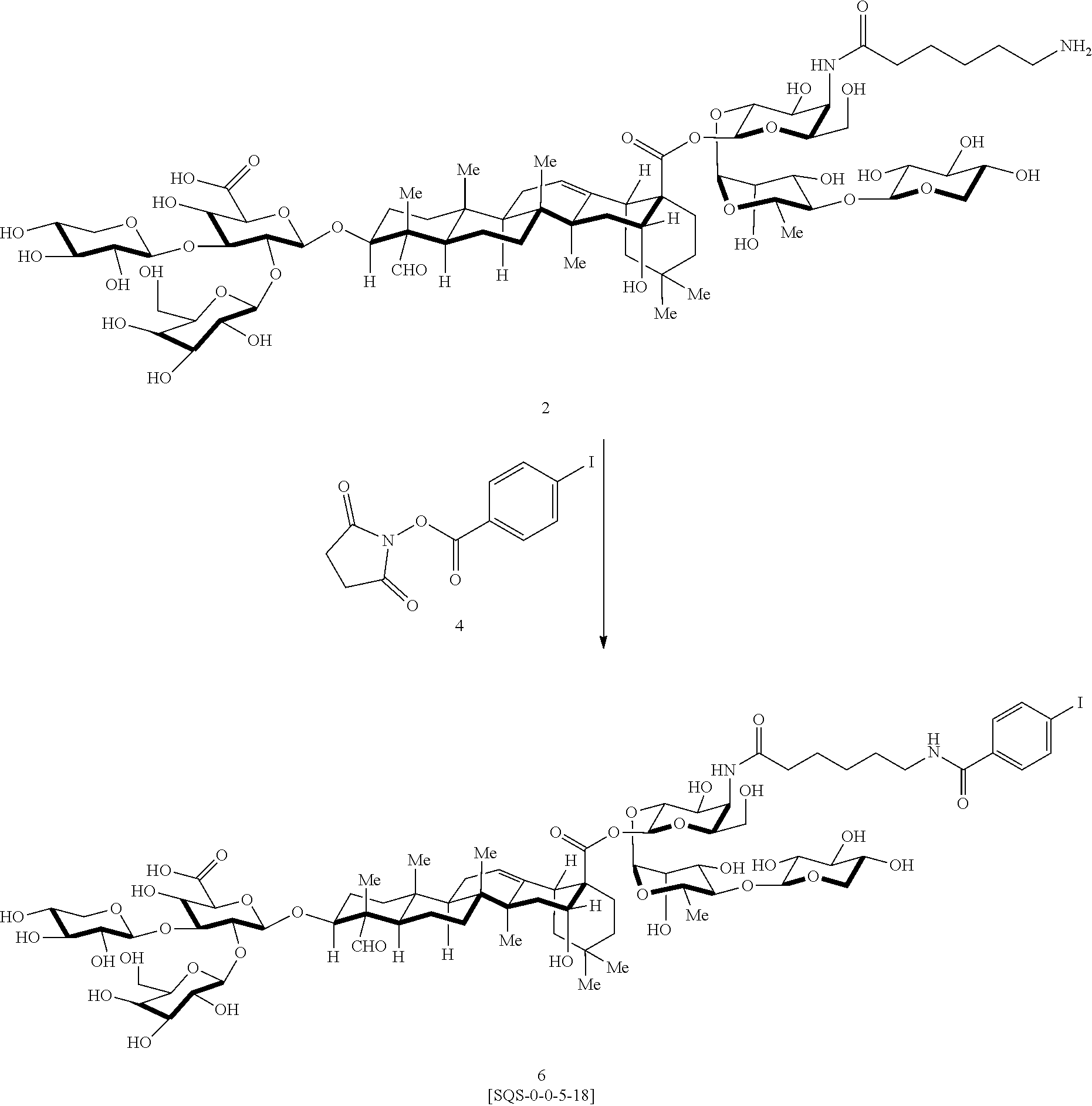


Claims (13)


Priority Applications (2)
| Application Number | Priority Date | Filing Date | Title |
|---|---|---|---|
| US17/694,180 US12187755B2 (en) | 2014-05-30 | 2022-03-14 | Minimal saponin analogues, synthesis and use thereof |
| US19/011,159 US20250223311A1 (en) | 2014-05-30 | 2025-01-06 | Minimal saponin analogues, synthesis and use thereof |
Applications Claiming Priority (5)
| Application Number | Priority Date | Filing Date | Title |
|---|---|---|---|
| US201462005302P | 2014-05-30 | 2014-05-30 | |
| PCT/US2015/033567 WO2015184451A1 (en) | 2014-05-30 | 2015-06-01 | Minimal saponin analogues, synthesis and use thereof |
| US201615314792A | 2016-11-29 | 2016-11-29 | |
| US16/853,393 US11274116B2 (en) | 2014-05-30 | 2020-04-20 | Minimal saponin analogues, synthesis and use thereof |
| US17/694,180 US12187755B2 (en) | 2014-05-30 | 2022-03-14 | Minimal saponin analogues, synthesis and use thereof |
Related Parent Applications (1)
| Application Number | Title | Priority Date | Filing Date |
|---|---|---|---|
| US16/853,393 Continuation US11274116B2 (en) | 2014-05-30 | 2020-04-20 | Minimal saponin analogues, synthesis and use thereof |
Related Child Applications (1)
| Application Number | Title | Priority Date | Filing Date |
|---|---|---|---|
| US19/011,159 Continuation US20250223311A1 (en) | 2014-05-30 | 2025-01-06 | Minimal saponin analogues, synthesis and use thereof |
Publications (2)
| Publication Number | Publication Date |
|---|---|
| US20220275017A1 US20220275017A1 (en) | 2022-09-01 |
| US12187755B2 true US12187755B2 (en) | 2025-01-07 |
Family
ID=54699970
Family Applications (4)
| Application Number | Title | Priority Date | Filing Date |
|---|---|---|---|
| US15/314,792 Active 2035-07-25 US10626137B2 (en) | 2014-05-30 | 2015-06-01 | Minimal saponin analogues, synthesis and use thereof |
| US16/853,393 Active US11274116B2 (en) | 2014-05-30 | 2020-04-20 | Minimal saponin analogues, synthesis and use thereof |
| US17/694,180 Active US12187755B2 (en) | 2014-05-30 | 2022-03-14 | Minimal saponin analogues, synthesis and use thereof |
| US19/011,159 Pending US20250223311A1 (en) | 2014-05-30 | 2025-01-06 | Minimal saponin analogues, synthesis and use thereof |
Family Applications Before (2)
| Application Number | Title | Priority Date | Filing Date |
|---|---|---|---|
| US15/314,792 Active 2035-07-25 US10626137B2 (en) | 2014-05-30 | 2015-06-01 | Minimal saponin analogues, synthesis and use thereof |
| US16/853,393 Active US11274116B2 (en) | 2014-05-30 | 2020-04-20 | Minimal saponin analogues, synthesis and use thereof |
Family Applications After (1)
| Application Number | Title | Priority Date | Filing Date |
|---|---|---|---|
| US19/011,159 Pending US20250223311A1 (en) | 2014-05-30 | 2025-01-06 | Minimal saponin analogues, synthesis and use thereof |
Country Status (14)
| Country | Link |
|---|---|
| US (4) | US10626137B2 (en) |
| EP (2) | EP3149015B1 (en) |
| JP (2) | JP6774943B2 (en) |
| KR (1) | KR102424785B1 (en) |
| CN (2) | CN106573951B (en) |
| AU (3) | AU2015266624A1 (en) |
| CA (1) | CA2950750C (en) |
| CL (1) | CL2016003048A1 (en) |
| DK (1) | DK3149015T3 (en) |
| ES (1) | ES2887400T3 (en) |
| IL (3) | IL290897B2 (en) |
| SG (2) | SG10202106403QA (en) |
| WO (1) | WO2015184451A1 (en) |
| ZA (4) | ZA201608255B (en) |
Families Citing this family (18)
| Publication number | Priority date | Publication date | Assignee | Title |
|---|---|---|---|---|
| KR102256410B1 (en) * | 2008-04-08 | 2021-05-26 | 슬로안-케테링인스티튜트퍼캔서리서치 | Triterpene saponins, methods of synthesis, and uses thereof |
| KR102424785B1 (en) * | 2014-05-30 | 2022-07-25 | 메모리얼 슬로안 케터링 캔서 센터 | Minimal saponin analogues, synthesis and use thereof |
| CN108778289B (en) * | 2015-11-06 | 2020-11-17 | 佐剂技术公司 | Triterpene saponin analogues |
| ES2944947T3 (en) | 2015-12-17 | 2023-06-27 | Memorial Sloan Kettering Cancer Center | Triterpene-saponin variants, methods of synthesis and use thereof |
| WO2018191598A1 (en) * | 2017-04-13 | 2018-10-18 | Adjuvance Technologies, Inc. | Triterpene saponin synthesis, intermediates and adjuvant combinations |
| CA3061205A1 (en) | 2017-04-25 | 2018-11-01 | Memorial Sloan Kettering Cancer Center | Triterpene saponin analogues |
| US20200164065A1 (en) * | 2017-04-25 | 2020-05-28 | Adjuvance Technologies, Inc. | Triterpene saponin analogues |
| SG11202001826YA (en) * | 2017-10-16 | 2020-03-30 | Adjuvance Technologies Inc | Triterpene saponin analogues |
| SG11202106603UA (en) | 2018-12-21 | 2021-07-29 | Sapreme Tech Bv | Biologically active cluster of molecules |
| ES3056941T3 (en) * | 2019-07-25 | 2026-02-25 | Sapreme Tech Bv | Saponin derivatives with improved therapeutic window |
| IL292796A (en) * | 2019-11-05 | 2022-07-01 | Adjuvance Tech Inc | Immunogenic preparations of varicella zoster and their uses |
| WO2021260054A2 (en) | 2020-06-24 | 2021-12-30 | Sapreme Technologies B.V. | Saponin derivatives with improved therapeutic window |
| EP4429674A4 (en) * | 2021-11-08 | 2025-10-08 | Adjuvance Tech Inc | ADJUVANT COMPOUNDS AND FORMULATIONS |
| EP4190359A1 (en) | 2021-12-03 | 2023-06-07 | Asociación Centro de Investigación Cooperativa en Biociencias - CIC bioGUNE | Saponin-based adjuvants and vaccines |
| EP4466278A1 (en) | 2022-01-19 | 2024-11-27 | Asociación Centro de Investigación Cooperativa en Biociencias - CIC bioGUNE | Saponin-based adjuvants and vaccines |
| CN117106004A (en) * | 2022-05-17 | 2023-11-24 | 北京科兴中维生物技术有限公司 | Triterpene saponin compounds and their preparation methods and applications |
| EP4698224A1 (en) | 2023-04-20 | 2026-02-25 | Asociación Centro de Investigación Cooperativa en Biociencias - CIC bioGUNE | Saponin derivatives as adjuvants and photoaffinity probes |
| CN117244053B (en) * | 2023-10-16 | 2024-04-26 | 国药中生生物技术研究院有限公司 | Adjuvant use of compound with hederagenin-O-Ara structure |
Citations (8)
| Publication number | Priority date | Publication date | Assignee | Title |
|---|---|---|---|---|
| WO2009126737A2 (en) | 2008-04-08 | 2009-10-15 | Sloan-Kettering Institute For Cancer Research | Triterpene saponins, methods of synthesis, and uses thereof |
| US20120136142A1 (en) | 2008-09-03 | 2012-05-31 | Southern Research Institute | Vaccine Compositions For Marburg Virus |
| CN103265606A (en) | 2013-05-31 | 2013-08-28 | 徐江平 | Hederagenin amide derivative and preparation method and application thereof |
| CN103694375A (en) | 2013-12-13 | 2014-04-02 | 北京大学 | Novel triterpene-cyclodextrin covalent compound and preparation method and use thereof |
| WO2014063441A1 (en) | 2012-10-22 | 2014-05-01 | 北京大学 | Triterpene derivative and its anti-influenza use |
| US10626137B2 (en) * | 2014-05-30 | 2020-04-21 | Memorial Sloan-Kettering Cancer Center | Minimal saponin analogues, synthesis and use thereof |
| US10906926B2 (en) * | 2015-11-06 | 2021-02-02 | Adjuvance Technologies, Inc. | Triterpene saponin analogues |
| US11324821B2 (en) * | 2017-10-16 | 2022-05-10 | Adjuvance Technologies, Inc. | Triterpene saponin analogues |
-
2015
- 2015-06-01 KR KR1020167036860A patent/KR102424785B1/en active Active
- 2015-06-01 ES ES15798814T patent/ES2887400T3/en active Active
- 2015-06-01 JP JP2017515877A patent/JP6774943B2/en active Active
- 2015-06-01 EP EP15798814.8A patent/EP3149015B1/en active Active
- 2015-06-01 SG SG10202106403QA patent/SG10202106403QA/en unknown
- 2015-06-01 EP EP21186590.2A patent/EP3929202A1/en active Pending
- 2015-06-01 CN CN201580041489.XA patent/CN106573951B/en active Active
- 2015-06-01 DK DK15798814.8T patent/DK3149015T3/en active
- 2015-06-01 WO PCT/US2015/033567 patent/WO2015184451A1/en not_active Ceased
- 2015-06-01 CA CA2950750A patent/CA2950750C/en active Active
- 2015-06-01 SG SG11201610004PA patent/SG11201610004PA/en unknown
- 2015-06-01 IL IL290897A patent/IL290897B2/en unknown
- 2015-06-01 CN CN202010832366.0A patent/CN112028951A/en active Pending
- 2015-06-01 AU AU2015266624A patent/AU2015266624A1/en not_active Abandoned
- 2015-06-01 US US15/314,792 patent/US10626137B2/en active Active
-
2016
- 2016-11-24 IL IL249196A patent/IL249196B/en active IP Right Grant
- 2016-11-28 CL CL2016003048A patent/CL2016003048A1/en unknown
- 2016-11-29 ZA ZA2016/08255A patent/ZA201608255B/en unknown
-
2018
- 2018-11-27 ZA ZA2018/08005A patent/ZA201808005B/en unknown
-
2019
- 2019-12-11 AU AU2019279971A patent/AU2019279971B2/en active Active
-
2020
- 2020-04-20 US US16/853,393 patent/US11274116B2/en active Active
- 2020-05-22 ZA ZA2020/03022A patent/ZA202003022B/en unknown
- 2020-08-12 IL IL276674A patent/IL276674B/en unknown
- 2020-10-05 JP JP2020168158A patent/JP7145188B2/en active Active
-
2021
- 2021-10-06 AU AU2021245129A patent/AU2021245129B2/en not_active Expired - Fee Related
-
2022
- 2022-03-14 US US17/694,180 patent/US12187755B2/en active Active
-
2023
- 2023-04-26 ZA ZA2023/04795A patent/ZA202304795B/en unknown
-
2025
- 2025-01-06 US US19/011,159 patent/US20250223311A1/en active Pending
Patent Citations (12)
| Publication number | Priority date | Publication date | Assignee | Title |
|---|---|---|---|---|
| WO2009126737A2 (en) | 2008-04-08 | 2009-10-15 | Sloan-Kettering Institute For Cancer Research | Triterpene saponins, methods of synthesis, and uses thereof |
| JP2011516566A (en) | 2008-04-08 | 2011-05-26 | スローン − ケタリング・インスティテュート・フォー・キャンサー・リサーチ | Triterpene saponin, its synthesis and use |
| US20130011421A1 (en) * | 2008-04-08 | 2013-01-10 | Sloan-Kettering Institute For Cancer Research | Triterpene saponins, methods of synthesis, and uses thereof |
| US20120136142A1 (en) | 2008-09-03 | 2012-05-31 | Southern Research Institute | Vaccine Compositions For Marburg Virus |
| WO2014063441A1 (en) | 2012-10-22 | 2014-05-01 | 北京大学 | Triterpene derivative and its anti-influenza use |
| CN103265606A (en) | 2013-05-31 | 2013-08-28 | 徐江平 | Hederagenin amide derivative and preparation method and application thereof |
| CN103694375A (en) | 2013-12-13 | 2014-04-02 | 北京大学 | Novel triterpene-cyclodextrin covalent compound and preparation method and use thereof |
| US10626137B2 (en) * | 2014-05-30 | 2020-04-21 | Memorial Sloan-Kettering Cancer Center | Minimal saponin analogues, synthesis and use thereof |
| CN106573951B (en) | 2014-05-30 | 2020-09-11 | 索隆-基特林癌症研究协会 | Micro saponin analogue, synthesis and use thereof |
| US11274116B2 (en) * | 2014-05-30 | 2022-03-15 | Memorial Sloan-Kettering Cancer Center | Minimal saponin analogues, synthesis and use thereof |
| US10906926B2 (en) * | 2015-11-06 | 2021-02-02 | Adjuvance Technologies, Inc. | Triterpene saponin analogues |
| US11324821B2 (en) * | 2017-10-16 | 2022-05-10 | Adjuvance Technologies, Inc. | Triterpene saponin analogues |
Non-Patent Citations (98)
| Title |
|---|
| Arrau et al. Journal of Ethnopharmacology, 2011, vol. 133(1), pp. 164-167 (2011). |
| Australian Examination Report dated Jun. 30, 2020 for Standard Australian Patent Application No. 2019279971. |
| Berge, et al. "Pharmaceutical Salts", Journal of Pharmaceutical Sciences, Jan. 1977, vol. 66, pp. 1-19 (Abstract Only). |
| Berge, Stephen M. et al., "Describe Pharmaceutically Acceptable salts in Detail," J. Pharmaceutical Sciences, vol. 66, pp. 1-19, 1977 [Cited in Parent U.S. Pat. No. 10,626,137 issued on Apr. 21, 2020]. |
| Berge, Stephen M. et al., "Describe Pharmaceutically Acceptable salts in Detail," J. Pharmaceutical Sciences, vol. 66, pp. 1-19, 1977. |
| Chea et al., Journal of the American Chemical Society, 2012, 134(32), pp. 13448-13457. (Year: 2012). |
| Chea et al., Journal of the American Chemical Society, 2012, vol. 134, No. 32, pp. 13448-13457 (Year: 2012). * |
| Chea, E.K., et al., "Synthesis and Preclinical Evaluation of QS-21 Variants Leading to Simplified Vaccine Adjuvants and Mechanistic Probes," J Am Chem Soc., Aug. 2012, vol. 134, No. 32, pp. 1-26. |
| Chea, Eric K. et al., "Synethsis and Preclinical Evaluation of Qs-21 Variants Leading to Simplified Vaccine Adjuvants and Mechanistic Probes," J. Am. Chem Soc, vol. 134, No. 32, pp. 13448-13457, Aug. 15, 2012 [Cited in Parent U.S. Pat. No. 10,626,137 issued on Apr. 21, 2020]. |
| Chea, Eric K. et al., "Synethsis and Preclinical Evaluation of Qs-21 Variants Leading to Simplified Vaccine Adjuvants and Mechanistic Probes," J. Am. Chem Soc, vol. 134, No. 32, pp. 13448-13457, Aug. 15, 2012. |
| Chile Examiner's Report dated Nov. 12, 2018 for Chile Patent Application No. 201603048 [Cited in Parent U.S. Pat. No. 10,626,137 issued on Apr. 21, 2020]. |
| Chile Examiner's Report dated Nov. 12, 2018 for Chile Patent Application No. 201603048. |
| Chilean Examiner's Report dated Jun. 18, 2018 for Chilean Patent Application No. 3048-2016 [Cited in Parent U.S. Pat. No. 10,626,137 issued on Apr. 21, 2020]. |
| Chiliean Examiner's Report dated Jun. 18, 2018 for Chilean Patent Application No. 3048-2016. |
| Communication pursuant to Article 94(1) EPC dated Mar. 4, 2019 for European Patent Application No. 15798814.8 [Cited in Parent U.S. Pat. No. 10,626,137 issued on Apr. 21, 2020]. |
| Communication pursuant to Article 94(3) EPC dated Mar. 4, 2019 for European Patent Application No. 15798814.8. |
| Communication pursuant to Article 94(3) EPC dated Nov. 6, 2019 for European Patent application No. 15798814.8 [Cited in Parent U.S. Pat. No. 10,626,137 issued on Apr. 21, 2020]. |
| Communication pursuant to Article 94(3) EPC dated Nov. 6, 2019 for European Patent application No. 15798814.8. |
| Communication Pursuant to Article 94(3) EPC for European Patent Application No. 21186590.2 mailed on Mar. 27, 2024. |
| Database Registry, Chemical Abstract Services, STN Accession No. 1424801-42-2, Mar. 18, 2013 [Cited in Parent U.S. Pat. No. 10,626,137 issued on Apr. 21, 2020]. |
| Database Registry, Chemical Abstract Services, STN Accession No. 1424801-42-2, Mar. 18, 2013. |
| Database Registry, Chemical Abstract Services, STN Accession No. 1596376-86-1, May 2, 2014 [Cited in Parent U.S. Pat. No. 10,626,137 issued on Apr. 21, 2020]. |
| Database Registry, Chemical Abstract Services, STN Accession No. 1596376-86-1, May 2, 2014. |
| Database Registry, Chemical Abstract Services, STN Accession No. 57539-70-5 and 30688-36-9, Nov. 16, 1984 [Cited in Parent U.S. Pat. No. 10,626,137 issued on Apr. 21, 2020]. |
| Database Registry, Chemical Abstract Services, STN Accession No. 57539-70-5 and 30688-36-9, Nov. 16, 1984. |
| Database Registry, Chemical Abstract Services, STN Accession No. 946617-18-1, Sep. 11, 2007 [Cited in Parent U.S. Pat. No. 10,626,137 issued on Apr. 21, 2020]. |
| Database Registry, Chemical Abstract Services, STN Accession No. 946617-18-1, Sep. 11, 2007. |
| Database Registry, Chemical Abstract Services, STN Accession No. 99633-30-4, Jan. 4, 1986 [Cited in Parent U.S. Pat. No. 10,626,137 issued on Apr. 21, 2020]. |
| Database Registry, Chemical Abstract Services, STN Accession No. 99633-30-4, Jan. 4, 1986. |
| Deng, Kai et al., "Synthesis and structure verification of the vaccine adjuvant QS-7-Api. Synthetic access to Homogeneous Quillaja Saponaria Immunostimulants," J. Am. Chem. Soc. 130, pp. 5860-5861, 2008 [Cited in Parent U.S. Pat. No. 10,626,137 issued on Apr. 21, 2020]. |
| Deng, Kai et al., "Synthesis and structure verification of the vaccine adjuvant QS-7-Api. Synthetic access to Homogeneous Quillaja Saponaria Immunostimulants," J. Am. Chem. Soc. 130, pp. 5860-5861, 2008. |
| Dissertation: "Design and Synthesis of Quillaja Saponin Adjuvants and Synthesis of Lablaboside Saponins," pp. 29-30, Dec. 31, 2013 [Cited in Parent U.S. Pat. No. 10,626,137 issued on Apr. 21, 2020]. |
| Dissertation: "Design and Synthesis of Quillaja Saponin Adjuvants and Synthesis of Lablaboside Saponins," pp. 29-30, Dec. 31, 2013. |
| E. Chea et al., "Synthesis and Preclinical Evaluation of QS-21 Variants Leading to Simplified Vaccine Adjuvants and Mechanistic Probes" J. Am. Chem. Soc., 2012, 134, 13448-13457. |
| Elgama et al., "A Novel Triterpene Saonin from Gypsohila capillaris", 1995, Zeitschrift fur Naturforschung, vol. 50b, pp. 563-567. |
| Elgama et al., "A Novel Triterpene Saonin from Gypsohila capillaris", 1995, Zeltschim fur Naturforschung, vol. 50b, pp. 563-567 [Cited in Parent U.S. Pat. No. 10,626,137 issued on Apr. 21, 2020]. |
| Elgamal, M. Hani. A et al., Isolation of Triterpene Saponins from Gypsophila Capillaris, Phytochemistry, vol. 38, No. 6, pp. 1481-1485, 1995 [Cited in Parent U.S. Pat. No. 10,626,137 issued on Apr. 21, 2020]. |
| Elgamal, M. Hani. A et al., Isolation of Triterpene Saponins from Gypsophila Capillaris, Phytochemistry, vol. 38, No. 6, pp. 1481-1485, 1995. |
| Elgamal, M.H.A., et al., "Isolation of Triterpene Saponins from Gypsophila Capillaris," Phytochemistry, 1995, vol. 38, No. 6, pp. 1481-1485. |
| European Search Report for European Divisional Patent Application No. 21186590.2 mailed on Oct. 12, 2021. |
| Examination Report dated Aug. 26, 2019 for Indian Application No. 201627040808 [Cited in Parent U.S. Pat. No. 10,626,137 issued on Apr. 21, 2020]. |
| Examination Report dated Aug. 26, 2019 for Indian Application No. 201627040808. |
| Examination Report No. 1 for Standard patent Application dated Dec. 11, 2018 for Australian Patent Application No. 2015266624 [Cited in Parent U.S. Pat. No. 10,626,137 issued on Apr. 21, 2020]. |
| Examination Report No. 1 for Standard Patent Application dated Dec. 11, 2018 for Australian Patent Application No. 2015266624. |
| Extended European Search Report issued on Nov. 27, 2017 for European Patent Application No. 15798814.8 [Cited in Parent U.S. Pat. No. 10,626,137 issued on Apr. 21, 2020]. |
| Extended European Search Report issued on Nov. 27, 2017 for European Patent Application No. 15798814.8. |
| Fernandez-Tejada, Alberto et al., "Design, Synthesis, and Immunologic Evaluation of vaccine Adjuvant Conjugates based on QS-21 and Tucaresol," Bioorganic & Medicinal Chemistry, vol. 22, pp. 5917-5923, 2014 [Cited in Parent U.S. Pat. No. 10,626,137 issued on Apr. 21, 2020]. |
| Fernandez-Tejada, Alberto et al., "Design, Synthesis, and Immunologic Evaluation of vaccine Adjuvant Conjugates based on QS-21 and Tucaresol," Bioorganic & Medicinal Chemistry, vol. 22, pp. 5917-5923, 2014. |
| Fernandez-Tejada, Alberto et al., "Development of Minimal Saponin Vaccine Adjuvant Based on Qs-21," Nature Chemistry, vol. 6, No. 7, pp. 635-643, Jun. 1, 2014 [Cited in Parent U.S. Pat. No. 10,626,137 issued on Apr. 21, 2020]. |
| Fernandez-Tejada, Alberto et al., "Development of Minimal Saponin Vaccine Adjuvant Based on Qs-21," Nature Chemistry, vol. 6, No. 7, pp. 635-643, Jun. 1, 2014. |
| First Examiner's Report dated Jun. 21, 2018 for Singapore Patent Application No. 201603048 [Cited in Parent U.S. Pat. No. 10,626,137 issued on Apr. 21, 2020]. |
| First Examiner's Report dated Jun. 21, 2018 or Singapore Patent Application No. 201603048. |
| First Official notification dated Jan. 14, 2021 issued in Israeli Patent Application No. 276674. |
| Hani, M. et al., "A Novel Triterpene Saponin from Gypsophila Capillaris," pp. 563-567, Apr. 1, 1995, [Retrieved from the Internet] <https://www.degruyter.com/downloadpdf/j/znb.1995.50.issue-4/znb-1995-0415/znb-1995-0415.pdf> [Cited in Parent U.S. Pat. No. 10,626,137 issued on Apr. 21, 2020]. |
| Hani, M. et al., "A Novel Triterpene Saponin from Gypsophila Capillaris," pp. 563-567, Apr. 1, 1995, [Retrieved from the Internet] <https://www.degruyter.com/downloadpdf/j/znb.1995.50.issue-4/znb-1995-0415/znb-1995-0415.pdf>. |
| Hani, M. et al., "A Novel Triterpene Sapoonin Gypsophila Capillaris," pp. 563-567, Apr. 1, 1995, [Retrieved from the Internet] <https://www.degruyter.com/downloadpdf/j/znb.1995.50.issue-4/znb-1995-0415/znb-1995-0415.pdf. |
| Hani, M. et al., "Isolation of Triterpene Saponins from Gypsophila Capillaris" Phytochemistry, 1995, vol. 38, No. 6, pp. 1481-1485 [Cited in Parent U.S. Pat. No. 10,626, 137 issued on Apr. 21, 2020]. |
| Hani, M. et al., "Isolation of Triterpene Saponins from Gypsophila Capillaris" Phytochemistry, 1995, vol. 38, No. 6, pp. 1481-1485. |
| International Search Report and Written Opinion for International Patent Application No. PCT/US15/33567 mailed Aug. 12, 2015. |
| International Search Report and Written Opinion, issued in International Patent Application No. PCT/US15/33567, mailed Aug. 12, 2015. [Cited in Parent U.S. Pat. No. 10,626,137 issued on Apr. 21, 2020]. |
| Invitation to Respond to Written Opinion dated Oct. 5, 2018 for Singapore Patent application No. 11201610004P [Cited in Parent U.S. Pat. No. 10,626,137 issued on Apr. 21, 2020]. |
| Invitation to Respond to Written Opinion dated Oct. 5, 2018 for Singapore Patent application No. 11201610004P. |
| Koziorowski, et al. "A new convenient route to radioiodinated N-succinimidyl 3- and 4-iodobenzoate, two reagents for radioiodination of proteins", Applied Radiation and Isotopes, 1998, vol. 49, pp. 955-959. (Abstract Only). |
| Koziorowski, J., et al., "A New Convenient Route to Radioiodinated N-succinimidyl 3- and 4-iodobenzoate, Two Reagents for Radioiodination of proteins," Appl. Radiat. Isot., vol. 49, pp. 955-959, 1998 [Cited in Parent U.S. Pat. No. 10,626,137 issued on Apr. 21, 2020]. |
| Koziorowski, J., et al., "A New Convenient Route to Radioiodinated N-succinimidyl 3- and 4-iodobenzoate, Two Reagents for Radioiodination of proteins," Appl. Radiat. Isot., vol. 49, pp. 955-959, 1998. |
| Luo, Jian-Guang et al., "New Triterpenoid Saponins with Strong *-glucosidase Inhibitory Activity from the Roost of Gypsophila Oldhamiana," Bioorganic & Medicinal Chemistry, vol. 16, pp. 2912-2920, 2008 [Cited in Parent U.S. Pat. No. 10,626,137 issued on Apr. 21, 2020]. |
| Luo, Jian-Guang et al., "New Triterpenoid Saponins with Strong *-glucosidase Inhibitory Activity from the Roost of Gypsophila Oldhamiana," Bioorganic & Medicinal Chemistry, vol. 16, pp. 2912-2920, 2008. |
| Luo, Jian-Guang et al., "New triterpenoid saponins with strong . . . ", 2008, Bioorganic & Medicinal Chemistry, vol. 16, pp. 2912-2920. |
| Luo, Jian-Guang et al., New triterpenoid saponins with strong . . . , 2008, Bloorganic & Medicinal Chemistry, vol. 16, pp. 2912-2920 [Cited in Parent U.S. Pat. No. 10,626,137 issued on Apr. 21, 2020]. |
| Ma, Li et al., "Triterpenoid Saponins from Dianthus Versicolor," J. Nat. Prod. vol. 72, No. 4, pp. 640-644, Apr. 24, 2009 [Cited in Parent U.S. Pat. No. 10,626,137 issued on Apr. 21, 2020]. |
| Ma, Li et al., "Triterpenoid Saponins from Dianthus Versicolor," J. Nat. Prod. vol. 72, No. 4, pp. 640-644, Apr. 24, 2009. |
| McNab, Jennifer A. et al., "Quantitative Short Echo-Time 1H Laser-CSI in Human Brain at 4T," NMR in Biomedicine, vol. 19, pp. 999-1009, 2006 [Cited in Parent U.S. Pat. No. 10,626,137 issued on Apr. 21, 2020]. |
| McNab, Jennifer A. et al., "Quantitative Short Echo-Time 1H Laser-CSI in Human Brain at 4T," NMR in Biomedicine, vol. 19, pp. 999-1009, 2006. |
| Notification of Reasons for Refusal dated Jun. 25, 2019 for Japanese Patent Application No. 2017-515877 [Cited in Parent U.S. Pat. No. 10,626,137 issued on Apr. 21, 2020]. |
| Notification of Reasons for Refusal dated Jun. 25, 2019 for Japanese Patent Application No. 2017-515877. |
| Notification of Reasons for Refusal for Japanese Patent Application No. 2020-168158 mailed on Dec. 28, 2021. |
| Notification of Reasons for Refusal for Korean Patent Application No. 10-2016-7036860 mailed on Nov. 24, 2021 with English Translation. |
| Notification of the Second Office Action dated Apr. 16, 2019 for Chinese Patent Application No. 201580041489.X. |
| Notification of the Second Oft1ce Action dated Apr. 16, 2019 for Chinese Patent Application No. 201580041489.X [Cited in Parent U.S. Pat. No. 10,626,137 issued on Apr. 21, 2020]. |
| Notification of the Third Office Action dated Sep. 29, 2019 for Chinese Patent application No. 201580041489.X [Cited in Parent U.S. Pat. No. 10,626,137 issued on Apr. 21, 2020]. |
| Notification of the Third Office Action dated Sep. 29, 2019 for Chinese Patent application No. 201580041489.X. |
| Office Action dated Jul. 13, 2021 for Canadian Patent Application No. 2,950,750. |
| Office Action issued on Nov. 28, 2017 for Singapore Patent Application No. 11201610004P [Cited in Parent U.S. Pat. No. 10,626,137 issued on Apr. 21, 2020]. |
| Office Action issued on Nov. 28, 2017 for Singapore Patent Application No. 11201610004P. |
| Plechanovová, A., et al., "Novel Substrate-Based Inhibitors of Human Glutamate Carboxypeptidase II with Enhanced Lipophilicity," J Med Chem., Nov. 2011, vol. 54, No. 21, pp. 1-24. |
| Plechanovova, Anna et al., "Novel Substrate-Based Inhibitors of Human Glutamate Carboxypeptidase II with Enhanced Lipophilicity," J Med Chem, vol. 54, No. 21, pp. 7535-7546, Nov. 10, 2011 [Cited in Parent U.S. Pat. No. 10,626,137 issued on Apr. 21, 2020]. |
| Plechanovova, Anna et al., "Novel Substrate-Based Inhibitors of Human Glutamate Carboxypeptidase II with Enhanced Lipophilicity," J Med Chem, vol. 54, No. 21, pp. 7535-7546, Nov. 10, 2011. |
| Quang et al., Journal of Natural Products, 2011, vol. 74, pp. 1098-1915. |
| Quang et al., Journal of Natural Products, 2011, vol. 74, pp. 1908-1915 (Year: 2011). * |
| Second Chinese Office Action mailed on Nov. 1, 2023 for Chinese Divisional Patent Application No. 202010932366.0 w/ English translation. |
| Shell, Thomas A., "Selective Targeting of DNA for cleavage within DNA-Histone Assemblies by a Spermine—[CpW (CO)3Ph]2 Conjugate," Org. Biomol. Chem., vol. 3, pp. 3091-3093, 2005 [Cited in Parent U.S. Pat. No. 10,626,137 issued on Apr. 21, 2020]. |
| Shell, Thomas A., "Selective Targeting of DNA for cleavage within DNA-Histone Assemblies by a Spermine-[CpW (CO)3Ph]2 Conjugate," Org. Biomol. Chem., vol. 3, pp. 3091-3093, 2005. |
| Singapore Written Opinion issued on Oct. 2, 2018 for Singapore Patent Application 11201610004P. |
| Zhi, Yong-Gang et al., "Systematic studies on Photoluminescence of oligo(arylene-ethynylene)s: tunability of excited states and derivatization as luminescent labeling probes for proteins," Eur. J. Org. Chem., pp. 3125-3139, 2006 [Cited in Parent U.S. Pat. No. 10,626,137 issued on Apr. 21, 2020]. |
| Zhi, Yong-Gang et al., "Systematic studies on Photoluminescence of oligo(arylene-ethynylene)s: tunability of excited states and derivatization as luminescent labeling probes for proteins," Eur. J. Org. Chem., pp. 3125-3139, 2006. |
| Zou, Cheng et al., "Diacylated Triterpenoid Saponin from Silene szechuensis" Chinese Chemical Letters, 1999, vol. 10, No. 1, pp. 33-36 [Cited in Parent U.S. Pat. No. 10,626,137 issued on Apr. 21, 2020]. |
| Zou, Cheng et al., "Diacylated Triterpenoid Saponin from Silene szechuensis" Chinese Chemical Letters, 1999, vol. 10, No. 1, pp. 33-36. |
| Zou, Cheng et al., "Diacylated Triterpenoid Saponin from Silene Szechunsis," Chinese Chemical Letters, vol. 10, No. 1, pp. 33-36, 1999. |
Also Published As
Similar Documents
| Publication | Publication Date | Title |
|---|---|---|
| US12187755B2 (en) | Minimal saponin analogues, synthesis and use thereof | |
| US12227535B2 (en) | Triterpene saponins, methods of synthesis and uses thereof | |
| US20230357300A1 (en) | Triterpene saponin synthesis, intermediates and adjuvant combinations | |
| WO2017106836A1 (en) | Triterpene saponin variants, methods of synthesis and use thereof | |
| HK40065698A (en) | Minimal saponin analogues, synthesis and use thereof | |
| HK1236537B (en) | Minimal saponin analogues, synthesis and use thereof | |
| HK1236537A1 (en) | Minimal saponin analogues, synthesis and use thereof |
Legal Events
| Date | Code | Title | Description |
|---|---|---|---|
| AS | Assignment |
Owner name: MEMORIAL SLOAN-KETTERING CANCER CENTER, NEW YORK Free format text: ASSIGNMENT OF ASSIGNORS INTEREST;ASSIGNORS:GIN, DAVID Y.;CHEA, ERIC K.;FERNANDEZ-TEJADA, ALBERTO;AND OTHERS;SIGNING DATES FROM 20170512 TO 20170531;REEL/FRAME:059258/0528 |
|
| FEPP | Fee payment procedure |
Free format text: ENTITY STATUS SET TO UNDISCOUNTED (ORIGINAL EVENT CODE: BIG.); ENTITY STATUS OF PATENT OWNER: SMALL ENTITY |
|
| FEPP | Fee payment procedure |
Free format text: ENTITY STATUS SET TO SMALL (ORIGINAL EVENT CODE: SMAL); ENTITY STATUS OF PATENT OWNER: SMALL ENTITY |
|
| STPP | Information on status: patent application and granting procedure in general |
Free format text: DOCKETED NEW CASE - READY FOR EXAMINATION |
|
| STPP | Information on status: patent application and granting procedure in general |
Free format text: NON FINAL ACTION MAILED |
|
| STPP | Information on status: patent application and granting procedure in general |
Free format text: RESPONSE TO NON-FINAL OFFICE ACTION ENTERED AND FORWARDED TO EXAMINER |
|
| STPP | Information on status: patent application and granting procedure in general |
Free format text: FINAL REJECTION MAILED |
|
| STPP | Information on status: patent application and granting procedure in general |
Free format text: RESPONSE AFTER FINAL ACTION FORWARDED TO EXAMINER |
|
| STPP | Information on status: patent application and granting procedure in general |
Free format text: NOTICE OF ALLOWANCE MAILED -- APPLICATION RECEIVED IN OFFICE OF PUBLICATIONS |
|
| STPP | Information on status: patent application and granting procedure in general |
Free format text: PUBLICATIONS -- ISSUE FEE PAYMENT VERIFIED |
|
| STCF | Information on status: patent grant |
Free format text: PATENTED CASE |