US12186717B2 - Mixer, mixer assembly and mixing method - Google Patents

Mixer, mixer assembly and mixing method Download PDF

Info

Publication number
US12186717B2
US12186717B2 US17/896,409 US202217896409A US12186717B2 US 12186717 B2 US12186717 B2 US 12186717B2 US 202217896409 A US202217896409 A US 202217896409A US 12186717 B2 US12186717 B2 US 12186717B2
Authority
US
United States
Prior art keywords
swirl
spray
mixer
doser
inlet
Prior art date
Legal status (The legal status is an assumption and is not a legal conclusion. Google has not performed a legal analysis and makes no representation as to the accuracy of the status listed.)
Active, expires
Application number
US17/896,409
Other versions
US20230065989A1 (en
Inventor
Ludovic GEANT
Jian Gao
Thibault Fouquet
Current Assignee (The listed assignees may be inaccurate. Google has not performed a legal analysis and makes no representation or warranty as to the accuracy of the list.)
Faurecia Emissions Control Technologies Development Shanghai Co Ltd
Cummins Emission Solutions Inc
Original Assignee
Cummins Emission Solutions Inc
Priority date (The priority date is an assumption and is not a legal conclusion. Google has not performed a legal analysis and makes no representation as to the accuracy of the date listed.)
Filing date
Publication date
Application filed by Cummins Emission Solutions Inc filed Critical Cummins Emission Solutions Inc
Publication of US20230065989A1 publication Critical patent/US20230065989A1/en
Assigned to Faurecia Emission Control Technologies (Shanghai) Co., Ltd reassignment Faurecia Emission Control Technologies (Shanghai) Co., Ltd ASSIGNMENT OF ASSIGNORS INTEREST (SEE DOCUMENT FOR DETAILS). Assignors: GAO, JIAN, GEANT, Ludovic, Fouquet, Thibault
Application granted granted Critical
Publication of US12186717B2 publication Critical patent/US12186717B2/en
Active legal-status Critical Current
Adjusted expiration legal-status Critical

Links

Images

Classifications

    • BPERFORMING OPERATIONS; TRANSPORTING
    • B01PHYSICAL OR CHEMICAL PROCESSES OR APPARATUS IN GENERAL
    • B01FMIXING, e.g. DISSOLVING, EMULSIFYING OR DISPERSING
    • B01F25/00Flow mixers; Mixers for falling materials, e.g. solid particles
    • B01F25/10Mixing by creating a vortex flow, e.g. by tangential introduction of flow components
    • B01F25/103Mixing by creating a vortex flow, e.g. by tangential introduction of flow components with additional mixing means other than vortex mixers, e.g. the vortex chamber being positioned in another mixing chamber
    • BPERFORMING OPERATIONS; TRANSPORTING
    • B01PHYSICAL OR CHEMICAL PROCESSES OR APPARATUS IN GENERAL
    • B01FMIXING, e.g. DISSOLVING, EMULSIFYING OR DISPERSING
    • B01F23/00Mixing according to the phases to be mixed, e.g. dispersing or emulsifying
    • B01F23/20Mixing gases with liquids
    • B01F23/21Mixing gases with liquids by introducing liquids into gaseous media
    • B01F23/213Mixing gases with liquids by introducing liquids into gaseous media by spraying or atomising of the liquids
    • B01F23/2132Mixing gases with liquids by introducing liquids into gaseous media by spraying or atomising of the liquids using nozzles
    • BPERFORMING OPERATIONS; TRANSPORTING
    • B01PHYSICAL OR CHEMICAL PROCESSES OR APPARATUS IN GENERAL
    • B01FMIXING, e.g. DISSOLVING, EMULSIFYING OR DISPERSING
    • B01F25/00Flow mixers; Mixers for falling materials, e.g. solid particles
    • B01F25/30Injector mixers
    • B01F25/31Injector mixers in conduits or tubes through which the main component flows
    • B01F25/313Injector mixers in conduits or tubes through which the main component flows wherein additional components are introduced in the centre of the conduit
    • BPERFORMING OPERATIONS; TRANSPORTING
    • B01PHYSICAL OR CHEMICAL PROCESSES OR APPARATUS IN GENERAL
    • B01FMIXING, e.g. DISSOLVING, EMULSIFYING OR DISPERSING
    • B01F25/00Flow mixers; Mixers for falling materials, e.g. solid particles
    • B01F25/30Injector mixers
    • B01F25/31Injector mixers in conduits or tubes through which the main component flows
    • B01F25/313Injector mixers in conduits or tubes through which the main component flows wherein additional components are introduced in the centre of the conduit
    • B01F25/3131Injector mixers in conduits or tubes through which the main component flows wherein additional components are introduced in the centre of the conduit with additional mixing means other than injector mixers, e.g. screens, baffles or rotating elements
    • BPERFORMING OPERATIONS; TRANSPORTING
    • B01PHYSICAL OR CHEMICAL PROCESSES OR APPARATUS IN GENERAL
    • B01FMIXING, e.g. DISSOLVING, EMULSIFYING OR DISPERSING
    • B01F25/00Flow mixers; Mixers for falling materials, e.g. solid particles
    • B01F25/30Injector mixers
    • B01F25/31Injector mixers in conduits or tubes through which the main component flows
    • B01F25/313Injector mixers in conduits or tubes through which the main component flows wherein additional components are introduced in the centre of the conduit
    • B01F25/3133Injector mixers in conduits or tubes through which the main component flows wherein additional components are introduced in the centre of the conduit characterised by the specific design of the injector
    • FMECHANICAL ENGINEERING; LIGHTING; HEATING; WEAPONS; BLASTING
    • F01MACHINES OR ENGINES IN GENERAL; ENGINE PLANTS IN GENERAL; STEAM ENGINES
    • F01NGAS-FLOW SILENCERS OR EXHAUST APPARATUS FOR MACHINES OR ENGINES IN GENERAL; GAS-FLOW SILENCERS OR EXHAUST APPARATUS FOR INTERNAL-COMBUSTION ENGINES
    • F01N3/00Exhaust or silencing apparatus having means for purifying, rendering innocuous, or otherwise treating exhaust
    • F01N3/08Exhaust or silencing apparatus having means for purifying, rendering innocuous, or otherwise treating exhaust for rendering innocuous
    • F01N3/10Exhaust or silencing apparatus having means for purifying, rendering innocuous, or otherwise treating exhaust for rendering innocuous by thermal or catalytic conversion of noxious components of exhaust
    • F01N3/18Exhaust or silencing apparatus having means for purifying, rendering innocuous, or otherwise treating exhaust for rendering innocuous by thermal or catalytic conversion of noxious components of exhaust characterised by methods of operation; Control
    • F01N3/20Exhaust or silencing apparatus having means for purifying, rendering innocuous, or otherwise treating exhaust for rendering innocuous by thermal or catalytic conversion of noxious components of exhaust characterised by methods of operation; Control specially adapted for catalytic conversion
    • F01N3/206Adding periodically or continuously substances to exhaust gases for promoting purification, e.g. catalytic material in liquid form, NOx reducing agents
    • F01N3/2066Selective catalytic reduction [SCR]
    • FMECHANICAL ENGINEERING; LIGHTING; HEATING; WEAPONS; BLASTING
    • F01MACHINES OR ENGINES IN GENERAL; ENGINE PLANTS IN GENERAL; STEAM ENGINES
    • F01NGAS-FLOW SILENCERS OR EXHAUST APPARATUS FOR MACHINES OR ENGINES IN GENERAL; GAS-FLOW SILENCERS OR EXHAUST APPARATUS FOR INTERNAL-COMBUSTION ENGINES
    • F01N3/00Exhaust or silencing apparatus having means for purifying, rendering innocuous, or otherwise treating exhaust
    • F01N3/08Exhaust or silencing apparatus having means for purifying, rendering innocuous, or otherwise treating exhaust for rendering innocuous
    • F01N3/10Exhaust or silencing apparatus having means for purifying, rendering innocuous, or otherwise treating exhaust for rendering innocuous by thermal or catalytic conversion of noxious components of exhaust
    • F01N3/24Exhaust or silencing apparatus having means for purifying, rendering innocuous, or otherwise treating exhaust for rendering innocuous by thermal or catalytic conversion of noxious components of exhaust characterised by constructional aspects of converting apparatus
    • F01N3/28Construction of catalytic reactors
    • F01N3/2892Exhaust flow directors or the like, e.g. upstream of catalytic device
    • BPERFORMING OPERATIONS; TRANSPORTING
    • B01PHYSICAL OR CHEMICAL PROCESSES OR APPARATUS IN GENERAL
    • B01FMIXING, e.g. DISSOLVING, EMULSIFYING OR DISPERSING
    • B01F25/00Flow mixers; Mixers for falling materials, e.g. solid particles
    • B01F2025/93Arrangements, nature or configuration of flow guiding elements
    • B01F2025/931Flow guiding elements surrounding feed openings, e.g. jet nozzles
    • FMECHANICAL ENGINEERING; LIGHTING; HEATING; WEAPONS; BLASTING
    • F01MACHINES OR ENGINES IN GENERAL; ENGINE PLANTS IN GENERAL; STEAM ENGINES
    • F01NGAS-FLOW SILENCERS OR EXHAUST APPARATUS FOR MACHINES OR ENGINES IN GENERAL; GAS-FLOW SILENCERS OR EXHAUST APPARATUS FOR INTERNAL-COMBUSTION ENGINES
    • F01N2240/00Combination or association of two or more different exhaust treating devices, or of at least one such device with an auxiliary device, not covered by indexing codes F01N2230/00 or F01N2250/00, one of the devices being
    • F01N2240/20Combination or association of two or more different exhaust treating devices, or of at least one such device with an auxiliary device, not covered by indexing codes F01N2230/00 or F01N2250/00, one of the devices being a flow director or deflector
    • FMECHANICAL ENGINEERING; LIGHTING; HEATING; WEAPONS; BLASTING
    • F01MACHINES OR ENGINES IN GENERAL; ENGINE PLANTS IN GENERAL; STEAM ENGINES
    • F01NGAS-FLOW SILENCERS OR EXHAUST APPARATUS FOR MACHINES OR ENGINES IN GENERAL; GAS-FLOW SILENCERS OR EXHAUST APPARATUS FOR INTERNAL-COMBUSTION ENGINES
    • F01N2610/00Adding substances to exhaust gases
    • FMECHANICAL ENGINEERING; LIGHTING; HEATING; WEAPONS; BLASTING
    • F01MACHINES OR ENGINES IN GENERAL; ENGINE PLANTS IN GENERAL; STEAM ENGINES
    • F01NGAS-FLOW SILENCERS OR EXHAUST APPARATUS FOR MACHINES OR ENGINES IN GENERAL; GAS-FLOW SILENCERS OR EXHAUST APPARATUS FOR INTERNAL-COMBUSTION ENGINES
    • F01N2610/00Adding substances to exhaust gases
    • F01N2610/14Arrangements for the supply of substances, e.g. conduits
    • F01N2610/1453Sprayers or atomisers; Arrangement thereof in the exhaust apparatus
    • YGENERAL TAGGING OF NEW TECHNOLOGICAL DEVELOPMENTS; GENERAL TAGGING OF CROSS-SECTIONAL TECHNOLOGIES SPANNING OVER SEVERAL SECTIONS OF THE IPC; TECHNICAL SUBJECTS COVERED BY FORMER USPC CROSS-REFERENCE ART COLLECTIONS [XRACs] AND DIGESTS
    • Y02TECHNOLOGIES OR APPLICATIONS FOR MITIGATION OR ADAPTATION AGAINST CLIMATE CHANGE
    • Y02TCLIMATE CHANGE MITIGATION TECHNOLOGIES RELATED TO TRANSPORTATION
    • Y02T10/00Road transport of goods or passengers
    • Y02T10/10Internal combustion engine [ICE] based vehicles
    • Y02T10/12Improving ICE efficiencies

Definitions

  • the present invention relates to a technical field of engine exhaust treatment, in particular to a mixer, an exhaust system and a mixing method.
  • Engine exhaust system processes the hot exhaust generated by the engine through various upstream exhaust components to reduce emissions.
  • Various upstream exhaust components may comprise one or more of the following components: pipes, filters, valves, catalytic converters, silencers, etc.
  • the upstream exhaust treatment component directs the exhaust to a selective catalytic reduction (SCR) catalyst with inlet and outlet.
  • SCR selective catalytic reduction
  • the outlet leads the exhaust to downstream exhaust components.
  • the mixer is positioned upstream of the inlet of the SCR catalyst. In the mixer, the exhaust generates swirling motion or rotary motion.
  • the doser is used to spray reductant such as a urea aqueous solution into the exhaust stream from the upstream of SCR catalyst, so that the mixer can fully mix the urea and the exhaust, and discharge them to the SCR catalyst for reduction reaction to generate nitrogen and water, so as to reduce nitrogen oxide emissions of the engine.
  • the doser can be fixedly installed through the mounting base of the mixer to spray urea aqueous solution into the mixer.
  • the urea spray sprayed from the doser needs to be fully decomposed and evenly mixed with exhaust to avoid urea crystallization.
  • the object of the present invention is to provide a mixer.
  • Another object of the present invention is to provide a mixer assembly.
  • Another object of the present invention is to provide a mixing method.
  • the mixer is used for an engine exhaust system.
  • the mixer comprises: a shell defining a first space, wherein the first space receives engine exhaust, and the shell has a mounting area located on a wall of the shell; a doser mounting base arranged in the mounting area for mounting the doser, wherein the doser mounting base comprises a spray inlet as an inlet end of the first space for the spray that is sprayed by the doser entering the first space, and the doser mounting base further comprises a first swirl structure that surrounds the spray inlet to make the exhaust forms a swirl around the spray inlet.
  • the doser mounting base comprises a mounting plate for mounting in the mounting area, the mounting plate is provided with a spray inlet, the doser mounting base further comprises a swirl base, the swirl base is fixed to the mounting plate, the swirl base is provided with a spiral flow passage, and the spiral flow passage surrounds the spray inlet, the spiral flow passage forms the first swirl structure.
  • an edge of the swirl base has a notch
  • the spiral flow passage extends from the notch to an end of the spiral flow passage, and is tangent to a profile line of the spray inlet.
  • the doser mounting base comprises a mounting plate for mounting in the mounting area, the mounting plate is provided with a spray inlet, the doser mounting base further comprises a swirl blade component, the swirl blade component is arranged around the spray inlet, and the swirl blade component constitutes the first swirl structure.
  • the doser mounting base comprises a mounting plate for mounting in the mounting area, the mounting plate is provided with a spray inlet, the doser mounting base further comprises a swirl base, the swirl base is fixed to the mounting plate, the swirl base is provided with a spiral flow passage, and the spiral flow passage surrounds the spray inlet, the doser mounting base further comprises a swirl blade component, swirl blades of the swirl blade component are distributed on an inner side of the spiral flow passage, and the spiral flow passage and the swirl blade component constitute the first swirl structure.
  • the swirl base is welded and fixed to the mounting plate, or the swirl base and the mounting plate are integrated.
  • the shell comprises a swirl cone, a small end of the swirl cone is provided corresponding to the spray inlet, a side wall of the swirl cone has an air inlet opening, and the air inlet opening is provided with a second swirl structure.
  • the side wall of the swirl cone has a plurality of air inlet openings distributed along a circumferential direction
  • the second swirl structure comprises at least one swirl blade component provided with the air inlet openings.
  • a mixer assembly comprises a doser and the mixer described in any one of the above items.
  • the doser is installed on the doser mounting base, and a spray end of the doser is located at the spray inlet, therefore the spray of reductant solution sprayed by the doser is released into the mixer from the spray inlet.
  • the reductant solution is a urea solution.
  • a mixing method which is used for mixing exhaust and spray of reductant solution, comprising: making spray of a reductant solution enter a mixing chamber from a spray inlet of the mixing chamber; making at least a part of the exhaust forms swirling exhaust at the spray inlet, and mixing the swirling exhaust with the spray at the spray inlet.
  • the progressive effects of the present invention include but are not limited to: by providing the first swirl structure around the spray inlet, the spray of the doser is fully mixed with the swirling exhaust immediately after entering the mixer, so that the spray is fully decomposed to reduce urea crystallization, improve the mixing effect of the mixer, and prolong the service life of the mixer assembly and the exhaust system.
  • FIG. 1 is a structural diagram of a mixer assembly according to an embodiment.
  • FIG. 2 is a partial structural diagram of a mixer according to an embodiment.
  • FIG. 3 is a partial structural diagram of a mixer according to an embodiment.
  • FIG. 4 is a structural diagram of a doser mounting base of a mixer according to an embodiment.
  • FIG. 5 is a structural diagram of a doser mounting base of a mixer according to another embodiment.
  • FIG. 6 is the structural diagram of a doser mounting base of a mixer according to another embodiment.
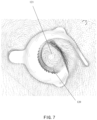
  • FIG. 7 is a schematic diagram of fluid simulation results of a doser mounting base of a mixer according to an embodiment.
  • FIG. 8 is a schematic diagram of urea crystallization in a mixer of a comparative proposal.
  • FIG. 9 is a schematic diagram of urea crystallization of a mixer according to an embodiment.
  • FIG. 10 is a flow chart of a mixing method according to an embodiment.
  • the mixer assembly 10 may comprise a mixer 1 and a doser 2 .
  • the mixer 1 comprises a shell 11 , which defines a first space S 1 .
  • the first space S 1 receives engine exhaust.
  • the shell 11 has a mounting area 111 formed on a wall of the shell 11 .
  • the doser 2 is installed in the mounting area 111 to be installed to the mixer 1 to form the mixer assembly 10 .
  • the exhaust generated by engine operation may enter the first space S 1 from below the shell 11 .
  • the mixer 1 also comprises a doser mounting base 12 , which is arranged in the mounting area 111 for installing the doser 2 .
  • the doser mounting base 12 comprises a spray inlet 121 , as an inlet end for the spray that is sprayed by the doser 2 entering the first space S 1 .
  • the spray end 21 of the doser 2 is located at the spray inlet 121 , so that the spray of the reductant solution sprayed by the doser 2 is released into the mixer 1 from the spray inlet 121 .
  • the doser mounting base 12 also comprises a first swirl structure 120 surrounding the spray inlet 121 to the exhaust form a swirl around the spray inlet 121 , so that the spray that is sprayed by the doser 2 is fully contacted and mixed with the hot swirl exhaust immediately after entering the mixer from the spray inlet 121 . Therefore, the spray is fully decomposed from the beginning of the diffusion process inside the mixer 1 , or the position of the spray inlet 121 may be easy to gather droplets or liquid films to form urea, and swirling flow of the spray inlet 121 can purge and decompose it in time to reduce urea crystallization. Moreover, because the first swirl flow structure 120 is located nearby the spray inlet, as shown in FIGS.
  • the specific structure of the first swirl structure 120 and the doser mounting base 12 can be that the doser mounting base 12 comprises a mounting plate 122 for mounting in the mounting area 111 , the mounting plate 122 is provided with a spray inlet 121 , the doser mounting base 12 also comprises a swirl base 123 , and the swirl base 123 is fixed to the mounting plate 122 .
  • the swirl base 123 is provided with a spiral flow passage 124 , which surrounds the spray inlet 121 and forms a first swirl structure 120 .
  • the streamline of the spiral flow passage 124 is a spiral.
  • the specific structure of the spiral flow passage 124 can be that the edge of the swirl base 123 has a notch 1230 , and the spiral flow passage 124 extends from the notch 1230 to the end of the spiral flow passage 124 and is tangent to the profile line of the spray inlet 121 , which can make the swirl effect around the spray inlet 121 better.
  • the tangential structure is not limited to that shown in the figure.
  • the profile line of the spiral flow passage 124 coincides with the profile line of the spray inlet 121 to form the profile coincident area 125 , which is tangent at the end of the profile coincident area 125 .
  • the spiral flow passage 124 can be tangent to the profile line of the spray inlet 121 only at the end of the spiral flow passage 124 , and the rest is not coincident. It can be understood that the tangency here refers to roughly tangency rather than strictly tangency.
  • the beneficial effect of the first swirl structure 120 as the spiral flow passage 124 is that the spiral flow passage 124 naturally forms a swirling motion, which flows smoothly and has a high flow efficiency of the exhaust flow, and the gas flow does not need additional loss of work to convert into other forms of energy.
  • the first swirl structure 120 comprises swirl blade component 126 in addition to the spiral flow passage 124 .
  • the swirl blade component 126 can be located on the inner side of the spiral flow passage 124 , for example, installed on the inner wall of the spiral flow passage 124 as shown in FIG. 5 .
  • the first swirl structure 120 comprises the spiral flow passage 124 and a swirl blade component 126 . That is, the combined action of the spiral streamline and the swirl blade component form swirling exhaust around the spray inlet 121 . In this way, the exhaust of the first swirl structure 120 can be strengthened, which is suitable for engines with large displacement. Because larger displacement engines need more urea solution spray, stronger swirl can more effectively prevent urea crystallization.
  • the first swirl structure may also comprise a swirl blade component without a spiral flow passage.
  • the specific position of the swirl blade component 126 can be directly arranged at the spray inlet 121 as shown in FIG. 6 , or it can be arranged on the inner wall of the swirl base 123 around the spray inlet 121 similar to FIG. 5 .
  • the first swirl structure 120 comprises both the spiral flow passage 124 and the swirl blade component 126 . It can be understood that in this another embodiment, the first swirl structure 120 does not comprise the spiral flow passage 124 , that is, the swirl base 123 is removed from the structure in FIG. 6 , or the swirl base 123 does not have a spiral flow passage in the structure in FIG. 5 .
  • the notch 1230 of the swirl base 123 is closed to form an annular swirl base 123 , and the swirl blade component 126 is located on the inner ring wall of the annular swirl base 123 .
  • the effect of reducing urea crystallization can also be obtained.
  • the swirl base 123 and the mounting plate 122 can be fixedly connected by welding, and such a connection structure is stable and reliable. Otherwise, the swirl base 123 and the mounting plate 122 can be an integral component, for example, integrated by the casting process, 3D printing process, etc., which can also make the structure of the swirl base and the mounting base stable and reliable.
  • the shell 11 of the mixer 1 is also provided with a swirl cone 13 .
  • the small end of the swirl cone 13 is arranged corresponding to the spray inlet 121 .
  • the side wall of the swirl cone 13 is provided with an air inlet opening 131 .
  • the air inlet opening 131 is provided with a second swirl structure 132 .
  • the specific structure of the second swirl structure 132 can be that the side wall of the swirl cone 13 has a plurality of air inlet openings 131 distributed in the circumferential direction, and the second swirl structure 132 comprises at least one swirl blade component 133 arranged at the air inlet opening 131 .
  • each air inlet opening 131 shown in the figure of the embodiment should have a corresponding swirl blade component 133 , but not limited to that.
  • not every but only a part of the air inlet openings 131 may have a corresponding structure such as a swirl blade component, which has a good swirl effect and is easy to process.
  • the mixing method of exhaust and urea spray described in the above embodiment comprises:
  • the spray of urea solution sprayed by the doser 2 enters the mixer 1 from the spray inlet 121 to mix with the exhaust.
  • At least part of the exhaust forms swirling exhaust at the spray inlet, and the swirling exhaust is mixed with the spray at the spray inlet.
  • part of the exhaust passes through the swirling structure 120 , such as the spiral flow passage 124 and/or the swirl blade component 126 , and forms a swirling flow at the spray inlet.
  • the swirling flow is mixed with the spray of urea solution at the spray inlet 121 to reduce urea crystallization.
  • a flowchart is used to illustrate the steps of mixing exhaust and urea spray according to the structure of some embodiments of the application. It should be understood that the preceding or following operations are not necessarily performed accurately in sequence. Technicians can also add other operations to these procedures or remove one or more operations from these procedures.
  • the beneficial effect of adopting the mixer, mixer assembly and mixing method described in the above embodiment is that by arranging the first swirling structure around the spray inlet, the spray of the doser is fully mixed with the swirling exhaust immediately after entering the mixer, so that the spray is fully decomposed to reduce urea crystallization and improve the mixing effect of the mixer, and the service life of the mixer assembly and the exhaust system thereof are prolonged.

Landscapes

  • Chemical & Material Sciences (AREA)
  • Chemical Kinetics & Catalysis (AREA)
  • Engineering & Computer Science (AREA)
  • Health & Medical Sciences (AREA)
  • Toxicology (AREA)
  • Combustion & Propulsion (AREA)
  • Mechanical Engineering (AREA)
  • General Engineering & Computer Science (AREA)
  • Exhaust Gas After Treatment (AREA)

Abstract

A mixer, a mixer assembly and a mixing method in which the mixer comprises a shell defining a first space, the first space receives engine exhaust, and the shell has a mounting area located on a wall of the shell; a doser mounting base arranged in the mounting area for mounting the doser, wherein the doser mounting base comprises a spray inlet as an inlet end for the spray that is sprayed by the doser entering the first space, and the doser mounting base further comprises a first swirl structure that surrounds the spray inlet to make the exhaust form a swirl around the spray inlet.

Description

CROSS-REFERENCE TO RELATED APPLICATIONS
This application claims priority to Chinese Application No. 202110988458.2 filed Aug. 26, 2021, the disclosure of which is incorporated herein by reference in its entirety and for all purposes.
TECHNICAL FIELD
The present invention relates to a technical field of engine exhaust treatment, in particular to a mixer, an exhaust system and a mixing method.
BACKGROUND
Engine exhaust system processes the hot exhaust generated by the engine through various upstream exhaust components to reduce emissions. Various upstream exhaust components may comprise one or more of the following components: pipes, filters, valves, catalytic converters, silencers, etc. For example, the upstream exhaust treatment component directs the exhaust to a selective catalytic reduction (SCR) catalyst with inlet and outlet. The outlet leads the exhaust to downstream exhaust components. The mixer is positioned upstream of the inlet of the SCR catalyst. In the mixer, the exhaust generates swirling motion or rotary motion. The doser is used to spray reductant such as a urea aqueous solution into the exhaust stream from the upstream of SCR catalyst, so that the mixer can fully mix the urea and the exhaust, and discharge them to the SCR catalyst for reduction reaction to generate nitrogen and water, so as to reduce nitrogen oxide emissions of the engine. The doser can be fixedly installed through the mounting base of the mixer to spray urea aqueous solution into the mixer.
In the mixer, the urea spray sprayed from the doser needs to be fully decomposed and evenly mixed with exhaust to avoid urea crystallization.
However, there are still some improvements in the mixer based on existing technology, especially the need to reduce urea crystallization.
SUMMARY
The object of the present invention is to provide a mixer.
Another object of the present invention is to provide a mixer assembly.
Another object of the present invention is to provide a mixing method.
According to one aspect of the present invention, the mixer is used for an engine exhaust system. The mixer comprises: a shell defining a first space, wherein the first space receives engine exhaust, and the shell has a mounting area located on a wall of the shell; a doser mounting base arranged in the mounting area for mounting the doser, wherein the doser mounting base comprises a spray inlet as an inlet end of the first space for the spray that is sprayed by the doser entering the first space, and the doser mounting base further comprises a first swirl structure that surrounds the spray inlet to make the exhaust forms a swirl around the spray inlet.
In one or more embodiments of the mixer, the doser mounting base comprises a mounting plate for mounting in the mounting area, the mounting plate is provided with a spray inlet, the doser mounting base further comprises a swirl base, the swirl base is fixed to the mounting plate, the swirl base is provided with a spiral flow passage, and the spiral flow passage surrounds the spray inlet, the spiral flow passage forms the first swirl structure.
In one or more embodiments of the mixer, an edge of the swirl base has a notch, and the spiral flow passage extends from the notch to an end of the spiral flow passage, and is tangent to a profile line of the spray inlet.
In one or more embodiments of the mixer, the doser mounting base comprises a mounting plate for mounting in the mounting area, the mounting plate is provided with a spray inlet, the doser mounting base further comprises a swirl blade component, the swirl blade component is arranged around the spray inlet, and the swirl blade component constitutes the first swirl structure.
In one or more embodiments of the mixer, the doser mounting base comprises a mounting plate for mounting in the mounting area, the mounting plate is provided with a spray inlet, the doser mounting base further comprises a swirl base, the swirl base is fixed to the mounting plate, the swirl base is provided with a spiral flow passage, and the spiral flow passage surrounds the spray inlet, the doser mounting base further comprises a swirl blade component, swirl blades of the swirl blade component are distributed on an inner side of the spiral flow passage, and the spiral flow passage and the swirl blade component constitute the first swirl structure.
In one or more embodiments of the mixer, the swirl base is welded and fixed to the mounting plate, or the swirl base and the mounting plate are integrated.
In one or more embodiments of the mixer, the shell comprises a swirl cone, a small end of the swirl cone is provided corresponding to the spray inlet, a side wall of the swirl cone has an air inlet opening, and the air inlet opening is provided with a second swirl structure.
In one or more embodiments of the mixer, the side wall of the swirl cone has a plurality of air inlet openings distributed along a circumferential direction, and the second swirl structure comprises at least one swirl blade component provided with the air inlet openings.
A mixer assembly according to another aspect of the present invention comprises a doser and the mixer described in any one of the above items. The doser is installed on the doser mounting base, and a spray end of the doser is located at the spray inlet, therefore the spray of reductant solution sprayed by the doser is released into the mixer from the spray inlet.
In one or more embodiments of the mixer assembly, the reductant solution is a urea solution.
A mixing method according to another aspect of the present invention, which is used for mixing exhaust and spray of reductant solution, comprising: making spray of a reductant solution enter a mixing chamber from a spray inlet of the mixing chamber; making at least a part of the exhaust forms swirling exhaust at the spray inlet, and mixing the swirling exhaust with the spray at the spray inlet.
The progressive effects of the present invention include but are not limited to: by providing the first swirl structure around the spray inlet, the spray of the doser is fully mixed with the swirling exhaust immediately after entering the mixer, so that the spray is fully decomposed to reduce urea crystallization, improve the mixing effect of the mixer, and prolong the service life of the mixer assembly and the exhaust system.
BRIEF DESCRIPTION OF THE DRAWINGS
The above and other features, properties and advantages of the present invention will become more apparent through the following description in combination with the attached drawings and embodiments. In the attached drawings, the same reference numerals always represent the same features, wherein:
FIG. 1 is a structural diagram of a mixer assembly according to an embodiment.
FIG. 2 is a partial structural diagram of a mixer according to an embodiment.
FIG. 3 is a partial structural diagram of a mixer according to an embodiment.
FIG. 4 is a structural diagram of a doser mounting base of a mixer according to an embodiment.
FIG. 5 is a structural diagram of a doser mounting base of a mixer according to another embodiment.
FIG. 6 is the structural diagram of a doser mounting base of a mixer according to another embodiment.
FIG. 7 is a schematic diagram of fluid simulation results of a doser mounting base of a mixer according to an embodiment.
FIG. 8 is a schematic diagram of urea crystallization in a mixer of a comparative proposal.
FIG. 9 is a schematic diagram of urea crystallization of a mixer according to an embodiment.
FIG. 10 is a flow chart of a mixing method according to an embodiment.
REFERENCE SIGNS
    • 10 mixer assembly
    • 1—mixer
    • 11 shell
    • 111 installation area
    • S1 first space
    • 12 doser mounting base
    • 120 first swirl structure
    • 121 spray inlet
    • 122 mounting plate
    • 123 swirl base
    • 1230 notch
    • 124 spiral flow passage,
    • 125 profile line coincident area
    • 126 swirl blade component
    • 13 swirl cone
    • 131 air inlet opening
    • 132 second swirl structure
    • 133 swirl blade component
    • 2 doser
    • 21 spray end
DETAILED DESCRIPTION OF EMBODIMENTS
The following discloses a variety of different implementation manners or embodiments for implementing the described subject technical proposal. In order to simplify the disclosure, specific examples of the elements and arrangements are described below. Of course, these are only examples, not limiting the scope of protection of the present invention.
In addition, for example, “one embodiment”, “an embodiment”, and/or “some embodiments” refer to a feature, structure or characteristic related to at least one embodiment of the present application. Therefore, it should be emphasized and noted that “an embodiment” or “one embodiment” or “one or more embodiments” mentioned twice or more in different positions in this specification do not necessarily refer to the same embodiment. In addition, certain features, structures or characteristics in one or more embodiments of the present application may be appropriately combined.
As shown in FIGS. 1 to 6 , in some embodiments, the mixer assembly 10 may comprise a mixer 1 and a doser 2. The mixer 1 comprises a shell 11, which defines a first space S1. The first space S1 receives engine exhaust. The shell 11 has a mounting area 111 formed on a wall of the shell 11. The doser 2 is installed in the mounting area 111 to be installed to the mixer 1 to form the mixer assembly 10. As shown in FIGS. 1 and 2 , the exhaust generated by engine operation may enter the first space S1 from below the shell 11.
The mixer 1 also comprises a doser mounting base 12, which is arranged in the mounting area 111 for installing the doser 2. Wherein, the doser mounting base 12 comprises a spray inlet 121, as an inlet end for the spray that is sprayed by the doser 2 entering the first space S1. As shown in FIG. 1 , the spray end 21 of the doser 2 is located at the spray inlet 121, so that the spray of the reductant solution sprayed by the doser 2 is released into the mixer 1 from the spray inlet 121.
As shown in FIGS. 2 to 7 , the doser mounting base 12 also comprises a first swirl structure 120 surrounding the spray inlet 121 to the exhaust form a swirl around the spray inlet 121, so that the spray that is sprayed by the doser 2 is fully contacted and mixed with the hot swirl exhaust immediately after entering the mixer from the spray inlet 121. Therefore, the spray is fully decomposed from the beginning of the diffusion process inside the mixer 1, or the position of the spray inlet 121 may be easy to gather droplets or liquid films to form urea, and swirling flow of the spray inlet 121 can purge and decompose it in time to reduce urea crystallization. Moreover, because the first swirl flow structure 120 is located nearby the spray inlet, as shown in FIGS. 4 to 6 for example, it is roughly tangent to the profile line of the spray inlet 121, so that the airflow movement at the spray inlet 121 is a swirling movement, and the negative impact on the spray is very small, to make the spray be fully extended and diffused in the mixer along the given spray direction, ensuring sufficient mixing distance between the spray and the exhaust. Therefore, the urea can be fully decomposed, and fully and evenly mixed with the exhaust. The principle that urea crystallization can be reduced by adopting the above embodiment is that the inventor accidentally found in practice that, as shown in FIG. 8 , mixer 1 will have more urea crystals 3 around the spray inlet 121. After adopting the first swirl structure, as shown in FIG. 9 , the urea crystals at the spray inlet 121 are almost eliminated, greatly improving the urea crystallization phenomenon inside mixer 1, and making the mixer meet the requirements. The simulation results shown in FIG. 7 show that the swirling effect near the spray inlet 121 is very strong.
As shown in FIG. 3 and FIG. 4 , in an embodiment, the specific structure of the first swirl structure 120 and the doser mounting base 12 can be that the doser mounting base 12 comprises a mounting plate 122 for mounting in the mounting area 111, the mounting plate 122 is provided with a spray inlet 121, the doser mounting base 12 also comprises a swirl base 123, and the swirl base 123 is fixed to the mounting plate 122. The swirl base 123 is provided with a spiral flow passage 124, which surrounds the spray inlet 121 and forms a first swirl structure 120. As shown in FIG. 4 , the streamline of the spiral flow passage 124 is a spiral.
In an embodiment, as shown in FIG. 4 , the specific structure of the spiral flow passage 124 can be that the edge of the swirl base 123 has a notch 1230, and the spiral flow passage 124 extends from the notch 1230 to the end of the spiral flow passage 124 and is tangent to the profile line of the spray inlet 121, which can make the swirl effect around the spray inlet 121 better. The tangential structure is not limited to that shown in the figure. The profile line of the spiral flow passage 124 coincides with the profile line of the spray inlet 121 to form the profile coincident area 125, which is tangent at the end of the profile coincident area 125. Otherwise, it can be tangent to the profile line of the spray inlet 121 only at the end of the spiral flow passage 124, and the rest is not coincident. It can be understood that the tangency here refers to roughly tangency rather than strictly tangency. The beneficial effect of the first swirl structure 120 as the spiral flow passage 124 is that the spiral flow passage 124 naturally forms a swirling motion, which flows smoothly and has a high flow efficiency of the exhaust flow, and the gas flow does not need additional loss of work to convert into other forms of energy.
In another embodiment, as shown in FIG. 5 , compared with the embodiment shown in FIG. 4 , the first swirl structure 120 comprises swirl blade component 126 in addition to the spiral flow passage 124. The swirl blade component 126 can be located on the inner side of the spiral flow passage 124, for example, installed on the inner wall of the spiral flow passage 124 as shown in FIG. 5 . At this time, the first swirl structure 120 comprises the spiral flow passage 124 and a swirl blade component 126. That is, the combined action of the spiral streamline and the swirl blade component form swirling exhaust around the spray inlet 121. In this way, the exhaust of the first swirl structure 120 can be strengthened, which is suitable for engines with large displacement. Because larger displacement engines need more urea solution spray, stronger swirl can more effectively prevent urea crystallization.
In another embodiment, the first swirl structure may also comprise a swirl blade component without a spiral flow passage. The specific position of the swirl blade component 126 can be directly arranged at the spray inlet 121 as shown in FIG. 6 , or it can be arranged on the inner wall of the swirl base 123 around the spray inlet 121 similar to FIG. 5 . In the structures shown in FIG. 5 and FIG. 6 , the first swirl structure 120 comprises both the spiral flow passage 124 and the swirl blade component 126. It can be understood that in this another embodiment, the first swirl structure 120 does not comprise the spiral flow passage 124, that is, the swirl base 123 is removed from the structure in FIG. 6 , or the swirl base 123 does not have a spiral flow passage in the structure in FIG. 5 . For example, the notch 1230 of the swirl base 123 is closed to form an annular swirl base 123, and the swirl blade component 126 is located on the inner ring wall of the annular swirl base 123. In this way, the effect of reducing urea crystallization can also be obtained.
As shown in FIGS. 3 to 6 , the swirl base 123 and the mounting plate 122 can be fixedly connected by welding, and such a connection structure is stable and reliable. Otherwise, the swirl base 123 and the mounting plate 122 can be an integral component, for example, integrated by the casting process, 3D printing process, etc., which can also make the structure of the swirl base and the mounting base stable and reliable.
Continuing to refer to FIGS. 1 to 3 , in some embodiments, the shell 11 of the mixer 1 is also provided with a swirl cone 13. The small end of the swirl cone 13 is arranged corresponding to the spray inlet 121. The side wall of the swirl cone 13 is provided with an air inlet opening 131. The air inlet opening 131 is provided with a second swirl structure 132. By arranging the structure of the swirl cone 13, the spray beam of the spray can fully extend and diffuse. Besides, by arranging the air inlet opening with the swirl structure on the side wall, sufficient swirl exhaust can be ensured to be fully mixed with urea spray, so that urea is fully decomposed and evenly mixed, and the direct impact on the spray beam can also be reduced. The specific structure of the second swirl structure 132 can be that the side wall of the swirl cone 13 has a plurality of air inlet openings 131 distributed in the circumferential direction, and the second swirl structure 132 comprises at least one swirl blade component 133 arranged at the air inlet opening 131. For example, each air inlet opening 131 shown in the figure of the embodiment should have a corresponding swirl blade component 133, but not limited to that. For example, not every but only a part of the air inlet openings 131 may have a corresponding structure such as a swirl blade component, which has a good swirl effect and is easy to process.
According to the above description, referring to FIG. 10 , the mixing method of exhaust and urea spray described in the above embodiment comprises:
    • making the spray of reductant solution enters the mixing chamber from the spray inlet of the mixing chamber.
For example, as shown in FIG. 1 , the spray of urea solution sprayed by the doser 2 enters the mixer 1 from the spray inlet 121 to mix with the exhaust.
At least part of the exhaust forms swirling exhaust at the spray inlet, and the swirling exhaust is mixed with the spray at the spray inlet.
As shown in FIGS. 2 to 7 , part of the exhaust passes through the swirling structure 120, such as the spiral flow passage 124 and/or the swirl blade component 126, and forms a swirling flow at the spray inlet. The swirling flow is mixed with the spray of urea solution at the spray inlet 121 to reduce urea crystallization.
In the above embodiments, a flowchart is used to illustrate the steps of mixing exhaust and urea spray according to the structure of some embodiments of the application. It should be understood that the preceding or following operations are not necessarily performed accurately in sequence. Technicians can also add other operations to these procedures or remove one or more operations from these procedures.
It can be seen from the above that the beneficial effect of adopting the mixer, mixer assembly and mixing method described in the above embodiment is that by arranging the first swirling structure around the spray inlet, the spray of the doser is fully mixed with the swirling exhaust immediately after entering the mixer, so that the spray is fully decomposed to reduce urea crystallization and improve the mixing effect of the mixer, and the service life of the mixer assembly and the exhaust system thereof are prolonged.
Although the above embodiments of the disclosure are disclosed as above, they are not intended to define the present invention. Any person skilled in the art can make possible changes and modifications without departing from the spirit and scope of the present invention. Therefore, any amendments, equivalent changes and modifications made to the above embodiments according to the technical essence of the disclosure without departing from the technical proposals of the disclosure fall within the scope of protection defined in the claims of the present invention.

Claims (13)

We claim:
1. A mixer for an engine exhaust system, the mixer comprising:
a shell defining a first space, wherein the first space is configured to receive engine exhaust and the shell has a mounting area located on a wall of the shell; and
a doser mounting base, arranged in the mounting area for mounting a doser, the doser mounting base comprising:
a spray inlet, the spray inlet being an inlet end for a spray that is sprayed by the doser entering the first space,
a first swirl structure that surrounds the spray inlet and is configured to make the exhaust form a swirl around the spray inlet,
a mounting plate configured to be mounted in the mounting area, the mounting plate being provided with the spray inlet, and
a swirl base fixed to the mounting plate, the swirl base provided with a spiral flow passage, the spiral flow passage continuously tapering and surrounding the spray inlet, and the spiral flow passage forming the first swirl structure, wherein an edge of the swirl base comprises a notch, and wherein the spiral flow passage extends from the notch to an end of the spiral flow passage and is tangent to a profile line of the spray inlet.
2. The mixer of claim 1, wherein the doser mounting base further comprises a swirl blade component, the swirl blade component being arranged around the spray inlet, and the swirl blade component constituting the first swirl structure.
3. The mixer of claim 1, wherein:
the doser mounting base further comprises a swirl blade component comprising swirl blades that are distributed on an inner side of the spiral flow passage; and
the spiral flow passage and the swirl blade component constitute the first swirl structure.
4. The mixer of claim 1, wherein:
the swirl base is welded and fixed to the mounting plate; or
the swirl base and the mounting plate are integrated.
5. The mixer of claim 1, wherein the shell comprises a swirl cone having a small end corresponding to the spray inlet, a side wall of the swirl cone comprising an air inlet opening, and the air inlet opening being provided with a second swirl structure.
6. The mixer of claim 5, wherein:
the side wall comprises a plurality of air inlet openings distributed along a circumferential direction; and
the second swirl structure comprises at least one swirl blade provided with the air inlet opening.
7. A mixer assembly comprising:
a doser; and
the mixer of claim 1;
wherein the doser is mounted on the doser mounting base, a spray end of the doser is located at the spray inlet, so that spray of a reductant solution sprayed by the doser is released into the mixer from the spray inlet.
8. The mixer assembly of claim 7, wherein the reductant solution is a urea solution.
9. The mixer assembly of claim 7, wherein the doser mounting base further comprises a swirl blade component, the swirl blade component being arranged around the spray inlet, and the swirl blade component constituting the first swirl structure.
10. The mixer assembly of claim 7, wherein the doser mounting base further comprises a swirl blade component comprising swirl blades that are distributed on an inner side of the spiral flow passage, the spiral flow passage and the swirl blade component constituting the first swirl structure.
11. The mixer assembly of claim 7, wherein the shell comprises a swirl cone having a small end corresponding to the spray inlet, a side wall of the swirl cone comprising an air inlet opening, and the air inlet opening being provided with a second swirl structure.
12. The mixer assembly of claim 7, wherein:
the first swirl structure comprises a swirl blade component with a plurality of swirl blades;
the shell comprises a swirl cone having a side wall with a plurality of air inlet openings distributed along a circumferential direction; and
each of the swirl blades is contiguous with one of the air inlet openings.
13. A mixing method for mixing exhaust with spray of reductant solution using the mixer of claim 1, the mixing method comprising:
making a spray of a reductant solution entering the mixer from the spray inlet;
making at least a part of the exhaust form swirling exhaust at the spray inlet; and
mixing the swirling exhaust with the spray at the spray inlet.
US17/896,409 2021-08-26 2022-08-26 Mixer, mixer assembly and mixing method Active 2042-12-16 US12186717B2 (en)

Applications Claiming Priority (2)

Application Number Priority Date Filing Date Title
CN202110988458.2 2021-08-26
CN202110988458.2A CN115898597A (en) 2021-08-26 2021-08-26 Mixer, mixer assembly and mixing method

Publications (2)

Publication Number Publication Date
US20230065989A1 US20230065989A1 (en) 2023-03-02
US12186717B2 true US12186717B2 (en) 2025-01-07

Family

ID=85174873

Family Applications (1)

Application Number Title Priority Date Filing Date
US17/896,409 Active 2042-12-16 US12186717B2 (en) 2021-08-26 2022-08-26 Mixer, mixer assembly and mixing method

Country Status (3)

Country Link
US (1) US12186717B2 (en)
CN (1) CN115898597A (en)
DE (1) DE102022121551A1 (en)

Families Citing this family (3)

* Cited by examiner, † Cited by third party
Publication number Priority date Publication date Assignee Title
US11857933B2 (en) * 2018-03-09 2024-01-02 Produced Water Absorbents Inc. Systems, apparatuses, and methods for mixing fluids using a conical flow member
FR3146953A1 (en) * 2023-03-22 2024-09-27 Faurecia Systemes D'echappement Reducing fluid mixer for exhaust line
CN116877239A (en) * 2023-08-09 2023-10-13 无锡威孚力达催化净化器有限责任公司 Urea mixing device

Citations (15)

* Cited by examiner, † Cited by third party
Publication number Priority date Publication date Assignee Title
US7712305B2 (en) * 2006-08-23 2010-05-11 Universal Silencer, Llc Exhaust aftertreatment system with spiral mixer
US20100212292A1 (en) * 2007-07-24 2010-08-26 Klaus Rusch Assembly and Method for Introducing a Reducing Agent into the Exhaust Pipe of an Exhaust System of an Internal Combustion Engine
US8438839B2 (en) * 2010-10-19 2013-05-14 Tenneco Automotive Operating Company Inc. Exhaust gas stream vortex breaker
US20130164181A1 (en) * 2011-12-27 2013-06-27 Tadashi Iijima Reducing agent aqueous solution mixing device and exhaust gas post-treatment device
US8756921B2 (en) * 2011-01-10 2014-06-24 Paccar Inc Reductant delivery device
US9062589B2 (en) * 2013-01-17 2015-06-23 Komatsu Ltd. Reductant aqueous solution mixing device and exhaust aftertreatment device provided with the same
US9435240B2 (en) * 2013-08-06 2016-09-06 Tenneco Automotive Operating Company Inc. Perforated mixing pipe with swirler
WO2018017164A1 (en) * 2016-07-20 2018-01-25 Faurecia Emissions Control Technologies, Usa, Llc Flow diverter to mitigate deposits in a doser cone
US20180142597A1 (en) * 2015-04-21 2018-05-24 Friedrich Boysen Gmbh & Co. Kg Device for introducing a fluid into a gas stream
US10047657B2 (en) * 2015-01-22 2018-08-14 Tenneco Automotive Operating Company Inc. Exhaust aftertreatment system having mixer assembly
US10208645B2 (en) * 2013-08-05 2019-02-19 Tenneco Gmbh Mixing chamber for mixing an additive in an exhaust system of an internal combustion engine
US10369533B2 (en) * 2013-09-13 2019-08-06 Donaldson Company, Inc. Dosing and mixing arrangement for use in exhaust aftertreatment
US20200340379A1 (en) * 2019-04-23 2020-10-29 Faurecia Emissions Control Technologies, Usa, Llc Exhaust gas aftertreatment system with a reducing agent mixer having an injector tip protector
US20210301710A1 (en) * 2020-03-30 2021-09-30 Faurecia Emissions Control Technologies, Usa, Llc Vehicle exhaust system mixer with flexible doser mount
US11767783B2 (en) * 2019-07-04 2023-09-26 Donaldson Company, Inc. System for mixing a liquid spray into a gaseous flow and exhaust aftertreatment device comprising same

Patent Citations (20)

* Cited by examiner, † Cited by third party
Publication number Priority date Publication date Assignee Title
US7712305B2 (en) * 2006-08-23 2010-05-11 Universal Silencer, Llc Exhaust aftertreatment system with spiral mixer
US20100212292A1 (en) * 2007-07-24 2010-08-26 Klaus Rusch Assembly and Method for Introducing a Reducing Agent into the Exhaust Pipe of an Exhaust System of an Internal Combustion Engine
US8438839B2 (en) * 2010-10-19 2013-05-14 Tenneco Automotive Operating Company Inc. Exhaust gas stream vortex breaker
US8756921B2 (en) * 2011-01-10 2014-06-24 Paccar Inc Reductant delivery device
US20130164181A1 (en) * 2011-12-27 2013-06-27 Tadashi Iijima Reducing agent aqueous solution mixing device and exhaust gas post-treatment device
US9062589B2 (en) * 2013-01-17 2015-06-23 Komatsu Ltd. Reductant aqueous solution mixing device and exhaust aftertreatment device provided with the same
US10208645B2 (en) * 2013-08-05 2019-02-19 Tenneco Gmbh Mixing chamber for mixing an additive in an exhaust system of an internal combustion engine
US9435240B2 (en) * 2013-08-06 2016-09-06 Tenneco Automotive Operating Company Inc. Perforated mixing pipe with swirler
US10369533B2 (en) * 2013-09-13 2019-08-06 Donaldson Company, Inc. Dosing and mixing arrangement for use in exhaust aftertreatment
US10047657B2 (en) * 2015-01-22 2018-08-14 Tenneco Automotive Operating Company Inc. Exhaust aftertreatment system having mixer assembly
US20180142597A1 (en) * 2015-04-21 2018-05-24 Friedrich Boysen Gmbh & Co. Kg Device for introducing a fluid into a gas stream
US10174658B2 (en) * 2016-07-20 2019-01-08 Faurecia Emissions Control Technologies, Usa, Llc Flow diverter to mitigate deposits in a doser cone
WO2018017164A1 (en) * 2016-07-20 2018-01-25 Faurecia Emissions Control Technologies, Usa, Llc Flow diverter to mitigate deposits in a doser cone
US20210285355A1 (en) * 2016-07-20 2021-09-16 Faurecia Emissions Control Technologies, Usa, Llc Flow diverter to mitigate deposits in a doser cone
US11459929B2 (en) * 2016-07-20 2022-10-04 Faurecia Emissions Control Technologies, Usa, Llc Flow diverter to mitigate deposits in a doser cone
US20200340379A1 (en) * 2019-04-23 2020-10-29 Faurecia Emissions Control Technologies, Usa, Llc Exhaust gas aftertreatment system with a reducing agent mixer having an injector tip protector
US10920635B2 (en) * 2019-04-23 2021-02-16 Faurecia Emissions Control Technologies, Usa, Llc Exhaust gas aftertreatment system with a reducing agent mixer having an injector tip protector
US11767783B2 (en) * 2019-07-04 2023-09-26 Donaldson Company, Inc. System for mixing a liquid spray into a gaseous flow and exhaust aftertreatment device comprising same
US20210301710A1 (en) * 2020-03-30 2021-09-30 Faurecia Emissions Control Technologies, Usa, Llc Vehicle exhaust system mixer with flexible doser mount
US11624310B2 (en) * 2020-03-30 2023-04-11 Faurecia Emissions Control Technologies, Usa, Llc Vehicle exhaust system mixer with flexible doser mount

Also Published As

Publication number Publication date
DE102022121551A1 (en) 2023-03-02
CN115898597A (en) 2023-04-04
US20230065989A1 (en) 2023-03-02

Similar Documents

Publication Publication Date Title
US12186717B2 (en) Mixer, mixer assembly and mixing method
CN217872989U (en) Mixer and exhaust gas aftertreatment system
US20220184567A1 (en) Mixer, Exhaust System and Mixing Method
CN111764987B (en) Post-treatment packaging SCR mixer system and treatment method thereof
US20230143888A1 (en) Mixers for use in aftertreatment systems
CN105089750B (en) exhaust gas treatment device
WO2018068667A1 (en) Tail gas after-treatment device
US20250101898A1 (en) Ultra-compact post-processing system, supercharger assembly and engine
CN206267925U (en) Exhaust gas post-treatment device
WO2016146015A1 (en) Mixing tube and exhaust gas treatment device thereof
CN109184863B (en) An SCR mixing system and its SCR mixer
CN205714374U (en) Tail-gas after treatment apparatus
CN104712401A (en) Mixing pipe and its exhaust treatment device
WO2017032231A1 (en) Exhaust gas treatment apparatus
CN114542248B (en) SCR system and engine
CN211819593U (en) SCR exhaust mixing device
CN112502814A (en) Vehicle aftertreatment SCR mixer
CN109356693B (en) Compact mixer assembly
CN116025449A (en) Urea mixing device
CN108979809A (en) Exhaust aftertreatment mixing arrangement
CN212690148U (en) A simplify urea mixing arrangement for U type platform
CN107076000B (en) Vertical ultrasonic decomposition tube
CN216922273U (en) SCR aftertreatment mixer and engine using same
CN212027913U (en) U-shaped after-treatment device of diesel engine
US12012887B2 (en) Systems and methods for providing uniform exhaust gas flow to an aftertreatment component

Legal Events

Date Code Title Description
FEPP Fee payment procedure

Free format text: ENTITY STATUS SET TO UNDISCOUNTED (ORIGINAL EVENT CODE: BIG.); ENTITY STATUS OF PATENT OWNER: LARGE ENTITY

STPP Information on status: patent application and granting procedure in general

Free format text: DOCKETED NEW CASE - READY FOR EXAMINATION

STPP Information on status: patent application and granting procedure in general

Free format text: NON FINAL ACTION MAILED

STPP Information on status: patent application and granting procedure in general

Free format text: RESPONSE TO NON-FINAL OFFICE ACTION ENTERED AND FORWARDED TO EXAMINER

STPP Information on status: patent application and granting procedure in general

Free format text: NOTICE OF ALLOWANCE MAILED -- APPLICATION RECEIVED IN OFFICE OF PUBLICATIONS

AS Assignment

Owner name: FAURECIA EMISSION CONTROL TECHNOLOGIES (SHANGHAI) CO., LTD, CHINA

Free format text: ASSIGNMENT OF ASSIGNORS INTEREST;ASSIGNORS:GEANT, LUDOVIC;GAO, JIAN;FOUQUET, THIBAULT;SIGNING DATES FROM 20221017 TO 20241016;REEL/FRAME:069128/0594

STPP Information on status: patent application and granting procedure in general

Free format text: PUBLICATIONS -- ISSUE FEE PAYMENT VERIFIED

STCF Information on status: patent grant

Free format text: PATENTED CASE