US12180232B2 - Late first row transition metal aryl diimine catalysts for hydrofunctionalization and dehydrocoupling - Google Patents
Late first row transition metal aryl diimine catalysts for hydrofunctionalization and dehydrocoupling Download PDFInfo
- Publication number
- US12180232B2 US12180232B2 US17/953,546 US202217953546A US12180232B2 US 12180232 B2 US12180232 B2 US 12180232B2 US 202217953546 A US202217953546 A US 202217953546A US 12180232 B2 US12180232 B2 US 12180232B2
- Authority
- US
- United States
- Prior art keywords
- bond
- reductant
- organic compound
- case
- unsaturated organic
- Prior art date
- Legal status (The legal status is an assumption and is not a legal conclusion. Google has not performed a legal analysis and makes no representation as to the accuracy of the status listed.)
- Active, expires
Links
Classifications
-
- C—CHEMISTRY; METALLURGY
- C07—ORGANIC CHEMISTRY
- C07F—ACYCLIC, CARBOCYCLIC OR HETEROCYCLIC COMPOUNDS CONTAINING ELEMENTS OTHER THAN CARBON, HYDROGEN, HALOGEN, OXYGEN, NITROGEN, SULFUR, SELENIUM OR TELLURIUM
- C07F7/00—Compounds containing elements of Groups 4 or 14 of the Periodic Table
- C07F7/02—Silicon compounds
- C07F7/08—Compounds having one or more C—Si linkages
- C07F7/10—Compounds having one or more C—Si linkages containing nitrogen having a Si-N linkage
-
- C—CHEMISTRY; METALLURGY
- C07—ORGANIC CHEMISTRY
- C07F—ACYCLIC, CARBOCYCLIC OR HETEROCYCLIC COMPOUNDS CONTAINING ELEMENTS OTHER THAN CARBON, HYDROGEN, HALOGEN, OXYGEN, NITROGEN, SULFUR, SELENIUM OR TELLURIUM
- C07F13/00—Compounds containing elements of Groups 7 or 17 of the Periodic Table
-
- C—CHEMISTRY; METALLURGY
- C07—ORGANIC CHEMISTRY
- C07F—ACYCLIC, CARBOCYCLIC OR HETEROCYCLIC COMPOUNDS CONTAINING ELEMENTS OTHER THAN CARBON, HYDROGEN, HALOGEN, OXYGEN, NITROGEN, SULFUR, SELENIUM OR TELLURIUM
- C07F15/00—Compounds containing elements of Groups 8, 9, 10 or 18 of the Periodic Table
- C07F15/02—Iron compounds
-
- C—CHEMISTRY; METALLURGY
- C07—ORGANIC CHEMISTRY
- C07F—ACYCLIC, CARBOCYCLIC OR HETEROCYCLIC COMPOUNDS CONTAINING ELEMENTS OTHER THAN CARBON, HYDROGEN, HALOGEN, OXYGEN, NITROGEN, SULFUR, SELENIUM OR TELLURIUM
- C07F15/00—Compounds containing elements of Groups 8, 9, 10 or 18 of the Periodic Table
- C07F15/04—Nickel compounds
-
- C—CHEMISTRY; METALLURGY
- C07—ORGANIC CHEMISTRY
- C07F—ACYCLIC, CARBOCYCLIC OR HETEROCYCLIC COMPOUNDS CONTAINING ELEMENTS OTHER THAN CARBON, HYDROGEN, HALOGEN, OXYGEN, NITROGEN, SULFUR, SELENIUM OR TELLURIUM
- C07F15/00—Compounds containing elements of Groups 8, 9, 10 or 18 of the Periodic Table
- C07F15/06—Cobalt compounds
Definitions
- This invention relates to the preparation of aryl diimine manganese, iron, cobalt, and nickel compounds, their use as catalysts for the hydrofunctionalization of unsaturated bonds, and their use as catalysts for the formation of new bonds via dehydrogenative substrate coupling.
- Transition metal catalysts are widely used by the chemical industry to prepare small molecules and polymers. In many circumstances, the most active and robust catalyst for a given reaction features a precious metal (Ru, Os, Rh, Ir, Pd, or Pt). Precious metals are expensive due to their low abundance within Earth's crust. Moreover, precious metals exhibit toxicity, and small residual concentrations of these metals in a final product or material can be harmful to the consumer.
- a precious metal Ru, Os, Rh, Ir, Pd, or Pt
- This disclosure describes the use of chelating aryl diimine ligands to prepare late transition metal catalysts that are active for hydrofunctionalization and dehydrogenative coupling reactions.
- the aryl diimine ligands will coordinate to the metal center in ⁇ 4 - or ⁇ 5 -fashion, meaning that 4 or 5 main group elements will bind, respectively.
- a first general aspect includes complexes that have one of the following general structures (G-1.1 through G-1.4):
- structures G-1.1 through G-1.4 exist as the cationic or anionic component of a salt.
- a second general aspect includes complexes that feature an agostic interaction between the metal center and one arene C—H bond (G-1.5 through G-1.8):
- structures G-1.5 through G-1.8 exist as the cationic or anionic component of a salt.
- a third general aspect includes complexes that can be converted to complexes G-1.1 through G-1.8 (G-1.9 through G-1.15), optionally in the presence of a base:
- structures G-1.9 through G-1.15 exist as the cationic or anionic component of a salt.
- a fourth general aspect includes facilitating a hydrofunctionalization reaction.
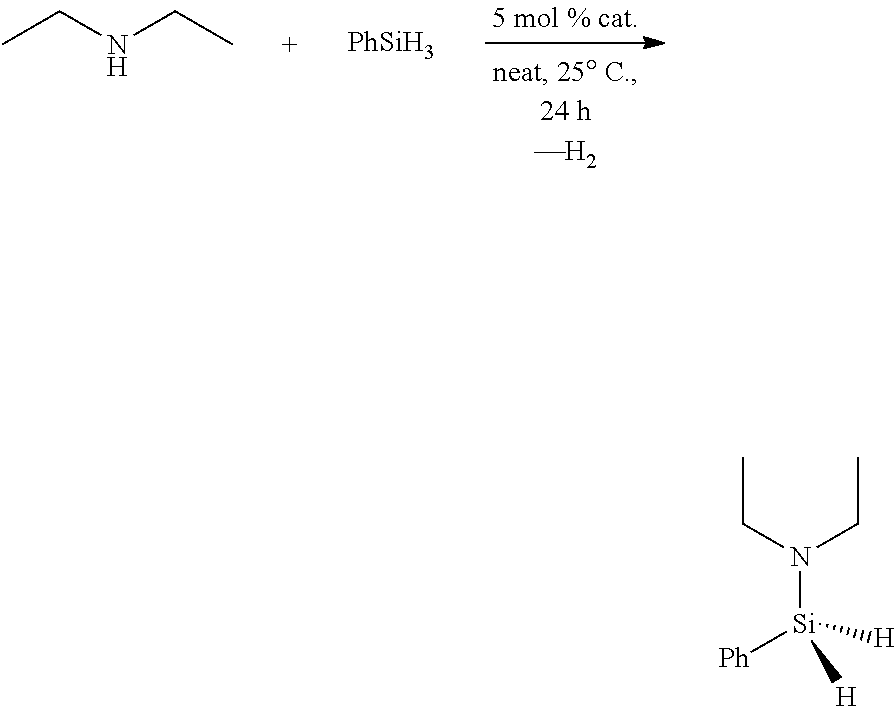
- a compound of general formula G-1.1 through G-1.15, or a salt thereof is used to facilitate the addition of a H—H, H—B, H—Al, H—C, H—Si, H—N, H—P, H—O, H—S, or H—Se bond across a double or triple bond within an unsaturated organic compound.
- Some embodiments include the addition of base to activate compounds G-1.1 through G-1.15, or a salt thereof.
- suitable bases include potassium tert-butoxide; cesium carbonate, lithium diisopropylamide, sodium triethylborohydride, sodium borohydride, methylmagnesium bromide, and triethylamine. These examples are not intended to be limiting in scope.
- the reaction takes place in a solvent.
- suitable solvents include pentane, toluene, tetrahydrofuran, diethyl ether, acetonitrile, and chloroform. These examples are not intended to be limiting in scope.
- a fifth general aspect includes a method of facilitating a dehydrogenative coupling reaction.
- a compound of general formula G-1.1 through G-1.15, or a salt thereof is used to facilitate the coupling of a H—B, H—Al, H—C, H—Si, H—P, H—O, H—S, or H—Se bond to a H—B, H—Al, H—C, H—N, H—P, H—O, H—S, or H—Se bond to generate a new heteroatom-heteroatom bond and hydrogen.
- Some embodiments of the fifth general aspect include the addition of base to activate compounds G-1.1 through G-1.15, or a salt thereof.
- suitable bases include potassium tert-butoxide, cesium carbonate, lithium diisopropylamide, sodium triethylborohydride, sodium borohydride, methylmagnesium bromide, and triethylamine. These examples are not intended to be limiting in scope.
- the reaction takes place in a solvent.
- suitable solvents include pentane, toluene, tetrahydrofuran, diethyl ether, acetonitrile, and chloroform. These examples are not intended to be limiting in scope.
- This disclosure describes metal complexes that are supported by aryl diimine ligands, as well as the synthesis of these complexes. These metal complexes can be used as catalysts for hydrofunctionalization and dehydrogenative coupling.
- the terms “optional” or “optionally” mean that the subsequently described event or circumstance may or may not occur, and that the description includes instances where said event or circumstance occurs and instances where it does not.
- alkyl as used herein is a branched or unbranched saturated hydrocarbon group of 1 to 24 carbon atoms (C 1 -C 24 ), including without limitation methyl, ethyl, n-propyl, isopropyl, n-butyl, isobutyl, s-butyl, t-butyl, n-pentyl, isopentyl, s-pentyl, neopentyl, hexyl, heptyl, octyl, nonyl, decyl, dodecyl, tetradecyl, hexadecyl, eicosyl, tetracosyl, and the like.
- the alkyl group can be cyclic or acyclic.
- the alkyl group can be branched or unbranched.
- the alkyl group can also be substituted or unsubstituted.
- the alkyl group can be substituted with one or more groups including, but not limited to, optionally substituted alkyl, cycloalkyl, alkoxy, amino, ether, halide, hydroxy, nitro, silyl, sulfoxo, or thiol.
- alkylene refers to a saturated, branched or straight chain or cyclic hydrocarbon diradical of the stated number of carbon atoms, typically 1-6 carbon atoms, and having two monovalent radical centers derived by the removal of two hydrogen atoms from the same or two different carbon atoms of a parent alkane.
- Typical alkylene radicals include, but are not limited to methylene (—CH 2 —), 1,2-ethylene (—CH 2 CH 2 —), 2,2-dimethylene, 1,3-propylene (—CH 2 CH 2 CH 2 —), 2-methylpropylene; 1,4-butylene (—CH 2 CH 2 CH 2 CH 2 —), and the like; optionally substituted, as appropriate, by 1 to 5 suitable substituents as defined above such as fluoro, chloro, deutero, cyano, trifluoromethyl, (C 1 -C 6 )alkoxy, (C 6 -C 10 )aryloxy, trifluoromethoxy, difluoromethoxy or (C 1 -C 6 )alkyl.
- the compound may exist as the pure E (ent ought) form, the pure Z (zusammen) form, or any mixture thereof.
- alkoxy and “alkyloxy”, which may be used interchangeably, refers to a moiety of the formula —OR, wherein R is a straight chain saturated alkyl or branched chain saturated alkyl moiety, as defined herein, bonded through an oxygen atom.
- the alkoxy group may be optionally substituted as defined herein.
- Non-limiting examples of such alkoxy groups are methoxy, ethoxy, propoxy, isopropoxy, butoxy, isobutoxy, tertiary butoxy, pentoxy and the like.
- aryl means a carbocyclic aromatic system containing one or two rings wherein such rings may be fused. If the rings are fused, one of the rings must be fully unsaturated and the fused ring(s) may be fully saturated, partially unsaturated or fully unsaturated.
- fused means that a second ring is present (i.e., attached or formed) by having two adjacent atoms in common (i.e., shared) with the first ring.
- fused is equivalent to the term “condensed”.
- the aryl group may be optionally substituted as defined herein.
- aryl embraces aromatic radicals such as phenyl, naphthyl, tetrahydronaphthyl, indanyl, biphenyl, benzo[b][1,4]oxazin-3(4H)-onyl, 2,3-dihydro-1H indenyl and 1,2,3,4-tetrahydronaphthalenyl.
- Aryls may be optionally substituted, as appropriate, by 1 to 5 suitable substituents as defined above such as fluoro, chloro, deutero, cyano, trifluoromethyl, C 1 -C 6 )alkoxy, (C 6 -C 10 )aryloxy, trifluoromethoxy, difluoromethoxy or (C 1 -C 6 )alkyl.
- arylene refers to a divalent aromatic substituent containing a single aromatic ring or multiple aromatic rings that are fused together or linked covalently. Preferred arylene groups contain one aromatic ring or two fused or linked aromatic rings. “Substituted arylene” refers to an arylene moiety substituted with one or more substituent groups, and the terms “heteroatom-containing arylene” and “heteroarylene” refer to arylene in which at least one carbon atom is replaced with a heteroatom.
- arylene refers to a divalent aromatic substituent containing a single aromatic ring or multiple aromatic rings that are fused together or linked covalently.
- arylene groups contain one aromatic ring or two fused or linked aromatic rings.
- “Substituted arylene” refers to an arylene moiety substituted with one or more substituent groups
- heteroatom-containing arylene and “heteroarylene” refer to arylene in which at least one carbon atom is replaced with a heteroatom.
- amine or “amino” as used herein are represented by the formula NA1A2A3, where A1, A2, and A3 can be, independently, hydrogen or optionally substituted alkyl, cycloalkyl, alkenyl, cycloalkenyl, alkynyl, cycloalkynyl, aryl, or heteroaryl group as described herein.
- halide refers to the halogens fluorine, chlorine, bromine, and iodine.
- nitro as used herein is represented by the formula —NO 2 .
- nitrile as used herein is represented by the formula —CN.
- thiol as used herein is represented by the formula —SH.
- compositions described herein Disclosed are the components to be used to prepare compositions described herein as well as the compositions themselves to be used within the methods disclosed herein.
- these and other materials are disclosed herein, and it is understood that when combinations, subsets, interactions, groups, etc. of these materials are disclosed that while specific reference of each various individual and collective combinations and permutation of these compounds cannot be explicitly disclosed, each is specifically contemplated and described herein. For example, if a particular compound is disclosed and discussed and a number of modifications that can be made to a number of molecules including the compounds are discussed, specifically contemplated is each and every combination and permutation of the compound and the modifications that are possible unless specifically indicated to the contrary.
- A-D a class of molecules A, B, and C are disclosed as well as a class of molecules D, E, and F and an example of a combination molecule, A-D is disclosed, then even if each is not individually recited each is individually and collectively contemplated meaning combinations, A-E, A-F, B-D, B-E, B-F, C-D, C-E, and C-F are considered disclosed.
- any subset or combination of these is also disclosed.
- the sub-group of A-E, B-F, and C-E would be considered disclosed.
- This concept applies to all aspects of this application including, but not limited to, steps in methods of making and using compositions described herein.
- steps in methods of making and using compositions described herein are a variety of additional steps that can be performed it is understood that each of these additional steps can be performed with any specific embodiment or combination of embodiments.
- Ph2PPr ADIH to Ni(COD) 2 resulted in ligand displacement to form a complex that features an agostic interaction between the metal center and one arene C—H bond. Heating a mixture of Ph2PPr ADIH and (CO) 5 MnBr to 90° C. afforded [( Ph2PPr ADI)MnH][Br].
- This salt features a cation that possesses a 5-coordinate Ph2PPr ADI ligand and a hydride ligand.
- a 20 mL scintillation vial was filled with 182.5 mg (0.210 mmol) of [( Ph2PPr ADI)CoCl][Co 2 Cl 6 ] 0.5 in 5 mL of toluene and placed in a liquid nitrogen cooled cold well for 20 min.
- Another 20 mL scintillation vial containing 0.9 mL (0.882 mmol) of 1.0 M solution of NaEt 3 BH in toluene was also cooled in the cold well for 20 min.
- the cold solution of NaEt 3 BH was then added dropwise to the vial containing the suspension of [( Ph2PPr ADI)CoCl][Co 2 Cl 6 ] 0.5 .
Landscapes
- Chemical & Material Sciences (AREA)
- Organic Chemistry (AREA)
- Organic Low-Molecular-Weight Compounds And Preparation Thereof (AREA)
Abstract
Description

where:
-
- each M represents Mn, Fe, Co, or Ni;
- each Y independently represents PRn, NRn, AsRn, SbRn, BiRn, ORn, SRn, SeRn, TeRn, a heterocycle comprising P, Sb, Bi, S, Se, Te, and combinations thereof, wherein n=2, 1, or 0;
- each X independently represents a substituted or unsubstituted alkylene or arylene linking group optionally comprising one or more heteroatoms;
- each R, including R under the definition of Y, independently represents hydrogen; a substituted, unsubstituted, or cyclic C1-C24 alkyl group that optionally comprises one or more heteroatoms; an aryl or substituted aryl group that optionally comprises one or more heteroatoms; a ring formed from two R groups taken together that is a substituted or unsubstituted, saturated or unsaturated cyclic structure that optionally comprises one or more heteroatoms; a halide; an alkoxide; an amide; a silyl; a boryl; or any combination or salt thereof; and
- Z represents a hydride, alkyl, aryl, halide, alkoxide, aryloxide, carboxylate, or amido substituent.

where:
-
- each M represents Mn, Fe, Co, or Ni;
- each Y independently represents PRn, NRn, AsRn, SbRn, BiRn, ORn, SRn, SeRn, TeRn, a heterocycle comprising P, N, As, Sb, Bi, O, S, Se, Te, and combinations thereof, wherein n=2, 1, or 0;
- each X independently represents a substituted or unsubstituted C1-C24 alkylene or arylene linking group optionally comprising one or more heteroatoms;
- each R, including R under the definition of Y, independently represents hydrogen; a substituted, unsubstituted, or cyclic C1-C24 alkyl group that optionally comprises one or more heteroatoms; an aryl or substituted aryl group that optionally comprises one or more heteroatoms; a ring formed from two R groups taken together that is a substituted or unsubstituted, saturated or unsaturated cyclic structure that optionally comprises one or more heteroatoms; a halide; an alkoxide; an amide; a silyl; a boryl; or any combination or salt thereof; and
- Z represents a hydride, alkyl, aryl, halide, alkoxide, aryloxide, carboxylate, or amido substituent.


where:
-
- each M represents Mn, Fe, Co, or Ni:
- each Y independently represents PRn, NRn, AsRn, SbRn, BiRn, SRn, SeRn, TeRn, a heterocycle comprising P, N, As, Sb, Bi, O, S, Se, Te, and combinations thereof, wherein n=2, 1, or 0;
- each X independently represents a substituted or unsubstituted C1-C24 alkylene or arylene linking group optionally comprising one or more heteroatoms;
- each including R under the definition of Y, independently represents hydrogen; a substituted, unsubstituted, or cyclic C1-C24 alkyl group that optionally comprises one or more heteroatoms; an aryl or substituted aryl group that optionally comprises one or more heteroatoms; a ring formed from two R groups taken together that is a substituted or unsubstituted, saturated or unsaturated cyclic structure that optionally comprises one or more heteroatoms; a halide; an alkoxide; an amide; a silyl; a boryl; or any combination thereof; and
- Z represents a hydride, alkyl, aryl, halide, alkoxide, aryloxide, carboxylate, or amide substituent:




Claims (16)


Priority Applications (2)
| Application Number | Priority Date | Filing Date | Title |
|---|---|---|---|
| US17/953,546 US12180232B2 (en) | 2021-09-28 | 2022-09-27 | Late first row transition metal aryl diimine catalysts for hydrofunctionalization and dehydrocoupling |
| US18/943,020 US20250066400A1 (en) | 2021-09-28 | 2024-11-11 | Late first row transition metal aryl diimine catalysts for hydrofunctionalization and dehydrocoupling |
Applications Claiming Priority (2)
| Application Number | Priority Date | Filing Date | Title |
|---|---|---|---|
| US202163249151P | 2021-09-28 | 2021-09-28 | |
| US17/953,546 US12180232B2 (en) | 2021-09-28 | 2022-09-27 | Late first row transition metal aryl diimine catalysts for hydrofunctionalization and dehydrocoupling |
Related Child Applications (1)
| Application Number | Title | Priority Date | Filing Date |
|---|---|---|---|
| US18/943,020 Division US20250066400A1 (en) | 2021-09-28 | 2024-11-11 | Late first row transition metal aryl diimine catalysts for hydrofunctionalization and dehydrocoupling |
Publications (2)
| Publication Number | Publication Date |
|---|---|
| US20230116103A1 US20230116103A1 (en) | 2023-04-13 |
| US12180232B2 true US12180232B2 (en) | 2024-12-31 |
Family
ID=85797217
Family Applications (2)
| Application Number | Title | Priority Date | Filing Date |
|---|---|---|---|
| US17/953,546 Active 2042-11-10 US12180232B2 (en) | 2021-09-28 | 2022-09-27 | Late first row transition metal aryl diimine catalysts for hydrofunctionalization and dehydrocoupling |
| US18/943,020 Pending US20250066400A1 (en) | 2021-09-28 | 2024-11-11 | Late first row transition metal aryl diimine catalysts for hydrofunctionalization and dehydrocoupling |
Family Applications After (1)
| Application Number | Title | Priority Date | Filing Date |
|---|---|---|---|
| US18/943,020 Pending US20250066400A1 (en) | 2021-09-28 | 2024-11-11 | Late first row transition metal aryl diimine catalysts for hydrofunctionalization and dehydrocoupling |
Country Status (1)
| Country | Link |
|---|---|
| US (2) | US12180232B2 (en) |
Families Citing this family (2)
| Publication number | Priority date | Publication date | Assignee | Title |
|---|---|---|---|---|
| US12180232B2 (en) | 2021-09-28 | 2024-12-31 | Arizona Board Of Regents On Behalf Of Arizona State University | Late first row transition metal aryl diimine catalysts for hydrofunctionalization and dehydrocoupling |
| WO2026072813A1 (en) * | 2024-09-25 | 2026-04-02 | Arizona Board Of Regents On Behalf Of Arizona State University | Dehydrocoupling amino acids and water with polymethylhydrosiloxanes and materials synthesized thereby |
Citations (20)
| Publication number | Priority date | Publication date | Assignee | Title |
|---|---|---|---|---|
| US5258348A (en) * | 1989-10-31 | 1993-11-02 | The Dow Chemical Company | Supported catalyst for the dehydrogenation of hydrocarbons and method for the preparation of the catalyst |
| US20030064883A1 (en) | 2001-08-16 | 2003-04-03 | Michael Arndt-Rosenau | Catalysts for olefin polymerization |
| CN102127116A (en) | 2010-11-26 | 2011-07-20 | 吉林大学 | Caliper type chromium complex and preparation method and application thereof |
| WO2012009957A1 (en) | 2010-07-21 | 2012-01-26 | Versitech Limited | Platinum(ii) tetradentate o-n-c-n complexes for organic light-emitting diode applications |
| CN102633840A (en) | 2012-04-05 | 2012-08-15 | 吉林大学 | Clamp-type iron complex and preparation method and application thereof |
| US20130313536A1 (en) | 2012-05-28 | 2013-11-28 | Idemitsu Kosan Co., Ltd. | Organic electroluminescence device |
| WO2014097199A1 (en) * | 2012-12-20 | 2014-06-26 | Versalis S.P.A. | Process for the preparation of (co) polymers of conjugated dienes in the presence of a catalytic system comprising a bis-imine complex of cobalt |
| US20140326960A1 (en) | 2013-05-03 | 2014-11-06 | Samsung Display Co., Ltd. | Organic light-emitting diode |
| US9708355B2 (en) | 2013-06-12 | 2017-07-18 | Arizona Board Of Regents On Behalf Of Arizona State University | First-row transition metal hydrogenation and hydrosilylation catalysts |
| EP3266790A1 (en) | 2016-07-05 | 2018-01-10 | Samsung Electronics Co., Ltd | Organometallic compound, organic light-emitting device including the same, and diagnostic composition including the organometallic compound |
| WO2018071697A1 (en) | 2016-10-12 | 2018-04-19 | Jian Li | Narrow band red phosphorescent tetradentate platinum (ii) complexes |
| US20180141969A1 (en) | 2016-11-18 | 2018-05-24 | Samsung Electronics Co., Ltd. | Organometallic compound, organic light-emitting device including the same, and diagnostic composition including the organometallic compound |
| US20180190915A1 (en) | 2017-01-03 | 2018-07-05 | Universal Display Corporation | Organic electroluminescent materials and devices |
| EP3392257A1 (en) | 2017-04-21 | 2018-10-24 | Samsung Electronics Co., Ltd. | Organometallic compound, organic light-emitting device including the organometallic compound, and diagnostic composition including the organometallic compound |
| WO2018236092A1 (en) | 2017-06-19 | 2018-12-27 | 삼성에스디아이 주식회사 | Organic optoelectronic diode and display device |
| US20190189939A1 (en) | 2017-12-14 | 2019-06-20 | Universal Display Corporation | Organic electroluminescent materials and devices |
| KR20190070378A (en) | 2017-12-12 | 2019-06-21 | 삼성디스플레이 주식회사 | Organometallic compound and organic light emitting device comprising the same |
| US20200172562A1 (en) | 2018-12-04 | 2020-06-04 | The University Of Hong Kong | Transition metal luminescent complexes and methods of use |
| US20200176691A1 (en) | 2018-12-04 | 2020-06-04 | The University Of Hong Kong | Transition metal luminescent complexes and methods of use |
| US20230116103A1 (en) | 2021-09-28 | 2023-04-13 | Ryan J. Trovitch | Late first row transition metal aryl diimine catalysts for hydrofunctionalization and dehydrocoupling |
-
2022
- 2022-09-27 US US17/953,546 patent/US12180232B2/en active Active
-
2024
- 2024-11-11 US US18/943,020 patent/US20250066400A1/en active Pending
Patent Citations (22)
| Publication number | Priority date | Publication date | Assignee | Title |
|---|---|---|---|---|
| US5258348A (en) * | 1989-10-31 | 1993-11-02 | The Dow Chemical Company | Supported catalyst for the dehydrogenation of hydrocarbons and method for the preparation of the catalyst |
| US20030064883A1 (en) | 2001-08-16 | 2003-04-03 | Michael Arndt-Rosenau | Catalysts for olefin polymerization |
| WO2012009957A1 (en) | 2010-07-21 | 2012-01-26 | Versitech Limited | Platinum(ii) tetradentate o-n-c-n complexes for organic light-emitting diode applications |
| CN102127116A (en) | 2010-11-26 | 2011-07-20 | 吉林大学 | Caliper type chromium complex and preparation method and application thereof |
| CN102633840A (en) | 2012-04-05 | 2012-08-15 | 吉林大学 | Clamp-type iron complex and preparation method and application thereof |
| US20130313536A1 (en) | 2012-05-28 | 2013-11-28 | Idemitsu Kosan Co., Ltd. | Organic electroluminescence device |
| WO2014097199A1 (en) * | 2012-12-20 | 2014-06-26 | Versalis S.P.A. | Process for the preparation of (co) polymers of conjugated dienes in the presence of a catalytic system comprising a bis-imine complex of cobalt |
| US20140326960A1 (en) | 2013-05-03 | 2014-11-06 | Samsung Display Co., Ltd. | Organic light-emitting diode |
| US10407451B2 (en) | 2013-06-12 | 2019-09-10 | Arizona Board Of Regents On Behalf Of Arizona State University | First-row transition metal hydrogenation and hydrosilylation catalysts |
| US9708355B2 (en) | 2013-06-12 | 2017-07-18 | Arizona Board Of Regents On Behalf Of Arizona State University | First-row transition metal hydrogenation and hydrosilylation catalysts |
| EP3266790A1 (en) | 2016-07-05 | 2018-01-10 | Samsung Electronics Co., Ltd | Organometallic compound, organic light-emitting device including the same, and diagnostic composition including the organometallic compound |
| WO2018071697A1 (en) | 2016-10-12 | 2018-04-19 | Jian Li | Narrow band red phosphorescent tetradentate platinum (ii) complexes |
| US20180141969A1 (en) | 2016-11-18 | 2018-05-24 | Samsung Electronics Co., Ltd. | Organometallic compound, organic light-emitting device including the same, and diagnostic composition including the organometallic compound |
| US20180190915A1 (en) | 2017-01-03 | 2018-07-05 | Universal Display Corporation | Organic electroluminescent materials and devices |
| EP3392257A1 (en) | 2017-04-21 | 2018-10-24 | Samsung Electronics Co., Ltd. | Organometallic compound, organic light-emitting device including the organometallic compound, and diagnostic composition including the organometallic compound |
| WO2018236092A1 (en) | 2017-06-19 | 2018-12-27 | 삼성에스디아이 주식회사 | Organic optoelectronic diode and display device |
| KR20180137772A (en) | 2017-06-19 | 2018-12-28 | 삼성에스디아이 주식회사 | Organic optoelectric device and display device |
| KR20190070378A (en) | 2017-12-12 | 2019-06-21 | 삼성디스플레이 주식회사 | Organometallic compound and organic light emitting device comprising the same |
| US20190189939A1 (en) | 2017-12-14 | 2019-06-20 | Universal Display Corporation | Organic electroluminescent materials and devices |
| US20200172562A1 (en) | 2018-12-04 | 2020-06-04 | The University Of Hong Kong | Transition metal luminescent complexes and methods of use |
| US20200176691A1 (en) | 2018-12-04 | 2020-06-04 | The University Of Hong Kong | Transition metal luminescent complexes and methods of use |
| US20230116103A1 (en) | 2021-09-28 | 2023-04-13 | Ryan J. Trovitch | Late first row transition metal aryl diimine catalysts for hydrofunctionalization and dehydrocoupling |
Non-Patent Citations (16)
Also Published As
| Publication number | Publication date |
|---|---|
| US20230116103A1 (en) | 2023-04-13 |
| US20250066400A1 (en) | 2025-02-27 |
Similar Documents
| Publication | Publication Date | Title |
|---|---|---|
| US20250066400A1 (en) | Late first row transition metal aryl diimine catalysts for hydrofunctionalization and dehydrocoupling | |
| TWI492789B (en) | Hydrosilylation catalysts | |
| US7250510B2 (en) | Transition metal complexes of N-heterocyclic carbenes, method of preparation and use in transition metal catalyzed organic transformations | |
| Takaya et al. | Reaction of bis (o-phosphinophenyl) silane with M (PPh3) 4 (M= Ni, Pd, Pt): synthesis and structural analysis of η2-(Si–H) metal (0) and pentacoordinate silyl metal (ii) hydride complexes of the Ni triad bearing a PSiP-pincer ligand | |
| Kireenko et al. | Palladium complexes with stabilized germylene and stannylene ligands | |
| TW202219024A (en) | Production method for alkaline earth metal formate | |
| CN111163863B (en) | Process for preparing transition metal complexes | |
| Delbari et al. | Mononuclear and dinuclear indium (III) complexes containing methoxy and hydroxy-bridge groups, nitrate anion and 4, 4′-dimethyl-2, 2′-bipyridine ligand: synthesis, characterization, crystal structure determination, luminescent properties, and thermal analyses | |
| US6939969B2 (en) | Tri-and bidentate amido ligands prepared by palladium0 coupling and metallation thereof to form metal-amido catalysts | |
| US9714464B2 (en) | Precursors for atomic layer deposition | |
| US8772520B2 (en) | Preparation of a metal complex | |
| Ma et al. | Reactions of palladium complex of N, N-dimethylbenzylamine with aromatic phosphines bearing the methoxy groups at the 2, 6-positions | |
| Singh et al. | Preparation of the Ru3 (CO) 8-pyridine-alcohol cluster and its use for the selective catalytic transformation of primary to secondary amines | |
| CN112300219A (en) | Novel ligand compound and synthesis method and application thereof | |
| EP2997013A1 (en) | Pyridine- or pyrazine-containing compounds | |
| JP5529591B2 (en) | Method for preparing metal complexes of multidentate β-ketoiminate | |
| US6894191B1 (en) | Process for the preparation of arylamines | |
| US20190152999A1 (en) | Cationic silicon (ii) compounds and method for the production thereof | |
| Kumbhar et al. | Synthesis, characterization and catalytic study of heterobimetallic Cu (I)/Fe (II) hybrid complexes for C–C and C–N coupling reactions | |
| CN117700326B (en) | A method for catalytic hydrogenation cracking of carbamate compounds and a method for preparing a ruthenium catalyst with a phosphine-tridentate ligand. | |
| CN114196008B (en) | Compound and preparation method and application thereof | |
| CN108774137B (en) | Method for catalytically synthesizing secondary amine compound by dinuclear manganese complex | |
| US20090099391A1 (en) | Novel Aryl Compound | |
| Alter et al. | Bis (diethylamino) pentafluorophenylphosphane as Valuable Precursor for the Design of Tetrafluorophenylphosphanes, Tetrafluorophenylphosphinic and‐phosphonic Acids | |
| US20130190510A1 (en) | Neutral Tricoordinate Organoboron Derivatives Isoelectronic with Amines and Phosphines |
Legal Events
| Date | Code | Title | Description |
|---|---|---|---|
| FEPP | Fee payment procedure |
Free format text: ENTITY STATUS SET TO UNDISCOUNTED (ORIGINAL EVENT CODE: BIG.); ENTITY STATUS OF PATENT OWNER: MICROENTITY |
|
| AS | Assignment |
Owner name: ARIZONA BOARD OF REGENTS ON BEHALF OF ARIZONA STATE UNIVERSITY, ARIZONA Free format text: ASSIGNMENT OF ASSIGNORS INTEREST;ASSIGNORS:TROVITCH, RYAN J.;SHARMA, ANUJA;NGUYEN, THU THAO;REEL/FRAME:061239/0302 Effective date: 20210928 |
|
| FEPP | Fee payment procedure |
Free format text: ENTITY STATUS SET TO MICRO (ORIGINAL EVENT CODE: MICR); ENTITY STATUS OF PATENT OWNER: MICROENTITY |
|
| STPP | Information on status: patent application and granting procedure in general |
Free format text: DOCKETED NEW CASE - READY FOR EXAMINATION |
|
| STPP | Information on status: patent application and granting procedure in general |
Free format text: NON FINAL ACTION MAILED |
|
| STPP | Information on status: patent application and granting procedure in general |
Free format text: RESPONSE TO NON-FINAL OFFICE ACTION ENTERED AND FORWARDED TO EXAMINER |
|
| STPP | Information on status: patent application and granting procedure in general |
Free format text: EX PARTE QUAYLE ACTION MAILED |
|
| STPP | Information on status: patent application and granting procedure in general |
Free format text: RESPONSE TO EX PARTE QUAYLE ACTION ENTERED AND FORWARDED TO EXAMINER |
|
| STPP | Information on status: patent application and granting procedure in general |
Free format text: NOTICE OF ALLOWANCE MAILED -- APPLICATION RECEIVED IN OFFICE OF PUBLICATIONS |
|
| STPP | Information on status: patent application and granting procedure in general |
Free format text: PUBLICATIONS -- ISSUE FEE PAYMENT VERIFIED |
|
| STCF | Information on status: patent grant |
Free format text: PATENTED CASE |
|
| AS | Assignment |
Owner name: NATIONAL SCIENCE FOUNDATION, VIRGINIA Free format text: CONFIRMATORY LICENSE;ASSIGNOR:ARIZONA STATE UNIVERSITY-TEMPE CAMPUS;REEL/FRAME:070031/0661 Effective date: 20221027 |