US12178573B2 - Bilirubin concentration measurement system - Google Patents

Bilirubin concentration measurement system Download PDF

Info

Publication number
US12178573B2
US12178573B2 US17/414,935 US201917414935A US12178573B2 US 12178573 B2 US12178573 B2 US 12178573B2 US 201917414935 A US201917414935 A US 201917414935A US 12178573 B2 US12178573 B2 US 12178573B2
Authority
US
United States
Prior art keywords
light
bilirubin concentration
subject
reflected light
intensities
Prior art date
Legal status (The legal status is an assumption and is not a legal conclusion. Google has not performed a legal analysis and makes no representation as to the accuracy of the status listed.)
Active, expires
Application number
US17/414,935
Other versions
US20220047192A1 (en
Inventor
Hiroki Ota
Yutaka Isoda
Go INAMORI
Shuichi Ito
Azusa UOZUMI
Current Assignee (The listed assignees may be inaccurate. Google has not performed a legal analysis and makes no representation or warranty as to the accuracy of the list.)
Yokohama National University NUC
Yokohama City University
Original Assignee
Yokohama National University NUC
Yokohama City University
Priority date (The priority date is an assumption and is not a legal conclusion. Google has not performed a legal analysis and makes no representation as to the accuracy of the date listed.)
Filing date
Publication date
Application filed by Yokohama National University NUC, Yokohama City University filed Critical Yokohama National University NUC
Assigned to PUBLIC UNIVERSITY CORPORATION YOKOHAMA CITY UNIVERSITY, National University Corporation Yokohama National University reassignment PUBLIC UNIVERSITY CORPORATION YOKOHAMA CITY UNIVERSITY ASSIGNMENT OF ASSIGNORS INTEREST (SEE DOCUMENT FOR DETAILS). Assignors: INAMORI, GO, ISODA, YUTAKA, OTA, HIROKI, ITO, SHUICHI, UOZUMI, AZUSA
Publication of US20220047192A1 publication Critical patent/US20220047192A1/en
Application granted granted Critical
Publication of US12178573B2 publication Critical patent/US12178573B2/en
Active legal-status Critical Current
Adjusted expiration legal-status Critical

Links

Images

Classifications

    • GPHYSICS
    • G01MEASURING; TESTING
    • G01NINVESTIGATING OR ANALYSING MATERIALS BY DETERMINING THEIR CHEMICAL OR PHYSICAL PROPERTIES
    • G01N21/00Investigating or analysing materials by the use of optical means, i.e. using sub-millimetre waves, infrared, visible or ultraviolet light
    • G01N21/17Systems in which incident light is modified in accordance with the properties of the material investigated
    • G01N21/25Colour; Spectral properties, i.e. comparison of effect of material on the light at two or more different wavelengths or wavelength bands
    • G01N21/31Investigating relative effect of material at wavelengths characteristic of specific elements or molecules, e.g. atomic absorption spectrometry
    • G01N21/314Investigating relative effect of material at wavelengths characteristic of specific elements or molecules, e.g. atomic absorption spectrometry with comparison of measurements at specific and non-specific wavelengths
    • G01N21/3151Investigating relative effect of material at wavelengths characteristic of specific elements or molecules, e.g. atomic absorption spectrometry with comparison of measurements at specific and non-specific wavelengths using two sources of radiation of different wavelengths
    • AHUMAN NECESSITIES
    • A61MEDICAL OR VETERINARY SCIENCE; HYGIENE
    • A61BDIAGNOSIS; SURGERY; IDENTIFICATION
    • A61B5/00Measuring for diagnostic purposes; Identification of persons
    • A61B5/0002Remote monitoring of patients using telemetry, e.g. transmission of vital signals via a communication network
    • AHUMAN NECESSITIES
    • A61MEDICAL OR VETERINARY SCIENCE; HYGIENE
    • A61BDIAGNOSIS; SURGERY; IDENTIFICATION
    • A61B5/00Measuring for diagnostic purposes; Identification of persons
    • A61B5/145Measuring characteristics of blood in vivo, e.g. gas concentration or pH-value ; Measuring characteristics of body fluids or tissues, e.g. interstitial fluid or cerebral tissue
    • A61B5/14546Measuring characteristics of blood in vivo, e.g. gas concentration or pH-value ; Measuring characteristics of body fluids or tissues, e.g. interstitial fluid or cerebral tissue for measuring analytes not otherwise provided for, e.g. ions, cytochromes
    • AHUMAN NECESSITIES
    • A61MEDICAL OR VETERINARY SCIENCE; HYGIENE
    • A61BDIAGNOSIS; SURGERY; IDENTIFICATION
    • A61B5/00Measuring for diagnostic purposes; Identification of persons
    • A61B5/145Measuring characteristics of blood in vivo, e.g. gas concentration or pH-value ; Measuring characteristics of body fluids or tissues, e.g. interstitial fluid or cerebral tissue
    • A61B5/1455Measuring characteristics of blood in vivo, e.g. gas concentration or pH-value ; Measuring characteristics of body fluids or tissues, e.g. interstitial fluid or cerebral tissue using optical sensors, e.g. spectral photometrical oximeters
    • AHUMAN NECESSITIES
    • A61MEDICAL OR VETERINARY SCIENCE; HYGIENE
    • A61BDIAGNOSIS; SURGERY; IDENTIFICATION
    • A61B5/00Measuring for diagnostic purposes; Identification of persons
    • A61B5/42Detecting, measuring or recording for evaluating the gastrointestinal, the endocrine or the exocrine systems
    • A61B5/4222Evaluating particular parts, e.g. particular organs
    • A61B5/4255Intestines, colon or appendix
    • AHUMAN NECESSITIES
    • A61MEDICAL OR VETERINARY SCIENCE; HYGIENE
    • A61BDIAGNOSIS; SURGERY; IDENTIFICATION
    • A61B2503/00Evaluating a particular growth phase or type of persons or animals
    • A61B2503/04Babies, e.g. for SIDS detection
    • A61B2503/045Newborns, e.g. premature baby monitoring
    • AHUMAN NECESSITIES
    • A61MEDICAL OR VETERINARY SCIENCE; HYGIENE
    • A61BDIAGNOSIS; SURGERY; IDENTIFICATION
    • A61B2562/00Details of sensors; Constructional details of sensor housings or probes; Accessories for sensors
    • A61B2562/04Arrangements of multiple sensors of the same type
    • A61B2562/046Arrangements of multiple sensors of the same type in a matrix array
    • GPHYSICS
    • G01MEASURING; TESTING
    • G01NINVESTIGATING OR ANALYSING MATERIALS BY DETERMINING THEIR CHEMICAL OR PHYSICAL PROPERTIES
    • G01N21/00Investigating or analysing materials by the use of optical means, i.e. using sub-millimetre waves, infrared, visible or ultraviolet light
    • G01N21/01Arrangements or apparatus for facilitating the optical investigation
    • G01N2021/0106General arrangement of respective parts
    • G01N2021/0118Apparatus with remote processing
    • GPHYSICS
    • G01MEASURING; TESTING
    • G01NINVESTIGATING OR ANALYSING MATERIALS BY DETERMINING THEIR CHEMICAL OR PHYSICAL PROPERTIES
    • G01N21/00Investigating or analysing materials by the use of optical means, i.e. using sub-millimetre waves, infrared, visible or ultraviolet light
    • G01N21/17Systems in which incident light is modified in accordance with the properties of the material investigated
    • G01N21/25Colour; Spectral properties, i.e. comparison of effect of material on the light at two or more different wavelengths or wavelength bands
    • G01N21/31Investigating relative effect of material at wavelengths characteristic of specific elements or molecules, e.g. atomic absorption spectrometry
    • G01N21/314Investigating relative effect of material at wavelengths characteristic of specific elements or molecules, e.g. atomic absorption spectrometry with comparison of measurements at specific and non-specific wavelengths
    • G01N2021/3181Investigating relative effect of material at wavelengths characteristic of specific elements or molecules, e.g. atomic absorption spectrometry with comparison of measurements at specific and non-specific wavelengths using LEDs
    • GPHYSICS
    • G01MEASURING; TESTING
    • G01NINVESTIGATING OR ANALYSING MATERIALS BY DETERMINING THEIR CHEMICAL OR PHYSICAL PROPERTIES
    • G01N21/00Investigating or analysing materials by the use of optical means, i.e. using sub-millimetre waves, infrared, visible or ultraviolet light
    • G01N21/17Systems in which incident light is modified in accordance with the properties of the material investigated
    • G01N21/47Scattering, i.e. diffuse reflection
    • G01N21/4738Diffuse reflection, e.g. also for testing fluids, fibrous materials
    • G01N21/474Details of optical heads therefor, e.g. using optical fibres
    • GPHYSICS
    • G01MEASURING; TESTING
    • G01NINVESTIGATING OR ANALYSING MATERIALS BY DETERMINING THEIR CHEMICAL OR PHYSICAL PROPERTIES
    • G01N2201/00Features of devices classified in G01N21/00
    • G01N2201/02Mechanical
    • G01N2201/022Casings
    • G01N2201/0221Portable; cableless; compact; hand-held

Definitions

  • the present invention relates to a bilirubin concentration measurement system and, in particular, to a bilirubin concentration measurement system that includes a sensor device attachable to a subject.
  • bilirubin is generated during degradation of hemoglobin. Since the newborns and babies have immature livers, they cannot quickly degrade generated bilirubin. As a result, undegraded bilirubin is accumulated in skin tissue to cause jaundice. If appropriate treatment is not applied when jaundice is caused, bilirubin can be deposited in the brain and possibly cause a brain damage.
  • the bilirubin allowance level depends on the ages (ages in month) of newborns and babies. Accordingly, in order to find the symptoms of jaundice as early as possible, it is important to measure the bilirubin concentrations (bilirubin values) of newborns and infants continuously.
  • the bilirubin concentration is measured using a method of sampling and directly measuring blood (blood sampling method), or an optical method.
  • the blood sampling method has an advantage that can highly accurately measure bilirubin values.
  • the method is invasive, and requires time and effort for measurement accordingly.
  • the optical method is non-invasive. Consequently, the method can more easily achieve measurement than the invasive blood sampling method. For such a reason, the optical method is widely used to measure the bilirubin concentration (Patent Literatures 1 and 2).
  • the optical method is non-invasive. Consequently, this method can more easily measure the bilirubin concentration than the invasive blood sampling method.
  • conventional bilirubin concentration measurement apparatuses that use the optical method are large in size. Accordingly, they impose heavy burden on medical staff and subjects (newborns and babies). Consequently, it is difficult to measure the bilirubin concentration continuously.
  • bilirubin concentration measurement apparatus requires medical staff to conduct measurement for a subject, with the bilirubin concentration measurement apparatus being in contact with the subject, at every time of measurement. Accordingly, it is difficult to monitor the bilirubin concentration continuously. In particular, the bilirubin concentrations of newborns and babies sometimes change rapidly. In the case of using the conventional bilirubin concentration measurement apparatus, it is difficult to detect such rapid change in bilirubin concentration.
  • the present invention has an object to provide a bilirubin concentration measurement system that is small in size and capable of continuously monitoring the bilirubin concentration.
  • a bilirubin concentration measurement system includes: a sensor device attachable to a subject; and a terminal device capable of wirelessly communicating with the sensor device.
  • the sensor device includes: a first light emitting element that emits light in a first wavelength band at a first timing; a second light emitting element that emits light in a second wavelength band at a second timing; a light detection element that detects first reflected light that is the light in the first wavelength band having been incident on skin of the subject and been reflected at the first timing, and detects second reflected light that is the light in the second wavelength band having been incident on the skin of the subject and been reflected at the second timing; and a first communication unit that wirelessly transmits information about intensities of the first and second reflected light detected by the light detection element.
  • the terminal device includes: a second communication unit that receives the information about the intensities of the first and second reflected light transmitted from the first communication unit; and a computing unit that calculates a bilirubin concentration using the information about the intensities of the first and second reflected light.
  • the present invention can provide the bilirubin concentration measurement system that is small in size and capable of continuously monitoring the bilirubin concentration.
  • FIG. 1 is a block diagram for illustrating a bilirubin concentration measurement system according to an embodiment.
  • FIG. 2 is a diagram for illustrating an arrangement example of light emitting elements and light detection elements included in a sensor device according to the embodiment.
  • FIG. 3 is a sectional view for illustrating a configuration example of the sensor device according to the embodiment.
  • FIG. 4 is a diagram for illustrating a bilirubin concentration measurement principle.
  • FIG. 5 is a graph showing the relationship between the bilirubin concentration and light intensity (in a case of blue light).
  • FIG. 6 is a graph showing the relationship between the bilirubin concentration and light intensity (in a case of green light).
  • FIG. 7 is a diagram for illustrating a bilirubin concentration measurement timing.
  • FIG. 8 is a graph showing the relationship between values measured using a commercially available bilirubin concentration measurement apparatus (abscissa axis) and values measured using a bilirubin concentration measurement system according to the present invention (ordinate axis).
  • FIG. 9 is a diagram for illustrating an example of temporal change in output of a light detection element.
  • FIG. 10 is a diagram for illustrating an example of temporal change in output of the light detection element.
  • FIG. 11 is a graph showing an example where statistical processing is applied to the output of the light detection element (blue light).
  • FIG. 13 is a block diagram for illustrating a system configuration example of the bilirubin concentration measurement system according to the embodiment.
  • FIG. 14 is a diagram for illustrating another configuration example of the sensor device according to the embodiment.
  • FIG. 1 is a block diagram for illustrating a bilirubin concentration measurement system according to an embodiment.
  • the bilirubin concentration measurement system 1 includes a sensor device 10 , and a terminal device 20 .
  • the sensor device 10 is configured to be attachable to a subject (a newborn or a baby).
  • the terminal device 20 is configured to be capable of wirelessly communicating with the sensor device 10 .
  • the control circuit 11 included in the sensor device 10 controls each of circuit elements included in the sensor device 10 .
  • the control circuit 11 can be configured using an MCU (Micro Controller Unit), for example.
  • the light emitting element 12 emits light in a blue wavelength band (e.g., 470 nm) (hereinafter, also described as blue light) at a predetermined timing.
  • the light emitting element 12 can be configured using a blue light emitting diode (LED), for example.
  • the light emitting element 12 is configured to emit light according to a control signal (drive signal) supplied from the control circuit 11 . In other words, the light emitting timing of the light emitting element 12 is controlled using the control circuit 11 .
  • the light emitting element 13 emits light in a green wavelength band (e.g., 570 nm) (hereinafter, also described as green light) at a predetermined timing.
  • the light emitting element 13 can be configured using a green light emitting diode (LED), for example.
  • the light emitting element 13 is configured to emit light according to a control signal (drive signal) supplied from the control circuit 11 . In other words, the light emitting timing of the light emitting element 13 is controlled using the control circuit 11 .
  • the amplifier 15 amplifies the electric signal supplied from the light detection element 14 , and supplies the amplified signal to the control circuit 11 . Note that in a case where the control circuit 11 can directly deal with the electric signal (voltage signal) generated by the light detection element 14 , the amplifier 15 may be omitted.
  • the control circuit 11 supplies the communication unit 16 with the electric signal supplied from the amplifier 15 .
  • the electric signal supplied from the amplifier 15 corresponds to information about the intensities of the reflected light detected by the light detection element 14 .
  • the control circuit 11 may convert the electric signal supplied from the amplifier 15 , which is an analog signal, into a digital signal, and supply the converted digital signal to the communication unit 16 .
  • the communication unit 16 wirelessly transmits the electric signal supplied from the control circuit 11 (i.e., the information about the intensities of the reflected light), to the terminal device 20 .
  • the communication unit 16 wirelessly transmits, to the terminal device 20 , the information about the intensities of the reflected light detected by the light detection element 14 .
  • the communication unit 16 of the sensor device 10 and the communication unit 21 of the terminal device 20 can wirelessly communicate with each other using a wireless LAN, Bluetooth®, or a mobile phone network, such as of 3G, 4G or 5G.
  • the network to be used can be appropriately selected in conformity with the distance and the like between the communication unit 16 and the communication unit 21 .
  • the computing unit 22 calculates the bilirubin concentration using the information about the intensities of the reflected light received by the communication unit 21 .
  • the computing unit 22 calculates the bilirubin concentration, using the intensity of the reflected light that is the blue light of the light emitting element 12 having entered the skin of the subject and been reflected, and the intensity of the reflected light that is the green light of the light emitting element 13 having entered the skin of the subject and been reflected. Note that a specific method of calculating the bilirubin concentration is described later.
  • the computing unit 22 can be configured using an MCU (Micro Controller Unit), for example.
  • the display unit 23 displays the bilirubin concentration calculated by the computing unit 22 .
  • the display unit 23 can be configured using a liquid crystal display, for example. For example, when the calculated bilirubin concentration exceeds a predetermined reference value, a warning message may be displayed on the display unit 23 .
  • the terminal device 20 can be configured using a smartphone, a tablet terminal or the like, for example. For example, when the calculated bilirubin concentration exceeds the predetermined reference value, a warning sound may be issued from a speaker included in the terminal device 20 .
  • the settings (e.g., settings of the light emitting timings and light intensities of the light emitting elements 12 and 13 , etc.) of the sensor device 10 may be configured using the terminal device 20 .
  • setting information on the sensor device 10 is generated by the computing unit 22 of the terminal device 20 .
  • the generated setting information is transmitted from the communication unit 21 of the terminal device 20 to the communication unit 16 of the sensor device 10 .
  • the communication unit 16 of the sensor device 10 supplies the control circuit 11 with the setting information received from the terminal device 20 . Accordingly, the control circuit 11 can change the settings (e.g., settings of the light emitting timings and light intensities of the light emitting elements 12 and 13 , etc.) of the sensor device 10 .
  • FIG. 2 is a diagram for illustrating an arrangement example of the light emitting elements 12 and 13 and light detection elements 14 included in a sensor device 10 according to the embodiment.
  • the two light emitting elements 12 and 13 and the four light detection elements 14 _ 1 to 14 _ 4 are implemented on an identical substrate 30 .
  • the four light detection elements 14 _ 1 to 14 _ 4 are arranged around the two light emitting elements 12 and 13 .
  • the light emitting surfaces of the two light emitting elements 12 and 13 and the light receiving surfaces of the four light detection elements 14 _ 1 to 14 _ 4 are configured to be on the same plane.
  • FIG. 3 is a sectional view for illustrating a configuration example of the sensor device according to this embodiment.
  • the sensor device 10 includes the substrate 30 , an exterior resin 41 , a substrate 42 , and a battery 45 .
  • the sensor device 10 is attached to the surface of skin of a subject 47 .
  • the substrate 30 is a substrate on which the light emitting elements 12 and 13 and the light detection elements 14 are implemented.
  • the substrate 42 is a substrate on which circuit elements, such as the control circuit 11 , the amplifier 15 and the communication unit 16 (see FIG. 1 ), are implemented.
  • the substrate 30 and the substrate 42 are stacked in the vertical direction.
  • the battery 45 is a battery for driving the sensor device 10 , and can be configured using a lithium-ion secondary battery or the like.
  • the surface of the exterior resin 41 facing the subject 47 has a shape corresponding to the position of the subject 47 to which the sensor device 10 is attached.
  • the sensor device 10 in order to attach the sensor device 10 , which is a wearable device, onto a forehead of a newborn, the sensor device 10 is configured to have an attachment surface having a shape corresponding to the forehead of the newborn (a shape having a predetermined curve).
  • the substrates 30 and 42 may be flexible polyimide substrates. Such a configuration can bring the sensor device 10 into close contact with the skin surface of the subject 47 .
  • the exterior resin 41 can be configured using silicone rubber, PDMS (polydimethylsiloxane), epoxy resin, polyurethane or the like.
  • reflected light includes light from the light emitting elements 12 and 13 having been absorbed by or passed through the skin surface.
  • the bilirubin concentration measurement system measures the bilirubin concentration in the blood of a subject using an optical method. Specifically, the bilirubin concentration is measured using the difference between the absorbance (absorptance) of bilirubin in the blue wavelength band, and the absorbance (absorptance) of bilirubin in the green wavelength band.
  • FIG. 4 is a diagram for illustrating the bilirubin concentration measurement principle.
  • a blue light emitting element 52 and a green light emitting element 53 are arranged above a container that contains a bilirubin solution 51 .
  • a light detection element 54 is arranged below the container, which contains the bilirubin solution 51 .
  • the intensity of light detected by the light detection element 54 is converted into predetermined data by a detector 55 .
  • the absorbance (absorptance) of blue light having passed through the bilirubin solution 51 and the absorbance (absorptance) of green light having passed through the bilirubin solution 51 can be measured.
  • FIG. 5 is a graph showing the relationship between the bilirubin concentration and light intensity (in the case of blue light).
  • FIG. 6 is a graph showing the relationship between the bilirubin concentration and light intensity (in the case of green light).
  • the light intensity is normalized to be one when the bilirubin concentration is zero.
  • the intensity of light detected by the light detection element 54 decreases with increase in bilirubin concentration.
  • the attenuation of light intensity is higher than that in the case of green light.
  • the blue light and the green light have different absorptances in the bilirubin solution.
  • the absorptance of light in the bilirubin solution is large. Note that as shown in FIGS. 5 and 6 , the measured values approximately coincide with respective theoretical values.
  • the computing unit 22 of the terminal device 20 calculates the bilirubin concentration, using information about the intensity of the reflected light of blue light and the intensity of the reflected light of green light, and the following Expression 1.
  • the following Expression 1 is an equation for obtaining the bilirubin concentration, the equation is derived using the Lambert-Beer law.
  • C is the bilirubin concentration
  • I( ⁇ 1 ) is the intensity of reflected light of blue light
  • I 0 ( ⁇ 1 ) is the intensity of blue light incident on the skin of the subject
  • I( ⁇ 2 ) is the intensity of reflected light of green light
  • I 0 ( ⁇ 2 ) is the intensity of the green light incident on the skin of the subject
  • D and R are specific constants determined for each subject.
  • the control circuit 11 causes the light emitting elements 12 and 13 to emit light at timings shown in FIG. 7 , for example. That is, the control circuit 11 applies a rectangular pulse voltage 61 to the light emitting element 13 to cause the light emitting element 13 to emit green light. After the green light from the light emitting element 13 is incident on the skin of the subject, the green light incident on the skin is reflected by the skin of the subject. The reflected light reflected this time is converted into an electric signal (voltage signal) 63 by the light detection element 14 .
  • control circuit 11 applies a rectangular pulse voltage 62 to the light emitting element 12 to cause the light emitting element 12 to emit blue light.
  • the blue light incident on the skin is reflected by the skin of the subject.
  • the reflected light reflected this time is converted into an electric signal (voltage signal) 64 by the light detection element 14 .
  • the light emitting element 12 blue light
  • the light emitting element 13 green light
  • the order thereof may be inverted.
  • the blue light has a higher absorptance of light in bilirubin than the green light. Accordingly, as shown in the lower diagram of FIG. 7 , the electric signal 64 corresponding to the blue light has a lower value of the electric signal 63 corresponding to the green light.
  • the electric signals 63 and 64 detected by the light detection element 14 are wirelessly transmitted as information about the intensities of the reflected light, from the sensor device 10 to the terminal device 20 .
  • the computing unit 22 of the terminal device 20 calculates the bilirubin concentration, using the information about the intensities of the reflected light obtained from the sensor device 10 , and Expression 1 described above.
  • the bilirubin concentration C can be obtained by substituting, in Expression 1, the intensity I( ⁇ 1 ) of the reflected light of blue light and the intensity I( ⁇ 2 ) of the reflected light of green light, which are the information about the intensities of the reflected light.
  • I 0 ( ⁇ 1 ) is the intensity of blue light incident on the skin of the subject, and is a value according to the drive voltage supplied from the control circuit 11 to the light emitting element 12 , and the property of the light emitting element 12 . Accordingly, this value is a known value.
  • I 0 ( ⁇ 2 ) is the intensity of green light incident on the skin of the subject, and is a value according to the drive voltage supplied from the control circuit 11 to the light emitting element 13 , and the property of the light emitting element 13 . Accordingly, this value is a known value.
  • D and R are specific constants determined for each subject. Consequently, the bilirubin concentration C can be obtained by substituting, in Expression 1, the intensity I( ⁇ 1 ) of the reflected light of blue light and the intensity I( ⁇ 2 ) of the reflected light of green light, which are the information about the intensities of the reflected light. Note that in Expression 1, “I( ⁇ 1 )/I 0 ( ⁇ 1 )” corresponds to the transmittance of blue light, and “I( ⁇ 2 )/I 0 ( ⁇ 2 )” corresponds to the transmittance of green light.
  • D and R are specific constants determined for each subject.
  • D is the constant corresponding to the length of a path along which light propagates in the subject.
  • R is the constant corresponding to attenuation of light in the subject.
  • the computing unit 22 preliminarily measures the bilirubin concentration of each subject to be tested, using other means and/or the bilirubin concentration measurement system 1 , and predetermines the constant D and the constant R in the Expression 1 for each subject to be tested, using the bilirubin concentration measured using the other means and/or the bilirubin concentration measurement system 1 .
  • a method of determining the constants D and R is described.
  • the bilirubin concentration is preliminarily measured for each subject to be tested, using other means (a blood test etc.).
  • Each of the light emitting elements 12 and 13 of the sensor device 10 is caused to emit light multiple times to obtain multiple data on combinations between the intensities I( ⁇ 1 ) of the reflected light of blue light and the intensities I( ⁇ 2 ) of the reflected light of green light.
  • the unknown constants are the two constants, which are D and R.
  • the constants D and R can be obtained by solving the two simultaneous equations. For example, multiple constants D and R are obtained, and the obtained constants D and R are statistically processed (for example, mean values are obtained), thereby allowing the accuracies of the constants D and R to be improved.
  • the constant D and the constant R can be predetermined for each subject to be tested.
  • the constants D and R are temporarily determined.
  • the values of the constants D and R may be determined using previously used data on the constants D and R.
  • the bilirubin concentration measurement system 1 is then used to obtain the intensity I( ⁇ 1 ) of the reflected light of blue light, and the intensity I( ⁇ 2 ) of the reflected light of green light are obtained, and the values of I( ⁇ 1 ) and I( ⁇ 2 ) are substituted in Expression 1, which can obtain the variation in bilirubin concentration (relative value).
  • the absolute value of the bilirubin concentration is subsequently obtained using other means (blood test etc.), thereby allowing the preliminarily obtained relative value of the bilirubin concentration to be converted into the absolute value.
  • bilirubin concentrations are obtained for each subject through the two apparatuses, which are the apparatus A and the apparatus B, and these values are plotted. The plotted values correspond respective subjects.
  • blue light and green light are alternatively emitted every 40 ms, as shown in FIG. 7 .
  • the bilirubin concentration measurement system according to this embodiment has a measurement accuracy equivalent to that of the commercially available bilirubin concentration measurement apparatus.
  • the bilirubin concentration measurement system 1 includes: the sensor device 10 attachable to a subject; and the terminal device 20 capable of wirelessly communicating with the sensor device 10 .
  • the sensor device 10 has the configuration that includes the light emitting elements 12 and 13 and the light detection elements 14 .
  • the bilirubin concentration is calculated by the terminal device 20 . Consequently, the configuration of the sensor device 10 can be simplified, which can reduce the size of the sensor device 10 .
  • the sensor device 10 can be attached to the subject in a state of being in close contact, and continuously monitor the bilirubin concentration of the subject accordingly. That is, the light emitting elements 12 and 13 can be caused to emit light alternately, and reflected light at this time is detected by the light detection element 14 , which can continuously monitor the bilirubin concentration of the subject.
  • the invention according to this embodiment can provide the bilirubin concentration measurement system that is small in size and capable of continuously monitoring the bilirubin concentration.
  • FIG. 9 is a diagram for illustrating an example of temporal change in output of the light detection element 14 , and shows temporal change when reflected light having a predetermined color (blue or green) is detected by the light detection element 14 .
  • the light detection element 14 continuously detects the reflected light.
  • the outputs of the light detection element 14 sometimes include data 71 and 72 having higher voltages than a predetermined value V 1 (i.e., data having high light intensities). It is assumed that this is because the light detection element 14 is temporarily apart from the subject owing to, for example, movement of the subject, and an abnormality temporarily occurs in reflected light detection.
  • the computing unit 22 may exclude the data 71 and 72 temporarily having a higher voltage than the predetermined value V 1 (i.e., data having high light intensities), and calculate the bilirubin concentration.
  • the computing unit 22 can accurately calculate the bilirubin concentration by excluding such abnormal data 71 and 72 .
  • FIG. 10 is a diagram for illustrating an example of temporal change in output of the light detection element 14 , and shows temporal change when reflected light having a predetermined color (blue or green) is detected by the light detection element 14 .
  • a predetermined color blue or green
  • FIG. 10 shows the output of the light detection element 14 becomes higher than a predetermined value V 2 at a certain timing (see an arrow in the graph of FIG. 10 ) and the state is continued in some cases. It is assumed that this is because the sensor device 10 (light detection element 14 ) is apart from the subject owing to, for example, movement of the subject, and an abnormality occurs in reflected light detection.
  • the computing unit 22 can determine that the sensor device 10 is not correctly attached on the subject. For example, when the computing unit 22 determines that the state of the sensor device 10 is abnormal, a warning message indicating that the state of the sensor device 10 is abnormal may be displayed on the display unit 23 . A warning sound may be output from the speaker included in the terminal device 20 .
  • the bilirubin concentration measurement system 1 can be preferably used for bilirubin measurement for newborns (babies and infants).
  • the close contact between the sensor device 10 and the skin of a newborn becomes insufficient by movement of the newborn, and light from the light emitting elements 12 and 13 is reflected by the surface of the skin of the newborn in some cases. In such cases, the reflected light serves as a disturbance. Accordingly, the accuracy of the measured value of the bilirubin concentration sometimes decreases.
  • the bilirubin concentration measurement system 1 may apply predetermined statistical processing to the output data of the light detection elements 14 in order to reduce the adverse effects of such a disturbance.
  • the light emitting element 12 blue light
  • the computing unit 22 applies the predetermined statistical processing to data corresponding to the intensities of reflected light (reflected light of blue light) detected multiple times.
  • data in a predetermined range are selectively used to calculate the bilirubin concentration.
  • the light emitting element 13 green light
  • the computing unit 22 applies the predetermined statistical processing to data corresponding to the intensities of reflected light (reflected light of green light) detected multiple times.
  • data in a predetermined range are selectively used to calculate the bilirubin concentration.
  • the computing unit 22 classifies the data corresponding to the intensities of the reflected light detected multiple times, into multiple classes corresponding to the intensities of the reflected light.
  • the bilirubin concentration is then calculated, selectively using data having cumulative relative frequencies in a predetermined range, among the classified data corresponding to the intensities of the reflected light.
  • the computing unit 22 may calculate the bilirubin concentration using the mean value of the selected data.
  • the computing unit 22 applies such processes to each of the reflected light of the light emitting element 12 (blue light) and the reflected light of the light emitting element 13 (green light).
  • FIG. 11 is a graph showing an example where the statistical processing is applied to the output of the light detection element (blue light).
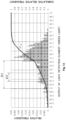
  • FIG. 12 is a graph showing an example where the statistical processing is applied to the output of the light detection element (green light).
  • FIGS. 11 and 12 indicate histograms of the outputs of the light detection element 14 .
  • the abscissa axes indicate the outputs of the light detection element 14 , and correspond to the intensities of the reflected light. Each abscissa axis is classified into multiple classes corresponding to the intensities of the reflected light. Data corresponding to the reflected light detected by the light detection element 14 (e.g., electric signal values of the light detection element 14 ) are classified into multiple classes. Each ordinate axis (left side) indicates the relative frequency. That is, the ordinate axis (left side) indicates the value (frequency) obtained by dividing the number of data classified into the individual classes by the number of total measured data (the number of total measurement times). Curves in the graphs of FIGS. 11 and 12 indicate the integrated values of the relative frequencies, that is, the cumulative relative frequencies (the ordinate axis on the left side).
  • the graph shown in FIG. 11 shows results of continuous measurement for about 30 seconds, with the light emitting element 12 (blue light) being caused to emit light for about three seconds, in order to survey the overview of the output (electric signal value) of the light detection element 14 .
  • FIG. 11 collectively shows measured results of 75 babies and infants, and the number of total measurement times is 757.
  • the graph shown in FIG. 12 indicates results of continuous measurement for about 10 seconds, with the light emitting element 13 (green light) being caused to emit light for about 0.2 seconds.
  • FIG. 12 collectively shows measured results of 14 babies and infants, and the number of total measurement times is 996. Note that during measurement, the light emitting element 12 (blue light) and the light emitting element 13 (green light) are alternately caused to emit light, and the individual reflected light is measured.
  • each part where the output (electric signal value) of the light detection element 14 is high are considered as reflected light that is light from the light emitting elements 12 and 13 reflected by the surface of the skin, that is, a disturbance. Accordingly, in this embodiment, among the outputs (electric signal values) of the light detection element 14 , data having low values (i.e., data of the reflected light having reached below the skin and been reflected) are selectively used, which can improve the accuracy of the measured value of the bilirubin concentration.
  • the data having low values are data in a range having the cumulative relative frequencies from 0.05 to 0.4 shown in FIGS. 11 and 12 .
  • the data are the outputs (electric signal values) of the light detection element 14 in a range B 11 shown in FIG. 11 .
  • the mean value of the outputs (electric signal values) of the light detection element 14 in the range B 11 indicated in FIG. 11 may be obtained, and the mean value may be used as information about the intensities of the reflected light of blue light. That is, the mean value may be used as the value of the intensity I( ⁇ 1 ) of the reflected light of blue light in Expression 1.
  • the mean value of the outputs (electric signal values) of the light detection element 14 in the range G 11 indicated in FIG. 12 may be obtained, and the mean value may be used as information about the intensities of the reflected light of green light. That is, the mean value may be used as the value of the intensity I( ⁇ 2 ) of the reflected light of green light in Expression 1.
  • These values may be used to obtain the constant D and the constant R in Expression 1.
  • the bilirubin concentration can be accurately obtained using such a method.
  • data in any range may be selected to be used only if the data are included in the range B 11 shown in FIG. 11 .
  • data in any range may be selected to be used only if the data are included in the range G 11 shown in FIG. 12 .
  • FIGS. 11 and 12 show data on multiple babies and infants in order to survey the overview of the output (electric signal value) of the light detection element 14 .
  • 100 measured data on the reflected light of blue light, and 100 measured data on the reflected light of green light can be obtained at the maximum.
  • the bilirubin concentration can be accurately obtained by applying such a method to the data obtained as described above.
  • FIG. 13 is a block diagram for illustrating a system configuration example of a bilirubin concentration measurement system according to this embodiment.
  • the bilirubin concentration measurement system 2 shown in FIG. 13 includes multiple sensor devices 10 _ 0 to 10 _ n (n is an integer of one or more), and a terminal device 20 capable of communicating with these sensor devices 10 _ 0 to 10 _ n .
  • the bilirubin concentration measurement system 2 shown in FIG. 13 can be used as a system that collectively manages the bilirubin concentrations of multiple newborns in a hospital or the like.
  • the sensor devices 10 _ 0 to 10 _ n are attached to the respective newborns, and information about the intensities of the reflected light is wirelessly transmitted from each of the sensor devices 10 _ 0 to 10 _ n to the terminal device 20 . Accordingly, the terminal device 20 can collectively manage the bilirubin concentrations of the individual newborns.
  • the communication units 16 of the sensor devices 10 _ 0 to 10 _ n respectively add pieces of ID information unique to the sensor devices 10 _ 0 to 10 _ n , and wirelessly transmit the information about the intensities of the reflected light to the terminal device 20 . Accordingly, the terminal device 20 can identify the transmitter of the information about the intensities of the reflected light, using the added ID information.
  • the bilirubin concentration measurement system 2 wirelessly transmits the data from the sensor devices 10 _ 0 to 10 _ n to the terminal device 20 . Accordingly, wiring for connecting the sensor devices with the terminal device can be omitted, which can improve the work environment for nurses and the like in the hospital or the like.
  • this embodiment may have a configuration that detects information other than that on the bilirubin concentration using the sensor device 10 .
  • multiple vital signs such as the pulse rate, respiration rate, heart rate, body temperature, brain waves (EEG: electroencephalogram), and blood oxygen saturation level, may be measured over time.
  • FIG. 14 is a diagram for illustrating another configuration example of a sensor device included in a bilirubin concentration measurement system according to this embodiment.
  • three light emitting elements 81 to 83 , and a light detection element 84 are implemented on a substrate 80 .
  • the light detection element 84 is arranged at the center position of the three light emitting elements 81 to 83 .
  • the three light emitting elements 81 to 83 are elements that emit red light, green light, and blue light, respectively.
  • FIG. 14 is a diagram for illustrating another configuration example of a sensor device included in a bilirubin concentration measurement system according to this embodiment.
  • three light emitting elements 81 to 83 are implemented on a substrate 80 .
  • the light detection element 84 is arranged at the center position of the three light emitting elements 81 to 83 .
  • the three light emitting elements 81 to 83 are elements that emit red light, green light, and blue light, respectively.
  • the light emitting element 82 green light
  • the light emitting element 83 blue light
  • the sensor device is provided with the three light emitting elements 81 to 83 , which can measure the bilirubin concentration and measure the blood oxygen saturation level.
  • a thermistor in the sensor device, the body temperature of a subject can be measured. Such information is wirelessly transmitted to the terminal device 20 . Accordingly, multiple vital signs of the subject can be monitored over time in the terminal device 20 .

Landscapes

  • Health & Medical Sciences (AREA)
  • Life Sciences & Earth Sciences (AREA)
  • Physics & Mathematics (AREA)
  • Engineering & Computer Science (AREA)
  • General Health & Medical Sciences (AREA)
  • Pathology (AREA)
  • Public Health (AREA)
  • Veterinary Medicine (AREA)
  • Animal Behavior & Ethology (AREA)
  • Surgery (AREA)
  • Molecular Biology (AREA)
  • Medical Informatics (AREA)
  • Heart & Thoracic Surgery (AREA)
  • Biophysics (AREA)
  • Biomedical Technology (AREA)
  • Spectroscopy & Molecular Physics (AREA)
  • Optics & Photonics (AREA)
  • Computer Networks & Wireless Communication (AREA)
  • Physiology (AREA)
  • Gastroenterology & Hepatology (AREA)
  • Endocrinology (AREA)
  • Immunology (AREA)
  • Biochemistry (AREA)
  • Toxicology (AREA)
  • Analytical Chemistry (AREA)
  • General Physics & Mathematics (AREA)
  • Chemical & Material Sciences (AREA)
  • Measurement Of The Respiration, Hearing Ability, Form, And Blood Characteristics Of Living Organisms (AREA)

Abstract

A bilirubin concentration measurement system including: a sensor device attachable to a subject; and a terminal device capable of wirelessly communicating with the sensor device. The sensor device includes: a light emitting diode that emits blue light; a light emitting diode that emits green light; a light detection diode that detects reflected light that is the blue light having been incident on skin of the subject and reflected, and detects reflected light that is the green light having been incident on the skin of the subject and reflected; and a communication unit that wirelessly transmits information about intensities of the reflected light detected by the photodiode. The terminal device includes: a communication unit that receives the information about the intensities of the reflected light transmitted from the sensor device; and a computing unit that calculates a bilirubin concentration using the information about the intensities of the reflected light.

Description

CROSS REFERENCE TO RELATED APPLICATIONS
The present application is a U.S. National Phase of International Application No. PCT/JP2019/049449 entitled “BILIRUBIN CONCENTRATION MEASUREMENT SYSTEM,” and filed on Dec. 17, 2019. International Application No. PCT/JP2019/049449 claims priority to Japanese Patent Application No. 2018-239555 filed on Dec. 21, 2018. The entire contents of each of the above-listed applications are hereby incorporated by reference for all purposes.
TECHNICAL FIELD
The present invention relates to a bilirubin concentration measurement system and, in particular, to a bilirubin concentration measurement system that includes a sensor device attachable to a subject.
BACKGROUND AND SUMMARY
Newborns, babies and infants have immaturely developed bodies, and their vital signs are necessarily checked. In particular, newborns and babies have immature livers. Accordingly, the functions of the livers are required to be periodically monitored. One of important parameters indicating hepatic functions is bilirubin, which is generated during degradation of hemoglobin. Since the newborns and babies have immature livers, they cannot quickly degrade generated bilirubin. As a result, undegraded bilirubin is accumulated in skin tissue to cause jaundice. If appropriate treatment is not applied when jaundice is caused, bilirubin can be deposited in the brain and possibly cause a brain damage. The bilirubin allowance level depends on the ages (ages in month) of newborns and babies. Accordingly, in order to find the symptoms of jaundice as early as possible, it is important to measure the bilirubin concentrations (bilirubin values) of newborns and infants continuously.
The bilirubin concentration is measured using a method of sampling and directly measuring blood (blood sampling method), or an optical method. The blood sampling method has an advantage that can highly accurately measure bilirubin values. However, the method is invasive, and requires time and effort for measurement accordingly. On the other hand, the optical method is non-invasive. Consequently, the method can more easily achieve measurement than the invasive blood sampling method. For such a reason, the optical method is widely used to measure the bilirubin concentration (Patent Literatures 1 and 2).
CITATION LIST Patent Literature
    • Japanese Unexamined Patent Application Publication No. 2000-279398
    • Japanese Unexamined Patent Application Publication No. 2011-163953
Technical Problem
As described above, the optical method is non-invasive. Consequently, this method can more easily measure the bilirubin concentration than the invasive blood sampling method. However, conventional bilirubin concentration measurement apparatuses that use the optical method are large in size. Accordingly, they impose heavy burden on medical staff and subjects (newborns and babies). Consequently, it is difficult to measure the bilirubin concentration continuously.
Furthermore, use of the conventional bilirubin concentration measurement apparatus requires medical staff to conduct measurement for a subject, with the bilirubin concentration measurement apparatus being in contact with the subject, at every time of measurement. Accordingly, it is difficult to monitor the bilirubin concentration continuously. In particular, the bilirubin concentrations of newborns and babies sometimes change rapidly. In the case of using the conventional bilirubin concentration measurement apparatus, it is difficult to detect such rapid change in bilirubin concentration.
In view of the above problems, the present invention has an object to provide a bilirubin concentration measurement system that is small in size and capable of continuously monitoring the bilirubin concentration.
Solution to Problem
A bilirubin concentration measurement system according to an aspect of the present invention includes: a sensor device attachable to a subject; and a terminal device capable of wirelessly communicating with the sensor device. The sensor device includes: a first light emitting element that emits light in a first wavelength band at a first timing; a second light emitting element that emits light in a second wavelength band at a second timing; a light detection element that detects first reflected light that is the light in the first wavelength band having been incident on skin of the subject and been reflected at the first timing, and detects second reflected light that is the light in the second wavelength band having been incident on the skin of the subject and been reflected at the second timing; and a first communication unit that wirelessly transmits information about intensities of the first and second reflected light detected by the light detection element. The terminal device includes: a second communication unit that receives the information about the intensities of the first and second reflected light transmitted from the first communication unit; and a computing unit that calculates a bilirubin concentration using the information about the intensities of the first and second reflected light.
Advantageous Effects of Invention
The present invention can provide the bilirubin concentration measurement system that is small in size and capable of continuously monitoring the bilirubin concentration.
BRIEF DESCRIPTION OF THE FIGURES
FIG. 1 is a block diagram for illustrating a bilirubin concentration measurement system according to an embodiment.
FIG. 2 is a diagram for illustrating an arrangement example of light emitting elements and light detection elements included in a sensor device according to the embodiment.
FIG. 3 is a sectional view for illustrating a configuration example of the sensor device according to the embodiment.
FIG. 4 is a diagram for illustrating a bilirubin concentration measurement principle.
FIG. 5 is a graph showing the relationship between the bilirubin concentration and light intensity (in a case of blue light).
FIG. 6 is a graph showing the relationship between the bilirubin concentration and light intensity (in a case of green light).
FIG. 7 is a diagram for illustrating a bilirubin concentration measurement timing.
FIG. 8 is a graph showing the relationship between values measured using a commercially available bilirubin concentration measurement apparatus (abscissa axis) and values measured using a bilirubin concentration measurement system according to the present invention (ordinate axis).
FIG. 9 is a diagram for illustrating an example of temporal change in output of a light detection element.
FIG. 10 is a diagram for illustrating an example of temporal change in output of the light detection element.
FIG. 11 is a graph showing an example where statistical processing is applied to the output of the light detection element (blue light).
FIG. 12 is a graph showing an example where statistical processing is applied to the output of the light detection element (green light).
FIG. 13 is a block diagram for illustrating a system configuration example of the bilirubin concentration measurement system according to the embodiment.
FIG. 14 is a diagram for illustrating another configuration example of the sensor device according to the embodiment.
DETAILED DESCRIPTION
Hereinafter, referring to the drawings, embodiments of the present invention are described.
FIG. 1 is a block diagram for illustrating a bilirubin concentration measurement system according to an embodiment. As shown in FIG. 1 , the bilirubin concentration measurement system 1 according to this embodiment includes a sensor device 10, and a terminal device 20. The sensor device 10 is configured to be attachable to a subject (a newborn or a baby). The terminal device 20 is configured to be capable of wirelessly communicating with the sensor device 10.
The sensor device 10 includes a control circuit 11, light emitting elements 12 and 13, and a light detection element 14, an amplifier 15, and a communication unit 16. The terminal device 20 includes a communication unit 21, a computing unit 22, and a display unit 23.
The control circuit 11 included in the sensor device 10 controls each of circuit elements included in the sensor device 10. The control circuit 11 can be configured using an MCU (Micro Controller Unit), for example.
The light emitting element 12 emits light in a blue wavelength band (e.g., 470 nm) (hereinafter, also described as blue light) at a predetermined timing. The light emitting element 12 can be configured using a blue light emitting diode (LED), for example. The light emitting element 12 is configured to emit light according to a control signal (drive signal) supplied from the control circuit 11. In other words, the light emitting timing of the light emitting element 12 is controlled using the control circuit 11.
The light emitting element 13 emits light in a green wavelength band (e.g., 570 nm) (hereinafter, also described as green light) at a predetermined timing. The light emitting element 13 can be configured using a green light emitting diode (LED), for example. The light emitting element 13 is configured to emit light according to a control signal (drive signal) supplied from the control circuit 11. In other words, the light emitting timing of the light emitting element 13 is controlled using the control circuit 11.
The light detection element 14 detects reflected light that is blue light of the light emitting element 12 having entered skin of a subject and been reflected. Likewise, the light detection element 14 detects reflected light that is green light of the light emitting element 13 having entered the skin of the subject and been reflected. The light detection element 14 can be configured using an element capable of outputting an electric signal (voltage signal) according to the intensity of the reflected light. The light detection element 14 can be configured using a photodiode, for example.
The amplifier 15 amplifies the electric signal supplied from the light detection element 14, and supplies the amplified signal to the control circuit 11. Note that in a case where the control circuit 11 can directly deal with the electric signal (voltage signal) generated by the light detection element 14, the amplifier 15 may be omitted.
The control circuit 11 supplies the communication unit 16 with the electric signal supplied from the amplifier 15. Here, the electric signal supplied from the amplifier 15 corresponds to information about the intensities of the reflected light detected by the light detection element 14. For example, the control circuit 11 may convert the electric signal supplied from the amplifier 15, which is an analog signal, into a digital signal, and supply the converted digital signal to the communication unit 16.
The communication unit 16 wirelessly transmits the electric signal supplied from the control circuit 11 (i.e., the information about the intensities of the reflected light), to the terminal device 20. In other words, the communication unit 16 wirelessly transmits, to the terminal device 20, the information about the intensities of the reflected light detected by the light detection element 14.
The communication unit 21 of the terminal device 20 receives the information about the intensities of the reflected light, the information having been transmitted from the communication unit 16 of the sensor device 10. The information about the intensities of the reflected light received by the communication unit 21 is supplied to the computing unit 22.
For example, the communication unit 16 of the sensor device 10 and the communication unit 21 of the terminal device 20 can wirelessly communicate with each other using a wireless LAN, Bluetooth®, or a mobile phone network, such as of 3G, 4G or 5G. The network to be used can be appropriately selected in conformity with the distance and the like between the communication unit 16 and the communication unit 21.
The computing unit 22 calculates the bilirubin concentration using the information about the intensities of the reflected light received by the communication unit 21. In other words, the computing unit 22 calculates the bilirubin concentration, using the intensity of the reflected light that is the blue light of the light emitting element 12 having entered the skin of the subject and been reflected, and the intensity of the reflected light that is the green light of the light emitting element 13 having entered the skin of the subject and been reflected. Note that a specific method of calculating the bilirubin concentration is described later. The computing unit 22 can be configured using an MCU (Micro Controller Unit), for example.
The display unit 23 displays the bilirubin concentration calculated by the computing unit 22. The display unit 23 can be configured using a liquid crystal display, for example. For example, when the calculated bilirubin concentration exceeds a predetermined reference value, a warning message may be displayed on the display unit 23.
The terminal device 20 can be configured using a smartphone, a tablet terminal or the like, for example. For example, when the calculated bilirubin concentration exceeds the predetermined reference value, a warning sound may be issued from a speaker included in the terminal device 20.
The settings (e.g., settings of the light emitting timings and light intensities of the light emitting elements 12 and 13, etc.) of the sensor device 10 may be configured using the terminal device 20. In this case, setting information on the sensor device 10 is generated by the computing unit 22 of the terminal device 20. The generated setting information is transmitted from the communication unit 21 of the terminal device 20 to the communication unit 16 of the sensor device 10. The communication unit 16 of the sensor device 10 supplies the control circuit 11 with the setting information received from the terminal device 20. Accordingly, the control circuit 11 can change the settings (e.g., settings of the light emitting timings and light intensities of the light emitting elements 12 and 13, etc.) of the sensor device 10.
FIG. 2 is a diagram for illustrating an arrangement example of the light emitting elements 12 and 13 and light detection elements 14 included in a sensor device 10 according to the embodiment. In the arrangement example shown in FIG. 2 , the two light emitting elements 12 and 13 and the four light detection elements 14_1 to 14_4 are implemented on an identical substrate 30. The four light detection elements 14_1 to 14_4 are arranged around the two light emitting elements 12 and 13. The light emitting surfaces of the two light emitting elements 12 and 13 and the light receiving surfaces of the four light detection elements 14_1 to 14_4 are configured to be on the same plane.
In the configuration example shown in FIG. 2 , the light detection elements 14_1 to 14_4 are arranged so as to encircle the light emitting elements 12 and 13. Accordingly, it is possible to effectively detect reflected light which is light that is originated from the light emitting elements 12 and 13, then incident on skin of the subject and reflected. Consequently, the sensor device 10 can be reduced in size. Note that the arrangement example shown in FIG. 2 is only an example. For the bilirubin concentration measurement system according to this embodiment, the arrangements and the numbers of light emitting elements 12 and 13 and light detection elements 14 can be freely determined.
FIG. 3 is a sectional view for illustrating a configuration example of the sensor device according to this embodiment. As shown in FIG. 3 , the sensor device 10 includes the substrate 30, an exterior resin 41, a substrate 42, and a battery 45. The sensor device 10 is attached to the surface of skin of a subject 47.
The substrate 30 is a substrate on which the light emitting elements 12 and 13 and the light detection elements 14 are implemented. The substrate 42 is a substrate on which circuit elements, such as the control circuit 11, the amplifier 15 and the communication unit 16 (see FIG. 1 ), are implemented. The substrate 30 and the substrate 42 are stacked in the vertical direction. The battery 45 is a battery for driving the sensor device 10, and can be configured using a lithium-ion secondary battery or the like.
As shown in FIG. 3 , the substrate 30, the substrate 42 and the battery 45 are implemented in the exterior resin 41. Specifically, the exterior resin 41 allows the substrate 30, the substrate 42 and the battery 45 to be implemented, so as to enclose these elements. The light emitting surfaces of the light emitting elements 12 and 13, and the light receiving surfaces of the light detection elements 14 are exposed from a surface of the exterior resin 41 facing the subject 47. Consequently, when the sensor device 10 is attached to the surface of the skin of the subject 47, this device is attached such that the light emitting surfaces of the light emitting elements 12 and 13 and the light receiving surfaces of the light detection elements 14 can be in contact with the subject 47.
Preferably, the surface of the exterior resin 41 facing the subject 47 has a shape corresponding to the position of the subject 47 to which the sensor device 10 is attached. For example, in order to attach the sensor device 10, which is a wearable device, onto a forehead of a newborn, the sensor device 10 is configured to have an attachment surface having a shape corresponding to the forehead of the newborn (a shape having a predetermined curve). For example, the substrates 30 and 42 may be flexible polyimide substrates. Such a configuration can bring the sensor device 10 into close contact with the skin surface of the subject 47. For example, the exterior resin 41 can be configured using silicone rubber, PDMS (polydimethylsiloxane), epoxy resin, polyurethane or the like.
As shown in FIG. 3 , when the light emitting element 12 emits light in a state where the sensor device 10 is attached on the surface of the skin of the subject 47, blue light from the light emitting element 12 is incident on the skin of the subject 47. A part of the blue light incident on the skin reaches a blood vessel 48 of the subject 47 and is reflected, and is detected as reflected light by the light detection elements 14. Likewise, when the light emitting element 13 emits light in the state where the sensor device 10 is attached on the surface of the skin of the subject 47, green light from the light emitting element 13 is incident on the skin of the subject 47. A part of the green light incident on the skin reaches the blood vessel 48 of the subject 47 and is reflected, and is detected as reflected light by the light detection elements 14. Note that “reflected light” includes light from the light emitting elements 12 and 13 having been absorbed by or passed through the skin surface.
Next, a method of measuring the bilirubin concentration using the bilirubin concentration measurement system according to this embodiment is described. First a bilirubin concentration measurement principle is described. The bilirubin concentration measurement system according to this embodiment measures the bilirubin concentration in the blood of a subject using an optical method. Specifically, the bilirubin concentration is measured using the difference between the absorbance (absorptance) of bilirubin in the blue wavelength band, and the absorbance (absorptance) of bilirubin in the green wavelength band.
FIG. 4 is a diagram for illustrating the bilirubin concentration measurement principle. In a measurement apparatus shown in FIG. 4 , a blue light emitting element 52 and a green light emitting element 53 are arranged above a container that contains a bilirubin solution 51. Furthermore, a light detection element 54 is arranged below the container, which contains the bilirubin solution 51. The intensity of light detected by the light detection element 54 is converted into predetermined data by a detector 55. Through use of the apparatus shown in FIG. 4 , the absorbance (absorptance) of blue light having passed through the bilirubin solution 51, and the absorbance (absorptance) of green light having passed through the bilirubin solution 51 can be measured.
FIG. 5 is a graph showing the relationship between the bilirubin concentration and light intensity (in the case of blue light). FIG. 6 is a graph showing the relationship between the bilirubin concentration and light intensity (in the case of green light). In the graphs shown in FIGS. 5 and 6 , the light intensity is normalized to be one when the bilirubin concentration is zero. As shown in FIGS. 5 and 6 , for both the cases of blue light and green light, the intensity of light detected by the light detection element 54 decreases with increase in bilirubin concentration. In particular, in the case of blue light, the attenuation of light intensity is higher than that in the case of green light. Consequently, the blue light and the green light have different absorptances in the bilirubin solution. In particular, with respect to the blue light, the absorptance of light in the bilirubin solution is large. Note that as shown in FIGS. 5 and 6 , the measured values approximately coincide with respective theoretical values.
In this embodiment, the bilirubin concentration is measured using the difference between the absorptance of blue light and the absorptance of green light for bilirubin. A specific method is described below.
In the bilirubin concentration measurement system according to this embodiment, the computing unit 22 of the terminal device 20 calculates the bilirubin concentration, using information about the intensity of the reflected light of blue light and the intensity of the reflected light of green light, and the following Expression 1. The following Expression 1 is an equation for obtaining the bilirubin concentration, the equation is derived using the Lambert-Beer law.
[ Math . 1 ] C = D [ - log 10 I ( λ 1 ) I 0 ( λ 1 ) + 1.95 log 10 I ( λ 2 ) I 0 ( λ 2 ) + R ] Expression 1
In Expression 1, C is the bilirubin concentration, I(λ1) is the intensity of reflected light of blue light, I01) is the intensity of blue light incident on the skin of the subject, I(λ2) is the intensity of reflected light of green light, I02) is the intensity of the green light incident on the skin of the subject, and D and R are specific constants determined for each subject.
When the bilirubin concentration is measured, the control circuit 11 causes the light emitting elements 12 and 13 to emit light at timings shown in FIG. 7 , for example. That is, the control circuit 11 applies a rectangular pulse voltage 61 to the light emitting element 13 to cause the light emitting element 13 to emit green light. After the green light from the light emitting element 13 is incident on the skin of the subject, the green light incident on the skin is reflected by the skin of the subject. The reflected light reflected this time is converted into an electric signal (voltage signal) 63 by the light detection element 14.
Subsequently, the control circuit 11 applies a rectangular pulse voltage 62 to the light emitting element 12 to cause the light emitting element 12 to emit blue light. After the blue light from the light emitting element 12 is incident on the skin of the subject, the blue light incident on the skin is reflected by the skin of the subject. The reflected light reflected this time is converted into an electric signal (voltage signal) 64 by the light detection element 14.
In the above example, the light emitting element 12 (blue light) emits light after the light emitting element 13 (green light). The order thereof may be inverted. The blue light has a higher absorptance of light in bilirubin than the green light. Accordingly, as shown in the lower diagram of FIG. 7 , the electric signal 64 corresponding to the blue light has a lower value of the electric signal 63 corresponding to the green light.
The electric signals 63 and 64 detected by the light detection element 14 are wirelessly transmitted as information about the intensities of the reflected light, from the sensor device 10 to the terminal device 20. The computing unit 22 of the terminal device 20 calculates the bilirubin concentration, using the information about the intensities of the reflected light obtained from the sensor device 10, and Expression 1 described above.
Specifically, the bilirubin concentration C can be obtained by substituting, in Expression 1, the intensity I(λ1) of the reflected light of blue light and the intensity I(λ2) of the reflected light of green light, which are the information about the intensities of the reflected light. Here, I01) is the intensity of blue light incident on the skin of the subject, and is a value according to the drive voltage supplied from the control circuit 11 to the light emitting element 12, and the property of the light emitting element 12. Accordingly, this value is a known value. Likewise, I02) is the intensity of green light incident on the skin of the subject, and is a value according to the drive voltage supplied from the control circuit 11 to the light emitting element 13, and the property of the light emitting element 13. Accordingly, this value is a known value. D and R are specific constants determined for each subject. Consequently, the bilirubin concentration C can be obtained by substituting, in Expression 1, the intensity I(λ1) of the reflected light of blue light and the intensity I(λ2) of the reflected light of green light, which are the information about the intensities of the reflected light. Note that in Expression 1, “I(λ1)/I01)” corresponds to the transmittance of blue light, and “I(λ2)/I02)” corresponds to the transmittance of green light.
As described above, D and R are specific constants determined for each subject. D is the constant corresponding to the length of a path along which light propagates in the subject. R is the constant corresponding to attenuation of light in the subject.
In this embodiment, the computing unit 22 preliminarily measures the bilirubin concentration of each subject to be tested, using other means and/or the bilirubin concentration measurement system 1, and predetermines the constant D and the constant R in the Expression 1 for each subject to be tested, using the bilirubin concentration measured using the other means and/or the bilirubin concentration measurement system 1. Hereinafter, a method of determining the constants D and R is described.
First, the bilirubin concentration is preliminarily measured for each subject to be tested, using other means (a blood test etc.). Each of the light emitting elements 12 and 13 of the sensor device 10 is caused to emit light multiple times to obtain multiple data on combinations between the intensities I(λ1) of the reflected light of blue light and the intensities I(λ2) of the reflected light of green light.
The bilirubin concentration C preliminarily obtained using the other means, and the multiple values of intensities I(λ1) and I(λ2), are substituted in Expression 1, thereby creating simultaneous equations. The unknown constants are the two constants, which are D and R. Accordingly, in principle, the constants D and R can be obtained by solving the two simultaneous equations. For example, multiple constants D and R are obtained, and the obtained constants D and R are statistically processed (for example, mean values are obtained), thereby allowing the accuracies of the constants D and R to be improved. Through use of such a method, the constant D and the constant R can be predetermined for each subject to be tested.
In a case where measurement of variation from an initial value is sufficient for measurement of the bilirubin concentration of a subject (i.e., a case where the relative value of the bilirubin concentration is calculated but the absolute value is not required to be measured), preliminary measurement of the bilirubin concentration using other means (blood test etc.) is unnecessary. That is, in the case where the variation in bilirubin concentration (relative value) is obtained, the constants D and R are temporarily determined. For example, the values of the constants D and R may be determined using previously used data on the constants D and R. The bilirubin concentration measurement system 1 is then used to obtain the intensity I(λ1) of the reflected light of blue light, and the intensity I(λ2) of the reflected light of green light are obtained, and the values of I(λ1) and I(λ2) are substituted in Expression 1, which can obtain the variation in bilirubin concentration (relative value).
As described above, in the case where the constants D and R are predetermined, the absolute value of the bilirubin concentration is subsequently obtained using other means (blood test etc.), thereby allowing the preliminarily obtained relative value of the bilirubin concentration to be converted into the absolute value.
FIG. 8 is a graph showing the relationship between values measured using a commercially available bilirubin concentration measurement apparatus (apparatus A: R=0.77) (abscissa axis) and values measured using a bilirubin concentration measurement system according to the present invention (apparatus B) (ordinate axis). In FIG. 8 , bilirubin concentrations are obtained for each subject through the two apparatuses, which are the apparatus A and the apparatus B, and these values are plotted. The plotted values correspond respective subjects. When the bilirubin concentration is measured using the bilirubin concentration measurement system according to the present invention, blue light and green light are alternatively emitted every 40 ms, as shown in FIG. 7 .
As shown in FIG. 8 , there is a relationship between the values measured using the bilirubin concentration measurement system according to this embodiment (ordinate axis) and the values measured using the commercially available bilirubin concentration measurement apparatus (abscissa axis). That is, the bilirubin concentration measurement system according to this embodiment has a measurement accuracy equivalent to that of the commercially available bilirubin concentration measurement apparatus.
The bilirubin concentration measurement system 1 according to this embodiment includes: the sensor device 10 attachable to a subject; and the terminal device 20 capable of wirelessly communicating with the sensor device 10. The sensor device 10 has the configuration that includes the light emitting elements 12 and 13 and the light detection elements 14. The bilirubin concentration is calculated by the terminal device 20. Consequently, the configuration of the sensor device 10 can be simplified, which can reduce the size of the sensor device 10.
The sensor device 10 according to this embodiment can be attached to the subject in a state of being in close contact, and continuously monitor the bilirubin concentration of the subject accordingly. That is, the light emitting elements 12 and 13 can be caused to emit light alternately, and reflected light at this time is detected by the light detection element 14, which can continuously monitor the bilirubin concentration of the subject.
Consequently, the invention according to this embodiment can provide the bilirubin concentration measurement system that is small in size and capable of continuously monitoring the bilirubin concentration.
FIG. 9 is a diagram for illustrating an example of temporal change in output of the light detection element 14, and shows temporal change when reflected light having a predetermined color (blue or green) is detected by the light detection element 14. As shown in FIG. 9 , the light detection element 14 continuously detects the reflected light. However, the outputs of the light detection element 14 sometimes include data 71 and 72 having higher voltages than a predetermined value V1 (i.e., data having high light intensities). It is assumed that this is because the light detection element 14 is temporarily apart from the subject owing to, for example, movement of the subject, and an abnormality temporarily occurs in reflected light detection.
In such a case, the computing unit 22 may exclude the data 71 and 72 temporarily having a higher voltage than the predetermined value V1 (i.e., data having high light intensities), and calculate the bilirubin concentration. The computing unit 22 can accurately calculate the bilirubin concentration by excluding such abnormal data 71 and 72.
FIG. 10 is a diagram for illustrating an example of temporal change in output of the light detection element 14, and shows temporal change when reflected light having a predetermined color (blue or green) is detected by the light detection element 14. As shown in FIG. 10 , while the light detection element 14 continuously detects reflected light, the output of the light detection element 14 becomes higher than a predetermined value V2 at a certain timing (see an arrow in the graph of FIG. 10 ) and the state is continued in some cases. It is assumed that this is because the sensor device 10 (light detection element 14) is apart from the subject owing to, for example, movement of the subject, and an abnormality occurs in reflected light detection.
In such a case, the computing unit 22 can determine that the sensor device 10 is not correctly attached on the subject. For example, when the computing unit 22 determines that the state of the sensor device 10 is abnormal, a warning message indicating that the state of the sensor device 10 is abnormal may be displayed on the display unit 23. A warning sound may be output from the speaker included in the terminal device 20.
As described above, the bilirubin concentration measurement system 1 according to this embodiment can be preferably used for bilirubin measurement for newborns (babies and infants). However, the close contact between the sensor device 10 and the skin of a newborn becomes insufficient by movement of the newborn, and light from the light emitting elements 12 and 13 is reflected by the surface of the skin of the newborn in some cases. In such cases, the reflected light serves as a disturbance. Accordingly, the accuracy of the measured value of the bilirubin concentration sometimes decreases.
The bilirubin concentration measurement system 1 according to this embodiment may apply predetermined statistical processing to the output data of the light detection elements 14 in order to reduce the adverse effects of such a disturbance.
That is, the light emitting element 12 (blue light) is caused to emit light multiple times, and reflected light at the times is detected multiple times by the light detection element 14. The computing unit 22 applies the predetermined statistical processing to data corresponding to the intensities of reflected light (reflected light of blue light) detected multiple times. Among statistically processed data corresponding to the intensity of the reflected light, data in a predetermined range are selectively used to calculate the bilirubin concentration. Likewise, the light emitting element 13 (green light) is caused to emit light multiple times, and reflected light at the times is detected multiple times by the light detection element 14. The computing unit 22 applies the predetermined statistical processing to data corresponding to the intensities of reflected light (reflected light of green light) detected multiple times. Among statistically processed data corresponding to the intensity of the reflected light, data in a predetermined range are selectively used to calculate the bilirubin concentration.
Specifically, the computing unit 22 classifies the data corresponding to the intensities of the reflected light detected multiple times, into multiple classes corresponding to the intensities of the reflected light. The bilirubin concentration is then calculated, selectively using data having cumulative relative frequencies in a predetermined range, among the classified data corresponding to the intensities of the reflected light. At this time, the computing unit 22 may calculate the bilirubin concentration using the mean value of the selected data. The computing unit 22 applies such processes to each of the reflected light of the light emitting element 12 (blue light) and the reflected light of the light emitting element 13 (green light).
Hereinafter, a specific example of such statistical processing is described with reference to FIGS. 11 and 12 . FIG. 11 is a graph showing an example where the statistical processing is applied to the output of the light detection element (blue light). FIG. 12 is a graph showing an example where the statistical processing is applied to the output of the light detection element (green light). FIGS. 11 and 12 indicate histograms of the outputs of the light detection element 14.
In FIGS. 11 and 12 , the abscissa axes indicate the outputs of the light detection element 14, and correspond to the intensities of the reflected light. Each abscissa axis is classified into multiple classes corresponding to the intensities of the reflected light. Data corresponding to the reflected light detected by the light detection element 14 (e.g., electric signal values of the light detection element 14) are classified into multiple classes. Each ordinate axis (left side) indicates the relative frequency. That is, the ordinate axis (left side) indicates the value (frequency) obtained by dividing the number of data classified into the individual classes by the number of total measured data (the number of total measurement times). Curves in the graphs of FIGS. 11 and 12 indicate the integrated values of the relative frequencies, that is, the cumulative relative frequencies (the ordinate axis on the left side).
The graph shown in FIG. 11 shows results of continuous measurement for about 30 seconds, with the light emitting element 12 (blue light) being caused to emit light for about three seconds, in order to survey the overview of the output (electric signal value) of the light detection element 14. FIG. 11 collectively shows measured results of 75 babies and infants, and the number of total measurement times is 757. Likewise, the graph shown in FIG. 12 indicates results of continuous measurement for about 10 seconds, with the light emitting element 13 (green light) being caused to emit light for about 0.2 seconds. FIG. 12 collectively shows measured results of 14 babies and infants, and the number of total measurement times is 996. Note that during measurement, the light emitting element 12 (blue light) and the light emitting element 13 (green light) are alternately caused to emit light, and the individual reflected light is measured.
In FIGS. 11 and 12 , each part where the output (electric signal value) of the light detection element 14 is high are considered as reflected light that is light from the light emitting elements 12 and 13 reflected by the surface of the skin, that is, a disturbance. Accordingly, in this embodiment, among the outputs (electric signal values) of the light detection element 14, data having low values (i.e., data of the reflected light having reached below the skin and been reflected) are selectively used, which can improve the accuracy of the measured value of the bilirubin concentration.
Here, the data having low values are data in a range having the cumulative relative frequencies from 0.05 to 0.4 shown in FIGS. 11 and 12 . Specifically, the data are the outputs (electric signal values) of the light detection element 14 in a range B11 shown in FIG. 11 . The outputs (electric signal values) of the light detection element 14 in a range G11 shown in FIG. 12 .
For example, the mean value of the outputs (electric signal values) of the light detection element 14 in the range B11 indicated in FIG. 11 may be obtained, and the mean value may be used as information about the intensities of the reflected light of blue light. That is, the mean value may be used as the value of the intensity I(λ1) of the reflected light of blue light in Expression 1. Likewise, the mean value of the outputs (electric signal values) of the light detection element 14 in the range G11 indicated in FIG. 12 may be obtained, and the mean value may be used as information about the intensities of the reflected light of green light. That is, the mean value may be used as the value of the intensity I(λ2) of the reflected light of green light in Expression 1. These values may be used to obtain the constant D and the constant R in Expression 1. The bilirubin concentration can be accurately obtained using such a method.
Note that in this embodiment, data in any range may be selected to be used only if the data are included in the range B11 shown in FIG. 11 . Likewise, data in any range may be selected to be used only if the data are included in the range G11 shown in FIG. 12 .
In particular, in this embodiment, it is preferable to use data having the cumulative relative frequencies ranging from 0.1 to 0.2 shown in FIGS. 11 and 12 . Specifically, it is preferable to use the outputs (electric signal values) of the light detection element 14 in a range B12 shown in FIG. 11 . Furthermore, it is preferable to use the outputs (electric signal values) of the light detection element 14 in a range G12 shown in FIG. 12 .
In a case of obtaining the bilirubin concentration using values in the range B12 shown in FIG. 11 and values in the range G12 shown in FIG. 12 , the correlation with the bilirubin concentration measured using the commercially available bilirubin concentration measurement apparatus (apparatus A: R=0.77) was specifically favorable.
Note that FIGS. 11 and 12 show data on multiple babies and infants in order to survey the overview of the output (electric signal value) of the light detection element 14. However, in actual measurement, for example, by repeating for about 10 seconds one time of emission and detection of light every period ranging from 0.05 to 0.5 seconds for each of the babies and infants, 100 measured data on the reflected light of blue light, and 100 measured data on the reflected light of green light can be obtained at the maximum. The bilirubin concentration can be accurately obtained by applying such a method to the data obtained as described above.
FIG. 13 is a block diagram for illustrating a system configuration example of a bilirubin concentration measurement system according to this embodiment. The bilirubin concentration measurement system 2 shown in FIG. 13 includes multiple sensor devices 10_0 to 10_n (n is an integer of one or more), and a terminal device 20 capable of communicating with these sensor devices 10_0 to 10_n. For example, the bilirubin concentration measurement system 2 shown in FIG. 13 can be used as a system that collectively manages the bilirubin concentrations of multiple newborns in a hospital or the like. That is, the sensor devices 10_0 to 10_n are attached to the respective newborns, and information about the intensities of the reflected light is wirelessly transmitted from each of the sensor devices 10_0 to 10_n to the terminal device 20. Accordingly, the terminal device 20 can collectively manage the bilirubin concentrations of the individual newborns.
At this time, the communication units 16 of the sensor devices 10_0 to 10_n respectively add pieces of ID information unique to the sensor devices 10_0 to 10_n, and wirelessly transmit the information about the intensities of the reflected light to the terminal device 20. Accordingly, the terminal device 20 can identify the transmitter of the information about the intensities of the reflected light, using the added ID information.
As described above, the bilirubin concentration measurement system 2 according to this embodiment wirelessly transmits the data from the sensor devices 10_0 to 10_n to the terminal device 20. Accordingly, wiring for connecting the sensor devices with the terminal device can be omitted, which can improve the work environment for nurses and the like in the hospital or the like.
As for the bilirubin concentration measurement system according to this embodiment described above, the case of measuring the bilirubin concentration of the subject using the sensor device 10 has been described. However, this embodiment may have a configuration that detects information other than that on the bilirubin concentration using the sensor device 10. For example, multiple vital signs, such as the pulse rate, respiration rate, heart rate, body temperature, brain waves (EEG: electroencephalogram), and blood oxygen saturation level, may be measured over time.
FIG. 14 is a diagram for illustrating another configuration example of a sensor device included in a bilirubin concentration measurement system according to this embodiment. In the sensor device shown in FIG. 14 , three light emitting elements 81 to 83, and a light detection element 84 are implemented on a substrate 80. In the configuration shown in FIG. 14 , the light detection element 84 is arranged at the center position of the three light emitting elements 81 to 83. The three light emitting elements 81 to 83 are elements that emit red light, green light, and blue light, respectively. In the sensor device shown in FIG. 14 , when the bilirubin concentration is measured, the light emitting element 82 (green light) and the light emitting element 83 (blue light) are used for measuring the bilirubin concentration. For measuring the blood oxygen saturation level, the light emitting element 81 (red light) and the light emitting element 82 (green light) are used. As described above, the sensor device is provided with the three light emitting elements 81 to 83, which can measure the bilirubin concentration and measure the blood oxygen saturation level. By further implementing a thermistor in the sensor device, the body temperature of a subject can be measured. Such information is wirelessly transmitted to the terminal device 20. Accordingly, multiple vital signs of the subject can be monitored over time in the terminal device 20.
The present invention has thus been described based on the aforementioned embodiments. However, the present invention is not limited only to the configuration of the aforementioned embodiment. It is a matter of course that the present invention encompasses various changes, modifications and combinations that those skilled in the art can make within the scope of the invention defined by each claim of the claims in the present application.
This application claims the priority based on Japanese Patent Application No. 2018-239555, filed Dec. 21, 2018, disclosure of which is herein incorporated by reference in its entirety.
REFERENCE SIGNS LIST
    • 1, 2 Bilirubin concentration measurement system
    • 10 Sensor device
    • 11 Control circuit
    • 12, 13 Light emitting element
    • 14 Light detection element
    • 15 Amplifier
    • 16 Communication unit
    • 20 Terminal device
    • 21 Communication unit
    • 22 Computing unit
    • 23 Display unit
    • 30 Substrate
    • 41 Exterior resin
    • 42 Substrate
    • 45 Battery
    • 47 Subject
    • 48 Blood vessel
    • 51 Bilirubin solution
    • 52 Blue light emitting element
    • 53 Green light emitting element
    • 54 Light detection element
    • 55 Detector
    • 80 Substrate
    • 81, 82, 83 Light emitting element
    • 84 Light detection element

Claims (8)

The invention claimed is:
1. A bilirubin concentration measurement system, comprising: a sensor device attachable to a subject; and a terminal device capable of wirelessly communicating with the sensor device, wherein
the sensor device comprises:
a first light emitting diode configured to emit light in a first wavelength band at a first timing on skin of the subject to produce first reflected light;
a second light emitting diode configured to emit light in a second wavelength band at a second timing on the skin of the subject to produce second reflected light;
a photodiode configured to detect the first reflected light that is the light in the first wavelength band having been incident on the skin of the subject and been reflected at the first timing, and detect the second reflected light that is the light in the second wavelength band having been incident on the skin of the subject and been reflected at the second timing; and
a first communication unit comprising a transmitter configured to wirelessly transmit information about intensities of the first and second reflected light detected by the photodiode, and
the terminal device comprises:
a second communication unit comprising a receiver configured to receive the information about the intensities of the first and second reflected light transmitted from the first communication unit; and
a computing unit configured to calculate a bilirubin concentration,
wherein:
the photodiode is configured to detect, multiple times, each of the first and second reflected light at the first and second timings, and
the computing unit is configured to:
apply predetermined statistical processing to data corresponding to the intensities of the first and second reflected light detected multiple times, and
classify the data corresponding to the intensities of the first and second reflected light detected multiple times into a plurality of classes corresponding to the intensities of the reflected light,
wherein calculating the bilirubin concentration comprises selectively using data having cumulative relative frequencies in a predetermined range among the classified data corresponding to the intensities of the first and second reflected light, wherein the predetermined range is 0.05 to 0.4,
wherein:
the sensor device further comprises an exterior resin that encloses a substrate on which the first and second light emitting diodes and the photodiode are implemented,
light emitting surfaces of the first and second light emitting diodes and a light receiving surface of the photodiode are exposed from a surface of the exterior resin configured to face the subject, and
the surface of the exterior resin facing the subject has a shape corresponding to a shape of a part of the subject to which the sensor device is attached.
2. The bilirubin concentration measurement system according to claim 1, wherein
calculating the bilirubin concentration comprises using a following Expression 1,
C = D [ - log 10 I ( λ 1 ) I 0 ( λ 1 ) + 1.95 log 10 I ( λ 2 ) I 0 ( λ 2 ) + R ] Expression 1
wherein, in the Expression 1, C is the bilirubin concentration, I(λ1) is the intensity of the first reflected light, I01) is an intensity of the light in the first wavelength band incident on the skin of the subject, I(λ2) is the intensity of the second reflected light, I02) is an intensity of the light in the second wavelength band incident on the skin of the subject, and D and R are specific constants determined for the subject.
3. The bilirubin concentration measurement system according to claim 2, wherein the computing unit is configured to preliminarily measure the bilirubin concentration of the subject to be tested using other means, and predetermine the constant D and the constant R in the Expression 1 for the subject using the bilirubin concentration measured using the other means.
4. The bilirubin concentration measurement system according to claim 1, wherein
the computing unit is configured to exclude data having a higher intensity than a predetermined value among the intensities of the first and second reflected light detected multiple times.
5. The bilirubin concentration measurement system according to claim 1, wherein when the intensities of the first and second reflected light are higher than a predetermined value, the computing unit is configured to determine that the sensor device is not correctly attached to the subject.
6. The bilirubin concentration measurement system according to claim 1, wherein calculating the bilirubin concentration comprises using mean values of the selected data.
7. The bilirubin concentration measurement system according to claim 1, wherein calculating the bilirubin concentration comprises selectively using data having the cumulative relative frequencies ranging from 0.1 to 0.2.
8. The bilirubin concentration measurement system according to claim 1, wherein:
the bilirubin concentration measurement system further comprises a plurality of the sensor devices;
the terminal device is capable of communicating with the sensor devices;
the first communication unit of each of the sensor devices is configured to add ID information unique to the corresponding sensor device to the information about the intensities of the first and second reflected light, and wirelessly transmit the information; and
the terminal device is configured to identify a transmitter of the information about the intensities of the first and second reflected light using the ID information.
US17/414,935 2018-12-21 2019-12-17 Bilirubin concentration measurement system Active 2042-04-08 US12178573B2 (en)

Applications Claiming Priority (3)

Application Number Priority Date Filing Date Title
JP2018-239555 2018-12-21
JP2018239555 2018-12-21
PCT/JP2019/049449 WO2020129989A1 (en) 2018-12-21 2019-12-17 Bilirubin concentration measurement system

Publications (2)

Publication Number Publication Date
US20220047192A1 US20220047192A1 (en) 2022-02-17
US12178573B2 true US12178573B2 (en) 2024-12-31

Family

ID=71101954

Family Applications (1)

Application Number Title Priority Date Filing Date
US17/414,935 Active 2042-04-08 US12178573B2 (en) 2018-12-21 2019-12-17 Bilirubin concentration measurement system

Country Status (4)

Country Link
US (1) US12178573B2 (en)
EP (1) EP3892984B1 (en)
JP (1) JP7370539B2 (en)
WO (1) WO2020129989A1 (en)

Families Citing this family (3)

* Cited by examiner, † Cited by third party
Publication number Priority date Publication date Assignee Title
WO2023028353A1 (en) 2021-08-27 2023-03-02 Bilibaby, Inc. Systems and methods for determining and communicating levels of bilirubin and other subcutaneous substances
CN117481601B (en) * 2023-10-31 2024-08-20 深圳高性能医疗器械国家研究院有限公司 Jaundice risk index assessment method, device, computer equipment and storage medium
CN117547258B (en) * 2023-10-31 2024-09-24 深圳高性能医疗器械国家研究院有限公司 Skin color correction method, device, computer equipment and storage medium

Citations (21)

* Cited by examiner, † Cited by third party
Publication number Priority date Publication date Assignee Title
US5086229A (en) * 1989-01-19 1992-02-04 Futrex, Inc. Non-invasive measurement of blood glucose
EP0747002A1 (en) 1995-06-06 1996-12-11 Ohmeda Inc. Non-invasive bilirubin monitor
US5913819A (en) * 1996-04-26 1999-06-22 Datex-Ohmeda, Inc. Injection molded, heat-sealed housing and half-etched lead frame for oximeter sensor
JP2000279398A (en) 1999-03-31 2000-10-10 Minolta Co Ltd Device for percutaneously measuring concentration of bilirubin and board for inspecting measured data
US6402691B1 (en) * 1999-09-21 2002-06-11 Herschel Q. Peddicord In-home patient monitoring system
US20020111541A1 (en) * 2000-01-03 2002-08-15 Sportbrain, Inc. Personal data capture device and web posting system
US20040138540A1 (en) * 2003-01-10 2004-07-15 Nellcor Puritan Bennett Inc. Signal quality metrics design for qualifying data for a physiological monitor
US20080039778A1 (en) * 2004-09-23 2008-02-14 Goldie James H Computer Controlled Bottle for Oral Feeding of a Patient
US20080275307A1 (en) * 2004-02-06 2008-11-06 Koninklijke Philips Electronics N.V. Telemetry System With out of Range Notification Features
JP2011163953A (en) 2010-02-10 2011-08-25 Konica Minolta Sensing Inc Light projecting/receiving system, and optical biological information measuring device using the same
US20120165618A1 (en) * 2010-12-22 2012-06-28 Richard Algoo Method and apparatus for health avatar
US20130053654A1 (en) * 2010-02-26 2013-02-28 Andreas Caduff Optical determination of blood perfusion and similar parameters
WO2013158815A2 (en) 2012-04-18 2013-10-24 Qualcomm Incorporated Biometric attribute anomoly detection system with adjusting notifications
US20140243681A1 (en) * 2011-09-30 2014-08-28 The Trustees Of Columbia University In The City Of New York Compact optical imaging devices, systems, and methods
US20150148623A1 (en) 2013-11-26 2015-05-28 David Alan Benaron Hydration Monitoring Sensor And Method For Cell Phones, Smart Watches, Occupancy Sensors, And Wearables
WO2015084947A1 (en) 2013-12-05 2015-06-11 Senseonics, Incorporated Analyte concentration alert function for analyte sensor system
JP2016096977A (en) 2014-11-20 2016-05-30 ローム株式会社 Optical sensor module
US20170071513A1 (en) * 2014-05-15 2017-03-16 Abbott Diabetes Care Inc. Analyte Level Calibration Using Baseline Analyte Level
WO2017115361A1 (en) 2015-12-31 2017-07-06 Wear2B Ltd Device, system and method for non-invasive monitoring of physiological measurements
US20180228433A1 (en) * 2017-02-12 2018-08-16 Hoon Kim Portable apparatus for noninvasively measuring blood glucose level and operating method thereof
US20210038144A1 (en) * 2018-06-21 2021-02-11 Panasonic Intellectual Property Management Co., Ltd. Skin evaluation device, skin evaluation system, skin evaluation method, and non-transitory computer-readable recording medium storing program for skin evaluation

Family Cites Families (1)

* Cited by examiner, † Cited by third party
Publication number Priority date Publication date Assignee Title
JPH04127034A (en) * 1990-09-19 1992-04-28 Minolta Camera Co Ltd Optical type density difference meter

Patent Citations (26)

* Cited by examiner, † Cited by third party
Publication number Priority date Publication date Assignee Title
US5086229A (en) * 1989-01-19 1992-02-04 Futrex, Inc. Non-invasive measurement of blood glucose
EP0747002A1 (en) 1995-06-06 1996-12-11 Ohmeda Inc. Non-invasive bilirubin monitor
JPH08332182A (en) 1995-06-06 1996-12-17 Ohmeda Inc System and method for judgement of concentration of bilirubin
US5913819A (en) * 1996-04-26 1999-06-22 Datex-Ohmeda, Inc. Injection molded, heat-sealed housing and half-etched lead frame for oximeter sensor
US6847835B1 (en) * 1999-03-31 2005-01-25 Minolta Co., Ltd. Transcutaneous bilirubin concentration measuring apparatus and a measurement data checking plate for use with the same
JP2000279398A (en) 1999-03-31 2000-10-10 Minolta Co Ltd Device for percutaneously measuring concentration of bilirubin and board for inspecting measured data
US6402691B1 (en) * 1999-09-21 2002-06-11 Herschel Q. Peddicord In-home patient monitoring system
US20020111541A1 (en) * 2000-01-03 2002-08-15 Sportbrain, Inc. Personal data capture device and web posting system
US20040138540A1 (en) * 2003-01-10 2004-07-15 Nellcor Puritan Bennett Inc. Signal quality metrics design for qualifying data for a physiological monitor
US20080275307A1 (en) * 2004-02-06 2008-11-06 Koninklijke Philips Electronics N.V. Telemetry System With out of Range Notification Features
US20080039778A1 (en) * 2004-09-23 2008-02-14 Goldie James H Computer Controlled Bottle for Oral Feeding of a Patient
JP2011163953A (en) 2010-02-10 2011-08-25 Konica Minolta Sensing Inc Light projecting/receiving system, and optical biological information measuring device using the same
US20130053654A1 (en) * 2010-02-26 2013-02-28 Andreas Caduff Optical determination of blood perfusion and similar parameters
US20120165618A1 (en) * 2010-12-22 2012-06-28 Richard Algoo Method and apparatus for health avatar
US20140243681A1 (en) * 2011-09-30 2014-08-28 The Trustees Of Columbia University In The City Of New York Compact optical imaging devices, systems, and methods
WO2013158815A2 (en) 2012-04-18 2013-10-24 Qualcomm Incorporated Biometric attribute anomoly detection system with adjusting notifications
JP2015514512A (en) 2012-04-18 2015-05-21 クゥアルコム・インコーポレイテッドQualcomm Incorporated Biometric attribute anomaly detection system with notification coordination
US20150148623A1 (en) 2013-11-26 2015-05-28 David Alan Benaron Hydration Monitoring Sensor And Method For Cell Phones, Smart Watches, Occupancy Sensors, And Wearables
WO2015084947A1 (en) 2013-12-05 2015-06-11 Senseonics, Incorporated Analyte concentration alert function for analyte sensor system
JP2017504446A (en) 2013-12-05 2017-02-09 センセオニクス,インコーポレイテッド Analyte concentration warning function for analyte sensor system
US20170071513A1 (en) * 2014-05-15 2017-03-16 Abbott Diabetes Care Inc. Analyte Level Calibration Using Baseline Analyte Level
JP2016096977A (en) 2014-11-20 2016-05-30 ローム株式会社 Optical sensor module
WO2017115361A1 (en) 2015-12-31 2017-07-06 Wear2B Ltd Device, system and method for non-invasive monitoring of physiological measurements
US20190008432A1 (en) * 2015-12-31 2019-01-10 Wear2B Ltd. Device, system and method for non-invasive monitoring of physiological measurements
US20180228433A1 (en) * 2017-02-12 2018-08-16 Hoon Kim Portable apparatus for noninvasively measuring blood glucose level and operating method thereof
US20210038144A1 (en) * 2018-06-21 2021-02-11 Panasonic Intellectual Property Management Co., Ltd. Skin evaluation device, skin evaluation system, skin evaluation method, and non-transitory computer-readable recording medium storing program for skin evaluation

Non-Patent Citations (4)

* Cited by examiner, † Cited by third party
Title
European Patent Office, Extended European Search Report Issued in Application No. 19898117.7, Aug. 10, 2022, Germany, 9 pages.
ISA Japan Patent Office, International Search Report Issued in Application No. PCT/JP2019/049449, Mar. 24, 2020, WIPO, 4 pages.
Japanese Patent Office, Office Action Issued in Application No. 2020-561462, Aug. 15, 2023, 9 pages.
Teh, H. et al., "Sensor data quality: a systematic review," Journal of Big Data, vol. 7, No. 11, Feb. 20, 2020, 50 pages.

Also Published As

Publication number Publication date
WO2020129989A1 (en) 2020-06-25
EP3892984B1 (en) 2024-12-04
EP3892984A4 (en) 2022-09-07
JP7370539B2 (en) 2023-10-30
US20220047192A1 (en) 2022-02-17
EP3892984A1 (en) 2021-10-13
JPWO2020129989A1 (en) 2021-11-04

Similar Documents

Publication Publication Date Title
EP3505058B1 (en) Bio-signal measuring apparatus and operating method thereof
US12178573B2 (en) Bilirubin concentration measurement system
US12161445B2 (en) Light-based non-invasive blood pressure systems and methods
EP3485802A1 (en) Bio-information measuring apparatus and bio-information measuring method
US20160022223A1 (en) Multi-modal depth-resolved tissue status monitor
US11122996B2 (en) Blood glucose measurement device, blood glucose calculation method, and blood glucose calculation program
CN108601529A (en) The equipment, system and method for non-invasive monitoring for physiological measurements
US10117585B2 (en) Sensor and biological signal measuring system
US20140073900A1 (en) System and method for measuring cardiac output
WO2022184623A1 (en) Dual-mode biosensor
US20220354398A1 (en) Device, system and method for non-invasive monitoring of physiological measurements
EP3593719A1 (en) Measurement device, measurement method, and program
EP3513725B1 (en) Concentration measurement apparatus and method for determining a timing of a start of measurement
US11883168B2 (en) Oxygen saturation measuring device, probe adapted to be used therefor, and oxygen saturation measuring method
CN119184698B (en) Detection method, electronic device and detection system for brain consciousness state of pilot
Inamori et al. Wearable optical device for real-time monitoring of newborn jaundice
US20250311947A1 (en) Spectrophotometric device for measuring blood oxygen saturation
US20240206753A1 (en) Biological information measurement device, biological information measurement method, and biological information measurement system
US20250194962A1 (en) Devices and methods for transcutaneous bilirubin measurement
KR101580195B1 (en) Terminal for bio-sensor measurement

Legal Events

Date Code Title Description
FEPP Fee payment procedure

Free format text: ENTITY STATUS SET TO UNDISCOUNTED (ORIGINAL EVENT CODE: BIG.); ENTITY STATUS OF PATENT OWNER: LARGE ENTITY

AS Assignment

Owner name: PUBLIC UNIVERSITY CORPORATION YOKOHAMA CITY UNIVERSITY, JAPAN

Free format text: ASSIGNMENT OF ASSIGNORS INTEREST;ASSIGNORS:OTA, HIROKI;ISODA, YUTAKA;INAMORI, GO;AND OTHERS;SIGNING DATES FROM 20210517 TO 20210602;REEL/FRAME:056739/0843

Owner name: NATIONAL UNIVERSITY CORPORATION YOKOHAMA NATIONAL UNIVERSITY, JAPAN

Free format text: ASSIGNMENT OF ASSIGNORS INTEREST;ASSIGNORS:OTA, HIROKI;ISODA, YUTAKA;INAMORI, GO;AND OTHERS;SIGNING DATES FROM 20210517 TO 20210602;REEL/FRAME:056739/0843

STPP Information on status: patent application and granting procedure in general

Free format text: DOCKETED NEW CASE - READY FOR EXAMINATION

STPP Information on status: patent application and granting procedure in general

Free format text: NON FINAL ACTION MAILED

STPP Information on status: patent application and granting procedure in general

Free format text: RESPONSE TO NON-FINAL OFFICE ACTION ENTERED AND FORWARDED TO EXAMINER

STPP Information on status: patent application and granting procedure in general

Free format text: NOTICE OF ALLOWANCE MAILED -- APPLICATION RECEIVED IN OFFICE OF PUBLICATIONS

STPP Information on status: patent application and granting procedure in general

Free format text: PUBLICATIONS -- ISSUE FEE PAYMENT VERIFIED

STCF Information on status: patent grant

Free format text: PATENTED CASE