US12175787B2 - Three-dimensional human pose estimation method and related apparatus - Google Patents
Three-dimensional human pose estimation method and related apparatus Download PDFInfo
- Publication number
- US12175787B2 US12175787B2 US17/901,700 US202217901700A US12175787B2 US 12175787 B2 US12175787 B2 US 12175787B2 US 202217901700 A US202217901700 A US 202217901700A US 12175787 B2 US12175787 B2 US 12175787B2
- Authority
- US
- United States
- Prior art keywords
- pose estimation
- view
- human
- frame
- video frame
- Prior art date
- Legal status (The legal status is an assumption and is not a legal conclusion. Google has not performed a legal analysis and makes no representation as to the accuracy of the status listed.)
- Active, expires
Links
Images



Classifications
-
- G—PHYSICS
- G06—COMPUTING OR CALCULATING; COUNTING
- G06N—COMPUTING ARRANGEMENTS BASED ON SPECIFIC COMPUTATIONAL MODELS
- G06N3/00—Computing arrangements based on biological models
- G06N3/02—Neural networks
- G06N3/04—Architecture, e.g. interconnection topology
- G06N3/0464—Convolutional networks [CNN, ConvNet]
-
- G—PHYSICS
- G06—COMPUTING OR CALCULATING; COUNTING
- G06V—IMAGE OR VIDEO RECOGNITION OR UNDERSTANDING
- G06V40/00—Recognition of biometric, human-related or animal-related patterns in image or video data
- G06V40/10—Human or animal bodies, e.g. vehicle occupants or pedestrians; Body parts, e.g. hands
-
- G—PHYSICS
- G06—COMPUTING OR CALCULATING; COUNTING
- G06N—COMPUTING ARRANGEMENTS BASED ON SPECIFIC COMPUTATIONAL MODELS
- G06N20/00—Machine learning
-
- G—PHYSICS
- G06—COMPUTING OR CALCULATING; COUNTING
- G06N—COMPUTING ARRANGEMENTS BASED ON SPECIFIC COMPUTATIONAL MODELS
- G06N3/00—Computing arrangements based on biological models
- G06N3/02—Neural networks
- G06N3/04—Architecture, e.g. interconnection topology
- G06N3/045—Combinations of networks
-
- G—PHYSICS
- G06—COMPUTING OR CALCULATING; COUNTING
- G06N—COMPUTING ARRANGEMENTS BASED ON SPECIFIC COMPUTATIONAL MODELS
- G06N3/00—Computing arrangements based on biological models
- G06N3/02—Neural networks
- G06N3/08—Learning methods
-
- G—PHYSICS
- G06—COMPUTING OR CALCULATING; COUNTING
- G06V—IMAGE OR VIDEO RECOGNITION OR UNDERSTANDING
- G06V10/00—Arrangements for image or video recognition or understanding
- G06V10/20—Image preprocessing
- G06V10/26—Segmentation of patterns in the image field; Cutting or merging of image elements to establish the pattern region, e.g. clustering-based techniques; Detection of occlusion
- G06V10/267—Segmentation of patterns in the image field; Cutting or merging of image elements to establish the pattern region, e.g. clustering-based techniques; Detection of occlusion by performing operations on regions, e.g. growing, shrinking or watersheds
-
- G—PHYSICS
- G06—COMPUTING OR CALCULATING; COUNTING
- G06V—IMAGE OR VIDEO RECOGNITION OR UNDERSTANDING
- G06V10/00—Arrangements for image or video recognition or understanding
- G06V10/70—Arrangements for image or video recognition or understanding using pattern recognition or machine learning
- G06V10/77—Processing image or video features in feature spaces; using data integration or data reduction, e.g. principal component analysis [PCA] or independent component analysis [ICA] or self-organising maps [SOM]; Blind source separation
- G06V10/80—Fusion, i.e. combining data from various sources at the sensor level, preprocessing level, feature extraction level or classification level
- G06V10/803—Fusion, i.e. combining data from various sources at the sensor level, preprocessing level, feature extraction level or classification level of input or preprocessed data
-
- G—PHYSICS
- G06—COMPUTING OR CALCULATING; COUNTING
- G06V—IMAGE OR VIDEO RECOGNITION OR UNDERSTANDING
- G06V10/00—Arrangements for image or video recognition or understanding
- G06V10/70—Arrangements for image or video recognition or understanding using pattern recognition or machine learning
- G06V10/77—Processing image or video features in feature spaces; using data integration or data reduction, e.g. principal component analysis [PCA] or independent component analysis [ICA] or self-organising maps [SOM]; Blind source separation
- G06V10/80—Fusion, i.e. combining data from various sources at the sensor level, preprocessing level, feature extraction level or classification level
- G06V10/806—Fusion, i.e. combining data from various sources at the sensor level, preprocessing level, feature extraction level or classification level of extracted features
-
- G—PHYSICS
- G06—COMPUTING OR CALCULATING; COUNTING
- G06V—IMAGE OR VIDEO RECOGNITION OR UNDERSTANDING
- G06V10/00—Arrangements for image or video recognition or understanding
- G06V10/70—Arrangements for image or video recognition or understanding using pattern recognition or machine learning
- G06V10/82—Arrangements for image or video recognition or understanding using pattern recognition or machine learning using neural networks
-
- G—PHYSICS
- G06—COMPUTING OR CALCULATING; COUNTING
- G06V—IMAGE OR VIDEO RECOGNITION OR UNDERSTANDING
- G06V20/00—Scenes; Scene-specific elements
- G06V20/40—Scenes; Scene-specific elements in video content
- G06V20/41—Higher-level, semantic clustering, classification or understanding of video scenes, e.g. detection, labelling or Markovian modelling of sport events or news items
-
- G—PHYSICS
- G06—COMPUTING OR CALCULATING; COUNTING
- G06V—IMAGE OR VIDEO RECOGNITION OR UNDERSTANDING
- G06V20/00—Scenes; Scene-specific elements
- G06V20/40—Scenes; Scene-specific elements in video content
- G06V20/46—Extracting features or characteristics from the video content, e.g. video fingerprints, representative shots or key frames
-
- G—PHYSICS
- G06—COMPUTING OR CALCULATING; COUNTING
- G06V—IMAGE OR VIDEO RECOGNITION OR UNDERSTANDING
- G06V20/00—Scenes; Scene-specific elements
- G06V20/60—Type of objects
- G06V20/64—Three-dimensional [3D] objects
-
- G—PHYSICS
- G06—COMPUTING OR CALCULATING; COUNTING
- G06V—IMAGE OR VIDEO RECOGNITION OR UNDERSTANDING
- G06V40/00—Recognition of biometric, human-related or animal-related patterns in image or video data
- G06V40/10—Human or animal bodies, e.g. vehicle occupants or pedestrians; Body parts, e.g. hands
- G06V40/103—Static body considered as a whole, e.g. static pedestrian or occupant recognition
Definitions
- Embodiments of this application relate to the field of artificial intelligence, and in particular, to three-dimensional human pose estimation.
- Three-dimensional human pose estimation is a technology through which a three-dimensional motion made by a human is recognized from a two-dimensional image.
- a three-dimensional human pose estimation method is provided in the related art.
- a two-dimensional image is inputted into a neural network model, and a three-dimensional human pose represented by a three-dimensional model is outputted based on constrained optimization of two-dimensional key points (2D Key points) of the image.
- Embodiments of this application provide a three-dimensional human pose estimation method and apparatus, a device, a medium, and a computer program product, which can provide a multi-frame and multi-view video frame sequence as a two-dimensional clue constraint, to implement stable and accurate three-dimensional human pose estimation for a human.
- the technical solutions are as follows.
- a three-dimensional human pose estimation method including:
- the video frame sequence including a plurality of video frames sorted according to timestamps, and n being an integer greater than 1;
- a three-dimensional human pose estimation apparatus including:
- a computer device including a processor and a memory, the memory storing at least one instruction, at least one program, a code set or an instruction set, the at least one instruction, the at least one program, the code set or the instruction set being loaded and executed by the processor to implement the three-dimensional human pose estimation method described in the foregoing aspect.
- a computer-readable storage medium storing a computer program, the computer program is configured to perform the three-dimensional human pose estimation method according to the foregoing aspect.
- a computer program product including instructions is provided, the computer program product, when run on a computer, causing the computer to perform the three-dimensional human pose estimation method in the foregoing aspect.
- the initialization pose estimation result extracted from the neural network model is used as a two-dimensional clue constraint, and the multi-frame and multi-view human pose estimation is performed based on an optimized three-dimensional pose estimation method.
- robustness of pose estimation of the neural network model can be utilized.
- accuracy of the method based on optimization can be utilized.
- a brand new multi-view and multi-frame human pose estimation method is provided, so that accuracy of human pose estimation is improved, and by using a multi-view constraint and a timing constraint, single-frame and single-view human pose estimation is prevented from easily falling into a local extremum.
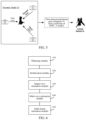
- FIG. 1 is a flowchart of a three-dimensional human pose estimation method according to an exemplary embodiment of this application.
- FIG. 2 is a schematic diagram of implementation when an image is acquired in multiple views according to an exemplary embodiment of this application.
- FIG. 3 is a schematic diagram of a framework of a three-dimensional human pose estimation method according to another exemplary embodiment of this application.
- FIG. 4 is a flowchart of a three-dimensional human pose estimation method according to another exemplary embodiment of this application.
- FIG. 5 is a diagram of an application scenario of a three-dimensional human pose estimation method according to an exemplary embodiment of this application.
- FIG. 6 is a block diagram of a three-dimensional human pose estimation apparatus according to an exemplary embodiment of this application.
- FIG. 7 is a block diagram of a computer device according to an exemplary embodiment of this application.
- Multi-view A plurality of cameras are used to acquire an action video of a same person from different lines of sight and angles at the same time.
- Three-dimensional human pose estimation A three-dimensional motion made by a human is estimated from a two-dimensional image. Generally, a human joint in human anatomy is used for expressing the three-dimensional motion, or a three-dimensional human parametric model is used for expressing the three-dimensional motion.
- Three-dimensional human parametric model It is referred to as human parametric model for short.
- a three-dimensional mesh of a human is expressed as some low-dimensional vector sets, and a new human can be expressed as a linear combination of these vector sets.
- a human parametric model commonly used includes Skinned Multi-Person Linear (SMPL) and Skinned Multi-Person Linear eXpressive (SMPL_X).
- the SMPL cannot express an expression and gesture of a human, and the SMPL_X extends to express the expression and gesture of the human based on the SMPL.
- the SMPL model is a skeleton-driven parametric human model proposed by researchers at Max Planck Institute in Germany. Related articles were published at SIGGRAPH Asia Conference convened by the international Association for Computing Machinery's Special Interest Group on Computer Graphics and Interactive Techniques in 2015.
- the SMPL model is simple and easy to use, and has been published (only for research) by the author. Therefore, the model has been widely used by researchers.
- the SMPL_X model has 10475 vertices and 54 joints. Joints used for neck, chin, eyeballs and fingers are included in the 54 joints.
- the SMPL_X is defined by a function M ( ⁇ , ⁇ , ⁇ ), where ⁇ is a pose parameter, ⁇ is a shape parameter, and ⁇ is a facial expression parameter.
- An OpenPose model is a human pose recognition model, and is an open source library developed by Carnegie Mellon University (CMU) in the United States based on convolutional neural network and supervised learning.
- the model can achieve pose estimation of a human motion, a facial expression, a finger motion, and the like, and output a two-dimensional human key point.
- the OpenPose model is suitable for single person and multiple persons, and has excellent robustness.
- the OpenPose model is the first real-time multi-person two-dimensional pose estimation application based on deep learning in the world.
- the solutions provided in the embodiments of this application relate to three-dimensional human pose estimation technologies in artificial intelligence.
- SMPL_X based on the human parametric model SMPL_X, a multi-frame and multi-view video frame sequence is provided as a two-dimensional clue constraint to achieve stable and accurate three-dimensional human pose estimation of a human.
- FIG. 1 is a flowchart of a three-dimensional human pose estimation method according to an exemplary embodiment of this application.
- the method includes the following steps.
- Step 110 Obtain a video frame sequence of n views, the video frame sequence including a plurality of video frames sorted according to timestamps, and n being an integer greater than 1.
- the view is an angle formed between a line of sight of a camera and a perpendicular direction of a reference object.
- the view is the angle formed between the line of sight of the camera and a perpendicular direction in front of the human.
- N views are more than two views, and are referred to as multi-view for short. Schematically, any two of the n views are different.
- n cameras are provided to acquire videos of a person according to different views, to obtain video frame sequences of the n views (referred to as videos for short).
- the first camera acquires a video frame sequence of a person in a first view
- the second camera acquires the video frame sequence of the person in a second view
- the third camera acquires the video frame sequence of the person in a third view.
- the n cameras are cameras without camera calibration.
- numbers of video frames in the video frame sequences of the n views are the same, and frame rates in the video frame sequences of the n views are the same, for example, 60 frames per second.
- the numbers of video frames in the video frame sequences of the n views are slightly different and the frame rates are different (for example, in multiples or proportions).
- video frames in some views may be deleted or discarded, so that the numbers of video frames in the n views are the same.
- video frames in some views may also be deleted or discarded in multiples or proportions, so that the numbers of video frames in the n views are the same.
- Step 120 Extract an initialization pose estimation result of a single video frame in the n views based on a neural network model.
- the neural network model is a model with a two-dimensional clue for extracting a single video frame.
- the two-dimensional clue includes a two-dimensional human key point, a human segmentation result, and a single-frame human pose estimation result
- the neural network model may include: a first model for extracting the two-dimensional human key point, a second model for extracting the human segmentation result, and a third model for extracting the single-frame human pose estimation result.
- the first model is an Openpose model
- the second model is an image semantic segmentation network model or a human parsing network.
- the third model is a convolutional neural network (CNN).
- An initialization pose estimation result of each video frame in the n views is extracted at least by the neural network model.
- initialization pose estimation result of each video frame in the n views is extracted based on the neural network model.
- initialization pose estimation includes: a two-dimensional human key point in the single video frame, a human segmentation result in the single video frame, and a human pose estimation result in the single video frame.
- n views include three views: a first view, a second view, and a third view as an example, initialization pose estimation results of each single video frame in the first view, the second view, and the third view are respectively extracted.
- Step 130 Perform single-frame and single-view human pose estimation on the initialization pose estimation result, to obtain n single-view pose estimation sequences respectively corresponding to the n views.
- the initialization pose estimation result is used as initialized input, and a constraint of a second clue can be used to perform single-frame and single-view human pose estimation, to obtain a single-view pose estimation result of the video frame.
- a single-view pose estimation sequence corresponding to the view can be obtained based on sorting of the corresponding single-view human pose estimation result in the same view.
- the single-view pose estimation sequence corresponding to the single-view includes: a plurality of single-view pose estimation results sorted according to an order of the timestamps from front to back. There is a one-to-one correspondence between each single-view pose estimation result and each video frame in the view.
- Step 140 Perform single-frame and multi-view human pose estimation according to single-view pose estimation results with the same timestamp in the n single-view pose estimation sequences, to obtain a multi-view pose estimation sequence.
- n single-view pose estimation sequences respectively corresponding to the n views there are n single-view pose estimation results belonging to the same timestamp.
- the same timestamp refers to absolutely the same timestamp, or a timestamp whose time difference is less than a tolerance threshold. For example, when a frame rate is 60 frames per second, two timestamps whose time difference is less than 1/60 (unit: second) or 1/120 (unit: second) are considered as the same timestamp.
- the single-frame and multi-view human pose estimation is performed on the n single-view pose estimation results with the same timestamp in the n single-view pose estimation sequences, to obtain a multi-view pose estimation result.
- the single-frame and multi-view human pose estimation is sequentially performed on the n single-view pose estimation results with the same timestamp in the n single-view pose estimation sequences, to obtain a multi-view pose estimation sequence including a plurality of multi-view pose estimation results.
- the multi-view pose estimation sequence includes a plurality of multi-view pose estimation results sorted according to the order of timestamps from front to back, each multi-view pose estimation result has a one-to-one corresponding timestamp, and different multi-view pose estimation results correspond to different timestamps.
- Step 150 Perform multi-frame and multi-view human pose estimation on a multi-view pose estimation result in the multi-view pose estimation sequence, to obtain a multi-view and multi-frame pose estimation result.
- the multi-view and multi-frame pose estimation result can be represented by the pose parameter ⁇ in the SMPL_X model.
- n views are three views as an example, there are video frame sequences of the first view, the second view, and the third view.
- Two-dimensional clue extraction is performed on the video frame sequence of the first view, to obtain a two-dimensional clue 12 of each video frame in the first view.
- the two-dimensional clue extraction is performed on the video frame sequence of the second view, to obtain a two-dimensional clue 14 of each video frame in the second view.
- the two-dimensional clue extraction is performed on the video frame sequence of the third view, to obtain a two-dimensional clue 16 of each video frame in the third view.
- Single-frame and single-view estimation is performed on the two-dimensional clue 12 of each video frame in the first view by using a two-dimensional clue constraint, to obtain a single-view pose estimation sequence 22 of the first view.
- the single-frame and single-view estimation is performed on the two-dimensional clue 14 of each video frame in the second view by using the two-dimensional clue constraint, to obtain a single-view pose estimation sequence 24 of the second view.
- the t single-frame and single-view estimation is performed on the two-dimensional clue 16 of each video frame in the third view by using the two-dimensional clue constraint, to obtain a single-view pose estimation sequence 26 of the third view.
- single-frame and multi-view estimation is performed on single-view pose estimation results with the same timestamp by using a multi-view constraint, to obtain a multi-view pose estimation sequence 30 .
- Multi-frame and multi-view estimation is performed on the multi-view pose estimation sequence 30 by using a timing constraint, to obtain a multi-view and multi-frame pose estimation result 40 .
- the initialization pose estimation result extracted from the neural network model is used as a two-dimensional clue constraint, and the multi-frame and multi-view human pose estimation is performed based on an optimized three-dimensional pose estimation method.
- robustness of pose estimation of the neural network model can be utilized.
- accuracy of the method based on optimization can be utilized.
- a brand new multi-view and multi-frame human pose estimation method is provided, so that accuracy of human pose estimation is improved, and by using a multi-view constraint and a timing constraint, single-frame and single-view human pose estimation is prevented from easily falling into a local extremum.
- FIG. 4 shows a flowchart of a pose estimation method of a three-dimensional human according to an exemplary embodiment of this application.
- the method includes the following steps.
- Step 122 Extract the two-dimensional human key point of the single video frame in the n views.
- the two-dimensional human key point is a human key point located on a two-dimensional image.
- the human key point is represented by a human joint in skeletal anatomy.
- the human key point includes but is not limited to: head, neck, shoulder, elbow, hand, hip, knee, or foot.
- the human key point further includes a face key point, to recognize a human expression.
- the human key point further includes a hand key point, to recognize a gesture action.
- the human joint in the skeletal anatomy is used as the human key point.
- this application uses the Openpose model to extract the two-dimensional human key point.
- the Openpose model is an open source project of Carnegie Mellon University, and includes location of the human joint, the face key point, and the hand key point.
- the Openpose model can not only output the two-dimensional human key point, but also output a confidence of each two-dimensional human key point. The confidence is used for expressing an accuracy probability of the two-dimensional human key point.
- the human segmentation result is used for indicating an image region where a human is located in the two-dimensional image.
- this application can also implement human segmentation of one or more humans in an image through a human segmentation network.
- the human segmentation network performs human segmentation based on an image feature, or a human skeleton feature indicated by the two-dimensional human key point.
- the human segmentation result includes human segmentation results of the plurality of humans.
- the human segmentation model is an image semantic segmentation network model or a human parsing network.
- a step of determining the human segmentation result is an optional implementation.
- Step 124 Extract a human pose estimation result of the single video frame through the convolutional neural network.
- the two-dimensional image is inputted to the CNN, and human pose estimation of the single video frame is extracted by the CNN.
- Step 126 Determine the two-dimensional human key point and the human pose estimation result as a two-dimensional clue of the single video frame, and use the two-dimensional clue as the initialization pose estimation result of the single video frame.
- the two-dimensional human key point and the human pose estimation result are determined as the two-dimensional clue and used as the initialization pose estimation result of the single video frame. In some other embodiments, the two-dimensional human key point, the human segmentation result, and the human pose estimation result are determined as the two-dimensional clue and used as the initialization pose estimation result of the single video frame.
- step 130 includes:
- Step 132 Perform the single-frame and single-view human pose estimation on the initialization pose estimation result based on a constraint of the two-dimensional clue, to obtain the n single-view pose estimation sequences respectively corresponding to the n views.
- the constraint of the two-dimensional clue includes: a distance loss between a third reprojection point and the two-dimensional human key point and a confidence compression coefficient.
- the third reprojection point is a point reprojected by a three-dimensional human key point in the single-view pose estimation result to an image plane on which the single video frame is located.
- the confidence compression coefficient is a compression coefficient acting on a distance between the third reprojection point and the two-dimensional human key point, and the confidence compression coefficient is negatively correlated with confidence of the two-dimensional human key point.
- the single-frame and single-view human pose estimation is performed on the initialization pose estimation result, to obtain the single-view pose estimation sequences respectively corresponding to the n views.
- the single-frame and single-view human pose estimation is performed on the initialization pose estimation result according to the following formula:
- E jik is a loss function of an i th image frame in a k th view, and is used for representing a difference between the estimated human pose estimation result and the two-dimensional clue in the two-dimensional image.
- K represents a view and i represents the number of frames.
- ⁇ is a shape coefficient of a human parametric model, and is used for representing height and weight of a person.
- ⁇ is a pose coefficient of the human parametric model, and represents an action of the person, where ⁇ i represents a pose coefficient corresponding to the i th image frame.
- J est,i,j represents a J th two-dimensional human key point estimated from the i th image frame.
- J( ⁇ ) is a joint regression function of the human parametric model, and is used for returning a position of the joint of the human in a three-dimensional space based on height and weight of the human.
- R( ⁇ ) is a rotation function, and is used for rotating a three-dimensional human joint to a correct position through the pose coefficient.
- II k is a projection function, and the three-dimensional human joint is projected to a two-dimensional point in an image space according to an estimated camera parameter K.
- W j is a distance function, such as a Euclidean space distance or a GMoF distance.
- w ⁇ is a soft loss coefficient acting on the distance function, and is an increasing function about distance.
- r (j, k) is a confidence compression function of a j th human key point in the k th view, and is nonlinear transformation.
- a two-dimensional human key point detection model such as the Openpose model
- J est,j is the j th human key point in timing after timing smoothing and difference supplementing. Smoothing and interpolation operations are performed on the two-dimensional human key point estimated from the video frame sequence.
- ⁇ is a confidence threshold
- ⁇ t is a weight
- Conf i is a confidence of the j th human key point
- linear_interp is a linear interpolation function.
- w ⁇ , and r (j, k) are optional coefficients.
- step 140 includes:
- Step 142 Perform the single-frame and multi-view human pose estimation on the single-view pose estimation results with the same timestamp in the n single-view pose estimation sequences based on a multi-view constraint of a soft loss coefficient, to obtain a multi-view pose estimation result.
- the soft loss coefficient is used for identifying tolerance to an existing offset error when the same group of human bones is shared and used through the n views.
- E( ⁇ ) is a loss function
- E jik is a loss function of an i th image frame in a k th view
- frame i represents the i th image frame
- view k represents the k th view.
- ⁇ represents a preset constant.
- ⁇ is a symbol of summation.
- E pik is a regular term loss of the i th image frame in the k th view, and is used for representing a deviation of an estimated shape coefficient and pose coefficient relative to a mean, to avoid an unreasonable parameter (such as an obese or extremely distorted pose).
- E Ti is a smoothing term, and is used for representing a difference loss between adjacent frames, to avoid excessive pose jumping between the adjacent frames.
- the initialization pose estimation result includes a two-dimensional human key point in a corresponding single video frame.
- the multi-view constraint includes: a distance loss between a first reprojection point of a multi-view pose estimation result corresponding to the single video frame and the two-dimensional human key point.
- the first reprojection point is a point reprojected by a three-dimensional human key point in the multi-view pose estimation result to an image plane on which the single video frame is located.
- the soft loss coefficient w ⁇ is a tolerance coefficient acting on a distance between the first reprojection point and the two-dimensional human key point.
- d is the distance between the first reprojection point and the two-dimensional human key point.
- ⁇ is the tolerance coefficient.
- step 150 includes:
- Step 152 Perform the multi-frame and multi-view human pose estimation on the multi-view pose estimation result based on a timing constraint, to obtain the multi-view and multi-frame pose estimation result.
- the multi-frame and multi-view human pose estimation is performed on the multi-view pose estimation result according to the following formula, to obtain the multi-view and multi-frame pose estimation result.
- E ( ⁇ , ⁇ 0 , . . . ⁇ n ⁇ 1 ) ⁇ framei ( ⁇ viewk ( E jik + ⁇ E plk ))+ ⁇ framei ( E Ti );
- E Ti ⁇ p ⁇ i ⁇ i ⁇ 1 ⁇ 2 + ⁇ M ⁇ M i ⁇ M i ⁇ 1 ⁇ 2 2 + ⁇ j ⁇ viewk ⁇ k ( R ⁇ i ( J ( ⁇ )) ⁇ R ⁇ i ⁇ 1 ( J ( ⁇ ))) ⁇ 2 ;
- M i is a set of vertex coordinates of a human parametric model according to a certain topological structure under the given shape coefficient and pose coefficient.
- i ⁇ 1 represents a previous frame of an frame.
- ⁇ p , ⁇ m , and ⁇ k are preset coefficients.
- a constraint ⁇ p ⁇ i ⁇ i ⁇ 1 ⁇ 2 is a pose difference loss between multi-view pose estimation results between two adjacent frames, and is used for ensuring that an action difference between the two adjacent frames cannot be excessive.
- a constraint ⁇ M ⁇ M i ⁇ M i ⁇ 1 ⁇ 2 2 is a vertex difference loss between multi-view pose estimation results between two adjacent frames, and is used for ensuring that human global position difference between the two adjacent frames cannot be excessive.
- the human global position includes a human orientation and a human translation.
- a constraint ⁇ j ⁇ viewk ⁇ k ( R ⁇ i ( J ( ⁇ )) ⁇ R ⁇ i ⁇ 1 ( J ( ⁇ ))) ⁇ 2 is a difference loss of a second reprojection point of a three-dimensional human joint between multi-view pose estimation results between two adjacent frames, and reduces a wrong pose caused by an estimation error of a two-dimensional human joint.
- the human parametric model includes a human mesh formed by a plurality of fixed points.
- the timing constraint includes: at least one of a pose estimation difference loss between two adjacent frames, a vertex difference loss between two adjacent frames, and a difference loss of a second reprojection point between two adjacent frames, the second reprojection point being a point reprojected by a three-dimensional human key point in the multi-view and multi-frame pose estimation result to an image plane on which the single video frame is located.
- the two-dimensional human key point, the human segmentation result, and a human pose estimation result predicted by the CNN are determined as the initialization pose estimation result of the single video frame, which can fully utilize robustness of the CNN in two-dimensional human pose estimation, and improve robustness of the pose estimation solution provided in this application in actual application.
- a premise to be relied on is that a human in multiple views shares the same human skeleton (including a plurality of human joints), and the same human skeleton is identified by the same shape coefficient in the human parametric model.
- the inventor finds that the assumption that a set of shape coefficients is shared in the multiple views cannot be well held on the two-dimensional human key point extracted based on the Openpose model, especially because a camera with n views is not calibrated and angled.
- imaging conditions such as imaging scale and imaging angle are quite different, the two-dimensional human key point extracted by the Openpose model is seriously deviated. Therefore, in the method provided in this embodiment, the inventor creatively proposes the soft loss coefficient, and the soft loss coefficient allows a certain tolerance distance between the three-dimensional human key point estimated in multiple views and the two-dimensional human key point extracted by the Openpose model, to achieve a better and more accurate human pose estimation result.
- An inter-frame pose estimation difference loss can ensure that a difference between frames cannot be excessive
- an inter-frame vertex difference loss can ensure that a difference of a human global position cannot be excessive
- an inter-frame reprojection point difference loss can ensure that a wrong pose caused by an estimation error of the two-dimensional human key point is reduced.
- a coefficient r (j, k) is further introduced, and r (j, k) is a confidence compression function of a j th human key point in a k th view, so that a confidence of a two-dimensional human key point with a low confidence is further compressed. Therefore, an unreliable two-dimensional human key point is suppressed by using nonlinear transformation, to reduce the impact of an error in two-dimensional human key point estimation on a subsequent pose estimation process.
- the three-dimensional human pose estimation method is applied to a virtual human project.
- a virtual human also known as an IP virtual human (IVH)
- IP virtual human is a virtual role generated by voice interaction and virtual formation.
- cameras with multiple views are first set up in a dynamic studio, and a real actor performs body performances and expression performances in the dynamic studio.
- a plurality of video frame sequences of the real actor are acquired by the cameras with the multiple views, a three-dimensional human pose estimation result of the real actor is estimated by the three-dimensional human pose estimation method, and the three-dimensional human pose estimation result is represented by a pose coefficient in a human parametric model SMPL model.
- an IP virtual human is constructed according to the SMPL model, and the IP virtual human may be a cartoon image, an animation character, a movie character, a company virtual spokesperson, a virtual news anchor, or the like.
- Three-dimensional human pose estimation of the real actor estimated in the above process is used to drive the IP virtual human to make body actions and dynamic expressions comparable to a real person.
- FIG. 6 is a block diagram of a three-dimensional human pose estimation apparatus according to an exemplary embodiment of this application.
- the apparatus includes:
- an obtaining module 610 configured to obtain a video frame sequence of n views, the video frame sequence including a plurality of video frames sorted according to timestamps, and n being an integer greater than 1;
- an initialization module 620 configured to extract an initialization pose estimation result of a single video frame in the n views based on a neural network model
- a single-view estimation module 630 configured to perform single-frame and single-view human pose estimation on the initialization pose estimation result, to obtain n single-view pose estimation sequences respectively corresponding to the n views;
- a multi-view estimation module 640 configured to perform single-frame and multi-view human pose estimation according to single-view pose estimation results with the same timestamp in the n single-view pose estimation sequences, to obtain a multi-view pose estimation sequence;
- a multi-frame estimation module 650 configured to perform multi-frame and multi-view human pose estimation on a multi-view pose estimation result in the multi-view pose estimation sequence, to obtain a multi-view and multi-frame pose estimation result.
- the neural network model includes a convolutional neural network.
- the initialization module 620 is configured to extract the two-dimensional human key point of the single video frame in the n views; extract a human pose estimation result of the single video frame through the convolutional neural network; and determine the two-dimensional human key point and the human pose estimation result as a two-dimensional clue of the single video frame, and use the two-dimensional clue as the initialization pose estimation result of the single video frame.
- the initialization module 620 is configured to extract the two-dimensional human key point and a human segmentation result of the single video frame in the n views through an Openpose model.
- the single-view estimation module 630 is configured to perform the single-frame and single-view human pose estimation on the initialization pose estimation result based on a constraint of the two-dimensional clue, to obtain the n single-view pose estimation sequences respectively corresponding to the n views.
- the single-frame and single-view human pose estimation is performed on the initialization pose estimation result according to the following formula:
- the constraint of the two-dimensional clue includes: a distance loss between a third reprojection point and the two-dimensional human key point and a confidence compression coefficient.
- the third reprojection point is a point reprojected by a three-dimensional human key point in the single-view pose estimation result to an image plane on which the single video frame is located.
- the confidence compression coefficient is a compression coefficient acting on a distance between the third reprojection point and the two-dimensional human key point, and the confidence compression coefficient is negatively correlated with confidence of the two-dimensional human key point.
- the multi-view estimation module 640 is configured to perform the single-frame and multi-view human pose estimation on the single-view pose estimation results with the same timestamp in the n single-view pose estimation sequences based on a multi-view constraint of a soft loss coefficient, to obtain a multi-view pose estimation result; and sort the multi-view pose estimation results according to an order of the timestamps from front to back, to obtain the multi-view pose estimation sequence.
- the soft loss coefficient is used for identifying tolerance to an existing offset error when the same group of human bones is shared and used through the n views.
- the initialization pose estimation result includes a two-dimensional human key point in a corresponding single video frame.
- the multi-view constraint includes: a distance loss between a first reprojection point and the two-dimensional human key point.
- the first reprojection point is a point reprojected by a three-dimensional human key point in the multi-view pose estimation result to an image plane on which the single video frame is located.
- the soft loss coefficient is a tolerance coefficient acting on a distance between the first reprojection point and the two-dimensional human key point, and the soft loss coefficient is positively correlated with the distance.
- the multi-view and multi-frame pose estimation result is represented by a pose parameter in the human parametric model
- the human parametric model includes a human mesh formed by a plurality of fixed points.
- the multi-frame estimation module 650 is configured to perform the multi-frame and multi-view human pose estimation on the multi-view pose estimation result based on a timing constraint, to obtain the multi-view and multi-frame pose estimation result.
- the timing constraint includes: at least one of a pose estimation difference loss between two adjacent frames, a vertex difference loss between two adjacent frames, and a difference loss of a second reprojection point between two adjacent frames, the second reprojection point being a point reprojected by a three-dimensional human key point in the multi-view and multi-frame pose estimation result to an image plane on which the single video frame is located.
- the multi-frame and multi-view human pose estimation is performed on the multi-view pose estimation result according to the following formula, to obtain the multi-view and multi-frame pose estimation result.
- E ( ⁇ , ⁇ 0 , . . . ⁇ n ⁇ 1 ) ⁇ framei ( ⁇ viewk ( E jik + ⁇ E plk ))+ ⁇ framei ( E Ti );
- E Ti ⁇ p ⁇ i ⁇ i ⁇ 1 ⁇ 2 + ⁇ M ⁇ M i ⁇ M i ⁇ 1 ⁇ 2 2 + ⁇ j ⁇ viewk ⁇ k ( R ⁇ i ( J ( ⁇ )) ⁇ R ⁇ i ⁇ 1 ( J ( ⁇ ))) ⁇ 2 ;
- the two-dimensional human key point, the human segmentation result, and a human pose estimation result predicted by the CNN are determined as the initialization pose estimation result of the single video frame, which can fully utilize robustness of the CNN in two-dimensional human pose estimation, and improve robustness of the pose estimation solution provided in this application in actual application.
- a premise to be relied on is that a human in multiple views shares the same human skeleton (including a plurality of human joints), and the same human skeleton is identified by the same shape coefficient in the human parametric model.
- the inventor finds that the assumption that a set of shape coefficients is shared in the multiple views cannot be well held on the two-dimensional human key point extracted based on the Openpose model, especially because a camera with n views is not calibrated and angled. When imaging conditions such as imaging scale and imaging angle are quite different, the two-dimensional human key point extracted by the Openpose model is seriously deviated.
- the inventor creatively proposes the soft loss coefficient, and the soft loss coefficient allows a certain tolerance distance between the three-dimensional human key point estimated in multiple views and the two-dimensional human key point extracted by the Openpose model, to achieve a better and more accurate human pose estimation result.
- An inter-frame pose estimation difference loss can ensure that a difference between frames cannot be excessive
- an inter-frame vertex difference loss can ensure that a difference of a human global position cannot be excessive
- an inter-frame reprojection point difference loss can ensure that a wrong pose caused by an estimation error of the two-dimensional human key point is reduced.
- a coefficient r (j, k) is further introduced, and r (j, k) is a confidence compression function of a j th human key point in a k th view, so that a confidence of a two-dimensional human key point with a low confidence is further compressed. Therefore, an unreliable two-dimensional human key point is suppressed by using nonlinear transformation, to reduce the impact of an error in two-dimensional human key point estimation on a subsequent pose estimation process.
- the three-dimensional human pose estimation apparatus provided in the foregoing embodiments is illustrated with an example of division of the foregoing functional modules.
- the functions may be allocated to and completed by different functional modules according to requirements, that is, the internal structure of the device is divided into different functional modules, to implement all or some of the functions described above.
- the three-dimensional human pose estimation apparatus provided in the foregoing embodiment and the three-dimensional human pose estimation method embodiments belong to the same concept. For the specific implementation process, refer to the method embodiments, and details are not described herein again.
- This application further provides a computer device (a terminal or a server), including a processor and a memory, the memory storing at least one instruction, the at least one instruction being loaded and executed by the processor to implement the three-dimensional human pose estimation method provided in the foregoing method embodiments.
- the computer device may be a computer device provided in FIG. 7 .
- FIG. 7 is a structural block diagram of a computer device 700 according to an exemplary embodiment of this application.
- the computer device 700 may be a smartphone, a tablet computer, a Moving Picture Experts Group Audio Layer III (MP3) player, a Moving Picture Experts Group Audio Layer IV (MP4) player, a notebook computer, or a desktop computer.
- MP3 Moving Picture Experts Group Audio Layer III
- MP4 Moving Picture Experts Group Audio Layer IV
- the computer device 700 may also be referred to as other names such as user equipment, a portable computer device, a laptop computer device, or a desktop computer device.
- the computer device 700 includes a processor 701 and a memory 702 .
- the processor 701 may include one or more processing cores, such as a 4-core processor or an 8-core processor.
- the processor 701 may be implemented by at least one hardware form in a digital signal processing (DSP), a field-programmable gate array (FPGA), and a programmable logic array (PLA).
- the processor 701 may also include a main processor and a co-processor.
- the main processor is a processor for processing data in a wake-up state, also referred to as a central processing unit (CPU).
- the coprocessor is a low power consumption processor configured to process data in a standby state.
- the processor 701 may be integrated with a graphic processing unit (GPU).
- the GPU is configured to render and plot what needs to be displayed on a display screen.
- the processor 701 may also include an AI processor for processing computing operations related to machine learning.
- the memory 702 may include one or more computer-readable storage media, which may be non-transitory.
- the memory 702 may also include a high-speed random access memory, as well as non-volatile memory, such as one or more disk storage devices and flash storage devices.
- the non-transitory computer-readable storage medium in the memory 702 is configured to store at least one instruction, and the at least one instruction being configured to be executed by the processor 701 to implement the three-dimensional human pose estimation method provided in the method embodiments of this application.
- the computer device 700 further optionally includes a peripheral interface 703 and at least one peripheral.
- the processor 701 , the memory 702 and the peripheral interface 703 may be connected by a bus or a signal line.
- Each peripheral may be connected to the peripheral interface 703 by a bus, signal line, or a circuit board.
- the peripheral device includes: at least one of a radio frequency (RF) circuit 704 , a touch display screen 705 , a camera component 706 , an audio circuit 707 , a positioning component 708 , and a power supply 709 .
- RF radio frequency
- the computer device 700 further includes one or more sensors 710 .
- the one or more sensors 710 include, but are not limited to: an acceleration sensor 711 , a gyroscope sensor 712 , a pressure sensor 713 , a fingerprint sensor 714 , an optical sensor 715 , and a proximity sensor 716 .
- FIG. 7 does not constitute any limitation on the computer device 700 , and the computer device may include more components or fewer components than those shown in the figure, or some components may be combined, or a different component deployment may be used.
- the memory further includes one or more programs, where the one or more programs are stored in the memory, and the one or more programs include instructions used for performing the three-dimensional human pose estimation method provided in the embodiments of the present invention.
- This application provides a computer-readable storage medium, storing a computer program, the computer program being configured to perform the three-dimensional human pose estimation method provided in the foregoing embodiments.
- This application further provides a computer program product, the computer program product, when run on a computer, causing the computer to perform the three-dimensional human pose estimation method according to the foregoing embodiments.
- the program may be stored in a computer-readable storage medium.
- the storage medium may include: a read-only memory, a magnetic disk, or an optical disc.
- the term “unit” or “module” in this application refers to a computer program or part of the computer program that has a predefined function and works together with other related parts to achieve a predefined goal and may be all or partially implemented by using software, hardware (e.g., processing circuitry and/or memory configured to perform the predefined functions), or a combination thereof.
- Each unit or module can be implemented using one or more processors (or processors and memory).
- a processor or processors and memory
- each module or unit can be part of an overall module that includes the functionalities of the module or unit.
Landscapes
- Engineering & Computer Science (AREA)
- Theoretical Computer Science (AREA)
- Physics & Mathematics (AREA)
- General Physics & Mathematics (AREA)
- Multimedia (AREA)
- Software Systems (AREA)
- Evolutionary Computation (AREA)
- Artificial Intelligence (AREA)
- Computing Systems (AREA)
- Computer Vision & Pattern Recognition (AREA)
- Health & Medical Sciences (AREA)
- General Health & Medical Sciences (AREA)
- Data Mining & Analysis (AREA)
- Computational Linguistics (AREA)
- General Engineering & Computer Science (AREA)
- Mathematical Physics (AREA)
- Medical Informatics (AREA)
- Human Computer Interaction (AREA)
- Biophysics (AREA)
- Molecular Biology (AREA)
- Biomedical Technology (AREA)
- Life Sciences & Earth Sciences (AREA)
- Databases & Information Systems (AREA)
- Image Analysis (AREA)
Abstract
Description
-
- an obtaining module, configured to obtain a video frame sequence of n views, the video frame sequence including a plurality of video frames sorted according to timestamps, and n being an integer greater than 1;
- an initialization module, configured to extract an initialization pose estimation result of a single video frame in the n views based on a neural network model;
- a single-view estimation module, configured to perform single-frame and single-view human pose estimation on the initialization pose estimation result, to obtain n single-view pose estimation sequences respectively corresponding to the n views;
- a multi-view estimation module, configured to perform single-frame and multi-view human pose estimation according to single-view pose estimation results with the same timestamp in the n single-view pose estimation sequences, to obtain a multi-view pose estimation sequence; and
- a multi-frame estimation module, configured to perform multi-frame and multi-view human pose estimation on a multi-view pose estimation result in the multi-view pose estimation sequence, to obtain a multi-view and multi-frame pose estimation result.
E(β,θ0, . . . θn−1)=Σframei(Σviewk(E jik +λE plk));
E jik=Σjointjγ(j,k)ω(σ)ωj(Πk(R θ
d is the distance between the first reprojection point and the two-dimensional human key point. σ is the tolerance coefficient.
E(β,θ0, . . . θn−1)=Σframei(Σviewk(E jik +λE plk))+Σframei(E Ti);
E Ti=λp∥θi−θi−1∥2+λM ∥M i −M i−1∥2 2+λjΣviewk∥Πk(R θ
E(β,θ0, . . . θn−1)=Σframei(Σviewk(E jik +λE plk));
E jik=Σjointjγ(j,k)ω(σ)ωj(Πk(R θ
E(β,θ0, . . . θn−1)=Σframei(Σviewk(E jik +λE plk))+Σframei(E Ti);
E Ti=λp∥θi−θi−1∥2+λM ∥M i −M i−1∥2 2+λjΣviewk∥Πk(R θ
Claims (20)
Applications Claiming Priority (3)
| Application Number | Priority Date | Filing Date | Title |
|---|---|---|---|
| CN202010734364.8A CN111738220B (en) | 2020-07-27 | 2020-07-27 | Three-dimensional human body posture estimation method, device, equipment and medium |
| CN202010734364.8 | 2020-07-27 | ||
| PCT/CN2021/098627 WO2022022063A1 (en) | 2020-07-27 | 2021-06-07 | Three-dimensional human pose estimation method and related device |
Related Parent Applications (1)
| Application Number | Title | Priority Date | Filing Date |
|---|---|---|---|
| PCT/CN2021/098627 Continuation WO2022022063A1 (en) | 2020-07-27 | 2021-06-07 | Three-dimensional human pose estimation method and related device |
Publications (2)
| Publication Number | Publication Date |
|---|---|
| US20220415076A1 US20220415076A1 (en) | 2022-12-29 |
| US12175787B2 true US12175787B2 (en) | 2024-12-24 |
Family
ID=72656117
Family Applications (1)
| Application Number | Title | Priority Date | Filing Date |
|---|---|---|---|
| US17/901,700 Active 2042-05-14 US12175787B2 (en) | 2020-07-27 | 2022-09-01 | Three-dimensional human pose estimation method and related apparatus |
Country Status (5)
| Country | Link |
|---|---|
| US (1) | US12175787B2 (en) |
| EP (1) | EP4102400A4 (en) |
| JP (1) | JP7503643B2 (en) |
| CN (1) | CN111738220B (en) |
| WO (1) | WO2022022063A1 (en) |
Families Citing this family (39)
| Publication number | Priority date | Publication date | Assignee | Title |
|---|---|---|---|---|
| CN111738220B (en) * | 2020-07-27 | 2023-09-15 | 腾讯科技(深圳)有限公司 | Three-dimensional human body posture estimation method, device, equipment and medium |
| CN112215160B (en) * | 2020-10-13 | 2023-11-24 | 厦门大学 | Video three-dimensional human body posture estimation algorithm utilizing long-short period information fusion |
| CN112560757B (en) * | 2020-12-24 | 2022-08-09 | 中国科学院大学 | End-to-end multi-view three-dimensional human body posture estimation method and system and storage medium |
| CN112686123A (en) * | 2020-12-25 | 2021-04-20 | 科大讯飞股份有限公司 | False video detection method and device, electronic equipment and storage medium |
| CN112804444B (en) * | 2020-12-30 | 2022-08-23 | 影石创新科技股份有限公司 | Video processing method and device, computing equipment and storage medium |
| CN112767534B (en) * | 2020-12-31 | 2024-02-09 | 北京达佳互联信息技术有限公司 | Video image processing method, device, electronic equipment and storage medium |
| CN112819849B (en) * | 2021-01-14 | 2021-12-03 | 电子科技大学 | Mark point-free visual motion capture method based on three eyes |
| CN112926475B (en) * | 2021-03-08 | 2022-10-21 | 电子科技大学 | A method for extracting 3D key points of human body |
| CN114036969B (en) * | 2021-03-16 | 2023-07-25 | 上海大学 | A 3D Human Action Recognition Algorithm in Multi-View Situation |
| CN113763532B (en) * | 2021-04-19 | 2024-01-19 | 腾讯科技(深圳)有限公司 | Man-machine interaction method, device, equipment and medium based on three-dimensional virtual object |
| CN113766119B (en) * | 2021-05-11 | 2023-12-05 | 腾讯科技(深圳)有限公司 | Virtual image display method, device, terminal and storage medium |
| CN115344113A (en) * | 2021-05-13 | 2022-11-15 | 上海科技大学 | Multi-view human motion capture method, device, system, medium and terminal |
| CN113570699B (en) * | 2021-06-24 | 2024-06-14 | 清华大学 | Method and device for three-dimensional fingerprint reconstruction |
| CN113569781B (en) * | 2021-08-03 | 2024-06-14 | 北京达佳互联信息技术有限公司 | Human body posture acquisition method, device, electronic device and storage medium |
| CN114299128B (en) * | 2021-12-30 | 2024-12-24 | 咪咕视讯科技有限公司 | Multi-view positioning detection method and device |
| CN114821099B (en) * | 2022-04-10 | 2025-04-22 | 复旦大学 | Multi-view 3D pose estimation system based on Transformer |
| CN114863325B (en) * | 2022-04-19 | 2024-06-07 | 上海人工智能创新中心 | Action recognition method, apparatus, device and computer readable storage medium |
| CN116071815B (en) * | 2022-05-13 | 2026-01-30 | 浪潮软件集团有限公司 | A lightweight multi-person human pose estimation method and system based on label representation |
| CN115731608A (en) * | 2022-08-16 | 2023-03-03 | 中国矿业大学 | Physical exercise training method and system based on human body posture estimation |
| US12394087B2 (en) | 2022-08-29 | 2025-08-19 | Shanghai United Imaging Intelligence Co., Ltd. | Systems and methods for determining 3D human pose based on 2D keypoints |
| CN115482556B (en) * | 2022-09-20 | 2025-11-07 | 百果园技术(新加坡)有限公司 | Method and corresponding device for training key point detection model and driving virtual roles |
| CN115546893B (en) * | 2022-10-08 | 2026-01-23 | 浙江大学 | Visual evaluation method and visual evaluation system for cheering operation video |
| CN115564795B (en) * | 2022-10-09 | 2025-08-05 | 杭州电子科技大学 | A 3D human pose estimation method based on multimodal information |
| CN116128918A (en) * | 2022-10-20 | 2023-05-16 | 阿里巴巴(中国)有限公司 | Gesture estimation method, virtual object driving method and electronic equipment |
| CN115862149B (en) * | 2022-12-30 | 2024-03-22 | 广州紫为云科技有限公司 | Method and system for generating 3D human skeleton key point data set |
| CN116109673B (en) * | 2023-01-20 | 2025-11-25 | 同济大学 | A multi-frame trajectory tracking system and method based on pedestrian pose estimation |
| CN116403275B (en) * | 2023-03-14 | 2024-05-24 | 南京航空航天大学 | Method and system for detecting the movement posture of people in closed space based on multi-eye vision |
| CN116228867B (en) * | 2023-03-15 | 2024-04-05 | 北京百度网讯科技有限公司 | Pose determination method, pose determination device, electronic equipment and medium |
| CN115984972B (en) * | 2023-03-20 | 2023-08-11 | 乐歌人体工学科技股份有限公司 | Human gesture recognition method based on motion video drive |
| CN116309469A (en) * | 2023-03-22 | 2023-06-23 | 中国民航大学 | A method and device for generating and detecting viewpoints of fuselage skin based on unmanned vehicles |
| CN116664679A (en) * | 2023-05-31 | 2023-08-29 | 中国工商银行股份有限公司 | Pose estimation method, device, device and medium |
| CN118135463B (en) * | 2024-04-30 | 2024-07-02 | 厦门两万里文化传媒有限公司 | Human body posture video generation method and system based on AI intelligence |
| CN118334755B (en) * | 2024-06-14 | 2024-09-03 | 中国地质大学(武汉) | Semi-supervised animal three-dimensional attitude estimation method, equipment and storage medium |
| CN118968623B (en) * | 2024-08-06 | 2025-10-28 | 浙江大学 | Method and device for underwater three-dimensional human posture estimation based on video |
| CN119091513B (en) * | 2024-11-06 | 2025-03-25 | 浙江工商大学 | Three-dimensional human posture estimation method and device based on multi-level information spatiotemporal fusion |
| CN119723655A (en) * | 2024-11-19 | 2025-03-28 | 吉林大学 | Pose Estimation Method |
| CN120071437B (en) * | 2025-02-05 | 2026-02-27 | 中国人民武装警察部队海警学院 | Joint modeling method, application method and device for gesture recognition and gesture estimation |
| CN120048003B (en) * | 2025-04-23 | 2025-08-08 | 华侨大学 | 3D pose estimation method based on data augmentation and multi-view localization |
| CN120747830B (en) * | 2025-08-19 | 2026-01-30 | 江西云眼视界科技股份有限公司 | Football pitch counting method and system based on attitude constraint and time sequence analysis |
Citations (21)
| Publication number | Priority date | Publication date | Assignee | Title |
|---|---|---|---|---|
| WO2004094943A1 (en) | 2003-04-22 | 2004-11-04 | Hiroshi Arisawa | Motion capturing method, motion capturing device, and motion capturing marker |
| JP2007333690A (en) | 2006-06-19 | 2007-12-27 | Sony Corp | Motion capture device, motion capture method, and motion capture program |
| JP2008140101A (en) | 2006-12-01 | 2008-06-19 | Advanced Telecommunication Research Institute International | Unconstrained, real-time, marker-free hand tracking device |
| JP2014501011A (en) | 2011-01-03 | 2014-01-16 | エクストリーム リアリティー エルティーディー. | Method, circuit and system for human machine interface with hand gestures |
| JP2017097577A (en) | 2015-11-24 | 2017-06-01 | キヤノン株式会社 | Posture estimation method and posture estimation apparatus |
| US20180186452A1 (en) | 2017-01-04 | 2018-07-05 | Beijing Deephi Technology Co., Ltd. | Unmanned Aerial Vehicle Interactive Apparatus and Method Based on Deep Learning Posture Estimation |
| JP2018129008A (en) | 2017-02-10 | 2018-08-16 | 日本電信電話株式会社 | Image composition apparatus, image composition method, and computer program |
| CN108491880A (en) | 2018-03-23 | 2018-09-04 | 西安电子科技大学 | Object classification based on neural network and position and orientation estimation method |
| CN109242950A (en) | 2018-07-11 | 2019-01-18 | 天津大学 | Multi-angle of view human body dynamic three-dimensional reconstruction method under more close interaction scenarios of people |
| JP2019079487A (en) | 2017-10-25 | 2019-05-23 | 日本電信電話株式会社 | Parameter optimization device, parameter optimization method and program |
| CN109829972A (en) | 2019-01-19 | 2019-05-31 | 北京工业大学 | A kind of 3 D human body standard framework extraction method towards successive frame point cloud |
| CN110020611A (en) | 2019-03-17 | 2019-07-16 | 浙江大学 | A kind of more human action method for catching based on three-dimensional hypothesis space clustering |
| US20190251341A1 (en) | 2017-12-08 | 2019-08-15 | Huawei Technologies Co., Ltd. | Skeleton Posture Determining Method and Apparatus, and Computer Readable Storage Medium |
| CN110598590A (en) | 2019-08-28 | 2019-12-20 | 清华大学 | Close interaction human body posture estimation method and device based on multi-view camera |
| CN111222486A (en) | 2020-01-15 | 2020-06-02 | 腾讯科技(深圳)有限公司 | Training method, device and equipment for hand gesture recognition model and storage medium |
| US20200218883A1 (en) | 2017-12-25 | 2020-07-09 | Beijing Sensetime Technology Development Co., Ltd. | Face pose analysis method, electronic device, and storage medium |
| CN107240124B (en) | 2017-05-19 | 2020-07-17 | 清华大学 | Method and device for cross-shot multi-target tracking based on spatiotemporal constraints |
| CN111738220A (en) | 2020-07-27 | 2020-10-02 | 腾讯科技(深圳)有限公司 | Three-dimensional human body posture estimation method, device, equipment and medium |
| EP4163882A2 (en) * | 2021-09-21 | 2023-04-12 | Max-Planck-Gesellschaft zur Förderung der Wissenschaften e.V. | Method and system for labelling motion-captured points |
| US11688139B1 (en) * | 2019-03-22 | 2023-06-27 | Bertec Corporation | System for estimating a three dimensional pose of one or more persons in a scene |
| US12094046B1 (en) * | 2023-07-12 | 2024-09-17 | Nanjing Silicon Intelligence Technology Co., Ltd. | Digital human driving method and apparatus, and storage medium |
Family Cites Families (5)
| Publication number | Priority date | Publication date | Assignee | Title |
|---|---|---|---|---|
| US6571024B1 (en) * | 1999-06-18 | 2003-05-27 | Sarnoff Corporation | Method and apparatus for multi-view three dimensional estimation |
| CN105809664B (en) * | 2014-12-31 | 2020-03-17 | 北京三星通信技术研究有限公司 | Method and device for generating three-dimensional image |
| CN106056089B (en) * | 2016-06-06 | 2019-06-11 | 中国科学院长春光学精密机械与物理研究所 | A three-dimensional gesture recognition method and system |
| CN106971145A (en) * | 2017-03-03 | 2017-07-21 | 广东工业大学 | A kind of various visual angles action identification method and device based on extreme learning machine |
| CN108629801B (en) * | 2018-05-14 | 2020-11-24 | 华南理工大学 | A three-dimensional human model pose and shape reconstruction method for video sequences |
-
2020
- 2020-07-27 CN CN202010734364.8A patent/CN111738220B/en active Active
-
2021
- 2021-06-07 JP JP2022556105A patent/JP7503643B2/en active Active
- 2021-06-07 EP EP21849589.3A patent/EP4102400A4/en active Pending
- 2021-06-07 WO PCT/CN2021/098627 patent/WO2022022063A1/en not_active Ceased
-
2022
- 2022-09-01 US US17/901,700 patent/US12175787B2/en active Active
Patent Citations (22)
| Publication number | Priority date | Publication date | Assignee | Title |
|---|---|---|---|---|
| WO2004094943A1 (en) | 2003-04-22 | 2004-11-04 | Hiroshi Arisawa | Motion capturing method, motion capturing device, and motion capturing marker |
| JP2007333690A (en) | 2006-06-19 | 2007-12-27 | Sony Corp | Motion capture device, motion capture method, and motion capture program |
| JP2008140101A (en) | 2006-12-01 | 2008-06-19 | Advanced Telecommunication Research Institute International | Unconstrained, real-time, marker-free hand tracking device |
| JP2014501011A (en) | 2011-01-03 | 2014-01-16 | エクストリーム リアリティー エルティーディー. | Method, circuit and system for human machine interface with hand gestures |
| JP2017097577A (en) | 2015-11-24 | 2017-06-01 | キヤノン株式会社 | Posture estimation method and posture estimation apparatus |
| US20180186452A1 (en) | 2017-01-04 | 2018-07-05 | Beijing Deephi Technology Co., Ltd. | Unmanned Aerial Vehicle Interactive Apparatus and Method Based on Deep Learning Posture Estimation |
| JP2018129008A (en) | 2017-02-10 | 2018-08-16 | 日本電信電話株式会社 | Image composition apparatus, image composition method, and computer program |
| CN107240124B (en) | 2017-05-19 | 2020-07-17 | 清华大学 | Method and device for cross-shot multi-target tracking based on spatiotemporal constraints |
| JP2019079487A (en) | 2017-10-25 | 2019-05-23 | 日本電信電話株式会社 | Parameter optimization device, parameter optimization method and program |
| US20190251341A1 (en) | 2017-12-08 | 2019-08-15 | Huawei Technologies Co., Ltd. | Skeleton Posture Determining Method and Apparatus, and Computer Readable Storage Medium |
| US20200218883A1 (en) | 2017-12-25 | 2020-07-09 | Beijing Sensetime Technology Development Co., Ltd. | Face pose analysis method, electronic device, and storage medium |
| CN108491880A (en) | 2018-03-23 | 2018-09-04 | 西安电子科技大学 | Object classification based on neural network and position and orientation estimation method |
| CN109242950A (en) | 2018-07-11 | 2019-01-18 | 天津大学 | Multi-angle of view human body dynamic three-dimensional reconstruction method under more close interaction scenarios of people |
| CN109829972A (en) | 2019-01-19 | 2019-05-31 | 北京工业大学 | A kind of 3 D human body standard framework extraction method towards successive frame point cloud |
| CN110020611A (en) | 2019-03-17 | 2019-07-16 | 浙江大学 | A kind of more human action method for catching based on three-dimensional hypothesis space clustering |
| CN110020611B (en) | 2019-03-17 | 2020-12-08 | 浙江大学 | A multi-person motion capture method based on 3D hypothesis space clustering |
| US11688139B1 (en) * | 2019-03-22 | 2023-06-27 | Bertec Corporation | System for estimating a three dimensional pose of one or more persons in a scene |
| CN110598590A (en) | 2019-08-28 | 2019-12-20 | 清华大学 | Close interaction human body posture estimation method and device based on multi-view camera |
| CN111222486A (en) | 2020-01-15 | 2020-06-02 | 腾讯科技(深圳)有限公司 | Training method, device and equipment for hand gesture recognition model and storage medium |
| CN111738220A (en) | 2020-07-27 | 2020-10-02 | 腾讯科技(深圳)有限公司 | Three-dimensional human body posture estimation method, device, equipment and medium |
| EP4163882A2 (en) * | 2021-09-21 | 2023-04-12 | Max-Planck-Gesellschaft zur Förderung der Wissenschaften e.V. | Method and system for labelling motion-captured points |
| US12094046B1 (en) * | 2023-07-12 | 2024-09-17 | Nanjing Silicon Intelligence Technology Co., Ltd. | Digital human driving method and apparatus, and storage medium |
Non-Patent Citations (16)
| Title |
|---|
| Anurag Arnab et al., "Exploiting Temporal Context for 3D Human Pose Estimation in the Wild", 2019 IEEE/CVF Conference on Computer Vision and Pattern Recognition (CVPR), IEEE, Jun. 15, 2019, XP033686788, 10 pgs. |
| K. Zhang, Z. Liu, Y. Li, W. Shi, Y. Chang and Z. Jiang, "Attention-Guided Video Inference for 3D Human posture estimation," 2022 16th ICME International Conference on Complex Medical Engineering (CME), Zhongshan, China, 2022, pp. 182-185, doi: 10.1109/CME55444.2022.10063314. (Year: 2022). * |
| Ryuya et al., "Vision-Based Real-Time Human Posture Analysis—Improvement for High Accuracy and Robustness", The Institute of Electrical Engineers of Japan, The Papers of Joint Technical Meeting on Information Processing and Information Oriented Industrial System, Aug. 23, 2002, 9 pgs. |
| S. Tao and Z. Zhang, "Video-Based 3D Human Pose Estimation Research," 2022 IEEE 17th Conference on Industrial Electronics and Applications (ICIEA), Chengdu, China, 2022, pp. 485-490, doi: 10.1109/ICIEA54703.2022.10005955. (Year: 2022). * |
| Sato et al., "3D Model-Based Tracking of Human Actions from Multiple Image Sequences", The Information and Systems Society—The Institute of Electronics, Information and Communication Engineers, vol. J80-D-II, No. 6, Jun. 25, 1997, 13 pgs. |
| Satoshi Shimada et al., "Posture Measurement by Camera and Tactile Sensor", Technical Report of IEICE, The Institute of Electronics, Information and Communication of Engineers, vol. 98, No. 527, Jan. 21, 1999, 11 pgs. |
| Tencent Technology (Shenzhen) Company, Japanese Office Action, JP2022-556105, Sep. 12, 2023, 10 pgs. |
| Tencent Technology, Extended European Search Report, EP21849589.3, May 26, 2023, 8 pgs. |
| Tencent Technology, IPRP, PCT/CN2021/098627, Jan. 31, 2023, 5 pgs. |
| Tencent Technology, ISR, PCT/CN2021/098627, Sep. 8, 2021, 2 pgs. |
| Tencent Technology, Japanese Office Action, JP Application No. 2022-556105, Feb. 20, 2024, 12 pgs. |
| Tencent Technology, WO, PCT/CN2021/098627, Sep. 8, 2021, 4 pgs. |
| X. Chu, R. Ji, W. Gao, M. Yan and Z. Zhou, "An Improved Lightweight Human Pose Estimation Method in Video," 2023 China Automation Congress (CAC), Chongqing, China, 2023, pp. 7133-7138, doi: 10.1109/CAC59555.2023.10451146. (Year: 2023). * |
| Xiu Li et al., "3D Pose Detection of Closely Interactive Humans Using Multi-View Cameras", Sensors, vol. 19, No. 2831, Jun. 25, 2019, XP093047132, 16 pgs. |
| Yamane et al., "Real-Time Human Motion Recovery from Stereoscopic Image Sequence Using a Human Stick Model", The Institute of Electronics, Information and Communication Engineers, Technical Report of IEICE, vol. 99, No. 710, Mar. 17, 2000, 13 pgs. |
| Yamazoe et al., "Distributed Camera Calibration Algorithm for Multiple Camera Based Vison Systems and its Application to Human Tracking System", Journal of the Institute of Image Information and Television Engineers, vol. 58, No. 11, 2004, 16 pgs. |
Also Published As
| Publication number | Publication date |
|---|---|
| CN111738220A (en) | 2020-10-02 |
| EP4102400A1 (en) | 2022-12-14 |
| JP2023521952A (en) | 2023-05-26 |
| WO2022022063A1 (en) | 2022-02-03 |
| EP4102400A4 (en) | 2023-06-28 |
| JP7503643B2 (en) | 2024-06-20 |
| US20220415076A1 (en) | 2022-12-29 |
| CN111738220B (en) | 2023-09-15 |
Similar Documents
| Publication | Publication Date | Title |
|---|---|---|
| US12175787B2 (en) | Three-dimensional human pose estimation method and related apparatus | |
| US11393152B2 (en) | Photorealistic real-time portrait animation | |
| US11335023B2 (en) | Human pose estimation using neural networks and kinematic structure | |
| US11055891B1 (en) | Real time styling of motion for virtual environments | |
| EP2880633B1 (en) | Animating objects using the human body | |
| Martin et al. | An appearance-based approach to gesture-recognition | |
| US20210209835A1 (en) | A method and system for real-time 3d capture and live feedback with monocular cameras | |
| US20130101164A1 (en) | Method of real-time cropping of a real entity recorded in a video sequence | |
| WO2020029554A1 (en) | Augmented reality multi-plane model animation interaction method and device, apparatus, and storage medium | |
| CN109949390A (en) | Image generating method, dynamic expression image generating method and device | |
| KR102264803B1 (en) | Method for generating character animation through extracting a character from an image and device using thereof | |
| CN110147737B (en) | Method, apparatus, device and storage medium for generating video | |
| EP3639193B1 (en) | Human feedback in 3d model fitting | |
| CN116311519A (en) | Action recognition method, model training method and device | |
| CN115775300B (en) | Human body model reconstruction method, human body reconstruction model training method and device | |
| CN115830640B (en) | A method, device, equipment and medium for human posture recognition and model training | |
| CN119832149A (en) | Three-dimensional human body data acquisition method, three-dimensional human body reconstruction method and device | |
| HK40030055B (en) | Method and apparatus for estimating three-dimensional human body pose, device and medium | |
| US20260105672A1 (en) | Audio-driven facial animation supporting varying identities and speaking styles | |
| Venkatrayappa et al. | Survey of 3d human body pose and shape estimation methods for contemporary dance applications | |
| HK40030055A (en) | Method and apparatus for estimating three-dimensional human body pose, device and medium | |
| CN115937284A (en) | Image generating method, device, storage medium and program product | |
| CN119363911A (en) | Frame insertion method, device, electronic device and readable storage medium | |
| CN121789265A (en) | Visual motion capturing method, device, equipment and storage medium | |
| CN121151649A (en) | Video generation methods, methods for training deep learning models, devices and intelligent agents |
Legal Events
| Date | Code | Title | Description |
|---|---|---|---|
| FEPP | Fee payment procedure |
Free format text: ENTITY STATUS SET TO UNDISCOUNTED (ORIGINAL EVENT CODE: BIG.); ENTITY STATUS OF PATENT OWNER: LARGE ENTITY |
|
| AS | Assignment |
Owner name: TENCENT TECHNOLOGY (SHENZHEN) COMPANY LIMITED, CHINA Free format text: ASSIGNMENT OF ASSIGNORS INTEREST;ASSIGNORS:CHEN, WEIDONG;ZHANG, WEI;KANG, DI;AND OTHERS;SIGNING DATES FROM 20220820 TO 20220831;REEL/FRAME:061173/0001 |
|
| STPP | Information on status: patent application and granting procedure in general |
Free format text: DOCKETED NEW CASE - READY FOR EXAMINATION |
|
| STPP | Information on status: patent application and granting procedure in general |
Free format text: NOTICE OF ALLOWANCE MAILED -- APPLICATION RECEIVED IN OFFICE OF PUBLICATIONS |
|
| STPP | Information on status: patent application and granting procedure in general |
Free format text: PUBLICATIONS -- ISSUE FEE PAYMENT VERIFIED |
|
| STCF | Information on status: patent grant |
Free format text: PATENTED CASE |