US12173027B2 - Excitonic quantum computing mediated by chromophore-embedded 1-, 2-, and 3-dimensional DNA scaffolds - Google Patents
Excitonic quantum computing mediated by chromophore-embedded 1-, 2-, and 3-dimensional DNA scaffolds Download PDFInfo
- Publication number
- US12173027B2 US12173027B2 US16/100,052 US201816100052A US12173027B2 US 12173027 B2 US12173027 B2 US 12173027B2 US 201816100052 A US201816100052 A US 201816100052A US 12173027 B2 US12173027 B2 US 12173027B2
- Authority
- US
- United States
- Prior art keywords
- nucleotide
- brick
- chromophores
- molecular
- exciton
- Prior art date
- Legal status (The legal status is an assumption and is not a legal conclusion. Google has not performed a legal analysis and makes no representation as to the accuracy of the status listed.)
- Active, expires
Links
Images



Classifications
-
- C—CHEMISTRY; METALLURGY
- C07—ORGANIC CHEMISTRY
- C07H—SUGARS; DERIVATIVES THEREOF; NUCLEOSIDES; NUCLEOTIDES; NUCLEIC ACIDS
- C07H21/00—Compounds containing two or more mononucleotide units having separate phosphate or polyphosphate groups linked by saccharide radicals of nucleoside groups, e.g. nucleic acids
- C07H21/04—Compounds containing two or more mononucleotide units having separate phosphate or polyphosphate groups linked by saccharide radicals of nucleoside groups, e.g. nucleic acids with deoxyribosyl as saccharide radical
-
- C—CHEMISTRY; METALLURGY
- C07—ORGANIC CHEMISTRY
- C07H—SUGARS; DERIVATIVES THEREOF; NUCLEOSIDES; NUCLEOTIDES; NUCLEIC ACIDS
- C07H21/00—Compounds containing two or more mononucleotide units having separate phosphate or polyphosphate groups linked by saccharide radicals of nucleoside groups, e.g. nucleic acids
- C07H21/02—Compounds containing two or more mononucleotide units having separate phosphate or polyphosphate groups linked by saccharide radicals of nucleoside groups, e.g. nucleic acids with ribosyl as saccharide radical
-
- C—CHEMISTRY; METALLURGY
- C09—DYES; PAINTS; POLISHES; NATURAL RESINS; ADHESIVES; COMPOSITIONS NOT OTHERWISE PROVIDED FOR; APPLICATIONS OF MATERIALS NOT OTHERWISE PROVIDED FOR
- C09B—ORGANIC DYES OR CLOSELY-RELATED COMPOUNDS FOR PRODUCING DYES, e.g. PIGMENTS; MORDANTS; LAKES
- C09B11/00—Diaryl- or thriarylmethane dyes
- C09B11/04—Diaryl- or thriarylmethane dyes derived from triarylmethanes, i.e. central C-atom is substituted by amino, cyano, alkyl
- C09B11/06—Hydroxy derivatives of triarylmethanes in which at least one OH group is bound to an aryl nucleus and their ethers or esters
- C09B11/08—Phthaleins; Phenolphthaleins; Fluorescein
-
- C—CHEMISTRY; METALLURGY
- C09—DYES; PAINTS; POLISHES; NATURAL RESINS; ADHESIVES; COMPOSITIONS NOT OTHERWISE PROVIDED FOR; APPLICATIONS OF MATERIALS NOT OTHERWISE PROVIDED FOR
- C09B—ORGANIC DYES OR CLOSELY-RELATED COMPOUNDS FOR PRODUCING DYES, e.g. PIGMENTS; MORDANTS; LAKES
- C09B23/00—Methine or polymethine dyes, e.g. cyanine dyes
- C09B23/02—Methine or polymethine dyes, e.g. cyanine dyes the polymethine chain containing an odd number of >CH- or >C[alkyl]- groups
- C09B23/06—Methine or polymethine dyes, e.g. cyanine dyes the polymethine chain containing an odd number of >CH- or >C[alkyl]- groups three >CH- groups, e.g. carbocyanines
-
- C—CHEMISTRY; METALLURGY
- C09—DYES; PAINTS; POLISHES; NATURAL RESINS; ADHESIVES; COMPOSITIONS NOT OTHERWISE PROVIDED FOR; APPLICATIONS OF MATERIALS NOT OTHERWISE PROVIDED FOR
- C09B—ORGANIC DYES OR CLOSELY-RELATED COMPOUNDS FOR PRODUCING DYES, e.g. PIGMENTS; MORDANTS; LAKES
- C09B23/00—Methine or polymethine dyes, e.g. cyanine dyes
- C09B23/02—Methine or polymethine dyes, e.g. cyanine dyes the polymethine chain containing an odd number of >CH- or >C[alkyl]- groups
- C09B23/08—Methine or polymethine dyes, e.g. cyanine dyes the polymethine chain containing an odd number of >CH- or >C[alkyl]- groups more than three >CH- groups, e.g. polycarbocyanines
- C09B23/083—Methine or polymethine dyes, e.g. cyanine dyes the polymethine chain containing an odd number of >CH- or >C[alkyl]- groups more than three >CH- groups, e.g. polycarbocyanines five >CH- groups
-
- G—PHYSICS
- G06—COMPUTING OR CALCULATING; COUNTING
- G06N—COMPUTING ARRANGEMENTS BASED ON SPECIFIC COMPUTATIONAL MODELS
- G06N10/00—Quantum computing, i.e. information processing based on quantum-mechanical phenomena
- G06N10/20—Models of quantum computing, e.g. quantum circuits or universal quantum computers
-
- G—PHYSICS
- G06—COMPUTING OR CALCULATING; COUNTING
- G06N—COMPUTING ARRANGEMENTS BASED ON SPECIFIC COMPUTATIONAL MODELS
- G06N3/00—Computing arrangements based on biological models
- G06N3/12—Computing arrangements based on biological models using genetic models
- G06N3/123—DNA computing
-
- G—PHYSICS
- G06—COMPUTING OR CALCULATING; COUNTING
- G06N—COMPUTING ARRANGEMENTS BASED ON SPECIFIC COMPUTATIONAL MODELS
- G06N10/00—Quantum computing, i.e. information processing based on quantum-mechanical phenomena
Definitions
- the invention relates generally to quantum computing. More specifically, the invention relates to chromophores bound to a nucleotide oligomer architecture, which are used to propagate excitons down wires or through gates for use in quantum calculations.
- An exciton is the name for the energy packet that resides on a chromophore when it is in its excited state.
- FRET fluorescence resonance energy transfer
- the packet of energy can be exchanged in a wave like manner back and forth between the two molecules.
- the energy packet acts like a quantum mechanical particle that can become delocalized or spread out over an aggregate of chromophores just like an electron can spread out its wave function over an entire molecule (molecular orbital).
- Davydov splitting and the circular dichroism (CD) spectra seen in chromophore aggregates is a manifestation of this delocalization.
- Davydov splitting is analogous to the splitting of orbitals into bonding and antibonding orbitals when two atoms are brought close together.
- Exciton wires can be made by closely spacing chromophores together in a row. As discussed above, when chromophores are nanospaced apart, an exciton may transfer from one chromophore to another without the loss of energy. An exciton created at one end of the row of chromophores may propagate down the row, hopping from one chromophore nanospaced to the next. This is done in a wavelike manner.
- Exciton circuits made from these exciton wires may be made to be analogous to electronic circuits but where excitons carry the signals rather than electrons in classical computing.
- an exciton can hop from one wire to the other by transferring from one chromophore to another.
- signal dividers such as those found in Yurke and Kuang ( Passive linear nanoscale optical and molecular electronics device synthesis from nanoparticles, 2000, Phys. Rev. A, 81, 033814, herein incorporated by reference).
- the division ratio depends on rates with which excitons can be transferred between chromophores in the coupling region.
- the transfer rate depends on the spacing between the chromophores, their orientations. This dependence on spacing and orientation enables the construction of signal dividers with, for practical purposes, any division ratio.
- An exciton propagating down one exciton wire will become delocalized so that one must think of the exciton as being in a superposition state where it resides on both exciton wires.
- This device is a basis-change gate. Its function is analogous to that of an optical beam splitter or microwave directional coupler.
- a basis-change gate is one of the fundamental quantum gates.
- phase-shift gate Another quantum gate of fundamental importance is a phase-shift gate.
- the phase accumulated by an exciton is proportional to the distance it travels.
- a phase-shift gate can simply be made by engineering the wire that the exciton travels over to have the length needed to accumulate the proper amount of phase.
- the phase an exciton accumulates is also determined by its energy relative to the optical transition energy for the chromophore.
- the optical transition frequency here denotes the energy difference between the chromophore's ground electronic state and its lowest excited electronic state that has an allowed optical transition.
- phase shifters can also be fashioned choosing the chromophores of differing optical transition energies. It is also possible to make phase shifters by terminating two ports of a signal divider with chromophores having differing optical transition energies as shown by Yurke and Kuang (2010).
- a controlled basis change gate relies on the interaction between two excitons.
- two excitons reside on neighboring chromophores they feel each other's presence just like two electrons will feel each other's Coulomb repulsion when they are brought close together.
- the two exciton interaction arises from static Coulomb interactions between molecules and is most strong when the molecules have an asymmetric molecular structure.
- Asymmetric molecules possess a permanent electric dipole which changes sign when the molecule is excited from the ground state to the excited state.
- the static Coulomb interaction in this case is a dipole-dipole interaction which, when both chromophores are excited (the two exciton case), differs in sign from the case when only one chromophore is excited (the one exciton case). Due to the static Coulomb interactions between chromophores one exciton will accumulate extra phase in the presence of the other exciton. As a result, the presence or absence of one exciton can control how the other exciton moves through a basis change gate.
- phase-shift gates can be produces with a finite set of phase angles. Since the phase angles can be controlled by the exciton path length, the optical transition energies of the phase-shifter wire chromophores or through the construction of optical phase-shifter gates out of basis-change gates with selected ports terminated this last requirement can be met. With this finite set of gates, one can assemble exciton circuits that perform any quantum computation. A set of gates having this property is said to be capable of universal quantum computation. This is analogous to the electronic computer case where the NAND gate is a universal gate in that any Boolean function can be implemented by a circuit employing only NAND gates.
- a quantum mechanical register can be in a state that is a quantum mechanical superposition of being in the zero state and the one state.
- An n bit quantum memory in this sense can act as if it is holding 2n bits of information whereas the classical computer memory only holds n bits of information.
- a single controlled basis change gate excepting as inputs the contents of memory elements i and j and delivering the outputs back to memory elements i and j can update the amplitudes of all of the 2n states in the superposition of the memory register simultaneously. This is quantum parallelism.
- chromophores exhibit many non-ideal characteristics for quantum computing.
- the electronic degrees of freedom are strongly coupled to the vibrational and environmental degrees of freedom. This causes phase jitter, which causes phase error to grow with time, thus spoiling the interference effects that the quantum gates relay on. All quantum computers suffer from this problem to a greater or lesser extent. Chromophores are also difficult to arrange in the requisite configurations.
- compositions of one or more chromophores attached to a nucleotide architecture When two or more chromophores are spaced close enough in which an exciton is transferred from one chromophore to another without energy loss (nanospaced) within the nucleotide architecture they can propagate excitons down quantum wires and through quantum circuits, which can be used in quantum computing.
- chromophores in quantum computing has several benefits over traditional methods, including functioning in a noisy environment and being able to be performed at room temperatures.
- nucleotide architecture allows for self-assembly of complex structures which place the chromophores in precise locations as well as placing the chromophores sufficiently close to each other to allow for the transfer of excitons without energy loss. Further, the use of nucleotides has benefits over the use of proteins for an architecture due to having less complex design rules.
- chromophores are attached to a nucleotide architecture to make exciton wires.
- the nucleotide architecture configures the exciton wires into gates or switches. These gates or switches include, but are not limited to, basis gates, phase gates, controlled basis gates, Hadamard gates, momentum switches, and CO gates.
- the switches and gates are configured into exciton circuits. These wires, gates, switches, and circuits can then be used in quantum computing to solve mathematical problems, as well as sorting and querying problems.
- the exciton wires are initialization by exciting only a subset of the chromophores, the input chromophores, to start the propagation of excitons through the rest of the chromophores within the quantum circuit.
- the chromophore orientations are chosen and exposed to polarized light in such a manner that only the desired subset of chromophores is excited when the system is hit with an initializing pulse of light.
- the input chromophores are initialized by lasers.
- the readout of the circuit, containing the results of the calculation can be done by using fluorescent reporter dyes delivered by fluorescent resonance energy transfer (FRET).
- FRET fluorescent resonance energy transfer
- the nucleotide architecture is self-assembling. In some embodiments, the nucleotide architecture is double stranded. In yet other embodiments, the nucleotide architecture is single stranded. In another embodiment, to allow the attachment of additional chromophores when compared to a single stranded architecture, the nucleotide architecture is double stranded. In some embodiments the nucleotide architecture is linear for fast transmission speed down a wire or to allow fine tuning by reagents. In other embodiments the nucleotide architecture is two- or three-dimensional to allow for more complex circuits or to increase rigidity of the chromophores within the architecture.
- nucleotide strands comprising the architecture may be branched to allow for increased complexity of the structure.
- the nucleotide strands are configured by nucleotide origami.
- the nucleotide strands are configured into nucleotide bricks allowing for very complex and controlled three-dimensional structures.
- FIG. 1 A is a schematic representation of a simple three-way branched nucleotide brick bringing together two other bricks with the chromophore bound to their 5′ ends.
- FIG. 1 B is a schematic representation of a simple nucleotide brick bringing together two chromophore bound separate bricks, one with a chromophore bound to the 3′ end and the other to the 5′ end.
- FIG. 1 C is a schematic representation of two simple nucleotide bricks, either bound with a chromophore, with the chromophore bound internally in both bricks.
- FIGS. 1 A- 1 C show the chromophore bound to the same nucleotide duplex.
- FIG. 1 D is a schematic representation of a canvas with two of the bricks bound with a chromophore internally and on different nucleotide duplexes.
- FIG. 2 A is a graphical representation of the absorbance versus energy of (i) Cy5 chromophore covalently attached to a single stranded DNA (ssDNA-Cy5) monomer with one primary exciton absorption peak; (ii) a Cy5-Cy5 dimer on double stranded DNA (dsDNA-Cy5 dimer) showing Davydov splitting causing two exciton absorption peaks: 1 st excited state (ES) at 1.87 eV from ground state (GS) shows J-Dimer characteristics due to the red shift from the monomer; 2 nd ES at 2.205 eV shows H-Dimer characteristics due to the shift from the monomer. Davydov splitting shows the Cy5 pairs are at oblique angles.
- FIG. 2 B is a graphical representation of the Cy3 dimer absorbance at different wavelengths compared to the Cy3 monomer.
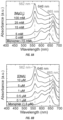
- FIG. 3 A is a graphical representation of changes in absorbance.
- FIG. 3 B is a graphical representation of circular dichroism.
- FIG. 3 C is a graphical representation of changes to salt concentration, absorbance with changes in temperature.
- FIG. 3 D is a graphical representation of emission with changes to salt.
- FIG. 4 A is a graphical representation of the changes in absorbance verses wavelength as a function of Cy5 dimer separation examined by varying the number of nucleotides between monomers.
- FIG. 4 B is a graphical representation of the changes in absorbance verses wavelength as a function of TAMRA dimer separation examined by varying the number of nucleotides between monomers.
- FIG. 5 is a graphical representation of the stability of a chromophore tetramer attached to an immobile 4-arm junction template in varying amounts of salt or DNA concentration.
- FIG. 6 A is a schematic representation of a chromophore trimer arranged in an “L” configuration such that chromophores 1 and 2 couple in a J-dimer configuration and chromophores 2 and 3 couple in a H-dimer configuration.
- FIG. 6 B is a graphical representation of the absorbance spectrum for the timer.
- FIG. 7 A is a schematic representation of a phase gate, which helps form the basis of quantum computing.
- FIG. 7 B is a schematic representation of a basis-changing gate which elps form the bases of quantum computing.
- FIG. 7 C is a schematic representation of a controlled basis change gate. The dots represent the chromophores.
- FIG. 7 A is a schematic representation of a phase gate, representing a phase shifter consisting of a modified 50:50 beam splitter with two detuned nanoparticles, labeled # and *.
- the phase shifter is a two-port network derived from the 50:50 beam splitter, shown in FIG.
- FIG. 7 B is a schematic representation of a basis-changing gate where the device nodes are labeled with the integers 1 through 4.
- the transmission line nodes are indicated by pairs of numbers r, m where the first labels the transmission line and the second labels a node along that transmission line.
- the hopping interaction coupling strengths between pairs of nodes within the device are labeled by g n , where n is 1 or 2.
- FIG. 7 C is a schematic representation of a controlled basis change gate with a phase shifting element between two basis change gates.
- FIG. 8 A is a graphical representation of the absorbance spectra of Cy5 J-dimers and/or H-tetramers bound to a mobile 4-arm junction template with varied MgCl 2 with a constant DNA concentration.
- FIG. 8 B is a graphical representation of the absorbance spectra of Cy5 J-dimers and/or H-tetramers bound to a mobile 4-arm junction template with varied DNA with a constant MgCl 2 concentration.
- FIG. 9 A is a schematic representation of the changes of J-dimers in a low salt concentration solution into H-tetramers in a high salt solution on mobile 4-arm junction over time due to four-way branch migration.
- FIG. 9 B is a schematic representation of the changes of H-tetramers in a high salt solution into J-dimers in a solution without salt over time due to disassociation of the complement sequences of the mobile 4-arm junction.
- description of a range such as from 1 to 6 should be considered to have specifically disclosed sub-ranges such as from 1 to 3, from 1 to 4, from 1 to 5, from 2 to 4, from 2 to 6, from 3 to 6 etc., as well as individual numbers within that range, for example, 1, 2, 3, 4, 5, and 6, and decimals and fractions, for example, 1.2, 3.8, 11 ⁇ 2, and 43 ⁇ 4. This applies regardless of the breadth of the range.
- the term “about” modifying the quantity of an ingredient in the compositions of the invention or employed in the methods of the invention refers to variation in the numerical quantity that can occur, for example, through typical measuring and liquid handling procedures used for making concentrates or use solutions in the real world; through inadvertent error in these procedures; through differences in the manufacture, source, or purity of the ingredients employed to make the compositions or carry out the methods; and the like.
- the term about also encompasses amounts that differ due to different equilibrium conditions for a composition resulting from a particular initial mixture. Whether or not modified by the term “about,” the claims include equivalents to the quantities.
- Non-covalent refers to any molecular interactions that are not covalent—i.e. the interaction does not involve the sharing of electrons.
- the term includes, for example, electrostatic, ⁇ -effects, van der Waals forces, and hydrophobic effects.
- Covalent refers to interactions involving the sharing of one or more electrons.
- a “brick” is a structural unit.
- a brick may be of any shape or size.
- the main body of a brick may be of any material composition.
- An example of a brick is a “nucleotide brick,” which is a structural unit where the body of the brick is made of a nucleotide oligomer.
- An example of a nucleotide brick is a “DNA brick,” which is a nucleotide brick where the body of the brick is made of a DNA oligomer.
- nucleotide is any nucleoside linked to a phosphate group.
- the nucleoside may be natural, including but not limited to, any of cytidine, uridine, adenosine, guanosine, thymidine, inosine (hypoxanthine), or uric acid; or synthetic, including but not limited to methyl-substituted phenol analogs, hydrophobic base analogs, purine/pyrimidine mimics, icoC, isoG, thymidine analogs, fluorescent base analogs, or X or Y synthetic bases.
- a nucleotide may be abasic, such as but not limited to 3-hydroxy-2-hydroxymethyl-tetrahydrofuran, which act as a linker group lacking a base or be a nucleotide analog.
- nucleotide duplex is when two strands of complement nucleotide oligomers complementary bind to each other. The two strands may be part of the same nucleotide molecule or separate nucleotide molecules.
- nucleotide origami is two or more nucleotide bricks, where one brick is a “scaffold” and provides the main body of the overall structure and is bound by one or more “staple(s).”
- a “scaffold” is a single stranded nucleotide brick rationally-designed to self-assemble into hairpin loops, helical domains, and locking domains.
- the scaffold may use staples to direct the folding and to hold the final shape.
- the scaffold may use intrinsic self-complementary pairing to hold the final shape.
- a “staple” or “staple strand” is a nucleotide brick which pairs with a longer main body brick in nucleotide origami to help fold the main body brick into the desired shape.
- a “nanobreadboard,” “breadboard,” or “template” is a total or final structure of a DNA structure or shape.
- a mobile or immobile 4-arm junction DNA origami happy face, rectangular brick, or double stranded DNA (dsDNA) in its final structure.
- dsDNA double stranded DNA
- an “architecture” is a one-, two-, or three-dimensional structure built using one or more bricks.
- a “nucleotide architecture” is a one-, two-, or three-dimensional structure built using one or more nucleotide bricks. Examples include nucleotide origami or molecular canvases.
- self-assembly refers to the ability of nucleotides to anneal to each other, in a sequence-specific manner, in a predicted manner and without external control.
- sufficiently close and “nanospaced” refers to a distance between two chromophores that allows one chromophore, when excited, to emit an exciton and transfer the exciton to a second chromophore without a loss of energy.
- a “breadboard” refers to reusable solderless device used to build an exitonic circuit.
- the breadboard allows for temporary placement of different solutions, such as solutions containing chromophore bound nucleotide architectures, in different arrangements.
- Nucleotide nanotechnology can be used to form complicated one-, two-, and three-dimensional architectures.
- the nucleotide architectures may comprise of one or more nucleotide bricks.
- the nucleotide bricks are designed to use the Watson-Crick pairing of the nucleotides to cause the bricks to self-assemble into the final and predictable architectures.
- any method of designing the architectures and self-assembly may be used, such as but not limited to nucleotide origami, nucleotide brick molecular canvases, single stranded tile techniques, or any other method of nucleotide folding or nanoassembly such as, but not limited to, using nucleotide tiles, nucleotide scaffolds, nucleotide lattices, four-armed junction, double-crossover structures, nanotubes, static nucleotide structures, dynamically changeable nucleotide structures, or any other synthetic biology technique (as described in U.S. Pat. No. 9,073,962, U.S. Pub. No.: US 2017/0190573, U.S. Pub. No.: US 2015/0218204, U.S. Pub. No.: US 2018/0044372, or International Publication Number WO 2014/018675, each of which is incorporated by reference).
- the nucleobase making up the bricks may be natural, including but not limited to, any of cytosine, uracil, adenine, guanine, thymine, hypoxanthine, or uric acid; or synthetic, including but not limited to methyl-substituted phenol analogs, hydrophobic base analogs, purine/pyrimidine mimics, icoC, isoG, thymidine analogs, fluorescent base analogs, or X or Y synthetic bases.
- a nucleotide may be abasic, such as but not limited to 3-hydroxy-2-hydroxymethyl-tetrahydrofuran, or alternatively a nucleotide analog may be used.
- Non-limiting examples of synthetic nucleobases and analogs include, but are not limited to methyl-substituted phenyl analogs, such as but not limited to mono-, di-, tri-, or tatramethylated benzene analogs; hydrophobic base analogs, such as but not limited to 7-propynyl isocarbostyril nucleoside, isocarbostyril nucleoside, 3-methylnapthalene, azaindole, bromo phenyl derivates at positions 2, 3, and 4, cyano derivatives at positions 2, 3, and 4, and fluoro derivates at position 2 and 3; purine/pyrimidine mimics, such as but not limited to azole hetercyclic carboxamides, such as but not limited to (1H)-1,2,3-triazole-4-carboxamide, 1,2,4-triazole-3-carboxamide, 1,2,3-triazole-4-carboxamide, or 1,2-pyrazole-3-carboxamide
- Non-limiting examples of nucleotide analogs include, but are not limited to, phosporothioate nucleotides, 2′-O-methyl ribonucleotides, 2′-O-methoxy-ethyl ribonucleotides, peptide nucleotides, N3′-P5′ phosphoroamidate, 2′-fluoro-arabino nucleotides, locked nucleotides, morpholino phosphoroamidate, cyclohexene nucleotides, tricyclo-deoxynucleotides, or triazole-linked nucleotides.
- the nucleotides can then be polymerized into oligomers.
- the design of the oligomers will depend on the design of the final architecture. Simple architectures may be designed by any methods. However, more complex architectures may be design using software such as, but not limited to, caDNAno (as described at http://cadnano.org/docs.html, and herein incorporated by reference), to minimize errors and time.
- the user may input the desired shape of the architecture into the software and once finalized, the software will provide the oligomer sequences of the bricks to create the desired architecture.
- the architecture is comprised of nucleotide brick molecular canvases, wherein the canvases are made of 1 to 5,000 nucleotide bricks comprising of nucleotide oligomers of 24 to 48 nucleotides and will self-assemble in a single reaction, a “single-pot” synthesis, as described in U.S. Pub. No.: US 2015/0218204.
- the canvases are made of 1 to 1,000 nucleotide bricks, from 1 to 750 nucleotide bricks, from 1 to 500 nucleotide bricks, or from 1 to 250 nucleotide bricks.
- the oligomers comprise of 24 to 42 nucleotides, from 24 to 36 nucleotides, or from 26 to 36 nucleotides.
- the architecture is made step wise using a serial fluidic flow to build the final shape as described in U.S. Pat. No. 9,073,962.
- a single-stranded nucleic acid for assembly of a nucleic acid nanostructure has a length of at least 500 base pairs, at least 1 kilobase, at least 2 kilobases, at least 3 kilobases, at least 4 kilobases, at least 5 kilobases, at least 6 kilobases, at least 7 kilobases, at least 8 kilobases, at least 9 kilobases, or at least 10 kilobases.
- a single-stranded nucleic acid for assembly of a nucleic acid nanostructure has a length of 500 base pairs to 10 kilobases, or more. In some embodiments, a single-stranded nucleic acid for assembly of a nucleic acid nanostructure has a length of 7 to 8 kilobases. In some embodiments, a single-stranded nucleic acid for assembly of a nucleic acid nanostructure comprises the M13 viral genome. In some embodiments the number of staple strands is less than about 500 staple strands, less than about 400 staple strands, less than about 300 staple strands, less than about 200 staple strands, or less than about 100 staple strands.
- the architecture is assembled from single-stranded tiles (SSTs) (see, e.g., Wei B. et al. Nature 485: 626, 2012, incorporated by reference herein) or nucleic acid “bricks” (see, e.g., Ke Y. et al. Science 388:1177, 2012; International Publication Number WO 2014/018675 A1 each of which is incorporated by reference herein).
- SSTs single-stranded tiles
- nucleic acid “bricks” see, e.g., Ke Y. et al. Science 388:1177, 2012; International Publication Number WO 2014/018675 A1 each of which is incorporated by reference herein.
- single-stranded 2- or 4-domain oligonucleotides self-assemble, through sequence-specific annealing, into two- and/or three-dimensional nanostructures in a predetermined (e.g., predicted) manner.
- a nucleic acid nanostructure may be modified, for example, by adding, removing or replacing oligonucleotides at particular positions.
- the nanostructure may also be modified, for example, by attachment of moieties, at particular positions. This may be accomplished by using a modified oligonucleotide as a starting material or by modifying a particular oligonucleotide after the nanostructure is formed. Therefore, knowing the position of each of the starting oligonucleotides in the resultant nanostructure provides addressability to the nanostructure.
- the architecture is made from a single stranded oligomer, as described in U.S. Pub. No.: 2018/0044372 and herein incorporated by reference.
- a single strand of DNA used for assembling a nanostructure in accordance with the present disclosure may vary in length.
- a single strand of DNA has a length of 500 nucleotides to 10,000 nucleotides, or more.
- a single strand of DNA may have a length of 500 to 9000 nucleotides, 500 to 8000 nucleotides, 500 to 7000 nucleotides, 500 to 6000 nucleotides, 500 to 5000 nucleotides, 500 to 4000 nucleotides, 500 to 3000 nucleotides, 500 to 2000 nucleotides, 500 to 1000 nucleotides, 1000 to 10000 nucleotides, 1000 to 9000 nucleotides, 1000 to 8000 nucleotides, 1000 to 7000 nucleotides, 1000 to 6000 nucleotides, 1000 to 5000 nucleotides, 1000 to 4000 nucleotides, 1000 to 3000 nucleotides, 1000 to 2000 nucleotides, 2000 to 10000 nucleotides, 2000 to 9000 nucleotides, 2000 to 8000 nucleotides, 2000 to 7000 nucleotides, 2000 to 6000 nucleotides, 2000 to 5000 nucleotides, 2000 to 9000
- a single strand of DNA may have a length of at least 2000 nucleotides, at least 3000 nucleotides, at least 4000 nucleotides, or at least 5000 nucleotides.
- a single strand of DNA may have a length of 500, 600, 700, 800, 900, 1000, 1100, 1200, 1300, 1400, 1500, 1600, 1700, 1800, 1900, 2000, 2100, 2200, 2300, 2400, 2500, 2600, 2700, 2800, 2900, 3100, 3200, 3300, 3400, 3500, 3600, 3700, 3800, 3900, 4100, 4200, 4300, 4400, 4500, 4600, 4700, 4800, 4900, 5100, 5200, 5300, 5400, 5500, 5600, 5700, 5800, 5900, 6600, 6200, 6300, 6400, 6500, 6600, 6700, 6800, 6900, 7100, 7200,
- the architecture is two-dimensional and comprises a single layer of bricks or a single scaffold.
- the single layer of bricks may form a molecular canvas.
- the architecture is three-dimensional and may contain 2, 3, 4, 5, 6, 7, 8, 9, 10, 20, 30, or more layers of two-dimensional structures depending on the desired final shape.
- the architecture is attached to a substrate, such as a glass slide, a silicon base, or a breadboard.
- the architecture remains in a solution.
- the aggregation of the bricks may be changed, which may change the orientation, as well as the absorbance spectra, of the chromophores.
- excitonic quantum coherent behavior e.g. large Davydov splitting, exchange narrowing, circular dichroism, Cotton effects, or Stokes shifting
- excitonic quantum coherent behavior e.g. large Davydov splitting, exchange narrowing, circular dichroism, Cotton effects, or Stokes shifting
- the chromophore When excited, the chromophore may emit an exciton, an electron and electron hole pair. If two chromophores are sufficiently close to each other, the emitted exciton may be transmitted from the excited chromophore to the neighboring chromophore without a loss in energy.
- Chromophore based excitonic quantum coherent effects may occur at room temperature in wet and noisy environments and the systems may be less than about 10 nm.
- any chromophore that emits an exciton when excited may be used in any embodiment.
- a chromophore may be symmetrical or preferably asymmetrical.
- the chromophore may be one or more of a commercial chromophore(s), such as but not limited to FreedomTM Dye, Alexa Fluor® Dye, LI-COR IRDyes®, ATTOTM Dyes, Rhodamine Dyes, or WellRED Dyes; or any other dye.
- Examples of FreedomTM Dyes include 6-FAM, 6-FAM (Fluorescein), Fluorescein dT, Cy3TM TAMRATM, JOE, Cy5TM TAMRA, MAX, TETTM, Cy5.5TM, ROX, TYETM 563, Yakima Yellow®, HEX, TEX 615, TYETM 665, TYE 705, and Dyomic Dyes.
- Examples of Alexa Fluor® Dyes include Alexa Fluor® 488, 532, 546, 647, 660, and 750.
- Examples of LI-COR IRDyes® include 5′ IRDye® 700, 800, and 800CW.
- ATTOTM Dyes examples include ATTOTM 488, 532, 550, 565, Rho101, 590, 633, 647N.
- Rhodamine Dyes examples include Rhodamine GreenTM-X, Rhodamine RedTM-X, and 5-TAMRATM.
- WellREd Dyes examples include WellRED D4, D3, and D2.
- Dyomic Dyes examples include Dy-530, -547, -547P1, -548, -549, -549P1, -550, -554, -555, -556, -560, -590, -591, -594, -605, -610, -615, -630, -631, -632, -633, -634, -635, -636, -647, -647P1, -648, -648P1, -649, -649P1, -650, -651, -652, -654, -675, -676, -677, -678, -679P1, -680, -681, -682, -700, -701, -703, -704, -705, 730, -731, -732, -734, -749, -749P1, -750, -751, -752, 754, -756, -757, -758, -780,
- two or more chromophores may be precisely placed with nanometer precision apart from each other. When so placed, the chromophores may produce quantum coherent excitons, biexcitons, and triexcitons when excited by a light source.
- the two or more chromophores are covalently bound to the same nucleotides brick, and then the chromophore bound brick and any non-bound bricks are allowed to self-assemble into the desired final one-, two-, or three-dimensional shape.
- the two or more chromophores are covalently bound to different nucleotide bricks and then the bricks are allowed to self-assemble into the desired final one-, two-, or three-dimensional shape.
- the bricks are allowed to first self-assemble into the desired final one-, two-, or three-dimensional shape. Portions of the bricks may still be unpaired after assembly, allowing for further binding of complementary oligomers. The two or more chromophores are bound to at least one complementary oligomer which may then pair with the one or more unpaired portions of the bricks.
- the chromophores are bound to the 5′ ends of the nucleotide bricks ( FIG. 1 A ). In other embodiments, the chromophores are bound to the 3′ ends of the nucleotide bricks. In yet other embodiments, the chromophores are bound internally within the nucleotide bricks ( FIGS. 1 C and 1 D ). In still more embodiments, the chromophores are bound to any mix of 5′ ends, 3′ ends, or internally ( FIG. 1 B ). The position of the chromophore will depend on the desired final configuration. Methods of binding chromophores to nucleotides is well known in the art.
- the chromophores are bound to the same nucleotide duplex ( FIGS. 1 A- 1 C ). In other embodiments, the chromophores are bound to separate nucleotide duplexes ( FIG. 1 D ).
- some of the chromophores are covalently bound to the bricks while other of the chromophores are bound to separate oligomers, and the oligomers then pair with exposed single strands of the bricks.
- the orientation of the two or more chromophore dipoles to each other effect the absorbance and emission spectra.
- a pair of chromophores nanospaced apart will have different characteristics when compared to the monomer chromophore.
- an “H-dimer” forms, which are characterized by a blue-shift in absorbance due to having a higher excited energy state when compared to the monomer.
- a “J-dimer” forms, which is characterized by a red-shift in absorbance due to having a lower excited energy state when compared to a monomer.
- a mixed “J/H-dimer” forms and is characterized by Davydov splitting due to having both a higher and lower excited energy state when compared to a monomer (see FIG. 2 , and Cannon et al., Coherent Exciton Delocalization in a Two - State DNA - Templated Dye Aggregate System, 2017, J. Phys. Chem. A, 121: 6905-6916, herein incorporated by reference).
- the orientation on a linear oligomer which affects the absorbance spectra, is also affected by characteristics of the solution, including salt concentration ( FIG. 3 A ), temperature ( FIG. 3 C ), and cation concentration. Therefore, by altering the conditions of the solution, it is possible to fine tune the absorbance spectra multiple chromophores nanospaced from each other. As shown in FIGS. 3 A and 3 B , as the salt concentration increases, a chromophore dimer may be fine-tuned to exhibit either J-dimer characteristics at lower salt concentrations or H-dimer characteristics at high salt concentrations.
- FIG. 3 C further shows that by altering both the temperature and salt concentrations, it is further possible to tune the chromophores for specific characteristics.
- FIG. 3 D shows that not only the absorbance, but the emission is altered by changing the concentration of salt in the solution.
- the absorbance spectrum of the two chromophores on a linear oligomer is also affected by the nanospacing of two chromophores.
- the Davydov splitting disappears and the absorbance spectrum approaches that of the monomer ( FIGS. 4 A and 4 B ).
- FIGS. 4 A and 4 B as two chromophores are moved apart, the Davydov splitting seen when the chromophores are within sufficiently close from each other disappears. Further, as shown by FIGS. 4 A and 4 B the distance in which the Davydov splitting is lost is different for different chromophores.
- one skilled in the art may alter the absorbance and emission spectra for two or more chromophores bound to a nucleotide architecture to fine tune toward dimer type.
- the architecture is more capable of holding the chromophores in a rigid position, losing the flexibility seen in the linear strands ( FIG. 5 ).
- two chromophore dipoles are held by an architecture nanospaced head to tail to form a J-dimer.
- two chromophore dipoles are held by an architecture in parallel nanospaced to form a H-dimer.
- two chromophore dipoles are held oblique to each other by an architecture to form a mixed J/H-dimer.
- three chromophores are positioned within the architecture so that two of the three chromophores form a J-dimer, and two of the three chromophores form a H-dimer.
- the chromophores are positioned such that two form a J-dimer and the third forms two mixed J/H-dimers.
- two of the chromophores form a H-dimer and the third forms two mixed J/H-dimers.
- a tetramer of chromophores are positioned within the architecture such that two H-dimers, two J-dimers are formed, and two mixed J/H-dimers form.
- the tetramer can be position so that two H-dimers and four mixed J/H-dimers are formed.
- the tetramer is positioned so that two J-dimers and four mixed J/H-dimers are formed.
- the chromophores all have the same optical transition energies. In other embodiments, the chromophores differ in their optical transition energies. The different optical transition energies allow the construction of a set phase shifter having desired values of absorbance and emittance.
- the basic configurations dimer, trimers, and tetramers as described above can be joined with other monomers, dimer, trimers, and tetramers in order to form more complex structures with desired dimer types.
- Quantum algorithms enable the speed-up of computation tasks such as, but not limited to, factoring and sorting. These computations may be performed by an excitonic quantum computer.
- the excitonic quantum computer combining the more complex chromophore structures, as discussed above, can be made into exciton coherence wires, circuits, and gates. Wires may be formed when a series of chromophores are held within the architecture so that when a first chromophore, the “input chromophore,” is excited and emits an exciton, the exciton passes, without loss of energy if sufficiently close, to a second chromophore.
- That chromophore may then pass the exciton to a third chromophore, and so on down a line of chromophores in a wave like manner.
- the wires may be straight or branched and may be shaped to go in any direction within the architecture.
- the architecture may contain one or more wires. Depending on the architecture system used, the wires may be formed along a single nucleotide brick, such as in using the scaffold strand of nucleotide origami, or multiple bricks may comprise the wire, such as in molecular canvases.
- the exciton may transfer from one wire to the other. By controlling this transfer, it is possible to build quantum circuits and gates.
- Two basic gates are needed for universal quantum computing: basis-change gates ( FIG. 7 B ) and phase-shift gates ( FIG. 7 A ).
- the basis-change gate function as a signal divider in classical computer. As the exciton propagates down one wire and if another wire is sufficient close, the exciton will delocalize and enter a superposition state where it resides on both wires.
- the phase-shift gate alters the excitons phase by controlling the distance the exciton travels along the two wires. As shown in FIG. 7 A , they may be done by first bringing two wires within nanospace from each other and then bending one or more wire away from the other in order to create two different lengths of the wires before bringing the wires close again.
- a third kind of gate, the controlled basis-change gate ( FIG. 7 C ) enables the entanglement of many-exciton states so that a network of quantum gates as if it is performing many different computations simultaneously.
- An exemplary controlled basis-change gate may be made from two basis-change gates and a phase-shift gate, with the phase-shift gate between the two basis-change gates.
- the controlled basis-change gate relies on the interaction between two excitons. When two excitons reside on neighboring chromophores they feel each other's presence just like two electrons will feel each other's Coulomb repulsion when they are brought close together.
- the two exciton interaction arises from static Coulomb interactions between molecules and is strong when the molecules have an asymmetric molecular structure than those with a symmetrical molecular structure.
- Asymmetric molecules possess a permanent electric dipole which changes sign when the molecule is excited from the ground state to the excited state.
- the static Coulomb interaction in this case is a dipole-dipole interaction which, when both chromophores are excited (the two exciton case), differs in sign from the case when only one chromophore is excited (the one exciton case). Due to the static Coulomb interactions between chromophores one exciton will accumulate extra phase in the presence of the other exciton. As a result, the presence or absence of one exciton can control of the other exciton moves through a basis change gate.
- additional gates may be incorporated into the architecture, such as, but not limited to, Hadamard gates, momentum switches, and C ⁇ gates (see Childs et al., Universal Computation by Multiparticle Quantum Walk , Science, 339, 791-94 (2013), herein incorporated by reference).
- the phase-shift gates can be controlled to only have a finite set of phase angles. By controlling the position and optical transition energies of the various gates, a set of gates, or a quantum circuit.
- the wires, gates, and switches as discussed above can be joined together to answer questions that benefit from quantum algorithms such as, but not limited to, sorting, factoring, and database searching.
- quantum algorithms such as, but not limited to, sorting, factoring, and database searching.
- input chromophores are excited by using the light with the proper wavelength and polarization in such a manner that only the desired subset of chromophores is excited when the system is hit with an initializing pulse of light.
- the wavelength and degree of polarization of the light may match that of input chromophores in order to excite the chromophores and cause exciton emission.
- Any light source that may produce the wavelength used by the chromophore may be used, such as, but not limited to, lasers, including ultra-fast lasers.
- the excitons After initializing, the excitons then propagate from chromophore to chromophore along the wires into the various gates.
- the various gates than calculate the answer, such as a sorted list or mathematical problem.
- the output, or readout can be done by using fluorescent reporter dyes to which the answer of the quantum computation is delivered by ordinary FRET. While this would be particularly beneficial for problems in which the output has a limited number of bits, these problems have applications in aeronautics, Earth and space sciences, and space exploration, among other fields of research. Additionally, these systems because it demonstrates that quantum coherence is observed at room temperature in a wet and noisy environment, an environment that is normally hostile to quantum coherence.
- the chromophore bound nucleotide architecture forms a single gate or switch. In other embodiments, the chromophore bound nucleotide architecture forms multiple gates and/or switches.
- multiple chromophore bound nucleotide architectures are aligned to form more complex circuits.
- the aligned architectures may be aligned using light or exciton wires to move the result of a quantum computation from one architecture to another.
- the multiple architectures may be aligned by placement upon a breadboard. Using this alignment allows to the output of one architecture to provide the input for a second architecture along the complex circuit.
- the absorbance and energy were measured over a range of wavelengths, covering the known absorbance and emittance wavelengths of Cy5, ranging from about 500 nm to about 6200 nm and compared to a Cy5 monomer.
- the absorbance verses energy of a Cy5 monomer attached to a linear single stranded DNA oligomer was compared to Cy5-Cy5 dimer attached to a double stranded DNA oligomer (dsDNA-Cy5) in the presence of 15 mM MgCl 2 .
- the concentration of DNA was about 3 ⁇ M.
- the monomer and dimer were exposed to increasing wavelengths of light and the absorbance and energy was measured.
- the monomer has one primary absorption peat at 1.92 eV.
- the dimer showed Davydov splitting, having two exciton absorption peaks, one at 1.87 eV and one at 2.205 eV.
- the 1.87 eV peak a red shift from the monomer peak, shows the presence of J-dimer behavior.
- the 2.205 eV peak a blue shift from the monomer peak, shows the presence of H-dimer behavior.
- this split causes a visible color change to the unaided eye.
- FIG. 2 A also shows the presence of exchange narrowing, as the two peaks of the dimer show a narrower excitation range than the monomer.
- Cy3 dimers were also compared to Cy3 monomers ( FIG. 2 B ). Both the dimer and the monomer were exposed to about 450 nm to about 650 nm light and the absorbance was measured. The Cy3 dimer, like the Cy5 dimer, showed a Davydov shift, having characteristics of both J-dimers and H-dimers.
- the orientation of the chromophores on the dsDNA-Cy5 can be determined to be at an oblique angle to each other.
- the oblique position of chromophore dipoles allows for the two different energy states because the other dimers, J-dimers and H-dimers do not permit the two excited energy states.
- the linear dsDNA-Cy5 strands were exposed to wavelengths of about 500 to about 700 nm.
- the salt concentrations were altered from 0 to about 1500 mM of NaCl.
- dsDNA-Cy5 showed a reduction in Davydov splitting (J 1 -V peaks), and a loss of J-dimer characteristics (J 1 peak).
- J 1 peak At about 1000 mM NaCl, dsDNA-Cy5 showed a loss of J-dimer characteristics, with a result of just H-dimer characteristics when compared to the ssDNA-Cy5 monomer.
- FIG. 3 A shows that the concentration of salt increased, dsDNA-Cy5 showed a reduction in Davydov splitting (J 1 -V peaks), and a loss of J-dimer characteristics (J 1 peak).
- J 1 peak At about 1000 mM NaCl, dsDNA-Cy5 showed a loss of J-dimer characteristics, with a result of just
- the Stokes Shift was also affected by a change in salt concentration. As shown in FIG. 3 D , at 15 mM MgCl 2 the Stokes Shift increased from 28 nm, the Stokes Shift of the Cy5 monomer, increases to 103 nm due to the red shift of the H-dimer lowers the Extinction Coefficient. At no salt, in the presence of the J-dimer, the Stokes Shift narrowed to 3 nm.
- the number of nucleotides to which the chromophores were bound along a linear oligomer were varied for different dyes.
- TAMRA chromophores in a 12 mM MgAcetate solution showed dimer characteristics when spaced further apart from each other, maintaining dimer characteristics at least until 5 nucleotides apart ( FIG. 4 B ).
- the dimerization characteristics for TAMRA was lost at 10 nucleotides as measured by the change in absorbance spectrum.
- the individual chromophore molecules must remain near each other or they will act like monomers.
- a more rigid architecture can more securely fix a chromophore in place, stabilizing the chromophores. This would allow one skilled in the art to select either a rigid or flexible system, or a combination thereof, to better form quantum wires and circuits of the desired shapes and absorbance spectra.
- Cy5 chromophores were attached to four different ssDNA strands (see Cannon et al., Coherent Exciton Delocalization in a Two - State DNA - Templated Dye Aggregate System, 2017, J. Phys. Chem. A, 121:6905-6916, Supplemental Information, herein incorporated by reference) and solution salt and DNA concentrations were varied.
- the four different ssDNA strands were designed to allow two complement ssDNA strands to form two dsDNA strands. The two dsDNA strands may then undergo four-way branch migration to form a 4AJ template.
- the complementary ssDNA strands were first annealed to position the Cy5 chromophores into a J-dimer.
- the Cy5 chromophore were further positioned such that if the two dsDNA strands form the 4AJ template, the resulting Cy5 tetramer would form H-dimers.
- the two dsDNA strands were then mixed at various salt (0-100 mM added MgCl2; DNA held constant at 1.5 ⁇ M) and DNA (0.1-10 ⁇ M; salt held constant at 15 mM) concentrations.
- the absorbance spectrum of each sample ( FIGS. 8 A and 8 B ) at various salt and DNA concentrations was measured.
- FIGS. 8 A and 8 B shows that with changes in salt or DNA concentration the locations of the absorbance peaks remain constant within the selected MgCl 2 and DNA concentration ranges, respectively.
Landscapes
- Chemical & Material Sciences (AREA)
- Engineering & Computer Science (AREA)
- Life Sciences & Earth Sciences (AREA)
- Organic Chemistry (AREA)
- Health & Medical Sciences (AREA)
- Molecular Biology (AREA)
- Physics & Mathematics (AREA)
- Biochemistry (AREA)
- Theoretical Computer Science (AREA)
- Genetics & Genomics (AREA)
- General Health & Medical Sciences (AREA)
- Biophysics (AREA)
- General Physics & Mathematics (AREA)
- Biotechnology (AREA)
- Bioinformatics & Cheminformatics (AREA)
- Evolutionary Biology (AREA)
- Bioinformatics & Computational Biology (AREA)
- Evolutionary Computation (AREA)
- Software Systems (AREA)
- Mathematical Physics (AREA)
- General Engineering & Computer Science (AREA)
- Computing Systems (AREA)
- Data Mining & Analysis (AREA)
- Artificial Intelligence (AREA)
- Computational Linguistics (AREA)
- Biomedical Technology (AREA)
- Pure & Applied Mathematics (AREA)
- Mathematical Optimization (AREA)
- Mathematical Analysis (AREA)
- Condensed Matter Physics & Semiconductors (AREA)
- Computational Mathematics (AREA)
- Measuring Or Testing Involving Enzymes Or Micro-Organisms (AREA)
Abstract
Description
Claims (30)
Priority Applications (1)
| Application Number | Priority Date | Filing Date | Title |
|---|---|---|---|
| US16/100,052 US12173027B2 (en) | 2017-08-09 | 2018-08-09 | Excitonic quantum computing mediated by chromophore-embedded 1-, 2-, and 3-dimensional DNA scaffolds |
Applications Claiming Priority (2)
| Application Number | Priority Date | Filing Date | Title |
|---|---|---|---|
| US201762543051P | 2017-08-09 | 2017-08-09 | |
| US16/100,052 US12173027B2 (en) | 2017-08-09 | 2018-08-09 | Excitonic quantum computing mediated by chromophore-embedded 1-, 2-, and 3-dimensional DNA scaffolds |
Publications (2)
| Publication Number | Publication Date |
|---|---|
| US20190048036A1 US20190048036A1 (en) | 2019-02-14 |
| US12173027B2 true US12173027B2 (en) | 2024-12-24 |
Family
ID=65274046
Family Applications (1)
| Application Number | Title | Priority Date | Filing Date |
|---|---|---|---|
| US16/100,052 Active 2042-06-11 US12173027B2 (en) | 2017-08-09 | 2018-08-09 | Excitonic quantum computing mediated by chromophore-embedded 1-, 2-, and 3-dimensional DNA scaffolds |
Country Status (1)
| Country | Link |
|---|---|
| US (1) | US12173027B2 (en) |
Families Citing this family (2)
| Publication number | Priority date | Publication date | Assignee | Title |
|---|---|---|---|---|
| US12068085B2 (en) | 2020-09-16 | 2024-08-20 | Boise State University | Entanglement of excitons by acoustic guiding |
| US12207481B2 (en) * | 2020-12-07 | 2025-01-21 | Boise State University | Ballistic exciton transistor |
Citations (5)
| Publication number | Priority date | Publication date | Assignee | Title |
|---|---|---|---|---|
| US20040209355A1 (en) * | 1996-12-06 | 2004-10-21 | Nanogen, Inc. | Systems and devices for photoelectrophoretic transport and hybridization of oligonucleotides |
| WO2014018675A1 (en) | 2012-07-24 | 2014-01-30 | President And Fellows Of Harvard College | Self-assembly of nucleic acid nanostructures |
| US9073962B2 (en) | 2012-07-12 | 2015-07-07 | Massachusetts Institute Of Technology | Methods of serial assembly of DNA bricks into larger structures |
| US20170190573A1 (en) | 2014-05-22 | 2017-07-06 | President And Fellows Of Harvard College | Scalable nucleic acid-based nanofabrication |
| US20180044372A1 (en) | 2015-03-07 | 2018-02-15 | President And Fellows Of Harvard College | Single-stranded dna nanostructures |
-
2018
- 2018-08-09 US US16/100,052 patent/US12173027B2/en active Active
Patent Citations (6)
| Publication number | Priority date | Publication date | Assignee | Title |
|---|---|---|---|---|
| US20040209355A1 (en) * | 1996-12-06 | 2004-10-21 | Nanogen, Inc. | Systems and devices for photoelectrophoretic transport and hybridization of oligonucleotides |
| US9073962B2 (en) | 2012-07-12 | 2015-07-07 | Massachusetts Institute Of Technology | Methods of serial assembly of DNA bricks into larger structures |
| WO2014018675A1 (en) | 2012-07-24 | 2014-01-30 | President And Fellows Of Harvard College | Self-assembly of nucleic acid nanostructures |
| US20150218204A1 (en) | 2012-07-24 | 2015-08-06 | President And Fellows Of Harvard College | Self-assembly of nucleic acid nanostructures |
| US20170190573A1 (en) | 2014-05-22 | 2017-07-06 | President And Fellows Of Harvard College | Scalable nucleic acid-based nanofabrication |
| US20180044372A1 (en) | 2015-03-07 | 2018-02-15 | President And Fellows Of Harvard College | Single-stranded dna nanostructures |
Non-Patent Citations (12)
| Title |
|---|
| Cannon et al. (ACS Photonics, 2015, 2, pp. 398-404). (Year: 2015). * |
| Cannon et al., "Coherent Exciton Delocalization in a Two-State DNA-Templated Dye Aggregate System", Journal of Physical Chemistry, vol. 121, pp. 6905-6916, Aug. 16, 2017. |
| Cannon et al., "Large Davydov Splitting and Strong Fluorescence Suppression: An Investigation of Exciton Delocalization in DNA-Templated Holliday Junction Dye Aggregates", Journal of Physical Chemistry, vol. 122, pp. 2086-2095, Feb. 8, 2018. |
| Cannon et al., "Large Davydov Splitting and Strong Fluorescence Suppression: An Investigation of Exciton Delocalization in DNA-Templated Holliday Junction Dye Aggregates", Supporting Information, 20 pages, Feb. 8, 2018. |
| Castellanos et al., "On the Design of Molecular Excitonic Circuits for Quantum Computing: The Universal Quantum Gates", Phys. Chem. Chem. Phys., vol. 22, pp. 3048-3057, 2020. |
| Childs et al., "Universal Computation by Multiparticle Quantum Walk", Science Mag., vol. 339, pp. 791-794, Feb. 15, 2013. |
| Graugnard et al. Nano Lett. 2012, 12, 2117-2122 with Supporting Information. (Year: 2012). * |
| Ke et al., "Three-Dimensional Structures Self-Assembled from DNA Bricks", Science, vol. 338(6111), 16 pages, Nov. 30, 2012. |
| Rothemund, Paul W. K., "Folding DNA to create nanoscale shapes and patterns", Nature, vol. 440, pp. 297-302, 2006. |
| Spillmann et al. (Journal of Photochemistry and Photobiology C: Photochemistry Reviews 23 (2015) 1-24). (Year: 2015). * |
| Wei et al., "Complex shapes self-assembled from single-stranded DNA tiles", Nature, vol. 485, pp. 623-627, May 31, 2012. |
| Yurke et al., "Passive linear nanoscale optical and molecular electronics device synthesis from nanoparticles", Physical Review, vol. A81, 9 pages, 2010. |
Also Published As
| Publication number | Publication date |
|---|---|
| US20190048036A1 (en) | 2019-02-14 |
Similar Documents
| Publication | Publication Date | Title |
|---|---|---|
| US10995373B2 (en) | Systems and methods for writing, reading, and controlling data stored in a polymer | |
| Htun et al. | Single strands, triple strands, and kinks in H-DNA | |
| JP2022095695A (en) | Methods, compositions and devices for information storage | |
| US12173027B2 (en) | Excitonic quantum computing mediated by chromophore-embedded 1-, 2-, and 3-dimensional DNA scaffolds | |
| Seeman | An overview of structural DNA nanotechnology | |
| KR100446358B1 (en) | Probe for preparation of probe polymer, method for preparation of probe polymer and use thereof | |
| Park et al. | Highly emissive deoxyguanosine analogue capable of direct visualization of B–Z transition | |
| WO2019213437A1 (en) | Systems and methods for writing, reading, and controlling data stored in a polymer | |
| Klejevskaja et al. | Studies of G-quadruplexes formed within self-assembled DNA mini-circles | |
| Seeman | Molecular craftwork with DNA | |
| US12545700B2 (en) | Excitonic quantum computing via aggregate-aggregate coupling | |
| US20230147320A1 (en) | Excitonic quantum computing via aggregate-aggregate coupling | |
| Williamson | G-quartets in biology: reprise. | |
| US12479998B2 (en) | Dyes in dye aggregate systems—engineering J, K, and dye packing | |
| Kim et al. | Substrate-assisted 2D DNA lattices and algorithmic lattices from single-stranded tiles | |
| Probst et al. | The DNA three-way junction as a mould for tripartite chromophore assembly | |
| Hey et al. | Nonenzymatic oligomerization of ribonucleotides: Towards in vitro selection experiments | |
| Jestrabova et al. | Arylethynyl-or Alkynyl-Linked Pyrimidine and 7-Deazapurine 2′-Deoxyribonucleoside 3′-Phosphoramidites for Chemical Synthesis of Hypermodified Hydrophobic Oligonucleotides | |
| US12292668B2 (en) | Molecular aggregate for optically-pumped nonreciprocal exciton devices | |
| Hrdlicka et al. | 25 years and still going strong: 2′-O-(pyren-1-yl) methylribonucleotides–versatile building blocks for applications in molecular biology, diagnostics and materials science | |
| Mao et al. | DNA conformational equilibrium enables continuous changing of curvatures | |
| Yan et al. | G-quadruplex apurinic site-programmed chiral cyanine assemblies for specifically recognizing guanosine and guanine | |
| Zhang et al. | Bioinspired optofluidic lasers for DNA and protein detection | |
| US12207481B2 (en) | Ballistic exciton transistor | |
| Xikui et al. | Efficient DNA algorithms for chromatic number of graph problems |
Legal Events
| Date | Code | Title | Description |
|---|---|---|---|
| FEPP | Fee payment procedure |
Free format text: ENTITY STATUS SET TO UNDISCOUNTED (ORIGINAL EVENT CODE: BIG.); ENTITY STATUS OF PATENT OWNER: SMALL ENTITY |
|
| FEPP | Fee payment procedure |
Free format text: ENTITY STATUS SET TO SMALL (ORIGINAL EVENT CODE: SMAL); ENTITY STATUS OF PATENT OWNER: SMALL ENTITY |
|
| STPP | Information on status: patent application and granting procedure in general |
Free format text: APPLICATION DISPATCHED FROM PREEXAM, NOT YET DOCKETED |
|
| AS | Assignment |
Owner name: BOISE STATE UNIVERSITY, IDAHO Free format text: ASSIGNMENT OF ASSIGNORS INTEREST;ASSIGNORS:YURKE, BERNARD;KNOWLTON, WILLIAM B.;SIGNING DATES FROM 20171128 TO 20190110;REEL/FRAME:048015/0372 |
|
| STPP | Information on status: patent application and granting procedure in general |
Free format text: DOCKETED NEW CASE - READY FOR EXAMINATION |
|
| STPP | Information on status: patent application and granting procedure in general |
Free format text: NON FINAL ACTION MAILED |
|
| STPP | Information on status: patent application and granting procedure in general |
Free format text: RESPONSE TO NON-FINAL OFFICE ACTION ENTERED AND FORWARDED TO EXAMINER |
|
| STPP | Information on status: patent application and granting procedure in general |
Free format text: NON FINAL ACTION MAILED |
|
| STPP | Information on status: patent application and granting procedure in general |
Free format text: DOCKETED NEW CASE - READY FOR EXAMINATION |
|
| STPP | Information on status: patent application and granting procedure in general |
Free format text: FINAL REJECTION MAILED |
|
| STPP | Information on status: patent application and granting procedure in general |
Free format text: RESPONSE AFTER FINAL ACTION FORWARDED TO EXAMINER |
|
| STPP | Information on status: patent application and granting procedure in general |
Free format text: NON FINAL ACTION MAILED |
|
| STPP | Information on status: patent application and granting procedure in general |
Free format text: RESPONSE TO NON-FINAL OFFICE ACTION ENTERED AND FORWARDED TO EXAMINER |
|
| STPP | Information on status: patent application and granting procedure in general |
Free format text: NON FINAL ACTION MAILED |
|
| STPP | Information on status: patent application and granting procedure in general |
Free format text: RESPONSE TO NON-FINAL OFFICE ACTION ENTERED AND FORWARDED TO EXAMINER |
|
| STPP | Information on status: patent application and granting procedure in general |
Free format text: FINAL REJECTION MAILED |
|
| STPP | Information on status: patent application and granting procedure in general |
Free format text: RESPONSE AFTER FINAL ACTION FORWARDED TO EXAMINER |
|
| STPP | Information on status: patent application and granting procedure in general |
Free format text: NOTICE OF ALLOWANCE MAILED -- APPLICATION RECEIVED IN OFFICE OF PUBLICATIONS |
|
| STPP | Information on status: patent application and granting procedure in general |
Free format text: PUBLICATIONS -- ISSUE FEE PAYMENT VERIFIED |
|
| STCF | Information on status: patent grant |
Free format text: PATENTED CASE |