US12172159B2 - Use of electric field gradients to control gene expression - Google Patents
Use of electric field gradients to control gene expression Download PDFInfo
- Publication number
- US12172159B2 US12172159B2 US17/029,228 US202017029228A US12172159B2 US 12172159 B2 US12172159 B2 US 12172159B2 US 202017029228 A US202017029228 A US 202017029228A US 12172159 B2 US12172159 B2 US 12172159B2
- Authority
- US
- United States
- Prior art keywords
- test chamber
- group
- dna
- biological process
- gfp
- Prior art date
- Legal status (The legal status is an assumption and is not a legal conclusion. Google has not performed a legal analysis and makes no representation as to the accuracy of the status listed.)
- Active, expires
Links
- 230000005684 electric field Effects 0.000 title claims abstract description 45
- 230000014509 gene expression Effects 0.000 title claims description 35
- 238000012360 testing method Methods 0.000 claims abstract description 94
- 230000031018 biological processes and functions Effects 0.000 claims abstract description 62
- 238000000034 method Methods 0.000 claims abstract description 62
- 150000007523 nucleic acids Chemical group 0.000 claims description 69
- 108020004707 nucleic acids Proteins 0.000 claims description 59
- 102000039446 nucleic acids Human genes 0.000 claims description 59
- 238000006243 chemical reaction Methods 0.000 claims description 43
- 238000013518 transcription Methods 0.000 claims description 19
- 230000035897 transcription Effects 0.000 claims description 18
- 230000000638 stimulation Effects 0.000 claims description 7
- 230000009145 protein modification Effects 0.000 claims description 5
- 239000005090 green fluorescent protein Substances 0.000 description 74
- 108020004414 DNA Proteins 0.000 description 72
- 108090000623 proteins and genes Proteins 0.000 description 35
- 239000000758 substrate Substances 0.000 description 31
- 108090000765 processed proteins & peptides Proteins 0.000 description 28
- VYPSYNLAJGMNEJ-UHFFFAOYSA-N Silicium dioxide Chemical compound O=[Si]=O VYPSYNLAJGMNEJ-UHFFFAOYSA-N 0.000 description 26
- 102000004169 proteins and genes Human genes 0.000 description 26
- 102000004196 processed proteins & peptides Human genes 0.000 description 24
- 239000012530 fluid Substances 0.000 description 23
- -1 hydroxy, thiohydroxy Chemical group 0.000 description 23
- 108090000626 DNA-directed RNA polymerases Proteins 0.000 description 22
- 102000004163 DNA-directed RNA polymerases Human genes 0.000 description 22
- 125000000217 alkyl group Chemical group 0.000 description 21
- 229920001184 polypeptide Polymers 0.000 description 21
- 150000001875 compounds Chemical class 0.000 description 20
- 239000000463 material Substances 0.000 description 20
- 229920000642 polymer Polymers 0.000 description 20
- XSQUKJJJFZCRTK-UHFFFAOYSA-N Urea Chemical compound NC(N)=O XSQUKJJJFZCRTK-UHFFFAOYSA-N 0.000 description 18
- 108091032973 (ribonucleotides)n+m Proteins 0.000 description 17
- 238000004720 dielectrophoresis Methods 0.000 description 17
- 230000000694 effects Effects 0.000 description 17
- OAKJQQAXSVQMHS-UHFFFAOYSA-N Hydrazine Chemical compound NN OAKJQQAXSVQMHS-UHFFFAOYSA-N 0.000 description 16
- 150000001412 amines Chemical class 0.000 description 16
- 230000006870 function Effects 0.000 description 16
- 210000003705 ribosome Anatomy 0.000 description 16
- 239000000243 solution Substances 0.000 description 16
- 125000003118 aryl group Chemical group 0.000 description 15
- 230000014616 translation Effects 0.000 description 15
- 230000001276 controlling effect Effects 0.000 description 14
- 125000000753 cycloalkyl group Chemical group 0.000 description 14
- 238000013519 translation Methods 0.000 description 14
- 238000009792 diffusion process Methods 0.000 description 13
- YBJHBAHKTGYVGT-ZKWXMUAHSA-N (+)-Biotin Chemical compound N1C(=O)N[C@@H]2[C@H](CCCCC(=O)O)SC[C@@H]21 YBJHBAHKTGYVGT-ZKWXMUAHSA-N 0.000 description 12
- ZRALSGWEFCBTJO-UHFFFAOYSA-N Guanidine Chemical compound NC(N)=N ZRALSGWEFCBTJO-UHFFFAOYSA-N 0.000 description 12
- 150000004820 halides Chemical class 0.000 description 12
- 125000005647 linker group Chemical group 0.000 description 12
- 229920001223 polyethylene glycol Polymers 0.000 description 12
- 125000001424 substituent group Chemical group 0.000 description 12
- UMGDCJDMYOKAJW-UHFFFAOYSA-N thiourea Chemical compound NC(N)=S UMGDCJDMYOKAJW-UHFFFAOYSA-N 0.000 description 12
- 125000003545 alkoxy group Chemical group 0.000 description 11
- 125000001072 heteroaryl group Chemical group 0.000 description 11
- 230000004044 response Effects 0.000 description 11
- 125000003342 alkenyl group Chemical group 0.000 description 10
- 125000004104 aryloxy group Chemical group 0.000 description 10
- 125000004429 atom Chemical group 0.000 description 10
- 125000004432 carbon atom Chemical group C* 0.000 description 10
- 239000004205 dimethyl polysiloxane Substances 0.000 description 10
- 235000013870 dimethyl polysiloxane Nutrition 0.000 description 10
- PCHJSUWPFVWCPO-UHFFFAOYSA-N gold Chemical compound [Au] PCHJSUWPFVWCPO-UHFFFAOYSA-N 0.000 description 10
- 229910052737 gold Inorganic materials 0.000 description 10
- 239000010931 gold Substances 0.000 description 10
- CXQXSVUQTKDNFP-UHFFFAOYSA-N octamethyltrisiloxane Chemical compound C[Si](C)(C)O[Si](C)(C)O[Si](C)(C)C CXQXSVUQTKDNFP-UHFFFAOYSA-N 0.000 description 10
- 238000004987 plasma desorption mass spectroscopy Methods 0.000 description 10
- 229920000435 poly(dimethylsiloxane) Polymers 0.000 description 10
- 239000000126 substance Substances 0.000 description 10
- 125000005309 thioalkoxy group Chemical group 0.000 description 10
- 125000005296 thioaryloxy group Chemical group 0.000 description 10
- 125000000304 alkynyl group Chemical group 0.000 description 9
- 230000027455 binding Effects 0.000 description 9
- 230000015572 biosynthetic process Effects 0.000 description 9
- 125000002887 hydroxy group Chemical group [H]O* 0.000 description 9
- 108020004999 messenger RNA Proteins 0.000 description 9
- UEZVMMHDMIWARA-UHFFFAOYSA-M phosphonate Chemical compound [O-]P(=O)=O UEZVMMHDMIWARA-UHFFFAOYSA-M 0.000 description 9
- 239000000377 silicon dioxide Substances 0.000 description 9
- 239000007787 solid Substances 0.000 description 9
- BDHFUVZGWQCTTF-UHFFFAOYSA-M sulfonate Chemical compound [O-]S(=O)=O BDHFUVZGWQCTTF-UHFFFAOYSA-M 0.000 description 9
- 238000003786 synthesis reaction Methods 0.000 description 9
- 238000000492 total internal reflection fluorescence microscopy Methods 0.000 description 9
- 239000002202 Polyethylene glycol Substances 0.000 description 8
- 239000001257 hydrogen Substances 0.000 description 8
- 229910052739 hydrogen Inorganic materials 0.000 description 8
- 239000010410 layer Substances 0.000 description 8
- 238000004088 simulation Methods 0.000 description 8
- 239000002356 single layer Substances 0.000 description 8
- 238000011144 upstream manufacturing Methods 0.000 description 8
- 108091028043 Nucleic acid sequence Proteins 0.000 description 7
- 150000001413 amino acids Chemical class 0.000 description 7
- 229960002685 biotin Drugs 0.000 description 7
- 239000011616 biotin Substances 0.000 description 7
- 210000004027 cell Anatomy 0.000 description 7
- 239000005350 fused silica glass Substances 0.000 description 7
- 239000002953 phosphate buffered saline Substances 0.000 description 7
- 238000001243 protein synthesis Methods 0.000 description 7
- 125000003808 silyl group Chemical group [H][Si]([H])([H])[*] 0.000 description 7
- 125000005190 thiohydroxy group Chemical group 0.000 description 7
- CHJJGSNFBQVOTG-UHFFFAOYSA-N N-methyl-guanidine Natural products CNC(N)=N CHJJGSNFBQVOTG-UHFFFAOYSA-N 0.000 description 6
- 150000004660 O-thiocarbamates Chemical class 0.000 description 6
- FAPWRFPIFSIZLT-UHFFFAOYSA-M Sodium chloride Chemical compound [Na+].[Cl-] FAPWRFPIFSIZLT-UHFFFAOYSA-M 0.000 description 6
- 108091081024 Start codon Proteins 0.000 description 6
- 108700009124 Transcription Initiation Site Proteins 0.000 description 6
- 239000000853 adhesive Substances 0.000 description 6
- 230000001070 adhesive effect Effects 0.000 description 6
- 238000004458 analytical method Methods 0.000 description 6
- CREUERHWPBNLFU-UHFFFAOYSA-N azanylidyne-[(nitrodiazenyl)sulfonylamino]methane Chemical compound [O-][N+](=O)N=NS(=O)(=O)NC#N CREUERHWPBNLFU-UHFFFAOYSA-N 0.000 description 6
- 239000011324 bead Substances 0.000 description 6
- 235000020958 biotin Nutrition 0.000 description 6
- 239000004202 carbamide Substances 0.000 description 6
- 238000004891 communication Methods 0.000 description 6
- 230000006854 communication Effects 0.000 description 6
- SWSQBOPZIKWTGO-UHFFFAOYSA-N dimethylaminoamidine Natural products CN(C)C(N)=N SWSQBOPZIKWTGO-UHFFFAOYSA-N 0.000 description 6
- 229920001971 elastomer Polymers 0.000 description 6
- 239000000806 elastomer Substances 0.000 description 6
- 239000003623 enhancer Substances 0.000 description 6
- 238000002474 experimental method Methods 0.000 description 6
- 125000000524 functional group Chemical group 0.000 description 6
- 125000002768 hydroxyalkyl group Chemical group 0.000 description 6
- RAXXELZNTBOGNW-UHFFFAOYSA-N imidazole Natural products C1=CNC=N1 RAXXELZNTBOGNW-UHFFFAOYSA-N 0.000 description 6
- 230000003993 interaction Effects 0.000 description 6
- 239000000203 mixture Substances 0.000 description 6
- 239000002773 nucleotide Substances 0.000 description 6
- 125000003729 nucleotide group Chemical group 0.000 description 6
- 238000011084 recovery Methods 0.000 description 6
- 229940124530 sulfonamide Drugs 0.000 description 6
- 150000003462 sulfoxides Chemical class 0.000 description 6
- 125000004385 trihaloalkyl group Chemical group 0.000 description 6
- 108091026890 Coding region Proteins 0.000 description 5
- XUIMIQQOPSSXEZ-UHFFFAOYSA-N Silicon Chemical compound [Si] XUIMIQQOPSSXEZ-UHFFFAOYSA-N 0.000 description 5
- 108010090804 Streptavidin Proteins 0.000 description 5
- 150000007942 carboxylates Chemical class 0.000 description 5
- 239000003153 chemical reaction reagent Substances 0.000 description 5
- 230000007423 decrease Effects 0.000 description 5
- 230000003247 decreasing effect Effects 0.000 description 5
- 230000004807 localization Effects 0.000 description 5
- 238000004519 manufacturing process Methods 0.000 description 5
- 229910052710 silicon Inorganic materials 0.000 description 5
- KDCGOANMDULRCW-UHFFFAOYSA-N 7H-purine Chemical compound N1=CNC2=NC=NC2=C1 KDCGOANMDULRCW-UHFFFAOYSA-N 0.000 description 4
- IJGRMHOSHXDMSA-UHFFFAOYSA-N Atomic nitrogen Chemical compound N#N IJGRMHOSHXDMSA-UHFFFAOYSA-N 0.000 description 4
- 102000004190 Enzymes Human genes 0.000 description 4
- 108090000790 Enzymes Proteins 0.000 description 4
- 241000588724 Escherichia coli Species 0.000 description 4
- 108700028146 Genetic Enhancer Elements Proteins 0.000 description 4
- 229910019142 PO4 Inorganic materials 0.000 description 4
- JUJWROOIHBZHMG-UHFFFAOYSA-N Pyridine Chemical compound C1=CC=NC=C1 JUJWROOIHBZHMG-UHFFFAOYSA-N 0.000 description 4
- 108091023040 Transcription factor Proteins 0.000 description 4
- 102000040945 Transcription factor Human genes 0.000 description 4
- 125000003277 amino group Chemical group 0.000 description 4
- 230000008901 benefit Effects 0.000 description 4
- 230000001413 cellular effect Effects 0.000 description 4
- 239000011248 coating agent Substances 0.000 description 4
- 229910052681 coesite Inorganic materials 0.000 description 4
- 229910052906 cristobalite Inorganic materials 0.000 description 4
- 230000000670 limiting effect Effects 0.000 description 4
- 230000004048 modification Effects 0.000 description 4
- 238000012986 modification Methods 0.000 description 4
- NBIIXXVUZAFLBC-UHFFFAOYSA-K phosphate Chemical compound [O-]P([O-])([O-])=O NBIIXXVUZAFLBC-UHFFFAOYSA-K 0.000 description 4
- 239000010452 phosphate Substances 0.000 description 4
- 239000013612 plasmid Substances 0.000 description 4
- 230000008488 polyadenylation Effects 0.000 description 4
- 239000000047 product Substances 0.000 description 4
- 230000009467 reduction Effects 0.000 description 4
- 239000010703 silicon Substances 0.000 description 4
- 229910052682 stishovite Inorganic materials 0.000 description 4
- 229910052905 tridymite Inorganic materials 0.000 description 4
- 108020004465 16S ribosomal RNA Proteins 0.000 description 3
- KAESVJOAVNADME-UHFFFAOYSA-N 1H-pyrrole Natural products C=1C=CNC=1 KAESVJOAVNADME-UHFFFAOYSA-N 0.000 description 3
- 108091023037 Aptamer Proteins 0.000 description 3
- 235000011299 Brassica oleracea var botrytis Nutrition 0.000 description 3
- 235000017647 Brassica oleracea var italica Nutrition 0.000 description 3
- KXDHJXZQYSOELW-UHFFFAOYSA-M Carbamate Chemical compound NC([O-])=O KXDHJXZQYSOELW-UHFFFAOYSA-M 0.000 description 3
- 241000701022 Cytomegalovirus Species 0.000 description 3
- 108010043121 Green Fluorescent Proteins Proteins 0.000 description 3
- 108091092724 Noncoding DNA Proteins 0.000 description 3
- 241000714474 Rous sarcoma virus Species 0.000 description 3
- QAOWNCQODCNURD-UHFFFAOYSA-L Sulfate Chemical compound [O-]S([O-])(=O)=O QAOWNCQODCNURD-UHFFFAOYSA-L 0.000 description 3
- NINIDFKCEFEMDL-UHFFFAOYSA-N Sulfur Chemical compound [S] NINIDFKCEFEMDL-UHFFFAOYSA-N 0.000 description 3
- YXFVVABEGXRONW-UHFFFAOYSA-N Toluene Chemical compound CC1=CC=CC=C1 YXFVVABEGXRONW-UHFFFAOYSA-N 0.000 description 3
- 238000009825 accumulation Methods 0.000 description 3
- 150000001408 amides Chemical class 0.000 description 3
- QVGXLLKOCUKJST-UHFFFAOYSA-N atomic oxygen Chemical compound [O] QVGXLLKOCUKJST-UHFFFAOYSA-N 0.000 description 3
- 239000000872 buffer Substances 0.000 description 3
- 229910052799 carbon Inorganic materials 0.000 description 3
- 125000002915 carbonyl group Chemical group [*:2]C([*:1])=O 0.000 description 3
- 230000008859 change Effects 0.000 description 3
- 238000013461 design Methods 0.000 description 3
- 238000005516 engineering process Methods 0.000 description 3
- 230000007613 environmental effect Effects 0.000 description 3
- 150000002148 esters Chemical class 0.000 description 3
- 239000007789 gas Substances 0.000 description 3
- 125000001475 halogen functional group Chemical group 0.000 description 3
- 150000002431 hydrogen Chemical class 0.000 description 3
- 238000003384 imaging method Methods 0.000 description 3
- 230000001965 increasing effect Effects 0.000 description 3
- 230000001939 inductive effect Effects 0.000 description 3
- 239000003999 initiator Substances 0.000 description 3
- BPHPUYQFMNQIOC-NXRLNHOXSA-N isopropyl beta-D-thiogalactopyranoside Chemical compound CC(C)S[C@@H]1O[C@H](CO)[C@H](O)[C@H](O)[C@H]1O BPHPUYQFMNQIOC-NXRLNHOXSA-N 0.000 description 3
- 238000002372 labelling Methods 0.000 description 3
- 238000005259 measurement Methods 0.000 description 3
- 238000010369 molecular cloning Methods 0.000 description 3
- 230000035772 mutation Effects 0.000 description 3
- 239000001301 oxygen Substances 0.000 description 3
- 229910052760 oxygen Inorganic materials 0.000 description 3
- 230000008569 process Effects 0.000 description 3
- 238000000746 purification Methods 0.000 description 3
- 239000011780 sodium chloride Substances 0.000 description 3
- 239000011593 sulfur Substances 0.000 description 3
- 229910052717 sulfur Inorganic materials 0.000 description 3
- GUAHPAJOXVYFON-ZETCQYMHSA-N (8S)-8-amino-7-oxononanoic acid zwitterion Chemical compound C[C@H](N)C(=O)CCCCCC(O)=O GUAHPAJOXVYFON-ZETCQYMHSA-N 0.000 description 2
- ASOKPJOREAFHNY-UHFFFAOYSA-N 1-Hydroxybenzotriazole Chemical class C1=CC=C2N(O)N=NC2=C1 ASOKPJOREAFHNY-UHFFFAOYSA-N 0.000 description 2
- QKNYBSVHEMOAJP-UHFFFAOYSA-N 2-amino-2-(hydroxymethyl)propane-1,3-diol;hydron;chloride Chemical compound Cl.OCC(N)(CO)CO QKNYBSVHEMOAJP-UHFFFAOYSA-N 0.000 description 2
- 240000003259 Brassica oleracea var. botrytis Species 0.000 description 2
- CURLTUGMZLYLDI-UHFFFAOYSA-N Carbon dioxide Chemical compound O=C=O CURLTUGMZLYLDI-UHFFFAOYSA-N 0.000 description 2
- 235000005956 Cosmos caudatus Nutrition 0.000 description 2
- 238000000018 DNA microarray Methods 0.000 description 2
- 241000196324 Embryophyta Species 0.000 description 2
- YLQBMQCUIZJEEH-UHFFFAOYSA-N Furan Chemical compound C=1C=COC=1 YLQBMQCUIZJEEH-UHFFFAOYSA-N 0.000 description 2
- 102000004144 Green Fluorescent Proteins Human genes 0.000 description 2
- UFHFLCQGNIYNRP-UHFFFAOYSA-N Hydrogen Chemical compound [H][H] UFHFLCQGNIYNRP-UHFFFAOYSA-N 0.000 description 2
- SIKJAQJRHWYJAI-UHFFFAOYSA-N Indole Chemical compound C1=CC=C2NC=CC2=C1 SIKJAQJRHWYJAI-UHFFFAOYSA-N 0.000 description 2
- 108020004684 Internal Ribosome Entry Sites Proteins 0.000 description 2
- TWRXJAOTZQYOKJ-UHFFFAOYSA-L Magnesium chloride Chemical compound [Mg+2].[Cl-].[Cl-] TWRXJAOTZQYOKJ-UHFFFAOYSA-L 0.000 description 2
- NQTADLQHYWFPDB-UHFFFAOYSA-N N-Hydroxysuccinimide Chemical class ON1C(=O)CCC1=O NQTADLQHYWFPDB-UHFFFAOYSA-N 0.000 description 2
- 229920000459 Nitrile rubber Polymers 0.000 description 2
- ZCQWOFVYLHDMMC-UHFFFAOYSA-N Oxazole Chemical compound C1=COC=N1 ZCQWOFVYLHDMMC-UHFFFAOYSA-N 0.000 description 2
- GLUUGHFHXGJENI-UHFFFAOYSA-N Piperazine Chemical compound C1CNCCN1 GLUUGHFHXGJENI-UHFFFAOYSA-N 0.000 description 2
- NQRYJNQNLNOLGT-UHFFFAOYSA-N Piperidine Chemical compound C1CCNCC1 NQRYJNQNLNOLGT-UHFFFAOYSA-N 0.000 description 2
- 108010076504 Protein Sorting Signals Proteins 0.000 description 2
- SMWDFEZZVXVKRB-UHFFFAOYSA-N Quinoline Chemical compound N1=CC=CC2=CC=CC=C21 SMWDFEZZVXVKRB-UHFFFAOYSA-N 0.000 description 2
- 102000009572 RNA Polymerase II Human genes 0.000 description 2
- 108010009460 RNA Polymerase II Proteins 0.000 description 2
- 108020004511 Recombinant DNA Proteins 0.000 description 2
- 108091028664 Ribonucleotide Proteins 0.000 description 2
- 108700026226 TATA Box Proteins 0.000 description 2
- YTPLMLYBLZKORZ-UHFFFAOYSA-N Thiophene Chemical compound C=1C=CSC=1 YTPLMLYBLZKORZ-UHFFFAOYSA-N 0.000 description 2
- 238000002835 absorbance Methods 0.000 description 2
- 230000009102 absorption Effects 0.000 description 2
- 238000010521 absorption reaction Methods 0.000 description 2
- 239000002253 acid Substances 0.000 description 2
- 239000006227 byproduct Substances 0.000 description 2
- 239000011203 carbon fibre reinforced carbon Substances 0.000 description 2
- 239000003795 chemical substances by application Substances 0.000 description 2
- 238000000576 coating method Methods 0.000 description 2
- 230000000295 complement effect Effects 0.000 description 2
- 125000004093 cyano group Chemical group *C#N 0.000 description 2
- 230000001419 dependent effect Effects 0.000 description 2
- 238000009826 distribution Methods 0.000 description 2
- 230000002255 enzymatic effect Effects 0.000 description 2
- 239000012634 fragment Substances 0.000 description 2
- 125000003827 glycol group Chemical group 0.000 description 2
- 238000010438 heat treatment Methods 0.000 description 2
- 238000000338 in vitro Methods 0.000 description 2
- 230000002779 inactivation Effects 0.000 description 2
- 230000006698 induction Effects 0.000 description 2
- 239000004615 ingredient Substances 0.000 description 2
- 230000002401 inhibitory effect Effects 0.000 description 2
- NOESYZHRGYRDHS-UHFFFAOYSA-N insulin Chemical compound N1C(=O)C(NC(=O)C(CCC(N)=O)NC(=O)C(CCC(O)=O)NC(=O)C(C(C)C)NC(=O)C(NC(=O)CN)C(C)CC)CSSCC(C(NC(CO)C(=O)NC(CC(C)C)C(=O)NC(CC=2C=CC(O)=CC=2)C(=O)NC(CCC(N)=O)C(=O)NC(CC(C)C)C(=O)NC(CCC(O)=O)C(=O)NC(CC(N)=O)C(=O)NC(CC=2C=CC(O)=CC=2)C(=O)NC(CSSCC(NC(=O)C(C(C)C)NC(=O)C(CC(C)C)NC(=O)C(CC=2C=CC(O)=CC=2)NC(=O)C(CC(C)C)NC(=O)C(C)NC(=O)C(CCC(O)=O)NC(=O)C(C(C)C)NC(=O)C(CC(C)C)NC(=O)C(CC=2NC=NC=2)NC(=O)C(CO)NC(=O)CNC2=O)C(=O)NCC(=O)NC(CCC(O)=O)C(=O)NC(CCCNC(N)=N)C(=O)NCC(=O)NC(CC=3C=CC=CC=3)C(=O)NC(CC=3C=CC=CC=3)C(=O)NC(CC=3C=CC(O)=CC=3)C(=O)NC(C(C)O)C(=O)N3C(CCC3)C(=O)NC(CCCCN)C(=O)NC(C)C(O)=O)C(=O)NC(CC(N)=O)C(O)=O)=O)NC(=O)C(C(C)CC)NC(=O)C(CO)NC(=O)C(C(C)O)NC(=O)C1CSSCC2NC(=O)C(CC(C)C)NC(=O)C(NC(=O)C(CCC(N)=O)NC(=O)C(CC(N)=O)NC(=O)C(NC(=O)C(N)CC=1C=CC=CC=1)C(C)C)CC1=CN=CN1 NOESYZHRGYRDHS-UHFFFAOYSA-N 0.000 description 2
- AWJUIBRHMBBTKR-UHFFFAOYSA-N isoquinoline Chemical compound C1=NC=CC2=CC=CC=C21 AWJUIBRHMBBTKR-UHFFFAOYSA-N 0.000 description 2
- 150000002632 lipids Chemical class 0.000 description 2
- 239000004973 liquid crystal related substance Substances 0.000 description 2
- 230000033001 locomotion Effects 0.000 description 2
- 125000002950 monocyclic group Chemical group 0.000 description 2
- 125000000449 nitro group Chemical group [O-][N+](*)=O 0.000 description 2
- 229910052757 nitrogen Inorganic materials 0.000 description 2
- 230000009871 nonspecific binding Effects 0.000 description 2
- 125000000636 p-nitrophenyl group Chemical group [H]C1=C([H])C(=C([H])C([H])=C1*)[N+]([O-])=O 0.000 description 2
- 230000000737 periodic effect Effects 0.000 description 2
- 230000002572 peristaltic effect Effects 0.000 description 2
- 230000002186 photoactivation Effects 0.000 description 2
- 238000000206 photolithography Methods 0.000 description 2
- 238000001020 plasma etching Methods 0.000 description 2
- BASFCYQUMIYNBI-UHFFFAOYSA-N platinum Chemical compound [Pt] BASFCYQUMIYNBI-UHFFFAOYSA-N 0.000 description 2
- 229920003229 poly(methyl methacrylate) Polymers 0.000 description 2
- 239000004926 polymethyl methacrylate Substances 0.000 description 2
- 108091033319 polynucleotide Proteins 0.000 description 2
- 102000040430 polynucleotide Human genes 0.000 description 2
- 239000002157 polynucleotide Substances 0.000 description 2
- UMJSCPRVCHMLSP-UHFFFAOYSA-N pyridine Natural products COC1=CC=CN=C1 UMJSCPRVCHMLSP-UHFFFAOYSA-N 0.000 description 2
- 230000001105 regulatory effect Effects 0.000 description 2
- 238000011160 research Methods 0.000 description 2
- 239000002336 ribonucleotide Substances 0.000 description 2
- 125000002652 ribonucleotide group Chemical group 0.000 description 2
- 238000007789 sealing Methods 0.000 description 2
- 238000000926 separation method Methods 0.000 description 2
- 229920002379 silicone rubber Polymers 0.000 description 2
- 150000007970 thio esters Chemical class 0.000 description 2
- 125000002813 thiocarbonyl group Chemical group *C(*)=S 0.000 description 2
- 210000001519 tissue Anatomy 0.000 description 2
- XLYOFNOQVPJJNP-UHFFFAOYSA-N water Chemical compound O XLYOFNOQVPJJNP-UHFFFAOYSA-N 0.000 description 2
- VLILFBZIVHDKIJ-UHFFFAOYSA-N 1-(2-ethylphenyl)ethanone Chemical compound CCC1=CC=CC=C1C(C)=O VLILFBZIVHDKIJ-UHFFFAOYSA-N 0.000 description 1
- DPJCXCZTLWNFOH-UHFFFAOYSA-N 2-nitroaniline Chemical compound NC1=CC=CC=C1[N+]([O-])=O DPJCXCZTLWNFOH-UHFFFAOYSA-N 0.000 description 1
- PLAZTCDQAHEYBI-UHFFFAOYSA-N 2-nitrotoluene Chemical compound CC1=CC=CC=C1[N+]([O-])=O PLAZTCDQAHEYBI-UHFFFAOYSA-N 0.000 description 1
- FWMNVWWHGCHHJJ-SKKKGAJSSA-N 4-amino-1-[(2r)-6-amino-2-[[(2r)-2-[[(2r)-2-[[(2r)-2-amino-3-phenylpropanoyl]amino]-3-phenylpropanoyl]amino]-4-methylpentanoyl]amino]hexanoyl]piperidine-4-carboxylic acid Chemical compound C([C@H](C(=O)N[C@H](CC(C)C)C(=O)N[C@H](CCCCN)C(=O)N1CCC(N)(CC1)C(O)=O)NC(=O)[C@H](N)CC=1C=CC=CC=1)C1=CC=CC=C1 FWMNVWWHGCHHJJ-SKKKGAJSSA-N 0.000 description 1
- ZCYVEMRRCGMTRW-UHFFFAOYSA-N 7553-56-2 Chemical compound [I] ZCYVEMRRCGMTRW-UHFFFAOYSA-N 0.000 description 1
- ODRDTKMYQDXVGG-UHFFFAOYSA-N 8-methoxycoumarin Natural products C1=CC(=O)OC2=C1C=CC=C2OC ODRDTKMYQDXVGG-UHFFFAOYSA-N 0.000 description 1
- 241000242764 Aequorea victoria Species 0.000 description 1
- 239000012114 Alexa Fluor 647 Substances 0.000 description 1
- 239000000592 Artificial Cell Substances 0.000 description 1
- 241000894006 Bacteria Species 0.000 description 1
- 108091003079 Bovine Serum Albumin Proteins 0.000 description 1
- 244000308180 Brassica oleracea var. italica Species 0.000 description 1
- WKBOTKDWSSQWDR-UHFFFAOYSA-N Bromine atom Chemical compound [Br] WKBOTKDWSSQWDR-UHFFFAOYSA-N 0.000 description 1
- OGPQOSAKRHKIHW-UHFFFAOYSA-N Cassin Natural products CC(CCCCCCCCCC1CCC(O)C(C)N1)C(=O)C OGPQOSAKRHKIHW-UHFFFAOYSA-N 0.000 description 1
- ZAMOUSCENKQFHK-UHFFFAOYSA-N Chlorine atom Chemical compound [Cl] ZAMOUSCENKQFHK-UHFFFAOYSA-N 0.000 description 1
- VYZAMTAEIAYCRO-UHFFFAOYSA-N Chromium Chemical compound [Cr] VYZAMTAEIAYCRO-UHFFFAOYSA-N 0.000 description 1
- 108020004705 Codon Proteins 0.000 description 1
- 101150074155 DHFR gene Proteins 0.000 description 1
- VGGSQFUCUMXWEO-UHFFFAOYSA-N Ethene Chemical compound C=C VGGSQFUCUMXWEO-UHFFFAOYSA-N 0.000 description 1
- JOYRKODLDBILNP-UHFFFAOYSA-N Ethyl urethane Chemical compound CCOC(N)=O JOYRKODLDBILNP-UHFFFAOYSA-N 0.000 description 1
- 239000005977 Ethylene Substances 0.000 description 1
- 229920002449 FKM Polymers 0.000 description 1
- PXGOKWXKJXAPGV-UHFFFAOYSA-N Fluorine Chemical compound FF PXGOKWXKJXAPGV-UHFFFAOYSA-N 0.000 description 1
- HVLSXIKZNLPZJJ-TXZCQADKSA-N HA peptide Chemical compound C([C@@H](C(=O)N[C@@H](CC(O)=O)C(=O)N[C@@H](C(C)C)C(=O)N1[C@@H](CCC1)C(=O)N[C@@H](CC(O)=O)C(=O)N[C@@H](CC=1C=CC(O)=CC=1)C(=O)N[C@@H](C)C(O)=O)NC(=O)[C@H]1N(CCC1)C(=O)[C@@H](N)CC=1C=CC(O)=CC=1)C1=CC=C(O)C=C1 HVLSXIKZNLPZJJ-TXZCQADKSA-N 0.000 description 1
- 241000701024 Human betaherpesvirus 5 Species 0.000 description 1
- 102000004877 Insulin Human genes 0.000 description 1
- 108090001061 Insulin Proteins 0.000 description 1
- 229920004459 Kel-F® PCTFE Polymers 0.000 description 1
- FFEARJCKVFRZRR-BYPYZUCNSA-N L-methionine Chemical compound CSCC[C@H](N)C(O)=O FFEARJCKVFRZRR-BYPYZUCNSA-N 0.000 description 1
- 241001465754 Metazoa Species 0.000 description 1
- 241000713862 Moloney murine sarcoma virus Species 0.000 description 1
- 241000701029 Murid betaherpesvirus 1 Species 0.000 description 1
- 241000714177 Murine leukemia virus Species 0.000 description 1
- 108700026244 Open Reading Frames Proteins 0.000 description 1
- 102000045595 Phosphoprotein Phosphatases Human genes 0.000 description 1
- 108700019535 Phosphoprotein Phosphatases Proteins 0.000 description 1
- 102000004160 Phosphoric Monoester Hydrolases Human genes 0.000 description 1
- 108090000608 Phosphoric Monoester Hydrolases Proteins 0.000 description 1
- 108091000080 Phosphotransferase Proteins 0.000 description 1
- 239000005062 Polybutadiene Substances 0.000 description 1
- 229920002367 Polyisobutene Polymers 0.000 description 1
- 241001505332 Polyomavirus sp. Species 0.000 description 1
- 239000004820 Pressure-sensitive adhesive Substances 0.000 description 1
- 101710150593 Protein beta Proteins 0.000 description 1
- WTKZEGDFNFYCGP-UHFFFAOYSA-N Pyrazole Chemical compound C=1C=NNC=1 WTKZEGDFNFYCGP-UHFFFAOYSA-N 0.000 description 1
- CZPWVGJYEJSRLH-UHFFFAOYSA-N Pyrimidine Chemical compound C1=CN=CN=C1 CZPWVGJYEJSRLH-UHFFFAOYSA-N 0.000 description 1
- 230000006819 RNA synthesis Effects 0.000 description 1
- 101150015069 RNAP gene Proteins 0.000 description 1
- 108010034634 Repressor Proteins Proteins 0.000 description 1
- 101100273253 Rhizopus niveus RNAP gene Proteins 0.000 description 1
- 102000004093 Ribosomal protein S15 Human genes 0.000 description 1
- 108090000530 Ribosomal protein S15 Proteins 0.000 description 1
- BUGBHKTXTAQXES-UHFFFAOYSA-N Selenium Chemical compound [Se] BUGBHKTXTAQXES-UHFFFAOYSA-N 0.000 description 1
- 229910008051 Si-OH Inorganic materials 0.000 description 1
- 241000580858 Simian-Human immunodeficiency virus Species 0.000 description 1
- 229910006358 Si—OH Inorganic materials 0.000 description 1
- 239000004809 Teflon Substances 0.000 description 1
- 229920006362 Teflon® Polymers 0.000 description 1
- WYURNTSHIVDZCO-UHFFFAOYSA-N Tetrahydrofuran Chemical compound C1CCOC1 WYURNTSHIVDZCO-UHFFFAOYSA-N 0.000 description 1
- DHXVGJBLRPWPCS-UHFFFAOYSA-N Tetrahydropyran Chemical compound C1CCOCC1 DHXVGJBLRPWPCS-UHFFFAOYSA-N 0.000 description 1
- FZWLAAWBMGSTSO-UHFFFAOYSA-N Thiazole Chemical compound C1=CSC=N1 FZWLAAWBMGSTSO-UHFFFAOYSA-N 0.000 description 1
- GNVMUORYQLCPJZ-UHFFFAOYSA-M Thiocarbamate Chemical compound NC([S-])=O GNVMUORYQLCPJZ-UHFFFAOYSA-M 0.000 description 1
- 102000004357 Transferases Human genes 0.000 description 1
- 108090000992 Transferases Proteins 0.000 description 1
- 239000007983 Tris buffer Substances 0.000 description 1
- 241000700605 Viruses Species 0.000 description 1
- XAKBSHICSHRJCL-UHFFFAOYSA-N [CH2]C(=O)C1=CC=CC=C1 Chemical group [CH2]C(=O)C1=CC=CC=C1 XAKBSHICSHRJCL-UHFFFAOYSA-N 0.000 description 1
- 230000002378 acidificating effect Effects 0.000 description 1
- 239000012190 activator Substances 0.000 description 1
- 108091006088 activator proteins Proteins 0.000 description 1
- 238000001042 affinity chromatography Methods 0.000 description 1
- 150000001338 aliphatic hydrocarbons Chemical class 0.000 description 1
- 210000004102 animal cell Anatomy 0.000 description 1
- 229940054051 antipsychotic indole derivative Drugs 0.000 description 1
- 238000013459 approach Methods 0.000 description 1
- 239000012062 aqueous buffer Substances 0.000 description 1
- 239000007864 aqueous solution Substances 0.000 description 1
- 238000003491 array Methods 0.000 description 1
- 238000003556 assay Methods 0.000 description 1
- JXLHNMVSKXFWAO-UHFFFAOYSA-N azane;7-fluoro-2,1,3-benzoxadiazole-4-sulfonic acid Chemical compound N.OS(=O)(=O)C1=CC=C(F)C2=NON=C12 JXLHNMVSKXFWAO-UHFFFAOYSA-N 0.000 description 1
- 230000009286 beneficial effect Effects 0.000 description 1
- 102000005936 beta-Galactosidase Human genes 0.000 description 1
- 230000001588 bifunctional effect Effects 0.000 description 1
- 238000004166 bioassay Methods 0.000 description 1
- 230000033228 biological regulation Effects 0.000 description 1
- 238000006664 bond formation reaction Methods 0.000 description 1
- 239000003618 borate buffered saline Substances 0.000 description 1
- 229940098773 bovine serum albumin Drugs 0.000 description 1
- GDTBXPJZTBHREO-UHFFFAOYSA-N bromine Substances BrBr GDTBXPJZTBHREO-UHFFFAOYSA-N 0.000 description 1
- 229910052794 bromium Inorganic materials 0.000 description 1
- 239000008366 buffered solution Substances 0.000 description 1
- NTXGQCSETZTARF-UHFFFAOYSA-N buta-1,3-diene;prop-2-enenitrile Chemical compound C=CC=C.C=CC#N NTXGQCSETZTARF-UHFFFAOYSA-N 0.000 description 1
- 229920005549 butyl rubber Polymers 0.000 description 1
- 150000001721 carbon Chemical group 0.000 description 1
- 229910002092 carbon dioxide Inorganic materials 0.000 description 1
- 239000001569 carbon dioxide Substances 0.000 description 1
- 229920003237 carborane-containing polymer Polymers 0.000 description 1
- 125000003178 carboxy group Chemical group [H]OC(*)=O 0.000 description 1
- 238000004113 cell culture Methods 0.000 description 1
- 230000006037 cell lysis Effects 0.000 description 1
- 239000001913 cellulose Substances 0.000 description 1
- 229920002678 cellulose Polymers 0.000 description 1
- 239000003638 chemical reducing agent Substances 0.000 description 1
- 239000000460 chlorine Substances 0.000 description 1
- 229910052801 chlorine Inorganic materials 0.000 description 1
- FZFAMSAMCHXGEF-UHFFFAOYSA-N chloro formate Chemical compound ClOC=O FZFAMSAMCHXGEF-UHFFFAOYSA-N 0.000 description 1
- UUAGAQFQZIEFAH-UHFFFAOYSA-N chlorotrifluoroethylene Chemical compound FC(F)=C(F)Cl UUAGAQFQZIEFAH-UHFFFAOYSA-N 0.000 description 1
- 229910052804 chromium Inorganic materials 0.000 description 1
- 239000011651 chromium Substances 0.000 description 1
- 239000003086 colorant Substances 0.000 description 1
- 239000002299 complementary DNA Substances 0.000 description 1
- 230000002153 concerted effect Effects 0.000 description 1
- 108091036078 conserved sequence Proteins 0.000 description 1
- 238000010276 construction Methods 0.000 description 1
- 229920001577 copolymer Polymers 0.000 description 1
- 238000000151 deposition Methods 0.000 description 1
- 230000008021 deposition Effects 0.000 description 1
- 238000001514 detection method Methods 0.000 description 1
- 230000009025 developmental regulation Effects 0.000 description 1
- 229910003460 diamond Inorganic materials 0.000 description 1
- 239000010432 diamond Substances 0.000 description 1
- 238000010790 dilution Methods 0.000 description 1
- 239000012895 dilution Substances 0.000 description 1
- LOKCTEFSRHRXRJ-UHFFFAOYSA-I dipotassium trisodium dihydrogen phosphate hydrogen phosphate dichloride Chemical compound P(=O)(O)(O)[O-].[K+].P(=O)(O)([O-])[O-].[Na+].[Na+].[Cl-].[K+].[Cl-].[Na+] LOKCTEFSRHRXRJ-UHFFFAOYSA-I 0.000 description 1
- 239000012153 distilled water Substances 0.000 description 1
- 238000007877 drug screening Methods 0.000 description 1
- 238000010894 electron beam technology Methods 0.000 description 1
- 238000005370 electroosmosis Methods 0.000 description 1
- 238000001962 electrophoresis Methods 0.000 description 1
- 238000006911 enzymatic reaction Methods 0.000 description 1
- 239000000835 fiber Substances 0.000 description 1
- 239000007850 fluorescent dye Substances 0.000 description 1
- 229910052731 fluorine Inorganic materials 0.000 description 1
- 239000011737 fluorine Substances 0.000 description 1
- 238000009472 formulation Methods 0.000 description 1
- 230000004927 fusion Effects 0.000 description 1
- 238000002523 gelfiltration Methods 0.000 description 1
- 238000012252 genetic analysis Methods 0.000 description 1
- 230000007614 genetic variation Effects 0.000 description 1
- 230000009477 glass transition Effects 0.000 description 1
- 125000001601 guanosyl group Chemical group 0.000 description 1
- 125000001188 haloalkyl group Chemical group 0.000 description 1
- LIIALPBMIOVAHH-UHFFFAOYSA-N herniarin Chemical compound C1=CC(=O)OC2=CC(OC)=CC=C21 LIIALPBMIOVAHH-UHFFFAOYSA-N 0.000 description 1
- JHGVLAHJJNKSAW-UHFFFAOYSA-N herniarin Natural products C1CC(=O)OC2=CC(OC)=CC=C21 JHGVLAHJJNKSAW-UHFFFAOYSA-N 0.000 description 1
- 238000013537 high throughput screening Methods 0.000 description 1
- HNDVDQJCIGZPNO-UHFFFAOYSA-N histidine Natural products OC(=O)C(N)CC1=CN=CN1 HNDVDQJCIGZPNO-UHFFFAOYSA-N 0.000 description 1
- 239000005556 hormone Substances 0.000 description 1
- 229940088597 hormone Drugs 0.000 description 1
- 150000002429 hydrazines Chemical class 0.000 description 1
- 125000004435 hydrogen atom Chemical group [H]* 0.000 description 1
- 230000002209 hydrophobic effect Effects 0.000 description 1
- 230000002706 hydrostatic effect Effects 0.000 description 1
- 150000002443 hydroxylamines Chemical class 0.000 description 1
- 210000001822 immobilized cell Anatomy 0.000 description 1
- 238000003018 immunoassay Methods 0.000 description 1
- 238000011534 incubation Methods 0.000 description 1
- PZOUSPYUWWUPPK-UHFFFAOYSA-N indole Natural products CC1=CC=CC2=C1C=CN2 PZOUSPYUWWUPPK-UHFFFAOYSA-N 0.000 description 1
- RKJUIXBNRJVNHR-UHFFFAOYSA-N indolenine Natural products C1=CC=C2CC=NC2=C1 RKJUIXBNRJVNHR-UHFFFAOYSA-N 0.000 description 1
- 150000002475 indoles Chemical class 0.000 description 1
- 230000000977 initiatory effect Effects 0.000 description 1
- 229940125396 insulin Drugs 0.000 description 1
- 230000010354 integration Effects 0.000 description 1
- 239000013067 intermediate product Substances 0.000 description 1
- 239000011630 iodine Substances 0.000 description 1
- 229910052740 iodine Inorganic materials 0.000 description 1
- 239000012948 isocyanate Substances 0.000 description 1
- 150000002513 isocyanates Chemical class 0.000 description 1
- 229920000126 latex Polymers 0.000 description 1
- 239000004816 latex Substances 0.000 description 1
- 239000007788 liquid Substances 0.000 description 1
- 230000007774 longterm Effects 0.000 description 1
- 229910001629 magnesium chloride Inorganic materials 0.000 description 1
- 229910052751 metal Inorganic materials 0.000 description 1
- 239000002184 metal Substances 0.000 description 1
- 229930182817 methionine Natural products 0.000 description 1
- 230000002906 microbiologic effect Effects 0.000 description 1
- 230000005012 migration Effects 0.000 description 1
- 238000013508 migration Methods 0.000 description 1
- 230000004001 molecular interaction Effects 0.000 description 1
- 238000012544 monitoring process Methods 0.000 description 1
- 125000004573 morpholin-4-yl group Chemical group N1(CCOCC1)* 0.000 description 1
- GKTNLYAAZKKMTQ-UHFFFAOYSA-N n-[bis(dimethylamino)phosphinimyl]-n-methylmethanamine Chemical compound CN(C)P(=N)(N(C)C)N(C)C GKTNLYAAZKKMTQ-UHFFFAOYSA-N 0.000 description 1
- 239000013642 negative control Substances 0.000 description 1
- BOPGDPNILDQYTO-NNYOXOHSSA-N nicotinamide-adenine dinucleotide Chemical compound C1=CCC(C(=O)N)=CN1[C@H]1[C@H](O)[C@H](O)[C@@H](COP(O)(=O)OP(O)(=O)OC[C@@H]2[C@H]([C@@H](O)[C@@H](O2)N2C3=NC=NC(N)=C3N=C2)O)O1 BOPGDPNILDQYTO-NNYOXOHSSA-N 0.000 description 1
- 229930027945 nicotinamide-adenine dinucleotide Natural products 0.000 description 1
- 238000007899 nucleic acid hybridization Methods 0.000 description 1
- 235000015097 nutrients Nutrition 0.000 description 1
- 238000002515 oligonucleotide synthesis Methods 0.000 description 1
- 238000005580 one pot reaction Methods 0.000 description 1
- 239000013307 optical fiber Substances 0.000 description 1
- 239000003960 organic solvent Substances 0.000 description 1
- 230000010355 oscillation Effects 0.000 description 1
- 125000004043 oxo group Chemical group O=* 0.000 description 1
- 230000035699 permeability Effects 0.000 description 1
- 102000013415 peroxidase activity proteins Human genes 0.000 description 1
- 108040007629 peroxidase activity proteins Proteins 0.000 description 1
- 230000003094 perturbing effect Effects 0.000 description 1
- 230000000144 pharmacologic effect Effects 0.000 description 1
- 125000000951 phenoxy group Chemical group [H]C1=C([H])C([H])=C(O*)C([H])=C1[H] 0.000 description 1
- 102000020233 phosphotransferase Human genes 0.000 description 1
- 238000006552 photochemical reaction Methods 0.000 description 1
- 238000000623 plasma-assisted chemical vapour deposition Methods 0.000 description 1
- 229910052697 platinum Inorganic materials 0.000 description 1
- 229920001084 poly(chloroprene) Polymers 0.000 description 1
- 229920002492 poly(sulfone) Polymers 0.000 description 1
- 229920002857 polybutadiene Polymers 0.000 description 1
- 239000004417 polycarbonate Substances 0.000 description 1
- 229920000515 polycarbonate Polymers 0.000 description 1
- 125000003367 polycyclic group Chemical group 0.000 description 1
- 229920001195 polyisoprene Polymers 0.000 description 1
- 238000003752 polymerase chain reaction Methods 0.000 description 1
- 229920002635 polyurethane Polymers 0.000 description 1
- 239000004814 polyurethane Substances 0.000 description 1
- 239000004800 polyvinyl chloride Substances 0.000 description 1
- 229920002981 polyvinylidene fluoride Polymers 0.000 description 1
- 150000003141 primary amines Chemical class 0.000 description 1
- 238000012514 protein characterization Methods 0.000 description 1
- 238000001742 protein purification Methods 0.000 description 1
- 230000012743 protein tagging Effects 0.000 description 1
- 125000000168 pyrrolyl group Chemical group 0.000 description 1
- 239000000376 reactant Substances 0.000 description 1
- 108010054624 red fluorescent protein Proteins 0.000 description 1
- 230000002829 reductive effect Effects 0.000 description 1
- 230000014493 regulation of gene expression Effects 0.000 description 1
- 238000012827 research and development Methods 0.000 description 1
- 108020004418 ribosomal RNA Proteins 0.000 description 1
- 230000032120 ribosome localization Effects 0.000 description 1
- 239000000523 sample Substances 0.000 description 1
- 229920006395 saturated elastomer Polymers 0.000 description 1
- 238000012216 screening Methods 0.000 description 1
- 150000003335 secondary amines Chemical class 0.000 description 1
- 230000028327 secretion Effects 0.000 description 1
- 239000013545 self-assembled monolayer Substances 0.000 description 1
- 229920005573 silicon-containing polymer Polymers 0.000 description 1
- 238000002174 soft lithography Methods 0.000 description 1
- 239000002904 solvent Substances 0.000 description 1
- 238000001179 sorption measurement Methods 0.000 description 1
- 125000003011 styrenyl group Chemical class [H]\C(*)=C(/[H])C1=C([H])C([H])=C([H])C([H])=C1[H] 0.000 description 1
- 125000000547 substituted alkyl group Chemical group 0.000 description 1
- 125000003107 substituted aryl group Chemical group 0.000 description 1
- 125000005346 substituted cycloalkyl group Chemical group 0.000 description 1
- FDDDEECHVMSUSB-UHFFFAOYSA-N sulfanilamide Chemical compound NC1=CC=C(S(N)(=O)=O)C=C1 FDDDEECHVMSUSB-UHFFFAOYSA-N 0.000 description 1
- 150000003456 sulfonamides Chemical class 0.000 description 1
- 230000002194 synthesizing effect Effects 0.000 description 1
- 150000003512 tertiary amines Chemical class 0.000 description 1
- 125000003396 thiol group Chemical group [H]S* 0.000 description 1
- 150000003573 thiols Chemical class 0.000 description 1
- 229930192474 thiophene Natural products 0.000 description 1
- RYYWUUFWQRZTIU-UHFFFAOYSA-K thiophosphate Chemical compound [O-]P([O-])([O-])=S RYYWUUFWQRZTIU-UHFFFAOYSA-K 0.000 description 1
- DHCDFWKWKRSZHF-UHFFFAOYSA-L thiosulfate(2-) Chemical compound [O-]S([S-])(=O)=O DHCDFWKWKRSZHF-UHFFFAOYSA-L 0.000 description 1
- 150000004764 thiosulfuric acid derivatives Chemical class 0.000 description 1
- 230000002110 toxicologic effect Effects 0.000 description 1
- 231100000027 toxicology Toxicity 0.000 description 1
- ZDHXKXAHOVTTAH-UHFFFAOYSA-N trichlorosilane Chemical compound Cl[SiH](Cl)Cl ZDHXKXAHOVTTAH-UHFFFAOYSA-N 0.000 description 1
- 239000005052 trichlorosilane Substances 0.000 description 1
- QQQSFSZALRVCSZ-UHFFFAOYSA-N triethoxysilane Chemical compound CCO[SiH](OCC)OCC QQQSFSZALRVCSZ-UHFFFAOYSA-N 0.000 description 1
- YUYCVXFAYWRXLS-UHFFFAOYSA-N trimethoxysilane Chemical compound CO[SiH](OC)OC YUYCVXFAYWRXLS-UHFFFAOYSA-N 0.000 description 1
- OZWKZRFXJPGDFM-UHFFFAOYSA-N tripropoxysilane Chemical compound CCCO[SiH](OCCC)OCCC OZWKZRFXJPGDFM-UHFFFAOYSA-N 0.000 description 1
- LENZDBCJOHFCAS-UHFFFAOYSA-N tris Chemical compound OCC(N)(CO)CO LENZDBCJOHFCAS-UHFFFAOYSA-N 0.000 description 1
- 241001430294 unidentified retrovirus Species 0.000 description 1
- UKRDPEFKFJNXQM-UHFFFAOYSA-N vinylsilane Chemical compound [SiH3]C=C UKRDPEFKFJNXQM-UHFFFAOYSA-N 0.000 description 1
- 238000005406 washing Methods 0.000 description 1
- 108091005957 yellow fluorescent proteins Proteins 0.000 description 1
Images




Classifications
-
- C—CHEMISTRY; METALLURGY
- C12—BIOCHEMISTRY; BEER; SPIRITS; WINE; VINEGAR; MICROBIOLOGY; ENZYMOLOGY; MUTATION OR GENETIC ENGINEERING
- C12Q—MEASURING OR TESTING PROCESSES INVOLVING ENZYMES, NUCLEIC ACIDS OR MICROORGANISMS; COMPOSITIONS OR TEST PAPERS THEREFOR; PROCESSES OF PREPARING SUCH COMPOSITIONS; CONDITION-RESPONSIVE CONTROL IN MICROBIOLOGICAL OR ENZYMOLOGICAL PROCESSES
- C12Q1/00—Measuring or testing processes involving enzymes, nucleic acids or microorganisms; Compositions therefor; Processes of preparing such compositions
- C12Q1/68—Measuring or testing processes involving enzymes, nucleic acids or microorganisms; Compositions therefor; Processes of preparing such compositions involving nucleic acids
- C12Q1/6844—Nucleic acid amplification reactions
-
- B—PERFORMING OPERATIONS; TRANSPORTING
- B01—PHYSICAL OR CHEMICAL PROCESSES OR APPARATUS IN GENERAL
- B01L—CHEMICAL OR PHYSICAL LABORATORY APPARATUS FOR GENERAL USE
- B01L3/00—Containers or dishes for laboratory use, e.g. laboratory glassware; Droppers
- B01L3/50—Containers for the purpose of retaining a material to be analysed, e.g. test tubes
- B01L3/502—Containers for the purpose of retaining a material to be analysed, e.g. test tubes with fluid transport, e.g. in multi-compartment structures
- B01L3/5027—Containers for the purpose of retaining a material to be analysed, e.g. test tubes with fluid transport, e.g. in multi-compartment structures by integrated microfluidic structures, i.e. dimensions of channels and chambers are such that surface tension forces are important, e.g. lab-on-a-chip
- B01L3/502715—Containers for the purpose of retaining a material to be analysed, e.g. test tubes with fluid transport, e.g. in multi-compartment structures by integrated microfluidic structures, i.e. dimensions of channels and chambers are such that surface tension forces are important, e.g. lab-on-a-chip characterised by interfacing components, e.g. fluidic, electrical, optical or mechanical interfaces
-
- B—PERFORMING OPERATIONS; TRANSPORTING
- B01—PHYSICAL OR CHEMICAL PROCESSES OR APPARATUS IN GENERAL
- B01L—CHEMICAL OR PHYSICAL LABORATORY APPARATUS FOR GENERAL USE
- B01L3/00—Containers or dishes for laboratory use, e.g. laboratory glassware; Droppers
- B01L3/50—Containers for the purpose of retaining a material to be analysed, e.g. test tubes
- B01L3/502—Containers for the purpose of retaining a material to be analysed, e.g. test tubes with fluid transport, e.g. in multi-compartment structures
- B01L3/5027—Containers for the purpose of retaining a material to be analysed, e.g. test tubes with fluid transport, e.g. in multi-compartment structures by integrated microfluidic structures, i.e. dimensions of channels and chambers are such that surface tension forces are important, e.g. lab-on-a-chip
- B01L3/50273—Containers for the purpose of retaining a material to be analysed, e.g. test tubes with fluid transport, e.g. in multi-compartment structures by integrated microfluidic structures, i.e. dimensions of channels and chambers are such that surface tension forces are important, e.g. lab-on-a-chip characterised by the means or forces applied to move the fluids
-
- C—CHEMISTRY; METALLURGY
- C12—BIOCHEMISTRY; BEER; SPIRITS; WINE; VINEGAR; MICROBIOLOGY; ENZYMOLOGY; MUTATION OR GENETIC ENGINEERING
- C12N—MICROORGANISMS OR ENZYMES; COMPOSITIONS THEREOF; PROPAGATING, PRESERVING, OR MAINTAINING MICROORGANISMS; MUTATION OR GENETIC ENGINEERING; CULTURE MEDIA
- C12N13/00—Treatment of microorganisms or enzymes with electrical or wave energy, e.g. magnetism, sonic waves
-
- C—CHEMISTRY; METALLURGY
- C12—BIOCHEMISTRY; BEER; SPIRITS; WINE; VINEGAR; MICROBIOLOGY; ENZYMOLOGY; MUTATION OR GENETIC ENGINEERING
- C12N—MICROORGANISMS OR ENZYMES; COMPOSITIONS THEREOF; PROPAGATING, PRESERVING, OR MAINTAINING MICROORGANISMS; MUTATION OR GENETIC ENGINEERING; CULTURE MEDIA
- C12N15/00—Mutation or genetic engineering; DNA or RNA concerning genetic engineering, vectors, e.g. plasmids, or their isolation, preparation or purification; Use of hosts therefor
- C12N15/09—Recombinant DNA-technology
- C12N15/10—Processes for the isolation, preparation or purification of DNA or RNA
- C12N15/1034—Isolating an individual clone by screening libraries
- C12N15/1075—Isolating an individual clone by screening libraries by coupling phenotype to genotype, not provided for in other groups of this subclass
-
- C—CHEMISTRY; METALLURGY
- C12—BIOCHEMISTRY; BEER; SPIRITS; WINE; VINEGAR; MICROBIOLOGY; ENZYMOLOGY; MUTATION OR GENETIC ENGINEERING
- C12Q—MEASURING OR TESTING PROCESSES INVOLVING ENZYMES, NUCLEIC ACIDS OR MICROORGANISMS; COMPOSITIONS OR TEST PAPERS THEREFOR; PROCESSES OF PREPARING SUCH COMPOSITIONS; CONDITION-RESPONSIVE CONTROL IN MICROBIOLOGICAL OR ENZYMOLOGICAL PROCESSES
- C12Q1/00—Measuring or testing processes involving enzymes, nucleic acids or microorganisms; Compositions therefor; Processes of preparing such compositions
- C12Q1/68—Measuring or testing processes involving enzymes, nucleic acids or microorganisms; Compositions therefor; Processes of preparing such compositions involving nucleic acids
- C12Q1/6897—Measuring or testing processes involving enzymes, nucleic acids or microorganisms; Compositions therefor; Processes of preparing such compositions involving nucleic acids involving reporter genes operably linked to promoters
-
- G—PHYSICS
- G01—MEASURING; TESTING
- G01N—INVESTIGATING OR ANALYSING MATERIALS BY DETERMINING THEIR CHEMICAL OR PHYSICAL PROPERTIES
- G01N27/00—Investigating or analysing materials by the use of electric, electrochemical, or magnetic means
- G01N27/26—Investigating or analysing materials by the use of electric, electrochemical, or magnetic means by investigating electrochemical variables; by using electrolysis or electrophoresis
- G01N27/416—Systems
- G01N27/447—Systems using electrophoresis
-
- B—PERFORMING OPERATIONS; TRANSPORTING
- B01—PHYSICAL OR CHEMICAL PROCESSES OR APPARATUS IN GENERAL
- B01L—CHEMICAL OR PHYSICAL LABORATORY APPARATUS FOR GENERAL USE
- B01L2300/00—Additional constructional details
- B01L2300/08—Geometry, shape and general structure
- B01L2300/0809—Geometry, shape and general structure rectangular shaped
- B01L2300/0816—Cards, e.g. flat sample carriers usually with flow in two horizontal directions
-
- B—PERFORMING OPERATIONS; TRANSPORTING
- B01—PHYSICAL OR CHEMICAL PROCESSES OR APPARATUS IN GENERAL
- B01L—CHEMICAL OR PHYSICAL LABORATORY APPARATUS FOR GENERAL USE
- B01L2300/00—Additional constructional details
- B01L2300/08—Geometry, shape and general structure
- B01L2300/0861—Configuration of multiple channels and/or chambers in a single devices
- B01L2300/0867—Multiple inlets and one sample wells, e.g. mixing, dilution
-
- B—PERFORMING OPERATIONS; TRANSPORTING
- B01—PHYSICAL OR CHEMICAL PROCESSES OR APPARATUS IN GENERAL
- B01L—CHEMICAL OR PHYSICAL LABORATORY APPARATUS FOR GENERAL USE
- B01L2400/00—Moving or stopping fluids
- B01L2400/04—Moving fluids with specific forces or mechanical means
- B01L2400/0403—Moving fluids with specific forces or mechanical means specific forces
- B01L2400/0415—Moving fluids with specific forces or mechanical means specific forces electrical forces, e.g. electrokinetic
- B01L2400/0424—Dielectrophoretic forces
Definitions
- the present invention in some embodiments thereof, relates to use of electric field gradients to control biological reactions and, more particularly, but not exclusively, to control gene expression.
- microfluidic devices have the potential to be adapted for use with automated systems, thereby providing the additional benefits of further cost reductions and decreased operator errors because of the reduction in human involvement.
- microfluidic chips that include very small fluid channels and small reaction/analysis chambers. These systems can be used for analyzing very small amounts of samples and reagents and can control liquid and gas samples on a small scale. Microfluidic chips have found use in both research and production, and are currently used for applications such as genetic analysis, chemical diagnostics, drug screening, and environmental monitoring. Although these systems may allow manipulation of small volumes of fluids, additional methods that allow further control and flexibility are needed.
- a method of controlling a biological process in a test chamber wherein a portion of a surface of the test chamber is attached to at least one immobilized component of the biological process, the method comprising:
- a method of controlling a biological process in a test chamber of a microfluidic device, wherein a surface of the test chamber is attached to at least one immobilized component of the biological process comprising:
- a microfluidic device comprising:
- a biological process in a test chamber of the microfluidic device described herein comprising:
- the biological process is DNA transcription, gene expression or protein modification.
- the immobilized component of the biological process is a nucleic acid.
- the applying the electric field gradient is effected between 0.01 second and 1 hour.
- the method further comprises terminating the electric field gradient.
- the frequency is between 0.1-10 MHz.
- the electric field gradient is generated using an AC electric potential of at least 1 V.
- the sequence of the nucleic acid encodes a promoter operatively linked to a nucleic acid sequence encoding a polypeptide.
- the polypeptide is a detectable polypeptide.
- the biological process is DNA transcription, gene expression or protein modification.
- the immobilized component of the biological process is a nucleic acid.
- the applying the electric field gradient is effected between 0.01 second and 1 hour.
- the method further comprises terminating the electric field gradient.
- the frequency is between 0.1-10 MHz.
- the electric field gradient is generated using an AC electric potential of at least 1 V.
- the maximal field intensity of the electric field gradient is localized at least 1-50 ⁇ m from the test chamber.
- the at least two electrodes are patterned into the microfluidic device.
- the at least two electrodes are patterned at least 1-50 ⁇ m from the test chamber.
- the sequence of the nucleic acid encodes a promoter operatively linked to a nucleic acid sequence encoding a polypeptide.
- the polypeptide is a detectable polypeptide.
- the flow-through channel and the microchannel are of dimensions so as to allow diffusion through the microchannel with essentially no fluid flow through the microchannel.
- the component is a nucleic acid.
- the electrodes are between 0.1-20 ⁇ m in width.
- the electrodes are between 0.1-30 ⁇ m apart.
- X is a functionalized group capable of binding to the substrate
- the amine group can therefore be a primary amine, where both R′ and R′′ are hydrogen, a secondary amine, where R′ is hydrogen and R′′ is alkyl, cycloalkyl or aryl, or a tertiary amine, where each of R′ and R′′ is independently alkyl, cycloalkyl or aryl.
- R′ and R′′ can each independently be hydroxyalkyl, trihaloalkyl, cycloalkyl, alkenyl, alkynyl, aryl, heteroaryl, heteroalicyclic, amine, halide, sulfonate, sulfoxide, phosphonate, hydroxy, alkoxy, aryloxy, thiohydroxy, thioalkoxy, thioaryloxy, cyano, nitro, azo, sulfonamide, carbonyl, C-carboxylate, O-carboxylate, N-thiocarbamate, O-thiocarbamate, urea, thiourea, N-carbamate, O-carbamate, C-amide, N-amide, guanyl, guanidine and hydrazine.
- amine is used herein to describe a —NR′R′′ group in cases where the amine is an end group, as defined hereinunder, and is used herein to describe a —NR′— group in cases where the amine is a linking group.
- end group describes a group (a substituent) that is attached to another moiety in the compound via one atom thereof.
- linking group describes a group (a substituent) that is attached to another moiety in the compound via two or more atoms thereof.
- alkyl describes a saturated aliphatic hydrocarbon including straight chain and branched chain groups.
- the alkyl group has 1 to 20 carbon atoms. Whenever a numerical range; e.g., “1-20”, is stated herein, it implies that the group, in this case the alkyl group, may contain 1 carbon atom, 2 carbon atoms, 3 carbon atoms, etc., up to and including 20 carbon atoms. More preferably, the alkyl is a medium size alkyl having 1 to 10 carbon atoms. Most preferably, unless otherwise indicated, the alkyl is a lower alkyl having 1 to 4 carbon atoms. The alkyl group may be substituted or unsubstituted.
- Substituted alkyl may have one or more substituents, whereby each substituent group can independently be, for example, hydroxyalkyl, trihaloalkyl, cycloalkyl, alkenyl, alkynyl, aryl, heteroaryl, heteroalicyclic, amine, halide, sulfonate, sulfoxide, phosphonate, hydroxy, alkoxy, aryloxy, thiohydroxy, thioalkoxy, thioaryloxy, cyano, nitro, azo, sulfonamide, C-carboxylate, O-carboxylate, N-thiocarbamate, O-thiocarbamate, urea, thiourea, N-carbamate, O-carbamate, C-amide, N-amide, guanyl, guanidine and hydrazine.
- substituent group can independently be, for example, hydroxyalkyl, trihaloalkyl, cycloalkyl
- the alkyl group can be an end group, as this phrase is defined hereinabove, wherein it is attached to a single adjacent atom, or a linking group, as this phrase is defined hereinabove, connecting another moiety at each end thereof.
- cycloalkyl describes an all-carbon monocyclic or fused ring (i.e., rings which share an adjacent pair of carbon atoms) group where one or more of the rings does not have a completely conjugated pi-electron system.
- the cycloalkyl group may be substituted or unsubstituted.
- Substituted cycloalkyl may have one or more substituents, whereby each substituent group can independently be, for example, hydroxyalkyl, trihaloalkyl, cycloalkyl, alkenyl, alkynyl, aryl, heteroaryl, heteroalicyclic, amine, halide, sulfonate, sulfoxide, phosphonate, hydroxy, alkoxy, aryloxy, thiohydroxy, thioalkoxy, thioaryloxy, cyano, nitro, azo, sulfonamide, C-carboxylate, O-carboxylate, N-thiocarbamate, O-thiocarbamate, urea, thiourea, N-carbamate, O-carbamate, C-amide, N-amide, guanyl, guanidine and hydrazine.
- substituent group can independently be, for example, hydroxyalkyl, trihaloalkyl, cyclo
- the cycloalkyl group can be an end group, as this phrase is defined hereinabove, wherein it is attached to a single adjacent atom, or a linking group, as this phrase is defined hereinabove, connecting two or more moieties at two or more positions thereof.
- aryl describes an all-carbon monocyclic or fused-ring polycyclic (i.e., rings which share adjacent pairs of carbon atoms) groups having a completely conjugated pi-electron system.
- the aryl group may be substituted or unsubstituted.
- Substituted aryl may have one or more substituents, whereby each substituent group can independently be, for example, hydroxyalkyl, trihaloalkyl, cycloalkyl, alkenyl, alkynyl, aryl, heteroaryl, heteroalicyclic, amine, halide, sulfonate, sulfoxide, phosphonate, hydroxy, alkoxy, aryloxy, thiohydroxy, thioalkoxy, thioaryloxy, cyano, nitro, azo, sulfonamide, C-carboxylate, O-carboxylate, N-thiocarbamate, O-thiocarbamate, urea, thiourea, N-carbamate, O-carbamate, C-amide, N-amide, guanyl, guanidine and hydrazine.
- substituent group can independently be, for example, hydroxyalkyl, trihaloalkyl, cycloalkyl
- the alkyl group can be an end group, as this term is defined hereinabove, wherein it is attached to a single adjacent atom, or a linking group, as this term is defined hereinabove, connecting two or more moieties at two or more positions thereof.
- halide or “halo” describes fluorine, chlorine, bromine or iodine.
- haloalkyl describes an alkyl group as defined above, further substituted by one or more halide.
- sulfate describes a —O—S( ⁇ O) 2 —OR′ end group, or an —O—S( ⁇ O) 2 —O— linking group, as these phrases are defined hereinabove, where R′ is as defined hereinabove. This term further encompasses thiosulfates.
- thiosulfate describes a —O—S( ⁇ S)( ⁇ O)—OR′ end group or a —O—S( ⁇ S)( ⁇ O)—O— linking group, as these phrases are defined hereinabove, where R′ is as defined hereinabove.
- sulfonate describes a —S( ⁇ O) 2 —R′ end group or an —S( ⁇ O) 2 -linking group, as these phrases are defined hereinabove, where R′ is as defined herein.
- sulfonamide describes a —S( ⁇ O) 2 —NR′R′′ end group or a —S( ⁇ O) 2 —NR′— linking group, as these phrases are defined hereinabove, with R′ and R′′ as defined herein. This term encompasses the terms N-sulfonamide and S-sulfonamide.
- N-sulfonamide describes an R'S( ⁇ O) 2 —NR′′— end group or a —S( ⁇ O) 2 —NR′— linking group, as these phrases are defined hereinabove, where R′ and R′′ are as defined herein.
- S-sulfonamide describes an —S( ⁇ O) 2 —NR′R′′— end group or a —S( ⁇ O) 2 —NR′— linking group, as these phrases are defined hereinabove, where R′ and R′′ are as defined herein.
- phosphonate describes a —P( ⁇ O)(OR′)(OR′′) end group or a —P( ⁇ O)(OR′)(O)— linking group, as these phrases are defined hereinabove, with R′ and R′′ as defined herein.
- phosphate describes an —O—P( ⁇ O) 2 (OR′) end group or a —O—P( ⁇ O) 2 (O)— linking group, as these phrases are defined hereinabove, with R′ as defined herein. This term further encompasses the term thiophosphonate.
- thiophosphate describes an —O—P( ⁇ O)( ⁇ S)(OR′) end group or a —O—P( ⁇ O)( ⁇ S)(O)— linking group, as these phrases are defined hereinabove, with R′ as defined herein.
- carbonyl or “carbonylate” as used herein, describes a —C( ⁇ O)—R′ end group or a —C( ⁇ O)— linking group, as these phrases are defined hereinabove, with R′ as defined herein.
- R′ can be halide, or any other reactive derivative. This term encompasses the term “thiocarbonyl”.
- thiocarbonyl as used herein, describes a —C( ⁇ S)—R′ end group or a —C( ⁇ S)— linking group, as these phrases are defined hereinabove, with R′ as defined herein.
- aryloxy describes both an —O-aryl and an —O-heteroaryl group, as defined herein.
- thiohydroxy describes a —SH group.
- thioalkoxy describes both a —S-alkyl group, and a —S-cycloalkyl group, as defined herein.
- thioaryloxy describes both a —S-aryl and a —S-heteroaryl group, as defined herein.
- cyano describes a —C ⁇ N group.
- isocyanate describes an —N ⁇ C ⁇ O group.
- nitro describes an —NO 2 group.
- carboxylate describes a —C( ⁇ O)—OR′ end group or a —C( ⁇ O)—O— linking group, as these phrases are defined hereinabove, where R′ is as defined herein.
- This term encompasses the terms O-carboxylate, C-thiocarboxylate, and O-thiocarboxylate, as well as various derivatives thereof including, but not limited to, N-hydroxysuccinimide esters, N-hydroxybenztriazole esters, acid halides, acyl imidazoles, thioesters, p-nitrophenyl esters, alkyl, alkenyl, alkynyl and aromatic esters.
- N-amide describes a R′C( ⁇ O)—NR′′— end group or a R′C( ⁇ O)—N—linking group, as these phrases are defined hereinabove, where R′ and R′′ are as defined herein.
- heteroaryl describes a monocyclic or fused ring (i.e., rings which share an adjacent pair of atoms) group having in the ring(s) one or more atoms, such as, for example, nitrogen, oxygen and sulfur and, in addition, having a completely conjugated pi-electron system.
- heteroaryl groups include pyrrole, furan, thiophene, imidazole, oxazole, thiazole, pyrazole, pyridine, pyrimidine, quinoline, isoquinoline and purine.
- the heteroaryl group may be substituted or unsubstituted.
- Substituted heteroaryl may have one or more substituents, whereby each substituent group can independently be, for example, hydroxyalkyl, trihaloalkyl, cycloalkyl, alkenyl, alkynyl, aryl, heteroaryl, heteroalicyclic, amine, halide, sulfonate, sulfoxide, phosphonate, hydroxy, alkoxy, aryloxy, thiohydroxy, thioalkoxy, thioaryloxy, cyano, nitro, azo, sulfonamide, C-carboxylate, O-carboxylate, N-thiocarbamate, O-thiocarbamate, urea, thiourea, O-carbamate, N-carbamate, C-amide, N-amide, guanyl, guanidine and hydrazine.
- substituent group can independently be, for example, hydroxyalkyl, trihaloalkyl, cycloalkyl
- the heteroaryl group can be an end group, as this phrase is defined hereinabove, where it is attached to a single adjacent atom, or a linking group, as this phrase is defined hereinabove, connecting two or more moieties at two or more positions thereof.
- Representative examples are pyridine, pyrrole, oxazole, indole, purine and the like.
- heteroalicyclic describes a monocyclic or fused ring group having in the ring(s) one or more atoms such as nitrogen, oxygen and sulfur.
- the rings may also have one or more double bonds. However, the rings do not have a completely conjugated pi-electron system.
- the heteroalicyclic may be substituted or unsubstituted.
- Substituted heteroalicyclic may have one or more substituents, whereby each substituent group can independently be, for example, hydroxyalkyl, trihaloalkyl, cycloalkyl, alkenyl, alkynyl, aryl, heteroaryl, heteroalicyclic, amine, halide, sulfonate, sulfoxide, phosphonate, hydroxy, alkoxy, aryloxy, thiohydroxy, thioalkoxy, thioaryloxy, cyano, nitro, azo, sulfonamide, C-carboxylate, O-carboxylate, N-thiocarbamate, O-thiocarbamate, urea, thiourea, O-carbamate, N-carbamate, C-amide, N-amide, guanyl, guanidine and hydrazine.
- substituent group can independently be, for example, hydroxyalkyl, trihaloalkyl, cycloalky
- the heteroalicyclic group can be an end group, as this phrase is defined hereinabove, where it is attached to a single adjacent atom, or a linking group, as this phrase is defined hereinabove, connecting two or more moieties at two or more positions thereof.
- Representative examples are piperidine, piperazine, tetrahydrofurane, tetrahydropyrane, morpholino and the like.
- esters describes a moiety containing a carboxylate group, as defined herein.
- alkenyl describes an alkyl group which consists of at least two carbon atoms and at least one carbon-carbon double bond.
- alkynyl describes an alkyl group which consists of at least two carbon atoms and at least one carbon-carbon triple bond.
- a “dienophile” group describes a group which comprises at least two conjugated double-double boned.
- FIGS. 1 A-E Electric-field manipulation of gene expression in a DNA compartment.
- A (Left, E-field OFF): Image of expressed GFP overlaid with fluorescently labeled DNA coding for GFP under T7 promoter (squares, end-labeled by red fluorophore, 647 nm). Only one compartment was connected to gold electrodes (yellow).
- Light, E-field ON same imaging upon application of E-field to electrodes at 1 MHz, 10V pp . Scale bar: 100 ⁇ m.
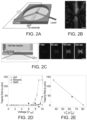
- FIGS. 2 A-E TIRFM Measurement of biomolecular trapping near electrodes.
- A Scheme: gold electrodes patterned on fused silica cover slip (100 nm, yellow) embedded in a circular PDMS chamber (250 ⁇ m thickness, 3 mm diameter), and mounted on a prism for detection of biomolecular localization close to the surface ( ⁇ 100 nm) by TIRF using a 488 nm continuous laser. Inset: side view.
- FIGS. 3 A-F Depletion of biomolecules from DNA brushes undergoing gene expression on the surface.
- A TIRFM Image of DNA (end-labeled in red, 647 nm) patterned along x-axis from electrodes. Scale bar 50 ⁇ m.
- B Imaging transcription-translation activity at DNA brush in separate experiments.
- ⁇ ⁇ ⁇ F F coding F non ⁇ - ⁇ coding of coding to non-coding DNA brushes patterned for reference on opposite side of electrodes ( ⁇ x).
- D Recovery time of RNAP-GFP, nascent RNA and Ribosome-GFP after E-field was turned off, extracted as exponential fits to data (dashed line) in (C).
- E Decay in signal of localized ribosome-GFP after application of E-field, as a function of the distance from the electrodes.
- F Depletion time of ribosome-GFP localized to DNA brush during applied E-field as a function of the distance from the electrodes, extracted by exponential fits to data (C).
- FIGS. 5 A-F Numerical solution of DEP in DNA compartment. Gene expression dynamics of mRNA and proteins (eq 1-4) manipulated by depletion of machinery by E-field: (a) RNAP and Ribosome. (b) RNAP. (c) Ribosome. (d) mRNA. (e) GFP. (f) RNAP, mRNA, Ribosomes, and GFP.
- FIG. 6 Finite element simulations of DEP in the DNA compartment. Finite element numerical solution of the E-field spatial distribution (colored image), and DEP force directions F ⁇ E 2 (arrows represent direction but not magnitude of force.
- FIGS. 7 A-D Raw images of E-field applied on beads.
- Image 2 b created from an overlay image of (B)-(D) subtracted by (A) to remove absorption of beads.
- FIG. 8 Finite element simulations of DEP in PDMS well. Finite element numerical solution of the E-field spatial distribution (colored image), and DEP force directions F ⁇ E 2 (arrows represent direction but not magnitude of force).
- FIG. 9 Trapping rate of different biomolecules. Trapping rate of ribosome-GFP, RNAP-GFP, and GFP as a function of their molecular weight. Trapping rates were measured as the slope of the increased fluorescence between the electrodes upon application of E-field at 1 MHz 10V pp .
- FIG. 10 Trapping rate of GFP. Zoom on data in FIG. 2 D .
- FIG. 11 Trapping rate as a function of molecule polarizability. Induced polarizability of RNAP-GFP, ribosome-GFP, and GFP at 1 MHz, 10V pp calculated from V th ( FIGS. 2 D , E).
- FIG. 12 Trapping rate of RNAP and ribosomes as a function of the distance between the electrodes. Trapping rate was measured for E-field application time shorter than 1 min, and calculated by:
- FIGS. 13 A-C Machinery localization.
- A TIRFM image of ribosome-GFP and RNAP-GFP localized to a coding DNA brush undergoing gene expression (left), and non-coding, inactive DNA brush (right). Fluorescent signals along the cross section of the brush for (B) ribosome-GFP, and (C) RNAP-GFP. Dashed lines are signals for noncoding DNA as background levels.
- FIGS. 14 A-D Direct E-field effect on immobilized GFP.
- FIG. 15 Fluorescent decay of immobilized GFP as a function of the distance from the electrodes. Epi fluorescence measurement of Decrease in fluorescence of GFP-HA bound to the surface in a cell-free transcription translation reaction upon application of an E-field at 1M Hz, 10V pp .
- FIG. 16 is an illustration of a microfluidic device according to embodiments of the present invention.
- FIG. 17 is an illustration of a microfluidic device according to embodiments of the present invention.
- FIG. 18 RNAP-GFP Signal between the electrodes in response to E-field.
- RNAP-GFP signal was monitored by TIRF before, during (shaded area) and after and E-field pulse. The RNAP-GFP signal did not decrease subsequently, indicating adsorption of the protein to the surface.
- the present invention in some embodiments thereof, relates to use of electric field gradients to control biological reactions and, more particularly, but not exclusively, to control gene expression.
- the present inventors Whilst reducing the present invention to practice, the present inventors applied a localized electric field gradient at Mega-Hertz frequency to manipulate gene expression in a DNA compartment on a chip.
- the spatial symmetry of a homogenous reaction in the compartment was broken by creating a macromolecular trap in a region of maximal field intensity localized 50 microns from immobilized DNA.
- the present inventors demonstrated protein synthesis oscillations by on/off switching of the electric field.
- ribosomes, RNA polymerases, and nascent RNA and proteins accumulated in the trap, and were then depleted from the DNA region where gene expression occurred.
- the resulting reduction in the rate of protein synthesis recovered back to steady-state when the field was off.
- the combination of electric field with compartmentalized cell-free gene expression reactions creates a simple, label-free approach for controlling biomolecules in space and time, opening possibilities for hybrid biological systems with a bioelectronic interface based on minimal biological parts design.
- a method of controlling a biological process in a test chamber wherein a portion of a surface of the test chamber is attached to at least one immobilized component of the biological process, the method comprising:
- controlling a biological process refers to controlling the rate of a biological process.
- the biological process is retarded.
- the biological process is stopped.
- the biological process is restarted.
- Exemplary biological processes that may be controlled include, but are not limited to DNA transcription, RNA translation, DNA expression (i.e. transcription and translation) and protein modification.
- test chamber for example a test chamber of a microfluidic device, as further described herein below.
- test chamber refers to an open or closed compartment in which the biological process (as described herein above) takes place.
- the test chamber may comprise volumes of between 10 pl-100 ml, more preferably between 10 pl-10 ml.
- the test chamber may be any shape—e.g. rectangular, square or circular.
- test chamber or device of the present invention is fabricated from a substrate (i.e. a single material or a combination of materials).
- the substrate material is substantially non-fluorescent or emits light of a wavelength range that does not interfere with the photoactivation.
- examples of such materials include, but are not limited to, silica-based materials (exemplified hereinbelow) and elastomeric materials.
- elastomer and “elastomeric” as used herein refers to the general meaning as used in the art.
- Allcock et al. Contemporary Polymer Chemistry, 2nd Ed.
- elastomeric materials exhibit elastic properties because the polymer chains readily undergo torsional motion to permit uncoiling of the backbone chains in response to a force, with the backbone chains recoiling to assume the prior shape in the absence of the force.
- elastomers deform when force is applied, but then return to their original shape when the force is removed.
- the elasticity exhibited by elastomeric materials can be characterized by a Young's modulus.
- the elastomeric materials utilized in the microfluidic devices disclosed herein typically have a Young's modulus of between about 1 Pa-1 TPa, in other instances between about 10 Pa-100 GPa, in still other instances between about 20 Pa-1 GPa, in yet other instances between about 50 Pa-10 MPa, and in certain instances between about 100 Pa-1 MPa.
- Elastomeric materials having a Young's modulus outside of these ranges can also be utilized depending upon the needs of a particular application.
- the choice of materials typically depends upon the particular material properties (e.g., solvent resistance, stiffness, gas permeability, and/or temperature stability) required for the application being conducted. Additional details regarding the type of materials that can be used in the manufacture of the components of the microfluidic devices disclosed herein are set forth in Unger et al. (2000) Science 288:113-116, and PCT Publications WO 02/43615, and WO 01/01025.
- Exemplary low-background substrates include those disclosed by Cassin et al., U.S. Pat. No. 5,910,287 and Pham et al., U.S. Pat. No. 6,063,338.
- Preferred elastomers of the instant invention are biocompatible, gas permeable, optically clear elastomers useful in soft lithography including silicone rubbers, most preferably PDMS.
- Other possible elastomers for use in the devices of the invention include, but are not limited to, polyisoprene, polybutadiene, polychloroprene, polyisobutylene, poly(styrene-butadiene-styrene), the polyurethanes, and silicone polymers; or poly(bis(fluoroalkoxy)phosphazene) (PNF, Eypel-F), poly(carborane-siloxanes) (Dexsil), poly(acrylonitrile-butadiene) (nitrile rubber), poly(l-butene), poly(chlorotrifluoroethylene-vinylidene fluoride) copolymers (Kel-F), poly(ethyl vinyl ether), poly(vinylidene fluoride
- the substrate material is substantially non-reactive with nucleic acids, thus preventing non-specific binding between the substrate and the nucleic acids.
- Methods of coating substrates with materials to prevent non-specific binding are generally known in the art.
- Exemplary coating agents include, but are not limited to cellulose, bovine serum albumin, and poly(ethyleneglycol). The proper coating agent for a particular application will be apparent to one of skill in the art.
- the method of this aspect of the present invention may be carried out in a microfluidic device.
- a method of controlling a biological process in a test chamber of a microfluidic device, wherein at least one component of the biological process is immobilized to the surface of the test chamber comprising:
- microfluidic device refers to a synthetic device in which minute volumes of fluids are flowed.
- the flow-through channel of the device is generally fabricated at the micron to sub-micron scale, e.g., the flow-through channel typically has at least one cross-sectional dimension in the range of less than about 1 mm.
- Microfluidic devices of the present invention can be incorporated in complicated systems such as those described herein below.
- the test chamber of a microfluidic device is connected to the flow-through channel such that components (i.e. non-immobilized components) which flow there-through can reach the test chamber and take part in the biological process (e.g. by diffusion or by fluid flow).
- the flow-through channel is connected directly to the test chamber.
- the flow-through channel is connected via a microchannel to the test chamber.
- the test chamber of a microfluidic device is circular and has a diameter of about 50-200 microns.
- the test chambers typically have a volume of less than 100 pl, in other instances less than 50 pl; in other instances less than 40 pl, 30 pl, 20 pl or 10 pl.
- flow-through channel refers to a low resistance flow channel, about 25 microns to about 150 microns deep, preferably about 25 microns to about 100 microns deep and more preferably about 30 microns to about 100 microns deep.
- Flow-through channels are sufficiently wide so as to not inhibit the flow of fluid through the channel, and not excessively wide to inhibit the function of valves. Such considerations are well understood by those of ordinary skill in the art. Exemplary widths of the flow-through channel are between 100 microns-1 mm wide.
- the flow-through channel has at least one inlet port and at least one outlet port, at least one of which being in fluid communication with a reservoir such as by tubing. Fluids may be passively or actively infused into the flow channels such as by capillary forces or pumps (e.g., external pumps, e.g., peristaltic pumps or electro-osmotically pumps).
- Flow through the flow-through channel may be regulated using a valve.
- a “valve” is a component of the device that regulates flow through a fluid channel of the device by substantially inhibiting flow through the fluid channel upon closure. Substantially inhibiting the flow means that flow is inhibited at least 80%, preferably at least 90%, more preferably at least 95%, even more preferably at least 99%, most preferably flow is completely (i.e., 100%) inhibited.
- the size of the valve is dependent on the size and shape of the fluid channel and the amount of pressure required to close the valve. In a preferred method, the fluid channel is about 250 microns wide and the valve is about 300 microns wide. The channel and control valve cross perpendicularly. Upon actuation of the valve, preferably by hydrostatic pressure, the channel closes and opens.
- microchannel refers to a high resistance channel, about 1 micron to about 20 microns deep, more preferably about 1 micron to about 10 microns deep.
- the length of the microchannel can vary between 20 microns to about 1 mm or between 20 microns to about 500 microns.
- the width of the microchannel is typically between 2-50 microns. According to embodiments of the present invention the ratio of the width of microchannel:width of the flow-through channel is greater than 1:5. Exemplary ratios include 1:5, 1:6, 1:7, 1:8, 1:9, 1:10 and 1:20.
- the hydrodynamic resistance of the microchannel is at least 5 or 6 orders of magnitude higher than in the flow-through channel. This reduces the flow in the microchannel by 5 or 6 orders of magnitude compared with the flow in the flow chamber.
- Resistance of fluid flow through the microchannel may be higher than the resistance in the flow-through channel.
- This resistance is typically established by having microchannels that are substantially and sufficiently shallower and/or narrower than the adjacent flow-through channels to create resistance.
- the relative dimensions of the microchannel: flow-through channel is such that there is essentially no flow in the microchannel.
- Such parameters can be readily determined by one of ordinary skill in the art using mathematical or empirical modeling.
- the depth ratio of the reaction unit:flow-through channel is greater than 1:5. Exemplary ratios include 1:5, 1:6, 1:7, 1:8, 1:9, 1:10 and 1:20.
- the surface of at least a portion of the test chamber is attached to at least one component of the biological process.
- the at least one component is an isolated protein or peptide.
- isolated protein or peptide refers to a protein or peptide which is not comprised in or on a cell.
- the isolated protein or peptide when attached to the test chamber, it is devoid of cellular components (such as nucleic acids, lipids etc.)
- the at least one component is an isolated nucleic acid.
- isolated nucleic acid refers to a nucleic acid which is not comprised in or on a cell.
- the isolated nucleic acid when attached to the reaction unit, it is devoid of cellular components (such as proteins, lipids etc.)
- the nucleic acid may be single stranded or double stranded.
- the nucleic acid may be DNA (e.g. cDNA, genomic DNA, synthetic DNA), RNA, a combination of both.
- the nucleic acid may be isolated from a cell, or may by synthesized in vitro.
- the nucleic acids of this aspect of the present invention comprise at least one promoter and encode a polypeptide.
- the nucleic acids may be of any length. According to a particular embodiment, the nucleic acids are between 200 bp-500 kbp, or between 200 bp-2000 kbp, or between 200 bp-100 kbp, or between 200 bp-40 kbp, or between 200-5000 bp.
- the distance between the DNA top and the promoter is about 200 bp and a similar distance between the terminator and the DNA end attached to the surface.
- nucleic acids and peptides of this aspect of the present invention are typically linear.
- At least a portion of the surface of the test chamber (or portion thereof) is coated with the component (e.g. nucleic acids).
- the component e.g. nucleic acids
- the density of the nucleic acid on the surface of the test chamber is between 10 2 DNA ⁇ m 2 -10 5 DNA ⁇ m 2 , for example in the order of 10 2 DNA ⁇ m 2 .
- the nucleic acid of the present invention is typically orientated on the substrate of the test chamber such that the regulatory region of the nucleic acid (e.g. promoter) is closer to the substrate and the polypeptide coding region is further from the substrate.
- the regulatory region of the nucleic acid e.g. promoter
- the components may be attached to the substrate of the test chamber (or portion thereof) in a wide variety of ways, as will be appreciated by those in the art.
- the components e.g. nucleic acids
- the test chamber and the component may be derivatized with chemical functional groups for subsequent attachment of the two.
- the test chamber may be derivatized with a chemical functional group including, but not limited to, amino groups, carboxyl groups, oxo groups or thiol groups.
- the nucleic acid may be attached using functional groups on the nucleic acid either directly or indirectly using linkers.
- the isolated nucleic acid may also be attached to the test chamber non-covalently.
- a biotinylated nucleic acid can be prepared, which may bind to surfaces covalently coated with streptavidin, resulting in attachment.
- a nucleic acid may be synthesized on the surface using techniques such as photopolymerization and photolithography. Additional methods of attaching nucleic acids to solid surfaces and methods of synthesizing nucleic acids on solid surfaces are well known in the art, i.e. VLSIPS technology from Affymetrix (e.g., see U.S. Pat. No. 6,566,495, and Rockett and Dix, “DNA arrays: technology, options and toxicological applications,” Xenobiotica 30(2):155-177, all of which are hereby incorporated by reference in their entirety).
- the test chamber is coated with a coat composed of a compound which can be represented by the general formula I below: X-L-Y Formula I
- X is the functionalized group capable of binding to a solid surface of the microfluidic device
- L is the polymer capable of forming a monolayer on the microfluidic device
- Y is a photoactivatable group capable of generating a reactive group upon exposure to light.
- the functionalized group is preferably selected such that it binds to the test chamber by reacting with at least one functional group present on a surface of the test chamber.
- Preferred functionalized groups according to the present invention comprise one or more reactive silyl group(s).
- the phrase “reactive silyl group” describes a residue of a compound comprising at least one silicon atom and at least one reactive group, such as an alkoxy or halide, such that the silyl group is capable of reacting with a functional group, for example on a surface of the microfluidic device, to form a covalent bond with the surface.
- the reactive silyl group can react with the surface of a silica substrate comprising surface Si—OH groups to create siloxane bonds between the compound and the silica substrate.
- Exemplary reactive silyl groups that are usable in the context of the present invention include, without limitation, trialkoxysilanes, alkyldialkoxysilanes, alkoxydialkylsilanes, trihalosilanes, alkyldihalosilanes and dialkylhalosilanes.
- Such reactive groups are easily reacted when contacted with free hydroxyl groups on a surface of solid surfaces and particularly with such hydroxyl groups on a silica surface.
- silicon and “SiO 2 ” are used interchangeably.
- the reactive silyl group is trialkoxysilane such as, for example trimethoxysilane, triethoxysilane, tripropyloxysilane or trihalosilane such as, for example, trichlorosilane.
- the functionalized group according to the present invention may further include a chemical moiety that is terminated with the reactive silyl group.
- a chemical moiety can comprise, for example, alkyl, alkenyl, aryl, cycloalkyl and derivatives thereof, as these terms are defined herein.
- the functionalized group comprises an alkyl terminating with a trialkoxysilane.
- the polymer is selected so as to form a monolayer on the test chamber.
- the polymer group in the compounds of the present invention may be any hydrophobic, hydrophilic and amphiphilic polymer that has suitable characteristics for forming a monolayer. Such characteristics include, for example, long, relatively inert chains, which may interact therebetween via e.g., hydrogen or Van-der-Waals interactions.
- a preferred polymer according to the present invention comprises polyethylene glycol (PEG).
- PEG polyethylene glycol
- PEG is characterized by resistance to nonspecific absorptions of biomolecules and is therefore beneficial for use in some contexts of the present invention.
- PEG chains typically interact therebetween via hydrogen bonds, so as to produce a well-ordered monolayered film.
- the polyethylene glycol residue in the compounds of the present invention can be derived from PEGs having a molecular weight that ranges from about 400 grams/mol and about 10000 grams/mol.
- Preferred PEGs are those having a molecular weight that ranges from about 2000 grams/mol and about 5000 grams/mol.
- Such PEGs allow the productions of a monolayered film when deposited on a solid surface in the presence of a functionalized group, as described hereinabove.
- the polyethylene glycol residue may be substituted or unsubstituted and can be represented by the general Formula II below: —(CR 1 R 2 CR 3 R 4 O)n- Formula II
- n is an integer from 10 to 200; and R 1 , R 2 , R 3 and R 4 are each independently selected from the group consisting of hydrogen, alkyl, cycloalkyl, aryl, alkenyl alkynyl, alkoxy, thioalkoxy, aryloxy and thioaryloxy.
- the PEG is unsubstituted such that R 1 , R 2 , R 3 and R 4 are each hydrogen.
- the PEG residue is a medium-sized residue such that n is an integer from 60 to 100.
- the polymer is preferably attached to the functionalized group described above via a linking moiety.
- linking moieties include, without limitation, oxygen, sulfur, amine, amide, carboxylate, carbamate, sulphonate, sulphonamide, phosphate, hydrazine, hydrazide, as these terms are defined herein and derivatives thereof.
- the linking moiety is an amide, formed between a carboxylic end group of the polymer and an amine end group of the functionalized moiety, as is detailed herein under.
- the compounds of the present invention by comprising the functionalized group and the polymer described hereinabove, readily form self-assembled monolayers when contacted with the solid surface of the test chamber, in a one-step, simple to perform, reaction.
- each of the formed monolayers has a photoactivatable group attached thereto.
- photoactivatable group describes a group that is rendered active when exposed to photoactivation, namely when exposed to light.
- Photoactivatable groups typically comprise a protected reactive group, which upon exposure to light are de-protected, so as to generate a reactive group.
- reactive group describes a chemical moiety that is capable of interacting with another moiety. This interaction typically results in a bond formation between these moieties, whereby the bond can be, for example a covalent bond, a hydrogen bond, a coordinative bond, or an ionic bond.
- reactive groups include, without limitation, amine, hydroxy, thiohydroxy, halo, alkoxy, thioalkoxy, aryloxy, thioaryloxy, carboxylate, phosphate, phosphonate, sulfate and sulfonate, as these terms are defined herein.
- the photoactivatable group is selected so as to generate a desired reactive group
- a photoactivatable group that comprises a carbamate can generate upon exposure to light amine as the reactive group.
- the photoactivatable groups according to the present invention are preferably derived from photoactivatable compounds and therefore preferably include a residue of, for example, photoactivatable compounds that has light-absorbing characteristics such as 6-nitrovertaryl chloroformate, 6-nitrovertaryl carbonyl, 2-nitrotoluene, 2-nitroaniline, phenacyl, phenoxy, azidoaryl, sulfonic ester, desyl, p-hydroxyphenacyl, 7-methoxy coumarin, o-ethylacetophenone, 3,5-dimethylphenacyl, dimethyl dimethoxybenzyloxy carbonyl, 5-bromo-7-nitroindolinyl, o-hydroxy- ⁇ -methyl cinnamoyl and 2-oxymethylene anthraquinone.
- light-absorbing characteristics such as 6-nitrovertaryl chloroformate, 6-nitrovertaryl carbonyl, 2-nitrotoluene, 2-nitroaniline, phenacyl, phenoxy, azidoaryl,
- reactive groups which are capable of nucleic acids, as is detailed hereinunder, are generated.
- the surface of the test chamber and the compound of the present invention are selected such that upon contacting the polymer with the substrate, a self-assembled monolayered film of the polymer forms on the substrate surface, in a one-step reaction.
- the contacting procedure is preferably effected by incubating the compound with the selected surface, preferably in the presence of an organic solvent such as, for example, toluene.
- the reactive group for binding a screenable moiety can be generated by exposing a pre-selected area of the substrate to light.
- the light can be a UV, IR or visible light, or, optionally and preferably, the light can be a monochromatic light of a predetermined wavelength.
- Exposure of a limited area of the test chamber surface to light is preferably effected using a photo mask to illuminate selected regions the substrate and avoid coating the substrate at the periphery.
- a photo mask to illuminate selected regions the substrate and avoid coating the substrate at the periphery.
- the solid surface may be translated under a modulated laser or diode light source. Such techniques are discussed in, for example, U.S. Pat. No. 4,719,615 (Feyrer et al.), which is incorporated herein by reference.
- a laser galvanometric scanner is utilized.
- the synthesis may take place on or in contact with a conventional liquid crystal (referred to herein as a “light valve”) or fiber optic light sources.
- liquid crystals By appropriately modulating liquid crystals, light may be selectively controlled so as to permit light to contact selected regions of the solid surface. Alternatively, synthesis may take place on the end of a series of optical fibers to which light is selectively applied. Other means of controlling the location of light exposure will be apparent to those of skill in the art.
- the surface of the test chamber may be irradiated either in contact or not in contact with a solution and is, preferably, irradiated in contact with a solution.
- the solution may contain reagents to prevent the by-products formed by irradiation. Such by-products might include, for example, carbon dioxide, nitrosocarbonyl compounds, styrene derivatives, indole derivatives, and products of their photochemical reactions.
- the solution may contain reagents used to match the index of refraction of the substrate. Reagents added to the solution may further include, for example, acidic or basic buffers, thiols, substituted hydrazines and hydroxylamines, or reducing agents (e.g., NADH).
- exposing the test chamber surface to light is effected so as to provide a patterned substrate in which reactive groups are generated according to a pre-selected pattern.
- the pattern can be printed directly onto the substrate or, alternatively, a “lift off” technique can be utilized.
- a patterned resist is laid onto the substrate or onto the light source. Resists are known to those of skill in the art. See, for example, Kleinfield et al., J. Neurosci. 8:4098-120 (1998).
- a second pattern is printed onto the substrate on those areas initially covered by the resist; a process that can be repeated any selected number of times with different components to produce an array having a desired format.
- Binding the nucleic acid can be effected by directly attaching the moiety to the reactive group.
- binding the nucleic acid is effected via a mediating moiety.
- mediating moiety describes a mediating agent or a plurality of mediating agents being linked therebetween that may bind to both the reactive group and the component and thus mediate the binding of the component to the reactive group.
- the mediating moiety can thus be a bifunctional moiety, having two reactive groups, each independently capable of reacting with the reactive group attached to the test chamber or the component.
- the mediating moiety can comprise two or more moieties, whereby the first moiety can be attached to the reactive group and to a second mediating moiety, whereby the second mediating moiety can bind the component (e.g. nucleic acid).
- the mediating moiety comprises an affinity pair, such as, for example, the biotin-avidin affinity pair.
- the biotin-avidin affinity pair is highly useful for integrating nucleic acids or peptides on the surface of the test chamber.
- the mediating moiety can comprise biotin.
- biotin When attached to the reactive group, biotin can bind a variety of chemical and biological substances that are capable of reacting with the free carboxylic group thereof.
- promoter refers to a nucleic acid fragment that functions to control the transcription of one or more genes, located upstream with respect to the direction of transcription of the transcription initiation site of the gene, and is structurally identified by the presence of a binding site for DNA-dependent RNA polymerase, transcription initiation sites and any other DNA sequences, including, but not limited to transcription factor binding sites, repressor and activator protein binding sites, and any other sequences of nucleotides known to one of skill in the art to act directly or indirectly to regulate the amount of transcription from the promoter.
- a “constitutive” promoter is a promoter that is active under most environmental and developmental conditions.
- An example of a constitutive promoter is cytomegalovirus (CMV) or Rous sarcoma virus (RSV) promoter.
- CMV cytomegalovirus
- RSV Rous sarcoma virus
- an “inducible” promoter is a promoter that is active under environmental or developmental regulation.
- inducible promoters examples include the tetracycline-inducible promoter (Srour, M. A., et al., 2003. Thromb. Haemost. 90: 398-405), an IPTG inducible promoter, P70, P70 b , P 28 , P 38 or Plac ⁇ arac (P la ).
- the promoter is preferably positioned approximately the same distance from the heterologous transcription start site as it is from the transcription start site in its natural setting. As is known in the art, however, some variation in this distance can be accommodated without loss of promoter function.
- a DNA segment such as an expression control sequence is “operably linked” when it is placed into a functional relationship with another DNA segment.
- a promoter or enhancer is operably linked to a coding sequence if it stimulates the transcription of the sequence.
- DNA for a signal sequence is operably linked to DNA encoding a polypeptide if it is expressed as a pre-protein that participates in the secretion of the polypeptide.
- DNA sequences that are operably linked are contiguous, and, in the case of a signal sequence, both contiguous and in reading phase.
- enhancers need not be contiguous with the coding sequences whose transcription they control. Linking is accomplished by ligation at convenient restriction sites or at adapters, linkers, or PCR fragments by means know in the art.
- the promoter is a eukaryotic promoter.
- Eukaryotic promoters typically contain two types of recognition sequences, the TATA box and upstream promoter elements.
- the TATA box located 25-30 base pairs upstream of the transcription initiation site, is thought to be involved in directing RNA polymerase to begin RNA synthesis.
- the other upstream promoter elements determine the rate at which transcription is initiated.
- the promoter is a prokaryotic promoter.
- the promoter is a plant-specific promoter.
- the promoter is a tissue specific promoter.
- the nucleic acid of this aspect of the present invention may further comprise an enhancer element.
- Enhancer elements can stimulate transcription up to 1,000 fold from linked homologous or heterologous promoters. Enhancers are active when placed downstream or upstream from the transcription initiation site. Many enhancer elements derived from viruses have a broad host range and are active in a variety of tissues. For example, the SV40 early gene enhancer is suitable for many cell types. Other enhancer/promoter combinations that are suitable for some embodiments of the invention include those derived from polyoma virus, human or murine cytomegalovirus (CMV), the long term repeat from various retroviruses such as murine leukemia virus, murine or Rous sarcoma virus and HIV. See, Enhancers and Eukaryotic Expression, Cold Spring Harbor Press, Cold Spring Harbor, N.Y. 1983, which is incorporated herein by reference.
- CMV cytomegalovirus
- Polyadenylation sequences may also be present in the nucleic acids in order to increase the efficiency of mRNA translation.
- Two distinct sequence elements are required for accurate and efficient polyadenylation: GU or U rich sequences located downstream from the polyadenylation site and a highly conserved sequence of six nucleotides, AAUAAA, located 11-30 nucleotides upstream.
- Termination and polyadenylation signals that are suitable for some embodiments of the invention include those derived from SV40.
- the nucleic acid of some embodiments of the invention can further include additional polynucleotide sequences that allow, for example, the translation of several proteins from a single mRNA such as an internal ribosome entry site (IRES) and sequences for genomic integration of the promoter-chimeric polypeptide.
- IRS internal ribosome entry site
- translational initiator sequence is defined as the ten nucleotides immediately upstream of the initiator or start codon of the open reading frame of a DNA sequence coding for a polypeptide.
- the initiator or start codon encodes for the amino acid methionine.
- the initiator codon is typically ATG, but may also be any functional start codon such as GTG, TTG or CTG.
- the nucleic acid of the present invention encodes an operon.
- the individual elements comprised in the nucleic acid can be arranged in a variety of configurations.
- enhancer elements, promoters and the like, and even the polynucleotide sequence(s) encoding the polypeptide can be arranged in a “head-to-tail” configuration, may be present as an inverted complement, or in a complementary configuration, as an anti-parallel strand. While such variety of configuration is more likely to occur with non-coding elements of the nucleic acid, alternative configurations of the coding sequence within the nucleic acid are also envisioned.
- the nucleic acid molecule comprises a coding sequence coding for a predetermined amino acid sequence that is to be expressed.
- At least one of the nucleic acids attached to the test chamber encodes a transcription factor, an activator or a repressor.
- At least one of the nucleic acids attached to the test chamber encodes a polypeptide comprising a detectable moiety.
- the polypeptides are fluorescent polypeptides.
- fluorescent polypeptides examples include, but are not limited to green fluorescent protein from Aequorea victoria (“GFP”), the yellow fluorescent protein and the red fluorescent protein and their variants (e.g., Evrogen).
- the polypeptides are phosphorescent polypeptides, chemiluminescent polypeptides or luminescent polypeptides.
- Table 1 provides non-limiting examples of such detectable moieties contemplated by the present invention.
- AAK09208 AF329457 Biotin lygase tag LHHILDAQ K MVWNHR (SEQ ID NO: 2) orange fluorescent AAL33917 AF435432 protein Beta galactosidase ACH42114 EU626139 Streptavidin AAM49066 AF283893
- a single test chamber may be attached to isolated nucleic acids each having the same sequence.
- a single test chamber may be attached to a plurality of isolated nucleic acids having different sequences.
- a single test chamber may be attached to a plurality of isolated nucleic acids encoding a transcriptome.
- the microfluidic device is preferably sealed using methods which are well known in the art.
- Low fluorescence adhesives which provide sealing and cover constructions may be used. Such adhesives are dimensionally stable and do not flow into microfluidic channels. They adhere to the cover layer without creating voids or gaps that may allow migration of components from one path to adjacent path, and they exhibit good stability to moisture and temperature change.
- Adhesives used in accordance with the present invention can be either flexible or rigid, but should preferably be clear and colorless (such adhesives can be obtained from Adhesives Research Inc.).
- adhesives include, but are not limited to, pressure sensitive adhesives, such as ethylene-containing polymers, urethane polymers, butyl rubber, butadiene-acrylonitrile polymers, butadiene-acrylonitrile-isoprene polymers, and the like. See, for example, U.S. Pat. No. 5,908,695 and references cited therein.
- the fluid which carries/contains the non-immobilized components are typically buffered solutions which are physiologically relevant such that they do not interfere with the biological process—i.e. for the interaction between the components to take place.
- the non-immobilized components are selected according to the biological process being carried out and the identity of the component immobilized to the test chamber surface.
- the immobilized component may be DNA and the non-immobilized components may include ribonucleotides, RNA polymerase (e.g. RNA polymerase II) and transcription factors.
- RNA polymerase e.g. RNA polymerase II
- the immobilized component may be RNA and the non-immobilized components may include ribosomes, tRNA and amino acids.
- the immobilized component may be DNA and the non-immobilized components may include ribonucleotides, RNA polymerase (e.g. RNA polymerase II), transcription factors, ribosomes, tRNA and amino acids.
- RNA polymerase e.g. RNA polymerase II
- transcription factors e.g. ribosomes, tRNA and amino acids.
- the immobilized component may be DNA and the non-immobilized components may include an enzyme that carries out the modification such as kinases; capping enzymes including phosphatases, guanosyl transferase, (guanine-N 7 -)-methyltransferase etc.
- the non-immobilized components of this aspect of the present invention do not include DNA.
- a cell-free protein expression system is used in the method to provide the non-immobilized components.
- a cell-free expression system is flowed through the microfluidic device of the present invention such that the non-immobilized components reach the test chamber and carry out the biological process.
- An electric field gradient is then applied in the vicinity of the test chamber at a frequency which draws at least one non-immobilized component of the biological process away from the immobilized component towards the source of the electric field gradient.
- Non-immobilized components of the biological process that may be drawn away from the immobilized component include the starting components used in the reaction and also intermediate products of the reaction (for example in the case of gene expression, a non-immobilized component may be RNA).
- Electrodes may be used to apply an electric field gradient electrodes.
- the electrodes are used to use apply dielectrophoresis (DEP) to polarize and trap the non-immobilized components of the biological process.
- DEP dielectrophoresis
- the electrodes of the present invention may be fabricated from a metal such as platinum or gold.
- the electrodes are typically between 0.1-20 ⁇ m in width.
- the electrode may be of any shape, e.g. rectangular. In one embodiment, it is tapered.
- the electrodes are typically in contact with the fluid inside the test chamber. Typically, the electrodes are placed at least 1 ⁇ m from the immobilized component in the test chamber. In another embodiment, the electrodes are placed between 1-50 ⁇ m from the immobilized component in the test chamber—e.g. about 10 ⁇ m.
- the electrodes are between 0.1-30 ⁇ m apart.
- the electrodes are integrated into the microfluidic device i.e. are fashioned into the microfluidic device.
- the electrodes may be connected to a programmable voltage controller for applying desired voltage differentials.
- the electric field gradient is generated using an AC electric potential of between 1 V-20 V, more preferably between 1 V-10 V (although higher or lower voltages are also contemplated.
- the voltage may be selected such that a particular non-immobilized component is trapped.
- a particular non-immobilized component is trapped.
- the frequency of the electric field gradient is typically above the diffusion rate of ions—e.g. between 0.1-10 MHz.
- an AC electric potential of 10V pp is applied at 1 MHz frequency.
- the electric field gradient may be applied for any time—for example between 0.01 second—1 hour, more preferably between 1 second and 1 hour and even more preferably between 1 minute and 1 hour. According to an exemplary embodiment, the time for applying the electric field gradient is about 5-10 minutes.
- the electric field gradient may be switched on and off intermittently to start and stop the biological process.
- the present invention contemplates providing additional non-immobilized components in order to restart the biological process. In another embodiment, no additional non-immobilized components are necessary to restart the biological process.
- the present invention contemplates a myriad of application for the device and methods described herein, some of which are detailed herein below.
- microfluidic device of the present invention which can be utilized to control gene transcription/expression. It should be understood that this configuration is exemplary and that modifications thereof will be apparent to those skilled in the art.
- FIG. 16 is a schematic illustration of a top view of a microfluidic device 10 , according to various exemplary embodiments of the present invention.
- microfluidic device 10 comprises a test chamber 12 , a stimulation chamber 16 and a microchannel 14 .
- the stimulation chamber 16 is in fluid connection with the test chamber 12 .
- Electrodes 34 are integrated into device 10 such that when current flows, an electric field potential is set up between the test chamber 12 and the stimulation chamber 16 .
- the maximal field intensity of the electric field gradient is localized at least 1-50 ⁇ m from the test chamber 12 .
- Nucleic acids 18 are attached to the test chamber 12 .
- the microchannel 14 is in communication with the flow-through channel 20 .
- Device 10 can also comprise an inlet port 26 which is in fluid communication with an external reagent inlet reservoir 22 such as by tubing (such as for infusing the reactants of the reaction) and an outlet port 28 which optionally may be in fluid communication with an outlet reservoir 30 .
- an inlet port 26 which is in fluid communication with an external reagent inlet reservoir 22 such as by tubing (such as for infusing the reactants of the reaction)
- an outlet port 28 which optionally may be in fluid communication with an outlet reservoir 30 .
- Fluids may be passively or actively infused into the flow channels such as by capillary forces or via a pump (e.g., external pumps, e.g., peristaltic pumps or electro-osmotically pumps).
- a pump e.g., external pumps, e.g., peristaltic pumps or electro-osmotically pumps.
- the device may be covered by a solid cover layer.
- FIG. 17 is a schematic illustration of a top view of an additional microfluidic device 100 , according to various exemplary embodiments of the present invention.
- microfluidic device 100 comprises a test chamber 120 , and a microchannel 140 .
- Electrodes 160 are integrated into device 100 such that when current flows, an electric field potential is set up between the outer area of the test chamber 120 and the inner area of the test chamber (the area where nucleic acids 180 are attached).
- the maximal field intensity of the electric field gradient is localized at least 1-50 ⁇ m from the inner area of the test chamber.
- Nucleic acids 180 are attached to the test chamber 120 .
- the microchannel 140 is in communication with the flow-through channel 200 .
- the device may comprise additional reaction units (a reaction unit being a test chamber connected to a microchannel).
- a reaction unit being a test chamber connected to a microchannel.
- each of the microchannels of the reaction units of the device are of the same length.
- the length of at least one of the microchannels of the reaction units is different to the length of another microchannel of the reaction unit.
- compositions, method or structure may include additional ingredients, steps and/or parts, but only if the additional ingredients, steps and/or parts do not materially alter the basic and novel characteristics of the claimed composition, method or structure.
- a compound or “at least one compound” may include a plurality of compounds, including mixtures thereof.
- range format is merely for convenience and brevity and should not be construed as an inflexible limitation on the scope of the invention. Accordingly, the description of a range should be considered to have specifically disclosed all the possible subranges as well as individual numerical values within that range. For example, description of a range such as from 1 to 6 should be considered to have specifically disclosed subranges such as from 1 to 3, from 1 to 4, from 1 to 5, from 2 to 4, from 2 to 6, from 3 to 6 etc., as well as individual numbers within that range, for example, 1, 2, 3, 4, 5, and 6. This applies regardless of the breadth of the range.
- a numerical range is indicated herein, it is meant to include any cited numeral (fractional or integral) within the indicated range.
- the phrases “ranging/ranges between” a first indicate number and a second indicate number and “ranging/ranges from” a first indicate number “to” a second indicate number are used herein interchangeably and are meant to include the first and second indicated numbers and all the fractional and integral numerals therebetween.
- method refers to manners, means, techniques and procedures for accomplishing a given task including, but not limited to, those manners, means, techniques and procedures either known to, or readily developed from known manners, means, techniques and procedures by practitioners of the chemical, pharmacological, biological, biochemical and medical arts.
- the compartment and main feeding channel ( FIG. 1 A , FIG. 4 ) were patterned on a silicon wafer (Si ⁇ 100> 4′′, R>10,000 ohm/cm) in two UV-photolithography steps using a maskless laser write system ( ⁇ PG 101, Heidelberg Instruments). The two layers were etched using Reactive Ion Etching (ICP-RIE, Surface Technology Systems, New Port, England). The compartments were first etched to a depth of 3 ⁇ m, and the main channel was then etched to a depth of 30 ⁇ m. Inlets and outlets of each device were drilled through (TBM 220, Proxxon; Dremel, 7103 diamond wheel point drill). The device was coated with a ⁇ 50 nm SiO 2 layer on both sides deposited by plasma enhanced chemical vapor deposition (Plasma-Therm VERSALINE, Saint Louis, Florida, USA).
- Electrodes were patterned using a layer of liftoff resist (LOR10B, microchem) coated with a 2 nd layer of S1805 positive resist to create a thin 1 ⁇ m undercut on two substrates, compartment wafer coated with 50 nm of SiO 2 , and fused silica (U.Q.G. optics, UV fused silica plates spectrosil 2000).
- Gold was evaporated to a thickness of 100 nm on top of 5 nm of chromium (Selen 500 Electron Beam source System, manufactured by Odem Scientific Application LTD). Liftoff was done using PG-remover at 50° C.
- the devices were cleaned and coated with a photoactive biocompatible monolayer [Buxboim, A. et al. Small 3, 500-10 (2007)] described in the following section.
- DNA Brush assembly Reactive amine groups of the biocompatible monolayer 5 were exposed to UV light from a laser source ( ⁇ PG 101, Hidelberg instruments). Biotin N-hydroxysuccinimidyl ester (biotin-NHS) dissolved in a borate buffered saline (0.5 mg/ml) was incubated on the chip for 10 minutes. The biotin-NHS covalently attached to the exposed amine groups on the UV exposed monolayer attaining a surface pattern with biotin.
- biotin-NHS Biotin N-hydroxysuccinimidyl ester
- Linear double strands of DNA fragments were produced by polymerase chain reaction with KAPA HiFi HotStart ReadyMix (KK2601, KAPA BIOSYSTEMS), using one primer with biotin and another with Alexa Fluor 647, both attached at the 5′-end (IDT).
- the final DNA solution contained Streptavidin (SA) conjugated DNA at a concentration of 150-300 nM in a phosphate buffered saline.
- Nano-liter DNA-SA droplets were individually deposited onto the reactor chambers using the GIX Microplotter II (Sonoplot Inc., Middleton, WI).
- Antibodies and GFP assembly to the surface 500 nM ( ⁇ 50 mg/ml) Anti-HA-Biotin, (High Affinity, 3F10 clone, Roche) was mixed with 2:1 amount of streptavidin (Sigma Aldrich) in PBS. After 30 minutes incubation at 4° C., to allow full formation of antibody-SA conjugates, and the mix was diluted to 25-50 nM in PBS and applied to the surface. The antibody-SA conjugate was incubated on the surface for 1 hour before repeated washing in PBS. Purified GFP fused to an HA tag were incubated on the surface for 15 minutes. The surface was washed and kept in PBS before the cell-free reaction was added.
- eGFP-T7 RNAP Labeling and purification of eGFP-T7 RNAP.
- the gene coding for eGFP was cloned into plasmid pBH161 [He, B. et al. Protein Expr. Purif. 9, 142-151 (1997)] under control of the E. coli UV5 promoter and upstream of the ATG codon of the T7 RNAP gene.
- the resulting protein His6-eGFP-T7RNAP was over-expressed in BL21(DE3) cells after induction with 1 mM IPTG at OD 600 of 0.5 for 3 hrs and purified using conventional protocols. Briefly, the protein was first purified by Ni 2+ affinity chromatography using 2 ⁇ 1 ml HisTrap FF columns (GE healthcare).
- eGFP coding sequence was cloned at the C-terminus of ribosomal protein S15.
- the S15-eGFP gene fusion was inserted into plasmid pRSFduet under control of T7 promoter/lac operator.
- S15-eGFP was over-expressed in BL21(DE3) by induction with 1 mM IPTG at OD 600 of 0.5 for 3 hrs.
- E. coli 16S rRNA gene lacking its leader sequence was cloned under control of the T7 promoter in the PUREfrex control plasmid (Cosmo Bio, Japan) replacing the DHFR gene.
- a broccoli aptamer [Filonov, G.
- the 16S-H6-Broccoli rRNA was synthesized in a PUREfrex Tx/Tl reaction and visualized by the addition of DHFBI-1T (Lucerna, Inc, TM NY) at a final concentration of 30 ⁇ M.
- RNA polymerase RNA polymerase
- R b ribosome
- Equation (1) describes the kinetics of r p in the compartment, with r 0 the bulk concentration in the feeding channel, ⁇ rp is the diffusion time into and out of the compartment, and ⁇ E is the response time to the electric field.
- ⁇ E the second term of the right-hand side of the equation is dominant, and the diffusion rate of r p in the compartment drops to zero
- Equation (2) describes the diffusion of ribosomes into the compartment, with R 0 is the bulk concentration in the feeding channel, ⁇ Rb is the diffusion time of R b into and out of the compartment. Similarly, as in equation (1) For ⁇ E ⁇ Rb the concentration of ribosomes drops to zero in the compartment,
- Equation (3) describes the kinetics of m, with transcription rate, k TX , DNA concentration, D, and mRNA lifetime ⁇ m .
- Equation (4) describes the kinetics of protein expression in the compartment with translation rate, k TL , the, and protein lifetime ⁇ p .
- the E-field, modeled by ⁇ (E), was applied separately to r p , R b , M, p, in Eqs. 1-4 and the resulting dynamics was simulated ( FIG. 6 ). The results are most compatible with the depletion of both ribosome and RNAP.
- the simulated DC field value can be interpreted as the root mean square (RMS) value of the experimental AC field.
- RMS root mean square
- a reconstituted cell-free protein synthesis reaction based on purified components 25 was used.
- Cell-free systems 25-27 provide a means to study biological design principles by programming minimal gene networks to exhibit emergent spatiotemporal expression patterns 3,6,28-30 .
- the DNA code was immobilized as a dense brush, thereby breaking the symmetry and localizing the reaction close to the surface of a compartment.
- An E-field gradient applied to electrodes patterned close to the DNA brush creates a scenario for effectively perturbing the reaction by separating transcription-translation enzymes from the DNA code.
- screening and electro-osmotic effects were overcome in a solution of high ionic strength 16,31 with conductivity of about ⁇ 1 S/m.
- the DEP force field perpendicular to the E-field was visualized by the streamlines of 1 ⁇ m beads in water, where the Joule heating and electro-osmosis at high ionic strength 31 is minimized, leaving DEP as main effect driving bead motion 32 ( FIG. 2 B , FIGS. 7 A-D ).
- the attraction of the beads to the maximal field intensity region between the electrodes is consistent with a numerical solution of the DEP force field ( FIG.
- the fluorescent signal between the electrodes did not decrease after the E-field had been turned off and stayed at a constant level (shown for RNAP-GFP in FIG. 18 ).
- DNA brushes coding for GFP were patterned on the surface along the symmetry axis of the E-field, up to 600 ⁇ m from the electrodes ( FIG. 3 A ).
- Localized transcription-translation activity was detectable by TIRFM 35 as RNAP-GFP, ribosome-GFP, and newly synthesized RNA (labeled by a fluorescent probe 36 ), all concentrated at the DNA brush ( FIG. 3 B ).
Landscapes
- Chemical & Material Sciences (AREA)
- Health & Medical Sciences (AREA)
- Life Sciences & Earth Sciences (AREA)
- Organic Chemistry (AREA)
- Genetics & Genomics (AREA)
- Engineering & Computer Science (AREA)
- General Health & Medical Sciences (AREA)
- Wood Science & Technology (AREA)
- Zoology (AREA)
- Bioinformatics & Cheminformatics (AREA)
- Analytical Chemistry (AREA)
- Molecular Biology (AREA)
- Biotechnology (AREA)
- Biochemistry (AREA)
- Chemical Kinetics & Catalysis (AREA)
- General Engineering & Computer Science (AREA)
- Physics & Mathematics (AREA)
- Microbiology (AREA)
- Biomedical Technology (AREA)
- Dispersion Chemistry (AREA)
- Hematology (AREA)
- Proteomics, Peptides & Aminoacids (AREA)
- Clinical Laboratory Science (AREA)
- Immunology (AREA)
- Biophysics (AREA)
- Electrochemistry (AREA)
- Bioinformatics & Computational Biology (AREA)
- Pathology (AREA)
- General Physics & Mathematics (AREA)
- Crystallography & Structural Chemistry (AREA)
- Plant Pathology (AREA)
- Apparatus Associated With Microorganisms And Enzymes (AREA)
- Measuring Or Testing Involving Enzymes Or Micro-Organisms (AREA)
Abstract
Description
-
- (a) providing non-immobilized components of the biological process to the test chamber under conditions that allow the non-immobilized components to react with the at least one immobilized component and carry out the biological process; and
- (b) applying an electric field gradient in the test chamber at a frequency which draws at least one non-immobilized component of the biological process away from the at least one immobilized component towards the source of the electric field gradient, thereby controlling the biological process.
-
- (a) providing non-immobilized components of the biological process to the microfluidic device under conditions that allow the non-immobilized components to reach the test chamber and carry out the biological process; and
- (b) applying an electric field gradient in the vicinity of the test chamber at a frequency which draws at least one non-immobilized component of the biological process away from the at least one immobilized component towards the source of the electric field gradient, thereby controlling the biological process.
-
- (i) at least one reaction unit having a test chamber connected to at least one microchannel, wherein a surface of at least a portion of the test chamber is attached to a component of a biological process;
- (ii) a flow-through channel having at least one inlet port and at least one outlet port, the flow-through channel being connected to the reaction unit via the at least one microchannel;
- (iii) a stimulation chamber which is connected to the test chamber; and
- (iv) two electrodes patterned into the device being in physical contact with the stimulation chamber, the two electrodes being at least 1-50 μm from the test chamber.
-
- (a) providing non-immobilized components of the biological process to the microfluidic device under conditions that allow the non-immobilized components to reach the test chamber: and
- (b) applying an electric field gradient in the vicinity of the test chamber at a frequency which draws at least one non-immobilized component of the biological process away from the biomolecule towards the source of the electric field gradient, thereby controlling the biological process.
X-L-Y Formula I
of coding to non-coding DNA brushes patterned for reference on opposite side of electrodes (−x). (D) Recovery time of RNAP-GFP, nascent RNA and Ribosome-GFP after E-field was turned off, extracted as exponential fits to data (dashed line) in (C). (E) Decay in signal of localized ribosome-GFP after application of E-field, as a function of the distance from the electrodes. (F) Depletion time of ribosome-GFP localized to DNA brush during applied E-field as a function of the distance from the electrodes, extracted by exponential fits to data (C).
-
- (a) providing non-immobilized components of the biological process to the test chamber under conditions that allow the non-immobilized components to react with the at least one immobilized component and carry out the biological process; and
- (b) applying an electric field gradient in the test chamber at a frequency which draws at least one non-immobilized component of the biological process away from the at least one immobilized component towards the source of the electric field gradient, thereby controlling the biological process.
-
- (a) providing non-immobilized components of the biological process to the microfluidic device under conditions that allow the non-immobilized components to reach the test chamber and carry out the biological process; and
- (b) applying an electric field gradient in the vicinity of the test chamber at a frequency which draws at least one of the non-immobilized components of the biological process away from the at least one component towards the source of the electric field gradient, thereby controlling the biological process.
X-L-Y Formula I
—(CR1R2CR3R4O)n- Formula II
| TABLE 1 | ||
| Nucleic Acid sequence | ||
| Identifiable | Amino Acid sequence | (GenBank |
| Moiety | (GenBank Accession No.) | Accession No.) |
| Green Fluorescent | AAL33912 | AF435427 |
| protein | ||
| Alkaline | AAK73766 | AY042185 |
| phosphatase | ||
| Peroxidase | CAA00083 | A00740 |
| Histidine tag | Amino acids 264-269 of | Nucleotides 790-807 of |
| GenBank Accession No. | GenBank Accession No. | |
| AAK09208 | AF329457 | |
| Myc tag | Amino acids 273-283 of | Nucleotides 817-849 of |
| GenBank Accession No. | GenBank Accession No. | |
| AAK09208 | AF329457 | |
| Biotin lygase tag | LHHILDAQ K MVWNHR | |
| (SEQ ID NO: 2) | ||
| orange fluorescent | AAL33917 | AF435432 |
| protein | ||
| Beta galactosidase | ACH42114 | EU626139 |
| Streptavidin | AAM49066 | AF283893 |
-
- 1. A biochip platform for research and development in areas such as systems and synthetic biology, biomedical diagnostics, high-throughput screening, protein expression system;
- 2. Biological assays in the context of gene expression in spatially defined on-chip reactor systems;
- 3. A biochip reactor platform for large-scale biosynthesis of molecules (proteins, RNA, peptides, hormones, etc.) with medical applications (e.g. Insulin) based on enzymatic reactions which are currently carried out in bacteria/plants;
- 4. A platform for embedding schemes of molecular computation in spatially arranged reactors on the chip; and
- 5. High-throughput analysis of protein functionality resulting from genetic mutations/variations. For example, after mutations/variations in a human genome have been detected, our chip could analyze whether this mutations lead to functionality loss of the expressed protein.
The parameter values can be found in Table 2. Equation (1) describes the kinetics of rp in the compartment, with r0 the bulk concentration in the feeding channel, τrp is the diffusion time into and out of the compartment, and τE is the response time to the electric field. For τE<<τrp the second term of the right-hand side of the equation is dominant, and the diffusion rate of rp in the compartment drops to zero
Equation (2) describes the diffusion of ribosomes into the compartment, with R0 is the bulk concentration in the feeding channel, τRb is the diffusion time of Rb into and out of the compartment. Similarly, as in equation (1) For τE<<τRb the concentration of ribosomes drops to zero in the compartment,
when the E-field is applied. Equation (3) describes the kinetics of m, with transcription rate, kTX, DNA concentration, D, and mRNA lifetime τm. Equation (4) describes the kinetics of protein expression in the compartment with translation rate, kTL, the, and protein lifetime τp. The E-field, modeled by Θ(E), was applied separately to rp, Rb, M, p, in Eqs. 1-4 and the resulting dynamics was simulated (
| TABLE 2 |
| parameters taken in the numerical solution-Values |
| are taken from J. Biosci. Bioeng. 118, 554-557 (2014); |
| and Karzbrun, E., et al., Science 345, 829-832 (2014) |
| TX—Transcription rate |
|
| TL—Translation rate |
|
| r0—RNAP concentration in extract | 0.5 | [μM] |
| R0—Ribosomes concentration in extract | 1 | [μM] |
|
|
||
|
|
||
| D—DNA concentration. | 100 | [nM] |
| τE—Response time to applied E-field. | 1-3 | [min] |
| τrp—RNAP diffusion time. | 30-50 | [min] |
| τRb—Ribosomes diffusion time. | 40-60 | [min] |
| τm—mRNA lifetime. | 10-20 | [min] |
| τp—protein lifetime. | 20-30 | [min] |
| Pulse duration of E field | 5-10 | [min] |
The simulations were performed on 2D meshes. The DEP force field direction was derived from the gradient of the electrical field squared, F∝∇E2. The simulation showed that the direction of the DEP force field points toward the electrode tips, with a maximal amplitude of the field, E=107V/m, at the tips.
Results
with D=45 μm2/s the diffusion coefficient of GFP6.
2·10−32; 1.4·10−32F·m2 for RNAP-GFP, ribosome-GFP, and GFP, respectively (
(1 MHz, 10Vpp). Additional experiments showed that the trapping rate decreased 10-fold as the distance between the electrodes varied from d=10 μm to 100 μm (
- 1. Basu, S., Gerchman, Y., Collins, C. H., Arnold, F. H. & Weiss, R. A synthetic multicellular system for programmed pattern formation. Nature 434, 1130-4 (2005).
- 2. Danino, T., Mondragón-Palomino, O., Tsimring, L. & Hasty, J. A synchronized quorum of genetic clocks. Nature 463, 326-30 (2010).
- 3. Tayar, A. M., Karzbrun, E., Noireaux, V. & Bar-Ziv, R. H. Synchrony and pattern formation of coupled genetic oscillators on a chip of artificial cells. Proc. Natl. Acad. Sci. U.S.A 114, 11609-11614 (2017).
- 4. Brophy, J. A. N. & Voigt, C. A. Principles of genetic circuit design. Nat.
Methods 11, 508-20 (2014). - 5. Daniel, R., Rubens, J. R., Sarpeshkar, R. & Lu, T. K. Synthetic analog computation in living cells. Nature 497, 619-23 (2013).
- 6. Karzbrun, E., Tayar, A. M., Noireaux, V. & Bar-Ziv, R. H. Programmable on-chip DNA compartments as artificial cells. Science 345, 829-832 (2014).
- 7. Haellman, V. & Fussenegger, M. Synthetic biology—Engineering cell-based biomedical devices. Curr. Opin. Biomed. Eng. 4, 50-56 (2017).
- 8. Deiters, A. Light activation as a method of regulating and studying gene expression. Curr. Opin. Chem. Biol. 13, 678-686 (2009).
- 9. Levskaya, A., Weiner, O. D., Lim, W. A. & Voigt, C. A. Spatiotemporal control of cell signalling using a light-switchable protein interaction. Nature 461, 997-1001 (2009).
- 10. Booth, M. J., Schild, V. R., Graham, A. D., Olof, S. N. & Bayley, H. Light-activated communication in synthetic tissues. Sci. Adv. 2, (2016).
- 11. Mannix, R. J. et al. Nanomagnetic actuation of receptor-mediated signal transduction. Nat. Nanotechnol. 3, 36-40 (2008).
- 12. Dobson, J. Remote control of cellular behaviour with magnetic nanoparticles. Nat. Nanotechnol. 3, 139-143 (2008).
- 13. Tschirhart, T. et al. Electronic control of gene expression and cell behaviour in Escherichia coli through redox signalling. Nat. Commun. 8, 14030 (2017).
- 14. Shivashankar, G. V., Liu, S. & Libchaber, A. Control of the expression of anchored genes using micron scale heater. Appl. Phys. Lett. 76, 3638 (2000).
- 15. Kreysing, M., Keil, L., Lanzmich, S. & Braun, D. Heat flux across an open pore enables the continuous replication and selection of oligonucleotides towards increasing length. Nat. Chem. 7, 203-208 (2015).
- 16. Bazant, M. Z., Thornton, K. & Ajdari, A. Diffuse-charge dynamics in electrochemical systems.
Phys. Rev. E 70, 21506 (2004). - 17. Pohl, H. A. Dielectrophoresis: the behavior of neutral matter in nonuniform electric fields. (Cambridge University Press, 1978).
- 18. Nakano, A. & Ros, A. Protein dielectrophoresis: Advances, challenges, and applications.
Electrophoresis 34, 1085-1096 (2013). - 19. Tuukkanen, S. et al. Trapping of 27 bp-8 kbp DNA and immobilization of thiol-modified DNA using dielectrophoresis. Nanotechnology 18, 295204 (2007).
- 20. Hölzel, R., Calander, N., Chiragwandi, Z., Willander, M. & Bier, F. F. Trapping Single Molecules by Dielectrophoresis. Phys. Rev. Lett. 95, 128102 (2005).
- 21. Castellanos, A., Ramos, A., Gonzalez, A., Green, N. G. & Morgan, H. Electrohydrodynamics and dielectrophoresis in microsystems: scaling laws. J. Phys. D. Appl. Phys. 36, 2584-2597 (2003).
- 22. Nili, H. & Green, N. G. in Encyclopedia of Nanotechnology 1-10 (Springer Netherlands, 2015). doi:10.1007/978-94-007-6178-0_130-2
- 23. Chaurey, V., Polanco, C., Chou, C.-F. & Swami, N. S. Floating-electrode enhanced constriction dielectrophoresis for biomolecular trapping in physiological media of high conductivity.
Biomicrofluidics 6, 12806 (2012). - 24. Gao, J. et al. Hybrid electrokinetic manipulation in high-conductivity media.
Lab Chip 11, 1770-5 (2011). - 25. Shimizu, Y. et al. Cell-free translation reconstituted with purified components. Nat. Biotechnol. 19, 751-755 (2001).
- 26. Noireaux, V., Bar-Ziv, R. & Libchaber, A. Principles of cell-free genetic circuit assembly. Proc Natl
Acad Sci USA 100, 12672-12677 (2003). - 27. Shin, J. & Noireaux, V. An E. coli cell-free expression toolbox: application to synthetic gene circuits and artificial cells. ACS Synth. Biol. 1, 29-41 (2012).
- 28. Noireaux, V. & Libchaber, A. A vesicle bioreactor as a step toward an artificial cell assembly. Proc Natl
Acad Sci USA 101, 17669-74 (2004). - 29. Niederholtmeyer, H., Stepanova, V. & Maerkl, S. J. Implementation of cell-free biological networks at steady state. Proc. Natl. Acad. Sci. U.S.A 110, 15985-90 (2013).
- 30. Hansen, M. M. K. et al. Macromolecular crowding creates heterogeneous environments of gene expression in picolitre droplets. Nat. Nanotechnol. 11, 191-197 (2015).
- 31. Morgan, H. & Green, N. G. AC electrokinetics: colloids and nanoparticles. (Research Studies Press, 2003).
- 32. Ermolina, I. & Morgan, H. The electrokinetic properties of latex particles: comparison of electrophoresis and dielectrophoresis. J. Colloid Interface Sci. 285, 419-428 (2005).
- 33. Giraud, G. et al. Dielectrophoretic manipulation of ribosomal RNA.
Biomicrofluidics 5, 24116 (2011). - 34. Suzuki, S., Yamanashi, T., Tazawa, S., Kurosawa, 0. & Washizu, M. Quantitative analysis of DNA orientation in stationary AC electric fields using fluorescence anisotropy. IEEE Trans. Ind. Appl. 34, 75-83 (1998).
- 35. Bracha, D., Karzbrun, E., Daube, S. S. & Bar-Ziv, R. H. Emergent Properties of Dense DNA Phases toward Artificial Biosystems on a Surface. Acc. Chem. Res. 47, 1912-1921 (2014).
- 36. Filonov, G. S., Moon, J. D., Svensen, N. & Jaffrey, S. R. Broccoli: Rapid Selection of an RNA Mimic of Green Fluorescent Protein by Fluorescence-Based Selection and Directed Evolution. doi:10.1021/ja508478x
- 37. Nakano, M. et al. Genetically encoded ratiometric fluorescent thermometer with wide range and rapid response.
PLoS One 12, e0172344 (2017).
Claims (7)
Priority Applications (2)
| Application Number | Priority Date | Filing Date | Title |
|---|---|---|---|
| US17/029,228 US12172159B2 (en) | 2018-03-29 | 2020-09-23 | Use of electric field gradients to control gene expression |
| US18/981,736 US20250114788A1 (en) | 2018-03-29 | 2024-12-16 | Use of electric field gradients to control gene expression |
Applications Claiming Priority (3)
| Application Number | Priority Date | Filing Date | Title |
|---|---|---|---|
| US201862649605P | 2018-03-29 | 2018-03-29 | |
| PCT/IL2019/050367 WO2019186569A1 (en) | 2018-03-29 | 2019-03-28 | Use of electric field gradients to control gene expression |
| US17/029,228 US12172159B2 (en) | 2018-03-29 | 2020-09-23 | Use of electric field gradients to control gene expression |
Related Parent Applications (1)
| Application Number | Title | Priority Date | Filing Date |
|---|---|---|---|
| PCT/IL2019/050367 Continuation WO2019186569A1 (en) | 2018-03-29 | 2019-03-28 | Use of electric field gradients to control gene expression |
Related Child Applications (1)
| Application Number | Title | Priority Date | Filing Date |
|---|---|---|---|
| US18/981,736 Division US20250114788A1 (en) | 2018-03-29 | 2024-12-16 | Use of electric field gradients to control gene expression |
Publications (2)
| Publication Number | Publication Date |
|---|---|
| US20210031193A1 US20210031193A1 (en) | 2021-02-04 |
| US12172159B2 true US12172159B2 (en) | 2024-12-24 |
Family
ID=66175459
Family Applications (2)
| Application Number | Title | Priority Date | Filing Date |
|---|---|---|---|
| US17/029,228 Active 2042-04-29 US12172159B2 (en) | 2018-03-29 | 2020-09-23 | Use of electric field gradients to control gene expression |
| US18/981,736 Pending US20250114788A1 (en) | 2018-03-29 | 2024-12-16 | Use of electric field gradients to control gene expression |
Family Applications After (1)
| Application Number | Title | Priority Date | Filing Date |
|---|---|---|---|
| US18/981,736 Pending US20250114788A1 (en) | 2018-03-29 | 2024-12-16 | Use of electric field gradients to control gene expression |
Country Status (3)
| Country | Link |
|---|---|
| US (2) | US12172159B2 (en) |
| EP (1) | EP3774047A1 (en) |
| WO (1) | WO2019186569A1 (en) |
Families Citing this family (2)
| Publication number | Priority date | Publication date | Assignee | Title |
|---|---|---|---|---|
| WO2019186569A1 (en) | 2018-03-29 | 2019-10-03 | Yeda Research And Development Co. Ltd. | Use of electric field gradients to control gene expression |
| US12630790B2 (en) * | 2020-12-25 | 2026-05-19 | Beijing Boe Sensor Technology Co., Ltd. | Substrate, microfluidic device, driving method and manufacturing method |
Citations (7)
| Publication number | Priority date | Publication date | Assignee | Title |
|---|---|---|---|---|
| WO2008090557A2 (en) | 2007-01-23 | 2008-07-31 | Yeda Research And Development Co. Ltd. | Microfluidic devices and methods of generating and using same |
| US8449837B2 (en) | 2005-10-11 | 2013-05-28 | The Johns Hopkins University | Microfluidic device for high-throughput cellular gradient and dose response studies |
| US8592221B2 (en) | 2007-04-19 | 2013-11-26 | Brandeis University | Manipulation of fluids, fluid components and reactions in microfluidic systems |
| WO2015052717A1 (en) | 2013-10-07 | 2015-04-16 | Yeda Research And Development Co. Ltd. | Microfluidic device for analyzing gene expression |
| US20160266105A1 (en) * | 2013-07-19 | 2016-09-15 | California Institute Of Technology | Digital assay for quantifying and concentrating analytes |
| US20170241888A1 (en) * | 2014-08-20 | 2017-08-24 | Bio-Rad Laboratories, Inc. | Optofluidic sorter |
| WO2019186569A9 (en) | 2018-03-29 | 2019-10-24 | Yeda Research And Development Co. Ltd. | Use of electric field gradients to control gene expression |
Family Cites Families (29)
| Publication number | Priority date | Publication date | Assignee | Title |
|---|---|---|---|---|
| NL154600B (en) | 1971-02-10 | 1977-09-15 | Organon Nv | METHOD FOR THE DETERMINATION AND DETERMINATION OF SPECIFIC BINDING PROTEINS AND THEIR CORRESPONDING BINDABLE SUBSTANCES. |
| NL154598B (en) | 1970-11-10 | 1977-09-15 | Organon Nv | PROCEDURE FOR DETERMINING AND DETERMINING LOW MOLECULAR COMPOUNDS AND PROTEINS THAT CAN SPECIFICALLY BIND THESE COMPOUNDS AND TEST PACKAGING. |
| NL154599B (en) | 1970-12-28 | 1977-09-15 | Organon Nv | PROCEDURE FOR DETERMINING AND DETERMINING SPECIFIC BINDING PROTEINS AND THEIR CORRESPONDING BINDABLE SUBSTANCES, AND TEST PACKAGING. |
| US3901654A (en) | 1971-06-21 | 1975-08-26 | Biological Developments | Receptor assays of biologically active compounds employing biologically specific receptors |
| US3853987A (en) | 1971-09-01 | 1974-12-10 | W Dreyer | Immunological reagent and radioimmuno assay |
| US3867517A (en) | 1971-12-21 | 1975-02-18 | Abbott Lab | Direct radioimmunoassay for antigens and their antibodies |
| NL171930C (en) | 1972-05-11 | 1983-06-01 | Akzo Nv | METHOD FOR DETERMINING AND DETERMINING BITES AND TEST PACKAGING. |
| US3850578A (en) | 1973-03-12 | 1974-11-26 | H Mcconnell | Process for assaying for biologically active molecules |
| US3935074A (en) | 1973-12-17 | 1976-01-27 | Syva Company | Antibody steric hindrance immunoassay with two antibodies |
| US3996345A (en) | 1974-08-12 | 1976-12-07 | Syva Company | Fluorescence quenching with immunological pairs in immunoassays |
| US4034074A (en) | 1974-09-19 | 1977-07-05 | The Board Of Trustees Of Leland Stanford Junior University | Universal reagent 2-site immunoradiometric assay using labelled anti (IgG) |
| US3984533A (en) | 1975-11-13 | 1976-10-05 | General Electric Company | Electrophoretic method of detecting antigen-antibody reaction |
| US4098876A (en) | 1976-10-26 | 1978-07-04 | Corning Glass Works | Reverse sandwich immunoassay |
| US4879219A (en) | 1980-09-19 | 1989-11-07 | General Hospital Corporation | Immunoassay utilizing monoclonal high affinity IgM antibodies |
| US4719615A (en) | 1983-08-22 | 1988-01-12 | Optical Data, Inc. | Erasable optical data storage medium |
| US5011771A (en) | 1984-04-12 | 1991-04-30 | The General Hospital Corporation | Multiepitopic immunometric assay |
| US4666828A (en) | 1984-08-15 | 1987-05-19 | The General Hospital Corporation | Test for Huntington's disease |
| US4683202A (en) | 1985-03-28 | 1987-07-28 | Cetus Corporation | Process for amplifying nucleic acid sequences |
| US4801531A (en) | 1985-04-17 | 1989-01-31 | Biotechnology Research Partners, Ltd. | Apo AI/CIII genomic polymorphisms predictive of atherosclerosis |
| US5272057A (en) | 1988-10-14 | 1993-12-21 | Georgetown University | Method of detecting a predisposition to cancer by the use of restriction fragment length polymorphism of the gene for human poly (ADP-ribose) polymerase |
| US5744101A (en) | 1989-06-07 | 1998-04-28 | Affymax Technologies N.V. | Photolabile nucleoside protecting groups |
| US5192659A (en) | 1989-08-25 | 1993-03-09 | Genetype Ag | Intron sequence analysis method for detection of adjacent and remote locus alleles as haplotypes |
| US5888335A (en) | 1989-10-26 | 1999-03-30 | Minnesota Mining And Manufacturing Company | Multiple releasable contact responsive fasteners |
| US5281521A (en) | 1992-07-20 | 1994-01-25 | The Trustees Of The University Of Pennsylvania | Modified avidin-biotin technique |
| US6063338A (en) | 1997-06-02 | 2000-05-16 | Aurora Biosciences Corporation | Low background multi-well plates and platforms for spectroscopic measurements |
| US5910287A (en) | 1997-06-03 | 1999-06-08 | Aurora Biosciences Corporation | Low background multi-well plates with greater than 864 wells for fluorescence measurements of biological and biochemical samples |
| US6899137B2 (en) | 1999-06-28 | 2005-05-31 | California Institute Of Technology | Microfabricated elastomeric valve and pump systems |
| CN100402850C (en) | 1999-06-28 | 2008-07-16 | 加利福尼亚技术学院 | Microfabricated Elastomer Valve and Pump Systems |
| US20080305964A1 (en) | 2004-12-15 | 2008-12-11 | Roy Bar-Ziv | Single-Step Platform for On-Chip Integration of Bio-Molecules |
-
2019
- 2019-03-28 WO PCT/IL2019/050367 patent/WO2019186569A1/en not_active Ceased
- 2019-03-28 EP EP19717617.5A patent/EP3774047A1/en active Pending
-
2020
- 2020-09-23 US US17/029,228 patent/US12172159B2/en active Active
-
2024
- 2024-12-16 US US18/981,736 patent/US20250114788A1/en active Pending
Patent Citations (8)
| Publication number | Priority date | Publication date | Assignee | Title |
|---|---|---|---|---|
| US8449837B2 (en) | 2005-10-11 | 2013-05-28 | The Johns Hopkins University | Microfluidic device for high-throughput cellular gradient and dose response studies |
| WO2008090557A2 (en) | 2007-01-23 | 2008-07-31 | Yeda Research And Development Co. Ltd. | Microfluidic devices and methods of generating and using same |
| US8592221B2 (en) | 2007-04-19 | 2013-11-26 | Brandeis University | Manipulation of fluids, fluid components and reactions in microfluidic systems |
| US20160266105A1 (en) * | 2013-07-19 | 2016-09-15 | California Institute Of Technology | Digital assay for quantifying and concentrating analytes |
| WO2015052717A1 (en) | 2013-10-07 | 2015-04-16 | Yeda Research And Development Co. Ltd. | Microfluidic device for analyzing gene expression |
| US20160243547A1 (en) * | 2013-10-07 | 2016-08-25 | Yeda Research And Development Co. Ltd. | Microfluidic device for analyzing gene expression |
| US20170241888A1 (en) * | 2014-08-20 | 2017-08-24 | Bio-Rad Laboratories, Inc. | Optofluidic sorter |
| WO2019186569A9 (en) | 2018-03-29 | 2019-10-24 | Yeda Research And Development Co. Ltd. | Use of electric field gradients to control gene expression |
Non-Patent Citations (8)
| Title |
|---|
| Communication Pursuant to Article 94(3) EPC Dated Sep. 8, 2023 From the European Patent Office Re. Application No. 19717617.5. (3 Pages). |
| Hölzel et al. "Trapping Single Molecules by Dielectrophoresis", Physical Review Letters, 95(12): 128102-1-128102-4, Sep. 16, 2005. |
| International Preliminary Report on Patentability Dated Oct. 8, 2020 From the International Bureau of WIPO Re. Application No. PCT/IL2019/050367. (7 Pages). |
| International Search Report and the Written Opinion Dated Jun. 17, 2019 From the International Searching Authority Re. Application No. PCT/IL2019/050367. (14 Pages). |
| Karzbrun et al. Programmable On-Chip DNA Compartments as Artificial Cells Eyal Karzbrun1, Science, 345(6198): 829-832, Aug. 15, 2014. |
| Mei et al. "Cell-Free Protein Synthesis in Microfluidic Array Device", Biotechnology Progress, 23(6): 1305-1311, Nov. 1, 2007. |
| Nakano et al. "Protein Dielectrophoresis: Advances, Challenges, and Applications", Electrophoresis, 34(7): 1085-1096, Apr. 2013. |
| Tuukkanen et al. "Trapping of 27 BP-8 KBP DNA and Immobilization of Thiol-Modified DNA Using Dielectrophoresis", Nanotechnology, 18(29): 295204-1-295204-10, Published Online Jun. 20, 2007. |
Also Published As
| Publication number | Publication date |
|---|---|
| EP3774047A1 (en) | 2021-02-17 |
| US20250114788A1 (en) | 2025-04-10 |
| WO2019186569A1 (en) | 2019-10-03 |
| US20210031193A1 (en) | 2021-02-04 |
| WO2019186569A9 (en) | 2019-10-24 |
Similar Documents
| Publication | Publication Date | Title |
|---|---|---|
| US20250114788A1 (en) | Use of electric field gradients to control gene expression | |
| JP2022068841A (en) | In vitro evolution in microfluidic systems | |
| US7691244B2 (en) | Microfluidic pumps and mixers driven by induced-charge electro-osmosis | |
| AU773289B2 (en) | Biochannel assay for hybridization with biomaterial | |
| US20090032401A1 (en) | Method and Apparatus Using Electric Field for Improved Biological Assays | |
| US6787088B2 (en) | Controlled fluid transport in microfabricated polymeric substrates | |
| EP3142790B1 (en) | Method for handling fluid in a microfluidic device with channel plates | |
| Sivagnanam et al. | Selective breast cancer cell capture, culture, and immunocytochemical analysis using self-assembled magnetic bead patterns in a microfluidic chip | |
| WO2016048994A2 (en) | Systems and methods of cell-free protein synthesis in droplets and other compartments | |
| EP4034879A1 (en) | Assembly of protein complexes on a chip | |
| KR101718951B1 (en) | Biomolecular preconcentration device and fabrication method thereof | |
| Baranwal et al. | A comprehensive review of Microfluidic approaches in cell-free synthetic biology | |
| US10710079B2 (en) | Electro-kinectic device for species exchange | |
| US20250196132A1 (en) | Loading and formation of multiple reservoirs | |
| Tanaka et al. | Integration of a reconstituted cell-free protein-synthesis system on a glass microchip | |
| US20250360502A1 (en) | Microfluidic device for analyzing steady state biological reactions | |
| US20230372873A1 (en) | Electrokinetic desalting and salting of water-in-oil droplets | |
| Lin et al. | Design and preparation of microfluidics device | |
| US20250360503A1 (en) | Controlled reservoir filling | |
| US20190203364A1 (en) | Apparatus and method for electrochemical reduction of biochemical compositions for bioconjugation | |
| WO2012178095A1 (en) | Electromotive system for high-throughput screening | |
| Wang et al. | From biochips to laboratory-on-a-chip system | |
| Davidsson | Microfluidic biosensing systems based on enzymes, antibodies and cells | |
| Barahona | Development of a microfluidic, segmented-flow, single molecule, enzyme activity assay and improvement of separation efficiency of basic proteins by application of a waterproofing agent as a coating in capillary electrophoresis | |
| Castro Barahona | Development of a microfluidic, segmented-flow, single molecule, enzyme activity assay and improvement of separation efficiency of basic proteins by application of a water-proofing agent as a coating in capillary electrophoresis |
Legal Events
| Date | Code | Title | Description |
|---|---|---|---|
| FEPP | Fee payment procedure |
Free format text: ENTITY STATUS SET TO UNDISCOUNTED (ORIGINAL EVENT CODE: BIG.); ENTITY STATUS OF PATENT OWNER: SMALL ENTITY |
|
| AS | Assignment |
Owner name: YEDA RESEARCH AND DEVELOPMENT CO. LTD., ISRAEL Free format text: ASSIGNMENT OF ASSIGNORS INTEREST;ASSIGNORS:BAR-ZIV, ROY;TAYAR, ALEXANDRA;SHULMAN DAUBE, SHIRLEY;AND OTHERS;SIGNING DATES FROM 20190305 TO 20190310;REEL/FRAME:053967/0887 |
|
| FEPP | Fee payment procedure |
Free format text: ENTITY STATUS SET TO SMALL (ORIGINAL EVENT CODE: SMAL); ENTITY STATUS OF PATENT OWNER: SMALL ENTITY |
|
| STPP | Information on status: patent application and granting procedure in general |
Free format text: APPLICATION DISPATCHED FROM PREEXAM, NOT YET DOCKETED |
|
| FEPP | Fee payment procedure |
Free format text: PETITION RELATED TO MAINTENANCE FEES GRANTED (ORIGINAL EVENT CODE: PTGR); ENTITY STATUS OF PATENT OWNER: SMALL ENTITY |
|
| STPP | Information on status: patent application and granting procedure in general |
Free format text: DOCKETED NEW CASE - READY FOR EXAMINATION |
|
| STPP | Information on status: patent application and granting procedure in general |
Free format text: NON FINAL ACTION MAILED |
|
| STPP | Information on status: patent application and granting procedure in general |
Free format text: RESPONSE TO NON-FINAL OFFICE ACTION ENTERED AND FORWARDED TO EXAMINER |
|
| STPP | Information on status: patent application and granting procedure in general |
Free format text: NON FINAL ACTION MAILED |
|
| STPP | Information on status: patent application and granting procedure in general |
Free format text: RESPONSE TO NON-FINAL OFFICE ACTION ENTERED AND FORWARDED TO EXAMINER |
|
| STPP | Information on status: patent application and granting procedure in general |
Free format text: FINAL REJECTION MAILED |
|
| STPP | Information on status: patent application and granting procedure in general |
Free format text: RESPONSE AFTER FINAL ACTION FORWARDED TO EXAMINER |
|
| STPP | Information on status: patent application and granting procedure in general |
Free format text: NOTICE OF ALLOWANCE MAILED -- APPLICATION RECEIVED IN OFFICE OF PUBLICATIONS |
|
| STPP | Information on status: patent application and granting procedure in general |
Free format text: PUBLICATIONS -- ISSUE FEE PAYMENT VERIFIED |
|
| STCF | Information on status: patent grant |
Free format text: PATENTED CASE |