US12168516B2 - Latching for a lavatory convertible divider wall - Google Patents

Latching for a lavatory convertible divider wall Download PDF

Info

Publication number
US12168516B2
US12168516B2 US17/988,534 US202217988534A US12168516B2 US 12168516 B2 US12168516 B2 US 12168516B2 US 202217988534 A US202217988534 A US 202217988534A US 12168516 B2 US12168516 B2 US 12168516B2
Authority
US
United States
Prior art keywords
aircraft
lavatory
pin
slot
movable wall
Prior art date
Legal status (The legal status is an assumption and is not a legal conclusion. Google has not performed a legal analysis and makes no representation as to the accuracy of the status listed.)
Active, expires
Application number
US17/988,534
Other versions
US20240158082A1 (en
Inventor
Oscar Ruiz Lara
Travis John Vaninetti
Brent Ellis
Scott Marley
Alexander Lei Velet
Current Assignee (The listed assignees may be inaccurate. Google has not performed a legal analysis and makes no representation or warranty as to the accuracy of the list.)
BE Aerospace Inc
Original Assignee
BE Aerospace Inc
Priority date (The priority date is an assumption and is not a legal conclusion. Google has not performed a legal analysis and makes no representation as to the accuracy of the date listed.)
Filing date
Publication date
Application filed by BE Aerospace Inc filed Critical BE Aerospace Inc
Priority to US17/988,534 priority Critical patent/US12168516B2/en
Assigned to B/E AEROSPACE, INC. reassignment B/E AEROSPACE, INC. ASSIGNMENT OF ASSIGNORS INTEREST (SEE DOCUMENT FOR DETAILS). Assignors: MARLEY, SCOTT, VANINETTI, TRAVIS JOHN, RUIZ LARA, Oscar, VELET, ALEXANDER LEI, ELLIS, BRENT
Priority to EP23210329.1A priority patent/EP4371878B1/en
Publication of US20240158082A1 publication Critical patent/US20240158082A1/en
Application granted granted Critical
Publication of US12168516B2 publication Critical patent/US12168516B2/en
Active legal-status Critical Current
Adjusted expiration legal-status Critical

Links

Images

Classifications

    • BPERFORMING OPERATIONS; TRANSPORTING
    • B64AIRCRAFT; AVIATION; COSMONAUTICS
    • B64DEQUIPMENT FOR FITTING IN OR TO AIRCRAFT; FLIGHT SUITS; PARACHUTES; ARRANGEMENT OR MOUNTING OF POWER PLANTS OR PROPULSION TRANSMISSIONS IN AIRCRAFT
    • B64D11/00Passenger or crew accommodation; Flight-deck installations not otherwise provided for
    • B64D11/0023Movable or removable cabin dividers, e.g. for class separation
    • BPERFORMING OPERATIONS; TRANSPORTING
    • B64AIRCRAFT; AVIATION; COSMONAUTICS
    • B64DEQUIPMENT FOR FITTING IN OR TO AIRCRAFT; FLIGHT SUITS; PARACHUTES; ARRANGEMENT OR MOUNTING OF POWER PLANTS OR PROPULSION TRANSMISSIONS IN AIRCRAFT
    • B64D11/00Passenger or crew accommodation; Flight-deck installations not otherwise provided for
    • B64D11/02Toilet fittings
    • EFIXED CONSTRUCTIONS
    • E05LOCKS; KEYS; WINDOW OR DOOR FITTINGS; SAFES
    • E05CBOLTS OR FASTENING DEVICES FOR WINGS, SPECIALLY FOR DOORS OR WINDOWS
    • E05C1/00Fastening devices with bolts moving rectilinearly
    • E05C1/02Fastening devices with bolts moving rectilinearly without latching action
    • E05C1/06Fastening devices with bolts moving rectilinearly without latching action with operating handle or equivalent member moving otherwise than rigidly with the bolt
    • EFIXED CONSTRUCTIONS
    • E05LOCKS; KEYS; WINDOW OR DOOR FITTINGS; SAFES
    • E05CBOLTS OR FASTENING DEVICES FOR WINGS, SPECIALLY FOR DOORS OR WINDOWS
    • E05C9/00Arrangements of simultaneously actuated bolts or other securing devices at well-separated positions on the same wing
    • E05C9/04Arrangements of simultaneously actuated bolts or other securing devices at well-separated positions on the same wing with two sliding bars moved in opposite directions when fastening or unfastening
    • E05C9/041Arrangements of simultaneously actuated bolts or other securing devices at well-separated positions on the same wing with two sliding bars moved in opposite directions when fastening or unfastening with rack and pinion mechanism
    • EFIXED CONSTRUCTIONS
    • E06DOORS, WINDOWS, SHUTTERS, OR ROLLER BLINDS IN GENERAL; LADDERS
    • E06BFIXED OR MOVABLE CLOSURES FOR OPENINGS IN BUILDINGS, VEHICLES, FENCES OR LIKE ENCLOSURES IN GENERAL, e.g. DOORS, WINDOWS, BLINDS, GATES
    • E06B3/00Window sashes, door leaves, or like elements for closing wall or like openings; Layout of fixed or moving closures, e.g. windows in wall or like openings; Features of rigidly-mounted outer frames relating to the mounting of wing frames
    • E06B3/32Arrangements of wings characterised by the manner of movement; Arrangements of movable wings in openings; Features of wings or frames relating solely to the manner of movement of the wing
    • E06B3/48Wings connected at their edges, e.g. foldable wings
    • E06B3/481Wings foldable in a zig-zag manner or bi-fold wings

Definitions

  • the present disclosure generally relates occupancy detection in lavatories, and more specifically to latching for a lavatory convertible divider wall.
  • a lavatory complex installed in an aircraft may be located against an outboard wall portion of an aircraft passenger cabin as well as the rear of the aircraft abutting the pressure dome.
  • aircraft lavatories typically have flat walls on all sides facing the aircraft interior as depicted by the lavatory envelope.
  • Aircraft lavatories are typically located adjacent a doorway emergency exit path.
  • Typical lavatory complexes comprise two lavatories which are configured with similar or identical water supply and sewage systems and structural layouts to minimize production cost and certification effort.
  • Each lavatory in the lavatory complex may be a physically separate structural unit with a gap designed therebetween to minimize the possibility that the units will contact one another during flight and/or emergency landing situations.
  • a variety of techniques have been employed for transferring a mobility-impaired passenger between an aisle wheelchair and a toilet.
  • a 90° transfer in which the aisle wheelchair is positioned at a 90° angle to the toilet and an assistant lifts the mobility-impaired passenger and rotates the passenger onto the toilet, and vice versa, has been found to reduce the risk of injury to the assistant and is, therefore, a favored method for assisted transfers.
  • a lateral transfer, in which a mobility-impaired passenger slides sideways from wheelchair to toilet and vice versa can be favored for an unassisted transfer in which the mobility-impaired passenger prefers to make the transfer unaided and has the upper body strength to do so.
  • PRM lavatory solutions for persons with reduced mobility include a wall at a centerline of the lavatory complex on a twin aisle aircraft, and a dedicated aft lavatory or galley complex on a narrow body aircraft.
  • PRM lavatories, located against the outboard wall portion of the aircraft, are typically single oversized units which occupy an enlarged footprint in the aircraft cabin.
  • a PRM lavatory may include an outboard folding removable center wall.
  • Such removable wall is difficult to fold and remove. A substantial effort and space is needed to fold the wall and move it outside the lavatory.
  • To build a PRM lavatory generally an existing footprint or layout of a typical lavatory needs to be modified. That, in turn, requires relocating utilities such as electrical conduits, water supplies and drain systems.
  • an aircraft lavatory monument including a first lavatory including a first door providing access to the first lavatory from an aisle of an aircraft; a second lavatory proximate the first lavatory, the second lavatory including a second door providing access to the second lavatory from the aisle of the aircraft; and a movable wall disposed between the first lavatory and the second lavatory, the movable wall including a latching mechanism positioned on an exterior edge of the movable wall and accessible from the aisle of the aircraft.
  • the latching mechanism responsive to being in a locked position, causes the movable wall to be positioned at a first position separating the first lavatory from the second lavatory and providing privacy therebetween.
  • the latching mechanism responsive to being in an unlocked position, allows the movable wall to collapse thereby forming an enlarged bathroom space including the first lavatory and the second lavatory.
  • the latching mechanism is two latching mechanisms and a first of the two latching mechanisms is located toward an upper portion of the exterior edge of the movable wall and accessible from the aisle of the aircraft.
  • the latching mechanism includes a handle portion, a linking portion, and a pin portion and, in the locked position, the handle portion is positioned within the exterior edge of the movable wall forcing the pin portion into a slot of a ceiling or a floor of the aircraft via the linking portion.
  • the handle portion in the unlocked position, the handle portion extends from the exterior edge of the movable wall forcing the pin portion out of the slot of the ceiling or the floor of the aircraft via the linking portion.
  • the latching mechanism includes a handle portion, a circular portion, and a pin portion, in the locked position, the handle portion is positioned within the exterior edge of the movable wall forcing a distal end of the pin portion into a slot of a ceiling or a floor of the aircraft via a slot in the circular portion, and, in the locked position, a proximal end of the pin portion is positioned a first distance within the circular portion.
  • the handle portion in the unlocked position, extends from the exterior edge of the movable wall forcing the distal end of the pin portion out of the slot of the ceiling or the floor of the aircraft via the slot in the circular portion, and, in the unlocked position, the proximal end of the pin portion is positioned a second distance within the circular portion, where the second distance is greater than the first distance.
  • the latching mechanism includes a handle portion and a pin portion and, in the locked position, the handle portion is positioned within the exterior edge of the movable wall forcing the pin portion into a slot of a ceiling or a floor of the aircraft via a slot in the handle portion. In various embodiments, in the unlocked position, the handle portion extends from the exterior edge of the movable wall forcing the pin portion out of the slot of the ceiling or the floor of the aircraft via the slot in the handle portion.
  • the latching mechanism includes a tab portion, a bolt portion, and a pin portion, where the tab portion rotates to about a face portion of the bolt portion, and, responsive to force being applied to the tab portion, the bolt portion rotates forcing the pin portion out of a slot of a floor of the aircraft.
  • the latching mechanism includes a handle portion, a shaft portion, a gear portion, and at least one pin portion and, in the locked position, the handle portion is position within the exterior edge of the movable wall such that the gear portion that is coupled to the handle portion via the shaft portion forces the at least one pin portion into a slot of a ceiling or a floor of the aircraft.
  • the handle portion in the unlocked position, rotates so as to extend from sides of the movable wall and thereby rotate the shaft portion and the gear portion such that the gear portion that is coupled to the handle portion via the shaft portion forces the at least one pin portion out of the slot of the ceiling or the floor of the aircraft.
  • the latching mechanism includes a handle portion, a shaft portion, a gear portion, and at least one pin portion and, in the locked position, the handle portion is position within the exterior edge of the movable wall such that the gear portion that is coupled to the handle portion via the shaft portion forces the at least one pin portion into a slot of a ceiling or a floor of the aircraft.
  • the handle portion in the unlocked position, rotates so as to extend from the exterior edge of the movable wall and thereby rotate the shaft portion and the gear portion such that the gear portion that is coupled to the handle portion via the shaft portion forces the at least one pin portion out of the slot of the ceiling or the floor of the aircraft.
  • the latching mechanism includes a handle portion and a pin portion and, in the locked position, the handle portion is position within the exterior edge of the movable wall forcing the pin portion into a slot of a ceiling or a floor of the aircraft. In various embodiments, in the unlocked position, the handle portion extends from the exterior edge of the movable wall forcing the pin portion out of the slot of the ceiling or the floor of the aircraft.
  • the movable wall includes a front panel and a kickout panel and where the front panel includes a pin that, in the locked position, protrudes from a distal end of the front panel engaging a slot in the kickout panel thereby preventing the kickout panel from rotating.
  • the pin in the locked position, retracts into the front panel from the slot in the kickout panel thereby allowing the kickout panel to rotate.
  • the movable wall includes a front panel, a rear panel, and a kickout panel, where the rear panel includes a first pin, where the kickout panel includes a second pin, where, responsive to the front panel being in the locked position, the front panel causes the first pin to protrude from a distal end of the rear panel thereby engaging a first slot in a frame segment of the aircraft and preventing the rear panel from rotating, and, responsive to the front panel being in the locked position, the front panel causes the second pin to protrude from the distal end of the kickout panel thereby engaging a second slot in the frame segment of the aircraft and preventing the kickout panel from rotating.
  • the front panel responsive to the front panel being in the unlocked position, causes the first pin to retract into the rear panel thereby disengaging the first pin from the first slot in the frame segment of the aircraft and allowing the rear panel to rotate, and, responsive to the front panel being in the unlocked position, the front panel causes the second pin to retract into the kickout panel thereby disengaging the second pin from the second slot in the frame segment of the aircraft and allowing the kickout panel to rotate.
  • Also disclose herein is a system for locking and unlocking a movable wall of a lavatory monument within an aircraft, the method including: transitioning a latching mechanism positioned on an exterior edge of the movable wall and accessible from an aisle of the aircraft from a first position to a second position, where, in the first position, the movable wall to be positioned to separate a first lavatory from a second lavatory thereby providing privacy therebetween, and where, in the second position, the movable wall collapses thereby forming an enlarged bathroom space including the first lavatory and the second lavatory.
  • FIG. 1 illustrates a partial top view of an aircraft cabin with an exemplary lavatory outboard dual monument, in accordance with various embodiments.
  • FIG. 2 A illustrates an aircraft lavatory monument in a two independent lavatory configuration, in accordance with various embodiments.
  • FIG. 2 B illustrates an aircraft lavatory monument in a combined lavatory configuration, in accordance with various embodiments.
  • FIG. 3 A illustrates a top view of a lavatory monument in the having a movable wall in a closed position, in accordance with various embodiments
  • FIG. 3 B illustrates a top view of the lavatory monument of FIG. 3 A with the wall in a fully open position, in accordance with various embodiments.
  • FIG. 4 illustrates a mechanism for locking/unlocking a movable wall of a lavatory monument without entering either of the lavatories, in accordance with various embodiments.
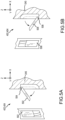
  • FIGS. 5 A and 5 B illustrate how latching mechanisms on a movable wall of a lavatory monument may disable lavatories, in accordance with various embodiments.
  • FIG. 6 illustrates latching mechanisms on a movable wall of a lavatory monument, in accordance with various embodiments.
  • FIG. 7 illustrates latching mechanisms on a movable wall of a lavatory monument, in accordance with various embodiments.
  • FIG. 8 illustrates latching mechanisms on a movable wall of a lavatory monument, in accordance with various embodiments.
  • FIG. 9 illustrates a hollow handle for use on a movable wall of a lavatory monument, in accordance with various embodiments.
  • FIGS. 10 A, 10 B, and 10 C illustrate a foot lever mechanism for use on a movable wall of a lavatory monument, in accordance with various embodiments.
  • FIGS. 11 A and 11 B illustrate latching mechanisms on a movable wall of a lavatory monument, in accordance with various embodiments.
  • FIGS. 12 A and 12 B illustrate latching mechanisms on a movable wall of a lavatory monument, in accordance with various embodiments.
  • FIG. 13 illustrates latching mechanisms on a movable wall of a lavatory monument, in accordance with various embodiments.
  • FIGS. 14 A and 14 B illustrate latching mechanisms for locking/unlocking a kickout panel to a front panel on a movable wall of a lavatory monument, in accordance with various embodiments.
  • FIG. 15 illustrates latching mechanisms for locking/unlocking a kickout panel and a rear panel to a front panel on a movable wall of a lavatory monument, in accordance with various embodiments.
  • references to “a,” “an” or “the” may include one or more than one and that reference to an item in the singular may also include the item in the plural. Further, all ranges may include upper and lower values and all ranges and ratio limits disclosed herein may be combined.
  • a persons with reduced mobility (PRM) lavatory may include an outboard folding movable center wall.
  • a movable wall could be difficult to fold and move.
  • This movable wall should ensure that no passenger can unlatch the door from one side and intrude or peek into the other lavatory's space.
  • the solution currently used to avoid this is to have several latches on both sides of the panel. This means that, when the lavatory needs to be configured to a combined lavatory configuration, the flight crew has to access both lavatories. Further, there is no means to avoid a passenger from deploying the latches on one side, then the other, and at some point peeking or pushing the wall into the other lavatory's space.
  • a second concern is that the current solution has latches next to the floor, so the flight crew has to reach into the lavatory floor to undo the latches. They are hesitant to do this as the floor of the lavatory may be not clean from time to time.
  • latches are located on the door edge at a location that is accessible from outside the lavatory only when both doors are unlocked, ensuring the movable wall may only be unlatched when no passenger is using either lavatory. Therefore, these systems and methods provide a clear indication of when the wall is unlatched, disabling the use of both lavatories when this happens, as either of these solutions would protrude outside of the convertible wall's volume and would stop the lavatory doors from closing, therefore disabling them.
  • lavatory monument 100 is located approximately toward the front of the aircraft
  • lavatory monument 102 is located approximately in the middle of the fuselage (e.g., near a wing)
  • lavatory monuments 104 , 106 , and 108 are located toward the rear of an aircraft 110 .
  • the outboard wall 105 may be formed as a curved body of the fuselage of the aircraft 110 .
  • the lavatory monuments 104 , 106 , and 108 are a complex of two adjacent compartments separated by a divider wall.
  • the lavatory monuments 104 , 106 , and 108 may be selectively configurable from two separated compartments to a unified private lavatory space by selectively stowing the divider wall to provide a combined and enlarged space for persons with restricted mobility (PRM), or to provide room for an assistant to be in the lavatory space as an aid for the PRM.
  • the divider wall may be retracted to form the unified space, and then secured in an open position, for example, with floor and/or ceiling locks.
  • the retracted divider may form a barrier that may conveniently keep the assistant separated from a wet sink area. In various embodiments, the retracted divider may form a barrier that may advantageously protect the sink area from collision or abrasion from a wheelchair, for example.
  • an area between the lavatory monuments 104 , 106 , and 108 and the door is an open area with some extra space for maneuvering, for example, a wheelchair.
  • the drawing is not necessarily shown to scale and is merely illustrative of one possible configuration of the lavatory monuments 100 , 102 , 104 , 106 , and 108 in a cabin of the aircraft 110 .
  • Configuration of the aisle and seats may be in any suitable arrangement that permits ingress and egress through either of the two doors provided in the lavatory monuments 104 , 106 , and 108 .
  • the lavatory monument may be located in an aft portion of the aircraft (e.g., near the pressure dome), or in a forward portion of the aircraft (e.g., immediately aft of the cockpit).
  • the lavatory monuments 104 , 106 , and 108 may be designed for lateral installation, with the closed doors of the lavatory monuments 104 , 106 , and 108 facing forward or aft, depending on configuration in the fuselage.
  • the lavatory compartment doors in the closed position may be oriented to be parallel to a passenger aisle, such as the center aisle that runs longitudinally from front to aft in a narrow body commercial aircraft.
  • Aircraft lavatory 210 includes a toilet 240 and a sink 220 .
  • Aircraft lavatory 215 includes a toilet 235 and a sink 225 .
  • movable wall 230 is deployed to divide lavatory 210 from lavatory 215 .
  • Movable wall 230 includes front panel 245 with a length from ceiling to floor, a rear panel 250 with a length from ceiling to substantially above a seat cover of toilet 240 , and a kickout panel 255 with a length from the bottom of the rear panel 250 to the floor.
  • Aircraft lavatory 210 includes a toilet 240 and a sink 220 .
  • Aircraft lavatory 215 includes a toilet 235 and a sink 225 .
  • movable wall 230 is folded such the kickout panel 255 rotates about a first hinge coupled to the front panel 245 to be adjacent to the front panel 245 , the rear panel 250 articulates about a second hinge coupled to the outer wall of the lavatory monument 104 , 106 , or 108 allowing the rear panel 250 to be displaced against the outer wall of the lavatory monument 104 , 106 , or 108 in aircraft lavatory 210 , and the front panel 245 articulates about a third hinge coupled to the rear panel 250 allowing the front panel 245 be displaced against the sink side wall of the aircraft lavatory 210 .
  • Lavatories 210 , 215 have a “mirror image” arrangement of a sink 220 and a sink 225 , respectively, toilet 240 and toilet 235 , respectively, stability bars 306 and 308 , respectively, which are mounted for use as support in lavatories 210 and 215 .
  • Lavatories 210 and 215 are separated by a movable wall 230 that provides privacy between a toilet 235 in the lavatory 215 and a toilet 240 in the lavatory 210 .
  • Lavatory 210 and lavatory 215 are substantially similar and a substantial mirror image of each other when configured as divided by the movable wall 230 into two separate compartments.
  • the movable wall 230 is in a closed (or first) position. When the movable wall 230 is closed (which may also be referred to herein as the first configuration), the movable wall 230 allows independent access to lavatory 210 via bifold door 302 and lavatory 215 via bifold door 304 .
  • the movable wall 230 includes front panel 245 and rear panel 250 .
  • Toilet 240 is located against the outer wall approximately at a center of the lavatory 210 .
  • Sink 220 is connected to a water supply and sewage system.
  • Lavatory 210 is also connected to electrical and environmental utilities.
  • the layout of lavatory 210 preferably matches that of a previously installed lavatory complex such that the utilities can be connected without substantial rework or relocation of the utilities.
  • Lavatory 210 provides a first space for a person to move inside lavatory 210 .
  • the first space has a limited size and dimension constrained by bifold door 302 , the movable wall 230 , sink 220 , and toilet 240 .
  • lavatory 210 has, in the various embodiments, enough room for only one person to move about in a comfortable manner.
  • an assistant i.e., a second person, may not have sufficient space to assist the person on to toilet 240 .
  • the first person requires a wheelchair, there may be no room to accept the wheelchair within lavatory 210 .
  • lavatory 215 includes toilet 235 and sink 225 .
  • Toilet 235 is located against the outer wall approximately at a center.
  • lavatory 215 also includes a second space, similar to the first space.
  • Lavatory 215 is, in various embodiments, substantially a mirror image of lavatory 210 .
  • the layout of lavatory 210 and 215 preferably matches that of a previously installed lavatory complex such that the utilities can be connected without substantial rework or relocation of the utilities.
  • the movable wall 230 is in closed (or first) position.
  • front panel 245 and rear panel 250 are aligned with frame segment 310 .
  • rear panel 250 is hingedly coupled to the frame segment 310 via hinge 312
  • front panel 245 is hingedly coupled to rear panel 250 via hinge 314 .
  • FIG. 3 B a top view of a lavatory monument 104 , 106 , or 108 in a second configuration is illustrated.
  • front panel 245 and rear panel 250 may rotate simultaneously, i.e., about the z-axis.
  • the front panel 245 and/or the rear panel 250 may be pushed causing the rear panel 250 to rotate, i.e., about the z-axis in a clockwise direction, about a hinge 312 that hingedly couples to frame segment 310 allowing the rear panel 250 be displaced against the outer wall of the lavatory monument 104 , 106 , or 108 in aircraft lavatory 210 .
  • the front panel 245 rotates, i.e., about the z-axis in a counterclockwise direction, about hinge 314 that hingedly couples the rear panel 250 to the front panel 245 .
  • the front panel is displaced against the sink side wall of lavatory 210 .
  • the kickout panel 255 rotates, i.e., about the z-axis in a counterclockwise direction, about a hinge that hingedly couples to the front panel 245 such that the kickout panel moves to a position that is adjacent to the front panel 245 .
  • front panel 245 of movable wall 230 includes one or more latching mechanisms 402 and 404 .
  • each of latching mechanisms 402 and 404 are located on an outer edge of the front panel 245 that is accessible from outside lavatories 210 and 215 only when both doors are unlocked, ensuring the movable wall 230 may only be unlatched when no passenger is using either of lavatories 210 or 215 .
  • latching mechanisms 402 and 404 are configured such that, in response to either or both of latching mechanisms 402 and 404 being in an unlocked configuration, neither of the doors, such as bifold doors 302 and 304 of FIG. 3 A , may be closed therefore disabling lavatories 210 and 215 .
  • release handle 502 may be disposed in an outer edge of front panel 245 and may be configured to, once articulated, to release the front panel 245 from the rear panel 250 and/or the kickout panel 255 .
  • the release handle 502 is pivotably coupled to the front panel 245 via shaft 504 that extends laterally in a y-direction.
  • rotation of release handle 502 about shaft 504 in a clockwise direction causes release handle 502 to protrude from the outer edge of the front panel 245 , providing a blocking mechanism that prevents either of the bifold doors 302 and 304 of FIG. 3 A to the lavatories from closing thereby disabling lavatories 210 and 215 .
  • release handle 506 may be disposed in an outer edge of front panel 245 and may be configured to, once articulated, to release the front panel 245 from the rear panel 250 and/or the kickout panel 255 .
  • the release handle 506 is pivotably coupled to the front panel 245 via shaft 508 that extends laterally in a y-direction.
  • rotation of release handle 506 about shaft 508 in a counterclockwise direction causes release handle 506 to protrude from the outer edge of the front panel 245 , providing a blocking mechanism that prevents either of the bifold doors 302 and 304 of FIG. 3 A to the lavatories from closing thereby disabling lavatories 210 and 215 .
  • handle 602 which may be part of a latching mechanism such as latching mechanism 402 of FIG. 4 , is pivotably coupled to the front panel 245 via shaft 603 that extends laterally in a y-direction.
  • a first end of linking mechanism 604 is pivotably coupled to handle 602 via shaft 605 that extends laterally in a y-direction and a second end of linking mechanism 604 is pivotably coupled to pin 606 via shaft 607 that extends laterally in a y-direction.
  • pin 606 in a locked position, pin 606 is forced upward, i.e., in a positive z-direction, by linking mechanism 604 such that pin 606 engages with a slot 608 in the ceiling 620 of the aircraft.
  • handle 602 to move to an unlocked position, handle 602 is rotated about shaft 603 in a counterclockwise direction, which causes the first end of the linking mechanism 604 to traverse outward, i.e., in a negative x-direction, moving the second end of the linking mechanism 604 downward, i.e., in a negative z-direction.
  • pin 606 is forced downward, i.e., in a negative z-direction, such that pin 606 disengages with a slot 608 in the ceiling 620 of the aircraft.
  • handle 612 which may be part of a latching mechanism such as latching mechanism 404 of FIG. 4 , is pivotably coupled to the front panel 245 via shaft 613 that extends laterally in a y-direction.
  • a first end of linking mechanism 614 is pivotably coupled to handle 612 via shaft 615 that extends laterally in a y-direction and a second end of linking mechanism 614 is pivotably coupled to pin 616 via shaft 617 that extends laterally in a y-direction.
  • pin 616 in a locked position, pin 616 is forced downward, i.e., in a negative z-direction, by linking mechanism 614 such that pin 616 engages with a slot 618 in the floor 625 of the aircraft.
  • handle 612 to move to an unlocked position, handle 612 is rotated about shaft 613 in a clockwise direction, which causes the first end of the linking mechanism 614 to traverse outward. i.e., in a negative x-direction, moving the second end of the linking mechanism 614 upward. i.e., in a positive z-direction.
  • pin 616 is forced upward, i.e., in a positive z-direction, such that pin 616 disengages with a slot 618 in the floor 625 of the aircraft.
  • latching mechanism 702 which may be part of a latching mechanism such as latching mechanism 402 of FIG. 4 , includes a handle portion 703 coupled to a circular portion 704 .
  • the circular portion 704 is pivotably coupled to the front panel 245 via shaft 705 that extends laterally in a y-direction.
  • pin 706 is pivotably coupled to the circular portion 704 via shaft 707 that extends laterally in a y-direction.
  • shaft 707 traverses a slot 709 that is a first dimension D 1 away from an outer diameter of the circular portion 704 at a first end and is a second dimension D 2 away from the outer diameter of the circular portion 704 at a second end opposite the first end.
  • slot 709 when the handle portion 703 is rotated in a counterclockwise direction thereby forcing the circular portion 704 to rotate in an counterclockwise direction, pin 706 is forced downward, i.e., in a negative z-direction.
  • pin 706 in a locked position, pin 706 is forced upward, i.e., in a positive z-direction such that pin 706 engages with a slot 708 in the ceiling 720 of the aircraft.
  • handle portion 703 to move to an unlocked position, handle portion 703 is rotated in a counterclockwise direction thereby forcing the circular portion 704 to rotate in a counterclockwise direction, which causes shaft 707 to traverse the slot 709 in a clockwise direction.
  • shaft 707 traverses slot 709 in the clockwise direction
  • handle portion 703 when the handle portion 703 is rotated in a counterclockwise direction thereby forcing the circular portion 704 to rotate in an counterclockwise direction
  • pin 706 is forced downward, i.e., in a negative z-direction, such that pin 706 disengages with a slot 708 in the ceiling 720 of the aircraft.
  • latching mechanism 712 which may be part of a latching mechanism such as latching mechanism 404 of FIG. 4 , includes a handle portion 713 coupled to a circular portion 714 .
  • the circular portion 714 is pivotably coupled to the front panel 245 via shaft 715 that extends laterally in a y-direction.
  • pin 716 is pivotably coupled to the circular portion 714 via shaft 717 that extends laterally in a y-direction.
  • shaft 717 traverses a slot 719 that is a first dimension D 1 away from an outer diameter of the circular portion 714 at a first end and is a second dimension D 2 away from the outer diameter of the circular portion 714 at a second end opposite the first end.
  • pin 716 is forced upward, i.e., in a positive z-direction. Therefore, in various embodiments, in a locked position, pin 716 is forced downward, i.e., in a negative z-direction such that pin 716 engages with a slot 718 in the floor 725 of the aircraft. In various embodiments, to move to an unlocked position, handle portion 713 is rotated in a clockwise direction thereby forcing the circular portion 714 to rotate in a clockwise direction, which causes shaft 717 to traverse the slot 719 in a counterclockwise direction.
  • shaft 717 traverses slot 719 in the counterclockwise direction
  • handle portion 713 when the handle portion 713 is rotated in a clockwise direction thereby forcing the circular portion 714 to rotate in an clockwise direction
  • pin 716 is forced upward, i.e., in a positive z-direction, such that pin 716 disengages with a slot 718 in the floor 525 of the aircraft.
  • handle 802 which may be part of a latching mechanism such as latching mechanism 402 of FIG. 4 , includes a first portion that extends in a first direction, i.e., in a z-direction, and a second portion that extends in a second direction, i.e., in an x-direction, that is perpendicular to the first portion.
  • handle 802 is pivotably coupled to the front panel 245 via shaft 803 that extends laterally in a y-direction.
  • pin 806 is pivotably coupled to handle 802 via shaft 807 that extends laterally in a y-direction.
  • shaft 807 traverses a slot 809 incorporated into the second portion of the handle 802 and extends along a length of the handle 802 in a first direction, i.e., in an x-direction.
  • pin 806 in a locked position, pin 806 is forced upward, i.e., in a positive z-direction, such that pin 806 engages with a slot 808 in the ceiling 820 of the aircraft.
  • handle 802 to move to an unlocked position, handle 802 is rotated about shaft 803 in a clockwise direction, which causes shaft 807 to traverse slot 809 in the first direction, i.e., in a positive x-direction, thereby forcing the pin 806 downward, i.e., in a negative z-direction, such that pin 806 disengages with a slot 808 in the ceiling 820 of the aircraft.
  • handle 812 which may be part of a latching mechanism such as latching mechanism 404 of FIG. 4 , includes a first portion that extends in a first direction, i.e., in a z-direction, and a second portion that extends in a second direction, i.e., in an x-direction, that is perpendicular to the first portion.
  • handle 812 is pivotably coupled to the front panel 245 via shaft 813 that extends laterally in a y-direction.
  • pin 816 is pivotably coupled to handle 812 via shaft 817 that extends laterally in a y-direction.
  • shaft 817 traverses a slot 819 incorporated into the second portion of the handle 812 and extends along a length of the handle 812 in a first direction, i.e., in an x-direction.
  • pin 816 in a locked position, is forced downward, i.e., in a negative z-direction, such that pin 816 engages with a slot 818 in the floor 825 of the aircraft.
  • handle 812 to move to an unlocked position, handle 812 is rotated about shaft 813 in a counterclockwise direction, which causes shaft 817 to traverse slot 819 in the first direction, i.e., in a positive x-direction, thereby forcing the pin 816 upward, i.e., in a positive z-direction, such that pin 816 disengages with a slot 818 in the floor 825 of the aircraft.
  • handles 902 and 904 include a first side portion and a second side portion such that the first side portion is coupled to the second side portion via a face portion.
  • Handles 902 and 904 are configured such that, in a locked position, the first side portion is in contact with a first side of the front panel 245 , the second side portion is in contact with a second side of the front panel 245 , and the face portion is in contact with the outer edge of the front panel 245 . It is noted that handles 902 and 904 may be coupled to the various latching mechanism via a shaft, such as shaft 603 or 613 of FIG. 6 .
  • Foot lever mechanism 1004 includes a tab portion 1006 and a bolt portion 1008 .
  • the tab portion 1006 is rotated in a counterclockwise position which causes a lower end portion of the tab portion 1006 to abut a face of the bolt portion 1008 .
  • the bolt portion 1008 rotates about a shaft, such as shaft 813 of FIG.
  • handle 1102 is pivotably coupled to the front panel 245 via shaft 1103 that extends laterally in an x-direction into the front panel 245 .
  • handle 1102 is configured to rotate in a counterclockwise direction to unlock the front panel 245 .
  • handle 1102 may be configured to rotate in a clockwise direction to unlock the front panel 245 .
  • shaft 1103 is coupled to a gear mechanism 1107 that engages with an upper pin 1106 and lower pin 1116 .
  • the upper pin 1106 in a locked position, is forced upward, i.e., in a positive z-direction, such that the upper pin 1106 engages with a slot 1108 in the ceiling 1120 of the aircraft.
  • the lower pin 1116 in a locked position, is forced downward, i.e., in a negative z-direction, such that the lower pin 1116 engages with a slot 1118 in the floor 1125 of the aircraft.
  • handle 1102 to move to an unlocked position, handle 1102 is rotated in a counterclockwise direction, which causes shaft 1103 to rotate in a counterclockwise direction thereby rotating the gear mechanism 1107 in a counterclockwise direction.
  • the gear mechanism 1107 rotating in the counterclockwise direction by the gear mechanism 1107 rotating in the counterclockwise direction, the upper pin 1106 is forced downward, i.e., in a negative z-direction, such that the upper pin 1106 disengages with a slot 1108 in the ceiling 1120 of the aircraft.
  • the lower pin 1116 is forced upward, i.e., in a positive z-direction, such that the lower pin 1116 disengages with a slot 1118 in the floor 1125 of the aircraft.
  • handle 1202 is pivotably coupled to the front panel 245 via shaft 1203 that extends laterally in an y-direction.
  • handle 1202 is configured to rotate in a counterclockwise direction to unlock the front panel 245 .
  • shaft 1203 is coupled to a gear mechanism 1207 that engages with an upper pin 1206 and lower pin 1216 .
  • the upper pin 1206 in a locked position, is forced upward, i.e., in a positive z-direction, such that the upper pin 1206 engages with a slot 1208 in the ceiling 1220 of the aircraft.
  • the lower pin 1216 in a locked position, is forced downward, i.e., in a negative z-direction, such that the lower pin 1216 engages with a slot 1218 in the floor 1225 of the aircraft.
  • handle 1202 to move to an unlocked position, handle 1202 is rotated in a counterclockwise direction, which causes shaft 1203 to rotate in a counterclockwise direction thereby rotating the gear mechanism 1207 in a counterclockwise direction.
  • the gear mechanism 1207 rotating in the counterclockwise direction by the gear mechanism 1207 rotating in the counterclockwise direction, the upper pin 1206 is forced downward, i.e., in a negative z-direction, such that the upper pin 1206 disengages with a slot 1208 in the ceiling 1220 of the aircraft.
  • the lower pin 1216 is forced upward, i.e., in a positive z-direction, such that the lower pin 1216 disengages with a slot 1218 in the floor 1225 of the aircraft.
  • handle 1302 is affixed to a pin portion 1306 within front panel 245 .
  • handle 1302 in a locked position, handle 1302 is forced upward in a substantially positive z-direction thereby forcing the pin portion 1306 upward, i.e., in a substantially positive z-direction, such that pin portion 1306 engages with a slot 1308 in the ceiling 1320 of the aircraft.
  • handle 1302 is forced downward in a substantially negative z-direction thereby forcing the pin portion 1306 downward, i.e., in a substantially negative z-direction, such that pin portion 1306 disengages with a slot 1308 in the ceiling 1320 of the aircraft.
  • handle 1312 is affixed to a pin portion 1306 within front panel 245 .
  • handle 1312 in a locked position, is forced downward in a substantially negative z-direction thereby forcing the pin portion 1316 downward, i.e., in a substantially negative z-direction, such that the pin portion 1316 engages with a slot 1318 in the floor 1325 of the aircraft.
  • handle 1312 to move to an unlocked position, is forced upward in a substantially positive z-direction thereby forcing the pin portion 1316 upward, i.e., in a substantially positive z-direction, such that the pin portion 1316 disengages with a slot 1318 in the floor 1325 of the aircraft.
  • latching mechanisms for locking/unlocking the kickout panel 255 to front panel 245 on movable wall 230 of a lavatory monument 104 , 106 , or 108 is illustrated.
  • pin 1402 contained within front panel 245 translates in a positive x-direction, in a locked position, and in a negative x-direction, in an unlocked position.
  • a distal end of pin 1402 in the locked position, protrudes into slot 1404 in kickout panel 255 thereby preventing the kickout panel 255 from rotating, i.e., about the z-axis in a clockwise direction, via hinge 1406 that hingedly couples the front panel 245 to the kickout panel 255 .
  • the distal end of pin 1402 in an unlocked position, translates in a negative x-direction such that the distal end of the pin 1402 disengages with a slot 1404 thereby allowing kickout panel 255 to rotate, i.e., about the z-axis in a clockwise direction, via the hinge 1406 that hingedly couples the front panel 245 to the kickout panel 255 .
  • a proximal end of the pin 1402 may be pivotably coupled on to a handle 1408 via shaft 1410 .
  • handle 1408 In a locked position, handle 1408 is positioned in a substantially positive z-direction and contained within the outer edge of the front panel 245 . In an unlocked position, handle 1408 is rotated to a substantially negative x-direction.
  • a user pulls handle 1408 thereby translating the distal end of pin 1402 in a negative x-direction such that the distal end of the pin 1402 disengages with a slot 1404 thereby allowing kickout panel 255 to rotate, i.e., about the z-axis in a clockwise direction, via the hinge 1406 that hingedly couples the front panel 245 to the kickout panel 255 .
  • latching mechanisms for locking/unlocking the kickout panel 255 and rear panel 250 to the front panel 245 on movable wall 230 of a lavatory monument 104 , 106 , or 108 is illustrated.
  • pin 1502 contained within the rear panel 250 and similarly within the kickout panel 255 translates in a positive x-direction, in a locked position, and in a negative x-direction, in an unlocked position.
  • a distal end of pin 1502 in the locked position, protrudes into slot 1504 in the frame segment 310 thereby preventing the rear panel 250 from rotating, i.e., about the z-axis in a clockwise direction, via hinge 312 that hingedly couples the rear panel 250 to the frame segment 310 .
  • a distal end of pin 1502 in the locked position, protrudes into slot 1504 in the frame segment 310 thereby preventing the kickout panel 255 from rotating, i.e., about the z-axis in a clockwise direction via hinge 1406 or in a counterclockwise direction past door stop 1506 .
  • the distal end of pin 1502 translates in a negative x-direction such that the distal end of the pin 1502 disengages with a slot 1504 thereby allowing the rear panel 250 to rotate, i.e., about the z-axis in a clockwise direction, via the hinge 314 that hingedly couples the front panel 245 to the rear panel 250 and, similarly, allowing the kickout panel 255 to rotate, i.e., about the z-axis in a clockwise direction, via the hinge 1406 that hingedly couples the front panel 245 to the kickout panel 255 .
  • references to “one embodiment,” “an embodiment,” “various embodiments,” etc. indicate that the embodiment described may include a particular feature, structure, or characteristic, but every embodiment may not necessarily include the particular feature, structure, or characteristic. Moreover, such phrases are not necessarily referring to the same embodiment. Further, when a particular feature, structure, or characteristic is described in connection with an embodiment, it is submitted that it is within the knowledge of one skilled in the art to affect such feature, structure, or characteristic in connection with other embodiments whether or not explicitly described. After reading the description, it will be apparent to one skilled in the relevant art(s) how to implement the disclosure in alternative embodiments.
  • Numbers, percentages, or other values stated herein are intended to include that value, and also other values that are about or approximately equal to the stated value, as would be appreciated by one of ordinary skill in the art encompassed by various embodiments of the present disclosure.
  • a stated value should therefore be interpreted broadly enough to encompass values that are at least close enough to the stated value to perform a desired function or achieve a desired result.
  • the stated values include at least the variation to be expected in a suitable industrial process, and may include values that are within 10%, within 5%, within 1%, within 0.1%, or within 0.01% of a stated value.
  • the terms “substantially,” “about” or “approximately” as used herein represent an amount close to the stated amount that still performs a desired function or achieves a desired result.
  • the term “substantially,” “about” or “approximately” may refer to an amount that is within 10% of, within 5% of, within 1% of, within 0.1% of, and within 0.01% of a stated amount or value

Landscapes

  • Engineering & Computer Science (AREA)
  • Aviation & Aerospace Engineering (AREA)
  • Mechanical Engineering (AREA)
  • Civil Engineering (AREA)
  • Structural Engineering (AREA)
  • Toilet Supplies (AREA)
  • Residential Or Office Buildings (AREA)

Abstract

An aircraft lavatory monument is provided that includes a first lavatory including a first door providing access to the first lavatory from an aisle of an aircraft; a second lavatory proximate the first lavatory, the second lavatory including a second door providing access to the second lavatory from the aisle of the aircraft; and a movable wall disposed between the first lavatory and the second lavatory, the movable wall including a latching mechanism positioned on an exterior edge of the movable wall and accessible from the aisle of the aircraft, where the latching mechanism, responsive to being in a locked position, causes the movable wall to be positioned at a first position separating the first lavatory from the second lavatory and providing privacy therebetween, and where the latching mechanism, responsive to being in an unlocked position, allows the movable wall to collapse thereby forming an enlarged bathroom space.

Description

FIELD
The present disclosure generally relates occupancy detection in lavatories, and more specifically to latching for a lavatory convertible divider wall.
BACKGROUND
A lavatory complex installed in an aircraft may be located against an outboard wall portion of an aircraft passenger cabin as well as the rear of the aircraft abutting the pressure dome. For ease of manufacture and ease of installation adjacent other interior structures, aircraft lavatories typically have flat walls on all sides facing the aircraft interior as depicted by the lavatory envelope. Aircraft lavatories are typically located adjacent a doorway emergency exit path.
To provide a space for a crew member to stand by an emergency exit door for the purpose assisting passengers during an emergency evacuation of an aircraft, airworthiness authorities require that a 12-inch (30.48 centimeters) by 20-inch (50.8 centimeters) “assist space” be provided adjacent the aircraft exit doorway, alongside the exit path but outside the exit path itself. Attendant seats, occupied by flight attendants during takeoff, landing and at other times are typically mounted inboard of the assist spaces near the exit paths. The attendant seats most typically fold upward to a stowed position when not occupied so as to remain clear of the exit path.
Typical lavatory complexes comprise two lavatories which are configured with similar or identical water supply and sewage systems and structural layouts to minimize production cost and certification effort. Each lavatory in the lavatory complex may be a physically separate structural unit with a gap designed therebetween to minimize the possibility that the units will contact one another during flight and/or emergency landing situations.
A variety of techniques have been employed for transferring a mobility-impaired passenger between an aisle wheelchair and a toilet. A 90° transfer in which the aisle wheelchair is positioned at a 90° angle to the toilet and an assistant lifts the mobility-impaired passenger and rotates the passenger onto the toilet, and vice versa, has been found to reduce the risk of injury to the assistant and is, therefore, a favored method for assisted transfers. A lateral transfer, in which a mobility-impaired passenger slides sideways from wheelchair to toilet and vice versa can be favored for an unassisted transfer in which the mobility-impaired passenger prefers to make the transfer unaided and has the upper body strength to do so.
Existing lavatory solutions for persons with reduced mobility (PRM) include a wall at a centerline of the lavatory complex on a twin aisle aircraft, and a dedicated aft lavatory or galley complex on a narrow body aircraft. PRM lavatories, located against the outboard wall portion of the aircraft, are typically single oversized units which occupy an enlarged footprint in the aircraft cabin.
Conventionally, a PRM lavatory may include an outboard folding removable center wall. Such removable wall is difficult to fold and remove. A substantial effort and space is needed to fold the wall and move it outside the lavatory. To build a PRM lavatory, generally an existing footprint or layout of a typical lavatory needs to be modified. That, in turn, requires relocating utilities such as electrical conduits, water supplies and drain systems.
SUMMARY
Disclosed herein is an aircraft lavatory monument, including a first lavatory including a first door providing access to the first lavatory from an aisle of an aircraft; a second lavatory proximate the first lavatory, the second lavatory including a second door providing access to the second lavatory from the aisle of the aircraft; and a movable wall disposed between the first lavatory and the second lavatory, the movable wall including a latching mechanism positioned on an exterior edge of the movable wall and accessible from the aisle of the aircraft. In various embodiments, the latching mechanism, responsive to being in a locked position, causes the movable wall to be positioned at a first position separating the first lavatory from the second lavatory and providing privacy therebetween. In various embodiments, the latching mechanism, responsive to being in an unlocked position, allows the movable wall to collapse thereby forming an enlarged bathroom space including the first lavatory and the second lavatory.
In various embodiments, the latching mechanism is two latching mechanisms and a first of the two latching mechanisms is located toward an upper portion of the exterior edge of the movable wall and accessible from the aisle of the aircraft. In various embodiments, the latching mechanism includes a handle portion, a linking portion, and a pin portion and, in the locked position, the handle portion is positioned within the exterior edge of the movable wall forcing the pin portion into a slot of a ceiling or a floor of the aircraft via the linking portion. In various embodiments, in the unlocked position, the handle portion extends from the exterior edge of the movable wall forcing the pin portion out of the slot of the ceiling or the floor of the aircraft via the linking portion.
In various embodiments, the latching mechanism includes a handle portion, a circular portion, and a pin portion, in the locked position, the handle portion is positioned within the exterior edge of the movable wall forcing a distal end of the pin portion into a slot of a ceiling or a floor of the aircraft via a slot in the circular portion, and, in the locked position, a proximal end of the pin portion is positioned a first distance within the circular portion. In various embodiments, in the unlocked position, the handle portion extends from the exterior edge of the movable wall forcing the distal end of the pin portion out of the slot of the ceiling or the floor of the aircraft via the slot in the circular portion, and, in the unlocked position, the proximal end of the pin portion is positioned a second distance within the circular portion, where the second distance is greater than the first distance.
In various embodiments, the latching mechanism includes a handle portion and a pin portion and, in the locked position, the handle portion is positioned within the exterior edge of the movable wall forcing the pin portion into a slot of a ceiling or a floor of the aircraft via a slot in the handle portion. In various embodiments, in the unlocked position, the handle portion extends from the exterior edge of the movable wall forcing the pin portion out of the slot of the ceiling or the floor of the aircraft via the slot in the handle portion.
In various embodiments, the latching mechanism includes a tab portion, a bolt portion, and a pin portion, where the tab portion rotates to about a face portion of the bolt portion, and, responsive to force being applied to the tab portion, the bolt portion rotates forcing the pin portion out of a slot of a floor of the aircraft.
In various embodiments, the latching mechanism includes a handle portion, a shaft portion, a gear portion, and at least one pin portion and, in the locked position, the handle portion is position within the exterior edge of the movable wall such that the gear portion that is coupled to the handle portion via the shaft portion forces the at least one pin portion into a slot of a ceiling or a floor of the aircraft. In various embodiments, in the unlocked position, the handle portion rotates so as to extend from sides of the movable wall and thereby rotate the shaft portion and the gear portion such that the gear portion that is coupled to the handle portion via the shaft portion forces the at least one pin portion out of the slot of the ceiling or the floor of the aircraft.
In various embodiments, the latching mechanism includes a handle portion, a shaft portion, a gear portion, and at least one pin portion and, in the locked position, the handle portion is position within the exterior edge of the movable wall such that the gear portion that is coupled to the handle portion via the shaft portion forces the at least one pin portion into a slot of a ceiling or a floor of the aircraft. In various embodiments, in the unlocked position, the handle portion rotates so as to extend from the exterior edge of the movable wall and thereby rotate the shaft portion and the gear portion such that the gear portion that is coupled to the handle portion via the shaft portion forces the at least one pin portion out of the slot of the ceiling or the floor of the aircraft.
In various embodiments, the latching mechanism includes a handle portion and a pin portion and, in the locked position, the handle portion is position within the exterior edge of the movable wall forcing the pin portion into a slot of a ceiling or a floor of the aircraft. In various embodiments, in the unlocked position, the handle portion extends from the exterior edge of the movable wall forcing the pin portion out of the slot of the ceiling or the floor of the aircraft.
In various embodiments, the movable wall includes a front panel and a kickout panel and where the front panel includes a pin that, in the locked position, protrudes from a distal end of the front panel engaging a slot in the kickout panel thereby preventing the kickout panel from rotating. In various embodiments, the pin, in the locked position, retracts into the front panel from the slot in the kickout panel thereby allowing the kickout panel to rotate.
In various embodiments, the movable wall includes a front panel, a rear panel, and a kickout panel, where the rear panel includes a first pin, where the kickout panel includes a second pin, where, responsive to the front panel being in the locked position, the front panel causes the first pin to protrude from a distal end of the rear panel thereby engaging a first slot in a frame segment of the aircraft and preventing the rear panel from rotating, and, responsive to the front panel being in the locked position, the front panel causes the second pin to protrude from the distal end of the kickout panel thereby engaging a second slot in the frame segment of the aircraft and preventing the kickout panel from rotating. In various embodiments, responsive to the front panel being in the unlocked position, the front panel causes the first pin to retract into the rear panel thereby disengaging the first pin from the first slot in the frame segment of the aircraft and allowing the rear panel to rotate, and, responsive to the front panel being in the unlocked position, the front panel causes the second pin to retract into the kickout panel thereby disengaging the second pin from the second slot in the frame segment of the aircraft and allowing the kickout panel to rotate.
Also disclose herein is a system for locking and unlocking a movable wall of a lavatory monument within an aircraft, the method including: transitioning a latching mechanism positioned on an exterior edge of the movable wall and accessible from an aisle of the aircraft from a first position to a second position, where, in the first position, the movable wall to be positioned to separate a first lavatory from a second lavatory thereby providing privacy therebetween, and where, in the second position, the movable wall collapses thereby forming an enlarged bathroom space including the first lavatory and the second lavatory.
The foregoing features and elements may be combined in any combination, without exclusivity, unless expressly indicated herein otherwise. These features and elements as well as the operation of the disclosed embodiments will become more apparent in light of the following description and accompanying drawings.
BRIEF DESCRIPTION OF THE DRAWINGS
The subject matter of the present disclosure is particularly pointed out and distinctly claimed in the concluding portion of the specification. A more complete understanding of the present disclosure, however, may best be obtained by referring to the following detailed description and claims in connection with the following drawings. While the drawings illustrate various embodiments employing the principles described herein, the drawings do not limit the scope of the claims.
FIG. 1 illustrates a partial top view of an aircraft cabin with an exemplary lavatory outboard dual monument, in accordance with various embodiments.
FIG. 2A illustrates an aircraft lavatory monument in a two independent lavatory configuration, in accordance with various embodiments.
FIG. 2B illustrates an aircraft lavatory monument in a combined lavatory configuration, in accordance with various embodiments.
FIG. 3A illustrates a top view of a lavatory monument in the having a movable wall in a closed position, in accordance with various embodiments
FIG. 3B illustrates a top view of the lavatory monument of FIG. 3A with the wall in a fully open position, in accordance with various embodiments.
FIG. 4 illustrates a mechanism for locking/unlocking a movable wall of a lavatory monument without entering either of the lavatories, in accordance with various embodiments.
FIGS. 5A and 5B illustrate how latching mechanisms on a movable wall of a lavatory monument may disable lavatories, in accordance with various embodiments.
FIG. 6 illustrates latching mechanisms on a movable wall of a lavatory monument, in accordance with various embodiments.
FIG. 7 illustrates latching mechanisms on a movable wall of a lavatory monument, in accordance with various embodiments.
FIG. 8 illustrates latching mechanisms on a movable wall of a lavatory monument, in accordance with various embodiments.
FIG. 9 illustrates a hollow handle for use on a movable wall of a lavatory monument, in accordance with various embodiments.
FIGS. 10A, 10B, and 10C illustrate a foot lever mechanism for use on a movable wall of a lavatory monument, in accordance with various embodiments.
FIGS. 11A and 11B illustrate latching mechanisms on a movable wall of a lavatory monument, in accordance with various embodiments.
FIGS. 12A and 12B illustrate latching mechanisms on a movable wall of a lavatory monument, in accordance with various embodiments.
FIG. 13 illustrates latching mechanisms on a movable wall of a lavatory monument, in accordance with various embodiments.
FIGS. 14A and 14B illustrate latching mechanisms for locking/unlocking a kickout panel to a front panel on a movable wall of a lavatory monument, in accordance with various embodiments.
FIG. 15 illustrates latching mechanisms for locking/unlocking a kickout panel and a rear panel to a front panel on a movable wall of a lavatory monument, in accordance with various embodiments.
DETAILED DESCRIPTION
The following detailed description of various embodiments herein makes reference to the accompanying drawings, which show various embodiments by way of illustration. While these various embodiments are described in sufficient detail to enable those skilled in the art to practice the disclosure, it should be understood that other embodiments may be realized and that changes may be made without departing from the scope of the disclosure. Thus, the detailed description herein is presented for purposes of illustration only and not of limitation. Furthermore, any reference to singular includes plural embodiments, and any reference to more than one component or step may include a singular embodiment or step. Also, any reference to attached, fixed, connected, or the like may include permanent, removable, temporary, partial, full or any other possible attachment option. Additionally, any reference to without contact (or similar phrases) may also include reduced contact or minimal contact. It should also be understood that unless specifically stated otherwise, references to “a,” “an” or “the” may include one or more than one and that reference to an item in the singular may also include the item in the plural. Further, all ranges may include upper and lower values and all ranges and ratio limits disclosed herein may be combined.
A persons with reduced mobility (PRM) lavatory may include an outboard folding movable center wall. However, such a movable wall could be difficult to fold and move. When used to create two independent lavatories, this movable wall should ensure that no passenger can unlatch the door from one side and intrude or peek into the other lavatory's space. The solution currently used to avoid this is to have several latches on both sides of the panel. This means that, when the lavatory needs to be configured to a combined lavatory configuration, the flight crew has to access both lavatories. Further, there is no means to avoid a passenger from deploying the latches on one side, then the other, and at some point peeking or pushing the wall into the other lavatory's space. A second concern is that the current solution has latches next to the floor, so the flight crew has to reach into the lavatory floor to undo the latches. They are hesitant to do this as the floor of the lavatory may be not clean from time to time.
Disclosed herein is a system and methods for locate the latches of the removable wall in an area that's easier to access, cleaner, and more comfortable to use. In various embodiments, latches are located on the door edge at a location that is accessible from outside the lavatory only when both doors are unlocked, ensuring the movable wall may only be unlatched when no passenger is using either lavatory. Therefore, these systems and methods provide a clear indication of when the wall is unlatched, disabling the use of both lavatories when this happens, as either of these solutions would protrude outside of the convertible wall's volume and would stop the lavatory doors from closing, therefore disabling them.
Referring now to FIG. 1 , in accordance with various embodiments, a partial top view of an aircraft cabin with an exemplary lavatory monument is illustrated. In the depicted figure, numerous lavatory monuments 100, 102, 104, 106, and 108 are shown with some located along an outboard wall 105. Lavatory monument 100 is located approximately toward the front of the aircraft, lavatory monument 102 is located approximately in the middle of the fuselage (e.g., near a wing), and lavatory monuments 104, 106, and 108 are located toward the rear of an aircraft 110. The outboard wall 105 may be formed as a curved body of the fuselage of the aircraft 110. The lavatory monuments 104, 106, and 108 are a complex of two adjacent compartments separated by a divider wall. In various embodiments, the lavatory monuments 104, 106, and 108 may be selectively configurable from two separated compartments to a unified private lavatory space by selectively stowing the divider wall to provide a combined and enlarged space for persons with restricted mobility (PRM), or to provide room for an assistant to be in the lavatory space as an aid for the PRM. In various embodiments, the divider wall may be retracted to form the unified space, and then secured in an open position, for example, with floor and/or ceiling locks. In various embodiments, the retracted divider may form a barrier that may conveniently keep the assistant separated from a wet sink area. In various embodiments, the retracted divider may form a barrier that may advantageously protect the sink area from collision or abrasion from a wheelchair, for example.
In the depicted example, an area between the lavatory monuments 104, 106, and 108 and the door is an open area with some extra space for maneuvering, for example, a wheelchair. Note that the drawing is not necessarily shown to scale and is merely illustrative of one possible configuration of the lavatory monuments 100, 102, 104, 106, and 108 in a cabin of the aircraft 110. Configuration of the aisle and seats may be in any suitable arrangement that permits ingress and egress through either of the two doors provided in the lavatory monuments 104, 106, and 108. In various embodiments, the lavatory monument may be located in an aft portion of the aircraft (e.g., near the pressure dome), or in a forward portion of the aircraft (e.g., immediately aft of the cockpit).
In various embodiments, the lavatory monuments 104, 106, and 108, for example, may be designed for lateral installation, with the closed doors of the lavatory monuments 104, 106, and 108 facing forward or aft, depending on configuration in the fuselage. In some examples, the lavatory compartment doors (in the closed position) may be oriented to be parallel to a passenger aisle, such as the center aisle that runs longitudinally from front to aft in a narrow body commercial aircraft.
Referring now to FIG. 2A, in accordance with various embodiments, the lavatory monument 104, 106, or 108 in a two independent lavatory 210 and 215 configuration is illustrated. Aircraft lavatory 210 includes a toilet 240 and a sink 220. Aircraft lavatory 215 includes a toilet 235 and a sink 225. In a two independent lavatory configuration, movable wall 230 is deployed to divide lavatory 210 from lavatory 215. Movable wall 230 includes front panel 245 with a length from ceiling to floor, a rear panel 250 with a length from ceiling to substantially above a seat cover of toilet 240, and a kickout panel 255 with a length from the bottom of the rear panel 250 to the floor.
Referring now to FIG. 2B, in accordance with various embodiments, the lavatory monument 104, 106, or 108 in a combined lavatory configuration is illustrated. Aircraft lavatory 210 includes a toilet 240 and a sink 220. Aircraft lavatory 215 includes a toilet 235 and a sink 225. In the combined lavatory configuration, movable wall 230 is folded such the kickout panel 255 rotates about a first hinge coupled to the front panel 245 to be adjacent to the front panel 245, the rear panel 250 articulates about a second hinge coupled to the outer wall of the lavatory monument 104, 106, or 108 allowing the rear panel 250 to be displaced against the outer wall of the lavatory monument 104, 106, or 108 in aircraft lavatory 210, and the front panel 245 articulates about a third hinge coupled to the rear panel 250 allowing the front panel 245 be displaced against the sink side wall of the aircraft lavatory 210.
Referring now to FIG. 3A, in accordance with various embodiments, a top view of a lavatory monument 104, 106, or 108 in a first configuration is illustrated. Lavatories 210, 215 have a “mirror image” arrangement of a sink 220 and a sink 225, respectively, toilet 240 and toilet 235, respectively, stability bars 306 and 308, respectively, which are mounted for use as support in lavatories 210 and 215. Lavatories 210 and 215 are separated by a movable wall 230 that provides privacy between a toilet 235 in the lavatory 215 and a toilet 240 in the lavatory 210. Lavatory 210 and lavatory 215 are substantially similar and a substantial mirror image of each other when configured as divided by the movable wall 230 into two separate compartments. In various embodiments, the movable wall 230 is in a closed (or first) position. When the movable wall 230 is closed (which may also be referred to herein as the first configuration), the movable wall 230 allows independent access to lavatory 210 via bifold door 302 and lavatory 215 via bifold door 304.
As will be described in further detail with reference to FIG. 3B, the movable wall 230 includes front panel 245 and rear panel 250. Toilet 240 is located against the outer wall approximately at a center of the lavatory 210. Sink 220 is connected to a water supply and sewage system. Lavatory 210 is also connected to electrical and environmental utilities. In a retrofit application, the layout of lavatory 210 preferably matches that of a previously installed lavatory complex such that the utilities can be connected without substantial rework or relocation of the utilities. Lavatory 210 provides a first space for a person to move inside lavatory 210. The first space has a limited size and dimension constrained by bifold door 302, the movable wall 230, sink 220, and toilet 240. Accordingly, lavatory 210 has, in the various embodiments, enough room for only one person to move about in a comfortable manner. Furthermore, if a person with reduced mobility (e.g., disabled, elderly, injured, etc.) enters lavatory 210, then an assistant. i.e., a second person, may not have sufficient space to assist the person on to toilet 240. Further, if the first person requires a wheelchair, there may be no room to accept the wheelchair within lavatory 210.
Similarly, lavatory 215 includes toilet 235 and sink 225. Toilet 235 is located against the outer wall approximately at a center. Furthermore, lavatory 215 also includes a second space, similar to the first space. Lavatory 215 is, in various embodiments, substantially a mirror image of lavatory 210. In a retrofit application, the layout of lavatory 210 and 215 preferably matches that of a previously installed lavatory complex such that the utilities can be connected without substantial rework or relocation of the utilities. In FIG. 3A, the movable wall 230 is in closed (or first) position. In various embodiments, front panel 245 and rear panel 250 are aligned with frame segment 310. In various embodiments, rear panel 250 is hingedly coupled to the frame segment 310 via hinge 312, while front panel 245 is hingedly coupled to rear panel 250 via hinge 314.
Referring now to FIG. 3B, in accordance with an illustrative embodiment, a top view of a lavatory monument 104, 106, or 108 in a second configuration is illustrated. In FIG. 3B, once unlocked, front panel 245 and rear panel 250 may rotate simultaneously, i.e., about the z-axis. The front panel 245 and/or the rear panel 250 may be pushed causing the rear panel 250 to rotate, i.e., about the z-axis in a clockwise direction, about a hinge 312 that hingedly couples to frame segment 310 allowing the rear panel 250 be displaced against the outer wall of the lavatory monument 104, 106, or 108 in aircraft lavatory 210. Simultaneously, the front panel 245 rotates, i.e., about the z-axis in a counterclockwise direction, about hinge 314 that hingedly couples the rear panel 250 to the front panel 245. When rotated, the front panel is displaced against the sink side wall of lavatory 210. While not shown in FIG. 3A, the kickout panel 255 rotates, i.e., about the z-axis in a counterclockwise direction, about a hinge that hingedly couples to the front panel 245 such that the kickout panel moves to a position that is adjacent to the front panel 245.
Referring now to FIG. 4 , in accordance with an illustrative embodiment, a mechanism for locking/unlocking a movable wall 230 of a lavatory monument 104, 106, or 108 without entering either of the lavatories is illustrated. In various embodiments, front panel 245 of movable wall 230 includes one or more latching mechanisms 402 and 404. In various embodiments, each of latching mechanisms 402 and 404 are located on an outer edge of the front panel 245 that is accessible from outside lavatories 210 and 215 only when both doors are unlocked, ensuring the movable wall 230 may only be unlatched when no passenger is using either of lavatories 210 or 215. In various embodiments, latching mechanisms 402 and 404 are configured such that, in response to either or both of latching mechanisms 402 and 404 being in an unlocked configuration, neither of the doors, such as bifold doors 302 and 304 of FIG. 3A, may be closed therefore disabling lavatories 210 and 215.
Referring now to FIGS. 5A and 5B, in accordance with various embodiments, examples of how latching mechanisms 402 and 404 on movable wall 230 of a lavatory monument 104, 106, or 108 may disable lavatories 210 and 215 is illustrated. With regard to FIG. 5A, in various embodiments, release handle 502 may be disposed in an outer edge of front panel 245 and may be configured to, once articulated, to release the front panel 245 from the rear panel 250 and/or the kickout panel 255. In various embodiments, the release handle 502 is pivotably coupled to the front panel 245 via shaft 504 that extends laterally in a y-direction. In various embodiments, rotation of release handle 502 about shaft 504 in a clockwise direction causes release handle 502 to protrude from the outer edge of the front panel 245, providing a blocking mechanism that prevents either of the bifold doors 302 and 304 of FIG. 3A to the lavatories from closing thereby disabling lavatories 210 and 215.
Similarly, with regard to FIG. 5B, in various embodiments, release handle 506 may be disposed in an outer edge of front panel 245 and may be configured to, once articulated, to release the front panel 245 from the rear panel 250 and/or the kickout panel 255. In various embodiments, the release handle 506 is pivotably coupled to the front panel 245 via shaft 508 that extends laterally in a y-direction. In various embodiments, rotation of release handle 506 about shaft 508 in a counterclockwise direction causes release handle 506 to protrude from the outer edge of the front panel 245, providing a blocking mechanism that prevents either of the bifold doors 302 and 304 of FIG. 3A to the lavatories from closing thereby disabling lavatories 210 and 215.
Referring now to FIG. 6 , in accordance with various embodiments, latching mechanisms on movable wall 230 of a lavatory monument 104, 106, or 108 is illustrated. In various embodiments, handle 602, which may be part of a latching mechanism such as latching mechanism 402 of FIG. 4 , is pivotably coupled to the front panel 245 via shaft 603 that extends laterally in a y-direction. In various embodiments, a first end of linking mechanism 604 is pivotably coupled to handle 602 via shaft 605 that extends laterally in a y-direction and a second end of linking mechanism 604 is pivotably coupled to pin 606 via shaft 607 that extends laterally in a y-direction. In various embodiments, in a locked position, pin 606 is forced upward, i.e., in a positive z-direction, by linking mechanism 604 such that pin 606 engages with a slot 608 in the ceiling 620 of the aircraft. In various embodiments, to move to an unlocked position, handle 602 is rotated about shaft 603 in a counterclockwise direction, which causes the first end of the linking mechanism 604 to traverse outward, i.e., in a negative x-direction, moving the second end of the linking mechanism 604 downward, i.e., in a negative z-direction. By the second end of the linking mechanism 604 moving downward, pin 606 is forced downward, i.e., in a negative z-direction, such that pin 606 disengages with a slot 608 in the ceiling 620 of the aircraft.
In various embodiments, handle 612, which may be part of a latching mechanism such as latching mechanism 404 of FIG. 4 , is pivotably coupled to the front panel 245 via shaft 613 that extends laterally in a y-direction. In various embodiments, a first end of linking mechanism 614 is pivotably coupled to handle 612 via shaft 615 that extends laterally in a y-direction and a second end of linking mechanism 614 is pivotably coupled to pin 616 via shaft 617 that extends laterally in a y-direction. In various embodiments, in a locked position, pin 616 is forced downward, i.e., in a negative z-direction, by linking mechanism 614 such that pin 616 engages with a slot 618 in the floor 625 of the aircraft. In various embodiments, to move to an unlocked position, handle 612 is rotated about shaft 613 in a clockwise direction, which causes the first end of the linking mechanism 614 to traverse outward. i.e., in a negative x-direction, moving the second end of the linking mechanism 614 upward. i.e., in a positive z-direction. By the second end of the linking mechanism 614 moving upward, pin 616 is forced upward, i.e., in a positive z-direction, such that pin 616 disengages with a slot 618 in the floor 625 of the aircraft.
Referring now to FIG. 7 , in accordance with an illustrative embodiment, latching mechanisms on movable wall 230 of a lavatory monument 104, 106, or 108 is illustrated. In various embodiments, latching mechanism 702, which may be part of a latching mechanism such as latching mechanism 402 of FIG. 4 , includes a handle portion 703 coupled to a circular portion 704. The circular portion 704 is pivotably coupled to the front panel 245 via shaft 705 that extends laterally in a y-direction. In various embodiments, pin 706 is pivotably coupled to the circular portion 704 via shaft 707 that extends laterally in a y-direction. In various embodiments, shaft 707 traverses a slot 709 that is a first dimension D1 away from an outer diameter of the circular portion 704 at a first end and is a second dimension D2 away from the outer diameter of the circular portion 704 at a second end opposite the first end. In various embodiments, as shaft 707 traverses slot 709, when the handle portion 703 is rotated in a counterclockwise direction thereby forcing the circular portion 704 to rotate in an counterclockwise direction, pin 706 is forced downward, i.e., in a negative z-direction. Therefore, in various embodiments, in a locked position, pin 706 is forced upward, i.e., in a positive z-direction such that pin 706 engages with a slot 708 in the ceiling 720 of the aircraft. In various embodiments, to move to an unlocked position, handle portion 703 is rotated in a counterclockwise direction thereby forcing the circular portion 704 to rotate in a counterclockwise direction, which causes shaft 707 to traverse the slot 709 in a clockwise direction. In various embodiments, as shaft 707 traverses slot 709 in the clockwise direction, when the handle portion 703 is rotated in a counterclockwise direction thereby forcing the circular portion 704 to rotate in an counterclockwise direction, pin 706 is forced downward, i.e., in a negative z-direction, such that pin 706 disengages with a slot 708 in the ceiling 720 of the aircraft.
In various embodiments, latching mechanism 712, which may be part of a latching mechanism such as latching mechanism 404 of FIG. 4 , includes a handle portion 713 coupled to a circular portion 714. The circular portion 714 is pivotably coupled to the front panel 245 via shaft 715 that extends laterally in a y-direction. In various embodiments, pin 716 is pivotably coupled to the circular portion 714 via shaft 717 that extends laterally in a y-direction. In various embodiments, shaft 717 traverses a slot 719 that is a first dimension D1 away from an outer diameter of the circular portion 714 at a first end and is a second dimension D2 away from the outer diameter of the circular portion 714 at a second end opposite the first end. In various embodiments, as shaft 717 traverses slot 719, when the handle portion 713 is rotated in a clockwise direction thereby forcing the circular portion 714 to rotate in an clockwise direction, pin 716 is forced upward, i.e., in a positive z-direction. Therefore, in various embodiments, in a locked position, pin 716 is forced downward, i.e., in a negative z-direction such that pin 716 engages with a slot 718 in the floor 725 of the aircraft. In various embodiments, to move to an unlocked position, handle portion 713 is rotated in a clockwise direction thereby forcing the circular portion 714 to rotate in a clockwise direction, which causes shaft 717 to traverse the slot 719 in a counterclockwise direction. In various embodiments, as shaft 717 traverses slot 719 in the counterclockwise direction, when the handle portion 713 is rotated in a clockwise direction thereby forcing the circular portion 714 to rotate in an clockwise direction, pin 716 is forced upward, i.e., in a positive z-direction, such that pin 716 disengages with a slot 718 in the floor 525 of the aircraft.
Referring now to FIG. 8 , in accordance with various embodiments, latching mechanisms on movable wall 230 of a lavatory monument 104, 106, or 108 is illustrated. In various embodiments, handle 802, which may be part of a latching mechanism such as latching mechanism 402 of FIG. 4 , includes a first portion that extends in a first direction, i.e., in a z-direction, and a second portion that extends in a second direction, i.e., in an x-direction, that is perpendicular to the first portion. In various embodiments, handle 802 is pivotably coupled to the front panel 245 via shaft 803 that extends laterally in a y-direction. In various embodiments, pin 806 is pivotably coupled to handle 802 via shaft 807 that extends laterally in a y-direction. In various embodiments, shaft 807 traverses a slot 809 incorporated into the second portion of the handle 802 and extends along a length of the handle 802 in a first direction, i.e., in an x-direction. In various embodiments, in a locked position, pin 806 is forced upward, i.e., in a positive z-direction, such that pin 806 engages with a slot 808 in the ceiling 820 of the aircraft. In various embodiments, to move to an unlocked position, handle 802 is rotated about shaft 803 in a clockwise direction, which causes shaft 807 to traverse slot 809 in the first direction, i.e., in a positive x-direction, thereby forcing the pin 806 downward, i.e., in a negative z-direction, such that pin 806 disengages with a slot 808 in the ceiling 820 of the aircraft.
In various embodiments, handle 812, which may be part of a latching mechanism such as latching mechanism 404 of FIG. 4 , includes a first portion that extends in a first direction, i.e., in a z-direction, and a second portion that extends in a second direction, i.e., in an x-direction, that is perpendicular to the first portion. In various embodiments, handle 812 is pivotably coupled to the front panel 245 via shaft 813 that extends laterally in a y-direction. In various embodiments, pin 816 is pivotably coupled to handle 812 via shaft 817 that extends laterally in a y-direction. In various embodiments, shaft 817 traverses a slot 819 incorporated into the second portion of the handle 812 and extends along a length of the handle 812 in a first direction, i.e., in an x-direction. In various embodiments, in a locked position, pin 816 is forced downward, i.e., in a negative z-direction, such that pin 816 engages with a slot 818 in the floor 825 of the aircraft. In various embodiments, to move to an unlocked position, handle 812 is rotated about shaft 813 in a counterclockwise direction, which causes shaft 817 to traverse slot 819 in the first direction, i.e., in a positive x-direction, thereby forcing the pin 816 upward, i.e., in a positive z-direction, such that pin 816 disengages with a slot 818 in the floor 825 of the aircraft.
Referring now to FIG. 9 , in accordance with various embodiments, a hollow handle for use on a movable wall 230 of a lavatory monument 104, 106, or 108 is illustrated. While in some of the embodiments shown previously the handle has been depicted as substantially solid, in other various embodiments, the handle may be substantially hollow. In the depicted example, handles 902 and 904 include a first side portion and a second side portion such that the first side portion is coupled to the second side portion via a face portion. Handles 902 and 904 are configured such that, in a locked position, the first side portion is in contact with a first side of the front panel 245, the second side portion is in contact with a second side of the front panel 245, and the face portion is in contact with the outer edge of the front panel 245. It is noted that handles 902 and 904 may be coupled to the various latching mechanism via a shaft, such as shaft 603 or 613 of FIG. 6 .
Referring now to FIGS. 10A-10C, in accordance with various embodiments, a foot lever mechanism for use on a movable wall 230 of a lavatory monument 104, 106, or 108 is illustrated. Foot lever mechanism 1004 includes a tab portion 1006 and a bolt portion 1008. In various embodiments, to move foot lever mechanism 1004 to an unlocked position, the tab portion 1006 is rotated in a counterclockwise position which causes a lower end portion of the tab portion 1006 to abut a face of the bolt portion 1008. In response to a user then forcing the tab portion 1006 further in a negative z-direction, the bolt portion 1008 rotates about a shaft, such as shaft 813 of FIG. 8 , in a counterclockwise direction, which is coupled to a pin, such as pin 816 of FIG. 8 , thereby forcing the pin upward, i.e., in a positive z-direction, such that the pin disengages with a slot in the floor of the aircraft.
Referring now to FIGS. 11A and 11B, in accordance with an illustrative embodiment, latching mechanisms on movable wall 230 of a lavatory monument 104, 106, or 108 is illustrated. In various embodiments, handle 1102 is pivotably coupled to the front panel 245 via shaft 1103 that extends laterally in an x-direction into the front panel 245. In various embodiments, handle 1102 is configured to rotate in a counterclockwise direction to unlock the front panel 245. In various embodiments, handle 1102 may be configured to rotate in a clockwise direction to unlock the front panel 245. In various embodiments, shaft 1103 is coupled to a gear mechanism 1107 that engages with an upper pin 1106 and lower pin 1116. In various embodiments, in a locked position, the upper pin 1106 is forced upward, i.e., in a positive z-direction, such that the upper pin 1106 engages with a slot 1108 in the ceiling 1120 of the aircraft. Simultaneously, in various embodiments, in a locked position, the lower pin 1116 is forced downward, i.e., in a negative z-direction, such that the lower pin 1116 engages with a slot 1118 in the floor 1125 of the aircraft.
In various embodiments, to move to an unlocked position, handle 1102 is rotated in a counterclockwise direction, which causes shaft 1103 to rotate in a counterclockwise direction thereby rotating the gear mechanism 1107 in a counterclockwise direction. In various embodiments, by the gear mechanism 1107 rotating in the counterclockwise direction, the upper pin 1106 is forced downward, i.e., in a negative z-direction, such that the upper pin 1106 disengages with a slot 1108 in the ceiling 1120 of the aircraft. Simultaneously, in various embodiments, by the gear mechanism 1107 rotating in the counterclockwise direction, the lower pin 1116 is forced upward, i.e., in a positive z-direction, such that the lower pin 1116 disengages with a slot 1118 in the floor 1125 of the aircraft.
Referring now to FIGS. 12A and 12B, in accordance with an illustrative embodiment, latching mechanisms on movable wall 230 of a lavatory monument 104, 106, or 108 is illustrated. In various embodiments, handle 1202 is pivotably coupled to the front panel 245 via shaft 1203 that extends laterally in an y-direction. In various embodiments, handle 1202 is configured to rotate in a counterclockwise direction to unlock the front panel 245. In various embodiments, shaft 1203 is coupled to a gear mechanism 1207 that engages with an upper pin 1206 and lower pin 1216. In various embodiments, in a locked position, the upper pin 1206 is forced upward, i.e., in a positive z-direction, such that the upper pin 1206 engages with a slot 1208 in the ceiling 1220 of the aircraft. Simultaneously, in various embodiments, in a locked position, the lower pin 1216 is forced downward, i.e., in a negative z-direction, such that the lower pin 1216 engages with a slot 1218 in the floor 1225 of the aircraft.
In various embodiments, to move to an unlocked position, handle 1202 is rotated in a counterclockwise direction, which causes shaft 1203 to rotate in a counterclockwise direction thereby rotating the gear mechanism 1207 in a counterclockwise direction. In various embodiments, by the gear mechanism 1207 rotating in the counterclockwise direction, the upper pin 1206 is forced downward, i.e., in a negative z-direction, such that the upper pin 1206 disengages with a slot 1208 in the ceiling 1220 of the aircraft. Simultaneously, in various embodiments, by gear mechanism 1207 rotating in the counterclockwise direction, the lower pin 1216 is forced upward, i.e., in a positive z-direction, such that the lower pin 1216 disengages with a slot 1218 in the floor 1225 of the aircraft.
Referring now to FIG. 13 , in accordance with various embodiments, latching mechanisms on movable wall 230 of a lavatory monument 104, 106, or 108 is illustrated. In various embodiments, handle 1302 is affixed to a pin portion 1306 within front panel 245. In various embodiments, in a locked position, handle 1302 is forced upward in a substantially positive z-direction thereby forcing the pin portion 1306 upward, i.e., in a substantially positive z-direction, such that pin portion 1306 engages with a slot 1308 in the ceiling 1320 of the aircraft. In various embodiments, to move to an unlocked position, handle 1302 is forced downward in a substantially negative z-direction thereby forcing the pin portion 1306 downward, i.e., in a substantially negative z-direction, such that pin portion 1306 disengages with a slot 1308 in the ceiling 1320 of the aircraft. In various embodiments, handle 1312 is affixed to a pin portion 1306 within front panel 245. In various embodiments, in a locked position, handle 1312 is forced downward in a substantially negative z-direction thereby forcing the pin portion 1316 downward, i.e., in a substantially negative z-direction, such that the pin portion 1316 engages with a slot 1318 in the floor 1325 of the aircraft. In various embodiments, to move to an unlocked position, handle 1312 is forced upward in a substantially positive z-direction thereby forcing the pin portion 1316 upward, i.e., in a substantially positive z-direction, such that the pin portion 1316 disengages with a slot 1318 in the floor 1325 of the aircraft.
Referring now to FIGS. 14A and 14B, in accordance with various embodiments, latching mechanisms for locking/unlocking the kickout panel 255 to front panel 245 on movable wall 230 of a lavatory monument 104, 106, or 108 is illustrated. As illustrated in FIG. 14A, in various embodiments, pin 1402, contained within front panel 245 translates in a positive x-direction, in a locked position, and in a negative x-direction, in an unlocked position. In various embodiments, a distal end of pin 1402, in the locked position, protrudes into slot 1404 in kickout panel 255 thereby preventing the kickout panel 255 from rotating, i.e., about the z-axis in a clockwise direction, via hinge 1406 that hingedly couples the front panel 245 to the kickout panel 255. In various embodiments, in an unlocked position, the distal end of pin 1402 translates in a negative x-direction such that the distal end of the pin 1402 disengages with a slot 1404 thereby allowing kickout panel 255 to rotate, i.e., about the z-axis in a clockwise direction, via the hinge 1406 that hingedly couples the front panel 245 to the kickout panel 255.
As illustrated in FIG. 14B, a proximal end of the pin 1402 may be pivotably coupled on to a handle 1408 via shaft 1410. In a locked position, handle 1408 is positioned in a substantially positive z-direction and contained within the outer edge of the front panel 245. In an unlocked position, handle 1408 is rotated to a substantially negative x-direction. In various embodiments, a user pulls handle 1408 thereby translating the distal end of pin 1402 in a negative x-direction such that the distal end of the pin 1402 disengages with a slot 1404 thereby allowing kickout panel 255 to rotate, i.e., about the z-axis in a clockwise direction, via the hinge 1406 that hingedly couples the front panel 245 to the kickout panel 255.
Referring now to FIG. 15 , in accordance with various embodiments, latching mechanisms for locking/unlocking the kickout panel 255 and rear panel 250 to the front panel 245 on movable wall 230 of a lavatory monument 104, 106, or 108 is illustrated. In various embodiments, pin 1502 contained within the rear panel 250 and similarly within the kickout panel 255 translates in a positive x-direction, in a locked position, and in a negative x-direction, in an unlocked position. Regarding the rear panel 250, in various embodiments, a distal end of pin 1502, in the locked position, protrudes into slot 1504 in the frame segment 310 thereby preventing the rear panel 250 from rotating, i.e., about the z-axis in a clockwise direction, via hinge 312 that hingedly couples the rear panel 250 to the frame segment 310. Regarding the kickout panel 255, in various embodiments, a distal end of pin 1502, in the locked position, protrudes into slot 1504 in the frame segment 310 thereby preventing the kickout panel 255 from rotating, i.e., about the z-axis in a clockwise direction via hinge 1406 or in a counterclockwise direction past door stop 1506. In various embodiments, as the front panel 245 rotates about hinge 324 that couples the rear panel 250 to the front panel 245 or hinge 1406 that couples the kickout panel 255 to the front panel 245 such that the movable wall transitions to an unlocked position, the distal end of pin 1502 translates in a negative x-direction such that the distal end of the pin 1502 disengages with a slot 1504 thereby allowing the rear panel 250 to rotate, i.e., about the z-axis in a clockwise direction, via the hinge 314 that hingedly couples the front panel 245 to the rear panel 250 and, similarly, allowing the kickout panel 255 to rotate, i.e., about the z-axis in a clockwise direction, via the hinge 1406 that hingedly couples the front panel 245 to the kickout panel 255.
Benefits, other advantages, and solutions to problems have been described herein with regard to specific embodiments. Furthermore, the connecting lines shown in the various figures contained herein are intended to represent exemplary functional relationships and/or physical couplings between the various elements. It should be noted that many alternative or additional functional relationships or physical connections may be present in a practical system. However, the benefits, advantages, solutions to problems, and any elements that may cause any benefit, advantage, or solution to occur or become more pronounced are not to be construed as critical, required, or essential features or elements of the disclosure. The scope of the disclosure is accordingly to be limited by nothing other than the appended claims, in which reference to an element in the singular is not intended to mean “one and only one” unless explicitly so stated, but rather “one or more.” Moreover, where a phrase similar to “at least one of A, B, or C” is used in the claims, it is intended that the phrase be interpreted to mean that A alone may be present in an embodiment, B alone may be present in an embodiment, C alone may be present in an embodiment, or that any combination of the elements A, B and C may be present in a single embodiment; for example, A and B, A and C, B and C, or A and B and C. Different cross-hatching is used throughout the figures to denote different parts but not necessarily to denote the same or different materials.
Systems, methods and apparatus are provided herein. In the detailed description herein, references to “one embodiment,” “an embodiment,” “various embodiments,” etc., indicate that the embodiment described may include a particular feature, structure, or characteristic, but every embodiment may not necessarily include the particular feature, structure, or characteristic. Moreover, such phrases are not necessarily referring to the same embodiment. Further, when a particular feature, structure, or characteristic is described in connection with an embodiment, it is submitted that it is within the knowledge of one skilled in the art to affect such feature, structure, or characteristic in connection with other embodiments whether or not explicitly described. After reading the description, it will be apparent to one skilled in the relevant art(s) how to implement the disclosure in alternative embodiments.
Numbers, percentages, or other values stated herein are intended to include that value, and also other values that are about or approximately equal to the stated value, as would be appreciated by one of ordinary skill in the art encompassed by various embodiments of the present disclosure. A stated value should therefore be interpreted broadly enough to encompass values that are at least close enough to the stated value to perform a desired function or achieve a desired result. The stated values include at least the variation to be expected in a suitable industrial process, and may include values that are within 10%, within 5%, within 1%, within 0.1%, or within 0.01% of a stated value. Additionally, the terms “substantially,” “about” or “approximately” as used herein represent an amount close to the stated amount that still performs a desired function or achieves a desired result. For example, the term “substantially,” “about” or “approximately” may refer to an amount that is within 10% of, within 5% of, within 1% of, within 0.1% of, and within 0.01% of a stated amount or value.
Furthermore, no element, component, or method step in the present disclosure is intended to be dedicated to the public regardless of whether the element, component, or method step is explicitly recited in the claims. No claim element herein is to be construed under the provisions of 35 U.S.C. 112(f) unless the element is expressly recited using the phrase “means for.” As used herein, the terms “comprises,” “comprising,” or any other variation thereof, are intended to cover a non-exclusive inclusion, such that a process, method, article, or apparatus that comprises a list of elements does not include only those elements but may include other elements not expressly listed or inherent to such process, method, article, or apparatus.
Finally, it should be understood that any of the above-described concepts can be used alone or in combination with any or all of the other above-described concepts. Although various embodiments have been disclosed and described, one of ordinary skill in this art would recognize that certain modifications would come within the scope of this disclosure. Accordingly, the description is not intended to be exhaustive or to limit the principles described or illustrated herein to any precise form. Many modifications and variations are possible in light of the above teaching.

Claims (19)

What is claimed is:
1. An aircraft lavatory monument, comprising:
a first lavatory comprising a first door providing access to the first lavatory from an aisle of an aircraft;
a second lavatory proximate the first lavatory, the second lavatory comprising a second door providing access to the second lavatory from the aisle of the aircraft; and
a movable wall disposed between the first lavatory and the second lavatory, the movable wall including a latching mechanism positioned on an exterior edge of the movable wall and accessible from the aisle of the aircraft,
wherein the latching mechanism, responsive to being in a locked position, causes the movable wall to be positioned at a first position separating the first lavatory from the second lavatory and providing privacy therebetween,
wherein the latching mechanism, responsive to being in an unlocked position, allows the movable wall to collapse thereby forming an enlarged bathroom space including the first lavatory and the second lavatory,
wherein the movable wall comprises a front panel, a rear panel, and a kickout panel,
wherein the rear panel comprises a first pin, wherein the kickout panel comprises a second pin,
wherein, responsive to the front panel being in the locked position, the front panel causes the first pin to protrude from a distal end of the rear panel thereby engaging a first slot in a frame segment of the aircraft and preventing the rear panel from rotating, and
wherein, responsive to the front panel being in the locked position, the front panel causes the second pin to protrude from the distal end of the kickout panel thereby engaging a second slot in the frame segment of the aircraft and preventing the kickout panel from rotating.
2. The aircraft lavatory monument of claim 1, wherein the latching mechanism is two latching mechanisms and wherein a first of the two latching mechanisms is located toward an upper portion of the exterior edge of the movable wall and accessible from the aisle of the aircraft.
3. The aircraft lavatory monument of claim 1, wherein the latching mechanism comprises a handle portion, a linking portion, and a pin portion and wherein, in the locked position, the handle portion is positioned within the exterior edge of the movable wall forcing the pin portion into a slot of a ceiling or a floor of the aircraft via the linking portion.
4. The aircraft lavatory monument of claim 3, wherein, in the unlocked position, the handle portion extends from the exterior edge of the movable wall forcing the pin portion out of the slot of the ceiling or the floor of the aircraft via the linking portion.
5. The aircraft lavatory monument of claim 1, wherein the latching mechanism comprises a handle portion, a circular portion, and a pin portion, wherein, in the locked position, the handle portion is positioned within the exterior edge of the movable wall forcing a distal end of the pin portion into a slot of a ceiling or a floor of the aircraft via a slot in the circular portion, and wherein, in the locked position, a proximal end of the pin portion is positioned at a first distance within the circular portion.
6. The aircraft lavatory monument of claim 5, wherein, in the unlocked position, the handle portion extends from the exterior edge of the movable wall forcing the distal end of the pin portion out of the slot of the ceiling or the floor of the aircraft via the slot in the circular portion, and wherein, in the unlocked position, the proximal end of the pin portion is positioned at a second distance within the circular portion, wherein the second distance is greater than the first distance.
7. The aircraft lavatory monument of claim 1, wherein the latching mechanism comprises a handle portion and a pin portion and wherein, in the locked position, the handle portion is positioned within the exterior edge of the movable wall forcing the pin portion into a slot of a ceiling or a floor of the aircraft via a slot in the handle portion.
8. The aircraft lavatory monument of claim 7, wherein, in the unlocked position, the handle portion extends from the exterior edge of the movable wall forcing the pin portion out of the slot of the ceiling or the floor of the aircraft via the slot in the handle portion.
9. The aircraft lavatory monument of claim 1, wherein the latching mechanism comprises a tab portion, a bolt portion, and a pin portion, wherein the tab portion rotates to about a face portion of the bolt portion, and wherein, responsive to force being applied to the tab portion, the bolt portion rotates forcing the pin portion out of a slot of a floor of the aircraft.
10. The aircraft lavatory monument of claim 1, wherein the latching mechanism comprises a handle portion, a shaft portion, a gear portion, and at least one pin portion and wherein, in the locked position, the handle portion is positioned within the exterior edge of the movable wall such that the gear portion that is coupled to the handle portion via the shaft portion forces the at least one pin portion into a slot of a ceiling or a floor of the aircraft.
11. The aircraft lavatory monument of claim 10, wherein, in the unlocked position, the handle portion rotates so as to extend from sides of the movable wall and thereby rotate the shaft portion and the gear portion such that the gear portion that is coupled to the handle portion via the shaft portion forces the at least one pin portion out of the slot of the ceiling or the floor of the aircraft.
12. The aircraft lavatory monument of claim 1, wherein the latching mechanism comprises a handle portion, a shaft portion, a gear portion, and at least one pin portion and wherein, in the locked position, the handle portion is positioned within the exterior edge of the movable wall such that the gear portion that is coupled to the handle portion via the shaft portion forces the at least one pin portion into a slot of a ceiling or a floor of the aircraft.
13. The aircraft lavatory monument of claim 12, wherein, in the unlocked position, the handle portion rotates so as to extend from the exterior edge of the movable wall and thereby rotate the shaft portion and the gear portion such that the gear portion that is coupled to the handle portion via the shaft portion forces the at least one pin portion out of the slot of the ceiling or the floor of the aircraft.
14. The aircraft lavatory monument of claim 1, wherein the latching mechanism comprises a handle portion and a pin portion and wherein, in the locked position, the handle portion is positioned within the exterior edge of the movable wall forcing the pin portion into a slot of a ceiling or a floor of the aircraft.
15. The aircraft lavatory monument of claim 14, wherein, in the unlocked position, the handle portion extends from the exterior edge of the movable wall forcing the pin portion out of the slot of the ceiling or the floor of the aircraft.
16. The aircraft lavatory monument of claim 1, wherein the movable wall comprises a front panel and a kickout panel and wherein the front panel comprises a pin that, in the locked position, protrudes from a distal end of the front panel engaging a slot in the kickout panel thereby preventing the kickout panel from rotating.
17. The aircraft lavatory monument of claim 16, wherein the pin, in the unlocked position, retracts into the front panel from the slot in the kickout panel thereby allowing the kickout panel to rotate.
18. The aircraft lavatory monument of claim 1, wherein, responsive to the front panel being in the unlocked position, the front panel causes the first pin to retract into the rear panel thereby disengaging the first pin from the first slot in the frame segment of the aircraft and allowing the rear panel to rotate, and wherein, responsive to the front panel being in the unlocked position, the front panel causes the second pin to retract into the kickout panel thereby disengaging the second pin from the second slot in the frame segment of the aircraft and allowing the kickout panel to rotate.
19. A method of locking and unlocking a movable wall of a lavatory monument within an aircraft, the method comprising:
transitioning a latching mechanism positioned on an exterior edge of the movable wall and accessible from an aisle of the aircraft from a first position to a second position,
wherein, in the first position, the movable wall is positioned to separate a first lavatory from a second lavatory thereby providing privacy therebetween,
wherein, in the second position, the movable wall collapses thereby forming an enlarged bathroom space including the first lavatory and the second lavatory,
wherein the movable wall comprises a front panel, a rear panel, and a kickout panel,
wherein the rear panel comprises a first pin, wherein the kickout panel comprises a second pin,
wherein, responsive to the front panel being positioned to separate the first lavatory from the second lavatory thereby providing privacy therebetween, the front panel causes the first pin to protrude from a distal end of the rear panel thereby engaging a first slot in a frame segment of the aircraft and preventing the rear panel from rotating, and
wherein, responsive to the front panel being positioned to separate the first lavatory from the second lavatory thereby providing privacy therebetween, the front panel causes the second pin to protrude from the distal end of the kickout panel thereby engaging a second slot in the frame segment of the aircraft and preventing the kickout panel from rotating.
US17/988,534 2022-11-16 2022-11-16 Latching for a lavatory convertible divider wall Active 2043-01-04 US12168516B2 (en)

Priority Applications (2)

Application Number Priority Date Filing Date Title
US17/988,534 US12168516B2 (en) 2022-11-16 2022-11-16 Latching for a lavatory convertible divider wall
EP23210329.1A EP4371878B1 (en) 2022-11-16 2023-11-16 Latching for a lavatory convertible divider wall

Applications Claiming Priority (1)

Application Number Priority Date Filing Date Title
US17/988,534 US12168516B2 (en) 2022-11-16 2022-11-16 Latching for a lavatory convertible divider wall

Publications (2)

Publication Number Publication Date
US20240158082A1 US20240158082A1 (en) 2024-05-16
US12168516B2 true US12168516B2 (en) 2024-12-17

Family

ID=88837482

Family Applications (1)

Application Number Title Priority Date Filing Date
US17/988,534 Active 2043-01-04 US12168516B2 (en) 2022-11-16 2022-11-16 Latching for a lavatory convertible divider wall

Country Status (2)

Country Link
US (1) US12168516B2 (en)
EP (1) EP4371878B1 (en)

Cited By (1)

* Cited by examiner, † Cited by third party
Publication number Priority date Publication date Assignee Title
US20250333170A1 (en) * 2024-04-29 2025-10-30 Airbus Operations Gmbh Transforming lavatory door

Families Citing this family (2)

* Cited by examiner, † Cited by third party
Publication number Priority date Publication date Assignee Title
US20250305348A1 (en) * 2024-03-28 2025-10-02 The Boeing Company Door Assembly with an Engagement Mechanism
US12325522B1 (en) * 2024-05-03 2025-06-10 B/E Aerospace, Inc. Movable wall section for reduced mobility passenger access

Citations (10)

* Cited by examiner, † Cited by third party
Publication number Priority date Publication date Assignee Title
CA2197167A1 (en) 1996-02-08 1997-08-09 Lloyd A. Neher Locking door assembly with at least three locking bars actuated by a central disk
US20050016067A1 (en) 2002-11-07 2005-01-27 Dean Pettit Integrated tilt/sash lock assembly
WO2013149072A1 (en) 2012-03-29 2013-10-03 B/E Aerospace, Inc. Cart bay door paddle latch
US20150136903A1 (en) 2013-11-15 2015-05-21 Airbus Operations Gmbh Toilet arrangement for a vehicle
US9045231B2 (en) 2012-11-05 2015-06-02 C&D Zodiac, Inc. Wheelchair accessible lavatory
EP2974960A1 (en) 2013-03-14 2016-01-20 The Yokohama Rubber Co., Ltd. Airplane lavatory unit
WO2019213136A1 (en) 2018-05-02 2019-11-07 B/E Aerospace, Inc. Modular lavatory accessible to passengers of reduced mobility (prm)
US20190359335A1 (en) * 2018-05-02 2019-11-28 B/E Aerospace, Inc. Modular Lavatory Accessible to Passengers of Reduced Mobility (PRM)
US20200115029A1 (en) * 2018-02-08 2020-04-16 The Boeing Company Aircraft Privacy Door and Door Frame Assembly
US20210403165A1 (en) 2018-10-30 2021-12-30 Safran Cabin Inc. Aft complex with prm lavatory

Patent Citations (13)

* Cited by examiner, † Cited by third party
Publication number Priority date Publication date Assignee Title
CA2197167A1 (en) 1996-02-08 1997-08-09 Lloyd A. Neher Locking door assembly with at least three locking bars actuated by a central disk
US20050016067A1 (en) 2002-11-07 2005-01-27 Dean Pettit Integrated tilt/sash lock assembly
WO2013149072A1 (en) 2012-03-29 2013-10-03 B/E Aerospace, Inc. Cart bay door paddle latch
US20130257065A1 (en) * 2012-03-29 2013-10-03 B/E Aerospace, Inc. Cart bay door paddle latch
US9045231B2 (en) 2012-11-05 2015-06-02 C&D Zodiac, Inc. Wheelchair accessible lavatory
EP2974960A1 (en) 2013-03-14 2016-01-20 The Yokohama Rubber Co., Ltd. Airplane lavatory unit
US20160039522A1 (en) 2013-03-14 2016-02-11 The Yokohama Rubber Co., Ltd. Aircraft Lavatory Unit
US20150136903A1 (en) 2013-11-15 2015-05-21 Airbus Operations Gmbh Toilet arrangement for a vehicle
US20200115029A1 (en) * 2018-02-08 2020-04-16 The Boeing Company Aircraft Privacy Door and Door Frame Assembly
WO2019213136A1 (en) 2018-05-02 2019-11-07 B/E Aerospace, Inc. Modular lavatory accessible to passengers of reduced mobility (prm)
US20190359335A1 (en) * 2018-05-02 2019-11-28 B/E Aerospace, Inc. Modular Lavatory Accessible to Passengers of Reduced Mobility (PRM)
US11377213B2 (en) 2018-05-02 2022-07-05 B/E Aerospace, Inc. Modular lavatory accessible to passengers of reduced mobility (PRM)
US20210403165A1 (en) 2018-10-30 2021-12-30 Safran Cabin Inc. Aft complex with prm lavatory

Non-Patent Citations (1)

* Cited by examiner, † Cited by third party
Title
European Patent Office, European Search Report dated Feb. 26, 2024 in Application No. 23210329.1.

Cited By (1)

* Cited by examiner, † Cited by third party
Publication number Priority date Publication date Assignee Title
US20250333170A1 (en) * 2024-04-29 2025-10-30 Airbus Operations Gmbh Transforming lavatory door

Also Published As

Publication number Publication date
US20240158082A1 (en) 2024-05-16
EP4371878B1 (en) 2026-02-04
EP4371878A1 (en) 2024-05-22

Similar Documents

Publication Publication Date Title
EP3589804B1 (en) Aircraft lavatory complex for people of reduced mobility
US12168516B2 (en) Latching for a lavatory convertible divider wall
CN102762455B (en) Lavatory fixtures for vehicles
EP0867365B1 (en) Dual pivot expandable lavatory
US12312087B2 (en) PRM-accessible aircraft lavatory
CN106029496B (en) The module for aircraft cabin with the seat for being fastened to door
US11958609B2 (en) Expandable aircraft lavatory apparatus, system, and method
EP4582338A1 (en) Bi-fold barrier system and method for a flight deck of an aircraft
US20250368332A1 (en) Persons with reduced mobility lavatory wall pull and translate to stow
US20250100687A1 (en) Lavatory access for persons with reduced mobility
US20250269963A1 (en) Expandable lavatory for full-size wheelchairs
US20250002153A1 (en) Premium and accessible lavatory with increased door opening
US12269595B2 (en) Wheelchair accessible airliner lavatory
EP4644244A1 (en) Lavatory arrangement for an aircraft cabin
US12291335B2 (en) System and method for transferring individuals to and from a toilet of a lavatory
US20250333170A1 (en) Transforming lavatory door
US12522357B2 (en) Large aircraft lavatory with storage compartments
CA2575010C (en) Stowable module airplane lavatory

Legal Events

Date Code Title Description
AS Assignment

Owner name: B/E AEROSPACE, INC., NORTH CAROLINA

Free format text: ASSIGNMENT OF ASSIGNORS INTEREST;ASSIGNORS:RUIZ LARA, OSCAR;VANINETTI, TRAVIS JOHN;ELLIS, BRENT;AND OTHERS;SIGNING DATES FROM 20221114 TO 20221116;REEL/FRAME:061801/0135

FEPP Fee payment procedure

Free format text: ENTITY STATUS SET TO UNDISCOUNTED (ORIGINAL EVENT CODE: BIG.); ENTITY STATUS OF PATENT OWNER: LARGE ENTITY

STPP Information on status: patent application and granting procedure in general

Free format text: NON FINAL ACTION MAILED

STPP Information on status: patent application and granting procedure in general

Free format text: RESPONSE TO NON-FINAL OFFICE ACTION ENTERED AND FORWARDED TO EXAMINER

STPP Information on status: patent application and granting procedure in general

Free format text: NOTICE OF ALLOWANCE MAILED -- APPLICATION RECEIVED IN OFFICE OF PUBLICATIONS

STPP Information on status: patent application and granting procedure in general

Free format text: PUBLICATIONS -- ISSUE FEE PAYMENT VERIFIED

STCF Information on status: patent grant

Free format text: PATENTED CASE