US12163288B2 - Treated substrates and methods of producing the same - Google Patents
Treated substrates and methods of producing the same Download PDFInfo
- Publication number
- US12163288B2 US12163288B2 US17/647,861 US202217647861A US12163288B2 US 12163288 B2 US12163288 B2 US 12163288B2 US 202217647861 A US202217647861 A US 202217647861A US 12163288 B2 US12163288 B2 US 12163288B2
- Authority
- US
- United States
- Prior art keywords
- polymer
- treated substrate
- substrate
- succinic
- moiety
- Prior art date
- Legal status (The legal status is an assumption and is not a legal conclusion. Google has not performed a legal analysis and makes no representation as to the accuracy of the status listed.)
- Active, expires
Links
Images




Classifications
-
- D—TEXTILES; PAPER
- D21—PAPER-MAKING; PRODUCTION OF CELLULOSE
- D21H—PULP COMPOSITIONS; PREPARATION THEREOF NOT COVERED BY SUBCLASSES D21C OR D21D; IMPREGNATING OR COATING OF PAPER; TREATMENT OF FINISHED PAPER NOT COVERED BY CLASS B31 OR SUBCLASS D21G; PAPER NOT OTHERWISE PROVIDED FOR
- D21H17/00—Non-fibrous material added to the pulp, characterised by its constitution; Paper-impregnating material characterised by its constitution
- D21H17/03—Non-macromolecular organic compounds
- D21H17/05—Non-macromolecular organic compounds containing elements other than carbon and hydrogen only
- D21H17/14—Carboxylic acids; Derivatives thereof
- D21H17/15—Polycarboxylic acids, e.g. maleic acid
- D21H17/16—Addition products thereof with hydrocarbons
-
- D—TEXTILES; PAPER
- D21—PAPER-MAKING; PRODUCTION OF CELLULOSE
- D21H—PULP COMPOSITIONS; PREPARATION THEREOF NOT COVERED BY SUBCLASSES D21C OR D21D; IMPREGNATING OR COATING OF PAPER; TREATMENT OF FINISHED PAPER NOT COVERED BY CLASS B31 OR SUBCLASS D21G; PAPER NOT OTHERWISE PROVIDED FOR
- D21H23/00—Processes or apparatus for adding material to the pulp or to the paper
- D21H23/02—Processes or apparatus for adding material to the pulp or to the paper characterised by the manner in which substances are added
- D21H23/22—Addition to the formed paper
- D21H23/24—Addition to the formed paper during paper manufacture
-
- D—TEXTILES; PAPER
- D21—PAPER-MAKING; PRODUCTION OF CELLULOSE
- D21H—PULP COMPOSITIONS; PREPARATION THEREOF NOT COVERED BY SUBCLASSES D21C OR D21D; IMPREGNATING OR COATING OF PAPER; TREATMENT OF FINISHED PAPER NOT COVERED BY CLASS B31 OR SUBCLASS D21G; PAPER NOT OTHERWISE PROVIDED FOR
- D21H11/00—Pulp or paper, comprising cellulose or lignocellulose fibres of natural origin only
- D21H11/02—Chemical or chemomechanical or chemothermomechanical pulp
- D21H11/04—Kraft or sulfate pulp
-
- D—TEXTILES; PAPER
- D21—PAPER-MAKING; PRODUCTION OF CELLULOSE
- D21H—PULP COMPOSITIONS; PREPARATION THEREOF NOT COVERED BY SUBCLASSES D21C OR D21D; IMPREGNATING OR COATING OF PAPER; TREATMENT OF FINISHED PAPER NOT COVERED BY CLASS B31 OR SUBCLASS D21G; PAPER NOT OTHERWISE PROVIDED FOR
- D21H11/00—Pulp or paper, comprising cellulose or lignocellulose fibres of natural origin only
- D21H11/16—Pulp or paper, comprising cellulose or lignocellulose fibres of natural origin only modified by a particular after-treatment
- D21H11/20—Chemically or biochemically modified fibres
-
- D—TEXTILES; PAPER
- D21—PAPER-MAKING; PRODUCTION OF CELLULOSE
- D21H—PULP COMPOSITIONS; PREPARATION THEREOF NOT COVERED BY SUBCLASSES D21C OR D21D; IMPREGNATING OR COATING OF PAPER; TREATMENT OF FINISHED PAPER NOT COVERED BY CLASS B31 OR SUBCLASS D21G; PAPER NOT OTHERWISE PROVIDED FOR
- D21H19/00—Coated paper; Coating material
- D21H19/10—Coatings without pigments
- D21H19/14—Coatings without pigments applied in a form other than the aqueous solution defined in group D21H19/12
- D21H19/20—Coatings without pigments applied in a form other than the aqueous solution defined in group D21H19/12 comprising macromolecular compounds obtained by reactions only involving carbon-to-carbon unsaturated bonds
-
- D—TEXTILES; PAPER
- D21—PAPER-MAKING; PRODUCTION OF CELLULOSE
- D21H—PULP COMPOSITIONS; PREPARATION THEREOF NOT COVERED BY SUBCLASSES D21C OR D21D; IMPREGNATING OR COATING OF PAPER; TREATMENT OF FINISHED PAPER NOT COVERED BY CLASS B31 OR SUBCLASS D21G; PAPER NOT OTHERWISE PROVIDED FOR
- D21H19/00—Coated paper; Coating material
- D21H19/10—Coatings without pigments
- D21H19/14—Coatings without pigments applied in a form other than the aqueous solution defined in group D21H19/12
- D21H19/20—Coatings without pigments applied in a form other than the aqueous solution defined in group D21H19/12 comprising macromolecular compounds obtained by reactions only involving carbon-to-carbon unsaturated bonds
- D21H19/22—Polyalkenes, e.g. polystyrene
-
- D—TEXTILES; PAPER
- D21—PAPER-MAKING; PRODUCTION OF CELLULOSE
- D21H—PULP COMPOSITIONS; PREPARATION THEREOF NOT COVERED BY SUBCLASSES D21C OR D21D; IMPREGNATING OR COATING OF PAPER; TREATMENT OF FINISHED PAPER NOT COVERED BY CLASS B31 OR SUBCLASS D21G; PAPER NOT OTHERWISE PROVIDED FOR
- D21H21/00—Non-fibrous material added to the pulp, characterised by its function, form or properties; Paper-impregnating or coating material, characterised by its function, form or properties
- D21H21/14—Non-fibrous material added to the pulp, characterised by its function, form or properties; Paper-impregnating or coating material, characterised by its function, form or properties characterised by function or properties in or on the paper
- D21H21/16—Sizing or water-repelling agents
-
- D—TEXTILES; PAPER
- D21—PAPER-MAKING; PRODUCTION OF CELLULOSE
- D21H—PULP COMPOSITIONS; PREPARATION THEREOF NOT COVERED BY SUBCLASSES D21C OR D21D; IMPREGNATING OR COATING OF PAPER; TREATMENT OF FINISHED PAPER NOT COVERED BY CLASS B31 OR SUBCLASS D21G; PAPER NOT OTHERWISE PROVIDED FOR
- D21H21/00—Non-fibrous material added to the pulp, characterised by its function, form or properties; Paper-impregnating or coating material, characterised by its function, form or properties
- D21H21/14—Non-fibrous material added to the pulp, characterised by its function, form or properties; Paper-impregnating or coating material, characterised by its function, form or properties characterised by function or properties in or on the paper
- D21H21/18—Reinforcing agents
-
- D—TEXTILES; PAPER
- D21—PAPER-MAKING; PRODUCTION OF CELLULOSE
- D21H—PULP COMPOSITIONS; PREPARATION THEREOF NOT COVERED BY SUBCLASSES D21C OR D21D; IMPREGNATING OR COATING OF PAPER; TREATMENT OF FINISHED PAPER NOT COVERED BY CLASS B31 OR SUBCLASS D21G; PAPER NOT OTHERWISE PROVIDED FOR
- D21H23/00—Processes or apparatus for adding material to the pulp or to the paper
- D21H23/02—Processes or apparatus for adding material to the pulp or to the paper characterised by the manner in which substances are added
- D21H23/04—Addition to the pulp; After-treatment of added substances in the pulp
-
- D—TEXTILES; PAPER
- D21—PAPER-MAKING; PRODUCTION OF CELLULOSE
- D21H—PULP COMPOSITIONS; PREPARATION THEREOF NOT COVERED BY SUBCLASSES D21C OR D21D; IMPREGNATING OR COATING OF PAPER; TREATMENT OF FINISHED PAPER NOT COVERED BY CLASS B31 OR SUBCLASS D21G; PAPER NOT OTHERWISE PROVIDED FOR
- D21H25/00—After-treatment of paper not provided for in groups D21H17/00 - D21H23/00
- D21H25/04—Physical treatment, e.g. heating, irradiating
- D21H25/06—Physical treatment, e.g. heating, irradiating of impregnated or coated paper
-
- B—PERFORMING OPERATIONS; TRANSPORTING
- B27—WORKING OR PRESERVING WOOD OR SIMILAR MATERIAL; NAILING OR STAPLING MACHINES IN GENERAL
- B27N—MANUFACTURE BY DRY PROCESSES OF ARTICLES, WITH OR WITHOUT ORGANIC BINDING AGENTS, MADE FROM PARTICLES OR FIBRES CONSISTING OF WOOD OR OTHER LIGNOCELLULOSIC OR LIKE ORGANIC MATERIAL
- B27N3/00—Manufacture of substantially flat articles, e.g. boards, from particles or fibres
- B27N3/002—Manufacture of substantially flat articles, e.g. boards, from particles or fibres characterised by the type of binder
Definitions
- This description relates to treated substrates and methods of producing the same, and more particularly relates to lignocellulose substrates used in the pulp and paper industry that are treated with polymeric compounds.
- Pure cellulose does not have carboxylic acid groups.
- wood pulp fibers have some ionized groups (usually carboxyl groups) owing to the presence of hemicellulose and lignin.
- the total fiber charge content is usually expressed as equivalents of titratable groups per mass of dry fiber, expressed as a positive number although the charges in most cases are negative.
- the ionizable carboxylic acid groups are titratable, so they can be measured.
- Bleached kraft pulps have low charge contents of the order 0.01 milliequivalent per gram of dry fiber (meq/g).
- Unbleached and chemi-thermomechanical pulps (CTMP pulps) typically have an order of magnitude more titratable charge.
- the topochemical distribution of charges within pulp fibers is usually characterized by two values, the “total charge” and the “surface charge”.
- the total charge can be measured by conductometric titration or by the adsorption of very low molecular weight cationic polymers.
- Surface charge is determined from the adsorption of high molecular weight cationic polymers that cannot access the small pores in the pulp fiber walls.
- Pulp can refer to both a dried product and a wet suspension which does not have a wet tensile index. Pulp sheets, formed in a laboratory papermaking process, do have a wet tensile index.
- treated substrates and methods of treating such substrates to produce lignocellulose with enhanced surface charges are desirable.
- the treated substrates should be amenable to the papermaking process with a wet tensile index of about 3 newton meters per gram or less.
- a treated substrate includes lignocellulose and a polymer fixed to the lignocellulose to form the treated substrate.
- the polymer includes a succinic moiety that can reversibly change between a succinic anhydride and a succinic acid moiety.
- the treated substrate has a wet tensile index of about 3 newton meters per gram or less.
- a treated substrate comprises lignocellulose and a polymer fixed to the lignocellulose to form the treated substrate.
- the polymer includes poly(ethylene-co-maleic acid), and the treated substrate has a wet tensile index of about 3 newton meters per gram or less.
- the treated substrate has a fixed ⁇ f value that represents an amount of polymer fixed to the treated substrate measured in milliequivalents of a titratable carboxyl group of the polymer per gram of dry treated substrate.
- the fixed gamma value is about 0.001 milliequivalents per gram of dry treated substrate or greater.
- a method of forming a treated substrate includes applying a polymer ingredient to an untreated substrate to form a polymer substrate combination.
- the untreated substrate includes lignocellulose, and the polymer ingredient includes a polymer with a succinic moiety that can reversibly change between a succinic anhydride and a succinic acid moiety.
- the polymer is fixed to the untreated substrate to form the treated substrate by heating the polymer substrate combination to a curing temperature of about 100° C. or greater for a curing time.
- the heating of the polymer substrate combination is terminated when a wet tensile index of the treated substrate is about 3 newton meters per gram or less, and when a fixed gamma value of the treated substrate is about 0.001 milliequivalents per gram of dry treated substrate or greater.
- the fixed gamma value represents an amount of polymer fixed to the treated substrate measured in milliequivalents of titratable carboxyl groups of the polymer per gram of dry treated substrate.
- FIGS. 1 and 2 are schematic diagram of different embodiments of a process for producing a treated substrate, and the treated substrate;
- FIGS. 3 - 11 are charts showing experimental results for various aspects and factors influencing the results of the present disclosure.
- a cellulosic untreated substrate is treated with a polymer having succinic moieties to provide surface carboxylic acid moieties, which may be charged.
- a polymer ingredient is applied to the untreated substrate, and the polymer is fixed to the lignocellulose by heat to produce a treated substrate.
- the treated substrate, with the fixed polymer is at least partially dried during the curing process.
- the polymer is fixed to the lignocellulose, where the polymer may be covalently bonded with an ester bond or physically adhered to the lignocellulose such that the polymer remains with the lignocellulose in subsequent processing, and increases paper strength made from the treated substrate.
- the treated cellulosic substrate tends to have a high wet tensile index, which makes re-pulping of the dried treated substrate difficult.
- the process conditions that fix the polymer to the treated substrate also serve to convert the succinic moieties from a succinic acid form to a succinic anhydride form, or to crosslink the fixed polymer to form a crosslinked network between fibers at points of fiber-fiber contact.
- the polymer may be fixed to the lignocellulose while limiting the increase in the wet tensile index if the curing process is controlled, so extensive conversion of the succinic acid form to the succinic anhydride form is avoided.
- a measurable parameter has been determined to indicate the heating conditions in the curing process the provide a high fixation yield and a wet tensile index that is still at acceptably low values.
- This measurable parameter is a “beta gamma” product of the treated substrate ( ⁇ a ), defined more fully in the following disclosure.
- an untreated substrate 10 includes lignocellulose, where lignocellulose may include cellulose, hemicellulose, lignin, and other materials.
- Lignocellulose is a plant biomass.
- the untreated substrate 10 primarily comprises wood pulp, and may comprise kraft pulp in some embodiments.
- the term “primarily comprises” means the named component is about 50% by weight of the named material or more, based on a total weight of the named material.
- the untreated substrate 10 is a raw material for paper production in an exemplary embodiment, and may be formed from wood, cotton or other fiber crops, or other materials known to provide pulp suitable for papermaking processes.
- the untreated substrate 10 may include from about 25 to about 100 weight percent lignocellulose, based on a total weight of the dried untreated substrate 10 . Other materials may also be present in the untreated substrate 10 in various embodiments.
- a polymer ingredient 12 and the untreated substrate 10 are combined in a polymer application process 20 to form a polymer substrate combination 8 in an exemplary embodiment.
- the polymer ingredient 12 may be applied to the untreated substrate 10 in a dry process, as illustrated in an exemplary embodiment in FIG. 2 , or a wet process as illustrated in an exemplary embodiment in FIG. 1 , with continuing reference to FIG. 2 .
- a limited amount of polymer ingredient 12 is added to the untreated substrate 10 such that the water content remains low, such as less than about 75% moisture, based on a dry weight of the untreated substrate.
- Some embodiments that may utilize the dry treatment process include a coating application process, size press application, or spraying.
- the polymer ingredient 12 is added to the untreated substrate 10 in a wet process to form a polymer substrate combination 8 , where the untreated substrate 10 and polymer ingredient 12 include significant amounts of water.
- Some exemplary embodiments that may utilize the wet process include a headbox of a pulp drying machine, a pulp chest, or into a pulp stream flowing through a pipe.
- the amount of water in the polymer substrate combination 8 during the polymer application process 20 may vary from about 0% to about 99.9% water, based on a weight of the polymer substrate combination 8 (including any water present in the polymer substrate combination 8 .)
- the amount of water present in the polymer substrate combination 8 is not critical.
- the polymer ingredient 12 includes a polymer, and may include water and other materials in various embodiments.
- the untreated substrate 10 may be de-watered before proceeding, such as by filtration or centrifugation.
- the polymer ingredient 12 may be added to the untreated substrate 10 as a solution, where water is present, but may also be added as a solid or high concentration polymer in alternate embodiments.
- the pH of the polymer substrate combination 8 is adjusted with appropriate acid(s) and/or base(s), such as hydrochloric acid, sulfuric acid, and/or sodium hydroxide.
- the acid(s) and/or base(s) may be added to the polymer ingredient 12 in some embodiments, or the acid(s) and/or base(s) may be added to the untreated substrate 10 or otherwise added to the polymer substrate combination 8 in alternate embodiments.
- the polymer ingredient 12 includes about 2 weight percent polymer, based on a total weight of the polymer ingredient 12 , where water is the primary component of the polymer ingredient (i.e., over about 50 weight percent of the polymer ingredient 12 ).
- water is the primary component of the polymer ingredient
- concentrations of polymer in the polymer ingredient 12 may be utilized in alternate embodiments as long as at least some of the polymer is present.
- the polymer ingredient 12 may include from about 0.1 to about 100 weight percent polymer or from about 0.3 to about 50 weight percent polymer, or other concentrations in various embodiments. It is also possible to use solvents other than water, or in addition to water, such as acetone, ethanol, methanol, or a wide variety of other solvents.
- the polymer may be hydrolyzed when present in the polymer substrate combination 8 , as explained in more detail below.
- the polymer in the polymer ingredient 12 includes a succinic moiety.
- the succinic moiety can reversibly change between a succinic anhydride moiety and a succinic acid moiety.
- the succinic acid moiety (often referred to as the “acid”) includes two carboxylic acid moieties that react with each other to form the anhydride. The two carboxylic acid moieties are separated from each other by two atoms in the succinic acid moiety, where the two atoms are carbon atoms.
- each carboxylic acid moiety of the succinic acid moiety is in the form of C( ⁇ O)OX, wherein X is a hydrogen atom or a compound ionically bound to the C( ⁇ O)O group, such as a chloride ion, a sulfate ion, a potassium ion, or other cations.
- X is a hydrogen atom or a compound ionically bound to the C( ⁇ O)O group, such as a chloride ion, a sulfate ion, a potassium ion, or other cations.
- succinic acid moiety and “carboxylic acid moiety” includes the acid form, where X is a hydrogen atom, and also includes carboxylic acid salts, where X is a cation other than hydrogen.
- the succinic moiety includes titratable carboxyl groups, where a succinic anhydride moiety or a succinic acid moiety includes two titratable carboxyl groups, and the carboxylic acid moiety includes one titratable carboxyl group. Therefore, the total titratable carboxyl groups of the polymer include the sum of (i) the two carboxyl groups of the succinic anhydride moiety, (ii) the two carboxylic acid moieties of the succinic acid moiety, and (iii) any titratable carboxylic acid moieties of the polymer that are not part of a succinic anhydride moiety or a succinic acid moiety.
- the polymer may have a weight average molecular weight of from about 1 to about 100,000 kilodaltons or more in some embodiments. In an exemplary embodiment, the polymer has a weight average molecular weight of from about 2 to about 10,000 kilodaltons, but in an alternate embodiment the polymer has a weight average molecular weight of from about 20 to about 100 kilodaltons. However, other weight average molecular weights may be utilized in alternate embodiments.
- the polymer is a copolymer formed from maleic anhydride or maleic acid with another compound that will polymerize with maleic anhydride or maleic acid.
- the other compound may include a double bond, such as an alkene, and may include other functional groups, such as acrylics, methacrylics, or other compounds.
- the polymer may be a copolymer of maleic anhydride, maleic acid, or combinations thereof with a monomer selected from acrylic acid, methacrylic acid, styrenesulfonic acid, vinylsulfonic acid, acrylamidomethylpropane sulfonic acid, diallyldimethylammonium salt, acryloylethyltrimethyl ammonium salt, acryloylethyl dimethylamine, ethacryloylethyltrimethyl ammonium salt, ethacryloylethyl dimethylamine, methacryloylethyl trimethyl ammonium salt, methacryloylethyl dimethylamine, acrylamidopropyltrimethyl ammonium salt, acrylamidopropyl dimethylamine, methacrylamidopropyl trimethyl ammonium salt, methacrylamidopropyl dimethylamine, vinylformamide, vinylamine, acrylamide, methacrylamide, N-alkylacrylamide
- the polymer includes poly(ethylene-co-maleic acid) compounds, where the term “maleic acid,” when used in the name of a polymer, refers to a moiety that may be reversibly changed between the succinic acid moiety and the succinic anhydride moiety.
- the maleic group may provide the polymer with succinic moieties, such as the succinic anhydride and/or the succinic acid moieties, and other co-monomers may optionally also provide succinic moieties and/or carboxylic acid moieties on the polymer.
- the polymer includes poly(ethylene-co-maleic acid), poly(butadiene-co-maleic aid), and combinations thereof. In an alternate embodiment, the polymer includes poly(ethylene-co-maleic acid).
- the polymer substrate combination 8 is adjusted to a pH of about 4.
- polymer substrate combination 8 may be adjusted to a pH of from about 2 to about 5, or a pH of about 3 to about 4.5, or a pH of about 3.5 to about 4.5.
- the low pH (at a value of less than about 5) ensures at least some of the succinic moiety includes succinic acid moieties, which may aid in a reaction with a hydroxy moiety of the lignocellulose to form an ester bond.
- the pH of the polymer substrate combination 8 is adjusted by adjusting the pH of the polymer ingredient 12 , where the polymer ingredient 12 is applied as an aqueous solution.
- the polymer substrate combination 8 is free of a catalyst.
- specific catalysts that may not be present include, but are not limited to, alkali metal hypophosphites and phosphites, (i.e., MH 2 PO 2 , MH 2 PO 3 and M 2 HPO 3 ), where M is an alkali metal; an alkali metal salt of polyphosphoric acid; lithium dihydrogen phosphate; sodium dihydrogen phosphate; potassium dihydrogen phosphate; sodium hypophosphite; sodium salt of dichloroacetic acid; p-toluenesulfonic acid; 1,4-dimethylaminopyridin; 1-methylimidazole; and combinations thereof.
- the term “not present” means the named component is present in a concentration of 0.01 weight percent or less, based on a total weight of the named composition, (i.e., the polymer substrate combination 8 ).
- the polymer is fixed to the untreated substrate 10 in a curing process 22 to form a treated substrate 14 .
- the polymer forms an ester linkage with the lignocellulose, where a succinic anhydride of the polymer reacts with a hydroxy group of the lignocellulose to form the ester linkage.
- Some of the polymer may also be physically fixed to the treated substrate 14 without being covalently bonded. Physically fixed polymer will not wash out of the treated substrate 14 in aqueous solutions, even after agitation and soaking for a period of two days.
- any polymer physically fixed to the treated substrate 14 remains with the treated substrate 14 during subsequent processing, so the benefits of the polymer are displayed by paper made from the treated substrate 14 .
- the amount of polymer present may be expressed as the “added polymer,” which includes the total amount of polymer added to the untreated substrate 10 , and which may be referred to as an added gamma (Fa).
- the “fixed polymer,” which is the amount of polymer fixed to the treated substrate 14 may be referred to as a fixed gamma ( ⁇ f ).
- the amount of fixed polymer divided by the added polymer (Fr/Fa) gives the fixation yield of the curing process 22 .
- the curing process 22 includes applying heat to the untreated substrate 10 wetted with the polymer ingredient 12 .
- the untreated substrate 10 and polymer ingredient 12 are heated to a curing temperature 16 of at least about 100 degrees Celsius (° C.) for a curing time 18 .
- the untreated substrate 10 and polymer ingredient 12 are heated to a curing temperature 16 of from about 120° C. to about 500° C., or a temperature of about 150° C. to about 400° C., or about 180° C. to about 300° C.
- the curing process 22 may be a multi-step curing process 22 that involves two or more separate heating processes (not illustrated), where the untreated substrate 10 and the polymer ingredient 12 are heated in a first step, and then re-heated again in subsequent step(s).
- references herein to the “wet tensile index” of the treated substrate 14 refers to a wet tensile index of a handsheet formed from the treated substrate 14 , where a mass of the dry handsheet includes at least about 90 weight percent of the treated substrate 14 , based on a weight of the dry treated substrate 14 .
- the wet tensile index measurement as used herein is defined as the wet tensile index of a handsheet, so direct measurement of a treated substrate 14 in a form other than a handsheet is not applicable.
- the handsheet may be formed by a variety of methods, where an exemplary method is described in the “EXAMPLES” section below. As such, the term a “wet tensile index” of a treated substrate 14 is comparable to a wet tensile index of a handsheet formed from the treated substrate 14 .
- a beta gamma product of the treated substrate ( ⁇ a ) may be useful in determining an appropriate curing time 18 , but the desired value of the ⁇ a varies with different types of untreated substrates 10 and with different types of polymers. Besides the type of untreated substrate 10 and polymer, the curing time 18 will vary with many other factors, including but not limited to the thickness of the untreated substrate 10 when exposed to the curing temperature 16 , the amount of water absorbed in the untreated substrate 10 , the amount of water freely mixed with the untreated substrate 10 , the rate at which the temperature is brought up to the curing temperature 16 , the type of equipment utilized, and other variables. The curing time 18 will be limited, because the longer the exposure, the greater the wet tensile index, and the greater the beta gamma product.
- Exemplary curing times 18 may be from about 30 seconds to about 2 hours, or from about 30 seconds to about 1 hour, or from about 1 minute to about 30 minutes, or from about 1 minute to about 15 minutes, or from about 1 minutes to about 10 minutes.
- the curing time 18 includes the sum of all the heating period time in each of heating process of a multi-step curing process 22 . Residual heat in the treated substrate 14 may contribute to further curing once removed from a source of heat, and this residual heat should be included in the process calculation for determining the ⁇ a .
- the curing time 18 may be the time a wet pulp is in a dryer section of the of a pulp drying machine.
- the polymer ingredient 12 may be applied to the untreated substrate 10 prior to, within, or after the dryer section of a pulp drying machine.
- the residence time and/or temperature in the dryer section may be adjusted to provide adequate fixation with a satisfactory wet tensile index.
- a beta gamma product corresponding to a wet tensile index of 3 newton meters per gram of treated substrate ( ⁇ a3 ), as described more fully below, may be determined in a laboratory for a desired type of pulp and a desired polymer, where the ⁇ a3 may guide the determination of the residence time and temperature in the dryer section.
- the treatment process may include other techniques, either in addition or in place of the dryer section, where the untreated substrate 10 may be exposed to infrared driers, heating ovens, or other techniques of applying heat to the untreated substrate 10 and the polymer ingredient 12 .
- the succinic moiety converts to the succinic anhydride moiety as the curing time 18 progresses, so longer exposure results in more succinic acid moieties converting to the succinic anhydride moieties. It is also possible that longer curing times 18 produce more covalent bonds linking the polymer, or other mechanisms.
- the desired level of wet tensile index result when the curing process 22 is controlled and terminated before the wet tensile index increases too much, such as to a level of greater than about 3 newton meters per gram.
- the fixed gamma ( ⁇ f ) value represents the amount of polymer fixed to the treated substrate 14 , and is measured in milliequivalents of titratable carboxyl groups of the polymer per gram of dry treated substrate (meq/g). All carboxylic acids and anhydrides are titratable, where the succinic anhydride moieties tend to convert to the succinic acid moieties when exposed to water. The lifetime of anhydrides in water is short because they quickly revert to acid, so all carboxylic acid and anhydride groups are measured during the titration, as mentioned above.
- the treated substrate 14 is titrated to measure the titratable carboxylic groups, so the initial titration includes titratable carboxyl groups attributable to the polymer combined with any titratable carboxyl groups attributable to the untreated substrate 10 .
- the amount of titratable carboxyl groups on the untreated substrate 10 is measured before the treatment process is initiated, and this value is subtracted from the amount of titratable carboxyl groups found after the treatment process to determine the amount of polymer fixed to the treated substrate 14 , measured in milliequivalents of titratable carboxyl groups of the polymer per gram of dry treated substrate 14 .
- the milliequivalents of titratable carboxyl groups can be measured by conductometric titration.
- the treated substrate 14 may be washed before the titration to remove any polymer remaining in the treated substrate 14 that is not fixed.
- the treated substrate 14 should have a certain minimum amount of polymer fixed to it to provide the desired available carboxylic acid groups. Therefore, the fixed gamma ( ⁇ f ) value should be at least about 0.001 meq/g, such as a ⁇ f value of from about 0.001 to about 4 meq/g. In an alternate embodiment, the ⁇ f value for the treated substrate 14 is from about 0.001 to about 1 meq/g, or about 0.005 to about 0.5 meq/g.
- the wet tensile index of the treated substrate 14 is measured.
- the wet tensile index is measured with a Tappi Standard wet tensile index test, such as TAPPI methods T456 om-10 and/or T494 om-96.
- Other wet tensile index tests may also be used in alternate embodiments, such as modifications of the TAPPI methods, such as changes in the test strip size of the number of repetitions.
- the wet tensile index for the treated substrate 14 is from about 0 to about 3 newton meters per gram (Nm/g).
- Reference to the wet tensile index of a treated substrate 14 means the wet tensile index of a handsheet prepared from the treated substrate 14 , as mentioned above.
- the treated substrate 14 may be repulped without excessive effort if the wet tensile index is about 3 Nm/g or less, but repulping efforts become prohibitive if the wet tensile index is above about 3 Nm/g.
- the treated substrate 14 is easier to repulp if the wet tensile index is about 2.5 Nm/g or less, and even easier to repulp if the wet tensile index is about 2 Nm/g or less.
- the wet tensile index of the treated substrate 14 may be from about 0.5 to about 2.5 Nm/g, or from about 0.5 to about 2.2 Nm/g or less, or from about 0.5 to about 2 Nm/g. Easier repulping of the treated substrate 14 may lead to lower paper manufacturing costs, because less time and effort are required for repulping.
- Beta ( ⁇ ) is the fraction of succinic acid moieties that have been converted to succinic anhydride moieties, which may occur during curing. It is proposed that ⁇ is a good single measure of the progress of curing during the treatment process.
- the ⁇ value is a dimensionless fractional value ranging from 0 to 1. Methods for estimating ⁇ are described below in the EXAMPLES section. Actual measurement of the number of succinic anhydride moieties divided by the total number of succinic moieties is difficult. The ⁇ value has been estimated by a model for the results presented herein, as explained in the EXAMPLES section below, where reaction rate calculations are used.
- the ⁇ value only represents the succinic moieties converted to the succinic anhydride form, and does not include any carboxylic acid moieties present in the treated substrate 14 that are not part of the succinic moieties, such as any carboxylic acid moieties present on hemicellulose or otherwise present in the untreated substrate 10 , or any carboxylic acid moieties on the polymer that are not part of the succinic moieties.
- Any carboxylic acid moieties present in the treated substrate 14 that are not part of the succinic moiety are subtracted or removed from the calculation of the beta value.
- the wet tensile index has been shown to be related to the beta gamma product of the treated substrate ( ⁇ a ), where the ⁇ a is a result of multiplying the ⁇ value (a unitless number) by the Fa value, where the Fa value is measured in meq/g, as described above.
- This ⁇ a can be correlated to the wet strength of the treated substrate 14 resulting from the contributions of (i) the amount of added polymer and (ii) the degree to which the polymer and the treated substrate 14 are cured.
- the wet strength of the treated substrate 14 is measured and discussed herein as the wet tensile index. If the ⁇ a product becomes too high, the wet tensile index grows and the treated substrate 14 becomes difficult to repulp.
- the wet tensile index has been measured for pulp treated while dry in the EXAMPLES section below, but the results are applicable to pulp treated when wet, so the ⁇ a product indicates if the pulp is re-pulpable despite the method of treatment.
- the curing process 22 requires heat, so the treated substrate 14 is dried to some extent at the termination of the curing process 22 because water is evaporated and/or boiled off.
- the value of the ⁇ a in the units described above, can be determined in a laboratory, and this may simplify determination of the variables in the curing process 22 that produce a treated substrate 14 with a sufficiently low wet tensile index.
- the ⁇ a product is determined for a series of curing conditions and a beta gamma product corresponding to a wet tensile index of 3 newton meters per gram of treated substrate ( ⁇ a3 ) can be determined by measuring the ⁇ a in meq/g corresponding to the wet tensile index of 3 Nm/g for the treated substrate 14 , in the form of a treated laboratory handsheet, as mentioned above. Therefore, ⁇ a3 predicts conditions for the curing process 22 that will lead to a wet tensile index of 3 Nm/g.
- Beta gamma products may be determined for other desired maximum wet tensile indices, such as a wet tensile index of 2 Nm/g, in alternate embodiments.
- a laboratory determination of ⁇ a3 (or any other beta gamma product for an alternate desired wet tensile index), may be determined for each different combination of pulp and polymer.
- Combinations of strong untreated substrates 10 and high molecular weight polymers tend to have high fixation yields, so control of the curing time 18 and curing temperature 16 to limit the ⁇ value helps limit the wet tensile index and the corresponding ⁇ a to below the desired value.
- Fixation yields tend to be lower for low molecular weight polymers, so control of the curing time 18 and curing temperature 16 help to increase the fixation yield.
- the ⁇ a product is an effective way to balance the competing challenges of different molecular weights of the polymer.
- Polyanhydride Hydrolysis Polyanhydride copolymers were hydrolyzed to the corresponding polyacids.
- PEMAc poly(ethylene-co-maleic acid)
- Pulp sheets were prepared for polymer treatment (75 grams per square meter (g/m 2 )). The pulp sheets were made with never-dried bleached pulp (15 g, dry mass) was diluted to 2 liters (L) with deionized water and disintegrated in a British disintegrator (Labtech® Instruments Inc., model 500-1) for 15,000 revolutions. 200 milliliters (mL) of 0.75% pulp was added to a semiautomatic sheet former (Labtech® Instruments Inc., model 300-1) where the pulp was further diluted to 0.019% with deionized water before dewatering.
- Pulp Treatment In a typical treatment experiment, 3 mL of 2 wt % PEMAc solution at the desired pH was added dropwise across the surface of a dry pulp sheet ( ⁇ 1.5 g, 75 g/m 2 ) over about 2 min. The wet pulp sheet was then placed between two blotter papers and rolled with two passes using a Technical Association of Pulp and Paper Industry (TAPPI)-standard brass couch roller (102 millimeter (mm) diameter and 13 kilogram (kg) mass) to remove excess polymer ingredient 12 . The sheet was weighed before treatment and after pressing to facilitate calculating the mass of applied polymer. The treatment sheet was cured between two blotting papers on a speed dryer (Labtech® Instruments Inc.) at the curing temperature 16 for the curing time 18 , such as at 120° C. for 10 min.
- TAPPI Technical Association of Pulp and Paper Industry
- the amount of polymer that could be washed off the pulps was measured to estimate the quantity of polymer remaining fixed to the fibers.
- a pulp sheet was placed in 200 mL of 1 mM NaCl solution in a 250 mL beaker.
- a carboxyl group of the polymer reacts with a hydroxy group of the ester to form a covalent ester linkage between the polymer and the treated substrate 14 .
- Some of the polymer may also be physically fixed to the treated substrate 14 , where there is no covalent chemical bond between the polymer and the treated substrate 14 , but the polymer may be adhered or otherwise physically connected to the treated substrate 14 without a covalent bond.
- the pulp was filtered to separate the fibers and the polymer content in the wash solution was measured by conductometric titration. The washing procedure was repeated to ensure there was no polymer in the second wash solution.
- the amount of polymer that could be washed off the pulps was measured to estimate the quantity of polymer remaining fixed to the fibers. Specifically, a pulp sheet was torn into small pieces that were added to 200 mL of 1 mM NaCl solution in a 250 mL beaker. After stirring 30 min with a magnetic stirring bar, the pulp was filtered to separate the fibers. The washing procedure was repeated. The polymer contents of the washing solutions were measured to calculate the PEMAc bonding yield based on the wash solution. The PEMAc content of the fibers was also directly measured by conductometric titration. In cases where the wet strength was high, the pulp sheets were repulped using a NutriBullet® Baby Bullet® blender followed by a standard disintegrator (30,000 revolutions (r)) to separate the pulp into individual fibers.
- Polyelectrolyte Titration The quantity of fixed PEMAc on exterior fiber surfaces was measured by polyelectrolyte titration.
- PDADMAC poly(diallyldimethylammonium chloride) (1.177 meq/L) in 1 mM NaCl was added approximated 0.1 g dry mass of wet, washed PEMAc grafted pulp.
- the suspension was mixed with a magnetic stirring bar for 30 min at pH 10 to facilitate PDADMAC adsorption.
- the suspensions were then filtered on a 4.7 cm Buchner funnel fitted with Whatman® 5 qualitative filter paper.
- the unabsorbed PDADMAC concentration in the filtrate was determined by titration with potassium polyvinylsulfate (PVSK) (1 meq/L). The endpoint was determined with a Mütek® PCD-03 particle charge detector. The charge of the starting cellulosic substrate was subtracted to determine the quantity of fixed PEMAc.
- PVSK potassium polyvinylsulfate
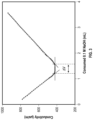
- PEMAc Quantification Conductometric titration was used to measure PEMAc concentrations in solutions and on pulp fibers. To a wet pulp sample (dry mass 0.2 g) was added 90 mL, 4 mM NaCl solution. The initial pH was adjusted below 3.0 by adding 1 M hydrochloric acid (HCl). 0.1 M NaOH solution was added at the rate of 0.05 mL/min up to pH 11.5 by using an auto titrator (MANTECH, Benchtop Titrator Model, MT-10). Titrations were repeated with fresh samples at least three times. The volume of base consumed by the weak carboxyl groups was determined by the points of intersection of three trendlines going through the linear sections of the titration curve, as shown in an example in FIG. 3 .
- FIGS. 4 and 5 show the fixation yield dependencies on the pH of the treatment polymer ingredient 12 , the curing temperature 16 , and PEMAc molecular weight.
- H-PEMAc refers to high molecular weight poly(ethylene-co-maleic acid) with a molecular weight of from about 100 to about 500 kilodaltons (kDa)
- L-PEMAc refers to low molecular weight poly(ethylene-co-maleic acid) with a molecular weight of about 60 kDa.
- FIG. 4 shows the treatment yield as a function of treatment solution pH and the PEMAc molecular weight for pulp sheets cured at 23° C. for greater than 12 hours.
- H-PEMAc 100-500 kDa
- the fixation yield for H-PEMAc was about 50% from pH 2-11 with a peak of about 70 at pH 4.
- the H-PEMAc is shown with square data points, and the L-PEMAc is shown with circular data points throughout the Experimental Data graphs.
- the corresponding fixation yields for pulps cured at 120° C. for about 10 minutes are shown in FIG. 5 . Note that the high yield samples could not be repulped for titration so the yields were based on wash water measurements.
- FIGS. 6 and 7 shows the influences of curing time 18 , curing temperature 16 , and PEMAc molecular weight, on the PEMAc content of washed fibers.
- FIG. 6 illustrates a constant curing temperature 16 of about 120° C., with the curing time 18 shown on the X axis
- FIG. 7 shows a constant curing time 18 of 10 minutes with the curing temperature 16 shown on the X axis.
- Curing of the H-PEMAc is illustrated in FIGS. 6 and 7 , with the solid boxes indicating pH 4 polymer ingredient 12 and the open boxes indicating pH 8 polymer ingredient 12 .
- FIG. 8 shows the influence of curing temperature 16 on wet strength.
- the solid boxes indicate pH 4 polymer ingredient 12 was used, and the open boxes indicate pH 8 polymer ingredient 12 was used, where the curing time 18 was 10 minutes, and the variable curing temperature 16 is shown on the X axis. Wet strength increases with curing temperature 16 .
- the numbers beside the data points are the corresponding fixation yields.
- FIG. 9 shows the wet strength of cured pulp sheets treated at pH 4 as functions of the corresponding fixation yield.
- the scattered points in FIG. 9 do not reflect noise or experimental error but instead result from using a range of curing times 18 , curing temperatures 16 , PEMAc dosages, and PEMAc molecular weights.
- the circular shaped data points are for the L-PEMAc
- the square shaped data points are for the H-PEMAc.
- the ideal result is no wet strength and a fixation yield of 1 (the lower right-hand corner of FIG. 9 ). Pulp sheets with WTIs below about 2 Nm/g were easily repulpable in a standard laboratory disintegrator whereas those reaching 3 Nm/g required more aggressive redispersion.
- H-PEMAc For the high molecular weight H-PEMAc, all but one of the fixation yields are high. The major challenge with H-PEMA was maintaining low WTI and thus repulpability. By contrast, with L-PEMAc, the WTIs were low, however, many of the fixation yields were too low. Focusing on yields greater than 0.8 and WTIs ⁇ 3 Nm/g we see it is possible to obtain high yields and low wet strengths. However, the data portrayal in FIG. 9 says nothing about the amounts of added polymer, the curing temperatures 16 , or the curing times 18 .
- Beta is the fraction of succinic acid moieties that have been converted to succinic anhydride moieties, which may occur during curing. It is proposed that beta is a good single measure of the progress of curing during heating treated pulp.
- Equations 1 and 2 were used to estimate beta values corresponding to the various curing conditions.
- Succinic anhydride formation from succinic acid moieties is a unimolecular, first-order reaction. Therefore beta should depend upon curing time 18 and curing temperature 16 but should be independent of the mass fraction of PEMAc (or other polymer) in the pulp sheet.
- the rate expression for beta as a function of curing time 18 , t is given in Equation 1, where k r is the rate constant for anhydride formation.
- the temperature dependence of the rate constant is given by the Arrhenius expression, shown in Equation 2.
- Equation 1 the pulp temperature may be determined as a function of curing time 18 so k r can be expressed as a function of time in Equation 1.
- k r the rate of time in Equation 1.
- Eq. 3 Two other assumptions used were the reaction was irreversible and the rates of water transport out of the pulp were not rate determining. These two assumptions are reasonable because, in the experiments, the beta values were low (most far less than 0.2) and the polymer deposits on the substrate surfaces were thin.
- Published values for the activation energy of PEMA is 56 kJ/mole and for poly(vinyl methyl ether-alt-maleic anhydride) is 78.7 kJ/mole.
- Beta is a useful parameter to describe the extent of curing because it encompasses both the curing time 18 and curing temperature 16 . However, in our experimental data, beta is an estimation of anhydride formation kinetics, as opposed to an actual measurement of the anhydride formation kinetics.
- wet tensile index of a PEMAc treated pulp sheet will increase with the product of the applied polymer content, the fixed gamma (measured in meq/g), the applied gamma, and the extent of curing, beta.
- FIG. 10 is a log/log plot showing experimental H-PEMAc treated pulp wet tensile indices as functions of the beta gamma product.
- the applied gamma (Fa) values were determined based on the added polymer, as opposed to the fixed polymer, and the beta values were obtained by applying the experimental curing times 18 and curing temperatures 16 to Equation 3, shown above.
- the open boxes correspond to experiments with very high dosages of applied polymer, where the Fa was >0.4 meg/g or equivalently >25 kg of added PEMA per metric tonne of dry pulp.
- the closed boxes correspond to experiments where the ⁇ a value was less than or equal to 0.4 meg/g.
- ⁇ a3 0.052 meq/g corresponding to a wet tensile index of 3 Nm/g, corresponding to the intersection point of the 3 Nm/g horizontal line with the power-law curve.
- This ⁇ a3 value can be used as design tool for choosing curing conditions in larger scales treatment scenarios.
- the corresponding ⁇ a2 value is 0.0027 meq/g reflecting a more conservative design target, where ⁇ a2 represents the ⁇ a value corresponding to a wet tensile index of 2 Nm/g.
- FIG. 11 compares wet tensile index versus ⁇ a for three cases: a strong pulp with high molecular polymer (dashed line closed to Y-axis, bleached softwood pulp+H-PEMA), a strong pulp with a lower molecular weight polymer (circles, bleached softwood pulp+L-PEMA), and a weaker pulp with a high molecular weight polymer (diamonds, bleached hardwood pulp+H-PEMA). All three combinations display power-law behaviors, each with a slope of 0.6. However, the weaker combinations are shifted to right, giving higher ⁇ a2 and ⁇ a3 values. It is recommended that laboratory handsheet studies be conducted to generate figures corresponding to FIGS. 10 and 11 for each new combination of polymer and substrate, so ⁇ a2 and/or ⁇ a3 values can be determined for the specific polymer and substrate combination. The table below summarizes these values for FIG. 11 .
Landscapes
- Chemical & Material Sciences (AREA)
- Chemical Kinetics & Catalysis (AREA)
- Life Sciences & Earth Sciences (AREA)
- Biochemistry (AREA)
- General Chemical & Material Sciences (AREA)
- Paper (AREA)
- Polysaccharides And Polysaccharide Derivatives (AREA)
- Treatments Of Macromolecular Shaped Articles (AREA)
Abstract
Description

| TABLE 1 | |||||
| Polymer | Pulp | a (Nm/g) | b | βΓ2 (meq/g) | βΓ3 (meq/g) |
| H-PEMAc | Softwood | 70 | 0.6 | 0.0027 | 0.0052 |
| L-PEMAc | Softwood | 45 | 0.6 | 0.0056 | 0.011 |
| H-PEMAc | Hardwood | 30 | 0.6 | 0.011 | 0.022 |
The power-law coefficients for Eq. 4 and the corresponding repulpability limits βΓa2 giving wet tensile index=2 Nm/g and βΓa3 for 3 Nm/g extracted from the power-law lines plotted in
Claims (18)
Priority Applications (11)
| Application Number | Priority Date | Filing Date | Title |
|---|---|---|---|
| US17/647,861 US12163288B2 (en) | 2021-01-19 | 2022-01-13 | Treated substrates and methods of producing the same |
| EP22743402.4A EP4281265A4 (en) | 2021-01-19 | 2022-01-18 | TREATED SUBSTRATES AND METHODS FOR THE PRODUCTION THEREOF |
| BR112023014534A BR112023014534A2 (en) | 2021-01-19 | 2022-01-18 | TREATED SUBSTRATES AND METHODS OF PRODUCING THEM |
| CN202280019435.3A CN116963886A (en) | 2021-01-19 | 2022-01-18 | Treated substrate and method for producing the same |
| AU2022211065A AU2022211065A1 (en) | 2021-01-19 | 2022-01-18 | Treated substrates and methods of producing the same |
| KR1020237027665A KR20230133333A (en) | 2021-01-19 | 2022-01-18 | Treated substrate and method of manufacturing the same |
| PCT/US2022/070216 WO2022159931A1 (en) | 2021-01-19 | 2022-01-18 | Treated substrates and methods of producing the same |
| CA3205615A CA3205615A1 (en) | 2021-01-19 | 2022-01-18 | Treated substrates and methods of producing the same |
| MX2023008472A MX2023008472A (en) | 2021-01-19 | 2022-01-18 | Treated substrates and methods of producing the same. |
| TW111102152A TW202237941A (en) | 2021-01-19 | 2022-01-19 | Treated substrates and methods of producing the same |
| CL2023002102A CL2023002102A1 (en) | 2021-01-19 | 2023-07-19 | Treated substrates and their production methods |
Applications Claiming Priority (2)
| Application Number | Priority Date | Filing Date | Title |
|---|---|---|---|
| US202163138882P | 2021-01-19 | 2021-01-19 | |
| US17/647,861 US12163288B2 (en) | 2021-01-19 | 2022-01-13 | Treated substrates and methods of producing the same |
Publications (2)
| Publication Number | Publication Date |
|---|---|
| US20220228320A1 US20220228320A1 (en) | 2022-07-21 |
| US12163288B2 true US12163288B2 (en) | 2024-12-10 |
Family
ID=82406084
Family Applications (1)
| Application Number | Title | Priority Date | Filing Date |
|---|---|---|---|
| US17/647,861 Active 2042-06-11 US12163288B2 (en) | 2021-01-19 | 2022-01-13 | Treated substrates and methods of producing the same |
Country Status (11)
| Country | Link |
|---|---|
| US (1) | US12163288B2 (en) |
| EP (1) | EP4281265A4 (en) |
| KR (1) | KR20230133333A (en) |
| CN (1) | CN116963886A (en) |
| AU (1) | AU2022211065A1 (en) |
| BR (1) | BR112023014534A2 (en) |
| CA (1) | CA3205615A1 (en) |
| CL (1) | CL2023002102A1 (en) |
| MX (1) | MX2023008472A (en) |
| TW (1) | TW202237941A (en) |
| WO (1) | WO2022159931A1 (en) |
Families Citing this family (1)
| Publication number | Priority date | Publication date | Assignee | Title |
|---|---|---|---|---|
| US12163288B2 (en) * | 2021-01-19 | 2024-12-10 | Solenis Technologies, L.P. | Treated substrates and methods of producing the same |
Citations (25)
| Publication number | Priority date | Publication date | Assignee | Title |
|---|---|---|---|---|
| US142596A (en) | 1873-09-09 | Improvedent in railroad cattle-guards | ||
| US3855299A (en) * | 1973-06-11 | 1974-12-17 | Grace W R & Co | Water soluble reaction product of epihalohydrin and alkylamines |
| US4210489A (en) * | 1978-06-21 | 1980-07-01 | W. R. Grace & Co. | Method of imparting wet strength to paper products |
| US4391878A (en) | 1981-07-24 | 1983-07-05 | Scott Paper Company | Wet strength resins |
| US5190563A (en) | 1989-11-07 | 1993-03-02 | The Proctor & Gamble Co. | Process for preparing individualized, polycarboxylic acid crosslinked fibers |
| US5549791A (en) | 1994-06-15 | 1996-08-27 | The Procter & Gamble Company | Individualized cellulosic fibers crosslinked with polyacrylic acid polymers |
| US5755828A (en) | 1996-12-18 | 1998-05-26 | Weyerhaeuser Company | Method and composition for increasing the strength of compositions containing high-bulk fibers |
| US5998511A (en) | 1994-03-25 | 1999-12-07 | Weyerhaeuser Company | Polymeric polycarboxylic acid crosslinked cellulosic fibers |
| US6184271B1 (en) | 1994-03-25 | 2001-02-06 | Weyerhaeuser Company | Absorbent composite containing polymaleic acid crosslinked cellulosic fibers |
| US6471824B1 (en) | 1998-12-29 | 2002-10-29 | Weyerhaeuser Company | Carboxylated cellulosic fibers |
| US20030131962A1 (en) | 2001-12-18 | 2003-07-17 | Kimberly-Clark Worldwide, Inc. | Fibrous materials treated with a polyvinylamine polymer |
| EP1242466B1 (en) * | 1999-11-19 | 2004-01-21 | Akzo Nobel N.V. | Wet strength agent and method for production thereof |
| US20040118540A1 (en) * | 2002-12-20 | 2004-06-24 | Kimberly-Clark Worlwide, Inc. | Bicomponent strengtheninig system for paper |
| US6852197B2 (en) * | 1999-11-19 | 2005-02-08 | Akzo Nobel Nv | Wet strong tissue paper |
| US20050048207A1 (en) | 2000-02-04 | 2005-03-03 | Commonwealth Scientific And Industrial Research Organisation | Treatment of natural polymer based materials and the products based thereon |
| US7435266B2 (en) * | 2001-12-18 | 2008-10-14 | Kimberly-Clark Worldwide, Inc. | Polyvinylamine treatments to improve dyeing of cellulosic materials |
| US20110060148A1 (en) | 2008-03-13 | 2011-03-10 | Bioecon International Holding N.V. | Process for converting polysaccharides in an inorganic molten salt hydrate |
| US20110190423A1 (en) | 2010-02-04 | 2011-08-04 | Varnell Daniel F | Adhesive Compositions |
| US8118976B2 (en) * | 2007-05-23 | 2012-02-21 | Akzo Nobel N.V. | Process for the production of a cellulosic product |
| US20120058536A1 (en) * | 2009-05-27 | 2012-03-08 | Swetree Technologies Ab | Polymer made of a primary amine functionalized polymer and a hemicellulose |
| US20120183723A1 (en) | 2006-06-16 | 2012-07-19 | Georgia-Pacific Chemicals Llc | Binder Compositions and Methods for Making and Using Same |
| CN109072551A (en) * | 2016-04-05 | 2018-12-21 | 菲博林科技有限公司 | Paper and Board Products |
| US20220228320A1 (en) * | 2021-01-19 | 2022-07-21 | Solenis Technologies, L.P. | Treated substrates and methods of producing the same |
| US20220275201A1 (en) * | 2021-01-29 | 2022-09-01 | Erthos Inc. | Biodegradable polymeric material, biodegradable products and methods of manufacture and use therefor |
| US20240093023A1 (en) * | 2022-09-16 | 2024-03-21 | Erthos Inc. | Biodegradable thermoplastic polymer materials, biodegradable products and methods of manufacture and use thereof |
Family Cites Families (5)
| Publication number | Priority date | Publication date | Assignee | Title |
|---|---|---|---|---|
| US5427587A (en) * | 1993-10-22 | 1995-06-27 | Rohm And Haas Company | Method for strengthening cellulosic substrates |
| TW200504265A (en) * | 2002-12-17 | 2005-02-01 | Bayer Chemicals Corp | Alkenylsuccinic anhydride surface-applied system and uses thereof |
| EP1595026A1 (en) * | 2003-02-07 | 2005-11-16 | Lanxess Corporation | Anionic functional promoter and charge control agent with improved wet to dry tensile strength ratio |
| US20090272505A1 (en) * | 2006-06-27 | 2009-11-05 | Basf Se | Method for finishing paper and paper products |
| US9562326B2 (en) * | 2013-03-14 | 2017-02-07 | Kemira Oyj | Compositions and methods of making paper products |
-
2022
- 2022-01-13 US US17/647,861 patent/US12163288B2/en active Active
- 2022-01-18 BR BR112023014534A patent/BR112023014534A2/en unknown
- 2022-01-18 MX MX2023008472A patent/MX2023008472A/en unknown
- 2022-01-18 CN CN202280019435.3A patent/CN116963886A/en active Pending
- 2022-01-18 EP EP22743402.4A patent/EP4281265A4/en active Pending
- 2022-01-18 CA CA3205615A patent/CA3205615A1/en active Pending
- 2022-01-18 KR KR1020237027665A patent/KR20230133333A/en active Pending
- 2022-01-18 AU AU2022211065A patent/AU2022211065A1/en active Pending
- 2022-01-18 WO PCT/US2022/070216 patent/WO2022159931A1/en not_active Ceased
- 2022-01-19 TW TW111102152A patent/TW202237941A/en unknown
-
2023
- 2023-07-19 CL CL2023002102A patent/CL2023002102A1/en unknown
Patent Citations (35)
| Publication number | Priority date | Publication date | Assignee | Title |
|---|---|---|---|---|
| US142596A (en) | 1873-09-09 | Improvedent in railroad cattle-guards | ||
| US3855299A (en) * | 1973-06-11 | 1974-12-17 | Grace W R & Co | Water soluble reaction product of epihalohydrin and alkylamines |
| US4210489A (en) * | 1978-06-21 | 1980-07-01 | W. R. Grace & Co. | Method of imparting wet strength to paper products |
| US4391878A (en) | 1981-07-24 | 1983-07-05 | Scott Paper Company | Wet strength resins |
| US5190563A (en) | 1989-11-07 | 1993-03-02 | The Proctor & Gamble Co. | Process for preparing individualized, polycarboxylic acid crosslinked fibers |
| US6184271B1 (en) | 1994-03-25 | 2001-02-06 | Weyerhaeuser Company | Absorbent composite containing polymaleic acid crosslinked cellulosic fibers |
| US5998511A (en) | 1994-03-25 | 1999-12-07 | Weyerhaeuser Company | Polymeric polycarboxylic acid crosslinked cellulosic fibers |
| US5549791A (en) | 1994-06-15 | 1996-08-27 | The Procter & Gamble Company | Individualized cellulosic fibers crosslinked with polyacrylic acid polymers |
| US5755828A (en) | 1996-12-18 | 1998-05-26 | Weyerhaeuser Company | Method and composition for increasing the strength of compositions containing high-bulk fibers |
| US6471824B1 (en) | 1998-12-29 | 2002-10-29 | Weyerhaeuser Company | Carboxylated cellulosic fibers |
| US6579414B2 (en) | 1998-12-29 | 2003-06-17 | Weyerhaeuser Company | Method for enhancing the softness of a fibrous web |
| US6579415B2 (en) | 1998-12-29 | 2003-06-17 | Weyerhaeuser Company | Method of increasing the wet strength of a fibrous sheet |
| US6592717B2 (en) | 1998-12-29 | 2003-07-15 | Weyerhaeuser Company | Carboxylated cellulosic fibrous web and method of making the same |
| US6852197B2 (en) * | 1999-11-19 | 2005-02-08 | Akzo Nobel Nv | Wet strong tissue paper |
| EP1242466B1 (en) * | 1999-11-19 | 2004-01-21 | Akzo Nobel N.V. | Wet strength agent and method for production thereof |
| US20050048207A1 (en) | 2000-02-04 | 2005-03-03 | Commonwealth Scientific And Industrial Research Organisation | Treatment of natural polymer based materials and the products based thereon |
| EP1456472B2 (en) * | 2001-12-18 | 2012-05-02 | Kimberly-Clark Worldwide, Inc. | A method of making a paper product comprising a polyvinylamine polymer |
| US7435266B2 (en) * | 2001-12-18 | 2008-10-14 | Kimberly-Clark Worldwide, Inc. | Polyvinylamine treatments to improve dyeing of cellulosic materials |
| US20030131962A1 (en) | 2001-12-18 | 2003-07-17 | Kimberly-Clark Worldwide, Inc. | Fibrous materials treated with a polyvinylamine polymer |
| US20040118540A1 (en) * | 2002-12-20 | 2004-06-24 | Kimberly-Clark Worlwide, Inc. | Bicomponent strengtheninig system for paper |
| US20060065380A1 (en) * | 2002-12-20 | 2006-03-30 | Garnier Gil B D | Bicomponent strengthening system for paper |
| US20120183723A1 (en) | 2006-06-16 | 2012-07-19 | Georgia-Pacific Chemicals Llc | Binder Compositions and Methods for Making and Using Same |
| US8118976B2 (en) * | 2007-05-23 | 2012-02-21 | Akzo Nobel N.V. | Process for the production of a cellulosic product |
| US20110060148A1 (en) | 2008-03-13 | 2011-03-10 | Bioecon International Holding N.V. | Process for converting polysaccharides in an inorganic molten salt hydrate |
| EP2435485B1 (en) * | 2009-05-27 | 2019-01-09 | Cellutech AB | A polymer made of a primary amine functionalized polymer and a hemicellulose |
| US20120058536A1 (en) * | 2009-05-27 | 2012-03-08 | Swetree Technologies Ab | Polymer made of a primary amine functionalized polymer and a hemicellulose |
| US9133578B2 (en) * | 2009-05-27 | 2015-09-15 | Cellutech Ab | Polymer made of a primary amine functionalized polymer and a hemicellulose |
| CN102597009B (en) * | 2009-05-27 | 2016-06-22 | 切卢科技公司 | The polymer prepared by Primary amine-functionalised polymer and hemicellulose |
| US20110190423A1 (en) | 2010-02-04 | 2011-08-04 | Varnell Daniel F | Adhesive Compositions |
| CN109072551A (en) * | 2016-04-05 | 2018-12-21 | 菲博林科技有限公司 | Paper and Board Products |
| US20220228320A1 (en) * | 2021-01-19 | 2022-07-21 | Solenis Technologies, L.P. | Treated substrates and methods of producing the same |
| WO2022159931A1 (en) * | 2021-01-19 | 2022-07-28 | Solenis Technologies Cayman, L.P. | Treated substrates and methods of producing the same |
| KR20230133333A (en) * | 2021-01-19 | 2023-09-19 | 솔레니스 테크놀러지스 케이맨, 엘.피. | Treated substrate and method of manufacturing the same |
| US20220275201A1 (en) * | 2021-01-29 | 2022-09-01 | Erthos Inc. | Biodegradable polymeric material, biodegradable products and methods of manufacture and use therefor |
| US20240093023A1 (en) * | 2022-09-16 | 2024-03-21 | Erthos Inc. | Biodegradable thermoplastic polymer materials, biodegradable products and methods of manufacture and use thereof |
Non-Patent Citations (65)
| Title |
|---|
| Ankerfors et al., "Topo-chemical modifications of fibres by grafting of carboxymethyl cellulose in pilot scale", 8th International Paper and Coating Chemistry Symposium 2012, Nordic Pulp and Paper Research Journal, vol. 28, No. Jan. 2013. |
| B. Alince and T.G.M. van de Ven. Porosity of swollen pulp fi bers evaluated by polymer adsorption. In The Fundametals of Papermaking Materials, Trans. of the XIth Fund. Res. Symp. Cambridge, 1997, (C.F. Baker, ed.), pp. 771-788, FRC, Manchester, 2018. DOI: 10.15376/frc.1997.2.771. |
| B. Alince, "Porosity of swollen pulp fibers revisited", Pulp and Paper Research Centre, McGill University, 2001. |
| Barzyk et al., "Acidic Group Topochemistry and Fibre-to-Fibre Specific Bond Strength", Journal of Pulp and Paper Science, vol. 23, No. 2, Feb. 2, 1997. |
| Bianchi et al., "Ethylene-Maleic Anhydride Copolymers and Derivatives. Potentiometrie Titrations and Interactions with Polypeptides", Chemistry Department, University of Genoa, Jun. 20, 1969. |
| Chen et al., Aqueous Polymerization of Maleic Acid and Cross-Linking of Cotton Cellulose by Poly(maleic acid), Department of Textiles, Merchandising and Interiors, University of Georgia, Ind. Eng. Chem. Res. 2005, 44, 7921-7927. |
| Chung et al., "Glass Transition Temperatures of Poly(methyl Vinyl Ether-co-Maleic Anhydride) (PMVEMA) and Poly (methyl Vinyl Ether-co-Maleic Acid) (PMVEMAC) and the Kinetics of Dehydration of PMVEMAC by Thermal Analysis", GAF Chemicals Corp., 1989. |
| Cooper et al., "Effects of molecular weight and plasticization on dissolution rates of thin polymer films", School of Chemical Engineering, Cornell University, Butterworth & Co. Ltd., Polymer, vol. 26., 1985. |
| Dubin et al., "Hydrophobic Bonding in Alternating Copolymers of Maleic Acid and Alkyl Vinyl Ethers", The Journal of Physical Chemistry, vol. 74, No. 14, 1970. |
| Duker et al., "On the mechanism behind the ability of CMC to enhance paper strength", Nordic Pulp and Paper Research Journal, vol. 23, No. Jan. 2008. |
| Duker et al., "The use of CMC as a dry strength agent—the interplay between CMC attachment and drying", Nordic Pulp and Paper Research Journal, vol. 23, No. Jan. 2008. |
| Eisenberg et al., "Dehydration Kinetics and Glass Transition of Poly(acrylic Acid)", Journal of Polymer Science: Part A-1, vol. 7, 1717-1728, 1969. |
| Evenson et al., "Solventless Attachment of Long-Chain Molecules to Poly(ethylene-alt-maleic anhydride) Copolymer Surfaces", J. Phys. Chem. B 1998, 102, 5500-55002. |
| Evenson et al., "Surface Esterification of Poly(Ethylene-alt-Maleic Anhydride) Copolymer", J. Phys. Chem. B 2000, 104, 10608-10611. |
| Forsstrom et al., "Influence of fibre/fibre joint strength and fibre flexibility on the strength of papers from unbleached kraft fibres", Nordic Pulp and Paper Research Journal vol. 20 No. Feb. 2005. |
| Fras et al., "Analysis of the oxidation of cellulose fibres by titration and XPS", Colloids and Surfaces: A Physicochem. Eng. Aspects 260 (2005) 101-1080. |
| Freudenberg et al., "Covalent Immobilization of Cellulose Layers onto Maleic Anhydride Copolymer Thin Films", Biomacromolecules 2005, 6, 1628-1634. |
| Garnier et al., "Association in Solution and Adsorption at an Air-Water Interface of Alternating Copolymers of Maleic-Anhydride and Styrene", Langmuir 2000, 16, 3757-3763. |
| Greenberg et aql., "Kinetics of Anhydride Formation in Poly(acrylic Acid) and Its Effect on the Properties of a PAA-Alumina Composite", Journal of Polymer Science: Polymer Chemistry Edition, vol. 15, 2137-2149 (1977). |
| Gu et al., "Ft-Ir and Ft-Raman Spectroscopy Study of the Cyclic Anhydride Intermediates for Esterification of Cellulose: I. Formation of Anhydrides Without a Catalyst", Res. Chem. Intermed., vol. 24, No. 9, pp. 979-996 (1998). |
| Higuchi et al., "Faciliated Reversible Formation of Amides from Carboxylic Acids in Aqueous Solutions. Intermediate Production of Acid Anhydride", Amides from Aqueous Carboxylic Acids, Nov. 20, 1963. |
| ISA/US, International Search Report and Written Opinion issued in Int. Appl. No. PCT/US2022/070216 mailed May 3, 2022. |
| Isogai et al., "Preparation of polyuronic acid from cellulose by TEMPO-mediated oxidation", Cellulose (1998), 5, 153-164. |
| Jeberreiter et al., "Velocity of Dissolution of Polystyrene", Journal of Polymer Science, vol. XXIII, pp. 75-81 (1957). |
| Johnson, David, Ward, "New Applications for Poly(ethylene-alt-maleic anhydride)", Durham theses, Durham University, 2010, http://etheses.dur.ac.uk/886/. |
| Katz et al., "The determination of strong and weak acidic groups in sulfite pulps", Pulp and Paper Research Institute of Canada, 1984. |
| Khutoryanskaya et al., "Characterisation of Blends Based on Hydroxyethylcellulose and Maleic Acid-alt-Methyl Vinyl Ether", Macromolecular Chemistry and Physics, 2005, 206, 1497-1510; DOI 10.1002/macp.200500069. |
| Kitaoka et al., "Chemical modification of pulp fibers by TEMPO-mediated oxidation", Nordic Pulp and Paper Research Journal vol. 14 No. Apr. 1999. |
| Laine et al., "Studies on topochemical modification of cellulosic fibres", Nordic Pulp and Paper Research Journal vol. 15 No. May 2000. |
| Laine et al., "Studies on topochemical modification of cellulosic fibres", Nordic Pulp and Paper Research Journal vol. 17 No. Jan. 2002. |
| Laine et al., "Studies on topochemical modification of cellulosic fibres", Nordic Pulp and Paper Research Journal vol. 18 No. 31/2003. |
| Lee et al., "Grafting of Maleic Anhydride Copolymers onto Cellulose Acetate and Methyl Cellulose", Journal of Wood Chemistry and Technology, 12:2, 231-240, DOI: 10.1080/02773819208545081. |
| Lee et al., "Prediction of Polymer Dissolution in Swellable Controlled-Release Systems", Journal of Controlled Release, 6 (1987) 207-215, Elsevier Science Publishers B.V. |
| Lepoutre et al., "The Water Absorbency of Hydrolyzed Polyacrylonitrile-Grafted Cellulose Fibers", Journal of Applied Polymer Science, vol. 17, pp. 3143-3156 (1973). |
| Lindstrom et al., "The effect of carboxyl groups and their ionic form during drying on the hornification of cellulose fibers", Swedish Forest Products Research Laboratory, pp. 146-151 (1982). |
| Lindström et al., "The effect of chemical environment on fiber swelling", Swedish Forest Products Research Laboratory, pp. 14-20 (1980). |
| Miller-Chou et al., "A review of polymer dissolution", Prog. Polym. Sci. 28 (2003), 1223-1270. |
| Mohamed Naceur Belgacem & Alessandro Gandini (2005) The surface modification of cellulose fibres for use as reinforcing elements in composite materials, Composite Interfaces, 12:1-2, 41-75, DOI: 10.1163/1568554053542188. |
| Musa, "Handbook of Maleic Anhydride Based Materials", Springer, 2016, ISBN 978-3-319-29453-7; DOI 10.1007/978-3-319-29454-4. |
| Page, "A Theory for the Tensile Strength of Paper", Paper Physics; Tappi Journal Reprint; Oct. 2018, vol. 17 No. 18. |
| Pelton et al., "The influence of dextran molecular weight on the dry strength of dextran-impregnated paper", Peer-Reviewed Paper Strength; vol. 2, No. 4; Tappi Journal; Apr. 2003. |
| Pompe et al., "Maleic Anhydride Copolymers—A Versatile Platform for Molecular Biosurface Engineering", Biomacromolecules 2003, 4, 1072-1079. |
| Rätzsch, "Alternating Maleic Anhydride Copolymers", Prog. Polym. Sci., vol. 13, 277-337, 1988. |
| Saito et al., "Ion-exchange behavior of carboxylate groups in fibrous cellulose oxidized by the TEMPO-mediated system", Elsevier, Carbohydrate Polymers 61 (2005) 183-190. |
| Saito et al., "Wet Strength Improvement of TEMPO-Oxidized Cellulose Sheets Prepared with Cationic Polymers", Ind. Eng. Chem. Res. 2007, 46, 773-780. |
| Sjostrom et al., "The Acidic Groups in Wood and Pulp as Measured by Ion Exchange", Journal of Polymer Science: Part C, No. 11, pp. 221-241 (1965). |
| Stone et al., "A Structural Model for the Cell Wall of Water-Swollen Wood Pulp Fibres Based on Their Accessibility to Macromolecules", Pulp and Paper Research Institute of Canada, Cellulose Chemistry and Technology, 2, 343-358 (1968). |
| Switala Zeliazkow, "Thermal degradation of copolymers of styrene with dicarboxylic acids I. Alternating styrene-maleic acid copolymer", Elsevier, Polymer Degradation and Stability 74 (2001) 579-584. |
| Uhlmann et al., "Characterization of Maleic Acid/Anhydride Copolymer Films by Low-Rate Dynamic Liquid-Fluid Contact Angle Measurements Using Axisymmetric Drop Shape Analysis", Langmuir 2005, 21, 6302-6307. |
| Vitta et al., "The Preparation and Properties of Acrylic and Methacrylic Acid Grafted Cellulose Prepared by Ceric Ion Initiation. Part I. Preparation of the Grafted Cellulose", Journal of Macromolecular Science: Part A—Chemistry, 22:5-7, 579-590 (1985), DOI: 1.1080/00222338508056624. |
| Wagberg et al., "Charge determination of porous substrates by polyelectrolyte adsorption", Nordic Pulp and Paper Research Journal No. Feb. 1989. |
| Wagberg et al., "On the Charge Stoichiometry upon Adsorption of a Cationic Polyelectrolyte on Cellulosic Materials", Colloids and Surfaces, 27 (1987), 163-173; Elsevier Science Publishers B.V. |
| Wagberg et al., "On the mechanism behind wet strength development in papers containing wet strength resins", SCA Research AB, 1992. |
| Wagberg et al., "Physicochemical characterization of papermaking fibres", The Fundamentals of Papermaking Materials, Trans. of the XIth Fund. Res. Symp. Cambridge, 1997, pp. 1-82, FRC, Manchester. |
| Xu et al., "Application of polymeric multifunctional carboxlic acids to improve wet strength", Peer Reviewed, vol. 81, No. 11, Tappi Journal, Nov. 1998. |
| Xu et al., "Comparison of the Kraft Paper Crosslinked by Polymeric Carboxylic Acids of Large and Small Molecular Sizes: Dry and Wet Performance", Comparison of Crosslinked Kraft Paper, 1999. |
| Xu et al., "Effects of Poly(vinyl Alcohol) on the Strength of Kraft Paper Crosslinked by a Polyarboxylic Acid", Journal of Pulp and Paper Science, vol. 27, No. 1, Jan. 2001. |
| Xu et al., "Wet reinforcement of paper with high-molecular-weight multifunctional carboxylic acid", Wet Strength, Tappi Journal, Aug. 1999. |
| Yang et al., "Formation of Cyclic Anhydride Intermediates and Esterification of Cotton Cellulose by Multifunctional Carboxylic Acids: An Infrared Spectroscopy Study", Textile Res. J. 66(9), 595-603 (Sep. 1996). |
| Yang et al., "FT-IR Spectroscopy Study of the Polycarboxylic Acids Used for Paper Wet Strength Improvement", Ind. Eng. Chem. Res., 1996, 35, 4037-4042. |
| Yang et al., "Increasing wet adhesion between cellulose surfaces with polyvinylamine", Cellulose, ISSN 0969-0239, vol. 26, No. 1 (2019). |
| Yang et al., "Infrared Spectroscopy Studies of the Cyclic Anhydride as the Intermediate for the Ester Crosslinking of Cotton Cellulose by Polycarboxylic Acids. II. Comparison of Different Polycarboxylic Acids", Journal of Polymer Science: Part A: Polymer Chemistry, vol. 34, 1573-1580 (1996). |
| Yang et al., "Paper Wet Performance and Ester Crosslinking of Wood Pulp Cellulose by Poly(carboxylic acid)s", ournal of Polymer Sciencea, vol. 67, 649-658 (1998). |
| Yang et al., "Wet-peel: a tool for comparing wet-strength resins", Nordic Pulp & Paper Research Journal 2018, 33(4):632-646. |
| Yang, C. Q. Infrared Spectroscopy Studies of the Cyclic Anhydride as the Intermediate for the Ester Crosslinking of Cotton Cellulose by Polycarboxylic Acids. I. Identification of the Cyclic Anhydride Intermediate. J. Polym. Sci., Part A: Polym. Chem. 1993, 31, 1187-1193. |
Also Published As
| Publication number | Publication date |
|---|---|
| WO2022159931A1 (en) | 2022-07-28 |
| CL2023002102A1 (en) | 2024-02-02 |
| TW202237941A (en) | 2022-10-01 |
| EP4281265A4 (en) | 2024-12-11 |
| KR20230133333A (en) | 2023-09-19 |
| EP4281265A1 (en) | 2023-11-29 |
| AU2022211065A1 (en) | 2023-08-10 |
| CA3205615A1 (en) | 2022-07-28 |
| MX2023008472A (en) | 2023-10-09 |
| CN116963886A (en) | 2023-10-27 |
| US20220228320A1 (en) | 2022-07-21 |
| BR112023014534A2 (en) | 2023-10-03 |
Similar Documents
| Publication | Publication Date | Title |
|---|---|---|
| AU2005319393B2 (en) | Reactive cationic resins for use as dry and wet strength agents in sulfite ion-containing papermaking systems | |
| US4986882A (en) | Absorbent paper comprising polymer-modified fibrous pulps and wet-laying process for the production thereof | |
| US3556932A (en) | Water-soluble,ionic,glyoxylated,vinylamide,wet-strength resin and paper made therewith | |
| AU2017223287B2 (en) | Glyoxalated polyacrylamide terpolymer, base copolymer thereof, compositions containing same, uses in papermaking and products thereof | |
| US4908097A (en) | Modified cellulosic fibers | |
| US9127408B2 (en) | Tissue having reduced hydrogen bonding | |
| US12163288B2 (en) | Treated substrates and methods of producing the same | |
| EP0016623B1 (en) | Water-soluble polymers containing quaternary ammonium groups, a process for their production and their use in improving the wet strength of cellulosic substrates | |
| Li et al. | Binary additives of polyamide epichlorohydrin-nanocellulose for effective valorization of used paper | |
| Zhang et al. | High-yield grafting of carboxylated polymers to wood pulp fibers | |
| US5294301A (en) | Process for manufacture of paper | |
| Blomstedt | Modification of cellulosic fibers by carboxymethyl cellulose: effects on fiber and sheet properties | |
| Horvath | Appropriate conditions for polyelectrolyte titration to determine the charge of cellulosic fibers | |
| Franco et al. | Understanding Sizing Conditions with Alkenyl Succinic Anhydride: Experimental Analysis of pH and Anionic Trash Catcher Effects on Softwood Kraft Pulp. | |
| Zhang | Grafted Pulp | |
| Kenealy et al. | Modification of lignocellulosic materials by laccase |
Legal Events
| Date | Code | Title | Description |
|---|---|---|---|
| FEPP | Fee payment procedure |
Free format text: ENTITY STATUS SET TO UNDISCOUNTED (ORIGINAL EVENT CODE: BIG.); ENTITY STATUS OF PATENT OWNER: LARGE ENTITY |
|
| AS | Assignment |
Owner name: SOLENIS TECHNOLOGIES, L.P., DELAWARE Free format text: ASSIGNMENT OF ASSIGNORS INTEREST;ASSIGNORS:PELTON, ROBERT, DR.;ZHANG, HONGFENG;REEL/FRAME:058654/0185 Effective date: 20210118 |
|
| STPP | Information on status: patent application and granting procedure in general |
Free format text: DOCKETED NEW CASE - READY FOR EXAMINATION |
|
| AS | Assignment |
Owner name: THE BANK OF NEW YORK MELLON TRUST COMPANY, N.A. AS COLLATERAL AGENT, ILLINOIS Free format text: SECURITY AGREEMENT (NOTES);ASSIGNORS:SOLENIS TECHNOLOGIES, L.P.;INNOVATIVE WATER CARE, LLC;REEL/FRAME:061431/0865 Effective date: 20220909 Owner name: GOLDMAN SACHS BANK USA, AS COLLATERAL AGENT, NEW YORK Free format text: SECURITY AGREEMENT (TERM);ASSIGNORS:SOLENIS TECHNOLOGIES, L.P.;INNOVATIVE WATER CARE, LLC;REEL/FRAME:061431/0851 Effective date: 20220909 |
|
| AS | Assignment |
Owner name: THE BANK OF NEW YORK MELLON TRUST COMPANY, N.A. AS COLLATERAL AGENT, ILLINOIS Free format text: SECURITY AGREEMENT (NOTES);ASSIGNORS:SOLENIS TECHNOLOGIES, L.P.;INNOVATIVE WATER CARE, LLC;REEL/FRAME:061432/0821 Effective date: 20220909 Owner name: BANK OF AMERICA, N.A, AS COLLATERAL AGENT, GEORGIA Free format text: SECURITY AGREEMENT (ABL);ASSIGNORS:SOLENIS TECHNOLOGIES, L.P.;INNOVATIVE WATER CARE, LLC;REEL/FRAME:061432/0958 Effective date: 20220909 |
|
| AS | Assignment |
Owner name: BANK OF NEW YORK MELLON TRUST COMPANY, N.A., ILLINOIS Free format text: 2023 NOTES PATENT SECURITY AGREEMENT;ASSIGNORS:BIRKO CORPORATION;SOLENIS TECHNOLOGIES, L.P.;INNOVATIVE WATER CARE, LLC;AND OTHERS;REEL/FRAME:064225/0170 Effective date: 20230705 |
|
| STPP | Information on status: patent application and granting procedure in general |
Free format text: NON FINAL ACTION MAILED |
|
| STPP | Information on status: patent application and granting procedure in general |
Free format text: RESPONSE TO NON-FINAL OFFICE ACTION ENTERED AND FORWARDED TO EXAMINER |
|
| STPP | Information on status: patent application and granting procedure in general |
Free format text: NON FINAL ACTION MAILED |
|
| STPP | Information on status: patent application and granting procedure in general |
Free format text: RESPONSE TO NON-FINAL OFFICE ACTION ENTERED AND FORWARDED TO EXAMINER |
|
| STPP | Information on status: patent application and granting procedure in general |
Free format text: FINAL REJECTION MAILED |
|
| STPP | Information on status: patent application and granting procedure in general |
Free format text: RESPONSE AFTER FINAL ACTION FORWARDED TO EXAMINER |
|
| STPP | Information on status: patent application and granting procedure in general |
Free format text: ADVISORY ACTION MAILED |
|
| STPP | Information on status: patent application and granting procedure in general |
Free format text: DOCKETED NEW CASE - READY FOR EXAMINATION |
|
| STPP | Information on status: patent application and granting procedure in general |
Free format text: NON FINAL ACTION MAILED |
|
| AS | Assignment |
Owner name: THE BANK OF NEW YORK MELLON TRUST COMPANY, N.A., AS NOTES COLLATERAL AGENT, ILLINOIS Free format text: SECURITY AGREEMENT (2024 NOTES);ASSIGNORS:BIRKO CORPORATION;DIVERSEY, INC.;DIVERSEY TASKI, INC.;AND OTHERS;REEL/FRAME:067824/0278 Effective date: 20240621 |
|
| STPP | Information on status: patent application and granting procedure in general |
Free format text: RESPONSE TO NON-FINAL OFFICE ACTION ENTERED AND FORWARDED TO EXAMINER |
|
| STPP | Information on status: patent application and granting procedure in general |
Free format text: NOTICE OF ALLOWANCE MAILED -- APPLICATION RECEIVED IN OFFICE OF PUBLICATIONS |
|
| STCF | Information on status: patent grant |
Free format text: PATENTED CASE |
|
| AS | Assignment |
Owner name: THE BANK OF NEW YORK MELLON TRUST COMPANY, N.A., AS NOTES COLLATERAL AGENT, ILLINOIS Free format text: SECURITY AGREEMENT (NOTES);ASSIGNORS:DIVERSEY, INC.;DIVERSEY TASKI, INC.;INNOVATIVE WATER CARE, LLC;AND OTHERS;REEL/FRAME:073061/0885 Effective date: 20251009 Owner name: BIRKO CORPORATION, COLORADO Free format text: RELEASE OF 2023 NOTES PATENT SECURITY INTERESTS;ASSIGNOR:THE BANK OF NEW YORK MELLON TRUST COMPANY, N.A.;REEL/FRAME:073074/0198 Effective date: 20251009 Owner name: DIVERSEY, INC., SOUTH CAROLINA Free format text: RELEASE OF 2023 NOTES PATENT SECURITY INTERESTS;ASSIGNOR:THE BANK OF NEW YORK MELLON TRUST COMPANY, N.A.;REEL/FRAME:073074/0198 Effective date: 20251009 Owner name: DIVERSEY TASKI, INC., SOUTH CAROLINA Free format text: RELEASE OF 2023 NOTES PATENT SECURITY INTERESTS;ASSIGNOR:THE BANK OF NEW YORK MELLON TRUST COMPANY, N.A.;REEL/FRAME:073074/0198 Effective date: 20251009 Owner name: INNOVATIVE WATER CARE, LLC, DELAWARE Free format text: RELEASE OF 2023 NOTES PATENT SECURITY INTERESTS;ASSIGNOR:THE BANK OF NEW YORK MELLON TRUST COMPANY, N.A.;REEL/FRAME:073074/0198 Effective date: 20251009 Owner name: SOLENIS TECHNOLOGIES, L.P., DELAWARE Free format text: RELEASE OF 2023 NOTES PATENT SECURITY INTERESTS;ASSIGNOR:THE BANK OF NEW YORK MELLON TRUST COMPANY, N.A.;REEL/FRAME:073074/0198 Effective date: 20251009 |
|
| AS | Assignment |
Owner name: BIRKO CORPORATION, COLORADO Free format text: RELEASE OF SECURITY INTEREST;ASSIGNOR:THE BANK OF NEW YORK MELLON TRUST COMPANY, N.A., AS NOTES COLLATERAL AGENT;REEL/FRAME:073564/0864 Effective date: 20251103 Owner name: DIVERSEY, INC., SOUTH CAROLINA Free format text: RELEASE OF SECURITY INTEREST;ASSIGNOR:THE BANK OF NEW YORK MELLON TRUST COMPANY, N.A., AS NOTES COLLATERAL AGENT;REEL/FRAME:073564/0864 Effective date: 20251103 Owner name: DIVERSEY TASKI, INC., SOUTH CAROLINA Free format text: RELEASE OF SECURITY INTEREST;ASSIGNOR:THE BANK OF NEW YORK MELLON TRUST COMPANY, N.A., AS NOTES COLLATERAL AGENT;REEL/FRAME:073564/0864 Effective date: 20251103 Owner name: INNOVATIVE WATER CARE, LLC, DELAWARE Free format text: RELEASE OF SECURITY INTEREST;ASSIGNOR:THE BANK OF NEW YORK MELLON TRUST COMPANY, N.A., AS NOTES COLLATERAL AGENT;REEL/FRAME:073564/0864 Effective date: 20251103 Owner name: SOLENIS TECHNOLOGIES, L.P., DELAWARE Free format text: RELEASE OF SECURITY INTEREST;ASSIGNOR:THE BANK OF NEW YORK MELLON TRUST COMPANY, N.A., AS NOTES COLLATERAL AGENT;REEL/FRAME:073564/0864 Effective date: 20251103 Owner name: THE BANK OF NEW YORK MELLON TRUST COMPANY, N.A., AS NOTES COLLATERAL AGENT, ILLINOIS Free format text: SECURITY INTEREST;ASSIGNORS:CHEM-AQUA, INC.;DIVERSEY, INC.;DIVERSEY TASKI, INC.;AND OTHERS;REEL/FRAME:073570/0838 Effective date: 20251103 |