US12162886B2 - 11,13-modified saxitoxins for the treatment of pain - Google Patents
11,13-modified saxitoxins for the treatment of pain Download PDFInfo
- Publication number
- US12162886B2 US12162886B2 US17/282,744 US201917282744A US12162886B2 US 12162886 B2 US12162886 B2 US 12162886B2 US 201917282744 A US201917282744 A US 201917282744A US 12162886 B2 US12162886 B2 US 12162886B2
- Authority
- US
- United States
- Prior art keywords
- alkyl
- halo
- compound
- formula
- groups
- Prior art date
- Legal status (The legal status is an assumption and is not a legal conclusion. Google has not performed a legal analysis and makes no representation as to the accuracy of the status listed.)
- Active, expires
Links
Images


Classifications
-
- C—CHEMISTRY; METALLURGY
- C07—ORGANIC CHEMISTRY
- C07D—HETEROCYCLIC COMPOUNDS
- C07D487/00—Heterocyclic compounds containing nitrogen atoms as the only ring hetero atoms in the condensed system, not provided for by groups C07D451/00 - C07D477/00
- C07D487/12—Heterocyclic compounds containing nitrogen atoms as the only ring hetero atoms in the condensed system, not provided for by groups C07D451/00 - C07D477/00 in which the condensed system contains three hetero rings
- C07D487/20—Spiro-condensed systems
-
- C—CHEMISTRY; METALLURGY
- C07—ORGANIC CHEMISTRY
- C07D—HETEROCYCLIC COMPOUNDS
- C07D487/00—Heterocyclic compounds containing nitrogen atoms as the only ring hetero atoms in the condensed system, not provided for by groups C07D451/00 - C07D477/00
- C07D487/12—Heterocyclic compounds containing nitrogen atoms as the only ring hetero atoms in the condensed system, not provided for by groups C07D451/00 - C07D477/00 in which the condensed system contains three hetero rings
- C07D487/14—Ortho-condensed systems
-
- A—HUMAN NECESSITIES
- A61—MEDICAL OR VETERINARY SCIENCE; HYGIENE
- A61P—SPECIFIC THERAPEUTIC ACTIVITY OF CHEMICAL COMPOUNDS OR MEDICINAL PREPARATIONS
- A61P25/00—Drugs for disorders of the nervous system
- A61P25/04—Centrally acting analgesics, e.g. opioids
-
- A—HUMAN NECESSITIES
- A61—MEDICAL OR VETERINARY SCIENCE; HYGIENE
- A61P—SPECIFIC THERAPEUTIC ACTIVITY OF CHEMICAL COMPOUNDS OR MEDICINAL PREPARATIONS
- A61P29/00—Non-central analgesic, antipyretic or antiinflammatory agents, e.g. antirheumatic agents; Non-steroidal antiinflammatory drugs [NSAID]
Definitions
- kits for making the compounds, pharmaceutical compositions comprising the compounds, and methods of using the compounds and compositions in treating conditions associated with voltage-gated sodium channel function, for example pain and conditions associated with pain.
- the compounds are 11,13-modified saxitoxins.
- methods of treating pain in a mammal comprising administering a therapeutically or prophylactically effective amount of a 11,13-modified saxitoxin or composition to a mammal.
- the mammal is a human.
- Voltage-gated sodium channels are large integral membrane protein complexes present in neurons and excitable tissues where they contribute to processes such as membrane excitability and muscle contraction (Ogata et al., Jpn. J. Pharmacol . (2002) 88(4) 365-77). They have been identified as a primary target for the treatment of pain.
- Genes encoding for nine distinct mammalian isoforms of Na V channels (Na V isoforms 1.1-1.9) have been sequenced. Variation in the gating properties of different Na V isoforms, cellular distributions, and expression levels influence the physiology of nerve cell conduction.
- a human genetic disorder resulting in a loss of function mutation in Na V 1.7 has been correlated with congenital insensitivity to pain (Cox et al., Nature. (2006) 444(7121) 894-898).
- the design of a drug which selectively inhibits Na V 1.7 over the other Na V channels is therefore desirable.
- Such a drug design is challenging given the high structural homology (75-96%) of the mammalian Na V isoforms.
- kits for making the compounds, pharmaceutical compositions comprising the compounds, and methods of using the compounds and compositions for the treatment of conditions modulated by voltage-gated sodium channels, in some or any embodiments, in the treatment of pain.
- the compounds are 11,13-modified saxitoxins.
- methods of treating pain and/or conditions modulated by voltage-gated sodium channels in a mammal comprising administering a therapeutically or prophylactically effective amount of a 11,13-modified saxitoxin or composition to a mammal.
- the mammal is a human.
- compositions, single unit dosage forms, and kits suitable for use in treating pain and/or conditions modulated by voltage-gated sodium channels which comprise a therapeutically or prophylactically effective amount of a compound provided herein, e.g., of some or any of the embodiments, of Formula (I)-(Ie), (I-P1), and (I-P) and compounds 1-107 and 108-114.
- a method of treatment of pain and/or conditions modulated by voltage-gated sodium channels comprising administering to an individual in need thereof a therapeutically or prophylactically effective amount of a 11,13-modified saxitoxin described herein, e.g., of some or any of the embodiments, of Formula (I)-(Ie), (I-P1), and (I-P) and compounds 1-107 and 108-114, or administering to an individual in need thereof a pharmaceutical composition comprising a therapeutically or prophylactically effective amount of a 11,13-modified saxitoxin described herein, e.g., of some or any of the embodiments, of Formula (I)-(Ie), (I-P1), and (I-P) and compounds 1-107 and 108-114, and a pharmaceutically acceptable carrier.
- FIG. 1 shows paw withdrawal latency to a thermal stimulus in mice administered Compound 61 or Compound 77 subcutaneously (SubQ). Values are mean f SEM. *p ⁇ 0.05, **p ⁇ 0.01, ***p ⁇ 0.001.
- FIG. 2 shows tail withdrawal latency following placement into 52° C. water in mice administered vehicle or Compound 77 SubQ. Values are mean ⁇ SEM. *p ⁇ 0.05, **p ⁇ 0.01, ***p ⁇ 0.001.
- FIG. 3 shows latency to attend to a clamp placed on the base of the tail 30 min after treatment with vehicle or Compound 77 SubQ. Values are mean ⁇ SEM. *p ⁇ 0.05, **p ⁇ 0.01, ***p ⁇ 0.001.
- FIG. 4 shows time spent licking paw following 10 ⁇ l injection of 2.5% formalin 30 minutes after SubQ injection of vehicle or Compound B SubQ. Left shows time spent licking in 5 min bins, and right shows total time during the early (0-5 min) and late phases (10-45 min). Values are mean ⁇ SEM. *p ⁇ 0.05, **p ⁇ 0.01, ***p ⁇ 0.001.
- FIG. 5 A shows withdrawal latency of the left and right paw due to a thermal stimulus in mice that were challenged with an incision on the ventral side of the left paw.
- FIG. 5 B- 5 E show withdrawal latency of the left (B, C) and right paw (D, E) in mice with an incision injury on the left paw that were administered either vehicle or Compound 77 SubQ. Data shown is from 2 days (B, D) or 5 days (C, E) after the incision procedure. All values are mean t SEM. *p ⁇ 0.05, **p ⁇ 0.01, ***p ⁇ 0.001.
- FIG. 6 A shows paw withdrawal threshold to a mechanical stimulus on the left and right paw in mice that were challenged with a nerve injury in the left hindlimb.
- FIGS. 6 B and 6 C show withdrawal threshold of the injured left (B) and uninjured right paw (C) in mice that received vehicle or Compound 77 SubQ. Data shows test session 14 days after the SNI procedure. All values are mean t SEM. *p ⁇ 0.05.
- the compounds are 11,13-modified saxitoxins.
- methods of treating pain in a mammal comprising administering a therapeutically or prophylactically effective amount of a 11,13-modified saxitoxin or composition to a mammal.
- the mammal is a human.
- references to “about” a value or parameter herein includes (and describes) variations that are directed to that value or parameter per se.
- description referring to “about X” includes description of “X”.
- the terms “about” and “approximately,” when used in connection with temperatures, doses, amounts, or weight percent of ingredients of a composition or a dosage form mean a dose, amount, or weight percent that is recognized by those of ordinary skill in the art to provide a pharmacological effect equivalent to that obtained from the specified dose, amount, or weight percent.
- alkyl refers to a saturated straight or branched hydrocarbon.
- the alkyl group is a primary, secondary, or tertiary hydrocarbon.
- the alkyl group includes one to ten carbon atoms, i.e., C 1 to C 10 alkyl.
- the alkyl is a C 1-6 alkyl.
- the alkyl group is selected from the group consisting of methyl, ethyl, propyl, isopropyl, butyl, isobutyl, secbutyl, t-butyl, pentyl, isopentyl, neopentyl, hexyl, isohexyl, 3-methylpentyl, 2,2-dimethylbutyl, and 2,3-dimethylbutyl.
- alkylene refers to a divalent alkyl group, as defined herein.
- the alkylene group is C 1-6 alkylene.
- the alkylene group is —CH 2 —, —CH 2 CH 2 —, or —CH 2 CH(CH 3 )— and the like.
- alkoxy refers to the group —OR′ where R′ is alkyl.
- Alkoxy groups include, in some or any embodiments, methoxy, ethoxy, n-propoxy, isopropoxy, n-butoxy, tert-butoxy, sec-butoxy, n-pentoxy, n-hexyloxy, 1,2-dimethylbutoxy, and the like.
- alkoxy is C 1-6 alkoxy.
- alkylthio refers to the group —SR′ where R′ is C 1-10 alkyl. In some or any embodiments, alkylthio is C 1-6 alkylthio. In some or any embodiments, alkylthio is methylthio.
- alkylsulfinyl refers to the group —S(O)R′ where R′ is C 1-10 alkyl. In some or any embodiments, the alkylsulfinyl is C 1-6 alkylsulfinyl.
- alkylsulfonyl refers to the group —S(O) 2 R′ where R′ is C 1-10 alkyl. In some or any embodiments, the alkylsulfonyl is C 1-6 alkylsulfonyl.
- amino means —NH 2 .
- alkylamino refers to the group —NHR′ where R′ is C 1-10 alkyl, as defined herein. In some or any embodiments, the alkylamino is C 1-6 alkylamino.
- dialkylamino refers to the group —NR′R′ where each R′ is independently C 1-10 alkyl, as defined herein. In some or any embodiments, the dialkylamino is di-C 1-6 alkylamino.
- aminoalkyl refers to an alkyl group, as defined herein, which is substituted with one or more amino groups.
- the aminoalkyl is an alkyl group substituted with one —NH 2 group (e.g., —R′(NH 2 ) where R′ is —C 1-10 alkyl, as defined herein).
- the aminoalkyl is an alkyl group substituted with two —NH 2 groups.
- aminoalkyl is aminoC 1-6 alkyl
- alkylaminoalkyl refers to an alkyl group, as defined herein, which is substituted with one or more alkylamino groups as defined herein.
- an “alkylaminoalkyl” is C 1-6 alkylaminoC 1-6 alkyl.
- each alkyl in alkylaminoalkyl is independently selected.
- dialkylaminoalkyl refers to an alkyl group, as defined herein, which is substituted with one or more dialkylamino groups as defined herein.
- dialkylaminoalkyl is di-C 1-6 alkylaminoC 1-6 alkyl.
- each alkyl in dialkylaminoalkyl is independently selected.
- aryl refers to a monovalent C 6 -C 15 carbocyclic ring system which comprises at least one aromatic ring wherein the aryl ring system is mono, di, or tricyclic.
- the aryl may be attached to the main structure through any of its rings, i.e. any aromatic or nonaromatic ring.
- the aryl group may be a bridged (where chemically feasible) or non-bridged, spirocyclic (where chemically feasible) or not spirocyclic, and/or fused or not fused multicyclic group.
- aryl is phenyl, naphthyl, bicyclo[4.2.0]octa-1,3,5-trienyl, indanyl, fluorenyl, 6,7,8,9-tetrahydro-5H-benzo[7]annulenyl,
- aryl When aryl is substituted, it can be substituted on any ring, i.e. on any aromatic or nonaromatic ring comprised by aryl.
- aryl is phenyl, naphthyl, tetrahydronaphthyl, fluorenyl, 6,7,8,9-tetrahydro-5H-benzo[7]annulenyl, or indanyl; each of which is optionally substituted with 1, 2, 3, or 4 groups as defined throughout the specification, including in some or any embodiments with group(s) independently selected from amino, hydroxy, halo, halo-C 1-6 alkoxy, C 1-6 alkoxy, C 1-6 alkyl, halo-C 1-6 alkyl, C 1-6 alkylthio, C 1-6 alkylsulfonyl, and phenyl.
- biphenyl refers to a phenyl group substituted with a second phenyl group.
- the optional substituent(s) can be substituted on either of the phenyl rings.
- aryloxy refers to an —OR group where R is aryl, as defined herein. In some embodiments, “aryloxy” is phenyloxy or phenoxy.
- arylalkyl refers to an alkyl group substituted with one or two aryl groups as defined herein, where the alkyl group is the point of attachment to the remainder of the molecule.
- aralkyl is phenylmethyl, phenyleth-1-yl, phenyleth-2-yl, diphenylmethyl, 2,2-diphenylethyl, 3,3-diphenylpropyl, or 3-phenylpropyl; each of which is optionally substituted on the ring with 1, 2, 3, or 4 groups as defined throughout the specification.
- arylalkyl is C 1-6 alkyl substituted with one phenyl group.
- arylalkyl is benzyl.
- C 3 -C 8 -cycloalkyl refers to a monovalent, saturated, monocyclic hydrocarbon.
- the cycloalkyl group includes three to six carbon atoms, i.e., C 3 to C 6 cycloalkyl.
- the cycloalkyl has 3, 4, or 5 (C 3-5 ); 3 or 4 (C 3-4 ); 3 (C 3 ); 4 (C 4 ); or 5 (C 5 ) carbon atoms.
- the cycloalkyl group is cyclopropyl, cyclobutyl, cyclopentyl, or cyclohexyl.
- the cycloalkyl group is cyclopropyl, cyclobutyl, or cyclopentyl. In some or any embodiments, the cycloalkyl group is cyclopropyl. In some or any embodiments, the cycloalkyl group is cyclobutyl. In some or any embodiments, the cycloalkyl group is cyclopentyl.
- cycloalkylalkyl refers to an alkyl as defined herein, which is substituted by one or more than one cycloalkyl groups as defined herein. In some embodiments, “cycloalkylalkyl” is C 3-8 cycloalkylC 1-6 alkyl. In some embodiments, “cycloalkylalkyl” is alkyl substituted with one cycloalkyl. In some embodiments, cycloalkylalkyl is cyclopropylmethyl.
- cycloalkylene refers to a divalent, saturated, monocyclic hydrocarbon.
- the cycloalkylene group includes three to six carbon atoms, i.e., C 3 to C 6 cycloalkylene.
- the cycloalkylene has 3, 4, or 5 (C 3-5 ); 3 or 4 (C 3-4 ); 3 (C 3 ); 4 (C 4 ); or 5 (C 5 ) carbon atoms.
- the cycloalkylene group is cycloprop-diyl, cyclobut-diyl, cyclopent-diyl, or cyclohex-diyl. In some or any embodiments, the cycloalkylene group is cycloprop-diyl, cyclobut-diyl, or cyclopent-diyl. In some or any embodiments, the cycloalkylene group is cycloprop-diyl. In some or any embodiments, the cycloalkylene group is cyclobut-diyl. In some or any embodiments, the cycloalkylene group is cyclopent-diyl.
- haloalkyl refers to an alkyl group substituted with 1, 2, 3, 4, or 5 halo groups.
- the haloalkyl is a halo-C 1-6 alkyl.
- the haloalkyl is —CF 3 , —CH 2 F, —CHF 2 , or —CH 2 CF 3 .
- haloalkylthio refers to an —SR group where R is halo-C 1-10 alkyl as defined herein. In some or any embodiments, the haloalkylthio is a halo-C 1-6 alkylthio.
- haloalkoxy refers to an —OR group where R is halo-C 1-10 alkyl as defined herein. In some or any embodiments, the haloalkoxy is a halo-C 1-6 alkoxy.
- haloalkylsulfinyl refers to an —S(O)R group where R is halo-C 1-10 alkyl as defined herein.
- the haloalkylsulfinyl is a halo-C 1-6 alkylsulfinyl.
- haloalkylsulfonyl refers to an —S(O) 2 R group where R is halo-C 1-10 alkyl as defined herein. In some or any embodiments, the haloalkylsulfonyl is a halo-C 1-6 alkylsulfonyl.
- halogen and “halo,” as used herein, and unless otherwise specified, are synonymous and refer to chloro, bromo, fluoro or iodo.
- heteroaryl refers to a monocyclic aromatic ring system or multicyclic aromatic ring system wherein one or more (in some or any embodiments, 1, 2, 3, or 4) of the ring atoms is a heteroatom independently selected from O, S(O) 0-2 , NH, and N, and the remaining ring atoms are carbon atoms, and where the ring may be optionally substituted as described herein.
- the heteroaryl group is bonded to the rest of the molecule through any atom in the ring system, valency rules permitting.
- each ring of a heteroaryl group can contain one or two O atoms, one or two S atoms, and/or one to four N atoms, or a combination thereof, provided that the total number of heteroatoms in each ring is four or less and each ring contains at least one carbon atom.
- the heteroaryl has from 5 to 20, from 5 to 15, or from 5 to 10 ring atoms. When heteroaryl is substituted, it can be substituted on any ring.
- heteroaryl includes, but is not limited to furanyl, pyrrolyl, pyrazolyl, imidazolyl, triazolyl, tetrazolyl, thienyl, pyridinyl, pyrimidinyl, pyridazinyl, pyrazinyl, indolyl, quinolinyl, isoquinolinyl, oxazolyl, isoxazolyl, thienopyridinyl, thienopyrimidinyl, azaindolinyl and the like.
- a heteroaryl is
- the heteroaryl when substituted one or more hydroxy can be named or drawn as either the keto or enol tautomer, for example, 2,4(1H,3H)-dioxo-pyrimidinyl or its tautomer 2,4-dihydroxy-pyrimidinyl; 2(1H)-oxo-4-hydroxypyrimidinyl or its tautomer 2-hydroxy-4(3H)-oxo-pyrimidinyl are within the scope of heteroaryl when substituted with two hydroxy.
- monocyclic heteroaryl groups include, but are not limited to, furanyl, imidazolyl, isothiazolyl, isoxazolyl, oxadiazolyl, oxadiazolyl, oxazolyl, pyrazinyl, pyrazolyl, pyridazinyl, pyridyl, pyrimidinyl, pyrrolyl, thiadiazolyl, thiazolyl, thienyl, tetrazolyl, triazinyl and triazolyl.
- bicyclic heteroaryl groups include, but are not limited to, benzofuranyl, benzimidazolyl, benzoisoxazolyl, benzopyranyl, benzothiadiazolyl, benzothiazolyl, benzothienyl, benzotriazolyl, benzoxazolyl, furopyridyl, imidazopyridinyl, imidazothiazolyl, indolizinyl, indolyl, indazolyl, isobenzofuranyl, isobenzothienyl, isoindolyl, isoquinolinyl, isothiazolyl, naphthyridinyl, oxazolopyridinyl, phthalazinyl, pteridinyl, purinyl, pyridopyridyl, pyrrolopyridyl, quinolinyl, quinoxalinyl, quinazolinyl, thiadiazol
- tricyclic heteroaryl groups include, but are not limited to, acridinyl, benzindolyl, carbazolyl, dibenzofuranyl, perimidinyl, phenanthrolinyl, phenanthridinyl, and phenazinyl.
- heteroaryl is indolyl, furanyl, pyridinyl, pyrimidinyl, imidazolyl, or pyrazolyl; each of which is optionally substituted with 1, 2, 3, or 4 groups as defined throughout the specification, including in some embodiments with group(s) independently selected from halo, C 1-6 alkyl, halo-C 1-6 alkyl, C 1-6 alkoxy, halo-C 1-6 alkoxy, and phenyl.
- heterocyclic refers to a monovalent monocyclic non-aromatic ring system and/or a multicyclic ring system that contains at least one non-aromatic ring; wherein one or more (in some or any embodiments, 1, 2, 3, or 4) of the non-aromatic monocyclic ring atoms is a heteroatom independently selected from O, S(O) 0-2 , and N, and the remaining ring atoms are carbon atoms; and wherein one or more (in some or any embodiments, 1, 2, 3, or 4) of any of the ring atoms in the multicyclic ring system is a heteroatom(s) independently selected from O, S(O) 0.2 , and N, and the remaining ring atoms are carbon.
- heterocyclic does not include fully aromatic ring(s), i.e. does not include imidazole, pyrimidine, pyridine, and the like.
- the heterocyclic ring comprises one or two heteroatom(s) which are independently selected from nitrogen and oxygen.
- the heterocyclic ring comprises one or two heteroatom(s) which are oxygen.
- the heterocyclic ring comprises one or two heteroatom(s) which are nitrogen (where the nitrogen is substituted as described in any aspect or embodiment described herein).
- heterocyclic is multicyclic and comprises one heteroatom in a non-aromatic ring, or comprises one heteroatom in an aromatic ring, or comprises two heteroatoms in an aromatic ring, or comprises two heteroatoms where one is in an aromatic ring and the other is in a non-aromatic ring.
- the heterocyclic group has from 3 to 20, 3 to 15, 3 to 10, 3 to 8, 4 to 7, or 5 to 6 ring atoms.
- the heterocyclic is a monocyclic, bicyclic, tricyclic, or tetracyclic ring system.
- the heterocyclic group may be a bridged or non-bridged, spirocyclic or not spirocyclic, and/or fused or not fused multicyclic group.
- One or more of the nitrogen and sulfur atoms may be optionally oxidized, one or more of the nitrogen atoms may be optionally quaternized, one or more of the carbon atoms may be optionally replaced with
- Some rings may be partially or fully saturated, or aromatic provided that heterocyclic is not fully aromatic.
- the monocyclic and multicyclic heterocyclic rings may be attached to the main structure at any heteroatom or carbon atom which results in a stable compound.
- the multicyclic heterocyclic may be attached to the main structure through any of its rings, including any aromatic or nonaromatic ring, regardless of whether the ring contains a heteroatom.
- heterocyclic is “heterocycloalkyl” which is 1) a saturated or partially unsaturated (but not aromatic) monovalent monocyclic group which contains at least one ring heteroatom, as described herein, or 2) a saturated or partially unsaturated (but not aromatic) monovalent bi- or tricyclic group in which at least one ring contains at least one heteroatom as described herein.
- heterocyclic and heterocycloalkyl are substituted, they can be substituted on any ring, i.e. on any aromatic or nonaromatic ring comprised by heterocyclic and heterocycloalkyl.
- such heterocyclic includes, but are not limited to, azepinyl, benzodioxanyl, benzodioxolyl, 3,4-dihydro-2H-benzo[b][1,4]oxazinyl, 3,4-dihydro-2H-benzo[b][1,4]dioxepinyl, 1,3-dihydroisobenzofuranyl, benzofuranonyl, benzopyranonyl, benzopyranyl, dihydrobenzofuranyl
- heterocyclic is benzo-1,4-dioxanyl, benzodioxolyl, indolinyl, 2-oxo-indolinyl, pyrrolidinyl, piperidinyl, 2,3-dihydrobenzofuranyl, or decahydroquinolinyl; each of which is optionally substituted with 1, 2, 3, or 4 groups as defined throughout the specification, including in some or any embodiments with group(s) independently selected from halo, alkyl, and phenyl.
- heterocycloalkyl is pyrrolidinyl.
- heterocycloalkyl is an N-linked heterocycloalkyl.
- hydroxyalkyl refers to a alkyl, as defined herein, substituted with at least one hydroxy (in some embodiments, one or two hydroxy). In some or any embodiments, the hydroxyalkyl is a hydroxy-C 1-6 alkyl. In some or any embodiments, hydroxyalkyl is —CH 2 OH, —CH 2 CH 2 OH.
- protecting group refers to a group that is added to an oxygen, nitrogen or phosphorus atom to prevent its further reaction or for other purposes.
- oxygen and nitrogen protecting groups are known to those skilled in the art of organic synthesis. (See for example those described in Greene, et al., Protective Groups in Organic Synthesis, John Wiley and Sons, Fourth Edition, 2006, hereby incorporated by reference.)
- a nitrogen-protecting group e.g.
- PG 1 and PG 2 is 9-fluorenylmethyloxycarbonyl (Fmoc), tert-butoxycarbonyl (Boc), benzyloxycarbonyl (CBz), acetyl, trichloroacetyl, trifluoroacetyl, —C(O)OCH 2 CCl 3 (Troc), p-methoxyphenyl, benzyl, p-methoxybenzyl, p-methoxybenzylcarbonyl, triphenylmethyl, benzylidenyl, 2,2,2-trichloroethoxysulfonyl (Tces), p-methoxybenzenesulfonyl (Mbs) or p-toluenesulfonyl (tosyl).
- Fmoc 9-fluorenylmethyloxycarbonyl
- Boc tert-butoxycarbonyl
- CBz benzyloxycarbonyl
- an oxygen-protecting group (e.g. for X 1 ) is methoxymethyl (MOM), ethoxyethyl, methoxyethoxymethyl, tetrahydrofuranyl, tetrahydropyranyl, methyl, tert-butyl, allyl, benzyl, trimethylsilyl, triethylsilyl, triisopropylsilyl, tert-butyldimethylsilyl, tert-butyldiphenylsilyl, acetyl, pivalyl, benzoyl, dimethoxytrityl, trityl, methoxytrityl, p-methoxybenzyl, or methylthiomethyl.
- MOM methoxymethyl
- ethoxyethyl methoxyethoxymethyl
- tetrahydrofuranyl tetrahydropyranyl
- methyl tert-butyl
- allyl
- salt refers to any salt of a compound provided herein which retains its biological properties and which is not toxic or otherwise desirable for pharmaceutical use. Such salts may be derived from a variety of organic and inorganic counter-ions well known in the art.
- Such salts include, but are not limited to: (1) acid addition salts formed with organic or inorganic acids such as hydrochloric, hydrobromic, sulfuric, nitric, phosphoric, sulfamic, acetic, trifluoroacetic, trichloroacetic, propionic, hexanoic, cyclopentylpropionic, glycolic, glutaric, pyruvic, lactic, malonic, succinic, sorbic, ascorbic, malic, maleic, fumaric, tartaric, citric, benzoic, 3-(4-hydroxybenzoyl)benzoic, picric, cinnamic, mandelic, phthalic, lauric, methanesulfonic, ethanesulfonic, 1,2-ethane-disulfonic, 2-hydroxyethanesulfonic, benzenesulfonic, 4-chlorobenzenesulfonic, 2-naphthalenesulfonic, 4-to
- Pharmaceutically acceptable salts further include, in some or any embodiments, and without limitation, sodium, potassium, calcium, magnesium, ammonium, tetraalkylammonium salts and the like.
- salts of non-toxic organic or inorganic acids such as hydrohalides, e.g.
- substantially free of or “substantially in the absence of” stereoisomers with respect to a composition refers to a composition that includes at least 85 or 90% by weight, in some or any embodiments 95%, 98%, 99% or 100% by weight, of a designated stereoisomer of a compound in the composition. In some or any embodiments, in the methods and compounds provided herein, the compounds are substantially free of stereoisomers.
- solvate refers to a compound provided herein or a salt thereof, that further includes a stoichiometric or non-stoichiometric amount of solvent bound by non-covalent intermolecular forces. Where the solvent is water, the solvate is a hydrate.
- isotopic composition refers to the amount of each isotope present for a given atom
- “natural isotopic composition” refers to the naturally occurring isotopic composition or abundance for a given atom.
- Atoms containing their natural isotopic composition may also be referred to herein as “non-enriched” atoms.
- the atoms of the compounds recited herein are meant to represent any stable isotope of that atom. For example, unless otherwise stated, when a position is designated specifically as “H” or “hydrogen,” the position is understood to have hydrogen at its natural isotopic composition.
- isotopic enrichment refers to the percentage of incorporation of an amount of a specific isotope at a given atom in a molecule in the place of that atom's natural isotopic abundance.
- deuterium enrichment of 1% at a given position means that 1% of the molecules in a given sample contain deuterium at the specified position. Because the naturally occurring distribution of deuterium is about 0.0156%, deuterium enrichment at any position in a compound synthesized using non-enriched starting materials is about 0.0156%.
- the isotopic enrichment of the compounds provided herein can be determined using conventional analytical methods known to one of ordinary skill in the art, including mass spectrometry and nuclear magnetic resonance spectroscopy.
- isotopically enriched refers to an atom having an isotopic composition other than the natural isotopic composition of that atom. “Isotopically enriched” may also refer to a compound containing at least one atom having an isotopic composition other than the natural isotopic composition of that atom.
- local anesthetic means a drug which provides local numbness or pain relief.
- local anesthetic includes aminoacylanilide compounds (in some or any embodiments, lidocaine, prilocaine, bupivacaine, ropivacaine, and mepivacaine) and related local anesthetic compounds having various substituents on the ring system or amine nitrogen; aminoalkyl benzoate compounds (in some or any embodiments, procaine, chloroprocaine, propoxycaine, hexylcaine, tetracaine, cyclomethycaine, benoxinate, butacaine, and proparacaine) and related local anesthetic compounds; cocaine; amino carbonate compounds (in some or any embodiments, diperodon); N-phenylamidine compounds (in some or any embodiments, phenacaine); N-aminoalkyl amide compounds (in some or any embodiments, dibucaine); aminoketone compounds
- alkyl As used herein, “alkyl,” “cycloalkyl,” “aryl,” “alkoxy,” “heterocycloalkyl,” and “heterocyclic” groups optionally comprise deuterium at one or more positions where hydrogen atoms are present, and wherein the deuterium composition of the atom or atoms is other than the natural isotopic composition.
- alkyl optionally comprise carbon-13 at an amount other than the natural isotopic composition.
- the terms “subject” and “patient” are used interchangeably.
- the terms “subject” and “subjects” refer to an animal, such as a mammal including a non-primate (e.g., a cow, pig, horse, cat, dog, rat, and mouse) and a primate (e.g., a monkey such as a cynomolgous monkey, a chimpanzee and a human), and in some or any embodiments, a human.
- the subject is a farm animal (e.g., a horse, a cow, a pig, etc.) or a pet (e.g., a dog or a cat).
- the subject is a human.
- terapéutica agent refers to any agent(s) which can be used in the treatment or prevention of a disorder or one or more symptoms thereof.
- therapeutic agent includes a compound provided herein.
- a therapeutic agent is an agent which is known to be useful for, or has been or is currently being used for the treatment or prevention of a disorder or one or more symptoms thereof.
- “Therapeutically effective amount” refers to an amount of a compound or composition that, when administered to a subject for treating a condition, is sufficient to effect such treatment for the condition.
- a “therapeutically effective amount” can vary depending on, inter alia, the compound, the condition and its severity, and the age, weight, etc., of the subject to be treated.
- Treating” or “treatment” of any condition or disorder refers, in some or any embodiments, to ameliorating a condition or disorder that exists in a subject, including prophylactically.
- “treating” or “treatment” includes ameliorating at least one physical parameter, which may be indiscernible by the subject.
- “treating” or “treatment” includes modulating the condition or disorder, either physically (e.g., stabilization of a discernible symptom) or physiologically (e.g., stabilization of a physical parameter) or both.
- “treating” or “treatment” includes delaying the onset of the condition or disorder.
- “treating” or “treatment” includes the reduction or elimination of either the condition (e.g.
- treating includes administering a compound described herein prophylactically.
- the terms “prophylactic agent” and “prophylactic agents” refer to any agent(s) which can be used in the prevention of a condition or one or more symptoms thereof and/or which prevents or impedes the onset, development, progression and/or severity of a condition.
- the term “prophylactic agent” includes a compound provided herein.
- the term “prophylactic agent” does not refer a compound provided herein.
- the agent is administered prophylactically, for example before surgery to prevent or impede the onset, duration, progression and/or severity of pain (e.g., post surgical pain).
- prophylactically effective amount refers to the amount of a therapy (e.g., prophylactic agent) which is sufficient to result in the prevention or reduction of the development, recurrence or onset of one or more symptoms associated with a condition, or to enhance or improve the prophylactic effect(s) of another therapy (e.g., another prophylactic agent).
- a therapy e.g., prophylactic agent
- another therapy e.g., another prophylactic agent
- the 11,13-modified saxitoxins can be formed as described herein and used for the treatment of conditions associated with voltage-gated sodium channel function.
- the condition associated with voltage-gated sodium channel function is pain or is a condition associated with pain.
- the condition associated with voltage-gated sodium channel function is a condition associated with pain.
- the condition associated with voltage-gated sodium channel function is pain, itch, cough, epilepsy, Parkinson's disease, a mood disorder, psychosis, amyotrophic lateral sclerosis, glaucoma, ischemia, spasticity disorders and obsessive compulsive disorder.
- the condition associated with voltage-gated sodium channel function is pain (in some embodiments, subacute or chronic pain).
- the pain associated with voltage-gated sodium channel function includes pain and/or discomfort associated with dry eye syndrome, pain associated with (acute) corneal injuries or abrasions, acute ocular pain, chronic ocular pain, pain associated with corneal infections, and pain associated with surgery (in some embodiments, ocular surgery).
- Saxitoxin has the chemical structure provided below with selected atom numbering used herein:
- R 7b substituents can be on the benzo portion of the bicyclic ring or the dihydrofuranyl portion of the bicyclic ring.
- provided herein is a compound of Formula (I), (I-P1), or (I-P), wherein
- the compound of Formula (I), (I-P1), or (I-P) is according to Formula (Ia):
- R 1 and R 2 are as defined in the Summary of the Invention or as defined in some or any embodiments described herein.
- the compound of Formula (I), (I-P1), or (I-P) is according to Formula (Ib):
- R 1 and R 2 are as defined in the Summary of the Invention or as defined in some or any embodiments described herein.
- the compound of Formula (I) (I-P1), or (I-P) is according to Formula (Ic):
- R 7b when present, and R 1 are as defined in Formula (I), (I-P1), or (I-P) in the Summary of the Invention or as defined in some or any embodiments described herein.
- each R 7b when present, is independently C 1-3 alkyl or halo, and R 1 is as defined in Formula (I), (I-P1), or (I-P) in the Summary of the Invention or as defined in some or any embodiments described herein.
- the compound of Formula (I), (I-P1), or (I-P) is according to Formula (Ic):
- X 1 is NH, N, O or S; and ring A is a 5 or 6 membered heteroaryl ring or a 5 or 6 membered heterocycloalkyl ring comprising, in addition to X 1 , 0, 1, or 2 heteroatoms and/or C ⁇ O groups, and the ring comprising X 1 is optionally substituted with 1, 2, 3, or 4 R 4b groups; each R 4b , when present, is as defined in Formula (I), (I-P1), or (I-P) in the Summary of the Invention or as defined in some or any embodiments described herein; and each R 7b (independently of each other), is as defined in Formula (I), (I-P1), or (I-P) in the Summary of the Invention or as defined in some or any embodiments described herein. In some or any embodiments of Formula (Id) X 1 is NH, N, O or S; and ring A is a 5 or 6 membered heteroaryl ring or a 5 or 6 membered hetero
- X 1 is NH and ring A is,
- X 1 is NH and ring A is
- X 1 is at the ortho position relative to the bond indicated by
- the compound of Formula (I), (I-P1), or (I-P) is according to Formula (Ie):
- R 8a is C 1-6 alkyl, or phenyl, and each R 7b (independently of each other), are as defined in Formula (I), (I-P1), or (I-P) in the Summary of the Invention or as defined in some or any embodiments described herein.
- R 8a is methyl.
- R 8a is ethyl.
- R 8a is phenyl.
- R 1 is —NR 4 C(O)R 4a , or —NR 8 C(O)OR 5a , and all other groups are as defined in Formula (I), (I-P1), or (I-P) in the Summary of the Invention or as defined in some or any embodiments described herein.
- R 4 and R 8 are hydrogen, and all other groups are as defined in Formula (I), (I-P1), or (I-P) in the Summary of the Invention or as defined in some or any embodiments described herein.
- R 4a is optionally substituted with 1, 2, 3, or 4 R 4b groups; in some or any embodiments, R 4a is not substituted or is substituted with one or two R 4b groups independently selected from the group consisting of alkyl, hydroxy, alkoxy, halo, and —O—(C 1-6 alkylene)-OH.
- R 8a is C 1-6 alkyl and R 4a is selected from the group consisting of
- R 4a is optionally substituted with 1, 2, 3, or 4 R 4b groups; in some or any embodiments, R 4a is not substituted or is substituted with one or two R 4b groups independently selected from the group consisting of alkyl, hydroxy, alkoxy, halo, halo, and —O—(C 1-6 alkylene)-OH.
- R 1 is —NR 4 C(O)R 4a , and all other groups are as defined in Formula (I), (I-P1), or (I-P) in the Summary of the Invention or as defined in some or any embodiments described herein.
- R 4 is hydrogen, and all other groups are as defined in Formula (I), (I-P1), or (I-P) in the Summary of the Invention or as defined in some or any embodiments described herein.
- R 4a is hydrogen; C 1-6 alkyl; halo-C 1-6 alkyl; amino-C 1-6 alkyl; C 1-6 alkoxyC 1-6 alkyl; cycloalkyl; cycloalkylalkyl; aryl optionally substituted with 1, 2, 3, or 4 R 4b groups; aralkyl where the aryl portion is optionally substituted with 1, 2, 3, or 4 R 4b groups; heterocycloalkyl optionally substituted with 1, 2, 3, or 4 R 4b groups; heterocyclic optionally substituted with 1, 2, 3, or 4 R 4b groups; or heteroaryl optionally substituted with 1, 2, 3, or 4 R 4b groups, and all other groups are as defined in Formula (I), (I-P1), or (I-P) in the Summary of the Invention or as defined in some or any embodiments described herein.
- R 4a is heterocycloalkyl optionally substituted with 1, 2, 3, or 4 R 4b groups and all other groups are as defined in Formula (I), (I-P1), or (I-P) in the Summary of the Invention or as defined in some or any embodiments described herein.
- R 4a is unsubstituted heterocycloalkyl and all other groups are as defined in Formula (I), (I-P1), or (I-P) in the Summary of the Invention or as defined in some or any embodiments described herein.
- R 4a is heterocyclic optionally substituted with 1, 2, 3, or 4 R 4b groups and all other groups are as defined in Formula (I), (I-P1), or (I-P) in the Summary of the Invention or as defined in some or any embodiments described herein.
- R 4a is heterocyclic substituted with 1, 2, or 3 halo groups and all other groups are as defined in Formula (I), (I-P1), or (I-P) in the Summary of the Invention or as defined in some or any embodiments described herein.
- R 4a is heteroaryl optionally substituted with 1, 2, 3, or 4 R 4b groups and all other groups are as defined in Formula (I), (I-P1), or (I-P) in the Summary of the Invention or as defined in some or any embodiments described herein.
- R 4a is unsubstituted heteroaryl and all other groups are as defined in Formula (I), (I-P1), or (I-P) in the Summary of the Invention or as defined in some or any embodiments described herein.
- each R 4b when present, is independently C 1-6 alkyl, halo, halo-C 1-6 alkyl, hydroxy-C 1-6 alkyl, C 1-6 alkoxy, or —O—(C 1-6 alkylene)-OZ, wherein Z is hydrogen or
- each R 4b when present, is independently cyano, or phenyl, and all other groups are as defined in Formula (I), (I-P1), or (I-P) in the Summary of the Invention or as defined in some or any embodiments described herein, or in any embodiments described in this paragraph.
- each R 4b when present, is independently C 1-6 alkyl, hydroxy, halo, halo-C 1-6 alkyl, hydroxy-C 1-6 alkyl, C 1-6 alkoxy, cyano, or —O—(C 1-6 alkylene)-OZ, wherein Z is hydrogen or
- Y is hydrogen or Boc group, and represents the point of attachment, and all other groups are as defined in Formula (I), (I-P1), or (I-P) in the Summary of the Invention or as defined in some or any embodiments described herein, or in any embodiments described in this paragraph.
- one or two R 4b groups are present and are independently selected from the group consisting of alkyl, hydroxy, alkoxy, halo, and —O—(C 1-6 alkylene)-OH.
- one or two R 4b groups are present and are independently selected from the group consisting of alkyl, hydroxy, alkoxy, halo, halo, and —O—(C 1-6 alkylene)-OH.
- R 4a is aryl optionally substituted with 1, 2, 3 or 4 R 4b groups and all other groups are as defined in Formula (I), (I-P1), or (I-P) in the Summary of the Invention or as defined in some or any embodiments described herein.
- R 4a is hydrogen and all other groups are as defined in Formula (I), (I-P1), or (I-P) in the Summary of the Invention or as defined in some or any embodiments described herein.
- R 4a is C 1-6 alkyl and all other groups are as defined in Formula (I), (I-P1), or (I-P) in the Summary of the Invention or as defined in some or any embodiments described herein.
- R 4a is halo-C 1-6 alkyl and all other groups are as defined in Formula (I), (I-P1), or (I-P) in the Summary of the Invention or as defined in some or any embodiments described herein.
- R 4a is amino-C 1-6 alkyl; C 1-6 alkylaminoC 1-6 alkyl; or di-C 1-6 alkylaminoC 1-6 alkyl and all other groups are as defined in Formula (I), (I-P1), or (I-P) in the Summary of the Invention or as defined in some or any embodiments described herein.
- R 4a is C 1-6 alkoxyC 1-6 alkyl and all other groups are as defined in Formula (I), (I-P1), or (I-P) in the Summary of the Invention or as defined in some or any embodiments described herein.
- R 4a is cycloalkyl and all other groups are as defined in Formula (I), (I-P1), or (I-P) in the Summary of the Invention or as defined in some or any embodiments described herein.
- R 4a is cycloalkylalkyl and all other groups are as defined in Formula (I), (I-P1), or (I-P) in the Summary of the Invention or as defined in some or any embodiments described herein.
- R 4a is aralkyl where the aryl portion is optionally substituted with 1, 2, 3, or 4 R 4b and all other groups are as defined in Formula (I), (I-P1), or (I-P) in the Summary of the Invention or as defined in some or any embodiments described herein.
- each R 4b when present, is independently C 1-6 alkyl, halo, halo-C 1-6 alkyl, hydroxy-C 1-6 alkyl, C 1-6 alkoxy, or —O—(C 1-6 alkylene)-OZ, wherein Z is hydrogen or
- each R 4b when present, is independently cyano, or phenyl, and all other groups are as defined in Formula (I), (I-P1), or (I-P) in the Summary of the Invention or as defined in some or any embodiments described herein, or in any embodiments described in this paragraph.
- each R 4b when present, is independently C 1-6 alkyl, hydroxy, halo, halo-C 1-6 alkyl, hydroxy-C 1-6 alkyl, C 1-6 alkoxy, cyano, or —O—(C 1-6 alkylene)-OZ, wherein Z is hydrogen or
- Y is hydrogen or Boc group, and represents the point of attachment, and all other groups are as defined in Formula (I), (I-P1), or (I-P) in the Summary of the Invention or as defined in some or any embodiments described herein, or in any embodiments described in this paragraph.
- R 1 is —NR 3a R 3 , heteroaryl, —CH 2 NH 2 , or —CH 2 NH 3 + , and all other groups are as defined in Formula (I), (I-P1), or (I-P) in the Summary of the Invention or as defined in some or any embodiments described herein.
- R 3a and R 3 are both C 1-6 alkyl; or R 3a and R 3 are both hydrogen, and all other groups are as defined in Formula (I), (I-P1), or (I-P) in the Summary of the Invention or as defined in some or any embodiments described herein.
- R 1 is —NR 5 S(O) 2 R Ia .
- R 5 is hydrogen, and all other groups are as defined in Formula (I), (I-P1), or (I-P) in the Summary of the Invention or as defined in some or any embodiments described herein.
- R 5 is hydrogen and R 5a is heterocycloalkyl, and all other groups are as defined in Formula (I), (I-P1), or (I-P) in the Summary of the Invention or as defined in some or any embodiments described herein. In some of such embodiments, R 5a is an N-linked heterocycloalkyl.
- R 1 is —NR 6 C(O)NR 6a R 6b , and all other groups are as defined in Formula (I), (I-P1), or (I-P) in the Summary of the Invention or as defined in some or any embodiments described herein.
- R 6 is hydrogen and all other groups are as defined in Formula (I), (I-P1), or (I-P) in the Summary of the Invention or as defined in some or any embodiments described herein.
- R 6 and R 6a are hydrogen and all other groups are as defined in Formula (I), (I-P1), or (I-P) in the Summary of the Invention or as defined in some or any embodiments described herein.
- R 6a is C 1-6 alkyl and R 6b is C 1-6 alkoxy; R 6a is hydrogen and R 6b is cycloalkyl; or R 6a and R 6b are both C 1-6 alkyl, and all other groups are as defined in Formula (I), (I-P1), or (I-P) in the Summary of the Invention or as defined in some or any embodiments described herein.
- R 1 is —NR B C(O)OR 8a , and all other groups are as defined in Formula (I), (I-P1), or (I-P) in the Summary of the Invention or as defined in some or any embodiments described herein.
- R 8 is hydrogen, and all other groups are as defined in Formula (I), (I-P1), or (I-P) in the Summary of the Invention or as defined in some or any embodiments described herein.
- R 8 is hydrogen and R 8a is C 1-6 alkyl, and all other groups are as defined in Formula (I), (I-P1), or (I-P) in the Summary of the Invention or as defined in some or any embodiments described herein.
- R 8 is hydrogen and R 8a is C 1-6 alkyl, cycloalkyl or phenyl, and all other groups are as defined in Formula (I), (I-P1), or (I-P) in the Summary of the Invention or as defined in some or any embodiments described herein.
- R 7 is hydrogen and all other groups are as defined in Formula (I), (I-P1), or (I-P) in the Summary of the Invention or as defined in some or any embodiments described herein.
- R 7a is heterocyclic optionally substituted with 1, 2, 3, or 4 R 7b , and all other groups are as defined in Formula (I), (I-P1), or (I-P) in the Summary of the Invention or as defined in some or any embodiments described herein.
- R 7 is hydrogen, and R 1 is —NHC(O)R 4a , where R 4a is a heteroaryl selected from the group consisting of furanyl, pyrrolyl, pyrazolyl, thiophenyl, pyridinyl, pyrimidinyl, pyridazinyl, and pyrazinyl, each of which is optionally substituted with 1, 2, or 3 groups selected from the group consisting of C 1-6 alkyl, hydroxy, halo, halo-C 1-6 alkyl, C 1-6 alkoxy, and cyano, and all other groups are as defined in Formula (I), (I-P1), or (I-P) in the Summary of the Invention or as defined in some or any embodiments described herein. In some or any embodiments of the compound of Formula (I), (I-P1), (I-P), (I-P), (
- each R 4a is optionally substituted with one or two groups selected from C 1-6 alkyl, hydroxy, halo, halo-C 1-6 alkyl, and C 1-6 alkoxy, and wherein indicates the point of attachment of R 4a to the rest of the molecule and all other groups are as defined in Formula (I), (I-P1), or (I-P) in the Summary of the Invention or as defined in some or any embodiments described herein.
- R 4a is selected from the group consisting of
- R 4a is optionally substituted with 1, 2, 3, or 4 R 4b groups; in some or any embodiments, R 4a is not substituted or is substituted with one or two R 4b groups independently selected from the group consisting of alkyl, hydroxy, alkoxy, and halo. In some or any embodiments, R 4a is selected from the group consisting of
- R 4a is optionally substituted with 1, 2, 3, or 4 R 4b groups; in some or any embodiments, R 4a is not substituted or is substituted with one or two R 4b groups independently selected from the group consisting of alkyl, hydroxy, alkoxy, halo, halo, and —O—(C 1-6 alkylene)-OH.
- R 7 is hydrogen
- R 7a is a heterocyclic group optionally substituted with 1, 2, 3, or 4 R 7b , wherein each R 7b , when present, is independently halo, hydroxyl, C 1-6 alkyl, halo-C 1-6 alkyl, C 1-6 alkoxy; and all other groups are as defined in Formula (I), (I-P1), or (I-P) in the Summary of the Invention or as defined in some or any embodiments described herein.
- R 7 is hydrogen
- R 1 is —NH 4 C(O)R 4a
- R 4I is aryl optionally substituted with 1, 2, or 3 groups selected from the group consisting of C 1-6 alkyl, hydroxy, halo, halo-C 1-6 alkyl, C 1-6 alkoxy, and cyano, and all other groups are as defined in Formula (I), (I-P1), or (I-P) in the Summary of the Invention or as defined in some or any embodiments described herein.
- R 7 is hydrogen
- R 7a is a heterocyclic group optionally substituted with 1, 2, 3, or 4 R 7b , wherein each R 7b , when present, is independently halo, hydroxyl, C 1-6 alkyl, halo-C 1-6 alkyl, or C 1-6 alkoxy; and all other groups are as defined in Formula (I), (I-P1), or (I-P) in the Summary of the Invention or as defined in some or any embodiments described herein.
- R 7 is hydrogen
- R 1 is —NHC(O)R 4a , where R 4a is heterocyclic optionally substituted with 1, 2, or 3 groups selected from the group consisting of C 1-6 alkyl, hydroxy, halo, halo-C 1-6 alkyl, C 1-6 alkoxy, and cyano, and all other groups are as defined in Formula (I), (I-P1), or (I-P) in the Summary of the Invention or as defined in some or any embodiments described herein.
- R 4a is
- R 4a is
- R 7 is hydrogen
- R 7a is a heterocyclic group optionally substituted with 1, 2, 3, or 4 R 7b , wherein each R 7b , when present, is independently halo, hydroxyl, C 1-6 alkyl, halo-C 1-6 alkyl, C 1-6 alkoxy; and all other groups are as defined in Formula (I), (I-P1), or (I-P) in the Summary of the Invention or as defined in some or any embodiments described herein.
- R 7 is hydrogen
- R 1 is —NHC(O)R 4a , where R 4a is heterocycloalkyl optionally substituted with 1, 2, or 3 groups selected from the group consisting of C 1-6 alkyl, hydroxy, halo, halo-C 1-6 alkyl, C 1-6 alkoxy, and cyano, and all other groups are as defined in Formula (I), (I-P1), or (I-P) in the Summary of the Invention or as defined in some or any embodiments described herein.
- R 4 , R 5 , R 6 and R 7 are each hydrogen, and R 1 is —NR 5 S(O) 2 R 5a , where R 5a is heterocycloalkyl optionally substituted with 1, 2, or 3 groups selected from the group consisting of C 1-6 alkyl, hydroxy, halo, halo-C 1-6 alkyl, C 1-6 alkoxy, and cyano, and all other groups are as defined in Formula (I), (I-P1), or (I-P) in the Summary of the Invention or as defined in some or any embodiments described herein.
- R 5a is an N-linked heterocyloalkyl, e.g.,
- R 7 is hydrogen
- R 7a is a heterocycloalkyl group optionally substituted with 1, 2, 3, or 4 R 7b , wherein each R 7b , when present, is independently halo, hydroxyl, C 1-6 alkyl, halo-C 1-6 alkyl, or C 1-6 alkoxy; and all other groups are as defined in Formula (I), (I-P1), or (I-P) in the Summary of the Invention or as defined in some or any embodiments described herein.
- the heterocyclic in R 7a is benzo-1,4-dioxanyl, benzodioxolyl, 2,3-dihydrobenzofuranyl, chromanyl,
- R 7a is unsubstituted
- the heterocyclic in R 7a comprises one heteroatom which is oxygen and wherein the heterocyclic is optionally substituted with 1, 2, or 3 groups independently selected from halo, C 1-6 alkyl, halo-C 1-6 alkyl, hydroxy, C 1-6 alkoxy, halo-C 1-6 alkoxy, and phenyl, and all other groups are as defined in Formula (I), (I-P1), or (I-P) in the Summary of the Invention or as defined in some or any embodiments described herein.
- the heterocyclic in R 7a comprises one heteroatom which is oxygen and wherein the heterocyclic is optionally substituted with one gem-di-C 1-3 alkyl or one gem-dihalo, and all other groups are as defined in Formula (I), (I-P1), or (I-P) in the Summary of the Invention or as defined in some or any embodiments described herein.
- the heterocyclic in R 7a is benzo-1,4-dioxanyl optionally substituted with one gem-di-C 1-3 alkyl, cyclopropyl, or one gem-dihalo, and all other groups are as defined in Formula (I), (I-P1), or (I-P) in the Summary of the Invention or as defined in some or any embodiments described herein.
- R 7a is
- R 7a is aryl optionally substituted with 1, 2, 3, or 4 R 7b , and all other groups are as defined in Formula (I), (I-P1), or (I-P) in the Summary of the Invention or as defined in some or any embodiments described herein.
- the aryl in R 7a is phenyl, naphthyl, tetrahydronaphthyl, fluorenyl, 6,7,8,9-tetrahydro-5H-benzo[7]annulenyl,
- the aryl in R 7a is tetrahydronaphthyl, 6,7,8,9-tetrahydro-5H-benzo[7]annulenyl, or indanyl; each of which is optionally substituted with one gem-di-C 1-3 alkyl or one gem-di-halo, and all other groups are as defined in Formula (I), (I-P1), or (I-P) in the Summary of the Invention or as defined in some or any embodiments described herein.
- R 7a is unsubstituted 6,7,8,9-tetrahydro-5H-benzo[7]annulenyl, unsubstituted
- R 7a is
- R 7b1 , R 7b2 , R 7b3 , R 7b4 , and R 7b5 is independently hydrogen, halo, or C 1-3 -alkyl, and all other groups are as defined in Formula (I), (I-P1), or (I-P) in the Summary of the Invention or as defined in some or any embodiments described herein.
- a) one R 7b1 is methyl or ethyl and the other R 7b1 is hydrogen, or b) the two R 7b are both hydrogen, or c) the two R 7b1 are both methyl; and each R 7b2 , R 7b3 , R 7b4 , and R 7b5 are hydrogen, and all other groups are as defined in Formula (I), (I-P1), or (I-P) in the Summary of the Invention or as defined in some or any embodiments described herein.
- X 3 is —C(R 7b3 )(R 7b3 )—O—, and all other groups are as defined in Formula (I), (I-P1), or (I-P) in the Summary of the Invention or as defined in some or any embodiments described herein.
- X 3 is —C(R 7b3 )(R 7b3 )—C(R 7b4 )(R 7b4 )—, and all other groups are as defined in Formula (I), (I-P1), or (I-P) in the Summary of the Invention or as defined in some or any embodiments described herein.
- R 7a is
- R 7a is
- A′ ring is a C 3-5 cycloalkyl ring, and all other groups are as defined in Formula (I), (I-P1), or (I-P) in the Summary of the Invention or as defined in some or any embodiments described herein.
- a) one R 7b is methyl or ethyl and the other R 7b is hydrogen, b) the two R 7b are both hydrogen, c) the two R 7b are both methyl, d) the two R 7b are both halo, and all other groups are as defined in Formula (I), (I-P1), or (I-P) in the Summary of the Invention or as defined in some or any embodiments described herein.
- a) one R 7b is methyl or ethyl and the other R 7b is hydrogen, b) the two R 7b are both hydrogen, c) the two R 7b are both methyl, d) the two R 7b are both halo, and all other groups are as defined in Formula (I), (I-P1), or (I-P) in the Summary of the Invention or as defined in some or any embodiments described herein.
- R 7 is hydrogen; and all other groups are as defined in Formula (I), (I-P1), or (I-P) in the Summary of the Invention or as defined in some or any embodiments described herein.
- the compound is according to Formula (I), (I-P), (Ia), or (Ib), where R 7 is C 1-6 alkyl; and all other groups are as defined in Formula (I), (I-P1), or (I-P) in the Summary of the Invention or as defined in some or any embodiments described herein.
- the compound is according to Formula (I), (I-P1), (I-P), (Ia), or (Ib), where R 7 is methyl; and all other groups are as defined in Formula (I), (I-P1), or (I-P) in the Summary of the Invention or as defined in some or any embodiments described herein.
- the compound is according to Formula (I), (I-P1), (I-P), (Ia), or (Ib), where R 7 is hydrogen or methyl; and all other groups are as defined in Formula (I), (I-P1), or (I-P) in the Summary of the Invention or as defined in some or any embodiments described herein.
- the compound is according to Formula (I), (I-P), (Ia), or (Ib), where R 7a is
- R 7b1 , R 7b2 , R 7b3 , R 7b4 , and R 7b5 is independently hydrogen, halo, or C 1-3 -alkyl; or the two R 7b1 , the two R 7b 2, the two R 7b3 , the two R 7b4 , or the two R 7b5 together with the carbon to which they are attached form
- each R 7b1 and R 7b2 is independently hydrogen, halo, or C 1-3 -alkyl; or the two R 7b1 or the two R 7b2 together with the carbon to which the two R 7b1 or the two R 7b2 are attached form a C 3-5 cycloalkyl ring (which has a spirocyclic attachment) and the remaining of R 7b1 and R 7b 2 are hydrogen; and all other groups are as defined in Formula (I), (I-P1), or (I-P) in the Summary of the Invention or as defined in some or any embodiments described herein.
- the compound is according to Formula (I), (I-P1), (I-P), (Ia), or (Ib), where R 7a is
- R 7b1 , R 7b2 , and R 7b3 is independently hydrogen, halo, or C 1-3 -alkyl; or the two R 7b1 , the two R 7b2 , or the two R 7b3 , together with the carbon to which they are attached form a C 3-5 cycloalkyl ring (which has a spirocyclic attachment), and the remaining of R 7b1 , R 7b2 , and R 7b3 are independently hydrogen, halo, or C 1-3 -alkyl; and all other groups are as defined in Formula (I), (I-P1), or (I-P) in the Summary of the Invention or as defined in some or any embodiments described herein.
- the compound is according to Formula (I), (I-P1), (I-P), (Ia), or (Ib), where R 7a is
- R 7b1 , R 7b2 , and R 7b3 is independently hydrogen, halo, or C 1-3 -alkyl; or the two R 7b1 , the two R 7b2 , or the two R 7b3 , together with the carbon to which they are attached form a C 3-5 cycloalkyl ring (which has a spirocyclic attachment), and the remaining of R 7b1 , R 7b2 , and R 7b3 are independently hydrogen, halo, or C 1-3 -alkyl; and all other groups are as defined in Formula (I), (I-P1), or (I-P) in the Summary of the Invention or as defined in some or any embodiments described herein.
- the compound is according to Formula (I), (I-P1), (I-P), (Ia), or (Ib), where R 7a is
- each R 7b1 , R 7b2 , and R 7b3 is independently hydrogen, halo, or C 1-3 -alkyl; or the two R 7b1 , the two R 7b2 , or the two R 7b3 together with the carbon to which they are attached form a C 3-5 cycloalkyl ring (which has a spirocyclic attachment), and the remaining of R 7b1 , R 7b2 , and R 7b3 are hydrogen; and all other groups are as defined in Formula (I), (I-P1), or (I-P) in the Summary of the Invention or as defined in some or any embodiments described herein.
- the compound is according to Formula (I), (I-P1), (I-P), (Ia), or (Ib), where R 7a is
- R 7b1 , R 7b2 , R 7b3 , and R 7b4 is independently hydrogen, halo, or C 1-3 -alkyl; the two R 7b1 , the two R 7b2 , the two R 7b3 , or the two R 7b4 together with the carbon to which they are attached form a C 3-5 cycloalkyl ring (which has a spirocyclic attachment), and the remaining of R 7b1 , R 7b2 , R 7b3 , and R 7b4 are hydrogen; and all other groups are as defined in Formula (I), (I-P1), or (I-P) in the Summary of the Invention or as defined in some or any embodiments described herein.
- the compound is according to Formula (I), (I-P1), (I-P), (Ia), or
- each R 7b1 , R 7b2 , R 7b3 , R 7b4 , and R 7b5 is independently hydrogen, halo, or C 1-3 -alkyl; or the two R 7b1 , the two R 7b2 , the two R 7b3 , the two R 7b4 , or the two R 7b5 together with the carbon to which they are attached form a C 3-5 cycloalkyl ring (which has a spirocyclic attachment), and the remaining of R 7b1 , R 7b2 , R 7b3 , R 7b4 , and R 7b5 are hydrogen; and all other groups are as defined in Formula (I), (I-P1), or (I-P) in the Summary of the Invention or as defined in some or any embodiment
- the R 7b1 groups are the same, the R 7b2 groups are the same, the R 7b3 groups are the same, R 7b4 groups are the same, and R 7b5 groups are the same; and all other groups are as defined in Formula (I), (I-P1), or (I-P) in the Summary of the Invention or as defined in some or any embodiments described herein.
- each R 7b1 , R 7b2 , R 7b3 , R 7b4 , and R 7b5 is hydrogen; and all other groups are as defined in Formula (I), (I-P1), or (I-P) in the Summary of the Invention or as defined in some or any embodiments described herein.
- the R 7b1 groups are the same and are selected from halo (in another embodiment fluoro) and C 1-3 -alkyl (in another embodiment methyl); and each R 7b2 , R 7b3 , R 7b4 , and R 7b5 is hydrogen; and all other groups are as defined in Formula (I), (I-P1), or (I-P) in the Summary of the Invention or as defined in some or any embodiments described herein.
- the R 7b2 groups are the same and are selected from halo (in another embodiment fluoro) and C 1-3 -alkyl (in another embodiment methyl); and each R 7b1 , R 7b2 , R 7b3 , R 7b4 , and R 7b5 is hydrogen; and all other groups are as defined in Formula (I), (I-P1), or (I-P) in the Summary of the Invention or as defined in some or any embodiments described herein.
- the R 7b3 groups are the same and are selected from halo (in another embodiment fluoro) and C 1-3 -alkyl (in another embodiment methyl); and each R 7b1 , R 7b2 , R 7b4 , and R 7b5 is hydrogen; and all other groups are as defined in Formula (I), (I-P1), or (I-P) in the Summary of the Invention or as defined in some or any embodiments described herein.
- the R 7b4 groups are the same and are selected from halo (in another embodiment fluoro) and C 1-3 -alkyl (in another embodiment methyl); and each R 7b1 , R 7b2 , R 7b3 , and R 7b5 is hydrogen; and all other groups are as defined in Formula (I), (I-P1), or (I-P) in the Summary of the Invention or as defined in some or any embodiments described herein.
- the R 7b5 groups are the same and are selected from halo (in another embodiment fluoro) and C 1-3 -alkyl (in another embodiment methyl); and each R 7b1 , R 7b2 , R 7b3 , and R 7b4 is hydrogen; and all other groups are as defined in Formula (I), (I-P1), or (I-P) in the Summary of the Invention or as defined in some or any embodiments described herein.
- the C 3-5 cycloalkyl ring (which has a spirocyclic attachment) is a C 3 cycloalkyl; and all other groups are as defined in Formula (I), (I-P1), or (I-P) in the Summary of the Invention or as defined in some or any embodiments described herein.
- the C 3-5 cycloalkyl ring (which has a spirocyclic attachment) is a C 4 cycloalkyl; and all other groups are as defined in Formula (I), (I-P1), or (I-P) in the Summary of the Invention or as defined in some or any embodiments described herein.
- the C 3-5 cycloalkyl ring (which has a spirocyclic attachment) is a C 5 cycloalkyl; and all other groups are as defined in Formula (I), (I-P1), or (I-P) in the Summary of the Invention or as defined in some or any embodiments described herein.
- the two R 7b1 together with the carbon to which they are attached form a C 3-5 cycloalkyl ring (which has a spirocyclic attachment); and all other groups are as defined in Formula (I), (I-P1), or (I-P) in the Summary of the Invention or as defined in some or any embodiments described herein.
- the two R 7b1 together with the carbon to which they are attached form a C 3-5 cycloalkyl ring (which has a spirocyclic attachment); when R 7b1 , R 7b2 , R 7b3 , R 7b4 , and R 7b5 are present, each R 7b1 , R 7b2 , R 7b3 , R 7b4 , and R 7b5 is hydrogen; and all other groups are as defined in Formula (I), (I-P1), or (I-P) in the Summary of the Invention or as defined in some or any embodiments described herein.
- a) one R 7b1 is C 1-3 alkyl (in some embodiments methyl or ethyl) and the other R 7b1 is hydrogen, b) the two R 7b1 are both hydrogen or c) the two R 7b1 are both C 1-3 alkyl (in some embodiments, methyl), or d) the two R 7b1 together with the carbon to which they are attached form a cyclopropylene ring; and when R 7b2 , R 7b3 , R 7b4 , and R 7b5 are present, each R 7b2 , R 7b3 , R 7b4 , and R 7b5 is hydrogen; and all other groups are as defined in Formula (I), (I-P1), or (I-P) in the Summary of the Invention or as defined in some or any embodiments described herein.
- the compound is according to Formula (I), (I-P1), (I-P), (Ia), or (Ib), where R 7a is
- R 7a is
- R 7a is —O—, —C(R 7b3 )(R 7b3 )—, —O—C(R 7b3 )(R 7b3 )—, or —C(R 7b3 )(R 7b3 )—; or R 7a is
- X 3 is —O—, —C(R 7b4 )(R 7b4 )—, —O—C(R 7b3 )(R 7b3 )—, or —C(R 7b3 )(R 7b3 )—O—; and all other groups are as defined in Formula (I), (I-P1), or (I-P) in the Summary of the Invention or as defined in some or any embodiments described herein.
- each R 7b1 , R 7b2 , R 7b3 , and R 7b4 is hydrogen.
- the spirocyclic ring is cycloprop-di-yl or cyclobut-di-yl.
- each R 7b1 , R 7b2 , R 7b3 , and R 7b4 is hydrogen; and the spirocyclic ring is cycloprop-di-yl or cyclobut-di-yl; and all other groups are as defined in Formula (I), (I-P1), or (I-P) in the Summary of the Invention or as defined in some or any embodiments described herein.
- R 7a is
- each R 7b is independently C 1-6 alkyl, aryl-C 1-6 alkyl, aryloxy, or —C(O)(heterocycloalkyl); and all other groups are as defined in Formula (I), (I-P1), or (I-P) in the Summary of the Invention or as defined in some or any embodiments described herein.
- R 7a is
- each R 7b is independently aryl-C 1-6 alkyl, aryloxy, or —C(O)(heterocycloalkyl); and all other groups are as defined in Formula (I), (I-P1), or (I-P) in the Summary of the Invention or as defined in some or any embodiments described herein.
- the Compound is according to Formula (I), (I-P1), (I-P), (Ia), or (Ib), where the aryl in R 7a is tetrahydronaphthyl, 6,7,8,9-tetrahydro-5H-benzo[7]annulenyl, or indanyl, each of which is optionally substituted with one gem-dimethyl or one gem-difluoro; and all other groups are as defined in Formula (I), (I-P1), or (I-P) in the Summary of the Invention or as defined in some or any embodiments described herein.
- both R 7b are hydrogen, both R 7b are C 1-6 alkyl, or both R 7b are halo; and all other groups are as defined in Formula (I), (I-P1), or (I-P) in the Summary of the Invention or as defined in some or any embodiments described herein.
- both R 7b are hydrogen, both R 7b are C 1-3 alkyl, or both R 7b are halo; and all other groups are as defined in Formula (I), (I-P1), or (I-P) in the Summary of the Invention or as defined in some or any embodiments described herein.
- both R 7b are hydrogen, both R 7b are methyl, or both R 7b are fluoro; and all other groups are as defined in Formula (I), (I-P1), or (I-P) in the Summary of the Invention or as defined in some or any embodiments described herein. In some or any embodiments, both R 7b are hydrogen; and all other groups are as defined in Formula (I), (I-P1), or (I-P) in the Summary of the Invention or as defined in some or any embodiments described herein.
- both R 7b are methyl; and all other groups are as defined in Formula (I), (I-P1), or (I-P) in the Summary of the Invention or as defined in some or any embodiments described herein. In some or any embodiments, both R 7 are fluoro; and all other groups are as defined in Formula (I), (I-P1), or (I-P) in the Summary of the Invention or as defined in some or any embodiments described herein.
- the Compound is according to Formula (I), (I-P1), (I-P), (Ia), or (Ib), where the aryl in R 7a is benzo-1,4-dioxanyl, benzodioxolyl, chromanyl, or 2,3-dihydrobenzofuranyl, each of which is optionally substituted with one gem-dimethyl or one gem-difluoro; and all other groups are as defined in Formula (I), (I-P1), or (I-P) in the Summary of the Invention or as defined in some or any embodiments described herein.
- R 7a is chromanyl, 2,3-dihydrobenzofuranyl, where the chromanyl and 2,3-dihydrobenzofuranyl are optionally substituted with 1, 2, or 3 groups independently selected from halo, C 1-6 alkyl, halo-C 1-6 alkyl, hydroxy, C 1-6 alkoxy, halo-C 1-6 alkoxy, and phenyl; and all other groups are as defined in Formula (I), (I-P1), or (I-P) in the Summary of the Invention or as defined in some or any embodiments described herein.
- the compound is according to Formula (I), (I-P1), (I-P), (Ia), or (Ib), where R 7a is
- X 3 is CH 2 or O; one R 7b1 is hydrogen and the other is alkyl (in some embodiments, methyl or ethyl), both R 7b1 are hydrogen, both R 7b1 are C 1 -C 3 alkyl (in some embodiments, methyl), or the two R 7b1 together with the carbon to which they are attached form cyclopropylene; and all other groups are as defined in Formula (I), (I-P1), or (I-P) in the Summary of the Invention or as defined in some or any embodiments described herein.
- the compound is according to Formula (I), (I-P1), (I-P), (Ia), or (Ib), where R 7a is
- X 3 is CH 2 ; one R 7b1 is hydrogen and the other is alkyl (in some embodiments, methyl or ethyl), both R 7b1 are hydrogen, both R 7b1 are C 1 -C 3 alkyl (in some embodiments, methyl), or the two R 7b1 together with the carbon to which they are attached form cyclopropylene; and all other groups are as defined in Formula (I), (I-P1), or (I-P) in the Summary of the Invention or as defined in some or any embodiments described herein.
- the compound is according to Formula (I), (I-P1), (I-P), (Ia), or (Ib), where R 7a is
- X 3 is O; one R 7b1 is hydrogen and the other is alkyl (in some embodiments, methyl or ethyl), both R 7b1 are hydrogen, both R 7b1 are C 1 -C 3 alkyl (in some embodiments, methyl), both R 71b are halo (e.g., fluoro), or the two R 7b1 together with the carbon to which they are attached form cyclopropylene; and all other groups are as defined in Formula (I), (I-P1), or (I-P) in the Summary of the Invention or as defined in some or any embodiments described herein.
- the compound is selected from any of Formulas 1-107 and 108-114, or a pharmaceutically acceptable salt, hydrate, solvate, stereoisomer, mixture of stereoisomers, tautomer, or combinations thereof:
- PG 1 is Tees. In some or any embodiments, PG 2 is Troc. In some or any embodiments of the compound of Formula (X), PG 1 is Tees and PG 2 is Troc.
- methods to obtain optically active materials are known in the art, and include at least the following.
- a composition of a 11,13-modified saxitoxin that comprises a substantially pure designated stereoisomer of the 11,13-modified saxitoxin.
- the compounds are substantially free of other stereoisomer.
- a composition includes a compound that is at least 85%, 90%, 95%, 98%, 99% or 100% by weight, of the 11,13-modified saxitoxin, the remainder comprising other chemical species or stereoisomers.
- isotopically enriched compounds including but not limited to isotopically enriched 11,13-modified saxitoxins.
- Isotopic enrichment of a drug can be used, in some or any embodiments, to (1) reduce or eliminate unwanted metabolites, (2) increase the half-life of the parent drug, (3) decrease the number of doses needed to achieve a desired effect, (4) decrease the amount of a dose necessary to achieve a desired effect, (5) increase the formation of active metabolites, if any are formed, and/or (6) decrees the production of deleterious metabolites in specific tissues and/or create a more effective drug and/or a safer drug for combination therapy, whether the combination therapy is intentional or not.
- KIE Kinetic Isotope Effect
- DKIE Deuterium Kinetic Isotope Effect
- the magnitude of the DKIE can be expressed as the ratio between the rates of a given reaction in which a C—H bond is broken, and the same reaction where deuterium is substituted for hydrogen.
- the DKIE can range from about 1 (no isotope effect) to very large numbers, such as 50 or more, meaning that the reaction can be fifty, or more, times slower when deuterium is substituted for hydrogen.
- High DKIE values may be due in part to a phenomenon known as tunneling, which is a consequence of the uncertainty principle. Tunneling is ascribed to the small mass of a hydrogen atom, and occurs because transition states involving a proton can sometimes form in the absence of the required activation energy. Because deuterium has more mass than hydrogen, it statistically has a much lower probability of undergoing this phenomenon.
- substitution of tritium (“T”) for hydrogen results in yet a stronger bond than deuterium and gives numerically larger isotope effects.
- substitution of isotopes for other elements including, but not limited to, 13 C or 14 C for carbon, 33 S, 34 S, or 36 S for sulfur, 15 N for nitrogen, and 17 O or 18 O for oxygen, may lead to a similar kinetic isotope effect.
- the DKIE was used to decrease the hepatotoxicity of halothane by presumably limiting the production of reactive species such as trifluoroacetyl chloride.
- this method may not be applicable to all drug classes.
- deuterium incorporation can lead to metabolic switching.
- the concept of metabolic switching asserts that xenogens, when sequestered by Phase I enzymes, may bind transiently and re-bind in a variety of conformations prior to the chemical reaction (e.g., oxidation). This hypothesis is supported by the relatively vast size of binding pockets in many Phase I enzymes and the promiscuous nature of many metabolic reactions. Metabolic switching can potentially lead to different proportions of known metabolites as well as altogether new metabolites. This new metabolic profile may impart more or less toxicity.
- the animal body expresses a variety of enzymes for the purpose of eliminating foreign substances, such as therapeutic agents, from its circulation system.
- enzymes include the cytochrome P450 enzymes (“CYPs”), esterases, proteases, reductases, dehydrogenases, and monoamine oxidases, to react with and convert these foreign substances to more polar intermediates or metabolites for renal excretion.
- the resultant metabolites may be stable or unstable under physiological conditions, and can have substantially different pharmacokinetic, pharmacodynamic, and acute and long-term toxicity profiles relative to the parent compounds. For many drugs, such oxidations are rapid. These drugs therefore often require the administration of multiple or high daily doses.
- isotopic enrichment at certain positions of a compound provided herein will produce a detectable KIE that will affect the pharmacokinetic, pharmacologic, and/or toxicological profiles of a compound provided herein in comparison with a similar compound having a natural isotopic composition.
- the compounds provided herein can be prepared, isolated or obtained by any method apparent to those of skill in the art.
- Compounds provided herein can be prepared according to the Exemplary Preparation Schemes provided below. Reaction conditions, steps and reactants not provided in the Exemplary Preparation Schemes would be apparent to, and known by, those skilled in the art.
- a compound of formula (I) may be prepared for example by starting with intermediate A-1.
- the hydroxy group in intermediate A-1 is converted to a bromide using any suitable bromination method known to one of skill in the art (e.g., triphenyl phosphine and carbon tetrabromide are used in the bromination step) to obtain intermediate A-2 which is optionally purified using column chromatography.
- An amino hydroxylation of the double bond in intermediate A-1 is carried out for example, by treating intermediate A-2 where PG 1 is a nitrogen-protecting group, e.g. Tces, and PG 2 is a nitrogen-protecting group, e.g.
- Troc with a nitrogen source, e.g., a compound of formula NH(R)PG 3 where PG 3 is as defined in any of the embodiments herein (e.g. PG 3 is Boc), and R is, e.g., a chlorobenzoyloxy group, in the presence of OsO 4 in a solvent such as CH 3 CN, where the reaction is optionally quenched, for example with NaHCO 3 and where the product is optionally extracted and/or purified by chromatography.
- the PG 3 protecting group is then removed using conditions known to one of ordinary skill in the art, e.g. by treating with an acid such as TFA when PG 3 is Boc to yield the compound of formula A-4 or a salt thereof.
- the product is used in the next step without further purification or is optionally extracted and/or purified by chromatography.
- the compound of formula A-4 is then treated with a base such as triethylamine in a solvent such as CH 2 Cl 2 with a compound of formula of formula R 7a —C(O)OH in the presence of a coupling agent such as HBTU and in the presence of a base such as diisopropylethylamine (DIEA) or treated with a compound of formula of formula R 7a —C(O)X (where X is a leaving group such as halo) in the presence of a base such as diisopropylethylamine (DIEA) where the product A-5 is optionally extracted and/or purified by chromatography.
- a base such as triethylamine in a solvent such as CH 2 Cl 2
- a compound of formula of formula R 7a —C(O)OH in the presence of a coupling agent such as HBTU and in the
- a compound of formula A-6 is prepared by treating a compound of formula A-5 with sodium azide in a solvent (e.g., dichloromethane) and optionally purifying the azide product A-6 by chromatography.
- the compound of formula A-7 can be prepared by treating a compound of formula A-6 with Dess-Martin periodinane in a solvent such as CH 2 Cl 2 and where the product is optionally purified before using in the next step.
- the azide in the compound of formula A-7 is reduced to an amine in the presence of an acid (e.g., trifluoroacetic acid), a palladium catalyst (e.g., PdCl 2 ) in the presence of hydrogen.
- the protecting groups PG 1 and PG 2 are also removed in this step.
- the product (Compound (1) of Formula (I)) is optionally isolated as a salt that is purified by reverse phase HPLC.
- Compound 1 of formula (I) is further elaborated into other compounds of formula (I) by coupling compound 1 with e.g., a suitable activated acid (e.g., 2,5-dioxopyrrolidin-1-yl-activated acid, e.g., 2,5-dioxopyrrolidin-1-yl-activated acid, e.g., 2,5-dioxopyrrolidin-1-yl-activated acid, e.g.,
- compound 1 is coupled with an acid R 1 —COOH in the presence of a coupling agent (e.g., HBTU) and a base (e.g., diisopropylethylamine), or compound 1 is coupled with an acyl halide (e.g., R 1 —C( ⁇ O)X, where X is Br, Cl or I) in the presence of a base to obtain other compounds of formula (I).
- a coupling agent e.g., HBTU
- a base e.g., diisopropylethylamine
- an acyl halide e.g., R 1 —C( ⁇ O)X, where X is Br, Cl or I
- a compound of formula (X-1A) is converted to a compound of formula (X-2A) in the presence of ammonia.
- the compounds of Formula I are prepared as described in General Scheme A, General Scheme B, and/or the Examples section.
- the compound of formula (X-2) is coupled to a compound of formula X 4 -LG using any methods of coupling known in the art and/or methods described herein.
- compositions comprising a compound of Formula (I), (I-P1), (I-P), (Ia), (Ib), (Ic), (Id) or (Ie), as described herein in some and any embodiments, and a pharmaceutically acceptable carrier.
- the composition is an oral or injectable composition.
- the injectable composition is a subcutaneously injectable composition.
- compositions containing at least one compound as described herein including a compound of Formula (I)-(Ie), (I-P1), (I-P), and 1-107 and 108-114, if appropriate in a salt form, either used alone or in the form of a combination with one or more compatible and pharmaceutically acceptable carriers, such as diluents or adjuvants, or with another agent for the treatment of pain and/or conditions modulated by voltage-gated sodium channels.
- the second agent can be formulated or packaged with the compound provided herein.
- the second agent will only be formulated with the compound provided herein when, according to the judgment of those of skill in the art, such co-formulation should not interfere with the activity of either agent or the method of administration.
- the compound provided herein and the second agent are formulated separately. They can be packaged together, or packaged separately, for the convenience of the practitioner of skill in the art.
- the active agents provided herein may be administered by any conventional route, in particular orally, parenterally, rectally or by inhalation (e.g. in the form of aerosols).
- the compound provided herein is administered orally.
- compositions for oral administration of tablets, pills, hard gelatin capsules, powders or granules.
- the active product is mixed with one or more inert diluents or adjuvants, such as sucrose, lactose or starch.
- compositions can comprise substances other than diluents, for example a lubricant, such as magnesium stearate, or a coating intended for controlled release.
- a lubricant such as magnesium stearate
- compositions for oral administration of solutions which are pharmaceutically acceptable, suspensions, emulsions, syrups and elixirs containing inert diluents, such as water or liquid paraffin.
- solutions which are pharmaceutically acceptable, suspensions, emulsions, syrups and elixirs containing inert diluents, such as water or liquid paraffin.
- These compositions can also comprise substances other than diluents, in some or any embodiments, wetting, sweetening or flavoring products.
- compositions for parenteral administration can be emulsions or sterile solutions. Use may be made, as solvent or vehicle, of propylene glycol, a polyethylene glycol, vegetable oils, in particular olive oil, or injectable organic esters, in some or any embodiments, ethyl oleate. These compositions can also contain adjuvants, in particular wetting, isotonizing, emulsifying, dispersing and stabilizing agents. Sterilization can be carried out in several ways, in some or any embodiments, using a bacteriological filter, by radiation or by heating. They can also be prepared in the form of sterile solid compositions which can be dissolved at the time of use in sterile water or any other injectable sterile medium.
- compositions for rectal administration are suppositories or rectal capsules which contain, in addition to the active principle, excipients such as cocoa butter, semi-synthetic glycerides or polyethylene glycols.
- compositions can also be aerosols.
- the compositions can be stable sterile solutions or solid compositions dissolved at the time of use in apyrogenic sterile water, in saline or any other pharmaceutically acceptable vehicle.
- the active principle is finely divided and combined with a water-soluble solid diluent or vehicle, in some or any embodiments, dextran, mannitol or lactose.
- compositions provided herein is a pharmaceutical composition or a single unit dosage form.
- Pharmaceutical compositions and single unit dosage forms provided herein comprise a prophylactically or therapeutically effective amount of one or more prophylactic or therapeutic agents (e.g., a compound provided herein, or other prophylactic or therapeutic agent), and a typically one or more pharmaceutically acceptable carriers or excipients.
- prophylactic or therapeutic agents e.g., a compound provided herein, or other prophylactic or therapeutic agent
- typically one or more pharmaceutically acceptable carriers or excipients e.g., the term “pharmaceutically acceptable” means approved by a regulatory agency of the Federal or a state government or listed in the U.S. Pharmacopeia or other generally recognized pharmacopeia for use in animals, and more particularly in humans.
- carrier includes a diluent, adjuvant (e.g., Freund's adjuvant (complete and incomplete)), excipient, or vehicle with which the therapeutic is administered.
- adjuvant e.g., Freund's adjuvant (complete and incomplete)
- excipient or vehicle with which the therapeutic is administered.
- Such pharmaceutical carriers can be sterile liquids, such as water and oils, including those of petroleum, animal, vegetable or synthetic origin, such as peanut oil, soybean oil, mineral oil, sesame oil and the like. Water can be used as a carrier when the pharmaceutical composition is administered intravenously.
- Saline solutions and aqueous dextrose and glycerol solutions can also be employed as liquid carriers, particularly for injectable solutions. Examples of suitable pharmaceutical carriers are described in Remington: The Science and Practice of Pharmacy; Pharmaceutical Press; 22 edition (Sep. 15, 2012).
- Typical pharmaceutical compositions and dosage forms comprise one or more excipients.
- Suitable excipients are well-known to those skilled in the art of pharmacy, and in some or any embodiments, suitable excipients include starch, glucose, lactose, sucrose, gelatin, malt, rice, flour, chalk, silica gel, sodium stearate, glycerol monostearate, talc, sodium chloride, dried skim milk, glycerol, propylene, glycol, water, ethanol and the like.
- composition or dosage form Whether a particular excipient is suitable for incorporation into a pharmaceutical composition or dosage form depends on a variety of factors well known in the art including, but not limited to, the way in which the dosage form will be administered to a subject and the specific active ingredients in the dosage form.
- the composition or single unit dosage form if desired, can also contain minor amounts of wetting or emulsifying agents, or pH buffering agents.
- Lactose free compositions can comprise excipients that are well known in the art and are listed, in some or any embodiments, in the U.S. Pharmacopeia (USP 36-NF 31 S2).
- lactose free compositions comprise an active ingredient, a binder/filler, and a lubricant in pharmaceutically compatible and pharmaceutically acceptable amounts.
- Exemplary lactose free dosage forms comprise an active ingredient, microcrystalline cellulose, pre gelatinized starch, and magnesium stearate.
- anhydrous pharmaceutical compositions and dosage forms comprising active ingredients, since water can facilitate the degradation of some compounds.
- water e.g., 5%
- water is widely accepted in the pharmaceutical arts as a means of simulating long term storage in order to determine characteristics such as shelf life or the stability of formulations over time. See, e.g., Jens T. Carstensen, Drug Stability: Principles & Practice, 2d. Ed., Marcel Dekker, New York, 1995, pp. 379 80.
- water and heat accelerate the decomposition of some compounds.
- the effect of water on a formulation can be of great significance since moisture and/or humidity are commonly encountered during manufacture, handling, packaging, storage, shipment, and use of formulations.
- Anhydrous pharmaceutical compositions and dosage forms provided herein can be prepared using anhydrous or low moisture containing ingredients and low moisture or low humidity conditions.
- Pharmaceutical compositions and dosage forms that comprise lactose and at least one active ingredient that comprises a primary or secondary amine can be anhydrous if substantial contact with moisture and/or humidity during manufacturing, packaging, and/or storage is expected.
- anhydrous pharmaceutical composition should be prepared and stored such that its anhydrous nature is maintained. Accordingly, anhydrous compositions can be packaged using materials known to prevent exposure to water such that they can be included in suitable formulary kits.
- suitable packaging include, but are not limited to, hermetically sealed foils, plastics, unit dose containers (e.g., vials), blister packs, and strip packs.
- compositions and dosage forms that comprise one or more compounds that reduce the rate by which an active ingredient will decompose.
- compounds which are referred to herein as “stabilizers,” include, but are not limited to, antioxidants such as ascorbic acid, pH buffers, or salt buffers.
- compositions and single unit dosage forms can take the form of solutions, suspensions, emulsion, tablets, pills, capsules, powders, sustained-release formulations and the like.
- Oral formulation can include standard carriers such as pharmaceutical grades of mannitol, lactose, starch, magnesium stearate, sodium saccharine, cellulose, magnesium carbonate, etc.
- Such compositions and dosage forms will contain a prophylactically or therapeutically effective amount of a prophylactic or therapeutic agent, in some or any embodiments, in purified form, together with a suitable amount of carrier so as to provide the form for proper administration to the subject.
- the formulation should suit the mode of administration.
- the pharmaceutical compositions or single unit dosage forms are sterile and in suitable form for administration to a subject, in some or any embodiments, an animal subject, such as a mammalian subject, in some or any embodiments, a human subject.
- routes of administration include, but are not limited to, parenteral, e.g., intravenous, intradermal, subcutaneous, intramuscular, subcutaneous, oral, buccal, sublingual, inhalation, intranasal, transdermal, topical (including administration to the eye, and in some embodiments to the cornea), transmucosal, intra-tumoral, intra-synovial and rectal administration.
- parenteral e.g., intravenous, intradermal, subcutaneous, intramuscular, subcutaneous, oral, buccal, sublingual, inhalation, intranasal, transdermal, topical (including administration to the eye, and in some embodiments to the cornea), transmucosal, intra-tumoral, intra-synovial and rectal administration.
- the composition is formulated in accordance with routine procedures as a pharmaceutical composition adapted for intravenous, subcutaneous, intramuscular, oral, intranasal, or topical (including administration to the eye, and in some embodiments to the cornea) administration to human beings.
- a pharmaceutical composition is formulated in accordance with routine procedures for subcutaneous administration to human beings.
- compositions for intravenous administration are solutions in sterile isotonic aqueous buffer.
- the composition may also include a solubilizing agent and a local anesthetic such as lignocaine to ease pain at the site of the injection.
- dosage forms include, but are not limited to: tablets; caplets; capsules, such as soft elastic gelatin capsules; cachets; troches; lozenges; dispersions; suppositories; ointments; cataplasms (poultices); pastes; powders; dressings; creams; plasters; solutions; patches; aerosols (e.g., nasal sprays or inhalers); gels; liquid dosage forms suitable for oral or mucosal administration to a subject, including suspensions (e.g., aqueous or non-aqueous liquid suspensions, oil in water emulsions, or a water in oil liquid emulsions), solutions, and elixirs; liquid dosage forms suitable for parenteral administration to a subject; and sterile solids (e.g., crystalline or amorphous solids) that can be reconstituted to provide liquid dosage forms suitable for parenteral administration to a subject.
- suspensions e.g., aqueous or non-aque
- composition, shape, and type of dosage forms provided herein will typically vary depending on their use.
- a dosage form used in the initial treatment of pain may contain larger amounts of one or more of the active ingredients it comprises than a dosage form used in the maintenance treatment of the same infection.
- a parenteral dosage form may contain smaller amounts of one or more of the active ingredients it comprises than an oral dosage form used to treat the same disease or disorder.
- compositions are supplied either separately or mixed together in unit dosage form, in some or any embodiments, as a dry lyophilized powder or water free concentrate in a hermetically sealed container such as an ampoule or sachet indicating the quantity of active agent.
- a hermetically sealed container such as an ampoule or sachet indicating the quantity of active agent.
- the composition is to be administered by infusion, it can be dispensed with an infusion bottle containing sterile pharmaceutical grade water or saline.
- an ampoule of sterile water for injection or saline can be provided so that the ingredients may be mixed prior to administration.
- Typical dosage forms comprise a compound provided herein, or a pharmaceutically acceptable salt, solvate or hydrate thereof lie within the range of from about 0.1 mg to about 1000 mg per day, given as a single once-a-day dose in the morning or as divided doses throughout the day taken with food.
- Particular dosage forms can have about 0.1, 0.2, 0.3, 0.4, 0.5, 1.0, 2.0, 2.5, 5.0, 10.0, 15.0, 20.0, 25.0, 50.0, 100, 200, 250, 500 or 1000 mg of the active compound.
- compositions that are suitable for oral administration can be presented as discrete dosage forms, such as, but are not limited to, tablets (e.g., chewable tablets), caplets, capsules, and liquids (e.g., flavored syrups).
- dosage forms contain predetermined amounts of active ingredients, and may be prepared by methods of pharmacy well known to those skilled in the art. See generally, Remington: The Science and Practice of Pharmacy; Pharmaceutical Press; 22 edition (Sep. 15, 2012).
- the oral dosage forms are solid and prepared under anhydrous conditions with anhydrous ingredients, as described in detail herein.
- anhydrous ingredients as described in detail herein.
- the scope of the compositions provided herein extends beyond anhydrous, solid oral dosage forms. As such, further forms are described herein.
- Typical oral dosage forms are prepared by combining the active ingredient(s) in an intimate admixture with at least one excipient according to conventional pharmaceutical compounding techniques.
- Excipients can take a wide variety of forms depending on the form of preparation desired for administration.
- excipients suitable for use in oral liquid or aerosol dosage forms include, but are not limited to, water, glycols, oils, alcohols, flavoring agents, preservatives, and coloring agents.
- excipients suitable for use in solid oral dosage forms include, but are not limited to, starches, sugars, micro crystalline cellulose, diluents, granulating agents, lubricants, binders, and disintegrating agents.
- tablets and capsules represent the most advantageous oral dosage unit forms, in which case solid excipients are employed. If desired, tablets can be coated by standard aqueous or non-aqueous techniques. Such dosage forms can be prepared by any of the methods of pharmacy. In general, pharmaceutical compositions and dosage forms are prepared by uniformly and intimately admixing the active ingredients with liquid carriers, finely divided solid carriers, or both, and then shaping the product into the desired presentation if necessary.
- a tablet can be prepared by compression or molding.
- Compressed tablets can be prepared by compressing in a suitable machine the active ingredients in a free flowing form such as powder or granules, optionally mixed with an excipient.
- Molded tablets can be made by molding in a suitable machine a mixture of the powdered compound moistened with an inert liquid diluent.
- excipients that can be used in oral dosage forms include, but are not limited to, binders, fillers, disintegrants, and lubricants.
- Binders suitable for use in pharmaceutical compositions and dosage forms include, but are not limited to, corn starch, potato starch, or other starches, gelatin, natural and synthetic gums such as acacia, sodium alginate, alginic acid, other alginates, powdered tragacanth, guar gum, cellulose and its derivatives (e.g., ethyl cellulose, cellulose acetate, carboxymethyl cellulose calcium, sodium carboxymethyl cellulose), polyvinyl pyrrolidone, methyl cellulose, pre gelatinized starch, hydroxypropyl methyl cellulose, (e.g., Nos. 2208, 2906, 2910), microcrystalline cellulose, and mixtures thereof.
- fillers suitable for use in the pharmaceutical compositions and dosage forms disclosed herein include, but are not limited to, talc, calcium carbonate (e.g., granules or powder), microcrystalline cellulose, powdered cellulose, dextrates, kaolin, mannitol, silicic acid, sorbitol, starch, pre gelatinized starch, and mixtures thereof.
- the binder or filler in pharmaceutical compositions is typically present in from about 50 to about 99 weight percent of the pharmaceutical composition or dosage form.
- suitable forms of microcrystalline cellulose include, but are not limited to, the materials sold as AVICEL PH 101, AVICEL PH 103 AVICEL RC 581, AVICEL PH 105 (available from FMC Corporation, American Viscose Division, Avicel Sales, Marcus Hook, PA), and mixtures thereof.
- a specific binder is a mixture of microcrystalline cellulose and sodium carboxymethyl cellulose sold as AVICEL RC 581.
- Suitable anhydrous or low moisture excipients or additives include AVICEL PH 103TM and Starch 1500 LM.
- Disintegrants are used in the compositions to provide tablets that disintegrate when exposed to an aqueous environment. Tablets that contain too much disintegrant may disintegrate in storage, while those that contain too little may not disintegrate at a desired rate or under the desired conditions. Thus, a sufficient amount of disintegrant that is neither too much nor too little to detrimentally alter the release of the active ingredients should be used to form solid oral dosage forms.
- the amount of disintegrant used varies based upon the type of formulation, and is readily discernible to those of ordinary skill in the art.
- Typical pharmaceutical compositions comprise from about 0.5 to about 15 weight percent of disintegrant, specifically from about 1 to about 5 weight percent of disintegrant.
- Disintegrants that can be used in pharmaceutical compositions and dosage forms include, but are not limited to, agar, alginic acid, calcium carbonate, microcrystalline cellulose, croscarmellose sodium, crospovidone, polacrilin potassium, sodium starch glycolate, potato or tapioca starch, pre gelatinized starch, other starches, clays, other algins, other celluloses, gums, and mixtures thereof.
- Lubricants that can be used in pharmaceutical compositions and dosage forms include, but are not limited to, calcium stearate, magnesium stearate, mineral oil, light mineral oil, glycerin, sorbitol, mannitol, polyethylene glycol, other glycols, stearic acid, sodium lauryl sulfate, talc, hydrogenated vegetable oil (e.g., peanut oil, cottonseed oil, sunflower oil, sesame oil, olive oil, corn oil, and soybean oil), zinc stearate, ethyl oleate, ethyl laureate, agar, and mixtures thereof.
- hydrogenated vegetable oil e.g., peanut oil, cottonseed oil, sunflower oil, sesame oil, olive oil, corn oil, and soybean oil
- zinc stearate ethyl oleate, ethyl laureate, agar, and mixtures thereof.
- Additional lubricants include, in some or any embodiments, a syloid silica gel (AEROSIL 200, manufactured by W. R. Grace Co. of Baltimore, MD), a coagulated aerosol of synthetic silica (marketed by Degussa Co. of Plano, TX), CAB O SIL (a pyrogenic silicon dioxide product sold by Cabot Co. of Boston, MA), and mixtures thereof. If used at all, lubricants are typically used in an amount of less than about 1 weight percent of the pharmaceutical compositions or dosage forms into which they are incorporated.
- AEROSIL 200 a syloid silica gel
- a coagulated aerosol of synthetic silica marketed by Degussa Co. of Plano, TX
- CAB O SIL a pyrogenic silicon dioxide product sold by Cabot Co. of Boston, MA
- lubricants are typically used in an amount of less than about 1 weight percent of the pharmaceutical compositions or dosage forms into which they are incorporated.
- Active ingredients such as the compounds provided herein can be administered by controlled release means or by delivery devices that are well known to those of ordinary skill in the art.
- Such dosage forms can be used to provide slow or controlled release of one or more active ingredients using, in some or any embodiments, hydropropylmethyl cellulose, other polymer matrices, gels, permeable membranes, osmotic systems, multilayer coatings, microparticles, liposomes, microspheres, or a combination thereof to provide the desired release profile in varying proportions.
- Suitable controlled release formulations known to those of ordinary skill in the art, including those described herein, can be readily selected for use with the active ingredients provided herein.
- unit dosage forms suitable for oral administration such as, but not limited to, tablets, capsules, gel caps, and caplets that are adapted for controlled release.
- controlled release pharmaceutical products have a common goal of improving drug therapy over that achieved by their non-controlled counterparts.
- the use of an optimally designed controlled release preparation in medical treatment is characterized by a minimum of drug substance being employed to cure or control the condition in a minimum amount of time.
- Advantages of controlled release formulations include extended activity of the drug, reduced dosage frequency, and increased subject compliance.
- controlled release formulations can be used to affect the time of onset of action or other characteristics, such as blood levels of the drug, and can thus affect the occurrence of side (e.g., adverse) effects.
- Controlled release of an active ingredient can be stimulated by various conditions including, but not limited to, pH, temperature, enzymes, water, or other physiological conditions or compounds.
- the drug may be administered using intravenous infusion, an implantable osmotic pump, a transdermal patch, liposomes, or other modes of administration.
- a pump may be used (see, Sefton, CRC Crit. Ref Biomed. Eng. 14:201 (1987); Buchwald et al., Surgery 88:507 (1980); Saudek et al., N. Engl. J. Med. 321:574 (1989)).
- polymeric materials can be used.
- a controlled release system can be placed in a subject at an appropriate site determined by a practitioner of skill, i.e., thus requiring only a fraction of the systemic dose (see, e.g., Goodson, Medical Applications of Controlled Release , vol. 2, pp. 115-138 (1984)). Other controlled release systems are discussed in the review by Langer ( Science 249:1527-1533 (1990)).
- the active ingredient can be dispersed in a solid inner matrix, e.g., polymethylmethacrylate, polybutylmethacrylate, plasticized or unplasticized polyvinylchloride, plasticized nylon, plasticized polyethyleneterephthalate, natural rubber, polyisoprene, polyisobutylene, polybutadiene, polyethylene, ethylene-vinylacetate copolymers, silicone rubbers, polydimethylsiloxanes, silicone carbonate copolymers, hydrophilic polymers such as hydrogels of esters of acrylic and methacrylic acid, collagen, cross-linked polyvinylalcohol and cross-linked partially hydrolyzed polyvinyl acetate, that is surrounded by an outer polymeric membrane, e.g., polyethylene, polypropylene, ethylene/propylene copolymers, ethylene/ethyl acrylate copolymers, ethylene/vinylacetate copolymers, silicone rubbers, polydimethyl siloxanes, ne
- parenteral dosage forms can be administered to subjects by various routes including, but not limited to, subcutaneous, intravenous (including bolus injection), intramuscular, and intra-arterial. Because their administration typically bypasses subjects' natural defenses against contaminants, parenteral dosage forms are typically, sterile or capable of being sterilized prior to administration to a subject.
- parenteral dosage forms include, but are not limited to, solutions ready for injection, dry products ready to be dissolved or suspended in a pharmaceutically acceptable vehicle for injection, suspensions ready for injection, and emulsions.
- Suitable vehicles that can be used to provide parenteral dosage forms are well known to those skilled in the art.
- suitable vehicles include, but are not limited to: Water for Injection USP; aqueous vehicles such as, but not limited to, Sodium Chloride Injection, Ringer's Injection, Dextrose Injection, Dextrose and Sodium Chloride Injection, and Lactated Ringer's Injection; water miscible vehicles such as, but not limited to, ethyl alcohol, polyethylene glycol, and polypropylene glycol; and non-aqueous vehicles such as, but not limited to, corn oil, cottonseed oil, peanut oil, sesame oil, ethyl oleate, isopropyl myristate, and benzyl benzoate.
- Transdermal, topical, and mucosal dosage forms include, but are not limited to, ophthalmic solutions, sprays, aerosols, creams, lotions, ointments, gels, solutions, emulsions, suspensions, or other forms known to one of skill in the art. See, e.g., Remington: The Science and Practice of Pharmacy; Pharmaceutical Press; 22 edition (Sep. 15, 2012); and Introduction to Pharmaceutical Dosage Forms, 4th ed., Lea & Febiger, Philadelphia (1985). Dosage forms suitable for treating mucosal tissues within the oral cavity can be formulated as mouthwashes or as oral gels. Further, transdermal dosage forms include “reservoir type” or “matrix type” patches, which can be applied to the skin and worn for a specific period of time to permit the penetration of a desired amount of active ingredients.
- Suitable excipients e.g., carriers and diluents
- other materials that can be used to provide transdermal, topical, and mucosal dosage forms encompassed herein are well known to those skilled in the pharmaceutical arts, and depend on the particular tissue to which a given pharmaceutical composition or dosage form will be applied.
- typical excipients include, but are not limited to, water, acetone, ethanol, ethylene glycol, propylene glycol, butane 1,3 diol, isopropyl myristate, isopropyl palmitate, mineral oil, and mixtures thereof to form lotions, tinctures, creams, emulsions, gels or ointments, which are nontoxic and pharmaceutically acceptable.
- Moisturizers or humectants can also be added to pharmaceutical compositions and dosage forms if desired. Examples of such additional ingredients are well known in the art. See, e.g., Remington: The Science and Practice of Pharmacy; Pharmaceutical Press; 22 edition (Sep. 15, 2012).
- penetration enhancers can be used to assist in delivering the active ingredients to the tissue.
- Suitable penetration enhancers include, but are not limited to: acetone; various alcohols such as ethanol, oleyl, and tetrahydrofuryl; alkyl sulfoxides such as dimethyl sulfoxide; dimethyl acetamide; dimethyl formamide; polyethylene glycol; pyrrolidones such as polyvinylpyrrolidone; Kollidon grades (Povidone, Polyvidone); urea; and various water soluble or insoluble sugar esters such as Tween 80 (polysorbate 80) and Span 60 (sorbitan monostearate).
- the pH of a pharmaceutical composition or dosage form, or of the tissue to which the pharmaceutical composition or dosage form is applied may also be adjusted to improve delivery of one or more active ingredients.
- the polarity of a solvent carrier, its ionic strength, or tonicity can be adjusted to improve delivery.
- Compounds such as stearates can also be added to pharmaceutical compositions or dosage forms to advantageously alter the hydrophilicity or lipophilicity of one or more active ingredients so as to improve delivery.
- stearates can serve as a lipid vehicle for the formulation, as an emulsifying agent or surfactant, and as a delivery enhancing or penetration enhancing agent.
- Different salts, hydrates or solvates of the active ingredients can be used to further adjust the properties of the resulting composition.
- doses are from about 1 to about 1000 mg per day for an adult, or from about 5 to about 250 mg per day or from about 10 to 50 mg per day for an adult. In some or any embodiments, doses are from about 5 to about 400 mg per day or 25 to 200 mg per day per adult. In some or any embodiments, dose rates of from about 50 to about 500 mg per day are also contemplated.
- doses for subcutaneous administration are from about 1 to about 50 mg per day, or from about 1 to about 25 mg per day, or from about 1 to about 10 mg per day, or from about 1 to about 20 mg per day, or from about 5 to about 25 mg per day, or from about 5 mg to about 20 mg per day, or from about 10 to about 20 mg per day.
- doses for oral administration are from about 5 to about 250 mg per day, from about 5 to 200 mg per day, or from about 50 mg to about 100 mg per day, or from about 75 mg to about 1125 mg per day, or from about 10 mg to about 200 mg per day. In some embodiments, the mg/day amounts are for an adult.
- a therapeutically or prophylactically effective amount of a compound provided herein, or a pharmaceutically acceptable salt thereof is administered to a subject in need thereof.
- the amount of the compound or composition which will be therapeutically or prophylactically effective in the treatment of a disorder or one or more symptoms thereof will vary with the nature and severity of the disease or condition, and the route by which the active ingredient is administered.
- the frequency and dosage will also vary according to factors specific for each subject depending on the specific therapy (e.g., therapeutic or prophylactic agents) administered, the severity of the disorder, disease, or condition, the route of administration, as well as age, body, weight, response, and the past medical history of the subject.
- Effective doses may be extrapolated from dose-response curves derived from in vitro or animal model test systems.
- exemplary doses of a composition include milligram or microgram amounts of the active compound per kilogram of subject or sample weight (e.g., about 10 micrograms per kilogram to about 50 milligrams per kilogram, about 100 micrograms per kilogram to about 25 milligrams per kilogram, or about 100 microgram per kilogram to about 10 milligrams per kilogram).
- the dosage administered to a subject is 0.01 mg/kg to 3 mg/kg of the subject's body weight, or 0.10 mg/kg to 3 mg/kg of the subject's body weight, based on weight of the active compound.
- the dosage administered to a subject is between 0.20 mg/kg and 2.00 mg/kg, or between 0.30 mg/kg and 1.50 mg/kg of the subject's body weight. In some embodiments, the dosage is administered subcutaneously to a subject and is between about 0.01 mg/kg to 1 mg/kg (inclusive), or between about 0.03 mg/kg to 0.5 mg/kg (inclusive) of the subject's body weight, based on weight of the active compound.
- the dosage is administered orally to a subject and is between about 0.10 mg/kg to 5 mg/kg (inclusive) of the subject's body weight, or between about 0.10 mg/kg to 2 mg/kg (inclusive) of the subject's body weight, based on weight of the active compound.
- the recommended daily dose range of a composition provided herein for the conditions described herein lie within the range of from about 0.1 mg to about 1000 mg per day, given as a single once-a-day dose or as divided doses throughout a day.
- the daily dose is administered twice daily in equally divided doses.
- the daily dose is administered thrice daily in equally divided doses.
- the daily dose is administered four times daily in equally divided doses.
- a daily dose range should be from about 0.01 mg to about 400 mg per day, from about 0.1 mg to about 250 mg per day, from about 10 mg to about 200 mg per day, in other embodiments, or from about 10 mg and about 150 mg per day, in further embodiments, between about 25 and about 100 mg per day. It may be necessary to use dosages of the active ingredient outside the ranges disclosed herein in some cases, as will be apparent to those of ordinary skill in the art. Furthermore, it is noted that the clinician or treating physician will know how and when to interrupt, adjust, or terminate therapy in conjunction with subject response.
- dosage amounts and dose frequency schedules are also encompassed by the herein described dosage amounts and dose frequency schedules.
- the dosage administered to the subject may be increased to improve the prophylactic or therapeutic effect of the composition or it may be decreased to reduce one or more side effects that a particular subject is experiencing.
- the dosage of the composition provided herein, based on weight of the active compound, administered to prevent, treat, manage, or ameliorate a disorder, or one or more symptoms thereof in a subject is 0.1 mg/kg, 1 mg/kg, 2 mg/kg, 3 mg/kg, 4 mg/kg, 5 mg/kg, 6 mg/kg, 10 mg/kg, or 15 mg/kg or more of a subject's body weight.
- the dosage of the composition or a composition provided herein administered to prevent, treat, manage, or ameliorate a disorder, or one or more symptoms thereof in a subject is a unit dose of 0.1 mg to 200 mg, 0.1 mg to 100 mg, 0.1 mg to 50 mg, 0.1 mg to 25 mg, 0.1 mg to 20 mg, 0.1 mg to 15 mg, 0.1 mg to 10 mg, 0.1 mg to 7.5 mg, 0.1 mg to 5 mg, 0.1 to 2.5 mg, 0.25 mg to 20 mg, 0.25 to 15 mg, 0.25 to 12 mg, 0.25 to 10 mg, 0.25 mg to 7.5 mg, 0.25 mg to 5 mg, 0.5 mg to 2.5 mg, 1 mg to 20 mg, 1 mg to 15 mg, 1 mg to 12 mg, 1 mg to 10 mg, 1 mg to 7.5 mg, 1 mg to 5 mg, or 1 mg to 2.5 mg.
- treatment or prevention can be initiated with one or more loading doses of a compound or composition provided herein followed by one or more maintenance doses.
- the loading dose can be, for instance, about 6 to about 40 mg per day, or about 10 to about 20 mg per day for one day to five weeks.
- the loading dose can be followed by one or more maintenance doses.
- each maintenance does is, independently, about from about 1 mg to about 20 mg per day, between about 2.5 mg and about 15 mg per day, or between about 2.5 and about 8 mg per day.
- Maintenance doses can be administered daily and can be administered as single doses, or as divided doses.
- a dose of a compound or composition provided herein can be administered to achieve a steady-state concentration of the active ingredient in blood or serum of the subject.
- the steady-state concentration can be determined by measurement according to techniques available to those of skill or can be based on the physical characteristics of the subject such as height, weight and age.
- a sufficient amount of a compound or composition provided herein is administered to achieve a steady-state concentration in blood or serum of the subject of from about 100 to about 1000 ng/mL, from about 150 to about 800 ng/mL, or from about 300 to about 600 ng/mL.
- loading doses can be administered to achieve steady-state blood or serum concentrations of about 300 to about 2000 ng/mL, or about 400 to about 800 ng/mL for one to five days.
- maintenance doses can be administered to achieve a steady-state concentration in blood or serum of the subject of from about 100 to about 1000 ng/mL, from about 150 to about 800 ng/mL, or from about 300 to about 600 ng/mL.
- administration of the same composition may be repeated and the administrations may be separated by at least 1 day, 2 days, 3 days, 5 days, 10 days, 15 days, 30 days, 45 days, 2 months, 75 days, 3 months, or 6 months.
- administration of the same prophylactic or therapeutic agent may be repeated and the administration may be separated by at least at least 1 day, 2 days, 3 days, 5 days, 10 days, 15 days, 30 days, 45 days, 2 months, 75 days, 3 months, or 6 months.
- unit dosages comprising a compound, or a pharmaceutically acceptable salt thereof, in a form suitable for administration. Such forms are described in detail herein.
- the unit dosage comprises 1 to 1000 mg, 1 to 100 mg or 10 to 50 mg active ingredient.
- the unit dosages comprise about 1, 5, 10, 25, 50, 100, 125, 250, 500 or 1000 mg active ingredient.
- Such unit dosages can be prepared according to techniques familiar to those of skill in the art.
- dosages of the second agents to be used in a combination therapy are provided herein. In some or any embodiments, dosages lower than those which have been or are currently being used to treat pain are used in the combination therapies provided herein.
- the recommended dosages of second agents can be obtained from the knowledge of those of skill in the art.
- the therapies are administered less than 5 minutes apart, less than 30 minutes apart, 1 hour apart, at about 1 hour apart, at about 1 to about 2 hours apart, at about 2 hours to about 3 hours apart, at about 3 hours to about 4 hours apart, at about 4 hours to about 5 hours apart, at about 5 hours to about 6 hours apart, at about 6 hours to about 7 hours apart, at about 7 hours to about 8 hours apart, at about 8 hours to about 9 hours apart, at about 9 hours to about 10 hours apart, at about 10 hours to about 11 hours apart, at about 11 hours to about 12 hours apart, at about 12 hours to 18 hours apart, 18 hours to 24 hours apart, 24 hours to 36 hours apart, 36 hours to 48 hours apart, 48 hours to 52 hours apart, 52 hours to 60 hours apart, 60 hours to 72 hours apart, 72 hours to 84 hours apart, 84 hours to 96 hours apart, or 96 hours to 120 hours apart.
- the therapies are administered no more than 24 hours apart or no more than 48 hours apart.
- the compound provided herein and the second agent are administered at about 2 to 4 days apart, at about 4 to 6 days apart, at about 1 week part, at about 1 to 2 weeks apart, or more than 2 weeks apart.
- administration of the same agent may be repeated and the administrations may be separated by at least 1 day, 2 days, 3 days, 5 days, 10 days, 15 days, 30 days, 45 days, 2 months, 75 days, 3 months, or 6 months. In other embodiments, administration of the same agent may be repeated and the administration may be separated by at least at least 1 day, 2 days, 3 days, 5 days, 10 days, 15 days, 30 days, 45 days, 2 months, 75 days, 3 months, or 6 months.
- a compound provided herein and a second agent are administered to a patient, in some or any embodiments, a mammal, such as a human, in a sequence and within a time interval such that the compound provided herein can act together with the other agent to provide an increased benefit than if they were administered otherwise.
- the second active agent can be administered at the same time or sequentially in any order at different points in time; however, if not administered at the same time, they should be administered sufficiently close in time so as to provide the desired therapeutic or prophylactic effect.
- the compound provided herein and the second active agent exert their effect at times which overlap.
- Each second active agent can be administered separately, in any appropriate form and by any suitable route.
- the compound provided herein is administered before, concurrently or after administration of the second active agent.
- the compound provided herein and the second agent are cyclically administered to a patient.
- Cycling therapy involves the administration of a first agent (e.g., a first prophylactic or therapeutic agent) for a period of time, followed by the administration of a second agent and/or third agent (e.g., a second and/or third prophylactic or therapeutic agent) for a period of time and repeating this sequential administration. Cycling therapy can reduce the development of resistance to one or more of the therapies, avoid or reduce the side effects of one of the therapies, and/or improve the efficacy of the treatment.
- a first agent e.g., a first prophylactic or therapeutic agent
- third agent e.g., a second and/or third prophylactic or therapeutic agent
- the compound provided herein and the second active agent are administered in a cycle of less than about 3 weeks, about once every two weeks, about once every 10 days or about once every week.
- One cycle can comprise the administration of a compound provided herein and the second agent by infusion over about 90 minutes every cycle, about 1 hour every cycle, about 45 minutes every cycle.
- Each cycle can comprise at least 1 week of rest, at least 2 weeks of rest, at least 3 weeks of rest.
- the number of cycles administered is from about 1 to about 12 cycles, more typically from about 2 to about 10 cycles, and more typically from about 2 to about 8 cycles.
- courses of treatment are administered concurrently to a patient, i.e., individual doses of the second agent are administered separately yet within a time interval such that the compound provided herein can work together with the second active agent.
- one component can be administered once per week in combination with the other components that can be administered once every two weeks or once every three weeks. In other words, the dosing regimens are carried out concurrently even if the therapeutics are not administered simultaneously or during the same day.
- the second agent can act additively or synergistically with the compound provided herein.
- the compound provided herein is administered concurrently with one or more second agents in the same pharmaceutical composition.
- a compound provided herein is administered concurrently with one or more second agents in separate pharmaceutical compositions.
- a compound provided herein is administered prior to or subsequent to administration of a second agent.
- administration of a compound provided herein and a second agent by the same or different routes of administration, e.g., oral and parenteral.
- the second active agent when the compound provided herein is administered concurrently with a second agent that potentially produces adverse side effects including, but not limited to, toxicity, can advantageously be administered at a dose that falls below the threshold that the adverse side effect is elicited.
- kits for use in methods of treatment of pain and/or a condition associated with voltage-gated sodium channel function or a pain-related disorder can include a compound or composition provided herein, a second agent or composition, and instructions providing information to a health care provider regarding usage for treating the pain or a pain-related disorder. Instructions may be provided in printed form or in the form of an electronic medium such as a floppy disc, CD, or DVD, or in the form of a website address where such instructions may be obtained.
- a unit dose of a compound or composition provided herein, or a second agent or composition can include a dosage such that when administered to a subject, a therapeutically or prophylactically effective plasma level of the compound or composition can be maintained in the subject for at least 1 day.
- a compound or composition can be included as a sterile aqueous pharmaceutical composition or dry powder (e.g., lyophilized) composition.
- suitable packaging includes a solid matrix or material customarily used in a system and capable of holding within fixed limits a compound provided herein and/or a second agent suitable for administration to a subject.
- materials include glass and plastic (e.g., polyethylene, polypropylene, and polycarbonate) bottles, vials, paper, plastic, and plastic-foil laminated envelopes and the like. If e-beam sterilization techniques are employed, the packaging should have sufficiently low density to permit sterilization of the contents.
- a method for treating a condition associated with voltage-gated sodium channel function and/or pain in a subject which comprises contacting the subject with a therapeutically or prophylactically effective amount of a 11,13-modified saxitoxin disclosed herein, e.g., a 11,13-modified saxitoxin of Formula (I)-(Ie) and 1-107 and 108-114, including a single enantiomer, a mixture of an enantiomeric pair, an individual diastereomer, a mixture of diastereomers, an individual stereoisomer, a mixture of stereoisomers, or a tautomeric form thereof; or a pharmaceutically acceptable salt, solvate, prodrug, phosphate, or active metabolite thereof.
- a 11,13-modified saxitoxin disclosed herein, e.g., a 11,13-modified saxitoxin of Formula (I)-(Ie) and 1-107 and 108-114, including a single
- a method for the treatment of a condition associated with voltage-gated sodium channel function in a mammal comprising the administration of a therapeutically or prophylactically effective amount of a compound of Formula (I), (I-P), (Ia), (Ib), (Ic), (Id) or (le) described herein or a pharmaceutical composition described herein.
- the mammal is a human.
- the condition is pain or the condition is associated with pain.
- the condition is pain.
- the condition is associated with pain.
- the pain is nociceptive pain.
- the pain is neuropathic pain.
- the pain is inflammatory pain.
- the pain is refractory to other forms of pain medications.
- the condition is selected from the group consisting of erythromelalgia, diabetic peripheral neuropathy, paroxysmal extreme pain disorder, complex regional pain syndrome, trigeminal neuralgia, multiple sclerosis, osteoarthritis, postherpetic neuralgia, cancer pain, cluster headache, migraine, sciatica, endometriosis, fibromyalgia, and postsurgical pain.
- the condition is selected from the group consisting of epilepsy, Parkinson's disease, a mood disorder, psychosis, amyotropic lateral sclerosis, glaucoma, ischemia, a spasticity disorder, and obsessive compulsive disorder.
- provided herein are methods for treating pain and/or a condition associated with voltage-gated sodium channel function in a subject.
- the methods encompass the step of administering to the subject in need thereof an amount of a compound effective for the treatment pain and/or a condition associated with voltage-gated sodium channel function in combination with a second agent effective for the treatment or prevention of pain and/or a condition associated with voltage-gated sodium channel function.
- the compound can be any compound as described herein, and the second agent can be any second agent described in the art or herein.
- the compound is in the form of a pharmaceutical composition or dosage form, as described elsewhere herein.
- provided herein are methods for treating a condition associated with voltage-gated sodium channel function in a subject.
- the methods encompass the step of administering to the subject in need thereof a therapeutically or prophylactically effective amount of a compound effective for the treatment of a condition associated with voltage-gated sodium channel function in combination with a second agent effective for the treatment of a condition associated with voltage-gated sodium channel function.
- the compound can be any compound as described herein, and the second agent can be any second agent described in the art or herein.
- the compound is in the form of a pharmaceutical composition or dosage form, as described elsewhere herein.
- the pain to be reduced, ameliorated, treated, or prevented is associated with a condition or is a condition selected from acute pain, anal fissures, back pain, chronic pain, dental pain, joint pain, neck pain, neuropathic pain, obstetric pain, post-herpetic neuralgia, shingles, tension headaches, trigeminal blepharospasm, pain associated with cardiac arrhythmia, focal dystonia, hyperhidrosis, muscle spasms, urinary bladder relaxation, visceral pain, sympathetically maintained pain, myositis pain, musculoskeletal pain, lower back pain, pain from sprains and strains, pain associated with functional bowel disorders, non-cardiac chest pain, pain associated with irritable bowel syndrome, pain associated with myocardial ischemia, toothache pain, pain from dysmenorrhea, erythromelalgia, diabetic peripheral neuropathy, paroxysmal extreme pain disorder, complex regional pain syndrome, trigeminal neuralgia, multiple
- the pain to be reduced, ameliorated, treated, or prevented is pain in an acute care setting, including post-surgery. In some or any embodiments, the pain to be reduced, ameliorated, treated, or prevented is pain in an acute care setting, including post-surgery and the compound is administered intravenously. In some or any embodiments, the pain to be reduced, ameliorated, treated, or prevented is ocular pain. In some or any embodiments, the pain to be reduced, ameliorated, treated, or prevented is ocular pain and the compound is administered topically. In some or any embodiments, the pain to be reduced, ameliorated, treated, or prevented is subacute or chronic pain.
- the pain to be reduced, ameliorated, treated, or prevented is subacute or chronic pain and the compound is administered subcutaneously. In some or any embodiments, the pain to be reduced, ameliorated, treated, or prevented is subacute or chronic pain and the compound is administered orally.
- the condition associated with voltage-gated sodium channel function is selected from itch, cough, epilepsy, Parkinson's disease, a mood disorder, psychosis, amyotrophic lateral sclerosis (ALS), cardiac arrhythmia, glaucoma, ischemia, a spasticity disorder, and obsessive compulsive disorder.
- the condition associated with voltage-gated sodium channel function is selected from pain, itch, cough, glaucoma, and ischemia.
- the condition associated with voltage-gated sodium channel function is selected from pain, itch, and cough.
- the condition associated with voltage-gated sodium channel function is pain.
- the compounds described herein are used for delaying the onset of pain, or reducing the severity or duration of pain. In some or any embodiments, the compounds described herein are used for the reduction of the severity or duration of pain associated with voltage-gated sodium channel function. In some embodiments, the compounds described herein are used for delaying or preventing onset of pain.
- the compounds described herein are used for prevention of pain or of a condition associated with voltage-gated sodium channel function.
- the compounds described herein are used for treatment of pain or of a condition associated with voltage-gated sodium channel function.
- Compounds can be assayed for efficacy in treating pain and/or a condition associated with voltage-gated sodium channel function according to any assay known to those of skill in the art. Exemplary assay methods are provided elsewhere herein.
- the compounds and compositions provided herein are useful in methods of treatment of pain and/or a condition associated with voltage-gated sodium channel function, that comprise further administration of a second agent effective for the treatment of pain and/or a pain-related disorder and/or a condition associated with voltage-gated sodium channel function.
- the second agent can be any agent known to those of skill in the art to be effective for the treatment of pain and/or a pain-related disorder and/or a condition associated with voltage-gated sodium channel function, including those currently approved by the United States Food and Drug Administration, or other similar body of a country foreign to the United States.
- the second agent is a local anesthetic (in some or any embodiments, a steroid), an opioid, a vasoconstrictor, a glucocorticoid, adrenergic drugs (in some or any embodiments, alpha agonists or mixed central-peripheral alpha-2-agonists), vanilloids, an anti-inflammatory agent (e.g. NSAID, or an anti-inflammatory agent associated with ocular conditions, including cyclosporine and lifitegrast) or a chemical permeation enhancer.
- chemical permeation enhancers include anionic surfactants, cationic surfactants, nonionic surfactants.
- the second agent is bupivacaine, levobupivacaine, tetracaine, ropivacaine, epinephrine, phenylephrine, clonidine, sodium lauryl sulfate, sodium octyl sulfate, dodecyltrimethylammonium bromide, octyltrimethylammonium bromide, polyoxyethylene (20) sorbitan monolaurate, and/or polyoxyethylene (20) sorbitan monooleate.
- a compound provided herein is administered in combination with one second agent. In further embodiments, a compound provided herein is administered in combination with two second agents. In still further embodiments, a compound provided herein is administered in combination with two or more second agents.
- the term “in combination” includes the use of more than one therapy (e.g., one or more prophylactic and/or therapeutic agents).
- the use of the term “in combination” does not restrict the order in which therapies (e.g., prophylactic and/or therapeutic agents) are administered to a subject with a disorder.
- a first therapy e.g., a prophylactic or therapeutic agent such as a compound provided herein
- a first therapy can be administered prior to (e.g., 5 minutes, 15 minutes, 30 minutes, 45 minutes, 1 hour, 2 hours, 4 hours, 6 hours, 12 hours, 24 hours, 48 hours, 72 hours, 96 hours, 1 week, 2 weeks, 3 weeks, 4 weeks, 5 weeks, 6 weeks, 8 weeks, or 12 weeks before), concomitantly with, or subsequent to (e.g., 5 minutes, 15 minutes, 30 minutes, 45 minutes, 1 hour, 2 hours, 4 hours, 6 hours, 12 hours, 24 hours, 48 hours, 72 hours, 96 hours, 1 week, 2 weeks, 3 weeks, 4 weeks, 5 weeks, 6 weeks, 8 weeks, or 12 weeks after) the administration of a second therapy (e.g., a prophylactic or therapeutic agent) to a subject with a disorder.
- a second therapy e.g., a prophylactic or therapeutic agent
- the term “synergistic” includes a combination of a compound provided herein and another therapy (e.g., a prophylactic or therapeutic agent) which has been or is currently being used to prevent, manage or treat a disorder, which is more effective than the additive effects of the therapies.
- a synergistic effect of a combination of therapies permits the use of lower dosages of one or more of the therapies and/or less frequent administration of said therapies to a subject with a disorder.
- a therapy e.g., a prophylactic or therapeutic agent
- a synergistic effect can result in improved efficacy of agents in the prevention or treatment of a disorder.
- a synergistic effect of a combination of therapies e.g., a combination of prophylactic or therapeutic agents
- the active compounds provided herein can be administered in combination or alternation with another therapeutic agent, in particular an agent effective in the treatment of pain and/or a pain-related disorder and/or a condition associated with voltage-gated sodium channel function.
- another therapeutic agent in particular an agent effective in the treatment of pain and/or a pain-related disorder and/or a condition associated with voltage-gated sodium channel function.
- effective dosages of two or more agents are administered together, whereas in alternation or sequential-step therapy, an effective dosage of each agent is administered serially or sequentially.
- the dosages given will depend on absorption, inactivation and excretion rates of the drug as well as other factors known to those of skill in the art. It is to be noted that dosage values will also vary with the severity of the pain or a pain-related disorder to be alleviated. It is to be further understood that for any particular subject, specific dosage regimens and schedules should be adjusted over time according to the individual need and the professional judgment of the person administering or supervising the administration of the compositions.
- Trifluoroacetic acid (4 mL) and PdCl 2 (50 mg) were added to a solution of intermediate 7 (406 mg, 0.468 mmol) in 44 mL of 10:1 MeOH/H 2 O.
- H 2 gas was bubbled through the reaction mixture for 10 minutes, after which time bubbling was ceased and the reaction was stirred under an atmosphere of H 2 for 2 hours.
- the reaction mixture was sequentially filtered through a 0.2 ⁇ m PTFE syringe filter. The flask and filters were washed with 50 mL of MeOH and the filtrate concentrated under reduced pressure.
- the thin-film residue was dissolved in 6 mL of 1:1 MeCN/1.0 M aqueous HCl and heated to 45° C.
- reaction mixture was concentrated under reduced pressure, dissolved in 15 mL aqueous 10 mM trifluoroacetic acid solution and purified by reversed-phase HPLC (Bonna-Agela Durashell C18, 10 ⁇ M, 50 ⁇ 250 mm column, eluting with gradient flow from 15-25% MeCN/ with 10 mM TFA over 45 minutes, 214 nm UV detection).
- reversed-phase HPLC Bonna-Agela Durashell C18, 10 ⁇ M, 50 ⁇ 250 mm column, eluting with gradient flow from 15-25% MeCN/ with 10 mM TFA over 45 minutes, 214 nm UV detection.
- (1) had a retention time of 25.4-32.8 min and the corresponding TFA salt was isolated as a white solid (135 mg, 0.169 mmol, 36%)
- Trifluoroacetic acid 0.25 mL and PdCl 2 (2 mg) were added to a solution of intermediate 1.10 (5.4 mg, 0.0062 mmol) in 10:1 MeOH/H 2 O (2.5 mL).
- H 2 gas was bubbled through the reaction mixture for 10 minutes, after which time bubbling was ceased and the reaction was stirred under an atmosphere of H 2 for 2 hours.
- the reaction mixture was sequentially filtered through a 0.2 ⁇ m PTFE syringe filter. The flask and filters were washed with 5 mL of MeOH and the filtrate concentrated under reduced pressure.
- the thin-film residue was dissolved in 2 mL of 1:1 MeCN/1.0 M aqueous HCl and heated to 45° C.
- reaction mixture was concentrated under reduced pressure, it was then dissolved in 5 mL aqueous 10 mM trifluoroacetic acid solution and purified by reversed-phase HPLC (Bonna-Agela Durashell C18, 10 ⁇ M, 21.2 ⁇ 250 mm column, eluting with gradient flow from 15-24% MeCN/ with 10 mM TFA over 30 minutes, 214 nm UV detection).
- reversed-phase HPLC Bonna-Agela Durashell C18, 10 ⁇ M, 21.2 ⁇ 250 mm column, eluting with gradient flow from 15-24% MeCN/ with 10 mM TFA over 30 minutes, 214 nm UV detection.
- a flow rate of 20 mL/min (16) had a retention time of 22.3-23.5 min and the corresponding TFA salt was isolated as a white solid.
- Trifluoroacetic acid 0.6 mL and PdCl 2 (3 mg) were added to a solution of intermediate 1.10 (11.6 mg, 0.0012 mmol) in 10:1 MeOH/H 2 O (6.6 mL).
- H 2 gas was bubbled through the reaction mixture for 10 minutes, after which time bubbling was ceased and the reaction was stirred under an atmosphere of H 2 for 2 hours.
- the reaction mixture was sequentially filtered through a 0.2 ⁇ m PTFE syringe filter. The flask and filters were washed with 10 mL of MeOH and the filtrate concentrated under reduced pressure.
- the thin-film residue was dissolved in 3 mL of 1:1 MeCN/1.0 M aqueous HCl and heated to 45° C.
- methylimidazolium salt 1.16 (13.4 mg, 0.044 mmol, 1.2 equiv) and triethylamine (7.6 ⁇ L, 0.054 mmol, 1.5 equiv).
- the reaction mixture was allowed to stir at room temperature for 16 hours. It was then diluted with EtOAc. Organic layer was washed with 1N HCl twice and brine. It was then dried with Na 2 SO 4 and concentrated to afford 1.17 as a yellow solid. This material was directly used in next step without further purification.
- Trifluoroacetic acid 0.2 mL and PdCl 2 (2 mg) were added to a solution of intermediate 1.10 (4.8 mg, 0.0051 mmol) in 10:1 MeOH/H 2 O (2.2 mL). H 2 gas was bubbled through the reaction mixture for 10 minutes, after which time bubbling was ceased and the reaction was stirred under an atmosphere of H 2 for 2 hours. The reaction mixture was sequentially filtered through a 0.2 ⁇ m PTFE syringe filter. The flask and filters were washed with 10 mL of MeOH and the filtrate concentrated under reduced pressure. The thin-film residue was dissolved in 2 mL of 1:1 MeCN/1.0 M aqueous HCl and heated to 45° C.
- reaction mixture was concentrated under reduced pressure, it was then dissolved in 5 mL aqueous 10 mM trifluoroacetic acid solution and purified by reversed-phase HPLC (Bonna-Agela Durashell C18, 10 mM, 21.2 ⁇ 250 mm column, eluting with gradient flow from 16-32% MeCN/ with 10 mM TFA over 30 minutes, 214 nm UV detection).
- reversed-phase HPLC Bonna-Agela Durashell C18, 10 mM, 21.2 ⁇ 250 mm column, eluting with gradient flow from 16-32% MeCN/ with 10 mM TFA over 30 minutes, 214 nm UV detection.
- 31) had a retention time of 21.1-22.6 min and the corresponding TFA salt was isolated as a white solid.
- Trifluoroacetic acid 0.2 mL and PdCl 2 (3 mg) were added to a solution of intermediate 1.20 (5.7 mg, 0.006 mmol) in 10:1 MeOH/H 2 O (2.0 mL).
- H 2 gas was bubbled through the reaction mixture for 10 minutes, after which time bubbling was ceased and the reaction was stirred under an atmosphere of H 2 for 2 hours.
- the reaction mixture was sequentially filtered through a 0.2 ⁇ m PTFE syringe filter. The flask and filters were washed with 10 mL of MeOH and the filtrate concentrated under reduced pressure.
- the thin-film residue was dissolved in 2 mL of 1:1 MeCN/1.0 M aqueous HCl and heated to 45° C.
- reaction mixture was concentrated under reduced pressure, it was then dissolved in 5 mL aqueous 10 mM trifluoroacetic acid solution and purified by reversed-phase HPLC (Bonna-Agela Durashell C18, 10 ⁇ M, 21.2 ⁇ 250 mm column, eluting with gradient flow from 15-24% MeCN/ with 10 mM TFA over 30 minutes, 214 nm UV detection).
- reversed-phase HPLC Bonna-Agela Durashell C18, 10 ⁇ M, 21.2 ⁇ 250 mm column, eluting with gradient flow from 15-24% MeCN/ with 10 mM TFA over 30 minutes, 214 nm UV detection.
- a flow rate of 20 mL/min (3) had a retention time of 21.5-24.3 min and the corresponding TFA salt was isolated as a white solid.
- Trifluoroacetic acid 0.2 mL and PdCl 2 (2 mg) were added to a solution of intermediate 1.22 (5.0 mg, 0.006 mmol) in 10:1 MeOH/H 2 O (2.0 mL). H 2 gas was bubbled through the reaction mixture for 10 minutes, after which time bubbling was ceased and the reaction was stirred under an atmosphere of H 2 for 2 hours. The reaction mixture was sequentially filtered through a 0.2 ⁇ m PTFE syringe filter. The flask and filters were washed with 10 mL of MeOH and the filtrate concentrated under reduced pressure. The thin-film residue was dissolved in 2 mL of 1:1 MeCN/1.0 M aqueous HCl and heated to 45° C.
- reaction mixture was concentrated under reduced pressure, it was then dissolved in 5 mL aqueous 10 mM trifluoroacetic acid solution and purified by reversed-phase HPLC (Bonna-Agela Durashell C18, 10 ⁇ M, 21.2 ⁇ 250 mm column, eluting with gradient flow from 15-24% MeCN/ with 10 mM TFA over 30 minutes, 214 nm UV detection).
- reversed-phase HPLC Bonna-Agela Durashell C18, 10 ⁇ M, 21.2 ⁇ 250 mm column, eluting with gradient flow from 15-24% MeCN/ with 10 mM TFA over 30 minutes, 214 nm UV detection.
- (4) had a retention time of 14.4-16.0 min and the corresponding TFA salt was isolated as a white solid.
- Trifluoroacetic acid 0.2 mL and PdCl 2 (10 mg) were added to a solution of intermediate 1.24 (40.0 mg, 0.006 mmol) in 10:1 MeOH/H 2 O (2.0 mL).
- H 2 gas was bubbled through the reaction mixture for 10 minutes, after which time bubbling was ceased and the reaction was stirred under an atmosphere of H 2 for 2 hours.
- the reaction mixture was sequentially filtered through a 0.2 ⁇ m PTFE syringe filter. The flask and filters were washed with 10 mL of MeOH and the filtrate concentrated under reduced pressure.
- the thin-film residue was dissolved in 5 mL of 1:1 MeCN/1.0 M aqueous HCl and heated to 45° C.
- reaction mixture was concentrated under reduced pressure, it was then dissolved in 5 mL aqueous 10 mM trifluoroacetic acid solution and purified by reversed-phase HPLC (Bonna-Agela Durashell C18, 10 ⁇ M, 21.2 ⁇ 250 mm column, eluting with gradient flow from 16-35% MeCN/ with 10 mM TFA over 30 minutes, 214 nm UV detection).
- reversed-phase HPLC Bonna-Agela Durashell C18, 10 ⁇ M, 21.2 ⁇ 250 mm column, eluting with gradient flow from 16-35% MeCN/ with 10 mM TFA over 30 minutes, 214 nm UV detection.
- a flow rate of 20 mL/min (26) had a retention time of 18.7-19.8 min and the corresponding TFA salt was isolated as a white solid.
- Trifluoroacetic acid 200 ⁇ L
- PdCl 2 5 mg
- H 2 gas was bubbled through the reaction mixture for 30 minutes, after which time bubbling was ceased and the reaction was stirred under an atmosphere of H 2 for 5 h.
- the reaction mixture was sequentially filtered through a 0.2 ⁇ m PTFE syringe filter. The flask and filters were washed with 10 mL of MeOH and the filtrate concentrated under reduced pressure. The thin-film residue was dissolved in 4 mL of 1:1 MeCN/1.0 M aqueous HCl.
- reaction mixture was concentrated under reduced pressure, dissolved in 1.5 mL of a 10 mM aqueous heptafluorobutyric acid solution and purified by reversed-phase HPLC (Bonna-Agela Durashell C18, 10 ⁇ M, 21.2 ⁇ 250 mm column, eluting with gradient flow over 30 min of 20-35 MeCN/10 mM aqueous C 3 F 7 CO 2 H, 214 nm UV detection).
- reversed-phase HPLC Bonna-Agela Durashell C18, 10 ⁇ M, 21.2 ⁇ 250 mm column, eluting with gradient flow over 30 min of 20-35 MeCN/10 mM aqueous C 3 F 7 CO 2 H, 214 nm UV detection.
- a flow rate of 20 mL/min (23) had a retention time of 16.0-18.5 min and was isolated as a white solid.
- Trifluoroacetic acid 150 ⁇ L
- PdCl 2 4 mg
- H 2 gas was bubbled through the reaction mixture for 30 minutes, after which time bubbling was ceased and the reaction was stirred under an atmosphere of H 2 for 5 h.
- the reaction mixture was sequentially filtered through a 0.2 ⁇ m PTFE syringe filter. The flask and filters were washed with 10 mL of MeOH and the filtrate concentrated under reduced pressure. The thin-film residue was dissolved in 4 mL of 1:1 MeCN/1.0 M aqueous HCl.
- N-iodosuccinimide (3.1 g, 14 mmol, 2.0 equiv) was suspended in 28 mL of CH 2 Cl 2 and cooled to ⁇ 78° C.
- HF-pyridine (2.56 mL, 28 mmol, 4.0 equiv) was added, followed by a solution of 1.2A in 17.3 mL of CH 2 Cl 2 .
- the reaction was stirred for 1 h at ⁇ 78° C., warmed to 0° C. and stirred for an additional 30 min. At this time, the mixture was quenched by the addition of 40 mL of saturated aqueous NaHCO 3 and poured into an additional 50 mL of saturated NaHCO 3 .
- Electrophysiology experiments were performed on Human Embryonic Kidney 293 cells (HEK) or Chinese hamster ovary cells (CHO) transfected with the full-length cDNA coding for the appropriate human Na V sodium channel ⁇ -subunit, including Na v 1.7, and Na V 1.4.
- HEK Human Embryonic Kidney 293 cells
- CHO Chinese hamster ovary cells
- Sodium currents were measured using the patch-clamp technique in the whole-cell configuration with a HEKA EPC 9 amplifier (HEKA Elektronik Dr. Schulze GmbH, Germany) or can be measured using an IonFlux 16 automated patch clamp system (Fluxion Biosciences, South San Francisco, USA) as previously described by Moran. See, Moran O, Picollo A, Conti F (2003) Tonic and phasic guanidinium toxin-block of skeletal muscle Na channels expressed in Mammalian cells, Biophys J 84(5):2999-3006. For manual patch-clamp experiments, borosilicate glass micropipettes (Sutter Instruments, Novato, CA) were pulled to a tip diameter yielding a resistance of 1.0-2.0 M ⁇ in the working solutions.
- composition of intracellular solution was (in mM): CsF 125, EDTA 10, HEPES 10, NaCl 10, and the pH was adjusted to 7.2 with CsOH.
- composition of extracellular solution was (in mM): NaCl 135, KCl 4.5, CaCl 2 2, MgCl 2 1, HEPES 10, and the pH was adjusted to 7.4 with NaOH. Peak currents were generally between 0.5-20 nA.
- the output of the EPC 9 patch-clamp amplifier was filtered with a built-in low-pass, four-pole Bessel filter having a cutoff frequency of 10 kHz and sampled at 20-50 kHz.
- the membrane was kept at a holding potential of between ⁇ 120 and ⁇ 90 mV.
- Pulse stimulation and data acquisition were controlled with the Pulse software (HEKA Elektronik Dr. Schulze GmbH, Germany) or the IonFlux software (Fluxion Biosciences, South San Francisco, USA). All measurements were performed at room temperature (about 20-22° C.). Recordings were made at least 5 min after establishing the whole-cell and voltage-clamp configuration to allow for stabilization of the voltage-dependent properties of the channels.
- Table 1 For Table 1, all data were measured in HEK cells. Column 1 provides IC 50 data for Na V 1.7 as measured using the patch-clamp technique in the whole-cell configuration with a HEKA EPC 9 amplifier. Column 2 provides IC 50 data for Na V 1.4 as measured using the patch-clamp technique in the whole-cell configuration with a HEKA EPC 9 amplifier. Column 3 provides selectivity data for column 1 over column 2. IC 50 results are provided in Table 1. ND means not detectable. NT means not tested.
- Na V 1.7 IC 50 potency (column 1) is provided as follows: ++++ means ⁇ 10 nM, +++ means >10 nM but ⁇ 50 nM, ++ means >50 nM but ⁇ 500 nM, and + means >500 nM but ⁇ 360 ⁇ M.
- Na V 1.4 potency (column 2) is provided as follows: ++ means ⁇ 2 ⁇ M, and + means >2 ⁇ M or ND.
- Selectivity for Na V 1.7 over Na V 1.4 is provided as follows (column 3): + means ⁇ 60 fold, ++ means >60 fold but ⁇ 250 fold, and +++ means >250 fold.
- mice Male male C57Bl/6 mice were used for all experiments. All behavioral assessments were performed in lights-on conditions by an investigator blinded to the treatment group except for the tail flick experiment. Group sizes were 7-12 subjects per condition and a within-subjects design was used when possible. In experiments with pre-dose assessments, post hoc statistical comparisons were made between post-dose time points and the pre-dose baseline for each dosing group.
- Hargreaves assay Subjects were placed into a small enclosure on a warmed glass floor (IITC Life Science). The hindpaw was stimulated with a focused, radiant heat light source until subjects withdrew the paw away from the thermal stimulus. A 20s cutoff time was used to prevent tissue damage. The results are shown in FIG. 1 .
- Tail Flick Subjects' tails were placed into 52° C. water, and the latency to remove the tail was determined. The results are shown in FIG. 2 .
- Tail Pinch The latency to attend to a bulldog clamp that was applied to the base of the subject's tail was measured. To avoid tissue damage, the maximum trial time was 15s. The results are shown in FIG. 3 .
- Formalin Test Subjects were injected SubQ with vehicle or a Compound B dose, and then 30 min later, subjects received 10 ⁇ l of 2.5% formalin into the dorsal surface of the left hind paw. Subjects were then videotaped for 45 min in the chamber and time spent lick or biting the affected paw was measured. The results are shown in FIG. 4 .
- Incisional Pain model This study was performed as previously described (see Pogatzki E M, Raja S N (2003) A mouse model of incisional pain. Anesthesiology 99(4): 1023-7). Briefly, a 5 mm incision was made through the skin and fascia on the plantar surface of the left hindpaw, between the heel and toes. The underlying muscle was slightly pulled with curved forceps, and then the skin was sutured. Mice were assessed on the Hargreaves assay before and after the procedure. The results are shown in FIG. 5 .
Landscapes
- Chemical & Material Sciences (AREA)
- Organic Chemistry (AREA)
- Health & Medical Sciences (AREA)
- Animal Behavior & Ethology (AREA)
- General Health & Medical Sciences (AREA)
- Veterinary Medicine (AREA)
- Public Health (AREA)
- Pain & Pain Management (AREA)
- Chemical Kinetics & Catalysis (AREA)
- General Chemical & Material Sciences (AREA)
- Medicinal Chemistry (AREA)
- Nuclear Medicine, Radiotherapy & Molecular Imaging (AREA)
- Life Sciences & Earth Sciences (AREA)
- Pharmacology & Pharmacy (AREA)
- Engineering & Computer Science (AREA)
- Bioinformatics & Cheminformatics (AREA)
- Biomedical Technology (AREA)
- Neurosurgery (AREA)
- Neurology (AREA)
- Rheumatology (AREA)
- Pharmaceuticals Containing Other Organic And Inorganic Compounds (AREA)
Abstract

Description

-
- wherein
- R1 is —NR3aR3, —NR4C(O)R4a, heteroaryl, —CH2NH2, —CH2CH2NH2, —CH2NH3 +, —CH2CH2NH3 +, —NR5S(O)2R5a, —NR6C(O)NR6aR6b, or —NR8C(O)OR8a;
- R2 is —NR7C(O)R7a;
- R3 is hydrogen or C1-6alkyl;
- R3a is hydrogen or C1-6alkyl;
- R4 is hydrogen or C1-6alkyl;
- R4a is hydrogen; C1-6alkyl; halo-C1-6alkyl; amino-C1-6alkyl; C1-6alkylaminoC1-6alkyl; di-C1-6alkylaminoC1-6alkyl; C1-6alkoxyC1-6alkyl; cycloalkyl; cycloalkylalkyl; aryl optionally substituted with 1, 2, 3, or 4 R4b groups; aralkyl where the aryl portion is optionally substituted with 1, 2, 3, or 4 R4b groups; heterocycloalkyl optionally substituted with 1, 2, 3, or 4 R4b groups; heteroaryl optionally substituted with 1, 2, 3, or 4 R4b groups; heteroaralkyl where the heteroaryl portion is optionally substituted with 1, 2, 3, or 4 R4b groups; heterocyclic optionally substituted with 1, 2, 3, or 4 R4b groups; or heterocyclicalkyl optionally substituted with 1, 2, 3, or 4 R4b groups;
- each R4b, when present, is independently C1-6alkyl, hydroxy, halo, halo-C1-6alkyl, hydroxy-C1-6alkyl, C1-6alkoxy, cyano, phenyl, or —O—(C1-6alkylene)-OZ, wherein Z is hydrogen or

-
- and wherein Y is hydrogen or Boc group, and represents the point of attachment;

- R5 is hydrogen or C1-6alkyl;
- R5a is heterocycloalkyl, amino, C1-6alkylamino, or di-C1-6alkylamino;
- R6 is hydrogen or C1-6alkyl;
- R6a is hydrogen, or C1-6alkyl;
- R6b is hydrogen, C1-6alkyl, C1-6alkoxy or cycloalkyl;
- R8 is hydrogen or C1-6alkyl;
- R8a is hydrogen, C1-6alkyl, cycloalkyl, or phenyl;
- R7 is hydrogen or C1-6alkyl;
- R7a is aryl optionally substituted with 1, 2, 3, or 4 R7b; heterocyclic optionally substituted with 1, 2, 3, or 4 R7b; or biphenyl optionally substituted with 1, 2, 3, or 4 R7b; and
- each R7b, when present, is independently halo, C1-6alkyl, halo-C1-6alkyl, aryl-C1-6alkyl, hydroxy, C1-6alkoxy, halo-C1-6alkoxy, aryloxy, nitro, C1-6alkylthio, halo-C1-6alkylthio, C1-6alkylsulfinyl, halo-C1-6alkylsulfinyl, C1-6alkylsulfonyl, halo-C1-6alkylsulfonyl, amino, C1-6alkylamino, di-C1-6alkylamino, —C(O)(heterocycloalkyl), phenyl, or cyano; where the aryl in aryloxy and aryl-C1-6alkyl are optionally substituted with 1, 2, or 3 groups independently selected from C1-6alkyl, halo, and halo-C1-6alkyl; or
- a pharmaceutically acceptable salt, hydrate, solvate, stereoisomer, mixture of stereoisomers, tautomer, or combinations thereof.
- and wherein Y is hydrogen or Boc group, and

-
- wherein
- R1 is —NR3aR3, —NR4C(O)R4a, heteroaryl, —CH2NH2, —CH2CH2NH2, —CH2NH3 +, —CH2CH2NH3 +, —NR5S(O)2R5a, —NR6C(O)NR6aR6b, or —NR8C(O)OR8a;
- R2 is —NR7C(O)R7a;
- R3 is hydrogen or C1-6alkyl;
- R3a is hydrogen or C1-6alkyl;
- R4 is hydrogen or C1-6alkyl;
- R4a is hydrogen; C1-6alkyl; halo-C1-6alkyl; amino-C1-6alkyl; C1-6alkylaminoC1-6alkyl; di-C1-6alkylaminoC1-6alkyl; C1-6alkoxyC1-6alkyl; cycloalkyl; cycloalkylalkyl; aryl optionally substituted with 1, 2, 3, or 4 R4b groups; aralkyl where the aryl portion is optionally substituted with 1, 2, 3, or 4 R4b groups; heterocycloalkyl optionally substituted with 1, 2, 3, or 4 R4b groups; heteroaryl optionally substituted with 1, 2, 3, or 4 R4b groups;
- each R4b, when present, is independently C1-6alkyl, hydroxy, halo, halo-C1-6alkyl, C1-6alkoxy, or cyano;
- R5 is hydrogen;
- R5a is heterocycloalkyl;
- R6 is hydrogen;
- R6a is hydrogen, or C1-6alkyl;
- R6b is C1-6alkyl, C1-6alkoxy or cycloalkyl;
- R8 is hydrogen or C1-6alkyl;
- R8a is C1-6alkyl, cycloalkyl, or phenyl;
- R7 is hydrogen;
- R7a is heterocyclic optionally substituted with 1, 2, 3, or 4 R7b; and
- each R7b, when present, is independently halo, C1-6alkyl, halo-C1-6alkyl, hydroxy, C1-6alkoxy, or halo-C1-6alkoxy; or
- a pharmaceutically acceptable salt, hydrate, solvate, stereoisomer, mixture of stereoisomers, tautomer, or combinations thereof.

-
- or a salt thereof,
- wherein
- PG1 is a nitrogen-protecting group;
- PG2 is a nitrogen-protecting group;
- X2 is halo (preferably Br, I), CN, or N3;
- R2 is —NR7C(O)R7a;
- R7 is hydrogen or C1-6alkyl;
- R7a is aryl optionally substituted with 1, 2, 3, or 4 R7b; heterocyclic optionally substituted with 1, 2, 3, or 4 R7b; or biphenyl optionally substituted with 1, 2, 3, or 4 R7b; and each R7b, when present, is independently halo, C1-6alkyl, halo-C1-6alkyl, aryl-C1-6alkyl, hydroxy, C1-6alkoxy, halo-C1-6alkoxy, aryloxy, nitro, C1-6alkylthio, halo-C1-6alkylthio, C1-6alkylsulfinyl, halo-C1-6alkylsulfinyl, C1-6alkylsulfonyl, halo-C1-6alkylsulfonyl, amino, C1-6alkylamino, di-C1-6alkylamino, —C(O)(heterocycloalkyl), phenyl, or cyano; where the aryl in aryloxy and aryl-C1-6alkyl are optionally substituted with 1, 2, or 3 groups independently selected from C1-6alkyl, halo, and halo-C1-6alkyl.

-
- or a salt thereof,
- wherein
- PG1 is a nitrogen-protecting group;
- PG2 is a nitrogen-protecting group;
- X2 is Br, I, CN or N3;
- R2 is —NR7C(O)R7a;
- R7 is hydrogen;
- R7a is heterocyclic optionally substituted with 1, 2, 3, or 4 R7b; and
- each R7b, when present, is independently halo, C1-6alkyl, halo-C1-6alkyl, hydroxy, C1-6alkoxy, or halo-C1-6alkoxy.
-
- a) in a single step, deprotecting and reducing a compound of Formula (X-1)

-
- to obtain a compound of Formula (X-2):

-
- or a salt thereof;
- b) coupling the compound of Formula (X-2) with a compound of Formula X4-LG to obtain a compound of Formula I; wherein
- PG1 is a nitrogen-protecting group;
- PG2 is a nitrogen-protecting group;
- X4 is —C(═O)R4a, —S(O)2R5a, —C(O)NR6aR6b, or —C(O)OR8a;
- LG is a leaving group selected from the group consisting of halo,

-
- where represents the point of attachment of LG to X4;
- R2 is —NR7C(O)R7a;
- R4a is hydrogen; C1-6alkyl; halo-C1-6alkyl; amino-C1-6alkyl; C1-6alkylaminoC1-6alkyl; di-C1-6alkylaminoC1-6alkyl; C1-6alkoxyC1-6alkyl; cycloalkyl; cycloalkylalkyl; aryl optionally substituted with 1, 2, 3, or 4 R4b groups; aralkyl where the aryl portion is optionally substituted with 1, 2, 3, or 4 R4b groups; heterocycloalkyl optionally substituted with 1, 2, 3, or 4 R4b groups; heteroaryl optionally substituted with 1, 2, 3, or 4 R4b groups; heteroaralkyl where the heteroaryl portion is optionally substituted with 1, 2, 3, or 4 R4b groups; heterocyclic optionally substituted with 1, 2, 3, or 4 R4b groups; or heterocyclicalkyl optionally substituted with 1, 2, 3, or 4 R4b groups;
- each R4b, when present, is independently C1-6alkyl, hydroxy, halo, halo-C1-6alkyl, hydroxy-C1-6alkyl, C1-6alkoxy, cyano, phenyl, or —O—(C1-6alkylene)-OZ, wherein Z is hydrogen or
- where

-
- and wherein Y is hydrogen or Boc group, and represents the point of attachment;
- R5a is heterocycloalkyl, amino, C1-6alkylamino, or di-C1-6alkylamino;
- R6a is hydrogen, or C1-6alkyl;
- R6b is hydrogen, C1-6alkyl, C1-6alkoxy or cycloalkyl;
- R8a is hydrogen, C1-6alkyl, cycloalkyl or phenyl;
- R7 is hydrogen or C1-6alkyl;
- R7a is aryl optionally substituted with 1, 2, 3, or 4 R7b; heterocyclic optionally substituted with 1, 2, 3, or 4 R7b; or biphenyl optionally substituted with 1, 2, 3, or 4 R7b; and
- each R7b, when present, is independently halo, C1-6alkyl, halo-C1-6alkyl, aryl-C1-6alkyl, hydroxy, C1-6alkoxy, halo-C1-6alkoxy, aryloxy, nitro, C1-6alkylthio, halo-C1-6alkylthio, C1-6alkylsulfinyl, halo-C1-6alkylsulfinyl, C1-6alkylsulfonyl, halo-C1-6alkylsulfonyl, amino, C1-6alkylamino, di-C1-6alkylamino, —C(O)(heterocycloalkyl), phenyl, or cyano; where the aryl in aryloxy and aryl-C1-6alkyl are optionally substituted with 1, 2, or 3 groups independently selected from C1-6alkyl, halo, and halo-C1-6alkyl;
- to yield a compound of Formula I; and
- c) optionally isolating the compound of Formula I.
- and wherein Y is hydrogen or Boc group, and

or tetrahydronaphthyl. When aryl is substituted, it can be substituted on any ring, i.e. on any aromatic or nonaromatic ring comprised by aryl. In some or any embodiments, aryl is phenyl, naphthyl, tetrahydronaphthyl, fluorenyl, 6,7,8,9-tetrahydro-5H-benzo[7]annulenyl, or indanyl; each of which is optionally substituted with 1, 2, 3, or 4 groups as defined throughout the specification, including in some or any embodiments with group(s) independently selected from amino, hydroxy, halo, halo-C1-6alkoxy, C1-6alkoxy, C1-6alkyl, halo-C1-6alkyl, C1-6alkylthio, C1-6alkylsulfonyl, and phenyl.

wherein

Some rings may be partially or fully saturated, or aromatic provided that heterocyclic is not fully aromatic. The monocyclic and multicyclic heterocyclic rings may be attached to the main structure at any heteroatom or carbon atom which results in a stable compound. The multicyclic heterocyclic may be attached to the main structure through any of its rings, including any aromatic or nonaromatic ring, regardless of whether the ring contains a heteroatom. In some or any embodiments, heterocyclic is “heterocycloalkyl” which is 1) a saturated or partially unsaturated (but not aromatic) monovalent monocyclic group which contains at least one ring heteroatom, as described herein, or 2) a saturated or partially unsaturated (but not aromatic) monovalent bi- or tricyclic group in which at least one ring contains at least one heteroatom as described herein. When heterocyclic and heterocycloalkyl are substituted, they can be substituted on any ring, i.e. on any aromatic or nonaromatic ring comprised by heterocyclic and heterocycloalkyl. In some or any embodiments, such heterocyclic includes, but are not limited to, azepinyl, benzodioxanyl, benzodioxolyl, 3,4-dihydro-2H-benzo[b][1,4]oxazinyl, 3,4-dihydro-2H-benzo[b][1,4]dioxepinyl, 1,3-dihydroisobenzofuranyl, benzofuranonyl, benzopyranonyl, benzopyranyl, dihydrobenzofuranyl

benzotetrahydrothienyl, 2,2-dioxo-1,3-dihydrobenzo[c]thienyl, benzothiopyranyl, benzoxazinyl, β-carbolinyl, chromanyl, chromonyl, cinnolinyl, coumarinyl, decahydroquinolinyl, decahydroisoquinolinyl, dihydrobenzisothiazinyl, dihydrobenzisoxazinyl, dihydrofuryl, dihydroisoindolyl, dihydropyranyl, dihydropyrazolyl, dihydropyrazinyl, dihydropyridinyl, dihydropyrimidinyl, dihydropyrrolyl, dioxolanyl, 1,4-dithianyl, furanonyl, imidazolidinyl, 2,4-dioxo-imidazolidinyl, imidazolinyl, indolinyl, 2-oxo-indolinyl, isobenzotetrahydrofuranyl, isobenzotetrahydrothienyl, isochromanyl, isocoumarinyl, isoindolinyl, 1-oxo-isoindolinyl, 1,3-dioxo-isoindolinyl, isothiazolidinyl, isoxazolidinyl, 3-oxo-isoxazolidinyl, morpholinyl, 3,5-dioxo-morpholinyl, octahydroindolyl, octahydroisoindolyl, 1-oxo-octahydroisoindolyl, 1,3-dioxo-hexahydroisoindolyl, oxazolidinonyl, oxazolidinyl, oxiranyl, piperazinyl, 2,6-dioxo-piperazinyl, piperidinyl, 2,6-dioxo-piperidinyl, 4-piperidonyl, pyrazolidinyl, pyrazolinyl, pyrrolidinyl, pyrrolinyl, 2-oxopyrrolidinyl, 2,5-dioxopyrrolidinyl, quinuclidinyl, tetrahydrofuryl, tetrahydroisoquinolinyl, tetrahydropyranyl, tetrahydrothienyl, thiamorpholinyl, thiomorpholinyl, 3,5-dioxo-thiomorpholinyl, thiazolidinyl, 2,4-dioxo-thiazolidinyl, tetrahydroquinolinyl, phenothiazinyl, phenoxazinyl, xanthenyl, and 1,3,5-trithianyl. In some or any embodiments, heterocyclic is benzo-1,4-dioxanyl, benzodioxolyl, indolinyl, 2-oxo-indolinyl, pyrrolidinyl, piperidinyl, 2,3-dihydrobenzofuranyl, or decahydroquinolinyl; each of which is optionally substituted with 1, 2, 3, or 4 groups as defined throughout the specification, including in some or any embodiments with group(s) independently selected from halo, alkyl, and phenyl. In some embodiments, heterocycloalkyl is pyrrolidinyl. In some embodiments, heterocycloalkyl is an N-linked heterocycloalkyl.


the R7b substituents can be on the benzo portion of the bicyclic ring or the dihydrofuranyl portion of the bicyclic ring.

-
- wherein
- R1 is —NR3aR3, —NR4C(O)R4a, heteroaryl, —CH2NH2, —CH2CH2NH2, —CH2NH3 +, —CH2CH2NH3 +, —NR5S(O)2R5a, —NR6C(O)NR6aR6b, or —NR8C(O)OR8a;
- R2 is —NR7C(O)R7a;
- R3 is hydrogen or C1-6alkyl;
- R3a is hydrogen or C1-6alkyl;
- R4 is hydrogen or C1-6alkyl;
- R4a is hydrogen; C1-6alkyl; halo-C1-6alkyl; amino-C1-6alkyl; C1-6alkylaminoC1-6alkyl; di-C1-6alkylaminoC1-6alkyl; C1-6alkoxyC1-6alkyl; cycloalkyl; cycloalkylalkyl; aryl optionally substituted with 1, 2, 3, or 4 R4b groups; aralkyl where the aryl portion is optionally substituted with 1, 2, 3, or 4 R4b groups; heterocycloalkyl optionally substituted with 1, 2, 3, or 4 R4b groups; heteroaryl optionally substituted with 1, 2, 3, or 4 R4b groups; heteroaralkyl where the heteroaryl portion is optionally substituted with 1, 2, 3, or 4 R4b groups; heterocyclic optionally substituted with 1, 2, 3, or 4 R4b groups; or heterocyclicalkyl optionally substituted with 1, 2, 3, or 4 R4b groups;
- each R4b, when present, is independently C1-6alkyl, hydroxy, halo, halo-C1-6alkyl, C1-6alkoxy, cyano, or phenyl;
- R5 is hydrogen or C1-6alkyl;
- R5a is heterocycloalkyl, amino, C1-6alkylamino, or di-C1-6alkylamino;
- R6 is hydrogen or C1-6alkyl;
- R6a is hydrogen, or C1-6alkyl;
- R6b is hydrogen, C1-6alkyl, C1-6alkoxy or cycloalkyl;
- R8 is hydrogen or C1-6alkyl;
- R8a is hydrogen, C1-6alkyl, cycloalkyl, or phenyl;
- R7 is hydrogen or C1-6alkyl;
- R7a is aryl optionally substituted with 1, 2, 3, or 4 R7b; heterocyclic optionally substituted with 1, 2, 3, or 4 R7b; or biphenyl optionally substituted with 1, 2, 3, or 4 R7b; and
- each R7b, when present, is independently halo, C1-6alkyl, halo-C1-6alkyl, aryl-C1-6alkyl, hydroxy, C1-6alkoxy, halo-C1-6alkoxy, aryloxy, nitro, C1-6alkylthio, halo-C1-6alkylthio, C1-6alkylsulfinyl, halo-C1-6alkylsulfinyl, C1-6alkylsulfonyl, halo-C1-6alkylsulfonyl, amino, C1-6alkylamino, di-C1-6alkylamino, —C(O)(heterocycloalkyl), phenyl, or cyano; where the aryl in aryloxy and aryl-C1-6alkyl are optionally substituted with 1, 2, or 3 groups independently selected from C1-6alkyl, halo, and halo-C1-6alkyl; or
- a pharmaceutically acceptable salt, hydrate, solvate, stereoisomer, mixture of stereoisomers, tautomer, or combinations thereof.
-
- R1 is —NR3aR3, —NR4C(O)R4a, heteroaryl, —CH2NH2, —CH2CH2NH2, —CH2NH3 +, —CH2CH2NH3 +, —NR5S(O)2R5a, —NR6C(O)NR6aR6b, or —NR8C(O)OR8a;
- R2 is —NR7C(O)R7a;
- R3 is hydrogen or C1-6alkyl;
- R3a is hydrogen or C1-6alkyl;
- R4 is hydrogen or C1-6alkyl;
- R4a is hydrogen; C1-6alkyl; halo-C1-6alkyl; amino-C1-6alkyl; C1-6alkylaminoC1-6alkyl; di-C1-6alkylaminoC1-6alkyl; C1-6alkoxyC1-6alkyl; cycloalkyl; cycloalkylalkyl; aryl optionally substituted with 1, 2, 3, or 4 R4b groups; aralkyl where the aryl portion is optionally substituted with 1, 2, 3, or 4 R4b groups; heterocycloalkyl optionally substituted with 1, 2, 3, or 4 R4b groups; heteroaryl optionally substituted with 1, 2, 3, or 4 R4b groups;
- each R4b, when present, is independently C1-6alkyl, hydroxy, halo, halo-C1-6alkyl, C1-6alkoxy, or cyano; or R4b is hydroxy-C1-6alkyl or —O—(C1-6alkylene)-OZ, wherein Z is hydrogen or

-
- and wherein Y is hydrogen or Boc group, and represents the point of attachment;
- R5 is hydrogen;
- R5a is heterocycloalkyl;
- R6 is hydrogen;
- R6a is hydrogen, or C1-6alkyl;
- R6b is C1-6alkyl, C1-6alkoxy or cycloalkyl;
- R8 is hydrogen or C1-6alkyl;
- R8a is C1-6alkyl, cycloalkyl, or phenyl;
- R7 is hydrogen;
- R7a is heterocyclic optionally substituted with 1, 2, 3, or 4 R7b; and
- each R7b, when present, is independently halo, C1-6alkyl, halo-C1-6alkyl, hydroxy, C1-6alkoxy, or halo-C1-6alkoxy; or
- a pharmaceutically acceptable salt, hydrate, solvate, stereoisomer, mixture of stereoisomers, tautomer, or combinations thereof.
- and wherein Y is hydrogen or Boc group, and

a pharmaceutically acceptable salt, hydrate, solvate, stereoisomer, mixture of stereoisomers, tautomer, or combinations thereof, where R1 and R2 are as defined in the Summary of the Invention or as defined in some or any embodiments described herein.

a pharmaceutically acceptable salt, hydrate, solvate, stereoisomer, mixture of stereoisomers, tautomer, or combinations thereof, where R1 and R2 are as defined in the Summary of the Invention or as defined in some or any embodiments described herein.

wherein R7b, when present, and R1 are as defined in Formula (I), (I-P1), or (I-P) in the Summary of the Invention or as defined in some or any embodiments described herein. In some or any embodiments of Formula (Ic), each R7b, when present, is independently C1-3alkyl or halo, and R1 is as defined in Formula (I), (I-P1), or (I-P) in the Summary of the Invention or as defined in some or any embodiments described herein.

where X1 is NH, N, O or S; and ring A is a 5 or 6 membered heteroaryl ring or a 5 or 6 membered heterocycloalkyl ring comprising, in addition to X1, 0, 1, or 2 heteroatoms and/or C═O groups, and the ring comprising X1 is optionally substituted with 1, 2, 3, or 4 R4b groups; each R4b, when present, is as defined in Formula (I), (I-P1), or (I-P) in the Summary of the Invention or as defined in some or any embodiments described herein; and each R7b (independently of each other), is as defined in Formula (I), (I-P1), or (I-P) in the Summary of the Invention or as defined in some or any embodiments described herein. In some or any embodiments of Formula (Id) X1 is

wherein

wherein

wherein

wherein

where R8a is C1-6alkyl, or phenyl, and each R7b (independently of each other), are as defined in Formula (I), (I-P1), or (I-P) in the Summary of the Invention or as defined in some or any embodiments described herein. In some embodiments of Formula (Ie), R8a is methyl. In some embodiments of Formula (Ie), R8a is ethyl. In some embodiments of Formula (Ie), R8a is phenyl.

and wherein R4a is optionally substituted with 1, 2, 3, or 4 R4b groups; in some or any embodiments, R4a is not substituted or is substituted with one or two R4b groups independently selected from the group consisting of alkyl, hydroxy, alkoxy, halo, and —O—(C1-6alkylene)-OH. In some or any embodiments, R8a is C1-6alkyl and R4a is selected from the group consisting of

and wherein R4a is optionally substituted with 1, 2, 3, or 4 R4b groups; in some or any embodiments, R4a is not substituted or is substituted with one or two R4b groups independently selected from the group consisting of alkyl, hydroxy, alkoxy, halo, halo, and —O—(C1-6alkylene)-OH.

wherein Y is hydrogen or Boc group, and

wherein Y is hydrogen or Boc group, and

wherein Y is hydrogen or Boc group, and
C1-6alkyl, hydroxy, halo, halo-C1-6alkyl, hydroxy-C1-6alkyl, C1-6alkoxy, cyano, or —O—(C1-6alkylene)-OZ, wherein Z is hydrogen or

wherein Y is hydrogen or Boc group, and

where each R4a is optionally substituted with one or two groups selected from C1-6alkyl, hydroxy, halo, halo-C1-6alkyl, and C1-6alkoxy, and wherein

and wherein R4a is optionally substituted with 1, 2, 3, or 4 R4b groups; in some or any embodiments, R4a is not substituted or is substituted with one or two R4b groups independently selected from the group consisting of alkyl, hydroxy, alkoxy, and halo. In some or any embodiments, R4a is selected from the group consisting of

and wherein R4a is optionally substituted with 1, 2, 3, or 4 R4b groups; in some or any embodiments, R4a is not substituted or is substituted with one or two R4b groups independently selected from the group consisting of alkyl, hydroxy, alkoxy, halo, halo, and —O—(C1-6alkylene)-OH. In some or any embodiments of the compound of Formula (I), (I-P1), (I-P), (Ia), and (Ib), or any embodiments in this paragraph, R7 is hydrogen, and R7a is a heterocyclic group optionally substituted with 1, 2, 3, or 4 R7b, wherein each R7b, when present, is independently halo, hydroxyl, C1-6alkyl, halo-C1-6alkyl, C1-6alkoxy; and all other groups are as defined in Formula (I), (I-P1), or (I-P) in the Summary of the Invention or as defined in some or any embodiments described herein.

optionally substituted with 1 or 2 groups selected from C1-6alkyl, and halo, and all other groups are as defined in Formula (I), (I-P1), or (I-P) in the Summary of the Invention or as defined in some or any embodiments described herein. In some or any embodiments, R4a is

In some or any embodiments of the compound of Formula (I), (I-P1), (I-P), (Ia), and (Ib), including any embodiments in this paragraph, R7 is hydrogen, and R7a is a heterocyclic group optionally substituted with 1, 2, 3, or 4 R7b, wherein each R7b, when present, is independently halo, hydroxyl, C1-6alkyl, halo-C1-6alkyl, C1-6alkoxy; and all other groups are as defined in Formula (I), (I-P1), or (I-P) in the Summary of the Invention or as defined in some or any embodiments described herein.

wherein

or 2,2-dioxo-1,3-dihydrobenzo[c]thienyl; each of which is optionally substituted with 1, 2, or 3 groups independently selected from halo, C1-6alkyl, halo-C1-6alkyl, hydroxy, C1-6alkoxy, halo-C1-6alkoxy, and phenyl, and all other groups are as defined in Formula (I), (I-P1), or (I-P) in the Summary of the Invention or as defined in some or any embodiments described herein.

unsubstituted

unsubstituted

unsubstituted

or unsubstituted 2,2-dioxo-1,3-dihydrobenzo[c]thienyl, and all other groups are as defined in Formula (I), (I-P1), or (I-P) in the Summary of the Invention or as defined in some or any embodiments described herein.

and all other groups are as defined in Formula (I), (I-P1), or (I-P) in the Summary of the Invention or as defined in some or any embodiments described herein.

or indanyl; each of which is optionally substituted with 1, 2, or 3 groups independently selected from halo, C1-6alkyl, halo-C1-6alkyl, hydroxy, C1-6alkoxy, halo-C1-6alkoxy, C1-6alkylthio, C1-6alkylsulfonyl, and amino, and all other groups are as defined in Formula (I), (I-P1), or (I-P)h in the Summary of the Invention or as defined in some or any embodiments described herein.

unsubstituted

unsubstituted

unsubstituted

or


where X3 is —O—, —O—C(R7b3)(R7b3)—, —C(R7b3)(R7b3)—O—, —C(R7b3)(R7b3)—, —C(R7b3)(R7b3)—C(R7b4)(R7b4)—, or —C(R7b3)(R7b3)—C(R7b4)(R7b4)—C(R7b5)(R7b5)— and each R7b1, R7b2, R7b3, R7b4, and R7b5 is independently hydrogen, halo, or C1-3-alkyl, and all other groups are as defined in Formula (I), (I-P1), or (I-P) in the Summary of the Invention or as defined in some or any embodiments described herein.

and all other groups are as defined in Formula (I), (I-P1), or (I-P) in the Summary of the Invention or as defined in some or any embodiments described herein.

where the A′ ring is a C3-5cycloalkyl ring, and all other groups are as defined in Formula (I), (I-P1), or (I-P) in the Summary of the Invention or as defined in some or any embodiments described herein. In some or any embodiments of Formula (I), (I-P1), (I-P), (La), and (Ib), including any of the foregoing embodiments, a) one R7b is methyl or ethyl and the other R7b is hydrogen, b) the two R7b are both hydrogen, c) the two R7b are both methyl, d) the two R7b are both halo, and all other groups are as defined in Formula (I), (I-P1), or (I-P) in the Summary of the Invention or as defined in some or any embodiments described herein.

and X3 is —O—, —O—C(R7b3)(R7b3)—, —C(R7b3)(R7b3)—O—, —C(R7b3)(R7b3)—, —C(R7b3)(R7b3)—C(R7b4)(R7b4)—, or —C(R7b3)(R7b3)—C(R7b4)(R7b4)—C(R7b5)(R7b5)—; each R7b1, R7b2, R7b3, R7b4, and R7b5 is independently hydrogen, halo, or C1-3-alkyl; or the two R7b1, the two

where X3 is —O—; each R7b1 and R7b2 is independently hydrogen, halo, or C1-3-alkyl; or the two R7b1 or the two R7b2 together with the carbon to which the two R7b1 or the two R7b2 are attached form a C3-5cycloalkyl ring (which has a spirocyclic attachment) and the remaining of R7b1 and

and X3 is —O—C(R7b3)(R7b3)—; each R7b1, R7b2, and R7b3 is independently hydrogen, halo, or C1-3-alkyl; or the two R7b1, the two R7b2, or the two R7b3, together with the carbon to which they are attached form a C3-5cycloalkyl ring (which has a spirocyclic attachment), and the remaining of R7b1, R7b2, and R7b3 are independently hydrogen, halo, or C1-3-alkyl; and all other groups are as defined in Formula (I), (I-P1), or (I-P) in the Summary of the Invention or as defined in some or any embodiments described herein. In some or any embodiments, the compound is according to Formula (I), (I-P1), (I-P), (Ia), or (Ib), where R7a is

and X3 is —C(R7b3)(R7b3)—O—; each R7b1, R7b2, and R7b3 is independently hydrogen, halo, or C1-3-alkyl; or the two R7b1, the two R7b2, or the two R7b3, together with the carbon to which they are attached form a C3-5cycloalkyl ring (which has a spirocyclic attachment), and the remaining of R7b1, R7b2, and R7b3 are independently hydrogen, halo, or C1-3-alkyl; and all other groups are as defined in Formula (I), (I-P1), or (I-P) in the Summary of the Invention or as defined in some or any embodiments described herein. In some or any embodiments, the compound is according to Formula (I), (I-P1), (I-P), (Ia), or (Ib), where R7a is

where X3 is —C(R7b3)(R7b3)—; each R7b1, R7b2, and R7b3 is independently hydrogen, halo, or C1-3-alkyl; or the two R7b1, the two R7b2, or the two R7b3 together with the carbon to which they are attached form a C3-5cycloalkyl ring (which has a spirocyclic attachment), and the remaining of R7b1, R7b2, and R7b3 are hydrogen; and all other groups are as defined in Formula (I), (I-P1), or (I-P) in the Summary of the Invention or as defined in some or any embodiments described herein. In some or any embodiments, the compound is according to Formula (I), (I-P1), (I-P), (Ia), or (Ib), where R7a is

where X3 is —C(R7b3)(R7b3)—C(R7b4)(R7b4)— and each R7b1, R7b2, R7b3, and R7b4 is independently hydrogen, halo, or C1-3-alkyl; the two R7b1, the two R7b2, the two R7b3, or the two R7b4 together with the carbon to which they are attached form a C3-5cycloalkyl ring (which has a spirocyclic attachment), and the remaining of R7b1, R7b2, R7b3, and R7b4 are hydrogen; and all other groups are as defined in Formula (I), (I-P1), or (I-P) in the Summary of the Invention or as defined in some or any embodiments described herein. In some or any embodiments, the compound is according to Formula (I), (I-P1), (I-P), (Ia), or (Ib), where R7a is

where X3 is —C(R7b3)(R7b3)—C(R7b4)(R7b4)—C(R7b5)(R7b5)—; each R7b1, R7b2, R7b3, R7b4, and R7b5 is independently hydrogen, halo, or C1-3-alkyl; or the two R7b1, the two R7b2, the two R7b3, the two R7b4, or the two R7b5 together with the carbon to which they are attached form a C3-5cycloalkyl ring (which has a spirocyclic attachment), and the remaining of R7b1, R7b2, R7b3, R7b4, and R7b5 are hydrogen; and all other groups are as defined in Formula (I), (I-P1), or (I-P) in the Summary of the Invention or as defined in some or any embodiments described herein. In some or any embodiments, the R7b1 groups are the same, the R7b2 groups are the same, the R7b3 groups are the same, R7b4 groups are the same, and R7b5 groups are the same; and all other groups are as defined in Formula (I), (I-P1), or (I-P) in the Summary of the Invention or as defined in some or any embodiments described herein. In some or any embodiments, each R7b1, R7b2, R7b3, R7b4, and R7b5 is hydrogen; and all other groups are as defined in Formula (I), (I-P1), or (I-P) in the Summary of the Invention or as defined in some or any embodiments described herein. In some or any embodiments, the R7b1 groups are the same and are selected from halo (in another embodiment fluoro) and C1-3-alkyl (in another embodiment methyl); and each R7b2, R7b3, R7b4, and R7b5 is hydrogen; and all other groups are as defined in Formula (I), (I-P1), or (I-P) in the Summary of the Invention or as defined in some or any embodiments described herein. In some or any embodiments, the R7b2 groups are the same and are selected from halo (in another embodiment fluoro) and C1-3-alkyl (in another embodiment methyl); and each R7b1, R7b2, R7b3, R7b4, and R7b5 is hydrogen; and all other groups are as defined in Formula (I), (I-P1), or (I-P) in the Summary of the Invention or as defined in some or any embodiments described herein. In some or any embodiments, the R7b3 groups are the same and are selected from halo (in another embodiment fluoro) and C1-3-alkyl (in another embodiment methyl); and each R7b1, R7b2, R7b4, and R7b5 is hydrogen; and all other groups are as defined in Formula (I), (I-P1), or (I-P) in the Summary of the Invention or as defined in some or any embodiments described herein. In some or any embodiments, the R7b4 groups are the same and are selected from halo (in another embodiment fluoro) and C1-3-alkyl (in another embodiment methyl); and each R7b1, R7b2, R7b3, and R7b5 is hydrogen; and all other groups are as defined in Formula (I), (I-P1), or (I-P) in the Summary of the Invention or as defined in some or any embodiments described herein. In some or any embodiments, the R7b5 groups are the same and are selected from halo (in another embodiment fluoro) and C1-3-alkyl (in another embodiment methyl); and each R7b1, R7b2, R7b3, and R7b4 is hydrogen; and all other groups are as defined in Formula (I), (I-P1), or (I-P) in the Summary of the Invention or as defined in some or any embodiments described herein. In some or any embodiments, the C3-5cycloalkyl ring (which has a spirocyclic attachment) is a C3cycloalkyl; and all other groups are as defined in Formula (I), (I-P1), or (I-P) in the Summary of the Invention or as defined in some or any embodiments described herein. In some or any embodiments, the C3-5cycloalkyl ring (which has a spirocyclic attachment) is a C4cycloalkyl; and all other groups are as defined in Formula (I), (I-P1), or (I-P) in the Summary of the Invention or as defined in some or any embodiments described herein. In some or any embodiments, the C3-5cycloalkyl ring (which has a spirocyclic attachment) is a C5cycloalkyl; and all other groups are as defined in Formula (I), (I-P1), or (I-P) in the Summary of the Invention or as defined in some or any embodiments described herein. In some or any embodiments, the two R7b1 together with the carbon to which they are attached form a C3-5cycloalkyl ring (which has a spirocyclic attachment); and all other groups are as defined in Formula (I), (I-P1), or (I-P) in the Summary of the Invention or as defined in some or any embodiments described herein. In some or any embodiments, the two R7b1 together with the carbon to which they are attached form a C3-5cycloalkyl ring (which has a spirocyclic attachment); when R7b1, R7b2, R7b3, R7b4, and R7b5 are present, each R7b1, R7b2, R7b3, R7b4, and R7b5 is hydrogen; and all other groups are as defined in Formula (I), (I-P1), or (I-P) in the Summary of the Invention or as defined in some or any embodiments described herein. In some or any embodiments, a) one R7b1 is C1-3alkyl (in some embodiments methyl or ethyl) and the other R7b1 is hydrogen, b) the two R7b1 are both hydrogen or c) the two R7b1 are both C1-3alkyl (in some embodiments, methyl), or d) the two R7b1 together with the carbon to which they are attached form a cyclopropylene ring; and when R7b2, R7b3, R7b4, and R7b5 are present, each R7b2, R7b3, R7b4, and R7b5 is hydrogen; and all other groups are as defined in Formula (I), (I-P1), or (I-P) in the Summary of the Invention or as defined in some or any embodiments described herein.

and X3 is —O—, —C(R7b3)(R7b3)—, —O—C(R7b3)(R7b3)—, or —C(R7b3)(R7b3)—O—; R7a is

and X3 is —O—, —C(R7b3)(R7b3)—, —O—C(R7b3)(R7b3)—, or —C(R7b3)(R7b3)—; or R7a is

and X3 is —O—, —C(R7b4)(R7b4)—, —O—C(R7b3)(R7b3)—, or —C(R7b3)(R7b3)—O—; and all other groups are as defined in Formula (I), (I-P1), or (I-P) in the Summary of the Invention or as defined in some or any embodiments described herein. In some or any embodiments, when R7b1, R7b2, R7b3, and R7b4 are present, each R7b1, R7b2, R7b3, and R7b4 is hydrogen. In some or any embodiments, the spirocyclic ring is cycloprop-di-yl or cyclobut-di-yl. In some or any embodiments, when R7b1, R7b2, R7b3, and R7b4 are present, each R7b1, R7b2, R7b3, and R7b4 is hydrogen; and the spirocyclic ring is cycloprop-di-yl or cyclobut-di-yl; and all other groups are as defined in Formula (I), (I-P1), or (I-P) in the Summary of the Invention or as defined in some or any embodiments described herein.

and all other groups are as defined in Formula (I), (I-P1), or (I-P) in the Summary of the Invention or as defined in some or any embodiments described herein. In some or any embodiments, R7a is

each R7b is independently C1-6alkyl, aryl-C1-6alkyl, aryloxy, or —C(O)(heterocycloalkyl); and all other groups are as defined in Formula (I), (I-P1), or (I-P) in the Summary of the Invention or as defined in some or any embodiments described herein. In some or any embodiments, R7a is

each R7b is independently aryl-C1-6alkyl, aryloxy, or —C(O)(heterocycloalkyl); and all other groups are as defined in Formula (I), (I-P1), or (I-P) in the Summary of the Invention or as defined in some or any embodiments described herein.

or indanyl; each of which is optionally substituted with 1, 2, 3, or 4 groups independently selected from halo, C1-6alkyl, halo-C1-6alkyl, aryl-C1-6alkyl, hydroxy, C1-6alkoxy, halo-C1-6alkoxy, aryloxy, C1-6alkylthio, C1-6alkylsulfonyl, —C(O)(heterocycloalkyl), and amino; and all other groups are as defined in Formula (I), (I-P1), or (I-P) in the Summary of the Invention or as defined in some or any embodiments described herein. In some or any embodiments, provided is a Compound of Formula (I), (I-P), (Ia), or (Ib), where R7a is aryl optionally substituted with 1, 2, 3, or 4 R7b; and all other groups are as defined in Formula (I), (I-P1), or (I-P) in the Summary of the Invention or as defined in some or any embodiments described herein. In some or any embodiments, provided is a Compound of Formula (I), (I-P1), (I-P), (Ia), or (Ib), where the R7a aryl is phenyl, naphthyl, tetrahydronaphthyl, fluorenyl, 6,7,8,9-tetrahydro-5H-benzo[7]annulenyl,

or indanyl; each of which is optionally substituted with 1, 2, 3, or 4 groups independently selected from halo, C1-6alkyl, halo-C1-6alkyl, aryl-C1-6alkyl, hydroxy, C1-6alkoxy, halo-C1-6alkoxy, phenyloxy, C1-6alkylthio, C1-6alkylsulfonyl, and amino; and all other groups are as defined in Formula (I), (I-P1), or (I-P) in the Summary of the Invention or as defined in some or any embodiments described herein. In some or any embodiments, provided is a Compound of Formula (I), (I-P1), (I-P), (Ia), or (Ib), where the R7a aryl is tetrahydronaphthyl, 6,7,8,9-tetrahydro-5H-benzo[7]annulenyl, or indanyl, each of which is optionally substituted with one gem-dialkyl or one gem-dihalo. In some or any embodiments, the Compound is according to Formula (I), (I-P1), (I-P), (Ia), or (Ib), where the aryl in R7a is tetrahydronaphthyl, 6,7,8,9-tetrahydro-5H-benzo[7]annulenyl, or indanyl, each of which is optionally substituted with one gem-dimethyl or one gem-difluoro; and all other groups are as defined in Formula (I), (I-P1), or (I-P) in the Summary of the Invention or as defined in some or any embodiments described herein. In some or any embodiments, provided is a Compound of Formula (I), (I-P1), (I-P), (Ia), or (Ib), where the R7a aryl comprises a spirocyclic ring; and all other groups are as defined in Formula (I), (I-P1), or (I-P) in the Summary of the Invention or as defined in some or any embodiments described herein.

and all other groups are as defined in Formula (I), (I-P1), or (I-P) in the Summary of the Invention or as defined in some or any embodiments described herein. In some or any embodiments, provided is a Compound of Formula (I), (I-P1), (I-P), (Ia), or (Ib), where R7a is

and all other groups are as defined in Formula (I), (I-P1), or (I-P) in the Summary of the Invention or as defined in some or any embodiments described herein. In some or any embodiments, provided is a Compound of Formula (I), (I-P1), (I-P), (Ia), or (Ib), where R7a is

and all other groups are as defined in Formula (I), (I-P1), or (I-P) in the Summary of the Invention or as defined in some or any embodiments described herein. In some or any embodiments, provided is a Compound of Formula (I), (I-P1), (I-P), (Ia), or (Ib), where R7a is

and all other groups are as defined in the Summary of the Invention or as defined in some or any embodiments described herein. In some or any embodiments, both R7b are hydrogen, both R7b are C1-6alkyl, or both R7b are halo; and all other groups are as defined in Formula (I), (I-P1), or (I-P) in the Summary of the Invention or as defined in some or any embodiments described herein. In some or any embodiments, both R7b are hydrogen, both R7b are C1-3alkyl, or both R7b are halo; and all other groups are as defined in Formula (I), (I-P1), or (I-P) in the Summary of the Invention or as defined in some or any embodiments described herein. In some or any embodiments, both R7b are hydrogen, both R7b are methyl, or both R7b are fluoro; and all other groups are as defined in Formula (I), (I-P1), or (I-P) in the Summary of the Invention or as defined in some or any embodiments described herein. In some or any embodiments, both R7b are hydrogen; and all other groups are as defined in Formula (I), (I-P1), or (I-P) in the Summary of the Invention or as defined in some or any embodiments described herein. In some or any embodiments, both R7b are methyl; and all other groups are as defined in Formula (I), (I-P1), or (I-P) in the Summary of the Invention or as defined in some or any embodiments described herein. In some or any embodiments, both R7 are fluoro; and all other groups are as defined in Formula (I), (I-P1), or (I-P) in the Summary of the Invention or as defined in some or any embodiments described herein.

2,2-dioxo-1,3-dihydrobenzo[c]thienyl, or decahydroquinolinyl; each of which is optionally substituted with 1, 2, or 3 groups independently selected from halo, C1-6alkyl, halo-C1-6alkyl, hydroxy, C1-6alkoxy, halo-C1-6alkoxy, and phenyl; and all other groups are as defined in Formula (I), (I-P1), or (I-P) in the Summary of the Invention or as defined in some or any embodiments described herein. In some or any embodiments, provided is a Compound of Formula (I), (I-P1), (I-P), (Ia), or (Ib), where the heterocyclic in R7a is benzo-1,4-dioxanyl, benzodioxolyl, chromanyl, 2,3-dihydrobenzofuranyl,

or 2,2-dioxo-1,3-dihydrobenzo[c]thienyl; each of which is optionally substituted with 1, 2, or 3 groups independently selected from halo, C1-6alkyl, halo-C1-6alkyl, hydroxy, C1-6alkoxy, halo-C1-6alkoxy, and phenyl; and all other groups are as defined in Formula (I), (I-P1), or (I-P) in the Summary of the Invention or as defined in some or any embodiments described herein. In some or any embodiments, provided is a Compound of Formula (I), (I-P1), (I-P), (Ia), or (Ib), where the heterocyclic in R7a comprises one heteroatom which is oxygen; and all other groups are as defined in Formula (I), (I-P1), or (I-P) in the Summary of the Invention or as defined in some or any embodiments described herein. In some or any embodiments, provided is a Compound of Formula (I), (I-P1), (I-P), (Ia), or (Ib), where the R7a heterocyclic is benzo-1,4-dioxanyl, benzodioxolyl, chromanyl, or 2,3-dihydrobenzofuranyl, each of which is optionally substituted with one gem-dialkyl or one gem-dihalo. In some or any embodiments, the Compound is according to Formula (I), (I-P1), (I-P), (Ia), or (Ib), where the aryl in R7a is benzo-1,4-dioxanyl, benzodioxolyl, chromanyl, or 2,3-dihydrobenzofuranyl, each of which is optionally substituted with one gem-dimethyl or one gem-difluoro; and all other groups are as defined in Formula (I), (I-P1), or (I-P) in the Summary of the Invention or as defined in some or any embodiments described herein.

unsubstituted

unsubstituted

or unsubstituted

or R7a is chromanyl, 2,3-dihydrobenzofuranyl, where the chromanyl and 2,3-dihydrobenzofuranyl are optionally substituted with 1, 2, or 3 groups independently selected from halo, C1-6alkyl, halo-C1-6alkyl, hydroxy, C1-6alkoxy, halo-C1-6alkoxy, and phenyl; and all other groups are as defined in Formula (I), (I-P1), or (I-P) in the Summary of the Invention or as defined in some or any embodiments described herein.

where X3 is CH2 or O; one R7b1 is hydrogen and the other is alkyl (in some embodiments, methyl or ethyl), both R7b1 are hydrogen, both R7b1 are C1-C3alkyl (in some embodiments, methyl), or the two R7b1 together with the carbon to which they are attached form cyclopropylene; and all other groups are as defined in Formula (I), (I-P1), or (I-P) in the Summary of the Invention or as defined in some or any embodiments described herein. In some or any embodiments, the compound is according to Formula (I), (I-P1), (I-P), (Ia), or (Ib), where R7a is

where X3 is CH2; one R7b1 is hydrogen and the other is alkyl (in some embodiments, methyl or ethyl), both R7b1 are hydrogen, both R7b1 are C1-C3alkyl (in some embodiments, methyl), or the two R7b1 together with the carbon to which they are attached form cyclopropylene; and all other groups are as defined in Formula (I), (I-P1), or (I-P) in the Summary of the Invention or as defined in some or any embodiments described herein. In some or any embodiments, the compound is according to Formula (I), (I-P1), (I-P), (Ia), or (Ib), where R7a is

where X3 is O; one R7b1 is hydrogen and the other is alkyl (in some embodiments, methyl or ethyl), both R7b1 are hydrogen, both R7b1 are C1-C3alkyl (in some embodiments, methyl), both R71b are halo (e.g., fluoro), or the two R7b1 together with the carbon to which they are attached form cyclopropylene; and all other groups are as defined in Formula (I), (I-P1), or (I-P) in the Summary of the Invention or as defined in some or any embodiments described herein.

and all other groups are as defined in the Summary of the Invention or as defined in some or any embodiments described herein.


-
- or a salt thereof,
- wherein
- PG1 is a nitrogen-protecting group;
- PG2 is a nitrogen-protecting group;
- R1 is —NR3aR3, —NR4C(O)R4a, heteroaryl, —CH2NH2, —CH2CH2NH2, —CH2NH3 +, —CH2CH2NH3 +, —NR5S(O)2R5a, —NR6C(O)NR6aR6b, or —NR8C(O)OR8a;
- R2 is —NR7C(O)R7a;
- R3 is hydrogen or C1-6alkyl;
- R3a is hydrogen or C1-6alkyl;
- R4 is hydrogen or C1-6alkyl;
- R4a is hydrogen; C1-6alkyl; halo-C1-6alkyl; amino-C1-6alkyl; C1-6alkylaminoC1-6alkyl; di-C1-6alkylaminoC1-6alkyl; C1-6alkoxyC1-6alkyl; cycloalkyl; cycloalkylalkyl; aryl optionally substituted with 1, 2, 3, or 4 R4b groups; aralkyl where the aryl portion is optionally substituted with 1, 2, 3, or 4 R4b groups; heterocycloalkyl optionally substituted with 1, 2, 3, or 4 R4b groups; heteroaryl optionally substituted with 1, 2, 3, or 4 R4b groups; heteroaralkyl where the heteroaryl portion is optionally substituted with 1, 2, 3, or 4 R4b groups; heterocyclic optionally substituted with 1, 2, 3, or 4 R4b groups; or heterocyclicalkyl optionally substituted with 1, 2, 3, or 4 R4b groups;
- each R4b, when present, is independently C1-6alkyl, hydroxy, halo, halo-C1-6alkyl, C1-6alkoxy, cyano, phenyl, or —O—(C1-6alkylene)-OZ, wherein Z is hydrogen or

-
- wherein Y is hydrogen or Boc group, and represents the point of attachment;
- R5 is hydrogen or C1-6alkyl;
- R5a is heterocycloalkyl, amino, C1-6alkylamino, or di-C1-6alkylamino;
- R6 is hydrogen or C1-6alkyl;
- R6a is hydrogen, or C1-6alkyl;
- R6b is hydrogen, C1-6alkyl, C1-6alkoxy or cycloalkyl;
- R8 is hydrogen or C1-6alkyl;
- R8a is hydrogen, C1-6alkyl, cycloalkyl, or phenyl;
- R7 is hydrogen or C1-6alkyl;
- R7a is aryl optionally substituted with 1, 2, 3, or 4 R7b; heterocyclic optionally substituted with 1, 2, 3, or 4 R7b; or biphenyl optionally substituted with 1, 2, 3, or 4 R7b; and
- each R7b, when present, is independently halo, C1-6alkyl, halo-C1-6alkyl, aryl-C1-6alkyl, hydroxy, C1-6alkoxy, halo-C1-6alkoxy, aryloxy, nitro, C1-6alkylthio, halo-C1-6alkylthio, C1-6alkylsulfinyl, halo-C1-6alkylsulfinyl, C1-6alkylsulfonyl, halo-C1-6alkylsulfonyl, amino, C1-6alkylamino, di-C1-6alkylamino, —C(O)(heterocycloalkyl), phenyl, or cyano; where the aryl in aryloxy and aryl-C1-6alkyl are optionally substituted with 1, 2, or 3 groups independently selected from C1-6alkyl, halo, and halo-C1-6alkyl.
In some or any embodiments, PG1 is Tces. In some or any embodiments, PG2 is Troc. In some or any embodiments, PG1 is Tces and PG2 is Troc.
- wherein Y is hydrogen or Boc group, and
-
- (a) compounds as described herein, e.g., of Formula (I)-(Ie), (I-P), (I-P1), and 1-107 and 108-114, and pharmaceutically acceptable salts and compositions thereof;
- (b) compounds as described herein, e.g., of Formula (I)-(Ie), (I-P), (I-P1), and 1-107 and 108-114, and pharmaceutically acceptable salts and compositions thereof for use in the treatment of pain and/or conditions modulated by voltage-gated sodium channels;
- (c) processes for the preparation of compounds as described herein, e.g., of Formula (I)-(Ie), (I-P), (I-P1), and 1-107 and 108-114, as described in more detail elsewhere herein;
- (d) pharmaceutical formulations comprising a compound as described herein, e.g., of Formula (I)-(Ie), (I-P), (I-P1), and 1-107 and 108-114, or a pharmaceutically acceptable salt thereof together with a pharmaceutically acceptable carrier or diluent;
- (e) a method for the treatment of a condition associated with voltage-gated sodium channel function in a subject that includes the administration of a therapeutically or prophylactically effective amount of a compound as described herein, e.g., of Formula (I)-(Ie), (I-P), (I-P1), and 1-107 and 108-114, its pharmaceutically acceptable salt or composition;
- (f) a method for the treatment of pain in a subject that includes the administration of a therapeutically or prophylactically effective amount of a compound as described herein, e.g., of Formula (I)-(Ie), (I-P), (I-P1), and 1-107 and 108-114, its pharmaceutically acceptable salt or composition;
- (g) pharmaceutical formulations comprising a compound as described herein, e.g., of Formula (I)-(Ie), (I-P), (I-P1), and 1-107 and 108-114, or a pharmaceutically acceptable salt thereof together with one or more other effective agents for treating pain and/or conditions modulated by voltage-gated sodium channels, optionally in a pharmaceutically acceptable carrier or diluent;
- (h) a method for the treatment of pain in a subject that includes the administration of a therapeutically or prophylactically effective amount of a compound as described herein, e.g., of Formula (I)-(Ie), (I-P), (I-P1), and 1-107 and 108-114, its pharmaceutically acceptable salt or composition in combination and/or alternation with one or more agent for the treatment of pain and/or conditions modulated by voltage-gated sodium channels; and
- (i) a method for the treatment of a condition associated with voltage-gated sodium channel function in a subject that includes the administration of a therapeutically or prophylactically effective amount of a compound as described herein, e.g., of Formula (I)-(Ie), (1-P), (I-P1), and 1-107 and 108-114, its pharmaceutically acceptable salt or composition in combination and/or alternation with one or more agent for the treatment of pain.
- (j) use of any compound described herein, e.g., of Formula (I)-(Ie), (I-P), (I-P1), and 1-107 and 108-114, or a composition comprising any compound described herein, e.g., of Formula (I)-(Ie), (I-P), (I-P1), and 1-107 and 108-114, for the treatment of a condition associated with voltage-gated sodium channel function described herein (e.g., pain), optionally in combination and/or alternation with one or more agent for the treatment of pain.
Optically Active Compounds
-
- i) physical separation of crystals—a technique whereby macroscopic crystals of the individual stereoisomers are manually separated. This technique can be used if crystals of the separate stereoisomers exist, i.e., the material is a conglomerate, and the crystals are visually distinct;
- ii) simultaneous crystallization—a technique whereby the individual stereoisomers are separately crystallized from a solution of the racemate, possible only if the latter is a conglomerate in the solid state;
- iii) enzymatic resolutions—a technique whereby partial or complete separation of a racemate by virtue of differing rates of reaction for the stereoisomers with an enzyme;
- iv) enzymatic asymmetric synthesis—a synthetic technique whereby at least one step of the synthesis uses an enzymatic reaction to obtain an stereoisomerically pure or enriched synthetic precursor of the desired stereoisomer;
- v) chemical asymmetric synthesis—a synthetic technique whereby the desired stereoisomer is synthesized from an achiral precursor under conditions that produce asymmetry (i.e., chirality) in the product, which may be achieved using chiral catalysts or chiral auxiliaries;
- vi) diastereomer separations—a technique whereby a racemic compound is reacted with an enantiomerically pure reagent (the chiral auxiliary) that converts the individual enantiomers to diastereomers. The resulting diastereomers are then separated by chromatography or crystallization by virtue of their now more distinct structural differences and the chiral auxiliary later removed to obtain the desired enantiomer;
- vii) first- and second-order asymmetric transformations—a technique whereby diastereomers from the racemate equilibrate to yield a preponderance in solution of the diastereomer from the desired enantiomer or where preferential crystallization of the diastereomer from the desired enantiomer perturbs the equilibrium such that eventually in principle all the material is converted to the crystalline diastereomer from the desired enantiomer. The desired enantiomer is then released from the diastereomer;
- viii) kinetic resolutions—this technique refers to the achievement of partial or complete resolution of a racemate (or of a further resolution of a partially resolved compound) by virtue of unequal reaction rates of the stereoisomers with a chiral, non-racemic reagent or catalyst under kinetic conditions;
- ix) stereospecific synthesis from non-racemic precursors—a synthetic technique whereby the desired stereoisomer is obtained from non-chiral starting materials and where the stereochemical integrity is not or is only minimally compromised over the course of the synthesis;
- x) chiral liquid chromatography—a technique whereby the stereoisomers of a racemate are separated in a liquid mobile phase by virtue of their differing interactions with a stationary phase. The stationary phase can be made of chiral material or the mobile phase can contain an additional chiral material to provoke the differing interactions;
- xi) chiral gas chromatography—a technique whereby the racemate is volatilized and stereoisomers are separated by virtue of their differing interactions in the gaseous mobile phase with a column containing a fixed non-racemic chiral adsorbent phase;
- xii) extraction with chiral solvents—a technique whereby the stereoisomers are separated by virtue of preferential dissolution of one stereoisomer into a particular chiral solvent;
- xiii) transport across chiral membranes—a technique whereby a racemate is placed in contact with a thin membrane barrier. The barrier typically separates two miscible fluids, one containing the racemate, and a driving force such as concentration or pressure differential causes preferential transport across the membrane barrier. Separation occurs as a result of the non-racemic chiral nature of the membrane which allows only one stereoisomer of the racemate to pass through.

could be prepared using the procedures known by one of ordinary skill in the art or as disclosed in US2010/0284913 (which is herein incorporated by reference in its entirety, particularly the synthetic methods disclosed therein) but replacing L-serine with D-serine. Exemplary methods of preparation are described in detail in the Examples herein. Compound A-1 was converted to compounds described herein as shown in the general scheme A and the Examples section.


in the presence of a base (e.g., sodium bicarbonate, cesium carbonate). Alternatively,
-
- a) in a single step, deprotecting and reducing a compound of Formula (X-1)

to obtain a compound of Formula (X-2):

or a salt thereof;
-
- b) coupling the compound of Formula (X-2) with a compound of Formula X4-LG to obtain a compound of Formula I; wherein
- PG1 is a nitrogen-protecting group;
- PG2 is a nitrogen-protecting group;
- X4 is —C(═O)R4a, —S(O)2R5a, —C(O)NR6aR6b, or —C(O)OR8a;
- LG is a leaving group selected from the group consisting of halo,

-
- where represents the point of attachment of LG to X4;
- R2 is —NR7C(O)R7a;
- R4a is hydrogen; C1-6alkyl; halo-C1-6alkyl; amino-C1-6alkyl; C1-6alkylaminoC1-6alkyl; di-C1-6alkylaminoC1-6alkyl; C1-6alkoxyC1-6alkyl; cycloalkyl; cycloalkylalkyl; aryl optionally substituted with 1, 2, 3, or 4 R4b groups; aralkyl where the aryl portion is optionally substituted with 1, 2, 3, or 4 R4b groups; heterocycloalkyl optionally substituted with 1, 2, 3, or 4 R4b groups; heteroaryl optionally substituted with 1, 2, 3, or 4 R4b groups; heteroaralkyl where the heteroaryl portion is optionally substituted with 1, 2, 3, or 4 R4b groups; heterocyclic optionally substituted with 1, 2, 3, or 4 R4b groups; or heterocyclicalkyl optionally substituted with 1, 2, 3, or 4 R4b groups;
- each R4b, when present, is independently C1-6alkyl, hydroxy, halo, halo-C1-6alkyl, hydroxy-C1-6alkyl, C1-6alkoxy, cyano, phenyl, or —O—(C1-6alkylene)-OZ, wherein Z is hydrogen or
- where

-
- wherein Y is hydrogen or Boc group, and represents the point of attachment;
- R5a is heterocycloalkyl, amino, C1-6alkylamino, or di-C1-6alkylamino;
- R6a is hydrogen, or C1-6alkyl;
- R6b is hydrogen, C1-6alkyl, C1-6alkoxy or cycloalkyl;
- R1a is hydrogen, C1-6alkyl, cycloalkyl or phenyl;
- R7 is hydrogen or C1-6alkyl;
- R7a is aryl optionally substituted with 1, 2, 3, or 4 R7b; heterocyclic optionally substituted with 1, 2, 3, or 4 R7b; or biphenyl optionally substituted with 1, 2, 3, or 4 R7b; and
- each R7b, when present, is independently halo, C1-6alkyl, halo-C1-6alkyl, aryl-C1-6alkyl, hydroxy, C1-6alkoxy, halo-C1-6alkoxy, aryloxy, nitro, C1-6alkylthio, halo-C1-6alkylthio, C1-6alkylsulfinyl, halo-C1-6alkylsulfinyl, C1-6alkylsulfonyl, halo-C1-6alkylsulfonyl, amino, C1-6alkylamino, di-C1-6alkylamino, —C(O)(heterocycloalkyl), phenyl, or cyano; where the aryl in aryloxy and aryl-C1-6alkyl are optionally substituted with 1, 2, or 3 groups independently selected from C1-6alkyl, halo, and halo-C1-6alkyl; to yield a compound of Formula I; and
- c) optionally isolating the compound of Formula I.
- wherein Y is hydrogen or Boc group, and
-
- a) converting a compound of Formula (X-1A) to a compound of Formula (X-2A),

-
- b) deprotecting the compound of Formula (X-2A) to obtain a compound of Formula (X-2):

or a salt thereof;
-
- c) coupling the compound of Formula (X-2) with a compound of Formula X4-LG to obtain a compound of Formula I; wherein
- halo is Br or I;
- PG1 is a nitrogen-protecting group;
- PG2 is a nitrogen-protecting group;
- X4 is —C(═O)R4a, —S(O)2R5a, —C(O)NR6aR6b, or —C(O)OR8a;
- LG is a leaving group selected from the group consisting of halo,

where
-
- R2 is —NR7C(O)R7a;
- R4a is hydrogen; C1-6alkyl; halo-C1-6alkyl; amino-C1-6alkyl; C1-6alkylaminoC1-6alkyl; di-C1-6alkylaminoC1-6alkyl; C1-6alkoxyC1-6alkyl; cycloalkyl; cycloalkylalkyl; aryl optionally substituted with 1, 2, 3, or 4 R4b groups; aralkyl where the aryl portion is optionally substituted with 1, 2, 3, or 4 R4b groups; heterocycloalkyl optionally substituted with 1, 2, 3, or 4 R4b groups; heteroaryl optionally substituted with 1, 2, 3, or 4 R4b groups; heteroaralkyl where the heteroaryl portion is optionally substituted with 1, 2, 3, or 4 R46 groups; heterocyclic optionally substituted with 1, 2, 3, or 4 R4b groups; or heterocyclicalkyl optionally substituted with 1, 2, 3, or 4 R4b groups;
- each R4b, when present, is independently C1-6alkyl, hydroxy, halo, halo-C1-6alkyl, hydroxy-C1-6alkyl, C1-6alkoxy, cyano, phenyl, or —O—(C1-6alkylene)-OZ, wherein Z is hydrogen or

-
- wherein Y is hydrogen or Boc group, and represents the point of attachment;
- R5a is heterocycloalkyl, amino, C1-6alkylamino, or di-C1-6alkylamino;
- R6a is hydrogen, or C1-6alkyl;
- R6b is hydrogen, C1-6alkyl, C1-6alkoxy or cycloalkyl;
- R8a is hydrogen, C1-6alkyl, cycloalkyl or phenyl;
- R7 is hydrogen or C1-6alkyl;
- R7a is aryl optionally substituted with 1, 2, 3, or 4 R7b; heterocyclic optionally substituted with 1, 2, 3, or 4 R7b; or biphenyl optionally substituted with 1, 2, 3, or 4 R7b; and
- each R7b, when present, is independently halo, C1-6alkyl, halo-C1-6alkyl, aryl-C1-6alkyl, hydroxy, C1-6alkoxy, halo-C1-6alkoxy, aryloxy, nitro, C1-6alkylthio, halo-C1-6alkylthio, C1-6alkylsulfinyl, halo-C1-6alkylsulfinyl, C1-6alkylsulfonyl, halo-C1-6alkylsulfonyl, amino, C1-6alkylamino, di-C1-6alkylamino, —C(O)(heterocycloalkyl), phenyl, or cyano; where the aryl in aryloxy and aryl-C1-6alkyl are optionally substituted with 1, 2, or 3 groups independently selected from C1-6alkyl, halo, and halo-C1-6alkyl; to yield a compound of Formula I; and
- c) optionally isolating the compound of Formula I.
- wherein Y is hydrogen or Boc group, and


Preparation of Compound (61)
-
- (108). MS (ES+, m/z) calcd for (M+H)+ C28H37N10O7: 625.28. found: 625.3.
- (109). MS (ES+, m/z) calcd for (M+H)+ C28H35N8O6: 593.28. found: 593.3.
- (111). MS (ES+, m/z) calcd for (M+H)+ C33H46N1O8: 724.35. found: 724.3.
- (112). MS (ES+, m/z) calcd for (M+H)+ C26H33N10O6: 581.26. found: 581.2.

Preparation of (16)

Preparation of (57)

Preparation of Methylimidazolium Salt (1.16)

Preparation of (31)

Preparation of (3)

Preparation of (4)

Preparation of (26)

Preparation of NHS Ester Procedure a

Preparation of NHS Ester Procedure B

Preparation of (23)

Preparation of (19)

Preparation of

Preparation of

Preparation of

Preparation of

Preparation of

Preparation of

Preparation of Intermediate 7

Preparation of Intermediate 8

Preparation of Intermediate 9

Preparation of

Preparation of Intermediate 11

Preparation of

Preparation of Intermediate 13

Preparation of Intermediate 19
| TABLE 1 |
| Compounds of the |
| 1 | 2 | 3 | |
| (nM) | (μM) | Selectivity | |
| Compound | Nav 1.7 | Nav 1.4 | Nav 1.7/1.4 |
 |
34 | 13 | 330-460 |
 |
45 | 11 | 240-260 |
 |
55 | 2 | 30-40 |
 |
180-360 | μM | ND | ND |
 |
26 | μM | 130 | 5 |
 |
20 | μM | 70 | 3.5 |
 |
<100 | 17 | 170 |
 |
14-46 | 9 | 200-640 |
 |
180 | 7.6 | 42 |
 |
120 | 1.9 | 16 |
 |
140 | 1 | 7 |
 |
90 | 8.7 | 100 |
 |
60 | 22 | 360 |
 |
230 | 23 | 100 |
 |
>1 | |
10 | ND |
 |
2 | μM | 42 | 20 |
 |
<70 | 20 | >300 |
 |
>300 | ND | ND |
 |
900 | 130 | 140 |
 |
370 | 55 | 150 |
 |
10 | |
30 | 3 |
 |
ND | ND | ND |
 |
16 | μM | 38 | 2.4 |
 |
660 | 4.3 | 6.5 |
 |
230 | 39 | 170 |
 |
6 | 2.6 | 430 |
 |
ND | ND | ND |
 |
18 | 7.3 | 400 |
 |
7.6 | 1.4 | 180 |
 |
55 | 30 | 550 |
 |
115 | 4 | 35 |
 |
165 | 7.8 | 47 |
 |
26 | 14.5 | 560 |
 |
100 | 12.2 | 122 |
 |
30 | 1.2 | 40 |
 |
57 | 48 nM | 0.84 |
 |
1.5-2.1 | 440 nM | 210-290 |
 |
5 | 5.2-10 | 1,000-2,000 |
 |
4 | 1.5 | 380 |
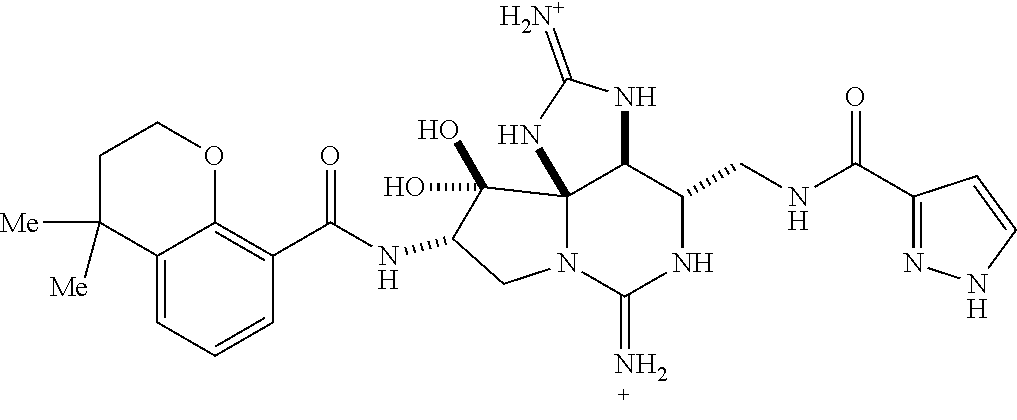 |
5 | 140 nM | 28 |
 |
4 | 6.5 | 1600 |
 |
477 | 81 | 170 |
 |
9 | 167 nM | 19 |
 |
164 | 95 | 580 |
 |
33 | 1.2 | 36 |
 |
5 | 5.3 | 1100 |
 |
160 | 32 | 200 |
 |
11 | 98 nM | 9 |
 |
10 | 3.2 | 320 |
 |
4 | 1.6 | 400 |
 |
140 | 475 | 3.4 |
 |
ND | ND | ND |
 |
4 | μM | 25 | 6.3 |
 |
13 | 1.2 | 92 |
 |
110 | 12 | 100 |
 |
100 | ND | ND |
 |
1.3 | μM | 75 | 58 |
 |
150 | 42 | 280 |
 |
9-37 | 1.3 | 40-150 |
 |
110 | 29 | 260 |
 |
2 | 7.8 | 3900 |
 |
90-180 | 9.37 | 50-100 |
 |
200 | 108 | 540 |
 |
20-50 | 23 | 500-1100 |
 |
110 | 2.8 | 25 |
 |
25 | <6.2 | <250 |
 |
13 | 1.5 | 120 |
 |
20 | 0.45 | 22 |
 |
4 | |
15 | 4 |
 |
2.4 | |
50 | 20 |
 |
36 | 18 | 500 |
 |
250 | 20 | 80 |
 |
2.9 | 520 | 180 |
 |
12 | 52 | 4300 |
 |
4-13 | 40 | 3,000-10,000 |
 |
6 | 6.1 | 1,000 |
 |
<5 | 40 | >8000 |
 |
300 | 4.6 | 15 |
 |
438 | 20 | ND |
 |
5600 | ND | ND |
 |
2900 | ND | ND |
 |
3500 | ND | ND |
 |
380 | 258 | ND |
 |
<16 | 35 | >2200 |
 |
41 | ND | ND |
 |
11 | 0.800 | 73 |
 |
200 | ND | ND |
 |
57 | 0.738 | 13 |
Claims (21)


Priority Applications (1)
| Application Number | Priority Date | Filing Date | Title |
|---|---|---|---|
| US17/282,744 US12162886B2 (en) | 2018-10-03 | 2019-10-03 | 11,13-modified saxitoxins for the treatment of pain |
Applications Claiming Priority (3)
| Application Number | Priority Date | Filing Date | Title |
|---|---|---|---|
| US201862740711P | 2018-10-03 | 2018-10-03 | |
| PCT/US2019/054588 WO2020072835A1 (en) | 2018-10-03 | 2019-10-03 | 11,13-modified saxitoxins for the treatment of pain |
| US17/282,744 US12162886B2 (en) | 2018-10-03 | 2019-10-03 | 11,13-modified saxitoxins for the treatment of pain |
Publications (2)
| Publication Number | Publication Date |
|---|---|
| US20220009938A1 US20220009938A1 (en) | 2022-01-13 |
| US12162886B2 true US12162886B2 (en) | 2024-12-10 |
Family
ID=68290394
Family Applications (1)
| Application Number | Title | Priority Date | Filing Date |
|---|---|---|---|
| US17/282,744 Active 2042-01-19 US12162886B2 (en) | 2018-10-03 | 2019-10-03 | 11,13-modified saxitoxins for the treatment of pain |
Country Status (3)
| Country | Link |
|---|---|
| US (1) | US12162886B2 (en) |
| EP (1) | EP3860714B1 (en) |
| WO (1) | WO2020072835A1 (en) |
Families Citing this family (25)
| Publication number | Priority date | Publication date | Assignee | Title |
|---|---|---|---|---|
| CA3058214A1 (en) | 2017-03-29 | 2018-10-04 | The Board Of Trustees Of The Leland Stanford Junior University | 11,13-modified saxitoxins for the treatment of pain |
| JP2020515611A (en) | 2017-03-29 | 2020-05-28 | サイトワン セラピューティクス, インコーポレイテッド | 11,13-Modified saxitoxin for the treatment of pain |
| EP3860714B1 (en) | 2018-10-03 | 2023-09-06 | Siteone Therapeutics, Inc. | 11,13-modified saxitoxins for the treatment of pain |
| PH12022551379A1 (en) | 2019-12-06 | 2023-05-03 | Vertex Pharma | Substituted tetrahydrofurans as modulators of sodium channels |
| AU2021271635A1 (en) * | 2020-05-12 | 2023-01-05 | The Trustees Of The University Of Pennsylvania | Compositions useful in treatment of krabbe disease |
| EP4196482B1 (en) * | 2020-08-14 | 2025-10-01 | SiteOne Therapeutics, Inc. | Non-hydrated ketone inhibitors of nav1.7 for the treatment of pain |
| CA3221939A1 (en) | 2021-06-04 | 2022-12-08 | Vertex Pharmaceuticals Incorporated | N-(hydroxyalkyl (hetero)aryl) tetrahydrofuran carboxamide analogs as modulators of sodium channels |
| SMT202600064T1 (en) | 2021-06-04 | 2026-03-09 | Vertex Pharma | Solid dosage forms and dosing regimens comprising (2r,3s,4s,5r)-4-[[3-(3,4-difluoro-2-methoxy-phenyl)-4,5-dimethyl-5-(trifluoromethyl) tetrahydrofuran-2-carbonyl]amino]pyridine-2-carboxamide |
| US20240368135A1 (en) | 2021-06-04 | 2024-11-07 | Vertex Pharmaceuticals Incorporated | Substituted tetrahydrofuran-2-carboxamides as modulators of sodium channels |
| CN117794918A (en) | 2021-06-04 | 2024-03-29 | 沃泰克斯药物股份有限公司 | Substituted tetrahydrofuran analogs as sodium channel modulators |
| WO2022256842A1 (en) | 2021-06-04 | 2022-12-08 | Vertex Pharmaceuticals Incorporated | Hydroxy and (halo)alkoxy substituted tetrahydrofurans as modulators of sodium channels |
| SI4347031T1 (en) | 2021-06-04 | 2026-01-30 | Vertex Pharmaceuticals Incorporated | N-(hydroxyalkyl (hetero)aryl) tetrahydrofuran carboxamides as modulators of sodium channels |
| AU2023257313A1 (en) | 2022-04-22 | 2024-10-31 | Vertex Pharmaceuticals Incorporated | Heteroaryl compounds for the treatment of pain |
| JP2025513455A (en) | 2022-04-22 | 2025-04-24 | バーテックス ファーマシューティカルズ インコーポレイテッド | Heteroaryl compounds for the treatment of pain - Patents.com |
| IL316422A (en) | 2022-04-22 | 2024-12-01 | Vertex Pharma | Heteroaryl compounds for the treatment of pain |
| AU2023255558A1 (en) | 2022-04-22 | 2024-10-31 | Vertex Pharmaceuticals Incorporated | Heteroaryl compounds for the treatment of pain |
| KR20250120351A (en) | 2022-12-06 | 2025-08-08 | 버텍스 파마슈티칼스 인코포레이티드 | Method for the synthesis of substituted tetrahydrofuran modulators of sodium channels |
| TW202535867A (en) | 2023-10-23 | 2025-09-16 | 美商維泰克斯製藥公司 | Methods of preparing modulators of sodium channels and solid forms of the same for treating pain |
| KR20260116140A (en) | 2023-10-23 | 2026-07-28 | 버텍스 파마슈티칼스 인코포레이티드 | Heteroaryl compounds for pain treatment |
| KR20260116141A (en) | 2023-10-23 | 2026-07-28 | 버텍스 파마슈티칼스 인코포레이티드 | Compound for pain treatment and method for preparing the same in solid form |
| KR20260118418A (en) | 2023-10-23 | 2026-07-30 | 버텍스 파마슈티칼스 인코포레이티드 | Heteroaryl compounds for pain treatment |
| AU2024393245A1 (en) | 2023-12-07 | 2026-06-18 | Vertex Pharmaceuticals Incorporated | Dosing regimens and formulations of suzetrigine for use in the treatment of acute and chronic pain |
| TW202606663A (en) | 2024-06-28 | 2026-02-16 | 美商維泰克斯製藥公司 | Heteroaryl compounds for the treatment of pain |
| LU605402B1 (en) | 2024-07-11 | 2026-07-14 | Sea4Us Biotecnologia E Recursos Marinhos Sa | Oxazolidone-derived compounds and their use in the treatment of chronic and acute pain |
| WO2026030525A1 (en) | 2024-07-31 | 2026-02-05 | Vertex Pharmaceuticals Incorporated | Zilvetrigine dosage forms and dosing regimens for treating pain |
Citations (27)
| Publication number | Priority date | Publication date | Assignee | Title |
|---|---|---|---|---|
| US3957996A (en) | 1971-12-08 | 1976-05-18 | Astra Pharmaceutical Products, Inc. | Pharmaceutical local anesthetic compositions |
| EP0857972A1 (en) | 1997-01-24 | 1998-08-12 | Tepual, S.A. | Immunoassay for the detection and quantitation of toxins causing paralytic shellfish poisoning |
| CN1192903A (en) | 1997-03-07 | 1998-09-16 | 潘心富 | Medicine of diguanidino-prine-hydride compounds for giving up drug-taking |
| US6030974A (en) | 1997-04-02 | 2000-02-29 | The Regents Of The University Of California | Method of anesthesia |
| US6326020B1 (en) | 1997-05-16 | 2001-12-04 | Children's Medical Center Corporation | Local anesthetic formulations |
| CN1363275A (en) | 2002-01-11 | 2002-08-14 | 中国科学院海洋研究所 | Application of paralytic PSP toxin in preparing antalgesic medicine |
| US20020161013A1 (en) | 2001-04-25 | 2002-10-31 | Wex Medical Intrumentation Co., Ltd. | Method of local anesthesia and analgesia |
| WO2003006507A1 (en) | 2001-07-04 | 2003-01-23 | Japan Science And Technology Corporation | Method of preparing antinarcotic shellfish toxin antibody, novel antibody, elisa kit with the use of the antibody and labelled toxin sample prepared by the method |
| US20050137177A1 (en) | 2003-12-18 | 2005-06-23 | Shafer Steven L. | Ester combination local anesthetic |
| US20050202093A1 (en) | 2002-12-02 | 2005-09-15 | Kohane Daniel S. | Prolonged suppression of electrical activity in excitable tissues |
| US20060057647A1 (en) | 2003-02-12 | 2006-03-16 | Robillot Cedic Emile F | Detection and identification of saxiphilins using saxitoxin-biotin conjugates |
| WO2006032459A1 (en) | 2004-09-22 | 2006-03-30 | Laboratorios Del Dr. Esteve S.A. | Tetrodotoxin and its derivatives for the treatment of peripheral-nervously derived neuropathic pain |
| WO2006119499A2 (en) | 2005-05-05 | 2006-11-09 | Phytotox Limited | Use of phycotoxins in veterinary applications |
| US20070280970A1 (en) | 2004-05-07 | 2007-12-06 | Phytotox Limited | Methods of Treating Wounds With Gonyautoxins |
| US20080045553A1 (en) | 2004-05-07 | 2008-02-21 | Phytotox Limited | Transdermal Administration of Phycotoxins |
| US7576202B2 (en) | 2004-12-27 | 2009-08-18 | Institut Molekulyarnoi Genetiki Rossiiskoi Akademh Nauk (Img Ran) | Tritium-traced saxitoxin dihydrochloride and method for the production thereof |
| CN101513408A (en) | 2008-02-19 | 2009-08-26 | 熊平 | Novel application of preparation of diguanidino-prine derivatives in improving drug effects of anti-cancer drugs |
| WO2010027641A2 (en) | 2008-08-15 | 2010-03-11 | Georgetown University | Na channels, disease, and related assays and compositions |
| US20100284913A1 (en) | 2009-05-07 | 2010-11-11 | The Board Of Trustees Of The Leland Stanford Junio | Methods and compositions for studying, imaging, and treating pain |
| WO2011098539A1 (en) | 2010-02-10 | 2011-08-18 | Phytotox Limited | Treatment of loss of sense of touch with saxitoxin derivatives |
| WO2012116440A1 (en) | 2011-03-03 | 2012-09-07 | Zalicus Pharmaceuticals Ltd. | Benzimidazole inhibitors of the sodium channel |
| WO2015157559A2 (en) | 2014-04-09 | 2015-10-15 | Siteone Therapeutics, Inc. | 10',11'-modified saxitoxins for the treatment of pain |
| WO2017059385A1 (en) | 2015-09-30 | 2017-04-06 | Siteone Therapeutics, Inc. | 11,13-modified saxitoxins for the treatment of pain |
| WO2018183782A1 (en) | 2017-03-29 | 2018-10-04 | Siteone Therapeutics, Inc. | 11,13-modified saxitoxins for the treatment of pain |
| WO2020072835A1 (en) | 2018-10-03 | 2020-04-09 | Siteone Therapeutics, Inc. | 11,13-modified saxitoxins for the treatment of pain |
| US11236097B2 (en) | 2017-03-29 | 2022-02-01 | Siteone Therapeutics, Inc. | 11,13-modified saxitoxins for the treatment of pain |
| WO2022036297A1 (en) | 2020-08-14 | 2022-02-17 | Siteone Therapeutics, Inc. | Non-hydrated ketone inhibitors of nav1.7 for the treatment of pain |
Family Cites Families (30)
| Publication number | Priority date | Publication date | Assignee | Title |
|---|---|---|---|---|
| US3536809A (en) | 1969-02-17 | 1970-10-27 | Alza Corp | Medication method |
| US3598123A (en) | 1969-04-01 | 1971-08-10 | Alza Corp | Bandage for administering drugs |
| US3845770A (en) | 1972-06-05 | 1974-11-05 | Alza Corp | Osmatic dispensing device for releasing beneficial agent |
| US3916899A (en) | 1973-04-25 | 1975-11-04 | Alza Corp | Osmotic dispensing device with maximum and minimum sizes for the passageway |
| US4008719A (en) | 1976-02-02 | 1977-02-22 | Alza Corporation | Osmotic system having laminar arrangement for programming delivery of active agent |
| KR890002631B1 (en) | 1984-10-04 | 1989-07-21 | 몬산토 캄파니 | Composition of prolonged release of biologically active somatotropin |
| IE58110B1 (en) | 1984-10-30 | 1993-07-14 | Elan Corp Plc | Controlled release powder and process for its preparation |
| US5073543A (en) | 1988-07-21 | 1991-12-17 | G. D. Searle & Co. | Controlled release formulations of trophic factors in ganglioside-lipsome vehicle |
| IT1229203B (en) | 1989-03-22 | 1991-07-25 | Bioresearch Spa | USE OF 5 METHYLTHETRAHYDROPHOLIC ACID, 5 FORMYLTHETRAHYDROPHOLIC ACID AND THEIR PHARMACEUTICALLY ACCEPTABLE SALTS FOR THE PREPARATION OF PHARMACEUTICAL COMPOSITIONS IN THE FORM OF CONTROLLED RELEASE ACTIVE IN THE THERAPY OF MENTAL AND ORGANIC DISORDERS. |
| PH30995A (en) | 1989-07-07 | 1997-12-23 | Novartis Inc | Sustained release formulations of water soluble peptides. |
| US5120548A (en) | 1989-11-07 | 1992-06-09 | Merck & Co., Inc. | Swelling modulated polymeric drug delivery device |
| US5733566A (en) | 1990-05-15 | 1998-03-31 | Alkermes Controlled Therapeutics Inc. Ii | Controlled release of antiparasitic agents in animals |
| US5580578A (en) | 1992-01-27 | 1996-12-03 | Euro-Celtique, S.A. | Controlled release formulations coated with aqueous dispersions of acrylic polymers |
| TW333456B (en) | 1992-12-07 | 1998-06-11 | Takeda Pharm Ind Co Ltd | A pharmaceutical composition of sustained-release preparation the invention relates to a pharmaceutical composition of sustained-release preparation which comprises a physiologically active peptide. |
| US5591767A (en) | 1993-01-25 | 1997-01-07 | Pharmetrix Corporation | Liquid reservoir transdermal patch for the administration of ketorolac |
| US6087324A (en) | 1993-06-24 | 2000-07-11 | Takeda Chemical Industries, Ltd. | Sustained-release preparation |
| IT1270594B (en) | 1994-07-07 | 1997-05-07 | Recordati Chem Pharm | CONTROLLED RELEASE PHARMACEUTICAL COMPOSITION OF LIQUID SUSPENSION MOGUISTEIN |
| DE69632684T2 (en) | 1995-06-27 | 2005-06-09 | Takeda Pharmaceutical Co. Ltd. | PROCESS FOR PREPARING PREPARED DELETION PREPARATIONS |
| TW448055B (en) | 1995-09-04 | 2001-08-01 | Takeda Chemical Industries Ltd | Method of production of sustained-release preparation |
| JP2909418B2 (en) | 1995-09-18 | 1999-06-23 | 株式会社資生堂 | Delayed release microsphere of drug |
| US5980945A (en) | 1996-01-16 | 1999-11-09 | Societe De Conseils De Recherches Et D'applications Scientifique S.A. | Sustained release drug formulations |
| US6264970B1 (en) | 1996-06-26 | 2001-07-24 | Takeda Chemical Industries, Ltd. | Sustained-release preparation |
| US6419961B1 (en) | 1996-08-29 | 2002-07-16 | Takeda Chemical Industries, Ltd. | Sustained release microcapsules of a bioactive substance and a biodegradable polymer |
| CA2217134A1 (en) | 1996-10-09 | 1998-04-09 | Sumitomo Pharmaceuticals Co., Ltd. | Sustained release formulation |
| ES2221019T3 (en) | 1996-10-31 | 2004-12-16 | Takeda Chemical Industries, Ltd. | PREPARATION OF MAINTENANCE RELEASE. |
| EP0946169B1 (en) | 1996-12-20 | 2003-02-26 | Takeda Chemical Industries, Ltd. | Method of producing a sustained-release preparation |
| US5891474A (en) | 1997-01-29 | 1999-04-06 | Poli Industria Chimica, S.P.A. | Time-specific controlled release dosage formulations and method of preparing same |
| US6613358B2 (en) | 1998-03-18 | 2003-09-02 | Theodore W. Randolph | Sustained-release composition including amorphous polymer |
| KR19990085365A (en) | 1998-05-16 | 1999-12-06 | 허영섭 | Biodegradable polymer microspheres capable of continuously controlled controlled release and preparation method thereof |
| US6248363B1 (en) | 1999-11-23 | 2001-06-19 | Lipocine, Inc. | Solid carriers for improved delivery of active ingredients in pharmaceutical compositions |
-
2019
- 2019-10-03 EP EP19790405.5A patent/EP3860714B1/en active Active
- 2019-10-03 US US17/282,744 patent/US12162886B2/en active Active
- 2019-10-03 WO PCT/US2019/054588 patent/WO2020072835A1/en not_active Ceased
Patent Citations (38)
| Publication number | Priority date | Publication date | Assignee | Title |
|---|---|---|---|---|
| US3957996A (en) | 1971-12-08 | 1976-05-18 | Astra Pharmaceutical Products, Inc. | Pharmaceutical local anesthetic compositions |
| EP0857972A1 (en) | 1997-01-24 | 1998-08-12 | Tepual, S.A. | Immunoassay for the detection and quantitation of toxins causing paralytic shellfish poisoning |
| CN1192903A (en) | 1997-03-07 | 1998-09-16 | 潘心富 | Medicine of diguanidino-prine-hydride compounds for giving up drug-taking |
| US6030974A (en) | 1997-04-02 | 2000-02-29 | The Regents Of The University Of California | Method of anesthesia |
| US6326020B1 (en) | 1997-05-16 | 2001-12-04 | Children's Medical Center Corporation | Local anesthetic formulations |
| US20020161013A1 (en) | 2001-04-25 | 2002-10-31 | Wex Medical Intrumentation Co., Ltd. | Method of local anesthesia and analgesia |
| WO2003006507A1 (en) | 2001-07-04 | 2003-01-23 | Japan Science And Technology Corporation | Method of preparing antinarcotic shellfish toxin antibody, novel antibody, elisa kit with the use of the antibody and labelled toxin sample prepared by the method |
| CN1363275A (en) | 2002-01-11 | 2002-08-14 | 中国科学院海洋研究所 | Application of paralytic PSP toxin in preparing antalgesic medicine |
| US20050202093A1 (en) | 2002-12-02 | 2005-09-15 | Kohane Daniel S. | Prolonged suppression of electrical activity in excitable tissues |
| US20060057647A1 (en) | 2003-02-12 | 2006-03-16 | Robillot Cedic Emile F | Detection and identification of saxiphilins using saxitoxin-biotin conjugates |
| US20050137177A1 (en) | 2003-12-18 | 2005-06-23 | Shafer Steven L. | Ester combination local anesthetic |
| US20070280970A1 (en) | 2004-05-07 | 2007-12-06 | Phytotox Limited | Methods of Treating Wounds With Gonyautoxins |
| US20080021051A1 (en) | 2004-05-07 | 2008-01-24 | Phytotox Limited | Phycotoxins and Uses Thereof |
| US20080045553A1 (en) | 2004-05-07 | 2008-02-21 | Phytotox Limited | Transdermal Administration of Phycotoxins |
| WO2006032459A1 (en) | 2004-09-22 | 2006-03-30 | Laboratorios Del Dr. Esteve S.A. | Tetrodotoxin and its derivatives for the treatment of peripheral-nervously derived neuropathic pain |
| US7576202B2 (en) | 2004-12-27 | 2009-08-18 | Institut Molekulyarnoi Genetiki Rossiiskoi Akademh Nauk (Img Ran) | Tritium-traced saxitoxin dihydrochloride and method for the production thereof |
| WO2006119499A2 (en) | 2005-05-05 | 2006-11-09 | Phytotox Limited | Use of phycotoxins in veterinary applications |
| CN101513408A (en) | 2008-02-19 | 2009-08-26 | 熊平 | Novel application of preparation of diguanidino-prine derivatives in improving drug effects of anti-cancer drugs |
| WO2010027641A2 (en) | 2008-08-15 | 2010-03-11 | Georgetown University | Na channels, disease, and related assays and compositions |
| WO2010129864A2 (en) | 2009-05-07 | 2010-11-11 | The Board Of Trustees Of The Leland Stanford Junior University | Methods and compositions for studying, imaging, and treating pain |
| US9174999B2 (en) | 2009-05-07 | 2015-11-03 | The Board Of Trustees Of The Leland Stanford Junior University | Methods and compositions for studying, imaging, and treating pain |
| US20160115173A1 (en) | 2009-05-07 | 2016-04-28 | The Board Of Trustees Of The Leland Stanford Junior University | Methods and compositions for studying, imaging, and treating pain |
| US20100284913A1 (en) | 2009-05-07 | 2010-11-11 | The Board Of Trustees Of The Leland Stanford Junio | Methods and compositions for studying, imaging, and treating pain |
| US10513525B2 (en) | 2009-05-07 | 2019-12-24 | The Board Of Trustees Of The Leland Stanford Junior University | Methods and compositions for studying, imaging, and treating pain |
| WO2011098539A1 (en) | 2010-02-10 | 2011-08-18 | Phytotox Limited | Treatment of loss of sense of touch with saxitoxin derivatives |
| WO2012116440A1 (en) | 2011-03-03 | 2012-09-07 | Zalicus Pharmaceuticals Ltd. | Benzimidazole inhibitors of the sodium channel |
| US10106549B2 (en) | 2014-04-09 | 2018-10-23 | Siteone Therapeutics, Inc. | 10′,11′-modified saxitoxins useful for the treatment of pain |
| WO2015157559A2 (en) | 2014-04-09 | 2015-10-15 | Siteone Therapeutics, Inc. | 10',11'-modified saxitoxins for the treatment of pain |
| US20170029431A1 (en) | 2014-04-09 | 2017-02-02 | Siteone Therapeutics, Inc. | 10',11'-modified saxitoxins useful for the treatment of pain |
| WO2017059385A1 (en) | 2015-09-30 | 2017-04-06 | Siteone Therapeutics, Inc. | 11,13-modified saxitoxins for the treatment of pain |
| US10112953B2 (en) | 2015-09-30 | 2018-10-30 | Siteone Therapeutics, Inc. | 11,13-modified saxitoxins for the treatment of pain |
| US20170233398A1 (en) | 2015-09-30 | 2017-08-17 | Siteone Therapeutics, Inc. | 11,13-modified saxitoxins for the treatment of pain |
| WO2018183782A1 (en) | 2017-03-29 | 2018-10-04 | Siteone Therapeutics, Inc. | 11,13-modified saxitoxins for the treatment of pain |
| US20200102317A1 (en) | 2017-03-29 | 2020-04-02 | Siteone Therapeutics, Inc. | 11,13-modified saxitoxins for the treatment of pain |
| US11236097B2 (en) | 2017-03-29 | 2022-02-01 | Siteone Therapeutics, Inc. | 11,13-modified saxitoxins for the treatment of pain |
| US20220259218A1 (en) | 2017-03-29 | 2022-08-18 | Siteone Therapeutics, Inc. | 11,13-modified saxitoxins for the treatment of pain |
| WO2020072835A1 (en) | 2018-10-03 | 2020-04-09 | Siteone Therapeutics, Inc. | 11,13-modified saxitoxins for the treatment of pain |
| WO2022036297A1 (en) | 2020-08-14 | 2022-02-17 | Siteone Therapeutics, Inc. | Non-hydrated ketone inhibitors of nav1.7 for the treatment of pain |
Non-Patent Citations (57)
| Title |
|---|
| Akimoto et al. "Synthesis of Saxitoxin Derivatives Bearing Guanidine and Urea Groups at C13 and Evaluation of their Inhibitory Activity on Voltage-Gated Sodium Channels," Org. Biomol. Chem., 2013, 11(38), 6642-6649. |
| Anderson, et al., "Voltage-Gated Sodium Channel Blockers as Cytostatic Inhibitors of the Androgen-Independent Prostate Cancer Cell Line PC-3", Mol. Cancer Ther., Nov. 14, 2003, vol. 2, pp. 1149-1154. |
| Arakawa et al., "A New Saxitoxin Analogue from a Xanthid Crab Atergatis Floridus", Toxicon, 1995, vol. 33, pp. 1577-1584. |
| Arakawa et al., "Occurrence of carbamoyl-N-hydroxy derivatives of saxitoxin and neosaxitoxin in a xanthid crab Zosimus aeneus", Toxicon, 1994, vol. 32, pp. 175-183. |
| Bennett et al., "Contribution of Sialic Acid to the Voltage Dependence of Sodium Channel Gating", J. Gen. Physiol., Mar. 1997, vol. 109, No. 3, pp. 327-343. |
| Biotinylation web site (http://www.piercenet.com/browse.cfm?fldID=84EBE112-F871-4CA5-807F-47327153CFCB retrieved Apr. 5, 2012). |
| Biswal et al. "Molecular Imaging: Integration of Molecular Imaging into the Musculoskeletal Imaging Practice", Radiology 244(3):651-671 (2007). |
| Bundgaard, Design of Prodrugs, 1985, Elsevier, Chapter 1, p. 1-4. |
| Cox et al., "An SCN9A channelopathy causes congenital inability to experience pain," Nature, vol. 444, Dec. 14, 2006, pp. 894-898. |
| De Lera Ruiz et al. "Voltage-Gated Sodium Channels: Structure, Function, Pharmacology, and Clinical Indications," Journal of Medicinal Chemistry, J. Med. Chem. 2015, 58, 7093-7118,; DOI: 10.1021/jm501981g. |
| Dell'Aversano et al., "Isolation and Structure Elucidation of New and Unusual Saxitoxin Analogues from Mussels," Journal of Natural Products, 2008, vol. 71, pp. 1518-1523. |
| Devigili et al., "Paroxysmal itch caused by gain-of-function Nav1.7 mutation," Pain 2014, 155(9), pp. 1702-1707. |
| Dib-Hajj et al. "From genes to pain: Na v 1.7 and human pain disorders", Trends Neurosci. 30(11):555-563, (2007). |
| Dorr et al. "Intriguing differences in the gas-phase dissociation behavior of protonated and deprotonated gonyautoxin epimers", J. American Society Mass. Spec. 22:2011-2020. |
| Fleming et al. "(+)-Saxitoxin: A First and Second Generation Stereoselective Synthesis", J. Am. Chemical Society, 2007, vol. 129, pp. 9964-9975. |
| Fleming et al. "A synthesis of (+)-saxitoxin", J. Am. Chem. Soc. 128:3926-3927 (2006). |
| Goldberg et al. "Loss-of-function mutations in the Nav1.7 gene underlie congenital indifference to pain in multiple human populations", Clinical Genetics 71(4):311-319 (2007). |
| Hall et al., "Dinoflagellate Neurotoxins Related to Saxitoxin: structures of toxins C3 and C4, and confirmation of the structure of neosaxitoxin", Tet Lett, 1984; vol. 25, pp. 3537-3538. |
| Han, Targeted Prodrug Design to Optimize Drug Deliver, 2000, AAPS Pharmsci, vol. 2(1), p. 1-11. |
| Harada et al., "Natural Occurrence Of Decarbamoylsaxitoxin in Tropical Dinoflagellate and Bivalves", Agric Biol Chem, 1983; vol. 47, pp. 191-193. |
| International Search Report and Written Opinion for PCT/US2018/025301 mailed on Jul. 2, 2018, 8 pages. |
| Iwamoto et al., "Total synthesis of (−)- and (+)-decarbamoyloxysaxitoxin and (+)-saxitoxin", Chem Asian J, 2009, vol. 4, pp. 277-285. |
| Jacobi et al., "Total Synthesis of +/− Saxitoxin", J Am Chem Soc, 1984, vol. 106, pp. 5594-5598. |
| Klugbauer et al, "Structure and Functional Expression of a New Member of the Tetrodotoxin-Sensitive Voltageactivated Sodium Channel Family From Human Neuroendocrine Cells", The EMBO Journal, 1995, vol. 14 No. 6, pp. 1084-1090. |
| Koehn Fe et al., "Dinoflagellate Neurotoxins Related to Saxitoxin: Structure and Latent Activity of Toxins B1 and B2", Tetrahedron Letters, 1982; vol. 23, pp. 2247-2248. |
| Llewellyn Le, "Saxitoxin, a Toxic Marine Natural Product that Targets a Multitude of Receptors", Nat Prod Rep, 2006, vol. 23, pp. 200-222. |
| Mao et al., "Novel modulator of NaV1.1 and NaV1.2 Na+ channels in rat neuronal cells", Med Chem Lett, 2010, vol. 1, pp. 135-138. |
| Momin et al., "Sensory Neuron Voltage-Gated Sodium Channels as Analgesic Drug Targets", Current Opinion in Neurobiology, 2008, vol. 18, pp. 383-388. |
| Mulcahy et al. "Challenges and Opportunities for Therapeutics Targeting the Voltage-Gated Sodium Channel Isoform Nav1.7," J. Med. Chem. 2019, 62(19), 8695-8710. |
| Mulcahy et al. "Synthesis of the Paralytic Shellfish Poisons (+)-Gonyautoxin 2, (+)-Gonyautoxin 3, and (+)-11,11-Dihydroxysaxitoxin," J. Am. Chem. Soc. 2016, 138(18), 5994-6001. |
| Mulcahy et al., "A Stereoselective Synthesis of (+)-Gonyautoxin 3", J Am Chem Soc., Sep. 24, 2008; vol. 130, No. 38, pp. 12630-12631. |
| Muroi et al. "Selective silencing of NaV1.7 decreases excitability and conduction in vagal sensory neurons," J. Physiol. 589.23 pp. 5663-5676, 2011, 14 pages. |
| Negri et al., "Three Novel Hydroxybenzoate Saxitoxin Analogues Isolated From the Dinoflagellate Gymnodinium Catenatum", Chem Res Toxicol, 2003, vol. 16, pp. 1029-1033. |
| Nishikawa et al., "Synthesis of an Advanced Model of Zetekitoxin AB Focusing on the N-Acylisoxazolidine Amide Structure Corresponding to C13-C17", Asian Journal of Organic Chemistry, Oct. 23, 2014, vol. 3, No. 12, pp. 1308-1311. |
| Ogata et al., "Molecular Diversity of Structure and Function of the Voltage-Gated Na+ Channels", Jpn. J. Pharmacol., 2002, vol. 88, pp. 365-377. |
| Onodera et al., "New Saxitoxin Analogues from the Freshwater Filamentous Cyanobacterium Lyngbya wollei", Natural Toxins, 1997, vol. 5, pp. 146-151. |
| Parkinson's Disease, Mayo Clinic, Symptoms and Causes, pp. 1-3, retrieved from internet Jan. 14, 2021. |
| Pergolizzi Jr. et al., "Treating Acute Pain in Light of thre Chronifiction of Pain," Pain Management Nursing, (2014), vol. 15, No. 1 pp. 380-390, http://dx.doi.org/10.1016/j.pmn.2012.07.004. |
| Robillot et al., "Synthesis of Bifunctional Saxitoxin Analogues by Biotinylation", Toxicon, 2009; vol. 53, pp. 460-465. |
| Rush et al. "Multiple Sodium Channels and their Roles in electrogenesis within Dorsal Root Ganglion Neurons", J. Physiol, 2007, 579 (Pt 1), pp. 1-14. |
| Sato et al., "Identification of Thioether Intermediates in the Reductive Transformation of Gonyautoxins Into Saxitoxins by Thiols", Bioorganic & Medicinal Chemistry Letters, vol. 10, No. 6, Aug. 21, 2000, pp. 1787-1789. |
| Schlager et al., "Micromole scale biotinylation of saxitoxin (STX) for use as a screening moiety for peptide binding libraries", Medical Defense Bioscience Proceedings, May 16, 1996, vol. 12, No. 3, pp. 1590-1597. |
| Shi et al. "The recent research progress of chemistry of marin natural products," Acta Pharmaceutica Sinica, 2010, vol. 45, No. 10, pp. 1212-1223. |
| Shimizu et al., "Isolation of Side-Chain Sulfated Saxitoxin Analogs", Tetrahedron, 1984; vol. 40, pp. 539-544. |
| Shimizu et al., Structure of Saxitoxin in Solutions and Stereochemistry of Dihydrosaxitoxins. J Am Chem Soc, 1981, vol. 103, pp. 605-609. |
| Shimuzu et al., "Toxigenesis and Biosynthesis of Saxitoxin Analogues," Pure and Applied Chemistry, 1986, vol. 58, No. 2, pp. 257-262. |
| Strichartz GR et al., "The Potencies of Synthetic Analogues of Saxitoxin and the Absolute Stereoselectivity of Decarbamoyl Saxitoxin", Toxicon, 1995, vol. 33, pp. 723-737. |
| Tanino et al., "A Stereospecific Total Synthesis of d,l-Saxitoxin", J Am Chem Soc, 1977, vol. 99, pp. 2818-2819. |
| Vale P., "Metabolites of Saxitoxin Analogues in Bivalves Contaminated by Gymnodinium Catenatum", Toxicon, 2010; vol. 55, pp. 162-165. |
| Vale P., "New Saxitoxin Analogues in the Marine Environment: Developments in Toxin Chemistry, Detection and Biotransformation During the 2000s", Phytochem Rev, 2010, vol. 9, pp. 525-535. |
| Voscopoulos et al. "When does acute pain become chronic?" British Journal of Anaesthesia 105 (S1): i69-i85 (2010); doi:10.1093/bja/aeq323. |
| Walls, et al., "Synthesis and Biological Evaluation of a Fluorescent Analog of Phenytoin as a Potential Inhibitor of Neuropathic Pain and Imaging Agent", Bioorg. Med. Chem., Jul. 3, 2012, vol. 20, pp. 5269-5276. |
| Watanabe et al., "Development of Saxitoxin-Conjugated Affinity Gels" Bioconjugate Chem., 17:459-465 (2006). |
| Waxman, Stephen G., "A Channel Sets the Gain on Pain" Nature, 444:831-832 (2006). |
| West, Anthony R., Solid State Chemistry and it's Applications, Wiley, New York, 1988, p. 358 and p. 365. |
| Yotsu-Yamashita et al., "The Structure of Zetekitoxin Ab, a Saxitoxin Analog From the Panamian Golden Frog Atelopus Zeteki: A Potent Sodium-Channel Blocker", PNAS, 2004; vol. 101, pp. 4346-4351. |
| Zaman et al., "Occurrence of a Methyl Derivative of Saxitoxin In Bangladeshi Freshwater Puffers", Toxicon, 1998, vol. 36, pp. 627-630. |
Also Published As
| Publication number | Publication date |
|---|---|
| EP3860714B1 (en) | 2023-09-06 |
| EP3860714A1 (en) | 2021-08-11 |
| US20220009938A1 (en) | 2022-01-13 |
| WO2020072835A1 (en) | 2020-04-09 |
Similar Documents
| Publication | Publication Date | Title |
|---|---|---|
| EP3860714B1 (en) | 11,13-modified saxitoxins for the treatment of pain | |
| US11834456B2 (en) | 11,13-modified saxitoxins for the treatment of pain | |
| EP4196482B1 (en) | Non-hydrated ketone inhibitors of nav1.7 for the treatment of pain | |
| US11279706B2 (en) | 11,13-modified saxitoxins for the treatment of pain | |
| US10112953B2 (en) | 11,13-modified saxitoxins for the treatment of pain | |
| US10106549B2 (en) | 10′,11′-modified saxitoxins useful for the treatment of pain | |
| EA051377B1 (en) | Non-Hydrated NAV1.7 Ketone Inhibitors for Pain Management |
Legal Events
| Date | Code | Title | Description |
|---|---|---|---|
| FEPP | Fee payment procedure |
Free format text: ENTITY STATUS SET TO UNDISCOUNTED (ORIGINAL EVENT CODE: BIG.); ENTITY STATUS OF PATENT OWNER: LARGE ENTITY |
|
| STPP | Information on status: patent application and granting procedure in general |
Free format text: DOCKETED NEW CASE - READY FOR EXAMINATION |
|
| AS | Assignment |
Owner name: SITEONE THERAPEUTICS, INC., CALIFORNIA Free format text: ASSIGNMENT OF ASSIGNORS INTEREST;ASSIGNORS:PAJOUHESH, HASSAN;ZHOU, XIANG;MULCAHY, JOHN;SIGNING DATES FROM 20211105 TO 20211130;REEL/FRAME:058985/0398 |
|
| STPP | Information on status: patent application and granting procedure in general |
Free format text: NON FINAL ACTION MAILED |
|
| STPP | Information on status: patent application and granting procedure in general |
Free format text: RESPONSE TO NON-FINAL OFFICE ACTION ENTERED AND FORWARDED TO EXAMINER |
|
| STPP | Information on status: patent application and granting procedure in general |
Free format text: NOTICE OF ALLOWANCE MAILED -- APPLICATION RECEIVED IN OFFICE OF PUBLICATIONS |
|
| STCF | Information on status: patent grant |
Free format text: PATENTED CASE |
|
| FEPP | Fee payment procedure |
Free format text: ENTITY STATUS SET TO SMALL (ORIGINAL EVENT CODE: SMAL); ENTITY STATUS OF PATENT OWNER: SMALL ENTITY |