US12159031B2 - Method and apparatus for returning memory - Google Patents

Method and apparatus for returning memory Download PDF

Info

Publication number
US12159031B2
US12159031B2 US17/943,901 US202217943901A US12159031B2 US 12159031 B2 US12159031 B2 US 12159031B2 US 202217943901 A US202217943901 A US 202217943901A US 12159031 B2 US12159031 B2 US 12159031B2
Authority
US
United States
Prior art keywords
memory
execution
amount
foreground
memory usage
Prior art date
Legal status (The legal status is an assumption and is not a legal conclusion. Google has not performed a legal analysis and makes no representation as to the accuracy of the status listed.)
Active, expires
Application number
US17/943,901
Other versions
US20230168807A1 (en
Inventor
Jungseung LEE
Huijin PARK
Current Assignee (The listed assignees may be inaccurate. Google has not performed a legal analysis and makes no representation or warranty as to the accuracy of the list.)
Samsung Electronics Co Ltd
Original Assignee
Samsung Electronics Co Ltd
Priority date (The priority date is an assumption and is not a legal conclusion. Google has not performed a legal analysis and makes no representation as to the accuracy of the date listed.)
Filing date
Publication date
Priority claimed from KR1020210167833A external-priority patent/KR20230080535A/en
Application filed by Samsung Electronics Co Ltd filed Critical Samsung Electronics Co Ltd
Assigned to SAMSUNG ELECTRONICS CO., LTD. reassignment SAMSUNG ELECTRONICS CO., LTD. ASSIGNMENT OF ASSIGNORS INTEREST (SEE DOCUMENT FOR DETAILS). Assignors: LEE, Jungseung, PARK, Huijin
Publication of US20230168807A1 publication Critical patent/US20230168807A1/en
Application granted granted Critical
Publication of US12159031B2 publication Critical patent/US12159031B2/en
Active legal-status Critical Current
Adjusted expiration legal-status Critical

Links

Images

Classifications

    • GPHYSICS
    • G06COMPUTING OR CALCULATING; COUNTING
    • G06FELECTRIC DIGITAL DATA PROCESSING
    • G06F9/00Arrangements for program control, e.g. control units
    • G06F9/06Arrangements for program control, e.g. control units using stored programs, i.e. using an internal store of processing equipment to receive or retain programs
    • G06F9/46Multiprogramming arrangements
    • G06F9/50Allocation of resources, e.g. of the central processing unit [CPU]
    • G06F9/5005Allocation of resources, e.g. of the central processing unit [CPU] to service a request
    • G06F9/5011Allocation of resources, e.g. of the central processing unit [CPU] to service a request the resources being hardware resources other than CPUs, Servers and Terminals
    • G06F9/5022Mechanisms to release resources
    • GPHYSICS
    • G06COMPUTING OR CALCULATING; COUNTING
    • G06FELECTRIC DIGITAL DATA PROCESSING
    • G06F13/00Interconnection of, or transfer of information or other signals between, memories, input/output devices or central processing units
    • G06F13/14Handling requests for interconnection or transfer
    • G06F13/16Handling requests for interconnection or transfer for access to memory bus
    • G06F13/18Handling requests for interconnection or transfer for access to memory bus based on priority control
    • GPHYSICS
    • G06COMPUTING OR CALCULATING; COUNTING
    • G06FELECTRIC DIGITAL DATA PROCESSING
    • G06F3/00Input arrangements for transferring data to be processed into a form capable of being handled by the computer; Output arrangements for transferring data from processing unit to output unit, e.g. interface arrangements
    • G06F3/06Digital input from, or digital output to, record carriers, e.g. RAID, emulated record carriers or networked record carriers
    • GPHYSICS
    • G06COMPUTING OR CALCULATING; COUNTING
    • G06FELECTRIC DIGITAL DATA PROCESSING
    • G06F3/00Input arrangements for transferring data to be processed into a form capable of being handled by the computer; Output arrangements for transferring data from processing unit to output unit, e.g. interface arrangements
    • G06F3/06Digital input from, or digital output to, record carriers, e.g. RAID, emulated record carriers or networked record carriers
    • G06F3/0601Interfaces specially adapted for storage systems
    • G06F3/0602Interfaces specially adapted for storage systems specifically adapted to achieve a particular effect
    • G06F3/0604Improving or facilitating administration, e.g. storage management
    • GPHYSICS
    • G06COMPUTING OR CALCULATING; COUNTING
    • G06FELECTRIC DIGITAL DATA PROCESSING
    • G06F3/00Input arrangements for transferring data to be processed into a form capable of being handled by the computer; Output arrangements for transferring data from processing unit to output unit, e.g. interface arrangements
    • G06F3/06Digital input from, or digital output to, record carriers, e.g. RAID, emulated record carriers or networked record carriers
    • G06F3/0601Interfaces specially adapted for storage systems
    • G06F3/0628Interfaces specially adapted for storage systems making use of a particular technique
    • G06F3/0629Configuration or reconfiguration of storage systems
    • G06F3/0631Configuration or reconfiguration of storage systems by allocating resources to storage systems
    • GPHYSICS
    • G06COMPUTING OR CALCULATING; COUNTING
    • G06FELECTRIC DIGITAL DATA PROCESSING
    • G06F3/00Input arrangements for transferring data to be processed into a form capable of being handled by the computer; Output arrangements for transferring data from processing unit to output unit, e.g. interface arrangements
    • G06F3/06Digital input from, or digital output to, record carriers, e.g. RAID, emulated record carriers or networked record carriers
    • G06F3/0601Interfaces specially adapted for storage systems
    • G06F3/0628Interfaces specially adapted for storage systems making use of a particular technique
    • G06F3/0653Monitoring storage devices or systems
    • GPHYSICS
    • G06COMPUTING OR CALCULATING; COUNTING
    • G06FELECTRIC DIGITAL DATA PROCESSING
    • G06F3/00Input arrangements for transferring data to be processed into a form capable of being handled by the computer; Output arrangements for transferring data from processing unit to output unit, e.g. interface arrangements
    • G06F3/06Digital input from, or digital output to, record carriers, e.g. RAID, emulated record carriers or networked record carriers
    • G06F3/0601Interfaces specially adapted for storage systems
    • G06F3/0668Interfaces specially adapted for storage systems adopting a particular infrastructure
    • G06F3/0671In-line storage system
    • G06F3/0673Single storage device
    • GPHYSICS
    • G06COMPUTING OR CALCULATING; COUNTING
    • G06FELECTRIC DIGITAL DATA PROCESSING
    • G06F9/00Arrangements for program control, e.g. control units
    • G06F9/06Arrangements for program control, e.g. control units using stored programs, i.e. using an internal store of processing equipment to receive or retain programs
    • G06F9/46Multiprogramming arrangements
    • G06F9/50Allocation of resources, e.g. of the central processing unit [CPU]
    • G06F9/5005Allocation of resources, e.g. of the central processing unit [CPU] to service a request
    • G06F9/5011Allocation of resources, e.g. of the central processing unit [CPU] to service a request the resources being hardware resources other than CPUs, Servers and Terminals
    • G06F9/5016Allocation of resources, e.g. of the central processing unit [CPU] to service a request the resources being hardware resources other than CPUs, Servers and Terminals the resource being the memory
    • GPHYSICS
    • G06COMPUTING OR CALCULATING; COUNTING
    • G06FELECTRIC DIGITAL DATA PROCESSING
    • G06F2209/00Indexing scheme relating to G06F9/00
    • G06F2209/50Indexing scheme relating to G06F9/50
    • G06F2209/5019Workload prediction
    • GPHYSICS
    • G06COMPUTING OR CALCULATING; COUNTING
    • G06FELECTRIC DIGITAL DATA PROCESSING
    • G06F3/00Input arrangements for transferring data to be processed into a form capable of being handled by the computer; Output arrangements for transferring data from processing unit to output unit, e.g. interface arrangements
    • G06F3/06Digital input from, or digital output to, record carriers, e.g. RAID, emulated record carriers or networked record carriers
    • G06F3/0601Interfaces specially adapted for storage systems
    • G06F3/0602Interfaces specially adapted for storage systems specifically adapted to achieve a particular effect
    • G06F3/0608Saving storage space on storage systems
    • GPHYSICS
    • G06COMPUTING OR CALCULATING; COUNTING
    • G06FELECTRIC DIGITAL DATA PROCESSING
    • G06F3/00Input arrangements for transferring data to be processed into a form capable of being handled by the computer; Output arrangements for transferring data from processing unit to output unit, e.g. interface arrangements
    • G06F3/06Digital input from, or digital output to, record carriers, e.g. RAID, emulated record carriers or networked record carriers
    • G06F3/0601Interfaces specially adapted for storage systems
    • G06F3/0602Interfaces specially adapted for storage systems specifically adapted to achieve a particular effect
    • G06F3/061Improving I/O performance
    • G06F3/0611Improving I/O performance in relation to response time
    • GPHYSICS
    • G06COMPUTING OR CALCULATING; COUNTING
    • G06FELECTRIC DIGITAL DATA PROCESSING
    • G06F3/00Input arrangements for transferring data to be processed into a form capable of being handled by the computer; Output arrangements for transferring data from processing unit to output unit, e.g. interface arrangements
    • G06F3/06Digital input from, or digital output to, record carriers, e.g. RAID, emulated record carriers or networked record carriers
    • G06F3/0601Interfaces specially adapted for storage systems
    • G06F3/0628Interfaces specially adapted for storage systems making use of a particular technique
    • G06F3/0629Configuration or reconfiguration of storage systems
    • G06F3/0632Configuration or reconfiguration of storage systems by initialisation or re-initialisation of storage systems
    • GPHYSICS
    • G06COMPUTING OR CALCULATING; COUNTING
    • G06FELECTRIC DIGITAL DATA PROCESSING
    • G06F3/00Input arrangements for transferring data to be processed into a form capable of being handled by the computer; Output arrangements for transferring data from processing unit to output unit, e.g. interface arrangements
    • G06F3/06Digital input from, or digital output to, record carriers, e.g. RAID, emulated record carriers or networked record carriers
    • G06F3/0601Interfaces specially adapted for storage systems
    • G06F3/0628Interfaces specially adapted for storage systems making use of a particular technique
    • G06F3/0655Vertical data movement, i.e. input-output transfer; data movement between one or more hosts and one or more storage devices
    • G06F3/0659Command handling arrangements, e.g. command buffers, queues, command scheduling

Definitions

  • Various embodiments of the present disclosure relate to a memory return method and apparatus for selectively returning memory by predicting the amount of available memory at a time point when a predetermined time has elapsed, based on memory usage information, in response to a foreground execution of an application process.
  • the electronic device may operate to periodically monitor an available memory, and if necessary, perform a memory return operation for the memory in use.
  • the electronic device may perform such a memory return operation for the memories used by application/service programs, a kernel which is resident in its memory as part of an operating system (OS), and so on.
  • OS operating system
  • the memory return operation may be performed with a memory re-allocation (reclaim) or a process termination (kill).
  • a memory re-allocation reclaim
  • a process termination kill
  • the memory return operation with process termination may force a process with a relatively lower priority among a plurality of processes in execution to be terminated, thereby returning the memory used by execution of the corresponding process.
  • the memory return operation with memory re-allocation makes it possible to return the memory by selecting the memory to be reclaimed while maintaining the process execution and swapping out a content of the selected memory into a swap medium (or device).
  • any available memory may be immediately obtained, but the overhead of execution costs such as e.g., an initialization process to re-execute the terminated process thereafter may be high, and a user's application usability may decline.
  • execution costs such as e.g., an initialization process to re-execute the terminated process thereafter
  • usage of a CPU and a swap medium will increase to process selection of memory to be reclaimed and swapping-out of the memory, which in turn may lead to reduced usability of the electronic device.
  • Various embodiments of the present disclosure provide a memory return method and apparatus for selectively returning memory by predicting the amount of available memory at a time point when a predetermined time has elapsed, based on memory usage information, in response to a foreground execution of an application process.
  • an electronic device including: a display: a memory configured to store at least one instruction corresponding to at least one program; and a processor configured to execute the at least one instruction as a process, wherein the processor is configured to: predict, in response to a foreground execution of a first process, an amount of an available memory at a time point after an elapse of a predetermined time from the foreground execution of the first process, based on memory usage information stored in the memory: based on the predicted amount of the available memory exceeding a predetermined threshold value, suspend a memory return operation for the predetermined time; and based on the predicted amount of the available memory being less than the predetermined threshold value, perform the memory return operation without suspending the memory return operation.
  • a memory return method including: predicting, in response to a foreground execution of a first process, an amount of an available memory at a time point after an elapse of a predetermined time from the foreground execution of the first process, based on memory usage information: based on the predicted amount of the available memory exceeding a predetermined threshold value, suspending a memory return operation for the predetermined time; and based on the predicted amount of the available memory being less than the predetermined threshold value, performing the memory return operation without suspending the memory return operation.
  • the electronic device may predict the amount of available memory at a time point when a predetermined time has elapsed, based on memory usage information stored in the memory in response to the foreground execution of a process, to selectively return the memory, thereby preventing unnecessary process killing and re-execution. This in turn leads to improved application usability of its user under a multitasking environment.
  • the electronic device may prevent unnecessary memory reallocation by predicting the amount of available memory, thereby preventing usage of CPUs and swap media for selection memory to be reclaimed and its swap-out operation, which in turn leads to improved usability of the electronic device for the user.
  • FIG. 1 is a schematic block diagram of an electronic device performing a memory return operation according to an embodiment of the present disclosure
  • FIG. 2 illustrates an example of an occasion of suspending to execute a memory return operation according to an embodiment of the present disclosure
  • FIG. 3 illustrates an example of a user interface to select an application to execute the application in the foreground according to an embodiment of the present disclosure
  • FIG. 4 illustrates an example of an occasion in which a memory return operation is performed according to an embodiment of the present disclosure
  • FIG. 5 illustrates an example of criteria to select a process for returning memory according to an embodiment of the present disclosure
  • FIG. 6 illustrates an example of a memory return operation according to an embodiment of the present disclosure
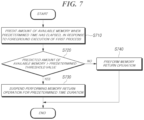
  • FIG. 7 is a schematic flowchart of a memory return method according to an embodiment of the present disclosure.
  • FIG. 1 is a schematic block diagram of an electronic device that performs a memory return operation according to an embodiment of the present disclosure.
  • an electronic device 100 may include a processor 110 , a memory 120 , and a display 130 .
  • the electronic device 100 may be further configured to include any additional components in addition to the illustrated components or omit at least one of the illustrated components.
  • the electronic device 100 may include a terminal capable of performing computing and communication functions, and so on.
  • the electronic device 100 may include, for example, a display device including a TV, a desktop computer, a smartphone, a notebook computer, a tablet PC, a mobile phone, a personal digital assistant (PDA), a laptop, a media player, a micro server, a global positioning system (GPS) device, an e-book terminal, a digital broadcasting terminal, a navigation system, a kiosk, an MP3 player, a digital camera, a home appliance, and other mobile or non-mobile computing devices, although it is not limited thereto.
  • a display device including a TV, a desktop computer, a smartphone, a notebook computer, a tablet PC, a mobile phone, a personal digital assistant (PDA), a laptop, a media player, a micro server, a global positioning system (GPS) device, an e-book terminal, a digital broadcasting terminal, a navigation system, a kiosk, an MP3 player,
  • the electronic device 100 may be a wearable terminal such as e.g., a watch, glasses, a hair band, and a ring capable of performing computing and communication functions.
  • the electronic device 100 may be various types of terminals without being limited to the above description.
  • the memory 120 may be of a storage medium used by the electronic device 100 to store data such as e.g., at least one instruction 121 corresponding to at least one program or setting information.
  • the program may include an operating system (OS) program and various application programs.
  • the memory 120 may be configured as a volatile memory, a non-volatile memory, or a combination of a volatile memory and a non-volatile memory.
  • the memory 120 may provide stored data according to a request from the processor 110 .
  • the memory 120 may store memory usage information 122 .
  • the memory usage information 122 may include, for each program, the amount of memory usage corresponding to each execution state of a process executing a program.
  • the execution state of the process may include a foreground execution state that is in execution while outputting the process to the display 130 in the foreground and a background execution state that is in execution without outputting the process to the display 130 in the foreground.
  • the process may perform an interaction with a user through a user interface (not shown).
  • the processor 110 may learn memory usage in response to each execution state of the process, and store memory usage information 122 including the learned memory usage in the memory 120 .
  • the processor 110 may learn the memory usage until variability in the memory usage becomes stable in each of the execution state of the process.
  • the memory usage information 122 may include, for each program, memory usage corresponding to an execution state of the process executing the program and an execution context.
  • the execution state of the process may include a foreground execution state that is in execution with outputting the process to the display 130 and a background execution state that is in execution without outputting the process to the display 130 .
  • the process may interact with a user through a user interface (not shown).
  • the execution context may include at least one of the amount of available memory at the time of execution and the number of background processes at the time of execution.
  • the processor 110 may learn memory usage corresponding to the execution state of the process and the execution context and store the memory usage information 122 including the learned memory usage in the memory 120 .
  • the processor 110 may learn the memory usage until variability in the memory usage becomes stable in each of the execution state of the process and the execution context. Accordingly, according to an embodiment, the processor 110 may learn the memory usage that may vary depending on the execution context at the time of execution as well as the execution state of the process and store the same in the memory 120 .
  • the display 130 may perform functions for outputting information in the form of a number(s), a character(s), an image(s), and/or a graphic(s).
  • the display 130 may include at least one hardware module for outputting information.
  • the at least one hardware module may include, for example, at least one of Liquid Crystal Display (LCD), Light Emitting Diode (LED), Light Emitting Polymer Display (LPD), Organic Light Emitting Diode (OLED), Active-Matrix Organic Light Emitting Diode (AMOLED), FLED (Flexible LED) and so on.
  • the display 130 may display a screen corresponding to data received from the processor 110 .
  • the display 130 may be referred to as an output module, a display module, or other terms having the equivalent technical meaning.
  • the processor 110 may execute at least one instruction 121 stored in the memory 120 as a process to perform an arithmetic operation or data processing in association with controlling of and/or communication with at least one other component of the electronic device 100 .
  • the processor 110 may include, for example, at least one of a central processing unit (CPU), a graphic processing unit (GPU), a microcontroller unit (MCU), a sensor hub, a supplementary processor, a communication processor, an application processor, an application specific integrated circuit (ASIC), or field programmable gate arrays (FPGA), and may have a plurality of cores.
  • the processor 110 may predict the amount of available memory when a predetermined time has elapsed (e.g., from a current time or from a time of the foreground execution), based on memory usage information 122 stored in the memory 120 .
  • the processor 110 may set a time duration until variability in the memory usage become stable, as the predetermined time, or may obtain the predetermined time based on an external input, but it would be apparent to those skilled in the art that the predetermined time may be obtained in various ways.
  • the processor 110 may predict the amount of available memory by further considering the execution context at the time of the foreground execution in response to the foreground execution of the first process.
  • the execution context may include at least one of the amount of available memory at the time of execution and the number of background processes at the time of execution.
  • the processor 110 may predict the amount of memory required for execution switching or new execution of the process, based on the memory usage information 122 .
  • the processor 110 may also predict the amount of required memory by further considering the execution context at the time of the foreground execution. In this context, the processor 110 may predict the amount of required memory based on the memory usage information 122 including the learned memory usage in response to the execution state of the process and the execution context.
  • the processor 110 may switch a second process from the foreground execution to the background execution in response to the foreground execution of the first process.
  • the processor 110 may predict the amount of obtained memory indicative of the memory that can be obtained by the background execution of the second process, based on the memory usage information 122 .
  • the processor 110 may predict the amount of obtained memory by further considering the execution context at the time of switching to the background execution. In this context, the processor 110 may predict the amount of obtained memory based on the memory usage information 122 including the learned memory usage in response to the execution state of the process and the execution context.
  • the processor 110 may predict the amount of available memory by adding or subtracting the amount of obtained memory and the amount of required memory to/from the amount of current available memory, respectively.
  • the processor 110 may predict the amount of available memory by adding the amount of obtained memory to the amount of current available memory and then subtracting the amount of required memory therefrom.
  • the processor 110 may suspend execution of a memory return operation for the predetermined time.
  • the processor 110 may perform the memory return operation without suspension.
  • the predetermined threshold value may be an amount of a reference memory that a system needs to maintain to operate the system normally without falling into an unrecoverable state, and may be pre-set based on an external input (e.g., user input), although the predetermined threshold value may be set in various manners that are apparent to those skilled in the art.
  • a scenario in which the memory return operation is suspended will be described below with reference to FIGS. 2 and 3
  • another scenario in which the memory return operation is performed will be described below with reference to FIGS. 4 to 6 .
  • the memory return operation may include operations of selecting a process to return memory in use based on a predetermined priority and terminating (or killing) the selected process.
  • the processor 110 may predict the amount of a second available memory when swapping out the memory in use to a swap medium without terminating the selected process and terminate the selected process when the predicted amount of the second available memory is less than a predetermined threshold value.
  • the swap medium may include various types of storage media such as e.g., a hard disk, a solid-state drive (SSD) or the like, and it is apparent to those skilled in the art that the swap medium is not limited to a specific type of storage medium. Further, the swap medium may utilize a partial area of the memory 120 as a swap medium.
  • the processor 110 may determine whether the current amount of available memory is less than a predetermined threshold value at a certain period and perform the memory return operation when the current amount of available memory is less than the predetermined threshold value.
  • the memory return operation may be performed through a memory reclaim or a process kill.
  • the memory return operation with the process kill may terminate a process that is determined to have lower importance based on a predetermined priority among processes in execution, when there is insufficient available memory in the system (e.g., when the available memory is less than the predetermined threshold value), thereby returning the memory in use for the execution of a corresponding process.
  • the memory return operation with the memory reclaim may select a memory to be reclaimed and swap out a content of the selected memory to a swap medium (or device) to reclaim the memory.
  • FIG. 2 illustrates an example of an occasion of suspending execution of a memory return operation according to an embodiment of the present disclosure.
  • the processor 110 may switch ( 210 ) an application B execution process from the background execution to the foreground execution based on an external input.
  • the processor 110 may switch ( 220 ) an application A execution process from the foreground execution to the background execution, in response to the foreground execution of the application B execution process.
  • the processor 110 may predict the amount of required memory indicating the memory required by the foreground execution of the application B execution process, based on the memory usage information 122 .
  • the processor 110 may predict the amount of obtained memory indicating the memory that can be obtained by switching from the foreground execution to the background execution of the application A execution process, based on the memory usage information 122 .
  • the processor 110 may predict the amount of available memory after an elapse of a predetermined time from the time of switching ( 210 ), by adding or subtracting the amount of obtained memory and the amount of required memory to/from the amount of current available memory, respectively.
  • the processor 110 may set the time duration until variability in the memory usage becomes stable, as the predetermined time, or may obtain the predetermined time based on an external input, but it would be apparent to those skilled in the art that the predetermined time may be obtained in various ways.
  • the processor 110 may suspend ( 230 ) execution of the memory return operation for the predetermined time.
  • the predetermined threshold value may be an amount of a reference memory that a system needs to maintain to operate the system normally without falling into an unrecoverable state, and may be pre-set based on an external input, but it would be apparent to those skilled in the art that the predetermined threshold value may be set in various ways.
  • the memory return operation may include operations of selecting a process to return the memory in use based on a predetermined priority and terminating the selected process.
  • the processor 110 may predict the amount of required memory in response to the foreground execution of the certain process with reference to the memory usage information 122 .
  • FIG. 3 illustrates an example of the user interface for use in selecting an application to execute in the foreground according to an embodiment of the present disclosure.
  • the processor 110 may receive an input to execute an application B among a plurality of applications A to E from a user through the user interface.
  • the processor 110 may switch the execution state of the process corresponding to the application B from the background to the foreground, based on the user input, and output the execution screen of the application B to the display 130 .
  • the processor 110 may newly execute the application B as the foreground process based on the user input and output the execution screen of the application B to the display 130 .
  • FIG. 4 illustrates an example of a scenario in which the memory return operation is performed according to an embodiment of the present disclosure.
  • the processor 110 may switch ( 410 ) the application B execution process from the background execution to the foreground execution, based on an external input.
  • the processor 110 may switch the process currently in execution in the foreground from the foreground execution to the background execution.
  • the processor 110 may predict the amount of required memory indicating the memory required by the foreground execution of the application B execution process, based on the memory usage information 122 .
  • the processor 110 may predict the amount of obtained memory indicating the memory that can be obtained by switching to the background execution of the process currently in execution in the foreground, based on the memory usage information 122 .
  • the processor 110 may predict the amount of available memory when a predetermined time elapses after the switching ( 410 ), by adding or subtracting the amount of obtained memory and the amount of required memory to/from the amount of current available memory, respectively.
  • the processor 110 may set a time duration until the variability in the memory usage become stable, as the predetermined time, or may obtain the predetermined time based on an external input, but it would be apparent to those skilled in the art that the predetermined time may be obtained in various ways.
  • the processor 110 may perform the memory return operation.
  • the processor 110 may select, based on a predetermined priority, a process to return the memory in use as an application A execution process, and terminate ( 420 ) the application A execution process.
  • the application A execution process may be the same as or different from the above-described process switched from the foreground execution to the background execution, depending upon a predetermined priority. Criteria for selecting a process to return the memory will be described later with reference to FIG. 5 .
  • FIG. 5 illustrates an example of the criteria for selecting a process to return memory according to an embodiment of the present disclosure.
  • the processor 110 may select a process to return the memory in use based on the predetermined priority and terminate the selected process.
  • FIG. 5 exemplarily illustrate a plurality of processes including processes A to E that are sorted in the order of the predetermined priority.
  • the predetermined priority may be set based on an external input, it is apparent to those skilled in the art that it may be set in various ways.
  • the predetermined priority may be set in the order of a background application, a previous application, a home application, a service, a perceptible application, a foreground application, a system process, and a native process.
  • the background application may include an application that was previously executed but is not currently active.
  • the previous application may include the most recently used background execution application.
  • the home application may include a launcher application that provides a function of making up a background screen, and the like.
  • the service may include a process to provide services such as e.g., cloud synchronization or upload.
  • the perceptible application may include an application that the user is able to recognize but is not actually executing in the foreground.
  • the perceptible application may include a search window displayed as a relatively small user interface, a music listening application, or the like.
  • the foreground application may include an application that is currently output to the display and is in execution.
  • the native process may include a low-hierarchy process to perform basic operations of the electronic device.
  • FIG. 6 illustrates an example of the memory return operation according to an embodiment of the present disclosure.
  • the processor 110 may determine whether the predicted amount of the second available memory is less than a predetermined threshold value after deducting the predicted amount of required memory, indicating a memory required for execution switching or new execution of a process, from the predicted amount of second available memory, and then terminate the process corresponding to the application 1 when the amount of the second available memory is less than the predetermined threshold value.
  • the processor 110 may terminate the selected process in a preemptive manner when it is predicted that the available memory will not be sufficiently obtained even if the memory 620 used by the selected process is swapped out to the swap medium 610 , thereby preventing unnecessary memory reallocation operation, and therefore, preventing unnecessary memory usage of CPU and swap media for selecting reclaimed memory and swapping-out operations.
  • FIG. 7 is a schematic flowchart of a memory return method according to an embodiment of the present disclosure.
  • the electronic device 100 may predict the amount of available memory when a predetermined time has elapsed, based on the memory usage information.
  • the electronic device 100 may set the time duration until variability in memory usage becomes stable, as the predetermined time, or obtain the predetermined time from an external input, but it would be apparent to those skilled in the art that the predetermined time may be obtained in various ways.
  • the memory usage information 122 may include, for each program, the amount of memory usage corresponding to each execution state of a process executing the program.
  • the execution state of the process may include a foreground execution state that is in execution while being output to the display 130 and a background execution state that is in execution without being output to the display 130 .
  • the electronic device 100 may learn the amount of memory usage corresponding to each execution state of the process, and store memory usage information 122 including the learned amount of memory usage into the memory 120 .
  • the processor 110 may learn the amount of memory usage until e.g., the variability in memory usage becomes stable in each of the execution states of the process.
  • the memory usage information 122 may include, for each program, memory usage corresponding to an execution state of a process executing the program and an execution context.
  • the execution state of the process may include a foreground execution state that is in execution with being output to the display 130 and a background execution state that is in execution without being output to the display 130 .
  • the execution context may include at least one of the amount of available memory at the time of execution and the number of background processes at the time of execution.
  • the electronic device 100 may learn the memory usage corresponding to the execution state of the process and the execution context and store the memory usage information 122 including the learned memory usage in the memory 120 .
  • the electronic device 100 may learn the memory usage until the variability in memory usage in each of the execution state of the process and the execution context becomes stable.
  • the electronic device 100 may switch the second process from the foreground execution to the background execution, in response to the foreground execution of the first process.
  • the electronic device 100 may predict, based on the memory usage information, the amount of obtained memory indicating the memory that can be obtained by the background execution of the second process, predict the amount of required memory indicating the memory required by the foreground execution of the first process, based on the memory usage information, and predict the amount of available memory by adding or subtracting the amount of obtained memory and the amount of required memory to/from the amount of current available memory.
  • the electronic device 100 may predict the amount of available memory by further considering the execution context at the time of foreground execution in response to the foreground execution of the first process.
  • the electronic device 100 may determine whether the predicted amount of available memory exceeds a predetermined threshold value. When it is determined, as a result of the determination, that the amount of available memory exceeds the predetermined threshold value, operation S 730 may be performed, while when it is determined that the amount of available memory is less than the predetermined threshold value, operation S 740 may be performed.
  • the electronic device 100 may suspend execution of the memory return operation for the predetermined time.
  • the electronic device 100 may perform the memory return operation.
  • the memory return operation may select a process to return the memory in use, based on a predetermined priority, and terminate the selected process.
  • the memory return operation may operate to select a process to return the memory in use based on the predetermined priority, predict the amount of the second available memory when swapping out the memory in use by the selected process to a memory swap medium, without terminating the selected process, determine whether the amount of the second available memory exceeds the predetermined threshold value, and terminate the selected process when the amount of the second available memory is less than the predetermined threshold value, as a result of the determination.
  • the electronic device 100 and the program executed by the electronic device 100 described through the present disclosure may be implemented as hardware components, software components, and/or a combination of the hardware components and the software components.
  • the program may be executed by any system capable of executing computer readable instructions.
  • the software may include computer programs, codes, instructions, or a combination of one or more of the same, and may configure processing units to operate as required and command the processing units independently or collectively.
  • the software may be implemented as a computer program including instructions stored in a computer-readable storage medium.
  • the computer-readable recording medium may include, for example, a magnetic storage medium (e.g., read-only memory (ROM), random-access memory (RAM), floppy disk, hard disk, and so on) and an optically readable medium (e.g., CD-ROM, Digital Versatile Disc (DVD) and so on).
  • the computer-readable codes in the recording medium may be distributed in between network-connected computer systems, so that the computer-readable codes may be stored and executed in a distributed manner.
  • the recording medium may be readable by a computer, stored in a memory, and executed on a processor.
  • the machine-readable storage medium may be provided in the form of a non-transitory storage medium, wherein the term “non-transitory” may simply mean that the storage medium is a tangible device, and does not include only a signal (e.g., an electromagnetic wave), but this term does not differentiate between where data is semi-permanently stored in the storage medium and where the data is temporarily stored in the storage medium.
  • a signal e.g., an electromagnetic wave
  • a program according to various embodiments of the disclosure may be included and provided in a computer program product.
  • the computer program product may be traded as a product between a seller and a buyer.
  • the computer program product may include a software program and a machine-readable storage medium in which the software program is stored.
  • the computer program product may include a product (e.g., a downloadable application) in the form of a software program distributed electronically via a manufacturer of a device or an electronic market (e.g., Google PlayStoreTM, App StoreTM) or between two user devices (e.g., smart phones) directly.
  • At least part of the software program may be stored in a storage medium or may be temporarily generated, wherein the storage medium may be, for example, a server of the manufacturer, a server of the electronic market, or a storage medium of a relay server temporarily storing the software program.
  • the storage medium may be, for example, a server of the manufacturer, a server of the electronic market, or a storage medium of a relay server temporarily storing the software program.
  • the computer program product may include a storage medium of the server or a storage medium of the device.
  • the computer program product may include a storage medium of the third device.
  • the computer program product may include the software program itself transmitted from the server to the device or the third device or transmitted from the third device to the device.
  • one of a server, a device and a third device may execute the computer program product to perform the method according to example embodiments.
  • two or more of a server, a device, and a third device may execute the computer program product to implement in a distributed manner the method according to the example embodiments.
  • the server may execute a computer program product stored in the server to control a device communicatively connected with the server to perform the method according to the example embodiments.
  • the third device may execute the computer program product to control the device communicatively connected to the third device to perform the method according to the example embodiment.
  • the third device may download the computer program product from the server and execute the downloaded computer program product.
  • the third device may execute the computer program product provided in a pre-loaded state to perform the method according to the example embodiments.

Landscapes

  • Engineering & Computer Science (AREA)
  • Theoretical Computer Science (AREA)
  • Physics & Mathematics (AREA)
  • General Engineering & Computer Science (AREA)
  • General Physics & Mathematics (AREA)
  • Human Computer Interaction (AREA)
  • Software Systems (AREA)
  • Stored Programmes (AREA)

Abstract

An electronic device includes a display; a memory configured to store at least one instruction corresponding to at least one program; and a processor configured to execute the at least one instruction as a process, wherein the processor is configured to: predict, in response to a foreground execution of a first process, an amount of an available memory at a time point after an elapse of a predetermined time from the foreground execution of the first process, based on memory usage information stored in the memory; based on the predicted amount of the available memory exceeding a predetermined threshold value, suspend a memory return operation for the predetermined time; and based on the predicted amount of the available memory being less than the predetermined threshold value, perform the memory return operation without suspending the memory return operation.

Description

CROSS REFERENCE TO RELATED APPLICATIONS
This application is a continuation application of International Application No. PCT/KR2022/013109 designating the United States, filed on Sep. 1, 2022, in the Korean Intellectual Property Receiving Office, which claims priority from Korean Patent Application No. 10-2021-0167833, filed on Nov. 30, 2021, in the Korean Intellectual Property Office, the disclosures of which are hereby incorporated by reference herein in their entireties.
BACKGROUND 1. Field
Various embodiments of the present disclosure relate to a memory return method and apparatus for selectively returning memory by predicting the amount of available memory at a time point when a predetermined time has elapsed, based on memory usage information, in response to a foreground execution of an application process.
2. Description of Related Art
Since an electronic device may fall into an unrecoverable state in the worst case if the minimum memory required for its operation is not secured, the electronic device may operate to periodically monitor an available memory, and if necessary, perform a memory return operation for the memory in use. The electronic device may perform such a memory return operation for the memories used by application/service programs, a kernel which is resident in its memory as part of an operating system (OS), and so on.
The memory return operation may be performed with a memory re-allocation (reclaim) or a process termination (kill). When an available memory in a system is insufficient (that is, when it is below a predetermined threshold value), the memory return operation with process termination may force a process with a relatively lower priority among a plurality of processes in execution to be terminated, thereby returning the memory used by execution of the corresponding process. The memory return operation with memory re-allocation makes it possible to return the memory by selecting the memory to be reclaimed while maintaining the process execution and swapping out a content of the selected memory into a swap medium (or device).
When an electronic device operates to determine whether there is insufficient available memory on the basis of a certain threshold value pre-set as a fixed value, without predicting a future memory usage condition, and terminate a process in execution, any available memory may be immediately obtained, but the overhead of execution costs such as e.g., an initialization process to re-execute the terminated process thereafter may be high, and a user's application usability may decline. Thus, even if the execution of the corresponding process is maintained and the available memory is obtained through the memory reallocation, usage of a CPU and a swap medium will increase to process selection of memory to be reclaimed and swapping-out of the memory, which in turn may lead to reduced usability of the electronic device.
SUMMARY
Various embodiments of the present disclosure provide a memory return method and apparatus for selectively returning memory by predicting the amount of available memory at a time point when a predetermined time has elapsed, based on memory usage information, in response to a foreground execution of an application process.
According to an aspect of an example embodiment of the present disclosure, provided is an electronic device including: a display: a memory configured to store at least one instruction corresponding to at least one program; and a processor configured to execute the at least one instruction as a process, wherein the processor is configured to: predict, in response to a foreground execution of a first process, an amount of an available memory at a time point after an elapse of a predetermined time from the foreground execution of the first process, based on memory usage information stored in the memory: based on the predicted amount of the available memory exceeding a predetermined threshold value, suspend a memory return operation for the predetermined time; and based on the predicted amount of the available memory being less than the predetermined threshold value, perform the memory return operation without suspending the memory return operation.
According to another aspect of an example embodiment of the present disclosure, provided is a memory return method including: predicting, in response to a foreground execution of a first process, an amount of an available memory at a time point after an elapse of a predetermined time from the foreground execution of the first process, based on memory usage information: based on the predicted amount of the available memory exceeding a predetermined threshold value, suspending a memory return operation for the predetermined time; and based on the predicted amount of the available memory being less than the predetermined threshold value, performing the memory return operation without suspending the memory return operation.
According to various embodiments of the present disclosure, the electronic device may predict the amount of available memory at a time point when a predetermined time has elapsed, based on memory usage information stored in the memory in response to the foreground execution of a process, to selectively return the memory, thereby preventing unnecessary process killing and re-execution. This in turn leads to improved application usability of its user under a multitasking environment.
Further, according to various embodiments of the present disclosure, the electronic device may prevent unnecessary memory reallocation by predicting the amount of available memory, thereby preventing usage of CPUs and swap media for selection memory to be reclaimed and its swap-out operation, which in turn leads to improved usability of the electronic device for the user.
The effects that may be obtained through exemplary embodiments of the present disclosure are not limited to those mentioned above, and other effects not mentioned herein may be clearly derived and understood by those having ordinary knowledge in the technical field to which the exemplary embodiments pertain, from the following description. In other words, any unintended effects according to carrying out the exemplary embodiments of the disclosure may be also derived by those skilled in the art from the disclosure of the exemplary embodiments.
BRIEF DESCRIPTION OF THE DRAWINGS
The above and other aspects, features, and advantages of certain embodiments of the present disclosure will be more apparent from the following description taken in conjunction with the accompanying drawings, in which:
FIG. 1 is a schematic block diagram of an electronic device performing a memory return operation according to an embodiment of the present disclosure;
FIG. 2 illustrates an example of an occasion of suspending to execute a memory return operation according to an embodiment of the present disclosure;
FIG. 3 illustrates an example of a user interface to select an application to execute the application in the foreground according to an embodiment of the present disclosure;
FIG. 4 illustrates an example of an occasion in which a memory return operation is performed according to an embodiment of the present disclosure;
FIG. 5 illustrates an example of criteria to select a process for returning memory according to an embodiment of the present disclosure;
FIG. 6 illustrates an example of a memory return operation according to an embodiment of the present disclosure; and
FIG. 7 is a schematic flowchart of a memory return method according to an embodiment of the present disclosure.
DETAILED DESCRIPTION
The terms used in various embodiments of the disclosure have been selected as general terms currently in wide use, considering various functions of the disclosure, but they may vary depending upon the intention of those skilled in the art, relevant precedents, the emergence of new technologies, and so on. Further, in a certain instance, there may be used a term arbitrarily selected by the applicant, in which case its meaning will be described in more detail in the description of the corresponding embodiment. Therefore, the term used in the disclosure should be defined based on the substantive meaning thereof and the entire contents of the disclosure, rather than a simple name of the term.
Throughout the entire specification, when it is described that an element “comprise(s)/include(s)” a certain component, it will mean that it may further include any other component(s), rather than excluding the other component(s), unless otherwise explicitly stated. Further, the terms such as e.g., “ . . . unit”, “ . . . module” or the like described throughout the specification will mean a unit to process at least one function or operation, which may be implemented as either hardware or software, or a combination of hardware and software.
Hereinafter, with reference to the accompanying drawings, various embodiments of the disclosure will be described in detail so that those having ordinary knowledge in the technical field to which the disclosure pertains may easily implement the same. However, the disclosure may be implemented in several different forms and is not limited to the embodiments described herein. In the drawings, like reference numerals refer to like elements or components, and the dimension of each element or component in the drawings may be partially exaggerated or scaled-down/up for better clarity of description.
FIG. 1 is a schematic block diagram of an electronic device that performs a memory return operation according to an embodiment of the present disclosure.
Referring to FIG. 1 , an electronic device 100 may include a processor 110, a memory 120, and a display 130. The electronic device 100 may be further configured to include any additional components in addition to the illustrated components or omit at least one of the illustrated components.
According to various embodiments, the electronic device 100 may include a terminal capable of performing computing and communication functions, and so on. The electronic device 100 may include, for example, a display device including a TV, a desktop computer, a smartphone, a notebook computer, a tablet PC, a mobile phone, a personal digital assistant (PDA), a laptop, a media player, a micro server, a global positioning system (GPS) device, an e-book terminal, a digital broadcasting terminal, a navigation system, a kiosk, an MP3 player, a digital camera, a home appliance, and other mobile or non-mobile computing devices, although it is not limited thereto. Further, the electronic device 100 may be a wearable terminal such as e.g., a watch, glasses, a hair band, and a ring capable of performing computing and communication functions. The electronic device 100 may be various types of terminals without being limited to the above description.
According to an embodiment, the memory 120 may be of a storage medium used by the electronic device 100 to store data such as e.g., at least one instruction 121 corresponding to at least one program or setting information. The program may include an operating system (OS) program and various application programs. The memory 120 may be configured as a volatile memory, a non-volatile memory, or a combination of a volatile memory and a non-volatile memory. The memory 120 may provide stored data according to a request from the processor 110.
According to an embodiment, the memory 120 may store memory usage information 122. For example, the memory usage information 122 may include, for each program, the amount of memory usage corresponding to each execution state of a process executing a program. The execution state of the process may include a foreground execution state that is in execution while outputting the process to the display 130 in the foreground and a background execution state that is in execution without outputting the process to the display 130 in the foreground. In the foreground execution state, the process may perform an interaction with a user through a user interface (not shown). When the program is executed as a process, the processor 110 may learn memory usage in response to each execution state of the process, and store memory usage information 122 including the learned memory usage in the memory 120. The processor 110 may learn the memory usage until variability in the memory usage becomes stable in each of the execution state of the process.
As another example, the memory usage information 122 may include, for each program, memory usage corresponding to an execution state of the process executing the program and an execution context. The execution state of the process may include a foreground execution state that is in execution with outputting the process to the display 130 and a background execution state that is in execution without outputting the process to the display 130. In the foreground execution state, the process may interact with a user through a user interface (not shown). The execution context may include at least one of the amount of available memory at the time of execution and the number of background processes at the time of execution. When the program is executed as a process, the processor 110 may learn memory usage corresponding to the execution state of the process and the execution context and store the memory usage information 122 including the learned memory usage in the memory 120. The processor 110 may learn the memory usage until variability in the memory usage becomes stable in each of the execution state of the process and the execution context. Accordingly, according to an embodiment, the processor 110 may learn the memory usage that may vary depending on the execution context at the time of execution as well as the execution state of the process and store the same in the memory 120.
According to an embodiment, the display 130 may perform functions for outputting information in the form of a number(s), a character(s), an image(s), and/or a graphic(s). The display 130 may include at least one hardware module for outputting information. The at least one hardware module may include, for example, at least one of Liquid Crystal Display (LCD), Light Emitting Diode (LED), Light Emitting Polymer Display (LPD), Organic Light Emitting Diode (OLED), Active-Matrix Organic Light Emitting Diode (AMOLED), FLED (Flexible LED) and so on. The display 130 may display a screen corresponding to data received from the processor 110. The display 130 may be referred to as an output module, a display module, or other terms having the equivalent technical meaning.
According to an embodiment, the processor 110 may execute at least one instruction 121 stored in the memory 120 as a process to perform an arithmetic operation or data processing in association with controlling of and/or communication with at least one other component of the electronic device 100. The processor 110 may include, for example, at least one of a central processing unit (CPU), a graphic processing unit (GPU), a microcontroller unit (MCU), a sensor hub, a supplementary processor, a communication processor, an application processor, an application specific integrated circuit (ASIC), or field programmable gate arrays (FPGA), and may have a plurality of cores.
According to an embodiment, in response to the foreground execution of a first process, the processor 110 may predict the amount of available memory when a predetermined time has elapsed (e.g., from a current time or from a time of the foreground execution), based on memory usage information 122 stored in the memory 120. The processor 110 may set a time duration until variability in the memory usage become stable, as the predetermined time, or may obtain the predetermined time based on an external input, but it would be apparent to those skilled in the art that the predetermined time may be obtained in various ways. The processor 110 may predict the amount of available memory by further considering the execution context at the time of the foreground execution in response to the foreground execution of the first process. The execution context may include at least one of the amount of available memory at the time of execution and the number of background processes at the time of execution.
According to an embodiment, when the first process is switched from the background execution to the foreground execution or the first process is newly executed in the foreground, the processor 110 may predict the amount of memory required for execution switching or new execution of the process, based on the memory usage information 122. The processor 110 may also predict the amount of required memory by further considering the execution context at the time of the foreground execution. In this context, the processor 110 may predict the amount of required memory based on the memory usage information 122 including the learned memory usage in response to the execution state of the process and the execution context.
According to an embodiment, the processor 110 may switch a second process from the foreground execution to the background execution in response to the foreground execution of the first process. The processor 110 may predict the amount of obtained memory indicative of the memory that can be obtained by the background execution of the second process, based on the memory usage information 122. The processor 110 may predict the amount of obtained memory by further considering the execution context at the time of switching to the background execution. In this context, the processor 110 may predict the amount of obtained memory based on the memory usage information 122 including the learned memory usage in response to the execution state of the process and the execution context.
According to an embodiment, the processor 110 may predict the amount of available memory by adding or subtracting the amount of obtained memory and the amount of required memory to/from the amount of current available memory, respectively. For example, the processor 110 may predict the amount of available memory by adding the amount of obtained memory to the amount of current available memory and then subtracting the amount of required memory therefrom.
According to an embodiment, when the predicted amount of available memory exceeds a predetermined threshold value, the processor 110 may suspend execution of a memory return operation for the predetermined time. When the predicted amount of available memory is less than the predetermined threshold value, the processor 110 may perform the memory return operation without suspension. The predetermined threshold value may be an amount of a reference memory that a system needs to maintain to operate the system normally without falling into an unrecoverable state, and may be pre-set based on an external input (e.g., user input), although the predetermined threshold value may be set in various manners that are apparent to those skilled in the art. A scenario in which the memory return operation is suspended will be described below with reference to FIGS. 2 and 3 , and another scenario in which the memory return operation is performed will be described below with reference to FIGS. 4 to 6 .
The memory return operation may include operations of selecting a process to return memory in use based on a predetermined priority and terminating (or killing) the selected process. Alternatively, the processor 110 may predict the amount of a second available memory when swapping out the memory in use to a swap medium without terminating the selected process and terminate the selected process when the predicted amount of the second available memory is less than a predetermined threshold value. The swap medium may include various types of storage media such as e.g., a hard disk, a solid-state drive (SSD) or the like, and it is apparent to those skilled in the art that the swap medium is not limited to a specific type of storage medium. Further, the swap medium may utilize a partial area of the memory 120 as a swap medium.
According to an embodiment, the processor 110 may determine whether the current amount of available memory is less than a predetermined threshold value at a certain period and perform the memory return operation when the current amount of available memory is less than the predetermined threshold value. The memory return operation may be performed through a memory reclaim or a process kill. The memory return operation with the process kill may terminate a process that is determined to have lower importance based on a predetermined priority among processes in execution, when there is insufficient available memory in the system (e.g., when the available memory is less than the predetermined threshold value), thereby returning the memory in use for the execution of a corresponding process. The memory return operation with the memory reclaim may select a memory to be reclaimed and swap out a content of the selected memory to a swap medium (or device) to reclaim the memory.
FIG. 2 illustrates an example of an occasion of suspending execution of a memory return operation according to an embodiment of the present disclosure.
Referring to FIG. 2 , the processor 110 may switch (210) an application B execution process from the background execution to the foreground execution based on an external input. The processor 110 may switch (220) an application A execution process from the foreground execution to the background execution, in response to the foreground execution of the application B execution process.
The processor 110 may predict the amount of required memory indicating the memory required by the foreground execution of the application B execution process, based on the memory usage information 122. The processor 110 may predict the amount of obtained memory indicating the memory that can be obtained by switching from the foreground execution to the background execution of the application A execution process, based on the memory usage information 122. The processor 110 may predict the amount of available memory after an elapse of a predetermined time from the time of switching (210), by adding or subtracting the amount of obtained memory and the amount of required memory to/from the amount of current available memory, respectively. The processor 110 may set the time duration until variability in the memory usage becomes stable, as the predetermined time, or may obtain the predetermined time based on an external input, but it would be apparent to those skilled in the art that the predetermined time may be obtained in various ways.
In the illustrated example in FIG. 2 , the predicted amount of available memory in response to the foreground execution of the application B execution process after the predetermined time from the switching (210) exceeds a predetermined threshold value, and accordingly, the processor 110 may suspend (230) execution of the memory return operation for the predetermined time. The predetermined threshold value may be an amount of a reference memory that a system needs to maintain to operate the system normally without falling into an unrecoverable state, and may be pre-set based on an external input, but it would be apparent to those skilled in the art that the predetermined threshold value may be set in various ways. The memory return operation may include operations of selecting a process to return the memory in use based on a predetermined priority and terminating the selected process.
Although not shown herein, for another example, when newly executing a certain process in the foreground, the processor 110 may predict the amount of required memory in response to the foreground execution of the certain process with reference to the memory usage information 122.
Hereinafter, referring to FIG. 3 , description will be made to a user interface in a case where for the processor 110 switches an execution state of a process or execute a new process.
FIG. 3 illustrates an example of the user interface for use in selecting an application to execute in the foreground according to an embodiment of the present disclosure.
Referring now to FIG. 3 , the processor 110 may receive an input to execute an application B among a plurality of applications A to E from a user through the user interface.
As described above with reference to FIG. 2 , when the input application B is being executed as the background process (210), the processor 110 may switch the execution state of the process corresponding to the application B from the background to the foreground, based on the user input, and output the execution screen of the application B to the display 130.
As another example, when the input application B is not in execution, the processor 110 may newly execute the application B as the foreground process based on the user input and output the execution screen of the application B to the display 130.
FIG. 4 illustrates an example of a scenario in which the memory return operation is performed according to an embodiment of the present disclosure.
Referring to FIG. 4 , the processor 110 may switch (410) the application B execution process from the background execution to the foreground execution, based on an external input. In response to the foreground execution of the application B execution process, the processor 110 may switch the process currently in execution in the foreground from the foreground execution to the background execution.
The processor 110 may predict the amount of required memory indicating the memory required by the foreground execution of the application B execution process, based on the memory usage information 122. The processor 110 may predict the amount of obtained memory indicating the memory that can be obtained by switching to the background execution of the process currently in execution in the foreground, based on the memory usage information 122. The processor 110 may predict the amount of available memory when a predetermined time elapses after the switching (410), by adding or subtracting the amount of obtained memory and the amount of required memory to/from the amount of current available memory, respectively. The processor 110 may set a time duration until the variability in the memory usage become stable, as the predetermined time, or may obtain the predetermined time based on an external input, but it would be apparent to those skilled in the art that the predetermined time may be obtained in various ways.
In the illustrated example in FIG. 4 , since the predicted amount of available memory after the predetermined time from the switching (410) in response to the foreground execution of the application B execution process is less than the predetermined threshold value, the processor 110 may perform the memory return operation. The processor 110 may select, based on a predetermined priority, a process to return the memory in use as an application A execution process, and terminate (420) the application A execution process. In the illustrated example, the application A execution process may be the same as or different from the above-described process switched from the foreground execution to the background execution, depending upon a predetermined priority. Criteria for selecting a process to return the memory will be described later with reference to FIG. 5 .
FIG. 5 illustrates an example of the criteria for selecting a process to return memory according to an embodiment of the present disclosure.
The processor 110 may select a process to return the memory in use based on the predetermined priority and terminate the selected process. FIG. 5 exemplarily illustrate a plurality of processes including processes A to E that are sorted in the order of the predetermined priority.
Although the predetermined priority may be set based on an external input, it is apparent to those skilled in the art that it may be set in various ways. For example, the predetermined priority may be set in the order of a background application, a previous application, a home application, a service, a perceptible application, a foreground application, a system process, and a native process. The background application may include an application that was previously executed but is not currently active. The previous application may include the most recently used background execution application. The home application may include a launcher application that provides a function of making up a background screen, and the like. The service may include a process to provide services such as e.g., cloud synchronization or upload. The perceptible application may include an application that the user is able to recognize but is not actually executing in the foreground. For example, the perceptible application may include a search window displayed as a relatively small user interface, a music listening application, or the like. The foreground application may include an application that is currently output to the display and is in execution. The native process may include a low-hierarchy process to perform basic operations of the electronic device.
FIG. 6 illustrates an example of the memory return operation according to an embodiment of the present disclosure.
Referring now to FIG. 6 , the processor 110 may select a process to return the memory in use based on a predetermined priority, and then predict the amount of a second available memory when swapping out the memory in use to a swap medium 610 without immediately terminating the selected process. In the illustrated example, the processor 110 may select a process corresponding to an application 1 having the lowest priority, and then predict the amount of the second available memory to which the memory 620, corresponding to the application 1, is to be returned when swapping out to the swap medium 610. The processor 110 may determine whether the predicted amount of the second available memory is less than a predetermined threshold value after deducting the predicted amount of required memory, indicating a memory required for execution switching or new execution of a process, from the predicted amount of second available memory, and then terminate the process corresponding to the application 1 when the amount of the second available memory is less than the predetermined threshold value.
With this operation, the processor 110 may terminate the selected process in a preemptive manner when it is predicted that the available memory will not be sufficiently obtained even if the memory 620 used by the selected process is swapped out to the swap medium 610, thereby preventing unnecessary memory reallocation operation, and therefore, preventing unnecessary memory usage of CPU and swap media for selecting reclaimed memory and swapping-out operations.
FIG. 7 is a schematic flowchart of a memory return method according to an embodiment of the present disclosure.
In operation S710, according to an embodiment, in response to the foreground execution of the first process, the electronic device 100 may predict the amount of available memory when a predetermined time has elapsed, based on the memory usage information. The electronic device 100 may set the time duration until variability in memory usage becomes stable, as the predetermined time, or obtain the predetermined time from an external input, but it would be apparent to those skilled in the art that the predetermined time may be obtained in various ways.
The memory usage information 122 may include, for each program, the amount of memory usage corresponding to each execution state of a process executing the program. The execution state of the process may include a foreground execution state that is in execution while being output to the display 130 and a background execution state that is in execution without being output to the display 130. When a process is executed, the electronic device 100 may learn the amount of memory usage corresponding to each execution state of the process, and store memory usage information 122 including the learned amount of memory usage into the memory 120. The processor 110 may learn the amount of memory usage until e.g., the variability in memory usage becomes stable in each of the execution states of the process.
As another example, the memory usage information 122 may include, for each program, memory usage corresponding to an execution state of a process executing the program and an execution context. The execution state of the process may include a foreground execution state that is in execution with being output to the display 130 and a background execution state that is in execution without being output to the display 130. The execution context may include at least one of the amount of available memory at the time of execution and the number of background processes at the time of execution. When executing the process, the electronic device 100 may learn the memory usage corresponding to the execution state of the process and the execution context and store the memory usage information 122 including the learned memory usage in the memory 120. The electronic device 100 may learn the memory usage until the variability in memory usage in each of the execution state of the process and the execution context becomes stable.
The electronic device 100 may switch the second process from the foreground execution to the background execution, in response to the foreground execution of the first process. The electronic device 100 may predict, based on the memory usage information, the amount of obtained memory indicating the memory that can be obtained by the background execution of the second process, predict the amount of required memory indicating the memory required by the foreground execution of the first process, based on the memory usage information, and predict the amount of available memory by adding or subtracting the amount of obtained memory and the amount of required memory to/from the amount of current available memory. The electronic device 100 may predict the amount of available memory by further considering the execution context at the time of foreground execution in response to the foreground execution of the first process.
In operation S720, according to an embodiment, the electronic device 100 may determine whether the predicted amount of available memory exceeds a predetermined threshold value. When it is determined, as a result of the determination, that the amount of available memory exceeds the predetermined threshold value, operation S730 may be performed, while when it is determined that the amount of available memory is less than the predetermined threshold value, operation S740 may be performed.
In the operation S730 according to an embodiment, the electronic device 100 may suspend execution of the memory return operation for the predetermined time.
In the operation S740 according to an embodiment, the electronic device 100 may perform the memory return operation. The memory return operation may select a process to return the memory in use, based on a predetermined priority, and terminate the selected process. Alternatively, the memory return operation may operate to select a process to return the memory in use based on the predetermined priority, predict the amount of the second available memory when swapping out the memory in use by the selected process to a memory swap medium, without terminating the selected process, determine whether the amount of the second available memory exceeds the predetermined threshold value, and terminate the selected process when the amount of the second available memory is less than the predetermined threshold value, as a result of the determination.
The electronic device 100 and the program executed by the electronic device 100 described through the present disclosure may be implemented as hardware components, software components, and/or a combination of the hardware components and the software components. The program may be executed by any system capable of executing computer readable instructions.
The software may include computer programs, codes, instructions, or a combination of one or more of the same, and may configure processing units to operate as required and command the processing units independently or collectively. The software may be implemented as a computer program including instructions stored in a computer-readable storage medium. The computer-readable recording medium may include, for example, a magnetic storage medium (e.g., read-only memory (ROM), random-access memory (RAM), floppy disk, hard disk, and so on) and an optically readable medium (e.g., CD-ROM, Digital Versatile Disc (DVD) and so on). The computer-readable codes in the recording medium may be distributed in between network-connected computer systems, so that the computer-readable codes may be stored and executed in a distributed manner. The recording medium may be readable by a computer, stored in a memory, and executed on a processor.
The machine-readable storage medium may be provided in the form of a non-transitory storage medium, wherein the term “non-transitory” may simply mean that the storage medium is a tangible device, and does not include only a signal (e.g., an electromagnetic wave), but this term does not differentiate between where data is semi-permanently stored in the storage medium and where the data is temporarily stored in the storage medium.
A program according to various embodiments of the disclosure may be included and provided in a computer program product. The computer program product may be traded as a product between a seller and a buyer. The computer program product may include a software program and a machine-readable storage medium in which the software program is stored. The computer program product may include a product (e.g., a downloadable application) in the form of a software program distributed electronically via a manufacturer of a device or an electronic market (e.g., Google PlayStore™, App Store™) or between two user devices (e.g., smart phones) directly. For electronic distribution, at least part of the software program may be stored in a storage medium or may be temporarily generated, wherein the storage medium may be, for example, a server of the manufacturer, a server of the electronic market, or a storage medium of a relay server temporarily storing the software program.
In a system inclusive a server and a device, the computer program product may include a storage medium of the server or a storage medium of the device. Alternatively, when there is a third device (e.g., a smart phone) that is communicatively connected with the server or device, the computer program product may include a storage medium of the third device. Alternatively, the computer program product may include the software program itself transmitted from the server to the device or the third device or transmitted from the third device to the device. In this case, one of a server, a device and a third device may execute the computer program product to perform the method according to example embodiments. Alternatively, two or more of a server, a device, and a third device may execute the computer program product to implement in a distributed manner the method according to the example embodiments. For example, the server may execute a computer program product stored in the server to control a device communicatively connected with the server to perform the method according to the example embodiments. As another example, the third device may execute the computer program product to control the device communicatively connected to the third device to perform the method according to the example embodiment. When the third device executes the computer program product, the third device may download the computer program product from the server and execute the downloaded computer program product. Alternatively, the third device may execute the computer program product provided in a pre-loaded state to perform the method according to the example embodiments.
As described above, although the embodiments have been described with reference to the example embodiments and drawings, various modifications and variations would be possible from the above description by those having ordinary skill in the art. For example, the described techniques may be performed in an order different from the described method, and/or the described components such as e.g., computer systems or modules may be coupled or combined in a different form than the described method, or replace or substituted by other components or equivalents, thereby achieving an appropriate result.

Claims (18)

What is claimed is:
1. An electronic device, comprising:
a display;
a memory configured to store at least one instruction corresponding to at least one application program; and
a processor configured to execute the at least one instruction as a process, wherein the processor is configured to:
perform a foreground execution of a first process, corresponding to a first application program, and concurrently perform a background execution of a second process corresponding to a second application program different from the first application program;
predict, while the first process is being executed in a foreground, an amount of an available memory at a time point after an elapse of a predetermined time period from the foreground execution of the first process, based on memory usage information stored in the memory;
based on the predicted amount of the available memory exceeding a predetermined threshold value, suspend a memory return operation for the predetermined time period; and
based on the predicted amount of the available memory being less than the predetermined threshold value, perform the memory return operation without suspending the memory return operation,
wherein the processor is further configured to:
concurrently to the foreground execution of the first process, switch the second process, previously executed in the foreground, to the background execution;
predict, based on the memory usage information, a first amount of the memory that is obtainable by switching the second process from the foreground execution to the background execution;
predict, based on the memory usage information, a second amount of the memory that is required by the foreground execution of the first process; and
predict the amount of the available memory based on an amount of a current available memory, the first amount of the memory, and the second amount of the memory.
2. The electronic device of claim 1, wherein the memory usage information includes, for each of the at least one application program, a memory usage corresponding to an execution state of the process; and
wherein the execution state of the process includes a foreground execution state in which the process is in execution while being output to the display and a background execution state in which the process is in execution without being output to the display.
3. The electronic device of claim 1, wherein the memory usage information includes, for each of the at least one application program, a memory usage corresponding to an execution state of the process and an execution context of the process;
wherein the execution state of the process includes a foreground execution state in which the process is in execution while being output to the display and a background execution state in which the process is in execution without being output to the display; and
wherein the execution context of the process includes at least one of an amount of an available memory at a time of execution of the process and a number of background processes at the time of execution of the process.
4. The electronic device of claim 3, wherein the processor is further configured to:
learn the memory usage corresponding to the execution state of the process and the execution context of the process, when executing the at least one application program as the process; and
store the memory usage information including the learned memory usage in the memory.
5. The electronic device of claim 3, wherein the processor is further configured to, in response to the foreground execution of the first process, predict the amount of the available memory further based on the execution context of the first process at a time of the foreground execution of the first process.
6. The electronic device of claim 1, wherein the processor is further configured to:
set a time to be taken for a variability in a memory usage to become stable, as the predetermined time period; or
obtain the predetermined time period from an external input.
7. The electronic device of claim 1, wherein the memory return operation includes:
selecting a process to return a memory in use based on a predetermined priority; and
terminating the selected process.
8. The electronic device of claim 1, wherein the memory usage information includes a memory usage until variability in the memory usage becomes stable in each execution state of the first process.
9. The electronic device of claim 1, wherein the processor is further configured to:
learn a memory usage until variability in the memory usage becomes stable in each execution state of the first process; and
store the memory usage information including the learned memory usage in the memory.
10. A memory return method, comprising:
performing a foreground execution of a first process, corresponding to a first application program, and concurrently performing a background execution of a second process corresponding to a second application program different from the first application program;
predicting, while the first process is being executed in the foreground, an amount of an available memory at a time point after an elapse of a predetermined time period from the foreground execution of the first process, based on memory usage information;
based on the predicted amount of the available memory exceeding a predetermined threshold value, suspending a memory return operation for the predetermined time period; and
based on the predicted amount of the available memory being less than the predetermined threshold value, performing the memory return operation without suspending the memory return operation,
wherein the memory return method further comprises:
concurrently to the foreground execution of the first process, switching the second process, previously executed in the foreground, to the background execution, and
wherein the predicting the amount of the available memory comprises:
predicting, based on the memory usage information, a first amount of a memory that is obtainable by switching the second process from the foreground execution to the background execution;
predicting, based on the memory usage information, a second amount of the memory that is required by the foreground execution of the first process; and
predicting the amount of the available memory an amount of a current available memory, the first amount of the memory, and the second amount of the memory.
11. The memory return method of claim 10, wherein the memory usage information includes, for each of at least one application program stored in a memory and executable as a process, a memory usage corresponding to an execution state of the process; and
wherein the execution state of the process includes a foreground execution state in which the process is in execution while being output to a display and a background execution state in which the process is in execution without being output to the display.
12. The memory return method of claim 10,
wherein the memory usage information includes, for each of at least one application program stored in a memory and executable as a process, a memory usage corresponding to an execution state of the process and an execution context of the process;
wherein the execution state of the process includes a foreground execution state in which the process is in execution while being output to a display and a background execution state in which the process is in execution without being output to the display; and
wherein the execution context of the process includes at least one of an amount of an available memory at a time of execution of the process and a number of background processes at the time of execution of the process.
13. The memory return method of claim 12, further comprising:
learning the memory usage corresponding to the execution state of the process and the execution context of the process, when executing the at least one application program as the process; and
storing the memory usage information including the learned memory usage in the memory.
14. The memory return method of claim 12, wherein the predicting the amount of the available memory comprises predicting, in response to the foreground execution of the first process, the amount of the available memory further based on the execution context of the first process at a time of the foreground execution of the first process.
15. The memory return method of claim 10, further comprising:
setting a time to be taken for a variability in a memory usage to become stable, as the predetermined time period; or
obtaining the predetermined time period from an external input.
16. The memory return method of claim 10, wherein the memory return operation comprises:
selecting a process to return a memory in use based on a predetermined priority; and
terminating the selected process.
17. The memory return method of claim 10, wherein the memory usage information includes a memory usage until variability in the memory usage becomes stable in each execution state of the first process.
18. The memory return method of claim 10, further comprising:
learning a memory usage until variability in the memory usage becomes stable in each execution state of the first process; and
storing the memory usage information including the learned memory usage in the memory.
US17/943,901 2021-11-30 2022-09-13 Method and apparatus for returning memory Active 2042-10-06 US12159031B2 (en)

Applications Claiming Priority (3)

Application Number Priority Date Filing Date Title
KR10-2021-0167833 2021-11-30
KR1020210167833A KR20230080535A (en) 2021-11-30 2021-11-30 Method and apparatus for returning memory
PCT/KR2022/013109 WO2023101155A1 (en) 2021-11-30 2022-09-01 Memory recovery method and device

Related Parent Applications (1)

Application Number Title Priority Date Filing Date
PCT/KR2022/013109 Continuation WO2023101155A1 (en) 2021-11-30 2022-09-01 Memory recovery method and device

Publications (2)

Publication Number Publication Date
US20230168807A1 US20230168807A1 (en) 2023-06-01
US12159031B2 true US12159031B2 (en) 2024-12-03

Family

ID=86499972

Family Applications (1)

Application Number Title Priority Date Filing Date
US17/943,901 Active 2042-10-06 US12159031B2 (en) 2021-11-30 2022-09-13 Method and apparatus for returning memory

Country Status (3)

Country Link
US (1) US12159031B2 (en)
EP (1) EP4343530A4 (en)
CN (1) CN117730307A (en)

Citations (19)

* Cited by examiner, † Cited by third party
Publication number Priority date Publication date Assignee Title
US20100122247A1 (en) 2008-11-12 2010-05-13 Canon Kabushiki Kaisha Application platform and application
US20120102504A1 (en) 2010-10-25 2012-04-26 Microsoft Corporation Application lifetime management
WO2012177579A2 (en) 2011-06-20 2012-12-27 Microsoft Corporation Memory manager with enhanced application metadata
KR20120139541A (en) 2011-06-16 2012-12-27 삼성전자주식회사 Apparatus and method for reducing application startup time in a digital device
US20150067238A1 (en) 2013-08-29 2015-03-05 Sandisk Technologies Inc. Computing Device and Method for Predicting Low Memory Conditions
US20150254108A1 (en) * 2014-03-10 2015-09-10 Microsoft Corporation Dynamic resource management for multi-process applications
US20150256476A1 (en) 2014-03-10 2015-09-10 Microsoft Corporation Resource management based on device-specific or user-specific resource usage profiles
US20160088988A1 (en) 2014-09-30 2016-03-31 Lg Electronics Inc. Dust collector and vacuum cleaner having the same
KR101908732B1 (en) 2011-12-23 2018-10-16 엘지전자 주식회사 An electronics apparatus configured to execute memory cleaning and method thereof
US20190335967A1 (en) 2018-05-04 2019-11-07 Irobot Corporation Filtering devices for evacuation stations
KR102091409B1 (en) 2018-03-09 2020-03-20 삼성전자 주식회사 Electronic apparatus and control method thereof
KR20200074055A (en) 2018-12-14 2020-06-24 삼성전자주식회사 Cleaning device having vacuum cleaner and docking station
US10802765B2 (en) * 2016-04-26 2020-10-13 Servicenow, Inc. Detection and remediation of memory leaks
CN111880991A (en) 2020-07-23 2020-11-03 Oppo广东移动通信有限公司 Memory optimization method, apparatus, electronic device, and computer-readable storage medium
CN112948073A (en) 2021-01-29 2021-06-11 京东方科技集团股份有限公司 Optimization method and device for running memory and storage medium
EP3514683B1 (en) 2016-09-29 2021-08-11 Huawei Technologies Co., Ltd. Memory collection method and terminal
KR20210128783A (en) 2020-04-17 2021-10-27 엘지전자 주식회사 Docking station and dust removal syatem inclduing the same
US20230036737A1 (en) * 2021-07-29 2023-02-02 Google Llc Determining available memory on a mobile platform
US11762860B1 (en) * 2020-12-10 2023-09-19 Amazon Technologies, Inc. Dynamic concurrency level management for database queries

Patent Citations (24)

* Cited by examiner, † Cited by third party
Publication number Priority date Publication date Assignee Title
JP2010117838A (en) 2008-11-12 2010-05-27 Canon Inc Application platform, method for controlling the same, and program
US20100122247A1 (en) 2008-11-12 2010-05-13 Canon Kabushiki Kaisha Application platform and application
US20120102504A1 (en) 2010-10-25 2012-04-26 Microsoft Corporation Application lifetime management
KR20130127445A (en) 2010-10-25 2013-11-22 마이크로소프트 코포레이션 Application lifetime management
KR20120139541A (en) 2011-06-16 2012-12-27 삼성전자주식회사 Apparatus and method for reducing application startup time in a digital device
WO2012177579A2 (en) 2011-06-20 2012-12-27 Microsoft Corporation Memory manager with enhanced application metadata
KR101908732B1 (en) 2011-12-23 2018-10-16 엘지전자 주식회사 An electronics apparatus configured to execute memory cleaning and method thereof
US20150067238A1 (en) 2013-08-29 2015-03-05 Sandisk Technologies Inc. Computing Device and Method for Predicting Low Memory Conditions
US20150256476A1 (en) 2014-03-10 2015-09-10 Microsoft Corporation Resource management based on device-specific or user-specific resource usage profiles
KR20160132432A (en) 2014-03-10 2016-11-18 마이크로소프트 테크놀로지 라이센싱, 엘엘씨 Dynamic resource management for multi-process applications
US20180102981A1 (en) 2014-03-10 2018-04-12 Microsoft Technology Licensing, Llc Resource management based on device-specific or user-specific resource usage profiles
US20150254108A1 (en) * 2014-03-10 2015-09-10 Microsoft Corporation Dynamic resource management for multi-process applications
US20160088988A1 (en) 2014-09-30 2016-03-31 Lg Electronics Inc. Dust collector and vacuum cleaner having the same
US10802765B2 (en) * 2016-04-26 2020-10-13 Servicenow, Inc. Detection and remediation of memory leaks
EP3514683B1 (en) 2016-09-29 2021-08-11 Huawei Technologies Co., Ltd. Memory collection method and terminal
KR102091409B1 (en) 2018-03-09 2020-03-20 삼성전자 주식회사 Electronic apparatus and control method thereof
US20190335967A1 (en) 2018-05-04 2019-11-07 Irobot Corporation Filtering devices for evacuation stations
KR20200074055A (en) 2018-12-14 2020-06-24 삼성전자주식회사 Cleaning device having vacuum cleaner and docking station
KR20210128783A (en) 2020-04-17 2021-10-27 엘지전자 주식회사 Docking station and dust removal syatem inclduing the same
US20230148812A1 (en) 2020-04-17 2023-05-18 Lg Electronics Inc. Station and dust removal system including the same
CN111880991A (en) 2020-07-23 2020-11-03 Oppo广东移动通信有限公司 Memory optimization method, apparatus, electronic device, and computer-readable storage medium
US11762860B1 (en) * 2020-12-10 2023-09-19 Amazon Technologies, Inc. Dynamic concurrency level management for database queries
CN112948073A (en) 2021-01-29 2021-06-11 京东方科技集团股份有限公司 Optimization method and device for running memory and storage medium
US20230036737A1 (en) * 2021-07-29 2023-02-02 Google Llc Determining available memory on a mobile platform

Non-Patent Citations (4)

* Cited by examiner, † Cited by third party
Title
Anonymous, "Paging", Wikipedia, the free encyclopedia, 2016, pp. 1-11 (11 pages total).
Extended European Search Report dated Oct. 8, 2024, issued by the European Patent Office in European Application No. 22901515.1.
International Search Report (PCT/ISA/210) dated Dec. 9, 2022 issued by the International Searching Authority in International Application No. PCT/KR2022/013109.
Written Opinion (PCT/ISA/237) dated Dec. 9, 2022 issued by the International Searching Authority in International Application No. PCT/KR2022/013109.

Also Published As

Publication number Publication date
CN117730307A (en) 2024-03-19
EP4343530A4 (en) 2024-11-06
EP4343530A1 (en) 2024-03-27
US20230168807A1 (en) 2023-06-01

Similar Documents

Publication Publication Date Title
US11429439B2 (en) Task scheduling based on performance control conditions for multiple processing units
KR102859994B1 (en) Electronic device and method for prefetching application
US20220210264A1 (en) Method and apparatus for executing application
US20200243037A1 (en) Electronic device and method of processing notification in electronic device
US20160048412A1 (en) Method and apparatus for switching applications
US20160055031A1 (en) Dual-System Architecture With Fast Recover And Switching Of Operating System
US10402222B2 (en) Task migration method and apparatus
KR102500608B1 (en) Electronic device for controlling application and method of operating the same
KR20180014494A (en) Screen controlling method and electronic device supporting the same
US20170078160A1 (en) Method for processing services and electronic device for the same
CN111813492B (en) Quick application display method, device, electronic device and storage medium
CN113728312B (en) Method for controlling execution of application, electronic device and storage medium thereof
KR20170019651A (en) Method and electronic device for providing sound
KR102516583B1 (en) Electronic device and method for controling update thereof
EP3125101A1 (en) Screen controlling method and electronic device for supporting the same
KR102653582B1 (en) Electronic device and method for resuming process thereof
WO2019214475A1 (en) Application preloading method, device, storage medium, and mobile terminal
KR102619117B1 (en) Electronic device and method for operating electronic device
KR20180020401A (en) Method for controlling communication network connection, storage medium and electronic device therefor
JP2023528845A (en) Chip activation control method, chip, display panel and electronic device
US20200098298A1 (en) Display and electronic device comprising display
US12159031B2 (en) Method and apparatus for returning memory
KR20160059252A (en) Method and electronic device for processing intent
KR20170055983A (en) Individual device reset and recovery in a computer
WO2022194068A1 (en) Flash memory configuration method and apparatus, electronic device, and storage medium

Legal Events

Date Code Title Description
AS Assignment

Owner name: SAMSUNG ELECTRONICS CO., LTD., KOREA, REPUBLIC OF

Free format text: ASSIGNMENT OF ASSIGNORS INTEREST;ASSIGNORS:LEE, JUNGSEUNG;PARK, HUIJIN;REEL/FRAME:061081/0069

Effective date: 20220819

FEPP Fee payment procedure

Free format text: ENTITY STATUS SET TO UNDISCOUNTED (ORIGINAL EVENT CODE: BIG.); ENTITY STATUS OF PATENT OWNER: LARGE ENTITY

STPP Information on status: patent application and granting procedure in general

Free format text: DOCKETED NEW CASE - READY FOR EXAMINATION

STPP Information on status: patent application and granting procedure in general

Free format text: NON FINAL ACTION MAILED

STPP Information on status: patent application and granting procedure in general

Free format text: RESPONSE TO NON-FINAL OFFICE ACTION ENTERED AND FORWARDED TO EXAMINER

STPP Information on status: patent application and granting procedure in general

Free format text: NOTICE OF ALLOWANCE MAILED -- APPLICATION RECEIVED IN OFFICE OF PUBLICATIONS

STCF Information on status: patent grant

Free format text: PATENTED CASE