US12157747B2 - Organic electroluminescent element, compound, material for organic electroluminescent element, and electronic device - Google Patents
Organic electroluminescent element, compound, material for organic electroluminescent element, and electronic device Download PDFInfo
- Publication number
- US12157747B2 US12157747B2 US17/413,248 US201917413248A US12157747B2 US 12157747 B2 US12157747 B2 US 12157747B2 US 201917413248 A US201917413248 A US 201917413248A US 12157747 B2 US12157747 B2 US 12157747B2
- Authority
- US
- United States
- Prior art keywords
- group
- substituted
- unsubstituted
- pair
- carbon atoms
- Prior art date
- Legal status (The legal status is an assumption and is not a legal conclusion. Google has not performed a legal analysis and makes no representation as to the accuracy of the status listed.)
- Active, expires
Links
Images


Classifications
-
- C—CHEMISTRY; METALLURGY
- C07—ORGANIC CHEMISTRY
- C07D—HETEROCYCLIC COMPOUNDS
- C07D405/00—Heterocyclic compounds containing both one or more hetero rings having oxygen atoms as the only ring hetero atoms, and one or more rings having nitrogen as the only ring hetero atom
- C07D405/02—Heterocyclic compounds containing both one or more hetero rings having oxygen atoms as the only ring hetero atoms, and one or more rings having nitrogen as the only ring hetero atom containing two hetero rings
- C07D405/10—Heterocyclic compounds containing both one or more hetero rings having oxygen atoms as the only ring hetero atoms, and one or more rings having nitrogen as the only ring hetero atom containing two hetero rings linked by a carbon chain containing aromatic rings
-
- C—CHEMISTRY; METALLURGY
- C07—ORGANIC CHEMISTRY
- C07D—HETEROCYCLIC COMPOUNDS
- C07D405/00—Heterocyclic compounds containing both one or more hetero rings having oxygen atoms as the only ring hetero atoms, and one or more rings having nitrogen as the only ring hetero atom
- C07D405/14—Heterocyclic compounds containing both one or more hetero rings having oxygen atoms as the only ring hetero atoms, and one or more rings having nitrogen as the only ring hetero atom containing three or more hetero rings
-
- C—CHEMISTRY; METALLURGY
- C07—ORGANIC CHEMISTRY
- C07D—HETEROCYCLIC COMPOUNDS
- C07D409/00—Heterocyclic compounds containing two or more hetero rings, at least one ring having sulfur atoms as the only ring hetero atoms
- C07D409/02—Heterocyclic compounds containing two or more hetero rings, at least one ring having sulfur atoms as the only ring hetero atoms containing two hetero rings
- C07D409/10—Heterocyclic compounds containing two or more hetero rings, at least one ring having sulfur atoms as the only ring hetero atoms containing two hetero rings linked by a carbon chain containing aromatic rings
-
- C—CHEMISTRY; METALLURGY
- C07—ORGANIC CHEMISTRY
- C07D—HETEROCYCLIC COMPOUNDS
- C07D491/00—Heterocyclic compounds containing in the condensed ring system both one or more rings having oxygen atoms as the only ring hetero atoms and one or more rings having nitrogen atoms as the only ring hetero atoms, not provided for by groups C07D451/00 - C07D459/00, C07D463/00, C07D477/00 or C07D489/00
- C07D491/02—Heterocyclic compounds containing in the condensed ring system both one or more rings having oxygen atoms as the only ring hetero atoms and one or more rings having nitrogen atoms as the only ring hetero atoms, not provided for by groups C07D451/00 - C07D459/00, C07D463/00, C07D477/00 or C07D489/00 in which the condensed system contains two hetero rings
- C07D491/04—Ortho-condensed systems
- C07D491/044—Ortho-condensed systems with only one oxygen atom as ring hetero atom in the oxygen-containing ring
- C07D491/048—Ortho-condensed systems with only one oxygen atom as ring hetero atom in the oxygen-containing ring the oxygen-containing ring being five-membered
-
- C—CHEMISTRY; METALLURGY
- C07—ORGANIC CHEMISTRY
- C07D—HETEROCYCLIC COMPOUNDS
- C07D495/00—Heterocyclic compounds containing in the condensed system at least one hetero ring having sulfur atoms as the only ring hetero atoms
- C07D495/02—Heterocyclic compounds containing in the condensed system at least one hetero ring having sulfur atoms as the only ring hetero atoms in which the condensed system contains two hetero rings
- C07D495/04—Ortho-condensed systems
-
- C—CHEMISTRY; METALLURGY
- C07—ORGANIC CHEMISTRY
- C07D—HETEROCYCLIC COMPOUNDS
- C07D519/00—Heterocyclic compounds containing more than one system of two or more relevant hetero rings condensed among themselves or condensed with a common carbocyclic ring system not provided for in groups C07D453/00 or C07D455/00
-
- C—CHEMISTRY; METALLURGY
- C09—DYES; PAINTS; POLISHES; NATURAL RESINS; ADHESIVES; COMPOSITIONS NOT OTHERWISE PROVIDED FOR; APPLICATIONS OF MATERIALS NOT OTHERWISE PROVIDED FOR
- C09K—MATERIALS FOR MISCELLANEOUS APPLICATIONS, NOT PROVIDED FOR ELSEWHERE
- C09K11/00—Luminescent materials, e.g. electroluminescent or chemiluminescent
- C09K11/06—Luminescent materials, e.g. electroluminescent or chemiluminescent containing organic luminescent materials
-
- H—ELECTRICITY
- H10—SEMICONDUCTOR DEVICES; ELECTRIC SOLID-STATE DEVICES NOT OTHERWISE PROVIDED FOR
- H10K—ORGANIC ELECTRIC SOLID-STATE DEVICES
- H10K85/00—Organic materials used in the body or electrodes of devices covered by this subclass
- H10K85/60—Organic compounds having low molecular weight
- H10K85/649—Aromatic compounds comprising a hetero atom
- H10K85/657—Polycyclic condensed heteroaromatic hydrocarbons
- H10K85/6572—Polycyclic condensed heteroaromatic hydrocarbons comprising only nitrogen in the heteroaromatic polycondensed ring system, e.g. phenanthroline or carbazole
-
- H—ELECTRICITY
- H10—SEMICONDUCTOR DEVICES; ELECTRIC SOLID-STATE DEVICES NOT OTHERWISE PROVIDED FOR
- H10K—ORGANIC ELECTRIC SOLID-STATE DEVICES
- H10K85/00—Organic materials used in the body or electrodes of devices covered by this subclass
- H10K85/60—Organic compounds having low molecular weight
- H10K85/649—Aromatic compounds comprising a hetero atom
- H10K85/657—Polycyclic condensed heteroaromatic hydrocarbons
- H10K85/6574—Polycyclic condensed heteroaromatic hydrocarbons comprising only oxygen in the heteroaromatic polycondensed ring system, e.g. cumarine dyes
-
- H—ELECTRICITY
- H10—SEMICONDUCTOR DEVICES; ELECTRIC SOLID-STATE DEVICES NOT OTHERWISE PROVIDED FOR
- H10K—ORGANIC ELECTRIC SOLID-STATE DEVICES
- H10K85/00—Organic materials used in the body or electrodes of devices covered by this subclass
- H10K85/60—Organic compounds having low molecular weight
- H10K85/649—Aromatic compounds comprising a hetero atom
- H10K85/657—Polycyclic condensed heteroaromatic hydrocarbons
- H10K85/6576—Polycyclic condensed heteroaromatic hydrocarbons comprising only sulfur in the heteroaromatic polycondensed ring system, e.g. benzothiophene
-
- H—ELECTRICITY
- H10—SEMICONDUCTOR DEVICES; ELECTRIC SOLID-STATE DEVICES NOT OTHERWISE PROVIDED FOR
- H10K—ORGANIC ELECTRIC SOLID-STATE DEVICES
- H10K2101/00—Properties of the organic materials covered by group H10K85/00
- H10K2101/10—Triplet emission
-
- H—ELECTRICITY
- H10—SEMICONDUCTOR DEVICES; ELECTRIC SOLID-STATE DEVICES NOT OTHERWISE PROVIDED FOR
- H10K—ORGANIC ELECTRIC SOLID-STATE DEVICES
- H10K2101/00—Properties of the organic materials covered by group H10K85/00
- H10K2101/20—Delayed fluorescence emission
-
- H—ELECTRICITY
- H10—SEMICONDUCTOR DEVICES; ELECTRIC SOLID-STATE DEVICES NOT OTHERWISE PROVIDED FOR
- H10K—ORGANIC ELECTRIC SOLID-STATE DEVICES
- H10K2101/00—Properties of the organic materials covered by group H10K85/00
- H10K2101/90—Multiple hosts in the emissive layer
-
- H—ELECTRICITY
- H10—SEMICONDUCTOR DEVICES; ELECTRIC SOLID-STATE DEVICES NOT OTHERWISE PROVIDED FOR
- H10K—ORGANIC ELECTRIC SOLID-STATE DEVICES
- H10K50/00—Organic light-emitting devices
- H10K50/10—OLEDs or polymer light-emitting diodes [PLED]
- H10K50/11—OLEDs or polymer light-emitting diodes [PLED] characterised by the electroluminescent [EL] layers
-
- H—ELECTRICITY
- H10—SEMICONDUCTOR DEVICES; ELECTRIC SOLID-STATE DEVICES NOT OTHERWISE PROVIDED FOR
- H10K—ORGANIC ELECTRIC SOLID-STATE DEVICES
- H10K50/00—Organic light-emitting devices
- H10K50/10—OLEDs or polymer light-emitting diodes [PLED]
- H10K50/11—OLEDs or polymer light-emitting diodes [PLED] characterised by the electroluminescent [EL] layers
- H10K50/12—OLEDs or polymer light-emitting diodes [PLED] characterised by the electroluminescent [EL] layers comprising dopants
- H10K50/121—OLEDs or polymer light-emitting diodes [PLED] characterised by the electroluminescent [EL] layers comprising dopants for assisting energy transfer, e.g. sensitization
-
- H—ELECTRICITY
- H10—SEMICONDUCTOR DEVICES; ELECTRIC SOLID-STATE DEVICES NOT OTHERWISE PROVIDED FOR
- H10K—ORGANIC ELECTRIC SOLID-STATE DEVICES
- H10K85/00—Organic materials used in the body or electrodes of devices covered by this subclass
- H10K85/30—Coordination compounds
- H10K85/321—Metal complexes comprising a group IIIA element, e.g. Tris (8-hydroxyquinoline) gallium [Gaq3]
- H10K85/322—Metal complexes comprising a group IIIA element, e.g. Tris (8-hydroxyquinoline) gallium [Gaq3] comprising boron
Definitions
- the present invention relates to an organic electroluminescence device, a compound, an organic-electroluminescence-device material, and an electronic device.
- organic electroluminescence device When a voltage is applied to an organic electroluminescence device (hereinafter, occasionally referred to as “organic EL device”), holes are injected from an anode and electrons are injected from a cathode into an emitting layer. The injected electrons and holes are recombined in the emitting layer to form excitons. Specifically, according to the electron spin statistics theory, singlet excitons and triplet excitons are generated at a ratio of 25%:75%.
- a fluorescent organic EL device using light emission from singlet excitons has been applied to a full-color display such as a mobile phone and a television set, but an internal quantum efficiency is said to be at a limit of 25%. Accordingly, studies has been made to improve a performance of the organic EL device.
- TADF Temporal Activated Delayed Fluorescence
- the TADF mechanism uses such a phenomenon that inverse intersystem crossing from triplet excitons to singlet excitons thermally occurs when a material having a small energy difference ( ⁇ ST) between singlet energy level and triplet energy level is used.
- ⁇ ST small energy difference
- Thermally activated delayed fluorescence is explained in “Yuki Hando-tai no Debaisu Bussei (Device Physics of Organic Semiconductors)” (edited by ADACHI, Chihaya, published by Kodansha, issued on Apr. 1, 2012, on pages 261-268).
- Non-Patent Literature 1 discloses an emitting layer including: a TADF compound as an assist dopant; mCP (1,3-Bis(N-carbazolyl)benzene), mCBP (3,3-di(9H-carbazol-9-yl)biphenyl, or CBP (4,4′-bis(9-carbazolyl)-1,1′-biphenyl) as a host material; and a fluorescent material.
- Patent Literature 1 discloses an organic EL device including an emitting layer including an assist dopant, a host material and a fluorescent dopant.
- an assist dopant a compound in which a triazine ring and a fused carbazole ring are bonded through a phenylene group is disclosed.
- Patent Literature 2 discloses a compound in which an aryl group is bonded to a dibenzothiophene ring or a dibenzofuran ring as an organic-EL-device material used along with a phosphorescent metal complex.
- An organic EL device using a TADF mechanism is desired to have higher performance such as longer lifetime.
- An object of the invention is to provide a high-performance organic EL device, for instance, an organic EL device configured to emit light with along lifetime, and an electronic device including the organic EL device.
- An object of the invention is also to provide: a compound capable of achieving a high-performance organic EL device, for instance, an organic EL device configured to emit light with a tong lifetime, and an electronic device including the organic EL device; and an organic-EL-device material containing the compound.
- an organic electroluminescence device including, an anode;
- X 1 is an oxygen atom or a sulfur atom
- C 1 is a carbon atom
- an electronic device including the organic electroluminescence device according to the above aspect of the invention is provided.
- a compound represented by a formula (201), a formula (202), or a formula (203) is provided.
- X 1 is an oxygen atom or a sulfur atom
- a compound represented by a formula (300) is provided.
- X 1 is an oxygen atom or a sulfur atom
- an organic-electroluminescence-device material containing the compound according to the aforementioned aspect of the invention is provided.
- a high-performance organic EL device for instance, an organic EL device configured to emit light with having a long lifetime, and an electronic device including the organic EL device can be provided.
- a compound capable of achieving a high-performance organic EL device for instance, an organic EL device configured to emit light with a long lifetime, and an electronic device including the organic EL device; and an organic-EL-device material containing the compound can be provided.
- FIG. 1 schematically shows an example of an organic electroluminescence device according to a first exemplary embodiment of the invention.
- FIG. 2 schematically shows a device of measuring transient PL.
- FIG. 3 shows an example of a decay curve of the transient PL.
- FIG. 4 schematically shows a relationship in energy level and energy transfer between a compound M3 and a compound M2 in an emitting layer of an exemplary organic electroluminescence device according to the first exemplary embodiment of the invention.
- FIG. 5 schematically shows a relationship in energy level and energy transfer between a compound M3, a compound M2, and a compound M1 in an emitting layer of an exemplary organic electroluminescence device according to a second exemplary embodiment of the invention.
- the organic EL device includes an anode, a cathode, and at least one organic layer between the anode and the cathode.
- This organic layer includes at least one layer formed of an organic compound.
- the organic layer includes a plurality of layers formed of an organic compound(s).
- the organic layer may further include an inorganic compound.
- at least one of the organic layer(s) is the emitting layer.
- the organic layer may consist of a single emitting layer or, alternatively, may further include at least one layer usable in organic EL devices. Examples of the layer usable in the organic EL device, which are not particularly limited, include at least one layer selected from the group consisting of a hole injecting layer, hole transporting layer, electron injecting layer, electron transporting layer, and blocking layer.
- the organic EL device of the exemplary embodiment includes an emitting layer between the anode and the cathode.
- FIG. 1 schematically shows an example of an organic EL device according to the first exemplary embodiment.
- An organic EL device 1 includes a light-transmissive substrate 2 , an anode 3 , a cathode 4 , and an organic layer 10 provided between the anode 3 and the cathode 4 .
- the organic layer 10 includes a hole injecting layer 6 , a hole transporting layer 7 , an emitting layer 5 , an electron transporting layer 8 , and an electron injecting layer 9 , which are sequentially laminated on the anode 3 .
- the emitting layer 5 may contain a metal complex.
- the emitting layer 5 does not contain a phosphorescent material (dopant material).
- the emitting layer 5 does not contain a heavy-metal complex and a phosphorescent rare-earth metal complex.
- the heavy-metal complex herein include iridium complex, osmium complex, and platinum complex.
- the emitting layer 5 does not contain a metal complex.
- the emitting layer 5 includes a delayed fluorescent compound M2 and a compound M3 represented by the formula (100).
- the compound M2 is preferably a dopant material (also referred to as a guest material, emitter or luminescent material), and the compound M3 is preferably a host material (also referred to as a matrix material).
- the compound M3 may be a delayed fluorescent compound or a compound exhibiting no delayed fluorescence.
- the inventors have found that a high-performance organic EL device is achievable by using the compound M3 represented by the formula (100) in addition to the delayed fluorescent compound M2.
- the compound M3 has a structure such that an electron transporting moiety in a form of a dibenzofuran ring or a dibenzothiophene ring is substituted by a carbon atom at a position 4 or a carbon atom at a position 4′ of a [1,1′-biphenyl]-diyl group.
- a conjugation length of the compound M3 of the exemplary embodiment extends longer as the entire electron transporting moiety than that of a compound having a structure such that a dibenzofuran ring or a dibenzothiophene ring is substituted, for instance, by a carbon atom at a position 3 or a carbon atom at a position 3′ of a [1,1′-biphenyl]-diyl group.
- the compound M3 in which a conjugation length of the electron transporting moiety extends long in the emitting layer electrons can be transported into an inside of the emitting layer to expand a recombination region of the electrons and holes.
- burden on the emitting layer can be reduced.
- a moiety having a large absolute value of LUMO lowest unoccupied molecular orbital
- the emitting layer contains a delayed fluorescent compound into which the moiety is introduced, electron transportability of the emitting layer may be hindered.
- the compound M3 in which a conjugation length of the electron transporting moiety extends long as well as the delayed fluorescent compound M2 are contained in the emitting layer, electron transportability of the emitting layer is prevented from being hindered, resulting in improving a reduction degree of the burden on the emitting layer.
- the compound M3 has a structure such that an appropriate amount of holes can be injected into the emitting layer, since a carbazole ring, which is a hole injecting moiety, is bonded to a partial structure represented by the formula (X) through a single bond or a linking group.
- a high-performance organic EL device is achievable.
- “High performance” in the exemplary embodiment means at least one of light emission with a long life, an improvement in a luminous efficiency, a decrease in a drive voltage, or an improvement in a luminance.
- the emitting layer of the exemplary embodiment includes the compound M3 represented by the formula (100) below.
- the compound M3 of the exemplary embodiment may be a thermally activated delayed fluorescent compound or a compound exhibiting no thermally activated delayed fluorescence.
- the compound M3 is preferably a compound exhibiting no thermally activated delayed fluorescence.
- X 1 is an oxygen atom or a sulfur atom
- C 1 is a carbon atom
- L 1 is a divalent linking group
- k is 1 and m is 4
- four R 2 are respectively bonded to carbon atoms at any ones of positions of a, b, c, d end e shown in the formula (100), and one L 1 is bonded to a carbon atom at the position of a, b, c, d or e which is not bonded to R 2 .
- a plurality of R 2 are not bonded to a carbon atom at the same position.
- n 1, L 1 is a divalent linking group, k is 2 and m is 3, three R 2 are respectively bonded to carbon atoms at any ones of positions of a, b, c, d and e shown in the formula (100), and two L 1 are respectively bonded to carbon atoms at any ones of positions of a, b, c, d and e which are not bonded to R 2 .
- a plurality of R 2 are not bonded to a carbon atom at the same position.
- L 1 is a divalent linking group
- k is 3 and m is 2
- two R 2 are respectively bonded to carbon atoms at any ones of positions of a, b, c, d and a shown in the formula (100)
- three L 1 are respectively bonded to carbon atoms at any ones of positions of a, b, c, d and e which are not bonded to R 2 .
- a plurality of R 2 are not bonded to a carbon atom at the same position.
- a formula (B1) represents an exemplary bonding pattern that in a case where n is 1, L 1 is a divalent (inking group, k is 1 and m is 4, four R 2 are respectively bonded to carbon atoms at positions of a, b, d and a shown in the formula (100), and one L 1 is bonded to a carbon atom at the position of c shown in the formula (100).
- R 11 to R 18 respectively represent the same as R 11 to R 18 in the formula (100), and R 21 , R 22 , R 24 , and R 25 each independently represent the same as R 2 in the formula (100).
- * represents a bonding position to a carbon atom between a carbon atom of a benzene ring bonded to R 32 and a carbon atom of the benzene ring bonded to R 34 in the formula (100).
- L 1 is a trivalent linking group
- k is 1 and m is 4
- four R 2 are respectively bonded to carbon atoms at any ones of positions of a, b, c, d and e shown in the formula (100), and one L 1 is bonded to a carbon atom at the position of a, b, c, d or e which is not bonded to R 2 .
- a plurality of R 2 are not bonded to a carbon atom at the same position.
- L 1 is a trivalent linking group
- k is 2 and m is 3
- three R 2 are respectively bonded to carbon atoms at any ones of positions of a, b, c, d and e shown in the formula (100)
- two L 1 are respectively bonded to carbon atoms at any ones of positions of a, b, c, d and e which are not bonded to R 2 .
- a plurality of R 2 are not bonded to a carbon atom at the same position.
- L 1 is a trivalent linking group
- k is 3 and m is 2
- two R 2 are respectively bonded to carbon atoms at any ones of positions of a, b, c, d and e shown in the formula (100)
- three L 1 are respectively bonded to carbon atoms at any ones of positions of a, b, c, d and e which are not bonded to R 2 .
- a plurality of R 2 are not bonded to a carbon atom at the same position.
- a formula (B2) represents an exemplary bonding pattern that in a case where n is 2, L 1 is a trivalent linking group, k is 1 and m is 4, four R 2 are respectively bonded to carbon atoms at positions of a, b, d and e shown in the formula (100), and one L 1 is bonded to a carbon atom at the position of c shown in the formula (100).
- R 11 to R 18 respectively represent the same as R 11 to R 18 in the formula (100); and R 21 , R 22 , R 24 , and R 25 each independently represent the same as R 2 in the formula (100), in the formula.
- * represents a bonding position to a carbon atom between a carbon atom of a benzene ring bonded to R 32 and a carbon atom of the benzene ring bonded to R 34 in the formula (100).
- two R 11 are mutually the same or different
- two R 12 are mutually the same or different
- two R 13 are mutually the same or different
- two R 14 are mutually the same or different
- two R 18 are mutually the same or different
- two R 16 are mutually the same dr different
- two R 17 are mutually the same or different
- two R 16 are mutually the same or different.
- L 1 is a tetravalent linking group
- k is 1 and m is 4
- four R 2 are respectively bonded to carbon atoms at any ones of positions of a, b, c, d and e shown in me formula (100), and one L 1 is bonded to a carbon atom at the position of a, b, c, d or e which is not bonded to R 2 .
- a plurality of R 2 are not bonded to a carbon atom at the same position.
- L 1 is a tetravalent (inking group, k is 2 and m is 3, three R 2 are respectively bonded to carbon atoms at any ones of positions of a, b, c, d and e shown in the formula (100), and two L 1 are respectively bonded to carbon atoms at any ones of positions of a, b, c, d and e which are not bonded to R 2 . However, a plurality of R 2 are not bonded to a carbon atom at the same position.
- L 1 is a tetravalent linking group
- k is 3 and m is 2
- two R 2 are respectively bonded to carbon atoms at any ones of positions of a, b, c, d and e shown in the formula (100)
- three L 1 are respectively bonded to carbon atoms at any ones of positions of a, b, c, d and e which are not bonded to R 2 .
- a plurality of R 2 are not bonded to a carbon atom at the same position.
- R 2 are respectively bonded to carbon atoms at any ones of positions of a, b, c, d and e shown in the formula (100), and a nitrogen atom at a position 9 of a carbazole ring is bonded to a carbon atom at the position of a, b, c, d or e which is not bonded to R 2 .
- a plurality of R 2 are not bonded to a carbon atom at the same position.
- a formula (B3) represents an exemplary bonding pattern that in a case where n is 1, L 1 is a single bond, k is 1 and m is 4, four R 2 are respectively bonded to carbon atoms at positions of a, b, d and e shown in the formula (100), and a nitrogen atom at a position 9 of one carbazole ring shown in the formula (100) is bonded to a carbon atom at the position of c shown in the formula (100).
- R 1 to R 16 , R 21 , R 22 , R 24 , and R 25 respectively represent the same as R 11 to R 18 , R 21 , R 22 , R 24 , and R 25 in the formula (B1), in the formula (B3).
- * represents a bonding position to a carbon atom between a carbon atom of a benzene ring bonded to R 32 and a carbon atom of the benzene ring bonded to R 34 in the formula (100).
- a formula (B4) represents an exemplary bonding pattern that in a case where n is 1.
- L 1 is a single bond
- k is 2 and m is 3
- three R 2 are respectively bonded to carbon atoms at positions of a, c and e shown in the formula (100)
- nitrogen atoms at a position 9 of two carbazole rings shown in the formula (100) are respectively bonded to carbon atoms at the positions of b and d shown in the formula (100)
- R 11 to R 18 respectively represent the same as R 11 to R 18 in the formula (B2)
- R 21 , R 23 , and R 25 each independently represent the same as R 21 , R 22 , R 24 , and R 25 in the formula (B2).
- * represents a bonding position to a carbon atom between a carbon atom of a benzene ring bonded to R 32 and a carbon atom of the benzene ring bonded to R 34 in the formula (100).
- the compound M3 of the exemplary embodiment it is preferable that at least one pair of a pair of R 11 and R 12 , a pair of R 12 and R 13 , a pair of R 13 and R 14 , a pair of R 15 and R 16 , a pair of R 16 and R 17 , or a pair of R 17 and R 18 is bonded to each other to form a ring.
- the compound M3 of the exemplary embodiment it is preferable that at least one pair of a pair of R 11 and R 12 , a pair of R 12 and R 13 , a pair of R 13 and R 14 , a pair of R 15 and R 16 , a pair of R 16 and R 17 , or a pair of R 17 and R 18 is bonded to each other to form a ring and that a pair of R 45 and R 46 , a pair of R 46 and R 47 , a pair of R 47 and R 48 and a pair of two or more of a plurality of R 4 are not mutually bonded.
- one pair of a pair of R 11 and R 12 , a pair of R 12 and R 13 , a pair of R 13 and R 14 , a pair of R 15 and R 16 , a pair of R 16 and R 17 , and a pair of R 17 and R 18 is bonded to each other to form a ring and that a pair of R 45 and R 46 , a pair of R 46 and R 47 , a pair of R 47 and R 48 and a pair of two or more of a plurality of R 4 are not mutually bonded.
- the ring when at least one pair of a pair of R 11 and R 12 , a pair of R 12 and R 13 , a pair of R 13 and R 14 , a pair of R 15 and R 16 , a pair of R 16 and R 17 , or a pair of R 17 and R 18 is bonded to each other to form a ring, the ring preferably has a cyclic structure represented by a formula (400) below.
- Y 1 is an oxygen atom or a sulfur atom
- R 401 to R 404 each independently represent the same as R 11 to R 18 in the formula (100), however, at least one pair of a pair of R 401 and R 402 , a pair of R 402 and R 403 , or a pair of R 403 and R 404 is bonded to each other to form a ring or not bonded.
- a plurality of Y 1 are mutually the same or different
- a plurality of R 401 are mutually the same or different
- a plurality of R 402 are mutually the same or different
- a plurality of R 403 are mutually the same or different
- a plurality of R 404 are mutually the same or different.
- a plurality of Y 1 are mutually the same or different
- a plurality of R 401 are mutually the same or different
- a plurality of R 402 are mutually the same or different
- a plurality of R 403 are mutually the same or different
- a plurality of R 404 are mutually the same or different.
- *1 and *2 in the cyclic structure represented by the formula (400) represent carbon atoms of at least one pair of a pair of two carbon atoms bonded to R 11 and R 12 , a pair of two carbon atoms bonded to R 12 and R 13 , a pair of two carbon atoms bonded to R 13 and R 14 , a pair of two carbon atoms bonded to R 15 and R 16 , a pair of two carbon atoms bonded to R 16 and R 17 , or a pair of two carbon atoms bonded to R 17 and R 18 in the formula (100).
- Y 1 is preferably an oxygen atom.
- Y 1 is also preferably a sulfur atom.
- a cyclic structure having R 11 to R 18 in the formula (100) is represented by one of formulae (400-1) to (400-6).
- Y 1 and R 401 to R 404 respectively represent the same as Y 1 and R 401 to R 404 in the formula (400), and R 11 to R 18 each independently represent the same as R 11 to R 18 in the formula (100).
- a pair of R 11 and R 12 , a pair of R 13 and R 14 , a pair of R 15 and R 16 , a pair of R 16 and R 17 , a pair of R 17 and R 18 , a pair of R 401 and R 402 , a pair of R 402 and R 403 , and a pair of R 403 and R 404 are not mutually bonded.
- Y 1 is preferably an oxygen atom.
- Y 1 is preferably a sulfur atom.
- the compound M3 of the exemplary embodiment is represented by one of formulae (401) to (406).
- X 1 , R 4 , R 45 to R 48 , C 1 , R 31 to R 32 , R 34 to R 35 , R 2 , L 1 , R 11 to R 18 , m, n, and k respectively represent the same as X 1 , R 4 , R 45 to R 48 , C 1 , R 31 to R 32 , R 34 to R 35 , R 2 , L 1 , R 11 to R 18 , m, n, and k in the formula (100),
- Y 1 is an oxygen atom or a sulfur atom
- R 401 to R 404 each independently represent the same as R 11 to R 18 in the formula (100), however, at least one pair of a pair of R 401 and R 402 , a pair of R 402 and R 403 , or a pair of R 403 and R 404 is bonded to each other to form a ring or not bonded.
- the compound M3 of the exemplary embodiment is preferably represented by one of formulae (401A) to (406A) below.
- X 1 , R 4 , R 45 to R 48 , C 1 , R 31 to R 32 , R 34 to R 35 , L 1 , R 11 to R 18 , and n respectively represent the same as X 1 , R 4 , R 45 to R 48 , C 1 , R 31 to R 32 , R 34 to R 35 , L 1 , R 11 to R 18 , and n in the formula (100)
- R 21 to R 22 and R 24 to R 25 each independently represent the same as R 2 in the formula (100)
- Y 1 is an oxygen atom or a sulfur atom
- R 401 to R 404 each independently represent the same as R 11 to R 18 in the formula (100), however, at least one pair of a pair of R 401 and R 402 , a pair of R 402 and R 403 , or a pair of R 403 and R 404 is bonded to each other to form a ring or not bonded.
- the compound M3 of the exemplary embodiment is preferably represented by one of formulae (401B) to (406B) below.
- X 1 , R 45 to R 48 , R 31 to R 32 , R 34 to R 35 , L 1 , and R 11 to R 18 respectively represent the same as X 1 , R 45 to R 48 , R 31 to R 32 , R 34 to R 35 , L 1 , and R 11 to R 18 in the formula (100)
- R 41 , R 42 and R 44 each independently represent the same as R 4 in the formula (100)
- R 21 to R 22 and R 24 to R 25 each independently represent the same as R 2 in the formula (100)
- Y 1 is an oxygen atom or a sulfur atom
- R 401 to R 404 each independently represent the same as R 11 to R 18 in the formula (100), however, at least one pair of a pair of R 401 and R 402 , a pair of R 402 and R 403 , or a pair of R 403 and R 404 is bonded to each other to form a ring or not bonded.
- a pair of R 11 and R 12 , a pair of R 12 and R 13 , a pair of R 13 and R 14 , a pair of R 15 and R 16 , a pair of R 16 and R 17 , and a pair of R 17 and R 18 , a pair of R 45 and R 46 , a pair of R 46 and R 47 , a pair of R 47 and R 48 and a pair of two or more or a plurality of R 4 are not bonded.
- R 2 , R 21 to R 22 , R 24 to R 25 , R 31 to R 32 and R 34 to R 35 are preferably hydrogen atoms.
- R 2 , R 31 , R 32 , R 34 and R 35 are hydrogen atoms
- L 1 is a single bond, a group derived from an unsubstituted aryl group having 6 to 30 ring carbon atoms, or a group derived from an unsubstituted heterocyclic group having 5 to 30 ring atoms.
- R 2 , R 21 to R 22 , R 24 to R 25 , R 31 to R 32 and R 34 to R 35 are hydrogen atoms
- L 1 is a single bond, a group derived from an unsubstituted aryl group having 6 to 30 ring carbon atoms, or a group derived from an unsubstituted heterocyclic group having 5 to 30 ring atoms.
- X 1 , R 4 , R 45 to R 48 , C 1 , R 11 to R 19 , n, and k represent the same as X 1 , R 4 , R 45 to R 46 , C 1 , R 11 to R 18 , n, and k in the formula (100), and L 1 is a single bond, a group derived from an unsubstituted aryl group having 6 to 30 ring carbon atoms, or a group derived from an unsubstituted heterocyclic group having 5 to 30 ring atoms, however, when L 1 is a single bond, n is 1, when k is 2 or more, a plurality of L 1 are mutually the same or different.
- a cyclic structure having R 11 to R 18 is represented by one of the formulae (400-1) to (400-6).
- n is preferably 1 or 2, more preferably 1.
- k is preferably 1 or 2.
- n is 1 or 2 and k is 1 or 2.
- n is 1 and k is 1 or 2. In the compound M3 of the exemplary embodiment, it is also more preferable that n is 2 and k is 1 or 2.
- the compound M3 of the exemplary embodiment when n is 2 is represented by a formula (100Y) below.
- the compound M3 of the exemplary embodiment when n is 1 is represented by a formula (100Z) below.
- X 1 , R 4 , R 45 to R 48 , C 1 , R 2 , R 31 , R 32 , R 34 , R 35 , L 1 , R 11 to R 16 , m, and k represent the same as X 1 , R 4 , R 45 to R 48 , C 1 , R 2 , R 31 , R 32 , R 34 , R 35 , L 1 , R 11 to R 18 , m, and k in the formula (100).
- k is preferably 1 or 2.
- X 1 , R 4 , R 45 to R 48 , C 1 , R 2 , R 31 , R 32 , R 34 , R 35 , L 1 , R 11 to R 18 , m, and k represent the same as X 1 , R 4 , R 46 to R 48 , C 1 , R 2 , R 31 , R 32 , R 34 , R 35 , L 1 . R 11 to R 18 , m, and k in the formula (100).
- k is preferably 1 or 2.
- R 11 to R 18 , R 4 and R 45 to R 48 are each independently a hydrogen atom, a substituted or unsubstituted aryl group having 6 to 30 ring carbon atoms, a substituted or unsubstituted heterocyclic group having 5 to 30 ring atoms, or a substituted or unsubstituted alkyl group having 1 to 30 carbon atoms.
- R 11 to R 18 , R 4 and R 45 to R 48 are each independently a hydrogen atom, a substituted or unsubstituted aryl group having 6 to 30 ring carbon atoms, or a substituted or unsubstituted heterocyclic group having 5 to 30 ring atoms.
- R 11 to R 18 , R 4 and R 45 to R 48 are each independently a hydrogen atom or a substituted or unsubstituted aryl group having 6 to 30 ring carbon atoms.
- R 11 to R 18 , R 4 and R 45 to R 48 are each independently a hydrogen atom or a substituted or unsubstituted phenyl group.
- R 11 to R 18 are each independently a hydrogen atom or a substituted or unsubstituted phenyl group, and R 4 and R 45 to R 48 each independently a hydrogen atom.
- R 11 to R 18 , R 401 to R 404 , R 4 , R 41 , R 42 and R 44 to R 48 are each independently a hydrogen atom, a substituted or unsubstituted aryl group having 6 to 30 ring carbon atoms, a substituted or unsubstituted heterocyclic group having 5 to 30 ring atoms, or a substituted or unsubstituted alkyl group having 1 to 30 carbon atoms, more preferably, a substituted or unsubstituted aryl group having 6 to 30 ring carbon atoms, or a substituted or unsubstituted heterocyclic group having 5 to 30 ring atoms, further preferably, a substituted or unsubstituted aryl group having 6 to 30 ring carbon atoms,
- R 11 to R 16 and R 401 to R 404 are each independently a hydrogen atom or a substituted or unsubstituted phenyl group, and R 4 , R 41 , R 42 and R 44 to R 48 are each independently a hydrogen atom.
- L 1 is a single bond or a group derived from an unsubstituted aryl group having 6 to 30 ring carbon atoms.
- L 1 is a single bond or a group derived from an unsubstituted benzene ring.
- L 1 is preferably a single bond.
- the compound M3 of the exemplary embodiment is also preferably a compound represented by a formula (100A) or (10 GB) below.
- the compound M1 of the exemplary embodiment is also more preferably a compound represented by the formula (100A).
- X 1 , R 11 to R 18 , n, k, m, L 1 , R 2 , R 31 , R 32 , R 34 , R 35 , and R 45 to R 48 respectively represent the same as X 1 , R 11 to R 18 , n, k, m, L 1 , R 2 , R 31 , R 32 , R 34 , R 35 , and R 45 to R 48 in the formula (100), and R 41 to R 44 each independently represent the same as R 4 in the formula (100).
- a cyclic structure having R 11 to R 18 is represented by one of the formulae (400-1) to (400-8).
- a cyclic structure having R 11 to R 18 is represented by one of the formulae (400-1) to (400-6).
- L 1 is preferably banded to a carbon atom at a position of b, c or d shown in the formula (100).
- L 1 is a divalent linking group
- n is 1 and k is 1.
- L 1 is preferably bonded to a carbon atom at the position of c shown in the formula (100).
- L 1 is a trivalent linking group
- n is 2 and k is 1.
- L 1 is preferably bonded to a carbon atom at the position of c shown in the formula (100).
- the compound M3 of the exemplary embodiment is also preferably a compound represented by the formula (100C).
- X 1 , C 1 , R 11 to R 18 , n, L 1 , R 31 , R 32 , R 34 , R 35 , R 4 , and R 45 to R 48 respectively represent the same as X 1 , C 1 , R 11 to R 18 , n, L 1 , R 31 , R 32 , R 34 , R 35 , R 4 , and R 45 to R 48 in the formula (100), and R 21 , R 22 , R 24 , and R 25 each independently represent the same as R 2 in the formula (100).
- a cyclic structure having R 11 to R 18 is represented by one of the formulae (400-1) to (400-8).
- the compound M3 of the exemplary embodiment is also more preferably a compound represented by the formula (100D)
- X 1 , C 1 , R 11 to R 18 , R 31 , R 32 , R 34 , R 35 , R 4 , and R 45 to R 48 respectively represent the same as X 1 , C 1 , R 11 to R 18 , R 31 , R 32 , R 34 , R 35 , R 4 , and R 45 to R 48 in the formula (100), and R 21 , R 23 , and R 25 each independently represent the same as R 2 in the formula (100).
- two R 11 are the same or different
- two R 12 are mutually the same or different
- two R 13 are the same or different
- two R 14 are the same or different
- two R 15 are the same or different
- two R 16 are the same or different
- two R 17 are the same or different
- two R 18 are the same or different.
- the compound M3 of the exemplary embodiment is also more preferably a compound represented by the formula (100E).
- X 1 and C 1 respectively represent the same as X 1 and C 1 in the formula (100), n is 1 or 2, K is 1 or 2, R 11 to R 18 , R 4 and R 45 to R 48 are each independently a hydrogen atom or a substituted or unsubstituted aryl group having 6 to 30 ring carbon atoms,
- a pair of R 11 and R 12 , a pair of R 12 and R 13 , a pair of R 13 and R 14 , a pair of R 15 and R 16 , a pair of R 16 and R 17 , and a pair of R 17 and R 18 , a pair of R 45 and R 46 , a pair of R 46 and R 47 , a pair of R 47 and R 48 and a pair of two or more or a plurality of R 4 are not bonded.
- L 1 is a single bond or a group derived from an unsubstituted aryl group having 6 to 30 ring carbon atoms, however, when L 1 is a single bond, n is 1, and when k is 2, a plurality of L 1 are mutually the same or different.
- L 1 is a linking group and k is 1, one L 1 is bonded to a carbon atom at the position of a, b, c, d or e.
- L 1 is a linking group and k is 2
- two L 1 are respectively bonded to carbon atoms at any ones of positions of a, b, c, d and e, however, a plurality of L 1 are not bonded to a carbon atom at the same position.
- the compound M3 of the exemplary embodiment is also more preferably a compound represented by a formula (100F) below.
- X 1 and C 1 respectively represent the same as X 1 and C 1 in the formula (100), n is 1 or 2.
- n 1, a nitrogen atom at a position 9 of one carbazole ring shown in the formula (100F) is bonded to a carbon atom at the position of a, b, c, d or e shown in the formula (100F).
- R 11 to R 18 are each independently a hydrogen atom or a substituted or unsubstituted phenyl group, when n is 2, a plurality of R 11 are mutually the same or different, a plurality of R 12 are mutually the same or different, a plurality of R 13 are mutually the same or different, a plurality of R 14 are mutually the same or different, a plurality of R 15 are mutually the same or different, a plurality of R 16 are mutually the same or different a plurality of R 17 are mutually the same or different, and a plurality of R 18 are mutually the same or different.
- a pair of R 11 and R 12 , a pair of R 12 and R 13 , a pair of R 13 and R 14 , a pair of R 15 and R 16 , a pair of R 16 and R 17 , and a pair of R 17 and R 18 are not bonded.
- X 1 is preferably an oxygen atom.
- C 1 in the formula (100) is bonded to a carbon atom at a position of h shown in the formula (100) and that at least one pair of a pair of R 11 and R 12 , a pair of R 12 and R 13 , a pair of R 13 and R 14 , a pair of R 15 and R 16 , a pair of R 16 and R 17 , or a pair of R 17 and R 18 is an unsubstituted aryl group having 6 to 30 ring carbon atoms.
- the compound M3 with this arrangement is represented by a formula (201A) below.
- X 1 , R 11 to R 18 , n, k, m, L 1 , R 2 , R 31 , R 32 , R 34 , R 35 , and R 45 to R 48 respectively represent the same as X 1 , R 11 to R 18 , n, k, m, L 1 , R 2 , R 31 , R 32 , R 34 , R 35 , and R 45 to R 48 in the formula (100), and R 41 , R 42 and R 44 each independently represent the same as R 4 in the formula (100).
- a pair of R 11 and R 12 , a pair of R 12 and R 13 , a pair of R 13 and R 14 , a pair of R 15 and R 16 , a pair of R 16 and R 17 , and a pair of R 17 and R 18 are not bonded to each other and at least one of R 11 to R 18 is an unsubstituted aryl group having 6 to 30 ring carbon atoms.
- the compound represented fay the formula (201A) represents the same as a compound represented by a formula (201) according to a fourth exemplary embodiment described later.
- X 1 , R 11 to R 16 , n, k, m, L 1 , R 2 , R 31 , R 32 , R 34 , R 35 , R 41 , R 42 , R 44 and R 45 to R 48 respectively represent the same as X 1 , R 11 to R 18 , n, k, m, L 1 , R 2 , R 31 , R 32 , R 34 , R 35 , R 41 , R 42 , R 44 and R 45 to R 48 in the formula (201).
- the compound according to the fourth exemplary embodiment is a compound capable of achieving a high-performance organic EL device, for instance, an organic EL device configured to emit light with a tong lifetime. Accordingly, the compound according to the fourth exemplary embodiment is usable as the compound M3 in the first exemplary embodiment.
- C 1 in the formula (100) is bonded to a carbon atom at a position of g shown in the formula (100) and that at least one pair of a pair of R 11 and R 12 , a pair of R 12 and R 13 , a pair of R 13 and R 14 , a pair of R 15 and R 16 , a pair of R 16 and R 17 , or a pair of R 17 and R 18 is an unsubstituted aryl group having 6 to 30 ring carbon atoms.
- the compound M3 with this arrangement is represented by a formula (202A) below.
- X 1 , R 11 to R 18 , a k, m, L 1 , R 2 , R 31 , R 32 , R 34 , R 35 , and R 45 to R 48 respectively represent the same as X 1 , R 11 to R 18 , n, k, m, L 1 , R 2 , R 31 , R 32 , R 34 , R 35 , and R 45 to R 48 in the formula (100), and R 41 , R 43 and R 44 each independently represent the same as R 4 in the formula (100).
- a pair of R 11 and R 12 , a pair of R 12 and R 13 , a pair of R 13 and R 14 , a pair of R 15 and R 16 , a pair of R 16 and R 17 , and a pair of R 17 and R 18 are not bonded to each other and at least one of R 11 to R 18 is an unsubstituted aryl group having 6 to 30 ring carbon atoms.
- the compound represented by the formula (202A) represents the same as a compound represented by a formula (202) according to a fourth exemplary embodiment described later.
- X 1 , R 11 to R 18 , n, k, m, L 1 , R 2 , R 31 , R 32 , R 34 , R 35 , R 41 , R 43 , R 44 and R 45 to R 48 respectively represent the same as X 1 , R 11 to R 18 , n, k, m, L 1 , R 2 , R 31 , R 32 , R 34 , R 35 , R 41 , R 43 , R 44 and R 45 to R 48 in the formula (201).
- the compound according to the fourth exemplary embodiment is a compound capable of achieving a high-performance organic EL device, for instance, an organic EL device configured to emit light with a long lifetime. Accordingly, the compound according to the fourth exemplary embodiment is usable as the compound M3 in the first exemplary embodiment.
- C 1 in the formula (100) is bonded to a carbon atom at a position of f shown in the formula (100) and that at least one pair of a pair of R 11 and R 12 , a pair of R 12 and R 13 , a pair of R 13 and R 14 , a pair of R 15 and R 16 , a pair of R 16 and R 17 , or a pair of R 17 and R 18 is an unsubstituted aryl group having 6 to 30 ring carbon atoms.
- the compound M3 with this arrangement is represented by a formula (203A) below.
- X 1 , R 11 to R 18 , n, k, m, L 1 , R 2 , R 31 , R 32 , R 34 , R 35 , and R 45 to R 48 respectively represent the same as X 1 , R 11 to R 18 , n, k, m, L 1 , R 2 , R 31 , R 32 , R 34 , R 35 , and R 45 to R 48 in the formula (100), and R 42 to R 44 each independently represent the same as R 4 in the formula (100).
- a pair of R 11 and R 12 , a pair of R 12 and R 13 , a pair of R 13 and RH a pair of R 15 and R 16 , a pair of R 16 and R 17 , and a pair of R 17 and R 16 are not bonded to each other and at least one of R 11 to R 16 is an unsubstituted aryl group having 6 to 30 ring carbon atoms.
- the compound represented by the formula (203A) represents the same as a compound represented by a formula (203) according to a fourth exemplary embodiment described later.
- X 1 , R 11 to R 15 , n, k, m, L 1 , R 2 , R 31 , R 32 , R 34 , R 35 , R 42 to R 44 and R 45 to R 46 respectively represent the same as X 1 , R 11 to R 18 , n, k, m, L 1 , R 2 , R 31 , R 32 , R 34 , R 35 , R 42 to R 44 and R 45 to R 48 in the formula (201).
- the compound according to the fourth exemplary embodiment is a compound capable of achieving a high-performance organic EL device, for instance an organic EL device configured to emit light with a long lifetime. Accordingly, the compound according to the fourth exemplary embodiment is usable as the compound M3 in the first exemplary embodiment.
- C 1 in the formula (100) is bonded to a carbon atom at the position of t shown in the formula (100).
- the compound M3 with this arrangement is represented by a formula (300A) below.
- X 1 , R 11 to R 18 , a k, m, L 1 , R 2 , R 31 , R 32 , R 34 , R 35 , and R 45 to R 48 respectively represent the same as X 1 , R 11 to R 18 , n, k, m, L 1 , R 2 , R 31 , R 32 , R 34 , R 35 , and R 45 to R 48 in the formula (100), and R 41 to R 43 each independently represent the same as R 4 in the formula (100).
- the compound represented by the formula (300A) represents the same as a compound represented by a formula (300) according to a fifth exemplary embodiment described later.
- X 1 , R 11 to R 18 , n, k, m, L 1 , R 2 , R 31 , R 32 , R 34 , R 35 , R 41 to R 43 and R 45 to R 48 respectively represent the same as X 1 , R 11 to R 18 , n, k, m, L 1 , R 2 , R 31 , R 32 , R 34 , R 35 , R 41 to R 43 and R 45 to R 48 in the formula (300).
- a cyclic structure having R 11 to R 18 is represented by one of the formulae (400-1) to (400-6).
- the compound according to the fifth exemplary embodiment is a compound capable of achieving a high-performance organic EL device, for instance, an organic EL device configured to emit light with a long lifetime. Accordingly, the compound according to the fifth exemplary embodiment is usable as the compound M3 in the first exemplary embodiment.
- the compound M3 of the exemplary embodiment can be manufactured, for instance, by a method described later in Examples.
- the compound M3 of the exemplary embodiment can be manufactured, for instance, by application of known substitution reactions and/or materials depending on a target compound according to reactions described later in Examples.
- the emitting layer of the exemplary embodiment includes a delayed fluorescent compound M2.
- Examples of the delayed fluorescent compound M2 include a compound represented by a formula (1) below.
- n is an integer from 1 to 4
- m is an integer from 1 to 4
- q is an integer from 0 to 4
- m+n+q 6
- R 1 to R 8 each independently represent a hydrogen atom or a substituent, or at least one pair of a pair of R 1 and R 2 , a pair of R 2 and R 3 , a pair of R 3 and R 4 , a pair of R 5 and R 6 , a pair of R 6 and R 7 , or a pair of R 7 and R 8 is bonded to each other to form a ring.
- R 1 to R 8 as the substituent are each independently a halogen atom, a substituted or unsubstituted aryl group having 6 to 30 ring carbon atoms, a substituted or unsubstituted heterocyclic group having 5 to 30 ring atoms, a substituted or unsubstituted alky) group having 1 to 30 carbon atoms, a substituted or unsubstituted alkyl halide group having 1 to 30 carbon atoms, a substituted or unsubstituted alkylsilyl group having 3 to 30 carbon atoms, a substituted or unsubstituted arylsilyl group having 6 to 60 ring carbon atoms, a hydroxy group, a substituted or unsubstituted alkoxy group having 1 to 30 carbon atoms, a substituted or unsubstituted alkoxy halide group having 1 to 30 carbon atoms, a substituted or unsubstituted aryloxy group having 6 to
- R 31 to R 38 each independently a hydrogen atom or a substituent, or at least one pair of a pair of R 31 and R 32 , a pair of R 32 and R 33 , a pair of R 33 and R 34 , a pair of R 35 and R 36 , a pair of R 36 and R 37 , or a pair of R 37 and R 38 are mutually bonded to form a ring:
- R 41 to R 48 are each independently a hydrogen atom or a substituent, or at least one pair of a pair of R 41 and R 42 , a pair of R 42 and R 43 , a pair of R 43 and R 44 , a pair of R 45 and R 46 , a pair of R 46 and R 47 , or a pair of R 47 and R 48 are mutually bonded to form a ring;
- R 19 and R 20 are each independently a hydrogen atom, or a substituent, or bonded to a part of an adjacent cyclic structure, or a pair of R 19 and R 20 are mutually bonded to form a ring.
- X 1 is CR 50 R 51 , NR 52 , a sulfur atom, or an oxygen atom
- R 50 , R 51 and R 52 are each independently a hydrogen atom or a substituent or R 50 and R 51 are mutually bonded to form a ring
- R 19 and R 20 are each independently bonded to a part of an adjacent cyclic structure to form a ring, which specifically means any of (I) to (IV) below.
- a pair of R 19 and R 20 are mutually bonded to form a ring, which specifically means (V) below (I)
- the cyclic structures represented by the formula (131) are adjacent to each other, between the two adjacent rings, at least one pair of the following are mutually bonded to form a ring.
- Rx is a hydrogen atom, an unsubstituted aryl group having 6 to 30 ring carbon atoms, an unsubstituted heterocyclic group having 5 to 30 ring atoms, or an unsubstituted alkyl group having 1 to 30 carbon atoms.
- Rx is an unsubstituted heterocyclic group having 5 to 30 ring atoms
- Rx as the unsubstituted heterocyclic group having 5 to 30 ring atoms is preferably a pyridyl group, pyrimidinyl group, triazinyl group, dibenzofuranyl group, or dibenzothienyl group.
- the triazinyl group refers to a group obtained by excluding one hydrogen atom from 1,3,5-triazine, 1,2,4-triazine, or 1,2,3-triazine.
- the triazinyl group is preferably a group obtained by excluding one hydrogen atom from 1,3,5-triazine.
- Rx is more preferably a hydrogen atom, an unsubstituted aryl group having 6 to 30 ring carbon atoms, an unsubstituted dibenzofuranyl group, or an unsubstituted dibenzothienyl group.
- Rx is further preferably a hydrogen atom.
- R 1 to R 8 , R 31 to R 36 , R 19 to R 20 , R 41 to R 48 , and R 50 to R 52 as a substituent are preferably each independently an unsubstituted aryl group having 6 to 30 ring carbon atoms, an unsubstituted heterocyclic group having 5 to 30 ring atoms, or an unsubstituted alkyl group having 1 to 30 carbon atoms.
- the compound M2 of the exemplary embodiment is preferably a compound represented by one of formulae (1-1) to (1-47) below.
- D 1 in the formulae (1-1) to (147) each independently represents the same as D 1 in the formula (1).
- Rx each independently represents the same as Rx in the formula (1).
- the compound M2 of the exemplary embodiment is preferably a compound represented by one of formulae (14) to (1-7), (1-14) to (1-17) and (1-23) to (1-25).
- the compound M2 of the exemplary embodiment is more preferably a compound represented by one of the formulae (1-6), (1-23) and (1-24).
- the compound M2 of the exemplary embodiment is further preferably a compound represented by one of formulae (1-6A), (1-23A) and (1-24A).
- D 1 in the formulae (1-6A), (1-23A) and (1-24A) each independently represents the same as D 1 in the formula (1).
- the compound M2 of the exemplary embodiment is also preferably the compound represented by the formula (1-6).
- the compound M2 of the exemplary embodiment is also preferably the to compound represented by the formula (1-23).
- the compound M2 of the exemplary embodiment is also preferably the compound represented by the formula (1-24).
- the compound M2 of the exemplary embodiment is also preferably a compound represented by one of formulae (1-1), (1-10) and (1-21).
- D 1 is preferably a group represented by one of formulae (3-1) to (3-12).
- R 11 to R 16 are substituents, R 101 to R 150 and R 61 to R 70 are each independently a hydrogen atom or a substituent;
- X 1 to X 6 each independently represent an oxygen atom, a sulfur atom, or CR 151 R 152 ;
- R 201 to R 260 each independently represent a hydrogen atom or a substituent; and
- R 151 and R 152 each independently represent a hydrogen atom or a substituent or R 151 and R 152 are bonded to each other to form a ring;
- D 1 is a group represented by one of formulae (3-7) to (3-12) and X 1 to X 6 in the formulae (3-7) to (3-12) are sulfur atoms.
- D 1 is a group represented by the formula (3-12) and X 6 in the formula (3-12) is a sulfur atom.
- D 1 is a group represented by one of formulae (3-7) to (3-12) and X 1 to X 6 in the formulae (3-7) to (3-12) are oxygen atoms.
- D 1 is a group represented by one of formulae (3-7) to (3-12) and X 1 to X 6 in the formulae (3-7) to (3-12) are CR 151 R 152 .
- D 1 is also preferably a group represented by one of the formulae (3-1) to (3-6).
- the compound M2 of the exemplary embodiment is a compound represented by one of the formulae (1-4) to (1-7), (1-14) to (1-17) and (1-23) to (1-25), and D 1 is a group represented by one of the formulae (3-1) to (3-12).
- the compound M2 of the exemplary embodiment is a compound represented by one of the formulae (1-4) to (1-7), (1-14) to (1-17) and (1-23) to (1-25), D 1 is a group represented by one of the formulae (3-7) to (3-12), and X 1 to X 6 in the formulae (3-7) to (3-12) are sulfur atoms.
- the compound M2 of the exemplary embodiment is a compound represented by one of the formulae (1-6), (1-23) and (1-24), D 1 is a group represented by one of the formulae (3-7) to (3-12), and X 1 to X 6 in the formulae (3-7) to (3-12) are sulfur atoms.
- the compound M2 of the exemplary embodiment is a compound represented by one of the formulae (1-4) to (1-7), (1-14) to (1-17) and (1-23) to (1-25), D 1 is a group represented by one of the formulae (3-7) to (3-12), and X 1 to X 6 in the formulae (3-7) to (3-12) are oxygen atoms.
- the compound M2 of the exemplary embodiment is a compound represented by one of the formulae (1-6), (1-23) and (1-24), D 1 is a group represented by one of the formulae (3-7) to (3-12), and X 1 to X 6 in the formulae (3-7) to (3-12) are oxygen atoms.
- the compound M2 of the exemplary embodiment is a compound represented by one of the formulae (1-4) to (1-7), (1-14) to (1-17) and (1-23) to (1-25), D 1 is a group represented by one of the formulae (3-7) to (3-12), and X 1 to X 6 in the formulae (3-7) to (3-12) are CR 151 R 152 .
- the compound M2 of the exemplary embodiment is a compound represented by one of the formulae (1-6), (1-23) and (1-24), D 1 is a group represented by one of the formulae (3-7) to (3-12), and X 1 to X 6 in the formulae (3-7) to (3-12) are CR 151 R 152 .
- the compound M2 of the exemplary embodiment is a compound represented by one of the formulae (1-4) to (1-7), (1-14) to (1-17) and (1-23) to (1-25), and D 1 is a group represented by one of the formulae (3-1) to (3-6).
- the compound M2 of the exemplary embodiment is a compound represented by one of the formulae (1-6), (1-23) and (1-24), and D 1 is a group represented by one of the formulae (3-1) to (3-6).
- R 101 to R 150 and R 61 to R 70 as a substituent in the compound M2 of the exemplary embodiment are each independently an unsubstituted aryl group having 6 to 14 ring carbon atoms, an unsubstituted heterocyclic group having 5 to 14 ring atoms, or
- R 101 to R 150 and R 61 to R 70 in the compound M2 of the exemplary embodiment are hydrogen atoms
- R 11 to R 16 as the substituent are each independently an unsubstituted aryl group having 6 to 14 ring carbon atoms or an unsubstituted heterocyclic group having 5 to 14 ring atoms.
- R 201 to R 260 as a substituent in the compound M2 of the exemplary embodiment are each independently a halogen atom, an unsubstituted aryl group having 6 to 14 ring carbon atoms, an unsubstituted heterocyclic group having 5 to 14 ring atoms, or an unsubstituted alkyl group having 1 to 6 carbon atoms; and R 151 and R 152 as the substituent are each independently an unsubstituted aryl group having 6 to 14 ring carbon atoms or an unsubstituted alkyl group having 1 to 6 carbon atoms.
- R 201 to R 260 as a substituent in the compound M2 of the exemplary embodiment are each independently an unsubstituted aryl group having 6 to 14 ring carbon atoms, an unsubstituted heterocyclic group having 5 to 14 ring atoms, or an unsubstituted alkyl group having 1 to 6 carbon atoms; and R 151 and R 152 as the substituent are each independently an unsubstituted aryl group having 6 to 14 ring carbon atoms or an unsubstituted alkyl group having 1 to 6 carbon atoms.
- R 201 to R 260 in the compound M2 of the exemplary embodiment are hydrogen atoms
- R 151 and R 152 as the substituent are each independently an unsubstituted aryl group having 6 to 14 ring carbon atoms or an unsubstituted alkyl group having 1 to 6 carbon atoms.
- D 1 in the compound M2 of the exemplary embodiment is a group represented by one of the formulae (2-1), (2-2), (2-3) and (2-4).
- R 171 to R 200 and R 71 to R 82 are each independently a hydrogen atom or a substituent, or at least one pair of a pair of R 171 and R 172 , a pair of R 172 and R 173 , a pair of R 173 and R 174 , a pair of R 174 and R 175 , a pair of R 175 and R 176 , a pair of R 177 and R 178 , a pair of R 178 and R 179 , a pair of R 179 and R 180 , a pair of R 181 and R 182 , a pair of R 182 and R 183 , a pair of R 183 and R 184 , a pair of R 185 and R 186 , a pair of R 186 and R 187 , a pair of R 187 and R 188 , a pair of R 188 and R 189 , a pair of R 189 and R 190 , a
- D 1 in the compound M2 of the exemplary embodiment is a group represented by one of the formulae (2-1), (2-3) and (2-4).
- D 1 in the compound M2 of the exemplary embodiment is a group represented by one of the formulae (2-1) and (2-3).
- the compound M2 of the exemplary embodiment is a compound represented by one of the formulae (1-1), (1-4) to (1-7), (1-10), (1-14) to (1-17), (1-21), and (1-23) to (1-25), and D 1 is a group represented by one of the formulae (2-1), (2-2), (2-3), and (2-4).
- the compound M2 of the exemplary embodiment is a compound represented by one of the formulae (1-6), (1-23), and (1-24), and D 1 is a group represented by one of the formulae (2-1), (2-2), (2-3), and (2-4).
- the compound M2 of the exemplary embodiment is a compound represented by one of the formulae (1-1), (1-10), and (1-21), and D 1 is a group represented by one of the formulae (2-1), (2-2), (2-3), and (2-4). More preferably, D 1 is a group represented by one of the formulae (2-1), (2-3), and (2-4).
- R 171 to R 200 and R 71 to R 82 as a substituent in the compound M2 of the exemplary embodiment are each independently an unsubstituted aryl group having 6 to 14 ring carbon atoms, an unsubstituted heterocyclic group having 5 to 14 ring atoms, or
- R 171 to R 200 and R 71 to R 82 in the compound M2 of the exemplary embodiment are hydrogen atoms.
- the compound M2 can be manufactured by a known method.
- Delayed fluorescence is explained in “Yuki Hando-tai no Debaisu Bussei (Device Physics of Organic Semiconductors)” (edited by ADACHI, Chihaya, published by Kodansha, on pages 261-268).
- TADF thermally activated delayed fluorescence
- FIG. 10.38 a mechanism of generating delayed fluorescence is explained in FIG. 10.38 in the document.
- the compound M2 of the exemplary embodiment is preferably a compound exhibiting thermally activated delayed fluorescence generated by such a mechanism.
- emission of delayed fluorescence can be confirmed by measuring the transient PL (Photo Luminescence).
- the behavior of delayed fluorescence can also be analyzed based on the decay curve obtained from the transient PL measurement.
- the transient PL measurement is a method of irradiating a sample with a pulse laser to excite the sample, and measuring the decay behavior (transient characteristics) of PL emission after the irradiation is stopped.
- PL emission in TADF materials is classified into a light emission component from a singlet exciton generated by the first PL excitation and a light emission component from a singlet exciton generated via a triplet exciton.
- the lifetime of the singlet exciton generated by the first PL excitation is on the order of nanoseconds and is very short. Therefore, light emission from the singlet exciton rapidly attenuates after irradiation with the pulse laser.
- the delayed fluorescence is gradually attenuated due to light emission from a singlet exciton generated via a triplet exciton having a long lifetime.
- the luminous intensity derived from delayed fluorescence can be determined.
- FIG. 2 shows a schematic diagram of an exemplary device for measuring the transient PL.
- An example of a method of measuring a transient PL using FIG. 2 and an example of behavior analysis of delayed fluorescence will be described.
- a transient PL measuring device 100 in FIG. 2 includes: a pulse laser 101 capable of radiating a light having a predetermined wavelength; a sample chamber 102 configured to house a measurement sample; a spectrometer 103 configured to divide a light radiated from the measurement sample; a streak camera 104 configured to provide a two-dimensional image; and a personal computer 105 configured to import and analyze the two-dimensional image.
- a device for measuring the transient PL is not limited to the device described in the exemplary embodiment.
- the sample to be housed in the sample chamber 102 is obtained by doping a matrix material with a doping material at a concentration of 12 mass % and forming a thin film on a quartz substrate.
- the thin film sample housed in the sample chamber 102 is radiated with a pulse laser from the pulse laser 101 to excite the doping material. Emission is extracted in a direction of 90 degrees with respect to a radiation direction of the excited light.
- the extracted emission is divided by the spectrometer 103 to form a two-dimensional image in the streak camera 104 .
- the two-dimensional image is obtainable in which the ordinate axis represents a time, the abscissa axis represents a wavelength, and a bright spot represents a luminous intensity.
- an emission spectrum in which the ordinate axis represents the luminous intensity and the abscissa axis represents the wavelength is obtainable.
- a thin film sample A was manufactured as described above from a reference compound H1 as the matrix material and a reference compound D1 as the doping material and was measured in terms of the transient PL.
- the decay curve was analyzed with respect to the above thin film sample A and a thin film sample B.
- the thin film sample B was manufactured in the same manner as described above from a reference compound H2 as the matrix material and the reference compound D1 as the doping material.
- FIG. 3 shows decay curves obtained from transient PL obtained by measuring the thin film samples A and B.
- an emission decay curve in which the ordinate axis represents the luminous intensity and the abscissa axis represents the time can be obtained by the transient PL measurement. Based on the emission decay curve, a fluorescence intensity ratio between fluorescence emitted from a singlet state generated by photo-excitation and delayed fluorescence emitted from a singlet state generated by inverse energy transfer via a triplet state can be estimated. In a delayed fluorescent material, a ratio of the intensity of the slowly decaying delayed fluorescence to the intensity of the promptly decaying fluorescence is relatively large.
- Prompt emission and Delay emission are present as emission from the delayed fluorescent material.
- Prompt emission is observed promptly when the excited state is achieved by exciting the compound of the exemplary embodiment with a pulse beam (i.e., a beam emitted from a pulse laser) having a wavelength absorbable by the delayed fluorescent material.
- Delay emission is observed not promptly when the excited state is achieved but after the excited state is achieved.
- An amount of Prompt emission, an amount of Delay emission and a ratio between the amounts thereof can be obtained according to the method as described in “Nature 492, 234-238, 2012” (Reference Document 1).
- the amount of Prompt emission and the amount of Delay emission may be calculated using a device different from one described in Reference Document 1 or one shown in FIG. 2 .
- a sample manufactured by a method shown below is used for measuring delayed fluorescence of the compound M2.
- the compound M2 is dissolved in toluene to prepare a dilute solution with an absorbance of 0.05 or less at the excitation wavelength to eliminate the contribution of self-absorption.
- the sample solution is frozen and degassed and then sealed in a cell with a lid under an argon atmosphere to obtain an oxygen-free sample solution saturated with argon.
- the fluorescence spectrum of the sample solution is measured with a spectrofluorometer FP-8600 (manufactured by JASCO Corporation), and the fluorescence spectrum of a 9,10-diphenylanthracene ethanol solution is measured under the same conditions. Using the fluorescence area intensities of both spectra, the total fluorescence quantum yield is calculated by an equation (1) in Morris et al. J. Phys. Chem. 80 (1976) 969.
- An amount of Prompt emission, an amount of Delay emission and a ratio between the amounts thereof can be obtained according to the method as described in “Nature 492, 234-238, 2012” (Reference Document 1).
- the amount of Prompt emission and the amount of Delay emission may be calculated using a device different from one described in Reference Document 1 or one shown in FIG. 2 .
- the delayed fluorescence means that a value of X D /X P is 0.05 or more.
- the singlet energy S 1 (M2) of the compound M2 and a singlet energy S 1 (M3) of the compound M3 satisfy a relationship of a numerical formula (Numerical Formula 1) below.
- An energy gap T 77K (M3) at 77K of the compound M3 is preferably larger than an energy gap T 77K (M2) at 77K of the compound M2.
- a relationship of the following numerical formula (Numerical Formula 11) is preferably satisfied.
- the organic EL device of the exemplary embodiment emits light
- the energy gap at 77 [K] is different from a typical triplet energy in some aspects.
- the triplet energy is measured as follows. Firstly, a solution in which a compound (measurement target) is dissolved in an appropriate solvent is encapsulated in a quartz glass tube to prepare a sample. A phosphorescent spectrum (ordinate axis: phosphorescent luminous intensity, abscissa axis: wavelength) of the sample is measured at a low temperature (77 [K]). A tangent is drawn to the rise of the phosphorescent spectrum close to the short-wavelength region. The triplet energy is calculated by a predetermined conversion equation based on a wavelength value at an intersection of the tangent and the abscissa axis.
- the thermally activated delayed fluorescent compound among the compounds of the exemplary embodiment is preferably a compound having a small ⁇ ST.
- ⁇ ST is small, intersystem crossing and inverse intersystem crossing are likely to occur even at a low temperature (77 [K]), so that the singlet state and the triplet state coexist.
- the spectrum to be measured in the same manner as the above includes emission from both the singlet state and the triplet state.
- the value of the triplet energy is basically considered dominant.
- the triplet energy is measured by the same method as a typical triplet energy T, but a value measured in the following manner is referred to as an energy gap T 77K in order to differentiate the measured energy from the typical triplet energy in a strict meaning.
- a phosphorescent spectrum (ordinate axis: phosphorescent luminous intensity, abscissa axis: wavelength) of the sample is measured at a low temperature (77 [K]).
- a tangent is drawn to the rise of the phosphorescent spectrum close to the short-wavelength region.
- An energy amount is calculated by a conversion equation below based on a wavelength value ⁇ edge [nm] at an intersection of the tangent and the abscissa axis and is defined as an energy gap T 77K at 77 [K].
- T 77K [eV] 1239.85/ ⁇ edge Conversion Equation (F1):
- the tangent to the rise of the phosphorescence spectrum close to the short-wavelength region is drawn as follows. While moving on a curve of the phosphorescence spectrum from the short-wavelength region to the maximum spectral value closest to the short-wavelength region among the maximum spectral values, a tangent is checked at each point on the curve toward the long-wavelength of the phosphorescence spectrum. An inclination of the tangent is increased along the rise of the curve (i.e., a value of the ordinate axis is increased). A tangent drawn at a point of the maximum inclination (i.e., a tangent at an inflection point) is defined as the tangent to the rise of the phosphorescence spectrum close to the short-wavelength region.
- the maximum with peak intensity being 15% or less of the maximum peak intensity of the spectrum is not included in the above-mentioned maximum closest to the short-wavelength region.
- the tangent drawn at a point of the maximum spectral value being closest to the short-wavelength region and having the maximum inclination is defined as a tangent to the rise of the phosphorescence spectrum close to the short-wavelength region.
- a spectrophotofluorometer body F-4500 (manufactured by Hitachi High-Technologies Corporation) is usable. Any device for phosphorescence measurement is usable. A combination of a cooling unit, a low temperature container, an excitation light source and a light-receiving unit may be used for phosphorescence measurement.
- a method of measuring a singlet energy S 1 with use of a solution (occasionally referred to as a solution method) is exemplified by a method below.
- a toluene solution in which a measurement target compound is dissolved at a concentration of 10 ⁇ mol/L is prepared and is encapsulated in a quartz cell to provide a measurement sample.
- Absorption spectrum (ordinate axis: absorption intensity, abscissa axis: wavelength) of the sample is measured at the normal temperature (300K).
- a tangent is drawn to the fall of the absorption spectrum on the long-wavelength side, and a wavelength value ⁇ edge (nm) at an intersection of the tangent and the abscissa axis is assigned to a conversion equation (F2) below to calculate singlet energy.
- S 1 [eV] 1239.85/ ⁇ edge Conversion Equation (F2):
- Any device for measuring absorption spectrum is usable.
- a spectrophotometer (U3310 manufactured by Hitachi, Ltd.) is usable.
- the tangent to the fall of the absorption spectrum on the long-wavelength side is drawn as follows. While moving on a curve of the absorption spectrum from the maximum spectral value closest to the long-wavelength side in a long-wavelength direction, a tangent at each point on the curve is checked. An inclination of the tangent is decreased and increased in a repeated manner as the curve falls (i.e., a value of the ordinate axis is decreased). A tangent drawn at a point of the minimum inclination closest to the long-wavelength side (except when absorbance is 0.1 or less) is defined as the tangent to the fall of the absorption spectrum on the long-wavelength side.
- the maximum absorbance of 0.2 or less is not included in the above-mentioned maximum absorbance on the long-wavelength side.
- a difference (S 1 -T 77K ) between the singlet energy S 1 and the energy gap T 77K at 77 [K] is defined as ⁇ ST.
- a difference ⁇ ST(M2) between the singlet energy S 1 (M2) of the compound M2 and the energy gap T 77K (M2) at 77K of the compound M2 is preferably less than 0.3 eV, more preferably less than 0.2 eV, further preferably less than 0.1 eV, more further preferably less than 0.01 eV.
- ⁇ ST(M2) preferably satisfies a relationship of one of numerical formulae (Numerical Formula 1A to Numerical Formula 1D).
- a film thickness of the emitting layer of the organic EL device in the exemplary embodiment is preferably in a range of 5 nm to 50 nm, more preferably in a range of 7 nm to 50 nm, most preferably in a range of 10 nm to 50 nm.
- the film thickness of the emitting layer is 5 nm or more, the formation of the emitting layer and the adjustment of the chromaticity are easy.
- the film thickness of the emitting layer is 50 nm or less, an increase in the drive voltage is likely to be reducible.
- Content ratios of the compounds M2 and M3 in the emitting layer preferably fall, for instance, within a range below.
- the content ratio of the compound M2 is preferably in a range from 10 mass % to 80 mass %, more preferably in a range from 10 mass % to 60 mass %, further preferably in a range from 20 mass % to 60 mass %.
- the content ratio of the compound M3 is preferably in a range from 20 mass % to 90 mass %, more preferably in a range from 40 mass % to 90 mass %, further preferably in a range from 40 mass % to 80 mass %.
- the emitting layer of the exemplary embodiment may further contain material(s) other than the compounds M2 and M3.
- the emitting layer may include a single type of the compound M2 or may include two or more types of the compound M2.
- the emitting layer may include a single type of the compound M3 or may include two or more types of the compound M3.
- FIG. 4 shows a relationship in energy level and energy transfer between the compound M3 and the compound M2 in the emitting layer.
- S0 represents a ground state.
- S1(M2) represents the lowest singlet state of the compound M2.
- T1(M2) represents the lowest triplet state of the compound M2.
- S1(M3) represents the lowest singlet state of the compound M3.
- Dashed arrows in FIG. 4 show energy transfer between the excited states.
- An energy transfer occurs by Förster transfer from the lowest singlet state S1 of the compound M3 to the lowest singlet state S1 of the compound M2 or an energy transfer occurs by Dexter transfer from the lowest triplet state T1 of the compound M3 to the lowest triplet state T1 of the compound M2.
- a material having a small ⁇ ST(M2)) is used as the compound M2
- inverse intersystem crossing can be caused by a heat energy from the lowest triplet state T1 to the lowest singlet state S1 in the compound M2. Consequently, fluorescence from the lowest singlet state S1 of the compound M2 can be observed. It is inferred that the internal quantum efficiency can be theoretically raised up to 100% also by using delayed fluorescence by the TADF mechanism.
- the organic EL device contains the delayed fluorescent compound M2, the compound M3 (the compound M3 represented by the formula (100)) having the singlet energy larger than that of the compound M2 in the emitting layer.
- the organic EL device according to the exemplary embodiment is applicable to an electronic device such as a display device and a light-emitting device.
- the substrate is used as a support for the organic EL device.
- glass, quartz, plastics and the like are usable for the substrate.
- a flexible substrate is also usable.
- the flexible substrate is a bendable substrate, which is exemplified by a plastic substrate.
- the material for the plastic substrate include polycarbonate, polyarylate, polyethersulfone, polypropylene, polyester, polyvinyl fluoride, polyvinyl chloride, polyimide, and polyethylene naphthalate.
- an inorganic vapor deposition film is also usable.
- Metal having a large work function (specifically, 4.0 eV or more), an alloy, an electrically conductive compound and a mixture thereof are preferably used as the anode formed on the substrate.
- the material include ITO (Indium Tin Oxide), indium oxide-tin oxide containing silicon or silicon oxide, indium oxide-zinc oxide, indium oxide containing tungsten oxide and zinc oxide, and graphene.
- gold Au
- platinum Pt
- nickel Ni
- tungsten W
- chrome Cr
- molybdenum Mo
- iron Fe
- cobalt Co
- copper Cu
- palladium Pd
- titanium Ti
- nitrides of a metal material e.g., titanium nitride
- the material is typically formed into a film by a sputtering method.
- the indium oxide-zinc oxide can be formed into a film by the sputtering method using a target in which zinc oxide in a range from 1 mass % to 10 mass % is added to indium oxide.
- the indium oxide containing tungsten oxide and zinc oxide can be formed by the sputtering method using a target in which tungsten oxide in a range from 0.5 mass % to 5 mass % and zinc oxide in a range from 0.1 mass % to 1 mass % are added to indium oxide.
- the anode may be formed by a vacuum deposition method, a coating method, an inkjet method, a spin coating method or the like.
- the hole injecting layer adjacent to the anode is formed of a composite material into which holes are easily injectable irrespective of the work function of the anode
- a material usable as an electrode material e.g., metal, an alloy, an electroconductive compound, a mixture thereof, and the elements belonging to the group 1 or 2 of the periodic table
- an electrode material e.g., metal, an alloy, an electroconductive compound, a mixture thereof, and the elements belonging to the group 1 or 2 of the periodic table
- a material having a small work function such as elements belonging to Groups 1 and 2 in the periodic table of the elements, specifically, an alkali metal such as lithium (Li) and cesium (Cs), an alkaline earth metal such as magnesium (Mg), calcium (Ca) and strontium (Sr), alloys (e.g., MgAg and AlLi) including the alkali metal or the alkaline earth metal, a rare earth metal such as europium (Eu) and ytterbium (Yb), and alloys including the rare earth metal are also usable for the anode.
- an alkali metal such as lithium (Li) and cesium (Cs)
- an alkaline earth metal such as magnesium (Mg), calcium (Ca) and strontium (Sr)
- alloys e.g., MgAg and AlLi including the alkali metal or the alkaline earth metal
- a rare earth metal such as europium (Eu) and ytterbium (Yb)
- the material for the cathode include elements belonging to Groups 1 and 2 in the periodic table of the elements, specifically, the alkali metal such as lithium (Li) and cesium (Cs), the alkaline earth metal such as magnesium (Mg), calcium (Ca) and strontium (Sr), alloys (e.g., MgAg and AlLi) including the alkali metal or the alkaline earth metal, the rare earth metal such as europium (Eu) and ytterbium (Yb), and alloys including the rare earth metal.
- the alkali metal such as lithium (Li) and cesium (Cs)
- the alkaline earth metal such as magnesium (Mg), calcium (Ca) and strontium (Sr)
- alloys e.g., MgAg and AlLi
- the rare earth metal such as europium (Eu) and ytterbium (Yb), and alloys including the rare earth metal.
- the vacuum deposition method and the sputtering method are usable for forming the cathode using the alkali metal, alkaline earth metal and the alloy thereof. Further, when a silver paste is used for the cathode, the coating method and the inkjet method are usable.
- various conductive materials such as Al, Ag, ITO, graphene, and indium oxide-tin oxide containing silicon or silicon oxide may be used for forming the cathode regardless of the work function.
- the conductive materials can be formed into a film using the sputtering method, inkjet method, spin coating method and the like.
- the hole injecting layer is a layer containing a substance exhibiting a high hole injectability.
- the substance exhibiting a high hole injectability include molybdenum oxide, titanium oxide, vanadium oxide, rhenium oxide, ruthenium oxide, chrome oxide, zirconium oxide, hafnium oxide, tantalum oxide, silver oxide, tungsten oxide, and manganese oxide.
- the examples of the highly hole-injectable substance further include: an aromatic amine compound, which is a low-molecule organic compound, such as 4,4′,4′′-tris(N,N-diphenylamino)triphenylamine (abbreviation: TDATA), 4,4′,4′′-tris[N-(3-methylphenyl)-N-phenylamino]triphenylamine (abbreviation: MTDATA), 4,4′-bis[N-(4-diphenylaminophenyl)-N-phenylamino]biphenyl (abbreviation: DPAB), 4,4′-bis(N- ⁇ 4-[N′-(3-methylphenyl)-N′-phenylamino]phenyl ⁇ -N-phenylamino)biphenyl (abbreviation: DNTPD), 1,3,5-tris[N-(4-diphenylaminophenyl)-N-phenylamino]benzene (abbre
- a high polymer compound e.g., oligomer, dendrimer and polymer
- a high-molecule compound include poly(N-vinylcarbazole) (abbreviation: PVK), poly(4-vinyltriphenylamine) (abbreviation: PVTPA), poly[N-(4- ⁇ N′-[4-(4-diphenylam ino)phenyl]phenyl-N′-phenylam ino ⁇ phenyl)methacrylam ide](abbreviation: PTPDMA), and poly[N,N′-bis(4-butylphenyl)-N,N′-bis(phenyl)benzidine] (abbreviation: Poly-TPD).
- PVK poly(N-vinylcarbazole)
- PVTPA poly(4-vinyltriphenylamine)
- PTPDMA poly[N-(4- ⁇ N′-[4-(4-diphenylam ino)pheny
- an acid-added high polymer compound such as poly(3,4-ethylenedioxythiophene)/poly(styrene sulfonic acid) (PEDOT/PSS) and polyaniline/poly(styrene sulfonic acid) (PAni/PSS) are also usable.
- PEDOT/PSS poly(3,4-ethylenedioxythiophene)/poly(styrene sulfonic acid)
- PAni/PSS polyaniline/poly(styrene sulfonic acid)
- the hole transporting layer is a layer containing a highly hole-transporting substance.
- An aromatic amine compound, carbazole derivative, anthracene derivative and the like are usable for the hole transporting layer.
- Specific examples of a material for the hole transporting layer include an aromatic amine compound such as 4,4′-bis[N-(1-naphthyl)-N-phenylamino]biphenyl (abbreviation: NPB), N,N′-bis(3-methylphenyl)-N,N′-diphenyl-[1,1′-biphenyl]-4,4′-diamine (abbreviation: TPD), 4-phenyl-4′-(9-phenylfluorene-9-yl)triphenylamine (abbreviation: BAFLP), 4,4′-bis[N-(9,9-dimethylfluorene-2-yl)-N-phenylamino]biphenyl (abbreviation: DFLD
- a carbazole derivative such as CBP, 9-[4-(N-carbazolyl)]phenyl-10-phenylanthracene (CzPA), and 9-phenyl-3-[4-(10-phenyl-9-anthryl)phenyl]-9H-carbazole (PCzPA) and an anthracene derivative such as t-BuDNA, DNA, and DPAnth may be used.
- a high polymer compound such as poly(N-vinylcarbazole) (abbreviation: PVK) and poly(4-vinyltriphenylamine) (abbreviation: PVTPA) is also usable.
- any substance exhibiting a higher hole transportability than an electron transportability may be used.
- the layer containing the substance exhibiting a high hole transportability may be not only a single layer but also a laminate of two or more layers formed of the above substance(s).
- the hole transporting layer includes two or more layers
- one of the layers with a larger energy gap is preferably provided closer to the emitting layer.
- An example of the material with a larger energy gap is HT-2 used in later-described Examples.
- the electron transporting layer is a layer containing a highly electron-transporting substance.
- a metal complex such as an aluminum complex, beryllium complex, and zinc complex
- a hetero aromatic compound such as imidazole derivative, benzimidazole derivative, azine derivative, carbazole derivative, and phenanthroline derivative
- 3) a high polymer compound are usable.
- a metal complex such as Alq, tris(4-methyl-8-quinolinato)aluminum (abbreviation: Almq 3 ), bis(10-hydroxybenzo[h]quinolinato)beryllium (abbreviation: BeBq 2 ), BAlq, Znq, ZnPBO and ZnBTZ is usable.
- a heteroaromatic compound such as 2-(4-biphenylyl)-5-(4-tert-butylphenyl)-1,3,4-oxadiazole (abbreviation: PBD), 1,3-bis[5-(ptert-butylphenyl)-1,3,4-oxadiazole-2-yl]benzene (abbreviation: OXD-7), 3-(4-tert-butylphenyl)-4-phenyl-5-(4-biphenylyl)-1,2,4-triazole (abbreviation: TAZ), 3-(4-tert-butylphenyl)-4-(4-ethylphenyl)-5-(4-biphenylyl)-1,2,4-triazole (abbreviation: p-EtTAZ), bathophenanthroline (abbreviation: BPhen), bathocuproine (abbreviation: BCP), and 4,4′-bis(
- a benzimidazole compound is preferably usable.
- the above-described substances mostly have an electron mobility of 10 ⁇ 6 cm 2 /(V ⁇ s) or more. It should be noted that any substance other than the above substance may be used for the electron transporting layer as long as the substance exhibits a higher electron transportability than the hole transportability.
- the electron transporting layer may be provided in the form of a single layer or a laminate of two or more layers of the above substance(s).
- a high polymer compound is usable for the electron transporting layer.
- poly[(9,9-dioctylfluorene-2,7-diyl)-co-(2,2′-bipyridine-6,6′-diyl)] abbreviation: PF-BPy
- PF-BPy poly[(9,9-dioctylfluorene-2,7-diyl)-co-(2,2′-bipyridine-6,6′-diyl)]
- the electron injecting layer is a layer containing a highly electron-injectable substance.
- a material for the electron injecting layer include an alkali metal, alkaline earth metal and a compound thereof, examples of which include lithium (Li), cesium (Cs), calcium (Ca), lithium fluoride (LiF), cesium fluoride (CsF), calcium fluoride (CaF 2 ), and lithium oxide (LiOx).
- the alkali metal, alkaline earth metal or the compound thereof may be added to the substance exhibiting the electron transportability in use. Specifically, for instance, magnesium (Mg) added to Alq may be used. In this case, the electrons can be more efficiently injected from the cathode.
- the electron injecting layer may be provided by a composite material in a form of a mixture of the organic compound and the electron donor.
- a composite material exhibits excellent electron injectability and electron transportability since electrons are generated in the organic compound by the electron donor.
- the organic compound is preferably a material excellent in transporting the generated electrons.
- the above examples e.g., the metal complex and the hetero aromatic compound
- the electron donor any substance exhibiting electron donating property to the organic compound is usable.
- the electron donor is preferably alkali metal, alkaline earth metal and rare earth metal such as lithium, cesium, magnesium, calcium, erbium and ytterbium.
- the electron donor is also preferably alkali metal oxide and alkaline earth metal oxide such as lithium oxide, calcium oxide, and barium oxide.
- a Lewis base such as magnesium oxide is usable.
- the organic compound such as tetrathiafulvalene (abbreviation: TTF) is usable.
- a method for forming each layer of the organic EL device in the third exemplary embodiment is subject to no limitation except for the above particular description.
- known methods of dry film-forming such as vacuum deposition, sputtering, plasma or ion plating and wet film-forming such as spin coating, dipping, flow coating or ink jet printing are applicable.
- a thickness of each of the organic layers in the organic EL device according to the third exemplary embodiment is not limited except for the above particular description.
- the thickness preferably ranges from several nanometers to 1 ⁇ m because excessively small film thickness is likely to cause defects (e.g. pin holes) and excessively large thickness leads to the necessity of applying high voltage and consequent reduction in efficiency.
- the organic EL device according to the second exemplary embodiment is different from the organic EL device according to the first exemplary embodiment in that the emitting layer further includes the fluorescent compound M1.
- the second exemplary embodiment is the same as the first exemplary embodiment in other respects.
- the emitting layer contains the compound M3 represented by the formula (100), the delayed fluorescent compound M2, and the fluorescent compound M1.
- the compound M1 is preferably a dopant material
- the compound M2 is preferably a host material
- the compound M3 is preferably a host material.
- One of the compound M2 and the compound M3 may be referred to as a first host material, and the other may be referred to as a second host material.
- the emitting layer of the exemplary embodiment includes the fluorescent compound M1.
- the compound M1 of the exemplary embodiment is not a phosphorescent metal complex.
- the compound M1 of the exemplary embodiment is preferably not a heavy metal complex.
- the compound M1 of the exemplary embodiment is preferably not a metal complex.
- a fluorescent material is usable as the compound M1 of the exemplary embodiment.
- the fluorescent material include a bisarylaminonaphthalene derivative, aryl-substituted naphthalene derivative, bisarylaminoanthracene derivative, aryl-substituted anthracene derivative, bisarylaminopyrene derivative, aryl-substituted pyrene derivative, bisarylamino chrysene derivative, aryl-substituted chrysene derivative, bisarylaminofluoranthene derivative, aryl-substituted fluoranthene derivative, indenoperylene derivative, acenaphthofluoranthene derivative, compound including a boron atom, pyromethene boron complex compound, compound having a pyromethene skeleton, metal complex of the compound having a pyrromethene skeleton, diketopyrrolopyrrole derivative, per
- the compound M1 of the exemplary embodiment is preferably a compound represented by a formula (20) below.
- X is a nitrogen atom, or a carbon atom bonded to Y;
- Y is a hydrogen atom or a substituent
- R 21 to R 26 are each independently a hydrogen atom or a substituent, or at least one of a pair of R 21 and R 22 , a pair of R 22 and R 23 , a pair of R 24 and R 26 , or a pair of R 25 and R 26 are mutually bonded to form a ring.
- Y and R 21 to as the substituent are each independently selected from the group consisting of a substituted or unsubstituted alkyl group having 1 to 30 carbon atoms, a substituted or unsubstituted alkyl halide group having 1 to 30 carbon atoms, a substituted or unsubstituted cycloalkyl group having 3 to 30 ring carbon atoms, a substituted or unsubstituted aryl group having 6 to 30 ring carbon atoms, a substituted or unsubstituted alkoxy group having 1 to 30 carbon atoms a substituted or unsubstituted alkoxy halide group having 1 to 30 carbon atoms, a substituted or unsubstituted alkylthio group having 1 to 30 carbon atoms; a substituted or unsubstituted aryloxy group having 6 to 30 ring carbon atoms, a substituted or unsubstituted arylthio group having 6 to 30 ring carbon
- Z 21 and Z 22 are each independently a substituent, or ere mutually bonded to form a ring, and
- Z 21 and Z 22 as the substituent are each independently selected from the group consisting of a halogen atom, a substituted or unsubstituted alkyl group having 1 to 30 carbon atoms, a substituted or unsubstituted alkyl halide group having 1 to carbon atoms, a substituted or unsubstituted aryl group having 6 to 30 ring carbon atoms, a substituted or unsubstituted alkoxy group having 1 to 30 carbon atoms, a substituted or unsubstituted alkoxy halide group having 1 to 30 carbon atoms, and a substituted or unsubstituted aryloxy group having 6 to 30 ring carbon atoms.
- X, Y, R 21 to R 24 , Z 21 and Z 22 respectively represent the same as X, Y, R 21 to R 24 , Z 21 and Z 22 in the formula (20).
- R 27 to R 30 each independently represent a hydrogen atom or a substituent. When R 27 to R 30 are each independently the substituent, the substituent represents the same as the substituents for R 21 to R 24 .
- the compound M1 when Z 21 and Z 22 are mutually bonded to form a ring, the compound M1 is represented by, for instance, a formula (20A) or a formula (20B) below. However, a structure of the compound M1 is not limited to structures below.
- X, Y and R 21 to R 26 respectively represent the same as X, Y and R 21 to R 26 in the formula (20).
- R 1A each independently represent a hydrogen atom or a substituent.
- R 1A is the substituent: the substituent represents the same as the substituents for R 21 to R 25 , n3 is 4.
- X, Y and R 21 to R 26 respectively represent the same as X, Y and R 21 to R 26 in the formula (20).
- R 18 each independently represent a hydrogen atom or a substituent. When R 18 is the substituent, the substituent represents the same as the substituents for R 21 to R 26 , n4 is 4.
- Z 21 or Z 22 is a group selected from the group consisting of a substituted or unsubstituted alkyl group having 1 to 30 carbon atoms, substituted or unsubstituted alkyl halide group having 1 to 30 carbon atoms, substituted or unsubstituted aryl group having 6 to 30 ring carbon atoms, substituted or unsubstituted alkoxy group having 1 to 30 carbon atoms, substituted or unsubstituted alkoxy halide group having 1 to 30 carbon atoms, and substituted or unsubstituted aryloxy group having 6 to 30 ring carbon atoms.
- At least one of Z 21 or Z 22 is a group selected from the group consisting of a fluorine-substituted alkoxy group having 1 to 30 carbon atoms, a fluorine-substituted aryloxy group having 6 to 30 ring carbon atoms, and an aryloxy group having 6 to 30 ring carbon atoms and substituted with a fluoroalkyl group having 1 to 30 carton atoms.
- At least one of Z 21 or Z 22 is a fluorine-substituted alkoxy group having 1 to 30 carbon atoms. Further more preferably, both of Z 21 and Z 22 are a fluorine-substituted alkoxy group having 1 to 30 carbon atoms.
- both of Z 21 and Z 22 are the same to each other.
- H is also preferable diet at least one of Z 21 or Z 22 is a fluorine atom. It is also more preferable that both of Z 21 and Z 22 are fluorine atoms.
- Z 21 or Z 22 is a group represented by a formula (20a) below
- A represents a substituted or unsubstituted alkyl group having 1 to 6 carbon atoms, substituted or unsubstituted alkyl halide group having 1 to 6 carbon atoms, or substituted or unsubstituted aryl group having 6 to 12 ring carbon atoms;
- L 2 represents a substituted or unsubstituted alkylene group having 1 to 6 carbon atoms, or substituted or unsubstituted arylene group having 6 to 12 ring carbon atoms; and m is 0, 1, 2, 3, 4, 5, 6 or 7. When m is 2, 3, 4, 5, 6 or 7 a plurality of L 2 are mutually the same or different m is preferably 0.1 or 2 When m is 0.
- A is directly bonded to O (oxygen atom).
- the compound M1 is also preferably a compound represented by a formula (22) below.
- X, Y bonded to a carbon atom as X, and R 21 to R 26 represent the same as X, Y and R 21 to R 26 in the formula (20).
- a 21 and A 22 represent the same as A in the formula (20a) and may be mutually the same or different.
- L 21 and L 22 represent the same as L 2 in the formula (20a) and may be mutually the same or different, m1 and m2 are each independently 0, 1, 2, 3, 4, 5, 6 or 7, preferably 0, 1 or 2.
- m1 is 2, 3, 4, 5, 6 or 7, a plurality of L 31 are mutually the same or different.
- m2 2, 3, 4, 5, 6 or 7, a plurality of L 22 are mutually the same or different.
- a 21 is directly bonded to O (oxygen atom).
- a 22 is directly bonded to O (oxygen atom).
- At least one of A or L 2 in the formula (20a) is preferably substituted with a halogen atom, more preferably substituted with a fluorine atom.
- a in the formula (20a) is more preferably a perfluoroalkyl group having 1 to 6 carbon atoms or a perfluoroaryl group having 6 to 12 carbon atoms, further preferably a perfluoroalkyl group having 1 to 6 carbon atoms.
- L 2 in the formula (20a) is more preferably a perfluoroalkylene group having 1 to 6 carbon atoms or a perfluoroarylene group having 6 to 12 carbon atoms, further preferably a perfluoroalkylene group having 1 to 6 carbon atoms.
- the compound M1 is also preferably a compound represented by a formula (22a) below.
- X represents the same as X in the formula (20); Y bonded to a carbon atom as X represents the same as Y m the formula (20); R 21 to R 26 each independently represent the same as R 21 to R 26 in the formula (20); m3 is in a range from 0 to 4; m4 is in a range from Q to 4; and m3 and m4 are mutually the same or different.
- X is a carbon atom bonded to Y; and Y is a hydrogen atom or a substituent.
- Y as the substituent is preferably a substituent selected from the group consisting of a substituted or unsubstituted alkyl group having 1 to 30 carbon atoms, substituted or unsubstituted alkyl halide group having 1 to 30 carbon atoms and substituted or unsubstituted aryl group having 6 to 30 ring carbon atoms, more preferably a substituted or unsubstituted aryl group having 6 to 30 ring carbon atoms.
- X is a carbon atom bonded to Y;
- Y is a hydrogen atom or a substituent;
- Y as the substituent is a substituted or unsubstituted aryl group having 6 to 30 ring carbon atoms;
- Z 21 and Z 22 may be mutually bonded to form a ring. However, it is preferable that Z 21 and Z 22 are not mutually bonded.
- R 21 , R 23 , R 24 or R 26 is preferably a substituted or unsubstituted alkyl group having 1 to 30 carbon atoms or a substituted or unsubstituted alkyl halide group having 1 to 30 carbon atoms.
- R 21 , R 23 , R 24 and R 26 are more preferably each a substituted or unsubstituted alkyl group having 1 to 30 carbon atoms or a substituted or unsubstituted alkyl halide group having 1 to 30 carbon atoms.
- R 22 and R 25 are preferably hydrogen atoms.
- R 21 , R 23 , R 24 or R 26 is preferably a substituted or unsubstituted aryl group having 6 to 30 ring carbon atoms.
- R 21 , R 23 , R 24 and R 26 are more preferably each a substituted or unsubstituted aryl group having 6 to 30 ring carbon atoms.
- R 22 and R 25 are preferably hydrogen atoms.
- R 21 , R 23 , R 24 and R 26 are each independently a substituted or unsubstituted alkyl group having 1 to 30 carbon atoms (preferably 1 to 6 carbon atoms), a substituted or unsubstituted alkyl halide group having 1 to 30 carbon atoms (preferably 1 to 6 carbon atoms), or an aryl group having 6 to 30 ring carbon atoms (preferably 6 to 12 ring carbon atoms) and substituted with an alkyl group having 1 to 30 carbon atoms; and R 22 and R 25 are hydrogen atoms.
- At least one of R 21 , R 23 or R 24 is preferably a substituted or unsubstituted alkyl group having 1 to 30 carbon atoms or a substituted or unsubstituted alkyl halide group having 1 to 30 carbon atoms.
- R 21 , R 23 and R 24 are more preferably a substituted or unsubstituted alkyl group having 1 to 30 carbon atoms or a substituted or unsubstituted alkyl halide group having 1 to 30 carbon atoms.
- R 22 is preferably a hydrogen atom.
- At least one of R 21 , R 23 or R 24 is preferably a substituted or unsubstituted aryl group having 6 to 30 ring carbon atoms.
- R 21 , R 23 and R 24 are more preferably a substituted or unsubstituted aryl group having 6 to 30 ring carbon atoms.
- R 22 is preferably a hydrogen atom.
- R 21 , R 23 , and R 24 are each independently a substituted or unsubstituted alkyl group having 1 to 30 carbon atoms (preferably 1 to 6 carbon atoms), a substituted or unsubstituted alkyl halide group having 1 to 30 carbon atoms (preferably 1 to 6 carbon atoms), or an aryl group having 6 to 30 ring carbon atoms (preferably 6 to 12 ring carbon atoms) and substituted with an alkyl group having 1 to 30 carbon atoms; and R 22 is a hydrogen atom.
- examples of the fluorine-substituted alkoxy group include 2,2,2-trifluoroethoxy group, 2,2-difluoroethoxy group, 2,2,3,3,3-pentafluoro-1-propoxy group, 2,2,3,3-tetrafluoro-1-propoxy group, 1,1,1,3,3,3-hexafluoro-2-propoxy group, 2,2,3,3,4,4,4-heptafluoro-1-butyloxy group, 2,2,3,3,4,4-hexafluoro-1-butyloxy group, nonafluoro-tertiary-butyloxy group, 2,2,3,3,4,4,5,5,5-nonafluoropentanoxy group, 2,2,3,3,4,4,5,5,6,6,6-undecafluorohexanoxy group, 2,3-bis(trifluoromethyl)-2,3-butanedioxy group, 1,1,2,2-tetra(trifluoromethyl)ethylene glycoxy group, 4,4,5,5,6,6,6
- examples of the fluorine-substituted aryloxy group or the aryloxy group substituted with a fluoroalkyl group include a pentafluorophenoxy group, 3,4,5-trifluorophenoxy group, 4-trifluoromethylphenoxy group, 3,5-bistrifluoromethylphenoxy group, 3-fluoro-4-trifluoromethylphenoxy group, 2,3,5,6-tetrafluoro-4-trifluoromethylphenoxy group, 4-fluorocatecholato group, 4-trifluoromethylcatecholato group, and 3,5-bistrifluoromethylcatecholato group.
- the compound M1 when the compound M1 is a fluorescent compound, the compound M1 preferably emits light having a main peak wavelength in a range from 400 nm to 700 nm.
- the main peak wavelength means a peak wavelength of an emission spectrum exhibiting a maximum luminous intensity among fluorescence spectra measured in a toluene solution in which a measurement target compound is dissolved at a concentration ranging from 10 ⁇ 6 mol/l to 10 ⁇ 5 mol/l.
- a spectrophotofluorometer (F-7000 manufactured by Hitachi High-Tech Science Corporation) is used as a measurement device.
- the compound M1 preferably exhibits red or green light emission.
- the red light emission refers to a light emission in which a main peak wavelength of fluorescence spectrum is in a range from 600 nm to 660 nm.
- the main peak wavelength of the compound M1 is preferably in a range from 600 nm to 660 nm, more preferably in a range from 600 nm to 640 nm, further preferably in a range from 610 nm to 630 nm.
- the green light emission refers to a light emission in which a main peak wavelength of fluorescence spectrum is in a range from 500 nm to 560 nm.
- the main peak wavelength of the compound M1 is preferably in a range from 500 nm to 560 nm, more preferably in a range from 500 nm to 540 nm, further preferably in a range from 510 nm to 540 nm.
- the blue light emission refers to a light emission in which a main peak wavelength of fluorescence spectrum is in a range from 430 nm to 480 nm.
- the main peak wavelength of the compound M1 is preferably in a range from 430 nm to 480 nm, more preferably in a range from 440 nm to 480 nm.
- a main peak wavelength of light from an organic EL device is measured as follows.
- Voltage is applied on the organic EL devices such that a current density becomes 10 mA/cm 2 , where spectral radiance spectrum is measured by a spectroradiometer CS-2000 (manufactured by Konica Minolta, Inc.).
- a peak wavelength of an emission spectrum, at which the luminous intensity of the resultant spectral radiance spectrum is at the maximum, is measured and defined as the main peak wavelength (unit: nm).
- the compound M1 can be manufactured by a known method.
- a coordinate bond between a boron atom and a nitrogen atom in a pyrromethene skeleton is shown by various means such as a solid line, a broken line, an arrow, and omission.
- the coordinate bond is shown by a solid line or a broken line, or the description of the coordinate bond is omitted.
- the singlet energy S 1 (M2) of the compound M2 and a singlet energy S 1 (M1) of the compound M1 no preferably satisfy a relationship of a numerical formula (Numerical Formula 2) below.
- the singlet energy S 1 (M3) of the compound M3 is preferably larger than the singlet energy S 1 (M1) of the compound M1.
- the singlet energy S 1 (M3) of the compound M3, the singlet energy S 1 (M2) of the compound M2, and the singlet energy S 1 (M1) of the compound M1 preferably satisfy a relationship of a numerical formula (Numerical Formula 2A) below.
- the fluorescent compound M1 in the emitting layer mainly emits light.
- the organic EL device of the exemplary embodiment preferably emits red light or green light.
- Content ratios of the compounds M3, M2 and M1 in the emitting layer preferably fall within, for instance, the following range.
- the content ratio of the compound M3 is preferably in a range from 10 mass % to 80 mass %.
- the content ratio of the compound M2 is preferably in a range from 10 mass % to 80 mass %, more preferably in a range from 10 mass % to 60 mass %, further preferably in a range from 20 mass % to 60 mass %.
- the content ratio of the compound M1 is preferably in a range from 0.01 mass % to 10 mass %, more preferably in a range from 0.01 mass % to 5 mass %, further preferably in a range from 0.01 mass % to 1 mass %.
- An upper limit of the total of the respective content ratios of the compounds M3, M2 and M1 in the emitting layer is 100 mass %. It should be noted that the emitting layer of the exemplary embodiment may further contain material(s) other than the compounds M3, M2 and M1.
- the emitting layer may include a single type of the compound M3 or may include two or more types of the compound M3.
- the emitting layer may include a single type of the compound M2 or may include two or more types of the compound M2.
- the emitting layer may include a single type of the compound M1 or may include two or more types of the compound M1.
- FIG. 5 shows an example of a relationship between energy levels of the compounds M3, M2 and M1 in the emitting layer.
- S0 represents a ground state.
- S1(M1) represents the lowest singlet state of the compound M1.
- T1(M1) represents the lowest triplet state of the compound M1.
- S1 (M2) represents the lowest singlet state of the compound M2.
- T1(M2) represents the lowest triplet state of the compound M1.
- S1(M3) represents the lowest singlet state of the compound M3.
- T1(M3) represents the lowest triplet state of the compound M3.
- a dashed arrow directed from S1 (M2) to S1 (M1) in FIG. 5 represents Förster energy transfer from the lowest singlet state of the compound M2 to the lowest singlet state of the compound M1.
- the organic EL device contains the delayed fluorescent compound M2, the compound M3 (the compound M3 represented by the formula (100)) having the singlet energy larger than that of the compound M2, and the compound M1 having the singlet energy smaller than that of the delayed fluorescent compound M2 in the emitting layer.
- an organic EL device having high-performance for instance, an organic EL device emitting light with a long lifetime can be achieved.
- the organic EL device according to the second exemplary embodiment is applicable to an electronic device such as a display device and a light-emitting device.
- An electronic device is installed with any one of the organic EL devices according to the above exemplary embodiments.
- the electronic device include a display device and a light-emitting device.
- the display device include a display component (e.g., an organic EL panel module), TV, mobile phone, tablet and personal computer.
- the light-emitting unit include an illuminator and a vehicle light.
- the compound of the fourth exemplary embodiment is a compound represented by a formula (201), a formula (202), or a formula (203) below.
- X 1 is an oxygen atom or a sulfur atom.
- X 1 is an oxygen atom or a sulfur atom
- X 1 is an oxygen atom or a sulfur atom
- An organic EL device in an arrangement of the fourth exemplary embodiment is an organic EL device in which the compound M3 in the organic EL device of the first exemplary embodiment is replaced by the compound of the fourth exemplary embodiment (the compound represented by one of the formulae (201) to (203)).
- the compounds represented by the formulae (201) to (203) respectively represent the same as the compounds represented by the formulae (201A) to (203A), which are shown as an example of the compound M3 in the first exemplary embodiment.
- X 1 , R 11 to R 18 , n, K, m, L 1 , R 2 , R 31 , R 32 , R 34 , R 35 , R 41 , R 42 , R 44 and R 45 to R 48 respectively represent the same as X 1 , R 11 to R 18 , n, k, m, L 1 , R 2 , R 31 , R 32 ; R 34 , R 35 , R 41 , R 42 , R 44 and R 45 to R 48 the formula (201A).
- X 1 , R 11 to R 18 , n, k, m, L 1 , R 2 , R 31 , R 32 , R 34 , R 35 , R 41 , R 43 , R 44 and R 45 to R 48 respectively represent the same as X 1 , R 11 to R 18 , n, k, m, L 1 , R 2 , R 31 , R 32 , R 34 , R 35 , R 41 , R 43 , R 44 and R 45 to R 48 in the formula (202A).
- X 1 , R 11 to R 18 , n, k, m, L 1 , R 2 , R 31 , R 32 , R 34 , R 35 , R 42 to R 44 and R 45 to R 48 respectively represent the same as X 1 , R 11 to R 18 , n, k, m, L 1 , R 2 , R 31 , R 32 , R 34 , R 35 , R 42 to R 44 and R 45 to R 48 in the formula (203A).
- the compound according to the fourth exemplary embodiment is a compound capable of achieving a high-performance organic EL device, for instance, an organic EL device configured to emit light with a long lifetime.
- an organic EL device in the arrangement of the fourth exemplary embodiment also has high performance, for instance, emits light with a long lifetime.
- the compound of the fifth exemplary embodiment is a compound represented by a formula (300) below:
- X 1 is an oxygen atom or a sulfur atom
- An organic EL device in an arrangement of the fifth exemplary embodiment is an organic EL device in which the compound M3 in the organic EL device of the first exemplary embodiment is replaced by the compound of the fifth exemplary embodiment (the compound represented by the formula (300)).
- the compound represented by the formula (300) represents the same as the compound represented by the formula (300A), which is shown as an example of the compound M3 in the first exemplary embodiment.
- X 1 , R 11 to R 18 , n, k, m, L 1 , R 2 , R 31 , R 32 , R 34 , R 35 , R 41 to R 43 and R 45 to R 48 respectively represent the same as X 1 , R 11 to R 18 , n, k, m, L 1 , R 2 , R 31 , R 32 , R 34 , R 35 , R 41 to R 43 and R 45 to R 48 in the formula (300A).
- the compound according to the fifth exemplary embodiment is a compound capable of achieving a high-performance organic EL device, for instance, an organic EL device configured to emit light with a long lifetime.
- an organic EL device in the arrangement of the fifth exemplary embodiment also has high-performance, for instance, emits light with a long lifetime.
- At least one pair of a pair of R 11 and R 12 , a pair of R 12 and R 13 , a pair of R 13 and R 14 , a pair of R 15 and R 16 , a pair of R 16 and R 17 , or a pair of R 17 and R 18 are mutually bonded to form a ring, and that a pair of R 41 and R 42 , a pair of R 42 and R 43 , a pair of R 43 and R 44 , a pair of R 45 and R 46 , a pair of R 46 and R 47 , and a pair of R 47 and R 48 are not mutually bonded.
- a pair of R 11 and R 12 , a pair of R 12 and R 13 , a pair of R 13 and R 14 , a pair of R 15 and R 16 , a pair of R 16 and R 17 , and a pair of R 17 and R 18 , a pair of R 41 and R 42 , a pair of R 42 and R 43 , a pair of R 43 and R 44 , a pair of R 45 and R 46 , a pair of R 46 and R 47 , and a pair of R 47 and R 48 are not mutually bonded.
- R 2 , R 31 , R 32 , R 34 , and R 35 are hydrogen atoms
- L 1 is a single bond, or a group derived from an unsubstituted aryl group having 6 to 30 ring carbon atoms or a group derived from an unsubstituted heterocyclic group having 5 to 30 ring atoms.
- n is preferably 1 or 2, and n is more preferably 1.
- k is preferably 1 or 2.
- n is 1 or 2
- k is 1 or 2.
- R 11 to R 18 and R 41 to R 48 are each independently a hydrogen atom, a substituted or unsubstituted aryl group having 6 to 30 ring carbon atoms, a substituted or unsubstituted heterocyclic group having 5 to 30 ring atoms, or a substituted or unsubstituted alkyl group having 1 to 30 carbon atoms.
- R 11 to R 18 and R 41 to R 48 are each independently a hydrogen atom, a substituted or unsubstituted aryl group having 6 to 30 ring carbon atoms, or a substituted or unsubstituted heterocyclic group having 5 to 30 ring atoms.
- R 11 to R 18 and R 41 to R 48 are each independently a hydrogen atom, or a substituted or unsubstituted aryl group having 6 to 30 ring carbon atoms.
- R 11 to R 18 and R 41 to R 48 are each independently a hydrogen atom, or a substituted or unsubstituted phenyl group.
- R 11 to R 18 are each independently a hydrogen atom, or a substituted or unsubstituted phenyl group, and R 41 to R 48 are each independently a hydrogen atom.
- L 1 is a single bond or a group derived from an unsubstituted aryl group having 6 to 30 ring carbon atoms.
- L 1 is a single bond or a group derived from an unsubstituted benzene ring.
- L 1 is a single bond.
- X 1 is an oxygen atom.
- R 2 , R 31 , R 32 , R 34 and R 35 are hydrogen atoms
- n is 1 or 2
- k is 1 or 2
- R 11 to R 18 and R 41 to R 48 are each independently a hydrogen atom, or a substituted or unsubstituted aryl group having 6 to 30 ring carbon atoms
- a pair of R 41 and R 42 , a pair of R 42 and R 43 , a pair of R 43 and R 44 , a pair of R 45 and R 46 , a pair of R 46 and R 47 , and a pair of R 47 and R 48 are not mutually bonded
- L 1 is a single bond or a group derived from an unsubstituted aryl group having 6 to 30 ring carbon atoms.
- R 2 , R 31 , R 32 , R 34 and R 35 are hydrogen atoms, n is 1 or 2, k is 1 or 2, R 11 to R 18 are each independently a hydrogen atom, or a substituted or unsubstituted phenyl group, R 41 to R 48 are hydrogen atoms, and L 1 is a single bond.
- R 2 , R 31 , R 32 , R 34 and R 35 are hydrogen atoms
- n is 1 or 2
- k is 1 or 2
- R 11 to R 18 , R 41 to R 43 and R 45 to R 48 are each independently a hydrogen atom, or a substituted or unsubstituted aryl group having 6 to 30 ring carbon atoms, a pair of R 11 and R 12 , a pair of R 12 and R 13 , a pair of R 13 and R 14 , a pair of R 15 and R 16 , a pair of R 16 and R 17 , a pair of R 17 and R 18 , a pair of R 41 and R 42 , a pair of R 42 and R 43 , a pair of R 45 and R 46 , a pair of R 46 and R 47 , and a pair of R 47 and R 48 are not mutually bonded
- L 1 is a single bond or a group derived from an unsubstituted ary
- R 2 , R 31 , R 32 , R 34 and R 35 are hydrogen atoms, n is 1 or 2, k is 1 or 2, R 11 to R 18 are each independently a hydrogen atom, or a substituted or unsubstituted phenyl group, a pair of R 11 and R 12 , a pair of R 12 and R 13 , a pair of R 13 and R 14 , a pair of R 15 and R 16 , a pair of R 16 and R 17 , and a pair of R 17 and R 18 are not mutually bonded, R 41 to R 43 and R 45 to R 48 are hydrogen atoms, and L 1 is a single bond.
- a compound of a fifth exemplary embodiment A is a compound represented by one of formulae (501) to (514) below.
- An organic EL device in an arrangement of the fifth exemplary embodiment A is an organic EL device in which the compound M3 in the organic EL device of the first exemplary embodiment is replaced by the compound of the fifth exemplary embodiment A (the compound represented by one of the formulae (501) to (514)).
- the compound represented by one of the formulae (501) to (514) is an example of the compound M3 in the first exemplary embodiment.
- the compound according to the fifth exemplary embodiment A is a compound capable of achieving a high-performance organic EL device, for instance, an organic EL device configured to emit light with a long lifetime.
- an organic EL device in the arrangement of the fifth exemplary embodiment A also has high performance, for instance, emits light with a long lifetime.
- An organic-EL-device material of a sixth exemplary embodiment contains at least one of the compound of the fourth exemplary embodiment, the compound of the fifth exemplary embodiment or the compound of the fifth exemplary embodiment A.
- the organic-EL-device material of the sixth exemplary embodiment contains at least one of the compounds represented by the formulae (201) to (203), (300) and (501) to (514).
- a high-performance organic EL device for instance, an organic EL device configured to emit light with a long lifetime and an electronic device including the organic EL device can be achieved.
- the organic-EL-device material according to the sixth exemplary embodiment may further contain an additional compound.
- the additional compound may be solid or liquid.
- the emitting layer is not limited to a single layer, but may be provided by laminating a plurality of emitting layers.
- the organic EL device has a plurality of emitting layers, it is only required that at least one of the emitting layers satisfies the conditions described in the above exemplary embodiments.
- the rest of the emitting layers is, for instance, a fluorescent emitting layer or a phosphorescent emitting layer with use of emission caused by electron transfer from the triplet excited state directly to the ground state, in an exemplary embodiment.
- the organic EL device When the organic EL device includes a plurality of emitting layers, these emitting layers are mutually adjacently provided, or form a so-called tandem organic EL device, in which a plurality of emitting units are layered via an intermediate layer.
- a blocking layer is provided adjacent to at least one of a side near the anode and a side near the cathode of the emitting layer.
- the blocking layer is preferably provided in contact with the emitting layer to block at least any of holes, electrons, and excitons.
- the blocking layer when the blocking layer is provided in contact with the cathode-side of the emitting layer, the blocking layer permits transport of electrons, and blocks holes from reaching a layer provided near the cathode (e.g., the electron transporting layer) beyond the blocking layer.
- the blocking layer is preferably disposed between the emitting layer and the electron transporting layer.
- the blocking layer When the blocking layer is provided in contact with the anode-side of the emitting layer, the blocking layer permits transport of holes, but blocks electrons from reaching a layer provided near the anode (e.g., the hole transporting layer) beyond the blocking layer.
- the blocking layer is preferably disposed between the emitting layer and the hole transporting layer.
- the blocking layer may be provided adjacent to the emitting layer so that the excitation energy does not leak out from the emitting layer toward neighboring layer(s).
- the blocking layer blocks excitons generated in the emitting layer from being transferred to a layer(s) (e.g., the electron transporting layer and the hole transporting layer) closer to the electrode(s) beyond the blocking layer.
- the emitting layer is preferably bonded with the blocking layer.
- Rx and Ry are mutually bonded to form a ring, which means herein, for instance, that Rx and Ry contain a carbon atom, a nitrogen atom, an oxygen atom, a sulfur atom or a silicon atom, the atom (a carbon atom, a nitrogen atom, an oxygen atom, a sulfur atom or a silicon atom) contained in Rx and the atom (a carbon atom, a nitrogen atom, an oxygen atom, a sulfur atom or a silicon atom) contained in Ry are mutually bonded via a single bond, a double bond, a triple bond or a divalent linking group to form a ring having 5 or more ring atoms (specifically, a heterocyclic ring or an aromatic hydrocarbon ring), x represents a number, a character or a combination of a number and a character, y represents a number, a character or a combination of a number and a character.
- the divalent linking group is not particularly limited and is exemplified by —O—, —CO—, —CO 2 —, —S—, —SO—, —SO 2 —, —NH—, —NRa—, and a group obtained by combining two or more linking groups of those.
- heterocyclic ring examples include a cyclic structure (heterocyclic ring) obtained by removing a bond from a “heteroaryl group Sub 2 ” exemplarily shown in the later-described “Description of Each Substituent in Formula.”
- the heterocyclic ring may have a substituent.
- heterocyclic ring examples include cyclic structures (heterocyclic rings) obtained by removing a bond from an “aryl group Sub 1 ” exemplarily shown in the later-described “Description of Each Substituent in Formula.”
- the aromatic hydrocarbon ring may have a substituent.
- Ra examples include a substituted or unsubstituted alkyl group Sub 3 having 1 to 30 carbon atoms, a substituted or unsubstituted aryl group Sub 1 having 6 to 30 ring carbon atoms, and a substituted or unsubstituted heteroaryl group Sub 2 having 5 to 30 ring atoms, which are exemplarily shown in the later-described “Description of Each Substituent in Formula.”
- Rx and Ry are mutually bonded to form a ring, which means, for instance, that: an atom contained in Rx 1 and an atom contained in Ry 1 in a molecular structure represented by a formula (E1) below form a ring (cyclic structure) E represented by a formula (E2); an atom contained in Rx 1 and an atom contained in Ry 1 in a molecular structure represented by a formula (F1) below form a ring (cyclic structure) F represented by a formula (F2); an atom contained in Rx 1 and an atom contained in Ry 1 in a molecular structure represented by a formula (G1) below form a ring (cyclic structure) G represented by a formula (G2); an atom contained in Rx 1 and an atom contained in Ry 1 in a molecular structure represented by a formula (H1) below form a ring (cyclic structure) H represented by a formula (H2); and an atom contained in Rx 1 and an atom contained in Ry 1 in a mole
- E to I each represent a cyclic structure (the ring having 5 or more ring atoms)
- * each independently represents a bonding position to another atom in a molecule.
- Two * in the formula (E2) correspond one-to-one to two * in the formula (E1).
- two * in each of the formulae (F2) to (12) correspond one-to-one to two * in in each of the formulae (Ft) to (11).
- the molecular structure represented by the formula (E1) is a molecular structure represented by a formula (E3) below.
- two * in the formula (E3) each independently correspond to two * in the formula (E2) and the formula (E1).
- the molecular structure represented by the formula (E1) is a molecular structure represented by a formula (E4) below.
- two in the formula (E4) each independently correspond to two * In the formula (62) and the formula (E1) In the formulae (E3) and (E4), * each independently represents a bonding position to another atom in a molecule.
- the ring carbon atoms refer to the number of carbon atoms among atoms forming a ring of a compound (e.g., a monocyclic compound, fused-ring compound, crosslinking compound, carbon ring compound, and heterocyclic compound) in which the atoms are bonded to each other to form the ring.
- a compound e.g., a monocyclic compound, fused-ring compound, crosslinking compound, carbon ring compound, and heterocyclic compound
- carbon atoms) contained in the substituent(s) is not counted in the ring carbon atoms.
- a benzene ring has 6 ring carbon atoms
- a naphthalene ring has 10 ring carbon atoms
- a pyridinyl group has 5 ring carbon atoms
- a furanyl group has A ring carbon atoms.
- a substituent e.g., an alkyl group
- the number of carbon atoms of the alkyl group is not counted in the number of the ring carbon atoms.
- a fluorene ring is substituted by a substituent (e.g., a fluorene ring) (i.e., a spirofluorene ring is included), the number of carbon atoms of the fluorene ring as the substituent is not counted in the number of the ring carbon atoms of the fluorene ring.
- a substituent e.g., a fluorene ring
- the ring atoms refer to the number of atoms forming a ring of a compound (e.g., a monocyclic compound, fused-ring compound, crosslinking compound, carbon ring compound, and heterocyclic compound) in which the atoms are bonded to each other to form the ring (e.g., monocyclic ring, fused ring, ring assembly). Atom(s) not forming a ring and atom(s) included in a substituent when the ring is substituted by the substituent are not counted in the number of the ring atoms.
- a compound e.g., a monocyclic compound, fused-ring compound, crosslinking compound, carbon ring compound, and heterocyclic compound
- a pyridine ring has six ring atoms
- a quinazoline ring has ten ring atoms
- a furan ring has five ring atoms.
- a hydrogen atom(s) and/or an atom(s) of a substituent which are bonded to carbon atoms of a pyridine ring and/or quinazoline ring are not counted in the ring atoms.
- a fluorene ring is substituted by a substituent (e.g., a fluorene ring) (i.e., a spirofluorene ring is included), the number of atoms of the fluorene ring as the substituent is not counted in the number of the ring atoms of the fluorene ring.
- a substituent e.g., a fluorene ring
- the aryl group (occasionally referred to as an aromatic hydrocarbon group) herein is exemplified by an aryl group Sub 1 .
- the aryl group Sub 1 is at least one group selected from the group consisting of a phenyl group, biphenyl group, terphenyl group, naphthyl group, anthryl group, phenanthryl group, fluorenyl group, pyrenyl group, chrysenyl group, fluoranthenyl group, benz[a]anthryl group, benzo[c]phenanthryl group, triphenylenyl group, benzo[k]fluoranthenyl group, benzo[g]chrysenyl group, benzo[b]triphenylenyl group, picenyl group, and perylenyl group.
- the aryl group Sub 1 preferably has 6 to 30 ring carbon atoms, more preferably 6 to 20 ring carbon atoms, further preferably 6 to 14 ring carbon atoms, further more preferably 6 to 12 ring carbon atoms.
- a phenyl group, biphenyl group, naphthyl group, phenanthryl group, terphenyl group and fluorenyl group are preferable.
- a carbon atom in a position 9 of each of 1-fluorenyl group, 2-fluorenyl group, 3-fluorenyl group and 4-fluorenyl group is preferably substituted by a substituted or unsubstituted alkyl group Sub 3 or a substituted or unsubstituted aryl group Sub 1 described later herein.
- the heteroaryl group (occasionally referred to as a heterocyclic group, heteroaromatic ring group or aromatic heterocyclic group) herein is exemplified by a heterocyclic group Sub 2 .
- the heterocyclic group Sub 2 is a group containing, as a hetero atom(s), at least one atom selected from the group consisting of nitrogen, sulfur, oxygen, silicon, selenium atom and germanium atom.
- the heterocyclic group Sub 2 preferably contains, as a hetero atom(s), at least one atom selected from the group consisting of nitrogen, sulfur and oxygen.
- the heterocyclic group Sub 2 herein are, for instance, at least one group selected from the group consisting of a pyridyl group, pyrimidinyl group, pyrazinyl group, pyridazinyl group, triazinyl group, quinolyl group, isoquinolinyl group, naphthyridinyl group, phthalazinyl group, quinoxalinyl group, quinazolinyl group, phenanthridinyl group, acridinyl group, phenanthrolinyl group, pyrrolyl group, imidazolyl group, pyrazolyl group, triazolyl group, tetrazolyl group, indolyl group, benzimidazolyl group, indazolyl group, imidazopyridinyl group, benzotriazolyl group, carbazolyl group, furyl group, thienyl group, oxazolyl group, thiazolyl group
- the heterocyclic group Sub 2 preferably has 5 to 30 ring atoms, more preferably 5 to 20 ring atoms, further preferably 5 to 14 ring atoms.
- a 1-dibenzofuranyl group, 2-dibenzofuranyl group, 3-dibenzofuranyl group, 4-dibenzofuranyl group, 1-dibenzothienyl group, 2-dibenzothienyl group, 3-dibenzothienyl group, 4-dibenzothienyl group, 1-carbazolyl group, 2-carbazolyl group, 3-carbazolyl group, 4-carbazolyl group, and 9-carbazolyl group are further more preferable.
- a nitrogen atom in position 9 of 1-carbazolyl group, 2-carbazolyl group, 3-carbazolyl group and 4-carbazolyl group is preferably substituted by the substituted or unsubstituted aryl group Sub 1 or the substituted or unsubstituted heterocyclic group Sub 2 described herein.
- heterocyclic group Sub 2 may be a group derived from any one of moieties represented by formulae (XY-1) to (XY-18) below.
- X A and Y A each independently represent a hetero atom, and preferably represent an oxygen atom, sulfur atom, selenium atom, silicon atom or germanium atom.
- Each of the moieties represented by the respective formulae (XY-1) to (XY-18) has a bond at any position to provide a heterocyclic group.
- the heterocyclic group may be substituted.
- heterocyclic group Sub 2 may be a group represented by one of formulae (XY-19) to (XY-22) below. Moreover, the position of the bond may be changed as needed
- the alkyl group herein may beany one of a linear alkyl group, branched alkyl group and cyclic alkyl group.
- the alkyl group herein is exemplified by an alkyl group Sub 3 .
- linear alkyl group herein is exemplified by a linear alkyl group Sub 31 .
- the branched alkyl group herein is exemplified by a branched alkyl group Sub 32 .
- the cyclic alkyl group herein is exemplified by a cyclic alkyl group Sub 33 .
- the alkyl group Sub 3 is at least one group selected from the group consisting of the linear alkyl group Sub 31 , branched alkyl group Sub 32 , and cyclic alkyl group Sub 33 .
- the linear alkyl group Sub 31 or branched alkyl group Sub 32 is exemplified by at least one group selected from the group consisting of a methyl group, ethyl group, n-propyl group, isopropyl group, n-butyl group, s-butyl group, isobutyl group, t-butyl group, n-pentyl group, n-hexyl group, n-heptyl group, n-octyl group, n-nonyl group, n-decyl group, n-undecyl group, n-dodecyl group, n-tridecyl group, n-tetradecyl group, n-pentadecyl group, n-hexadecyl group, n-heptadecyl group, n-octadecyl group, neopentyl group, amyl group
- the linear alkyl group Sub 31 or branched alkyl group Sub 32 preferably has 1 to 30 carbon atoms, more preferably 1 to 20 carbon atoms, further preferably 1 to 10 carbon atoms, further more preferably 1 to 6 carbon atoms.
- the linear alkyl group Sub 31 or branched alkyl group Sub 32 is further more preferably a methyl group, ethyl group, propyl group, isopropyl group, n-butyl group, s-butyl group, isobutyl group, t-butyl group, n-pentyl group, n-hexyl group, amyl group, isoamyl group and neopentyl group.
- cyclic alkyl group Sub 33 is exemplified by a cycloalkyl group Sub 331 .
- the cycloalkyl group Sub 331 herein is exemplified by at least one group selected from the group consisting of a cyclopropyl group, cyclobutyl group, cyclopentyl group, cyclohexyl group, 4-methylcyclohexyl group, adamantyl group and norbornyl group.
- the cycloalkyl group Sub 331 preferably has 3 to 30 ring carbon atoms, more preferably 3 to 20 ring carbon atoms, further preferably 3 to 10 ring carbon atoms, further more preferably 5 to 8 ring carbon atoms.
- a cyclopentyl group and a cyclohexyl group are further more preferable.
- an alkyl halide group is exemplified by an alkyl halide group Sub 4 .
- the alkyl halide group Sub 4 is provided by substituting the alkyl group Sub 3 with at least one halogen atom, preferably at least one fluorine atom.
- the alkyl halide group Sub 4 is exemplified by at least one group selected from the group consisting of a fluoromethyl group, difluoromethyl group, trifluoromethyl group, fluoroethyl group, trifluoromethylmethyl group, trifluoroethyl group, and pentafluoroethyl group.
- a substituted silyl group is exemplified by a substituted silyl group Sub 5 .
- the substituted silyl group Sub 5 is exemplified by at least one group selected from the group consisting of an alkylsilyl group Sub 51 and an arylsilyl group Sub 52 .
- alkylsilyl group Sub 51 is exemplified by a trialkylsilyl group Sub 511 having the above-described alkyl group Sub 3 .
- the trialkylsilyl group Sub 511 is exemplified by at least one group selected from the group consisting of a trimethylsilyl group, triethylsilyl group, tri-n-butylsilyl group, tri-n-octylsilyl group, triisobutylsilyl group, dimethylethylsilyl group, dimethylisopropylsilyl group, dimethyl-n-propylsilyl group, dimethyl-n-butylsilyl group, dimethyl-t-butylsilyl group, diethylisopropylsilyl group, vinyl dimethylsilyl group, propyldimethylsilyl group, and triisopropylsilyl group.
- Three alkyl groups Sub 3 in the trialkylsilyl group Sub 511 may be mutually the same or different.
- the arylsilyl group Sub 52 is exemplified by at least one group selected from the group consisting of a dialkylarylsilyl group Sub 521 , alkyldiarylsilyl group Sub 522 and triarylsilyl group Sub 523 .
- the dialkylarylsilyl group Sub 521 is exemplified by a dialkylarylsilyl group including two alkyl groups Sub 3 and one aryl group Sub 1 .
- the dialkylarylsilyl group Sub 521 preferably has 8 to 30 carbon atoms.
- the alkyldiarylsilyl group Sub 522 is exemplified by an alkyldiarylsilyl group including one alkyl group Sub 3 and two aryl groups Sub 1 .
- the alkyldiarylsilyl group Sub 522 preferably has 13 to 30 carbon atoms.
- the triarylsilyl group Sub 523 is exemplified by a triarylsilyl group including three aryl groups Sub 1 .
- the triarylsilyl group Sub 523 preferably has 18 to 30 carbon atoms.
- a substituted or unsubstituted alkyl sulfonyl group is exemplified by an alkyl sulfonyl group Sub 6 .
- the alkyl sulfonyl group Sub 6 is represented by —SO 2 R w .
- R w in —SO 2 R w represents a substituted or unsubstituted alkyl group Sub 3 described above.
- an aralkyl group (occasionally referred to as an arylalkyl group) is exemplified by an aralkyl group Sub 7 .
- An aryl group in the aralkyl group Sub 7 includes, for instance, at least one of the above-described aryl group Sub 1 and the above-described heteroaryl group Sub 2 .
- the aralkyl group Sub 7 herein is preferably a group having the aryl group Sub 1 and is represented by —Z 3 -Z 4 .
- Z 3 is exemplified by an alkylene group corresponding to the above alkyl group Sub 3 .
- Z 4 is exemplified by the above aryl group Sub 1 .
- an aryl moiety has 6 to 30 carbon atoms (preferably 6 to 20 carbon atoms, more preferably 6 to 12 carbon atoms) and an alkyl moiety has 1 to 30 carbon atoms (preferably 1 to 20 carbon atoms, more preferably 1 to 10 carbon atoms, further preferably 1 to 6 carbon atoms).
- the aralkyl group Sub 7 is exemplified by at least one group selected from the group consisting of a benzyl group, 2-phenylpropane-2-yl group, 1-phenylethyl group, 2-phenylethyl group, 1-phenylisopropyl group, 2-phenylisopropyl group, phenyl-t-butyl group, ⁇ -naphthylmethyl group, 1- ⁇ -naphthylethyl group, 2- ⁇ -naphthylethyl group, 1- ⁇ -naphthylisopropyl group, 2- ⁇ -naphthylisopropyl group, ⁇ -naphthylmethyl group, 1- ⁇ -naphthylethyl group, 2- ⁇ -naphthylethyl group, 1- ⁇ -naphthyl isopropyl group, and 2- ⁇ -naphthylisopropyl group
- the alkoxy group herein is exemplified by an alkoxy group Sub 8 .
- the alkoxy group Sub 8 is represented by —OZ 1 .
- Z 1 is exemplified by the above alkyl group Sub 3 .
- the alkoxy group Sub 8 is exemplified by at least one group selected from the group consisting of a methoxy group, ethoxy group, propoxy group, butoxy group, pentyloxy group and hexyloxy group.
- the alkoxy group Sub 8 preferably has 1 to 30 carbon atoms, more preferably 1 to 20 carbon atoms.
- an alkoxy halide group is exemplified by an alkoxy halide group Sub 9 .
- the alkoxy halide group Sub 9 is provided by substituting the alkoxy group Sub 8 with at least one halogen atom, preferably at least one fluorine atom.
- an aryloxy group (occasionally referred to as an arylalkoxy group) is exemplified by an arylalkoxy group Sub 10 .
- An aryl group in the arylalkoxy group Sub 10 includes at least one of the aryl group Sub 1 and the heteroaryl group Sub 2 .
- the arylalkoxy group Sub 10 herein is represented by —OZ 2 .
- Z 2 is exemplified by the aryl group Sub 1 or the heteroaryl group Sub 2 .
- the arylalkoxy group Sub 10 preferably has 6 to 30 ring carbon atoms, more preferably 6 to 20 ring carbon atoms.
- the arylalkoxy group Sub 10 is exemplified by a phenoxy group.
- a substituted amino group is exemplified by a substituted amino group Sub 11 .
- the substituted amino group Sub 11 is exemplified by at least one group selected from the group consisting of an arylamino group Sub 111 and an alkylamino group Sub 112 .
- the arylamino group Sub 111 is represented by —NHR V1 or —N(R V1 ) 2 .
- R V1 is exemplified by the aryl group Sub 1 .
- Two R V1 in —N(R V1 ) 2 are mutually the same or different.
- the alkylamino group Sub 112 is represented by —NHR V2 or —N(R V2 ) 2 .
- R V2 is exemplified by the alkyl group Sub 3 .
- Two R V2 in —N(R V2 ) 2 are mutually the same or different.
- the alkenyl group is exemplified by an alkenyl group Sub 12 .
- the alkenyl group Sub 12 which is linear or branched, is exemplified by at least one group selected from the group consisting of a vinyl group, propenyl group, butenyl group, oleyl group, eicosapentaenyl group, docosahexaenyl group, styryl group, 2,2-diphenylvinyl group, 1,2,2-triphenylvinyl group, and 2-phenyl-2-propenyl group.
- the alkynyl group herein is exemplified by an alkynyl group Sub 13 .
- the alkynyl group Sub 13 may be linear or branched and is at least one group selected from the group consisting of an ethynyl group, a propynyl group and a 2-phenylethynyl group.
- alkylthio group herein is exemplified by an alkylthio group Sub 14 .
- the alkylthio group Sub 14 is represented by —SR v3 .
- R v3 is exemplified by the alkyl group Sub 3 .
- the alkylthio group Sub 14 preferably has 1 to 30 carbon atoms, more preferably 1 to 20 carbon atoms.
- the arylthio group herein is exemplified by an arylthio group Sub 15 .
- the arylthio group Sub 15 is represented by —SR V4 .
- R V4 is exemplified by the aryl group Sub 1 .
- the arylthio group Sub 15 preferably has 6 to 30 ring carbon atoms, more preferably 6 to 20 ring carbon atoms.
- examples of the halogen atom include a fluorine atom, a chlorine atom, a bromine atom and an iodine atom, among which a fluorine atom is preferable.
- a substituted phosphino group herein is exemplified by a substituted phosphino group Sub 16 .
- the substituted phosphino group Sub 16 is exemplified by a phenyl phosphanyl group.
- An arylcarbonyl group herein is exemplified by an arylcarbonyl group Sub 17 .
- the arylcarbonyl group Sub 17 is represented by —COY′.
- Y′ is exemplified by the aryl group Sub 1 .
- the arylcarbonyl group Sub 17 is exemplified by at least one group selected from the group consisting of a phenyl carbonyl group, diphenyl carbonyl group, naphthyl carbonyl group, and triphenyl carbonyl group.
- An acyl group herein is exemplified by an acyl group Sub 18 .
- the acyl group Sub 18 is represented by —COR′.
- R′ is exemplified by the alkyl group Sub 3 .
- the acyl group Sub 15 herein is exemplified by at least one group selected from the group consisting of an acetyl group and a propionyl group.
- a substituted phosphoryl group herein is exemplified by a substituted phosphoryl group Sub 19 .
- the substituted phosphoryl group Sub 19 is represented by a formula (P) below.
- Ar P1 anti Ar P2 are any one substituent selected from the group consisting of the above alkyl group Sub 3 and the above aryl group Sub 1 .
- An eater group herein is exemplified by an eater group Sub 20 .
- the ester group Sub 20 is exemplified by an alkyl ester group.
- alkyl aster group herein is exemplified by an alkyl ester group Sub 201 .
- the alkyl ester group Sub 201 is represented by —C( ⁇ O)OR E .
- R E is exemplified by a substituted or unsubstituted alkyl group Sub 3 described above.
- a siloxanyl group herein is exemplified by a siloxanyl group Sub 21 .
- the siloxanyl group Sub 21 is a silicon compound group through an ether bond.
- the siloxanyl group Sub 21 is exemplified by a trimethylsiloxanyl group.
- a carbamoyl group herein is represented by —CONH 2 .
- a substituted carbamoyl group herein is exemplified by a carbamoyl group Sub 22 .
- the carbamoyl group Sub 22 is represented by —CONH—Ar C or —CONH—R C .
- Ar C is exemplified by at least one group selected from the group consisting of a substituted or unsubstituted aryl group Sub 1 (preferably 5 to 10 ring carbon atoms) and a substituted or unsubstituted heteroaryl group Sub 2 (preferably 5 to 14 ring atoms).
- Ar C may be a group formed by bonding the aryl group Sub 1 and the heteroaryl group Sub 2 .
- R C is exemplified by a substituted or unsubstituted alkyl group Sub 3 described above (preferably having 1 to 6 carbon atoms).
- carbon atoms forming a ring mean carbon atoms forming a saturated ring, unsaturated ring, or aromatic ring.
- “Atoms forming a ring (ring atoms)” mean carbon atoms and hetero atoms forming a ring including a saturated ring, unsaturated ring, or aromatic ring.
- a hydrogen atom includes isotope having different numbers of neutrons, specifically, protium, deuterium and tritium.
- an alkyl group Sub 3 means at least one group of a linear alkyl group Sub 31 , a branched alkyl group Sub 32 , and a cyclic alkyl group Sub 33 described in “Description of Each Substituent.”
- a substituted silyl group Sub 5 means at least one group of an alkylsilyl group Sub 51 and an arylsilyl group Sub 52 .
- a substituted amino group Sub 11 means at least one group of an arylamino group Sub 111 and an alkylamino group Sub 112 .
- a substituent for a “substituted or unsubstituted” group is exemplified by a substituent R F1 .
- the substituent R F1 is at least one group selected from the group consisting of an aryl group Sub 1 , heteroaryl group Sub 2 , alkyl group Sub 3 , alkyl halide group Sub 4 , substituted silyl group Sub 5 , alkylsulfonyl group Sub 6 , aralkyl group Sub 7 , alkoxy group Sub 8 , alkoxy halide group Sub 9 , arylalkoxy group Sub 10 , substituted amino group Sub 11 , alkenyl group Sub 12 , alkynyl group Sub 13 , alkylthio group Sub 14 , arylthio group Sub 15 , substituted phosphino group Sub 16 , arylcarbonyl group Sub 17 , acyl group Sub 18 , substituted phosphoryl group Sub 19 , ester group Sub 20 , si
- the substituent R F1 for a “substituted or unsubstituted” group may be a diaryl boron group (Ar B1 Ar B2 B—).
- Ar B1 and Ar B2 are exemplified by the above-described aryl group Sub 1 .
- Ar B1 and Ar B2 in Ar B1 Ar B2 B— are the same or different.
- substituent R F1 are the same as those of the substituents described in “Description of Each Substituent” (e.g., an aryl group Sub 1 , heteroaryl group Sub 2 , alkyl group Sub 3 , alkyl halide group Sub 4 , substituted silyl group Sub 5 , alkylsulfonyl group Sub 6 , aralkyl group Sub 7 , alkoxy group Sub 8 , alkoxy halide group Sub 9 , arylalkoxy group Sub 10 , substituted amino group Sub 11 , alkenyl group Sub 12 , alkynyl group Sub 13 , alkylthio group Sub 14 , arylthio group Sub 15 , substituted phosphino group Sub 16 , arylcarbonyl group Sub 17 , acyl group Sub 18 , substituted phosphoryl group Sub 19 , ester group Sub 20 , siloxanyl group Sub 21 , and carbamoyl group Sub 22
- the substituent R F1 for a “substituted or unsubstituted” group may be further substituted by at least one group (hereinafter, also referred to as a substitutent R F2 ) selected from the group consisting of an aryl group Sub 1 , heteroaryl group Sub 2 , alkyl group Sub 3 , alkyl halide group Sub 4 , substituted silyl group Sub 5 , alkylsulfonyl group Sub 6 , aralkyl group Sub 7 , alkoxy group Sub 8 , alkoxy halide group Sub 9 , arylalkoxy group Sub 10 , substituted amino group Sub 11 , alkenyl group Sub 12 , alkynyl group Sub 13 , alkylthio group Sub 14 , arylthio group Sub 15 , substituted phosphino group Sub 16 , arylcarbonyl group Sub 17 , acyl group Sub 18 , substituted phosphoryl group Sub 19 , ester group Sub 20
- “Unsubstituted” for a “substituted or unsubstituted” group means that a group is not substituted by the above-described substituent R F1 but bonded with a hydrogen atom.
- XX to YY carbon atoms in the description of “substituted or unsubstituted ZZ group having XX to YY carbon atoms” represent carbon atoms of an unsubstituted ZZ group and do not include carbon atoms of the substituent R F1 of the substituted ZZ group.
- XX to YY atoms in the description of “substituted or unsubstituted ZZ group having XX to YY atoms” represent atoms of an unsubstituted ZZ group and do not include atoms of the substituent R F1 of the substituted ZZ group.
- the ring is structured to be a saturated ring, an unsaturated ring, an aromatic hydrocarbon ring or a hetero ring.
- examples of the aromatic hydrocarbon group in the linking group include a divalent or multivalent group obtained by eliminating one or more atoms from the above monovalent aryl group Sub 1 .
- examples of the heterocyclic group in the linking group include a divalent or multivalent group obtained by eliminating one or more atoms from the above monovalent heteroaryl group Sub 2 .
- Example(s) of the invention will be described below. However, the invention is not limited to Example(s).
- Compounds 1 to 16 are each the compound M3 represented by the formula (100).
- the compounds 3 to 4 and the compounds 14 to 15 each also fall under the compound represented by the formula (201).
- the compound 9 also falls under the compound represented by the formula (300).
- the compound 10 also falls under the compound represented by the formula (202).
- the compound 11 also falls under the compound represented by the formula (203).
- Comparative compounds Ref-1 and Ref-2 used for manufacturing organic EL devices in Comparatives 1 to 6 are shown below.
- a glass substrate (size: 25 mm ⁇ 75 mm ⁇ 1.1 mm thick, manufactured by Geomatec Co., Ltd) having an ITO transparent electrode (anode) was ultrasonic-cleaned in isopropyl alcohol for five minutes, and then UV/ozone-cleaned for one minute A film of ITO was 130 nm thick.
- the glass substrate having the transparent electrode line was cleaned, the glass substrate was mounted on a substrate holder of a vacuum evaporation apparatus. Firstly, a compound HT and a compound HA ware co-deposited on a surface of the glass substrate where the transparent electrode line was provided in a manner to cover the transparent electrode, thereby forming a 10-nm-thick hole injecting layer.
- concentrations of the compound HT and the compound HA in the hole injecting layer were 97 mass % and 3 mass %, respectively.
- the compound HT was vapor-deposited on the hole injecting layer to form a 200-nm-thick hole transporting layer.
- a compound EBL was vapor-deposited on the hobs transporting layer to form a 10-nm-thick electron blocking layer.
- a compound RD (the fluorescent compound M1), a compound TADF-1 (the delayed fluorescent compound M2) and the compound 1 (the compound M3) were co-deposited on the electron blocking layer to form a 25-nm-thick emitting layer.
- concentrations of the compound RD, the compound TADF-1, and the compound 1 in the knitting layer were 1 mas %, 25 mass %, and 74 mass %, respectively.
- a compound HBL was vapor-deposited on the emitting layer to form a 10-nm-thick hole blocking layer.
- a compound ET was vapor-deposited on the hole blocking layer to form a 30-nm-thick electron transporting layer.
- LiF Lithium fluoride
- metal aluminum (Al) was vapor-deposited on the electron injectable electrode to form an 80-nm-thick metal Al cathode.
- a device arrangement of the organic EL device of Example 1 is roughly shown as follows.
- Numerals in parentheses represent a film thickness (unit: nm).
- the numerals (97%:3%) represented by percentage in the same parentheses each indicate a ratio (mass %) between the compound HT and the compound HA in the hole injecting layer, and the numerals (74%:25%:1%) represented by percentage in the same parentheses each indicate a ratio (mass %) between the compound M3, the compound M2, and the compound M1 in the emitting layer. Similar notations apply to the description below.
- the organic EL devices in Comparatives 1 to 2 were manufactured in the same manner as in Example 1 except that compounds shown in a column of the compound M3 in Table 1 were used in place of the compound 1 in Example 1.
- Ref-1 and Ref-2 used in the emitting layer of Comparatives 1 to 2 are shown in the column of the compound M3 for convenience of explanation.
- a voltage (unit: V) was measured when current was applied between the anode and the cathode such that a current density was 10 mA/cm 2 .
- ⁇ p represents a main peak wavelength [nm] of the organic EL devices. The same applies to Tables 2 and 3.
- the organic EL device in Example 1 exhibited a larger value of LT95 than the organic EL device in Comparative 1 for which the compound Ref-1 was used in place of the compound 1 (the compound M3), and the organic EL device in Comparative 2 for which the compound Ref-2 was used in place of the compound 1 (the compound M3). Accordingly, the organic EL device in Example 1 emitted light with a long lifetime.
- Example 1 exhibited a lower drive voltage and a higher external quantum efficiency EQE than the organic EL devices in Comparatives 1 and 2.
- a glass substrate (size: 25 mm ⁇ 75 mm ⁇ 1.1 mm thick, manufactured by Geomatec Co., Ltd.) having an ITO transparent electrode (anode) was ultrasonic-cleaned in isopropyl alcohol for five minutes, and then UV/ozone-cleaned for one minute.
- a film of ITO was 130 nm thick.
- the glass substrate having the transparent electrode line was cleaned, the glass substrate was mounted on a substrate holder of a vacuum evaporation apparatus. Firstly, the compound HT and the compound HA were co-deposited on a surface of the glass substrate where the transparent electrode line was provided in a manner to cover the transparent electrode, thereby forming a 10-nm-thick hole injecting layer.
- the concentrations of the compound HT and the compound HA in the hole injecting layer were 97 mass % and 3 mass %, respectively.
- the compound HT was vapor-deposited on the hole injecting layer to form a 200-nm-thick hole transporting layer.
- a compound CBP was vapor-deposited on the hole transporting layer to form a 10-nm-thick electron blocking layer.
- the compound RD (the fluorescent compound M1), the compound TADF-1 (the delayed fluorescent compound M2) and the compound 1 (the compound M3) were co-deposited on the electron blocking layer to form a 25-nm-thick emitting layer.
- the compound HBL was vapor-deposited on the emitting layer to form a 10-nm-thick hole blocking layer.
- the compound ET was vapor-deposited on the hole blocking layer to form a 30-nm-thick electron transporting layer.
- LiF Lithium fluoride
- metal aluminum (Al) was vapor-deposited on the electron injectable electrode to form an 80-nm-thick metal Al cathode.
- a device arrangement of the organic EL device of Example 2 is roughly shown as follows.
- Numerals in parentheses represent a film thickness (unit: nm).
- the organic EL devices in Examples 3 to 4 were manufactured in the same manner as in Example 2 except that compounds shown in a column of the compound M3 in Table 2 were used in place of the compound 1 in Example 2.
- the organic EL devices in Comparatives 3 to 4 were manufactured in the same manner as in Example 2 except that the compounds shown in the column of the compound M3 in Table 2 were used in place of the compound 1 in Example 2.
- Ref-1 and Ref-2 used in the emitting layer of Comparatives 3 to 4 are shown in the column of the compound M3 for convenience of explanation.
- the organic EL devices in Examples 2 to 4 exhibited a larger value of LT95 than the organic EL device in Comparative 3 for which the compound Ref-1 was used in place of the compounds 1 to 3 (the compound M3), and the organic EL device in Comparative 4 for which the compound Ref-2 was used in place of the compounds 1 to 3 (the compound M3). Accordingly, the organic EL devices in Examples 2 to 4 emitted light with a long lifetime.
- a glass substrate (size: 25 mm ⁇ 75 mm ⁇ 1.1 mm thick, manufactured by Geomatec Co., Ltd.) having an ITO transparent electrode (anode) was ultrasonic-cleaned in isopropyl alcohol for five minutes, and then UV/ozone-cleaned for one minute.
- a film of ITO was 130 nm thick.
- the glass substrate having the transparent electrode line was cleaned, the glass substrate was mounted on a substrate holder of a vacuum evaporation apparatus. Firstly, the compound HT and the compound HA were co-deposited on a surface of the glass substrate where the transparent electrode line was provided in a manner to cover the transparent electrode, thereby forming a 10-nm-thick hole injecting layer.
- the concentrations of the compound HT and the compound HA in the hole injecting layer were 97 mass % and 3 mass %, respectively.
- the compound HT was vapor-deposited on the hole injecting layer to form a 200-nm-thick hole transporting layer.
- the compound EBL was vapor-deposited on the hole transporting layer to form a 10-nm-thick electron blocking layer.
- the compound RD (the fluorescent compound M1), a compound TADF-2 (the delayed fluorescent compound M2) and the compound 1 (the compound M3) were co-deposited on the electron blocking layer to form a 25-nm-thick emitting layer.
- concentrations of the compound RD, the compound TADF-2, and the compound 1 in the emitting layer were 1 mass %, 25 mass %, and 74 mass %, respectively.
- the compound HBL was vapor-deposited on the emitting layer to form a 10-nm-thick hole blocking layer.
- the compound ET was vapor-deposited on the hole blocking layer to form a 30-nm-thick electron transporting layer.
- LiF Lithium fluoride
- metal aluminum (Al) was vapor-deposited on the electron injectable electrode to form an 80-nm-thick metal Al cathode.
- a device arrangement of the organic EL device of Example 5 is roughly shown as follows.
- Numerals in parentheses represent a film thickness (unit: nm).
- the organic EL device manufactured in Example 5 was measured for the main peak wavelength ⁇ p, the drive voltage, the external quantum efficiency EQE and the lifetime LT95 in the same manner as in Example 1. The results are shown in Table 3.
- the organic EL device in Example 5 exhibited a large value of LT95. Accordingly, the organic EL device in Example 5 emitted light with a long lifetime.
- the organic EL device in Example 6 was manufactured in the same manner as in Example 1 except that compounds shown in a column of the compound M2 in Table 4 were used in place of the compound M2 in Example 1.
- a device arrangement of the organic EL device of Example 6 is roughly shown as follows.
- Numerals in parentheses represent a film thickness (unit: nm).
- the organic EL devices in Examples 7 to 16 were manufactured in the same manner as in Example 6 except that the compounds shown in the column of the compound M3 in Table 4 were used in place of the compound 1 in Example 6.
- the organic EL devices in Comparatives 5 to 6 were manufactured in the same manner as in Example 6 except that the compounds shown in the column of the compound M3 in Table 4 were used in place of the compound 1 in Example 6.
- Ref-1 and Ref-2 used in the emitting layer of Comparatives 5 to 6 are shown in the column of the compound M3 for convenience of explanation.
- the organic EL devices in Examples 6 to 16 exhibited a greatly improved LT95 as compared with the organic EL devices in Comparatives 5 to 6. Further, the organic EL devices in Examples 6 to 16 exhibited a greatly reduced drive voltage and a greatly improved external quantum efficiency EQE as compared with the organic EL device in Comparative 6.
- Delayed fluorescence properties were checked by measuring transient photoluminescence (PL) using a device shown in FIG. 2 .
- the compound TADF-1 was dissolved in toluene to prepare a dilute solution with an absorbance of 0.05 or less at the excitation wavelength to eliminate the contribution of self-absorption.
- the sample solution was frozen and degassed and then sealed in a cell with a lid under an argon atmosphere to obtain an oxygen-free sample solution saturated with argon.
- the fluorescence spectrum of the above sample solution was measured with a spectrofluorometer FP-8600 (manufactured by JASCO Corporation), and the fluorescence spectrum of a 9,10-diphenylanthracene ethanol solution was measured under the same conditions. Using the fluorescence area intensities of both spectra, the total fluorescence quantum yield was calculated by an equation (1) in Morris et al. J. Phys. Chem. 80 (1976) 969.
- Prompt Emission was observed immediately when the excited state was achieved by exciting the compound TADF-1 with a pulse beam (i.e., a beam emitted from a pulse laser) having a wavelength to be absorbed by the compound TADF-1, and Delay Emission was observed not immediately when the excited state was achieved but after the excited state was achieved.
- the delayed fluorescence in Examples means that an amount of Delay Emission is 5% or more with respect to an amount of Prompt Emission.
- the delayed fluorescence means that a value of X D /X P is 0.05 or more.
- An amount of Prompt emission, an amount of Delay emission and a ratio between the amounts thereof can be obtained according to the method as described in “Nature 492, 234-238, 2012” (Reference Document 1).
- the amount of Prompt emission and the amount of Delay emission may be calculated using a device different from one described in Reference Document 1 or one shown in FIG. 2 .
- the amount of Delay Emission was 5% or more with respect to the amount of Prompt Emission in the compound TADF-1. Specifically, it was found that the value of X D /X P was 0.05 or more in the compound TADF-1.
- the compound TADF-2 was checked in terms of delayed fluorescence in the same manner as above except that the compound TADF-2 was replaced by the compound TADF-1. It was found that the value of X D /X P was 0.05 or more in the compound TADF-2.
- the compound TADF-3 was checked in terms of delayed fluorescence in the same manner as above except that the compound TADF-3 was replaced by the compound TADF-1. It was found that the value of X D /X P was 0.05 or more in the compound TADF-3.
- a main peak wavelength ⁇ of each of the compounds TADF-1, TADF-2, TADF-3 and RD was measured by the following method. The measurement results are shown in Tables 6 to 7.
- a 5- ⁇ mol/L toluene solution of each of the compounds (measurement target) was prepared and put in a quartz cell.
- An emission spectrum (ordinate axis: luminous intensity, abscissa axis: wavelength) of each of the samples was measured at a normal temperature (300K).
- the emission spectrum was measured using a spectrophotometer manufactured by Hitachi, Ltd. (device name: F-7000). It should be noted that the machine for measuring the emission spectrum is not limited to the machine used herein.
- a peak wavelength of the emission spectrum exhibiting the maximum luminous intensity was defined as a main peak wavelength ⁇ .
- ⁇ 0.01 represents ⁇ ST of less than 0.01 eV.
- xylene 50 mL was added into a mixture of carbazole (1.84 g, 11.0 mmol), 2-(4′-bromo-[1,1′-biphenyl]-4-yl)dibenzo[b,d]furan (4.39 g, 11.0 mmol), palladium acetate (49.4 mg, 0.22 mmol), tri-tert-butylphosphonium tetrafluoroborate (t-Bu 3 P—HBF 4 ) (122.7 mg, 0.44 mmol) and sodium tert-butoxide (t-BuONa) (2.11 g, 22.0 mmol), and stirred at 130 degrees C. for eight hours.
- the compound 3 was obtained in the same manner as in Synthesis Example 1 except for using 2,7-diphenyl-9H-carbazole in place of carbazole in Synthesis of Compound 1 of Synthesis Example 1. A yield was 59%.
- the obtained compound was identified as the compound 3 by analysis according to LC-MS.
- the compound 4 was obtained in the same manner as in Synthesis Example 4 except for using 3,6-diphenyl-9H-carbazole in place of carbazole in Synthesis of Compound 1 of Synthesis Example 1. A yield was 65%. The obtained compound was identified as the compound 4 by analysis according to LC-MS.
- the compound 5 was obtained in the same manner as in Synthesis Example 1 except for using 4-(4′-bromo-[1,1′-biphenyl]-4-yl)dibenzo[b,d]furan in place of 2-(4′-bromo-[1,1′-biphenyl]-4-yl)dibenzo[b,d]furan in Synthesis of Compound 1 of Synthesis Example 1. A yield was 52%. The obtained compound was identified as the compound 5 by analysis according to LC-MS.
- the compound 6 was obtained in the same manner as in Synthesis Example 1 except for using 2-(4′-bromo-[1,1′-biphenyl]-4-yl)dibenzo[b,d]thiophene in place of 2-(4′-bromo-[1,1′-biphenyl]-4-yl)dibenzo[b,d]furan in Synthesis of Compound 1 of Synthesis Example 1. A yield was 65%. The obtained compound was identified as the compound 6 by analysis according to LC-MS.
- the compound 7 was obtained in the same manner as in Synthesis Example 2 except for using (4-(9H-carbazole-9-yl)phenyl) boronic acid in place of (3,5-di(9H-carbazole-9-yl)phenyl) boronic acid in Synthesis of Compound 2 of Synthesis Example 2. A yield was 43%. The obtained compound was identified as the compound 7 by analysis according to LC-MS.
- the compound 8 was obtained in the same manner as in Synthesis Example 2 except for using (4′-(9H-carbazole-9-yl)-[1,1′-biphenyl]-4-yl) boronic acid in place of (3,5-di(9H-carbazole-9-yl)phenyl) boronic acid, and 9-(8-bromodibenzo[b,d]furan-2-yl)-9H-carbazole in place of 2-(4′-bromo-[1,1′-biphenyl]-4-yl))dibenzo[b,d]furan in Synthesis of Compound 2 of Synthesis Example 2. A yield was 57%. The obtained compound was identified as the compound 8 by analysis according to LC-MS.
- the compound 9 was obtained in the same manner as in Synthesis Example 2 except for using (4′-(9H-carbazole-9-yl)-[1,1′-biphenyl]-4-yl) boronic acid in place of (3,5-di(9H-carbazole-9-yl)phenyl) boronic acid, and 1-bromodibenzo[b,d]furan in place of 2-(4′-bromo-[1,1′-biphenyl]-4-yl))dibenzo[b,d]furan in Synthesis of Compound 2 of Synthesis Example 2. A yield was 26%. The obtained compound was identified as the compound 9 by analysis according to LC-MS.
- the compound 10 was obtained in the same manner as in Synthesis Example 2 except for using (4-(3,6-diphenyl-9H-carbazole-9H-9-yl)phenyl) boronic acid in place of (3,5-di(9H-carbazole-9-yl)phenyl) boronic acid, and 3-(4-bromophenyl)dibenzo[b,d]furan in place of 2-(4′-bromo-[1,1′-biphenyl]-4-yl))dibenzo[b,d]furan in Synthesis of Compound 2 of Synthesis Example 2. A yield was 46%. The obtained compound was identified as the compound 10 by analysis according to LC-MS.
- the compound 11 was obtained in the same manner as in Synthesis Example 2 except for using (4-(3,6-diphenyl-9H-carbazole-9-yl)phenyl) boronic acid in place of (3,5-di(9H-carbazole-9-yl)phenyl) boronic acid, and 4-(4-bromophenyl)dibenzo[b,d]furan in place of 2-(4′-bromo-[1,1′-biphenyl]-4-yl))dibenzo[b,d]furan in Synthesis of Compound 2 of Synthesis Example 2. A yield was 55%. The obtained compound was identified as the compound 11 by analysis according to LC-MS.
- the compound 12 was obtained in the same manner as in Synthesis Example 1 except for using 12H-benzofuro[2,3-a]carbazole in place of carbazole in Synthesis of Compound 1 of Synthesis Example 1. A yield was 61%. The obtained compound was identified as the compound 12 by analysis according to LC-MS.
- the compound 13 was obtained in the same manner as in Synthesis Example 1 except for using 7H-benzofuro[2,3-b]carbazole in place of carbazole in Synthesis of Compound 1 of Synthesis Example 1. A yield was 59%. The obtained compound was identified as the compound 13 by analysis according to LC-MS.
- the compound 14 was obtained in the same manner as in Synthesis Example 1 except for using 2-phenyl-9H-carbazole in place of carbazole in Synthesis of Compound 1 of Synthesis Example 1. A yield was 65%. The obtained compound was identified as the compound 14 by analysis according to LC-MS.
- the compound 15 was obtained in the same manner as in Synthesis Example 1 except for using 3-phenyl-9H-carbazole in place of carbazole in Synthesis of Compound 1 of Synthesis Example 1. A yield was 61%. The obtained compound was identified as the compound 15 by analysis according to LC-MS.
- the compound 16 was obtained in the same manner as in Synthesis Example 2 except for using (4-(9H-carbazole-9-yl)phenyl) boronic acid in place of (3,5-di(9H-carbazole-9-yl)phenyl) boronic acid, and 3-(4-bromophenyl)dibenzo[b,d]furan in place of 2-(4′-bromo-[1,1′-biphenyl]-4-yl))dibenzo[b,d]furan in Synthesis of Compound 2 of Synthesis Example 2. A yield was 50%. The obtained compound was identified as the compound 16 by analysis according to LC-MS.
Landscapes
- Chemical & Material Sciences (AREA)
- Organic Chemistry (AREA)
- Engineering & Computer Science (AREA)
- Materials Engineering (AREA)
- Physics & Mathematics (AREA)
- Spectroscopy & Molecular Physics (AREA)
- Optics & Photonics (AREA)
- Electroluminescent Light Sources (AREA)
- Nitrogen Condensed Heterocyclic Rings (AREA)
- Plural Heterocyclic Compounds (AREA)
Abstract

Description
- Patent Literature 1: US Patent Application Publication No. 2017/0062718
- Patent Literature 2: International Publication No. WO2009/008099
- Hajime Nakanotani et al, “High-efficiency organic light-emitting diodes with fluorescent emitters”, Nature Communications, 5, 4016, 2014
-
- a cathode; and
- an emitting layer provided between the anode and the cathode, in which the emitting layer includes a delayed fluorescent compound M2 and a compound M3 represented by a formula (100) below, and
- a singlet energy S1(M2) of the compound M2 and a singlet energy S1(M3) of the compound M3 satisfy a relationship of a numerical formula (Numerical Formula 1).

-
- n is 1, 2 or 3,
- k is 1, 2 or 3,
- m is 2, 3, or 4,
- k+m=5,
- R11 to R18 are each independently a hydrogen atom or a substituent, or
- at least one pair of a pair of R11 and R12, a pair of R12 and R13, a pair of R13 and R14, a pair of R15 and R16, a pair of R16 and R17, or a pair of R17 and R18 are mutually bonded to form a ring,
- when at least one of n or k is 2 or more, a plurality of R11 are mutually the same or different, a plurality of R12 are mutually the same or different, a plurality of R13 are mutually the same or different, a plurality of R14 are mutually the same or different, a plurality of R15 are mutually the same or different, a plurality of R16 are mutually the same or different, a plurality of R17 are mutually the same or different, and a plurality of R18 are mutually the same or different,
- L1 is a single bond or a linking group,
- when L1 is a single bond, n is 1,
- when k is 2 or more, a plurality of L1 are mutually the same or different,
- L1 as a linking group is a group derived from a substituted or unsubstituted aryl group having 6 to 30 ring carbon atoms, a group derived from a substituted or unsubstituted heterocyclic group having 5 to 30 ring atoms, or a group in which two group selected from the group consisting of a group derived from a substituted or unsubstituted aryl group having 6 to 30 ring carbon atoms and a group derived from a substituted or unsubstituted heterocyclic group having 5 to 30 ring atoms are bonded,
- when k is 1 and m is 4, four R2 are respectively bonded to carbon atoms at any ones of positions of a, b, c, d and e shown in the formula (100), and one L1 is bonded to a carbon atom at the position of a, b, c, d or e which is not bonded to R2,
- when k is 2 and m is 3, three R2 are respectively bonded to carbon atoms at any ones of positions of a, b, c, d and e shown in the formula (100), and two L1 are respectively bonded to carbon atoms at any ones of positions of a, b, c, d and e which are not bonded to R2,
- when k is 3 and m is 2, two R2 are respectively bonded to carbon atoms at any ones of positions of a, b, c, d and e shown in the formula (100), and three L1 are respectively bonded to carbon atoms at any ones of positions of a, b, c, d and e which are not bonded to R2,
- R2, R31, R32, R34 and R35 are each independently a hydrogen atom or a substituent, a plurality of R2 are mutually the same or different when m is 2 or more,
- R4 and R45 to R48 are each independently a hydrogen atom or a substituent, or at least one pair of a pair of R45 and R46, a pair of R46 and R47, or a pair of R47 and R48 is mutually bonded to form a ring, or at least one pair of pairs including at least two of a plurality of R4 is mutually bonded to form a ring, three R4 are mutually the same or different, three R4 are respectively bonded to carbon atoms at any ones of positions of f, g, h and i shown in the formula (100), and C1 is bonded to a carbon atom at the position of f, g, h or i which is not bonded to R4,
- R11 to R18, R2, R31, R32, R34, R35, R4 and R45 to R48 as the substituent are each independently, a halogen atom, a cyano group, a substituted or unsubstituted aryl group having 6 to 30 ring carbon atoms, a substituted or unsubstituted heterocyclic group having 5 to 30 ring atoms, a substituted or unsubstituted alkyl group having 1 to 30 carbon atoms, a substituted or unsubstituted alkyl halide group having 1 to 30 carbon atoms, a substituted or unsubstituted alkenyl group having 2 to 30 carbon atoms, a substituted or unsubstituted alkynyl group having 2 to 30 carbon atoms, a substituted or unsubstituted alkylsilyl group having 3 to 30 carbon atoms, a substituted or unsubstituted arylsilyl group having 6 to 60 ring carbon atoms, a substituted or unsubstituted arylphosphoryl group having 6 to 60 ring carbon atoms, a hydroxy group, a substituted or unsubstituted alkoxy group having 1 to 30 carbon atoms, a substituted or unsubstituted aryloxy group having 6 to 30 ring carbon atoms, an amino group, a substituted or unsubstituted alkylamino group having 2 to 30 carbon atoms, a substituted or unsubstituted arylamino group having 6 to 60 ring carbon atoms, a thiol group, a substituted or unsubstituted alkylthio group having 1 to 30 carbon atoms, or a substituted or unsubstituted arylthio group having 6 to 30 ring carbon atoms.

-
- n is 1, 2 or 3,
- k is 1, 2 or 3,
- m is 2, 3, or 4,
- k+m=5,
- R11 to R16 are each independently a hydrogen atom or a substituent, or a pair of R11 and R12, a pair of R11 and R13, a pair of R13 and R14, a pair of R15 and R16, a pair of R16 and R17, and a pair of R17 and R16 are not mutually bonded,
- when at least one of n or k is 2 or more, a plurality of R11 are mutually the same or different, a plurality of R12 are mutually the same or different, a plurality of R13 are mutually the same or different, a plurality of R14 are mutually the same or different, a plurality of R18 are mutually the same or different, a plurality of R10 are mutually the same or different, a plurality of R17 are mutually the same or different, and a plurality of R18 are mutually the same or different,
- L1 is a single bond or a linking group,
- when L1 is a single bond, n is 1,
- when k is 2 or more, a plurality of L1 are mutually the same or different,
- L1 as a linking group is a group derived from a substituted or unsubstituted aryl group having 6 to 30 ring carbon atoms,
- a group derived from a substituted or unsubstituted heterocyclic group having 5 to 30 ring atoms, or
- a group in which two group selected from the group consisting of a group derived from a substituted or unsubstituted aryl group having 6 to 30 ring carbon atoms and a group derived from a substituted or unsubstituted heterocyclic group having 5 to 30 ring atoms are bonded,
- when k is 1 and m is 4, four R2 are respectively bonded to carbon atoms at any ones of positions of a, b, c, d and e shown in the formula (201), (202) or (203), and one L1 is bonded to a carbon atom at the position of a, b, c, d or e which is not bonded to R2,
- when k is 2 and m is 3, three R2 are respectively bonded to carbon atoms at any ones of positions of a, b, c, d and e shown in the formula (201), (202) or (203), and two L1 are respectively bonded to carbon atoms at any ones of positions of a, b, c, d and e which are not bonded to R2,
- when k is 3 and m is 2, two R2 are respectively bonded to carbon atoms at any ones of positions of a, b, c, d and e shown in the formula (201), (202) or (203), and three L1 are respectively bonded to carbon atoms at any ones of positions of a, b, c, d and e which are not bonded to R2,
- R2, R31, R32, R34 and R35 are each independently a hydrogen atom or a substituent, a plurality of R2 are mutually the same or different when m is 2 or more,
- R41 to R48 are each independently a hydrogen atom or a substituent, or at least one pair of a pair of R41 and R42, a pair of R42 and R43, a pair of R43 and R44, a pair of R45 and R46, a pair of R46 and R47, or a pair of R47 and R48 are mutually bonded to form a ring,
- R11 to R18, R2, R31, R32, R34, R35, and R41 to R48 as the substituent are each independently a halogen atom, a cyano group, a substituted or unsubstituted aryl group having 6 to 30 ring carbon atoms, a substituted or unsubstituted heterocyclic group having 5 to 30 ring atoms, a substituted or unsubstituted alkyl group having 1 to 30 carbon atoms, a substituted or unsubstituted alkyl halide group having 1 to 30 carbon atoms, a substituted or unsubstituted alkenyl group having 2 to 30 carbon atoms, a substituted or unsubstituted alkynyl group having 2 to 30 carbon atoms, a substituted or unsubstituted alkylsilyl group having 3 to 30 carbon atoms, a substituted or unsubstituted arylsilyl group having 6 to 60 ring carbon atoms, a substituted or unsubstituted arylphosphoryl group having 6 to 60 ring carbon atoms, a hydroxy group, a substituted or unsubstituted alkoxy group having 1 to 30 carbon atoms, a substituted or unsubstituted aryloxy group having 6 to 30 ring carbon atoms, an amino group, a substituted or unsubstituted alkylamino group having 2 to 30 carbon atoms, a substituted or unsubstituted arylamino group having 6 to 60 ring carbon atoms, a thiol group, a substituted or unsubstituted alkylthio group having 1 to 30 carbon atoms, or a substituted or unsubstituted arylthio group having 6 to 30 ring carbon atoms, and
- at least one of R11 to R16 is an unsubstituted aryl group having 6 to 30 ring carbon atoms.

-
- n is 1, 2 or 3,
- k is 1, 2 or 3,
- m is 2, 3, or 4,
- k+m=5,
- R11 to R18 are each independently a hydrogen atom or a substituent, or
- at least one pair of a pair of R11 and R12, a pair of R12 and R13, a pair of R13 and R14, a pair of R15 and R16, a pair of R16 and R17, or a pair of R17 and R18 are mutually bonded to form a ring,
- when at least one of n or k is 2 or more, a plurality of R11 are mutually the same or different, a plurality of R12 are mutually the same or different, a plurality of R13 are mutually the same or different, a plurality of R14 are mutually the same or different, a plurality of R15 are mutually the same or different, a plurality of R16 are mutually the same or different, a plurality of R17 are mutually the same or different, and a plurality of R18 are mutually the same or different,
- L1 is a single bond or a linking group,
- when L1 is a single bond, n is 1,
- when k is 2 or more, a plurality of L1 are mutually the same or different,
- L1 as a linking group is a group derived from a substituted or unsubstituted aryl group having 6 to 30 ring carbon atoms, a group derived from a substituted or unsubstituted heterocyclic group having 5 to 30 ring atoms, or a group in which two group selected from the group consisting of a group derived from a substituted or unsubstituted aryl group having 6 to 30 ring carbon atoms and a group derived from a substituted or unsubstituted heterocyclic group having 5 to 30 ring atoms are bonded,
- when k is 1 and m is 4, four R2 are respectively bonded to carbon atoms at any ones of positions of a, b, c, d and e shown in the formula (300), and one L1 is bonded to a carbon atom at the position of a, b, c, d or e which is not bonded to R2,
- when k is 2 and m is 3, three R2 are respectively bonded to carbon atoms at any ones of positions of a, b, c, d and e shown in the formula (300), and two L1 are respectively bonded to carbon atoms at any ones of positions of a, b, c, d and e which are not bonded to R2,
- when k is 3 and m is 2, two R2 are respectively bonded to carbon atoms at any ones of positions of a, b, c, d and e shown in the formula (300), and three L1 are respectively bonded to carbon atoms at any ones of positions of a, b, c, d and e which are not bonded to R2,
- R2, R31, R32, R34 and R35 are each independently a hydrogen atom or a substituent, a plurality of R2 are mutually the same or different when m is 2 or more,
- R41, R42, R43 and R45 to R48 are each independently a hydrogen atom or a substituent, or at least one pair of a pair of R41 and R42, a pair of R42 and R43, a pair of R45 and R46, a pair of R46 and R47, or a pair of R47 and R48 are mutually bonded to form a ring,
- R11 to R18, R2, R31, R32, R34, R35, R41 to R43, and R45 to R48 as the substituent are each independently a halogen atom, a cyano group, a substituted or unsubstituted aryl group having 6 to 30 ring carbon atoms, a substituted or unsubstituted heterocyclic group having 5 to 30 ring atoms, a substituted or unsubstituted alkyl group having 1 to 30 carbon atoms, a substituted or unsubstituted alkyl halide group having 1 to 30 carbon atoms, a substituted or unsubstituted alkenyl group having 2 to 30 carbon atoms, a substituted or unsubstituted alkynyl group having 2 to 30 carbon atoms, a substituted or unsubstituted alkylsilyl group having 3 to 30 carbon atoms, a substituted or unsubstituted arylsilyl group having 6 to 60 ring carbon atoms, a substituted or unsubstituted arylphosphoryl group having 6 to 60 ring carbon atoms, a hydroxy group, a substituted or unsubstituted alkoxy group having 1 to 30 carbon atoms, a substituted or unsubstituted aryloxy group having 6 to 30 ring carbon atoms, an amino group, a substituted or unsubstituted alkylamino group having 2 to 30 carbon atoms, a substituted or unsubstituted arylamino group having 6 to 60 ring carbon atoms, a thiol group, a substituted or unsubstituted alkylthio group having 1 to 30 carbon atoms, or a substituted or unsubstituted arylthio group having 6 to 30 ring carbon atoms; and


-
- n is 1, 2, or 3,
- k is 1, 2, or 3,
- m is 2, 3, or 4,
- k+m=5,
- R11 to R18 are each independently a hydrogen atom or a substituent, or
- at least one pair of a pair of R11 and R12, a pair of R12 and R13, a pair of R13 and R14, a pair of R15 and R16, a pair of R16 and R17, or a pair of R17 and R18 are mutually bonded to form a ring,
- when at least one of n or k is 2 or more, a plurality of R11 are mutually the same or different, a plurality of R12 are mutually the same or different, a plurality of R13 are mutually the same or different, a plurality of R14 are mutually the same or different, a plurality of R15 are mutually the same or different, a plurality of R16 are mutually the same or different, a plurality of R17 are mutually the same or different, and a plurality of R18 are mutually the same or different,
- L1 is a single bond or a linking group,
- when L1 is a single bond, n is 1,
- when k is 2 or more, a plurality of L1 are mutually the same or different,
- L1 as a linking group is a group derived from a substituted or unsubstituted aryl group having 6 to 30 ring carbon atoms, a group derived from a substituted or unsubstituted heterocyclic group having 5 to 30 ring atoms, or a group in which two group selected from the group consisting of a group derived from a substituted or unsubstituted aryl group having 6 to 30 ring carbon atoms and a group derived from a substituted or unsubstituted heterocyclic group having 5 to 30 ring atoms are bonded,
- when k is 1 and m is 4, four R2 are respectively bonded to carbon atoms at any ones of positions of a, b, c, d and e shown in the formula (100), and one L1 is bonded to a carbon atom at the position of a, b, c, d or e which is not bonded to R2,
- when k is 2 and m is 3, three R2 are respectively bonded to carbon atoms at any ones of positions of a, b, c, d and e shown in the formula (100), and two L1 are respectively bonded to carbon atoms at any ones of positions of a, b, c, d and e which are not bonded to R2,
- when k is 3 and m is 2, two R2 are respectively bonded to carbon atoms at any ones of positions of a, b, c, d and e shown in the formula (100), and three L1 are respectively bonded to carbon atoms at any ones of positions of a, b, c, d and e which are not bonded to R2,
- R2, R31, R32, R34 and R35 are each independently a hydrogen atom or a substituent, a plurality of R2 are mutually the same or different when m is 2 or more,
- R4 and R45 to R48 are each independently a hydrogen atom or a substituent, or at least one pair of a pair of R45 and R46, a pair of R46 and R47, or a pair of R47 and R48 is mutually bonded to form a ring, or at least one pair of pairs including at least two of a plurality of R4 is mutually bonded to form a ring, three R4 are mutually the same or different, three R4 are respectively bonded to carbon atoms at any ones of positions of f, g, h and i shown in the formula (100), and C1 is bonded to a carbon atom at any position of f, g, h or i which is not bonded to R4,
- R11 to R18, R2, R31, R32, R34, R35, R4 and R45 to R48 as the substituent are each independently a halogen atom, a cyano group, a substituted or unsubstituted aryl group having 6 to 30 ring carbon atoms, a substituted or unsubstituted heterocyclic group having 5 to 30 ring atoms, a substituted or unsubstituted alkyl group having 1 to 30 carbon atoms, a substituted or unsubstituted alkyl halide group having 1 to 30 carbon atoms, a substituted or unsubstituted alkenyl group having 2 to 30 carbon atoms, a substituted or unsubstituted alkynyl group having 2 to 30 carbon atoms, a substituted or unsubstituted alkylsilyl group having 3 to 30 carbon atoms, a substituted or unsubstituted arylsilyl group having 6 to 60 ring carbon atoms, a substituted or unsubstituted arylphosphoryl group having 6 to 60 ring carbon atoms, a hydroxy group, a substituted or unsubstituted alkoxy group having 1 to 30 carbon atoms, a substituted or unsubstituted aryloxy group having 6 to 30 ring carbon atoms, an amino group, a substituted or unsubstituted alkylamino group having 2 to 30 carbon atoms, a substituted or unsubstituted arylamino group having 6 to 60 ring carbon atoms, a thiol group, a substituted or unsubstituted alkylthio group having 1 to 30 carbon atoms, or a substituted or unsubstituted arylthio group having 6 to 30 ring carbon atoms.


-
- R2, R31, R32, R34, and R35 in the compound M3 of the exemplary embodiment are preferably hydrogen atoms.


Compound M2

-
- CN is a cyano group;
- D1 is a group represented by a formula (2), (3) or (3x) below, when a plurality of D1 are present the plurality of D1 are mutually the same or different,
- Rx is a hydrogen atom or a substituent, or a pair of adjacent ones of Rx are bonded to each other to form a ring, and when a plurality of Rx are present, the plurality of Rx are mutually the same or different,
- Rx as the substituent is each independently a halogen atom, a substituted or to unsubstituted aryl group having 6 to 30 ring carbon atoms, a substituted or unsubstituted heterocyclic group having 5 to 30 ring atoms, a substituted or unsubstituted amino group, a substituted of unsubstituted carbonyl group, a substituted or unsubstituted alkyl group having 1 to 30 carbon atoms, a substituted or unsubstituted alkyl halide group having 1 to 30 carbon atoms, a substituted or unsubstituted alkylsilyl group having 3 to 30 carbon atoms, or a substituted or unsubstituted arylsilyl group having 6 to 60 ring carbon atoms; CN, D1 and Rx are bonded to respective carbon atoms of a six-membered ring.

-
- * represents a bonding position to a carbon atom of a benzene ring in the formula (1)

-
- R31 to R38 as a substituent each independently represent the same as R1 to R8 in the formula (2):
- A represents a cyclic structure represented by a formate (131) or (132), the cyclic structure A is fused with any positions of adjacent cyclic structures, p is an integer from 1 to 4, end a plurality of cyclic structures A are mutually the same or different when p is an integer of 2 or more; and * represents a bonding position to a carbon atom of a benzene ring in the formula (1)

-
- R41 to R48 as the substituent each independently represent the same as R31 to R38 as the substituent in the formula (3):
- B represents a cyclic structure represented by the formula (131) or (132) below, the cyclic structure B is fused with any positions of adjacent cyclic structures, px is an integer from 1 to 4, and plurality of cyclic structures B are mutually the same or different when px is an integer of 2 or more;
- C represents a cyclic structure represented by the formula (131) or (132) below, the cyclic structure C is fused with any positions of adjacent cyclic structures, py is an integer from 1 to 4, and a plurality of cyclic structures C are mutually the same or different when py is an integer of 2 or more; and * represents a bonding position to a carbon atom of a benzene ring in the formula (1).

-
- R19, R20, R50, R51 and R52 as the substituent each independently represent the same as R1 to R8 as the substituent m the formula (2).
(III) When the cyclic structure represented by the formula (131) and the benzene ring having R41 to R44 in the formula (3X) are adjacent to each other, between two adjacent rings, at least one pair of the following are mutually bonded to form a ring: R19 of one of the rings and R41 of the other of the rings; R19 of one of the rings and R44 of the other of the rings; R20 of one of the rings and R41 of the other of the rings; and R20 of one of the rings and R44 of the other of the rings.
(IV) When the cyclic structure represented by the formula (131) and the benzene ring having R45 to R48 in the formula (3X) are adjacent to each other, between two adjacent rings, at least one pair of the following are mutually bonded to form a ring: R19 of one of the rings and R45 of the other of the rings; R19 of one of the rings and R48 of the other of the rings; R20 of one of the rings and R45 of the other of the rings; and R20 of one of the rings and R48 of the other of the rings.
(V) The pair of R19 and R20 of the cyclic structure represented by the formula (131) are mutually bonded to form a ring. In other words, (V) means that the pair of R19 and R20 bonded to the same ring are mutually bonded to form a ring.


-
- R101 to R150 and R61 to R70 as the substituent are each independently a substituted or unsubstituted aryl group having 6 to 14 ring carbon atoms, a substituted or unsubstituted heterocyclic group having 5 to 14 ring atoms, a substituted or unsubstituted alky) group having 1 to 6 carbon atoms, a substituted or unsubstituted alkylsilyl group having 3 to 6 carbon atoms, a hydroxy group, a substituted or unsubstituted alkoxy group having 1 to 6 carbon atoms, a substituted or unsubstituted aryloxy group having 6 to 14 ring carbon atoms, a substituted or unsubstituted arylamino group having 6 to 28 ring carbon atoms, a substituted or unsubstituted alkylamino group having 2 to 12 carbon atoms; a thiol group, a substituted or unsubstituted alkylthio group having 1 to 6 carbon atoms, or a substituted or unsubstituted arylthio group having 6 to 14 ring carbon atoms;
- R11 to R16 as the substituent are each independently a substituted or unsubstituted alky) group having 1 to 6 carbon atoms, a substituted or unsubstituted aryl group having 6 to 14 ring carbon atoms, a substituted or unsubstituted heterocyclic group having 5 to 14 ring atoms, a substituted or unsubstituted alkylsilyl group having 3 to 6 carbon atoms, a substituted or unsubstituted aryloxy group having 6 to 14 ring carbon atoms, a substituted or unsubstituted alkylamino group having 2 to 12 carbon atoms, a substituted or unsubstituted alkylthio group having 1 to 6 carbon atoms, or a substituted or unsubstituted arylthio group having 6 to 14 ring carbon atoms; and
- * represents a bonding position to a carbon atom of a benzene ring in the formula (1),


-
- R201 to R260, R151 and R152 as the substituent are each independently a halogen atom, a substituted or unsubstituted aryl group having 6 to 14 ring carbon atoms, a substituted or unsubstituted heterocyclic group having 5 to 14 ring atoms, a substituted or unsubstituted alkyl group having 1 to 6 carbon atoms, a substituted or unsubstituted alkyl halide group having 1 to 6 carbon atoms, a substituted or unsubstituted alkylsilyl group having 3 to 6 carbon atoms, a hydroxy group, a substituted or unsubstituted alkoxy group having 1 to 6 carbon atoms, a substituted or unsubstituted alkoxy halide group having 1 to 6 carbon atoms, a substituted or unsubstituted aryloxy group having 6 to 14 ring carbon atoms, a substituted or unsubstituted arylamino group having 6 to 28 ring carbon atoms, a substituted or unsubstituted alkylamino group having 2 to 12 carbon atoms, a thiol group, a substituted or unsubstituted alkylthio group having 1 to 6 carbon atoms, or a substituted or unsubstituted arylthio group having 6 to 14 ring carbon atoms; and
- * represents a bonding position to a carbon atom of a benzene ring in the formula (1).
-
- an unsubstituted alkyl group having 1 to 6 carbon atoms, and
- R11 to R16 as the substituent are each independently an unsubstituted aryl group having 6 to 14 ring carbon atoms or an unsubstituted heterocyclic group having to 14 ring atoms.

-
- R171 to R200 and R71 to R82 as the substituent are each independently a halogen atom, a substituted or unsubstituted aryl group having 6 to 14 ring carbon atoms, a substituted or unsubstituted heterocyclic group having 5 to 14 ring atoms, a substituted or unsubstituted alkyl group having 1 to 6 carbon atoms, a substituted or unsubstituted alkyl halide group having 1 to 30 carbon atoms, a substituted or unsubstituted alkylsilyl group having 3 to 6 carbon atoms, a hydroxy group, a substituted or unsubstituted alkoxy group having 1 to 6 carbon atoms, a substituted or unsubstituted alkoxy halide group having 1 to 6 carbon atoms, a substituted or unsubstituted aryloxy group having 6 to 14 ring carbon atoms, a substituted or unsubstituted alkylamino group having 2 to 12 carbon atoms, a thiol group, a substituted or unsubstituted alkylthio group having 1 to 6 carbon atoms, or a substituted or unsubstituted arylthio group having 6 to 14 ring carbon atoms; and
- * represents a bonding position to a carbon atom of a benzene ring in the formula (1).
-
- an unsubstituted alkyl group having 1 to 6 carbon atoms.


S 1(M3)>S 1(M2) (Numerical Formula 1)
T 77K(M3)>T 77K(M2) (Numerical Formula 11)
T 77K[eV]=1239.85/λedge Conversion Equation (F1):
S 1 [eV]=1239.85/λedge Conversion Equation (F2):
ΔST(M2)=S 1(M2)−T 77K(M2)<0.3 eV (Numerical Formula 1A)
ΔST(M2)=S 1(M2)−T 77K(M2)<0.2 eV (Numerical Formula 1B)
ΔST(M2)=S 1(M2)−T 77K(M2)<0.1 eV (Numerical Formula 1C)
ΔST(M2)=S 1(M2)−T 77K(M2)<0.01 eV (Numerical Formula 1D)
Film Thickness of Emitting Layer


-
- when Y as the substituent is an aryl group having 6 to 30 ring carbon atoms having a substituent, the substituent is a substituted or unsubstituted alkyl group having 1 to 30 carbon atoms, a substituted or unsubstituted alkyl halide group having 1 to 30 carbon atoms, a substituted or unsubstituted alkoxy group having 1 to 30 carbon atoms, a substituted or unsubstituted alkoxy halide group having 1 to 30 carbon atoms, or an aryl group having 6 to 30 ring carbon atoms and substituted by an alkyl group having 1 to 30 carbon atoms.


Relationship Between Compound M3, Compound M2 and Compound M1 in Emitting Layer
S 1(M2)>S 1(M1) (Numerical Formula 2)
S 1(M3)>S 1(M2)>S 1(M1) (Numerical Formula 2A)

-
- n is 1, 2 or 3, k is 1, 2 or 3,
- m is 2, 3 or 4,
- k+m=5,
- R11 to R18 are each independently a hydrogen atom or a substituent,
- a pair of R11 and R12, a pair of R12 and R13, a pair of R13 and R14, a pair of R15 and R16, a pair of R16 and R17, or a pair of R17 and R18 are not mutually bonded,
- when at least one of n or k is 2 or more, a plurality of R11 are mutually the same or different, a plurality of R12 are mutually the same or different, a plurality of R13 are mutually the same or different, a plurality of R14 are mutually the same or different, a plurality of R15 are mutually the same or different, a plurality of R16 are mutually the same or different, a plurality of R17 are mutually the same or different, and a plurality of R18 are mutually the same or different,
- L1 is a single bond or a linking group,
- when L1 is a single bond, n is 1,
- when k is 2 or more, a plurality of L1 are mutually the same or different,
- L1 as a linking group is a group derived from a substituted or unsubstituted aryl group having 6 to 30 ring carbon atoms, a group derived from a substituted or unsubstituted heterocyclic group having 5 to 30 ring atoms, or a group in which two groups selected from the group consisting of a group derived from a substituted or unsubstituted aryl group having 6 to 30 ring carbon atoms and a group derived from a substituted or unsubstituted heterocyclic group having 5 to 30 ring atoms are bonded,
- when k is 1 and m is 4, four R2 are respectively bonded to carbon atoms at any ones of positions of a, b, c, d and e shown in the formula (201), and one L1 is bonded to a carbon atom at the position of a, b, c, d or e which is not bonded to R2,
- when k is 2 and m is 3, three R2 are respectively bonded to carbon atoms at any ones of positions of a, b, c, d and e shown in the formula (201), and two L1 are respectively bonded to carbon atoms at any ones of positions of a, b, c, d and e which are not bonded to R2,
- when k is 3 and m is 2, two R2 are respectively bonded to carbon atoms at any ones of positions of a, b, c, d and e shown in the formula (201), and three L1 are respectively bonded to carbon atoms at the positions of a, b, c, d and e which are not bonded to R2,
- R2, R31, R32, R34 and R35 are each independently a hydrogen atom or a substituent, a plurality of R2 are mutually the same or different when m is 2 or more,
- R41, R42, R44 and R45 to R48 are each independently a hydrogen atom or a substituent, or at least one pair of a pair of R41 and R42, a pair of R45 and R46, a pair of R46 and R47, or a pair of R47 and R48 are mutually bonded to form a ring,
- R11 to R18, R2, R31, R32, R34, R35, R41, R42, R44 and R45 to R48 as the substituent are each independently a halogen atom, a cyano group, a substituted or unsubstituted aryl group having 6 to 30 ring carbon atoms, a substituted or unsubstituted heterocyclic group having 5 to 30 ring atoms, a substituted or unsubstituted alkyl group having 1 to 30 carbon atoms, a substituted or unsubstituted alkyl halide group having 1 to 30 carbon atoms, a substituted or unsubstituted alkenyl group having 2 to 30 carbon atoms, a substituted or unsubstituted alkynyl group having 2 to 30 carbon atoms, a substituted or unsubstituted alkylsilyl group having 3 to 30 carbon atoms, a substituted or unsubstituted arylsilyl group having 6 to 60 ring carbon atoms, a substituted or unsubstituted arylphosphoryl group having 6 to 60 ring carbon atoms, a hydroxy group, a substituted or unsubstituted alkoxy group having 1 to 30 carbon atoms, a substituted or unsubstituted aryloxy group having 6 to 30 ring carbon atoms, an amino group, a substituted or unsubstituted alkylamino group having 2 to 30 carbon atoms, a substituted or unsubstituted arylamino group having 6 to 60 ring carbon atoms, a thiol group, a substituted or unsubstituted alkylthio group having 1 to 30 carbon atoms, or a substituted or unsubstituted arylthio group having 6 to 30 ring carbon atoms, and
- at least one of R11 to R16 is an unsubstituted aryl group having 6 to 30 ring carbon atoms.

-
- n is 1, 2 or 3,
- k is 1, 2 or 3,
- m is 2, 3 or 4,
- k+m=5,
- R11 to R18 are each independently a hydrogen atom or a substituent,
- a pair of R11 and R12, a pair of R12 and R13, a pair of R13 and R14, a pair erf R15 and R16, a pair of R16 and R17, and a pair of R17 and R18 are not mutually bonded,
- when at least one of n or k is 2 or more, a plurality of R11 are mutually the same or different, a plurality of R12 are mutually the same or different, a plurality of R13 are mutually the same or different, a plurality of R14 are mutually the same or different, a plurality of R15 are mutually the same or different, a plurality of R16 are mutually the same or different, a plurality of R17 are mutually the same or different, and a plurality of R18 are mutually the same or different,
- L1 is a single bond or a linking group,
- when L1 is a single bond, n is 1,
- when k is 2 or more, a plurality of L1 are mutually the same or different,
- L1 as a linking group is a group derived from a substituted or unsubstituted aryl group having 6 to 30 ring carbon atoms, a group derived from a substituted or unsubstituted heterocyclic group having 5 to 30 ring atoms, or a group in which two groups selected from the group consisting of a group derived from a substituted or unsubstituted aryl group having 6 to 30 ring carbon atoms and a group derived from a substituted or unsubstituted heterocyclic group having 5 to 30 ring atoms are bonded,
- when k is 1 and m is 4, four R2 are respectively bonded to carbon atoms at any ones of positions of a, b, c, d and e shown in the formula (202), and one L1 is bonded to a carbon atom at the position of a, b, c, d or e which is not bonded to R2,
- when k is 2 and m is 3, three R2 are respectively bonded to carbon atoms at any ones of positions of a, b, c, d and e shown in the formula (202), and two L1 are respectively bonded to carbon atoms at the positions of a, b, c, d and e which are not bonded to R2,
- when k is 3 and m is 2, two R2 are respectively bonded to carbon atoms at any ones of positions of a, b, c, d and e shown in the formula (202), and three L1 are respectively bonded to carbon atoms at the positions of a, b, c, d and e which are not bonded to R2,
- R2, R31, R32, R34 and R35 are each independently a hydrogen atom or a substituent, a plurality of R2 are mutually the same or different when m is 2 or more,
- R41, R43, R44 and R45 to R48 are each independently a hydrogen atom or a substituent, or at least one pair of a pair of R43 and R44, a pair of R45 and R46, a pair of R46 and R47, or a pair of R47 and R48 are mutually bonded to form a ring,
- R11 to R18, R2, R31, R32, R34, R35, R41, R43, R44 and R45 to R48 as the substituent are each independently a halogen atom, a cyano group, a substituted or unsubstituted aryl group having 6 to 30 ring carbon atoms, a substituted or unsubstituted heterocyclic group having 5 to 30 ring atoms, a substituted or unsubstituted alkyl group having 1 to 30 carbon atoms, a substituted or unsubstituted alkyl halide group having 1 to 30 carbon atoms, a substituted or unsubstituted alkenyl group having 2 to 30 carbon atoms, a substituted or unsubstituted alkynyl group having 2 to 30 carbon atoms, a substituted or unsubstituted alkylsilyl group having 3 to 30 carbon atoms, a substituted or unsubstituted arylsilyl group having 6 to 60 ring carbon atoms, a substituted or unsubstituted arylphosphoryl group having 6 to 60 ring carbon atoms, a hydroxy group, a substituted or unsubstituted alkoxy group having 1 to 30 carbon atoms, a substituted or unsubstituted aryloxy group having 6 to 30 ring carbon atoms, an amino group, a substituted or unsubstituted akylamino group having 2 to 30 carbon atoms, a substituted or unsubstituted arylamino group having 6 to 60 ring carbon atoms, a thiol group, a substituted or unsubstituted alkylthio group having 1 to 30 carbon atoms, or a substituted or unsubstituted arylthio group having 6 to 30 ring carbon atoms, and
- at least one of R11 to R18 is an unsubstituted aryl group having 6 to 30 ring carbon atoms.

-
- n is 1, 2 or 3,
- k is 1, 2 or 3.
- m is 2, 3 or 4,
- k+m=5,
- R11 to R18 are each independently a hydrogen atom or a substituent,
- a pair of R11 and R12, a pair of R12 and R13, a pair of R13 and R14, a pair of R15 and R16, a pair of R16 and R17, and a pair of R17 and R18 are not mutually bonded,
- when at least one of n or k is 2 or more, a plurality of R11 are mutually the same or different, a plurality of R12 are mutually the same or different, a plurality of R13 are mutually the same or different, a plurality of R11 are mutually the same or different, a plurality of R15 are mutually the same or different, a plurality of R16 are mutually the same or different, a plurality of R17 are mutually the same or different, and a plurality of R18 are mutually the same or different,
- L1 is a single bond or a linking group,
- when L1 is a single bond, n is 1,
- when k is 2 or more, a plurality of L1 are mutually the same or different,
- L1 as a linking group is a group derived from a substituted or unsubstituted aryl group having 6 to 30 ring carbon atoms, a group derived from a substituted or unsubstituted heterocyclic group having 5 to 30 ring atoms, or a group in which two groups selected from the group consisting of a group derived from a substituted or unsubstituted aryl group having 6 to 30 ring carbon atoms and a group derived from a substituted or unsubstituted heterocyclic group having 5 to 30 ring atoms are bonded,
- when k is 1 and m is 4, four R2 are respectively bonded to carbon atoms at any ones of positions of a, b, c, d and e shown in the formula (203), and one L1 is bonded to a carbon atom at the position of a, b, c, d or e which is not bonded to R2,
- when k is 2 and m is 3, three R2 are respectively bonded to carbon atoms at any ones of positions of a, b, c, d and e shown in the formula (203), and two L1 are respectively bonded to carbon atoms at the positions of a, b, c, d and e which are not bonded to R2,
- when k is 3 and m is 2, two R2 are respectively bonded to carbon atoms at any ones of positions of a, b, c, d and e shown in the formula (203), and three L1 are respectively bonded to carbon atoms at the positions of a, b, c, d and e which are not bonded to R2,
- R2, R31, R32, R34 and R35 are each independently a hydrogen atom or a substituent, a plurality of R2 are mutually the same or different when m is 2 or more,
- R42 to R44 and R45 to R48 are each independently a hydrogen atom or a substituent, or at least one pair of a pair of R42 and R43, a pair of R43 and R44, a pair of R45 and R46, a pair of R46 and R47, and a pair of R47 and R48 are mutually bonded to form a ring,
- R11 to R18, R2, R31, R32, R34, R35, R42 to R44 and R45 to R48 as the substituent are each independently a halogen atom, a cyano group, a substituted or unsubstituted aryl group having 6 to 30 ring carbon atoms, a substituted or unsubstituted heterocyclic group having 5 to 30 ring atoms, a substituted or unsubstituted alkyl group having 1 to 30 carbon atoms, a substituted or unsubstituted alkyl halide group having 1 to 30 carbon atoms, a substituted or unsubstituted alkenyl group having 2 to 30 carbon atoms, a substituted or unsubstituted alkynyl group having 2 to 30 carbon atoms, a substituted or unsubstituted alkylsilyl group having 3 to 30 carbon atoms, a substituted or unsubstituted arylsilyl group having 6 to 60 ring carbon atoms, a substituted or unsubstituted arylphosphoryl group having 6 to 60 ring carbon atoms, a hydroxy group, a substituted or unsubstituted alkoxy group having 1 to 30 carbon atoms, a substituted or unsubstituted aryloxy group having 6 to 30 ring carbon atoms, an amino group, a substituted or unsubstituted alkylamino group having 2 to 30 carbon atoms, a substituted or unsubstituted arylamino group having 6 to 60 ring carbon atoms, a thiol group, a substituted or unsubstituted alkylthio group having 1 to 30 carbon atoms, or a substituted or unsubstituted arylthio group having 6 to 30 ring carbon atoms, and
- at least one of R11 to R18 is an unsubstituted aryl group having 6 to 30 ring carbon atoms.
Organic EL Device

-
- n is 1, 2 or 3,
- k is 1, 2 or 3,
- m is 2, 3 or 4,
- k+m=5,
- R11 to R18 are each independently a hydrogen atom or a substituent,
- at least one pair of a pair of R11 and R12, a pair of R12 and R13, a pair of R13 and R14, a pair of R15 and R16, a pair of R16 and R17, or a pair of R17 and R18 are mutually bonded to each other to form a ring,
- when at least one of n or k is 2 or more, a plurality of R11 are mutually the same or different, a plurality of R12 are mutually the same or different, a plurality of R13 are mutually the same or different, a plurality of R14 are mutually the same or different, a plurality of R15 are mutually the same or different, a plurality of R16 are mutually the same or different, a plurality of R17 are mutually the same or different, and a plurality of R18 are mutually the same or different,
- L1 is a single bond or a linking group,
- when k is 2 or more, a plurality of L1 are mutually the same or different,
- when L1 is a single bond, n is 1,
- L1 as a linking group is a group derived from a substituted or unsubstituted aryl group having 6 to 30 ring carbon atoms, a group derived from a substituted or unsubstituted heterocyclic group having 5 to 30 ring atoms, or a group in which two groups selected from the group consisting of a group derived from a substituted or unsubstituted aryl group having 6 to 30 ring carbon atoms and a group derived from a substituted or unsubstituted heterocyclic group having 5 to 30 ring atoms are bonded,
- when k is 1 and m is 4, four R2 are respectively bonded to carbon atoms at any ones of positions of a, b, c, d and e shown in the formula (300), and one L1 is bonded to a carbon atom at the position of a, b, c, d or e which is not bonded to R2,
- when k is 2 and m is 3, three R2 are respectively bonded to carbon atoms at any ones of positions of a, b, c, d and e shown in the formula (300), and two L1 are respectively bonded to carbon atoms at the positions of a, b, c, d and e which are not bonded to R2,
- when k is 3 and m is 2, two R2 are respectively bonded to carbon atoms at any ones of positions of a, b, c, d and e shown in the formula (300), and three L1 are respectively bonded to carbon atoms at the positions of a, b, c, d and e which are not bonded to R2,
- R2, R31, R32, R34 and R35 are each independently a hydrogen atom or a substituent, a plurality of R2 are mutually the same or different when m is 2 or more,
- R41, R42, R43 and R45 to R48 are each independently a hydrogen atom or a substituent, or at least one pair of a pair of R41 and R42, a pair of R42 and R43, a pair of R45 and R46, a pair of R46 and R47, or a pair of R47 and R48 are mutually bonded to form a ring, and
- R11 to R18, R2, R31, R32, R34, R35, R41, R42, R43 and R45 to R48 as the substituent are each independently a halogen atom, a cyano group, a substituted or unsubstituted aryl group having 6 to 30 ring carbon atoms, a substituted or unsubstituted heterocyclic group having 5 to 30 ring atoms, a substituted or unsubstituted alkyl group having 1 to 30 carbon atoms, a substituted or unsubstituted alkyl halide group having 1 to 30 carbon atoms, a substituted or unsubstituted alkenyl group having 2 to 30 carbon atoms, a substituted or unsubstituted alkynyl group having 2 to 30 carbon atoms, a substituted or unsubstituted alkylsilyl group having 3 to 30 carbon atoms, a substituted or unsubstituted arylsilyl group having 6 to 60 ring carbon atoms, a substituted or unsubstituted arylphosphoryl group having 6 to 60 ring carbon atoms, a hydroxy group, a substituted or unsubstituted alkoxy group having 1 to 30 carbon atoms, a substituted or unsubstituted aryloxy group having 6 to 30 ring carbon atoms, an amino group, a substituted or unsubstituted alkylamino group having 2 to 30 carbon atoms, a substituted or unsubstituted arylamino group having 6 to 60 ring carbon atoms, a thiol group, a substituted or unsubstituted alkylthio group having 1 to 30 carbon atoms, or a substituted or unsubstituted arylthio group having 6 to 30 ring carbon atoms.
Organic EL Device


Organic EL Device


| TABLE 1 | ||||
| Emitting layer | Evaluation | |||
| Compound | Compound | Compound | Electron blocking layer | λp | Drive voltage | EQE | LT95 | ||
| M3 | M2 | M1 | Compound | [nm] | [V] | [%] | [h] | ||
| Example 1 | | TADF-1 | RD | EBL | 621 | 4.33 | 16.6 | 82 |
| | Ref-1 | TADF-1 | RD | EBL | 621 | 4.41 | 15.6 | 52 |
| | Ref-2 | TADF-1 | RD | EBL | 621 | 5.18 | 14.5 | 48 |
Explanation of Table 1
| TABLE 2 | ||||
| Emitting layer | Evaluation | |||
| Compound | Compound | Compound | Electron blocking layer | λp | LT95 | ||
| M3 | M2 | M1 | Compound | [nm] | [h] | ||
| Example 2 | |
TADF-1 | RD | CBP | 621 | 121 |
| Example 3 | |
TADF-1 | RD | CBP | 621 | 145 |
| Example 4 | |
TADF-1 | RD | CBP | 621 | 148 |
| |
Ref-1 | TADF-1 | RD | CBP | 621 | 80 |
| |
Ref-2 | TADF-1 | RD | CBP | 621 | 78 |
| TABLE 3 | ||||
| Emitting layer | Evaluation | |||
| Compound | Compound | Compound | Electron blocking layer | λp | Drive voltage | EQE | LT95 | ||
| M3 | M2 | M1 | Compound | [nm] | [V] | [%] | [h] | ||
| Example 5 | |
TADF-2 | RD | EBL | 619 | 4.13 | 15.7 | 75 |
| TABLE 4 | ||||
| Emitting layer | Evaluation | |||
| Compound | Compound | Compound | Electron blocking layer | λp | Drive voltage | EQE | LT95 | ||
| M3 | M2 | M1 | Compound | [nm] | [V] | [%] | [h] | ||
| Example 6 | |
TADF-3 | RD | EBL | 621 | 4.35 | 16.8 | 185 |
| Example 7 | |
TADF-3 | RD | EBL | 621 | 4.30 | 16.0 | 154 |
| Example 8 | |
TADF-3 | RD | EBL | 621 | 4.41 | 16.6 | 179 |
| Example 9 | |
TADF-3 | RD | EBL | 621 | 4.43 | 16.5 | 185 |
| Example 10 | |
TADF-3 | RD | EBL | 621 | 4.39 | 16.0 | 188 |
| Example 11 | |
TADF-3 | RD | EBL | 621 | 4.41 | 16.6 | 178 |
| Example 12 | |
TADF-3 | RD | EBL | 621 | 4.12 | 16.2 | 195 |
| Example 13 | Compound 13 | TADF-3 | RD | EBL | 621 | 4.02 | 16.0 | 195 |
| Example 14 | Compound 14 | TADF-3 | RD | EBL | 621 | 4.40 | 16.2 | 180 |
| Example 15 | Compound 15 | TADF-3 | RD | EBL | 621 | 4.33 | 16.2 | 161 |
| Example 16 | Compound 16 | TADF-3 | RD | EBL | 621 | 4.36 | 16.1 | 170 |
| |
Ref-1 | TADF-3 | RD | EBL | 621 | 4.44 | 16.0 | 130 |
| |
Ref-2 | TADF-3 | RD | EBL | 621 | 4.82 | 14.7 | 118 |
| TABLE 5 | ||
| S1[eV] | ||
| | Compound | 1 | 3.50 | |
| |
3.57 | |||
| |
3.36 | |||
| |
3.03 | |||
| |
3.46 | |||
| |
3.49 | |||
| |
3.44 | |||
| |
3.45 | |||
| |
3.41 | |||
| Compound 13 | 3.38 | |||
| Compound 14 | 3.40 | |||
| Compound 15 | 3.42 | |||
| Compound 16 | 3.41 | |||
| Comparative | Ref-1 | 3.52 | ||
| compound | Ref-2 | 3.55 | ||
| TABLE 6 | ||||
| S1 | AST | λ | ||
| [eV] | [eV] | [nm] | ||
| Compound M2 | TADF-1 | 2.37 | <0.01 | 531 | ||
| TADF-2 | 2.44 | <0.01 | 536 | |||
| TADF-3 | 2.32 | <0.01 | 545 | |||
Explanation of Table 6
| TABLE 7 | |||
| S1 | λ | ||
| [eV] | [nm] | ||
| Compound M1 | RD | 2.02 | 609 | ||
Synthesis of Compounds


Claims (51)


SH(M2)>S 1(M1) (Numerical Formula 2).


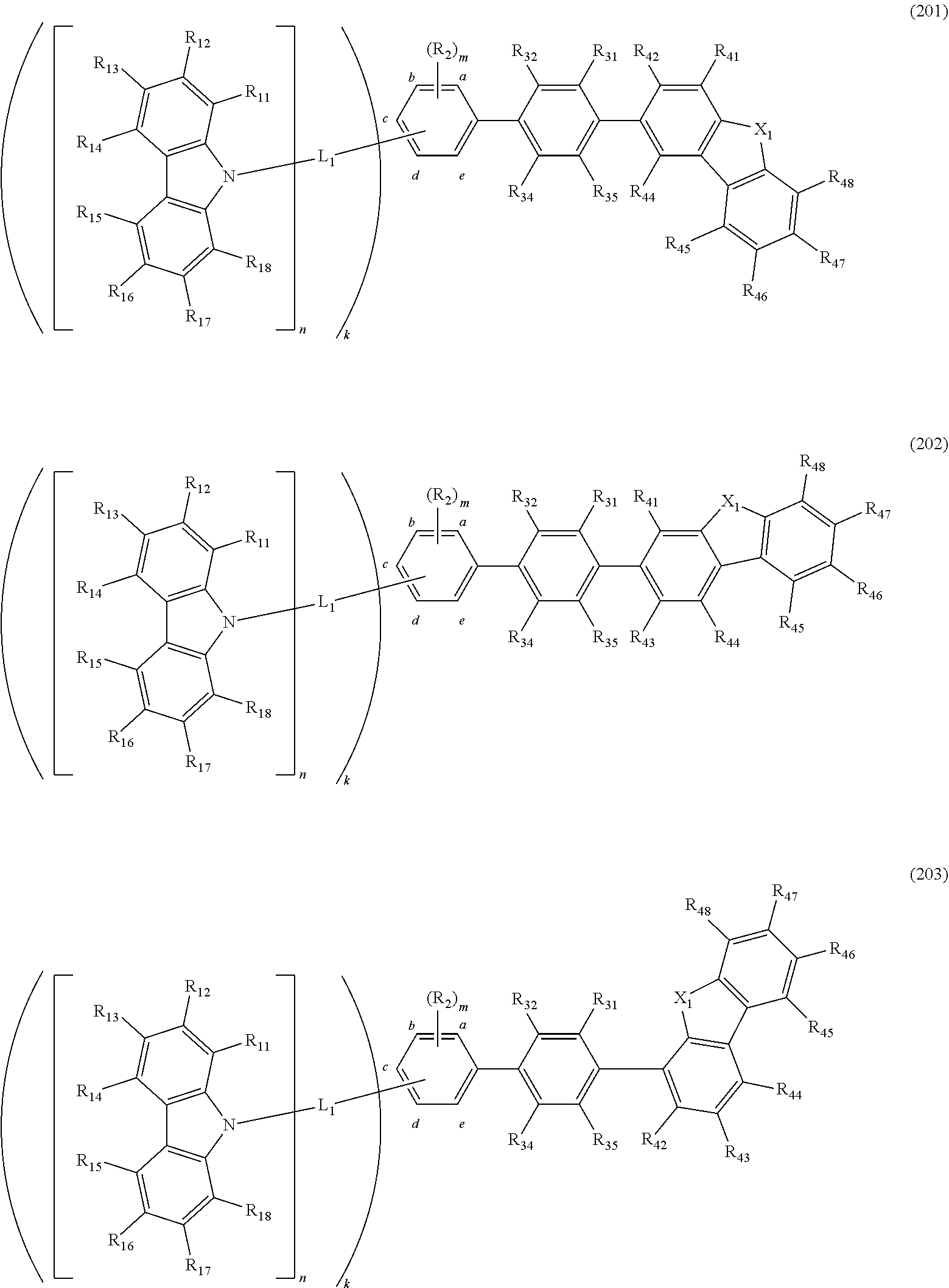


Applications Claiming Priority (3)
| Application Number | Priority Date | Filing Date | Title |
|---|---|---|---|
| JP2018234819 | 2018-12-14 | ||
| JP2018-234819 | 2018-12-14 | ||
| PCT/JP2019/048468 WO2020122118A1 (en) | 2018-12-14 | 2019-12-11 | Organic electroluminescent element, compound, material for organic electroluminescent element, and electronic device |
Publications (2)
| Publication Number | Publication Date |
|---|---|
| US20220081450A1 US20220081450A1 (en) | 2022-03-17 |
| US12157747B2 true US12157747B2 (en) | 2024-12-03 |
Family
ID=71077417
Family Applications (1)
| Application Number | Title | Priority Date | Filing Date |
|---|---|---|---|
| US17/413,248 Active 2042-01-06 US12157747B2 (en) | 2018-12-14 | 2019-12-11 | Organic electroluminescent element, compound, material for organic electroluminescent element, and electronic device |
Country Status (6)
| Country | Link |
|---|---|
| US (1) | US12157747B2 (en) |
| EP (1) | EP3896070A4 (en) |
| JP (1) | JP7393345B2 (en) |
| KR (1) | KR102810054B1 (en) |
| CN (1) | CN113166118A (en) |
| WO (1) | WO2020122118A1 (en) |
Families Citing this family (6)
| Publication number | Priority date | Publication date | Assignee | Title |
|---|---|---|---|---|
| KR102753926B1 (en) * | 2019-03-11 | 2025-01-15 | 삼성디스플레이 주식회사 | Heterocyclic compound and organic light emitting device including the same |
| US12180399B2 (en) * | 2020-02-04 | 2024-12-31 | Kyulux, Inc. | Composition, film, organic light emitting element, method for providing light emitting composition, and program |
| US20220158096A1 (en) * | 2020-11-16 | 2022-05-19 | Universal Display Corporation | Organic electroluminescent materials and devices |
| JP2024075797A (en) * | 2021-02-19 | 2024-06-05 | 出光興産株式会社 | Organic electroluminescence element and electronic device |
| WO2022196749A1 (en) | 2021-03-18 | 2022-09-22 | 出光興産株式会社 | Organic electroluminescent element, compound, and electronic device |
| JP2025131944A (en) * | 2022-06-09 | 2025-09-10 | 出光興産株式会社 | Organic electroluminescent element, compound, and electronic device |
Citations (25)
| Publication number | Priority date | Publication date | Assignee | Title |
|---|---|---|---|---|
| US20090017330A1 (en) | 2007-07-10 | 2009-01-15 | Idemitsu Kosan Co., Ltd. | Material for organic electroluminescence device and organic electroluminescence device utilizing the same |
| WO2013109045A1 (en) | 2012-01-16 | 2013-07-25 | Rohm And Haas Electronic Materials Korea Ltd. | Novel organic electroluminescent compounds and organic electroluminescent device using the same |
| CN103688384A (en) * | 2011-07-15 | 2014-03-26 | 国立大学法人九州大学 | Delayed-fluorescence material and organic electroluminescence element using same |
| KR20150077219A (en) | 2013-12-27 | 2015-07-07 | 주식회사 두산 | Organic light emitting compound and organic electroluminescent device using the same |
| CN105198868A (en) | 2010-10-08 | 2015-12-30 | 通用显示公司 | Novel 3, 9-Linked Oliogocarbazole-Based Hosts, Containing DBT and DBF Fragments, Separated by Aromatic Spacers |
| CN105263937A (en) | 2013-06-03 | 2016-01-20 | 罗门哈斯电子材料韩国有限公司 | Organic electroluminescent compound and organic electroluminescent device comprising the same |
| KR20160027940A (en) | 2014-09-02 | 2016-03-10 | 주식회사 엘지화학 | Organic light emitting device |
| CN105684180A (en) | 2014-10-07 | 2016-06-15 | 出光兴产株式会社 | Organic electroluminescent element and electronic device |
| EP3035401A1 (en) | 2013-08-14 | 2016-06-22 | Kyushu University, National University Corporation | Organic electroluminescent element |
| WO2016102040A1 (en) | 2014-12-23 | 2016-06-30 | Merck Patent Gmbh | Carbazoles with two dibenzofuran or dibenzothiophene substituents |
| US20160276604A1 (en) | 2015-03-16 | 2016-09-22 | Universal Display Corporation | Organic electroluminescent materials and devices |
| KR20160149879A (en) | 2015-06-19 | 2016-12-28 | 덕산네오룩스 주식회사 | Compound for organic electric element, organic electric element comprising the same and electronic device thereof |
| US20170062718A1 (en) | 2015-08-31 | 2017-03-02 | Samsung Electronics Co., Ltd. | Organic light-emitting device |
| WO2017053426A1 (en) | 2015-09-21 | 2017-03-30 | Molecular Glasses, Inc. | Isomeric and asymmetric molecular glass mixtures for oled and other organic electronics and photonics applications |
| US20170141340A1 (en) | 2015-11-13 | 2017-05-18 | Japan Display Inc. | Organic electroluminescence device |
| US20170237004A1 (en) | 2013-08-25 | 2017-08-17 | Molecular Glasses, Inc. | Oled devices with improved lifetime using non-crystallizable molecular glass mixture hosts |
| KR20170136256A (en) | 2016-06-01 | 2017-12-11 | 삼성전자주식회사 | Organic light emitting device including the same |
| US20170369439A1 (en) | 2016-06-27 | 2017-12-28 | Samsung Electronics Co., Ltd. | Condensed cyclic compound, composition including the same, and organic light-emitting device including the condensed cyclic compound |
| WO2018113538A1 (en) * | 2016-12-23 | 2018-06-28 | 江苏三月光电科技有限公司 | Organic compound with homobenzene as core and use thereof in organic electroluminescence device |
| US20180248127A1 (en) | 2017-02-27 | 2018-08-30 | Samsung Electronics Co., Ltd. | Condensed cyclic compound and organic light-emitting device including the same |
| KR20180112962A (en) | 2017-04-05 | 2018-10-15 | (주)피엔에이치테크 | An electroluminescent compound and an electroluminescent device comprising the same |
| CN108912099A (en) | 2018-07-25 | 2018-11-30 | 上海道亦化工科技有限公司 | A kind of compound containing triazine and carbazole and application thereof and organic electroluminescence device |
| CN109232382A (en) | 2018-11-15 | 2019-01-18 | 长春海谱润斯科技有限公司 | A kind of carbazole derivates and its organic electroluminescence device |
| KR20190078117A (en) | 2017-12-26 | 2019-07-04 | 엘티소재주식회사 | Heterocyclic compound and organic light emitting device comprising the same |
| WO2019191665A1 (en) | 2018-03-30 | 2019-10-03 | Kyulux, Inc. | Composition of matter for use in organic light-emitting diodes |
Family Cites Families (2)
| Publication number | Priority date | Publication date | Assignee | Title |
|---|---|---|---|---|
| KR20090008099A (en) | 2007-09-05 | 2009-01-21 | 유영선 | Biodegradable resin composition with improved physical properties and preparation method thereof |
| KR101751395B1 (en) | 2015-11-30 | 2017-06-27 | 경북대학교 산학협력단 | Apparatus and method for ringer drop detection, recording medium for performing the method |
-
2019
- 2019-12-11 JP JP2020559283A patent/JP7393345B2/en active Active
- 2019-12-11 US US17/413,248 patent/US12157747B2/en active Active
- 2019-12-11 EP EP19897214.3A patent/EP3896070A4/en active Pending
- 2019-12-11 WO PCT/JP2019/048468 patent/WO2020122118A1/en not_active Ceased
- 2019-12-11 KR KR1020217022021A patent/KR102810054B1/en active Active
- 2019-12-11 CN CN201980081332.8A patent/CN113166118A/en active Pending
Patent Citations (37)
| Publication number | Priority date | Publication date | Assignee | Title |
|---|---|---|---|---|
| WO2009008099A1 (en) | 2007-07-10 | 2009-01-15 | Idemitsu Kosan Co., Ltd. | Material for organic electroluminescence element, and organic electroluminescence element prepared by using the material |
| US20090017331A1 (en) | 2007-07-10 | 2009-01-15 | Idemitsu Kosan Co., Ltd. | Material for organic electroluminescence device and organic electroluminescence device utilizing the same |
| US20120097937A1 (en) | 2007-07-10 | 2012-04-26 | Idemitsu Kosan Co., Ltd. | Material for organic electroluminescence device and organic electroluminescence device utilizing the same |
| US20090017330A1 (en) | 2007-07-10 | 2009-01-15 | Idemitsu Kosan Co., Ltd. | Material for organic electroluminescence device and organic electroluminescence device utilizing the same |
| CN105198868A (en) | 2010-10-08 | 2015-12-30 | 通用显示公司 | Novel 3, 9-Linked Oliogocarbazole-Based Hosts, Containing DBT and DBF Fragments, Separated by Aromatic Spacers |
| CN103688384A (en) * | 2011-07-15 | 2014-03-26 | 国立大学法人九州大学 | Delayed-fluorescence material and organic electroluminescence element using same |
| CN104136440A (en) | 2012-01-16 | 2014-11-05 | 罗门哈斯电子材料韩国有限公司 | Novel organic electroluminescent compounds and organic electroluminescent device using the same |
| WO2013109045A1 (en) | 2012-01-16 | 2013-07-25 | Rohm And Haas Electronic Materials Korea Ltd. | Novel organic electroluminescent compounds and organic electroluminescent device using the same |
| CN105263937A (en) | 2013-06-03 | 2016-01-20 | 罗门哈斯电子材料韩国有限公司 | Organic electroluminescent compound and organic electroluminescent device comprising the same |
| US20160190478A1 (en) | 2013-08-14 | 2016-06-30 | Kyushu University, National University Corporation | Organic electroluminescent device |
| US20210074927A1 (en) | 2013-08-14 | 2021-03-11 | Kyushu University, National University Corporation | Organic electroluminescent device |
| EP3035401A1 (en) | 2013-08-14 | 2016-06-22 | Kyushu University, National University Corporation | Organic electroluminescent element |
| US20170237004A1 (en) | 2013-08-25 | 2017-08-17 | Molecular Glasses, Inc. | Oled devices with improved lifetime using non-crystallizable molecular glass mixture hosts |
| KR20150077219A (en) | 2013-12-27 | 2015-07-07 | 주식회사 두산 | Organic light emitting compound and organic electroluminescent device using the same |
| KR20160027940A (en) | 2014-09-02 | 2016-03-10 | 주식회사 엘지화학 | Organic light emitting device |
| KR20180015209A (en) | 2014-09-02 | 2018-02-12 | 주식회사 엘지화학 | Organic light emitting device |
| CN105684180A (en) | 2014-10-07 | 2016-06-15 | 出光兴产株式会社 | Organic electroluminescent element and electronic device |
| WO2016102040A1 (en) | 2014-12-23 | 2016-06-30 | Merck Patent Gmbh | Carbazoles with two dibenzofuran or dibenzothiophene substituents |
| JP2018503622A (en) | 2014-12-23 | 2018-02-08 | メルク パテント ゲーエムベーハー | Carbazole with two dibenzofuran or dibenzothiophene substituents |
| US20190044071A1 (en) | 2014-12-23 | 2019-02-07 | Merck Patent Gmbh | Carbazoles with two dibenzofuran or dibenzothiophene substituents |
| US20160276604A1 (en) | 2015-03-16 | 2016-09-22 | Universal Display Corporation | Organic electroluminescent materials and devices |
| KR20160149879A (en) | 2015-06-19 | 2016-12-28 | 덕산네오룩스 주식회사 | Compound for organic electric element, organic electric element comprising the same and electronic device thereof |
| US20170062718A1 (en) | 2015-08-31 | 2017-03-02 | Samsung Electronics Co., Ltd. | Organic light-emitting device |
| WO2017053426A1 (en) | 2015-09-21 | 2017-03-30 | Molecular Glasses, Inc. | Isomeric and asymmetric molecular glass mixtures for oled and other organic electronics and photonics applications |
| CN108140733A (en) | 2015-09-21 | 2018-06-08 | 分子玻璃公司 | For OLED and other organic electronics and the isomery of photonics applications and asymmetric molecult glass mixture |
| US20180261775A1 (en) | 2015-09-21 | 2018-09-13 | Molecular Glasses, Inc. | Isomeric and asymmetric molecular glass mixtures for oled and other organic electronics and photonics applications |
| US20170141340A1 (en) | 2015-11-13 | 2017-05-18 | Japan Display Inc. | Organic electroluminescence device |
| KR20170136256A (en) | 2016-06-01 | 2017-12-11 | 삼성전자주식회사 | Organic light emitting device including the same |
| US20170369439A1 (en) | 2016-06-27 | 2017-12-28 | Samsung Electronics Co., Ltd. | Condensed cyclic compound, composition including the same, and organic light-emitting device including the condensed cyclic compound |
| WO2018113538A1 (en) * | 2016-12-23 | 2018-06-28 | 江苏三月光电科技有限公司 | Organic compound with homobenzene as core and use thereof in organic electroluminescence device |
| US20180248127A1 (en) | 2017-02-27 | 2018-08-30 | Samsung Electronics Co., Ltd. | Condensed cyclic compound and organic light-emitting device including the same |
| KR20180112962A (en) | 2017-04-05 | 2018-10-15 | (주)피엔에이치테크 | An electroluminescent compound and an electroluminescent device comprising the same |
| KR20190078117A (en) | 2017-12-26 | 2019-07-04 | 엘티소재주식회사 | Heterocyclic compound and organic light emitting device comprising the same |
| US20200343452A1 (en) | 2017-12-26 | 2020-10-29 | Lt Materials Co., Ltd. | Heterocyclic compound and organic light-emitting device comprising same |
| WO2019191665A1 (en) | 2018-03-30 | 2019-10-03 | Kyulux, Inc. | Composition of matter for use in organic light-emitting diodes |
| CN108912099A (en) | 2018-07-25 | 2018-11-30 | 上海道亦化工科技有限公司 | A kind of compound containing triazine and carbazole and application thereof and organic electroluminescence device |
| CN109232382A (en) | 2018-11-15 | 2019-01-18 | 长春海谱润斯科技有限公司 | A kind of carbazole derivates and its organic electroluminescence device |
Non-Patent Citations (12)
| Title |
|---|
| Adachi, C., "Yuki Hando-tai no Debaisu Bussei (Device Physics of Organic Semiconductors)," Kodansha, 2012, pp. 261-268, 19 total pages (with English translation). |
| Combined Chinese Office Action and Search Report issued Nov. 14, 2023, in corresponding Chinese Patent Application No. 201980081332.8 (with English Translation of Category of Cited Documents), 12 pages. |
| Extended European Search Report issued Aug. 5, 2022 in European Patent Application No. 19897214.3, 14 pages. |
| Extended European Search Report issued Oct. 18, 2022 in European Patent Application No. 19897214.3, 15 pages. |
| International Search Report issued on Feb. 25, 2020 in PCT/JP2019/048468 filed on Dec. 11, 2019, 3 pages. |
| Machine translation of CN-103688384-A, translation generated Feb. 2024, 19 pages. (Year: 2024). * |
| Machine translation of WO-2018113538-A1, translation generated Feb. 2024, 18 pages. (Year: 2024). * |
| Nakanotani, H. et al., "High-efficiency organic light-emitting diodes with fluorescent emitters," Nature Communications, vol. 5, 4016, 2014, pp. 1-7. |
| Office Action issued Sep. 5, 2023, in corresponding Japanese Patent Application No. 2020-559283, 2 pages. |
| Office Action received Aug. 9, 2024, in corresponding Chinese patent application No. 201980081332.8, (with machine translation). |
| Office Action received on Oct. 7, 2024, in corresponding Korean patent application No. 10-2021-7022021(with machine translation). |
| Uoyama, H. et al., "Highly efficient organic light-emitting diodes from delayed fluorescence," Nature, vol. 492, pp. 234-238, 2012, 7 total pages. |
Also Published As
| Publication number | Publication date |
|---|---|
| CN113166118A (en) | 2021-07-23 |
| JP7393345B2 (en) | 2023-12-06 |
| JPWO2020122118A1 (en) | 2021-10-21 |
| EP3896070A1 (en) | 2021-10-20 |
| WO2020122118A1 (en) | 2020-06-18 |
| KR20210103508A (en) | 2021-08-23 |
| EP3896070A4 (en) | 2022-11-16 |
| KR102810054B1 (en) | 2025-05-19 |
| US20220081450A1 (en) | 2022-03-17 |
Similar Documents
| Publication | Publication Date | Title |
|---|---|---|
| US10547009B2 (en) | Organic electroluminescent element, electronic device and compound | |
| US11043638B2 (en) | Organic electroluminescence device and electronic device | |
| US9997717B2 (en) | Organic electroluminescence device and electronic device | |
| US11201297B2 (en) | Organic electroluminescence device and electronic device | |
| US12157747B2 (en) | Organic electroluminescent element, compound, material for organic electroluminescent element, and electronic device | |
| US12486452B2 (en) | Organic electroluminescent element and electronic device | |
| US12435269B2 (en) | Organic electroluminescent element and electronic appliance | |
| US20230014964A1 (en) | Organic electroluminescent element, and electronic apparatus | |
| US20210074925A1 (en) | Organic electroluminescent element and electronic device | |
| US12274168B2 (en) | Compound, material for organic electroluminescent element, organic electroluminescent element, and electronic appliance | |
| US20210020846A1 (en) | Organic electroluminescent element and electronic device | |
| US20220263030A1 (en) | Organic electroluminescent element and electronic device | |
| EP3974433B1 (en) | Organic electroluminescent element, compound, and electronic appliance | |
| US12302757B2 (en) | Organic electroluminescence element and electronic device | |
| US12127478B2 (en) | Organic electroluminescence device and electronic device | |
| US11944009B2 (en) | Compound, material for organic electroluminescent element, organic electroluminescent element, and electronic device | |
| US12575319B2 (en) | Organic electroluminescence device and electronic device | |
| US20230301188A1 (en) | Organic electroluminescent element, organic electroluminescent light-emitting device, and electronic equipment | |
| US20190245152A1 (en) | Organic electroluminescence device and electronic device | |
| US20230371373A1 (en) | Organic electroluminescent element, compound, material for organic electroluminescent element, and electronic device | |
| US12421450B2 (en) | Compounds, materials for organic electroluminescent devices, organic electroluminescent devices, and electronic devices | |
| US20240215447A1 (en) | Organic electroluminescent element and electronic device | |
| US20230050369A1 (en) | Organic electroluminescent element, compound and electronic device |
Legal Events
| Date | Code | Title | Description |
|---|---|---|---|
| AS | Assignment |
Owner name: IDEMITSU KOSAN CO.,LTD., JAPAN Free format text: ASSIGNMENT OF ASSIGNORS INTEREST;ASSIGNORS:SHIOMI, TAKUSHI;NAKANO, HIROMI;SIGNING DATES FROM 20210426 TO 20210506;REEL/FRAME:056514/0456 |
|
| FEPP | Fee payment procedure |
Free format text: ENTITY STATUS SET TO UNDISCOUNTED (ORIGINAL EVENT CODE: BIG.); ENTITY STATUS OF PATENT OWNER: LARGE ENTITY |
|
| STPP | Information on status: patent application and granting procedure in general |
Free format text: DOCKETED NEW CASE - READY FOR EXAMINATION |
|
| STPP | Information on status: patent application and granting procedure in general |
Free format text: NON FINAL ACTION MAILED |
|
| STPP | Information on status: patent application and granting procedure in general |
Free format text: RESPONSE TO NON-FINAL OFFICE ACTION ENTERED AND FORWARDED TO EXAMINER |
|
| STPP | Information on status: patent application and granting procedure in general |
Free format text: NOTICE OF ALLOWANCE MAILED -- APPLICATION RECEIVED IN OFFICE OF PUBLICATIONS |
|
| ZAAB | Notice of allowance mailed |
Free format text: ORIGINAL CODE: MN/=. |
|
| STPP | Information on status: patent application and granting procedure in general |
Free format text: AWAITING TC RESP., ISSUE FEE NOT PAID |
|
| STPP | Information on status: patent application and granting procedure in general |
Free format text: NOTICE OF ALLOWANCE MAILED -- APPLICATION RECEIVED IN OFFICE OF PUBLICATIONS |
|
| STPP | Information on status: patent application and granting procedure in general |
Free format text: NOTICE OF ALLOWANCE MAILED -- APPLICATION RECEIVED IN OFFICE OF PUBLICATIONS |
|
| STPP | Information on status: patent application and granting procedure in general |
Free format text: PUBLICATIONS -- ISSUE FEE PAYMENT VERIFIED |
|
| STPP | Information on status: patent application and granting procedure in general |
Free format text: WITHDRAW FROM ISSUE AWAITING ACTION |
|
| STPP | Information on status: patent application and granting procedure in general |
Free format text: AWAITING TC RESP., ISSUE FEE NOT PAID |
|
| STCF | Information on status: patent grant |
Free format text: PATENTED CASE |