US12152801B2 - Structure - Google Patents

Structure Download PDF

Info

Publication number
US12152801B2
US12152801B2 US17/992,114 US202217992114A US12152801B2 US 12152801 B2 US12152801 B2 US 12152801B2 US 202217992114 A US202217992114 A US 202217992114A US 12152801 B2 US12152801 B2 US 12152801B2
Authority
US
United States
Prior art keywords
ventilation channel
space
ventilation
virtual line
tube section
Prior art date
Legal status (The legal status is an assumption and is not a legal conclusion. Google has not performed a legal analysis and makes no representation as to the accuracy of the status listed.)
Active, expires
Application number
US17/992,114
Other versions
US20230168001A1 (en
Inventor
Tsuneyuki Okamoto
Current Assignee (The listed assignees may be inaccurate. Google has not performed a legal analysis and makes no representation or warranty as to the accuracy of the list.)
Individual
Original Assignee
Individual
Priority date (The priority date is an assumption and is not a legal conclusion. Google has not performed a legal analysis and makes no representation as to the accuracy of the date listed.)
Filing date
Publication date
Application filed by Individual filed Critical Individual
Publication of US20230168001A1 publication Critical patent/US20230168001A1/en
Application granted granted Critical
Publication of US12152801B2 publication Critical patent/US12152801B2/en
Active legal-status Critical Current
Adjusted expiration legal-status Critical

Links

Images

Classifications

    • FMECHANICAL ENGINEERING; LIGHTING; HEATING; WEAPONS; BLASTING
    • F24HEATING; RANGES; VENTILATING
    • F24FAIR-CONDITIONING; AIR-HUMIDIFICATION; VENTILATION; USE OF AIR CURRENTS FOR SCREENING
    • F24F13/00Details common to, or for air-conditioning, air-humidification, ventilation or use of air currents for screening
    • F24F13/02Ducting arrangements
    • F24F13/0227Ducting arrangements using parts of the building, e.g. air ducts inside the floor, walls or ceiling of a building
    • EFIXED CONSTRUCTIONS
    • E04BUILDING
    • E04BGENERAL BUILDING CONSTRUCTIONS; WALLS, e.g. PARTITIONS; ROOFS; FLOORS; CEILINGS; INSULATION OR OTHER PROTECTION OF BUILDINGS
    • E04B1/00Constructions in general; Structures which are not restricted either to walls, e.g. partitions, or floors or ceilings or roofs
    • E04B1/62Insulation or other protection; Elements or use of specified material therefor
    • E04B1/70Drying or keeping dry, e.g. by air vents
    • E04B1/7069Drying or keeping dry, e.g. by air vents by ventilating
    • FMECHANICAL ENGINEERING; LIGHTING; HEATING; WEAPONS; BLASTING
    • F24HEATING; RANGES; VENTILATING
    • F24FAIR-CONDITIONING; AIR-HUMIDIFICATION; VENTILATION; USE OF AIR CURRENTS FOR SCREENING
    • F24F7/00Ventilation
    • FMECHANICAL ENGINEERING; LIGHTING; HEATING; WEAPONS; BLASTING
    • F24HEATING; RANGES; VENTILATING
    • F24FAIR-CONDITIONING; AIR-HUMIDIFICATION; VENTILATION; USE OF AIR CURRENTS FOR SCREENING
    • F24F7/00Ventilation
    • F24F2007/0025Ventilation using vent ports in a wall

Definitions

  • the present disclosure relates to a structure including a ventilation device for sending air from a first space to a second space.
  • Patent Literature 1 describes an example of a structure with a ventilation device that sends air from the outside (first space) to the inside (second space) of a building.
  • the structure described in PTL 1 is a ventilation structure in a multi-story apartment house, in which multiple dwelling units are arranged in the left-right direction on each floor.
  • the ventilation structure described in PTL 1 has at least one of the unit boundary walls dividing dwelling units adjacent to each other on a given floor with double walls arranged at predetermined intervals.
  • a balcony is provided outside each dwelling unit, and the double wall is integrated with the balcony's handrail wall.
  • the double wall is extended from the dwelling unit side to the outside and is extendedly formed in parallel until a halfway point and extendedly formed in spreading out in a trumpet shape in the left-right directions from the halfway point.
  • PTL 1 states that the space between the double walls comprising the unit boundary walls can function as a ventilation channel with high air distribution efficiency, thereby sufficiently enhancing the ventilation of the living space of each dwelling unit in a multi-story apartment house.
  • Patent Literature 1 Japanese Unexamined Patent Application Publication No. 2002-115407
  • the inventor of the present application recognized the problem that the structure described in PTL 1 is exclusively provided on a balcony to partition adjacent dwelling units, thus increasing the size of the building structure.
  • the purpose of the present disclosure is to provide a structure that can improve air permeability from a first space to a second space and can prevent a structure of a building from increasing in size.
  • the structure of the present disclosure has a body section separating a first space from a second space; a ventilation device provided in the body section; and a ventilation channel provided in the ventilation device, the ventilation channel sending air in the first space to the second space, wherein an arrangement range of the ventilation device in a thickness direction of the body section is within an arrangement range of the body section, and a cross-sectional area of the ventilation channel in a plane perpendicular to a virtual line indicating a center of the ventilation channel narrows as it approaches the second space along the virtual line.
  • the structure of the present disclosure can improve ventilation performance from a first space to a second space and can prevent a structure of a building from increasing in size.
  • FIG. 1 A is an outside view of an example building.
  • FIG. 1 B is a cross-sectional view of a wall provided in the building.
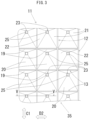
  • FIG. 2 is a front view of the wall viewing from outside the building.
  • FIG. 3 is a rear view of the wall viewing from inside the building.
  • FIG. 4 is a side cross-sectional view at the II-II line of FIG. 2 .
  • FIG. 5 is a planar cross-sectional view at the V-V line of FIG. 3 .
  • FIG. 6 A is a front view illustrating another example of the shape of the ventilation channel.
  • FIG. 6 B is a rear view illustrating another example of the shape of the ventilation channel.
  • FIG. 7 is a side cross-sectional view illustrating an example with a sealing device that blocks the ventilation channel.
  • FIG. 8 is a side cross-sectional view illustrating an example with shutters on the outside and inside of the wall.
  • FIG. 9 A is a schematic side-section view of the wall.
  • FIG. 9 B is a schematic side-section view of the wall.
  • FIG. 9 C is a schematic side-plane view of the wall.
  • FIG. 9 D is a schematic side-plane view of the wall.
  • a structure of the present disclosure is designed to improve air permeability and ventilation performance from a first space to a second space, and a ventilation device is provided in the structure itself.
  • the following is a description of the embodiment of the present disclosure based on the drawings. The configuration of the following embodiments is illustrative and the present disclosure is not limited to the contents of the embodiments.
  • Building 10 shown in FIG. 1 A is a detached house (a house) as an example, and the building 10 has walls 11 as shown in FIG. 1 B , FIG. 2 , FIG. 3 , FIG. 4 , and FIG. 5 .
  • the wall 11 is the structure that separates outside A 1 of building 10 from living space B 1 .
  • the wall 11 extends along a vertical direction, i.e., the action direction of gravity.
  • the wall 11 is extended, as an example, linearly in a side cross-sectional view, as shown in FIG. 4
  • the wall 11 is extended, as an example, linearly in a planar cross-sectional view, as shown in FIG. 5 .
  • the wall 11 has body section 35 and a ventilation device 30 .
  • a body section 35 is a structure that ensures the strength of the wall 11 , and the body section 35 has vertical frames 12 and horizontal frames 13 .
  • the vertical frame 12 is a plate-shaped structural element extending along a vertical direction C 1 and having a width in a first direction D 1 from the outside A 1 to the living space B 1 .
  • a side cross-sectional view of the wall 11 , a virtual line E 3 which shows the center of the body section 35 in the thickness direction of the body section 35 , i.e., in the first direction D 1 , and extends in the vertical direction C 1 , is a straight line.
  • a planar cross-sectional view of the wall 11 , a virtual line E 4 shows the center of the body section 35 in the first direction D 1 , and extends in the horizontal direction, is a straight line.
  • the first direction D 1 is horizontal and intersects the vertical direction C 1 .
  • the vertical frames 12 are arranged linearly along the vertical direction C 1 .
  • the vertical frame 12 has a first side edge 15 and a second side edge 16 as shown in FIG. 4 .
  • the first side edge 15 is located in the vertical frames 12 closest to the outside A 1 .
  • the second side edge 16 is located in the vertical frames 12 closest to the living space B 1 .
  • the first side edge 15 and the second side edge 16 are parallel.
  • a plurality of vertical frames 12 is provided, and the plurality of vertical frames 12 is arranged parallel to each other.
  • the plurality of vertical frames 12 has the same spacing in a second direction D 2 between each other.
  • the second direction D 2 is horizontal and intersects the first direction D 1 .
  • the horizontal frame 13 is a plate-shaped structural element that extends along the first direction D 1 , and has a width of the second direction D 2 . As shown in FIG. 2 , when the wall 11 is viewed from the front, the horizontal frames 13 are arranged linearly along the second direction D 2 .
  • the horizontal frame 13 has a first side edge 17 and a second side edge 18 as shown in FIG. 5 .
  • the first side edge 17 is located in the horizontal frames 13 closest to the outside A 1 .
  • the second side edge 18 is located in the horizontal frames 13 closest to the living space B 1 .
  • the first side edge 17 and the second side edge 18 are parallel.
  • a plurality of horizontal frames 13 is provided as shown in FIG. 2 and FIG. 3 , and the plurality of horizontal frames 13 are arranged parallel to each other.
  • the plurality of horizontal frames 13 has the same spacing in the vertical direction C 1 between each other.
  • the vertical frame 12 and the horizontal frame 13 are connected. Therefore, both in the front view of the wall 11 from the outside A 1 as shown in FIG. 2 and in the rear view of the wall 11 from the living space B 1 as shown in FIG. 3 , the plurality of vertical frames 12 and the plurality of horizontal frames 13 are arranged in a grid pattern.
  • the ventilation device 30 is a mechanism for sending air of the outside A 1 to the living space B 1 , and the ventilation device 30 has first tube sections 14 and second tube sections 23 .
  • a plurality of first tube section 14 is provided, and each first tube section 14 is located between two vertical frames 12 and between two horizontal frames 13 , respectively.
  • Each of the plurality of first tube sections 14 is connected to the vertical frames 12 and the horizontal frames 13 .
  • the first tube section 14 has an upper plate 19 , a lower plate 20 , side plates 21 and 22 , and the second tube section 23 .
  • the upper plate 19 locates above the lower plate 20 in the vertical direction C 1 .
  • the part of the upper plate 19 closest to the outside A 1 connects with the first side edge 17 of the horizontal frame 13 .
  • the part of the upper plate 19 closest to the living space B 1 connects with the second tube section 23 .
  • the part of the lower plate 20 closest to the outside A 1 connects with the first side edge 17 of the horizontal frame 13 .
  • the part of the lower plate 20 closest to the living space B 1 connects with the second tube section 23 .
  • the side plate 21 connects with the first side edge 15 of the vertical frame 12 , the second tube section 23 , the upper plate 19 , and the lower plate 20 , respectively.
  • the side plate 22 connects with the first side edge 15 of the vertical frame 12 , the second tube section 23 , upper plate 19 , and lower plate 20 , respectively.
  • the shape of the second tube section 23 is a quadrangle, specifically, rectangular or square.
  • the first ventilation channel 24 is formed in the space enclosed by the upper plate 19 , the lower plate 20 , and the side plates 21 and 22 .
  • the opening shape of the first ventilation channel 24 is a quadrangle, e.g., square or rectangular.
  • the second tube section 23 has a second ventilation channel 25 .
  • the opening shape of the second ventilation channel 25 is a quadrangle, e.g., square or rectangular.
  • the first ventilation channel 24 connects with the outside A 1 and the second ventilation channel 25
  • the second ventilation channel 25 connects with the living space B 1 .
  • the first ventilation channel 24 and the second ventilation channel 25 apparently penetrate the wall 11 .
  • the air in outside A 1 can flow into the living space B 1 through the first ventilation channel 24 and the second ventilation channel 25 .
  • the virtual line E 1 which indicates the center of the second tube section 23 , i.e., the center of the second ventilation channel 25 , is a straight line.
  • the virtual line E 1 is horizontal and aligned with the first direction D 1 .
  • an arrangement range L 1 of the first ventilation channel 24 exceeds an arrangement range L 2 of the second ventilation channel 25 .
  • the arrangement range L 1 and the arrangement range L 2 do not overlap.
  • all of the arrangement range L 1 and the arrangement range L 2 are located within an arrangement range L 3 of the body section 35 .
  • two adjacent vertical frames 12 and two adjacent horizontal frames 13 are connected to construct a circular frame, and inside the circular frame, i.e., in the area or space enclosed by the frame, the first ventilation channel 24 and the second ventilation channel 25 are provided respectively.
  • a flat surface 26 forming the first ventilation channel 24 has a slope inclined to the virtual line E 1 .
  • a flat surface 27 forming the first ventilation channel 24 has a slope inclined to the virtual line E 1 .
  • the virtual line E 1 of the second ventilation channel 25 formed between adjacent horizontal frames 13 is located above a virtual line E 2 that marks the center between adjacent horizontal frames 13 .
  • the virtual line E 2 can also be defined as the centerline of the entrance of the first ventilation channel 24 .
  • a slope angle of an acute angle side of the flat surface 26 inclined to the virtual line E 1 is smaller than a slope angle of an acute angle side of the flat surface 27 inclined to the virtual line E 1 .
  • a flat surface 28 forming the first ventilation channel 24 has a slope inclined to the virtual line E 1 .
  • a flat surface 29 forming the first ventilation channel 24 has a slope inclined to the virtual line E 1 .
  • a slope angle on an acute side of the flat surface 28 inclined to the virtual line E 1 and a slope angle on an acute side of the flat surface 29 inclined to the virtual line E 1 are identical.
  • the cross-sectional area of the second ventilation channel 25 in the plane perpendicular to the virtual line E 1 is identical in the direction along the virtual line E 1 . Furthermore, the cross-sectional area of the first ventilation channel 24 in the plane perpendicular to the virtual line E 1 becomes narrower as it approaches the second ventilation channel 25 . Furthermore, the minimum cross-sectional area of the first ventilation channel 24 in the plane perpendicular to the virtual line E 1 is identical to the cross-sectional area of the second ventilation channel 25 in the plane perpendicular to the virtual line E 1 .
  • the first tube section 14 and the second tube section 23 described above, constitute the ventilation device 30 .
  • the first tube section 14 and the second tube section 23 are connected to form a funnel shape.
  • the materials of the vertical frame 12 , the horizontal frame 13 , the first tube section 14 , and the second tube section 23 are not limited.
  • the materials may be any of the following: metal, glass, synthetic resin, concrete, etc.
  • the materials of the vertical frame 12 , the horizontal frame 13 , the first tube section 14 , and the second tube section 23 may all be different, or materials of several elements may be identical.
  • the hatching on the cross sections of the vertical frame 12 , the horizontal frame 13 , the first tube section 14 , and the second tube section 23 are common for convenience. The common hatching does not mean that the materials of the vertical frame 12 , the horizontal frame 13 , the first tube section 14 , and the second tube section 23 are identical.
  • the ventilation device 30 also maybe a unit integrating the first tube section 14 and the second tube section 23 beforehand.
  • the ventilation device 30 is arranged in a space enclosed by two vertical frames 12 and two horizontal frames 13 , and the first tube section 14 is connected to the vertical frames 12 and the horizontal frames 13 .
  • the air in outside A 1 flows into the living space B 1 through the first ventilation channel 24 and the second ventilation channel 25 .
  • the cross-sectional area of the first ventilation channel 24 in the plane perpendicular to the virtual line E 1 becomes narrower as it approaches the second ventilation channel 25 .
  • the air velocity in the first ventilation channel 24 is determined by:
  • the ventilation device 30 is part of the body section 35 . Furthermore, the arrangement range L 1 and L 2 in the thickness direction of the body section 35 , i.e., along the first direction D 1 , are within the placement range L 3 of the body section 35 . Thus, the structure of the wall 11 can be prevented from increasing in size along the first direction D 1 . In addition, the ventilation device 30 does not interfere with the movement of people and the like in the living space B 1 and outside A 1 .
  • the frequency of use, the duration of use, and the like of the air conditioning equipment used to air-condition the living space B 1 can be reduced.
  • the concentration of carbon dioxide in the air in the inside A 2 can be reduced by fresh air being drawn into the living space B 1 .
  • the ventilation device 30 does not consume electrical power.
  • the virtual line of the second ventilation channel 25 is located above the virtual line E 2 at the entrance of the first ventilation channel 24 .
  • the virtual line E 1 and the virtual line E 2 may be located at the same height, or the virtual line E 1 may be located below the virtual line E 2 .
  • the virtual lines E 1 and E 2 may be centered between a horizontal frame 13 and a horizontal frame 13 , or the virtual lines E 1 and E 2 may be positioned closer to one of the horizontal frames 13 .
  • FIG. 6 A is a front view illustrating a portion of wall 11 , and FIG. 6 A inclusively shows other geometry examples of the first ventilation channel 24 A, and the second ventilation channel 25 A.
  • FIG. 6 A shows the shape of the first ventilation channel 24 A and the shape of the second ventilation channel 25 A in the plane perpendicular to the virtual line E 1 .
  • FIG. 6 B is a front view illustrating a portion of wall 11 , and FIG. 6 B inclusively shows other geometry examples of the first tube section 14 , and the second tube section 23 . Shapes of the first ventilation channel 24 A of the first tube section 14 and the second ventilation channel 25 A are circular.
  • the cross-sectional area of the second ventilation channel 25 A in the plane perpendicular to the virtual line E 1 is identical in the direction along the virtual line E 1 . Furthermore, the cross-sectional area of the first ventilation channel 24 A in the plane perpendicular to the virtual line E 1 becomes narrower as it approaches the second ventilation channel 25 A. Furthermore, the minimum cross-sectional area of the first ventilation channel 24 A in the plane perpendicular to the virtual line E 1 is identical to the cross-sectional area of the second ventilation channel 25 A in the plane perpendicular to the virtual line E 1 .
  • the frontal shape of the first ventilation channel 24 B of the first tube section 14 and the second ventilation channel 25 B of the second tube section 23 are hexagonal. Furthermore, the cross-sectional area of the second ventilation channel 25 B in the plane perpendicular to the virtual line E 1 is identical in the direction along virtual line E 1 . Furthermore, the cross-sectional area of the first ventilation channel 24 B in the plane perpendicular to the virtual line E 1 becomes narrower as it approaches the second ventilation channel 25 B. Furthermore, the minimum cross-sectional area of the first ventilation channel 24 B in the plane perpendicular to the virtual line E 1 is identical to the cross-sectional area of the second ventilation channel 25 B in the plane perpendicular to the virtual line E 1 .
  • the frontal shape of the first ventilation channel 24 C of the first tube section 14 and the second ventilation channel 25 C of the second tube section 23 are oval. Furthermore, the cross-sectional area of the second ventilation channel 25 C in the plane perpendicular to the virtual line E 1 is identical in the direction along virtual line E 1 . Furthermore, the cross-sectional area of the first ventilation channel 24 C in the plane perpendicular to the virtual line E 1 becomes narrower as it approaches the second ventilation channel 25 C. Furthermore, the minimum cross-sectional area of the first ventilation channel 24 C in the plane perpendicular to the virtual line E 1 is identical to the cross-sectional area of the second ventilation channel 25 C in the plane perpendicular to the virtual line E 1 .
  • the frontal shape of the first ventilation channel 24 D of the first tube section 14 and the first ventilation channel 25 D of the second tube section 23 are triangular. Furthermore, the cross-sectional area of the second ventilation channel 25 D in the plane perpendicular to the virtual line E 1 is identical in the direction along virtual line E 1 . Furthermore, the cross-sectional area of the first ventilation channel 24 D in the plane perpendicular to the virtual line E 1 becomes narrower as it approaches the second ventilation channel 25 D. Furthermore, the minimum cross-sectional area of the first ventilation channel 24 D in the plane perpendicular to the virtual line E 1 is identical to the cross-sectional area of the second ventilation channel 25 D in the plane perpendicular to the virtual line E 1 .
  • the four types of ventilation devices 30 shown in FIG. 6 A and FIG. 6 B have the same effect as the ventilation devices 30 shown in FIG. 2 through 5 .
  • multiple combinations of the ventilation channels among follows with different shapes in the front view of the wall 11 can be provided: the first ventilation channel 24 and the second ventilation channel 25 , shown in FIG. 2 and FIG. 3 , and the first ventilation channel 24 A and the second ventilation channel 25 A, the first ventilation channel 24 B and the second ventilation channel 25 B, the first ventilation channel 24 C and the second ventilation channel 25 C, and the first ventilation channel 24 D and the second ventilation channel 25 D, shown in FIG. 6 A and FIG. 6 B .
  • FIG. 7 is a side cross-sectional view illustrating an example of sealing devices 36 and 37 that block the second ventilation channel 25 .
  • the sealing device 36 is attached to the outer circumference of the second tube section 23 .
  • the sealing device 36 can be applied to any of the second tube sections 23 in FIG. 2 through FIG. 6 .
  • the user can grab the sealing device 36 and attach and remove it from the second tube section 23 .
  • the sealing device 36 and the second tube section 23 may be secured by threaded coupling or by fitting together.
  • the sealing device 36 is removed from the second tube section 23 , the same effect of the ventilation device 30 in FIG. 2 through FIG. 6 can be achieved.
  • the sealing device 36 is attached to the second tube section 23 , the air is prevented from entering the living space B 1 from the outside A 1 , and rain, insects, or other foreign matter can be reliably prevented from entering the living space B 1 from the outside A 1 .
  • the sealing device 37 is fitted into the second ventilation channel 25 of the second tube section 23 .
  • the sealing device 37 can be applied to any of the second tube sections 23 in FIG. 2 through FIG. 6 .
  • the user can grab the sealing device 37 and attach and remove it from the second tube section 23 .
  • the same effect of the ventilation device 30 in FIG. 2 through FIG. 6 can be achieved.
  • the sealing device 37 is attached to the second tube section 23 , the air is prevented from entering the living space B 1 from the outside A 1 , and rain, insects, or other foreign matter can be reliably prevented from entering the living space B 1 from the outside A 1 .
  • the material of sealing devices 36 and 37 can be any of metal, synthetic resin, or synthetic rubber.
  • FIG. 8 shows an example with a shutter 38 on the outside A 1 side from wall 11 and a shutter 39 on the living space B 1 side from wall 11 .
  • a guide member which can allow the shutter 38 capable of moving in the second direction D 2 shown in FIG. 2 or capable of moving in the vertical direction C 1 is provided. Then, the shutter 38 is moved and stopped by manual operation by the user, the power of an electric motor, and the like.
  • shutter 38 is provided on the outside A 1 side of the wall 11 , the outside A 1 and the first ventilation channel 24 are blocked by the shutter 38 . Therefore, the air is prevented from entering the living space B 1 from the outside A 1 , and rain, insects, or other foreign matter can be reliably prevented from entering the living space B 1 from the outside A 1 .
  • a guide member which can allow a shutter 39 capable of moving in the second direction D 2 shown in FIG. 2 or capable of moving in the vertical direction C 1 is provided. Then, the shutter 38 is moved and stopped by manual operation by the user, the power of an electric motor, and the like.
  • shutter 39 is provided on the living space B 1 side of the wall 11 , the air is prevented from entering the living space B 1 from the outside A 1 Further, the shutter 39 may be positioned in contact with the wall 11 . In this way, the shutter 39 can open and close the second ventilation channel 25 as the shutter 39 is moved.
  • either or both of the shutters 38 and 39 may be provided.
  • the shutters 38 and 39 are each made of metal for example.
  • sealing devices 36 or 37 are used or shutters 38 or 39 are present, the living space B 1 cannot be seen from the outside A 1 through the first ventilation channels 24 and second ventilation channels 25 so that the privacy of the living space B 1 can be ensured.
  • FIGS. 9 A, 9 B, 9 C, and 9 D are schematic cross-sectional views illustrating other shapes of the body section 35 of wall 11 .
  • FIGS. 9 A and 9 B show side sections of wall 11 .
  • the virtual line E 3 of the body section 35 shown in FIG. 9 A is a circular arc or curved line. In other words, the body section 35 is curved so that a substantial center of the vertical direction C 1 is closer to the outside A 1 than an upper end and a lower end of the vertical direction C 1 .
  • the virtual line E 3 of the body section 35 shown in FIG. 9 B is a circular arc or curved line. In other words, the body section 35 is curved so that a substantial center of the vertical direction C 1 is closer to the living space B 1 than an upper end and a lower end of the vertical direction C 1 .
  • FIGS. 9 C and 9 D show planar cross sections of the wall 11 .
  • the virtual line E 4 of the body section 35 shown in FIG. 9 C is a circular arc or curved line. In other words, the body section 35 is curved so that a substantial center of the second direction D 2 is closer to the outside A 1 than both ends of the second direction D 2 .
  • the virtual line E 4 of the body section 35 shown in FIG. 9 D is a circular arc or curved line. In other words, the body section 35 is curved so that a substantial center of the second direction D 2 is closer to the living space B 1 than both ends of the second direction D 2 .
  • the ventilation device 30 is shown singly for convenience, but multiple ventilation devices may be provided.
  • the body section 35 shown in FIGS. 9 A, 9 B, 9 C, and 9 D may have the vertical frames 12 and horizontal frames 13 shown in FIG. 2 through 8 or maybe a solid structure.
  • the ventilation devices 30 shown in FIGS. 9 A, 9 B, 9 C, and 9 D respectively, have at least one of the configurations of the ventilation devices 30 shown in FIG. 2 through 8 .
  • the ventilation devices 30 shown in FIGS. 9 A, 9 B, 9 C, and 9 D can achieve the same effect as the ventilation devices 30 shown in FIG. 2 through 8 .
  • FIG. 2 through 8 when the ventilation device 30 is unitized, it is possible to provide a hole or space in the body section of the existing wall 11 , install the ventilation device 30 in the hole or space, and secure the ventilation device 30 to the body section.
  • the building 10 is an example of a building.
  • the wall 11 is an example of a structure.
  • the ventilation device 30 is an example of a ventilation device.
  • the outside A 1 is an example of a first space
  • the living space B 1 is an example of a second space.
  • the body section 35 is an example of a body section.
  • the first ventilation channel 24 and the second ventilation channel 25 are examples of ventilation channels.
  • the first ventilation channels 24 , 24 A, 24 B, 24 C, and 24 D are examples of the first ventilation channel, respectively, and the second ventilation channels 25 , 25 A, 25 B, 25 C, and 25 D are examples of the second ventilation channel, respectively.
  • the virtual line E 1 is an example of a “virtual line indicating a center of the ventilation channel”.
  • the first tube section 14 is an example of a first tube section
  • the second tube section 23 is an example of a second tube section.
  • the arrangement range L 1 is an example of the arrangement range of the first ventilation channel
  • the arrangement range L 2 is an example of the arrangement range of the second ventilation channel Adjacent vertical frames 12 and adjacent horizontal frames 13 forms an annular frame.
  • the thickness of the wall body in the first direction may be constant in the vertical direction or may vary in the vertical direction.
  • the thickness of the wall body in the first direction may be constant in the horizontal direction or may vary in the horizontal direction.
  • the frames that consist of the wall body can be provided in a grid shape in the front view of the wall, in a curved shape in the front view of the wall, or in an annular shape in the front view of the wall.
  • the number of curved-shaped frames may be any number, single or multiple.
  • the number of annular frames may be any number, single or multiple.
  • Annular frames include triangular frames, circular frames, quadrangular frames, hexagonal frames, and the like.
  • a ventilation device can be installed in the area of the wall body enclosed by the annular frame.
  • the building can be any of single-family residence, warehouse, gymnasium, multi-used building, high-rise building, apartment complex, and the like.
  • the body section may be made of metal, wood, synthetic resin, mortar, or any combination of several of these.
  • wall 11 as a structure may be provided to separate the living space B 1 provided inside the building 10 and the living space B 2 provided inside the building 10 .
  • the wall 11 is also provided inside the building 10 .
  • the living space B 1 is the first space
  • the living space B 2 is the second space.
  • the air in the living space B 1 is sent to the living space B 2 through the ventilation device 30 provided in the wall 11 .
  • a ventilation device 30 may be provided in a wall 11 separating the living space B 2 from the outside A 1 .
  • the living space B 2 is the first space and the outside A 1 is the second space.
  • the air in the living space B 2 is sent to the outside A 1 through the ventilation device 30 provided in the wall 11 .
  • the ventilation performance of the living space B 2 is improved.
  • either the first space or second space may be a toilet, oshiire (Japanese built-in closet), closet, and the like.
  • the first space may be inside the building and the second space may be outside the building. In this case, the air inside the building is sent to the outside of the building by the ventilation device of the structure. Thus, ventilation performance inside the building is improved.
  • the structure of this disclosure can be installed and used as a wall for sending the air from a first space to a second space.

Landscapes

  • Engineering & Computer Science (AREA)
  • Chemical & Material Sciences (AREA)
  • General Engineering & Computer Science (AREA)
  • Mechanical Engineering (AREA)
  • Combustion & Propulsion (AREA)
  • Civil Engineering (AREA)
  • Architecture (AREA)
  • Structural Engineering (AREA)
  • Physics & Mathematics (AREA)
  • Electromagnetism (AREA)
  • Building Environments (AREA)
  • Residential Or Office Buildings (AREA)
  • Duct Arrangements (AREA)
  • Air-Flow Control Members (AREA)
  • Ventilation (AREA)
  • Load-Bearing And Curtain Walls (AREA)

Abstract

To provide a structure that can improve air permeability from a first space to a second space and can prevent a building structure from increasing in size. A wall 11 has: a body section 35 separating an outside A1 from a living space B1 of a building; a ventilation device 30 provided in the body section 35; and a first ventilation channel 24 and a second ventilation channel 25 provided in the ventilation device 30, the first ventilation channel 24 and the second ventilation channel 25 sending air in the outside A1 to the living space B1, wherein arrangement ranges L1 and L2 of the ventilation device 30 in a thickness direction of the body section 35 are within an arrangement range L3 of the body section 35, and a cross-sectional area of the first ventilation channel 24 in a plane perpendicular to a virtual line E1 indicating a center of the second ventilation channel 24 narrows as it approaches the living space B1 along the virtual line E1.

Description

TECHNICAL FIELD
The present disclosure relates to a structure including a ventilation device for sending air from a first space to a second space.
BACKGROUND ART
Patent Literature 1 (PTL1) describes an example of a structure with a ventilation device that sends air from the outside (first space) to the inside (second space) of a building. The structure described in PTL 1 is a ventilation structure in a multi-story apartment house, in which multiple dwelling units are arranged in the left-right direction on each floor. The ventilation structure described in PTL 1 has at least one of the unit boundary walls dividing dwelling units adjacent to each other on a given floor with double walls arranged at predetermined intervals. In addition, a balcony is provided outside each dwelling unit, and the double wall is integrated with the balcony's handrail wall. Furthermore, the double wall is extended from the dwelling unit side to the outside and is extendedly formed in parallel until a halfway point and extendedly formed in spreading out in a trumpet shape in the left-right directions from the halfway point. PTL 1 states that the space between the double walls comprising the unit boundary walls can function as a ventilation channel with high air distribution efficiency, thereby sufficiently enhancing the ventilation of the living space of each dwelling unit in a multi-story apartment house.
CITATION LIST Patent Literature
[Patent Literature 1] Japanese Unexamined Patent Application Publication No. 2002-115407
SUMMARY OF THE INVENTION Problems to be Solved by the Invention
The inventor of the present application recognized the problem that the structure described in PTL 1 is exclusively provided on a balcony to partition adjacent dwelling units, thus increasing the size of the building structure.
The purpose of the present disclosure is to provide a structure that can improve air permeability from a first space to a second space and can prevent a structure of a building from increasing in size.
Means for Solving the Problems
The structure of the present disclosure has a body section separating a first space from a second space; a ventilation device provided in the body section; and a ventilation channel provided in the ventilation device, the ventilation channel sending air in the first space to the second space, wherein an arrangement range of the ventilation device in a thickness direction of the body section is within an arrangement range of the body section, and a cross-sectional area of the ventilation channel in a plane perpendicular to a virtual line indicating a center of the ventilation channel narrows as it approaches the second space along the virtual line.
Effect of the Invention
The structure of the present disclosure can improve ventilation performance from a first space to a second space and can prevent a structure of a building from increasing in size.
BRIEF DESCRIPTION OF DRAWINGS
FIG. 1A is an outside view of an example building.
FIG. 1B is a cross-sectional view of a wall provided in the building.
FIG. 2 is a front view of the wall viewing from outside the building.
FIG. 3 is a rear view of the wall viewing from inside the building.
FIG. 4 is a side cross-sectional view at the II-II line of FIG. 2 .
FIG. 5 is a planar cross-sectional view at the V-V line of FIG. 3 .
FIG. 6A is a front view illustrating another example of the shape of the ventilation channel.
FIG. 6B is a rear view illustrating another example of the shape of the ventilation channel.
FIG. 7 is a side cross-sectional view illustrating an example with a sealing device that blocks the ventilation channel.
FIG. 8 is a side cross-sectional view illustrating an example with shutters on the outside and inside of the wall.
FIG. 9A is a schematic side-section view of the wall.
FIG. 9B is a schematic side-section view of the wall.
FIG. 9C is a schematic side-plane view of the wall.
FIG. 9D is a schematic side-plane view of the wall.
MODES FOR CARRYING OUT THE INVENTION Summary
A structure of the present disclosure is designed to improve air permeability and ventilation performance from a first space to a second space, and a ventilation device is provided in the structure itself. The following is a description of the embodiment of the present disclosure based on the drawings. The configuration of the following embodiments is illustrative and the present disclosure is not limited to the contents of the embodiments.
Example
Building 10 shown in FIG. 1A is a detached house (a house) as an example, and the building 10 has walls 11 as shown in FIG. 1B, FIG. 2 , FIG. 3 , FIG. 4 , and FIG. 5 . The wall 11 is the structure that separates outside A1 of building 10 from living space B1. The wall 11 extends along a vertical direction, i.e., the action direction of gravity. The wall 11 is extended, as an example, linearly in a side cross-sectional view, as shown in FIG. 4 , and the wall 11 is extended, as an example, linearly in a planar cross-sectional view, as shown in FIG. 5 . The wall 11 has body section 35 and a ventilation device 30. A body section 35 is a structure that ensures the strength of the wall 11, and the body section 35 has vertical frames 12 and horizontal frames 13.
The vertical frame 12 is a plate-shaped structural element extending along a vertical direction C1 and having a width in a first direction D1 from the outside A1 to the living space B1. In FIG. 4 , a side cross-sectional view of the wall 11, a virtual line E3, which shows the center of the body section 35 in the thickness direction of the body section 35, i.e., in the first direction D1, and extends in the vertical direction C1, is a straight line. In FIG. 5 , a planar cross-sectional view of the wall 11, a virtual line E4 shows the center of the body section 35 in the first direction D1, and extends in the horizontal direction, is a straight line.
As shown in FIG. 4 , the first direction D1 is horizontal and intersects the vertical direction C1. When the wall 11 is viewed from the outside A1 of the building 10, as shown in FIG. 2 , the vertical frames 12 are arranged linearly along the vertical direction C1. The vertical frame 12 has a first side edge 15 and a second side edge 16 as shown in FIG. 4 . The first side edge 15 is located in the vertical frames 12 closest to the outside A1. The second side edge 16 is located in the vertical frames 12 closest to the living space B1. The first side edge 15 and the second side edge 16 are parallel. Also, a plurality of vertical frames 12 is provided, and the plurality of vertical frames 12 is arranged parallel to each other. Furthermore, as shown in FIG. 2 and FIG. 3 , the plurality of vertical frames 12 has the same spacing in a second direction D2 between each other. The second direction D2 is horizontal and intersects the first direction D1.
The horizontal frame 13 is a plate-shaped structural element that extends along the first direction D1, and has a width of the second direction D2. As shown in FIG. 2 , when the wall 11 is viewed from the front, the horizontal frames 13 are arranged linearly along the second direction D2. The horizontal frame 13 has a first side edge 17 and a second side edge 18 as shown in FIG. 5 . The first side edge 17 is located in the horizontal frames 13 closest to the outside A1. The second side edge 18 is located in the horizontal frames 13 closest to the living space B1. The first side edge 17 and the second side edge 18 are parallel. A plurality of horizontal frames 13 is provided as shown in FIG. 2 and FIG. 3 , and the plurality of horizontal frames 13 are arranged parallel to each other. The plurality of horizontal frames 13 has the same spacing in the vertical direction C1 between each other.
Then, at the intersection of the vertical frame 12 and the horizontal frame 13, the vertical frame 12 and the horizontal frame 13 are connected. Therefore, both in the front view of the wall 11 from the outside A1 as shown in FIG. 2 and in the rear view of the wall 11 from the living space B1 as shown in FIG. 3 , the plurality of vertical frames 12 and the plurality of horizontal frames 13 are arranged in a grid pattern.
The ventilation device 30 is a mechanism for sending air of the outside A1 to the living space B1, and the ventilation device 30 has first tube sections 14 and second tube sections 23. A plurality of first tube section 14 is provided, and each first tube section 14 is located between two vertical frames 12 and between two horizontal frames 13, respectively. Each of the plurality of first tube sections 14 is connected to the vertical frames 12 and the horizontal frames 13. The first tube section 14 has an upper plate 19, a lower plate 20, side plates 21 and 22, and the second tube section 23.
As shown in FIG. 4 , the upper plate 19 locates above the lower plate 20 in the vertical direction C1. The part of the upper plate 19 closest to the outside A1 connects with the first side edge 17 of the horizontal frame 13. The part of the upper plate 19 closest to the living space B1 connects with the second tube section 23. The part of the lower plate 20 closest to the outside A1 connects with the first side edge 17 of the horizontal frame 13. The part of the lower plate 20 closest to the living space B1 connects with the second tube section 23.
As shown in FIG. 4 and FIG. 5 , the side plate 21 connects with the first side edge 15 of the vertical frame 12, the second tube section 23, the upper plate 19, and the lower plate 20, respectively. The side plate 22 connects with the first side edge 15 of the vertical frame 12, the second tube section 23, upper plate 19, and lower plate 20, respectively. As shown in FIG. 3 , viewing the wall 11 from the rear, the shape of the second tube section 23 is a quadrangle, specifically, rectangular or square. In the space enclosed by the upper plate 19, the lower plate 20, and the side plates 21 and 22, the first ventilation channel 24 is formed. Viewing the wall 11 from the front, as shown in FIG. 2 , the opening shape of the first ventilation channel 24 is a quadrangle, e.g., square or rectangular. Also, the second tube section 23 has a second ventilation channel 25.
Viewing the wall 11 from the rear as shown in FIG. 3 , the opening shape of the second ventilation channel 25 is a quadrangle, e.g., square or rectangular. The first ventilation channel 24 connects with the outside A1 and the second ventilation channel 25, and the second ventilation channel 25 connects with the living space B1. In other words, the first ventilation channel 24 and the second ventilation channel 25 apparently penetrate the wall 11. Thus, the air in outside A1 can flow into the living space B1 through the first ventilation channel 24 and the second ventilation channel 25. As shown in FIG. 4 , the virtual line E1, which indicates the center of the second tube section 23, i.e., the center of the second ventilation channel 25, is a straight line. The virtual line E1 is horizontal and aligned with the first direction D1.
As shown in FIG. 4 , in the direction along the virtual line E1, an arrangement range L1 of the first ventilation channel 24 exceeds an arrangement range L2 of the second ventilation channel 25. In addition, the arrangement range L1 and the arrangement range L2 do not overlap. Furthermore, all of the arrangement range L1 and the arrangement range L2 are located within an arrangement range L3 of the body section 35. As shown in FIG. 2 , two adjacent vertical frames 12 and two adjacent horizontal frames 13 are connected to construct a circular frame, and inside the circular frame, i.e., in the area or space enclosed by the frame, the first ventilation channel 24 and the second ventilation channel 25 are provided respectively.
In addition, of the upper plate 19, a flat surface 26 forming the first ventilation channel 24 has a slope inclined to the virtual line E1. Of the lower plate 20, a flat surface 27 forming the first ventilation channel 24 has a slope inclined to the virtual line E1. In the vertical direction C1, the virtual line E1 of the second ventilation channel 25 formed between adjacent horizontal frames 13 is located above a virtual line E2 that marks the center between adjacent horizontal frames 13. The virtual line E2 can also be defined as the centerline of the entrance of the first ventilation channel 24. A slope angle of an acute angle side of the flat surface 26 inclined to the virtual line E1 is smaller than a slope angle of an acute angle side of the flat surface 27 inclined to the virtual line E1.
As shown in FIG. 5 , of the side plate 21, a flat surface 28 forming the first ventilation channel 24 has a slope inclined to the virtual line E1. Of the side plate 22, a flat surface 29 forming the first ventilation channel 24 has a slope inclined to the virtual line E1. A slope angle on an acute side of the flat surface 28 inclined to the virtual line E1 and a slope angle on an acute side of the flat surface 29 inclined to the virtual line E1 are identical.
Furthermore, as shown in FIG. 4 , the cross-sectional area of the second ventilation channel 25 in the plane perpendicular to the virtual line E1 is identical in the direction along the virtual line E1. Furthermore, the cross-sectional area of the first ventilation channel 24 in the plane perpendicular to the virtual line E1 becomes narrower as it approaches the second ventilation channel 25. Furthermore, the minimum cross-sectional area of the first ventilation channel 24 in the plane perpendicular to the virtual line E1 is identical to the cross-sectional area of the second ventilation channel 25 in the plane perpendicular to the virtual line E1. The first tube section 14 and the second tube section 23, described above, constitute the ventilation device 30. The first tube section 14 and the second tube section 23 are connected to form a funnel shape.
The materials of the vertical frame 12, the horizontal frame 13, the first tube section 14, and the second tube section 23 are not limited. For example, the materials may be any of the following: metal, glass, synthetic resin, concrete, etc. In addition, the materials of the vertical frame 12, the horizontal frame 13, the first tube section 14, and the second tube section 23 may all be different, or materials of several elements may be identical. In FIG. 4 and FIG. 5 , the hatching on the cross sections of the vertical frame 12, the horizontal frame 13, the first tube section 14, and the second tube section 23 are common for convenience. The common hatching does not mean that the materials of the vertical frame 12, the horizontal frame 13, the first tube section 14, and the second tube section 23 are identical. The ventilation device 30 also maybe a unit integrating the first tube section 14 and the second tube section 23 beforehand. The ventilation device 30 is arranged in a space enclosed by two vertical frames 12 and two horizontal frames 13, and the first tube section 14 is connected to the vertical frames 12 and the horizontal frames 13.
Next, the action of the ventilation device 30 of the present disclosure is described. The air in outside A1 flows into the living space B1 through the first ventilation channel 24 and the second ventilation channel 25. The cross-sectional area of the first ventilation channel 24 in the plane perpendicular to the virtual line E1 becomes narrower as it approaches the second ventilation channel 25. Here, the air velocity in the first ventilation channel 24 is determined by:
the airflow rate [m3]/cross-sectional area of the first ventilation channel 24 [m2]. Thus, if the airflow rate is constant, the velocity of the air flowing through the first ventilation channel 24 becomes faster as it approaches the second ventilation channel 25. Therefore, ventilation in the living space B1 of the building 10 can be facilitated. Therefore, condensation and the like in the structure surrounding the living space B1 can be suppressed and aging of the building 10 can be suppressed. Also, the ventilation device 30 is part of the body section 35. Furthermore, the arrangement range L1 and L2 in the thickness direction of the body section 35, i.e., along the first direction D1, are within the placement range L3 of the body section 35. Thus, the structure of the wall 11 can be prevented from increasing in size along the first direction D1. In addition, the ventilation device 30 does not interfere with the movement of people and the like in the living space B1 and outside A1.
In addition, the frequency of use, the duration of use, and the like of the air conditioning equipment used to air-condition the living space B1 can be reduced. Furthermore, the concentration of carbon dioxide in the air in the inside A2 can be reduced by fresh air being drawn into the living space B1. Furthermore, the ventilation device 30 does not consume electrical power. Furthermore, as shown in FIG. 4 , in the vertical direction C1, the virtual line of the second ventilation channel 25 is located above the virtual line E2 at the entrance of the first ventilation channel 24. Thus, if it rains outside A1, rain is prevented from entering the second ventilation channel 25. In FIG. 4 , the virtual line E1 and the virtual line E2 may be located at the same height, or the virtual line E1 may be located below the virtual line E2. In FIG. 5 , the virtual lines E1 and E2 may be centered between a horizontal frame 13 and a horizontal frame 13, or the virtual lines E1 and E2 may be positioned closer to one of the horizontal frames 13.
Other Examples
FIG. 6A is a front view illustrating a portion of wall 11, and FIG. 6A inclusively shows other geometry examples of the first ventilation channel 24A, and the second ventilation channel 25A. FIG. 6A shows the shape of the first ventilation channel 24A and the shape of the second ventilation channel 25A in the plane perpendicular to the virtual line E1. FIG. 6B is a front view illustrating a portion of wall 11, and FIG. 6B inclusively shows other geometry examples of the first tube section 14, and the second tube section 23. Shapes of the first ventilation channel 24A of the first tube section 14 and the second ventilation channel 25A are circular. Furthermore, the cross-sectional area of the second ventilation channel 25A in the plane perpendicular to the virtual line E1 is identical in the direction along the virtual line E1. Furthermore, the cross-sectional area of the first ventilation channel 24A in the plane perpendicular to the virtual line E1 becomes narrower as it approaches the second ventilation channel 25A. Furthermore, the minimum cross-sectional area of the first ventilation channel 24A in the plane perpendicular to the virtual line E1 is identical to the cross-sectional area of the second ventilation channel 25A in the plane perpendicular to the virtual line E1.
The frontal shape of the first ventilation channel 24B of the first tube section 14 and the second ventilation channel 25B of the second tube section 23 are hexagonal. Furthermore, the cross-sectional area of the second ventilation channel 25B in the plane perpendicular to the virtual line E1 is identical in the direction along virtual line E1. Furthermore, the cross-sectional area of the first ventilation channel 24B in the plane perpendicular to the virtual line E1 becomes narrower as it approaches the second ventilation channel 25B. Furthermore, the minimum cross-sectional area of the first ventilation channel 24B in the plane perpendicular to the virtual line E1 is identical to the cross-sectional area of the second ventilation channel 25B in the plane perpendicular to the virtual line E1.
The frontal shape of the first ventilation channel 24C of the first tube section 14 and the second ventilation channel 25C of the second tube section 23 are oval. Furthermore, the cross-sectional area of the second ventilation channel 25C in the plane perpendicular to the virtual line E1 is identical in the direction along virtual line E1. Furthermore, the cross-sectional area of the first ventilation channel 24C in the plane perpendicular to the virtual line E1 becomes narrower as it approaches the second ventilation channel 25C. Furthermore, the minimum cross-sectional area of the first ventilation channel 24C in the plane perpendicular to the virtual line E1 is identical to the cross-sectional area of the second ventilation channel 25C in the plane perpendicular to the virtual line E1.
The frontal shape of the first ventilation channel 24D of the first tube section 14 and the first ventilation channel 25D of the second tube section 23 are triangular. Furthermore, the cross-sectional area of the second ventilation channel 25D in the plane perpendicular to the virtual line E1 is identical in the direction along virtual line E1. Furthermore, the cross-sectional area of the first ventilation channel 24D in the plane perpendicular to the virtual line E1 becomes narrower as it approaches the second ventilation channel 25D. Furthermore, the minimum cross-sectional area of the first ventilation channel 24D in the plane perpendicular to the virtual line E1 is identical to the cross-sectional area of the second ventilation channel 25D in the plane perpendicular to the virtual line E1.
The four types of ventilation devices 30 shown in FIG. 6A and FIG. 6B have the same effect as the ventilation devices 30 shown in FIG. 2 through 5 . In addition, multiple combinations of the ventilation channels among follows with different shapes in the front view of the wall 11 can be provided: the first ventilation channel 24 and the second ventilation channel 25, shown in FIG. 2 and FIG. 3 , and the first ventilation channel 24A and the second ventilation channel 25A, the first ventilation channel 24B and the second ventilation channel 25B, the first ventilation channel 24C and the second ventilation channel 25C, and the first ventilation channel 24D and the second ventilation channel 25D, shown in FIG. 6A and FIG. 6B.
FIG. 7 is a side cross-sectional view illustrating an example of sealing devices 36 and 37 that block the second ventilation channel 25. The sealing device 36 is attached to the outer circumference of the second tube section 23. The sealing device 36 can be applied to any of the second tube sections 23 in FIG. 2 through FIG. 6 . The user can grab the sealing device 36 and attach and remove it from the second tube section 23. The sealing device 36 and the second tube section 23 may be secured by threaded coupling or by fitting together. When the sealing device 36 is removed from the second tube section 23, the same effect of the ventilation device 30 in FIG. 2 through FIG. 6 can be achieved. When the sealing device 36 is attached to the second tube section 23, the air is prevented from entering the living space B1 from the outside A1, and rain, insects, or other foreign matter can be reliably prevented from entering the living space B1 from the outside A1.
In addition, the sealing device 37 is fitted into the second ventilation channel 25 of the second tube section 23. The sealing device 37 can be applied to any of the second tube sections 23 in FIG. 2 through FIG. 6 . The user can grab the sealing device 37 and attach and remove it from the second tube section 23. When the sealing device 37 is removed from the second tube section 23, the same effect of the ventilation device 30 in FIG. 2 through FIG. 6 can be achieved. When the sealing device 37 is attached to the second tube section 23, the air is prevented from entering the living space B1 from the outside A1, and rain, insects, or other foreign matter can be reliably prevented from entering the living space B1 from the outside A1. The material of sealing devices 36 and 37 can be any of metal, synthetic resin, or synthetic rubber.
FIG. 8 shows an example with a shutter 38 on the outside A1 side from wall 11 and a shutter 39 on the living space B1 side from wall 11. A guide member which can allow the shutter 38 capable of moving in the second direction D2 shown in FIG. 2 or capable of moving in the vertical direction C1 is provided. Then, the shutter 38 is moved and stopped by manual operation by the user, the power of an electric motor, and the like. When shutter 38 is provided on the outside A1 side of the wall 11, the outside A1 and the first ventilation channel 24 are blocked by the shutter 38. Therefore, the air is prevented from entering the living space B1 from the outside A1, and rain, insects, or other foreign matter can be reliably prevented from entering the living space B1 from the outside A1.
A guide member which can allow a shutter 39 capable of moving in the second direction D2 shown in FIG. 2 or capable of moving in the vertical direction C1 is provided. Then, the shutter 38 is moved and stopped by manual operation by the user, the power of an electric motor, and the like. When shutter 39 is provided on the living space B1 side of the wall 11, the air is prevented from entering the living space B1 from the outside A1 Further, the shutter 39 may be positioned in contact with the wall 11. In this way, the shutter 39 can open and close the second ventilation channel 25 as the shutter 39 is moved. Furthermore, either or both of the shutters 38 and 39 may be provided. The shutters 38 and 39 are each made of metal for example. In addition, if sealing devices 36 or 37 are used or shutters 38 or 39 are present, the living space B1 cannot be seen from the outside A1 through the first ventilation channels 24 and second ventilation channels 25 so that the privacy of the living space B1 can be ensured.
FIGS. 9A, 9B, 9C, and 9D are schematic cross-sectional views illustrating other shapes of the body section 35 of wall 11. FIGS. 9A and 9B show side sections of wall 11. The virtual line E3 of the body section 35 shown in FIG. 9A is a circular arc or curved line. In other words, the body section 35 is curved so that a substantial center of the vertical direction C1 is closer to the outside A1 than an upper end and a lower end of the vertical direction C1. The virtual line E3 of the body section 35 shown in FIG. 9B is a circular arc or curved line. In other words, the body section 35 is curved so that a substantial center of the vertical direction C1 is closer to the living space B1 than an upper end and a lower end of the vertical direction C1.
FIGS. 9C and 9D show planar cross sections of the wall 11. The virtual line E4 of the body section 35 shown in FIG. 9C is a circular arc or curved line. In other words, the body section 35 is curved so that a substantial center of the second direction D2 is closer to the outside A1 than both ends of the second direction D2. The virtual line E4 of the body section 35 shown in FIG. 9D is a circular arc or curved line. In other words, the body section 35 is curved so that a substantial center of the second direction D2 is closer to the living space B1 than both ends of the second direction D2. In all of FIGS. 9A, 9B, 9C, and 9D, the ventilation device 30 is shown singly for convenience, but multiple ventilation devices may be provided.
The body section 35 shown in FIGS. 9A, 9B, 9C, and 9D, respectively, may have the vertical frames 12 and horizontal frames 13 shown in FIG. 2 through 8 or maybe a solid structure. Furthermore, the ventilation devices 30 shown in FIGS. 9A, 9B, 9C, and 9D, respectively, have at least one of the configurations of the ventilation devices 30 shown in FIG. 2 through 8 . Thus, the ventilation devices 30 shown in FIGS. 9A, 9B, 9C, and 9D, respectively, can achieve the same effect as the ventilation devices 30 shown in FIG. 2 through 8 . Furthermore, in FIG. 2 through 8 , when the ventilation device 30 is unitized, it is possible to provide a hole or space in the body section of the existing wall 11, install the ventilation device 30 in the hole or space, and secure the ventilation device 30 to the body section.
(Supplemental Explanation)
An example of the technical meaning of the matters described in the embodiment is as follows. The building 10 is an example of a building. The wall 11 is an example of a structure. The ventilation device 30 is an example of a ventilation device. The outside A1 is an example of a first space, and the living space B1 is an example of a second space. The body section 35 is an example of a body section. The first ventilation channel 24 and the second ventilation channel 25 are examples of ventilation channels. The first ventilation channels 24, 24A, 24B, 24C, and 24D are examples of the first ventilation channel, respectively, and the second ventilation channels 25, 25A, 25B, 25C, and 25D are examples of the second ventilation channel, respectively. The virtual line E1 is an example of a “virtual line indicating a center of the ventilation channel”. The first tube section 14 is an example of a first tube section, and the second tube section 23 is an example of a second tube section. The arrangement range L1 is an example of the arrangement range of the first ventilation channel, and the arrangement range L2 is an example of the arrangement range of the second ventilation channel Adjacent vertical frames 12 and adjacent horizontal frames 13 forms an annular frame.
The ventilation device described in this embodiment is not limited to those described in the drawings. For example, the thickness of the wall body in the first direction may be constant in the vertical direction or may vary in the vertical direction. The thickness of the wall body in the first direction may be constant in the horizontal direction or may vary in the horizontal direction. In addition, the frames that consist of the wall body can be provided in a grid shape in the front view of the wall, in a curved shape in the front view of the wall, or in an annular shape in the front view of the wall. The number of curved-shaped frames may be any number, single or multiple. The number of annular frames may be any number, single or multiple. Annular frames include triangular frames, circular frames, quadrangular frames, hexagonal frames, and the like. When an annular frame is provided, a ventilation device can be installed in the area of the wall body enclosed by the annular frame. Furthermore, the building can be any of single-family residence, warehouse, gymnasium, multi-used building, high-rise building, apartment complex, and the like. Furthermore, the body section may be made of metal, wood, synthetic resin, mortar, or any combination of several of these.
In this embodiment, wall 11 as a structure, as shown in FIG. 1 , may be provided to separate the living space B1 provided inside the building 10 and the living space B2 provided inside the building 10. The wall 11 is also provided inside the building 10. In this case, the living space B1 is the first space, and the living space B2 is the second space. Then, the air in the living space B1 is sent to the living space B2 through the ventilation device 30 provided in the wall 11. Furthermore, a ventilation device 30 may be provided in a wall 11 separating the living space B2 from the outside A1. In this case, the living space B2 is the first space and the outside A1 is the second space. Then, the air in the living space B2 is sent to the outside A1 through the ventilation device 30 provided in the wall 11. Thus, the ventilation performance of the living space B2 is improved. In addition, either the first space or second space may be a toilet, oshiire (Japanese built-in closet), closet, and the like. In addition, the first space may be inside the building and the second space may be outside the building. In this case, the air inside the building is sent to the outside of the building by the ventilation device of the structure. Thus, ventilation performance inside the building is improved.
INDUSTRIAL APPLICABILITY
The structure of this disclosure can be installed and used as a wall for sending the air from a first space to a second space.
DESCRIPTION OF THE REFERENCE NUMERALS
10 . . . Building, 11 . . . Wall, 12 . . . Vertical frame, 13 . . . Horizontal frame, 14 . . . First tube section, 23 . . . Second tube section, 24, 24A, 24B, 24C, 24D . . . First ventilation channel, 25, 25A, 25B, 25C, 25D . . . Second ventilation channel, 30 . . . Ventilation device, 35 . . . Body section, A1 . . . Outside, B1, B2 . . . Living space, E1 . . . Virtual line, L1, L2 . . . Arrangement range

Claims (6)

The invention claimed is:
1. A structure, comprising:
a body section separating a first space from a second space;
a ventilation device provided in the body section and sending air in the first space to the second space,
wherein an arrangement range of the ventilation device in a thickness direction of the body section is within an arrangement range of the body section,
wherein:
the ventilation device includes:
a first tube section provided with a plate separating the first space from the second space, and
a second tube section connected to the first tube section,
wherein:
the first tube section has a first ventilation channel formed by the plate surrounding the first ventilation channel; and
the second tube section has a second ventilation channel connecting to the first ventilation channel, the second ventilation channel located between the first ventilation channel and the second space,
wherein a virtual line indicates a center of the second ventilation channel,
a cross-sectional area of the second ventilation channel in a plane perpendicular to the virtual line is identical at any position along the virtual line,
a cross-sectional area of the first ventilation channel in a plane perpendicular to the virtual line narrows as it approaches the inside along the virtual line, and
wherein:
in a direction along the virtual line, the arrangement range of the first ventilation channel exceeds the arrangement range of the second ventilation channel.
2. The structure according to claim 1, wherein:
the first space is outside of a building, and
the second space is inside of the building.
3. The structure according to claims 1, wherein:
the body section has an annular frame in a plane perpendicular to the virtual line, and
the first ventilation channel and the second ventilation channel are provided inside the frame.
4. The structure according to claim 1, wherein:
the first space is a first living space provided inside a building, and
the second space is a second living space provided inside the building.
5. The structure according to claim 1, wherein:
the first space is inside a building, and
the second space is outside the building.
6. The structure according to claim 1, further comprising:
a sealing device sealing the second ventilation channel,
wherein the sealing device is able to be attached to and detached from the second tube section.
US17/992,114 2021-11-29 2022-11-22 Structure Active 2043-04-08 US12152801B2 (en)

Applications Claiming Priority (2)

Application Number Priority Date Filing Date Title
JP2021193103A JP7138984B1 (en) 2021-11-29 2021-11-29 Structure
JP2021-193103 2021-11-29

Publications (2)

Publication Number Publication Date
US20230168001A1 US20230168001A1 (en) 2023-06-01
US12152801B2 true US12152801B2 (en) 2024-11-26

Family

ID=83322634

Family Applications (1)

Application Number Title Priority Date Filing Date
US17/992,114 Active 2043-04-08 US12152801B2 (en) 2021-11-29 2022-11-22 Structure

Country Status (2)

Country Link
US (1) US12152801B2 (en)
JP (2) JP7138984B1 (en)

Citations (17)

* Cited by examiner, † Cited by third party
Publication number Priority date Publication date Assignee Title
FR418022A (en) * 1909-07-07 1910-11-29 Achille Knapen Special building materials for surface or interior ventilation of wall coverings
GB205221A (en) * 1922-07-18 1923-10-18 George Henry Sykes Carter Improvements in or relating to perforated bricks or gratings used for ventilating buildings and other purposes
GB265817A (en) * 1926-04-20 1927-02-17 Harold Frederick Henry Poole Concrete ventilating brick
US1680626A (en) * 1926-09-10 1928-08-14 Meyer William Ventilated building block
DE664954C (en) * 1938-09-08 Gustav Knueppel Ventilation stone
GB600358A (en) * 1946-09-10 1948-04-07 Harbans Sing Batra Airflow ventilator
GB1255146A (en) * 1968-03-19 1971-11-24 Red Bank Mfg Company Ltd Improvements relating to air bricks in buildings
JPS5952260A (en) 1982-09-20 1984-03-26 Ricoh Co Ltd Copy machine paper feed device
JPH08233317A (en) 1995-02-27 1996-09-13 Sato:Kk Underfloor ventilation
JPH1077696A (en) 1996-09-03 1998-03-24 Yoshimi Mizoguchi Soundproof and ventilating device for living room in reinforced concrete-constructed dwelling house
JP2000045410A (en) 1998-07-27 2000-02-15 Oriken:Kk Natural ventilating method for building and ventilating device
JP2002115407A (en) 2000-10-11 2002-04-19 Sumitomo Constr Co Ltd Ventilation structure of multi-story apartment house
JP2006002395A (en) 2004-06-16 2006-01-05 Taisei Corp Building outer wall structure and double window unit
US20060052051A1 (en) * 2004-09-02 2006-03-09 Daniels William B Ii Roof providing improved passive ventilation and energy efficiency
WO2019170358A1 (en) * 2018-03-05 2019-09-12 Ruag Schweiz Ag Vented panel
JP2020026936A (en) 2018-08-14 2020-02-20 富士フイルム株式会社 Ventilation passage relay member, and ventilation system
JP2020070991A (en) 2018-11-01 2020-05-07 富士フイルム株式会社 Silent ventilation structure

Family Cites Families (1)

* Cited by examiner, † Cited by third party
Publication number Priority date Publication date Assignee Title
JPS5952260B2 (en) * 1979-06-30 1984-12-19 積水ハウス株式会社 Manufacturing method for underfloor ventilation

Patent Citations (18)

* Cited by examiner, † Cited by third party
Publication number Priority date Publication date Assignee Title
DE664954C (en) * 1938-09-08 Gustav Knueppel Ventilation stone
FR418022A (en) * 1909-07-07 1910-11-29 Achille Knapen Special building materials for surface or interior ventilation of wall coverings
GB205221A (en) * 1922-07-18 1923-10-18 George Henry Sykes Carter Improvements in or relating to perforated bricks or gratings used for ventilating buildings and other purposes
GB265817A (en) * 1926-04-20 1927-02-17 Harold Frederick Henry Poole Concrete ventilating brick
US1680626A (en) * 1926-09-10 1928-08-14 Meyer William Ventilated building block
GB600358A (en) * 1946-09-10 1948-04-07 Harbans Sing Batra Airflow ventilator
GB1255146A (en) * 1968-03-19 1971-11-24 Red Bank Mfg Company Ltd Improvements relating to air bricks in buildings
JPS5952260A (en) 1982-09-20 1984-03-26 Ricoh Co Ltd Copy machine paper feed device
JPH08233317A (en) 1995-02-27 1996-09-13 Sato:Kk Underfloor ventilation
JPH1077696A (en) 1996-09-03 1998-03-24 Yoshimi Mizoguchi Soundproof and ventilating device for living room in reinforced concrete-constructed dwelling house
JP2000045410A (en) 1998-07-27 2000-02-15 Oriken:Kk Natural ventilating method for building and ventilating device
JP2002115407A (en) 2000-10-11 2002-04-19 Sumitomo Constr Co Ltd Ventilation structure of multi-story apartment house
JP2006002395A (en) 2004-06-16 2006-01-05 Taisei Corp Building outer wall structure and double window unit
US20060052051A1 (en) * 2004-09-02 2006-03-09 Daniels William B Ii Roof providing improved passive ventilation and energy efficiency
US7250000B2 (en) * 2004-09-02 2007-07-31 Daniels Ii William B Building with improved vent arrangement
WO2019170358A1 (en) * 2018-03-05 2019-09-12 Ruag Schweiz Ag Vented panel
JP2020026936A (en) 2018-08-14 2020-02-20 富士フイルム株式会社 Ventilation passage relay member, and ventilation system
JP2020070991A (en) 2018-11-01 2020-05-07 富士フイルム株式会社 Silent ventilation structure

Non-Patent Citations (3)

* Cited by examiner, † Cited by third party
Title
JPO, Notice of Allowance of JP 2021-193103 dated Aug. 10, 2022.
JPO, Office Action of JP 2021-193103 dated Feb. 21, 2022.
JPO, Office Action of JP 2021-193103 dated Jun. 9, 2022.

Also Published As

Publication number Publication date
JP7138984B1 (en) 2022-09-20
JP2023080002A (en) 2023-06-08
US20230168001A1 (en) 2023-06-01
JP2023079581A (en) 2023-06-08

Similar Documents

Publication Publication Date Title
ES2385051T3 (en) Metal and hybrid plastic roof vent
US9851115B2 (en) Vent sealing device and system
US20110275307A1 (en) Vent sealing device and system
US20190186133A1 (en) Hanger profile allowing for the passage of air and ceiling assembly comprising such a profile
JP2013221708A (en) Ventilator of electric equipment box
US12152801B2 (en) Structure
ES2376335T3 (en) VENTILATION DEVICE AND FRAME SYSTEM.
KR200446716Y1 (en) Ventilation connection structure for ventilation device
CN101660830A (en) Unpowered air exhaust cap
CN105972787B (en) Air port and air exchange system using same
KR101625954B1 (en) Apparatus for preventing a back flow of ventilation
KR102173650B1 (en) Ventilator cap for direct supply
CN219734479U (en) Wall pipe with inner water retaining grating and fresh air pipeline system of air conditioner
KR102462492B1 (en) Assembly house
ITTO20140009U1 (en) VENTILATION VALVE FOR TUBES
KR101597518B1 (en) Windbrake device for safe window
KR102187760B1 (en) System for ventilation and filtering air
KR102089623B1 (en) Rainwater shutoff material for windows
KR100926581B1 (en) Window frame systems
CN217501147U (en) Embedded install elevator vestibule space smoke exhaust structure additional and embedded install elevator additional
KR20170090561A (en) A soundproof booth with easy assembling and diassembling
KR20220005213A (en) Exhaust cap utilizing reverse wind
KR102508087B1 (en) Exhaust cap utilizing reverse wind
JP2006145117A (en) Air conditioning outlet
KR20200061158A (en) Wall-penetration dual sleeve for direct ventilator with anti-wind damper and ventilation method of direct exhaust system using the same

Legal Events

Date Code Title Description
FEPP Fee payment procedure

Free format text: ENTITY STATUS SET TO UNDISCOUNTED (ORIGINAL EVENT CODE: BIG.); ENTITY STATUS OF PATENT OWNER: MICROENTITY

FEPP Fee payment procedure

Free format text: ENTITY STATUS SET TO MICRO (ORIGINAL EVENT CODE: MICR); ENTITY STATUS OF PATENT OWNER: MICROENTITY

STPP Information on status: patent application and granting procedure in general

Free format text: DOCKETED NEW CASE - READY FOR EXAMINATION

STPP Information on status: patent application and granting procedure in general

Free format text: NON FINAL ACTION MAILED

STPP Information on status: patent application and granting procedure in general

Free format text: RESPONSE TO NON-FINAL OFFICE ACTION ENTERED AND FORWARDED TO EXAMINER

STPP Information on status: patent application and granting procedure in general

Free format text: NOTICE OF ALLOWANCE MAILED -- APPLICATION RECEIVED IN OFFICE OF PUBLICATIONS

STPP Information on status: patent application and granting procedure in general

Free format text: PUBLICATIONS -- ISSUE FEE PAYMENT VERIFIED

STCF Information on status: patent grant

Free format text: PATENTED CASE