US12147915B2 - Systems and methods for modelling prediction errors in path-learning of an autonomous learning agent - Google Patents
Systems and methods for modelling prediction errors in path-learning of an autonomous learning agent Download PDFInfo
- Publication number
- US12147915B2 US12147915B2 US16/547,380 US201916547380A US12147915B2 US 12147915 B2 US12147915 B2 US 12147915B2 US 201916547380 A US201916547380 A US 201916547380A US 12147915 B2 US12147915 B2 US 12147915B2
- Authority
- US
- United States
- Prior art keywords
- path
- actions
- learning
- autonomous learning
- learning agent
- Prior art date
- Legal status (The legal status is an assumption and is not a legal conclusion. Google has not performed a legal analysis and makes no representation as to the accuracy of the status listed.)
- Active, expires
Links
Images




Classifications
-
- G—PHYSICS
- G06—COMPUTING OR CALCULATING; COUNTING
- G06N—COMPUTING ARRANGEMENTS BASED ON SPECIFIC COMPUTATIONAL MODELS
- G06N7/00—Computing arrangements based on specific mathematical models
- G06N7/01—Probabilistic graphical models, e.g. probabilistic networks
-
- G—PHYSICS
- G06—COMPUTING OR CALCULATING; COUNTING
- G06N—COMPUTING ARRANGEMENTS BASED ON SPECIFIC COMPUTATIONAL MODELS
- G06N3/00—Computing arrangements based on biological models
- G06N3/02—Neural networks
- G06N3/04—Architecture, e.g. interconnection topology
- G06N3/045—Combinations of networks
-
- G—PHYSICS
- G06—COMPUTING OR CALCULATING; COUNTING
- G06N—COMPUTING ARRANGEMENTS BASED ON SPECIFIC COMPUTATIONAL MODELS
- G06N3/00—Computing arrangements based on biological models
- G06N3/02—Neural networks
- G06N3/04—Architecture, e.g. interconnection topology
- G06N3/047—Probabilistic or stochastic networks
-
- G—PHYSICS
- G06—COMPUTING OR CALCULATING; COUNTING
- G06N—COMPUTING ARRANGEMENTS BASED ON SPECIFIC COMPUTATIONAL MODELS
- G06N3/00—Computing arrangements based on biological models
- G06N3/02—Neural networks
- G06N3/04—Architecture, e.g. interconnection topology
- G06N3/049—Temporal neural networks, e.g. delay elements, oscillating neurons or pulsed inputs
-
- G—PHYSICS
- G06—COMPUTING OR CALCULATING; COUNTING
- G06N—COMPUTING ARRANGEMENTS BASED ON SPECIFIC COMPUTATIONAL MODELS
- G06N3/00—Computing arrangements based on biological models
- G06N3/02—Neural networks
- G06N3/08—Learning methods
-
- G—PHYSICS
- G06—COMPUTING OR CALCULATING; COUNTING
- G06N—COMPUTING ARRANGEMENTS BASED ON SPECIFIC COMPUTATIONAL MODELS
- G06N3/00—Computing arrangements based on biological models
- G06N3/02—Neural networks
- G06N3/08—Learning methods
- G06N3/084—Backpropagation, e.g. using gradient descent
-
- G—PHYSICS
- G06—COMPUTING OR CALCULATING; COUNTING
- G06N—COMPUTING ARRANGEMENTS BASED ON SPECIFIC COMPUTATIONAL MODELS
- G06N3/00—Computing arrangements based on biological models
- G06N3/02—Neural networks
- G06N3/08—Learning methods
- G06N3/0895—Weakly supervised learning, e.g. semi-supervised or self-supervised learning
Definitions
- the disclosure herein generally relates to modelling prediction errors in path-learning of an autonomous learning agent, and, more particularly, to systems and methods for modelling prediction errors in path-learning of an autonomous learning agent.
- Self-learning predictive systems are systems which have the capability to learn sequences of actions and use any inherent patterns present therein to correctly predict future courses of actions. Such systems may be used for self-learning robots which may need to interact with humans, especially in factory or residential settings and autonomous cars who will need to anticipate events on the road for successful navigation.
- Various deep learning and reinforcement learning techniques are currently used for this purpose (for example, temporal skipping) but such techniques need a large volume of training data and computational resources; moreover they are not capable of online learning.
- this genre of learning and prediction techniques work well in controlled environments but a more adaptive learning and prediction technique by repeated trial and error, similar to human brain, may be required for autonomous operations within unstructured and noisy environments.
- Hierarchical Temporal Memory comprises creating a biologically inspired (and constrained) theoretical framework capable of human brain-like learning and prediction wherein incoming environmental stimulus is encoded in Sparse Distributed Representation (SDR) format.
- SDR Sparse Distributed Representation
- a cortical learning algorithm mimicking the human brain is applied, which by using temporal and spatial clustering, probabilistically abstracts the SDR representation to detect semantic similarity among consecutive such SDRs.
- a learning and prediction model very similar to human brain is created, which can store, learn, infer and recall higher order sequences.
- the HTM works accurately as demonstrated in various applications such as monitoring and predicting stock performance, energy usage, machine failure, detecting unusual human behavior and finding patterns in geospatial data and even human-like skill learning for robots.
- a method for modelling prediction errors in path-learning of an autonomous learning agent comprising: capturing, by one or more hardware processors, a plurality of sequential actions depicting a pattern of time series via a two-stage modelling technique, wherein each of the plurality of sequential actions corresponds to the autonomous learning agent; deriving, based upon the plurality of sequential actions captured, one or more datasets comprising a plurality of predicted and actual actions of the autonomous learning agent by a Hierarchical Temporal Memory (HTM) modelling technique; extracting, using each of the plurality of predicted and actual actions, a set of prediction error values by a Euclidean Distance technique, wherein each of the set of prediction error values comprises a deviation from one or more actual actions amongst the plurality of predicted and actual actions; modelling, based upon the set of prediction error values, a plurality of prediction errors
- a system for modelling prediction errors in path-learning of an autonomous learning agent comprising a memory storing instructions; one or more communication interfaces; and one or more hardware processors coupled to the memory via the one or more communication interfaces, wherein the one or more hardware processors are configured by the instructions to: capture, a plurality of sequential actions depicting a pattern of time series via a two-stage modelling technique, wherein each of the plurality of sequential actions corresponds to the autonomous learning agent; derive, based upon the plurality of sequential actions captured, one or more datasets comprising a plurality of predicted and actual actions of the autonomous learning agent by a Hierarchical Temporal Memory modelling (HTM) technique; extract, using each of the plurality of predicted and actual actions, a set of prediction error values by a Euclidean Distance technique, wherein each of the set of prediction error values comprises a deviation from one or more actual actions amongst the plurality of predicted and actual actions; model, based upon the set of prediction error values, a plurality of prediction errors
- one or more non-transitory machine readable information storage mediums comprising one or more instructions which when executed by one or more hardware processors causes the one or more hardware processors to perform a method for modelling prediction errors in path-learning of an autonomous learning agent, the method comprising: capturing, by the one or more hardware processors, a plurality of sequential actions depicting a pattern of time series via a two-stage modelling technique, wherein each of the plurality of sequential actions corresponds to the autonomous learning agent; deriving, based upon the plurality of sequential actions captured, one or more datasets comprising a plurality of predicted and actual actions of the autonomous learning agent by a Hierarchical Temporal Memory (HTM) modelling technique; extracting, using each of the plurality of predicted and actual actions, a set of prediction error values by a Euclidean Distance technique, wherein each of the set of prediction error values comprises a deviation from one or more actual actions amongst the plurality of predicted and actual actions; modelling, based upon the set of prediction error values, a
- HTM Hierarchical
- FIG. 1 illustrates a block diagram of a system for modelling prediction errors in path-learning of an autonomous learning agent, in accordance with some embodiments of the present disclosure.
- FIG. 2 A through 2 B is a flow diagram illustrating the steps involved in the process of modelling the prediction errors in path-learning of the autonomous learning agent, in accordance with some embodiments of the present disclosure.
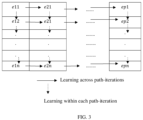
- FIG. 3 illustrates learning of the autonomous learning agent within each path-iteration and across each path-iteration, and an example of a path and a path-iteration of the autonomous learning agent, in accordance with some embodiments of the present disclosure.
- FIG. 4 A through 6 B illustrate graphical examples of prediction behaviors of the autonomous learning agent across a square path, a crisscross path, and a right-angle path by implementing a two-stage modelling technique, in accordance with some embodiments of the present disclosure.
- FIG. 7 A through FIG. 7 C illustrate a graphical representation of an example that when the number of path-iterations increase as an input, learning saturation point of the autonomous learning agent oscillates around a certain fixed value for a particular path, in accordance with some embodiments of the present disclosure.
- FIG. 8 A through FIG. 8 C illustrate a difference of prediction deviations between the proposed methodology and the traditional systems and methods, that is, the HTM, in accordance with some embodiments of the present disclosure.
- Embodiments of the present disclosure provide systems and methods for modelling prediction errors in path-learning of an autonomous learning agent.
- Neocortex the wrinkled portion of brain comprises a predictive memory system that stores sensory perception and motor actions and is capable of learning/inferring, decision making, generation of commands and spatial reasoning based on the knowledge acquired and stored over time.
- Self-learning systems such as a Hierarchical Temporal Memory (HTM) is a theoretical framework based on the understanding of human neocortex.
- Predictive modelling generally refers to techniques for extracting information from data to build a model that can predict an output from a given input. Predicting an output can include predicting future trends or behavior patterns, or performing sentiment analysis, to name a few examples.
- HTM Hierarchical Temporal Memory
- Various types of predictive and machine learning models can be used to analyze data and generate predictive outputs.
- the amount of training data that can be required to train a predictive or a machine learning model can be large, e.g., in the order of gigabytes or terabytes.
- the number of different types of predictive models available is extensive, and different models behave differently depending on the type of input data.
- a particular type of predictive model can be made to behave differently, for example, by adjusting the hyper-parameters or via feature induction or selection.
- output from a number of distinct predictive models can be combined to achieve a superior prediction.
- the traditional systems and methods are essentially a simple theoretical modelling framework lacking mathematical formulations in their learning and framework.
- FIG. 1 through 8 C where similar reference characters denote corresponding features consistently throughout the figures, there are shown preferred embodiments and these embodiments are described in the context of the following exemplary system and/or method.
- FIG. 1 illustrates an exemplary block diagram of a system 100 for modelling prediction errors in path-learning of an autonomous learning agent, in accordance with an embodiment of the present disclosure.
- the system 100 includes one or more processors 104 , communication interface device(s) or input/output (I/O) interface(s) 106 , and one or more data storage devices or memory 102 operatively coupled to the one or more processors 104 .
- the one or more processors 104 that are hardware processors can be implemented as one or more microprocessors, microcomputers, microcontrollers, digital signal processors, central processing units, state machines, logic circuitries, and/or any devices that manipulate signals based on operational instructions.
- the processor(s) is configured to fetch and execute computer-readable instructions stored in the memory 102 .
- the system 100 can be implemented in a variety of computing systems, such as laptop computers, notebooks, hand-held devices, workstations, mainframe computers, servers, a network cloud and the like.
- the I/O interface device(s) 106 can include a variety of software and hardware interfaces, for example, a web interface, a graphical user interface, and the like and can facilitate multiple communications within a wide variety of networks N/W and protocol types, including wired networks, for example, LAN, cable, etc., and wireless networks, such as WLAN, cellular, or satellite.
- the I/O interface device(s) can include one or more ports for connecting a number of devices to one another or to another server.
- the memory 102 may include any computer-readable medium known in the art including, for example, volatile memory, such as static random access memory (SRAM) and dynamic random access memory (DRAM), and/or non-volatile memory, such as read only memory (ROM), erasable programmable ROM, flash memories, hard disks, optical disks, and magnetic tapes.
- volatile memory such as static random access memory (SRAM) and dynamic random access memory (DRAM)
- DRAM dynamic random access memory
- non-volatile memory such as read only memory (ROM), erasable programmable ROM, flash memories, hard disks, optical disks, and magnetic tapes.
- FIG. 2 A through 2 B illustrates an exemplary flow diagram of a method for modelling the prediction errors in path-learning of the autonomous learning agent, in accordance with some embodiments of the present disclosure.
- the system 100 comprises one or more data storage devices of the memory 102 operatively coupled to the one or more hardware processors 104 and is configured to store instructions for execution of steps of the method by the one or more processors 104 .
- the steps of the method of the present disclosure will now be explained with reference to the components of the system 100 as depicted in FIG. 1 and the flow diagram.
- the hardware processors 104 when configured the instructions performs one or more methodologies described herein.
- the one or more hardware processors 104 capture a plurality of sequential actions via a two-stage modelling technique, wherein the plurality of sequential actions depict a pattern of time series, and wherein each of the plurality of sequential actions corresponds to the autonomous learning agent.
- the autonomous learning agent may comprise a smart agent operating on an owner's behalf but without any interference of that ownership entity, for example, a robot.
- autonomous learning agent(s) possess capacity to process information within a restricted domain giving it autonomy and then take an action based upon the rules it has been given or learned. Further, the autonomous learning system may use information gathered from sensors to make independent decisions and then act on them using corresponding actuators.
- the autonomous learning agent may also comprise of any Deep Learning agent or an Artificial Intelligence based agent that uses one or more deep learning techniques to perform and improve upon its tasks (for example, chat-bots, self-driving cars and the like)
- sequence(s) of actions executed by any autonomous learning agent facilitates execution of tasks or sub-tasks.
- a sequence of actions generally comprises several parallel or sequential actions.
- an action may comprise one or several parallel or sequential elementary actions.
- a single elementary action comprises a single or a plurality of parallel elementary operations.
- Each of the plurality of parallel elementary operations characterizes a primitive senso-motoric operation for degree of freedom (DOF) of the robot subsystem (for e.g. one low-level control loop).
- DOF degree of freedom
- the plurality of sequential actions may comprise turning left, right, moving forward etc. by the autonomous learning agent, wherein the plurality of sequential actions are represented by a sequence for execution of tasks or sub-tasks. Further, the plurality of sequential actions depict the pattern of time series as learning and prediction of the autonomous learning agent evolves and become accurate over time.
- the plurality of sequential actions are captured via the two-stage modelling technique.
- the two-stage modelling technique may now be considered in detail.
- the two-stage modelling technique comprises a model (or a mathematical model) that may be described via two-stage model to analyze any deviation(s) in learning using a Hierarchical Temporal Memory (HTM) or a HTM modelling technique.
- HTM Hierarchical Temporal Memory
- the HTM (or the HTM modelling technique) is a theoretical framework based on the understanding of human neocortex.
- the HTM is based on the hypothesis that a common set of learning algorithms reside within the neocortex (validated by the experiments on neo-natal ferrets whose auditory cortex was rewired with the vision system).
- the HTM may be viewed as a type of neural network, although, the structure is radically different from conventional ANNs where feedback and feed-forward inputs are not really considered.
- the HTM (or the HTM modelling technique) models neurons (or cells, in its terminology) which are arranged in columns and regions, forming a hierarchy analogous to the cortical structure of human brain.
- the HTM fundamentally, is a memory-based system, and an HTM network, when trained on time-varying data, stores a large set of patterns and sequences.
- HTM memory on the other hand, is restricted with a hierarchical organization and inherent reliance on time. Information is stored in a distributed manner, and the HTM controls where and how information is stored based on the size of the hierarchy and the type of data.
- the two-stage modelling technique comprises a time series model within each path-iteration of the path-learning and another time series model) across all path-iterations of the path-learning, wherein the two-stage time series models (that is, the time series model within each path-iteration and the another time series model across all path-iterations) are integrated via a linear regression technique for estimating a deviation of the autonomous learning agent.
- the two-stage modelling technique along with examples will be discussed in further detail in subsequent paragraphs.
- the one or more hardware processors 104 derive, based upon the plurality of sequential actions captured, one or more datasets comprising a plurality of predicted and actual actions of the autonomous learning agent, wherein the one or more datasets are derived by implementing the HTM modelling technique.
- the autonomous learning agent is assigned to learn a particular path comprising the plurality of sequential actions like turning left, right, moving forward etc. and as discussed in the step 201 above, the plurality of sequential actions are captured.
- An actual action refers to an actual step taken by the autonomous learning agent, wherein each such actual action amongst the plurality of predicted and actual actions results in a movement of the autonomous learning agent to a position on the path which is denoted by (x act , y act ).
- a predicted action refers to an action of a robot predicted by the HTM modelling technique. Each of a prediction action amongst the plurality of predicted and actual actions is supposed to take the autonomous learning agent to a position in the path denoted by (x pred , y pred ).
- a path comprises n steps and if p iterations are required to precisely learn and predict the path
- learning and prediction at i th step in j th path-iteration is influenced by an action taken in all (n ⁇ 1) preceding steps in that path-iteration, and by an action taken in the exact i th step in all preceding (j ⁇ 1) path-iterations.
- Table 1 a sample dataset derived by implementing the HTM framework (or the HTM modelling technique) may be referred, wherein prediction position of the autonomous learning agent is denoted by (x pred , y pred ), while an actual position is denoted by (x act , y act ).
- the autonomous learning agent while traversing a path, learns in two different ways.
- One learning is achieved within a path, that is, when the autonomous learning agent learns from one or more preceding steps in the path.
- Another learning may be achieved across each path-iteration, that is, when the autonomous learning agent learns from one or more preceding-iterations.
- the autonomous learning agent takes n steps to complete a path-iteration. Further, p path-iterations are taken to complete learning of that path. Then e ij may denote a deviation (of the autonomous learning agent) from an actual position at j th step of i th path-iteration.
- the autonomous learning agent has learnt from the first and second steps of the fifth path-iteration, and also from the third step of preceding four path-iterations.
- an example of a path and a path-iteration of the autonomous learning agent may also be referred.
- learning within each path-iteration and across each path-iteration may be referred.
- the one or more hardware processors 104 extract a set of prediction error values by a Euclidean Distance technique using each of the plurality of predicted and actual actions, wherein each of the set of prediction error values comprises a deviation from one or more actual actions amongst the plurality of predicted and actual actions.
- the Euclidean Distance may be derived between actual coordinates and predicted coordinates.
- the Euclidean Distance technique is applied for each of the n steps and p iterations as learning and prediction at i th step in j th path-iteration is influenced by an action taken in all (n ⁇ 1) preceding steps in that path-iteration, and by an action taken in the exact i th step in all preceding (j ⁇ 1) path-iterations. It may be noted that the embodiments of the proposed disclosure do not restrict extraction of the set of prediction error values using the Euclidean Distance technique only and facilitate extracting the set of prediction error values using some other techniques or any combination(s) of one or more known techniques.
- the set of prediction error values may be obtained as:
- the one or more hardware processors 104 model, based upon the set of prediction error values, a plurality of prediction errors in path-learning of the autonomous learning agent.
- the one or more hardware processors 104 extract, from the set of prediction error values, a plurality of fitted error values corresponding to each of the plurality of predicted actions and actual actions by implementing an Autoregressive moving average (ARMA) technique on the set of prediction error values.
- the step of modelling may now be considered in detail in the light of technical problems encountered by the traditional systems and methods.
- a time series model in such a case is always futile, as a time series comprises an autocorrelation parameter.
- the autocorrelation parameter measures the effect of preceding step(s) taken by the autonomous learning agent on present step(s). However, as the preceding step(s) go further back in past, the effect of the autocorrelation parameter reduces. Thus, autocorrelation may now properly capture the effect of e. j on e ij if a single time series is implemented.
- e 22 may be achieved as a result of learning from the second step of the first path-iteration, and also as the first step of the second path-iteration.
- a single time series, with an appropriate autocorrelation results in a high influence of e 21 on e 22 .
- the proposed disclosure provides for the two-stage modelling technique, wherein the two-stage modelling technique, as discussed above, comprises the time series model within each path-iteration of the path-learning and the another time series model across all path-iterations of the path-learning.
- the implementation of the two-stage modelling technique in modelling the prediction errors in path-learning of the autonomous learning agent along with the examples may now be considered in detail.
- the two-stage modelling technique uses two time series T 1 and T 2 .
- T 1 is an ARMA model that leams within each of the path-iteration
- T 2 is another ARMA model that learns across each of the path-iteration.
- Y t is an ARMA (p, q) time series with p autoregressive terms and q moving-average terms
- the two-stage modelling (or the modelling) is thus performed across and within each path-iteration of the path-learning by implementing the ARMA technique. Further, the two-stage modelling technique is implemented to capture a plurality of learning modalities across the path-learning of the autonomous learning agent, wherein the plurality of learning modalities comprise a learning from a preceding step and a learning from a preceding iteration by the autonomous learning agent.
- each path-iteration may be modelled by a single ARMA(p 1 , q i ) time series T 1
- each of the steps across the path-iterations may be modelled by implementing a single ARMA(p 2 , q 2 ) time series T 1
- a prediction corresponding to each value may be obtained.
- two predictions for example, ê ij from T 1 and ⁇ tilde over (e) ⁇ ij from T 2 may be obtained (herein referred to as the plurality of fitted error values).
- the plurality of fitted error values may be extracted by implementing the ARMA technique as:
- the one or more hardware processors 104 estimate, by implementing the linear regression technique on the plurality of fitted error values, a probable deviation of the autonomous learning agent from each of an actual action amongst the plurality of predicted and actual actions.
- the two-stage modelling technique movies into a regression stage, wherein it is assumed that the autonomous learning agent's deviation from an actual position e ij may be modelled by the linear regression technique, wherein ê ij and ê ij act as covariates.
- e ij ⁇ 1 ê ij + ⁇ 2 ⁇ tilde over (e) ⁇ ij +e ij — equation (2)
- ⁇ 1 and ⁇ 2 are regression parameters ⁇ ij is the Gaussian noise.
- ⁇ circumflex over ( ⁇ ) ⁇ 1 and ⁇ circumflex over ( ⁇ ) ⁇ 2 denote the estimated autoregressive parameters of T 1 and T 2 respectively
- ⁇ circumflex over ( ⁇ ) ⁇ 1 and ⁇ circumflex over ( ⁇ ) ⁇ 2 denote the estimated moving-average parameters of T 1 and T 2 respectively
- ⁇ 1 and ⁇ 2 are errors attached to T 1 and T 2 respectively
- ⁇ is the Gaussian noise with mean 0 and variance 1.
- the two-stage modelling technique is implemented on the set of prediction error values extracted in step 203 above by implementing the below mentioned model (that is an algorithm) of behavior of the autonomous learning agent via the one or more hardware processors 104 .
- model that is an algorithm
- the proposed disclosure provides for fitting the two-series model for each deviation value to get two predictions, and then derive a final prediction using the linear regression over the two prediction via the one or more hardware processors 104 .
- Deviation ⁇ ⁇ square root over ((x act 2 +y act 2 ) ⁇ (x pred 2 +y pred 2 )) ⁇ ;
- the fitted deviation referred to in the above algorithm may be denoted as ⁇ circumflex over ( ⁇ ) ⁇ fin .
- ⁇ circumflex over ( ⁇ ) ⁇ fin to study the behavior of ⁇ circumflex over ( ⁇ ) ⁇ fin. notations used in equation 3 above may be used. It may be noted that while the autonomous learning agent is trained, learning gets more accurate over a time. In other words, ⁇ becomes equal to 0 as the time increases.
- ⁇ ⁇ 1 ⁇ 1 is q 1 ⁇ q 1 matrix with its (i,j)th element as ⁇ B (i ⁇ j), B(t) being an AR(q) process and ⁇ B (i ⁇ j) denoting the (i,j)th element of corresponding autocovariance matrix.
- ⁇ ⁇ 1 ⁇ 1 is the covariance of A(t) and B(t). In an embodiment, similar definition follows for ⁇ 2 .
- two ARMA structures T 1 and T 2 are used.
- T 1 the variance matrix is ⁇ 1 ⁇ 1 /n
- T 1 the variance matrix is ⁇ 2 ⁇ 1 /p as known from some of the traditional systems and methods.
- the variance of f is as below:
- the theorem shows that if the total number of steps (that is, np) for learning are large in number, then the predicted deviation goes to 0. Also, if the number of steps in each of the path-iteration and the number of path-iterations are large in number, then fluctuations in the predicted deviation gets condensed within a small region. This is because approximate variance is
- np ⁇ is a critical property because it shows that after a sufficiently large number of iterations of a path with a fixed number of steps, the variance, and thus, the predicted deviation gets bounded, and hence, the plot of the predicted deviations is like a funnel, as may be observed while referring to FIG. 4 A through 6 B .
- n and p or what value of p for a fixed n
- an autonomous learning agent that is, a robot was used to perform and implement the proposed methodology, wherein the autonomous learning agent is a Raspberry Pi 3 based robot with 512 MB of Random Access Memory (RAM).
- the robot was made to learn different paths, that is, a square path, a crisscross path, and a right-angle path, wherein large number of turns in each path imply more complexity in learning.
- multiple experiments were performed on each of the three paths, wherein first experiment was performed to test as to how the prediction behaves over an increasing number of learning iterations.
- the square path is tested to be accurately learned and each step is accurately predicted after thirty-six iterations.
- the learning model may then be removed from the robot by the one or more hardware processors 104 , so that the robot completely forgets navigations corresponding to the square path.
- the autonomous learning agent (or the robot) may then be trained with 4, 8, 11 and 18 path-iterations (that is, 10%, 20%, 30% and 50% of the saturation learning step respectively), and corresponding deviation prediction may be plotted against path-iterations.
- path-iterations that is, 10%, 20%, 30% and 50% of the saturation learning step respectively
- FIGS. 4 A and 4 B it may be noted that for four training iterations, learning saturation is predicted to happen at around 40 path-iterations, while for 8 iterations it decreases to approximately 35 iterations.
- the one or more hardware processors 104 may, via the proposed methodology, predict the time by which the autonomous learning agent (or the robot) may learn the given path and also given a certain time for training how accurate will the autonomous learning agent (or the robot) be.
- the value of predicted iteration for convergence i.e. learning saturation point
- the value of predicted iteration for convergence oscillates around a certain fixed value for a particular path.
- the deviation model converges around a band of that certain value. This means that the learning saturation point always tends to a certain value and it does not improves (or degrades) much after certain number of path-iterations.
- FIG. 8 A through 8 C a difference of the prediction deviations by implementing the proposed methodology and the traditional systems and methods, that is, the HTM may be observed.
- FIG. 8 A through 8 C again, it may be noted that as the training iterations increase, the predictions modelled by implementing the proposed methodology converges with the HTM predictions.
- the proposed methodology provides for a high accuracy in modelling the error in prediction.
- the proposed methodology may be easily be integrated with the HTM, and thereby facilitates a new model that helps in reducing errors (or the prediction errors) in the HTM over a number of iterations.
- the proposed methodology takes all the errors in HTM as an input and facilitates an optimized model that determines how the prediction behavior changes over a number of iterations. None of the traditional systems and methods provide for modelling the prediction errors of the HTM.
- the traditional systems and methods fail to provide for the two-stage time-series modelling, as well as the combination of the two-stage time-series modelling, as has been disclosed by the proposed methodology.
- the proposed methodology is able to accommodate both learning modalities, that is, when the autonomous learning agent learns within each of the path-iteration and across each of the path-iterations.
- the memory 102 can be configured to store any data that is associated with modelling the prediction errors in path-learning of the autonomous learning agent.
- the information pertaining to the plurality of sequential actions, the one or more datasets derived, the set of prediction error values extracted, the plurality of fitted error values extracted, and modelling the probable deviation of the autonomous learning agent from each of the actual action etc. is stored in the memory 102 .
- all information (inputs, outputs and so on) pertaining to modelling the prediction errors in path-learning of the autonomous learning agent may also be stored in the database, as history data, for reference purpose.
- the embodiments of present disclosure herein addresses unresolved problem of modelling the prediction errors in path-learning of the autonomous learning agent.
- the embodiment thus provides for modelling the plurality of prediction errors in path-learning of the autonomous learning agent by extracting, from the set of prediction error values, the plurality of fitted error values corresponding to each of the plurality of predicted actions and actual actions by implementing the ARMA technique, and estimating, by implementing the linear regression technique on the plurality of fitted error values, the probable deviation of the autonomous learning agent from each of the actual action amongst the plurality of predicted and actual actions.
- the embodiments herein further provides for the two-stage time-series modelling, as well as the combination of the two-stage time-series modelling, wherein all the prediction errors in the HTM are reduced over a number of iterations.
- the hardware device can be any kind of device which can be programmed including e.g. any kind of computer like a server or a personal computer, or the like, or any combination thereof.
- the device may also include means which could be e.g. hardware means like e.g. an application-specific integrated circuit (ASIC), a field-programmable gate array (FPGA), or a combination of hardware and software means, e.g.
- ASIC application-specific integrated circuit
- FPGA field-programmable gate array
- the means can include both hardware means and software means.
- the method embodiments described herein could be implemented in hardware and software.
- the device may also include software means.
- the embodiments may be implemented on different hardware devices, e.g. using a plurality of CPUs.
- the embodiments herein can comprise hardware and software elements.
- the embodiments that are implemented in software include but are not limited to, firmware, resident software, microcode, etc.
- the functions performed by various modules described herein may be implemented in other modules or combinations of other modules.
- a computer-usable or computer readable medium can be any apparatus that can comprise, store, communicate, propagate, or transport the program for use by or in connection with the instruction execution system, apparatus, or device.
- a computer-readable storage medium refers to any type of physical memory on which information or data readable by a processor may be stored.
- a computer-readable storage medium may store instructions for execution by one or more processors, including instructions for causing the processor(s) to perform steps or stages consistent with the embodiments described herein.
- the term “computer-readable medium” should be understood to include tangible items and exclude carrier waves and transient signals, i.e., be non-transitory. Examples include random access memory (RAM), read-only memory (ROM), volatile memory, nonvolatile memory, hard drives, CD ROMs, DVDs, flash drives, disks, and any other known physical storage media.
Landscapes
- Engineering & Computer Science (AREA)
- Physics & Mathematics (AREA)
- Theoretical Computer Science (AREA)
- General Physics & Mathematics (AREA)
- Computing Systems (AREA)
- Software Systems (AREA)
- Artificial Intelligence (AREA)
- Mathematical Physics (AREA)
- Data Mining & Analysis (AREA)
- Evolutionary Computation (AREA)
- General Engineering & Computer Science (AREA)
- Biophysics (AREA)
- Molecular Biology (AREA)
- General Health & Medical Sciences (AREA)
- Computational Linguistics (AREA)
- Biomedical Technology (AREA)
- Life Sciences & Earth Sciences (AREA)
- Health & Medical Sciences (AREA)
- Probability & Statistics with Applications (AREA)
- Algebra (AREA)
- Computational Mathematics (AREA)
- Mathematical Analysis (AREA)
- Mathematical Optimization (AREA)
- Pure & Applied Mathematics (AREA)
- Feedback Control In General (AREA)
- Management, Administration, Business Operations System, And Electronic Commerce (AREA)
Abstract
Description
| TABLE 1 | |||||||||
| Xact | Yact | Xpred | Ypred | . | . | Xact | Yact | Xpred | Ypred |
| Xact |
Yact |
Xpred |
Ypred |
. | . | Xact |
Yact |
Xpred |
Ypred |
| Xact |
Yact |
Xpred |
Ypred |
. | . | Xact |
Yact |
XXpred |
Ypred |
| Xact |
Yact |
Xpred |
Ypred |
. | . | Xact |
Yact |
XXpred |
Ypred |
| . | . | . | . | . | . | . | . | . | . |
| . | . | . | . | . | . | . | . | . | . |
| . | . | . | . | . | . | . | . | . | . |
| Xact |
Yact |
Xpred |
Ypred |
. | . | Xact |
Yact |
XXpred |
Ypred |
-
- Predicted error after learning
iteration 1 only for a square path=7.209276; - Predicted error after learning
iterations - Predicted error after learning
iterations
- Predicted error after learning
Y t =C+=Σ i=1 pϕi Y t−i+Σi=1 qΨiεt−i+εt— equation (1)
wherein εt is error at time t, ϕi−S are auto-regression parameters and Ψi−S are moving-average parameters.
-
- Fitted error values of each step within each iteration:
- Fitted error value for
step 1iteration 1=59.94000004 - Fitted error value for
step 2iteration 1=65.43371336- Fitted error value for
step 6 iteration 9=−410.931- Fitted error value for step 9 iteration 9=−480
- Fitted error value for
- Fitted error value for
- Fitted error values of a single step across each iteration:
- Fitted error value for
iteration 1step 1=59.94000035- Fitted error value for
iteration 1step 6=56.75596 - Fitted error value for iteration 5
step 1=−510.62 - Fitted error value for iteration 9
step 11=−35.3545
- Fitted error value for
- Fitted error value for
- Fitted error values of each step within each iteration:
e ij=β1 ê ij+β2 {tilde over (e)} ij +e ij— equation (2)
e ij =C+β 1[Σk=1 p1{circumflex over (ϕ)}k 1 e i −k,j+Σ k=1 q1{circumflex over (Ψ)}i 1εi−k, 1.]+β2[Σk=1 p2{circumflex over (ϕ)}k 2 e i ,j−k,+Σ k=1 q2{circumflex over (Ψ)}i 2ε.,j−k 2]+εij— equation (3)
ξ=β
and wherein ΓΦ
which shrinks as n and p both increase. Further, even if n remains fixed and p increases, the results holds because np→∞.
part bounded with a pre-specified interval.
Claims (3)
Applications Claiming Priority (2)
| Application Number | Priority Date | Filing Date | Title |
|---|---|---|---|
| IN201821031249 | 2018-08-21 | ||
| IN201821031249 | 2018-08-21 |
Publications (2)
| Publication Number | Publication Date |
|---|---|
| US20200151599A1 US20200151599A1 (en) | 2020-05-14 |
| US12147915B2 true US12147915B2 (en) | 2024-11-19 |
Family
ID=67659715
Family Applications (1)
| Application Number | Title | Priority Date | Filing Date |
|---|---|---|---|
| US16/547,380 Active 2041-08-06 US12147915B2 (en) | 2018-08-21 | 2019-08-21 | Systems and methods for modelling prediction errors in path-learning of an autonomous learning agent |
Country Status (3)
| Country | Link |
|---|---|
| US (1) | US12147915B2 (en) |
| EP (1) | EP3614315B1 (en) |
| JP (1) | JP7373941B2 (en) |
Families Citing this family (5)
| Publication number | Priority date | Publication date | Assignee | Title |
|---|---|---|---|---|
| EP3614315B1 (en) | 2018-08-21 | 2024-08-14 | Tata Consultancy Services Limited | Systems and methods for modelling prediction errors in path-learning of an autonomous learning agent |
| US20200310420A1 (en) * | 2019-03-26 | 2020-10-01 | GM Global Technology Operations LLC | System and method to train and select a best solution in a dynamical system |
| US11790030B2 (en) * | 2020-06-04 | 2023-10-17 | Promoted.ai, Inc. | Creating an effective product using an attribute solver |
| KR102525191B1 (en) * | 2020-08-07 | 2023-04-26 | 한국전자통신연구원 | System and method for generating and controlling driving paths in autonomous vehicles |
| US11977440B2 (en) | 2020-11-23 | 2024-05-07 | Ford Global Technologies, Llc | On-board feedback system for autonomous vehicles |
Citations (5)
| Publication number | Priority date | Publication date | Assignee | Title |
|---|---|---|---|---|
| US20080167820A1 (en) | 2007-01-04 | 2008-07-10 | Kentaro Oguchi | System for predicting driver behavior |
| US20160028599A1 (en) | 2014-07-23 | 2016-01-28 | Cisco Technology, Inc. | Scheduling predictive models for machine learning systems |
| US20160132787A1 (en) * | 2014-11-11 | 2016-05-12 | Massachusetts Institute Of Technology | Distributed, multi-model, self-learning platform for machine learning |
| CN107103613A (en) * | 2017-03-28 | 2017-08-29 | 深圳市未来媒体技术研究院 | A kind of three-dimension gesture Attitude estimation method |
| US20180053093A1 (en) * | 2016-08-16 | 2018-02-22 | Toyota Jidosha Kabushiki Kaisha | Integrative Cognition of Driver Behavior |
Family Cites Families (2)
| Publication number | Priority date | Publication date | Assignee | Title |
|---|---|---|---|---|
| JP2007018490A (en) | 2005-02-23 | 2007-01-25 | Sony Corp | Action control device, action control method, and program |
| EP3614315B1 (en) | 2018-08-21 | 2024-08-14 | Tata Consultancy Services Limited | Systems and methods for modelling prediction errors in path-learning of an autonomous learning agent |
-
2019
- 2019-08-21 EP EP19192879.5A patent/EP3614315B1/en active Active
- 2019-08-21 US US16/547,380 patent/US12147915B2/en active Active
- 2019-08-23 JP JP2019152935A patent/JP7373941B2/en active Active
Patent Citations (5)
| Publication number | Priority date | Publication date | Assignee | Title |
|---|---|---|---|---|
| US20080167820A1 (en) | 2007-01-04 | 2008-07-10 | Kentaro Oguchi | System for predicting driver behavior |
| US20160028599A1 (en) | 2014-07-23 | 2016-01-28 | Cisco Technology, Inc. | Scheduling predictive models for machine learning systems |
| US20160132787A1 (en) * | 2014-11-11 | 2016-05-12 | Massachusetts Institute Of Technology | Distributed, multi-model, self-learning platform for machine learning |
| US20180053093A1 (en) * | 2016-08-16 | 2018-02-22 | Toyota Jidosha Kabushiki Kaisha | Integrative Cognition of Driver Behavior |
| CN107103613A (en) * | 2017-03-28 | 2017-08-29 | 深圳市未来媒体技术研究院 | A kind of three-dimension gesture Attitude estimation method |
Non-Patent Citations (8)
| Title |
|---|
| Cui, Y. et al. (Apr. 2016). "Continuous online sequence learning with an unsupervised neural network model," Journal Neural Computation, vol. 28, No. 11; pp. 2474-2504. |
| Liddiard, Ashley, Jonathan Tapson, and Robyn Verrinder. "A robust implementation of the spatial pooler within the theory of Hierarchical Temporal Memory (HTM)." 2013 6th Robotics and Mechatronics Conference (RobMech). IEEE, 2013. (Year: 2013). * |
| Lin, Jessica, et al. "Iterative incremental clustering of time series." Advances in Database Technology—EDBT 2004: 9th International Conference on Extending Database Technology, Heraklion, Crete, Greece, Mar. 14-18, 2004 9. Springer Berlin Heidelberg, 2004. (Year: 2004). * |
| Pedretti, G. et al. (Jul. 2017). "Memristive neural network for on-line learning and tracking with brain-inspired spike timing dependent plasticity," Scientific Reports, vol. 7, issue 5288; pp. 1-10. |
| Reyes, Fernando, and Rafael Kelly. "Experimental evaluation of identification schemes on a direct drive robot." Robotica 15.5 (1997): 563-571. (Year: 1997). * |
| Taghvaei, Sajjad, Mohammad Hasan Jahanandish, and Kazuhiro Kosuge. "Autoregressive-moving-average hidden Markov model for vision-based fall prediction—An application for walker robot." Assistive technology 29.1 (2017): 19-27. (Year: 2017). * |
| Zhang, Xinzheng, Jianfen Zhang, and Junpei Zhong. "Skill learning for intelligent robot by perception-action integration: A view from hierarchical temporal memory." Complexity 2017 (2017). (Year: 2017). * |
| Zhang, Xinzheng, Jianfen Zhang, and Junpei Zhong. "Toward navigation ability for autonomous mobile robots with learning from demonstration paradigm: A view of hierarchical temporal memory." International Journal of Advanced Robotic Systems 15.3 (2018): 1729881418777939. (Year: 2018). * |
Also Published As
| Publication number | Publication date |
|---|---|
| JP7373941B2 (en) | 2023-11-06 |
| JP2020030830A (en) | 2020-02-27 |
| EP3614315C0 (en) | 2024-08-14 |
| US20200151599A1 (en) | 2020-05-14 |
| EP3614315B1 (en) | 2024-08-14 |
| EP3614315A1 (en) | 2020-02-26 |
Similar Documents
| Publication | Publication Date | Title |
|---|---|---|
| EP3614315B1 (en) | Systems and methods for modelling prediction errors in path-learning of an autonomous learning agent | |
| JP6902645B2 (en) | How to manage a system that contains multiple devices that provide sensor data | |
| EP3958185B1 (en) | Neural networks for handling variable-dimensional time series data | |
| US11568203B2 (en) | Failed and censored instances based remaining useful life (RUL) estimation of entities | |
| US20200097810A1 (en) | Automated window based feature generation for time-series forecasting and anomaly detection | |
| US11586928B2 (en) | Method and system for incorporating regression into stacked auto encoder (SAE) | |
| CN113825978B (en) | Method and device for defining path and storage device | |
| US12443845B2 (en) | System and method for online time-series forecasting using spiking reservoir | |
| CN115017819B (en) | A method and device for predicting remaining service life of an engine based on a hybrid model | |
| CN117493884B (en) | Reinforcement learning decision-making method and device for complex scenarios | |
| Gupta et al. | Relevance feedback based online learning model for resource bottleneck prediction in cloud servers | |
| Häussermann et al. | A novel framework for anomaly detection of robot behaviors | |
| Arora et al. | I2RL: online inverse reinforcement learning under occlusion | |
| US20240028039A1 (en) | Method and system for reinforcement learning and dual channel action embedding based robotic navigation | |
| Yu et al. | Deep Q‐Network with Predictive State Models in Partially Observable Domains | |
| US20240386278A1 (en) | Method and device with continual learning | |
| Qin et al. | Federated fault diagnosis method for collaborative self-diagnosis and cross-robot peer diagnosis | |
| US20260037238A1 (en) | Compiling machine learning software for execution at edge devices | |
| Kaur et al. | Particle swarm optimization based neural network | |
| US20250315306A1 (en) | Task-Based Distributional Semantic Model or Embeddings for Inferring Intent Similarity | |
| EP4734003A1 (en) | Method and system for constructing classical equivalent model of trained quantum machine learning model | |
| Xie et al. | Cond-Enabled Deep Learning Reconstruction for Ooda-Oriented Heterogeneous Network Topologies | |
| Zeng et al. | Neighborhood Combination Strategies for Solving the Bi-objective Max-Bisection | |
| Voulgarakis et al. | Latent Behavior Cloning for Deep Reinforcement Learning Robotic Tasks | |
| WO2026030088A1 (en) | Compiling machine learning software for execution at edge devices |
Legal Events
| Date | Code | Title | Description |
|---|---|---|---|
| FEPP | Fee payment procedure |
Free format text: ENTITY STATUS SET TO UNDISCOUNTED (ORIGINAL EVENT CODE: BIG.); ENTITY STATUS OF PATENT OWNER: LARGE ENTITY |
|
| STPP | Information on status: patent application and granting procedure in general |
Free format text: DOCKETED NEW CASE - READY FOR EXAMINATION |
|
| STPP | Information on status: patent application and granting procedure in general |
Free format text: NON FINAL ACTION MAILED |
|
| STPP | Information on status: patent application and granting procedure in general |
Free format text: RESPONSE TO NON-FINAL OFFICE ACTION ENTERED AND FORWARDED TO EXAMINER |
|
| STPP | Information on status: patent application and granting procedure in general |
Free format text: FINAL REJECTION MAILED |
|
| STPP | Information on status: patent application and granting procedure in general |
Free format text: RESPONSE AFTER FINAL ACTION FORWARDED TO EXAMINER |
|
| STPP | Information on status: patent application and granting procedure in general |
Free format text: ADVISORY ACTION MAILED |
|
| STPP | Information on status: patent application and granting procedure in general |
Free format text: DOCKETED NEW CASE - READY FOR EXAMINATION |
|
| STPP | Information on status: patent application and granting procedure in general |
Free format text: RESPONSE TO NON-FINAL OFFICE ACTION ENTERED AND FORWARDED TO EXAMINER |
|
| STPP | Information on status: patent application and granting procedure in general |
Free format text: FINAL REJECTION MAILED |
|
| STPP | Information on status: patent application and granting procedure in general |
Free format text: RESPONSE AFTER FINAL ACTION FORWARDED TO EXAMINER |
|
| STPP | Information on status: patent application and granting procedure in general |
Free format text: ADVISORY ACTION MAILED |
|
| STPP | Information on status: patent application and granting procedure in general |
Free format text: DOCKETED NEW CASE - READY FOR EXAMINATION |
|
| STPP | Information on status: patent application and granting procedure in general |
Free format text: NOTICE OF ALLOWANCE MAILED -- APPLICATION RECEIVED IN OFFICE OF PUBLICATIONS |
|
| ZAAB | Notice of allowance mailed |
Free format text: ORIGINAL CODE: MN/=. |
|
| STPP | Information on status: patent application and granting procedure in general |
Free format text: PUBLICATIONS -- ISSUE FEE PAYMENT RECEIVED |
|
| STPP | Information on status: patent application and granting procedure in general |
Free format text: PUBLICATIONS -- ISSUE FEE PAYMENT VERIFIED |
|
| STCF | Information on status: patent grant |
Free format text: PATENTED CASE |