US12145952B2 - Heteroatom- and cycloalkyl-containing organic compound and organic electroluminescent device containing compound - Google Patents
Heteroatom- and cycloalkyl-containing organic compound and organic electroluminescent device containing compound Download PDFInfo
- Publication number
- US12145952B2 US12145952B2 US18/535,534 US202318535534A US12145952B2 US 12145952 B2 US12145952 B2 US 12145952B2 US 202318535534 A US202318535534 A US 202318535534A US 12145952 B2 US12145952 B2 US 12145952B2
- Authority
- US
- United States
- Prior art keywords
- substituted
- carbon atom
- atom number
- group
- organic
- Prior art date
- Legal status (The legal status is an assumption and is not a legal conclusion. Google has not performed a legal analysis and makes no representation as to the accuracy of the status listed.)
- Active
Links
Images


Classifications
-
- C—CHEMISTRY; METALLURGY
- C07—ORGANIC CHEMISTRY
- C07F—ACYCLIC, CARBOCYCLIC OR HETEROCYCLIC COMPOUNDS CONTAINING ELEMENTS OTHER THAN CARBON, HYDROGEN, HALOGEN, OXYGEN, NITROGEN, SULFUR, SELENIUM OR TELLURIUM
- C07F5/00—Compounds containing elements of Groups 3 or 13 of the Periodic Table
- C07F5/02—Boron compounds
- C07F5/027—Organoboranes and organoborohydrides
-
- C—CHEMISTRY; METALLURGY
- C07—ORGANIC CHEMISTRY
- C07F—ACYCLIC, CARBOCYCLIC OR HETEROCYCLIC COMPOUNDS CONTAINING ELEMENTS OTHER THAN CARBON, HYDROGEN, HALOGEN, OXYGEN, NITROGEN, SULFUR, SELENIUM OR TELLURIUM
- C07F5/00—Compounds containing elements of Groups 3 or 13 of the Periodic Table
- C07F5/02—Boron compounds
-
- C—CHEMISTRY; METALLURGY
- C09—DYES; PAINTS; POLISHES; NATURAL RESINS; ADHESIVES; COMPOSITIONS NOT OTHERWISE PROVIDED FOR; APPLICATIONS OF MATERIALS NOT OTHERWISE PROVIDED FOR
- C09K—MATERIALS FOR MISCELLANEOUS APPLICATIONS, NOT PROVIDED FOR ELSEWHERE
- C09K11/00—Luminescent materials, e.g. electroluminescent or chemiluminescent
- C09K11/06—Luminescent materials, e.g. electroluminescent or chemiluminescent containing organic luminescent materials
-
- H—ELECTRICITY
- H10—SEMICONDUCTOR DEVICES; ELECTRIC SOLID-STATE DEVICES NOT OTHERWISE PROVIDED FOR
- H10K—ORGANIC ELECTRIC SOLID-STATE DEVICES
- H10K50/00—Organic light-emitting devices
-
- H—ELECTRICITY
- H10—SEMICONDUCTOR DEVICES; ELECTRIC SOLID-STATE DEVICES NOT OTHERWISE PROVIDED FOR
- H10K—ORGANIC ELECTRIC SOLID-STATE DEVICES
- H10K50/00—Organic light-emitting devices
- H10K50/10—OLEDs or polymer light-emitting diodes [PLED]
- H10K50/11—OLEDs or polymer light-emitting diodes [PLED] characterised by the electroluminescent [EL] layers
-
- H—ELECTRICITY
- H10—SEMICONDUCTOR DEVICES; ELECTRIC SOLID-STATE DEVICES NOT OTHERWISE PROVIDED FOR
- H10K—ORGANIC ELECTRIC SOLID-STATE DEVICES
- H10K50/00—Organic light-emitting devices
- H10K50/10—OLEDs or polymer light-emitting diodes [PLED]
- H10K50/11—OLEDs or polymer light-emitting diodes [PLED] characterised by the electroluminescent [EL] layers
- H10K50/12—OLEDs or polymer light-emitting diodes [PLED] characterised by the electroluminescent [EL] layers comprising dopants
-
- H—ELECTRICITY
- H10—SEMICONDUCTOR DEVICES; ELECTRIC SOLID-STATE DEVICES NOT OTHERWISE PROVIDED FOR
- H10K—ORGANIC ELECTRIC SOLID-STATE DEVICES
- H10K50/00—Organic light-emitting devices
- H10K50/10—OLEDs or polymer light-emitting diodes [PLED]
- H10K50/14—Carrier transporting layers
- H10K50/15—Hole transporting layers
-
- H—ELECTRICITY
- H10—SEMICONDUCTOR DEVICES; ELECTRIC SOLID-STATE DEVICES NOT OTHERWISE PROVIDED FOR
- H10K—ORGANIC ELECTRIC SOLID-STATE DEVICES
- H10K50/00—Organic light-emitting devices
- H10K50/10—OLEDs or polymer light-emitting diodes [PLED]
- H10K50/14—Carrier transporting layers
- H10K50/16—Electron transporting layers
-
- H—ELECTRICITY
- H10—SEMICONDUCTOR DEVICES; ELECTRIC SOLID-STATE DEVICES NOT OTHERWISE PROVIDED FOR
- H10K—ORGANIC ELECTRIC SOLID-STATE DEVICES
- H10K85/00—Organic materials used in the body or electrodes of devices covered by this subclass
- H10K85/60—Organic compounds having low molecular weight
- H10K85/615—Polycyclic condensed aromatic hydrocarbons, e.g. anthracene
-
- H—ELECTRICITY
- H10—SEMICONDUCTOR DEVICES; ELECTRIC SOLID-STATE DEVICES NOT OTHERWISE PROVIDED FOR
- H10K—ORGANIC ELECTRIC SOLID-STATE DEVICES
- H10K85/00—Organic materials used in the body or electrodes of devices covered by this subclass
- H10K85/60—Organic compounds having low molecular weight
- H10K85/615—Polycyclic condensed aromatic hydrocarbons, e.g. anthracene
- H10K85/622—Polycyclic condensed aromatic hydrocarbons, e.g. anthracene containing four rings, e.g. pyrene
-
- H—ELECTRICITY
- H10—SEMICONDUCTOR DEVICES; ELECTRIC SOLID-STATE DEVICES NOT OTHERWISE PROVIDED FOR
- H10K—ORGANIC ELECTRIC SOLID-STATE DEVICES
- H10K85/00—Organic materials used in the body or electrodes of devices covered by this subclass
- H10K85/60—Organic compounds having low molecular weight
- H10K85/615—Polycyclic condensed aromatic hydrocarbons, e.g. anthracene
- H10K85/623—Polycyclic condensed aromatic hydrocarbons, e.g. anthracene containing five rings, e.g. pentacene
-
- H—ELECTRICITY
- H10—SEMICONDUCTOR DEVICES; ELECTRIC SOLID-STATE DEVICES NOT OTHERWISE PROVIDED FOR
- H10K—ORGANIC ELECTRIC SOLID-STATE DEVICES
- H10K85/00—Organic materials used in the body or electrodes of devices covered by this subclass
- H10K85/60—Organic compounds having low molecular weight
- H10K85/615—Polycyclic condensed aromatic hydrocarbons, e.g. anthracene
- H10K85/624—Polycyclic condensed aromatic hydrocarbons, e.g. anthracene containing six or more rings
-
- H—ELECTRICITY
- H10—SEMICONDUCTOR DEVICES; ELECTRIC SOLID-STATE DEVICES NOT OTHERWISE PROVIDED FOR
- H10K—ORGANIC ELECTRIC SOLID-STATE DEVICES
- H10K85/00—Organic materials used in the body or electrodes of devices covered by this subclass
- H10K85/60—Organic compounds having low molecular weight
- H10K85/615—Polycyclic condensed aromatic hydrocarbons, e.g. anthracene
- H10K85/626—Polycyclic condensed aromatic hydrocarbons, e.g. anthracene containing more than one polycyclic condensed aromatic rings, e.g. bis-anthracene
-
- H—ELECTRICITY
- H10—SEMICONDUCTOR DEVICES; ELECTRIC SOLID-STATE DEVICES NOT OTHERWISE PROVIDED FOR
- H10K—ORGANIC ELECTRIC SOLID-STATE DEVICES
- H10K85/00—Organic materials used in the body or electrodes of devices covered by this subclass
- H10K85/60—Organic compounds having low molecular weight
- H10K85/631—Amine compounds having at least two aryl rest on at least one amine-nitrogen atom, e.g. triphenylamine
- H10K85/633—Amine compounds having at least two aryl rest on at least one amine-nitrogen atom, e.g. triphenylamine comprising polycyclic condensed aromatic hydrocarbons as substituents on the nitrogen atom
-
- H—ELECTRICITY
- H10—SEMICONDUCTOR DEVICES; ELECTRIC SOLID-STATE DEVICES NOT OTHERWISE PROVIDED FOR
- H10K—ORGANIC ELECTRIC SOLID-STATE DEVICES
- H10K85/00—Organic materials used in the body or electrodes of devices covered by this subclass
- H10K85/60—Organic compounds having low molecular weight
- H10K85/631—Amine compounds having at least two aryl rest on at least one amine-nitrogen atom, e.g. triphenylamine
- H10K85/636—Amine compounds having at least two aryl rest on at least one amine-nitrogen atom, e.g. triphenylamine comprising heteroaromatic hydrocarbons as substituents on the nitrogen atom
-
- H—ELECTRICITY
- H10—SEMICONDUCTOR DEVICES; ELECTRIC SOLID-STATE DEVICES NOT OTHERWISE PROVIDED FOR
- H10K—ORGANIC ELECTRIC SOLID-STATE DEVICES
- H10K85/00—Organic materials used in the body or electrodes of devices covered by this subclass
- H10K85/60—Organic compounds having low molecular weight
- H10K85/649—Aromatic compounds comprising a hetero atom
- H10K85/657—Polycyclic condensed heteroaromatic hydrocarbons
-
- H—ELECTRICITY
- H10—SEMICONDUCTOR DEVICES; ELECTRIC SOLID-STATE DEVICES NOT OTHERWISE PROVIDED FOR
- H10K—ORGANIC ELECTRIC SOLID-STATE DEVICES
- H10K85/00—Organic materials used in the body or electrodes of devices covered by this subclass
- H10K85/60—Organic compounds having low molecular weight
- H10K85/649—Aromatic compounds comprising a hetero atom
- H10K85/657—Polycyclic condensed heteroaromatic hydrocarbons
- H10K85/6572—Polycyclic condensed heteroaromatic hydrocarbons comprising only nitrogen in the heteroaromatic polycondensed ring system, e.g. phenanthroline or carbazole
-
- H—ELECTRICITY
- H10—SEMICONDUCTOR DEVICES; ELECTRIC SOLID-STATE DEVICES NOT OTHERWISE PROVIDED FOR
- H10K—ORGANIC ELECTRIC SOLID-STATE DEVICES
- H10K85/00—Organic materials used in the body or electrodes of devices covered by this subclass
- H10K85/60—Organic compounds having low molecular weight
- H10K85/649—Aromatic compounds comprising a hetero atom
- H10K85/657—Polycyclic condensed heteroaromatic hydrocarbons
- H10K85/6574—Polycyclic condensed heteroaromatic hydrocarbons comprising only oxygen in the heteroaromatic polycondensed ring system, e.g. cumarine dyes
-
- H—ELECTRICITY
- H10—SEMICONDUCTOR DEVICES; ELECTRIC SOLID-STATE DEVICES NOT OTHERWISE PROVIDED FOR
- H10K—ORGANIC ELECTRIC SOLID-STATE DEVICES
- H10K85/00—Organic materials used in the body or electrodes of devices covered by this subclass
- H10K85/60—Organic compounds having low molecular weight
- H10K85/649—Aromatic compounds comprising a hetero atom
- H10K85/657—Polycyclic condensed heteroaromatic hydrocarbons
- H10K85/6576—Polycyclic condensed heteroaromatic hydrocarbons comprising only sulfur in the heteroaromatic polycondensed ring system, e.g. benzothiophene
-
- H—ELECTRICITY
- H10—SEMICONDUCTOR DEVICES; ELECTRIC SOLID-STATE DEVICES NOT OTHERWISE PROVIDED FOR
- H10K—ORGANIC ELECTRIC SOLID-STATE DEVICES
- H10K85/00—Organic materials used in the body or electrodes of devices covered by this subclass
- H10K85/60—Organic compounds having low molecular weight
- H10K85/658—Organoboranes
-
- H—ELECTRICITY
- H10—SEMICONDUCTOR DEVICES; ELECTRIC SOLID-STATE DEVICES NOT OTHERWISE PROVIDED FOR
- H10K—ORGANIC ELECTRIC SOLID-STATE DEVICES
- H10K99/00—Subject matter not provided for in other groups of this subclass
-
- C—CHEMISTRY; METALLURGY
- C09—DYES; PAINTS; POLISHES; NATURAL RESINS; ADHESIVES; COMPOSITIONS NOT OTHERWISE PROVIDED FOR; APPLICATIONS OF MATERIALS NOT OTHERWISE PROVIDED FOR
- C09K—MATERIALS FOR MISCELLANEOUS APPLICATIONS, NOT PROVIDED FOR ELSEWHERE
- C09K2211/00—Chemical nature of organic luminescent or tenebrescent compounds
- C09K2211/10—Non-macromolecular compounds
- C09K2211/1003—Carbocyclic compounds
- C09K2211/1007—Non-condensed systems
-
- C—CHEMISTRY; METALLURGY
- C09—DYES; PAINTS; POLISHES; NATURAL RESINS; ADHESIVES; COMPOSITIONS NOT OTHERWISE PROVIDED FOR; APPLICATIONS OF MATERIALS NOT OTHERWISE PROVIDED FOR
- C09K—MATERIALS FOR MISCELLANEOUS APPLICATIONS, NOT PROVIDED FOR ELSEWHERE
- C09K2211/00—Chemical nature of organic luminescent or tenebrescent compounds
- C09K2211/10—Non-macromolecular compounds
- C09K2211/1003—Carbocyclic compounds
- C09K2211/1011—Condensed systems
-
- C—CHEMISTRY; METALLURGY
- C09—DYES; PAINTS; POLISHES; NATURAL RESINS; ADHESIVES; COMPOSITIONS NOT OTHERWISE PROVIDED FOR; APPLICATIONS OF MATERIALS NOT OTHERWISE PROVIDED FOR
- C09K—MATERIALS FOR MISCELLANEOUS APPLICATIONS, NOT PROVIDED FOR ELSEWHERE
- C09K2211/00—Chemical nature of organic luminescent or tenebrescent compounds
- C09K2211/10—Non-macromolecular compounds
- C09K2211/1003—Carbocyclic compounds
- C09K2211/1014—Carbocyclic compounds bridged by heteroatoms, e.g. N, P, Si or B
-
- C—CHEMISTRY; METALLURGY
- C09—DYES; PAINTS; POLISHES; NATURAL RESINS; ADHESIVES; COMPOSITIONS NOT OTHERWISE PROVIDED FOR; APPLICATIONS OF MATERIALS NOT OTHERWISE PROVIDED FOR
- C09K—MATERIALS FOR MISCELLANEOUS APPLICATIONS, NOT PROVIDED FOR ELSEWHERE
- C09K2211/00—Chemical nature of organic luminescent or tenebrescent compounds
- C09K2211/10—Non-macromolecular compounds
- C09K2211/1018—Heterocyclic compounds
- C09K2211/1025—Heterocyclic compounds characterised by ligands
- C09K2211/1044—Heterocyclic compounds characterised by ligands containing two nitrogen atoms as heteroatoms
- C09K2211/1055—Heterocyclic compounds characterised by ligands containing two nitrogen atoms as heteroatoms with other heteroatoms
-
- C—CHEMISTRY; METALLURGY
- C09—DYES; PAINTS; POLISHES; NATURAL RESINS; ADHESIVES; COMPOSITIONS NOT OTHERWISE PROVIDED FOR; APPLICATIONS OF MATERIALS NOT OTHERWISE PROVIDED FOR
- C09K—MATERIALS FOR MISCELLANEOUS APPLICATIONS, NOT PROVIDED FOR ELSEWHERE
- C09K2211/00—Chemical nature of organic luminescent or tenebrescent compounds
- C09K2211/10—Non-macromolecular compounds
- C09K2211/1018—Heterocyclic compounds
- C09K2211/1025—Heterocyclic compounds characterised by ligands
- C09K2211/1059—Heterocyclic compounds characterised by ligands containing three nitrogen atoms as heteroatoms
- C09K2211/107—Heterocyclic compounds characterised by ligands containing three nitrogen atoms as heteroatoms with other heteroatoms
-
- C—CHEMISTRY; METALLURGY
- C09—DYES; PAINTS; POLISHES; NATURAL RESINS; ADHESIVES; COMPOSITIONS NOT OTHERWISE PROVIDED FOR; APPLICATIONS OF MATERIALS NOT OTHERWISE PROVIDED FOR
- C09K—MATERIALS FOR MISCELLANEOUS APPLICATIONS, NOT PROVIDED FOR ELSEWHERE
- C09K2211/00—Chemical nature of organic luminescent or tenebrescent compounds
- C09K2211/10—Non-macromolecular compounds
- C09K2211/1018—Heterocyclic compounds
- C09K2211/1025—Heterocyclic compounds characterised by ligands
- C09K2211/1088—Heterocyclic compounds characterised by ligands containing oxygen as the only heteroatom
-
- C—CHEMISTRY; METALLURGY
- C09—DYES; PAINTS; POLISHES; NATURAL RESINS; ADHESIVES; COMPOSITIONS NOT OTHERWISE PROVIDED FOR; APPLICATIONS OF MATERIALS NOT OTHERWISE PROVIDED FOR
- C09K—MATERIALS FOR MISCELLANEOUS APPLICATIONS, NOT PROVIDED FOR ELSEWHERE
- C09K2211/00—Chemical nature of organic luminescent or tenebrescent compounds
- C09K2211/10—Non-macromolecular compounds
- C09K2211/1018—Heterocyclic compounds
- C09K2211/1025—Heterocyclic compounds characterised by ligands
- C09K2211/1092—Heterocyclic compounds characterised by ligands containing sulfur as the only heteroatom
-
- Y—GENERAL TAGGING OF NEW TECHNOLOGICAL DEVELOPMENTS; GENERAL TAGGING OF CROSS-SECTIONAL TECHNOLOGIES SPANNING OVER SEVERAL SECTIONS OF THE IPC; TECHNICAL SUBJECTS COVERED BY FORMER USPC CROSS-REFERENCE ART COLLECTIONS [XRACs] AND DIGESTS
- Y02—TECHNOLOGIES OR APPLICATIONS FOR MITIGATION OR ADAPTATION AGAINST CLIMATE CHANGE
- Y02E—REDUCTION OF GREENHOUSE GAS [GHG] EMISSIONS, RELATED TO ENERGY GENERATION, TRANSMISSION OR DISTRIBUTION
- Y02E10/00—Energy generation through renewable energy sources
- Y02E10/50—Photovoltaic [PV] energy
- Y02E10/549—Organic PV cells
Definitions
- the present invention belongs to the technical field of OLEDs and in particular involves a heteroatom- and cycloalkyl-containing organic compound and an organic electroluminescent device containing the compound.
- OLEDs organic light-emitting diodes
- OLEDs organic field effect transistors
- organic photovoltaic cells organic sensors
- OLEDs are developing particularly rapidly and has achieved commercial success in the field of information display.
- OLEDs can provide red, green and blue colors with high saturation, and full-color display devices made thereof do not need an additional backlight source and have the advantages of dazzling colors, short response time, wide color gamut, high contrast, etc.
- the core of an OLED device is a thin film structure containing a variety of organic functional materials.
- Common functional organic materials include hole injection materials, hole transport materials, hole blocking materials, electron injection materials, electron transport materials, electron blocking materials, light-emitting host materials, light-emitting guests (dyes), etc. When energized, electrons and holes are respectively injected into, transported to and recombined in a light-emitting region, thus generating excitons and emitting light.
- Organic luminescent materials, the core of OLED display technologies realize full color gamut based on mixed red-light, green-light and blue-light materials.
- the development of new luminescent materials is the driving force to promote the continuous progress of electroluminescent technologies and is also a research hotspot in the organic electroluminescent industry.
- the development of new blue-light organic electroluminescent materials realizes high luminous efficiency and better lifetime of devices.
- the development of blue-light luminescent materials focuses on blue-light luminescent materials with a narrow peak width at half height and a high color purity.
- red luminescent materials and green luminescent materials are usually phosphorescent materials, while blue-light materials are usually fluorescent materials.
- blue-light materials are usually fluorescent materials.
- the theoretical internal quantum efficiency can be improved to 100% by means of triplet-triplet fusion, thermally activated delayed fluorescence, etc.; however, larger-plane conjugated groups used by such molecules simultaneously cause significant concentration quenching effect.
- organic photoelectric materials show isotropic characteristics during film formation, so that lost of the light emitted by the materials easily occurs inside the device. Hence, it is urgent to develop a material with a high efficiency and a long lifetime.
- the present invention provides a heteroatom- and cycloalkyl-containing organic compound and an organic electroluminescent device containing the compound.
- the technical solution used by the present invention comprises the following content:
- a heteroatom- and cycloalkyl-containing organic compound having a general structural formula as represented by Formula I:
- cycloalkyl-containing fluorenyl group is selected from
- each of Ar 1 and Ar 2 independently represents
- the amino group is selected from any one of a substituted or unsubstituted alkylamino group with a carbon atom number of C 1 -C 10 , a substituted or unsubstituted arylamino group with a carbon atom number of C 6 -C 20 , a substituted or unsubstituted aralkylamino group with a carbon atom number of C 6 -C 20 , and a substituted or unsubstituted heteroarylamino group with a carbon atom number of C 2 -C 24 .
- ring B represents
- any nonadjacent C in each of the above structures can be each independently replaced by N, and any hydrogen in each of the above structures can be each independently replaced by fluorine, deuterium, cyano, linear alkyl, branched alkyl, cycloalkyl, aryl, heteroaryl, or arylamino.
- arylamino is —NR 5 R 6 ,
- Ar 3 represents any one of hydrogen, a substituted or unsubstituted linear alkyl or branched alkyl group with a carbon atom number of C 1 -C 10 ,
- any hydrogen in each of the above structures of Ar 3 can be each independently replaced by fluorine, deuterium, linear alkyl, branched alkyl, cycloalkyl, or phenyl;
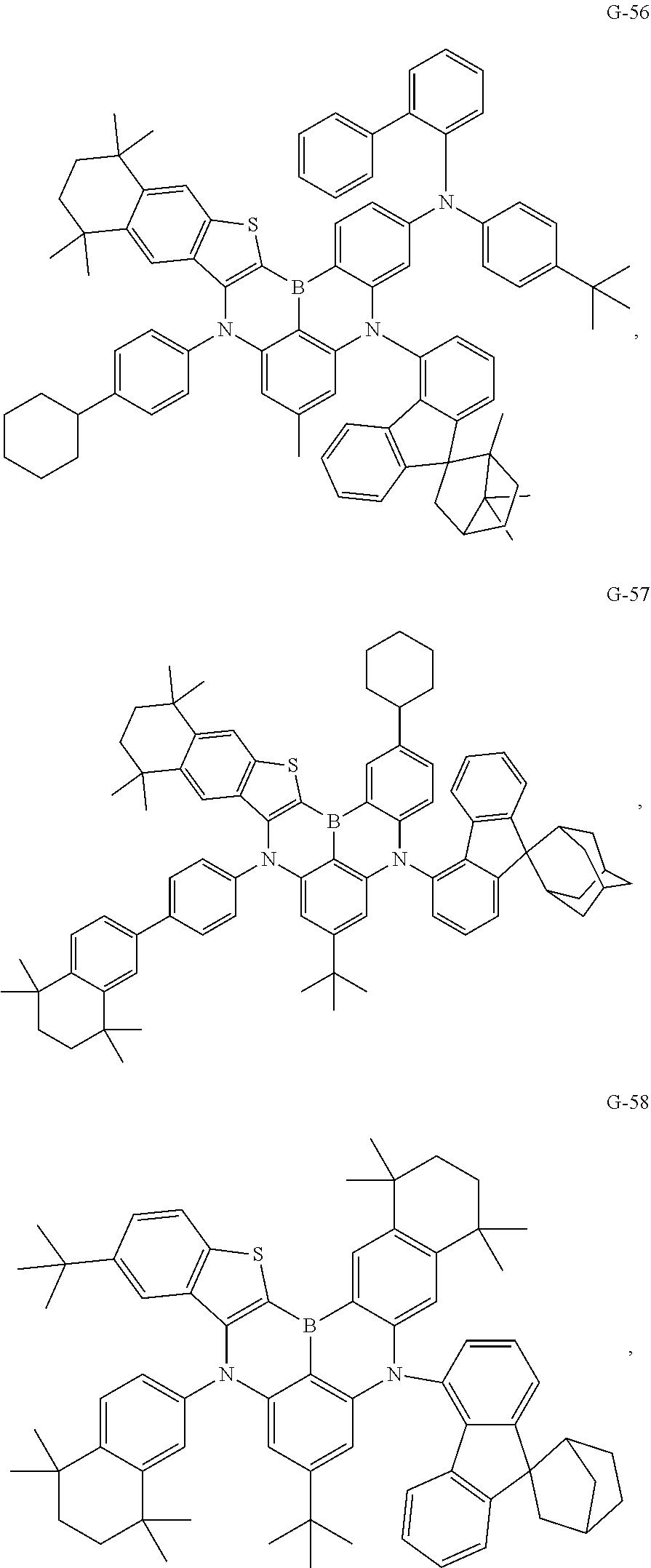
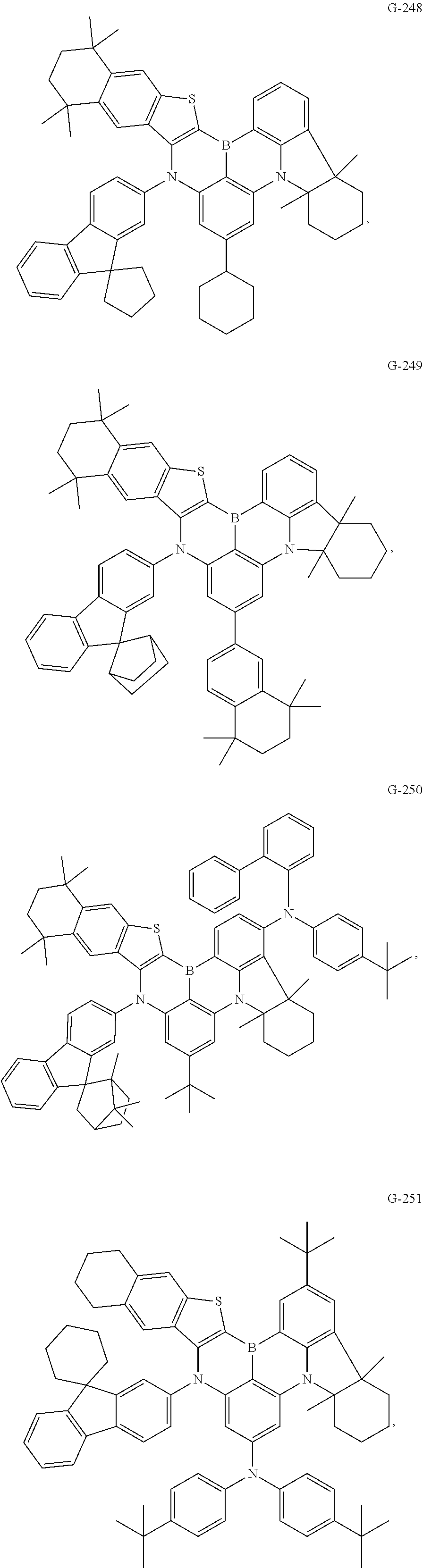
- the compound represented by Formula I is selected from any one of the following compounds:
- an organic electroluminescent device comprising an anode, a hole transport region, a luminescent layer, an electron transport region, and a cathode, which are arranged in this order on a substrate plate, wherein the luminescent layer comprises one or more of the organic compounds as mentioned above.
- the luminescent layer comprises a host material and a doping material, wherein the doping material comprises one or more of the organic compounds as mentioned above.
- the heteroatom- and cycloalkyl-containing organic compound of the present invention has a boron-nitrogen structure with multiple resonance effect, wherein a cycloalkyl-containing fluorenyl structure is introduced on the basis of the boron-nitrogen structure.
- the molecular size is greatly expanded by means of the cycloalkyl group, thereby effectively avoiding a concentration quenching effect, while the molecular orientation is enhanced due to the planarity of the fluorenyl group.
- a heteroatom is introduced to improve the spin coupling effect, and the oscillator strength is enhanced to improve the energy transfer between a host and a guest; furthermore, by means of the heavy atom effect, the conjugation of a luminous moiety is extended while the efficiency is further improved, avoiding excessive photochromic blue shift, so that the organic compound of the present invention has a good efficiency and lifetime performance.
- an organic electroluminescent device manufactured by using the heteroatom- and cycloalkyl-containing organic compound of the present invention has a good performance in terms of external quantum efficiency and lifetime.
- FIG. 1 is a schematic structural diagram of an organic electroluminescent device containing the heteroatom- and cycloalkyl-containing organic compound of the present invention.
- FIG. 2 is a UV-PL diagram of Example 12.
- 1 substrate
- 2 anode
- 3 hole injection layer
- 4 hole transport layer
- 5 luminescent auxiliary layer
- 6 luminescent layer
- 7 hole barrier layer
- 8 electron transport layer
- 9 electron injection layer
- 10 cathode
- the compound of the present invention is suitable for light-emitting elements, display panels, and electronic devices, especially for organic electroluminescent devices.
- the electronic device described in the present invention is a device that comprises a layer of at least one organic compound, and the device may also comprise an inorganic material or a layer formed entirely of an inorganic material.
- the electronic device is preferably an organic electroluminescent device (OLED), an organic integrated circuit (O-IC), an organic field-effect transistor (O-FET), an organic thin film transistor (O-TFT), an organic light-emitting transistor (O-LET), an organic solar cell (O-SC), an organic dye-sensitized solar cell (O-DSSC), an organic optical detector, an organic photosensor, an organic field-quenching device (O-FQD), a luminescent electrochemical cell (LEC), an organic laser diode (O-laser), and an organic plasma emitting device.
- OLED organic electroluminescent device
- OLED organic electroluminescent device
- the structural diagram of an exemplary organic electroluminescent device is as shown in FIG. 1 .
- the polycyclic compound, the preparation method for the compound, and the luminescent characteristics of the device will be explained in detail in conjunction with examples.
- Various chemical reactions can be applied to the synthesis method for a compound according to one embodiment of the present invention.
- the synthesis method for the compound according to one embodiment of the present invention is not limited to the synthesis method described below.
- the subsequent synthesis is carried out in an anhydrous solvent in a protective gas atmosphere.
- Solvents and reagents can be purchased from conventional reagent suppliers.
- the general formula of intermediate synthesis was as above.
- the target intermediate could be obtained by means of a common two-step Buchwald-Hartwig coupling synthesis method.
- a specific example was as follows:
- A-1 (9.38 g, 10 mmol) was added to tert-butyl benzene (125 ml), the mixture was then cooled to 0° C. under nitrogen protection, and 12.4 ml of a solution of 1.7 M tert-butyl lithium (21 mmol) in pentane was added; the mixture was heated to 60° C., stirred for 2 hours, and then cooled to 0° C., and 2.0 ml (21 mmol) of boron tribromide was added and stirred for 0.5 h; the mixture was then cooled to 0° C., and 3.65 ml (21 mmol) of N,N-diisopropylethylamine was added; the mixture was heated to 60° C., stirred for 2 h, cooled to room temperature, quenched by adding ice water, and separated, the organic phase was filtered, and anhydrous magnesium sulfate was then used to remove water; and after rotary evaporation to
- Example 2 This method was the same as in Example 1, except that A-106 (12.48 g, 10 mmol) was used instead of A-1 to finally obtain product G-106: 0.94 g (yield: 8%), MS (m/z) (M+): 1176.
- Compound G-106 had a peak width at half height of 20 nm and a peak value at 459 nm, and this compound had an extremely narrow peak width at half height and a sharp peak shape. The compound could significantly improve the luminous efficiency when applied to an organic electroluminescent device.
- the organic electroluminescent device provided by the present invention comprised an anode, a hole transport region, a luminescent layer, an electron transport region, and a cathode, which were arranged in this order on a substrate plate.
- the hole transport region comprised a hole injection layer, a hole transport layer, and a luminescent auxiliary layer; and the electron transport region comprised an electron transport layer and an electron injection layer.
- the luminescent layer was composed of a host material and a doping material, wherein the host material of the luminescent layer could be composed of one molecular material or a plurality of molecular materials.
- the polycyclic compound of the present invention could be used for one or more layers of the above-mentioned organic electroluminescent devices, preferably for the doping material in the luminescent layer of the devices.
- the anode in the example was an anode material commonly used in the art, such as ITO, Ag or a multilayer structure thereof.
- the hole injection layer was made of a hole injection material commonly used in the art and was doped with F4TCNQ, HATCN, NDP-9, etc.
- the hole transport layer was made of a hole transport material commonly used in the art.
- the luminescent layer was made of a luminescent material commonly used in the art. For example, it could be made of a host material and a doping material, wherein the doping material was a heteroatom- and cycloalkyl-containing organic compound provided by the present invention.
- the electron transport layer was made of an electron transport material commonly used in the art.
- the electron injection layer was made of an electron injection material commonly used in the art, such as Liq, LiF, and Yb.
- the cathode was made of a material commonly used in the art, such as the metals Al and Ag or metal mixtures (Ag-doped Mg, Ag-doped Ca, etc.).
- the electrode preparation method and the deposition method for each functional layer in this example were both conventional methods in the art, such as vacuum thermal evaporation or ink-jet printing. No more detailed repetition would be given here, and only some process details and test methods in the preparation process were supplemented as follows:
- This example provided a blue-light organic electroluminescent device, the preparation method of which was as follows: firstly, on an ITO layer (anode) formed on a substrate, HTL and p-dopant (at a mass ratio of HTL to p-dopant of 97:3) were deposited in vacuo to a thickness of 10 nm to form a hole injection layer; secondly, on the above hole injection layer, HTL was deposited in vacuo to a thickness of 120 nm to form a hole transport layer; thirdly, on the above hole transport layer, B prime was deposited in vacuo to a thickness of 5 nm to form a luminescent auxiliary layer; again, on the above luminescent auxiliary layer, a mixture of BH and G-1 was deposited in vacuo to a thickness of 20 nm to form a luminescent layer, wherein BH acted as a host, G-1 acted as a dopant, and the mass ratio of the host to the dopant
- the compounds described in the other examples were manufactured into organic electroluminescent devices, in which G-2, G-25, G-45, G-49, G-57, G-65, G-73, G-81, G-89, G-93, G-106, G-113, G-118, G-131, G-143, G-167, G-187, G-191, and G-199 were respectively used instead of G-1 to manufacture blue-light organic electroluminescent devices of Examples 2-20.
- Comparative Compounds BD1-BD4 were manufactured into organic electroluminescent devices as Comparative Device Examples 1-4.
- BD1-BD4 were respectively used instead of G-1 to manufacture blue-light organic electroluminescent devices as Comparative Device Examples 1-4, and the structures of BD1-BD4 were as shown below:
- the OLED devices described above were tested by means of a standard method.
- the lifetime LT was defined as the time for the brightness to decrease from the initial luminous brightness L 0 , which was obtained at the time when it worked at a constant current J, to a specific proportion L 1 .
- test instruments and methods for testing the performance of the OLED devices of the above examples and comparative examples were as follows:
Landscapes
- Physics & Mathematics (AREA)
- Chemical & Material Sciences (AREA)
- Engineering & Computer Science (AREA)
- Materials Engineering (AREA)
- Spectroscopy & Molecular Physics (AREA)
- Optics & Photonics (AREA)
- Organic Chemistry (AREA)
- Electroluminescent Light Sources (AREA)
Abstract

Description

-
- wherein
- ring A represents a substituted or unsubstituted aryl group with a carbon atom number of C6-C60 or a substituted or unsubstituted fused cycloaryl group with a carbon atom number of C6-C60;
- ring B represents any one of a substituted or unsubstituted aryl group with a carbon atom number of C6-C60, a substituted or unsubstituted heteroaryl group with a carbon atom number of C5-C60, a substituted or unsubstituted fused cycloaryl group with a carbon atom number of C6-C60, and a substituted or unsubstituted fused heterocycloaryl group with a carbon atom number of C5-C60;
- X represents B or P═O; Y represents NR3, O, or S;
- R1 and R2 each independently represent any one of hydrogen, deuterium, halogen, a substituted or unsubstituted alkyl group with a carbon atom number of C1-C30, a substituted or unsubstituted alkenyl group with a carbon atom number of C2-C30, a substituted or unsubstituted cycloalkyl group with a carbon atom number of C3-C30, a substituted or unsubstituted aryl group with a carbon atom number of C6-C60, a substituted or unsubstituted heteroaryl group with a carbon atom number of C5-C60, a substituted or unsubstituted fused cycloaryl group with a carbon atom number of C6-C60, a substituted or unsubstituted fused heterocycloaryl group with a carbon atom number of C5-C60, and a substituted or unsubstituted amino group, and two or more R1 and R2 can be connected to each other to form a ring structure;
- R3 represents any one of a substituted or unsubstituted alkyl group with a carbon atom number of C1-C30, a substituted or unsubstituted alkoxy group with a carbon atom number of C1-C30, a substituted or unsubstituted cycloalkyl group with a carbon atom number of C3-C30, a substituted or unsubstituted aryl group with a carbon atom number of C6-C60, a substituted or unsubstituted heteroaryl group with a carbon atom number of C5-C60, a substituted or unsubstituted fused cycloaryl group with a carbon atom number of C6-C60, and a substituted or unsubstituted fused heterocycloaryl group with a carbon atom number of C5-C60;
- m and n each independently represent 0, 1, 2, 3, or 4; and when m is 2, 3, or 4, R1 can be the same or different, and when n is 2, 3, or 4, R2 can be the same or different;
- one of Ar1 and Ar2 represents a substituted or unsubstituted cycloalkyl-containing fluorenyl group, and the other one of Ar1 and Ar2 represents any one of a substituted or unsubstituted alkyl group with a carbon atom number of C1-C30, a substituted or unsubstituted alkenyl group with a carbon atom number of C2-C30, a substituted or unsubstituted alkoxy group with a carbon atom number of C1-C30, a substituted or unsubstituted cycloalkyl group with a carbon atom number of C3-C30, a substituted or unsubstituted aryl group with a carbon atom number of C6-C60, a substituted or unsubstituted heteroaryl group with a carbon atom number of C5-C60, a substituted or unsubstituted fused cycloaryl group with a carbon atom number of C6-C60, and a substituted or unsubstituted fused heterocycloaryl group with a carbon atom number of C5-C60;
- when Ar2 does not represent a substituted or unsubstituted cycloalkyl-containing fluorenyl group, Ar2 and ring B can be connected to each other to form a ring; that is, if Ar1 represents a substituted or unsubstituted cycloalkyl-containing fluorenyl group, Ar2 is a structure as defined above other than the substituted or unsubstituted cycloalkyl-containing fluorenyl group, and Ar2 and ring B can be connected to each other to form a ring; on the contrary, if Ar2 represents a substituted or unsubstituted cycloalkyl-containing fluorenyl group, Ar1 is a structure as defined above other than the substituted or unsubstituted cycloalkyl-containing fluorenyl group, and Ar2 and ring B cannot be connected to each other to form a ring;
- Ar3 represents one of hydrogen, deuterium, halogen, a substituted or unsubstituted alkyl group with a carbon atom number of C1-C30, a substituted or unsubstituted alkoxy group with a carbon atom number of C1-C30, a substituted or unsubstituted cycloalkyl group with a carbon atom number of C3-C30, a substituted or unsubstituted aryl group with a carbon atom number of C6-C60, a substituted or unsubstituted heteroaryl group with a carbon atom number of C5-C60, a substituted or unsubstituted fused cycloaryl group with a carbon atom number of C6-C60, a substituted or unsubstituted fused heterocycloaryl group with a carbon atom number of C5-C60, and a substituted or unsubstituted amino group;
- substituents in ring A, ring B, R1, R2, R3, Ar1, Ar2, and Ar3 can be the same or different and are each independently selected from one of deuterium, halogen, cyano, an alkyl group with a carbon atom number of C1-C10, an aryl group with a carbon atom number of C6-C60, a heteroaryl group with a carbon atom number of C5-C60, a fused cycloaryl group with a carbon atom number of C6-C60, a cycloalkyl group with a carbon atom number of C3-C30, and an amino group, wherein two or more substituents can be connected to each other to form an aliphatic ring, an aromatic ring, or a condensed ring; and
- each hydrogen on the compound represented by Formula I can be independently replaced by deuterium.


-
- wherein
- ring B represents any one of a substituted or unsubstituted aryl group with a carbon atom number of C6-C60, a substituted or unsubstituted heteroaryl group with a carbon atom number of C5-C60, a substituted or unsubstituted fused cycloaryl group with a carbon atom number of C6-C60, and a substituted or unsubstituted fused heterocycloaryl group with a carbon atom number of C5-C60;
- Y represents NR3, O, or S;
- each R3 independently represents any one of a substituted or unsubstituted alkyl group with a carbon atom number of C1-C30, a substituted or unsubstituted cycloalkyl group with a carbon atom number of C3-C30, and a substituted or unsubstituted aryl group with a carbon atom number of C6-C60;
- R11 and R4 represent any one of hydrogen, deuterium, halogen, a substituted or unsubstituted alkyl group with a carbon atom number of C1-C30, a substituted or unsubstituted cycloalkyl group with a carbon atom number of C3-C30, and a substituted or unsubstituted aryl group with a carbon atom number of C6-C60;
- R21 represents any one of hydrogen, deuterium, halogen, a substituted or unsubstituted alkyl group with a carbon atom number of C1-C30, a substituted or unsubstituted cycloalkyl group with a carbon atom number of C3-C30, a substituted or unsubstituted aryl group with a carbon atom number of C6-C60, a substituted or unsubstituted heteroaryl group with a carbon atom number of C5-C60, a substituted or unsubstituted fused cycloaryl group with a carbon atom number of C6-C60, a substituted or unsubstituted fused heterocycloaryl group with a carbon atom number of C5-C60, and a substituted or unsubstituted amino group;
- m1 and p represent 0, 1, 2, 3, or 4; and when m1 represents 2, 3, or 4, R11 can be the same or different, and when p represents 2, 3, or 4, R4 can be the same or different;
- n1 represents 0, 1, 2, or 3; and when n1 represents 2 or 3, R21 can be the same or different;
- Ar1 and Ar2 each independently represent any one of a substituted or unsubstituted alkyl group with a carbon atom number of C1-C30, a substituted or unsubstituted alkoxy group with a carbon atom number of C1-C30, a substituted or unsubstituted cycloalkyl group with a carbon atom number of C3-C30, a substituted or unsubstituted aryl group with a carbon atom number of C6-C60, a substituted or unsubstituted heteroaryl group with a carbon atom number of C5-C60, a substituted or unsubstituted fused cycloaryl group with a carbon atom number of C6-C60, and a substituted or unsubstituted fused heterocycloaryl group with a carbon atom number of C5-C60;
- in Formulas I-1 to 1-5, one of Ar1 and Ar2 represents a substituted or unsubstituted cycloalkyl-containing fluorenyl group, and in Formulas I-6 to I-11, Ar1 represents a substituted or unsubstituted cycloalkyl-containing fluorenyl group;
- Ar3 represents one of hydrogen, deuterium, halogen, a substituted or unsubstituted alkyl group with a carbon atom number of C1-C30, a substituted or unsubstituted alkoxy group with a carbon atom number of C1-C30, a substituted or unsubstituted cycloalkyl group with a carbon atom number of C3-C30, a substituted or unsubstituted aryl group with a carbon atom number of C6-C60, a substituted or unsubstituted heteroaryl group with a carbon atom number of C5-C60, a substituted or unsubstituted fused cycloaryl group with a carbon atom number of C6-C60, a substituted or unsubstituted fused heterocycloaryl group with a carbon atom number of C5-C60, and a substituted or unsubstituted amino group;
- substituents in ring B, R11, R21, R3, R4, Ar1, Ar2, and Ar3 can be the same or different and are each independently selected from one of deuterium, halogen, cyano, an alkyl group with a carbon atom number of C1-C10, an aryl group with a carbon atom number of C6-C60, a heteroaryl group with a carbon atom number of C5-C60, a fused cycloaryl group with a carbon atom number of C6-C60, and a cycloalkyl group with a carbon atom number of C3-C30, wherein two or more substituents can be connected to each other to form an aliphatic ring, an aromatic ring, or a condensed ring; and
- each hydrogen on the compounds represented by Formulas I-1 to I-11 can be independently replaced by deuterium.


-
- wherein any nonadjacent C in each of the above structures can be each independently replaced by N, and any hydrogen in each of the above structures can be each independently replaced by fluorine, deuterium, cyano, linear alkyl, branched alkyl, cycloalkyl, aryl, heteroaryl, or arylamino.

wherein any nonadjacent C in each of the above structures can be each independently replaced by N, and any hydrogen in each of the above structures can be each independently replaced by fluorine, deuterium, cyano, linear alkyl, branched alkyl, cycloalkyl, aryl, heteroaryl, or arylamino.
-
- wherein R5 and R6 each independently represent a substituted or unsubstituted linear alkyl or branched alkyl group with a carbon atom number of C1-C10,

-
- and any hydrogen in each of the above structures can be each independently replaced by fluorine, deuterium, linear alkyl, branched alkyl, cycloalkyl, or phenyl.

and —NR5R6, and any hydrogen in each of the above structures of Ar3 can be each independently replaced by fluorine, deuterium, linear alkyl, branched alkyl, cycloalkyl, or phenyl; and
-
- R5 and R6 each independently represent a substituted or unsubstituted linear alkyl or branched alkyl group with a carbon atom number of C1-C10,

-
- and any hydrogen in each of the above structures of R5 and R6 can be each independently replaced by fluorine, deuterium, linear alkyl, branched alkyl, cycloalkyl, or phenyl.






-
- the brightness was tested by means of spectrum scanner PhotoResearch PR-635;
- the current density and turn-on voltage were tested by digital SourceMeter Keithley 2400; and
- lifetime test: LT-96ch lifetime test device was used.
| TABLE 1 |
| Performance test results of blue-light devices |
| @ J = 10 | ||||
| mA/cm2 | ||||
| No. | Vop (V) | EQE (%) | LT95 (h) | Color |
| G-1 | 3.98 | 8.88 | 192 | Blue |
| G-2 | 4.06 | 8.68 | 216 | Blue |
| G-25 | 4.01 | 8.41 | 214 | Blue |
| G-45 | 4.04 | 8.41 | 191 | Blue |
| G-49 | 4.09 | 8.13 | 216 | Blue |
| G-57 | 4.10 | 8.72 | 212 | Blue |
| G-65 | 3.99 | 8.52 | 197 | Blue |
| G-73 | 3.94 | 8.66 | 195 | Blue |
| G-81 | 3.99 | 8.16 | 205 | Blue |
| G-89 | 3.96 | 9.48 | 218 | Blue |
| G-93 | 3.97 | 9.22 | 201 | Blue |
| G-106 | 4.10 | 8.15 | 202 | Blue |
| G-113 | 3.93 | 8.93 | 193 | Blue |
| G-118 | 4.06 | 9.48 | 213 | Blue |
| G-131 | 3.94 | 8.29 | 183 | Blue |
| G-143 | 4.07 | 8.13 | 209 | Blue |
| G-167 | 3.95 | 8.07 | 213 | Blue |
| G-187 | 3.99 | 8.58 | 193 | Blue |
| G-191 | 3.99 | 8.89 | 188 | Blue |
| G-199 | 3.99 | 9.10 | 202 | Blue |
| BD1 | 4.08 | 4.28 | 108 | Blue |
| BD2 | 4.13 | 4.30 | 104 | Blue |
| BD3 | 3.90 | 4.17 | 105 | Blue |
| BD4 | 4.02 | 4.08 | 103 | Blue |
Claims (3)


Applications Claiming Priority (2)
| Application Number | Priority Date | Filing Date | Title |
|---|---|---|---|
| CN202310388728.5 | 2023-04-12 | ||
| CN202310388728.5A CN116574118B (en) | 2023-04-12 | 2023-04-12 | Organic compound containing heteroatom and cycloalkyl and organic electroluminescent device containing organic compound |
Publications (2)
| Publication Number | Publication Date |
|---|---|
| US20240158419A1 US20240158419A1 (en) | 2024-05-16 |
| US12145952B2 true US12145952B2 (en) | 2024-11-19 |
Family
ID=87538599
Family Applications (1)
| Application Number | Title | Priority Date | Filing Date |
|---|---|---|---|
| US18/535,534 Active US12145952B2 (en) | 2023-04-12 | 2023-12-11 | Heteroatom- and cycloalkyl-containing organic compound and organic electroluminescent device containing compound |
Country Status (2)
| Country | Link |
|---|---|
| US (1) | US12145952B2 (en) |
| CN (1) | CN116574118B (en) |
Families Citing this family (3)
| Publication number | Priority date | Publication date | Assignee | Title |
|---|---|---|---|---|
| CN118406486B (en) * | 2024-04-28 | 2025-03-21 | 石家庄诚志永华显示材料有限公司 | A blue light-emitting composition and an organic electroluminescent device containing the same |
| CN119039977B (en) * | 2024-10-30 | 2025-01-10 | 石家庄诚志永华显示材料有限公司 | A blue light-emitting composition and an organic electroluminescent device and a display device containing the same |
| CN119119097B (en) * | 2024-11-12 | 2025-08-05 | 浙江华显光电科技有限公司 | Boron nitrogen compound containing carbazole group, OLED and organic light-emitting device having the compound |
Citations (3)
| Publication number | Priority date | Publication date | Assignee | Title |
|---|---|---|---|---|
| WO2021107680A1 (en) * | 2019-11-29 | 2021-06-03 | 주식회사 엘지화학 | Compound and organic light-emitting element comprising same |
| CN113416206A (en) | 2021-08-23 | 2021-09-21 | 浙江华显光电科技有限公司 | Spiro compound, preparation, organic electroluminescent diode and display device |
| CN115746039A (en) | 2022-11-30 | 2023-03-07 | 吉林奥来德光电材料股份有限公司 | Organic compound, preparation method thereof and electroluminescent device |
-
2023
- 2023-04-12 CN CN202310388728.5A patent/CN116574118B/en active Active
- 2023-12-11 US US18/535,534 patent/US12145952B2/en active Active
Patent Citations (3)
| Publication number | Priority date | Publication date | Assignee | Title |
|---|---|---|---|---|
| WO2021107680A1 (en) * | 2019-11-29 | 2021-06-03 | 주식회사 엘지화학 | Compound and organic light-emitting element comprising same |
| CN113416206A (en) | 2021-08-23 | 2021-09-21 | 浙江华显光电科技有限公司 | Spiro compound, preparation, organic electroluminescent diode and display device |
| CN115746039A (en) | 2022-11-30 | 2023-03-07 | 吉林奥来德光电材料股份有限公司 | Organic compound, preparation method thereof and electroluminescent device |
Non-Patent Citations (3)
| Title |
|---|
| Feb. 23, 2024, Chinese Decision to Grant Patent issued for related CN Application No. 202310388728.5. |
| Jan. 16, 2024, Chinese Office Action issued for related CN Application No. 202310388728.5. |
| Machine-generated English-language translation of WO-2021107680-A1. * |
Also Published As
| Publication number | Publication date |
|---|---|
| US20240158419A1 (en) | 2024-05-16 |
| CN116574118A (en) | 2023-08-11 |
| CN116574118B (en) | 2024-03-15 |
Similar Documents
| Publication | Publication Date | Title |
|---|---|---|
| US12145952B2 (en) | Heteroatom- and cycloalkyl-containing organic compound and organic electroluminescent device containing compound | |
| US9079920B2 (en) | Compound containing 5-membered heterocycles, organic light-emitting device using same, and terminal comprising the latter | |
| US9028978B2 (en) | Compound and organic light-emitting device including the same | |
| US12116379B2 (en) | Compound and organic light emitting diode comprising same | |
| US8592055B2 (en) | Compound for organic electroluminescent device and organic electroluminescent device having the same | |
| US9450192B2 (en) | Carbazole derivative and organic electroluminescent devices utilizing the same and fabrication method thereof | |
| US9353085B2 (en) | Compound for organic electroluminescent device and organic electroluminescent devices using the same | |
| CN114975839B (en) | An organic electroluminescence device, organic electroluminescence device and optoelectronic equipment | |
| US11111244B2 (en) | Organic compound and organic electroluminescence device using the same | |
| US20230331704A1 (en) | Compound and organic light-emitting device comprising same | |
| US8460802B2 (en) | Charge transport materials for luminescent applications | |
| US12060369B2 (en) | Organic eletroluminescent material, preparation method thereof and organic eletroluminescent device | |
| US20120013247A1 (en) | Dendrimer and organic light-emitting device using the same | |
| US20240018168A1 (en) | Compound with multiple resonance characteristics and organic electroluminescent device containing compound | |
| US6872824B2 (en) | Pyrimidine spirobifluorene oligomer for organic light-emitting device | |
| US20200259088A1 (en) | Electroluminescent compound, thermally activated delayed fluorescence material, and application thereof | |
| US11858906B2 (en) | Amine compound and high-efficiency organic light-emitting diode including same | |
| US20250120304A1 (en) | Organic light emitting device | |
| US11557732B2 (en) | Organic electroluminescent compound, and organic electroluminescent element and device employing the same | |
| CN116217605B (en) | Polycyclic compound and light-emitting device thereof | |
| US20250113730A1 (en) | Material for organic electroluminescent element, and organic electroluminescent element | |
| EP3915982A1 (en) | Compound and organic light-emitting device including same | |
| US11374177B2 (en) | Compound and organic light emitting device comprising the same | |
| US20240315128A1 (en) | Compound containing carbazole derivative and organic electroluminescent device comprising same | |
| US20250234697A1 (en) | Organic light-emitting device |
Legal Events
| Date | Code | Title | Description |
|---|---|---|---|
| AS | Assignment |
Owner name: SHIJIAZHUANG CHENGZHI YONGHUA DISPLAY MATERIAL CO., LTD., CHINA Free format text: ASSIGNMENT OF ASSIGNORS INTEREST;ASSIGNORS:LIU, SONGYUAN;XIE, ZAIFENG;SHAO, ZHE;AND OTHERS;REEL/FRAME:065865/0613 Effective date: 20231114 |
|
| FEPP | Fee payment procedure |
Free format text: ENTITY STATUS SET TO UNDISCOUNTED (ORIGINAL EVENT CODE: BIG.); ENTITY STATUS OF PATENT OWNER: LARGE ENTITY |
|
| STPP | Information on status: patent application and granting procedure in general |
Free format text: NON FINAL ACTION MAILED |
|
| STPP | Information on status: patent application and granting procedure in general |
Free format text: RESPONSE TO NON-FINAL OFFICE ACTION ENTERED AND FORWARDED TO EXAMINER |
|
| STPP | Information on status: patent application and granting procedure in general |
Free format text: FINAL REJECTION MAILED |
|
| STPP | Information on status: patent application and granting procedure in general |
Free format text: RESPONSE AFTER FINAL ACTION FORWARDED TO EXAMINER |
|
| STPP | Information on status: patent application and granting procedure in general |
Free format text: PUBLICATIONS -- ISSUE FEE PAYMENT RECEIVED |
|
| STPP | Information on status: patent application and granting procedure in general |
Free format text: PUBLICATIONS -- ISSUE FEE PAYMENT VERIFIED |
|
| STCF | Information on status: patent grant |
Free format text: PATENTED CASE |