US12144864B2 - Tubulysins and protein-tubulysin conjugates - Google Patents
Tubulysins and protein-tubulysin conjugates Download PDFInfo
- Publication number
- US12144864B2 US12144864B2 US16/724,164 US201916724164A US12144864B2 US 12144864 B2 US12144864 B2 US 12144864B2 US 201916724164 A US201916724164 A US 201916724164A US 12144864 B2 US12144864 B2 US 12144864B2
- Authority
- US
- United States
- Prior art keywords
- alkyl
- aryl
- alkynyl
- cycloalkyl
- alkenyl
- Prior art date
- Legal status (The legal status is an assumption and is not a legal conclusion. Google has not performed a legal analysis and makes no representation as to the accuracy of the status listed.)
- Active, expires
Links
Images


Classifications
-
- A—HUMAN NECESSITIES
- A61—MEDICAL OR VETERINARY SCIENCE; HYGIENE
- A61K—PREPARATIONS FOR MEDICAL, DENTAL OR TOILETRY PURPOSES
- A61K31/00—Medicinal preparations containing organic active ingredients
- A61K31/33—Heterocyclic compounds
- A61K31/395—Heterocyclic compounds having nitrogen as a ring hetero atom, e.g. guanethidine or rifamycins
- A61K31/435—Heterocyclic compounds having nitrogen as a ring hetero atom, e.g. guanethidine or rifamycins having six-membered rings with one nitrogen as the only ring hetero atom
- A61K31/44—Non condensed pyridines; Hydrogenated derivatives thereof
- A61K31/445—Non condensed piperidines, e.g. piperocaine
- A61K31/4523—Non condensed piperidines, e.g. piperocaine containing further heterocyclic ring systems
- A61K31/454—Non condensed piperidines, e.g. piperocaine containing further heterocyclic ring systems containing a five-membered ring with nitrogen as a ring hetero atom, e.g. pimozide, domperidone
-
- A—HUMAN NECESSITIES
- A61—MEDICAL OR VETERINARY SCIENCE; HYGIENE
- A61K—PREPARATIONS FOR MEDICAL, DENTAL OR TOILETRY PURPOSES
- A61K38/00—Medicinal preparations containing peptides
-
- A—HUMAN NECESSITIES
- A61—MEDICAL OR VETERINARY SCIENCE; HYGIENE
- A61K—PREPARATIONS FOR MEDICAL, DENTAL OR TOILETRY PURPOSES
- A61K47/00—Medicinal preparations characterised by the non-active ingredients used, e.g. carriers or inert additives; Targeting or modifying agents chemically bound to the active ingredient
- A61K47/50—Medicinal preparations characterised by the non-active ingredients used, e.g. carriers or inert additives; Targeting or modifying agents chemically bound to the active ingredient the non-active ingredient being chemically bound to the active ingredient, e.g. polymer-drug conjugates
- A61K47/51—Medicinal preparations characterised by the non-active ingredients used, e.g. carriers or inert additives; Targeting or modifying agents chemically bound to the active ingredient the non-active ingredient being chemically bound to the active ingredient, e.g. polymer-drug conjugates the non-active ingredient being a modifying agent
- A61K47/54—Medicinal preparations characterised by the non-active ingredients used, e.g. carriers or inert additives; Targeting or modifying agents chemically bound to the active ingredient the non-active ingredient being chemically bound to the active ingredient, e.g. polymer-drug conjugates the non-active ingredient being a modifying agent the modifying agent being an organic compound
- A61K47/545—Heterocyclic compounds
-
- A—HUMAN NECESSITIES
- A61—MEDICAL OR VETERINARY SCIENCE; HYGIENE
- A61K—PREPARATIONS FOR MEDICAL, DENTAL OR TOILETRY PURPOSES
- A61K47/00—Medicinal preparations characterised by the non-active ingredients used, e.g. carriers or inert additives; Targeting or modifying agents chemically bound to the active ingredient
- A61K47/50—Medicinal preparations characterised by the non-active ingredients used, e.g. carriers or inert additives; Targeting or modifying agents chemically bound to the active ingredient the non-active ingredient being chemically bound to the active ingredient, e.g. polymer-drug conjugates
- A61K47/51—Medicinal preparations characterised by the non-active ingredients used, e.g. carriers or inert additives; Targeting or modifying agents chemically bound to the active ingredient the non-active ingredient being chemically bound to the active ingredient, e.g. polymer-drug conjugates the non-active ingredient being a modifying agent
- A61K47/62—Medicinal preparations characterised by the non-active ingredients used, e.g. carriers or inert additives; Targeting or modifying agents chemically bound to the active ingredient the non-active ingredient being chemically bound to the active ingredient, e.g. polymer-drug conjugates the non-active ingredient being a modifying agent the modifying agent being a protein, peptide or polyamino acid
- A61K47/65—Peptidic linkers, binders or spacers, e.g. peptidic enzyme-labile linkers
-
- A—HUMAN NECESSITIES
- A61—MEDICAL OR VETERINARY SCIENCE; HYGIENE
- A61K—PREPARATIONS FOR MEDICAL, DENTAL OR TOILETRY PURPOSES
- A61K47/00—Medicinal preparations characterised by the non-active ingredients used, e.g. carriers or inert additives; Targeting or modifying agents chemically bound to the active ingredient
- A61K47/50—Medicinal preparations characterised by the non-active ingredients used, e.g. carriers or inert additives; Targeting or modifying agents chemically bound to the active ingredient the non-active ingredient being chemically bound to the active ingredient, e.g. polymer-drug conjugates
- A61K47/51—Medicinal preparations characterised by the non-active ingredients used, e.g. carriers or inert additives; Targeting or modifying agents chemically bound to the active ingredient the non-active ingredient being chemically bound to the active ingredient, e.g. polymer-drug conjugates the non-active ingredient being a modifying agent
- A61K47/68—Medicinal preparations characterised by the non-active ingredients used, e.g. carriers or inert additives; Targeting or modifying agents chemically bound to the active ingredient the non-active ingredient being chemically bound to the active ingredient, e.g. polymer-drug conjugates the non-active ingredient being a modifying agent the modifying agent being an antibody, an immunoglobulin or a fragment thereof, e.g. an Fc-fragment
- A61K47/6801—Drug-antibody or immunoglobulin conjugates defined by the pharmacologically or therapeutically active agent
- A61K47/6803—Drugs conjugated to an antibody or immunoglobulin, e.g. cisplatin-antibody conjugates
-
- A—HUMAN NECESSITIES
- A61—MEDICAL OR VETERINARY SCIENCE; HYGIENE
- A61K—PREPARATIONS FOR MEDICAL, DENTAL OR TOILETRY PURPOSES
- A61K47/00—Medicinal preparations characterised by the non-active ingredients used, e.g. carriers or inert additives; Targeting or modifying agents chemically bound to the active ingredient
- A61K47/50—Medicinal preparations characterised by the non-active ingredients used, e.g. carriers or inert additives; Targeting or modifying agents chemically bound to the active ingredient the non-active ingredient being chemically bound to the active ingredient, e.g. polymer-drug conjugates
- A61K47/51—Medicinal preparations characterised by the non-active ingredients used, e.g. carriers or inert additives; Targeting or modifying agents chemically bound to the active ingredient the non-active ingredient being chemically bound to the active ingredient, e.g. polymer-drug conjugates the non-active ingredient being a modifying agent
- A61K47/68—Medicinal preparations characterised by the non-active ingredients used, e.g. carriers or inert additives; Targeting or modifying agents chemically bound to the active ingredient the non-active ingredient being chemically bound to the active ingredient, e.g. polymer-drug conjugates the non-active ingredient being a modifying agent the modifying agent being an antibody, an immunoglobulin or a fragment thereof, e.g. an Fc-fragment
- A61K47/6801—Drug-antibody or immunoglobulin conjugates defined by the pharmacologically or therapeutically active agent
- A61K47/6803—Drugs conjugated to an antibody or immunoglobulin, e.g. cisplatin-antibody conjugates
- A61K47/6811—Drugs conjugated to an antibody or immunoglobulin, e.g. cisplatin-antibody conjugates the drug being a protein or peptide, e.g. transferrin or bleomycin
-
- A—HUMAN NECESSITIES
- A61—MEDICAL OR VETERINARY SCIENCE; HYGIENE
- A61K—PREPARATIONS FOR MEDICAL, DENTAL OR TOILETRY PURPOSES
- A61K47/00—Medicinal preparations characterised by the non-active ingredients used, e.g. carriers or inert additives; Targeting or modifying agents chemically bound to the active ingredient
- A61K47/50—Medicinal preparations characterised by the non-active ingredients used, e.g. carriers or inert additives; Targeting or modifying agents chemically bound to the active ingredient the non-active ingredient being chemically bound to the active ingredient, e.g. polymer-drug conjugates
- A61K47/51—Medicinal preparations characterised by the non-active ingredients used, e.g. carriers or inert additives; Targeting or modifying agents chemically bound to the active ingredient the non-active ingredient being chemically bound to the active ingredient, e.g. polymer-drug conjugates the non-active ingredient being a modifying agent
- A61K47/68—Medicinal preparations characterised by the non-active ingredients used, e.g. carriers or inert additives; Targeting or modifying agents chemically bound to the active ingredient the non-active ingredient being chemically bound to the active ingredient, e.g. polymer-drug conjugates the non-active ingredient being a modifying agent the modifying agent being an antibody, an immunoglobulin or a fragment thereof, e.g. an Fc-fragment
- A61K47/6801—Drug-antibody or immunoglobulin conjugates defined by the pharmacologically or therapeutically active agent
- A61K47/6803—Drugs conjugated to an antibody or immunoglobulin, e.g. cisplatin-antibody conjugates
- A61K47/6811—Drugs conjugated to an antibody or immunoglobulin, e.g. cisplatin-antibody conjugates the drug being a protein or peptide, e.g. transferrin or bleomycin
- A61K47/6817—Toxins
- A61K47/6829—Bacterial toxins, e.g. diphteria toxins or Pseudomonas exotoxin A
-
- A—HUMAN NECESSITIES
- A61—MEDICAL OR VETERINARY SCIENCE; HYGIENE
- A61K—PREPARATIONS FOR MEDICAL, DENTAL OR TOILETRY PURPOSES
- A61K47/00—Medicinal preparations characterised by the non-active ingredients used, e.g. carriers or inert additives; Targeting or modifying agents chemically bound to the active ingredient
- A61K47/50—Medicinal preparations characterised by the non-active ingredients used, e.g. carriers or inert additives; Targeting or modifying agents chemically bound to the active ingredient the non-active ingredient being chemically bound to the active ingredient, e.g. polymer-drug conjugates
- A61K47/51—Medicinal preparations characterised by the non-active ingredients used, e.g. carriers or inert additives; Targeting or modifying agents chemically bound to the active ingredient the non-active ingredient being chemically bound to the active ingredient, e.g. polymer-drug conjugates the non-active ingredient being a modifying agent
- A61K47/68—Medicinal preparations characterised by the non-active ingredients used, e.g. carriers or inert additives; Targeting or modifying agents chemically bound to the active ingredient the non-active ingredient being chemically bound to the active ingredient, e.g. polymer-drug conjugates the non-active ingredient being a modifying agent the modifying agent being an antibody, an immunoglobulin or a fragment thereof, e.g. an Fc-fragment
- A61K47/6835—Medicinal preparations characterised by the non-active ingredients used, e.g. carriers or inert additives; Targeting or modifying agents chemically bound to the active ingredient the non-active ingredient being chemically bound to the active ingredient, e.g. polymer-drug conjugates the non-active ingredient being a modifying agent the modifying agent being an antibody, an immunoglobulin or a fragment thereof, e.g. an Fc-fragment the modifying agent being an antibody or an immunoglobulin bearing at least one antigen-binding site
- A61K47/6871—Medicinal preparations characterised by the non-active ingredients used, e.g. carriers or inert additives; Targeting or modifying agents chemically bound to the active ingredient the non-active ingredient being chemically bound to the active ingredient, e.g. polymer-drug conjugates the non-active ingredient being a modifying agent the modifying agent being an antibody, an immunoglobulin or a fragment thereof, e.g. an Fc-fragment the modifying agent being an antibody or an immunoglobulin bearing at least one antigen-binding site the antibody targeting an enzyme
-
- A—HUMAN NECESSITIES
- A61—MEDICAL OR VETERINARY SCIENCE; HYGIENE
- A61P—SPECIFIC THERAPEUTIC ACTIVITY OF CHEMICAL COMPOUNDS OR MEDICINAL PREPARATIONS
- A61P35/00—Antineoplastic agents
-
- A—HUMAN NECESSITIES
- A61—MEDICAL OR VETERINARY SCIENCE; HYGIENE
- A61P—SPECIFIC THERAPEUTIC ACTIVITY OF CHEMICAL COMPOUNDS OR MEDICINAL PREPARATIONS
- A61P35/00—Antineoplastic agents
- A61P35/02—Antineoplastic agents specific for leukemia
-
- C—CHEMISTRY; METALLURGY
- C07—ORGANIC CHEMISTRY
- C07K—PEPTIDES
- C07K5/00—Peptides containing up to four amino acids in a fully defined sequence; Derivatives thereof
- C07K5/02—Peptides containing up to four amino acids in a fully defined sequence; Derivatives thereof containing at least one abnormal peptide link
- C07K5/021—Peptides containing up to four amino acids in a fully defined sequence; Derivatives thereof containing at least one abnormal peptide link containing the structure -NH-(X)n-C(=0)-, n being 5 or 6; for n > 6, classification in C07K5/06 - C07K5/10, according to the moiety having normal peptide bonds
-
- C—CHEMISTRY; METALLURGY
- C07—ORGANIC CHEMISTRY
- C07K—PEPTIDES
- C07K5/00—Peptides containing up to four amino acids in a fully defined sequence; Derivatives thereof
- C07K5/04—Peptides containing up to four amino acids in a fully defined sequence; Derivatives thereof containing only normal peptide links
- C07K5/06—Dipeptides
- C07K5/06139—Dipeptides with the first amino acid being heterocyclic
-
- A—HUMAN NECESSITIES
- A61—MEDICAL OR VETERINARY SCIENCE; HYGIENE
- A61K—PREPARATIONS FOR MEDICAL, DENTAL OR TOILETRY PURPOSES
- A61K39/00—Medicinal preparations containing antigens or antibodies
- A61K2039/505—Medicinal preparations containing antigens or antibodies comprising antibodies
Definitions
- novel tubulysins and protein conjugates thereof and methods for treating a variety of diseases, disorders, and conditions including administering the tubulysins, and protein conjugates thereof.
- ADCs antibody-drug conjugates
- MDR multidrug resistance
- tubulysins first isolated from myxobacterial culture broth, are a group of extremely potent tubulin polymerization inhibitors that rapidly disintegrate the cytoskeleton of dividing cells and induce apoptosis.
- Tubulysins are comprised of N-methyl-D-pipecolinic acid (Mep), L-isoleucine (Ile), and tubuvaline (Tuv), which contains an unusual N,O-acetal and a secondary alcohol or acetoxy group.
- Tubulysins A, B, C, G, and I contain the C-terminal tubutyrosine (Tut) ⁇ -amino acid, while D, E, F, and H instead have tubuphenylalanine (Tup) at this position ( Angew. Chem. Int. Ed. Engl. 43, 4888-4892).
- Tubulysins have emerged as promising anticancer leads due to their powerful activity in drug-resistant cells through a validated mechanism of action.
- the average cell growth inhibitory activity outperforms that of well-known epothilones, vinblastines, and taxols by 10-fold to more than 1000-fold, including activity against multi-drug resistant carcinoma ( Biochem. J 2006, 396, 235-242 ; Nat. Prod. Rep. 2015, 32, 654-662).
- Tubulysins have extremely potent antiproliferative activity against cancer cells, including multidrug resistant KB-V1 cervix carcinoma cells. ( Angew. Chem. Int. Ed. 2004, 43, 4888-4892; and Biochemical Journal 2006, 396, 235-242).
- a linker-payload of Formula LPa, LPb, LPc, or LPd is provided.
- a linker-payload of Formula LPa, LPb, LPc, or LPd is provided.
- an antibody-drug conjugate including an antibody, or antigen binding fragment thereof, wherein said antibody or antigen binding fragment thereof is conjugated to a compound as described herein.
- set forth herein are methods for making the compounds, linker-payloads, or antibody-drug conjugates, and compositions described herein.
- FIGS. 1 - 14 show synthetic chemistry schemes for tubulyisin payloads, tubulysin linker-payloads, and protein conjugates thereof.
- FIG. 15 shows Size Exclusion Chromatography of anti-STEAP2 Ab-LP3, anti-STEAP2 Ab-LP4, control Ab-LP3, and control Ab-LP4.
- FIG. 16 shows that anti-STEAP2 Tubulysin ADCs demonstrate significant anti-tumor efficacy against CTG-2440 prostate cancer PDX bearing NOG mice.
- FIG. 17 shows that anti-STEAP2 Tubulysin ADCs demonstrate significant anti-tumor efficacy against CTG-2441 prostate cancer PDX bearing NOG mice.
- compositions, and methods useful for treating for example, cancer in a subject are provided herein.
- alkyl refers to a monovalent and saturated hydrocarbon radical moiety. Alkyl is optionally substituted and can be linear, branched, or cyclic, i.e., cycloalkyl. Alkyl includes, but is not limited to, those radicals having 1-20 carbon atoms, i.e., C 1-20 alkyl; 1-12 carbon atoms, i.e., C 1-12 alkyl; 1-8 carbon atoms, i.e., C 1-8 alkyl; 1-6 carbon atoms, i.e., C 1-6 alkyl; and 1-3 carbon atoms, i.e., C 1-3 alkyl.
- alkyl moieties include, but are not limited to, methyl, ethyl, n-propyl, i-propyl, n-butyl, ⁇ -butyl, t-butyl, i-butyl, a pentyl moiety, a hexyl moiety, cyclopropyl, cyclobutyl, cyclopentyl, and cyclohexyl.
- a pentyl moiety includes, but is not limited to, n-pentyl and i-pentyl.
- a hexyl moiety includes, but is not limited to, n-hexyl.
- alkylene refers to a divalent alkyl group. Unless specified otherwise, alkylene includes, but is not limited to, 1-20 carbon atoms. The alkylene group is optionally substituted as described herein for alkyl. In some embodiments, alkylene is unsubstituted.
- Designation of an amino acid or amino acid residue without specifying its stereochemistry is intended to encompass the L-form of the amino acid, the D-form of the amino acid, or a racemic mixture thereof.
- haloalkyl refers to alkyl, as defined above, wherein the alkyl includes at least one substituent selected from a halogen, for example, fluorine (F), chlorine (Cl), bromine (Br), or iodine (I).
- haloalkyl include, but are not limited to, —CF 3 , —CH 2 CF 3 , —CCl 2 F, and —CCl 3 .
- alkenyl refers to a monovalent hydrocarbon radical moiety containing at least two carbon atoms and one or more non-aromatic carbon-carbon double bonds. Alkenyl is optionally substituted and can be linear, branched, or cyclic.
- Alkenyl includes, but is not limited to, those radicals having 2-20 carbon atoms, i.e., C 2-20 alkenyl; 2-12 carbon atoms, i.e., C 2-12 alkenyl; 2-8 carbon atoms, i.e., C 2 -s alkenyl; 2-6 carbon atoms, i.e., C 2-6 alkenyl; and 2-4 carbon atoms, i.e., C 24 alkenyl.
- alkenyl moieties include, but are not limited to, vinyl, propenyl, butenyl, and cyclohexenyl.
- alkynyl refers to a monovalent hydrocarbon radical moiety containing at least two carbon atoms and one or more carbon-carbon triple bonds. Alkynyl is optionally substituted and can be linear, branched, or cyclic.
- Alkynyl includes, but is not limited to, those radicals having 2-20 carbon atoms, i.e., C 2-20 alkynyl; 2-12 carbon atoms, i.e., C 2-12 alkynyl; 2-8 carbon atoms, i.e., C 2 -s alkynyl; 2-6 carbon atoms, i.e., C 2-6 alkynyl; and 2-4 carbon atoms, i.e., C 2 4 alkynyl.
- alkynyl moieties include, but are not limited to ethynyl, propynyl, and butynyl.
- alkoxy refers to a monovalent and saturated hydrocarbon radical moiety wherein the hydrocarbon includes a single bond to an oxygen atom and wherein the radical is localized on the oxygen atom, e.g., CH 3 CH 2 —O for ethoxy.
- Alkoxy substituents bond to the compound which they substitute through this oxygen atom of the alkoxy substituent.
- Alkoxy is optionally substituted and can be linear, branched, or cyclic, i.e., cycloalkoxy.
- Alkoxy includes, but is not limited to, those having 1-20 carbon atoms, i.e., C 1-20 alkoxy; 1-12 carbon atoms, i.e., C 1-12 alkoxy; 1-8 carbon atoms, i.e., C 1-8 alkoxy; 1-6 carbon atoms, i.e., C 1-6 alkoxy; and 1-3 carbon atoms, i.e., C 1-3 alkoxy.
- alkoxy moieties include, but are not limited to, methoxy, ethoxy, n-propoxy, i-propoxy, n-butoxy, ⁇ -butoxy, t-butoxy, i-butoxy, a pentoxy moiety, a hexoxy moiety, cyclopropoxy, cyclobutoxy, cyclopentoxy, and cyclohexoxy.
- haloalkoxy refers to alkoxy, as defined above, wherein the alkoxy includes at least one substituent selected from a halogen, e.g., F, Cl, Br, or I.
- aryl refers to a monovalent moiety that is a radical of an aromatic compound wherein the ring atoms are carbon atoms.
- Aryl is optionally substituted and can be monocyclic or polycyclic, e.g., bicyclic or tricyclic.
- aryl moieties include, but are not limited to, those having 6 to 20 ring carbon atoms, i.e., C 6-20 aryl; 6 to 15 ring carbon atoms, i.e., C 6-15 aryl, and 6 to 10 ring carbon atoms, i.e., C 6-10 aryl.
- Examples of aryl moieties include, but are limited to, phenyl, naphthyl, fluorenyl, azulenyl, anthryl, phenanthryl, and pyrenyl.
- arylalkyl refers to a monovalent moiety that is a radical of an alkyl compound, wherein the alkyl compound is substituted with an aromatic substituent, i.e., the aromatic compound includes a single bond to an alkyl group and wherein the radical is localized on the alkyl group.
- An arylalkyl group bonds to the illustrated chemical structure via the alkyl group.
- An arylalkyl can be represented by the structure, e.g.,
- B is an aromatic moiety, e.g., aryl or phenyl.
- Arylalkyl is optionally substituted, i.e., the aryl group and/or the alkyl group, can be substituted as disclosed herein. Examples of arylalkyl include, but are not limited to, benzyl.
- alkylaryl refers to a monovalent moiety that is a radical of an aryl compound, wherein the aryl compound is substituted with an alkyl substituent, i.e., the aryl compound includes a single bond to an alkyl group and wherein the radical is localized on the aryl group.
- An alkylaryl group bonds to the illustrated chemical structure via the aryl group.
- An alkylaryl can be represented by the structure, e.g.,
- Alkylaryl is optionally substituted, i.e., the aryl group and/or the alkyl group, can be substituted as disclosed herein.
- alkylaryl include, but are not limited to, toluyl.
- aryloxy refers to a monovalent moiety that is a radical of an aromatic compound wherein the ring atoms are carbon atoms and wherein the ring is substituted with an oxygen radical, i.e., the aromatic compound includes a single bond to an oxygen atom and wherein the radical is localized on the oxygen atom, e.g.,
- Aryloxy substituents bond to the compound which they substitute through this oxygen atom.
- Aryloxy is optionally substituted.
- Aryloxy includes, but is not limited to, those radicals having 6 to 20 ring carbon atoms, i.e., C 6-20 aryloxy; 6 to 15 ring carbon atoms, i.e., C 6-15 aryloxy, and 6 to 10 ring carbon atoms, i.e., C 6-10 aryloxy.
- Examples of aryloxy moieties include, but are not limited to phenoxy, naphthoxy, and anthroxy.
- arylene refers to a divalent moiety of an aromatic compound wherein the ring atoms are only carbon atoms.
- Arylene is optionally substituted and can be monocyclic or polycyclic, e.g., bicyclic or tricyclic.
- Examples of arylene moieties include, but are not limited to those having 6 to 20 ring carbon atoms, i.e., C 6-20 arylene; 6 to 15 ring carbon atoms, i.e., C 6-15 arylene, and 6 to 10 ring carbon atoms, i.e., C 6-10 arylene.
- heteroalkyl refers to an alkyl in which one or more carbon atoms are replaced by heteroatoms.
- heteroalkenyl refers to an alkenyl in which one or more carbon atoms are replaced by heteroatoms.
- heteroalkynyl refers to an alkynyl in which one or more carbon atoms are replaced by heteroatoms. Suitable heteroatoms include, but are not limited to, nitrogen, oxygen, and sulfur atoms. Heteroalkyl, heteroalkenyl, and heteroalkynyl are optionally substituted.
- heteroalkyl moieties include, but are not limited to, aminoalkyl, sulfonylalkyl, and sulfinylalkyl.
- heteroalkyl moieties also include, but are not limited to, methylamino, methylsulfonyl, and methylsulfinyl.
- heteroaryl refers to a monovalent moiety that is a radical of an aromatic compound wherein the ring atoms contain carbon atoms and at least one oxygen, sulfur, nitrogen, or phosphorus atom.
- heteroaryl moieties include, but are not limited to those having 5 to 20 ring atoms; 5 to 15 ring atoms; and 5 to 10 ring atoms. Heteroaryl is optionally substituted.
- heteroarylene refers to a divalent heteroaryl in which one or more ring atoms of the aromatic ring are replaced with an oxygen, sulfur, nitrogen, or phosphorus atom. Heteroarylene is optionally substituted.
- heterocycloalkyl refers to a cycloalkyl in which one or more carbon atoms are replaced by heteroatoms. Suitable heteroatoms include, but are not limited to, nitrogen, oxygen, and sulfur atoms. Heterocycloalkyl is optionally substituted. Examples of heterocycloalkyl moieties include, but are not limited to, morpholinyl, piperidinyl, tetrahydropyranyl, pyrrolidinyl, imidazolidinyl, oxazolidinyl, thiazolidinyl, dioxolanyl, dithiolanyl, oxanyl, or thianyl.
- Lewis acid refers to a molecule or ion that accepts an electron lone pair.
- the Lewis acids used in the methods described herein are those other than protons.
- Lewis acids include, but are not limited to, non-metal acids, metal acids, hard Lewis acids, and soft Lewis acids.
- Lewis acids include, but are not limited to, Lewis acids of aluminum, boron, iron, tin, titanium, magnesium, copper, antimony, phosphorus, silver, ytterbium, scandium, nickel, and zinc.
- Illustrative Lewis acids include, but are not limited to, AlBr 3 , AlCl 3 , BCl 3 , boron trichloride methyl sulfide, BF 3 , boron trifluoride methyl etherate, boron trifluoride methyl sulfide, boron trifluoride tetrahydrofuran, dicyclohexylboron trifluoromethanesulfonate, iron (III) bromide, iron (III) chloride, tin (IV) chloride, titanium (IV) chloride, titanium (IV) isopropoxide, Cu(OTf) 2 , CuCl 2 , CuBr 2 , zinc chloride, alkylaluminum halides (R n AlX 3-n , wherein R is hydrocarbyl), Zn(OTf) 2 , ZnCl 2 , Yb(OTf) 3 , Sc(OTf) 3 , MgBr 2 , NiCl
- N-containing heterocycloalkyl refers to a cycloalkyl in which one or more carbon atoms are replaced by heteroatoms and wherein at least one replacing heteroatom is a nitrogen atom. Suitable heteroatoms in addition to nitrogen, include, but are not limited to, oxygen and sulfur atoms. N-containing heterocycloalkyl is optionally substituted. Examples of N-containing heterocycloalkyl moieties include, but are not limited to, morpholinyl, piperidinyl, pyrrolidinyl, imidazolidinyl, oxazolidinyl, or thiazolidinyl.
- optionally substituted when used to describe a radical moiety, for example, optionally substituted alkyl, means that such moiety is optionally bonded to one or more substituents.
- substituents include, but are not limited to, halo, cyano, nitro, amino, hydroxyl, optionally substituted haloalkyl, aminoalkyl, hydroxyalkyl, azido, epoxy, optionally substituted heteroaryl, optionally substituted heterocycloalkyl,
- R A , R B , and R C are, independently at each occurrence, a hydrogen atom, alkyl, alkenyl, alkynyl, aryl, alkylaryl, arylalkyl, heteroalkyl, heteroaryl, or heterocycloalkyl, or R A and R B together with the atoms to which they are bonded, form a saturated or unsaturated carbocyclic ring, wherein the ring is optionally substituted, and wherein one or more ring atoms is optionally replaced with a heteroatom.
- a radical moiety is optionally substituted with an optionally substituted heteroaryl, optionally substituted heterocycloalkyl, or optionally substituted saturated or unsaturated carbocyclic ring
- the substituents on the optionally substituted heteroaryl, optionally substituted heterocycloalkyl, or optionally substituted saturated or unsaturated carbocyclic ring, if they are substituted, are not substituted with substituents which are further optionally substituted with additional substituents.
- the substituent bonded to the group is unsubstituted unless otherwise specified.
- binding agent refers to any molecule, e.g., protein, antibody, or fragment thereof, capable of binding with specificity to a given binding partner, e.g., antigen.
- linker refers to a divalent, trivalent, or multivalent moiety that covalently links, or is capable of covalently linking (e.g., via a reactive group), the binding agent to one or more compounds described herein, for instance, payload compounds and enhancement agents.
- amide synthesis conditions refers to reaction conditions suitable to effect the formation of an amide, e.g., by the reaction of a carboxylic acid, activated carboxylic acid, or acyl halide with an amine.
- amide synthesis conditions refers to reaction conditions suitable to effect the formation of an amide bond between a carboxylic acid and an amine.
- the carboxylic acid is first converted to an activated carboxylic acid before the activated carboxylic acid reacts with an amine to form an amide.
- Suitable conditions to effect the formation of an amide include, but are not limited to, those utilizing reagents to effect the reaction between a carboxylic acid and an amine, including, but not limited to, dicyclohexylcarbodiimide (DCC), diisopropylcarbodiimide (DIC), (benzotriazol-1-yloxy)tris(dimethylamino)phosphonium hexafluorophosphate (BOP), (benzotriazol-1-yloxy)tripyrrolidinophosphonium hexafluorophosphate (PyBOP), (7-azabenzotriazol-1-yloxy)tripyrrolidinophosphonium hexafluorophosphate (PyAOP), bromotripyrrolidinophosphonium hexafluorophosphate (PyBrOP), O-(benzotriazol-1-yl)-N,N,N′,N′-tetramethyluronium hexa
- a carboxylic acid is first converted to an activated carboxylic ester before treating the activated carboxylic ester with an amine to form an amide bond.
- the carboxylic acid is treated with a reagent.
- the reagent activates the carboxylic acid by deprotonating the carboxylic acid and then forming a product complex with the deprotonated carboxylic acid as a result of nucleophilic attack by the deprotonated carboxylic acid onto the protonated reagent.
- the activated carboxylic esters for certain carboxylic acids are subsequently more susceptible to nucleophilic attack by an amine than the carboxylic acid is before it is activated. This results in amide bond formation.
- the carboxylic acid is described as activated.
- Exemplary reagents include DCC and DIC.
- regioisomer As used herein, “regioisomer,” “regioisomers,” or “mixture of regioisomers” refers to the product(s) of 1,3-cycloadditions or strain-promoted alkyne-azide cycloadditions (SPAACs)—otherwise known as click reactions—that derive from suitable azides (e.g., —N 3 , or -PEG-N 3 derivitized antibodies) treated with suitable alkynes.
- SPAACs strain-promoted alkyne-azide cycloadditions
- more than one suitable azide and more than one suitable alkyne can be utilized within a synthetic scheme en route to a product, where each pair of azide-alkyne can participate in one or more independent click reactions to generate a mixture of regioisomeric click reaction products.
- a first suitable azide may independently react with a first suitable alkyne
- a second suitable azide may independently react with a second suitable alkyne, en route to a product, resulting in the generation of four possible click reaction regioisomers or a mixture of the four possible click reaction regioisomers.
- the term “residue” refers to the chemical moiety within a compound that remains after a chemical reaction.
- amino acid residue or “N-alkyl amino acid residue” refers to the product of an amide coupling or peptide coupling of an amino acid or a N-alkyl amino acid to a suitable coupling partner; wherein, for example, a water molecule is expelled after the amide or peptide coupling of the amino acid or the N-alkylamino acid, resulting in the product having the amino acid residue or N-alkyl amino acid residue incorporated therein.
- amino acid refers to naturally occurring and synthetic ⁇ , ⁇ , ⁇ , or ⁇ amino acids, and includes, but is not limited to, amino acids found in proteins, viz., glycine, alanine, valine, leucine, isoleucine, methionine, phenylalanine, tryptophan, proline, serine, threonine, cysteine, tyrosine, asparagine, glutamine, aspartate, glutamate, lysine, arginine, and histidine.
- the amino acid is in the L-configuration.
- the amino acid can be a derivative of alanyl, valinyl, leucinyl, isoleucinyl, prolinyl, phenylalaninyl, tryptophanyl, methioninyl, glycinyl, serinyl, threoninyl, cysteinyl, tyrosinyl, asparaginyl, glutaminyl, aspartoyl, glutaroyl, lysinyl, argininyl, histidinyl, ⁇ -alanyl, ⁇ -valinyl, ⁇ -leucinyl, ⁇ -isoleuccinyl, ⁇ -prolinyl, ⁇ -phenylalaninyl, ⁇ -tryptophanyl, ⁇ -methioninyl, ⁇ -glycinyl, ⁇ -serinyl, ⁇ -threoninyl, ⁇ -cysteinyl
- amino acid derivative refers to a group derivable from a naturally or non-naturally occurring amino acid, as described and exemplified herein.
- Amino acid derivatives are apparent to those of skill in the art and include, but are not limited to, ester, amino alcohol, amino aldehyde, amino lactone, and N-methyl derivatives of naturally and non-naturally occurring amino acids.
- an amino acid residue is
- S c is a side chain of a naturally occurring or non-naturally occurring amino acid or a bond (e.g., hydrogen, as in glycine; —CH 2 OH as in serine; —CH 2 SH as in cysteine; —CH 2 CH 2 CH 2 CH 2 NH 2 as in lysine; —CH 2 CH 2 COOH as in glutamic acid; —CH 2 CH 2 C(O)NH 2 as in glutamine; or —CH 2 C 6 H 5 OH as in tyrosine; and the like); and represents the bonding to another chemical entity.
- S c is selected from the group consisting of hydrogen, alkyl, heteroalkyl, arylalkyl, and heteroarylalkyl.
- terapéuticaally effective amount refers to an amount (e.g., of a compound) that is sufficient to provide a therapeutic benefit to a patient in the treatment or management of a disease or disorder, or to delay or minimize one or more symptoms associated with the disease or disorder.
- constitutional isomers refers to compounds that have the same molecular formula, but different chemical structures resulting from the way the atoms are arranged.
- Exemplary constitutional isomers include n-propyl and isopropyl; n-butyl, sec-butyl, and tert-butyl; and n-pentyl, isopentyl, and neopentyl, and the like.
- Certain groups, moieties, substituents, and atoms are depicted with a wiggly line that intersects a bond or bonds to indicate the atom through which the groups, moieties, substituents, atoms are bonded.
- cyclic group e.g., aromatic, heteroaromatic, fused ring, and saturated or unsaturated cycloalkyl or heterocycloalkyl
- substituents bonded to a cyclic group are meant to indicate, unless specified otherwise, that the cyclic group may be substituted with that substituent at any ring position in the cyclic group or on any ring in the fused ring group, according to techniques set forth herein or which are known in the field to which the instant disclosure pertains.
- subscript q is an integer from 0 to 4 and in which the positions of substituent R 1 are described generically, i.e., not directly attached to any vertex of the bond line structure, i.e., specific ring carbon atom, includes the following, non-limiting examples of groups in which the substituent R 1 is bonded to a specific ring carbon atom:
- reactive linker or the abbreviation “RL” refers to a monovalent group that includes a reactive group (“RG”) and spacer group (“SP”), depicted, for example, as
- a reactive linker may include more than one reactive group and more than one spacer group.
- the spacer group is any divalent moiety that bridges the reactive group to another group, such as a payload.
- the reactive linkers (RLs), together with the payloads to which they are bonded, provide intermediates (“linker-payloads” or LPs) useful as synthetic precursors for the preparation of the antibody conjugates described herein.
- the reactive linker includes a reactive group, which is a functional group or moiety that is capable of reacting with a reactive portion of another group, for instance, an antibody, modified antibody, or antigen binding fragment thereof, or an enhancement group.
- the “reactive group” is a functional group or moiety (e.g., maleimide or N-hydroxysuccinimide (NHS) ester) that reacts with a cysteine or lysine residue of an antibody or antigen-binding fragment thereof.
- the “reactive group” is a functional group or moiety that is capable of undergoing a click chemistry reaction (see, e.g., click chemistry, Huisgen Proc. Chem. Soc. 1961, Wang et al. J Am.
- the reactive group is an alkyne that is capable of undergoing a 1,3-cycloaddition reaction with an azide.
- suitable reactive groups include, but are not limited to, strained alkynes, e.g., those suitable for strain-promoted alkyne-azide cycloadditions (SPAAC), cycloalkynes, e.g., cyclooctynes, benzannulated alkynes, and alkynes capable of undergoing 1,3-cycloaddition reactions with alkynes in the absence of copper catalysts.
- Suitable alkynes also include, but are not limited to, dibenzoazacyclooctyne or
- R is alkyl, alkoxy, or acyl), and derivatives thereof.
- Particularly useful alkynes include
- Linker-payloads including such reactive groups are useful for conjugating antibodies that have been functionalized with azido groups.
- Such functionalized antibodies include antibodies functionalized with azido-polyethylene glycol groups.
- such a functionalized antibody is derived by treating an antibody having at least one glutamine residue, e.g., heavy chain Gln295, with a compound bearing an an amino agroup and an azide group, in the presence of the enzyme transglutaminase.
- the reactive group is an alkyne, e.g.,
- the group reacts with an azide on a modified antibody or antigen binding fragment thereof.
- the reactive group is an alkyne, e.g.,
- the reactive group is an alkyne, e.g.,
- the reactive group is a functional group, e.g.,
- Ab refers to an antibody or antigen-binding fragment thereof and S refers to the S atom on a cysteine residue through which the functional group bonds to the Ab.
- the reactive group is a functional group, e.g.,
- Ab refers to an antibody or antigen-binding fragment thereof and NH refers to the NH atom on a lysine side chain residue through which the functional group bonds to the Ab.
- biodegradable moiety refers to a moiety that degrades in vivo to non-toxic, biocompatible components which can be cleared from the body by ordinary biological processes.
- a biodegradable moiety completely or substantially degrades in vivo over the course of about 90 days or less, about 60 days or less, or about 30 days or less, where the extent of degradation is based on percent mass loss of the biodegradable moiety, and wherein complete degradation corresponds to 100% mass loss.
- biodegradable moieties include, without limitation, aliphatic polyesters such as poly(s-caprolactone) (PCL), poly(3-hydroxybutyrate) (PHB), poly(glycolic acid) (PGA), poly(lactic acid) (PLA) and its copolymers with glycolic acid (i.e., poly(D,L-lactide-coglycolide) (PLGA) (Vert M, Schwach G, Engel R and Coudane J (1998) J Control Release 53(1-3):85-92; Jain R A (2000) Biomaterials 21(23):2475-2490; Uhrich K E, Cannizzaro S M, Langer R S and Shakesheff K M (1999) Chemical Reviews 99(11): 3181-3198; and Park T G (1995) Biomaterials 16(15):1123-1130, each of which are incorporated herein by reference in their entirety).
- PCL poly(s-caprolactone)
- PHB poly(3-hydroxybutyrate)
- PGA
- binding agent linker refers to any divalent, trivalent, or multi-valent group or moiety that links, connects, or bonds a binding agent (e.g., an antibody or an antigen-binding fragment thereof) with a payload compound set forth herein (e.g., tubulysins) and, optionally, with one or more side chain compounds.
- a binding agent e.g., an antibody or an antigen-binding fragment thereof
- a payload compound set forth herein e.g., tubulysins
- suitable binding agent linkers for the antibody conjugates described herein are those that are sufficiently stable to exploit the circulating half-life of the antibody conjugates and, at the same time, capable of releasing its payload after antigen-mediated internalization of the conjugate. Linkers can be cleavable or non-cleavable.
- Cleavable linkers are linkers that are cleaved by intracellular metabolism following internalization, e.g., cleavage via hydrolysis, reduction, or enzymatic reaction.
- Non-cleavable linkers are linkers that release an attached payload via lysosomal degradation of the antibody following internalization.
- Suitable linkers include, but are not limited to, acid-labile linkers, hydrolytically-labile linkers, enzymatically cleavable linkers, reduction labile linkers, self-immolative linkers, and non-cleavable linkers.
- Suitable linkers also include, but are not limited to, those that are or comprise peptides, glucuronides, succinimide-thioethers, polyethylene glycol (PEG) units, hydrazones, mal-caproyl units, dipeptide units, valine-citruline units, and para-aminobenzyloxycarbonyl (PABC), para-aminobenzyl (PAB) units.
- the binding agent linker (BL) includes a moiety that is formed by the reaction of the reactive group (RG) of a reactive linker (RL) and reactive portion of the binding agent, e.g., antibody, modified antibody, or antigen binding fragment thereof.
- the BL includes the following moiety:
- the BL includes the following moiety:
- the BL includes the following moiety:
- the BL includes the following moiety:
- the BL includes the following moiety:
- the phrase “substantial similarity” or “substantially similar” means that two peptide sequences, when optimally aligned, such as by the programs GAP or BESTFIT using default gap weights, share at least 95% sequence identity, even more preferably at least 98% or 99% sequence identity. Sequence similarity may also be determined using the BLAST algorithm, described in Altschul et al. J. Mol. Biol. 215: 403-10 (using the published default settings), or available at blast.ncbi.nlm.nih.gov/Blast.cgi. Preferably, residue positions which are not identical differ by conservative amino acid substitutions.
- a “conservative amino acid substitution” is one in which an amino acid residue is substituted by another amino acid residue having a side chain (R group) with similar chemical properties (e.g., charge or hydrophobicity).
- R group side chain
- a conservative amino acid substitution will not substantially change the functional properties of a protein.
- the percent sequence identity or degree of similarity may be adjusted upwards to correct for the conservative nature of the substitution. Methods for making this adjustment are well-known to those of skill in the art. See, e.g., Pearson (1994) Methods Mol. Biol. 24: 307-331.
- Examples of groups of amino acids that have side chains with similar chemical properties include (1) aliphatic side chains: glycine, alanine, valine, leucine, and isoleucine; (2) aliphatic-hydroxyl side chains: serine and threonine; (3) amide-containing side chains: asparagine and glutamine; (4) aromatic side chains: phenylalanine, tyrosine, and tryptophan; (5) basic side chains: lysine, arginine, and histidine; (6) acidic side chains: aspartate and glutamate; and (7) sulfur-containing side chains are cysteine and methionine.
- Preferred conservative amino acids substitution groups are: valine-leucine-isoleucine, phenylalanine-tyrosine, lysine-arginine, alanine-valine, glutamate-aspartate, and asparagine-glutamine.
- a conservative replacement is any change having a positive value in the PAM250 log-likelihood matrix disclosed in Gonnet et al. (1992) Science 256: 1443-1445.
- a “moderately conservative” replacement is any change having a nonnegative value in the PAM250 log-likelihood matrix.
- the compounds include tubulysins or tubulysin derivatives.
- the compounds can be delivered to cells as part of a conjugate.
- the compounds are capable of carrying out any activity of tubulysin or a tubulysin derivative at or in a target, for instance, a target cell.
- Certain compounds can have one or more additional activities.
- the compounds are capable of modulating the activity of a folate receptor, a somatostatin receptor, and/or a bombesin receptor.
- useful R 1 groups include methyl and ethyl.
- useful R 1 groups include propyl, butyl, pentyl, hexyl, heptyl, octyl, nonyl, decyl, and constitutional isomers thereof.
- R 1 is methyl.
- R 1 is ethyl.
- R 1 is propyl, and constitutional isomers thereof. In one embodiment, R 1 is butyl, and constitutional isomers thereof. In one embodiment, R 1 is pentyl, and constitutional isomers thereof. In one embodiment, R 1 is hexyl, and constitutional isomers thereof. In one embodiment, R 1 is heptyl, and constitutional isomers thereof. In one embodiment, R 1 is octyl, and constitutional isomers thereof. In one embodiment, R 1 is nonyl, and constitutional isomers thereof. In one embodiment, R 1 is decyl, and constitutional isomers thereof.
- R 2 groups include n-pentyl, n-hexyl, n-heptyl, n-octyl, n-nonyl, and n-decyl.
- R 2 is n-pentyl, or constitutional isomers thereof.
- R 2 is n-hexyl, or constitutional isomers thereof.
- R 2 is n-heptyl, or constitutional isomers thereof.
- R 2 is n-octyl, or constitutional isomers thereof.
- R 2 is n-nonyl, or constitutional isomers thereof.
- R 2 is n-decyl, or constitutional isomers thereof.
- Q-R 2 is n-hexyl.
- useful R 3 groups include —C(O)Me, —C(O)Et, —C(O)propyl, —C(O)butyl, and —C(O)pentyl.
- R 3 is —C(O)Me.
- R 3 is —C(O)Et.
- R 3 is —C(O)propyl, and constitutional isomers thereof.
- R 3 is —C(O)butyl, and constitutional isomers thereof.
- R 3 is —C(O)pentyl, and constitutional isomers thereof.
- useful R 5 groups include methyl, ethyl, propyl, butyl, and pentyl. In one embodiment, R 5 is methyl. In another embodiment, R 5 is ethyl. In another embodiment, R 5 is propyl, and constitutional isomers thereof. In another embodiment, R 5 is butyl, and constitutional isomers thereof. In another embodiment, R 5 is pentyl, and constitutional isomers thereof.
- R 6 includes —OH or —NHNH 2 . In one embodiment, R 6 is —OH. In another embodiment, R 6 is —NHNH 2 .
- each R 7 includes, independently, fluorine, chlorine, bromine, and iodine. In one embodiment, R 7 is fluorine. In another embodiment, R 7 is chlorine. In another embodiment, R 7 is bromine. In another embodiment, R 7 is iodine.
- R 8 incudes hydrogen, deuterium, —NHR 9 , or halogen. In certain embodiments of Formula I above, R 9 is hydrogen, —C 1 -C 5 alkyl, or —C(O)C 1 -C 5 alkyl. In certain embodiments of Formula I above, m is 1 or 2. In one embodiment, R 8 is hydrogen. In one embodiment, R 8 is deuterium.
- R 8 includes, independently, fluorine, chlorine, bromine, and iodine. In one embodiment, R 8 is fluorine. In another embodiment, R 8 is chlorine. In another embodiment, R 8 is bromine. In another embodiment, R 8 is iodine. In one embodiment, —NHR 9 is —NH 2 . In one embodiment, —NHR 9 includes —NHMe, —NHEt, —NHCH 2 CH 2 CH 3 , —NHCH 2 CH 2 CH 2 CH 3 , and —NHCH 2 CH 2 CH 2 CH 2 CH 3 . In one embodiment, —NHR 9 is —NHMe. In one embodiment, —NHR 9 is —NHEt.
- —NHR 9 is —NHCH 2 CH 2 CH 3 . In one embodiment, —NHR 9 is —NHCH 2 CH 2 CH 2 CH 3 . In one embodiment, —NHR 9 is —NHCH 2 CH 2 CH 2 CH 3 . In one embodiment, —NHR 9 includes —NHC(O)Me, —NHC(O)Et, —NHC(O)CH 2 CH 2 CH 3 , —NHC(O)CH 2 CH 2 CH 2 CH 3 , and —NHC(O)CH 2 CH 2 CH 2 CH 3 . In one embodiment, —NHR 9 is —NHC(O)Me. In one embodiment, —NHR 9 is —NHC(O)Et.
- —NHR 9 is —NHC(O)CH 2 CH 2 CH 3 . In one embodiment, —NHR 9 is —NHC(O)CH 2 CH 2 CH 2 CH 3 . In one embodiment, —NHR 9 is —NHC(O)CH 2 CH 2 CH 2 CH 3 . In one embodiment, m is 1. In one embodiment, m is 2.
- R 2 , R 3 , R 6 , and R 7 are as described in the preceding paragraph.
- set forth herein is a compound having the structure of Formula I, or a pharmaceutically acceptable salt or prodrug thereof, wherein Q is —CH 2 —; R 2 is C 5 -C 10 alkyl; R 3 is —C(O)C 1 -C 5 alkyl; R 4 and R 5 are methyl; R 7 is —OH, halogen, or —NH 2 ; R 8 is, independently in each occurrence, hydrogen, deuterium, —NHR 9 , or halogen, wherein R 9 is hydrogen or —C 1 -C 5 alkyl; and m is 1 or 2.
- R 1 , R 2 , R 3 , and Q-R 2 are as described in Formula I above.
- R 7 includes fluorine, chlorine, bromine, and iodine.
- R 7 is fluorine.
- R 7 is chlorine.
- R 7 is bromine.
- R 7 is iodine.
- R 7 is —OH.
- R 7 is —NH 2 .
- R 8 is hydrogen.
- R 8 is deuterium.
- R 8 includes, independently, fluorine, chlorine, bromine, and iodine.
- R 8 is fluorine.
- R 8 is chlorine.
- R 8 is bromine.
- R 8 is iodine.
- R 8 is —NHR 9 .
- —NHR 9 is —NH 2 .
- —NHR 9 includes —NHMe, —NHEt, —NHCH 2 CH 2 CH 3 , —NHCH 2 CH 2 CH 2 CH 3 , and —NHCH 2 CH 2 CH 2 CH 2 CH 3 .
- —NHR 9 is —NHMe.
- —NHR 9 is —NHEt.
- —NHR 9 is —NHCH 2 CH 2 CH 3 .
- —NHR 9 is —NHCH 2 CH 2 CH 2 CH 3 .
- —NHR 9 is —NHCH 2 CH 2 CH 2 CH 2 CH 3 .
- —NHR 9 is —NHCH 2 CH 2 CH 2 CH 2 CH 3 .
- m is 1. In one embodiment, m is 2.
- Q, R 2 , R 3 , R 7 , R 8 , R 9 , and Q-R 2 are as described in the preceding paragraph.
- R 2 is a compound having the structure of Formula I, or a pharmaceutically acceptable salt or prodrug thereof, wherein Q is —CH 2 —; R 2 is C 1 -C 10 alkynyl; and R 6 is —OH.
- R 1 , R 3 , R 4 , R 5 , R 7 , and R 8 are as described above.
- R 2 is —CH 2 CCH.
- R 2 is —CH 2 CH 2 CCH.
- R 2 is —CH 2 CH 2 CH 2 CCH.
- R 2 is —CH 2 CH 2 CH 2 CCH.
- R 2 is —CH 2 CH 2 CH 2 CH 2 CCH.
- R 2 is —CH 2 CH 2 CH 2 CH 2 CH 2 CCH. In one embodiment of Formula I, R 2 is —CH 2 CH 2 CH 2 CH 2 CH 2 CCH. In one embodiment of Formula I, R 2 is —CH 2 CH 2 CH 2 CH 2 CH 2 CH 2 CCH. In one embodiment of Formula I, R 2 is —CH 2 CH 2 CH 2 CH 2 CH 2 CH 2 CH 2 CCH. In one embodiment of Formula I, R 2 is —CH 2 CH 2 CH 2 CH 2 CH 2 CH 2 CH 2 CCH. In one embodiment of Formula I, R 2 is —CH 2 CH 2 CH 2 CH 2 CH 2 CH 2 CH 2 CH 2 CCH. In one embodiment of Formula I, R 2 is —CH 2 CH 2 CH 2 CH 2 CH 2 CH 2 CH 2 CH 2 CCH.
- set for the herein is a compound having the structure of Formula IV:
- R 2 , R 3 , R 4 , R 5 , R 7 , and R 8 are as described in the preceding paragraph.
- set forth herein is a compound having the structure of Formula I, or a pharmaceutically acceptable salt or prodrug thereof, wherein Q is —CH 2 —; R 2 is regioisomeric —C 1 -C 10 alkylene-(5-membered heteroaryl), wherein said heteroaryl is unsubstituted or substituted with alkyl, aminoalkyl, hydroxylalkyl, carboxyalkyl, benzyl, or phenyl; R 3 is —C(O)C 1 -C 5 alkyl; R 4 and R 5 are C 1 -C 5 alkyl; R 6 is —OH; and R 7 is —NH 2 .
- R 1 , R 8 , and R 9 are as described above.
- useful R 2 groups include regioisomeric —C 1 -C 10 alkylene-(1,2,3-triazoles), wherein said regioisomeric 1,2,3-triazoles are unsubstituted or substituted with alkyl, aminoalkyl, hydroxylalkyl, carboxyalkyl, benzyl, or phenyl.
- the 1,2,3-triazoles derive from click-chemistry reactions between terminal alkynes and azides giving rise to regioisomeric products, as described elsewhere herein.
- R 2 is
- R 2 is
- R 2 is
- R 2 is
- R 2 is
- R 2 is
- R 2 is
- R 2 is
- R 2 is
- R 2 is
- Y is hydrogen, alkyl, aminoalkyl, hydroxylalkyl, carboxyalkyl, benzyl, or phenyl.
- Y is hydrogen.
- Y is alkyl.
- Y is aminoalkyl.
- Y is hydroxylalkyl.
- Y is carboxyalkyl.
- Y is phenyl.
- useful R 3 groups include —C(O)Me, —C(O)Et, —C(O)propyl, —C(O)butyl, and —C(O)pentyl.
- R 3 is —C(O)Me. In another embodiment, R 3 is —C(O)Et. In another embodiment, R 3 is —C(O)propyl, and constitutional isomers thereof. In another embodiment, R 3 is —C(O)butyl, and constitutional isomers thereof. In another embodiment, R 3 is —C(O)pentyl, and constitutional isomers thereof.
- useful R 4 and R 5 groups independently, include methyl, ethyl, propyl, and constitutional isomers thereof, butyl and constitutional isomers thereof, and pentyl and constitutional isomers thereof, and combinations thereof. For example, in one embodiment, R 4 and R 5 is Me.
- R 4 and R 5 is ethyl.
- R 4 is methyl and R 5 is ethyl.
- Other exemplary combinations or perturbations for R 4 and R 5 as embodiments within this paragraph are contemplated herein.
- R 2 , R 3 , R 4 , and R 5 are as described in the preceding paragraph.
- R 10 is hydrogen, methyl, —CH 2 CH 2 NH 2 , —CH 2 CH 2 OH, —CH 2 COOH, —CH 2 CH 2 CH 2 COOH, benzyl, or phenyl; or a pharmaceutically acceptable salt thereof.
- R 10 is hydrogen.
- R 10 is methyl.
- R 10 is —CH 2 CH 2 NH 2 .
- R 10 is —CH 2 CH 2 OH.
- R 10 is —CH 2 COOH.
- R 10 is —CH 2 CH 2 CH 2 COOH.
- R 10 is benzyl.
- R 10 is phenyl.
- a regioisomer thereof thereof; or a pharmaceutically acceptable salt thereof.
- R 1 groups include methyl and ethyl.
- useful R 1 groups include propyl, butyl, pentyl, hexyl, heptyl, octyl, nonyl, decyl, and constitutional isomers thereof.
- R 1 is methyl.
- R 1 is ethyl.
- R 1 is propyl, and constitutional isomers thereof.
- R 1 is butyl, and constitutional isomers thereof.
- R 1 is pentyl, and constitutional isomers thereof.
- R 1 is hexyl, and constitutional isomers thereof.
- R 1 is heptyl, and constitutional isomers thereof.
- R 1 is octyl, and constitutional isomers thereof. In one embodiment, R 1 is nonyl, and constitutional isomers thereof. In one embodiment, R 1 is decyl, and constitutional isomers thereof.
- useful R 2 groups include n-pentyl, n-hexyl, n-heptyl, n-octyl, n-nonyl, and n-decyl. In one embodiment, R 2 is n-pentyl, or constitutional isomers thereof. In another embodiment, R 2 is n-hexyl, or constitutional isomers thereof. In another embodiment, R 2 is n-heptyl, or constitutional isomers thereof.
- R 2 is n-octyl, or constitutional isomers thereof. In another embodiment, R 2 is n-nonyl, or constitutional isomers thereof. In another embodiment, R 2 is n-decyl, or constitutional isomers thereof. In one embodiment, Q-R 2 is n-hexyl.
- useful R 3 groups include —C(O)Me, —C(O)Et, —C(O)propyl, —C(O)butyl, and —C(O)pentyl. In one embodiment, R 3 is —C(O)Me. In another embodiment, R 3 is —C(O)Et.
- R 3 is —C(O)propyl, and constitutional isomers thereof. In another embodiment, R 3 is —C(O)butyl, and constitutional isomers thereof. In another embodiment, R 3 is —C(O)pentyl, and constitutional isomers thereof.
- R 4 is hydrogen. In certain embodiments of Formula XIII above, useful R 4 groups include methyl, ethyl, propyl, butyl, and pentyl. In one embodiment, R 4 is methyl. In another embodiment, R 4 is ethyl. In another embodiment, R 4 is propyl, and constitutional isomers thereof. In another embodiment, R 4 is butyl, and constitutional isomers thereof.
- R 4 is pentyl, and constitutional isomers thereof.
- useful R 5 groups include methyl, ethyl, propyl, butyl, and pentyl.
- R 5 is methyl.
- R 5 is ethyl.
- R 5 is propyl, and constitutional isomers thereof.
- R 5 is butyl, and constitutional isomers thereof.
- R 5 is pentyl, and constitutional isomers thereof.
- R 4 and R 5 are methyl.
- R 4 and R 5 together with the carbon to which they are attached, is cyclopropyl or substituted cyclopropyl.
- R 4 and R 5 together with the carbon to which they are attached, is cyclobutyl or substituted cyclobutyl. In one embodiment, R 4 and R 5 , together with the carbon to which they are attached, is cyclopentyl or substituted cyclopentyl. In one embodiment, R 4 and R 5 , together with the carbon to which they are attached, is cyclohexyl or substituted cyclohexyl. In one embodiment, R 4 and R 5 , together with the carbon to which they are attached, is cycloheptyl or substituted cycloheptyl.
- R 4 and R 5 together with the carbon to which they are attached, is cyclooctyl or substituted cyclooctyl.
- R 4 and R 5 together with the carbon to which they are attached, is cyclopropyl where one methylene carbon in the cyclopropyl is replaced with Z, where Z is oxygen, nitrogen, or sulfur.
- R 4 and R 5 together with the carbon to which they are attached, is cyclobutyl where one methylene carbon in the cyclobutyl is replaced with Z, where Z is oxygen, nitrogen, or sulfur.
- R 4 and R 5 together with the carbon to which they are attached, is cyclopentyl where one or more methylene carbons in the cyclopentyl is replaced with Z, where Z is oxygen, nitrogen, or sulfur.
- R 4 and R 5 together with the carbon to which they are attached, is cyclohexyl where one or more methylene carbons in the cyclohexyl is replaced with Z, where Z is oxygen, nitrogen, or sulfur.
- R 4 and R 5 together with the carbon to which they are attached, is cycloheptyl where one or more methylene carbons in the cycloheptyl is replaced with Z, where Z is oxygen, nitrogen, or sulfur.
- R 4 and R 5 together with the carbon to which they are attached, is cyclooctyl where one or more methylene carbons in the cyclooctyl is replaced with Z, where Z is oxygen, nitrogen, or sulfur.
- R 60 is alkyl, alkenyl, alkynyl, cycloalkyl, heterocycloalkyl, aryl, heteroaryl, substituted aryl, or substituted heteroaryl.
- Suitable R 60 alkyl groups include those described in this paragraph for R 1 , for example, methyl, ethyl, and the like. Suitable R 60 alkenyl, alkynyl, aryl, and heteroaryl are described elsewhere herein.
- each R 7 includes, independently, fluorine, chlorine, bromine, and iodine.
- R 7 is fluorine.
- R 7 is chlorine.
- R 7 is bromine.
- R 7 is iodine.
- R 8 incudes hydrogen, deuterium, —NHR 9 , or halogen.
- R 9 is hydrogen, —C 1 -C 5 alkyl, or —C(O)C 1 -C 5 alkyl.
- m is 1 or 2.
- R 8 is hydrogen.
- R 8 is deuterium.
- R 8 includes, independently, fluorine, chlorine, bromine, and iodine.
- R 8 is fluorine.
- R 8 is chlorine.
- R 8 is bromine.
- R 8 is iodine.
- —NHR 9 is —NH 2 .
- —NHR 9 includes —NHMe, —NHEt, —NHCH 2 CH 2 CH 3 , —NHCH 2 CH 2 CH 2 CH 3 , and —NHCH 2 CH 2 CH 2 CH 2 CH 3 .
- —NHR 9 is —NHMe.
- —NHR 9 is —NHEt.
- —NHR 9 is —NHCH 2 CH 2 CH 3 .
- —NHR 9 is —NHCH 2 CH 2 CH 2 CH 3 .
- —NHR 9 is —NHCH 2 CH 2 CH 2 CH 2 CH 3 .
- —NHR 9 is —NHCH 2 CH 2 CH 2 CH 2 CH 3 .
- —NHR 9 includes —NHC(O)Me, —NHC(O)Et, —NHC(O)CH 2 CH 2 CH 3 , —NHC(O)CH 2 CH 2 CH 2 CH 3 , and —NHC(O)CH 2 CH 2 CH 2 CH 2 CH 3 .
- —NHR 9 is —NHC(O)Me.
- —NHR 9 is —NHC(O)Et.
- —NHR 9 is —NHC(O)CH 2 CH 2 CH 3 .
- —NHR 9 is —NHC(O)CH 2 CH 2 CH 2 CH 3 .
- —NHR 9 is —NHC(O)CH 2 CH 2 CH 2 CH 2 CH 3 .
- —NHR 9 is —NHC(O)CH 2 CH 2 CH 2 CH 2 CH 3 .
- m is 1. In one embodiment, m is 2.
- R 2 , R 3 , R 7 , and R 60 are as described in the preceding paragraph.
- set forth herein is a compound having the structure of Formula XIII, or a pharmaceutically acceptable salt or prodrug thereof, wherein Q is —CH 2 —; R 2 is C 5 -C 10 alkyl; R 3 is —C(O)C 1 -C 5 alkyl; R 4 and R 5 are methyl; R 7 is —OH, halogen, or —NH 2 ; R 8 is, independently in each occurrence, hydrogen, deuterium, —NHR 9 , or halogen, wherein R 9 is hydrogen or —C 1 -C 5 alkyl; and m is 1 or 2.
- R 1 , R 2 , R 3 , and Q-R 2 are as described in Formula XIII above.
- R 7 includes fluorine, chlorine, bromine, and iodine. In one embodiment, R 7 is fluorine. In another embodiment, R 7 is chlorine. In another embodiment, R 7 is bromine. In another embodiment, R 7 is iodine. In one embodiment, R 7 is —OH. In one embodiment, R 7 is —NH 2 . In one embodiment, R 8 is hydrogen. In one embodiment, R 8 is deuterium. In certain embodiments, R 8 includes, independently, fluorine, chlorine, bromine, and iodine. In one embodiment, R 8 is fluorine. In another embodiment, R 8 is chlorine. In another embodiment, R 8 is bromine. In another embodiment, R 8 is iodine.
- R 8 is —NHR 9 .
- —NHR 9 is —NH 2 .
- —NHR 9 includes —NHMe, —NHEt, —NHCH 2 CH 2 CH 3 , —NHCH 2 CH 2 CH 2 CH 3 , and —NHCH 2 CH 2 CH 2 CH 2 CH 3 .
- —NHR 9 is —NHMe.
- —NHR 9 is —NHEt.
- —NHR 9 is —NHCH 2 CH 2 CH 3 .
- —NHR 9 is —NHCH 2 CH 2 CH 2 CH 3 .
- —NHR 9 is —NHCH 2 CH 2 CH 2 CH 2 CH 3 .
- R 60 is alkyl, alkenyl, alkynyl, cycloalkyl, heterocycloalkyl, aryl, heteroaryl, substituted aryl, or substituted heteroaryl.
- Suitable R 60 alkyl groups include those described in the context of Formula XIII for R 1 , for example, methyl, ethyl, and the like.
- Suitable R 60 alkenyl, alkynyl, aryl, and heteroaryl are described elsewhere herein.
- Suitable R 60 cycloalkyl and heterocycloalkyl include those described for R 4 and R 5 , together with the carbon to which they are attached, as described in the context of Formula XIII.
- m is 1. In one embodiment, m is 2.
- Q, R 2 , R 3 , R 7 , R 8 , R 9 , Q-R 2 , and R 60 are as described in the preceding paragraph.
- set forth herein is a compound having the structure of Formula XIII, or a pharmaceutically acceptable salt or prodrug thereof, wherein Q is —CH 2 —; R 2 is C 1 -C 10 alkynyl; and R 60 is alkyl, alkenyl, alkynyl, cycloalkyl, heterocycloalkyl, aryl, heteroaryl, substituted aryl, or substituted heteroaryl.
- Suitable R 60 alkyl groups include those described in the context of Formula XIII for R 1 , for example, methyl, ethyl, and the like. Suitable R 60 alkenyl, alkynyl, aryl, and heteroaryl are described elsewhere herein.
- R 60 cycloalkyl and heterocycloalkyl include those described for R 4 and R 5 , together with the carbon to which they are attached, as described in the context of Formula XIII.
- R 1 , R 3 , R 4 , R 5 , R 7 , and R 8 are as described above.
- R 2 is —CH 2 CCH.
- R 2 is —CH 2 CH 2 CCH.
- R 2 is —CH 2 CH 2 CH 2 CCH.
- R 2 is —CH 2 CH 2 CH 2 CCH.
- R 2 is —CH 2 CH 2 CH 2 CH 2 CCH.
- R 2 is —CH 2 CH 2 CH 2 CH 2 CH 2 CCH. In one embodiment of Formula XIII, R 2 is —CH 2 CH 2 CH 2 CH 2 CH 2 CCH. In one embodiment of Formula XIII, R 2 is —CH 2 CH 2 CH 2 CH 2 CH 2 CH 2 CCH. In one embodiment of Formula XIII, R 2 is —CH 2 CH 2 CH 2 CH 2 CH 2 CH 2 CH 2 CCH. In one embodiment of Formula XIII, R 2 is —CH 2 CH 2 CH 2 CH 2 CH 2 CH 2 CH 2 CCH. In one embodiment of Formula XIII, R 2 is —CH 2 CH 2 CH 2 CH 2 CH 2 CH 2 CH 2 CCH. In one embodiment of Formula XIII, R 2 is —CH 2 CH 2 CH 2 CH 2 CH 2 CH 2 CH 2 CCH.
- R 2 , R 3 , R 4 , R 5 , R 7 , R 8 , and R 60 are as described in the preceding paragraph.
- set forth herein is a compound having the structure of Formula XIII, or a pharmaceutically acceptable salt or prodrug thereof, wherein Q is —CH 2 —; R 2 is regioisomeric —C 1 -C 10 alkylene-(5-membered heteroaryl), wherein said heteroaryl is unsubstituted or substituted with alkyl, aminoalkyl, hydroxylalkyl, carboxyalkyl, benzyl, or phenyl; R 3 is —C(O)C 1 -C 5 alkyl; R 4 and R 5 are C 1 -C 5 alkyl; R 7 is —NH 2 ; and R 60 is alkyl, alkenyl, alkynyl, cycloalkyl, heterocycloalkyl, aryl, heteroaryl, substituted aryl, or substituted heteroaryl.
- Suitable R 60 alkyl groups include those described in the context of Formula XIII for R 1 , for example, methyl, ethyl, and the like. Suitable R 60 alkenyl, alkynyl, aryl, and heteroaryl are described elsewhere herein. Suitable R 60 cycloalkyl and heterocycloalkyl include those described for R 4 and R 5 , together with the carbon to which they are attached, as described in the context of Formula XIII. In certain embodiments, R 1 , R 8 , and R 9 are as described above.
- useful R 2 groups include regioisomeric —C 1 -C 10 alkylene-(1,2,3-triazoles), wherein said regioisomeric 1,2,3-triazoles are unsubstituted or substituted with alkyl, aminoalkyl, hydroxylalkyl, carboxyalkyl, benzyl, or phenyl.
- the 1,2,3-triazoles derive from click-chemistry reactions between terminal alkynes and azides giving rise to regioisomeric products, as described elsewhere herein.
- R 2 is
- R 2 is
- R 2 is
- R 2 is
- R 2 is
- R 2 is
- R 2 is
- R 2 is
- R 2 is
- R 2 is
- Y is hydrogen, alkyl, aminoalkyl, hydroxylalkyl, carboxyalkyl, benzyl, or phenyl.
- Y is hydrogen.
- Y is alkyl.
- Y is aminoalkyl.
- Y is hydroxylalkyl.
- Y is carboxyalkyl.
- Y is phenyl.
- useful R 3 groups include —C(O)Me, —C(O)Et, —C(O)propyl, —C(O)butyl, and —C(O)pentyl.
- R 3 is —C(O)Me. In another embodiment, R 3 is —C(O)Et. In another embodiment, R 3 is —C(O)propyl, and constitutional isomers thereof. In another embodiment, R 3 is —C(O)butyl, and constitutional isomers thereof. In another embodiment, R 3 is —C(O)pentyl, and constitutional isomers thereof.
- useful R 4 and R 5 groups independently, include methyl, ethyl, propyl and constitutional isomers thereof, butyl and constitutional isomers thereof, and pentyl and constitutional isomers thereof, and combinations thereof. For example, in one embodiment, R 4 and R 5 is methyl.
- R 4 and R 5 is ethyl.
- R 4 is methyl and R 5 is ethyl.
- Other exemplary combinations or perturbations for R 4 and R 5 as embodiments within this paragraph are contemplated herein.
- R 2 , R 3 , R 4 , R 5 , and R 60 are as described preceding paragraph.
- R 60 is alkyl, alkenyl, alkynyl, cycloalkyl, heterocycloalkyl, aryl, heteroaryl, substituted aryl, or substituted heteroaryl.
- Suitable R 60 alkyl groups include those described in the context of Formula XIII for R 1 , for example, methyl, ethyl, and the like.
- Suitable R 60 alkenyl, alkynyl, aryl, and heteroaryl are described elsewhere herein.
- Suitable R 60 cycloalkyl and heterocycloalkyl include those described for R 4 and R 5 , together with the carbon to which they are attached, as described in the context of Formula XIII.
- R 10 is hydrogen, methyl, —CH 2 CH 2 NH 2 , —CH 2 CH 2 OH, —CH 2 COOH, —CH 2 CH 2 CH 2 COOH, benzyl, or phenyl; or a pharmaceutically acceptable salt thereof.
- R 10 is hydrogen.
- R 10 is methyl.
- R 10 is —CH 2 CH 2 NH 2 .
- R 10 is —CH 2 CH 2 OH.
- R 10 is —CH 2 COOH.
- R 10 is —CH 2 CH 2 CH 2 COOH.
- R 10 is benzyl.
- R 10 is phenyl.
- R 7 is —NR 7a R 7b , wherein R 7a and R 7b are independently in each instance, hydrogen, alkyl, alkenyl, alkynyl, cycloalkyl, aryl, heteroaryl, acyl, and amino acid residue, wherein alkyl, alkenyl, alkynyl, cycloalkyl, aryl, heteroaryl, and acyl are optionally substituted.
- R 7a is hydrogen and R 7b is an amino acid residue.
- useful R 1 groups include methyl and ethyl.
- useful R 1 groups include propyl, butyl, pentyl, hexyl, heptyl, octyl, nonyl, decyl, and constitutional isomers thereof.
- R 1 is methyl.
- R 1 is ethyl.
- R 1 is propyl, and constitutional isomers thereof.
- R 1 is butyl, and constitutional isomers thereof.
- R 1 is pentyl, and constitutional isomers thereof. In one embodiment, R 1 is hexyl, and constitutional isomers thereof. In one embodiment, R 1 is heptyl, and constitutional isomers thereof. In one embodiment, R 1 is octyl, and constitutional isomers thereof. In one embodiment, R 1 is nonyl, and constitutional isomers thereof. In one embodiment, R 1 is decyl, and constitutional isomers thereof.
- R 2 groups include methyl, ethyl, n-propyl, n-butyl, n-pentyl, n-hexyl, n-heptyl, n-octyl, n-nonyl, and n-decyl.
- R 2 is methyl.
- R 2 is ethyl.
- R 2 is n-propyl, or constitutional isomers thereof.
- R 2 is n-butyl, or constitutional isomers thereof.
- R 2 is n-pentyl, or constitutional isomers thereof.
- R 2 is n-hexyl, or constitutional isomers thereof. In another embodiment, R 2 is n-heptyl, or constitutional isomers thereof. In another embodiment, R 2 is n-octyl, or constitutional isomers thereof. In another embodiment, R 2 is n-nonyl, or constitutional isomers thereof. In another embodiment, R 2 is n-decyl, or constitutional isomers thereof.
- R 3 is —C(O)C 1 -C 5 alkyl, —C(O)N(H)C 1 -C 10 alkyl, or —(C 1 -C 10 alkylene)-NR 3a R 3b , wherein R 3a and R 3b are independently in each instance, hydrogen, alkyl, alkenyl, alkynyl, cycloalkyl, aryl, heteroaryl, and acyl, wherein alkyl, alkenyl, alkynyl, cycloalkyl, aryl, heteroaryl, and acyl are optionally substituted.
- useful R 3 groups include —C(O)Me, —C(O)Et, —C(O)propyl, —C(O)butyl, and —C(O)pentyl, and constitutional isomers thereof.
- R 3 is —C(O)Me.
- R 3 is —C(O)Et.
- R 3 is —C(O)propyl, and constitutional isomers thereof.
- R 3 is —C(O)butyl, and constitutional isomers thereof.
- R 3 is —C(O)pentyl, and constitutional isomers thereof.
- useful R 3 groups include —C(O)N(H)Me, —C(O)N(H)Et, —C(O)N(H)propyl and constitutional isomers thereof, —C(O)N(H)butyl and constitutional isomers thereof, —C(O)N(H)pentyl and constitutional isomers thereof, —C(O)N(H)hexyl and constitutional isomers thereof, —C(O)N(H)heptyl and constitutional isomers thereof, —C(O)N(H)octyl and constitutional isomers thereof, —C(O)N(H)nonyl and constitutional isomers thereof, —C(O)N(H)decyl and constitutional isomers thereof.
- R 3 is —C(O)N(H)Me. In one embodiment of Formula I above, R 3 is —C(O)N(H)Et. In one embodiment of Formula I above, R 3 is —C(O)N(H)propyl, and constitutional isomers thereof. In one embodiment of Formula I above, R 3 is —C(O)N(H)butyl, and constitutional isomers thereof. In one embodiment of Formula I above, R 3 is —C(O)N(H)pentyl, and constitutional isomers thereof. In one embodiment of Formula I above, R 3 is —C(O)N(H)hexyl, and constitutional isomers thereof.
- R 3 is —C(O)N(H)heptyl, and constitutional isomers thereof. In one embodiment of Formula I above, R 3 is —C(O)N(H)octyl, and constitutional isomers thereof. In one embodiment of Formula I above, R 3 is —C(O)N(H)nonyl, and constitutional isomers thereof. In one embodiment of Formula I above, R 3 is —C(O)N(H)decyl, and constitutional isomers thereof.
- useful R 3 groups include —CH 2 —NR 3a R 3b , —CH 2 CH 2 —NR 3a R 3b , —CH 2 CH 2 CH 2 —NR 3a R 3b , —CH 2 CH 2 CH 2 CH 2 —NR 3a R 3b , —CH 2 CH 2 CH 2 CH 2 CH 2 —NR 3a R 3b , —CH 2 CH 2 CH 2 CH 2 CH 2 —NR 3a R 3b , —CH 2 CH 2 CH 2 CH 2 CH 2 CH 2 —NR 3a R 3b , —CH 2 CH 2 CH 2 CH 2 CH 2 CH 2 CH 2 —NR 3a R 3b , —CH 2 CH 2 CH 2 CH 2 CH 2 CH 2 CH 2 —NR 3a R 3n , —CH 2 CH 2 CH 2 CH 2 CH 2 CH 2 CH 2 CH 2 —NR 3a R 3b , and —CH 2 CH 2 CH 2 CH 2 CH 2 CH 2 CH 2 CH 2 —NR 3a R 3b , wherein R 3
- R 3 is —CH 2 —NR 3a R 3b , wherein R 3a and R 3b are independently in each instance, hydrogen, alkyl, alkenyl, alkynyl, cycloalkyl, aryl, heteroaryl, and acyl, wherein alkyl, alkenyl, alkynyl, cycloalkyl, aryl, heteroaryl, and acyl are optionally substituted.
- R 3 is —CH 2 CH 2 —NR 3a R 3b , wherein R 3a and R 3b are independently in each instance, hydrogen, alkyl, alkenyl, alkynyl, cycloalkyl, aryl, heteroaryl, and acyl, wherein alkyl, alkenyl, alkynyl, cycloalkyl, aryl, heteroaryl, and acyl are optionally substituted.
- R 3 is —CH 2 CH 2 CH 2 —NR 3a R 3b , wherein R 3a and R 3b are independently in each instance, hydrogen, alkyl, alkenyl, alkynyl, cycloalkyl, aryl, heteroaryl, and acyl, wherein alkyl, alkenyl, alkynyl, cycloalkyl, aryl, heteroaryl, and acyl are optionally substituted.
- R 3 is —CH 2 CH 2 CH 2 CH 2 —NR 3a R 3b , wherein R 3a and R 3b are independently in each instance, hydrogen, alkyl, alkenyl, alkynyl, cycloalkyl, aryl, heteroaryl, and acyl, wherein alkyl, alkenyl, alkynyl, cycloalkyl, aryl, heteroaryl, and acyl are optionally substituted.
- R 3 is —CH 2 CH 2 CH 2 CH 2 CH 2 —NR 3a R 3b , wherein R 3a and R 3b are independently in each instance, hydrogen, alkyl, alkenyl, alkynyl, cycloalkyl, aryl, heteroaryl, and acyl, wherein alkyl, alkenyl, alkynyl, cycloalkyl, aryl, heteroaryl, and acyl are optionally substituted.
- R 3 is —CH 2 CH 2 CH 2 CH 2 CH 2 CH 2 —NR 3a R 3b , wherein R 3a and R 3b are independently in each instance, hydrogen, alkyl, alkenyl, alkynyl, cycloalkyl, aryl, heteroaryl, and acyl, wherein alkyl, alkenyl, alkynyl, cycloalkyl, aryl, heteroaryl, and acyl are optionally substituted.
- R 3 is —CH 2 CH 2 CH 2 CH 2 CH 2 CH 2 CH 2 —NR 3a R 3b , wherein R 3a and R 3b are independently in each instance, hydrogen, alkyl, alkenyl, alkynyl, cycloalkyl, aryl, heteroaryl, and acyl, wherein alkyl, alkenyl, alkynyl, cycloalkyl, aryl, heteroaryl, and acyl are optionally substituted.
- R 3 is —CH 2 CH 2 CH 2 CH 2 CH 2 CH 2 CH 2 CH 2 —NR 3a R 3b , wherein R 3a and R 3b are independently in each instance, hydrogen, alkyl, alkenyl, alkynyl, cycloalkyl, aryl, heteroaryl, and acyl, wherein alkyl, alkenyl, alkynyl, cycloalkyl, aryl, heteroaryl, and acyl are optionally substituted.
- R 3 is —CH 2 CH 2 CH 2 CH 2 CH 2 CH 2 CH 2 CH 2 CH 2 CH 2 —NR 3a R 3b , wherein R 3a and R 3b are independently in each instance, hydrogen, alkyl, alkenyl, alkynyl, cycloalkyl, aryl, heteroaryl, and acyl, wherein alkyl, alkenyl, alkynyl, cycloalkyl, aryl, heteroaryl, and acyl are optionally substituted.
- R 3 is —CH 2 CH 2 CH 2 CH 2 CH 2 CH 2 CH 2 CH 2 CH 2 CH 2 CH 2 —NR 3a R 3b , wherein R 3a and R 3b are independently in each instance, hydrogen, alkyl, alkenyl, alkynyl, cycloalkyl, aryl, heteroaryl, and acyl, wherein alkyl, alkenyl, alkynyl, cycloalkyl, aryl, heteroaryl, and acyl are optionally substituted.
- useful R 4 groups include hydrogen, methyl, ethyl, propyl, butyl, and pentyl, and constitutional isomers thereof. In one embodiment, R 4 is hydrogen.
- R 4 is methyl. In another embodiment, R 4 is ethyl. In another embodiment, R 4 is propyl, and constitutional isomers thereof. In another embodiment, R 4 is butyl, and constitutional isomers thereof. In another embodiment, R 4 is pentyl, and constitutional isomers thereof.
- useful R 5 groups include hydrogen, methyl, ethyl, propyl, butyl, and pentyl, and constitutional isomers thereof.
- R 5 is hydrogen. In one embodiment, R 5 is methyl. In another embodiment, R 5 is ethyl. In another embodiment, R 5 is propyl, and constitutional isomers thereof. In another embodiment, R 5 is butyl, and constitutional isomers thereof.
- R 5 is pentyl, and constitutional isomers thereof.
- R 4 and R 5 together with the carbon to which they are attached, form a 3-8 membered cycloalkyl, substituted cycloalkyl, heterocycloalkyl, or substituted heterocycloalkyl.
- R 6 includes —OH or —NHNH 2 .
- R 6 is —OH.
- R 6 is —NHNH 2 .
- R 6 is —NHSO 2 R 60 , wherein R 60 is alkyl, alkenyl, alkynyl, cycloalkyl, heterocycloalkyl, aryl, heteroaryl, substituted aryl, or substituted heteroaryl.
- R 7 is —OH.
- R 7 is —NH 2 .
- R 8 incudes hydrogen, deuterium, —NHR 9 , or halogen.
- R 9 is hydrogen, —C 1 -C 5 alkyl, or —C(O)C 1 -C 5 alkyl.
- m is 1 or 2.
- R 8 is hydrogen. In one embodiment, R 8 is deuterium. In certain embodiments, R 8 includes, independently, fluorine, chlorine, bromine, and iodine. In one embodiment, R 8 is fluorine. In another embodiment, R 8 is chlorine. In another embodiment, R 8 is bromine. In another embodiment, R 8 is iodine.
- —NHR 9 is —NH 2 . In one embodiment, —NHR 9 includes —NHMe, —NHEt, —NHCH 2 CH 2 CH 3 , —NHCH 2 CH 2 CH 2 CH 3 , and —NHCH 2 CH 2 CH 2 CH 2 CH 3 .
- —NHR 9 is —NHMe. In one embodiment, —NHR 9 is —NHEt. In one embodiment, —NHR 9 is —NHCH 2 CH 2 CH 3 . In one embodiment, —NHR 9 is —NHCH 2 CH 2 CH 2 CH 3 . In one embodiment, —NHR 9 is —NHCH 2 CH 2 CH 2 CH 3 . In one embodiment, —NHR 9 includes —NHC(O)Me, —NHC(O)Et, —NHC(O)CH 2 CH 2 CH 3 , —NHC(O)CH 2 CH 2 CH 2 CH 3 , and —NHC(O)CH 2 CH 2 CH 2 CH 3 .
- —NHR 9 is —NHC(O)Me. In one embodiment, —NHR 9 is —NHC(O)Et. In one embodiment, —NHR 9 is —NHC(O)CH 2 CH 2 CH 3 . In one embodiment, —NHR 9 is —NHC(O)CH 2 CH 2 CH 2 CH 3 . In one embodiment, —NHR 9 is —NHC(O)CH 2 CH 2 CH 2 CH 2 CH 3 . In one embodiment, m is 1. In one embodiment, m is 2.
- R 2 , R 3 , R 4 , R 5 , R 6 , and R 7 are as described in the preceding paragraph.
- R 3 is —C(O)Me, and R 2 , R 4 , R 5 , R 6 , and R 7 , are as described in the preceding paragraph.
- R 3 is —C(O)N(H)C 1 -C 10 alkyl, and R 2 , R 4 , R 5 , R 6 , and R 7 , are as described in the preceding paragraph.
- R 3 is —C(O)N(H)C 1 -C 10 alkyl
- R 4 is hydrogen
- R 5 is C 1 -C 5 alkyl
- R 6 and R 7 are —OH.
- R 2 is as described in Formula I above.
- useful R 3 groups include —C(O)N(H)Me, —C(O)N(H)Ft, —C(O)N(H)propyl and constitutional isomers thereof, —C(O)N(H)butyl and constitutional isomers thereof, —C(O)N(H)pentyl and constitutional isomers thereof, —C(O)N(H)hexyl and constitutional isomers thereof, —C(O)N(H)heptyl and constitutional isomers thereof, —C(O)N(H)octyl and constitutional isomers thereof, —C(O)N(H)nonyl and constitutional isomers thereof, —C(O)N(H)decyl and constitutional isomers thereof.
- R 3 is —C(O)N(H)Me. In one embodiment of Formula I above, R 3 is —C(O)N(H)Ft. In one embodiment of Formula I above, R 3 is —C(O)N(H)propyl, and constitutional isomers thereof. In one embodiment of Formula I above, R 3 is —C(O)N(H)butyl, and constitutional isomers thereof. In one embodiment of Formula I above, R 3 is —C(O)N(H)pentyl, and constitutional isomers thereof. In one embodiment of Formula I above, R 3 is —C(O)N(H)hexyl, and constitutional isomers thereof.
- R 3 is —C(O)N(H)heptyl, and constitutional isomers thereof. In one embodiment of Formula I above, R 3 is —C(O)N(H)octyl, and constitutional isomers thereof. In one embodiment of Formula I above, R 3 is —C(O)N(H)nonyl, and constitutional isomers thereof. In one embodiment of Formula I above, R 3 is —C(O)N(H)decyl, and constitutional isomers thereof. In one embodiment, R 5 is methyl. In another embodiment, R 5 is ethyl. In another embodiment, R 5 is propyl, and constitutional isomers thereof. In another embodiment, R 5 is butyl, and constitutional isomers thereof. In another embodiment, R 5 is pentyl, and constitutional isomers thereof.
- R 11 is C 1 -C 10 alkyl; or a pharmaceutically acceptable salt thereof.
- R 11 is methyl.
- R 11 is ethyl.
- R 11 is propyl, and constitutional isomers thereof.
- R 11 is butyl, and constitutional isomers thereof.
- R 11 is pentyl, and constitutional isomers thereof.
- R 11 is hexyl, and constitutional isomers thereof.
- R 11 is heptyl, and constitutional isomers thereof.
- R 11 is octyl, and constitutional isomers thereof.
- R 11 is nonyl, and constitutional isomers thereof.
- R 11 is decyl, and constitutional isomers thereof.
- set forth herein is a compound having the structure of Formula I, or a pharmaceutically acceptable salt or prodrug thereof, wherein Q is —O—; R 2 is C 1 -C 10 alkynyl; R 3 is —C(O)C 1 -C 5 alkyl; and R 6 is —OH.
- R 1 , R 4 , R 5 , R 7 , and R 8 are as described in Formula I above.
- R 2 is —CH 2 CCH.
- R 2 is —CH 2 CH 2 CCH.
- R 2 is —CH 2 CH 2 CH 2 CCH.
- R 2 is —CH 2 CH 2 CH 2 CH 2 CCH. In one embodiment of Formula I, R 2 is —CH 2 CH 2 CH 2 CH 2 CCH. In one embodiment of Formula I, R 2 is —CH 2 CH 2 CH 2 CH 2 CH 2 CCH. In one embodiment of Formula I, R 2 is —CH 2 CH 2 CH 2 CH 2 CH 2 CH 2 CCH. In one embodiment of Formula I, R 2 is —CH 2 CH 2 CH 2 CH 2 CH 2 CH 2 CH 2 CCH. In one embodiment of Formula I, R 2 is —CH 2 CH 2 CH 2 CH 2 CH 2 CH 2 CH 2 CCH. In one embodiment of Formula I, R 2 is —CH 2 CH 2 CH 2 CH 2 CH 2 CH 2 CH 2 CCH.
- R 2 is —CH 2 CH 2 CH 2 CH 2 CH 2 CH 2 CH 2 CH 2 CH 2 CH 2 CCH.
- R 3 is —C(O)Me.
- R 3 is —C(O)Et.
- R 3 is —C(O)propyl, and constitutional isomers thereof.
- R 3 is —C(O)butyl, and constitutional isomers thereof.
- R 3 is —C(O)pentyl, and constitutional isomers thereof.
- set forth herein is a compound having the structure of Formula X.
- R 2 , R 3 , R 4 , R 5 , and R 7 are as described in the preceding paragraph.
- set forth herein is a compound having the structure of Formula I, or a pharmaceutically acceptable salt or prodrug thereof, wherein Q is —O—; R 2 is C 1 -C 10 alkynyl; R 3 is —C(O)N(H)C 1 -C 10 alkyl; and R 6 is —OH.
- R 1 , R 4 , R 5 , R 7 , and R 8 are as described in Formula I above.
- R 2 is —CH 2 CCH.
- R 2 is —CH 2 CH 2 CCH.
- R 2 is —CH 2 CH 2 CH 2 CCH.
- R 2 is —CH 2 CH 2 CH 2 CH 2 CCH. In one embodiment of Formula I, R 2 is —CH 2 CH 2 CH 2 CH 2 CCH. In one embodiment of Formula I, R 2 is —CH 2 CH 2 CH 2 CH 2 CH 2 CCH. In one embodiment of Formula I, R 2 is —CH 2 CH 2 CH 2 CH 2 CH 2 CH 2 CCH. In one embodiment of Formula I, R 2 is —CH 2 CH 2 CH 2 CH 2 CH 2 CH 2 CH 2 CCH. In one embodiment of Formula I, R 2 is —CH 2 CH 2 CH 2 CH 2 CH 2 CH 2 CH 2 CCH. In one embodiment of Formula I, R 2 is —CH 2 CH 2 CH 2 CH 2 CH 2 CH 2 CH 2 CCH.
- R 2 is —CH 2 CH 2 CH 2 CH 2 CH 2 CH 2 CH 2 CH 2 CH 2 CH 2 CCH.
- R 3 is —C(O)N(H)Me.
- R 3 is —C(O)N(H)Et.
- R 3 is —C(O)N(H)propyl, and constitutional isomers thereof.
- R 3 is —C(O)N(H)butyl, and constitutional isomers thereof.
- R 3 is —C(O)N(H)pentyl, and constitutional isomers thereof.
- R 3 is —C(O)N(H)hexyl, and constitutional isomers thereof. In one embodiment of Formula I above, R 3 is —C(O)N(H)heptyl, and constitutional isomers thereof. In one embodiment of Formula I above, R 3 is —C(O)N(H)octyl, and constitutional isomers thereof. In one embodiment of Formula I above, R 3 is —C(O)N(H)nonyl, and constitutional isomers thereof. In one embodiment of Formula I above, R 3 is —C(O)N(H)decyl, and constitutional isomers thereof.
- R 2 , R 4 , R 5 , and R 8 are as described in the preceding paragraph.
- set forth herein is a compound having the structure of Formula I, or a pharmaceutically acceptable salt or prodrug thereof, wherein Q is —O—; R 2 is C 1 -C 3 alkylene-Q 1 -(CH 2 ) n aryl; or C 1 -C 3 hydroxyalkyl; R 3 is —C(O)C 1 -C 5 alkyl; R 4 is hydrogen; R 5 is C 1 -C 5 alkyl; and R 6 and R 7 is —OH.
- R 1 and R 8 are as described in Formula I above.
- R 2 is C 1 -C 3 alkylene-Q 1 -(CH 2 ) n aryl, and Q 1 is —CH 2 —.
- R 2 is —CH 2 CH 2 (CH 2 ) n aryl, wherein aryl is unsubstituted or substituted with nitro or amino, and n is an integer from 1 to 5.
- R 2 is —CH 2 CH 2 (CH 2 ) n phenyl, and n is 1, 2, 3, 4, or 5.
- R 2 is —CH 2 CH 2 (CH 2 ) n p-nitrophenyl, and n is 1, 2, 3, 4, or 5.
- R 2 is —CH 2 CH 2 (CH 2 ) n p-aminophenyl, and n is 1, 2, 3, 4, or 5.
- R 2 is —CH 2 CH 2 CH 2 (CH 2 ) n aryl, wherein aryl is unsubstituted or substituted with nitro or amino, and n is an integer from 1 to 5.
- R 2 is —CH 2 CH 2 CH 2 (CH 2 ) n phenyl, and n is 1, 2, 3, 4, or 5.
- R 2 is —CH 2 CH 2 CH 2 (CH 2 ) n p-nitrophenyl, and n is 1, 2, 3, 4, or 5.
- R 2 is —CH 2 CH 2 CH 2 (CH 2 ) n p-aminophenyl, and n is 1, 2, 3, 4, or 5.
- R 2 is —CH 2 CH 2 CH 2 CH 2 (CH 2 ) n aryl, wherein aryl is unsubstituted or substituted with nitro or amino, and n is an integer from 1 to 5.
- R 2 is —CH 2 CH 2 CH 2 CH 2 (CH 2 ) n phenyl, and n is 1, 2, 3, 4, or 5.
- R 2 is —CH 2 CH 2 CH 2 CH 2 (CH 2 ) n p-nitrophenyl, and n is 1, 2, 3, 4, or 5.
- R 2 is —CH 2 CH 2 CH 2 CH 2 (CH 2 ) n p-aminophenyl, and n is 1, 2, 3, 4, or 5.
- R 2 is C 1 -C 3 alkylene-Q 1 -(CH 2 ) n aryl, and Q 1 is —O—.
- R 2 is —CH 2 O—(CH 2 ) n aryl, wherein aryl is unsubstituted or substituted with nitro or amino, and n is an integer from 1 to 5.
- R 2 is —CH 2 O—(CH 2 ) n phenyl, and n is 1, 2, 3, 4, or 5.
- R 2 is —CH 2 O—(CH 2 ) n p-nitrophenyl, and n is 1, 2, 3, 4, or 5. In one embodiment, R 2 is —CH 2 O—(CH 2 ) n p-aminophenyl, and n is 1, 2, 3, 4, or 5. In one embodiment, R 2 is —CH 2 CH 2 O—(CH 2 ) n aryl, wherein aryl is unsubstituted or substituted with nitro or amino, and n is an integer from 1 to 5. In one embodiment, R 2 is —CH 2 CH 2 O—(CH 2 ) n phenyl, and n is 1, 2, 3, 4, or 5.
- R 2 is —CH 2 CH 2 O—(CH 2 ) n p-nitrophenyl, and n is 1, 2, 3, 4, or 5. In one embodiment, R 2 is —CH 2 CH 2 O—(CH 2 ) n p-aminophenyl, and n is 1, 2, 3, 4, or 5. In one embodiment, R 2 is —CH 2 CH 2 CH 2 O—(CH 2 ) n aryl, wherein aryl is unsubstituted or substituted with nitro or amino, and n is an integer from 1 to 5. In one embodiment, R 2 is —CH 2 CH 2 CH 2 O—(CH 2 ) n phenyl, and n is 1, 2, 3, 4, or 5.
- R 2 is —CH 2 CH 2 CH 2 O—(CH 2 ) n p-nitrophenyl, and n is 1, 2, 3, 4, or 5. In one embodiment, R 2 is —CH 2 CH 2 CH 2 O—(CH 2 ) n p-aminophenyl, and n is 1, 2, 3, 4, or 5. In one embodiment, R 2 is —CH 2 OH. In one embodiment, R 2 is —CH 2 CH 2 OH. In one embodiment, R 2 is —CH 2 CH 2 CH 2 OH.
- useful R 3 groups include —C(O)Me, —C(O)Et, —C(O)propyl, —C(O)butyl, and —C(O)pentyl, and constitutional isomers thereof.
- R 3 is —C(O)Me.
- R 3 is —C(O)Et.
- R 3 is —C(O)propyl, and constitutional isomers thereof.
- R 3 is —C(O)butyl, and constitutional isomers thereof.
- R 3 is —C(O)pentyl, and constitutional isomers thereof.
- useful R 5 groups include methyl, ethyl, propyl, butyl, and pentyl, and constitutional isomers thereof.
- R 5 is methyl.
- R 5 is ethyl.
- R 5 is propyl, and constitutional isomers thereof.
- R 5 is butyl, and constitutional isomers thereof.
- R 5 is pentyl, and constitutional isomers thereof.
- R 2 and R 3 are as described in the preceding paragraph.
- R 2 is C 1 -C 3 alkylene-O—(CH 2 ) n aryl, as described in the preceding paragraph.
- R 2 is C 1 -C 3 hydroxyalkyl, as described in the preceding paragraph.
- useful R 1 groups include methyl and ethyl.
- useful R 1 groups include propyl, butyl, pentyl, hexyl, heptyl, octyl, nonyl, decyl, and constitutional isomers thereof.
- R 1 is methyl.
- R 1 is ethyl.
- R 1 is propyl, and constitutional isomers thereof.
- R 1 is butyl, and constitutional isomers thereof.
- R 1 is pentyl, and constitutional isomers thereof. In one embodiment, R 1 is hexyl, and constitutional isomers thereof. In one embodiment, R 1 is heptyl, and constitutional isomers thereof. In one embodiment, R 1 is octyl, and constitutional isomers thereof. In one embodiment, R 1 is nonyl, and constitutional isomers thereof. In one embodiment, R 1 is decyl, and constitutional isomers thereof.
- R 2 groups include methyl, ethyl, n-propyl, n-butyl, n-pentyl, n-hexyl, n-heptyl, n-octyl, n-nonyl, and n-decyl.
- R 2 is methyl.
- R 2 is ethyl.
- R 2 is n-propyl, or constitutional isomers thereof.
- R 2 is n-butyl, or constitutional isomers thereof.
- R 2 is n-pentyl, or constitutional isomers thereof.
- R 2 is n-hexyl, or constitutional isomers thereof. In another embodiment, R 2 is n-heptyl, or constitutional isomers thereof. In another embodiment, R 2 is n-octyl, or constitutional isomers thereof. In another embodiment, R 2 is n-nonyl, or constitutional isomers thereof. In another embodiment, R 2 is n-decyl, or constitutional isomers thereof.
- R 3 is —C(O)C 1 -C 5 alkyl, —C(O)N(H)C 1 -C 10 alkyl, or —(C 1 -C 10 alkylene)-NR 3a R 3b , wherein R 3a and R 3b are independently in each instance, hydrogen, alkyl, alkenyl, alkynyl, cycloalkyl, aryl, heteroaryl, and acyl, wherein alkyl, alkenyl, alkynyl, cycloalkyl, aryl, heteroaryl, and acyl are optionally substituted.
- useful R 3 groups include —C(O)Me, —C(O)Et, —C(O)propyl, —C(O)butyl, and —C(O)pentyl, and constitutional isomers thereof.
- R 3 is —C(O)Me.
- R 3 is —C(O)Et.
- R 3 is —C(O)propyl, and constitutional isomers thereof.
- R 3 is —C(O)butyl, and constitutional isomers thereof.
- R 3 is —C(O)pentyl, and constitutional isomers thereof.
- useful R 3 groups include —C(O)N(H)Me, —C(O)N(H)Et, —C(O)N(H)propyl and constitutional isomers thereof, —C(O)N(H)butyl and constitutional isomers thereof, —C(O)N(H)pentyl and constitutional isomers thereof, —C(O)N(H)hexyl and constitutional isomers thereof, —C(O)N(H)heptyl and constitutional isomers thereof, —C(O)N(H)octyl and constitutional isomers thereof, —C(O)N(H)nonyl and constitutional isomers thereof, —C(O)N(H)decyl and constitutional isomers thereof.
- R 3 is —C(O)N(H)Me. In one embodiment of Formula XIII above, R 3 is —C(O)N(H)Et. In one embodiment of Formula XIII above, R 3 is —C(O)N(H)propyl, and constitutional isomers thereof. In one embodiment of Formula XIII above, R 3 is —C(O)N(H)butyl, and constitutional isomers thereof. In one embodiment of Formula XIII above, R 3 is —C(O)N(H)pentyl, and constitutional isomers thereof. In one embodiment of Formula XIII above, R 3 is —C(O)N(H)hexyl, and constitutional isomers thereof.
- R 3 is —C(O)N(H)heptyl, and constitutional isomers thereof. In one embodiment of Formula XIII above, R 3 is —C(O)N(H)octyl, and constitutional isomers thereof. In one embodiment of Formula XIII above, R 3 is —C(O)N(H)nonyl, and constitutional isomers thereof. In one embodiment of Formula XIII above, R 3 is —C(O)N(H)decyl, and constitutional isomers thereof.
- R 3 groups include —CH 2 —NR 3a R 3b , —CH 2 CH 2 —NR 3a R 3b , —CH 2 CH 2 CH 2 —NR 3a R 3b , —CH 2 CH 2 CH 2 CH 2 —NR 3a R 3b , —CH 2 CH 2 CH 2 CH 2 CH 2 —NR 3a R 3b , —CH 2 CH 2 CH 2 CH 2 CH 2 —NR 3a R 3b , —CH 2 CH 2 CH 2 CH 2 CH 2 CH 2 —NR 3a R 3b , —CH 2 CH 2 CH 2 CH 2 CH 2 CH 2 CH 2 —NR 3a R 3b , —CH 2 CH 2 CH 2 CH 2 CH 2 CH 2 CH 2 —NR 3a R 3b , —CH 2 CH 2 CH 2 CH 2 CH 2 CH 2 CH 2 CH 2 —NR 3a R 3b , —CH 2 CH 2 CH 2 CH 2 CH 2 CH 2 CH 2 CH 2 —NR 3a R 3b , and —CH 2 CH
- R 3 is —CH 2 —NR 3a R 3b , wherein R 3a and R 3b are independently in each instance, hydrogen, alkyl, alkenyl, alkynyl, cycloalkyl, aryl, heteroaryl, and acyl, wherein alkyl, alkenyl, alkynyl, cycloalkyl, aryl, heteroaryl, and acyl are optionally substituted.
- R 3 is —CH 2 CH 2 —NR 3a R 3b , wherein R 3a and R 3b are independently in each instance, hydrogen, alkyl, alkenyl, alkynyl, cycloalkyl, aryl, heteroaryl, and acyl, wherein alkyl, alkenyl, alkynyl, cycloalkyl, aryl, heteroaryl, and acyl are optionally substituted.
- R 3 is —CH 2 CH 2 CH 2 —NR 3a R 3b , wherein R 3a and R 3b are independently in each instance, hydrogen, alkyl, alkenyl, alkynyl, cycloalkyl, aryl, heteroaryl, and acyl, wherein alkyl, alkenyl, alkynyl, cycloalkyl, aryl, heteroaryl, and acyl are optionally substituted.
- R 3 is —CH 2 CH 2 CH 2 CH 2 —NR 3a R 3b , wherein R 3a and R 3b are independently in each instance, hydrogen, alkyl, alkenyl, alkynyl, cycloalkyl, aryl, heteroaryl, and acyl, wherein alkyl, alkenyl, alkynyl, cycloalkyl, aryl, heteroaryl, and acyl are optionally substituted.
- R 3 is —CH 2 CH 2 CH 2 CH 2 CH 2 —NR 3a R 3b , wherein R 3a and R 3b are independently in each instance, hydrogen, alkyl, alkenyl, alkynyl, cycloalkyl, aryl, heteroaryl, and acyl, wherein alkyl, alkenyl, alkynyl, cycloalkyl, aryl, heteroaryl, and acyl are optionally substituted.
- R 3 is —CH 2 CH 2 CH 2 CH 2 CH 2 CH 2 —NR 3a R 3b , wherein R 3a and R 3b are independently in each instance, hydrogen, alkyl, alkenyl, alkynyl, cycloalkyl, aryl, heteroaryl, and acyl, wherein alkyl, alkenyl, alkynyl, cycloalkyl, aryl, heteroaryl, and acyl are optionally substituted.
- R 3 is —CH 2 CH 2 CH 2 CH 2 CH 2 CH 2 CH 2 —NR 3a R 3b , wherein R 3a and R 3b are independently in each instance, hydrogen, alkyl, alkenyl, alkynyl, cycloalkyl, aryl, heteroaryl, and acyl, wherein alkyl, alkenyl, alkynyl, cycloalkyl, aryl, heteroaryl, and acyl are optionally substituted.
- R 3 is —CH 2 CH 2 CH 2 CH 2 CH 2 CH 2 CH 2 CH 2 —NR 3a R 3b , wherein R 3a and R 3b are independently in each instance, hydrogen, alkyl, alkenyl, alkynyl, cycloalkyl, aryl, heteroaryl, and acyl, wherein alkyl, alkenyl, alkynyl, cycloalkyl, aryl, heteroaryl, and acyl are optionally substituted.
- R 3 is —CH 2 CH 2 CH 2 CH 2 CH 2 CH 2 CH 2 CH 2 CH 2 CH 2 —NR 3a R 3b , wherein R 3a and R 3b are independently in each instance, hydrogen, alkyl, alkenyl, alkynyl, cycloalkyl, aryl, heteroaryl, and acyl, wherein alkyl, alkenyl, alkynyl, cycloalkyl, aryl, heteroaryl, and acyl are optionally substituted.
- R 3 is —CH 2 CH 2 CH 2 CH 2 CH 2 CH 2 CH 2 CH 2 CH 2 CH 2 CH 2 —NR 3a R 3b , wherein R 3a and R 3b are independently in each instance, hydrogen, alkyl, alkenyl, alkynyl, cycloalkyl, aryl, heteroaryl, and acyl, wherein alkyl, alkenyl, alkynyl, cycloalkyl, aryl, heteroaryl, and acyl are optionally substituted.
- useful R 4 groups include hydrogen, methyl, ethyl, propyl, butyl, and pentyl, and constitutional isomers thereof.
- R 4 is hydrogen. In one embodiment, R 4 is methyl. In another embodiment, R 4 is ethyl. In another embodiment, R 4 is propyl, and constitutional isomers thereof. In another embodiment, R 4 is butyl, and constitutional isomers thereof. In another embodiment, R 4 is pentyl, and constitutional isomers thereof.
- useful R 5 groups include hydrogen, methyl, ethyl, propyl, butyl, and pentyl, and constitutional isomers thereof. In one embodiment, R 5 is hydrogen. In one embodiment, R 5 is methyl. In another embodiment, R 5 is ethyl. In another embodiment, R 5 is propyl, and constitutional isomers thereof.
- R 5 is butyl, and constitutional isomers thereof. In another embodiment, R 5 is pentyl, and constitutional isomers thereof. In one embodiment, R 4 and R 5 are methyl. In certain embodiments, R 4 and R 5 , together with the carbon to which they are attached, form a 3-8 membered cycloalkyl, substituted cycloalkyl, heterocycloalkyl, or substituted heterocycloalkyl. Other exemplary combinations or perturbations for R 4 and R 5 as embodiments within this paragraph are contemplated herein. In one embodiment, R 4 and R 5 , together with the carbon to which they are attached, is cyclopropyl or substituted cyclopropyl.
- R 4 and R 5 together with the carbon to which they are attached, is cyclobutyl or substituted cyclobutyl. In one embodiment, R 4 and R 5 , together with the carbon to which they are attached, is cyclopentyl or substituted cyclopentyl. In one embodiment, R 4 and R 5 , together with the carbon to which they are attached, is cyclohexyl or substituted cyclohexyl. In one embodiment, R 4 and R 5 , together with the carbon to which they are attached, is cycloheptyl or substituted cycloheptyl.
- R 4 and R 5 together with the carbon to which they are attached, is cyclooctyl or substituted cyclooctyl.
- R 4 and R 5 together with the carbon to which they are attached, is cyclopropyl where one methylene carbon in the cyclopropyl is replaced with Z, where Z is oxygen, nitrogen, or sulfur.
- R 4 and R 5 together with the carbon to which they are attached, is cyclobutyl where one methylene carbon in the cyclobutyl is replaced with Z, where Z is oxygen, nitrogen, or sulfur.
- R 4 and R 5 together with the carbon to which they are attached, is cyclopentyl where one or more methylene carbons in the cyclopentyl is replaced with Z, where Z is oxygen, nitrogen, or sulfur.
- R 4 and R 5 together with the carbon to which they are attached, is cyclohexyl where one or more methylene carbons in the cyclohexyl is replaced with Z, where Z is oxygen, nitrogen, or sulfur.
- R 4 and R 5 together with the carbon to which they are attached, is cycloheptyl where one or more methylene carbons in the cycloheptyl is replaced with Z, where Z is oxygen, nitrogen, or sulfur.
- R 4 and R 5 together with the carbon to which they are attached, is cyclooctyl where one or more methylene carbons in the cyclooctyl is replaced with Z, where Z is oxygen, nitrogen, or sulfur.
- R 60 is alkyl, alkenyl, alkynyl, cycloalkyl, heterocycloalkyl, aryl, heteroaryl, substituted aryl, or substituted heteroaryl.
- Suitable R 60 alkyl groups include those described in this paragraph for R 1 , for example, methyl, ethyl, and the like. Suitable R 60 alkenyl, alkynyl, aryl, and heteroaryl are described elsewhere herein.
- R 60 cycloalkyl and heterocycloalkyl include those described for R 4 and R 5 , together with the carbon to which they are attached, as described in this paragraph.
- R 7 is —OH.
- R 7 is —NH 2 .
- R 8 incudes hydrogen, deuterium, —NHR 9 , or halogen.
- R 9 is hydrogen, —C 1 -C 5 alkyl, or —C(O)C 1 -C 5 alkyl.
- m is 1 or 2.
- R 8 is hydrogen.
- R 8 is deuterium. In certain embodiments, R 8 includes, independently, fluorine, chlorine, bromine, and iodine. In one embodiment, R 8 is fluorine. In another embodiment, R 8 is chlorine. In another embodiment, R 8 is bromine. In another embodiment, R 8 is iodine. In one embodiment, —NHR 9 is —NH 2 . In one embodiment, —NHR 9 includes —NHMe, —NHEt, —NHCH 2 CH 2 CH 3 , —NHCH 2 CH 2 CH 2 CH 3 , and —NHCH 2 CH 2 CH 2 CH 2 CH 3 . In one embodiment, —NHR 9 is —NHMe. In one embodiment, —NHR 9 is —NHEt.
- —NHR 9 is —NHCH 2 CH 2 CH 3 . In one embodiment, —NHR 9 is —NHCH 2 CH 2 CH 2 CH 3 . In one embodiment, —NHR 9 is —NHCH 2 CH 2 CH 2 CH 3 . In one embodiment, —NHR 9 includes —NHC(O)Me, —NHC(O)Et, —NHC(O)CH 2 CH 2 CH 3 , —NHC(O)CH 2 CH 2 CH 2 CH 3 , and —NHC(O)CH 2 CH 2 CH 2 CH 3 . In one embodiment, —NHR 9 is —NHC(O)Me. In one embodiment, —NHR 9 is —NHC(O)Et.
- —NHR 9 is —NHC(O)CH 2 CH 2 CH 3 . In one embodiment, —NHR 9 is —NHC(O)CH 2 CH 2 CH 2 CH 3 . In one embodiment, —NHR 9 is —NHC(O)CH 2 CH 2 CH 2 CH 3 . In one embodiment, m is 1. In one embodiment, m is 2.
- R 2 , R 3 , R 4 , R 5 , R 7 , and R 60 are as described in the preceding paragraph.
- R 3 is —C(O)Me, and R 2 , R 4 , R 5 , R 7 , and R 60 are as described in the preceding paragraph.
- R 3 is —C(O)N(H)C 1 -C 10 alkyl, and R 2 , R 4 , R 5 , R 7 , and R 60 are as described in the preceding paragraph.
- set forth herein is a compound having the structure of Formula XIII, or a pharmaceutically acceptable salt or prodrug thereof, wherein R 3 is —C(O)N(H)C 1 -C 10 alkyl; R 4 is hydrogen or C 1 -C 5 alkyl; R 5 is C 1 -C 5 alkyl; R 7 is —OH; and R 60 is as described in the context of Formula XIII.
- R 2 is as described in Formula XIII above.
- useful R 3 groups include —C(O)N(H)Me, —C(O)N(H)Et, —C(O)N(H)propyl and constitutional isomers thereof, —C(O)N(H)butyl and constitutional isomers thereof, —C(O)N(H)pentyl and constitutional isomers thereof, —C(O)N(H)hexyl and constitutional isomers thereof, —C(O)N(H)heptyl and constitutional isomers thereof, —C(O)N(H)octyl and constitutional isomers thereof, —C(O)N(H)nonyl and constitutional isomers thereof, —C(O)N(H)decyl and constitutional isomers thereof.
- R 3 is —C(O)N(H)Me. In one embodiment of Formula XIII above, R 3 is —C(O)N(H)Et. In one embodiment of Formula XIII above, R 3 is —C(O)N(H)propyl, and constitutional isomers thereof. In one embodiment of Formula XIII above, R 3 is —C(O)N(H)butyl, and constitutional isomers thereof. In one embodiment of Formula XIII above, R 3 is —C(O)N(H)pentyl, and constitutional isomers thereof. In one embodiment of Formula XIII above, R 3 is —C(O)N(H)hexyl, and constitutional isomers thereof.
- R 3 is —C(O)N(H)heptyl, and constitutional isomers thereof. In one embodiment of Formula XIII above, R 3 is —C(O)N(H)octyl, and constitutional isomers thereof. In one embodiment of Formula XIII above, R 3 is —C(O)N(H)nonyl, and constitutional isomers thereof. In one embodiment of Formula XIII above, R 3 is —C(O)N(H)decyl, and constitutional isomers thereof. In one embodiment, R 4 is hydrogen. In one embodiment, R 4 is methyl. In another embodiment, R 4 is ethyl. In another embodiment, R 4 is propyl, and constitutional isomers thereof.
- R 4 is butyl, and constitutional isomers thereof. In another embodiment, R 4 is pentyl, and constitutional isomers thereof. In one embodiment, R 5 is methyl. In another embodiment, R 5 is ethyl. In another embodiment, R 5 is propyl, and constitutional isomers thereof. In another embodiment, R 5 is butyl, and constitutional isomers thereof. In another embodiment, R 5 is pentyl, and constitutional isomers thereof. In one embodiment, R 4 and R 5 are methyl.
- R 60 is alkyl, alkenyl, alkynyl, cycloalkyl, heterocycloalkyl, aryl, heteroaryl, substituted aryl, or substituted heteroaryl.
- Suitable R 60 alkyl groups include those described in the context of Formula XIII for R 1 , for example, methyl, ethyl, and the like.
- Suitable R 60 alkenyl, alkynyl, aryl, and heteroaryl are described elsewhere herein.
- Suitable R 60 cycloalkyl and heterocycloalkyl include those described for R 4 and R 5 , together with the carbon to which they are attached, as described in the context of Formula XIII.
- R 11 is C 1 -C 10 alkyl; or a pharmaceutically acceptable salt thereof.
- R 11 is methyl.
- R 11 is ethyl.
- R 11 is propyl, and constitutional isomers thereof.
- R 11 is butyl, and constitutional isomers thereof.
- R 11 is pentyl, and constitutional isomers thereof.
- R 11 is hexyl, and constitutional isomers thereof.
- R 11 is heptyl, and constitutional isomers thereof.
- R 11 is octyl, and constitutional isomers thereof.
- R 11 is nonyl, and constitutional isomers thereof.
- R 11 is decyl, and constitutional isomers thereof.
- R 60 is alkyl, alkenyl, alkynyl, cycloalkyl, heterocycloalkyl, aryl, heteroaryl, substituted aryl, or substituted heteroaryl.
- Suitable R 60 alkyl groups include those described in the context of Formula XIII for R 1 , for example, methyl, ethyl, and the like.
- Suitable R 60 alkenyl, alkynyl, aryl, and heteroaryl are described elsewhere herein.
- Suitable R 60 cycloalkyl and heterocycloalkyl include those described for R 4 and R 5 , together with the carbon to which they are attached, as described in the context of Formula XIII.
- R 1 , R 4 , R 5 , R 7 , and R 8 are as described in Formula XIII above.
- R 2 is —CH 2 CCH.
- R 2 is —CH 2 CH 2 CCH.
- R 2 is —CH 2 CH 2 CH 2 CCH.
- R 2 is —CH 2 CH 2 CH 2 CH 2 CCH. In one embodiment of Formula XIII, R 2 is —CH 2 CH 2 CH 2 CH 2 CCH. In one embodiment of Formula XIII, R 2 is —CH 2 CH 2 CH 2 CH 2 CH 2 CCH. In one embodiment of Formula XIII, R 2 is —CH 2 CH 2 CH 2 CH 2 CH 2 CH 2 CCH. In one embodiment of Formula XIII, R 2 is —CH 2 CH 2 CH 2 CH 2 CH 2 CH 2 CCH. In one embodiment of Formula XIII, R 2 is —CH 2 CH 2 CH 2 CH 2 CH 2 CH 2 CH 2 CCH. In one embodiment of Formula XIII, R 2 is —CH 2 CH 2 CH 2 CH 2 CH 2 CH 2 CH 2 CCH.
- R 2 is —CH 2 CH 2 CH 2 CH 2 CH 2 CH 2 CH 2 CH 2 CH 2 CH 2 CCH.
- R 3 is —C(O)Me.
- R 3 is —C(O)Et.
- R 3 is —C(O)propyl, and constitutional isomers thereof.
- R 3 is —C(O)butyl, and constitutional isomers thereof.
- R 3 is —C(O)pentyl, and constitutional isomers thereof.
- R 2 , R 3 , R 4 , R 5 , R 7 , and R 60 are as described in the preceding paragraph.
- R 60 is alkyl, alkenyl, alkynyl, cycloalkyl, heterocycloalkyl, aryl, heteroaryl, substituted aryl, or substituted heteroaryl.
- Suitable R 60 alky groups include those described in the context of Formula XIII for R 1 , for example, methyl, ethyl, and the like.
- Suitable R 60 alkenyl, alkynyl, aryl, and heteroaryl are described elsewhere herein.
- Suitable R 60 cycloalkyl and heterocycloalkyl include those described for R 4 and R 5 , together with the carbon to which they are attached, as described in the context of Formula XIII.
- R 1 , R 4 , R 5 , R 7 , and R 8 are as described in Formula XIII above.
- R 2 is —CH 2 CCH.
- R 2 is —CH 2 CH 2 CCH.
- R 2 is —CH 2 CH 2 CH 2 CCH.
- R 2 is —CH 2 CH 2 CH 2 CH 2 CCH. In one embodiment of Formula XIII, R 2 is —CH 2 CH 2 CH 2 CH 2 CCH. In one embodiment of Formula XIII, R 2 is —CH 2 CH 2 CH 2 CH 2 CH 2 CCH. In one embodiment of Formula XIII, R 2 is —CH 2 CH 2 CH 2 CH 2 CH 2 CH 2 CCH. In one embodiment of Formula XIII, R 2 is —CH 2 CH 2 CH 2 CH 2 CH 2 CH 2 CCH. In one embodiment of Formula XIII, R 2 is —CH 2 CH 2 CH 2 CH 2 CH 2 CH 2 CH 2 CCH. In one embodiment of Formula XIII, R 2 is —CH 2 CH 2 CH 2 CH 2 CH 2 CH 2 CH 2 CCH.
- R 2 is —CH 2 CH 2 CH 2 CH 2 CH 2 CH 2 CH 2 CH 2 CH 2 CH 2 CCH.
- R 3 is —C(O)N(H)Me.
- R 3 is —C(O)N(H)Et.
- R 3 is —C(O)N(H)propyl, and constitutional isomers thereof.
- R 3 is —C(O)N(H)butyl, and constitutional isomers thereof.
- R 3 is —C(O)N(H)pentyl, and constitutional isomers thereof.
- R 3 is —C(O)N(H)hexyl, and constitutional isomers thereof. In one embodiment of Formula XIII above, R 3 is —C(O)N(H)heptyl, and constitutional isomers thereof. In one embodiment of Formula XIII above, R 3 is —C(O)N(H)octyl, and constitutional isomers thereof. In one embodiment of Formula XIII above, R 3 is —C(O)N(H)nonyl, and constitutional isomers thereof. In one embodiment of Formula XIII above, R 3 is —C(O)N(H)decyl, and constitutional isomers thereof.
- R 2 , R 4 , R 5 , R 8 , and R 60 are as described in the preceding paragraph.
- set forth herein is a compound having the structure of Formula XIII, or a pharmaceutically acceptable salt or prodrug thereof, wherein Q is —O—; R 2 is C 1 -C 3 alkylene-Q 1 -(CH 2 ) n aryl; or C 1 -C 3 hydroxyalkyl; R 3 is —C(O)C 1 -C 5 alkyl; R 4 is hydrogen or C 1 -C 5 alkyl; R 1 is C 1 -C 5 alkyl; R 7 is —OH; and R 60 is alkyl, alkenyl, alkynyl, cycloalkyl, heterocycloalkyl, aryl, heteroaryl, substituted aryl, or substituted heteroaryl.
- Suitable R 60 alkyl groups include those described in the context of Formula XIII for R 1 , for example, methyl, ethyl, and the like. Suitable R 60 alkenyl, alkynyl, aryl, and heteroaryl are described elsewhere herein. Suitable R 60 cycloalkyl and heterocycloalkyl include those described for R 4 and R 5 , together with the carbon to which they are attached, as described in the context of Formula XIII. In certain embodiments, R 1 and R 8 , are as described in Formula XIII above. In certain embodiments, R 2 is C 1 -C 3 alkylene-Q 1 -(CH 2 ) n aryl, and Q 1 is —CH 2 —.
- R 2 is —CH 2 CH 2 (CH 2 ) n aryl, wherein aryl is unsubstituted or substituted with nitro or amino, and n is an integer from 1 to 5.
- R 2 is —CH 2 CH 2 (CH 2 ) n phenyl, and n is 1, 2, 3, 4, or 5.
- R 2 is —CH 2 CH 2 (CH 2 ) n p-nitrophenyl, and n is 1, 2, 3, 4, or 5.
- R 2 is —CH 2 CH 2 (CH 2 ) n p-aminophenyl, and n is 1, 2, 3, 4, or 5.
- R 2 is —CH 2 CH 2 CH 2 (CH 2 ) n aryl, wherein aryl is unsubstituted or substituted with nitro or amino, and n is an integer from 1 to 5.
- R 2 is —CH 2 CH 2 CH 2 (CH 2 ) n phenyl, and n is 1, 2, 3, 4, or 5.
- R 2 is —CH 2 CH 2 CH 2 (CH 2 ) n p-nitrophenyl, and n is 1, 2, 3, 4, or 5.
- R 2 is —CH 2 CH 2 CH 2 (CH 2 ) n p-aminophenyl, and n is 1, 2, 3, 4, or 5.
- R 2 is —CH 2 CH 2 CH 2 CH 2 (CH 2 ) n aryl, wherein aryl is unsubstituted or substituted with nitro or amino, and n is an integer from 1 to 5.
- R 2 is —CH 2 CH 2 CH 2 CH 2 (CH 2 ) n phenyl, and n is 1, 2, 3, 4, or 5.
- R 2 is —CH 2 CH 2 CH 2 CH 2 (CH 2 ) n p-nitrophenyl, and n is 1, 2, 3, 4, or 5.
- R 2 is —CH 2 CH 2 CH 2 CH 2 (CH 2 ) n p-aminophenyl, and n is 1, 2, 3, 4, or 5.
- R 2 is C 1 -C 3 alkylene-Q 1 -(CH 2 ) n aryl, and Q 1 is —O—. Accordingly, in one embodiment, R 2 is —CH 2 O—(CH 2 ) n aryl, wherein aryl is unsubstituted or substituted with nitro or amino, and n is an integer from 1 to 5. In one embodiment, R 2 is —CH 2 O—(CH 2 ) n phenyl, and n is 1, 2, 3, 4, or 5. In one embodiment, R 2 is —CH 2 O—(CH 2 ) n p-nitrophenyl, and n is 1, 2, 3, 4, or 5.
- R 2 is —CH 2 O—(CH 2 ) n p-aminophenyl, and n is 1, 2, 3, 4, or 5.
- R 2 is —CH 2 CH 2 O—(CH 2 ) n aryl, wherein aryl is unsubstituted or substituted with nitro or amino, and n is an integer from 1 to 5.
- R 2 is —CH 2 CH 2 O—(CH 2 ) n phenyl, and n is 1, 2, 3, 4, or 5.
- R 2 is —CH 2 CH 2 O—(CH 2 ) n p-nitrophenyl, and n is 1, 2, 3, 4, or 5.
- R 2 is —CH 2 CH 2 O—(CH 2 ) n p-aminophenyl, and n is 1, 2, 3, 4, or 5.
- R 2 is —CH 2 CH 2 CH 2 O—(CH 2 ) n aryl, wherein aryl is unsubstituted or substituted with nitro or amino, and n is an integer from 1 to 5.
- R 2 is —CH 2 CH 2 CH 2 O—(CH 2 ) n phenyl, and n is 1, 2, 3, 4, or 5.
- R 2 is —CH 2 CH 2 CH 2 O—(CH 2 ) n p-nitrophenyl, and n is 1, 2, 3, 4, or 5.
- R 2 is —CH 2 CH 2 CH 2 O—(CH 2 ) n p-aminophenyl, and n is 1, 2, 3, 4, or 5.
- R 2 is —CH 2 OH.
- R 2 is —CH 2 CH 2 OH.
- R 2 is —CH 2 CH 2 CH 2 OH.
- useful R 3 groups include —C(O)Me, —C(O)Et, —C(O)propyl, —C(O)butyl, and —C(O)pentyl, and constitutional isomers thereof.
- R 3 is —C(O)Me.
- R 3 is —C(O)Et. In another embodiment, R 3 is —C(O)propyl, and constitutional isomers thereof. In another embodiment, R 3 is —C(O)butyl, and constitutional isomers thereof. In another embodiment, R 3 is —C(O)pentyl, and constitutional isomers thereof.
- R 4 is hydrogen. In certain embodiments of Formula I above, useful R 4 groups include methyl, ethyl, propyl, butyl, and pentyl, and constitutional isomers thereof. In one embodiment, R 4 is methyl. In another embodiment, R 4 is ethyl. In another embodiment, R 4 is propyl, and constitutional isomers thereof.
- R 4 is butyl, and constitutional isomers thereof. In another embodiment, R 4 is pentyl, and constitutional isomers thereof.
- useful R 5 groups include methyl, ethyl, propyl, butyl, and pentyl, and constitutional isomers thereof.
- R 5 is methyl.
- R 5 is ethyl.
- R 5 is propyl, and constitutional isomers thereof.
- R 5 is butyl, and constitutional isomers thereof.
- R 5 is pentyl, and constitutional isomers thereof.
- R 4 and R 5 are methyl.
- R 2 , R 3 , and R 60 are as described in the preceding paragraph.
- R 2 is C 1 -C 3 alkylene-O—(CH 2 ) n aryl, as described in the preceding paragraph.
- R 2 is C 1 -C 3 hydroxyalkyl, as described in the preceding paragraph.
- R 7 is —NR 7a R 7b , wherein R 7a and R 7b are independently in each instance, hydrogen, alkyl, alkenyl, alkynyl, cycloalkyl, aryl, heteroaryl, acyl, and amino acid residue, wherein alkyl, alkenyl, alkynyl, cycloalkyl, aryl, heteroaryl, and acyl are optionally substituted.
- R 7a is hydrogen and R 7b is an amino acid residue.
- Suitable binding agents for any of the conjugates provided in the instant disclosure include, but are not limited to, antibodies, lymphokines (e.g., IL-2 or IL-3), hormones (e.g., insulin and glucocorticoids), growth factors (e.g., EGF, transferrin, and fibronectin type III), viral receptors, interleukins, or any other cell binding or peptide binding molecules or substances. Binding agents also include, but are not limited to, ankyrin repeat proteins and interferons.
- the binding agent is an antibody or an antigen-binding fragment thereof.
- the antibody can be in any form known to those of skill in the art.
- the term “antibody,” as used herein, refers to any antigen-binding molecule or molecular complex comprising at least one complementarity determining region (CDR) that specifically binds to or interacts with a particular antigen.
- CDR complementarity determining region
- the term “antibody” includes immunoglobulin molecules comprising four polypeptide chains, two heavy (H) chains and two light (L) chains inter-connected by disulfide bonds, as well as multimers thereof (e.g., IgM). Each heavy chain comprises a heavy chain variable region (abbreviated herein as HCVR or V H ) and a heavy chain constant region.
- HCVR heavy chain variable region
- the heavy chain constant region comprises three domains, C H 1, C H 2 and C H 3.
- Each light chain comprises a light chain variable region (abbreviated herein as LCVR or V L ) and a light chain constant region.
- the light chain constant region comprises one domain (C L 1).
- the V H and V L regions can be further subdivided into regions of hypervariability, termed complementarity determining regions (CDRs), interspersed with regions that are more conserved, termed framework regions (FR).
- CDRs complementarity determining regions
- FR framework regions
- Each V H and V L is composed of three CDRs and four FRs, arranged from amino-terminus to carboxy-terminus in the following order: FR1, CDR1, FR2, CDR2, FR3, CDR3, FR4.
- the FRs of the antibodies (or antigen-binding portion thereof) suitable for the compounds herein may be identical to the human germline sequences, or may be naturally or artificially modified.
- An amino acid consensus sequence may be defined based on a side-by-side analysis of two or more CDRs.
- the term “antibody,” as used herein, also includes antigen-binding fragments of full antibody molecules.
- the terms “antigen-binding portion” of an antibody, “antigen-binding fragment” of an antibody, and the like, as used herein, include any naturally occurring, enzymatically obtainable, synthetic, or genetically engineered polypeptide or glycoprotein that specifically binds an antigen to form a complex.
- Antigen-binding fragments of an antibody may be derived, e.g., from full antibody molecules using any suitable, standard technique(s) such as proteolytic digestion or recombinant genetic engineering technique(s) involving the manipulation and expression of DNA encoding antibody variable and optionally constant domains.
- DNA is known and/or is readily available from, e.g., commercial sources, DNA libraries (including, e.g., phage-antibody libraries), or can be synthesized.
- the DNA may be sequenced and manipulated chemically or by using molecular biology techniques, for example, to arrange one or more variable and/or constant domains into a suitable configuration, or to introduce codons, create cysteine residues, modify, add, or delete amino acids, etc.
- Non-limiting examples of antigen-binding fragments include: (i) Fab fragments; (ii) F(ab′)2 fragments; (iii) Fd fragments; (iv) Fv fragments; (v) single-chain Fv (scFv) molecules; (vi) dAb fragments; and (vii) minimal recognition units consisting of the amino acid residues that mimic the hypervariable region of an antibody (e.g., an isolated CDR such as a CDR3 peptide), or a constrained FR3-CDR3-FR4 peptide.
- engineered molecules such as domain-specific antibodies, single domain antibodies, domain-deleted antibodies, chimeric antibodies, CDR-grafted antibodies, diabodies, triabodies, tetrabodies, minibodies, nanobodies (e.g., monovalent nanobodies, bivalent nanobodies, etc.), small modular immunopharmaceuticals (SMIPs), and shark variable IgNAR domains, are also encompassed within the expression “antigen-binding fragment,” as used herein.
- An antigen-binding fragment of an antibody will typically comprise at least one variable domain.
- the variable domain may be of any size or amino acid composition and will generally comprise at least one CDR which is adjacent to or in frame with one or more framework sequences.
- the V H and V L domains may be situated relative to one another in any suitable arrangement.
- the variable region may be dimeric and contain V H -V H , V H -V L , or V L -V L dimers.
- the antigen-binding fragment of an antibody may contain a monomeric V H or V L domain.
- an antigen-binding fragment of an antibody may contain at least one variable domain covalently linked to at least one constant domain.
- Non-limiting, exemplary configurations of variable and constant domains that may be found within an antigen-binding fragment of an antibody of the present invention include: (i) V H -C H 1; (ii) V H -C H 2; (iii) V H -CH 3 ; (iv) V H -C H 1-C H 2; (v) V H -C H 1-C H 2-C H 3; (vi) V H -C H 2-C H 3; (vii) V H -C L ; (viii) V L -C H 1; (ix) V L -C H 2; (x) V L -C H 3; (xi) V L -C H 1-C H 2; (xii) V L -C H 1-C H 2-C H 3; (xiii) V L -C H 2-C H 3; and (xiv) V L -C L .
- variable and constant domains may be either directly linked to one another or may be linked by a full or partial hinge or linker region.
- a hinge region may consist of at least 2 (e.g., 5, 10, 15, 20, 40, 60, or more) amino acids which result in a flexible or semi-flexible linkage between adjacent variable and/or constant domains in a single polypeptide molecule.
- antigen-binding fragments may be monospecific or multispecific (e.g., bispecific).
- a multispecific antigen-binding fragment of an antibody will typically comprise at least two different variable domains, wherein each variable domain is capable of specifically binding to a separate antigen or to a different epitope on the same antigen.
- Any multispecific antibody format including the exemplary bispecific antibody formats disclosed herein, may be adapted for use in the context of an antigen-binding fragment of an antibody of the present disclosure using routine techniques available in the art.
- antibodies described herein are human antibodies.
- the term “human antibody,” as used herein, is intended to include antibodies having variable and constant regions derived from human germline immunoglobulin sequences.
- the human antibodies of the invention may include amino acid residues not encoded by human germline immunoglobulin sequences (e.g., mutations introduced by random or site-specific mutagenesis in vitro or by somatic mutation in vivo), for example, in the CDRs and in particular CDR3.
- human antibody as used herein, is not intended to include antibodies in which CDR sequences derived from the germline of another mammalian species, such as a mouse, have been grafted onto human framework sequences.
- the term “human antibody” does not include naturally occurring molecules that normally exist without modification or human intervention/manipulation, in a naturally occurring, unmodified living organism.
- the antibodies disclosed herein may, in some embodiments, be recombinant human antibodies.
- recombinant human antibody is intended to include all human antibodies that are prepared, expressed, created, or isolated by recombinant means, such as antibodies expressed using a recombinant expression vector transfected into a host cell (described further below), antibodies isolated from a recombinant, combinatorial human antibody library (described further below), antibodies isolated from an animal (e.g., a mouse) that is transgenic for human immunoglobulin genes (see e.g., Taylor et al. (1992) Nucl. Acids Res. 20:6287-6295) or antibodies prepared, expressed, created, or isolated by any other means that involves splicing of human immunoglobulin gene sequences to other DNA sequences.
- Such recombinant human antibodies have variable and constant regions derived from human germline immunoglobulin sequences. In certain embodiments, however, such recombinant human antibodies are subjected to in vitro mutagenesis (or, when an animal transgenic for human Ig sequences is used, in vivo somatic mutagenesis) and thus the amino acid sequences of the V H and V L regions of the recombinant antibodies are sequences that, while derived from and related to human germline V H and V L sequences, may not naturally exist within the human antibody germline repertoire in vivo. Human antibodies can exist in two forms that are associated with hinge heterogeneity.
- an immunoglobulin molecule comprises a stable four chain construct of approximately 150-160 kDa in which the dimers are held together by an interchain heavy chain disulfide bond.
- the dimers are not linked via inter-chain disulfide bonds and a molecule of about 75-80 kDa is formed composed of a covalently coupled light and heavy chain (half-antibody).
- These forms have been extremely difficult to separate, even after affinity purification.
- the frequency of appearance of the second form in various intact IgG isotypes is due to, but not limited to, structural differences associated with the hinge region isotype of the antibody.
- a single amino acid substitution in the hinge region of the human IgG4 hinge can significantly reduce the appearance of the second form (Angal et al.
- the instant disclosure encompasses antibodies having one or more mutations in the hinge, C H 2, or C H 3 region which may be desirable, for example, in production, to improve the yield of the desired antibody form.
- the antibodies described herein may be isolated antibodies.
- An “isolated antibody,” as used herein, refers to an antibody that has been identified and separated and/or recovered from at least one component of its natural environment. For example, an antibody that has been separated or removed from at least one component of an organism, or from a tissue or cell in which the antibody naturally exists or is naturally produced, is an “isolated antibody” for purposes of the instant disclosure.
- An isolated antibody also includes an antibody in situ within a recombinant cell.
- Isolated antibodies are antibodies that have been subjected to at least one purification or isolation step. According to certain embodiments, an isolated antibody may be substantially free of other cellular material and/or chemicals.
- the antibodies used herein can comprise one or more amino acid substitutions, insertions, and/or deletions in the framework and/or CDR regions of the heavy and light chain variable domains as compared to the corresponding germline sequences from which the antibodies were derived. Such mutations can be readily ascertained by comparing the amino acid sequences disclosed herein to germline sequences available from, for example, public antibody sequence databases.
- This disclosure includes antibodies, and antigen-binding fragments thereof, which are derived from any of the amino acid sequences disclosed herein, wherein one or more amino acids within one or more framework and/or CDR regions are mutated to the corresponding residue(s) of the germline sequence from which the antibody was derived, or to the corresponding residue(s) of another human germline sequence, or to a conservative amino acid substitution of the corresponding germline residue(s) (such sequence changes are referred to herein collectively as “germline mutations”).
- Germline mutations such sequence changes are referred to herein collectively as “germline mutations”.
- all of the framework and/or CDR residues within the V H and/or V L domains are mutated back to the residues found in the original germline sequence from which the antibody was derived.
- only certain residues are mutated back to the original germline sequence, e.g., only the mutated residues found within the first 8 amino acids of FRI or within the last 8 amino acids of FR4, or only the mutated residues found within CDR1, CDR2, or CDR3.
- one or more of the framework and/or CDR residue(s) are mutated to the corresponding residue(s) of a different germline sequence (i.e., a germline sequence that is different from the germline sequence from which the antibody was originally derived).
- the antibodies of the present disclosure may contain any combination of two or more germline mutations within the framework and/or CDR regions, e.g., wherein certain individual residues are mutated to the corresponding residue of a particular germline sequence while certain other residues that differ from the original germline sequence are maintained or are mutated to the corresponding residue of a different germline sequence.
- antibodies and antigen-binding fragments that contain one or more germline mutations can be easily tested for one or more desired property such as, improved binding specificity, increased binding affinity, improved or enhanced antagonistic or agonistic biological properties (as the case may be), reduced immunogenicity, etc.
- Antibodies and antigen-binding fragments obtained in this general manner are encompassed within the present disclosure.
- Antibodies useful for the compounds herein also include antibodies comprising variants of any of the HCVR, LCVR, and/or CDR amino acid sequences disclosed herein having one or more conservative substitutions.
- epipe refers to an antigenic determinant that interacts with a specific antigen-binding site in the variable region of an antibody molecule known as a paratope.
- a single antigen may have more than one epitope.
- different antibodies may bind to different areas on an antigen and may have different biological effects.
- Epitopes may be either conformational or linear.
- a conformational epitope is produced by spatially juxtaposed amino acids from different segments of the linear polypeptide chain.
- a linear epitope is one produced by adjacent amino acid residues in a polypeptide chain.
- an epitope may include moieties of saccharides, phosphoryl groups, or sulfonyl groups on the antigen.
- the antibody comprises a light chain. In certain embodiments, the light chain is a kappa light chain. In certain embodiments, the light chain is a lambda light chain. In certain embodiments, the antibody comprises a heavy chain. In some embodiments, the heavy chain is an IgA. In some embodiments, the heavy chain is an IgD. In some embodiments, the heavy chain is an IgE. In some embodiments, the heavy chain is an IgG. In some embodiments, the heavy chain is an IgM. In some embodiments, the heavy chain is an IgG1. In some embodiments, the heavy chain is an IgG2. In some embodiments, the heavy chain is an IgG3. In some embodiments, the heavy chain is an IgG4. In some embodiments, the heavy chain is an IgA1. In some embodiments, the heavy chain is an IgA2.
- the antibody is an antibody fragment. In some embodiments, the antibody fragment is an Fv fragment. In some embodiments, the antibody fragment is a Fab fragment. In some embodiments, the antibody fragment is a F(ab′) 2 fragment. In some embodiments, the antibody fragment is a Fab′ fragment. In some embodiments, the antibody fragment is an scFv (sFv) fragment. In some embodiments, the antibody fragment is an scFv-Fc fragment.
- the antibody is a monoclonal antibody. In some embodiments, the antibody is a polyclonal antibody. In some embodiments, the antibody is a bispecific antibody including a first antigen-binding domain (also referred to herein as “D1”), and a second antigen-binding domain (also referred to herein as “D2”).
- D1 first antigen-binding domain
- D2 second antigen-binding domain
- the expression “antigen-binding domain” means any peptide, polypeptide, nucleic acid molecule, scaffold-type molecule, peptide display molecule, or polypeptide-containing construct that is capable of specifically binding a particular antigen of interest (e.g., PRLR or STEAP2).
- the term “specifically binds” or the like, as used herein, means that the antigen-binding domain forms a complex with a particular antigen characterized by a dissociation constant (K D ) of 1 ⁇ M or less, and does not bind other unrelated antigens under ordinary test conditions.
- K D dissociation constant
- Unrelated antigens are proteins, peptides, or polypeptides that have less than 95% amino acid identity to one another.
- antigen-binding domains that can be used in the context of the present disclosure include antibodies, antigen-binding portions of antibodies, peptides that specifically interact with a particular antigen (e.g., peptibodies), receptor molecules that specifically interact with a particular antigen, proteins comprising a ligand-binding portion of a receptor that specifically binds a particular antigen, antigen-binding scaffolds (e.g., DARPins, HEAT repeat proteins, ARM repeat proteins, tetratricopeptide repeat proteins, and other scaffolds based on naturally occurring repeat proteins, etc., [see, e.g., Boersma and Pluckthun, 2011 , Curr. Opin. Biotechnol. 22:849-857, and references cited therein]), and aptamers or portions thereof.
- DARPins e.g., DARPins, HEAT repeat proteins, ARM repeat proteins, tetratricopeptide repeat proteins, and other scaffolds based
- an antigen-binding domain includes polypeptides that bind a particular antigen (e.g., a target molecule [T] or an internalizing effector protein [E]) or a portion thereof with a K D of less than about 1 ⁇ M, less than about 500 nM, less than about 250 nM, less than about 125 nM, less than about 60 nM, less than about 30 nM, less than about 10 nM, less than about 5 nM, less than about 2 nM, less than about 1 nM, less than about 500 pM, less than about 400 pM, less than about 300 pM, less than about 200 pM, less than about 100 pM, less than about 90 pM, less than about 80 pM, less than about 70 pM,
- a particular antigen e.g., a target molecule [T] or an internalizing effector protein [E]
- the antibody is a chimeric antibody. In some embodiments, the antibody is a humanized antibody. In some embodiments, the antibody is a human antibody.
- the antibody is an anti-PSMA, anti-PRLR, anti-MUC16, anti-HER2, or anti-EGFRvIII, or anti-STEAP2 antibody. In some embodiments, the antibody is an anti-PRLR or anti HER2 antibody. In some embodiments, the antibody, or antigen-binding fragment thereof, is anti-STEAP2. In some embodiments, the antibody, or antigen-binding fragment thereof, is anti-PRLR
- the antibody can have binding specificity for any antigen deemed suitable to those of skill in the art.
- the antigen is a transmembrane molecule (e.g., receptor).
- the antigen is expressed on a tumor.
- the binding agents interact with or bind to tumor antigens, including antigens specific for a type of tumor or antigens that are shared, overexpressed, or modified on a particular type of tumor.
- the antigen is expressed on solid tumors.
- antigens include, but are not limited to, lipoproteins; alpha1-antitrypsin; a cytotoxic T-lymphocyte associated antigen (CTLA), such as CTLA-4; vascular endothelial growth factor (VEGF); receptors for hormones or growth factors; protein A or D; fibroblast growth factor receptor 2 (FGFR2), EpCAM, GD3, FLT3, PSMA, PSCA, MUC1, MUC16, STEAP, STEAP2, CEA, TENB2, EphA receptors, EphB receptors, folate receptor, FOLRI, mesothelin, cripto, alphavbeta6, integrins, VEGF, VEGFR, EGFR, transferrin receptor, IRTA1, IRTA2, IRTA3, IRTA4, IRTA5; CD proteins such as CD2, CD3, CD4, CD5, CD6, CD8, CD11, CD14, CD19, CD20, CD21, CD22, CD25, CD26, CD28, CD30, CD
- the antigen is PRLR or HER2. In some embodiments, the antigen is STEAP2. In some embodiments the antigen is human STEAP2. In some examples, the MAGE proteins are selected from MAGE-1, -2, -3, -4, -6, and -12. In some examples, the GAGE proteins are selected from GAGE-1 and GAGE-2.
- Exemplary antigens also include, but are not limited to, BCMA, SLAMF7, GPNMB, and UPK3A. Exemplary antigens also include, but are not limited to, MUC16, STEAP2, and HER2.
- the antigens include MUC16. In some embodiments, the antigens include STEAP2. In some embodiments, the antigens include PSMA. In some embodiments, the antigens include HER2. In some embodiments, the antigen is prolactin receptor (PRLR) or prostate-specific membrane antigen (PSMA). In some embodiments, the antigen is MUC16. In some embodiments, the antigens include PSMA. In some embodiments, the antigen is HER2. In some embodiments, the antigen is STEAP2.
- the antibody comprises a glutamine residue at one or more heavy chain positions numbered 295 in the EU numbering system. In the present disclosure, this position is referred to as glutamine 295, or as Gln295, or as Q295. Those of skill will recognize that this is a conserved glutamine residue in the wild type sequence of many antibodies.
- the antibody can be engineered to comprise a glutamine residue.
- the antibody comprises one or more N297Q mutations. Techniques for modifying an antibody sequence to include a glutamine residue are within the skill of those in the art (see, e.g., Ausubel et al. Current Protoc. Mol. Biol. ).
- the antibody, or antigen-binding fragment thereof, conjugated to the linker-payload or payload can be an antibody that targets STEAP2.
- Suitable anti-STEAP2 antibodies or antigen binding fragments thereof include those, for example, in International Publication No. WO 2018/058001 A1, including those comprising amino acid sequences disclosed in Table 1, on page 75 therein.
- an anti-STEAP2 antibody is H1H7814N of WO 2018/058001 A1, comprising the CDRs of H1M7814N in the same publication.
- an anti-STEAP2 antibody comprises a heavy chain complementarity determining region (HCDR)-1 comprising SEQ ID NO: 2; an HCDR2 comprising SEQ ID NO: 3; an HCDR3 comprising SEQ ID NO: 4; a light chain complementarity determining region (LCDR)-1 comprising SEQ ID NO: 6; an LCDR2 comprising SEQ ID NO: 7; and an LCDR3 comprising SEQ ID NO: 8.
- HCDR heavy chain complementarity determining region
- LCVR light chain variable region
- the anti-STEAP2 antibody can be prepared by site-directed mutagenesis to insert a glutamine residue at a site without resulting in disabled antibody function or binding.
- the anti-STEAP2 antibody can comprise an Asn297Gln (N297Q) mutation.
- Such antibodies having an N297Q mutation can also contain one or more additional naturally occurring glutamine residues in their variable regions, which can be accessible to transglutaminase and therefore capable of conjugation to a payload or a linker-payload (Table A).
- the antibody or antigen-binding fragment thereof comprises three heavy chain complementarity determining regions (HCDR1, HCDR2, and HCDR3) within a heavy chain variable region (HCVR) amino acid sequence of SEQ ID NO: 1; and three light chain complementarity determining regions (LCDR1, LCDR2, and LCDR3) within a light chain variable region (LCVR) amino acid sequence of SEQ ID NO:5.
- the antibody or antigen-binding fragment thereof comprises an HCVR amino acid sequence of SEQ ID NO: 1; and an LCVR amino acid sequence of SEQ ID NO:5.
- the antibody, or antigen-binding fragment thereof, conjugated to the linker-payload or payload can be an antibody that targets human prolactin receptor (PRLR).
- PRLR human prolactin receptor
- Suitable anti-PRLR antibodies or antigen-binding fragments thereof include those, for example, in International Publication No. WO 2015/026907 A1, including those comprising amino acid sequences disclosed in Table 1, on page 36 therein.
- an anti-PRLR antibody is H1H6958N2 of WO 2015/026907 A1, comprising the CDRs of H2M6958N2 in the same publication.
- an anti-PRLR antibody comprises a heavy chain complementarity determining region (HCDR)-1 comprising SEQ ID NO: 10; an HCDR2 comprising SEQ ID NO: 11; an HCDR3 comprising SEQ ID NO: 12; a light chain complementarity determining region (LCDR)-1 comprising SEQ ID NO: 14; an LCDR2 comprising SEQ ID NO: 15; and an LCDR3 comprising SEQ ID NO: 16.
- an anti-PRLR antibody comprises a heavy chain variable region (HCVR) comprising SEQ ID NO: 9 and a light chain variable region (LCVR) comprising SEQ ID NO: 13.
- the anti-PRLR antibody can be prepared by site-directed mutagenesis to insert a glutamine residue at a site without resulting in disabled antibody function or binding.
- the anti-PRLR antibody can comprise an Asn297Gln (N297Q) mutation.
- Such antibodies having an N297Q mutation can also contain one or more additional naturally occurring glutamine residues in their variable regions, which can be accessible to transglutaminase and therefore capable of conjugation to a payload or a linker-payload (Table A).
- the antibody or antigen-binding fragment thereof comprises three heavy chain complementarity determining regions (HCDR1, HCDR2, and HCDR3) within a heavy chain variable region (HCVR) amino acid sequence of SEQ ID NO:9; and three light chain complementarity determining regions (LCDR1, LCDR2, and LCDR3) within a light chain variable region (LCVR) amino acid sequence of SEQ ID NO:13.
- the antibody or antigen-binding fragment thereof comprises an HCVR amino acid sequence of SEQ ID NO:9; and an LCVR amino acid sequence of SEQ ID NO:13.
- This disclosure provides antibodies or antigen-binding fragments thereof that specifically bind STEAP2, comprising an HCVR comprising an amino acid sequence selected from any of the HCVR amino acid sequences listed in Table A, or a substantially similar sequence thereof having at least 90%, at least 95%, at least 98%, or at least 99% sequence identity thereto.
- This disclosure also provides antibodies or antigen-binding fragments thereof that specifically bind STEAP2, comprising an LCVR comprising an amino acid sequence selected from any of the LCVR amino acid sequences listed in Table A, or a substantially similar sequence thereof having at least 90%, at least 95%, at least 98%, or at least 99% sequence identity thereto.
- This disclosure also provides antibodies or antigen-binding fragments thereof that specifically bind STEAP2, comprising an HCVR and an LCVR amino acid sequence pair (HCVR/LCVR) comprising any of the HCVR amino acid sequences listed in Table A paired with any of the LCVR amino acid sequences listed in Table A.
- this disclosure provides antibodies, or antigen-binding fragments thereof, comprising an HCVR/LCVR amino acid sequence pair contained within any of the exemplary anti-STEAP2 antibodies listed in Table A.
- the HCVR/LCVR amino acid sequence pair is selected from the group consisting of: 250/258; as described in International Publication No. WO 2018/058001 A1, the contents of which are incorporated herein by reference in its entirety.
- This disclosure also provides antibodies or antigen-binding fragments thereof that specifically bind STEAP2, comprising a heavy chain CDR1 (HCDR1) comprising an amino acid sequence selected from any of the HCDR1 amino acid sequences listed in Table A or a substantially similar sequence thereof having at least 90%, at least 95%, at least 98%, or at least 99% sequence identity.
- HCDR1 heavy chain CDR1
- This disclosure also provides antibodies or antigen-binding fragments thereof that specifically bind STEAP2, comprising a heavy chain CDR2 (HCDR2) comprising an amino acid sequence selected from any of the HCDR2 amino acid sequences listed in Table A or a substantially similar sequence thereof having at least 90%, at least 95%, at least 98%, or at least 99% sequence identity.
- HCDR2 heavy chain CDR2
- This disclosure also provides antibodies or antigen-binding fragments thereof that specifically bind STEAP2, comprising a heavy chain CDR3 (HCDR3) comprising an amino acid sequence selected from any of the HCDR3 amino acid sequences listed in Table A or a substantially similar sequence thereof having at least 90%, at least 95%, at least 98%, or at least 99% sequence identity.
- HCDR3 heavy chain CDR3
- This disclosure also provides antibodies or antigen-binding fragments thereof that specifically bind STEAP2, comprising a light chain CDR1 (LCDR1) comprising an amino acid sequence selected from any of the LCDR1 amino acid sequences listed in Table A or a substantially similar sequence thereof having at least 90%, at least 95%, at least 98%, or at least 99% sequence identity.
- LCDR1 light chain CDR1
- This disclosure also provides antibodies or antigen-binding fragments thereof that specifically bind STEAP2, comprising a light chain CDR2 (LCDR2) comprising an amino acid sequence selected from any of the LCDR2 amino acid sequences listed in Table A or a substantially similar sequence thereof having at least 90%, at least 95%, at least 98%, or at least 99% sequence identity.
- LCDR2 light chain CDR2
- This disclosure also provides antibodies or antigen-binding fragments thereof that specifically bind STEAP2, comprising a light chain CDR3 (LCDR3) comprising an amino acid sequence selected from any of the LCDR3 amino acid sequences listed in Table A or a substantially similar sequence thereof having at least 90%, at least 95%, at least 98%, or at least 99% sequence identity.
- LCDR3 light chain CDR3
- This disclosure also provides antibodies or antigen-binding fragments thereof that specifically bind STEAP2, comprising an HCDR3 and an LCDR3 amino acid sequence pair (HCDR3/LCDR3) comprising any of the HCDR3 amino acid sequences listed in Table A paired with any of the LCDR3 amino acid sequences listed in Table A.
- this disclosure provides antibodies, or antigen-binding fragments thereof, comprising an HCDR3/LCDR3 amino acid sequence pair contained within any of the exemplary anti-STEAP2 antibodies listed in Table A.
- the HCDR3/LCDR3 amino acid sequence pair is selected from the group consisting of: 256/254; as described in International Publication No. WO 2018/058001 A1, the contents of which are incorporated herein by reference in its entirety.
- This disclosure also provides antibodies or antigen-binding fragments thereof that specifically bind STEAP2, comprising a set of six CDRs (i.e., HCDR1-HCDR2-HCDR3-LCDR1-LCDR2-LCDR3) contained within any of the exemplary anti-STEAP2 antibodies listed in Table A.
- the HCDR1-HCDR2-HCDR3-LCDR1-LCDR2-LCDR3 amino acid sequence set is selected from the group consisting of: 252-254-256-260-262-264; as described in International Publication No. WO 2018/058001 A1, the contents of which are incorporated herein by reference in its entirety.
- this disclosure provides antibodies, or antigen-binding fragments thereof that specifically bind STEAP2, comprising a set of six CDRs (i.e., HCDR1-HCDR2-HCDR3-LCDR1-LCDR2-LCDR3) contained within an HCVR/LCVR amino acid sequence pair as defined by any of the exemplary anti-STEAP2 antibodies listed in Table A.
- this disclosure includes antibodies or antigen-binding fragments thereof that specifically bind STEAP2, comprising the HCDR1-HCDR2-HCDR3-LCDR1-LCDR2-LCDR3 amino acid sequence set contained within an HCVR/LCVR amino acid sequence pair selected from the group consisting of: 250/258; as described in International Publication No.
- WO 2018/058001 A1 the contents of which are incorporated herein by reference in its entirety.
- Methods and techniques for identifying CDRs within HCVR and LCVR amino acid sequences are well known in the art and can be used to identify CDRs within the specified HCVR and/or LCVR amino acid sequences disclosed herein.
- Exemplary conventions that can be used to identify the boundaries of CDRs include, e.g., the Kabat definition, the Chothia definition, and the AbM definition.
- the Kabat definition is based on sequence variability
- the Chothia definition is based on the location of the structural loop regions
- the AbM definition is a compromise between the Kabat and Chothia approaches.
- This disclosure provides antibodies or antigen-binding fragments thereof that specifically bind PRLR, comprising an HCVR comprising an amino acid sequence selected from any of the HCVR amino acid sequences listed in Table A, or a substantially similar sequence thereof having at least 90%, at least 95%, at least 98%, or at least 99% sequence identity thereto.
- This disclosure also provides antibodies or antigen-binding fragments thereof that specifically bind PRLR, comprising an LCVR comprising an amino acid sequence selected from any of the LCVR amino acid sequences listed in Table A, or a substantially similar sequence thereof having at least 90%, at least 95%, at least 98%, or at least 99% sequence identity thereto.
- This disclosure also provides antibodies or antigen-binding fragments thereof that specifically bind PRLR, comprising an HCVR and an LCVR amino acid sequence pair (HCVR/LCVR) comprising any of the HCVR amino acid sequences listed in Table A paired with any of the LCVR amino acid sequences listed in Table A.
- this disclosure provides antibodies, or antigen-binding fragments thereof, comprising an HCVR/LCVR amino acid sequence pair contained within any of the exemplary anti-PRLR antibodies listed in Table A.
- the HCVR/LCVR amino acid sequence pair is selected from the group consisting of: 18/26; 66/74; 274/282; 290/298; and 370/378; as described in International Publication No. WO 2015/026907 A1, the contents of which are incorporated herein by reference in its entirety.
- This disclosure also provides antibodies or antigen-binding fragments thereof that specifically bind PRLR, comprising a heavy chain CDR1 (HCDR1) comprising an amino acid sequence selected from any of the HCDR1 amino acid sequences listed in Table A or a substantially similar sequence thereof having at least 90%, at least 95%, at least 98%, or at least 99% sequence identity.
- HCDR1 heavy chain CDR1
- This disclosure also provides antibodies or antigen-binding fragments thereof that specifically bind PRLR, comprising a heavy chain CDR2 (HCDR2) comprising an amino acid sequence selected from any of the HCDR2 amino acid sequences listed in Table A or a substantially similar sequence thereof having at least 90%, at least 95%, at least 98%, or at least 99% sequence identity.
- HCDR2 heavy chain CDR2
- This disclosure also provides antibodies or antigen-binding fragments thereof that specifically bind PRLR, comprising a heavy chain CDR3 (HCDR3) comprising an amino acid sequence selected from any of the HCDR3 amino acid sequences listed in Table A or a substantially similar sequence thereof having at least 90%, at least 95%, at least 98%, or at least 99% sequence identity.
- HCDR3 heavy chain CDR3
- This disclosure also provides antibodies or antigen-binding fragments thereof that specifically bind PRLR, comprising a light chain CDR1 (LCDR1) comprising an amino acid sequence selected from any of the LCDR1 amino acid sequences listed in Table A or a substantially similar sequence thereof having at least 90%, at least 95%, at least 98%, or at least 99% sequence identity.
- LCDR1 light chain CDR1
- This disclosure also provides antibodies or antigen-binding fragments thereof that specifically bind PRLR, comprising a light chain CDR2 (LCDR2) comprising an amino acid sequence selected from any of the LCDR2 amino acid sequences listed in Table A or a substantially similar sequence thereof having at least 90%, at least 95%, at least 98%, or at least 99% sequence identity.
- LCDR2 light chain CDR2
- This disclosure also provides antibodies or antigen-binding fragments thereof that specifically bind PRLR, comprising a light chain CDR3 (LCDR3) comprising an amino acid sequence selected from any of the LCDR3 amino acid sequences listed in Table A or a substantially similar sequence thereof having at least 90%, at least 95%, at least 98%, or at least 99% sequence identity.
- LCDR3 light chain CDR3
- This disclosure also provides antibodies or antigen-binding fragments thereof that specifically bind PRLR, comprising an HCDR3 and an LCDR3 amino acid sequence pair (HCDR3/LCDR3) comprising any of the HCDR3 amino acid sequences listed in Table A paired with any of the LCDR3 amino acid sequences listed in Table A.
- this disclosure provides antibodies, or antigen-binding fragments thereof, comprising an HCDR3/LCDR3 amino acid sequence pair contained within any of the exemplary anti-PRLR antibodies listed in Table A.
- the HCDR3/LCDR3 amino acid sequence pair is selected from the group consisting of: 24/32; 72/80; 280/288; 296/304; and 376/384; as described in International Publication No. WO 2015/026907 A1, the contents of which are incorporated herein by reference in its entirety.
- This disclosure also provides antibodies or antigen-binding fragments thereof that specifically bind PRLR, comprising a set of six CDRs (i.e., HCDR1-HCDR2-HCDR3-LCDR1-LCDR2-LCDR3) contained within any of the exemplary anti-PRLR antibodies listed in Table A.
- the HCDR1-HCDR2-HCDR3-LCDR1-LCDR2-LCDR3 amino acid sequence set is selected from the group consisting of: 20-22-24-28-30-32; 68-70-72-76-78-80; 276-278-280-284-286-288; 292-294-296-300-302-304; and 372-374-376-380-382-384; as described in International Publication No. WO 2015/026907 A1, the contents of which are incorporated herein by reference in its entirety.
- this disclosure provides antibodies, or antigen-binding fragments thereof that specifically bind PRLR, comprising a set of six CDRs (i.e., HCDR1-HCDR2-HCDR3-LCDR1-LCDR2-LCDR3) contained within an HCVR/LCVR amino acid sequence pair as defined by any of the exemplary anti-PRLR antibodies listed in Table A.
- this disclosure includes antibodies or antigen-binding fragments thereof that specifically bind PRLR, comprising the HCDR1-HCDR2-HCDR3-LCDR1-LCDR2-LCDR3 amino acid sequence set contained within an HCVR/LCVR amino acid sequence pair selected from the group consisting of: 18/26; 66/74; 274/282; 290/298; and 370/378; as described in International Publication No. WO 2015/026907 A1, the contents of which are incorporated herein by reference in its entirety.
- Methods and techniques for identifying CDRs within HCVR and LCVR amino acid sequences are well known in the art and can be used to identify CDRs within the specified HCVR and/or LCVR amino acid sequences disclosed herein.
- Exemplary conventions that can be used to identify the boundaries of CDRs include, e.g., the Kabat definition, the Chothia definition, and the AbM definition.
- the Kabat definition is based on sequence variability
- the Chothia definition is based on the location of the structural loop regions
- the AbM definition is a compromise between the Kabat and Chothia approaches. See, e.g., Kabat, “Sequences of Proteins of Immunological Interest,” National Institutes of Health, Bethesda, Md. (1991); A1-Lazikani et al., J. Mol. Biol. 273:927-948 (1997); and Martin et al., Proc. Natl. Acad. Sci. USA 86:9268-9272 (1989). Public databases are also available for identifying CDR sequences within an antibody.
- the binding agent linkers can be bonded to the binding agent, e.g., antibody or antigen-binding molecule, through an attachment at a particular amino acid within the antibody or antigen-binding molecule.
- Exemplary amino acid attachments that can be used in the context of this embodiment of the disclosure include, e.g., lysine (see, e.g., U.S. Pat. No. 5,208,020; US 2010/0129314; Hollander et al., Bioconjugate Chem., 2008, 19:358-361; WO 2005/089808; U.S. Pat. No.
- cysteine see, e.g., US 2007/0258987; WO 2013/055993; WO 2013/055990; WO 2013/053873; WO 2013/053872; WO 2011/130598; US 2013/0101546; and U.S. Pat. No. 7,750,116
- selenocysteine see, e.g., WO 2008/122039; and Hofer et al., Proc. Natl. Acad. Sci., USA, 2008, 105:12451-12456
- formyl glycine see, e.g., Carrico et al., Nat. Chem.
- Linkers can also be conjugated to an antigen-binding protein via attachment to carbohydrates (see, e.g., US 2008/0305497, WO 2014/065661, and Ryan et al., Food & Agriculture Immunol., 2001, 13:127-130).
- the binding agent is an antibody or antigen binding molecule, and the antibody is bonded to the linker through a lysine residue. In some embodiments, the antibody or antigen binding molecule is bonded to the linker through a cysteine residue.
- Linkers can also be conjugated to one or more glutamine residues via transglutaminase-based chemo-enzymatic conjugation (see, e.g., Dennler et al., Bioconjugate Chem. 2014, 25, 569-578).
- transglutaminase one or more glutamine residues of an antibody can be coupled to a primary amine compound.
- Primary amine compounds include, e.g., payloads or linker-payloads, which directly provide antibody drug conjugates via transglutaminase-mediated coupling.
- Primary amine compounds also include linkers and spacers that are functionalized with reactive groups that can be subsequently reacted with further compounds towards the synthesis of antibody drug conjugates.
- Antibodies comprising glutamine residues can be isolated from natural sources or engineered to comprise one or more glutamine residues. Techniques for engineering glutamine residues into an antibody polypeptide chain (glutaminyl-modified antibodies or antigen binding molecules) are within the skill of the practitioners in the art. In certain embodiments, the antibody is aglycosylated.
- the antibody or a glutaminyl-modified antibody or antigen binding molecule comprises at least one glutamine residue in at least one polypeptide chain sequence. In certain embodiments, the antibody or a glutaminyl-modified antibody or antigen binding molecule comprises two heavy chain polypeptides, each with one Gln295 or Q295 residue. In further embodiments, the antibody or a glutaminyl-modified antibody or antigen binding molecule comprises one or more glutamine residues at a site other than a heavy chain 295. Included herein are antibodies of this section bearing N297Q mutation(s) described herein.
- primary amine compounds useful for the transglutaminase mediated coupling of an antibody (or antigen binding compound) comprising a glutamine can be any primary amine compound deemed useful by the practitioner of ordinary skill.
- the primary amine compound has the formula H 2 N—R, where R can be any group compatible with the antibody and reaction conditions.
- R is alkyl, substituted alkyl, heteroalkyl, or substituted heteroalkyl.
- the primary amine compound comprises a reactive group or protected reactive group.
- Useful reactive groups include azides, alkynes, cycloalkynes, thiols, alcohols, ketones, aldehydes, carboxylic acids, esters, amides, hydrazides, anilines, and amines.
- the reactive group is selected from the group consisting of azide, alkyne, sulfhydryl, cycloalkyne, aldehyde, and carboxyl.
- the primary amine compound is according to the formula H 2 N-LL-X, where LL is a divalent spacer and X is a reactive group or protected reactive group.
- LL is a divalent polyethylene glycol (PEG) group.
- X is selected from the group consisting of —SH, —N 3 , alkyne, aldehyde, and tetrazole. In particular embodiments, X is —N 3 .
- the primary amine compound is according to one of the following formulas: H 2 N—(CH 2 ) n —X; H 2 N—(CH 2 CH 2 O) n —(CH 2 ) p —X; H 2 N—(CH 2 ) n —N(H)C(O)—(CH 2 ) m —X; H 2 N—(CH 2 CH 2 O) n —N(H)C(O)—(CH 2 CH 2 O) m —(CH 2 ) p —X; H 2 N—(CH 2 ) n —C(O)N(H)—(CH 2 ) m —X; H 2 N—(CH 2 CH 2 O) n —C(O)N(H)—(CH 2 CH 2 O) m —(CH 2 ) p —X; H 2 N—(CH 2 ) n —N(H)C(O)—(CH 2 CH 2 O) m —(CH 2 ) p
- any of the alkyl or alkylene (i.e., —CH 2 —) groups can optionally be substituted, for example, with C 1-8 alkyl, methylformyl, or —SO 3 H. In certain embodiments, the alkyl groups are unsubstituted.
- the primary amine compound is selected from the group consisting of:
- the primary amine compound is N-(2-aminoethyl)-2-aminoethyl-N-(2-aminoethyl)-2-aminoethyl-N-(2-aminoethyl)-2-aminoethyl-N-(2-aminoethyl)-2-aminoethyl-N-(2-aminoethyl)-2-aminoethyl-N-(2-aminoethyl)-2-aminoethyl-N-(2-aminoethyl)-2-aminoethyl-N-(2-aminoethyl)-2-aminoethyl-N-(2-aminoethyl)-2-aminoethyl-N-(2-aminoethyl)-2-aminoethyl-N-(2-aminoethyl)-2-aminoethyl-N
- the linker L portion of the conjugates described herein is a moiety, for instance a divalent moiety, that covalently links a binding agent to a payload compound described herein.
- the linker L is a trivalent or multivalent moiety that covalently links a binding agent to a payload compound described herein.
- Suitable linkers may be found, for example, in Antibody - Drug Conjugates and Immunotoxins ; Phillips, G.
- the linker L portion of the linker-payloads described herein is a moiety covalently linked to a payload compound described herein, capable of divalently and covalently linking a binding agent to a payload compound described herein.
- the linker L portion of the linker-payloads described herein is a moiety covalently linked to a payload compound described herein, capable of covalently linking, as a trivalent or multivalent moiety, a binding agent to a payload compound described herein.
- Payload compounds include compounds of Formulae I, II, III, IV, V, VI, VII, VIII IX, X, XI, and XII above, and their residues following bonding or incorporation with linker L are linker-payloads.
- the linker-payloads can be further bonded to binding agents such as antibodies or antigen binding fragments thereof to form antibody-drug conjugates.
- payload moieties are convenient for linking to linkers and/or binding agents.
- the linker is absent and payloads are directly bonded to binding agents.
- payloads include terminal alkynes and binding agents include azides, where each alkyne and azide participate in regioisomeric click chemistry to bind payload residues directly to binding agent residues.
- payloads include carboxylic acids and binding agents include lysines, where each carboxylic acid and lysine participate in amide bond formation to bind payload residues directly to binding agent residues.
- Payload functional groups further include amines (e.g., Formulae C, D, LPc, and LPd), quaternary ammonium ions (e.g., Formulae A and LPa), hydroxyls (e.g., Formulae C, D, LPc, and LPd), phosphates, carboxylic acids (e.g., in the form of esters upon linking to L, as in Formulae B, D, LPb, and LPd), hydrazides (e.g., Formulae B and LPb), amides (e.g., derived from anilines of Formula C and LPc, or amines of Formulae D and LPd), and sugars.
- amines e.g., Formulae C, D, LPc, and LPd
- quaternary ammonium ions e.g., Formulae A and LPa
- hydroxyls e.g., Formulae C, D, LPc, and LPd
- the linkers are stable in physiological conditions.
- the linkers are cleavable, for instance, able to release at least the payload portion in the presence of an enzyme or at a particular pH range or value.
- a linker comprises an enzyme-cleavable moiety.
- Illustrative enzyme-cleavable moieties include, but are not limited to, peptide bonds, ester linkages, hydrazones, ⁇ -glucuronide linkages, and disulfide linkages.
- the linker comprises a cathepsin-cleavable linker.
- the linker comprises a ⁇ -glucuronidase (GUSB)-cleavable linker (see, e.g., GUSB linkers from Creative Biolabs, creative-biolabs.com/adc/beta-glucuronide-linker.htm, or ACS Med. Chem. Lett. 2010, 1: 277-280).
- GUSB ⁇ -glucuronidase
- the linker comprises a non-cleavable moiety.
- the non-cleavable linker is derived from
- non-cleavable linker-payload residue is
- the non-cleavable linker is derived from
- non-cleavable linker-payload residue is
- the linker is maleimide cyclohexane carboxylate or 4-(N-maleimidomethyl)cyclohexanecarboxylic acid (MCC).
- suitable linkers include, but are not limited to, those that are chemically bonded to two cysteine residues of a single binding agent, e.g., antibody. Such linkers can serve to mimic the antibody's disulfide bonds that are disrupted as a result of the conjugation process.
- the linker comprises one or more amino acids. Suitable amino acids include natural, non-natural, standard, non-standard, proteinogenic, non-proteinogenic, and L- or D- ⁇ -amino acids.
- the linker comprises alanine, valine, glycine, leucine, isoleucine, methionine, tryptophan, phenylalanine, proline, serine, threonine, cysteine, tyrosine, asparagine, glutamine, aspartic acid, glutamic acid, lysine, arginine, histidine, or citrulline, a derivative thereof, or any combination thereof (e.g., dipeptides, tripeptides, oligopeptides, polypeptides, and the like).
- one or more side chains of the amino acids are linked to a side chain group, described below.
- the linker is a peptide comprising or consisting of the amino acids valine and citrulline (e.g., divalent -Val-Cit- or divalent -VCit-).
- the linker is a peptide comprising or consisting of the amino acids alanine and alanine, or divalent -AA-.
- the linker is a peptide comprising or consisting of the amino acids glutamic acid and alanine, or -EA-.
- the linker is a peptide comprising or consisting of the amino acids glutamic acid and glycine, or -EG-. In some embodiments, the linker is a peptide comprising or consisting of the amino acids glycine and glycine, or -GG-. In some embodiments, the linker is a peptide comprising or consisting of the amino acids glutamine, valine, and citrulline, or -Q-V-Cit- or -QVCit-. In some embodiments, the linker is a peptide comprising or consisting of the amino acids glutamic acid, valine, and citrulline, or -E-V-Cit- or -EVCit-.
- the linker is a peptide comprising or consisting of the amino acids -GGGGS-. In some embodiments, the linker is a peptide comprising or consisting of the amino acids -GGGGG-. In some embodiments, the linker is a peptide comprising or consisting of the amino acids -GGGGK-. In some embodiments, the linker is a peptide comprising or consisting of the amino acids -GFGG-. In some embodiments, the linker is a peptide comprising or consisting of the amino acids lysine, valine, and citrulline, or -KVCit-. In some embodiments, the linker is a peptide comprising or consisting of the amino acids -KVA-.
- the linker is a peptide comprising or consisting of the amino acids -VA-.
- the standard three-letter or one-letter amino acid designations are used, as would be appreciated by a person of skill in the art.
- Exemplary single-letter amino acid designations include, G for glycine, K for lysine, S for serine, V for valine, A for alanine, and F for phenylalanine.
- the linker comprises a self-immolative group.
- the self-immolative group can be any such group known to those of skill.
- the self-immolative group is p-aminobenzyl (PAB), or a derivative thereof.
- PAB p-aminobenzyl
- Useful derivatives include p-aminobenzyloxycarbonyl (PABC).
- PABC p-aminobenzyloxycarbonyl
- the linker is:
- the SP 1 spacer is a moiety that connects the (AA) n moiety or residue to the binding agent (BA) or to a reactive group residue which is bonded to BA.
- Suitable SP 1 spacers include, but are not limited to, those comprising alkylene or polyether, or both.
- the ends of the spacers for example, the portion of the spacer bonded to the BA or an AA, can be moieties derived from reactive moieties that are used for purposes of coupling the antibody or an AA to the spacer during chemical synthesis of the conjugate.
- n is 1, 2, 3, or 4.
- n is 2.
- n is 3.
- n is 4.
- the SP 1 spacer comprises an alkylene. In some embodiments, the SP 1 spacer comprises a C 57 alkylene. In some embodiments, the SP 1 spacer comprises a polyether. In some embodiments, the SP 1 spacer comprises a polymer of ethylene oxide such as polyethylene glycol.
- the SP 1 spacer is:
- the reactive group RG can be any reactive group known to those of skill in the art to be capable of forming one or more bonds to the binding agent.
- the reactive group RG is a moiety comprising a portion in its structure that is capable of reacting with the binding agent (e.g., reacting with an antibody at its cysteine or lysine residues, or at an azide moiety, for example, a PEG-N 3 functionalized antibody at one or more glutamine residues) to form a compound of Formula A, A′, B, B′, C, C′, D, or D′.
- the reactive group becomes the reactive group residue (RG′).
- Illustrative reactive groups include, but are not limited to, those that comprise haloacetyl, isothiocyanate, succinimide, N-hydroxysuccinimide, or maleimide portions that are capable of reacting with the binding agent.
- reactive groups include, but are not limited to, alkynes.
- the alkynes are alkynes capable of undergoing 1,3-cycloaddition reactions with azides in the absence of copper catalysts, such as strained alkynes.
- Strained alkynes are suitable for strain-promoted alkyne-azide cycloadditions (SPAAC), and include cycloalkynes, for example, cyclooctynes and benzannulated alkynes.
- Suitable alkynes include, but are not limited to, dibenzoazacyclooctyne or
- alkynes include
- the binding agent is bonded directly to RG′. In certain embodiments, the binding agent is bonded to RG′ via a spacer, for instance SP 4 , located between
- the binding agent is bonded indirectly to RG′ via SP 4 , for example, a PEG spacer.
- the binding agent is prepared by functionalizing with one or more azido groups. Each azido group is capable of reacting with RG to form RG′.
- the binding agent is derivatized with -PEG-N 3 linked to a glutamine residue. Exemplary —N 3 derivatized binding agents, methods for their preparation, and methods for their use in reacting with RG are provided herein.
- RG is an alkyne suitable for participation in 1,3-cycloadditions
- RG′ is a regioisomeric 1,2,3-triazolyl moiety formed from the reaction of RG with an azido-functionalized binding agent.
- RG′ is linked to the binding agent as shown in
- each R and R′ is as described or exemplified herein.
- the SP 2 spacer when present, is a moiety that connects the (AA) n moiety to the payload.
- Suitable spacers include, but are not limited to, those described above as SP′ spacers.
- Further suitable SP 2 spacers include, but are not limited to, those comprising alkylene or polyether, or both.
- the ends of the SP 2 spacers for example, the portion of the spacer directly bonded to the payload or an AA, can be moieties derived from reactive moieties that are used for purposes of coupling the payload or AA to the SP 2 spacer during the chemical synthesis of the conjugate.
- the ends of the SP 2 spacers for example, the portion of the SP 2 spacer directly bonded to the payload or an AA, can be residues of reactive moieties that are used for purposes of coupling the payload or an AA to the spacer during the chemical synthesis of the conjugate.
- the SP 2 spacer when present, is selected from the group consisting of —NH-(p-C 6 H 4 )—CH 2 —, —NH-(p-C 6 H 4 )—CH 2 OC(O)—, an amino acid, a dipeptide, a tripeptide, an oligopeptide, —O—, —N(H)—,
- each (AA) n is an amino acid or, optionally, a p-aminobenzyloxycarbonyl residue (PABC),
- PABC residue is bonded to a terminal AA in the (AA) n group, proximal to the payload.
- Suitable amino acids for each AA include natural, non-natural, standard, non-standard, proteinogenic, non-proteinogenic, and L- or D-ax-amino acids.
- the AA comprises alanine, valine, leucine, isoleucine, methionine, tryptophan, phenylalanine, proline, serine, threonine, cysteine, tyrosine, asparagine, glutamine, aspartic acid, glutamic acid, lysine, arginine, histidine, or citrulline, a derivative thereof, or any combinations thereof (e.g., dipeptides, tripeptides, and oligopeptides, and the like).
- one or more side chains of the amino acids is linked to a side chain group, described below.
- n is two.
- the (AA) n is valine-citrulline. In some embodiments, (AA) n is citrulline-valine. In some embodiments, (AA) n is valine-alanine. In some embodiments, (AA) n is alanine-valine. In some embodiments, (AA) n is valine-glycine. In some embodiments, (AA) n is glycine-valine. In some embodiments, n is three. In some embodiments, the (AA) n is valine-citrulline-PABC. In some embodiments, (AA) n is citrulline-valine-PABC. In some embodiments, (AA) n is glutamate-valine-citrulline.
- (AA) n is glutamine-valine-citrulline. In some embodiments, (AA) n is lysine-valine-alanine. In some embodiments, (AA) n is lysine-valine-citrulline. In some embodiments, n is four. In some embodiments, (AA) n is glutamate-valine-citrulline-PAB. In some embodiments, (AA) n is glutamine-valine-citrulline-PABC. Those of skill will recognize PABC as a residue of p-aminobenzyloxycarbonyl with the following structure:
- PABC residue has been shown to facilitate cleavage of certain linkers in vitro and in vivo.
- PAB as a divalent residue of p-aminobenzyl or —NH-(p-C 6 H 4 )—CH 2 —.
- the linker is:
- ZZ is hydrogen, or a side chain for an amino acid as discussed elsewhere herein.
- ZZ is C 1-6 alkyl.
- ZZ is C 1-6 heteroalkyl.
- A may be derived from a primary amine compound or a residue thereof where X is —N 3 , as described elsewhere herein.
- a 1,2,3-triazole residue is derived from the azide following participation in a click chemistry reaction, as described elsewhere herein, with an alkyne or terminal acetylene of a compound or payload described herein. Accordingly, in one non-limiting example, A is
- A is
- A is
- A is
- the bond to the binding agent can be direct, or via a spacer.
- the bond to the binding agent is via a PEG spacer to a glutamine residue of the binding agent.
- the linker is:
- ZZ is hydrogen, or a side chain for an amino acid as discussed elsewhere herein.
- ZZ is C 1-6 alkyl.
- ZZ is C 1-6 heteroalkyl.
- A may be derived from a primary amine compound or a residue thereof where X is —N 3 , as described elsewhere herein.
- a 1,2,3-triazole residue is derived from the azide following participation in a click chemistry reaction, as described elsewhere herein, with an alkyne or terminal acetylene of a compound or payload described herein. Accordingly, in one non-limiting example, A is
- A is
- A is
- A is
- the bond to the binding agent can be direct, or via a spacer.
- the bond to the binding agent is via a PEG spacer to a glutamine residue of the binding agent.
- the (AA) n group can be modified with one or more enhancement groups.
- the enhancement group can be linked to the side chain of any amino acid in (AA) n .
- Useful amino acids for linking enhancement groups include lysine, asparagine, aspartate, glutamine, glutamate, and citrulline.
- the link to the enhancement group can be a direct bond to the amino acid side chain, or the link can be indirect via a spacer and/or reactive group.
- Useful spacers and reactive groups include any described above.
- the enhancement group can be any group deemed useful by those of skill in the art.
- the enhancement group can be any group that imparts a beneficial effect to the compound, payload, linker payload, or antibody conjugate including, but not limited to, biological, biochemical, synthetic, solubilizing, imaging, detecting, and reactivity effects, and the like.
- the enhancement group is a hydrophilic group.
- the enhancement group is a cyclodextrin.
- the enhancement group is an alkyl, heteroalkyl, alkylenyl, heteroalkylenyl sulfonic acid, heteroalkylenyl taurine, heteroalkylenyl phosphoric acid or phosphate, heteroalkylenyl amine (e.g., quaternary amine), or heteroalkylenyl sugar.
- sugars include, without limitation, monosaccharides, disaccharides, and polysaccharides. Exemplary monosaccharides include glucose, ribose, deoxyribose, xylose, arabinose, mannose, galactose, fructose, and the like.
- sugars include sugar acids such as glucuronic acid, further including conjugated forms such as glucuronides (i.e., via glucuronidation).
- exemplary disaccharides include maltose, sucrose, lactose, lactulose, trehalose, and the like.
- Exemplary polysaccharides include amylose, amylopectin, glycogen, inulin, cellulose, and the like.
- the cyclodextrin can be any cyclodextrin known to those of skill. In certain embodiments, the cyclodextrin is alpha cyclodextrin, beta cyclodextrin, or gamma cyclodextrin, or mixtures thereof.
- the cyclodextrin is alpha cyclodextrin. In certain embodiments, the cyclodextrin is beta cyclodextrin. In certain embodiments, the cyclodextrin is gamma cyclodextrin. In certain embodiments, the enhancement group is capable of improving solubility of the remainder of the conjugate. In certain embodiments, the alkyl, heteroalkyl, alkylenyl, or heteroalkylenyl sulfonic acid is substituted or non-substituted.
- the alkyl, heteroalkyl, alkylenyl, or heteroalkylenyl sulfonic acid is —(CH 2 ) 1-5 SO 3 H, —(CH 2 ) n —NH—(CH 2 ) 1-5 SO 3 H, —(CH 2 ) n —C(O)NH—(CH 2 ) 1-5 SO 3 H, —(CH 2 CH 2 O) m —C(O)NH—(CH 2 ) 1-5 SO 3 H, —(CH 2 ) n —N((CH 2 ) 1-5 C(O)NH(CH 2 ) 1-5 SO 3 H) 2 , —(CH 2 ) n —C(O)N((CH 2 ) 1-5 C(O)NH(CH 2 ) 1-5 SO 3 H) 2 , or —(CH 2 CH 2 O) m —C(O)N((CH 2 ) 1-5 C(O)NH(CH 2 ) 1-5 SO 3 H) 2
- the alkyl or alkylenyl sulfonic acid is —(CH 2 ) 1-5 SO 3 H.
- the heteroalkyl or heteroalkylenyl sulfonic acid is —(CH 2 ) n —NH—(CH 2 ) 1-5 SO 3 H, wherein n is 1, 2, 3, 4, or 5.
- the alkyl, heteroalkyl, alkylenyl, or heteroalkylenyl sulfonic acid is —(CH 2 ) n —C(O)NH—(CH 2 ) 1-5 SO 3 H, wherein n is 1, 2, 3, 4, or 5.
- the alkyl, heteroalkyl, alkylenyl, or heteroalkylenyl sulfonic acid is —(CH 2 CH 2 O) m —C(O)NH—(CH 2 ) 1-5 SO 3 H, wherein m is 1, 2, 3, 4, or 5.
- the alkyl, heteroalkyl, alkylenyl, or heteroalkylenyl sulfonic acid is —(CH 2 ) n —N((CH 2 ) 1-5 C(O)NH(CH 2 ) 1-5 SO 3 H) 2 , wherein n is 1, 2, 3, 4, or 5.
- the alkyl, heteroalkyl, alkylenyl, or heteroalkylenyl sulfonic acid is —(CH 2 ) n —C(O)N((CH 2 ) 1-5 C(O)NH(CH 2 ) 1-5 SO 3 H) 2 , wherein n is 1, 2, 3, 4, or 5.
- the alkyl, heteroalkyl, alkylenyl, or heteroalkylenyl sulfonic acid is —(CH 2 CH 2 O) m —C(O)N((CH 2 ) 1-5 C(O)NH(CH 2 ) 1-5 SO 3 H) 2 , wherein m is 1, 2, 3, 4, or 5.
- the linker is:
- the SP 1 spacer group is as described above.
- the SP 2 spacer group is as described above.
- Each (AA) n group is as described above.
- the SP 3 spacer is a moiety that connects the (AA) n moiety to the enhancement group (EG).
- Suitable SP 3 spacers include, but are not limited to, those comprising alkylene or polyether, or both.
- the ends of the SP 3 spacers, i.e., the portion of the SP 3 spacer directly bonded to the enhancement group or an AA, can be moieties derived from reactive moieties that are used for purposes of coupling the enhancement group or an AA to the SP 3 spacer during the chemical synthesis of the conjugate.
- the ends of the SP 3 spacers i.e., the portion of the spacer directly bonded to the enhancement group or an AA, can be residues of reactive moieties that are used for purposes of coupling the enhancement group or an AA to the spacer during the chemical synthesis of the conjugate.
- SP 3 is a spacer, linked to one and only one AA of (AA) n .
- the SP 3 spacer is linked to the side chain of a lysine residue of (AA) n .
- the SP 3 spacer is:
- the reactive group RG can be any reactive group known to those of skill in the art to be capable of forming one or more bonds to the enhancement agent.
- the reactive group RG is a moiety comprising a portion in its structure that is capable of reacting with the enhancement group to form a compound of Formula LPa, LPb, LPc, LPd, LPa′, LPb′, LPc′, LPd′, A, B, C, D, A′, B′, C′, D′, or A′′.
- the reactive group becomes the reactive group residue (RG′).
- the reactive group RG can be any reactive group described above. Illustrative reactive groups include, but are not limited to, those that comprise haloacetyl, isothiocyanate, succinimide, N-hydroxysuccinimide, or maleimide portions that are capable of reacting with the binding agent.
- reactive groups include, but are not limited to, alkynes.
- the alkynes are alkynes capable of undergoing 1,3-cycloaddition reactions with azides in the absence of copper catalysts such as strained alkynes.
- Strained alkynes are suitable for strain-promoted alkyne-azide cycloadditions (SPAAC), cycloalkynes, e.g., cyclooctynes, and benzannulated alkynes.
- Suitable alkynes include, but are not limited to, dibenzoazacyclooctyne or
- alkynes include
- the linker is:
- the linker is:
- ZZ is hydrogen, or a side chain for an amino acid as discussed elsewhere herein.
- ZZ is C 1-6 alkyl.
- ZZ is C 1-6 heteroalkyl.
- A may be derived from a primary amine compound or a residue thereof where X is —N 3 , as described elsewhere herein.
- a 1,2,3-triazole residue is derived from the azide following participation in a click chemistry reaction, as described elsewhere herein, with an alkyne or terminal acetylene of a compound or payload described herein. Accordingly, in one non-limiting example, A is
- A is
- A is
- A is
- 1,3-cycloaddition or SPAAC regioisomers, or mixture of regioisomers are derived from PEG-N 3 derivitized antibodies treated with suitable alkynes.
- the linker is:
- the linker is:
- the linker is:
- the linker is:
- the bond to the binding agent can be direct, or via a spacer.
- the bond to the binding agent is via a PEG spacer to a glutamine residue of the binding agent.
- the enhancement agent is a hydrophilic group.
- the enhancement agent is cyclodextrin.
- the enhancement group is an alkyl, heteroalkyl, alkylenyl, heteroalkylenyl sulfonic acid, heteroalkylenyl taurine, heteroalkylenyl phosphoric acid or phosphate, heteroalkylenyl amine (e.g., quaternary amine), or heteroalkylenyl sugar.
- sugars include, without limitation, monosaccharides, disaccharides, and polysaccharides. Exemplary monosaccharides include glucose, ribose, deoxyribose, xylose, arabinose, mannose, galactose, fructose, and the like.
- sugars include sugar acids such as glucuronic acid, further including conjugated forms such as glucuronides (i.e., via glucuronidation).
- exemplary disaccharides include maltose, sucrose, lactose, lactulose, trehalose, and the like.
- Exemplary polysaccharides include amylose, amylopectin, glycogen, inulin, cellulose, and the like.
- the cyclodextrin can be any cyclodextrin known to those of skill. In certain embodiments, the cyclodextrin is alpha cyclodextrin, beta cyclodextrin, or gamma cyclodextrin, or mixtures thereof.
- the cyclodextrin is alpha cyclodextrin. In certain embodiments, the cyclodextrin is beta cyclodextrin. In certain embodiments, the cyclodextrin is gamma cyclodextrin.
- the alkyl, heteroalkyl, alkylenyl, or heteroalkylenyl sulfonic acid is —(CH 2 ) 1-5 SO 3 H, —(CH 2 ) n —NH—(CH 2 ) 1-5 SO 3 H, —(CH 2 ) n —C(O)NH—(CH 2 ) 1-5 SO 3 H, —(CH 2 CH 2 O) m —C(O)NH—(CH 2 ) 1-5 SO 3 H, —(CH 2 ) n —N((CH 2 ) 1-5 C(O)NH(CH 2 ) 1-5 SO 3 H) 2 , —(CH 2 ) n —C(O)N((CH 2 ) 1-5 C(O)NH(CH 2 ) 1-5 SO 3 H) 2 , or —(CH 2 CH 2 O) m —C(O)N((CH 2 ) 1-5 C(O)NH(CH 2 ) 1-5 SO 3 H) 2
- the alkyl or alkylenyl sulfonic acid is —(CH 2 ) 1-5 SO 3 H.
- the heteroalkyl or heteroalkylenyl sulfonic acid is —(CH 2 ) n —NH—(CH 2 ) 1-5 SO 3 H, wherein n is 1, 2, 3, 4, or 5.
- the alkyl, heteroalkyl, alkylenyl, or heteroalkylenyl sulfonic acid is —(CH 2 ) n —C(O)NH—(CH 2 ) 1-5 SO 3 H, wherein n is 1, 2, 3, 4, or 5.
- the alkyl, heteroalkyl, alkylenyl, or heteroalkylenyl sulfonic acid is —(CH 2 CH 2 O) m —C(O)NH—(CH 2 ) 1-5 SO 3 H, wherein m is 1, 2, 3, 4, or 5.
- the alkyl, heteroalkyl, alkylenyl, or heteroalkylenyl sulfonic acid is —(CH 2 ) n —N((CH 2 ) 1-5 C(O)NH(CH 2 ) 1-5 SO 3 H) 2 , wherein n is 1, 2, 3, 4, or 5.
- the alkyl, heteroalkyl, alkylenyl, or heteroalkylenyl sulfonic acid is —(CH 2 ) n —C(O)N((CH 2 ) 1-5 C(O)NH(CH 2 ) 1-5 SO 3 H) 2 , wherein n is 1, 2, 3, 4, or 5.
- the alkyl, heteroalkyl, alkylenyl, or heteroalkylenyl sulfonic acid is —(CH 2 CH 2 O) m —C(O)N((CH 2 ) 1-5 C(O)NH(CH 2 ) 1-5 SO 3 H) 2 , wherein m is 1, 2, 3, 4, or 5.
- the linker is:
- ZZ is hydrogen, or a side chain for an amino acid as discussed elsewhere herein.
- ZZ is C 1-6 alkyl.
- ZZ is C 1-6 heteroalkyl.
- A may be derived from a primary amine compound or a residue thereof where X is —N 3 , as described elsewhere herein.
- a 1,2,3-triazole residue is derived from the azide following participation in a click chemistry reaction, as described elsewhere herein, with an alkyne or terminal acetylene of a compound or payload described herein. Accordingly, in one non-limiting example, A is
- A is
- A is
- A is
- the bond to the binding agent can be direct, or via a spacer. In certain embodiments, the bond to the binding agent is via a PEG spacer to a glutamine residue of the binding agent.
- the enhancement agent is a hydrophilic group. In certain embodiments, the enhancement agent is cyclodextrin. In certain embodiments, the enhancement group is an alkyl, heteroalkyl, alkylenyl, heteroalkylenyl sulfonic acid, heteroalkylenyl taurine, heteroalkylenyl phosphoric acid or phosphate, heteroalkylenyl amine (e.g., quaternary amine), or heteroalkylenyl sugar.
- sugars include, without limitation, monosaccharides, disaccharides, and polysaccharides.
- Exemplary monosaccharides include glucose, ribose, deoxyribose, xylose, arabinose, mannose, galactose, fructose, and the like.
- sugars include sugar acids such as glucuronic acid, further including conjugated forms such as glucuronides (i.e., via glucuronidation).
- Exemplary disaccharides include maltose, sucrose, lactose, lactulose, trehalose, and the like.
- Exemplary polysaccharides include amylose, amylopectin, glycogen, inulin, cellulose, and the like.
- the cyclodextrin can be any cyclodextrin known to those of skill.
- the cyclodextrin is alpha cyclodextrin, beta cyclodextrin, or gamma cyclodextrin, or mixtures thereof.
- the cyclodextrin is alpha cyclodextrin.
- the cyclodextrin is beta cyclodextrin.
- the cyclodextrin is gamma cyclodextrin.
- the alkyl, heteroalkyl, alkylenyl, or heteroalkylenyl sulfonic acid is —(CH 2 ) 1-5 SO 3 H, —(CH 2 ) n —NH—(CH 2 ) 1-5 SO 3 H, —(CH 2 ) n —C(O)NH—(CH 2 ) 1-5 SO 3 H, —(CH 2 CH 2 O) m —C(O)NH—(CH 2 ) 1-5 SO 3 H, —(CH 2 ) n —N((CH 2 ) 1-5 C(O)NH(CH 2 ) 1-5 SO 3 H) 2 , —(CH 2 ) n —C(O)N((CH 2 ) 1-5 C(O)NH(CH 2 ) 1-5 SO 3 H) 2 , or —(CH 2 CH 2 O) m —C(O)N((CH 2 ) 1-5 C(O)NH(CH 2 ) 1-5 SO 3 H) 2
- the alkyl or alkylenyl sulfonic acid is —(CH 2 ) 1-5 SO 3 H.
- the heteroalkyl or heteroalkylenyl sulfonic acid is —(CH 2 ) n —NH—(CH 2 ) 1-5 SO 3 H, wherein n is 1, 2, 3, 4, or 5.
- the alkyl, heteroalkyl, alkylenyl, or heteroalkylenyl sulfonic acid is —(CH 2 ) n —C(O)NH—(CH 2 ) 1-5 SO 3 H, wherein n is 1, 2, 3, 4, or 5.
- the alkyl, heteroalkyl, alkylenyl, or heteroalkylenyl sulfonic acid is —(CH 2 CH 2 O) m —C(O)NH—(CH 2 ) 1-5 SO 3 H, wherein m is 1, 2, 3, 4, or 5.
- the alkyl, heteroalkyl, alkylenyl, or heteroalkylenyl sulfonic acid is —(CH 2 ) n —N((CH 2 ) 1-5 C(O)NH(CH 2 ) 1-5 SO 3 H) 2 , wherein n is 1, 2, 3, 4, or 5.
- the alkyl, heteroalkyl, alkylenyl, or heteroalkylenyl sulfonic acid is —(CH 2 ) n —C(O)N((CH 2 ) 1-5 C(O)NH(CH 2 ) 1-5 SO 3 H) 2 , wherein n is 1, 2, 3, 4, or 5.
- the alkyl, heteroalkyl, alkylenyl, or heteroalkylenyl sulfonic acid is —(CH 2 CH 2 O) m —C(O)N((CH 2 ) 1-5 C(O)NH(CH 2 ) 1-5 SO 3 H) 2 , wherein m is 1, 2, 3, 4, or 5.
- the linker is:
- ZZ is hydrogen, or a side chain for an amino acid as discussed elsewhere herein.
- ZZ is C 1-6 alkyl.
- ZZ is C 1-6 heteroalkyl.
- A may be derived from a primary amine compound or a residue thereof where X is —N 3 , as described elsewhere herein.
- a 1,2,3-triazole residue is derived from the azide following participation in a click chemistry reaction, as described elsewhere herein, with an alkyne or terminal acetylene of a compound or payload described herein. Accordingly, in one non-limiting example, A is
- A is
- A is
- A is
- the bond to the binding agent can be direct, or via a spacer.
- the bond to the binding agent is via a PEG spacer to a glutamine residue of the binding agent.
- the linker is:
- ZZ is hydrogen, or a side chain for an amino acid as discussed elsewhere herein.
- ZZ is C 1-6 alkyl.
- ZZ is C 1-6 heteroalkyl.
- A may be derived from a primary amine compound or a residue thereof where X is —N 3 , as described elsewhere herein.
- a 1,2,3-triazole residue is derived from the azide following participation in a click chemistry reaction, as described elsewhere herein, with an alkyne or terminal acetylene of a compound or payload described herein. Accordingly, in one non-limiting example, A is
- A is
- A is
- A is
- the bond to the binding agent can be direct, or via a spacer.
- the bond to the binding agent is via a PEG spacer to a glutamine residue of the binding agent.
- the linker is:
- ZZ is hydrogen, or a side chain for an amino acid as discussed elsewhere herein.
- ZZ is C 1-6 alkyl.
- ZZ is C 1-6 heteroalkyl.
- A may be derived from a primary amine compound or a residue thereof where X is —N 3 , as described elsewhere herein.
- a 1,2,3-triazole residue is derived from the azide following participation in a click chemistry reaction, as described elsewhere herein, with an alkyne or terminal acetylene of a compound or payload described herein. Accordingly, in one non-limiting example, A is
- A is
- A is
- A is
- the bond to the binding agent can be direct, or via a spacer. In certain embodiments, the bond to the binding agent is via a PEG spacer to a glutamine residue of the binding agent.
- the enhancement agent is a hydrophilic group. In certain embodiments, the enhancement agent is cyclodextrin. In certain embodiments, the enhancement group is an alkyl, heteroalkyl, alkylenyl, heteroalkylenyl sulfonic acid, heteroalkylenyl taurine, heteroalkylenyl phosphoric acid or phosphate, heteroalkylenyl amine (e.g., quaternary amine), or heteroalkylenyl sugar.
- sugars include, without limitation, monosaccharides, disaccharides, and polysaccharides.
- Exemplary monosaccharides include glucose, ribose, deoxyribose, xylose, arabinose, mannose, galactose, fructose, and the like.
- sugars include sugar acids such as glucuronic acid, further including conjugated forms such as glucuronides (i.e., via glucuronidation).
- Exemplary disaccharides include maltose, sucrose, lactose, lactulose, trehalose, and the like.
- Exemplary polysaccharides include amylose, amylopectin, glycogen, inulin, cellulose, and the like.
- the cyclodextrin can be any cyclodextrin known to those of skill.
- the cyclodextrin is alpha cyclodextrin, beta cyclodextrin, or gamma cyclodextrin, or mixtures thereof.
- the cyclodextrin is alpha cyclodextrin.
- the cyclodextrin is beta cyclodextrin.
- the cyclodextrin is gamma cyclodextrin.
- the alkyl, heteroalkyl, alkylenyl, or heteroalkylenyl sulfonic acid is —(CH 2 ) 1-5 SO 3 H, —(CH 2 ) n —NH—(CH 2 ) 1-5 SO 3 H, —(CH 2 ) n —C(O)NH—(CH 2 ) 1-5 SO 3 H, —(CH 2 CH 2 O) m —C(O)NH—(CH 2 ) 1-5 SO 3 H, —(CH 2 ) n —N((CH 2 ) 1-5 C(O)NH(CH 2 ) 1-5 SO 3 H) 2 , —(CH 2 ) n —C(O)N((CH 2 ) 1-5 C(O)NH(CH 2 ) 1-5 SO 3 H) 2 , or —(CH 2 CH 2 O) m —C(O)N((CH 2 ) 1-5 C(O)NH(CH 2 ) 1-5 SO 3 H) 2
- the alkyl or alkylenyl sulfonic acid is —(CH 2 ) 1-5 SO 3 H.
- the heteroalkyl or heteroalkylenyl sulfonic acid is —(CH 2 ) n —NH—(CH 2 ) 1-5 SO 3 H, wherein n is 1, 2, 3, 4, or 5.
- the alkyl, heteroalkyl, alkylenyl, or heteroalkylenyl sulfonic acid is —(CH 2 ) n —C(O)NH—(CH 2 ) 1-5 SO 3 H, wherein n is 1, 2, 3, 4, or 5.
- the alkyl, heteroalkyl, alkylenyl, or heteroalkylenyl sulfonic acid is —(CH 2 CH 2 O) m —C(O)NH—(CH 2 ) 1-5 SO 3 H, wherein m is 1, 2, 3, 4, or 5.
- the alkyl, heteroalkyl, alkylenyl, or heteroalkylenyl sulfonic acid is —(CH 2 ) n —N((CH 2 ) 1-5 C(O)NH(CH 2 ) 1-5 SO 3 H) 2 , wherein n is 1, 2, 3, 4, or 5.
- the alkyl, heteroalkyl, alkylenyl, or heteroalkylenyl sulfonic acid is —(CH 2 ) n —C(O)N((CH 2 ) 1-5 C(O)NH(CH 2 ) 1-5 SO 3 H) 2 , wherein n is 1, 2, 3, 4, or 5.
- the alkyl, heteroalkyl, alkylenyl, or heteroalkylenyl sulfonic acid is —(CH 2 CH 2 O) m —C(O)N((CH 2 ) 1-5 C(O)NH(CH 2 ) 1-5 SO 3 H) 2 , wherein m is 1, 2, 3, 4, or 5.
- the linker is:
- ZZ is hydrogen, or a side chain for an amino acid as discussed elsewhere herein.
- ZZ is C 1-6 alkyl.
- ZZ is C 1-6 heteroalkyl.
- A may be derived from a primary amine compound or a residue thereof where X is —N 3 , as described elsewhere herein.
- a 1,2,3-triazole residue is derived from the azide following participation in a click chemistry reaction, as described elsewhere herein, with an alkyne or terminal acetylene of a compound or payload described herein. Accordingly, in one non-limiting example, A is
- A is
- A is
- A is
- the bond to the binding agent can be direct, or via a spacer. In certain embodiments, the bond to the binding agent is via a PEG spacer to a glutamine residue of the binding agent.
- the enhancement agent is a hydrophilic group. In certain embodiments, the enhancement agent is cyclodextrin. In certain embodiments, the enhancement group is an alkyl, heteroalkyl, alkylenyl, heteroalkylenyl sulfonic acid, heteroalkylenyl taurine, heteroalkylenyl phosphoric acid or phosphate, heteroalkylenyl amine (e.g., quaternary amine), or heteroalkylenyl sugar.
- sugars include, without limitation, monosaccharides, disaccharides, and polysaccharides.
- Exemplary monosaccharides include glucose, ribose, deoxyribose, xylose, arabinose, mannose, galactose, fructose, and the like.
- sugars include sugar acids such as glucuronic acid, further including conjugated forms such as glucuronides (i.e., via glucuronidation).
- Exemplary disaccharides include maltose, sucrose, lactose, lactulose, trehalose, and the like.
- Exemplary polysaccharides include amylose, amylopectin, glycogen, inulin, cellulose, and the like.
- the cyclodextrin can be any cyclodextrin known to those of skill.
- the cyclodextrin is alpha cyclodextrin, beta cyclodextrin, or gamma cyclodextrin, or mixtures thereof.
- the cyclodextrin is alpha cyclodextrin.
- the cyclodextrin is beta cyclodextrin.
- the cyclodextrin is gamma cyclodextrin.
- the alkyl, heteroalkyl, alkylenyl, or heteroalkylenyl sulfonic acid is —(CH 2 ) 1-5 SO 3 H, —(CH 2 ) n —NH—(CH 2 ) 1-5 SO 3 H, —(CH 2 ) n —C(O)NH—(CH 2 ) 1-5 SO 3 H, —(CH 2 CH 2 O) m —C(O)NH—(CH 2 ) 1-5 SO 3 H, —(CH 2 ) n —N((CH 2 ) 1-5 C(O)NH(CH 2 ) 1-5 SO 3 H) 2 , —(CH 2 ) n —C(O)N((CH 2 ) 1-5 C(O)NH(CH 2 ) 1-5 SO 3 H) 2 , or —(CH 2 CH 2 O) m —C(O)N((CH 2 ) 1-5 C(O)NH(CH 2 ) 1-5 SO 3 H) 2
- the alkyl or alkylenyl sulfonic acid is —(CH 2 ) 1-5 SO 3 H.
- the heteroalkyl or heteroalkylenyl sulfonic acid is —(CH 2 ) n —NH—(CH 2 ) 1-5 SO 3 H, wherein n is 1, 2, 3, 4, or 5.
- the alkyl, heteroalkyl, alkylenyl, or heteroalkylenyl sulfonic acid is —(CH 2 ) n —C(O)NH—(CH 2 ) 1-5 SO 3 H, wherein n is 1, 2, 3, 4, or 5.
- the alkyl, heteroalkyl, alkylenyl, or heteroalkylenyl sulfonic acid is —(CH 2 CH 2 O) m —C(O)NH—(CH 2 ) 1-5 SO 3 H, wherein m is 1, 2, 3, 4, or 5.
- the alkyl, heteroalkyl, alkylenyl, or heteroalkylenyl sulfonic acid is —(CH 2 ) n —N((CH 2 ) 1-5 C(O)NH(CH 2 ) 1-5 SO 3 H) 2 , wherein n is 1, 2, 3, 4, or 5.
- the alkyl, heteroalkyl, alkylenyl, or heteroalkylenyl sulfonic acid is —(CH 2 ) n —C(O)N((CH 2 ) 1-5 C(O)NH(CH 2 ) 1-5 SO 3 H) 2 , wherein n is 1, 2, 3, 4, or 5.
- the alkyl, heteroalkyl, alkylenyl, or heteroalkylenyl sulfonic acid is —(CH 2 CH 2 O) m —C(O)N((CH 2 ) 1-5 C(O)NH(CH 2 ) 1-5 SO 3 H) 2 , wherein m is 1, 2, 3, 4, or 5.
- the linker is:
- ZZ is hydrogen, or a side chain for an amino acid as discussed elsewhere herein.
- ZZ is C 1-6 alkyl.
- ZZ is C 1-6 heteroalkyl.
- A may be derived from a primary amine compound or a residue thereof where X is —N 3 , as described elsewhere herein.
- a 1,2,3-triazole residue is derived from the azide following participation in a click chemistry reaction, as described elsewhere herein, with an alkyne or terminal acetylene of a compound or payload described herein. Accordingly, in one non-limiting example, A is
- A is
- A is
- A is
- the bond to the binding agent can be direct, or via a spacer.
- the bond to the binding agent is via a PEG spacer to a glutamine residue of the binding agent.
- the linker is:
- ZZ is hydrogen, or a side chain for an amino acid as discussed elsewhere herein.
- ZZ is C 1-6 alkyl.
- ZZ is C 1-6 heteroalkyl.
- A may be derived from a primary amine compound or a residue thereof where X is —N 3 , as described elsewhere herein.
- a 1,2,3-triazole residue is derived from the azide following participation in a click chemistry reaction, as described elsewhere herein, with an alkyne or terminal acetylene of a compound or payload described herein. Accordingly, in one non-limiting example, A is
- A is
- A is
- A is
- the bond to the binding agent can be direct, or via a spacer.
- the bond to the binding agent is via a PEG spacer to a glutamine residue of the binding agent.
- disclosed compounds or payloads with an alkyne or terminal acetylene may be linked to a binding agent derivatized with -PEG-N 3 linked to a glutamine residue.
- a binding agent derivatized with -PEG-N 3 linked to a glutamine residue.
- Exemplary —N 3 derivatized binding agents, methods for their preparation, and methods for their use are provided herein.
- a compound or payload with an alkyne described herein suitable for participation in 1,3-cycloadditions with binding agents derivatized with -PEG-N 3 provide regioisomeric 1,2,3-triazolyl linked moieties.
- compounds or payloads linked to the binding agent may be
- linker-payloads include any specific compound embraced by any one or more of Formulae I, II, III, IV, V, VI, VII, VIII, IX, X, XI, or XII above, bonded to a linker, wherein the linker(s) described herein include a moiety that is reactive with an antibody or antigen binding fragment thereof described herein.
- the linker is bonded to the piperdine nitrogen, R 2 , R 6 , or R 7 in any one or more of Formulae I, II, III, IV, V, VI, VII, VIII, IX, X, XI, or XII above.
- the linker-payload has a structure of Formula LPa′:
- the linker-payload has a structure of Formula LPb′:
- the linker-payload has a structure of Formula LPc′:
- the linker-payload has a structure of Formula LPd′:
- SP 1 , (AA) p , SP 2 , R 1 , Q, Q 1 , R 2 , R 3 , R 4 , R 5 , R 6 , R 7 , and R 8 are as described in any of the embodiments disclosed herein.
- Formulae LPa′, LPb′, LPc′, or LPd′ may be a pharmaceutically acceptable salt thereof.
- p is 1, 2, 3, 4, 5, 6, 7, 8, 9, or 10.
- aryl includes phenyl, naphthyl, fluorenyl, azulenyl, anthryl, phenanthryl, and pyrenyl; heteroaryl includes furanyl, thiophenyl, pyrrolyl, oxazolyl, thiazolyl, imidazolyl, pyrazolyl, isoxazolyl, isothiazolyl, pyridyl, pyrazinyl, pyrimidinyl, pyridazinyl, quinolinyl, isoquinolinyl, cinnolinyl, quinazolinyl, quinoxalinyl, phthalazinyl, pteridinyl, benzofuranyl, dibenzofuranyl, benzothiophenyl, benzoxazolyl, benzthiazoyl, dibenzothiophenyl, indolyl, indolinyl,
- aryl is phenyl. In one embodiment, aryl is naphthyl. In one embodiment, aryl is fluorenyl. In one embodiment, aryl is azulenyl. In one embodiment, aryl is anthryl. In one embodiment, aryl is phenanthryl. In one embodiment, aryl is pyrenyl. In one embodiment, heteroaryl is furanyl. In one embodiment, heteroaryl is thiophenyl. In one embodiment, heteroaryl is pyrrolyl. In one embodiment, heteroaryl is oxazolyl. In one embodiment, heteroaryl is thiazolyl. In one embodiment, heteroaryl is imidazolyl.
- heteroaryl is pyrazolyl. In one embodiment, heteroaryl is isoxazolyl. In one embodiment, heteroaryl is isothiazolyl. In one embodiment, heteroaryl is pyridyl. In one embodiment, heteroaryl is pyrazinyl. In one embodiment, heteroaryl is pyrimidinyl. In one embodiment, heteroaryl is pyridazinyl. In one embodiment, heteroaryl is quinolinyl. In one embodiment, heteroaryl is isoquinolinyl. In one embodiment, heteroaryl is cinnolinyl. In one embodiment, heteroaryl is quinazolinyl. In one embodiment, heteroaryl is quinoxalinyl.
- heteroaryl is phthalazinyl. In one embodiment, heteroaryl is pteridinyl. In one embodiment, heteroaryl is benzofuranyl. In one embodiment, heteroaryl is dibenzofuranyl. In one embodiment, heteroaryl is benzothiophenyl. In one embodiment, heteroaryl is benzoxazolyl. In one embodiment, heteroaryl is benzthiazoyl. In one embodiment, heteroaryl is dibenzothiophenyl. In one embodiment, heteroaryl is indolyl. In one embodiment, heteroaryl is indolinyl. In one embodiment, heteroaryl is benzimidazolyl. In one embodiment, heteroaryl is indazolyl.
- heteroaryl is benztriazolyl.
- acyl is —C(O)R 3c , and R 3c is alkyl.
- acyl is —C(O)R 3c , and R 3c is alkenyl.
- acyl is —C(O)R 3c , and R 3c is alkynyl.
- acyl is —C(O)R 3c , and R 3c is cycloalkyl.
- acyl is —C(O)R 3c , and R 3c is aryl.
- acyl is —C(O)R 3c , and R 3c is heteroaryl.
- R 7 is —NR 7a R 7b , wherein R 7a and R 7b are independently in each instance, hydrogen, alkyl, alkenyl, alkynyl, cycloalkyl, aryl, heteroaryl, acyl, and amino acid residue, wherein alkyl, alkenyl, alkynyl, cycloalkyl, aryl, heteroaryl, and acyl are optionally substituted.
- R 7a is hydrogen and R 7b is an amino acid residue.
- antibodies or an antigen binding fragment thereof, wherein said antibody is conjugated to one or more compounds of Formula I, II, III, IV, V, VI, VII, VIII, IX, X, XI, and/or XII as described herein.
- R 1 , Q, Q 1 , R 2 , R 3 , R 4 , R 5 , R 6 , R 7 , R 8 , R 9 , and m are as described above in the context of Formula I, BA is a binding agent, L is a linker, and k is 1, 2, 3, 4, 5, 6, 7, 8, 9, or 10. In certain embodiments, k is a range from 1-2, 1-3, 2-3, 2-4, 3-4, or 1-4.
- compounds conjugated to -L-BA in Formula A include one or more compounds of Formulae II, III, IV, V, VI, VII, VIII, IX, X, XI, and/or XII, as described above, wherein BA is a binding agent; L is a linker; and k is 1, 2, 3, 4, 5, 6, 7, 8, 9, or 10. In certain embodiments, k is a range from 1-2, 1-3, 2-3, 2-4, 3-4, or 1-4.
- BA is antibody, or antigen binding fragment thereof, wherein the antibody is conjugated to a compound of Formula I, as described above.
- BA is antibody, or antigen binding fragment thereof, wherein the antibody is conjugated to a compound of Formula II, as described above. In any embodiment in this paragraph, BA is antibody, or antigen binding fragment thereof, wherein the antibody is conjugated to a compound of Formula III, as described above. In any embodiment in this paragraph, BA is antibody, or antigen binding fragment thereof, wherein the antibody is conjugated to a compound of Formula IV, as described above. In any embodiment in this paragraph, BA is antibody, or antigen binding fragment thereof, wherein the antibody is conjugated to a compound of Formula V, as described above. In any embodiment in this paragraph, BA is antibody, or antigen binding fragment thereof, wherein the antibody is conjugated to a compound of Formula VI, as described above.
- BA is antibody, or antigen binding fragment thereof, wherein the antibody is conjugated to a compound of Formula VII, as described above. In any embodiment in this paragraph, BA is antibody, or antigen binding fragment thereof, wherein the antibody is conjugated to a compound of Formula VIII, as described above. In any embodiment in this paragraph, BA is antibody, or antigen binding fragment thereof, wherein the antibody is conjugated to a compound of Formula IX, as described above. In any embodiment in this paragraph, BA is antibody, or antigen binding fragment thereof, wherein the antibody is conjugated to a compound of Formula X, as described above. In any embodiment in this paragraph, BA is antibody, or antigen binding fragment thereof, wherein the antibody is conjugated to a compound of Formula XI, as described above.
- BA is antibody, or antigen binding fragment thereof, wherein the antibody is conjugated to a compound of Formula XII, as described above.
- any one or more compounds of Formulae I, II, III, IV, V, VI, VII, VIII, IX, X, XI, and/or XII conjugated to -L-BA in Formula A are conjugated via the piperidine nitrogen.
- R 1 , Q, Q 1 , R 2 , R 3 , R 4 , R 5 , R 6 , R 7 , R 8 , R 9 , and m are as described above in the context of Formula I, BA is a binding agent, L is a linker, and k is 1, 2, 3, 4, 5, 6, 7, 8, 9, or 10. In certain embodiments, k is a range from 1-2, 1-3, 2-3, 2-4, 3-4, or 1-4.
- compounds conjugated to -L-BA in Formula B include one or more compounds of Formulae II, III, IV, V, VI, VII, VIII, IX, X, XI, and/or XII, as described above, wherein BA is a binding agent; L is a linker; and k is 1, 2, 3, 4, 5, 6, 7, 8, 9, or 10. In certain embodiments, k is a range from 1-2, 1-3, 2-3, 2-4, 3-4, or 1-4. In any embodiment in this paragraph, BA is antibody, or antigen binding fragment thereof, wherein the antibody is conjugated to a compound of Formula I, as described above.
- BA is antibody, or antigen binding fragment thereof, wherein the antibody is conjugated to a compound of Formula II, as described above. In any embodiment in this paragraph, BA is antibody, or antigen binding fragment thereof, wherein the antibody is conjugated to a compound of Formula III, as described above. In any embodiment in this paragraph, BA is antibody, or antigen binding fragment thereof, wherein the antibody is conjugated to a compound of Formula IV, as described above. In any embodiment in this paragraph, BA is antibody, or antigen binding fragment thereof, wherein the antibody is conjugated to a compound of Formula V, as described above. In any embodiment in this paragraph, BA is antibody, or antigen binding fragment thereof, wherein the antibody is conjugated to a compound of Formula VI, as described above.
- BA is antibody, or antigen binding fragment thereof, wherein the antibody is conjugated to a compound of Formula VII, as described above. In any embodiment in this paragraph, BA is antibody, or antigen binding fragment thereof, wherein the antibody is conjugated to a compound of Formula VIII, as described above. In any embodiment in this paragraph, BA is antibody, or antigen binding fragment thereof, wherein the antibody is conjugated to a compound of Formula IX, as described above. In any embodiment in this paragraph, BA is antibody, or antigen binding fragment thereof, wherein the antibody is conjugated to a compound of Formula X, as described above. In any embodiment in this paragraph, BA is antibody, or antigen binding fragment thereof, wherein the antibody is conjugated to a compound of Formula XI, as described above.
- BA is antibody, or antigen binding fragment thereof, wherein the antibody is conjugated to a compound of Formula XII, as described above.
- any one or more compounds of Formulae I, II, III, IV, V, VI, VII, VIII, IX, X, XI, and/or XII conjugated to -L-BA in Formula B are conjugated via divalent R 6 .
- R 1 , Q, Q 1 , R 2 , R 3 , R 4 , R 5 , R 6 , R 7 , R 8 , R 9 , and m are as described above in the context of Formula I, BA is a binding agent, L is a linker, and k is 1, 2, 3, 4, 5, 6, 7, 8, 9, or 10. In certain embodiments, k is a range from 1-2, 1-3, 2-3, 2-4, 3-4, or 1-4.
- compounds conjugated to -L-BA in Formula C include one or more compounds of Formulae II, III, IV, V, VI, VII, VIII, IX, X, XI, and/or XII, as described above, wherein BA is a binding agent; L is a linker; and k is 1, 2, 3, 4, 5, 6, 7, 8, 9, or 10. In certain embodiments, k is a range from 1-2, 1-3, 2-3, 2-4, 3-4, or 1-4.
- BA is antibody, or antigen binding fragment thereof, wherein the antibody is conjugated to a compound of Formula I, as described above.
- BA is antibody, or antigen binding fragment thereof, wherein the antibody is conjugated to a compound of Formula II, as described above. In any embodiment in this paragraph, BA is antibody, or antigen binding fragment thereof, wherein the antibody is conjugated to a compound of Formula III, as described above. In any embodiment in this paragraph, BA is antibody, or antigen binding fragment thereof, wherein the antibody is conjugated to a compound of Formula IV, as described above. In any embodiment in this paragraph, BA is antibody, or antigen binding fragment thereof, wherein the antibody is conjugated to a compound of Formula V, as described above. In any embodiment in this paragraph, BA is antibody, or antigen binding fragment thereof, wherein the antibody is conjugated to a compound of Formula VI, as described above.
- BA is antibody, or antigen binding fragment thereof, wherein the antibody is conjugated to a compound of Formula VII, as described above. In any embodiment in this paragraph, BA is antibody, or antigen binding fragment thereof, wherein the antibody is conjugated to a compound of Formula VIII, as described above. In any embodiment in this paragraph, BA is antibody, or antigen binding fragment thereof, wherein the antibody is conjugated to a compound of Formula IX, as described above. In any embodiment in this paragraph, BA is antibody, or antigen binding fragment thereof, wherein the antibody is conjugated to a compound of Formula X, as described above. In any embodiment in this paragraph, BA is antibody, or antigen binding fragment thereof, wherein the antibody is conjugated to a compound of Formula XI, as described above.
- BA is antibody, or antigen binding fragment thereof, wherein the antibody is conjugated to a compound of Formula XII, as described above.
- any one or more compounds of Formulae I, II, III, IV, V, VI, VII, VIII, IX, X, XI, and/or XII conjugated to -L-BA in Formula C are conjugated via divalent R 7 .
- R 1 , Q, Q 1 , R 2 , R 3 , R 4 , R 5 , R 6 , R 7 , R 8 , R 9 , and m are as described above in the context of Formula I, BA is a binding agent, L is a linker, and k is 1, 2, 3, 4, 5, 6, 7, 8, 9, or 10. In certain embodiments, k is a range from 1-2, 1-3, 2-3, 2-4, 3-4, or 1-4.
- compounds conjugated to -L-BA in Formula D include one or more compounds of Formulae II, III, IV, V, VI, VII, VIII, IX, X, XI, and/or XII, as described above, wherein BA is a binding agent; L is a linker; and k is 1, 2, 3, 4, 5, 6, 7, 8, 9, or 10. In certain embodiments, k is a range from 1-2, 1-3, 2-3, 2-4, 3-4, or 1-4. In any embodiment in this paragraph, BA is antibody, or antigen binding fragment thereof, wherein the antibody is conjugated to a compound of Formula I, as described above.
- BA is antibody, or antigen binding fragment thereof, wherein the antibody is conjugated to a compound of Formula II, as described above. In any embodiment in this paragraph, BA is antibody, or antigen binding fragment thereof, wherein the antibody is conjugated to a compound of Formula III, as described above. In any embodiment in this paragraph, BA is antibody, or antigen binding fragment thereof, wherein the antibody is conjugated to a compound of Formula IV, as described above. In any embodiment in this paragraph, BA is antibody, or antigen binding fragment thereof, wherein the antibody is conjugated to a compound of Formula V, as described above. In any embodiment in this paragraph, BA is antibody, or antigen binding fragment thereof, wherein the antibody is conjugated to a compound of Formula VI, as described above.
- BA is antibody, or antigen binding fragment thereof, wherein the antibody is conjugated to a compound of Formula VII, as described above. In any embodiment in this paragraph, BA is antibody, or antigen binding fragment thereof, wherein the antibody is conjugated to a compound of Formula VIII, as described above. In any embodiment in this paragraph, BA is antibody, or antigen binding fragment thereof, wherein the antibody is conjugated to a compound of Formula IX, as described above. In any embodiment in this paragraph, BA is antibody, or antigen binding fragment thereof, wherein the antibody is conjugated to a compound of Formula X, as described above. In any embodiment in this paragraph, BA is antibody, or antigen binding fragment thereof, wherein the antibody is conjugated to a compound of Formula XI, as described above.
- BA is antibody, or antigen binding fragment thereof, wherein the antibody is conjugated to a compound of Formula XII, as described above.
- any one or more compounds of Formulae I, II, III, IV, V, VI, VII, VIII, IX, X, XI, and/or XII conjugated to -L-BA in Formula D are conjugated via divalent R 2 .
- BA is a binding agent; L is a linker; Q is —CH 2 —; R 1 is C 1 -C 10 alkyl; R 2 is C 5 -C 10 alkyl; R 3 is —C(O)C 1 -C 5 alkyl; R 4 is hydrogen; R 5 is C 1 -C 5 alkyl; R 6 is —NHNH—; R 7 is halogen; R 8 is hydrogen; m is one; and k is 1, 2, 3, 4, 5, 6, 7, 8, 9, or 10.
- BA is a binding agent;
- L is a linker;
- R 1 is methyl, ethyl, propyl, butyl, pentyl, hexyl, heptyl, octyl, nonyl, or decyl, and constitutional isomers thereof;
- R 2 is pentyl, hexyl, heptyl, octyl, nonyl, or decyl, and constitutional isomers thereof;
- R 3 is —C(O)CH 3 , —C(O)CH 2 CH 3 , —C(O)CH 2 CH 2 CH 3 , —C(O)CH 2 CH 2 CH 2 CH 3 , or —C(O)CH 2 CH 2 CH 2 CH 3 ;
- R 5 is methyl, ethyl, propyl, butyl, or pentyl, and constitutional isomers thereof;
- R 7 is fluoro, chloro, bromo, or io
- BA is a binding agent; L is a linker; R 1 is methyl; R 2 is pentyl, and constitutional isomers thereof; R 3 is —C(O)CH 3 ; R 5 is methyl; R 7 is fluoro, chloro, bromo, or iodo; and k is 1, 2, 3, or 4.
- conjugates of Formula B include the following conjugate:
- BA is a binding agent; and k is 1, 2, 3, or 4.
- BA is an antibody or antigen binding fragment thereof.
- k is a range from 1-2, 1-3, 2-3, 2-4, 3-4, or 1-4.
- k is 1.
- k is 2.
- k is 3.
- k is 4.
- BA is a binding agent; L is a linker; Q is —O—; R 1 is C 1 -C 10 alkyl; R 2 is C 5 -C 10 alkyl; R 3 is —C(O)C 1 -C 5 alkyl; R 4 is hydrogen; R 5 is C 1 -C 5 alkyl; R 6 is —NHNH—; R 7 is —OH; R 8 is hydrogen; m is one; and k is 1, 2, 3, 4, 5, 6, 7, 8, 9, or 10.
- BA is a binding agent;
- L is a linker;
- R 1 is methyl, ethyl, propyl, butyl, pentyl, hexyl, heptyl, octyl, nonyl, or decyl, and constitutional isomers thereof;
- R 2 is pentyl, hexyl, heptyl, octyl, nonyl, or decyl, and constitutional isomers thereof;
- R 3 is —C(O)CH 3 , —C(O)CH 2 CH 3 , —C(O)CH 2 CH 2 CH 3 , —C(O)CH 2 CH 2 CH 2 CH 3 , or —C(O)CH 2 CH 2 CH 2 CH 3 ;
- R 5 is methyl, ethyl, propyl, butyl, or pentyl, and constitutional isomers thereof;
- BA is a binding agent; L is a linker; R 1 is methyl; R 2 is pentyl, and constitutional isomers thereof; R 3 is —C(O)CH 3 ; R 5 is methyl; R 7 is —OH; and k is 1, 2, 3, or 4.
- conjugates of Formula B include a compound selected from the group consisting of:
- BA is a binding agent; and k is 1, 2, 3, or 4.
- BA is an antibody or antigen binding fragment thereof.
- k is a range from 1-2, 1-3, 2-3, 2-4, 3-4, or 1-4.
- k is 1.
- k is 2.
- k is 3.
- k is 4.
- BA is a binding agent; L is a linker; Q is —CH 2 —; R 1 is C 1 -C 10 alkyl; R 2 is C 5 -C 10 alkynyl; R 3 is —C(O)C 1 -C 5 alkyl; R 4 and R 5 are, independently, C 1 -C 5 alkyl; R 6 is —OH; R 7 is —NH—; R 8 is hydrogen; m is one; and k is 1, 2, 3, 4, 5, 6, 7, 8, 9, or 10.
- BA is a binding agent;
- L is a linker;
- Q is —CH 2 —;
- R 1 is methyl, ethyl, propyl, butyl, pentyl, hexyl, heptyl, octyl, nonyl, or decyl, and constitutional isomers thereof;
- R 2 is pentynyl, hexynyl, heptynyl, octynyl, nonynyl, or decynyl;
- R 3 is —C(O)CH 3 , —C(O)CH 2 CH 3 , —C(O)CH 2 CH 2 CH 3 , —C(O)CH 2 CH 2 CH 2 CH 3 , or —C(O)CH 2 CH 2 CH 2 CH 2 CH 3 ;
- R 4 and R 5 are, independently, methyl, ethyl, propyl, butyl, or pentyl, and constitutional is
- BA is a binding agent;
- L is a linker;
- R 1 is methyl, ethyl, propyl, butyl, pentyl, hexyl, heptyl, octyl, nonyl, or decyl, and constitutional isomers thereof;
- R 2 is pentynyl, hexynyl, heptynyl, octynyl, nonynyl, or decynyl;
- R 3 is —C(O)CH 3 , —C(O)CH 2 CH 3 , —C(O)CH 2 CH 2 CH 3 , —C(O)CH 2 CH 2 CH 2 CH 3 , or —C(O)CH 2 CH 2 CH 2 CH 2 CH 3 ;
- R 4 and R 5 are, independently, methyl, ethyl, propyl, butyl, or pentyl, and constitutional isomers thereof;
- R 7 is —
- BA is a binding agent; L is a linker; R 1 is methyl; R 2 is pentynyl; R 3 is —C(O)CH 3 ; R 4 and R 5 are methyl; R 7 is —NH—; and k is 1, 2, 3, or 4.
- conjugates of Formula C include a compound selected from the group consisting of:
- BA is a binding agent; and k is 1, 2, 3, or 4.
- BA is an antibody or antigen binding fragment thereof.
- k is a range from 1-2, 1-3, 2-3, 2-4, 3-4, or 1-4.
- k is 1.
- k is 2.
- k is 3.
- k is 4.
- BA is a binding agent; L is a linker; Q is —O—; R 1 is C 1 -C 10 alkyl; R 2 is C 5 -C 10 alkynyl; R 3 is —C(O)C 1 -C 5 alkyl; R 4 and R 5 are, independently, C 1 -C 5 alkyl; R 6 is —OH; R 7 is —NH—; R 1 is hydrogen; m is one; and k is 1, 2, 3, 4, 5, 6, 7, 8, 9, or 10.
- BA is a binding agent;
- L is a linker;
- Q is —O—;
- R 1 is methyl, ethyl, propyl, butyl, pentyl, hexyl, heptyl, octyl, nonyl, or decyl, and constitutional isomers thereof;
- R 2 is pentynyl, hexynyl, heptynyl, octynyl, nonynyl, or decynyl;
- R 3 is —C(O)CH 3 , —C(O)CH 2 CH 3 , —C(O)CH 2 CH 2 CH 3 , —C(O)CH 2 CH 2 CH 2 CH 3 , or —C(O)CH 2 CH 2 CH 2 CH 2 CH 3 ;
- R 4 and R 5 are, independently, methyl, ethyl, propyl, butyl, or pentyl, and constitutional isomers
- BA is a binding agent;
- L is a linker;
- R 1 is methyl, ethyl, propyl, butyl, pentyl, hexyl, heptyl, octyl, nonyl, or decyl, and constitutional isomers thereof;
- R 2 is pentynyl, hexynyl, heptynyl, octynyl, nonynyl, or decynyl;
- R 3 is —C(O)CH 3 , —C(O)CH 2 CH 3 , —C(O)CH 2 CH 2 CH 3 , —C(O)CH 2 CH 2 CH 2 CH 3 , or —C(O)CH 2 CH 2 CH 2 CH 2 CH 3 ;
- R 4 and R 5 are, independently, methyl, ethyl, propyl, butyl, or pentyl, and constitutional isomers thereof;
- R 7 is —
- BA is a binding agent; L is a linker; R 1 is methyl; R 2 is pentynyl; R 3 is —C(O)CH 3 ; R 4 and R 5 are methyl; R 7 is —NH—; and k is 1, 2, 3, or 4.
- conjugates of Formula C include a compound selected from the group consisting of:
- conjugates of Formula C include a compound selected from the group consisting of:
- conjugates of Formula C include a compound selected from the group consisting of:
- conjugates of Formula C include a compound selected from the group consisting of:
- conjugates of Formula C include a compound selected from the group consisting of:
- conjugates of Formula C include a compound selected from the group consisting of:
- conjugates of Formula C include a compound selected from the group consisting of:
- conjugates of Formula C include a compound selected from the group consisting of:
- conjugates of Formula C include a compound selected from the group consisting of:
- conjugates of Formula C include a compound selected from the group consisting of:
- conjugates of Formula C include a compound selected from the group consisting of:
- conjugates of Formula C include a compound selected from the group consisting of:
- BA is a binding agent; and k is 1, 2, 3, or 4.
- BA is an antibody or antigen binding fragment thereof.
- k is a range from 1-2, 1-3, 2-3, 2-4, 3-4, or 1-4.
- k is 1.
- k is 2.
- k is 3.
- k is 4.
- BA is a binding agent; L is a linker; Q is —CH 2 —; R 1 is C 1 -C 10 alkyl; R 2 is C 5 -C 10 alkynyl; R 3 is —C(O)C 1 -C 5 alkyl; R 4 and R 5 are, independently, C 1 -C 5 alkyl; R 6 is —OH; R 7 is —NH—; R 8 is hydrogen; m is one; and k is 1, 2, 3, 4, 5, 6, 7, 8, 9, or 10.
- BA is a binding agent;
- L is a linker;
- Q is —CH 2 —;
- R 1 is methyl, ethyl, propyl, butyl, pentyl, hexyl, heptyl, octyl, nonyl, or decyl, and constitutional isomers thereof;
- R 2 is pentynyl, hexynyl, heptynyl, octynyl, nonynyl, or decynyl;
- R 3 is —C(O)CH 3 , —C(O)CH 2 CH 3 , —C(O)CH 2 CH 2 CH 3 , —C(O)CH 2 CH 2 CH 2 CH 3 , or —C(O)CH 2 CH 2 CH 2 CH 2 CH 3 ;
- R 4 and R 5 are, independently, methyl, ethyl, propyl, butyl, or pentyl, and constitutional is
- BA is a binding agent;
- L is a linker;
- R 1 is methyl, ethyl, propyl, butyl, pentyl, hexyl, heptyl, octyl, nonyl, or decyl, and constitutional isomers thereof;
- R 2 is pentynyl, hexynyl, heptynyl, octynyl, nonynyl, or decynyl;
- R 3 is —C(O)CH 3 , —C(O)CH 2 CH 3 , —C(O)CH 2 CH 2 CH 3 , —C(O)CH 2 CH 2 CH 2 CH 3 , or —C(O)CH 2 CH 2 CH 2 CH 2 CH 3 ;
- R 4 and R 5 are, independently, methyl, ethyl, propyl, butyl, or pentyl, and constitutional isomers thereof;
- R 7 is —
- BA is a binding agent; L is a linker; R 1 is methyl; R 2 is pentynyl; R 3 is —C(O)CH 3 ; R 4 and R 5 are methyl; R 7 is —NH—; and k is 1, 2, 3, or 4.
- conjugates of Formula C include a compound selected from the group consisting of:
- BA is a binding agent; and k is 1, 2, 3, or 4.
- BA is an antibody or antigen binding fragment thereof.
- k is a range from 1-2, 1-3, 2-3, 2-4, 3-4, or 1-4.
- k is 1.
- k is 2.
- k is 3.
- k is 4.
- BA is a binding agent; L is a linker; Q is —O—; R 1 is C 1 -C 10 alkyl; R 2 is C 5 -C 10 alkyl; R 3 is —C(O)C 1 -C 5 alkyl; R 4 and R 5 are, independently, C 1 -C 5 alkyl; R 6 is —OH; R 7 is —NH—; R 8 is hydrogen; m is one; and k is 1, 2, 3, 4, 5, 6, 7, 8, 9, or 10.
- BA is a binding agent;
- L is a linker;
- R 1 is methyl, ethyl, propyl, butyl, pentyl, hexyl, heptyl, octyl, nonyl, or decyl, and constitutional isomers thereof;
- R 2 is pentyl, hexyl, heptyl, octyl, nonyl, or decyl, and constitutional isomers thereof;
- R 3 is —C(O)CH 3 , —C(O)CH 2 CH 3 , —C(O)CH 2 CH 2 CH 3 , —C(O)CH 2 CH 2 CH 2 CH 3 , or —C(O)CH 2 CH 2 CH 2 CH 2 CH 3 ;
- R 4 and R 5 are, independently, methyl, ethyl, propyl, butyl, or pentyl, and constitutional isomers thereof;
- R 7 is —NH—; and
- BA is a binding agent; L is a linker; R 1 is methyl; R 2 is pentyl; R 3 is —C(O)CH 3 ; R 4 and R 5 are methyl; R 7 is —NH—; and k is 1, 2, 3, or 4.
- conjugates of Formula C include a compound selected from the group consisting of:
- conjugates of Formula C include a compound selected from the group consisting of:
- conjugates of Formula C include a compound selected from the group consisting of:
- BA is a binding agent; and k is 1, 2, 3, or 4.
- BA is an antibody or antigen binding fragment thereof.
- k is a range from 1-2, 1-3, 2-3, 2-4, 3-4, or 1-4.
- k is 1.
- k is 2.
- k is 3.
- k is 4.
- BA is a binding agent; L is a linker; Q is —CH 2 —; R 1 is C 1 -C 10 alkyl; R 2 is C 5 -C 10 alkynyl; R 3 is —C(O)C 1 -C 5 alkyl; R 4 and R 5 are, independently, C 1 -C 5 alkyl; R 6 is —OH; R 7 is —NH—; R 8 is hydrogen; m is one; and k is 1, 2, 3, 4, 5, 6, 7, 8, 9, or 10.
- BA is a binding agent;
- L is a linker;
- Q is —CH 2 —;
- R 1 is methyl, ethyl, propyl, butyl, pentyl, hexyl, heptyl, octyl, nonyl, or decyl, and constitutional isomers thereof;
- R 2 is pentynyl, hexynyl, heptynyl, octynyl, nonynyl, or decynyl;
- R 3 is —C(O)CH 3 , —C(O)CH 2 CH 3 , —C(O)CH 2 CH 2 CH 3 , —C(O)CH 2 CH 2 CH 2 CH 3 , or —C(O)CH 2 CH 2 CH 2 CH 2 CH 3 ;
- R 4 and R 5 are, independently, methyl, ethyl, propyl, butyl, or pentyl, and constitutional is
- BA is a binding agent;
- L is a linker;
- R 1 is methyl, ethyl, propyl, butyl, pentyl, hexyl, heptyl, octyl, nonyl, or decyl, and constitutional isomers thereof;
- R 2 is pentynyl, hexynyl, heptynyl, octynyl, nonynyl, or decynyl;
- R 3 is —C(O)CH 3 , —C(O)CH 2 CH 3 , —C(O)CH 2 CH 2 CH 3 , —C(O)CH 2 CH 2 CH 2 CH 3 , or —C(O)CH 2 CH 2 CH 2 CH 2 CH 3 ;
- R 4 and R 5 are, independently, methyl, ethyl, propyl, butyl, or pentyl, and constitutional isomers thereof;
- R 7 is —
- BA is a binding agent; L is a linker; R 1 is methyl; R 2 is pentynyl; R 3 is —C(O)CH 3 ; R 4 and R 5 are methyl; R 7 is —NH—; and k is 1, 2, 3, or 4.
- conjugates of Formula C include a compound selected from the group consisting of:
- BA is a binding agent; and k is 1, 2, 3, or 4.
- BA is an antibody or antigen binding fragment thereof.
- k is a range from 1-2, 1-3, 2-3, 2-4, 3-4, or 1-4.
- k is 1.
- k is 2.
- k is 3.
- k is 4.
- BA is a binding agent; L is a linker; Q is —CH 2 —; R 1 is C 1 -C 10 alkyl; R 2 is C 5 -C 10 alkyl; R 3 is —C(O)C 1 -C 5 alkyl; R 4 and R 5 are, independently, C 1 -C 5 alkyl; R 6 is —OH; R 7 is —NH—; R 1 is halogen; m is one; and k is 1, 2, 3, 4, 5, 6, 7, 8, 9, or 10.
- BA is a binding agent;
- L is a linker;
- Q is —CH 2 —;
- R 1 is methyl, ethyl, propyl, butyl, pentyl, hexyl, heptyl, octyl, nonyl, or decyl, and constitutional isomers thereof;
- R 2 is pentyl, hexyl, heptyl, octyl, nonyl, or decyl;
- R 3 is —C(O)CH 3 , —C(O)CH 2 CH 3 , —C(O)CH 2 CH 2 CH 3 , —C(O)CH 2 CH 2 CH 2 CH 3 , or —C(O)CH 2 CH 2 CH 2 CH 2 CH 3 ;
- R 4 and R 5 are, independently, methyl, ethyl, propyl, butyl, or pentyl, and constitutional isomers thereof;
- R 6 is —OH
- BA is a binding agent;
- L is a linker;
- R 1 is methyl, ethyl, propyl, butyl, pentyl, hexyl, heptyl, octyl, nonyl, or decyl, and constitutional isomers thereof;
- R 2 is pentyl, hexyl, heptyl, octyl, nonyl, or decyl;
- R 3 is —C(O)CH 3 , —C(O)CH 2 CH 3 , —C(O)CH 2 CH 2 CH 3 , —C(O)CH 2 CH 2 CH 2 CH 3 , or —C(O)CH 2 CH 2 CH 2 CH 2 CH 3 ;
- R 4 and R 5 are, independently, methyl, ethyl, propyl, butyl, or pentyl, and constitutional isomers thereof;
- R 7 is —NH—;
- R 8 is halogen;
- BA is a binding agent; L is a linker; R 1 is methyl; R 2 is pentyl; R 3 is —C(O)CH 3 ; R 4 and R 5 are methyl; R 7 is —NH—; R 8 is halogen; m is one; and k is 1, 2, 3, or 4.
- conjugates of Formula C include a compound selected from the group consisting of:
- conjugates of Formula C include
- BA is a binding agent; and k is 1, 2, 3, or 4.
- BA is an antibody or antigen binding fragment thereof.
- k is a range from 1-2, 1-3, 2-3, 2-4, 3-4, or 1-4.
- k is 1.
- k is 2.
- k is 3.
- k is 4.
- BA is a binding agent; L is a linker; Q is —O—; R 1 is C 1 -C 10 alkyl; R 2 is C 5 -C 10 alkyl; R 3 is —C(O)N(H)C 1 -C 10 alkyl; R 4 and R 5 are, independently, C 1 -C 5 alkyl; R 6 is —OH; R 7 is —NH—; R 8 is hydrogen; m is one; and k is 1, 2, 3, 4, 5, 6, 7, 8, 9, or 10.
- BA is a binding agent;
- L is a linker;
- Q is —O—;
- R 1 is methyl, ethyl, propyl, butyl, pentyl, hexyl, heptyl, octyl, nonyl, or decyl, and constitutional isomers thereof;
- R 2 is pentyl, hexyl, heptyl, octyl, nonyl, or decyl, and constitutional isomers thereof;
- R 3 is —C(O)N(H)CH 3 , —C(O)N(H)CH 2 CH 3 , —C(O)N(H)CH 2 CH 2 CH 3 , —C(O)N(H)CH 2 CH 2 CH 2 CH 3 , or —C(O)N(H)CH 2 CH 2 CH 2 CH 3 ;
- R 4 and R 5 are, independently, methyl, ethyl, propyl, buty
- BA is a binding agent;
- L is a linker;
- R 1 is methyl, ethyl, propyl, butyl, pentyl, hexyl, heptyl, octyl, nonyl, or decyl, and constitutional isomers thereof;
- R 2 is pentyl, hexyl, heptyl, octyl, nonyl, or decyl, and constitutional isomers thereof;
- R 3 is —C(O)N(H)CH 3 , —C(O)N(H)CH 2 CH 3 , —C(O)N(H)CH 2 CH 2 CH 3 , —C(O)N(H)CH 2 CH 2 CH 2 CH 3 , or —C(O)N(H)CH 2 CH 2 CH 2 CH 3 ;
- R 4 and R 5 are, independently, methyl, ethyl, propyl, butyl, or pentyl, and
- BA is a binding agent; L is a linker; R 1 is methyl; R 2 is pentyl; R 3 is —C(O)N(H)CH 3 ; R 4 and R 5 are methyl; R 7 is —NH—; and k is 1, 2, 3, or 4.
- conjugates of Formula C include a compound selected from the group consisting of:
- conjugates of Formula C include a compound selected from the group consisting of:
- BA is a binding agent; and k is 1, 2, 3, or 4.
- BA is an antibody or antigen binding fragment thereof.
- k is a range from 1-2, 1-3, 2-3, 2-4, 3-4, or 1-4.
- k is 1.
- k is 2.
- k is 3.
- k is 4.
- BA is a binding agent; L is a linker; Q is —CH 2 —; R 1 is C 1 -C 10 alkyl; R 2 is C 5 -C 10 alkyl; R 3 is —C(O)N(H)C 1 -C 5 alkyl; R 4 and R 5 are, independently, C 1 -C 5 alkyl; R 6 is —OH; R 7 is —NH—; R 8 is halogen; m is one; and k is 1, 2, 3, 4, 5, 6, 7, 8, 9, or 10.
- BA is a binding agent;
- L is a linker;
- Q is —CH 2 —;
- R 1 is methyl, ethyl, propyl, butyl, pentyl, hexyl, heptyl, octyl, nonyl, or decyl, and constitutional isomers thereof;
- R 2 is pentyl, hexyl, heptyl, octyl, nonyl, or decyl;
- R 3 is —C(O)N(H)CH 3 , —C(O)N(H)CH 2 CH 3 , —C(O)N(H)CH 2 CH 2 CH 3 , —C(O)N(H)CH 2 CH 2 CH 2 CH 3 , or —C(O)N(H)CH 2 CH 2 CH 2 CH 3 ;
- R 4 and R 5 are, independently, methyl, ethyl, propyl, butyl, or pent
- BA is a binding agent;
- L is a linker;
- R 1 is methyl, ethyl, propyl, butyl, pentyl, hexyl, heptyl, octyl, nonyl, or decyl, and constitutional isomers thereof;
- R 2 is pentyl, hexyl, heptyl, octyl, nonyl, or decyl;
- R 3 is —C(O)N(H)CH 3 , —C(O)N(H)CH 2 CH 3 , —C(O)N(H)CH 2 CH 2 CH 3 , —C(O)N(H)CH 2 CH 2 CH 2 CH 3 , or —C(O)N(H)CH 2 CH 2 CH 2 CH 3 ;
- R 4 and R 5 are, independently, methyl, ethyl, propyl, butyl, or pentyl, and constitutional isomers thereof;
- BA is a binding agent; L is a linker; R 1 is methyl; R 2 is pentyl; R 3 is —C(O)N(H)CH 3 ; R 4 and R 5 are methyl; R 7 is —NH—; R 8 is halogen; m is one; and k is 1, 2, 3, or 4.
- conjugates of Formula C include a compound selected from the group consisting of:
- BA is a binding agent; and k is 1, 2, 3, or 4.
- BA is an antibody or antigen binding fragment thereof.
- k is a range from 1-2, 1-3, 2-3, 2-4, 3-4, or 1-4.
- k is 1.
- k is 2.
- k is 3.
- k is 4.
- an antibody or antigen-binding fragment thereof can be conjugated directly to any one or more of Formulae I, II, III, IV, V, VI, VII, VIII, IX, X, XI, and/or XII, as described herein.
- an antibody-drug conjugate includes an antibody or antigen binding fragment thereof conjugated to any one or more of Formulae I, II, III, IV, V, VI, VII, VIII, IX, X, XI, and/or XII, as described herein, selected from the group consisting of
- an antibody-drug conjugate includes an antibody or antigen binding fragment thereof conjugated to
- an antibody-drug conjugate includes an antibody or antigen binding fragment thereof conjugated to
- an antibody-drug conjugate includes an antibody or antigen binding fragment thereof conjugated to
- an antibody-drug conjugate includes an antibody or antigen binding fragment thereof conjugated to
- an antibody-drug conjugate includes an antibody or antigen binding fragment thereof conjugated to
- an antibody-drug conjugate includes an antibody or antigen binding fragment thereof conjugated to
- an antibody-drug conjugate includes an antibody or antigen binding fragment thereof conjugated to
- BA is an antibody, or antigen binding fragment thereof, that binds PRLR. In any of the compound or conjugate embodiments provided, BA is an antibody, or antigen binding fragment thereof, that binds STEAP2. In any of the compound or conjugate embodiments provided, BA is an antibody or antigen-binding fragment thereof, and conjugation is through at least one Q295 residue. In any of the compound or conjugate embodiments provided, BA is an antibody or antigen-binding fragment thereof, and conjugation is through two Q295 residues. In any of the compound or conjugate embodiments provided, BA is a N297Q antibody or antigen-binding fragment thereof.
- BA is a N297Q antibody or antigen-binding fragment thereof, and conjugation is through at least one Q295 and at least one Q297 residue.
- BA is a N297Q antibody or antigen-binding fragment thereof, and conjugation is through two Q295 residues and two Q297 residues.
- numbering is according to the EU numbering system.
- BA is an anti-STEAP2 antibody.
- BA is the anti-STEAP2 antibody H1H7814N described in the Examples below.
- BA is the anti-STEAP2 antibody H1H7814N N297Q described in the Examples below.
- BA is an anti-STEAP2 antibody comprising an HCVR according to SEQ ID NO:1 and an LCVR according to SEQ ID NO:5.
- BA is an N297Q antibody comprising an HCVR according to SEQ ID NO:1 and an LCVR according to SEQ ID NO:5.
- BA is an anti-STEAP2 antibody comprising one, two, three, four, five, or six of HCDR1, HCDR2, HCDR3, LCDR1, LCDR2, and LCDR3 according to SEQ ID NOS:2, 3, 4, 6, 7, and 8, respectively.
- BA is an N297Q antibody comprising one, two, three, four, five, or six of HCDR1, HCDR2, HCDR3, LCDR1, LCDR2, and LCDR3 according to SEQ ID NOS:2, 3, 4, 6, 7, and 8, respectively.
- N297Q indicates that one or more residues 297 are mutated from asparagine (N) to glutamine (Q).
- each residue 297 is mutated to Q.
- numbering is according to the EU numbering system.
- k is from 1 to 4.
- k is 1, 2, 3, or 4.
- k is 4.
- BA is an anti-PRLR antibody.
- BA is the anti-PRLR antibody H1H6958N2 described in the Examples below.
- BA is the anti-PRLR antibody H1H6958N2 N297Q described in the Examples below.
- BA is an anti-PRLR antibody comprising an HCVR according to SEQ ID NO:9 and an LCVR according to SEQ ID NO: 13.
- BA is an N297Q antibody comprising an HCVR according to SEQ ID NO:9 and an LCVR according to SEQ ID NO:13.
- BA is an anti-PRLR antibody comprising one, two, three, four, five, or six of HCDR1, HCDR2, HCDR3, LCDR1, LCDR2, and LCDR3 according to SEQ ID NOS:10, 11, 12, 14, 15, and 16, respectively.
- BA is an N297Q antibody comprising one, two, three, four, five, or six of HCDR1, HCDR2, HCDR3, LCDR1, LCDR2, and LCDR3 according to SEQ ID NOS:10, 11, 12, 14, 15, and 16, respectively.
- N297Q indicates that one or more residues 297 are mutated from asparagine (N) to glutamine (Q).
- each residue 297 is mutated to Q.
- numbering is according to the EU numbering system.
- k is from 1 to 4.
- k is 1, 2, 3, or 4.
- k is 4.
- R 7 is —NR 7a R 7b , wherein R 7a and R 7b are independently in each instance, hydrogen, alkyl, alkenyl, alkynyl, cycloalkyl, aryl, heteroaryl, acyl, and amino acid residue, wherein alkyl, alkenyl, alkynyl, cycloalkyl, aryl, heteroaryl, and acyl are optionally substituted.
- R 7a is hydrogen and R 7b is an amino acid residue.
- R 1 , R 2 , R 3 , R 4 , R 5 , R 6 , R 7 , R 8 are described in the context of Formula I.
- amino acids were homologated, and then gem-dimethylated at the ⁇ -carbon.
- N-sulfonylcarboxamides can be prepared using H 2 NSO 2 R 60 under standard conditions, as would be appreciated by a person of skill in the art.
- cysteine participated in a cyclization en route to thiazole formation, followed by aldol condensation and Michael addition of Boc-protected N-alkoxyamines. The Boc-protected N-alkoxyamine was then reduced to the Boc-protected amine derivatives.
- linker-payloads described herein can generally be synthesized by a series of coupling steps as shown in Schemes E-H, J, K, M, and N:
- R 1 , R 2 , R 3 , R 4 , R 5 , R 6 , R 7 , R 8 are described in the context of Formula I.
- a payload is treated with a benzyl halide to form a quaternary ammonium linker-payload.
- a payload is treated with a carbonate to form linker-payloads.
- a payload is treated with a benzyl azide to form a triazolyl linker-payload.
- a payload is esterified with a benzyl alcohol to form a linker-payload.
- compounds selected from the group consisting of:
- the conjugates described herein can be synthesized by coupling the linker-payloads described herein with a binding agent, for example, an antibody under standard conjugation conditions (see, e.g., Doronina et al. Nature Biotechnology 2003, 21, 778, which is incorporated herein by reference in its entirety).
- a binding agent for example, an antibody under standard conjugation conditions (see, e.g., Doronina et al. Nature Biotechnology 2003, 21, 778, which is incorporated herein by reference in its entirety).
- the binding agent is an antibody
- the antibody may be coupled to a linker-payload via one or more cysteine or lysine residues of the antibody.
- Linker-payloads can be coupled to cysteine residues, for example, by subjecting the antibody to a reducing agent, for example, dithiotheritol, to cleave the disulfide bonds of the antibody, purifying the reduced antibody, for example, by gel filtration, and subsequently treating the antibody with a linker-payload containing a suitable reactive moiety, for example, a maleimido group.
- Suitable solvents include, but are not limited to water, DMA, DMF, and DMSO.
- Linker-payloads containing a reactive group for example, an activated ester or acid halide group, can be coupled to lysine residues of the antibody.
- Suitable solvents include, but are not limited to, water, DMA, DMF, and DMSO.
- Conjugates can be purified using known protein techniques, including, for example, size exclusion chromatography, dialysis, and ultrafiltration/diafiltration.
- Binding agents for example antibodies, can also be conjugated via click chemistry reactions.
- the linker-payload includes a reactive group, for example an alkyne, that is capable of undergoing a regioisomeric 1,3-cycloaddition reaction with an azide.
- a reactive group for example an alkyne
- the antibody includes one or more azide groups.
- Such antibodies include antibodies functionalized with, for example, azido-polyethylene glycol groups.
- such functionalized antibody is derived by treating an antibody having at least one glutamine residue, for example, heavy chain Gln295, with a primary amine compound in the presence of the enzyme transglutaminase.
- such functionalized antibody is derived by treating an antibody having at least one glutamine residue, for example, heavy chain Gln297, with a primary amine compound in the presence of the enzyme transglutaminase.
- Such antibodies include Asn297Gln (N297Q) mutants.
- such functionalized antibody is derived by treating an antibody having at least two glutamine residues, for example, heavy chain Gln295 and heavy chain Gln297, with a primary amine compound in the presence of the enzyme transglutaminase.
- Such antibodies include Asn297Gln (N297Q) mutants.
- the antibody has two heavy chains as described in this paragraph for a total of two or a total of four glutamine residues.
- the antibody comprises two glutamine residues, one in each heavy chain.
- the antibody comprises a Q295 residue in each heavy chain.
- the antibody comprises one, two, three, four, five, six, seven, eight, or more glutamine residues. These glutamine residues can be in heavy chains, light chains, or in both heavy chains and light chains. These glutamine residues can be wild-type residues, or engineered residues.
- the antibodies can be prepared according to standard techniques.
- an antibody heavy chain has an N297 mutation.
- the antibody is mutated to no longer have an asparagine residue at position 297.
- an antibody heavy chain has an N297Q mutation.
- Such an antibody can be prepared by site-directed mutagenesis to remove or disable a glycosylation sequence or by site-directed mutagenesis to insert a glutamine residue at a site apart from any interfering glycosylation site or any other interfering structure.
- Such an antibody also can be isolated from natural or artificial sources.
- the antibody without interfering glycosylation is then reacted or treated with a primary amine compound.
- an aglycosylated antibody is reacted or treated with a primary amine compound to produce a glutaminyl-modified antibody.
- a deglycosylated antibody is reacted or treated with a primary amine compound to produce a glutaminyl-modified antibody.
- the primary amine can be any primary amine that is capable of forming a covalent bond with a glutamine residue in the presence of a transglutaminase.
- Useful primary amines are described herein.
- the transglutaminase can be any transglutaminase deemed suitable by those of skill in the art.
- the transglutaminase is an enzyme that catalyzes the formation of an isopeptide bond between a free amine group on the primary amine compound and the acyl group on the side chain of a glutamine residue.
- Transglutaminase is also known as protein-glutamine- ⁇ -glutamyltransferase.
- the transglutaminase is classified as EC 2.3.2.13.
- the transglutaminase can be from any source deemed suitable.
- the transglutaminase is microbial.
- Useful transglutaminases have been isolated from Streptomyces mobaraense, Streptomyces cinnamoneum, Streptomyces griseo - carneum, Streptomyces lavendulae , and Bacillus subtilis .
- Non-microbial transglutaminases, including mammalian transglutaminases, can also be used.
- the transglutaminase can be produced by any technique or obtained from any source deemed suitable by the practitioner of skill.
- the transglutaminase is obtained from a commercial source.
- the primary amine compound comprises a reactive group capable of further reaction after transglutamination.
- the glutaminyl-modified antibody can be reacted or treated with a reactive payload compound or a reactive linker-payload compound to form an antibody-payload conjugate or an antibody-linker-payload conjugate.
- the primary amine compound comprises an azide.
- the glutaminyl-modified antibody is reacted or treated with a reactive linker-payload to form an antibody-linker-payload conjugate.
- the reaction can proceed under conditions deemed suitable by those of skill in the art.
- the glutaminyl-modified antibody is contacted with the reactive linker-payload compound under conditions suitable for forming a bond between the glutaminyl-modified antibody and the linker-payload compound. Suitable reaction conditions are well known to those in the art. Exemplary reactions are provided in the Examples below.
- diseases, conditions, or disorders comprising administering a therapeutically or prophylactically effective amount or one or more of the compounds disclosed herein, for example, one or more of the compounds of a formula provided herein.
- Diseases, disorders, and/or conditions include, but are not limited to, those associated with the antigens listed herein.
- the compounds described herein can be administered alone or together with one or more additional therapeutic agents.
- the one or more additional therapeutic agents can be administered just prior to, concurrent with, or shortly after the administration of the compounds described herein.
- the present disclosure also includes pharmaceutical compositions comprising any of the compounds described herein in combination with one or more additional therapeutic agents, and methods of treatment comprising administering such combinations to subjects in need thereof.
- Suitable additional therapeutic agents include, but are not limited to: a second tubulysin, an autoimmune therapeutic agent, a hormone, a biologic, or a monoclonal antibody. Suitable therapeutic agents also include, but are not limited to any pharmaceutically acceptable salts, acids, or derivatives of a compound set forth herein.
- multiple doses of a compound described herein may be administered to a subject over a defined time course.
- the methods according to this embodiment of the disclosure comprise sequentially administering to a subject multiple doses of a compound described herein.
- “sequentially administering” means that each dose of the compound is administered to the subject at a different point in time, e.g., on different days separated by a predetermined interval (e.g., hours, days, weeks, or months).
- the present disclosure includes methods which comprise sequentially administering to the patient a single initial dose of a compound described herein, followed by one or more secondary doses of the compound, and optionally followed by one or more tertiary doses of the compound.
- the terms “initial dose,” “secondary doses,” and “tertiary doses,” refer to the temporal sequence of administration of the compounds described herein.
- the “initial dose” is the dose which is administered at the beginning of the treatment regimen (also referred to as the “baseline dose”);
- the “secondary doses” are the doses which are administered after the initial dose;
- the “tertiary doses” are the doses which are administered after the secondary doses.
- the initial, secondary, and tertiary doses can all include the same amount the compound described herein, but generally can differ from one another in terms of frequency of administration.
- the amount of the compound included in the initial, secondary and/or tertiary doses varies from one another (e.g., adjusted up or down as appropriate) during the course of treatment.
- two or more (e.g., 2, 3, 4, or 5) doses are administered at the beginning of the treatment regimen as “loading doses” followed by subsequent doses that are administered on a less frequent basis (e.g., “maintenance doses”).
- each secondary and/or tertiary dose is administered 1 to 26 (e.g., 1, 11 ⁇ 2, 2, 21 ⁇ 2, 3, 31 ⁇ 2, 4, 41 ⁇ 2, 5, 51 ⁇ 2, 6, 61 ⁇ 2, 7, 71 ⁇ 2, 8, 81 ⁇ 2, 9, 91 ⁇ 2, 10, 101 ⁇ 2, 11, 111 ⁇ 2, 12, 121 ⁇ 2, 13, 131 ⁇ 2, 14, 141 ⁇ 2, 15, 151 ⁇ 2, 16, 161 ⁇ 2, 17, 171 ⁇ 2, 18, 181 ⁇ 2, 19, 191 ⁇ 2, 20, 201 ⁇ 2, 21, 211 ⁇ 2, 22, 221 ⁇ 2, 23, 231 ⁇ 2, 24, 241 ⁇ 2, 25, 251 ⁇ 2, 26, 261 ⁇ 2, or more) weeks after the immediately preceding dose.
- the phrase “the immediately preceding dose,” as used herein, means, in a sequence of multiple administrations, the dose the compound which is administered to a patient prior to the administration of the very next dose in the sequence with no intervening doses.
- the methods according to this embodiment of the disclosure may comprise administering to a patient any number of secondary and/or tertiary doses of the compound.
- any number of secondary and/or tertiary doses of the compound may comprise administering to a patient any number of secondary and/or tertiary doses of the compound.
- only a single secondary dose is administered to the patient.
- two or more (e.g., 2, 3, 4, 5, 6, 7, 8, or more) secondary doses are administered to the patient.
- only a single tertiary dose is administered to the patient.
- two or more (e.g., 2, 3, 4, 5, 6, 7, 8, or more) tertiary doses are administered to the patient.
- the administration regimen may be carried out indefinitely over the lifetime of a particular subject, or until such treatment is no longer therapeutically needed or advantageous.
- each secondary dose may be administered at the same frequency as the other secondary doses. For example, each secondary dose may be administered to the patient 1 to 2 weeks or 1 to 2 months after the immediately preceding dose. Similarly, in embodiments involving multiple tertiary doses, each tertiary dose may be administered at the same frequency as the other tertiary doses. For example, each tertiary dose may be administered to the patient 2 to 12 weeks after the immediately preceding dose.
- the frequency at which the secondary and/or tertiary doses are administered to a patient can vary over the course of the treatment regimen. The frequency of administration may also be adjusted during the course of treatment by a physician depending on the needs of the individual patient following clinical examination.
- the present disclosure includes administration regimens in which 2 to 6 loading doses are administered to a patient at a first frequency (e.g., once a week, once every two weeks, once every three weeks, once a month, once every two months, etc.), followed by administration of two or more maintenance doses to the patient on a less frequent basis.
- a first frequency e.g., once a week, once every two weeks, once every three weeks, once a month, once every two months, etc.
- the maintenance doses may be administered to the patient once every six weeks, once every two months, once every three months, etc.
- compositions of the compounds and/or conjugates described herein e.g., the compounds Formulae I, II, III, IV, V, VI, VII, VIII IX, X, XI, and XII, e.g., compositions comprising a compound described herein, a salt, stereoisomer, regioisomer, polymorph thereof, and a pharmaceutically acceptable carrier, diluent, and/or excipient.
- suitable carriers, diluents and excipients include, but are not limited to, buffers for maintenance of proper composition pH (e.g., citrate buffers, succinate buffers, acetate buffers, phosphate buffers, lactate buffers, oxalate buffers, and the like), carrier proteins (e.g., human serum albumin), saline, polyols (e.g., trehalose, sucrose, xylitol, sorbitol, and the like), surfactants (e.g., polysorbate 20, polysorbate 80, polyoxolate, and the like), antimicrobials, and antioxidants.
- buffers for maintenance of proper composition pH e.g., citrate buffers, succinate buffers, acetate buffers, phosphate buffers, lactate buffers, oxalate buffers, and the like
- carrier proteins e.g., human serum albumin
- saline e.g., trehalose, sucrose,
- set forth herein is a method of treating cancer comprising administering to a patient having said cancer a therapeutically effective amount of a compound of Formulae I, II, III, IV, V, VI, VII, VIII IX, X, XI, and XII, or a pharmaceutical composition thereof.
- a method of treating cancer comprising administering to a patient having said cancer a therapeutically effective amount of a an antibody-tubulysin conjugate described herein, or a pharmaceutical composition thereof.
- the binding agent e.g., antibody
- the conjugates e.g., antibody-drug conjugates described herein interact with or bind to tumor antigens, including antigens specific for a type of tumor or antigens that are shared, overexpressed, or modified on a particular type of tumor.
- Examples include, but are not limited to, alpha-actinin-4 with lung cancer, ARTC1 with melanoma, BCR-ABL fusion protein with chronic myeloid leukemia, B-RAF, CLPP or Cdc27 with melanoma, CASP-8 with squamous cell carcinoma, and hsp70-2 with renal cell carcinoma as well as the following shared tumor-specific antigens, for example, BAGE-1, GAGE, GnTV, KK-LC-1, MAGE-A2, NA88-A, TRP2-INT2.
- tumor antigens include, but are not limited to, PSMA, PRLR, MUC16, HER2, EGFRvIII, and anti-STEAP2, and MET.
- the compounds disclosed herein can be used for treating primary and/or metastatic tumors arising in the brain and meninges, oropharynx, lung and bronchial tree, gastrointestinal tract, male and female reproductive tract, muscle, bone, skin and appendages, connective tissue, spleen, immune system, blood forming cells and bone marrow, liver and urinary tract, and special sensory organs such as the eye.
- the compounds provided herein are used to treat one or more of the following cancers: renal cell carcinoma, pancreatic carcinoma, head and neck cancer (e.g., head and neck squamous cell carcinoma [HNSCC]), prostate cancer, castrate-resistant prostrate cancer, malignant gliomas, osteosarcoma, colorectal cancer, gastric cancer (e.g., gastric cancer with MET amplification), mesothelioma, malignant mesothelioma, multiple myeloma, ovarian cancer, lung cancer, small cell lung cancer, non-small cell lung cancer, synovial sarcoma, thyroid cancer, breast cancer, PRLR positive (PRLR+) breast cancer, melanoma, acute myelogenous leukemia, adult T-cell leukemia, astrocytomas, bladder cancer, cervical cancer, cholangiocarcinoma, endometrial cancer, esophageal cancer, glioblastomata, Kaposi's sar
- set forth herein is a method of preventing prostate cancer comprising administering to a patient having said disorder a prophylactically effective amount of a compound of Formulae I, II, III, IV, V, VI, VII, VIII IX, X, XI, and XII, or a pharmaceutical composition thereof.
- novel tubulysins Provided herein are novel tubulysins, protein conjugates thereof, and methods for treating diseases, disorders, and conditions including administering the tubulysins and conjugates.
- Reagents and solvents were obtained from commercial sources such as Sinopharm Chemical Reagent Co. (SCRC), Sigma-Aldrich, Alfa, or other vendors, unless explicitly stated otherwise.
- 1 H NMR and other NMR spectra were recorded on a Bruker AVIII 400 or Bruker AVIII 500.
- the data were processed with Nuts software or MestReNova software, measuring proton shifts in parts per million (ppm) downfield from an internal standard tetramethylsilane (TMS).
- HPLC-MS measurements were run on an Agilent 1200 HPLC/6100 SQ System using the follow conditions: Method A for HPLC-MS measurements included, as the Mobile Phase: A: Water (0.01% trifluoroacetic acid (TFA)), B: acetonitrile (0.01% TFA); Gradient Phase: 5% of B increased to 95% of B within 15 min; Flow Rate: 1.0 mL/min; Column: SunFire C18, 4.6 ⁇ 50 mm, 3.5 ⁇ m; Column Temperature: 50° C.
- TFA trifluoroacetic acid
- Detectors Analog to Digital Converter (ADC) Evaporative Light-scattering Detector (ELSD), Diode array detector (DAD) (214 nm and 254 nm), electrospray ionization-atmospheric ionization (ES-API).
- ADC Analog to Digital Converter
- ELSD Evaporative Light-scattering Detector
- DAD Diode array detector
- ES-API electrospray ionization-atmospheric ionization
- Method B for HPLC-MS measurements included, as the Mobile Phase: A: Water (10 mM NH 4 HCO 3 ), B: acetonitrile; Gradient Phase: 5% to 95% of B within 15 min; Flow Rate: 1.0 mL/min; Column: XBridge C18, 4.6 ⁇ 50 mm, 3.5 ⁇ m; Column Temperature: 50° C.
- Detectors ADC ELSD, DAD (214 nm and 254
- LC-MS measurements were run on an Agilent 1200 HPLC/6100 SQ System using the following conditions: Method A for LC-MS measurements included, as the Instrument: WATERS 2767; column: Shimadzu Shim-Pack, PRC-ODS, 20 ⁇ 250 mm, 15 ⁇ m, two connected in series; Mobile Phase: A: Water (0.01% TFA), B: acetonitrile (0.01% TFA); Gradient Phase: 5% of B increased to 95% of B within 3 min; Flow Rate: 1.8-2.3 mL/min; Column: SunFire C18, 4.6 ⁇ 50 mm, 3.5 ⁇ m; Column Temperature: 50° C.
- Method A for LC-MS measurements included, as the Instrument: WATERS 2767; column: Shimadzu Shim-Pack, PRC-ODS, 20 ⁇ 250 mm, 15 ⁇ m, two connected in series; Mobile Phase: A: Water (0.01% TFA), B: acetonitrile (0.01% TFA); Gradient Phase: 5% of B increased
- Detectors ADC ELSD, DAD (214 nm and 254 nm), ES-API.
- Method B for LC-MS measurement included, as the Instrument: Gilson GX-281; column: Xbridge Prep C18 10 ⁇ m OBD, 19 ⁇ 250 mm; Mobile Phase: A: Water (10 mM NH 4 HCO 3 ), B: Acetonitrile; Gradient Phase: 5% to 95% of B within 3 min; Flow Rate: 1.8-2.3 mL/min; Column: XBridge C18, 4.6 ⁇ 50 mm, 3.5 ⁇ m; Column Temperature: 50° C.
- Detectors ADC ELSD, DAD (214 nm and 254 nm), MSD (ES-API).
- Preparative high-pressure liquid chromatography in an acidic or basic solvent system was utilized on a Gilson GX-281 instrument.
- the acidic solvent system used a Waters SunFire 10 ⁇ m C18 column (100 ⁇ , 250 ⁇ 19 mm), and solvent A for prep-HPLC was water/0.05% TFA and solvent B was acetonitrile.
- the elution conditions were a linear gradient increase of solvent B from 5% to 100% over a time period of 20 min at a flow rate of 30 mL/min.
- the basic solvent system included a Waters Xbridge 10 ⁇ m C18 column (100 ⁇ , 250 ⁇ 19 mm), and solvent A used for prep-HPLC was water/10 mM ammonium bicarbonate (NH 4 HCO 3 ) and solvent B was acetonitrile.
- the elution conditions were a linear gradient increase of solvent B from 5% to 100% over a time period of 20 min at a flow rate of 30 mL/min.
- tubulysin payloads (IV, V, VI) in Table 1 were synthesized from intermediate I ( FIG. 1 ), II, and III ( FIGS. 4 - 6 ).
- the tubulysin-linker-payloads in Table 2 were synthesized from tubulysin payloads with known linkers L-1 ( FIG. 8 ), L-2, L-3 ( FIG. 9 ), and L-4 ( FIG. 10 A ) that are commercially available or were synthesized according to the literature (See, e.g., US 2014/227295; and WO2014/191578 A1).
- FIG. 1 The synthesis of intermediates Ia-c and Ig-1 are shown in FIG. 1 .
- the Boc-aminoacid 1 was condensed with 2,2-dimethyl-1,3-dioxane-4,6-dione 2, followed by a reduction of ketone 3 with NaBH 4 to provide compound 4.
- Compound 4 was converted to the lactam 5 via de-carboxylation of 4 under heated conditions for ring-opening and subsequent ring-closure in one step. Methylation at the ⁇ -position of 5, followed by basic hydrolysis to convert lactam 5 to acid 7, and finally Boc deprotection provided intermediates Ia-c and Ig-1.
- FIG. 4 The synthesis of the 0-intermediate and C-intermediate (II and III) are shown in FIG. 4 .
- Compounds 19a-c were obtained from O-TBS protections of 17a-c, followed by Boc deprotections of 18a-c.
- Compounds 19d-e were obtained from a reductive amination of caproaldehyde or 5-hexynaldehyde 20 with a known compound 21 (Eur. Pat. Appl., 2409983, 25 Jan. 2012), respectively.
- the triple bond in 19c can be reduced with palladium-carbon to provide 19f.
- C-tubulysin derivatives (IV) and O-tubulysin derivatives (V) are shown in FIG. 5 .
- the C-tubulysin derivatives (IV) were synthesized according to the procedures reported in J. Org. Chem. 2008, 73 (12), 4362-4369. Shown in FIG.
- O-tubulysin derivatives Vb, Ve, and Vh were obtained after additional deprotections of Fmoc. Hydrogenation of O-tubulysin derivative Vi with palladium-carbon provided aniline derivative Vj, which was further hydrogenated with heat to provide Vk.
- the C-triazole tubulysin analogs (IVh and j-p) were prepared via two approaches shown in FIG. 6 A .
- the intermediate IIIe was treated with TMS-methyl azide in a [3+2] click reaction to form IIIg1, followed by TMS deprotection with cesium fluoride to provide IIIg2.
- FIGS. 7 A and 7 B The synthesis for making O-tubulysin derivatives VIa-f,h is shown in FIGS. 7 A and 7 B .
- Compound 27a was treated with bis(4-nitrophenyl) carbonate (NPC) to form an activated carbonate 33, which was then treated with primary amines to provide compounds 34a-e,F,H respectively.
- NPC bis(4-nitrophenyl) carbonate
- the carbamates VIa-f,h were obtained from amidation of compounds 34a-e,F,H with, for example, intermediate Ie, respectively.
- FIG. 8 The synthesis for making linker-tubulysin-payloads (LPs) is shown in FIG. 8 for LP1, FIG. 9 for LP2, and FIG. 10 A for LP3 and LP4, FIG. 10 B for LP5.
- One way is to conjugate a linker with a payload exemplified in the synthesis of LP1 ( FIG. 8 ); another way is to link a linker with a fragment of the payload, followed by an amide coupling to make a linker-payload exemplified in the synthesis of LP2 ( FIG. 9 ).
- LP1 was synthesized from the reaction of IVa with hydrazine hydrate to give IVa′, followed by treating with MC-VC-PAB-PNP (L-1).
- LP2 was synthesized by first coupling VC-PAB with the hydrazide of intermediate Ie.
- the intermediate Ie was treated with hydrazine hydrate to form hydrazide 35, which was treated with N-Fmoc-VC-PAB-PNP (L-2) to afford compound 37 after Boc deprotection using TFA.
- Amidation of 37 with intermediate IIa provided compound 39 after deprotection of Fmoc; amidation of 39 with DIBAC-suc-PEG4-COOH (L-3) afforded LP2.
- linker L-2 was treated with intermediate 7e to afford compound 41 after Boc deprotection.
- Compound 43a or 43b was coupled with DIBAC-suc-PEG4-NHS (L-4) to afford LP3 or LP4, respectively.
- N-chlorosuccinimide N-chlorosuccinimide
- Boc-A-2b (0.48 g, ESI m/z 315.0 (M ⁇ tBu+H) + ) as a light yellow solid, which was dissolved in TFA (2 mL). The mixture was stirred at RT for 15 minutes until Boc was totally removed according to LCMS. The volatiles were removed in vacuo to give crude compound A-2b (0.64 g, TFA salt, 80% yield from Boc-A-2d) as a light yellow solid, which was used directly without further purification. ESI m/z 271.1 (M+H) + .
Landscapes
- Health & Medical Sciences (AREA)
- Chemical & Material Sciences (AREA)
- Engineering & Computer Science (AREA)
- Bioinformatics & Cheminformatics (AREA)
- Life Sciences & Earth Sciences (AREA)
- General Health & Medical Sciences (AREA)
- Medicinal Chemistry (AREA)
- Pharmacology & Pharmacy (AREA)
- Veterinary Medicine (AREA)
- Public Health (AREA)
- Animal Behavior & Ethology (AREA)
- Epidemiology (AREA)
- Organic Chemistry (AREA)
- Immunology (AREA)
- Molecular Biology (AREA)
- Proteomics, Peptides & Aminoacids (AREA)
- Genetics & Genomics (AREA)
- Biophysics (AREA)
- Biochemistry (AREA)
- Toxicology (AREA)
- General Chemical & Material Sciences (AREA)
- Chemical Kinetics & Catalysis (AREA)
- Nuclear Medicine, Radiotherapy & Molecular Imaging (AREA)
- Crystallography & Structural Chemistry (AREA)
- Hematology (AREA)
- Oncology (AREA)
- Pharmaceuticals Containing Other Organic And Inorganic Compounds (AREA)
- Peptides Or Proteins (AREA)
- Medicinal Preparation (AREA)
- Medicines That Contain Protein Lipid Enzymes And Other Medicines (AREA)
- Medicines Containing Antibodies Or Antigens For Use As Internal Diagnostic Agents (AREA)
- Acyclic And Carbocyclic Compounds In Medicinal Compositions (AREA)
- Nitrogen And Oxygen Or Sulfur-Condensed Heterocyclic Ring Systems (AREA)
Abstract
Description

-
- or a pharmaceutically acceptable salt thereof, wherein
- R1 is C1-C10 alkyl;
- R3 is —C(O)C1-C5 alkyl, —C(O)N(H)C1-C10 alkyl, or —(C1-C10 alkylene)-NR3aR3b,
- wherein R3a and R3b are independently in each instance, hydrogen, alkyl, alkenyl, alkynyl, cycloalkyl, aryl, heteroaryl, and acyl, wherein alkyl, alkenyl, alkynyl, cycloalkyl, aryl, heteroaryl, and acyl are optionally substituted;
- R4 and R5 are, independently in each instance, hydrogen or C1-C5 alkyl;
- R6 is —OH or —NHNH2;
- R7 is, independently in each instance, hydrogen, —OH, halogen, or —NR7aR7b,
- wherein R7a and R7b are independently in each instance, hydrogen, alkyl, alkenyl, alkynyl, cycloalkyl, aryl, heteroaryl, acyl, and amino acid residue, wherein alkyl, alkenyl, alkynyl, cycloalkyl, aryl, heteroaryl, and acyl are optionally substituted;
- R8 is, independently in each instance, hydrogen, deuterium, —NHR9, or halogen,
- wherein R9 is hydrogen, —C1-C5 alkyl, or —C(O)C1-C5 alkyl; and
- m is 1 or 2;
- Q is —CH2— or —O— wherein
- when Q is —O—, then R2 is C1-C10 alkyl, C1-C10 alkynyl, —C1-C10 alkylene-(5-membered heteroaryl), —C1-C3 alkylene-Q1-(CH2)naryl, or C1-C3 hydroxyalkyl; or
- when Q is —CH2—, then R2 is C5-C10 alkyl, C1-C10 alkynyl, —C1-C10 alkylene-(5-membered heteroaryl), —C1-C3 alkylene-Q1-(CH2)naryl, or C1-C3 hydroxyalkyl; and
- Q1 is —CH2— or —O—;
- wherein said heteroaryl is unsubstituted or substituted with alkyl, aminoalkyl, hydroxylalkyl, carboxyalkyl, benzyl, or phenyl;
- wherein said aryl is unsubstituted or substituted with nitro or amino; and
- wherein n is an integer from 1 to 5.

-
- or a pharmaceutically acceptable salt thereof, wherein
- R1 is C1-C10 alkyl;
- R3 is —C(O)C1-C5 alkyl, —C(O)N(H)C1-C10 alkyl, or —(C1-C10 alkylene)-NR3aR3b,
- wherein R3a and R3b are independently in each instance, hydrogen, alkyl, alkenyl, alkynyl, cycloalkyl, aryl, heteroaryl, and acyl, wherein alkyl, alkenyl, alkynyl, cycloalkyl, aryl, heteroaryl, and acyl are optionally substituted;
- R4 and R5 are, independently in each instance, hydrogen or C1-C5 alkyl; or, in certain embodiments, R4 and R5, together with the carbon to which they are attached, form a 3-8 membered cycloalkyl, substituted cycloalkyl, heterocycloalkyl, or substituted heterocycloalkyl;
- R6 is —OH or —NHNH2; or, in certain embodiments, R6 is —NHSO2R60, wherein R60 is alkyl, alkenyl, alkynyl, cycloalkyl, heterocycloalkyl, aryl, heteroaryl, substituted aryl, or substituted heteroaryl;
- R7 is, independently in each instance, hydrogen, —OH, halogen, or —NR7aR7b,
- wherein R7a and R7b are independently in each instance, hydrogen, alkyl, alkenyl, alkynyl, cycloalkyl, aryl, heteroaryl, and acyl, wherein alkyl, alkenyl, alkynyl, cycloalkyl, aryl, heteroaryl, and acyl are optionally substituted;
- R8 is, independently in each instance, hydrogen, deuterium, —NHR9, or halogen,
- wherein R9 is hydrogen, —C1-C5 alkyl, or —C(O)C1-C5 alkyl; and
- m is 1 or 2;
- Q is —CH2— or —O— wherein
- when Q is —O—, then R2 is C1-C10 alkyl, C1-C10 alkynyl, —C1-C10 alkylene-(5-membered heteroaryl), —C1-C3 alkylene-Q1-(CH2)naryl, or C1-C3 hydroxyalkyl; or
- when Q is —CH2—, then R2 is C5-C10 alkyl, C1-C10 alkynyl, —C1-C10 alkylene-(5-membered heteroaryl), —C1-C3 alkylene-Q1-(CH2)naryl, or C1-C3 hydroxyalkyl; and
- Q1 is —CH2— or —O—;
- wherein said heteroaryl is unsubstituted or substituted with alkyl, aminoalkyl, hydroxylalkyl, carboxyalkyl, benzyl, or phenyl;
- wherein said aryl is unsubstituted or substituted with nitro or amino; and
- wherein n is an integer from 1 to 5.

-
- or a pharmaceutically acceptable salt thereof, wherein
- L is a linker;
- BA is a binding agent;
- k is an integer from 1 to 30;
- R1 is C1-C10 alkyl;
- R3 is —C(O)C1-C5 alkyl, —C(O)N(H)C1-C10 alkyl, or —(C1-C10 alkylene)-NR3aR3b,
- wherein R3a and R3b are independently in each instance, hydrogen, alkyl, alkenyl, alkynyl, cycloalkyl, aryl, heteroaryl, and acyl, wherein alkyl, alkenyl, alkynyl, cycloalkyl, aryl, heteroaryl, and acyl are optionally substituted;
- R4 and R5 are, independently in each instance, hydrogen or C1-C5 alkyl;
- R6 is —OH, —O—, —NHNH2, or —NHNH—;
- R7 is, independently in each instance, hydrogen, —OH, —O—, halogen, or —NR7aR7b,
- wherein R7a and R7b are independently in each instance, a bond, hydrogen, alkyl, alkenyl, alkynyl, cycloalkyl, aryl, heteroaryl, acyl, and amino acid residue, wherein alkyl, alkenyl, alkynyl, cycloalkyl, aryl, heteroaryl, and acyl are optionally substituted;
- R8 is, independently in each instance, hydrogen, deuterium, —NHR9, or halogen,
- wherein R9 is hydrogen, —C1-C5 alkyl, or —C(O)C1-C5 alkyl; and
- m is 1 or 2;
- Q is —CH2— or —O— wherein
- when Q is —O—, then R2 is C1-C10 alkyl, C1-C10 alkynyl, a regioisomeric C1-C10 triazolylene, —C1-C10 alkylene-(5-membered heteroaryl), a regioisomeric —C1-C10 alkylene-(5-membered heteroarylene), —C1-C3 alkylene-Q1-(CH2)naryl, C1-C3 hydroxyalkyl, or C1-C10 alkylether; or
- when Q is —CH2—, then R2 is C5-C10 alkyl, C1-C10 alkynyl, a regioisomeric C1-C10 triazolylene, —C1-C10 alkylene-(5-membered heteroaryl), a regioisomeric —C1-C10 alkylene-(5-membered heteroarylene), —C1-C3 alkylene-Q1-(CH2)naryl, C1-C3 hydroxyalkyl, or C1-C10 alkylether; and
- Q1 is —CH2— or —O—;
- wherein said regioisomeric triazolylene is unsubstituted or substituted with alkyl, alkenyl, alkynyl, cycloalkyl, aryl, heteroaryl, and acyl;
- wherein said heteroaryl or regioisomeric heteroarylene is unsubstituted or substituted with alkyl, aminoalkyl, -alkylene-NH—, hydroxylalkyl, -alkylene-O—, carboxyalkyl, -alkylene-COO—, benzyl, or phenyl;
- wherein said aryl is unsubstituted or substituted with nitro, amino, or —NH—; and
- wherein n is an integer from 1 to 5.

-
- or a pharmaceutically acceptable salt thereof, wherein
- L is a linker;
- BA is a binding agent;
- k is an integer from 1 to 30;
- R1 is C1-C10 alkyl;
- R3 is —C(O)C1-C5 alkyl, —C(O)N(H)C1-C10 alkyl, or —(C1-C10 alkylene)-NR3aR3b,
- wherein R3a and R3b are independently in each instance, hydrogen, alkyl, alkenyl, alkynyl, cycloalkyl, aryl, heteroaryl, and acyl, wherein alkyl, alkenyl, alkynyl, cycloalkyl, aryl, heteroaryl, and acyl are optionally substituted;
- R4 and R5 are, independently in each instance, hydrogen or C1-C5 alkyl;
- R6 is —OH, —O—, —NHNH2, or —NHNH—; or, in certain embodiments, R6 is —NHSO2R60, wherein R60 is alkyl, alkenyl, alkynyl, cycloalkyl, heterocycloalkyl, aryl, heteroaryl, substituted aryl, substituted heteroaryl, or divalent -alkylene-, -alkenylene-, -alkynylene-, -cycloalkylene-, -heterocycloalkylene-, -arylene-, -heteroarylene-, substituted -arylene-, or substituted -heteroarylene- when bonded to -L-;
- R7 is, independently in each instance, hydrogen, —OH, —O—, halogen, or —NR7aR7b,
- wherein R7a and R7b are independently in each instance, a bond, hydrogen, alkyl, alkenyl, alkynyl, cycloalkyl, aryl, heteroaryl, and acyl, wherein alkyl, alkenyl, alkynyl, cycloalkyl, aryl, heteroaryl, and acyl are optionally substituted, or divalent -alkylene-, -alkenylene-, -alkynylene-, -cycloalkylene-, -arylene-, -heteroarylene-, or -acylene- when bonded to -L-, wherein -alkylene-, -alkenylene-, -alkynylene-, -cycloalkylene-, -arylene-, -heteroarylene-, and -acylene- are optionally substituted;
- R8 is, independently in each instance, hydrogen, deuterium, —NHR9, or halogen,
- wherein R9 is hydrogen, —C1-C5 alkyl, or —C(O)C1-C5 alkyl; and
- m is 1 or 2;
- Q is —CH2— or —O— wherein
- when Q is —O—, then R2 is C1-C10 alkyl, divalent —C1-C10 alkylene-, C1-C10 alkynyl, divalent —C1-C10 alkynylene-, a regioisomeric C1-C10 alkyl triazolyl, a regioisomeric divalent —C1-C10 alkyl triazolylene-, —C1-C10 alkylene-(5-membered heteroaryl), a regioisomeric divalent —C1-C10 alkylene-(5-membered heteroarylene)-, —C1-C3 alkylene-Q1-(CH2)naryl, divalent —C1-C3 alkylene-Q1-(CH2)narylene-, C1-C3 hydroxyalkyl, divalent —C1-C3 hydroxyalkylene-, C1-C10 alkylether, or divalent —C1-C10 alkylether-; or
- when Q is —CH2—, then R2 is C5-C10 alkyl, divalent —C5-C10 alkylene-, C1-C10 alkynyl, divalent —C1-C10 alkynylene-, a regioisomeric C1-C10 alkyl triazolyl, a regioisomeric divalent —C1-C10 alkyl triazolylene-, —C1-C10 alkylene-(5-membered heteroaryl), a regioisomeric divalent —C1-C10 alkylene-(5-membered heteroarylene)-, —C1-C3 alkylene-Q1-(CH2)naryl, divalent —C1-C3 alkylene-Q1-(CH2)narylene-, C1-C3 hydroxyalkyl, divalent —C1-C3 hydroxyalkylene-, C1-C10 alkylether, or divalent —C1-C10 alkylether-; and
- Q1 is —CH2— or —O—;
- wherein said regioisomeric triazolylene is unsubstituted or substituted with alkyl, alkenyl, alkynyl, cycloalkyl, aryl, heteroaryl, and acyl;
- wherein said heteroaryl or regioisomeric heteroarylene is unsubstituted or substituted with alkyl, aminoalkyl, -alkylene-NH—, hydroxylalkyl, -alkylene-O—, carboxyalkyl, -alkylene-COO—, benzyl, or phenyl;
- wherein said aryl is unsubstituted or substituted with nitro, amino, or —NH—; and
- wherein n is an integer from 1 to 5.

-
- or a pharmaceutically acceptable salt thereof, wherein
- L is a linker;
- R1 is C1-C10 alkyl;
- R3 is —C(O)C1-C5 alkyl, —C(O)N(H)C1-C10 alkyl, or —(C1-C10 alkylene)-NR3aR3b,
- wherein R3a and R3b are independently in each instance, hydrogen, alkyl, alkenyl, alkynyl, cycloalkyl, aryl, heteroaryl, and acyl, wherein alkyl, alkenyl, alkynyl, cycloalkyl, aryl, heteroaryl, and acyl are optionally substituted;
- R4 and R5 are, independently in each instance, hydrogen or C1-C5 alkyl;
- R6 is —OH, —O—, —NHNH2, or —NHNH—;
- R7 is, independently in each instance, hydrogen, —OH, —O—, halogen, or —NR7aR7b,
- wherein R7a and R7b are independently in each instance, a bond, hydrogen, alkyl, alkenyl, alkynyl, cycloalkyl, aryl, heteroaryl, acyl, and amino acid residue, wherein alkyl, alkenyl, alkynyl, cycloalkyl, aryl, heteroaryl, and acyl are optionally substituted;
- R8 is, independently in each instance, hydrogen, deuterium, —NHR9, or halogen,
- wherein R9 is hydrogen, —C1-C5 alkyl, or —C(O)C1-C5 alkyl; and
- m is 1 or 2;
- Q is —CH2— or —O— wherein
- when Q is —O—, then R2 is C1-C10 alkyl, C1-C10 alkynyl, a regioisomeric C1-C10 triazolylene, —C1-C10 alkylene-(5-membered heteroaryl), a regioisomeric —C1-C10 alkylene-(5-membered heteroarylene), —C1-C3 alkylene-Q1-(CH2)naryl, C1-C3 hydroxyalkyl, or C1-C10 alkylether; or
- when Q is —CH2—, then R2 is C5-C10 alkyl, C1-C10 alkynyl, a regioisomeric C1-C10 triazolylene, —C1-C10 alkylene-(5-membered heteroaryl), a regioisomeric —C1-C10 alkylene-(5-membered heteroarylene), —C1-C3 alkylene-Q1-(CH2)naryl, C1-C3 hydroxyalkyl, or C1-C10 alkylether; and
- Q1 is —CH2— or —O—;
- wherein said regioisomeric triazolylene is unsubstituted or substituted with alkyl, alkenyl, alkynyl, cycloalkyl, aryl, heteroaryl, and acyl;
- wherein said heteroaryl or regioisomeric heteroarylene is unsubstituted or substituted with alkyl, aminoalkyl, -alkylene-NH—, hydroxylalkyl, -alkylene-O—, carboxyalkyl, -alkylene-COO—, benzyl, or phenyl;
- wherein said aryl is unsubstituted or substituted with nitro, amino, or —NH—; and
- wherein n is an integer from 1 to 5.

-
- or a pharmaceutically acceptable salt thereof, wherein
- L is a linker;
- R1 is C1-C10 alkyl;
- R3 is —C(O)C1-C5 alkyl, —C(O)N(H)C1-C10 alkyl, or —(C1-C10 alkylene)-NR3aR3b,
- wherein R3a and R3b are independently in each instance, hydrogen, alkyl, alkenyl, alkynyl, cycloalkyl, aryl, heteroaryl, and acyl, wherein alkyl, alkenyl, alkynyl, cycloalkyl, aryl, heteroaryl, and acyl are optionally substituted;
- R4 and R5 are, independently in each instance, hydrogen or C1-C5 alkyl;
- R6 is —OH, —O—, —NHNH2, or —NHNH—; or, in certain embodiments, R6 is —NHSO2R60, wherein R60 is alkyl, alkenyl, alkynyl, cycloalkyl, heterocycloalkyl, aryl, heteroaryl, substituted aryl, substituted heteroaryl, or divalent -alkylene-, -alkenylene-, -alkynylene-, -cycloalkylene-, -heterocycloalkylene-, -arylene-, -heteroarylene-, substituted -arylene-, or substituted -heteroarylene- when bonded to -L-;
- R7 is, independently in each instance, hydrogen, —OH, —O—, halogen, or —NR7aR7b,
- wherein R7a and R7b are independently in each instance, a bond, hydrogen, alkyl, alkenyl, alkynyl, cycloalkyl, aryl, heteroaryl, and acyl, wherein alkyl, alkenyl, alkynyl, cycloalkyl, aryl, heteroaryl, and acyl are optionally substituted, or divalent -alkylene-, -alkenylene-, -alkynylene-, -cycloalkylene-, -arylene-, -heteroarylene-, or -acylene- when bonded to -L-, wherein -alkylene-, -alkenylene-, -alkynylene-, -cycloalkylene-, -arylene-, -heteroarylene-, and -acylene- are optionally substituted;
- R8 is, independently in each instance, hydrogen, deuterium, —NHR9, or halogen,
- wherein R9 is hydrogen, —C1-C5 alkyl, or —C(O)C1-C5 alkyl; and
- m is 1 or 2;
- Q is —CH2— or —O— wherein when Q is —O—, then R2 is C1-C10 alkyl, divalent —C1-C10 alkylene-, C1-C10 alkynyl, divalent —C1-C10 alkynylene-, a regioisomeric C1-C10 alkyl triazolyl, a regioisomeric divalent —C1-C10 alkyl triazolylene-, —C1-C10 alkylene-(5-membered heteroaryl), a regioisomeric divalent —C1-C10 alkylene-(5-membered heteroarylene)-, —C1-C3 alkylene-Q1-(CH2)naryl, divalent —C1-C3 alkylene-Q1-(CH2)narylene-, C1-C3 hydroxyalkyl, divalent —C1-C3 hydroxyalkylene-, C1-C10 alkylether, or divalent —C1-C10 alkylether-; or
- when Q is —CH2—, then R2 is C5-C10 alkyl, divalent —C5-C10 alkylene-, C1-C10 alkynyl, divalent —C1-C10 alkynylene-, a regioisomeric C1-C10 alkyl triazolyl, a regioisomeric divalent —C1-C10 alkyl triazolylene-, —C1-C10 alkylene-(5-membered heteroaryl), a regioisomeric divalent —C1-C10 alkylene-(5-membered heteroarylene)-, —C1-C3 alkylene-Q1-(CH2)naryl, divalent —C1-C3 alkylene-Q1-(CH2)narylene-, C1-C3 hydroxyalkyl, divalent —C1-C3 hydroxyalkylene-, C1-C10 alkylether, or divalent —C1-C10 alkylether-; and
- Q1 is —CH2— or —O—;
- wherein said regioisomeric triazolylene is unsubstituted or substituted with alkyl, alkenyl, alkynyl, cycloalkyl, aryl, heteroaryl, and acyl;
- wherein said heteroaryl or regioisomeric heteroarylene is unsubstituted or substituted with alkyl, aminoalkyl, -alkylene-NH—, hydroxylalkyl, -alkylene-O—, carboxyalkyl, -alkylene-COO—, benzyl, or phenyl;
- wherein said aryl is unsubstituted or substituted with nitro, amino, or —NH—; and
- wherein n is an integer from 1 to 5.

wherein B is an aromatic moiety, e.g., aryl or phenyl. Arylalkyl is optionally substituted, i.e., the aryl group and/or the alkyl group, can be substituted as disclosed herein. Examples of arylalkyl include, but are not limited to, benzyl.

wherein B is an aromatic moiety, e.g., phenyl. Alkylaryl is optionally substituted, i.e., the aryl group and/or the alkyl group, can be substituted as disclosed herein. Examples of alkylaryl include, but are not limited to, toluyl.

for phenoxy. Aryloxy substituents bond to the compound which they substitute through this oxygen atom. Aryloxy is optionally substituted. Aryloxy includes, but is not limited to, those radicals having 6 to 20 ring carbon atoms, i.e., C6-20 aryloxy; 6 to 15 ring carbon atoms, i.e., C6-15 aryloxy, and 6 to 10 ring carbon atoms, i.e., C6-10 aryloxy. Examples of aryloxy moieties include, but are not limited to phenoxy, naphthoxy, and anthroxy.

wherein RA, RB, and RC are, independently at each occurrence, a hydrogen atom, alkyl, alkenyl, alkynyl, aryl, alkylaryl, arylalkyl, heteroalkyl, heteroaryl, or heterocycloalkyl, or RA and RB together with the atoms to which they are bonded, form a saturated or unsaturated carbocyclic ring, wherein the ring is optionally substituted, and wherein one or more ring atoms is optionally replaced with a heteroatom. In certain embodiments, when a radical moiety is optionally substituted with an optionally substituted heteroaryl, optionally substituted heterocycloalkyl, or optionally substituted saturated or unsaturated carbocyclic ring, the substituents on the optionally substituted heteroaryl, optionally substituted heterocycloalkyl, or optionally substituted saturated or unsaturated carbocyclic ring, if they are substituted, are not substituted with substituents which are further optionally substituted with additional substituents. In some embodiments, when a group described herein is optionally substituted, the substituent bonded to the group is unsubstituted unless otherwise specified.

In certain embodiments, more than one suitable azide and more than one suitable alkyne can be utilized within a synthetic scheme en route to a product, where each pair of azide-alkyne can participate in one or more independent click reactions to generate a mixture of regioisomeric click reaction products. For example, a person of skill will recognize that a first suitable azide may independently react with a first suitable alkyne, and a second suitable azide may independently react with a second suitable alkyne, en route to a product, resulting in the generation of four possible click reaction regioisomers or a mixture of the four possible click reaction regioisomers.

wherein Sc is a side chain of a naturally occurring or non-naturally occurring amino acid or a bond (e.g., hydrogen, as in glycine; —CH2OH as in serine; —CH2SH as in cysteine; —CH2CH2CH2CH2NH2 as in lysine; —CH2CH2COOH as in glutamic acid; —CH2CH2C(O)NH2 as in glutamine; or —CH2C6H5OH as in tyrosine; and the like); and


has the following structure:

As used herein, illustrations showing substituents bonded to a cyclic group (e.g., aromatic, heteroaromatic, fused ring, and saturated or unsaturated cycloalkyl or heterocycloalkyl) through a bond between ring atoms are meant to indicate, unless specified otherwise, that the cyclic group may be substituted with that substituent at any ring position in the cyclic group or on any ring in the fused ring group, according to techniques set forth herein or which are known in the field to which the instant disclosure pertains. For example, the group,

wherein subscript q is an integer from 0 to 4 and in which the positions of substituent R1 are described generically, i.e., not directly attached to any vertex of the bond line structure, i.e., specific ring carbon atom, includes the following, non-limiting examples of groups in which the substituent R1 is bonded to a specific ring carbon atom:


wherein RG is the reactive group and SP is the spacer group. As described herein, a reactive linker may include more than one reactive group and more than one spacer group. The spacer group is any divalent moiety that bridges the reactive group to another group, such as a payload. The reactive linkers (RLs), together with the payloads to which they are bonded, provide intermediates (“linker-payloads” or LPs) useful as synthetic precursors for the preparation of the antibody conjugates described herein. The reactive linker includes a reactive group, which is a functional group or moiety that is capable of reacting with a reactive portion of another group, for instance, an antibody, modified antibody, or antigen binding fragment thereof, or an enhancement group. The moiety resulting from the reaction of the reactive group with the antibody, modified antibody, or antigen binding fragment thereof, together with the linking group, include the “binding agent linker” (“BL”) portion of the conjugate, described herein. In certain embodiments, the “reactive group” is a functional group or moiety (e.g., maleimide or N-hydroxysuccinimide (NHS) ester) that reacts with a cysteine or lysine residue of an antibody or antigen-binding fragment thereof. In certain embodiments, the “reactive group” is a functional group or moiety that is capable of undergoing a click chemistry reaction (see, e.g., click chemistry, Huisgen Proc. Chem. Soc. 1961, Wang et al. J Am. Chem. Soc. 2003, and Agard et al. J Am. Chem. Soc. 2004). In some embodiments of said click chemistry reaction, the reactive group is an alkyne that is capable of undergoing a 1,3-cycloaddition reaction with an azide. Such suitable reactive groups include, but are not limited to, strained alkynes, e.g., those suitable for strain-promoted alkyne-azide cycloadditions (SPAAC), cycloalkynes, e.g., cyclooctynes, benzannulated alkynes, and alkynes capable of undergoing 1,3-cycloaddition reactions with alkynes in the absence of copper catalysts. Suitable alkynes also include, but are not limited to, dibenzoazacyclooctyne or

dibenzocyclooctyne or

biarylazacyclooctynone or

difluorinated cyclooctyne or

substituted, e.g., fluorinated alkynes, aza-cycloalkynes, bicycle[6.1.0]nonyne or

where R is alkyl, alkoxy, or acyl), and derivatives thereof. Particularly useful alkynes include

Linker-payloads including such reactive groups are useful for conjugating antibodies that have been functionalized with azido groups. Such functionalized antibodies include antibodies functionalized with azido-polyethylene glycol groups. In certain embodiments, such a functionalized antibody is derived by treating an antibody having at least one glutamine residue, e.g., heavy chain Gln295, with a compound bearing an an amino agroup and an azide group, in the presence of the enzyme transglutaminase.

which can react via click chemistry with an azide, e.g.,

to form a click chemistry product, e.g.,

In some examples, the group reacts with an azide on a modified antibody or antigen binding fragment thereof. In some examples, the reactive group is an alkyne, e.g.,

which can react via click chemistry with an azide, e.g.,

to form a click chemistry product, e.g.,

In some examples, the reactive group is an alkyne, e.g.,

which can react via click chemistry with an azide, e.g.,

to form a click chemistry product, e.g.,

In some examples, the reactive group is a functional group, e.g.,

which reacts with a cysteine residue on an antibody or antigen-binding fragment thereof, to form a carbon-sulfur bond thereto, e.g.,

wherein Ab refers to an antibody or antigen-binding fragment thereof and S refers to the S atom on a cysteine residue through which the functional group bonds to the Ab. In some examples, the reactive group is a functional group, e.g.,

which reacts with a lysine residue on an antibody or antigen-binding fragment thereof, to form an amide bond thereto, e.g.,

wherein Ab refers to an antibody or antigen-binding fragment thereof and NH refers to the NH atom on a lysine side chain residue through which the functional group bonds to the Ab.

wherein

is the bond to the binding agent. In some examples, the BL includes the following moiety:

wherein

is the bond to the binding agent. In some examples, the BL includes the following moiety:

wherein

is the bond to the binding agent. In some examples, the BL includes the following moiety:

wherein

is the bond to the cysteine of the antibody or antigen-binding fragment thereof. In some examples, the BL includes the following moiety:

wherein

is the bond to the lysine of the antibody or antigen-binding fragment thereof.

or a pharmaceutically acceptable salt or prodrug thereof, wherein Q is —CH2—; R2 is C5-C10 alkyl; R3 is —C(O)C1-C5 alkyl; R4 is hydrogen; R5 is C1-C5 alkyl; and R7 is halogen. In Formula I, in certain embodiments, useful R1 groups include methyl and ethyl. In certain embodiments, useful R1 groups include propyl, butyl, pentyl, hexyl, heptyl, octyl, nonyl, decyl, and constitutional isomers thereof. In one embodiment, R1 is methyl. In one embodiment, R1 is ethyl. In one embodiment, R1 is propyl, and constitutional isomers thereof. In one embodiment, R1 is butyl, and constitutional isomers thereof. In one embodiment, R1 is pentyl, and constitutional isomers thereof. In one embodiment, R1 is hexyl, and constitutional isomers thereof. In one embodiment, R1 is heptyl, and constitutional isomers thereof. In one embodiment, R1 is octyl, and constitutional isomers thereof. In one embodiment, R1 is nonyl, and constitutional isomers thereof. In one embodiment, R1 is decyl, and constitutional isomers thereof. In Formula I, in certain embodiments above, useful R2 groups include n-pentyl, n-hexyl, n-heptyl, n-octyl, n-nonyl, and n-decyl. In one embodiment, R2 is n-pentyl, or constitutional isomers thereof. In another embodiment, R2 is n-hexyl, or constitutional isomers thereof. In another embodiment, R2 is n-heptyl, or constitutional isomers thereof. In another embodiment, R2 is n-octyl, or constitutional isomers thereof. In another embodiment, R2 is n-nonyl, or constitutional isomers thereof. In another embodiment, R2 is n-decyl, or constitutional isomers thereof. In one embodiment, Q-R2 is n-hexyl. In certain embodiments of Formula I above, useful R3 groups include —C(O)Me, —C(O)Et, —C(O)propyl, —C(O)butyl, and —C(O)pentyl. In one embodiment, R3 is —C(O)Me. In another embodiment, R3 is —C(O)Et. In another embodiment, R3 is —C(O)propyl, and constitutional isomers thereof. In another embodiment, R3 is —C(O)butyl, and constitutional isomers thereof. In another embodiment, R3 is —C(O)pentyl, and constitutional isomers thereof. In certain embodiments of Formula I above, useful R5 groups include methyl, ethyl, propyl, butyl, and pentyl. In one embodiment, R5 is methyl. In another embodiment, R5 is ethyl. In another embodiment, R5 is propyl, and constitutional isomers thereof. In another embodiment, R5 is butyl, and constitutional isomers thereof. In another embodiment, R5 is pentyl, and constitutional isomers thereof. In certain embodiments of Formula I above, R6 includes —OH or —NHNH2. In one embodiment, R6 is —OH. In another embodiment, R6 is —NHNH2. In Formula I, in certain embodiments above, each R7 includes, independently, fluorine, chlorine, bromine, and iodine. In one embodiment, R7 is fluorine. In another embodiment, R7 is chlorine. In another embodiment, R7 is bromine. In another embodiment, R7 is iodine. In Formula I, in certain embodiments above, R8 incudes hydrogen, deuterium, —NHR9, or halogen. In certain embodiments of Formula I above, R9 is hydrogen, —C1-C5 alkyl, or —C(O)C1-C5 alkyl. In certain embodiments of Formula I above, m is 1 or 2. In one embodiment, R8 is hydrogen. In one embodiment, R8 is deuterium. In certain embodiments, R8 includes, independently, fluorine, chlorine, bromine, and iodine. In one embodiment, R8 is fluorine. In another embodiment, R8 is chlorine. In another embodiment, R8 is bromine. In another embodiment, R8 is iodine. In one embodiment, —NHR9 is —NH2. In one embodiment, —NHR9 includes —NHMe, —NHEt, —NHCH2CH2CH3, —NHCH2CH2CH2CH3, and —NHCH2CH2CH2CH2CH3. In one embodiment, —NHR9 is —NHMe. In one embodiment, —NHR9 is —NHEt. In one embodiment, —NHR9 is —NHCH2CH2CH3. In one embodiment, —NHR9 is —NHCH2CH2CH2CH3. In one embodiment, —NHR9 is —NHCH2CH2CH2CH2CH3. In one embodiment, —NHR9 includes —NHC(O)Me, —NHC(O)Et, —NHC(O)CH2CH2CH3, —NHC(O)CH2CH2CH2CH3, and —NHC(O)CH2CH2CH2CH2CH3. In one embodiment, —NHR9 is —NHC(O)Me. In one embodiment, —NHR9 is —NHC(O)Et. In one embodiment, —NHR9 is —NHC(O)CH2CH2CH3. In one embodiment, —NHR9 is —NHC(O)CH2CH2CH2CH3. In one embodiment, —NHR9 is —NHC(O)CH2CH2CH2CH2CH3. In one embodiment, m is 1. In one embodiment, m is 2.

or a pharmaceutically acceptable salt or prodrug thereof. In certain embodiments, R2, R3, R6, and R7 are as described in the preceding paragraph.

or a pharmaceutically acceptable salt thereof. In certain embodiments, Q, R2, R3, R7, R8, R9, and Q-R2 are as described in the preceding paragraph.

or a pharmaceutically acceptable salt thereof. In certain embodiments, R2, R3, R4, R5, R7, and R8 are as described in the preceding paragraph.

In one embodiment, R2 is

In one embodiment, R2 is

In one embodiment, R2 is

In one embodiment, R2 is

In one embodiment, R2 is

In one embodiment, R2 is

In one embodiment, R2 is

In one embodiment, R2 is

In one embodiment, R2 is

In any one or more of the embodiments in this paragraph, Y is hydrogen, alkyl, aminoalkyl, hydroxylalkyl, carboxyalkyl, benzyl, or phenyl. In one embodiment, Y is hydrogen. In one embodiment, Y is alkyl. In one embodiment, Y is aminoalkyl. In one embodiment, Y is hydroxylalkyl. In one embodiment, Y is carboxyalkyl. In one embodiment, Y is phenyl. In certain embodiments of Formula I above, useful R3 groups include —C(O)Me, —C(O)Et, —C(O)propyl, —C(O)butyl, and —C(O)pentyl. In one embodiment, R3 is —C(O)Me. In another embodiment, R3 is —C(O)Et. In another embodiment, R3 is —C(O)propyl, and constitutional isomers thereof. In another embodiment, R3 is —C(O)butyl, and constitutional isomers thereof. In another embodiment, R3 is —C(O)pentyl, and constitutional isomers thereof. In certain embodiments of Formula I above, useful R4 and R5 groups, independently, include methyl, ethyl, propyl, and constitutional isomers thereof, butyl and constitutional isomers thereof, and pentyl and constitutional isomers thereof, and combinations thereof. For example, in one embodiment, R4 and R5 is Me. By way of another example, in one embodiment, R4 and R5 is ethyl. By way of another example, R4 is methyl and R5 is ethyl. Other exemplary combinations or perturbations for R4 and R5 as embodiments within this paragraph are contemplated herein.

or a pharmaceutically acceptable salt thereof. In certain embodiments, R2, R3, R4, and R5 are as described in the preceding paragraph.

wherein R10 is hydrogen, methyl, —CH2CH2NH2, —CH2CH2OH, —CH2COOH, —CH2CH2CH2COOH, benzyl, or phenyl; or a pharmaceutically acceptable salt thereof. In one embodiment, R10 is hydrogen. In one embodiment, R10 is methyl. In one embodiment, R10 is —CH2CH2NH2. In one embodiment, R10 is —CH2CH2OH. In one embodiment, R10 is —CH2COOH. In one embodiment, R10 is —CH2CH2CH2COOH. In one embodiment, R10 is benzyl. In one embodiment, R10 is phenyl.


a regioisomer thereof; or a pharmaceutically acceptable salt thereof.

or a pharmaceutically acceptable salt or prodrug thereof, wherein Q is —CH2—; R2 is C5-C10 alkyl; R3 is —C(O)C1-C5 alkyl; R4 is hydrogen or C1-C5 alkyl; R5 is C1-C5 alkyl; or R4 and R5, together with the carbon to which they are attached, form a 3-8 membered cycloalkyl, substituted cycloalkyl, heterocycloalkyl, or substituted heterocycloalkyl; and R7 is halogen. In Formula XIII, in certain embodiments, useful R1 groups include methyl and ethyl. In certain embodiments, useful R1 groups include propyl, butyl, pentyl, hexyl, heptyl, octyl, nonyl, decyl, and constitutional isomers thereof. In one embodiment, R1 is methyl. In one embodiment, R1 is ethyl. In one embodiment, R1 is propyl, and constitutional isomers thereof. In one embodiment, R1 is butyl, and constitutional isomers thereof. In one embodiment, R1 is pentyl, and constitutional isomers thereof. In one embodiment, R1 is hexyl, and constitutional isomers thereof. In one embodiment, R1 is heptyl, and constitutional isomers thereof. In one embodiment, R1 is octyl, and constitutional isomers thereof. In one embodiment, R1 is nonyl, and constitutional isomers thereof. In one embodiment, R1 is decyl, and constitutional isomers thereof. In Formula XIII, in certain embodiments above, useful R2 groups include n-pentyl, n-hexyl, n-heptyl, n-octyl, n-nonyl, and n-decyl. In one embodiment, R2 is n-pentyl, or constitutional isomers thereof. In another embodiment, R2 is n-hexyl, or constitutional isomers thereof. In another embodiment, R2 is n-heptyl, or constitutional isomers thereof. In another embodiment, R2 is n-octyl, or constitutional isomers thereof. In another embodiment, R2 is n-nonyl, or constitutional isomers thereof. In another embodiment, R2 is n-decyl, or constitutional isomers thereof. In one embodiment, Q-R2 is n-hexyl. In certain embodiments of Formula XIII above, useful R3 groups include —C(O)Me, —C(O)Et, —C(O)propyl, —C(O)butyl, and —C(O)pentyl. In one embodiment, R3 is —C(O)Me. In another embodiment, R3 is —C(O)Et. In another embodiment, R3 is —C(O)propyl, and constitutional isomers thereof. In another embodiment, R3 is —C(O)butyl, and constitutional isomers thereof. In another embodiment, R3 is —C(O)pentyl, and constitutional isomers thereof. In one embodiment, R4 is hydrogen. In certain embodiments of Formula XIII above, useful R4 groups include methyl, ethyl, propyl, butyl, and pentyl. In one embodiment, R4 is methyl. In another embodiment, R4 is ethyl. In another embodiment, R4 is propyl, and constitutional isomers thereof. In another embodiment, R4 is butyl, and constitutional isomers thereof. In another embodiment, R4 is pentyl, and constitutional isomers thereof. In certain embodiments of Formula XIII above, useful R5 groups include methyl, ethyl, propyl, butyl, and pentyl. In one embodiment, R5 is methyl. In another embodiment, R5 is ethyl. In another embodiment, R5 is propyl, and constitutional isomers thereof. In another embodiment, R5 is butyl, and constitutional isomers thereof. In another embodiment, R5 is pentyl, and constitutional isomers thereof. In one embodiment, R4 and R5 are methyl. In one embodiment, R4 and R5, together with the carbon to which they are attached, is cyclopropyl or substituted cyclopropyl. In one embodiment, R4 and R5, together with the carbon to which they are attached, is cyclobutyl or substituted cyclobutyl. In one embodiment, R4 and R5, together with the carbon to which they are attached, is cyclopentyl or substituted cyclopentyl. In one embodiment, R4 and R5, together with the carbon to which they are attached, is cyclohexyl or substituted cyclohexyl. In one embodiment, R4 and R5, together with the carbon to which they are attached, is cycloheptyl or substituted cycloheptyl. In one embodiment, R4 and R5, together with the carbon to which they are attached, is cyclooctyl or substituted cyclooctyl. In one embodiment, R4 and R5, together with the carbon to which they are attached, is cyclopropyl where one methylene carbon in the cyclopropyl is replaced with Z, where Z is oxygen, nitrogen, or sulfur. In one embodiment, R4 and R5, together with the carbon to which they are attached, is cyclobutyl where one methylene carbon in the cyclobutyl is replaced with Z, where Z is oxygen, nitrogen, or sulfur. In one embodiment, R4 and R5, together with the carbon to which they are attached, is cyclopentyl where one or more methylene carbons in the cyclopentyl is replaced with Z, where Z is oxygen, nitrogen, or sulfur. In one embodiment, R4 and R5, together with the carbon to which they are attached, is cyclohexyl where one or more methylene carbons in the cyclohexyl is replaced with Z, where Z is oxygen, nitrogen, or sulfur. In one embodiment, R4 and R5, together with the carbon to which they are attached, is cycloheptyl where one or more methylene carbons in the cycloheptyl is replaced with Z, where Z is oxygen, nitrogen, or sulfur. In one embodiment, R4 and R5, together with the carbon to which they are attached, is cyclooctyl where one or more methylene carbons in the cyclooctyl is replaced with Z, where Z is oxygen, nitrogen, or sulfur. In certain embodiments of Formula XIII above, R60 is alkyl, alkenyl, alkynyl, cycloalkyl, heterocycloalkyl, aryl, heteroaryl, substituted aryl, or substituted heteroaryl. Suitable R60 alkyl groups include those described in this paragraph for R1, for example, methyl, ethyl, and the like. Suitable R60 alkenyl, alkynyl, aryl, and heteroaryl are described elsewhere herein. Suitable R60 cycloalkyl and heterocycloalkyl include those described for R4 and R5, together with the carbon to which they are attached, as described in this paragraph. In Formula XIII, in certain embodiments above, each R7 includes, independently, fluorine, chlorine, bromine, and iodine. In one embodiment, R7 is fluorine. In another embodiment, R7 is chlorine. In another embodiment, R7 is bromine. In another embodiment, R7 is iodine. In Formula XIII, in certain embodiments above, R8 incudes hydrogen, deuterium, —NHR9, or halogen. In certain embodiments of Formula XIII above, R9 is hydrogen, —C1-C5 alkyl, or —C(O)C1-C5 alkyl. In certain embodiments of Formula XIII above, m is 1 or 2. In one embodiment, R8 is hydrogen. In one embodiment, R8 is deuterium. In certain embodiments, R8 includes, independently, fluorine, chlorine, bromine, and iodine. In one embodiment, R8 is fluorine. In another embodiment, R8 is chlorine. In another embodiment, R8 is bromine. In another embodiment, R8 is iodine. In one embodiment, —NHR9 is —NH2. In one embodiment, —NHR9 includes —NHMe, —NHEt, —NHCH2CH2CH3, —NHCH2CH2CH2CH3, and —NHCH2CH2CH2CH2CH3. In one embodiment, —NHR9 is —NHMe. In one embodiment, —NHR9 is —NHEt. In one embodiment, —NHR9 is —NHCH2CH2CH3. In one embodiment, —NHR9 is —NHCH2CH2CH2CH3. In one embodiment, —NHR9 is —NHCH2CH2CH2CH2CH3. In one embodiment, —NHR9 includes —NHC(O)Me, —NHC(O)Et, —NHC(O)CH2CH2CH3, —NHC(O)CH2CH2CH2CH3, and —NHC(O)CH2CH2CH2CH2CH3. In one embodiment, —NHR9 is —NHC(O)Me. In one embodiment, —NHR9 is —NHC(O)Et. In one embodiment, —NHR9 is —NHC(O)CH2CH2CH3. In one embodiment, —NHR9 is —NHC(O)CH2CH2CH2CH3. In one embodiment, —NHR9 is —NHC(O)CH2CH2CH2CH2CH3. In one embodiment, m is 1. In one embodiment, m is 2.

or a pharmaceutically acceptable salt or prodrug thereof. In certain embodiments, R2, R3, R7, and R60 are as described in the preceding paragraph.

or a pharmaceutically acceptable salt thereof. In certain embodiments, Q, R2, R3, R7, R8, R9, Q-R2, and R60 are as described in the preceding paragraph.

or a pharmaceutically acceptable salt thereof. In certain embodiments, R2, R3, R4, R5, R7, R8, and R60 are as described in the preceding paragraph.

In one embodiment, R2 is

In one embodiment, R2 is

In one embodiment, R2 is

In one embodiment, R2 is

In one embodiment, R2 is

In one embodiment, R2 is

In one embodiment, R2 is

In one embodiment, R2 is

In one embodiment, R2 is

In any one or more of the embodiments in this paragraph, Y is hydrogen, alkyl, aminoalkyl, hydroxylalkyl, carboxyalkyl, benzyl, or phenyl. In one embodiment, Y is hydrogen. In one embodiment, Y is alkyl. In one embodiment, Y is aminoalkyl. In one embodiment, Y is hydroxylalkyl. In one embodiment, Y is carboxyalkyl. In one embodiment, Y is phenyl. In certain embodiments of Formula XIII above, useful R3 groups include —C(O)Me, —C(O)Et, —C(O)propyl, —C(O)butyl, and —C(O)pentyl. In one embodiment, R3 is —C(O)Me. In another embodiment, R3 is —C(O)Et. In another embodiment, R3 is —C(O)propyl, and constitutional isomers thereof. In another embodiment, R3 is —C(O)butyl, and constitutional isomers thereof. In another embodiment, R3 is —C(O)pentyl, and constitutional isomers thereof. In certain embodiments of Formula XIII above, useful R4 and R5 groups, independently, include methyl, ethyl, propyl and constitutional isomers thereof, butyl and constitutional isomers thereof, and pentyl and constitutional isomers thereof, and combinations thereof. For example, in one embodiment, R4 and R5 is methyl. By way of another example, in one embodiment, R4 and R5 is ethyl. By way of another example, R4 is methyl and R5 is ethyl. Other exemplary combinations or perturbations for R4 and R5 as embodiments within this paragraph are contemplated herein.

or a pharmaceutically acceptable salt thereof. In certain embodiments, R2, R3, R4, R5, and R60 are as described preceding paragraph.

wherein R60 is alkyl, alkenyl, alkynyl, cycloalkyl, heterocycloalkyl, aryl, heteroaryl, substituted aryl, or substituted heteroaryl. Suitable R60 alkyl groups include those described in the context of Formula XIII for R1, for example, methyl, ethyl, and the like. Suitable R60 alkenyl, alkynyl, aryl, and heteroaryl are described elsewhere herein. Suitable R60 cycloalkyl and heterocycloalkyl include those described for R4 and R5, together with the carbon to which they are attached, as described in the context of Formula XIII. In certain embodiments, R10 is hydrogen, methyl, —CH2CH2NH2, —CH2CH2OH, —CH2COOH, —CH2CH2CH2COOH, benzyl, or phenyl; or a pharmaceutically acceptable salt thereof. In one embodiment, R10 is hydrogen. In one embodiment, R10 is methyl. In one embodiment, R10 is —CH2CH2NH2. In one embodiment, R10 is —CH2CH2OH. In one embodiment, R10 is —CH2COOH. In one embodiment, R10 is —CH2CH2CH2COOH. In one embodiment, R10 is benzyl. In one embodiment, R10 is phenyl.

or a pharmaceutically acceptable salt or prodrug thereof, wherein Q is —O—; R2 is C1-C10 alkyl; and R7 is —OH or —NH2. In Formula I, in certain embodiments, useful R1 groups include methyl and ethyl. In certain embodiments, useful R1 groups include propyl, butyl, pentyl, hexyl, heptyl, octyl, nonyl, decyl, and constitutional isomers thereof. In one embodiment, R1 is methyl. In one embodiment, R1 is ethyl. In one embodiment, R1 is propyl, and constitutional isomers thereof. In one embodiment, R1 is butyl, and constitutional isomers thereof. In one embodiment, R1 is pentyl, and constitutional isomers thereof. In one embodiment, R1 is hexyl, and constitutional isomers thereof. In one embodiment, R1 is heptyl, and constitutional isomers thereof. In one embodiment, R1 is octyl, and constitutional isomers thereof. In one embodiment, R1 is nonyl, and constitutional isomers thereof. In one embodiment, R1 is decyl, and constitutional isomers thereof. In Formula I, in certain embodiments above, useful R2 groups include methyl, ethyl, n-propyl, n-butyl, n-pentyl, n-hexyl, n-heptyl, n-octyl, n-nonyl, and n-decyl. In one embodiment, R2 is methyl. In one embodiment, R2 is ethyl. In one embodiment, R2 is n-propyl, or constitutional isomers thereof. In one embodiment, R2 is n-butyl, or constitutional isomers thereof. In one embodiment, R2 is n-pentyl, or constitutional isomers thereof. In another embodiment, R2 is n-hexyl, or constitutional isomers thereof. In another embodiment, R2 is n-heptyl, or constitutional isomers thereof. In another embodiment, R2 is n-octyl, or constitutional isomers thereof. In another embodiment, R2 is n-nonyl, or constitutional isomers thereof. In another embodiment, R2 is n-decyl, or constitutional isomers thereof. In certain embodiments, R3 is —C(O)C1-C5 alkyl, —C(O)N(H)C1-C10 alkyl, or —(C1-C10 alkylene)-NR3aR3b, wherein R3a and R3b are independently in each instance, hydrogen, alkyl, alkenyl, alkynyl, cycloalkyl, aryl, heteroaryl, and acyl, wherein alkyl, alkenyl, alkynyl, cycloalkyl, aryl, heteroaryl, and acyl are optionally substituted. In certain embodiments of Formula I above, useful R3 groups include —C(O)Me, —C(O)Et, —C(O)propyl, —C(O)butyl, and —C(O)pentyl, and constitutional isomers thereof. In one embodiment, R3 is —C(O)Me. In another embodiment, R3 is —C(O)Et. In another embodiment, R3 is —C(O)propyl, and constitutional isomers thereof. In another embodiment, R3 is —C(O)butyl, and constitutional isomers thereof. In another embodiment, R3 is —C(O)pentyl, and constitutional isomers thereof. In certain embodiments of Formula I above, useful R3 groups include —C(O)N(H)Me, —C(O)N(H)Et, —C(O)N(H)propyl and constitutional isomers thereof, —C(O)N(H)butyl and constitutional isomers thereof, —C(O)N(H)pentyl and constitutional isomers thereof, —C(O)N(H)hexyl and constitutional isomers thereof, —C(O)N(H)heptyl and constitutional isomers thereof, —C(O)N(H)octyl and constitutional isomers thereof, —C(O)N(H)nonyl and constitutional isomers thereof, —C(O)N(H)decyl and constitutional isomers thereof. In one embodiment of Formula I above, R3 is —C(O)N(H)Me. In one embodiment of Formula I above, R3 is —C(O)N(H)Et. In one embodiment of Formula I above, R3 is —C(O)N(H)propyl, and constitutional isomers thereof. In one embodiment of Formula I above, R3 is —C(O)N(H)butyl, and constitutional isomers thereof. In one embodiment of Formula I above, R3 is —C(O)N(H)pentyl, and constitutional isomers thereof. In one embodiment of Formula I above, R3 is —C(O)N(H)hexyl, and constitutional isomers thereof. In one embodiment of Formula I above, R3 is —C(O)N(H)heptyl, and constitutional isomers thereof. In one embodiment of Formula I above, R3 is —C(O)N(H)octyl, and constitutional isomers thereof. In one embodiment of Formula I above, R3 is —C(O)N(H)nonyl, and constitutional isomers thereof. In one embodiment of Formula I above, R3 is —C(O)N(H)decyl, and constitutional isomers thereof. In certain embodiments of Formula I above, useful R3 groups include —CH2—NR3aR3b, —CH2CH2—NR3aR3b, —CH2CH2CH2—NR3aR3b, —CH2CH2CH2CH2—NR3aR3b, —CH2CH2CH2CH2CH2—NR3aR3b, —CH2CH2CH2CH2CH2CH2—NR3aR3b, —CH2CH2CH2CH2CH2CH2CH2—NR3aR3b, —CH2CH2CH2CH2CH2CH2CH2CH2—NR3aR3n, —CH2CH2CH2CH2CH2CH2CH2CH2CH2—NR3aR3b, and —CH2CH2CH2CH2CH2CH2CH2CH2CH2CH2—NR3aR3b, wherein R3a and R3b are independently in each instance, hydrogen, alkyl, alkenyl, alkynyl, cycloalkyl, aryl, heteroaryl, and acyl, wherein alkyl, alkenyl, alkynyl, cycloalkyl, aryl, heteroaryl, and acyl are optionally substituted. In one embodiment of Formula I above, R3 is —CH2—NR3aR3b, wherein R3a and R3b are independently in each instance, hydrogen, alkyl, alkenyl, alkynyl, cycloalkyl, aryl, heteroaryl, and acyl, wherein alkyl, alkenyl, alkynyl, cycloalkyl, aryl, heteroaryl, and acyl are optionally substituted. In one embodiment of Formula I above, R3 is —CH2CH2—NR3aR3b, wherein R3a and R3b are independently in each instance, hydrogen, alkyl, alkenyl, alkynyl, cycloalkyl, aryl, heteroaryl, and acyl, wherein alkyl, alkenyl, alkynyl, cycloalkyl, aryl, heteroaryl, and acyl are optionally substituted. In one embodiment of Formula I above, R3 is —CH2CH2CH2—NR3aR3b, wherein R3a and R3b are independently in each instance, hydrogen, alkyl, alkenyl, alkynyl, cycloalkyl, aryl, heteroaryl, and acyl, wherein alkyl, alkenyl, alkynyl, cycloalkyl, aryl, heteroaryl, and acyl are optionally substituted. In one embodiment of Formula I above, R3 is —CH2CH2CH2CH2—NR3aR3b, wherein R3a and R3b are independently in each instance, hydrogen, alkyl, alkenyl, alkynyl, cycloalkyl, aryl, heteroaryl, and acyl, wherein alkyl, alkenyl, alkynyl, cycloalkyl, aryl, heteroaryl, and acyl are optionally substituted. In one embodiment of Formula I above, R3 is —CH2CH2CH2CH2CH2—NR3aR3b, wherein R3a and R3b are independently in each instance, hydrogen, alkyl, alkenyl, alkynyl, cycloalkyl, aryl, heteroaryl, and acyl, wherein alkyl, alkenyl, alkynyl, cycloalkyl, aryl, heteroaryl, and acyl are optionally substituted. In one embodiment of Formula I above, R3 is —CH2CH2CH2CH2CH2CH2—NR3aR3b, wherein R3a and R3b are independently in each instance, hydrogen, alkyl, alkenyl, alkynyl, cycloalkyl, aryl, heteroaryl, and acyl, wherein alkyl, alkenyl, alkynyl, cycloalkyl, aryl, heteroaryl, and acyl are optionally substituted. In one embodiment of Formula I above, R3 is —CH2CH2CH2CH2CH2CH2CH2—NR3aR3b, wherein R3a and R3b are independently in each instance, hydrogen, alkyl, alkenyl, alkynyl, cycloalkyl, aryl, heteroaryl, and acyl, wherein alkyl, alkenyl, alkynyl, cycloalkyl, aryl, heteroaryl, and acyl are optionally substituted. In one embodiment of Formula I above, R3 is —CH2CH2CH2CH2CH2CH2CH2CH2—NR3aR3b, wherein R3a and R3b are independently in each instance, hydrogen, alkyl, alkenyl, alkynyl, cycloalkyl, aryl, heteroaryl, and acyl, wherein alkyl, alkenyl, alkynyl, cycloalkyl, aryl, heteroaryl, and acyl are optionally substituted. In one embodiment of Formula I above, R3 is —CH2CH2CH2CH2CH2CH2CH2CH2CH2—NR3aR3b, wherein R3a and R3b are independently in each instance, hydrogen, alkyl, alkenyl, alkynyl, cycloalkyl, aryl, heteroaryl, and acyl, wherein alkyl, alkenyl, alkynyl, cycloalkyl, aryl, heteroaryl, and acyl are optionally substituted. In one embodiment of Formula I above, R3 is —CH2CH2CH2CH2CH2CH2CH2CH2CH2CH2—NR3aR3b, wherein R3a and R3b are independently in each instance, hydrogen, alkyl, alkenyl, alkynyl, cycloalkyl, aryl, heteroaryl, and acyl, wherein alkyl, alkenyl, alkynyl, cycloalkyl, aryl, heteroaryl, and acyl are optionally substituted. In certain embodiments of Formula I above, useful R4 groups include hydrogen, methyl, ethyl, propyl, butyl, and pentyl, and constitutional isomers thereof. In one embodiment, R4 is hydrogen. In one embodiment, R4 is methyl. In another embodiment, R4 is ethyl. In another embodiment, R4 is propyl, and constitutional isomers thereof. In another embodiment, R4 is butyl, and constitutional isomers thereof. In another embodiment, R4 is pentyl, and constitutional isomers thereof. In certain embodiments of Formula I above, useful R5 groups include hydrogen, methyl, ethyl, propyl, butyl, and pentyl, and constitutional isomers thereof. In one embodiment, R5 is hydrogen. In one embodiment, R5 is methyl. In another embodiment, R5 is ethyl. In another embodiment, R5 is propyl, and constitutional isomers thereof. In another embodiment, R5 is butyl, and constitutional isomers thereof. In another embodiment, R5 is pentyl, and constitutional isomers thereof. In certain embodiments, R4 and R5, together with the carbon to which they are attached, form a 3-8 membered cycloalkyl, substituted cycloalkyl, heterocycloalkyl, or substituted heterocycloalkyl. Other exemplary combinations or perturbations for R4 and R5 as embodiments within this paragraph are contemplated herein. In certain embodiments of Formula I above, R6 includes —OH or —NHNH2. In one embodiment, R6 is —OH. In another embodiment, R6 is —NHNH2. In certain embodiments, R6 is —NHSO2R60, wherein R60 is alkyl, alkenyl, alkynyl, cycloalkyl, heterocycloalkyl, aryl, heteroaryl, substituted aryl, or substituted heteroaryl. In Formula I above, in one embodiment, R7 is —OH. In Formula I above, in one embodiment, R7 is —NH2. In Formula I, in certain embodiments above, R8 incudes hydrogen, deuterium, —NHR9, or halogen. In certain embodiments of Formula I above, R9 is hydrogen, —C1-C5 alkyl, or —C(O)C1-C5 alkyl. In certain embodiments of Formula I above, m is 1 or 2. In one embodiment, R8 is hydrogen. In one embodiment, R8 is deuterium. In certain embodiments, R8 includes, independently, fluorine, chlorine, bromine, and iodine. In one embodiment, R8 is fluorine. In another embodiment, R8 is chlorine. In another embodiment, R8 is bromine. In another embodiment, R8 is iodine. In one embodiment, —NHR9 is —NH2. In one embodiment, —NHR9 includes —NHMe, —NHEt, —NHCH2CH2CH3, —NHCH2CH2CH2CH3, and —NHCH2CH2CH2CH2CH3. In one embodiment, —NHR9 is —NHMe. In one embodiment, —NHR9 is —NHEt. In one embodiment, —NHR9 is —NHCH2CH2CH3. In one embodiment, —NHR9 is —NHCH2CH2CH2CH3. In one embodiment, —NHR9 is —NHCH2CH2CH2CH2CH3. In one embodiment, —NHR9 includes —NHC(O)Me, —NHC(O)Et, —NHC(O)CH2CH2CH3, —NHC(O)CH2CH2CH2CH3, and —NHC(O)CH2CH2CH2CH2CH3. In one embodiment, —NHR9 is —NHC(O)Me. In one embodiment, —NHR9 is —NHC(O)Et. In one embodiment, —NHR9 is —NHC(O)CH2CH2CH3. In one embodiment, —NHR9 is —NHC(O)CH2CH2CH2CH3. In one embodiment, —NHR9 is —NHC(O)CH2CH2CH2CH2CH3. In one embodiment, m is 1. In one embodiment, m is 2.

or a pharmaceutically acceptable salt thereof. In certain embodiments, R2, R3, R4, R5, R6, and R7, are as described in the preceding paragraph. In one embodiment of Formula VIII, R3 is —C(O)Me, and R2, R4, R5, R6, and R7, are as described in the preceding paragraph. In one embodiment of Formula VIII, R3 is —C(O)N(H)C1-C10 alkyl, and R2, R4, R5, R6, and R7, are as described in the preceding paragraph.

wherein R11 is C1-C10 alkyl; or a pharmaceutically acceptable salt thereof. In one embodiment, R11 is methyl. In one embodiment, R11 is ethyl. In one embodiment, R11 is propyl, and constitutional isomers thereof. In one embodiment, R11 is butyl, and constitutional isomers thereof. In one embodiment, R11 is pentyl, and constitutional isomers thereof. In one embodiment, R11 is hexyl, and constitutional isomers thereof. In one embodiment, R11 is heptyl, and constitutional isomers thereof. In one embodiment, R11 is octyl, and constitutional isomers thereof. In one embodiment, R11 is nonyl, and constitutional isomers thereof. In one embodiment, R11 is decyl, and constitutional isomers thereof.

or a pharmaceutically acceptable salt thereof. In certain embodiments, R2, R3, R4, R5, and R7 are as described in the preceding paragraph.

or a pharmaceutically acceptable salt thereof. In certain embodiments, R2, R4, R5, and R8 are as described in the preceding paragraph.

or a pharmaceutically acceptable salt thereof. In certain embodiments, R2 and R3 are as described in the preceding paragraph. In one embodiment of Formula XII, R2 is C1-C3 alkylene-O—(CH2)naryl, as described in the preceding paragraph. In one embodiment of Formula XII, R2 is C1-C3 hydroxyalkyl, as described in the preceding paragraph.


a pharmaceutically acceptable salt thereof.

or a pharmaceutically acceptable salt or prodrug thereof, wherein Q is —O—; R2 is C1-C10 alkyl; and R7 is —OH or —NH2. In Formula XIII, in certain embodiments, useful R1 groups include methyl and ethyl. In certain embodiments, useful R1 groups include propyl, butyl, pentyl, hexyl, heptyl, octyl, nonyl, decyl, and constitutional isomers thereof. In one embodiment, R1 is methyl. In one embodiment, R1 is ethyl. In one embodiment, R1 is propyl, and constitutional isomers thereof. In one embodiment, R1 is butyl, and constitutional isomers thereof. In one embodiment, R1 is pentyl, and constitutional isomers thereof. In one embodiment, R1 is hexyl, and constitutional isomers thereof. In one embodiment, R1 is heptyl, and constitutional isomers thereof. In one embodiment, R1 is octyl, and constitutional isomers thereof. In one embodiment, R1 is nonyl, and constitutional isomers thereof. In one embodiment, R1 is decyl, and constitutional isomers thereof. In Formula XIII, in certain embodiments above, useful R2 groups include methyl, ethyl, n-propyl, n-butyl, n-pentyl, n-hexyl, n-heptyl, n-octyl, n-nonyl, and n-decyl. In one embodiment, R2 is methyl. In one embodiment, R2 is ethyl. In one embodiment, R2 is n-propyl, or constitutional isomers thereof. In one embodiment, R2 is n-butyl, or constitutional isomers thereof. In one embodiment, R2 is n-pentyl, or constitutional isomers thereof. In another embodiment, R2 is n-hexyl, or constitutional isomers thereof. In another embodiment, R2 is n-heptyl, or constitutional isomers thereof. In another embodiment, R2 is n-octyl, or constitutional isomers thereof. In another embodiment, R2 is n-nonyl, or constitutional isomers thereof. In another embodiment, R2 is n-decyl, or constitutional isomers thereof. In certain embodiments, R3 is —C(O)C1-C5 alkyl, —C(O)N(H)C1-C10 alkyl, or —(C1-C10 alkylene)-NR3aR3b, wherein R3a and R3b are independently in each instance, hydrogen, alkyl, alkenyl, alkynyl, cycloalkyl, aryl, heteroaryl, and acyl, wherein alkyl, alkenyl, alkynyl, cycloalkyl, aryl, heteroaryl, and acyl are optionally substituted. In certain embodiments of Formula XIII above, useful R3 groups include —C(O)Me, —C(O)Et, —C(O)propyl, —C(O)butyl, and —C(O)pentyl, and constitutional isomers thereof. In one embodiment, R3 is —C(O)Me. In another embodiment, R3 is —C(O)Et. In another embodiment, R3 is —C(O)propyl, and constitutional isomers thereof. In another embodiment, R3 is —C(O)butyl, and constitutional isomers thereof. In another embodiment, R3 is —C(O)pentyl, and constitutional isomers thereof. In certain embodiments of Formula I above, useful R3 groups include —C(O)N(H)Me, —C(O)N(H)Et, —C(O)N(H)propyl and constitutional isomers thereof, —C(O)N(H)butyl and constitutional isomers thereof, —C(O)N(H)pentyl and constitutional isomers thereof, —C(O)N(H)hexyl and constitutional isomers thereof, —C(O)N(H)heptyl and constitutional isomers thereof, —C(O)N(H)octyl and constitutional isomers thereof, —C(O)N(H)nonyl and constitutional isomers thereof, —C(O)N(H)decyl and constitutional isomers thereof. In one embodiment of Formula XIII above, R3 is —C(O)N(H)Me. In one embodiment of Formula XIII above, R3 is —C(O)N(H)Et. In one embodiment of Formula XIII above, R3 is —C(O)N(H)propyl, and constitutional isomers thereof. In one embodiment of Formula XIII above, R3 is —C(O)N(H)butyl, and constitutional isomers thereof. In one embodiment of Formula XIII above, R3 is —C(O)N(H)pentyl, and constitutional isomers thereof. In one embodiment of Formula XIII above, R3 is —C(O)N(H)hexyl, and constitutional isomers thereof. In one embodiment of Formula XIII above, R3 is —C(O)N(H)heptyl, and constitutional isomers thereof. In one embodiment of Formula XIII above, R3 is —C(O)N(H)octyl, and constitutional isomers thereof. In one embodiment of Formula XIII above, R3 is —C(O)N(H)nonyl, and constitutional isomers thereof. In one embodiment of Formula XIII above, R3 is —C(O)N(H)decyl, and constitutional isomers thereof. In certain embodiments of Formula XIII above, useful R3 groups include —CH2—NR3aR3b, —CH2CH2—NR3aR3b, —CH2CH2CH2—NR3aR3b, —CH2CH2CH2CH2—NR3aR3b, —CH2CH2CH2CH2CH2—NR3aR3b, —CH2CH2CH2CH2CH2CH2—NR3aR3b, —CH2CH2CH2CH2CH2CH2CH2—NR3aR3b, —CH2CH2CH2CH2CH2CH2CH2CH2—NR3aR3b, —CH2CH2CH2CH2CH2CH2CH2CH2CH2—NR3aR3b, and —CH2CH2CH2CH2CH2CH2CH2CH2CH2CH2—NR3aR3b, wherein R3a and R3b are independently in each instance, hydrogen, alkyl, alkenyl, alkynyl, cycloalkyl, aryl, heteroaryl, and acyl, wherein alkyl, alkenyl, alkynyl, cycloalkyl, aryl, heteroaryl, and acyl are optionally substituted. In one embodiment of Formula XIII above, R3 is —CH2—NR3aR3b, wherein R3a and R3b are independently in each instance, hydrogen, alkyl, alkenyl, alkynyl, cycloalkyl, aryl, heteroaryl, and acyl, wherein alkyl, alkenyl, alkynyl, cycloalkyl, aryl, heteroaryl, and acyl are optionally substituted. In one embodiment of Formula XIII above, R3 is —CH2CH2—NR3aR3b, wherein R3a and R3b are independently in each instance, hydrogen, alkyl, alkenyl, alkynyl, cycloalkyl, aryl, heteroaryl, and acyl, wherein alkyl, alkenyl, alkynyl, cycloalkyl, aryl, heteroaryl, and acyl are optionally substituted. In one embodiment of Formula XIII above, R3 is —CH2CH2CH2—NR3aR3b, wherein R3a and R3b are independently in each instance, hydrogen, alkyl, alkenyl, alkynyl, cycloalkyl, aryl, heteroaryl, and acyl, wherein alkyl, alkenyl, alkynyl, cycloalkyl, aryl, heteroaryl, and acyl are optionally substituted. In one embodiment of Formula XIII above, R3 is —CH2CH2CH2CH2—NR3aR3b, wherein R3a and R3b are independently in each instance, hydrogen, alkyl, alkenyl, alkynyl, cycloalkyl, aryl, heteroaryl, and acyl, wherein alkyl, alkenyl, alkynyl, cycloalkyl, aryl, heteroaryl, and acyl are optionally substituted. In one embodiment of Formula XIII above, R3 is —CH2CH2CH2CH2CH2—NR3aR3b, wherein R3a and R3b are independently in each instance, hydrogen, alkyl, alkenyl, alkynyl, cycloalkyl, aryl, heteroaryl, and acyl, wherein alkyl, alkenyl, alkynyl, cycloalkyl, aryl, heteroaryl, and acyl are optionally substituted. In one embodiment of Formula XIII above, R3 is —CH2CH2CH2CH2CH2CH2—NR3aR3b, wherein R3a and R3b are independently in each instance, hydrogen, alkyl, alkenyl, alkynyl, cycloalkyl, aryl, heteroaryl, and acyl, wherein alkyl, alkenyl, alkynyl, cycloalkyl, aryl, heteroaryl, and acyl are optionally substituted. In one embodiment of Formula XIII above, R3 is —CH2CH2CH2CH2CH2CH2CH2—NR3aR3b, wherein R3a and R3b are independently in each instance, hydrogen, alkyl, alkenyl, alkynyl, cycloalkyl, aryl, heteroaryl, and acyl, wherein alkyl, alkenyl, alkynyl, cycloalkyl, aryl, heteroaryl, and acyl are optionally substituted. In one embodiment of Formula XIII above, R3 is —CH2CH2CH2CH2CH2CH2CH2CH2—NR3aR3b, wherein R3a and R3b are independently in each instance, hydrogen, alkyl, alkenyl, alkynyl, cycloalkyl, aryl, heteroaryl, and acyl, wherein alkyl, alkenyl, alkynyl, cycloalkyl, aryl, heteroaryl, and acyl are optionally substituted. In one embodiment of Formula XIII above, R3 is —CH2CH2CH2CH2CH2CH2CH2CH2CH2—NR3aR3b, wherein R3a and R3b are independently in each instance, hydrogen, alkyl, alkenyl, alkynyl, cycloalkyl, aryl, heteroaryl, and acyl, wherein alkyl, alkenyl, alkynyl, cycloalkyl, aryl, heteroaryl, and acyl are optionally substituted. In one embodiment of Formula XIII above, R3 is —CH2CH2CH2CH2CH2CH2CH2CH2CH2CH2—NR3aR3b, wherein R3a and R3b are independently in each instance, hydrogen, alkyl, alkenyl, alkynyl, cycloalkyl, aryl, heteroaryl, and acyl, wherein alkyl, alkenyl, alkynyl, cycloalkyl, aryl, heteroaryl, and acyl are optionally substituted. In certain embodiments of Formula XIII above, useful R4 groups include hydrogen, methyl, ethyl, propyl, butyl, and pentyl, and constitutional isomers thereof. In one embodiment, R4 is hydrogen. In one embodiment, R4 is methyl. In another embodiment, R4 is ethyl. In another embodiment, R4 is propyl, and constitutional isomers thereof. In another embodiment, R4 is butyl, and constitutional isomers thereof. In another embodiment, R4 is pentyl, and constitutional isomers thereof. In certain embodiments of Formula XIII above, useful R5 groups include hydrogen, methyl, ethyl, propyl, butyl, and pentyl, and constitutional isomers thereof. In one embodiment, R5 is hydrogen. In one embodiment, R5 is methyl. In another embodiment, R5 is ethyl. In another embodiment, R5 is propyl, and constitutional isomers thereof. In another embodiment, R5 is butyl, and constitutional isomers thereof. In another embodiment, R5 is pentyl, and constitutional isomers thereof. In one embodiment, R4 and R5 are methyl. In certain embodiments, R4 and R5, together with the carbon to which they are attached, form a 3-8 membered cycloalkyl, substituted cycloalkyl, heterocycloalkyl, or substituted heterocycloalkyl. Other exemplary combinations or perturbations for R4 and R5 as embodiments within this paragraph are contemplated herein. In one embodiment, R4 and R5, together with the carbon to which they are attached, is cyclopropyl or substituted cyclopropyl. In one embodiment, R4 and R5, together with the carbon to which they are attached, is cyclobutyl or substituted cyclobutyl. In one embodiment, R4 and R5, together with the carbon to which they are attached, is cyclopentyl or substituted cyclopentyl. In one embodiment, R4 and R5, together with the carbon to which they are attached, is cyclohexyl or substituted cyclohexyl. In one embodiment, R4 and R5, together with the carbon to which they are attached, is cycloheptyl or substituted cycloheptyl. In one embodiment, R4 and R5, together with the carbon to which they are attached, is cyclooctyl or substituted cyclooctyl. In one embodiment, R4 and R5, together with the carbon to which they are attached, is cyclopropyl where one methylene carbon in the cyclopropyl is replaced with Z, where Z is oxygen, nitrogen, or sulfur. In one embodiment, R4 and R5, together with the carbon to which they are attached, is cyclobutyl where one methylene carbon in the cyclobutyl is replaced with Z, where Z is oxygen, nitrogen, or sulfur. In one embodiment, R4 and R5, together with the carbon to which they are attached, is cyclopentyl where one or more methylene carbons in the cyclopentyl is replaced with Z, where Z is oxygen, nitrogen, or sulfur. In one embodiment, R4 and R5, together with the carbon to which they are attached, is cyclohexyl where one or more methylene carbons in the cyclohexyl is replaced with Z, where Z is oxygen, nitrogen, or sulfur. In one embodiment, R4 and R5, together with the carbon to which they are attached, is cycloheptyl where one or more methylene carbons in the cycloheptyl is replaced with Z, where Z is oxygen, nitrogen, or sulfur. In one embodiment, R4 and R5, together with the carbon to which they are attached, is cyclooctyl where one or more methylene carbons in the cyclooctyl is replaced with Z, where Z is oxygen, nitrogen, or sulfur. In certain embodiments of Formula XIII above, R60 is alkyl, alkenyl, alkynyl, cycloalkyl, heterocycloalkyl, aryl, heteroaryl, substituted aryl, or substituted heteroaryl. Suitable R60 alkyl groups include those described in this paragraph for R1, for example, methyl, ethyl, and the like. Suitable R60 alkenyl, alkynyl, aryl, and heteroaryl are described elsewhere herein. Suitable R60 cycloalkyl and heterocycloalkyl include those described for R4 and R5, together with the carbon to which they are attached, as described in this paragraph. In Formula XIII above, in one embodiment, R7 is —OH. In Formula XIII above, in one embodiment, R7 is —NH2. In Formula XIII, in certain embodiments above, R8 incudes hydrogen, deuterium, —NHR9, or halogen. In certain embodiments of Formula XIII above, R9 is hydrogen, —C1-C5 alkyl, or —C(O)C1-C5 alkyl. In certain embodiments of Formula XIII above, m is 1 or 2. In one embodiment, R8 is hydrogen. In one embodiment, R8 is deuterium. In certain embodiments, R8 includes, independently, fluorine, chlorine, bromine, and iodine. In one embodiment, R8 is fluorine. In another embodiment, R8 is chlorine. In another embodiment, R8 is bromine. In another embodiment, R8 is iodine. In one embodiment, —NHR9 is —NH2. In one embodiment, —NHR9 includes —NHMe, —NHEt, —NHCH2CH2CH3, —NHCH2CH2CH2CH3, and —NHCH2CH2CH2CH2CH3. In one embodiment, —NHR9 is —NHMe. In one embodiment, —NHR9 is —NHEt. In one embodiment, —NHR9 is —NHCH2CH2CH3. In one embodiment, —NHR9 is —NHCH2CH2CH2CH3. In one embodiment, —NHR9 is —NHCH2CH2CH2CH2CH3. In one embodiment, —NHR9 includes —NHC(O)Me, —NHC(O)Et, —NHC(O)CH2CH2CH3, —NHC(O)CH2CH2CH2CH3, and —NHC(O)CH2CH2CH2CH2CH3. In one embodiment, —NHR9 is —NHC(O)Me. In one embodiment, —NHR9 is —NHC(O)Et. In one embodiment, —NHR9 is —NHC(O)CH2CH2CH3. In one embodiment, —NHR9 is —NHC(O)CH2CH2CH2CH3. In one embodiment, —NHR9 is —NHC(O)CH2CH2CH2CH2CH3. In one embodiment, m is 1. In one embodiment, m is 2.

or a pharmaceutically acceptable salt thereof. In certain embodiments, R2, R3, R4, R5, R7, and R60 are as described in the preceding paragraph. In one embodiment of Formula VIII, R3 is —C(O)Me, and R2, R4, R5, R7, and R60 are as described in the preceding paragraph. In one embodiment of Formula VIII, R3 is —C(O)N(H)C1-C10 alkyl, and R2, R4, R5, R7, and R60 are as described in the preceding paragraph.

wherein R60 is alkyl, alkenyl, alkynyl, cycloalkyl, heterocycloalkyl, aryl, heteroaryl, substituted aryl, or substituted heteroaryl. Suitable R60 alkyl groups include those described in the context of Formula XIII for R1, for example, methyl, ethyl, and the like. Suitable R60 alkenyl, alkynyl, aryl, and heteroaryl are described elsewhere herein. Suitable R60 cycloalkyl and heterocycloalkyl include those described for R4 and R5, together with the carbon to which they are attached, as described in the context of Formula XIII. In certain embodiments, R11 is C1-C10 alkyl; or a pharmaceutically acceptable salt thereof. In one embodiment, R11 is methyl. In one embodiment, R11 is ethyl. In one embodiment, R11 is propyl, and constitutional isomers thereof. In one embodiment, R11 is butyl, and constitutional isomers thereof. In one embodiment, R11 is pentyl, and constitutional isomers thereof. In one embodiment, R11 is hexyl, and constitutional isomers thereof. In one embodiment, R11 is heptyl, and constitutional isomers thereof. In one embodiment, R11 is octyl, and constitutional isomers thereof. In one embodiment, R11 is nonyl, and constitutional isomers thereof. In one embodiment, R11 is decyl, and constitutional isomers thereof.

or a pharmaceutically acceptable salt thereof. In certain embodiments, R2, R3, R4, R5, R7, and R60 are as described in the preceding paragraph.

or a pharmaceutically acceptable salt thereof. In certain embodiments, R2, R4, R5, R8, and R60 are as described in the preceding paragraph.

or a pharmaceutically acceptable salt thereof. In certain embodiments, R2, R3, and R60 are as described in the preceding paragraph. In one embodiment of Formula XXIV, R2 is C1-C3 alkylene-O—(CH2)naryl, as described in the preceding paragraph. In one embodiment of Formula XXIV, R2 is C1-C3 hydroxyalkyl, as described in the preceding paragraph.
| TABLE A |
| Sequences of Exemplary Antibodies H1H7814N (anti-STEAP2) |
| and H1H6958N2 (anti-PRLR) |
| SEQ ID | Molecule | |||
| NO: | | Region | Sequence | |
| 1 | H1H7814N | HCVR | | |
| KGLEWVAVISYDGGNKYSVDSVKGRFTISRDNSKNTLYLQMN | ||||
| SLRAEDSAVYYCARGRYFDLWGRGTLVTVSS | ||||
| 2 | | HCDR1 | GFTISSYG | |
| 3 | | HCDR2 | ISYDGGNK | |
| 4 | | HCDR3 | ARGRYFDL | |
| 5 | H1H7814N | LCVR | | |
| APNLLISKASSLKSGVPSRFSGSGSGTEFTLTVSSLQPDDFA | ||||
| TYYCQQYYSYSYTFGQGTKLEIK | ||||
| 6 | | LCDR1 | QSISSW | |
| 7 | H1H7814N | LCDR2 | KAS | |
| 8 | | LCDR3 | QQYYSYSYT | |
| 9 | H1H6958N2 | HCVR | | |
| KGLEWVTLISFDGNDKYYADSVKGRFTISRDNSKNTLFLQMN | ||||
| SLRTEDTAVYYCARGGDFDYWGQGTLVTVSS | ||||
| 10 | | HCDR1 | GFTFRNYG | |
| 11 | | HCDR2 | ISFDGNDK | |
| 12 | | HCDR3 | ARGGDFDY | |
| 13 | H1H6958N2 | LCVR | DIQMTQSPSSLSASVGDRVTITCRASQDIRKDLGWYQQKPGK | |
| APKRLIYAASSLHSGVPSRFSGSGSGTEFTLTISSLQPEDFA | ||||
| TYYCLQHNSYPMYTFGQGTKLEIK | ||||
| 14 | | LCDR1 | QDIRKD | |
| 15 | | LCDR2 | AAS | |
| 16 | H1H6958N2 | LCDR3 | LQHNSYPMYT | |
| 17 | hPRLR ecto- | MHRPRRRGTRPPPLALLAALLLAARGADAQLPPGKPEIFKCR | ||
| MMH | SPNKETFTCWWRPGTDGGLPTNYSLTYHREGETLMHECPDYI | |||
| TGGPNSCHFGKQYTSMWRTYIMMVNATNQMGSSFSDELYVDV | ||||
| TYIVQPDPPLELAVEVKQPEDRKPYLWIKWSPPTLIDLKTGW | ||||
| FTLLYEIRLKPEKAAEWEIHFAGQQTEFKILSLHPGQKYLVQ | ||||
| VRCKPDHGYWSAWSPATFIQIPSDFTMNDEQKLISEEDLGGE | ||||
| QKLISEEDLHHHHHH | ||||
H2N—(CH2)n—X;
H2N—(CH2CH2O)n—(CH2)p—X;
H2N—(CH2)n—N(H)C(O)—(CH2)m—X;
H2N—(CH2CH2O)n—N(H)C(O)—(CH2CH2O)m—(CH2)p—X;
H2N—(CH2)n—C(O)N(H)—(CH2)m—X;
H2N—(CH2CH2O)n—C(O)N(H)—(CH2CH2O)m—(CH2)p—X;
H2N—(CH2)n—N(H)C(O)—(CH2CH2O)m—(CH2)p—X;
H2N—(CH2CH2O)n—N(H)C(O)—(CH2)m—X;
H2N—(CH2)n—C(O)N(H)—(CH2CH2O)m—(CH2)p—X; and
H2N—(CH2CH2O)n—C(O)N(H)—(CH2)m—X;
-
- where n is an integer selected from 1 to 12;
- m is an integer selected from 0 to 12;
- p is an integer selected from 0 to 2;
- and X is selected from the group consisting of —SH, —N3, —C≡CH, —C(O)H, tetrazole, and any of


Exemplary conditions for the above reactions are provided in the Examples below.
Linkers

or a residue thereof. In some embodiments, the non-cleavable linker-payload residue is

or a regioisomer thereof. In some embodiments, the non-cleavable linker is derived from

or a residue thereof. In some embodiments, the non-cleavable linker-payload residue is

or a regioisomer thereof. In one embodiment, the linker is maleimide cyclohexane carboxylate or 4-(N-maleimidomethyl)cyclohexanecarboxylic acid (MCC). In the structures,

indicates a bond to a binding agent. In the structures, in some examples,

indicates a click chemistry residue which results from the reaction of, for example, a binding agent having an azide or alkyne functionality and a linker-payload having a complementary alkyne or azide functionality. In the structures, in other examples,

indicates a divalent sulfide which results from the reaction of, for example, one or more binding agent cysteines with one or more linkers or linker-payloads having maleimide functionality via Michael addition reactions. In the structures, in other examples,

indicates an amide bond which results from the reaction of, for example, one or more binding agent lysines with one or more linkers or linker-payloads having activated or unactivated carboxyl functionality, as would be appreciated by a person of skill in the art. In one embodiment,

indicates an amide bond which results from the reaction of, for example, one or more binding agent lysines with one or more linkers or linker-payloads having activated carboxyl functionality, as would be appreciated by a person of skill in the art.

wherein:
-
- SP1 is a spacer;
- SP2 is a spacer;

-
- is one or more bonds to the binding agent;

-
- is one or more bonds to the payload;
- each AA is an amino acid residue; and
- n is an integer from 1 to 10.

wherein:
-
- RG′ is a reactive group residue following reaction of a reactive group RG with a binding agent;

-
- is a bond to the binding agent;

-
- is a bond to (AA)n where n is an integer from 1 to 10; and
- b is an integer from 2 to 8.

dibenzocyclooctyne or

biarylazacyclooctynone or

difluorinated cyclooctyne or

substituted, for example, fluorinated alkynes, aza-cycloalkynes, bicycle[6.1.0]nonyne or

and derivatives thereof. Particularly useful alkynes include


and RG′. In particular embodiments, the binding agent is bonded indirectly to RG′ via SP4, for example, a PEG spacer. As discussed in detail below, in certain embodiments, the binding agent is prepared by functionalizing with one or more azido groups. Each azido group is capable of reacting with RG to form RG′. In particular embodiments, the binding agent is derivatized with -PEG-N3 linked to a glutamine residue. Exemplary —N3 derivatized binding agents, methods for their preparation, and methods for their use in reacting with RG are provided herein. In certain embodiments, RG is an alkyne suitable for participation in 1,3-cycloadditions, and RG′ is a regioisomeric 1,2,3-triazolyl moiety formed from the reaction of RG with an azido-functionalized binding agent. By way of further example, in certain embodiments, RG′ is linked to the binding agent as shown in

or a mixture of each regioisomer. Each R and R′ is as described or exemplified herein.


and any combinations thereof. In certain embodiments, each

is a bond to the payload, and each

is a bond to (AA)n.

If PABC is present, preferably only one PABC is present. Preferably, the PABC residue, if present, is bonded to a terminal AA in the (AA)n group, proximal to the payload. If

is present, then only

is present. Preferably, the

residue, if present, is bonded to the payload via the benzyloxycarbonyl moiety, and no AA is present. Suitable amino acids for each AA include natural, non-natural, standard, non-standard, proteinogenic, non-proteinogenic, and L- or D-ax-amino acids. In some embodiments, the AA comprises alanine, valine, leucine, isoleucine, methionine, tryptophan, phenylalanine, proline, serine, threonine, cysteine, tyrosine, asparagine, glutamine, aspartic acid, glutamic acid, lysine, arginine, histidine, or citrulline, a derivative thereof, or any combinations thereof (e.g., dipeptides, tripeptides, and oligopeptides, and the like). In certain embodiments, one or more side chains of the amino acids is linked to a side chain group, described below. In some embodiments, n is two. In some embodiments, the (AA)n is valine-citrulline. In some embodiments, (AA)n is citrulline-valine. In some embodiments, (AA)n is valine-alanine. In some embodiments, (AA)n is alanine-valine. In some embodiments, (AA)n is valine-glycine. In some embodiments, (AA)n is glycine-valine. In some embodiments, n is three. In some embodiments, the (AA)n is valine-citrulline-PABC. In some embodiments, (AA)n is citrulline-valine-PABC. In some embodiments, (AA)n is glutamate-valine-citrulline. In some embodiments, (AA)n is glutamine-valine-citrulline. In some embodiments, (AA)n is lysine-valine-alanine. In some embodiments, (AA)n is lysine-valine-citrulline. In some embodiments, n is four. In some embodiments, (AA)n is glutamate-valine-citrulline-PAB. In some embodiments, (AA)n is glutamine-valine-citrulline-PABC. Those of skill will recognize PABC as a residue of p-aminobenzyloxycarbonyl with the following structure:

The PABC residue has been shown to facilitate cleavage of certain linkers in vitro and in vivo. Those of skill will recognize PAB as a divalent residue of p-aminobenzyl or —NH-(p-C6H4)—CH2—.


wherein:
-
- each

-
- is a bond to the binding agent;
- each

-
- is a bond to the payload;
- each R9 is —CH3 or —(CH2)3N(H)C(O)NH2; and
- each A is —O—, —NH—,

where ZZ is hydrogen, or a side chain for an amino acid as discussed elsewhere herein. By way of further example, in one embodiment, ZZ is C1-6 alkyl. By way of further example, in one embodiment, ZZ is C1-6 heteroalkyl. In particular embodiments of this paragraph, A may be derived from a primary amine compound or a residue thereof where X is —N3, as described elsewhere herein. In these embodiments, a 1,2,3-triazole residue is derived from the azide following participation in a click chemistry reaction, as described elsewhere herein, with an alkyne or terminal acetylene of a compound or payload described herein. Accordingly, in one non-limiting example, A is

or a mixture thereof. Alternatively, in another embodiment, A is

or a mixture thereof. In another embodiment, A is

or a mixture thereof. In another embodiment, A is

or a mixture thereof. As discussed above, the bond to the binding agent can be direct, or via a spacer. In certain embodiments, the bond to the binding agent is via a PEG spacer to a glutamine residue of the binding agent.

wherein:
-
- each

-
- is a bond to the binding agent;
- each

-
- is a bond to the payload;
- each R9 is —CH3 or —(CH2)3N(H)C(O)NH2; and
- each A is —O—, —N(H)—,

where ZZ is hydrogen, or a side chain for an amino acid as discussed elsewhere herein. For example, in one embodiment, ZZ is C1-6 alkyl. By way of further example, in one embodiment, ZZ is C1-6 heteroalkyl. In particular embodiments of this paragraph, A may be derived from a primary amine compound or a residue thereof where X is —N3, as described elsewhere herein. In these embodiments, a 1,2,3-triazole residue is derived from the azide following participation in a click chemistry reaction, as described elsewhere herein, with an alkyne or terminal acetylene of a compound or payload described herein. Accordingly, in one non-limiting example, A is

or a mixture thereof. Alternatively, in another embodiment, A is

or a mixture thereof. In another embodiment, A is

or a mixture thereof. In another embodiment, A is

or a mixture thereof. As discussed above, the bond to the binding agent can be direct, or via a spacer. In certain embodiments, the bond to the binding agent is via a PEG spacer to a glutamine residue of the binding agent.

wherein:
-
- SP1 is a spacer;
- SP2 is a spacer;
- SP3 is a spacer, linked to one AA of (AA)n;

-
- is one or more bonds to the binding agent;

-
- is one or more bonds to the payload;

-
- is one or more bonds to the enhancement group EG;
- each AA is an amino acid; and
- n is an integer from 1 to 10.
As discussed above, the bond to the binding agent can be direct, or via a spacer. In certain embodiments, the bond to the binding agent is via a PEG spacer to a glutamine residue of the binding agent.

wherein:
-
- RG′ is a reactive group residue following reaction of a reactive group RG with an enhancement agent EG;

-
- is a bond to the enhancement agent;

-
- is a bond to (AA)n;
- a is an integer from 2 to 8; and
- n is an integer from 1 to 4.

dibenzocyclooctyne or

biarylazacyclooctynone or

difluorinated cyclooctyne or

substituted, e.g., fluorinated alkynes, aza-cycloalkynes, bicycle[6.1.0]nonyne or

and derivatives thereof. Particularly useful alkynes include


wherein:
-
- RG′ is a reactive group residue following reaction of a reactive group RG with a binding agent;
- PEG is —NH-PEG4-C(O)—;
- SP2 is a spacer;
- SP3 is a spacer, linked to one AA residue of (AA)n;

-
- is one or more bonds to the binding agent;

-
- is one or more bonds to the payload;

-
- is one or more bonds to the enhancement group EG;
- each AA is an amino acid residue; and
- n is an integer from 1 to 10.
As discussed above, the bond to the binding agent can be direct, or via a spacer. In certain embodiments, the bond to the binding agent is via a PEG spacer to a glutamine residue of the binding agent.

or a pharmaceutically acceptable salt, solvate, or stereoisomeric form thereof, or a regioisomer thereof, or a mixture of regioisomers thereof, wherein:
-
- each

-
- is a bond to the binding agent;
- each

-
- is a bond to the payload;
- each

-
- is a bond to the enhancement agent;
- each R9 is —CH3 or —(CH2)3N(H)C(O)NH2; and
- each A is —O—, —N(H)—,

where ZZ is hydrogen, or a side chain for an amino acid as discussed elsewhere herein. For example, in one embodiment, ZZ is C1-6 alkyl. By way of further example, in one embodiment, ZZ is C1-6 heteroalkyl. In particular embodiments of this paragraph, A may be derived from a primary amine compound or a residue thereof where X is —N3, as described elsewhere herein. In these embodiments, a 1,2,3-triazole residue is derived from the azide following participation in a click chemistry reaction, as described elsewhere herein, with an alkyne or terminal acetylene of a compound or payload described herein. Accordingly, in one non-limiting example, A is

or a mixture thereof. Alternatively, in another embodiment, A is

or a mixture thereof. In another embodiment, A is

or a mixture thereof. In another embodiment, A is

or a mixture thereof. In certain embodiments, 1,3-cycloaddition or SPAAC regioisomers, or mixture of regioisomers, are derived from PEG-N3 derivitized antibodies treated with suitable alkynes. For example, in one embodiment, the linker is:

or a pharmaceutically acceptable salt, solvate, or stereoisomeric form thereof, or a regioisomer thereof, or a mixture of regioisomers thereof. By way of further example, in one embodiment, the linker is:

or a pharmaceutically acceptable salt, solvate, or stereoisomeric form thereof, or a regioisomer thereof, or a mixture of regioisomers thereof. By way of further example, the linker is:

or a pharmaceutically acceptable salt, solvate, or stereoisomeric form thereof, or a regioisomer thereof, or a mixture of regioisomers thereof. By way of further example, in one embodiment, the linker is:

or a pharmaceutically acceptable salt, solvate, or stereoisomeric form thereof, or a regioisomer thereof, or a mixture of regioisomers thereof. As discussed above, the bond to the binding agent can be direct, or via a spacer. In certain embodiments, the bond to the binding agent is via a PEG spacer to a glutamine residue of the binding agent. In certain embodiments, the enhancement agent is a hydrophilic group. In certain embodiments, the enhancement agent is cyclodextrin. In certain embodiments, the enhancement group is an alkyl, heteroalkyl, alkylenyl, heteroalkylenyl sulfonic acid, heteroalkylenyl taurine, heteroalkylenyl phosphoric acid or phosphate, heteroalkylenyl amine (e.g., quaternary amine), or heteroalkylenyl sugar. In certain embodiments, sugars include, without limitation, monosaccharides, disaccharides, and polysaccharides. Exemplary monosaccharides include glucose, ribose, deoxyribose, xylose, arabinose, mannose, galactose, fructose, and the like. In certain embodiments, sugars include sugar acids such as glucuronic acid, further including conjugated forms such as glucuronides (i.e., via glucuronidation). Exemplary disaccharides include maltose, sucrose, lactose, lactulose, trehalose, and the like. Exemplary polysaccharides include amylose, amylopectin, glycogen, inulin, cellulose, and the like. The cyclodextrin can be any cyclodextrin known to those of skill. In certain embodiments, the cyclodextrin is alpha cyclodextrin, beta cyclodextrin, or gamma cyclodextrin, or mixtures thereof. In certain embodiments, the cyclodextrin is alpha cyclodextrin. In certain embodiments, the cyclodextrin is beta cyclodextrin. In certain embodiments, the cyclodextrin is gamma cyclodextrin. In certain embodiments, the alkyl, heteroalkyl, alkylenyl, or heteroalkylenyl sulfonic acid is —(CH2)1-5SO3H, —(CH2)n—NH—(CH2)1-5SO3H, —(CH2)n—C(O)NH—(CH2)1-5SO3H, —(CH2CH2O)m—C(O)NH—(CH2)1-5SO3H, —(CH2)n—N((CH2)1-5C(O)NH(CH2)1-5SO3H)2, —(CH2)n—C(O)N((CH2)1-5C(O)NH(CH2)1-5SO3H)2, or —(CH2CH2O)m—C(O)N((CH2)1-5C(O)NH(CH2)1-5SO3H)2, wherein n is 1, 2, 3, 4, or 5, and m is 1, 2, 3, 4, or 5. In one embodiment, the alkyl or alkylenyl sulfonic acid is —(CH2)1-5SO3H. In another embodiment, the heteroalkyl or heteroalkylenyl sulfonic acid is —(CH2)n—NH—(CH2)1-5SO3H, wherein n is 1, 2, 3, 4, or 5. In another embodiment, the alkyl, heteroalkyl, alkylenyl, or heteroalkylenyl sulfonic acid is —(CH2)n—C(O)NH—(CH2)1-5SO3H, wherein n is 1, 2, 3, 4, or 5. In another embodiment, the alkyl, heteroalkyl, alkylenyl, or heteroalkylenyl sulfonic acid is —(CH2CH2O)m—C(O)NH—(CH2)1-5SO3H, wherein m is 1, 2, 3, 4, or 5. In another embodiment, the alkyl, heteroalkyl, alkylenyl, or heteroalkylenyl sulfonic acid is —(CH2)n—N((CH2)1-5C(O)NH(CH2)1-5SO3H)2, wherein n is 1, 2, 3, 4, or 5. In another embodiment, the alkyl, heteroalkyl, alkylenyl, or heteroalkylenyl sulfonic acid is —(CH2)n—C(O)N((CH2)1-5C(O)NH(CH2)1-5SO3H)2, wherein n is 1, 2, 3, 4, or 5. In another embodiment, the alkyl, heteroalkyl, alkylenyl, or heteroalkylenyl sulfonic acid is —(CH2CH2O)m—C(O)N((CH2)1-5C(O)NH(CH2)1-5SO3H)2, wherein m is 1, 2, 3, 4, or 5.

or a pharmaceutically acceptable salt, solvate, or stereoisomeric form thereof, or a regioisomer thereof, or mixture of regioisomers thereof, wherein:
-
- each

-
- is a bond to the binding agent;
- each

-
- is a bond to the enhancement agent;
- each

-
- is a bond to the payload;
- each R9 is —CH3 or —(CH2)3N(H)C(O)NH2; and
- each A is —O—, —N(H)—,

where ZZ is hydrogen, or a side chain for an amino acid as discussed elsewhere herein. For example, in one embodiment, ZZ is C1-6 alkyl. By way of further example, in one embodiment, ZZ is C1-6 heteroalkyl. In particular embodiments of this paragraph, A may be derived from a primary amine compound or a residue thereof where X is —N3, as described elsewhere herein. In these embodiments, a 1,2,3-triazole residue is derived from the azide following participation in a click chemistry reaction, as described elsewhere herein, with an alkyne or terminal acetylene of a compound or payload described herein. Accordingly, in one non-limiting example, A is

or a mixture thereof. Alternatively, in another embodiment, A is

or a mixture thereof. In another embodiment, A is

or a mixture thereof. In another embodiment, A is

or a mixture thereof. As discussed above, the bond to the binding agent can be direct, or via a spacer. In certain embodiments, the bond to the binding agent is via a PEG spacer to a glutamine residue of the binding agent. In certain embodiments, the enhancement agent is a hydrophilic group. In certain embodiments, the enhancement agent is cyclodextrin. In certain embodiments, the enhancement group is an alkyl, heteroalkyl, alkylenyl, heteroalkylenyl sulfonic acid, heteroalkylenyl taurine, heteroalkylenyl phosphoric acid or phosphate, heteroalkylenyl amine (e.g., quaternary amine), or heteroalkylenyl sugar. In certain embodiments, sugars include, without limitation, monosaccharides, disaccharides, and polysaccharides. Exemplary monosaccharides include glucose, ribose, deoxyribose, xylose, arabinose, mannose, galactose, fructose, and the like. In certain embodiments, sugars include sugar acids such as glucuronic acid, further including conjugated forms such as glucuronides (i.e., via glucuronidation). Exemplary disaccharides include maltose, sucrose, lactose, lactulose, trehalose, and the like. Exemplary polysaccharides include amylose, amylopectin, glycogen, inulin, cellulose, and the like. The cyclodextrin can be any cyclodextrin known to those of skill. In certain embodiments, the cyclodextrin is alpha cyclodextrin, beta cyclodextrin, or gamma cyclodextrin, or mixtures thereof. In certain embodiments, the cyclodextrin is alpha cyclodextrin. In certain embodiments, the cyclodextrin is beta cyclodextrin. In certain embodiments, the cyclodextrin is gamma cyclodextrin. In certain embodiments, the alkyl, heteroalkyl, alkylenyl, or heteroalkylenyl sulfonic acid is —(CH2)1-5SO3H, —(CH2)n—NH—(CH2)1-5SO3H, —(CH2)n—C(O)NH—(CH2)1-5SO3H, —(CH2CH2O)m—C(O)NH—(CH2)1-5SO3H, —(CH2)n—N((CH2)1-5C(O)NH(CH2)1-5SO3H)2, —(CH2)n—C(O)N((CH2)1-5C(O)NH(CH2)1-5SO3H)2, or —(CH2CH2O)m—C(O)N((CH2)1-5C(O)NH(CH2)1-5SO3H)2, wherein n is 1, 2, 3, 4, or 5, and m is 1, 2, 3, 4, or 5. In one embodiment, the alkyl or alkylenyl sulfonic acid is —(CH2)1-5SO3H. In another embodiment, the heteroalkyl or heteroalkylenyl sulfonic acid is —(CH2)n—NH—(CH2)1-5SO3H, wherein n is 1, 2, 3, 4, or 5. In another embodiment, the alkyl, heteroalkyl, alkylenyl, or heteroalkylenyl sulfonic acid is —(CH2)n—C(O)NH—(CH2)1-5SO3H, wherein n is 1, 2, 3, 4, or 5. In another embodiment, the alkyl, heteroalkyl, alkylenyl, or heteroalkylenyl sulfonic acid is —(CH2CH2O)m—C(O)NH—(CH2)1-5SO3H, wherein m is 1, 2, 3, 4, or 5. In another embodiment, the alkyl, heteroalkyl, alkylenyl, or heteroalkylenyl sulfonic acid is —(CH2)n—N((CH2)1-5C(O)NH(CH2)1-5SO3H)2, wherein n is 1, 2, 3, 4, or 5. In another embodiment, the alkyl, heteroalkyl, alkylenyl, or heteroalkylenyl sulfonic acid is —(CH2)n—C(O)N((CH2)1-5C(O)NH(CH2)1-5SO3H)2, wherein n is 1, 2, 3, 4, or 5. In another embodiment, the alkyl, heteroalkyl, alkylenyl, or heteroalkylenyl sulfonic acid is —(CH2CH2O)m—C(O)N((CH2)1-5C(O)NH(CH2)1-5SO3H)2, wherein m is 1, 2, 3, 4, or 5.


or a pharmaceutically acceptable salt, solvate, or stereoisomeric form thereof, or a regioisomer thereof, or mixture of regioisomers thereof, wherein:
-
- each

-
- is a bond to the binding agent;
- each

-
- is a bond to the payload;
- R9 is —CH3 or —(CH2)3N(H)C(O)NH2; and
- A is —O—, —N(H)—,

where ZZ is hydrogen, or a side chain for an amino acid as discussed elsewhere herein. For example, in one embodiment, ZZ is C1-6 alkyl. By way of further example, in one embodiment, ZZ is C1-6 heteroalkyl. In particular embodiments of this paragraph, A may be derived from a primary amine compound or a residue thereof where X is —N3, as described elsewhere herein. In these embodiments, a 1,2,3-triazole residue is derived from the azide following participation in a click chemistry reaction, as described elsewhere herein, with an alkyne or terminal acetylene of a compound or payload described herein. Accordingly, in one non-limiting example, A is

or a mixture thereof. Alternatively, in another embodiment, A is

or a mixture thereof. In another embodiment, A is

or a mixture thereof. In another embodiment, A is

or a mixture thereof. As discussed above, the bond to the binding agent can be direct, or via a spacer. In certain embodiments, the bond to the binding agent is via a PEG spacer to a glutamine residue of the binding agent.


or a pharmaceutically acceptable salt, solvate, or stereoisomeric form thereof, or a regioisomer thereof, or mixture of regioisomers thereof, wherein:
-
- each

-
- is a bond to the binding agent;
- each

-
- H is a bond to the payload;
- R9 is —CH3 or —(CH2)3N(H)C(O)NH2; and
- A is —O—, —N(H)—,

where ZZ is hydrogen, or a side chain for an amino acid as discussed elsewhere herein. For example, in one embodiment, ZZ is C1-6 alkyl. By way of further example, in one embodiment, ZZ is C1-6 heteroalkyl. In particular embodiments of this paragraph, A may be derived from a primary amine compound or a residue thereof where X is —N3, as described elsewhere herein. In these embodiments, a 1,2,3-triazole residue is derived from the azide following participation in a click chemistry reaction, as described elsewhere herein, with an alkyne or terminal acetylene of a compound or payload described herein. Accordingly, in one non-limiting example, A is

or a mixture thereof. Alternatively, in another embodiment, A is

or a mixture thereof. In another embodiment, A is

or a mixture thereof. In another embodiment, A is

or a mixture thereof. As discussed above, the bond to the binding agent can be direct, or via a spacer. In certain embodiments, the bond to the binding agent is via a PEG spacer to a glutamine residue of the binding agent.

or a pharmaceutically acceptable salt, solvate, or stereoisomeric form thereof, or a regioisomer thereof, or mixture of regioisomers thereof, wherein:
-
- each

-
- is a bond to the binding agent;
- each

-
- is a bond to the payload;
- each

-
- is a bond to the enhancement group;
- each R9 is —CH3 or —(CH2)3N(H)C(O)NH2; and
- each A is —O—, —N(H)—,

where ZZ is hydrogen, or a side chain for an amino acid as discussed elsewhere herein. For example, in one embodiment, ZZ is C1-6 alkyl. By way of further example, in one embodiment, ZZ is C1-6 heteroalkyl. In particular embodiments of this paragraph, A may be derived from a primary amine compound or a residue thereof where X is —N3, as described elsewhere herein. In these embodiments, a 1,2,3-triazole residue is derived from the azide following participation in a click chemistry reaction, as described elsewhere herein, with an alkyne or terminal acetylene of a compound or payload described herein. Accordingly, in one non-limiting example, A is

or a mixture thereof. Alternatively, in another embodiment, A is

or a mixture thereof. In another embodiment, A is

or a mixture thereof. In another embodiment, A is

or a mixture thereof. As discussed above, the bond to the binding agent can be direct, or via a spacer. In certain embodiments, the bond to the binding agent is via a PEG spacer to a glutamine residue of the binding agent. In certain embodiments, the enhancement agent is a hydrophilic group. In certain embodiments, the enhancement agent is cyclodextrin. In certain embodiments, the enhancement group is an alkyl, heteroalkyl, alkylenyl, heteroalkylenyl sulfonic acid, heteroalkylenyl taurine, heteroalkylenyl phosphoric acid or phosphate, heteroalkylenyl amine (e.g., quaternary amine), or heteroalkylenyl sugar. In certain embodiments, sugars include, without limitation, monosaccharides, disaccharides, and polysaccharides. Exemplary monosaccharides include glucose, ribose, deoxyribose, xylose, arabinose, mannose, galactose, fructose, and the like. In certain embodiments, sugars include sugar acids such as glucuronic acid, further including conjugated forms such as glucuronides (i.e., via glucuronidation). Exemplary disaccharides include maltose, sucrose, lactose, lactulose, trehalose, and the like. Exemplary polysaccharides include amylose, amylopectin, glycogen, inulin, cellulose, and the like. The cyclodextrin can be any cyclodextrin known to those of skill. In certain embodiments, the cyclodextrin is alpha cyclodextrin, beta cyclodextrin, or gamma cyclodextrin, or mixtures thereof. In certain embodiments, the cyclodextrin is alpha cyclodextrin. In certain embodiments, the cyclodextrin is beta cyclodextrin. In certain embodiments, the cyclodextrin is gamma cyclodextrin. In certain embodiments, the alkyl, heteroalkyl, alkylenyl, or heteroalkylenyl sulfonic acid is —(CH2)1-5SO3H, —(CH2)n—NH—(CH2)1-5SO3H, —(CH2)n—C(O)NH—(CH2)1-5SO3H, —(CH2CH2O)m—C(O)NH—(CH2)1-5SO3H, —(CH2)n—N((CH2)1-5C(O)NH(CH2)1-5SO3H)2, —(CH2)n—C(O)N((CH2)1-5C(O)NH(CH2)1-5SO3H)2, or —(CH2CH2O)m—C(O)N((CH2)1-5C(O)NH(CH2)1-5SO3H)2, wherein n is 1, 2, 3, 4, or 5, and m is 1, 2, 3, 4, or 5. In one embodiment, the alkyl or alkylenyl sulfonic acid is —(CH2)1-5SO3H. In another embodiment, the heteroalkyl or heteroalkylenyl sulfonic acid is —(CH2)n—NH—(CH2)1-5SO3H, wherein n is 1, 2, 3, 4, or 5. In another embodiment, the alkyl, heteroalkyl, alkylenyl, or heteroalkylenyl sulfonic acid is —(CH2)n—C(O)NH—(CH2)1-5SO3H, wherein n is 1, 2, 3, 4, or 5. In another embodiment, the alkyl, heteroalkyl, alkylenyl, or heteroalkylenyl sulfonic acid is —(CH2CH2O)m—C(O)NH—(CH2)1-5SO3H, wherein m is 1, 2, 3, 4, or 5. In another embodiment, the alkyl, heteroalkyl, alkylenyl, or heteroalkylenyl sulfonic acid is —(CH2)n—N((CH2)1-5C(O)NH(CH2)1-5SO3H)2, wherein n is 1, 2, 3, 4, or 5. In another embodiment, the alkyl, heteroalkyl, alkylenyl, or heteroalkylenyl sulfonic acid is —(CH2)n—C(O)N((CH2)1-5C(O)NH(CH2)1-5SO3H)2, wherein n is 1, 2, 3, 4, or 5. In another embodiment, the alkyl, heteroalkyl, alkylenyl, or heteroalkylenyl sulfonic acid is —(CH2CH2O)m—C(O)N((CH2)1-5C(O)NH(CH2)1-5SO3H)2, wherein m is 1, 2, 3, 4, or 5.

or a pharmaceutically acceptable salt, solvate, or stereoisomeric form thereof, or a regioisomer thereof, or mixture of regioisomers thereof, wherein:
-
- each

-
- is a bond to the binding agent;
- each

-
- is a bond to the payload;
- each R9 is —CH3 or —(CH2)3N(H)C(O)NH2; and
- each A is —O—, —N(H)—,

where ZZ is hydrogen, or a side chain for an amino acid as discussed elsewhere herein. For example, in one embodiment, ZZ is C1-6 alkyl. By way of further example, in one embodiment, ZZ is C1-6 heteroalkyl. In particular embodiments of this paragraph, A may be derived from a primary amine compound or a residue thereof where X is —N3, as described elsewhere herein. In these embodiments, a 1,2,3-triazole residue is derived from the azide following participation in a click chemistry reaction, as described elsewhere herein, with an alkyne or terminal acetylene of a compound or payload described herein. Accordingly, in one non-limiting example, A is

or a mixture thereof. Alternatively, in another embodiment, A is

or a mixture thereof. In another embodiment, A is

or a mixture thereof. In another embodiment, A is

or a mixture thereof. As discussed above, the bond to the binding agent can be direct, or via a spacer. In certain embodiments, the bond to the binding agent is via a PEG spacer to a glutamine residue of the binding agent. In certain embodiments, the enhancement agent is a hydrophilic group. In certain embodiments, the enhancement agent is cyclodextrin. In certain embodiments, the enhancement group is an alkyl, heteroalkyl, alkylenyl, heteroalkylenyl sulfonic acid, heteroalkylenyl taurine, heteroalkylenyl phosphoric acid or phosphate, heteroalkylenyl amine (e.g., quaternary amine), or heteroalkylenyl sugar. In certain embodiments, sugars include, without limitation, monosaccharides, disaccharides, and polysaccharides. Exemplary monosaccharides include glucose, ribose, deoxyribose, xylose, arabinose, mannose, galactose, fructose, and the like. In certain embodiments, sugars include sugar acids such as glucuronic acid, further including conjugated forms such as glucuronides (i.e., via glucuronidation). Exemplary disaccharides include maltose, sucrose, lactose, lactulose, trehalose, and the like. Exemplary polysaccharides include amylose, amylopectin, glycogen, inulin, cellulose, and the like. The cyclodextrin can be any cyclodextrin known to those of skill. In certain embodiments, the cyclodextrin is alpha cyclodextrin, beta cyclodextrin, or gamma cyclodextrin, or mixtures thereof. In certain embodiments, the cyclodextrin is alpha cyclodextrin. In certain embodiments, the cyclodextrin is beta cyclodextrin. In certain embodiments, the cyclodextrin is gamma cyclodextrin. In certain embodiments, the alkyl, heteroalkyl, alkylenyl, or heteroalkylenyl sulfonic acid is —(CH2)1-5SO3H, —(CH2)n—NH—(CH2)1-5SO3H, —(CH2)n—C(O)NH—(CH2)1-5SO3H, —(CH2CH2O)m—C(O)NH—(CH2)1-5SO3H, —(CH2)n—N((CH2)1-5C(O)NH(CH2)1-5SO3H)2, —(CH2)n—C(O)N((CH2)1-5C(O)NH(CH2)1-5SO3H)2, or —(CH2CH2O)m—C(O)N((CH2)1-5C(O)NH(CH2)1-5SO3H)2, wherein n is 1, 2, 3, 4, or 5, and m is 1, 2, 3, 4, or 5. In one embodiment, the alkyl or alkylenyl sulfonic acid is —(CH2)1-5SO3H. In another embodiment, the heteroalkyl or heteroalkylenyl sulfonic acid is —(CH2)n—NH—(CH2)1-5SO3H, wherein n is 1, 2, 3, 4, or 5. In another embodiment, the alkyl, heteroalkyl, alkylenyl, or heteroalkylenyl sulfonic acid is —(CH2)n—C(O)NH—(CH2)1-5SO3H, wherein n is 1, 2, 3, 4, or 5. In another embodiment, the alkyl, heteroalkyl, alkylenyl, or heteroalkylenyl sulfonic acid is —(CH2CH2O)m—C(O)NH—(CH2)1-5SO3H, wherein m is 1, 2, 3, 4, or 5. In another embodiment, the alkyl, heteroalkyl, alkylenyl, or heteroalkylenyl sulfonic acid is —(CH2)n—N((CH2)1-5C(O)NH(CH2)1-5SO3H)2, wherein n is 1, 2, 3, 4, or 5. In another embodiment, the alkyl, heteroalkyl, alkylenyl, or heteroalkylenyl sulfonic acid is —(CH2)n—C(O)N((CH2)1-5C(O)NH(CH2)1-5SO3H)2, wherein n is 1, 2, 3, 4, or 5. In another embodiment, the alkyl, heteroalkyl, alkylenyl, or heteroalkylenyl sulfonic acid is —(CH2CH2O)m—C(O)N((CH2)1-5C(O)NH(CH2)1-5SO3H)2, wherein m is 1, 2, 3, 4, or 5.

or a pharmaceutically acceptable salt, solvate, or stereoisomeric form thereof, or a regioisomer thereof, or mixture of regioisomers thereof, wherein:
-
- each

-
- is a bond to the binding agent;
- each

-
- is a bond to the payload;
- R9 is —CH3 or —(CH2)3N(H)C(O)NH2; and
- A is —O—, —N(H)—,

where ZZ is hydrogen, or a side chain for an amino acid as discussed elsewhere herein. For example, in one embodiment, ZZ is C1-6 alkyl. By way of further example, in one embodiment, ZZ is C1-6 heteroalkyl. In particular embodiments of this paragraph, A may be derived from a primary amine compound or a residue thereof where X is —N3, as described elsewhere herein. In these embodiments, a 1,2,3-triazole residue is derived from the azide following participation in a click chemistry reaction, as described elsewhere herein, with an alkyne or terminal acetylene of a compound or payload described herein. Accordingly, in one non-limiting example, A is

or a mixture thereof. Alternatively, in another embodiment, A is

or a mixture thereof. In another embodiment, A is

or a mixture thereof. In another embodiment, A is

or a mixture thereof. As discussed above, the bond to the binding agent can be direct, or via a spacer. In certain embodiments, the bond to the binding agent is via a PEG spacer to a glutamine residue of the binding agent.

or a pharmaceutically acceptable salt, solvate, or stereoisomeric form thereof, or a regioisomer thereof, or mixture of regioisomers thereof, wherein:
-
- each

-
- is a bond to the binding agent;
- each

-
- is a bond to the payload;
- R9 is —CH3 or —(CH2)3N(H)C(O)NH2; and
- A is —O—, —N(H)—,

where ZZ is hydrogen, or a side chain for an amino acid as discussed elsewhere herein. For example, in one embodiment, ZZ is C1-6 alkyl. By way of further example, in one embodiment, ZZ is C1-6 heteroalkyl. In particular embodiments of this paragraph, A may be derived from a primary amine compound or a residue thereof where X is —N3, as described elsewhere herein. In these embodiments, a 1,2,3-triazole residue is derived from the azide following participation in a click chemistry reaction, as described elsewhere herein, with an alkyne or terminal acetylene of a compound or payload described herein. Accordingly, in one non-limiting example, A is

or a mixture thereof. Alternatively, in another embodiment, A is

or a mixture thereof. In another embodiment, A is

or a mixture thereof. In another embodiment, A is

or a mixture thereof. As discussed above, the bond to the binding agent can be direct, or via a spacer. In certain embodiments, the bond to the binding agent is via a PEG spacer to a glutamine residue of the binding agent.

or a mixture thereof, where each

is a bond to the binding agent.
Linker-Payloads

wherein SP1, (AA)p, SP2, R1, Q, Q1, R2, R3, R4, R5, R6, R7, and R8 are as described in any of the embodiments disclosed herein. In one embodiment, the linker-payload has a structure of Formula LPb′:

wherein SP1, (AA)p, SP2, R1, Q, Q1, R2, R3, R4, R5, R6, R7, and R8 are as described in any of the embodiments disclosed herein. In one embodiments, the linker-payload has a structure of Formula LPc′:

wherein SP1, (AA)p, SP2, R1, Q, Q1, R2, R3, R4, R5, R6, R7, and R8 are as described in any of the embodiments disclosed herein. In one embodiments, the linker-payload has a structure of Formula LPd′:

wherein SP1, (AA)p, SP2, R1, Q, Q1, R2, R3, R4, R5, R6, R7, and R8 are as described in any of the embodiments disclosed herein. In any of the embodiments in this paragraph, Formulae LPa′, LPb′, LPc′, or LPd′ may be a pharmaceutically acceptable salt thereof. In any of the embodiments in this paragraph, p is 1, 2, 3, 4, 5, 6, 7, 8, 9, or 10.

or a pharmaceutically acceptable salt, solvate, regioisomeric, or stereoisomeric form thereof, wherein R1, Q, Q1, R2, R3, R4, R5, R6, R7, R8, R9, and m, are as described above in the context of Formula I, BA is a binding agent, L is a linker, and k is 1, 2, 3, 4, 5, 6, 7, 8, 9, or 10. In certain embodiments, k is a range from 1-2, 1-3, 2-3, 2-4, 3-4, or 1-4. In certain embodiments, compounds conjugated to -L-BA in Formula A include one or more compounds of Formulae II, III, IV, V, VI, VII, VIII, IX, X, XI, and/or XII, as described above, wherein BA is a binding agent; L is a linker; and k is 1, 2, 3, 4, 5, 6, 7, 8, 9, or 10. In certain embodiments, k is a range from 1-2, 1-3, 2-3, 2-4, 3-4, or 1-4. In any embodiment in this paragraph, BA is antibody, or antigen binding fragment thereof, wherein the antibody is conjugated to a compound of Formula I, as described above. In any embodiment in this paragraph, BA is antibody, or antigen binding fragment thereof, wherein the antibody is conjugated to a compound of Formula II, as described above. In any embodiment in this paragraph, BA is antibody, or antigen binding fragment thereof, wherein the antibody is conjugated to a compound of Formula III, as described above. In any embodiment in this paragraph, BA is antibody, or antigen binding fragment thereof, wherein the antibody is conjugated to a compound of Formula IV, as described above. In any embodiment in this paragraph, BA is antibody, or antigen binding fragment thereof, wherein the antibody is conjugated to a compound of Formula V, as described above. In any embodiment in this paragraph, BA is antibody, or antigen binding fragment thereof, wherein the antibody is conjugated to a compound of Formula VI, as described above. In any embodiment in this paragraph, BA is antibody, or antigen binding fragment thereof, wherein the antibody is conjugated to a compound of Formula VII, as described above. In any embodiment in this paragraph, BA is antibody, or antigen binding fragment thereof, wherein the antibody is conjugated to a compound of Formula VIII, as described above. In any embodiment in this paragraph, BA is antibody, or antigen binding fragment thereof, wherein the antibody is conjugated to a compound of Formula IX, as described above. In any embodiment in this paragraph, BA is antibody, or antigen binding fragment thereof, wherein the antibody is conjugated to a compound of Formula X, as described above. In any embodiment in this paragraph, BA is antibody, or antigen binding fragment thereof, wherein the antibody is conjugated to a compound of Formula XI, as described above. In any embodiment in this paragraph, BA is antibody, or antigen binding fragment thereof, wherein the antibody is conjugated to a compound of Formula XII, as described above. In any of the embodiments in this paragraph, any one or more compounds of Formulae I, II, III, IV, V, VI, VII, VIII, IX, X, XI, and/or XII conjugated to -L-BA in Formula A are conjugated via the piperidine nitrogen.

or a pharmaceutically acceptable salt, solvate, regioisomeric, or stereoisomeric form thereof, wherein R1, Q, Q1, R2, R3, R4, R5, R6, R7, R8, R9, and m, are as described above in the context of Formula I, BA is a binding agent, L is a linker, and k is 1, 2, 3, 4, 5, 6, 7, 8, 9, or 10. In certain embodiments, k is a range from 1-2, 1-3, 2-3, 2-4, 3-4, or 1-4. In certain embodiments, compounds conjugated to -L-BA in Formula B include one or more compounds of Formulae II, III, IV, V, VI, VII, VIII, IX, X, XI, and/or XII, as described above, wherein BA is a binding agent; L is a linker; and k is 1, 2, 3, 4, 5, 6, 7, 8, 9, or 10. In certain embodiments, k is a range from 1-2, 1-3, 2-3, 2-4, 3-4, or 1-4. In any embodiment in this paragraph, BA is antibody, or antigen binding fragment thereof, wherein the antibody is conjugated to a compound of Formula I, as described above. In any embodiment in this paragraph, BA is antibody, or antigen binding fragment thereof, wherein the antibody is conjugated to a compound of Formula II, as described above. In any embodiment in this paragraph, BA is antibody, or antigen binding fragment thereof, wherein the antibody is conjugated to a compound of Formula III, as described above. In any embodiment in this paragraph, BA is antibody, or antigen binding fragment thereof, wherein the antibody is conjugated to a compound of Formula IV, as described above. In any embodiment in this paragraph, BA is antibody, or antigen binding fragment thereof, wherein the antibody is conjugated to a compound of Formula V, as described above. In any embodiment in this paragraph, BA is antibody, or antigen binding fragment thereof, wherein the antibody is conjugated to a compound of Formula VI, as described above. In any embodiment in this paragraph, BA is antibody, or antigen binding fragment thereof, wherein the antibody is conjugated to a compound of Formula VII, as described above. In any embodiment in this paragraph, BA is antibody, or antigen binding fragment thereof, wherein the antibody is conjugated to a compound of Formula VIII, as described above. In any embodiment in this paragraph, BA is antibody, or antigen binding fragment thereof, wherein the antibody is conjugated to a compound of Formula IX, as described above. In any embodiment in this paragraph, BA is antibody, or antigen binding fragment thereof, wherein the antibody is conjugated to a compound of Formula X, as described above. In any embodiment in this paragraph, BA is antibody, or antigen binding fragment thereof, wherein the antibody is conjugated to a compound of Formula XI, as described above. In any embodiment in this paragraph, BA is antibody, or antigen binding fragment thereof, wherein the antibody is conjugated to a compound of Formula XII, as described above. In any of the embodiments in this paragraph, any one or more compounds of Formulae I, II, III, IV, V, VI, VII, VIII, IX, X, XI, and/or XII conjugated to -L-BA in Formula B are conjugated via divalent R6.

or a pharmaceutically acceptable salt, solvate, regioisomeric, or stereoisomeric form thereof, wherein R1, Q, Q1, R2, R3, R4, R5, R6, R7, R8, R9, and m, are as described above in the context of Formula I, BA is a binding agent, L is a linker, and k is 1, 2, 3, 4, 5, 6, 7, 8, 9, or 10. In certain embodiments, k is a range from 1-2, 1-3, 2-3, 2-4, 3-4, or 1-4. In certain embodiments, compounds conjugated to -L-BA in Formula C include one or more compounds of Formulae II, III, IV, V, VI, VII, VIII, IX, X, XI, and/or XII, as described above, wherein BA is a binding agent; L is a linker; and k is 1, 2, 3, 4, 5, 6, 7, 8, 9, or 10. In certain embodiments, k is a range from 1-2, 1-3, 2-3, 2-4, 3-4, or 1-4. In any embodiment in this paragraph, BA is antibody, or antigen binding fragment thereof, wherein the antibody is conjugated to a compound of Formula I, as described above. In any embodiment in this paragraph, BA is antibody, or antigen binding fragment thereof, wherein the antibody is conjugated to a compound of Formula II, as described above. In any embodiment in this paragraph, BA is antibody, or antigen binding fragment thereof, wherein the antibody is conjugated to a compound of Formula III, as described above. In any embodiment in this paragraph, BA is antibody, or antigen binding fragment thereof, wherein the antibody is conjugated to a compound of Formula IV, as described above. In any embodiment in this paragraph, BA is antibody, or antigen binding fragment thereof, wherein the antibody is conjugated to a compound of Formula V, as described above. In any embodiment in this paragraph, BA is antibody, or antigen binding fragment thereof, wherein the antibody is conjugated to a compound of Formula VI, as described above. In any embodiment in this paragraph, BA is antibody, or antigen binding fragment thereof, wherein the antibody is conjugated to a compound of Formula VII, as described above. In any embodiment in this paragraph, BA is antibody, or antigen binding fragment thereof, wherein the antibody is conjugated to a compound of Formula VIII, as described above. In any embodiment in this paragraph, BA is antibody, or antigen binding fragment thereof, wherein the antibody is conjugated to a compound of Formula IX, as described above. In any embodiment in this paragraph, BA is antibody, or antigen binding fragment thereof, wherein the antibody is conjugated to a compound of Formula X, as described above. In any embodiment in this paragraph, BA is antibody, or antigen binding fragment thereof, wherein the antibody is conjugated to a compound of Formula XI, as described above. In any embodiment in this paragraph, BA is antibody, or antigen binding fragment thereof, wherein the antibody is conjugated to a compound of Formula XII, as described above. In any of the embodiments in this paragraph, any one or more compounds of Formulae I, II, III, IV, V, VI, VII, VIII, IX, X, XI, and/or XII conjugated to -L-BA in Formula C are conjugated via divalent R7.

or a pharmaceutically acceptable salt, solvate, regioisomeric, or stereoisomeric form thereof, wherein R1, Q, Q1, R2, R3, R4, R5, R6, R7, R8, R9, and m, are as described above in the context of Formula I, BA is a binding agent, L is a linker, and k is 1, 2, 3, 4, 5, 6, 7, 8, 9, or 10. In certain embodiments, k is a range from 1-2, 1-3, 2-3, 2-4, 3-4, or 1-4. In certain embodiments, compounds conjugated to -L-BA in Formula D include one or more compounds of Formulae II, III, IV, V, VI, VII, VIII, IX, X, XI, and/or XII, as described above, wherein BA is a binding agent; L is a linker; and k is 1, 2, 3, 4, 5, 6, 7, 8, 9, or 10. In certain embodiments, k is a range from 1-2, 1-3, 2-3, 2-4, 3-4, or 1-4. In any embodiment in this paragraph, BA is antibody, or antigen binding fragment thereof, wherein the antibody is conjugated to a compound of Formula I, as described above. In any embodiment in this paragraph, BA is antibody, or antigen binding fragment thereof, wherein the antibody is conjugated to a compound of Formula II, as described above. In any embodiment in this paragraph, BA is antibody, or antigen binding fragment thereof, wherein the antibody is conjugated to a compound of Formula III, as described above. In any embodiment in this paragraph, BA is antibody, or antigen binding fragment thereof, wherein the antibody is conjugated to a compound of Formula IV, as described above. In any embodiment in this paragraph, BA is antibody, or antigen binding fragment thereof, wherein the antibody is conjugated to a compound of Formula V, as described above. In any embodiment in this paragraph, BA is antibody, or antigen binding fragment thereof, wherein the antibody is conjugated to a compound of Formula VI, as described above. In any embodiment in this paragraph, BA is antibody, or antigen binding fragment thereof, wherein the antibody is conjugated to a compound of Formula VII, as described above. In any embodiment in this paragraph, BA is antibody, or antigen binding fragment thereof, wherein the antibody is conjugated to a compound of Formula VIII, as described above. In any embodiment in this paragraph, BA is antibody, or antigen binding fragment thereof, wherein the antibody is conjugated to a compound of Formula IX, as described above. In any embodiment in this paragraph, BA is antibody, or antigen binding fragment thereof, wherein the antibody is conjugated to a compound of Formula X, as described above. In any embodiment in this paragraph, BA is antibody, or antigen binding fragment thereof, wherein the antibody is conjugated to a compound of Formula XI, as described above. In any embodiment in this paragraph, BA is antibody, or antigen binding fragment thereof, wherein the antibody is conjugated to a compound of Formula XII, as described above. In any of the embodiments in this paragraph, any one or more compounds of Formulae I, II, III, IV, V, VI, VII, VIII, IX, X, XI, and/or XII conjugated to -L-BA in Formula D are conjugated via divalent R2.

wherein BA is a binding agent; L is a linker; R1 is methyl, ethyl, propyl, butyl, pentyl, hexyl, heptyl, octyl, nonyl, or decyl, and constitutional isomers thereof; R2 is pentyl, hexyl, heptyl, octyl, nonyl, or decyl, and constitutional isomers thereof; R3 is —C(O)CH3, —C(O)CH2CH3, —C(O)CH2CH2CH3, —C(O)CH2CH2CH2CH3, or —C(O)CH2CH2CH2CH2CH3; R5 is methyl, ethyl, propyl, butyl, or pentyl, and constitutional isomers thereof; R7 is fluoro, chloro, bromo, or iodo; and k is 1, 2, 3, or 4. In one embodiment of Formula Bi, BA is a binding agent; L is a linker; R1 is methyl; R2 is pentyl, and constitutional isomers thereof; R3 is —C(O)CH3; R5 is methyl; R7 is fluoro, chloro, bromo, or iodo; and k is 1, 2, 3, or 4. In one embodiment, conjugates of Formula B include the following conjugate:

wherein BA is a binding agent; and k is 1, 2, 3, or 4. In any of the embodiments in this paragraph, BA is an antibody or antigen binding fragment thereof. In any of the embodiments in this paragraph, k is a range from 1-2, 1-3, 2-3, 2-4, 3-4, or 1-4. In any of the embodiments in this paragraph, k is 1. In any of the embodiments in this paragraph, k is 2. In any of the embodiments in this paragraph, k is 3. In any of the embodiments in this paragraph, k is 4.

wherein BA is a binding agent; L is a linker; R1 is methyl, ethyl, propyl, butyl, pentyl, hexyl, heptyl, octyl, nonyl, or decyl, and constitutional isomers thereof; R2 is pentyl, hexyl, heptyl, octyl, nonyl, or decyl, and constitutional isomers thereof; R3 is —C(O)CH3, —C(O)CH2CH3, —C(O)CH2CH2CH3, —C(O)CH2CH2CH2CH3, or —C(O)CH2CH2CH2CH2CH3; R5 is methyl, ethyl, propyl, butyl, or pentyl, and constitutional isomers thereof; R7 is —OH; and k is 1, 2, 3, or 4. In one embodiment of Formula Bii, BA is a binding agent; L is a linker; R1 is methyl; R2 is pentyl, and constitutional isomers thereof; R3 is —C(O)CH3; R5 is methyl; R7 is —OH; and k is 1, 2, 3, or 4. In one embodiment, conjugates of Formula B include a compound selected from the group consisting of:

wherein BA is a binding agent; and k is 1, 2, 3, or 4. In any of the embodiments in this paragraph, BA is an antibody or antigen binding fragment thereof. In any of the embodiments in this paragraph, k is a range from 1-2, 1-3, 2-3, 2-4, 3-4, or 1-4. In any of the embodiments in this paragraph, k is 1. In any of the embodiments in this paragraph, k is 2. In any of the embodiments in this paragraph, k is 3. In any of the embodiments in this paragraph, k is 4.

wherein BA is a binding agent; L is a linker; R1 is methyl, ethyl, propyl, butyl, pentyl, hexyl, heptyl, octyl, nonyl, or decyl, and constitutional isomers thereof; R2 is pentynyl, hexynyl, heptynyl, octynyl, nonynyl, or decynyl; R3 is —C(O)CH3, —C(O)CH2CH3, —C(O)CH2CH2CH3, —C(O)CH2CH2CH2CH3, or —C(O)CH2CH2CH2CH2CH3; R4 and R5 are, independently, methyl, ethyl, propyl, butyl, or pentyl, and constitutional isomers thereof; R7 is —NH—; and k is 1, 2, 3, or 4. In one embodiment of Formula Ci, BA is a binding agent; L is a linker; R1 is methyl; R2 is pentynyl; R3 is —C(O)CH3; R4 and R5 are methyl; R7 is —NH—; and k is 1, 2, 3, or 4. In one embodiment, conjugates of Formula C include a compound selected from the group consisting of:

wherein BA is a binding agent; and k is 1, 2, 3, or 4. In any of the embodiments in ti paragraph, BA is an antibody or antigen binding fragment thereof. In any of the embodiments in this paragraph, k is a range from 1-2, 1-3, 2-3, 2-4, 3-4, or 1-4. In any of the embodiments in this paragraph, k is 1. In any of the embodiments in this paragraph, k is 2. In any of the embodiments in this paragraph, k is 3. In any of the embodiments in this paragraph, k is 4.

wherein BA is a binding agent; L is a linker; R1 is methyl, ethyl, propyl, butyl, pentyl, hexyl, heptyl, octyl, nonyl, or decyl, and constitutional isomers thereof; R2 is pentynyl, hexynyl, heptynyl, octynyl, nonynyl, or decynyl; R3 is —C(O)CH3, —C(O)CH2CH3, —C(O)CH2CH2CH3, —C(O)CH2CH2CH2CH3, or —C(O)CH2CH2CH2CH2CH3; R4 and R5 are, independently, methyl, ethyl, propyl, butyl, or pentyl, and constitutional isomers thereof; R7 is —NH—; and k is 1, 2, 3, or 4. In one embodiment of Formula Cii, BA is a binding agent; L is a linker; R1 is methyl; R2 is pentynyl; R3 is —C(O)CH3; R4 and R5 are methyl; R7 is —NH—; and k is 1, 2, 3, or 4. In one embodiment, conjugates of Formula C include a compound selected from the group consisting of:

wherein BA is a binding agent; and k is 1, 2, 3, or 4. In one embodiment, conjugates of Formula C include a compound selected from the group consisting of:

wherein BA is a binding agent; and k is 1, 2, 3, or 4. In one embodiment, conjugates of Formula C include a compound selected from the group consisting of:

wherein BA is a binding agent; and k is 1, 2, 3, or 4. In one embodiment, conjugates of Formula C include a compound selected from the group consisting of:

wherein BA is a binding agent; and k is 1, 2, 3, or 4. In one embodiment, conjugates of Formula C include a compound selected from the group consisting of:

wherein BA is a binding agent; and k is 1, 2, 3, or 4. In one embodiment, conjugates of Formula C include a compound selected from the group consisting of:

wherein BA is a binding agent; and k is 1, 2, 3, or 4. In one embodiment, conjugates of Formula C include a compound selected from the group consisting of:

wherein BA is a binding agent; and k is 1, 2, 3, or 4. In one embodiment, conjugates of Formula C include a compound selected from the group consisting of:

wherein BA is a binding agent; and k is 1, 2, 3, or 4. In one embodiment, conjugates of Formula C include a compound selected from the group consisting of:

wherein BA is a binding agent; and k is 1, 2, 3, or 4. In one embodiment, conjugates of Formula C include a compound selected from the group consisting of:

wherein BA is a binding agent; and k is 1, 2, 3, or 4. In one embodiment, conjugates of Formula C include a compound selected from the group consisting of:

wherein BA is a binding agent; and k is 1, 2, 3, or 4. In one embodiment, conjugates of Formula C include a compound selected from the group consisting of:

wherein BA is a binding agent; and k is 1, 2, 3, or 4. In any of the embodiments in this paragraph, BA is an antibody or antigen binding fragment thereof. In any of the embodiments in this paragraph, k is a range from 1-2, 1-3, 2-3, 2-4, 3-4, or 1-4. In any of the embodiments in this paragraph, k is 1. In any of the embodiments in this paragraph, k is 2. In any of the embodiments in this paragraph, k is 3. In any of the embodiments in this paragraph, k is 4.

wherein BA is a binding agent; L is a linker; R1 is methyl, ethyl, propyl, butyl, pentyl, hexyl, heptyl, octyl, nonyl, or decyl, and constitutional isomers thereof; R2 is pentynyl, hexynyl, heptynyl, octynyl, nonynyl, or decynyl; R3 is —C(O)CH3, —C(O)CH2CH3, —C(O)CH2CH2CH3, —C(O)CH2CH2CH2CH3, or —C(O)CH2CH2CH2CH2CH3; R4 and R5 are, independently, methyl, ethyl, propyl, butyl, or pentyl, and constitutional isomers thereof; R7 is —NH—; and k is 1, 2, 3, or 4. In one embodiment of Formula Ci, BA is a binding agent; L is a linker; R1 is methyl; R2 is pentynyl; R3 is —C(O)CH3; R4 and R5 are methyl; R7 is —NH—; and k is 1, 2, 3, or 4. In one embodiment, conjugates of Formula C include a compound selected from the group consisting of:

wherein BA is a binding agent; and k is 1, 2, 3, or 4. In any of the embodiments in this paragraph, BA is an antibody or antigen binding fragment thereof. In any of the embodiments in this paragraph, k is a range from 1-2, 1-3, 2-3, 2-4, 3-4, or 1-4. In any of the embodiments in this paragraph, k is 1. In any of the embodiments in this paragraph, k is 2. In any of the embodiments in this paragraph, k is 3. In any of the embodiments in this paragraph, k is 4.

wherein BA is a binding agent; L is a linker; R1 is methyl, ethyl, propyl, butyl, pentyl, hexyl, heptyl, octyl, nonyl, or decyl, and constitutional isomers thereof; R2 is pentyl, hexyl, heptyl, octyl, nonyl, or decyl, and constitutional isomers thereof; R3 is —C(O)CH3, —C(O)CH2CH3, —C(O)CH2CH2CH3, —C(O)CH2CH2CH2CH3, or —C(O)CH2CH2CH2CH2CH3; R4 and R5 are, independently, methyl, ethyl, propyl, butyl, or pentyl, and constitutional isomers thereof; R7 is —NH—; and k is 1, 2, 3, or 4. In one embodiment of Formula Cii, BA is a binding agent; L is a linker; R1 is methyl; R2 is pentyl; R3 is —C(O)CH3; R4 and R5 are methyl; R7 is —NH—; and k is 1, 2, 3, or 4. In one embodiment, conjugates of Formula C include a compound selected from the group consisting of:

wherein BA is a binding agent; and k is 1, 2, 3, or 4. In one embodiment, conjugates of Formula C include a compound selected from the group consisting of:

wherein BA is a binding agent; and k is 1, 2, 3, or 4. In one embodiment, conjugates of Formula C include a compound selected from the group consisting of:

wherein BA is a binding agent; and k is 1, 2, 3, or 4. In any of the embodiments in this paragraph, BA is an antibody or antigen binding fragment thereof. In any of the embodiments in this paragraph, k is a range from 1-2, 1-3, 2-3, 2-4, 3-4, or 1-4. In any of the embodiments in this paragraph, k is 1. In any of the embodiments in this paragraph, k is 2. In any of the embodiments in this paragraph, k is 3. In any of the embodiments in this paragraph, k is 4.

wherein BA is a binding agent; L is a linker; R1 is methyl, ethyl, propyl, butyl, pentyl, hexyl, heptyl, octyl, nonyl, or decyl, and constitutional isomers thereof; R2 is pentynyl, hexynyl, heptynyl, octynyl, nonynyl, or decynyl; R3 is —C(O)CH3, —C(O)CH2CH3, —C(O)CH2CH2CH3, —C(O)CH2CH2CH2CH3, or —C(O)CH2CH2CH2CH2CH3; R4 and R5 are, independently, methyl, ethyl, propyl, butyl, or pentyl, and constitutional isomers thereof; R7 is —NH—; and k is 1, 2, 3, or 4. In one embodiment of Formula Ci, BA is a binding agent; L is a linker; R1 is methyl; R2 is pentynyl; R3 is —C(O)CH3; R4 and R5 are methyl; R7 is —NH—; and k is 1, 2, 3, or 4. In one embodiment, conjugates of Formula C include a compound selected from the group consisting of:

wherein BA is a binding agent; and k is 1, 2, 3, or 4. In any of the embodiments in this paragraph, BA is an antibody or antigen binding fragment thereof. In any of the embodiments in this paragraph, k is a range from 1-2, 1-3, 2-3, 2-4, 3-4, or 1-4. In any of the embodiments in this paragraph, k is 1. In any of the embodiments in this paragraph, k is 2. In any of the embodiments in this paragraph, k is 3. In any of the embodiments in this paragraph, k is 4.

wherein BA is a binding agent; L is a linker; R1 is methyl, ethyl, propyl, butyl, pentyl, hexyl, heptyl, octyl, nonyl, or decyl, and constitutional isomers thereof; R2 is pentyl, hexyl, heptyl, octyl, nonyl, or decyl; R3 is —C(O)CH3, —C(O)CH2CH3, —C(O)CH2CH2CH3, —C(O)CH2CH2CH2CH3, or —C(O)CH2CH2CH2CH2CH3; R4 and R5 are, independently, methyl, ethyl, propyl, butyl, or pentyl, and constitutional isomers thereof; R7 is —NH—; R8 is halogen; m is one; and k is 1, 2, 3, or 4. In one embodiment of Formula Ciii, BA is a binding agent; L is a linker; R1 is methyl; R2 is pentyl; R3 is —C(O)CH3; R4 and R5 are methyl; R7 is —NH—; R8 is halogen; m is one; and k is 1, 2, 3, or 4. In one embodiment, conjugates of Formula C include a compound selected from the group consisting of:

wherein BA is a binding agent; and k is 1, 2, 3, or 4. In one embodiment, conjugates of Formula C include

wherein BA is a binding agent; and k is 1, 2, 3, or 4. In any of the embodiments in this paragraph, BA is an antibody or antigen binding fragment thereof. In any of the embodiments in this paragraph, k is a range from 1-2, 1-3, 2-3, 2-4, 3-4, or 1-4. In any of the embodiments in this paragraph, k is 1. In any of the embodiments in this paragraph, k is 2. In any of the embodiments in this paragraph, k is 3. In any of the embodiments in this paragraph, k is 4.

wherein BA is a binding agent; L is a linker; R1 is methyl, ethyl, propyl, butyl, pentyl, hexyl, heptyl, octyl, nonyl, or decyl, and constitutional isomers thereof; R2 is pentyl, hexyl, heptyl, octyl, nonyl, or decyl, and constitutional isomers thereof; R3 is —C(O)N(H)CH3, —C(O)N(H)CH2CH3, —C(O)N(H)CH2CH2CH3, —C(O)N(H)CH2CH2CH2CH3, or —C(O)N(H)CH2CH2CH2CH2CH3; R4 and R5 are, independently, methyl, ethyl, propyl, butyl, or pentyl, and constitutional isomers thereof; R7 is —NH—; and k is 1, 2, 3, or 4. In one embodiment of Formula Cii, BA is a binding agent; L is a linker; R1 is methyl; R2 is pentyl; R3 is —C(O)N(H)CH3; R4 and R5 are methyl; R7 is —NH—; and k is 1, 2, 3, or 4. In one embodiment, conjugates of Formula C include a compound selected from the group consisting of:

wherein BA is a binding agent; and k is 1, 2, 3, or 4. In one embodiment, conjugates of Formula C include a compound selected from the group consisting of:

wherein BA is a binding agent; and k is 1, 2, 3, or 4. In any of the embodiments in this paragraph, BA is an antibody or antigen binding fragment thereof. In any of the embodiments in this paragraph, k is a range from 1-2, 1-3, 2-3, 2-4, 3-4, or 1-4. In any of the embodiments in this paragraph, k is 1. In any of the embodiments in this paragraph, k is 2. In any of the embodiments in this paragraph, k is 3. In any of the embodiments in this paragraph, k is 4.

wherein BA is a binding agent; L is a linker; R1 is methyl, ethyl, propyl, butyl, pentyl, hexyl, heptyl, octyl, nonyl, or decyl, and constitutional isomers thereof; R2 is pentyl, hexyl, heptyl, octyl, nonyl, or decyl; R3 is —C(O)N(H)CH3, —C(O)N(H)CH2CH3, —C(O)N(H)CH2CH2CH3, —C(O)N(H)CH2CH2CH2CH3, or —C(O)N(H)CH2CH2CH2CH2CH3; R4 and R5 are, independently, methyl, ethyl, propyl, butyl, or pentyl, and constitutional isomers thereof; R7 is —NH—; R8 is halogen; m is one; and k is 1, 2, 3, or 4. In one embodiment of Formula Ciii, BA is a binding agent; L is a linker; R1 is methyl; R2 is pentyl; R3 is —C(O)N(H)CH3; R4 and R5 are methyl; R7 is —NH—; R8 is halogen; m is one; and k is 1, 2, 3, or 4. In one embodiment, conjugates of Formula C include a compound selected from the group consisting of:

wherein BA is a binding agent; and k is 1, 2, 3, or 4. In any of the embodiments in this paragraph, BA is an antibody or antigen binding fragment thereof. In any of the embodiments in this paragraph, k is a range from 1-2, 1-3, 2-3, 2-4, 3-4, or 1-4. In any of the embodiments in this paragraph, k is 1. In any of the embodiments in this paragraph, k is 2. In any of the embodiments in this paragraph, k is 3. In any of the embodiments in this paragraph, k is 4.


In one embodiment, an antibody-drug conjugate includes an antibody or antigen binding fragment thereof conjugated to

In one embodiment, an antibody-drug conjugate includes an antibody or antigen binding fragment thereof conjugated to

In one embodiment, an antibody-drug conjugate includes an antibody or antigen binding fragment thereof conjugated to

In one embodiment, an antibody-drug conjugate includes an antibody or antigen binding fragment thereof conjugated to

In one embodiment, an antibody-drug conjugate includes an antibody or antigen binding fragment thereof conjugated to

In one embodiment, an antibody-drug conjugate includes an antibody or antigen binding fragment thereof conjugated to

In one embodiment, an antibody-drug conjugate includes an antibody or antigen binding fragment thereof conjugated to


In certain embodiments within this paragraph, all diastereomers are contemplated. For example, in one embodiment, the stereochemistry within

is undefined or racemic. By way of further example, in one embodiment, the stereochemistry within

is (R)-. By way of further example, in one embodiment, the stereochemistry within

(S)-. By way of further example, in one embodiment, the stereochemistry within

is (R)- in excess of (S)-. By way of further example, in one embodiment, the stereochemistry within

is (S)-in excess of (R)-.
| TABLE 1 |
| Tubulysin Payloads |
| # in | |
| Scheme(s) | Structure |
| Tub A |
 |
| IVa |
 |
| IVa′ |
 |
| IVb |
 |
| IVc |
 |
| IVd |
 |
| IVe |
 |
| IVf |
 |
| IVg |
 |
| IVh |
 |
| IVj |
 |
| IVk |
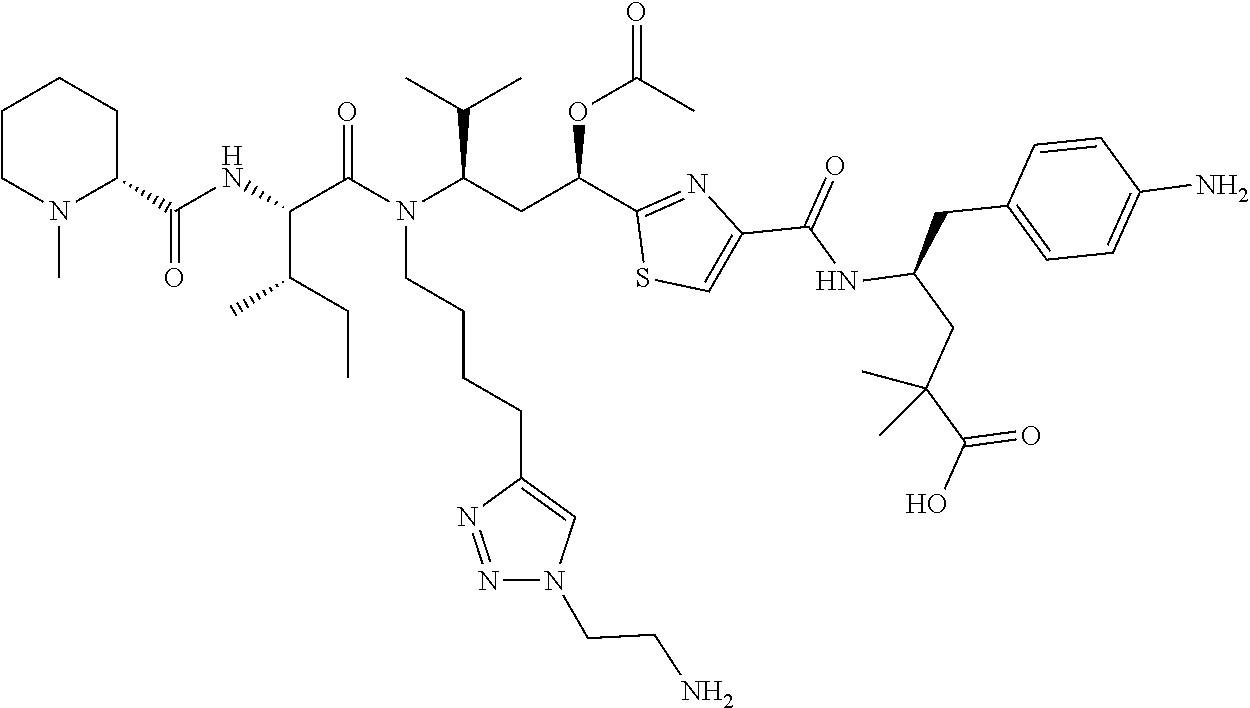 |
| IVl |
 |
| IVm |
 |
| IVn |
 |
| IVo |
 |
| IVp |
 |
| IVq |
 |
| IVr |
 |
| IVs |
 |
| IVt |
 |
| IVu |
 |
| IVvA |
 |
| IVvB |
 |
| IVw |
 |
| IVx |
 |
| IVy |
 |
| Va |
 |
| Va' |
 |
| Vb |
 |
| Vc |
 |
| Vd |
 |
| Ve |
 |
| Vf |
 |
| Vg |
 |
| Vh |
 |
| Vi |
 |
| Vj |
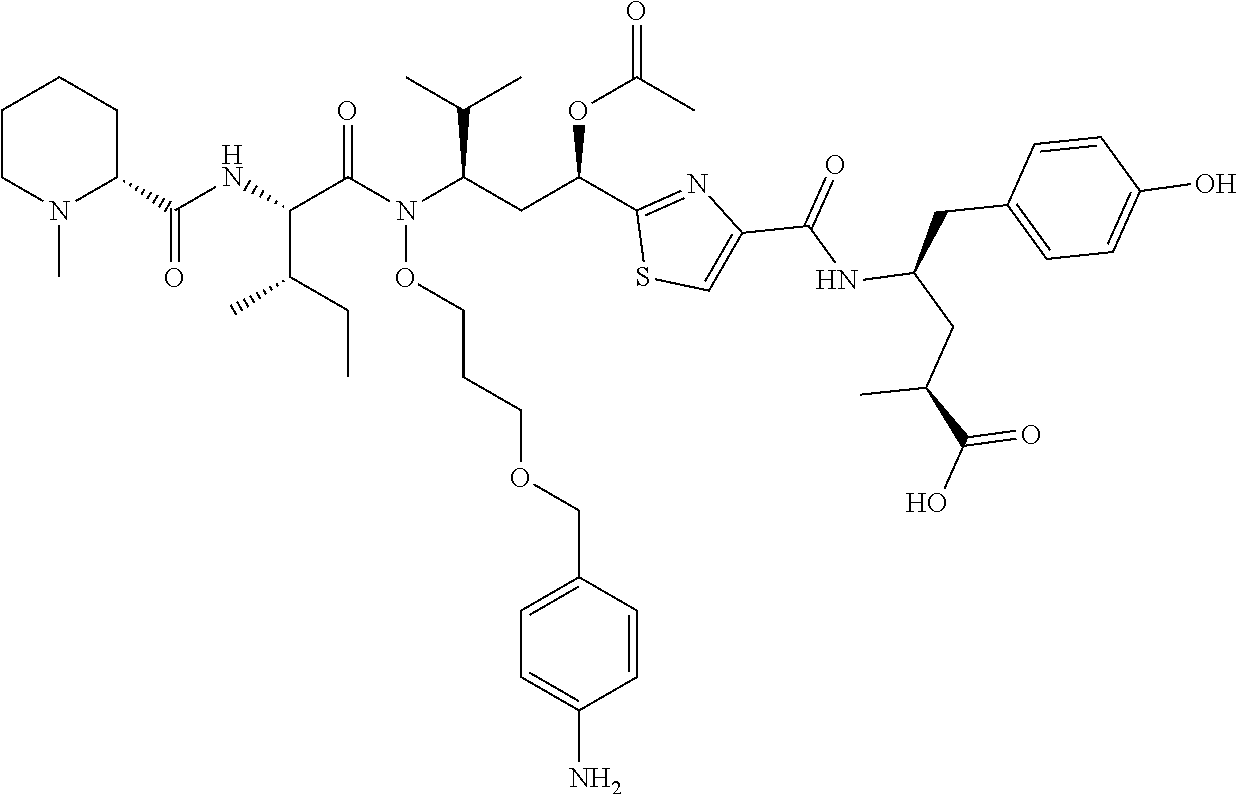 |
| Vk |
 |
| VIa |
 |
| IVb |
 |
| VIc |
 |
| VId |
 |
| VIe |
 |
| VIf |
 |
| VIg |
 |
| VIh |
 |
| VI |
 |
| VIi |
 |
| VII |
 |
| VIII |
 |
| IX |
 |
| X |
 |
| D-5a |
 |
| D-5c |
 |
| MS | ||||||
| (M + H) | ||||||
| # in | or m/z | HPLC | ||||
| Scheme(s) | cLogP | MF | MW | 100% | purity | |
| Tub A | C42H63N5O10S | |||||
| IVa | 4.75 | C43H66FN5O7S | 816.08 | 816.4 | 96 | |
| IVa′ | 6.28 | C43H68FN7O6S | 830.11 | 830.3 | > 95 | |
| IVb | 4.37 | C44H65N5O7S | 808.08 | 808.3 | 100 | |
| IVc | 4.51 | C44H64FN5O7S | 826.07 | 826.2 | 100 | |
| IVd | 3.54 | C44H66N6O7S | 823.10 | 412.3 [M/2 + H] | 100 | |
| IVe | 3.94 | C43H62FN5O7S | 812.05 | 812.4 | 100 | |
| IVf | 3.47 | C43H63N5O8S | 810.05 | 810.3 | 100 | |
| IVg | 2.97 | C43H64N6O7S | 809.07 | 809.2 | 100 | |
| IVh | 2.95 | C45H69N9O7S | 880.15 | 880.4 | 99 | |
| IVj | 2.83 | C44H67N9O7S | 866.12 | 433.8 [M/2 + H] | 100 | |
| IVk | 2.46 | C46H72N10O7S | 909.19 | 455.3 | 96 | |
| IVl | 2.26 | C46H71N9O8S | 910.18 | 910.4 | 94 | |
| IVm | 1.51 | C46H69N9O9S | 924.16 | 924.4 | 97 | |
| IVn | 2.07 | C48H73N9O9S | 952.21 | 476.8 [M/2 + H] | 95.6 | |
| IVo | 4.68 | C51H73N9O7S | 956.25 | 956.4 | 100 | |
| IVp | 4.61 | C50H71N9O7S | 942.22 | 942.4 | 100 | |
| IVq | 4.34 | C44H70N6O7S | 827.13 | 414.3 [M/2 + H] | 97.2 | |
| IVr | 3.54 | C44H64D2N6O7S | 825.12 | 825.5 | 98.9 | |
| IVs | 4.34 | C44H68D2N6O7S | 829.14 | 829.5 | 100 | |
| IVt | 4.79 | C45H71FN6O7S | 859.15 | 859.5 | 100 | |
| IVu | 4.51 | C44H69FN6O7S | 845.12 | 423.3 [M/2 + H] | 100 | |
| IVvA | 4.48 | C44H69FN6O7S | 845.12 | 846.5 | 95 | |
| IVvB | 4.48 | C44H69FN6O7S | 845.1 | 845.5 | >99 | |
| IVw | 4.01 | C44H70N6O8S | 843.13 | 422.3 [M/2 + H] | 100 | |
| IVx | 4.01 | C44H70N6O8S | 843.13 | 422.4 [M/2 + H] | 100 | |
| IVy | 5.87 | C44H72N8O6S | 841.16 | 841.5 | 95 | |
| Va | 4.42 | C43H67N5O9S | 830.09 | 830.1 | 97 | |
| Va' | 5.99 | C43H69N7O8S | 844.12 | 844.2 | 97 | |
| Vb | 4.05 | C43H68N6O8S | 829.1 | 829.4 | >99 | |
| Vc | 4.08 | C43H63N5O8S | 810.05 | 810.0 | 100 | |
| Vd | 4.21 | C43H62FN5O8S | 828.04 | 828.4 | 100 | |
| Ve | 3.24 | C43H64N6O8S | 825.1 | 825.4 | 98 | |
| Vf | 3.65 | C42H60FN5O8S | 814.02 | 814.3 | 98 | |
| Vg | 3.17 | C42H61N5O9S | 812.03 | 812.3 | 100 | |
| Vh | 2.68 | C42H62N6O8S | 811.04 | 406.2 [M/2 + H] | 100 | |
| Vi | 3.89 | C47H66N6O12S | 939.13 | 939.2 | 98 | |
| Vj | 3.11 | C47H68N6O10S | 909.14 | 909.1 | 100 | |
| Vk | 1.58 | C40H61N5O10S | 804.01 | 804.2 | 100 | |
| VIa | 4.31 | C43H68N6O9S | 845.10 | 845 | 99 | |
| IVb | 4.67 | C44H70N6O9S | 859.13 | 859.2 | 95 | |
| VIc | 5.19 | C45H72N6O9S | 873.15 | 873.5 | 95 | |
| VId | 5.64 | C46H74N6O9S | 887.18 | 887.5 | 95 | |
| VIe | 6.53 | C48H78N6O9S | 915.23 | 915.5 | 95 | |
| VIf | 3.49 | C44H67N7O8S | 854.11 | 854.5 | 99 | |
| VIg | 3.53 | C46H69N7O9S | 896.15 | 896.5 | 100 | |
| VIh | 3.94 | C43H69N7O8S | 844.1 | 844.2 | >99 | |
| VI | 4.01 | C44H70N6O8S | 843 | 844 | 100 | |
| VIi | 4.37 | C44H70FN7O7S | 860.1 | 860.5 | >99 | |
| VII | 4.95 | C44H69ClN6O7S | 861.6 | 861.3 | >99 | |
| VIII | 5.31 | C44H68FN5O7S | 830.1 | 830.5 | >99 | |
| IX | 3.73 | C43H63N5O9S | 826.1 | 826.5 | 95 | |
| X | 4.54 | C43H67N5O9S | 830.1 | 830.1 | >99 | |
| D-5a | C45H67N7O9S | 882.13 | 882.4 | |||
| D-5c | C48H71N7O11S | 954.19 | 478.0 [M/2 + H] | |||
| TABLE 2 |
| Tubulysin Linker-payloads |
| MS | HPLC |
| (m/z) | purity | Rt | |||||
| # | MF | MW | 100% | (%) | (min) | CLogP | Payload |
| LP1 | C72H106FN13O14S | 1428.8 | 715.0 | 85 | 9.51 | 7.00 | IVa |
| [M/2 + H] | (B) | ||||||
| LP2 | C92H130N14O20S | 1784.2 | 892.5 | 95 | 9.32 | 7.94 | Va |
| [M/2 + H] | (B) | ||||||
| LP3 | C93H127N13O19S | 1763.1 | 882.0 | 95 | 7.98 | 5.82 | IVd |
| [M/2 + H] | (B) | ||||||
| LP4 | C92H125N13O20S | 1765.1 | 883.0 | 90 | 8.05 | 5.53 | Ve |
| [M/2 + H] | (B) | ||||||
| LP5 | C82H114N10O16S | 1527.9 | 764.5 | 100 | 8.17 | 5.33 | IVd |
| [M/2 + H] | (B) | ||||||
| LP6 | C84H122N12O18S | 1620.0 | 810.5 | 100 | 8.52 | 4.75 | Vb |
| [M/2 + H] | (B) | ||||||
| LP7 | C85H120N12O17S | 1614.0 | 807.5 | 97.2 | 7.73 | 4.24 | IVd |
| [M/2 + H] | (B) | ||||||
| LP9 | C82H117FN10O16S | 1549.9 | 775.3 | 99 | 6.28 | IVvB | |
| (M/2 + H) | |||||||
| LP10 | C84H123N13O18S | 1635.0 | 818.0 | >99 | 4.64 | VIh | |
| (M/2 + H) | |||||||
| LP11 | C74H116FN9O16S | 1438.8 | 719.7 | >99 | 6.16 | IVvB | |
| (M/2 + H) | |||||||
| LP12 | C82H118FN11O16S | 1564.9 | 782.7 | >99 | 6.17 | VIi | |
| (M/2 + H) | |||||||
| LP13 | C68H86N10O13S | 1283.5 | 642.5 | 99 | 2.96 | Ve | |
| (M/2 + H) | |||||||
| LP14 | C62H91N9O13S | 1202.5 | Ve | ||||
| LP15 | C92H130N14O20S | 1784.2 | 892.2 | 99 | 6.22 | VIh | |
| (M/2 + H) | |||||||
| LP16 | C55H79N7O11S | 1046.3 | 523.8 | >95 | 4.43 | Ve | |
| (M/2 + H) | |||||||
| LP17 | C57H82N8O12S | 1103.4 | 552.3 | >95 | 3.33 | Ve | |
| (M/2 + H) | |||||||
| LP18 | C62H91N9O13S | 1202.5 | 601.8 | 95 | 3.93 | Ve | |
| (M/2 + H) | |||||||
| LP19 | C61H88N10O14S | 1217.5 | 609.3 | 95 | 1.12 | Ve | |
| (M/2 + H) | |||||||
| LP20 | C77H95N11O14S | 1430.7 | 716.0 | 95 | 4.08 | Ve | |
| (M/2 + H) | |||||||
| LP21 | C64H92N10O16S | 1289.6 | 645.4 | 95 | 0.98 | Ve | |
| (M/2 + H) | |||||||
| LP22 | C64H93N11O16S | 1304.6 | 653.0 | >95 | −0.47 | Ve | |
| (M/2 + H) | |||||||
| LP23 | C61H92N10O14S | 1221.5 | 611.3 | >99 | 1.93 | Vb | |
| (M/2 + H) | |||||||
| LP24 | C77H99N11O14S | 1434.7 | 718.0 | >99 | 4.89 | Vb | |
| (M/2 + H) | |||||||
| LP25 | C70H96N8O20S | 1401.6 | 701.3 | >95 | 3.49 | Ve | |
| (M/2 + H) | |||||||
| LP26 | C70H98N8O19S | 1387.7 | 694.3 | >95 | 3.41 | Ve | |
| (M/2 + H) | |||||||
| Structures | |
| LP1 |
 |
| LP2 |
 |
| LP3 |
 |
| LP4 |
 |
| LP5 |
 |
| LP6 |
 |
| LP7 |
 |
| LP8 ref |
 |
| LP9 |
 |
| LP10 |
 |
| LP11 |
 |
| LP12 |
 |
| LP13 |
 |
| LP14 |
 |
| LP15 |
 |
| LP16 |
 |
| LP17 |
 |
| LP18 |
 |
| LP19 |
 |
| LP20 |
 |
| LP21 |
 |
| LP22 |
 |
| LP23 |
 |
| LP24 |
 |
| LP25 |
 |
| LP26 |
 |
| Abbreviation | Term or Phrase |
| ADC | Antibody-drug conjugate |
| Aglycosylated | Antibody does not have any glycan |
| antibody | |
| API | Atmospheric pressure ionization |
| aq | Aqueous |
| Boc | N-tert-butoxycarbonyl |
| BupH ™ | Thermo Scientific Prod# 28372, |
| containing 100 mM sodium | |
| phosphate and 150 mM sodium | |
| chloride, potassium free, pH was | |
| adjusted from 7.2 to 7.6-7.8 MQ, | |
| unless otherwise noted. | |
| CD | Cyclodextrin |
| COT | Cyclooctynol |
| Da | Dalton |
| DAD | Diode array detector |
| DAR | Drug to antibody ratio |
| DCM | Dichloromethane |
| DIBAC | 11,12-didehydro-5,6-dihydro- |
| Dibenz[b,f]azocine | |
| DIBAC-Suc | 11,12-didehydro-5,6-dihydro- |
| Dibenz[b.f]azocine succinamic acid | |
| DIBAC-Suc-PEG4- | {4-[(2S)-2-[(2S)-2-[1-(4-{2-azatri- |
| VC-pAB-PNP | cyclo[10.4.0.04,9]hexadeca- |
| 1(12),4(9),5,7,13,15-hexaen- | |
| 10-yn-2-yl}-4-oxobutanamido)- | |
| 3,6,9,12-tetraoxapentadecan-15- | |
| amido]-3-methylbutanamido]- | |
| 5-(carbamoylamino)pentana- | |
| mido]phenyl}methyl 4-nitrophenyl | |
| carbonate | |
| DIBACT | 3H-Benzo[c]-1,2,3-triazolo[4,5- |
| e][1]benzazocine, 8,9-dihydro- | |
| DIPEA | Diisopropylethylamine |
| DMF | N,N-dimethylformamide |
| DMSO | Dimethylsulfoxide |
| EC | Enzyme commission |
| ELSD | Evaporative light scattering detector |
| ESI | Electrospray ionization |
| Fmoc | N-(9-fluorenylmethyloxycarbonyl) |
| Fmoc-vcPAB-PNP | N-Fmoc-L-valine-L-citrulline-p- |
| aminobenzyl alcohol p-nitrophenyl carbonate | |
| g | Gram |
| HATU | 2-(7-Aza-1H-benzotriazole-1-yl)-1,1,3,3- |
| tetramethyluronium hexafluorophosphate | |
| HC | Heavy chain of immunoglobulin |
| HEK | Human embryonic kidney (cells) |
| HPLC | High performance liquid chromatography |
| hr, h, or hrs | Hours |
| LC | Light chain of immunoglobulin |
| LCh | Liquid chromatography |
| MALDI | Matrix-assisted laser desorption/ionization |
| MC | Maleimidocaproyl |
| mg | milligrams |
| min | minutes |
| mL | milliliters |
| mmh | myc-myc-hexahistidine tag |
| μL | microliters |
| mM | millimolar |
| μM | micromolar |
| MMAE | Monomethyl auristatin E |
| MS | Mass spectrometry |
| MsCl | Methanesulfonyl chloride |
| MSD | Mass-selective detector |
| MTG | Microbial transglutaminase (MTG EC |
| 2.3.2.13, Zedira, Darmstadt, Germany) | |
| MW | Molecular weight |
| ncADC | Non-Cytotoxic antibody drug conjugate |
| NHS | N-hydroxy succinimide |
| nM | nanomolar |
| NMR | Nuclear magnetic resonance |
| NOESY | Nuclear Overhauser effect spectroscopy |
| PAB | Para-aminobenzyloxy(carbonyl) |
| PBS | 10 mM sodium phosphate buffer and |
| 150 mM sodium chloride | |
| PBSg | 10 mM phosphate, 150 mM sodium |
| chloride, 5% glycerol | |
| PEG | Polyethyleneglycol |
| PNP | p-nitrophenyl |
| MC-VC-PAB-PNP | Maleimidocaproyl-L-valine-L- |
| citrulline-p-aminobenzyl alcohol | |
| p-nitrophenyl carbonate | |
| ppm | Parts per million (chemical shift, δ) |
| RP | Reversed phase |
| rt or RT | room temperature |
| SDS-PAGE | Sodium dodecylsulfate |
| polyacrylamide gel electrophoresis | |
| SEC | Size exclusion chromatography |
| Suc | Succinic acid |
| TCEP | Tris(2-carboxyethyl)phosphine hydrochloride |
| TEA | Triethylamine |
| TMS | tetramethylsilane |
| TFA | Trifluoroacetic acid |
| TG | Transglutaminase |
| THF | Tetrahydrofuran |
| TOF | Time-of-flight |
| UPLC | Ultra Performance Liquid Chromatography |
| UV | Ultraviolet |
| VA | Valine-alanine |
| VC | Valine-citrulline |
| VC-PAB | Valine-citrulline-para- |
| aminobenzyloxy(carbonyl) | |
-
- a) Instrument: SFC Method Station (Thar, Waters)
- b) Column: CHIRALPAK AD-H/AS-H/OJ-H/OD-H 4.6×100 mm, 5 μm (Daicel)
- c) Column temperature: 40° C.
- d) Mobile phase: CO2/TPA (0.1% DEA)=55/45
- e) Flow: 4.0 mL/min
- f) Back Pressure: 120 Bar
- g) Injection volume: 2 μL
Preparative Chiral HPLC Method—SFC Conditions - a) Instrument: SFC-80 (Thar, Waters)
- b) Column: CHIRALPAK AD-H/AS-H/OJ-H/OD-
H 20×250 mm, 10 μm (Daicel) - c) Column temperature: 35° C.
- d) Mobile phase: CO2/TPA (0.2% Methanol Ammonia)=30/70
- e) Flow rate: 80 g/min
- f) Back pressure: 100 bar
- g) Detection wavelength: 214 nm
- h) Cycle time: 6.0 min
- i) Sample solution: 1500 mg dissolved in 70 mL Methanol
- j) Injection volume: 2 mL (loading: 42.86 mg/injection)
| TABLE 3 |
| Chiral SFC Rt to determine ee of intermediates |
| Chiral SFC Rt (min) |
| Compd. | AD-H | AS-H | OJ-H | OD- |
| 37 | 2.14 | 3.89 | 1.99 | 4.97 |
| 38 | 2.19 | 3.99 | 2.06 | 6.24 |
| 39 | 2.37 | 2.11 | 5.73 | |


| TABLE 4 |
| NMR data of (1R,3R)-17A, (1R,3R)-17A, |
| (1R,3S)-17B, and (1R,3S)-17B |
| (1R,3R)-17A | (1R,3R)-17A | |
| (reference data) | (from 17a) | |
| 1 | 8.08 (s, 1H) | 8.14 (s, 1H) |
| (NH) | 5.14 (br s, 1H) | 5.22 (d, J = 3.8 Hz, 1H) |
| 3 | 4.98 (br d, J = 11 Hz, 1H) | 5.02 (d, J = 11 Hz, 1H) |
| 4 | 4.58 (d, J = 9.4 Hz, 1H) | 4.58 (d, J = 9.6 Hz, 1H) |
| 5 | 4.36 (q, J = 7.3 Hz, 2H) | 4.42 (q, J = 7.1 Hz, 2H) |
| 6 | 3.75-3.64 (m, 1H), | 3.77-3.69 (m, 1H) |
| 7 | 2.04 (dt, J = 12, 2.2 Hz, 1H) | 2.13-2.03 (m, 1H) |
| 8 | 1.81-1.63 (m, 2H) | 1.85-1.68 (m, 2H) |
| 9 | 1.40 (s, 9H), | 1.44 (s, 9H) |
| 10 | 1.37 (t, J = 7.3 Hz, 3H) | 1.40 (t, J-7.1 Hz, 3H) |
| 11 | 0.93 (d, J = 7.0 Hz, 3H) | 0.96 (d, J = 6.8, 3.0 Hz, 3H). |
| 12 | 0.91 (d, J = 6.8 Hz, 3H) | 0.95, (d, J = 6.8 Hz, 3H) |
| [a]D 23 = +4.5 | [a]D 23 = +13.571 | |
| (c = 1.74 g/100 mL | (c = 0.56 g/100 mL | |
| in CHCl3) | in CHCl3) | |
| Rf = 0.51 (n-Hex/AcOEt = | ||
| 6:4) on TLC | ||
| (1R,3S)-17B | (1R,3S)-17B | |
| (reference data) | (from 17a2) | |
| 1 | 8.07 (s, 1H) | 8.04 (s, 1H) |
| (NH) | 4.82 (br s, 1H), | 4.90 (s, 1H) |
| 3 | 5.18-5.04 (m, 1H) | 5.07 (s, 1H) |
| 4 | 4.56 (br d, J = 8.6 Hz, 1H) | 4.53 (d, J = 8.9 Hz, 1H) |
| 5 | 4.38 (q, J = 6.9 Hz, 2H) | 4.35 (q, J = 7.1 Hz, 2H) |
| 6 | 3.68-3.56 (m, 1H) | 3.584 (m, 1H) |
| 7 | 2.39-2.26 (m, 1H) | 2.30 (d, J = 14.8 Hz, 1H) |
| 8 | 1.98-1.77 (m, 2H) | 2.00-1.85 (m, 2H) |
| 9 | 1.39 (s, 9H), | 1.34 (s, 9H) |
| 10 | 1.37 (t, J = 6.9 Hz, 3H) | 1.32, (t, J = 7 Hz, 3H) |
| 11 | 0.94 (d, J = 6.8 Hz, 3H) | 0.90 (d, J = 6.8 Hz, 3H) |
| 12 | 0.90 (d, J = 6.7 Hz, 3H) | 0.86 (d, J = 6.8 Hz, 3H) |
| [a]D 23 = +57.7 | [a]D 23 = +82.957 | |
| (c = 1.2 g/100 mL in | (c = 1.6 g/100 mL | |
| CHCl3) | in CHCl3) | |
| Rf = 0.27 (n-Hex/AcOEt = | ||
| 6:4) on TLC | ||


| TABLE 5 |
| NMR data of (1R,3R)-17A, (1R,3R)-17A, (1S,3S)-17A, |
| (1R,3S)-17B, (1S,3R)-17B and (1R,3S)-17B |
| (1R,3R)-17A | (1R,3R)-17A | (1S,3S)-17A | |
| (reference) | from (1R,3R)-17c; cis-P2 | from (1S,3S)-17c; cis-P1 | |
| 1 | 8.08 (s, 1H) | 8.13 (s, 1H) | 8.12 (s, 1H) |
| 2 (NH) | 5.14 (br s, 1H) | 3.84 (br s, 1H) | NA |
| 3 | 4.98 (br d, J = 11 Hz, 1H) | 5.02 (d, J = 11 Hz, 1H) | 5.02 (d, J = 11 Hz, 1H) |
| 4 | 4.58 (d, J = 9.4 Hz, 1H) | 4.59 (d, J = 9.6 Hz, 1H) | 4.56 (d, J = 9.6 Hz, 1H) |
| 5 | 4.36 (q, J = 7.3 Hz, 2H) | 4.42 (q, J = 7.1 Hz, 2H) | 4.42 (q, J = 7.1 Hz, 2H) |
| 6 | 3.75-3.64 (m, 1H), | 3.77-3.69 (m, 1H) | 3.77-3.67 (m, 1H) |
| 7 | 2.04 (dt, J =12, 2.2 Hz, | 2.12-2.03 (m, 1H) | 2.13-2.04 (m, 1H) |
| 1H) | |||
| 8 | 1.81-1.63 (m, 2H) | 1.85-1.68 (m, 2H) | 1.82-1.70 (m, 2H) |
| 9 | 1.40 (s, 9H), | 1.44 (s, 9H) | 1.45 (s, 9H) |
| 10 | 1.37 (t, J = 7.3 Hz, 3H) | 1.40 (t, J = 7.1 Hz, 3H) | 1.40 (t, J = 7.1 Hz, 3H) |
| 11 | 0.93 (d, J = 7.0 Hz, 3H) | 0.96 (d, J = 6.8 Hz, 3H) | 0.97 (d, J = 6.8 Hz, 3H) |
| 12 | 0.91 (d, J = 6.8 Hz, 3H) | 0.95 (d, J = 6.8 Hz, 3H) | 0.95 (d, J = 6.8 Hz, 3H) |
| [a]D 23 = +4.5 | [a]D 23 = +10.244 | [a]D 23 = −12.045 | |
| (c = 1.74 g/100 mL in | (c = 2.46 g/100 mL in | (c = 0.88 g/100 mL in | |
| CHCl3) | CHCl3) | CHCl3) | |
| (1R,3S)-17B | (1S,3R)-17B | (1R,3S)-17B | |
| (reference) | from (1S,3R)-17c; trans-P4 | from (1R,3S)-17c; trans-P3 | |
| 1 | 8.07 (s, 1H) | 8.11 (s, 1H) | 8.11 (s, 1H) |
| 2 (NH) | 4.82 (br s, 1H), | NA | 1.86 (br s, 1H) |
| 3 | 5.18-5.04 (m, 1H) | 5.13 (d, J = 4.4 Hz, 1H) | 5.13 (d, J = 4.5 Hz, 1H) |
| 4 | 4.56 (br d, J = 8.6 Hz, 1H) | 4.59 (d, J = 8.5 Hz, 1H) | 4.58 (d, J = 8.2 Hz, 1H) |
| 5 | 4.38 (q, J = 6.9 Hz, 2H) | 4.41 (q, J = 7.1 Hz, 2H) | 4.41 (q, J = 7.1 Hz, 2H) |
| 6 | 3.68-3.56 (m, 1H) | 3.67-3.63 (m, 1H) | 3.71-3.58 (m, 1H) |
| 7 | 2.39-2.26 (m, 1H) | 2.40-2.33 (m, 1H) | 2.41-2.31 (m, 1H) |
| 8 | 1.98-1.77 (m, 2H) | 1.99-1.91 (m, 2H) | 1.98-1.89 (m, 2H) |
| 9 | 1.39 (s, 9H), | 1.41 (s, 9H) | 1.42 (s, 9H) |
| 10 | 1.37 (t, J = 6.9 Hz, 3H) | 1.40 (t, J = 7.0 Hz, 3H) | 1.40 (t, J = 6.7 Hz, 3H) |
| 11 | 0.94 (d, J = 6.8 Hz, 3H) | 0.97 (d, J = 6.8 Hz, 3H) | 0.97 (d, J = 6.7 Hz, 3H) |
| 12 | 0.90 (d, J = 6.7 Hz, 3H) | 0.93 (d, J = 6.8 Hz, 3H) | 0.93 (d, J = 6.8 Hz, 3H) |
| [a]D 23 = +57.7 | [a]D 23 = −73.140 | [a]D 23 = +61.579 | |
| (c = 1.2 g/100 mL in | (c = 0.86 g/100 mL in | (c = 1.52 g/100 mL in | |
| CHCl3) | CHCl3) | CHCl3) | |
| TABLE 6 | |||
| | |
Trans | 17c |
| Instrument | SFC-200 (Thar, Waters) | SFC-200 (Thar, Waters) | |
| | OZ | 30*250 mm, | |
| 5 um (Decial) | 5 um (Dacel) | ||
| |
35° | C. | 35° | C. |
| temperature |
| Mobile phase | CO2/Methanol (0.1% | CO2/MeOH 0.2% NH4OH |
| NH4OH) = 90/10 | (7M methanol) = 85/15 |
| Flow rate | 70 | g/min | 120 | g/min |
| Back pressure | 100 | bar | 100 | bar |
| Detection | 214 | nm | 214 | nm |
| wavelength | ||||
| Cycle time | 2.0 | min | 3.6 | min |
| Sample s | 1.8 g dissolved in | 1.8 g dissolved in |
| olution | 20 |
35 ml Methanol |
| Injection | 0.35 | mL | 1.0 | mL |
| volume | ||||


| TABLE 7 |
| List of Site-specific Conjugates |
| Ab, N297Q Ab-PEG3-N3, or N297Q | |
| Linker-Payload (LP) | Ab-tubulysin LP conjugates |
| EX | MW | Name | MW (Da) | DAR |
| Anti-PRLR Ab | 144591 | |||
| PEG3-N3 | 218 | Anti-PRLR N297Q Ab- | 145387 | 4 |
| PEG3-N3 | ||||
| Ex1 | 1656.9 | Anti-PRLR N297Q Ab- | 152028 | 3.9 |
| LP7 | ||||
| Ex2 | 1761.9 | Anti-PRLR N297Q Ab- | 152438 | 3.9 |
| LP3 | ||||
| Ex3 | 1763.9 | Anti-PRLR N297Q Ab- | 152454 | 3.9 |
| LP4 | ||||
| Anti-Fel D1 Ab | 145439 | |||
| (non-binding control) | ||||
| PEG3-N3 | 218 | Anti-Fel D1 N297Q Ab- | 146235 | 4 |
| PEG3-N3 | ||||
| Ex4 | 1656.9 | Anti-Fel D1 N297Q Ab- | 152879 | 4 |
| LP7 | ||||
| Ex5 | 1761.9 | Anti-Fel D1 N297Q Ab- | 153291 | 3.8 |
| LP3 | ||||
| Ex6 | 1763.9 | Anti-Fel D1 N297Q Ab- | 153307 | 3.8 |
| LP4 | ||||
| Anti-STEAP2 Ab | 143986 | |||
| PEG3-N3 | 218 | Anti-STEAP2 N297Q | 144785 | 4 |
| Ab-PEG3-N3 | ||||
| Ex7 | 1656.9 | Anti-STEAP2 N297Q | 151410 | 3.8 |
| Ab-LP7 | ||||
| Ex8 | 1761.9 | Anti-STEAP2 N297Q | 151833 | 3.8 |
| Ab-LP3 | ||||
| Ex9 | 1763.9 | Anti-STEAP2 N297Q | 151849 | 3.8 |
| Ab-LP4 | ||||
| Ex10 | 1782.9 | Anti-STEAP2 N297Q | 151911 | 3.8 |
| Ab-LP2 | ||||
General Procedure for Characterization of Antibody and ADCs
| TABLE 8 |
| In vitro plasma stability of Anti-PRLR N297Q |
| antibody-LP3 and Anti-PRLR N297Q antibody-LP4 |
| Anti-PRLR N297Q | Anti-PRLR N297Q antibody- | |
| antibody-LP3 | LP4 | |
| Plasma type | (DAR = 3.8 at 0 hr) | (DAR = 4.0 at 0 hr) |
| used for | DAR after 72 hours of | DAR after 72 hours of |
| incubation | incubation | incubation |
| Mouse plasma | 2.7 | 2.7 |
| Anti-PRLR N297Q | Anti-PRLR N297Q antibody- | |
| antibody-LP3 | LP4 | |
| Plasma type | (DAR = 3.8 at 0 hr) | (DAR = 4.0 at 0 hr) |
| used for | DAR after 72 hours of | DAR after 72 hours of |
| incubation | incubation | incubation |
| Cynomolgus | 2.7 | 2.7 |
| monkey plasma | ||
| Rat plasma | 2.7 | 2.6 |
| Human plasma | 3.0 | 3.0 |
Testing of Tubulysin Payloads in Cell-Based Killing Assays
| TABLE 9 |
| Cytotoxicity in C4-2, HEK293, and T47D cells by Tubulysin |
| payloads and reference compounds |
| T47D | HEK293 |
| C4-2 | IC50 | IC50 |
| Cmpd | IC50 (M) | % Kill | (M) | % Kill | (M) | % Kill |
| TubA | 1.09E−10 | 96.4 | NT | NT | NT | NT |
| IVa | 6.53E−11 | 95.2 | NT | NT | NT | NT |
| IVa’ | 1.08E−08 | 94.7 | 1.06E−08 | 81.9 | 1.44E−08 | 74.8 |
| Va | 8.03E−10 | 92.1 | NT | NT | NT | NT |
| VIa | 1.86E−09 | 94.1 | NT | NT | NT | NT |
| VId | 2.4E−09 ± 2.2E−09 | 95.5 ± 2.6 | 2.51E−09 | 68.4 | 5.26E−09 | 78.5 |
| VIc | 1.33E−09 ± 1.11E−09 | 95.5 ± 1.8 | NT | NT | NT | NT |
| VIe | 8.22E−09 ± 6.1E−09 | 94.4 ± 0.2 | 2.27E−09 | 72.7 | 4.77E−09 | 76.7 |
| VIb | 1.20E−08 | 96.5 | 1.36E−08 | 76.2 | 2.03E−08 | 75.4 |
| Va’ | 1.62E−08 | 96.5 | NT | NT | NT | NT |
| Vj | 5.31E−08 ± 6.64E−08 | 68.5 ± 39.2 | >1.00E−07 | 14.6 | >1.00E−07 | 4.7 |
| Vk | ND | ND | >1.00E−07 | NT | >1.00E−07 | NT |
| Vi | 6.333E−09 ± 1.39E−09 | 96.4 ± 0.5 | 4.66E−09 | 71.3 | 6.79E−09 | 81.4 |
| Vh | 5.09E−10 | 92 | 4.58E−10 | 64.5 | 7.18E−10 | 85.6 |
| IVg | 1.36E−10 | 91.7 | 4.13E−10 | 62.9 | 5.39E−10 | 86.5 |
| IVd | 1.64E−11 ± 7.13E−12 | 93.7 ± 1.8 | 3.50E−11 | 84.5 | 5.72E−11 | 85.4 |
| Vc | 3.60E−11 | 91.7 | 6.77E−11 | 64.9 | 1.13E−10 | 86.9 |
| Ve | <4.7E−11 | 92.6 | 7.31E−11 | 69.8 | 1.03E−10 | 88.5 |
| IVc | 9.24E−11 | 92.2 | 2.05E−10 | 81.4 | 3.07E−10 | 84.8 |
| Vd | 3.84E−10 | 91.3 | 4.44E−10 | 66 | 5.90E−10 | 86.3 |
| IVh | 6.47E−10 ± 4.86E−11 | 82 ± 2.8 | 1.86E−09 | 71.6 | 1.76E−09 | 82.5 |
| Vb | 7.00E−11 ± 4.25E−11 | 92.3 ± 1.7 | 1.44E−10 | 66.5 | 2.89E−10 | 87.8 |
| IVe | 7.42E−11 | 91.8 | 1.55E−10 | 67.2 | 2.81E−10 | 86.7 |
| IVf | 2.29E−10 | 93.8 | 7.82E−10 | 67.1 | 1.64E−09 | 86.0 |
| Vf | 9.00E−10 | 90 | 3.96E−10 | 68 | 6.66E−10 | 83.8 |
| Vg | 3.69E−10 | 93.2 | 5.35E−10 | 65.2 | 7.00E−10 | 86.4 |
| IVj | 7.16E−09 | 94.5 | 1.77E−08 | 79.9 | 1.76E−08 | 75.5 |
| IVk | >4.0E−08 | 66.7 | 4.74E−08 | 68.5 | 4.30E−08 | 62.7 |
| IVl | >2.0E−08 | 86.5 | 4.25E−08 | 66.1 | 3.98E−08 | 65.2 |
| VIf | 3.12E−10 | 93.9 | 3.02E−10 | 63.2 | 3.83E−10 | 85.6 |
| IVm | >1.00E−07 | 8.9 | NT | NT | NT | NT |
| IVn | >1.00E−07 | 30.2 | NT | NT | NT | NT |
| VIg | >1.00E−07 | 10.9 | NT | NT | NT | NT |
| VIh | 1.59E−10 | 93.9 | NT | NT | NT | NT |
| IVo | 2.62E−10 | 93.4 | NT | NT | NT | NT |
| IVp | 1.77E−10 | 94.2 | NT | NT | NT | NT |
| IVs | 4.99E−11 | 93.8 | NT | NT | NT | NT |
| IVt | 1.10E−10 | 94.2 | NT | NT | NT | NT |
| IVu | 1.14E−10 | 93.9 | NT | NT | NT | NT |
| IVvA | 1.09E−08 | 96.7 | NT | NT | NT | NT |
| IVy | 1.82E−09 | 94.4 | NT | NT | NT | NT |
| IVw | >1.00E−07 | 27.9 | NT | NT | NT | NT |
| IVvB | 2.15E−11 | 94.6 | NT | NT | NT | NT |
| VII | 2.8E−11 (0.028 nM) | NT | NT | NT | NT | NT |
| IX | 5.4E−11 (0.054 nM) | NT | NT | NT | NT | NT |
| X | 6E−11 (0.060 nM) | NT | NT | NT | NT | NT |
| MMAE | 2.87E−10 ± 9.35E−11 | 93.7 ± 2.5 | NT | NT | NT | NT |
| NT = not tested | ||||||
Testing of Tubulysin Payloads in MDR Cell Based Killing Assays
| TABLE 10 |
| Cytotoxicity by Tubulysin payloads and reference |
| compounds in HCT15 cells with or without Verapamil |
| HCT15 | |||||
| IC50/HCT- | |||||
| 15 + |
| HCT-15 | HCT-15 + verapamil | Verapamil |
| Cmpd | IC50 (M) | % Kill | IC50 (M) | % Kill | IC50 |
| TubA | 5.09E−10 | 99.1 | 1.28E−10 | 99.1 | 4.0 |
| Va | 3.63E−09 | 98 | 2.15E−10 | 99.1 | 16.9 |
| VIa | 5.80E−09 ± 7.8E−09 | 97 ± 1.9 | 2.55E−10 | 98.4 ± 0.7 | 16.6 ± 9.9 |
| VId | >3.00E−08 | 78.7 | 4.82E−10 | 99 | >62.2 |
| VIc | 1.32E−08 | 94 | 2.86E−10 | 98.8 | 46.3 |
| VIe | >1.00E−07 | 36.6 | 2.95E−10 | 98.8 | >338.6 |
| VIb | >5.00E−08 | 54.7 | 2.88E−09 | 97.8 | >17.3 |
| Va' | >1.00E−07 | 20.9 | 2.41E−09 | 98.8 | >41.5 |
| Vj | >1.00E−07 | −3.8 | 3.92E−08 | 77.4 | >2.6 |
| Vk | 1.00E−07 | 41.5 | 4.27E−08 | 83 | >2.3 |
| Vh | 1.47E−09 | 97.7 | 5.87E−10 | 98.1 | 2.5 |
| IVg | 4.60E−10 | 97.1 | 3.28E−10 | 97.5 | 1.4 |
| IVd | 5.7E−11 ± 2.01E−11 | 98.2 ± 0.5 | 4.07E−11 ± 2.2E−11 | 97.7 ± 1.8 | 1.57 ± 0.5 |
| Vc | 4.75E−10 | 97.6 | 1.46E−10 | 96.7 | 3.3 |
| Ve | 2.73E−10 ± 1.24E−10 | 98.6 ± 0.7 | 6.54E−11 ± 5.36E−11 | 98.2 ± 1.2 | 5.6 ± 2.7 |
| IVc | 3.02E−10 | 99.2 | 1.13E−10 | 98 | 2.7 |
| Vd | 1.93E−09 | 99.7 | 3.52E−10 | 98.7 | 5.5 |
| IVb | 1.51E−10 | 98 | 1.03E−10 | 98.1 | 1.5 |
| IVh | 2.5E−09 ± 3.33E−09 | 94.6 ± 3.5 | NT | NT | NT |
| Vb | 1.20E−10 ± 1.40E−10 | 98.8 ± 0.7 | 3.65E−11 ± 3.12 | 98.2 ± 0.5 | 2.8 ± 0.9 |
| IVe | 2.95E−10 | 95.8 | 1.00E−10 | 97.6 | 3.0 |
| IVf | 5.54E−10 | 96.4 | 6.86E−10 | 97.7 | 0.8 |
| Vf | 3.36E−09 | 96.5 | 3.75E−10 | 98 | 9.0 |
| Vg | 5.30E−10 | 94.9 | 2.37E−10 | 98 | 2.2 |
| IVj | 7.80E−09 | 96.4 | 5.56E−09 | 98.4 | 1.4 |
| IVk | >30E−09 | 48.3 | >30E−09 | 87.2 | 1.0 |
| IVl | 2.50E−08 | 91.6 | 1.37E−08 | 93.6 | 1.8 |
| VIf | 2.06E−09 | 99.1 | 8.54E−11 | 98.8 | 24.1 |
| IVn | >3.0E−08 | 30.9 | >3.0E−08 | 72.4 | 1.0 |
| VIh | 2.63E−10 | 99 | 7.16E−11 | 97.8 | 3.7 |
| IVo | 3.70E−10 | 98.6 | 1.09E−10 | 97.6 | 3.5 |
| IVp | 2.39E−10 | 98.7 | 8.64E−11 | 97.6 | 2.8 |
| IVr | 8.93E−11 | 99.1 | 6.24E−11 | 99 | 1.4 |
| IVq | 4.23E−11 ± 2.21 | 98.4 ± 0.8 | 2.25E−11 ± 4.5E−12 | 98.6 ± 0.7 | 1.8 ± 0.6 |
| IVs | 1.08E−10 | 99.1 | 4.59E−11 | 98.8 | 2.4 |
| IVvA | 5.27E−09 | 99.2 | 1.97E−09 | 97.1 | 2.7 |
| IVw | 9.73E−09 | 95.9 | 4.49E−09 | 98.3 | 2.2 |
| IVvB | 2.50E−11 | 97.3 | 1.50E−11 | 97.7 | 1.3 |
| VIi | (0.410 nM) | (0.217 nM) | |||
| VII | 1.31E−10 (0.131 nM) | NT | 2.16E−10 (0.216 nM) | NT | 0.61 |
| VIII | (0.295 nM) | NT | (0.106 nM) | NT | |
| IX | (0.171 nM) | NT | (0.162 nM) | NT | |
| X | (0.097 nM) | (0.116 nM) | |||
| MMAE | 1.77E−08 ± 1.36E−08 | 97.1 ± 3.7 | 7.82E−10 ± 4.11E−10 | 98.4 ± 0.5 | 23.7 ± 12.0 |
| NT = not tested | |||||
Testing of Tubulysin Payloads in a Panel of MDR Cell Lines
| TABLE 11 |
| Cytotoxicity in HL60/MX2 and MES-SA/MX2 cells by Tubulysin |
| payloads and reference compounds |
| HL60/MX2 | MES-SA/MX2 |
| IC50 | % Kill | IC50 | % Kill |
| Cmpd | 72 h | 144 h | 72 h | 144 h | 72 h | 144 h | 72 h | 144 h |
| TubA | <1.5E−11 | <1.5E−11 | 98 | 100 | 5.73E−10 | 1.33E−09 | 98.6 | 99.9 |
| Va | 5.53E−10 | 1.40E−10 | 96.8 | 99.9 | >1E−07 | >1E−07 | 80.1 | 69.8 |
| Vh | 1.73E−10 | <1.5E−11 | 97.5 | 99.9 | 2.98E−09 | 8.15E−09 | 98.4 | 99.8 |
| IVg | 1.24E−10 | <1.5E−11 | 98.5 | 100 | 8.38E−10 | 9.99E−10 | 99.6 | 100 |
| IVd | <1.5E−11 | <1.5E−11 | 98.6 | 99.9 | 5.41E−11 | 1.30E−10 | 99.5 | 100 |
| Vc | <1.5E−11 | <1.5E−11 | 98.4 | 99.9 | 8.95E−11 | 2.99E−10 | 99.2 | 100 |
| Ve | <1.5E−11 | <1.5E−11 | 98.3 | 100 | 5.20E−10 | 7.34E−10 | 98.9 | 100 |
| IVc | <1.5E−11 | <1.5E−11 | 97.7 | 99.9 | 3.74E−10 | 6.04E−10 | 98.2 | 99.9 |
| IVh | 1.11E−09 | <1.5E−11 | 96.4 | 100 | 7.49E−09 | 8.80E−09 | 98.5 | 99.9 |
| Vb | <1.5E−11 | <1.5E−11 | 97.9 | 100 | 2.13E−10 | 1.04E−09 | 99.6 | 99.9 |
| IVe | <1.5E−11 | <1.5E−11 | 97.3 | 99.9 | 7.86E−10 | 2.81E−09 | 99.6 | 99.9 |
| IVf | 2.22E−10 | <1.5E−11 | 97.2 | 100 | 2.57E−09 | 3.82E−09 | 99.1 | 99.9 |
| Vg | 1.31E−10 | 6.10E−11 | 98 | 99.9 | 3.54E−09 | 5.30E−09 | 98 | 99.8 |
| VIh | 3.91E−11 | <1.5E−11 | 97.6 | 99.9 | 1.26E−09 | 2.72E−09 | 98.5 | 99.8 |
| IVo | 3.76E−11 | <1.5E−11 | 98.1 | 100 | 1.12E−09 | 2.96E−09 | 98.9 | 99.9 |
| IVp | 2.37E−11 | <1.5E−11 | 97.5 | 99.9 | 7.92E−10 | 1.66E−09 | 98.8 | 99.9 |
| IVr | <1.5E−11 | <1.5E−11 | 98.7 | 100 | 1.51E−10 | 1.76E−10 | 99.1 | 100 |
| IVx | 9.55E−10 | 7.70E−10 | 96.9 | 100 | >1E−07 | >1E−07 | 62.1 | 33.6 |
| VIi | <1.5E−11 | <1.5E−11 | 98.8 | 99.9 | 1.49E−10 | 1.98E−10 | 99.3 | 99.9 |
| Vl | 1.37E−10 | <1.5E−11 | 97 | 99.9 | 4.76E−09 | 6.91E−09 | 98.6 | 99.9 |
| IVq | <1.5E−11 | <1.5E−11 | 98.6 | 100 | 5.89E−11 | 1.05E−10 | 99.4 | 100 |
| IVs | <1.5E−11 | <1.5E−11 | 98.4 | 100 | 1.02E−10 | 2.10E−10 | 99.2 | 100 |
| IVt | <1.5E−11 | <1.5E−11 | 98.4 | 100 | 4.47E−10 | 7.40E−10 | 99.3 | 100 |
| IVu | <1.5E−11 | <1.5E−11 | 98 | 99.9 | 5.35E−10 | 1.21E−09 | 98.8 | 100 |
| IVvB | <1.5E−11 | <1.5E−11 | 98.2 | 99.8 | 4.56E−11 | 6.58E−11 | 99.1 | 99.9 |
| MMAE | 4.18E−10 | 1.64E−10 | 88.7 | 99.6 | 3.73E−08 | 6.83E−10 | 65.6 | 58.1 |
| TABLE 12 |
| Cytotoxicity in HCT-15 and H69AR cells by Tubulysin payloads and |
| reference compounds |
| HCT-15 | H69AR |
| IC50 | % Kill | IC50 | % Kill |
| Cmpd | 72 h | 144 h | 72 h | 144 h | 72 h | 144 h | 72 h | 144 h |
| IVa | 1.66E−10 | 3.18E−10 | 97.8 | 99.6 | 7.49E−10 | 1.38E−09 | 96.1 | 99.3 |
| VIa | 5.42E−09 | 7.17E−09 | 94 | 98.9 | 1.60E−08 | 8.01E−08 | 83.5 | 91.6 |
| Vh | 8.71E−10 | 1.27E−09 | 97 | 99.6 | 2.59E−09 | 4.21E−09 | 93.7 | 98.4 |
| IVg | 1.70E−10 | 2.23E−10 | 97.6 | 99.5 | 5.53E−10 | 5.71E−10 | 95.7 | 99.2 |
| IVd | 8.88E−12 | 2.95E−11 | 97.6 | 99.7 | 5.64E−11 | 1.33E−10 | 96.9 | 99.5 |
| Vc | 3.30E−11 | 6.75E−11 | 97.6 | 99.7 | 1.54E−10 | 2.87E−10 | 96.6 | 99.4 |
| Ve | 9.22E−11 | 1.58E−10 | 97.5 | 99.7 | 3.31E−10 | 5.59E−10 | 96.6 | 99.5 |
| IVc | 1.25E−10 | 1.65E−10 | 97.3 | 99.8 | 3.60E−10 | 7.25E−10 | 96.6 | 99.3 |
| IVh | 1.52E−09 | 1.53E−09 | 95.4 | 99.7 | 2.93E−09 | 3.30E−09 | 90.2 | 97.5 |
| Vb | 6.23E−11 | 1.27E−10 | 97.8 | 99.7 | 2.72E−10 | 6.60E−10 | 97 | 99.4 |
| IVe | 1.33E−10 | 2.30E−10 | 98.1 | 99.6 | 5.85E−10 | 1.26E−09 | 96.5 | 99 |
| IVf | 4.19E−10 | 3.96E−10 | 96.9 | 99.8 | 1.33E−09 | 1.55E−09 | 94.6 | 98.9 |
| Vg | 6.80E−10 | 9.16E−10 | 97.6 | 99.5 | 2.13E−09 | 2.72E−09 | 94.2 | 98.4 |
| VIh | 3.66E−10 | 5.15E−10 | 97.9 | 99.7 | 1.07E−09 | 1.73E−09 | 96.3 | 99.1 |
| IVo | 2.47E−10 | 3.48E−10 | 97.3 | 99.7 | 7.79E−10 | 1.27E−09 | 96.2 | 99.1 |
| IVp | 1.81E−10 | 2.31E−10 | 97.6 | 99.7 | 6.44E−10 | 1.12E−09 | 96.3 | 99.2 |
| IVr | 4.01E−11 | 6.21E−11 | 98 | 99.7 | 1.37E−10 | 2.11E−10 | 96.7 | 99 |
| IVx | 3.45E−08 | 8.48E−08 | 84.4 | 91 | >1E−07 | >1E−07 | 48.7 | 38 |
| VIi | 2.55E−11 | 5.44E−11 | 97.9 | 99.7 | 1.45E−10 | 2.31E−10 | 96.7 | 99.2 |
| Vl | 1.50E−09 | 1.72E−09 | 96.3 | 99.7 | 5.03E−09 | 6.62E−09 | 90.4 | 97.4 |
| IVq | <1.5E−11 | 2.77E−11 | 98 | 99.8 | 6.42E−11 | 1.28E−10 | 96.9 | 99.5 |
| IVs | 3.71E−11 | 5.01E−11 | 97.6 | 99.7 | 1.61E−10 | 2.81E−10 | 96.8 | 99.4 |
| IVt | 1.43E−10 | 1.80E−10 | 97.6 | 99.8 | 4.86E−10 | 8.19E−10 | 96.3 | 99.3 |
| IVu | 1.34E−10 | 2.42E−10 | 97.9 | 99.8 | 6.34E−10 | 1.04E−09 | 96.4 | 99 |
| IVvB | <1.5E−11 | 2.28E−11 | 97.7 | 99.6 | 5.99E−11 | 1.58E−10 | 96.9 | 99.1 |
| MMAE | 1.68E−08 | ND | 93.7 | ND | 9.23E−10 | 6.83E−10 | 66.8 | 92.7 |
Testing of Tubulysin Payload Containing ADCs in Cell Based Killing Assays
| TABLE 13 |
| Cytotoxicity in HCT15/PRLR cells with or without Verapamil by |
| Tubulysin payloads, reference compounds, and ADCs |
| IC50 (nM) on | % kill on | IC50 (nM) on | % kill on | |
| HCT15/ | HCT15/ | HCT15/ | HCT15/ | |
| PRLR | PRLR | PRLR | PRLR | |
| w/o | w/o | w/ | w/ | |
| Test article | Verapamil | Verapamil | Verapamil | Verapamil |
| Anti-PRLR-LP3 | 0.525 | 90 | 0.309 | 91 |
| Anti-PRLR-LP4 | 3.305 | 65 | 0.196 | 91 |
| Isotype control- | >50 nM | 51 | >50 nM | 82 |
| LP3 | ||||
| Isotype control- | NS | NS | >50 nM | 76 |
| LP4 | ||||
| IVd (payload of | 0.037 | 99 | 0.015 | 99 |
| LP3) | ||||
| Ve (payload of | 0.203 | 99 | 0.033 | 99 |
| LP4) | ||||
| Anti-PRLR | >50 |
0 | >50 |
0 |
| antibody | ||||
| NS = No significant killing at conenctrations tested | ||||
| TABLE 14 |
| Cytotoxicity in C4-2 cells by Tubulysin |
| payloads, reference compounds, and ADCs |
| Test Articles | IC50 (nM) | % kill | ||
| Anti-STEAP2-LP3 | 0.097 | 99 | ||
| Anti-STEAP2-LP4 | 0.15 | 99 | ||
| Anti-STEAP2-MMAE | 0.53 | 99 | ||
| Isotype control-LP3 | >50 nM | 48 | ||
| Isotype control-LP4 | >50 nM | 34 | ||
| Isotype control-MMAE | >50 | 16 | ||
| Anti-STEAP2 Ab | >50 | 0 | ||
| IVd (payload of LP3) | 0.022 | 99 | ||
| Ve (payload of LP4) | 0.063 | 99 | ||
| MMAE (payload of LP8) | 0.22 | 99 | ||
Anti-STEAP2 Antibodies
| TABLE 15 |
| Inhibition of C4-2 Tumor Growth at end of study in |
| SCID mice treated with anti-STEAP2 ADCs |
| Average | Average Tumor | |
| Final Tumor | Growth | |
| size mm3 | Inhibition | |
| Treatment Group | (mean ± SEM) | (%) |
| PBS Vehicle | 1539 ± 177 | 0 |
| Isotype control- | 1140 ± 213 | 31 |
| MMAE 2.5 mg/kg | ||
| Isotype control- | 1100 ± 202 | 33 |
| LP3 2.5 mg/kg | ||
| Isotype control- | 1127 ± 192 | 31 |
| LP4 2.5 mg/kg | ||
| Anti-STEAP2- | 475 ± 118 | 81 |
| MMAE 2.5 mg/kg | ||
| Anti-STEAP2 N297Q- | 115 ± 6 | 108 |
| LP3 2.5 mg/kg | ||
| Anti-STEAP2 N297Q- | 258 ± 60 | 97 |
| LP4 2.5 mg/kg | ||
Efficacy of STEAP2-Tubulysin ADC in CTG-2440 and CTG-2441 PDX Prostate Cancer Models
mAb Clone IDs:
| N297Q | ||||
| AbPID/REGN# | Common Name | mutation? | ||
| Isotype Control- | Control Tubulysin ADC | Yes | ||
| LP4 | ||||
| Anti-STEAP2 | STEAP2 Tubulysin ADC | Yes | ||
| N297Q Ab-LP4 | ||||
Experimental Procedure:
| TABLE 16 | |||||
| Total | |||||
| ADC | Payload | Dosing | Payload | ||
| Article | DAR | Dose | Dose | Schedule | Dose |
| Isotype Control- | 3.9-4 | 3.64-3.72 | 80 ug/kg | QW × 3 | 240 ug/kg |
| LP4 | mg/kg | ||||
| Anti-STEAP2 | 3.9-4 | 1.82-1.86 | 40 ug/kg | QW × 1 | 40 ug/kg |
| N297Q Ab-LP4 | mg/kg | ||||
| Anti-STEAP2 | 3.9-4 | 1.82-1.86 | 40 ug/kg | QW × 3 | 120 ug/kg |
| N297Q Ab-LP4 | mg/kg | ||||
| Anti-STEAP2 | 3.9-4 | 3.64-3.72 | 80 ug/kg | QW × 3 | 240 ug/kg |
| N297Q Ab-LP4 | mg/kg | ||||
Results and Conclusions:
| Final | Tumor growth | ||
| tumor volume | (mm3) | ||
| Total | (mm3) at | from start of | |
| Antibody | Payload | termination | treatment |
| (mg/kg) | Dose | (mean ± SD) | (mean ± SD) |
| Isotype | 240 ug/kg | 1556.0 ± 747.7 | 1355.3 ± 724.0 |
| Control-LP4 | |||
| (3.72 mg/kg, | |||
| QW × 3) | |||
| Anti-STEAP2 | 40 ug/kg | 179.9 ± 68.5 | −20.0 ± 65.1 |
| N297Q | |||
| Ab-LP4 | |||
| (1.86 mg/kg, | |||
| QW × 1) | |||
| Anti-STEAP2 | 120 ug/kg | 73.5 ± 53.4 | −129.3 ± 67.7 |
| N297Q | |||
| Ab-LP4 | |||
| (1.86 mg/kg, | |||
| QW × 3) | |||
| Anti-STEAP2 | 240 ug/kg | 6.0 ± 11.4 | −196.5 ± 37.1 |
| N297Q | |||
| Ab-LP4 | |||
| (3.72 mg/kg, | |||
| QW × 3) | |||
| Final | Tumor growth | ||||
| tumor volume | (mm3) from | ||||
| Total | (mm3) at | start of | |||
| Antibody | Payload | termination | treatment | ||
| (mg/kg) | Dose | (mean ± SD) | (mean ± SD) | ||
| Isotype | 240 ug/kg | 977.3 ± 390.0 | 770.3 ± 365.8 | ||
| Control-LP4 | |||||
| (3.64 mg/kg, | |||||
| QW × 3) | |||||
| Anti-STEAP2 | 40 ug/kg | 171.8 ± 176.1 | −36.8 ± 167.0 | ||
| N297Q | |||||
| Ab-LP4 | |||||
| (1.82 mg/kg, | |||||
| QW × 1) | |||||
| Anti-STEAP2 | 120 ug/kg | 46.0 ± 15.1 | −164.0 ± 57.3 | ||
| N297Q | |||||
| Ab-LP4 | |||||
| (1.82 mg/kg, | |||||
| QW × 3) | |||||
| Anti-STEAP2 | 240 ug/kg | 33.5 ± 13.6 | −179.1 ± 51.3 | ||
| N297Q | |||||
| Ab-LP4 | |||||
| (3.64 mg/kg, | |||||
| QW × 3) | |||||
PDX Model and STEAP2 Expression Information:
Claims (33)


Priority Applications (1)
| Application Number | Priority Date | Filing Date | Title |
|---|---|---|---|
| US16/724,164 US12144864B2 (en) | 2018-12-21 | 2019-12-20 | Tubulysins and protein-tubulysin conjugates |
Applications Claiming Priority (2)
| Application Number | Priority Date | Filing Date | Title |
|---|---|---|---|
| US201862784325P | 2018-12-21 | 2018-12-21 | |
| US16/724,164 US12144864B2 (en) | 2018-12-21 | 2019-12-20 | Tubulysins and protein-tubulysin conjugates |
Publications (2)
| Publication Number | Publication Date |
|---|---|
| US20210260208A1 US20210260208A1 (en) | 2021-08-26 |
| US12144864B2 true US12144864B2 (en) | 2024-11-19 |
Family
ID=69185739
Family Applications (1)
| Application Number | Title | Priority Date | Filing Date |
|---|---|---|---|
| US16/724,164 Active 2042-01-08 US12144864B2 (en) | 2018-12-21 | 2019-12-20 | Tubulysins and protein-tubulysin conjugates |
Country Status (19)
| Country | Link |
|---|---|
| US (1) | US12144864B2 (en) |
| EP (1) | EP3898651A2 (en) |
| JP (2) | JP7590328B2 (en) |
| KR (1) | KR102911341B1 (en) |
| CN (2) | CN113454097B (en) |
| AU (1) | AU2019403554B2 (en) |
| BR (1) | BR112021011729A2 (en) |
| CA (1) | CA3124106A1 (en) |
| CL (2) | CL2021001593A1 (en) |
| CO (1) | CO2021009129A2 (en) |
| EA (1) | EA202191769A1 (en) |
| IL (1) | IL283942A (en) |
| MA (2) | MA53765B2 (en) |
| MX (1) | MX2021007235A (en) |
| MY (1) | MY208067A (en) |
| PH (1) | PH12021551421A1 (en) |
| SG (1) | SG11202106067UA (en) |
| WO (1) | WO2020132658A2 (en) |
| ZA (1) | ZA202103867B (en) |
Families Citing this family (9)
| Publication number | Priority date | Publication date | Assignee | Title |
|---|---|---|---|---|
| WO2020132658A2 (en) | 2018-12-21 | 2020-06-25 | Regeneron Pharmaceuticals, Inc. | Tubulysins and protein-tubulysin conjugates |
| MX2022015769A (en) * | 2020-06-24 | 2023-01-19 | Regeneron Pharma | Tubulysins and protein-tubulysin conjugates. |
| US11866502B2 (en) | 2020-10-22 | 2024-01-09 | Regeneron Pharmaceuticals, Inc. | Anti-FGFR2 antibodies and methods of use thereof |
| MX2023004935A (en) | 2020-11-10 | 2023-07-07 | Regeneron Pharma | Selenium antibody conjugates. |
| WO2023129518A1 (en) | 2021-12-29 | 2023-07-06 | Regeneron Pharmaceuticals, Inc. | Tubulysins and protein-tubulysin conjugates |
| EP4626553A2 (en) | 2022-11-30 | 2025-10-08 | Regeneron Pharmaceuticals, Inc. | Tlr7 agonists and antibody-drug-conjugates thereof |
| WO2024235135A1 (en) * | 2023-05-12 | 2024-11-21 | 四川科伦博泰生物医药股份有限公司 | Macrocyclic compound and preparation method and use thereof |
| CN120981249A (en) * | 2023-05-12 | 2025-11-18 | 四川科伦博泰生物医药股份有限公司 | Polycyclic compounds, their preparation methods and uses |
| WO2025117727A1 (en) | 2023-11-29 | 2025-06-05 | Regeneron Pharmaceuticals, Inc. | Analogs of quinoxaline/quinoline cytotoxins, linker- payloads, protein-drug conjugates, and uses thereof |
Citations (61)
| Publication number | Priority date | Publication date | Assignee | Title |
|---|---|---|---|---|
| US5208020A (en) | 1989-10-25 | 1993-05-04 | Immunogen Inc. | Cytotoxic agents comprising maytansinoids and their therapeutic use |
| US5714586A (en) | 1995-06-07 | 1998-02-03 | American Cyanamid Company | Methods for the preparation of monomeric calicheamicin derivative/carrier conjugates |
| WO2005089808A2 (en) | 2004-03-15 | 2005-09-29 | Wyeth | Antibody calicheamicin conjugates |
| US20070258987A1 (en) | 2000-11-28 | 2007-11-08 | Seattle Genetics, Inc. | Recombinant Anti-Cd30 Antibodies and Uses Thereof |
| US20080171040A1 (en) | 2004-06-01 | 2008-07-17 | Genentech, Inc. | Antibody-drug conjugates and methods |
| WO2008122039A2 (en) | 2007-04-02 | 2008-10-09 | The Government Of The United States Of America, As Represented By The Secretary, Department Of Health And Human Services | Selenocysteine mediated hybrid antibody molecules |
| WO2008138561A1 (en) | 2007-05-10 | 2008-11-20 | R & D Biopharmaceuticals Gmbh | Tubulysine derivatives |
| US20080305044A1 (en) | 2004-11-29 | 2008-12-11 | Seattle Genetics, Inc. | Engineered Antibodies and Immunoconjugates |
| US20080305497A1 (en) | 2007-05-23 | 2008-12-11 | Ventana Medical Systems, Inc. | Polymeric carriers for immunohistochemistry and in situ hybridization |
| WO2009055562A1 (en) | 2007-10-25 | 2009-04-30 | Endocyte, Inc. | Tubulysins and processes for preparing |
| US20100129314A1 (en) | 2008-04-30 | 2010-05-27 | Immunogen Inc. | Potent conjugates and hydrophilic linkers |
| US7750116B1 (en) | 2006-02-18 | 2010-07-06 | Seattle Genetics, Inc. | Antibody drug conjugate metabolites |
| WO2011017249A1 (en) | 2009-08-03 | 2011-02-10 | Medarex, Inc. | Antiproliferative compounds, conjugates thereof, methods therefor, and uses thereof |
| US20110245295A1 (en) | 2008-09-25 | 2011-10-06 | Universitat Des Saarlandes | Bioactive pre-tubulysins and use thereof |
| WO2011130598A1 (en) | 2010-04-15 | 2011-10-20 | Spirogen Limited | Pyrrolobenzodiazepines and conjugates thereof |
| US20110263650A1 (en) | 2007-07-20 | 2011-10-27 | Helmholtz-Zentrum Für Infektions-Forschung Gmbh | Tubulysin D Analogues |
| WO2012005982A2 (en) | 2010-07-06 | 2012-01-12 | Board Of Supervisors Of Louisiana State University And Agricultural And Mechanical College | Reporter for rna polymerase ii termination |
| EP2409983A1 (en) | 2010-07-19 | 2012-01-25 | Leibniz-Institut für Pflanzenbiochemie (IPB) | Tubulysin analogues |
| WO2012166559A1 (en) | 2011-05-27 | 2012-12-06 | Ambrx, Inc. | Compositions containing, methods involving, and uses of non-natural amino acid linked dolastatin derivatives |
| WO2013055990A1 (en) | 2011-10-14 | 2013-04-18 | Seattle Genetics, Inc. | Pyrrolobenzodiazepines and targeted conjugates |
| WO2013053872A1 (en) | 2011-10-14 | 2013-04-18 | Spirogen Sàrl | Synthesis method and intermediates useful in the preparation of pyrrolobenzodiazepines |
| WO2013053873A1 (en) | 2011-10-14 | 2013-04-18 | Spirogen Sàrl | Pyrrolobenzodiazepines |
| WO2013055993A1 (en) | 2011-10-14 | 2013-04-18 | Seattle Genetics, Inc. | Pyrrolobenzodiazepines and targeted conjugates |
| US20130101546A1 (en) | 2011-06-10 | 2013-04-25 | Mersana Therapeutics, Inc. | Protein-Polymer-Drug Conjugates |
| WO2013068874A1 (en) | 2011-11-11 | 2013-05-16 | Pfizer Inc. | Antibody-drug conjugates |
| US8476451B2 (en) | 2007-07-20 | 2013-07-02 | The Regents Of The University Of California | Tubulysin D analogues |
| US8580820B2 (en) * | 2009-07-22 | 2013-11-12 | Kemtech S.R.L. | Tubulysin compounds with high cytotoxicity, pharmaceutical compositions thereof, and method of use thereof |
| WO2014009774A1 (en) | 2012-07-12 | 2014-01-16 | Hangzhou Dac Biotech Co., Ltd | Conjugates of cell binding molecules with cytotoxic agents |
| WO2014065661A1 (en) | 2012-10-23 | 2014-05-01 | Synaffix B.V. | Modified antibody, antibody-conjugate and process for the preparation thereof |
| US20140227295A1 (en) * | 2013-02-14 | 2014-08-14 | Bristol-Myers Squibb Company | Tubulysin compounds, methods of making and use |
| WO2014191578A1 (en) | 2013-05-31 | 2014-12-04 | Pharma Mar, S.A. | Antibody drug conjugates |
| WO2015026907A1 (en) | 2013-08-21 | 2015-02-26 | Regeneron Pharmaceuticals, Inc. | Anti-prlr antibodies and uses thereof |
| WO2015095755A1 (en) | 2013-12-19 | 2015-06-25 | Seattle Genetics, Inc. | Methylene carbamate linkers for use with targeted-drug conjugates |
| US20150202314A1 (en) | 2012-05-11 | 2015-07-23 | Advanced Proteome Therapeutics Inc. | Site-specific labeling and targeted delivery of proteins for the treatment of cancer |
| WO2015113760A1 (en) | 2014-01-28 | 2015-08-06 | Tube Pharmaceuticals Gmbh | Cytotoxic tubulysin compounds for conjugation |
| WO2015157594A1 (en) | 2014-04-11 | 2015-10-15 | Medimmune Llc | Tubulysin derivatives |
| US20160016993A1 (en) | 2013-03-01 | 2016-01-21 | Endocyte, Inc. | Process for preparing tubulysins |
| US20160022829A1 (en) | 2013-03-14 | 2016-01-28 | Mersana Therapeutics, Inc. | Tubulysin compounds and conjugates thereof |
| WO2016040684A1 (en) | 2014-09-11 | 2016-03-17 | Seattle Genetics, Inc | Targeted delivery of tertiary amine-containing drug substances |
| WO2016049313A1 (en) | 2014-09-25 | 2016-03-31 | Endocyte, Inc. | Methods of treating cancer with tubulysin conjugates |
| WO2016059622A2 (en) | 2016-02-04 | 2016-04-21 | Suzhou M-Conj Biotech Co., Ltd. | Specific conjugation linkers, specific immunoconjugates thereof, methods of making and uses such conjugates thereof |
| US20160130299A1 (en) | 2014-11-10 | 2016-05-12 | Bristol-Myers Squibb Company | Tubulysin analogs and methods of making and use |
| WO2016090050A1 (en) | 2014-12-03 | 2016-06-09 | Genentech, Inc. | Quaternary amine compounds and antibody-drug conjugates thereof |
| WO2016089879A1 (en) | 2014-12-01 | 2016-06-09 | Endocyte, Inc. | Conjugates of garftase inhibitors |
| WO2016138288A1 (en) | 2015-02-25 | 2016-09-01 | William Marsh Rice University | Desacetoxytubulysin h and analogs thereof |
| WO2016140957A1 (en) | 2015-03-01 | 2016-09-09 | Endocyte, Inc. | Methods of treating cancer with a psma ligand-tubulysin compound |
| WO2016168471A1 (en) | 2015-04-17 | 2016-10-20 | Endocyte, Inc. | Dual disulfide drug conjugates |
| WO2017031209A1 (en) | 2015-08-18 | 2017-02-23 | Endocyte, Inc. | Tubulysin analogs and methods |
| WO2017083451A1 (en) | 2015-11-10 | 2017-05-18 | Medimmune, Llc | Binding molecules specific for asct2 and uses thereof |
| WO2017134547A1 (en) | 2016-02-01 | 2017-08-10 | Pfizer Inc. | Tubulysin analogs and methods for their preparation |
| WO2017147542A2 (en) | 2016-02-26 | 2017-08-31 | Regeneron Pharmaceuticals, Inc. | Optimized transglutaminase site-specific antibody conjugation |
| WO2017196598A1 (en) | 2016-05-10 | 2017-11-16 | Bristol-Myers Squibb Company | Antibody-drug conjugates of tubulysin analogs with enhanced stability |
| WO2018031690A1 (en) | 2016-08-09 | 2018-02-15 | Seattle Genetics, Inc. | Drug conjugates with self-stabilizing linkers having improved physiochemical properties |
| WO2018058001A1 (en) | 2016-09-23 | 2018-03-29 | Regeneron Pharmaceuticals, Inc. | Anti-steap2 antibodies, antibody-drug conjugates, and bispecific antigen-binding molecules that bind steap2 and cd3, and uses thereof |
| US20180125992A1 (en) | 2016-11-04 | 2018-05-10 | Endocyte, Inc. | Drug delivery conjugates of tertiary amine containing drugs |
| WO2019094395A2 (en) | 2017-11-07 | 2019-05-16 | Regeneron Pharmaceuticals, Inc. | Hydrophilic linkers for antibody drug conjugates |
| WO2020132658A2 (en) | 2018-12-21 | 2020-06-25 | Regeneron Pharmaceuticals, Inc. | Tubulysins and protein-tubulysin conjugates |
| US20200276261A1 (en) | 2017-12-31 | 2020-09-03 | Hangzhou Dac Biotech Co., Ltd. | A conjugate of a tubulysin analog with branched linkers |
| WO2020258893A1 (en) | 2019-06-24 | 2020-12-30 | Hangzhou Dac Biotech Co., Ltd | A formulation of a conjugate of a tubulysin analog to a cell-binding molecule |
| WO2021174113A1 (en) | 2020-02-28 | 2021-09-02 | Regeneron Pharmaceuticals, Inc. | Bispecific antigen binding molecules that bind her2, and methods of use thereof |
| WO2021262910A2 (en) | 2020-06-24 | 2021-12-30 | Regeneron Pharmaceuticals, Inc. | Tubulysins and protein-tubulysin conjugates |
Family Cites Families (3)
| Publication number | Priority date | Publication date | Assignee | Title |
|---|---|---|---|---|
| KR101000067B1 (en) | 2008-12-30 | 2010-12-10 | 엘지전자 주식회사 | Laser firing apparatus for high efficiency solar cell and manufacturing method of high efficiency solar cell |
| US20140080175A1 (en) * | 2012-03-29 | 2014-03-20 | Endocyte, Inc. | Processes for preparing tubulysin derivatives and conjugates thereof |
| US11866502B2 (en) * | 2020-10-22 | 2024-01-09 | Regeneron Pharmaceuticals, Inc. | Anti-FGFR2 antibodies and methods of use thereof |
-
2019
- 2019-12-20 WO PCT/US2019/068185 patent/WO2020132658A2/en not_active Ceased
- 2019-12-20 SG SG11202106067UA patent/SG11202106067UA/en unknown
- 2019-12-20 KR KR1020217020862A patent/KR102911341B1/en active Active
- 2019-12-20 US US16/724,164 patent/US12144864B2/en active Active
- 2019-12-20 MX MX2021007235A patent/MX2021007235A/en unknown
- 2019-12-20 CN CN201980092736.7A patent/CN113454097B/en active Active
- 2019-12-20 MA MA53765A patent/MA53765B2/en unknown
- 2019-12-20 BR BR112021011729A patent/BR112021011729A2/en unknown
- 2019-12-20 MY MYPI2021003217A patent/MY208067A/en unknown
- 2019-12-20 JP JP2021535783A patent/JP7590328B2/en active Active
- 2019-12-20 EA EA202191769A patent/EA202191769A1/en unknown
- 2019-12-20 AU AU2019403554A patent/AU2019403554B2/en active Active
- 2019-12-20 PH PH1/2021/551421A patent/PH12021551421A1/en unknown
- 2019-12-20 CA CA3124106A patent/CA3124106A1/en active Pending
- 2019-12-20 EP EP19839767.1A patent/EP3898651A2/en active Pending
- 2019-12-20 CN CN202410161713.XA patent/CN118027137A/en active Pending
-
2021
- 2021-06-04 ZA ZA2021/03867A patent/ZA202103867B/en unknown
- 2021-06-13 IL IL283942A patent/IL283942A/en unknown
- 2021-06-17 CL CL2021001593A patent/CL2021001593A1/en unknown
- 2021-07-13 MA MA67288A patent/MA67288A1/en unknown
- 2021-07-13 CO CONC2021/0009129A patent/CO2021009129A2/en unknown
-
2024
- 2024-02-15 CL CL2024000459A patent/CL2024000459A1/en unknown
- 2024-08-01 JP JP2024125601A patent/JP2024167209A/en active Pending
Patent Citations (68)
| Publication number | Priority date | Publication date | Assignee | Title |
|---|---|---|---|---|
| US5208020A (en) | 1989-10-25 | 1993-05-04 | Immunogen Inc. | Cytotoxic agents comprising maytansinoids and their therapeutic use |
| US5714586A (en) | 1995-06-07 | 1998-02-03 | American Cyanamid Company | Methods for the preparation of monomeric calicheamicin derivative/carrier conjugates |
| US20070258987A1 (en) | 2000-11-28 | 2007-11-08 | Seattle Genetics, Inc. | Recombinant Anti-Cd30 Antibodies and Uses Thereof |
| WO2005089808A2 (en) | 2004-03-15 | 2005-09-29 | Wyeth | Antibody calicheamicin conjugates |
| US20080171040A1 (en) | 2004-06-01 | 2008-07-17 | Genentech, Inc. | Antibody-drug conjugates and methods |
| US20080305044A1 (en) | 2004-11-29 | 2008-12-11 | Seattle Genetics, Inc. | Engineered Antibodies and Immunoconjugates |
| US7750116B1 (en) | 2006-02-18 | 2010-07-06 | Seattle Genetics, Inc. | Antibody drug conjugate metabolites |
| WO2008122039A2 (en) | 2007-04-02 | 2008-10-09 | The Government Of The United States Of America, As Represented By The Secretary, Department Of Health And Human Services | Selenocysteine mediated hybrid antibody molecules |
| WO2008138561A1 (en) | 2007-05-10 | 2008-11-20 | R & D Biopharmaceuticals Gmbh | Tubulysine derivatives |
| US8980833B2 (en) * | 2007-05-10 | 2015-03-17 | R&D-Biopharmaceuticals Gmbh | Tubulysine derivatives |
| US20080305497A1 (en) | 2007-05-23 | 2008-12-11 | Ventana Medical Systems, Inc. | Polymeric carriers for immunohistochemistry and in situ hybridization |
| US8476451B2 (en) | 2007-07-20 | 2013-07-02 | The Regents Of The University Of California | Tubulysin D analogues |
| US20110263650A1 (en) | 2007-07-20 | 2011-10-27 | Helmholtz-Zentrum Für Infektions-Forschung Gmbh | Tubulysin D Analogues |
| WO2009055562A1 (en) | 2007-10-25 | 2009-04-30 | Endocyte, Inc. | Tubulysins and processes for preparing |
| US20100240701A1 (en) | 2007-10-25 | 2010-09-23 | Endocyte, Inc. | Tubulysins and processes for preparing |
| US20100129314A1 (en) | 2008-04-30 | 2010-05-27 | Immunogen Inc. | Potent conjugates and hydrophilic linkers |
| US20110245295A1 (en) | 2008-09-25 | 2011-10-06 | Universitat Des Saarlandes | Bioactive pre-tubulysins and use thereof |
| US8580820B2 (en) * | 2009-07-22 | 2013-11-12 | Kemtech S.R.L. | Tubulysin compounds with high cytotoxicity, pharmaceutical compositions thereof, and method of use thereof |
| WO2011017249A1 (en) | 2009-08-03 | 2011-02-10 | Medarex, Inc. | Antiproliferative compounds, conjugates thereof, methods therefor, and uses thereof |
| WO2011130598A1 (en) | 2010-04-15 | 2011-10-20 | Spirogen Limited | Pyrrolobenzodiazepines and conjugates thereof |
| WO2012005982A2 (en) | 2010-07-06 | 2012-01-12 | Board Of Supervisors Of Louisiana State University And Agricultural And Mechanical College | Reporter for rna polymerase ii termination |
| EP2409983A1 (en) | 2010-07-19 | 2012-01-25 | Leibniz-Institut für Pflanzenbiochemie (IPB) | Tubulysin analogues |
| US20130217638A1 (en) | 2010-07-19 | 2013-08-22 | Leibniz-Institut fur Pflanzenbiochemie | Tubulysin Analogues |
| WO2012166559A1 (en) | 2011-05-27 | 2012-12-06 | Ambrx, Inc. | Compositions containing, methods involving, and uses of non-natural amino acid linked dolastatin derivatives |
| US20130101546A1 (en) | 2011-06-10 | 2013-04-25 | Mersana Therapeutics, Inc. | Protein-Polymer-Drug Conjugates |
| WO2013055993A1 (en) | 2011-10-14 | 2013-04-18 | Seattle Genetics, Inc. | Pyrrolobenzodiazepines and targeted conjugates |
| WO2013053872A1 (en) | 2011-10-14 | 2013-04-18 | Spirogen Sàrl | Synthesis method and intermediates useful in the preparation of pyrrolobenzodiazepines |
| WO2013055990A1 (en) | 2011-10-14 | 2013-04-18 | Seattle Genetics, Inc. | Pyrrolobenzodiazepines and targeted conjugates |
| WO2013053873A1 (en) | 2011-10-14 | 2013-04-18 | Spirogen Sàrl | Pyrrolobenzodiazepines |
| WO2013068874A1 (en) | 2011-11-11 | 2013-05-16 | Pfizer Inc. | Antibody-drug conjugates |
| US20150202314A1 (en) | 2012-05-11 | 2015-07-23 | Advanced Proteome Therapeutics Inc. | Site-specific labeling and targeted delivery of proteins for the treatment of cancer |
| WO2014009774A1 (en) | 2012-07-12 | 2014-01-16 | Hangzhou Dac Biotech Co., Ltd | Conjugates of cell binding molecules with cytotoxic agents |
| WO2014065661A1 (en) | 2012-10-23 | 2014-05-01 | Synaffix B.V. | Modified antibody, antibody-conjugate and process for the preparation thereof |
| WO2014126836A1 (en) | 2013-02-14 | 2014-08-21 | Bristol-Myers Squibb Company | Tubulysin compounds, methods of making and use |
| US9382289B2 (en) | 2013-02-14 | 2016-07-05 | Bristol-Myers Squibb Company | Tubulysin compounds, methods of making and use |
| US20140227295A1 (en) * | 2013-02-14 | 2014-08-14 | Bristol-Myers Squibb Company | Tubulysin compounds, methods of making and use |
| US20160016993A1 (en) | 2013-03-01 | 2016-01-21 | Endocyte, Inc. | Process for preparing tubulysins |
| US20160022829A1 (en) | 2013-03-14 | 2016-01-28 | Mersana Therapeutics, Inc. | Tubulysin compounds and conjugates thereof |
| WO2014191578A1 (en) | 2013-05-31 | 2014-12-04 | Pharma Mar, S.A. | Antibody drug conjugates |
| WO2015026907A1 (en) | 2013-08-21 | 2015-02-26 | Regeneron Pharmaceuticals, Inc. | Anti-prlr antibodies and uses thereof |
| WO2015095755A1 (en) | 2013-12-19 | 2015-06-25 | Seattle Genetics, Inc. | Methylene carbamate linkers for use with targeted-drug conjugates |
| WO2015113760A1 (en) | 2014-01-28 | 2015-08-06 | Tube Pharmaceuticals Gmbh | Cytotoxic tubulysin compounds for conjugation |
| WO2015157594A1 (en) | 2014-04-11 | 2015-10-15 | Medimmune Llc | Tubulysin derivatives |
| US20150291657A1 (en) | 2014-04-11 | 2015-10-15 | Medimmune Llc | Tubulysin derivatives |
| WO2016040684A1 (en) | 2014-09-11 | 2016-03-17 | Seattle Genetics, Inc | Targeted delivery of tertiary amine-containing drug substances |
| WO2016049313A1 (en) | 2014-09-25 | 2016-03-31 | Endocyte, Inc. | Methods of treating cancer with tubulysin conjugates |
| US20160130299A1 (en) | 2014-11-10 | 2016-05-12 | Bristol-Myers Squibb Company | Tubulysin analogs and methods of making and use |
| WO2016077260A1 (en) * | 2014-11-10 | 2016-05-19 | Bristol-Myers Squibb Company | Tubulysin analogs and methods of making and use |
| WO2016089879A1 (en) | 2014-12-01 | 2016-06-09 | Endocyte, Inc. | Conjugates of garftase inhibitors |
| WO2016090050A1 (en) | 2014-12-03 | 2016-06-09 | Genentech, Inc. | Quaternary amine compounds and antibody-drug conjugates thereof |
| WO2016138288A1 (en) | 2015-02-25 | 2016-09-01 | William Marsh Rice University | Desacetoxytubulysin h and analogs thereof |
| WO2016140957A1 (en) | 2015-03-01 | 2016-09-09 | Endocyte, Inc. | Methods of treating cancer with a psma ligand-tubulysin compound |
| WO2016168471A1 (en) | 2015-04-17 | 2016-10-20 | Endocyte, Inc. | Dual disulfide drug conjugates |
| WO2017031209A1 (en) | 2015-08-18 | 2017-02-23 | Endocyte, Inc. | Tubulysin analogs and methods |
| WO2017083451A1 (en) | 2015-11-10 | 2017-05-18 | Medimmune, Llc | Binding molecules specific for asct2 and uses thereof |
| WO2017134547A1 (en) | 2016-02-01 | 2017-08-10 | Pfizer Inc. | Tubulysin analogs and methods for their preparation |
| WO2016059622A2 (en) | 2016-02-04 | 2016-04-21 | Suzhou M-Conj Biotech Co., Ltd. | Specific conjugation linkers, specific immunoconjugates thereof, methods of making and uses such conjugates thereof |
| WO2017147542A2 (en) | 2016-02-26 | 2017-08-31 | Regeneron Pharmaceuticals, Inc. | Optimized transglutaminase site-specific antibody conjugation |
| WO2017196598A1 (en) | 2016-05-10 | 2017-11-16 | Bristol-Myers Squibb Company | Antibody-drug conjugates of tubulysin analogs with enhanced stability |
| WO2018031690A1 (en) | 2016-08-09 | 2018-02-15 | Seattle Genetics, Inc. | Drug conjugates with self-stabilizing linkers having improved physiochemical properties |
| WO2018058001A1 (en) | 2016-09-23 | 2018-03-29 | Regeneron Pharmaceuticals, Inc. | Anti-steap2 antibodies, antibody-drug conjugates, and bispecific antigen-binding molecules that bind steap2 and cd3, and uses thereof |
| US20180125992A1 (en) | 2016-11-04 | 2018-05-10 | Endocyte, Inc. | Drug delivery conjugates of tertiary amine containing drugs |
| WO2019094395A2 (en) | 2017-11-07 | 2019-05-16 | Regeneron Pharmaceuticals, Inc. | Hydrophilic linkers for antibody drug conjugates |
| US20200276261A1 (en) | 2017-12-31 | 2020-09-03 | Hangzhou Dac Biotech Co., Ltd. | A conjugate of a tubulysin analog with branched linkers |
| WO2020132658A2 (en) | 2018-12-21 | 2020-06-25 | Regeneron Pharmaceuticals, Inc. | Tubulysins and protein-tubulysin conjugates |
| WO2020258893A1 (en) | 2019-06-24 | 2020-12-30 | Hangzhou Dac Biotech Co., Ltd | A formulation of a conjugate of a tubulysin analog to a cell-binding molecule |
| WO2021174113A1 (en) | 2020-02-28 | 2021-09-02 | Regeneron Pharmaceuticals, Inc. | Bispecific antigen binding molecules that bind her2, and methods of use thereof |
| WO2021262910A2 (en) | 2020-06-24 | 2021-12-30 | Regeneron Pharmaceuticals, Inc. | Tubulysins and protein-tubulysin conjugates |
Non-Patent Citations (79)
Also Published As
| Publication number | Publication date |
|---|---|
| JP2024167209A (en) | 2024-12-03 |
| MA53765B2 (en) | 2025-04-30 |
| JP7590328B2 (en) | 2024-11-26 |
| PH12021551421A1 (en) | 2022-05-02 |
| ZA202103867B (en) | 2025-09-25 |
| WO2020132658A2 (en) | 2020-06-25 |
| CN113454097B (en) | 2024-08-30 |
| SG11202106067UA (en) | 2021-07-29 |
| CL2021001593A1 (en) | 2022-01-21 |
| MY208067A (en) | 2025-04-11 |
| IL283942A (en) | 2021-07-29 |
| CN118027137A (en) | 2024-05-14 |
| CL2024000459A1 (en) | 2024-09-13 |
| CA3124106A1 (en) | 2020-06-25 |
| EA202191769A1 (en) | 2021-12-08 |
| KR20210106467A (en) | 2021-08-30 |
| AU2019403554B2 (en) | 2025-07-24 |
| BR112021011729A2 (en) | 2021-11-09 |
| CN113454097A (en) | 2021-09-28 |
| WO2020132658A3 (en) | 2020-08-13 |
| MX2021007235A (en) | 2021-09-23 |
| KR102911341B1 (en) | 2026-01-12 |
| AU2019403554A1 (en) | 2021-06-17 |
| EP3898651A2 (en) | 2021-10-27 |
| MA53765A1 (en) | 2022-02-28 |
| CO2021009129A2 (en) | 2021-07-30 |
| US20210260208A1 (en) | 2021-08-26 |
| JP2022516427A (en) | 2022-02-28 |
| MA67288A1 (en) | 2026-03-31 |
Similar Documents
| Publication | Publication Date | Title |
|---|---|---|
| US20210260208A1 (en) | Tubulysins and protein-tubulysin conjugates | |
| US20230069722A1 (en) | Tubulysins and protein-tubulysin conjugates | |
| US12338199B2 (en) | Bis-octahydrophenanthrene carboxamides and protein conjugates thereof | |
| KR102877468B1 (en) | Traceless linker and its protein-conjugate | |
| JP7615189B2 (en) | Antibody-pyrrolobenzodiazepine derivative conjugates | |
| US20250171622A1 (en) | Bis-octahydrophenanthrene carboxamide derivatives and protein conjugates thereof for use as lxr agonists | |
| US20230119539A1 (en) | Traceless linkers and protein-conjugates thereof | |
| US20230414775A1 (en) | Tubulysins and protein-tubulysin conjugates | |
| EA047625B1 (en) | TUBULISINS AND PROTEIN-TUBULYSIN CONJUGATES | |
| HK40116735A (en) | Bis-octahydrophenanthrene carboxamide derivatives and protein conjugates thereof | |
| KR20250069711A (en) | Glucocorticoid receptor agonists and conjugates thereof | |
| HK40060716B (en) | Bis-octahydrophenanthrene carboxamide derivatives and protein conjugates thereof for use as lxr agonists | |
| HK40060716A (en) | Bis-octahydrophenanthrene carboxamide derivatives and protein conjugates thereof for use as lxr agonists |
Legal Events
| Date | Code | Title | Description |
|---|---|---|---|
| FEPP | Fee payment procedure |
Free format text: ENTITY STATUS SET TO UNDISCOUNTED (ORIGINAL EVENT CODE: BIG.); ENTITY STATUS OF PATENT OWNER: LARGE ENTITY |
|
| AS | Assignment |
Owner name: REGENERON PHARMACEUTICALS, INC., NEW YORK Free format text: ASSIGNMENT OF ASSIGNORS INTEREST;ASSIGNORS:HAN, AMY;KELLY, MARCUS;OLSON, WILLIAM;SIGNING DATES FROM 20200705 TO 20200819;REEL/FRAME:054240/0311 |
|
| STPP | Information on status: patent application and granting procedure in general |
Free format text: NON FINAL ACTION MAILED |
|
| STPP | Information on status: patent application and granting procedure in general |
Free format text: RESPONSE TO NON-FINAL OFFICE ACTION ENTERED AND FORWARDED TO EXAMINER |
|
| STPP | Information on status: patent application and granting procedure in general |
Free format text: NON FINAL ACTION MAILED |
|
| STPP | Information on status: patent application and granting procedure in general |
Free format text: RESPONSE TO NON-FINAL OFFICE ACTION ENTERED AND FORWARDED TO EXAMINER |
|
| STPP | Information on status: patent application and granting procedure in general |
Free format text: NON FINAL ACTION MAILED |
|
| STPP | Information on status: patent application and granting procedure in general |
Free format text: FINAL REJECTION MAILED |
|
| STPP | Information on status: patent application and granting procedure in general |
Free format text: DOCKETED NEW CASE - READY FOR EXAMINATION |
|
| STPP | Information on status: patent application and granting procedure in general |
Free format text: NON FINAL ACTION MAILED |
|
| STPP | Information on status: patent application and granting procedure in general |
Free format text: RESPONSE TO NON-FINAL OFFICE ACTION ENTERED AND FORWARDED TO EXAMINER |
|
| STPP | Information on status: patent application and granting procedure in general |
Free format text: FINAL REJECTION MAILED |
|
| STPP | Information on status: patent application and granting procedure in general |
Free format text: RESPONSE AFTER FINAL ACTION FORWARDED TO EXAMINER |
|
| STPP | Information on status: patent application and granting procedure in general |
Free format text: ADVISORY ACTION MAILED |
|
| STPP | Information on status: patent application and granting procedure in general |
Free format text: ADVISORY ACTION MAILED |
|
| STPP | Information on status: patent application and granting procedure in general |
Free format text: NOTICE OF ALLOWANCE MAILED -- APPLICATION RECEIVED IN OFFICE OF PUBLICATIONS |
|
| ZAAA | Notice of allowance and fees due |
Free format text: ORIGINAL CODE: NOA |
|
| ZAAB | Notice of allowance mailed |
Free format text: ORIGINAL CODE: MN/=. |
|
| STPP | Information on status: patent application and granting procedure in general |
Free format text: AWAITING TC RESP., ISSUE FEE NOT PAID |
|
| STPP | Information on status: patent application and granting procedure in general |
Free format text: NOTICE OF ALLOWANCE MAILED -- APPLICATION RECEIVED IN OFFICE OF PUBLICATIONS |
|
| STPP | Information on status: patent application and granting procedure in general |
Free format text: PUBLICATIONS -- ISSUE FEE PAYMENT VERIFIED |
|
| STCF | Information on status: patent grant |
Free format text: PATENTED CASE |