US12138070B2 - Gas sensor - Google Patents
Gas sensor Download PDFInfo
- Publication number
- US12138070B2 US12138070B2 US17/389,765 US202117389765A US12138070B2 US 12138070 B2 US12138070 B2 US 12138070B2 US 202117389765 A US202117389765 A US 202117389765A US 12138070 B2 US12138070 B2 US 12138070B2
- Authority
- US
- United States
- Prior art keywords
- alkyl
- group
- optionally substituted
- heteroaryl
- aryl
- Prior art date
- Legal status (The legal status is an assumption and is not a legal conclusion. Google has not performed a legal analysis and makes no representation as to the accuracy of the status listed.)
- Active, expires
Links
Images




Classifications
-
- G—PHYSICS
- G01—MEASURING; TESTING
- G01N—INVESTIGATING OR ANALYSING MATERIALS BY DETERMINING THEIR CHEMICAL OR PHYSICAL PROPERTIES
- G01N30/00—Investigating or analysing materials by separation into components using adsorption, absorption or similar phenomena or using ion-exchange, e.g. chromatography or field flow fractionation
- G01N30/02—Column chromatography
-
- A—HUMAN NECESSITIES
- A61—MEDICAL OR VETERINARY SCIENCE; HYGIENE
- A61B—DIAGNOSIS; SURGERY; IDENTIFICATION
- A61B5/00—Measuring for diagnostic purposes; Identification of persons
- A61B5/145—Measuring characteristics of blood in vivo, e.g. gas concentration or pH-value ; Measuring characteristics of body fluids or tissues, e.g. interstitial fluid or cerebral tissue
- A61B5/14507—Measuring characteristics of blood in vivo, e.g. gas concentration or pH-value ; Measuring characteristics of body fluids or tissues, e.g. interstitial fluid or cerebral tissue specially adapted for measuring characteristics of body fluids other than blood
-
- A—HUMAN NECESSITIES
- A61—MEDICAL OR VETERINARY SCIENCE; HYGIENE
- A61B—DIAGNOSIS; SURGERY; IDENTIFICATION
- A61B5/00—Measuring for diagnostic purposes; Identification of persons
- A61B5/44—Detecting, measuring or recording for evaluating the integumentary system, e.g. skin, hair or nails
- A61B5/441—Skin evaluation, e.g. for skin disorder diagnosis
-
- A—HUMAN NECESSITIES
- A61—MEDICAL OR VETERINARY SCIENCE; HYGIENE
- A61B—DIAGNOSIS; SURGERY; IDENTIFICATION
- A61B5/00—Measuring for diagnostic purposes; Identification of persons
- A61B5/145—Measuring characteristics of blood in vivo, e.g. gas concentration or pH-value ; Measuring characteristics of body fluids or tissues, e.g. interstitial fluid or cerebral tissue
- A61B5/14546—Measuring characteristics of blood in vivo, e.g. gas concentration or pH-value ; Measuring characteristics of body fluids or tissues, e.g. interstitial fluid or cerebral tissue for measuring analytes not otherwise provided for, e.g. ions, cytochromes
-
- A—HUMAN NECESSITIES
- A61—MEDICAL OR VETERINARY SCIENCE; HYGIENE
- A61B—DIAGNOSIS; SURGERY; IDENTIFICATION
- A61B5/00—Measuring for diagnostic purposes; Identification of persons
- A61B5/145—Measuring characteristics of blood in vivo, e.g. gas concentration or pH-value ; Measuring characteristics of body fluids or tissues, e.g. interstitial fluid or cerebral tissue
- A61B5/1468—Measuring characteristics of blood in vivo, e.g. gas concentration or pH-value ; Measuring characteristics of body fluids or tissues, e.g. interstitial fluid or cerebral tissue using chemical or electrochemical methods, e.g. by polarographic means
- A61B5/1477—Measuring characteristics of blood in vivo, e.g. gas concentration or pH-value ; Measuring characteristics of body fluids or tissues, e.g. interstitial fluid or cerebral tissue using chemical or electrochemical methods, e.g. by polarographic means non-invasive
-
- G—PHYSICS
- G01—MEASURING; TESTING
- G01N—INVESTIGATING OR ANALYSING MATERIALS BY DETERMINING THEIR CHEMICAL OR PHYSICAL PROPERTIES
- G01N27/00—Investigating or analysing materials by the use of electric, electrochemical, or magnetic means
-
- G—PHYSICS
- G01—MEASURING; TESTING
- G01N—INVESTIGATING OR ANALYSING MATERIALS BY DETERMINING THEIR CHEMICAL OR PHYSICAL PROPERTIES
- G01N30/00—Investigating or analysing materials by separation into components using adsorption, absorption or similar phenomena or using ion-exchange, e.g. chromatography or field flow fractionation
- G01N30/02—Column chromatography
- G01N30/62—Detectors specially adapted therefor
- G01N30/72—Mass spectrometers
-
- H—ELECTRICITY
- H10—SEMICONDUCTOR DEVICES; ELECTRIC SOLID-STATE DEVICES NOT OTHERWISE PROVIDED FOR
- H10K—ORGANIC ELECTRIC SOLID-STATE DEVICES
- H10K10/00—Organic devices specially adapted for rectifying, amplifying, oscillating or switching; Organic capacitors or resistors having potential barriers
- H10K10/40—Organic transistors
- H10K10/46—Field-effect transistors, e.g. organic thin-film transistors [OTFT]
- H10K10/462—Insulated gate field-effect transistors [IGFETs]
-
- H—ELECTRICITY
- H10—SEMICONDUCTOR DEVICES; ELECTRIC SOLID-STATE DEVICES NOT OTHERWISE PROVIDED FOR
- H10K—ORGANIC ELECTRIC SOLID-STATE DEVICES
- H10K10/00—Organic devices specially adapted for rectifying, amplifying, oscillating or switching; Organic capacitors or resistors having potential barriers
- H10K10/40—Organic transistors
- H10K10/46—Field-effect transistors, e.g. organic thin-film transistors [OTFT]
- H10K10/462—Insulated gate field-effect transistors [IGFETs]
- H10K10/491—Vertical transistors, e.g. vertical carbon nanotube field effect transistors [CNT-FETs]
-
- H—ELECTRICITY
- H10—SEMICONDUCTOR DEVICES; ELECTRIC SOLID-STATE DEVICES NOT OTHERWISE PROVIDED FOR
- H10K—ORGANIC ELECTRIC SOLID-STATE DEVICES
- H10K85/00—Organic materials used in the body or electrodes of devices covered by this subclass
- H10K85/10—Organic polymers or oligomers
- H10K85/111—Organic polymers or oligomers comprising aromatic, heteroaromatic, or aryl chains, e.g. polyaniline, polyphenylene or polyphenylene vinylene
- H10K85/113—Heteroaromatic compounds comprising sulfur or selene, e.g. polythiophene
-
- H—ELECTRICITY
- H10—SEMICONDUCTOR DEVICES; ELECTRIC SOLID-STATE DEVICES NOT OTHERWISE PROVIDED FOR
- H10K—ORGANIC ELECTRIC SOLID-STATE DEVICES
- H10K85/00—Organic materials used in the body or electrodes of devices covered by this subclass
- H10K85/10—Organic polymers or oligomers
- H10K85/111—Organic polymers or oligomers comprising aromatic, heteroaromatic, or aryl chains, e.g. polyaniline, polyphenylene or polyphenylene vinylene
- H10K85/113—Heteroaromatic compounds comprising sulfur or selene, e.g. polythiophene
- H10K85/1135—Polyethylene dioxythiophene [PEDOT]; Derivatives thereof
Definitions
- This disclosure relates to high-current organic thin film transistor (OTFT) devices with vertically-designed structures and donor-acceptor-based organic semiconductor (OSC) materials, along with methods for making such devices, and uses thereof.
- OTFT organic thin film transistor
- OSC organic semiconductor
- OSC devices such as organic light-emitting diodes (OLEDs), organic field-effect transistors (OFETs), organic chemical sensors, and polymer solar cells.
- OLEDs organic light-emitting diodes
- OFETs organic field-effect transistors
- Organic chemical sensors and polymer solar cells.
- Organic semiconductors may substantially reduce cost of manufacturing over their inorganic (e.g., silicon) counterparts since they can be deposited from solution, as this enables fast, large-area fabrication routes such as spin-coating, ink-jet printing, gravure printing, transfer printing, etc. and could have applications in smart cards, security tags, low cost sensors, and as switching elements in the backplane of flat panel displays.
- FET field effect transistor
- a horizontal device with source and drain electrodes on the same plane.
- FET field effect transistor
- In the “off” state there is no charge carrier channel accumulation between source and drain electrodes in the FET.
- In the “on” state current flows between the source and drain electrodes and is controlled by a gate voltage applied to the gate electrode.
- Such devices are usually operated in an accumulation mode, where the gate bias induces a channel of charge carriers at the insulator-semiconductor interface.
- This disclosure presents improved OTFT devices having high relative current density at low voltages.
- a device for analyzing gas emitted from skin comprises: an enclosure for collecting the gas emitted from skin, the enclosure comprising: an inlet through which a carrier gas is flown; and an outlet through which the carrier gas and the gas emitted from skin is flown into a vertical gas sensor, wherein the vertical gas sensor comprises: a substrate; a collector layer; an emitter layer positively biased relative to the collector; a metal grid comprising a metal layer having openings, the metal grid located in between, but not in direct contact with, the collector and emitter; and an organic semiconductor (OSC) layer located in between the collector and emitter.
- OSC organic semiconductor
- each of the openings has a length along its longest dimension of from about 50 nm to about 800 nm. In one aspect, which is combinable with any of the other aspects or embodiments, the length along its longest dimension is from 200 nm to 500 nm. In one aspect, which is combinable with any of the other aspects or embodiments, the vertical gas sensor further comprises: an insulating layer positioned between the emitter layer and the metal grid.
- the insulating layer is polyvinylpyrrolidone (PVP).
- PVP polyvinylpyrrolidone
- at least the insulating layer and the emitter layer are patterned to form vertical nano-channels configured to adsorb the gas emitted from skin.
- the OSC layer is disposed in the vertical nano-channels.
- the OSC layer comprises soluble OSC small molecules.
- the OSC small molecules include at least one of the structures exemplified in Table 5.
- the OSC layer comprises: an OSC polymer with the structure:
- each D is an independently selected conjugated electron donating aromatic or heteroaromatic group having from 5 to 50 backbone atoms and each D group is optionally substituted with one or more electron donating substituents or electron withdrawing substituents, provided that even when substituted the electronic character of each D is electron donating;
- each A is an independently selected conjugated electron accepting aromatic or heteroaromatic group having from 5 to 50 backbone atoms or an ethenylene group substituted with one or two electron withdrawing substituents, each A being optionally substituted with one or more electron donating substituents or electron withdrawing substituents provided that even when substituted the electronic character of each A is electron accepting;
- each of a and b is an integer from 1 to 4, and n is an integer from 2 to 10,000.
- each D is independently one of the structures exemplified in Table 1.
- each A is independently one of the structures exemplified in Table 2.
- one or more of R 1 , R 2 , R 3 , R 4 , and R 6 is an optionally substituted C 15 -C 35 alkyl.
- one or more of R 1 , R 2 , R 3 , or R 4 is an optionally substituted C 15 -C 35 alkyl having at least one branching point.
- R 1 , R 2 , or R 3 can be optionally substituted C 15 -C 35 alkyl. In one aspect, which is combinable with any of the other aspects or embodiments, each R 1 or R 2 is independently an optionally substituted C 15 -C 35 alkyl. In one aspect, which is combinable with any of the other aspects or embodiments, each R 1 or R 2 is independently an optionally substituted C 15 -C 35 alkyl having at least one branching point.
- each R 1 or R 2 is independently an optionally substituted C 15 -C 35 alkyl having at least one branching point, where the branching point is at least 4 carbons from the base molecule.
- the OSC layer comprises an OSC polymer including at least one of the structures exemplified in Table 4.
- the collector layer comprises Al, Au, Ag, Pt, Cu, stainless steel, oxides thereof, alloys thereof or combinations thereof.
- the emitter layer comprises at least one of: a transparent conductive oxide, an organic polymer, or a combination thereof.
- a gas sensor for analyzing gas emitted from skin comprises: a substrate; a collector layer; an emitter layer positively biased relative to the collector; a metal grid comprising a metal layer having openings, the metal grid located in between, but not in direct contact with, the collector and emitter; and an organic semiconductor (OSC) layer located in between the collector and emitter.
- OSC organic semiconductor
- FIG. 1 describes an embodied device design for an organic polymer-based vertical transistor, according to some embodiments.
- FIGS. 2 A- 2 C illustrate a vertical sidewall of a sensor structure using a scanning electron microscopy (SEM) ( FIGS. 2 A and 2 C ) and a schematic of the gas sensor ( FIG. 2 B ), according to some embodiments.
- SEM scanning electron microscopy
- FIG. 3 illustrates a gas collection mechanism, according to some embodiments.
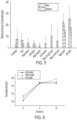
- FIG. 4 illustrates a plot of measured current of a vertical sensor described herein as a function of time when collecting gas from various parts of the human body, according to some embodiments.
- FIG. 5 illustrates a plot of measured ammonia concentration from various parts of the human body for both males and females, according to some embodiments.
- FIG. 6 illustrates a plot of signal recovery after washing hands with cold, warm, and hot water, according to some embodiments.
- FIG. 7 illustrates a plot of sensor response sensitivity as a function of concentration for various chemical compounds, according to some embodiments.
- FIG. 8 illustrates a mean and standard deviation for ammonia ratios at various concentrations, according to some embodiments.
- FIGS. 9 A- 9 C illustrate gas chromatography-mass spectroscopy (GC-MS) plot for the detection of emitted aldehyde skin gas, according to some embodiments.
- GC-MS gas chromatography-mass spectroscopy
- FIG. 10 illustrates a plot of gas sensor response signal as a function of ammonia concentration when the gas sensor comprises organic semiconductor layers having PTB7, CT, and FT4X.
- arylalkene refers to an alkene group that is directly bonded to an aromatic group.
- alkyl group refers to a monoradical branched or unbranched saturated hydrocarbon chain having 1 to 40 carbon atoms. This term is exemplified by groups such as methyl, ethyl, n-propyl, isopropyl, n-butyl, isobutyl, t-butyl, pentyl, n-hexyl, n-heptyl, n-octyl, n-decyl, or tetradecyl, and the like.
- the alkyl group can be substituted or unsubstituted.
- substituted alkyl group refers to: (1) an alkyl group as defined above, having 1, 2, 3, 4 or 5 substituents, typically 1 to 3 substituents, selected from the group consisting of alkenyl, alkynyl, alkoxy, aralkyl, aldehyde, cycloalkyl, cycloalkenyl, acyl, acylamino, acyl halide, acyloxy, amino, aminocarbonyl, alkoxycarbonylamino, azido, cyano, halogen, hydroxy, keto, thiocarbonyl, carboxy, carboxyalkyl, arylthiol, ester, heteroarylthio, heterocyclylthio, hydroxyl, thiol, alkylthio, aryl, aryloxy, heteroaryl, aminosulfonyl, aminocarbonylamino, heteroaryloxy, heterocyclyl, heterocyclooxy, hydroxyamino, alk
- substituents may optionally be further substituted by 1, 2, or 3 substituents chosen from alkyl, carboxy, carboxyalkyl, aminocarbonyl, hydroxy, alkoxy, halogen, CF 3 , amino, substituted amino, cyano, and —S(O) n R SO , where R SO is alkyl, aryl, or heteroaryl and n is 0, 1 or 2; or (2) an alkyl group as defined above that is interrupted by 1-10 atoms independently chosen from oxygen, sulfur and NR a , where R a is chosen from hydrogen, alkyl, cycloalkyl, alkenyl, cycloalkenyl, alkynyl, aryl, heteroaryl and heterocyclyl.
- All substituents may be optionally further substituted by alkyl, alkoxy, halogen, CF 3 , amino, substituted amino, cyano, or —S(O) n R SO , in which R SO is alkyl, aryl, or heteroaryl and n is 0, 1 or 2; or (3) an alkyl group as defined above that has both 1, 2, 3, 4 or 5 substituents as defined above and is also interrupted by 1-10 atoms as defined above.
- the alkyl groups can be an alkyl hydroxy group, where any of the hydrogen atoms of the alkyl group are substituted with a hydroxyl group.
- alkyl group as defined herein also includes cycloalkyl groups.
- cycloalkyl group as used herein is a non-aromatic carbon-based ring (i.e., carbocyclic) composed of at least three carbon atoms, and in some embodiments from three to 20 carbon atoms, having a single cyclic ring or multiple condensed rings.
- single ring cycloalkyl groups include, but are not limited to, cyclopropyl, cyclobutyl, cyclopentyl, cyclohexyl, cyclooctyl, and the like.
- Examples of multiple ring cycloalkyl groups include, but are not limited to, adamantanyl, bicyclo[2.2.1]heptane, 1,3,3-trimethylbicyclo[2.2.1]hept-2-yl, (2,3,3-trimethylbicyclo[2.2.1]hept-2-yl), or carbocyclic groups to which is fused an aryl group, for example indane, and the like.
- the term cycloalkyl group also includes a heterocycloalkyl group, where at least one of the carbon atoms of the ring is substituted with a heteroatom such as, but not limited to, nitrogen, oxygen, sulfur, or phosphorus.
- unsubstituted alkyl group is defined herein as an alkyl group composed of just carbon and hydrogen.
- acyl denotes a group —C(O)R CO , in which R CO is hydrogen, optionally substituted alkyl, optionally substituted cycloalkyl, optionally substituted heterocyclyl, optionally substituted aryl, and optionally substituted heteroaryl.
- aryl group is any carbon-based aromatic group (i.e., aromatic carbocyclic) such as having a single ring (e.g., phenyl) or multiple rings (e.g., biphenyl), or multiple condensed (fused) rings (e.g., naphthyl or anthryl). These may include, but are not limited to, benzene, naphthalene, phenyl, etc.
- aryl group also includes “heteroaryl group,” meaning a radical derived from an aromatic cyclic group (i.e., fully unsaturated) having 1, 2, 3, 4, 5, 6, 7, 8, 9, 10, 11, 12, 13, 14, or 15 carbon atoms and 1, 2, 3 or 4 heteroatoms selected from oxygen, nitrogen, sulfur, and phosphorus within at least one ring.
- heteroaryl groups are aromatic rings composed of at least three carbon atoms that has at least one heteroatom incorporated within the ring of the aromatic group.
- Such heteroaryl groups can have a single ring (e.g., pyridyl or furyl) or multiple condensed rings (e.g., indolizinyl, benzothiazolyl, or benzothienyl).
- heteroaryls include, but are not limited to, [1,2,4]oxadiazole, [1,3,4]oxadiazole, [1,2,4]thiadiazole, [1,3,4]thiadiazole, pyrrole, imidazole, pyrazole, pyridine, pyrazine, pyrimidine, pyridazine, indolizine, isoindole, indole, indazole, purine, quinolizine, isoquinoline, quinoline, phthalazine, naphthylpyridine, quinoxaline, quinazoline, cinnoline, pteridine, carbazole, carboline, phenanthridine, acridine, phenanthroline, isothiazole, phenazine, isoxazole, phenoxazine, phenothiazine, imidazolidine, imidazoline, triazole, oxazole, thiazo
- heteroaryl groups can be optionally substituted with 1 to 5 substituents, typically 1 to 3 substituents selected from the group consisting of alkyl, alkenyl, alkynyl, alkoxy, cycloalkyl, cycloalkenyl, acyl, acylamino, acyloxy, amino, aminocarbonyl, alkoxycarbonylamino, azido, cyano, halogen, hydroxy, keto, thiocarbonyl, carboxy, carboxyalkyl, arylthio, heteroarylthio, heterocyclylthio, thiol, alkylthio, aryl, aryloxy, heteroaryl, aminosulfonyl, aminocarbonylamino, heteroaryloxy, heterocyclyl, heterocyclooxy, hydroxyamino, alkoxyamino, nitro, —SO— alkyl, —SO-aryl, —SO—
- substituents may optionally be further substituted by 1-3 substituents chosen from alkyl, carboxy, carboxyalkyl, aminocarbonyl, hydroxy, alkoxy, halogen, CF 3 , amino, substituted amino, cyano, and —S(O) n R SO , where R SO is alkyl, aryl, or heteroaryl and n is 0, 1 or 2.
- the aryl group can be substituted or unsubstituted. Unless otherwise constrained by the definition for the aryl substituent, such aryl groups can optionally be substituted with from 1 to 5 substituents, typically 1 to 3 substituents, selected from the group consisting of alkyl, alkenyl, alkynyl, alkoxy, aldehyde, cycloalkyl, cycloalkenyl, acyl, acylamino, acyloxy, amino, aminocarbonyl, alkoxycarbonylamino, azido, cyano, ester, halogen, hydroxy, keto, thiocarbonyl, carboxy, carboxyalkyl, arylthio, heteroarylthio, heterocyclylthio, thiol, alkylthio, aryl, aryloxy, heteroaryl, aminosulfonyl, aminocarbonylamino, heteroaryloxy, heterocyclyl, heterocyclooxy, hydroxyamino,
- substituents may optionally be further substituted by 1-3 substituents chosen from alkyl, carboxy, carboxyalkyl, aminocarbonyl, hydroxy, alkoxy, halogen, CF 3 , amino, substituted amino, cyano, and —S(O) n R SO , where R SO is alkyl, aryl, or heteroaryl and n is 0, 1 or 2.
- R SO is alkyl, aryl, or heteroaryl and n is 0, 1 or 2.
- aryl group is limited to substituted or unsubstituted aryl and heteroaryl rings having from three to 30 carbon atoms.
- aralkyl group is an aryl group having an alkyl group or an alkylene group as defined herein covalently attached to the aryl group.
- An example of an aralkyl group is a benzyl group.
- “Optionally substituted aralkyl” refers to an optionally substituted aryl group covalently linked to an optionally substituted alkyl group or alkylene group.
- Such aralkyl groups are exemplified by benzyl, phenylethyl, 3-(4-methoxyphenyl)propyl, and the like.
- heteroarylkyl refers to a heteroaryl group covalently linked to an alkylene group, where heteroaryl and alkylene are defined herein.
- Optionally substituted heteroaralkyl refers to an optionally substituted heteroaryl group covalently linked to an optionally substituted alkylene group.
- Such heteroaralkyl groups are exemplified by 3-pyridylmethyl, quinolin-8-ylethyl, 4-methoxythiazol-2-ylpropyl, and the like.
- alkenyl group refers to a monoradical of a branched or unbranched unsaturated hydrocarbon group typically having from 2 to 40 carbon atoms, more typically 2 to 10 carbon atoms and even more typically 2 to 6 carbon atoms and having 1-6, typically 1, double bond (vinyl).
- Typical alkenyl groups include ethenyl or vinyl (—CH ⁇ CH 2 ), 1-propylene or allyl (—CH 2 CH ⁇ CH 2 ), isopropylene (—C(CH 3 ) ⁇ CH 2 ), bicyclo[2.2.1]heptene, and the like. When alkenyl is attached to nitrogen, the double bond cannot be alpha to the nitrogen.
- substituted alkenyl group refers to an alkenyl group as defined above having 1, 2, 3, 4 or 5 substituents, and typically 1, 2, or 3 substituents, selected from the group consisting of alkyl, alkenyl, alkynyl, alkoxy, cycloalkyl, cycloalkenyl, acyl, acylamino, acyloxy, amino, aminocarbonyl, alkoxycarbonylamino, azido, cyano, halogen, hydroxy, keto, thiocarbonyl, carboxy, carboxyalkyl, arylthio, heteroarylthio, heterocyclylthio, thiol, alkylthio, aryl, aryloxy, heteroaryl, aminosulfonyl, aminocarbonylamino, heteroaryloxy, heterocyclyl, heterocyclooxy, hydroxyamino, alkoxyamino, nitro, —SO— alkyl, —SO-aryl
- substituents may optionally be further substituted by 1, 2, or 3 substituents chosen from alkyl, carboxy, carboxyalkyl, aminocarbonyl, hydroxy, alkoxy, halogen, CF 3 , amino, substituted amino, cyano, and —S(O) n R SO , where R SO is alkyl, aryl, or heteroaryl and n is 0, 1 or 2.
- cycloalkenyl group refers to carbocyclic groups of from 3 to 20 carbon atoms having a single cyclic ring or multiple condensed rings with at least one double bond in the ring structure.
- alkynyl group refers to a monoradical of an unsaturated hydrocarbon, typically having from 2 to 40 carbon atoms, more typically 2 to 10 carbon atoms and even more typically 2 to 6 carbon atoms and having at least 1 and typically from 1-6 sites of acetylene (triple bond) unsaturation.
- Typical alkynyl groups include ethynyl, (—C ⁇ CH), propargyl (or prop-1-yn-3-yl, —CH 2 C ⁇ CH), and the like. When alkynyl is attached to nitrogen, the triple bond cannot be alpha to the nitrogen.
- substituted alkynyl group refers to an alkynyl group as defined above having 1, 2, 3, 4 or 5 substituents, and typically 1, 2, or 3 substituents, selected from the group consisting of alkyl, alkenyl, alkynyl, alkoxy, cycloalkyl, cycloalkenyl, acyl, acylamino, acyloxy, amino, aminocarbonyl, alkoxycarbonylamino, azido, cyano, halogen, hydroxy, keto, thiocarbonyl, carboxy, carboxyalkyl, arylthio, heteroarylthio, heterocyclylthio, thiol, alkylthio, aryl, aryloxy, heteroaryl, aminosulfonyl, aminocarbonylamino, heteroaryloxy, heterocyclyl, heterocyclooxy, hydroxyamino, alkoxyamino, nitro, —SO-alkyl, —SO-
- substituents may optionally be further substituted by 1, 2, or 3 substituents chosen from alkyl, carboxy, carboxyalkyl, aminocarbonyl, hydroxy, alkoxy, halogen, CF 3 , amino, substituted amino, cyano, and —S(O) n R SO , where R SO is alkyl, aryl, or heteroaryl and n is 0, 1 or 2.
- alkylene group is defined as a diradical of a branched or unbranched saturated hydrocarbon chain, having 1, 2, 3, 4, 5, 6, 7, 8, 9, 10, 11, 12, 13, 14, 15, 16, 17, 18, 19 or 20 carbon atoms, typically 1-10 carbon atoms, more typically 1, 2, 3, 4, 5 or 6 carbon atoms.
- This term is exemplified by groups such as methylene (—CH 2 —), ethylene (—CH 2 CH 2 —), the propylene isomers (e.g., —CH 2 CH 2 CH 2 — and —CH(CH 3 )CH 2 —) and the like.
- substituted alkylene group refers to: (1) an alkylene group as defined above having 1, 2, 3, 4, or 5 substituents selected from the group consisting of alkyl, alkenyl, alkynyl, alkoxy, cycloalkyl, cycloalkenyl, acyl, acylamino, acyloxy, amino, aminocarbonyl, alkoxycarbonylamino, azido, cyano, halogen, hydroxy, keto, thiocarbonyl, carboxy, carboxyalkyl, arylthio, heteroarylthio, heterocyclylthio, thiol, alkylthio, aryl, aryloxy, heteroaryl, aminosulfonyl, aminocarbonylamino, heteroaryloxy, heterocyclyl, heterocyclooxy, hydroxyamino, alkoxyamino, nitro, —SO-alkyl, —SO-aryl, —SO-heteroaryl,
- substituents may optionally be further substituted by 1, 2, or 3 substituents chosen from alkyl, carboxy, carboxyalkyl, aminocarbonyl, hydroxy, alkoxy, halogen, CF 3 , amino, substituted amino, cyano, and —S(O) n R SO , where R SO is alkyl, aryl, or heteroaryl and n is 0, 1 or 2; or (2) an alkylene group as defined above that is interrupted by 1-20 atoms independently chosen from oxygen, sulfur and NR a —, where R a is chosen from hydrogen, optionally substituted alkyl, cycloalkyl, cycloalkenyl, aryl, heteroaryl and heterocyclyl, or groups selected from carbonyl, carboxyester, carboxyamide and sulfonyl; or (3) an alkylene group as defined above that has both 1, 2, 3, 4 or 5 substituents as defined above and is also interrupted by 1-20 atoms as defined above.
- substituted alkylenes are chloromethylene (—CH(Cl)—), aminoethylene (—CH(NH 2 )CH 2 —), methylaminoethylene (—CH(NHMe)CH 2 —), 2-carboxypropylene isomers (—CH 2 CH(CO 2 H)CH 2 —), ethoxyethyl (—CH 2 CH 2 O—CH 2 CH 2 —), ethylmethylaminoethyl (—CH 2 CH 2 N(CH 3 )CH 2 CH 2 —), and the like.
- alkoxy group refers to the group R—O—, where R is an optionally substituted alkyl or optionally substituted cycloalkyl, or R is a group —Y—Z, in which Y is optionally substituted alkylene and Z is optionally substituted alkenyl, optionally substituted alkynyl; or optionally substituted cycloalkenyl, where alkyl, alkenyl, alkynyl, cycloalkyl and cycloalkenyl are as defined herein.
- Typical alkoxy groups are optionally substituted alkyl-O— and include, by way of example, methoxy, ethoxy, n-propoxy, iso-propoxy, n-butoxy, tert-butoxy, sec-butoxy, n-pentoxy, n-hexoxy, 1,2-dimethylbutoxy, trifluoromethoxy, and the like.
- alkylthio group refers to the group R S —S—, where R S is as defined for alkoxy.
- aminocarbonyl refers to the group —C(O)NR N R N where each R N is independently hydrogen, alkyl, aryl, heteroaryl, heterocyclyl or where both R N groups are joined to form a heterocyclic group (e.g., morpholino). Unless otherwise constrained by the definition, all substituents may optionally be further substituted by 1-3 substituents chosen from alkyl, carboxy, carboxyalkyl, aminocarbonyl, hydroxy, alkoxy, halogen, CF 3 , amino, substituted amino, cyano, and —S(O) n R SO , where R SO is alkyl, aryl, or heteroaryl and n is 0, 1 or 2.
- acylamino refers to the group —NR NCO C(O)R where each R NCO is independently hydrogen, alkyl, aryl, heteroaryl, or heterocyclyl. Unless otherwise constrained by the definition, all substituents may optionally be further substituted by 1-3 substituents chosen from alkyl, carboxy, carboxyalkyl, aminocarbonyl, hydroxy, alkoxy, halogen, CF 3 , amino, substituted amino, cyano, and —S(O) n R SO , where R SO is alkyl, aryl, or heteroaryl and n is 0, 1 or 2.
- acyloxy refers to the groups —O(O)C-alkyl, —O(O)C-cycloalkyl, —O(O)C-aryl, —O(O)C-heteroaryl, and —O(O)C-heterocyclyl. Unless otherwise constrained by the definition, all substituents may be optionally further substituted by alkyl, carboxy, carboxyalkyl, aminocarbonyl, hydroxy, alkoxy, halogen, CF 3 , amino, substituted amino, cyano, and —S(O) n R SO , where R SO is alkyl, aryl, or heteroaryl and n is 0, 1 or 2.
- aryloxy group refers to the group aryl-O— wherein the aryl group is as defined above, and includes optionally substituted aryl groups as also defined above.
- heteroaryloxy refers to the group heteroaryl-O—.
- amino refers to the group —NH 2 .
- substituted amino refers to the group —NR w R w where each R w is independently selected from the group consisting of hydrogen, alkyl, cycloalkyl, carboxyalkyl (for example, benzyloxycarbonyl), aryl, heteroaryl and heterocyclyl provided that both R w groups are not hydrogen, or a group —Y—Z, in which Y is optionally substituted alkylene and Z is alkenyl, cycloalkenyl, or alkynyl.
- substituents may optionally be further substituted by 1-3 substituents chosen from alkyl, carboxy, carboxyalkyl, aminocarbonyl, hydroxy, alkoxy, halogen, CF 3 , amino, substituted amino, cyano, and —S(O) n R SO , where R SO is alkyl, aryl, or heteroaryl and n is 0, 1 or 2.
- Carboxy refers to a group —C(O)OH.
- carboxyalkyl group refers to the groups —C(O)O-alkyl or —C(O)O-cycloalkyl, where alkyl and cycloalkyl, are as defined herein, and may be optionally further substituted by alkyl, alkenyl, alkynyl, alkoxy, halogen, CF 3 , amino, substituted amino, cyano, and —S(O) n R SO , in which R SO is alkyl, aryl, or heteroaryl and n is 0, 1 or 2.
- Cinnamate refers to a salt or ester of cinnamic acid, which is an organic compound with the formulate C 6 H 5 CH ⁇ CHCOOH. Both cinnamic acids and cinnamates are classified as unsaturated carboxylic acids. Cinnamates may occur as both cis and trans isomers.
- chalcone refers to an aromatic ketone and an enone that forms the central core for a variety of important biological compounds, collectively as chalcones or chalconoids.
- chalcones include benzylideneacetophenone, phenyl styryl ketone, benzalacetophenone, ⁇ -phenylacrylophenone, ⁇ -oxo- ⁇ , ⁇ -diphenyl- ⁇ -propylene, and ⁇ -phenyl- ⁇ -benzoylethylene.
- coumarin i.e., 2H-chromen-2-one
- 2H-chromen-2-one refers to an aromatic organic chemical compound with formula C 9 H 6 O 2 . It is a benzene molecule with two adjacent hydrogen atoms replaced by a lactone-like chain —O—, forming a second six-membered heterocycle that shares two carbons with the benzene ring. It may be placed in the benzopyrone chemical class and considered as a lactone.
- substituted cycloalkyl group or “substituted cycloalkenyl group” refer to cycloalkyl or cycloalkenyl groups having 1, 2, 3, 4 or 5 substituents, and typically 1, 2, or 3 substituents, selected from the group consisting of alkyl, alkenyl, alkynyl, alkoxy, cycloalkyl, cycloalkenyl, acyl, acylamino, acyloxy, amino, aminocarbonyl, alkoxycarbonylamino, azido, cyano, halogen, hydroxy, keto, thiocarbonyl, carboxy, carboxyalkyl, arylthio, heteroarylthio, heterocyclylthio, thiol, alkylthio, aryl, aryloxy, heteroaryl, aminosulfonyl, aminocarbonylamino, heteroaryloxy, heterocyclyl, heterocyclooxy, hydroxyamino, al
- substituents may optionally be further substituted by 1, 2, or 3 substituents chosen from alkyl, carboxy, carboxyalkyl, aminocarbonyl, hydroxy, alkoxy, halogen, CF 3 , amino, substituted amino, cyano, and —S(O) n R SO , where R SO is alkyl, aryl, or heteroaryl and n is 0, 1 or 2.
- conjugated group is defined as a linear, branched or cyclic group, or combination thereof, in which p-orbitals of the atoms within the group are connected via delocalization of electrons and wherein the structure can be described as containing alternating single and double or triple bonds and may further contain lone pairs, radicals, or carbenium ions.
- Conjugated cyclic groups may comprise both aromatic and non-aromatic groups, and may comprise polycyclic or heterocyclic groups, such as diketopyrrolopyrrole. Ideally, conjugated groups are bound in such a way as to continue the conjugation between the thiophene moieties they connect. In some embodiments, “conjugated groups” is limited to conjugated groups having three to 30 carbon atoms.
- halogen halo
- halo halide
- fluoro bromo, chloro, and iodo
- heterocyclyl refers to a monoradical saturated or partially unsaturated group having a single ring or multiple condensed rings, having from 1 to 40 carbon atoms and from 1 to 10 hetero atoms, typically 1, 2, 3 or 4 heteroatoms, selected from nitrogen, sulfur, phosphorus, and/or oxygen within the ring.
- Heterocyclic groups can have a single ring or multiple condensed rings, and include tetrahydrofuranyl, morpholino, piperidinyl, piperazino, dihydropyridino, and the like.
- heterocyclyl groups can be optionally substituted with 1, 2, 3, 4 or 5, and typically 1, 2 or 3 substituents, selected from the group consisting of alkyl, alkenyl, alkynyl, alkoxy, cycloalkyl, cycloalkenyl, acyl, acylamino, acyloxy, amino, aminocarbonyl, alkoxycarbonylamino, azido, cyano, halogen, hydroxy, keto, thiocarbonyl, carboxy, carboxyalkyl, arylthio, heteroarylthio, heterocyclylthio, thiol, alkylthio, aryl, aryloxy, heteroaryl, aminosulfonyl, aminocarbonylamino, heteroaryloxy, heterocyclyl, heterocyclooxy, hydroxyamino, alkoxyamino, nitro, —SO— alkyl, —SO-aryl,
- substituents may optionally be further substituted by 1-3 substituents chosen from alkyl, carboxy, carboxyalkyl, aminocarbonyl, hydroxy, alkoxy, halogen, CF 3 , amino, substituted amino, cyano, and —S(O) n R SO , where R SO is alkyl, aryl, or heteroaryl and n is 0, 1 or 2.
- thiol refers to the group —SH.
- substituted alkylthio refers to the group —S— substituted alkyl.
- arylthiol group refers to the group aryl-S—, where aryl is as defined as above.
- heteroarylthiol refers to the group —S— heteroaryl wherein the heteroaryl group is as defined above including optionally substituted heteroaryl groups as also defined above.
- sulfoxide refers to a group —S(O)R SO , in which R SO is alkyl, aryl, or heteroaryl.
- substituted sulfoxide refers to a group —S(O)R SO , in which R SO is substituted alkyl, substituted aryl, or substituted heteroaryl, as defined herein.
- sulfone refers to a group —S(O) 2 R SO , in which R SO is alkyl, aryl, or heteroaryl.
- substituted sulfone refers to a group —S(O) 2 R SO , in which R SO is substituted alkyl, substituted aryl, or substituted heteroaryl, as defined herein.
- keto refers to a group —C(O)—.
- thiocarbonyl refers to a group —C(S)—.
- room temperature is 20° C. to 25° C.
- These and other materials are disclosed herein, and it is understood that when combinations, subsets, interactions, groups, etc. of these materials are disclosed that while specific reference of each various individual and collective combinations and permutation of these compounds may not be explicitly disclosed, each is specifically contemplated and described herein.
- A-D is disclosed, then even if each is not individually recited, each is individually and collectively contemplated.
- each of the combinations A-E, A-F, B-D, B-E, B—F, C-D, C-E, and C-F are specifically contemplated and should be considered disclosed from disclosure of A, B, and C; D, E, and F; and the example combination A-D.
- any subset or combination of these is also specifically contemplated and disclosed.
- the sub-group of A-E, B—F, and C-E are specifically contemplated and should be considered disclosed from disclosure of A, B, and C; D, E, and F; and the example combination A-D.
- This concept applies to all aspects of this disclosure including, but not limited to, steps in methods of making and using the disclosed compositions.
- steps in methods of making and using the disclosed compositions are if there are a variety of additional steps that can be performed it is understood that each of these additional steps can be performed with any specific embodiment or combination of embodiments of the disclosed methods, and that each such combination is specifically contemplated and should be considered disclosed.
- a weight percent of a component is based on the total weight of the formulation or composition in which the component is included.
- Detection of health conditions by non-invasive ways is one major goal of current medical research. In such an approach, it is critical to connect the physiological condition inside the human body to a detectable metric measured outside the human body. In other words, non-invasive methods involve measuring some benchmark external to the body that provides cues as to a physiological condition inside the body.
- gases emitted from humans may be linked to certain diseases. For example, content of ammonia in the breath may be an indicator for kidney diseases, acetone an indicator for diabetes, and nitric oxide an indicator for asthma. Gas emission may also be detected through the skin.
- the gas sensor has a vertical channel with organic semiconductors, and in some examples, has a sensitivity of ammonia detection to as low as 30 parts-per-billion (ppb) using the electrical current responses.
- the gas sensor is also sensitive to aldehyde (e.g., comprising 7-9 carbon atoms) detection. Gas samples may be collected from various skin positions such as the hand (e.g., palm), forehead, forearm, chin, and elbow.
- An organic vertical transistor is similar to a solid-state version of a vacuum tube triode.
- the vacuum tube triode consists of the cathode for electron emission by heating, the anode for electron collection, and the grid for current modulation.
- the anode is always positively biased against the cathode.
- both the grid and anode electrodes can control the potential within the device, but the grid is much more effective in controlling the gradient near the cathode.
- the on and off state of the vacuum tube triode is determined by whether the emitted electrons encounter a large energy barrier between cathode and anode or not.
- the electrons When the grid is in large and negative bias, the electrons experience a negative gradient of potential after they are emitted from cathode, and consequently very few of them can be collected by the anode. However, if the grid is slightly negative biased or positively biased, it is possible for the electrons to find a passage through the potential minimum in the grid.
- FIG. 1 One example of an organic vertical transistor design that function similar to the vacuum tube triodes is shown in FIG. 1 .
- the device is on an inert substrate, such as glass or polymer. Ultrathin (less than 150 or 100 ⁇ m for example) and flexible glasses allow the device to be placed in a variety of locations. Electrons are injected from the emitter, going through the openings on the metal grid and finally arriving at the collector.
- the collector can be a metals, alloys, or metal oxide capable of properly operating at the voltages and currents of the device.
- Example materials that can be used include Al, Au, Ag, Pt, Cu, and stainless steel.
- the emitter can have a thickness of 10 nm or greater, for example 10 nm to 500 nm, with the thickness being dictated by the material, signal, current and voltage.
- the metal grid can similarly be made of metals capable of properly operating at the voltages and currents of the device, such as Al, Au, Ag, Pt, Cu, and stainless steel.
- the metal grid and collector are made of the same material.
- the metal grid can have a thickness of 10 nm or greater, for example from 10 nm to 200 nm, with the thickness being dictated by the material, the size of the passages through the grid, current and voltage.
- the emitter may be a metal, metal oxide, or polymer with a thickness from 10 nm to 500 nm, again dictated by the material, signal, current and voltage.
- Example materials for the emitter poly(3,4-ethylenedioxythiophene):poly(styrenesulfonate) (PEDOT:PSS), transparent conductive oxides such as indium tin oxide (ITO), and metals such as Cu, Pt, Au, Ag, and the like.
- the potential between emitter and collector can be controlled by the voltages of the grid and collector.
- voltages of the grid and collector constitute a high barrier between the emitter and the opening, few carriers can arrive at the collector through the openings.
- the magnitude of the collector current is determined by the space-charge-limited current given by the potential difference between the emitter and the center of the opening.
- Collector current is modulated by the grid bias which controls the effective potential at the opening for fixed emitter and collector potentials.
- J SCLC (9/8) ⁇ 0 ⁇ r ⁇ ( V 2 /L 3 ).
- J current density
- ⁇ 0 permittivity in vacuum space (8.854 ⁇ 10 ⁇ 12 F/m)
- ⁇ r relative permittivity
- ⁇ charge carrier mobility
- V voltage between electrodes
- L material of thickness
- the advantages of using a donor-acceptor organic semiconductor material in such a system are that the material generates a high current density and high mobility and is highly stable (long shelf life), allowing for simplification of the devices because they can be made without need of an encapsulating layer. Further, many of the polymers can be made efficiently in using non-toxic processes at high purities and high molecular weights (up to 120,000 Da), and with solvent-based printing processes that produce a uniformly thin semiconducting layer.
- operation voltages for the vertical transistor may be 2V or less, 1.5V or less, 1.25V or less or 1V or less.
- the donor-acceptor based vertical transistor may have current densities of at least 80 mA/cm 2 , 90 mA/cm 2 , 100 mA/cm 2 , 110 mA/cm 2 , 120 mA/cm 2 , 130 mA/cm 2 , 140 mA/cm 2 , 150 mA/cm 2 , or 160 mA/cm 2 . Because there is no need for an encapsulation layer, the device fabrication process is simpler and scalable for large area requiring a little as two mask levels and allowing for the use of a variety of hydrocarbon solvents.
- a layer of polyvinylpyrrolidone (PVP) is spin coated on the ITO emitter from 8 wt. % PVP:PGMEA solution to serve as an insulating layer.
- a thin surface modification layer e.g., poly(3-hexylthiophene-2,5-diyl); P3HT
- PS polystyrene
- spheres are adsorbed on the substrate.
- the substrate is dipped inside the ethanol solution of spheres (1.4 wt.
- the spheres are adsorbed on the substrate surface and the wet substrate is then taken out of the ethanol and dipped into boiling isopropyl alcohol (IPA) to rinse away the spheres that are not adsorbed.
- IPA isopropyl alcohol
- a stream of nitrogen gas is used to blow-dry the hot IPA to form a monolayer of spheres.
- the PS spheres serve as a hard mask for the following deposition of the metal grid layer (Al).
- Al 40 nm
- a layer of SiO (50 nm) were deposited as an electrode and an insulating layer, respectively.
- Scotch type (3M) After removing the spheres by Scotch type (3M), openings in the metal grid are formed.
- Oxygen plasma is used to etch through the PVP to open a channel and to form aluminum oxide on top of the grid.
- the device is then finished by the deposition of an embodied donor-acceptor organic semiconductor layer ( ⁇ 200-600 nm thick) and then patterning of collector (MoO 3 /Al).
- the vertical transistor provides a unique design that allows for high amplification and improves sensitivity of organic semiconductors in senor applications.
- device current is through the bulk material and is not hampered by surface effects like normal field mobility degradation or proximity doping effects as in FETs.
- the vertical design encapsulates the OSC, thus enhancing the stability of the device and OSC material.
- the vertical OSC transistor occupies a much smaller in footprint than a traditional device such as a FET.
- a planar FET would need to be ⁇ 150 ⁇ to 200 ⁇ the footprint size to achieve the same current output.
- conjugated polymeric and small molecule compounds that may be used in vertical transistors, and electronic devices incorporating such transistors.
- the compounds may be easily synthesized and may be solution processable. Accordingly, transistors incorporating these compounds may be manufactured using solution deposition techniques such as inkjet printing, dip and/or spin coating, and screen printing, to name a few.
- Polymeric compounds described herein contain alternating blocks of aromatic, heteroaromatic or ethynylene electron accepting groups (“A” groups, also referred to as electron withdrawing groups or electron accepting groups), which are referred to as acceptor blocks, and blocks of aromatic or heteroaromatic electron-rich donating groups (“D” groups, also referred to as electron donating groups), which are referred to as donor blocks, along a compound backbone.
- A aromatic, heteroaromatic or ethynylene electron accepting groups
- D aromatic or heteroaromatic electron-rich donating groups
- the repeating unit of the polymeric compounds contains an acceptor block containing one or more acceptor groups (A) with a donor block containing one or more donor groups (D) on each side of the acceptor group, thus providing the general Formula I:
- each D is an independently selected conjugated electron donating aromatic or heteroaromatic group having from 5 to 50 backbone atoms, each D group optionally substituted with one or more electron donating substituents or electron withdrawing substituents, provided that even when substituted the electronic character of each D is electron donating;
- each A is an independently selected conjugated electron accepting aromatic or heteroaromatic group having from 5 to 50 backbone atoms or an ethynylene group substituted with one or two electron withdrawing substituents, each A being optionally substituted with one or more electron donating substituents or electron withdrawing substituents provided that even when substituted the electronic character of each A is electron accepting.
- each D is independently one or more of the following in Table 1:
- each A is independently one or more of the following in Table 2:
- R 1 , R 2 , R 3 , R 4 , and R 6 can play a significant role in the solubility, stability, or film forming properties (including structure, adhesion, organization, processability, and the like) of the polymers.
- one or more of R 1 , R 2 , R 3 , R 4 , and R 6 is an optionally substituted C 15 -C 35 alkyl.
- one or more of R 1 , R 2 , R 3 , or R 4 is an optionally substituted C 15 -C 35 alkyl having at least one branching point.
- one or more of R 1 , R 2 , or R 3 can be optionally substituted C 15 -C 35 alkyl.
- each R 1 or R 2 is independently an optionally substituted C 15 -C 35 alkyl. In some examples, each R 1 or R 2 is independently an optionally substituted C 15 -C 35 alkyl having at least one branching point. In some examples, each R 1 or R 2 is independently an optionally substituted C 15 -C 35 alkyl having at least one branching point, where the branching point is at least 4 carbons from the base molecule.
- the embodied polymers provide superior properties when branched alkyl chains are at least four carbons away from the main polymer backbone, thereby producing no or very low steric effect, which would interfere with the ⁇ -stacking of the polymer backbones, and the existence of four large, nonpolar branched side chains in one polymer repeat unit significantly increases the solubility of these polymers, thus allowing for an increase in the molecular weight of the polymers, which may result in an enhanced mobility over current high performance polymers.
- the polymers have molecular weights of from about 30-80 kDa or 40-60 kDa.
- organic compounds having the structure of Formula I may be exemplified in Table 3, wherein n is an integer from 2 to 10,000:
- the OSC polymers may be n-type, p-type and ambipolar polymers, as exemplified in Table 4 below, wherein n is an integer from 2 to 10,000:
- R, R′, R 1 , R 2 , X, and Y are each independently selected as hydrogen, C 1 -C 40 alkyl, C 1 -C 40 alkenyl, C 1 -C 40 alkynl, C 1 -C 40 alkoxy, C 1 -C 40 cycloalkyl, C 1 -C 40 aryl, C 1 -C 40 heteroaryl, C 1 -C 40 heterocycloalkyl, C 1 -C 40 conjugated group, any of which may be optionally substituted, or halo.
- soluble OSC small molecules may be used either solely or in combination with OSC polymers, such as those defined in Tables 1-4.
- small organic compounds are exemplified in Table 5:
- Another aspect comprises methods of making the compounds and devices described herein. Synthesis of the disclosed monomers, oligomers and polymers can be done without undue experimentation based on references in the literature. Example embodied compounds may be found, for example, in U.S. Pat. Nos. 7,705,108, 7,838,623, 8,389,669, 7,893,191, and 8,624,232, all of which are incorporated herein by reference in their entirety.
- Construction of embodied devices is conducted by using an inert, non-conductive substrates that can be subjected to the necessary conditions to produce the device, including elevated temperatures and organic solvents. Glass, glass ceramics, ceramics, and some plastics may be used.
- the substrate thickness is based on the needs of the device, such as stability or strength.
- the substrate is a glass.
- the substrate is an ultrathin and/or flexible glass, such as Corning® Willow® glass.
- a conductive or emitter layer is then placed on the substrate.
- a transparent conductive oxide can be coated onto the substrate via known methods such as sputter coating.
- the emitter may comprise a transparent conductive oxide that is sputter coated on the substrate in combination with a polymer layer is then spin coated on the TCO.
- an insulating layer can be coated on the emitter layer.
- the insulating layer can be a polymer layer, such as polyvinylpyrrolidone (PVP) that incorporates polymer spheres (for example, made of polystyrene and having a diameter of from 30-400 nm) that can be later removed.
- PVP polyvinylpyrrolidone
- the insulating layer is then coated with a metal mask layer is produced using one or more known methods, including lithography.
- the polymer spheres are then removed via solvent, leaving voids in the insulating layer and mask.
- the device is then coated with an OSC compound(s) described herein and finally a collector layer is lithographically patterned on the OSC layer.
- a first layer of the OSC compound(s) can be coated on the emitter.
- polymer spheres having a diameter of from 30-400 nm
- the metal mask layer which is produced using one or more known methods, including lithography.
- the polymer beads are removed via solvent, heating, or adhesion to produce the grid.
- the collector layer is patterned on the OSC via lithography.
- FIG. 1 An example of a structure of a gas sensor with vertical nano-channels is shown in FIG. 1 and described above.
- FIGS. 2 A- 2 C illustrate a vertical sidewall of a cylindrical channel (as shown by the cross-section in FIG. 1 ) covered with active OSC compounds.
- the vertical sidewalls of the sensor structure is imaged using SEM ( FIGS. 2 A and 2 C ) and schematically depicted in FIG. 2 B .
- FIG. 2 C is an enlarged version of FIG. 2 A .
- SEM images are collected using a cold-field emission SEM (Hitachi SU-8010).
- Thickness of ITO emitter on the glass substrate is about 200 nm
- thickness of the insulating poly(4-vinlphenol) (PVP) layer is 300 nm
- thickness of the final active layer is about 60 nm.
- the active channel is on the vertical sidewall.
- FT4X is a polymer comprising a diketopyrrolopyrrole (DPP) having N,N′-substitutents of two C 8 H 15 (C 8 H 17 C 10 H 21 ) groups, an intervening thiophene, and a fused thiophene having four fused rings (“FT4”) with attached two C 17 H 35 groups or chains as ⁇ -substituents (i.e., on the ⁇ -positions of the FT4 portion).
- DPP diketopyrrolopyrrole
- FT4 fused thiophene having four fused rings
- a generalized OSC compound fabrication procedure is as follows.
- the monomers and catalyst materials for each of PTB7, CT, and FT4X, respectively, are weighed into a flask and the solvent (chloroform for PTB7 and CT; xylene for FT4X) is added.
- Polymerization is then carried out at a predetermined time (e.g., 0.1-10 hrs, or 0.1-7.5 hrs, or 0.5-5 hrs) and temperature (e.g., 50-200° C., or 50-150° C., or 70-150° C.).
- polymerization of PTB7 may be carried out for 10 min at 200° C.
- polymerization of CT may be carried out for 10 min at 80° C.
- polymerization of FT4X may be carried out for 60 min or 90 min at 130° C.
- the material is then precipitated, filtered, dried then extracted in a Soxhlet extractor to remove any residual monomers and catalyst species.
- the polymer is dissolved from the Soxhlet extractor, re-precipitated and dried under vacuum.
- the OSC compounds are used as the active material in vertical transistors with high output current density and a long lifetime without encapsulation.
- the gas sensor has a vertical channel with organic semiconductors, and in some examples, has a sensitivity of ammonia detection to as low as 30 parts-per-billion (ppb) using the electrical current responses.
- the gas sensor is also sensitive to aldehyde (e.g., comprising 7-9 carbon atoms) detection. Gas samples may be collected from various skin positions such as the hand (e.g., palm), forehead, forearm, chin, and elbow.
- FIG. 3 illustrates a gas collection mechanism of the gas emitted from human skin.
- a glass enclosure covers the area of interest, with the enclosure comprising two tubes connected therein.
- gas emitted from the skin is carried outward by the air through a second tube for characterization to a sensor chamber.
- the target gas molecules Prior to entering the sensor chamber, the target gas molecules pass through a tube of sodium hydroxide solid to remove moisture.
- Target gas flow is driven by a pump connected to the sensor chamber, with the flow rate fixed at 500 cc/min. Electrical current remains at an air background level before the glass enclosure contacts the skin. Once the enclosure touches the skin, an airtight seal is formed above the skin such that the air flow carries the emitted skin gas through the second tube to the sensor chamber.
- Aldehyde liquids are first injected into a plastic bag (Tedlar bag from Kohan Instruments Co.) and then the bag is sealed and the liquids evaporate shortly. The aldehyde gas in the plastic bag is then pumped out and mixed with the air (entering through the first tube) with individually controlled flow rates for each aldehyde in order to vary aldehyde gas concentration.
- Skin gas is also analyzed by a gas chromatography-mass spectroscopy (GC-MS) system.
- GC-MS is conducted using an Agilent Model No. 6890-5972 device (35° C., hold 5 min then increase 15° C./min to 180° C., hold 10 min).
- the target gas molecules are first adsorbed on an inner surface of the winding column. Upon heating, different target gas molecules are released at different times.
- the skin gas for the GC is also collected by the glass enclosure, as in the case of the vertical sensor. Both air background and the skin gas are measured by the GC system in order to identify the real gas from the skin.
- response of the vertical sensor to ammonia in air is used as a calibration for other gases.
- the OSC compound in the vertical sensor is PTB7.
- Current response (R) is defined as ⁇ I/I 0 , where ⁇ I is the change of current within 60 seconds and I 0 is the initial current before the flow of ammonia to the sensor chamber. The dependence of R on ammonia concentration is in ppb.
- Such ammonia response is used for further calibration as there is a variation among devices and gradual decay through time for an individual device.
- FIG. 4 illustrates how the electrical current of the sensor is altered when measuring gas emitted from the human skin at various positions.
- Body parts measured are the left palm (A), right palm (B), back of left hand (C), back of right hand (D), left forearm (E), right forearm (F), left elbow (G), right elbow (H), chin (I), and forehead (J).
- the skin gas is collected by a glass enclosure which covers the skin.
- FIG. 5 illustrates a plot of measured ammonia concentration from various parts of the human body for both males and females (with mean and standard deviation for men and women).
- the vertical sensor was used to measure the response of the gas emitted from skin at various body positions for eight (8) healthy volunteers, including four (4) men and four (4) women between the ages of 20 and 30, with an average age of twenty-three (23) for both men and women.
- a strong effective ammonia concentration signal was detected for the palm in both men and women. Chin, forehead, and elbow show moderate-to-low signals for both sexes. And while men have signals from hand backs and forearms, signals from these positions are barely detectable for women.
- FIG. 6 illustrates a plot of signal recovery after washing hands with cold, warm, and hot water, according to some embodiments. Because palm of the hand show a particularly large signal, attention is given to understand effects of hand washing. Water is used to wash the hands and the normalized recovery of the response as a function of time after washing is shown in FIG. 6 . As expected, immediately after washing response is low, regardless of washing water temperature. However, after 5 minutes, response rises to its steady state value.
- the vertical sensor described herein is very sensitive to ammonia, it is important to know if the skin gas is dominated by ammonia. Sensitivity to ammonia is tested and compared using three OSC materials: organic vertical transistors are formed as described herein with organic semiconductor layers comprising PTB7, CT, and FT4X. For any given kind of molecule (in this case, ammonia), unique relative strengths of adsorption and reaction are observed with each of the three OSC materials. Put together, the ratio among the three responses can therefore serve as a fingerprint, or identifier, of the type of molecule. Different molecules, in general, will have different ratios.
- FIG. 8 illustrates a mean and standard deviation for ammonia ratios at various concentrations, according to some embodiments. The ratio for the palm are also shown in FIG. 8 for a total of twelve (12) data points collected from various days. Roughly, r 1 is 1.2 and r 2 is 0.9. Whereas there is no significant difference in r 1 , the r 2 values for palm and ammonia are significantly different. Thus, palm gas is not dominated by ammonia.
- FIG. 10 illustrates a plot of gas sensor response signal as a function of ammonia concentration when the gas sensor comprises organic semiconductor layers having PTB7, CT, and FT4X.
- the ratio of the FT4X response to the PTB7 response is indicated as r ⁇
- the ratio of the CT response to the PTB7 response is indicated as r ⁇ .
- r ⁇ is 1.1 and r ⁇ is 0.5
- 500 ppb r ⁇ is 1.1 and r ⁇ is 0.6
- 700 ppb r ⁇ is 1.1 and r ⁇ is 0.5.
- FIG. 8 it was shown that the chemical composition of the skin gas is one not dominated by ammonia.
- GC-MS is used to study the skin gas (see above) in FIGS. 9 A- 9 C .
- skin gas can be pumped to the GC directly with a nitrogen background.
- Different molecules are released from the GC column under heating at different times. As the abundance is plotted against time in minutes there are several peaks, though a portion appear in the air control as part of the system background.
- Substantive signals include acetone and some aldehydes with 7 to 9 carbon atoms.
- the vertical sensor has a weak response for acetone. Aldehyde is therefore considered as a potential candidate which contributes to the sensor response from the skin gas.
- FIG. 7 illustrates a plot of sensor response sensitivity as a function of concentration for various chemical compounds, according to some embodiments. While the gas sensors described herein are designed to detect ammonia, FIG. 7 discloses that other types of chemical compounds are also detectable, such as various aldehydes. FIG. 7 shows that ammonia detection requires relatively small quantities of ammonia (less than 1000 ppb). Propanal and heptanal exhibit the weakest sensor response signal, even at concentrations greater than 3000 ppb (>5% response), while octanal and nonanal detection response steadily increases with concentration.
- New applications of the OSC materials include vertical sensor devices which are able to detect gas emitted from skin. This application may be potentially used with mobile devices to monitor health risks and provide dynamic feedback of daily health information.
- Advantages include organic semiconductors which (1) are P-type and/or N-type materials which can be solution-processed into vertical designed structures; (2) may be polymers, small molecules, or combinations thereof; and (3) have thiophene, fused thiophene and other aromatic structures as donor-acceptor dipole molecule and polymers.
Landscapes
- Health & Medical Sciences (AREA)
- Life Sciences & Earth Sciences (AREA)
- Physics & Mathematics (AREA)
- Chemical & Material Sciences (AREA)
- Engineering & Computer Science (AREA)
- General Health & Medical Sciences (AREA)
- Pathology (AREA)
- Public Health (AREA)
- Heart & Thoracic Surgery (AREA)
- Medical Informatics (AREA)
- Molecular Biology (AREA)
- Surgery (AREA)
- Animal Behavior & Ethology (AREA)
- Biomedical Technology (AREA)
- Biophysics (AREA)
- Veterinary Medicine (AREA)
- Materials Engineering (AREA)
- Immunology (AREA)
- Analytical Chemistry (AREA)
- Biochemistry (AREA)
- General Physics & Mathematics (AREA)
- Optics & Photonics (AREA)
- Chemical Kinetics & Catalysis (AREA)
- Dermatology (AREA)
- General Chemical & Material Sciences (AREA)
- Electrochemistry (AREA)
- Nanotechnology (AREA)
- Plural Heterocyclic Compounds (AREA)
- Sampling And Sample Adjustment (AREA)
- Heterocyclic Carbon Compounds Containing A Hetero Ring Having Nitrogen And Oxygen As The Only Ring Hetero Atoms (AREA)
Abstract
Description

wherein each D is an independently selected conjugated electron donating aromatic or heteroaromatic group having from 5 to 50 backbone atoms and each D group is optionally substituted with one or more electron donating substituents or electron withdrawing substituents, provided that even when substituted the electronic character of each D is electron donating; each A is an independently selected conjugated electron accepting aromatic or heteroaromatic group having from 5 to 50 backbone atoms or an ethenylene group substituted with one or two electron withdrawing substituents, each A being optionally substituted with one or more electron donating substituents or electron withdrawing substituents provided that even when substituted the electronic character of each A is electron accepting; each of a and b is an integer from 1 to 4, and n is an integer from 2 to 10,000.
J SCLC=(9/8)ε0εrμ(V 2 /L 3).
where, J is current density, ε0 is permittivity in vacuum space (8.854×10⁻¹² F/m), εr is relative permittivity, μ is charge carrier mobility, V is voltage between electrodes, and L is material of thickness.

where a and b are integers from 1 to 4 and n is an integer from 2 to 10,000, each D is an independently selected conjugated electron donating aromatic or heteroaromatic group having from 5 to 50 backbone atoms, each D group optionally substituted with one or more electron donating substituents or electron withdrawing substituents, provided that even when substituted the electronic character of each D is electron donating; each A is an independently selected conjugated electron accepting aromatic or heteroaromatic group having from 5 to 50 backbone atoms or an ethynylene group substituted with one or two electron withdrawing substituents, each A being optionally substituted with one or more electron donating substituents or electron withdrawing substituents provided that even when substituted the electronic character of each A is electron accepting.
| TABLE 1 |
 |
 |
 |
 |
 |
 |
 |
 |
 |
 |
 |
 |
 |
 |
 |
 |
 |
 |
 |
 |
 |
 |
where each x is independently NR6, S, Se, or O; each R1 is independently hydrogen, C1-C40 alkyl, C1-C40 alkenyl, alkynl, alkoxy, cycloalkyl, C1-C40 aryl, C1-C40 heteroaryl, C1-C40 heterocycloalkyl, C1-C40 conjugated group, any of which may be optionally substituted, or halo; each R5 is independently hydrogen, C1-C40 alkyl, C1-C40 alkenyl, C1-C40 alkoxy, C1-C40 cycloalkyl, C1-C40 aryl, C1-C40 heteroaryl, or C1-C40 conjugated group, any of which may be optionally substituted; and each R6 is independently hydrogen, C1-C40 alkyl.
| TABLE 2 |
 |
 |
 |
 |
 |
 |
 |
 |
 |
 |
 |
 |
 |
 |
 |
 |
where each x is independently NR5, S, Se, or O; each R2 is independently hydrogen, C1-C40 alkyl, C1-C40 alkenyl, C1-C40 alkynl, C1-C40 alkoxy, C1-C40 cycloalkyl, C1-C40 aryl, C1-C40 heteroaryl, C1-C40 heterocycloalkyl, C1-C40 conjugated group, any of which may be optionally substituted, or halo; each R3 is independently hydrogen, C1-C40 alkyl, C1-C40 alkenyl, C1-C40 alkoxy, C1-C40 cycloalkyl, C1-C40 aryl, C1-C40 heteroaryl, or C1-C40 conjugated group, any of which may be optionally substituted; each R5 is independently hydrogen, C1-C40 alkyl; each R4 is independently hydrogen, C1-C40 alkyl, cyano, ester, or carboxylic acid, and each R6 is independently hydrogen, C1-C40 alkyl, cyano, ester, or carboxylic acid.
| TABLE 3 |
 |
 |
 |
 |
 |
 |
 |
 |
 |
 |
 |
 |
| TABLE 4 |
 |
 |
 |
 |
 |
 |
 |
 |
 |
 |
 |
 |
 |
 |
 |
 |
 |
 |
 |
 |
 |
 |
 |
 |
 |
 |
 |
 |
 |
 |
 |
 |
 |
 |
 |
 |
 |
 |
 |
 |
 |
 |
 |
 |
 |
 |
 |
 |
 |
 |
 |
 |
 |
 |
 |
| TABLE 5 |
 |
 |
 |
 |
 |
 |
 |
 |
 |
 |
 |
 |
 |
 |
 |
 |
 |
 |
 |
 |
 |
 |
Methods


Claims (19)


Applications Claiming Priority (2)
| Application Number | Priority Date | Filing Date | Title |
|---|---|---|---|
| CN202010760067.0 | 2020-07-31 | ||
| CN202010760067.0A CN114062524A (en) | 2020-07-31 | 2020-07-31 | Gas sensor |
Publications (2)
| Publication Number | Publication Date |
|---|---|
| US20220031228A1 US20220031228A1 (en) | 2022-02-03 |
| US12138070B2 true US12138070B2 (en) | 2024-11-12 |
Family
ID=80003905
Family Applications (1)
| Application Number | Title | Priority Date | Filing Date |
|---|---|---|---|
| US17/389,765 Active 2043-04-23 US12138070B2 (en) | 2020-07-31 | 2021-07-30 | Gas sensor |
Country Status (3)
| Country | Link |
|---|---|
| US (1) | US12138070B2 (en) |
| CN (1) | CN114062524A (en) |
| TW (1) | TW202223380A (en) |
Families Citing this family (1)
| Publication number | Priority date | Publication date | Assignee | Title |
|---|---|---|---|---|
| WO2021035533A1 (en) | 2019-08-27 | 2021-03-04 | Lenovo (Beijing) Limited | Method and apparatus for controlling a cell selection procedure and a handover procedure |
Citations (14)
| Publication number | Priority date | Publication date | Assignee | Title |
|---|---|---|---|---|
| US20080128681A1 (en) * | 2006-12-01 | 2008-06-05 | Hsin-Fei Meng | Vertical organic transistor |
| US20090230383A1 (en) | 2008-03-14 | 2009-09-17 | National Chiao Tung University | Passive matrix organic light emitting diode display device |
| US7705108B2 (en) | 2004-09-14 | 2010-04-27 | Corning Incorporated | Fused thiophenes, methods for making fused thiophenes, and uses thereof |
| US7791068B2 (en) | 2008-03-14 | 2010-09-07 | National Chiao Tung University | Vertical organic light emitting transistor assembly and horizontal organic light emitting transistor assembly |
| US7838623B2 (en) | 2004-09-14 | 2010-11-23 | Corning Incorporated | Fused thiophenes, methods for making fused thiophenes, and uses thereof |
| US7893191B2 (en) | 2007-02-28 | 2011-02-22 | Corning Incorporated | Fused thiophenes, methods for making fused thiophenes, and uses thereof |
| US20110284949A1 (en) | 2010-05-24 | 2011-11-24 | National Chiao Tung University | Vertical transistor and a method of fabricating the same |
| US8258554B2 (en) | 2009-11-10 | 2012-09-04 | National Chiao Tung University | Pressure detector and pressure detector array |
| US8624232B2 (en) | 2009-08-28 | 2014-01-07 | Prashant Sonar | Ambipolar polymeric semiconductor materials and organic electronic devices |
| US20140045297A1 (en) | 2012-08-07 | 2014-02-13 | National Chiao Tung University | Nanoball solution coating method and applications thereof |
| US9331294B2 (en) | 2011-03-16 | 2016-05-03 | National Chiao Tung University | Vertical electro-optical component and method of fabricating the same |
| US20160222167A1 (en) * | 2015-01-29 | 2016-08-04 | Corning Incorporated | Dpp with branched alkyl-chain or (and) fused thiophene with branched alkyl-chain and the related designing strategy to increase the molecular weight of their semi-conducting copolymers |
| US20200220084A1 (en) | 2018-11-29 | 2020-07-09 | Corning Incorporated | High current otft devices with vertical designed structure and donor-acceptor based organic semiconductor materials |
| US20200217816A1 (en) | 2018-12-05 | 2020-07-09 | Corning Incorporated | Gas sensor based on thiophene-based high performance organic semiconducting materials with large surface area vertical device design |
-
2020
- 2020-07-31 CN CN202010760067.0A patent/CN114062524A/en active Pending
-
2021
- 2021-07-23 TW TW110127079A patent/TW202223380A/en unknown
- 2021-07-30 US US17/389,765 patent/US12138070B2/en active Active
Patent Citations (17)
| Publication number | Priority date | Publication date | Assignee | Title |
|---|---|---|---|---|
| US7705108B2 (en) | 2004-09-14 | 2010-04-27 | Corning Incorporated | Fused thiophenes, methods for making fused thiophenes, and uses thereof |
| US7838623B2 (en) | 2004-09-14 | 2010-11-23 | Corning Incorporated | Fused thiophenes, methods for making fused thiophenes, and uses thereof |
| US8389669B2 (en) | 2004-09-14 | 2013-03-05 | Corning Incorporated | Fused thiophenes, methods for making fused thiophenes, and uses thereof |
| US7692269B2 (en) | 2006-12-01 | 2010-04-06 | National Chiao Tung University | Vertical organic transistor |
| US7772079B2 (en) | 2006-12-01 | 2010-08-10 | National Chiao Tung University | Vertical organic transistor |
| US20080128681A1 (en) * | 2006-12-01 | 2008-06-05 | Hsin-Fei Meng | Vertical organic transistor |
| US7893191B2 (en) | 2007-02-28 | 2011-02-22 | Corning Incorporated | Fused thiophenes, methods for making fused thiophenes, and uses thereof |
| US20090230383A1 (en) | 2008-03-14 | 2009-09-17 | National Chiao Tung University | Passive matrix organic light emitting diode display device |
| US7791068B2 (en) | 2008-03-14 | 2010-09-07 | National Chiao Tung University | Vertical organic light emitting transistor assembly and horizontal organic light emitting transistor assembly |
| US8624232B2 (en) | 2009-08-28 | 2014-01-07 | Prashant Sonar | Ambipolar polymeric semiconductor materials and organic electronic devices |
| US8258554B2 (en) | 2009-11-10 | 2012-09-04 | National Chiao Tung University | Pressure detector and pressure detector array |
| US20110284949A1 (en) | 2010-05-24 | 2011-11-24 | National Chiao Tung University | Vertical transistor and a method of fabricating the same |
| US9331294B2 (en) | 2011-03-16 | 2016-05-03 | National Chiao Tung University | Vertical electro-optical component and method of fabricating the same |
| US20140045297A1 (en) | 2012-08-07 | 2014-02-13 | National Chiao Tung University | Nanoball solution coating method and applications thereof |
| US20160222167A1 (en) * | 2015-01-29 | 2016-08-04 | Corning Incorporated | Dpp with branched alkyl-chain or (and) fused thiophene with branched alkyl-chain and the related designing strategy to increase the molecular weight of their semi-conducting copolymers |
| US20200220084A1 (en) | 2018-11-29 | 2020-07-09 | Corning Incorporated | High current otft devices with vertical designed structure and donor-acceptor based organic semiconductor materials |
| US20200217816A1 (en) | 2018-12-05 | 2020-07-09 | Corning Incorporated | Gas sensor based on thiophene-based high performance organic semiconducting materials with large surface area vertical device design |
Non-Patent Citations (11)
| Title |
|---|
| Agapiou et al., "Analysis of volatile organic compounds released from the decay of surrogate human models simulating victims of collapsed buildings by thermal desorption—comprehensive two-dimensional gas chromatography—time of flight mass spectrometry", Analytica Chimica ACTA, vol. 883, 2015, pp. 99-108. |
| Bevc et al., "Measurement of breath ammonia for detection of patients with chronic kidney disease", Jun. 2017, Clinical Nephrology, vol. 88 (13) p. S14-S17. |
| Chuang et al, "Organic Gas Sensor with an Improved Lifetime for Detecting Breath Ammonia in Hemodialysis Patients", 2017, ACS Sensors, vol. 2 (12), pp. 1788-1795. |
| Haze et al. "2-Nonenal Newly Found in Human Body Odor Tends to Increase with Aging", Apr. 2001, Journal of Investigative Dermatology, vol. 116 (4), pp. 520-524. |
| He Jian-cheng et al., "Method for Predicting Clinical State of Disease Based on Information Technology on Diagnosis in Chinese Medicine", 2008, 2008 IEEE International Symposium on it in Medicine and Education, vol. 1 and 2 , Proceedings, pp. 583-586. |
| Modulated gas sensor based on vertical organic diode with blended channel for ppb-regime detection, Sensors and Actuators B: Chemical, 2016, 230, 223-230, Chuang et al. (Year: 2016). * |
| Saasa et al., "Blood Ketone Bodies and Breath Acetone Analysis and Their Correlations in Type 2 Diabetes Mellitus", 2019, Diagnostics, vol. 9 (4), No. 224 pp. 10. |
| Shang-Yu Yu et al, "A Versatile Method to Enhance the Operational Current of Air-Stable Organic Gas Sensor for Monitoring of Breath Ammonia in Hemodialysis Patients", Mar. 20, 20192, ACS Sensors, vol. 4 (4), pp. 1023-1031. |
| Tiele et al., "Breath-based non-invasive diagnosis of Alzheimer's disease: a pilot study", 2020, Journal of breath research, vol. 14 (2), No. 026003, pp. 10. |
| Zan et al., Room-temperature-operated sensitive hybrid gas sensor-based on amorphous indium gallium zinc oxide thin-film transistors—Applied Physics Letters, 98, 253503, 2011, pp. 3. |
| Zhang et al., "Diagnostic value of fractional exhaled nitric oxide in cough-variant asthma: an updated metaanalysis", Journal of Asthma, vol. 57 (3), 2020, pp. 335-342. |
Also Published As
| Publication number | Publication date |
|---|---|
| CN114062524A (en) | 2022-02-18 |
| US20220031228A1 (en) | 2022-02-03 |
| TW202223380A (en) | 2022-06-16 |
Similar Documents
| Publication | Publication Date | Title |
|---|---|---|
| Di Pietro et al. | Spectroscopic investigation of oxygen-and water-induced electron trapping and charge transport instabilities in n-type polymer semiconductors | |
| US9040175B2 (en) | Electronic device comprising an organic semiconducting material | |
| Cheng et al. | Air stable cross-linked cytop ultrathin gate dielectric for high yield low-voltage top-gate organic field-effect transistors | |
| US8003807B2 (en) | Device containing compound having indolocarbazole moiety and divalent linkage | |
| US20240365662A1 (en) | Photoactive nonfullerene acceptors of the a-d-a'-d-a type for use in optoelectronic devices | |
| US9564604B2 (en) | Fused polycyclic aromatic compounds, organic semiconductor material and thin film including the same, and method for producing an organic semiconductor device | |
| US20170168000A1 (en) | Gas sensor and organic transistor | |
| JP2008216038A (en) | Chemical substance detection sensor | |
| KR20120069675A (en) | Organic semiconductors | |
| US20140021448A1 (en) | Naphthalene-diimide-heterocycle-naphthalene diimide oligomers as organic semiconductors and transistors therefrom | |
| KR101535619B1 (en) | Alkylated graphene oxide composition and field effect transistor type gas sensor comprising the same | |
| US12138070B2 (en) | Gas sensor | |
| Choi et al. | High performance of low band gap polymer-based ambipolar transistor using single-layer graphene electrodes | |
| US20160351815A1 (en) | Phenazine-Based Molecular and Polymeric Semiconductors | |
| US20200225186A1 (en) | Ofet-based ethylene gas sensor | |
| US12058933B2 (en) | High current OTFT devices with vertical designed structure and donor-acceptor based organic semiconductor materials | |
| KR102838323B1 (en) | A large surface area, vertical device design gas sensor based on thiophene-based high-performance organic semiconductor materials | |
| US12227613B2 (en) | Photo-patternable organic semiconductor (OSC) polymers and methods of formation and applications thereof | |
| US8946448B2 (en) | Organic semiconductors | |
| Kang et al. | Synthesis and characterization of a new π-conjugated polymer with cyanoacrylate side chain for organic thin film transistors | |
| US8933441B2 (en) | Organic electronic device | |
| US20240206310A1 (en) | Compound and device | |
| Patel et al. | Synthesis and study of donor–acceptor conjugated polymers based on the dithienopyrrolobenzothiadiazole unit via a metal free aldol condensation polymerization strategy and their SCLC hole mobilities | |
| Liu et al. | Synthesis and electronic properties of pentacene derivatives as promising n-type semiconductor candidates | |
| Kim et al. | Investigation of Solvent Effect on the Electrical Properties of Triisopropylsilylethynyl (TIPS) Pentacene Organic Thin-film Transistors |
Legal Events
| Date | Code | Title | Description |
|---|---|---|---|
| AS | Assignment |
Owner name: NATIONAL YANG MING CHIAO TUNG UNIVERSITY, TAIWAN Free format text: ASSIGNMENT OF ASSIGNORS INTEREST;ASSIGNORS:HE, MINGQIAN;LI, YANG;CHEN, CHANG-CHIANG;AND OTHERS;SIGNING DATES FROM 20210713 TO 20210727;REEL/FRAME:057032/0834 Owner name: CORNING INCORPORATED, NEW YORK Free format text: ASSIGNMENT OF ASSIGNORS INTEREST;ASSIGNORS:HE, MINGQIAN;LI, YANG;CHEN, CHANG-CHIANG;AND OTHERS;SIGNING DATES FROM 20210713 TO 20210727;REEL/FRAME:057032/0834 |
|
| FEPP | Fee payment procedure |
Free format text: ENTITY STATUS SET TO UNDISCOUNTED (ORIGINAL EVENT CODE: BIG.); ENTITY STATUS OF PATENT OWNER: LARGE ENTITY |
|
| STPP | Information on status: patent application and granting procedure in general |
Free format text: DOCKETED NEW CASE - READY FOR EXAMINATION |
|
| STPP | Information on status: patent application and granting procedure in general |
Free format text: NON FINAL ACTION MAILED |
|
| STPP | Information on status: patent application and granting procedure in general |
Free format text: RESPONSE TO NON-FINAL OFFICE ACTION ENTERED AND FORWARDED TO EXAMINER |
|
| STPP | Information on status: patent application and granting procedure in general |
Free format text: NOTICE OF ALLOWANCE MAILED -- APPLICATION RECEIVED IN OFFICE OF PUBLICATIONS |
|
| ZAAB | Notice of allowance mailed |
Free format text: ORIGINAL CODE: MN/=. |
|
| STPP | Information on status: patent application and granting procedure in general |
Free format text: PUBLICATIONS -- ISSUE FEE PAYMENT RECEIVED |
|
| STPP | Information on status: patent application and granting procedure in general |
Free format text: PUBLICATIONS -- ISSUE FEE PAYMENT VERIFIED |
|
| STCF | Information on status: patent grant |
Free format text: PATENTED CASE |
|
| CC | Certificate of correction |