US12136747B2 - Method of making a battery cell including clamping, tapering, trimming and ultrasonic welding of electrode foils - Google Patents

Method of making a battery cell including clamping, tapering, trimming and ultrasonic welding of electrode foils Download PDF

Info

Publication number
US12136747B2
US12136747B2 US17/868,887 US202217868887A US12136747B2 US 12136747 B2 US12136747 B2 US 12136747B2 US 202217868887 A US202217868887 A US 202217868887A US 12136747 B2 US12136747 B2 US 12136747B2
Authority
US
United States
Prior art keywords
distal end
end sections
workstation
electrode
sonotrode
Prior art date
Legal status (The legal status is an assumption and is not a legal conclusion. Google has not performed a legal analysis and makes no representation as to the accuracy of the status listed.)
Active, expires
Application number
US17/868,887
Other versions
US20240030564A1 (en
Inventor
Wayne W. Cai
Thomas Alumoottil
Jennifer T. Bracey
Teresa J. Rinker
Cammi L. Siu
Current Assignee (The listed assignees may be inaccurate. Google has not performed a legal analysis and makes no representation or warranty as to the accuracy of the list.)
GM Global Technology Operations LLC
Original Assignee
GM Global Technology Operations LLC
Priority date (The priority date is an assumption and is not a legal conclusion. Google has not performed a legal analysis and makes no representation as to the accuracy of the date listed.)
Filing date
Publication date
Application filed by GM Global Technology Operations LLC filed Critical GM Global Technology Operations LLC
Priority to US17/868,887 priority Critical patent/US12136747B2/en
Assigned to GM Global Technology Operations LLC reassignment GM Global Technology Operations LLC ASSIGNMENT OF ASSIGNORS INTEREST (SEE DOCUMENT FOR DETAILS). Assignors: Bracey, Jennifer T., RINKER, TERESA J., Alumoottil, Thomas, CAI, WAYNE W., SIU, CAMMI L.
Priority to DE102023101436.6A priority patent/DE102023101436A1/en
Priority to CN202310093357.8A priority patent/CN117428483A/en
Publication of US20240030564A1 publication Critical patent/US20240030564A1/en
Application granted granted Critical
Publication of US12136747B2 publication Critical patent/US12136747B2/en
Active legal-status Critical Current
Adjusted expiration legal-status Critical

Links

Images

Classifications

    • HELECTRICITY
    • H01ELECTRIC ELEMENTS
    • H01MPROCESSES OR MEANS, e.g. BATTERIES, FOR THE DIRECT CONVERSION OF CHEMICAL ENERGY INTO ELECTRICAL ENERGY
    • H01M10/00Secondary cells; Manufacture thereof
    • H01M10/05Accumulators with non-aqueous electrolyte
    • H01M10/058Construction or manufacture
    • BPERFORMING OPERATIONS; TRANSPORTING
    • B23MACHINE TOOLS; METAL-WORKING NOT OTHERWISE PROVIDED FOR
    • B23KSOLDERING OR UNSOLDERING; WELDING; CLADDING OR PLATING BY SOLDERING OR WELDING; CUTTING BY APPLYING HEAT LOCALLY, e.g. FLAME CUTTING; WORKING BY LASER BEAM
    • B23K20/00Non-electric welding by applying impact or other pressure, with or without the application of heat, e.g. cladding or plating
    • B23K20/10Non-electric welding by applying impact or other pressure, with or without the application of heat, e.g. cladding or plating making use of vibrations, e.g. ultrasonic welding
    • BPERFORMING OPERATIONS; TRANSPORTING
    • B23MACHINE TOOLS; METAL-WORKING NOT OTHERWISE PROVIDED FOR
    • B23KSOLDERING OR UNSOLDERING; WELDING; CLADDING OR PLATING BY SOLDERING OR WELDING; CUTTING BY APPLYING HEAT LOCALLY, e.g. FLAME CUTTING; WORKING BY LASER BEAM
    • B23K20/00Non-electric welding by applying impact or other pressure, with or without the application of heat, e.g. cladding or plating
    • B23K20/10Non-electric welding by applying impact or other pressure, with or without the application of heat, e.g. cladding or plating making use of vibrations, e.g. ultrasonic welding
    • B23K20/106Features related to sonotrodes
    • BPERFORMING OPERATIONS; TRANSPORTING
    • B23MACHINE TOOLS; METAL-WORKING NOT OTHERWISE PROVIDED FOR
    • B23KSOLDERING OR UNSOLDERING; WELDING; CLADDING OR PLATING BY SOLDERING OR WELDING; CUTTING BY APPLYING HEAT LOCALLY, e.g. FLAME CUTTING; WORKING BY LASER BEAM
    • B23K20/00Non-electric welding by applying impact or other pressure, with or without the application of heat, e.g. cladding or plating
    • B23K20/22Non-electric welding by applying impact or other pressure, with or without the application of heat, e.g. cladding or plating taking account of the properties of the materials to be welded
    • B23K20/233Non-electric welding by applying impact or other pressure, with or without the application of heat, e.g. cladding or plating taking account of the properties of the materials to be welded without ferrous layer
    • BPERFORMING OPERATIONS; TRANSPORTING
    • B23MACHINE TOOLS; METAL-WORKING NOT OTHERWISE PROVIDED FOR
    • B23KSOLDERING OR UNSOLDERING; WELDING; CLADDING OR PLATING BY SOLDERING OR WELDING; CUTTING BY APPLYING HEAT LOCALLY, e.g. FLAME CUTTING; WORKING BY LASER BEAM
    • B23K20/00Non-electric welding by applying impact or other pressure, with or without the application of heat, e.g. cladding or plating
    • B23K20/22Non-electric welding by applying impact or other pressure, with or without the application of heat, e.g. cladding or plating taking account of the properties of the materials to be welded
    • B23K20/233Non-electric welding by applying impact or other pressure, with or without the application of heat, e.g. cladding or plating taking account of the properties of the materials to be welded without ferrous layer
    • B23K20/2333Non-electric welding by applying impact or other pressure, with or without the application of heat, e.g. cladding or plating taking account of the properties of the materials to be welded without ferrous layer one layer being aluminium, magnesium or beryllium
    • BPERFORMING OPERATIONS; TRANSPORTING
    • B23MACHINE TOOLS; METAL-WORKING NOT OTHERWISE PROVIDED FOR
    • B23KSOLDERING OR UNSOLDERING; WELDING; CLADDING OR PLATING BY SOLDERING OR WELDING; CUTTING BY APPLYING HEAT LOCALLY, e.g. FLAME CUTTING; WORKING BY LASER BEAM
    • B23K20/00Non-electric welding by applying impact or other pressure, with or without the application of heat, e.g. cladding or plating
    • B23K20/26Auxiliary equipment
    • BPERFORMING OPERATIONS; TRANSPORTING
    • B23MACHINE TOOLS; METAL-WORKING NOT OTHERWISE PROVIDED FOR
    • B23KSOLDERING OR UNSOLDERING; WELDING; CLADDING OR PLATING BY SOLDERING OR WELDING; CUTTING BY APPLYING HEAT LOCALLY, e.g. FLAME CUTTING; WORKING BY LASER BEAM
    • B23K26/00Working by laser beam, e.g. welding, cutting or boring
    • B23K26/36Removing material
    • B23K26/38Removing material by boring or cutting
    • BPERFORMING OPERATIONS; TRANSPORTING
    • B23MACHINE TOOLS; METAL-WORKING NOT OTHERWISE PROVIDED FOR
    • B23KSOLDERING OR UNSOLDERING; WELDING; CLADDING OR PLATING BY SOLDERING OR WELDING; CUTTING BY APPLYING HEAT LOCALLY, e.g. FLAME CUTTING; WORKING BY LASER BEAM
    • B23K37/00Auxiliary devices or processes, not specially adapted for a procedure covered by only one of the other main groups of this subclass
    • B23K37/04Auxiliary devices or processes, not specially adapted for a procedure covered by only one of the other main groups of this subclass for holding or positioning work
    • B23K37/0426Fixtures for other work
    • B23K37/0435Clamps
    • B23K37/0443Jigs
    • BPERFORMING OPERATIONS; TRANSPORTING
    • B23MACHINE TOOLS; METAL-WORKING NOT OTHERWISE PROVIDED FOR
    • B23PMETAL-WORKING NOT OTHERWISE PROVIDED FOR; COMBINED OPERATIONS; UNIVERSAL MACHINE TOOLS
    • B23P23/00Machines or arrangements of machines for performing specified combinations of different metal-working operations not covered by a single other subclass
    • HELECTRICITY
    • H01ELECTRIC ELEMENTS
    • H01MPROCESSES OR MEANS, e.g. BATTERIES, FOR THE DIRECT CONVERSION OF CHEMICAL ENERGY INTO ELECTRICAL ENERGY
    • H01M10/00Secondary cells; Manufacture thereof
    • H01M10/04Construction or manufacture in general
    • H01M10/0404Machines for assembling batteries
    • HELECTRICITY
    • H01ELECTRIC ELEMENTS
    • H01MPROCESSES OR MEANS, e.g. BATTERIES, FOR THE DIRECT CONVERSION OF CHEMICAL ENERGY INTO ELECTRICAL ENERGY
    • H01M10/00Secondary cells; Manufacture thereof
    • H01M10/05Accumulators with non-aqueous electrolyte
    • H01M10/052Li-accumulators
    • H01M10/0525Rocking-chair batteries, i.e. batteries with lithium insertion or intercalation in both electrodes; Lithium-ion batteries
    • HELECTRICITY
    • H01ELECTRIC ELEMENTS
    • H01MPROCESSES OR MEANS, e.g. BATTERIES, FOR THE DIRECT CONVERSION OF CHEMICAL ENERGY INTO ELECTRICAL ENERGY
    • H01M50/00Constructional details or processes of manufacture of the non-active parts of electrochemical cells other than fuel cells, e.g. hybrid cells
    • H01M50/10Primary casings; Jackets or wrappings
    • H01M50/102Primary casings; Jackets or wrappings characterised by their shape or physical structure
    • H01M50/105Pouches or flexible bags
    • HELECTRICITY
    • H01ELECTRIC ELEMENTS
    • H01MPROCESSES OR MEANS, e.g. BATTERIES, FOR THE DIRECT CONVERSION OF CHEMICAL ENERGY INTO ELECTRICAL ENERGY
    • H01M50/00Constructional details or processes of manufacture of the non-active parts of electrochemical cells other than fuel cells, e.g. hybrid cells
    • H01M50/50Current conducting connections for cells or batteries
    • H01M50/531Electrode connections inside a battery casing
    • HELECTRICITY
    • H01ELECTRIC ELEMENTS
    • H01MPROCESSES OR MEANS, e.g. BATTERIES, FOR THE DIRECT CONVERSION OF CHEMICAL ENERGY INTO ELECTRICAL ENERGY
    • H01M50/00Constructional details or processes of manufacture of the non-active parts of electrochemical cells other than fuel cells, e.g. hybrid cells
    • H01M50/50Current conducting connections for cells or batteries
    • H01M50/531Electrode connections inside a battery casing
    • H01M50/536Electrode connections inside a battery casing characterised by the method of fixing the leads to the electrodes, e.g. by welding
    • HELECTRICITY
    • H01ELECTRIC ELEMENTS
    • H01MPROCESSES OR MEANS, e.g. BATTERIES, FOR THE DIRECT CONVERSION OF CHEMICAL ENERGY INTO ELECTRICAL ENERGY
    • H01M50/00Constructional details or processes of manufacture of the non-active parts of electrochemical cells other than fuel cells, e.g. hybrid cells
    • H01M50/50Current conducting connections for cells or batteries
    • H01M50/531Electrode connections inside a battery casing
    • H01M50/538Connection of several leads or tabs of wound or folded electrode stacks
    • HELECTRICITY
    • H01ELECTRIC ELEMENTS
    • H01MPROCESSES OR MEANS, e.g. BATTERIES, FOR THE DIRECT CONVERSION OF CHEMICAL ENERGY INTO ELECTRICAL ENERGY
    • H01M50/00Constructional details or processes of manufacture of the non-active parts of electrochemical cells other than fuel cells, e.g. hybrid cells
    • H01M50/50Current conducting connections for cells or batteries
    • H01M50/531Electrode connections inside a battery casing
    • H01M50/54Connection of several leads or tabs of plate-like electrode stacks, e.g. electrode pole straps or bridges
    • HELECTRICITY
    • H01ELECTRIC ELEMENTS
    • H01MPROCESSES OR MEANS, e.g. BATTERIES, FOR THE DIRECT CONVERSION OF CHEMICAL ENERGY INTO ELECTRICAL ENERGY
    • H01M50/00Constructional details or processes of manufacture of the non-active parts of electrochemical cells other than fuel cells, e.g. hybrid cells
    • H01M50/50Current conducting connections for cells or batteries
    • H01M50/543Terminals
    • H01M50/552Terminals characterised by their shape
    • H01M50/553Terminals adapted for prismatic, pouch or rectangular cells
    • H01M50/557Plate-shaped terminals
    • BPERFORMING OPERATIONS; TRANSPORTING
    • B23MACHINE TOOLS; METAL-WORKING NOT OTHERWISE PROVIDED FOR
    • B23KSOLDERING OR UNSOLDERING; WELDING; CLADDING OR PLATING BY SOLDERING OR WELDING; CUTTING BY APPLYING HEAT LOCALLY, e.g. FLAME CUTTING; WORKING BY LASER BEAM
    • B23K2101/00Articles made by soldering, welding or cutting
    • B23K2101/36Electric or electronic devices
    • BPERFORMING OPERATIONS; TRANSPORTING
    • B23MACHINE TOOLS; METAL-WORKING NOT OTHERWISE PROVIDED FOR
    • B23KSOLDERING OR UNSOLDERING; WELDING; CLADDING OR PLATING BY SOLDERING OR WELDING; CUTTING BY APPLYING HEAT LOCALLY, e.g. FLAME CUTTING; WORKING BY LASER BEAM
    • B23K2103/00Materials to be soldered, welded or cut
    • B23K2103/08Non-ferrous metals or alloys
    • B23K2103/10Aluminium or alloys thereof
    • BPERFORMING OPERATIONS; TRANSPORTING
    • B23MACHINE TOOLS; METAL-WORKING NOT OTHERWISE PROVIDED FOR
    • B23KSOLDERING OR UNSOLDERING; WELDING; CLADDING OR PLATING BY SOLDERING OR WELDING; CUTTING BY APPLYING HEAT LOCALLY, e.g. FLAME CUTTING; WORKING BY LASER BEAM
    • B23K2103/00Materials to be soldered, welded or cut
    • B23K2103/08Non-ferrous metals or alloys
    • B23K2103/12Copper or alloys thereof
    • YGENERAL TAGGING OF NEW TECHNOLOGICAL DEVELOPMENTS; GENERAL TAGGING OF CROSS-SECTIONAL TECHNOLOGIES SPANNING OVER SEVERAL SECTIONS OF THE IPC; TECHNICAL SUBJECTS COVERED BY FORMER USPC CROSS-REFERENCE ART COLLECTIONS [XRACs] AND DIGESTS
    • Y02TECHNOLOGIES OR APPLICATIONS FOR MITIGATION OR ADAPTATION AGAINST CLIMATE CHANGE
    • Y02EREDUCTION OF GREENHOUSE GAS [GHG] EMISSIONS, RELATED TO ENERGY GENERATION, TRANSMISSION OR DISTRIBUTION
    • Y02E60/00Enabling technologies; Technologies with a potential or indirect contribution to GHG emissions mitigation
    • Y02E60/10Energy storage using batteries

Definitions

  • Electrochemical battery cells and battery packs constructed from such battery cells are used as direct current (DC) power supplies in a myriad of high-power battery electric systems.
  • An electric vehicle for instance, includes a high-voltage propulsion battery pack having an application-suitable number of cylindrical, prismatic, or pouch-style battery cells.
  • the battery pack which is connected to a DC voltage bus, ultimately powers one or more electric propulsion motors and associated power electronic components during battery discharging modes.
  • a charging current is provided to the constituent battery cells of the battery pack, e.g., from an offboard charging station or via onboard regeneration.
  • Rechargeable lithium-ion batteries in particular operate by reversibly passing lithium ions back and forth through the separator and electrodes in such a construction.
  • Grouped battery cells may be connected in series or parallel through use of an electrical interconnect board assembly, which in turn contains various electrical buses, cell sensing hardware, and power electronics necessary for operating the battery pack.
  • a standard pouch-style lithium-ion cell is generally composed of working electrode foils and a permeable separator, which are surrounded by an electrolyte material. The various battery components are collectively enclosed within an electrically-insulated outer pouch. Respective positive and negative electrodes function as the cathode and anode of an assembled battery cell.
  • a stack of thin electrode foils may be arranged in a cell body enclosed within the outer pouch in a typical construction. Such electrode foils in turn are internally welded within the pouch to a conductive lead tab that protrudes from pouch and is ultimately welded to a bus bar or other interconnecting member when constructing the battery pack.
  • the battery cell in a possible embodiment has an outer pouch containing a cell body therein, with the cell body in turn enclosing and protecting thin metal electrode foils. Ends of the electrode foils protrude from an edge of the cell body.
  • the present teachings pertain to methods and systems for forming internal welds of the various electrode foils to a conductive lead tab within such a battery cell.
  • the contemplated internal welds are thus “internal” in the sense of being located fully within a volume of the outer pouch, i.e., as opposed to being “external welds” of the above-noted lead tab to a conductive bus bar or interconnecting member of the battery pack as appreciated in the art.
  • the present teachings contemplate a streamlined performance of multiple, traditionally sequential processes at a single workstation. For example, implementations of the disclosed methodology combine clamping, optional pre-welding, electrode foil trimming, lead tab placement, and main welding processes in one or more embodiments, with such a single-station methodology being enabled by the hardware innovations described below.
  • optional hardware implementations include: (1) a one-step internal welding process that integrates main welding and electrode foil trimming processes while eliminating the pre-welding process, and (2) a two-step welding process which integrates the pre-welding and electrode foil trimming processes followed by performance of the main welding process.
  • An aspect of the disclosure includes a method for manufacturing a battery cell having a plurality of electrode foils protruding from a cell body.
  • the method may include positioning the cell body in a fixture such that distal end sections of the electrode foils extend outward from the fixture, and clamping the distal end sections of the electrode foils between resilient polymer surfaces of a curvilinear guide clamp to thereby cause the distal end sections to taper into an electrode foil stack.
  • the method may also include translating the curvilinear guide clamp a predetermined distance toward the fixture to thereby displace the distal end sections by the predetermined distance.
  • the method includes trimming a portion of the distal end sections using a trim tool, positioning a sonotrode and an anvil adjacent opposite surfaces of the electrode foil stack, and ultrasonically welding the electrode foil stack to a conductive lead tab using the sonotrode to thereby form a welded joint within the battery cell.
  • the predetermined distance in one or more implementations is less than about 1.0 millimeters (mm) and greater than about 0.10 mm.
  • Opposing sections of the curvilinear guide clamp may define respective air channels, in which case the method may include directing pressurized airflow through the respective air channels and onto the distal end sections.
  • Another aspect of the disclosure includes heating the electrode foil stack, the conductive lead tab, and/or the anvil via a heating source at a predetermined time that is prior to and/or concurrently with ultrasonically welding the electrode foil stack.
  • the sonotrode in some embodiments is a multi-sided sonotrode having different knurl patterns on each respective side of the multi-sided sonotrode. Positioning the sonotrode and the anvil adjacent opposite surfaces of the electrode foil stack in such a case includes rotating a multi-sided sonotrode to present a predetermined one of the different knurl patterns adjacent to the electrode foil stack.
  • the method in some implementations may be characterized by an absence of pre-welding of the electrode foils prior to ultrasonically welding the electrode foil stack to the conductive lead tab.
  • Trimming the portion of the distal end sections using the trim tool could occur concurrently or sequentially with ultrasonically welding the electrode foil stack to the conductive lead tab.
  • the trim tool may be optionally connected to the sonotrode.
  • the method may include trimming the portion of the distal end sections using the trim tool concurrently with movement of the sonotrode toward the anvil.
  • a workstation for manufacturing a battery cell having a plurality of electrode foils protruding from a cell body.
  • the workstation includes a fixture configured for positioning the cell body in a predetermined orientation such that distal end sections of the electrode foils extend outward from the fixture, and a curvilinear guide clamp configured to clamp the distal end sections of the electrode foils therebetween and thereby cause the distal end sections to taper into an electrode foil stack.
  • the curvilinear guide clamp includes resilient polymer surfaces.
  • An actuator is configured to translate the curvilinear guide clamp a predetermined distance of about 0.10 mm to about 1 mm toward the fixture to thereby displace the distal end sections by the predetermined distance.
  • a trim tool is operable for trimming a portion of the distal end sections.
  • the workstation also includes a sonotrode and an anvil positioned opposite the sonotrode on adjacent opposite surfaces of the electrode foil stack.
  • the sonotrode is configured to ultrasonically weld the electrode foil stack to a conductive lead tab to thereby form a welded joint within the battery cell.
  • Another aspect of the present disclosure includes a method for manufacturing a battery pack having a plurality of battery cells.
  • Each respective one of the battery cells has electrode foils protruding from a cell pouch.
  • the method includes positioning the cell pouch in a fixture such that distal end sections of the electrode foils extend outward from the fixture, and then clamping the distal end sections of the electrode foils between resilient polymer surfaces of a curvilinear guide clamp to thereby cause the distal end sections to taper into an electrode foil stack.
  • the curvilinear guide clamp defines air channels therein.
  • the method may include directing a pressurized airflow through the respective air channels and onto the distal end sections to maintain a planar alignment of the electrode foil stack, as well as translating the curvilinear guide clamp a predetermined distance toward the fixture to thereby displace the distal end sections by the predetermined distance, wherein the predetermined distance is configured to reduce tension on the electrode foils.
  • the method additionally includes trimming a portion of the distal end sections using a trim tool, positioning a sonotrode and an anvil adjacent opposite surfaces of the electrode foil stack, such that a double-sided knurl pattern of the sonotrode is adjacent the electrode foil stack, and ultrasonically welding the electrode foil stack to a conductive lead tab using the sonotrode to thereby form a welded joint within the battery cell.
  • a plurality of the battery cells is then connected together to construct the battery pack.
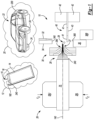
  • FIG. 1 is an illustration of an integrated process for forming internal welds of an electrochemical battery cell in accordance with the disclosure.
  • FIG. 2 is an illustration of a portion of the workstation of FIG. 1 illustrating a possible construction in which soft-touch guide clamps are used for guiding thin electrode foils of a battery cell toward a mating anvil and sonotrode, with the guide clamps possibly defining optional air channels for directing a pressurized airflow onto the electrode foils.
  • FIGS. 3 A and 3 B illustrate an optional tension relief mechanism that displaces the electrode foils by a small, predetermined distance to relieve tension on the electrode foils during the described integrated process.
  • FIG. 4 is an illustration of the integrated process of FIG. 1 .
  • FIG. 5 is an illustration of an optional multi-sided sonotrode in accordance with an aspect of the disclosure.
  • a component that is “configured to” perform a specified function is capable of performing the specified function without alteration, rather than merely having potential to perform the specified function after further modification.
  • the described hardware, when expressly configured to perform the specified function is specifically selected, created, implemented, utilized, programmed, and/or designed for the purpose of performing the specified function.
  • FIG. 1 depicts an integrated workstation 10 configured for performing an integrated trimming and internal welding process during manufacturing of an electrochemical battery cell 12 .
  • the present teachings contemplate a streamlined performance of multiple traditionally separate or sequential processes at a single workstation.
  • implementations of the disclosed methodology combine clamping, optional pre-welding, electrode foil trimming, lead tab placement, and main welding processes in one or more embodiments, with such a single-station methodology being enabled by the hardware innovations described below.
  • the solutions provided below therefore may be used to manufacture the battery cells 12 in a more efficient manner, especially in terms of manufacturing space and process time.
  • the battery cell 12 as contemplated herein e.g., a lithium-ion battery cell, includes a cell body 14 and an outer casing or pouch 16 constructed of laminated foil or another suitable composition.
  • the present teachings are not limited to batteries having lithium-ion chemistries, however, and therefore lithium-ion is just one possible construction of the battery cell 12 .
  • the battery cell 12 has positive and negative external electrode tabs 15 that protrude from a perimeter edge 160 of the pouch 16 .
  • the electrode tabs 15 which may be constructed from copper, aluminum, or another application-suitable metal, allow several of the battery cells 12 to be arranged in a stack and conductively joined together in a series or parallel arrangement, e.g., using one or more bus bars or interconnecting members (not shown) when constructing a battery pack having an application-suitable output voltage.
  • a plurality of the battery cells 12 may be joined together to form a propulsion battery pack 18 for an electrified powertrain system 20 , e.g., a motor vehicle 22 having a vehicle body 200 connected to one or more road wheels 24 .
  • the motor vehicle 22 may be optionally embodied as a battery electric vehicle as shown, or as a hybrid electric vehicle.
  • the electrified powertrain system 20 may be used as part of another mobile system such as but not limited to a rail vehicle, aircraft, marine vessel, robot, farm equipment, etc.
  • the electrified powertrain system 20 may be stationary, such as in the case of an electric powerplant, hoist, drive belt, or conveyor system. Therefore, the electrified powertrain system 20 in the representative vehicular embodiment of FIG. 1 is intended to be illustrative of the present teachings and not limiting thereof.
  • the propulsion battery pack 18 when using the propulsion battery pack 18 to power one or more single-phase or polyphase/alternating current devices such as a typical propulsion or traction motor, the propulsion battery pack 18 is connected to a power inverter (not shown), such that a voltage and current from the discharging battery cells 12 of the propulsion battery pack 18 is ultimately provided to the power inverter.
  • a set of semiconductor switches residing within the power inverter are controlled via pulse width modulation, pulse density modulation, or other suitable switching control techniques to invert a DC input voltage into an AC output voltage suitable for energizing such motors. High-speed switching of the resident semiconductor switches of the power inverter thus ultimately cause the motor(s) to deliver a motor drive torque to one or more of the road wheels 24 in the illustrated vehicular embodiment of FIG. 1 , or to another coupled mechanical load in other implementations.
  • internal welds therewithin may be constructed using the illustrated integrated workstation 10 .
  • the integrated workstation 10 may be used to perform a one-step welding process that integrates main welding and electrode foil trimming processes while eliminating a pre-welding process, or to perform a two-step welding process which integrates the pre-welding and electrode foil trimming processes followed by performance of the main welding process.
  • a one-step welding process that integrates main welding and electrode foil trimming processes while eliminating a pre-welding process
  • a two-step welding process which integrates the pre-welding and electrode foil trimming processes followed by performance of the main welding process.
  • the cell body 14 encloses electrode foils 28 that protrude from an edge 240 of the cell body 14 .
  • the cell body 14 is arranged between respective upper and lower sections 26 U and 26 L of a clamping fixture 26 , with the clamping fixture 26 configured for positioning the cell body 14 in a predetermined orientation. In this orientation, distal ends 280 of the electrode foils 28 extend outward from the clamping fixture 26 .
  • electromechanical, hydraulic, or pneumatic actuators may apply a clamping force (arrows Fc) to the upper and lower sections 26 U and 26 L of the clamping fixture 26 .
  • the clamping fixture 26 thus gently and securely holds and retains the cell body 14 in the indicated orientation.
  • a longitudinal center axis 140 of the cell body 14 is arranged in a generally horizontal manner relative to a plant floor surface (not shown).
  • the electrode foils 28 are presented toward a curvilinear guide clamp 30 constructed as set forth below with reference to FIGS. 2 - 4 .
  • the curvilinear guide clamp 30 in the exemplary construction of FIG. 2 includes opposing sections 30 A and 30 B configured to gently clamp the electrode foils 28 therebetween and also cause the electrode foils 28 to smoothly taper into an electrode foil stack 27 .
  • a trim tool 32 e.g., a laser beam or a hard cutter such as a sharpened blade operable for trimming the distal ends 280 of the electrode foils 28 during a trimming process.
  • the 1 also includes a vibrating welding horn or sonotrode 34 and an anvil 36 , with the anvil 36 connected to, formed integrally with, or placed adjacent to a trim block 36 B.
  • the anvil 36 is positioned opposite the sonotrode 34 on adjacent opposite surfaces of the electrode foil stack 27 , and may be optionally heated via a heating source 38 as described below with reference to FIG. 4 .
  • the sonotrode 34 of FIG. 1 as understood in the art is configured to vibrate at ultrasonic or higher frequencies and thereby weld the electrode foil stack 27 to a conductive lead tab 40 of the battery cell 12 .
  • the integrated workstation 10 is configured to form a welded joint within the battery cell 12 , i.e., an internal weld.
  • the sonotrode 34 may have a multi-sided knurl pattern for heated crimping, ultrasonic pre-welding, and final welding. An exemplary approach for implementing a representative multi-sided variant of the sonotrode 34 is described below with particular reference to FIG. 5 .
  • the conductive lead tab 40 may be secured between robotic fingers 42 of a robot (not shown) or within a suitable fixture and positioned adjacent to the oriented electrode foil stack 27 . Portions of the conductive lead tab 40 may be encased or coated in a film 43 , e.g., for handling and protection, with uncoated portions 41 used to form the above-noted welded joint via the method 100 .
  • the clamp actuator 39 which is shown schematically for illustrative simplicity, may be embodied as an electrical, electromechanical, hydraulic, or pneumatic device as appreciated in the art.
  • a radiused surface 35 of the curvilinear guide clamp 30 gently contacts the electrode foils 28 protruding from the edge 240 of the cell body 14 .
  • the electrode foils 28 are very thin, e.g., about six microns to about fifteen microns (6-15 ⁇ ), and thus are quite delicate and prone to damage during the manufacturing process.
  • the radiused surface 35 of the curvilinear guide clamp 30 may be constructed from a soft, resilient polymer material such as an open-cell polymer or foam material.
  • “resilient” entails the capability of gently compressing against the electrode foils 28 and then returning to an uncompressed state when the electrode foils 28 are released.
  • the materials of the radiused surface 35 would gently compress or yield as the clamp actuator 39 translates the opposing sections 30 A and 30 B into contact with the electrode foils 28 , thereby protecting the electrode foils 28 from damage during this portion of the overall process.
  • the curvilinear guide clamp 30 may optionally define respective air channels 33 , e.g., one or more tubular openings passing through the opposing sections 32 A and 32 B as shown.
  • a blower 44 such as a motorized fan assembly is coupled to the air channels 33 and configured to direct a pressurized airflow (arrows AA) into a fluid inlet 330 of the air channels 33 , through the air channels 33 , and through a fluid outlet 430 .
  • the pressurized airflow (arrows AA) ultimately contacts the distal ends 280 of the electrode foils 28 .
  • Use of the pressurized airflow (arrows AA) in this manner is intended to help to maintain a desired alignment of the electrode foil stack 27 .
  • the escaping airstream through the fluid outlets 430 gently blows onto and across the electrode foils 28 with sufficient air pressure to gently orient the electrode foils 28 and ensure top/bottom foils of the presented electrode foil stack 27 are unfolded and substantially flat or aligned.
  • the method described herein may include clamping the electrode foils 28 in the curvilinear guide clamp 30 as described above ( FIG. 3 A ), with the shape, contours, and materials of the curvilinear guide clamp 30 helping to reduce the probability of bent foil issues and other manufacturing issues as set forth above. Aspects of the method contemplated herein may further include translating the curvilinear guide clamp 30 by a predetermined distance ( ⁇ X) toward the clamp fixture 26 or the cell body 14 as best shown in FIG.
  • ⁇ X predetermined distance
  • the linear actuator 50 applies a force (arrows FT) to the curvilinear guide clamp 30 sufficient for displacing the distal ends 280 and the electrode foils 28 by the predetermined distance ( ⁇ X).
  • Representative implementations include a predetermined distance ( ⁇ X) of less than or equal to about 1.0 millimeters (mm) and greater than or equal to about 0.10 mm in a possible implementation, or about 0.2 mm to about 0.5 mm, or about 0.3 mm to about 0.4 mm in different implementations.
  • ⁇ X predetermined distance
  • Such minute movements will tend to reduce tension on the fragile electrode foils 28 , particularly in the middlemost layers of the electrode stack 27 , thus minimizing the possibility of damage to the electrode foils 28 during the subsequent ultrasonic welding process.
  • the trim tool 32 may be connected to the sonotrode 34 such that the trim tool 32 moves toward the anvil 36 , or more specifically the trim block 36 B of FIG. 1 , in conjunction with movement of the sonotrode 34 .
  • Such movement is represented in FIG. 4 by arrow BB.
  • the trim tool 32 need not be connected to the sonotrode 34 in other configurations, it may be more efficient in terms of economy of motion to connect to the trim tool 32 to the sonotrode 34 when performing the present method during manufacturing of the battery cell 12 of FIG. 1 .
  • the trim tool 32 is thus used to perform a trimming process in which unused portions 380 of the electrode foils 28 are cleanly severed to form the distal ends 280 .
  • the unused portions 380 are then disposed of as scrap material.
  • the integrated workstation 10 may include the optional heating source 38 , e.g., a resistive heating element such as a conductive wire or coil, a fluidic heating source such as oil that is circulated through internal channels (not shown) in the anvil 36 , or another suitable implementation allowing for internal heating of the anvil 36 , and thus indirect heating of the metals forming the workpiece.
  • the heating source 38 which may be operatively connected to or integral with the anvil 36 as shown schematically in FIG. 4 , is thus operable for heating the anvil 36 , particularly around working surfaces thereof.
  • Heating the anvil 36 to about 175 degrees Celsius (° C.) to about 225° C., or to about 200° C., may help reduce the required force or energy for ultrasonic pre-welding of the electrode foils 28 together to form the electrode stack 27 . That is, “pre-welding” as contemplated herein involves forming the electrode foils 28 into the electrode stack 27 before welding the electrode stack to the lead tab 40 (“final welding”). Use of applied heat in this manner in turn reduces the propensity for fracture of the electrode foils 28 , particularly near the sonotrode 34 .
  • the method described above may be performed without heating the anvil 36 , e.g., by instead heating the conductive lead tab 40 and/or one or more of the electrode foils 28 using an external heating source 138 .
  • the external heating source 138 e.g., a laser or a heat lamp operable for emitting heat energy (HH) toward the conductive lead tab 40 and/or the distal ends 280 , may be situated in close proximity to the main tab 40 and the electrode foils 28 as shown.
  • the external heating source 138 is usable alone or in conjunction with the heating source 38 of the anvil 36 .
  • a working surface of the sonotrode 34 may have the knurled pattern 340 to enhance heated pre-welding and final welding, e.g., by helping to distribute heat to the affected surfaces of the electrode foils 28 .
  • the anvil 36 may have a similar knurled pattern 360 in some embodiments to achieve the same ends.
  • a multi-sided welding horn when forming the various ultrasonic welds, for instance during pre-welding and main welding.
  • Such welds may require different knurl patterns.
  • running the two welding processes on the same welding machine would require rotation of the welding machine and use of a separate sonotrode 34 and anvil 36 , or the use of a special welding machine having two different anvils 36 and a multi-sided sonotrode.
  • the present integrated strategy may be achieved at a single integrated workstation in some embodiments using the latter solution.
  • an integrated workstation 10 A having a welding machine 60 , a rotatable multi-sided sonotrode 134 , and first and second anvils 136 A and 136 B.
  • the sonotrode 134 has an axis of rotation 234 about which the welding machine 60 is operable for rotating the sonotrode 134 to present either: (1) the first anvil 136 A and a first knurl pattern 340 A, or (2) a second anvil 136 B and a second knurl pattern 340 B.
  • the respective first and second knurl patterns 340 A and 340 B are configured for a given welding process, e.g., the second knurl pattern 340 B may be used for pre-welding, and thus could be less pronounced, bumpy, or penetrating than the first knurl pattern 340 A.
  • the first knurl pattern 340 A may be configured to perform a main welding process, and thus may have larger, bumpier, or more penetrating knurls relative to the second knurl pattern 340 B.
  • one side of the sonotrode 134 of FIG. 5 may be rotated into place and used for the pre-welding process, followed by rotation of the sonotrode 134 prior to performing the main welding process.
  • positioning the sonotrode 134 and the anvil 136 A or 136 B adjacent opposite surfaces of the electrode foil stack 27 may include rotating the multi-sided sonotrode 134 to present a predetermined one of the different knurl patterns 340 A or 340 B adjacent to the electrode foil stack 27 .
  • a single-sided sonotrode 34 (see FIG. 1 ) may be used, which may require detachment and replacement of the sonotrode 34 and possibly the anvil 36 when transitioning between pre-welding and main welding processes. While two sides are shown in FIG. 5 , those skilled in the art will appreciate that additional sides would be provided, e.g., for reduced wear.
  • the integrated workstation 10 is thus suitable for use in performing a method for manufacturing the battery cell 12 , which in turn has plurality of electrode foils 28 protruding from the cell body 14 .
  • An embodiment of such a method may include positioning the cell body 14 in the clamping fixture 26 such that distal ends 280 of the electrode foils 28 extend outward from the fixture 26 , and then gently clamping or positioning the distal ends 280 of the electrode foils 28 between the opposing sections 30 A and 30 B of the curvilinear guide clamp 30 . In this manner the curvilinear guide clamp 30 causes the distal ends 280 to smoothly curve or taper into the electrode foil stack 27 .
  • a possible implementation of the present teachings includes translating the curvilinear guide clamp 30 a predetermined distance ( ⁇ X) toward the clamping fixture 26 to slightly displace the distal ends 280 , and then trimming the unused portions 380 ( FIG. 4 ) of the distal ends 280 using the above-described trim tool 32 in its various embodiments.
  • the sonotrode 34 and the anvil 36 are positioned adjacent opposite surfaces of the electrode foil stack 27 .
  • the disclosed methodology in this embodiment may include trimming the electrode foils 28 to form the distal ends 280 using the trim tool 32 . This may occur either concurrently or sequentially with ultrasonically welding the electrode foil stack 27 to the conductive lead tab 40 .
  • the present method may include ultrasonically welding the electrode foil stack 27 to the conductive lead tab 40 using the sonotrode 34 to thereby form a welded joint within the battery cell 12 , which may optionally occur at the same time as the above-described trimming process or sequentially therewith.
  • the method 100 could entail directing the pressurized airflow (arrows AA) through the respective air channels 33 and onto the distal end sections 280 .
  • the method 100 may include heating the anvil 36 or the electrode foils 28 via the heating source 38 and/or 380 prior to and/or during ultrasonically welding the electrode foil stack 27 .
  • the method described herein may be performed at a single workstation, e.g., the integrated workstation 10 of FIG. 1 .
  • Such a method may be characterized by an absence of pre-welding of the electrode foils 28 to each other prior to ultrasonically welding the electrode foil stack 27 to the conductive lead tab 40 .
  • main welding and trimming of the electrode foils 28 may occur in a one-step implementation.
  • one may integrate pre-welding with trimming and perform main welding as a separate subsequent step.

Landscapes

  • Engineering & Computer Science (AREA)
  • Chemical & Material Sciences (AREA)
  • Chemical Kinetics & Catalysis (AREA)
  • Electrochemistry (AREA)
  • General Chemical & Material Sciences (AREA)
  • Mechanical Engineering (AREA)
  • Physics & Mathematics (AREA)
  • Optics & Photonics (AREA)
  • Manufacturing & Machinery (AREA)
  • Plasma & Fusion (AREA)
  • Materials Engineering (AREA)
  • Connection Of Batteries Or Terminals (AREA)

Abstract

A method for manufacturing a battery cell having electrode foils protruding from a cell pouch includes positioning the cell pouch in a fixture such that distal end sections of the foils extend outward from the fixture. The method includes clamping the distal end sections in a curvilinear guide clamp to cause the distal end sections to taper into an electrode foil stack, and then translating the clamp a predetermined distance toward the fixture to displace the distal end sections by the predetermined distance. The method also includes trimming the distal end sections using a trim tool, positioning a sonotrode and an anvil adjacent opposite surfaces of the stack, and ultrasonically welding the stack to a conductive lead tab using the sonotrode to thereby form a welded joint within the battery cell. The sonotrode may be multi-sided with different knurl patterns for performing different welding processes.

Description

INTRODUCTION
Electrochemical battery cells and battery packs constructed from such battery cells are used as direct current (DC) power supplies in a myriad of high-power battery electric systems. An electric vehicle, for instance, includes a high-voltage propulsion battery pack having an application-suitable number of cylindrical, prismatic, or pouch-style battery cells. The battery pack, which is connected to a DC voltage bus, ultimately powers one or more electric propulsion motors and associated power electronic components during battery discharging modes. During battery charging modes, a charging current is provided to the constituent battery cells of the battery pack, e.g., from an offboard charging station or via onboard regeneration. Rechargeable lithium-ion batteries in particular operate by reversibly passing lithium ions back and forth through the separator and electrodes in such a construction. Grouped battery cells may be connected in series or parallel through use of an electrical interconnect board assembly, which in turn contains various electrical buses, cell sensing hardware, and power electronics necessary for operating the battery pack.
Propulsion battery packs suitable for use with electric vehicles and other high-power battery electric systems commonly utilize the noted lithium-ion battery chemistry, or other suitable chemistries such as nickel metal hydride, to produce the requisite electricity for energizing the propulsion motor(s) and other electrical components. A standard pouch-style lithium-ion cell is generally composed of working electrode foils and a permeable separator, which are surrounded by an electrolyte material. The various battery components are collectively enclosed within an electrically-insulated outer pouch. Respective positive and negative electrodes function as the cathode and anode of an assembled battery cell. A stack of thin electrode foils may be arranged in a cell body enclosed within the outer pouch in a typical construction. Such electrode foils in turn are internally welded within the pouch to a conductive lead tab that protrudes from pouch and is ultimately welded to a bus bar or other interconnecting member when constructing the battery pack.
SUMMARY
Disclosed herein are methods and systems for manufacturing an electrochemical battery cell for a battery pack. The battery cell in a possible embodiment has an outer pouch containing a cell body therein, with the cell body in turn enclosing and protecting thin metal electrode foils. Ends of the electrode foils protrude from an edge of the cell body. In particular, the present teachings pertain to methods and systems for forming internal welds of the various electrode foils to a conductive lead tab within such a battery cell. The contemplated internal welds are thus “internal” in the sense of being located fully within a volume of the outer pouch, i.e., as opposed to being “external welds” of the above-noted lead tab to a conductive bus bar or interconnecting member of the battery pack as appreciated in the art. The present teachings contemplate a streamlined performance of multiple, traditionally sequential processes at a single workstation. For example, implementations of the disclosed methodology combine clamping, optional pre-welding, electrode foil trimming, lead tab placement, and main welding processes in one or more embodiments, with such a single-station methodology being enabled by the hardware innovations described below.
In particular, optional hardware implementations include: (1) a one-step internal welding process that integrates main welding and electrode foil trimming processes while eliminating the pre-welding process, and (2) a two-step welding process which integrates the pre-welding and electrode foil trimming processes followed by performance of the main welding process. Also disclosed herein are hardware options for optimizing the above-summarized processes, including direct and/or indirect heating of an anvil and/or the various metals of the subject workpiece, i.e., the lead tab and/or the electrode foils, the use of “soft touch” guide clamps with optional integral air channels for gently guiding the electrode foils toward the anvil and an accompanying welding horn or sonotrode, and an actuator for displacing the electrode foils by a predetermined distance to reduce tension on the electrode foils.
An aspect of the disclosure includes a method for manufacturing a battery cell having a plurality of electrode foils protruding from a cell body. The method may include positioning the cell body in a fixture such that distal end sections of the electrode foils extend outward from the fixture, and clamping the distal end sections of the electrode foils between resilient polymer surfaces of a curvilinear guide clamp to thereby cause the distal end sections to taper into an electrode foil stack. The method may also include translating the curvilinear guide clamp a predetermined distance toward the fixture to thereby displace the distal end sections by the predetermined distance. As part of this embodiment, the method includes trimming a portion of the distal end sections using a trim tool, positioning a sonotrode and an anvil adjacent opposite surfaces of the electrode foil stack, and ultrasonically welding the electrode foil stack to a conductive lead tab using the sonotrode to thereby form a welded joint within the battery cell.
The predetermined distance in one or more implementations is less than about 1.0 millimeters (mm) and greater than about 0.10 mm.
Opposing sections of the curvilinear guide clamp may define respective air channels, in which case the method may include directing pressurized airflow through the respective air channels and onto the distal end sections.
Another aspect of the disclosure includes heating the electrode foil stack, the conductive lead tab, and/or the anvil via a heating source at a predetermined time that is prior to and/or concurrently with ultrasonically welding the electrode foil stack.
The sonotrode in some embodiments is a multi-sided sonotrode having different knurl patterns on each respective side of the multi-sided sonotrode. Positioning the sonotrode and the anvil adjacent opposite surfaces of the electrode foil stack in such a case includes rotating a multi-sided sonotrode to present a predetermined one of the different knurl patterns adjacent to the electrode foil stack.
The method in some implementations may be characterized by an absence of pre-welding of the electrode foils prior to ultrasonically welding the electrode foil stack to the conductive lead tab.
Trimming the portion of the distal end sections using the trim tool could occur concurrently or sequentially with ultrasonically welding the electrode foil stack to the conductive lead tab. Moreover, the trim tool may be optionally connected to the sonotrode. In such a construction, the method may include trimming the portion of the distal end sections using the trim tool concurrently with movement of the sonotrode toward the anvil.
Also disclosed herein is a workstation for manufacturing a battery cell having a plurality of electrode foils protruding from a cell body. The workstation includes a fixture configured for positioning the cell body in a predetermined orientation such that distal end sections of the electrode foils extend outward from the fixture, and a curvilinear guide clamp configured to clamp the distal end sections of the electrode foils therebetween and thereby cause the distal end sections to taper into an electrode foil stack. The curvilinear guide clamp includes resilient polymer surfaces. An actuator is configured to translate the curvilinear guide clamp a predetermined distance of about 0.10 mm to about 1 mm toward the fixture to thereby displace the distal end sections by the predetermined distance. As part of this construction, a trim tool is operable for trimming a portion of the distal end sections. The workstation also includes a sonotrode and an anvil positioned opposite the sonotrode on adjacent opposite surfaces of the electrode foil stack. The sonotrode is configured to ultrasonically weld the electrode foil stack to a conductive lead tab to thereby form a welded joint within the battery cell.
Another aspect of the present disclosure includes a method for manufacturing a battery pack having a plurality of battery cells. Each respective one of the battery cells has electrode foils protruding from a cell pouch. The method according to an exemplary embodiment includes positioning the cell pouch in a fixture such that distal end sections of the electrode foils extend outward from the fixture, and then clamping the distal end sections of the electrode foils between resilient polymer surfaces of a curvilinear guide clamp to thereby cause the distal end sections to taper into an electrode foil stack. The curvilinear guide clamp defines air channels therein. The method may include directing a pressurized airflow through the respective air channels and onto the distal end sections to maintain a planar alignment of the electrode foil stack, as well as translating the curvilinear guide clamp a predetermined distance toward the fixture to thereby displace the distal end sections by the predetermined distance, wherein the predetermined distance is configured to reduce tension on the electrode foils.
The method additionally includes trimming a portion of the distal end sections using a trim tool, positioning a sonotrode and an anvil adjacent opposite surfaces of the electrode foil stack, such that a double-sided knurl pattern of the sonotrode is adjacent the electrode foil stack, and ultrasonically welding the electrode foil stack to a conductive lead tab using the sonotrode to thereby form a welded joint within the battery cell. A plurality of the battery cells is then connected together to construct the battery pack.
The above features and advantages, and other features and attendant advantages of this disclosure, will be readily apparent from the following detailed description of illustrative examples and modes for carrying out the present disclosure when taken in connection with the accompanying drawings and the appended claims. Moreover, this disclosure expressly includes combinations and sub-combinations of the elements and features presented above and below.
BRIEF DESCRIPTION OF THE DRAWINGS
The accompanying drawings, which are incorporated into and constitute a part of this specification, illustrate implementations of the disclosure which, taken together with the description, serve to explain the principles of the disclosure.
FIG. 1 is an illustration of an integrated process for forming internal welds of an electrochemical battery cell in accordance with the disclosure.
FIG. 2 is an illustration of a portion of the workstation of FIG. 1 illustrating a possible construction in which soft-touch guide clamps are used for guiding thin electrode foils of a battery cell toward a mating anvil and sonotrode, with the guide clamps possibly defining optional air channels for directing a pressurized airflow onto the electrode foils.
FIGS. 3A and 3B illustrate an optional tension relief mechanism that displaces the electrode foils by a small, predetermined distance to relieve tension on the electrode foils during the described integrated process.
FIG. 4 is an illustration of the integrated process of FIG. 1 .
FIG. 5 is an illustration of an optional multi-sided sonotrode in accordance with an aspect of the disclosure.
The appended drawings are not necessarily to scale, and may present a somewhat simplified representation of various preferred features of the present disclosure as disclosed herein, including, for example, specific dimensions, orientations, locations, and shapes. Details associated with such features will be determined in part by the particular intended application and use environment.
DETAILED DESCRIPTION
The present disclosure is susceptible of embodiment in many different forms. Representative examples of the disclosure are shown in the drawings and described herein in detail as non-limiting examples of the disclosed principles. To that end, elements and limitations described in the Abstract, Introduction, Summary, and Detailed Description sections, but not explicitly set forth in the claims, should not be incorporated into the claims, singly or collectively, by implication, inference, or otherwise.
For purposes of the present description, unless specifically disclaimed, use of the singular includes the plural and vice versa, the terms “and” and “or” shall be both conjunctive and disjunctive, and the words “including”, “containing”, “comprising”, “having”, and the like shall mean “including without limitation”. Moreover, words of approximation such as “about”, “almost”, “substantially”, “generally”, “approximately”, etc., may be used herein in the sense of “at, near, or nearly at”, or “within 0-5% of”, or “within acceptable manufacturing tolerances”, or logical combinations thereof. As used herein, a component that is “configured to” perform a specified function is capable of performing the specified function without alteration, rather than merely having potential to perform the specified function after further modification. In other words, the described hardware, when expressly configured to perform the specified function, is specifically selected, created, implemented, utilized, programmed, and/or designed for the purpose of performing the specified function.
Referring to the drawings, wherein like reference numbers refer to like features throughout the several views, FIG. 1 depicts an integrated workstation 10 configured for performing an integrated trimming and internal welding process during manufacturing of an electrochemical battery cell 12. As noted above, the present teachings contemplate a streamlined performance of multiple traditionally separate or sequential processes at a single workstation. For example, implementations of the disclosed methodology combine clamping, optional pre-welding, electrode foil trimming, lead tab placement, and main welding processes in one or more embodiments, with such a single-station methodology being enabled by the hardware innovations described below. The solutions provided below therefore may be used to manufacture the battery cells 12 in a more efficient manner, especially in terms of manufacturing space and process time.
The battery cell 12 as contemplated herein, e.g., a lithium-ion battery cell, includes a cell body 14 and an outer casing or pouch 16 constructed of laminated foil or another suitable composition. The present teachings are not limited to batteries having lithium-ion chemistries, however, and therefore lithium-ion is just one possible construction of the battery cell 12. In the representative configuration of FIG. 1 , the battery cell 12 has positive and negative external electrode tabs 15 that protrude from a perimeter edge 160 of the pouch 16. The electrode tabs 15, which may be constructed from copper, aluminum, or another application-suitable metal, allow several of the battery cells 12 to be arranged in a stack and conductively joined together in a series or parallel arrangement, e.g., using one or more bus bars or interconnecting members (not shown) when constructing a battery pack having an application-suitable output voltage.
In a representative use case, a plurality of the battery cells 12 may be joined together to form a propulsion battery pack 18 for an electrified powertrain system 20, e.g., a motor vehicle 22 having a vehicle body 200 connected to one or more road wheels 24. The motor vehicle 22 may be optionally embodied as a battery electric vehicle as shown, or as a hybrid electric vehicle. Alternatively, the electrified powertrain system 20 may be used as part of another mobile system such as but not limited to a rail vehicle, aircraft, marine vessel, robot, farm equipment, etc. Likewise, the electrified powertrain system 20 may be stationary, such as in the case of an electric powerplant, hoist, drive belt, or conveyor system. Therefore, the electrified powertrain system 20 in the representative vehicular embodiment of FIG. 1 is intended to be illustrative of the present teachings and not limiting thereof.
As appreciated by those skilled in the art, when using the propulsion battery pack 18 to power one or more single-phase or polyphase/alternating current devices such as a typical propulsion or traction motor, the propulsion battery pack 18 is connected to a power inverter (not shown), such that a voltage and current from the discharging battery cells 12 of the propulsion battery pack 18 is ultimately provided to the power inverter. A set of semiconductor switches residing within the power inverter are controlled via pulse width modulation, pulse density modulation, or other suitable switching control techniques to invert a DC input voltage into an AC output voltage suitable for energizing such motors. High-speed switching of the resident semiconductor switches of the power inverter thus ultimately cause the motor(s) to deliver a motor drive torque to one or more of the road wheels 24 in the illustrated vehicular embodiment of FIG. 1 , or to another coupled mechanical load in other implementations.
Regardless of the end use or application of the battery cell 12, internal welds therewithin may be constructed using the illustrated integrated workstation 10. In possible implementations, the integrated workstation 10 may be used to perform a one-step welding process that integrates main welding and electrode foil trimming processes while eliminating a pre-welding process, or to perform a two-step welding process which integrates the pre-welding and electrode foil trimming processes followed by performance of the main welding process. Each option will be described in turn below.
As shown in FIG. 1 , the cell body 14 encloses electrode foils 28 that protrude from an edge 240 of the cell body 14. The cell body 14 is arranged between respective upper and lower sections 26U and 26L of a clamping fixture 26, with the clamping fixture 26 configured for positioning the cell body 14 in a predetermined orientation. In this orientation, distal ends 280 of the electrode foils 28 extend outward from the clamping fixture 26. For instance, electromechanical, hydraulic, or pneumatic actuators (not shown) may apply a clamping force (arrows Fc) to the upper and lower sections 26U and 26L of the clamping fixture 26. The clamping fixture 26 thus gently and securely holds and retains the cell body 14 in the indicated orientation. In the representative orientation of FIG. 1 , a longitudinal center axis 140 of the cell body 14 is arranged in a generally horizontal manner relative to a plant floor surface (not shown).
In the illustrated orientation of the cell body 14, the electrode foils 28 are presented toward a curvilinear guide clamp 30 constructed as set forth below with reference to FIGS. 2-4 . The curvilinear guide clamp 30 in the exemplary construction of FIG. 2 , for instance, includes opposing sections 30A and 30B configured to gently clamp the electrode foils 28 therebetween and also cause the electrode foils 28 to smoothly taper into an electrode foil stack 27. Also depicted in FIG. 1 is a trim tool 32, e.g., a laser beam or a hard cutter such as a sharpened blade operable for trimming the distal ends 280 of the electrode foils 28 during a trimming process. The integrated workstation 10 of FIG. 1 also includes a vibrating welding horn or sonotrode 34 and an anvil 36, with the anvil 36 connected to, formed integrally with, or placed adjacent to a trim block 36B. In the illustrated configuration, the anvil 36 is positioned opposite the sonotrode 34 on adjacent opposite surfaces of the electrode foil stack 27, and may be optionally heated via a heating source 38 as described below with reference to FIG. 4 .
The sonotrode 34 of FIG. 1 as understood in the art is configured to vibrate at ultrasonic or higher frequencies and thereby weld the electrode foil stack 27 to a conductive lead tab 40 of the battery cell 12. In this manner the integrated workstation 10 is configured to form a welded joint within the battery cell 12, i.e., an internal weld. In a possible construction, the sonotrode 34 may have a multi-sided knurl pattern for heated crimping, ultrasonic pre-welding, and final welding. An exemplary approach for implementing a representative multi-sided variant of the sonotrode 34 is described below with particular reference to FIG. 5 . Additionally, the conductive lead tab 40 may be secured between robotic fingers 42 of a robot (not shown) or within a suitable fixture and positioned adjacent to the oriented electrode foil stack 27. Portions of the conductive lead tab 40 may be encased or coated in a film 43, e.g., for handling and protection, with uncoated portions 41 used to form the above-noted welded joint via the method 100.
Referring now to FIG. 2 , the opposing sections 30A and 30B of the curvilinear guide clamp 30 in one or more embodiments are moved together via a clamp actuator 39. The clamp actuator 39, which is shown schematically for illustrative simplicity, may be embodied as an electrical, electromechanical, hydraulic, or pneumatic device as appreciated in the art. A radiused surface 35 of the curvilinear guide clamp 30 gently contacts the electrode foils 28 protruding from the edge 240 of the cell body 14. The electrode foils 28 are very thin, e.g., about six microns to about fifteen microns (6-15μ), and thus are quite delicate and prone to damage during the manufacturing process. To protect the electrode foils 28, therefore, the radiused surface 35 of the curvilinear guide clamp 30 may be constructed from a soft, resilient polymer material such as an open-cell polymer or foam material. As used herein, “resilient” entails the capability of gently compressing against the electrode foils 28 and then returning to an uncompressed state when the electrode foils 28 are released. In other words, the materials of the radiused surface 35 would gently compress or yield as the clamp actuator 39 translates the opposing sections 30A and 30B into contact with the electrode foils 28, thereby protecting the electrode foils 28 from damage during this portion of the overall process.
Additionally, the curvilinear guide clamp 30 may optionally define respective air channels 33, e.g., one or more tubular openings passing through the opposing sections 32A and 32B as shown. In this embodiment, a blower 44 such as a motorized fan assembly is coupled to the air channels 33 and configured to direct a pressurized airflow (arrows AA) into a fluid inlet 330 of the air channels 33, through the air channels 33, and through a fluid outlet 430. The pressurized airflow (arrows AA) ultimately contacts the distal ends 280 of the electrode foils 28. Use of the pressurized airflow (arrows AA) in this manner is intended to help to maintain a desired alignment of the electrode foil stack 27. That is, the escaping airstream through the fluid outlets 430 gently blows onto and across the electrode foils 28 with sufficient air pressure to gently orient the electrode foils 28 and ensure top/bottom foils of the presented electrode foil stack 27 are unfolded and substantially flat or aligned.
Referring to FIGS. 3A and 3B, it is desirable during the performance of the method 100 of FIG. 1 to minimize tension on the electrode foils 28. In a possible embodiment, therefore, the method described herein may include clamping the electrode foils 28 in the curvilinear guide clamp 30 as described above (FIG. 3A), with the shape, contours, and materials of the curvilinear guide clamp 30 helping to reduce the probability of bent foil issues and other manufacturing issues as set forth above. Aspects of the method contemplated herein may further include translating the curvilinear guide clamp 30 by a predetermined distance (ΔX) toward the clamp fixture 26 or the cell body 14 as best shown in FIG. 3B, e.g., using a linear actuator 50 having a range of motion limited to the predetermined distance (ΔX). In this manner the linear actuator 50 applies a force (arrows FT) to the curvilinear guide clamp 30 sufficient for displacing the distal ends 280 and the electrode foils 28 by the predetermined distance (ΔX).
Representative implementations include a predetermined distance (ΔX) of less than or equal to about 1.0 millimeters (mm) and greater than or equal to about 0.10 mm in a possible implementation, or about 0.2 mm to about 0.5 mm, or about 0.3 mm to about 0.4 mm in different implementations. Such minute movements will tend to reduce tension on the fragile electrode foils 28, particularly in the middlemost layers of the electrode stack 27, thus minimizing the possibility of damage to the electrode foils 28 during the subsequent ultrasonic welding process.
Referring now to FIG. 4 , in one or more embodiments of the integrated workstation 10, the trim tool 32 noted briefly hereinabove may be connected to the sonotrode 34 such that the trim tool 32 moves toward the anvil 36, or more specifically the trim block 36B of FIG. 1 , in conjunction with movement of the sonotrode 34. Such movement is represented in FIG. 4 by arrow BB. While the trim tool 32 need not be connected to the sonotrode 34 in other configurations, it may be more efficient in terms of economy of motion to connect to the trim tool 32 to the sonotrode 34 when performing the present method during manufacturing of the battery cell 12 of FIG. 1 . The trim tool 32 is thus used to perform a trimming process in which unused portions 380 of the electrode foils 28 are cleanly severed to form the distal ends 280. The unused portions 380 are then disposed of as scrap material.
Additionally, the integrated workstation 10 may include the optional heating source 38, e.g., a resistive heating element such as a conductive wire or coil, a fluidic heating source such as oil that is circulated through internal channels (not shown) in the anvil 36, or another suitable implementation allowing for internal heating of the anvil 36, and thus indirect heating of the metals forming the workpiece. The heating source 38, which may be operatively connected to or integral with the anvil 36 as shown schematically in FIG. 4 , is thus operable for heating the anvil 36, particularly around working surfaces thereof. Heating the anvil 36 to about 175 degrees Celsius (° C.) to about 225° C., or to about 200° C., may help reduce the required force or energy for ultrasonic pre-welding of the electrode foils 28 together to form the electrode stack 27. That is, “pre-welding” as contemplated herein involves forming the electrode foils 28 into the electrode stack 27 before welding the electrode stack to the lead tab 40 (“final welding”). Use of applied heat in this manner in turn reduces the propensity for fracture of the electrode foils 28, particularly near the sonotrode 34.
Those skilled in the art will appreciate that the method described above may be performed without heating the anvil 36, e.g., by instead heating the conductive lead tab 40 and/or one or more of the electrode foils 28 using an external heating source 138. In such embodiments, the external heating source 138, e.g., a laser or a heat lamp operable for emitting heat energy (HH) toward the conductive lead tab 40 and/or the distal ends 280, may be situated in close proximity to the main tab 40 and the electrode foils 28 as shown. The external heating source 138 is usable alone or in conjunction with the heating source 38 of the anvil 36. As noted above, a working surface of the sonotrode 34 may have the knurled pattern 340 to enhance heated pre-welding and final welding, e.g., by helping to distribute heat to the affected surfaces of the electrode foils 28. The anvil 36 may have a similar knurled pattern 360 in some embodiments to achieve the same ends.
Referring briefly to FIG. 5 , it may be advantageous to use a multi-sided welding horn when forming the various ultrasonic welds, for instance during pre-welding and main welding. Such welds may require different knurl patterns. In the context of the present disclosure, running the two welding processes on the same welding machine would require rotation of the welding machine and use of a separate sonotrode 34 and anvil 36, or the use of a special welding machine having two different anvils 36 and a multi-sided sonotrode. The present integrated strategy may be achieved at a single integrated workstation in some embodiments using the latter solution.
In particular, an integrated workstation 10A is shown having a welding machine 60, a rotatable multi-sided sonotrode 134, and first and second anvils 136A and 136B. The sonotrode 134 has an axis of rotation 234 about which the welding machine 60 is operable for rotating the sonotrode 134 to present either: (1) the first anvil 136A and a first knurl pattern 340A, or (2) a second anvil 136B and a second knurl pattern 340B. The respective first and second knurl patterns 340A and 340B are configured for a given welding process, e.g., the second knurl pattern 340B may be used for pre-welding, and thus could be less pronounced, bumpy, or penetrating than the first knurl pattern 340A. Likewise, the first knurl pattern 340A may be configured to perform a main welding process, and thus may have larger, bumpier, or more penetrating knurls relative to the second knurl pattern 340B. Thus, one side of the sonotrode 134 of FIG. 5 may be rotated into place and used for the pre-welding process, followed by rotation of the sonotrode 134 prior to performing the main welding process. The sonotrode 134 is then translated away from the stack before moving the trim tool 32 into place. Thus, positioning the sonotrode 134 and the anvil 136A or 136B adjacent opposite surfaces of the electrode foil stack 27 may include rotating the multi-sided sonotrode 134 to present a predetermined one of the different knurl patterns 340A or 340B adjacent to the electrode foil stack 27. Alternatively, a single-sided sonotrode 34 (see FIG. 1 ) may be used, which may require detachment and replacement of the sonotrode 34 and possibly the anvil 36 when transitioning between pre-welding and main welding processes. While two sides are shown in FIG. 5 , those skilled in the art will appreciate that additional sides would be provided, e.g., for reduced wear.
Returning to FIG. 1 , the integrated workstation 10 is thus suitable for use in performing a method for manufacturing the battery cell 12, which in turn has plurality of electrode foils 28 protruding from the cell body 14. An embodiment of such a method may include positioning the cell body 14 in the clamping fixture 26 such that distal ends 280 of the electrode foils 28 extend outward from the fixture 26, and then gently clamping or positioning the distal ends 280 of the electrode foils 28 between the opposing sections 30A and 30B of the curvilinear guide clamp 30. In this manner the curvilinear guide clamp 30 causes the distal ends 280 to smoothly curve or taper into the electrode foil stack 27. A possible implementation of the present teachings includes translating the curvilinear guide clamp 30 a predetermined distance (ΔX) toward the clamping fixture 26 to slightly displace the distal ends 280, and then trimming the unused portions 380 (FIG. 4 ) of the distal ends 280 using the above-described trim tool 32 in its various embodiments.
As part of the method 100, the sonotrode 34 and the anvil 36 are positioned adjacent opposite surfaces of the electrode foil stack 27. The disclosed methodology in this embodiment may include trimming the electrode foils 28 to form the distal ends 280 using the trim tool 32. This may occur either concurrently or sequentially with ultrasonically welding the electrode foil stack 27 to the conductive lead tab 40. Thus, the present method may include ultrasonically welding the electrode foil stack 27 to the conductive lead tab 40 using the sonotrode 34 to thereby form a welded joint within the battery cell 12, which may optionally occur at the same time as the above-described trimming process or sequentially therewith.
In constructions of the curvilinear guide clamp 30 in which the opposing sections 30A and 30B define the air channels 33, the method 100 could entail directing the pressurized airflow (arrows AA) through the respective air channels 33 and onto the distal end sections 280. Likewise, the method 100 may include heating the anvil 36 or the electrode foils 28 via the heating source 38 and/or 380 prior to and/or during ultrasonically welding the electrode foil stack 27.
The method described herein may be performed at a single workstation, e.g., the integrated workstation 10 of FIG. 1 . Such a method may be characterized by an absence of pre-welding of the electrode foils 28 to each other prior to ultrasonically welding the electrode foil stack 27 to the conductive lead tab 40. In other words, main welding and trimming of the electrode foils 28 may occur in a one-step implementation. Alternatively, one may integrate pre-welding with trimming and perform main welding as a separate subsequent step. These and other attendant benefits will be readily appreciated by those skilled in the art in view of the foregoing disclosure.
The detailed description and the drawings or figures are supportive and descriptive of the present teachings, but the scope of the present teachings is defined solely by the claims. While some of the best modes and other embodiments for carrying out the present teachings have been described in detail, various alternative designs and embodiments exist for practicing the present teachings defined in the appended claims. Moreover, this disclosure expressly includes combinations and sub-combinations of the elements and features presented above and below.

Claims (20)

What is claimed is:
1. A method for manufacturing a battery cell using a workstation, the battery cell having a plurality of electrode foils protruding from a cell body, the method comprising:
positioning the cell body in a fixture of the workstation such that distal end sections of the electrode foils extend outward from the fixture;
clamping the distal end sections of the electrode foils between resilient polymer surfaces of a curvilinear guide clamp of the workstation to cause the distal end sections of the electrode foils to taper into an electrode foil stack;
translating the curvilinear guide clamp by a predetermined distance toward the fixture to displace the distal end sections of the electrode foils by the predetermined distance;
trimming a portion of the distal end sections of the electrode foils by using a trim tool of the workstation;
positioning a sonotrode and an anvil of the workstation adjacent to opposite surfaces of the electrode foil stack; and
ultrasonically welding the electrode foil stack to a conductive lead tab of the battery cell using the sonotrode to form a welded joint within the battery cell.
2. The method of claim 1, wherein the translating the curvilinear guide clamp by the predetermined distance toward the fixture further comprises translating the curvilinear guide clamp by 0.1 millimeters (mm) to 1.0 millimeters (mm).
3. The method of claim 1, the method further comprising:
directing pressurized airflow through respective air channels of opposing sections of the curvilinear guide clamp and onto the distal end sections of the electrode foil stack to maintain a planar alignment of the electrode foil stack.
4. The method of claim 1, further comprising:
heating one or more of the electrode foil stack, the conductive lead tab or the anvil via a heating source of the workstation prior to or concurrently with the ultrasonically welding the electrode foil stack.
5. The method of claim 1, wherein the positioning the sonotrode and the anvil adjacent opposite surfaces of the electrode foil stack further comprises rotating a multi-sided sonotrode to present a predetermined one of a plurality of different knurl patterns of the multi-sided sonotrode adjacent to the electrode foil stack.
6. The method of claim 1, wherein the ultrasonically welding the electrode foil stack to the conductive lead tab occurs without pre-welding of the electrode foils.
7. The method of claim 1, wherein the trimming the portion of the distal end sections using the trim tool occurs concurrently or sequentially with the ultrasonically welding the electrode foil stack to the conductive lead tab.
8. The method of claim 1,
wherein the trimming the portion of the distal end sections using the trim tool occurs concurrently with a movement of the sonotrode toward the anvil.
9. The method of claim 1, wherein the trimming the portion of the distal end sections using the trim tool of the workstation occurs concurrently with movement of the sonotrode of the workstation toward the anvil of the workstation.
10. A method for manufacturing a battery pack using a workstation, the battery pack having a plurality of battery cells, each respective one of the battery cells having electrode foils protruding from a cell pouch, the method comprising:
positioning the cell pouch in a fixture of the workstation such that distal end sections of the electrode foils extend outward from the fixture;
clamping the distal end sections of the electrode foils between resilient polymer surfaces of a curvilinear guide clamp of the workstation to cause the distal end sections of the electrode foils to taper into an electrode foil stack;
directing a pressurized airflow through respective air channels of the curvilinear guide clamp and onto the distal end sections to maintain a planar alignment of the electrode foil stack;
translating the curvilinear guide clamp toward the fixture to displace the distal end sections by a predetermined distance, wherein the predetermined distance is configured to reduce tension on the electrode foils;
trimming a portion of the distal end sections of the electrode foils using a trim tool of the workstation;
positioning a sonotrode and an anvil of the workstation adjacent opposite surfaces of the electrode foil stack, such that a double-sided knurl pattern of the sonotrode is adjacent the electrode foil stack;
ultrasonically welding the electrode foil stack to a conductive lead tab of the battery cell by using the sonotrode to obtain a welded joint within the battery cell; and
connecting the plurality of the battery cells together to form the battery pack.
11. The method of claim 10, further comprising:
heating the conductive lead tab, the electrode foil stack, and the anvil via a heating source prior to ultrasonically welding the electrode foil stack.
12. The method of claim 10, wherein the positioning the sonotrode and the anvil adjacent to opposite surfaces of the electrode foil stack includes rotating a multi-sided sonotrode to present a knurl pattern of a multi-sided sonotrode adjacent to the electrode foil stack.
13. The method of claim 10, wherein the translating the curvilinear guide clamp toward the fixture to displace the distal end sections by the predetermined distance further comprises translating the curvilinear guide clamp by 0.1 to 1.0 millimeters (mm).
14. The method of claim 12, the method further comprising:
using the trim tool to trim the electrode foil stack concurrently with ultrasonically welding the electrode foil stack to the conductive lead tab using the sonotrode.
15. A method for manufacturing a lithium ion battery cell using a workstation, the lithium ion battery cell having a plurality of electrode foils protruding from a pouch, the method comprising:
providing the workstation, the workstation comprising a clamping fixture, a trim tool, a curvilinear guide clamp, a heating source, an anvil, and a sonotrode;
positioning the pouch of the lithium ion battery cell in the clamping fixture of the workstation such that distal end sections of the electrode foils extend outward from the clamping fixture;
clamping the distal end sections of the electrode foils between resilient polymer surfaces of the curvilinear guide clamp of the workstation to cause the distal end sections of the electrode foils to taper into an electrode foil stack of the lithium ion battery cell;
translating the curvilinear guide clamp toward the fixture to displace the distal end sections of the electrode foils by 0.1 mm to 1 mm;
trimming a portion of the distal end sections of the electrode foils by using the trim tool of the workstation;
positioning the sonotrode of the workstation and the anvil of the workstation adjacent to opposite surfaces of the electrode foil stack of the lithium ion battery cell;
heating the anvil via the heating source of the workstation; and
ultrasonically welding the electrode foil stack to a conductive lead tab of the lithium ion battery cell using the sonotrode of the workstation to form a welded joint within the lithium ion battery cell.
16. The method of claim 15, wherein the clamping the distal end sections of the electrode foils further comprises applying a clamping force to upper and lower sections of the clamping fixture.
17. The method of claim 15, wherein the trimming the portion of the distal end sections by using the trim tool of the workstation further occurs using a laser beam.
18. The method of claim 15, wherein the trimming the portion of the distal end sections by using the trim tool of the workstation occurs using a blade.
19. The method of claim 15, further comprising:
directing pressurized airflow through respective air channels of opposing sections of the curvilinear guide clamp and onto the distal end sections of the electrode foil stack to maintain a planar alignment of the electrode foil stack.
20. The method of claim 15, wherein the trimming the portion of the distal end sections using the trim tool of the workstation occurs concurrently with the ultrasonically welding the electrode foil stack to the conductive lead tab of the lithium ion battery cell.
US17/868,887 2022-07-20 2022-07-20 Method of making a battery cell including clamping, tapering, trimming and ultrasonic welding of electrode foils Active 2043-01-16 US12136747B2 (en)

Priority Applications (3)

Application Number Priority Date Filing Date Title
US17/868,887 US12136747B2 (en) 2022-07-20 2022-07-20 Method of making a battery cell including clamping, tapering, trimming and ultrasonic welding of electrode foils
DE102023101436.6A DE102023101436A1 (en) 2022-07-20 2023-01-20 INTEGRATED CUTTING AND WELDING OF ELECTRODE FILMS
CN202310093357.8A CN117428483A (en) 2022-07-20 2023-01-31 Comprehensive trimming and welding of electrode foils

Applications Claiming Priority (1)

Application Number Priority Date Filing Date Title
US17/868,887 US12136747B2 (en) 2022-07-20 2022-07-20 Method of making a battery cell including clamping, tapering, trimming and ultrasonic welding of electrode foils

Publications (2)

Publication Number Publication Date
US20240030564A1 US20240030564A1 (en) 2024-01-25
US12136747B2 true US12136747B2 (en) 2024-11-05

Family

ID=89429398

Family Applications (1)

Application Number Title Priority Date Filing Date
US17/868,887 Active 2043-01-16 US12136747B2 (en) 2022-07-20 2022-07-20 Method of making a battery cell including clamping, tapering, trimming and ultrasonic welding of electrode foils

Country Status (3)

Country Link
US (1) US12136747B2 (en)
CN (1) CN117428483A (en)
DE (1) DE102023101436A1 (en)

Families Citing this family (6)

* Cited by examiner, † Cited by third party
Publication number Priority date Publication date Assignee Title
US12136747B2 (en) * 2022-07-20 2024-11-05 GM Global Technology Operations LLC Method of making a battery cell including clamping, tapering, trimming and ultrasonic welding of electrode foils
US20240139857A1 (en) * 2022-10-27 2024-05-02 Rivian Ip Holdings, Llc Ultrasonic assisted trimming of battery foil
US20250149612A1 (en) * 2023-11-06 2025-05-08 GM Global Technology Operations LLC Guides and methods for battery cell current collector tab consolidation
WO2025159618A1 (en) * 2024-01-24 2025-07-31 주식회사 엘지에너지솔루션 Electrode tab welding apparatus and electrode tab welding method
WO2026003683A1 (en) * 2024-06-24 2026-01-02 G.D S.P.A. Apparatus for coupling electrode tabs of a semi-finished electrochemical cell and method thereof
CN119589094B (en) * 2025-02-10 2025-06-03 深圳市深发源精密科技有限公司 Welding control method, device and storage medium

Citations (3)

* Cited by examiner, † Cited by third party
Publication number Priority date Publication date Assignee Title
US20110189532A1 (en) * 2010-01-29 2011-08-04 GM Global Technology Operations LLC Interconnect member for a battery module
US20200112015A1 (en) * 2018-10-04 2020-04-09 GM Global Technology Operations LLC Method and apparatus for laser welding
US20240030564A1 (en) * 2022-07-20 2024-01-25 GM Global Technology Operations LLC Integrated trimming and welding of electrode foils

Family Cites Families (7)

* Cited by examiner, † Cited by third party
Publication number Priority date Publication date Assignee Title
US20120006810A1 (en) * 2010-07-09 2012-01-12 GM Global Technology Operations LLC Induction heating-assisted vibration welding method and apparatus
DE102018221843A1 (en) * 2018-12-14 2020-06-18 Volkswagen Aktiengesellschaft Ultrasonic welding device and method for producing a metal foil stack
KR102323041B1 (en) * 2019-02-01 2021-11-08 주식회사 엘지에너지솔루션 Electrode Assembly Comprising Different Pressure Welded Part on Weld Surface of Electrode Tab and Ultrasonic Welding Device for Manufacturing the Same
KR102739779B1 (en) * 2019-02-28 2024-12-09 주식회사 엘지에너지솔루션 Electrode assembly manufacturing method and electrode assembly manufacturing device
KR102738519B1 (en) * 2019-09-30 2024-12-04 현대자동차 주식회사 Ultrasonic welding system of secondary battery and manufacturing method of secondary battery using the same
KR102846416B1 (en) * 2021-01-08 2025-08-14 주식회사 엘지에너지솔루션 Welding Device, Welding Method Using the Same, and Electrode Assembly Manufactured by Welding Method
CN215089891U (en) * 2021-04-30 2021-12-10 杭州英希捷科技有限责任公司 Continuous air knife flattening device for high-precision preparation of foil

Patent Citations (3)

* Cited by examiner, † Cited by third party
Publication number Priority date Publication date Assignee Title
US20110189532A1 (en) * 2010-01-29 2011-08-04 GM Global Technology Operations LLC Interconnect member for a battery module
US20200112015A1 (en) * 2018-10-04 2020-04-09 GM Global Technology Operations LLC Method and apparatus for laser welding
US20240030564A1 (en) * 2022-07-20 2024-01-25 GM Global Technology Operations LLC Integrated trimming and welding of electrode foils

Also Published As

Publication number Publication date
US20240030564A1 (en) 2024-01-25
CN117428483A (en) 2024-01-23
DE102023101436A1 (en) 2024-01-25

Similar Documents

Publication Publication Date Title
US12136747B2 (en) Method of making a battery cell including clamping, tapering, trimming and ultrasonic welding of electrode foils
KR102172519B1 (en) Bus bar assembly for connecting electrode lead and Battery module including the same
EP3063801B1 (en) System and method for battery cell thermal management using carbon-based thermal films
EP3243229B1 (en) System for sinusoidal lap welding process of a battery module
US10490795B2 (en) Electricity storage device
CN110326130B (en) Electrode with improved electrode tab welding characteristics and secondary battery including the same
EP2715832B1 (en) Electrochemical cells with improved heat collection and transfer systems
KR20130124341A (en) Method and system for cutting sheet-like or plate-like objects
US20220352606A1 (en) Secondary battery and method for manufacturing same
KR20160107643A (en) Connecting structure and method between grid and electrode-tab of secondary battery
WO2006109610A1 (en) Production method for electric device assembly and electric device assembly
KR20240072260A (en) Method and apparatus for laminating components of battery cells
EP4354573A1 (en) Solid electrolyte battery, manufacturing method for solid electrolyte battery, and transportation apparatus
KR20170101857A (en) Connecting structure and method between grid and electrode-tab of secondary battery
JP7731385B2 (en) Energy storage devices
KR101590671B1 (en) Ultrasonic welding assembly and Fabricating method of secondary battery using the same
US11462791B2 (en) Electric vehicle battery cell structure
US20120171568A1 (en) Prismatic battery cell welding
JP7778102B2 (en) Energy storage devices
JP7738589B2 (en) Energy storage devices
US20250140942A1 (en) Method for manufacturing battery
EP4517896B1 (en) Rechargeable battery
US20250112347A1 (en) Method of manufacturing battery
KR20240010267A (en) Battery cell, battery pack and vehicle comprising the same
KR20260001790A (en) Manufacturing Apparatus of Electrode Assembly and Manufacturing Method thereof

Legal Events

Date Code Title Description
AS Assignment

Owner name: GM GLOBAL TECHNOLOGY OPERATIONS LLC, MICHIGAN

Free format text: ASSIGNMENT OF ASSIGNORS INTEREST;ASSIGNORS:CAI, WAYNE W.;ALUMOOTTIL, THOMAS;BRACEY, JENNIFER T.;AND OTHERS;SIGNING DATES FROM 20220715 TO 20220719;REEL/FRAME:060561/0304

FEPP Fee payment procedure

Free format text: ENTITY STATUS SET TO UNDISCOUNTED (ORIGINAL EVENT CODE: BIG.); ENTITY STATUS OF PATENT OWNER: LARGE ENTITY

STPP Information on status: patent application and granting procedure in general

Free format text: DOCKETED NEW CASE - READY FOR EXAMINATION

STPP Information on status: patent application and granting procedure in general

Free format text: NON FINAL ACTION MAILED

STPP Information on status: patent application and granting procedure in general

Free format text: RESPONSE TO NON-FINAL OFFICE ACTION ENTERED AND FORWARDED TO EXAMINER

STPP Information on status: patent application and granting procedure in general

Free format text: NON FINAL ACTION MAILED

STPP Information on status: patent application and granting procedure in general

Free format text: RESPONSE TO NON-FINAL OFFICE ACTION ENTERED AND FORWARDED TO EXAMINER

STPP Information on status: patent application and granting procedure in general

Free format text: NOTICE OF ALLOWANCE MAILED -- APPLICATION RECEIVED IN OFFICE OF PUBLICATIONS

STPP Information on status: patent application and granting procedure in general

Free format text: PUBLICATIONS -- ISSUE FEE PAYMENT VERIFIED

STCF Information on status: patent grant

Free format text: PATENTED CASE