US12136407B2 - Sandwich-structured panels and method of manufacture - Google Patents
Sandwich-structured panels and method of manufacture Download PDFInfo
- Publication number
- US12136407B2 US12136407B2 US17/086,579 US202017086579A US12136407B2 US 12136407 B2 US12136407 B2 US 12136407B2 US 202017086579 A US202017086579 A US 202017086579A US 12136407 B2 US12136407 B2 US 12136407B2
- Authority
- US
- United States
- Prior art keywords
- skin
- peripheral portion
- backing member
- cellular core
- cellular structure
- Prior art date
- Legal status (The legal status is an assumption and is not a legal conclusion. Google has not performed a legal analysis and makes no representation as to the accuracy of the status listed.)
- Active, expires
Links
Images



Classifications
-
- G—PHYSICS
- G10—MUSICAL INSTRUMENTS; ACOUSTICS
- G10K—SOUND-PRODUCING DEVICES; METHODS OR DEVICES FOR PROTECTING AGAINST, OR FOR DAMPING, NOISE OR OTHER ACOUSTIC WAVES IN GENERAL; ACOUSTICS NOT OTHERWISE PROVIDED FOR
- G10K11/00—Methods or devices for transmitting, conducting or directing sound in general; Methods or devices for protecting against, or for damping, noise or other acoustic waves in general
- G10K11/16—Methods or devices for protecting against, or for damping, noise or other acoustic waves in general
- G10K11/162—Selection of materials
- G10K11/168—Plural layers of different materials, e.g. sandwiches
-
- B—PERFORMING OPERATIONS; TRANSPORTING
- B29—WORKING OF PLASTICS; WORKING OF SUBSTANCES IN A PLASTIC STATE IN GENERAL
- B29C—SHAPING OR JOINING OF PLASTICS; SHAPING OF MATERIAL IN A PLASTIC STATE, NOT OTHERWISE PROVIDED FOR; AFTER-TREATMENT OF THE SHAPED PRODUCTS, e.g. REPAIRING
- B29C66/00—General aspects of processes or apparatus for joining preformed parts
- B29C66/01—General aspects dealing with the joint area or with the area to be joined
- B29C66/05—Particular design of joint configurations
- B29C66/10—Particular design of joint configurations particular design of the joint cross-sections
- B29C66/11—Joint cross-sections comprising a single joint-segment, i.e. one of the parts to be joined comprising a single joint-segment in the joint cross-section
- B29C66/112—Single lapped joints
-
- B—PERFORMING OPERATIONS; TRANSPORTING
- B29—WORKING OF PLASTICS; WORKING OF SUBSTANCES IN A PLASTIC STATE IN GENERAL
- B29C—SHAPING OR JOINING OF PLASTICS; SHAPING OF MATERIAL IN A PLASTIC STATE, NOT OTHERWISE PROVIDED FOR; AFTER-TREATMENT OF THE SHAPED PRODUCTS, e.g. REPAIRING
- B29C66/00—General aspects of processes or apparatus for joining preformed parts
- B29C66/01—General aspects dealing with the joint area or with the area to be joined
- B29C66/05—Particular design of joint configurations
- B29C66/10—Particular design of joint configurations particular design of the joint cross-sections
- B29C66/13—Single flanged joints; Fin-type joints; Single hem joints; Edge joints; Interpenetrating fingered joints; Other specific particular designs of joint cross-sections not provided for in groups B29C66/11 - B29C66/12
- B29C66/131—Single flanged joints, i.e. one of the parts to be joined being rigid and flanged in the joint area
-
- B—PERFORMING OPERATIONS; TRANSPORTING
- B29—WORKING OF PLASTICS; WORKING OF SUBSTANCES IN A PLASTIC STATE IN GENERAL
- B29C—SHAPING OR JOINING OF PLASTICS; SHAPING OF MATERIAL IN A PLASTIC STATE, NOT OTHERWISE PROVIDED FOR; AFTER-TREATMENT OF THE SHAPED PRODUCTS, e.g. REPAIRING
- B29C66/00—General aspects of processes or apparatus for joining preformed parts
- B29C66/01—General aspects dealing with the joint area or with the area to be joined
- B29C66/05—Particular design of joint configurations
- B29C66/10—Particular design of joint configurations particular design of the joint cross-sections
- B29C66/13—Single flanged joints; Fin-type joints; Single hem joints; Edge joints; Interpenetrating fingered joints; Other specific particular designs of joint cross-sections not provided for in groups B29C66/11 - B29C66/12
- B29C66/131—Single flanged joints, i.e. one of the parts to be joined being rigid and flanged in the joint area
- B29C66/1312—Single flange to flange joints, the parts to be joined being rigid
-
- B—PERFORMING OPERATIONS; TRANSPORTING
- B29—WORKING OF PLASTICS; WORKING OF SUBSTANCES IN A PLASTIC STATE IN GENERAL
- B29C—SHAPING OR JOINING OF PLASTICS; SHAPING OF MATERIAL IN A PLASTIC STATE, NOT OTHERWISE PROVIDED FOR; AFTER-TREATMENT OF THE SHAPED PRODUCTS, e.g. REPAIRING
- B29C66/00—General aspects of processes or apparatus for joining preformed parts
- B29C66/01—General aspects dealing with the joint area or with the area to be joined
- B29C66/05—Particular design of joint configurations
- B29C66/10—Particular design of joint configurations particular design of the joint cross-sections
- B29C66/13—Single flanged joints; Fin-type joints; Single hem joints; Edge joints; Interpenetrating fingered joints; Other specific particular designs of joint cross-sections not provided for in groups B29C66/11 - B29C66/12
- B29C66/133—Fin-type joints, the parts to be joined being flexible
-
- B—PERFORMING OPERATIONS; TRANSPORTING
- B29—WORKING OF PLASTICS; WORKING OF SUBSTANCES IN A PLASTIC STATE IN GENERAL
- B29C—SHAPING OR JOINING OF PLASTICS; SHAPING OF MATERIAL IN A PLASTIC STATE, NOT OTHERWISE PROVIDED FOR; AFTER-TREATMENT OF THE SHAPED PRODUCTS, e.g. REPAIRING
- B29C66/00—General aspects of processes or apparatus for joining preformed parts
- B29C66/40—General aspects of joining substantially flat articles, e.g. plates, sheets or web-like materials; Making flat seams in tubular or hollow articles; Joining single elements to substantially flat surfaces
- B29C66/41—Joining substantially flat articles ; Making flat seams in tubular or hollow articles
- B29C66/43—Joining a relatively small portion of the surface of said articles
- B29C66/433—Casing-in, i.e. enclosing an element between two sheets by an outlined seam
-
- B—PERFORMING OPERATIONS; TRANSPORTING
- B29—WORKING OF PLASTICS; WORKING OF SUBSTANCES IN A PLASTIC STATE IN GENERAL
- B29C—SHAPING OR JOINING OF PLASTICS; SHAPING OF MATERIAL IN A PLASTIC STATE, NOT OTHERWISE PROVIDED FOR; AFTER-TREATMENT OF THE SHAPED PRODUCTS, e.g. REPAIRING
- B29C66/00—General aspects of processes or apparatus for joining preformed parts
- B29C66/50—General aspects of joining tubular articles; General aspects of joining long products, i.e. bars or profiled elements; General aspects of joining single elements to tubular articles, hollow articles or bars; General aspects of joining several hollow-preforms to form hollow or tubular articles
- B29C66/51—Joining tubular articles, profiled elements or bars; Joining single elements to tubular articles, hollow articles or bars; Joining several hollow-preforms to form hollow or tubular articles
- B29C66/53—Joining single elements to tubular articles, hollow articles or bars
- B29C66/534—Joining single elements to open ends of tubular or hollow articles or to the ends of bars
- B29C66/5346—Joining single elements to open ends of tubular or hollow articles or to the ends of bars said single elements being substantially flat
- B29C66/53461—Joining single elements to open ends of tubular or hollow articles or to the ends of bars said single elements being substantially flat joining substantially flat covers and/or substantially flat bottoms to open ends of container bodies
-
- B—PERFORMING OPERATIONS; TRANSPORTING
- B29—WORKING OF PLASTICS; WORKING OF SUBSTANCES IN A PLASTIC STATE IN GENERAL
- B29C—SHAPING OR JOINING OF PLASTICS; SHAPING OF MATERIAL IN A PLASTIC STATE, NOT OTHERWISE PROVIDED FOR; AFTER-TREATMENT OF THE SHAPED PRODUCTS, e.g. REPAIRING
- B29C66/00—General aspects of processes or apparatus for joining preformed parts
- B29C66/70—General aspects of processes or apparatus for joining preformed parts characterised by the composition, physical properties or the structure of the material of the parts to be joined; Joining with non-plastics material
- B29C66/72—General aspects of processes or apparatus for joining preformed parts characterised by the composition, physical properties or the structure of the material of the parts to be joined; Joining with non-plastics material characterised by the structure of the material of the parts to be joined
- B29C66/721—Fibre-reinforced materials
-
- B—PERFORMING OPERATIONS; TRANSPORTING
- B29—WORKING OF PLASTICS; WORKING OF SUBSTANCES IN A PLASTIC STATE IN GENERAL
- B29C—SHAPING OR JOINING OF PLASTICS; SHAPING OF MATERIAL IN A PLASTIC STATE, NOT OTHERWISE PROVIDED FOR; AFTER-TREATMENT OF THE SHAPED PRODUCTS, e.g. REPAIRING
- B29C66/00—General aspects of processes or apparatus for joining preformed parts
- B29C66/70—General aspects of processes or apparatus for joining preformed parts characterised by the composition, physical properties or the structure of the material of the parts to be joined; Joining with non-plastics material
- B29C66/72—General aspects of processes or apparatus for joining preformed parts characterised by the composition, physical properties or the structure of the material of the parts to be joined; Joining with non-plastics material characterised by the structure of the material of the parts to be joined
- B29C66/725—General aspects of processes or apparatus for joining preformed parts characterised by the composition, physical properties or the structure of the material of the parts to be joined; Joining with non-plastics material characterised by the structure of the material of the parts to be joined being hollow-walled or honeycombs
- B29C66/7254—General aspects of processes or apparatus for joining preformed parts characterised by the composition, physical properties or the structure of the material of the parts to be joined; Joining with non-plastics material characterised by the structure of the material of the parts to be joined being hollow-walled or honeycombs honeycomb structures
-
- B—PERFORMING OPERATIONS; TRANSPORTING
- B29—WORKING OF PLASTICS; WORKING OF SUBSTANCES IN A PLASTIC STATE IN GENERAL
- B29D—PRODUCING PARTICULAR ARTICLES FROM PLASTICS OR FROM SUBSTANCES IN A PLASTIC STATE
- B29D24/00—Producing articles with hollow walls
- B29D24/002—Producing articles with hollow walls formed with structures, e.g. cores placed between two plates or sheets, e.g. partially filled
- B29D24/005—Producing articles with hollow walls formed with structures, e.g. cores placed between two plates or sheets, e.g. partially filled the structure having joined ribs, e.g. honeycomb
- B29D24/007—Producing articles with hollow walls formed with structures, e.g. cores placed between two plates or sheets, e.g. partially filled the structure having joined ribs, e.g. honeycomb and a chamfered edge
-
- B—PERFORMING OPERATIONS; TRANSPORTING
- B29—WORKING OF PLASTICS; WORKING OF SUBSTANCES IN A PLASTIC STATE IN GENERAL
- B29D—PRODUCING PARTICULAR ARTICLES FROM PLASTICS OR FROM SUBSTANCES IN A PLASTIC STATE
- B29D99/00—Subject matter not provided for in other groups of this subclass
- B29D99/001—Producing wall or panel-like structures, e.g. for hulls, fuselages, or buildings
- B29D99/0021—Producing wall or panel-like structures, e.g. for hulls, fuselages, or buildings provided with plain or filled structures, e.g. cores, placed between two or more plates or sheets, e.g. in a matrix
-
- B—PERFORMING OPERATIONS; TRANSPORTING
- B32—LAYERED PRODUCTS
- B32B—LAYERED PRODUCTS, i.e. PRODUCTS BUILT-UP OF STRATA OF FLAT OR NON-FLAT, e.g. CELLULAR OR HONEYCOMB, FORM
- B32B27/00—Layered products comprising a layer of synthetic resin
-
- B—PERFORMING OPERATIONS; TRANSPORTING
- B32—LAYERED PRODUCTS
- B32B—LAYERED PRODUCTS, i.e. PRODUCTS BUILT-UP OF STRATA OF FLAT OR NON-FLAT, e.g. CELLULAR OR HONEYCOMB, FORM
- B32B27/00—Layered products comprising a layer of synthetic resin
- B32B27/06—Layered products comprising a layer of synthetic resin as the main or only constituent of a layer, which is next to another layer of the same or of a different material
-
- B—PERFORMING OPERATIONS; TRANSPORTING
- B32—LAYERED PRODUCTS
- B32B—LAYERED PRODUCTS, i.e. PRODUCTS BUILT-UP OF STRATA OF FLAT OR NON-FLAT, e.g. CELLULAR OR HONEYCOMB, FORM
- B32B3/00—Layered products comprising a layer with external or internal discontinuities or unevennesses, or a layer of non-planar shape; Layered products comprising a layer having particular features of form
- B32B3/10—Layered products comprising a layer with external or internal discontinuities or unevennesses, or a layer of non-planar shape; Layered products comprising a layer having particular features of form characterised by a discontinuous layer, i.e. formed of separate pieces of material
- B32B3/12—Layered products comprising a layer with external or internal discontinuities or unevennesses, or a layer of non-planar shape; Layered products comprising a layer having particular features of form characterised by a discontinuous layer, i.e. formed of separate pieces of material characterised by a layer of regularly- arranged cells, e.g. a honeycomb structure
-
- B—PERFORMING OPERATIONS; TRANSPORTING
- B32—LAYERED PRODUCTS
- B32B—LAYERED PRODUCTS, i.e. PRODUCTS BUILT-UP OF STRATA OF FLAT OR NON-FLAT, e.g. CELLULAR OR HONEYCOMB, FORM
- B32B3/00—Layered products comprising a layer with external or internal discontinuities or unevennesses, or a layer of non-planar shape; Layered products comprising a layer having particular features of form
- B32B3/26—Layered products comprising a layer with external or internal discontinuities or unevennesses, or a layer of non-planar shape; Layered products comprising a layer having particular features of form characterised by a particular shape of the outline of the cross-section of a continuous layer; characterised by a layer with cavities or internal voids ; characterised by an apertured layer
- B32B3/266—Layered products comprising a layer with external or internal discontinuities or unevennesses, or a layer of non-planar shape; Layered products comprising a layer having particular features of form characterised by a particular shape of the outline of the cross-section of a continuous layer; characterised by a layer with cavities or internal voids ; characterised by an apertured layer characterised by an apertured layer, the apertures going through the whole thickness of the layer, e.g. expanded metal, perforated layer, slit layer regular cells B32B3/12
-
- B—PERFORMING OPERATIONS; TRANSPORTING
- B32—LAYERED PRODUCTS
- B32B—LAYERED PRODUCTS, i.e. PRODUCTS BUILT-UP OF STRATA OF FLAT OR NON-FLAT, e.g. CELLULAR OR HONEYCOMB, FORM
- B32B33/00—Layered products characterised by particular properties or particular surface features, e.g. particular surface coatings; Layered products designed for particular purposes not covered by another single class
-
- B—PERFORMING OPERATIONS; TRANSPORTING
- B32—LAYERED PRODUCTS
- B32B—LAYERED PRODUCTS, i.e. PRODUCTS BUILT-UP OF STRATA OF FLAT OR NON-FLAT, e.g. CELLULAR OR HONEYCOMB, FORM
- B32B37/00—Methods or apparatus for laminating, e.g. by curing or by ultrasonic bonding
- B32B37/0076—Methods or apparatus for laminating, e.g. by curing or by ultrasonic bonding characterised in that the layers are not bonded on the totality of their surfaces
-
- B—PERFORMING OPERATIONS; TRANSPORTING
- B32—LAYERED PRODUCTS
- B32B—LAYERED PRODUCTS, i.e. PRODUCTS BUILT-UP OF STRATA OF FLAT OR NON-FLAT, e.g. CELLULAR OR HONEYCOMB, FORM
- B32B37/00—Methods or apparatus for laminating, e.g. by curing or by ultrasonic bonding
- B32B37/06—Methods or apparatus for laminating, e.g. by curing or by ultrasonic bonding characterised by the heating method
-
- B—PERFORMING OPERATIONS; TRANSPORTING
- B32—LAYERED PRODUCTS
- B32B—LAYERED PRODUCTS, i.e. PRODUCTS BUILT-UP OF STRATA OF FLAT OR NON-FLAT, e.g. CELLULAR OR HONEYCOMB, FORM
- B32B37/00—Methods or apparatus for laminating, e.g. by curing or by ultrasonic bonding
- B32B37/14—Methods or apparatus for laminating, e.g. by curing or by ultrasonic bonding characterised by the properties of the layers
- B32B37/146—Methods or apparatus for laminating, e.g. by curing or by ultrasonic bonding characterised by the properties of the layers whereby one or more of the layers is a honeycomb structure
-
- B—PERFORMING OPERATIONS; TRANSPORTING
- B32—LAYERED PRODUCTS
- B32B—LAYERED PRODUCTS, i.e. PRODUCTS BUILT-UP OF STRATA OF FLAT OR NON-FLAT, e.g. CELLULAR OR HONEYCOMB, FORM
- B32B37/00—Methods or apparatus for laminating, e.g. by curing or by ultrasonic bonding
- B32B37/14—Methods or apparatus for laminating, e.g. by curing or by ultrasonic bonding characterised by the properties of the layers
- B32B37/16—Methods or apparatus for laminating, e.g. by curing or by ultrasonic bonding characterised by the properties of the layers with all layers existing as coherent layers before laminating
- B32B37/18—Methods or apparatus for laminating, e.g. by curing or by ultrasonic bonding characterised by the properties of the layers with all layers existing as coherent layers before laminating involving the assembly of discrete sheets or panels only
-
- F—MECHANICAL ENGINEERING; LIGHTING; HEATING; WEAPONS; BLASTING
- F01—MACHINES OR ENGINES IN GENERAL; ENGINE PLANTS IN GENERAL; STEAM ENGINES
- F01D—NON-POSITIVE DISPLACEMENT MACHINES OR ENGINES, e.g. STEAM TURBINES
- F01D25/00—Component parts, details, or accessories, not provided for in, or of interest apart from, other groups
- F01D25/24—Casings; Casing parts, e.g. diaphragms, casing fastenings
-
- F—MECHANICAL ENGINEERING; LIGHTING; HEATING; WEAPONS; BLASTING
- F01—MACHINES OR ENGINES IN GENERAL; ENGINE PLANTS IN GENERAL; STEAM ENGINES
- F01D—NON-POSITIVE DISPLACEMENT MACHINES OR ENGINES, e.g. STEAM TURBINES
- F01D25/00—Component parts, details, or accessories, not provided for in, or of interest apart from, other groups
- F01D25/30—Exhaust heads, chambers, or the like
-
- B—PERFORMING OPERATIONS; TRANSPORTING
- B29—WORKING OF PLASTICS; WORKING OF SUBSTANCES IN A PLASTIC STATE IN GENERAL
- B29C—SHAPING OR JOINING OF PLASTICS; SHAPING OF MATERIAL IN A PLASTIC STATE, NOT OTHERWISE PROVIDED FOR; AFTER-TREATMENT OF THE SHAPED PRODUCTS, e.g. REPAIRING
- B29C64/00—Additive manufacturing, i.e. manufacturing of three-dimensional [3D] objects by additive deposition, additive agglomeration or additive layering, e.g. by 3D printing, stereolithography or selective laser sintering
- B29C64/10—Processes of additive manufacturing
- B29C64/141—Processes of additive manufacturing using only solid materials
- B29C64/147—Processes of additive manufacturing using only solid materials using sheet material, e.g. laminated object manufacturing [LOM] or laminating sheet material precut to local cross sections of the 3D object
-
- B—PERFORMING OPERATIONS; TRANSPORTING
- B29—WORKING OF PLASTICS; WORKING OF SUBSTANCES IN A PLASTIC STATE IN GENERAL
- B29C—SHAPING OR JOINING OF PLASTICS; SHAPING OF MATERIAL IN A PLASTIC STATE, NOT OTHERWISE PROVIDED FOR; AFTER-TREATMENT OF THE SHAPED PRODUCTS, e.g. REPAIRING
- B29C65/00—Joining or sealing of preformed parts, e.g. welding of plastics materials; Apparatus therefor
- B29C65/02—Joining or sealing of preformed parts, e.g. welding of plastics materials; Apparatus therefor by heating, with or without pressure
- B29C65/08—Joining or sealing of preformed parts, e.g. welding of plastics materials; Apparatus therefor by heating, with or without pressure using ultrasonic vibrations
-
- B—PERFORMING OPERATIONS; TRANSPORTING
- B29—WORKING OF PLASTICS; WORKING OF SUBSTANCES IN A PLASTIC STATE IN GENERAL
- B29L—INDEXING SCHEME ASSOCIATED WITH SUBCLASS B29C, RELATING TO PARTICULAR ARTICLES
- B29L2007/00—Flat articles, e.g. films or sheets
- B29L2007/002—Panels; Plates; Sheets
-
- B—PERFORMING OPERATIONS; TRANSPORTING
- B29—WORKING OF PLASTICS; WORKING OF SUBSTANCES IN A PLASTIC STATE IN GENERAL
- B29L—INDEXING SCHEME ASSOCIATED WITH SUBCLASS B29C, RELATING TO PARTICULAR ARTICLES
- B29L2024/00—Articles with hollow walls
-
- B—PERFORMING OPERATIONS; TRANSPORTING
- B29—WORKING OF PLASTICS; WORKING OF SUBSTANCES IN A PLASTIC STATE IN GENERAL
- B29L—INDEXING SCHEME ASSOCIATED WITH SUBCLASS B29C, RELATING TO PARTICULAR ARTICLES
- B29L2031/00—Other particular articles
- B29L2031/10—Building elements, e.g. bricks, blocks, tiles, panels, posts, beams
-
- B—PERFORMING OPERATIONS; TRANSPORTING
- B29—WORKING OF PLASTICS; WORKING OF SUBSTANCES IN A PLASTIC STATE IN GENERAL
- B29L—INDEXING SCHEME ASSOCIATED WITH SUBCLASS B29C, RELATING TO PARTICULAR ARTICLES
- B29L2031/00—Other particular articles
- B29L2031/30—Vehicles, e.g. ships or aircraft, or body parts thereof
- B29L2031/3076—Aircrafts
-
- B—PERFORMING OPERATIONS; TRANSPORTING
- B29—WORKING OF PLASTICS; WORKING OF SUBSTANCES IN A PLASTIC STATE IN GENERAL
- B29L—INDEXING SCHEME ASSOCIATED WITH SUBCLASS B29C, RELATING TO PARTICULAR ARTICLES
- B29L2031/00—Other particular articles
- B29L2031/60—Multitubular or multicompartmented articles, e.g. honeycomb
- B29L2031/608—Honeycomb structures
-
- B—PERFORMING OPERATIONS; TRANSPORTING
- B29—WORKING OF PLASTICS; WORKING OF SUBSTANCES IN A PLASTIC STATE IN GENERAL
- B29L—INDEXING SCHEME ASSOCIATED WITH SUBCLASS B29C, RELATING TO PARTICULAR ARTICLES
- B29L2031/00—Other particular articles
- B29L2031/748—Machines or parts thereof not otherwise provided for
- B29L2031/7504—Turbines
-
- B—PERFORMING OPERATIONS; TRANSPORTING
- B32—LAYERED PRODUCTS
- B32B—LAYERED PRODUCTS, i.e. PRODUCTS BUILT-UP OF STRATA OF FLAT OR NON-FLAT, e.g. CELLULAR OR HONEYCOMB, FORM
- B32B2305/00—Condition, form or state of the layers or laminate
- B32B2305/02—Cellular or porous
-
- B—PERFORMING OPERATIONS; TRANSPORTING
- B32—LAYERED PRODUCTS
- B32B—LAYERED PRODUCTS, i.e. PRODUCTS BUILT-UP OF STRATA OF FLAT OR NON-FLAT, e.g. CELLULAR OR HONEYCOMB, FORM
- B32B2307/00—Properties of the layers or laminate
- B32B2307/10—Properties of the layers or laminate having particular acoustical properties
- B32B2307/102—Insulating
-
- B—PERFORMING OPERATIONS; TRANSPORTING
- B32—LAYERED PRODUCTS
- B32B—LAYERED PRODUCTS, i.e. PRODUCTS BUILT-UP OF STRATA OF FLAT OR NON-FLAT, e.g. CELLULAR OR HONEYCOMB, FORM
- B32B2310/00—Treatment by energy or chemical effects
- B32B2310/028—Treatment by energy or chemical effects using vibration, e.g. sonic or ultrasonic
-
- B—PERFORMING OPERATIONS; TRANSPORTING
- B32—LAYERED PRODUCTS
- B32B—LAYERED PRODUCTS, i.e. PRODUCTS BUILT-UP OF STRATA OF FLAT OR NON-FLAT, e.g. CELLULAR OR HONEYCOMB, FORM
- B32B2605/00—Vehicles
- B32B2605/18—Aircraft
-
- B—PERFORMING OPERATIONS; TRANSPORTING
- B33—ADDITIVE MANUFACTURING TECHNOLOGY
- B33Y—ADDITIVE MANUFACTURING, i.e. MANUFACTURING OF THREE-DIMENSIONAL [3D] OBJECTS BY ADDITIVE DEPOSITION, ADDITIVE AGGLOMERATION OR ADDITIVE LAYERING, e.g. BY 3D PRINTING, STEREOLITHOGRAPHY OR SELECTIVE LASER SINTERING
- B33Y10/00—Processes of additive manufacturing
Definitions
- the disclosure relates generally to aircraft components, and more particularly to sandwich-structured panels.
- a gas turbine engine powering an aircraft in flight produces noise and acoustic treatment in the engine can be used to attenuate some of the noise.
- a single-degree of freedom (SDOF) acoustic panel construction can include a honeycomb core disposed between a backing sheet and a porous (e.g., perforated) facing sheet. The space between the backing sheet and the facing sheet defines a noise-attenuating cavity.
- a double-degree of freedom (DDOF) acoustic panel construction can include two honeycomb cores joined together at an intermediate porous septum. The arrangement of the two honeycomb cores and the septum are disposed between a backing sheet and a porous (e.g., perforated) facing sheet to define two noise-attenuating cavities.
- Components of such acoustic treatment are typically assembled and joined together using an adhesive reticulation process where a film-adhesive is used to join the edges of the honeycomb cells to the facing sheet and backing sheet.
- a film-adhesive is used to join the edges of the honeycomb cells to the facing sheet and backing sheet.
- some excess adhesive material can flow into and block holes formed into the facing sheet of the acoustic panel.
- the blocking of the holes by the adhesive material can reduce the noise attenuation efficiency of the acoustic panel.
- Existing approaches for securing components of the panels together can also take away space that could otherwise be used as acoustically treated areas of the panels. Improvement is desirable.
- the disclosure describes a method of manufacturing a sandwich-structured panel.
- the method comprises:
- the disclosure describes a method of manufacturing an aircraft component.
- the method comprises:
- a sandwich-structured panel comprising:
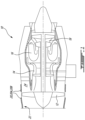
- FIG. 1 shows an axial schematic cross-section view of an exemplary turbofan gas turbine engine including one or more sandwich-structured panels as described herein;
- FIG. 2 is a perspective cutaway view of an exemplary sandwich-structured panel in the form of a single-degree-of-freedom (SDOF) acoustic panel;
- SDOF single-degree-of-freedom
- FIG. 3 is a perspective cutaway view of another exemplary sandwich-structured panel in the form of a double-degree-of-freedom (DDOF) acoustic panel;
- DDOF double-degree-of-freedom
- FIG. 4 is a perspective schematic view of an exemplary duct including a sandwich-structured panel as described herein;
- FIG. 5 is a schematic cross-section view of the duct of FIG. 4 taken along line 5 - 5 in FIG. 4 ;
- FIG. 6 is a schematic cross-section view of the duct of FIG. 4 taken along line 6 - 6 in FIG. 4 ;
- FIG. 7 is a flowchart illustrating an exemplary method of manufacturing an aircraft component in the form of a sandwich-structured panel
- FIG. 8 A schematically illustrates a backing member of a sandwich-structured panel formed from a precursor sheet
- FIG. 8 B schematically illustrates assembling the backing member of FIG. 8 A with a base and ultrasonically welding the backing member to the base;
- FIG. 8 C schematically illustrates assembling a cellular structure and a facing sheet with the backing member of FIG. 8 A ;
- FIG. 8 D schematically illustrates ultrasonically welding the facing sheet of FIG. 8 C to the backing member of FIG. 8 A and to the cellular structure;
- FIG. 9 A schematically illustrates an exploded view of a sandwich-structured panel in the form of a DDOF acoustic panel
- FIG. 9 B schematically illustrates ultrasonically welding components of the sandwich-structured panel of FIG. 9 A ;
- FIG. 10 is a schematic representation of part of another exemplary sandwich-structured panel.
- FIG. 11 is a schematic representation of part of another exemplary sandwich-structured panel.
- Sandwich-structured components e.g., panels of aircraft and methods for manufacturing such components are described herein.
- the components may be suitable for use in various structural and/or noise-attenuating applications including on structures (i.e., airframes) of aircraft or other mobile platforms, in aircraft engines, in automotive applications, buildings and/or in other structural applications for example.
- the components described herein may include or be part of walls, panels, liners or ducts for example.
- the components may serve as acoustic treatment and may be referred to as “acoustic panels” or “acoustic liners” with desirable noise-attenuating properties.
- Such components may be installed to line a duct (e.g., inlet or bypass duct) of a gas turbine engine or may be installed in any other location(s) such as inside a passenger cabin of an aircraft or on the exterior of an aircraft where noise attenuation is desirable. While the following description refers to acoustic treatment (e.g., panels) for aircraft applications, it is understood that sandwich-structured components and methods described herein may be suitable for use in other applications.
- the components and methods described herein make use of ultrasonic welding for joining parts of the components together so that the need for adhesive material (e.g., glue) used in conventional assembly methods such as adhesive reticulation can be reduced or eliminated.
- adhesive material e.g., glue
- the reduction or elimination of adhesive material can reduce or eliminate the risk of excess adhesive material flowing into and blocking holes formed into the facing sheet and/or the septum of such acoustic panels.
- the use of ultrasonic welding may simplify the construction of sandwich-structured panels.
- the ultrasonically-welded joints between parts of acoustic panels may make efficient use of space to leave more space available for acoustically treated areas of acoustic panels.
- FIG. 1 illustrates gas turbine engine 10 of a type preferably provided for use on an aircraft, generally comprising in serial flow communication, fan 12 through which ambient air is propelled, multistage compressor 14 for pressurizing the air, combustor 16 in which the compressed air is mixed with fuel and ignited for generating an annular stream of hot combustion gases, and turbine section 18 for extracting energy from the combustion gases.
- Engine 10 may include one or more sandwich-structured panels 20 , 20 A, 20 B (referred generically herein as “panel 20 ”) used as acoustic treatment (e.g., panels or liners) disposed at different locations within engine 10 to obtain desired noise-attenuation. It is understood that panel 20 may be used in other types of engines (e.g., turboshaft, turboprop, auxiliary power unit (APU)) and in other types of noise-attenuating applications. In some embodiments, panel 20 may be used in structural applications that are not necessarily intended to provide noise-attenuation.
- panel 20 may be used in structural applications that are not necessarily intended to provide noise-attenuation.
- panel(s) 20 may be disposed upstream and/or downstream of fan 12 inside of engine 10 so that noise produced by fan 12 may be attenuated.
- panel(s) 20 may be integrated in inlet 22 of engine 10 and disposed upstream of fan 12 .
- panel(s) 20 may be integrated in (e.g., annular) bypass duct 24 and define a radially-outer and/or a radially-inner surface of bypass duct 24 .
- panel 20 may be suitable for use in a fan case, intermediate case, bypass duct 24 , exhaust duct, thrust reverser duct, and an exhaust center body of engine 10 for example.
- panel 20 may be suitable for use in a hot core section duct of engine 10 where adhesively bonded acoustic materials would typically not be used due to elevated temperatures.
- panel 20 may have a generally planar or non-planar (e.g., curved, arcuate, annular) form (e.g., of single or double curvature).
- FIG. 2 is a perspective cutaway view of an exemplary sandwich-structured panel 20 A in the form of a single-degree-of-freedom (SDOF) acoustic panel.
- SDOF acoustic panel 20 A may include backing member 26 , facing sheet 28 and cellular structure 30 disposed between backing member 26 and facing sheet 28 . Facing sheet 28 may be spaced apart from backing member 26 to define (e.g., noise-attenuating) cavity 32 between backing member 26 and facing sheet 28 .
- cellular structure 30 may be attached to backing member 26 and/or facing sheet 28 through ultrasonic welding.
- Cellular structure 30 may include walls serving as partitions defining sub-cavities (cells) within noise-attenuating cavity 32 .
- Cellular structure 30 may serve as a core of SDOF acoustic panel 20 A.
- backing member 26 may have the form of a sheet or plate. However, it is understood that backing member 26 may be of any suitable shape and thickness.
- backing member 26 may be a part of another component of engine 10 such as a wall of inlet 22 or bypass duct 24 of engine 10 that provides a suitable back wall for noise-attenuating cavity 32 .
- Backing member 26 and facing sheet 28 may serve as skins of SDOF acoustic panel 20 A disposed on opposite sides of cellular structure 30 .
- FIG. 3 is a perspective cutaway view of an exemplary sandwich-structured composite panel 20 B in the form of a double-degree-of-freedom (DDOF) acoustic panel.
- DDOF acoustic panel 20 B may include backing member 26 , septum 34 , cellular structures 30 A, 30 B and facing sheet 28 .
- Septum 34 may be spaced apart from backing member 26 to define (e.g., noise-attenuating) cavity 32 A between backing member 26 and septum 34 .
- Cellular structure 30 A may be disposed between backing member 26 and septum 34 .
- cellular structure 30 A may be attached to backing member 26 and/or septum 34 through ultrasonic welding.
- Facing sheet 28 may be spaced apart from septum 34 to define (e.g., noise-attenuating) cavity 32 B between septum 34 and facing sheet 28 .
- Cellular structure 30 B may be disposed between facing sheet 28 and septum 34 .
- cellular structure 30 B may be attached to facing sheet 28 and/or septum 34 through ultrasonic welding. Due to its configuration, DDOF acoustic panel 20 B may, in some embodiments, resonate and attenuate noise at multiple frequencies or within a wider frequency range than SDOF acoustic panel 20 A.
- cellular structures 30 , 30 A, 30 B may each include a plurality of open-ended juxtaposed cells of hexagonal or other (e.g., triangular, rectangular, polygonal) cross-sectional profile.
- the walls defining the cells of cellular structure 30 may extend from backing member 26 to facing sheet 28 and may provide structural support between facing sheet 28 and backing member 26 .
- the walls defining the cells of cellular structure 30 B may extend from septum 34 to facing sheet 28
- the walls defining the cells of cellular structure 30 A may extend from backing member 26 to septum 34 .
- cellular structure 30 may be of a type referred to as “honeycomb” core.
- Cellular structure 30 may be made from a suitable non-metallic material (e.g., polymer), fiber-reinforced composite material (e.g., carbon fibre/resin matrix) or metallic (e.g., aluminum-based) material for example.
- outer facing sheet 28 may be porous (e.g., perforated) and may include a plurality of through holes 36 formed (e.g., drilled) therein.
- holes 36 may have a substantially circular cross-sectional shape but other cross-sectional shapes such as ovals or rectangles may also be suitable.
- holes 36 may include one or more slits.
- one or more holes 36 may be in communication with each cell defined by cellular structure 30 and each cell may function as a resonator.
- a highly resistive material such as a mesh of porous material may be disposed inside or outside the cells defined by cellular structure 30 (e.g., bonded above or below facing sheet 28 ) and may alter the noise-attenuating performance of SDOF acoustic panel 20 A.
- Facing sheet 28 may be made from a suitable metallic, plastic or composite material.
- facing sheet 28 may be made from fiber-reinforced composite material (e.g., carbon fibers embedded in a polymeric resin) or metallic (e.g., aluminum-based or metal) material.
- facing sheet 28 may have a thickness permitting ultrasonically welding facing sheet 28 to another component.
- facing sheet 28 may have a thickness of between 1 mm and 6.5 mm for example. However, other thicknesses may be suitable for various applications.
- Backing member 26 may be unperforated and include a non-porous impermeable sheet, plate or other relatively hard material.
- Backing member 26 may be made from a suitable metallic, plastic or composite material.
- backing member 26 may be made from fiber-reinforced composite material (e.g., carbon fibers embedded in a polymeric resin) or metallic (e.g., aluminum-based or metal) material.
- backing member 26 may have a thickness permitting ultrasonically welding backing member 26 to another component.
- septum 34 may be a porous (e.g., perforated) sheet or plate and may include a plurality of through holes 38 formed (e.g., drilled) therein for acoustically connecting noise-attenuating cavities 32 A, 32 B together.
- Septum 34 may serve as an intermediate (e.g., perforated) skin disposed between cellular structure 30 A and cellular structure 30 B.
- Septum 34 may be made from a suitable metallic, plastic or composite material.
- septum 34 may be made from fiber-reinforced composite material (e.g., carbon fibers embedded in a polymeric resin), metallic (e.g., aluminum-based or metal) material, or fibrous material such as fiber cloth and mesh cloth.
- septum 34 may include a perforated sheet of similar of substantially the same construction as facing sheet 28 . In some embodiments, septum 34 may have a thickness permitting ultrasonically welding septum 34 to another component. In various embodiments, septum 34 may have a thickness of between 0.3 mm and 2.5 mm for example. However, other thicknesses may be suitable for various applications.
- Cellular structure 30 may serve as a relatively low-density core disposed between two relatively stronger skins such as backing member 26 , facing sheet 28 and/or septum 34 .
- the resulting sandwich-structured panel 20 may provide a combination of relatively high structural rigidity and low weight, as the skins provide resistance to in-plane and lateral bending loads, while the core provides resistance to shear loads.
- facing sheet 28 and/or septum 34 may not be perforated (i.e., devoid of through holes 36 , 38 ).
- Materials of components of panel 20 may be selected to be compatible for ultrasonic welding together.
- FIG. 4 is a perspective schematic view of an exemplary duct 40 that may include one or more panels 20 .
- Duct 40 may be part of inlet 22 of engine 10 , or may form part of bypass duct 24 of engine 10 for example.
- Duct 40 may include (e.g., annular) base 42 to which panel(s) 20 may be mounted.
- Base 42 may be made from a suitable polymeric material, fiber-reinforced composite material (e.g., carbon fibers embedded in a polymeric resin) or metallic (e.g., aluminum-based) material.
- FIG. 5 is a schematic cross-section view of duct 40 taken along line 5 - 5 in FIG. 4 .
- One or more panel(s) 20 may be mounted to a radially-inner side and/or to a radially-outer side of base 42 .
- a single panel 20 may be mounted to base 42 and cover part or substantially an entirety of the circumferential span of base 42 .
- a plurality of panels 20 may be mounted to base 42 in a circumferentially adjacent manner to cover part or substantially an entirety of the circumferential span of base 42 .
- two adjacent semicircular panels 20 are shown mounted to a radially-inner side of base 42 .
- Intermediate parting lines 44 are shown schematically between the adjacent panels 20 .
- a plurality of panels 20 may be mounted to any suitable base 42 to cooperatively provide an acoustically treated area of a desired shape and size.
- FIG. 6 is a schematic cross-section view of duct 40 of FIG. 4 taken along line 6 - 6 in FIG. 4 .
- Panel 20 may be formed to fit a profile defined in base 42 of duct 40 and may be inserted in base 42 as shown in FIG. 6 .
- Cellular structure 30 may have periphery P shown in FIG. 6 and representing an external boundary of cellular structure 30 within a plane intersecting and substantially parallel to panel 20 .
- periphery P may be an outer edge of an acoustically treated area of panel 20 .
- Backing member 26 may have a cross-sectional profile that substantially conforms to the cross-sectional profile of base 42 .
- backing member 26 may have a “top hat” shaped cross-sectional profile including main portion 26 A disposed inside periphery P of cellular structure 30 and peripheral portions 26 B disposed outside of periphery P of cellular structure 30 .
- backing member 26 may extend outwardly beyond periphery P of cellular structure 30 .
- Backing member 26 may also include transitions portions 26 C that interconnect respective peripheral portions 26 B to main portion 26 A. Transition portions 26 C may provide step-shaped transitions between main portion 26 A and respective peripheral portions 26 B.
- transition portion 26 C may eliminate the need for a ramped or “pan down” region of panel 20 that would take away from the acoustically treated area of panel 20 . Accordingly, the step-shaped transitions provided by transition portions 26 C may facilitate a larger acoustically treated area in the space available for panel 20 compared to ramped transitions for example.
- transition portions 26 C may be substantially perpendicular to main portion 26 A. However, in some embodiments, transition portions 26 C may instead be non-perpendicular to main portion and provide ramp-shaped transitions interconnecting main portion 26 A with respective peripheral portions 26 B.
- Facing sheet 28 may include main portion 28 A disposed inside periphery P of cellular structure 30 and peripheral portions 28 B disposed outside of periphery P of cellular structure 30 .
- facing sheet 28 may extend outwardly beyond periphery P of cellular structure 30 .
- Peripheral portions 28 B of facing sheet 28 may face respective corresponding peripheral portions 26 B of backing member 26 .
- Peripheral portions 28 B of facing sheet 28 may be adjacent and (e.g., ultrasonically) welded to respective corresponding peripheral portions 26 B of backing member 26 .
- Components of panel 20 may be welded together or to base 42 at weld junctions 46 . Additional or fewer weld junctions 46 than those shown in FIG. 6 may be used.
- main portion 26 A of backing member 26 may be welded to base 42 .
- Peripheral portions 26 B of backing member 26 may be welded to base 42 .
- Peripheral portions 26 B of backing member 26 and peripheral portions 28 B of facing sheet 28 may be welded together to form a lap joint.
- Main portion 28 A of facing sheet 28 and cellular structure 30 may be welded together.
- FIG. 7 is a flowchart illustrating an exemplary method 100 of manufacturing a sandwich-structured component such as panel 20 . Aspects of method 100 may be combined with method steps or other aspects described herein. Aspects of method 100 are illustrated in FIGS. 8 A- 9 B .
- Method 100 may include: receiving backing member 26 , facing sheet 28 (or septum 34 ), and cellular structure 30 (block 102 ); assembling cellular structure 30 between backing member 26 and facing sheet 28 (or septum 34 ) (block 104 ); and ultrasonically welding backing member 26 and facing sheet 28 (or septum 34 ) together (block 106 ).
- Weld junctions 46 may be produced by ultrasonic welding as explained further below. Alternatively, weld junctions 46 may be made using other suitable low-temperature methods of welding such as seam welding or linear friction welding. Weld junctions 46 may include a union or fusion of components made after rendering part of the components to be joined soft or pasty using heat, and with or without the use of fusible filler material.
- FIG. 8 A schematically illustrates backing member 26 of panel 20 formed from (e.g., flat) precursor sheet 48 prior to assembly with base 42 .
- Backing member 26 may be formed to the desired shape using any suitable metal or polymer forming techniques. In some embodiments where backing member 26 is made from a metallic material, backing member 26 may formed from precursor sheet 48 by stamping or conventional welding for example. In some embodiments where backing member 26 is made from a polymer, backing member 26 may be thermoformed from precursor sheet 48 or injection molded for example. In some embodiments, backing member 26 may define recess 50 in which cellular structure 30 may be inserted. Peripheral portions 26 B may be disposed outside a periphery of recess 50 .
- FIG. 8 B schematically illustrates assembling backing member 26 with base 42 and ultrasonically welding backing member 26 to base 42 using sonotrode 52 .
- base 42 may be held on a suitable anvil to facilitate the ultrasonic welding process.
- a suitable anvil or other suitable work holding equipment may be used to hold backing member 26 during assembly of panel 20 and during ultrasonic welding.
- optional metallic foil 54 may be laid between the components to be joined to facilitate ultrasonic welding.
- foil 54 may be a relatively thin piece made from a compatible polymeric material and laid between the components to be joined to facilitate ultrasonic welding.
- ultrasonic welding may provide flexibility in joining various materials via relatively strong structural bonds compared to some adhesive bonding approaches.
- the relatively high bond strength may facilitate bonding areas of reduced size for weld junctions 46 compared to the use of fasteners such as rivets or bolts.
- the use of ultrasonic welding may promote an increase in acoustically treated area in a given space, a reduction or elimination of blockage of through holes 36 , 38 by adhesive material and/or potentially a weight reduction compared to existing acoustic panels made using other methods.
- the ultrasonic welding used herein may be a solid state welding process where no external heat is added for welding.
- Ultrasonic welding may be performed using sonotrode 52 .
- Sonotrode 52 may be moved to locations to be welded and placed in contact with the workpieces to transmit energy to the workpieces by way of ultrasonic vibration.
- the ultrasonic vibration may create a dynamic shear stress between the contact surfaces of the workpieces. Due to local plastic deformation and heat generation due to friction between the contact surfaces, joint formation may take place at the interface between the two workpieces.
- Sonotrode 52 may be associated with a (e.g., piezoelectric) transducer which can convert high frequency electric signal into high frequency mechanical vibration.
- Oscillating shear forces acting at the interface between the workpieces may cause elastoplastic deformation at the interface.
- the local temperature may rise at the interface without significantly melting the workpieces and/or filler material.
- the welding may be achieved by disrupting the surface oxide films of the metallic components. Ultrasonic welding may be considered a relatively low heat procedure and may be used to weld metallic materials together, and polymeric materials together.
- FIG. 8 C schematically illustrates assembling cellular structure 30 and facing sheet 28 with backing member 26 after backing member 26 has been installed with (and optionally welded to) base 42 .
- Recess 50 (show in FIG. 8 B ) may be at least partially filled with cellular structure 30 and covered with facing sheet 28 .
- foil 54 may be disposed between main portion 28 A of facing sheet 28 and cellular structure 30 to facilitate ultrasonic welding therebetween.
- foil 54 may be disposed between peripheral portion 28 B of facing sheet 28 and peripheral portion 26 B of backing member 26 to facilitate ultrasonic welding therebetween.
- FIG. 8 D schematically illustrates ultrasonically welding peripheral portion 28 B of facing sheet 28 to peripheral portion 26 B of backing member 26 to form weld junction 46 using sonotrode 52 .
- main portion 28 A of facing sheet 28 may be ultrasonically welded to cellular portion 30 using sonotrode 52 also.
- base 42 may function as a suitable backing member and a separate intermediate backing member 26 overlaying base 42 may not be required.
- cellular structure 30 may be inserted into a recess formed in base 42 and peripheral portion 28 B of facing sheet 28 may be ultrasonically welded directly to a peripheral portion of base 42 so that base 42 may serve as a backing member of panel 20 .
- ultrasonic welding may also be used at the ply lay-up stage to bond plies (e.g., pre-impregnated fabric or unidirectional tape) together and the resulting lay-up may be subsequently consolidated in an autoclave.
- plies e.g., pre-impregnated fabric or unidirectional tape
- UAM layer-by-layer ultrasonic additive manufacturing
- FIG. 9 A schematically illustrates an exploded view of DDOF acoustic panel 20 B to be assembled with base 42 .
- Method 100 and other aspects described above in relation to manufacturing SDOF acoustic panel 20 A may be used to make DDOF acoustic panel 20 B.
- backing member 26 may be installed with base 42 and optionally ultrasonically welded to base 42 as described above.
- Cellular structure 30 A may be assembled to be disposed between backing member 26 and septum 34 which may be perforated with through holes 38 .
- Cellular structure 30 A may be inserted into recess 50 defined by backing member 26 .
- Septum 34 may have first peripheral portions 34 B disposed outside periphery P 1 of cellular structure 30 A.
- First peripheral portions 34 B of septum 34 may be facing and disposed adjacent to respective peripheral portions 26 B of backing member 26 to provide a lap joint to permit ultrasonic welding.
- Septum 34 may also be formed to have a “top hat” shape similar to backing member 26 .
- Cellular structure 30 B may be installed between septum 34 and facing sheet 28 .
- Septum 34 may define recess 56 in which cellular structure 30 B may be inserted.
- Septum 34 may also have second peripheral portions 34 D that are disposed outside a periphery P 2 of cellular structure 30 B. Second peripheral portions 34 D of septum 34 may facilitate ultrasonic welding of septum 34 to base 42 .
- Transition portions 34 C may interconnect second peripheral portions 34 D to respective first peripheral portions 34 B of septum 34 .
- Each transition portion 34 C may define a step-shaped transition or a ramp-shaped transition.
- transition portions 34 C may be substantially perpendicular to main portion 34 A of septum 34 disposed within periphery P 1 of cellular structure 30 A.
- Peripheral portions 28 B of facing sheet 28 may be disposed outside periphery P 2 of facing sheet 28 .
- Peripheral portions 28 B of facing sheet 28 and corresponding second peripheral portions 34 D of septum 34 may face each other and be disposed adjacent each other to define a lap joint to facilitate ultrasonic welding.
- the assembly order of the parts of SDOF acoustic panel 20 A or of DDOF acoustic panel 20 B may be varied from those depicted herein.
- the entire SDOF acoustic panel 20 A or DDOF acoustic panel 20 B may be assembled separately from base 42 and subsequently assembled (e.g., adhesively bonded, welded, fastened) with base 42 .
- One or more optional foils 54 as shown in FIG. 8 C may also be used to facilitate ultrasonic welding of components of DDOF acoustic panel 20 B.
- FIG. 9 B schematically illustrates ultrasonically welding components of DDOF acoustic panel 20 B using sonotrode 52 .
- DDOF acoustic panel 20 B may contain a plurality of weld junctions 46 throughout DDOF acoustic panel 20 B and acoustic welding operations may be carried out between assembly steps to provide sonotrode 52 access to the components to be welded.
- One or more weld junctions 46 may be produced between main portion 26 A of backing member 26 and base 42 .
- One or more weld junctions 46 may be produced between peripheral portion(s) 26 B of backing member 26 and base 42 .
- One or more weld junctions 46 may be produced between main portion 34 A of septum 34 and cellular structure 30 A.
- One or more weld junctions 46 may be produced between first peripheral portion(s) 34 B of septum 34 and respective peripheral portion(s) 26 B of backing member 26 .
- One or more weld junctions 46 may be produced between second peripheral portion(s) 34 D of septum 34 and base 42 .
- One or more weld junctions 46 may be produced between peripheral portion(s) 28 B of facing sheet 28 and respective second peripheral portion(s) 34 D of septum 34 .
- One or more weld junctions 46 may be produced between main portion 28 A of facing sheet 28 and cellular structure 30 B.
- base 42 may function as a suitable backing member and a separate intermediate backing member 26 overlaying base 42 may not be required in the construction of DDOF acoustic panel 20 B either.
- cellular structure 30 A may be inserted into a recess formed in base 42 and first peripheral portion 34 B of septum 34 may be ultrasonically welded directly to 42 so that base 42 may serve as a backing member of DDOF acoustic panel 20 .
- FIG. 10 is a schematic representation of part of another exemplary sandwich-structured panel 120 which may be suitable for structural applications.
- first skin 126 and second skin 128 are not perforated.
- Panel 120 may include elements previously described above and reference numerals for like elements have been incremented by 100.
- Ultrasonic welding may be used to produce weld junctions 146 .
- One or more weld junctions 146 may be produced between main portion 126 A of first skin 126 and cellular structure 130 .
- One or more weld junctions 146 may be produced between main portion 128 A of second skin 128 and cellular structure 130 .
- One or more weld junctions 146 may be produced between peripheral portion 126 B of first skin 126 and peripheral portion 128 B of second skin 128 .
- Transition portion 126 C of first skin 126 may define a step-shaped transition between peripheral portion 126 B of first skin 126 and main portion 126 A of first skin 126 disposed inside the periphery of cellular structure 130 .
- Transition portion 128 C of second skin 128 may define a step-shaped transition between peripheral portion 128 B of second skin 128 and main portion 128 A of second skin 128 disposed inside the periphery of cellular structure 130 .
- ultrasonic welding may also facilitate the fabrication of other components such as bracket 58 , flanges and/or other accessories integrated to panels, ducts and bases described herein through the use of UAM to reduce or eliminate the use of fasteners.
- UAM may include stacking and fusing (e.g., welding) metallic or polymeric strips 60 in a layer-by-layer manner using ultrasonic welding to build-up such components.
- the panels described herein may be used in components such as ducts, aircraft stringers and aircraft fuselage skins for example. The panels described herein may be used for shock-absorbing and/or insulating functions.
- FIG. 11 is a schematic representation of part of another exemplary sandwich-structured panel 220 which may be suitable for structural applications.
- first skin 226 and second skin 228 may not be perforated.
- Panel 220 may include elements previously described above and reference numerals for like elements have been incremented by 200.
- Ultrasonic welding may be used to produce weld junctions 246 .
- One or more weld junctions 246 may be produced between main portion 226 A of first skin 226 and cellular structure 230 .
- One or more weld junctions 246 may be produced between main portion 228 A of second skin 228 and cellular structure 230 .
- One or more weld junctions 246 may be produced between peripheral portion 226 B of first skin 226 and peripheral portion 228 B of second skin 228 .
- Transition portion 226 C of first skin 226 may define a ramp-shaped transition between peripheral portion 226 B of first skin 226 and main portion 226 A of first skin 226 disposed inside the periphery of cellular structure 230 .
Landscapes
- Engineering & Computer Science (AREA)
- Mechanical Engineering (AREA)
- General Engineering & Computer Science (AREA)
- Physics & Mathematics (AREA)
- Acoustics & Sound (AREA)
- Multimedia (AREA)
- Architecture (AREA)
- Civil Engineering (AREA)
- Structural Engineering (AREA)
- Lining Or Joining Of Plastics Or The Like (AREA)
- Soundproofing, Sound Blocking, And Sound Damping (AREA)
- Laminated Bodies (AREA)
Abstract
Description
-
- receiving a first skin, a second skin and a cellular core;
- assembling the cellular core with the first and second skins so that:
- the cellular core is disposed between the first and second skins;
- the first skin has a peripheral portion disposed outside a periphery of the cellular core;
- the second skin has a peripheral portion disposed outside the periphery of the cellular core and facing the peripheral portion of the first skin, the peripheral portion of the second skin being adjacent the peripheral portion of the first skin; and
- ultrasonically welding the peripheral portion of the first skin and the peripheral portion of the second skin together.
-
- receiving a backing member, a sheet and a cellular structure;
- assembling the cellular structure between the backing member and the sheet; and
- ultrasonically welding the backing member and the sheet together.
-
- a first skin,
- a second skin disposed relative to the first skin to define a cavity between the first and second skins; and
- a cellular core disposed in the cavity between the first and second skins;
- wherein:
- the first skin has a peripheral portion disposed outside a periphery of the cellular core;
- the second skin has a peripheral portion disposed outside the periphery of the cellular core and facing the peripheral portion of the first skin, the peripheral portion of the second skin being adjacent the peripheral portion of the first skin; and
- the peripheral portion of the first skin and the peripheral portion of the second skin are welded together.
Claims (11)
Priority Applications (5)
| Application Number | Priority Date | Filing Date | Title |
|---|---|---|---|
| US17/086,579 US12136407B2 (en) | 2020-11-02 | 2020-11-02 | Sandwich-structured panels and method of manufacture |
| CA3137316A CA3137316A1 (en) | 2020-11-02 | 2021-11-01 | Sandwich-structured panels and method of manufacture |
| EP21206068.5A EP3991948B1 (en) | 2020-11-02 | 2021-11-02 | Sandwich-structured panels and methods of manufacture |
| CN202111288820.1A CN114434881A (en) | 2020-11-02 | 2021-11-02 | Sandwich structure panel and manufacturing method |
| US18/904,382 US20260100179A1 (en) | 2020-11-02 | 2024-10-02 | Sandwich-Structured Panels and Method of Manufacture |
Applications Claiming Priority (1)
| Application Number | Priority Date | Filing Date | Title |
|---|---|---|---|
| US17/086,579 US12136407B2 (en) | 2020-11-02 | 2020-11-02 | Sandwich-structured panels and method of manufacture |
Related Child Applications (1)
| Application Number | Title | Priority Date | Filing Date |
|---|---|---|---|
| US18/904,382 Division US20260100179A1 (en) | 2020-11-02 | 2024-10-02 | Sandwich-Structured Panels and Method of Manufacture |
Publications (2)
| Publication Number | Publication Date |
|---|---|
| US20220139364A1 US20220139364A1 (en) | 2022-05-05 |
| US12136407B2 true US12136407B2 (en) | 2024-11-05 |
Family
ID=78789597
Family Applications (2)
| Application Number | Title | Priority Date | Filing Date |
|---|---|---|---|
| US17/086,579 Active 2042-03-26 US12136407B2 (en) | 2020-11-02 | 2020-11-02 | Sandwich-structured panels and method of manufacture |
| US18/904,382 Pending US20260100179A1 (en) | 2020-11-02 | 2024-10-02 | Sandwich-Structured Panels and Method of Manufacture |
Family Applications After (1)
| Application Number | Title | Priority Date | Filing Date |
|---|---|---|---|
| US18/904,382 Pending US20260100179A1 (en) | 2020-11-02 | 2024-10-02 | Sandwich-Structured Panels and Method of Manufacture |
Country Status (4)
| Country | Link |
|---|---|
| US (2) | US12136407B2 (en) |
| EP (1) | EP3991948B1 (en) |
| CN (1) | CN114434881A (en) |
| CA (1) | CA3137316A1 (en) |
Families Citing this family (7)
| Publication number | Priority date | Publication date | Assignee | Title |
|---|---|---|---|---|
| FR3103054B1 (en) * | 2019-11-07 | 2021-11-19 | Airbus Operations Sas | Multifrequency absorption aircraft nacelle acoustic panel. |
| US11946414B2 (en) * | 2021-12-16 | 2024-04-02 | Rolls-Royce Corporation | Manufacture methods and apparatus for turbine engine acoustic panels |
| KR102502845B1 (en) * | 2022-03-04 | 2023-02-24 | 주식회사 대솔오시스 | Sound absorption board for electric vehicles |
| DE102023108467A1 (en) * | 2023-04-03 | 2024-10-10 | SFS Group International AG | Lightweight panel system and method for fastening a screw-in element in a lightweight panel |
| FR3150628B1 (en) * | 2023-06-30 | 2025-10-10 | Safran | Manufacture of an acoustic panel by ultrasonic welding |
| CN118342836B (en) * | 2024-04-23 | 2025-03-07 | 南京航空航天大学 | Thermoplastic composite honeycomb sandwich structure surface-core interface connection method based on ultrasonic welding |
| DE102024125692A1 (en) * | 2024-09-06 | 2026-03-12 | Daimler Truck AG | Functional component for sound insulation for a commercial vehicle, commercial vehicle and process |
Citations (17)
| Publication number | Priority date | Publication date | Assignee | Title |
|---|---|---|---|---|
| CN1991234A (en) * | 2005-12-30 | 2007-07-04 | 冷鹭浩 | Material filling type supersonic welding plastic uptake clad plate |
| WO2009143002A2 (en) | 2008-05-20 | 2009-11-26 | Nike International, Ltd. | Contoured fluid-filled chamber with a tensile member |
| WO2010038314A1 (en) | 2008-10-03 | 2010-04-08 | 盟和産業株式会社 | Laminated plate, and terminal treating method for laminated material |
| US20100111675A1 (en) * | 2008-10-31 | 2010-05-06 | Czeslaw Wojtyczka | Fan case for turbofan engine |
| US20130122244A1 (en) * | 2011-11-14 | 2013-05-16 | The Boeing Company | Aircraft Interior Panels and Methods of Panel Fabrication |
| US20140326536A1 (en) * | 2011-10-04 | 2014-11-06 | Aircelle | Structural acoustic attenuation panel |
| US9034129B2 (en) | 2011-01-13 | 2015-05-19 | Lg Chem, Ltd. | Ultrasonic welding system and method for forming a weld joint utilizing the ultrasonic welding system |
| EP2942184A1 (en) | 2012-12-28 | 2015-11-11 | Kyoraku Co., Ltd. | Foam structure, resin panel, and resin panel manufacturing method |
| US20160114550A1 (en) | 2008-10-28 | 2016-04-28 | Woodwelding Ag | Method of fastening an edge structure to a construction element |
| US20190084261A1 (en) * | 2017-09-19 | 2019-03-21 | The Boeing Company | Acoustic Device Manufacturing System |
| US10239150B2 (en) | 2014-12-09 | 2019-03-26 | GM Global Technology Operations LLC | Ultrasonic welding of composites using C frame tooling |
| US10259170B2 (en) | 2013-09-06 | 2019-04-16 | GM Global Technology Operations LLC | Methods for joining polymeric composites using a hybrid friction/ultrasound technique for achieving desired weld characteristics |
| US20190301370A1 (en) | 2018-03-28 | 2019-10-03 | Pratt & Whitney Canada Corp. | Aircraft component and method of manufacture |
| EP3626958A1 (en) | 2018-09-24 | 2020-03-25 | Rohr, Inc. | Thermoplastic acoustic blocker door |
| US20200222984A1 (en) | 2019-01-16 | 2020-07-16 | United Technologies Corporation | Ultrasonic assisted additive manufacturing apparatus and method |
| US20220134675A1 (en) | 2019-05-29 | 2022-05-05 | Airbus Operations Gmbh | System and method for welding two thermoplastic workpieces |
| US11654636B2 (en) | 2016-06-14 | 2023-05-23 | GM Global Technology Operations LLC | Ultrasonic weld-bonding of thermoplastic composites |
Family Cites Families (4)
| Publication number | Priority date | Publication date | Assignee | Title |
|---|---|---|---|---|
| JP4192138B2 (en) * | 2004-10-01 | 2008-12-03 | 本田技研工業株式会社 | Laminated sheet |
| US10174675B2 (en) * | 2015-12-30 | 2019-01-08 | General Electric Company | Acoustic liner for gas turbine engine components |
| US20170361540A1 (en) * | 2016-06-16 | 2017-12-21 | GM Global Technology Operations LLC | Ultrasonic welding of dissimilar sheet materials |
| US10940955B2 (en) * | 2017-11-27 | 2021-03-09 | Rohr, Inc. | Acoustic panel with structural septum |
-
2020
- 2020-11-02 US US17/086,579 patent/US12136407B2/en active Active
-
2021
- 2021-11-01 CA CA3137316A patent/CA3137316A1/en active Pending
- 2021-11-02 CN CN202111288820.1A patent/CN114434881A/en active Pending
- 2021-11-02 EP EP21206068.5A patent/EP3991948B1/en active Active
-
2024
- 2024-10-02 US US18/904,382 patent/US20260100179A1/en active Pending
Patent Citations (19)
| Publication number | Priority date | Publication date | Assignee | Title |
|---|---|---|---|---|
| CN100467933C (en) | 2005-12-30 | 2009-03-11 | 冷鹭浩 | A packing-type ultrasonic-welded plastic-absorbing composite board |
| CN1991234A (en) * | 2005-12-30 | 2007-07-04 | 冷鹭浩 | Material filling type supersonic welding plastic uptake clad plate |
| WO2009143002A2 (en) | 2008-05-20 | 2009-11-26 | Nike International, Ltd. | Contoured fluid-filled chamber with a tensile member |
| WO2010038314A1 (en) | 2008-10-03 | 2010-04-08 | 盟和産業株式会社 | Laminated plate, and terminal treating method for laminated material |
| US20160114550A1 (en) | 2008-10-28 | 2016-04-28 | Woodwelding Ag | Method of fastening an edge structure to a construction element |
| US20100111675A1 (en) * | 2008-10-31 | 2010-05-06 | Czeslaw Wojtyczka | Fan case for turbofan engine |
| US9034129B2 (en) | 2011-01-13 | 2015-05-19 | Lg Chem, Ltd. | Ultrasonic welding system and method for forming a weld joint utilizing the ultrasonic welding system |
| US20140326536A1 (en) * | 2011-10-04 | 2014-11-06 | Aircelle | Structural acoustic attenuation panel |
| US20130122244A1 (en) * | 2011-11-14 | 2013-05-16 | The Boeing Company | Aircraft Interior Panels and Methods of Panel Fabrication |
| EP2942184A1 (en) | 2012-12-28 | 2015-11-11 | Kyoraku Co., Ltd. | Foam structure, resin panel, and resin panel manufacturing method |
| US10259170B2 (en) | 2013-09-06 | 2019-04-16 | GM Global Technology Operations LLC | Methods for joining polymeric composites using a hybrid friction/ultrasound technique for achieving desired weld characteristics |
| US10239150B2 (en) | 2014-12-09 | 2019-03-26 | GM Global Technology Operations LLC | Ultrasonic welding of composites using C frame tooling |
| US11654636B2 (en) | 2016-06-14 | 2023-05-23 | GM Global Technology Operations LLC | Ultrasonic weld-bonding of thermoplastic composites |
| US20190084261A1 (en) * | 2017-09-19 | 2019-03-21 | The Boeing Company | Acoustic Device Manufacturing System |
| US20190301370A1 (en) | 2018-03-28 | 2019-10-03 | Pratt & Whitney Canada Corp. | Aircraft component and method of manufacture |
| EP3626958A1 (en) | 2018-09-24 | 2020-03-25 | Rohr, Inc. | Thermoplastic acoustic blocker door |
| US20200095955A1 (en) * | 2018-09-24 | 2020-03-26 | Rohr, Inc. | Thermoplastic acoustic blocker door |
| US20200222984A1 (en) | 2019-01-16 | 2020-07-16 | United Technologies Corporation | Ultrasonic assisted additive manufacturing apparatus and method |
| US20220134675A1 (en) | 2019-05-29 | 2022-05-05 | Airbus Operations Gmbh | System and method for welding two thermoplastic workpieces |
Non-Patent Citations (3)
| Title |
|---|
| European Patent Office, Communication pursuant to Article 94(3) EPC for European patent application No. 21206068.5, Sep. 18, 2024. |
| European Patent Office, Communication re. extended European search report for European patent application No. 21206068.5, Apr. 7, 2022. |
| Translation of CN-1991234-A, Leng L, Jul. 2007 (Year: 2007). * |
Also Published As
| Publication number | Publication date |
|---|---|
| CN114434881A (en) | 2022-05-06 |
| EP3991948B1 (en) | 2025-12-24 |
| US20260100179A1 (en) | 2026-04-09 |
| EP3991948A1 (en) | 2022-05-04 |
| CA3137316A1 (en) | 2022-05-02 |
| US20220139364A1 (en) | 2022-05-05 |
Similar Documents
| Publication | Publication Date | Title |
|---|---|---|
| US20260100179A1 (en) | Sandwich-Structured Panels and Method of Manufacture | |
| US11092077B2 (en) | Aircraft component and method of manufacture | |
| US6203656B1 (en) | Acoustic liner manufacture | |
| US5768778A (en) | One-piece engine inlet acoustic barrel | |
| US6051302A (en) | Thrust reverser inner wall | |
| EP3489947B1 (en) | Acoustic panel with structural septum | |
| EP3132930B1 (en) | Acoustic sandwich panel and method | |
| US8899512B2 (en) | Acoustic attenuation panel for aircraft for engine nacelle | |
| US11325718B2 (en) | Aircraft propulsion system assembly including one or more acoustic panels | |
| US20100212998A1 (en) | Cellular-core structure for an acoustic panel | |
| US9518509B2 (en) | Method for manufacturing a structure with cellular cores for a turbojet nacelle | |
| CN101601086A (en) | Manufacturing is used in particular for the method for acoustic absorption panel of the nacelle of aircraft engine | |
| JP2016532045A (en) | Superplastic forming / diffusion bonded structure for attenuation of noise by airflow | |
| CN111318856A (en) | Forming a structured panel with one or more structural stiffeners | |
| CN113002074A (en) | Structural single degree of freedom panel acoustic pad | |
| US20170297729A1 (en) | Panel and insert for corner radii | |
| CN107023402A (en) | Acoustic lining for gas turbine engine component | |
| EP3736432A1 (en) | Forming a thrust reverser cascade using corrugated bodies | |
| CN114730559A (en) | Sound attenuation panel and method for manufacturing same | |
| EP4108443A1 (en) | Acoustic panel and method of forming same | |
| EP3858595A1 (en) | Acoustic liner and method of forming same | |
| CN116713473A (en) | Metal structures and manufacturing methods for additively manufactured metal articles | |
| CN119590040A (en) | Acoustic lining component and manufacturing method thereof, power propulsion system, and honeycomb core initial component |
Legal Events
| Date | Code | Title | Description |
|---|---|---|---|
| FEPP | Fee payment procedure |
Free format text: ENTITY STATUS SET TO UNDISCOUNTED (ORIGINAL EVENT CODE: BIG.); ENTITY STATUS OF PATENT OWNER: LARGE ENTITY |
|
| AS | Assignment |
Owner name: PRATT & WHITNEY CANADA CORP., QUEBEC Free format text: ASSIGNMENT OF ASSIGNORS INTEREST;ASSIGNORS:JOSHI, NINAD;MESLIOUI, SID-ALI;REEL/FRAME:055702/0661 Effective date: 20201027 |
|
| STPP | Information on status: patent application and granting procedure in general |
Free format text: DOCKETED NEW CASE - READY FOR EXAMINATION |
|
| STPP | Information on status: patent application and granting procedure in general |
Free format text: NON FINAL ACTION MAILED |
|
| STPP | Information on status: patent application and granting procedure in general |
Free format text: RESPONSE TO NON-FINAL OFFICE ACTION ENTERED AND FORWARDED TO EXAMINER |
|
| STPP | Information on status: patent application and granting procedure in general |
Free format text: FINAL REJECTION MAILED |
|
| STPP | Information on status: patent application and granting procedure in general |
Free format text: NON FINAL ACTION MAILED |
|
| STPP | Information on status: patent application and granting procedure in general |
Free format text: RESPONSE TO NON-FINAL OFFICE ACTION ENTERED AND FORWARDED TO EXAMINER |
|
| STPP | Information on status: patent application and granting procedure in general |
Free format text: FINAL REJECTION MAILED |
|
| STPP | Information on status: patent application and granting procedure in general |
Free format text: RESPONSE AFTER FINAL ACTION FORWARDED TO EXAMINER |
|
| STPP | Information on status: patent application and granting procedure in general |
Free format text: NOTICE OF ALLOWANCE MAILED -- APPLICATION RECEIVED IN OFFICE OF PUBLICATIONS |
|
| ZAAB | Notice of allowance mailed |
Free format text: ORIGINAL CODE: MN/=. |
|
| STPP | Information on status: patent application and granting procedure in general |
Free format text: PUBLICATIONS -- ISSUE FEE PAYMENT VERIFIED |
|
| STCF | Information on status: patent grant |
Free format text: PATENTED CASE |