US12132500B2 - Accelerating bit error correction in a receiver - Google Patents
Accelerating bit error correction in a receiver Download PDFInfo
- Publication number
- US12132500B2 US12132500B2 US17/909,896 US202117909896A US12132500B2 US 12132500 B2 US12132500 B2 US 12132500B2 US 202117909896 A US202117909896 A US 202117909896A US 12132500 B2 US12132500 B2 US 12132500B2
- Authority
- US
- United States
- Prior art keywords
- bit
- check
- parallel
- shared
- parity
- Prior art date
- Legal status (The legal status is an assumption and is not a legal conclusion. Google has not performed a legal analysis and makes no representation as to the accuracy of the status listed.)
- Active, expires
Links
Images




Classifications
-
- H—ELECTRICITY
- H03—ELECTRONIC CIRCUITRY
- H03M—CODING; DECODING; CODE CONVERSION IN GENERAL
- H03M13/00—Coding, decoding or code conversion, for error detection or error correction; Coding theory basic assumptions; Coding bounds; Error probability evaluation methods; Channel models; Simulation or testing of codes
- H03M13/03—Error detection or forward error correction by redundancy in data representation, i.e. code words containing more digits than the source words
- H03M13/05—Error detection or forward error correction by redundancy in data representation, i.e. code words containing more digits than the source words using block codes, i.e. a predetermined number of check bits joined to a predetermined number of information bits
- H03M13/11—Error detection or forward error correction by redundancy in data representation, i.e. code words containing more digits than the source words using block codes, i.e. a predetermined number of check bits joined to a predetermined number of information bits using multiple parity bits
- H03M13/1102—Codes on graphs and decoding on graphs, e.g. low-density parity check [LDPC] codes
- H03M13/1148—Structural properties of the code parity-check or generator matrix
- H03M13/116—Quasi-cyclic LDPC [QC-LDPC] codes, i.e. the parity-check matrix being composed of permutation or circulant sub-matrices
-
- H—ELECTRICITY
- H03—ELECTRONIC CIRCUITRY
- H03M—CODING; DECODING; CODE CONVERSION IN GENERAL
- H03M13/00—Coding, decoding or code conversion, for error detection or error correction; Coding theory basic assumptions; Coding bounds; Error probability evaluation methods; Channel models; Simulation or testing of codes
- H03M13/03—Error detection or forward error correction by redundancy in data representation, i.e. code words containing more digits than the source words
- H03M13/05—Error detection or forward error correction by redundancy in data representation, i.e. code words containing more digits than the source words using block codes, i.e. a predetermined number of check bits joined to a predetermined number of information bits
- H03M13/11—Error detection or forward error correction by redundancy in data representation, i.e. code words containing more digits than the source words using block codes, i.e. a predetermined number of check bits joined to a predetermined number of information bits using multiple parity bits
- H03M13/1102—Codes on graphs and decoding on graphs, e.g. low-density parity check [LDPC] codes
- H03M13/1105—Decoding
- H03M13/1111—Soft-decision decoding, e.g. by means of message passing or belief propagation algorithms
-
- H—ELECTRICITY
- H03—ELECTRONIC CIRCUITRY
- H03M—CODING; DECODING; CODE CONVERSION IN GENERAL
- H03M13/00—Coding, decoding or code conversion, for error detection or error correction; Coding theory basic assumptions; Coding bounds; Error probability evaluation methods; Channel models; Simulation or testing of codes
- H03M13/03—Error detection or forward error correction by redundancy in data representation, i.e. code words containing more digits than the source words
- H03M13/05—Error detection or forward error correction by redundancy in data representation, i.e. code words containing more digits than the source words using block codes, i.e. a predetermined number of check bits joined to a predetermined number of information bits
- H03M13/11—Error detection or forward error correction by redundancy in data representation, i.e. code words containing more digits than the source words using block codes, i.e. a predetermined number of check bits joined to a predetermined number of information bits using multiple parity bits
- H03M13/1102—Codes on graphs and decoding on graphs, e.g. low-density parity check [LDPC] codes
- H03M13/1105—Decoding
- H03M13/1131—Scheduling of bit node or check node processing
- H03M13/1137—Partly parallel processing, i.e. sub-blocks or sub-groups of nodes being processed in parallel
-
- H—ELECTRICITY
- H03—ELECTRONIC CIRCUITRY
- H03M—CODING; DECODING; CODE CONVERSION IN GENERAL
- H03M13/00—Coding, decoding or code conversion, for error detection or error correction; Coding theory basic assumptions; Coding bounds; Error probability evaluation methods; Channel models; Simulation or testing of codes
- H03M13/03—Error detection or forward error correction by redundancy in data representation, i.e. code words containing more digits than the source words
- H03M13/05—Error detection or forward error correction by redundancy in data representation, i.e. code words containing more digits than the source words using block codes, i.e. a predetermined number of check bits joined to a predetermined number of information bits
- H03M13/11—Error detection or forward error correction by redundancy in data representation, i.e. code words containing more digits than the source words using block codes, i.e. a predetermined number of check bits joined to a predetermined number of information bits using multiple parity bits
- H03M13/1102—Codes on graphs and decoding on graphs, e.g. low-density parity check [LDPC] codes
- H03M13/1105—Decoding
- H03M13/1131—Scheduling of bit node or check node processing
- H03M13/114—Shuffled, staggered, layered or turbo decoding schedules
-
- H—ELECTRICITY
- H03—ELECTRONIC CIRCUITRY
- H03M—CODING; DECODING; CODE CONVERSION IN GENERAL
- H03M13/00—Coding, decoding or code conversion, for error detection or error correction; Coding theory basic assumptions; Coding bounds; Error probability evaluation methods; Channel models; Simulation or testing of codes
- H03M13/03—Error detection or forward error correction by redundancy in data representation, i.e. code words containing more digits than the source words
- H03M13/05—Error detection or forward error correction by redundancy in data representation, i.e. code words containing more digits than the source words using block codes, i.e. a predetermined number of check bits joined to a predetermined number of information bits
- H03M13/11—Error detection or forward error correction by redundancy in data representation, i.e. code words containing more digits than the source words using block codes, i.e. a predetermined number of check bits joined to a predetermined number of information bits using multiple parity bits
- H03M13/1102—Codes on graphs and decoding on graphs, e.g. low-density parity check [LDPC] codes
- H03M13/1148—Structural properties of the code parity-check or generator matrix
- H03M13/118—Parity check matrix structured for simplifying encoding, e.g. by having a triangular or an approximate triangular structure
- H03M13/1185—Parity check matrix structured for simplifying encoding, e.g. by having a triangular or an approximate triangular structure wherein the parity-check matrix comprises a part with a double-diagonal
- H03M13/1188—Parity check matrix structured for simplifying encoding, e.g. by having a triangular or an approximate triangular structure wherein the parity-check matrix comprises a part with a double-diagonal wherein in the part with the double-diagonal at least one column has an odd column weight equal or greater than three
Definitions
- the present disclosure relates generally to the field of bit error correction. More particularly, it relates to accelerating bit error correction in a receiver in a radio communication network.
- LDPC Low-Density Parity-Check
- a first drawback of the use of LPDC codes is that updating of parity checks may require processing of one row of a parity-check matrix at a time, e.g. from top to bottom, and render increased processing time.
- a second drawback of the use of LPDC codes is that updating of parity checks may require processing of all rows of a parity-check matrix at a time, i.e. in parallel, and render increased hardware size.
- a third drawback of the use of LPDC codes is that in a parallel approach, many row updates may update soft bit values for the same bits and render expensive synchronization to avoid race conditions as well as more iterations to be performed.
- the physical product may comprise one or more parts, such as controlling circuitry in the form of one or more controllers, one or more processors, or the like.
- this is achieved by a method for accelerating bit error correction in a receiver in a radio communication network, wherein the receiver is configured to update soft bit values associated with each code bit of a block code based on parallel parity checks.
- the method comprises receiving a block code encoded message.
- the method further comprises for any group of two or more rows of a parity-check matrix of the block code: when the two or more rows are non-overlapping: combining the two or more rows in a row group for parallel updating; and updating, in parallel, the parity checks of the row group for the received message.
- the method furthermore comprises forming a message estimate based on the updated parity checks.
- the method further comprises when the two or more rows are overlapping in one shared bit: combining the two or more rows in a row group for parallel updating; and updating the parity checks of the row group for the received message.
- the updating of the parity checks of the row group for the received message is performed by: collecting available bit-to-check values except from the shared bit; computing shared check-to-bit values towards the shared bit based on the collected bit-to-check values; computing shared bit-to-check values for the shared bit based on the computed shared check-to-bit values; computing new check-to-bit values for all remaining bits; and updating, in parallel, the parity checks of the row group for the received message based on the computed check-to-bit values.
- the receiver is configured to iteratively update soft bit values associated with each code bit of the block code based on parallel parity checks.
- the soft bit values are indicative of corresponding message bits being either zero or one.
- a positive soft bit value is indicative of the corresponding message bit likely being a zero.
- a negative soft value is indicative of the corresponding message bit likely being a one.
- the parity-check matrix is pre-computed and stored in a memory of the receiver and/or in a remote memory accessible to the receiver.
- the parity-check matrix is a binary matrix.
- a second aspect is a computer program product comprising a non-transitory computer readable medium, having thereon a computer program comprising program instructions.
- the computer program is loadable into a data processing unit and configured to cause execution of the method according to the first aspect when the computer program is run by the data processing unit.
- a third aspect is an apparatus for accelerating bit error correction in a receiver in a radio communication network, wherein the receiver is configured to update soft bit values associated with each code bit of a block code based on parallel parity checks.
- the apparatus comprises a controller being configured to cause reception of a block code encoded message.
- the controller being further configured to cause for any group of two or more rows of a parity-check matrix of the block code: when the two or more rows are non-overlapping: combination of the two or more rows in a row group for parallel updating; and parallel update of the parity checks of the row group for the received message.
- the controller being furthermore configured to cause formation of a message estimate based on the updated parity checks.
- the controller is further configured to cause, when the two or more rows are overlapping in one shared bit: combination of the two or more rows in a row group for parallel updating; and update of the parity checks of the row group for the received message.
- the update of the parity checks of the row group for the received message is caused by: collection of available bit-to-check values except from the shared bit; computation of shared check-to-bit values towards the shared bit based on the collected bit-to-check values; computation of shared bit-to-check values for the shared bit based on the computed shared check-to-bit values; computation of new check-to-bit values for all remaining bits; and parallel update of the parity checks of the row group for the received message based on the computed check-to-bit values.
- the receiver is configured to iteratively update soft bit values associated with each code bit of the block code based on parallel parity checks.
- the apparatus is operably connectable to general-purpose hardware with parallel processing elements configured to process the parallelized parity checks.
- each of the parallel processing elements is configured to compute respective one or more of shared check-to-bit values, shared bit-to-check values, and new check-to-bit values.
- the general-purpose hardware with parallel processing elements is comprised in the receiver and/or in a cloud environment.
- the general-purpose hardware comprises a Graphics Processing Unit, GPU.
- a fourth aspect is a receiver in a radio communication network comprising the apparatus according to the third aspect.
- the receiver is configured to update soft bit values associated with each code block bit of a code block based on parallel parity checks.
- any of the above aspects may additionally have features identical with or corresponding to any of the various features as explained above for any of the other aspects.
- An advantage of some embodiments is that alternative approaches for accelerating bit error correction in a receiver in a radio communication network are provided.
- An advantage of some embodiments is that simultaneous updating of grouped rows allows for a larger degree of parallelization, and thereby provision of shorter processing times compared to what is possible according to prior art approaches on hardware with a plurality of processing units.
- Yet an advantage of some embodiments is that grouped rows reduces the number of sequential steps and thereby the number of times that different processing units are required to synchronize and exchange information.
- Yet an advantage of some embodiments is that grouped rows allows for more information to be processed in each step compared to what is possible according to prior art approaches and thereby reducing the number of required iterations.
- FIG. 1 is a flowchart illustrating example method steps according to some embodiments
- FIG. 2 a is a schematic drawing illustrating an example base graph matrix according to some embodiments
- FIG. 2 b is a schematic drawing illustrating an example base graph according to some embodiments.
- FIG. 3 a is a schematic drawing illustrating an example base graph matrix according to some embodiments.
- FIG. 3 b is a schematic drawing illustrating an example parity-check matrix according to some embodiments.
- FIG. 3 c is a schematic drawing illustrating an example base graph according to some embodiments.
- FIG. 4 a is a schematic drawing illustrating an example parity-check matrix according to some embodiments.
- FIG. 4 b is a schematic drawing illustrating an example base graph according to some embodiments.
- FIG. 5 a is a schematic drawing illustrating an example parity-check matrix according to some embodiments.
- FIG. 5 b is a schematic drawing illustrating an example base graph according to some embodiments.
- FIG. 6 a is a schematic drawing illustrating an example parity-check matrix according to some embodiments.
- FIG. 6 b is a schematic drawing illustrating an example base graph according to some embodiments.
- FIG. 7 a is a schematic drawing illustrating an example parity-check matrix according to some embodiments.
- FIG. 7 b is a schematic drawing illustrating an example base graph according to some embodiments.
- FIG. 8 a is a schematic drawing illustrating an example parity-check matrix according to some embodiments.
- FIG. 8 b is a schematic drawing illustrating an example base graph according to some embodiments.
- FIG. 9 a is a schematic drawing illustrating an example parity-check matrix according to some embodiments.
- FIG. 9 b is a schematic drawing illustrating an example base graph according to some embodiments.
- FIG. 9 c is a schematic drawing illustrating an example base graph according to some embodiments.
- FIG. 9 d is a schematic drawing illustrating an example base graph according to some embodiments.
- FIG. 9 e is a schematic drawing illustrating an example base graph according to some embodiments.
- FIG. 10 is a schematic block diagram illustrating an example apparatus according to some embodiments.
- FIG. 11 is a schematic drawing illustrating an example computer readable medium according to some embodiments.
- LDPC codes are used, e.g., in the 5G NR (Fifth Generation New Radio) communication standard to allow a receiver to correct bit errors that occur during radio transmission.
- 5G NR Frth Generation New Radio
- An LDPC code is defined by a binary matrix of size R ⁇ N, where R is the number of redundancy bits and N is the total number of bits in a code block. In the 5G NR standard, N typically ranges from 28 bits to 26112 bits. Each matrix row represents a parity check that acts upon a subset of the code block bits and requires that these bits have even parity, i.e. that their modulo-2 sum is zero.
- the parity checks are defined by the location of the non-zero entries of the parity-check matrix.
- the parity checks are relatively small, in that each involve a relatively small subset of the code block bits. In the 5G NR standard, the parity-check sizes typically range from 3 to 19 bits.
- Bit error correction typically comprises detection and correction of errors that occur during radio transmission, wherein additional bits are added to data bits at the time of transmission, wherein the additional bits are called parity bits and allow the detection and correction of the errors.
- the data bits along with the parity bits form a code word.
- a receiver typically comprises a radio receiver configured to receive radio waves and convert information carried by the radio waves into a usable form, wherein the receiver is used with an antenna.
- Parallelization typically comprises updating of two or more parity checks of a row group simultaneously in general-purpose hardware comprising one or more processing units.
- Synchronization typically comprises synchronization and exchange of information between processing units and/or between processing elements of processing units of general-purpose hardware.
- General-purpose hardware typically comprises hardware comprising one or more processing elements associated with shared memory of one or more processing units, wherein the one or more processing elements are configured to process parallelized updating of two or more parity checks of a row group.
- Bit-to-check values typically comprises soft information comprising soft bit values associated with each code bit of a block code.
- Check-to-bit values typically comprises soft information comprising soft bit values associated with edges of a base graph corresponding to a parity-check matrix.
- Shared bit typically comprises logic which is shared for parallelized processes, e.g. processes related to updating of two or more parity checks of a row group.
- Parity checks typically comprises one or more parity-check codes represented by one or more parity-check matrices, in which there is one row for each parity group and each column corresponds to a functional output or a check bit.
- FIG. 1 is a flowchart illustrating method steps of an example method 100 according to some embodiments.
- the method 100 is for accelerating bit error correction in a receiver in a radio communication network.
- the method 100 may, for example, be performed by the apparatus 1000 and/or the controller 1010 of FIG. 10 ; all of which will be described later herein.
- the method 100 comprises the following steps.
- step 101 a block code encoded message is received.
- step 102 it is determined, for any group of two or more rows of a parity-check matrix of the block code, when the two or more rows are non-overlapping (NO-path out of step 102 , proceed to step 103 ) or when the two or more rows are overlapping in one shared bit (YES-path out of step 102 , proceed to step 105 ).
- step 103 the two or more rows in a row group are combined for parallel updating (NO-path out of step 102 ).
- the combination of the two or more rows in the row group may comprise row blocks which are independent from each other, i.e. non-overlapping (reference to FIGS. 6 a - b ).
- step 104 the parity checks of the row group for the received message are updated in parallel.
- the updating of the parity checks takes place over all of the parity checks in parallel.
- step 105 in some embodiments, the two or more rows in a row group are combined for parallel updating (YES-path out of step 102 ).
- the combination of the two or more rows in the row group may comprise row blocks which overlap in a single column (reference to FIGS. 7 a - 7 b and/or FIG. 8 a - 8 b ).
- the parity checks of the row group for the received message are updated by performing optional steps 106 a - 106 e.
- the updating of the parity checks takes place over all of the parity checks in parallel.
- step 106 a in some embodiments, available bit-to-check values are collected except from the shared bit (reference to FIG. 9 b ).
- shared check-to-bit values are computed towards the shared bit based on the collected bit-to-check values (reference to FIG. 9 c ).
- shared bit-to-check values are computed for the shared bit based on the computed shared check-to-bit values (reference to FIG. 9 d ).
- step 106 d new check-to-bit values are computed for all remaining bits (reference to FIG. 9 e ).
- the parity checks of the row group for the received message are updated in parallel based on the computed check-to-bit values.
- step 107 a message estimate is formed based on the updated parity checks.
- the receiver is configured to iteratively update soft bit values associated with each code bit of the block code based on parallel parity checks.
- the soft bit values are indicative of corresponding message bits being either zero or one.
- a positive soft bit value is indicative of the corresponding message bit likely being a zero.
- a negative soft value is indicative of the corresponding message bit likely being a one.
- the parity-check matrix is pre-computed and stored in a memory of the receiver and/or in a remote memory accessible to the receiver.
- the remote memory may be comprised in a cloud environment.
- the parity-check matrix is a binary matrix.
- any of the above steps for FIG. 1 may additionally have features identical with or corresponding to any of the various features as explained below for FIGS. 2 - 11 .
- FIG. 2 a is a schematic drawing illustrating an example base graph matrix according to some embodiments.
- an LDPC code is defined by a binary matrix of size R ⁇ N, where R is the number of redundancy bits and N is the total number of bits in a code block.
- N typically ranges from 28 bits to 26112 bits.
- Each matrix row represents a parity check that acts upon a subset of the code block bits and requires that these bits have even parity, i.e. that their modulo-2 sum is zero.
- the parity checks are defined by the location of the non-zero entries of a parity-check matrix (reference to FIG. 3 b ).
- the parity checks are relatively small, in that each involve a relatively small subset of the code block bits.
- the parity-check sizes typically range from 3 to 19 bits.
- the construction of the base graph matrix also uses an integer Z that ranges from 2 to 384, which is used to form the parity-check matrix from the base graph matrix, as follows.
- Each base graph matrix element is replaced by a Z-by-Z square binary matrix.
- the square matrix is a cyclically shifted identity matrix, where the number of shift steps equals the integer element. Otherwise the square matrix is zero.
- Each block of Z adjacent rows or columns corresponding to these square matrices is called a row block or column block, respectively. This construction ensures that none of the Z rows in the same row block involve any common bits.
- the size of the 5G NR LDPC base graph matrix is variable.
- One construction starts out from a 4-by-26 matrix, and allows extension of this matrix by adding one row and one column at a time, up to a size of 46-by-68.
- the base graph matrix of FIG. 2 a corresponds to the base graph of FIG. 2 b.
- the base graph may comprise a protograph.
- FIG. 2 b is a schematic drawing illustrating an example base graph according to some embodiments.
- the parity-check matrix is designed using a so-called base graph with an associated base graph matrix (reference to FIG. 2 a ).
- Each row and each column of the base graph matrix correspond to a graph vertex.
- Graph edges only exist between column and row vertices, and each edge corresponds to a non-negative integer element in the base graph matrix (reference to FIG. 2 a ).
- Other matrix elements are empty (sometimes represented as ⁇ 1), meaning that that row and column are not connected in the graph.
- the Z-variable represents a so called lifting size comprising a number of attached copies of the base graph and permuting edges of the base graph.
- FIG. 3 a is a schematic drawing illustrating an example base graph matrix according to some embodiments.
- the construction of the base graph matrix also uses an integer Z that ranges from 2 to 384, which is used to form the parity-check matrix from the base graph matrix, as follows.
- Each base graph matrix element is replaced by a Z-by-Z square binary matrix.
- the square matrix is a cyclically shifted identity matrix, where the number of shift steps equals the integer element. Otherwise the square matrix is zero.
- Each block of Z adjacent rows or columns corresponding to these square matrices is called a row block or column block, respectively. This construction ensures that none of the Z rows in the same row block involve any common bits.
- the size of the 5G NR LDPC base graph matrix is variable.
- One construction starts out from a 4-by-26 matrix, and allows extension of this matrix by adding one row and one column at a time, up to a size of 46-by-68.
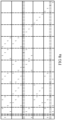
- FIG. 3 b is a schematic drawing illustrating an example parity-check matrix according to some embodiments.
- the parity-check matrix of FIG. 3 b corresponds to the base graph matrix of FIG. 3 a and has a Z-variable set to 4.
- the code block bits are usually represented by numerical soft values: a positive soft value indicates that the corresponding bit is likely a zero, while a negative soft value indicates that the corresponding bit is likely a one.
- the received information is usually represented by numerical “soft values” corresponding to the code block bits: a positive soft value indicates that the corresponding bit is likely a zero, while a negative soft value indicates that the corresponding bit is likely a one.
- the LDPC decoder operates by iteratively updating soft information based on the parity checks.
- FIG. 3 c is a schematic drawing illustrating an example base graph according to some embodiments.
- the base graph of FIG. 3 c corresponds to the base graph matrix of FIG. 3 a and illustrates iterative updating of soft information according to the parity-check matrix of FIG. 3 b.
- the soft information involves the soft bit values associated with each code block bit, as well as soft values associated with the edges in the graph, i.e. ones in the parity-check matrix.
- bit-to-check values and check-to-bit values.
- This updating proceeds for a number of iterations, after which a code block estimate is formed by examining the signs of the updated soft values (reference to step 107 of FIG. 1 ). The number of required iterations depends partly on the noisiness of the radio channel.
- noise channels may require as many as 30-40 iterations over all parity checks.
- FIG. 4 a is a schematic drawing illustrating an example parity-check matrix according to some embodiments.
- the parity-check matrix of FIG. 4 a has a Z-variable set to 4.
- the LDPC decoder operates by updating soft information based on one parity check, i.e. one row (emphasis added in matrix).
- FIG. 4 b is a schematic drawing illustrating an example base graph according to some embodiments.
- the base graph of FIG. 4 b illustrates iterative updating of soft information according to the parity-check matrix of FIG. 4 a.
- the one parity-check update performed by the LDPC decoder comprises computing new check-to-bit values and new bit values.
- bit-to-check values are computed based on current bit values and check-to-bit values. This may be performed by subtracting the most recent check-to-bit values from the bit values, but other techniques may also be used.
- the update then computes new check-to-bit values based on the bit-to-check values.
- FIG. 5 a is a schematic drawing illustrating an example parity-check matrix according to some embodiments.
- the parity-check matrix of FIG. 5 a has a Z-variable set to 4.
- the LDPC decoder operates by updating all checks, i.e. parity checks, in one row block (emphasis added in matrix).
- This fully parallel approach entails that many row updates will update the soft bit values for the same bits. This may require expensive synchronization methods to avoid race conditions. Moreover, this may require more iterations to be performed, since the row updates that are performed in parallel are unable to use the updated soft values from each other.
- the structure of the 5G NR LDPC codes allows for an update strategy that is called layered updating.
- the row blocks are processed sequentially, one by one, e.g. from top to bottom.
- the Z constituent rows are updated in parallel.
- the layered strategy typically requires that the row blocks be processed sequentially, which can mean up to 46 sequential steps for some 5G NR codes. This may create unwanted processing delays.
- Hardware comprising parallel processing units may provide very high degree of parallelization, e.g. Graphics Processing Units (GPU).
- GPU Graphics Processing Units
- To implement LDPC decoding on such hardware comprising parallel processing units may enable even higher parallelization factors than can be obtained with the layered strategy.
- FIG. 5 b is a schematic drawing illustrating an example base graph according to some embodiments.
- the base graph of FIG. 5 b illustrates iterative updating of soft information according to the parity-check matrix of FIG. 5 a.
- the updating of all checks, i.e. parity-checks, in one row block by the LDPC decoder comprises computing new check-to-bit values and new bit values.
- FIG. 6 a is a schematic drawing illustrating an example parity-check matrix according to some embodiments.
- the parity-check matrix of FIG. 6 a has a Z-variable set to 4.
- the LDPC decoder operates by updating all checks in two row blocks (emphasis added in matrix).
- combining row blocks may be performed when two rows of the base graph matrix are completely non-overlapping, i.e. they do not share any column with a nonnegative value. Such a row pair can be readily combined into a row group.
- FIG. 6 b is a schematic drawing illustrating an example base graph according to some embodiments.
- the base graph of FIG. 6 b illustrates iterative updating of soft information according to the parity-check matrix of FIG. 6 a.
- the updating of all checks, i.e. parity-checks, in two independent row blocks by the LDPC decoder comprises updating the parity checks for a combined row group comprising the two independent row blocks which are completely non-overlapping (reference to FIG. 6 a ).
- FIG. 7 a is a schematic drawing illustrating an example parity-check matrix according to some embodiments.
- the parity-check matrix of FIG. 7 a has a Z-variable set to 4.
- the LDPC decoder operates by updating all checks in two row blocks with a shared column (emphasis added in matrix).
- FIG. 7 b is a schematic drawing illustrating an example base graph according to some embodiments.
- the base graph of FIG. 7 b illustrates iterative updating of soft information according to the parity-check matrix of FIG. 7 a.
- the updating of all checks, i.e. parity-checks, in two row blocks with a shared column by the LDPC decoder comprises updating the parity checks for a combined row group comprising the two row blocks with the shared column (emphasis added to the overlap in the single column bits).
- FIG. 8 a is a schematic drawing illustrating an example parity-check matrix according to some embodiments.
- the parity-check matrix of FIG. 8 a has a Z-variable set to 4.
- the LDPC decoder operates by updating all checks in two row blocks with a shared column (emphasis added in matrix).
- FIG. 8 b is a schematic drawing illustrating an example base graph according to some embodiments.
- the base graph of FIG. 8 b illustrates iterative updating of soft information according to the parity-check matrix of FIG. 8 a.
- the updating of all checks, i.e. parity-checks, in two row blocks with a shared column by the LDPC decoder comprises updating the parity checks for a combined row group comprising the two row blocks with the shared column (emphasis added to the overlap in the single column bits).
- FIG. 9 a is a schematic drawing illustrating an example parity-check matrix according to some embodiments.
- the parity-check matrix of FIG. 9 a has a Z-variable set to 4.
- the LDPC decoder operates by updating all checks in two row blocks with a shared column (emphasis added in matrix).
- the base graph matrix illustrates an embodiment wherein row blocks 2 and 4 share column 0.
- steps 1 - 4 (corresponding to steps 106 a - 106 d of FIG. 1 ) in the updating with focus on one of the parity checks of row block 2 and one of the parity checks of row block 4, chosen such that they involve the same bit in the shared column 0.
- FIG. 9 b is a schematic drawing illustrating an example base graph according to some embodiments.
- the base graph of FIG. 9 b illustrates a first step of iterative updating of soft information according to the parity-check matrix of FIG. 9 a.
- FIGS. 9 b - 9 e only illustrate one parity check on each row block, the actual updating takes place over all of the parity checks in parallel.
- Step 1 Collect available bit-to-check values.
- step 1 latest bit-to-check values are collected, except for those coming from the shared bit.
- FIG. 9 c is a schematic drawing illustrating an example base graph according to some embodiments.
- the base graph of FIG. 9 c illustrates a first and second step of iterative updating of soft information according to the parity-check matrix of FIG. 9 a.
- FIGS. 9 b - 9 e only illustrate one parity check on each row block, the actual updating takes place over all of the parity checks in parallel.
- Step 2 Compute shared check-to-bit values.
- step 2 new check-to-bit values are computed towards the shared bit.
- FIG. 9 d is a schematic drawing illustrating an example base graph according to some embodiments.
- the base graph of FIG. 9 d illustrates a first, second, and third step of iterative updating of soft information according to the parity-check matrix of FIG. 9 a.
- FIGS. 9 b - 9 e only illustrate one parity check on each row block, the actual updating takes place over all of the parity checks in parallel.
- Step 3 Compute shared bit-to-check values.
- step 3 new bit-to-check values are computed for the shared bit, based on the previous step 2 illustrated in FIG. 9 c.
- FIG. 9 e is a schematic drawing illustrating an example base graph according to some embodiments.
- the base graph of FIG. 9 e illustrates a first, second, third, and fourth step of iterative updating of soft information according to the parity-check matrix of FIG. 9 a.
- FIGS. 9 b - 9 e only illustrate one parity check on each row block, the actual updating takes place over all of the parity checks in parallel.
- Step 4 Compute new check-to-bit values.
- step 4 computation of the remaining check-to-bit values is performed, for all bits except the already computed shared bit.
- step 5 the bit values for all involved are updated (corresponding to step 106 e of FIG. 1 ).
- the condition that they can be combined into one update is based on a corresponding subgraph of the base graph.
- the subgraph consists of the given row vertices and the column vertices to which they are connected, as well as any edges defined by those rows. If this subgraph is free from cycles, then the rows can be combined into a group and updated in parallel.
- FIG. 10 is a schematic block diagram illustrating an example apparatus 1000 according to some embodiments.
- the apparatus 1000 is for accelerating bit error correction in a receiver in a radio communication network.
- the apparatus 1000 and/or the controller 1010 may, for example, be configured to perform one or more of the method steps of FIG. 1 , and/or updating steps of FIGS. 9 b - 9 e , and/or one or more of any steps otherwise described herein.
- the apparatus 1000 is for accelerating bit error correction in a receiver in a radio communication network, wherein the receiver is configured to update soft bit values associated with each code bit of a block code based on parallel parity checks.
- the apparatus 1000 comprises a controller 1010 , e.g. device controlling circuitry, configured to cause reception of a block code encoded message.
- a controller 1010 e.g. device controlling circuitry, configured to cause reception of a block code encoded message.
- the controller 1010 is further configured to cause for any group of two or more rows of a parity-check matrix of the block code: when the two or more rows are non-overlapping: combination of the two or more rows in a row group for parallel updating, parallel update of the parity checks of the row group for the received message, and formation of a message estimate based on the updated parity checks.
- the controller 1010 is furthermore configured to cause, when the two or more rows are overlapping in one shared bit: combination of the two or more rows in a row group for parallel updating, update of the parity checks of the row group for the received message by: collection of available bit-to-check values except from the shared bit, computation of shared check-to-bit values towards the shared bit based on the collected bit-to-check values, computation of shared bit-to-check values for the shared bit based on the computed shared check-to-bit values, computation of new check-to-bit values for all remaining bits, and parallel update of the parity checks of the row group for the received message based on the computed check-to-bit values.
- the controller 1010 is furthermore configured to cause iterative updating of soft bit values associated with each code bit of the block code based on parallel parity checks.
- the apparatus 1000 comprises, as mentioned above, the controller (CNTR; e.g., control circuitry or a controlling module) 1010 , which may in turn comprise, (or be otherwise associated with; e.g., connected or connectable to), a receiver 1001 , e.g. receiving circuitry or receiving module, configured to receive a block code encoded message (compare with step 101 of FIG. 1 ).
- the controller CNTR; e.g., control circuitry or a controlling module
- a receiver 1001 e.g. receiving circuitry or receiving module, configured to receive a block code encoded message (compare with step 101 of FIG. 1 ).
- the controller 1010 further comprises, (or is otherwise associated with; e.g., connected or connectable to), a determiner 1002 , e.g. determining circuitry or determining module, configured to determine, for any group of two or more rows of a parity-check matrix of the block code, when the two or more rows are non-overlapping (compare with step 102 of FIG. 1 ).
- a determiner 1002 e.g. determining circuitry or determining module, configured to determine, for any group of two or more rows of a parity-check matrix of the block code, when the two or more rows are non-overlapping (compare with step 102 of FIG. 1 ).
- the controller 1010 furthermore comprises, (or is otherwise associated with; e.g., connected or connectable to), a combiner 1003 , e.g. combining circuitry or combining module, configured to combine the two or more rows in a row group for parallel updating (compare with step 103 of FIG. 1 ), an updater 1004 , e.g. updating circuitry or updating module, configured to update, in parallel, the parity checks of the row group for the received message (compare with step 104 of FIG. 1 ), and a former 1007 , e.g. forming circuitry or forming module, configured to form a message estimate based on the updated parity checks (compare with step 107 of FIG. 1 ).
- a combiner 1003 e.g. combining circuitry or combining module, configured to combine the two or more rows in a row group for parallel updating (compare with step 103 of FIG. 1 )
- an updater 1004 e.g. updating circuitry or updating module, configured to update, in
- the controller 1010 may, in some embodiments, further comprise, (or be otherwise associated with; e.g., connected or connectable to), the determiner 1002 , e.g. determining circuitry or determining module, configured to determine, for any group of two or more rows of a parity-check matrix of the block code, when the two or more rows are overlapping ( 102 ) in one shared bit (compare with step 102 of FIG. 1 ).
- the determiner 1002 e.g. determining circuitry or determining module, configured to determine, for any group of two or more rows of a parity-check matrix of the block code, when the two or more rows are overlapping ( 102 ) in one shared bit (compare with step 102 of FIG. 1 ).
- the controller 1010 may, in some embodiments, furthermore comprise, (or be otherwise associated with; e.g., connected or connectable to), a combiner 1005 , e.g. combining circuitry or combining module configured to combine the two or more rows in a row group for parallel updating (compare with step 105 of FIG. 1 ), an updater 1006 , e.g. updating circuitry or updating module, configured to update the parity checks of the row group for the received message (compare with step 106 of FIG. 1 ), a collector 1006 a , e.g. collecting circuitry or collecting module, configured to collect available bit-to-check values except from the shared bit (compare with step 106 a of FIG.
- a combiner 1005 e.g. combining circuitry or combining module configured to combine the two or more rows in a row group for parallel updating (compare with step 105 of FIG. 1 )
- an updater 1006 e.g. updating circuitry or updating module, configured to update the parity
- a computer 1006 b e.g. computing circuitry or computing module, configured to compute shared check-to-bit values towards the shared bit based on the collected bit-to-check values (compare with step 106 b of FIG. 1 )
- a computer 1006 c e.g. computing circuitry or computing module, configured to compute shared bit-to-check values for the shared bit based on the computed shared check-to-bit values (compare with step 106 c of FIG. 1 )
- a computer 1006 d e.g. computing circuitry or computing module, configured to compute new check-to-bit values for all remaining bits (compare with step 106 d of FIG. 1 )
- an updater 1006 e e.g. updating circuitry or updating module, configured to update, in parallel, the parity checks of the row group for the received message based on the computed check-to-bit values (compare with step 106 e of FIG. 1 ).
- the controller 1010 may, in some embodiments, furthermore comprise, (or be otherwise associated with; e.g., connected or connectable to), an iterator (not shown), e.g. iterating circuitry or iterating module configured to iterate updating of soft bit values associated with each code bit of the block code based on parallel parity checks.
- an iterator not shown
- iterating circuitry or iterating module configured to iterate updating of soft bit values associated with each code bit of the block code based on parallel parity checks.
- the apparatus is operably connectable to general-purpose hardware with parallel processing elements configured to process the parallelized parity checks.
- each of the parallel processing elements is configured to compute respective one or more of shared check-to-bit values, shared bit-to-check values, and new check-to-bit values.
- the general-purpose hardware with parallel processing elements is comprised in the receiver and/or in a cloud environment.
- the general-purpose hardware comprises a Graphics Processing Unit, GPU.
- the apparatus 1000 may further optionally comprise, (or be otherwise associated with; e.g., connected or connectable to), in some embodiments, a transceiver TX/RX 1020 , e.g. transceiving circuitry or transceiving module, configured to transmit and receive radio signals e.g. in accordance with accelerating bit error correction in a receiver in a radio communication network.
- a transceiver TX/RX 1020 e.g. transceiving circuitry or transceiving module, configured to transmit and receive radio signals e.g. in accordance with accelerating bit error correction in a receiver in a radio communication network.
- the physical product may comprise one or more parts, such as controlling circuitry in the form of one or more controllers, one or more processors, or the like.
- the described embodiments and their equivalents may be realized in software or hardware or a combination thereof.
- the embodiments may be performed by general purpose circuitry. Examples of general purpose circuitry include digital signal processors (DSP), central processing units (CPU), Graphics Processing Units (GPU), co-processor units, field programmable gate arrays (FPGA) and other programmable hardware.
- DSP digital signal processors
- CPU central processing units
- GPU Graphics Processing Unit
- FPGA field programmable gate arrays
- the embodiments may be performed by specialized circuitry, such as application specific integrated circuits (ASIC).
- ASIC application specific integrated circuits
- the general purpose circuitry and/or the specialized circuitry may, for example, be associated with or comprised in an apparatus such as a wireless communication device.
- Embodiments may appear within an electronic apparatus (such as a wireless communication device) comprising arrangements, circuitry, and/or logic according to any of the embodiments described herein.
- an electronic apparatus such as a wireless communication device
- an electronic apparatus may be configured to perform methods according to any of the embodiments described herein.
- a computer program product comprises a computer readable medium such as, for example a universal serial bus (USB) memory, a plug-in card, an embedded drive or a read only memory (ROM).
- a computer readable medium such as, for example a universal serial bus (USB) memory, a plug-in card, an embedded drive or a read only memory (ROM).
- USB universal serial bus
- ROM read only memory
- FIG. 11 illustrates an example computer readable medium in the form of a compact disc (CD) ROM 1100 .
- the computer readable medium has stored thereon a computer program comprising program instructions.
- the computer program is loadable into a data processor (PROC) 1120 , which may, for example, be comprised in a wireless communication device 1110 .
- PROC data processor
- the computer program may be stored in a memory (MEM) 1130 associated with or comprised in the data processor.
- the computer program may, when loaded into and run by the data processing unit, cause execution of method steps according to, for example, FIG. 1 and/or FIGS. 9 b - e and/or one or more of any steps otherwise described herein.
- the method embodiments described herein discloses example methods through steps being performed in a certain order. However, it is recognized that these sequences of events may take place in another order without departing from the scope of the claims. Furthermore, some method steps may be performed in parallel even though they have been described as being performed in sequence. Thus, the steps of any methods disclosed herein do not have to be performed in the exact order disclosed, unless a step is explicitly described as following or preceding another step and/or where it is implicit that a step must follow or precede another step.
Landscapes
- Physics & Mathematics (AREA)
- Mathematical Physics (AREA)
- Probability & Statistics with Applications (AREA)
- Engineering & Computer Science (AREA)
- Theoretical Computer Science (AREA)
- Error Detection And Correction (AREA)
Abstract
Description
Claims (18)
Priority Applications (1)
| Application Number | Priority Date | Filing Date | Title |
|---|---|---|---|
| US17/909,896 US12132500B2 (en) | 2020-03-23 | 2021-03-03 | Accelerating bit error correction in a receiver |
Applications Claiming Priority (3)
| Application Number | Priority Date | Filing Date | Title |
|---|---|---|---|
| US202062993210P | 2020-03-23 | 2020-03-23 | |
| PCT/EP2021/055282 WO2021190887A1 (en) | 2020-03-23 | 2021-03-03 | Accelerating bit error correction in layered ldpc decoding |
| US17/909,896 US12132500B2 (en) | 2020-03-23 | 2021-03-03 | Accelerating bit error correction in a receiver |
Publications (2)
| Publication Number | Publication Date |
|---|---|
| US20230101789A1 US20230101789A1 (en) | 2023-03-30 |
| US12132500B2 true US12132500B2 (en) | 2024-10-29 |
Family
ID=74859426
Family Applications (1)
| Application Number | Title | Priority Date | Filing Date |
|---|---|---|---|
| US17/909,896 Active 2041-05-04 US12132500B2 (en) | 2020-03-23 | 2021-03-03 | Accelerating bit error correction in a receiver |
Country Status (3)
| Country | Link |
|---|---|
| US (1) | US12132500B2 (en) |
| EP (1) | EP4128542B1 (en) |
| WO (1) | WO2021190887A1 (en) |
Families Citing this family (1)
| Publication number | Priority date | Publication date | Assignee | Title |
|---|---|---|---|---|
| KR20230164328A (en) * | 2022-05-25 | 2023-12-04 | 삼성전자주식회사 | Method and appaartus for layered decoding of low-density parity-check codes in communication system |
Citations (14)
| Publication number | Priority date | Publication date | Assignee | Title |
|---|---|---|---|---|
| EP1622276A2 (en) | 2004-07-22 | 2006-02-01 | Texas Instruments Incorporated | Layered decoding of low density parity check (LDPC) codes |
| US20070089017A1 (en) * | 2005-10-18 | 2007-04-19 | Nokia Corporation | Error correction decoder, method and computer program product for block serial pipelined layered decoding of structured low-density parity-check (LDPC) codes with reduced memory requirements |
| US20070283220A1 (en) * | 2006-05-16 | 2007-12-06 | Nokia Corporation | Method, apparatus and computer program product providing soft iterative recursive least squares (RLS) channel estimator |
| US20080126916A1 (en) * | 2006-11-17 | 2008-05-29 | Lg Electronics Inc. | Method of executing ldpc coding using parity check matrix |
| US20110161770A1 (en) * | 2009-12-31 | 2011-06-30 | Yeong-Luh Ueng | Low density parity check codec and method of the same |
| US20110179333A1 (en) * | 2008-05-21 | 2011-07-21 | The Regents Of The University Of California | Lower-complexity layered belief propagation decoding ldpc codes |
| US20110283158A1 (en) | 2010-05-11 | 2011-11-17 | Samsung Electronics Co., Ltd. | Apparatus and method for layered decoding in a communication system using low-density parity-check codes |
| US9590658B1 (en) * | 2013-08-01 | 2017-03-07 | SK Hynix Inc. | High-speed low-power LDPC decoder design |
| US20170317692A1 (en) | 2014-09-22 | 2017-11-02 | Streamscale, Inc. | Sliding window list decoder for error correcting codes |
| US20180026662A1 (en) * | 2016-07-22 | 2018-01-25 | Samsung Electronics Co., Ltd. | Method for controlling decoding process based on path metric value and computing apparatus and mobile device for controlling the same |
| WO2018128560A1 (en) | 2017-01-09 | 2018-07-12 | Huawei Technologies Co., Ltd | Efficiently decodable qc-ldpc code |
| US20180226992A1 (en) * | 2017-02-03 | 2018-08-09 | Huawei Technologies Co., Ltd. | Offset Lifting Method |
| US20210194509A1 (en) * | 2018-04-20 | 2021-06-24 | Telefonaktiebolaget Lm Ericsson (Publ) | Information decoder for polar codes |
| US11075650B1 (en) * | 2019-10-29 | 2021-07-27 | Xilinx, Inc. | Sub-matrix reduction for quasi-cyclic LDPC codes |
-
2021
- 2021-03-03 WO PCT/EP2021/055282 patent/WO2021190887A1/en not_active Ceased
- 2021-03-03 EP EP21710226.8A patent/EP4128542B1/en active Active
- 2021-03-03 US US17/909,896 patent/US12132500B2/en active Active
Patent Citations (15)
| Publication number | Priority date | Publication date | Assignee | Title |
|---|---|---|---|---|
| EP1622276A2 (en) | 2004-07-22 | 2006-02-01 | Texas Instruments Incorporated | Layered decoding of low density parity check (LDPC) codes |
| US20070089017A1 (en) * | 2005-10-18 | 2007-04-19 | Nokia Corporation | Error correction decoder, method and computer program product for block serial pipelined layered decoding of structured low-density parity-check (LDPC) codes with reduced memory requirements |
| US20070089018A1 (en) * | 2005-10-18 | 2007-04-19 | Nokia Corporation | Error correction decoder, method and computer program product for block serial pipelined layered decoding of structured low-density parity-check (LDPC) codes, including reconfigurable permuting/de-permuting of data values |
| US20070283220A1 (en) * | 2006-05-16 | 2007-12-06 | Nokia Corporation | Method, apparatus and computer program product providing soft iterative recursive least squares (RLS) channel estimator |
| US20080126916A1 (en) * | 2006-11-17 | 2008-05-29 | Lg Electronics Inc. | Method of executing ldpc coding using parity check matrix |
| US20110179333A1 (en) * | 2008-05-21 | 2011-07-21 | The Regents Of The University Of California | Lower-complexity layered belief propagation decoding ldpc codes |
| US20110161770A1 (en) * | 2009-12-31 | 2011-06-30 | Yeong-Luh Ueng | Low density parity check codec and method of the same |
| US20110283158A1 (en) | 2010-05-11 | 2011-11-17 | Samsung Electronics Co., Ltd. | Apparatus and method for layered decoding in a communication system using low-density parity-check codes |
| US9590658B1 (en) * | 2013-08-01 | 2017-03-07 | SK Hynix Inc. | High-speed low-power LDPC decoder design |
| US20170317692A1 (en) | 2014-09-22 | 2017-11-02 | Streamscale, Inc. | Sliding window list decoder for error correcting codes |
| US20180026662A1 (en) * | 2016-07-22 | 2018-01-25 | Samsung Electronics Co., Ltd. | Method for controlling decoding process based on path metric value and computing apparatus and mobile device for controlling the same |
| WO2018128560A1 (en) | 2017-01-09 | 2018-07-12 | Huawei Technologies Co., Ltd | Efficiently decodable qc-ldpc code |
| US20180226992A1 (en) * | 2017-02-03 | 2018-08-09 | Huawei Technologies Co., Ltd. | Offset Lifting Method |
| US20210194509A1 (en) * | 2018-04-20 | 2021-06-24 | Telefonaktiebolaget Lm Ericsson (Publ) | Information decoder for polar codes |
| US11075650B1 (en) * | 2019-10-29 | 2021-07-27 | Xilinx, Inc. | Sub-matrix reduction for quasi-cyclic LDPC codes |
Non-Patent Citations (5)
| Title |
|---|
| 3GPP TS 38.212 V16.0.0; 3rd Generation Partnership Project; Technical Specification Group Radio Access Network; NR; Multiplexing and channel coding (Release 16); Dec. 2019; consisting 145 pages. |
| 3GPP TSG-RAN WG1 NR R1-1701211; Title: High Efficiency LDPC code Features; Agenda item: 5.1.5.1; Source: MediaTek Inc.; Document for: Discussion/Decision; Date and Location: Jan. 16-20, 2017, Spokane, Washington; consisting of 13 pages. |
| Gallager, R.G.; Low-Density Parity-Check Codes; IRE Transactions on Information Theory; Jan. 1962; pp. 21-28; Cambridge, Massachusetts; consisting of 8 pages. |
| International Search Report and Written Opinion dated Jun. 4, 2021 for International Application No. PCT/EP2021/055282 filed Mar. 3, 2021; consisting of 14 pages. |
| Swedish Office Action dated Apr. 7, 2021 for Swedish Patent Application No. 2030161-0; consisting of 8 pages. |
Also Published As
| Publication number | Publication date |
|---|---|
| WO2021190887A1 (en) | 2021-09-30 |
| EP4128542B1 (en) | 2025-11-19 |
| US20230101789A1 (en) | 2023-03-30 |
| EP4128542A1 (en) | 2023-02-08 |
Similar Documents
| Publication | Publication Date | Title |
|---|---|---|
| US8321747B2 (en) | QC-LDPC code decoder and corresponding decoding method | |
| US20060020870A1 (en) | Layered decoding of low density parity check (PDPC) codes | |
| US10623019B2 (en) | Method of decoding low density parity check (LDPC) code, decoder and system performing the same | |
| CN108809332B (en) | Polar code transmission method and device | |
| US11108410B1 (en) | User-programmable LDPC decoder | |
| US11075651B2 (en) | Generalized low-density parity check codes (GLDPC) | |
| US11075650B1 (en) | Sub-matrix reduction for quasi-cyclic LDPC codes | |
| JP4320418B2 (en) | Decoding device and receiving device | |
| US7451374B2 (en) | Apparatus and method for channel coding in mobile communication system | |
| WO2007018590A1 (en) | Method and apparatus for block and rate independent decoding of ldpc codes | |
| US12132500B2 (en) | Accelerating bit error correction in a receiver | |
| CN110555512B (en) | Data reuse method and device for binary convolution neural network | |
| EP2230767A1 (en) | Decoding device, data storage device, data communication system, and decoding method | |
| US20110179337A1 (en) | Memory utilization method for low density parity check code, low density parity check code decoding method and decoding apparatus thereof | |
| CN112583420B (en) | A data processing method and decoder | |
| KR20160116980A (en) | Scheduling apparatus and method of the parity check matrix h for vertical shuffle scheduling algorithm of the low density parity check decoder | |
| CN113489995A (en) | Decoding method for decoding received information and related decoding device | |
| US12034454B2 (en) | Verifying data integrity in a receiver | |
| CN115425987B (en) | FPGA-based LDPC decoder | |
| US20180309463A1 (en) | Hybrid type iterative decoding method and apparatus | |
| US10216567B1 (en) | Direct parity encoder | |
| CN113271109A (en) | Iterative cycle data storage method and system in LDPC decoding process | |
| CN119496516B (en) | Dynamic coding construction and low-complexity coding method and device for error correction and encryption fusion | |
| CN115425990B (en) | Verification methods, devices, and decoders applicable to LDPC decoders | |
| US20250247111A1 (en) | Controller, system and method for decoding codeword based on historical information |
Legal Events
| Date | Code | Title | Description |
|---|---|---|---|
| FEPP | Fee payment procedure |
Free format text: ENTITY STATUS SET TO UNDISCOUNTED (ORIGINAL EVENT CODE: BIG.); ENTITY STATUS OF PATENT OWNER: LARGE ENTITY |
|
| AS | Assignment |
Owner name: TELEFONAKTIEBOLAGET LM ERICSSON (PUBL), SWEDEN Free format text: ASSIGNMENT OF ASSIGNORS INTEREST;ASSIGNORS:WIBERG, NICLAS;HESSLER, MARTIN;REEL/FRAME:061313/0734 Effective date: 20210419 |
|
| STPP | Information on status: patent application and granting procedure in general |
Free format text: DOCKETED NEW CASE - READY FOR EXAMINATION |
|
| STPP | Information on status: patent application and granting procedure in general |
Free format text: NON FINAL ACTION MAILED |
|
| STPP | Information on status: patent application and granting procedure in general |
Free format text: RESPONSE TO NON-FINAL OFFICE ACTION ENTERED AND FORWARDED TO EXAMINER |
|
| STPP | Information on status: patent application and granting procedure in general |
Free format text: NOTICE OF ALLOWANCE MAILED -- APPLICATION RECEIVED IN OFFICE OF PUBLICATIONS |
|
| STPP | Information on status: patent application and granting procedure in general |
Free format text: AWAITING TC RESP., ISSUE FEE NOT PAID |
|
| STPP | Information on status: patent application and granting procedure in general |
Free format text: NOTICE OF ALLOWANCE MAILED -- APPLICATION RECEIVED IN OFFICE OF PUBLICATIONS |
|
| STPP | Information on status: patent application and granting procedure in general |
Free format text: PUBLICATIONS -- ISSUE FEE PAYMENT VERIFIED |
|
| STCF | Information on status: patent grant |
Free format text: PATENTED CASE |