US12131827B2 - Knowledge graph-based question answering method, computer device, and medium - Google Patents
Knowledge graph-based question answering method, computer device, and medium Download PDFInfo
- Publication number
- US12131827B2 US12131827B2 US17/613,629 US202117613629A US12131827B2 US 12131827 B2 US12131827 B2 US 12131827B2 US 202117613629 A US202117613629 A US 202117613629A US 12131827 B2 US12131827 B2 US 12131827B2
- Authority
- US
- United States
- Prior art keywords
- entity
- knowledge graph
- mention
- name
- entities
- Prior art date
- Legal status (The legal status is an assumption and is not a legal conclusion. Google has not performed a legal analysis and makes no representation as to the accuracy of the status listed.)
- Active, expires
Links
Images


Classifications
-
- G—PHYSICS
- G06—COMPUTING OR CALCULATING; COUNTING
- G06F—ELECTRIC DIGITAL DATA PROCESSING
- G06F40/00—Handling natural language data
- G06F40/20—Natural language analysis
- G06F40/279—Recognition of textual entities
- G06F40/289—Phrasal analysis, e.g. finite state techniques or chunking
- G06F40/295—Named entity recognition
-
- G—PHYSICS
- G06—COMPUTING OR CALCULATING; COUNTING
- G06F—ELECTRIC DIGITAL DATA PROCESSING
- G06F16/00—Information retrieval; Database structures therefor; File system structures therefor
- G06F16/30—Information retrieval; Database structures therefor; File system structures therefor of unstructured textual data
- G06F16/33—Querying
- G06F16/332—Query formulation
- G06F16/3329—Natural language query formulation
-
- G—PHYSICS
- G06—COMPUTING OR CALCULATING; COUNTING
- G06F—ELECTRIC DIGITAL DATA PROCESSING
- G06F16/00—Information retrieval; Database structures therefor; File system structures therefor
- G06F16/30—Information retrieval; Database structures therefor; File system structures therefor of unstructured textual data
- G06F16/36—Creation of semantic tools, e.g. ontology or thesauri
- G06F16/367—Ontology
-
- G—PHYSICS
- G06—COMPUTING OR CALCULATING; COUNTING
- G06F—ELECTRIC DIGITAL DATA PROCESSING
- G06F40/00—Handling natural language data
- G06F40/20—Natural language analysis
- G06F40/205—Parsing
- G06F40/216—Parsing using statistical methods
-
- G—PHYSICS
- G06—COMPUTING OR CALCULATING; COUNTING
- G06F—ELECTRIC DIGITAL DATA PROCESSING
- G06F40/00—Handling natural language data
- G06F40/20—Natural language analysis
- G06F40/237—Lexical tools
- G06F40/242—Dictionaries
-
- G—PHYSICS
- G06—COMPUTING OR CALCULATING; COUNTING
- G06F—ELECTRIC DIGITAL DATA PROCESSING
- G06F40/00—Handling natural language data
- G06F40/20—Natural language analysis
- G06F40/237—Lexical tools
- G06F40/247—Thesauruses; Synonyms
-
- G—PHYSICS
- G06—COMPUTING OR CALCULATING; COUNTING
- G06F—ELECTRIC DIGITAL DATA PROCESSING
- G06F40/00—Handling natural language data
- G06F40/20—Natural language analysis
- G06F40/279—Recognition of textual entities
- G06F40/284—Lexical analysis, e.g. tokenisation or collocates
-
- G—PHYSICS
- G06—COMPUTING OR CALCULATING; COUNTING
- G06F—ELECTRIC DIGITAL DATA PROCESSING
- G06F40/00—Handling natural language data
- G06F40/30—Semantic analysis
-
- G—PHYSICS
- G06—COMPUTING OR CALCULATING; COUNTING
- G06N—COMPUTING ARRANGEMENTS BASED ON SPECIFIC COMPUTATIONAL MODELS
- G06N3/00—Computing arrangements based on biological models
- G06N3/02—Neural networks
- G06N3/04—Architecture, e.g. interconnection topology
- G06N3/042—Knowledge-based neural networks; Logical representations of neural networks
-
- G—PHYSICS
- G06—COMPUTING OR CALCULATING; COUNTING
- G06N—COMPUTING ARRANGEMENTS BASED ON SPECIFIC COMPUTATIONAL MODELS
- G06N5/00—Computing arrangements using knowledge-based models
- G06N5/02—Knowledge representation; Symbolic representation
-
- G—PHYSICS
- G06—COMPUTING OR CALCULATING; COUNTING
- G06N—COMPUTING ARRANGEMENTS BASED ON SPECIFIC COMPUTATIONAL MODELS
- G06N5/00—Computing arrangements using knowledge-based models
- G06N5/04—Inference or reasoning models
-
- G—PHYSICS
- G16—INFORMATION AND COMMUNICATION TECHNOLOGY [ICT] SPECIALLY ADAPTED FOR SPECIFIC APPLICATION FIELDS
- G16H—HEALTHCARE INFORMATICS, i.e. INFORMATION AND COMMUNICATION TECHNOLOGY [ICT] SPECIALLY ADAPTED FOR THE HANDLING OR PROCESSING OF MEDICAL OR HEALTHCARE DATA
- G16H10/00—ICT specially adapted for the handling or processing of patient-related medical or healthcare data
- G16H10/20—ICT specially adapted for the handling or processing of patient-related medical or healthcare data for electronic clinical trials or questionnaires
-
- G—PHYSICS
- G16—INFORMATION AND COMMUNICATION TECHNOLOGY [ICT] SPECIALLY ADAPTED FOR SPECIFIC APPLICATION FIELDS
- G16H—HEALTHCARE INFORMATICS, i.e. INFORMATION AND COMMUNICATION TECHNOLOGY [ICT] SPECIALLY ADAPTED FOR THE HANDLING OR PROCESSING OF MEDICAL OR HEALTHCARE DATA
- G16H50/00—ICT specially adapted for medical diagnosis, medical simulation or medical data mining; ICT specially adapted for detecting, monitoring or modelling epidemics or pandemics
- G16H50/70—ICT specially adapted for medical diagnosis, medical simulation or medical data mining; ICT specially adapted for detecting, monitoring or modelling epidemics or pandemics for mining of medical data, e.g. analysing previous cases of other patients
Definitions
- the present disclosure relates to the field of computer technologies, and particularly relates to a knowledge graph-based question answering method and apparatus, a computer device, and a medium.
- a conventional frequently asked questions (FAQ) question answering system needs to prepare question-answer (Q&A) pairs to answer questions based on the Q&A pairs.
- Q&A pairs cover a narrow range, and it is difficult to match a question raised by a user against questions in the Q&A pairs. For example, it is very difficult to match the question “I feel dizzy and exhausted all the time. Do I have high blood pressure?” with “What are the typical symptoms of high blood pressure?” in an FAQ database. As a result, the FAQ question answering system has low accuracy.
- the present disclosure is intended to provide a knowledge graph-based question answering method and apparatus, a computer device, and a medium.
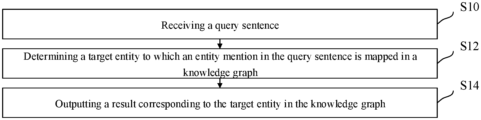
- a knowledge graph-based question answering method includes: receiving a query sentence; determining a target entity to which an entity mention in the query sentence is mapped in a knowledge graph; and outputting a result corresponding to the target entity in the knowledge graph.
- determining the target entity to which the entity mention in the query sentence is mapped in the knowledge graph includes: extracting a semantic feature vector of the entity mention; and inputting the semantic feature vector of the entity mention into a preset neural network, such that the neural network matches the semantic feature vector of the entity mention against semantic feature vectors of entities in the knowledge graph and outputs a first matching result, wherein the first matching result is intended to indicate the target entity.
- determining the target entity to which the entity mention in the query sentence is mapped in the knowledge graph includes: acquiring a second matching result by matching the entity mention against entities in the knowledge graph, wherein the second matching result includes a name of an entity matching the entity mention in the knowledge graph; and determining the entity indicated by the second matching result as the target entity.
- determining the target entity to which the entity mention in the query sentence is mapped in the knowledge graph includes: matching the entity mention against entities in the knowledge graph; searching the entity mention in a name dictionary in response to an absence of a second matching result, wherein the name dictionary includes a standard name and at least one alternative name of each entity, a name of a same entity in the knowledge graph is the same as a corresponding standard name, and the second matching result includes a name of an entity matching the entity mention in the knowledge graph; and determining an entity corresponding to an alternative name containing the entity mention as the target entity in response to a presence of the alternative name containing the entity mention in the name dictionary.
- determining the target entity to which the entity mention in the query sentence is mapped in the knowledge graph includes: matching the entity mention against entities in the knowledge graph; searching the entity mention in a name dictionary in response to an absence of a second matching result, wherein the name dictionary includes a standard name and at least one alternative name of each entity, a name of a same entity in the knowledge graph is the same as a corresponding standard name, and the second matching result includes a name of an entity matching the entity mention in the knowledge graph; and in response to an absence of an alternative name containing the entity mention in the name dictionary, extracting a semantic feature vector of the entity mention, and inputting the semantic feature vector of the entity mention into a preset neural network, such that the neural network matches the semantic feature vector of the entity mention against semantic feature vectors of entities in the knowledge graph and outputs a first matching result, wherein the first matching result is intended to indicate the target entity.
- inputting the semantic feature vector of the entity mention into the preset neural network, such that the neural network matches the semantic feature vector of the entity mention against the semantic feature vectors of the entities in the knowledge graph and outputs the first matching result includes: generating a candidate entity set based on feature comparison results between the entity mention and the entities in the knowledge graph; and inputting the semantic feature vector of the entity mention into the preset neural network, such that the neural network matches the semantic feature vector of the entity mention against semantic feature vectors of candidate entities in the candidate entity set and outputs the first matching result.
- generating the candidate entity set based on the feature comparison results between the entity mention and the entities in the knowledge graph includes: acquiring the feature comparison results by separately performing local character string-based feature comparison, pronunciation feature comparison, initial character feature comparison, and Dice similarity coefficient-based feature comparison on the entity mention and the entities in the knowledge graph; and placing entities with any one of following features in the feature comparison results into the candidate entity set: matching local character strings, consistent pronunciation, consistent initial characters, and a Dice similarity coefficient being greater than a coefficient threshold.
- the method prior to inputting the semantic feature vector of the entity mention into the preset neural network, the method further includes: screening the candidate entities in the candidate entity set.
- screening the candidate entities in the candidate entity set includes: screening the candidate entities in the candidate entity set in at least one of following screening fashions: coexistent keyword screening, synonym replacement-based coexistent keyword screening, and character length difference-based screening.
- the neural network is a Keras deep learning framework-based neural network.
- the knowledge graph is a medical knowledge graph.
- a knowledge graph-based question answering apparatus includes a receiving module, a determining module, and an outputting module.
- the receiving module is configured to receive a query sentence.
- the determining module is configured to determine a target entity to which an entity mention in the query sentence is mapped in a knowledge graph.
- the outputting module is configured to output a result corresponding to the target entity in the knowledge graph.
- the determining module is configured to: extract a semantic feature vector of the entity mention; and input the semantic feature vector of the entity mention into a preset neural network, such that the neural network matches the semantic feature vector of the entity mention against semantic feature vectors of entities in the knowledge graph and outputs a first matching result, wherein the first matching result is intended to indicate the target entity.
- the determining module is configured to: acquire a second matching result by matching the entity mention against entities in the knowledge graph, wherein the second matching result includes a name of an entity matching the entity mention in the knowledge graph; and determine the entity indicated by the second matching result as the target entity.
- the determining module is configured to: match the entity mention against entities in the knowledge graph; search the entity mention in a name dictionary in response to an absence of a second matching result, wherein the name dictionary includes a standard name and at least one alternative name of each entity, a name of a same entity in the knowledge graph is the same as a corresponding standard name, and the second matching result includes a name of an entity matching the entity mention in the knowledge graph; and determine an entity corresponding to an alternative name containing the entity mention as the target entity in response to a presence of the alternative name containing the entity mention in the name dictionary.
- the determining module is configured to: match the entity mention against entities in the knowledge graph; search the entity mention in a name dictionary in response to an absence of a second matching result, wherein the name dictionary includes a standard name and at least one alternative name of each entity, a name of a same entity in the knowledge graph is the same as a corresponding standard name, and the second matching result includes a name of an entity matching the entity mention in the knowledge graph; and in response to an absence of an alternative name containing the entity mention in the name dictionary, extract a semantic feature vector of the entity mention, and input the semantic feature vector of the entity mention into a preset neural network, such that the neural network matches the semantic feature vector of the entity mention against semantic feature vectors of entities in the knowledge graph and outputs a first matching result, wherein the first matching result is intended to indicate the target entity.
- the determining module is configured to: generate a candidate entity set based on feature comparison results between the entity mention and the entities in the knowledge graph; and input the semantic feature vector of the entity mention into the preset neural network, such that the neural network matches the semantic feature vector of the entity mention against semantic feature vectors of candidate entities in the candidate entity set and outputs the first matching result.
- the determining module is configured to: acquire the feature comparison results by separately performing local character string-based feature comparison, pronunciation feature comparison, initial character feature comparison, and Dice similarity coefficient-based feature comparison on the entity mention and the entities in the knowledge graph; and place entities with any one of following features in the feature comparison results into the candidate entity set: matching local character strings, consistent pronunciation, consistent initial characters, and a Dice similarity coefficient being greater than a coefficient threshold.
- the apparatus further includes: a screening module, configured to screen the candidate entities in the candidate entity set.
- the screening module is configured to screen the candidate entities in the candidate entity set in at least one of following screening fashions: coexistent keyword screening, synonym replacement-based coexistent keyword screening, and character length difference-based screening.
- the receiving module is configured to receive the query sentence inputted according to a set sentence structure, wherein the set sentence structure is intended to determine a type of the entity mention.
- a computer device includes a memory, a processor, and at least one computer program stored in the memory and runnable on the processor.
- the processor when running the computer program, is caused to implement the method provided in the first aspect of the present disclosure.
- a non-transitory computer-readable storage medium stores at least one computer program therein.
- the computer program when run by a processor, causes the processor to implement the method provided in the first aspect of the present disclosure.
- FIG. 1 is a schematic flowchart of a knowledge graph-based question answering method according to an embodiment of the present disclosure
- FIG. 2 is a schematic flowchart of a medical knowledge graph-based question answering method according to an embodiment of the present disclosure
- FIG. 3 is a schematic diagram of an interaction interface of a knowledge graph-based question answering system according to an embodiment of the present disclosure
- FIG. 4 is a flowchart of S 22 in a knowledge graph-based question answering method according to an embodiment of the present disclosure
- FIG. 5 is a flowchart of S 222 in a knowledge graph-based question answering method according to an embodiment of the present disclosure
- FIG. 6 is a schematic structural diagram of a knowledge graph-based question answering apparatus according to an embodiment of the present disclosure.
- FIG. 7 is a schematic structural diagram of a computer device for implementing a knowledge graph-based question answering method according to an embodiment of the present disclosure.
- FIG. 1 is a schematic structural diagram of a knowledge graph-based question answering method according to an embodiment of the present disclosure. The method is performed by a terminal device or a server. As shown in FIG. 1 , the method includes the following steps.
- the terminal device when the method is performed by the terminal device, the terminal device receives the query sentence inputted by a user.
- a fashion of inputting the query sentence includes, but is not limited to, a text input fashion, a speech input fashion, and the like.
- a text input fashion an input box is displayed on an interaction interface, and the query sentence inputted by the user in a text form is received via the input box.
- the speech input fashion the query sentence inputted by the user in a speech form is received via a speech acquisition device (for example, a microphone, or the like).
- the server when the method is performed by the server, the server receives the query sentence sent by the terminal device.
- the entity mention in the query sentence is first recognized, and then the entity mention is linked to the target entity in the knowledge graph in a fashion of entity linking, thereby acquiring the target entity to which the entity mention is mapped in the knowledge graph.
- the entity mention may be acquired by performing named entity recognition by using a conditional random field on the query sentence inputted by the user.
- the knowledge graph includes a plurality of entities and association relationships between the entities. After the target entity is determined, other entities associated with the target entity may be acquired in a search fashion, and a found result is outputted.
- a fashion of outputting the result corresponding to the target entity in the knowledge graph includes at least one of: a display fashion, a speech broadcast fashion, and the like.
- the display fashion includes a graphical display fashion and/or a text display fashion.
- the fashion of outputting the result corresponding to the target entity in the knowledge graph includes: sending the result to the terminal device, such that the terminal device feeds back the result to the user in a display fashion, a speech broadcast fashion or the like.
- the question answering method is implemented based on the knowledge graph.
- the accuracy of the result corresponding to the target entity as searched is high by taking the knowledge graph as a knowledge base.
- the target entity is determined in the knowledge graph based on the entity mention in the query sentence, such that the target entity can be accurately determined, thereby further improving the accuracy of the result.
- the knowledge graph is a research hotspot in the field of knowledge engineering at present.
- a medical knowledge graph is taken as an example.
- a medical knowledge graph technology may be used to connect various medical information to each other.
- the medical knowledge graph may be applied to intelligent medical applications such as question answering and auxiliary decision-making support.
- the knowledge graph-based question answering method provided in the embodiments of the present disclosure is exemplarily described by taking the field of medical question answering to which the medical knowledge graph is relatively widely applied as an example.
- FIG. 2 is a schematic structural diagram of a medical knowledge graph-based question answering method according to an embodiment of the present disclosure. As shown in FIG. 2 , the method includes the following steps.
- the query sentence inputted by a user may be received via a human-computer interaction component.
- the human-computer interaction component includes at least one of the following components: a microphone, a keyboard, a mouse, a touchscreen, and the like.
- the user when the steps are performed by a server, the user inputs the query sentence on the terminal device.
- the terminal device sends the received query sentence to the server via a network.
- the server receives the query sentence sent by the terminal device.
- the terminal device presents an interaction interface in a visual form.
- an input box 20 is displayed in an interaction interface.
- the user may input a query sentence, for example, “What diseases are caused by alcohol abuse?” into the input box.
- S 20 includes: receiving the query sentence inputted according to a set sentence structure, wherein the set sentence structure is intended to determine a type of the entity mention.
- a query sentence example may be presented in the interaction interface.
- a query sentence example such as “Is ** xx?” is preset in the input box 20 or near (for example, below) the input box 20 , wherein ** may be a descriptor of a symptom, and xx may be a descriptor of a disease.
- the user is only allowed to input the descriptor of the symptom. For example, the user only needs to input “**” in the foregoing example but does not need to input “xx?” in the example.
- a system parses out that the entity mention in the query sentence is “alcohol abuse.”
- an interaction input box in the present disclosure also supports that the user inputs a query sentence like “What are the symptoms of xx?” wherein xx represents a descriptor of a disease.
- the query sentence is “What are the symptoms of high blood pressure?”.
- the system parses out that the entity mention in the query sentence is “high blood pressure.”
- the type of the entity mention includes a symptom, a disease, or the like.
- the type of the entity mention can be distinguished by using the set sentence structure.
- there are various entity types, and entities of the same name may exist in different entity types.
- the target entity can be determined more accurately by distinguishing the type of the entity mention.
- a target entity to which an entity mention in the query sentence is mapped in a medical knowledge graph is displayed in response to an entity link search request of a user.
- the interaction interface further includes a search button, for example, a “View an entity link result” button 22 .
- the user clicks the “View an entity link result” button 22 to initiate an entity link search request.
- the target entity in the foregoing example of alcohol abuse, the target entity to which the entity mention is mapped is alcoholism
- the entity mention for example, alcohol abuse
- the interaction interface is further provided with a display box 24 .
- the entity mention and the target entity are displayed in the display box 24 , for example, as shown in FIG. 3 , alcohol abuse-->alcoholism.
- the user may clearly see what the entity mention and the target entity separately are.
- the display box 24 may display only the target entity but does not display the entity mention.
- the target entity to which the entity mention in the query sentence is mapped in the medical knowledge graph may be automatically determined, and it is not necessary to wait for the user to send an entity link search request.
- S 24 may be directly performed without displaying the target entity.
- S 22 further includes the following substeps.
- the entity mention may be acquired by performing the named entity recognition by using the conditional random field on the sentence inputted by the user.
- the target entity to which the entity mention is mapped in the medical knowledge graph is acquired by performing entity linking on the entity mention and entities in the medical knowledge graph.
- the medical knowledge graph in the embodiments contains a total of 14 entity types such as symptoms, prevention, the most common group of people, and the like. There are a total of over 70,000 entities and a total of over 200,000 triplets.
- the triplets are in the form ⁇ entity, relationship, entity>.
- S 222 includes:
- the neural network is adopted to classify and determine the target entity corresponding to the entity mention accurately and efficiently, thereby ensuring the efficiency and accuracy of the entity linking, so as to ensure the response speed of question answering and the accuracy of answers.
- S 222 includes the following substeps.
- the entity mention is matched against entities in the medical knowledge graph, and if a second matching result (the second matching result includes the name of the entity matching the entity mention) exists, the entity indicated by the second matching result is taken as the target entity to which the entity mention is mapped in the medical knowledge graph.
- matching the entity mention against the entities in the medical knowledge graph includes: if a name of an entity in the medical knowledge graph is the same as characters of the entity mention, determining that the name of the entity precisely matches the entity mention, so as to acquire a second matching result.
- the entity mention is searched in a name dictionary, wherein the name dictionary includes a standard name and at least one alternative name of each entity, and a name of the same entity in the knowledge graph is the same as a corresponding standard name.
- an entity corresponding to the alternative name is taken as the target entity to which the entity mention is mapped in the medical knowledge graph.
- a standard name of an entity is a name of the entity in the medical knowledge graph.
- a key value of the name dictionary is a title name in Baidu Baike, and a value is a name in an alternative name tag. If the entity mention is contained in a value, a corresponding key value is returned as the target entity to which the entity mention is mapped in the medical knowledge graph.
- a semantic feature vector of the entity mention is extracted, and the semantic feature vector of the entity mention is inputted into a preset neural network, such that the neural network matches the semantic feature vector of the entity mention against semantic feature vectors of entities in the medical knowledge graph and outputs a first matching result, wherein the first matching result is intended to indicate the target entity.
- the neural network is based on Keras deep learning framework.
- S 2223 includes the following steps.
- a candidate entity set is generated based on feature comparison results between the entity mention and the entities in the medical knowledge graph.
- the first step includes:
- acquiring the feature comparison results by separately performing local character string-based feature comparison, pronunciation feature comparison, initial character feature comparison, and Dice similarity coefficient-based feature comparison on the entity mention and the entities in the medical knowledge graph; and placing entities with any one of following features in the feature comparison results into the candidate entity set: matching local character strings, consistent pronunciation, consistent initial characters, and a Dice similarity coefficient being greater than a coefficient threshold.
- This implementation is based on the comparison of various features.
- the accuracy and recall of the candidate entity set can be ensured, and meanwhile, the efficiency of entity linking is improved, thereby improving the response speed of question answering at the same time when the accuracy of answers is ensured.
- feature comparison results of four types that is, matching local character strings, consistent pronunciation, consistent initial characters, and a Dice similarity coefficient being greater than a coefficient threshold are set according to characteristics of Chinese text.
- the matching local character strings are any one of the cases that an entity mention is contained in an entity, an entity mention contains an entity, a single character in a character string of an entity mention is contained in a character string of an entity.
- the consistent pronunciation means that the pronunciation of an entity mention is the same as the pronunciation of a name of a candidate entity. If the pronunciation of an entity mention is the same as the pronunciation of a name of a candidate entity, for an entity mention with a spelling error, a corresponding candidate entity can still be found, which helps to increase the recall of the candidate entity set.
- the consistent initial characters mean that the first character in a character string of an entity mention is the same as the first character in a character string of a candidate entity.
- the Dice similarity coefficient is used for measuring similarity between a character string of an entity mention and a character string of a candidate entity. If the Dice similarity coefficient is greater than the coefficient threshold, the entity is the candidate entity. In comparison, if the Dice similarity coefficient is not greater than the coefficient threshold, the entity is not the candidate entity.
- a semantic feature vector of the entity mention is extracted, and the semantic feature vector of the entity mention is inputted into the preset neural network, such that the neural network matches the semantic feature vector of the entity mention against the semantic feature vectors of candidate entities in the candidate entity set and outputs a first matching result, wherein the first matching result is intended to indicate the target entity.
- This implementation can improve the efficiency of entity linking, thereby improving the response speed of question answering.
- a feature vector containing semantic information is acquired by extracting the semantic feature vector of the entity mention and the semantic feature vector of the candidate entity directly using word2vec.
- the semantic feature vector is inputted into the Keras deep learning framework-based neural network, such that the neural network accurately determines the target entity by classifying ⁇ entity mention, candidate entity>.
- Network parameters of the Keras deep learning framework-based neural network for implementing binary classification may be set as follows: the input dimension is a semantic vector value of 400, epochs are set to 50, batch_size is set to 512, relu is used as a fully-connected network of an activation function, and binary_crossentropy is used as a loss function. The experiment shows that the accuracy of classifying the neural network may be up to 95% or higher.
- the Keras deep learning framework-based neural network outputs a probability value that the candidate entity in ⁇ entity mention, candidate entity> is a target entity, and the target entity is a candidate entity corresponding to a maximum probability value.
- This optional fashion is set based on factors such as comprehensive execution efficiency and effectiveness and includes a plurality of fashions for implementing entity linking that are executed in sequence.
- the efficiency of entity linking can be further improved meanwhile the accuracy of entity linking is ensured, thereby further improving the response speed of question answering meanwhile the accuracy of answers is ensured.
- S 2223 further includes: screening the candidate entities in the candidate entity set.
- a number of the candidate entities in the candidate entity set can be reduced by screening the candidate entities in the candidate entity set, so as to improve the efficiency of entity linking, thereby improving the response speed of question answering.
- screening the candidate entities in the candidate entity set includes: performing at least one of coexistent keyword screening, synonym replacement-based coexistent keyword screening, and character length difference-based screening on the candidate entities in the candidate entity set.
- the corresponding candidate entity is kept. If a keyword is not included in both an entity mention and a candidate entity, the corresponding candidate entity is deleted.
- synonym replacement is performed on a keyword in an entity mention, and coexistent keyword screening is performed on the entity mention after replacement and candidate entities; alternatively, synonym replacement is performed on keywords in candidate entities, and coexistent keyword screening is performed on an entity mention and the candidate entities after replacement.
- excrement and feces are synonyms. After synonym replacement is performed on a keyword in an entity mention or a candidate entity, if the keyword exists in both the entity mention and the candidate entity after replacement, the corresponding candidate entity is kept. If the keyword does not exist in both the entity mention and the candidate entity after replacement, the candidate entity is screened out.
- the threshold is 4.
- This implementation is based on multi-dimensional screening, the accuracy and recall of the candidate entity set can be ensured, and meanwhile, the efficiency of entity linking can be improved, thereby further increasing the response speed of question answering meanwhile the accuracy of answers is ensured.
- the foregoing S 2221 to S 2223 are set based on factors such as comprehensive execution efficiency and effectiveness and include a plurality of fashions for implementing entity linking that are executed in sequence.
- the efficiency of entity linking can be further improved meanwhile the accuracy of entity linking is ensured, thereby further improving the response speed of question answering meanwhile the accuracy of answers is ensured.
- the execution order of the foregoing steps in the embodiments of the present disclosure is not limited as long as a target entity can be determined and a result of the target entity in the knowledge graph can be determined.
- this is an entity linking method designed according to characteristics of Chinese text in the medical field, and the method is applied to medical question answering.
- the medical knowledge graph is used as a knowledge base and an entity mention is acquired by performing named entity recognition, precise matching is performed first. If a target entity fails to be matched in the medical knowledge graph through precise matching, the entity mention is then searched in the name dictionary. If a target entity also fails to be found through the search in the name dictionary, a high-quality candidate entity set constructed based on a plurality of features is finally used.
- a feature vector word vector
- the method provided in the embodiments is used in a Chinese medical corpus to perform entity linking, and an entity mention can be accurately mapped to a target entity in the medical knowledge graph, such that a Cypher sentence in neo4j may be used to search the medical knowledge graph, and an acquired result is outputted as an answer, thereby achieving advantages such as fast response and high accuracy and providing practical value.
- the method further includes: determining a type of the target entity according to the set sentence structure; and selecting a unique target entity by using the type of the target entity.
- S 22 further includes:
- the name of the target entity is displayed in the display box 24 .
- the question answering method in the embodiments of the present disclosure further includes the following step.
- a search button for example, a “View a knowledge graph search result” button 26 is further displayed in the foregoing interaction interface.
- a result corresponding to the target entity in the knowledge graph is displayed in response to a search request of the user (in response to that the user clicks the button 26 in the example in FIG. 3 ).
- the target entity is alcoholism
- diseases related to alcoholism are displayed.
- the target entity is high blood pressure
- symptoms corresponding to high blood pressure are displayed.
- a result is displayed in a display box 28 in a text form (for example, a sentence fashion).
- a text form for example, a sentence fashion.
- “may cause hepatic steatosis, pancreatitis, pituitary apoplexy, . . . ” is displayed in the display box 28 .
- the sentence is relatively long and exceeds a display boundary of the display box 28 , the part that is not shown is replaced by “. . . . ”
- the user may float a cursor of a pointer device such as a mouse on the display box 28 . In this case, the complete sentence is displayed floating.
- the result is displayed in the form of a displayed topological graph 29 as shown in FIG. 3 , thereby displaying the result in a more intuitive graphical fashion.
- corresponding query results such as hepatic steatosis, pancreatitis, and pituitary apoplexy are presented in a radiation form.
- the diseases are connected to alcoholism by arrows.
- the graph is not limited to the topological graph, and for example, may further be a tree relationship diagram.
- the result may be presented in a text fashion and a graphical fashion at the same time.
- the result corresponding to the target entity in the knowledge graph may be further directly displayed, and the knowledge graph search request does not need to be used as a trigger condition.
- a sentence that is inputted by the user and may contain an abbreviation, an acronym, an irregular expression, or a vague expression is accurately mapped to the target entity in the medical knowledge graph by using entity linking, such that an answer can be accurately found, thereby achieving advantages such as fast response and relatively high accuracy.
- question answering method provided in the foregoing embodiments may also be applied to question answering systems in other fields as well as fields such as knowledge graph-based intelligent search and personalized recommendation.
- the medical knowledge graph-based question answering method provided in the foregoing embodiments may be implemented by the terminal device.
- the terminal device may be one of various electronic devices that include, but are not limited to, a personal computer, a smartphone, a tablet computer, a personal digital assist, and the like.
- the medical knowledge graph-based question answering method may further be implemented by a server.
- the terminal device receives the query sentence inputted by the user and sends the query sentence to the server.
- the server may be a server that provides various services.
- the server may perform processing such as storage and analysis on received data (the query sentence that is inputted by the user and is sent by the terminal device), and feedback a processing result (a question answering result) to the terminal device.
- the terminal device outputs the processing result to the user by using an interaction module such as a touchscreen.
- the terminal device communicates with the server via a network.
- the network may include a network of one of various types such as a wired communication link, a wireless communication link, a fiber-optic cable.
- a specific implementation of the so-called “receive” corresponds to a fashion of using the terminal device by the user.
- the user inputs data into a personal computer by a keyboard.
- the personal computer receives the data inputted by the user.
- the user inputs the data in a fashion such as mouse clicks and keyboard operations on a GUI of an application based on the medical knowledge graph-based question answering method on the personal computer.
- the personal computer captures these operations to receive the data inputted by the user.
- the user inputs the data in a speech fashion.
- the personal computer uses a speech-to-text method to receive the data inputted by the user.
- the user uses a mobile phone application (App), and the server may interact with a mobile phone used by the user to receive the data inputted by the user.
- App mobile phone application
- FIG. 6 is a schematic structural diagram of a knowledge graph-based question answering apparatus according to an embodiment of the present disclosure.
- the apparatus includes a receiving module 301 , a determining module 302 , and an outputting module 303 .
- the receiving module 301 is configured to receive a query sentence.
- the determining module 302 is configured to determine a target entity to which an entity mention in the query sentence is mapped in a knowledge graph.
- the outputting module 303 is configured to output a result corresponding to the target entity in the knowledge graph.
- the determining module 302 is configured to: extract a semantic feature vector of the entity mention; and input the semantic feature vector of the entity mention into a preset neural network, such that the neural network matches the semantic feature vector of the entity mention against semantic feature vectors of entities in the knowledge graph and outputs a first matching result, wherein the first matching result is intended to indicate the target entity.
- the determining module 302 is configured to: acquire a second matching result by matching the entity mention against entities in the knowledge graph, wherein the second matching result includes a name of an entity matching the entity mention in the knowledge graph; and determine the entity indicated by the second matching result as the target entity.
- the determining module 302 is configured to: match the entity mention against entities in the knowledge graph; search the entity mention in a name dictionary in response to an absence of a second matching result, wherein the name dictionary includes a standard name and at least one alternative name of each entity, a name of a same entity in the knowledge graph is the same as a corresponding standard name, and the second matching result includes a name of an entity matching the entity mention in the knowledge graph; and determine an entity corresponding to an alternative name containing the entity mention as the target entity in response to a presence of the alternative name containing the entity mention in the name dictionary.
- the determining module 302 is configured to: match the entity mention against entities in the knowledge graph; search the entity mention in a name dictionary in response to an absence of a second matching result, wherein the name dictionary includes a standard name and at least one alternative name of each entity, a name of a same entity in the knowledge graph is the same as a corresponding standard name, and the second matching result includes a name of an entity matching the entity mention in the knowledge graph; and in response to an absence of an alternative name containing the entity mention in the name dictionary, extract a semantic feature vector of the entity mention, and input the semantic feature vector of the entity mention into a preset neural network, such that the neural network matches the semantic feature vector of the entity mention against semantic feature vectors of entities in the knowledge graph and outputs a first matching result, wherein the first matching result is intended to indicate the target entity.
- the determining module 302 is configured to: generate a candidate entity set based on feature comparison results between the entity mention and the entities in the knowledge graph; and input the semantic feature vector of the entity mention into the preset neural network, such that the neural network matches the semantic feature vector of the entity mention against semantic feature vectors of candidate entities in the candidate entity set and outputs the first matching result.
- the determining module 302 is configured to: acquire the feature comparison results by separately performing local character string-based feature comparison, pronunciation feature comparison, initial character feature comparison, and Dice similarity coefficient-based feature comparison on the entity mention and the entities in the knowledge graph; and place entities with any one of following features in the feature comparison results into the candidate entity set: matching local character strings, consistent pronunciation, consistent initial characters, and a Dice similarity coefficient being greater than a coefficient threshold.
- the apparatus further includes: a screening module, configured to screen the candidate entities in the candidate entity set.
- the screening module is configured to screen the candidate entities in the candidate entity set in at least one of following screening fashions: coexistent keyword screening, synonym replacement-based coexistent keyword screening, and character length difference-based screening.
- the receiving module 301 is configured to receive the query sentence inputted according to a set sentence structure, wherein the set sentence structure is intended to determine a type of the entity mention.
- the knowledge graph-based question answering apparatus provided in the foregoing embodiments are implemented by a personal computer.
- the personal computer stores human-computer interaction software.
- a question answering system module developed by using python is encapsulated and then invoked in software.
- a user may view a graphical search result.
- the interaction interface is as shown in FIG. 3 .
- the division of the foregoing functional modules is only an example for description.
- the foregoing functions may be allocated to different functional modules as required. That is, the internal structure of the apparatus is divided into different functional modules, to complete all or some functions described above.
- the knowledge graph-based question answering apparatus provided in the foregoing embodiments and the embodiments of the knowledge graph-based question answering method belong to the same concept.
- a computer device suitable for implementing a medical knowledge graph-based question answering system includes a central processing unit (CPU) may perform various appropriate actions and processing according to a program stored in a read-only memory (ROM) or a program loaded into a random access memory (RAM) from a storage part.
- the RAM further stores various programs and data required for the operation of a computer system.
- the CPU, the ROM, and the RAM are connected by a bus.
- An input/output (I/O) interface is also connected to the bus.
- the following parts that are connected to the I/O interface include an input part such as a keyboard, a mouse, and the like, an output part such as a liquid crystal display (LCD), a speaker, and the like, a storage part such as a hard disk, and the like, and a communication part of a network interface card such as a LAN card, a modem, and the like.
- the communication part performs communication via a network such as the Internet.
- a driver is also connected to the I/O interface as required.
- a removable medium such as a magnetic disk, an optical disc, a magneto-optical disc, a semiconductor memory, or the like is installed on the driver as required, such that a computer program read from the driver is installed in the storage part as required.
- the process described in the foregoing flowcharts may be implemented as a computer software program.
- the embodiments include a computer program product, including a computer program tangibly contained in a computer-readable medium.
- the computer program contains program code used for performing the method as shown in the flowcharts.
- the computer program may be downloaded and installed from a network through the communication part and/or installed from the removable medium.
- each block in the flowcharts or schematic diagrams can represent a part of a module, a program segment, or a code, and the part of the module, the program segment, or the code contains one or more executable instructions for implementing the defined logical functions.
- the functions labeled in the blocks can occur in an order different from the order labeled in the accompanying drawings. For example, two sequentially shown blocks can be substantially executed in parallel in fact, and they sometimes can also be executed in a reverse order, which is defined by the referred functions.
- each block in the schematic diagrams and/or the flowcharts and the combination of the blocks in the schematic diagrams and/or the flowcharts can be implemented by a dedicated system based on hardware for executing the defined functions or operations, or can be implemented by a combination of the dedicated hardware and computer instructions.
- the modules described in the embodiments may be implemented in a software fashion or may be implemented in a hardware fashion.
- the described modules may also be disposed in a processor, for example, may be described as a processor, including a receiving module, a determining module, and the like.
- the names of these modules do not constitute a limitation to the modules in some cases.
- the embodiments further provide a non-transitory computer storage medium.
- the non-transitory computer storage medium may be a non-transitory computer storage medium contained in the foregoing apparatus in the foregoing embodiment or may be a non-transitory computer storage medium that exists separately and is not assembled in a terminal.
- the non-transitory computer storage medium stores one or more programs therein. The one or more programs, when running on a device, causes the device to implement the foregoing method.
Landscapes
- Engineering & Computer Science (AREA)
- Theoretical Computer Science (AREA)
- Physics & Mathematics (AREA)
- General Physics & Mathematics (AREA)
- Computational Linguistics (AREA)
- General Engineering & Computer Science (AREA)
- Artificial Intelligence (AREA)
- Health & Medical Sciences (AREA)
- Data Mining & Analysis (AREA)
- General Health & Medical Sciences (AREA)
- Mathematical Physics (AREA)
- Audiology, Speech & Language Pathology (AREA)
- Databases & Information Systems (AREA)
- Public Health (AREA)
- Medical Informatics (AREA)
- Software Systems (AREA)
- Evolutionary Computation (AREA)
- Computing Systems (AREA)
- Biomedical Technology (AREA)
- Epidemiology (AREA)
- Human Computer Interaction (AREA)
- Primary Health Care (AREA)
- Pathology (AREA)
- Life Sciences & Earth Sciences (AREA)
- Molecular Biology (AREA)
- Biophysics (AREA)
- Probability & Statistics with Applications (AREA)
- Animal Behavior & Ethology (AREA)
- Information Retrieval, Db Structures And Fs Structures Therefor (AREA)
Abstract
Description
Claims (16)
Applications Claiming Priority (3)
| Application Number | Priority Date | Filing Date | Title |
|---|---|---|---|
| CN202010096035.5A CN111339267A (en) | 2020-02-17 | 2020-02-17 | Knowledge graph-based question answering method and system, computer equipment and medium |
| CN202010096035.5 | 2020-02-17 | ||
| PCT/CN2021/076049 WO2021164618A1 (en) | 2020-02-17 | 2021-02-08 | Knowledge graph-based question answering method and apparatus, computer device, and medium |
Publications (2)
| Publication Number | Publication Date |
|---|---|
| US20220254507A1 US20220254507A1 (en) | 2022-08-11 |
| US12131827B2 true US12131827B2 (en) | 2024-10-29 |
Family
ID=71185249
Family Applications (1)
| Application Number | Title | Priority Date | Filing Date |
|---|---|---|---|
| US17/613,629 Active 2042-05-12 US12131827B2 (en) | 2020-02-17 | 2021-02-08 | Knowledge graph-based question answering method, computer device, and medium |
Country Status (4)
| Country | Link |
|---|---|
| US (1) | US12131827B2 (en) |
| EP (1) | EP4109295A4 (en) |
| CN (1) | CN111339267A (en) |
| WO (1) | WO2021164618A1 (en) |
Families Citing this family (16)
| Publication number | Priority date | Publication date | Assignee | Title |
|---|---|---|---|---|
| CN111339267A (en) | 2020-02-17 | 2020-06-26 | 京东方科技集团股份有限公司 | Knowledge graph-based question answering method and system, computer equipment and medium |
| CN112819577B (en) * | 2021-01-28 | 2024-09-10 | 长沙市到家悠享网络科技有限公司 | Dependency visualization method, apparatus, device and storage medium |
| CN112995297B (en) * | 2021-02-06 | 2022-06-03 | 四川省农业科学院农业信息与农村经济研究所 | Sichuan crop breeding result service system based on knowledge map |
| KR20220118123A (en) * | 2021-02-18 | 2022-08-25 | 현대자동차주식회사 | Qestion and answer system and method for controlling the same |
| CN112948566B (en) * | 2021-04-21 | 2024-02-02 | 华东理工大学 | Chemical engineering knowledge graph construction method and device and intelligent question and answer method and device |
| CN113704494B (en) * | 2021-08-27 | 2024-04-05 | 北京百度网讯科技有限公司 | Entity retrieval method, device, equipment and storage medium based on knowledge graph |
| CN114116838B (en) * | 2021-11-22 | 2022-10-21 | 北京百度网讯科技有限公司 | Data processing method, data processing device, electronic equipment and storage medium |
| CN114372133A (en) | 2022-01-11 | 2022-04-19 | 北京百度网讯科技有限公司 | Query information question answering method, related device and computer program product |
| CN114896417A (en) * | 2022-05-20 | 2022-08-12 | 郑州轻工业大学 | Method for constructing computer education knowledge graph based on knowledge graph |
| CN115617967B (en) * | 2022-10-21 | 2025-06-27 | 中电智恒信息科技服务有限公司 | A conference assistant auxiliary expansion idea generation method, device and storage medium |
| CN115687591A (en) * | 2022-11-08 | 2023-02-03 | 讯飞智元信息科技有限公司 | Intelligent question answering method, device, equipment and readable storage medium |
| CN116010570A (en) * | 2022-12-28 | 2023-04-25 | 国网河北省电力有限公司信息通信分公司 | Query method, device and electronic equipment for electric power data based on knowledge graph |
| CN116049375B (en) * | 2023-03-06 | 2023-05-30 | 环球数科集团有限公司 | Intelligent customer service response system based on AIGC |
| CN117217307B (en) * | 2023-10-11 | 2026-01-06 | 山东师范大学 | A Method and System for Predicting Mechanical Faults Based on Knowledge Graphs and Convolutional Neural Networks |
| CN117668205B (en) * | 2024-02-02 | 2024-04-30 | 深圳市快金数据技术服务有限公司 | Smart logistics customer service processing method, system, equipment and storage medium |
| CN118535619B (en) * | 2024-07-24 | 2024-10-08 | 浙江大学 | A query method and device based on fuzzy sample input on knowledge graph |
Citations (11)
| Publication number | Priority date | Publication date | Assignee | Title |
|---|---|---|---|---|
| CN104035917A (en) | 2014-06-10 | 2014-09-10 | 复旦大学 | Knowledge graph management method and system based on semantic space mapping |
| US20160132648A1 (en) * | 2014-11-06 | 2016-05-12 | ezDI, LLC | Data Processing System and Method for Computer-Assisted Coding of Natural Language Medical Text |
| US20170109355A1 (en) * | 2015-10-16 | 2017-04-20 | Baidu Usa Llc | Systems and methods for human inspired simple question answering (hisqa) |
| CN106844603A (en) | 2017-01-16 | 2017-06-13 | 竹间智能科技(上海)有限公司 | The computational methods and device, application process and device of entity hot topic degree |
| CN108681537A (en) | 2018-05-08 | 2018-10-19 | 中国人民解放军国防科技大学 | Chinese entity linking method based on neural network and word vector |
| CN108804521A (en) | 2018-04-27 | 2018-11-13 | 南京柯基数据科技有限公司 | A kind of answering method and agricultural encyclopaedia question answering system of knowledge based collection of illustrative plates |
| US20190018839A1 (en) | 2017-07-14 | 2019-01-17 | Guangzhou Shenma Mobile Information Technology Co., Ltd. | Knowledge map-based question-answer method, device, and storage medium |
| CN109657037A (en) * | 2018-12-21 | 2019-04-19 | 焦点科技股份有限公司 | A kind of knowledge mapping answering method and system based on entity type and semantic similarity |
| US20190317994A1 (en) * | 2018-04-16 | 2019-10-17 | Tata Consultancy Services Limited | Deep learning techniques based multi-purpose conversational agents for processing natural language queries |
| CN110516260A (en) | 2019-08-30 | 2019-11-29 | 腾讯科技(深圳)有限公司 | Entity recommended method, device, storage medium and equipment |
| CN111339267A (en) | 2020-02-17 | 2020-06-26 | 京东方科技集团股份有限公司 | Knowledge graph-based question answering method and system, computer equipment and medium |
-
2020
- 2020-02-17 CN CN202010096035.5A patent/CN111339267A/en active Pending
-
2021
- 2021-02-08 EP EP21756573.8A patent/EP4109295A4/en not_active Withdrawn
- 2021-02-08 US US17/613,629 patent/US12131827B2/en active Active
- 2021-02-08 WO PCT/CN2021/076049 patent/WO2021164618A1/en not_active Ceased
Patent Citations (11)
| Publication number | Priority date | Publication date | Assignee | Title |
|---|---|---|---|---|
| CN104035917A (en) | 2014-06-10 | 2014-09-10 | 复旦大学 | Knowledge graph management method and system based on semantic space mapping |
| US20160132648A1 (en) * | 2014-11-06 | 2016-05-12 | ezDI, LLC | Data Processing System and Method for Computer-Assisted Coding of Natural Language Medical Text |
| US20170109355A1 (en) * | 2015-10-16 | 2017-04-20 | Baidu Usa Llc | Systems and methods for human inspired simple question answering (hisqa) |
| CN106844603A (en) | 2017-01-16 | 2017-06-13 | 竹间智能科技(上海)有限公司 | The computational methods and device, application process and device of entity hot topic degree |
| US20190018839A1 (en) | 2017-07-14 | 2019-01-17 | Guangzhou Shenma Mobile Information Technology Co., Ltd. | Knowledge map-based question-answer method, device, and storage medium |
| US20190317994A1 (en) * | 2018-04-16 | 2019-10-17 | Tata Consultancy Services Limited | Deep learning techniques based multi-purpose conversational agents for processing natural language queries |
| CN108804521A (en) | 2018-04-27 | 2018-11-13 | 南京柯基数据科技有限公司 | A kind of answering method and agricultural encyclopaedia question answering system of knowledge based collection of illustrative plates |
| CN108681537A (en) | 2018-05-08 | 2018-10-19 | 中国人民解放军国防科技大学 | Chinese entity linking method based on neural network and word vector |
| CN109657037A (en) * | 2018-12-21 | 2019-04-19 | 焦点科技股份有限公司 | A kind of knowledge mapping answering method and system based on entity type and semantic similarity |
| CN110516260A (en) | 2019-08-30 | 2019-11-29 | 腾讯科技(深圳)有限公司 | Entity recommended method, device, storage medium and equipment |
| CN111339267A (en) | 2020-02-17 | 2020-06-26 | 京东方科技集团股份有限公司 | Knowledge graph-based question answering method and system, computer equipment and medium |
Non-Patent Citations (3)
| Title |
|---|
| China National Intellectual Property Administration, First office action of Chinese application No. 202010096035.5 issued on Feb. 11, 2023, which is foreign counterpart application of this US application. |
| Extended European search report of counterpart European application No. 21756573.8 issued on Jul. 6, 2023. |
| Zhang Min; Teng Haibin; Jiang Ming; Wen Tao; Tang Jingfan. A Longest Matching Resource Mapping Algorithm with State Compression Dynamic programming Optimization. Intelligent Automation and Soft Computing 25.3: 625-635. Tech Science Press. (Sep. 2019) (Year: 2019). * |
Also Published As
| Publication number | Publication date |
|---|---|
| US20220254507A1 (en) | 2022-08-11 |
| EP4109295A1 (en) | 2022-12-28 |
| EP4109295A4 (en) | 2023-08-09 |
| CN111339267A (en) | 2020-06-26 |
| WO2021164618A1 (en) | 2021-08-26 |
Similar Documents
| Publication | Publication Date | Title |
|---|---|---|
| US12131827B2 (en) | Knowledge graph-based question answering method, computer device, and medium | |
| US11455981B2 (en) | Method, apparatus, and system for conflict detection and resolution for competing intent classifiers in modular conversation system | |
| US10963499B2 (en) | Generating command-specific language model discourses for digital assistant interpretation | |
| US10713571B2 (en) | Displaying quality of question being asked a question answering system | |
| US10963495B2 (en) | Automated discourse phrase discovery for generating an improved language model of a digital assistant | |
| US10929613B2 (en) | Automated document cluster merging for topic-based digital assistant interpretation | |
| CN111984851B (en) | Medical data searching method, device, electronic device and storage medium | |
| CN110222045A (en) | A kind of data sheet acquisition methods, device and computer equipment, storage medium | |
| CN111414763A (en) | A semantic disambiguation method, device, device and storage device for sign language computing | |
| CN111428010A (en) | Man-machine intelligent question and answer method and device | |
| CN114116997A (en) | Knowledge question answering method, knowledge question answering device, electronic equipment and storage medium | |
| US20210034621A1 (en) | System and method for creating database query from user search query | |
| CN115269959A (en) | Search association recommendation method and device, electronic equipment and storage medium | |
| CN113836316B (en) | Processing method, training method, device, equipment and medium for ternary group data | |
| CN113220862A (en) | Standard question recognition method and device, computer equipment and storage medium | |
| US11386132B2 (en) | System and method for retrieving results and responses with context based exclusion criteria | |
| CN119646016A (en) | Data query method, device, electronic device, medium and program product | |
| CN114090793A (en) | Information extraction method, apparatus, electronic device, computer-readable medium and product | |
| US12423949B2 (en) | Knowledge driven pre-trained form key mapping | |
| CN117278675A (en) | Outbound method, device, equipment and medium based on intention classification | |
| CN110851560B (en) | Information retrieval method, device and equipment | |
| CN113505889B (en) | Processing method and device of mapping knowledge base, computer equipment and storage medium | |
| CN110489740A (en) | Semantic analytic method and Related product | |
| CN119829574A (en) | Data processing method, system and related device | |
| CN119719333A (en) | Data query method, device and program product |
Legal Events
| Date | Code | Title | Description |
|---|---|---|---|
| AS | Assignment |
Owner name: BOE TECHNOLOGY GROUP CO., LTD., CHINA Free format text: ASSIGNMENT OF ASSIGNORS INTEREST;ASSIGNOR:DAI, YAFEI;REEL/FRAME:058194/0045 Effective date: 20210621 |
|
| FEPP | Fee payment procedure |
Free format text: ENTITY STATUS SET TO UNDISCOUNTED (ORIGINAL EVENT CODE: BIG.); ENTITY STATUS OF PATENT OWNER: LARGE ENTITY |
|
| STPP | Information on status: patent application and granting procedure in general |
Free format text: DOCKETED NEW CASE - READY FOR EXAMINATION |
|
| STPP | Information on status: patent application and granting procedure in general |
Free format text: NON FINAL ACTION MAILED |
|
| STPP | Information on status: patent application and granting procedure in general |
Free format text: RESPONSE TO NON-FINAL OFFICE ACTION ENTERED AND FORWARDED TO EXAMINER |
|
| STPP | Information on status: patent application and granting procedure in general |
Free format text: NOTICE OF ALLOWANCE MAILED -- APPLICATION RECEIVED IN OFFICE OF PUBLICATIONS |
|
| ZAAB | Notice of allowance mailed |
Free format text: ORIGINAL CODE: MN/=. |
|
| STPP | Information on status: patent application and granting procedure in general |
Free format text: PUBLICATIONS -- ISSUE FEE PAYMENT VERIFIED |
|
| STCF | Information on status: patent grant |
Free format text: PATENTED CASE |