US12130616B2 - Approach to determining a remaining useful life of a system - Google Patents
Approach to determining a remaining useful life of a system Download PDFInfo
- Publication number
- US12130616B2 US12130616B2 US17/358,260 US202117358260A US12130616B2 US 12130616 B2 US12130616 B2 US 12130616B2 US 202117358260 A US202117358260 A US 202117358260A US 12130616 B2 US12130616 B2 US 12130616B2
- Authority
- US
- United States
- Prior art keywords
- neural network
- stage
- useful life
- remaining useful
- rul
- Prior art date
- Legal status (The legal status is an assumption and is not a legal conclusion. Google has not performed a legal analysis and makes no representation as to the accuracy of the status listed.)
- Active, expires
Links
Images


Classifications
-
- G—PHYSICS
- G05—CONTROLLING; REGULATING
- G05B—CONTROL OR REGULATING SYSTEMS IN GENERAL; FUNCTIONAL ELEMENTS OF SUCH SYSTEMS; MONITORING OR TESTING ARRANGEMENTS FOR SUCH SYSTEMS OR ELEMENTS
- G05B23/00—Testing or monitoring of control systems or parts thereof
- G05B23/02—Electric testing or monitoring
- G05B23/0205—Electric testing or monitoring by means of a monitoring system capable of detecting and responding to faults
- G05B23/0259—Electric testing or monitoring by means of a monitoring system capable of detecting and responding to faults characterized by the response to fault detection
- G05B23/0283—Predictive maintenance, e.g. involving the monitoring of a system and, based on the monitoring results, taking decisions on the maintenance schedule of the monitored system; Estimating remaining useful life [RUL]
-
- G—PHYSICS
- G05—CONTROLLING; REGULATING
- G05B—CONTROL OR REGULATING SYSTEMS IN GENERAL; FUNCTIONAL ELEMENTS OF SUCH SYSTEMS; MONITORING OR TESTING ARRANGEMENTS FOR SUCH SYSTEMS OR ELEMENTS
- G05B23/00—Testing or monitoring of control systems or parts thereof
- G05B23/02—Electric testing or monitoring
- G05B23/0205—Electric testing or monitoring by means of a monitoring system capable of detecting and responding to faults
- G05B23/0218—Electric testing or monitoring by means of a monitoring system capable of detecting and responding to faults characterised by the fault detection method dealing with either existing or incipient faults
- G05B23/0224—Process history based detection method, e.g. whereby history implies the availability of large amounts of data
- G05B23/024—Quantitative history assessment, e.g. mathematical relationships between available data; Functions therefor; Principal component analysis [PCA]; Partial least square [PLS]; Statistical classifiers, e.g. Bayesian networks, linear regression or correlation analysis; Neural networks
-
- G—PHYSICS
- G05—CONTROLLING; REGULATING
- G05B—CONTROL OR REGULATING SYSTEMS IN GENERAL; FUNCTIONAL ELEMENTS OF SUCH SYSTEMS; MONITORING OR TESTING ARRANGEMENTS FOR SUCH SYSTEMS OR ELEMENTS
- G05B23/00—Testing or monitoring of control systems or parts thereof
- G05B23/02—Electric testing or monitoring
- G05B23/0205—Electric testing or monitoring by means of a monitoring system capable of detecting and responding to faults
- G05B23/0259—Electric testing or monitoring by means of a monitoring system capable of detecting and responding to faults characterized by the response to fault detection
- G05B23/0267—Fault communication, e.g. human machine interface [HMI]
- G05B23/0272—Presentation of monitored results, e.g. selection of status reports to be displayed; Filtering information to the user
-
- G—PHYSICS
- G06—COMPUTING OR CALCULATING; COUNTING
- G06N—COMPUTING ARRANGEMENTS BASED ON SPECIFIC COMPUTATIONAL MODELS
- G06N3/00—Computing arrangements based on biological models
- G06N3/02—Neural networks
- G06N3/04—Architecture, e.g. interconnection topology
- G06N3/044—Recurrent networks, e.g. Hopfield networks
-
- G—PHYSICS
- G06—COMPUTING OR CALCULATING; COUNTING
- G06N—COMPUTING ARRANGEMENTS BASED ON SPECIFIC COMPUTATIONAL MODELS
- G06N3/00—Computing arrangements based on biological models
- G06N3/02—Neural networks
- G06N3/04—Architecture, e.g. interconnection topology
- G06N3/044—Recurrent networks, e.g. Hopfield networks
- G06N3/0442—Recurrent networks, e.g. Hopfield networks characterised by memory or gating, e.g. long short-term memory [LSTM] or gated recurrent units [GRU]
-
- G—PHYSICS
- G06—COMPUTING OR CALCULATING; COUNTING
- G06N—COMPUTING ARRANGEMENTS BASED ON SPECIFIC COMPUTATIONAL MODELS
- G06N3/00—Computing arrangements based on biological models
- G06N3/02—Neural networks
- G06N3/04—Architecture, e.g. interconnection topology
- G06N3/045—Combinations of networks
-
- G—PHYSICS
- G06—COMPUTING OR CALCULATING; COUNTING
- G06N—COMPUTING ARRANGEMENTS BASED ON SPECIFIC COMPUTATIONAL MODELS
- G06N3/00—Computing arrangements based on biological models
- G06N3/02—Neural networks
- G06N3/08—Learning methods
-
- G—PHYSICS
- G06—COMPUTING OR CALCULATING; COUNTING
- G06N—COMPUTING ARRANGEMENTS BASED ON SPECIFIC COMPUTATIONAL MODELS
- G06N3/00—Computing arrangements based on biological models
- G06N3/02—Neural networks
- G06N3/08—Learning methods
- G06N3/084—Backpropagation, e.g. using gradient descent
-
- G—PHYSICS
- G06—COMPUTING OR CALCULATING; COUNTING
- G06N—COMPUTING ARRANGEMENTS BASED ON SPECIFIC COMPUTATIONAL MODELS
- G06N3/00—Computing arrangements based on biological models
- G06N3/02—Neural networks
- G06N3/08—Learning methods
- G06N3/0895—Weakly supervised learning, e.g. semi-supervised or self-supervised learning
-
- G—PHYSICS
- G06—COMPUTING OR CALCULATING; COUNTING
- G06N—COMPUTING ARRANGEMENTS BASED ON SPECIFIC COMPUTATIONAL MODELS
- G06N3/00—Computing arrangements based on biological models
- G06N3/02—Neural networks
- G06N3/08—Learning methods
- G06N3/09—Supervised learning
-
- G—PHYSICS
- G06—COMPUTING OR CALCULATING; COUNTING
- G06N—COMPUTING ARRANGEMENTS BASED ON SPECIFIC COMPUTATIONAL MODELS
- G06N3/00—Computing arrangements based on biological models
- G06N3/02—Neural networks
- G06N3/08—Learning methods
- G06N3/0985—Hyperparameter optimisation; Meta-learning; Learning-to-learn
Definitions
- the present invention relates to using neural networks to determine a remaining useful life of a system, and more particularly to using stacked long short term memory neural networks and a multi-layer perceptron to determine a remaining useful life of a system.
- Remaining Useful Life (RUL) estimation is an element in predictive maintenance.
- Remaining Useful Life (RUL) of a system (e.g., piece of equipment) or one or more components of a system is the time left until the equipment or component may need to be repaired or replaced, for example, when it would be likely or expected to fail. Failing to replace or repair equipment or components before they fail can be much more expensive than the repair or replacement, and can also result in damage to a company's reputation due to unexpected down-time that can result in being unable to meet deadlines.
- Time series is a group of observations on a single entity over time.
- Time series data is a collection of observed values for the single entity at different times that are sequential.
- Time series data has a natural time order, where that is the order in which the data was observed. The data can be gathered or become available at regular time intervals or at irregular time intervals. There can be multiple/different sensor/observation readings for the same entity over a time frame, and/or the same sensor/observation reading for multiple/different entities.
- a method for determining a remaining useful life (RUL) of a system.
- the method includes, feeding historic time series data into a first neural network and a second neural network to train the first and second neural networks; determining a point in time that a health index (HI) changes from a healthy stage in the system's life to a degradation stage by converting a feature representation output by the first neural network; estimating a first remaining useful life of the system based on the point in time that the health index (HI) changes from a healthy stage in the system's life to a degradation stage provided using a third neural network; estimating a second remaining useful life of the system by converting a feature representation output by the second long short term memory neural network; minimizing the difference between the first remaining useful life and the second remaining useful life; classifying the health stage at RUL estimation to suppress false positive alarms based on a probability of the healthy stage and a degradation stage; and sending a warning to a user based on the determination that the system is in a
- a computer system for determining a remaining useful life (RUL) of a system.
- the computer system includes one or more processors; a memory coupled to the one or more processors; a data acquisition unit configured to receive run-to-failure time series data; a neural network training unit configured to train a neural network model to determine a point in time that a health index (HI) changes from a healthy stage in the system's life to a degradation stage by converting a feature representation output by the first neural network; a remaining useful life estimation unit configured to estimate a first remaining useful life of the system based on the point in time that the health index (HI) changes from a healthy stage in the system's life to a degradation stage provided using a third neural network; estimate a second remaining useful life of the system by converting a feature representation output by the second long short term memory neural network; minimize the difference between the first remaining useful life and the second remaining useful life; classify the health stage at RUL estimation to suppress false positive alarms based on
- a computer program product for determining a remaining useful life (RUL) of a system.
- the computer program product includes instructions executable by a computer to cause the computer to perform a method of feeding historic time series data into a first neural network and a second neural network to train the first and second neural networks; determining a point in time that a health index (HI) changes from a healthy stage in the system's life to a degradation stage by converting a feature representation output by the first neural network; estimating a first remaining useful life of the system based on the point in time that the health index (HI) changes from a healthy stage in the system's life to a degradation stage provided using a third neural network; estimating a second remaining useful life of the system by converting a feature representation output by the second long short term memory neural network; minimizing the difference between the first remaining useful life and the second remaining useful life; classifying the health stage at RUL estimation to suppress false positive alarms based on a probability of the healthy stage and a degradation stage; and
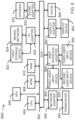
- FIG. 1 is a block/flow diagram illustrating a high-level system/method for neural network training based on time series data, in accordance with an embodiment of the present invention
- FIG. 2 is a block/flow diagram illustrating a high-level system/method for neural network implementation using time series data received from system sensors, in accordance with an embodiment of the present invention
- FIG. 3 is a flow diagram illustrating a system for implementing a neural network based system for remaining useful life (RUL) estimation, in accordance with an embodiment of the present invention
- FIG. 4 is a graph illustrating a relationship between remaining useful life and a health index (HI), in accordance with an embodiment of the present invention
- FIG. 5 is a block/flow diagram illustrating a high-level system/method for a dual estimator RUL model implementing TSS2Vec with Vec2HI and TSS2Mat with Mat2HIch and HIch2HI, in accordance with an embodiment of the present invention
- FIG. 6 is a block/flow diagram illustrating a high-level system/method for a dual estimator RUL model with stage classification implementing Vec2St, in accordance with an embodiment of the present invention.
- FIG. 7 is a flow diagram illustrating a system/method for implementing a remaining useful life (RUL) Maintenance Planning System, in accordance with an embodiment of the present invention.
- FIG. 8 is an exemplary processing system 800 to which the present methods and systems may be applied, in accordance with an embodiment of the present invention.
- a RUL estimation model is built with given multivariate time series data and a historical record, and utilizing the RUL estimation model to estimate the Remaining Useful Lifetime (RUL) of equipment based on sensor input.
- the model can periodically estimate the RUL using a segment of time series data. If the RUL is shorter than a pre-determined threshold, a computer system (e.g., server) can notify a user that the RUL is expected to expire.
- a computer system e.g., server
- deep neural networks can directly map given observations to a RUL.
- RUL decreases linearly over time, but HI does not always decrease in a similar manner due to nonlinearity in the degradation process.
- HI health index
- a framework of end-to-end learning for RUL estimation is provided.
- the stability of the training of the model can be improved using a proposed end-to-end framework.
- a classification can be incorporated into the model's loss function.
- classification loss stabilizes the training since it gives another aspect of the change point in the health stages.
- an additional component, Vec2St can be added to classify health stage(s) at the RUL estimation to suppress false positive alarms.
- a neural network can be trained to predict the RUL of a monitored system given partial temporal observation samples of a time-series sequence.
- a deep neural network can include a converter that changes the time series set (Tss) into a vector, which is referred to as Tss2vec, and a converter that changes a vector to RUL, which is referred to as Vec2HI, where HI refers to a health index.
- Tss2vec time series set
- RUL RUL
- HI refers to a health index
- a deep neural networks can directly map given observations to RUL.
- RUL may used as a substitute for a health index (HI).
- LSTM Long Short-Term Memory
- a Multi-layer Perceptron can be used as Vec2HI.
- An LSTM is a type of recurrent neural network (RNN) structure that can model long-range dependencies of a sequence.
- the LSTM has a memory cell which acts as an accumulator of state information for the sequence.
- the LSTM has a memory cell with a number of gates that control the flow of information into and out of the cell.
- the cell output may be propagated to a final state based on an output gate.
- a gradient can be trapped in the cell and prevented from vanishing.
- Multiple LSTMs can be stacked and temporally concatenated.
- Predictive Maintenance can be used to monitor an equipment's and/or component's condition and identify maintenance program(s).
- Predictive Maintenance can include: 1) a remaining useful life estimation, which estimates the remaining time to the end of the equipment's useful life, and 2) failure prediction, which predicts the probability that the equipment will fail within a predetermined time frame.
- Data-driven approaches can utilize sensor and operational data to estimate RUL, where the data can be collected as a time series. This approach can involve large amounts of data that may be generated by monitoring many equipment and performance characteristics at different time intervals over extended periods, where the monitoring can be conducted by a plurality of different sensors.
- RUL estimation can be utilized for Prognostics and Health Management [1], which aims to enhance the effective reliability and availability of a physical system in-service by detecting current and approaching failures and by providing mitigation of the system risks.
- the pipeline for RUL estimation can include four phases, including data acquisition, Health Index (HI) construction, health stage division, and RUL estimation.
- RUL estimation can be challenging because information can come from multiple sensors with different data channels.
- FIG. 1 a high-level system/method for neural network training based on time series data, in accordance with an embodiment of the present invention is illustratively depicted in accordance with an embodiment of the present invention.
- a plurality of sensors 120 can be associated with a system 110 , where the sensors 120 can produce multivariate time series data for the associated system.
- the plurality of sensors 120 can collect measurements of different attributes of the system, where the measurements can be collected as a time series.
- the sensors 120 can be in electronic communication with a monitoring system 130 that receives time series data from each of the sensors 120 , where the sensors can be in electronic communication with the monitor system 130 over wired and/or wireless communication paths 135 .
- the received and collected time series data 140 can be stored in a database 150 , where the multivariate time series data can be stored as one or more database records.
- the stored time series data can form a historical record of the performance of the system 110 based on the monitored attributes.
- the data and record(s) can include a time period to the end-of-life for the system 110 , which can include details regarding system failures and system maintenance.
- the time series data 140 can be used by a neural network training system 160 to train a neural network model 170 , such that the neural network model can predict the remaining useful life of the system 110 , and a health index (HI) for the system 110 , for scheduling predictive maintenance.
- An operator can use the predicted RUL and scheduled predictive maintenance to maintain the monitored system.
- the neural network training system 160 can simultaneously optimizes a Dual-estimator for RUL estimation and its feasible range estimation.
- the Dual-estimator can consist of five components: Tss2vec, Tss2Mat, Vec2HI, Mat2HIch, and HIch2HI.
- Tss2vec outputs a feature representation v(k,j)
- Vec2HI gives RUL estimation at j as H 1 (k,j) based upon the j th time index, v(k, j).
- Mat2HIch can convert feature representation V(k) to the change point, H ch (k) , of HI.
- HIch2HI gives RUL estimation at j as H 2 (k;j) based upon H ch (k).
- the neural network can learn feature representation from the multivariate time series data for RUL estimation without taking H ch as an input, and accurately estimate RUL based upon the representation.
- x ⁇ L ⁇ A where L denotes the length of the time series, A denotes the number of attributes, e.g., sensor readings or operational settings.
- H ⁇ be HI at the end of the time series data, x.
- RUL ⁇ be the RUL of H. Time series data from the past to current time can be used to generate a feature vector.
- time series data 140 from the past to the current time is used to generate a feature vector.
- a sliding window can be utilized to extract subsequences for Tss2Vec and Tss2Mat.
- a component, Vec2St can be added to classify the health stage at RUL estimation to suppress false positive alarms, where “St” refers to stage.
- classification can be incorporated into the model's loss function.
- the addition of a classification loss can stabilize the training, since it provides another aspect of the change point in the health stages.
- available data for training can be divided into training data and validation data.
- the model can be trained with the mini-batch gradient descent and its parameters are optimized with every training sample for the number of iteration, so called epochs. For each epoch, a performance metric can be computed for the validation data. If the performance metric is better than that from previous epoch, the newer parameters can be kept as the best parameters at the moment. In order to determine the best hyper-parameters, a cross-validation method may be employed.
- FIG. 2 is a block/flow diagram illustrating a high-level system/method for neural network implementation using time series data received from system sensors, in accordance with an embodiment of the present invention.
- the model can periodically estimate RUL using the received segment(s) of time series data. If the determined RUL is shorter than a predetermined threshold, the neural network system 180 can notify 225 that information to the users through a client device 220 . A system can undergo maintenance or by replaced based on the determined remaining useful life (RUL).
- time series data 140 can be collected from a system 210 while the system is operating, and the time series data 140 can be fed into a neural network system 180 having the trained neural network model 170 to determine the state of the system 210 and predict the remaining useful life and health index of the system 210 .
- the neural network system 180 can communicate to a user device 220 that the system 210 may be in need of preventative maintenance or nearing it's end-of-life.
- FIG. 3 is a flow diagram illustrating a system for implementing a neural network based system for remaining useful life (RUL) estimation, in accordance with an embodiment of the present invention.
- the neural network system 300 can include a data acquisition unit 310 , a learning unit 320 , an RUL estimation unit 330 , an output unit 340 , and a storage unit 350 .
- the data acquisition unit 310 can be configured to obtain and receive run-to-failure time series data 140 from a monitoring system 130 , sensors 120 , and database 150 for training the neural network model 170 , estimating RUL, and showing results.
- the learning unit 320 can be configured for training the neural network model 170 .
- RUL estimation unit 330 can be configured to estimate the RUL.
- the output unit 340 can be configured to provide output to users and user devices 220 .
- the storage unit 350 can store one or more neural network models 170 , and be in communication with the data acquisition unit 310 , learning unit 320 , RUL estimation unit 330 , output unit 340 , and storage unit 350 .
- the data acquisition unit 310 and the learning unit 320 can form the neural network training system 160 to train the neural network model 170 .
- the neural network system 300 can include one or more processor(s) (e.g., CPUs, GPUs), one or more types of memory (e.g., DRAM, SRAM, FLASH, magnetic, optical, etc.), communications bus(es) and controllers (e.g., memory management unit), and input/output devices (e.g., display(s), keyboard, mouse, etc.).
- processors e.g., CPUs, GPUs
- memory e.g., DRAM, SRAM, FLASH, magnetic, optical, etc.
- communications bus(es) and controllers e.g., memory management unit
- input/output devices e.g., display(s), keyboard, mouse, etc.
- FIG. 4 is a graph illustrating a relationship between remaining useful life and a health index (HI), in accordance with an embodiment of the present invention.
- RUL linearly decreases over time, but the health index (HI) does not always due to nonlinearity in degradation process. It can be severe especially when the degradation process has multi-stages.
- the whole lifetime of a system can be divided into two or more different health stages.
- a healthy stage 410 can be followed by degradation stage 420 .
- the degradation in the system can be negligible and the health index (HI) does not change appreciably or at all.
- the degradation can become severe and the HI starts to change noticeably.
- a point in time where the monitored system changes from a healthy stage to a degrading stage may be determined.
- H is a variable holding a value of HI
- ‘min’ returns the minimum value in the given list of arguments. This makes this calculated RUL different from the true RUL, where it is the same as HI only when the RUL is smaller than H ch .
- H ch can be determined by upstream tasks or domain knowledge. It costs a lot or restricts the scalability.
- FIG. 5 is a block/flow diagram illustrating a high-level system/method for a dual estimator RUL model implementing TSS2Vec with Vec2HI and TSS2Mat with Mat2HIch and HIch2HI, in accordance with an embodiment of the present invention.
- the neural network training system 160 simultaneously optimizes a Dual-estimator for RUL estimation and its feasible range estimation.
- the Dual-estimator can consist of five components: Tss2Mat 510 , Tss2vec 550 , Mat2HIch 520 , Vec2HI 560 , and HIch2HI 530 .
- Mat refers to matrix
- Tss2Mat refers to time series set to matrix
- HI refers to health index
- HI ch refers to health index change.
- the Dual-estimator can use all components at training and can use Tss2vec 550 and Vec2HI 560 for inference at run time.
- Mat2HIch 520 can estimate a point in time that the health index (HI) changes from a healthy stage or region 410 in the system's lifespan to a degradation stage or region 420 , where the health index, HI, changes appreciably compared to the healthy region or stage 410 .
- the Mat2HIch function 520 can change a matrix into a value for HIch.
- X (k) be the k th example from K run-to-failure data X, where X (i,lk) represents the observation at the point of failure.
- i denotes the time index in run-to-failure data whose smaller value indicates older records
- l k denotes the length of the k th time series.
- A denotes the number of attributes, e.g. sensors or operational setting.
- a subsequence of X (k) can be x and this is not limited to run-to failure data. It can also be run-to-event data, which is time series data collected during a period from a usual status to a certain status, for example a status which requires maintenance.
- x (k, j) be a subsequence of X (k) ending at a j th time index
- v (k, j) be a feature representation of each x (k, j)
- V (k) [v (k, 1) , v (k, 2) , . . . , v (k, lk) ] be the feature representation for the entire X (k) .
- the beginning of x (k,j) can be at the beginning of X (k) but not necessary.
- Tss2vec 550 outputs its feature representation v (k,j)
- Vec2HI 560 gives a RUL estimation at j as H 1 (k,j) 570 based upon v (k,j)
- Tss2Mat 510 outputs V (k)
- Mat2HIch 520 converts V (k) to the change point of HI, H ch (k)
- HIch2HI 530 gives a RUL estimation at a j th time as H 2 (k;j) 540 based upon H ch (k) .
- HIch2HI 530 can estimate H 2 (k;j) based on a leaky truncated RUL function.
- Tss2vec 550 and Tss2Mat 510 can be identical except for their input and output. Tss2vec 550 and Tss2Mat 510 can share the same internal parameters. Tss2vec 550 can take a subsequence x (k, j) and generate a vector v (k, j) . Tss2Mat 510 can just iterate the process for all j and concatenate all the vectors to be a matrix, Mat. The intuition behind this design is better feature representation works not only for RUL estimation but also for the feasible range estimation. It also helps to reduce the search space of parameters.
- the Dual-estimator can take an example of run-to-failure data X (k) 140 and its subsequence x (k, j) as the inputs at a time, and then the trained neural network model 170 can generate two RUL estimations, H 1 (k, j) 570 and H 2 (k, j) 540 , where H 1 (k, j) 570 is a value for the health index generated by Vec2HI 560 , and H 2 (k, j) 540 is a value for the health index generated by HIch2HI 530 .
- the objective of the training is to find optimal values for parameters including hyper-parameters of the neural network model, so that it can provide the best performance at inference.
- the trained neural network model 170 can receive a multivariate time series x 601 as the input for RUL estimation, then the trained neural network model outputs H, which is HI at the end of the time series data x.
- Tss2Mat 510 and Tss2vec 550 can each be a stacked Long Short-Term Memory (LSTM).
- LSTM networks which are a variant of recurrent neural networks (RNN), can be used, in order to take temporal information into account.
- Vec2HI 560 can be a Multi-layer Perceptron.
- Mat2HIch can implement a function that can map a matrix to a single value.
- the same values can be set to the hyper-parameters of the LSTM, where the number of LSTM layers can be two, the number of nodes in the 1st LSTM Cell is 32, the number of nodes in the 2nd LSTM Cell is 64, the number of MLP layers is two, the number of nodes in both the 1st layer and the 2nd layer is 8.
- a weighted average of true RUL can be used, where the weights are determined by a neural network, so-called attention mechanism, based upon v (k, j) and must sum to one, independent of the length of sequence. It enforces the solution bounds to the maximum true RUL in the training examples to zero and to be represented by the weight average.
- a is a weight of the R.
- a is computed based on feature vectors v as shown in the next equation.
- the gated attention mechanism is employed to capture complex relationships among feature representations.
- a sigmoid function can play the role of the gate.
- the gated attention mechanism gives the weights as:
- w, P, and Q are parameters
- ⁇ is element-wise multiplication
- sigm( ) is sigmoid function
- C is the number of elements in w.
- HIch2HI is the piece-wise RUL function, however the gradient is zero for the region from H ch to later times. This function has no gradient at the region whose value is H ch . This may lead to a longer training time or a sub-optimal solution when the neural networks are optimized with back propagation.
- the segment When an input data segment is mapped to H ch or a larger value, the segment doesn't contribute updating parameters in Mat2HIch. In order to deal with the potential problem, a negative slope can be provided for the region greater than H ch .
- H(R) leaky truncated RUL function
- the Dual-estimator gives two estimation of RUL at the time index j; H 1 (k, j) and H 2 (k, j) . Although they are from different methods, they are similar to each other.
- RMSE is a typical measure of the difference between two attributes.
- ⁇ j, k> represents a pair of the indices in the training data, where the ⁇ ,> is a notation to show a set for the summation.
- L b is the sum of the squared errors between H 1 and H 2 due to convenience for optimization, it can be easily converted to RMSE.
- the H 1 (k, j) 570 can be arbitrary, but H 2 (k, j) is not.
- the H 2 (k, j) 540 is constrained by the leaky truncated RUL function, which means there is only one parameter to change its value over k th example of run-to-failure data.
- H 2 (k, j) is more accurate because Mat2HIch and HIch2HI can observe entire run-to-failure data and it includes future information from the perspective of the pipeline with TSS2Vec and Vec2HI. Due to these mechanisms, H 2 (k, j) acts as a teacher for TSS2Vec and Vec2HI.
- H ch (k) is given for every j as well, since a pair of X (k) and its subsequence x (k,j) is the input and a training sample.
- This auxiliary loss enforces to have larger values of Hch(k), and affects the representation learning at Tss2Vec 550 due to weight sharing, where Tss2Vec and Tss2Mat are identical, such that when a parameter in Tss2Vec changes, the corresponding parameter in Tss2Mat also changes and vice versa.
- ⁇ is a hyper-parameter
- Available data for training can be divided into training data and validation data.
- the NN model can be trained with the Mini-batch gradient descent and its parameters are optimized with every training sample for the number of iterations.
- a performance metric is computed for the validation data. If the performance metric is better than that from the previous iteration, the parameters are kept as the best parameter at the moment.
- a cross-validation method is employed.
- the performance metric should be designed for each use case based upon its requirements. In various cases, there is a range of interest for RUL estimation since no action is needed at sufficient RUL and no action can be taken once the RUL is very short.
- h est (i) be an estimated RUL
- h true (i) be the true RUL.
- P(.) is a function to compute the performance metric for an estimation, where it can be a Root Mean Square Error and acceptable prediction.
- the training metric is not limited to this notation. It can be any metrics in prognostics, where metrics are values to measure performance, and prognostics is an engineering discipline focused on predicting the time at which a system or a component will no longer perform its intended function.
- One of the tasks is classification to identify the healthy stage 410 and/or the degrading stage 420 .
- L c loss term
- y ⁇ 1 ( k , j ) 1 - y ⁇ 0 ( k , j )
- ⁇ 1 , ⁇ 2 , and a are hyper-parameters, and ⁇ must be a negative value.
- the larger H 1 is, the closer the value of ⁇ 0 (k,j) is to 1, and the smaller H 1 is, the closer the value of ⁇ 0 (k,j) is to 0.
- ⁇ 0 (k,j) can be viewed as a probability that the sample is assigned to class 0, where class 0 is for healthy samples whose HI are larger than Hch, which would fall in the healthy stage 410 .
- soft labeling can be used. In this case, it can be given as:
- y 0 ( k , j ) 1 1 + exp ⁇ ⁇ ⁇ - ⁇ ⁇ ( H c ⁇ h ( k ) - R ( j , k ) ) ⁇ .
- the classifier may be relied on to judge whether it is healthy or not.
- FIG. 6 is a block/flow diagram illustrating a high-level system/method for a dual estimator RUL model with stage classification implementing Vec2St, in accordance with an embodiment of the present invention.
- Vec2St 610 can be added to the Dual-estimator. It takes output from Tss2Vec 550 and then outputs a probability for each stage, i.e., healthy stage 410 and degrading stage 420 .
- Vec2St 610 can be a Multilayer Perceptron with two output nodes and a softmax activation layer for the output nodes. In this case, let f (k, j, i) be value of the i th output node, then the probability of ii class is given as:
- ⁇ c> is the set of classes.
- the denominator is the sum of exp(f (k,j,i) ) over classes, c.
- y ⁇ i ( k , j ) exp ⁇ ⁇ ( f ( k , j , i ) ) ⁇ ⁇ c ⁇ ⁇ exp ⁇ ⁇ ( f ( k , j , i ) ) , is used for classification loss.
- L b in the loss function can be weighted based on classification results, so that estimation error can be ignored if the healthy stages are identified correctly.
- the performance metric at validation also considers the weight, (1 ⁇ y 0 (k,j) ⁇ 0 (k,j) ), for samples from the degrading stage or samples incorrectly classified as healthy.
- RMSE Root Mean Square Error
- the classifier can help to reduce false positive when the alarm is suppressed based on classification results.
- One possible condition to suppress alarms is that the classifier says it's normal, but the estimated RUL is smaller than pre-determined threshold.
- health stage classification can be conducted, where estimating the health stage of the time series fed to the second neural network can be based on a fourth neural network, Vec2St, and minimizing the estimation error of the health stage.
- a model for RUL estimation and for stage classification are simultaneously trained.
- a component, Vec2St is added to the Dual-estimator. It takes output from Tss2Vec and then outputs probability for each stage, i.e., healthy stage and degrading stage.
- Vec2St can be Multi-layer Perceptron with two output nodes and a softmax activation layer for the output nodes. In this case, let f(k, j, i) be value of i th output node, then the probability of i th class is given as:
- L b in the loss function can be weighted based on classification results so that estimation error can be ignored if the healthy stages are identified correctly.
- FIG. 7 is a flow diagram illustrating a system/method for implementing a remaining useful life (RUL) Maintenance Planning System, in accordance with an embodiment of the present invention.
- RUL remaining useful life
- the neural network system 300 can include the neural network training unit 320 and the estimation unit 330 .
- the neural network training unit 320 can calculate and optimize an RMSE loss 710 , a value loss 720 , and a classification loss 730 .
- the estimation unit 330 can provide a RUL estimation value 740 and a health stage classification 750 .
- RULENet simultaneously optimizes its Dual-estimator for RUL estimation and the change point estimate from unpredictable health stage to predictable health stage and health stage classification.
- FIG. 8 is an exemplary processing system 800 to which the present methods and systems may be applied, in accordance with an embodiment of the present invention.
- the processing system 800 can include at least one processor (CPU) 804 and may have a graphics processing (GPU) 805 that can perform vector calculations/manipulations operatively coupled to other components via a system bus 802 .
- a cache 806 a Read Only Memory (ROM) 808 , a Random Access Memory (RAM) 810 , an input/output (I/O) adapter 820 , a sound adapter 830 , a network adapter 840 , a user interface adapter 850 , and/or a display adapter 860 , can also be operatively coupled to the system bus 802 .
- a first storage device 822 and a second storage device 824 are operatively coupled to system bus 802 by the I/O adapter 820 , where a neural network can be stored for implementing the features described herein.
- the storage devices 822 and 824 can be any of a disk storage device (e.g., a magnetic or optical disk storage device), a solid state storage device, a magnetic storage device, and so forth.
- the storage devices 822 and 824 can be the same type of storage device or different types of storage devices.
- a speaker 832 can be operatively coupled to the system bus 802 by the sound adapter 830 .
- a transceiver 842 can be operatively coupled to the system bus 802 by the network adapter 840 .
- a display device 862 can be operatively coupled to the system bus 802 by display adapter 860 .
- a first user input device 852 , a second user input device 854 , and a third user input device 856 can be operatively coupled to the system bus 802 by the user interface adapter 850 .
- the user input devices 852 , 854 , and 856 can be any of a keyboard, a mouse, a keypad, an image capture device, a motion sensing device, a microphone, a device incorporating the functionality of at least two of the preceding devices, and so forth. Of course, other types of input devices can also be used, while maintaining the spirit of the present principles.
- the user input devices 852 , 854 , and 856 can be the same type of user input device or different types of user input devices.
- the user input devices 852 , 854 , and 856 can be used to input and output information to and from the processing system 800 .
- the processing system 800 may also include other elements (not shown), as readily contemplated by one of skill in the art, as well as omit certain elements.
- various other input devices and/or output devices can be included in processing system 800 , depending upon the particular implementation of the same, as readily understood by one of ordinary skill in the art.
- various types of wireless and/or wired input and/or output devices can be used.
- additional processors, controllers, memories, and so forth, in various configurations can also be utilized as readily appreciated by one of ordinary skill in the art.
- system 800 is a system for implementing respective embodiments of the present methods/systems. Part or all of processing system 1000 may be implemented in one or more of the elements of FIGS. 1 - 7 . Further, it is to be appreciated that processing system 800 may perform at least part of the methods described herein including, for example, at least part of the method of FIGS. 1 - 7 .
- the neural network system 300 can be implemented on the processing system 800 , where the data acquisition unit 310 , learning unit 320 , RUL estimation unit 330 , and output unit 340 can be stored in memory, where the neural network(s) (e.g., LSTM, MLP, etc.) may be stored in storage device 824 .
- the received and collected time series data 140 can be stored in a database 150 that may reside in the first storage device 822 and/or the second storage device 824 .
- the sensors 120 can be connected to and in electronic communication with system 800 through network adapter 840 and/or a communications port or other adapter.
- the output unit 340 can communicate with the users and user devices 220 through the network adapter 840 and/or communication ports.
- the term “hardware processor subsystem” or “hardware processor” can refer to a processor, memory, software or combinations thereof that cooperate to perform one or more specific tasks.
- the hardware processor subsystem can include one or more data processing elements (e.g., logic circuits, processing circuits, instruction execution devices, etc.).
- the one or more data processing elements can be included in a central processing unit, a graphics processing unit, and/or a separate processor- or computing element-based controller (e.g., logic gates, etc.).
- the hardware processor subsystem can include one or more on-board memories (e.g., caches, dedicated memory arrays, read only memory, etc.).
- the hardware processor subsystem can include one or more memories that can be on or off board or that can be dedicated for use by the hardware processor subsystem (e.g., ROM, RAM, basic input/output system (BIOS), etc.).
- the hardware processor subsystem can include and execute one or more software elements.
- the one or more software elements can include an operating system and/or one or more applications and/or specific code to achieve a specified result.
- the hardware processor subsystem can include dedicated, specialized circuitry that performs one or more electronic processing functions to achieve a specified result.
- Such circuitry can include one or more application-specific integrated circuits (ASICs), field-programmable gate arrays (FPGAs), and/or programmable logic arrays (PLAs).
- ASICs application-specific integrated circuits
- FPGAs field-programmable gate arrays
- PDAs programmable logic arrays
- Embodiments described herein may be entirely hardware, entirely software or including both hardware and software elements.
- the present invention is implemented in software, which includes but is not limited to firmware, resident software, microcode, etc.
- Embodiments may include a computer program product accessible from a computer-usable or computer-readable medium providing program code for use by or in connection with a computer or any instruction execution system.
- a computer-usable or computer readable medium may include any apparatus that stores, communicates, propagates, or transports the program for use by or in connection with the instruction execution system, apparatus, or device.
- the medium can be magnetic, optical, electronic, electromagnetic, infrared, or semiconductor system (or apparatus or device) or a propagation medium.
- the medium may include a computer-readable storage medium such as a semiconductor or solid state memory, magnetic tape, a removable computer diskette, a random access memory (RAM), a read-only memory (ROM), a rigid magnetic disk and an optical disk, etc.
- Each computer program may be tangibly stored in a machine-readable storage media or device (e.g., program memory or magnetic disk) readable by a general or special purpose programmable computer, for configuring and controlling operation of a computer when the storage media or device is read by the computer to perform the procedures described herein.
- the inventive system may also be considered to be embodied in a computer-readable storage medium, configured with a computer program, where the storage medium so configured causes a computer to operate in a specific and predefined manner to perform the functions described herein.
- a data processing system suitable for storing and/or executing program code may include at least one processor coupled directly or indirectly to memory elements through a system bus.
- the memory elements can include local memory employed during actual execution of the program code, bulk storage, and cache memories which provide temporary storage of at least some program code to reduce the number of times code is retrieved from bulk storage during execution.
- I/O devices including but not limited to keyboards, displays, pointing devices, etc. may be coupled to the system either directly or through intervening I/O controllers.
- Network adapters may also be coupled to the system to enable the data processing system to become coupled to other data processing systems or remote printers or storage devices through intervening private or public networks.
- Modems, cable modem and Ethernet cards are just a few of the currently available types of network adapters.
- any of the following “/”, “and/or”, and “at least one of”, for example, in the cases of “A/B”, “A and/or B” and “at least one of A and B”, is intended to encompass the selection of the first listed option (A) only, or the selection of the second listed option (B) only, or the selection of both options (A and B).
- such phrasing is intended to encompass the selection of the first listed option (A) only, or the selection of the second listed option (B) only, or the selection of the third listed option (C) only, or the selection of the first and the second listed options (A and B) only, or the selection of the first and third listed options (A and C) only, or the selection of the second and third listed options (B and C) only, or the selection of all three options (A and B and C).
- This may be extended for as many items listed.
Landscapes
- Engineering & Computer Science (AREA)
- Physics & Mathematics (AREA)
- Theoretical Computer Science (AREA)
- General Physics & Mathematics (AREA)
- Evolutionary Computation (AREA)
- Mathematical Physics (AREA)
- Artificial Intelligence (AREA)
- Biomedical Technology (AREA)
- Biophysics (AREA)
- Computational Linguistics (AREA)
- General Health & Medical Sciences (AREA)
- Molecular Biology (AREA)
- Computing Systems (AREA)
- General Engineering & Computer Science (AREA)
- Data Mining & Analysis (AREA)
- Life Sciences & Earth Sciences (AREA)
- Software Systems (AREA)
- Health & Medical Sciences (AREA)
- Automation & Control Theory (AREA)
- Human Computer Interaction (AREA)
- Management, Administration, Business Operations System, And Electronic Commerce (AREA)
Abstract
Description

RUL=min(H,H ch),
H ch k=Σj=0 I

where:
y 1(R)=−a 1(−R+H ch)+H ch,
y 2(R)=−a 2(−R+H ch)+H ch,
L b=Σ(j,k)(H 1 (j,k) −H 2 (k,j))2,
L=L b +λL v,
P=Σ i∈D

where:
d (i) =h est (i) −h true (i),
D={i∈

is used for classification loss. The term Lb in the loss function can be weighted based on classification results, so that estimation error can be ignored if the healthy stages are identified correctly. In this case, the loss function can be given as:
L=(1−y 0 (k,j) ŷ 0 (k,j))Lb+λ 1 Lv+λ 2 Lc,
P=Σ i∈D(1−y 0 (k,j) ŷ 0 (k,j))


Claims (20)
Priority Applications (1)
| Application Number | Priority Date | Filing Date | Title |
|---|---|---|---|
| US17/358,260 US12130616B2 (en) | 2020-07-02 | 2021-06-25 | Approach to determining a remaining useful life of a system |
Applications Claiming Priority (2)
| Application Number | Priority Date | Filing Date | Title |
|---|---|---|---|
| US202063047384P | 2020-07-02 | 2020-07-02 | |
| US17/358,260 US12130616B2 (en) | 2020-07-02 | 2021-06-25 | Approach to determining a remaining useful life of a system |
Publications (2)
| Publication Number | Publication Date |
|---|---|
| US20220004182A1 US20220004182A1 (en) | 2022-01-06 |
| US12130616B2 true US12130616B2 (en) | 2024-10-29 |
Family
ID=79166732
Family Applications (1)
| Application Number | Title | Priority Date | Filing Date |
|---|---|---|---|
| US17/358,260 Active 2043-04-07 US12130616B2 (en) | 2020-07-02 | 2021-06-25 | Approach to determining a remaining useful life of a system |
Country Status (1)
| Country | Link |
|---|---|
| US (1) | US12130616B2 (en) |
Families Citing this family (20)
| Publication number | Priority date | Publication date | Assignee | Title |
|---|---|---|---|---|
| JP7600256B2 (en) * | 2020-03-12 | 2024-12-16 | ジョンソン・コントロールズ・タイコ・アイピー・ホールディングス・エルエルピー | CONTROLLER AND METHOD FOR PREDICTING FAULTS IN HEATING, VENTILATION, OR AIR CONDITIONING (HVAC) SYSTEMS - Patent application |
| WO2023056617A1 (en) | 2021-10-09 | 2023-04-13 | Johnson Controls Tyco IP Holdings LLP | Systems and methods for controlling variable refrigerant flow systems using artificial intelligence |
| CN114298443B (en) * | 2022-03-03 | 2022-06-14 | 北京航空航天大学杭州创新研究院 | Industrial equipment predictive maintenance method and device based on health state index and electronic equipment |
| CN114676630B (en) * | 2022-03-24 | 2025-07-25 | 北京科技大学 | Neural network prediction method and device for residual life of titanium alloy in fluoride ion environment |
| DE102022108584A1 (en) * | 2022-04-08 | 2023-10-12 | Krones Aktiengesellschaft | Method and device for automatically determining the current status of a system in operation |
| CN114707731B (en) * | 2022-04-11 | 2025-02-18 | 合肥工业大学 | Equipment Remaining Life Prediction Method Based on Multi-domain Feature Fusion of Double-layer Attention Network |
| CN114896865B (en) * | 2022-04-20 | 2024-07-23 | 北京航空航天大学 | An online prediction method of health status based on adaptive evolutionary neural network for digital twins |
| CN114861349B (en) * | 2022-04-22 | 2024-08-27 | 哈尔滨理工大学 | Rolling bearing RUL prediction method based on model migration and wiener process |
| CN114971052B (en) * | 2022-06-07 | 2024-12-20 | 南京理工大学 | A method for predicting the remaining useful life of an engine based on improved HRHN |
| GB2620602A (en) * | 2022-07-13 | 2024-01-17 | Continental Automotive Tech Gmbh | Training of a machine learning model for predictive maintenance tasks |
| WO2024020960A1 (en) * | 2022-07-28 | 2024-02-01 | 西门子股份公司 | Method for predicting remaining useful life of circuit breaker, and electronic device and storage medium |
| CN115755835B (en) * | 2022-11-04 | 2024-10-08 | 四川大学 | Online health factor optimization method for electromechanical actuator |
| US12379984B2 (en) | 2022-12-08 | 2025-08-05 | Toyota Motor Engineering & Manufacturing North America, Inc. | Remaining useful life determination for power electronic devices |
| US20240210934A1 (en) * | 2022-12-21 | 2024-06-27 | Palo Alto Research Center Incorporated | Remaining useful life estimation using hybrid physics-machine learning reasoning |
| US20240255939A1 (en) * | 2023-01-27 | 2024-08-01 | Hitachi, Ltd. | Reinforcement learning system for maintenance decision making |
| CN116187193B (en) * | 2023-02-28 | 2026-02-13 | 北京理工大学 | A data- and model-driven method for predicting the remaining useful life of mechanical components |
| CN116665013A (en) * | 2023-06-14 | 2023-08-29 | 中国联合网络通信集团有限公司 | Remaining life determining method, device and computer readable storage medium |
| WO2025049459A1 (en) * | 2023-08-27 | 2025-03-06 | The Regents Of The University Of Michigan | Adaptive fault prediction |
| CN119104307B (en) * | 2024-11-11 | 2025-02-25 | 浙江永成机械有限公司 | A life detection method and system for bearing retainer for CNC machine tools |
| CN119886465B (en) * | 2025-03-26 | 2025-06-10 | 中国石油大学(华东) | Model prediction control method for strengthening health perception of marine petroleum underwater production system |
Citations (13)
| Publication number | Priority date | Publication date | Assignee | Title |
|---|---|---|---|---|
| US20030023404A1 (en) * | 2000-11-22 | 2003-01-30 | Osama Moselhi | Method and apparatus for the automated detection and classification of defects in sewer pipes |
| US20170368682A1 (en) * | 2016-06-27 | 2017-12-28 | Fujitsu Limited | Neural network apparatus and control method of neural network apparatus |
| US20180046902A1 (en) * | 2016-08-09 | 2018-02-15 | Palo Alto Research Center Incorporated | Enhanced restricted boltzmann machine with prognosibility regularization for prognostics and health assessment |
| US20190057307A1 (en) * | 2016-10-11 | 2019-02-21 | Hitachi, Ltd. | Deep long short term memory network for estimation of remaining useful life of the components |
| US20190187212A1 (en) * | 2016-11-21 | 2019-06-20 | Battelle Energy Alliance, Llc | Systems and methods for estimation and prediction of battery health and performance |
| US20190294413A1 (en) * | 2018-03-23 | 2019-09-26 | Amazon Technologies, Inc. | Accelerated quantized multiply-and-add operations |
| US20190354836A1 (en) * | 2018-05-17 | 2019-11-21 | International Business Machines Corporation | Dynamic discovery of dependencies among time series data using neural networks |
| US20190384257A1 (en) * | 2018-06-13 | 2019-12-19 | Hitachi, Ltd. | Automatic health indicator learning using reinforcement learning for predictive maintenance |
| US20200285964A1 (en) * | 2019-03-04 | 2020-09-10 | Royal Bank Of Canada | System and method for machine learning with long-range dependency |
| US20200337580A1 (en) * | 2018-03-30 | 2020-10-29 | Samsung Sds Co., Ltd. | Time series data learning and analysis method using artificial intelligence |
| US20210033680A1 (en) * | 2018-03-20 | 2021-02-04 | Gs Yuasa International Ltd. | Degradation estimation apparatus, computer program, and degradation estimation method |
| US20210284179A1 (en) * | 2020-03-11 | 2021-09-16 | Ford Global Technologies, Llc | Vehicle health calibration |
| US20220353803A1 (en) * | 2019-10-31 | 2022-11-03 | Google Llc | Determining a Machine-Learning Architecture for Network Slicing |
-
2021
- 2021-06-25 US US17/358,260 patent/US12130616B2/en active Active
Patent Citations (14)
| Publication number | Priority date | Publication date | Assignee | Title |
|---|---|---|---|---|
| US20030023404A1 (en) * | 2000-11-22 | 2003-01-30 | Osama Moselhi | Method and apparatus for the automated detection and classification of defects in sewer pipes |
| US20170368682A1 (en) * | 2016-06-27 | 2017-12-28 | Fujitsu Limited | Neural network apparatus and control method of neural network apparatus |
| US20180046902A1 (en) * | 2016-08-09 | 2018-02-15 | Palo Alto Research Center Incorporated | Enhanced restricted boltzmann machine with prognosibility regularization for prognostics and health assessment |
| US20190057307A1 (en) * | 2016-10-11 | 2019-02-21 | Hitachi, Ltd. | Deep long short term memory network for estimation of remaining useful life of the components |
| US20190187212A1 (en) * | 2016-11-21 | 2019-06-20 | Battelle Energy Alliance, Llc | Systems and methods for estimation and prediction of battery health and performance |
| US20210033680A1 (en) * | 2018-03-20 | 2021-02-04 | Gs Yuasa International Ltd. | Degradation estimation apparatus, computer program, and degradation estimation method |
| US20200293284A1 (en) * | 2018-03-23 | 2020-09-17 | Amazon Technologies, Inc. | Accelerated quantized multiply-and-add operations |
| US20190294413A1 (en) * | 2018-03-23 | 2019-09-26 | Amazon Technologies, Inc. | Accelerated quantized multiply-and-add operations |
| US20200337580A1 (en) * | 2018-03-30 | 2020-10-29 | Samsung Sds Co., Ltd. | Time series data learning and analysis method using artificial intelligence |
| US20190354836A1 (en) * | 2018-05-17 | 2019-11-21 | International Business Machines Corporation | Dynamic discovery of dependencies among time series data using neural networks |
| US20190384257A1 (en) * | 2018-06-13 | 2019-12-19 | Hitachi, Ltd. | Automatic health indicator learning using reinforcement learning for predictive maintenance |
| US20200285964A1 (en) * | 2019-03-04 | 2020-09-10 | Royal Bank Of Canada | System and method for machine learning with long-range dependency |
| US20220353803A1 (en) * | 2019-10-31 | 2022-11-03 | Google Llc | Determining a Machine-Learning Architecture for Network Slicing |
| US20210284179A1 (en) * | 2020-03-11 | 2021-09-16 | Ford Global Technologies, Llc | Vehicle health calibration |
Non-Patent Citations (6)
| Title |
|---|
| Babu et al., "Deep Convolutional Neural Network Based Regression Approach for Estimation of Remaining Useful Life", Institute for Infocomm Research, Apr. 16, 2016, pp. 1-15. |
| Natsumeda et al., "RULENet: End-to-end Learning with the Dual-estimator for Remaining Useful Life Estimation", 2020 IEEE International Conference on Prognostics and Health Management (ICPHM), Jun. 8, 2020, pp. 1-8. |
| Vaswani et al., "Attention is all you need", arXiv preprint arXiv:1706.03762, Jun. 12, 2017, pp. 1-15. |
| Wang et al., "Remaining Useful Life Estimation Using Functional Data Analysis", arxiv:1904.06442v1 [cs.LG] Apr. 12, 2019, pp. 1-9. |
| Zhang et al., "Remaining Useful Life Estimation Using Long Short-Term Memory Neural Networks and Deep Fusion", IEEE Access vol. 8, Jan. 30, 2020, pp. 19033-19045. |
| Zheng et al., "Long short-term memory network for remaining useful life estimation", In 2017 IEEE international conference on prognostics and health management (ICPHM) Jun. 19, 2017, pp. 88-95. |
Also Published As
| Publication number | Publication date |
|---|---|
| US20220004182A1 (en) | 2022-01-06 |
Similar Documents
| Publication | Publication Date | Title |
|---|---|---|
| US20220004182A1 (en) | Approach to determining a remaining useful life of a system | |
| Shcherbakov et al. | A hybrid deep learning framework for intelligent predictive maintenance of cyber-physical systems | |
| US10831577B2 (en) | Abnormality detection system, abnormality detection method, abnormality detection program, and method for generating learned model | |
| Aggarwal et al. | Two birds with one network: Unifying failure event prediction and time-to-failure modeling | |
| US20210034449A1 (en) | Integrated model for failure diagnosis and prognosis | |
| US11892826B2 (en) | Anomaly detection system | |
| Chehade et al. | Sensor fusion via statistical hypothesis testing for prognosis and degradation analysis | |
| US20180136617A1 (en) | Systems and methods for continuously modeling industrial asset performance | |
| US20190057307A1 (en) | Deep long short term memory network for estimation of remaining useful life of the components | |
| CN113837427B (en) | Method and computing system for performing predictive health analysis on assets | |
| Zhao et al. | Probabilistic remaining useful life prediction based on deep convolutional neural network | |
| Peng et al. | Health indicator construction based on multisensors for intelligent remaining useful life prediction: A reinforcement learning approach | |
| JP5193533B2 (en) | Remote monitoring system and remote monitoring method | |
| US11906960B1 (en) | Bayesian risk inference engine (BRIE) | |
| Ye et al. | Adaptive MAGNN-TCN: An innovative approach for bearings remaining useful life prediction | |
| Liao et al. | Health assessment and prognostics based on higher‐order hidden semi‐Markov models | |
| US20220075361A1 (en) | Systems and method for management and allocation of network assets | |
| CN115375038B (en) | A method for aircraft engine failure mode identification and life prediction | |
| US20240104269A1 (en) | Transferable hybrid prognostics based on fundamental degradation modes | |
| Byun et al. | RUL Prognostics: Recursive Bayesian Ensemble Prediction with Combining Artificial Degradation Patterns | |
| Bieber et al. | Data-driven prognostics incorporating environmental factors for aircraft maintenance | |
| Wang et al. | Few-shot rul prediction with a hypernetwork structure incorporating uncertainty quantification and calibration | |
| KR102868169B1 (en) | Facility failure prediction device using deep learning model | |
| Nagendrappa et al. | Optimizing Wireless Sensor Networks with Machine Learning-Based Predictive Maintenance. | |
| Baumann et al. | Methods to improve the prognostics of time-to-failure models |
Legal Events
| Date | Code | Title | Description |
|---|---|---|---|
| AS | Assignment |
Owner name: NEC LABORATORIES AMERICA, INC., NEW JERSEY Free format text: ASSIGNMENT OF ASSIGNORS INTEREST;ASSIGNORS:NATSUMEDA, MASANAO;CHEN, HAIFENG;SIGNING DATES FROM 20210616 TO 20210618;REEL/FRAME:056667/0612 |
|
| FEPP | Fee payment procedure |
Free format text: ENTITY STATUS SET TO UNDISCOUNTED (ORIGINAL EVENT CODE: BIG.); ENTITY STATUS OF PATENT OWNER: LARGE ENTITY |
|
| STPP | Information on status: patent application and granting procedure in general |
Free format text: DOCKETED NEW CASE - READY FOR EXAMINATION |
|
| STPP | Information on status: patent application and granting procedure in general |
Free format text: NON FINAL ACTION MAILED |
|
| STPP | Information on status: patent application and granting procedure in general |
Free format text: RESPONSE TO NON-FINAL OFFICE ACTION ENTERED AND FORWARDED TO EXAMINER |
|
| STPP | Information on status: patent application and granting procedure in general |
Free format text: NOTICE OF ALLOWANCE MAILED -- APPLICATION RECEIVED IN OFFICE OF PUBLICATIONS |
|
| ZAAB | Notice of allowance mailed |
Free format text: ORIGINAL CODE: MN/=. |
|
| AS | Assignment |
Owner name: NEC CORPORATION, JAPAN Free format text: ASSIGNMENT OF ASSIGNORS INTEREST;ASSIGNOR:NEC LABORATORIES AMERICA, INC.;REEL/FRAME:068733/0576 Effective date: 20240927 |
|
| STPP | Information on status: patent application and granting procedure in general |
Free format text: PUBLICATIONS -- ISSUE FEE PAYMENT VERIFIED |
|
| STCF | Information on status: patent grant |
Free format text: PATENTED CASE |