US12129246B1 - Hydroquinazoline derivatives for the treatment of a disease or disorder - Google Patents
Hydroquinazoline derivatives for the treatment of a disease or disorder Download PDFInfo
- Publication number
- US12129246B1 US12129246B1 US18/589,841 US202418589841A US12129246B1 US 12129246 B1 US12129246 B1 US 12129246B1 US 202418589841 A US202418589841 A US 202418589841A US 12129246 B1 US12129246 B1 US 12129246B1
- Authority
- US
- United States
- Prior art keywords
- amino
- methyl
- ethyl
- propyl
- tetrahydroquinazolin
- Prior art date
- Legal status (The legal status is an assumption and is not a legal conclusion. Google has not performed a legal analysis and makes no representation as to the accuracy of the status listed.)
- Active
Links
Classifications
-
- A—HUMAN NECESSITIES
- A61—MEDICAL OR VETERINARY SCIENCE; HYGIENE
- A61K—PREPARATIONS FOR MEDICAL, DENTAL OR TOILETRY PURPOSES
- A61K31/00—Medicinal preparations containing organic active ingredients
- A61K31/33—Heterocyclic compounds
- A61K31/395—Heterocyclic compounds having nitrogen as a ring hetero atom, e.g. guanethidine or rifamycins
- A61K31/495—Heterocyclic compounds having nitrogen as a ring hetero atom, e.g. guanethidine or rifamycins having six-membered rings with two or more nitrogen atoms as the only ring heteroatoms, e.g. piperazine or tetrazines
- A61K31/505—Pyrimidines; Hydrogenated pyrimidines, e.g. trimethoprim
- A61K31/517—Pyrimidines; Hydrogenated pyrimidines, e.g. trimethoprim ortho- or peri-condensed with carbocyclic ring systems, e.g. quinazoline, perimidine
-
- A—HUMAN NECESSITIES
- A61—MEDICAL OR VETERINARY SCIENCE; HYGIENE
- A61K—PREPARATIONS FOR MEDICAL, DENTAL OR TOILETRY PURPOSES
- A61K31/00—Medicinal preparations containing organic active ingredients
- A61K31/33—Heterocyclic compounds
- A61K31/395—Heterocyclic compounds having nitrogen as a ring hetero atom, e.g. guanethidine or rifamycins
- A61K31/55—Heterocyclic compounds having nitrogen as a ring hetero atom, e.g. guanethidine or rifamycins having seven-membered rings, e.g. azelastine, pentylenetetrazole
-
- A—HUMAN NECESSITIES
- A61—MEDICAL OR VETERINARY SCIENCE; HYGIENE
- A61K—PREPARATIONS FOR MEDICAL, DENTAL OR TOILETRY PURPOSES
- A61K45/00—Medicinal preparations containing active ingredients not provided for in groups A61K31/00 - A61K41/00
- A61K45/06—Mixtures of active ingredients without chemical characterisation, e.g. antiphlogistics and cardiaca
-
- A—HUMAN NECESSITIES
- A61—MEDICAL OR VETERINARY SCIENCE; HYGIENE
- A61P—SPECIFIC THERAPEUTIC ACTIVITY OF CHEMICAL COMPOUNDS OR MEDICINAL PREPARATIONS
- A61P11/00—Drugs for disorders of the respiratory system
- A61P11/06—Antiasthmatics
-
- A—HUMAN NECESSITIES
- A61—MEDICAL OR VETERINARY SCIENCE; HYGIENE
- A61P—SPECIFIC THERAPEUTIC ACTIVITY OF CHEMICAL COMPOUNDS OR MEDICINAL PREPARATIONS
- A61P13/00—Drugs for disorders of the urinary system
- A61P13/12—Drugs for disorders of the urinary system of the kidneys
-
- A—HUMAN NECESSITIES
- A61—MEDICAL OR VETERINARY SCIENCE; HYGIENE
- A61P—SPECIFIC THERAPEUTIC ACTIVITY OF CHEMICAL COMPOUNDS OR MEDICINAL PREPARATIONS
- A61P27/00—Drugs for disorders of the senses
- A61P27/02—Ophthalmic agents
- A61P27/06—Antiglaucoma agents or miotics
-
- A—HUMAN NECESSITIES
- A61—MEDICAL OR VETERINARY SCIENCE; HYGIENE
- A61P—SPECIFIC THERAPEUTIC ACTIVITY OF CHEMICAL COMPOUNDS OR MEDICINAL PREPARATIONS
- A61P43/00—Drugs for specific purposes, not provided for in groups A61P1/00-A61P41/00
-
- A—HUMAN NECESSITIES
- A61—MEDICAL OR VETERINARY SCIENCE; HYGIENE
- A61P—SPECIFIC THERAPEUTIC ACTIVITY OF CHEMICAL COMPOUNDS OR MEDICINAL PREPARATIONS
- A61P9/00—Drugs for disorders of the cardiovascular system
-
- C—CHEMISTRY; METALLURGY
- C07—ORGANIC CHEMISTRY
- C07D—HETEROCYCLIC COMPOUNDS
- C07D239/00—Heterocyclic compounds containing 1,3-diazine or hydrogenated 1,3-diazine rings
- C07D239/70—Heterocyclic compounds containing 1,3-diazine or hydrogenated 1,3-diazine rings condensed with carbocyclic rings or ring systems
- C07D239/72—Quinazolines; Hydrogenated quinazolines
- C07D239/95—Quinazolines; Hydrogenated quinazolines with hetero atoms directly attached in positions 2 and 4
-
- C—CHEMISTRY; METALLURGY
- C07—ORGANIC CHEMISTRY
- C07D—HETEROCYCLIC COMPOUNDS
- C07D401/00—Heterocyclic compounds containing two or more hetero rings, having nitrogen atoms as the only ring hetero atoms, at least one ring being a six-membered ring with only one nitrogen atom
- C07D401/02—Heterocyclic compounds containing two or more hetero rings, having nitrogen atoms as the only ring hetero atoms, at least one ring being a six-membered ring with only one nitrogen atom containing two hetero rings
- C07D401/12—Heterocyclic compounds containing two or more hetero rings, having nitrogen atoms as the only ring hetero atoms, at least one ring being a six-membered ring with only one nitrogen atom containing two hetero rings linked by a chain containing hetero atoms as chain links
-
- C—CHEMISTRY; METALLURGY
- C07—ORGANIC CHEMISTRY
- C07D—HETEROCYCLIC COMPOUNDS
- C07D401/00—Heterocyclic compounds containing two or more hetero rings, having nitrogen atoms as the only ring hetero atoms, at least one ring being a six-membered ring with only one nitrogen atom
- C07D401/14—Heterocyclic compounds containing two or more hetero rings, having nitrogen atoms as the only ring hetero atoms, at least one ring being a six-membered ring with only one nitrogen atom containing three or more hetero rings
-
- C—CHEMISTRY; METALLURGY
- C07—ORGANIC CHEMISTRY
- C07D—HETEROCYCLIC COMPOUNDS
- C07D403/00—Heterocyclic compounds containing two or more hetero rings, having nitrogen atoms as the only ring hetero atoms, not provided for by group C07D401/00
- C07D403/02—Heterocyclic compounds containing two or more hetero rings, having nitrogen atoms as the only ring hetero atoms, not provided for by group C07D401/00 containing two hetero rings
- C07D403/12—Heterocyclic compounds containing two or more hetero rings, having nitrogen atoms as the only ring hetero atoms, not provided for by group C07D401/00 containing two hetero rings linked by a chain containing hetero atoms as chain links
-
- C—CHEMISTRY; METALLURGY
- C07—ORGANIC CHEMISTRY
- C07D—HETEROCYCLIC COMPOUNDS
- C07D403/00—Heterocyclic compounds containing two or more hetero rings, having nitrogen atoms as the only ring hetero atoms, not provided for by group C07D401/00
- C07D403/14—Heterocyclic compounds containing two or more hetero rings, having nitrogen atoms as the only ring hetero atoms, not provided for by group C07D401/00 containing three or more hetero rings
-
- C—CHEMISTRY; METALLURGY
- C07—ORGANIC CHEMISTRY
- C07D—HETEROCYCLIC COMPOUNDS
- C07D405/00—Heterocyclic compounds containing both one or more hetero rings having oxygen atoms as the only ring hetero atoms, and one or more rings having nitrogen as the only ring hetero atom
- C07D405/02—Heterocyclic compounds containing both one or more hetero rings having oxygen atoms as the only ring hetero atoms, and one or more rings having nitrogen as the only ring hetero atom containing two hetero rings
- C07D405/12—Heterocyclic compounds containing both one or more hetero rings having oxygen atoms as the only ring hetero atoms, and one or more rings having nitrogen as the only ring hetero atom containing two hetero rings linked by a chain containing hetero atoms as chain links
-
- C—CHEMISTRY; METALLURGY
- C07—ORGANIC CHEMISTRY
- C07D—HETEROCYCLIC COMPOUNDS
- C07D417/00—Heterocyclic compounds containing two or more hetero rings, at least one ring having nitrogen and sulfur atoms as the only ring hetero atoms, not provided for by group C07D415/00
- C07D417/02—Heterocyclic compounds containing two or more hetero rings, at least one ring having nitrogen and sulfur atoms as the only ring hetero atoms, not provided for by group C07D415/00 containing two hetero rings
- C07D417/12—Heterocyclic compounds containing two or more hetero rings, at least one ring having nitrogen and sulfur atoms as the only ring hetero atoms, not provided for by group C07D415/00 containing two hetero rings linked by a chain containing hetero atoms as chain links
-
- C—CHEMISTRY; METALLURGY
- C07—ORGANIC CHEMISTRY
- C07D—HETEROCYCLIC COMPOUNDS
- C07D417/00—Heterocyclic compounds containing two or more hetero rings, at least one ring having nitrogen and sulfur atoms as the only ring hetero atoms, not provided for by group C07D415/00
- C07D417/14—Heterocyclic compounds containing two or more hetero rings, at least one ring having nitrogen and sulfur atoms as the only ring hetero atoms, not provided for by group C07D415/00 containing three or more hetero rings
-
- C—CHEMISTRY; METALLURGY
- C07—ORGANIC CHEMISTRY
- C07D—HETEROCYCLIC COMPOUNDS
- C07D451/00—Heterocyclic compounds containing 8-azabicyclo [3.2.1] octane, 9-azabicyclo [3.3.1] nonane, or 3-oxa-9-azatricyclo [3.3.1.0<2,4>] nonane ring systems, e.g. tropane or granatane alkaloids, scopolamine; Cyclic acetals thereof
- C07D451/14—Heterocyclic compounds containing 8-azabicyclo [3.2.1] octane, 9-azabicyclo [3.3.1] nonane, or 3-oxa-9-azatricyclo [3.3.1.0<2,4>] nonane ring systems, e.g. tropane or granatane alkaloids, scopolamine; Cyclic acetals thereof containing 9-azabicyclo [3.3.1] nonane ring systems, e.g. granatane, 2-aza-adamantane; Cyclic acetals thereof
-
- C—CHEMISTRY; METALLURGY
- C07—ORGANIC CHEMISTRY
- C07D—HETEROCYCLIC COMPOUNDS
- C07D471/00—Heterocyclic compounds containing nitrogen atoms as the only ring hetero atoms in the condensed system, at least one ring being a six-membered ring with one nitrogen atom, not provided for by groups C07D451/00 - C07D463/00
- C07D471/02—Heterocyclic compounds containing nitrogen atoms as the only ring hetero atoms in the condensed system, at least one ring being a six-membered ring with one nitrogen atom, not provided for by groups C07D451/00 - C07D463/00 in which the condensed system contains two hetero rings
- C07D471/04—Ortho-condensed systems
-
- C—CHEMISTRY; METALLURGY
- C07—ORGANIC CHEMISTRY
- C07D—HETEROCYCLIC COMPOUNDS
- C07D471/00—Heterocyclic compounds containing nitrogen atoms as the only ring hetero atoms in the condensed system, at least one ring being a six-membered ring with one nitrogen atom, not provided for by groups C07D451/00 - C07D463/00
- C07D471/02—Heterocyclic compounds containing nitrogen atoms as the only ring hetero atoms in the condensed system, at least one ring being a six-membered ring with one nitrogen atom, not provided for by groups C07D451/00 - C07D463/00 in which the condensed system contains two hetero rings
- C07D471/08—Bridged systems
-
- C—CHEMISTRY; METALLURGY
- C07—ORGANIC CHEMISTRY
- C07D—HETEROCYCLIC COMPOUNDS
- C07D471/00—Heterocyclic compounds containing nitrogen atoms as the only ring hetero atoms in the condensed system, at least one ring being a six-membered ring with one nitrogen atom, not provided for by groups C07D451/00 - C07D463/00
- C07D471/12—Heterocyclic compounds containing nitrogen atoms as the only ring hetero atoms in the condensed system, at least one ring being a six-membered ring with one nitrogen atom, not provided for by groups C07D451/00 - C07D463/00 in which the condensed system contains three hetero rings
- C07D471/18—Bridged systems
-
- C—CHEMISTRY; METALLURGY
- C07—ORGANIC CHEMISTRY
- C07D—HETEROCYCLIC COMPOUNDS
- C07D491/00—Heterocyclic compounds containing in the condensed ring system both one or more rings having oxygen atoms as the only ring hetero atoms and one or more rings having nitrogen atoms as the only ring hetero atoms, not provided for by groups C07D451/00 - C07D459/00, C07D463/00, C07D477/00 or C07D489/00
- C07D491/02—Heterocyclic compounds containing in the condensed ring system both one or more rings having oxygen atoms as the only ring hetero atoms and one or more rings having nitrogen atoms as the only ring hetero atoms, not provided for by groups C07D451/00 - C07D459/00, C07D463/00, C07D477/00 or C07D489/00 in which the condensed system contains two hetero rings
- C07D491/08—Bridged systems
-
- C—CHEMISTRY; METALLURGY
- C07—ORGANIC CHEMISTRY
- C07D—HETEROCYCLIC COMPOUNDS
- C07D491/00—Heterocyclic compounds containing in the condensed ring system both one or more rings having oxygen atoms as the only ring hetero atoms and one or more rings having nitrogen atoms as the only ring hetero atoms, not provided for by groups C07D451/00 - C07D459/00, C07D463/00, C07D477/00 or C07D489/00
- C07D491/02—Heterocyclic compounds containing in the condensed ring system both one or more rings having oxygen atoms as the only ring hetero atoms and one or more rings having nitrogen atoms as the only ring hetero atoms, not provided for by groups C07D451/00 - C07D459/00, C07D463/00, C07D477/00 or C07D489/00 in which the condensed system contains two hetero rings
- C07D491/10—Spiro-condensed systems
-
- C—CHEMISTRY; METALLURGY
- C07—ORGANIC CHEMISTRY
- C07D—HETEROCYCLIC COMPOUNDS
- C07D491/00—Heterocyclic compounds containing in the condensed ring system both one or more rings having oxygen atoms as the only ring hetero atoms and one or more rings having nitrogen atoms as the only ring hetero atoms, not provided for by groups C07D451/00 - C07D459/00, C07D463/00, C07D477/00 or C07D489/00
- C07D491/02—Heterocyclic compounds containing in the condensed ring system both one or more rings having oxygen atoms as the only ring hetero atoms and one or more rings having nitrogen atoms as the only ring hetero atoms, not provided for by groups C07D451/00 - C07D459/00, C07D463/00, C07D477/00 or C07D489/00 in which the condensed system contains two hetero rings
- C07D491/10—Spiro-condensed systems
- C07D491/107—Spiro-condensed systems with only one oxygen atom as ring hetero atom in the oxygen-containing ring
-
- C—CHEMISTRY; METALLURGY
- C07—ORGANIC CHEMISTRY
- C07D—HETEROCYCLIC COMPOUNDS
- C07D498/00—Heterocyclic compounds containing in the condensed system at least one hetero ring having nitrogen and oxygen atoms as the only ring hetero atoms
- C07D498/02—Heterocyclic compounds containing in the condensed system at least one hetero ring having nitrogen and oxygen atoms as the only ring hetero atoms in which the condensed system contains two hetero rings
- C07D498/08—Bridged systems
-
- C—CHEMISTRY; METALLURGY
- C07—ORGANIC CHEMISTRY
- C07D—HETEROCYCLIC COMPOUNDS
- C07D519/00—Heterocyclic compounds containing more than one system of two or more relevant hetero rings condensed among themselves or condensed with a common carbocyclic ring system not provided for in groups C07D453/00 or C07D455/00
Definitions
- Natriuretic Peptide Receptor 1 (NPR1; also known as NPRA) is a receptor guanylate cyclase, which is activated by Atrial Natriuretic Peptide (ANP) resulting in lowering of blood pressure and blood volume. ANP binding induces dimerization and twisting of the receptor that induces activation of the guanylate cyclase domain and conversion of GTP into cGMP. ANP is cleared by NPR3, a natriuretic peptide receptor that lacks the guanylate cyclase domain, and degraded by Neutral Endopeptidase (NEP).
- NEP Neutral Endopeptidase
- the disclosure relates to a compound of Formula (I):
- the present disclosure relates to a pharmaceutical composition
- a pharmaceutical composition comprising a compound of Formula I or a pharmaceutically acceptable salt thereof and one or more pharmaceutically acceptable carriers.
- the present disclosure relates to a combination comprising a compound of Formula I or a pharmaceutically acceptable salt thereof and one or more pharmaceutical agents.
- the present disclosure relates to a method for treating a disease or disorder comprising administering to a patient in need thereof a therapeutically effective amount of a compound of Formula I or a pharmaceutically acceptable salt thereof.
- the disease or disorder is a cardiovascular disease or disorder.
- the cardiovascular disease or disorder is selected from hypertension, peripheral vascular disease, heart failure, coronary artery disease (CAD), ischemic heart disease (IHD), mitral stenosis and regurgitation, angina, hypertrophic cardiomyopathy, diabetic cardiomyopathy, supraventricular and ventricular arrhythmias, cardiac dysrhythmia, atrial fibrillation (AF), new onset of atrial fibrillation, recurrent atrial fibrillation, cardiac fibrosis, atrial flutter, detrimental vascular remodeling, plaque stabilization, and myocardial infarction (MI).
- the disease or disorder is disorder is a disorder or disease associated with natriuretic peptide receptor activity
- the present disclosure relates to a compound of Formula I or a pharmaceutically acceptable salt thereof for use as a medicament.
- the present disclosure relates to a compound of Formula I or a pharmaceutically acceptable salt thereof for use in the treatment of a disease or disorder.
- the present disclosure relates to a compound of Formula I for use in the manufacture of a medicament for treating a disease or disorder.
- the present disclosure relates to use of a compound of Formula I or a pharmaceutically acceptable salt thereof in the treatment of a disease or disorder.
- the disclosure provides substituted hydroquinazoline derivatives compounds, and pharmaceutical compositions thereof.
- substituted compounds are useful as activators of NPR1 and thus can be used to treat or prevent a disease or condition.
- the disclosure therefore provides a compound of Formula (I):
- the term “compounds of the present disclosure” or “compound of the present disclosure” refers to compounds of Formula (I) thereof, and exemplified compounds, and salts thereof, as well as all stereoisomers (including diastereoisomers and enantiomers), rotamers, tautomers and isotopically labeled compounds (including deuterium substitutions), as well as inherently formed moieties.
- A is NR 1 and R 1 is (C 3 -C 6 )cycloalkyl or (C 6 -C 10 )aryl, wherein the (C 6 -C 10 )aryl is optionally substituted with one or more (e.g., 1, 2, 3, 4, or 5) substituents independently selected from halo, —CN, —OH, —CO 2 H, (C 1 -C 6 )alkyl and (C 3 -C 6 ) cycloalkyl.
- substituents independently selected from halo, —CN, —OH, —CO 2 H, (C 1 -C 6 )alkyl and (C 3 -C 6 ) cycloalkyl.
- A is NR 1 and R 1 is (C 6 -C 10 )aryl which is optionally substituted with one or more (e.g., 1, 2, 3, 4, or 5) substituents independently selected from halo, —CN, —OH, —CO 2 H, (C 1 -C 6 )alkyl and (C 3 -C 6 )cycloalkyl.
- A is NR 1 and R 1 is (C 6 -C 10 )aryl which is optionally substituted with one or more (e.g., 1, 2, 3, 4, or 5) substituents independently selected from halo and —CN.
- A is NR 1 and R 1 is phenyl which is optionally substituted with 1 or 2 substituents independently selected from halo and —CN. In some embodiments, A is NR 1 and R 1 is phenyl which is optionally substituted with 1 substituent independently selected from halo and —CN. In some embodiments, A is NR 1 and R 1 is phenyl which is optionally substituted with 1 substituent independently selected from fluoro and —CN.
- A is NR 1 and R 1 is selected from
- A is NR 1 and R 1 is selected from
- A is CR 2 R 3 and R 2 is (C 6 -C 10 )aryl, which is optionally substituted with one or more (e.g., 1, 2, 3, 4, or 5) substituents independently selected from halo, —CN, —OH, —CO 2 H, (C 1 -C 6 )alkyl and (C 3 -C 6 )cycloalkyl.
- A is CR 2 R 3 and R 2 is (C 6 -C 10 )aryl, which is optionally substituted with one or more (e.g., 1, 2, 3, 4, or 5) substituents independently selected from halo.
- A is CR 2 R 3 and R 2 is phenyl which is optionally substituted with 1 or 2 substituents independently selected from halo. In some embodiments, A is CR 2 R 3 and R 2 is phenyl which is optionally substituted with 1 substituents selected from halo. In some embodiments, A is CR 2 R 3 and R 2 is phenyl which is optionally substituted with 1 substituents selected from fluoro.
- A is CR 2 R 3 and R 2 is selected from
- A is CR 2 R 3 and R 3 is selected from H and —CH 3 .
- R 4 is (C 6 -C 10 )aryl or a 5- or 6-membered heteroaryl comprising 1, 2, 3, or 4 heteroatoms selected from N, O, and S, wherein the (C 6 -C 10 )aryl is optionally substituted with one or more (e.g., 1, 2, 3, 4, or 5) substituents independently selected from halo, —CN, —OH, —CO 2 H, and (C 1 -C 6 )alkyl and the 5- or 6-membered heteroaryl is optionally substituted with one or more (e.g., 1, 2, 3, 4, or 5) substituents independently selected from halo, —CN, —OH, —CO 2 H, oxo, (C 1 -C 6 )alkyl, (C 1 -C 6 )haloalkyl, (C 3 -C 6 )cycloalkyl, (C 3 -C 6 )cycloalkyl-(C 1 -C 6 )alkyl
- R 4 is (C 6 -C 10 )aryl or a 5- or 6-membered heteroaryl comprising 1 to 2 heteroatoms selected from N and S, wherein the (C 6 -C 10 )aryl is optionally substituted with one or more (e.g., 1, 2, 3, 4, or 5) substituents independently selected from halo and (C 1 -C 6 )alkyl and the 5- or 6-membered heteroaryl is optionally substituted with one or more (e.g., 1, 2, 3, 4, or 5) substituents independently selected from oxo, (C 1 -C 6 )alkyl, (C 1 -C 6 )haloalkyl, (C 3 -C 6 )cycloalkyl, and (C 3 -C 6 )cycloalkyl-(C 1 -C 6 )alkyl.
- the (C 6 -C 10 )aryl is optionally substituted with one or more (e.g., 1, 2, 3, 4, or 5) substituents independently
- R 4 is a 5- or 6-membered heteroaryl comprising 1 to 2 heteroatoms selected from N and S, which is optionally substituted with one or more (e.g., 1, 2, 3, 4, or 5) substituents independently selected from oxo, (C 1 -C 6 )alkyl, (C 1 -C 6 )haloalkyl, (C 3 -C 6 )cycloalkyl, and (C 3 -C 6 )cycloalkyl-(C 1 -C 6 )alkyl.
- substituents independently selected from oxo, (C 1 -C 6 )alkyl, (C 1 -C 6 )haloalkyl, (C 3 -C 6 )cycloalkyl, and (C 3 -C 6 )cycloalkyl-(C 1 -C 6 )alkyl.
- R 4 is a 5-membered heteroaryl comprising 1 to 2 heteroatoms selected from N and S, which is optionally substituted with one or more (e.g., 1, 2, 3, 4, or 5) substituents independently selected from oxo, (C 1 -C 6 )alkyl, (C 1 -C 6 )fluoroalkyl, (C 3 -C 6 )cycloalkyl, and (C 3 -C 6 )cycloalkyl-(C 1 -C 6 )alkyl.
- substituents independently selected from oxo, (C 1 -C 6 )alkyl, (C 1 -C 6 )fluoroalkyl, (C 3 -C 6 )cycloalkyl, and (C 3 -C 6 )cycloalkyl-(C 1 -C 6 )alkyl.
- R 4 is a 5-membered heteroaryl comprising 1 to 2 heteroatoms selected from N and S, which is optionally substituted with 1 or 2 substituents independently selected from (C 1 -C 6 )alkyl, (C 1 -C 6 )fluoroalkyl, (C 3 -C 6 )cycloalkyl, and (C 3 -C 6 )cycloalkyl-(C 1 -C 6 )alkyl.
- R 4 is a 5-membered heteroaryl comprising 2 heteroatoms selected from N and S, which is optionally substituted with 1 or 2 substituents independently selected from (C 1 -C 6 )alkyl, (C 1 -C 6 )fluoroalkyl, (C 3 -C 6 )cycloalkyl, and (C 3 -C 6 )cycloalkyl-(C 1 -C 6 )alkyl.
- R 4 is (C 6 -C 10 )aryl, which is optionally substituted with one or more (e.g., 1, 2, 3, 4, or 5) substituents independently selected from halo, oxo, and (C 1 -C 6 )alkyl.
- R 4 is phenyl, which is optionally substituted with 1 or 2 substituents independently selected from halo, oxo, and (C 1 -C 6 )alkyl.
- R 4 is (C 6 -C 10 )aryl, which is optionally substituted with one or more (e.g., 1, 2, 3, 4, or 5) substituents independently selected from halo.
- R 4 is selected from
- R 4 is selected from
- R 4 is selected from
- R 5 is NR 8 R 9 and R 8 and R 9 together with the N to which there are bound form a 3- to 10-membered heterocycle optionally comprising 1 or 2 additional heteroatoms selected from N, O, and S, wherein the 3- to 10-membered heterocycle is optionally substituted with one or more (e.g., 1, 2, 3, 4, or 5) substituents independently selected from halo, —CN, —OH, —CO 2 H, (C 1 -C 6 )alkyl, (C 1 -C 6 )haloalkyl, (C 3 -C 6 )cycloalkyl-(C 1 -C 6 )alkyl, (C 3 -C 6 )cycloalkyl, (C 1 -C 6 )alkyl-O—(C 1 -C 6 )alkyl, (C 1 -C 6 )hydroxyalkyl, (C 1 -C 6 )alkoxy, and a 3- to 7-membered heterocycle comprising —CN
- R 5 is NR 8 R 9 and R 8 and R 9 together with the N which there are bound form a 3- to 10-membered heterocycle optionally comprising 1 to 2 additional O heteroatoms, wherein the 3- to 10-membered heterocycle is optionally substituted with one or more (e.g., 1, 2, 3, 4, or 5) substituents independently selected from halo, —CN, —OH, —CO 2 H, (C 1 -C 6 )alkyl, (C 1 -C 6 )haloalkyl, (C 3 -C 6 )cycloalkyl-(C 1 -C 6 )alkyl, (C 3 -C 6 )cycloalkyl, (C 1 -C 6 )alkyl-O—(C 1 -C 6 )alkyl, (C 1 -C 6 )hydroxyalkyl, (C 1 -C 6 )alkoxy, and a 3- to 7-membered heterocycle comprising 1 to 2 heteroatoms selected from halo
- R 5 is NR 8 R 9 and R 8 and R 9 together with the N which there are bound form a 3- to 10-membered heterocycle optionally comprising 1 to 2 additional O heteroatoms, wherein the 3- to 10-membered heterocycle is optionally substituted with one or more (e.g., 1, 2, 3, 4, or 5) substituents independently selected from halo, —OH, (C 1 -C 6 )alkyl, (C 1 -C 6 )haloalkyl, (C 3 -C 6 )cycloalkyl, (C 1 -C 6 )alkyl-O—(C 1 -C 6 )alkyl, (C 1 -C 6 )hydroxyalkyl, (C 1 -C 6 )alkoxy, and a 3- to 7-membered heterocycle comprising a heteroatom selected from N, O, and S.
- substituents independently selected from halo, —OH, (C 1 -C 6 )alkyl, (C 1 -C 6
- R 5 is NR 8 R 9 and R 8 and R 9 together with the N which there are bound form a 5- to 10-membered heterocycle optionally comprising 1 to 2 additional O heteroatoms, wherein the 5- to 10-membered heterocycle is optionally substituted with one or more (e.g., 1, 2, 3, 4, or 5) substituents independently selected from halo, —OH, (C 1 -C 6 )alkyl, (C 1 -C 6 )haloalkyl, (C 3 -C 6 )cycloalkyl, (C 1 -C 6 )alkyl-O—(C 1 -C 6 )alkyl, (C 1 -C 6 )hydroxyalkyl, (C 1 -C 6 )alkoxy, and a 3- to 7-membered heterocycle comprising a heteroatom selected from N and O.
- substituents independently selected from halo, —OH, (C 1 -C 6 )alkyl, (C 1 -C 6 )hal
- the 5- to 10-membered heterocycle is optionally substituted with one or more (e.g., 1, 2, 3, 4, or 5) substituents independently selected from fluoro, —OH, (C 1 -C 6 )alkyl, (C 1 -C 6 )fluoroalkyl, CH 3 O—(C 1 -C 6 )alkyl, (C 1 -C 6 )hydroxyalkyl, and a 5-membered heterocycle comprising a heteroatom selected from 0.
- substituents independently selected from fluoro, —OH, (C 1 -C 6 )alkyl, (C 1 -C 6 )fluoroalkyl, CH 3 O—(C 1 -C 6 )alkyl, (C 1 -C 6 )hydroxyalkyl, and a 5-membered heterocycle comprising a heteroatom selected from 0.
- the 5- to 10-membered heterocycle is optionally substituted with one or more (e.g., 1, 2, 3, 4, or 5) substituents independently selected from fluoro, —OH, —CH 3 , —CH 2 F, —CF 2 H, —CH 2 CH 3 , —CH 2 OH, —OCH 3 , and —CH 2 OCH 3 .
- the 5- to 10-membered heterocycle is optionally substituted with 1 or 2 substituents independently selected from fluoro, —OH, —CH 3 , —CH 2 F, —CF 2 H, —CH 2 CH 3 , —CH 2 OH, —OCH 3 , and —CH 2 OCH 3 .
- the 5- to 10-membered heterocycle is optionally substituted with 1 substituents independently selected from (C 3 -C 6 )cycloalkyl and a 5-membered heterocycle comprising a heteroatom selected from N and O.
- R 5 is selected from
- R 5 is selected from
- R 5 is selected from
- R 5 is NR 8 R 9 and R 8 is selected from H and (C 1 -C 6 )alkyl. In some embodiments, R 5 is NR 8 R 9 and R 9 is selected from H, (C 1 -C 6 )alkyl, and a 3- to 6-membered heterocycle comprising an O heteroatom.
- R 6 is selected from selected from (C 1 -C 4 )alkyl, (C 3 -C 5 )cycloalkyl, and (C 3 -C 5 )cycloalkyl-(C 1 -C 4 )alkyl. In certain embodiments, R 6 is selected from, —CH 3 , —CH 2 CH 3 ,
- R 7 is selected from (C 3 -C 6 )cycloalkyl or (C 6 -C 10 )aryl, wherein the (C 3 -C 6 )cycloalkyl and (C 6 -C 10 )aryl are each optionally substituted with one or more (e.g., 1, 2, 3, 4, or 5) substituents independently selected from halo, —CO 2 H, and —CH 2 CO 2 H.
- R 7 is selected from (C 5 -C 6 )cycloalkyl or (C 6 -C 10 )aryl, wherein the (C 5 -C 6 )cycloalkyl and (C 6 -C 10 )aryl are each optionally substituted with one or more (e.g., 1, 2, 3, 4, or 5) substituents independently selected from halo, —CO 2 H, and —CH 2 CO 2 H.
- R 7 is selected from (C 5 -C 6 )cycloalkyl or (C 6 -C 10 )aryl, wherein the (C 5 -C 6 )cycloalkyl and (C 6 -C 10 )aryl are each optionally substituted with 1 or 2 substituents independently selected from fluoro, —CO 2 H, and —CH 2 CO 2 H.
- R 7 is selected from
- R a , R b , R c , and R d are each, independently H or —CH 3 . In some embodiments, R a , R b , R c , and R d are each H. In some embodiments, R a , R b , and R c are each H. In some embodiments, R a is H. In some embodiments, R b and R c are each H. In some embodiments, R a , R b , R c , and R d are each —CH 3 . In some preferred embodiments, R d is —CH 3 .
- the disclosure relates to a compound of Formula (I):
- the disclosure relates to a compound of Formula (I):
- the disclosure relates to a compound of Formula (I):
- the disclosure relates to a compound of Formula (I):
- the compound is a compound or a pharmaceutically acceptable salt thereof selected from:
- salt refers to an acid addition or base addition salt of a compound of the present disclosure.
- Salts include in particular “pharmaceutical acceptable salts”.
- pharmaceutically acceptable salts refers to salts that retain the biological effectiveness and properties of the compounds of this disclosure and, which typically are not biologically or otherwise undesirable.
- the compounds of the present disclosure are capable of forming acid and/or base salts by virtue of the presence of amino and/or carboxyl groups or groups similar thereto.
- the compounds of the present disclosure may also form internal salts, e.g., zwitterionic molecules.
- Pharmaceutically acceptable acid addition salts can be formed with inorganic acids and organic acids.
- Inorganic acids from which salts can be derived include, for example, hydrochloric acid, hydrobromic acid, sulfuric acid, nitric acid, phosphoric acid, and the like.
- Organic acids from which salts can be derived include, for example, acetic acid, propionic acid, glycolic acid, oxalic acid, maleic acid, malonic acid, succinic acid, fumaric acid, tartaric acid, citric acid, benzoic acid, mandelic acid, methanesulfonic acid, ethanesulfonic acid, toluenesulfonic acid, sulfosalicylic acid, and the like.
- Pharmaceutically acceptable base addition salts can be formed with inorganic and organic bases.
- Inorganic bases from which salts can be derived include, for example, ammonium salts and metals from columns I to XII of the periodic table.
- the salts are derived from sodium, potassium, ammonium, calcium, magnesium, iron, silver, zinc, and copper; particularly suitable salts include ammonium, potassium, sodium, calcium and magnesium salts.
- Organic bases from which salts can be derived include, for example, primary, secondary, and tertiary amines, substituted amines including naturally occurring substituted amines, cyclic amines, basic ion exchange resins, and the like.
- Certain organic amines include isopropylamine, benzathine, cholinate, diethanolamine, diethylamine, lysine, meglumine, piperazine and tromethamine.
- the present disclosure provides compounds of the present disclosure in acetate, ascorbate, adipate, aspartate, benzoate, besylate, bromide/hydrobromide, bicarbonate/carbonate, bisulfate/sulfate, camphorsulfonate, caprate, chloride/hydrochloride, chlortheophyllonate, citrate, ethandisulfonate, fumarate, gluceptate, gluconate, glucuronate, glutamate, glutarate, glycolate, hippurate, hydroiodide/iodide, isethionate, lactate, lactobionate, laurylsulfate, malate, maleate, malonate, mandelate, mesylate, methylsulphate, mucate, naphthoate, napsylate, nicotinate, nitrate, octadecanoate, oleate, oxalate, palmitate, pamoate
- any formula given herein is also intended to represent unlabeled forms as well as isotopically labeled forms of the compounds.
- Isotopically labeled compounds have structures depicted by the formulae given herein except that one or more atoms are replaced by an atom having a selected atomic mass or mass number.
- Isotopes that can be incorporated into compounds of the disclosure include, for example, isotopes of hydrogen.
- isotopes particularly deuterium (i.e., 2 H or D) may afford certain therapeutic advantages resulting from greater metabolic stability, for example increased in vivo half-life or reduced dosage requirements or an improvement in therapeutic index or tolerability.
- deuterium in this context is regarded as a substituent of a compound of the present disclosure.
- concentration of deuterium may be defined by the isotopic enrichment factor.
- isotopic enrichment factor as used herein means the ratio between the isotopic abundance and the natural abundance of a specified isotope.
- a substituent in a compound of this disclosure is denoted as being deuterium, such compound has an isotopic enrichment factor for each designated deuterium atom of at least 3500 (52.5% deuterium incorporation at each designated deuterium atom), at least 4000 (60% deuterium incorporation), at least 4500 (67.5% deuterium incorporation), at least 5000 (75% deuterium incorporation), at least 5500 (82.5% deuterium incorporation), at least 6000 (90% deuterium incorporation), at least 6333.3 (95% deuterium incorporation), at least 6466.7 (97% deuterium incorporation), at least 6600 (99% deuterium incorporation), or at least 6633.3 (99.5% deuterium incorporation).
- isotopic enrichment factor can be applied to any isotope in the same manner as described for deuterium.
- isotopes that can be incorporated into compounds of the disclosure include isotopes of hydrogen, carbon, nitrogen, oxygen, phosphorous, fluorine, and chlorine, such as 3 H, 11 C, 13 C 14 C, 15 N, 18 F 31 P, 32 P, 35 S, 36 Cl, 123 I, 124 I, 125 I respectively. Accordingly it should be understood that the disclosure includes compounds that incorporate one or more of any of the aforementioned isotopes, including for example, radioactive isotopes, such as 3 H and 14 C, or those into which non-radioactive isotopes, such as 2 H and 13 C are present.
- Such isotopically labelled compounds are useful in metabolic studies (with 14 C), reaction kinetic studies (with, for example 2 H or 3 H), detection or imaging techniques, such as positron emission tomography (PET) or single-photon emission computed tomography (SPECT) including drug or substrate tissue distribution assays, or in radioactive treatment of patients.
- PET positron emission tomography
- SPECT single-photon emission computed tomography
- an 18 F or labeled compound may be particularly desirable for PET or SPECT studies.
- Isotopically-labeled compounds of the present disclosure can generally be prepared by conventional techniques known to those skilled in the art or by processes analogous to those described in the accompanying Examples and Preparations using an appropriate isotopically-labeled reagents in place of the non-labeled reagent previously employed.
- any asymmetric atom (e.g., carbon or the like) of the compound(s) of the present disclosure can be present in racemic or enantiomerically enriched, for example the (R)-, (S)- or (R,S)-configuration.
- each asymmetric atom has at least 50% enantiomeric excess, at least 60% enantiomeric excess, at least 70% enantiomeric excess, at least 80% enantiomeric excess, at least 90% enantiomeric excess, at least 95% enantiomeric excess, or at least 99% enantiomeric excess in the (R)- or (S)—configuration.
- Substituents at atoms with unsaturated double bonds may, if possible, be present in cis- (Z)- or trans- (E)- form.
- a compound of the present disclosure can be in the form of one of the possible stereoisomers, rotamers, atropisomers, tautomers or mixtures thereof, for example, as substantially pure geometric (cis or trans) stereoisomers, diastereomers, optical isomers (antipodes), racemates or mixtures thereof.
- Any resulting mixtures of stereoisomers can be separated on the basis of the physicochemical differences of the constituents, into the pure or substantially pure geometric or optical isomers, diastereomers, racemates, for example, by chromatography and/or fractional crystallization.
- Any resulting racemates of compounds of the present disclosure or of intermediates can be resolved into the optical antipodes by known methods, e.g., by separation of the diastereomeric salts thereof, obtained with an optically active acid or base, and liberating the optically active acidic or basic compound.
- a basic moiety may thus be employed to resolve the compounds of the present disclosure into their optical antipodes, e.g., by fractional crystallization of a salt formed with an optically active acid, e.g., tartaric acid, dibenzoyl tartaric acid, diacetyl tartaric acid, di-0,0′-p-toluoyl tartaric acid, mandelic acid, malic acid or camphor-10-sulfonic acid.
- Racemic compounds of the present disclosure or racemic intermediates can also be resolved by chiral chromatography, e.g., high pressure liquid chromatography (HPLC) using a chiral adsorbent.
- HPLC high pressure liquid chromatography
- the present disclosure provides a pharmaceutical composition
- a pharmaceutical composition comprising a compound of the present disclosure, or a pharmaceutically acceptable salt thereof, and one or more pharmaceutically acceptable carriers.
- the composition comprises at least two pharmaceutically acceptable carriers, such as those described herein.
- a pharmaceutical composition further comprises at least one additional pharmaceutically active agent.
- the additional pharmaceutically active agent is selected from an ACE (angiotensin-converting-enzyme) inhibitor, an angiotensin receptor blocker (ARB), a neprilysin inhibitor, a beta blocker, a diuretic, a calcium channel blocker, a cardiac glycoside, a sodium-glucose co-transporter 2 inhibitor (SGLT2i), or combinations thereof.
- the pharmaceutical composition can be formulated for particular routes of administration such as oral administration, parenteral administration (e.g. by injection, infusion, transdermal or topical administration), and rectal administration. Topical administration may also pertain to inhalation or intranasal application.
- the pharmaceutical compositions of the present disclosure can be made up in a solid form (including, without limitation, capsules, tablets, pills, granules, powders or suppositories), or in a liquid form (including, without limitation, solutions, suspensions or emulsions). Tablets may be either film coated or enteric coated according to methods known in the art.
- the pharmaceutical compositions are tablets or gelatin capsules comprising the active ingredient together with one or more of:
- Liquid, particularly injectable, compositions can, for example, be prepared by dissolution, dispersion, etc.
- the disclosed compound is dissolved in or mixed with a pharmaceutically acceptable solvent such as, for example, water, saline, aqueous dextrose, glycerol, ethanol, and the like, to thereby form an injectable isotonic solution or suspension.
- a pharmaceutically acceptable solvent such as, for example, water, saline, aqueous dextrose, glycerol, ethanol, and the like.
- Proteins such as albumin, chylomicron particles, or serum proteins can be used to solubilize the disclosed compounds.
- the disclosed compounds can be also formulated as a suppository that can be prepared from fatty emulsions or suspensions; using polyalkylene glycols such as propylene glycol, as the carrier.
- Parental injectable administration is generally used for subcutaneous, intramuscular or intravenous injections and infusions.
- Injectables can be prepared in conventional forms, either as liquid solutions or suspensions or solid forms suitable for dissolving in liquid prior to injection.
- compositions can be prepared according to conventional mixing, granulating or coating methods, respectively, and the present pharmaceutical compositions can contain from about 0.1% to about 99%, from about 5% to about 90%, or from about 1% to about 20% of the disclosed compound by weight or volume.
- the dosage regimen utilizing the disclosed compound is selected in accordance with a variety of factors including type, species, age, weight, sex and medical condition of the patient; the severity of the condition to be treated; the route of administration; the renal or hepatic function of the patient; and the particular disclosed compound employed.
- a physician or veterinarian of ordinary skill in the art can readily determine and prescribe the effective amount of the drug required to prevent, counter or arrest the progress of the condition.
- the pharmaceutical composition or combination of the present disclosure may, for example, be in unit dosage of about 1-1000 mg of active ingredient(s) for a subject of about 50-70 kg.
- the compositions are in the form of a tablet that can be scored.
- the therapeutically effective dosage of a compound, the pharmaceutical composition, or the combinations thereof, is dependent on the species of the subject, the body weight, age and individual condition, the disorder or disease or the severity thereof being treated.
- the present disclosure is directed to a method of treating or preventing a disease or disorder comprising administering to a patient in need thereof an effective amount of a compound of Formula (I), or a pharmaceutically acceptable salt thereof or a pharmaceutical composition comprising a compound of Formula (I), or a pharmaceutically acceptable salt thereof, and a pharmaceutically acceptable carrier.
- the present disclosure relates to a method for treating a disease or disorder comprising administering to a patient in need thereof an effective amount of a compound of Formula (I), or a pharmaceutically acceptable salt thereof, or a pharmaceutical composition comprising a compound of Formula (I), or a pharmaceutically acceptable salt thereof, and a pharmaceutically acceptable carrier, wherein the disease or disorder is a cardiovascular disease or disorder.
- the cardiovascular disease or disorder is selected from hypertension, peripheral vascular disease, heart failure, coronary artery disease (CAD), ischemic heart disease (IHD), mitral stenosis and regurgitation, angina, hypertrophic cardiomyopathy, diabetic cardiomyopathy, supraventricular and ventricular arrhythmias, cardiac dysrhythmia, atrial fibrillation (AF), new onset of atrial fibrillation, recurrent atrial fibrillation, cardiac fibrosis, atrial flutter, detrimental vascular remodeling, plaque stabilization, and myocardial infarction (MI).
- CAD coronary artery disease
- IHD ischemic heart disease
- the heart failure is selected from a heart failure with reduced ejection fraction (HFrEF), heart failure with preserved ejection fraction (HFpEF), heart failure after acute myocardial infarction, or acute decompensated heart failure.
- the hypertrophic cardiomyopathy is ventricular hypertrophy.
- the hypertension is selected from resistant hypertension, hypertensive heart disease, pulmonary hypertension, pulmonary arterial hypertension, isolated systolic hypertension, resistant hypertension, and pulmonary arterial hypertension. In some embodiments, the hypertension is selected from resistant hypertension and hypertensive heart disease.
- the disease or disorder is preeclampsia, asthma, glaucoma, a kidney disorder, and/or cytokine release syndrome in a subject in need of such treatment.
- the kidney disorder is selected from: diabetic renal insufficiency, non-diabetic renal insufficiency, renal failure, diabetic nephropathy, non-diabetic nephropathy, acute renal injury, contrast induced nephropathy, nephrotic syndrome, glomerulonephritis, scleroderma, glomerular sclerosis, proteinuria of primary renal disease, renal vascular hypertension, diabetic retinopathy and end-stage renal disease (ESRD), endothelial dysfunction, diastolic dysfunction, renal fibrosis, and polycystic kidney disease (PKD).
- ESRD diabetic retinopathy and end-stage renal disease
- PTD polycystic kidney disease
- the disease or disorder is a disorder or disease associated with natriuretic peptide receptor activity.
- the present disclosure relates to a compound of Formula (I), or a pharmaceutically acceptable salt thereof or a pharmaceutical composition described herein for use as a medicament.
- Another aspect of the present disclosure relates to a compound of Formula (I), or a pharmaceutically acceptable salt thereof, or a pharmaceutical composition described herein for use in the in the treatment of a disease or disorder disclosed herein.
- the disease or disorder is a cardiovascular disease or disorder (e.g., a cardiovascular disease or disorder as disclosed herein).
- the present disclosure relates to the use of a compound of Formula (I), or a pharmaceutically acceptable salt thereof, or a pharmaceutical composition described herein in the treatment of a disease or disorder disclosed herein.
- the disclosed compounds of the disclosure can be administered in effective amounts to treat or prevent a disorder and/or prevent the development thereof in subjects.
- the compounds of the disclosure can be administered in therapeutically effective amounts in a combinational therapy with one or more pharmaceutically active agents (pharmaceutical combinations) or modalities, e.g., non-drug therapies.
- the compounds of the present disclosure may be administered either simultaneously with, or before or after, one or more other pharmaceutically active agent.
- the compound of the present disclosure may be administered separately, by the same or different route of administration, or together in the same pharmaceutical composition as the other agents.
- a pharmaceutically active agent is, for example, a chemical compound, peptide, antibody, antibody fragment or nucleic acid, which is therapeutically active or enhances the therapeutic activity when administered to a patient in combination with a compound of the present disclosure.
- the disclosure provides a product comprising a compound of the present disclosure and at least one other pharmaceutically active agent as a combined preparation for simultaneous, separate or sequential use as disclosed herein.
- Products provided as a combined preparation include a composition comprising the compound of the present disclosure and the other pharmaceutically active agent(s) together in the same pharmaceutical composition as described herein, or the compound of the present disclosure and the other pharmaceutically active agent (s) in separate form, e.g. in the form of a kit.
- the disclosure includes a compound of Formula (I) or a pharmaceutically acceptable salt thereof, for use in a combination therapy.
- compositions comprising a compound of Formula (I), or a pharmaceutically acceptable salt thereof, a pharmaceutically acceptable carrier, and one or more pharmaceutically active agent.
- the pharmaceutical acceptable carrier may further include an excipient, diluent, or surfactant.
- Combination therapy includes the administration of the subject compounds in further combination with other biologically active ingredients.
- the compounds of the application can be used in combination with other pharmaceutically active agents, preferably compounds that are able to enhance the effect of the compounds of the application.
- the compounds of the application can be administered simultaneously (as a single preparation or separate preparation) or sequentially to the other drug therapy or treatment modality.
- a combination therapy envisions administration of two or more drugs during a single cycle or course of therapy.
- Exemplary additional pharmaceutically active agents that may be used in combination with the compounds of the disclosure, include, but are not limited to an ACE (angiotensin-converting-enzyme) inhibitor, an angiotensin receptor blocker (ARB), a neprilysin inhibitor, a beta blocker, a diuretic, a calcium channel blocker, a cardiac glycoside, a sodium-glucose co-transporter 2 inhibitor (SGLT2i), or combinations thereof.
- ACE angiotensin-converting-enzyme
- ARB angiotensin receptor blocker
- a neprilysin inhibitor a beta blocker
- diuretic a diuretic
- calcium channel blocker a calcium channel blocker
- cardiac glycoside a calcium-glucose co-transporter 2 inhibitor
- SGLT2i sodium-glucose co-transporter 2 inhibitor
- a compound or a pharmaceutically acceptable salt thereof described herein may be combined with an additional pharmaceutically active agent selected from enalapril, benazepril, captopril, fosinopril, lisinopril, moexipril, perindopril, quinapril, ramipril, trandolapril, valsartan, azilsartan, candesartan, eprosartan, irbesartan, losartan, olmesartan, telmisartan, sacubitril, bisoprolol, carvedilol, propanolol, metoprolol, metoprolol tartrate, metoprolol succinate, thiazide diuretics, loop diuretics, potassium-sparing diuretics, amlodipine, clevidipine, diltiazem, felodipine, isradipine, n
- Exemplary diuretics and digitalis glycosides include, but are not limited to, chlorothiazide, chlorthalidone, hydrochlorothiazide, indapamide, metolazone, bumetanide, ethacrynic acid, furosemide, torsemide, amiloride, eplerenone, spironolactonem, triamterene, digoxin, and combinations thereof.
- ARNi angiotensin receptor-neprilysin inhibitor
- ARNi angiotensin receptor-neprilysin inhibitor
- a compound or a pharmaceutically acceptable salt thereof described herein can be combined with one or more of a corticosteroid (e.g., an inhaled corticosteroid such as fluticasone, budesonide, mometasone, beclomethasone, ciclesonide, or fluticasone furoate; or an oral or intravenous corticosteroid such as prednisone or methylprednisolone), a leukotriene modifier (e.g., montelukast, zafirlukast, or zileuton), a bronchodilator (e.g., a long-acting beta agonist (e.g., salmeterol or formoterol), a short-acting beta agonist (e.g., albuterol or levalbuterol), theophylline or ipratropium), or combinations thereof (e.g., a combination of fluticasone and salmeterol, a corticoste
- a compound or a pharmaceutically acceptable salt thereof described herein can be combined with one or more of a beta-adrenoceptor antagonist (e.g., timolol, levobunolol, metipranolol, carteolol, or betaxolol), a carbonic anhydrase inhibitor (e.g., acetazolamide, dorzolamide, brinzolamide, or methazolamide), an alpha 2-adrenoceptor agonist (e.g., brimonidine or apraclonidine), a parasympathomimetic (e.g., cholinomimetics like pilocarpine), a prostaglandin analog (e.g., latanoprost, latanoprostene bunod, travoprost, bimatoprost, or tafluprost), a rho kinase inhibitor (e.g., netars
- “Combination therapy” is intended to embrace administration of these therapeutic agents in a sequential manner, wherein each therapeutic agent is administered at a different time and in any order, or in alternation and in any order, as well as administration of these therapeutic agents, or at least two of the therapeutic agents, in a substantially simultaneous manner.
- Substantially simultaneous administration can be accomplished, for example, by administering to the subject a single capsule having a fixed ratio of each therapeutic agent or in multiple, single capsules for each of the therapeutic agents.
- Sequential or substantially simultaneous administration of each therapeutic agent can be effected by any appropriate route including, but not limited to, oral routes, intravenous routes, intramuscular routes, and direct absorption through mucous membrane tissues.
- the therapeutic agents can be administered by the same route or by different routes.
- a first therapeutic agent of the combination selected may be administered by intravenous injection while the other therapeutic agents of the combination may be administered orally.
- all therapeutic agents may be administered orally or all therapeutic agents may be administered by intravenous injection.
- the sequence in which the therapeutic agents are administered is not narrowly critical.
- the compounds of the present disclosure may be made by a variety of methods, including standard chemistry. Suitable synthetic routes are depicted in the Schemes given below.
- the compounds of Formula (I) may be prepared by methods known in the art of organic synthesis as set forth in part by the following synthetic schemes. In the schemes described below, it is well understood that protecting groups for sensitive or reactive groups are employed where necessary in accordance with general principles or chemistry. Protecting groups are manipulated according to standard methods of organic synthesis (T. W. Greene and P. G. M. Wuts, “Protective Groups in Organic Synthesis”, Third edition, Wiley, New York 1999). These groups are removed at a convenient stage of the compound synthesis using methods that are readily apparent to those skilled in the art. The selection processes, as well as the reaction conditions and order of their execution, shall be consistent with the preparation of compounds of Formula (I).
- the present disclosure includes both possible stereoisomers (unless specified in the synthesis) and includes not only racemic compounds but the individual enantiomers and/or diastereomers as well.
- a compound When a compound is desired as a single enantiomer or diastereomer, it may be obtained by stereospecific synthesis or by resolution of the final product or any convenient intermediate. Resolution of the final product, an intermediate, or a starting material may be affected by any suitable method known in the art. See, for example, “Stereochemistry of Organic Compounds” by E. L. Eliel, S. H. Wilen, and L. N. Mander (Wiley-Interscience, 1994).
- the compounds described herein may be made from commercially available starting materials or synthesized using known organic, inorganic, and/or enzymatic processes.
- a general scheme for preparing compounds of Formula (I) is described in General Reaction Scheme I.
- I.a C—O cross coupling step, for example: DIPEA, MeCN, 80° C., 40 h;
- I.b C—N cross coupling step, for example: DIPEA, MeCN, 100° C., 72 h;
- I.c C—N cross coupling step followed by hydrolysis, for example: DIPEA, i-PrOH, 110° C., 48 h, purification then treated with 4N NaOH aq solution in THF/MeOH.
- a compound of formula INT-(II) may be prepared by reaction of a compound of formula INT-(I) with 2,3,5,6-tetrafluorophenol and base such as DIPEA, in a suitable solvent such as MeCN at a temperature of 80° C. for 40 hours followed by flash column chromatography.
- a compound of formula INT-(I) may be prepared by any suitable method known including for example by the methods shown to prepare Intermediates 1 to 5 in Examples 1 to 5 below.
- Step I.b A compound of formula INT-(III) may be prepared by reaction of compounds of formula INT-(II) and INT-(VI) (see e.g., Intermediates 6 to 8 for exemplary prepartions) with base such as DIPEA, in a suitable solvent such as MeCN at a temperature of 100° C. for 72 hours followed by flash column chromatography.
- Step I.c A compound of formula (I) may be prepared by following sequence: a reaction of compounds of formula INT-(III) and INT-(VII) (see e.g., Intermediate 9 for an exemplary prepartion) with base such as DIPEA, in a suitable solvent such as i-PrOH was performed at a temperature of 110° C. for 40 hours followed by flash column chromatography or used as crude material after concentration; the above material may then be treated with base such as NaOH in THF/MeOH/water followed by reverse phase purification to give a compound of formula (I).
- a general scheme for preparing compounds of Formula (I) is described in General Reaction Scheme II. II.a: C—N cross coupling step, for example: DIPEA, MeCN, 70° C., 3 h; II.b, C—N cross coupling step followed by hydrolysis, for example: DIPEA, MeCN, 160° C., 48 h in microwave reactor, purification then treated with 4N NaOH aq solution in THF/MeOH.
- C—N cross coupling step for example: DIPEA, MeCN, 70° C., 3 h
- II.b C—N cross coupling step followed by hydrolysis, for example: DIPEA, MeCN, 160° C., 48 h in microwave reactor, purification then treated with 4N NaOH aq solution in THF/MeOH.
- a compound of formula INT-(V) may be prepared by reaction of compounds of formula INT-(I) with INT-(VII) (see e.g., Intermediate 9 for an exemplary prepartion) and base such as DIPEA, in a suitable solvent such as MeCN at a temperature of 70° C. for 3 hours followed by flash column chromatography.
- a compound of formula INT-(I) may be prepared by any suitable method known including for example by the methods shown to prepare Intermediates 1 to 5 in Examples 1 to 5 below.
- a compound of formula (I) may be prepared by following sequence: a reaction of compounds of formula INT-(V) and INT-(VI) (see e.g., Intermediates 6 to 8 for exemplary prepartions) with base such as DIPEA, in a suitable solvent such as i-PrOH was performed at a temperature of 160° C. for 480 hours followed by flash column chromatography or used as crude material after concentration; the above material may then be treated with base such as NaOH in THF/MeOH/water followed by reverse phase purification to give a compound of Formula (I)
- alkoxy refers to an alkyl group, preferably a lower alkyl group, having an oxygen attached thereto, e.g., —O(alkyl).
- Representative alkoxy groups include, but are not limited to, methoxy, ethoxy, propoxy, tert-butoxy and the like.
- Representative substituted alkoxy groups include, but are not limited to, —OCF 3 and the like.
- alkyl group or “alkane” is a straight chained or branched non-aromatic hydrocarbon which is completely saturated. Typically, a straight chained or branched alkyl group has from 1 to about 20 carbon atoms, preferably from 1 to about 10 unless otherwise defined. Examples of straight chained and branched alkyl groups include methyl, ethyl, n-propyl, iso-propyl, n-butyl, sec-butyl, ter-butyl, pentyl, hexyl, pentyl and octyl. A C 1 -C 6 straight chained or branched alkyl group is also referred to as a “lower alkyl” group.
- aryl include single-ring aromatic groups in which each atom of the ring is carbon.
- the ring is a 5- to 7-membered ring, more preferably a 6-membered ring.
- aryl also includes polycyclic ring systems having two or more cyclic rings in which two or more carbons are common to two adjoining rings wherein at least one of the rings is aromatic, e.g., the other cyclic rings can be cycloalkyls, cycloalkenyls, cycloalkynyls, aryls, heteroaryls, and/or heterocyclyls.
- Aryl groups include, but are not limited to, phenyl, biphenyl, naphthyl, anthracenyl, phenalenyl, phenanthrenyl, indanyl, indenyl, tetrahydronaphthalenyl, tetrahydrobenzoannulenyl, and the like.
- C x -C y when used in conjunction with a chemical moiety, such as, acyl, acyloxy, alkyl, alkenyl, alkynyl, or alkoxy is meant to include groups that contain from x to y carbons in the chain.
- C x -C y alkyl refers to substituted or unsubstituted saturated hydrocarbon groups, including straight-chain alkyl and branched-chain alkyl groups that contain from x to y carbons in the chain.
- C 0 alkyl indicates a hydrogen where the group is in a terminal position, a bond if internal.
- C 2 -C y alkenyl and “C 2 -Cyalkynyl” refer to substituted or unsubstituted unsaturated aliphatic groups analogous in length and possible substitution to the alkyls described above, but that contain at least one double or triple bond respectively.
- carbocycle refers to a saturated or unsaturated ring in which each atom of the ring is carbon.
- carbocycle includes both aromatic carbocycles and non-aromatic carbocycles.
- Non-aromatic carbocycles include both cycloalkane rings, in which all carbon atoms are saturated, and cycloalkene rings, which contain at least one double bond.
- Carbocycle includes 5-7 membered monocyclic and 8-12 membered bicyclic rings. Each ring of a bicyclic carbocycle may be selected from saturated, unsaturated and aromatic rings.
- Carbocycle includes bicyclic molecules in which one, two or three or more atoms are shared between the two rings.
- the term “fused carbocycle” refers to a bicyclic carbocycle in which each of the rings shares two adjacent atoms with the other ring.
- Each ring of a fused carbocycle may be selected from saturated, unsaturated and aromatic rings.
- an aromatic ring e.g., phenyl
- an aromatic ring e.g., phenyl
- a saturated or unsaturated ring e.g., cyclohexane, cyclopentane, or cyclohexene.
- Any combination of saturated, unsaturated and aromatic bicyclic rings, as valence permits, is included in the definition of carbocyclic
- a “cycloalkyl” group is a cyclic hydrocarbon which is completely saturated.
- “Cycloalkyl” includes monocyclic and bicyclic rings. Typically, a monocyclic cycloalkyl group has from 3 to about 10 carbon atoms, more typically 3 to 8 carbon atoms unless otherwise defined.
- the second ring of a bicyclic cycloalkyl may be selected from saturated, unsaturated and aromatic rings. Cycloalkyl includes bicyclic molecules in which one, two or three or more atoms are shared between the two rings.
- the term “fused cycloalkyl” refers to a bicyclic cycloalkyl in which each of the rings shares two adjacent atoms with the other ring.
- the second ring of a fused bicyclic cycloalkyl may be selected from saturated, unsaturated and aromatic rings.
- cycloalkyl-alkyl refers to an alkyl group substituted with a cycloalkyl group.
- alkyl-cycloalkyl refers to an cycloalkyl group substituted with an alkyl group.
- halo and “halogen”, as used herein, means halogen and includes chloro, fluoro, bromo, and iodo.
- Haloalkyl refers to an alkyl group substituted with one or more (e.g., 1, 2, 3, 4, 5, or 6) halogens.
- haloalkyl groups include, but are not limited to, trifluoromethyl, difluoromethyl, pentafluoroethyl, trichloromethyl, etc.
- Fluoroalkyl refers to an alkyl group substituted with one or more (e.g., 1, 2, 3, 4, 5, or 6) fluoro groups.
- heteroaryl and “hetaryl” include substituted or unsubstituted aromatic single ring structures, preferably 5- to 7-membered rings, more preferably 5- to 6-membered rings, whose ring structures include at least one heteroatom, preferably one to four heteroatoms, more preferably one or two heteroatoms.
- heteroaryl and “hetaryl” also include polycyclic ring systems having two or more cyclic rings in which two or more carbons are common to two adjoining rings wherein at least one of the rings is heteroaromatic, e.g., the other cyclic rings can be cycloalkyls, cycloalkenyls, cycloalkynyls, aryls, heteroaryls, and/or heterocyclyls.
- Heteroaryl groups include, but are not limited to, furyl, thienyl, pyrrolyl, pyridyl, pyridyl N-oxide, pyrazolyl, pyrimidinyl, imidazolyl, isoxazolyl, oxazolyl, oxadiazolyl, pyrazinyl, indolyl, thiophen-2-yl, quinolyl, benzopyranyl, isothiazolyl, thiazolyl, thiadiazole, indazole, benzimidazolyl, thieno[3,2-b]thiophene, triazolyl, triazinyl, imidazo[1,2-b]pyrazolyl, furo[2,3-c]pyridinyl, imidazo[1,2-a]pyridinyl, indazolyl, pyrrolo[2,3-c]pyridinyl, pyrrolo[3,2-c]pyridiny
- heteroatom as used herein means an atom of any element other than carbon or hydrogen. Preferred heteroatoms are nitrogen, oxygen, and sulfur.
- heterocyclyl refers to substituted or unsubstituted non-aromatic ring structures, preferably 3- to 10-membered rings, more preferably 3- to 7-membered rings, whose ring structures include at least one heteroatom, preferably one to four heteroatoms, more preferably one or two heteroatoms.
- heterocyclyl also include polycyclic ring systems having two or more cyclic rings in which two or more carbons are common to two adjoining rings wherein at least one of the rings is heterocyclic, e.g., the other cyclic rings can be cycloalkyls, cycloalkenyls, cycloalkynyls, aryls, heteroaryls, and/or heterocyclyls.
- the polycyclic ring systems may be fused or bridged.
- Heterocyclyl groups include, for example, piperidine, piperazine, pyrrolidine, morpholine, lactones, lactams, azaadamantane and the like. Heterocyclyl groups can also be substituted by oxo groups.
- “heterocyclyl” encompasses both pyrrolidine and pyrrolidinone.
- oxo refers to a carbonyl group.
- an oxo substituent occurs on an otherwise saturated group, such as with an oxo-substituted cycloalkyl group (e.g., 3-oxo-cyclobutyl)
- the substituted group is still intended to be a saturated group.
- a group is referred to as being substituted by an “oxo” group, this can mean that a carbonyl moiety (i.e., —C( ⁇ O)—) replaces a methylene unit (i.e., —CH 2 —).
- an alkyl group that is optionally substituted can be a fully saturated alkyl chain (e.g., a pure hydrocarbon).
- the same optionally substituted alkyl group can have substituents different from hydrogen, wherein the substituents are as defined herein.
- “Optionally substituted” as used herein also refers to substituted or unsubstituted whose meaning is described below.
- substituted means that the specified group or moiety bears one or more suitable substituents wherein the substituents may connect to the specified group or moiety at one or more positions.
- an aryl substituted with a cycloalkyl may indicate that the cycloalkyl connects to one atom of the aryl with a bond or by fusing with the aryl and sharing two or more common atoms.
- a “patient” or “subject” is a mammal, e.g., a human, mouse, rat, guinea pig, dog, cat, horse, cow, pig, or nonhuman primate, such as a monkey, chimpanzee, baboon or, rhesus.
- the subject is a primate.
- the subject is a human.
- pharmaceutically effective amount or “therapeutically effective amount” or “effective amount” means an amount of a compound according to the disclosure which, when administered to a patient in need thereof, is sufficient to effect treatment for disease-states, conditions, or disorders for which the compounds have utility. Such an amount would be sufficient to elicit the biological or medical response of a tissue, system, or patient that is sought by a researcher or clinician.
- the amount of a compound according to the disclosure which constitutes a therapeutically effective amount will vary depending on such factors as the compound and its biological activity, the composition used for administration, the time of administration, the route of administration, the rate of excretion of the compound, the duration of treatment, the type of disease-state or disorder being treated and its severity, drugs used in combination with or coincidentally with the compounds of the disclosure, and the age, body weight, general health, sex, and diet of the patient.
- a therapeutically effective amount can be determined routinely by one of ordinary skill in the art having regard to their own knowledge, the prior art, and this disclosure.
- composition refers to a compound of the disclosure, or a pharmaceutically acceptable salt, hydrate, solvate, stereoisomer, or tautomer thereof, together with at least one pharmaceutically acceptable carrier, in a form suitable for oral or parenteral administration.
- Carrier encompasses carriers, excipients, and diluents and means a material, composition or vehicle, such as a liquid or solid filler, diluent, excipient, solvent or encapsulating material, involved in carrying or transporting a pharmaceutical agent from one organ, or portion of the body, to another organ, or portion of the body of a subject.
- a subject is “in need of” a treatment if such subject would benefit biologically, medically, or in quality of life from such treatment (preferably, a human).
- the term “inhibit”, “inhibition”, or “inhibiting” refers to the reduction or suppression of a given condition, symptom, or disorder, or disease, or a significant decrease in the baseline activity of a biological activity or process.
- treat refers to alleviating or ameliorating the disease or disorder (i.e., slowing or arresting the development of the disease or at least one of the clinical symptoms thereof); or alleviating or ameliorating at least one physical parameter or biomarker associated with the disease or disorder, including those which may not be discernible to the patient.
- the term “prevent”, “preventing”, or “prevention” of any disease or disorder refers to the prophylactic treatment of the disease or disorder; or delaying the onset or progression of the disease or disorder.
- “Pharmaceutically acceptable” means that the substance or composition must be compatible chemically and/or toxicologically, with the other ingredients comprising a formulation, and/or the mammal being treated therewith.
- disorder means, and is used interchangeably with, the terms disease, condition, or illness, unless otherwise indicated.
- administering means to either directly administering a disclosed compound or pharmaceutically acceptable salt of the disclosed compound or a composition to a subject, or administering a prodrug derivative or analog of the compound or pharmaceutically acceptable salt of the compound or composition to the subject, which can form an equivalent amount of active compound within the subject's body.
- the term “about” or “approximately” means within 20%, preferably within 10%, and more preferably within 5% of a given value or range.
- Mass spectra were collected using a Waters System (Acquity UPLC and a Micromass ZQ mass spectrometer) or Agilent-1260 Infinity (6120 Quadrupole); all masses reported are the m/z of the protonated parent ions unless recorded otherwise.
- the chemical names were generated using ChemBioDraw Ultra v14 from CambridgeSoft.
- Step 1 To a stirred solution of diethyl carbonate (2110.0 mL, 17.0 mol, 5.0 eq) in tetrahydrofuran (2.4 L) at room temperature, NaH (165 g, 4.1 mol, 1.2 eq, 60% dispersion in mineral oil) was added portions wise. The resulting mixture was heated to 80° C. and then the solution of 4-phenylcyclohexanone (600.0 g, 3.4 mol) in tetrahydrofuran (2.4 L) was added dropwise over 1 h. The reaction mixture was then stirred at 80° C. for 1 h and quenched with saturated aqueous NH 4 Cl (1.2 L) solution at 0° C.
- Step 2 To a solution of ethyl 2-oxo-5-phenylcyclohexane-1-carboxylate (700.0 g, 2.8 mol, 1.0 eq) and urea (341 g, 5.7 mol, 2.0 eq) in ethanol (12.5 L) at room temperature, sodium methoxide (1570.0 mL, 20% in methanol, 5.7 mol, 2.0 eq) was added. The resulting reaction mixture was stirred at 80° C. for 16 h. The reaction was monitored by HPLC. The reaction mixture was cooled to room temperature.
- Step 3 To a mixture of 6-phenyl-5,6,7,8-tetrahydroquinazoline-2,4(1H,3H)-dione (500.0 g, 2.1 mol, 1.0 eq) in POCl 3 (2.0 L, 4.0 V) was added N, N-Diisopropylethylamine (266 g, 2.1 mol, 1.0 eq) dropwise over 30 min at room temperature under nitrogen atmosphere. After addition, the resulting mixture was heated to 120° C. and stirred for 16 h. The reaction was monitored by HPLC. The reaction mixture was cooled down to 25° C. in the air and diluted with dichloromethane (2.0 L).
- Step 4 Racemic 2,4-dichloro-6-phenyl-5,6,7,8-tetrahydroquinazoline (266.0 g) was purified by chiral SFC (Chiralcel OJ-H, Flowrate: 4 ml/min, Co-Solvent: 40%, Co-Solvent: Methanol, Injected Volume: 2 ⁇ l, Outlet Pressure: 100 bar, Temperature: 35° C.) to afford 105.0 g, 99.7% ee of (R)-2,4-dichloro-6-phenyl-5,6,7,8-tetrahydroquinazoline and 105.0 g, 98.6% ee of (S)-2,4-dichloro-6-phenyl-5,6,7,8-tetrahydroquinazoline. Absolute stereochemistry was determined by small molecule X-ray crystallography.
- Step 3 To a solution of 4-methyl-4-phenylcyclohexan-1-one (608 g, 5.15 mol, 624 mL, 5 eq) in THF (1.16 L) was added NaH (49.4 g, 1.24 mol, 60% purity, 1.2 eq) at 20° C. slowly. A solution of diethylcarbonate (194 g, 1.03 mol, 1 eq) in THF (388 mL) was added drop wise at 80° C., over 0.5 h. The mixture was stirred at 80° C. for 1 h.
- Step 4 To a mixture of ethyl 5-methyl-2-oxo-5-phenylcyclohexane-1-carboxylate (295 g, 1.13 mol, 1 eq) in EtOH (2.95 L) was added urea (136 g, 2.27 mol,121 mL, 2 eq) and NaOMe (122 g, 2.27 mol, 2 eq) slowly. The mixture was stirred at 80° C. for 12 h. HPLC indicated that the ⁇ 7.2% of the starting material was remained and ⁇ 77.5% of the desired peak was detected on 220 nm. The reaction mixture was concentrated to remove most of the ethanol. The product was triturated with MTBE (1.50 L) at 20° C. for 0.5 h. 6-methyl-6-phenyl-5,6,7,8-tetrahydroquinazoline-2,4(1H,3H)-dione (210 g, crude) was obtained as white solid and used to next step directly.
- Step 5 To a mixture of 6-methyl-6-phenyl-5,6,7,8-tetrahydroquinazoline-2,4(1H,3H)-dione (200 g, 780 mmol, 1 eq) in dioxane (2.00 L) was added Et 3 N (236 g, 2.34 mol, 325 mL, 3 eq) and followed by POCl 3 (1.20 kg, 7.80 mol, 725 mL, 10 eq) dropwise at 0-5° C. over 0.5 h. The mixture was stirred at 125° C. for 5 h. LCMS indicated that the reactant was disappeared and the new peak with desired mass was detected.
- Step 6 Chiral separation of 2,4-dichloro-6-methyl-6-phenyl-5,6,7,8-tetrahydroquinazoline (65.0 g, 221 mmol, 1 eq) was separated by SFC (column: DAICEL CHIRALPAK AY (250 mm ⁇ 50 mm, 10 ⁇ m); mobile phase: [0.1% NH 3 ⁇ H 2 O EtOH]; B %: 15%-15%, 2.2; 2105 min). The product was concentrated.
- reaction mixture was poured into petroleum ether (2 L) and then filtered.
- the filter was filtered through silica pad and concentrated under vacuum to afford desired product (E)-1-fluoro-3-(1-methoxyprop-1-en-2-yl)benzene (100 g, 602 mmol, 83.26% yield) as yellow oil which was used to next step directly.
- HBr 663 g, 2170.
- Step 4 To a solution of 3′-fluoro-1-methyl-2,3-dihydro-[1,1′-biphenyl]-4(1H)-one (60 g, 293.76 mmol) in MeOH (600 mL) was added Pd/C (62 g, 58.75 mmol, 10% on carbon). The mixture was purge and degassed by H 2 three times. The mixture was stirred at 25° C. for 16 h. The reaction mixture was filtered to remove Pd/C and the filterate was concentrated under vacuum.
- Step 5 To a solution of 4-(3-fluorophenyl)-4-methylcyclohexan-1-one (100 g, 848.46 mmol) and NaH (8.14 g, 87.27 mmol, 60%) in THF (200 mL) was added a solution of diethylcarbonate (35 g, 169.69 mmol) in THF (100 mL) drop wise at 80° C. under N 2 atmosphere. The mixture was stirred at 80° C. for 3 h. The reaction mixture was poured into HCl (200 mL, 1N) and extracted with EtOAc (50 mL ⁇ 3).
- Step 6 To a solution of 5-(3-fluorophenyl)-5-methyl-2-oxocyclohexane-1-carboxylate (30 g, 107.79 mmol) in EtOH (300 mL) was added urea (13 g, 215.58 mmol) and NaOMe (12 g, 215.58 mmol). The mixture was stirred at 80° C. for 16 h and the mixture was filtered to give 6-(3-fluorophenyl)-6-methyl-5,6,7,8-tetrahydroquinazoline-2,4(1H,3H)-dione (35 g crude) as yellow solid which was used to next step directly.
- Step 7 To a solution of 6-(3-fluorophenyl)-6-methyl-5,6,7,8-tetrahydroquinazoline-2,4(1H,3H)-dione (30 g, 109.49 mmol) and TEA (2.2 g, 16.41 mmol, 2.2 mL) in dioxane (200 mL) was added POCl 3 (84 g, 546.87 mmol. 50.8 mL) drop wise at 0° C. The mixture was warmed to 125° C. and stirred for 3 h and the reaction mixture was concentrated under vacuum.
- Step 8 Racemate 2,4-dichloro-6-(3-fluorophenyl)-6-methyl-5,6,7,8-tetrahydroquinazoline (64 g, 205.78 mmol) was separated by SFC (Column: DAICEL CHIRALPAK AY-H(250 mm*30 mm, 10 um), Condition: 0.1% NH 3 ⁇ H 2 O EtOH, Begin B %: 20% to End B %: 20%). The solution was concentrated under vacuum to yield:
- Step 1 The stirred suspension of 1-fluoro-3-iodobenzene (140 g, 630 mmol, 74.0 mL, 1.00 eq), 4,4,5,5-tetramethyl-2-(1,4-dioxaspiro[4.5]dec-7-en-8-yl)-1,3,2-dioxaborolane (149 g, 561 mmol, 0.89 eq) and Cs 2 CO 3 (308 g, 945 mmol, 1.50 eq) in dioxane (1200 mL)/H 2 O (300 mL) (8/2) was degassed with argon for 15 min.
- 1-fluoro-3-iodobenzene 140 g, 630 mmol, 74.0 mL, 1.00 eq
- 4,4,5,5-tetramethyl-2-(1,4-dioxaspiro[4.5]dec-7-en-8-yl)-1,3,2-dioxaborolane 149
- Step 3 To a solution of 8-(3-fluorophenyl)-1,4-dioxaspiro[4.5]decane (74.4 g, 314 mmol, 1.00 eq) in dioxane (620 mL)/H 2 O (310 mL) (2/1) was added HCl (12 M, 309 mL, 11.7 eq). The mixture was stirred at 20° C. for 3 h. LCMS show that starting material was consumed and desired compound was detected. The reaction mixture was concentrated under reduced pressure to remove dioxane. The residue was extracted with EtOAc (500 mL ⁇ 2) and the combined organic layers were washed with sat.
- EtOAc 500 mL ⁇ 2
- Step 4 To a stirred solution of diethyl carbonate (245 g, 2.08 mol, 251 mL, 5.00 eq) in THF (400 mL) at 25° C., NaH (19.9 g, 498 mmol, 60.0% purity, 1.20 eq) was added portionwise. The resulting mixture was heated to 80° C. and then a solution of 4-(3-fluorophenyl)cyclohexan-1-one (79.9 g, 415 mmol, 1.00 eq) in THF (400 mL) was added dropwise over ⁇ 20 min. The reaction mixture was then stirred at 80° C. for 30 min. LCMS showed the starting material was consumed and desired compound was detected.
- Step 5 To a stirred solution of ethyl 5-(3-fluorophenyl)-2-oxocyclohexane-1-carboxylate (75.0 g, 283 mmol, 1.00 eq) in EtOH (1680 mL) was added urea (34.0 g, 567 mmol, 30.4 mL, 2.00 eq) and followed by NaOMe (30.6 g, 567 mmol, 2.00 eq) and the reaction mixture was heated to 80° C. for 16 h. LCMS showed the starting material was consumed and desired compound was detected.
- Step 6 To a stirred suspension of 6-(3-fluorophenyl)-5,6,7,8-tetrahydroquinazoline-2,4(1H,3H)-dione (44.0 g, 169 mmol, 1.00 eq) in dioxane (1760 mL) were added TEA (5.65 g, 55.7 mmol, 7.77 mL, 0.33 eq) and followed by POCl 3 (259 g, 1.69 mol, 157 mL, 10.0 eq) (dropwise) at 0° C. and the reaction mixture was heated to 130° C. for 3 h. LCMS showed the starting material was consumed and desired compound was detected. The reaction mixture was concentrated under reduced pressure to remove solvent.
- Step 7 Racemic 2,4-dichloro-6-(3-fluorophenyl)-5,6,7,8-tetrahydroquinazoline was purified by SFC (column: DAICEL CHIRALCEL OJ (250 mm*30 mm, 10 um); mobile phase: [0.1% NH 3 ⁇ H 2 O MeOH]; B %: 30%-30%, 2.8 min; 1100 min) to give:
- Step 1 4,5,5-tetramethyl-2-(1,4-dioxaspiro[4.5]dec-7-en-8-yl)-1,3,2-dioxaborolane (10 g, 37.6 mmol), 1-bromo-4-fluorobenzene (7.89 g, 45.1 mmol), Na 2 CO 3 (15.93 g, 150 mmol) were mixed in 1,4-dioxane (150 mL) and water (37.5 mL). The mixture was degassed with nitrogen for 5 min. PdCl 2 (dppf) ⁇ CH 2 Cl 2 adduct (1.534 g, 1.879 mmol) was added and the rxn was heated at 90° C. overnight.
- Step 2 A solution of 8-(4-fluorophenyl)-1,4-dioxaspiro[4.5]dec-7-ene (3.67 g, 15.67 mmol) in EtOH (50 mL) was vacuumed and filled with nitrogen for three times. Pd—C wet 50% (1.667 g, 1.567 mmol) was added. 1 atm hydrogen balloon was connected via an adapter. The reaction flask was vacuumed and filled with hydrogen for three times. The rxn was stirred at rt under hydrogen for 1 h. LCMS showed that the reaction was complete.
- Step 3 To a solution of 8-(4-fluorophenyl)-1,4-dioxaspiro[4.5]decane (4.63 g, 19.59 mmol) in DCM (15 mL) was added TFA (30.2 mL, 392 mmol). The resulting mixture was stirred at rt for 2 days. LCMS showed rxn was incomplete. More TFA (12 mL) was added. The rxn was continued for another day. The mixture was concentrated, diluted with EtOAc, and washed with sat. NaHCO 3 , water, and brine. It was then dried over Na 2 SO 4 and concentrated via rotovap.
- Step 4 To a stirred solution of diethyl carbonate (19.60 mL, 162 mmol) in anhydrous THF (20 mL) was added NaH in mineral oil (0.776 g, 19.41 mmol). A solution of 4-(4-fluorophenyl)cyclohexan-1-one (3.11 g, 16.18 mmol) in anhydrous THF (10 mL) was added. The reaction was stirred at rt for 30 min before heated to 75° C. and stirred under nitrogen for 1.5 h. TLC showed no SM left, instead a new major spot. LCMS showed a major new peak and nearly no SM left. The reaction was cooled to 0° C., quenched with 30 mL of sat.
- Step 6 To a stirred suspension of 6-(4-fluorophenyl)-5,6,7,8-tetrahydroquinazoline-2,4(1H,3H)-dione (2.5 g, 9.61 mmol) and TEA (3.21 mL, 23.05 mmol) in 1,4-dioxane (10 mL), at 0° C. was added POCl 3 (8.95 mL, 96 mmol) dropwise over 10 min. The resulting reaction mixture was stirred at 125° C. for 23 h (dark precipitates were observed). LCMS showed the reaction was complete. The crude was cooled and concentrated under reduced pressure to remove 1,4-dioxane and excessive POCl 3 .
- Step 1 To a solution of 3-(methoxycarbonyl)bicyclo[1.1.1]pentane-1-carboxylic acid (253.0 g, 1.5 mol, 1.0 eq) in anhydrous THF (2500.0 mL) and was added dropwise boranemethyl sulfide complex (2232.0 mL, 2.0 mol/L, 4.5 mol, 3.0 eq) at 0° C., and the reaction mixture was stirred at 0° C. for 2 h. The reaction was monitored by GC. The reaction mixture was quenched with MeOH (750.0 mL) until no bubbles were generated at 25° C. The mixture was concentrated under reduced pressure at 45° C.
- Step 2 To a solution of methyl 3-(hydroxymethyl)bicyclo[1.1.1]pentane-1-carboxylate (255.0 g crude, 1.5 mol, 1.0 eq) in dry DCM (2500.0 mL) was added NaHCO 3 (250.0 g, 3.0 mol, 2 eq) and DMP (753.3 g, 1.8 mol, 1.2 eq) at 0° C., and the mixture was warmed to 25° C. and stirred for 2 h. The reaction was monitored by GC. The reaction mixture was filtered through a pad of celite, and the filter cake was washed with DCM (1000.0 mL ⁇ 3). The combined organic layers were concentrated under reduced pressure.
- Step 3 To a mixture of methyl 3-formylbicyclo[1.1.1]pentane-1-carboxylate (180.0 g, 1.3 mol, 1.0 eq) in DCM (1800.0 mL, 10 V) was added (R)-(+)-2-Methyl-2-propanesulfinamide (156.8 g, 1.3 mol, 1.0 eq) at 25° C., and the mixture was stirred for 72 h. The reaction was monitored by GC. The reaction mixture was diluted with H 2 O (900.0 mL), and separated.
- the aqueous phase was extracted with DCM (2700.0 mL, 15 V), and the combined organic phases were washed with saturated NaCl aqueous (500.0 mL), dried over anhydrous Na 2 SO 4 , filtered and concentrated under reduced pressure.
- Step 4 To a solution of methyl (R,E)-3-(((tert-butylsulfinyl)imino)methyl)bicyclo[1.1.1]pentane-1-carboxylate (200.0 g, 0.77 mol, 1.0 eq) in dry THF (1600.0 mL) was added dropwise ethyl magnesium bromide (777.0 mL, 1.5 mol, 2 mol/L, 2.0 eq) at ⁇ 78° C., and the mixture was stirred for 2 h. The reaction was monitored by HPLC. The reaction mixture was quenched with saturated NH 4 Cl aqueous (1200.0 mL) at ⁇ 78° C. The reaction mixture was warmed up to 25° C.
- Step 5 To a solution of methyl (R)-3-(1-((tert-butylsulfinyl)amino)-113-propyl)bicyclo[1.1.1]pentane-1-carboxylate (63.0 g, 0.21 mol, 1.0 eq) in dry THF (0.7 L) was added LiHMDS (2 M, 210.0 mL, 0.42 mol, 2.0 eq) at 0° C. under N 2 , and the reaction mixture was stirred for 0.5 h at 0° C. Then Mel (59.6 g, 0.42 mol, 2.0 eq) was added dropwise at 0° C., and the mixture was warmed to 25° C. and stirred for 2 h.
- LiHMDS 2 M, 210.0 mL, 0.42 mol, 2.0 eq
- Step 6 Methyl (R)-3-(1-((tert-butylsulfinyl)(methyl)amino)-113-propyl)bicyclo[1.1.1]pentane-1-carboxylate (55.0 g, 182.5 mmol, 1.0 eq) was added into 4M HCl in 1,4-dioxane (467.0 mL, 1.8 mol, 10.0 eq) at 0° C., and the mixture was warmed to 25° C. and stirred for 2 h. The reaction was monitored by HPLC. The reaction mixture was concentrated under reduced pressure, and swapped with MTBE (110.0 mL ⁇ 2).
- Step 1 To a solution (1r,4r)-4-(methoxycarbonyl)cyclohexane-1-carboxylic acid g, mmol, 1 eq) in CH 2 Cl 2 (700 mL) was added DMF (549 mg, 7.52 mmol, 578 uL, 0.01 eq) under an atmosphere of nitrogen. The reaction was cooled to 0° C. and then (COCl) 2 (101 g, 796 mmol, 69.7 mL, 1.06 eq) was added dropwise. The reaction was stirred at 25° C. for 10 h.
- Step 3 To a solution of ethyl (1R,4r)-4-((E)-1-(((R)-tert-butylsulfinyl)imino)propyl)cyclohexane-1-carboxylate (96.0 g, 304 mmol, 1 eq) and Ti(OEt) 4 (208 g, 912 mmol, 189 mL, 3 eq) in THF (960 mL) and EtOAc (240 mL) was added NaBH 4 (34.5 g, 912 mmol, 3 eq) at ⁇ 78° C., The resulting mixture was continued and stirred at ⁇ 78-0° C. for 2 h (removed ⁇ 78° C.
- Step 4 To a solution of ethyl (1R,4r)-4-((R)-1-(((R)-tert-butylsulfinyl)amino)propyl)cyclohexane-1-carboxylate (55.0 g, 173 mmol, 1 eq) in THF (1100 mL) at ⁇ 70° C. was added LiHMDS (1M, 207 mL, 1.2 eq) and then the mixture was stirred at 0° C. for 30 min, at 0° C., CH 3 I (122 g, 866 mmol, 53.9 mL, 5 eq) was added and the reaction mixture was slowly warm to 25° C. for 2 h.
- Step 5 To a solution of ethyl (1R,4r)-4-((R)-1-(((R)-tert-butylsulfinyl)(methyl)amino)propyl)cyclohexane-1-carboxylate (64.0 g, 193 mmol, 1 eq) in MeOH (448 mL) were added HCl/MeOH (4 M, 448 mL, 9.28 eq) at 0° C., the resulting mixture was continued and stirred at 25° C. for 5 h. LCMS showed that the material was consumed and desired product was formed. The reaction mixture was concentrated to get a product as a yellow oil.
- Step 1 (S)-3-methylpiperidine hydrochloride (3.19 g, 23.50 mmol), (R)-2-((tert-butoxycarbonyl)amino)-2-(1-methyl-1H-pyrazol-4-yl)acetic acid (5 g, 19.59 mmol) and Et 3 N (10.92 ml, 78 mmol) were dissolved in DCM (75 ml). The solution was cooled down to 0° C. and T3P (50% in EtOAc) (23.56 ml, 39.2 mmol) was added slowly. The solution became unclear and mixture was stirred at room temperature for 2 h. LC-MS indicated complete reaction.
- the reaction mixture was partitioned between EtOAc and water, the organic phase was washed with water, saturated NaHCO 3 solution, brine and dried over MgSO 4 .
- the solid was filtered off and concentrated under reduced pressure.
- the crude material was purified by ISCO combi-flash chromatography (ELSD detection), eluting with a gradient of 20-100% EtOAc in heptane, using a 120 g silica column, loading with DCM.
- Step 2 To a solution of tert-butyl ((R)-1-(1-methyl-1H-pyrazol-4-yl)-2-((S)-3-methylpiperidin-1-yl)-2-oxoethyl)carbamate (2.46 g, 7.31 mmol) in THF (18.28 ml) was added BH3.DMS (2M in THF) (18.28 ml, 36.6 mmol, 5.0 equiv.) at 0° C. Then the mixture was warmed to 25° C. and stirred overnight. LC-MS indicated all starting material was consumed. The RXN mixture was quenched with MeOH until no more bubbling observed. The mixture was stirred for 30 min then concentrated.
- Step 3 To a solution of tert-butyl ((R)-1-(1-methyl-1H-pyrazol-4-yl)-2-((S)-3-methylpiperidin-1-yl)ethyl)carbamate (1.64 g, 5.09 mmol) in MeOH (10 ml) was added HCl (6.36 ml, 25.4 mmol, 4 N in Dioxane) solution. The reaction was stirred at room temperature for 4 h.
- Step 1 To a solution of tert-butyl (3R,5R)-3-hydroxy-5-methylpiperidine-1-carboxylate (4500.0 mg, 1 Eq, 20.902 mmol) in THF (104 mL) was added NaH (2.090 g, 60% Wt, 2.5 Eq, 52 mmol) at 0° C. Then the reaction mixture was stirred at 0° C. for 0.5 h and Mel (7.42 g, 3.27 mL, 2.5 Eq, 52 mmol) was added dropwise. The mixture was stirred at 25° C. for another 1.5 h. LCMS showed one major peak with desired mass was detected.
- Step 1 To a solution of ethyl 2-((diphenylmethylene)amino)acetate (1.25 g, 4.68 mmol) 4-bromo-3-fluoro-1-methyl-1H-pyrazole (0.92 g, 5.14 mmol) in Toluene (30 mL) was added K 3 PO 4 (2.98 g, 14.03 mmol) and Pd(t-Bu 3 P) 2 (0.24 g, 0.468 mmol) at 25° C. under N 2 . Then the mixture was stirred at 100° C. for 16 h. LCMS showed desired mass was detected.
- Step 3 To a mixture of ethyl 2-amino-2-(3-fluoro-1-methyl-1H-pyrazol-4-yl)acetate (0.41 mmol, in H 2 O (4 mL)) in THF (4 mL) was added NaHCO 3 (345 mg, 4.10 mmol) and Boc 2 O (179 mg, 0.82 mmol). The resulting mixture was stirred at 25° C. for 16 h. LCMS showed desired mass was detected. The mixture was extracted with EA (15 mL*3).
- Example 12 Synthesis of (1R,4r)-4-((R)-1-(((R)-6-(2-fluorophenyl)-4-(((R)-1-(1-methyl-1H-pyrazol-4-yl)-2-((S)-3-methylpiperidin-1-yl)ethyl)amino)-5,6,7,8-tetrahydroquinazolin-2-yl)(methyl)amino)propyl)cyclohexane-1-carboxylic acid (Compound 48) and (1R,4r)-4-((R)-1-(((S)-6-(2-fluorophenyl)-4-(((R)-1-(1-methyl-1H-pyrazol-4-yl)-2-((S)-3-methylpiperidin-1-yl)ethyl)amino)-5,6,7,8-tetrahydroquinazolin-2-yl)(methyl)amino)propyl)cyclohex
- Step 1 To a flask with 4,4,5,5-tetramethyl-2-(1,4-dioxaspiro[4.5]dec-7-en-8-yl)-1,3,2-dioxaborolane (5 g, 18.79 mmol), 1-fluoro-2-iodobenzene (5 g, 22.54 mmol) and sodium carbonate (7.96 g, 75 mmol) were added dioxane (75 ml) and water (18.75 ml). The reaction mixture was degassed with nitrogen for 5 min, and then added PdCl 2 (dppf) ⁇ CH 2 Cl 2 adduct (0.767 g, 0.939 mmol) and heated at 90° C. for overnight.
- dppf PdCl 2
- Step 2 A solution of 8-(2-fluorophenyl)-1,4-dioxaspiro[4.5]dec-7-ene (4.26 g, 18.18 mmol) in MeOH (100 mL), was added Pd/C (10%, 1.355 g) and flushed with hydrogen three times. The resulting solution was stirred under hydrogen balloon for 16 h. The mixture was flushed with nitrogen and filtered through celite. The filtrate was concentrated to afford desired product 8-(2-fluorophenyl)-1,4-dioxaspiro[4.5]decane, which was taken to the next step as such.
- Step 3 Crude 8-(2-fluorophenyl)-1,4-dioxaspiro[4.5]decane residue was dissolved in DCM (15 mL) and added TFA (28.0 mL, 364 mmol) at room temperature. The mixture was stirred at room temperature for 2 days. LCMS showed one single peak of desired product. The mixture was concentrated, diluted with EtOAc and washed with sodium bicarbonate saturated aqueous solution, water, brine, dried over sodium sulfate, and concentrated.
- Step 4 NaH (1.032 g, 25.8 mmol) was added to diethyl carbonate (23.45 mL, 194 mmol) at room temperature in portions. 4-(2-fluorophenyl)cyclohexan-1-one (3.1 g, 16.13 mmol) was then added in portions to the reaction mixture. When the reaction was heated to 60° C., the formed foam rising up. The reaction was cooled down and THF (20 mL) was used to rinse back. The mixture was heated to 75° C. for 2 h. The reaction was allowed to cool to room temperature and then neutralized by 2 M HCl aqueous solution. The resulting mixture was extracted with EtOAc (2 ⁇ 50 mL).
- Step 5 To a flask with ethyl 5-(2-fluorophenyl)-2-oxocyclohexane-1-carboxylate (2.3 g, 8.70 mmol) and urea (1.045 g, 17.40 mmol) was added NaOMe (0.940 g, 17.40 mmol) and MeOH (Volume: 20 mL). The mixture was heated at 70° C. for 16 h. The reaction was cooled down to room temperature, and the precipitate was filtered and washed with Et 20 , and dried to afford 6-(2-fluorophenyl)-5,6,7,8-tetrahydroquinazoline-2,4-diol (2.1 g, 93% yield).
- Step 6 To a solution of 6-(2-fluorophenyl)-5,6,7,8-tetrahydroquinazoline-2,4-diol (2.1 g, 8.07 mmol) and Et 3 N (2.68 mL, 19.36 mmol) in dioxane (8 mL) at 0° C. was slowly added POCl 3 (7.52 mL, 81 mmol). The mixture was heated at 97° C. for 40 h. The reaction mixture was concentrated and poured to ice-cold water and stirred for 30 min. The mixture was extracted with EtOAc (4 ⁇ 100 mL) until no product in aqueous layer. The organic layers were combined and concentrated.
- Step 7 A solution of 2,4-dichloro-6-(2-fluorophenyl)-5,6,7,8-tetrahydroquinazoline (0.4 g, 1.346 mmol), 2,3,5,6-tetrafluorophenol (0.268 g, 1.615 mmol) and DIPEA (0.306 mL, 1.750 mmol) in CH 3 CN (2 mL) was stirred at 80° C. for 40 h.
- Step 8 To 2-chloro-6-(2-fluorophenyl)-4-(2,3,5,6-tetrafluorophenoxy)-5,6,7,8-tetrahydroquinazoline (280 mg, 0.656 mmol), methyl (1R,4r)-4-((R)-1-(methylamino)propyl)cyclohexane-1-carboxylate (263 mg, 0.919 mmol) in anhydrous acetonitrile (Volume: 0.4 mL) in a 5 ml microwave vial was added DIPEA (0.458 mL, 2.62 mmol). The resulting mixture was heated to 100° C. for 72 h.
- DIPEA 0.458 mL, 2.62 mmol
- Step 9 A solution of (R)-1-(1-methyl-1H-pyrazol-4-yl)-2-((S)-3-methylpiperidin-1-yl)ethan-1-amine (103 mg, 0.350 mmol), methyl (1R,4r)-4-((1R)-1-((6-(2-fluorophenyl)-4-(2,3,5,6-tetrafluorophenoxy)-5,6,7,8-tetrahydroquinazolin-2-yl)(methyl)amino)propyl)cyclohexane-1-carboxylate (176 mg, 0.292 mmol) and DIPEA (0.204 mL, 1.166 mmol) in isopropanol (0.25 mL) in chem-glass pressure vessel (20 ml) was stirred at 110° C.
- Step 10 A solution of methyl (1R,4r)-4-((1R)-1-((6-(2-fluorophenyl)-4-(((R)-1-(1-methyl-1H-pyrazol-4-yl)-2-((S)-3-methylpiperidin-1-yl)ethyl)amino)-5,6,7,8-tetrahydroquinazolin-2-yl)(methyl)amino)propyl)cyclohexane-1-carboxylate (100 mg, 0.152 mmol) in MeOH (2 mL) and Water (0.5 mL) was added NaOH (4M aqueous solution, 0.379 mL, 1.515 mmol) and stirred at 50° C.
- Step 1 A solution of (R)-2,4-dichloro-6-phenyl-5,6,7,8-tetrahydroquinazoline (1265 mg, 4.53 mmol), (R)-1-(1-methyl-1H-pyrazol-4-yl)-2-((S)-3-methylpiperidin-1-yl)ethan-1-amine dihydrochloride (1338 mg, 4.53 mmol) and DIPEA (2769 ⁇ l, 15.86 mmol) in MeCN (Volume: 22 mL) was stirred at 70° C. for 3 h. MeCN was removed under reduced pressure then the residue was extracted with EtOAc/water. The combined organic layer was washed with brine, dried over Na 2 SO 4 and concentrated.
- Step 2 A solution of (R)-2-chloro-N—((R)-1-(1-methyl-1H-pyrazol-4-yl)-2-((S)-3-methylpiperidin-1-yl)ethyl)-6-phenyl-5,6,7,8-tetrahydroquinazolin-4-amine (920 mg, 1.98 mmol), methyl (1R,4r)-4-((R)-1-(methylamino)propyl)cyclohexane-1-carboxylate (844 mg, 3.96 mmol) and DIPEA (1.727 mL, 9.89 mmol) in MeCN (4 mL) was heated at 160° C. in a microwave reactor for 2 days.
- Step 3 To a solution of methyl (1R,4r)-4-((R)-1-(methyl((R)-4-(((R)-1-(1-methyl-1H-pyrazol-4-yl)-2-((S)-3-methylpiperidin-1-yl)ethyl)amino)-6-phenyl-5,6,7,8-tetrahydroquinazolin-2-yl)amino)propyl)cyclohexane-1-carboxylate (832 mg, 1.296 mmol) in THF (6 mL) and MeOH (3 mL) was added NaOH (4N aq solution) (1.620 mL, 6.48 mmol). The resulting suspension was stirred at 50° C.
- Step 1 (R)-1-phenyl-2-(pyrrolidin-1-yl)ethan-1-amine (230 mg, 0.874 mmol) and DIPEA (0.763 ml, 4.37 mmol) were combined with MeCN (3 ml) and then 2,4-dichloro-6-phenyl-5,6,7,8-tetrahydropyrido[4,3-d]pyrimidine (245 mg, 0.874 mmol) was added in one portion. The reaction was stirred at 70° C. overnight at which time LCMS indicated formation of desired product. It was concentrated under reduced pressure.
- Step 2 To a microwave vial containing ethyl (1R,4r)-4-((R)-1-aminopropyl)cyclohexane-1-carboxylate (159 mg, 0.636 mmol) and ethyl (1R,4r)-4-((R)-1-aminopropyl)cyclohexane-1-carboxylate (138 mg, 0.318 mmol) were added MeCN (0.7 ml, Ratio: 1.000) and 2,2,2-trifluoroethanol (0.700 ml, Ratio: 1.000). The reaction was heated in a microwave reactor at 175° C. for 2 h at which time LCMS indicated formation of desired product.
- Step 3 To a vial containing ethyl (1R,4r)-4-((R)-1-((6-phenyl-4-(((R)-1-phenyl-2-(pyrrolidin-1-yl)ethyl)amino)-5,6,7,8-tetrahydropyrido[4,3-d]pyrimidin-2-yl)amino)propyl)cyclohexane-1-carboxylate (20 mg, 0.033 mmol) was added THF (1 mL, Ratio: 2), MeOH (0.500 mL, Ratio: 1.000) and then 3.75N NaOH (0.087 mL, 0.327 mmol). The mixture was agitated at 60° C.
- Desired fractions were combined and lyophilized to provide with desired product (1R,4r)-4-((R)-1-((6-phenyl-4-(((R)-1-phenyl-2-(pyrrolidin-1-yl)ethyl)amino)-5,6,7,8-tetrahydropyrido[4,3-d]pyrimidin-2-yl)amino)propyl)cyclohexane-1-carboxylic acid (9.3 mg, 0.014 mmol, 44.1% yield).
- Example 15 Syntheis of (1R,4r)-4-((R)-1-(((R)-4-(((R)-2-(4-fluoropiperidin-1-yl)-1-(1-methyl-1H-pyrazol-4-yl)ethyl)amino)-6-phenyl-5,6,7,8-tetrahydroquinazolin-2-yl)amino)propyl)cyclohexane-1-carboxylic acid (Compound 142)
- Step 1 A solution of (R)-2,4-dichloro-6-phenyl-5,6,7,8-tetrahydroquinazoline (740 mg, 2.65 mmol), 2-(4-fluoropiperidin-1-yl)-1-(1-methyl-1H-pyrazol-4-yl)ethan-1-amine bis-hydrochloride (720 mg, 3.18 mmol, prepared according to intermediate 8) and DIPEA (1.389 ml, 7.95 mmol) in MeCN (10 ml) was heated at 80° C. overnight at which time LCMS indicated formation of desired product. The reaction mixture was concentrated under reduced pressure, partitioned between EtOAc and water.
- Step 2 To a microwave vial containing ethyl (1R,4r)-4-((R)-1-aminopropyl)cyclohexane-1-carboxylate (213 mg, 0.853 mmol) and (6R)-2-chloro-N-(2-(4-fluoropiperidin-1-yl)-1-(1-methyl-1H-pyrazol-4-yl)ethyl)-6-phenyl-5,6,7,8-tetrahydroquinazolin-4-amine (200 mg, 0.426 mmol) were added MeCN (1 ml, Ratio: 1.000) and 2,2,2-Trifluoroethanol (1 ml, Ratio: 1.000).
- reaction was heated in a microwave reactor at 165° C. for 1.5 h at which time LCMS indicated formation of desired product.
- the reaction mixture was diluted with EtOAc, washed with saturated NaHCO 4 , brine and dried over MgSO 4 , and concentrated under reduced pressure.
- Step 3 To a vial containing ethyl (1R,4r)-4-((1R)-1-(((6R)-4-((2-(4-fluoropiperidin-1-yl)-1-(1-methyl-1H-pyrazol-4-yl)ethyl)amino)-6-phenyl-5,6,7,8-tetrahydroquinazolin-2-yl)amino)propyl)cyclohexane-1-carboxylate (109 mg, 0.169 mmol) was added THF (1 mL, Ratio: 2), MeOH (0.500 mL, Ratio: 1.000) and then 3.75N NaOH (0.450 mL, 1.688 mmol).
- Step 1 A solution of tert-butyl 2,4-dichloro-7,8-dihydropyrido[4,3-d]pyrimidine-6(5H)-carboxylate (3 g, 9.86 mmol), LiOH (0.828 g, 19.73 mmol) in THF (24 mL, Ratio: 2) and Water (12 mL, Ratio: 1.000) was stirred at 65° C. for 4.5 h at which time LCMS indicated formation of desired product. HCl (2N) solution was added to neutralize the reaction. The reaction mixture was diluted with EtOAc, washed with water, brine and dried over Na 2 SO 4 , and concentrated under reduced pressure to provide crude product.
- Step 2 A microwave vial containing tert-butyl 2-chloro-4-hydroxy-7,8-dihydropyrido[4,3-d]pyrimidine-6(5H)-carboxylate (600 mg, 2.100 mmol), methyl (1R,4r)-4-((R)-1-(methylamino)propyl)cyclohexane-1-carboxylate hydrochloride (661 mg, 2.310 mmol) in anhydrous CH 3 CN (3.5 mL) and DIPEA (1.467 mL, 8.40 mmol) was irradiated to 150° C. for 3.5 h at which time LCMS indicated formation of desired product. The crude was filtered to remove precipitates and concentrated.
- Step 3 To a solution of tert-butyl 4-hydroxy-2-(((R)-1-((1r,4R)-4-(methoxycarbonyl)cyclohexyl)propyl)(methyl)amino)-7,8-dihydropyrido[4,3-d]pyrimidine-6(5H)-carboxylate (400 mg, 0.865 mmol) in MeOH (1.667 ml) was added 4N HCl in Dioxane (2.162 ml, 8.65 mmol) and stirred at room temperature for 1.5 h at which time LCMS indicated formation of desired product. The reaction mixture was concentrated under reduced pressure and azeotroped twice with DCM.
- Step 4 In a vial was added cyclohexanone (0.016 ⁇ l, 0.153 mmol) and methyl (1R,4r)-4-((R)-1-((4-hydroxy-5,6,7,8-tetrahydropyrido[4,3-d]pyrimidin-2-yl)(methyl)amino)propyl)cyclohexane-1-carboxylate (60.9 mg, 0.168 mmol) followed by DCE (1.5 mL) under N 2 . It was stirred for 15 min and then sodium triacetoxyborohydride (64.8 mg, 0.306 mmol) was added and continued to stir overnight at which time LCMS showed incomplete reaction.
- Step 5 To a solution of (1R,4r)-4-((R)-1-((6-cyclohexyl-4-hydroxy-5,6,7,8-tetrahydropyrido[4,3-d]pyrimidin-2-yl)(methyl)amino)propyl)cyclohexane-1-carboxylate (57.5 mg, 0.129 mmol) in anhydrous ACN (0.3 mL) in a microwave vial was added POCl 3 (0.036 mL, 0.388 mmol) dropwise at rt. The reaction mixture was heated to 80° C. for 60 min at which time LCMS indicated formation of desired product.
- Step 6 To a microwave vial containing methyl (1R,4r)-4-((R)-1-((4-chloro-6-cyclohexyl-5,6,7,8-tetrahydropyrido[4,3-d]pyrimidin-2-yl)(methyl)amino)propyl)cyclohexane-1-carboxylate (60 mg, 0.130 mmol), (R)-1-(1-methyl-1H-pyrazol-4-yl)-2-((S)-3-methylpiperidin-1-yl)ethan-1-amine (38.3 mg, 0.130 mmol) in CH 3 CN (0.5 mL) was added HCl in dioxane (0.032 mL, 0.130 mmol) and irradiated at 120° C.
- Step 7 To a vial containing methyl (1R,4r)-4-((R)-1-((6-cyclohexyl-4-(((R)-1-(1-methyl-1H-pyrazol-4-yl)-2-((S)-3-methylpiperidin-1-yl)ethyl)amino)-5,6,7,8-tetrahydropyrido [4,3-d]pyrimidin-2-yl)(methyl)amino)propyl)cyclohexane-1-carboxylate (84 mg, 0.052 mmol) was added THF (0.4 ml, Ratio: 2) and MeOH (0.200 ml, Ratio: 1.000) and then 4M NaOH (0.065 ml, 0.259 mmol).
- Desired fractions were combined and lyophilized to provide with desired product (1R,4r)-4-((R)-1-((6-cyclohexyl-4-(((R)-1-(1-methyl-1H-pyrazol-4-yl)-2-((S)-3-methylpiperidin-1-yl)ethyl)amino)-5,6,7,8-tetrahydropyrido[4,3-d]pyrimidin-2-yl)(methyl)amino)propyl)cyclohexane-1-carboxylic acid (10 mg, 0.014 mmol, 27.9% yield).
- Example 17 Synthesis of (1R,4r)-4-((R)-1-(((R)-6-(3-fluorophenyl)-4-(((R)-1-(1-methyl-1H-pyrazol-4-yl)-2-((S)-3-methylpiperidin-1-yl)ethyl)amino)-5,6,7,8-tetrahydroquinazolin-2-yl)(methyl)amino)propyl)cyclohexane-1-carboxylic acid (Compound 23)
- Step 1 A solution of (R)-2,4-dichloro-6-(3-fluorophenyl)-5,6,7,8-tetrahydroquinazoline (10 g, 33.7 mmol), 2,3,5,6-tetrafluorophenol (6.71 g, 40.4 mmol) and DIPEA (7.64 mL, 43.7 mmol) in CH 3 CN (Volume: 50 mL) was stirred at 80° C. for 40 h. The mixture was concentrated and added EtOAc (200 ml), and washed with NaHCO 3 sat. aqueous solution, water and brine, dried over Na 2 SO 4 , and concentrated.
- EtOAc 200 ml
- Step 2 (R)-2-chloro-6-(3-fluorophenyl)-4-(2,3,5,6-tetrafluorophenoxy)-5,6,7,8-tetrahydroquinazoline (8.6 g, 20.15 mmol), methyl (1R,4r)-4-((R)-1-(methylamino)propyl)cyclohexane-1-carboxylate (8.08 g, 28.2 mmol) in anhydrous acetonitrile (Volume: 12 mL) was added DIPEA (14.08 mL, 81 mmol) in a 100 mL pressure reactor. The resulting mixture was heated to 100° C. for 72 h.
- DIPEA 14.08 mL, 81 mmol
- Step 3 A solution of (R)-1-(1-methyl-1H-pyrazol-4-yl)-2-((S)-3-methylpiperidin-1-yl)ethan-1-amine bis-hydrochloride (1.174 g, 3.98 mmol), methyl (1R,4r)-4-((R)-1-(((R)-6-(3-fluorophenyl)-4-(2,3,5,6-tetrafluorophenoxy)-5,6,7,8-tetrahydroquinazolin-2-yl)(methyl)amino)propyl)cyclohexane-1-carboxylate (2 g, 3.31 mmol) in iPrOH (Volume: 3 mL) and DIPEA (2.315 mL, 13.25 mmol) was stirred at 110° C.
- Step 4 A solution of methyl (1R,4r)-4-((R)-1-(((R)-6-(3-fluorophenyl)-4-(((R)-1-(1-methyl-1H-pyrazol-4-yl)-2-((S)-3-methylpiperidin-1-yl)ethyl)amino)-5,6,7,8-tetrahydroquinazolin-2-yl)(methyl)amino)propyl)cyclohexane-1-carboxylate (1.05 g, 1.591 mmol) in MeOH (Volume: 12 mL, Ratio: 2.000) and Water (Volume: 6 mL, Ratio: 1.000) was added NaOH,(4M, 3.98 mL, 15.91 mmol) and stirred at 50° C.
- Step 1 To a solution of 1-bromo-3-fluorobenzene (30 g, 209.52 mmol) and 1,4-dioxa-8-azaspiro[4.5]decane (73.33 g, 419.04 mmol) in toluene (500 mL) was added t-BuONa (40.27 g, 139.68 mmol), Sphos (8.60 g, 20.95 mmol) and Pd 2 (dba) 3 (9.59 g, 10.48 mmol) at 25° C. under N 2 . Then the mixture was stirred at 110° C. for 16 h before degassed three times by N 2 . LCMS showed desired mass was detected.
- t-BuONa 40.27 g, 139.68 mmol
- Sphos 8.60 g, 20.95 mmol
- Pd 2 (dba) 3 9.59 g, 10.48 mmol
- Step 4 To a solution of ethyl 1-(3-fluorophenyl)-4-oxopiperidine-3-carboxylate (4 g, 15.08 mmol) in EtOH (100 mL) was added urea (1.81 g, 30.16 mmol) and NaOMe (1.63 g, 30.16 mmol) at 25° C. Then the mixture was stirred at 80° C. for 16 h. LCMS showed one major peak with desired mass was detected.
- Step 5 To a solution of 6-(3-fluorophenyl)-5,6,7,8-tetrahydropyrido[4,3-d]pyrimidine-2,4(1H,3H)-dione (1.2 g, 4.59 mmol) in dioxane (10 mL) was added POCl 3 (7 mL) at 25° C. Then the reaction mixture was heated to 125° C. and stirred for 16 h. LCMS showed one major peak with desired mass was detected. The reaction mixture was concentrated under reduced pressured to remove POCl 3 . Then the residue was diluted with EA (50 mL) and washed with saturated NaHCO 3 solution (50 mL ⁇ 2).
- Step 6 To a solution of 2,4-dichloro-6-(3-fluorophenyl)-5,6,7,8-tetrahydropyrido[4,3-d]pyrimidine (150 mg, 0.503 mmol) and 1-(1-methyl-1H-pyrazol-4-yl)-2-(piperidin-1-yl)ethan-1-amine bis-hydrochloride (212 mg, 0.603 mmol) in MeCN (2 mL) was added DPIEA (325 mg, 2.52 mmol). Then the mixture was stirred at 80° C. for 4 h. LCMS showed one major peak with desired mass was detected.
- Step 7 To a solution of 2-chloro-6-(3-fluorophenyl)-N-(1-(1-methyl-1H-pyrazol-4-yl)-2-(piperidin-1-yl)ethyl)-5,6,7,8-tetrahydropyrido[4,3-d]pyrimidin-4-amine (100 mg, 0.425 mmol) in ACN (0.5 mL) was added DPIEA (82 mg, 0.638 mmol) and methyl (1R,4r)-4-((R)-1-aminopropyl)cyclohexane-1-carboxylate hydrochloride (100 mg, 0.212 mmol) at 25° C.
- the 174 compounds described were tested for their functional activity in a cellular cGMP production assay using human NPR1 expressing CHO—K 1 cells (DiscoverX (Cat. #93-0804C2) and monkey NPR1 expressing CHO—K 1 cells (generated in-house using pcDNA3.1( ⁇ )Neo-CynoNPR1).
- DiscoverX Cat. #93-0804C2
- monkey NPR1 expressing CHO—K 1 cells generated in-house using pcDNA3.1( ⁇ )Neo-CynoNPR1
- cGMP cyclic guanosine 3′,5′-cyclic monophosphate
- Cellular cGMP is a major second messenger that mediates cell activities and is synthesized by activated NPR1 triggered by binding of the natural ligand ANP.
- a commercial assay kit was used (CisBio HTRF Assay Kit (Cat. #62GM2PEB)). The assay was performed according to manufacturer's instructions with minor deviations. In brief, human NPR1 cells were adjusted to 2 ⁇ 10 4 cells/mL and monkey NPR1 cells adjusted to 2.5 ⁇ 10 4 cells/mL, and 20 ⁇ L/well were seeded in 384-well microtiter plates and incubated overnight. All compound stocks were diluted in PBS+0.1% BSA at 2-fold the final assay concentration.
- ANP Phoenix Pharmaceuticals (Cat. #005-06) dose-response curve was used as a control for each assay run, and Amax (the maximum cGMP production achieved) for each compound was expressed as a percentage of the maximum cGMP produced with ANP.
Landscapes
- Chemical & Material Sciences (AREA)
- Organic Chemistry (AREA)
- Health & Medical Sciences (AREA)
- Medicinal Chemistry (AREA)
- Pharmacology & Pharmacy (AREA)
- Life Sciences & Earth Sciences (AREA)
- Animal Behavior & Ethology (AREA)
- General Health & Medical Sciences (AREA)
- Public Health (AREA)
- Veterinary Medicine (AREA)
- Epidemiology (AREA)
- Bioinformatics & Cheminformatics (AREA)
- Engineering & Computer Science (AREA)
- Chemical Kinetics & Catalysis (AREA)
- General Chemical & Material Sciences (AREA)
- Nuclear Medicine, Radiotherapy & Molecular Imaging (AREA)
- Ophthalmology & Optometry (AREA)
- Pulmonology (AREA)
- Urology & Nephrology (AREA)
- Cardiology (AREA)
- Heart & Thoracic Surgery (AREA)
- Pharmaceuticals Containing Other Organic And Inorganic Compounds (AREA)
- Plural Heterocyclic Compounds (AREA)
- Medicines That Contain Protein Lipid Enzymes And Other Medicines (AREA)
Abstract

or a pharmaceutically acceptable salt thereof wherein A, Ra to Rd, and R4 to R7, are as described herein, as well as compositions and methods of using such compounds.
Description

-
- or a pharmaceutically acceptable salt thereof wherein:
- A is NR1 or CR2R3;
- R1 and R2 are each, independently H, (C3-C6)cycloalkyl, or (C6-C10)aryl, wherein the (C6-C10)aryl is optionally substituted with one or more (e.g., 1, 2, 3, 4, or 5) substituents independently selected from halo, —CN, —OH, —CO2H, (C1-C6)alkyl and (C3-C6)cycloalkyl;
- R3 is H or (C1-C6)alkyl;
- R4 is (C6-C10)aryl or a 5- or 6-membered heteroaryl comprising 1, 2, 3, or 4 heteroatoms selected from N, O, and S, wherein the (C6-C10)aryl or the 5- or 6-membered heteroaryl are each optionally substituted with one or more (e.g., 1, 2, 3, 4, or 5) substituents independently selected from halo, —CN, —OH, —CO2H, oxo, (C1-C6)alkyl, (C1-C6)haloalkyl, (C3-C6)cycloalkyl, (C3-C6)cycloalkyl-(C1-C6)alkyl, and (C1-C6)alkyl(C3-C6)cycloalkyl;
- R5 is NR8R9;
- R6 is selected from H, (C1-C6)alkyl, (C3-C6)cycloalkyl, and (C3-C6)cycloalkyl-(C1-C6)alkyl;
- R7 is (C3-C6)cycloalkyl or (C6-C10)aryl, wherein the (C3-C6)cycloalkyl and (C6-C10)aryl are each optionally substituted with one or more (e.g., 1, 2, 3, 4, or 5) substituents independently selected from halo, —CN, —OH, —CO2H, and HO2C—(C1-C6)alkyl;
- R8 and R9 are each, independently H, (C1-C6)alkyl or a 3- to 6-membered heterocycle comprising 1 to 3 heteroatoms selected from N, O, and S; or
- R8 and R9 together with the N to which there are bound form a 3- to 10-membered heterocycle optionally comprising 1 or 2 additional heteroatoms selected from N, O, and S, wherein the 3- to 10-membered heterocycle is optionally substituted with one or more (e.g., 1, 2, 3, 4, or 5) substituents independently selected from halo, —CN, —OH, —CO2H, (C1-C6)alkyl, (C1-C6)haloalkyl, (C3-C6)cycloalkyl-(C1-C6)alkyl, (C3-C6)cycloalkyl, (C1-C6)alkyl-O—(C1-C6)alkyl, (C1-C6)hydroxyalkyl, (C1-C6)alkoxy, and a 3- to 7-membered heterocycle comprising 1 to 2 heteroatoms selected from N, O, and S; and
- Ra, Rb, Rc, and Rd are each, independently H or (C1-C6)alkyl.

-
- or a pharmaceutically acceptable salt thereof wherein:
- A is NR1 or CR2R3;
- R1 and R2 are each, independently H, (C3-C6)cycloalkyl, or (C6-C10)aryl, wherein the (C6-C10)aryl is optionally substituted with one or more (e.g., 1, 2, 3, 4, or 5) substituents independently selected from halo, —CN, —OH, —CO2H, (C1-C6)alkyl and (C3-C6)cycloalkyl;
- R3 is H or (C1-C6)alkyl;
- R4 is (C6-C10)aryl or a 5- or 6-membered heteroaryl comprising 1, 2, 3, or 4 heteroatoms selected from N, O, and S, wherein the (C6-C10)aryl or the 5- or 6-membered heteroaryl are each optionally substituted with one or more (e.g., 1, 2, 3, 4, or 5) substituents independently selected from halo, —CN, —OH, —CO2H, oxo, (C1-C6)alkyl, (C1-C6)haloalkyl, (C3-C6)cycloalkyl, (C3-C6)cycloalkyl-(C1-C6)alkyl, and (C1-C6)alkyl(C3-C6)cycloalkyl;
- R5 is NR8R9;
- R6 is selected from H, (C1-C6)alkyl, (C3-C6)cycloalkyl, and (C3-C6)cycloalkyl-(C1-C6)alkyl;
- R7 is (C3-C6)cycloalkyl or (C6-C10)aryl, wherein the (C3-C6)cycloalkyl and (C6-C10)aryl are each optionally substituted with one or more (e.g., 1, 2, 3, 4, or 5) substituents independently selected from halo, —CN, —OH, —CO2H, and HO2C—(C1-C6)alkyl;
- R8 and R9 are each, independently H, (C1-C6)alkyl or a 3- to 6-membered heterocycle comprising 1 to 3 heteroatoms selected from N, O, and S; or
- R8 and R9 together with the N to which there are bound form a 3- to 10-membered heterocycle optionally comprising 1 or 2 additional heteroatoms selected from N, O, and S, wherein the 3- to 10-membered heterocycle is optionally substituted with one or more (e.g., 1, 2, 3, 4, or 5) substituents independently selected from halo, —CN, —OH, —CO2H, (C1-C6)alkyl, (C1-C6)haloalkyl, (C3-C6)cycloalkyl-(C1-C6)alkyl, (C3-C6)cycloalkyl, (C1-C6)alkyl-O—(C1-C6)alkyl, (C1-C6)hydroxyalkyl, (C1-C6)alkoxy, and a 3- to 7-membered heterocycle comprising 1 to 2 heteroatoms selected from N, O, and S; and
- Ra, Rb, Rc, and Rd are each, independently H or (C1-C6)alkyl.

In some embodiments, A is NR1 and R1 is selected from


In certain embodiments, R4 is selected from

In certain embodiments, R4 is selected from


In certain embodiments, R5 is selected from


In some embodiments, R5 is selected from


and


-
- or a pharmaceutically acceptable salt thereof wherein:
- A is CR2R3;
- R2 is (C6-C10)aryl, wherein the (C6-C10)aryl is optionally substituted with one or more (e.g., 1, 2, 3, 4, or 5) substituents independently selected from halo, —CN, —OH, —CO2H, (C1-C6)alkyl and (C3-C6)cycloalkyl;
- R3 is H or (C1-C6)alkyl;
- R4 is a 5- or 6-membered heteroaryl comprising 1, 2, 3, or 4 heteroatoms selected from N, O, and S, wherein the 5- or 6-membered heteroaryl is optionally substituted with one or more (e.g., 1, 2, 3, 4, or 5) substituents independently selected from halo, —CN, —OH, —CO2H, oxo, (C1-C6)alkyl, (C1-C6)haloalkyl, (C3-C6)cycloalkyl, (C3-C6)cycloalkyl-(C1-C6)alkyl, and (C1-C6)alkyl(C3-C6)cycloalkyl;
- R5 is NR8R9;
- R6 is selected from H, (C1-C6)alkyl, (C3-C6)cycloalkyl, and (C3-C6)cycloalkyl-(C1-C6)alkyl;
- R7 is (C3-C6)cycloalkyl or (C6-C10)aryl, wherein the (C3-C6)cycloalkyl and (C6-C10)aryl are each optionally substituted with one or more (e.g., 1, 2, 3, 4, or 5) substituents independently selected from halo, —CN, —OH, —CO2H, and HO2C—(C1-C6)alkyl;
- R8 and R9 are each, independently H, (C1-C6)alkyl or a 3- to 6-membered heterocycle comprising 1 to 3 heteroatoms selected from N, O, and S; or
- R8 and R9 together with the N to which there are bound form a 3- to 10-membered heterocycle optionally comprising 1 or 2 additional heteroatoms selected from N, O, and S, wherein the 3- to 10-membered heterocycle is optionally substituted with one or more (e.g., 1, 2, 3, 4, or 5) substituents independently selected from halo, —CN, —OH, —CO2H, (C1-C6)alkyl, (C1-C6)haloalkyl, (C3-C6)cycloalkyl-(C1-C6)alkyl, (C3-C6)cycloalkyl, (C1-C6)alkyl-O—(C1-C6)alkyl, (C1-C6)hydroxyalkyl, (C1-C6)alkoxy, and a 3- to 7-membered heterocycle comprising 1 to 2 heteroatoms selected from N, O, and S; and
- Ra, Rb, Rc, and Rd are each, independently H or (C1-C6)alkyl.

-
- or a pharmaceutically acceptable salt thereof wherein:
- A is CR2R3;
- R2 is phenyl, wherein the phenyl is optionally substituted with one or more (e.g., 1, 2, 3, 4, or 5) substituents independently selected from halo, —CN, —OH, —CO2H, (C1-C6)alkyl and (C3-C6)cycloalkyl;
- R3 is H or (C1-C6)alkyl;
- R4 is (C6-C10)aryl or a 5- or 6-membered heteroaryl comprising 1, 2, 3, or 4 heteroatoms selected from N, O, and S, wherein the (C6-C10)aryl or the 5- or 6-membered heteroaryl are each optionally substituted with one or more (e.g., 1, 2, 3, 4, or 5) substituents independently selected from halo, —CN, —OH, —CO2H, oxo, (C1-C6)alkyl, (C1-C6)haloalkyl, (C3-C6)cycloalkyl, (C3-C6)cycloalkyl-(C1-C6)alkyl, and (C1-C6)alkyl(C3-C6)cycloalkyl;
- R5 is NR8R9;
- R6 is selected from H, (C1-C6)alkyl, (C3-C6)cycloalkyl, and (C3-C6)cycloalkyl-(C1-C6)alkyl;
- R7 is (C3-C6)cycloalkyl or (C6-C10)aryl, wherein the (C3-C6)cycloalkyl and (C6-C10)aryl are each optionally substituted with one or more (e.g., 1, 2, 3, 4, or 5) substituents independently selected from halo, —CN, —OH, —CO2H, and HO2C—(C1-C6)alkyl;
- R8 and R9 are each, independently H, (C1-C6)alkyl or a 3- to 6-membered heterocycle comprising 1 to 3 heteroatoms selected from N, O, and S; or
- R8 and R9 together with the N to which there are bound form a 3- to 10-membered heterocycle optionally comprising 1 or 2 additional heteroatoms selected from N, O, and S, wherein the 3- to 10-membered heterocycle is optionally substituted with one or more (e.g., 1, 2, 3, 4, or 5) substituents independently selected from halo, —CN, —OH, —CO2H, (C1-C6)alkyl, (C1-C6)haloalkyl, (C3-C6)cycloalkyl-(C1-C6)alkyl, (C3-C6)cycloalkyl, (C1-C6)alkyl-O—(C1-C6)alkyl, (C1-C6)hydroxyalkyl, (C1-C6)alkoxy, and a 3- to 7-membered heterocycle comprising 1 to 2 heteroatoms selected from N, O, and S; and
- Ra, Rb, Rc, and Rd are each, independently H or (C1-C6)alkyl.

-
- or a pharmaceutically acceptable salt thereof wherein:
- A is CR2R3;
- R2 is phenyl, wherein the phenyl is optionally substituted with one or more (e.g., 1, 2, 3, 4, or 5) substituents independently selected from halo, —CN, —OH, —CO2H, (C1-C6)alkyl and (C3-C6)cycloalkyl;
- R3 is H or (C1-C6)alkyl;
- R4 is (C6-C10)aryl or a 5- or 6-membered heteroaryl comprising 1, 2, 3, or 4 heteroatoms selected from N, O, and S, wherein the (C6-C10)aryl or the 5- or 6-membered heteroaryl are each optionally substituted with one or more (e.g., 1, 2, 3, 4, or 5) substituents independently selected from halo, —CN, —OH, —CO2H, oxo, (C1-C6)alkyl, (C1-C6)haloalkyl, (C3-C6)cycloalkyl, (C3-C6)cycloalkyl-(C1-C6)alkyl, and (C1-C6)alkyl(C3-C6)cycloalkyl;
- R5 is NR8R9;
- R6 is selected from H, (C1-C6)alkyl, (C3-C6)cycloalkyl, and (C3-C6)cycloalkyl-(C1-C6)alkyl;
- R7 is (C3-C6)cycloalkyl or (C6-C10)aryl, wherein the (C3-C6)cycloalkyl and (C6-C10)aryl are each optionally substituted with one or more (e.g., 1, 2, 3, 4, or 5) substituents independently selected from halo, —CN, —OH, —CO2H, and HO2C—(C1-C6)alkyl;
- R8 and R9 are each, independently H, (C1-C6)alkyl or a 3- to 6-membered heterocycle comprising 1 to 3 heteroatoms selected from N, O, and S; or
- R8 and R9 together with the N to which there are bound form a 3- to 10-membered heterocycle optionally comprising 1 or 2 additional heteroatoms selected from N, O, and S, wherein the 3- to 10-membered heterocycle is optionally substituted with one or more (e.g., 1, 2, 3, 4, or 5) substituents independently selected from halo, —CN, —OH, —CO2H, (C1-C6)alkyl, (C1-C6)haloalkyl, (C3-C6)cycloalkyl-(C1-C6)alkyl, (C3-C6)cycloalkyl, (C1-C6)alkyl-O—(C1-C6)alkyl, (C1-C6)hydroxyalkyl, (C1-C6)alkoxy, and a 3- to 7-membered heterocycle comprising 1 to 2 heteroatoms selected from N, O, and S; and
- Ra, Rb, Rc, and Rd are each, independently H or (C1-C6)alkyl.

-
- or a pharmaceutically acceptable salt thereof wherein:
- A is NR1;
- R1 is (C6-C10)aryl, wherein the (C6-C10)aryl is optionally substituted with one or more (e.g., 1, 2, 3, 4, or 5) substituents independently selected from halo, —CN, —OH, —CO2H, (C1-C6)alkyl and (C3-C6)cycloalkyl;
- R3 is H or (C1-C6)alkyl;
- R4 is (C6-C10)aryl or a 5- or 6-membered heteroaryl comprising 1, 2, 3, or 4 heteroatoms selected from N, O, and S, wherein the (C6-C10)aryl is optionally substituted with one or more (e.g., 1, 2, 3, 4, or 5) substituents independently selected from halo, —CN, —OH, —CO2H, and (C1-C6)alkyl and the 5- or 6-membered heteroaryl is optionally substituted with one or more (e.g., 1, 2, 3, 4, or 5) substituents independently selected from halo, —CN, —OH, —CO2H, oxo, (C1-C6)alkyl, (C1-C6)haloalkyl, (C3-C6)cycloalkyl, (C3-C6)cycloalkyl-(C1-C6)alkyl, and (C1-C6)alkyl(C3-C6)cycloalkyl;
- R5 is NR8R9;
- R6 is selected from (C1-C6)alkyl, (C3-C6)cycloalkyl, and (C3-C6)cycloalkyl-(C1-C6)alkyl;
- R7 is (C3-C6)cycloalkyl or (C6-C10)aryl, wherein the (C3-C6)cycloalkyl and (C6-C10)aryl are each optionally substituted with one or more (e.g., 1, 2, 3, 4, or 5) substituents independently selected from halo, —CO2H, and HO2C—(C1-C6)alkyl;
- R8 and R9 together with the N to which there are bound form a 3- to 10-membered heterocycle optionally comprising 1 or 2 additional heteroatoms selected from N, O, and S, wherein the 3- to 10-membered heterocycle is optionally substituted with one or more (e.g., 1, 2, 3, 4, or 5) substituents independently selected from halo, —CN, —OH, —CO2H, (C1-C6)alkyl, (C1-C6)haloalkyl, (C3-C6)cycloalkyl-(C1-C6)alkyl, (C3-C6)cycloalkyl, (C1-C6)alkyl-O—(C1-C6)alkyl, (C1-C6)hydroxyalkyl, (C1-C6)alkoxy, and a 3- to 7-membered heterocycle comprising 1 to 2 heteroatoms selected from N, O, and S; and
- Ra, Rb, Rc, and Rd are each, independently H or (C1-C6)alkyl.
| Cmp | ||
| # | Structure | Name |
| 1 |
 |
3-((R)-1-(((R)-4-(((R)-2-(azepan-1-yl)-1-(1-methyl- 1H-pyrazol-4-yl)ethyl)amino)-6-(3-fluorophenyl)- 5,6,7,8-tetrahydroquinazolin-2- yl)(methyl)amino)propyl)bicyclo[1.1.1]pentane-1- carboxylic acid |
| 2 |
 |
(1R,4r)-4-((R)-1-(((R)-6-(3-fluorophenyl)-6-methyl- 4-(((R)-1-(1-methyl-1H-pyrazol-4-yl)-2-((S)-3- methylpiperidin-1-yl)ethyl)amino)-5,6,7,8- tetrahydroquinazolin-2- yl)amino)propyl)cyclohexane-1-carboxylic acid |
| 3 |
 |
(1R,4r)-4-((R)-1-(((R)-4-(((R)-2-(azepan-1-yl)-1-(1- methyl-1H-pyrazol-4-yl)ethyl)amino)-6-(3- fluorophenyl)-5,6,7,8-tetrahydroquinazolin-2- yl)amino)propyl)cyclohexane-1-carboxylic acid |
| 4 |
 |
3-((R)-1-(((R)-4-(((S)-2-(azepan-1-yl)-1-(1-methyl- 1H-pyrazol-4-yl)ethyl)amino)-6-(3-fluorophenyl)- 5,6,7,8-tetrahydroquinazolin-2- yl)(methyl)amino)propyl)bicyclo[1.1.1]pentane-1- carboxylic acid |
| 5 |
 |
(1R,4r)-4-((R)-1-(((R)-6-(4-fluorophenyl)-6-methyl- 4-(((R)-1-(1-methyl-1H-pyrazol-4-yl)-2-((S)-3- methylpiperidin-1-yl)ethyl)amino)-5,6,7,8- tetrahydroquinazolin-2- yl)amino)propyl)cyclohexane-1-carboxylic acid |
| 6 |
 |
3-((R)-1-(((R)-4-(((R)-2-((1S,5S)-9- azabicyclo[3.3.1]nonan-9-yl)-1-(1-methyl-1H- pyrazol-4-yl)ethyl)amino)-6-(3-fluorophenyl)- 5,6,7,8-tetrahydroquinazolin-2- yl)(methyl)amino)propyl)bicyclo[1.1.1]pentane-1- carboxylic acid |
| 7 |
 |
(1R,4r)-4-((R)-1-(methyl((R)-6-methyl-4-(((R)-1-(1- methyl-1H-pyrazol-4-yl)-2-((S)-3-methylpiperidin- 1-yl)ethyl)amino)-6-phenyl-5,6,7,8- tetrahydroquinazolin-2- yl)amino)propyl)cyclohexane-1-carboxylic acid |
| 8 |
 |
3-((R)-1-(methyl((R)-6-methyl-4-(((R)-1-(1-methyl- 1H-pyrazol-4-yl)-2-((S)-3-methylpiperidin-1- yl)ethyl)amino)-6-phenyl-5,6,7,8- tetrahydroquinazolin-2- yl)amino)propyl)bicyclo[1.1.1]pentane-1-carboxylic acid |
| 9 |
 |
3-((R)-1-(((R)-6-(3-fluorophenyl)-4-(((R)-1-(1- methyl-1H-pyrazol-4-yl)-2-((S)-3-methylpiperidin- 1-yl)ethyl)amino)-5,6,7,8-tetrahydroquinazolin-2- yl)(methyl)amino)propyl)bicyclo[1.1.1]pentane-1- carboxylic acid |
| 10 |
 |
(1R,4r)-4-((R)-1-(((S)-4-(((R)-2-((1S,5S)-9- azabicyclo[3.3.1]nonan-9-yl)-1-(1-ethyl-1H-pyrazol- 4-yl)ethyl)amino)-6-(3-fluorophenyl)-5,6,7,8- tetrahydroquinazolin-2- yl)amino)propyl)cyclohexane-1-carboxylic acid |
| 11 |
 |
3-((R)-1-(((R)-4-(((R)-2-((1S,5S)-9- azabicyclo[3.3.1]nonan-9-yl)-1-(1-methyl-1H- pyrazol-4-yl)ethyl)amino)-6-(4-fluorophenyl)- 5,6,7,8-tetrahydroquinazolin-2- yl)(methyl)amino)propyl)bicyclo[1.1.1]pentane-1- carboxylic acid |
| 12 |
 |
3-((R)-1-(((R)-4-(((R)-2-((S)-3- (fluoromethyl)piperidin-1-yl)-1-(1-methyl-1H- pyrazol-4-yl)ethyl)amino)-6-methyl-6-phenyl- 5,6,7,8-tetrahydroquinazolin-2- yl)(methyl)amino)propyl)bicyclo[1.1.1]pentane-1- carboxylic acid |
| 13 |
 |
3-((R)-1-(((R)-4-(((R)-1-(1-ethyl-1H-pyrazol-4-yl)- 2-((S)-3-methylpiperidin-1-yl)ethyl)amino)-6-(3- fluorophenyl)-5,6,7,8-tetrahydroquinazolin-2- yl)(methyl)amino)propyl)bicyclo[1.1.1]pentane-1- carboxylic acid |
| 14 |
 |
(1R,4r)-4-((R)-1-(((R)-6-(4-fluorophenyl)-4-(((R)-1- (1-methyl-1H-pyrazol-4-yl)-2-((S)-3- methylpiperidin-1-yl)ethyl)amino)-5,6,7,8- tetrahydroquinazolin-2- yl)(methyl)amino)propyl)cyclohexane-1-carboxylic acid |
| 15 |
 |
(1R,4r)-4-((R)-1-(((R)-4-(((R)-2-((1S,5S)-9- azabicyclo[3.3.1]nonan-9-yl)-1-(1-methyl-1H- pyrazol-4-yl)ethyl)amino)-6-(3-fluorophenyl)- 5,6,7,8-tetrahydroquinazolin-2- yl)amino)propyl)cyclohexane-1-carboxylic acid |
| 16 |
 |
(1R,4r)-4-((1R)-1-(((6R)-4-(((1R)-2-(8- azabicyclo[3.2.1]octan-8-yl)-1-(1,5-dimethyl-1H- pyrazol-4-yl)ethyl)amino)-6-(3-fluorophenyl)- 5,6,7,8-tetrahydroquinazolin-2- yl)(methyl)amino)propyl)cyclohexane-1-carboxylic acid |
| 17 |
 |
(1R,4r)-4-((R)-1-(((R)-4-(((R)-2-((1S,5S)-9- azabicyclo[3.3.1]nonan-9-yl)-1-(1-ethyl-1H-pyrazol- 4-yl)ethyl)amino)-6-(3-fluorophenyl)-5,6,7,8- tetrahydroquinazolin-2- yl)amino)propyl)cyclohexane-1-carboxylic acid |
| 18 |
 |
(1R,4r)-4-((R)-1-(((R)-4-(((R)-2-((1S,5S)-9- azabicyclo[3.3.1]nonan-9-yl)-1-(1-ethyl-1H-pyrazol- 4-yl)ethyl)amino)-6-(3-fluorophenyl)-5,6,7,8- tetrahydroquinazolin-2- yl)(methyl)amino)propyl)cyclohexane-1-carboxylic acid |
| 19 |
 |
(1R,4r)-4-((R)-1-(((R)-4-(((R)-2-((S)-3- (fluoromethyl)piperidin-1-yl)-1-(1-methyl-1H- pyrazol-4-yl)ethyl)amino)-6-(3-fluorophenyl)- 5,6,7,8-tetrahydroquinazolin-2- yl)(methyl)amino)propyl)cyclohexane-1-carboxylic acid |
| 20 |
 |
(1R,4r)-4-((R)-1-(((R)-6-(2-fluorophenyl)-6-methyl- 4-(((R)-1-(1-methyl-1H-pyrazol-4-yl)-2-((S)-3- methylpiperidin-1-yl)ethyl)amino)-5,6,7,8- tetrahydroquinazolin-2- yl)amino)propyl)cyclohexane-1-carboxylic acid |
| 21 |
 |
(1S,4r)-1-fluoro-4-((S)-1-(methyl((S)-4-(((S)-1-(1- methyl-1H-pyrazol-4-yl)-2-((R)-3-methylpiperidin- 1-yl)ethyl)amino)-6-phenyl-5,6,7,8- tetrahydroquinazolin-2- yl)amino)propyl)cyclohexane-1-carboxylic acid |
| 22 |
 |
(1R,4r)-4-((R)-1-(((R)-4-(((R)-1-(1-isopropyl-1H- pyrazol-4-yl)-2-((S)-3-methylpiperidin-1- yl)ethyl)amino)-6-phenyl-5,6,7,8- tetrahydroquinazolin-2- yl)amino)propyl)cyclohexane-1-carboxylic acid |
| 23 |
 |
(1R,4r)-4-((R)-1-(((R)-6-(3-fluorophenyl)-4-(((R)-1- (1-methyl-1H-pyrazol-4-yl)-2-((S)-3- methylpiperidin-1-yl)ethyl)amino)-5,6,7,8- tetrahydroquinazolin-2- yl)(methyl)amino)propyl)cyclohexane-1-carboxylic acid |
| 24 |
 |
(1R,4r)-4-((1R)-1-(((6R)-4-(((1S)-2-(8- azabicyclo[3.2.1]octan-8-yl)-1-(2,4-dimethylthiazol- 5-yl)ethyl)amino)-6-(3-fluorophenyl)-5,6,7,8- tetrahydroquinazolin-2- yl)amino)propyl)cyclohexane-1-carboxylic acid |
| 25 |
 |
3-((1R)-1-(((6R)-4-(((1R)-2-(8- azabicyclo[3.2.1]octan-8-yl)-1-(1-methyl-1H- pyrazol-4-yl)ethyl)amino)-6-(4-fluorophenyl)- 5,6,7,8-tetrahydroquinazolin-2- yl)(methyl)amino)propyl)bicyclo[1.1.1]pentane-1- carboxylic acid |
| 26 |
 |
(1R,4r)-4-((1R)-1-(((6R)-4-(((1S)-2-(8- azabicyclo[3.2.1]octan-8-yl)-1-(4-methylthiazol-5- yl)ethyl)amino)-6-(3-fluorophenyl)-5,6,7,8- tetrahydroquinazolin-2- yl)amino)propyl)cyclohexane-1-carboxylic acid |
| 27 |
 |
3-((R)-1-(((R)-4-(((R)-2-((1S,5S)-9- azabicyclo[3.3.1]nonan-9-yl)-1-(1-methyl-1H- pyrazol-4-yl)ethyl)amino)-6-methyl-6-phenyl- 5,6,7,8-tetrahydroquinazolin-2- yl)(methyl)amino)propyl)bicyclo[1.1.1]pentane-1- carboxylic acid |
| 28 |
 |
3-((1R)-1-(((6R)-4-(((1R)-2-(8- azabicyclo[3.2.1]octan-8-yl)-1-(1-methyl-1H- pyrazol-4-yl)ethyl)amino)-6-methyl-6-phenyl- 5,6,7,8-tetrahydroquinazolin-2- yl)(methyl)amino)propyl)bicyclo[1.1.1]pentane-1- carboxylic acid |
| 29 |
 |
(1R,4r)-4-((R)-1-(((R)-4-(((R)-2-((1S,5S)-9- azabicyclo[3.3.1]nonan-9-yl)-1-(1-methyl-1H- pyrazol-4-yl)ethyl)amino)-6-(3-fluorophenyl)- 5,6,7,8-tetrahydroquinazolin-2- yl)(methyl)amino)propyl)cyclohexane-1-carboxylic acid |
| 30 |
 |
(1R,4r)-4-((R)-1-(((R)-4-(((R)-1-(1-ethyl-1H- pyrazol-4-yl)-2-(piperidin-1-yl)ethyl)amino)-6-(3- fluorophenyl)-5,6,7,8-tetrahydroquinazolin-2- yl)amino)propyl)cyclohexane-1-carboxylic acid |
| 31 |
 |
(1R,4r)-4-((1R)-1-(((6R)-4-(((1R)-2-(8- azabicyclo[3.2.1]octan-8-yl)-1-(1-methyl-1H- pyrazol-4-yl)ethyl)amino)-6-(4-fluorophenyl)- 5,6,7,8-tetrahydroquinazolin-2- yl)(methyl)amino)propyl)cyclohexane-1-carboxylic acid |
| 32 |
 |
(1R,4r)-4-((R)-1-(((R)-4-(((R)-1-(1-methyl-1H- pyrazol-4-yl)-2-((S)-3-methylpiperidin-1- yl)ethyl)amino)-6-phenyl-5,6,7,8- tetrahydroquinazolin-2- yl)amino)propyl)cyclohexane-1-carboxylic acid |
| 33 |
 |
(1R,4r)-4-((1R)-1-(((6R)-4-(((1R)-2-(8- azabicyclo[3.2.1]octan-8-yl)-1-(1-methyl-1H- pyrazol-4-yl)ethyl)amino)-6-(3-fluorophenyl)- 5,6,7,8-tetrahydroquinazolin-2- yl)(methyl)amino)propyl)cyclohexane-1-carboxylic acid |
| 34 |
 |
(1R,4r)-4-((1R)-1-(((6R)-4-(((1R)-2-(8- azabicyclo[3.2.1]octan-8-yl)-1-(1-methyl-1H- pyrazol-4-yl)ethyl)amino)-6-methyl-6-phenyl- 5,6,7,8-tetrahydroquinazolin-2- yl)(methyl)amino)propyl)cyclohexane-1-carboxylic acid |
| 35 |
 |
(1R,4r)-4-((R)-1-(((R)-6-(3-fluorophenyl)-4-(((R)-2- ((S)-3-(methoxymethyl)piperidin-1-yl)-1-(1-methyl- 1H-pyrazol-4-yl)ethyl)amino)-5,6,7,8- tetrahydroquinazolin-2- yl)(methyl)amino)propyl)cyclohexane-1-carboxylic acid |
| 36 |
 |
3-((S)-1-(((S)-4-(((R)-2-((R)-3- (fluoromethyl)piperidin-1-yl)-1-(1-methyl-1H- pyrazol-4-yl)ethyl)amino)-6-methyl-6-phenyl- 5,6,7,8-tetrahydroquinazolin-2- yl)(methyl)amino)propyl)bicyclo[1.1.1]pentane-1- carboxylic acid |
| 37 |
 |
(1R,4r)-4-((R)-1-(((S)-6-(3-fluorophenyl)-4-(((R)-1- phenyl-2-(piperidin-1-yl)ethyl)amino)-5,6,7,8- tetrahydroquinazolin-2- yl)amino)propyl)cyclohexane-1-carboxylic acid |
| 38 |
 |
(1R,4r)-4-((R)-1-(((R)-4-(((R)-2-((1R,3R,5R,7R)-2- azaadamantan-2-yl)-1-(1-ethyl-1H-pyrazol-4- yl)ethyl)amino)-6-phenyl-5,6,7,8- tetrahydroquinazolin-2- yl)amino)propyl)cyclohexane-1-carboxylic acid |
| 39 |
 |
2-((1R,4r)-4-((R)-1-(((R)-6-(3-fluorophenyl)-4- (((R)-1-(1-methyl-1H-pyrazol-4-yl)-2-((S)-3- methylpiperidin-1-yl)ethyl)amino)-5,6,7,8- tetrahydroquinazolin-2- yl)(methyl)amino)propyl)cyclohexyl)acetic acid |
| 40 |
 |
(1R,4r)-4-((R)-1-(methyl((R)-4-(((R)-1-(1-methyl- 1H-pyrazol-4-yl)-2-((S)-3-methylpiperidin-1- yl)ethyl)amino)-6-phenyl-5,6,7,8- tetrahydroquinazolin-2- yl)amino)propyl)cyclohexane-1-carboxylic acid |
| 41 |
 |
3-((R)-1-(((R)-4-(((R)-2-(9-azabicyclo[3.3.1]nonan- 9-yl)-1-(1-methyl-1H-pyrazol-4-yl)ethyl)amino)-6- (2-fluorophenyl)-5,6,7,8-tetrahydroquinazolin-2- yl)(methyl)amino)propyl)bicyclo[1.1.1]pentane-1- carboxylic acid |
| 42 |
 |
3-((1R)-1-(((6R)-4-(((1R)-2-(8- azabicyclo[3.2.1]octan-8-yl)-1-(1-ethyl-1H-pyrazol- 4-yl)ethyl)amino)-6-(3-fluorophenyl)-5,6,7,8- tetrahydroquinazolin-2- yl)(methyl)amino)propyl)bicyclo[1.1.1]pentane-1- carboxylic acid |
| 43 |
 |
3-((S)-1-(((R)-4-(((R)-2-((S)-3- (fluoromethyl)piperidin-1-yl)-1-(1-methyl-1H- pyrazol-4-yl)ethyl)amino)-6-methyl-6-phenyl- 5,6,7,8-tetrahydroquinazolin-2- yl)(methyl)amino)propyl)bicyclo[1.1.1]pentane-1- carboxylic acid |
| 44 |
 |
3-((R)-1-(methyl((R)-4-(((R)-1-(1-methyl-1H- pyrazol-4-yl)-2-((S)-3-methylpiperidin-1- yl)ethyl)amino)-6-phenyl-5,6,7,8- tetrahydroquinazolin-2- yl)amino)propyl)bicyclo[1.1.1]pentane-1-carboxylic acid |
| 45 |
 |
(1R,4r)-4-((R)-1-(((R)-4-(((R)-1-(1-ethyl-1H- pyrazol-4-yl)-2-(piperidin-1-yl)ethyl)amino)-6- phenyl-5,6,7,8-tetrahydroquinazolin-2- yl)amino)propyl)cyclohexane-1-carboxylic acid |
| 46 |
 |
3-(R)-1-(R)-4-(R)-1-(1,5-dimethyl-1H-pyrazol- 4-yl)-2-((S)-3-methylpiperidin-1-yl)ethyl)amino)-6- (3-fluorophenyl)-5,6,7,8-tetrahydroquinazolin-2- yl)(methyl)amino)propyl)bicyclo[1.1.1]pentane-1- carboxylic acid |
| 47 |
 |
(1R,4r)-4-((R)-cyclopropyl(((R)-6-(3-fluorophenyl)- 4-(((R)-1-(1-methyl-1H-pyrazol-4-yl)-2-((S)-3- methylpiperidin-1-yl)ethyl)amino)-5,6,7,8- tetrahydroquinazolin-2- yl)(methyl)amino)methyl)cyclohexane-1-carboxylic acid |
| 48 |
 |
(1R,4r)-4-((R)-1-(((R)-6-(2-fluorophenyl)-4-(((R)-1- (1-methyl-1H-pyrazol-4-yl)-2-((S)-3- methylpiperidin-1-yl)ethyl)amino)-5,6,7,8- tetrahydroquinazolin-2- yl)(methyl)amino)propyl)cyclohexane-1-carboxylic acid |
| 49 |
 |
(1R,4r)-4-((1R)-1-(((6R)-4-(((1R)-2-(8- azabicyclo[3.2.1]octan-8-yl)-1-phenylethyl)amino)- 6-phenyl-5,6,7,8-tetrahydroquinazolin-2- yl)amino)propyl)cyclohexane-1-carboxylic acid |
| 50 |
 |
(1R,4r)-4-((R)-1-(((S)-4-(((R)-1-(1-ethyl-1H- pyrazol-4-yl)-2-(piperidin-1-yl)ethyl)amino)-6-(3- fluorophenyl)-5,6,7,8-tetrahydroquinazolin-2- yl)amino)propyl)cyclohexane-1-carboxylic acid |
| 51 |
 |
(1R,4r)-4-((R)-1-(((R)-4-(((R)-2-(azepan-1-yl)-1-(1- methyl-1H-pyrazol-4-yl)ethyl)amino)-6-phenyl- 5,6,7,8-tetrahydroquinazolin-2- yl)amino)propyl)cyclohexane-1-carboxylic acid |
| 52 |
 |
(1R,4r)-4-((R)-1-(((S)-4-(((R)-2-((1S,5S)-9- azabicyclo[3.3.1]nonan-9-yl)-1-(1-ethyl-1H-pyrazol- 4-yl)ethyl)amino)-6-(3-fluorophenyl)-5,6,7,8- tetrahydroquinazolin-2- yl)(methyl)amino)propyl)cyclohexane-1-carboxylic acid |
| 53 |
 |
(1R,4r)-4-((R)-1-(((R)-6-(3-fluorophenyl)-4-(((R)-1- (1-methyl-6-oxo-1,6-dihydropyridin-3-yl)-2-((S)-3- methylpiperidin-1-yl)ethyl)amino)-5,6,7,8- tetrahydroquinazolin-2- yl)(methyl)amino)propyl)cyclohexane-1-carboxylic acid |
| 54 |
 |
(1R,4r)-4-((R)-1-(((R)-4-(((R)-2-((S)-3- (difluoromethyl)piperidin-1-yl)-1-(1-methyl-1H- pyrazol-4-yl)ethyl)amino)-6-(3-fluorophenyl)- 5,6,7,8-tetrahydroquinazolin-2- yl)(methyl)amino)propyl)cyclohexane-1-carboxylic acid |
| 55 |
 |
(1R,4r)-4-((R)-1-((6-(3-fluorophenyl)-4-(((R)-1-(1- methyl-1H-pyrazol-4-yl)-2-(piperidin-1- yl)ethyl)amino)-5,6,7,8-tetrahydropyrido[4,3- d]pyrimidin-2-yl)amino)propyl)cyclohexane-1- carboxylic acid |
| 56 |
 |
(1R,4r)-4-((R)-1-(((R)-4-(((R)-1-(1-methyl-1H- pyrazol-4-yl)-2-(piperidin-1-yl)ethyl)amino)-6- phenyl-5,6,7,8-tetrahydroquinazolin-2- yl)amino)propyl)cyclohexane-1-carboxylic acid |
| 57 |
 |
(1R,4r)-4-((R)-1-(((R)-4-(((R)-2-(7- azabicyclo[2.2.1]heptan-7-yl)-1-(1-methyl-1H- pyrazol-4-yl)ethyl)amino)-6-(3-fluorophenyl)- 5,6,7,8-tetrahydroquinazolin-2- yl)(methyl)amino)propyl)cyclohexane-1-carboxylic acid |
| 58 |
 |
(1R,4r)-4-((1R)-1-(((6R)-4-(((1R)-2-(2- azabicyclo[2.2.1]heptan-2-yl)-1-(1-methyl-1H- pyrazol-4-yl)ethyl)amino)-6-phenyl-5,6,7,8- tetrahydroquinazolin-2- yl)amino)propyl)cyclohexane-1-carboxylic acid |
| 59 |
 |
(1R,4r)-4-((R)-1-(((R)-4-(((R)-2-((1S,5S)-9- azabicyclo[3.3.1]nonan-9-yl)-1-(1-methyl-1H- pyrazol-4-yl)ethyl)amino)-6-phenyl-5,6,7,8- tetrahydroquinazolin-2- yl)amino)propyl)cyclohexane-1-carboxylic acid |
| 60 |
 |
(1R,4r)-4-((1R)-1-(((6R)-4-(((1R)-2-(8- azabicyclo[3.2.1]octan-8-yl)-1-(1-methyl-1H- pyrazol-4-yl)ethyl)amino)-6-phenyl-5,6,7,8- tetrahydroquinazolin-2- yl)amino)propyl)cyclohexane-1-carboxylic acid |
| 61 |
 |
(1R,4r)-4-((R)-1-(((R)-4-(((R)-2-((3S,5R)-3,5- dimethylpiperidin-1-yl)-1-(1-methyl-1H-pyrazol-4- yl)ethyl)amino)-6-phenyl-5,6,7,8- tetrahydroquinazolin-2- yl)amino)propyl)cyclohexane-1-carboxylic acid |
| 62 |
 |
(1R,4r)-4-((1R)-1-(((6R)-4-(((1R)-2-(8- azabicyclo[3.2.1]octan-8-yl)-1-(1-methyl-1H- pyrazol-4-yl)ethyl)amino)-6-(2-fluorophenyl)- 5,6,7,8-tetrahydroquinazolin-2- yl)(methyl)amino)propyl)cyclohexane-1-carboxylic acid |
| 63 |
 |
(1R,4r)-4-((R)-1-(((R)-4-(((R)-2-(7- azabicyclo[2.2.1]heptan-7-yl)-1-(1-methyl-1H- pyrazol-4-yl)ethyl)amino)-6-(4-fluorophenyl)- 5,6,7,8-tetrahydroquinazolin-2- yl)(methyl)amino)propyl)cyclohexane-1-carboxylic acid |
| 64 |
 |
(1R,4r)-4-((R)-1-(((R)-4-(((R)-1-(1-ethyl-1H- pyrazol-4-yl)-2-((R)-2-methylpiperidin-1- yl)ethyl)amino)-6-phenyl-5,6,7,8- tetrahydroquinazolin-2- yl)amino)propyl)cyclohexane-1-carboxylic acid |
| 65 |
 |
(1R,4r)-4-((R)-1-(((R)-4-(((R)-2-((1S,5S)-9- azabicyclo[3.3.1]nonan-9-yl)-1-(1-ethyl-1H-pyrazol- 4-yl)ethyl)amino)-6-phenyl-5,6,7,8- tetrahydroquinazolin-2- yl)amino)propyl)cyclohexane-1-carboxylic acid |
| 66 |
 |
(1R,4r)-4-((R)-1-(methyl((R)-6-methyl-4-(((R)-1-(1- methyl-1H-pyrazol-4-yl)-2-(piperidin-1- yl)ethyl)amino)-6-phenyl-5,6,7,8- tetrahydroquinazolin-2- yl)amino)propyl)cyclohexane-1-carboxylic acid |
| 67 |
 |
2-((1R,4r)-4-((R)-1-(methyl((R)-4-(((R)-1-(1- methyl-1H-pyrazol-4-yl)-2-((S)-3-methylpiperidin- 1-yl)ethyl)amino)-6-phenyl-5,6,7,8- tetrahydroquinazolin-2- yl)amino)propyl)cyclohexyl)acetic acid |
| 68 |
 |
(1R,4r)-4-((1R)-1-(((6R)-4-(((1R)-2-(2- azabicyclo[2.2.1]heptan-2-yl)-1-(1-methyl-1H- pyrazol-4-yl)ethyl)amino)-6-methyl-6-phenyl- 5,6,7,8-tetrahydroquinazolin-2- yl)(methyl)amino)propyl)cyclohexane-1-carboxylic acid |
| 69 |
 |
3-((1S)-1-(((6R)-4-(((1R)-2-(8- azabicyclo[3.2.1]octan-8-yl)-1-(1-methyl-1H- pyrazol-4-yl)ethyl)amino)-6-methyl-6-phenyl- 5,6,7,8-tetrahydroquinazolin-2- yl)(methyl)amino)propyl)bicyclo[1.1.1]pentane-1- carboxylic acid |
| 70 |
 |
(1R,4r)-4-((R)-1-(((R)-4-(((R)-2-(7- azabicyclo[2.2.1]heptan-7-yl)-1-(1-methyl-1H- pyrazol-4-yl)ethyl)amino)-6-methyl-6-phenyl- 5,6,7,8-tetrahydroquinazolin-2- yl)(methyl)amino)propyl)cyclohexane-1-carboxylic acid |
| 71 |
 |
(1R,4r)-4-((R)-1-(((R)-4-(((R)-2-((5R,7R)-2- azaadamantan-2-yl)-1-(1-methyl-1H-pyrazol-4- yl)ethyl)amino)-6-phenyl-5,6,7,8- tetrahydroquinazolin-2- yl)amino)propyl)cyclohexane-1-carboxylic acid |
| 72 |
 |
(1R,4r)-4-((R)-1-(((R)-6-(3-fluorophenyl)-4-(((R)-2- ((S)-3-(hydroxymethyl)piperidin-1-yl)-1-(1-methyl- 1H-pyrazol-4-yl)ethyl)amino)-5,6,7,8- tetrahydroquinazolin-2- yl)(methyl)amino)propyl)cyclohexane-1-carboxylic acid |
| 73 |
 |
(1R,4r)-4-((R)-1-(((R)-4-(((S)-2-((S)-3- methylpiperidin-1-yl)-1-(4-methylthiazol-5- yl)ethyl)amino)-6-phenyl-5,6,7,8- tetrahydroquinazolin-2- yl)amino)propyl)cyclohexane-1-carboxylic acid |
| 74 |
 |
3-(1-(((R)-4-(((R)-2-((1S,5S)-9- azabicyclo[3.3.1]nonan-9-yl)-1-(1-methyl-1H- pyrazol-4-yl)ethyl)amino)-6-phenyl-5,6,7,8- tetrahydroquinazolin-2-yl)(methyl)amino)-1l3- propyl)bicyclo[1.1.1]pentane-1-carboxylic acid |
| 75 |
 |
(1R,4r)-4-((R)-1-(((S)-6-(3-fluorophenyl)-4-(((R)-1- (1-methyl-1H-pyrazol-4-yl)-2-((S)-3- methylpiperidin-1-yl)ethyl)amino)-5,6,7,8- tetrahydroquinazolin-2- yl)(methyl)amino)propyl)cyclohexane-1-carboxylic acid |
| 76 |
 |
(1R,4r)-4-((R)-1-((4-(((R)-1-(1-ethyl-1H-pyrazol-4- yl)-2-((S)-3-methylpiperidin-1-yl)ethyl)amino)-6-(3- fluorophenyl)-5,6,7,8-tetrahydropyrido[4,3- d]pyrimidin-2-yl)amino)propyl)cyclohexane-1- carboxylic acid |
| 77 |
 |
3-((1R)-1-(((6R)-4-(((1S)-2-(8- azabicyclo[3.2.1]octan-8-yl)-1-(2-methylthiazol-5- yl)ethyl)amino)-6-(3-fluorophenyl)-5,6,7,8- tetrahydroquinazolin-2- yl)(methyl)amino)propyl)bicyclo[1.1.1]pentane-1- carboxylic acid |
| 78 |
 |
(1R,4r)-4-((1R)-1-(((6R)-4-(((1R)-2-(3- azabicyclo[4.1.0]heptan-3-yl)-1-(1-methyl-1H- pyrazol-4-yl)ethyl)amino)-6-phenyl-5,6,7,8- tetrahydroquinazolin-2- yl)(methyl)amino)propyl)cyclohexane-1-carboxylic acid |
| 79 |
 |
(1R,4r)-4-((1R)-1-(((6R)-4-(((1R)-1-(1-ethyl-1H- pyrazol-4-yl)-2-((1R,5S)-3-hydroxy-9- azabicyclo[3.3.1]nonan-9-yl)ethyl)amino)-6-(3- fluorophenyl)-5,6,7,8-tetrahydroquinazolin-2- yl)(methyl)amino)propyl)cyclohexane-1-carboxylic acid |
| 80 |
 |
(1R,4r)-4-((1R)-1-((4-(((1R)-2-(8- azabicyclo[3.2.1]octan-8-yl)-1-(1-methyl-1H- pyrazol-4-yl)ethyl)amino)-6-(4-fluorophenyl)- 5,6,7,8-tetrahydropyrido[4,3-d]pyrimidin-2- yl)(methyl)amino)propyl)cyclohexane-1-carboxylic acid |
| 81 |
 |
(1R,4r)-4-((1R)-1-(((6R)-4-(((1S)-2-(8- azabicyclo[3.2.1]octan-8-yl)-1-(2-methylthiazol-5- yl)ethyl)amino)-6-(3-fluorophenyl)-5,6,7,8- tetrahydroquinazolin-2- yl)(methyl)amino)propyl)cyclohexane-1-carboxylic acid |
| 82 |
 |
(1S,4s)-1-fluoro-4-((R)-1-(methyl((R)-4-(((S)-1-(1- methyl-1H-pyrazol-4-yl)-2-((S)-3-methylpiperidin- 1-yl)ethyl)amino)-6-phenyl-5,6,7,8- tetrahydroquinazolin-2- yl)amino)propyl)cyclohexane-1-carboxylic acid |
| 83 |
 |
(1R,4r)-4-((R)-1-(((R)-4-(((R)-2-((S)-3- (methoxymethyl)piperidin-1-yl)-1-(1-methyl-1H- pyrazol-4-yl)ethyl)amino)-6-phenyl-5,6,7,8- tetrahydroquinazolin-2- yl)(methyl)amino)propyl)cyclohexane-1-carboxylic acid |
| 84 |
 |
(1R,4r)-4-((R)-1-(((R)-4-(((R)-1-(1-methyl-1H- pyrazol-4-yl)-2-((R)-3-methylpiperidin-1- yl)ethyl)amino)-6-phenyl-5,6,7,8- tetrahydroquinazolin-2- yl)amino)propyl)cyclohexane-1-carboxylic acid |
| 85 |
 |
(1R,4r)-4-((R)-1-(((R)-6-phenyl-4-(((R)-1-phenyl-2- (pyrrolidin-1-yl)ethyl)amino)-5,6,7,8- tetrahydroquinazolin-2- yl)amino)propyl)cyclohexane-1-carboxylic acid |
| 86 |
 |
(1R,4r)-4-((1R)-1-(((6R)-4-(((1R)-2-(2- azabicyclo[2.2.1]heptan-2-yl)-1-(4- fluorophenyl)ethyl)amino)-6-phenyl-5,6,7,8- tetrahydroquinazolin-2- yl)amino)propyl)cyclohexane-1-carboxylic acid |
| 87 |
 |
(1R,4r)-4-((R)-1-(((R)-4-(((R)-2-((S)-3- (fluoromethyl)piperidin-1-yl)-1-(1-methyl-1H- pyrazol-4-yl)ethyl)amino)-6-phenyl-5,6,7,8- tetrahydroquinazolin-2- yl)(methyl)amino)propyl)cyclohexane-1-carboxylic acid |
| 88 |
 |
(1R,4r)-4-((1R)-1-(((6R)-4-(((1S)-2-(8- azabicyclo[3.2.1]octan-8-yl)-1-(1,5-dimethyl-1H- pyrazol-3-yl)ethyl)amino)-6-(3-fluorophenyl)- 5,6,7,8-tetrahydroquinazolin-2- yl)(methyl)amino)propyl)cyclohexane-1-carboxylic acid |
| 89 |
 |
3-((R)-1-(((R)-4-(((R)-2-((1S,5S)-9- azabicyclo[3.3.1]nonan-9-yl)-1-(1,5-dimethyl-1H- pyrazol-4-yl)ethyl)amino)-6-(3-fluorophenyl)- 5,6,7,8-tetrahydroquinazolin-2- yl)(methyl)amino)propyl)bicyclo[1.1.1]pentane-1- carboxylic acid |
| 90 |
 |
(1R,4r)-4-((R)-1-(((R)-4-(((R)-1-(1-methyl-1H- pyrazol-4-yl)-2-((R)-2-methylpiperidin-1- yl)ethyl)amino)-6-phenyl-5,6,7,8- tetrahydroquinazolin-2- yl)amino)propyl)cyclohexane-1-carboxylic acid |
| 91 |
 |
(1R,4r)-4-((R)-1-(((R)-4-(((R)-1-(1-ethyl-1H- pyrazol-4-yl)-2-(piperidin-1-yl)ethyl)amino)-6-(3- fluorophenyl)-5,6,7,8-tetrahydroquinazolin-2- yl)(methyl)amino)propyl)cyclohexane-1-carboxylic acid |
| 92 |
 |
(1R,4r)-4-((R)-1-(((R)-4-(((R)-2-((1S,5S)-9- azabicyclo[3.3.1]nonan-9-yl)-1-(1-ethyl-1H-pyrazol- 4-yl)ethyl)amino)-6-phenyl-5,6,7,8- tetrahydroquinazolin-2- yl)(methyl)amino)propyl)cyclohexane-1-carboxylic acid |
| 93 |
 |
(1R,4r)-4-((R)-1-(((R)-4-(((R)-2-((S)-3- (hydroxymethyl)piperidin-1-yl)-1-(1-methyl-1H- pyrazol-4-yl)ethyl)amino)-6-phenyl-5,6,7,8- tetrahydroquinazolin-2- yl)(methyl)amino)propyl)cyclohexane-1-carboxylic acid |
| 94 |
 |
(1R,4r)-4-((R)-1-(((R)-4-(((R)-2-(azepan-1-yl)-1-(1- ethyl-1H-pyrazol-4-yl)ethyl)amino)-6-phenyl- 5,6,7,8-tetrahydroquinazolin-2- yl)amino)propyl)cyclohexane-1-carboxylic acid |
| 95 |
 |
(1R,4r)-4-((R)-1-(((R)-4-(((R)-2-(3,3- dimethylpiperidin-1-yl)-1-(1-methyl-1H-pyrazol-4- yl)ethyl)amino)-6-phenyl-5,6,7,8- tetrahydroquinazolin-2- yl)amino)propyl)cyclohexane-1-carboxylic acid |
| 96 |
 |
(1R,4r)-4-((R)-1-(((R)-4-(((R)-2-((R)-2- ethylpiperidin-1-yl)-1-(1-methyl-1H-pyrazol-4- yl)ethyl)amino)-6-phenyl-5,6,7,8- tetrahydroquinazolin-2- yl)amino)propyl)cyclohexane-1-carboxylic acid |
| 97 |
 |
(1R,4r)-4-((R)-1-(((R)-4-(((R)-1-(1-cyclopropyl-1H- pyrazol-4-yl)-2-(piperidin-1-yl)ethyl)amino)-6- phenyl-5,6,7,8-tetrahydroquinazolin-2- yl)(methyl)amino)propyl)cyclohexane-1-carboxylic acid |
| 98 |
 |
(1R,4r)-4-((R)-1-(((R)-4-(((R)-2-((1R,3R,5R,7R)-2- azaadamantan-2-yl)-1-(1-methyl-1H-pyrazol-4- yl)ethyl)amino)-6-phenyl-5,6,7,8- tetrahydroquinazolin-2- yl)(methyl)amino)propyl)cyclohexane-1-carboxylic acid |
| 99 |
 |
(1R,4r)-4-((R)-1-((6-(3-fluorophenyl)-4-(((R)-1- phenyl-2-(pyrrolidin-1-yl)ethyl)amino)-5,6,7,8- tetrahydropyrido[4,3-d]pyrimidin-2- yl)amino)propyl)cyclohexane-1-carboxylic acid |
| 100 |
 |
(1R,4r)-4-((R)-1-(((R)-4-(((R)-1-(1-isopropyl-1H- pyrazol-4-yl)-2-(piperidin-1-yl)ethyl)amino)-6- phenyl-5,6,7,8-tetrahydroquinazolin-2- yl)amino)propyl)cyclohexane-1-carboxylic acid |
| 101 |
 |
(1R,4r)-4-((R)-1-(methyl((S)-4-(((R)-1-(1-methyl- 1H-pyrazol-4-yl)-2-((S)-3-methylpiperidin-1- yl)ethyl)amino)-6-phenyl-5,6,7,8- tetrahydroquinazolin-2- yl)amino)propyl)cyclohexane-1-carboxylic acid |
| 102 |
 |
(1R,4r)-4-((1R)-1-(((6R)-4-(((1R)-2-(8- azabicyclo[3.2.1]octan-8-yl)-1-(1,3-dimethyl-1H- pyrazol-4-yl)ethyl)amino)-6-(3-fluorophenyl)- 5,6,7,8-tetrahydroquinazolin-2- yl)(methyl)amino)propyl)cyclohexane-1-carboxylic acid |
| 103 |
 |
(1R,4r)-4-((1R)-1-(((6R)-4-(((1R)-2-(8- azabicyclo[3.2.1]octan-8-yl)-1-(1-methyl-1H- pyrazol-4-yl)ethyl)amino)-6-phenyl-5,6,7,8- tetrahydroquinazolin-2- yl)(methyl)amino)propyl)cyclohexane-1-carboxylic acid |
| 104 |
 |
(1R,4r)-4-((R)-1-(((R)-4-(((R)-1-(1-ethyl-1H- pyrazol-4-yl)-2-((R)-2-(hydroxymethyl)piperidin-1- yl)ethyl)amino)-6-(3-fluorophenyl)-5,6,7,8- tetrahydroquinazolin-2- yl)(methyl)amino)propyl)cyclohexane-1-carboxylic acid |
| 105 |
 |
(1R,4r)-4-((1R)-1-(((6R)-4-(((1S)-2-(8- azabicyclo[3.2.1]octan-8-yl)-1-(1-methyl-1H- pyrazol-3-yl)ethyl)amino)-6-(3-fluorophenyl)- 5,6,7,8-tetrahydroquinazolin-2- yl)(methyl)amino)propyl)cyclohexane-1-carboxylic acid |
| 106 |
 |
(1R,4r)-4-((R)-1-((6-(2-fluorophenyl)-4-(((R)-1-(1- methyl-1H-pyrazol-4-yl)-2-((S)-3-methylpiperidin- 1-yl)ethyl)amino)-5,6,7,8-tetrahydropyrido[4,3- d]pyrimidin-2- yl)(methyl)amino)propyl)cyclohexane-1-carboxylic acid |
| 107 |
 |
(1R,4r)-4-((1R)-1-(((6R)-4-((1-(1-(fluoromethyl)- 1H-pyrazol-4-yl)-2-((S)-3-methylpiperidin-1- yl)ethyl)amino)-6-phenyl-5,6,7,8- tetrahydroquinazolin-2- yl)(methyl)amino)propyl)cyclohexane-1-carboxylic acid |
| 108 |
 |
(1R,4r)-4-((R)-1-(((R)-4-(((R)-2-((1S,5S)-9- azabicyclo[3.3.1]nonan-9-yl)-1-phenylethyl)amino)- 6-phenyl-5,6,7,8-tetrahydroquinazolin-2- yl)amino)propyl)cyclohexane-1-carboxylic acid |
| 109 |
 |
(1R,4r)-4-((1R)-1-(((6R)-4-(((1R)-1-(1-ethyl-1H- pyrazol-4-yl)-2-(2-oxa-7-azaspiro[4.5]decan-7- yl)ethyl)amino)-6-phenyl-5,6,7,8- tetrahydroquinazolin-2- yl)amino)propyl)cyclohexane-1-carboxylic acid |
| 110 |
 |
(1R,4r)-4-((R)-1-((6-(4-fluorophenyl)-4-(((R)-1-(1- methyl-1H-pyrazol-4-yl)-2-((S)-3-methylpiperidin- 1-yl)ethyl)amino)-5,6,7,8-tetrahydropyrido[4,3- d]pyrimidin-2- yl)(methyl)amino)propyl)cyclohexane-1-carboxylic acid |
| 111 |
 |
3-((1R)-1-(((6R)-4-(((1S)-2-(8- azabicyclo[3.2.1]octan-8-yl)-1-(2,4-dimethylthiazol- 5-yl)ethyl)amino)-6-(3-fluorophenyl)-5,6,7,8- tetrahydroquinazolin-2- yl)(methyl)amino)propyl)bicyclo[1.1.1]pentane-1- carboxylic acid |
| 112 |
 |
(1R,4r)-4-((1R)-1-(((6R)-4-(((1R)-2-((1R,5S)-3- hydroxy-9-azabicyclo[3.3.1]nonan-9-yl)-1- phenylethyl)amino)-6-phenyl-5,6,7,8- tetrahydroquinazolin-2- yl)(methyl)amino)propyl)cyclohexane-1-carboxylic acid |
| 113 |
 |
3-((1R)-1-(((6R)-4-(((1S)-2-(8- azabicyclo[3.2.1]octan-8-yl)-1-(4-methylthiazol-5- yl)ethyl)amino)-6-(3-fluorophenyl)-5,6,7,8- tetrahydroquinazolin-2- yl)(methyl)amino)propyl)bicyclo[1.1.1]pentane-1- carboxylic acid |
| 114 |
 |
(1R,4r)-4-((R)-1-(((R)-4-(((S)-1-(4-methylthiazol-5- yl)-2-(piperidin-1-yl)ethyl)amino)-6-phenyl-5,6,7,8- tetrahydroquinazolin-2- yl)amino)propyl)cyclohexane-1-carboxylic acid |
| 115 |
 |
(1R,4r)-4-((R)-1-(((S)-6-phenyl-4-(((R)-1-phenyl-2- (pyrrolidin-1-yl)ethyl)amino)-5,6,7,8- tetrahydroquinazolin-2- yl)amino)propyl)cyclohexane-1-carboxylic acid |
| 116 |
 |
(1R,4r)-4-((R)-1-(((S)-4-(((R)-1-(1-ethyl-1H- pyrazol-4-yl)-2-(piperidin-1-yl)ethyl)amino)-6-(3- fluorophenyl)-5,6,7,8-tetrahydroquinazolin-2- yl)(methyl)amino)propyl)cyclohexane-1-carboxylic acid |
| 117 |
 |
(1R,4r)-4-((1R)-1-(((6R)-4-(((1R)-1-(1-ethyl-1H- pyrazol-4-yl)-2-((1R,5S)-3-hydroxy-9- azabicyclo[3.3.1]nonan-9-yl)ethyl)amino)-6-(3- fluorophenyl)-5,6,7,8-tetrahydroquinazolin-2- yl)amino)propyl)cyclohexane-1-carboxylic acid |
| 118 |
 |
(1R,4r)-4-((R)-1-(methyl((R)-4-(((R)-1-(1-methyl- 1H-pyrazol-4-yl)-2-(piperidin-1-yl)ethyl)amino)-6- phenyl-5,6,7,8-tetrahydroquinazolin-2- yl)amino)propyl)cyclohexane-1-carboxylic acid |
| 119 |
 |
(1R,4r)-4-((R)-1-(((R)-4-(((S)-1-(2-methylthiazol-5- yl)-2-(piperidin-1-yl)ethyl)amino)-6-phenyl-5,6,7,8- tetrahydroquinazolin-2- yl)amino)propyl)cyclohexane-1-carboxylic acid |
| 120 |
 |
(1R,4r)-4-((R)-cyclopropyl(methyl((R)-4-(((R)-1-(1- methyl-1H-pyrazol-4-yl)-2-((S)-3-methylpiperidin- 1-yl)ethyl)amino)-6-phenyl-5,6,7,8- tetrahydroquinazolin-2- yl)amino)methyl)cyclohexane-1-carboxylic acid |
| 121 |
 |
(1R,4r)-4-((R)-1-(((R)-4-(((R)-1-(1-methyl-1H- pyrazol-4-yl)-2-(4-methylpiperidin-1- yl)ethyl)amino)-6-phenyl-5,6,7,8- tetrahydroquinazolin-2- yl)amino)propyl)cyclohexane-1-carboxylic acid |
| 122 |
 |
(1R,4r)-4-((R)-1-(((R)-4-(((R)-2-((1R,4S)-2- azabicyclo[2.2.1]heptan-2-yl)-1-(1-ethyl-1H- pyrazol-4-yl)ethyl)amino)-6-phenyl-5,6,7,8- tetrahydroquinazolin-2- yl)amino)propyl)cyclohexane-1-carboxylic acid |
| 123 |
 |
(1R,4r)-4-((R)-1-(((R)-4-(((R)-1-(1-methyl-1H- pyrazol-4-yl)-2-((S)-2-methylpiperidin-1- yl)ethyl)amino)-6-phenyl-5,6,7,8- tetrahydroquinazolin-2- yl)amino)propyl)cyclohexane-1-carboxylic acid |
| 124 |
 |
(1R,4r)-4-((R)-1-((6-(3-fluorophenyl)-4-(((R)-1-(1- methyl-1H-pyrazol-4-yl)-2-((S)-3-methylpiperidin- 1-yl)ethyl)amino)-5,6,7,8-tetrahydropyrido[4,3- d]pyrimidin-2- yl)(methyl)amino)propyl)cyclohexane-1-carboxylic acid |
| 125 |
 |
(1R,4r)-4-((R)-1-(methyl((R)-4-(((R)-1-(1-methyl- 1H-pyrazol-4-yl)-2-((R)-3-methylpiperidin-1- yl)ethyl)amino)-6-phenyl-5,6,7,8- tetrahydroquinazolin-2- yl)amino)propyl)cyclohexane-1-carboxylic acid |
| 126 |
 |
(1R,4r)-4-((R)-1-(((R)-4-(((R)-1-(1-ethyl-1H- pyrazol-4-yl)-2-(6-azaspiro[3.5]nonan-6- yl)ethyl)amino)-6-phenyl-5,6,7,8- tetrahydroquinazolin-2- yl)amino)propyl)cyclohexane-1-carboxylic acid |
| 127 |
 |
(1R,4r)-4-((1R)-1-(((6R)-4-(((1S)-2-(8- azabicyclo[3.2.1]octan-8-yl)-1-(2-methylthiazol-4- yl)ethyl)amino)-6-(3-fluorophenyl)-5,6,7,8- tetrahydroquinazolin-2- yl)amino)propyl)cyclohexane-1-carboxylic acid |
| 128 |
 |
(1R,4r)-4-((1R)-1-(((6R)-4-(((1R)-2-(2- azabicyclo[2.2.1]heptan-2-yl)-1-(1-methyl-1H- pyrazol-4-yl)ethyl)amino)-6-phenyl-5,6,7,8- tetrahydroquinazolin-2- yl)(methyl)amino)propyl)cyclohexane-1-carboxylic acid |
| 129 |
 |
(1R,4r)-4-((R)-1-(((R)-4-(((R)-2-((S)-3- hydroxypiperidin-1-yl)-1-(1-methyl-1H-pyrazol-4- yl)ethyl)amino)-6-phenyl-5,6,7,8- tetrahydroquinazolin-2- yl)(methyl)amino)propyl)cyclohexane-1-carboxylic acid |
| 130 |
 |
(1S,4r)-4-((S)-1-(((S)-6-(3-fluorophenyl)-6-methyl- 4-(((R)-1-(1-methyl-1H-pyrazol-4-yl)-2-((R)-3- methylpiperidin-1-yl)ethyl)amino)-5,6,7,8- tetrahydroquinazolin-2- yl)amino)propyl)cyclohexane-1-carboxylic acid |
| 131 |
 |
(1R,4r)-4-((R)-1-((6-phenyl-4-(((R)-1-phenyl-2- (pyrrolidin-1-yl)ethyl)amino)-5,6,7,8- tetrahydropyrido[4,3-d]pyrimidin-2- yl)amino)propyl)cyclohexane-1-carboxylic acid |
| 132 |
 |
(1R,4r)-4-((R)-1-(((R)-4-(((R)-2-((1S,5S)-9- azabicyclo[3.3.1]nonan-9-yl)-1-(1-isopropyl-1H- pyrazol-4-yl)ethyl)amino)-6-phenyl-5,6,7,8- tetrahydroquinazolin-2- yl)amino)propyl)cyclohexane-1-carboxylic acid |
| 133 |
 |
(1R,4r)-4-((R)-(((R)-4-(((R)-2-((1S,5S)-9- azabicyclo[3.3.1]nonan-9-yl)-1-(1-methyl-1H- pyrazol-4-yl)ethyl)amino)-6-phenyl-5,6,7,8- tetrahydroquinazolin-2- yl)(methyl)amino)(cyclopropyl)methyl)cyclohexane- 1-carboxylic acid |
| 134 |
 |
(1R,4r)-4-((R)-1-(((R)-4-(((R)-2-((S)-3- methoxypiperidin-1-yl)-1-(1-methyl-1H-pyrazol-4- yl)ethyl)amino)-6-phenyl-5,6,7,8- tetrahydroquinazolin-2- yl)(methyl)amino)propyl)cyclohexane-1-carboxylic acid |
| 135 |
 |
(1R,4r)-4-((R)-1-(((R)-4-(((R)-1-(1-ethyl-1H- pyrazol-4-yl)-2-((S)-2-(hydroxymethyl)piperidin-1- yl)ethyl)amino)-6-(3-fluorophenyl)-5,6,7,8- tetrahydroquinazolin-2- yl)(methyl)amino)propyl)cyclohexane-1-carboxylic acid |
| 136 |
 |
(1R,4r)-4-((1R)-1-(((6R)-4-(((1R)-2-(2- azabicyclo[2.2.1]heptan-2-yl)-1-phenylethyl)amino)- 6-phenyl-5,6,7,8-tetrahydroquinazolin-2- yl)(methyl)amino)propyl)cyclohexane-1-carboxylic acid |
| 137 |
 |
(1R,4r)-4-((R)-1-(((R)-4-(((R)-2-(4,4- difluoroazepan-1-yl)-1-(1-ethyl-1H-pyrazol-4- yl)ethyl)amino)-6-phenyl-5,6,7,8- tetrahydroquinazolin-2- yl)amino)propyl)cyclohexane-1-carboxylic acid |
| 138 |
 |
(1R,4r)-4-((1R)-1-(((6R)-4-(((1R)-2-((1R,5S)-6- hydroxy-3-azabicyclo[3.1.1]heptan-3-yl)-1-(1- methyl-1H-pyrazol-4-yl)ethyl)amino)-6-phenyl- 5,6,7,8-tetrahydroquinazolin-2- yl)(methyl)amino)propyl)cyclohexane-1-carboxylic acid |
| 139 |
 |
(1R,4r)-4-((1R)-2-cyclopropyl-1-((6-phenyl-4-(((R)- 1-phenyl-2-(pyrrolidin-1-yl)ethyl)amino)-5,6,7,8- tetrahydroquinazolin-2-yl)amino)ethyl)cyclohexane- 1-carboxylic acid |
| 140 |
 |
3-(1-(((R)-4-(((S)-1-(1,3-dimethyl-1H-pyrazol-5-yl)- 2-((S)-3-methylpiperidin-1-yl)ethyl)amino)-6- phenyl-5,6,7,8-tetrahydroquinazolin-2- yl)(methyl)amino)-1l3- propyl)bicyclo[1.1.1]pentane-1-carboxylic acid |
| 141 |
 |
(1R,4r)-4-((R)-1-(((S)-6-(2-fluorophenyl)-4-(((R)-1- (1-methyl-1H-pyrazol-4-yl)-2-((S)-3- methylpiperidin-1-yl)ethyl)amino)-5,6,7,8- tetrahydroquinazolin-2- yl)(methyl)amino)propyl)cyclohexane-1-carboxylic acid |
| 142 |
 |
(1R,4r)-4-((R)-1-(((R)-4-(((R)-2-(4-fluoropiperidin- 1-yl)-1-(1-methyl-1H-pyrazol-4-yl)ethyl)amino)-6- phenyl-5,6,7,8-tetrahydroquinazolin-2- yl)amino)propyl)cyclohexane-1-carboxylic acid |
| 143 |
 |
(1R,4r)-4-((R)-1-(((R)-4-(((R)-2-((1S,5S)-9- azabicyclo[3.3.1]nonan-9-yl)-1-(1-methyl-1H- pyrazol-4-yl)ethyl)amino)-6-phenyl-5,6,7,8- tetrahydroquinazolin-2- yl)(methyl)amino)propyl)cyclohexane-1-carboxylic acid |
| 144 |
 |
(1R,4r)-4-((1R)-1-(((6R)-4-(((1R)-2-(3-fluoro-3- methylpiperidin-1-yl)-1-(1-methyl-1H-pyrazol-4- yl)ethyl)amino)-6-phenyl-5,6,7,8- tetrahydroquinazolin-2- yl)(methyl)amino)propyl)cyclohexane-1-carboxylic acid |
| 145 |
 |
(1R,4r)-4-((R)-1-(methyl((R)-4-(((R)-1-(1-methyl- 1H-pyrazol-4-yl)-2-(4-methylpiperidin-1- yl)ethyl)amino)-6-phenyl-5,6,7,8- tetrahydroquinazolin-2- yl)amino)propyl)cyclohexane-1-carboxylic acid |
| 146 |
 |
(1R,4r)-4-((R)-1-(methyl((R)-6-phenyl-4-(((R)-1- phenyl-2-(pyrrolidin-1-yl)ethyl)amino)-5,6,7,8- tetrahydroquinazolin-2- yl)amino)propyl)cyclohexane-1-carboxylic acid |
| 147 |
 |
(1R,4r)-4-((R)-1-(((R)-4-(((R)-1-(1- (cyclopropylmethyl)-1H-pyrazol-4-yl)-2-(piperidin- 1-yl)ethyl)amino)-6-phenyl-5,6,7,8- tetrahydroquinazolin-2- yl)(methyl)amino)propyl)cyclohexane-1-carboxylic acid |
| 148 |
 |
(1R,4r)-4-((R)-1-(((R)-4-(((R)-1-(1-ethyl-6-oxo-1,6- dihydropyridin-3-yl)-2-(piperidin-1-yl)ethyl)amino)- 6-phenyl-5,6,7,8-tetrahydroquinazolin-2- yl)(methyl)amino)propyl)cyclohexane-1-carboxylic acid |
| 149 |
 |
(1R,4r)-4-((R)-1-(((R)-4-(((R)-2-((R)-2- (hydroxymethyl)piperidin-1-yl)-1-(1-methyl-1H- pyrazol-4-yl)ethyl)amino)-6-phenyl-5,6,7,8- tetrahydroquinazolin-2- yl)(methyl)amino)propyl)cyclohexane-1-carboxylic acid |
| 150 |
 |
(1R,4r)-4-((R)-1-(((R)-4-(((R)-2-(4,4- difluoroazepan-1-yl)-1-(1-methyl-1H-pyrazol-4- yl)ethyl)amino)-6-phenyl-5,6,7,8- tetrahydroquinazolin-2- yl)(methyl)amino)propyl)cyclohexane-1-carboxylic acid |
| 151 |
 |
(1R,4r)-4-((R)-1-(((R)-4-(((R)-2-(4- methoxypiperidin-1-yl)-1-(1-methyl-1H-pyrazol-4- yl)ethyl)amino)-6-phenyl-5,6,7,8- tetrahydroquinazolin-2- yl)amino)propyl)cyclohexane-1-carboxylic acid |
| 152 |
 |
(1R,4r)-4-((R)-1-((6-cyclohexyl-4-(((R)-1-(1- methyl-1H-pyrazol-4-yl)-2-((S)-3-methylpiperidin- 1-yl)ethyl)amino)-5,6,7,8-tetrahydropyrido[4,3- d]pyrimidin-2- yl)(methyl)amino)propyl)cyclohexane-1-carboxylic acid |
| 153 |
 |
4-((R)-1-(((R)-4-(((R)-2-((1S,5S)-9- azabicyclo[3.3.1]nonan-9-yl)-1-(1-ethyl-1H-pyrazol- 4-yl)ethyl)amino)-6-(3-fluorophenyl)-5,6,7,8- tetrahydroquinazolin-2-yl)amino)ethyl)benzoic acid |
| 154 |
 |
(1R,4r)-4-((R)-1-(((R)-4-(((R)-1-(1-ethyl-1H- pyrazol-4-yl)-2-(4-hydroxypiperidin-1- yl)ethyl)amino)-6-phenyl-5,6,7,8- tetrahydroquinazolin-2- yl)(methyl)amino)propyl)cyclohexane-1-carboxylic acid |
| 155 |
 |
3-((R)-1-(((R)-6-(3-fluorophenyl)-4-(((S)-1-(1- methyl-1H-pyrazol-5-yl)-2-((S)-3-methylpiperidin- 1-yl)ethyl)amino)-5,6,7,8-tetrahydroquinazolin-2- yl)(methyl)amino)propyl)bicyclo[1.1.1]pentane-1- carboxylic acid |
| 156 |
 |
(1R,4r)-4-((1R)-1-(((6R)-4-(((1R)-2-(3- fluoropiperidin-1-yl)-1-(1-methyl-1H-pyrazol-4- yl)ethyl)amino)-6-phenyl-5,6,7,8- tetrahydroquinazolin-2- yl)(methyl)amino)propyl)cyclohexane-1-carboxylic acid |
| 157 |
 |
(1R,4r)-4-((R)-1-((6-(3-fluorophenyl)-4-(((R)-1-(1- methyl-1H-pyrazol-4-yl)-2-(piperidin-1- yl)ethyl)amino)-5,6,7,8-tetrahydropyrido[4,3- d]pyrimidin-2- yl)(methyl)amino)propyl)cyclohexane-1-carboxylic acid |
| 158 |
 |
(1S,4r)-4-((1S)-1-((6-phenyl-4-(((R)-1-phenyl-2- (pyrrolidin-1-yl)ethyl)amino)-5,6,7,8- tetrahydroquinazolin-2-yl)amino)ethyl)cyclohexane- 1-carboxylic acid |
| 159 |
 |
4-((R)-1-(((R)-6-phenyl-4-(((R)-1-phenyl-2- (pyrrolidin-1-yl)ethyl)amino)-5,6,7,8- tetrahydroquinazolin-2-yl)amino)ethyl)benzoic acid |
| 160 |
 |
(1R,4r)-4-((1R)-1-(((6R)-4-(((1R)-2-(2- azabicyclo[2.2.1]heptan-2-yl)-1-phenylethyl)amino)- 6-phenyl-5,6,7,8-tetrahydroquinazolin-2- yl)amino)propyl)cyclohexane-1-carboxylic acid |
| 161 |
 |
(1R,4r)-4-((R)-1-(((R)-6-(3-fluorophenyl)-4-(((S)-1- (1-methyl-1H-pyrazol-5-yl)-2-((S)-3- methylpiperidin-1-yl)ethyl)amino)-5,6,7,8- tetrahydroquinazolin-2- yl)(methyl)amino)propyl)cyclohexane-1-carboxylic acid |
| 162 |
 |
(1R,4r)-4-((1R)-1-(((6R)-4-(((1R)-1-(1-ethyl-1H- pyrazol-4-yl)-2-(2-oxa-7-azaspiro[4.5]decan-7- yl)ethyl)amino)-6-phenyl-5,6,7,8- tetrahydroquinazolin-2- yl)(methyl)amino)propyl)cyclohexane-1-carboxylic acid |
| 163 |
 |
(1R,4r)-4-((R)-1-(((R)-4-(((R)-1-(1-ethyl-1H- pyrazol-4-yl)-2-((S)-3-hydroxypiperidin-1- yl)ethyl)amino)-6-(3-fluorophenyl)-5,6,7,8- tetrahydroquinazolin-2- yl)(methyl)amino)propyl)cyclohexane-1-carboxylic acid |
| 164 |
 |
(1R,4r)-4-((1R)-1-(((6R)-4-(((1S)-2-(8- azabicyclo[3.2.1]octan-8-yl)-1-(1-methyl-1H- pyrazol-5-yl)ethyl)amino)-6-(3-fluorophenyl)- 5,6,7,8-tetrahydroquinazolin-2- yl)(methyl)amino)propyl)cyclohexane-1-carboxylic acid |
| 165 |
 |
(1R,4r)-4-((R)-1-(((R)-4-(((R)-2-(dimethylamino)-1- phenylethyl)amino)-6-phenyl-5,6,7,8- tetrahydroquinazolin-2- yl)amino)propyl)cyclohexane-1-carboxylic acid |
| 166 |
 |
(1R,4r)-4-((R)-1-(((R)-6-phenyl-4-(((R)-1-phenyl-2- ((tetrahydro-2H-pyran-4-yl)amino)ethyl)amino)- 5,6,7,8-tetrahydroquinazolin-2- yl)amino)propyl)cyclohexane-1-carboxylic acid |
| 167 |
 |
(1R,4r)-4-((R)-1-(methyl((R)-6-phenyl-4-(((R)-2- (piperidin-1-yl)-1-(1-(2,2,2-trifluoroethyl)-1H- pyrazol-4-yl)ethyl)amino)-5,6,7,8- tetrahydroquinazolin-2- yl)amino)propyl)cyclohexane-1-carboxylic acid |
| 168 |
 |
4-((R)-1-(((R)-4-(((R)-2-((1S,5S)-9- azabicyclo[3.3.1]nonan-9-yl)-1-(1-methyl-1H- pyrazol-4-yl)ethyl)amino)-6-phenyl-5,6,7,8- tetrahydroquinazolin-2-yl)amino)ethyl)-2- fluorobenzoic acid |
| 169 |
 |
(1R,4r)-4-((R)-1-(((R)-4-(((R)-2-((1R,5S)-3-oxa-9- azabicyclo[3.3.1]nonan-9-yl)-1-(1-methyl-1H- pyrazol-4-yl)ethyl)amino)-6-phenyl-5,6,7,8- tetrahydroquinazolin-2- yl)(methyl)amino)propyl)cyclohexane-1-carboxylic acid |
| 170 |
 |
(1R,4r)-4-((R)-1-((6-(3-chlorophenyl)-4-(((R)-1-(1- methyl-1H-pyrazol-4-yl)-2-((S)-3-methylpiperidin- 1-yl)ethyl)amino)-5,6,7,8-tetrahydropyrido[4,3- d]pyrimidin-2- yl)(methyl)amino)propyl)cyclohexane-1-carboxylic acid |
| 171 |
 |
4-((R)-1-(((R)-4-(((R)-1-(1-isopropyl-1H-pyrazol-4- yl)-2-(piperidin-1-yl)ethyl)amino)-6-phenyl-5,6,7,8- tetrahydroquinazolin-2-yl)amino)ethyl)benzoic acid |
| 172 |
 |
3-((R)-1-(((R)-4-(((S)-2-((1R,5R)-9- azabicyclo[3.3.1]nonan-9-yl)-1-(1-methyl-1H- pyrazol-5-yl)ethyl)amino)-6-phenyl-5,6,7,8- tetrahydroquinazolin-2- yl)(methyl)amino)propyl)bicyclo[1.1.1]pentane-1- carboxylic acid |
| 173 |
 |
(1R,4r)-4-((R)-1-(methyl((R)-4-(((R)-2-methyl-1-(1- methyl-1H-pyrazol-4-yl)-2-(piperidin-1- yl)propyl)amino)-6-phenyl-5,6,7,8- tetrahydroquinazolin-2- yl)amino)propyl)cyclohexane-1-carboxylic acid |
| 174 |
 |
(1R,4r)-4-((R)-1-((6-(3-cyanophenyl)-4-(((R)-1-(1- methyl-1H-pyrazol-4-yl)-2-((S)-3-methylpiperidin- 1-yl)ethyl)amino)-5,6,7,8-tetrahydropyrido[4,3- d]pyrimidin-2- yl)(methyl)amino)propyl)cyclohexane-1-carboxylic acid |
| 175 |
 |
(1R,4r)-4-((1R)-1-(((6R)-4-(((1R)-2-(3- (fluoromethyl)piperidin-1-yl)-1-(1-methyl-1H- pyrazol-4-yl)ethyl)amino)-6-(3-fluorophenyl)- 5,6,7,8-tetrahydroquinazolin-2- yl)amino)propyl)cyclohexane-1-carboxylic acid |
| 176 |
 |
(1R,4r)-4-((R)-1-(((R)-4-(((R)-2-((1R,6S)-2- azabicyclo[4.1.0]heptan-2-yl)-1-(1-methyl-1H- pyrazol-4-yl)ethyl)amino)-6-phenyl-5,6,7,8- tetrahydroquinazolin-2- yl)(methyl)amino)propyl)cyclohexane-1-carboxylic acid |
| 177 |
 |
(1R,4r)-4-((R)-1-(((R)-4-(((R)-2-((1S,6R)-2- azabicyclo[4.1.0]heptan-2-yl)-1-(1-methyl-1H- pyrazol-4-yl)ethyl)amino)-6-phenyl-5,6,7,8- tetrahydroquinazolin-2- yl)(methyl)amino)propyl)cyclohexane-1-carboxylic acid |
| 178 |
 |
(1R,4r)-4-((R)-1-(((R)-4-(((R)-2-((R)-3-ethyl-3- hydroxypiperidin-1-yl)-1-(1-methyl-1H-pyrazol-4- yl)ethyl)amino)-6-phenyl-5,6,7,8- tetrahydroquinazolin-2- yl)(methyl)amino)propyl)cyclohexane-1-carboxylic acid |
| 179 |
 |
(1R,4r)-4-((R)-1-(((R)-4-(((R)-2-((3R,4R)-4- hydroxy-3-methylpiperidin-1-yl)-1-(1-methyl-1H- pyrazol-4-yl)ethyl)amino)-6-phenyl-5,6,7,8- tetrahydroquinazolin-2- yl)(methyl)amino)propyl)cyclohexane-1-carboxylic acid |
| 180 |
 |
(1R,4r)-4-((R)-1-(methyl((R)-4-(((R)-1-(1-methyl- 1H-pyrazol-4-yl)-2-(5-azaspiro[2.5]octan-5- yl)ethyl)amino)-6-phenyl-5,6,7,8- tetrahydroquinazolin-2- yl)amino)propyl)cyclohexane-1-carboxylic acid |
| 181 |
 |
(1R,4r)-4-((R)-1-(((R)-4-(((R)-2-((R)-3- methoxypyrrolidin-1-yl)-1-(1-methyl-1H-pyrazol-4- yl)ethyl)amino)-6-phenyl-5,6,7,8- tetrahydroquinazolin-2- yl)(methyl)amino)propyl)cyclohexane-1-carboxylic acid |
| 182 |
 |
(1R,4r)-4-((R)-1-(((R)-4-(((R)-2-((R)-3-hydroxy-3- methylpiperidin-1-yl)-1-(1-methyl-1H-pyrazol-4- yl)ethyl)amino)-6-phenyl-5,6,7,8- tetrahydroquinazolin-2- yl)(methyl)amino)propyl)cyclohexane-1-carboxylic acid |
| 183 |
 |
(1R,4r)-4-((R)-1-(((R)-4-(((R)-2-((3R,5R)-3- methoxy-5-methylpiperidin-1-yl)-1-(1-methyl-1H- pyrazol-4-yl)ethyl)amino)-6-phenyl-5,6,7,8- tetrahydroquinazolin-2- yl)(methyl)amino)propyl)cyclohexane-1-carboxylic acid |
| 184 |
 |
(1R,4r)-4-((R)-1-(((R)-4-(((R)-2-((3S,5S)-3- methoxy-5-methylpiperidin-1-yl)-1-(1-methyl-1H- pyrazol-4-yl)ethyl)amino)-6-phenyl-5,6,7,8- tetrahydroquinazolin-2- yl)(methyl)amino)propyl)cyclohexane-1-carboxylic acid |
| 185 |
 |
(1R,4r)-4-((R)-1-(((R)-4-(((S)-1-(3-fluoro-1-methyl- 1H-pyrazol-4-yl)-2-((S)-3-methylpiperidin-1- yl)ethyl)amino)-6-phenyl-5,6,7,8- tetrahydroquinazolin-2- yl)(methyl)amino)propyl)cyclohexane-1-carboxylic acid |
| 186 |
 |
(1R,4r)-4-((R)-1-(((R)-4-(((R)-2-((S)-3-hydroxy-3- methylpiperidin-1-yl)-1-(1-methyl-1H-pyrazol-4- yl)ethyl)amino)-6-phenyl-5,6,7,8- tetrahydroquinazolin-2- yl)(methyl)amino)propyl)cyclohexane-1-carboxylic acid |
-
- a) diluents, e.g., lactose, dextrose, sucrose, mannitol, sorbitol, cellulose and/or glycine;
- b) lubricants, e.g., silica, talcum, stearic acid, its magnesium or calcium salt and/or polyethyleneglycol; for tablets also
- c) binders, e.g., magnesium aluminum silicate, starch paste, gelatin, tragacanth, methylcellulose, sodium carboxymethylcellulose and/or polyvinylpyrrolidone; if desired
- d) disintegrants, e.g., starches, agar, alginic acid or its sodium salt, or effervescent mixtures; and
- e) absorbents, colorants, flavors and sweeteners.

-
- wherein A, Ra to Rd, and R4 to R7 are defined herein for Formula (I).

-
- wherein A, Ra to Rd, and R4 to R7 are defined herein for Formula (I).


| 98 |
 |
LCMS m/z [M + H]+ = 666.6, 1H NMR (400 MHz, MeOD) δ 7.40 (s, 1H), 7.30 (s, 1H), 7.28-7.17 (m, 5H), 7.16-6.99 (m, 1H), 5.17 (s, 1H), 3.75 (s, 3H), 2.96-2.53 (m, 9H), 2.37 (s, 1H), 2.13-1.10 (m, 29H), 0.90- 0.58 (m, 3H). |
| 128 |
 |
LCMS m/z [M + H]+ = 626.4, 1H NMR (400 MHz, Methanol-d4) δ 7.61-6.81 (m, 7H), 5.61 (d, J = 169.9 Hz, 1H), 4.37 (s, 1H), 3.73 (d, J = 8.9 Hz, 4H), 2.98-2.13 (m, 11H), 2.08-1.05 (m, 20H), 1.02-0.32 (m, 5H). |
| 136 |
 |
LCMS m/z [M + H]+ = 622.3, 1H NMR (400 MHz, MeOD) δ 7.19-6.93 (m, 10H), 4.96 (s, 1H), 4.11 (s, 1H), 2.74 (dd, J = 29.1, 13.1 Hz, 4H), 2.55 (s, 6H), 2.43-2.13 (m, 3H), 2.01-0.97 (m, 22H), 0.84 (d, J = 39.5 Hz, 2H). |
| 19 |
 |
LCMS m/z [M + H]+ = 664.3, 1H NMR (400 MHz, Methanol-d4) δ 7.49 (s, 1H), 7.39 (s, 1H), 7.33 (td, J = 8.0, 6.1 Hz, 1H), 7.17 (dt, J = 7.8, 1.2 Hz, 1H), 7.10 (dt, J = 10.5, 2.1 Hz, 1H), 6.97-6.91 (m, 1H), 5.47 (s, 1H), 4.52 (s, 1H), 4.41-4.12 (m, 2H), 3.85 (s, 3H), 3.09 (t, J = 5.6 Hz, 2H), 3.03-2.87 (m, 4H), 2.78-2.70 (m, 3H), 2.65 (dd, J = 12.8, 5.5 Hz, 1H), 2.47-2.35 (m, 1H), 2.10 (td, J = 10.8, 2.7 Hz, 2H), 2.05-1.94 (m, 4H), 1.85-1.62 (m, 7H), 1.60-1.23 (m, 6H), 1.10 (dd, J = 11.2, 8.5 Hz, 1H), 0.94 (d, J = 12.7 Hz, 1H), 0.77 (t, J = 7.2 Hz, 3H), 0.65 (d, J = 13.3 Hz, 1H). |
| 72 |
 |
LCMS m/z [M + H]+ = 662.4, 1H NMR (400 MHz, Methanol-d4) δ 7.37 (s, 1H), 7.32- 7.19 (m, 2H), 7.07 (d, J = 7.8 Hz, 1H), 7.00 (dt, J = 10.5, 2.1 Hz, 1H), 6.83 (td, J = 8.3, 2.3 Hz, 1H), 5.34 (s, 1H), 4.40 (s, 1H), 3.74 (s, 3H), 3.32 (dd, J = 10.7, 5.7 Hz, 1H), 3.28- 3.23 (m, 1H), 2.97-2.76 (m, 4H), 2.71 (s, 3H), 2.68-2.58 (m, 3H), 2.57-2.47 (m, 1H), 2.35-2.25 (m, 1H), 2.03-1.54 (m, 12H), 1.48-1.13 (m, 6H), 0.97-0.77 (m, 2H), 0.70-0.49 (m, 4H). |
| 75 |
 |
LCMS m/z [M + H]+ = 646.3, 1H NMR (400 MHz, Methanol-d4) δ 7.40 (s, 1H), 7.30 (s, 1H), 7.23 (td, J = 8.0, 6.1 Hz, 1H), 7.07 (dt, J = 7.8, 1.3 Hz, 1H), 7.00 (dt, J = 10.4, 2.1 Hz, 1H), 6.88-6.80 (m, 1H), 5.38 (s, 1H), 4.42 (s, 1H), 3.75 (s, 3H), 2.76 (d, J = 14.5 Hz, 7H), 2.69-2.50 (m, 4H), 2.35 (dd, J = 15.7, 10.8 Hz, 1H), 2.01 (d, J = 13.1 Hz, 1H), 1.96-1.83 (m, 4H), 1.82-1.50 (m, 7H), 1.49-1.14 (m, 6H), 0.89-0.73 (m, 5H), 0.72-0.64 (m, 3H), 0.59-0.49 (m, 1H) |
| 93 |
 |
LCMS m/z [M + H]+ = 644.4, 1H NMR (400 MHz, Methanol-d4) δ 7.36 (d, J = 2.9 Hz, 1H), 7.30-7.18 (m, 5H), 7.12-7.06 (m, 1H), 5.32 (s, 1H), 4.40 (s, 1H), 3.74 (s, 3H), 3.31 (dd, J = 10.8, 5.7 Hz, 1H), 3.26-3.23 (m, 1H), 2.94-2.67 (m, 7H), 2.66-2.58 (m, 3H), 2.56-2.47 (m, 1H), 2.37-2.26 (m, 1H), 2.02-1.54 (m, 12H), 1.48-1.12 (m, 6H), 0.98-0.80 (m, 2H), 0.73-0.47 (m, 4H). |
| 101 |
 |
LCMS m/z [M + H]+ = 628.4, 1H NMR (400 MHz, Methanol-d4) δ 7.49 (s, 1H), 7.40 (s, 1H), 7.36-7.29 (m, 4H), 7.24-7.17 (m, 1H), 5.47 (s, 1H), 4.52 (s, 1H), 3.85 (s, 3H), 3.08-2.92 (m, 2H), 2.91-2.81 (m, 5H), 2.79-2.59 (m, 4H), 2.46 (dd, J = 15.8, 10.7 Hz, 1H), 2.14-2.07 (m, 1H), 2.05-1.93 (m, 4H), 1.92-1.61 (m, 7H), 1.58-1.24 (m, 6H), 1.04-0.83 (m, 5H), 0.79 (t, J = 7.2 Hz, 3H), 0.71-0.55 (m, 1H). |
| 103 |
 |
LCMS m/z [M + H]+ = 640.4, 1H NMR (400 MHz, Methanol-d4) δ 7.38 (s, 1H), 7.29 (s, 1H), 7.26-7.19 (m, 4H), 7.10 (tt, J = 7.2, 1.9 Hz, 1H), 5.17 (s, 1H), 4.38 (s, 1H), 3.74 (s, 3H), 3.17 (s, 2H), 2.94-2.84 (m, 1H), 2.74 (d, J = 16.3 Hz, 5H), 2.63 (dt, J = 10.6, 5.4 Hz, 3H), 2.42-2.25 (m, 1H), 1.99 (d, J = 13.1 Hz, 1H), 1.88 (s, 5H), 1.80-1.46 (m, 8H), 1.44-1.15 (m, 8H), 0.82 (d, J = 13.2 Hz, 1H), 0.65 (t, J = 7.2 Hz, 3H), 0.54 (s, 1H). |
| 118 |
 |
LCMS m/z [M + H]+ = 614.3, 1H NMR (400 MHz, Methanol-d4) δ 7.46 (s, 1H), 7.42- 7.27 (m, 5H), 7.24-7.15 (m, 1H), 5.46 (s, 1H), 4.53 (s, 1H), 3.84 (s, 3H), 3.02-2.93 (m, 1H), 2.90-2.67 (m, 7H), 2.65-2.34 (m, 6H), 2.13-1.93 (m, 4H), 1.91-1.69 (m, 3H), 1.65-1.22 (m, 11H), 0.92 (d, J = 12.5 Hz, 1H), 0.83-0.57 (m, 4H). |
| 83 |
 |
LCMS m/z [M + H]+ = 658.9, 1H NMR (400 MHz, Methanol-d4) δ 7.37 (s, 1H), 7.28 (s, 1H), 7.26-7.16 (m, 4H), 7.10 (t, J = 6.9 Hz, 1H), 5.33 (s, 1H), 4.42 (s, 2H), 3.74 (s, 3H), 3.18-3.01 (m, 5H), 2.95-2.47 (m, 11H), 2.32 (t, J = 13.5 Hz, 1H), 2.13-1.62 (m, 10H), 1.56 (d, J = 11.6 Hz, 2H), 1.49-1.10 (m, 6H), 0.92 (d, J = 10.9 Hz, 2H), 0.67 (t, J = 7.2 Hz, 3H). |
| 129 |
 |
LCMS m/z [M + H]+ = 630.4, 1H NMR (400 MHz, Methanol-d4) δ 7.52 (s, 1H), 7.46- 7.28 (m, 5H), 7.28-7.17 (m, 1H), 5.43 (s, 1H), 3.87 (s, 3H), 3.63 (d, J = 10.0 Hz, 1H), 3.08-2.62 (m, 10H), 2.48 (d, J = 13.9 Hz, 1H), 2.20-1.14 (m, 17H), 0.96 (s, 1H), 0.80 (t, J = 7.3 Hz, 3H), 0.65 (s, 1H). Signal for 3H hidden under solvent peaks. |
| 134 |
 |
LCMS m/z [M + H]+ = 644.5, 1H NMR (400 MHz, Methanol-d4) δ 7.41 (s, 1H), 7.33- 7.21 (m, 5H), 7.19-7.09 (m, 1H), 5.31 (s, 1H), 4.44 (d, J = 33.6 Hz, 1H), 3.76 (s, 3H), 3.16 (s, 3H), 2.90 (ddt, J = 8.9, 5.5, 3.2 Hz, 1H), 2.79 (s, 3H), 2.77-2.65 (m, 4H), 2.59 (dd, J = 12.9, 5.2 Hz, 2H), 2.36 (t, J = 13.5 Hz, 1H), 2.25-1.57 (m, 12H), 1.54-1.11 (m, 8H), 0.84 (d, J = 13.2 Hz, 1H), 0.69 (t, J = 7.2 Hz, 3H), 0.50 (d, J = 13.1 Hz, 1H). |
| 145 |
 |
LCMS m/z [M + H]+ = 628.3, 1H NMR (400 MHz, Methanol-d4) δ 7.38 (s, 1H), 7.31- 7.17 (m, 5H), 7.15-7.07 (m, 1H), 5.36 (s, 1H), 4.42 (s, 1H), 3.75 (s, 3H), 2.81 (t, J = 11.2 Hz, 4H), 2.74 (s, 3H), 2.65 (q, J = 6.8, 6.2 Hz, 3H), 2.54 (dd, J = 12.9, 4.8 Hz, 1H), 2.31 (t, J = 13.5 Hz, 1H), 2.17-1.59 (m, 9H), 1.52 (d, J = 12.9 Hz, 2H), 1.46-0.97 (m, 8H), 0.82 (d, J = 6.5 Hz, 4H), 0.66 (t, J = 7.1 Hz, 3H), 0.54 (d, J = 13.4 Hz, 1H). |
| 11 |
 |
LCMS m/z [M + H]+ = 656.4, 1H NMR (400 MHz, Methanol-d4) δ 7.54 (s, 1H), 7.44 (s, 1H), 7.38-7.29 (m, 2H), 7.05 (t, J = 8.8 Hz, 2H), 5.41 (s, 1H), 4.73 (s, 1H), 3.84 (s, 3H), 2.92 (m, 6H), 2.83-2.68 (m, 3H), 2.47- 2.37 (m, 1H), 2.15-1.42 (m, 24H), 0.81 (t, J = 7.4 Hz, 3H). |
| 14 |
 |
LCMS m/z [M + H]+ = 646.4, 1H NMR (400 MHz, Methanol-d4) δ 7.47 (s, 1H), 7.42- 7.27 (m, 3H), 7.11-6.98 (m, 2H), 5.48 (s, 1H), 4.52 (s, 1H), 3.84 (s, 3H), 3.05-2.78 (m, 7H), 2.73 (dd, J = 10.4, 5.0 Hz, 3H), 2.63 (dd, J = 12.7, 5.1 Hz, 1H), 2.37 (t, J = 13.2 Hz, 1H), 2.12-1.20 (m, 18H), 1.03- 0.81 (m, 5H), 0.76 (t, J = 7.2 Hz, 4H) |
| 77 |
 |
LCMS m/z [M + H]+ = 659.0, 1H NMR (400 MHz, Methanol-d4) δ 7.44 (s, 1H), 7.33 (td, J = 7.9, 5.9 Hz, 1H), 7.16 (d, J = 7.8 Hz, 1H), 7.09 (dt, J = 10.3, 2.2 Hz, 1H), 6.93 (td, J = 8.4, 2.5 Hz, 1H), 5.47 (s, 1H), 4.74 (s, 1H), 3.23 (d, J = 15.9 Hz, 2H), 3.01 (s, 1H), 2.85 (d, J = 15.7 Hz, 5H), 2.73 (q, J = 5.7, 5.1 Hz, 3H), 2.62 (s, 3H), 2.43 (dd, J = 15.4, 10.9 Hz, 1H), 2.11 (d, J = 13.2 Hz, 1H), 1.96 (s, 3H), 1.87-1.19 (m, 16H), 0.79 (t, J = 7.2 Hz, 3H). |
| 81 |
 |
LCMS m/z [M + H]+ = 675.3, 1H NMR (400 MHz, MeOD) δ 7.42 (s, 1H), 7.34 (td, J = 8.0, 6.0 Hz, 1H), 7.17 (d, J = 7.7 Hz, 1H), 7.11 (d, J = 10.5 Hz, 1H), 6.95 (td, J = 8.5, 2.6 Hz, 1H), 5.41 (s, 1H), 4.40 (s, 1H), 3.08- 2.34 (m, 16H), 2.21-0.38 (m, 26H). |
| 53 |
 |
LCMS m/z [M + H]+ = 673.4, 1H NMR (400 MHz, MeOD) δ 7.48 (d, J = 9.9 Hz, 2H), 7.25 (td, J = 7.9, 5.9 Hz, 1H), 7.08 (d, J = 7.8 Hz, 1H), 7.02 (dt, J = 10.3, 2.2 Hz, 1H), 6.87 (td, J = 8.5, 2.6 Hz, 1H), 6.46 (d, J = 9.1 Hz, 1H), 5.13-4.88 (m, 1H), 4.48-4.12 (m, 1H), 3.45 (s, 3H), 3.01-2.60 (m, 11H), 2.59-2.29 (m, 2H), 2.18-0.99 (m, 18H), 1.02-0.51 (m, 9H), 0.34 (d, J = 13.5 Hz, 1H). |
| 88 |
 |
LCMS m/z [M + H]+ = 672.5, 1H NMR (400 MHz, MeOD) δ 7.24 (td, J = 7.9, 5.9 Hz, 1H), 7.08 (d, J = 7.8 Hz, 1H), 7.01 (dt, J = 10.6, 2.1 Hz, 1H), 6.85 (td, J = 8.5, 2.6 Hz, 1H), 5.87 (s, 1H), 5.38 (s, 1H), 4.45-4.18 (m, 1H), 3.78-3.42 (m, 5H), 3.16-3.05 (m, 1H), 3.01-2.86 (m, 1H), 2.85-2.54 (m, 6H), 2.49-2.28 (m, 1H), 2.24-1.09 (m, 26H), 0.98 (t, J = 12.4 Hz, 1H), 0.88- 0.32 (m, 4H). |
| 105 |
 |
LCMS m/z [M + H]+ = 658.6, 1H NMR (400 MHz, MeOD) δ 7.48 (s, 1H), 7.25 (q, J = 7.4 Hz, 1H), 7.06 (dd, J = 25.3, 9.0 Hz, 2H), 6.94-6.80 (m, 1H), 6.06 (s, 1H), 5.43 (s, 1H), 4.45-4.15 (m, 1H), 3.77 (s, 3H), 3.67- 3.41 (m, 1H), 3.01-2.87 (m, 1H), 2.85- 2.61 (m, 6H), 2.44 (t, J = 13.5 Hz, 1H), 2.24- 1.02 (m, 25H), 0.78 (d, J = 13.4 Hz, 1H), 0.66 (t, J = 7.3 Hz, 3H), 0.41 (d, J = 13.7 Hz, 1H). |
| 111 |
 |
LCMS m/z [M + H]+ = 673.4, 1H NMR (400 MHz, MeOD) δ 7.25 (td, J = 8.0, 6.1 Hz, 1H), 7.07 (d, J = 7.7 Hz, 1H), 7.01 (dt, J = 10.6, 2.1 Hz, 1H), 6.95-6.79 (m, 1H), 5.26 (s, 1H), 4.63 (s, 1H), 3.02-2.88 (m, 1H), 2.89-2.57 (m, 9H), 2.49 (s, 3H), 2.44- 2.22 (m, 4H), 2.18-1.10 (m, 21H), 0.75 (q, J = 6.3 Hz, 3H). |
| 113 |
 |
LCMS m/z [M + H]+ = 659.5, 1H NMR (400 MHz, MeOD) δ 8.68 (s, 1H), 7.26 (td, J = 7.9, 6.0 Hz, 1H), 7.07 (s, 1H), 7.02 (dt, J = 10.3, 2.0 Hz, 1H), 6.87 (td, J = 8.6, 2.6 Hz, 1H), 5.57-5.28 (m, 1H), 4.66-4.40 (m, 1H), 3.03-2.92 (m, 1H), 2.92-2.76 (m, 5H), 2.77-2.59 (m, 3H), 2.49-2.35 (m, 4H), 2.15-1.27 (m, 22H), 0.55-0.25 (m, 3H). |
| 148 |
 |
LCMS m/z [M + H]+ = 655.4, 1H NMR (400 MHz, MeOD) δ 7.59-7.38 (m, 2H), 7.32- 7.17 (m, 4H), 7.19-7.01 (m, 1H), 6.42 (d, J = 9.3 Hz, 1H), 4.94-4.82 (m, 1H), 4.25 (t, J = 9.0 Hz, 1H), 3.90 (ddd, J = 45.2, 13.3, 6.8 Hz, 2H), 2.90 (ddt, J = 8.2, 5.4, 2.9 Hz, 1H), 2.78-2.53 (m, 7H), 2.40 (ddt, J = 35.1, 14.8, 7.7 Hz, 6H), 2.12-1.68 (m, 6H), 1.63- 1.14 (m, 15H), 1.08-0.75 (m, 2H), 0.45- 0.13 (m, 3H). |
| 41 |
 |
LCMS m/z [M + H]+ = 656.5, 1H NMR (400 MHz, MeOD) δ 7.39 (s, 1H), 7.37-7.24 (m, 2H), 7.21-7.10 (m, 1H), 7.10-7.02 (m, 1H), 6.97 (dd, J = 10.8, 8.0 Hz, 1H), 5.10 (s, 1H), 4.65 (s, 2H), 3.73 (s, 3H), 3.13-2.95 (m, 1H), 2.96-2.50 (m, 9H), 2.31 (dd, J = 15.2, 11.0 Hz, 1H), 2.05-1.26 (m, 22H), 0.71 (t, J = 7.3 Hz, 3H). |
| 92 |
 |
LCMS m/z [M + H]+ = 668.7, 1H NMR (400 MHz, DMSO) δ 7.51 (s, 1H), 7.42-7.31 (m, 5H), 7.26-7.16 (m, 1H), 6.18-6.08 (m, 1H), 5.11-4.96 (m, 1H), 4.49-4.30 (m, 1H), 4.04 (q, J = 7.2 Hz, 2H), 2.96-2.80 (m, 3H), 2.80-2.58 (m, 7H), 2.39-2.23 (m, 1H), 2.01-1.58 (m, 13H), 1.56-1.45 (m, 2H), 1.45-1.06 (m, 14H), 0.89-0.78 (m, 1H), 0.65 (t, J = 7.3 Hz, 4H). |
| 138 |
 |
LCMS m/z [M + H]+ = 642.8, 1H NMR (400 MHz, DMSO) δ 7.47 (s, 1H), 7.39-7.28 (m, 5H), 7.29-7.15 (m, 1H), 6.20 (d, J = 7.7 Hz, 1H), 5.40-5.26 (m, 1H), 4.61-4.42 (m, 1H), 3.88-3.71 (m, 4H), 3.07-2.94 (m, 2H), 2.93-2.82 (m, 2H), 2.80-2.70 (m, 5H), 2.67-2.55 (m, 3H), 2.37-2.19 (m, 3H), 2.05-1.56 (m, 8H), 1.42-0.97 (m, 8H), 0.92-0.79 (m, 1H), 0.74-0.57 (m, 4H). |
| 169 |
 |
LCMS m/z [M + H]+ = 656.3, 1H NMR (400 MHz, DMSO) δ 7.46 (s, 1H), 7.39-7.28 (m, 5H), 7.26-7.18 (m, 1H), 6.17-6.04 (m, 1H), 5.12-4.97 (m, 1H), 4.47-4.32 (m, 1H), 3.74 (s, 3H), 3.71-3.57 (m, 3H), 2.99- 2.84 (m, 4H), 2.74-2.57 (m, 5H), 2.38- 2.20 (m, 3H), 1.98-1.55 (m, 11H), 1.52- 0.95 (m, 9H), 0.91-0.70 (m, 1H), 0.63 (t, J = 7.1 Hz, 3H). |
| 1 |
 |
LCMS m/z [M + H]+ = 630.3, 1H NMR (400 MHz, DMSO-d6) δ 7.50 (s, 1H), 7.41-7.29 (m, 2H), 7.20 (d, J = 7.8 Hz, 2H), 7.09-6.98 (m, 1H), 6.16 (d, J = 7.4 Hz, 1H), 5.26 (br s, 1H), 4.82 (br s, 1H), 3.75 (s, 3H), 2.97-2.91 (m, 1H), 2.86-2.82 (m, 1H), 2.80 (s, 3H), 2.75-2.70 (m, 1H), 2.68-2.63 (m, 4H), 2.59 (m, 1H), 2.53 (m, 1H), 2.31-2.23 (m, 1H), 1.95-1.86 (m, 2H), 1.81-1.67 (m, 6H), 1.48 (br s, 10H), 0.73 (t, J = 7.3 Hz, 3H). |
| 4 |
 |
LCMS m/z [M + H]+ = 630.3, 1H NMR (400 MHz, DMSO-d6) δ 7.59-7.44 (m, 1H), 7.42- 7.27 (m, 2H), 7.23-7.14 (m, 2H), 7.08- 7.01 (m, 1H), 6.18 (br s, 1H), 5.22 (br s, 1H), 4.76 (br s, 1H), 3.75 (s, 3H), 2.96-2.92 (m, 1H), 2.85-2.82 (m, 1H), 2.79 (s, 3H), 2.67- 2.64 (m, 4H), 2.59 (m, 1H), 2.53 (m, 3H), 2.26 (br dd, J = 11.5, 14.9 Hz, 1H), 1.99- 1.90 (br s, 2H), 1.84-1.77 (m, 6H), 1.48 (br s, 10H), 0.74-0.60 (m, 3H). |
| 7 |
 |
LCMS m/z [M + H]+ = 642.6, 1H NMR (400 MHz, DMSO-d6) δ 7.51 (s, 1H), 7.44-7.37 (m, 2H), 7.37-7.27 (m, 3H), 7.22-7.13 (m, 1H), 6.28 (br d, J = 7.5 Hz, 1H), 5.58-5.24 (m, 1H), 4.52-4.38 (m, 1H), 3.79 (s, 3H), 2.89-2.70 (m, 4H), 2.69 (br s, 3H), 2.62- 2.54 (m, 1H),2.41-2.32 (m, 2H), 2.22-2.08 (m, 2H), 2.03-1.78 (m, 6H), 1.76-1.55 (m, 6H), 1.45-1.24 (m, 8H), 1.23-1.02 (m, 2H), 0.90-0.80 (m, 5H), 0.74-0.53 (m, 4H) |
| 8 |
 |
LCMS m/z [M + H]+ = 626.6, 1H NMR (400 MHz, DMSO-d6) δ 7.55 (s, 1H), 7.41-7.33 (m, 3H), 7.29 (br t, J = 7.6 Hz, 2H), 7.21- 7.12 (m, 1H), 6.32 (br d, J = 7.6 Hz, 1H), 5.61-5.29 (m, 1H), 4.77 (br s, 1H), 3.78 (s, 3H), 2.92-2.64 (m, 7H), 2.61-2.54 (m, 1H), 2.44-2.33 (m, 2H), 2.23-2.02 (m, 2H), 2.00-1.81 (m, 2H), 1.80-1.50 (m, 10H), 1.48-1.36 (m, 3H), 1.26 (s, 3H), 0.89- 0.62 (m, 7H). |
| 12 |
 |
LCMS m/z [M + H]+ = 644.6, 1H NMR (400 MHz, DMSO-d6) δ 7.56 (br s, 1H), 7.42- 7.34 (m, 3H), 7.33-7.27 (m, 2H), 7.21- 7.13 (m, 1H), 6.31 (br d, J = 7.3 Hz, 1H), 5.66-5.23 (m, 1H), 4.76 (br s, 1H), 4.46- 4.35 (m, 1H), 4.34-4.22 (m, 1H), 4.21- 4.12 (m, 1H), 3.78 (s, 3H), 2.93 (br d, J = 8.9 Hz, 1H), 2.84-2.66 (m, 6H), 2.60 (br dd, J = 7.1, 12.3 Hz, 2H), 2.45-2.31 (m, 2H), 2.27-2.17 (m, 1H), 2.16-2.03 (m, 2H), 2.00- 1.83 (m, 3H), 1.81-1.64 (m, 5H), 1.59 (br d, J = 10.0 Hz, 2H), 1.52-1.37 (m, 3H), 1.33-1.21 (m, 3H), 1.09-0.96 (m, 1H), 0.72 (br t, J = 6.6 Hz, 3H). |
| 13 |
 |
LCMS m/z [M + H]+ = 644.6. 1H NMR (400 MHz, DMSO-d6) δ 12.50-12.06 (m, 1H), 7.76-7.57 (m, 1H), 7.47-7.33 (m, 2H), 7.31-7.17 (m, 2H), 7.13-7.00 (m, 1H), 5.03-4.68 (m, 1H), 4.07 (q, J = 7.3 Hz, 2H), 3.84-3.34 (m, 6H), 3.20-2.61 (m, 8H), 2.59-2.52 (m, 3H), 2.33-2.22 (m, 1H), 2.01- 1.47 (m, 13H), 1.32 (t, J = 7.3 Hz, 3H), 0.93-0.65 m, 6H). |
| 16 |
 |
LCMS m/z [M + H]+ = 672.6, 1H NMR (400 MHz, DMSO-d6) δ 7.40-7.32 (m, 1H), 7.28 (s, 1H), 7.18 (br d, J = 7.8 Hz, 2H), 7.07- 6.98 (m, 1H), 6.11 (br d, J = 6.1 Hz, 1H), 5.31-4.97 (m, 1H), 4.51-4.42 (m, 1H), 3.65 (br s, 3H), 3.18 (br d, J = 3.1 Hz, 1H), 3.06 (br s, 1H), 2.95-2.89 (m, 2H), 2.72 (s, 3H), 2.61 (br dd, J = 3.3, 14.7 Hz, 5H), 2.34- 2.22 (m, 2H), 2.19 (s, 3H), 1.99-1.87 (m, 4H), 1.85-1.75 (m, 4H), 1.72-1.53 (m, 3H), 1.51-1.44 (m, 4H), 1.40-1.20 (m, 8H), 1.16-1.10 (m, 1H), 0.69 (br t, J = 7.0 Hz, 3H). |
| 18 |
 |
LCMS m/z [M + H]+ = 686.7, 1H NMR (400 MHz, DMSO-d6) δ 7.50 (br s, 1H), 7.41- 7.29 (m, 2H), 7.18 (br d, J = 8.2 Hz, 2H), 7.04 (br t, J = 8.1 Hz, 1H), 6.23-6.02 (m, 1H), 5.29-4.92 (m, 1H), 4.57-4.37 (m, 1H), 4.03 (q, J = 7.0 Hz, 2H), 3.01-2.81 (m, 4H), 2.80-2.55 (m, 8H), 2.36-2.26 (m, 1H), 2.07-1.73 (m, 12H), 1.73-1.48 (m, 4H), 1.44-1.21 (m, 11H), 1.15-1.03 (m, 1H), 0.83 (br d, J = 10.9 Hz, 1H), 0.74-0.48 (m, 4H). |
| 21 |
 |
LCMS m/z [M + H]+ = 646.6, 1H NMR (400 MHz, DMSO-d6) δ 7.47 (s, 1H), 7.39-7.28 (m, 5H), 7.26-7.17 (m, 1H), 6.30-6.12 (m, 1H), 5.59-5.38 (m, 1H), 4.59 (br t, J = 9.2 Hz, 1H), 3.74 (s, 3H), 2.95-2.59 (m, 11H), 2.26-2.16 (m, 1H), 1.98-1.84 (m, 4H), 1.84-1.58 (m, 7H), 1.57-1.30 (m, 6H), 1.26-1.02 (m, 2H), 0.80 (br d, J = 6.1 Hz, 4H), 0.70 (br t, J = 6.0 Hz, 3H). |
| 25 |
 |
LCMS m/z [M + H]+ = 642.6, 1H NMR (400 MHz, DMSO-d6) δ 7.52 (br s, 1H), 7.42- 7.26 (m, 3H), 7.15 (t, J = 8.9 Hz, 2H), 6.31- 6.07 (m, 1H), 5.34-5.00 (m, 1H), 4.90- 4.68 (m, 1H), 3.74 (s, 3H), 3.18 (br s, 2H), 3.08 (br s, 1H), 2.94-2.87 (m, 1H), 2.79 (s, 3H), 2.64-2.55 (m, 4H), 2.31-2.21 (m, 1H), 1.93-1.63 (m, 10H), 1.58-1.39 (m, 7H), 1.35-1.29 (m, 1H), 1.23 (br s, 2H), 0.72 (br t, J = 7.3 Hz, 3H). |
| 27 |
 |
LCMS m/z [M + H]+ = 652.6, 1H NMR (400 MHz, DMSO-d6) δ 7.62-7.51 (m, 1H), 7.45- 7.33 (m, 3H), 7.33-7.24 (m, 2H), 7.22- 7.14 (m, 1H), 6.35-6.15 (m, 1H), 5.36- 4.99 (m, 1H), 4.68 (br d, J = 7.8 Hz, 1H), 3.77 (s, 3H), 2.92 (br d, J = 6.5 Hz, 2H), 2.80-2.71 (m, 6H), 2.45-2.39 (m, 2H), 2.26-2.16 (m, 1H), 2.11-2.04 (m, 1H), 1.97-1.80 (m, 8H), 1.77-1.59 (m, 6H), 1.53 (br s, 2H), 1.48-1.37 (m, 6H), 1.26 (s, 3H), 0.76-0.64 (m, 3H). |
| 28 |
 |
LCMS m/z [M + H]+ = 638.6, 1H NMR (400 MHz, DMSO-d6) δ 7.56 (br s, 1H), 7.45- 7.35 (m, 3H), 7.31 (br t, J = 7.6 Hz, 2H), 7.23-7.13 (m, 1H), 6.38 (br s, 1H), 5.11 (br d, J = 3.9 Hz, 1H), 4.73 (br t, J = 6.7 Hz, 1H), 3.78 (s, 3H), 3.21 (br s, 2H), 3.12 (br s, 2H), 2.85-2.72 (m, 4H), 2.70-2.58 (m, 3H), 2.41 (br d, J = 16.0 Hz, 2H), 2.28-2.15 (m, 1H), 2.13-2.04 (m, 1H), 1.94-1.81 (m, 3H), 1.77-1.68 (m, 3H), 1.67-1.59 (m, 3H), 1.52 (br d, J = 8.4 Hz, 2H), 1.49-1.40 (m, 3H), 1.37 (br d, J = 6.7 Hz, 1H), 1.27 (s, 5H), 0.71 (br t, J = 6.6 Hz, 3H). |
| 29 |
 |
LCMS m/z [M + H]+ = 672.7, 1H NMR (400 MHz, DMSO-d6) δ 7.60-7.42 (m, 1H), 7.41- 7.27 (m, 2H), 7.19 (br d, J = 7.8 Hz, 2H), 7.09-6.99 (m, 1H), 6.16 (br d, J = 6.4 Hz, 1H), 5.31-4.89 (m, 1H), 4.61-4.29 (m, 1H), 3.74 (s, 3H), 3.44 (br d, J = 7.1 Hz, 1H), 3.00-2.91 (m, 1H), 2.87 (br d, J = 6.6 Hz, 2H), 2.71 (s, 5H), 2.66-2.56 (m, 2H), 2.34-2.27 (m, 1H), 2.00-1.69 (m, 12H), 1.66-1.56 (m, 1H), 1.50 (br d, J = 5.4 Hz, 2H), 1.45-1.20 (m, 8H), 1.16-1.02 (m, 1H), 0.89-0.75 (m, 1H), 0.70-0.60 (m, 3H), 0.58-0.38 (m, 1H). |
| 31 |
 |
LCMS m/z [M + H]+ = 658.6, 1H NMR (400 MHz, DMSO-d6) δ 7.57-7.43 (m, 1H), 7.42- 7.30 (m, 3H), 7.15 (t, J = 8.9 Hz, 2H), 6.26- 6.06 (m, 1H), 5.32-4.97 (m, 1H), 4.57- 4.36 (m, 1H), 3.74 (s, 3H), 3.19-3.05 (m, 2H), 2.97-2.86 (m, 1H), 2.71 (s, 3H), 2.61- 2.56 (m, 3H), 2.30-2.22 (m, 1H), 2.06- 1.98 (m, 1H), 1.94-1.75 (m, 7H), 1.74- 1.68 (m, 1H), 1.66-1.42 (m, 7H), 1.39- 1.17 (m, 8H), 1.17-1.07 (m, 1H), 0.91- 0.78 (m, 1H), 0.66 (br t, J = 7.2 Hz, 3H), 0.57-0.43 (m, 1H). |
| 33 |
 |
LCMS m/z [M + H]+ = 658.6, 1H NMR (400 MHz, DMSO-d6) δ 7.46 (s, 1H), 7.42-7.29 (m, 2H), 7.19 (br d, J = 8.1 Hz, 2H), 7.11- 6.97 (m, 1H), 6.24 (br d, J = 6.6 Hz, 1H), 5.02 (br d, J = 6.4 Hz, 1H), 4.61-4.34 (m, 1H), 3.74 (s, 3H), 3.17-3.04 (m, 2H), 2.99- 2.88 (m, 1H), 2.71 (s, 3H), 2.65-2.51 (m, 6H), 2.32-2.18 (m, 1H), 2.03-1.85 (m, 4H), 1.83-1.68 (m, 4H), 1.66-1.44 (m, 6H), 1.43-1.17 (m, 7H), 1.16-1.02 (m, 1H), 0.92-0.75 (m, 1H), 0.69-0.60 (m, 3H), 0.56-0.41 (m, 1H). |
| 34 |
 |
LCMS m/z [M + H]+ = 654.6, 1H NMR (400 MHz, DMSO-d6) δ 7.49 (s, 1H), 7.43-7.37 (m, 2H), 7.37-7.27 (m, 3H), 7.24-7.15 (m, 1H), 6.46-6.18 (m, 1H), 5.39-4.91 (m, 1H), 4.57-4.33 (m, 1H), 3.77 (s, 3H), 3.23- 3.05 (m, 2H), 2.81 (br d, J = 16.0 Hz, 1H), 2.74-2.61 (m, 5H), 2.47-2.36 (m, 3H), 2.26-2.03 (m, 3H), 1.96-1.75 (m, 6H), 1.73-1.44 (m, 8H), 1.36-1.23 (m, 9H), 1.14-1.02 (m, 1H), 0.90-0.77 (m, 1H), 0.71-0.61 (m, 3H), 0.53-0.39 (m, 1H). |
| 35 |
 |
LCMS m/z [M + H]+ = 676.6, 1H NMR (400 MHz, DMSO-d6) δ 7.45 (s, 1H), 7.40-7.27 (m, 2H), 7.20 (br d, J = 7.8 Hz, 2H), 7.08- 6.99 (m, 1H), 6.20-6.05 (m, 1H), 5.55- 5.22 (m, 1H), 4.59-4.38 (m, 1H), 3.74 (s, 3H), 3.19-3.13 (m, 4H), 3.13-3.05 (m, 1H), 2.98-2.84 (m, 2H), 2.78-2.69 (m, 3H), 2.69-2.59 (m, 3H), 2.56 (br d, J = 4.4 Hz, 1H), 2.52 (d, J = 1.9 Hz, 2H), 2.32-2.22 (m, 1H), 2.05-1.95 (m, 2H), 1.95-1.78 (m, 5H), 1.74 (br dd, J = 9.0, 9.9 Hz, 2H), 1.66- 1.48 (m, 3H), 1.47-1.20 (m, 5H), 1.19- 1.05 (m, 1H), 0.99-0.81 (m, 2H), 0.68 (br t, J = 6.8 Hz, 3H), 0.62-0.49 (m, 1H). |
| 36 |
 |
LCMS m/z [M + H]+ = 644.6, 1H NMR (400 MHz, DMSO-d6) δ 7.58-7.50 (m, 1H), 7.34 (br d, J = 7.7 Hz, 3H), 7.31-7.24 (m, 2H), 7.22-7.11 (m, 1H), 6.43-6.23 (m, 1H), 5.44-5.18 (m, 1H), 4.82-4.64 (m, 1H), 4.47-4.13 (m, 2H), 3.77 (s, 3H), 3.17 (s, 1H), 2.85-2.66 (m, 6H), 2.43-2.28 (m, 3H), 2.25-1.97 (m, 5H), 1.92-1.72 (m, 7H), 1.61 (br d, J = 8.2 Hz, 2H), 1.53-1.37 (m, 3H), 1.35-1.22 (m, 3H), 1.12-1.01 (m, 1H), 0.62 (br d, J = 1.5 Hz, 3H). |
| 39 |
 |
LCMS m/z [M + H]+ = 660.6, 1H NMR (400 MHz, DMSO-d6) δ 7.54-7.44 (m, 1H), 7.40- 7.33 (m, 1H), 7.30 (s, 1H), 7.19 (br d, J = 7.8 Hz, 2H), 7.08-6.99 (m, 1H), 6.22-6.05 (m, 1H), 5.55-5.25 (m, 1H), 4.59-4.44 (m, 1H), 3.75 (s, 3H), 2.99-2.88 (m, 1H), 2.81 (br d, J = 8.2 Hz, 1H), 2.72 (s, 3H), 2.66- 2.58 (m, 3H), 2.57-2.54 (m, 3H), 2.29- 2.19 (m, 1H), 2.04 (br d, J = 6.7 Hz, 2H), 1.97-1.84 (m, 3H), 1.82-1.70 (m, 2H), 1.68-1.57 (m, 4H), 1.56-1.46 (m, 3H), 1.43-1.21 (m, 4H), 0.90 (br t, J = 8.9 Hz, 2H), 0.85-0.74 (m, 5H), 0.68 (br t, J = 6.7 Hz, 4H). |
| 42 |
 |
LCMS m/z [M + H]+ = 656.6, 1H NMR (400 MHz, DMSO-d6) δ 7.56 (br s, 1H), 7.44- 7.29 (m, 2H), 7.24-7.13 (m, 2H), 7.09- 6.97 (m, 1H), 6.30-6.14 (m, 1H), 5.30- 5.10 (m, 1H), 4.89-4.66 (m, 1H), 4.03 (q, J = 7.3 Hz, 2H), 3.19-3.08 (m, 3H), 2.96- 2.91 (m, 1H), 2.79 (s, 3H), 2.64-2.59 (m, 3H), 2.36-2.21 (m, 2H), 1.94 (br s, 1H), 1.85-1.65 (m, 8H), 1.61-1.42 (m, 7H), 1.41-1.10 (m, 7H), 0.72 (br t, J = 7.2 Hz, 3H). |
| 43 |
 |
LCMS m/z [M + H]+ = 644.3, 1H NMR (400 MHz, DMSO-d6) δ 7.66 (br d, J = 1.9 Hz, 1H), 7.49-7.27 (m, 5H), 7.21 (br t, J = 6.0 Hz, 1H), 6.07-5.34 (m, 1H), 4.75 (br s, 1H), 4.58-4.02 (m, 3H), 3.79 (s, 4H), 3.54 (br d, J = 9.4 Hz, 2H), 3.18-2.59 (m, 9H), 2.48- 2.34 (m, 1H), 2.24-2.06 (m, 2H), 2.01- 1.60 (m, 10H), 1.59-1.44 (m, 2H), 1.38- 1.05 (m, 4H), 0.75 (br s, 3H). |
| 46 |
 |
LCMS m/z [M + H]+ = 644.6, 1H NMR (400 MHz, DMSO-d6) δ 7.43-7.27 (m, 2H), 7.19 (br d, J = 7.6 Hz, 2H), 7.08-7.01 (m, 1H), 6.57-6.03 (m, 1H), 5.87-5.18 (m, 1H), 4.99-4.70 (m, 1H), 3.66 (s, 3H), 2.98-2.77 (m, 6H), 2.65-2.57 (m, 4H), 2.27-2.12 (m, 4H), 2.02-1.72 (m, 10H), 1.70-1.35 (m, 6H), 0.96-0.64 (m, 7H). |
| 52 |
 |
LCMS m/z [M + H]+ = 686.7, 1H NMR (400 MHz, DMSO-d6) δ 7.62-7.50 (m, 1H), 7.41- 7.32 (m, 2H), 7.23-7.15 (m, 2H), 7.08- 7.00 (m, 1H), 6.20-6.04 (m, 1H), 5.28- 4.96 (m, 1H), 4.58-4.36 (m, 1H), 4.03 (q, J = 7.2 Hz, 2H), 3.03-2.82 (m, 4H), 2.81- 2.57 (m, 7H), 2.36-2.28 (m, 1H), 2.04- 1.75 (m, 12H), 1.75-1.57 (m, 2H), 1.55- 1.35 (m, 7H), 1.30 (br t, J = 7.3 Hz, 5H), 1.26-1.02 (m, 2H), 0.91-0.77 (m, 1H), 0.72-0.45 (m, 4H). |
| 54 |
 |
LCMS m/z [M + H]+ = 682.6, 1H NMR (400 MHz, DMSO-d6) δ 7.47 (s, 1H), 7.42-7.27 (m, 2H), 7.21 (br d, J = 7.9 Hz, 2H), 7.09- 7.01 (m, 1H), 6.18 (br d, J = 7.3 Hz, 1H), 6.06-5.74 (m, 1H), 5.58-5.28 (m, 1H), 4.62-4.42 (m, 1H), 3.75 (s, 3H), 3.00-2.84 (m, 2H), 2.81-2.67 (m, 5H), 2.64-2.56 (m, 2H), 2.32-2.23 (m, 1H), 2.08-1.78 (m, 9H), 1.77-1.57 (m, 4H), 1.43-1.22 (m, 5H), 1.20-1.07 (m, 2H), 0.96-0.80 (m, 1H), 0.73-0.51 (m, 4H). |
| 62 |
 |
LCMS m/z [M + H]+ = 658.6, 1H NMR (400 MHz, DMSO-d6) δ 7.56-7.40 (m, 2H), 7.38- 7.25 (m, 2H), 7.24-7.14 (m, 2H), 6.32- 6.05 (m, 1H), 5.34-4.96 (m, 1H), 4.61- 4.35 (m, 1H), 3.75 (s, 3H), 3.26-3.00 (m, 4H), 2.73 (s, 3H), 2.65-2.56 (m, 6H), 2.36- 2.26 (m, 1H), 2.13-1.86 (m, 5H), 1.85- 1.68 (m, 4H), 1.66-1.45 (m, 6H), 1.40- 1.19 (m, 7H), 1.17-1.05 (m, 1H), 0.91- 0.80 (m, 1H), 0.74-0.63(m, 3H), 0.61-0.38 (m, 1H). |
| 63 |
 |
LCMS m/z [M + H]+ = 644.4, 1H NMR (400 MHz, DMSO-d6) δ 7.47-7.23 (m, 3H), 7.15 (br t, J = 8.7 Hz, 2H), 6.21 (br d, J = 7.3 Hz, 1H), 5.39-4.93 (m,1H), 4.67-4.34 (m, 1H), 3.74 (s, 3H), 3.24-3.13 (m, 3H), 2.98-2.86 (m, 2H), 2.81-2.64 (m, 5H), 2.63-2.57 (m, 2H), 2.34-2.18 (m, 2H), 2.05-1.97 (m, 1H), 1.94-1.80 (m, 4H), 1.75-1.67 (m, 1H), 1.58 (br d, J = 6.1 Hz, 4H), 1.40-1.26 (m, 3H), 1.19 (br d, J = 9.9 Hz, 4H), 1.14- 1.07 (m, 1H), 0.95-0.77 (m, 2H), 0.67 (br t, J = 7.1 Hz, 3H), 0.57-0.42 (m, 1H). |
| 66 |
 |
LCMS m/z [M + H]+ = 628.6, 1H NMR (400 MHz, DMSO-d6) δ 7.48 (br s, 1H), 7.43- 7.26 (m, 5H), 7.23-7.12 (m, 1H), 6.40- 6.13 (m, 1H), 5.45-5.19 (m, 1H), 4.50- 4.38 (m, 1H), 3.77 (s, 3H), 2.86-2.78 (m, 2H), 2.73-2.64 (m, 6H), 2.43 (br d, J = 1.7 Hz, 3H), 2.33 (br d, J = 3.5 Hz, 2H), 2.22- 2.08 (m, 3H), 1.96-1.80 (m, 4H), 1.71- 1.61 (m, 2H), 1.47 (br s, 4H), 1.40-1.23 (m, 9H), 0.89-0.74 (m, 2H), 0.70-0.58 (m, 3H). |
| 67 |
 |
LCMS m/z [M + H]+ = 642.6, 1H NMR (400 MHz, DMSO-d6) δ 7.45 (s, 1H), 7.39-7.27 (m, 5H), 7.26-7.17 (m, 1H), 6.13 (br d, J = 7.2 Hz, 1H), 5.49-5.33 (m, 1H), 4.67-4.42 (m, 1H), 3.74 (s, 3H), 3.57 (s, 1H), 2.93- 2.79 (m, 3H), 2.72 (br s, 3H), 2.67-2.62 (m, 2H), 2.35-2.24 (m, 2H), 2.10-2.01 (m, 3H), 1.94-1.85 (m, 3H), 1.82-1.71 (m, 2H), 1.67-1.58 (m, 3H), 1.51 (br d, J = 5.1 Hz, 3H), 1.38-1.32 (m, 3H), 1.24 (br s, 5H), 0.90 (br d, J = 9.4 Hz, 1H), 0.85 (br t, J = 6.8 Hz, 2H), 0.79 (br d, J = 6.5 Hz, 3H), 0.68 (br t, J = 6.8 Hz, 3H). |
| 68 |
 |
LCMS m/z [M + H]+ = 640.6, 1H NMR (400 MHz, DMSO-d6) δ 7.46 (s, 1H), 7.42-7.27 (m, 5H), 7.23-7.13 (m, 1H), 6.37-6.18 (m, 1H), 5.33-5.00 (m, 1H), 4.61-4.37 (m, 1H), 3.76 (s, 3H), 3.19 (br d, J = 9.7 Hz, 3H), 2.88-2.76 (m, 4H), 2.73-2.63 (m, 4H), 2.39-2.32 (m, 1H), 2.27 (br s, 1H), 2.23-2.03 (m, 4H), 1.91-1.75 (m, 4H), 1.71-1.46 (m, 6H), 1.39-1.23 (m, 8H), 1.19 (br d, J = 8.9 Hz, 2H), 1.12-1.02 (m, 1H), 0.90-0.78 (m, 1H), 0.71-0.59 (m, 3H). |
| 69 |
 |
LCMS m/z [M + H]+ = 638.5, 1H NMR (400 MHz, DMSO-d6) δ 7.77-7.61 (m, 1H), 7.48- 7.26 (m, 5H), 7.20 (br t, J = 7.3 Hz, 1H), 6.17-5.65 (m, 1H), 4.98-4.59 (m, 1H), 4.01-3.77 (m, 5H), 3.70-3.49 (m, 2H), 3.01-2.75 (m, 4H), 2.60 (br dd, J = 4.5, 10.0 Hz, 2H), 2.29-2.05 (m, 5H), 2.02- 1.71 (m, 8H), 1.69-1.35 (m, 9H), 1.33- 1.21 (m, 3H), 0.74 (br s, 3H). |
| 70 |
 |
LCMS m/z [M + H]+ = 640.6, 1H NMR (400 MHz, DMSO-d6) δ 7.45 (s, 1H), 7.40 (br d, J = 7.6 Hz, 2H), 7.34-7.26 (m, 3H), 7.21- 7.16 (m, 1H), 6.53-6.11 (m, 1H), 5.43- 4.91 (m, 1H), 4.54-4.27 (m, 1H), 3.76 (s, 3H), 3.25-3.16 (m, 2H), 2.86-2.74 (m, 2H), 2.68-2.64 (m, 3H), 2.40-2.30 (m, 4H), 2.23-2.06 (m, 3H), 1.91-1.84 (m, 2H), 1.83-1.73 (m, 2H), 1.63 (br d, J = 2.3 Hz, 5H), 1.36-1.14 (m, 12H), 1.09-1.02 (m, 1H), 0.90-0.78 (m, 1H), 0.71-0.57 (m, 3H), 0.52-0.38 (m, 1H). |
| 78 |
 |
LCMS m/z [M + H]+ = 626.6, 1H NMR (400 MHz, DMSO-d6) δ 7.42 (br d, J = 2.8 Hz, 1H), 7.39-7.31 (m, 4H), 7.28 (s, 1H), 7.22 (dt, J = 2.8, 5.5 Hz, 1H), 6.13-5.98 (m, 1H), 5.16 (br d, J = 7.5 Hz, 1H), 4.61-4.38 (m, 1H), 3.74 (s, 3H), 2.94-2.84 (m, 1H), 2.72 (s, 3H), 2.62-2.53 (m, 4H), 2.46-2.39 (m, 2H), 2.32-2.18 (m, 2H), 2.09-1.76 (m, 8H), 1.76-1.45 (m, 4H), 1.41-1.18 (m, 4H), 1.17-1.05 (m, 1H), 0.95-0.79 (m, 3H), 0.68 (br t, J = 6.5 Hz, 3H), 0.58-0.37 (m, 2H), 0.19-0.08 (m, 1H). |
| 79 |
 |
LCMS m/z [M + H]+ = 702.6, 1H NMR (400 MHz, DMSO-d6) δ 7.60-7.47 (m, 1H), 7.42- 7.29 (m, 2H), 7.23-7.14 (m, 2H), 7.10- 7.00 (m, 1H), 6.42-5.97 (m, 1H), 5.37- 4.96 (m, 1H), 4.60-4.34 (m, 2H), 4.25- 4.09 (m, 1H), 4.07-4.00 (m, 2H), 3.78 (br d, J = 2.1 Hz, 1H), 2.98-2.81 (m, 4H), 2.72 (s, 3H), 2.64-2.57 (m, 2H), 2.29-2.05 (m, 2H), 2.03-1.77 (m, 6H), 1.76-1.54 (m, 6H), 1.53-1.46 (m,1H), 1.44-1.23 (m, 9H), 1.22-0.98 (m, 4H), 0.93-0.78 (m, 1H), 0.71-0.70 (m, 1H), 0.73-0.63 (m, 2H), 0.62-0.51 (m, 1H). |
| 82 |
 |
LCMS m/z [M + H]+ = 646.6, 1H NMR (400 MHz, DMSO-d6) δ 7.53 (br s, 1H), 7.38- 7.28 (m, 5H), 7.21 (dt, J = 2.8, 5.9 Hz, 1H), 6.19-5.92 (m, 1H), 5.58-5.42 (m, 1H), 4.96-4.70 (m, 1H), 3.76-3.72 (m, 3H), 3.17 (s, 1H), 2.96-2.83 (m, 2H), 2.80-2.72 (m, 5H), 2.64-2.60 (m, 2H), 2.20-2.06 (m, 3H), 1.99-1.83 (m, 3H), 1.82-1.71 (m, 2H), 1.69-1.32 (m, 13H), 1.30-1.21 (m, 1H), 0.84-0.76 (m, 4H), 0.69 (br t, J = 7.2 Hz, 3H). |
| 89 |
 |
LCMS m/z [M + H]+ = 670.6, 1H NMR (400 MHz, DMSO-d6) δ 7.40-7.32 (m, 1H), 7.29 (s, 1H), 7.18 (br d, J = 7.9 Hz, 2H), 7.07- 7.00 (m, 1H), 6.08-5.95 (m, 1H), 5.33- 4.99 (m, 1H), 4.84-4.70 (m, 1H), 3.66 (s, 3H), 2.97-2.81 (m, 3H), 2.78 (s, 3H), 2.73 (br s, 2H), 2.65-2.57 (m, 2H), 2.28-2.21 (m, 1H), 2.18 (s, 3H), 2.01-1.60 (m, 16H), 1.50-1.32 (m, 8H), 0.78-0.66 (m, 3H). |
| 91 |
 |
LCMS m/z [M + H]+ = 646.7, 1H NMR (400 MHz, DMSO-d6) δ 8.25 (s, 1H), 7.49 (s, 1H), 7.41-7.30 (m, 2H), 7.20 (br d, J = 7.9 Hz, 2H), 7.08-7.00 (m, 1H), 6.21 (br d, J = 7.4 Hz, 1H), 5.52-5.25 (m, 1H), 4.60-4.42 (m, 1H), 4.06-3.99 (m, 2H), 2.98-2.8 (m, 2H), 2.72 (s, 3H), 2.70-2.62 (m, 2H), 2.61- 2.55 (m, 2H), 2.39 (br s, 4H), 2.31-2.23 (m, 1H), 2.02-1.80 (m, 5H), 1.76-1.57 (m, 2H), 1.44 (br s, 4H), 1.35 (br d, J = 4.1 Hz, 3H), 1.32-1.27 (m, 4H), 1.26-1.08 (m, 2H), 1.07-0.80 (m, 2H), 0.74-0.50 (m, 4H). |
| 102 |
 |
LCMS m/z [M + H]+ = 672.6, 1H NMR (400 MHz, DMSO-d6) δ 7.55-7.29 (m, 2H), 7.19 (br d, J = 7.9 Hz, 2H), 7.05 (br t, J = 8.1 Hz, 1H), 6.09 (br d, J = 6.0 Hz, 1H), 4.96 (br d, J = 6.2 Hz, 1H), 4.59-4.38 (m, 1H), 3.67 (s, 3H), 3.18-3.03 (m, 4H), 3.00-2.88 (m, 2H), 2.71 (s, 3H), 2.60 (br dd, J = 4.5, 16.2 Hz, 3H), 2.36-2.19 (m, 2H), 2.11 (s, 3H), 1.98-1.84 (m, 4H), 1.84-1.81 (m, 1H), 1.73-1.59 (m, 2H), 1.56-1.39 (m, 5H), 1.36-1.17 (m, 7H), 1.14-1.02 (m, 1H), 0.95-0.80 (m, 1H), 0.69 (br t, J = 6.7 Hz, 3H), 0.53-0.33 (m, 1H). |
| 104 |
 |
LCMS m/z [M + H]+ = 676.7, 0.82 min; 1H NMR (400 MHz, DMSO-d6) δ 7.50 (s, 1H), 7.42-7.30 (m, 2H), 7.19 (br d, J = 7.9 Hz, 2H), 7.08-6.97 (m, 1H), 6.26 (br d, J = 7.8 Hz, 1H), 5.41-5.21 (m, 1H), 4.56-4.46 (m, 1H), 4.03 (q, J = 7.3 Hz, 2H), 3.49 (td, J = 5.0, 10.4 Hz, 2H), 3.01-2.87 (m, 3H), 2.75- 2.70 (m, 3H), 2.62 (br dd, J = 4.8, 10.7 Hz, 2H), 2.38 (br d, J = 7.0 Hz, 1H), 2.30-2.22 (m, 2H), 2.01-1.78 (m, 6H), 1.71-1.49 (m, 4H), 1.43-1.18 (m, 14H), 1.12-1.02 (m, 1H), 0.91-0.81 (m, 1H), 0.74-0.53 (m, 4H). |
| 107 |
 |
LCMS m/z [M + H]+ = 646.6, 1H NMR (400 MHz, DMSO-d6) δ 7.98 (br s, 1H), 7.76- 7.67 (m, 1H), 7.37 (br d, J = 4.3 Hz, 5H), 7.29-7.23 (m, 1H), 6.21-6.13 (m, 1H), 6.08-5.99 (m, 1H), 4.58-4.26 (m, 1H), 3.78-3.65 (m, 2H), 3.63-3.58 (m, 1H), 2.90 (br s, 5H), 2.82-2.71 (m, 4H), 2.45- 2.29 (m, 2H), 2.03-1.91 (m, 5H), 1.87- 1.80 (m, 2H), 1.76 (br s, 5H), 1.52-1.38 (m, 3H), 1.36-1.22 (m, 3H), 1.20-1.11 (m, 1H), 1.09-0.94 (m, 3H), 0.87 (br d, J = 5.9 Hz, 3H), 0.70 (br s, 3H). |
| 135 |
 |
LCMS m/z [M + H]+ = 676.5, 1H NMR (400 MHz, DMSO-d6) δ 7.74 (s, 1H), 7.49-7.45 (m, 1H), 7.40-7.29 (m, 2H), 7.23-7.18 (m, 2H), 7.09-7.00 (m, 1H), 6.29-6.13 (m, 1H), 5.34-5.28 (m, 1H), 4.07-4.01 (m, 2H), 3.26-3.22 (m, 3H), 2.74-2.70 (m, 2H), 2.03-1.97 (m, 4H), 1.90-1.82 (m, 3H), 1.59-1.48 (m, 4H), 1.37-1.34 (m, 2H), 1.32 (br d, J = 4.4 Hz, 3H), 1.29 (br d, J = 7.3 Hz, 5H), 1.23 (br s, 13H), 0.86-0.82 (m, 2H), 0.69-0.65 (m, 2H). |
| 140 |
 |
LCMS m/z [M + H]+ = 626.6, 1H NMR (400 MHz, DMSO-d6) δ 7.37-7.28 (m, 4H), 7.25- 7.18 (m, 1H), 6.32 (br d, J = 7.5 Hz, 1H), 5.92 (s, 1H), 5.54-5.29 (m, 1H), 4.87-4.74 (m, 1H), 3.66 (s, 3H), 2.91-2.75 (m, 5H), 2.74-2.68 (m, 1H), 2.64-2.58 (m, 3H), 2.52-2.52 (m, 2H), 2.23 (br dd, J = 11.9, 15.1 Hz, 1H), 2.05 (s, 3H), 1.97-1.86 (m, 3H), 1.80 (br d, J = 8.4 Hz, 3H), 1.70 (br d, J = 6.7 Hz, 3H), 1.67-1.55 (m, 2H), 1.53- 1.42 (m, 4H), 1.38-1.21 (m, 1H), 0.83- 0.65 (m, 7H). |
| 144 |
 |
LCMS m/z [M + H]+ = 646.7, 1H NMR (400 MHz, DMSO-d6) δ 12.21-11.44 (m, 1H), 7.47 (br s, 1H), 7.34 (br d, J = 4.3 Hz, 5H), 7.27-7.17 (m, 1H), 5.38-5.17 (m, 1H), 4.46 (br s, 1H), 3.74 (s, 3H), 2.99-2.83 (m, 1H), 2.82-2.69 (m, 4H), 2.65-2.55 (m, 3H), 2.38-2.19 (m, 3H), 2.11-1.78 (m, 6H), 1.75-1.48 (m, 5H), 1.44-1.07 (m, 9H), 1.01-0.76 (m, 2H), 0.69 (br s, 3H), 0.60-0.46 (m, 1H). |
| 155 |
 |
LCMS m/z [M + H]+ = 630.3, 1H NMR (400 MHz, DMSO-d6) δ 12.68-11.64 (m, 1H), 7.37 (dt, J = 6.5, 7.9 Hz, 1H), 7.27 (d, J = 1.4 Hz, 1H), 7.23-7.17 (m, 2H), 7.08-7.00 (m, 1H), 6.37 (br d, J = 7.8 Hz, 1H), 6.17 (d, J = 1.8 Hz, 1H), 5.85-5.35 (m, 1H), 4.84 (br t, J = 6.9 Hz, 1H), 3.77 (s, 3H), 3.00- 2.89 (m, 1H), 2.88-2.83 (m, 1H), 2.80 (s, 3H), 2.75-2.60 (m, 5H), 2.59-2.55 (m, 1H), 2.53 (br d, J = 2.0 Hz, 1H), 2.31-2.18 (m, 1H), 2.00-1.88 (m, 3H), 1.85-1.79 (m, 3H), 1.77-1.65 (m, 3H), 1.63-1.55 (m, 1H), 1.55-1.42 (m, 4H), 1.38-1.25 (m, 1H), 0.85-0.69 (m, 7H). |
| 161 |
 |
LCMS m/z [M + H]+ = 646.6, 1H NMR (400 MHz, DMSO-d6) δ 7.42-7.31 (m, 1H), 7.25 (d, J = 1.5 Hz, 1H), 7.19 (br d, J = 7.8 Hz, 2H), 7.07-7.00 (m, 1H), 6.32 (br d, J = 7.5 Hz, 1H), 6.14 (s, 1H), 5.52-5.40 (m, 1H), 4.43 (br t, J = 9.2 Hz, 1H), 3.78 (s, 3H), 2.96- 2.83 (m, 2H), 2.72 (s, 4H), 2.68-2.57 (m, 4H), 2.31-2.20 (m, 1H), 2.13-2.00 (m, 1H), 1.97-1.88 (m, 4H), 1.81 (br d, J = 9.5 Hz, 2H), 1.75-1.56 (m, 4H), 1.49 (br d, J = 2.9 Hz, 2H), 1.41-1.21 (m, 5H), 1.19-1.05 (m, 1H), 1.03-0.88 (m, 1H), 0.79 (br d, J = 6.4 Hz, 4H), 0.71 (br t, J = 6.9 Hz, 3H), 0.65 (br d, J = 3.9 Hz, 1H), 0.56-0.41 (m, 1H). |
| 163 |
 |
LCMS m/z [M + H]+ = 662.5, 1H NMR (400 MHz, DMSO-d6) δ 7.62-7.49 (m, 1H), 7.41- 7.28 (m, 2H), 7.20 (br d, J = 8.6 Hz, 2H), 7.04 (br t, J = 8.9 Hz, 1H), 6.20 (br d, J = 7.5 Hz, 1H), 5.47-5.30 (m, 1H), 4.60-4.42 (m, 1H), 4.03 (q, J = 6.6 Hz, 2H), 2.99-2.86 (m, 2H), 2.84-2.63 (m, 8H), 2.63-2.57 (m, 3H), 2.34-2.17 (m, 2H), 2.04-1.69 (m, 10H), 1.58-1.52 (m, 1H), 1.41-1.17 (m, 9H), 1.10-0.85 (m, 4H), 0.56 (br t, J = 6.7 Hz, 2H). |
| 164 |
 |
LCMS m/z [M + H]+ = 658.6, 1H NMR (400 MHz, DMSO-d6) δ 12.19-11.72 (m, 1H), 7.38 (q, J = 7.4 Hz, 1H), 7.27-7.15 (m, 3H), 7.05 (dt, J = 1.7, 8.2 Hz, 1H), 6.35 (br d, J = 6.0 Hz, 1H), 6.21-6.08 (m, 1H), 5.19 (br d, J = 6.0 Hz, 1H), 4.38 (br t, J = 8.5 Hz, 1H), 3.84 (s, 3H), 3.14 (br s, 1H), 3.05-2.85 (m, 2H), 2.77-2.69 (m, 3H), 2.69-2.60 (m, 4H), 2.33-2.22 (m, 1H), 2.14-1.62 (m, 10H), 1.60-0.92 (m, 15H), 0.71 (br t, J = 7.0 Hz, 2H), 0.47-0.31 (m, 1H). |
| 172 |
 |
LCMS m/z [M + H]+ = 638.6, 1H NMR (400 MHz, DMSO-d6) δ 7.43-7.28 (m, 4H), 7.27- 7.15 (m, 2H), 6.24 (br d, J = 7.6 Hz, 1H), 6.15 (s, 1H), 5.52-5.14 (m, 1H), 4.88-4.64 (m, 1H), 3.80 (s, 3H), 2.95 (br d, J = 6.2 Hz, 2H), 2.93-2.81 (m, 2H), 2.78 (s, 3H), 2.69 (br s, 3H), 2.63 (br d, J = 4.3 Hz, 1H), 2.56 (br s, 1H), 2.31-2.21 (m, 1H), 1.97-1.87 (m, 3H), 1.83 (br d, J = 13.1 Hz, 3H), 1.77 (br d, J = 6.4 Hz, 4H), 1.70 (br d, J = 7.7 Hz, 3H), 1.46 (br d, J = 6.4 Hz, 4H), 1.42-1.32 (m, 4H), 0.72 (br t, J = 6.4 Hz, 3H). |
| 173 |
 |
LCMS m/z [M + H]+ = 642.7, 1H NMR (400 MHz, DMSO-d6) δ 7.92-7.82 (m, 1H), 7.64- 7.52 (m, 1H), 7.39 (br d, J = 7.5 Hz, 4H), 7.28 (br d, J = 8.1 Hz, 1H), 5.81-5.72 (m, 1H), 4.46-4.21 (m, 1H), 3.79 (s, 3H), 3.63- 3.54 (m, 1H), 2.96-2.85 (m, 6H), 2.08 (s, 3H), 1.98-1.80 (m, 8H), 1.74-1.63 (m, 4H), 1.48-1.39 (m, 6H), 1.32-1.22 (m, 6H), 1.20-1.13 (m, 3H), 1.00-0.85 (m, 2H), 0.74-0.67 (m, 3H). |
| 6 |
 |
LCMS m/z [M + H]+ = 656.40, 1H NMR (300 MHz, METHANOL-d4) δ ppm 7.54 (s, 1 H), 7.44 (s, 1 H), 7.38-7.28 (m, 1 H), 7.21- 7.07 (m, 2 H), 7.01-6.88 (m, 1 H), 5.53- 5.27 (m, 1 H), 4.78-4.65 (m, 1 H), 3.84 (s, 3 H), 3.14-2.88 (m, 6 H), 2.86-2.75 (m, 4 H), 2.53-2.28 (m, 1 H), 2.23-1.98 (m, 9 H), 1.90-1.53 (m, 13 H), 1.31 (br d, J = 11.71 Hz, 1 H), 0.93-0.68 (m, 3 H). |
| 9 |
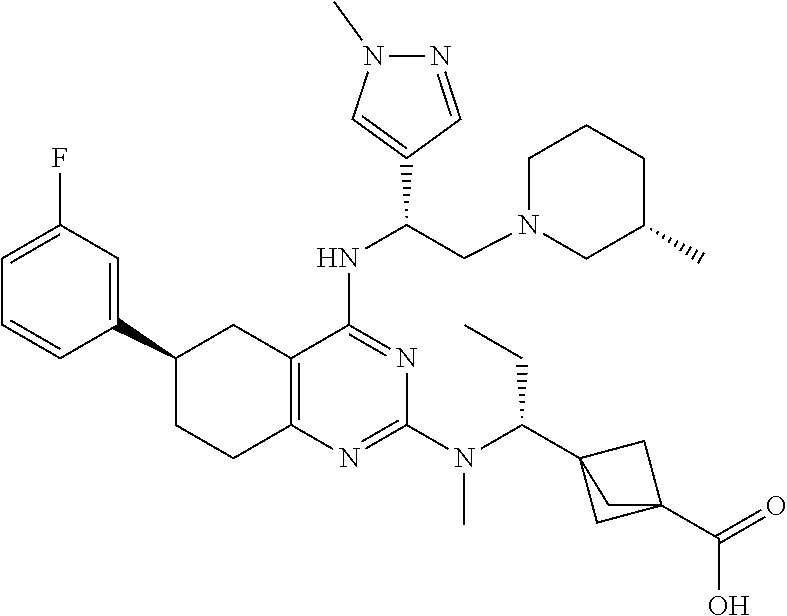 |
LCMS m/z [M + H]+ = 630.45, 1H NMR (400 MHz, METHANOL-d4) δ ppm 7.53 (s, 1 H), 7.42 (s, 1 H), 7.38-7.29 (m, 1 H), 7.17 (br d, J = 7.82 Hz, 1 H), 7.11 (br d, J = 10.17 Hz, 1 H), 7.00-6.92 (m, 1 H), 5.63 (br d, J = 5.48 Hz, 2 H), 4.10 (q, J = 7.30 Hz, 2 H), 3.84 (s, 3 H), 3.09-2.87 (m, 6 H), 2.85- 2.64 (m, 4 H), 2.43-2.39 (m, 2 H), 2.25- 1.93 (m, 6 H), 1.89-1.55 (m, 8 H), 1.24 (t, J = 7.24 Hz, 3 H), 0.96-0.77 (m, 4 H) |
| 44 |
 |
LCMS m/z [M + H]+ = 612.60, 1H NMR (400 MHz, METHANOL-d4) δ ppm 7.53 (s, 1 H), 7.41 (s, 1 H), 7.37-7.28 (m, 4 H), 7.24- 7.20 (m, 1 H) 5.60 (br d, J = 4.30 Hz, 1 H), 4.85-4.76 (m, 1 H) 3.83 (s, 3 H), 2.96 (s, 6 H), 2.81 (br d, J = 8.22 Hz, 7 H), 2.44-2.40 (m, 2 H), 2.21-1.94 (m, 5 H) 1.92-1.56 (m, 11 H) 1.00-0.76 (m, 4 H) |
| 47 |
 |
LCMS m/z [M + H]+ = 658.40, 1H NMR (400 MHz, METHANOL-d4) δ ppm 7.46 (br s, 1 H), 7.40-7.29 (m, 2 H), 7.17 (br d, J = 7.43 Hz, 1 H), 7.11 (br d, J = 10.17 Hz, 1 H), 7.01-6.89 (m, 1 H), 5.46-5.30 (m, 1 H), 4.10 (q, J = 7.30 Hz, 1 H), 3.89-3.71 (m, 4 H), 3.10-2.90 (m, 5 H), 2.89-2.60 (m, 5 H), 2.48-2.34 (m, 1 H), 2.26-1.92 (m, 6 H), 1.89-1.62 (m, 6 H), 1.60-1.17 (m, 5 H), 1.12-0.56 (m, 8 H), 0.39 (br s, 2 H) |
| 97 |
 |
LCMS m/z [M + H]+ = 644.45, 1H NMR (400 MHz, METHANOL-d4) δ 8.52 (br s, 1 H), 7.59 (br s, 1 H), 7.39 (br s, 1 H), 7.37-7.29 (m, 3 H), 7.26-7.18 (m, 1 H) 5.59-5.49 (m, 1 H) 4.57-4.46 (m, 1 H) 3.76-3.53 (m, 2 H) 3.09-2.35 (m, 14 H) 2.22-1.76 (m, 7 H) 1.71-1.24 (m, 12 H) 1.01 (br d, J = 5.70 Hz, 4 H), 0.78 (br t, J = 7.02 Hz, 3 H) |
| 112 |
 |
LCMS m/z [M + H]+ = 665.90, 1H NMR (400 MHz, METHANOL-d4) δ ppm 8.53 (s, 1 H), 7.34-7.42 (m, 6 H), 7.23-7.33 (m, 4 H), 4.99 (br dd, J = 9.21, 4.82 Hz, 1 H), 4.27 (br t, J = 9.21 Hz, 1 H), 3.93-4.04 (m, 1 H), 3.13-3.23 (m, 1 H), 2.96-3.12 (m, 3 H), 2.70-2.91 (m, 7 H), 2.56-2.68 (m, 2 H), 2.14-2.39 (m, 5 H), 2.01-2.12 (m, 2 H), 1.69-2.00 (m, 6 H), 1.61 (br d, J = 12.28 Hz, 2 H), 1.26-1.50 (m, 7 H), 1.06-1.24 (m, 4 H). |
| 120 |
 |
LCMS m/z [M + H]+ = 640.65, 1H NMR (400 MHz, METHANOL-d4) δ ppm 7.42 (br s, 1 H), 7.28-7.37 (m, 5 H), 7.17-7.23 (m, 1 H), 5.34 (br d, J = 2.63 Hz, 1 H), 3.73-3.92 (m, 4 H), 2.91-3.06 (m, 4 H), 2.77-2.89 (m, 2 H), 2.66-2.76 (m, 3 H), 2.61-2.57 (m, 1 H), 2.41-2.37 (m, 1 H), 2.14-2.26 (m, 1 H), 1.91-2.13 (m, 5 H), 1.58-1.87 (m, 7 H), 1.52 (br d, J = 8.77 Hz, 2 H), 1.43 (br dd, J = 13.59, 2.63 Hz, 1 H), 1.32 (br d, J = 11.84 Hz, 2 H), 0.77-1.07 (m, 6 H), 0.71 (br s, 2 H), 0.33 (br d, J = 6.58 Hz, 2 H). |
| 133 |
 |
LCMS m/z [M + H]+ = 676.70, 1H NMR (400 MHz, METHANOL-d4) δ ppm 8.53 (s, 1H), 7.49 (br s, 1H), 7.37 (br s, 1H), 7.33 (br d, J = 3.1 Hz, 4H), 7.22 (dt, J = 2.9, 5.6 Hz, 1H), 5.19 (br s, 1H), 3.85 (s, 3H), 3.76-3.58 (m, 1H), 3.51-3.44 (m, 1H), 3.40 (br s, 1H), 3.16-2.90 (m, 5H), 2.90-2.63 (m, 4H), 2.61-2.34 (m, 2H), 2.20-2.12 (m, 3H), 2.10-1.88 (m, 8H), 1.86-1.71 (m, 2H), 1.62 (br s, 5H), 1.46-1.32 (m, 2H), 1.29 (br d, J = 4.4 Hz, 2H), 1.06-0.86 (m, 2H), 0.84- 0.73 (m, 1H), 0.56 (br d, J = 13.6 Hz, 1H), 0.40 (br s, 2H). |
| 146 |
 |
LCMS m/z [M + H]+ = 596.2, 1H NMR (300 MHz, METHANOL-d4) δ ppm 7.26-7.41 (m, 9 H), 7.17-7.24 (m, 1 H), 5.34 (br d, J = 7.90 Hz, 1 H), 4.37 (br t, J = 9.55 Hz, 1 H), 2.67-3.09 (m, 10 H), 2.42-2.59 (m, 1 H), 1.72-2.11 (m, 8 H), 1.53-1.63 (m, 1 H), 1.21-1.48 (m, 10 H), 1.09-1.18 (m, 2 H), 0.80 (br t, J = 6.91 Hz, 3 H). |
| 147 |
 |
LCMS m/z [M + H]+ = 654.30, 1H NMR (400 MHz, METHANOL-d4) δ ppm 7.61 (br s, 1 H) 7.41 (br s, 1 H) 7.29-7.38 (m, 4 H) 7.18- 7.27 (m, 1 H) 5.58 (br d, J = 3.07 Hz, 1 H) 4.50-4.66 (m, 1 H) 3.96 (br d, J = 7.02 Hz, 2 H) 2.95-3.06 (m, 2 H) 2.90 (s, 3 H) 2.37- 2.84 (m, 10 H) 1.75-2.18 (m, 8 H) 1.43- 1.69 (m, 8 H) 1.20-1.35 (m, 4 H) 0.79 (br t, J = 7.23 Hz, 3 H) 0.51-0.63 (m, 2 H) 0.36 (q, J = 4.82 Hz, 2 H). |
| 150 |
 |
LCMS m/z [M + H]+ = 664.6, 1H NMR (400 MHz, METHANOL-d4) δ ppm 7.49 (br s, 1 H), 7.39 (br s, 1 H), 7.27-7.36 (m, 4 H), 7.22 (br dd, J = 5.92, 2.41 Hz, 1 H), 5.33 (br d, J = 4.38 Hz, 1 H), 4.49 (br d, J = 11.40 Hz, 1 H), 2.63-3.04 (m, 13 H), 2.39-2.51 (m, 1 H), 1.94-2.16 (m, 9 H), 1.76-1.92 (m, 3 H), 1.63-1.73 (m, 2 H), 1.21-1.55 (m, 7 H), 0.87-1.01 (m, 1 H), 0.77 (br t, J = 7.02 Hz, 3 H), 0.66-0.62 (m, 1 H) |
| 154 |
 |
LCMS m/z [M + H]+ = 644.3, 1H NMR (300 MHz, METHANOL-d4) δ ppm 7.57 (s, 1 H), 7.42 (s, 1 H), 7.38-7.30 (m, 4 H), 7.24 (dt, J = 5.76, 2.71 Hz, 1 H), 5.54-5.50 (m, 1 H), 4.52 (br t, J = 9.21 Hz, 1 H), 4.13 (q, J = 7.24 Hz, 2 H), 3.69-3.56 (m, 1 H), 3.12- 2.16 (m, 12 H), 2.57-2.23 (m, 3 H) , 2.20- 1.73 (m, 10 H), 1.65-1.24 (m, 11 H), 0.80 (br t, J = 7.24 Hz, 3 H). |
| 156 |
 |
LCMS m/z [M + H]+ = 632.70, 1H NMR (400 MHz, METHANOL-d4) δ ppm 8.54 (s, 1 H), 7.52 (br s, 1 H), 7.40 (br s, 1 H), 7.38-7.29 (m, 4 H), 7.28-7.20 (m, 1 H), 5.44 (br dd, J = 8.55, 4.60 Hz, 1 H), 4.61 (br s, 1 H), 4.50 (br s, 2 H), 2.97-3.08 (m, 1 H), 2.65-2.97 (m, 7 H), 2.41-2.60 (m, 4 H), 2.11-2.22 (m, 2 H), 1.96-2.10 (m, 3 H), 1.72-1.95 (m, 5 H), 1.63 (br d, J = 8.33 Hz, 2 H), 1.36- 1.56 (m, 5 H), 1.20-1.35 (m, 3 H), 0.89- 1.05 (m, 1 H), 0.81 (br t, J = 7.02 Hz, 3 H), 0.57 (br d, J = 13.59 Hz, 1 H). |
| 162 |
 |
LCMS m/z [M + H]+ = 683.90, 1H NMR (400 MHz, METHANOL-d4) δ ppm 7.56 (br s, 1 H), 7.42 (br s, 1 H), 7.38-7.29 (m, 4 H), 7.27-7.20 (m, 1 H), 5.46-5.33 (m, 1 H), 4.64-4.47 (m, 2 H), 4.21-4.07 (m, 2 H), 3.78-3.59 (m, 3 H), 3.53 (br d, J = 8.33 Hz, 1 H), 3.39 (br d, J = 9.21 Hz, 1 H), 3.07- 2.96 (m, 2 H), 2.91 (s, 3 H), 2.87-2.77 (m, 3 H), 2.74-2.59 (m, 3 H), 2.54-2.26 (m, 5 H), 2.14 (br d, J = 10.96 Hz, 1 H), 2.09- 1.68 (m, 7 H), 1.65-1.35 (m, 11 H), 0.80 (br t, J = 7.02 Hz, 3 H). |
| 167 |
 |
LCMS m/z [M + H]+ = 681.95, 1H NMR (400 MHz, METHANOL-d4) δ ppm 7.68 (br s, 1 H), 7.53 (br s, 1 H), 7.29-7.39 (m, 4 H), 7.17-7.27 (m, 1 H), 5.56 (br s, 1 H), 4.46- 4.68 (m, 1 H), 2.92-3.07 (m, 3 H), 2.89 (s, 3 H), 2.67-2.83 (m, 4 H), 2.40-2.66 (m, 5 H), 2.08-2.18 (m, 1 H), 1.74-2.07 (m, 6 H), 1.25-1.67 (m, 12 H), 0.90 (br s, 1 H), 0.78 (br t, J = 7.02 Hz, 3 H), 0.66-0.59 (m, 1 H). |
| 74 |
 |
LCMS m/z [M + H]+ = 638.85, 1H NMR (400 MHz, METHANOL-d4) δ = 7.51 (s, 1H), 7.43 (s, 1H), 7.37-7.26 (m, 4H), 7.22-7.18 (m, 1H), 5.48-5.19 (m, 2H), 4.82-4.70 (m, 1H), 3.83 (s, 3H), 3.54-3.40 (m, 1H), 3.32- 3.32 (m, 1H), 3.25-3.21 (m, 1H), 3.17- 3.04 (m, 1H), 2.32-2.26 (m, 2H), 2.89 (s, 3H), 2.81 (br d, J = 6.3 Hz, 1H), 2.77-2.67 (m, 2H), 2.55-2.33 (m, 2H), 2.13-2.06 (m, 1H), 2.04-1.96 (m, 4H), 1.95-1.87 (m, 1H), 1.78 (br d, J = 8.2 Hz, 2H), 1.71 (br s, 2H), 1.66 (br s, 1H), 1.62-1.50 (m, 5H), 1.28 (br d, J = 3.9 Hz, 2H), 1.04 (br d, J = 6.7 Hz, 1H), 0.89 (br s, 1H), 0.80 (t, J = 7.4 Hz, 2H). |
| 149 |
 |
LCMS m/z [M + H − 16]+ = 628.45, 1H NMR (400 MHz, METHANOL-d4) δ ppm 7.50 (br s, 1 H), 7.41 (br s, 1 H), 7.37-7.27 (m, 4 H), 7.24-7.16 (m, 1 H), 5.50 (br d, J = 4.38 Hz, 1 H), 4.64-4.49 (m, 1 H), 2.96 (br d, J = 11.40 Hz, 3 H), 2.85 (br s, 3 H), 2.79- 2.65 (m, 3 H), 2.56-2.38 (m, 3 H), 2.14- 1.78 (m, 8 H), 1.70-1.24 (m, 14 H), 1.10 (br d, J = 6.58 Hz, 3 H), 1.01-0.90 (m, 1 H), 0.78 (br t, J = 7.02 Hz, 3 H). |
| 116 |
 |
LCMS m/z [M + H]+ = 646.6, 1H NMR (400 MHz, DMSO-d6) δ 7.50 (s, 1H), 7.41-7.31 (m, 2H), 7.20 (br d, J = 7.9 Hz, 2H), 7.08- 7.00 (m, 1H), 6.15 (br d, J = 7.3 Hz, 1H), 5.30 (br d, J = 6.1 Hz, 1H), 4.57-4.43 (m, 1H), 4.08-3.99 (m, 2H), 2.99-2.88 (m, 1H), 2.72 (s, 3H), 2.66- 2.57 (m, 2H), 2.52-2.51 (m, 2H), 2.37 (br s, 4H), 2.29-2.21 (m, 1H), 2.09-1.78 (m, 6H), 1.75-1.53 (m, 2H), 1.43 (br s, 4H), 1.38-1.33 (m, 3H), 1.33-1.19 (m, 6H), 1.18-1.05 (m, 1H), 0.93-0.81 (m, 1H), 0.76-0.50 (m, 4H) |
| 125 |
 |
LCMS m/z [M + H]+ = 628.3, 1H NMR (400 MHz, Methanol-d4) δ 7.36 (s, 1H), 7.31- 7.17 (m, 5H), 7.13-7.05 (m, 1H), 5.34 (s, 1H), 4.43 (s, 1H), 3.74 (s, 3H), 2.91-2.67 (m, 7H), 2.66-2.58 (m, 3H), 2.50 (dd, J = 12.8, 5.2 Hz, 1H), 2.37-2.24 (m, 1H), 2.02- 1.83 (m, 5H), 1.75 (t, J = 17.7 Hz, 2H), 1.51 (ddd, J = 40.3, 25.2, 13.3 Hz, 7H), 1.26 (dt, J = 38.3, 12.2 Hz, 4H), 0.91-0.72 (m, 5H), 0.71-0.51 (m, 4H). |
| 143 |
 |
LCMS m/z [M + H]+ = 654.7, 1H NMR (400 MHz, MeOD) δ 7.52 (s, 1H), 7.40 (s, 1H), 7.38-7.28 (m, 4H), 7.22 (dq, J = 5.6, 2.5 Hz, 1H), 5.28 (br s, 1H), 4.43 (br s, 1H), 3.85 (s, 3H), 3.23-3.07 (br m, 1H), 3.07- 2.61 (m, 9H), 2.59-2.34 (m, 1H), 2.30- 1.15 (m, 24H), 1.02-0.83 (m, 1H), 0.83- 0.67 (m, 3H), 0.68-0.43 (m, 1H). |
| 175 |
 |
LCMS m/z [M + H]+ = 650.6, 1H NMR (400 MHz CD3OD) δ 7.42 (s, 1H), 7.30 (s, 1H), 7.27-7.18 (m, 1H), 7.10-6.95 (m, 1H), 6.91- 6.80 (m, 1H), 5.52 (s, 1H), 4.25 (s, 1H), 4.21-4.03 (m, 2H), 3.74 (s, 3H), 2.98-2.51 (m, 9H), 2.36-2.22 (m, 1H), 2.10-1.74 (m, 10H), 1.65-1.52 (m, 4H), 1.51-1.11 (m, 6H), 1.07-0.86 (m, 3H), 0.83 (t, J = 7.2 Hz, 3H). |


| 22 |
 |
LCMS m/z [M + H]+ = 642.4, 1H NMR (400 MHz, Methanol-d4) δ 7.62 (s, 1H), 7.50- 7.40 (m, 1H), 7.38-7.30 (m, 4H), 7.24 (ddt, J = 8.6, 5.4, 2.6 Hz, 1H), 5.70 (dd, J = 10.0, 4.7 Hz, 1H), 4.51-4.40 (m, 1H), 3.89 (s, 1H), 3.14-2.93 (m, 3H), 2.91-2.59 (m, 5H), 2.42 (dd, J = 15.8, 11.0 Hz, 1H), 2.19- 1.91 (m, 6H), 1.84 (t, J = 10.4 Hz, 2H), 1.77- 1.60 (m, 5H), 1.60-1.30 (m, 11H), 1.18- 0.98 (m, 2H), 0.95 (t, J = 7.3 Hz, 4H), 0.88 (d, J = 6.4 Hz, 3H). |
| 32 |
 |
LCMS m/z [M + H]+ = 614.4, 1H NMR (400 MHz, Methanol-d4) δ 7.42 (s, 1H), 7.29 (d, J = 4.8 Hz, 1H), 7.26-7.16 (m, 4H), 7.12 (tt, J = 6.2, 2.8 Hz, 1H), 5.55 (dd, J = 10.2, 4.9 Hz, 1H), 3.73 (s, 4H), 2.99-2.42 (m, 8H), 2.29 (dd, J = 15.9, 11.2 Hz, 1H), 2.03-1.10 (m, 18H), 1.04-0.52 (m, 9H). |
| 38 |
 |
LCMS m/z [M + H]+ = 666.5, 1H NMR (400 MHz, MeOD) δ 7.52 (s, 1H), 7.37 (s, 1H), 7.23 (q, J = 4.1 Hz, 4H), 7.11 (ddt, J = 8.4, 5.5, 2.6 Hz, 1H), 4.03 (q, J = 7.3 Hz, 2H), 3.71 (dt, J = 9.7, 4.9 Hz, 1H), 3.01-2.81 (m, 3H), 2.61 (dt, J = 15.8, 10.0 Hz, 3H), 2.35 (d, J = 13.4 Hz, 1H), 2.17-1.74 (m, 14H), 1.74-1.48 (m, 7H), 1.31 (t, J = 7.3 Hz, 8H), 0.82 (t, J = 7.3 Hz, 6H). |
| 45 |
 |
LCMS m/z [M + H]+ = 614.4, 1H NMR (400 MHz, MeOD) δ 7.55 (s, 1H), 7.43 (s, 1H), 7.39-7.29 (m, 4H), 7.28-7.18 (m, 1H), 5.63 (dd, J = 9.8, 4.8 Hz, 1H), 4.14 (q, J = 7.3 Hz, 2H), 3.84 (s, 1H), 3.05-2.89 (m, 2H), 2.76 (dd, J = 15.8, 5.4 Hz, 2H), 2.70- 2.55 (m, 4H), 2.54-2.36 (m, 3H), 2.15- 1.91 (m, 5H), 1.82 (d, J = 12.9 Hz, 1H), 1.75- 1.54 (m, 6H), 1.51-1.39 (m, 8H), 1.11- 1.00 (m, 2H), 0.94 (t, J = 7.3 Hz, 3H). |
| 58 |
 |
LCMS m/z [M + H]+ = 612.4, 1H NMR (400 MHz, MeOD) δ 7.52 (d, J = 3.3 Hz, 1H), 7.42 (d, J = 4.1 Hz, 1H), 7.34 (d, J = 6.4 Hz, 3H), 7.21 (d, J = 7.1 Hz, 1H), 5.53 (s, 1H), 3.83 (d, J = 14.4 Hz, 4H), 3.55 (s, 1H), 2.96 (d, J = 10.8 Hz, 3H), 2.82-2.57 (m, 3H), 2.52-2.28 (m, 3H), 2.14-1.87 (m, 6H), 1.85-1.60 (m, 6H), 1.59-1.26 (m, 7H), 1.15-0.97 (m, 2H), 0.93 (t, J = 7.4 Hz, 3H). |
| 71 |
 |
LCMS m/z [M + H]+ = 652.4, 1H NMR (400 MHz, Methanol-d4) δ 7.51 (dd, J = 40.1, 8.4 Hz, 2H), 7.38-7.02 (m, 5H), 5.42 (s, 1H), 3.91-3.73 (m, 4H), 3.19-2.85 (m, 4H), 2.82-2.58 (m, 3H), 2.45 (dd, J = 15.8, 10.6 Hz, 1H), 2.25-1.53 (m, 21H), 1.49-1.24 (m, 4H), 1.09 (dtd, J = 18.9, 13.8, 13.4, 9.9 Hz, 2H), 0.83 (t, J = 7.5 Hz, 3H) |
| 84 |
 |
LCMS m/z [M + H]+ = 614.34, 1H NMR (400 MHz, MeOD) δ 7.42 (s, 1H), 7.37-7.22 (m, 5H), 7.13 (qt, J = 5.3, 2.8 Hz, 1H), 5.55 (s, 1H), 3.74 (s, 4H), 2.99-2.50 (m, 8H), 2.43- 2.24 (m, 1H), 2.14-1.16 (m, 20H), 0.89- 0.74 (m, 7H). |
| 86 |
 |
LCMS m/z [M + H]+ = 626.3, 1H NMR (400 MHz, Methanol-d4) δ 7.34-7.18 (m, 6H), 7.11 (tq, J = 6.4, 2.2 Hz, 1H), 7.02-6.90 (m, 2H), 5.24 (s, 1H), 3.59 (ddt, J = 9.1, 6.1, 2.9 Hz, 1H), 3.40 (s, 1H), 3.03-2.79 (m, 3H), 2.75-2.49 (m, 3H), 2.36 (q, J = 12.1, 10.9 Hz, 3H), 2.10-1.07 (m, 19H), 0.81 (t, J = 7.3 Hz, 5H). |
| 90 |
 |
LCMS m/z [M + H]+ = 614.4, 1H NMR (400 MHz, MeOD) δ 7.48 (s, 1H), 7.40 (d, J = 0.8 Hz, 1H), 7.38-7.30 (m, 4H), 7.27-7.17 (m, 1H), 5.63 (dd, J = 10.2, 4.1 Hz, 1H), 3.85 (s, 4H), 3.19 (dd, J = 13.6, 10.3 Hz, 1H), 3.10-2.93 (m, 2H), 2.80-2.29 (m, 7H), 2.12-1.87 (m, 5H), 1.80 (d, J = 12.9 Hz, 1H), 1.75-1.56 (m, 5H), 1.55-1.26 (m, 7H), 1.17-0.98 (m, 5H), 0.93 (t, J = 7.3 Hz, 3H). |
| 95 |
 |
LCMS m/z [M + H]+ = 628.4, 1H NMR (400 MHz, Methanol-d4) δ 7.42 (s, 1H), 7.31 (s, 1H), 7.23 (d, J = 4.9 Hz, 4H), 7.18-7.07 (m, 1H), 5.42 (d, J = 8.2 Hz, 1H), 3.74 (s, 4H), 2.86 (tdd, J = 11.3, 5.2, 2.8 Hz, 1H), 2.77-2.51 (m, 4H), 2.45 (dd, J = 12.7, 5.5 Hz, 1H), 2.38-2.20 (m, 3H), 2.17-1.78 (m, 7H), 1.75-1.52 (m, 3H), 1.50-1.20 (m, 6H), 1.15-1.04 (m, 2H), 1.00-0.81 (m, 5H), 0.76 (d, J = 8.4 Hz, 6H). |
| 96 |
 |
LCMS m/z [M + H]+ = 628.4, 1H NMR (400 MHz, MeOD) δ 7.55-7.24 (m, 6H), 6.98 (dt, J = 8.6, 4.2 Hz, 1H), 5.76 (s, 1H), 3.75 (d, J = 2.3 Hz, 4H), 3.06-2.84 (m, 2H), 2.63-2.16 (m, 2H), 2.16-0.48 (m, 34H). |
| 123 |
 |
LCMS m/z [M + H]+ = 614.3, 1H NMR (400 MHz, MeOD) δ 7.50 (s, 1H), 7.43 (s, 1H), 7.39-7.30 (m, 4H), 7.21 (ddd, J = 8.5, 6.0, 2.2 Hz, 1H), 5.60 (dd, J = 7.6, 5.8 Hz, 1H), 3.85 (s, 4H), 3.11-2.81 (m, 4H), 2.77- 2.33 (m, 6H), 2.17-1.88 (m, 5H), 1.81 (d, J = 12.9 Hz, 1H), 1.75-1.23 (m, 12H), 1.16- 1.00 (m, 5H), 0.94 (t, J = 7.3 Hz, 3H). |
| 49 |
 |
LCMS m/z [M + H]+ = 623.0,1H NMR (400 MHz, Methanol-d4) δ 7.39-7.27 (m, 8H), 7.27-7.19 (m, 2H), 5.13 (s, 1H), 4.65 (s, 1H), 3.59 (ddd, J = 10.0, 6.3, 3.8 Hz, 1H), 3.22-3.10 (m, 1H), 3.01 (tdd, J = 11.2, 5.3, 2.9 Hz, 1H), 2.81 (tq, J = 10.3, 5.1 Hz, 3H), 2.72-2.60 (m, 2H), 2.53 (dd, J = 15.5, 11.0 Hz, 1H), 2.15-2.06 (m, 1H), 2.06-1.88 (m, 4H), 1.83-1.51 (m, 9H), 1.47-1.14 (m, 8H), 0.90 (t, J = 7.3 Hz, 3H), 0.85-0.72 (m, 1H), 0.66-0.48 (m, 1H). |
| 56 |
 |
LCMS m/z [M + H]+ = 600.3, 1H NMR (400 MHz, DMSO-d6) δ 7.48 (s, 1H), 7.40-7.26 (m, 5H), 7.26-7.19 (m, 1H), 6.12 (d, J = 8.0 Hz, 1H), 5.81 (s, 1H), 5.40 (q, J = 7.6 Hz, 1H), 3.74 (s, 3H), 3.68-3.61 (m, 1H), 3.17 (s, 1H), 2.87 (tq, J = 9.0, 4.5 Hz, 1H), 2.70-2.52 (m, 3H), 2.48-2.32 (m, 5H), 2.22 (dd, J = 15.6, 11.3 Hz, 1H), 1.94-1.84 (m, 2H), 1.78 (d, J = 12.7 Hz, 2H), 1.72- 1.58 (m, 3H), 1.56-1.39 (m, 5H), 1.38- 1.21 (m, 4H), 1.20-1.00 (m, 2H), 0.98- 0.72 (m, 5H). |
| 60 |
 |
LCMS m/z [M + H]+ = 626.4, 1H NMR (400 MHz, Methanol-d4) δ 7.50 (s, 1H), 7.41 (s, 1H), 7.35-7.28 (m, 4H), 7.23-7.17 (m, 1H), 5.46-5.34 (m, 1H), 3.84-3.74 (m, 4H), 3.29-3.25 (m, 2H), 2.97 (tdd, J = 11.2, 5.2, 2.7 Hz, 1H), 2.85 (q, J = 8.0, 7.4 Hz, 2H), 2.76-2.56 (m, 3H), 2.41 (dd, J = 15.5, 11.0 Hz, 1H), 2.12-1.86 (m, 7H), 1.81- 1.53 (m, 8H), 1.47-1.30 (m, 7H), 1.10- 0.95 (m, 2H), 0.91 (t, J = 7.3 Hz, 3H). |
| 151 |
 |
LCMS m/z [M + H]+ = 630.3, 1H NMR (400 MHz, Methanol-d4) δ 7.49 (s, 1H), 7.39 (s, 1H), 7.37-7.29 (m, 4H), 7.21 (tt, J = 6.4, 2.1 Hz, 1H), 5.57 (dd, J = 9.8, 4.9 Hz, 1H), 3.87-3.72 (m, 4H), 3.30 (s, 3H), 3.28- 3.22 (m, 1H), 3.01-2.86 (m, 3H), 2.82- 2.55 (m, 5H), 2.38 (dd, J = 14.8, 10.9 Hz, 2H), 2.24 (t, J = 10.6 Hz, 1H), 2.14-1.84 (m, 7H), 1.78 (d, J = 12.7 Hz, 1H), 1.71- 1.61 (m, 2H), 1.58-1.24 (m, 6H), 1.10- 0.95 (m, 2H), 0.92 (t, J = 7.3 Hz, 3H). |
| 61 |
 |
LCMS m/z [M + H]+ = 628.4, 1H NMR (400 MHz, Methanol-d4) δ 7.41 (s, 1H), 7.30 (d, J = 0.8 Hz, 1H), 7.28-7.17 (m, 4H), 7.11 (ddd, J = 8.6, 5.7, 2.7 Hz, 1H), 5.53 (dd, J = 9.8, 4.9 Hz, 1H), 3.73 (s, 4H), 2.96-2.74 (m, 4H), 2.71-2.45 (m, 4H), 2.29 (dd, J = 15.7, 11.1 Hz, 1H), 2.07-1.77 (m, 5H), 1.60 (ddd, J = 44.7, 33.6, 11.2 Hz, 8H), 1.44- 1.14 (m, 4H), 1.02-0.87 (m, 2H), 0.84 (t, J = 7.3 Hz, 3H), 0.75 (d, J = 5.7 Hz, 6H), 0.53-0.34 (m, 1H). |
| 121 |
 |
LCMS m/z [M + H]+ = 614.3, 1H NMR (400 MHz, Methanol-d4) δ 7.44 (s, 1H), 7.31 (s, 1H), 7.24 (q, J = 4.0, 2.9 Hz, 4H), 7.13 (td, J = 5.9, 2.8 Hz, 1H), 5.58 (s, 1H), 3.74 (s, 4H), 3.10-2.79 (m, 4H), 2.79-2.51 (m, 4H), 2.41-2.27 (m, 1H), 2.27-1.77 (m, 7H), 1.57 (d, J = 13.4 Hz, 5H), 1.50-0.90 (m, 9H), 0.83 (d, J = 6.5 Hz, 6H). |
| 85 |
 |
LCMS m/z [M + H]+ = 582.8,1H NMR (400 MHz, DMSO) δ 7.43-7.30 (m, 6H), 7.25 (t, J = 7.4 Hz, 3H), 7.16 (t, J = 7.2 Hz, 1H), 6.43 (d, J = 7.2 Hz, 1H), 5.87 (s, 1H), 5.25 (s, 1H), 3.61 (s, 1H), 2.91 (ddd, J = 14.7, 11.3, 7.4 Hz, 2H), 2.67-2.38 (m, 9H), 2.31 (dd, J = 15.7, 11.4 Hz, 1H), 2.03-1.85 (m, 3H), 1.79 (d, J = 14.6 Hz, 2H), 1.67-1.42 (m, 6H), 1.37-1.01 (m, 4H), 0.81 (t, J = 7.2 Hz, 5H). |
| 115 |
 |
LCMS m/z [M + H]+ = 582.6, 1H NMR (400 MHz, DMSO) δ 7.42-7.30 (m, 6H), 7.30- 7.20 (m, 3H), 7.16 (t, J = 7.2 Hz, 1H), 6.37 (d, J = 7.3 Hz, 1H), 5.79 (s, 1H), 5.26 (s, 1H), 3.61 (d, J = 8.5 Hz, 1H), 2.96-2.81 (m, 2H), 2.67 (dd, J = 15.7, 5.3 Hz, 1H), 2.61-2.36 (m, 6H), 2.25 (dd, J = 15.6, 11.3 Hz, 1H), 1.92 (td, J = 9.9, 4.9 Hz, 3H), 1.78 (d, J = 13.8 Hz, 2H), 1.69-1.40 (m, 7H), 1.37-1.05 (m, 5H), 0.93-0.51 (m, 5H). |
| 119 |
 |
LCMS m/z [M + H]+ = 617.4, 1H NMR (400 MHz, DMSO) δ 7.37-7.21 (m, 5H), 7.18- 7.09 (m, 1H), 6.43 (s, 1H), 5.85 (s, 1H), 5.52 (s, 1H), 3.51 (s, 1H), 2.81 (s, 1H), 2.63- 2.35 (m, 8H), 2.32-2.11 (m, 4H), 1.85 (s, 3H), 1.72 (s, 2H), 1.55 (s, 2H), 1.39 (d, J = 5.5 Hz, 5H), 1.26 (d, J = 33.9 Hz, 5H), 1.05 (s, 2H), 0.73 (t, J = 7.2 Hz, 5H). |
| 139 |
 |
LCMS m/z [M + H]+ = 608.7, Rt = 0.94 min (Method: A: 5mM Ammonium Hydroxide in Water, B: 5mM Ammonium Hydroxide in ACN, pH 10.2, 50° C., 2-98% B. AcQuity UPLC BEH C18 1.7 μm 2.1 × 30 mm, 1 mL/min ) |
| 158 |
 |
LCMS m/z [M + H]+ = 568.4, 1H NMR (400 MHz, Methanol-d4) δ 7.42-7.16 (m, 10H), 5.55-5.33 (m, 1H), 3.82 (td, J = 9.3, 8.0, 5.7 Hz, 1H), 3.06-2.29 (m, 10H), 2.10- 1.75 (m, 10H), 1.66-1.18 (m, 5H), 1.18- 0.84 (m, 5H). |
| 24 |
 |
LCMS m/z [M + H]+ = 675.6,1H NMR (400 MHz, MeOD) δ 7.25 (td, J = 8.1, 6.1 Hz, 1H), 7.10-7.04 (m, 1H), 7.00 (dt, J = 10.3, 2.2 Hz, 1H), 6.86 (td, J = 8.6, 2.7 Hz, 1H), 5.65-5.24 (m, 1H), 3.86-3.58 (m, 1H), 2.95 (dddd, J = 11.3, 8.3, 5.2, 2.7 Hz, 1H), 2.77 (d, J = 7.0 Hz, 2H), 2.73-2.54 (m, 3H), 2.48 (s, 3H), 2.43-2.25 (m, 4H), 2.14- 1.12 (m, 24H), 1.00 (qt, J = 12.7, 6.4 Hz, 2H), 0.64 (t, J = 7.3 Hz, 3H). |
| 26 |
 |
LCMS m/z [M + H]+ = 661.4, 1H NMR (400 MHz, MeOD) δ 8.81 (s, 1H), 7.35 (td, J = 8.0, 6.1 Hz, 1H), 7.17 (d, J = 7.9 Hz, 1H), 7.11 (dt, J = 10.3, 2.2 Hz, 1H), 7.02-6.91 (m, 1H), 5.45 (s, 1H), 3.83-3.58 (m, 1H), 3.23-3.14 (m, 1H), 3.11-2.98 (m, 1H), 2.95-2.61 (m, 5H), 2.56-2.38 (m, 4H), 2.24-1.81 (m, 7H), 1.81-1.50 (m, 8H), 1.50-1.17 (m, 8H), 0.93 (t, J = 7.3 Hz, 4H), 0.82-0.54 (m, 1H). |
| 73 |
 |
LCMS m/z [M + H]+ = 631.5, 1H NMR (400 MHz, MeOD) δ 8.69 (s, 1H), 7.29-7.19 (m, 4H), 7.12 (dt, J = 5.8, 2.9 Hz, 1H), 5.45 (dd, J = 9.5, 5.3 Hz, 1H), 3.56 (ddd, J = 10.2, 6.6, 4.0 Hz, 1H), 2.99-2.26 (m, 12H), 2.08- 1.09 (m, 18H), 1.00-0.69 (m, 8H), 0.70- 0.49 (m, 1H). |
| 114 |
 |
LCMS m/z [M + H]+ = 617.5, 1H NMR (400 MHz, MeOD) δ 8.68 (s, 1H), 7.29-7.19 (m, 4H), 7.14 (dt, J = 6.1, 3.2 Hz, 1H), 5.69 (s, 1H), 3.70 (s, 1H), 2.90 (ddt, J = 8.3, 5.3, 2.5 Hz, 1H), 2.82 (dd, J = 12.9, 9.7 Hz, 1H), 2.75-2.28 (m, 12H), 1.96 (dtd, J = 31.6, 13.0, 7.8 Hz, 5H), 1.83-1.66 (m, 2H), 1.58- 1.15 (m, 11H), 1.10-0.91 (m, 2H), 0.63 (t, J = 7.3 Hz, 3H). |
| 127 |
 |
LCMS m/z [M + H]+ = 661.4, 1H NMR (400 MHz, MeOD) δ 7.35 (td, J = 8.0, 6.1 Hz, 1H), 7.26-7.15 (m, 2H), 7.11 (dt, J = 10.3, 2.2 Hz, 1H), 6.96 (td, J = 8.5, 2.6 Hz, 1H), 5.61 (s, 1H), 3.72 (ddd, J = 9.8, 6.0, 3.8 Hz, 1H), 3.61-3.38 (m, 2H), 3.25-2.98 (m, 3H), 2.92-2.58 (m, 6H), 2.57-2.40 (m, 1H), 2.24-1.90 (m, 7H), 1.90-1.22 (m, 15H), 1.19-0.97 (m, 2H), 0.75 (s, 3H). |
| 159 |
 |
LCMS m/z [M + H]+ = 562.6, 1H NMR (400 MHz, DMSO) δ 7.77 (d, J = 8.1 Hz, 2H), 7.39-7.27 (m, 6H), 7.27-7.18 (m, 1H), 7.17-6.97 (m, 5H), 6.40 (d, J = 8.3 Hz, 1H), 5.29 (d, J = 7.1 Hz, 1H), 5.00 (t, J = 7.3 Hz, 1H), 2.96-2.76 (m, 3H), 2.66-2.53 (m, 3H), 2.49-2.40 (m, 3H), 2.29-2.07 (m, 1H), 2.00-1.74 (m, 2H), 1.72-1.56 (m, 4H), 1.38 (d, J = 7.0 Hz, 3H). |
| 160 |
 |
LCMS m/z [M + H]+ = 607.8, 1H NMR (400 MHz, MeOD) δ 7.34-7.16 (m, 8H), 7.12 (dtd, J = 4.7, 2.6, 1.3 Hz, 2H), 5.15 (dd, J = 10.0, 4.1 Hz, 1H), 3.56 (ddd, J = 9.7, 5.8, 4.0 Hz, 1H), 3.32 (s, 1H), 2.97-2.71 (m, 4H), 2.71-2.35 (m, 4H), 2.26 (dd, J = 19.3, 8.5 Hz, 2H), 2.11-0.87 (m, 20H), 0.50 (t, J = 7.2 Hz, 3H). |
| 168 |
 |
LCMS m/z [M + H]+ = 638.4, 1H NMR (400 MHz, MeOD) δ 7.60 (td, J = 7.8, 2.9 Hz, 1H), 7.37 (s, 1H), 7.34-7.24 (m, 4H), 7.24- 7.14 (m, 1H), 7.14-6.92 (m, 3H), 5.47 (s, 1H), 5.14-4.93 (m, 1H), 3.75 (s, 3H), 3.6- 3.1 (Signals for 5H overlap MeOD solvent peak), 3.04-2.83 (m, 1H), 2.82-2.53 (m, 3H), 2.39-2.27 (m, 1H), 2.26-1.86 (m, 8H), 1.87-1.54 (m, 5H), 1.49 (d, J = 6.9 Hz, 3H). |
| 59 |
 |
LCMS m/z [M + H]+ = 640.5, 1H NMR (400 MHz, DMSO) δ 7.51 (s, 1H), 7.37-7.28 (m, 5H), 7.27-7.17 (m, 1H), 6.04 (s, 1H), 5.71 (s, 1H), 5.29-5.14 (m, 1H), 3.75 (s, 3H), 3.67-3.60 (m, 1H), 2.95-2.82 (m, 3H), 2.76- 2.70 (m, 2H), 2.64-2.52 (m, 2H), 2.36- 2.22 (m, 1H), 1.99-1.73 (m, 10H), 1.72- 1.62 (m, 3H), 1.55-1.45 (m, 3H), 1.45-1.34 (m, 4H), 1.34-1.21 (m, 3H), 1.20-1.05 (m, 2H), 0.98-0.81 (m, 2H), 0.75 (t, J = 7.2 Hz, 3H). |
| 65 |
 |
LCMS m/z [M + H]+ = 654.7, 1H NMR (400 MHz, DMSO) δ 7.54 (s, 1H), 7.42-7.30 (m, 5H), 7.27-7.15 (m, 1H), 6.03 (s, 1H), 5.70 (s, 1H), 5.16 (q, J = 7.2 Hz, 1H), 4.03 (q, J = 7.2 Hz, 2H), 3.63 (s, 1H), 2.91-2.79 (m, 3H), 2.73 (s, 2H), 2.68-2.55 (m, 2H), 2.36- 2.18 (m, 1H), 2.00-1.74 (m, 10H), 1.68- 1.60 (m, 3H), 1.56-1.47 (m, 3H), 1.44- 1.37 (m, 4H), 1.35-1.24 (m, 6H), 1.17- 1.06 (m, 2H), 0.96-0.74 (m, 5H). |
| 100 |
 |
LCMS m/z [M + H]+ = 628.6, 1H NMR (400 MHz, DMSO) δ 7.53 (s, 1H), 7.41-7.29 (m, 5H), 7.27-7.16 (m, 1H), 6.12 (s, 1H), 5.78 (s, 1H), 5.49-5.39 (m, 1H), 4.49-4.29 (m, 1H), 3.78-3.63 (m, 1H), 2.95-2.85 (m, 1H), 2.75-2.66 (m, 2H), 2.61-2.52 (m, 3H), 2.45-2.37 (m, 3H), 2.29-2.19 (m, 1H), 2.02-1.78 (m, 5H), 1.74-1.64 (m, 2H), 1.56-1.39 (m, 5H), 1.37-1.28 (m, 10H), 1.25-1.11 (m, 3H), 1.04-0.91 (m, 2H), 0.81 (t, J = 7.2 Hz, 3H). |
| 108 |
 |
LCMS m/z [M + H]+ = 636.7, 1H NMR (400 MHz, DMSO) δ 7.42-7.30 (m, 6H), 7.29- 7.21 (m, 3H), 7.19-7.08 (m, 1H), 6.32 (s, 1H), 5.69 (s, 1H), 5.09-4.84 (m, 1H), 3.08- 2.86 (m, 2H), 2.82-2.52 (m, 5H), 2.45- 2.28 (m, 2H), 2.01-1.58 (m, 12H), 1.55- 1.31 (m, 10H), 1.30-0.83 (m, 5H), 0.78 (t, J = 7.3 Hz, 3H). |
| 153 |
 |
LCMS m/z [M + H]+ = 652.3, 1H NMR (400 MHz, MeOD) δ 7.94-7.84 (m, 2H), 7.36 (s, 1H), 7.29 (dd, J = 7.8, 3.8 Hz, 3H), 7.14- 7.08 (m, 1H), 7.08-7.01 (m, 1H), 6.92 (ddd, J = 11.0, 8.4, 4.2 Hz, 2H), 5.48 (s, 2H), 5.29-5.23 (m, 1H), 5.07-5.01 (m, 1H), 4.03-3.92 (m, 2H), 3.21-2.82 (m, 5H), 2.76-2.56 (m, 3H), 2.36-2.25 (m, 1H), 2.14-1.85 (m, 9H), 1.68-1.54 (m, 5H), 1.47 (dd, J = 7.0, 1.2 Hz, 3H), 1.31 (td, J = 7.3, 1.0 Hz, 3H). |
| 171 |
 |
LCMS m/z [M + H]+ = 608.6, 1H NMR (400 MHz, DMSO) δ 7.76 (d, J = 8.1 Hz, 2H), 7.38-7.12 (m, 9H), 6.62 (s, 1H), 6.12 (d, J = 8.4 Hz, 1H), 5.45-5.34 (m, 1H), 5.10- 4.98 (m, 1H), 4.41-4.23 (m, 1H), 2.92- 2.77 (m, 1H), 2.68-2.56 (m, 2H), 2.54 (s, 3H), 2.48-2.30 (m, 5H), 2.25-2.12 (m, 1H), 1.96-1.78 (m, 2H), 1.54-1.18 (m, 14H). |
| 2 |
 |
LCMS m/z [M + H]+ = 646.3, 1H NMR(400 MHz, DMSO-d6) δ 7.52 (s, 1H), 7.41-7.27 (m, 2H), 7.25-7.12 (m, 2H), 7.00 (dt, J = 2.1, 8.4 Hz, 1H), 6.46-6.22 (br s, 1H), 6.11 (br s, 1H), 5.45 (q, J = 7.4 Hz, 1H), 3.76 (s, 3H), 3.69-3.59 (m, 1H), 2.85 (br d, J = 9.4 Hz, 1H), 2.81-2.70 (m, 2H), 2.70-2.63 (m, 1H), 2.61-2.54 (m, 1H), 2.54-2.51 (m, 2H), 2.45-2.31 (m, 2H), 2.19-2.08 (m, 1H), 2.07-2.00 (m, 1H), 1.95 (m, 1H), 1.92- 1.78 (m, 3H), 1.72-1.59 (m, 4H), 1.58- 1.50 (m, 2H), 1.48-1.40 (m, 1H), 1.37- 1.22 (m, 5H), 1.20-1.06 (m, 2H), 1.00- 0.86 (m, 2H), 0.85-0.72 (m, 7H). |
| 3 |
 |
LCMS m/z [M + H]+ = 632.5 , 1H NMR(400 MHz, DMSO-d6) δ 7.46 (s, 1H), 7.40-7.33 (m, 1H), 7.33-7.31 (m, 1H), 7.19 (d, J = 7.8 Hz, 1H), 7.14 (br d, J = 10.5 Hz, 1H), 7.01 (dt, J = 1.9, 8.6 Hz, 1H), 5.81 (br d, J = 7.6 Hz, 1H), 5.36-5.27 (m, 2H), 3.76 (s, 3H), 3.75-3.68 (m, 1H), 3.03-2.93 (m, 2H), 2.92-2.76 (m, 3H), 2.69 (br t, J = 5.1 Hz, 4H), 2.66-2.58 (m, 2H), 2.33 (br dd, J = 11.2, 15.2 Hz, 1H), 2.09-1.98 (m, 2H), 1.89 (br dd, J = 6.2, 11.8 Hz, 3H), 1.74 (br t, J = 12.8 Hz, 2H), 1.52 (br s, 8H), 1.46-1.33 (m, 2H), 1.33-1.18 (m, 2H), 1.08-0.95 (m, 2H), 0.86 (t, J = 7.3 Hz, 3H). |
| 5 |
 |
LCMS m/z [M + H]+ = 646.6, 1H NMR(400 MHz, DMSO-d6) δ 7.53 (s, 1H), 7.38 (m, 2H), 7.34 (s, 1H), 7.11 (t, J = 8.8 Hz, 2H), 6.37 (br s, 1H), 6.20 (br s, 1H), 5.44 (q, J = 7.1 Hz, 1H), 3.77 (s, 3H), 3.65 (br s, 1H), 2.85 (br d, J = 10.3 Hz, 1H), 2.81-2.61 (m, 3H), 2.57 (br dd, J = 7.5, 12.2 Hz, 2H), 2.44- 2.30 (m, 2H), 2.19-1.88 (m, 4H), 1.87- 1.77 (m, 3H), 1.74-1.50 (m, 6H), 1.49- 1.28 (m, 4H), 1.25 (s, 3H), 1.21-1.06 (m, 2H), 1.02-0.87 (m, 2H), 0.81 (br d, J = 6.4 Hz, 6H) |
| 10 |
 |
LCMS m/z [M + H]+ = 672.7, 1H NMR(400 MHz, DMSO-d6) δ 7.55 (br s, 1H), 7.40- 7.33 (m, 2H), 7.20-7.15 (m, 2H), 7.07- 7.00 (m, 1H), 6.22-6.02 (m, 1H), 5.20- 5.13 (m, 1H), 4.03 (q, J = 7.2 Hz, 2H), 3.00- 2.90 (m, 2H), 2.90-2.83 (m, 2H), 2.72 (br s, 2H), 2.63-2.54 (m, 3H), 2.43 (br d, J = 1.6 Hz, 1H), 2.28 (br dd, J = 11.2, 15.0 Hz, 1H), 2.04-1.89 (m, 4H), 1.84 (br dd, J = 6.3, 11.7 Hz, 8H), 1.65 (br d, J = 0.9 Hz, 2H), 1.54-1.45 (m, 3H), 1.43-1.33 (m, 5H), 1.30 (t, J = 7.3 Hz, 4H), 1.24-1.13 (m, 2H), 0.98-0.87 (m, 2H), 0.80 (t, J = 7.2 Hz, 3H). |
| 15 |
 |
LCMS m/z [M + H]+ = 658.4, 1H NMR(400 MHz, DMSO-d6) δ 7.49 (s, 1H), 7.42-7.34 (m, 1H), 7.31 (s, 1H), 7.19 (br d, J = 7.8 Hz, 2H), 7.08-7.00 (m, 1H), 6.27-5.88 (m, 2H), 5.14 (q, J = 7.0 Hz, 1H), 3.74 (s, 3H), 3.62 (br dd, J = 1.3, 3.6 Hz, 2H), 3.00-2.80 (m, 4H), 2.73 (br s, 2H), 2.66-2.54 (m, 2H), 2.34-2.21 (m, 1H), 2.10-1.76 (m, 11H), 1.65 (br d, J = 8.8 Hz, 2H), 1.57-1.46 (m, 3H), 1.45-1.35 (m, 4H), 1.34-1.25 (m, 2H), 1.24-1.09 (m, 2H), 0.92 (br dd, J = 1.6, 7.1 Hz, 2H), 0.80 (br t, J = 7.2 Hz, 3H) |
| 17 |
 |
LCMS m/z [M + H]+ = 672.7, 1H NMR(400 MHz, DMSO-d6) δ 7.54 (br s, 1H), 7.40- 7.31 (m, 2H), 7.19 (d, J = 7.7 Hz, 2H), 7.08- 7.00 (m, 1H), 6.22-6.00 (m, 1H), 5.98- 5.77 (m, 1H), 5.16 (q, J = 7.2 Hz, 1H), 4.03 (q, J = 7.3 Hz, 2H), 2.99-2.90 (m, 2H), 2.72 (br s, 3H), 2.63(br d, J = 5.3 Hz, 2H), 2.59 (br d, J = 4.9 Hz, 2H), 2.26 (br dd, J = 12.0, 14.7 Hz, 1H), 1.99-1.89 (m, 4H), 1.89- 1.77 (m, 8H), 1.70-1.60 (m, 2H), 1.54-1.35 (m, 8H), 1.30 (t, J = 7.3 Hz, 5H), 1.22-1.12 (m, 2H), 0.98-0.87 (m, 2H), 0.79 (t, J = 7.3 Hz, 3H). |
| 20 |
 |
LCMS m/z [M + H]+ = 646.3, 1H NMR(400 MHz, DMSO-d6) § 7.55 (s, 1H), 7.35 (s, 1H), 7.30-7.23 (m, 1H), 7.19-7.04 (m, 3H), 6.40-6.25 (m, 1H), 6.08-5.85 (m, 1H), 5.44 (q, J = 7.6 Hz, 1H), 3.78 (s, 3H), 3.69-3.61 (m, 1H), 2.85 (br d, J = 15.8 Hz, 2H), 2.78 (br d, J = 10.5 Hz, 1H), 2.71-2.65 (m, 1H), 2.61-2.56 (m, 1H), 2.53 (d, J = 1.9 Hz, 1H), 2.45-2.37 (m, 2H), 2.36-2.31 (m, 1H), 2.30-2.21 (m, 1H), 2.10-1.98 (m, 2H), 1.97-1.90 (m, 1H), 1.89-1.78 (m, 3H), 1.72-1.60 (m, 4H), 1.59-1.51 (m, 2H), 1.46 (dt, J = 4.0, 6.9 Hz, 1H), 1.36 (s, 3H), 1.34-1.26 (m, 1H), 1.25-1.07 (m, 2H), 1.00-0.88 (m, 2H), 0.86-0.72 (m, 7H). |
| 30 |
 |
LCMS m/z [M + H]+ = 632.6, 1H NMR(400 MHz, DMSO-d6) δ 7.54-7.49 (m, 1H), 7.40- 7.33 (m, 1H), 7.31 (s, 1H), 7.20 (d, J = 7.6 Hz, 2H), 7.07-7.00 (m, 1H), 6.19-6.10 (m, 1H), 5.93-5.75 (m, 1H), 5.47-5.38 (m, 1H), 4.07-3.99 (m, 2H), 3.71-3.64 (m, 1H), 2.96-2.90 (m, 1H), 2.70-2.64 (m, 2H), 2.39 (br s, 4H), 2.30-2.17 (m, 2H), 2.00-1.80 (m, 6H), 1.72-1.63 (m, 2H), 1.42 (br d, J = 4.4 Hz,6H), 1.37-1.28 (m, 8H), 1.22-1.14 (m, 2H), 1.00-0.91 (m, 2H), 0.83-0.78 (m, 3H). |
| 117 |
 |
LCMS m/z [M + H]+ = 688.6, 1H NMR(400 MHz, DMSO-d6) δ 7.53 (br d, J = 7.5 Hz, 1H), 7.42-7.30 (m, 2H), 7.19 (br d, J = 9.3 Hz, 2H), 7.09-7.00 (m, 1H), 6.27-6.08 (m, 1H), 5.29-5.16 (m, 1H), 4.43-4.26 (m, 1H), 4.09-3.99 (m, 2H), 3.80-3.73 (m, 1H), 3.69-3.64 (m, 1H), 2.94 (br s, 2H), 2.83-2.77 (m, 2H), 2.61 (br d, J = 4.2 Hz, 4H), 2.30-2.15 (m, 3H), 2.15-2.01 (m, 4H), 1.95-1.83 (m, 4H), 1.79-1.65 (m, 4H), 1.56-1.44 (m, 2H), 1.34-1.28 (m, 5H), 1.23-1.11 (m, 4H), 1.09-0.94 (m, 4H), 0.83-0.75 (m, 3H). |
| 130 |
 |
LCMS m/z [M + H]+ = 646.3, 1H NMR(400 MHz, DMSO-d6) δ 7.63-7.48 (m, 1H), 7.43- 7.25 (m, 2H), 7.23-7.09 (m, 2H), 7.00 (dt, J = 2.3, 8.4 Hz, 1H), 6.53-6.21 (m, 1H), 6.12-5.86 (m, 1H), 5.52-5.38 (m, 1H), 3.76 (s, 3H), 3.69-3.61 (m, 1H), 2.90-2.70 (m, 4H), 2.59-2.55 (m, 1H), 2.54-2.52 (m, 2H), 2.40-2.30 (m, 2H), 2.13-1.95 (m, 4H), 1.91-1.80 (m, 3H), 1.72 (br d, J = 11.9 Hz, 2H), 1.67-1.58 (m, 2H), 1.55 (br d, J = 3.1 Hz, 1H), 1.50-1.40 (m, 2H), 1.39-1.25 (m, 4H), 1.24-1.13 (m, 2H), 1.08-0.91 (m, 2H), 0.89-0.70 (m, 7H). |
| 37 |
 |
LCMS m/z [M + H]+ = 614.2, 1H NMR (400 MHz, DMSO-d6) δ ppm 8.53 (s, 1H), 7.41- 7.34 (m, 6H) 7.29-7.14 (m, 2H) 7.02- 6.97 (m, 1H) 5.38 (br d, J = 2.63 Hz, 1H) 3.70 (brs, 1H), 3.07-2.99 (m, 2H), 2.88- 2.50 (m, 9H) 2.16-1.98 (m, 4H), 1.84- 1.25 (m, 14H) 0.93 (t, J = 6.8 Hz, 3H), 0.84- 0.81 (m, 1H) 0.58-0.56 (m, 1H). |
| 50 |
 |
LCMS m/z [M + H]+ = 632.70, 1H NMR (400 MHz, DMSO-d6 ) δ ppm 7.53 (br s, 1H), 7.40-7.33 (m, 1H), 7.32 (s, 1H), 7.19 (d, J = 7.7 Hz, 2H), 7.08-7.00 (m, 1H), 6.26-6.08 (m, 1H), 5.99-5.72 (m, 1H), 5.47-5.37 (m, 1H), 4.07-3.97 (m, 2H), 3.73-3.63 (m, 2H), 2.97-2.86 (m, 2H), 2.68-2.63 (m, 1H), 2.60-2.55 (m, 2H), 2.45-2.42 (m, 2H), 2.38 (br s, 4H), 2.27-2.19 (m, 1H), 2.07-1.98 (m, 1H), 1.96-1.88 (m, 2H), 1.87-1.81 (m, 2H), 1.74-1.63 (m, 2H), 1.42 (br d, J = 4.6 Hz, 4H), 1.37-1.28 (m, 7H), 1.26-1.15 (m, 2H), 1.01-0.88 (m, 2H), 0.85-0.78 (m, 3H). |
| 51 |
 |
LCMS m/z [M + H]+ = 614.40, 1H NMR (400 MHz, METHANOL-d4) δ ppm 7.53 (s, 1H), 7.42 (s, 1H), 7.35-7.32 (m, 4H), 7.24-7.21 (m, 1H), 5.06 (br s, 1H), 3.85 (s, 3H), 3.02- 2.98 (m, 3H), 2.83-2.73 (m, 6H), 2.48- 2.42 (m, 1H), 2.23-1.98 (m, 7H), 2.14- 1.93 (m, 5H), 1.82-1.31 (m, 10H), 1.09- 0.92 (m, 5H) |
| 64 |
 |
LCMS m/z [M + H]+ = 628.00, 1H NMR (400 MHz, METHANOL-d4) δ ppm 7.60 (s, 1H), 7.44 (s, 1H), 7.29-7.39 (m, 4H), 7.19- 7.27 (m, 1H), 5.71-5.82 (m, 1H), 4.14 (q, J = 7.45 Hz, 2H), 3.86 (br s, 1H), 3.38 (br s, 1H), 3.14 (br s, 1H), 3.01 (br s, 2H), 2.53-2.90 (m, 5H), 2.35-2.51 (m, 2H), 1.88-2.19 (m, 5H), 1.59-1.86 (m, 6H), 1.46-1.58 (m, 3H), 1.32-1.45 (m, 6H), 1.17 (br d, J = 6.14 Hz, 2H), 1.00-1.10 (m, 2H), 0.95 (br t, J = 7.23 Hz, 4H). |
| 109 |
 |
LCMS m/z [M + H]+ = 669.80, 1H NMR (400 MHz, METHANOL-d4) δ ppm 7.55 (s, 1H), 7.43 (s, 1H), 7.28-7.37 (m, 4H), 7.24- 7.20 (m, 1H), 5.54-5.49 (m, 1H), 4.13 (q, J = 7.31 Hz, 2H), 3.82 (br s, 1H), 3.59- 3.77 (m, 2H), 3.52 (br d, J = 8.77 Hz, 2H), 3.33-3.43 (m, 1H), 2.92-3.04 (m, 1H), 2.56-2.86 (m, 5H), 2.31-2.51 (m, 3H), 2.21 (s, 2H), 1.87-2.13 (m, 6H), 1.26- 1.85 (m, 14H), 1.01-1.11 (m, 2H), 0.94 (t, J = 7.45 Hz, 3H). |
| 122 |
 |
LCMS m/z [M + H]+ = 625.90, 1H NMR (400 MHz, METHANOL-d4) δ ppm 7.63 (br s, 1 H), 7.45-7.55 (m, 1H), 7.29-7.39 (m, 4 H), 7.23 (br d, J = 5.70 Hz, 1H), 5.68-5.90 (m, 2H), 4.57-4.77 (m, 1H), 4.15 (q, J = 7.02 Hz, 2H), 3.86 (br s, 2H), 3.45-3.63 (m, 2H), 3.06-3.26 (m, 2H), 2.98 (br s, 2 H), 2.54-2.88 (m, 5H), 2.33-2.51 (m, 1 H), 1.59-2.20 (m, 11H), 1.21-1.57 (m, 8 H), 1.04 (br d, J = 4.38 Hz, 1H), 0.95 (br t, J = 7.23 Hz, 2H). |
| 126 |
 |
LCMS m/z [M + H]+ = 653.75, 1H NMR (300 MHz, METHANOL-d4) δ ppm 7.60 (d, J = 7.24 Hz, 1H) 7.44 (d, J = 6.58 Hz, 1H) 7.27- 7.38 (m, 4H) 7.19-7.26 (m, 1H) 5.58 (br s, 1H) 4.12 (qd, J = 7.24, 1.97 Hz, 1H) 3.89 (br s, 1H) 2.86-3.10 (m, 2H) 2.60-2.84 (m, 5H) 2.29-2.58 (m, 5H) 1.61-2.21 (m, 14H) 1.31-1.58 (m, 11H) 0.77-1.23 (m, 5 H) |
| 137 |
 |
LCMS m/z [M + H]+ = 664.35, 1H NMR (400 MHz, METHANOL-d4) δ ppm 8.53 (s, 1H), 7.58 (s, 1H), 7.42 (s, 1H), 7.35-7.31 (m, 4 H), 7.16-7.26 (m, 1H), 5.54 (br s, 1H), 4.12 (q, J = 7.16 Hz, 2H), 3.88 (br d, J = 2.19 Hz, 1H), 2.94-3.06 (m, 2H), 2.55-2.93 (m, 9 H), 2.38-2.52 (m, 1H), 1.88-2.20 (m, 9H), 1.60-1.86 (m, 5H), 1.26-1.57 (m, 6H), 0.87- 1.14 (m, 5H) |
| 165 |
 |
LCMS m/z [M + H]+ = 556.30, 1H NMR (400 MHz, METHANOL-d4) δ ppm 8.51 (br s, 1 H), 7.37-7.35 (m, 7H), 7.28-7.25 (m, 2H), 5.46-5.38 (m, 1H), 3.78-3.76 (m, 1H), 3.12-2.62 (m, 8H), 2.52-2.50 (m, 2H), 2.38-2.32 (m, 5H), 2.14-1.98 (m, 3H), 1.89-1.26 (m, 9H), 0.96-0.92 (m, 3H). |
| 166 |
 |
LCMS m/z [M + H]+ = 612.30, 1H NMR (400 MHz, METHANOL-d4) δ ppm 8.51 (s, 1H), 7.44-7.29 (m, 9H), 7.27 (br d, J = 6.58 Hz, 1H), 5.36 (br d, J = 3.95 Hz, 1H), 3.94 (br d, J = 12.28 Hz, 2H), 3.77 (br s, 1H), 3.45- 3.36 (m, 2H), 3.25-3.12 (m, 1H), 3.10- 2.96 (m, 2H), 2.93-2.63 (m, 4H), 2.61-2.48 (m, 1H), 2.24-1.95 (m, 4H), 1.92-1.66 (m, 4H), 1.64-1.17 (m, 9H), 0.95 (br t, J = 7.23 Hz, 3H), 0.84 (br s, 1H), 0.55 (br d, J = 11.84 Hz, 1H) |
| 94 |
 |
LCMS m/z [M + H]+ = 627.90, 1H NMR (METHANOL-d4) δ 7.61 (s, 1H), 7.45 (s, 1H), 7.30-7.39 (m, 4H), 7.24-7.22 (m, 1H), 5.65 (brs, 1H), 4.14 (q, J = 7.3 Hz, 2H), 3.11- 3.15 (m, 3H), 3.00-2.71 (m, 8H), 2.49- 2.42 (m, 2H), 2.12-1.95 (m, 6H), 1.83- 1.63 (m, 8H), 1.55-1.49 (m, 2H), 1.47- 1.42 (m, 2H), 1.40-1.31 (m, 3H), 1.11- 1.02 (m, 3H), 0.97-0.91 (m, 3H). |
| 132 |
 |
LCMS m/z [M + H]+ = 668.5, 1H NMR (400 MHz, DMSO) δ 7.50 (s, 1H), 7.26 (d, J = 4.6 Hz, 5H), 7.15 (tt, J = 5.5, 3.1 Hz, 1H), 6.02 (s, 1H), 5.87 (s, 1H), 5.11 (q, J = 7.3 Hz, 1H), 4.32 (p, J = 6.6 Hz, 1H), 3.58 (s, 1H), 2.81 (t, J = 6.8 Hz, 3H), 2.65 (s, 2H), 2.53 (td, J = 13.4, 5.7 Hz, 2H), 2.20 (dd, J = 15.4, 11.1 Hz, 1H), 2.00-1.70 (m, 11H), 1.71- 1.55 (m, 2H), 1.42 (q, J = 7.6 Hz, 3H), 1.37- 1.23 (m, 13H), 1.22-1.05 (m, 2H), 0.95- 0.79 (m, 2H), 0.73 (t, J = 7.2 Hz, 3H). |
| 176 |
 |
LCMS m/z [M + H]+ = 626.5, 1H NMR (400 MHz, DMSO-d6) δ = 7.58-7.43 (m, 1H), 7.38-7.26 (m, 5H), 7.25-7.18 (m, 1H), 6.20-6.08 (m, 1H), 5.70-5.47 (m, 1H), 4.54-4.41 (m, 1H), 3.75 (s, 3H), 2.92- 2.80 (m, 2H), 2.74-2.69 (m, 3H), 2.65- 2.55 (m, 2H), 2.47-2.43 (m, 1H), 2.30- 2.18 (m, 2H), 2.17-2.09 (m, 1H), 2.07 (s, 1H), 2.03-1.77 (m, 5H), 1.73-1.59 (m, 3H), 1.50-1.33 (m, 3H), 1.32-1.21 (m, 5H), 1.20-1.05 (m, 2H), 1.01-0.91 (m, 1H), 0.90-0.72 (m, 2H), 0.71-0.60 (m, 3H), 0.37-0.10 (m, 2H). |
| 177 |
 |
LCMS m/z [M + H]+ = 626.5, 1H NMR (400 MHz, DMSO-d6) δ = 7.56-7.41 (m, 1H), 7.39-7.27 (m, 5H), 7.25-7.17 (m, 1H), 6.18-6.04 (m, 1H), 5.63-5.37 (m, 1H), 4.56-4.42 (m, 1H), 3.75 (s, 3H), 2.97- 2.85 (m, 2H), 2.74-2.68 (m, 3H), 2.65- 2.54 (m, 2H), 2.46-2.40 (m, 1H), 2.31- 2.22 (m, 1H), 2.21-2.09 (m, 2H), 2.04- 1.89 (m, 2H), 1.87-1.76 (m, 3H), 1.67 (br s, 3H), 1.45-1.21 (m, 8H), 1.19-1.02 (m, 2H), 0.99-0.92 (m, 1H), 0.88-0.79 (m, 1H), 0.71-0.63 (m, 3H), 0.63-0.51 (m, 1H), 0.30-0.11 (m, 2H). |
| 178 |
 |
LCMS m/z [M + H]+ = 658.4, 1H NMR (400 MHz, DMSO-d6) δ = 7.58-7.40 (m, 1H), 7.39-7.25 (m, 5H), 7.25-7.18 (m, 1H), 6.17-5.98 (m, 1H), 5.51-5.12 (m, 1H), 4.60-4.36 (m, 1H), 3.74 (s, 3H), 2.91- 2.82 (m, 1H), 2.78-2.68 (m, 3H), 2.68- 2.57 (m, 3H), 2.57-2.51 (m, 3H), 2.45- 2.32 (m, 2H), 2.31-2.13 (m, 2H), 2.11- 1.99 (m, 1H), 1.97-1.79 (m, 3H), 1.79- 1.58 (m, 4H), 1.56-1.46 (m, 1H), 1.45- 0.97 (m, 10H), 0.92-0.77 (m, 1H), 0.76- 0.60 (m, 6H), 0.59-0.44 (m, 1H). |
| 179 |
 |
LCMS m/z [M + H]+ = 644.5, 1H NMR (600 MHz, DMSO) δ 11.86 (d, J = 248.6 Hz, 1H), 11.27 (s, 1H), 10.04 (s, 1H), 8.26 (s, 1H), 7.60 (s, 1H), 7.40 (s, 1H), 7.39-7.31 (m, 4H), 7.26 (ddd, J = 8.7, 5.1, 3.5 Hz, 1H), 5.70 (s, 1H), 4.40 (s, 2H), 3.78 (s, 4H), 3.50 (s, 2H), 3.35 (d, J = 14.5 Hz, 2H), 3.27 (d, J = 11.9 Hz, 1H), 3.18 (d, J = 12.3 Hz, 1H), 3.05 (d, J = 23.9 Hz, 1H), 2.97-2.65 (m, 6H), 2.43-2.23 (m, 1H), 2.16-1.80 (m, 5H), 1.72 (d, J = 13.5 Hz, 3H), 1.60 (p, J = 15.8 Hz, 1H), 1.43 (d, J = 11.9 Hz, 2H), 1.37-1.22 (m, 2H), 1.16 (q, J = 12.5 Hz, 1H), 1.03-0.78 (m, 5H), 0.72 (d, J = 23.2 Hz, 3H), 0.46 (d, J = 14.0 Hz, 1H) |
| 180 |
 |
LCMS m/z [M + H]+ = 640.5, 1H NMR (400 MHz CD3OD) δ 7.27 (s, 1H), 7.17 (s, 1H), 7.14-7.05 (m, 4H), 7.04-6.93 (m, 1H), 5.04 (s, 1H), 4.23 (s, 1H), 3.59 (s, 3H), 2.84-2.71 (m, 1H), 2.69-2.14 (m, 12H), 2.15-1.95 (m, 2H), 1.94-1.58 (m, 7H), 1.56-1.31 (m, 5H), 1.29-0.97 (m, 7H), 0.94-0.61 (m, 3H), 0.308 (t, J = 7.2 Hz, 3H). |
| 181 |
 |
LCMS m/z [M + H]+ = 630.5, 1H NMR (400 MHz, DMSO-d6) δ = 7.54-7.42 (m, 1H), 7.38-7.27 (m, 5H), 7.25-7.18 (m, 1H), 6.23-6.12 (m, 1H), 5.50-5.19 (m, 1H), 4.60-4.44 (m, 1H), 3.81 (br s, 1H), 3.74 (s, 3H), 3.12 (s, 3H), 2.95-2.85 (m, 1H), 2.84- 2.74 (m, 2H), 2.72 (s, 2H), 2.70-2.65 (m, 1H), 2.65-2.56 (m, 3H), 2.54 (br s, 2H), 2.47-2.40 (m, 2H), 2.31-2.20 (m, 1H), 2.01-1.80 (m, 6H), 1.77-1.54 (m, 3H), 1.42-1.06 (m, 5H), 0.95-0.80 (m, 1H), 0.73-0.63 (m, 3H), 0.63-0.49 (m, 1H). |
| 182 |
 |
LCMS m/z [M + H]+ = 644.4, 1H NMR (400 MHz, DMSO) δ 7.46 (s, 1H), 7.38-7.29 (m, 5H), 7.22 (ddt, J = 8.6, 5.2, 3.2 Hz, 1H), 6.13 (d, J = 7.3 Hz, 1H), 5.23 (d, J = 7.4 Hz, 1H), 4.47 (t, J = 10.3 Hz, 1H), 3.74 (s, 3H), 2.87 (tt, J = 10.5, 4.6 Hz, 1H), 2.72 (s, 3H), 2.61 (dtd, J = 31.0, 13.8, 6.1 Hz, 5H), 2.39 (s, 1H), 2.23 (dq, J = 22.6, 12.5 Hz, 4H), 2.01 (d, J = 11.4 Hz, 1H), 1.90 (s, 3H), 1.81 (d, J = 11.4 Hz, 1H), 1.72 (d, J = 12.3 Hz, 1H), 1.64 (s, 1H), 1.54 (s, 1H), 1.31 (t, J = 19.9 Hz, 7H), 1.13 (t, J = 12.8 Hz, 1H), 1.03 (s, 3H), 0.87 (d, J = 13.4 Hz, 1H), 0.69 (t, J = 7.2 Hz, 3H), 0.55 (t, J = 12.7 Hz, 1H). |
| 183 |
 |
LCMS m/z [M + H]+ = 658.3, 1H NMR (400 MHz, DMSO-d6) δ = 7.56-7.41 (m, 1H), 7.39-7.27 (m, 5H), 7.26-7.19 (m, 1H), 6.25-6.08 (m, 1H), 5.55-5.11 (m, 1H), 4.62-4.39 (m, 1H), 3.74 (s, 3H), 3.08 (s, 3H), 2.94-2.83 (m, 1H), 2.83-2.69 (m, 4H), 2.68-2.51 (m, 7H), 2.35-2.12 (m, 2H), 1.98-1.75 (m, 7H), 1.74-1.51 (m, 3H), 1.40-1.01 (m, 6H), 0.89-0.74 (m, 4H), 0.68 (br t, J = 6.8 Hz, 3H), 0.58-0.40 (m, 1H) |
| 184 |
 |
LCMS m/z [M + H]+ = 658.5, 1H NMR (400 MHz, DMSO-d6) δ = 11.91 (br s, 1H), 7.56- 7.44 (m, 1H), 7.42-7.29 (m, 5H), 7.26- 7.19 (m, 1H), 6.24-6.11 (m, 1H), 5.53- 5.12 (m, 1H), 4.64-4.38 (m, 1H), 3.74 (s, 3H), 3.07 (s, 3H), 2.93-2.82 (m, 1H), 2.79- 2.57 (m, 8H), 2.57-2.51 (m, 2H), 2.49- 2.45 (m, 1H), 2.34-2.14 (m, 2H), 2.03- 1.77 (m, 7H), 1.77-1.56 (m, 3H), 1.46- 1.20 (m, 4H), 1.19-1.04 (m, 2H), 0.93- 0.82 (m, 1H), 0.78 (br d, J = 6.0 Hz, 3H), 0.68 (br s, 1H), 0.59-0.41 (m, 1H) |
| 185 |
 |
LCMS m/z [M + H]+ = 646.4, 1H NMR (400 MHz, DMSO-d6) δ = 11.88 (br s, 1H), 7.50- 7.38 (m, 1H), 7.37-7.29 (m, 4H), 7.26- 7.18 (m, 1H), 6.20 (br s, 1H), 5.49-5.21 (m, 1H), 4.57-4.45 (m, 1H), 3.63 (s, 3H), 2.94- 2.84 (m, 1H), 2.83-2.77 (m, 1H), 2.72 (s, 3H), 2.71-2.67 (m, 1H), 2.66-2.62 (m, 1H), 2.61-2.58 (m, 1H), 2.57-2.52 (m, 2H), 2.47-2.43 (m, 1H), 2.30-2.21 (m, 1H), 2.10-1.99 (m, 1H), 1.94-1.79 (m, 5H), 1.76-1.68 (m, 1H), 1.67-1.56 (m, 3H), 1.55-1.46 (m, 2H), 1.41-1.22 (m, 5H), 1.21-1.08 (m, 1H), 1.02-0.92 (m, 1H), 0.83-0.75 (m, 4H), 0.74-0.64 (m, 3H), 0.60-0.44 (m, 1H) |
| 186 |
 |
LCMS m/z [M + H]+ = 644.4, 1H NMR (400 MHz, DMSO) δ 8.18 (s, 1H), 7.46 (s, 1H), 7.37-7.28 (m, 5H), 7.22 (ddd, J = 8.6, 5.3, 3.3 Hz, 1H), 6.20 (d, J = 7.0 Hz, 1H), 5.23- 5.17 (m, 1H), 4.45 (t, J = 10.2 Hz, 1H), 3.74 (s, 3H), 2.37-2.29 (m, 1H), 2.26 (d, J = 13.0 Hz, 2H), 2.13 (d, J = 10.6 Hz, 1H), 2.05- 1.85 (m, 4H), 1.80 (d, J = 11.6 Hz, 1H), 1.55 (s, 1H), 1.40-1.20 (m, 7H), 1.13 (t, J = 12.4 Hz, 1H), 1.03 (d, J = 8.8 Hz, 3H), 0.88 (q, J = 12.5 Hz, 1H), 0.68 (t, J = 7.1 Hz, 3H), 0.51 (q, J = 12.5 Hz, 1H), 2.88 (s, 1H), 2.72 (s, 3H), 2.70-2.52 (m, 5H), 2.41 (s, 1H), 1.71 (d, J = 12.9 Hz, 1H), 1.65 (s, 1H). |


| 87 |
 |
LCMS m/z [M + H]+ = 646.4, 1H NMR (400 MHz, MeOD) δ 7.41 (s, 1H), 7.36-7.19 (m, 5H), 7.13 (ddd, J = 8.5, 5.5, 2.5 Hz, 1H), 5.51-5.23 (m, 1H), 4.55-4.32 (m, 1H), 4.30-4.00 (m, 2H), 3.75 (s, 3H), 2.97- 2.61 (m, 10H), 2.56 (dd, J = 12.9, 5.3 Hz, 1H), 2.48-2.24 (m, 1H), 2.12-1.65 (m, 10H), 1.65-1.52 (m, 2H), 1.52-1.10 (m, 6H), 1.10-0.77 (m, 2H), 0.69 (t, J = 7.3 Hz, 3H), 0.53 (d, J = 12.7 Hz, 1H). |
| 57 |
 |
LCMS m/z [M + H]+ = 644.3, 1H NMR (400 MHz, DMSO) δ 7.54-7.18 (m, 3H), 7.13 (d, J = 8.6 Hz, 2H), 6.97 (t, J = 8.6 Hz, 1H), 6.34-5.86 (m, 1H), 5.40-4.87 (m, 1H), 4.63-4.26 (m, 1H), 3.68 (s, 3H), 2.97- 2.80 (m, 2H), 2.76-2.49 (m, 8H), 2.31- 2.05 (m, 2H), 2.00-1.39 (m, 11H), 1.16 (dd, J = 39.4, 22.6 Hz, 9H), 0.77 (d, J = 12.0 Hz, 1H), 0.60 (t, J = 7.3 Hz, 4H). |


| 80 |
 |
LCMS m/z [M + H]+ = 659.6, 1H NMR(400 MHz, DMSO-d6) δ ppm 12.60-11.13 (m, 1H), 7.53 (s, 1H), 7.38 (s, 1H), 7.17-7.01 (m, 4H), 6.46 (br d, J = 6.8 Hz, 1H), 5.14 (q, J = 6.2 Hz, 1H), 4.63-4.36 (m, 1H), 3.98- 3.84 (m, 2H), 3.77 (s, 3H), 3.44 (br t, J = 5.0 Hz, 2H), 3.12 (br s, 1H), 2.73 (s, 3H), 2.69- 2.59 (m, 5H), 2.04-1.94 (m, 1H), 1.92- 1.78 (m, 4H), 1.75-1.44 (m, 8H), 1.39- 1.25 (m, 6H), 1.18-1.04 (m, 1H), 0.93- 0.78 (m, 1H), 0.67 (br t, J = 7.1 Hz, 3H), 0.62-0.40 (m, 1H). |
| 124 |
 |
LCMS m/z [M + H]+ = 647.6, 1H NMR(400 MHz, DMSO-d6) δ ppm 7.70-7.44 (m, 1H), 7.44-7.31 (m, 1H), 7.29-7.16 (m, 1H), 6.90 (br d, J = 9.3 Hz, 2H), 6.58-6.40 (m, 2H), 5.51-5.35 (m, 1H), 4.62-4.44 (m, 1H), 3.92 (br s, 1H), 3.85-3.68 (m, 2H), 3.58-3.49 (m, 1H), 3.50-3.38 (m, 3H), 2.95-2.83 (m, 2H), 2.81-2.72 (m, 3H), 2.60 (br dd, J = 6.3, 8.0 Hz, 4H), 2.05-1.79 (m, 5H), 1.78-1.48 (m, 7H), 1.47-1.08 (m, 7H), 0.97-0.75 (m, 5H), 0.73-0.62 (m, 3H). |
| 157 |
 |
LCMS m/z [M + H]+ = 633.7, 1H NMR(400 MHz, DMSO-d6) δ ppm 7.53 (s, 1H), 7.36 (s, 1H), 7.23 (q, J = 7.8 Hz, 1H), 6.90 (br d, J = 9.8 Hz, 2H), 6.57-6.45 (m, 2H), 5.38 (br d, J = 6.7 Hz, 1H), 4.52-4.40 (m, 1H), 3.92 (br d, J = 6.0 Hz, 2H), 3.77 (s, 4H), 3.53 (br t, J = 5.3 Hz, 2H), 2.77-2.67 (m, 5H), 2.61 (br s, 2H), 2.02-1.93 (m, 1H), 1.92-1.77 (m, 3H), 1.76-1.57 (m, 3H), 1.47 (br d, J = 3.9 Hz, 4H), 1.36 (br d, J = 3.5 Hz, 4H), 1.22-1.06 (m, 2H), 0.94-0.79 (m, 2H), 0.74-0.47 (m, 5H). |
| 76 |
 |
LCMS m/z [M + H]+ = 647.60, 1H NMR (400 MHz, METHANOL-d4) δ ppm 7.59 (s, 1H) 7.46 (s, 1H) 7.15-7.28 (m, 1H) 6.76-6.93 (m, 2H) 6.51 (td, J = 8.31, 2.15 Hz, 1H) 5.74 (br dd, J = 9.78, 4.70 Hz, 1H) 4.03-4.21 (m, 3H) 3.87-3.99 (m, 1H) 3.82 (br s, 1H) 3.43-3.67 (m, 3H) 2.87-3.16 (m, 4H) 2.66-2.83 (m, 3H) 1.84-2.13 (m, 6H) 1.52-1.83 (m, 6H) 1.22-1.49 (m, 7H) 0.96-1.11 (m, 2H) 0.82-0.95 (m, 5H). |
| 99 |
 |
LCMS m/z [M + H]+ = 600.80, 1H NMR (300 MHz, METHANOL-d4) δ ppm 8.51 (s, 1H) 7.13-7.50 (m, 7H) 6.76-6.97 (m, 2H) 6.54 (td, J = 8.23, 1.97 Hz, 1H) 5.73 (br d, J = 10.53 Hz, 1H) 3.95-4.33 (m, 2H) 3.43- 3.85 (m, 5H) 3.17 (br d, J = 4.61 Hz, 4H) 2.77 (br s, 3H) 1.13-2.10 (m, 13H) 0.92 (br t, J = 7.24 Hz, 4H) 0.69 (br d, J = 11.19 Hz, 1H). |
| 106 |
 |
LCMS m/z [M + H]+ = 647.70, 1H NMR (400 MHz, METHANOL-d4) δ = 7.53 (s, 1H), 7.43 (br s, 1H), 7.23-7.16 (m, 1H), 7.13- 7.04 (m, 2H), 7.03-6.96 (m, 1H), 5.60 (br s, 1H), 4.51 (br s, 1H), 4.04-3.93 (m, 3H), 3.86 (s, 3H), 3.49-3.39 (m, 2H), 3.14- 3.06 (m, 3H), 2.99-2.96 (m, 1H), 2.87- 2.84 (m, 5H), 2.00-1.74 (m, 8H), 1.60- 1.25 (m, 7H), 0.98-0.89 (m, 5H), 0.79 (t, J = 7 Hz, 3H), 0.62-0.59 (m, 1H). |
| 110 |
 |
LCMS m/z [M + H]+ = 647.5, 1H NMR (400 MHz, METHANOL-d4) δ ppm 7.51 (br s, 1 H), 7.41 (br s, 1H), 7.07-7.16 (m, 2H), 6.94-7.05 (m, 2H), 5.57 (br d, J = 3.07 Hz, 1H), 4.51 (br s, 1H), 3.88-4.04 (m, 2H), 3.84 (s, 3H), 3.39-3.53 (m, 2H), 2.89- 3.07 (m, 3H), 2.72-2.88 (m, 5H), 1.61- 2.12 (m, 10H), 1.20-1.60 (m, 8H), 0.87 (br d, J = 6.14 Hz, 5H), 0.76 (br t, J = 7.02 Hz, 3H). |
| 174 |
 |
LCMS m/z [M + H]+ = 654.6, 1H NMR(400 MHz, DMSO-d6) δ 7.57 (s, 1H), 7.47-7.38 (m, 4H), 7.18-7.13 (m, 1H), 6.48 (br d, J = 7.9 Hz, 1H), 5.45 (br d, J = 7.3 Hz, 1H), 4.56 -4.44 (m, 1H), 3.96 (br s, 2H), 3.79 (s, 3H), 3.66-3.49 (m, 3H), 2.95-2.88 (m, 1H), 2.82-2.72 (m, 4H), 2.66-2.62 (m, 2H), 2.02-1.77 (m, 5H), 1.75-1.50 (m, 7H), 1.45-1.19 (m, 6H), 1.16-1.09 (m, 1H), 0.90-0.78 (m, 5H), 0.72-0.66 (m, 3H). |
| 170 |
 |
LCMS m/z [M + H]+ = 663.55, 1H NMR (400 MHz, METHANOL-d4) δ = 7.51 (s, 1H), 7.41(s, 1H), 7.13-7.09 (m, 2H), 7.02-6.97 (m, 2H), 5.57 (br s, 1H), 4.53 (br s, 1H), 4.00 -3.93 (m, 2H), 3.84 (s, 3H), 3.47-3.60 (m, 3H), 3.10-2.89 (m, 3H), 2.81-2.54 (m, 6H), 2.10-1.70 (m, 9H), 1.60-1.15 (m, 7H), 1.05-0.86 (m, 5H), 0.77-0.74 (m, 3H). |
Ratio=[(A 665 nm /B 620nm)*104]
Mean Ratio=(Σratios/2)
CV=[(Std deviation/Mean ratio)*100]
Delta F=[((Calibrator or sample Ratio−Rationeg)/Rationeg)*100]
Rationeg: negative control
| TABLE 1 |
| In vitro functional data |
| Human | Human NPR1 | Monkey NPR1 | Monkey NPR1 | |
| Compound | NPR1 AC50 | Amax (% of | AC50 | Amax (% of |
| # | (μM) | ANP) | (μM) | ANP) |
| 1 | 0.014 | 93.788 | 0.010 | 97.462 |
| 2 | 0.042 | 96.935 | 0.044 | 103.371 |
| 3 | 0.066 | 105.403 | 0.045 | 107.571 |
| 4 | 0.072 | 99.041 | 0.070 | 101.838 |
| 5 | 0.072 | 85.741 | 0.068 | 104.503 |
| 6 | 0.077 | 98.462 | 0.058 | 98.535 |
| 7 | 0.080 | 97.105 | 0.050 | 102.341 |
| 8 | 0.087 | 92.409 | 0.077 | 101.778 |
| 9 | 0.088 | 95.056 | 0.045 | 95.667 |
| 10 | 0.091 | 96.065 | 0.073 | 97.058 |
| 11 | 0.094 | 103.738 | 0.070 | 113.853 |
| 12 | 0.094 | 96.068 | 0.073 | 95.099 |
| 13 | 0.094 | 99.405 | 0.064 | 100.145 |
| 14 | 0.097 | 94.761 | 0.062 | 88.286 |
| 15 | 0.102 | 106.001 | 0.092 | 109.175 |
| 16 | 0.103 | 100.021 | 0.047 | 98.785 |
| 17 | 0.105 | 97.959 | 0.068 | 99.682 |
| 18 | 0.107 | 97.609 | 0.071 | 100.607 |
| 19 | 0.108 | 100.504 | 0.082 | 98.174 |
| 20 | 0.109 | 95.253 | 0.060 | 92.710 |
| 21 | 0.111 | 96.122 | 0.093 | 101.974 |
| 22 | 0.114 | 102.676 | 0.074 | 103.742 |
| 23 | 0.115 | 120.018 | 0.072 | 132.182 |
| 24 | 0.125 | 112.884 | 0.102 | 128.837 |
| 25 | 0.126 | 102.816 | 0.108 | 106.072 |
| 26 | 0.131 | 115.149 | 0.091 | 102.667 |
| 27 | 0.137 | 92.458 | 0.137 | 102.654 |
| 28 | 0.139 | 103.247 | 0.134 | 105.314 |
| 29 | 0.140 | 102.911 | 0.137 | 128.079 |
| 30 | 0.140 | 99.863 | 0.077 | 99.091 |
| 31 | 0.144 | 92.978 | 0.089 | 100.914 |
| 32 | 0.144 | 99.842 | 0.084 | 92.720 |
| 33 | 0.145 | 99.163 | 0.104 | 106.934 |
| 34 | 0.146 | 95.375 | 0.091 | 100.553 |
| 35 | 0.148 | 92.607 | 0.127 | 104.934 |
| 36 | 0.150 | 101.036 | 0.133 | 101.251 |
| 37 | 0.150 | 105.989 | 0.158 | 107.224 |
| 38 | 0.161 | 101.675 | 0.083 | 101.007 |
| 39 | 0.162 | 100.189 | 0.102 | 97.588 |
| 40 | 0.166 | 102.476 | 0.127 | 105.150 |
| 41 | 0.168 | 96.843 | 0.144 | 92.494 |
| 42 | 0.169 | 92.080 | 0.146 | 101.138 |
| 43 | 0.170 | 101.178 | 0.158 | 104.036 |
| 44 | 0.173 | 99.256 | 0.102 | 107.199 |
| 45 | 0.175 | 98.472 | 0.125 | 99.911 |
| 46 | 0.179 | 93.728 | 0.146 | 101.294 |
| 47 | 0.180 | 101.280 | 0.097 | 96.550 |
| 48 | 0.183 | 106.036 | 0.101 | 101.062 |
| 49 | 0.185 | 104.186 | 0.138 | 106.033 |
| 50 | 0.187 | 93.357 | 0.135 | 107.881 |
| 51 | 0.187 | 106.105 | 0.110 | 104.734 |
| 52 | 0.188 | 97.880 | 0.167 | 106.496 |
| 53 | 0.190 | 101.185 | 0.101 | 101.261 |
| 54 | 0.194 | 95.979 | 0.174 | 103.704 |
| 55 | 0.194 | 92.712 | 0.142 | 93.391 |
| 56 | 0.198 | 102.955 | 0.196 | 108.953 |
| 57 | 0.199 | 101.340 | 0.082 | 103.000 |
| 58 | 0.201 | 99.715 | 0.149 | 95.422 |
| 59 | 0.205 | 99.614 | 0.153 | 104.401 |
| 60 | 0.205 | 93.233 | 0.099 | 106.189 |
| 61 | 0.207 | 104.236 | 0.122 | 102.127 |
| 62 | 0.207 | 94.244 | 0.133 | 103.497 |
| 63 | 0.210 | 100.629 | 0.196 | 99.684 |
| 64 | 0.213 | 93.045 | 0.175 | 92.911 |
| 65 | 0.217 | 106.664 | 0.128 | 99.329 |
| 66 | 0.219 | 96.868 | 0.123 | 98.088 |
| 67 | 0.229 | 95.228 | 0.155 | 98.233 |
| 68 | 0.234 | 96.721 | 0.095 | 101.066 |
| 69 | 0.234 | 98.634 | 0.220 | 100.449 |
| 70 | 0.234 | 97.399 | 0.230 | 100.673 |
| 71 | 0.237 | 91.827 | 0.078 | 121.791 |
| 72 | 0.242 | 99.718 | 0.137 | 104.824 |
| 73 | 0.245 | 94.290 | 0.172 | 99.527 |
| 74 | 0.246 | 102.182 | 0.167 | 117.270 |
| 75 | 0.247 | 93.803 | 0.162 | 102.588 |
| 76 | 0.247 | 100.752 | 0.147 | 100.861 |
| 77 | 0.249 | 95.666 | 0.134 | 96.715 |
| 78 | 0.254 | 99.406 | 0.212 | 102.158 |
| 79 | 0.257 | 101.351 | 0.327 | 104.610 |
| 80 | 0.267 | 94.876 | 0.137 | 102.546 |
| 81 | 0.271 | 101.636 | 0.175 | 100.863 |
| 82 | 0.272 | 96.493 | 0.278 | 106.556 |
| 83 | 0.282 | 98.117 | 0.173 | 98.205 |
| 84 | 0.284 | 100.223 | 0.191 | 102.883 |
| 85 | 0.285 | 102.461 | 0.238 | 95.638 |
| 86 | 0.286 | 101.050 | 0.192 | 92.318 |
| 87 | 0.292 | 93.715 | 0.235 | 100.104 |
| 88 | 0.303 | 98.817 | 0.255 | 94.699 |
| 89 | 0.309 | 98.816 | 0.268 | 103.084 |
| 90 | 0.313 | 103.308 | 0.224 | 106.347 |
| 91 | 0.315 | 98.135 | 0.184 | 102.129 |
| 92 | 0.317 | 99.678 | 0.249 | 99.824 |
| 93 | 0.318 | 92.058 | 0.261 | 91.105 |
| 94 | 0.326 | 101.620 | 0.226 | 105.567 |
| 95 | 0.334 | 97.121 | 0.173 | 94.323 |
| 96 | 0.336 | 103.654 | 0.106 | 101.912 |
| 97 | 0.338 | 107.286 | 0.192 | 96.148 |
| 98 | 0.346 | 100.756 | 0.179 | 105.533 |
| 99 | 0.351 | 102.315 | 0.256 | 94.886 |
| 100 | 0.354 | 92.848 | 0.161 | 105.588 |
| 101 | 0.377 | 93.777 | 0.335 | 101.476 |
| 102 | 0.382 | 96.769 | 0.279 | 107.819 |
| 103 | 0.393 | 101.239 | 0.350 | 106.030 |
| 104 | 0.396 | 106.357 | 0.290 | 109.908 |
| 105 | 0.396 | 99.945 | 0.272 | 97.086 |
| 106 | 0.399 | 100.198 | 0.254 | 104.076 |
| 107 | 0.404 | 97.223 | 0.224 | 100.163 |
| 108 | 0.410 | 93.072 | 0.248 | 99.706 |
| 109 | 0.412 | 91.101 | 0.190 | 115.338 |
| 110 | 0.419 | 99.979 | 0.238 | 103.438 |
| 111 | 0.424 | 106.085 | 0.271 | 103.264 |
| 112 | 0.427 | 90.394 | 0.394 | 97.009 |
| 113 | 0.438 | 98.462 | 0.460 | 99.894 |
| 114 | 0.449 | 108.428 | 0.296 | 113.348 |
| 115 | 0.474 | 111.049 | 0.387 | 106.285 |
| 116 | 0.477 | 95.817 | 0.471 | 104.029 |
| 117 | 0.524 | 100.635 | 0.500 | 109.499 |
| 118 | 0.540 | 94.446 | 0.400 | 99.466 |
| 119 | 0.542 | 89.681 | 0.378 | 90.965 |
| 120 | 0.553 | 96.905 | 0.427 | 102.755 |
| 121 | 0.570 | 100.330 | 0.382 | 102.117 |
| 122 | 0.574 | 102.209 | 0.411 | 99.605 |
| 123 | 0.592 | 103.006 | 0.377 | 102.761 |
| 124 | 0.617 | 106.069 | 0.406 | 101.428 |
| 125 | 0.619 | 106.130 | 0.410 | 114.072 |
| 126 | 0.620 | 98.906 | 0.452 | 102.477 |
| 127 | 0.623 | 102.596 | 0.355 | 102.089 |
| 128 | 0.629 | 105.430 | 0.416 | 95.117 |
| 129 | 0.646 | 93.751 | 0.362 | 91.227 |
| 130 | 0.671 | 88.663 | 0.205 | 114.798 |
| 131 | 0.693 | 101.666 | 0.582 | 109.531 |
| 132 | 0.757 | 97.440 | 0.620 | 103.231 |
| 133 | 0.765 | 95.978 | 0.647 | 99.809 |
| 134 | 0.792 | 101.936 | 0.684 | 96.371 |
| 135 | 0.805 | 94.757 | 0.604 | 99.242 |
| 136 | 0.812 | 103.913 | 0.516 | 96.754 |
| 137 | 0.840 | 95.603 | 0.379 | 99.351 |
| 138 | 0.852 | 105.993 | 0.734 | 101.929 |
| 139 | 0.876 | 105.089 | 0.696 | 111.911 |
| 140 | 0.885 | 89.152 | 0.499 | 96.883 |
| 141 | 0.888 | 102.728 | 0.731 | 105.798 |
| 142 | 0.901 | 107.815 | 0.313 | 95.614 |
| 143 | 0.920 | 104.085 | 0.694 | 100.784 |
| 144 | 0.985 | 114.314 | 0.873 | 152.392 |
| 145 | 1.049 | 97.636 | 0.900 | 103.150 |
| 146 | 1.069 | 104.657 | 0.702 | 96.864 |
| 147 | 1.077 | 97.612 | 0.671 | 101.537 |
| 148 | 1.084 | 93.518 | 0.834 | 102.851 |
| 149 | 1.142 | 130.209 | 1.021 | 164.167 |
| 150 | 1.156 | 130.487 | 1.036 | 156.200 |
| 151 | 1.183 | 88.350 | 1.333 | 96.950 |
| 152 | 1.185 | 104.537 | 0.600 | 106.260 |
| 153 | 1.195 | 93.868 | 0.753 | 98.372 |
| 154 | 1.237 | 105.125 | 0.802 | 97.456 |
| 155 | 1.288 | 97.313 | 0.648 | 95.840 |
| 156 | 1.299 | 93.013 | 1.165 | 105.900 |
| 157 | 1.428 | 99.549 | 0.999 | 105.667 |
| 158 | 1.431 | 109.837 | 1.268 | 165.777 |
| 159 | 1.578 | 92.446 | 0.503 | 98.468 |
| 160 | 1.623 | 94.868 | 1.431 | 102.098 |
| 161 | 1.681 | 108.479 | 0.989 | 97.242 |
| 162 | 1.696 | 83.721 | 1.311 | 89.971 |
| 163 | 1.713 | 103.903 | 1.273 | 102.145 |
| 164 | 1.776 | 94.088 | 0.946 | 92.193 |
| 165 | 1.814 | 90.595 | 1.078 | 87.861 |
| 166 | 1.997 | 101.913 | 1.982 | 96.913 |
| 167 | 2.086 | 112.087 | 1.431 | 98.847 |
| 168 | 2.233 | 96.777 | 1.542 | 93.654 |
| 169 | 2.665 | 67.375 | 1.921 | 96.574 |
| 170 | 2.737 | 97.591 | 0.790 | 124.109 |
| 171 | 2.773 | 96.419 | 2.322 | 83.963 |
| 172 | 3.680 | 94.632 | 2.579 | 111.107 |
| 173 | 4.200 | 102.335 | 2.578 | 102.204 |
| 174 | 0.014 | 93.788 | 0.010 | 97.462 |
| 175 | 0.089 | 109.91 | ND | ND |
| 176 | 0.359 | 107.70 | ND | ND |
| 177 | 0.488 | 107.75 | ND | ND |
| 178 | 0.362 | 112.78 | ND | ND |
| 179 | 2.710 | 97.72 | ND | ND |
| 180 | 0.465 | 86.52 | ND | ND |
| 181 | 1.810 | 101.57 | ND | ND |
| 182 | 0.250 | 110.06 | ND | ND |
| 183 | 0.380 | 98.57 | ND | ND |
| 184 | 0.940 | 103.67 | ND | ND |
| 185 | 0.201 | 98.01 | ND | ND |
| 186 | 0.406 | 110.66 | ND | ND |
| *ND = not determined | ||||
Claims (30)


Priority Applications (2)
| Application Number | Priority Date | Filing Date | Title |
|---|---|---|---|
| US18/589,841 US12129246B1 (en) | 2023-03-01 | 2024-02-28 | Hydroquinazoline derivatives for the treatment of a disease or disorder |
| US19/091,170 US20260055085A1 (en) | 2023-03-01 | 2025-03-26 | Hydroquinazoline derivatives for the treatment of a disease or disorder |
Applications Claiming Priority (3)
| Application Number | Priority Date | Filing Date | Title |
|---|---|---|---|
| US202363487756P | 2023-03-01 | 2023-03-01 | |
| US202463550180P | 2024-02-06 | 2024-02-06 | |
| US18/589,841 US12129246B1 (en) | 2023-03-01 | 2024-02-28 | Hydroquinazoline derivatives for the treatment of a disease or disorder |
Related Child Applications (1)
| Application Number | Title | Priority Date | Filing Date |
|---|---|---|---|
| US202418797987A Continuation | 2023-03-01 | 2024-08-08 |
Publications (2)
| Publication Number | Publication Date |
|---|---|
| US20240336598A1 US20240336598A1 (en) | 2024-10-10 |
| US12129246B1 true US12129246B1 (en) | 2024-10-29 |
Family
ID=90361842
Family Applications (2)
| Application Number | Title | Priority Date | Filing Date |
|---|---|---|---|
| US18/589,841 Active US12129246B1 (en) | 2023-03-01 | 2024-02-28 | Hydroquinazoline derivatives for the treatment of a disease or disorder |
| US19/091,170 Pending US20260055085A1 (en) | 2023-03-01 | 2025-03-26 | Hydroquinazoline derivatives for the treatment of a disease or disorder |
Family Applications After (1)
| Application Number | Title | Priority Date | Filing Date |
|---|---|---|---|
| US19/091,170 Pending US20260055085A1 (en) | 2023-03-01 | 2025-03-26 | Hydroquinazoline derivatives for the treatment of a disease or disorder |
Country Status (16)
| Country | Link |
|---|---|
| US (2) | US12129246B1 (en) |
| EP (1) | EP4673431A1 (en) |
| JP (1) | JP2026508349A (en) |
| KR (1) | KR20250152103A (en) |
| CN (1) | CN120712253A (en) |
| AU (1) | AU2024228957A1 (en) |
| CL (1) | CL2025002615A1 (en) |
| CO (1) | CO2025011377A2 (en) |
| DO (1) | DOP2025000212A (en) |
| IL (1) | IL322605A (en) |
| JO (1) | JOP20250214A1 (en) |
| MX (1) | MX2025010256A (en) |
| PE (1) | PE20252536A1 (en) |
| TW (1) | TW202435887A (en) |
| UY (1) | UY40657A (en) |
| WO (1) | WO2024180499A1 (en) |
Families Citing this family (3)
| Publication number | Priority date | Publication date | Assignee | Title |
|---|---|---|---|---|
| WO2026047577A1 (en) * | 2024-08-29 | 2026-03-05 | Novartis Ag | Hydroquinazoline derivatives and treatment of a disease or disorder using the same |
| WO2026047576A1 (en) * | 2024-08-29 | 2026-03-05 | Novartis Ag | Hydroquinazoline derivatives for the treatment of a disease or disorder |
| TW202615049A (en) * | 2024-08-29 | 2026-04-16 | 瑞士商諾華公司 | Hydroquinazoline derivatives for the treatment of a disease or disorder |
Citations (8)
| Publication number | Priority date | Publication date | Assignee | Title |
|---|---|---|---|---|
| US3299068A (en) | 1966-02-10 | 1967-01-17 | Searle & Co | 2, 4-diamino-5, 6, 7, 8-tetrahydro-6-phenylquinazoline and congeners |
| US20040063690A1 (en) | 1999-02-05 | 2004-04-01 | Aventis Pharma Deutschland Gmbh | Substituted 4-amino-2-aryl-tetrahydroquinazolines, their preparation, their use and pharmaceutical preparations comprising them |
| WO2006050843A1 (en) | 2004-11-09 | 2006-05-18 | F. Hoffmann-La Roche Ag | Aminoquinazolines compounds |
| WO2009047255A1 (en) | 2007-10-09 | 2009-04-16 | Ucb Pharma, S.A. | Heterobicyclic compounds as histamine h4-receptor antagonists |
| US20100016344A1 (en) | 2008-07-11 | 2010-01-21 | Abbott Laboratories | Amino heterocyclic linked pyrimidine derivatives |
| WO2016048861A2 (en) | 2014-09-22 | 2016-03-31 | National Health Research Institutes | Heterocyclic compounds and use thereof |
| US20180065938A1 (en) | 2016-09-02 | 2018-03-08 | Gilead Sciences, Inc. | Toll like receptor modulator compounds |
| WO2020150113A1 (en) | 2019-01-14 | 2020-07-23 | Innate Tumor Immunity, Inc. | Substituted quinazolines as nlrp3 modulators, for use in the treatment of cancer |
-
2024
- 2024-02-27 TW TW113106932A patent/TW202435887A/en unknown
- 2024-02-27 UY UY0001040657A patent/UY40657A/en unknown
- 2024-02-28 IL IL322605A patent/IL322605A/en unknown
- 2024-02-28 KR KR1020257032175A patent/KR20250152103A/en active Pending
- 2024-02-28 CN CN202480015832.2A patent/CN120712253A/en active Pending
- 2024-02-28 US US18/589,841 patent/US12129246B1/en active Active
- 2024-02-28 WO PCT/IB2024/051925 patent/WO2024180499A1/en not_active Ceased
- 2024-02-28 PE PE2025001883A patent/PE20252536A1/en unknown
- 2024-02-28 EP EP24709851.0A patent/EP4673431A1/en active Pending
- 2024-02-28 JP JP2025550565A patent/JP2026508349A/en active Pending
- 2024-02-28 AU AU2024228957A patent/AU2024228957A1/en active Pending
-
2025
- 2025-03-26 US US19/091,170 patent/US20260055085A1/en active Pending
- 2025-08-25 CO CONC2025/0011377A patent/CO2025011377A2/en unknown
- 2025-08-26 JO JOJO/P/2025/0214A patent/JOP20250214A1/en unknown
- 2025-08-27 CL CL2025002615A patent/CL2025002615A1/en unknown
- 2025-08-27 DO DO2025000212A patent/DOP2025000212A/en unknown
- 2025-08-29 MX MX2025010256A patent/MX2025010256A/en unknown
Patent Citations (9)
| Publication number | Priority date | Publication date | Assignee | Title |
|---|---|---|---|---|
| US3299068A (en) | 1966-02-10 | 1967-01-17 | Searle & Co | 2, 4-diamino-5, 6, 7, 8-tetrahydro-6-phenylquinazoline and congeners |
| US20040063690A1 (en) | 1999-02-05 | 2004-04-01 | Aventis Pharma Deutschland Gmbh | Substituted 4-amino-2-aryl-tetrahydroquinazolines, their preparation, their use and pharmaceutical preparations comprising them |
| WO2006050843A1 (en) | 2004-11-09 | 2006-05-18 | F. Hoffmann-La Roche Ag | Aminoquinazolines compounds |
| WO2009047255A1 (en) | 2007-10-09 | 2009-04-16 | Ucb Pharma, S.A. | Heterobicyclic compounds as histamine h4-receptor antagonists |
| US20100016344A1 (en) | 2008-07-11 | 2010-01-21 | Abbott Laboratories | Amino heterocyclic linked pyrimidine derivatives |
| WO2016048861A2 (en) | 2014-09-22 | 2016-03-31 | National Health Research Institutes | Heterocyclic compounds and use thereof |
| US20180065938A1 (en) | 2016-09-02 | 2018-03-08 | Gilead Sciences, Inc. | Toll like receptor modulator compounds |
| WO2018045144A1 (en) * | 2016-09-02 | 2018-03-08 | Gilead Sciences, Inc. | Toll like receptor modulator compounds |
| WO2020150113A1 (en) | 2019-01-14 | 2020-07-23 | Innate Tumor Immunity, Inc. | Substituted quinazolines as nlrp3 modulators, for use in the treatment of cancer |
Non-Patent Citations (3)
| Title |
|---|
| International Search Report and Written Opinion for PCT Application No. PCT/IB2024/051925, mailed Jun. 11, 2024 (12 pages). |
| Iwaki et al., Discovery and in vivo effects of novel human natriuretic peptide receptor A (NPR-A) agonists with improved activity for rat NPR-A, Bioorganic & Medicinal Chemistry, 25, 6680-6694, Nov. 6, 2017. |
| Iwaki et al., Discovery and SAR of a novel series of Natriuretic Peptide Receptor-A (NPR-A) agonists, Bioorganic & Medicinal Chemistry Letters, 27, 4904-4907, Sep. 18, 2017. |
Also Published As
| Publication number | Publication date |
|---|---|
| AU2024228957A1 (en) | 2025-08-14 |
| CO2025011377A2 (en) | 2025-09-18 |
| PE20252536A1 (en) | 2025-10-27 |
| JP2026508349A (en) | 2026-03-10 |
| EP4673431A1 (en) | 2026-01-07 |
| UY40657A (en) | 2024-09-13 |
| US20260055085A1 (en) | 2026-02-26 |
| KR20250152103A (en) | 2025-10-22 |
| CL2025002615A1 (en) | 2025-12-19 |
| TW202435887A (en) | 2024-09-16 |
| MX2025010256A (en) | 2025-10-01 |
| WO2024180499A1 (en) | 2024-09-06 |
| CN120712253A (en) | 2025-09-26 |
| IL322605A (en) | 2025-10-01 |
| US20240336598A1 (en) | 2024-10-10 |
| DOP2025000212A (en) | 2025-09-30 |
| JOP20250214A1 (en) | 2025-08-26 |
Similar Documents
| Publication | Publication Date | Title |
|---|---|---|
| EP3573987B1 (en) | Tyrosine amide derivatives as rho- kinase inhibitors | |
| JP7035055B2 (en) | N- (Pyridine-2-yl) Pyridine-Sulfonamide Derivatives and Their Use in the Treatment of Diseases | |
| AU2016304408B2 (en) | 1,1,1-trifluoro-3-hydroxypropan-2-yl carbamate derivatives and 1,1,1-trifluoro-4-hydroxybutan-2-yl carbamate derivatives as MAGL inhibitors | |
| CA3186981A1 (en) | Phthalazinone compound, and preparation method therefor and medical use thereof | |
| CA3182105A1 (en) | Heterocyclic compounds as triggering receptor expressed on myeloid cells 2 agonists and methods of use | |
| US20260055085A1 (en) | Hydroquinazoline derivatives for the treatment of a disease or disorder | |
| AU2017359025A1 (en) | Cyclobutane- and azetidine-containing mono and spirocyclic compounds as alpha V integrin inhibitors | |
| US20220363694A1 (en) | N-cyano-7-azanorbornane derivatives and uses thereof | |
| TWI835840B (en) | INHIBITORS OF αVβ6 INTEGRIN | |
| EP4423068A1 (en) | Rxfp1 agonists | |
| JP2020510083A (en) | CDK4 / 6 inhibitor | |
| JP2021529819A (en) | Tyrosine amide derivative as an RHO kinase inhibitor | |
| AU2021409546A1 (en) | Imidazo[1,2-a]pyridine derivatives as irak4 inhibitors and their use in the treatment of disease | |
| TW202535370A (en) | Indazole derivatives useful as inhibitors of nod-like receptor protein 3 | |
| CA3235682A1 (en) | Naphthyridinone derivatives for the treatment of a disease or disorder | |
| WO2026047575A1 (en) | Hydroquinazoline derivatives for the treatment of a disease or disorder | |
| WO2026047577A1 (en) | Hydroquinazoline derivatives and treatment of a disease or disorder using the same | |
| WO2026093992A1 (en) | Benzothiazole and benzoimidazole derivatives for the treatment of a disease or disorder | |
| WO2026047576A1 (en) | Hydroquinazoline derivatives for the treatment of a disease or disorder | |
| EA047455B1 (en) | IMIDAZO[1,2-a]PYRIDINYL DERIVATIVES AND THEIR USE IN THE TREATMENT OF DISEASES | |
| HK40109683A (en) | Naphthyridinone derivatives for the treatment of a disease or disorder | |
| OA18588A (en) | 1,1,1-Trifluoro-3-Hydroxypropan-2-yl Carbamate Derivatives and 1,1,1-Trifluoro-4Hydroxybutan-2-yl Carbamate Derivatives as Magl Inhibitors. | |
| NZ717556A (en) | Spirocyclic compounds as tryptophan hydroxylase inhibitors |
Legal Events
| Date | Code | Title | Description |
|---|---|---|---|
| FEPP | Fee payment procedure |
Free format text: ENTITY STATUS SET TO UNDISCOUNTED (ORIGINAL EVENT CODE: BIG.); ENTITY STATUS OF PATENT OWNER: LARGE ENTITY |
|
| AS | Assignment |
Owner name: NOVARTIS INSTITUTES FOR BIOMEDICAL RESEARCH, INC., MASSACHUSETTS Free format text: ASSIGNMENT OF ASSIGNORS INTEREST;ASSIGNOR:HORNAK, VIKTOR;REEL/FRAME:068219/0272 Effective date: 20240210 Owner name: NOVARTIS INSTITUTES FOR BIOMEDICAL RESEARCH, INC., MASSACHUSETTS Free format text: ASSIGNMENT OF ASSIGNORS INTEREST;ASSIGNORS:BOLDUC, PHILIPPE;CARSON, MATTHEW;CHEUNG, ATWOOD KIM;AND OTHERS;SIGNING DATES FROM 20240207 TO 20240226;REEL/FRAME:066909/0909 Owner name: NOVARTIS INSTITUTES FOR BIOMEDICAL RESEARCH, INC., MASSACHUSETTS Free format text: ASSIGNMENT OF ASSIGNORS INTEREST;ASSIGNOR:BOLDUC, PHILIPPE;REEL/FRAME:066899/0391 Effective date: 20230501 Owner name: NOVARTIS INSTITUTES FOR BIOMEDICAL RESEARCH, INC., MASSACHUSETTS Free format text: ASSIGNMENT OF ASSIGNORS INTEREST;ASSIGNOR:ZHENG, RUI;REEL/FRAME:066911/0442 Effective date: 20240220 Owner name: NOVARTIS AG, SWITZERLAND Free format text: ASSIGNMENT OF ASSIGNORS INTEREST;ASSIGNOR:NOVARTIS INSTITUTES FOR BIOMEDICAL RESEARCH, INC.;REEL/FRAME:066899/0927 Effective date: 20230525 Owner name: NOVARTIS INSTITUTES FOR BIOMEDICAL RESEARCH, INC., MASSACHUSETTS Free format text: ASSIGNMENT OF ASSIGNORS INTEREST;ASSIGNOR:ZHENG, RUI;REEL/FRAME:066899/0852 Effective date: 20230519 Owner name: NOVARTIS AG, SWITZERLAND Free format text: ASSIGNMENT OF ASSIGNORS INTEREST;ASSIGNOR:NOVAERTIS PHARMA AG;REEL/FRAME:066900/0442 Effective date: 20240215 Owner name: NOVARTIS PHARMA AG, SWITZERLAND Free format text: ASSIGNMENT OF ASSIGNORS INTEREST;ASSIGNOR:ANGST, DANIELA;REEL/FRAME:066899/0992 Effective date: 20240213 Owner name: NOVARTIS INSTITUTES FOR BIOMEDICAL RESEARCH, INC., MASSACHUSETTS Free format text: ASSIGNMENT OF ASSIGNORS INTEREST;ASSIGNOR:JENDZA, KEITH;REEL/FRAME:066899/0694 Effective date: 20230422 Owner name: NOVARTIS INSTITUTES FOR BIOMEDICAL RESEARCH, INC., MASSACHUSETTS Free format text: ASSIGNMENT OF ASSIGNORS INTEREST;ASSIGNOR:MEREDITH, ERIK;REEL/FRAME:066899/0813 Effective date: 20230427 Owner name: NOVARTIS INSTITUTES FOR BIOMEDICAL RESEARCH, INC., MASSACHUSETTS Free format text: ASSIGNMENT OF ASSIGNORS INTEREST;ASSIGNORS:CARSON, MATTHEW;DARSIGNY, VERONIQUE;GAO, XIANG;AND OTHERS;SIGNING DATES FROM 20230404 TO 20230508;REEL/FRAME:066897/0630 Owner name: NOVARTIS INSTITUTES FOR BIOMEDICAL RESEARCH, INC., MASSACHUSETTS Free format text: ASSIGNMENT OF ASSIGNORS INTEREST;ASSIGNOR:JENDZA, KEITH;REEL/FRAME:066911/0067 Effective date: 20240215 Owner name: NOVARTIS AG, SWITZERLAND Free format text: ASSIGNMENT OF ASSIGNORS INTEREST;ASSIGNOR:NOVARTIS INSTITUTES FOR BIOMEDICAL RESEARCH, INC.;REEL/FRAME:066905/0786 Effective date: 20240226 Owner name: NOVARTIS INSTITUTES FOR BIOMEDICAL RESEARCH, INC., MASSACHUSETTS Free format text: ASSIGNMENT OF ASSIGNORS INTEREST;ASSIGNOR:WANG, SHUANGXI;REEL/FRAME:067095/0632 Effective date: 20240209 Owner name: NOVARTIS INSTITUTES FOR BIOMEDICAL RESEARCH, INC., MASSACHUSETTS Free format text: ASSIGNMENT OF ASSIGNORS INTEREST;ASSIGNOR:MEREDITH, ERIK;REEL/FRAME:067095/0603 Effective date: 20240218 Owner name: NOVARTIS INSTITUTES FOR BIOMEDICAL RESEARCH, INC., MASSACHUSETTS Free format text: ASSIGNMENT OF ASSIGNORS INTEREST;ASSIGNOR:MCKENNA, JEFFREY M.;REEL/FRAME:067095/0574 Effective date: 20240215 Owner name: NOVARTIS INSTITUTES FOR BIOMEDICAL RESEARCH, INC., MASSACHUSETTS Free format text: ASSIGNMENT OF ASSIGNORS INTEREST;ASSIGNOR:MCKENNA, JEFFREY M.;REEL/FRAME:066899/0752 Effective date: 20230523 |
|
| STCF | Information on status: patent grant |
Free format text: PATENTED CASE |