US12129227B2 - Methods, processes, and compositions for improved preparation of HU308 and HU433 - Google Patents
Methods, processes, and compositions for improved preparation of HU308 and HU433 Download PDFInfo
- Publication number
- US12129227B2 US12129227B2 US18/027,897 US202118027897A US12129227B2 US 12129227 B2 US12129227 B2 US 12129227B2 US 202118027897 A US202118027897 A US 202118027897A US 12129227 B2 US12129227 B2 US 12129227B2
- Authority
- US
- United States
- Prior art keywords
- compound
- vol
- reaction
- formula
- dcm
- Prior art date
- Legal status (The legal status is an assumption and is not a legal conclusion. Google has not performed a legal analysis and makes no representation as to the accuracy of the status listed.)
- Active
Links
- 238000000034 method Methods 0.000 title claims abstract description 255
- 239000000203 mixture Substances 0.000 title claims abstract description 150
- 230000008569 process Effects 0.000 title abstract description 93
- 238000002360 preparation method Methods 0.000 title description 2
- 150000001875 compounds Chemical class 0.000 claims abstract description 275
- 238000006243 chemical reaction Methods 0.000 claims abstract description 171
- 238000007254 oxidation reaction Methods 0.000 claims abstract description 70
- 230000003647 oxidation Effects 0.000 claims abstract description 65
- 125000000746 allylic group Chemical group 0.000 claims abstract description 61
- 238000005859 coupling reaction Methods 0.000 claims abstract description 61
- 238000010511 deprotection reaction Methods 0.000 claims abstract description 39
- 238000006722 reduction reaction Methods 0.000 claims abstract description 36
- 238000007069 methylation reaction Methods 0.000 claims abstract description 31
- YMWUJEATGCHHMB-UHFFFAOYSA-N Dichloromethane Chemical compound ClCCl YMWUJEATGCHHMB-UHFFFAOYSA-N 0.000 claims description 588
- CIHOLLKRGTVIJN-UHFFFAOYSA-N tert‐butyl hydroperoxide Chemical compound CC(C)(C)OO CIHOLLKRGTVIJN-UHFFFAOYSA-N 0.000 claims description 174
- 239000002904 solvent Substances 0.000 claims description 161
- CSCPPACGZOOCGX-UHFFFAOYSA-N Acetone Chemical compound CC(C)=O CSCPPACGZOOCGX-UHFFFAOYSA-N 0.000 claims description 148
- LFQSCWFLJHTTHZ-UHFFFAOYSA-N Ethanol Chemical compound CCO LFQSCWFLJHTTHZ-UHFFFAOYSA-N 0.000 claims description 135
- WGLPBDUCMAPZCE-UHFFFAOYSA-N Trioxochromium Chemical compound O=[Cr](=O)=O WGLPBDUCMAPZCE-UHFFFAOYSA-N 0.000 claims description 116
- WEVYAHXRMPXWCK-UHFFFAOYSA-N Acetonitrile Chemical group CC#N WEVYAHXRMPXWCK-UHFFFAOYSA-N 0.000 claims description 78
- 239000012279 sodium borohydride Substances 0.000 claims description 77
- 229910000033 sodium borohydride Inorganic materials 0.000 claims description 77
- VHYFNPMBLIVWCW-UHFFFAOYSA-N 4-Dimethylaminopyridine Chemical compound CN(C)C1=CC=NC=C1 VHYFNPMBLIVWCW-UHFFFAOYSA-N 0.000 claims description 72
- BWHMMNNQKKPAPP-UHFFFAOYSA-L potassium carbonate Chemical compound [K+].[K+].[O-]C([O-])=O BWHMMNNQKKPAPP-UHFFFAOYSA-L 0.000 claims description 71
- JOXIMZWYDAKGHI-UHFFFAOYSA-N toluene-4-sulfonic acid Chemical compound CC1=CC=C(S(O)(=O)=O)C=C1 JOXIMZWYDAKGHI-UHFFFAOYSA-N 0.000 claims description 56
- VAYGXNSJCAHWJZ-UHFFFAOYSA-N dimethyl sulfate Chemical compound COS(=O)(=O)OC VAYGXNSJCAHWJZ-UHFFFAOYSA-N 0.000 claims description 50
- QOSSAOTZNIDXMA-UHFFFAOYSA-N Dicylcohexylcarbodiimide Chemical compound C1CCCCC1N=C=NC1CCCCC1 QOSSAOTZNIDXMA-UHFFFAOYSA-N 0.000 claims description 44
- 229910018162 SeO2 Inorganic materials 0.000 claims description 42
- JPJALAQPGMAKDF-UHFFFAOYSA-N selenium dioxide Chemical compound O=[Se]=O JPJALAQPGMAKDF-UHFFFAOYSA-N 0.000 claims description 42
- JUJWROOIHBZHMG-UHFFFAOYSA-N Pyridine Chemical compound C1=CC=NC=C1 JUJWROOIHBZHMG-UHFFFAOYSA-N 0.000 claims description 38
- 150000002978 peroxides Chemical class 0.000 claims description 38
- NGNBDVOYPDDBFK-UHFFFAOYSA-N 2-[2,4-di(pentan-2-yl)phenoxy]acetyl chloride Chemical compound CCCC(C)C1=CC=C(OCC(Cl)=O)C(C(C)CCC)=C1 NGNBDVOYPDDBFK-UHFFFAOYSA-N 0.000 claims description 36
- 238000006460 hydrolysis reaction Methods 0.000 claims description 34
- 239000002253 acid Substances 0.000 claims description 32
- GETQZCLCWQTVFV-UHFFFAOYSA-N trimethylamine Chemical group CN(C)C GETQZCLCWQTVFV-UHFFFAOYSA-N 0.000 claims description 28
- JVSFQJZRHXAUGT-UHFFFAOYSA-N 2,2-dimethylpropanoyl chloride Chemical group CC(C)(C)C(Cl)=O JVSFQJZRHXAUGT-UHFFFAOYSA-N 0.000 claims description 21
- AFVFQIVMOAPDHO-UHFFFAOYSA-N Methanesulfonic acid Chemical compound CS(O)(=O)=O AFVFQIVMOAPDHO-UHFFFAOYSA-N 0.000 claims description 21
- UMJSCPRVCHMLSP-UHFFFAOYSA-N pyridine Natural products COC1=CC=CN=C1 UMJSCPRVCHMLSP-UHFFFAOYSA-N 0.000 claims description 19
- 229940125773 compound 10 Drugs 0.000 claims description 17
- ZLVXBBHTMQJRSX-VMGNSXQWSA-N jdtic Chemical compound C1([C@]2(C)CCN(C[C@@H]2C)C[C@H](C(C)C)NC(=O)[C@@H]2NCC3=CC(O)=CC=C3C2)=CC=CC(O)=C1 ZLVXBBHTMQJRSX-VMGNSXQWSA-N 0.000 claims description 17
- QVHJQCGUWFKTSE-UHFFFAOYSA-N 2-[(2-methylpropan-2-yl)oxycarbonylamino]propanoic acid Chemical compound OC(=O)C(C)NC(=O)OC(C)(C)C QVHJQCGUWFKTSE-UHFFFAOYSA-N 0.000 claims description 13
- 239000000376 reactant Substances 0.000 claims description 11
- ONBQEOIKXPHGMB-VBSBHUPXSA-N 1-[2-[(2s,3r,4s,5r)-3,4-dihydroxy-5-(hydroxymethyl)oxolan-2-yl]oxy-4,6-dihydroxyphenyl]-3-(4-hydroxyphenyl)propan-1-one Chemical compound O[C@@H]1[C@H](O)[C@@H](CO)O[C@H]1OC1=CC(O)=CC(O)=C1C(=O)CCC1=CC=C(O)C=C1 ONBQEOIKXPHGMB-VBSBHUPXSA-N 0.000 claims description 8
- 229940126142 compound 16 Drugs 0.000 claims description 8
- GHYOCDFICYLMRF-UTIIJYGPSA-N (2S,3R)-N-[(2S)-3-(cyclopenten-1-yl)-1-[(2R)-2-methyloxiran-2-yl]-1-oxopropan-2-yl]-3-hydroxy-3-(4-methoxyphenyl)-2-[[(2S)-2-[(2-morpholin-4-ylacetyl)amino]propanoyl]amino]propanamide Chemical compound C1(=CCCC1)C[C@@H](C(=O)[C@@]1(OC1)C)NC([C@H]([C@@H](C1=CC=C(C=C1)OC)O)NC([C@H](C)NC(CN1CCOCC1)=O)=O)=O GHYOCDFICYLMRF-UTIIJYGPSA-N 0.000 claims description 5
- 229940125797 compound 12 Drugs 0.000 claims description 5
- SZUVGFMDDVSKSI-WIFOCOSTSA-N (1s,2s,3s,5r)-1-(carboxymethyl)-3,5-bis[(4-phenoxyphenyl)methyl-propylcarbamoyl]cyclopentane-1,2-dicarboxylic acid Chemical compound O=C([C@@H]1[C@@H]([C@](CC(O)=O)([C@H](C(=O)N(CCC)CC=2C=CC(OC=3C=CC=CC=3)=CC=2)C1)C(O)=O)C(O)=O)N(CCC)CC(C=C1)=CC=C1OC1=CC=CC=C1 SZUVGFMDDVSKSI-WIFOCOSTSA-N 0.000 claims description 4
- UNILWMWFPHPYOR-KXEYIPSPSA-M 1-[6-[2-[3-[3-[3-[2-[2-[3-[[2-[2-[[(2r)-1-[[2-[[(2r)-1-[3-[2-[2-[3-[[2-(2-amino-2-oxoethoxy)acetyl]amino]propoxy]ethoxy]ethoxy]propylamino]-3-hydroxy-1-oxopropan-2-yl]amino]-2-oxoethyl]amino]-3-[(2r)-2,3-di(hexadecanoyloxy)propyl]sulfanyl-1-oxopropan-2-yl Chemical compound O=C1C(SCCC(=O)NCCCOCCOCCOCCCNC(=O)COCC(=O)N[C@@H](CSC[C@@H](COC(=O)CCCCCCCCCCCCCCC)OC(=O)CCCCCCCCCCCCCCC)C(=O)NCC(=O)N[C@H](CO)C(=O)NCCCOCCOCCOCCCNC(=O)COCC(N)=O)CC(=O)N1CCNC(=O)CCCCCN\1C2=CC=C(S([O-])(=O)=O)C=C2CC/1=C/C=C/C=C/C1=[N+](CC)C2=CC=C(S([O-])(=O)=O)C=C2C1 UNILWMWFPHPYOR-KXEYIPSPSA-M 0.000 claims description 4
- 229940126543 compound 14 Drugs 0.000 claims description 4
- 229940125758 compound 15 Drugs 0.000 claims description 4
- GLGNXYJARSMNGJ-VKTIVEEGSA-N (1s,2s,3r,4r)-3-[[5-chloro-2-[(1-ethyl-6-methoxy-2-oxo-4,5-dihydro-3h-1-benzazepin-7-yl)amino]pyrimidin-4-yl]amino]bicyclo[2.2.1]hept-5-ene-2-carboxamide Chemical compound CCN1C(=O)CCCC2=C(OC)C(NC=3N=C(C(=CN=3)Cl)N[C@H]3[C@H]([C@@]4([H])C[C@@]3(C=C4)[H])C(N)=O)=CC=C21 GLGNXYJARSMNGJ-VKTIVEEGSA-N 0.000 claims 2
- 239000000543 intermediate Substances 0.000 abstract description 165
- 239000007858 starting material Substances 0.000 abstract description 38
- VLKZOEOYAKHREP-UHFFFAOYSA-N n-Hexane Chemical class CCCCCC VLKZOEOYAKHREP-UHFFFAOYSA-N 0.000 description 339
- XEKOWRVHYACXOJ-UHFFFAOYSA-N Ethyl acetate Chemical compound CCOC(C)=O XEKOWRVHYACXOJ-UHFFFAOYSA-N 0.000 description 250
- 239000000047 product Substances 0.000 description 131
- CFMRIVODIXTERW-BDTNDASRSA-N HU-308 Chemical compound COC1=CC(C(C)(C)CCCCCC)=CC(OC)=C1[C@@H]1[C@@H](C2(C)C)C[C@@H]2C(CO)=C1 CFMRIVODIXTERW-BDTNDASRSA-N 0.000 description 119
- OKKJLVBELUTLKV-UHFFFAOYSA-N methanol Natural products OC OKKJLVBELUTLKV-UHFFFAOYSA-N 0.000 description 116
- VYPSYNLAJGMNEJ-UHFFFAOYSA-N Silicium dioxide Chemical compound O=[Si]=O VYPSYNLAJGMNEJ-UHFFFAOYSA-N 0.000 description 107
- 239000000741 silica gel Substances 0.000 description 93
- 229910002027 silica gel Inorganic materials 0.000 description 93
- XLYOFNOQVPJJNP-UHFFFAOYSA-N water Substances O XLYOFNOQVPJJNP-UHFFFAOYSA-N 0.000 description 78
- 238000000746 purification Methods 0.000 description 71
- 238000004809 thin layer chromatography Methods 0.000 description 71
- 239000011541 reaction mixture Substances 0.000 description 67
- XKRFYHLGVUSROY-UHFFFAOYSA-N Argon Chemical compound [Ar] XKRFYHLGVUSROY-UHFFFAOYSA-N 0.000 description 66
- 239000000243 solution Substances 0.000 description 66
- HEMHJVSKTPXQMS-UHFFFAOYSA-M Sodium hydroxide Chemical compound [OH-].[Na+] HEMHJVSKTPXQMS-UHFFFAOYSA-M 0.000 description 55
- 230000015572 biosynthetic process Effects 0.000 description 49
- 238000003786 synthesis reaction Methods 0.000 description 49
- 239000012043 crude product Substances 0.000 description 48
- 239000011521 glass Substances 0.000 description 46
- 239000003480 eluent Substances 0.000 description 45
- 239000012535 impurity Substances 0.000 description 45
- 239000012044 organic layer Substances 0.000 description 43
- WQDUMFSSJAZKTM-UHFFFAOYSA-N Sodium methoxide Chemical compound [Na+].[O-]C WQDUMFSSJAZKTM-UHFFFAOYSA-N 0.000 description 40
- KWYUFKZDYYNOTN-UHFFFAOYSA-M Potassium hydroxide Chemical compound [OH-].[K+] KWYUFKZDYYNOTN-UHFFFAOYSA-M 0.000 description 39
- 239000010410 layer Substances 0.000 description 36
- 239000003153 chemical reaction reagent Substances 0.000 description 34
- 229910052786 argon Inorganic materials 0.000 description 33
- -1 (1R,4R,5R)-4-(2,6-dimethoxy-4-(2-methyloctan-2-yl)phenyl)-6,6-dimethylbicyclo[3.1.1]hept-2-en-2-yl Chemical group 0.000 description 31
- 238000003756 stirring Methods 0.000 description 31
- 229940125904 compound 1 Drugs 0.000 description 30
- 239000000706 filtrate Substances 0.000 description 29
- 229910000027 potassium carbonate Inorganic materials 0.000 description 28
- HPALAKNZSZLMCH-UHFFFAOYSA-M sodium;chloride;hydrate Chemical compound O.[Na+].[Cl-] HPALAKNZSZLMCH-UHFFFAOYSA-M 0.000 description 28
- 239000007787 solid Substances 0.000 description 28
- WYURNTSHIVDZCO-UHFFFAOYSA-N Tetrahydrofuran Chemical compound C1CCOC1 WYURNTSHIVDZCO-UHFFFAOYSA-N 0.000 description 26
- 239000012267 brine Substances 0.000 description 26
- 230000007062 hydrolysis Effects 0.000 description 25
- 238000013341 scale-up Methods 0.000 description 25
- 238000004128 high performance liquid chromatography Methods 0.000 description 24
- 238000005457 optimization Methods 0.000 description 22
- 239000007800 oxidant agent Substances 0.000 description 22
- 230000001590 oxidative effect Effects 0.000 description 21
- 239000007832 Na2SO4 Substances 0.000 description 20
- PMZURENOXWZQFD-UHFFFAOYSA-L Sodium Sulfate Chemical compound [Na+].[Na+].[O-]S([O-])(=O)=O PMZURENOXWZQFD-UHFFFAOYSA-L 0.000 description 20
- LNUFLCYMSVYYNW-ZPJMAFJPSA-N [(2r,3r,4s,5r,6r)-2-[(2r,3r,4s,5r,6r)-6-[(2r,3r,4s,5r,6r)-6-[(2r,3r,4s,5r,6r)-6-[[(3s,5s,8r,9s,10s,13r,14s,17r)-10,13-dimethyl-17-[(2r)-6-methylheptan-2-yl]-2,3,4,5,6,7,8,9,11,12,14,15,16,17-tetradecahydro-1h-cyclopenta[a]phenanthren-3-yl]oxy]-4,5-disulfo Chemical compound O([C@@H]1[C@@H](COS(O)(=O)=O)O[C@@H]([C@@H]([C@H]1OS(O)(=O)=O)OS(O)(=O)=O)O[C@@H]1[C@@H](COS(O)(=O)=O)O[C@@H]([C@@H]([C@H]1OS(O)(=O)=O)OS(O)(=O)=O)O[C@@H]1[C@@H](COS(O)(=O)=O)O[C@H]([C@@H]([C@H]1OS(O)(=O)=O)OS(O)(=O)=O)O[C@@H]1C[C@@H]2CC[C@H]3[C@@H]4CC[C@@H]([C@]4(CC[C@@H]3[C@@]2(C)CC1)C)[C@H](C)CCCC(C)C)[C@H]1O[C@H](COS(O)(=O)=O)[C@@H](OS(O)(=O)=O)[C@H](OS(O)(=O)=O)[C@H]1OS(O)(=O)=O LNUFLCYMSVYYNW-ZPJMAFJPSA-N 0.000 description 20
- GHMLBKRAJCXXBS-UHFFFAOYSA-N resorcinol Chemical compound OC1=CC=CC(O)=C1 GHMLBKRAJCXXBS-UHFFFAOYSA-N 0.000 description 20
- 229910052938 sodium sulfate Inorganic materials 0.000 description 20
- 238000010626 work up procedure Methods 0.000 description 20
- 238000003556 assay Methods 0.000 description 19
- WMFOQBRAJBCJND-UHFFFAOYSA-M lithium hydroxide Inorganic materials [Li+].[OH-] WMFOQBRAJBCJND-UHFFFAOYSA-M 0.000 description 19
- 238000005160 1H NMR spectroscopy Methods 0.000 description 18
- UIIMBOGNXHQVGW-UHFFFAOYSA-M Sodium bicarbonate Chemical class [Na+].OC([O-])=O UIIMBOGNXHQVGW-UHFFFAOYSA-M 0.000 description 18
- 239000000523 sample Substances 0.000 description 18
- 238000010898 silica gel chromatography Methods 0.000 description 16
- 239000003638 chemical reducing agent Substances 0.000 description 15
- 238000001035 drying Methods 0.000 description 15
- 238000001914 filtration Methods 0.000 description 14
- 230000003287 optical effect Effects 0.000 description 14
- QTBSBXVTEAMEQO-UHFFFAOYSA-N Acetic acid Chemical compound CC(O)=O QTBSBXVTEAMEQO-UHFFFAOYSA-N 0.000 description 13
- 229940126214 compound 3 Drugs 0.000 description 13
- 230000008878 coupling Effects 0.000 description 13
- 238000010168 coupling process Methods 0.000 description 13
- 239000012280 lithium aluminium hydride Substances 0.000 description 13
- 230000002572 peristaltic effect Effects 0.000 description 13
- 229950010765 pivalate Drugs 0.000 description 13
- YLQBMQCUIZJEEH-UHFFFAOYSA-N tetrahydrofuran Natural products C=1C=COC=1 YLQBMQCUIZJEEH-UHFFFAOYSA-N 0.000 description 13
- GRWFGVWFFZKLTI-IUCAKERBSA-N (-)-α-pinene Chemical compound CC1=CC[C@@H]2C(C)(C)[C@H]1C2 GRWFGVWFFZKLTI-IUCAKERBSA-N 0.000 description 12
- NTPLXRHDUXRPNE-UHFFFAOYSA-N 4-methoxyacetophenone Chemical compound COC1=CC=C(C(C)=O)C=C1 NTPLXRHDUXRPNE-UHFFFAOYSA-N 0.000 description 12
- YXFVVABEGXRONW-UHFFFAOYSA-N Toluene Chemical compound CC1=CC=CC=C1 YXFVVABEGXRONW-UHFFFAOYSA-N 0.000 description 12
- 238000004440 column chromatography Methods 0.000 description 12
- IUGYQRQAERSCNH-UHFFFAOYSA-M pivalate Chemical compound CC(C)(C)C([O-])=O IUGYQRQAERSCNH-UHFFFAOYSA-M 0.000 description 12
- 238000000425 proton nuclear magnetic resonance spectrum Methods 0.000 description 12
- 230000005484 gravity Effects 0.000 description 11
- 239000012286 potassium permanganate Substances 0.000 description 11
- VEXZGXHMUGYJMC-UHFFFAOYSA-N Hydrochloric acid Chemical compound Cl VEXZGXHMUGYJMC-UHFFFAOYSA-N 0.000 description 10
- 238000005481 NMR spectroscopy Methods 0.000 description 10
- CDBYLPFSWZWCQE-UHFFFAOYSA-L Sodium Carbonate Chemical compound [Na+].[Na+].[O-]C([O-])=O CDBYLPFSWZWCQE-UHFFFAOYSA-L 0.000 description 10
- 238000004458 analytical method Methods 0.000 description 10
- 239000006227 byproduct Substances 0.000 description 10
- 229940125898 compound 5 Drugs 0.000 description 10
- 239000000463 material Substances 0.000 description 10
- 238000011084 recovery Methods 0.000 description 10
- 238000000926 separation method Methods 0.000 description 10
- 239000003795 chemical substances by application Substances 0.000 description 9
- 125000006239 protecting group Chemical group 0.000 description 9
- GRWFGVWFFZKLTI-UHFFFAOYSA-N rac-alpha-Pinene Natural products CC1=CCC2C(C)(C)C1C2 GRWFGVWFFZKLTI-UHFFFAOYSA-N 0.000 description 9
- 230000009467 reduction Effects 0.000 description 9
- 238000010186 staining Methods 0.000 description 9
- RXBQNMWIQKOSCS-IUCAKERBSA-N [(1s,5r)-6,6-dimethyl-4-bicyclo[3.1.1]hept-3-enyl]methanol Chemical compound C1[C@@H]2C(C)(C)[C@H]1CC=C2CO RXBQNMWIQKOSCS-IUCAKERBSA-N 0.000 description 8
- 230000003197 catalytic effect Effects 0.000 description 8
- 229910000030 sodium bicarbonate Inorganic materials 0.000 description 8
- QVHJQCGUWFKTSE-YFKPBYRVSA-N (2s)-2-[(2-methylpropan-2-yl)oxycarbonylamino]propanoic acid Chemical compound OC(=O)[C@H](C)NC(=O)OC(C)(C)C QVHJQCGUWFKTSE-YFKPBYRVSA-N 0.000 description 7
- QFLWZFQWSBQYPS-AWRAUJHKSA-N (3S)-3-[[(2S)-2-[[(2S)-2-[5-[(3aS,6aR)-2-oxo-1,3,3a,4,6,6a-hexahydrothieno[3,4-d]imidazol-4-yl]pentanoylamino]-3-methylbutanoyl]amino]-3-(4-hydroxyphenyl)propanoyl]amino]-4-[1-bis(4-chlorophenoxy)phosphorylbutylamino]-4-oxobutanoic acid Chemical compound CCCC(NC(=O)[C@H](CC(O)=O)NC(=O)[C@H](Cc1ccc(O)cc1)NC(=O)[C@@H](NC(=O)CCCCC1SC[C@@H]2NC(=O)N[C@H]12)C(C)C)P(=O)(Oc1ccc(Cl)cc1)Oc1ccc(Cl)cc1 QFLWZFQWSBQYPS-AWRAUJHKSA-N 0.000 description 7
- WFDIJRYMOXRFFG-UHFFFAOYSA-N Acetic anhydride Chemical compound CC(=O)OC(C)=O WFDIJRYMOXRFFG-UHFFFAOYSA-N 0.000 description 7
- KMRMUZKLFIEVAO-RKDXNWHRSA-N Myrtenal Natural products C1[C@H]2C(C)(C)[C@@H]1CC=C2C=O KMRMUZKLFIEVAO-RKDXNWHRSA-N 0.000 description 7
- 239000004809 Teflon Substances 0.000 description 7
- 229920006362 Teflon® Polymers 0.000 description 7
- 239000011324 bead Substances 0.000 description 7
- 239000003054 catalyst Substances 0.000 description 7
- 150000004820 halides Chemical class 0.000 description 7
- 238000011165 process development Methods 0.000 description 7
- 230000035484 reaction time Effects 0.000 description 7
- GEHJYWRUCIMESM-UHFFFAOYSA-L sodium sulfite Chemical compound [Na+].[Na+].[O-]S([O-])=O GEHJYWRUCIMESM-UHFFFAOYSA-L 0.000 description 7
- 238000012360 testing method Methods 0.000 description 7
- KMRMUZKLFIEVAO-UHFFFAOYSA-N 7,7-dimethylbicyclo[3.1.1]hept-3-ene-4-carbaldehyde Chemical compound C1C2C(C)(C)C1CC=C2C=O KMRMUZKLFIEVAO-UHFFFAOYSA-N 0.000 description 6
- HBAQYPYDRFILMT-UHFFFAOYSA-N 8-[3-(1-cyclopropylpyrazol-4-yl)-1H-pyrazolo[4,3-d]pyrimidin-5-yl]-3-methyl-3,8-diazabicyclo[3.2.1]octan-2-one Chemical class C1(CC1)N1N=CC(=C1)C1=NNC2=C1N=C(N=C2)N1C2C(N(CC1CC2)C)=O HBAQYPYDRFILMT-UHFFFAOYSA-N 0.000 description 6
- HEDRZPFGACZZDS-UHFFFAOYSA-N Chloroform Chemical compound ClC(Cl)Cl HEDRZPFGACZZDS-UHFFFAOYSA-N 0.000 description 6
- HEDRZPFGACZZDS-MICDWDOJSA-N Trichloro(2H)methane Chemical compound [2H]C(Cl)(Cl)Cl HEDRZPFGACZZDS-MICDWDOJSA-N 0.000 description 6
- MVNCAPSFBDBCGF-UHFFFAOYSA-N alpha-pinene Natural products CC1=CCC23C1CC2C3(C)C MVNCAPSFBDBCGF-UHFFFAOYSA-N 0.000 description 6
- 239000007810 chemical reaction solvent Substances 0.000 description 6
- 238000004296 chiral HPLC Methods 0.000 description 6
- 238000011097 chromatography purification Methods 0.000 description 6
- 239000002274 desiccant Substances 0.000 description 6
- 230000011987 methylation Effects 0.000 description 6
- 238000002156 mixing Methods 0.000 description 6
- 239000012071 phase Substances 0.000 description 6
- LPNYRYFBWFDTMA-UHFFFAOYSA-N potassium tert-butoxide Chemical compound [K+].CC(C)(C)[O-] LPNYRYFBWFDTMA-UHFFFAOYSA-N 0.000 description 6
- 239000004576 sand Substances 0.000 description 6
- 229910000029 sodium carbonate Inorganic materials 0.000 description 6
- 238000012800 visualization Methods 0.000 description 6
- AOSZTAHDEDLTLQ-AZKQZHLXSA-N (1S,2S,4R,8S,9S,11S,12R,13S,19S)-6-[(3-chlorophenyl)methyl]-12,19-difluoro-11-hydroxy-8-(2-hydroxyacetyl)-9,13-dimethyl-6-azapentacyclo[10.8.0.02,9.04,8.013,18]icosa-14,17-dien-16-one Chemical compound C([C@@H]1C[C@H]2[C@H]3[C@]([C@]4(C=CC(=O)C=C4[C@@H](F)C3)C)(F)[C@@H](O)C[C@@]2([C@@]1(C1)C(=O)CO)C)N1CC1=CC=CC(Cl)=C1 AOSZTAHDEDLTLQ-AZKQZHLXSA-N 0.000 description 5
- GWBGUJWRDDDVBI-UHFFFAOYSA-N 5-(2-methyloctan-2-yl)benzene-1,3-diol Chemical compound CCCCCCC(C)(C)C1=CC(O)=CC(O)=C1 GWBGUJWRDDDVBI-UHFFFAOYSA-N 0.000 description 5
- 229940126657 Compound 17 Drugs 0.000 description 5
- RTZKZFJDLAIYFH-UHFFFAOYSA-N Diethyl ether Chemical compound CCOCC RTZKZFJDLAIYFH-UHFFFAOYSA-N 0.000 description 5
- 239000000499 gel Substances 0.000 description 5
- 238000000227 grinding Methods 0.000 description 5
- 239000003960 organic solvent Substances 0.000 description 5
- BSCHIACBONPEOB-UHFFFAOYSA-N oxolane;hydrate Chemical compound O.C1CCOC1 BSCHIACBONPEOB-UHFFFAOYSA-N 0.000 description 5
- 150000003138 primary alcohols Chemical class 0.000 description 5
- 238000005406 washing Methods 0.000 description 5
- LMDZBCPBFSXMTL-UHFFFAOYSA-N 1-ethyl-3-(3-dimethylaminopropyl)carbodiimide Chemical compound CCN=C=NCCCN(C)C LMDZBCPBFSXMTL-UHFFFAOYSA-N 0.000 description 4
- HCSCWJCZRCSQFA-UHFFFAOYSA-N 1-methylpyrrolidin-2-one;hydrate Chemical compound O.CN1CCCC1=O HCSCWJCZRCSQFA-UHFFFAOYSA-N 0.000 description 4
- 238000001644 13C nuclear magnetic resonance spectroscopy Methods 0.000 description 4
- ZCYVEMRRCGMTRW-UHFFFAOYSA-N 7553-56-2 Chemical compound [I] ZCYVEMRRCGMTRW-UHFFFAOYSA-N 0.000 description 4
- 150000001299 aldehydes Chemical class 0.000 description 4
- RRKTZKIUPZVBMF-IBTVXLQLSA-N brucine Chemical compound O([C@@H]1[C@H]([C@H]2C3)[C@@H]4N(C(C1)=O)C=1C=C(C(=CC=11)OC)OC)CC=C2CN2[C@@H]3[C@]41CC2 RRKTZKIUPZVBMF-IBTVXLQLSA-N 0.000 description 4
- RRKTZKIUPZVBMF-UHFFFAOYSA-N brucine Natural products C1=2C=C(OC)C(OC)=CC=2N(C(C2)=O)C3C(C4C5)C2OCC=C4CN2C5C31CC2 RRKTZKIUPZVBMF-UHFFFAOYSA-N 0.000 description 4
- 238000001460 carbon-13 nuclear magnetic resonance spectrum Methods 0.000 description 4
- 229940125782 compound 2 Drugs 0.000 description 4
- 238000001816 cooling Methods 0.000 description 4
- 238000010828 elution Methods 0.000 description 4
- 239000000839 emulsion Substances 0.000 description 4
- 150000002148 esters Chemical class 0.000 description 4
- IDGUHHHQCWSQLU-UHFFFAOYSA-N ethanol;hydrate Chemical compound O.CCO IDGUHHHQCWSQLU-UHFFFAOYSA-N 0.000 description 4
- 238000001704 evaporation Methods 0.000 description 4
- 238000002474 experimental method Methods 0.000 description 4
- 238000000605 extraction Methods 0.000 description 4
- 229910052740 iodine Inorganic materials 0.000 description 4
- 239000011630 iodine Substances 0.000 description 4
- 150000002576 ketones Chemical class 0.000 description 4
- BDAGIHXWWSANSR-UHFFFAOYSA-N methanoic acid Natural products OC=O BDAGIHXWWSANSR-UHFFFAOYSA-N 0.000 description 4
- FEMOMIGRRWSMCU-UHFFFAOYSA-N ninhydrin Chemical compound C1=CC=C2C(=O)C(O)(O)C(=O)C2=C1 FEMOMIGRRWSMCU-UHFFFAOYSA-N 0.000 description 4
- 238000010791 quenching Methods 0.000 description 4
- 230000000171 quenching effect Effects 0.000 description 4
- 239000000377 silicon dioxide Substances 0.000 description 4
- 238000001228 spectrum Methods 0.000 description 4
- 239000000126 substance Substances 0.000 description 4
- ITOFPJRDSCGOSA-KZLRUDJFSA-N (2s)-2-[[(4r)-4-[(3r,5r,8r,9s,10s,13r,14s,17r)-3-hydroxy-10,13-dimethyl-2,3,4,5,6,7,8,9,11,12,14,15,16,17-tetradecahydro-1h-cyclopenta[a]phenanthren-17-yl]pentanoyl]amino]-3-(1h-indol-3-yl)propanoic acid Chemical compound C([C@H]1CC2)[C@H](O)CC[C@]1(C)[C@@H](CC[C@]13C)[C@@H]2[C@@H]3CC[C@@H]1[C@H](C)CCC(=O)N[C@H](C(O)=O)CC1=CNC2=CC=CC=C12 ITOFPJRDSCGOSA-KZLRUDJFSA-N 0.000 description 3
- CURLTUGMZLYLDI-UHFFFAOYSA-N Carbon dioxide Chemical compound O=C=O CURLTUGMZLYLDI-UHFFFAOYSA-N 0.000 description 3
- RXBQNMWIQKOSCS-RKDXNWHRSA-N Darwinol Chemical compound C1[C@H]2C(C)(C)[C@@H]1CC=C2CO RXBQNMWIQKOSCS-RKDXNWHRSA-N 0.000 description 3
- 238000001157 Fourier transform infrared spectrum Methods 0.000 description 3
- RXBQNMWIQKOSCS-UHFFFAOYSA-N Myrthenol Natural products C1C2C(C)(C)C1CC=C2CO RXBQNMWIQKOSCS-UHFFFAOYSA-N 0.000 description 3
- 229910019093 NaOCl Inorganic materials 0.000 description 3
- DKGAVHZHDRPRBM-UHFFFAOYSA-N Tert-Butanol Chemical compound CC(C)(C)O DKGAVHZHDRPRBM-UHFFFAOYSA-N 0.000 description 3
- 239000007864 aqueous solution Substances 0.000 description 3
- 229930003827 cannabinoid Natural products 0.000 description 3
- 239000003557 cannabinoid Substances 0.000 description 3
- 235000011089 carbon dioxide Nutrition 0.000 description 3
- 229940125810 compound 20 Drugs 0.000 description 3
- 238000011161 development Methods 0.000 description 3
- 238000000119 electrospray ionisation mass spectrum Methods 0.000 description 3
- 230000008020 evaporation Effects 0.000 description 3
- 239000000284 extract Substances 0.000 description 3
- 239000012467 final product Substances 0.000 description 3
- 238000011010 flushing procedure Methods 0.000 description 3
- 235000019253 formic acid Nutrition 0.000 description 3
- 125000002887 hydroxy group Chemical group [H]O* 0.000 description 3
- XXROGKLTLUQVRX-UHFFFAOYSA-N hydroxymethylethylene Natural products OCC=C XXROGKLTLUQVRX-UHFFFAOYSA-N 0.000 description 3
- 238000004895 liquid chromatography mass spectrometry Methods 0.000 description 3
- 238000011068 loading method Methods 0.000 description 3
- 238000004519 manufacturing process Methods 0.000 description 3
- GRWIABMEEKERFV-UHFFFAOYSA-N methanol;oxolane Chemical compound OC.C1CCOC1 GRWIABMEEKERFV-UHFFFAOYSA-N 0.000 description 3
- 239000012022 methylating agents Substances 0.000 description 3
- 230000004048 modification Effects 0.000 description 3
- 238000012986 modification Methods 0.000 description 3
- 239000012074 organic phase Substances 0.000 description 3
- KJIFKLIQANRMOU-UHFFFAOYSA-N oxidanium;4-methylbenzenesulfonate Chemical compound O.CC1=CC=C(S(O)(=O)=O)C=C1 KJIFKLIQANRMOU-UHFFFAOYSA-N 0.000 description 3
- 230000002093 peripheral effect Effects 0.000 description 3
- 239000004033 plastic Substances 0.000 description 3
- 238000001556 precipitation Methods 0.000 description 3
- 238000001953 recrystallisation Methods 0.000 description 3
- 238000002390 rotary evaporation Methods 0.000 description 3
- 239000012488 sample solution Substances 0.000 description 3
- SUKJFIGYRHOWBL-UHFFFAOYSA-N sodium hypochlorite Chemical compound [Na+].Cl[O-] SUKJFIGYRHOWBL-UHFFFAOYSA-N 0.000 description 3
- 238000000638 solvent extraction Methods 0.000 description 3
- 239000006228 supernatant Substances 0.000 description 3
- IWZSHWBGHQBIML-ZGGLMWTQSA-N (3S,8S,10R,13S,14S,17S)-17-isoquinolin-7-yl-N,N,10,13-tetramethyl-2,3,4,7,8,9,11,12,14,15,16,17-dodecahydro-1H-cyclopenta[a]phenanthren-3-amine Chemical compound CN(C)[C@H]1CC[C@]2(C)C3CC[C@@]4(C)[C@@H](CC[C@@H]4c4ccc5ccncc5c4)[C@@H]3CC=C2C1 IWZSHWBGHQBIML-ZGGLMWTQSA-N 0.000 description 2
- HUHXLHLWASNVDB-UHFFFAOYSA-N 2-(oxan-2-yloxy)oxane Chemical group O1CCCCC1OC1OCCCC1 HUHXLHLWASNVDB-UHFFFAOYSA-N 0.000 description 2
- NLXLAEXVIDQMFP-UHFFFAOYSA-N Ammonia chloride Chemical class [NH4+].[Cl-] NLXLAEXVIDQMFP-UHFFFAOYSA-N 0.000 description 2
- IJGRMHOSHXDMSA-UHFFFAOYSA-N Atomic nitrogen Chemical compound N#N IJGRMHOSHXDMSA-UHFFFAOYSA-N 0.000 description 2
- OJRUSAPKCPIVBY-KQYNXXCUSA-N C1=NC2=C(N=C(N=C2N1[C@H]3[C@@H]([C@@H]([C@H](O3)COP(=O)(CP(=O)(O)O)O)O)O)I)N Chemical compound C1=NC2=C(N=C(N=C2N1[C@H]3[C@@H]([C@@H]([C@H](O3)COP(=O)(CP(=O)(O)O)O)O)O)I)N OJRUSAPKCPIVBY-KQYNXXCUSA-N 0.000 description 2
- 102000018208 Cannabinoid Receptor Human genes 0.000 description 2
- 108050007331 Cannabinoid receptor Proteins 0.000 description 2
- 238000003547 Friedel-Crafts alkylation reaction Methods 0.000 description 2
- 239000002841 Lewis acid Substances 0.000 description 2
- IMNFDUFMRHMDMM-UHFFFAOYSA-N N-Heptane Chemical compound CCCCCCC IMNFDUFMRHMDMM-UHFFFAOYSA-N 0.000 description 2
- OPFJDXRVMFKJJO-ZHHKINOHSA-N N-{[3-(2-benzamido-4-methyl-1,3-thiazol-5-yl)-pyrazol-5-yl]carbonyl}-G-dR-G-dD-dD-dD-NH2 Chemical compound S1C(C=2NN=C(C=2)C(=O)NCC(=O)N[C@H](CCCN=C(N)N)C(=O)NCC(=O)N[C@H](CC(O)=O)C(=O)N[C@H](CC(O)=O)C(=O)N[C@H](CC(O)=O)C(N)=O)=C(C)N=C1NC(=O)C1=CC=CC=C1 OPFJDXRVMFKJJO-ZHHKINOHSA-N 0.000 description 2
- OFBQJSOFQDEBGM-UHFFFAOYSA-N Pentane Chemical compound CCCCC OFBQJSOFQDEBGM-UHFFFAOYSA-N 0.000 description 2
- 125000002777 acetyl group Chemical group [H]C([H])([H])C(*)=O 0.000 description 2
- 150000007513 acids Chemical class 0.000 description 2
- 239000000556 agonist Substances 0.000 description 2
- 125000003118 aryl group Chemical group 0.000 description 2
- 125000001797 benzyl group Chemical group [H]C1=C([H])C([H])=C(C([H])=C1[H])C([H])([H])* 0.000 description 2
- 238000012512 characterization method Methods 0.000 description 2
- 238000010668 complexation reaction Methods 0.000 description 2
- 229940126086 compound 21 Drugs 0.000 description 2
- 239000012141 concentrate Substances 0.000 description 2
- 239000012045 crude solution Substances 0.000 description 2
- 229910001873 dinitrogen Inorganic materials 0.000 description 2
- 239000006260 foam Substances 0.000 description 2
- 238000005187 foaming Methods 0.000 description 2
- 238000010438 heat treatment Methods 0.000 description 2
- 230000036571 hydration Effects 0.000 description 2
- 238000006703 hydration reaction Methods 0.000 description 2
- 239000005457 ice water Substances 0.000 description 2
- 230000006872 improvement Effects 0.000 description 2
- 150000007517 lewis acids Chemical class 0.000 description 2
- 239000012035 limiting reagent Substances 0.000 description 2
- 238000000622 liquid--liquid extraction Methods 0.000 description 2
- SPAKMVQVTSVXES-UHFFFAOYSA-N methanol;oxolane;hydrate Chemical compound O.OC.C1CCOC1 SPAKMVQVTSVXES-UHFFFAOYSA-N 0.000 description 2
- 239000004570 mortar (masonry) Substances 0.000 description 2
- 235000011181 potassium carbonates Nutrition 0.000 description 2
- 239000012264 purified product Substances 0.000 description 2
- 238000004366 reverse phase liquid chromatography Methods 0.000 description 2
- 230000002194 synthesizing effect Effects 0.000 description 2
- VZGDMQKNWNREIO-UHFFFAOYSA-N tetrachloromethane Chemical compound ClC(Cl)(Cl)Cl VZGDMQKNWNREIO-UHFFFAOYSA-N 0.000 description 2
- 125000002221 trityl group Chemical group [H]C1=C([H])C([H])=C([H])C([H])=C1C([*])(C1=C(C(=C(C(=C1[H])[H])[H])[H])[H])C1=C([H])C([H])=C([H])C([H])=C1[H] 0.000 description 2
- 229930006718 (+)-alpha-pinene Natural products 0.000 description 1
- GRWFGVWFFZKLTI-RKDXNWHRSA-N (+)-α-pinene Chemical compound CC1=CC[C@H]2C(C)(C)[C@@H]1C2 GRWFGVWFFZKLTI-RKDXNWHRSA-N 0.000 description 1
- 229930006720 (-)-alpha-pinene Natural products 0.000 description 1
- QVHJQCGUWFKTSE-RXMQYKEDSA-N (2r)-2-[(2-methylpropan-2-yl)oxycarbonylamino]propanoic acid Chemical compound OC(=O)[C@@H](C)NC(=O)OC(C)(C)C QVHJQCGUWFKTSE-RXMQYKEDSA-N 0.000 description 1
- MZOFCQQQCNRIBI-VMXHOPILSA-N (3s)-4-[[(2s)-1-[[(2s)-1-[[(1s)-1-carboxy-2-hydroxyethyl]amino]-4-methyl-1-oxopentan-2-yl]amino]-5-(diaminomethylideneamino)-1-oxopentan-2-yl]amino]-3-[[2-[[(2s)-2,6-diaminohexanoyl]amino]acetyl]amino]-4-oxobutanoic acid Chemical compound OC[C@@H](C(O)=O)NC(=O)[C@H](CC(C)C)NC(=O)[C@H](CCCN=C(N)N)NC(=O)[C@H](CC(O)=O)NC(=O)CNC(=O)[C@@H](N)CCCCN MZOFCQQQCNRIBI-VMXHOPILSA-N 0.000 description 1
- UVNPEUJXKZFWSJ-LMTQTHQJSA-N (R)-N-[(4S)-8-[6-amino-5-[(3,3-difluoro-2-oxo-1H-pyrrolo[2,3-b]pyridin-4-yl)sulfanyl]pyrazin-2-yl]-2-oxa-8-azaspiro[4.5]decan-4-yl]-2-methylpropane-2-sulfinamide Chemical compound CC(C)(C)[S@@](=O)N[C@@H]1COCC11CCN(CC1)c1cnc(Sc2ccnc3NC(=O)C(F)(F)c23)c(N)n1 UVNPEUJXKZFWSJ-LMTQTHQJSA-N 0.000 description 1
- 150000005207 1,3-dihydroxybenzenes Chemical class 0.000 description 1
- ASOKPJOREAFHNY-UHFFFAOYSA-N 1-Hydroxybenzotriazole Chemical compound C1=CC=C2N(O)N=NC2=C1 ASOKPJOREAFHNY-UHFFFAOYSA-N 0.000 description 1
- YQTCQNIPQMJNTI-UHFFFAOYSA-N 2,2-dimethylpropan-1-one Chemical group CC(C)(C)[C]=O YQTCQNIPQMJNTI-UHFFFAOYSA-N 0.000 description 1
- OSWFIVFLDKOXQC-UHFFFAOYSA-N 4-(3-methoxyphenyl)aniline Chemical compound COC1=CC=CC(C=2C=CC(N)=CC=2)=C1 OSWFIVFLDKOXQC-UHFFFAOYSA-N 0.000 description 1
- 239000005711 Benzoic acid Substances 0.000 description 1
- WPYMKLBDIGXBTP-UHFFFAOYSA-N Benzoic acid Natural products OC(=O)C1=CC=CC=C1 WPYMKLBDIGXBTP-UHFFFAOYSA-N 0.000 description 1
- 206010065687 Bone loss Diseases 0.000 description 1
- 102000009135 CB2 Cannabinoid Receptor Human genes 0.000 description 1
- 108010073376 CB2 Cannabinoid Receptor Proteins 0.000 description 1
- KCBAMQOKOLXLOX-BSZYMOERSA-N CC1=C(SC=N1)C2=CC=C(C=C2)[C@H](C)NC(=O)[C@@H]3C[C@H](CN3C(=O)[C@H](C(C)(C)C)NC(=O)CCCCCCCCCCNCCCONC(=O)C4=C(C(=C(C=C4)F)F)NC5=C(C=C(C=C5)I)F)O Chemical compound CC1=C(SC=N1)C2=CC=C(C=C2)[C@H](C)NC(=O)[C@@H]3C[C@H](CN3C(=O)[C@H](C(C)(C)C)NC(=O)CCCCCCCCCCNCCCONC(=O)C4=C(C(=C(C=C4)F)F)NC5=C(C=C(C=C5)I)F)O KCBAMQOKOLXLOX-BSZYMOERSA-N 0.000 description 1
- DCERHCFNWRGHLK-UHFFFAOYSA-N C[Si](C)C Chemical compound C[Si](C)C DCERHCFNWRGHLK-UHFFFAOYSA-N 0.000 description 1
- VEXZGXHMUGYJMC-UHFFFAOYSA-M Chloride anion Chemical compound [Cl-] VEXZGXHMUGYJMC-UHFFFAOYSA-M 0.000 description 1
- 206010056328 Hepatic ischaemia Diseases 0.000 description 1
- BZLVMXJERCGZMT-UHFFFAOYSA-N Methyl tert-butyl ether Chemical compound COC(C)(C)C BZLVMXJERCGZMT-UHFFFAOYSA-N 0.000 description 1
- JGFZNNIVVJXRND-UHFFFAOYSA-N N,N-Diisopropylethylamine (DIPEA) Chemical compound CCN(C(C)C)C(C)C JGFZNNIVVJXRND-UHFFFAOYSA-N 0.000 description 1
- 208000005141 Otitis Diseases 0.000 description 1
- WTARULDDTDQWMU-UHFFFAOYSA-N Pseudopinene Natural products C1C2C(C)(C)C1CCC2=C WTARULDDTDQWMU-UHFFFAOYSA-N 0.000 description 1
- 206010063837 Reperfusion injury Diseases 0.000 description 1
- 108060008682 Tumor Necrosis Factor Proteins 0.000 description 1
- 102000000852 Tumor Necrosis Factor-alpha Human genes 0.000 description 1
- MXZNUGFCDVAXLG-CHWSQXEVSA-N [(2S)-1-[(2R)-3-methyl-2-(pyridine-4-carbonylamino)butanoyl]pyrrolidin-2-yl]boronic acid Chemical compound CC(C)[C@@H](NC(=O)c1ccncc1)C(=O)N1CCC[C@@H]1B(O)O MXZNUGFCDVAXLG-CHWSQXEVSA-N 0.000 description 1
- 230000002378 acidificating effect Effects 0.000 description 1
- 239000008186 active pharmaceutical agent Substances 0.000 description 1
- 125000002252 acyl group Chemical group 0.000 description 1
- 125000003172 aldehyde group Chemical group 0.000 description 1
- 150000004808 allyl alcohols Chemical group 0.000 description 1
- 230000000202 analgesic effect Effects 0.000 description 1
- 230000003110 anti-inflammatory effect Effects 0.000 description 1
- 230000000259 anti-tumor effect Effects 0.000 description 1
- 230000006907 apoptotic process Effects 0.000 description 1
- 150000007860 aryl ester derivatives Chemical group 0.000 description 1
- XRWSZZJLZRKHHD-WVWIJVSJSA-N asunaprevir Chemical compound O=C([C@@H]1C[C@H](CN1C(=O)[C@@H](NC(=O)OC(C)(C)C)C(C)(C)C)OC1=NC=C(C2=CC=C(Cl)C=C21)OC)N[C@]1(C(=O)NS(=O)(=O)C2CC2)C[C@H]1C=C XRWSZZJLZRKHHD-WVWIJVSJSA-N 0.000 description 1
- 235000010233 benzoic acid Nutrition 0.000 description 1
- AQIHMSVIAGNIDM-UHFFFAOYSA-N benzoyl bromide Chemical compound BrC(=O)C1=CC=CC=C1 AQIHMSVIAGNIDM-UHFFFAOYSA-N 0.000 description 1
- PASDCCFISLVPSO-UHFFFAOYSA-N benzoyl chloride Chemical compound ClC(=O)C1=CC=CC=C1 PASDCCFISLVPSO-UHFFFAOYSA-N 0.000 description 1
- 125000001584 benzyloxycarbonyl group Chemical group C(=O)(OCC1=CC=CC=C1)* 0.000 description 1
- 210000000988 bone and bone Anatomy 0.000 description 1
- 150000001649 bromium compounds Chemical class 0.000 description 1
- QHMBSVQNZZTUGM-ZWKOTPCHSA-N cannabidiol Chemical class OC1=CC(CCCCC)=CC(O)=C1[C@H]1[C@H](C(C)=C)CCC(C)=C1 QHMBSVQNZZTUGM-ZWKOTPCHSA-N 0.000 description 1
- 239000003556 cannabinoid 2 receptor agonist Substances 0.000 description 1
- 229940065144 cannabinoids Drugs 0.000 description 1
- 229910052799 carbon Inorganic materials 0.000 description 1
- 125000004432 carbon atom Chemical group C* 0.000 description 1
- BVKZGUZCCUSVTD-UHFFFAOYSA-N carbonic acid Chemical class OC(O)=O BVKZGUZCCUSVTD-UHFFFAOYSA-N 0.000 description 1
- 125000003178 carboxy group Chemical group [H]OC(*)=O 0.000 description 1
- 238000006555 catalytic reaction Methods 0.000 description 1
- 230000020411 cell activation Effects 0.000 description 1
- 230000008859 change Effects 0.000 description 1
- 238000012824 chemical production Methods 0.000 description 1
- 238000004587 chromatography analysis Methods 0.000 description 1
- 238000010549 co-Evaporation Methods 0.000 description 1
- 229940126208 compound 22 Drugs 0.000 description 1
- 229940125833 compound 23 Drugs 0.000 description 1
- 229940125961 compound 24 Drugs 0.000 description 1
- 239000012468 concentrated sample Substances 0.000 description 1
- 239000000356 contaminant Substances 0.000 description 1
- 238000011109 contamination Methods 0.000 description 1
- 238000007796 conventional method Methods 0.000 description 1
- 238000002425 crystallisation Methods 0.000 description 1
- 230000008025 crystallization Effects 0.000 description 1
- 238000000354 decomposition reaction Methods 0.000 description 1
- 238000001514 detection method Methods 0.000 description 1
- AQEFLFZSWDEAIP-UHFFFAOYSA-N di-tert-butyl ether Chemical compound CC(C)(C)OC(C)(C)C AQEFLFZSWDEAIP-UHFFFAOYSA-N 0.000 description 1
- LSXWFXONGKSEMY-UHFFFAOYSA-N di-tert-butyl peroxide Chemical compound CC(C)(C)OOC(C)(C)C LSXWFXONGKSEMY-UHFFFAOYSA-N 0.000 description 1
- 150000005690 diesters Chemical class 0.000 description 1
- 230000008034 disappearance Effects 0.000 description 1
- 239000012156 elution solvent Substances 0.000 description 1
- 238000003821 enantio-separation Methods 0.000 description 1
- 210000002889 endothelial cell Anatomy 0.000 description 1
- 238000010931 ester hydrolysis Methods 0.000 description 1
- 230000032050 esterification Effects 0.000 description 1
- 238000005886 esterification reaction Methods 0.000 description 1
- 125000001033 ether group Chemical group 0.000 description 1
- 239000002360 explosive Substances 0.000 description 1
- 239000003269 fluorescent indicator Substances 0.000 description 1
- 125000002485 formyl group Chemical group [H]C(*)=O 0.000 description 1
- 238000004191 hydrophobic interaction chromatography Methods 0.000 description 1
- 230000028709 inflammatory response Effects 0.000 description 1
- 238000013101 initial test Methods 0.000 description 1
- 238000010829 isocratic elution Methods 0.000 description 1
- 238000002955 isolation Methods 0.000 description 1
- 238000003760 magnetic stirring Methods 0.000 description 1
- 238000005259 measurement Methods 0.000 description 1
- NSPJNIDYTSSIIY-UHFFFAOYSA-N methoxy(methoxymethoxy)methane Chemical compound COCOCOC NSPJNIDYTSSIIY-UHFFFAOYSA-N 0.000 description 1
- 230000001035 methylating effect Effects 0.000 description 1
- 238000013508 migration Methods 0.000 description 1
- 230000005012 migration Effects 0.000 description 1
- 238000012544 monitoring process Methods 0.000 description 1
- 210000001616 monocyte Anatomy 0.000 description 1
- SYSQUGFVNFXIIT-UHFFFAOYSA-N n-[4-(1,3-benzoxazol-2-yl)phenyl]-4-nitrobenzenesulfonamide Chemical class C1=CC([N+](=O)[O-])=CC=C1S(=O)(=O)NC1=CC=C(C=2OC3=CC=CC=C3N=2)C=C1 SYSQUGFVNFXIIT-UHFFFAOYSA-N 0.000 description 1
- 230000000324 neuroprotective effect Effects 0.000 description 1
- 238000009806 oophorectomy Methods 0.000 description 1
- 150000002894 organic compounds Chemical class 0.000 description 1
- 125000001181 organosilyl group Chemical group [SiH3]* 0.000 description 1
- AICOOMRHRUFYCM-ZRRPKQBOSA-N oxazine, 1 Chemical compound C([C@@H]1[C@H](C(C[C@]2(C)[C@@H]([C@H](C)N(C)C)[C@H](O)C[C@]21C)=O)CC1=CC2)C[C@H]1[C@@]1(C)[C@H]2N=C(C(C)C)OC1 AICOOMRHRUFYCM-ZRRPKQBOSA-N 0.000 description 1
- 230000036542 oxidative stress Effects 0.000 description 1
- 239000002245 particle Substances 0.000 description 1
- 230000000144 pharmacologic effect Effects 0.000 description 1
- UYWQUFXKFGHYNT-UHFFFAOYSA-N phenylmethyl ester of formic acid Natural products O=COCC1=CC=CC=C1 UYWQUFXKFGHYNT-UHFFFAOYSA-N 0.000 description 1
- 239000002798 polar solvent Substances 0.000 description 1
- 235000015320 potassium carbonate Nutrition 0.000 description 1
- 230000003389 potentiating effect Effects 0.000 description 1
- 239000000843 powder Substances 0.000 description 1
- 239000002244 precipitate Substances 0.000 description 1
- 125000002924 primary amino group Chemical group [H]N([H])* 0.000 description 1
- 238000012545 processing Methods 0.000 description 1
- 238000005086 pumping Methods 0.000 description 1
- 239000012521 purified sample Substances 0.000 description 1
- 238000003908 quality control method Methods 0.000 description 1
- 239000002994 raw material Substances 0.000 description 1
- 230000009257 reactivity Effects 0.000 description 1
- 229920006395 saturated elastomer Polymers 0.000 description 1
- 238000012216 screening Methods 0.000 description 1
- 150000003333 secondary alcohols Chemical class 0.000 description 1
- 238000004062 sedimentation Methods 0.000 description 1
- 239000005361 soda-lime glass Substances 0.000 description 1
- 235000011152 sodium sulphate Nutrition 0.000 description 1
- 235000010265 sodium sulphite Nutrition 0.000 description 1
- AKHNMLFCWUSKQB-UHFFFAOYSA-L sodium thiosulfate Chemical compound [Na+].[Na+].[O-]S([O-])(=O)=S AKHNMLFCWUSKQB-UHFFFAOYSA-L 0.000 description 1
- SUBJHSREKVAVAR-UHFFFAOYSA-N sodium;methanol;methanolate Chemical compound [Na+].OC.[O-]C SUBJHSREKVAVAR-UHFFFAOYSA-N 0.000 description 1
- 239000011877 solvent mixture Substances 0.000 description 1
- 230000003595 spectral effect Effects 0.000 description 1
- 230000000638 stimulation Effects 0.000 description 1
- 125000001424 substituent group Chemical group 0.000 description 1
- FGTJJHCZWOVVNH-UHFFFAOYSA-N tert-butyl-[tert-butyl(dimethyl)silyl]oxy-dimethylsilane Chemical compound CC(C)(C)[Si](C)(C)O[Si](C)(C)C(C)(C)C FGTJJHCZWOVVNH-UHFFFAOYSA-N 0.000 description 1
- KJTULOVPMGUBJS-UHFFFAOYSA-N tert-butyl-[tert-butyl(diphenyl)silyl]oxy-diphenylsilane Chemical compound C=1C=CC=CC=1[Si](C=1C=CC=CC=1)(C(C)(C)C)O[Si](C(C)(C)C)(C=1C=CC=CC=1)C1=CC=CC=C1 KJTULOVPMGUBJS-UHFFFAOYSA-N 0.000 description 1
- 125000005931 tert-butyloxycarbonyl group Chemical group [H]C([H])([H])C(OC(*)=O)(C([H])([H])[H])C([H])([H])[H] 0.000 description 1
- 238000012546 transfer Methods 0.000 description 1
- 125000004044 trifluoroacetyl group Chemical group FC(C(=O)*)(F)F 0.000 description 1
- 125000000026 trimethylsilyl group Chemical group [H]C([H])([H])[Si]([*])(C([H])([H])[H])C([H])([H])[H] 0.000 description 1
- 238000007794 visualization technique Methods 0.000 description 1
- 238000010792 warming Methods 0.000 description 1
Images


Classifications
-
- C—CHEMISTRY; METALLURGY
- C07—ORGANIC CHEMISTRY
- C07C—ACYCLIC OR CARBOCYCLIC COMPOUNDS
- C07C269/00—Preparation of derivatives of carbamic acid, i.e. compounds containing any of the groups, the nitrogen atom not being part of nitro or nitroso groups
- C07C269/06—Preparation of derivatives of carbamic acid, i.e. compounds containing any of the groups, the nitrogen atom not being part of nitro or nitroso groups by reactions not involving the formation of carbamate groups
-
- C—CHEMISTRY; METALLURGY
- C07—ORGANIC CHEMISTRY
- C07C—ACYCLIC OR CARBOCYCLIC COMPOUNDS
- C07C271/00—Derivatives of carbamic acids, i.e. compounds containing any of the groups, the nitrogen atom not being part of nitro or nitroso groups
- C07C271/06—Esters of carbamic acids
- C07C271/08—Esters of carbamic acids having oxygen atoms of carbamate groups bound to acyclic carbon atoms
- C07C271/10—Esters of carbamic acids having oxygen atoms of carbamate groups bound to acyclic carbon atoms with the nitrogen atoms of the carbamate groups bound to hydrogen atoms or to acyclic carbon atoms
- C07C271/22—Esters of carbamic acids having oxygen atoms of carbamate groups bound to acyclic carbon atoms with the nitrogen atoms of the carbamate groups bound to hydrogen atoms or to acyclic carbon atoms to carbon atoms of hydrocarbon radicals substituted by carboxyl groups
-
- C—CHEMISTRY; METALLURGY
- C07—ORGANIC CHEMISTRY
- C07C—ACYCLIC OR CARBOCYCLIC COMPOUNDS
- C07C29/00—Preparation of compounds having hydroxy or O-metal groups bound to a carbon atom not belonging to a six-membered aromatic ring
- C07C29/48—Preparation of compounds having hydroxy or O-metal groups bound to a carbon atom not belonging to a six-membered aromatic ring by oxidation reactions with formation of hydroxy groups
-
- C—CHEMISTRY; METALLURGY
- C07—ORGANIC CHEMISTRY
- C07C—ACYCLIC OR CARBOCYCLIC COMPOUNDS
- C07C33/00—Unsaturated compounds having hydroxy or O-metal groups bound to acyclic carbon atoms
- C07C33/05—Alcohols containing rings other than six-membered aromatic rings
- C07C33/14—Alcohols containing rings other than six-membered aromatic rings containing six-membered rings
-
- C—CHEMISTRY; METALLURGY
- C07—ORGANIC CHEMISTRY
- C07C—ACYCLIC OR CARBOCYCLIC COMPOUNDS
- C07C41/00—Preparation of ethers; Preparation of compounds having groups, groups or groups
- C07C41/01—Preparation of ethers
- C07C41/18—Preparation of ethers by reactions not forming ether-oxygen bonds
- C07C41/26—Preparation of ethers by reactions not forming ether-oxygen bonds by introduction of hydroxy or O-metal groups
-
- C—CHEMISTRY; METALLURGY
- C07—ORGANIC CHEMISTRY
- C07C—ACYCLIC OR CARBOCYCLIC COMPOUNDS
- C07C43/00—Ethers; Compounds having groups, groups or groups
- C07C43/02—Ethers
- C07C43/20—Ethers having an ether-oxygen atom bound to a carbon atom of a six-membered aromatic ring
- C07C43/23—Ethers having an ether-oxygen atom bound to a carbon atom of a six-membered aromatic ring containing hydroxy or O-metal groups
-
- C—CHEMISTRY; METALLURGY
- C07—ORGANIC CHEMISTRY
- C07C—ACYCLIC OR CARBOCYCLIC COMPOUNDS
- C07C67/00—Preparation of carboxylic acid esters
- C07C67/08—Preparation of carboxylic acid esters by reacting carboxylic acids or symmetrical anhydrides with the hydroxy or O-metal group of organic compounds
-
- C—CHEMISTRY; METALLURGY
- C07—ORGANIC CHEMISTRY
- C07C—ACYCLIC OR CARBOCYCLIC COMPOUNDS
- C07C67/00—Preparation of carboxylic acid esters
- C07C67/28—Preparation of carboxylic acid esters by modifying the hydroxylic moiety of the ester, such modification not being an introduction of an ester group
- C07C67/29—Preparation of carboxylic acid esters by modifying the hydroxylic moiety of the ester, such modification not being an introduction of an ester group by introduction of oxygen-containing functional groups
-
- C—CHEMISTRY; METALLURGY
- C07—ORGANIC CHEMISTRY
- C07C—ACYCLIC OR CARBOCYCLIC COMPOUNDS
- C07C67/00—Preparation of carboxylic acid esters
- C07C67/28—Preparation of carboxylic acid esters by modifying the hydroxylic moiety of the ester, such modification not being an introduction of an ester group
- C07C67/293—Preparation of carboxylic acid esters by modifying the hydroxylic moiety of the ester, such modification not being an introduction of an ester group by isomerisation; by change of size of the carbon skeleton
-
- C—CHEMISTRY; METALLURGY
- C07—ORGANIC CHEMISTRY
- C07C—ACYCLIC OR CARBOCYCLIC COMPOUNDS
- C07C69/00—Esters of carboxylic acids; Esters of carbonic or haloformic acids
- C07C69/02—Esters of acyclic saturated monocarboxylic acids having the carboxyl group bound to an acyclic carbon atom or to hydrogen
- C07C69/22—Esters of acyclic saturated monocarboxylic acids having the carboxyl group bound to an acyclic carbon atom or to hydrogen having three or more carbon atoms in the acid moiety
- C07C69/24—Esters of acyclic saturated monocarboxylic acids having the carboxyl group bound to an acyclic carbon atom or to hydrogen having three or more carbon atoms in the acid moiety esterified with monohydroxylic compounds
-
- C—CHEMISTRY; METALLURGY
- C07—ORGANIC CHEMISTRY
- C07B—GENERAL METHODS OF ORGANIC CHEMISTRY; APPARATUS THEREFOR
- C07B2200/00—Indexing scheme relating to specific properties of organic compounds
- C07B2200/07—Optical isomers
-
- C—CHEMISTRY; METALLURGY
- C07—ORGANIC CHEMISTRY
- C07C—ACYCLIC OR CARBOCYCLIC COMPOUNDS
- C07C2602/00—Systems containing two condensed rings
- C07C2602/36—Systems containing two condensed rings the rings having more than two atoms in common
- C07C2602/42—Systems containing two condensed rings the rings having more than two atoms in common the bicyclo ring system containing seven carbon atoms
Definitions
- the present invention relates to improvements of synthetic methodology of synthetic cannabinoid derivatives; more specifically, improvements of synthetic methodology of HU308 and HU433.
- HU308 is a synthetic cannabidiol derivative that was previously identified as a potent peripheral CB2-selective agonist. HU308 has also been shown to display properties such as anti-inflammatory, analgesic, neuroprotective or antitumor effects, and has been used as a pharmacological tool in numerous cannabinoid studies.
- the method, process and/or composition further comprises:
- the peroxide may be tert-butyl hydroperoxide (TBHP).
- the first allylic oxidation may comprise 1 eq. compound 9, 0.036-1.19 eq. SeO 2 , and 0-3.5 eq. peroxide.
- the first allylic oxidation may comprise 0.036 eq. SeO 2 , 2.0 eq. TBHP, 0.45 eq. NaBH 4 , and may be conducted at room temperature.
- the acid chloride may be pivaloyl chloride.
- the first base may be trimethylamine (TEA), 4-dimethylaminopyridine (DMAP) or pyridine.
- the protection reaction may comprise 1 eq. compound 3, 1.2-2.0 eq. acid chloride, 6 vol. of dichloromethane (DCM), and 1.5-6 eq. of the first base.
- the acid chloride may be pivaloyl chloride
- the first base may be pyridine
- the protection reaction may comprise 1.2 eq. pivaloyl chloride, 1.5 eq. first base and 6 vol. of DCM.
- the second allylic oxidation may comprise 1 eq. compound 4, 0.05-0.5 eq. CrO 3 , 3.15-7 eq. tert-butyl hydroperoxide (TBHP), and 14.6-16 vol. of the first solvent.
- the first solvent may be acetonitrile (ACN) or DCM.
- the second allylic oxidation may comprise 0.5 eq. CrO 3 , 3.15 eq. TBHP, 14.6 vol. of first solvent and the second allylic oxidation may occur at an initial temperature of 0° C. and a final temperature of room temperature, and the first solvent may be ACN.
- the second allylic oxidation may comprise 0.05 eq. CrO 3 , 7 eq. TBHP, and 16 vol. of solvent, the second allylic oxidation may occur at room temperature, and the solvent may be DCM.
- the reduction reaction may comprise 1 eq. of compound 5, 1.05-1.32 eq. of sodium borohydride (NaBH 4 ) and 10-18 vol. of ethanol (EtOH) and may be conducted at room temperature.
- the reduction reaction may comprise 1.1 eq. of NaBH 4 , 10 vol. of EtOH and may be conducted at room temperature over a period of 30 minutes.
- the acid may be para-toluenesulfonic acid (pTSA) or MeSO 3 H.
- the acid-catalyzed coupling reaction may comprise 1.02-1.1 eq. of compound 1, 0.05-0.28 eq. of pTSA, 35-112 vol. of DCM, and 1 eq. of the compound of formula 2.
- the acid-catalyzed coupling reaction may comprise 1.02 eq. of compound 1, 0.1 eq. of pTSA, 35 vol. of DCM, and 1 eq. of the compound of formula 2.
- the acid-catalyzed coupling reaction may comprise 0.05-0.2 eq. of MeSO 3 H, 1.02 eq. of compound 1, 112 vol. of DCM and 1 eq. of the compound of formula 2. In some embodiments, the acid-catalyzed coupling reaction may comprise 0.2 eq. of MeSO 3 H, 1.02 eq. of compound 1, 112 vol. of DCM and 1 eq. of the compound of formula 2.
- the methylation reaction may comprise 1 eq. of compound 6, 2.5-5 eq. dimethyl sulfate (Me 2 SO 4 ), 5.3-6.7 eq. of potassium carbonate (K 2 CO 3 ) and 5-20 vol. of acetone.
- the methylation reaction may comprise 4 eq. of Me 2 SO 4 , 5.3 eq. of K 2 CO 3 , 20 vol. of acetone, and is conducted at room temperature over a period of 72 hours.
- the deprotection reaction may comprise 1 eq. of compound 7, 2-9 eq. of the second base and 20-155 vol. of the second solvent.
- the second base may be 2.4 eq. of lithium aluminum hydride (LiAlH 4 ) and the second solvent may be 75-155 vol. of tetrahydrofuran (THF).
- the second base may be 6 eq. of potassium tert-butoxide
- the second solvent may be 88 vol. of methyl tert-butyl ester (MTBE) and the deprotection reaction may further comprise 1.6 eq. of water.
- the second base may be 2-9 eq. of potassium hydroxide, the second solvent may be 80 vol. of methanol and the deprotection reaction may further comprise 1 mL of water.
- the second base may be 6-9 eq. of sodium methoxide, the second solvent may be 20-88 vol. of methanol and the deprotection reaction may further comprise 1.6-22 eq. of water.
- the second base may be 9 eq. of sodium methoxide
- the second solvent may be 20 vol. of methanol
- the deprotection reaction may further comprises 22 eq. of water and may be conducted at a temperature of 37° C.
- the peroxide may be tert-butyl hydroperoxide (TBHP).
- the first allylic oxidation may comprise 1 eq. compound 9, 0.036-1.19 eq. SeO 2 , and 0-3.5 eq. peroxide.
- the first allylic oxidation may comprise 0.036 eq. SeO 2 , 2.0 eq. TBHP, 0.45 eq. NaBH 4 , and may be conducted at room temperature.
- the acid chloride may be pivaloyl chloride.
- the first base may be trimethylamine (TEA), 4-dimethylaminopyridine (DMAP) or pyridine.
- the protection reaction may comprise 1 eq. compound 3, 1.2-2.0 eq. acid chloride, 6 vol. of dichloromethane (DCM), and 1.5-6 eq. of the first base.
- the acid chloride may be pivaloyl chloride
- the first base may be pyridine
- the protection reaction may comprise 1.2 eq. pivaloyl chloride, 1.5 eq. first base and 6 vol. of DCM.
- the second allylic oxidation may comprise 1 eq. compound 4, 0.05-0.5 eq. CrO 3 , 3.15-7 eq. tert-butyl hydroperoxide (TBHP), and 14.6-16 vol. of the first solvent.
- the first solvent may be acetonitrile (ACN) or DCM.
- the second allylic oxidation may comprise 0.5 eq. CrO 3 , 3.15 eq. TBHP, 14.6 vol. of first solvent and the second allylic oxidation may occur at an initial temperature of 0° C. and a final temperature of room temperature, and the first solvent may be ACN.
- the second allylic oxidation may comprise 0.05 eq. CrO 3 , 7 eq. TBHP, and 16 vol. of solvent, the second allylic oxidation may occur at room temperature, and the solvent may be DCM.
- the reduction reaction may comprise 1 eq. of compound 5, 1.05-1.32 eq. of sodium borohydride (NaBH 4 ) and 10-18 vol. of ethanol (EtOH) and may be conducted at room temperature.
- the reduction reaction may comprise 1.1 eq. of NaBH 4 , 10 vol. of EtOH and may be conducted at room temperature over a period of 30 minutes.
- the acid may be para-toluenesulfonic acid (pTSA) or MeSO 3 H.
- the acid-catalyzed coupling reaction may comprise 1.02-1.1 eq. of compound 1, 0.05-0.28 eq. of pTSA, 35-112 vol. of DCM, and 1 eq. of the compound of formula 2.
- the acid-catalyzed coupling reaction may comprise 1.02 eq. of compound 1, 0.1 eq. of pTSA, 35 vol. of DCM, and 1 eq. of the compound of formula 2.
- the acid-catalyzed coupling reaction may comprise 0.05-0.2 eq. of MeSO 3 H, 1.02 eq. of compound 1, 112 vol. of DCM and 1 eq. of the compound of formula 2. In some embodiments, the acid-catalyzed coupling reaction may comprise 0.2 eq. of MeSO 3 H, 1.02 eq. of compound 1, 112 vol. of DCM and 1 eq. of the compound of formula 2.
- the methylation reaction may comprise 1 eq. of compound 6, 2.5-5 eq. dimethyl sulfate (Me 2 SO 4 ), 5.3-6.7 eq. of potassium carbonate (K 2 CO 3 ) and 5-20 vol. of acetone.
- the methylation reaction may comprise 4 eq. of Me 2 SO 4 , 5.3 eq. of K 2 CO 3 , 20 vol. of acetone, and is conducted at room temperature over a period of 72 hours.
- the deprotection reaction may comprise 1 eq. of compound 7, 2-9 eq. of the second base and 20-155 vol. of the second solvent.
- the second base may be 2.4 eq. of lithium aluminum hydride (LiAlH 4 ) and the second solvent may be 75-155 vol. of tetrahydrofuran (THF).
- the second base may be 6 eq. of potassium tert-butoxide
- the second solvent may be 88 vol. of methyl tert-butyl ester (MTBE) and the deprotection reaction may further comprise 1.6 eq. of water.
- the second base may be 2-9 eq. of potassium hydroxide, the second solvent may be 80 vol. of methanol and the deprotection reaction may further comprise 1 mL of water.
- the second base may be 6-9 eq. of sodium methoxide, the second solvent may be 20-88 vol. of methanol and the deprotection reaction may further comprise 1.6-22 eq. of water.
- the second base may be 9 eq. of sodium methoxide
- the second solvent may be 20 vol. of methanol
- the deprotection reaction may further comprises 22 eq. of water and may be conducted at a temperature of 37° C.
- the method or process comprising: providing a first reactant of formula 14, and performing a second allylic oxidation comprising compound 14, an oxidant such as CrO 3 , a peroxide such as tert-butyl hydroperoxide (TBHP), a first solvent to yield a compound of formula 15.
- an oxidant such as CrO 3
- a peroxide such as tert-butyl hydroperoxide (TBHP)
- the method or process comprising: providing a first reactant of formula 15, and performing a reduction reaction comprising compound 15, sodium borohydride (NaBH 4 ) and ethanol to yield a compound of formula 16.
- the method or process comprising, providing a first mixture of compounds 6 and 17, and performing a coupling reaction comprising the first mixture, Boc-alanine, N,N′-dicyclohexylcarbodiimide (DCC), and 4-dimethylaminopyridine (DMAP) to yield the second mixture.
- Boc-alanine N,N′-dicyclohexylcarbodiimide
- DMAP 4-dimethylaminopyridine
- the method of process comprising, providing an enantiomerically purified compound 10, and performing a hydrolysis reaction comprising enantiomerically purified compound 10, a third base and a third solvent, to yield enantiomerically purified compound 6.
- the method of process comprising providing an enantiomerically purified compound 6, and performing a methylation reaction comprising enantiomerically purified compound 6, dimethyl sulfate (Me 2 SO 4 ), potassium carbonate (K 2 CO 3 ) and acetone to yield an enantiomerically purified compound of formula 7.
- the method of process comprising providing an enantiomerically purified compound 7, and performing a deprotection reaction comprising enantiomerically purified compound 7, a second base and a second solvent to yield the enantiomerically purified compound 8; and isolating the enantiomerically purified compound 8.
- the peroxide may be tert-butyl hydroperoxide (TBHP).
- the first allylic oxidation may comprise 1 eq. compound 9, 0.036-1.19 eq. SeO 2 , and 0-3.5 eq. peroxide.
- the first allylic oxidation may comprise 0.036 eq. SeO 2 , 2.0 eq. TBHP, 0.45 eq. NaBH 4 , and may be conducted at room temperature.
- the acid chloride may be pivaloyl chloride.
- the first base may be trimethylamine (TEA), 4-dimethylaminopyridine (DMAP) or pyridine.
- the protection reaction may comprise 1 eq. compound 3, 1.2-2.0 eq. acid chloride, 6 vol. of dichloromethane (DCM), and 1.5-6 eq. of the first base.
- the acid chloride may be pivaloyl chloride
- the first base may be pyridine
- the protection reaction may comprise 1.2 eq. pivaloyl chloride, 1.5 eq. first base and 6 vol. of DCM.
- the second allylic oxidation may comprise 1 eq. compound 4, 0.05-0.5 eq. CrO 3 , 3.15-7 eq. tert-butyl hydroperoxide (TBHP), and 14.6-16 vol. of the first solvent.
- the first solvent may be acetonitrile (ACN) or DCM.
- the second allylic oxidation may comprise 0.5 eq. CrO 3 , 3.15 eq. TBHP, 14.6 vol. of first solvent and the second allylic oxidation may occur at an initial temperature of 0° C. and a final temperature of room temperature, and the first solvent may be ACN.
- the second allylic oxidation may comprise 0.05 eq. CrO 3 , 7 eq. TBHP, and 16 vol. of solvent, the second allylic oxidation may occur at room temperature, and the solvent may be DCM.
- the reduction reaction may comprise 1 eq. of compound 5, 1.05-1.32 eq. of sodium borohydride (NaBH 4 ) and 10-18 vol. of ethanol (EtOH) and may be conducted at room temperature.
- the reduction reaction may comprise 1.1 eq. of NaBH 4 , 10 vol. of EtOH and may be conducted at room temperature over a period of 30 minutes.
- the acid may be para-toluenesulfonic acid (pTSA) or MeSO 3 H.
- the acid-catalyzed coupling reaction may comprise 1.02-1.1 eq. of compound 1, 0.05-0.28 eq. of pTSA, 35-112 vol. of DCM, and 1 eq. of the compound of formula 2.
- the acid-catalyzed coupling reaction may comprise 1.02 eq. of compound 1, 0.1 eq. of pTSA, 35 vol. of DCM, and 1 eq. of the compound of formula 2.
- the acid-catalyzed coupling reaction may comprise 0.05-0.2 eq.
- the acid-catalyzed coupling reaction may comprise 0.2 eq. of MeSO 3 H, 1.02 eq. of compound 1, 112 vol. of DCM and 1 eq. of the compound of formula 2.
- the methylation reaction may comprise 1 eq. of enantiomerically purified compound 6, 2.5-5 eq. dimethyl sulfate (Me 2 SO 4 ), 5.3-6.7 eq. of potassium carbonate (K 2 CO 3 ) and 5-20 vol. of acetone and may be conducted at room temperature.
- the methylation reaction may comprise 4 eq. of Me 2 SO 4 , 5.3 eq. of K 2 CO 3 , 20 vol. of acetone, and may be conducted at room temperature over a period of 72 hours.
- the deprotection reaction may comprise 1 eq. of enantiomerically purified compound 7, 2-9 eq. of the second base and 20-155 vol. of the second solvent.
- the second base may be 2.4 eq. of lithium aluminum hydride (LiAlH 4 ) and the second solvent may be 75-155 vol. of tetrahydrofuran (THF).
- second base may be 6 eq. of potassium tert-butoxide
- the second solvent may be 88 vol. of methyl tert-butyl ester (MTBE) and the deprotection reaction may further comprise 1.6 eq. of water.
- the second base may be 2-9 eq. of potassium hydroxide, the second solvent may be 80 vol. of methanol and the deprotection reaction may further comprise 1 mL of water.
- the second base may be 6-9 eq. of sodium methoxide, the second solvent may be 20-88 vol. of methanol and the deprotection reaction may further comprise 1.6-22 eq. of water.
- the second base may be 9 eq. of sodium methoxide
- the second solvent may be 20 vol. of methanol
- the deprotection reaction may further comprise 22 eq. of water and is conducted at a temperature of 37° C.
- the coupling reaction may comprise 1 eq. of the first mixture, 2.2 eq. of Boc-alanine, 2.2 eq. of DCC, 0.1 eq. of DMAP and the reaction may occur at room temperature for 1 h.
- compositions, or processes, purifying the second mixture may comprise silica gel column chromatography.
- silica gel column chromatography may be conducted with a solvent gradient of 5-14% ethyl acetate in hexanes.
- the hydrolysis reaction may comprise 1 eq. enantiomerically purified compound 10, 3-20 eq. of a third base and 10-20 eq. of the third solvent.
- the third base may be 3 eq. of sodium hydroxide (NaOH)
- the third solvent may be 11 vol. of ethanol:water (1:1) and the hydrolysis reaction may occur over 2 hours.
- DMAP 4-dimethylaminopyridine
- a second mixture of compound 10 and a compound of formula 11 purifying the second mixture by silica gel column chromatography with a solvent gradient of 5-14% ethyl acetate in hexanes to yield enantiomerically purified compound 10, performing a hydrolysis reaction comprising 1 eq. enantiomerically purified compound 10, 3-20 eq. of a third base and 10-20 eq. of solvent, to yield enantiomerically purified compound 6, performing a methylation reaction comprising 1 eq. of enantiomerically purified compound 6, 2.5-5 eq. dimethyl sulfate (Me 2 SO 4 ), 5.3-6.7 eq.
- DMAP 4-dimethylaminopyridine
- the method or process comprising: performing a coupling reaction with 1 eq. of a first mixture of a compound formula 6 and a compound of formula 17, with 2.2 eq. of Boc-alanine, 2.2 eq. of N,N′-dicyclohexylcarbodiimide (DCC), and 0.1 eq. of 4-dimethylaminopyridine (DMAP) to yield a second mixture of compound 10 and a compound of formula 11, purifying the mixture by silica gel column chromatography with a solvent gradient of 5-14% ethyl acetate in hexanes to yield enantiomerically purified compound 11, performing a hydrolysis reaction comprising 1 eq.
- DCC N,N′-dicyclohexylcarbodiimide
- DMAP 4-dimethylaminopyridine
- enantiomerically purified compound 11 3-20 eq. of a third base and 10-20 eq. of solvent, to yield enantiomerically purified compound 17, performing a methylation reaction comprising 1 eq. of enantiomerically purified compound 17, 2.5-5 eq. dimethyl sulfate (Me 2 SO 4 ), 5.3-6.7 eq. of potassium carbonate (K 2 CO 3 ) and 5-20 vol. of acetone to yield an enantiomerically purified compound of formula 19:
- FIG. 1 is a synthetic scheme showing the synthesis of HU308 (compound 8) from Int. 1;
- FIG. 2 is a synthetic scheme showing the synthesis of Int. 1 from ⁇ -(+)-pinene (compound 9);
- FIG. 3 is a 1 H-NMR spectrum of Int. 3;
- FIG. 4 is a 1 H-NMR spectrum of Int. 4;
- FIG. 5 is a 1 H-NMR spectrum of Int. 5;
- FIG. 6 is a 1 H-NMR spectrum of Int. 1;
- FIG. 7 is an 1 H-NMR spectrum of Int. 6;
- FIG. 8 is a 1 H-NMR spectrum of Int. 7;
- FIGS. 9 A and 9 B are a 1 H-NMR spectrum of HU308 (compound 8); and a 13 C-NMR spectrum of HU308 (compound 8), respectively;
- FIG. 10 is a certificate of analysis of HU308 (compound 8).
- FIG. 11 is a list of chiral resolving agents used during trial experiments to find diastereomers of compound 6 for chiral resolution;
- FIG. 12 is a schematic depicting coupling of chiral resolving agents (R—COOH) and compound 20 (optically impure Int. 6) to diastereomers 6(a-f) and subsequent hydrolysis to enantiomerically purified Int. 6;
- FIG. 13 is a synthetic scheme showing the coupling of Int. 6 and 17 with Boc-alanine to diastereomers 10 and 11 and subsequent hydrolysis to enantiomerically purified Int. 6;
- FIG. 14 is a 1 H NMR of diastereomer 10.
- FIG. 15 is a synthetic scheme showing the hydrolysis of diastereomer 10 to intermediate 6;
- FIG. 16 is an HPLC chromatogram of Int. 6 after chiral resolution
- FIG. 17 is a Chiral HPLC chromatogram of Int. 6 after chiral resolution
- FIG. 18 is a 1 H NMR of Intermediate 6 after chiral resolution
- FIG. 19 is a 13 C NMR of Intermediate 6 after chiral resolution
- FIG. 20 is a synthetic scheme showing the synthesis of intermediate 16 from an optically impure compound 12;
- FIG. 21 is a synthetic scheme showing the synthesis of enantiomerically purified compounds 8 and 18 from an optically impure intermediate 16;
- FIG. 22 is a synthetic scheme depicting the synthesis of HU433 from (1R)-( ⁇ )-Myrtenal;
- FIGS. 23 A-H are spectra of Int. 6 after chiral resolution.
- FIG. 23 A is a certificate of analysis of Int. 6;
- FIG. 23 B is an 1 H-NMR spectrum of Int. 6;
- FIG. 23 C is a 13 C-NMR spectrum of Int. 6;
- FIG. 23 D is an ESI-MS spectrum of Int. 6,
- FIGS. 23 E-G are HPLC chromatograms of Int. 6, and
- FIG. 23 H is an FT-IR spectrum of Int. 6;
- FIG. 24 A-G are spectra of compound 8 (HU308) after chiral resolution.
- FIG. 24 A is a certificate of analysis of compound 8;
- FIG. 24 B is an 1 H-NMR spectrum of compound 8;
- FIG. 24 C is a 13 C-NMR spectrum of compound 8;
- FIG. 24 D is an ESI-MS spectrum of compound 8,
- FIG. 24 E is an FT-IR spectrum of compound 8;
- FIGS. 24 F-G are HPLC chromatograms of compound 8,
- FIG. 25 depicts chiral purity data of compound 8 (HU308) and compound 18 (HU433) obtained after chiral resolution and subsequent hydrolysis and methylation steps;
- FIGS. 26 A-H are spectra of compound 18 that was synthesized using the synthetic procedure shown in FIG. 22 .
- Compound 18 was synthesized using the synthetic route depicted in FIG. 22 .
- FIG. 26 A is a certificate of analysis of compound 18;
- FIG. 26 B depicts chiral purity data of compound 18;
- FIG. 26 C is an 1 H-NMR spectrum of compound 18;
- FIG. 26 D is a 13 C-NMR spectrum of compound 18;
- FIG. 26 E is an ESI-MS spectrum of compound 18;
- FIG. 26 F is an FT-IR spectrum of compound 18;
- FIGS. 26 G and 26 H depict HPLC chromatograms of compound 18; and
- FIG. 27 is a 1 H-NMR spectrum of Int. 21.
- FIG. 28 is a synthetic scheme showing the synthesis of HU308 (compound 8) according to an improved synthetic protocol.
- FIG. 29 is a chiral resolution scheme for enantiomeric mixture resolution to HU308 Intermediate 6a.
- Chiral or “chiral center” is used to refer to a carbon atom having four different substituents.
- One criterion of chirality is non-superimposability of mirror images.
- Enantiomeric mixture refers to a chiral compound having a mixture of enantiomers, including a racemic mixture. In some cases, enantiomeric mixture refers to a chiral compound having a substantially equal amount of each enantiomers, such as a racemic mixture. In some cases, enantiomeric mixture refers to a mixture where one of the enantiomers is present in a greater amount.
- Optical purity refers to the amount of a particular enantiomer present in the composition. For example, if a composition comprises 98% of the first enantiomer and 2% of the second enantiomer, the optical purity of the first enantiomer is 98%.
- Protecting group refers to a moiety that when attached to a reactive group in a molecule masks, reduces or prevents that group's reactivity. Examples of protecting groups can be found in T. W. Greene and P. G. M. Wuts, Protective Groups in Organic Synthesis, 3 rd edition, John Wiley & Sons, New York, 1999, and Harrison and Harrison et al., Compendium of Synthetic Organic Methods , Vols. 1-8 (John Wiley and Sons, 1971-1996), which are incorporated herein by reference in their entirety.
- hydroxyl protecting groups include, but are not limited to, acyl groups, benzyl and trityl ethers, tetrahydropyranyl ethers, trialkylsilyl ethers, allyl ethers or others known in the art.
- Representative amino protecting groups include: formyl, acetyl, trifluoroacetyl, benzyl, benzyloxycarbonyl (CBZ), tert-butoxycarbonyl (Boc), trimethyl silyl (TMS), 2-trimethylsilyl-ethanesulfonyl (SES), trityl and substituted trityl groups, allyloxycarbonyl, 9-fluorenylmethyloxycarbonyl (FMOC), nitro-veratryloxycarbonyl (NVOC), or others known in the art.
- the term “treating”, “contacting”, “performing” or “reacting” refers to adding or mixing two or more reagents under appropriate conditions to produce the indicated and/or the desired product. It should be appreciated that the reaction which produces the indicated and/or the desired product may not necessarily result directly from the combination of two reagents which were initially added, i.e., there may be one or more intermediates which are produced in the mixture which ultimately leads to the formation of the indicated and/or the desired product. Additional routine steps, such as work-up, liquid-liquid extractions, or others, may be employed.
- the terms “isolating” or “purifying” may be used interchangeably and refer to methods or reagents known in the art to isolating a substance (such as a compound or mixture of one or more compounds) such that the substance comprises the majority percent of the sample in which it resides.
- a substantially purified component comprises 50%, preferably 80%-85%, more preferably 90-95% of the sample.
- Techniques for purifying compounds of interest are well known in the art and include, for example, normal-phase or reversed-phase chromatography, chiral chromatography, hydrophobic interaction chromatography, recrystallization, extraction, sedimentation according to density, high performance liquid chromatography or others. Isolation or purification could occur prior, after or in-between any step described herein.
- enantiomers are identical except that they are mirror images of one another.
- a specific stereoisomer can also be referred to as an “enantiomer,” and a mixture of such isomers is often called an “enantiomeric” or “racemic” mixture.
- Diastereomers will be understood as non-superimposable stereoisomers. See, e.g., Streitwiesser, A. & Heathcock, C. H., INTRODUCTION TO ORGANIC CHEMISTRY, 2 nd Edition, Chapter 7 (MacMillan Publishing Co., U.S.A. 1981), herein incorporated by reference.
- compositions contain a greater proportion of a desired isomer in relation to a one or more undesired isomers.
- enantiomerically pure or enantiomerically purified means that the composition is 510% or greater of the desired isomer, such as 70%, 80%, 90% or greater. In a preferred embodiment, at least 90% by weight of the desired isomer and 10% by weight or less of the undesired isomer or isomers.
- the term “enantiomerically pure” or “enantiomerically purified” means that the composition contains at least 99% by weight of the desired isomer and 1% by weight or less of the undesired isomer or isomers. In the most preferred embodiment, the term “enantiomerically pure” or “enantiomerically purified” means that the composition contains greater than 99% by weight of the desired isomer. These percentages are based upon the total amount of isomers in the composition.
- eq. and equiv. are used interchangeably, and a person of skill in the art will understand that the term is meant to describe the relative amounts of reagent used, compared to one reagent set at 1 equiv.
- the terms are used herein to describe mole equivalents. For example if a reaction described reagent A is 1 equiv. and reagent B is 2 equiv., then twice as many mol. of reagent B as reagent A should be used. When ranges of equivalents are used, any value therebetween (optionally rounded to the nearest 0.1), or any subrange spanning between any two of these values are contemplated.
- vol. is used herein to describe the amount of solvent used in a reaction. As will be understood by a person of skill in the art, vol. is a term used in process chemistry and means that 1 mL of solvent should be used per g of limiting reagent. For example, if a reaction described 40 vol., then 40 mL of solvent should be used per gram of limiting reagent. When ranges of vol. are used, any value therebetween (optionally rounded to the nearest 0.1), or any subrange spanning between any two of these values are contemplated.
- room temperature will be understood by a person of skill in the art to refer to ambient temperature, for example preferably 10-35° C. any value therebetween (optionally rounded to the nearest 0.1), or any subrange spanning between any two of these values.
- room temperature is 10° C., 11° C., 12° C., 13° C., 14° C., 15° C., 16° C., 17° C., 18° C., 19° C., 20° C., 21° C., 22° C., 23° C., 24° C., 25° C., 26° C., 27° C., 28° C., 29° C., 30° C., 31° C., 32° C., 33° C., 34° C., 35° C., or others.
- the temperature range may also include temperatures outside the range listed.
- Methods, processes and compositions as described herein may be used to produce HU308 and/or HU433 at a suitable scale. Scaling up production can be difficult in the field and a person of skill will understand that what works well for bench-size production scale may not work well when scaled up. Accordingly, the methods and compositions as described herein and throughout may be employed to produce the compounds in scaled up amounts. In one embodiment, the methods and compositions herein may be employed to produce compounds on the kg or greater scale.
- compositions and methods as described herein may be used to produce compounds on the gram scale, for example, but not limited to 1, 2, 5, 10, 15, 20, 25, 30, 35, 40, 45, 50, 55, 60, 65, 70, 75, 80, 85, 90, 95, 100, 200, 250, 300, 400, 450, 500, 550, 600, 700, 750, 800, 900 or more.
- the methods and compositions described herein may be employed to produce a scaled up range of compounds in an amount, for example, but not limited to, 1-10 g, 10-15 g, 10-20 g, 10-50 g, 60-70 g, or any other range defined by any two values noted above or any values therein between.
- compositions comprising components and mixtures that are useful in the methods and processes described herein, for example, but not wishing to be limiting, a compound of formula 9 with one or both of a peroxide and SeO 2 ; a compound of formula 9 with at least one, two or three of an acid chloride, dichloromethane and a base, a compound of formula 4 with one or two of CrO 3 , TBHT or both, a compound of formula 5 with sodium borohydride, a compound of formula 1 in combination with p-toluenesulfonic acid (pTSA), dichloromethane, a compound of formula 2 or any combination thereof, a compound of formula 6 with one or more of dimethyl sulfate, potassium carbonate, acetone, or a combination thereof.
- pTSA p-toluenesulfonic acid
- a first allylic oxidation is performed.
- a compound of formula 9 is formed by reacting a compound of formula 9:
- oxidized intermediate is mixed with an oxidant, such as SeO 2 , and a peroxide to yield an oxidized intermediate.
- oxidant such as SeO 2
- peroxide a peroxide
- the intermediate may be reduced with NaBH 4 to yield a compound of formula 3:
- sub-stoichiometric or stoichiometric quantities of SeO 2 is used. For example, about 0.02-1.19 eq. SeO 2 or any value therebetween (optionally rounded to the nearest 0.1), or any subrange spanning between any two of these values, such as 0.01-200 eq may be used.
- 0.01, 0.015, 0.02, 0.025, 0.03, 0.036, 0.04, 0.045, 0.05, 0.055, 0.06, 0.065, 0.07, 0.075, 0.08, 0.085, 0.09, 0.095, 0.1, 0.11, 0.12, 0.13, 0.14, 0.15, 0.16, 0.17, 0.18, 0.19, 0.2, 0.21, 0.22, 0.23, 0.24, 0.25, 0.3, 0.35, 0.4, 0.45, 0.5, 0.55, 0.6, 0.65, 0.7, 0.75, 0.8, 0.85, 0.9, 0.95, 1, 1.05, 1.1, 1.15, 1.2, 1.25, 1.3, 1.35, 1.4, 1.45, 1.5, 1.55 eq. of SeO 2 or others are considered.
- the peroxide may be a suitable peroxide known in the art, for example, tert-butyl hydroperoxide (TBHP).
- TBHP may be used as an aqueous solution with a suitable concentration, such as 70 wt. %.
- a suitable organic solvent such as DCM
- the reaction may be conducted at a suitable temperature, such as room temperature.
- a suitable temperature such as room temperature.
- the resulting oxidized intermediate may be directly reduced to the primary alcohol by a suitable reducing agent.
- sodium borohydride may be used directly without the need for substantial purification.
- a purification step may be desired or required.
- the crude oxidized intermediate may be subjected to liquid-liquid extraction.
- 0.45 eq. of NaBH 4 is used.
- the first allylic oxidation comprises 0.036 eq. SeO 2 , 2.0 eq. TBHP, 0.45 eq. NaBH 4 , and is conducted at room temperature.
- 0.1-20 eq. or any value therebetween (optionally rounded to the nearest 0.1), or any subrange spanning between any two of these values, such as 0.01-2 eq. of reducing agent may be used.
- crude intermediate 3 may then be subjected to known work-up methods known in the art.
- the reaction mixture is cooled down to a low temperature, such as 9-13° C. and quenched by the addition of 10% HCl to a final pH of about 4.
- the quenched reaction may then be subjected to liquid-liquid extraction with the addition of organic solvent, such as diethyl ether or tert-butyl methyl ether (MTBE).
- organic layers may then be pooled before drying with an anhydrous drying agent.
- Suitable purification methods known in the art may then be performed, such as silica gel column chromatography.
- the organic layers are pooled, dried and the crude product is purified through a silica gel bed.
- Compound 3 may be eluted from the gel bed with a suitable solvent, which may be a gradient or isocratic.
- a suitable solvent which may be a gradient or isocratic.
- ethyl acetate in hexanes may be used with a gradient of 0, 2.5, 5, 7.5, 10, 12.5 and 15%.
- the oxidized intermediate described above may be (1S)-(+)-Myrtenal or (1R)-( ⁇ )-Myrtenal. It will be understood by a person of skill in the art that the synthesis of HU308 may start from this intermediate instead of ⁇ -pinene.
- the first step may be a reduction of the aldehyde group to a primary alcohol via a reduction agent such as NaBH 4 .
- the remaining steps 2-7 would then proceed as described herein.
- a synthetic scheme for such embodiments is shown in FIG. 22 with (1R)-( ⁇ )-Myrtenal as the starting material.
- a second step protection of the primary alcohol of compound 3 is performed.
- the primary alcohol of intermediate 3 may be protected by a suitable protecting group.
- compound 3 may be mixed with an acid chloride and a first base in suitable conditions to yield compound 4:
- the protection reaction comprises 1 eq. compound 3, about 1.2-2.0 eq. acid chloride, about 6 vol. of a suitable solvent, such as dichloromethane (DCM), and about 1.5-11.4 eq. of a first base to yield a compound of formula 4.
- the protection reaction may comprise an additional base, such as 4-dimethylaminopyridine (DMAP).
- DMAP 4-dimethylaminopyridine
- catalytic DMAP may be used, for example 0.01 eq.
- the acid chloride may be any suitable acid halide, such as benzoyl chloride, pivaloyl chloride, or others.
- acid bromides such as pivaloyl bromide, benzoyl bromide, or others, are contemplated.
- the first base may be any suitable base known in the art, such as trimethylamine (TEA), DMAP, pyridine, Hunig's base or others.
- TAA trimethylamine
- DMAP dimethylamine
- pyridine pyridine
- Hunig's base Hunig's base or others.
- the acid chloride is pivaloyl chloride
- the base is pyridine
- the protection reaction comprises 1.2 eq. pivaloyl chloride, 1.5 eq. base and 6 vol. of DCM.
- the primary alcohol is protected by a pivaloyl protecting group (Piv), but other suitable protecting groups known in the art may be used, such as through an ether protecting group (methoxymethyl ether, tetrahydropyranyl ether, t-butyl ether, or others), a silyl protecting group (t-Butyldimethylsilyl ether, t-Butyldiphenylsilyl ether, or others) or other acetyl protecting groups (benzoic acid ester or others).
- ether protecting group methoxymethyl ether, tetrahydropyranyl ether, t-butyl ether, or others
- silyl protecting group t-Butyldimethylsilyl ether, t-Butyldiphenylsilyl ether, or others
- other acetyl protecting groups benzoic acid ester or others.
- the protection reaction comprises about 2.0 eq. trimethylacetyl chloride (acid chloride), about 11.4 eq. pyridine (first base) in anhydrous dichloromethane (DCM) at a starting temperature of 0° C. and a final temperature of room temperature. In some cases, the reaction occurs over a period of about 16 hours.
- the protection reaction comprises about 2.0 eq. acid chloride, about 6 vol. DCM, and about 6 vol. of pyridine.
- the protection reaction comprises about 1.2 eq. acid chloride, about 6 vol. DCM, and about 6 vol. of pyridine.
- the protection reaction comprises about 2.0 eq. acid chloride, about 6 vol. DCM, 2.5 vol. of trimethylamine (TEA) and 0.01 eq. DMAP.
- 0.1-20 eq. or any value therebetween may be used.
- 0.01-150 vol. or any value therebetween (optionally rounded to the nearest 0.1), or any subrange spanning between any two of these values, such as 0.01-50 vol. of solvent may be used.
- crude intermediate 4 may then be subjected to known work-up methods known in the art.
- the reaction mixture is diluted with MTBE, and quenched by the addition of 10% HCl.
- the aqueous/organic mixture may then be washed with saturated sodium bicarbonate solution and brine.
- the organic layers may then be dried with an anhydrous drying agent prior to filtration and concentration under vacuum.
- Suitable purification methods known in the art may then be performed, such as silica gel column chromatography.
- the organic layers are pooled, dried and the crude product is purified through a silica gel bed.
- Compound 4 may be eluted from the gel bed with a suitable solvent, which may be a gradient or isocratic. For example, ethyl acetate in hexanes may be used with a gradient of 0 and 5%.
- a second allylic oxidation is performed.
- Compound 4 may be subjected to oxidizing conditions with CrO 3 and a peroxide in a suitable solvent to yield a compound of formula 5:
- sub-stoichiometric or catalytic amounts of CrO 3 is used.
- about 0.05-0.5 eq. of CrO 3 may be used.
- the peroxide used in this reaction may be tert-butyl hydroperoxide (TBHP).
- TBHP tert-butyl hydroperoxide
- the suitable solvent may be acetonitrile (ACN), dichloromethane (DCM), acetone or others.
- CrO 3 , DCM and TBHP are mixed prior to addition of compound 4.
- the reaction may occur over a suitable period, such as about 5 minutes to 16 hours.
- the second allylic oxidation comprises 0.5 eq. CrO 3 , 3.15 eq. TBHP, 14.6 vol. of solvent and the second allylic oxidation occurs at an initial temperature of 0° C. and a final temperature of room temperature.
- the solvent is ACN.
- the second allylic oxidation comprises 0.05 eq. CrO 3 , 7 eq. TBHP, 16 vol. of solvent and the second allylic oxidation occurs at room temperature.
- the solvent is DCM.
- about 0.53 eq. of CrO 3 , 6.3 eq. TBHP and 14.6 vol. ACN may be used.
- DCM may be used and the reaction occurs at rt over a period of about 2.5 hours. In yet another embodiment, about 0.05 eq. of CrO 3 , 7 eq. TBHP and 16 vol. DCM may be used and the reaction occurs at rt over a period of about 1.5 hours. In yet another embodiment, about 0.05 eq. of CrO 3 , 7 eq. TBHP and 16 vol. DCM may be used and the reaction occurs at rt over a period of about 4 hours.
- the second allylic reaction may occur at a suitable temperature.
- the reaction occurs at a cooler temperature, such as 0° C.
- the temperature is allowed to increase to ambient temperature. In other cases, the temperature is maintained at ambient temperature throughout.
- intermediate 5 is purified after the second allylic oxidation is completed.
- the crude intermediate 5 may be subjected to work-up methods known in the art.
- the reaction mixture is quenched by the addition of 10% Na 2 SO 3 .
- the aqueous/organic mixture may then be separated and extracted with organic solvent, such as DCM.
- the organic phases may then be pooled, washed with brine, and dried with an anhydrous drying agent prior to filtration and concentration under vacuum.
- Suitable purification methods known in the art may then be performed, such as silica gel column chromatography.
- the organic layers are pooled, dried and the crude product is purified through a silica gel bed.
- Compound 5 may be eluted from the gel bed with a suitable solvent, which may be a gradient or isocratic. For example, ethyl acetate in hexanes may be used with a gradient of 0-15%.
- the crude reaction mixture may be used in subsequent reactions without purification.
- any subrange spanning between any two of these values such as 0.05-0.5 eq. of CrO 3 may be used.
- 0.01-20 vol. or any value therebetween (optionally rounded to the nearest 0.1), or any subrange spanning between any two of these values, such as 3.15-7 eq. of peroxide, such as TBHP, may be used.
- 0.01-150 vol. or any value therebetween (optionally rounded to the nearest 0.1), or any subrange spanning between any two of these values, such as 0.01-50 vol. of solvent may be used.
- a fourth step reduction of the allylic ketone to a secondary alcohol (compound 1) is performed.
- the allylic ketone of compound 5 may be reduced to a secondary allylic alcohol by a suitable reducing agent.
- a suitable reducing agent In some cases, NaBH 4 is used as the reducing agent. In some cases, other reducing agents known in the art may be used.
- the reduction reaction may be performed by mixing compound 5, about 1.05-1.32 eq. of sodium borohydride (NaBH 4 ) and about 10-18 vol. of solvent, such as ethanol, at room temperature over a period of about 5-60 minutes.
- NaBH 4 sodium borohydride
- solvent such as ethanol
- the NaBH 4 is added in portions over a period, for example 5-20 minutes, such as 14 minutes.
- the solvent used is dehydrated ethanol.
- the crude intermediate 1 may be subjected to work-up methods known in the art.
- the solvent of the reaction mixture is removed under vacuum.
- the crude mixture is then treated with MTBE/H 2 O.
- the aqueous/organic mixture may then be separated and extracted with organic solvent, such as MTBE.
- the organic phases may then be pooled, washed with brine, and dried with an anhydrous drying agent prior to filtration and concentration under vacuum.
- Suitable purification methods known in the art may then be performed, such as silica gel column chromatography.
- the organic layers are pooled, dried and the crude product is purified through a silica gel bed.
- Compound 1 may be eluted from the gel bed with a suitable solvent, which may be a gradient or isocratic. For example, ethyl acetate in hexanes may be used with a gradient of 0-15%.
- the reduction reaction comprises 1.1 eq. of NaBH 4 , 10 vol. of EtOH and is conducted at room temperature over a period of about 30 minutes. In an embodiment, 1 eq. of NaBH 4 and 15 vol. of ethanol are used. In an embodiment, the reduction reaction comprises 1.32 eq. of NaBH 4 , 18 vol. of dehydrated EtOH. In an embodiment, the reduction reaction comprises 1.32 eq. of NaBH 4 , 18 vol. of dehydrated EtOH and is conducted at room temperature over a period of about 15 minutes. In another embodiment, the reduction reaction comprises 1.32 eq. of NaBH 4 , 18 vol. of dehydrated EtOH and is conducted at room temperature over a period of about 70 minutes.
- the reduction reaction comprises 1.05 eq. of NaBH 4 , 15 vol. of dehydrated EtOH and is conducted at room temperature over a period of about 30 minutes. In an embodiment, the reduction reaction comprises 1.1 eq. of NaBH 4 , 10 vol. of dehydrated EtOH and is conducted at room temperature over a period of about 30 minutes.
- 0.01-150 vol. or any value therebetween (optionally rounded to the nearest 0.1), or any subrange spanning between any two of these values, such as 0.01-50 vol. of solvent may be used.
- pTSA para-toluenesulfonic acid
- the acid-catalyzed coupling reaction may be understood as a Lewis-acid catalyzed Friedel-Crafts alkylation.
- Compound 2 and pTSA may be premixed prior to the addition of compound 1.
- the acid-catalyzed coupling reaction comprising about 1.02-1.1 eq. of compound 1, about 0.05-0.28 eq. of para-toluenesulfonic acid (pTSA), about 35-112 vol. of DCM, and 1 eq. of a compound of formula 2 (resorcinol).
- the reaction may be conducted over a suitable period, such as about 45 minutes.
- the acid-catalyzed coupling reaction comprises 1.02 eq. of compound 1, 0.28 eq. of para-toluenesulfonic acid (pTSA), 112 vol. of DCM, and 1 eq. of the compound of formula 2.
- the acid-catalyzed coupling reaction comprises 1.1 eq. of compound 1, 0.28 eq. of para-toluenesulfonic acid (pTSA), 112 vol. of DCM, and 1 eq. of the compound of formula 2.
- the acid-catalyzed coupling reaction comprises 1.02 eq. of compound 1, 0.05 eq. of para-toluenesulfonic acid (pTSA), 112 vol.
- the acid-catalyzed coupling reaction comprises 1.02 eq. of compound 1, 0.1 eq. of para-toluenesulfonic acid (pTSA), 112 vol. of DCM, and 1 eq. of the compound of formula 2.
- the acid-catalyzed coupling reaction comprises 1.02 eq. of compound 1, 0.1 eq. of para-toluenesulfonic acid (pTSA), 65 vol. of DCM, and 1 eq. of the compound of formula 2.
- the acid-catalyzed coupling reaction comprises 1.02 eq. of compound 1, 0.1 eq. of para-toluenesulfonic acid (pTSA), 35 vol. of DCM, and 1 eq. of the compound of formula 2.
- pTSA para-toluenesulfonic acid
- the acid-catalyzed coupling reaction comprises 1.02 eq. of compound 1, 0.2 eq. of MeSO 3 H, 112 vol. of DCM, and 1 eq. of the compound of formula 2. In another embodiment, the acid-catalyzed coupling reaction comprises 1.02 eq. of compound 1, 0.05 eq. of MeSO 3 H, 112 vol. of DCM, and 1 eq. of the compound of formula 2.
- the acid such as pTSA
- the reaction may be conducted in oxygen-free conditions, such as under argon or nitrogen gas.
- the crude intermediate 6 may be subjected to work-up methods known in the art.
- reaction is quenched with addition of 50% NaHCO 3 solution.
- the aqueous/organic mixture may then be separated and extracted with organic solvent, such as DCM.
- the organic phases may then be pooled, washed with brine, and dried with an anhydrous drying agent prior to filtration and concentration under vacuum. Suitable purification methods known in the art may then be performed, such as silica gel column chromatography.
- the organic layers are pooled, dried and the crude product is purified through a silica gel bed.
- Compound 6 may be eluted from the gel bed with a suitable solvent, which may be a gradient or isocratic.
- a suitable solvent which may be a gradient or isocratic.
- ethyl acetate in hexanes may be used with a gradient of 0-3%.
- 0.01-20 vol. or any value therebetween (optionally rounded to the nearest 0.1), or any subrange spanning between any two of these values, of compound 1 may be used.
- 0.01-20 vol. or any value therebetween (optionally rounded to the nearest 0.1), or any subrange spanning between any two of these values, such as 0.05-0.28 of acid, may be used.
- any subrange spanning between any two of these values, such as 35-112 vol. of solvent may be used.
- methylation of the aryl hydroxyl groups is performed.
- Compound 6 may be mixed with a methylating agent and optionally a weak base to yield a compound of formula 7:
- the methylating reagent is dimethyl sulfate.
- the methylation reaction comprises 1 eq. of compound 6, about 2.5-5 eq. dimethyl sulfate (Me 2 SO 4 ), about 5.3-6.7 eq. of potassium carbonate (K 2 CO 3 ) and about 5-20 vol. of acetone.
- the methylation reaction may occur at a suitable temperature, such as ambient temperature.
- the reaction may occur over a suitable period, such as 5 minutes to two days.
- the methylation reaction may be in air-free conditions, such as under argon or nitrogen gas.
- the methylation reaction comprises 5 eq. of Me 2 SO 4 , 6.7 eq. of K 2 CO 3 , 20 vol. of acetone. In a preferred embodiment, the methylation reaction comprises 4 eq. of Me 2 SO 4 , 5.3 eq. of K 2 CO 3 , 20 vol. of acetone, and is conducted at room temperature over a period of about 72 hours.
- the crude intermediate 7 may be subjected to work-up methods known in the art.
- the solvent is removed from the crude reaction mixture via vacuum.
- the crude mixture may be reconstituted in solvent, such as MTBE, and washed with water.
- the organic later may then be washed with brine, and dried with an anhydrous drying agent prior to filtration and concentration under vacuum.
- Suitable purification methods known in the art may then be performed, such as silica gel column chromatography.
- the organic layer is dried and the crude product is purified through a silica gel column.
- Compound 3 may be eluted from the column with a suitable solvent, which may be a gradient or isocratic. For example, ethyl acetate in hexanes may be used with a gradient of 0.5-3%.
- methylating agent may be used.
- any subrange spanning between any two of these values, such as 35-112 vol. of solvent may be used.
- a deprotection reaction is performed.
- compound 7 is deprotected to yield compound 8.
- the deprotection reaction may comprise about 2-9 equivalents of a second base and about 20-155 vol. of a second solvent to yield the compound of formula 8.
- the second base may be a suitable base, such as lithium aluminum hydride (LiAlH 4 ), potassium tert-butoxide, potassium hydroxide, sodium methoxide, sodium hydroxide, or others.
- the second solvent may be any suitable solvent known in the art, for example tetrahydrofuran (THF), methyl tert-butyl ester (MTBE), methanol or others.
- the deprotection reaction is about 2.4 eq. LiAlH 4 and the second solvent is about 75-155 vol. of tetrahydrofuran (THF).
- the second base is 6 eq. of potassium tert-butoxide
- the second solvent is 88 vol. of MTBE and the deprotection reaction further comprises 1.6 eq. of water.
- the second base is about 2-9 eq. of potassium hydroxide
- the second solvent is about 80 vol. of methanol and the deprotection reaction further comprises about 1 mL of water.
- the second base is about 6-9 eq.
- the second solvent is about 20-88 vol. of methanol and the deprotection reaction further comprises about 1.6-22 eq. of water.
- the second base is 9 eq. of sodium methoxide
- the second solvent is 20 vol. of methanol
- the deprotection reaction further comprises 22 eq. of water and is conducted at a temperature of 37° C.
- the reaction conditions are used to remove a Piv protecting group, but other conditions known in the art may be used when alternate protecting groups are used in Step 2.
- a second base may be used.
- 0.01-30 vol. or any value therebetween (optionally rounded to the nearest 0.1), or any subrange spanning between any two of these values, of water may be used.
- any subrange spanning between any two of these values, such as 35-112 vol. of solvent may be used.
- Described herein are methods for separation of enantiomers of intermediate 6 ( FIGS. 20 and 21 ).
- the methods described herein may be used to synthesize enantiomerically purified compounds 8 or 18.
- the previously described steps 1-7 may be used as described above in the synthesis of HU308 (8) and/or HU433 (18).
- This procedure may be used to remove unwanted chiral impurities, to obtain an enantiomerically purified sample.
- This procedure may also be used in a divergent manner, to facilitate the separation and synthesis of both stereoisomers of compound 6 to synthesize both HU308 and HU433 ( FIG. 21 ).
- step 5 the acid catalyzed reaction comprises pre-mixing compound 2 and pTSA and subsequently adding compound 16:
- a coupling reaction is used.
- the coupling reaction may comprise coupling conditions, such as DCC/DMAP.
- the coupling reaction may be used to couple two equivalents of a chiral resolving agent, such as Boc-alanine (for example Boc-L-alanine), to the aryl hydroxyl groups of compounds 6 and 17 to yield a second mixture of diastereomer 10:
- DCC/DMAP coupling conditions are used in the embodiments described herein, a person of skill in the art will understand that other coupling conditions known in the art may be used.
- coupling conditions that activate a carboxylic group for esterification such as 1-Ethyl-3-(3-dimethylaminopropyl)carbodiimide (EDC), hydroxybenzotriazole (HOBt) and/or others, may be used.
- EDC 1-Ethyl-3-(3-dimethylaminopropyl)carbodiimide
- HOBt hydroxybenzotriazole
- the coupling reaction comprises about 2.2 eq. of Boc-alanine, about 2.2 eq. of DCC, about 0.1 eq. of DMAP and the reaction occurs at room temperature for about 1 h.
- Boc-L-Alanine a person of skill in the art will understand that Boc-D-Alanine may be used. In such embodiments, the coupling would result in a different stereoisomer pair than diasteromers 10 and 11.
- the second mixture is purified to yield one or both of the diastereomers 10 and 11.
- Purification may be performed using methods known in the art for separation of diasteromers, such as normal phase or reversed-phase chromatography, column chromatography, HPLC, preparation thin layer chromatography, recrystallization with or without chiral resolving agents or others.
- the second mixture may be purified using silica gel column chromatography to yield enantiomerically purified compound 10; or compound 11.
- Suitable ratios of crude product:silica gel may be used, for example about 1:37.5, about 1:40, about 1:34.6, or others.
- Suitable elution solvents may be used, such as ethyl acetate (EtOAc) in hexanes, at various concentrations, such as 5-14%, for example 0-11%, 5-10%, or others.
- EtOAc ethyl acetate
- the eluting solvent may increase or decrease in polarity (gradient) during elution or remain isocratic, for example 0-50% EtOAc in hexanes, such as 7%.
- a hydrolysis is performed.
- Either enantiomerically purified compound 10 or 11 may be hydrolyzed in basic conditions to yield enantiomerically purified 6 or 17, respectively.
- the hydrolysis reaction comprises 1 eq. enantiomerically purified compound 10 or 11, about 3-20 eq. of a third base and about 10-20 eq. of solvent, to yield enantiomerically purified compound 6 or 17.
- the third base may be any suitable base that hydrolyzes the aryl ester groups, while keeping the protecting group on the allylic hydroxyl intact.
- the third base may be sodium hydroxide.
- the third base is 3 eq. of sodium hydroxide (NaOH), the third solvent is 11 vol. of ethanol:water (1:1) and the hydrolysis reaction occurs over 2 hours.
- steps 6 and 7 may be performed as described above.
- compositions which are important and useful in the subject matter as described.
- such composition may comprise: a compound 2 and pTSA, Boc-Alanine and DCC, compound 10 and compound 11, compound 6 and compound 17 with one or more of DCC or DMAP, or compound 10 or compound 11 and sodium hydroxide.
- a compound 2 and pTSA Boc-Alanine and DCC
- compound 10 and compound 11 compound 6 and compound 17 with one or more of DCC or DMAP
- compound 10 or compound 11 and sodium hydroxide are not meant to be limiting or exhaustive.
- Step 1.2 Na 2 S 2 O 3 HU-01-139-2 1 g SM:SeO 2 :t-
- TBHP with catalytic amount of SeO 2 may be better than using stoichiometric amount of SeO 2 without TBHP.
- the oxidation reaction may be carried out at ambient temperature and the similar yield will be obtained.
- the removal of water from TBHP (70% aqueous solution) may increase the yield.
- Oxidation using SeO 2 (0.036 eq.)/TBHP (2.0 eq.) at ambient temperature may give a similar yield.
- solvent MTBE can be used for extraction instead of using Et 2 O.
- the amount of trimethylacetyl chloride can be reduced from 2.0 eq. to 1.2 eq.
- the base (such as pyridine) can be reduced from 11.4 eq. to 1.5 eq.
- Step3 CrO3 As standard 12.5% over HU-01-069 (0.5 eq)/t- steps 3 and 4 BuOOH (6.3 eq)/ACN (14.6 vol)/0-rt after purification then and move to Step 4 NaBH4 (1.0 eq), EtOH (15 vol) HU-01-087/ 20.75 g
- Step3 CrO3 As standard 11.3% over HU-01-103 (0.5 eq)/t- steps 3 and 4 BuOOH (6.3 eq)/ACN (14.6 vol)/0-rt after purification then and move to Step 4 NaBH4 (1.0 eq), EtOH (15 vol) HU-03-047-1 500 mg Step3 CrO3 without 19% (0.5 eq)/t- purification BuOOH (6.3 and move to eq)/ACN (14.6 Step 4 vol)/0-rt without purification and move to Step 4 NaBH4 (1.0 e
- Step 4 NaBH4 (1.0 eq), EtOH (15 vol) HU-03-077 500 mg Step3 PCC (2 Using PCC as Reaction very eq)/t-BuOOH an oxidant slow and not (4 eq)/DCM clean (25 vol)/at 0° C.
- Step3 CrO3 Reduce the 20.7% (0.5 eq)/t- molar ratio of BuOOH (3.15 t-BuOOH to eq)/ACN (14.6 3.15 eq from vol)/0-rt 6.3 eq without without purification purification and move to and move to Step 4 NaBH4 Step 4 (1.0 eq), EtOH (15 vol) *isolated yield
- Using Na 2 CrO 4 in acetic acid/acetic anhydride as oxidant may be less suitable for this oxidation.
- the catalytic amount of CrO 3 can be further reduced from 0.5 eq to 0.05 eq.
- the work-up process may be much easier if DCM is used as the reaction solvent.
- step 4 The feasibility batch for step 4 was carried out with NaBH 4 (1.32 eq) in dehydrated EtOH (18 vol). Four trial reactions were carried out for Step 4 to evaluate reagent stoichiometry, and reaction volume. The parameters and results are summarized in Table 5.
- Preferred reaction conditions are: NaBH 4 (1.1 eq) in EtOH (10 vol) at ambient temperature for 30 minutes.
- the amount of catalyst may be reduced from 0.28 eq to 0.1 eq.
- the reaction volume may be further reduced from 112 vol to 35 vol.
- MeSO 3 H may be less desirable than p-TAS as a catalyst.
- Preferred reaction conditions are: pTSA (0.1 eq), intermediate 1 (Int. 1, 1.02 eq), resorcinol (1.0 eq) and reaction in anhydrous DCM (35 vol).
- the amount of Me 2 SO 4 may be reduced from 5 eq to 4 eq and the base (K 2 CO 3 ) may be reduced from 6.7 eq to 5.3 eq.
- MeI may be less effective than Me 2 SO 4 as a methylation reagent.
- 20 volume of acetone is the preferred reaction volume.
- the preferred reaction conditions are: Me 2 SO 4 (4.0 eq)/K2CO3 (5.3 eq) acetone (20 vol), at ambient temperature for 72 h.
- HU-03-099 25 mg NaOMe(6 eq) Same as in Only product by H 2 O(1.6 eq) HU-02-25 TLC MeOH(88 vol) 4 days, At 35° C. HU-03-123-1 100 mg NaOMe (9 eq)/ Deprotection 91.4% H 2 O 22 eq) in with NaOMe MeOH (80 vol) and H 2 O at 37° C. HU-03-123-2 100 mg KOH (9 eq)/H 2 O Deprotection Reaction very (1 mL)/ MeOH with KOH and slow (4 days) (80 vol), at 37 H 2 O ° C.
- HU-03-129 200 mg NaOMe (9 eq)/ Reduce the 95.6% (crude) H 2 O 22 eq) in reaction MeOH (20 vol), volume at 37° C.
- HU-03-137 1.66 g NaOMe (9 eq)/ Scale up the 95% (crude) H 2 O 22 eq) in reaction MeOH (20 vol), HU-03-129 at 37° C.
- the deprotection under catalytic amount of p-TSA in DCM may be less effective.
- the deprotection may be achieved through basic hydrolysis using either KOH or MeONa, and MeONa is the preferred choice for the deprotection.
- the preferred reaction conditions are: NaOMe (9 eq.)/H 2 O (22 eq.) in MeOH (20 vol.), at 37° C.
- the intermediate 3 (50.6 g, 0.33 mol, 1 eq) was dissolved in anhydrous DCM (250 mL) under argon. To this solution was added anhydrous pyridine (40.2 mL, 0.499 mol, 1.5 eq). The solution was cooled with ice-H 2 O bath. Then pivaloyl chloride (49.1 mL, 0.399 mol, 1.2 eq) was added dropwise over 40 minutes while maintaining the temperature 4-6° C. After 1.5 hour, the ice-bath was removed and let the reaction mixture warm up to ambient temperature and stirred at that temperature overnight.
- intermediate 5 (4.99 g, 0.199 mol, 1.0 eq) was dissolved in dehydrated EtOH (50 mL) under argon. To this solution was added NaBH 4 (830 mg, 0.219 mol, 1.1 eq) in portions over 14 minutes. The reaction mixture was stirred at ambient temperature for 40 minutes. TLC (20% EtOAc/hexanes, visualized by UV and KMnO 4 ) indicated the completion of reaction. Solvent was removed under vacuum. The residue was treated with MTBE/H 2 O (250 mL/175 mL). The aqueous layer was extracted with MTBE (1 ⁇ 150 mL). The combined organic layer was dried over Na 2 SO 4 .
- the intermediate 6 (11.62 g, 0.0247 mol, 1.0 eq) was dissolved in HPLC grade acetone (232 mL) under argon. To this solution was added K 2 CO 3 (18.08 g, 0.131 mol, 5.3 eq). After stirring for 5-10 minutes, Me 2 SO 4 (9.4 mL, 0.0987 mol, 4.0 eq) was added. The reaction mixture was stirred at ambient temperature for 2 days. TLC (10% EtOAc/hexanes, visualized by UV and KMnO 4 ). Solvent was removed under vacuum.
- Step 1 Overhead stirrer was used for non-GMP engineering batch instead of magnetic stirrer.
- Step 2 Overhead stirrer was used for non-GMP engineering batch instead of magnetic stirrer.
- Step 4 Overhead stirrer was used for non-GMP engineering batch instead of magnetic stirrer.
- Step 5 Overhead stirrer was used for non-GMP engineering batch instead of magnetic stirrer.
- Step 6 Overhead stirrer was used for non-GMP engineering batch and GMP batch instead of magnetic stirrer.
- Step 7 Overhead stirrer was used for non-GMP engineering batch and GMP batch instead of magnetic stirrer.
- purified HU308 obtained from silica gel chromatographic purification was further triturated in water to obtain the final product HU308 in white solid form.
- FIG. 11 A general scheme for the synthesis of diasteromers of intermediate 6 (6a-6j) can be found in FIG. 12 .
- the diasteromers 6a-6j were synthesized using DCC/DMAP coupling conditions.
- the diasteromers were then subjected to silica gel column/HPLC purification to determine if separation of the diasteromers was possible.
- the purified diasteromers were then subjected to hydrolysis under basic conditions to yield enantiomerically purified intermediate 6.
- Test reactions and purification of diastereomeric esters 6a-f revealed that Boc-alanine (compound a in FIG. 11 ) was the preferred ester for separation.
- the Int. 6 (containing the other enantiomer) was coupled with Boc-L-alanine under DCC/DMAP in DCM (20 Vol) at ambient temperature under argon for 1 hour.
- LC/MS and TLC indicated that the starting material was completely consumed and the major spot is the product with one faint spot for by-product. Since the Rfs for the diastereomer 10 and diastereomer 11 are close, the process development and optimization will focus on column purification of the crude product and re-purification of the impure fractions obtained from the first column.
- Boc-L-alanine 120.85 g, 0.64 mol, 2.2 eq
- anhydrous DCM 1 L
- DCC 131.78 g, 0.64 mol, 2.2 eq
- the container was rinsed with anhydrous DCM (350 mL).
- a solution of Int. 6 136.65 g, 0.29 mol, 1.0 eq
- anhydrous DCM 1.3 L
- the basicity of sodium carbonate may be too weak to hydrolyze the diastereomer 6a in three solvent combinations (THF-MeOH—H 2 O, THF-H 2 O, and NMP-H 2 O).
- the desired product was obtained under the hydrolysis using LiOH. With more access of LiOH, the hydrolysis proceeded fast, but there was more by-products formed, and a low yield resulted. With 3 eq of LiOH, the hydrolysis proceeded slowly with minor by-product, and the longer reaction time is needed. With 3 eq of LiOH using NMP as solvent, the hydrolysis proceeded smoothly and the conversion is good with less by-product, but NMP is hard to remove even after brine washing for a couple of times.
- the desired product was obtained under the hydrolysis using NaOH and the starting material was consumed in 2 hours with less amount of by-product in the two solvent combinations (THF-MeOH—H 2 O and EtOH—H 2 O).
- the scale-up process will follow the parameters: NaOH (3.0 eq) in EtOH—H 2 O (10:1, 11 vol) and the reaction time is 2 hours.
- step 9 The hydrolysis step (step 9) was scaled up following the optimized parameters identified from the above trial reactions ( FIG. 15 ). The results are summarized in the Table 12. According to the results from Table 12, it was determined that this process is suitable for scale up with some minor modifications.
- diastereomer 10 (151 g, 0.19 mol, 1.0 eq) was dissolved in EtOH (1.5 L). Argon was purged for 25 minutes. The solution was cooled to 11° C. with ice-H 2 O bath. A NaOH solution (prepared from NaOH (22.29 g) in USP purified H 2 O (150 mL)) was added drop-wise through the addition funnel while maintaining the temperature at 11 ⁇ 3° C. After the completion of the addition, the cooling bath was remove and allowed the reaction mixture warm up to ambient temperature.
- Compound 18 may be synthesized by various methods as described herein. As shown in FIG. 21 , compound 18 may be synthesized via methodology that includes a chiral resolution step. Such methodology may be used when optically impure starting materials are used. In such cases, the mixture of diastereomers 6 and 17 may be coupled with optically pure Boc-Alanine, purified by methodology described herein and the enantiomerically purified diastereomer 11 may be hydrolyzed to compound 17 and methylated to yield compound 19. Conditions for the hydrolysis and methylation reactions for HU433 may be the same as the conditions listed for the synthesis of HU308 (compound 8). In some cases, the synthesis of HU433 may resemble FIG.
- FIGS. 25 and 26 Spectral and optical data for compound 18 is provided in FIGS. 25 and 26 .
- FIG. 25 compounds 8 and 18 were synthesized using the chiral resolution methodology described herein.
- FIG. 26 B includes chiral data of compound 18 that was obtained using the synthetic route depicted in FIG. 22 .
- Step 8 Reduction of aldehyde 20 to allylic alcohol 21 ( FIG. 22 )
- Steps 2-7 in FIG. 22 may be carried out according to the synthetic procedures described herein for the synthesis of HU308.
- Step 1a and Step 3 have limitations for scale-up due to safety concerns associated with the large quantity of t-butyl hydroperoxide required for the reaction.
- Step 1, 3 and 4 are identified as some problematic steps in the synthesis. Accordingly, process development and enhancement was initiated.
- Step 1a and Step 3 are oxidation steps. Both reactions do not go to completion. These oxidation reactions use a large volume of tert-butyl hydroperoxide, which is explosive in nature and requires further safety measures. Although the initial reaction volume was small, both reactions were quenched with large volume of 10% Na2SO3 to inactivate the excess of tert-butyl peroxide; this also restricts the batch size. After quenching the reaction for both these steps, it was difficult to separate the layers during work-up.
- Step 6 a large amount of K 2 CO 3 (5.3 eq) was used and the reaction required stirring for approximately 72 hrs. It was noticed that K 2 CO 3 seizes the stir bar from time to time. If magnetic stirring is replaced with overhead stirring, the reaction does not progress.
- Step 1 A number of trials were carried out for Step 1 to improve reagent stoichiometry, work-up and purification procedures.
- the Step 1 was developed as follows: The equivalences of tert-Butyl hydroperoxide were reduced to 2.5 from 3.5. The work-up procedure involving emulsion formation was eliminated. The silica gel column purification procedure was further improved. The eluent required for column chromatography was changed to use EtOAc/hexanes plus (EtOAc+MeOH)/hexanes instead of just EtOAc/hexanes. By introducing the polar solvent MeOH in eluent, the volume of solvents required for purification was significantly reduced.
- Step 1b was done as single batch starting from 4.688 kg of the crude product from step 1a (reaction ⁇ SPS-04-35, purification ⁇ PN-03-89) using 0.45 mole equivalent of NaBH4 in 5 volumes of absolute EtOH. It was scaled up 3.3 times as compared to the previous scale batch. Although reaction was done with cooling bath, the internal temperature was maintained below 27° C. and then left to react overnight. The reaction was quenched at temperature below 10° C., with 6% HCl until pH 6. After usual extraction and concentration, 4.06 kg of crude product was obtained. In the previous scale up, about 2.5 kg crude was split into 9 portions and each portion was purified by 2.5 Kg silica gel column under gravity. The crude product from current process was purified in two portions.
- Step 2 was further scaled to 2.63 times as compared to the previous large-scale batch.
- About 3.32 kg of Intermediate 3 (reaction ⁇ PN-03-93) was reacted with 1.2 mole eq. of pivaloyl chloride in the presence of 1.5 mole eq. of pyridine to form the ester using the previous conditions. It gave 4.67 kg crude product which was purified using 2.14 times silica gel and 151 L of eluent (0-5% ethyl acetate in hexanes).
- About 78.3% (PN-03-93-P) of the crude weight was recovered as product.
- Step 3 was enhanced for work-up, stoichiometry and assay quantitation as follows: The organic layer was filtered through a layer of sand to eliminate the emulsion formation during work-up. Also, the assay of isolated Intermediate 5 was determined by q-NMR using 4′-Methoxy acetophenone as internal standard before using for next step.
- the Step 3 is (reaction ⁇ PN-03-113) an allylic oxidation reaction. Due to scale restriction and safety concerns, the 3.656 kg of Intermediate 4 was split into 5 portions. Each portion was handled in separate 50 L reactor. To reduce the work time, multiple batches were done in parallel: 3 and 2. Each sub-batch was scaled-up 1.66 times as compared to previous batch size. The scale of total crude to be processed in this batch was 1.42 times as compared to the previous batch. The Intermediate 4 was reacted with 5 mole eq. of tBuOOH in the presence of 0.05 mole eq. of CrO 3 in 16 volumes DCM.
- Step 4 was improved for silica gel column purification and assay quantitation as follows: 1. The eluent required for column chromatography was changed to use (EtOAc+MeOH)/hexanes instead of EtOAc/hexanes. It significantly reduced the volume of solvents required. 2. The assay of isolated Intermediate 1 was determined by q-NMR using 4′-Methoxy acetophenone as internal standard before using for next step.
- the Step 4 is a ketone reduction.
- the reagents and solvent were calculated based on the assay of Intermediate 5. That is, about 522.4 g of the ketone contained in 1.10 kg bulk was reduced using 1.1 mole equivalent (86.84 g) of NaBH 4 in 10 volumes (5.25 L) of absolute ethanol at ⁇ 13.5 to 2° C. After stirring for 2 hours, the reaction mixture was quenched at ⁇ 6 to 0° C. using saturated NH 4 Cl solution at pH 7. Instead of evaporating the entire reaction mixture, first it was stored in the refrigerator at 2 to 8° C. for overnight and then the white precipitate was filtered out. The filtrate was evaporated at 35° C. to remove EtOH.
- the column chromatographic purification for Step 5 was further enhanced as follows: The crude reaction mixture was first purified via a silica gel pad. The impure fractions were combined based on TLC profiles, concentrated and then purified on silica gel cartridge using Biotage with different eluent.
- Step 5 is a Friedel-Crafts alkylation.
- Intermediate 1 was converted to Intermediate 6a (Reaction ⁇ SAP-41-057) using 0.98 mole equivalence of 5-(1,1-Dimethylheptyl)-resorcinol (Intermediate 2) in the presence of catalytic amount of p-TsOH (0.1 mole eq.) in 35 volumes of anhydrous DCM.
- p-TsOH H 2 O was dehydrated via co-evaporation with 2 ⁇ 3.2 volumes of toluene at 60° C.
- the dry catalyst and 5-(1,1-Dimethylheptyl)-resorcinol were dissolved in 25 volumes of anhydrous DCM.
- the crude was split into 7 portions. Each portion was dissolved in 1 volume of DCM and loaded onto a column (5 L sintered glass funnel) packed with 2.5 kg silica gel in hexanes. The column was eluted with 8.85 volumes of hexanes, then 226 volumes of 2% ethyl acetate in hexanes. Fractions were collected as 1 L portion. According to TLC profile, the fractions were pooled in 3 different portions: top impurities+Product, Product and Product+bottom impurities. This flash column gave significant portion as pure product.
- top impurity+product and product+bottom impurity many different solvent combinations were evaluated to achieve efficient purification.
- One method for purification of top impurity+product and another method for product+bottom impurity were found.
- silica gel 1.6 kg silica cartridge packed in hexanes was loaded with a solution of 172 g sample in a solvent mixture containing 1 volume DCM and 2 volume hexanes. The sample loading was under gravity. The column was eluted with isocratic eluent 0.5% EtOH/2% acetone in hexanes on Biotage with a flow rate of 300 mL/min.
- the product+bottom impurity was purified except that the column was eluted with isocratic eluent of 0.5% acetone/2% EtOAc in hexanes on Biotage. After product was carefully eluted, the product fractions were evaporated as before and stored in the freezer. The bottom impurity from the column was flushed out with 100% acetone. Then the column was recovered by washing with 2 CV acetone and equilibrating with 1 CV hexanes.
- Step 6 was enhanced for stirring efficiency to increase the rate of reaction as follows: Glass beads (6 mm diameter, 400 g) were introduced for the reaction to help with the grinding of K 2 CO 3 .
- Step 6 involves methylation of intermediate 6a with dimethylsulfate using solid potassium carbonate as base.
- a 400 g of intermediate 6a was processed in R&D batch (PN-03-135).
- R&D batch PN-03-135).
- Teflon coated stir rod After two days of stirring, desired product was not observed though mono-methylated intermediate and the starting material intermediate 6a were present. It was thought that the reaction requires constant grinding of K 2 CO 3 . So, we introduced magnetic stirrer and Teflon coated magnetic stir bar. When the magnetic stirrer was used alone, the solid K 2 CO 3 seized the stir bar. Therefore, a combination of both stirring methods was used: magnetic stirrer at 400 rpm and overhead stirrer at 50 rpm.
- the engineering batch (SAP-41-065) was 2.9 times scale-up as compared to previous scale.
- About 290 g of intermediate 6a was reacted with 4.0 mole equivalents of dimethyl sulfate in the presence of 5.3 mole equivalents of K 2 CO 3 in 20 volumes of acetone.
- a combination of magnetic stir bar, 6 mm diameter glass beads and overhead stirrer were used. (Glass beads to help with grinding of K 2 CO 3 , magnetic stir bar to move the glass beads and overhead stirrer to prevent the magnetic stir bar being seized by solids). This system improved the rate of reaction.
- the reaction was complete in 46 hours and 24 minutes rather than 72 hours.
- the reaction mixture was filtered and filtrate was concentrated to remove the acetone.
- the residue was mixed with water and extracted using MTBE. After washing the organic layer with brine and drying over Na 2 SO 4 , the organic layer was evaporated to remove MTBE. It gave 564 g of crude product.
- the crude was purified by silica gel column chromatography. For this purification, glass column was packed with 25 times silica gel in hexanes. The crude was dissolved in one volume hexanes and was loaded on column; and eluted with 0 to 1.2% EtOAc in hexanes using peristaltic pump at flow rate of 700 ml/min. The column chromatographic purification required about 155 L solvent. After monitoring column fractions by TLC, the product fractions were combined and evaporated to get 277 g of intermediate 7. It was taken to next step as is.
- the TLC visualization for Step 7 was enhanced as follows: The developed TLC plates were visualized using PMA instead of iodine vapor. PMA shows more intense spots as compared to iodine vapor as a visualizing agent.
- the Step 7 is hydrolysis of pivalate ester to form HU308.
- the R&D batch had been previously scaled to 4.2-times scale. This engineering batch was scaled to 2.9 times. Both batches were done with same ratios of reagents and volumes solvents and reaction conditions; except the reaction time for R&D batch was about 24 hours and for engineering batch was 48 hours. Since both scales were successful, we discuss the engineering scale (SAP-41-165). Approximately 276 g of intermediate 7 was dissolved in 20 volumes of methanol and 0.796 volumes of water. To this mixture, 9 moles equivalents of NaOMe (25% w/w in MeOH) was added and reaction mixture was stirred for 48 hours under argon at 37° C. After completion of the reaction, it was neutralized to pH 6-7 using acetic acid at ⁇ 10° C. temperature and evaporated to remove methanol.
- the residue was mixed with water and extracted using ethyl acetate.
- the extracted organic layer was washed with saturated bicarbonate to remove excess acetic acid, then brine to remove excess water. After drying over Na 2 SO 4 and filtration, the organic layer was evaporated to remove ethyl acetate.
- the crude was purified by column chromatography using 10.5 times of silica gel in 3% ethyl acetate/hexanes packed in a large glass column. The crude sample was loaded onto the column then the source bottle was rinsed with 2 ⁇ 0.5 volumes of 3% ethyl acetate/hexanes and loaded.
- the column was eluted with 3-10% ethyl acetate in hexanes using peristaltic pump with 700 ml/min flow rate. Approximately 80 L solvent was used.
- the column fractions were analysed by TLC (the fraction was spotted on silica gel on glass plate and developed with 20% ethyl acetate/hexanes).
- the developed TLC plates were visualized using PMA instead of iodine vapor. PMA shows more intensive spots than iodine vapor.
- the pure product fractions were pooled and evaporated. The residue after evaporation was re-dissolved in 1.6 volumes of DCM and filtered through medium frit sintered glass funnel to remove and physical particles.
- the filtrate was evaporated using 10 L evaporation flask on large rotary evaporator to minimize the foaming of the product under vacuum.
- the product residue was co-evaporated with 4 ⁇ 2 volumes of hexanes to remove any residual DCM (In the R&D batch, DCM was used to co-evaporate to remove hexanes).
- the product (244 g) was ready for hydration. It was thick viscous oil at warm temperature.
- the hydration was done in the same rotary evaporation flask to prevent the physical loss of the product during transfer.
- the thick oily product was mixed with 10 volumes of USP water and stirred vigorously using magnetic stir bar and stirrer under argon. After 12 hours, the product solidified as a block and stir bar seized. The supernatant was decanted into a clean vessel and the block solid was broken into pieces. Each solid piece was grinded using pestle and mortar. The fine solid was transferred back into the flask and mixed with decantate. This mixture was stirred for an additional 24 hours and filtered through medium frit sintered glass funnel. Solid was rinsed with 1.6 volumes of fresh USP water. The solid was air dried on the filter under vacuum suction for 2 hours. The solid was further dried in the high vacuum oven at room temperature for overnight. The solid was sieved through a 1.00 mm sieve to obtain 211.05 g of HU308.
- the 70% t-butyl hydroperoxide (1760 mL, 12.84 mol, 2.5 eq) was extracted with 2630 mL DCM.
- the organic layer (after discarding aqueous layer) was transferred into a 50 L four necked bottle reactor equipped with an overhead stirrer, Teflon stir rod with blade, condenser, thermocouple with temperature monitor and addition funnel.
- SeO 2 (20.5 g, 0.18 mol, 0.036 eq) was added.
- the reaction mixture was stirred at ambient temperature for 35 minutes. This reaction mixture was cooled using ice/water bath to about 11° C.
- the organic layer was carefully siphoned out using a siphoning tube, filter flask and vacuum pump. The separated organic layer was washed with 750 mL of brine. Peroxide test showed positive result. The organic layer was stirred with 600 mL of 10% Na 2 SO 3 solution for 1 hour and peroxide test was found to be less than 3 mg/mL. The organic layer was separated and washed again with 750 mL of brine, and then dried over Na 2 SO 4 and filtered; the filtrate was concentrated under vacuum to dryness to obtain 820.4 g of yellowish oily residue (A total 4688 g of crude oxidized product was obtained from 4 kg ⁇ -Pinene).
- the crude product was purified by silica gel column chromatography.
- To this column 2.355 kg crude in one volume of hexanes was loaded using peristaltic pump. Then, the column was eluted with 12.5 L of each of the following eluents in sequence: 4, 5, 6, 8, 10% EtOAc in hexanes. Then, each 12.5 L of 10% EtOAc in hexanes, eluent polarity was increased using methanol as following: 2, 4, 5% methanol.
- a 50 L bottle reactor was placed in a plastic container and equipped with Argon inlet and outlet, thermocouple with temperature monitor, air condenser and addition funnel. After flushing the reactor with argon for 30 min, (1S)-(+)-Myrtenol (intermediate 3) (3.31 kg, 21.74 moles) was taken with 16 L (4.8 volumes) of anhydrous DCM. To this solution, anhydrous pyridine (2.63 L, 32.6 moles, 1.5 eq.) was added and contents were stirred at 170 rpm while cooling below 0° C. using dry ice/IPA bath.
- pivaloyl chloride (1.0 L, 26.09 moles, 1.2 eq.) was added dropwise over about 40 minutes while maintaining the internal temperature below 0° C. While reaction mixture was gradually warming up to ambient temperature, the reaction mixture was stirred overnight. The reaction was monitored by TLC (spotting on silica gel on glass plate; developing with 10% EtOAc in hexanes; PMA visualization). After starting Myrtenol disappeared, the reaction mixture was quenched with 10 L of USP water below room temperature. The bilayer was separated. The aqueous layer was back extracted with 2 L DCM. The combined organic layer was washed with 5.2 L of 0.5 M HCl solution.
- the purified Intermediate 4 from the Step 2 was split in 5 equal portions and carried forward for allylic oxidation. First 3 batches were done in parallel and then remaining 2 batches were done in parallel. For each reaction, a 50 L bottle reactor was assembled in the plastic tub with overhead stirrer and Teflon stir rod with blade. For each reactor, CrO 3 (15.47 g, 0.155 mol), 5 L DCM and 2.1 L t-BuOOH were added and stirred at room temperature at 300 rpm for 30 minutes. To this mixture, Intermediate 4 (731.2 g, 3.094 moles) dissolved in 5.85 L of DCM was added in small stream over 14 minutes. The reaction mixture continued to stir overnight.
- the reaction was monitored by TLC (spotting on silica gel on glass; developing with 10% EtOAc in hexanes; PMA visualization). When most of the starting material disappeared, the reaction mixture was cooled with dry ice/IPA to ⁇ 12° C. and then was quenched by pouring 11.7 L of 10% Na 2 SO 3 solution for 10 minutes and stirring for 30 minutes. After bi-layer separation, the organic layer was carefully siphoned and filtered through a pad of sand layer. The aqueous layer was back extracted with DCM (3 ⁇ 2 L). The back extracts were also filtered through the sand pad. The filtrate was washed with 6 L brine. The organic layer was dried over Na 2 SO 4 , filtered, and concentrated by rotary evaporation. The crude from five sub reactions was combined to obtain 4.0 kg of crude Intermediate 5 (L) PN-03-113-Cr. It was purified by column chromatography.
- a 30 L glass column was packed with 12 kg silica gel in hexanes.
- the crude product was dissolved in 13 L hexanes and loaded on to the column using peristaltic pump.
- the eluents were pumped using peristaltic pump to elute the column.
- the eluents were 24 L hexanes (first 6 ⁇ 4 L recycled hexanes), 12 L 5% EtOAc hexanes, 12 L 10% EtOAc hexanes, 12 L 20% EtOAc hexanes and 35.5 L 50% EtOAc hexanes.
- the 4 L column fraction was collected.
- the starting material (Intermediate 5) for this step is not pure. According to the q-NMR using 4′-methoxy acetophenone as an internal standard, the assay for the staring material is 36.23%. The reagent stoichiometry for this step was adjusted based on q-NMR Assay value.
- the reaction was setup as follows: in a 50 L bottle reactor, 1478 g of intermediate 5 (L) SAP-41-045-SM (assay: 38.5%) (ketone 569 g, 2.27 moles) was dissolved with 5.7 L (10 volumes) of abs. EtOH under argon. The stirred solution was cooled to ⁇ 24.4° C. using dry ice/IPA bath.
- the combined filtrate and rinse volume were evaporated at 35° C. bath temperature under reduced pressure.
- the evaporated crude product was mixed with 2.6 L of saturated brine and 3.3 L of MTBE.
- the bi-layer separated; the aqueous layer was further saturated and back extracted with 1 L MTBE.
- the combined extract and back extract were dried over 300 g of Na 2 SO 4 and filtered.
- This mixture was filtered through silica bed (2.5 L volume of silica gel in 5 L sintered glass funnel in hexanes solvent). Fraction was collected in 1 L portions. After loading all the crude mixture onto the column, the silica bed was rinsed with MTBE to elute the entire product from the silica gel. A total of 18 fractions were obtained. Fraction 2 to 12 contained product and some impurities.
- reaction was monitored by TLC (sample “as is” spotted on silica gel on glass plate; developing with 20% EtOAc in hexanes; PMA visualization). After disappearance of 5-(1,1-Dimethylheptyl)-resorcinol, the reaction mixture was quenched with 1.8 L of 5% NaHCO 3 solutions. The bilayer separated after stirring for 5 minutes. The organic layer (bottom layer) was washed with another portion of 1.8 L of 5% NaHCO 3 solution. The combined aqueous layers were back extracted with 2 ⁇ 500 mL reagent grade DCM. The combined organic layers were washed with 2 L of saturated brine. The organic layer was dried over 300 g of Na 2 SO 4 and filtered. The filtrate was rotary evaporated at 35° C. bath temperature to obtain 1529 g of crude Intermediate 6a which was purified by column chromatography in seven portions.
- a 1.6 kg silica gel cartridge equilibrated with hexanes was used for repurification.
- the 172 g of impure sample was dissolved in a mixture of solvents ⁇ 170 ml of DCM and 340 mL Hexanes.
- One half of the solution was loaded onto the column under gravity (2nd half was stored in the fridge 2-8° C. until use) and eluted with 0.5% EtOH; 2% acetone in hexanes. Once the top impurity was removed, the column polarity was increased to 100% acetone to flush out the product.
- the column was recovered by washing with 2 CV of acetone followed by 1 CV of hexanes. The column purification was repeated for the 2nd half solution.
- reaction was periodically monitored by TLC (spotting on silica gel on glass; developing with 10% EtOAc hexanes; visualized by UV 254 nm and then PMA staining).
- TLC spotting on silica gel on glass; developing with 10% EtOAc hexanes; visualized by UV 254 nm and then PMA staining.
- the reaction mixture was filtered using sintered glass funnel and the solid was rinsed using 3 ⁇ 290 mL acetone.
- the filtrate and rinses were combined and were rotary evaporated at 35° C. bath temperature under reduced pressure to give 536 g of residue which was suspended in MTBE (4350 mL) and washed with USP purified H 2 O (2 ⁇ 2600 mL), followed by brine (1 ⁇ 2900 mL).
- reaction mixture was cooled using ice bath to 4.8° C.
- the pH of the reaction mixture was adjusted to 6 using acetic acid with dropwise addition using dropping funnel to maintain internal temperature below 10° C.
- the reaction mixture was rotary evaporated at 35° C. under vacuum.
- the residue was suspended in EtOAc (4.9 L) and washed with H 2 O (1 ⁇ 2.9 L).
- the aqueous layer was extracted with EtOAc (2 ⁇ 1.45 L).
- the combined organic layer was washed with sat. NaHCO 3 (1 ⁇ 2.9 L), followed by brine (1 ⁇ 2.9 L). After drying over Na 2 SO 4 (653 g) and filtration, the filtrate was concentrated at 35° C. under vacuum to dryness to give 283 g of the crude product HU308.
- the crude product was purified via column chromatography.
- the crude product was dissolved in 142 mL of DCM and loaded on the column. It was eluted in sequence with 3% EtOAc/hexanes (17.40 L); 8% EtOAc/hexanes (13.04 L) and 10% EtOAc/hexanes (46.44 L).
- Each 2.9 L fraction was analyzed by TLC as before. All fractions containing pure HU308 were pooled and rotary evaporated at 35° C. bath temperature.
- the isolated product was dissolved in 2.9 L DCM and filtered through a clean sintered glass funnel.
- the flask and funnel were rinsed multiple times with DCM (total 870 mL) and filtered.
- the combined filtrate and rinses were rotary evaporated in a 20 L wide mouth flask under reduced pressure.
- the evaporated residue was co-evaporated with 3 ⁇ 100 mL and 200 mL hexanes.
- the product was dried under high vacuum at 35° C. to until the constant weight was reached and an oily product was obtained. It was hydrated (crystalized) by mixing with 2440 mL USP water for 15 hours. Then the supernatant was carefully decanted into a clean vessel.
- the solid was grinded using pestle and mortar.
- the impure HU308 Intermediate 6a during synthesis had two impurities which had very close Rf values with the product; one was less polar than the product and the other one was more polar than product. Therefore, the desired product was difficult to purify. It required large amount of silica gel and solvent and time to purify. It was also noticed that between pure product fractions, few fractions had product with polar impurity (lacking linearity). It is suspected that this product is unstable to hold in silica gel for long time. So, it was decided to purify in small portions and fast elution.
- This material was re-purified with anew system of eluent 0.5% acetone/2% EtOAc/hexanes. It was decided to purify 2 ⁇ about 67 g portions.
- Sample solution was prepared by dissolving in half volumes of 50% DCM/hexanes. Another 0.3 volumes of 50% DCM/hexanes was used to rinse the source flask and load onto the column. The column was eluted at 300 mL/min flow rate. Approximately 60 L eluent was used for purification of each portion. For each portion, about 141 ⁇ 220 mL fractions were collected and analyzed by TLC as before.
- the fractions were pooled in three categories: Top impurity plus product (L) SAP-41-159-TP, product (L) (SAP-41-159-C1P1, SAP-41-159-C1P2 and SAP-41-159-C2P) and product plus bottom impurities (L) SAP-41-159-PB.
- the 12.14 g of top impurity plus product (L) SAP-41-159-TP was discarded.
- the purities for the rest combined fractions were not less than 98.5% by HPLC. All the quality control passed portions were combined using DCM, concentrated under vacuum at 35° C. and dried under high vacuum to obtain about 110 g of Didesmethyl HU308 Pivalate (HU308 Intermediate 6a) (L) SAP-41-159.
- the Biotage XL system was assembled with two stacked (2 ⁇ 800 g) silica gel cartridges and equilibrated with 5 L of hexanes.
- the crude (about 66.8 g) was dissolved in 30 mL (half volumes) of 50% DCM in hexanes and loaded onto the column under gravity.
- Another 20 mL (0.3 volumes) of 50% DCM in hexanes was used to rinse the flask and loaded onto the column.
- the column was eluted with 0.5% acetone/2% EtOAc in hexanes at 300 mL/minutes flowrate with following settings: Cartridge SNAP Ultra 1500 g; Start Threshold 40 mAu; UV 1 (monitor) 254 nm and UV 2 (monitor) 280 nm; Detection Mode Lambda-all and Lambda-all (collect). About 141 ⁇ 220 mL fractions were collected. About 3 ⁇ L samples were spotted on TLC plates (silica gel on glass; 60 ⁇ ; Fluorescent indicator). In the beginning and later fractions were spotted up 9 ⁇ L to have concentrated sample spots. It was developed in the 10% EtOAc in hexane.
- each developed TLC plates were visualized by staining in PMA.
- the fractions were pooled together according to TLC profile.
- the fractions 28 to 37 contained top impurity plus product and the pooled fraction was labeled as SAP-41-159-C1TP.
- the fractions 38 to 72 except fractions 54 and 62 contained pure product spots and the pooled fraction was labeled as SAP-41-159-C1P1.
- the fractions 54, 62 and 73-109 contained product plus bottom impurity and the pooled fraction was labeled as SAP-41-159-PB.
- the fractions 110 to 141 were tailing fraction with trace of product and the pooled fraction was labeled as SAP-41-159-C1P2.
- the pure diastereomer 6a is hydrolyzed and purified by silica gel column chromatography to obtain Didesmethyl HU308 Pivalate (HU308 Intermediate 6a) with purity not less than 98.5% by HPLC and chiral purity not less than 95% ee by chiral HPLC.
- the chiral synthesis involves diester formation.
- mono ester intermediate as an impurity due to stirring rate and time limit for the reaction.
- diastereomers have very close Rf, therefor the purification needs large amount of silica gel and solvent and time to separate the isomers.
- the peak tailing and later fraction come with very dilute amount of product.
- spots dissolve and the spots smear. It creates confusion about the purity of the fraction.
- the purified diastereomer 6a is hydrolyzed using NaOH aqueous solution in EtOH to regenerate HU308 Intermediate 6a.
- the crude hydrolyzed product is purified by silica gel column.
- HU308 Intermediate 6a is an unstable compound. Therefore it is better to avoid large columns and long processing times.
- the chiral synthesis was done in two batches starting from 250 g and 63 g of chirally impure HU308 Intermediate 6a (L) PN-03-165-p respectively.
- the HU308 Intermediate 6a was reacted with 2.2 mole equivalents of Boc-L-alanine in the presence of DMAP and DCC in anhydrous DCM under argon for 2 hours at ambient temperature. After filtering off the DCU by-product, the filtrate was rotary evaporated at 35° C. The crude yields of 151% and 126% were obtained respectively in both batches. To purify the crude product, it was split into two portions and each portion was first purified by large glass column packed silica gel. Then the impure portions were purified by Biotage system.
- a large 30 L column was packed with 27 times of silica gel in eluent (5% EtOAc in hexanes). The sample was loaded as solution in 0.8 times eluent.
- the column was head space filled with eluent and set a loop system, where a peristaltic pump pumps the eluent in and out for 19 hours. This helped to move the diastereomer spot close to bottom of the column without using extra solvent. It helped to save approximately 450 L of solvents. After breaking the loop, fraction collection was started in 4 L portions. The polarity of the eluent was also increased for each 20 L by half percentage.
- fractions were first spot check by TLC (10p L spotted on a silica gel plate and visualized by PMA). If there was no spot, the fraction was recycled as eluent. Otherwise, the fraction was labelled as fraction 1 and continue to collect fraction in 4 L portions.
- each fraction was analyzed by TLC.
- the collected fractions were pooled according to TLC profile.
- the impurity spots are very faint so approximately 9 ⁇ L was spotted for each fraction on TLC to concentrate the faint spots. Since the nonpolar spot, product and unwanted diastereomer spots have very close Rf values, the TLC plate was developed 2 to 3 times in order to obtain a clear separation of spots.
- the spots dissolved in PMA solution and smeared with other spots. So, the TLC plates were stained upright for the earlier fractions. After top spots disappear, the TLC plates were stained upside down. It helped to avoid the confusions of the purity of the fractions.
- top impurity plus product fractions were combined and purified via Biotage XL system using a stack of 2 ⁇ 800 g silica gel cartridges.
- the column was equilibrated with 5.5% EtOAc in hexanes.
- the crude was loaded as solution with one volume of hexanes. It was eluted with 5.5 to 8% EtOAc in hexanes to remove the top spot. Then, the column was flushed with 15% EtOAc in hexanes to obtain the product.
- the product solution was evaporated to get 9.1 g product.
- Step 1 Boc-L-Alanine Coupling to Intermediate 6 (SAP-41-127)
- a 4 necked 12 L RBF was equipped with Teflon coated stirred, overhead stirrer, thermocouple, temperature monitor, dropping funnel, argon inlet and outlet.
- anhydrous DCM 500 ml
- Boc-L-Ala 221.10 g
- the funnel, scope and container were rinsed with 500 ml anhydrous DCM and added to the reactor.
- Another 500 ml portion of anhydrous DCM was added and stirred the mixture under argon.
- DCC (241.10 g) with 500 ml anhydrous DCM was sonicated to make a colloidal solution. It was slowly added to the reactor for 10 minutes.
- TLC plates were developed (silica gel on glass plate, mobile phase 10% EtOAc in hexane) and each visualized by different methods: PMA, I 2 vapour and ninhydrin.
- the reaction mixture was filtered through sintered glass funnel to remove the DCU.
- the solid was rinsed with 3 portions of hexanes (total volume 500 ml).
- a glass column (8′′ ID ⁇ 62′′ L) was packed with 12 kg silica gel in 5% EtOAc/hexanes. The above sample was loaded onto the column under gravity. The flask was rinsed with 500 ml eluent (5% EtOAc/hexanes) and loaded to the column. It was continued to elute with 5 ⁇ 500 ml of eluent under gravity. Then about 5 L eluent was loaded to column and set a close loop system with a peristaltic pump. The column was eluted at 400 ml/min for 19 hours.
- the Biotage XL system was assembled with two stacked (2 ⁇ 800 g) silica gel cartridges and equilibrated with 5 L of hexanes.
- the impure fractions from the above large glass column (149 g) was dissolved in 1 volume of hexanes and 1 ⁇ 3 of the crude solution was loaded onto the column under gravity.
- the column was eluted with 3.75 L of hexanes.
- each collected 3.75 L of fraction was spot checked on TLC and ninhydrin staining technique. Fractions that did not contain spots were mixed with 20 ml of EtOAc and injected to the column. That is, every 7.5 L of recycled eluent polarity increased by about 0.5%.
- the column was eluted with 26.25 L of 5.5% and 60 L of 6% of fresh eluents.
- the column flow rate was set at 250 ml/min for 0% to 5.5% eluents and 300 ml/min for 6% eluent.
- 240 ml fractions were collected and analyzed by TLC (silica gel on glass plates; 10% EtOAc in hexanes; Ninhydrin staining). Fractions were pooled according to TLC profile.
- the column was cleaned by flushing with 4 L EtOAc then it was equilibrated with 7 L of hexanes to regenerate the column.
- the column was recycled for next 1 ⁇ 3 portion of the crude similar way then the column was regenerated again to use for final 1 ⁇ 3 portion.
- the combined all pure fractions from three column chromatography were rotary evaporated at 35° C. bath temperature.
- a 4 necked 10 L round bottom flask was equipped with Teflon coated stir rod, overhead stirrer, thermo couple, temperature control, addition funnel, argon inlet and outlet.
- the diastereomer 6a (324 g, 0.399 mole) was dissolved using 3.24 L abs. ethanol under argon in the 10 L reactor. It was stirred at 250 rpm and cooled with ice/water bath to 9.7° C. To this, a solution of NaOH (47.8 g, 1.195 mole) in 324 mL USP water was added dropwise using dropping funnel for 6 minutes. The final temperature of the reaction mixture reached 8.4° C. The cooling bath was removed and the reaction mixture was left to warm up to ambient temperature for 2 hours and 45 minutes.
- reaction progress was monitored by TLC (Silica gel on glass; mobile phase 10% EtOAc/hexanes; I 2 vapour). After all the starting material was consumed, the reaction mixture was cooled with ice/water bath to below 15° C. It was quenched with 1 M HCl solution by adding dropwise below 15° C. After the pH of the reaction mixture was adjusted to 6, the reaction mixture was rotary evaporated at 35° C. bath temperature under reduced pressure to remove EtOH. After almost no distillate condensing, the residue was mixed with 1.7 L DCM plus 1.7 L USP water. The bilayers were separated. The aqueous layer was back extracted with 2 ⁇ 0.7 L DCM. The combined organic layer was washed with 1 L brine.
- the crude was dissolved in 85 mL (0.37 volumes) of DCM at 35° C. bath temperature. The solution was mixed with 85 mL (0.37 volumes) of hexanes. The crude was split into 3 portions. A 1.6 kg silica gel cartridge was mounted on Biotage XL and the column was equilibrated using 3 column volumes (CV) of hexanes. The first portion of the crude solution was loaded onto the column under gravity. The column was first eluted with gradient eluent of EtOAc In hexanes: 0% 6 L; 0.5% 4 L; 1% 4 L; 1.5% 4 L and 2% 4 L. Then, it was kept eluting with 2.5% eluent to get rid of yellow color material out of the column.
Landscapes
- Chemical & Material Sciences (AREA)
- Organic Chemistry (AREA)
- Chemical Kinetics & Catalysis (AREA)
- Organic Low-Molecular-Weight Compounds And Preparation Thereof (AREA)
- Medicinal Preparation (AREA)
- Medicines That Contain Protein Lipid Enzymes And Other Medicines (AREA)
- Low-Molecular Organic Synthesis Reactions Using Catalysts (AREA)
Abstract

Description

the method or process comprising: providing a first reactant of formula 9:

performing a first allylic

performing a protection

performing a second allylic

performing a reduction

performing an acid-catalyzed coupling

to yield a compound of formula 6:

performing a methylation

performing a deprotection reaction comprising a second base and a second solvent to yield the compound of

the method or process comprising: providing a compound of formula 3:

performing a protection

performing a second allylic
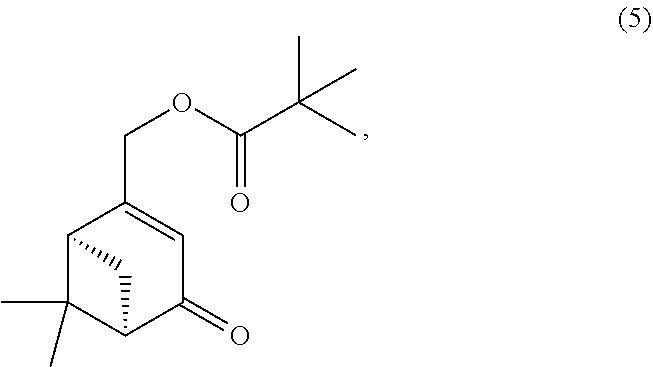
performing a reduction

performing an acid-catalyzed coupling

to yield a compound of formula 6:

performing a methylation

performing a deprotection reaction comprising a second base and a second solvent to yield the compound of

and performing a first allylic

the method, process or composition comprising, providing a first reactant of formula 9:

and performing a first allylic

the method, process or composition comprising, providing a compound of formula 3:

and
performing a protection

the method, process or composition comprising, providing a compound of formula 4:

and
performing a second allylic

the method, process or composition comprising, providing a compound of formula 5:

and
performing a reduction

the method, process or composition comprising, providing a compound of formula 1:
and

performing an acid-catalyzed coupling reaction comprising compound 1, an acid, DCM, and a compound of formula 2:

to yield a compound of

the method, process or composition comprising, providing a compound of formula 6:

and
performing a methylation

the method, process or composition comprising, providing a compound of formula 7:

performing a deprotection reaction comprising a second base and a second solvent to yield the compound of

the method, process or composition comprising: providing a first reactant of formula 12,

performing a first allylic oxidation comprising compound 12, an oxidant such as SeO2, and peroxide to yield a compound of formula 13:

performing a protection reaction comprising compound 13, an acid halide, such as an acid chloride, a solvent such as dichloromethane (DCM), and a first base to yield a compound of formula 14:

performing a second allylic oxidation comprising compound 14, an oxidant such as CrO3, a peroxide such as tert-butyl hydroperoxide (TBHP), a first solvent to yield a compound of formula 15:

performing a reduction reaction comprising compound 15, a reducing agent such as sodium borohydride (NaBH4), and a solvent, such as ethanol, to yield a compound of formula 16:

performing an acid-catalyzed coupling reaction comprising compound 16, an acid, DCM, and a compound of formula 2:

to yield a first mixture comprising a compound of formula 6:

and a compound of formula 17:

performing a coupling reaction comprising the first mixture, Boc-alanine, N,N′-dicyclohexylcarbodiimide (DCC), and 4-dimethylaminopyridine (DMAP) to yield a second mixture comprising a compound of formula 10:

and a compound of formula 11:

purifying the second mixture to yield enantiomerically purified compound 10, performing a hydrolysis reaction comprising enantiomerically purified compound 10, a third base and a third solvent, to yield enantiomerically purified compound 6, performing a methylation reaction comprising enantiomerically purified compound 6, dimethyl sulfate (Me2SO4), potassium carbonate (K2CO3) and acetone to yield an enantiomerically purified compound of formula 7:

performing a deprotection reaction comprising enantiomerically purified

the method, process or composition comprising: providing a first reactant of formula 12,

and
performing a first allylic

the method or process comprising: providing a first reactant of formula 13:

and
performing a protection

the method or process comprising: providing a first reactant of

the method or process comprising: providing a first reactant of

and a compound of formula 17:

the method or process comprising providing a compound of formula 16, and performing an acid-catalyzed coupling reaction comprising compound 16, an acid, DCM, and a compound of formula 2:

to yield the first mixture.

and a compound of formula 11:

the method or process comprising, providing a first mixture of

the method of process comprising, providing a second mixture comprising a compound of formula 10 and a compound of formula 11:

purifying the second mixture to yield enantiomerically purified

the method of process comprising, providing an enantiomerically purified

the method of process comprising providing an enantiomerically

the method of process comprising providing an enantiomerically

the method or process comprising: performing a coupling reaction with 1 eq. of a first mixture of a compound formula 6 and a compound of formula 17, with 2.2 eq. of Boc-alanine, 2.2 eq. of N,N′-dicyclohexylcarbodiimide (DCC), and 0.1 eq. of 4-dimethylaminopyridine (DMAP) to yield a second mixture of compound 10 and a compound of formula 11, purifying the mixture by silica gel column chromatography with a solvent gradient of 5-14% ethyl acetate in hexanes to yield enantiomerically purified compound 11, performing a hydrolysis reaction comprising 1 eq. enantiomerically purified compound 11, 3-20 eq. of a third base and 10-20 eq. of solvent, to yield enantiomerically purified compound 17, performing a methylation reaction comprising 1 eq. of enantiomerically purified compound 17, 2.5-5 eq. dimethyl sulfate (Me2SO4), 5.3-6.7 eq. of potassium carbonate (K2CO3) and 5-20 vol. of acetone to yield an enantiomerically purified compound of formula 19:

performing a deprotection reaction comprising 1 eq. of enantiomerically purified

the method or process comprising: providing a first reactant of formula 20:

performing a first reduction reaction comprising compound 20, and a reducing agent such as NaBH4, to yield a compound of formula 21:

performing a protection reaction comprising compound 21, an acid halide such as an acid chloride, a solvent such as dichloromethane (DCM), and a first base to yield a compound of formula 22:

performing a second allylic oxidation comprising compound 22, an oxidant such as CrO3, a peroxide such as tert-butyl hydroperoxide (TBHP), and a first solvent to yield a compound of formula 23:

performing a second reduction reaction comprising compound 23, a reducing agent such as sodium borohydride (NaBH4), and a solvent, such as ethanol, to yield a compound of formula 24:

performing an acid-catalyzed coupling reaction comprising compound 24, an acid, DCM, and a compound of formula 2:

to yield a compound of formula 17:

performing a methylation reaction comprising compound 17, dimethyl sulfate (Me2SO4), and potassium carbonate (K2CO3) to yield a compound of formula 19:

performing a deprotection reaction comprising a second base and a second solvent to yield the compound of


the method comprising:


to yield a compound of formula 6:


is mixed with an oxidant, such as SeO2, and a peroxide to yield an oxidized intermediate. The intermediate may be reduced with NaBH4 to yield a compound of formula 3:


may be mixed with a suitable acid, such as para-toluenesulfonic acid (pTSA) and compound 1 to yield a compound of formula 6:


to yield a first mixture of enantiomer 6:

and enantiomer 17:


and diastereomer 11:

| TABLE 1 |
| Optimization Results for |
| Reaction | Parameter | |||
| Lot No. | Scale | condition | changed | Results* |
| HU-01-131 | 500 | mg | SM:SeO2 = | Without t- | 0.49 |
| 1:1.19 At | BuOOH use | ||||
| 80° C. | stoichiometric | ||||
| amount of SeO2 | |||||
| HU-01-133 | 500 | mg | SM:SeO2:HCOOH = | Without t- | 0.44 |
| 1:1.02:1.51 | BuOOH use | ||||
| at 60° C. | stoichiometric | ||||
| amount of SeO2 | |||||
| HU-01-139-1 | 1 | g | SM:SeO2:t- | After 2 days, | 0.77 |
| BuOOH = | the oxidation | ||||
| 1:0.036:3.5 | reaction was | ||||
| at RT | quenched with | ||||
| Sat. Na2S2O3 | |||||
| HU-01-139-2 | 1 | g | SM:SeO2:t- | In step 1.2, | 0.85 |
| BuOOH = | MTBE will be | ||||
| 1:0.036:3.5 | used instead of | ||||
| at RT | Et2O | ||||
| HU-01-139-3 | 1 | g | SM:SeO2:t- | Used as |
1 |
| BuOOH = | for comparison | ||||
| 1:0.036:3.5 | |||||
| at RT | |||||
| HU-01-139-4 | 1 | g | SM:SeO2:t- | t-BuOOH will | 0.72 |
| BuOOH = | be used as the | ||||
| 1:0.036:3.5 | 70% aqueous | ||||
| at RT | solution. | ||||
| HU-01-139-5 | 1 | g | SM:SeO2:t- | Reduce the | 0.59 |
| BuOOH = | catalytic | ||||
| 1:0.02:3.5 | amount of SeO2 | ||||
| at RT | |||||
| HU-03-009 | 1 | g | SM:SeO2:t- | Reduce the | 47%** |
| BuOOH = | amount of | ||||
| 1:0.036:2.0 | TBHP | ||||
| at RT | |||||
| *The product was analyzed using the residue of CHCl3 in CDCl3 as an internal standard to compare the yield without purification. | |||||
| **Isolated yield | |||||
| TABLE 2 |
| Optimization Results for |
| Reaction | Parameter | |||
| Lot No. | scale | condition | changed | Results* |
| HU-01-167-1 | 200 | mg | Acid chloride | Used as control | 1 |
| (2.0 eq) DCM | for comparison | ||||
| (6 vol), py(6 | |||||
| vol) | |||||
| HU-01-167-2 | 200 | mg | Acid chloride | Reduce the | 0.76 |
| (1.2 eq) DCM | amount of Acid | ||||
| (6 vol), py(6 | chloride | ||||
| vol) | |||||
| HU-01-167-3 | 200 | mg | Acid chloride | use | 1.16 |
| (1.2 eq) DCM | stoichiometric | ||||
| (6 vol), py(1.5 | amount of | ||||
| eq) | pyridine | ||||
| HU-01-167-4 | 200 | mg | Acid chloride | Using TEA as | 1.35 |
| (2 eq) DCM (6 | base and | ||||
| vol), TEA (2.5 | catalytic | ||||
| eq), DMAP | amount of | ||||
| (0.01 eq) | DMAP | ||||
| HU-01-177 | 1.2 | g | Acid chloride | Scale up HU- | 100% |
| (1.2 eq) DCM | 01-167-3 | (crude)** | |||
| (6 vol), py(1.5 | |||||
| eq) | |||||
| *The product was analyzed using the residue of CHCl3 in CDCl3 as an internal standard to compare the yield without purification. | |||||
| **Based on the 1H NMR and actual quantity of the crude product | |||||
| TABLE 3 |
| Optimization results for Step 3 and Step 4 |
| Reaction | Parameter | |||
| Lot No. | scale | condition | changed | Results* |
| HU-01-063/ | 10 | g | Step3 CrO3 | As standard | 12.5% over |
| HU-01-069 | (0.5 eq)/t- | steps 3 and 4 | |||
| BuOOH (6.3 | |||||
| eq)/ACN (14.6 | |||||
| vol)/0-rt after | |||||
| purification | |||||
| then and move | |||||
| to | |||||
| Step 4 NaBH4 | |||||
| (1.0 eq), EtOH | |||||
| (15 vol) | |||||
| HU-01-087/ | 20.75 | g | Step3 CrO3 | As standard | 11.3% over |
| HU-01-103 | (0.5 eq)/t- | steps 3 and 4 | |||
| BuOOH (6.3 | |||||
| eq)/ACN (14.6 | |||||
| vol)/0-rt after | |||||
| purification | |||||
| then and move | |||||
| to | |||||
| Step 4 NaBH4 | |||||
| (1.0 eq), EtOH | |||||
| (15 vol) | |||||
| HU-03-047-1 | 500 | mg | Step3 CrO3 | without | 19% |
| (0.5 eq)/t- | purification | ||||
| BuOOH (6.3 | and move to | ||||
| eq)/ACN (14.6 | Step 4 | ||||
| vol)/0-rt | |||||
| without | |||||
| purification | |||||
| and move to | |||||
| Step 4 NaBH4 | |||||
| (1.0 eq), EtOH | |||||
| (15 vol) | |||||
| HU-03-047-2 | 500 | mg | Step3 CrO3 | Oxidation in | 15% |
| (0.5 eq)/t- | different | ||||
| BuOOH (6.3 | solvent | ||||
| eq)/acetone | without | ||||
| (14.6 vol)/0-rt | purification | ||||
| without | and move to | ||||
| purification | Step 4 | ||||
| and move to | |||||
| Step 4 NaBH4 | |||||
| (1.0 eq), EtOH | |||||
| (15 vol) | |||||
| HU-03-065 | 500 | mg | Step3 NBS(2.6 | Using NBS as | No product |
| eq)/THF- | an oxidant | ||||
| H2O(4:1) 60 | |||||
| vol at 0-rt | |||||
| HU-03-067 | 500 | mg | Step3 NaOCl(2 | Using NaOCl | No product |
| eq)/t-BuOOH | as an oxidant | ||||
| (7 eq) in ACN | |||||
| (15 vol) at 0-rt | |||||
| HU-03-075 | 500 | mg | Step3 CrO3 | Reduce the | 16% |
| (0.5 eq)/t- | reaction | ||||
| BuOOH (6.3 | temperature | ||||
| eq)/ACN (14.6 | without | ||||
| vol)/ at 0° C. | purification | ||||
| without | and move to | ||||
| purification | Step 4 | ||||
| and move to | |||||
| Step 4 NaBH4 | |||||
| (1.0 eq), EtOH | |||||
| (15 vol) | |||||
| HU-03-077 | 500 | mg | Step3 PCC (2 | Using PCC as | Reaction very |
| eq)/t-BuOOH | an oxidant | slow and not | |||
| (4 eq)/DCM | clean | ||||
| (25 vol)/at | |||||
| 0° C. | |||||
| HU-03-087 | 500 | mg | Step3 CrO3 | Reduce the | 20.7% |
| (0.5 eq)/t- | molar ratio of | ||||
| BuOOH (3.15 | t-BuOOH to | ||||
| eq)/ACN (14.6 | 3.15 eq from | ||||
| vol)/0-rt | 6.3 eq | ||||
| without | without | ||||
| purification | purification | ||||
| and move to | and move to | ||||
| Step 4 NaBH4 | Step 4 | ||||
| (1.0 eq), EtOH | |||||
| (15 vol) | |||||
| *isolated yield | |||||
| TABLE 4 |
| Optimization results for step 3 |
| Reaction | Parameter | |||
| Lot No. | scale | condition | changed | Results* |
| HU-02-61 | 500 | mg | Na2CrO4 (2.3 | Using Na2CrO4 | Difficult for |
| eq) in acetic | as oxidant | work-up | |||
| acid (2.8 mL)/ | |||||
| acetic | |||||
| anhydride | |||||
| (1.25 mL) | |||||
| HU-02-67 | 500 | mg | CrO3 (0.5 | t-BuOOH | 26.4% |
| eq)/t-BuOOH | equivalence | ||||
| (5 eq)/CAN | change | ||||
| (14.6 vol)/ | |||||
| 0-rt | |||||
| HU-02-75 | 500 | mg | CrO3 (0.05 | Reduce the | 31.2% |
| eq)/t-BuOOH | amount of CrO3 | ||||
| (7 eq)/DCM | and using DCM | ||||
| (16 vol)/rt, | as solvent | ||||
| 4 h | |||||
| HU-02-81 | 500 | mg | CrO3 (0.05 | Reduce | 21.9% |
| eq)/t-BuOOH | reaction time | ||||
| (7 eq)/DCM | |||||
| (16 vol)/rt, | |||||
| 2.5 h | |||||
| HU-02-83 | 500 | mg | CrO3 (0.05 | Reduce the | 18.9% |
| eq)/t-BuOOH | amount of t- | ||||
| (5 eq)/DCM | BuOOH from 7 | ||||
| (16 vol)/rt, | eq to 5 eq) | ||||
| 2.5 h | |||||
| HU-02-89 | 8 | g | CrO3 (0.05 | Scale up and | 16.4% (with |
| eq)/t-BuOOH | the reaction | 62.5% | |||
| (7 eq)/DCM | was quenched | starting | |||
| (16 vol)/rt, | after 1.5 h | material | |||
| 1.5 h | based on the | recovery) | |||
| TLC analysis | |||||
| HU-02-91 | 6.76 | g | CrO3 (0.05 | Scale up the | 20.3% (with |
| eq)/t-BuOOH | reaction | 63.6% | |||
| (7 eq)/DCM | starting | ||||
| (16 vol)/rt, | material | ||||
| 2.5 h | recovery) | ||||
| HU-03-131 | 10 | g | CrO3 (0.05 | Scale up the | 20.7% (with |
| eq)/t-BuOOH | reaction | 25.4% | |||
| (7 eq)/DCM | starting | ||||
| (16 vol)/rt, | material | ||||
| 2.5 h | recovery) | ||||
| HU-03-135 | 5 | g | CrO3 (0.05 | Scale up the | 22% |
| eq)/t-BuOOH | reaction and | ||||
| (7 eq)/DCM | using longer | ||||
| (16 vol)/rt, 4 h | reaction time | ||||
| *isolated yield | |||||
| TABLE 5 |
| The optimization results for |
| Reaction | Parameter | |||
| Lot No. | scale | condition | changed | Results* |
| HU-01-69 | 3.3 | g | NaBH4 (1.32 | As standard | 40% |
| eq), EtOH (18 | |||||
| vol), at RT for | |||||
| 15 minutes | |||||
| HU-01-103 | 5.3 | g | NaBH4 (1.32 | As standard | 46.8% |
| eq), EtOH (18 | |||||
| vol), at RT for | |||||
| 70 minutes | |||||
| HU-02-97 | 200 | mg | NaBH4 (1.05 | Reduce the | 55.6% |
| eq), EtOH (15 | amount of | ||||
| vol), at RT for | |
||||
| 30 minutes | |||||
| HU-02-105 | 200 | mg | NaBH4 (1.1 | Reduce the | 56.5% |
| eq), EtOH (10 | amount of | ||||
| vol), at RT for | NaBH4 and | ||||
| 30 minutes | volume of | ||||
| reaction | |||||
| solvent | |||||
| HU-02-115 | 1.02 | g | NaBH4 (1.1 | Scale up the | 47.2% |
| eq), EtOH (10 | process | ||||
| vol), at RT for | |||||
| 30 minutes | |||||
| HU-02-117 | 4.99 | g | NaBH4 (1.1 | Scale up the | 38.6% |
| eq), EtOH (10 | process | ||||
| vol), at RT for | |||||
| 30 minutes | |||||
| *isolated yield | |||||
| TABLE 6 |
| The optimization results for step 5 |
| Reaction | Parameter | Results | ||
| Lot No. | scale | condition | changed | (isolated yield) |
| HU-01-105-1 | 1 g | pTSA (0.28 eq), | Used as | 64.7% |
| Int. 1, (1.02 eq) | control for | |||
| resorcinol(1.0 | comparison | |||
| eq), DCM (112 | ||||
| vol) | ||||
| HU-01-183-1 | 100 mg | pTSA (0.28 eq), | Increase the | 71% |
| Int. 1 (1.1 eq) | amount of OH | |||
| resorcinol(1.0 | ||||
| eq), DCM (112 | ||||
| vol) | ||||
| HU-01-185-1 | 100 mg | pTSA (0.1 eq), | reduce the | 78% |
| Int. 1 (1.02 eq) | amount of | |||
| resorcinol(1.0 | pTSA | |||
| eq), DCM (112 | ||||
| vol) | ||||
| HU-01-193-1 | 100 mg | MeSO3H(0.2 | Using | 65.7% |
| eq), Int. 1 | MeSO3H as | |||
| (1.02 eq) | catalyst | |||
| resorcinol(1.0 | ||||
| eq), DCM (112 | ||||
| vol) | ||||
| HU-01-201-1 | 200 mg | pTSA (0.05 eq), | reduce the | 72% |
| Int. 1 (1.02 eq) | amount of | |||
| resorcinol(1.0 | pTSA | |||
| eq), DCM (112 | ||||
| vol) | ||||
| HU-01-203-1 | 200 mg | MeSO3H(0.05 | Using less | 37.5% |
| eq), Int. 1 | amount of | |||
| (1.02 eq) | MeSO3H as | |||
| resorcinol(1.0 | catalyst | |||
| eq), DCM (112 | ||||
| vol) | ||||
| HU-03-013 | 100 mg | pTSA (0.1 eq), | Reduce | 78% |
| Int. 1 (1.02 eq) | reaction | |||
| resorcinol(1.0 | volume | |||
| eq), DCM (65 | ||||
| vol) | ||||
| HU-03-019 | 100 mg | pTSA (0.1 eq), | Further reduce | 78% |
| Int. 1 (1.02 eq) | reaction | |||
| resorcinol(1.0 | volume | |||
| eq), DCM (35 | ||||
| vol) | ||||
| TABLE 7 |
| Optimization results for |
| Reaction | Parameter | Results | ||
| Lot No. | scale | condition | changed | (isolated yield) |
| HU-03-031 | 100 mg | Me2SO4 (4.0 | As standard | 81% |
| eq)/K2CO3 (5.3 | ||||
| eq) acetone (20 | ||||
| vol), at RT for | ||||
| 72 h | ||||
| HU-03-033 | 100 mg | MeI (4.0 | Different | Trace desired |
| eq)/K2CO3 (5.3 | reagent | product | ||
| eq) acetone (20 | ||||
| vol), at RT for | ||||
| 72 h | ||||
| HU-03-041 | 100 mg | Mel (4.0 | Different | Only Mono |
| eq)/K2CO3 (5.3 | solvent | methylated | ||
| eq) DMF (20 | product | |||
| vol), at RT for | ||||
| 66 h | ||||
| HU-03-083 | 200 mg | Me2SO4 (4.0 | Reduce | SM + Mono- |
| eq)/K2CO3 (5.3 | reaction vol | Methylated and | ||
| eq) acetone (10 | desired product | |||
| vol), at RT for | ||||
| 66 h | ||||
| HU-03-085 | 200 mg | Me2SO4 (2.5 | Reduce | SM + Mono- |
| eq)/K2CO3 (5.3 | reaction vol & | Methylated and | ||
| eq) acetone (5 | Me2SO4 ratio | desired product | ||
| vol), at RT for | ||||
| 66 h | ||||
| TABLE 8 |
| Optimization results for |
| Reaction | Parameter | Results | ||
| Lot No. | scale | condition | changed | (isolated yield) |
| HU-01-119 | 1.23 | g | LiAlH4(2.4 eq) | Used as | 84% |
| THF(75 vol) | control |
| HU-02-17 | 500 mg of | LiAlH4(2.4 eq) | Used as | 73% |
| Model | THF(155 vol) | control for | ||
| compound | model | |||
| compound | ||||
| HU-02-19 | 500 mg of | p-TSA · H2O(0.27 | Acid | No Reaction |
| Model | eq) | hydrolysis | ||
| compound | DCM(15 vol) | |||
| HU-02-23 | 500 mg of | t-BuOK(6 eq) | Base | 95% (Crude) |
| Model | H2O(1.6 eq) | Hydrolysis | Contains solvent | |
| compound | MTBE (88 vol) | peaks in NMR | ||
| HU-02-25 | 500 mg of | NaOMe(6 eq) | Using NaOMe | 88% (crude) |
| Model | H2O(1.6 eq) | as base | ||
| compound | MeOH(88 vol) | |||
| HU-03-101 | 100 mg of | KOH(2 eq) | Using KOH as | Product + trace |
| Model | MeOH:H2O | base | amount of | |
| compound | (1:1) 4 days, At | starting material | ||
| 35° C. |
| HU-03-099 | 25 | mg | NaOMe(6 eq) | Same as in | Only product by |
| H2O(1.6 eq) | HU-02-25 | TLC | |||
| MeOH(88 vol) 4 | |||||
| days, At 35° C. | |||||
| HU-03-123-1 | 100 | mg | NaOMe (9 eq)/ | Deprotection | 91.4% |
| H2O 22 eq) in | with NaOMe | ||||
| MeOH (80 vol) | and H2O | ||||
| at 37° C. | |||||
| HU-03-123-2 | 100 | mg | KOH (9 eq)/H2O | Deprotection | Reaction very |
| (1 mL)/ MeOH | with KOH and | slow (4 days) | |||
| (80 vol), at 37 | H2O | ||||
| ° C. | |||||
| HU-03-129 | 200 | mg | NaOMe (9 eq)/ | Reduce the | 95.6% (crude) |
| H2O 22 eq) in | reaction | ||||
| MeOH (20 vol), | volume | ||||
| at 37° C. | |||||
| HU-03-137 | 1.66 | g | NaOMe (9 eq)/ | Scale up the | 95% (crude) |
| H2O 22 eq) in | reaction | ||||
| MeOH (20 vol), | HU-03-129 | ||||
| at 37° C. | |||||
| TABLE 9 |
| Differences between batches in |
| Equivalence | Equivalence | Reaction | |||
| Scale | of CrO3 | of TBHP | Vol | time | Stirrer |
| Intermediary | 0.05 | 7 | 33 | 2.5 hours | magnetic |
| scale-up | stirrer | ||||
| Batch | |||||
| Scale-up for | 0.05 | 5 | 16 | 2-4 hours | overhead |
| non-GMP | stirrer | ||||
| engineering | |||||
| batch | |||||
| TABLE 10 |
| Optical rotation of commercially available batches of α-(+)-pinene |
| Cat No. | Optical Rotation | |
| 268070 | +37.890 DEGREES | |
| 43566 | +38.089 DEGREES | |
| W290238 | +31.138 DEGREES | |
| TABLE 11 |
| Summary of optimization trials and results |
| Reaction No. | Lot No. | Scale | Solvent | Base | Reaction time | Results/comments |
| 1 | HU-05- | 50 mg | THF-MeOH | Na2CO3 | 4 | h | No reaction |
| 25_Na2CO3 | (4:1 20 Vol) | (20 eq) | |||||
| 6 | HU-06-049C | 100 mg | THF-H2O | Na2CO3 | 18-24 | hours | No reaction |
| (10:1, 11 Vol) | (3 eq) | ||||||
| 9 | HU-05-95-6 | 100 mg | NMP-H2O | Na2CO3 | 18-24 | hours | No reaction |
| (10:1, 11 Vol) | (3 eq) | ||||||
| 2 | HU-05- | 50 mg | THF-MeOH | LiOH (11 eq) | 4 | h | No SM, more by- |
| 25_LiOH | (4:1 20 Vol) | product | |||||
| 3 | HU-06-049A | 100 mg | THF-H2O | LiOH (3 eq) | 18-24 | hours | Product + minor |
| (10:1, 11 Vol) | by-product | ||||||
| 4 | HU-05-53 | 350 mg | THF-H2O | LiOH (3 eq) | 18-24 | hours | 67% yield |
| (10:1, 11 Vol) | |||||||
| 7 | HU-05-95-4 | 100 mg | NMP-H2O | LiOH (3 eq) | 18-24 | hours | Conversion is |
| (10:1, 11 Vol) | good, but NMP is | ||||||
| hard to remove | |||||||
| 5 | HU-06-049B | 100 mg | THF-H2O | NaOH (3 eq) | 18-24 | hours | More effective |
| (10:1, 11 Vol) | compared with | ||||||
| LiOH and Na2CO3 | |||||||
| 8 | HU-05-95-5 | 100 mg | NMP-H2O | NaOH (3 eq) | 18-24 | hours | Conversion is |
| (10:1, 11 Vol) | good, but NMP is | ||||||
| hard to remove | |||||||
| 10 | HU-05-109-Rx10 | 100 mg | THF-MeOH | NaOH (3 eq) | 2 | hours | Product + minor |
| (4:1 10 vol) | by-product | ||||||
| 11 | HU-05-109-Rx11 | 100 mg | EtOH (10 vol) | NaOH (3 eq) | 2 | hours | Product + less by- |
| product | |||||||
| TABLE 12 |
| Hydrolysis results from intermediary scale up batches |
| Reaction | Isolated | ||||
| Lot No. | Scale | Solvent | Base | Time | Yield |
| HU-05-111 | 4 g | EtOH—H2O | NaOH (3.0 | 1 |
90% |
| (10:1 11 | eq) | ||||
| Vol) | |||||
| HU-05-149 | 24.25 g | EtOH—H2O | NaOH (3.0 | 2 |
92% |
| (10:1 11 | eq) | ||||
| Vol) | |||||
| % Purity of | |||
| HU308 | |||
| Sample Name | Sample lot# | Int. 6a* | |
| HU308 | SAP-41-159-PB | 98.94 | |
| Intermediate | SAP-41-159-C2P | 98.57 | |
| 6a | SAP-41-159-C1P1 | 98.91 | |
| SAP-41-159-C2P2 | 98.97 | ||
| Note: | |||
| *Solvent peaks are not included | |||
- 1. Mechoulam, R., Lander, N., Breuer, A., and Zahalka, J. (1990). Synthesis of the individual, pharmacologically distinct enantiomers of a tetrahydrocannabinol derivative.
Tetrahedron Asymmetry 1, 315-318. - 2. Mechoulam, R., Peters, M., Murillo-Rodriguez, E., and Hanus, L. O. (2007). Cannabidiol-recent advances. Chem. Biodivers. 4, 1678-1692.
- 3. Hanus, L., Breuer, A., Tchilibon, S., Shiloah, S., Goldenberg, D., Horowitz, M., et al. (1999). HU308: a specific agonist for CB(2), a peripheral cannabinoid receptor. Proc. Natl. Acad. Sci. U.S.A. 96, 14228-14233.
- 4. Ofek, O., Karsak, M., Leclerc, N., Fogel, M., Frenkel, B., Wright, K., et al. (2006). Peripheral cannabinoid receptor, CB2, regulates bone mass. Proc. Natl. Acad. Sci. U.S.A. 103, 696-701.
- 5. Rajesh, M., Mukhopadhyay, P., Batkai, S., Hasko, G., Liaudet, L., Huffman, J. W., et al. (2007). CB2-receptor stimulation attenuates TNF-alpha-induced human endothelial cell activation, transendothelial migration of monocytes, and monocyte-endothelial adhesion. Am. J. Physiol. Heart Circ. Physiol. 293, H2210-H2218.
- 6. Rajesh, M., Pan, H., Mukhopadhyay, P., Bátkai, S., Osei-Hyiaman, D., Haskó, G., et al. (2007). Cannabinoid-2 receptor agonist HU308 protects against hepatic ischemia/reperfusion injury by attenuating oxidative stress, inflammatory response, and apoptosis. J. Leukoc. Biol. 82, 1382-1389.
- 7. Smoum, R., Baraghithy, S., Chourasia, M., Breuer, A., Mussai, N., Attar-Namdar, M., et al. (2015). CB2 cannabinoid receptor agonist enantiomers HU433 and HU308: an inverse relationship between binding affinity and biological potency. Proc. Natl. Acad. Sci. U.S.A. 112, 8774-8779.
- 8. Gonçalves, E. C. D., Baldasso, G. M., Bicca, M. A., Paes, R. S., Capasso, R., Dutra, R. C. (2020). Terpenoids, Cannbimimetic Ligands, beyond the Cannabis Plant. Molecules, 25, 1567.
- 9. Morales, P., Reggio, P. H., Jagerovic, N. (2017). An Overview on Medicial Chemistry of Synthetic and Natural Derivatives of Cannabidiol. Frontiers in Pharmacology, 8, 422.
- 10. U.S. Pat. No. 6,903,137
- 11. U.S. Pat. No. 9,428,431
Claims (20)


Priority Applications (1)
| Application Number | Priority Date | Filing Date | Title |
|---|---|---|---|
| US18/027,897 US12129227B2 (en) | 2020-09-24 | 2021-09-23 | Methods, processes, and compositions for improved preparation of HU308 and HU433 |
Applications Claiming Priority (3)
| Application Number | Priority Date | Filing Date | Title |
|---|---|---|---|
| US202063082986P | 2020-09-24 | 2020-09-24 | |
| US18/027,897 US12129227B2 (en) | 2020-09-24 | 2021-09-23 | Methods, processes, and compositions for improved preparation of HU308 and HU433 |
| PCT/CA2021/051327 WO2022061461A1 (en) | 2020-09-24 | 2021-09-23 | Methods, processes, and compositions for improved preparation of hu308 and hu433 |
Publications (2)
| Publication Number | Publication Date |
|---|---|
| US20230271908A1 US20230271908A1 (en) | 2023-08-31 |
| US12129227B2 true US12129227B2 (en) | 2024-10-29 |
Family
ID=80845942
Family Applications (1)
| Application Number | Title | Priority Date | Filing Date |
|---|---|---|---|
| US18/027,897 Active US12129227B2 (en) | 2020-09-24 | 2021-09-23 | Methods, processes, and compositions for improved preparation of HU308 and HU433 |
Country Status (5)
| Country | Link |
|---|---|
| US (1) | US12129227B2 (en) |
| EP (1) | EP4217337A4 (en) |
| CA (1) | CA3193450A1 (en) |
| IL (1) | IL301528A (en) |
| WO (1) | WO2022061461A1 (en) |
Citations (1)
| Publication number | Priority date | Publication date | Assignee | Title |
|---|---|---|---|---|
| US9428431B2 (en) * | 2008-10-06 | 2016-08-30 | Yissum Research Development Company Of The Hebrew University Of Jerusalem, Ltd. | Compositions comprising CB receptor agonists, uses thereof and methods for their preparation |
Family Cites Families (1)
| Publication number | Priority date | Publication date | Assignee | Title |
|---|---|---|---|---|
| IL132661A (en) | 1999-10-31 | 2008-11-26 | Raphael Mechoulam | Agonists specific for the peripheral cannabinoid receptor |
-
2021
- 2021-09-23 CA CA3193450A patent/CA3193450A1/en active Pending
- 2021-09-23 WO PCT/CA2021/051327 patent/WO2022061461A1/en not_active Ceased
- 2021-09-23 IL IL301528A patent/IL301528A/en unknown
- 2021-09-23 US US18/027,897 patent/US12129227B2/en active Active
- 2021-09-23 EP EP21870641.4A patent/EP4217337A4/en active Pending
Patent Citations (1)
| Publication number | Priority date | Publication date | Assignee | Title |
|---|---|---|---|---|
| US9428431B2 (en) * | 2008-10-06 | 2016-08-30 | Yissum Research Development Company Of The Hebrew University Of Jerusalem, Ltd. | Compositions comprising CB receptor agonists, uses thereof and methods for their preparation |
Non-Patent Citations (5)
| Title |
|---|
| De Richter et al., (+)- and (−)-[2-(1,3-dithianyl)]myrtanylborane. Solid and stable monoalkylboranes for asymmetric hydroboration. J Org Chem. Apr. 1, 1990;55(9):2855-60. doi: 10.1021/JO00296A054. |
| Hanus et al., HU-308: a specific agonist for CB2, a peripheral cannabinoid receptor. Proc Natl Acad Sci U S A. Dec. 7, 1999;96(25):14228-33. doi: 10.1073/pnas.96.25.14228. |
| International Search Report and Written Opinion, dated Jan. 13, 2022 for International Application No. PCT/CA2021/051327. |
| Mechoulam et al., Synthesis of the individual, pharmacologically distinct, enantiomers of a tetrahydrocannabinol derivative. Tetrahedron: Assymmetry. 1990;1(5):315-8. doi: 10.1016/S0957-4166(00)86322-3. |
| Smoum et al., CB2 cannabinoid receptor agonist enantiomers HU-433 and HU-308: An inverse relationship between binding affinity and biological potency. Proc Natl Acad Sci U S A. Jul. 14, 2015;112(28):8774-9. doi: 10.1073/pnas.1503395112. Epub Jun. 29, 2015. |
Also Published As
| Publication number | Publication date |
|---|---|
| EP4217337A1 (en) | 2023-08-02 |
| CA3193450A1 (en) | 2022-03-31 |
| US20230271908A1 (en) | 2023-08-31 |
| EP4217337A4 (en) | 2024-04-17 |
| WO2022061461A1 (en) | 2022-03-31 |
| IL301528A (en) | 2023-05-01 |
Similar Documents
| Publication | Publication Date | Title |
|---|---|---|
| EP2861554A2 (en) | Improved process for the preparation of treprostinil and derivatives thereof | |
| CN103228640B (en) | The preparation process of nebivolol | |
| US20250042838A1 (en) | Process for the synthesis and purification of cannabinoic acids and acylated derivatives thereof | |
| CN114805206B (en) | Industrial preparation method of high optical purity remegipam intermediate | |
| CN112154140B (en) | Compounds and their use in the synthesis of Brivaracetam API | |
| US20230271908A1 (en) | Methods, processes, and compositions for improved preparation of hu308 and hu433 | |
| CN104163787A (en) | Preparation methods of Atazanavir and sulfate of Atazanavir | |
| CN110734443B (en) | Preparation method of tadalafil-related substance I | |
| CN115124583A (en) | Method for synthesizing ganoderic acid through selective reduction or oxidation reaction | |
| JP2000143688A (en) | Production of zeaxanthin mono-beta-glucoside | |
| CN110746333A (en) | A kind of method for separating carboprost isomers | |
| EP3848348A1 (en) | Method for manufacturing cyclopropane compound | |
| Hayman et al. | A stereoselective synthesis of 6, 6, 6-trifluoro-l-daunosamine and 6, 6, 6-trifluoro-l-acosamine | |
| JPH08208688A (en) | Method for producing ginsenoside Rh2 | |
| JPH0684367B2 (en) | New method for producing forskolin derivative | |
| Bonazzi et al. | Synthetic studies on the sporolides: Exploration of the enediyne route | |
| CN105985370B (en) | Prepare key intermediate and its application of limaprost | |
| CN104910164A (en) | Method for synthesizing 3,6-dichloroimidazo[1,2-b]pyridazine | |
| CN105753697B (en) | A kind of method for preparing hydroquinone monocarboxylate | |
| CN117510445A (en) | An intermediate of beraprost and its salt and its preparation method | |
| JP3471067B2 (en) | Method for producing optically active 6- (4-substituted inden-1-yl) -2-methyl-4-hepten-3-ols | |
| WO2002066424A1 (en) | Vitamin d derivative having substituent in 2-position | |
| CN114805029A (en) | Related substances of key intermediate of 25-hydroxy dihydro tachysterol and preparation method thereof | |
| CN116606232A (en) | Novel monofluoroalkyl compounds, preparation method and application thereof | |
| JP5196736B2 (en) | Apoptosis inducer and antitumor agent containing the same |
Legal Events
| Date | Code | Title | Description |
|---|---|---|---|
| FEPP | Fee payment procedure |
Free format text: ENTITY STATUS SET TO UNDISCOUNTED (ORIGINAL EVENT CODE: BIG.); ENTITY STATUS OF PATENT OWNER: SMALL ENTITY |
|
| FEPP | Fee payment procedure |
Free format text: ENTITY STATUS SET TO SMALL (ORIGINAL EVENT CODE: SMAL); ENTITY STATUS OF PATENT OWNER: SMALL ENTITY |
|
| STPP | Information on status: patent application and granting procedure in general |
Free format text: NON FINAL ACTION MAILED |
|
| STPP | Information on status: patent application and granting procedure in general |
Free format text: NOTICE OF ALLOWANCE MAILED -- APPLICATION RECEIVED IN OFFICE OF PUBLICATIONS |
|
| AS | Assignment |
Owner name: TETRA BIO-PHARMA INC., CANADA Free format text: ASSIGNMENT OF ASSIGNORS INTEREST;ASSIGNORS:KAUR, HARPREET;LIU, XUEJUN;NEPAL, PRABIN;AND OTHERS;SIGNING DATES FROM 20210122 TO 20210331;REEL/FRAME:067402/0105 Owner name: AIP ASSET MANAGEMENT INC., CANADA Free format text: COURT ORDER;ASSIGNOR:TETRA BIO-PHARMA INC.;REEL/FRAME:067408/0018 Effective date: 20231213 |
|
| STPP | Information on status: patent application and granting procedure in general |
Free format text: PUBLICATIONS -- ISSUE FEE PAYMENT VERIFIED |
|
| STCF | Information on status: patent grant |
Free format text: PATENTED CASE |