US12127478B2 - Organic electroluminescence device and electronic device - Google Patents
Organic electroluminescence device and electronic device Download PDFInfo
- Publication number
- US12127478B2 US12127478B2 US17/345,450 US202117345450A US12127478B2 US 12127478 B2 US12127478 B2 US 12127478B2 US 202117345450 A US202117345450 A US 202117345450A US 12127478 B2 US12127478 B2 US 12127478B2
- Authority
- US
- United States
- Prior art keywords
- group
- substituted
- unsubstituted
- pair
- carbon atoms
- Prior art date
- Legal status (The legal status is an assumption and is not a legal conclusion. Google has not performed a legal analysis and makes no representation as to the accuracy of the status listed.)
- Active, expires
Links
Images


Classifications
-
- H—ELECTRICITY
- H10—SEMICONDUCTOR DEVICES; ELECTRIC SOLID-STATE DEVICES NOT OTHERWISE PROVIDED FOR
- H10K—ORGANIC ELECTRIC SOLID-STATE DEVICES
- H10K85/00—Organic materials used in the body or electrodes of devices covered by this subclass
- H10K85/60—Organic compounds having low molecular weight
- H10K85/649—Aromatic compounds comprising a hetero atom
- H10K85/654—Aromatic compounds comprising a hetero atom comprising only nitrogen as heteroatom
-
- H—ELECTRICITY
- H10—SEMICONDUCTOR DEVICES; ELECTRIC SOLID-STATE DEVICES NOT OTHERWISE PROVIDED FOR
- H10K—ORGANIC ELECTRIC SOLID-STATE DEVICES
- H10K71/00—Manufacture or treatment specially adapted for the organic devices covered by this subclass
- H10K71/10—Deposition of organic active material
- H10K71/16—Deposition of organic active material using physical vapour deposition [PVD], e.g. vacuum deposition or sputtering
- H10K71/164—Deposition of organic active material using physical vapour deposition [PVD], e.g. vacuum deposition or sputtering using vacuum deposition
-
- H—ELECTRICITY
- H10—SEMICONDUCTOR DEVICES; ELECTRIC SOLID-STATE DEVICES NOT OTHERWISE PROVIDED FOR
- H10K—ORGANIC ELECTRIC SOLID-STATE DEVICES
- H10K85/00—Organic materials used in the body or electrodes of devices covered by this subclass
- H10K85/40—Organosilicon compounds, e.g. TIPS pentacene
-
- H—ELECTRICITY
- H10—SEMICONDUCTOR DEVICES; ELECTRIC SOLID-STATE DEVICES NOT OTHERWISE PROVIDED FOR
- H10K—ORGANIC ELECTRIC SOLID-STATE DEVICES
- H10K85/00—Organic materials used in the body or electrodes of devices covered by this subclass
- H10K85/60—Organic compounds having low molecular weight
- H10K85/631—Amine compounds having at least two aryl rest on at least one amine-nitrogen atom, e.g. triphenylamine
-
- H—ELECTRICITY
- H10—SEMICONDUCTOR DEVICES; ELECTRIC SOLID-STATE DEVICES NOT OTHERWISE PROVIDED FOR
- H10K—ORGANIC ELECTRIC SOLID-STATE DEVICES
- H10K85/00—Organic materials used in the body or electrodes of devices covered by this subclass
- H10K85/60—Organic compounds having low molecular weight
- H10K85/649—Aromatic compounds comprising a hetero atom
- H10K85/656—Aromatic compounds comprising a hetero atom comprising two or more different heteroatoms per ring
- H10K85/6565—Oxadiazole compounds
-
- H—ELECTRICITY
- H10—SEMICONDUCTOR DEVICES; ELECTRIC SOLID-STATE DEVICES NOT OTHERWISE PROVIDED FOR
- H10K—ORGANIC ELECTRIC SOLID-STATE DEVICES
- H10K85/00—Organic materials used in the body or electrodes of devices covered by this subclass
- H10K85/60—Organic compounds having low molecular weight
- H10K85/649—Aromatic compounds comprising a hetero atom
- H10K85/657—Polycyclic condensed heteroaromatic hydrocarbons
-
- H—ELECTRICITY
- H10—SEMICONDUCTOR DEVICES; ELECTRIC SOLID-STATE DEVICES NOT OTHERWISE PROVIDED FOR
- H10K—ORGANIC ELECTRIC SOLID-STATE DEVICES
- H10K85/00—Organic materials used in the body or electrodes of devices covered by this subclass
- H10K85/60—Organic compounds having low molecular weight
- H10K85/649—Aromatic compounds comprising a hetero atom
- H10K85/657—Polycyclic condensed heteroaromatic hydrocarbons
- H10K85/6572—Polycyclic condensed heteroaromatic hydrocarbons comprising only nitrogen in the heteroaromatic polycondensed ring system, e.g. phenanthroline or carbazole
-
- H—ELECTRICITY
- H10—SEMICONDUCTOR DEVICES; ELECTRIC SOLID-STATE DEVICES NOT OTHERWISE PROVIDED FOR
- H10K—ORGANIC ELECTRIC SOLID-STATE DEVICES
- H10K85/00—Organic materials used in the body or electrodes of devices covered by this subclass
- H10K85/60—Organic compounds having low molecular weight
- H10K85/649—Aromatic compounds comprising a hetero atom
- H10K85/657—Polycyclic condensed heteroaromatic hydrocarbons
- H10K85/6574—Polycyclic condensed heteroaromatic hydrocarbons comprising only oxygen in the heteroaromatic polycondensed ring system, e.g. cumarine dyes
-
- H—ELECTRICITY
- H10—SEMICONDUCTOR DEVICES; ELECTRIC SOLID-STATE DEVICES NOT OTHERWISE PROVIDED FOR
- H10K—ORGANIC ELECTRIC SOLID-STATE DEVICES
- H10K85/00—Organic materials used in the body or electrodes of devices covered by this subclass
- H10K85/60—Organic compounds having low molecular weight
- H10K85/649—Aromatic compounds comprising a hetero atom
- H10K85/657—Polycyclic condensed heteroaromatic hydrocarbons
- H10K85/6576—Polycyclic condensed heteroaromatic hydrocarbons comprising only sulfur in the heteroaromatic polycondensed ring system, e.g. benzothiophene
-
- H—ELECTRICITY
- H10—SEMICONDUCTOR DEVICES; ELECTRIC SOLID-STATE DEVICES NOT OTHERWISE PROVIDED FOR
- H10K—ORGANIC ELECTRIC SOLID-STATE DEVICES
- H10K2101/00—Properties of the organic materials covered by group H10K85/00
- H10K2101/10—Triplet emission
-
- H—ELECTRICITY
- H10—SEMICONDUCTOR DEVICES; ELECTRIC SOLID-STATE DEVICES NOT OTHERWISE PROVIDED FOR
- H10K—ORGANIC ELECTRIC SOLID-STATE DEVICES
- H10K2101/00—Properties of the organic materials covered by group H10K85/00
- H10K2101/20—Delayed fluorescence emission
-
- H—ELECTRICITY
- H10—SEMICONDUCTOR DEVICES; ELECTRIC SOLID-STATE DEVICES NOT OTHERWISE PROVIDED FOR
- H10K—ORGANIC ELECTRIC SOLID-STATE DEVICES
- H10K2101/00—Properties of the organic materials covered by group H10K85/00
- H10K2101/90—Multiple hosts in the emissive layer
-
- H—ELECTRICITY
- H10—SEMICONDUCTOR DEVICES; ELECTRIC SOLID-STATE DEVICES NOT OTHERWISE PROVIDED FOR
- H10K—ORGANIC ELECTRIC SOLID-STATE DEVICES
- H10K50/00—Organic light-emitting devices
- H10K50/10—OLEDs or polymer light-emitting diodes [PLED]
- H10K50/11—OLEDs or polymer light-emitting diodes [PLED] characterised by the electroluminescent [EL] layers
Definitions
- the present invention relates to an organic electroluminescence device and an electronic device.
- organic electroluminescence device When a voltage is applied to an organic electroluminescence device (hereinafter, occasionally referred to as “organic EL device”), holes are injected from an anode and electrons are injected from a cathode into an emitting layer. The injected electrons and holes are recombined in the emitting layer to form excitons. Specifically, according to the electron spin statistics theory, singlet excitons and triplet excitons are generated at a ratio of 25%:75%.
- a fluorescent organic EL device using light emission from singlet excitons has been applied to a full-color display such as a mobile phone and a television set, but an internal quantum efficiency is said to be at a limit of 25%. Accordingly, studies has been made to improve a performance of the organic EL device.
- a TADF (Thermally Activated Delayed Fluorescence) mechanism uses such a phenomenon that inverse intersystem crossing from triplet excitons to singlet excitons thermally occurs when a material having a small energy difference ( ⁇ ST) between singlet energy level and triplet energy level is used.
- Thermally activated delayed fluorescence is explained in “Yuki Hando-tai no Debaisu Bussei (Device Physics of Organic Semiconductors)” (edited by ADACHI, Chihaya, published by Kodansha, issued on Apr. 1, 2012, on pages 261-268).
- TADF compound As a compound exhibiting TADF properties (hereinafter also referred to as a TADF compound), for example, a compound in which a donor moiety and an acceptor moiety are bonded in a molecule is known.
- Literature 1 Choinese Patent Application Publication No. 110492006
- Literature 2 Choinese Patent Application Publication No. 107964017
- Literature 1 discloses, in Examples, a device in which a TADF compound (e.g., a compound DB-1), an indenocarbazole compound such as a compound H6 or H7, and “a compound in which monocyclic azine (nitrogen-containing six-membered ring) is substituted by indenocarbazole” such as and a compound H4 are used in an emitting layer.
- a TADF compound e.g., a compound DB-1
- an indenocarbazole compound such as a compound H6 or H7
- a compound in which monocyclic azine (nitrogen-containing six-membered ring) is substituted by indenocarbazole” such as and a compound H4 are used in an emitting layer.
- Literature 2 discloses, in Examples, a device in which a TADF compound, a carbazole compound such as a compound GH-204, and “a compound in which azatriphenylene is substituted by benzofurocarbazole” such as a compound 102 are used in an emitting layer.
- an organic EL device In order to improve performance of an electronic device such as a display, an organic EL device has been required to be further improved in performance.
- An object of the invention is to provide an organic electroluminescence device with higher performance, in particular, with improved luminous efficiency and an electronic device including the organic electroluminescence device.
- an organic electroluminescence device includes: an anode; a cathode; and an emitting layer provided between the anode and the cathode, in which
- n1 is 1, 2, 3, 4, or 5;
- an electronic device including the organic electroluminescence device according to the above aspect of the invention is provided.
- an organic-electroluminescence-device with higher performance, in particular, with improved luminous efficiency and an electronic device including the organic electroluminescence device.
- FIG. 1 schematically shows an exemplary arrangement of an organic electroluminescence device according to a first exemplary embodiment of the invention.
- FIG. 2 schematically shows a device that measures transient PL.
- FIG. 3 shows an example of a decay curve of the transient PL.
- FIG. 4 is an illustration for explaining a principle of light emission according to exemplary embodiments of the invention.
- FIG. 5 schematically shows a relationship in energy level and energy transfer between a first compound, a second compound, a third compound, and a fourth compound in an emitting layer of an exemplary organic electroluminescence device according to the first exemplary embodiment of the invention.
- the organic EL device includes an anode, a cathode, and at least one organic layer between the anode and the cathode.
- the organic layer includes at least one layer formed of an organic compound.
- the organic layer includes a plurality of layers formed of an organic compound(s).
- the organic layer may further contain an inorganic compound.
- At least one of the organic layer(s) of the organic EL device of the exemplary embodiment is an emitting layer. Accordingly, the organic layer may, for instance, be provided by a single emitting layer, or include a layer(s) usable for an organic EL device. Examples of the layer usable in the organic EL device, which are not particularly limited, include at least one layer selected from the group consisting of a hole injecting layer, hole transporting layer, electron blocking layer, electron injecting layer, electron transporting layer, and hole blocking layer.
- the organic EL device of the exemplary embodiment includes an emitting layer between the anode and the cathode.
- FIG. 1 schematically shows an exemplary arrangement of the organic EL device of the exemplary embodiment.
- An organic EL device 1 includes a light-transmissive substrate 2 , an anode 3 , a cathode 4 , and an organic layer 10 provided between the anode 3 and the cathode 4 .
- the organic layer 10 includes a hole injecting layer 6 , a hole transporting layer 7 , an emitting layer 5 , an electron transporting layer 8 , and an electron injecting layer 9 , which are sequentially laminated on the anode 3 .
- the emitting layer may contain a metal complex.
- the emitting layer does not contain a phosphorescent material (dopant material).
- the emitting layer does not contain a heavy-metal complex and a phosphorescent rare-earth metal complex.
- the heavy-metal complex herein include iridium complex, osmium complex, and platinum complex.
- the emitting layer does not contain a metal complex.
- the emitting layer contains a first compound represented by a formula (1x) or a formula (1Y), a second compound, and a third compound that exhibits delayed fluorescence.
- the second compound and the first compound are mutually different in a structure.
- the second compound and the third compound are mutually different in a structure.
- the first compound and the second compound are preferably a host material.
- the third compound that exhibits delayed fluorescence is also a host material.
- the first and second compounds each in a form of a host material are occasionally referred to as a “matrix” for convenience of explanation.
- a case where the first and second compounds coexist is occasionally referred to as a “co-matrix”.
- the third compound in a form of a host material is occasionally referred to simply as a “host material” or “host”.
- a host material exhibiting hole injectability is occasionally referred to as a “p-host”, and a host material exhibiting electron injectability is occasionally referred to as a “n-host”.
- the first compound, the second compound, and the third compound in a form of a host material are collectively referred to as a “host material” or “host”.
- the first compound is preferably a matrix with relatively high electron injectability (i.e., n-host).
- the second compound is preferably a matrix with relatively high hole injectability (i.e., p-host).
- an organic EL device can be highly improved in performance, in particular, in luminous efficiency by using the first compound represented by the formula (1x) or (1Y) and the second compound as the “comatrix” together with the third compound that exhibits delayed fluorescence.
- luminous efficiency is improved by using “a compound in which monocyclic azine is substituted by benzofurocarbazole or benzothienocarbazole (the first compound of the exemplary embodiment)”, as the n-host, in an emitting layer containing a delayed fluorescent compound.
- a moiety having a large absolute value of energy level of LUMO lowest unoccupied molecular orbital
- LUMO lowest unoccupied molecular orbital
- Literature 1 discloses a device in which an electron injectable “compound (compound H4: n-host) in which monocyclic azine (nitrogen-containing six-membered ring) is substituted by indenocarbazole” and another matrix are contained as the “co-matrix” in an emitting layer containing a delayed fluorescent compound.
- the device described in Literature 1 corresponds to organic EL devices in Comparatives 1 to 3 below, and luminous efficiency thereof is lower than in all the Examples. The reason thereof is considered as follows.
- a “co-matrix” type emitting layer to which another matrix is added has an advantage that a device performance is improved because crystallization is inhibited by multiple components to improve film quality.
- the emitting layer contains the “compound in which monocyclic azine is substituted by benzofurocarbazole or benzothienocarbazole (the first compound of the exemplary embodiment)” as the n-host and another matrix (preferably, the p-host exhibiting hole injectability) (the second compound of the exemplary embodiment) together with a delayed fluorescent compound (the third compound of the exemplary embodiment), and thus the device is highly improved in efficiency when a supply amount of holes is inhibited as appropriate.
- Literature 2 discloses a “compound in which azatriphenylene is substituted by benzofurocarbazole” such as a compound 102 .
- a device in which the compound 102 , another host, and a delayed fluorescent compound are contained in an emitting layer corresponds to organic EL devices in Comparatives 4 and 5 below, and luminous efficiency thereof is lower than in all the Examples. The reason thereof is considered that, due to an azatriphenylene compound exhibiting low electron transportability, an amount of holes remains excessive even if azatriphenylene is substituted by benzofurocarbazole.
- the organic EL device according to the exemplary embodiment can exhibit higher luminous efficiency than conventional organic EL devices.
- a high-performance organic EL device is achievable.
- High performance means at least one of luminous efficiency, device lifetime, drive voltage, and luminance is improved.
- it is expected to improve, in addition to luminous efficiency, at least one of device lifetime, drive voltage, and luminance.
- the emitting layer contains the first compound, the second compound, and the third compound, and further contains a fourth compound that fluoresces.
- the emitting layer of the exemplary embodiment contains the first compound represented by a formula (1X) or a formula (1Y) below.
- the first compound of the exemplary embodiment may be a thermally activated delayed fluorescent compound or a compound exhibiting no thermally activated delayed fluorescence.
- the first compound of the exemplary embodiment is preferably a compound exhibiting no thermally activated delayed fluorescence.
- A is a group represented by a formula (a1), a formula (a2), a formula (a3), a formula (a4), a formula (a5), or a formula (a6) below.
- L being a single bond means that A is directly bonded to a carbon atom in a six-membered ring in the formula (1X).
- the above means, for example, when A is a group represented by the formula (a1), a carbon atom in a six-membered ring in the formula (1X) is directly bonded to one of positions R 110 to R 119 and R 11 .
- A is a group represented by one of the formulae (a2) to (a6).
- L being a single bond means that A is directly bonded to a carbon atom in a six-membered ring in the formula (1Y).
- the above means, for example, when A is a group represented by the formula (a1), a carbon atom in a six-membered ring in the formula (1Y) is directly bonded to one of positions R 110 to R 119 and R 11 .
- A is a group represented by one of the formulae (a2) to (a6).
- L 12 being a single bond means that: L 11 is directly bonded to R 4X when m1 is 1; L 11 is directly bonded to two R 4X when m1 is 2; L 11 is directly bonded to three R 4X when m1 is 3; L 11 is directly bonded to four R 4X when m1 is 4; and L 11 is directly bonded to five R 4X when m1 is 5.
- a trivalent group derived from the arylene group” in L 11 is a group obtained by removing one hydrogen atom from the arylene group.
- a tetravalent group derived from the arylene group” in L 11 is a group obtained by removing two hydrogen atoms from the arylene group.
- a pentavalent group derived from the arylene group” in L 11 is a group obtained by removing three hydrogen atoms from the arylene group.
- a hexavalent group derived from the arylene group” in L 11 is a group obtained by removing four hydrogen atoms from the arylene group.
- a trivalent group derived from the divalent heterocyclic group “a tetravalent group derived from the divalent heterocyclic group”, “a pentavalent group derived from the divalent heterocyclic group”, and “a hexavalent group derived from the divalent heterocyclic group”.
- a bonding form of the group represented by the formula (1Z) is determined depending on a value of m1.
- L 11 is, for example, “a trivalent group derived from the arylene group”.
- L 11 is, for example, “a tetravalent group derived from the arylene group”.
- L 11 is, for example, “a pentavalent group derived from the arylene group”.
- L 11 is, for example, “a hexavalent group derived from the arylene group”.
- * represents a bonding position to a carbon atom in a six-membered ring in the formula (1X) or (1Y).
- * represents a bonding position to a carbon atom in a six-membered ring in the formula (1X) or (1Y).
- A is preferably a group represented by the formula (a1), (a2), (a3), (a4), or (a6).
- A is more preferably a group represented by the formula (a1), (a2), (a3), or (a4).
- A is further preferably a group represented by the formula (a1) or (a4).
- A is still further preferably a group represented by the formula (a1).
- X 11 , X 12 , X 13 , X 14 , X 15 and X 16 are each preferably an oxygen atom.
- the first compound of the exemplary embodiment is preferably a compound represented by a formula (11X), (12X), (13X), (14X), (15X), or (16X) below.
- L, R 1X , R 2X , Y 11 to Y 13 , R 110 to R 119 and X 11 each independently represent the same as L, R 1X , R 2X , Y 11 to Y 13 , R 110 to R 119 and X 11 in the formulae (1X) and (a1);
- R 110 to R 169 , Ry, R 1X , R 2X , R 3X , and R 4X are each independently a hydrogen atom, a substituted or unsubstituted aryl group having 6 to 30 ring carbon atoms, a substituted or unsubstituted heterocyclic group having 5 to 30 ring atoms, or a substituted or unsubstituted alkyl group having 1 to 30 carbon atoms; and
- R 110 to R 169 , Ry, R 1X , R 2X , R 3X , and R 4X are each independently a hydrogen atom or a substituted or unsubstituted aryl group having 6 to 30 ring carbon atoms
- R 11 to R 16 are each independently a substituted or unsubstituted aryl group having 6 to 30 ring carbon atoms.
- R 110 to R 169 are each a hydrogen atom
- R 11 to R 16 are each independently a substituted or unsubstituted aryl group having 6 to 30 ring carbon atoms.
- R 110 to R 169 , Ry, R 1X , R 2X , R 3X , and R 4X are preferably each independently a hydrogen atom, an unsubstituted aryl group having 6 to 30 ring carbon atoms, an unsubstituted heterocyclic group having 5 to 30 ring atoms, or an unsubstituted alkyl group having 1 to 30 carbon atoms;
- R 11 to R 16 are preferably each independently an unsubstituted aryl group having 6 to 30 ring carbon atoms, an unsubstituted heterocyclic group having 5 to 30 ring atoms, or an unsubstituted alkyl group having 1 to 30 carbon atoms.
- L is preferably a single bond, a substituted or unsubstituted arylene group having 6 to 25 ring carbon atoms, or a substituted or unsubstituted divalent heterocyclic group having 5 to 22 ring atoms.
- L is a single bond or a substituted or unsubstituted arylene group having 6 to 25 ring carbon atoms.
- L is preferably a single bond, an unsubstituted arylene group having 6 to 25 ring carbon atoms, or an unsubstituted divalent heterocyclic group having 5 to 22 ring atoms.
- L is preferably a substituted or unsubstituted phenylene group, a substituted or unsubstituted biphenylene group, or a substituted or unsubstituted terphenylene group.
- L is preferably an unsubstituted phenylene group, an unsubstituted biphenylene group, or an unsubstituted terphenylene group.
- the first compound of the exemplary embodiment is represented by the formula (1X), and Y 11 , Y 12 , and Y 13 in the formula (1X) are each a nitrogen atom.
- Ry, R 1X , R 2X , R 3X , and R 4X serving as the substituents are preferably each independently one of groups represented by formulae (b1) to (b17) below.
- Ra is a hydrogen atom or a substituent, or one or more pairs of adjacent ones of Ra are mutually bonded to form a ring, and a plurality of Ra are mutually the same or different;
- Ra is preferably a hydrogen atom, a substituted or unsubstituted aryl group having 6 to 30 ring carbon atoms, or a substituted or unsubstituted alkyl group having 1 to 30 carbon atoms, more preferably a hydrogen atom.
- Rb 1 and Rb 2 are each independently a substituted or unsubstituted aryl group having 6 to 30 ring carbon atoms or a substituted or unsubstituted alkyl group having 1 to 30 carbon atoms, or a pair of Rb 1 and Rb 2 are bonded to each other to form a ring.
- Rb 3 is preferably a substituted or unsubstituted aryl group having 6 to 30 ring carbon atoms, a substituted or unsubstituted alkyl group having 1 to 30 carbon atoms, or a substituted or unsubstituted heterocyclic group having 5 to 30 ring atoms.
- L 11 is preferably a single bond, or a divalent, trivalent, tetravalent, pentavalent, or hexavalent group derived from a group selected from the group consisting of a substituted or unsubstituted phenyl group, a substituted or unsubstituted biphenyl group, a substituted or unsubstituted naphthyl group, and a substituted or unsubstituted terphenyl group.
- L 11 is preferably a single bond, or a divalent, trivalent, tetravalent, pentavalent, or hexavalent group derived from a group selected from the group consisting of an unsubstituted phenyl group, an unsubstituted biphenyl group, an unsubstituted naphthyl group, and an unsubstituted terphenyl group.
- L 12 is preferably a single bond, or a divalent group derived from a group selected from the group consisting of a substituted or unsubstituted phenyl group, a substituted or unsubstituted biphenyl group, a substituted or unsubstituted naphthyl group, and a substituted or unsubstituted terphenyl group.
- L 12 is preferably a single bond, or a divalent group derived from a group selected from the group consisting of an unsubstituted phenyl group, an unsubstituted biphenyl group, an unsubstituted naphthyl group, and an unsubstituted terphenyl group.
- the first compound of the exemplary embodiment can be manufactured, for instance, by a method described later in Examples.
- the first compound of the exemplary embodiment can be manufactured, for instance, by application of known substitution reactions and/or materials depending on a target compound according to reactions described later in Examples.
- first compound of the exemplary embodiment include, for example, the following compounds. It should however be noted that the invention is not limited to the specific examples of the compound.
- the second compound of the exemplary embodiment may be a thermally activated delayed fluorescent compound or a compound exhibiting no thermally activated delayed fluorescence.
- the second compound of the exemplary embodiment is preferably a compound exhibiting no thermally activated delayed fluorescence.
- the emitting layer of the exemplary embodiment preferably contains the second compound represented by a formula (2) below.
- the ring Cx is preferably a substituted or unsubstituted aromatic hydrocarbon ring having 6 to 30 ring carbon atoms, or a substituted or unsubstituted heterocycle having 5 to 30 ring atoms.
- M being a single bond means that C is directly bonded to D.
- D is directly bonded to one of positions of R 1C to R 9C and carbon atoms forming the ring Cx in the formula (C1).
- R 1C to R 9C serving as the substituents are each independently a group selected from a substituent group A below.
- the ring Cx is preferably a substituted or unsubstituted aromatic hydrocarbon ring having 6 to 30 ring carbon atoms, or a substituted or unsubstituted heterocycle having 5 to 30 ring atoms except for one having a partial structure of benzene in which at least one carbon is substituted by nitrogen.
- the ring Cx is particularly preferably a substituted or unsubstituted heterocycle having 5 to 30 ring atoms except for one having a partial structure of benzene in which at least one carbon is substituted by nitrogen.
- the substituents are preferably each independently a group selected from the substituent group A, more preferably a group selected from the substituent group B.
- the substitutents in the substituent group A and the substituent group B are groups exhibiting relatively high electron donating property.
- Substituent Group A a substituted or unsubstituted aryl group having 6 to 30 ring carbon atoms, a substituted or unsubstituted heterocyclic group having 5 to 30 ring atoms except for one having a partial structure of benzene in which at least one carbon is substituted by nitrogen, a substituted or unsubstituted alkyl group having 1 to 30 carbon atoms, a substituted or unsubstituted alkyl halide group having 1 to 30 carbon atoms, a substituted or unsubstituted alkenyl group having 2 to 30 carbon atoms, a substituted or unsubstituted alkynyl group having 2 to 30 carbon atoms, a substituted or unsubstituted alkylsilyl group having 3 to 30 carbon atoms, a substituted or unsubstituted arylsilyl group having 6 to 60 ring carbon atoms, a substituted or unsubstituted aryl
- Substituent Group B an unsubstituted aryl group having 6 to 30 ring carbon atoms, an unsubstituted heterocyclic group having 5 to 30 ring atoms except for one having a partial structure of benzene in which at least one carbon is substituted by nitrogen, an unsubstituted alkyl group having 1 to 30 carbon atoms, an unsubstituted alkyl halide group having 1 to 30 carbon atoms, an unsubstituted alkenyl group having 2 to 30 carbon atoms, an unsubstituted alkynyl group having 2 to 30 carbon atoms, an unsubstituted alkylsilyl group having 3 to 30 carbon atoms an unsubstituted arylsilyl group having 6 to 60 ring carbon atoms, an unsubstituted arylphosphoryl group having 6 to 60 ring carbon atoms, a hydroxy group, an unsubstituted alkoxy group having 1 to 30 carbon
- the substituent E1 is preferably each independently a group selected from the substituent group A, more preferably each independently a group selected from the substituent group B.
- the substituent E1 is also preferably a group selected from a substituent group C below, also more preferably a group selected from a substituent group D below.
- the substituent (substituent (substituent E2) for the substituted or unsubstituted group in the substituent E1) is preferably each independently a group selected from the substituent group A, more preferably a group selected from the substituent group B.
- the substituent (substituent (substituent E3) for the substituted or unsubstituted group in the substituent E2) is preferably each independently a group selected from the substituent group A, more preferably each independently a group selected from the substituent group B.
- the substituent (substituent (substituent E4) for the substituted or unsubstituted group in the substituent E3) is preferably each independently a group selected from the substituent group B.
- the substitutents in the substituent group C and the substituent group D are groups exhibiting relatively high electron donating property.
- Substituent Group C a substituted or unsubstituted aryl group having 6 to 50 ring carbon atoms, and a substituted or unsubstituted heterocyclic group having 5 to 50 ring atoms except for one having a partial structure of benzene in which at least one carbon is substituted by nitrogen.
- Substituent Group D an unsubstituted aryl group having 6 to 50 ring carbon atoms, and an unsubstituted heterocyclic groups having 5 to 50 ring atoms except for one having a partial structure of benzene in which at least one carbon is substituted by nitrogen.
- M is preferably each independently a group selected from a substituent group E below.
- the substituent is preferably each independently a group selected from the substituent group A, more preferably a group selected from the substituent group B.
- the substitutents in the substituent group E are groups exhibiting relatively high electron donating property.
- Substituent Group E a substituted or unsubstituted arylene group having 6 to 22 ring carbon atoms, a substituted or unsubstituted divalent heterocyclic groups having 5 to 22 ring atoms except for one having a partial structure of benzene in which at least one carbon is substituted by nitrogen, a divalent group formed by bonding two groups selected from the group consisting of a substituted or unsubstituted arylene group having 6 to 22 ring carbon atoms and the divalent heterocyclic group not including the partial structure in which at least one carbon of benzene is substituted by nitrogen, and a divalent group formed by bonding three groups selected from the group consisting of a substituted or unsubstituted arylene group having 6 to 22 ring carbon atoms and the divalent heterocyclic group not including the partial structure in which at least one carbon of benzene is substituted by nitrogen.
- the second compound of the exemplary embodiment is preferably a compound represented by a formula (21) below.
- M, D, and R 1C to R 9C each independently represent the same as M, D, and R 1C to R 9C in the formulae (2) and (C1).
- M is preferably a single bond, a substituted or unsubstituted arylene group having 6 to 25 ring carbon atoms, or a substituted or unsubstituted divalent heterocyclic group having 5 to 22 ring atoms.
- M is more preferably a single bond or a substituted or unsubstituted arylene group having 6 to 25 ring carbon atoms.
- M is preferably a single bond, an unsubstituted arylene group having 6 to 25 ring carbon atoms, or an unsubstituted divalent heterocyclic group having 5 to 22 ring atoms.
- M is preferably a substituted or unsubstituted paraphenylene group, a substituted or unsubstituted para-biphenylene group, or a substituted or unsubstituted para-terphenylene group.
- M is preferably an unsubstituted paraphenylene group, an unsubstituted para-biphenylene group, or an unsubstituted para-terphenylene group.
- D is preferably one of groups represented by formulae (d1) to (d17) below.
- Ra is a hydrogen atom or a substituent, or one or more pairs of adjacent ones of Ra are mutually bonded to form a ring, and a plurality of Ra are mutually the same or different;
- Ra is preferably a hydrogen atom, a substituted or unsubstituted aryl group having 6 to 30 ring carbon atoms, or a substituted or unsubstituted alkyl group having 1 to 30 carbon atoms, more preferably a hydrogen atom.
- Rb 1 and Rb 2 are each independently a substituted or unsubstituted aryl group having 6 to 30 ring carbon atoms or a substituted or unsubstituted alkyl group having 1 to 30 carbon atoms, or a pair of Rb 1 and Rb 2 are bonded to each other to form a ring.
- Rb 3 is preferably a substituted or unsubstituted aryl group having 6 to 30 ring carbon atoms, a substituted or unsubstituted alkyl group having 1 to 30 carbon atoms, or a substituted or unsubstituted heterocyclic group having 5 to 30 ring atoms.
- C is preferably one of groups represented by formulae (C-1) to (C-6) below.
- R 210 to R 269 , R 20C and R 21C are each independently a hydrogen atom, a substituted or unsubstituted aryl group having 6 to 30 ring carbon atoms, a substituted or unsubstituted heterocyclic group having 5 to 30 ring atoms, or a substituted or unsubstituted alkyl group having 1 to 30 carbon atoms;
- R 210 to R 269 , R 20C and R 21C are each independently a hydrogen atom, a substituted or unsubstituted aryl group having 6 to 30 ring carbon atoms, a substituted or unsubstituted heterocyclic group having 5 to 30 ring atoms except for one having a partial structure of benzene in which at least one carbon is substituted by nitrogen, or a substituted or unsubstituted alkyl group having 1 to 30 carbon atoms;
- R 21 to R 26 and R 22C are preferably each independently a substituted or unsubstituted aryl group having 6 to 30 ring carbon atoms, a substituted or unsubstituted heterocyclic group having 5 to 30 ring atoms except for one having a partial structure of benzene in which at least one carbon is substituted by nitrogen, or a substituted or unsubstituted alkyl group having 1 to 30 carbon atoms.
- X 21 , X 22 , X 23 , X 24 , X 25 and X 26 in the formulae (C-1) to (C-6) are each preferably an oxygen atom or a sulfur atom.
- X 21 , X 22 , X 23 , X 24 , X 25 and X 26 in the formulae (C-1) to (C-6) are each preferably an oxygen atom.
- the second compound of the exemplary embodiment can be manufactured, for instance, by a method described later in Examples.
- the second compound of the exemplary embodiment can be manufactured, for instance, by application of known substitution reactions and/or materials depending on a target compound according to reactions described later in Examples.
- the emitting layer of the exemplary embodiment contains a third compound that exhibits delayed fluorescence.
- Delayed fluorescence is explained in “Yuki Hando-tai no Debaisu Bussei (Device Physics of Organic Semiconductors)” (edited by ADACHI, Chihaya, published by Kodansha, on pages 261-268).
- TADF thermally activated delayed fluorescence
- FIG. 10.38 a mechanism of generating delayed fluorescence is explained in FIG. 10.38 in the document.
- the third compound of the exemplary embodiment is preferably a compound exhibiting thermally activated delayed fluorescence generated by such a mechanism.
- emission of delayed fluorescence can be confirmed by measuring the transient PL (Photo Luminescence).
- the behavior of delayed fluorescence can also be analyzed based on the decay curve obtained from the transient PL measurement.
- the transient PL measurement is a method of irradiating a sample with a pulse laser to excite the sample, and measuring the decay behavior (transient characteristics) of PL emission after the irradiation is stopped.
- PL emission in TADF materials is classified into a light emission component from a singlet exciton generated by the first PL excitation and a light emission component from a singlet exciton generated via a triplet exciton.
- the lifetime of the singlet exciton generated by the first PL excitation is on the order of nanoseconds and is very short. Therefore, light emission from the singlet exciton rapidly attenuates after irradiation with the pulse laser.
- the delayed fluorescence is gradually attenuated due to light emission from a singlet exciton generated via a triplet exciton having a long lifetime.
- the luminous intensity derived from delayed fluorescence can be determined.
- FIG. 2 shows a schematic diagram of an exemplary device for measuring the transient PL.
- FIG. 2 An example of a method of measuring a transient PL and an example of behavior analysis of delayed fluorescence will be described using FIG. 2 .
- a transient PL measuring device 100 in FIG. 2 includes: a pulse laser 101 capable of radiating a light having a predetermined wavelength; a sample chamber 102 configured to house a measurement sample; a spectrometer 103 configured to divide a light radiated from the measurement sample; a streak camera 104 configured to provide a two-dimensional image; and a personal computer 105 configured to import and analyze the two-dimensional image.
- a device for measuring the transient PL is not limited to the device described in the exemplary embodiment.
- the sample to be housed in the sample chamber 102 is obtained by doping a host material with a doping material at a concentration of 12 mass % and forming a thin film on a quartz substrate.
- the thin film sample housed in the sample chamber 102 is irradiated with the pulse laser from the pulse laser 101 to excite the doping material. Emission is extracted in a direction of 90 degrees with respect to a radiation direction of the excited light. The extracted emission is divided by the spectrometer 103 to form a two-dimensional image in the streak camera 104 . As a result, the two-dimensional image is obtainable in which the ordinate axis represents a time, the abscissa axis represents a wavelength, and a bright spot represents a luminous intensity.
- a thin film sample A was manufactured as described above from a reference compound H1 as the host material and a reference compound D1 as the doping material and was measured in terms of the transient PL.
- the decay curve was analyzed with respect to the above thin film sample A and a thin film sample B.
- the thin film sample B was manufactured in the same manner as described above from a reference compound H2 as the host material and the reference compound D1 as the doping material.
- FIG. 3 shows decay curves obtained from transient PL obtained by measuring the thin film samples A and B.
- an emission decay curve in which the ordinate axis represents the luminous intensity and the abscissa axis represents the time can be obtained by the transient PL measurement. Based on the emission decay curve, a fluorescence intensity ratio between fluorescence emitted from a singlet state generated by photo-excitation and delayed fluorescence emitted from a singlet state generated by inverse energy transfer via a triplet state can be estimated. In a delayed fluorescent material, a ratio of the intensity of the slowly decaying delayed fluorescence to the intensity of the promptly decaying fluorescence is relatively large.
- Prompt emission and Delay emission are present as emission from the delayed fluorescent material.
- Prompt emission is observed promptly when the excited state is achieved by exciting the compound of the exemplary embodiment with a pulse beam (i.e., a beam emitted from a pulse laser) having a wavelength absorbable by the delayed fluorescent material.
- Delay emission is observed not promptly when the excited state is achieved but after the excited state is achieved.
- An amount of Prompt emission, an amount of Delay emission and a ratio between the amounts thereof can be obtained according to the method as described in “Nature 492, 234-238, 2012” (Reference Document 1).
- the amount of Prompt emission and the amount of Delay emission may be calculated using a device different from one described in Reference Document 1 or one shown in FIG. 2 .
- a sample manufactured by a method shown below is used for measuring delayed fluorescence of the third compound.
- the third compound is dissolved in toluene to prepare a dilute solution with an absorbance of 0.05 or less at the excitation wavelength to eliminate the contribution of self-absorption.
- the sample solution is frozen and degassed and then sealed in a cell with a lid under an argon atmosphere to obtain an oxygen-free sample solution saturated with argon.
- the fluorescence spectrum of the sample solution is measured with a spectrofluorometer FP-8600 (manufactured by JASCO Corporation), and the fluorescence spectrum of a 9,10-diphenylanthracene ethanol solution is measured under the same conditions. Using the fluorescence area intensities of both spectra, the total fluorescence quantum yield is calculated by an equation (1) in Morris et al. J. Phys. Chem. 80 (1976) 969.
- An amount of Prompt emission, an amount of Delay emission and a ratio between the amounts thereof can be obtained according to the method as described in “Nature 492, 234-238, 2012” (Reference Document 1).
- the amount of Prompt emission and the amount of Delay emission may be calculated using a device different from one described in Reference Document 1 or one shown in FIG. 2 .
- a value of X D /X P is preferably 0.05 or more.
- Examples of the third compound include, for example, a compound represented by a formula (31) below.
- R 2009 and R 2010 are each independently a hydrogen atom or a substituent, or are bonded to a part of an adjacent cyclic structure to form a ring, or a pair of R 2009 and R 2010 are mutually bonded to form a ring.
- X 201 is CR 2011 R 2012 , NR 2013 , a sulfur atom, or an oxygen atom, and R 2011 , R 2012 and R 2013 are each independently a hydrogen atom or a substituent, or R 2011 and R 2012 are mutually bonded to form a ring; and
- R 2009 and R 2010 are each independently bonded to a part of an adjacent cyclic structure to form a ring, which specifically means any of (1) to (IV) below.
- Rx is each independently a hydrogen atom, an unsubstituted aryl group having 6 to 30 ring carbon atoms, an unsubstituted heterocyclic group having 5 to 30 ring atoms, or an unsubstituted alkyl group having 1 to 30 carbon atoms;
- the triazinyl group refers to a group obtained by excluding one hydrogen atom from 1,3,5-triazine, 1,2,4-triazine, or 1,2,3-triazine.
- the triazinyl group is preferably a group obtained by excluding one hydrogen atom from 1,3,5-triazine.
- Rx is more preferably each independently a hydrogen atom, an unsubstituted aryl group having 6 to 30 ring carbon atoms, an unsubstituted dibenzofuranyl group, or an unsubstituted dibenzothienyl group.
- Rx is further preferably a hydrogen atom.
- R 1 to R 8 , R 21 to R 28 , R 2001 to R 2008 , R 2009 to R 2010 , and R 2011 to R 2013 serving as the substituents are preferably each independently an unsubstituted aryl group having 6 to 30 ring carbon atoms, an unsubstituted heterocyclic group having 5 to 30 ring atoms, or an unsubstituted alkyl group having 1 to 30 carbon atoms.
- D1 is preferably one of groups represented by formulae (D-21) to (D-27) below.
- R 83 to R 90 are each independently a hydrogen atom or a substituent
- D 1 is a group represented by the formula (D-21), (D-23) or (D-24).
- D 1 is a group represented by the formula (D-21) or (D-23).
- R 83 to R 90 , R 201 to R 260 , R 151 and R 152 are preferably each independently a hydrogen atom, an unsubstituted aryl group having 6 to 14 ring carbon atoms, an unsubstituted heterocyclic group having 5 to 14 ring atoms, or an unsubstituted alkyl group having 1 to 6 carbon atoms.
- R 83 to R 90 and R 201 to R 260 are each preferably a hydrogen atom.
- R 151 and R 152 are preferably each independently an unsubstituted aryl group having 6 to 14 ring carbon atoms, an unsubstituted heterocyclic group having 5 to 14 ring atoms, or an unsubstituted alkyl group having 1 to 6 carbon atoms.
- Examples of the third compound include, for example, a compound represented by a formula (32) below.
- X 1 to X 20 are each independently a nitrogen atom (N) or a carbon atom bonded with R A1 (C—R A1 );
- Ara is preferably a substituted or unsubstituted aryl group having 6 to 30 ring carbon atoms, or a substituted or unsubstituted heteroaryl group having 5 to 30 ring atoms.
- the formula (1a) is represented by a formula (1aa) below when A1 is a single bond, represented by a formula (1ab) below when A 1 is an oxygen atom, represented by a formula (1ac) below when A1 is a sulfur atom, represented by a formula (1ad) below when A 1 is C(R 2021 )(R 2022 ), represented by a formula (1ae) below when A 1 is Si(R 2023 )(R 2024 ), represented by a formula (1af) below when A1 is C( ⁇ O), represented by a formula (1ag) below when A 1 is S( ⁇ O), represented by a formula (1ah) below when A 1 is SO 2 , and represented by a formula (1ai) below when A 1 is N(R 2025 ).
- the third compound is preferably represented by a formula (221) below.
- Ar 1 , Ar EWG , Ar x , n and a ring (A) respectively represent the same as Ar 1 , Ar EWG , Ar x , n and the ring (A) in the formula (32).
- the third compound is also preferably represented by a formula (222) below.
- Y 1 to Y 5 are each independently a nitrogen atom (N), a carbon atom bonded with a cyano group (C—CN), or a carbon atom bonded with R A2 (C—R A2 ), and at least one of Y 1 to Y 5 is N or C—CN.
- a plurality of R A2 are mutually the same or different.
- R A2 are each independently a hydrogen atom or a substituent, R A2 serving as the substituent being a group selected from the group consisting of a substituted or unsubstituted aryl group having 6 to 30 ring carbon atoms, a substituted or unsubstituted heteroaryl group having 5 to 30 ring atoms, a substituted or unsubstituted alkyl group having 1 to 30 carbon atoms, a substituted or unsubstituted fluoroalkyl group having 1 to 30 carbon atoms, a substituted or unsubstituted cycloalkyl group having 3 to 30 ring carbon atoms, a substituted or unsubstituted aralkyl group having 7 to 30 carbon atoms, a substituted phosphoryl group, a substituted silyl group, a cyano group, a nitro group, and a carboxy group; and a plurality of R A2 are mutually the same or different.
- Ar1 represents the same as Ar1 in the formula (32).
- Ar 2 to Ar 5 are each independently a hydrogen atom or a substituent, Ar 2 to Ar 5 serving as the substituents being each independently a group selected from the group consisting of a substituted or unsubstituted aryl group having 6 to 30 ring carbon atoms, a substituted or unsubstituted heteroaryl group having 5 to 30 ring atoms, a substituted or unsubstituted alkyl group having 1 to 30 carbon atoms, a substituted or unsubstituted fluoroalkyl group having 1 to 30 carbon atoms, a substituted or unsubstituted cycloalkyl group having 3 to 30 ring carbon atoms, a substituted or unsubstituted aralkyl group having 7 to 30 carbon atoms, a substituted phosphoryl group, a substituted silyl group, a cyano group, a nitro group, a carboxy group, and the groups represented by the formulae (1a) to
- At least one of Ar 1 to Ar 5 is a group selected from the group consisting of the groups represented by the formulae (1a) to (1c).
- the third compound is also preferably a compound represented by a formula (11aa), a formula (11bb), or a formula (11cc) below.
- Y 1 to Y 5 , R A2 , Ar 2 to Ar 5 , X 1 to X 16 , R A1 , and Ara represent the same as above-described Y 1 to Y 5 , R A2 , Ar 2 to Ar 5 , X 1 to X 16 , R A1 , and Ara, respectively.
- Examples of the third compound include, for example, a compound represented by a formula (23) below.
- Az is a cyclic structure selected from the group consisting of a substituted or unsubstituted pyridine ring, a substituted or unsubstituted pyrimidine ring, a substituted or unsubstituted triazine ring, and a substituted or unsubstituted pyrazine ring;
- Y 21 to Y 23 and Y 51 to Y 58 are each independently a nitrogen atom or CR A4 ;
- Z 21 and Z 22 are each independently any one selected from the group consisting of an oxygen atom, a sulfur atom, NR 45 and CR 46 R 47 ;
- R 45 is preferably a substituted or unsubstituted aryl group having 6 to 30 ring carbon atoms.
- Z 22 is preferably NR 45 .
- R 45 is preferably a substituted or unsubstituted aryl group having 6 to 30 ring carbon atoms.
- Y 51 to Y 58 are preferably CR A4 , provided that at least one of Y 51 to Y 58 is a carbon atom bonded to a cyclic structure represented by the formula (23a).
- Cz is also preferably represented by the formula (23d) in which n is 1.
- Az is preferably a cyclic structure selected from the group consisting of a substituted or unsubstituted pyrimidine ring and a substituted or unsubstituted triazine ring.
- Az is a cyclic structure selected from the group consisting of a substituted pyrimidine ring and a substituted triazine ring, in which a substituent of each of the substituted pyrimidine ring and the substituted triazine ring is more preferably a group selected from the group consisting of a substituted or unsubstituted aryl group having 6 to 30 ring carbon atoms and a substituted or unsubstituted heteroaryl group having 5 to 30 ring atoms, further preferably a substituted or unsubstituted aryl group having 6 to 30 ring carbon atoms.
- the aryl group preferably has 6 to 20 ring carbon atoms, more preferably 6 to 14 ring carbon atoms, further preferably 6 to 12 ring carbon atoms.
- the substituent is preferably a substituent selected from the group consisting of a substituted or unsubstituted phenyl group, a substituted or unsubstituted biphenyl group, a substituted or unsubstituted naphthyl group, a substituted or unsubstituted phenanthryl group, a substituted or unsubstituted terphenyl group, and a substituted or unsubstituted fluorenyl group, more preferably a substituent selected from the group consisting of a substituted or unsubstituted phenyl group, a substituted or unsubstituted biphenyl group, and a substituted or unsubstituted naphthyl group.
- the substituent is preferably a substituent selected from the group consisting of a substituted or unsubstituted carbazolyl group, a substituted or unsubstituted dibenzofuranyl group, and a substituted or unsubstituted dibenzothienyl group.
- R A4 is each independently a hydrogen atom or a substituent, and R A4 serving as the substituent is a substituent selected from the group consisting of a substituted or unsubstituted aryl group having 6 to 30 ring carbon atoms and a substituted or unsubstituted heteroaryl group having 5 to 30 ring atoms.
- R A4 serving as the substituent is a substituted or unsubstituted aryl group having 6 to 30 ring carbon atoms
- R A4 serving as the substituent is preferably a substituent selected from the group consisting of a substituted or unsubstituted phenyl group, a substituted or unsubstituted biphenyl group, a substituted or unsubstituted naphthyl group, a substituted or unsubstituted phenanthryl group, a substituted or unsubstituted terphenyl group, and a substituted or unsubstituted fluorenyl group, more preferably a substituent selected from the group consisting of a substituted or unsubstituted phenyl group, a substituted or unsubstituted biphenyl group, and a substituted or unsubstituted naphthyl group.
- R A4 serving as the substituent is a substituted or unsubstituted heteroaryl group having 5 to 30 ring atoms
- R A4 serving as the substituent is preferably a substituent selected from the group consisting of a substituted or unsubstituted carbazolyl group, a substituted or unsubstituted dibenzofuranyl group, and a substituted or unsubstituted dibenzothienyl group.
- R 45 , R 46 , and R 47 serving as the substituents are preferably each independently a substituent selected from the group consisting of a substituted or unsubstituted aryl group having 6 to 30 ring carbon atoms, a substituted or unsubstituted heteroaryl group having 5 to 30 ring atoms, and a substituted or unsubstituted alkyl group having 1 to 30 carbon atoms.
- the third compound according to the exemplary embodiment can be manufactured by a known method.
- the emitting layer of the exemplary embodiment preferably contains the fourth compound that fluoresces.
- the fourth compound of the exemplary embodiment is not a phosphorescent metal complex.
- the fourth compound of the exemplary embodiment is preferably not a heavy metal complex.
- the fourth compound of the exemplary embodiment is preferably not a metal complex.
- the fourth compound of the exemplary embodiment is preferably a compound exhibiting no thermally activated delayed fluorescence.
- a fluorescent material is usable as the fourth compound of the exemplary embodiment.
- the fluorescent material include a bisarylaminonaphthalene derivative, aryl-substituted naphthalene derivative, bisarylaminoanthracene derivative, aryl-substituted anthracene derivative, bisarylaminopyrene derivative, aryl-substituted pyrene derivative, bisarylamino chrysene derivative, aryl-substituted chrysene derivative, bisarylaminofluoranthene derivative, aryl-substituted fluoranthene derivative, indenoperylene derivative, acenaphthofluoranthene derivative, compound including a boron atom, pyromethene boron complex compound, compound having a pyromethene skeleton, metal complex of the compound having a pyrromethene skeleton, diketopyrrolopyrrole derivative, pery
- the fourth compound is preferably a compound represented by a formula (20) below.
- X is a nitrogen atom, or a carbon atom bonded to Y;
- the main peak wavelength of the fourth compound is preferably in a range from 400 nm to 700 nm.
- the main peak wavelength means a peak wavelength of a fluorescence spectrum exhibiting a maximum luminous intensity among fluorescence spectra measured in a toluene solution in which a measurement target compound is dissolved at a concentration ranging from 10 ⁇ 6 mol/l to 10 ⁇ 5 mol/l.
- a spectrophotofluorometer (F-7000 manufactured by Hitachi High-Tech Science Corporation) is used as a measurement device.
- the fourth compound preferably exhibits red or green light emission.
- the red light emission refers to light emission whose main peak wavelength of fluorescence spectrum is in a range from 600 nm to 660 nm.
- the main peak wavelength of the fourth compound is preferably in a range from 600 nm to 660 nm, more preferably in a range from 600 nm to 640 nm, further preferably in a range from 610 nm to 630 nm.
- the green light emission refers to light emission whose main peak wavelength of fluorescence spectrum is in a range from 500 nm to 560 nm.
- the main peak wavelength of the fourth compound is preferably in a range from 500 nm to 560 nm, more preferably in a range from 500 nm to 540 nm, further preferably in a range from 510 nm to 540 nm.
- the blue light emission refers to a light emission in which a main peak wavelength of fluorescence spectrum is in a range from 430 nm to 480 nm.
- the main peak wavelength of the fourth compound is preferably in a range from 430 nm to 480 nm, more preferably in a range from 440 nm to 480 nm.
- a main peak wavelength of light from an organic EL device is measured as follows.
- Voltage is applied on the organic EL devices such that a current density becomes 10 mA/cm 2 , where spectral radiance spectrum is measured by a spectroradiometer CS-2000 (manufactured by Konica Minolta, Inc.).
- a peak wavelength of an emission spectrum, at which the luminous intensity of the resultant spectral radiance spectrum is at the maximum, is measured and defined as the main peak wavelength (unit: nm).
- the fourth compound can be manufactured by a known method.
- a coordinate bond between a boron atom and a nitrogen atom in a pyrromethene skeleton is shown by various means such as a solid line, a broken line, an arrow, and omission.
- the coordinate bond is shown by a solid line or a broken line, or the description of the coordinate bond is omitted.
- a singlet energy S 1 (M1) of the first compound and a singlet energy S 1 (M3) of the third compound satisfy a relationship of a numerical formula (Numerical Formula 1) below.
- a singlet energy Si(M2) of the second compound and a singlet energy S 1 (M3) of the third compound satisfy a relationship of a numerical formula (Numerical Formula 2) below.
- an energy gap T 77K (M1) at 77K of the first compound and an energy gap T 77K (M3) at 77K of the third compound preferably satisfy a relationship of a numerical formula (Numerical Formula 1a) below.
- an energy gap T 77K (M2) at 77K of the second compound and the energy gap T 77K (M3) at 77K of the third compound preferably satisfy a relationship of a numerical formula (Numerical Formula 2b) below.
- the emitting layer preferably further contains the fourth compound that fluoresces.
- the singlet energy S 1 (M3) of the third compound and a singlet energy S 1 (M4) of the fourth compound preferably satisfy a relationship of a numerical formula (Numerical Formula 3) below.
- the singlet energy S 1 (M1) of the first compound and the singlet energy S 1 (M4) of the fourth compound preferably satisfy a relationship of a numerical formula (Numerical Formula 4) below.
- the singlet energy S 1 (M2) of the second compound and the singlet energy S 1 (M4) of the fourth compound preferably satisfy a relationship of a numerical formula (Numerical Formula 5) below.
- the singlet energy S 1 (M1) of the first compound, the singlet energy S 1 (M3) of the third compound, and the singlet energy S 1 (M4) of the fourth compound preferably satisfy a relationship of a numerical formula (Numerical Formula 6) below.
- the singlet energy S 1 (M2) of the second compound, the singlet energy S 1 (M3) of the third compound, and the singlet energy S 1 (M4) of the fourth compound preferably satisfy a relationship of a numerical formula (Numerical Formula 7) below.
- a magnitude relationship between the singlet energy S 1 (M1) of the first compound and the singlet energy S 1 (M2) of the second compound does not matter.
- the singlet energy S 1 (M1) of the first compound is larger or smaller than the singlet energy S 1 (M2) of the second compound, or the singlet energy S 1 (M1) of the first compound is the same as the singlet energy S 1 (M2) of the second compound.
- the organic EL device of the exemplary embodiment emits light
- the first compound and the second compound do not mainly emit light in the emitting layer.
- the third compound also does not mainly emit light.
- the organic EL device of the exemplary embodiment emits light
- the fourth compound that fluoresces mainly emits light in the emitting layer it is preferable that the fourth compound that fluoresces mainly emits light in the emitting layer.
- the organic EL device of the exemplary embodiment preferably emits red light or green light.
- the energy gap at 77K is different from a typical triplet energy in some aspects.
- the triplet energy is measured as follows. First, a solution in which a compound (measurement target) is dissolved in an appropriate solvent is encapsulated in a quartz glass tube to prepare a sample. A phosphorescent spectrum (ordinate axis: phosphorescent luminous intensity, abscissa axis: wavelength) of the sample is measured at a low temperature (77K). A tangent is drawn to the rise of the phosphorescent spectrum close to the short-wavelength region. The triplet energy is calculated by a predetermined conversion equation based on a wavelength value at an intersection of the tangent and the abscissa axis.
- the thermally activated delayed fluorescent compound among the compounds of the exemplary embodiment is preferably a compound having a small ⁇ ST.
- ⁇ ST is small, intersystem crossing and inverse intersystem crossing are likely to occur even at a low temperature (77K), so that the singlet state and the triplet state coexist.
- the spectrum to be measured in the same manner as the above includes emission from both the singlet state and the triplet state.
- the value of the triplet energy is basically considered dominant.
- the triplet energy is measured by the same method as a typical triplet energy T, but a value measured in the following manner is referred to as an energy gap T 77K in order to differentiate the measured energy from the typical triplet energy in a strict meaning.
- a phosphorescent spectrum (ordinate axis: phosphorescent luminous intensity, abscissa axis: wavelength) of the sample is measured at a low temperature (77K).
- a tangent is drawn to the rise of the phosphorescent spectrum close to the short-wavelength region.
- An energy amount is calculated by a conversion equation (F1) below based on a wavelength value ⁇ edge [nm] at an intersection of the tangent and the abscissa axis and is defined as an energy gap T 77K at 77K.
- T 77K [eV] 1239.85/ ⁇ edge Conversion Equation (F1):
- the tangent to the rise of the phosphorescence spectrum close to the short-wavelength region is drawn as follows. While moving on a curve of the phosphorescence spectrum from the short-wavelength region to the local maximum value closest to the short-wavelength region among the local maximum values of the phosphorescence spectrum, a tangent is checked at each point on the curve toward the long-wavelength of the phosphorescence spectrum. An inclination of the tangent is increased along the rise of the curve (i.e., a value of the ordinate axis is increased). A tangent drawn at a point of the local maximum inclination (i.e., a tangent at an inflection point) is defined as the tangent to the rise of the phosphorescence spectrum close to the short-wavelength region.
- a local maximum point where a peak intensity is 15% or less of the maximum peak intensity of the spectrum is not counted as the above-mentioned local maximum peak intensity closest to the short-wavelength region.
- the tangent drawn at a point that is closest to the local maximum peak intensity closest to the short-wavelength region and where the inclination of the curve is the local maximum is defined as a tangent to the rise of the phosphorescence spectrum close to the short-wavelength region.
- a spectrophotofluorometer body F-4500 (manufactured by Hitachi High-Technologies Corporation) is usable. Any device for phosphorescence measurement is usable. A combination of a cooling unit, a low temperature container, an excitation light source and a light-receiving unit may be used for phosphorescence measurement.
- a method of measuring a singlet energy S 1 with use of a solution (occasionally referred to as a solution method) is exemplified by a method below.
- a toluene solution of a measurement target compound at a concentration of 10 ⁇ mol/L is prepared and put in a quartz cell.
- An absorption spectrum (ordinate axis: absorption intensity, abscissa axis: wavelength) of the thus-obtained sample is measured at a normal temperature (300K).
- a tangent was drawn to the fall of the absorption spectrum close to the long-wavelength region, and a wavelength value ⁇ edge (nm) at an intersection of the tangent and the abscissa axis was assigned to a conversion equation (F2) below to calculate the singlet energy.
- S 1 [eV] 1239.85/ ⁇ edge Conversion Equation (F2):
- Any device for measuring absorption spectrum is usable.
- a spectrophotometer (U3310 manufactured by Hitachi, Ltd.) is usable.
- the tangent to the fall of the absorption spectrum close to the long-wavelength region is drawn as follows. While moving on a curve of the absorption spectrum from the local maximum value closest to the long-wavelength region, among the local maximum values of the absorption spectrum, in a long-wavelength direction, a tangent at each point on the curve is checked. An inclination of the tangent is decreased and increased in a repeated manner as the curve falls (i.e., a value of the ordinate axis is decreased). A tangent drawn at a point where the inclination of the curve is the local minimum closest to the long-wavelength region (except when absorbance is 0.1 or less) is defined as the tangent to the fall of the absorption spectrum close to the long-wavelength region.
- the local maximum absorbance of 0.2 or less is not counted as the above-mentioned local maximum absorbance closest to the long-wavelength region.
- a difference (S 1 -T 77K ) between the singlet energy S 1 and the energy gap T 77K at 77K is defined as ⁇ ST.
- a difference ⁇ ST(M3) between the singlet energy S 1 (M3) of the third compound and the energy gap T 77K (M3) at 77K of the third compound is preferably less than 0.3 eV, more preferably less than 0.2 eV, further preferably less than 0.1 eV, still further preferably less than 0.01 eV.
- ⁇ ST(M3) preferably satisfies a relationship of one of numerical formulae (Numerical Formula 1A to Numerical Formula 1D) below.
- a film thickness of the emitting layer of the organic EL device in the exemplary embodiment is preferably in a range from 5 nm to 50 nm, more preferably in a range from 7 nm to 50 nm, most preferably in a range from 10 nm to 50 nm.
- the film thickness of the emitting layer is 5 nm or more, the formation of the emitting layer and the adjustment of the chromaticity are easy.
- the film thickness of the emitting layer is 50 nm or less, an increase in the drive voltage is likely to be reducible.
- Content ratios of the first, second, third and fourth compounds in the emitting layer preferably fall, for instance, within a range below.
- the content ratio of the total of the first and second compounds in the emitting layer is preferably in a range from 10 mass % to 80 mass %.
- the ratio of the content ratio of the first compound to the content ratio of the second compound in the emitting layer is preferably 1:9 to 9:1, more preferably 3:7 to 7:3, further preferably 4:6 to 6:4.
- the content ratio of the third compound is preferably in a range from 10 mass % to 80 mass %, more preferably in a range from 10 mass % to 60 mass %, further preferably in a range from 20 mass % to 60 mass %.
- the content ratio of the fourth compound is preferably in a range from 0.01 mass % to 10 mass %, more preferably in a range from 0.01 mass % to 5 mass %, further preferably in a range from 0.01 mass % to 1 mass %.
- An upper limit of the total of the respective content ratios of the first, second, third, and fourth compounds in the emitting layer is 100 mass %. It should be noted that the emitting layer of the exemplary embodiment may further contain material(s) other than the first, second, third, and fourth compounds.
- the emitting layer may contain a single type of the first compound or may contain two or more types of the first compound.
- the emitting layer may contain a single type of the second compound or may contain two or more types of the second compound.
- the emitting layer may contain a single type of the third compound or may contain two or more types of the third compound.
- the emitting layer may contain a single type of the fourth compound or may contain two or more types of the fourth compound.
- FIG. 4 is an illustration for explaining a principle of light emission according to the exemplary embodiment of the invention.
- S0 represents a ground state.
- S1(M1) represents the lowest singlet state of the first compound.
- T1(M1) represents the lowest triplet state of the first compound.
- S1(M2) represents the lowest singlet state of the second compound.
- T1(M2) represents the lowest triplet state of the second compound.
- S1(M3) represents the lowest singlet state of the third compound.
- T1(M3) represents the lowest triplet state of the third compound.
- the inverse intersystem crossing caused in the third compound enables (i) and (ii), as follows: (i) when the emitting layer contains a fluorescent dopant with the lowest singlet state S1 (fourth compound that fluoresces in the first exemplary embodiment) smaller than the lowest singlet state S1(M3) of the third compound, light emission from the fluorescent dopant can be observed; (ii) when the emitting layer does not contain the fluorescent dopant with the lowest singlet state S1 smaller than the lowest singlet state S1(M3) of the third compound, light emission from the lowest singlet state S1(M3) of the third compound can be observed.
- the emitting layer of the first exemplary embodiment corresponds to (i).
- An emitting layer of a second exemplary embodiment described later corresponds to (ii).
- FIG. 5 shows a relationship in energy level and energy transfer between the first compound, the second compound, the third compound, and the fourth compound in the emitting layer of an exemplary organic electroluminescence device according to the first exemplary embodiment.
- FIG. 5 shows a case where the emitting layer shown in FIG. 4 corresponds to the above (i).
- FIG. 5 further shows the lowest singlet state S1(M4) and the lowest triplet state T1(M4) of the fourth compound in addition to the compounds shown in FIG. 4 .
- a dashed arrow directed from S1(M3) to S1(M4) in FIG. 5 represents Forster energy transfer from the lowest singlet state of the third compound to the lowest singlet state of the fourth compound.
- the emitting layer contains, together with the third compound that exhibits delayed fluorescence, the first compound having the singlet energy larger than that of the third compound and the second compound having the singlet energy larger than that of the third compound, the first and second compounds being as the co-matrix, and further contains the fourth compound that fluoresces.
- the organic EL device with higher performance, in particular, with improved luminous efficiency can be achieved.
- the organic EL device according to the first exemplary embodiment is applicable to an electronic device such as a display device and a light-emitting device.
- the substrate is used as a support for the organic EL device.
- glass, quartz, plastics and the like are usable for the substrate.
- a flexible substrate is also usable.
- the flexible substrate is a bendable substrate, which is exemplified by a plastic substrate.
- the material for the plastic substrate include polycarbonate, polyarylate, polyethersulfone, polypropylene, polyester, polyvinyl fluoride, polyvinyl chloride, polyimide, and polyethylene naphthalate.
- an inorganic vapor deposition film is also usable.
- Metal an alloy, an electrically conductive compound, a mixture thereof, or the like having a large work function (specifically, 4.0 eV or more) is preferably used as the anode formed on the substrate.
- the material include ITO (Indium Tin Oxide), indium oxide-tin oxide containing silicon or silicon oxide, indium oxide-zinc oxide, indium oxide containing tungsten oxide and zinc oxide, and graphene.
- gold Au
- platinum Pt
- nickel Ni
- tungsten W
- chrome Cr
- molybdenum Mo
- iron Fe
- cobalt Co
- copper Cu
- palladium Pd
- titanium Ti
- nitrides of a metal material e.g., titanium nitride
- the material is typically formed into a film by a sputtering method.
- the indium oxide-zinc oxide can be formed into a film by the sputtering method using a target in which zinc oxide in a range from 1 mass % to 10 mass % is added to indium oxide.
- the indium oxide containing tungsten oxide and zinc oxide can be formed by the sputtering method using a target in which tungsten oxide in a range from 0.5 mass % to 5 mass % and zinc oxide in a range from 0.1 mass % to 1 mass % are added to indium oxide.
- the anode may be formed by a vacuum deposition method, a coating method, an inkjet method, a spin coating method or the like.
- the hole injecting layer adjacent to the anode is formed of a composite material into which holes are easily injectable irrespective of the work function of the anode
- a material usable as an electrode material e.g., metal, an alloy, an electroconductive compound, a mixture thereof, and the elements belonging to the group 1 or 2 of the periodic table
- an electrode material e.g., metal, an alloy, an electroconductive compound, a mixture thereof, and the elements belonging to the group 1 or 2 of the periodic table
- a material having a small work function such as elements belonging to Groups 1 and 2 in the periodic table of the elements, specifically, an alkali metal such as lithium (Li) and cesium (Cs), an alkaline earth metal such as magnesium (Mg), calcium (Ca) and strontium (Sr), alloys (e.g., MgAg and AlLi) including the alkali metal or the alkaline earth metal, a rare earth metal such as europium (Eu) and ytterbium (Yb), alloys including the rare earth metal are also usable for the anode.
- an alkali metal such as lithium (Li) and cesium (Cs)
- an alkaline earth metal such as magnesium (Mg), calcium (Ca) and strontium (Sr)
- alloys e.g., MgAg and AlLi including the alkali metal or the alkaline earth metal
- a rare earth metal such as europium (Eu) and ytterbium (Yb)
- the material for the cathode include elements belonging to Groups 1 and 2 in the periodic table of the elements, specifically, the alkali metal such as lithium (Li) and cesium (Cs), the alkaline earth metal such as magnesium (Mg), calcium (Ca) and strontium (Sr), alloys (e.g., MgAg and AlLi) including the alkali metal or the alkaline earth metal, the rare earth metal such as europium (Eu) and ytterbium (Yb), and alloys including the rare earth metal.
- the alkali metal such as lithium (Li) and cesium (Cs)
- the alkaline earth metal such as magnesium (Mg), calcium (Ca) and strontium (Sr)
- alloys e.g., MgAg and AlLi
- the rare earth metal such as europium (Eu) and ytterbium (Yb), and alloys including the rare earth metal.
- the vacuum deposition method and the sputtering method are usable for forming the cathode using the alkali metal, alkaline earth metal and the alloy thereof. Further, when a silver paste is used for the cathode, the coating method and the inkjet method are usable.
- various conductive materials such as Al, Ag, ITO, graphene, and indium oxide-tin oxide containing silicon or silicon oxide may be used for forming the cathode regardless of the work function.
- the conductive materials can be formed into a film using the sputtering method, inkjet method, spin coating method and the like.
- the hole injecting layer is a layer containing a substance exhibiting a high hole injectability.
- the substance exhibiting a high hole injectability include molybdenum oxide, titanium oxide, vanadium oxide, rhenium oxide, ruthenium oxide, chrome oxide, zirconium oxide, hafnium oxide, tantalum oxide, silver oxide, tungsten oxide, and manganese oxide.
- the examples of the highly hole-injectable substance include: an aromatic amine compound, which is a low-molecule organic compound, such that 4,4′,4′′-tris(N,N-diphenylamino)triphenylamine (abbreviation: TDATA), 4,4′,4′′-tris[N-(3-methylphenyl)-N-phenylamino]triphenylamine (abbreviation: MTDATA), 4,4′-bis[N-(4-diphenylaminophenyl)-N-phenylamino]biphenyl(abbreviation: DPAB), 4,4′-bis(N- ⁇ 4-[N′-(3-methylphenyl)-N′-phenylamino]phenyl ⁇ -N-phenylamino)biphenyl (abbreviation: DNTPD), 1,3,5-tris[N-(4-diphenylaminophenyl)-N-phenylamino]benzene (abbrevi
- a high polymer compound e.g., oligomer, dendrimer and polymer
- a high-molecule compound include poly(N-vinylcarbazole) (abbreviation: PVK), poly(4-vinyltriphenylamine) (abbreviation: PVTPA), poly[N-(4- ⁇ N′-[4-(4-diphenylamino)phenyl]phenyl-N′-phenylamino ⁇ phenyl)methacrylamide](abbreviation: PTPDMA), and poly[N,N′-bis(4-butylphenyl)-N,N′-bis(phenyl)benzidine] (abbreviation: Poly-TPD).
- PVK poly(N-vinylcarbazole)
- PVTPA poly(4-vinyltriphenylamine)
- PTPDMA poly[N-(4- ⁇ N′-[4-(4-diphenylamino)phenyl]phenyl
- an acid-added high polymer compound such as poly(3,4-ethylenedioxythiophene)/poly(styrene sulfonic acid) (PEDOT/PSS) and polyaniline/poly(styrene sulfonic acid) (PAni/PSS) are also usable.
- PEDOT/PSS poly(3,4-ethylenedioxythiophene)/poly(styrene sulfonic acid)
- PAni/PSS polyaniline/poly(styrene sulfonic acid)
- the hole transporting layer is a layer containing a highly hole-transporting substance.
- An aromatic amine compound, carbazole derivative, anthracene derivative and the like are usable for the hole transporting layer.
- Specific examples of a material for the hole transporting layer include 4,4′-bis[N-(1-naphthyl)-N-phenylamino]biphenyl (abbreviation: NPB), N,N′-bis(3-methylphenyl)-N,N′-diphenyl-[1,1′-biphenyl]-4,4′-diamine (abbreviation: TPD), 4-phenyl-4′-(9-phenylfluorene-9-yl)triphenylamine (abbreviation: BAFLP), 4,4′-bis[N-(9,9-dimethylfluorene-2-yl)-N-phenylamino]biphenyl (abbreviation: DFLDPBi), 4,4′,
- a carbazole derivative such as CBP, 9-[4-(N-carbazolyl)]phenyl-10-phenylanthracene (CzPA), and 9-phenyl-3-[4-(10-phenyl-9-anthryl)phenyl]-9H-carbazole (PCzPA) and an anthracene derivative such as t-BuDNA, DNA, and DPAnth may be used.
- a high polymer compound such as poly(N-vinylcarbazole) (abbreviation: PVK) and poly(4-vinyltriphenylamine) (abbreviation: PVTPA) is also usable.
- any substance exhibiting a higher hole transportability than an electron transportability may be used.
- the layer containing the substance exhibiting a high hole transportability may be not only a single layer but also a laminate of two or more layers formed of the above substance(s).
- the hole transporting layer includes two or more layers
- one of the layers with a larger energy gap is preferably provided closer to the emitting layer.
- Examples of the material with a larger energy gap include compounds EBL and EBL-2 used in later-described Examples.
- the electron transporting layer is a layer containing a highly electron-transporting substance.
- a metal complex such as an aluminum complex, beryllium complex, and zinc complex
- a hetero aromatic compound such as imidazole derivative, benzimidazole derivative, azine derivative, carbazole derivative, and phenanthroline derivative
- 3) a high polymer compound are usable.
- a metal complex such as Alq, tris(4-methyl-8-quinolinato)aluminum (abbreviation: Almq 3 ), bis(10-hydroxybenzo[h]quinolinato)beryllium (abbreviation: BeBq 2 ), BAlq, Znq, ZnPBO and ZnBTZ is usable.
- a heteroaromatic compound such as 2-(4-biphenylyl)-5-(4-tert-butylphenyl)-1,3,4-oxadiazole (abbreviation: PBD), 1,3-bis[5-(ptert-butylphenyl)-1,3,4-oxadiazole-2-yl]benzene (abbreviation: OXD-7), 3-(4-tert-butylphenyl)-4-phenyl-5-(4-biphenylyl)-1,2,4-triazole (abbreviation: TAZ), 3-(4-tert-butylphenyl)-4-(4-ethylphenyl)-5-(4-biphenylyl)-1,2,4-triazole (abbreviation: p-EtTAZ), bathophenanthroline (abbreviation: BPhen), bathocuproine (abbreviation: BCP), and 4,4′-bis(
- a benzimidazole compound is preferably usable.
- the above-described substances mostly have an electron mobility of 10 ⁇ 6 cm 2 /(V ⁇ s) or more. It should be noted that any substance other than the above substance may be used for the electron transporting layer as long as the substance exhibits a higher electron transportability than the hole transportability.
- the electron transporting layer may be provided in the form of a single layer or a laminate of two or more layers of the above substance(s).
- a high polymer compound is usable for the electron transporting layer.
- poly[(9,9-dioctylfluorene-2,7-diyl)-co-(2,2′-bipyridine-6,6′-diyl)] abbreviation: PF-BPy
- the electron injecting layer is a layer containing a highly electron-injectable substance.
- a material for the electron injecting layer include an alkali metal, alkaline earth metal and a compound thereof, examples of which include lithium (Li), cesium (Cs), calcium (Ca), lithium fluoride (LiF), cesium fluoride (CsF), calcium fluoride (CaF 2 ), and lithium oxide (LiOx).
- the alkali metal, alkaline earth metal or the compound thereof may be added to the substance exhibiting the electron transportability in use. Specifically, for instance, magnesium (Mg) added to Alq may be used. In this case, the electrons can be more efficiently injected from the cathode.
- the electron injecting layer may be provided by a composite material in a form of a mixture of the organic compound and the electron donor.
- a composite material exhibits excellent electron injectability and electron transportability since electrons are generated in the organic compound by the electron donor.
- the organic compound is preferably a material excellent in transporting the generated electrons.
- the above examples e.g., the metal complex and the hetero aromatic compound
- the electron donor any substance exhibiting electron donating property to the organic compound is usable.
- the electron donor is preferably alkali metal, alkaline earth metal and rare earth metal such as lithium, cesium, magnesium, calcium, erbium and ytterbium.
- the electron donor is also preferably alkali metal oxide and alkaline earth metal oxide such as lithium oxide, calcium oxide, and barium oxide.
- a Lewis base such as magnesium oxide is usable.
- the organic compound such as tetrathiafulvalene (abbreviation: TTF) is usable.
- a method for forming each layer of the organic EL device in the present exemplary embodiment is subject to no limitation except for the above particular description.
- known methods of dry film-forming such as vacuum deposition, sputtering, plasma or ion plating and wet film-forming such as spin coating, dipping, flow coating or ink-jet are applicable.
- the emitting layer is also preferably formed by using, as a vapor deposition source, a composition containing the first and second compounds.
- a composition containing the first and second compounds Use of the composition can reduce the number of vapor deposition sources for forming the emitting layer.
- a thickness of each of the organic layers in the organic EL device according to the exemplary embodiment is not limited except for the above particular description.
- the thickness preferably ranges from several nanometers to 1 ⁇ m because excessively small film thickness is likely to cause defects (e.g. pin holes) and excessively large thickness leads to the necessity of applying high voltage and consequent reduction in efficiency.
- the organic EL device according to the second exemplary embodiment is different from the organic EL device according to the first exemplary embodiment in that the emitting layer of the second exemplary embodiment does not contain the fluorescent dopant with the lowest singlet state S1 (fourth compound that fluoresces in the first exemplary embodiment) smaller than the lowest singlet state S1(M3) of the third compound.
- Other components are the same as those in the first exemplary embodiment.
- the emitting layer contains the first compound represented by the formula (1) and the second compound represented by the formula (2) as the co-matrix, together with the third compound that exhibits delayed fluorescence.
- the emitting layer does not contain the fluorescent dopant with the lowest singlet state S1 (fourth compound that fluoresces in the first exemplary embodiment) smaller than the lowest singlet state S1(M3) of the third compound.
- the organic EL devices according to the first and second exemplary embodiments are the same in the relationship between the singlet energy S 1 of the first compound and the singlet energy S 1 of the second compound and the singlet energy S 1 of the third compound in the emitting layer as well as the relationship between the energy gap T 77K at 77K of the first compound and the energy gap T 77K at 77K of the second compound and the energy gap T 77K at 77K of the third compound. That is, S 1 and T 77K of the first, second, and third compounds according to the second exemplary embodiment satisfy relationships of Numerical Formulae 1, 2, 1a, and 2b below.
- the organic EL device of the exemplary embodiment emits light
- Content ratios of the first, second, and third compounds contained in the emitting layer preferably fall, for instance, within a range below.
- the content ratio of the total of the first and second compounds in the emitting layer is preferably in a range from 20 mass % to 90 mass %, more preferably in a range from 40 mass % to 90 mass %, further preferably in a range from 40 mass % to 80 mass %.
- the ratio of the content ratio of the first compound to the content ratio of the second compound in the emitting layer is preferably 1:9 to 9:1, more preferably 3:7 to 7:3, further preferably 4:6 to 6:4.
- the content ratio of the third compound is preferably in a range from 10 mass % to 80 mass %, more preferably in a range from 10 mass % to 60 mass %, further preferably in a range from 20 mass % to 60 mass %.
- An upper limit of the total of the respective content ratios of the first, second, and third compounds in the emitting layer is 100 mass %. It is not excluded that the emitting layer of the exemplary embodiment further contains a material(s) other than the first, second, and third compounds.
- the emitting layer may contain a single type of the first compound or may contain two or more types of the first compound.
- the emitting layer may contain a single type of the second compound or may contain two or more types of the second compound.
- the emitting layer may contain a single type of the third compound or may contain two or more types of the third compound.
- the emitting layer contains, together with the third compound that exhibits delayed fluorescence, the first compound having the singlet energy larger than that of the third compound and the second compound having the singlet energy larger than that of the third compound as the co-matrix.
- the organic EL device with higher performance, in particular, with improved luminous efficiency can be achieved.
- the organic EL device according to the second exemplary embodiment is applicable to an electronic device such as a display device and a light-emitting device.
- a composition that is an exemplary arrangement of the third exemplary embodiment contains the first compound represented by the formula (1x) or the formula (1Y), and the second compound represented by the formula (2).
- the first compound contained in the composition according to the third exemplary embodiment corresponds to the first compound described in the first exemplary embodiment.
- the second compound contained in the composition according to the third exemplary embodiment corresponds to the second compound described in the first exemplary embodiment.
- A is preferably a group represented by the formula (a1), (a2), (a3), (a4), or (a6), more preferably a group represented by the formula (a1), (a2), (a3), or (a4), further preferably a group represented by the formula (a1) or (a4), still further preferably a group represented by the formula (a1).
- X 11 , X 12 , X 13 , X 14 , X 15 and X 16 are each preferably an oxygen atom.
- the first compound contained in the composition is preferably a compound represented by the formula (11X), (12X), (13X), (14X), (15X), or (16X).
- R 110 to R 169 , Ry, R 1X , R 2X , R 3X , and R 4X are each independently a hydrogen atom, a substituted or unsubstituted aryl group having 6 to 30 ring carbon atoms, a substituted or unsubstituted heterocyclic group having 5 to 30 ring atoms, or a substituted or unsubstituted alkyl group having 1 to 30 carbon atoms; and
- R 110 to R 169 , Ry, R 1X , R 2X , R 3X , and R 4X are each independently a hydrogen atom, or a substituted or unsubstituted aryl group having 6 to 30 ring carbon atoms;
- R 110 to R 169 are each a hydrogen atom
- R 11 to R 16 are each independently a substituted or unsubstituted aryl group having 6 to 30 ring carbon atoms.
- L is preferably a single bond, a substituted or unsubstituted arylene group having 6 to 25 ring carbon atoms, or a substituted or unsubstituted divalent heterocyclic group having 5 to 22 ring atoms, more preferably a single bond or a substituted or unsubstituted arylene group having 6 to 25 ring carbon atoms, further preferably a substituted or unsubstituted phenylene group, a substituted or unsubstituted biphenylene group, or a substituted or unsubstituted terphenylene group.
- the first compound contained in the composition is represented by the formula (1X), and Y 11 , Y 12 , and Y 13 in the formula (1X) are each a nitrogen atom.
- Ry, R 1X , R 2X , R 3X , and R 4X serving as the substituents are preferably each independently one of the groups represented by the formulae (b1) to (b17).
- L 11 is a single bond, or a divalent, trivalent, tetravalent, pentavalent, or hexavalent group derived from a group selected from the group consisting of a substituted or unsubstituted phenyl group, a substituted or unsubstituted biphenyl group, a substituted or unsubstituted naphthyl group, and a substituted or unsubstituted terphenyl group.
- L 12 is a single bond, or a divalent group derived from a group selected from the group consisting of a substituted or unsubstituted phenyl group, a substituted or unsubstituted biphenyl group, a substituted or unsubstituted naphthyl group, and a substituted or unsubstituted terphenyl group.
- the second compound contained in the composition is preferably a compound represented by the formula (21).
- M is preferably a single bond, a substituted or unsubstituted arylene group having 6 to 25 ring carbon atoms, or a substituted or unsubstituted divalent heterocyclic group having 5 to 22 ring atoms, more preferably a single bond or a substituted or unsubstituted arylene group having 6 to 25 ring carbon atoms, further preferably a substituted or unsubstituted paraphenylene group, a substituted or unsubstituted para-biphenylene group, or a substituted or unsubstituted para-terphenylene group.
- D is preferably one of the groups represented by the formulae (d1) to (d17), more preferably one of the groups represented by the formulae (d1) to (d6).
- C is preferably one of the groups represented by the formulae (C-1) to (C-6).
- X 21 , X 22 , X 23 , X 24 , X 25 and X 26 are each preferably an oxygen atom or a sulfur atom, more preferably an oxygen atom.
- the ratio of the content ratio (mass %) of the first compound to the content ratio (mass %) of the second compound in the composition according to the third exemplary embodiment is preferably 1:9 to 9:1, more preferably 3:7 to 7:3, further preferably 4:6 to 6:4.
- An upper limit of the total of the respective content ratios of the first and second compounds in the composition according to the third exemplary embodiment is 100 mass %. It is not excluded that the composition of the exemplary embodiment further contains a material(s) other than the first and second compounds.
- composition according to the third exemplary embodiment may contain a single type of the first compound or may contain two or more types of the first compound.
- composition according to the third exemplary embodiment may contain a single type of the second compound or may contain two or more types of the second compound.
- the emitting layer is preferably formed by using, as a vapor deposition source, the composition according to the third exemplary embodiment (composition containing the first and second compounds).
- the emitting layer according to each of the first and second exemplary embodiments can be formed by using at least the vapor deposition source that is the composition of the third exemplary embodiment and any other compound(s).
- composition according to the third exemplary embodiment can reduce the number of vapor deposition sources for forming a desired layer (e.g., emitting layer).
- the emitting layer with higher performance, in particular, with improved luminous efficiency can be formed using the composition according to the third exemplary embodiment, thus resulting in the organic EL device with higher efficiency.
- composition according to the third exemplary embodiment may further contain an additional compound.
- the additional compound may be a solid or a liquid.
- An organic EL device that is an exemplary arrangement according to a fourth exemplary embodiment includes an anode, a cathode, and an emitting layer interposed between the anode and the cathode;
- the organic EL device that is an exemplary arrangement according to the fourth exemplary embodiment is an organic EL device in which the first compound represented by the formula (1X) or (1Y) in the organic EL device according to the first exemplary embodiment is replaced by the first compound represented by the formula (11X) or (11Y). That is, the organic EL device according to the fourth exemplary embodiment is different from the organic EL element according to the first exemplary embodiment.
- A is a group represented by a formula (c11), (c12), (c13), (c14), (c15), or (c16) below.
- A is a group represented by the formula (c11), (c12), (c13), (c14), (c15), or (c16);
- the organic EL device that is an exemplary arrangement according to the fourth exemplary embodiment is an organic EL device in which the first compound in the organic EL device according to the first exemplary embodiment is replaced by the first compound represented by the formula (11X) or (11Y).
- the preferable arrangements of the organic EL device according to the fourth exemplary embodiment are the same as those according to the first exemplary embodiment except for the structure of the first compound, which will be specifically shown below.
- the emitting layer further contains a fourth compound that fluoresces, and the singlet energy S 1 (M3) of the third compound and a singlet energy S 1 (M4) of the fourth compound satisfy a relationship of a numerical formula (Numerical Formula 3) below.
- an energy gap T 77K (M1) at 77K of the first compound represented by the formula (11X) or (11Y) and an energy gap T 77K (M3) at 77K of the third compound satisfy a relationship of a numerical formula (Numerical Formula 1a) below;
- a in the formula (11X) or (11Y) is preferably a group represented by the formula (c11), (c12), (c13), (c14), or (c16), more preferably a group represented by the formula (c11), (c12), (c13), or (c14), further preferably a group represented by the formula (c11) or (c14), still further preferably a group represented by the formula (c11).
- R 110 to R 169 and R 1c to R 9c in the formulae (c11), (c12), (c13), (c14), (c15), and (c16) are each independently a hydrogen atom, a substituted or unsubstituted aryl group having 6 to 30 ring carbon atoms, a substituted or unsubstituted heterocyclic group having 5 to 30 ring atoms, or a substituted or unsubstituted alkyl group having 1 to 30 carbon atoms;
- R 110 to R 169 and R 1c to R 9c in the formulae (c11), (c12), (c13), (c14), (c15), and (c16) are more preferably each independently a hydrogen atom, or a substituted or unsubstituted aryl group having 6 to 30 ring carbon atoms
- R 11C R 13C are more preferably each independently a substituted or unsubstituted alkyl group having 1 to 30 carbon atoms or a substituted or unsubstituted aryl group having 6 to 30 ring carbon atoms.
- R 110 to R 169 and R 1c to R 9c in the formulae (c11), (c12), (c13), (c14), (c15), and (c16) are each further preferably a hydrogen atom
- R 11C to R 13C are further preferably each independently a substituted or unsubstituted alkyl group having 1 to 30 carbon atoms, or a substituted or unsubstituted aryl group having 6 to 30 ring carbon atoms.
- L is preferably a single bond, a substituted or unsubstituted arylene group having 6 to 25 ring carbon atoms, or a substituted or unsubstituted divalent heterocyclic group having 5 to 22 ring atoms, more preferably a single bond or a substituted or unsubstituted arylene group having 6 to 25 ring carbon atoms, further preferably a substituted or unsubstituted phenylene group, a substituted or unsubstituted biphenylene group, or a substituted or unsubstituted terphenylene group.
- the first compound represented by the formulae (11X) and (11Y) is preferably represented by the formula (11X) and Y 11 , Y 12 , and Y 13 in the formula (11X) are each preferably a nitrogen atom.
- Ry, R 1X , R 2X , R 3X , and R 4X serving as the substituents are preferably each independently one of the groups represented by the formulae (b1) to (b17) in the first compound according to the first exemplary embodiment.
- L 11 is a single bond, or a divalent, trivalent, tetravalent, pentavalent, or hexavalent group derived from a group selected from the group consisting of a substituted or unsubstituted phenyl group, a substituted or unsubstituted biphenyl group, a substituted or unsubstituted naphthyl group, and a substituted or unsubstituted terphenyl group.
- L 12 is a single bond, or a divalent group derived from a group selected from the group consisting of a substituted or unsubstituted phenyl group, a substituted or unsubstituted biphenyl group, a substituted or unsubstituted naphthyl group, and a substituted or unsubstituted terphenyl group.
- the second compound according to the fourth exemplary embodiment is preferably the second compound represented by the formula (2) according to the first exemplary embodiment.
- the preferable arrangements of the second compound according to the fourth exemplary embodiment are the same as those of the second compound according to the first exemplary embodiment.
- the emitting layer according to the fourth exemplary embodiment is preferably formed by using, as a vapor deposition source, “a composition containing the first compound represented by the formula (11X) or (11Y) and the second compound represented by the formula (2)”.
- the emitting layer according to the fourth exemplary embodiment can be formed by using at least the vapor deposition source that is “the composition containing the first compound represented by the formula (11X) or (11Y) and the second compound represented by the formula (2)” and the third compound.
- composition containing the first compound represented by the formula (11X) or (11Y) and the second compound can reduce the number of vapor deposition sources for forming a desired layer (e.g., emitting layer).
- the organic EL device that is an exemplary arrangement of the fourth exemplary embodiment can also achieve higher performance, in particular, improved luminous efficiency.
- An electronic device is installed with any one of the organic EL devices according to the above exemplary embodiments.
- the electronic device include a display device and a light-emitting device.
- the display device include a display component (e.g., an organic EL panel module), TV, mobile phone, tablet and personal computer.
- the light-emitting unit include an illuminator and a vehicle light.
- An organic-EL-device material contains at least the first compound (compound represented by the formula (1X) or (1Y)), the second compound (compound represented by the formula (2)), and the third compound that exhibits delayed fluorescence according to the first or second exemplary embodiment.
- the organic-EL-device material of the sixth exemplary embodiment can provide an organic EL device with higher performance, in particular, improved luminous efficiency.
- the organic-EL-device material according to the sixth exemplary embodiment may further contain an additional compound.
- the additional compound may be solid or liquid.
- the emitting layer is not limited to a single layer, but may be provided by laminating a plurality of emitting layers.
- the organic EL device has the plurality of emitting layers, it is only required that at least one of the emitting layers satisfies the conditions described in the above exemplary embodiment.
- the rest of the emitting layers is a fluorescent emitting layer or a phosphorescent emitting layer with use of emission caused by electron transfer from the triplet excited state directly to the ground state.
- the organic EL device includes a plurality of emitting layers
- these emitting layers may be mutually adjacently provided, or may form a so-called tandem organic EL device, in which a plurality of emitting units are layered via an intermediate layer.
- a blocking layer may be provided adjacent to at least one of a side of the emitting layer close to the anode or a side of the emitting layer close to the cathode.
- the blocking layer is preferably provided in contact with the emitting layer to block holes, electrons, excitons or combinations thereof.
- the blocking layer when the blocking layer is provided in contact with the side of the emitting layer close to the cathode, the blocking layer permits transport of electrons and blocks holes from reaching a layer provided closer to the cathode (e.g., the electron transporting layer) beyond the blocking layer.
- the blocking layer is preferably disposed between the emitting layer and the electron transporting layer.
- the blocking layer When the blocking layer is provided in contact with the side of the emitting layer close to the anode, the blocking layer permits transport of holes and blocks electrons from reaching a layer provided closer to the anode (e.g., the hole transporting layer) beyond the blocking layer.
- the blocking layer is preferably disposed between the emitting layer and the hole transporting layer.
- the blocking layer may be provided adjacent to the emitting layer so that the excitation energy does not leak out from the emitting layer toward neighboring layer(s).
- the blocking layer blocks excitons generated in the emitting layer from being transferred to a layer(s) (e.g., the electron transporting layer and the hole transporting layer) closer to the electrode(s) beyond the blocking layer.
- the emitting layer is preferably bonded with the blocking layer.
- Rx and Ry are mutually bonded to form a ring
- Rx and Ry include a carbon atom, a nitrogen atom, an oxygen atom, a sulfur atom or a silicon atom
- the atom(s) contained in Rx (a carbon atom, a nitrogen atom, an oxygen atom, a sulfur atom or a silicon atom)
- the atom(s) contained in Ry (a carbon atom, a nitrogen atom, an oxygen atom, a sulfur atom or a silicon atom) are bonded via a single bond(s), a double bond(s), a triple bond, and/or a divalent linking group(s) to form a ring having 5 or more ring atoms (specifically, a heterocycle or an aromatic hydrocarbon ring).
- x represents a number, a character or a combination of a number and a character.
- y represents a number, a character or a combination of a number and a character.
- the divalent linking group is not limited. Examples of the divalent linking group include —O—, —CO—, —CO 2 —, —S—, —SO—, —SO 2 —, —NH—, —NRa—, and a group provided by a combination of two or more of these linking group.
- heterocyclic ring examples include a cyclic structure (heterocyclic ring) obtained by removing a bond from a “heteroaryl group Sub 2 ” exemplarily shown in the later-described “Description of Each Substituent in Formula.”
- the heterocyclic ring may have a substituent.
- heterocyclic ring examples include cyclic structures (heterocyclic rings) obtained by removing a bond from an “aryl group Sub 1 ” exemplarily shown in the later-described “Description of Each Substituent in Formula.”
- the aromatic hydrocarbon ring may have a substituent.
- Ra examples include a substituted or unsubstituted alkyl group Sub 3 having 1 to 30 carbon atoms, a substituted or unsubstituted aryl group Sub 1 having 6 to 30 ring carbon atoms, and a substituted or unsubstituted heteroaryl group Sub 2 having 5 to 30 ring atoms, which are exemplarily shown in the later-described “Description of Each Substituent in Formula.”
- Rx and Ry are mutually bonded to form a ring, which means, for instance, that: an atom contained in Rx 1 and an atom contained in Ry 1 in a molecular structure represented by a formula (E1) below form a ring (cyclic structure) E represented by a formula (E2); an atom contained in Rx 1 and an atom contained in Ry 1 in a molecular structure represented by a formula (F1) below form a ring (cyclic structure) F represented by a formula (F2); an atom contained in Rx 1 and an atom contained in Ry 1 in a molecular structure represented by a formula (G1) below form a ring (cyclic structure) G represented by a formula (G2); an atom contained in Rx 1 and an atom contained in Ry 1 in a molecular structure represented by a formula (H1) below form a ring (cyclic structure) H represented by a formula (H2); and an atom contained in Rx 1 and an atom contained in Ry 1 in a mole
- E to I each represent a cyclic structure (the ring having 5 or more ring atoms).
- * each independently represents a bonding position to another atom in a molecule.
- the two * in the formula (E2) correspond to two * in the formula (E1).
- two * in each of the formulae (F2) to (I2) correspond one-to-one to two * in in each of the formulae (F1) to (I1).
- the molecular structure represented by the formula (E1) is a molecular structure represented by a formula (E3) below.
- two * in the formula (E3) each independently correspond to two * in the formula (E2) and the formula (E1).
- the molecular structure represented by the formula (E1) is a molecular structure represented by a formula (E4) below.
- two * in the formula (E4) each independently correspond to two * in the formula (E2) and the formula (E1).
- * each independently represents a bonding position to another atom in a molecule.
- the ring carbon atoms refer to the number of carbon atoms among atoms forming a ring of a compound (e.g., a monocyclic compound, fused-ring compound, crosslinking compound, carbon ring compound, and heterocyclic compound) in which the atoms are bonded to each other to form the ring.
- a compound e.g., a monocyclic compound, fused-ring compound, crosslinking compound, carbon ring compound, and heterocyclic compound
- carbon atom(s) contained in the substituent(s) is not counted in the ring carbon atoms.
- a benzene ring has 6 ring carbon atoms
- a naphthalene ring has 10 ring carbon atoms
- a pyridinyl group has 5 ring carbon atoms
- a furanyl group has 4 ring carbon atoms.
- a substituent e.g., an alkyl group
- the number of carbon atoms of the alkyl group is not counted in the number of the ring carbon atoms.
- a fluorene ring is substituted by a substituent (e.g., a fluorene ring) (i.e., a spirofluorene ring is included), the number of carbon atoms of the fluorene ring as the substituent is not counted in the number of the ring carbon atoms of the fluorene ring.
- a substituent e.g., a fluorene ring
- the ring atoms refer to the number of atoms forming a ring of a compound (e.g., a monocyclic compound, fused-ring compound, crosslinking compound, carbon ring compound, and heterocyclic compound) in which the atoms are bonded to each other to form the ring (e.g., monocyclic ring, fused ring, ring assembly). Atom(s) not forming a ring and atom(s) included in a substituent when the ring is substituted by the substituent are not counted in the number of the ring atoms. Unless specifically described, the same applies to the “ring atoms” described later.
- a pyridine ring has six ring atoms
- a quinazoline ring has ten ring atoms
- a furan ring has five ring atoms.
- a hydrogen atom(s) and/or an atom(s) of a substituent which are bonded to carbon atoms of a pyridine ring and/or quinazoline ring are not counted in the ring atoms.
- a fluorene ring is substituted by a substituent (e.g., a fluorene ring) (i.e., a spirofluorene ring is included), the number of atoms of the fluorene ring as the substituent is not counted in the number of the ring atoms of the fluorene ring.
- a substituent e.g., a fluorene ring
- the aryl group (occasionally referred to as an aromatic hydrocarbon group) herein is exemplified by an aryl group Sub 1 .
- the aryl group Sub 1 is at least one group selected from the group consisting of a phenyl group, biphenyl group, terphenyl group, naphthyl group, anthryl group, phenanthryl group, fluorenyl group, pyrenyl group, chrysenyl group, fluoranthenyl group, benz[a]anthryl group, benzo[c]phenanthryl group, triphenylenyl group, benzo[k]fluoranthenyl group, benzo[g]chrysenyl group, benzo[b]triphenylenyl group, picenyl group, and perylenyl group.
- the aryl group Sub 1 preferably has 6 to 30 ring carbon atoms, more preferably 6 to 20 ring carbon atoms, further preferably 6 to 14 ring carbon atoms, further more preferably 6 to 12 ring carbon atoms.
- a phenyl group, biphenyl group, naphthyl group, phenanthryl group, terphenyl group and fluorenyl group are preferable.
- a carbon atom in a position 9 of each of 1-fluorenyl group, 2-fluorenyl group, 3-fluorenyl group and 4-fluorenyl group is preferably substituted by a substituted or unsubstituted alkyl group Sub 3 or a substituted or unsubstituted aryl group Sub 1 described later herein.
- the heteroaryl group (occasionally referred to as a heterocyclic group, heteroaromatic ring group or aromatic heterocyclic group) herein is exemplified by a heterocyclic group Sub 2 .
- the heterocyclic group Sub 2 is a group containing, as a hetero atom(s), at least one atom selected from the group consisting of nitrogen, sulfur, oxygen, silicon, selenium atom and germanium atom.
- the heterocyclic group Sub 2 preferably contains, as a hetero atom(s), at least one atom selected from the group consisting of nitrogen, sulfur and oxygen.
- the heterocyclic group Sub 2 herein are, for instance, at least one group selected from the group consisting of a pyridyl group, pyrimidinyl group, pyrazinyl group, pyridazinyl group, triazinyl group, quinolyl group, isoquinolinyl group, naphthyridinyl group, phthalazinyl group, quinoxalinyl group, quinazolinyl group, phenanthridinyl group, acridinyl group, phenanthrolinyl group, pyrrolyl group, imidazolyl group, pyrazolyl group, triazolyl group, tetrazolyl group, indolyl group, benzimidazolyl group, indazolyl group, imidazopyridinyl group, benzotriazolyl group, carbazolyl group, furyl group, thienyl group, oxazolyl group, thiazolyl group
- the heterocyclic group Sub 2 preferably has 5 to 30 ring atoms, more preferably 5 to 20 ring atoms, further preferably 5 to 14 ring atoms.
- a 1-dibenzofuranyl group, 2-dibenzofuranyl group, 3-dibenzofuranyl group, 4-dibenzofuranyl group, 1-dibenzothienyl group, 2-dibenzothienyl group, 3-dibenzothienyl group, 4-dibenzothienyl group, 1-carbazolyl group, 2-carbazolyl group, 3-carbazolyl group, 4-carbazolyl group, and 9-carbazolyl group are further more preferable.
- a nitrogen atom in position 9 of 1-carbazolyl group, 2-carbazolyl group, 3-carbazolyl group and 4-carbazolyl group is preferably substituted by the substituted or unsubstituted aryl group Sub 1 or the substituted or unsubstituted heterocyclic group Sub 2 described herein.
- heterocyclic group Sub 2 may be a group derived from any one of moieties represented by formulae (XY-1) to (XY-18) below.
- X A and Y A each independently represent a hetero atom, and preferably represent an oxygen atom, sulfur atom, selenium atom, silicon atom or germanium atom.
- Each of the moieties represented by the respective formulae (XY-1) to (XY-18) has a bond at any position to provide a heterocyclic group.
- the heterocyclic group may be substituted.
- heterocyclic group Sub 2 may be a group represented by one of formulae (XY-19) to (XY-22) below. Moreover, the position of the bond may be changed as needed.
- the alkyl group herein may be any one of a linear alkyl group, branched alkyl group and cyclic alkyl group.
- the alkyl group herein is exemplified by an alkyl group Sub 3 .
- linear alkyl group herein is exemplified by a linear alkyl group Sub 31 .
- the branched alkyl group herein is exemplified by a branched alkyl group Sub 32 .
- the cyclic alkyl group herein is exemplified by a cyclic alkyl group Sub 33 .
- the alkyl group Sub 3 is at least one group selected from the group consisting of the linear alkyl group Sub 31 , branched alkyl group Sub 32 , and cyclic alkyl group Sub 33 .
- the linear alkyl group Sub 31 or branched alkyl group Sub 32 is exemplified by at least one group selected from the group consisting of a methyl group, ethyl group, n-propyl group, isopropyl group, n-butyl group, s-butyl group, isobutyl group, t-butyl group, n-pentyl group, n-hexyl group, n-heptyl group, n-octyl group, n-nonyl group, n-decyl group, n-undecyl group, n-dodecyl group, n-tridecyl group, n-tetradecyl group, n-pentadecyl group, n-hexadecyl group, n-heptadecyl group, n-octadecyl group, neopentyl group, amyl group
- the linear alkyl group Sub 31 or branched alkyl group Sub 32 preferably has 1 to 30 carbon atoms, more preferably 1 to 20 carbon atoms, further preferably 1 to 10 carbon atoms, further more preferably 1 to 6 carbon atoms.
- the linear alkyl group Sub 31 or branched alkyl group Sub 32 is further more preferably a methyl group, ethyl group, propyl group, isopropyl group, n-butyl group, s-butyl group, isobutyl group, t-butyl group, n-pentyl group, n-hexyl group, amyl group, isoamyl group and neopentyl group.
- cyclic alkyl group Sub 33 is exemplified by a cycloalkyl group Sub 331 .
- the cycloalkyl group Sub 331 herein is exemplified by at least one group selected from the group consisting of a cyclopropyl group, cyclobutyl group, cyclopentyl group, cyclohexyl group, 4-metylcyclohexyl group, adamantyl group and norbornyl group.
- the cycloalkyl group Sub 331 preferably has 3 to 30 ring carbon atoms, more preferably 3 to 20 ring carbon atoms, further preferably 3 to 10 ring carbon atoms, further more preferably 5 to 8 ring carbon atoms.
- a cyclopentyl group and a cyclohexyl group are further more preferable.
- an alkyl halide group is exemplified by an alkyl halide group Sub 4 .
- the alkyl halide group Sub 4 is provided by substituting the alkyl group Sub 3 with at least one halogen atom, preferably at least one fluorine atom.
- the alkyl halide group Sub 4 is exemplified by at least one group selected from the group consisting of a fluoromethyl group, difluoromethyl group, trifluoromethyl group, fluoroethyl group, trifluoromethylmethyl group, trifluoroethyl group, and pentafluoroethyl group.
- a substituted silyl group is exemplified by a substituted silyl group Sub 5 .
- the substituted silyl group Sub 5 is exemplified by at least one group selected from the group consisting of an alkylsilyl group Sub 51 and an arylsilyl group Sub 52 .
- alkylsilyl group Sub 51 is exemplified by a trialkylsilyl group Sub 511 having the above-described alkyl group Sub 3 .
- the trialkylsilyl group Sub 511 is exemplified by at least one group selected from the group consisting of a trimethylsilyl group, triethylsilyl group, tri-n-butylsilyl group, tri-n-octylsilyl group, triisobutylsilyl group, dimethylethylsilyl group, dimethylisopropylsilyl group, dimethyl-n-propylsilyl group, dimethyl-n-butylsilyl group, dimethyl-t-butylsilyl group, diethylisopropylsilyl group, vinyl dimethylsilyl group, propyldimethylsilyl group, and triisopropylsilyl group.
- Three alkyl groups Sub 3 in the trialkylsilyl group Sub 511 may be mutually the same or different.
- the arylsilyl group Sub 52 is exemplified by at least one group selected from the group consisting of a dialkylarylsilyl group Sub 521 , alkyldiarylsilyl group Sub 522 and triarylsilyl group Sub 523 .
- the dialkylarylsilyl group Sub 521 is exemplified by a dialkylarylsilyl group including two alkyl groups Sub 3 and one aryl group Sub 1 .
- the dialkylarylsilyl group Sub 521 preferably has 8 to 30 carbon atoms.
- the alkyldiarylsilyl group Sub 522 is exemplified by an alkyldiarylsilyl group including one alkyl group Sub 3 and two aryl groups Sub 1 .
- the alkyldiarylsilyl group Sub 522 preferably has 13 to 30 carbon atoms.
- the triarylsilyl group Sub 523 is exemplified by a triarylsilyl group including three aryl groups Sub 1 .
- the triarylsilyl group Sub 523 preferably has 18 to 30 carbon atoms.
- a substituted or unsubstituted alkyl sulfonyl group is exemplified by an alkyl sulfonyl group Sub 6 .
- the alkyl sulfonyl group Sub 6 is represented by —SO 2 Rw.
- R w in —SO 2 R w represents a substituted or unsubstituted alkyl group Sub 3 described above.
- an aralkyl group (occasionally referred to as an arylalkyl group) is exemplified by an aralkyl group Sub 7 .
- An aryl group in the aralkyl group Sub 7 includes, for instance, at least one of the above-described aryl group Sub 1 and the above-described heteroaryl group Sub 2 .
- the aralkyl group Sub 7 herein is preferably a group having the aryl group Sub 1 and is represented by —Z 3 -Z 4 .
- Z 3 is exemplified by an alkylene group corresponding to the above alkyl group Sub 3 .
- Z 4 is exemplified by the above aryl group Sub 1 .
- an aryl moiety has 6 to 30 carbon atoms (preferably 6 to 20 carbon atoms, more preferably 6 to 12 carbon atoms) and an alkyl moiety has 1 to 30 carbon atoms (preferably 1 to 20 carbon atoms, more preferably 1 to 10 carbon atoms, further preferably 1 to 6 carbon atoms).
- the aralkyl group Sub 7 is exemplified by at least one group selected from the group consisting of a benzyl group, 2-phenylpropane-2-yl group, 1-phenylethyl group, 2-phenylethyl group, 1-phenylisopropyl group, 2-phenylisopropyl group, phenyl-t-butyl group, ⁇ -naphthylmethyl group, 1- ⁇ -naphthylethyl group, 2- ⁇ -naphthylethyl group, 1- ⁇ -naphthylisopropyl group, 2- ⁇ -naphthylisopropyl group, ⁇ -naphthylmethyl group, 1- ⁇ -naphthylethyl group, 2- ⁇ -naphthylethyl group, 1- ⁇ -naphthylisopropyl group, and 2- ⁇ -naphthylisopropyl group
- the alkoxy group herein is exemplified by an alkoxy group Sub 8 .
- the alkoxy group Sub 8 is represented by —OZ 1 .
- Z 1 is exemplified by the above alkyl group Sub 3 .
- the alkoxy group Sub 8 is exemplified by at least one group selected from the group consisting of a methoxy group, ethoxy group, propoxy group, butoxy group, pentyloxy group and hexyloxy group.
- the alkoxy group Sub 8 preferably has 1 to 30 carbon atoms, more preferably 1 to 20 carbon atoms.
- an alkoxy halide group is exemplified by an alkoxy halide group Sub 9 .
- the alkoxy halide group Sub 9 is provided by substituting the alkoxy group Sub 8 with at least one halogen atom, preferably at least one fluorine atom.
- an aryloxy group (occasionally referred to as an arylalkoxy group) is exemplified by an arylalkoxy group Sub 10 .
- An aryl group in the arylalkoxy group Sub 10 includes at least one of the aryl group Sub 1 and the heteroaryl group Sub 2 .
- the arylalkoxy group Sub 10 herein is represented by —OZ 2 .
- Z 2 is exemplified by the aryl group Sub 1 or the heteroaryl group Sub 2 .
- the arylalkoxy group Sub 10 preferably has 6 to 30 ring carbon atoms, more preferably 6 to 20 ring carbon atoms.
- the arylalkoxy group Sub 10 is exemplified by a phenoxy group.
- a substituted amino group is exemplified by a substituted amino group Sub 11 .
- the substituted amino group Sub 11 is exemplified by at least one group selected from the group consisting of an arylamino group Sub 111 and an alkylamino group Sub 112 .
- the arylamino group Sub 11 is represented by —NHR V1 or —N(R V1 )2.
- R V1 is exemplified by the aryl group Sub 1 .
- Two R V1 in —N(R V1 )2 are mutually the same or different.
- the alkylamino group Sub 112 is represented by —NHR V2 or —N(R V2 )2.
- R V2 is exemplified by the alkyl group Sub 3 .
- Two R V2 in —N(R V2 )2 are mutually the same or different.
- the alkenyl group is exemplified by an alkenyl group Sub 12 .
- the alkenyl group Sub 12 which is linear or branched, is exemplified by at least one group selected from the group consisting of a vinyl group, propenyl group, butenyl group, oleyl group, eicosapentaenyl group, docosahexaenyl group, styryl group, 2,2-diphenylvinyl group, 1,2,2-triphenylvinyl group, and 2-phenyl-2-propenyl group.
- the alkynyl group herein is exemplified by an alkynyl group Sub 13 .
- the alkynyl group Sub 13 may be linear or branched and is at least one group selected from the group consisting of an ethynyl group, a propynyl group and a 2-phenylethynyl group.
- alkylthio group herein is exemplified by an alkylthio group Sub 14 .
- the alkylthio group Sub 14 is represented by —SR V3 .
- R V3 is exemplified by the alkyl group Sub 3 .
- the alkylthio group Sub 14 preferably has 1 to 30 carbon atoms, more preferably 1 to 20 carbon atoms.
- the arylthio group herein is exemplified by an arylthio group Sub 15 .
- the arylthio group Sub 15 is represented by —SR V4 .
- R V4 is exemplified by the aryl group Sub 1 .
- the arylthio group Sub 15 preferably has 6 to 30 ring carbon atoms, more preferably 6 to 20 ring carbon atoms.
- examples of the halogen atom include a fluorine atom, a chlorine atom, a bromine atom and an iodine atom, among which a fluorine atom is preferable.
- a substituted phosphino group herein is exemplified by a substituted phosphino group Sub 16 .
- the substituted phosphino group Sub 16 is exemplified by a phenyl phosphanyl group.
- An arylcarbonyl group herein is exemplified by an arylcarbonyl group Sub 17 .
- the arylcarbonyl group Sub 17 is represented by —COY′.
- Y′ is exemplified by the aryl group Sub 1 .
- the arylcarbonyl group Sub 17 is exemplified by at least one group selected from the group consisting of a phenyl carbonyl group, diphenyl carbonyl group, naphthyl carbonyl group, and triphenyl carbonyl group.
- An acyl group herein is exemplified by an acyl group Sub 11 .
- the acyl group Sub 18 is represented by —COR′.
- R′ is exemplified by the alkyl group Sub 3 .
- the acyl group Sub 18 herein is exemplified by at least one group selected from the group consisting of an acetyl group and a propionyl group.
- a substituted phosphoryl group herein is exemplified by a substituted phosphoryl group Sub 19 .
- the substituted phosphoryl group Sub 19 is represented by a formula (P) below.
- Ar P1 and Ar P2 are any one substituent selected from the group consisting of the above alkyl group Sub 3 and the above aryl group Sub 1 .
- ester group herein is exemplified by an ester group Sub 20 .
- the ester group Sub 20 is exemplified by at least one group selected from the group consisting of an alkyl ester group and an aryl ester group.
- alkyl ester group herein is exemplified by an alkyl ester group Sub 201 .
- the alkyl ester group Sub 201 is represented by —C( ⁇ O)OR E .
- R E is exemplified by a substituted or unsubstituted alkyl group Sub 3 described above.
- An aryl ester group herein is exemplified by an aryl ester group Sub 202 .
- the aryl ester group Sub 202 is represented by —C( ⁇ O)OR Ar .
- R Ar is exemplified by a substituted or unsubstituted aryl group Sub 1 described above.
- a siloxanyl group herein is exemplified by a siloxanyl group Sub 21 .
- the siloxanyl group Sub 21 is a silicon compound group through an ether bond.
- the siloxanyl group Sub 21 is exemplified by a trimethylsiloxanyl group.
- a carbamoyl group herein is represented by —CONH 2 .
- a substituted carbamoyl group herein is exemplified by a carbamoyl group Sub 22 .
- the carbamoyl group Sub 22 is represented by —CONH—Ar C or —CONH—R C .
- Ar C is exemplified by at least one group selected from the group consisting of the above-described aryl group Sub 1 (preferably 6 to 10 ring carbon atoms) and the above-described heteroaryl group Sub 2 (preferably 5 to 14 ring atoms).
- Ar C may be a group formed by bonding the aryl group Sub 1 and the heteroaryl group Sub 2 .
- R C is exemplified by a substituted or unsubstituted alkyl group Sub 3 described above (preferably having 1 to 6 carbon atoms).
- carbon atoms forming a ring mean carbon atoms forming a saturated ring, unsaturated ring, or aromatic ring.
- “Atoms forming a ring (ring atoms)” mean carbon atoms and hetero atoms forming a ring including a saturated ring, unsaturated ring, or aromatic ring.
- a hydrogen atom includes isotope having different numbers of neutrons, specifically, protium, deuterium and tritium.
- an alkyl group Sub 3 means at least one group of a linear alkyl group Sub 31 , a branched alkyl group Sub 32 , and a cyclic alkyl group Sub 33 described in “Description of Each Substituent.”
- a substituted silyl group Sub 5 means at least one group of an alkylsilyl group Sub 51 and an arylsilyl group Sub 52 .
- a substituted amino group Sub 11 means at least one group of an arylamino group Sub 111 and an alkylamino group Sub 112 .
- a substituent for a “substituted or unsubstituted” group is exemplified by a substituent R F1 .
- the substituent R F1 is at least one group selected from the group consisting of an aryl group Sub 1 , heteroaryl group Sub 2 , alkyl group Sub 3 , alkyl halide group Sub 4 , substituted silyl group Sub 5 , alkylsulfonyl group Sub 6 , aralkyl group Sub 7 , alkoxy group Sub 8 , alkoxy halide group Sub 9 , arylalkoxy group Sub 10 , substituted amino group Sub 11 , alkenyl group Sub 12 , alkynyl group Sub 13 , alkylthio group Sub 14 , arylthio group Sub 15 , substituted phosphino group Sub 16 , arylcarbonyl group Sub 17 , acyl group Sub 18 , substituted phosphoryl group Sub 19 , ester group Sub 20 , si
- the substituent R F1 for a “substituted or unsubstituted” group may be a diaryl boron group (Ar B1 Ar B2 B—).
- Ar B1 and Ar B2 are exemplified by the above-described aryl group Sub 1 .
- Ar B1 and Ar B2 in Ar B1 Ar B2 B— are the same or different.
- substituent R F1 are the same as those of the substituents described in “Description of Each Substituent” (e.g., an aryl group Sub 1 , heteroaryl group Sub 2 , alkyl group Sub 3 , alkyl halide group Sub 4 , substituted silyl group Sub 5 , alkylsulfonyl group Sub 6 , aralkyl group Sub 7 , alkoxy group Sub 8 , alkoxy halide group Sub 9 , arylalkoxy group Sub 10 , substituted amino group Sub 11 , alkenyl group Sub 12 , alkynyl group Sub 13 , alkylthio group Sub 14 , arylthio group Sub 15 , substituted phosphino group Sub 11 , arylcarbonyl group Sub 17 , acyl group Sub 18 , substituted phosphoryl group Sub 19 , ester group Sub 20 , siloxanyl group Sub 21 , and carbamoyl group Sub 22
- the substituent R F1 for a “substituted or unsubstituted” group may be further substituted by at least one group (hereinafter, also referred to as a substitutent R F2 ) selected from the group consisting of an aryl group Sub 1 , heteroaryl group Sub 2 , alkyl group Sub 3 , alkyl halide group Sub 4 , substituted silyl group Sub 5 , alkylsulfonyl group Sub 6 , aralkyl group Sub 7 , alkoxy group Sub 8 , alkoxy halide group Sub 9 , arylalkoxy group Sub 10 , substituted amino group Sub 11 , alkenyl group Sub 12 , alkynyl group Sub 13 , alkylthio group Sub 14 , arylthio group Sub 15 , substituted phosphino group Sub 16 , arylcarbonyl group Sub 17 , acyl group Sub 18 , substituted phosphoryl group Sub 19 , ester group Sub 20
- “Unsubstituted” for a “substituted or unsubstituted” group means that a group is not substituted by the above-described substituent R F1 but bonded with a hydrogen atom.
- XX to YY carbon atoms in the description of “substituted or unsubstituted ZZ group having XX to YY carbon atoms” represent carbon atoms of an unsubstituted ZZ group and do not include carbon atoms of the substituent R F1 of the substituted ZZ group.
- XX to YY atoms in the description of “substituted or unsubstituted ZZ group having XX to YY atoms” represent atoms of an unsubstituted ZZ group and do not include atoms of the substituent R F1 of the substituted ZZ group.
- the ring is structured to be a saturated ring, an unsaturated ring, an aromatic hydrocarbon ring or a hetero ring.
- examples of the aromatic hydrocarbon group in the linking group include a divalent or multivalent group obtained by eliminating one or more atoms from the above monovalent aryl group Sub 1 .
- examples of the heterocyclic group in the linking group include a divalent or multivalent group obtained by eliminating one or more atoms from the above monovalent heteroaryl group Sub 2 .
- the first compound used for manufacturing organic EL devices are shown below.
- the second compound used for manufacturing organic EL devices are shown below.
- the organic EL devices were prepared and evaluated as follows.
- a glass substrate (size: 25 mm ⁇ 75 mm ⁇ 1.1 mm thick, manufactured by Geomatec Co., Ltd.) having an ITO transparent electrode (anode) was ultrasonic-cleaned in isopropyl alcohol for five minutes, and then UV/ozone-cleaned for one minute.
- a film of ITO was 130 nm thick.
- the glass substrate having the transparent electrode line was cleaned, the glass substrate was mounted on a substrate holder of a vacuum evaporation apparatus. Firstly, a compound HT and a compound HA were co-deposited on a surface of the glass substrate where the transparent electrode line was provided in a manner to cover the transparent electrode, thereby forming a 10-nm-thick hole injecting layer.
- concentrations of the compound HT and the compound HA in the hole injecting layer were 97 mass % and 3 mass %, respectively.
- the compound HT was vapor-deposited on the hole injecting layer to form a 200-nm-thick hole transporting layer.
- a compound EBL was vapor-deposited on the hole transporting layer to form a 10-nm-thick electron blocking layer.
- a compound na as the first compound, a compound pa as the second compound, a compound TADF as the third compound, and RD as the fourth compound were co-deposited on the electron blocking layer to form a 25-nm-thick emitting layer.
- concentrations of the compound na, the compound pa, the compound TADF, and the compound RD in the emitting layer were 37 mass %, 37 mass %, 25 mass %, and 1 mass % respectively.
- the compound HBL was vapor-deposited on the emitting layer to form a 10-nm-thick hole blocking layer.
- the compound ET was vapor-deposited on the hole blocking layer to form a 30-nm-thick electron transporting layer.
- lithium fluoride LiF was vapor-deposited on the electron transporting layer to form a 1-nm-thick electron injecting electrode (cathode).
- metal aluminum (Al) was vapor-deposited on the electron injectable electrode to form an 80-nm-thick metal Al cathode.
- a device arrangement of the organic EL device of Example 1 is roughly shown as follows.
- Numerals in parentheses represent a film thickness (unit: nm).
- the numerals (97%:3%) represented by percentage in the same parentheses indicate a ratio (mass %) between the compound HT and the compound HA in the hole injecting layer, and the numerals (37%:37%:25%:1%) represented by percentage in the same parentheses indicate a ratio (mass %) between the compound na and the compound pa and the compound TADF and the compound RD in the emitting layer.
- the organic EL devices in Examples 2 to 4 and Comparatives 1 to 5 were manufactured in the same manner as in Example 1 except that compounds shown in Table 1 were used in place of the compound na and the compound pa in the emitting layer of Example 1.
- EQE (%) of Comparative 1 was set to be 100 and EQE (%) of each of Examples and Comparatives was obtained as a “EQE (relative value: %)” using a numerical formula (numerical formula 100) below.
- EQE (relative value: %) of each of Examples and Comparatives (EQE (%) of each of Examples and Comparatives/EQE (%) of Comparative 1) ⁇ 100 (Numerical Formula 100)
- ⁇ 0.01 represents ⁇ ST of less than 0.01 eV.
- the organic EL devices in Examples 1 to 4 exhibited an improved external quantum efficiency EQE as compared with the organic EL devices in Comparatives 1 to 5 in which the compounds Ref-nb and Ref-nc were used in place of the first compound in the emitting layer.
- the organic EL devices of Comparatives 1 and 2 correspond to Examples of Literature 1. From the comparison of Comparatives 1, 2 to Examples 1 to 4, it is understood that the luminous efficiency is improved as compared with that in Literature 1 by using the first compound of the first exemplary embodiment or the like of the present specification (together with the second compound).
- the organic EL device of Comparative 3 uses the compound Ref-nc, which is used in Examples of Literature 1, together with the second compound pa of Examples 1, 2. Also from the comparison of Comparative 3 to Examples 1, 2, it is understood that the luminous efficiency is improved as compared with that in Literature 1 by using the first compound of the first exemplary embodiment or the like of the present specification (together with the second compound).
- the organic EL device of Comparative 4 corresponds to Examples of Literature 2. From the comparison of Comparative 4 to Examples 1 to 4, it is understood that the luminous efficiency is improved as compared with that in Literature 2 by using the first compound of the first exemplary embodiment or the like of the present specification (together with the second compound).
- the organic EL device of Comparative 5 uses the compound Ref-nb, which is used in Examples of Literature 2, together with the second compound pa of Examples 1, 2. Also from the comparison of Comparative 5 to Examples 1, 2, it is understood that the luminous efficiency is improved as compared with that in Literature 1 by using the first compound of the first exemplary embodiment or the like of the present specification (together with the second compound).
- Delayed fluorescence properties were checked by measuring transient photoluminescence (PL) using a device shown in FIG. 2 .
- the compound TADF was dissolved in toluene to prepare a dilute solution with an absorbance of 0.05 or less at the excitation wavelength to eliminate the contribution of self-absorption.
- the sample solution was frozen and degassed and then sealed in a cell with a lid under an argon atmosphere to obtain an oxygen-free sample solution saturated with argon.
- the fluorescence spectrum of the above sample solution was measured with a spectrofluorometer FP-8600 (manufactured by JASCO Corporation), and the fluorescence spectrum of a 9,10-diphenylanthracene ethanol solution was measured under the same conditions. Using the fluorescence area intensities of both spectra, the total fluorescence quantum yield is calculated by an equation (1) in Morris et al. J. Phys. Chem. 80 (1976) 969.
- Prompt emission was observed immediately when the excited state was achieved by exciting the compound TADF with a pulse beam (i.e., a beam emitted from a pulse laser) having a wavelength to be absorbed by the compound TADF, and Delay emission was observed not immediately when the excited state was achieved but after the excited state was achieved.
- the delayed fluorescence in Examples means that an amount of Delay Emission is 5% or more with respect to an amount of Prompt Emission.
- the delayed fluorescence means that a value of X D /X P is 0.05 or more.
- An amount of Prompt emission, an amount of Delay emission and a ratio between the amounts thereof can be obtained according to the method as described in “Nature 492, 234-238, 2012” (Reference Document 1).
- the amount of Prompt emission and the amount of Delay emission may be calculated using a device different from one described in Reference Document 1 or one shown in FIG. 2 .
- a value of X D /X P was 0.05 or more in the compound TADF.
- An energy gap T 77K of each of the compounds na, nb, pa, pc, pd, pe, pf, TADF and comparative compounds Ref-nb, Ref-nc was measured according to the measurement method of energy gap T 77K described in the above “Relationship between Triplet Energy and Energy Gap at 77K.”
- ⁇ ST was checked from the measurement results of T77K and the values of the singlet energy S 1 described above.
- a main peak wavelength ⁇ of each of the compounds RD and TADF was measured by the following method.
- a 5- ⁇ mol/L toluene solution of each of the compounds (measurement target) was prepared and put in a quartz cell.
- An emission spectrum (ordinate axis: luminous intensity, abscissa axis: wavelength) of each of the samples was measured at a normal temperature (300K).
- the emission spectrum was measured using a spectrophotometer manufactured by Hitachi, Ltd. (device name: F-7000). It should be noted that the machine for measuring the emission spectrum is not limited to the machine used herein.
- a peak wavelength of the emission spectrum exhibiting the maximum luminous intensity was defined as a main peak wavelength A.
- a compound na represented by a formula (1X) and a compound pb represented by a formula (2) were synthesized.
Landscapes
- Engineering & Computer Science (AREA)
- Chemical & Material Sciences (AREA)
- Materials Engineering (AREA)
- Physics & Mathematics (AREA)
- Spectroscopy & Molecular Physics (AREA)
- Manufacturing & Machinery (AREA)
- Electroluminescent Light Sources (AREA)
Abstract

A is, for example, a group represented by a formula (a1); Y11˜Y13 are, for example, each independently a nitrogen atom or CRy; Ry is, for example, a substituent or a group represented by a formula (1Z); R1X to R3X are, for example, each independently a substituent or a group represented by a formula (1Z).
Description
-
- the emitting layer includes a first compound represented by a formula (1X) or a formula (1Y) below, a second compound, and a third compound that exhibits delayed fluorescence,
- the second compound is different in structure from the first compound,
- the second compound is different in structure from the third compound,
- a singlet energy S1(M1) of the first compound and a singlet energy S1(M3) of the third compound satisfy a relationship of a numerical formula (Numerical Formula 1) below, and
- a singlet energy S1(M2) of the second compound and the singlet energy S1(M3) of the third compound satisfy a relationship of a numerical formula (Numerical Formula 2) below,

-
- in the formulae (1X) and (1Y), A is a group represented by a formula (a1), a formula (a2), a formula (a3), a formula (a4), a formula (a5), or a formula (a6) below,


-
- in the formula (1X) and (1Y):
- L is a single bond, a substituted or unsubstituted arylene group having 6 to 25 ring carbon atoms, a substituted or unsubstituted divalent heterocyclic group having 5 to 22 ring atoms, a divalent group formed by bonding two groups selected from the group consisting of a substituted or unsubstituted arylene group having 6 to 25 ring carbon atoms and a substituted or unsubstituted divalent heterocyclic group having 5 to 22 ring atoms, or a divalent group formed by bonding three groups selected from the group consisting of a substituted or unsubstituted arylene group having 6 to 25 ring carbon atoms and a substituted or unsubstituted divalent heterocyclic group having 5 to 22 ring atoms;
- Y11 to Y13 are each independently a nitrogen atom or CRy, at least one of Y11 to Y13 in the formula (1X) is a nitrogen atom, and at least one of Y11 to Y12 in the formula (1Y) is a nitrogen atom;
- Ry is a hydrogen atom, a substituent, or a group represented by a formula (1Z);
- a plurality of Ry are the same or different;
- R1x, R2x, and R3x are each independently a hydrogen atom, a substituent, or a group represented by the formula (1Z);
- in the formula (1Z):
-
- L11 is a single bond, a substituted or unsubstituted arylene group having 6 to 22 ring carbon atoms, a trivalent, tetravalent, pentavalent, or hexavalent group derived from the arylene group, a substituted or unsubstituted divalent heterocyclic group having 5 to 22 ring atoms, a trivalent, tetravalent, pentavalent, or hexavalent group derived from the heterocyclic group, or a divalent group formed by bonding two groups selected from the group consisting of a substituted or unsubstituted arylene group having 6 to 22 ring carbon atoms and a substituted or unsubstituted divalent heterocyclic group having 5 to 22 ring atoms, a trivalent, tetravalent, pentavalent, or hexavalent group derived from the divalent group, L12 is a single bond, a substituted or unsubstituted arylene group having 6 to 22 ring carbon atoms, a substituted or unsubstituted divalent heterocyclic group having 5 to 22 ring atoms; when a plurality of L12 are present, the plurality of L12 are mutually the same or different;
- R4x is a substituent;
- when a plurality of R4x are present, the plurality of R4x are mutually the same or different;
- * represents a bonding position to a carbon atom in a six-membered ring in the formula (1X) or (1Y); and
- when L11 is a single bond, m1 is 1, and L12 is bonded to a carbon atom in a six-membered ring in the formula (1X) or the formula (1Y);
- in the formulae (a1) to (a6):
- R11, R12, R13, R14, R15, and R16 are each independently a substituent or a single bond bonded to L;
- X11, X12, X13, X14, X15, and X16 are each independently an oxygen atom or a sulfur atom;
- R110 to R119 are each independently a hydrogen atom, a substituent, or a single bond bonded to L, or at least one pair of a pair of R110 and R111, a pair of R111 and R112, a pair of R112 and R113, a pair of R114 and R115, a pair of R116 and R117, a pair of R117 and R118, or a pair of R118 and R119 are bonded to each other to form a ring;
- one of R110 to R119 and R11 is a single bond bonded to L,
- R120 to R129 are each independently a hydrogen atom, a substituent, or a single bond bonded to L, or at least one pair of a pair of R120 and R121, a pair of R121 and R122, a pair of R122 and R123, a pair of R124 and R125, a pair of R126 and R127, a pair of R127 and R128, or a pair of R128 and R129 are bonded to each other to form a ring;
- one of R120 to R129 and R12 is a single bond bonded to L;
- R130 to R139 are each independently a hydrogen atom, a substituent, or a single bond bonded to L, or at least one pair of a pair of R130 and R131, a pair of R131 and R132, a pair of R132 and R133, a pair of R135 and R136, a pair of R136 and R137, or a pair of R137 and R138 are bonded to each other to form a ring;
- one of R130 to R139 and R13 is a single bond bonded to L;
- R140 to R149 are each independently a hydrogen atom, a substituent, or a single bond bonded to L, or at least one pair of a pair of R140 and R141, a pair of R141 and R142, a pair of R142 and R143, a pair of R145 and R146, a pair of R146 and R147, or a pair of R147 and R148 are bonded to each other to form a ring;
- one of R140 to R149 and R14 is a single bond bonded to L;
- R150 to R159 are each independently a hydrogen atom, a substituent, or a single bond bonded to L, or at least one pair of a pair of R150 and R151, a pair of R151 and R152, a pair of R152 and R153, a pair of R154 and R155, a pair of R155 and R156, a pair of R156 and R157, or a pair of R158 and R159 are bonded to each other to form a ring;
- one of R150 to R159 and R15 is a single bond bonded to L;
- R160 to R169 are each independently a hydrogen atom, a substituent, or a single bond bonded to L, or at least one pair of a pair of R160 and R161, a pair of R161 and R162, a pair of R162 and R163, a pair of R164 and R165, a pair of R165 and R166, a pair of R166 and R167, or a pair of R168 and R169 are bonded to each other to form a ring; and
- one of R160 to R169 and R16 is a single bond bonded to L;
- Ry, R1X, R2X, R3X, and R4X serving as the substituents in the formulae (1X), (1Y), and (1Z) and R110 to R169 and R11 to R16 serving as the substituents in the formulae (a1) to (a6) are each independently a halogen atom, a cyano group, a substituted or unsubstituted aryl group having 6 to 30 ring carbon atoms, a substituted or unsubstituted heterocyclic group having 5 to 30 ring atoms, a substituted or unsubstituted alkyl group having 1 to 30 carbon atoms, a substituted or unsubstituted alkyl halide group having 1 to 30 carbon atoms, a substituted or unsubstituted alkenyl group having 2 to 30 carbon atoms, a substituted or unsubstituted alkynyl group having 2 to 30 carbon atoms, a substituted or unsubstituted alkylsilyl group having 3 to 30 carbon atoms, a substituted or unsubstituted arylsilyl group having 6 to 60 ring carbon atoms, a substituted or unsubstituted arylphosphoryl group having 6 to 60 ring carbon atoms, a hydroxy group, a substituted or unsubstituted alkoxy group having 1 to 30 carbon atoms, a substituted or unsubstituted aryloxy group having 6 to 30 ring carbon atoms, a group represented by —N(Rz)2, a thiol group, a substituted or unsubstituted alkylthio group having 1 to 30 carbon atoms, a substituted or unsubstituted aralkyl group having 7 to 30 ring carbon atoms, a substituted germanium group, a substituted phosphine oxide group, a nitro group, a substituted boryl group, or a substituted or unsubstituted arylthio group having 6 to 30 ring carbon atoms,
- Rz is a substituted or unsubstituted aryl group having 6 to 30 ring carbon atoms, a substituted or unsubstituted heterocyclic group having 5 to 30 ring atoms, a substituted or unsubstituted alkyl group having 1 to 30 carbon atoms; and
- two Rz in —N(Rz)2 are mutually the same or different.


-
- L is a single bond, a substituted or unsubstituted arylene group having 6 to 25 ring carbon atoms, a substituted or unsubstituted divalent heterocyclic group having 5 to 22 ring atoms, a divalent group formed by bonding two groups selected from the group consisting of a substituted or unsubstituted arylene group having 6 to 25 ring carbon atoms and a substituted or unsubstituted divalent heterocyclic group having 5 to 22 ring atoms, or a divalent group formed by bonding three groups selected from the group consisting of a substituted or unsubstituted arylene group having 6 to 25 ring carbon atoms and a substituted or unsubstituted divalent heterocyclic group having 5 to 22 ring atoms;
- Y11 to Y13 are each independently a nitrogen atom or CRy, at least one of Y11 to Y13 in the formula (1X) is a nitrogen atom, at least one of Y11 to Y12 in the formula (1Y) is a nitrogen atom;
- Ry is a hydrogen atom, a substituent, or a group represented by a formula (1Z);
- a plurality of Ry are the same or different; and
- R1x, R2x, and R3x are each independently a hydrogen atom, a substituent, or a group represented by the formula (1Z).
-
- m1 is 1, 2, 3, 4, or 5;
- L11 is a single bond, a substituted or unsubstituted arylene group having 6 to 22 ring carbon atoms, a trivalent, tetravalent, pentavalent, or hexavalent group derived from the arylene group, a substituted or unsubstituted divalent heterocyclic group having 5 to 22 ring atoms, a trivalent, tetravalent, pentavalent, or hexavalent group derived from the heterocyclic group, or a divalent group formed by bonding two groups selected from the group consisting of a substituted or unsubstituted arylene group having 6 to 22 ring carbon atoms and a substituted or unsubstituted divalent heterocyclic group having 5 to 22 ring atoms, a trivalent, tetravalent, pentavalent, or hexavalent group derived from the divalent group;
- L12 is a single bond, a substituted or unsubstituted arylene group having 6 to 22 ring carbon atoms, a substituted or unsubstituted divalent heterocyclic group having 5 to 22 ring atoms;
- when a plurality of L12 are present, the plurality of L12 are mutually the same or different;
- R4x is a substituent;
- when a plurality of R4x are present, the plurality of R4x are mutually the same or different;
- * represents a bonding position to a carbon atom in a six-membered ring in the formula (1X) or (1Y); and
- when L11 is a single bond, m1 is 1, and L12 is bonded to a carbon atom in a six-membered ring in the formula (1X) or (1Y).
-
- R11, R12, R13, R14, R15, and R16 are each independently a substituent or a single bond bonded to L;
- X11, X12, X13, X14, X15, and X16 are each independently an oxygen atom or a sulfur atom;
- R110 to R119 are each independently a hydrogen atom, a substituent, or a single bond bonded to L, or at least one pair of a pair of R110 and R111, a pair of R111 and R112, a pair of R112 and R113, a pair of R114 and R115, a pair of R116 and R117, a pair of R117 and R113, or a pair of R118 and R119 are bonded to each other to form a ring;
- one of R110 to R119 and R11 is a single bond bonded to L;
- R120 to R129 are each independently a hydrogen atom, a substituent, or a single bond bonded to L, or at least one pair of a pair of R120 and R121, a pair of R121 and R122, a pair of R122 and R123, a pair of R124 and R125, a pair of R126 and R127, a pair of R127 and R128, or a pair of R128 and R129 are bonded to each other to form a ring;
- one of R120 to R129 and R12 is a single bond bonded to L;
- R130 to R139 are each independently a hydrogen atom, a substituent, or a single bond bonded to L, or at least one pair of a pair of R130 and R131, a pair of R131 and R132, a pair of R132 and R133, a pair of R135 and R136, a pair of R136 and R137, or a pair of R137 and R138 are bonded to each other to form a ring;
- one of R130 to R139 and R13 is a single bond bonded to L;
- R140 to R149 are each independently a hydrogen atom, a substituent, or a single bond bonded to L, or at least one pair of a pair of R140 and R141, a pair of R141 and R142, a pair of R142 and R143, a pair of R145 and R146, a pair of R146 and R147, or a pair of R147 and R148 are bonded to each other to form a ring;
- one of R140 to R149 and R14 is a single bond bonded to L;
- R150 to R159 are each independently a hydrogen atom, a substituent, or a single bond bonded to L, or at least one pair of a pair of R150 and R151, a pair of R151 and R152, a pair of R152 and R153, a pair of R154 and R155, a pair of R155 and R156, a pair of R156 and R157, or a pair of R158 and R159 are bonded to each other to form a ring;
- one of R150 to R159 and R15 is a single bond bonded to L;
- R160 to R169 are each independently a hydrogen atom, a substituent, or a single bond bonded to L, or at least one pair of a pair of R160 and R161, a pair of R161 and R162, a pair of R162 and R163, a pair of R164 and R165, a pair of R165 and R166, a pair of R166 and R167, or a pair of R168 and R169 are bonded to each other to form a ring; and
- one of R160 to R169 and R16 is a single bond bonded to L.
- Ry, R1X, R2X, R3X, and R4X serving as the substituents in the formulae (1X), (1Y), and (1Z), and R110 to R116 and R11 to R16 serving as the substituents in the formulae (a1) to (a6) are each independently a halogen atom, a cyano group, a substituted or unsubstituted aryl group having 6 to 30 ring carbon atoms, a substituted or unsubstituted heterocyclic group having 5 to 30 ring atoms, a substituted or unsubstituted alkyl group having 1 to 30 carbon atoms, a substituted or unsubstituted alkyl halide group having 1 to 30 carbon atoms, a substituted or unsubstituted alkenyl group having 2 to 30 carbon atoms, a substituted or unsubstituted alkynyl group having 2 to 30 carbon atoms, a substituted or unsubstituted alkylsilyl group having 3 to 30 carbon atoms, a substituted or unsubstituted arylsilyl group having 6 to 60 ring carbon atoms, a substituted or unsubstituted arylphosphoryl group having 6 to 60 ring carbon atoms, a hydroxy group; a substituted or unsubstituted alkoxy group having 1 to 30 carbon atoms, a substituted or unsubstituted aryloxy group having 6 to 30 ring carbon atoms, a group represented by —N(Rz)2, a thiol group, a substituted or unsubstituted alkylthio group having 1 to 30 carbon atoms, a substituted or unsubstituted aralkyl group having 7 to 30 ring carbon atoms, a substituted germanium group, a substituted phosphine oxide group, a nitro group, a substituted boryl group, or a substituted or unsubstituted arylthio group having 6 to 30 ring carbon atoms,
- Rz is a substituted or unsubstituted aryl group having 6 to 30 ring carbon atoms, a substituted or unsubstituted heterocyclic group having 5 to 30 ring atoms, or a substituted or unsubstituted alkyl group having 1 to 30 carbon atoms; and
- two Rz in —N(Rz)2 are mutually the same or different.


-
- In the formula (12X), L, R1X, R2X, Y11 to Y13, R120 to R129 and X12 each independently represent the same as L, R1X, R2X, Y11 to Y13, R120 to R129 and X12 in the formulae (1X) and (a2);
- in the formula (13X), L, R1X, R2X, Y11 to Y13, R130 to R139 and X13 each independently represent the same as L, R1X, R2X, Y11 to Y13, R130 to R139 and X13 in the formulae (1X) and (a3);
- in the formula (14X), L, R1X, R2X, Y11 to Y13, R140 to R149 and X14 each independently represent the same as L, R1X, R2X, Y11 to Y13, R140 to R149 and X14 in the formulae (1X) and (a4);
- in the formula (15X), L, R1X, R2X, Y11 to Y13, R150 to R159 and X15 each independently represent the same as L, R1X, R2X, Y11 to Y13, R150 to R159 and X15 in the formulae (1X) and (a5); and
- in the formula (16X), L, R1X, R2X, Y11 to Y13, R160 to R169 and X16 each independently represent the same as L, R1X, R2X, Y11 to Y13, R160 to R169 and X16 in the formulae (1X) and (a6).
-
- R11 to R16 are preferably each independently a substituted or unsubstituted aryl group having 6 to 30 ring carbon atoms, a substituted or unsubstituted heterocyclic group having 5 to 30 ring atoms, or a substituted or unsubstituted alkyl group having 1 to 30 carbon atoms.
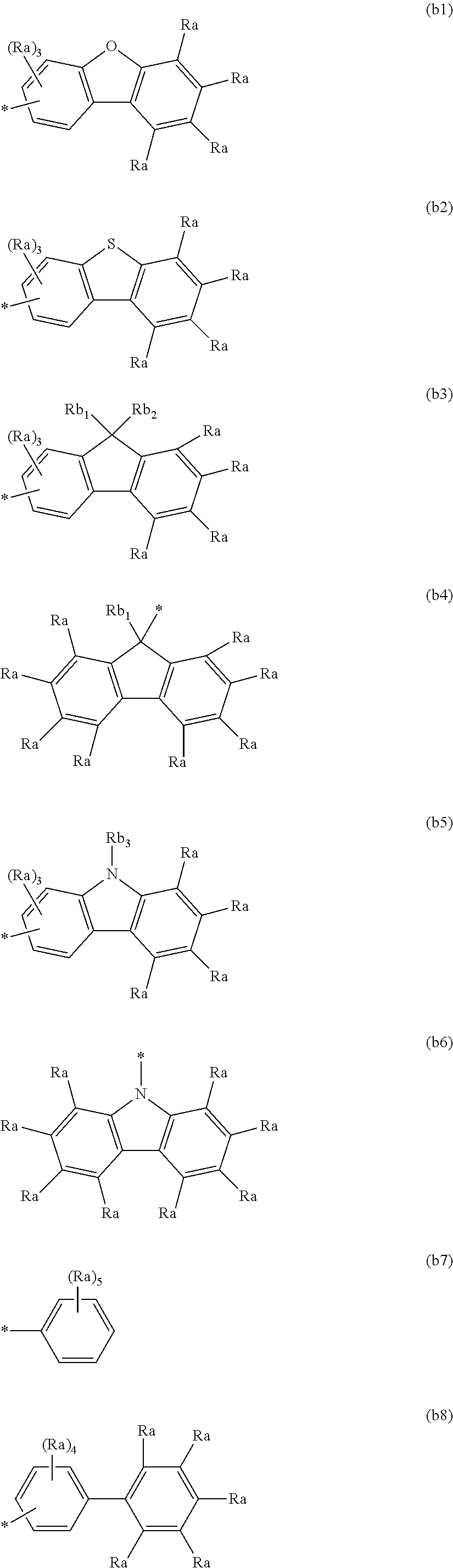


-
- Rb1 and Rb2 are each independently a hydrogen atom or a substituent, or a pair of Rb1 and Rb2 are bonded to each other to form a ring;
- Rb3 is a hydrogen atom or a substituent;
- when Ra, Rb1, Rb2, and Rb3 are each independently a substituent, the substituent represents the same as a substituent for the substituted or unsubstituted group in Ry, R1X, R2X, R3X, R4X in the first compound.


Second Compound
C-M-D (2)
-
- C is a group represented by a formula (C1) below;
- M is a single bond, a substituted or unsubstituted arylene group having 6 to 25 ring carbon atoms, a substituted or unsubstituted divalent heterocyclic group having 5 to 22 ring atoms, a divalent group formed by bonding two groups selected from the group consisting of a substituted or unsubstituted arylene group having 6 to 25 ring carbon atoms and a substituted or unsubstituted divalent heterocyclic group having 5 to 22 ring atoms; or a divalent group formed by bonding three groups selected from the group consisting of a substituted or unsubstituted arylene group having 6 to 25 ring carbon atoms and a substituted or unsubstituted divalent heterocyclic group having 5 to 22 ring atoms;
- D is a substituent E1;
- the substituent E1 is unsubstituted, or further has at least one substituent E2;
- the substituent E2 is unsubstituted, or further has at least one substituent E3;
- the substituent E3 is unsubstituted, or further has at least one substituent E4;
- the substituent E4 is unsubstituted;
- the substituents E1, E2, and E3 are each independently a halogen atom, a cyano group, a substituted or unsubstituted aryl group having 6 to 30 ring carbon atoms, a substituted or unsubstituted heterocyclic group having 5 to 30 ring atoms, a substituted or unsubstituted alkyl group having 1 to 30 carbon atoms, a substituted or unsubstituted alkyl halide group having 1 to 30 carbon atoms, a substituted or unsubstituted alkenyl group having 2 to 30 carbon atoms, a substituted or unsubstituted alkynyl group having 2 to 30 carbon atoms, a substituted or unsubstituted alkylsilyl group having 3 to 30 carbon atoms, a substituted or unsubstituted arylsilyl group having 6 to 60 ring carbon atoms, a substituted or unsubstituted arylphosphoryl group having 6 to 60 ring carbon atoms, a hydroxy group; a substituted or unsubstituted alkoxy group having 1 to 30 carbon atoms, a substituted or unsubstituted aryloxy group having 6 to 30 ring carbon atoms, a group represented by —N(Rz)2, a thiol group, a substituted or unsubstituted alkylthio group having 1 to 30 carbon atoms, a substituted or unsubstituted aralkyl group having 7 to 30 ring carbon atoms, a substituted germanium group, a substituted phosphine oxide group, a nitro group, a substituted boryl group, or a substituted or unsubstituted arylthio group having 6 to 30 ring carbon atoms;
- Rz is a substituted or unsubstituted aryl group having 6 to 30 ring carbon atoms, a substituted or unsubstituted heterocyclic group having 5 to 30 ring atoms, or a substituted or unsubstituted alkyl group having 1 to 30 carbon atoms;
- two Rz in —N(Rz)2 are mutually the same or different;
- the substituent E4 is each independently a halogen atom, a cyano group, an unsubstituted aryl group having 6 to 30 ring carbon atoms, an unsubstituted heterocyclic group having 5 to 30 ring atoms, an unsubstituted alkyl group having 1 to 30 carbon atoms, an unsubstituted alkyl halide group having 1 to 30 carbon atoms, an unsubstituted alkenyl group having 2 to 30 carbon atoms, an unsubstituted alkynyl group having 2 to 30 carbon atoms, an unsubstituted alkylsilyl group having 3 to 30 carbon atoms an unsubstituted arylsilyl group having 6 to 60 ring carbon atoms, an unsubstituted arylphosphoryl group having 6 to 60 ring carbon atoms, a hydroxy group; an unsubstituted alkoxy group having 1 to 30 carbon atoms, an unsubstituted aryloxy group having 6 to 30 ring carbon atoms, a group represented by —N(Rz)2, a thiol group, an unsubstituted alkylthio group having 1 to 30 carbon atoms, an unsubstituted aralkyl group having 7 to 30 ring carbon atoms, a substituted germanium group, a substituted phosphine oxide group, a nitro group, a substituted boryl group, or an unsubstituted arylthio group having 6 to 30 ring carbon atoms;
- Rz is a substituted or unsubstituted aryl group having 6 to 30 ring carbon atoms, a substituted or unsubstituted heterocyclic group having 5 to 30 ring atoms, or a substituted or unsubstituted alkyl group having 1 to 30 carbon atoms,
- two Rz in —N(Rz)2 are mutually the same or different;
- when a plurality of substituents E1 are present, the plurality of substituents E1 are mutually the same or different;
- when a plurality of substituents E2 are present, the plurality of substituents E2 are mutually the same or different;
- when a plurality of substituents E3 are present, the plurality of substituents E3 are mutually the same or different; and
- when a plurality of substituents E4 are present, the plurality of substituents E4 are mutually the same or different.

-
- R1C to R9C are each independently a hydrogen atom, a substituent, or a single bond bonded to M, or at least one pair of a pair of R1C and R2C, a pair of R2C and R3C, a pair of R3C and R4C, a pair of R5C and R6C, a pair of R6C and R7C, or a pair of R7C and R8C are bonded to each other to form a ring Cx;
- one of R1C to R9C is a single bond bonded to M, or any one of carbon atoms forming the ring Cx is bonded to M;
- R1C to R9C serving as the substituents are each independently a halogen atom, a cyano group, a substituted or unsubstituted aryl group having 6 to 30 ring carbon atoms, a substituted or unsubstituted heterocyclic group having 5 to 30 ring atoms, a substituted or unsubstituted alkyl group having 1 to 30 carbon atoms, a substituted or unsubstituted alkyl halide group having 1 to 30 carbon atoms, a substituted or unsubstituted alkenyl group having 2 to 30 carbon atoms, a substituted or unsubstituted alkynyl group having 2 to 30 carbon atoms, a substituted or unsubstituted alkylsilyl group having 3 to 30 carbon atoms, a substituted or unsubstituted arylsilyl group having 6 to 60 ring carbon atoms, a substituted or unsubstituted arylphosphoryl group having 6 to 60 ring carbon atoms, a hydroxy group; a substituted or unsubstituted alkoxy group having 1 to 30 carbon atoms, a substituted or unsubstituted aryloxy group having 6 to 30 ring carbon atoms, a group represented by —N(Rz)2, a thiol group, a substituted or unsubstituted alkylthio group having 1 to 30 carbon atoms, a substituted or unsubstituted aralkyl group having 7 to 30 ring carbon atoms, a substituted germanium group, a substituted phosphine oxide group, a nitro group, a substituted boryl group, or a substituted or unsubstituted arylthio group having 6 to 30 ring carbon atoms;
- Rz is a substituted or unsubstituted aryl group having 6 to 30 ring carbon atoms, a substituted or unsubstituted heterocyclic group having 5 to 30 ring atoms, or a substituted or unsubstituted alkyl group having 1 to 30 carbon atoms; and
- two Rz in —N(Rz)2 are mutually the same or different.
Substituent Group B: an unsubstituted aryl group having 6 to 30 ring carbon atoms, an unsubstituted heterocyclic group having 5 to 30 ring atoms except for one having a partial structure of benzene in which at least one carbon is substituted by nitrogen, an unsubstituted alkyl group having 1 to 30 carbon atoms, an unsubstituted alkyl halide group having 1 to 30 carbon atoms, an unsubstituted alkenyl group having 2 to 30 carbon atoms, an unsubstituted alkynyl group having 2 to 30 carbon atoms, an unsubstituted alkylsilyl group having 3 to 30 carbon atoms an unsubstituted arylsilyl group having 6 to 60 ring carbon atoms, an unsubstituted arylphosphoryl group having 6 to 60 ring carbon atoms, a hydroxy group, an unsubstituted alkoxy group having 1 to 30 carbon atoms, an unsubstituted aryloxy group having 6 to 30 ring carbon atoms, a group represented by N(Rz)2, where Rz is an unsubstituted aryl group having 6 to 30 ring carbon atoms, an unsubstituted heterocyclic group having 5 to 30 ring atoms, or an unsubstituted alkyl group having 1 to 30 carbon atoms, and two Rz in —N(Rz)2 are mutually the same or different, a thiol group, an unsubstituted alkylthio group having 1 to 30 carbon atoms, an unsubstituted aralkyl group having 7 to 30 ring carbon atoms, a substituted germanium group, and an unsubstituted arylthio group having 6 to 30 ring carbon atoms.
“D” in Formula (2)
Substituent Group D: an unsubstituted aryl group having 6 to 50 ring carbon atoms, and an unsubstituted heterocyclic groups having 5 to 50 ring atoms except for one having a partial structure of benzene in which at least one carbon is substituted by nitrogen.
“M” in Formula (2)


-
- Rb1 and Rb2 are each independently a hydrogen atom or a substituent, or a pair of Rb1 and Rb2 are bonded to each other to form a ring;
- Rb3 is a hydrogen atom or a substituent; and
- when Ra, Rb1, Rb2, and Rb3 are each independently a substituent, the substituent represents the same as the substituent E1 serving as D in the formula (2).


-
- R21 to R26 are each independently a substituent or a single bond bonded to M;
- X21 to X26 are each independently an oxygen atom, a sulfur atom, CR20CR21C, or NR22C, R22C is a substituent, R20C and R21C are each independently a hydrogen atom or a substituent, or a single bond bonded to M, or R20C and R21C are bonded to each other to form a ring;
- R210 to R219 are each independently a hydrogen atom, a substituent, or a single bond bonded to M, or at least one pair of a pair of R210 and R211, a pair of R211 and R212, a pair of R212 and R213, a pair of R214 and R215, a pair of R216 and R217, a pair of R217 and R218, or a pair of R218 and R219 are bonded to each other to form a ring;
- one of R210 to R219, R21, R20C, R21C and R22C is a single bond bonded to M;
- R220 to R229 are each independently a hydrogen atom, a substituent, or a single bond bonded to M, or at least one pair of a pair of R220 and R221, a pair of R221 and R222, a pair of R222 and R223, a pair of R224 and R225, a pair of R226 and R227, a pair of R227 and R228, or a pair of R228 and R229 are bonded to each other to form a ring;
- one of R220 to R229, R22, R20C, R21C and R22C is a single bond bonded to M;
- R230 to R239 are each independently a hydrogen atom, a substituent, or a single bond bonded to M, or at least one pair of a pair of R230 and R231, a pair of R231 and R232, a pair of R232 and R233, a pair of R235 and R236, a pair of R236 and R237, or a pair of R237 and R238 are bonded to each other to form a ring;
- one of R230 to R239, R23, R20C, R21C and R22C is a single bond bonded to M;
- R240 to R249 are each independently a hydrogen atom, a substituent, or a single bond bonded to M, or at least one pair of a pair of R240 and R241, a pair of R241 and R242, a pair of R242 and R243, a pair of R245 and R246, a pair of R246 and R247, or a pair of R247 and R248 are bonded to each other to form a ring;
- one of R240 to R249, R24, R20C, R21C and R22C is a single bond bonded to M;
- R250 to R259 are each independently a hydrogen atom, a substituent, or a single bond bonded to M, or at least one pair of a pair of R250 and R251, a pair of R251 and R252, a pair of R252 and R253, a pair of R254 and R255, a pair of R255 and R256, a pair of R256 and R257, or a pair of R258 and R259 are bonded to each other to form a ring;
- one of R250 to R259, R25, R20C, R21C and R22C is a single bond bonded to M;
- R260 to R269 are each independently a hydrogen atom, a substituent, or a single bond bonded to M, or at least one pair of a pair of R260 and R261, a pair of R261 and R262, a pair of R262 and R263, a pair of R264 and R265, a pair of R265 and R266, a pair of R266 and R267, or a pair of R268 and R269 are bonded to each other to form a ring;
- one of R260 to R269, R26, R20C, R21C and R22C is a single bond bonded to M; and
- R210 to R269, R21 to R26, R20C, R21C and R22C serving as the substituents each independently represent the same as R1C to R9C serving as the substituents in the formula (1C).
-
- R21 to R26 and R22C are preferably each independently a substituted or unsubstituted aryl group having 6 to 30 ring carbon atoms, a substituted or unsubstituted heterocyclic group having 5 to 30 ring atoms, or a substituted or unsubstituted alkyl group having 1 to 30 carbon atoms.


Third Compound


-
- n is 1, 2, 3 or 4;
- m is 1, 2, 3, or 4;
- q is 0, 1, 2, 3, or 4;
- m+n+q=6 is satisfied;
- CN is a cyano group;
- D1 is a group represented by a formula (3a), a formula (3b) or a formula (3c) below, when a plurality of D1 are present, the plurality of D1 are mutually the same or different;
- Rx is a hydrogen atom or a substituent, or a pair of adjacent ones of Rx are bonded to each other to form a ring, and when a plurality of Rx are present, the plurality of Rx are mutually the same or different;
- Rx serving as the substituent is each independently a halogen atom, a substituted or unsubstituted aryl group having 6 to 30 ring carbon atoms, a substituted or unsubstituted heterocyclic group having 5 to 30 ring atoms, a substituted or unsubstituted amino group, a substituted or unsubstituted carbonyl group, a substituted or unsubstituted alkyl group having 1 to 30 carbon atoms, a substituted or unsubstituted alkyl halide group having 1 to 30 carbon atoms, a substituted or unsubstituted cycloalkyl group having 3 to 30 ring carbon atoms, a substituted or unsubstituted alkylsilyl group having 3 to 30 carbon atoms, or a substituted or unsubstituted arylsilyl group having 6 to 60 ring carbon atoms; and CN, D1 and Rx are respectively bonded to carbon atoms of a six-membered ring.

-
- R1 to R8 are each independently a hydrogen atom or a substituent, or at least one pair of a pair of R1 and R2, a pair of R2 and R3, a pair of R3 and R4, a pair of R5 and R6, a pair of R6 and R7, or a pair of R7 and R8 are bonded to each other to form a ring;
- R1 to R8 serving as the substituents are each independently a halogen atom, a substituted or unsubstituted aryl group having 6 to 30 ring carbon atoms, a substituted or unsubstituted heterocyclic group having 5 to 30 ring atoms, a substituted or unsubstituted alkyl group having 1 to 30 carbon atoms, a substituted or unsubstituted alkyl halide group having 1 to 30 carbon atoms, a substituted or unsubstituted cycloalkyl group having 3 to 30 ring carbon atoms, a substituted or unsubstituted alkylsilyl group having 3 to 30 carbon atoms, a substituted or unsubstituted arylsilyl group having 6 to 60 ring carbon atoms, a hydroxy group; a substituted or unsubstituted alkoxy group having 1 to 30 carbon atoms, a substituted or unsubstituted alkoxy halide group having 1 to 30 carbon atoms, a substituted or unsubstituted aryloxy group having 6 to 30 ring carbon atoms, a substituted or unsubstituted alkylamino group having 2 to 30 carbon atoms, a substituted or unsubstituted arylamino group having 6 to 60 ring carbon atoms, a thiol group, a substituted or unsubstituted alkylthio group having 1 to 30 carbon atoms, or a substituted or unsubstituted arylthio group having 6 to 30 ring carbon atoms; and
- * represents a bonding position to a carbon atom of a benzene ring in the formula (31).

-
- R21 to R28 are each independently a hydrogen atom or a substituent, or at least one pair of a pair of R21 and R22, a pair of R22 and R23, a pair of R23 and R24, a pair of R25 and R26, a pair of R26 and R27, or a pair of R27 and R28 are bonded to each other to form a ring;
- R21 to R28 serving as the substituents each independently represent the same as R1 to R8 in the formula (3a);
- A represents a cyclic structure represented by a formula (311) or a formula (312) below, and the cyclic structure A is fused at any positions with adjacent cyclic structures;
- p is 1, 2, 3, or 4;
- when p is 2, 3, or 4, a plurality of cyclic structures A are mutually the same or different; and
- * represents a bonding position to a carbon atom of a benzene ring in the formula (31).

-
- R2001 to R2008 are each independently a hydrogen atom or a substituent, or at least one pair of a pair of R2001 and R2002, a pair of R2002 and R2003, a pair of R2003 and R2004, a pair of R2005 and R2006, a pair of R2006 and R2007, or a pair of R2007 and R2008 are bonded to each other to form a ring;
- R2001 to R2008 serving as the substituents each independently represent the same as R1 to R8 serving as the substituents in the formula (3a);
- B represents a cyclic structure represented by the formula (311) or (312), and the cyclic structure B is fused at any positions with adjacent cyclic structures;
- px is 1, 2, 3, or 4;
- when px is 2, 3, or 4, a plurality of cyclic structures B are mutually the same or different;
- C represents a cyclic structure represented by the formula (311) or (312), and the cyclic structure C is fused at any positions with adjacent cyclic structures;
- py is 1, 2, 3, or 4;
- when py is 2, 3, or 4, a plurality of cyclic structures C are mutually the same or different; and
- * represents a bonding position to a carbon atom of a benzene ring in the formula (31).

-
- R2009, R2010, R2011, R2012 and R2013 serving as the substituents each independently represent the same as R1 to R8 serving as the substituents in the formula (3a).
(II) When the cyclic structure represented by the formula (311) and the benzene ring having R25 to R28 in the formula (3b) are adjacent to each other, between two adjacent rings, at least one pair of the following are mutually bonded to form a ring: R2009 of one of the rings and R25 of the other of the rings; R2009 of one of the rings and R28 of the other of the rings; R2010 of one of the rings and R25 of the other of the rings; or R2010 of one of the rings and R28 of the other of the rings.
(111) When the cyclic structure represented by the formula (311) and the benzene ring having R2001 to R2004 in the formula (3c) are adjacent to each other, between two adjacent rings, at least one pair of the following are mutually bonded to form a ring: R2009 of one of the rings and R2001 of the other of the rings; R2009 of one of the rings and R2004 of the other of the rings; R2010 of one of the rings and R2001 of the other of the rings; or R2010 of one of the rings and R2004 of the other of the rings.
(IV) When the cyclic structure represented by the formula (311) and the benzene ring having R2005 to R2008 in the formula (3c) are adjacent to each other, between two adjacent rings, at least one pair of the following are mutually bonded to form a ring: R2009 of one of the rings and R2005 of the other of the rings; R2009 of one of the rings and R2008 of the other of the rings; R2010 of one of the rings and R2005 of the other of the rings; or R2010 of one of the rings and R2008 of the other of the rings.
(V) The pair of R2009 and R2010 of the cyclic structure represented by the formula (311) are mutually bonded to form a ring. In other words, (V) means that the pair of R2009 and R2010 bonded to the same ring are mutually bonded to form a ring.
-
- when Rx is an unsubstituted heterocyclic group having 5 to 30 ring atoms, Rx as the unsubstituted heterocyclic group having 5 to 30 ring atoms is preferably a pyridyl group, pyrimidinyl group, triazinyl group, dibenzofuranyl group, or dibenzothienyl group.


-
- in the formulae (D-22) to (D-27), X1 to X6 are each independently an oxygen atom, a sulfur atom, or CR151R152;
- R151 and R152 are each independently a hydrogen atom or a substituent, or R151 and R152 are bonded to each other to form a ring;
- R201 to R260 are each independently a hydrogen atom or a substituent, or at least one pair of a pair of R201 and R202, a pair of R202 and R203, a pair of R203 and R204, a pair of R205 and R206, a pair of R207 and R208, a pair of R208 and R209, a pair of R209 and R210, a pair of R211 and R212, a pair of R212 and R213, a pair of R213 and R214, a pair of R216 and R217, a pair of R217 and R218, a pair of R218 and R219, a pair of R221 and R222, a pair of R222 and R223, a pair of R223 and R224, a pair of R226 and R227, a pair of R227 and R228, a pair of R228 and R229, a pair of R231 and R232, a pair of R232 and R233, a pair of R233 and R234, a pair of R235 and R236, a pair of R236 and R237, a pair of R237 and R238, a pair of R239 and R240, a pair of R241 and R242, a pair of R242 and R243, a pair of R243 and R244, a pair of R245 and R246, a pair of R246 and R247, a pair of R247 and R248, a pair of R249 and R250, a pair of R251 and R252, a pair of R252 and R253, a pair of R253 and R254, a pair of R255 and R256, a pair of R257 and R258, a pair of R258 and R259, or a pair of R259 and R260 are bonded to each other to form a ring;
- R83 to R90, R151, R152 and R201 to R260 serving as the substituents are each independently a halogen atom, a substituted or unsubstituted aryl group having 6 to 14 ring carbon atoms, a substituted or unsubstituted heterocyclic group having 5 to 14 ring atoms, a substituted or unsubstituted alkyl group having 1 to 6 carbon atoms, a substituted or unsubstituted alkyl halide group having 1 to 6 carbon atoms, a substituted or unsubstituted cycloalkyl group having 3 to 8 ring carbon atoms, a substituted or unsubstituted alkylsilyl group having 3 to 6 carbon atoms, a hydroxy group; a substituted or unsubstituted alkoxy group having 1 to 6 carbon atoms, a substituted or unsubstituted alkoxy halide group having 1 to 6 carbon atoms, a substituted or unsubstituted aryloxy group having 6 to 14 ring carbon atoms, a substituted or unsubstituted arylamino group having 6 to 28 ring carbon atoms, a substituted or unsubstituted alkylamino group having 2 to 12 carbon atoms, a thiol group, a substituted or unsubstituted alkylthio group having 1 to 6 carbon atoms, or a substituted or unsubstituted arylthio group having 6 to 14 ring carbon atoms; and
- * represents a bonding position to a carbon atom of a benzene ring in the formula (31).

-
- Ar1 is a group selected from the group consisting of a substituted or unsubstituted aryl group having 6 to 30 ring carbon atoms, a substituted or unsubstituted heteroaryl group having 5 to 30 ring atoms, a substituted or unsubstituted alkyl group having 1 to 30 carbon atoms, a substituted or unsubstituted fluoroalkyl group having 1 to 30 carbon atoms, a substituted or unsubstituted cycloalkyl group having 3 to 30 ring carbon atoms, a substituted or unsubstituted aralkyl group having 7 to 30 carbon atoms, a substituted phosphoryl group, a substituted silyl group, a cyano group, a nitro group, a carboxy group, and groups represented by formulae (1a) to (1j) below;
- ArEWG is a substituted or unsubstituted heteroaryl group having 5 to 30 ring atoms that contains one or more nitrogen atoms in a ring, or an aryl group having 6 to 30 ring carbon atoms that is substituted with one or more cyano groups;
- ArX is each independently a hydrogen atom or a substituent, ArX serving as the substituent being a group selected from the group consisting of a substituted or unsubstituted aryl group having 6 to 30 ring carbon atoms, a substituted or unsubstituted heteroaryl group having 5 to 30 ring atoms, a substituted or unsubstituted alkyl group having 1 to 30 carbon atoms, a substituted or unsubstituted fluoroalkyl group having 1 to 30 carbon atoms, a substituted or unsubstituted cycloalkyl group having 3 to 30 ring carbon atoms, a substituted or unsubstituted aralkyl group having 7 to 30 carbon atoms, a substituted phosphoryl group, a substituted silyl group, a cyano group, a nitro group, a carboxy group, and the groups represented by the formulae (1a) to (1j);
- n is 0, 1, 2, 3, 4, or 5 and when n is 2, 3, 4, or 5, a plurality of ArX are mutually the same or different;
- a ring (A) is a substituted or unsubstituted aromatic hydrocarbon ring or a substituted or unsubstituted heterocycle, the ring (A) is a five-membered ring, a six-membered ring, or a seven-membered ring, and ArEWG, Ar1 and ArX are respectively bonded to elements forming the ring (A); and
- at least one of Ar1 or ArX is a group selected from the group consisting of the groups represented by the formulae (1a) to (1j).


-
- in the formula (1 b), one of X5 to X8 is a carbon atom bonded with one of X9 to X12, and one of X9 to X12 is a carbon atom bonded with one of X5 to X8;
- in the formula (1c), one of X5 to X8 is a carbon atom bonded with a nitrogen atom in a ring including A2;
- in the formula (1e), one of X5 to X8 and X18 is a carbon atom bonded with one of X9 to X12, and one of X9 to X12 is a carbon atom bonded with one of X5 to X8 and X18;
- in the formula (1f), one of X5 to X8 and X18 is a carbon atom bonded with one of X9 to X12 and X19, and one of X9 to X12 and X19 is a carbon atom bonded with one of X5 to X8 and X18;
- in the formula (1g), one of X5 to X8 is a carbon atom bonded with one of X9 to X12 and X19, and one of X9 to X12 and X19 is a carbon atom bonded with one of X5 to X8;
- in the formula (1h), one of X5 to X8 and X18 is a carbon atom bonded with a nitrogen atom in a ring including A2;
- in the formula (1i), one of X5 to X8 and X18 is a carbon atom bonded with a nitrogen atom connecting a ring including X9 to X12 and X19 and a ring including X13 to X16 and X20;
- in the formula (1j), one of X5 to X8 is a carbon atom bonded with a nitrogen atom connecting a ring including X9 to X12 and X19 and a ring including X13 to X16 and X20;
- RA1 is independently a hydrogen atom or a substituent, or at least one pair of pairs of a plurality of RA1 are mutually directly bonded to form a ring or are bonded through a hetero atom to form a ring;
- RA1 serving as the substituent is a group selected from the group consisting of a substituted or unsubstituted aryl group having 6 to 30 ring carbon atoms, a substituted or unsubstituted heteroaryl group having 5 to 30 ring atoms, a substituted or unsubstituted alkyl group having 1 to 30 carbon atoms, a substituted or unsubstituted fluoroalkyl group having 1 to 30 carbon atoms, a substituted or unsubstituted cycloalkyl group having 3 to 30 ring carbon atoms, a substituted or unsubstituted aralkyl group having 7 to 30 carbon atoms, a substituted phosphoryl group, a substituted silyl group, a cyano group, a nitro group, and a carboxy group; and
- a plurality of RA1 serving as the substituents are mutually the same or different;
- in the formulae (1a) to (1j), * represents a bonding position to a ring (A); and
- in the formulae (1a) to (1j), A1 and A2 are each independently a single bond, an oxygen atom (O), a sulfur atom (S), C(R2021)(R2022), Si(R2023)(R2024), C(═O), S(═O), SO2, or N(R2025), and R2021 to R2025 are each independently a hydrogen atom or a substituent, R2021 to R2025 serving as the substituents being each independently a group selected from the group consisting of a substituted or unsubstituted aryl group having 6 to 30 ring carbon atoms, a substituted or unsubstituted heteroaryl group having 5 to 30 ring atoms, a substituted or unsubstituted alkyl group having 1 to 30 carbon atoms, a substituted or unsubstituted fluoroalkyl group having 1 to 30 carbon atoms, a substituted or unsubstituted cycloalkyl group having 3 to 30 ring carbon atoms, a substituted or unsubstituted aralkyl group having 7 to 30 carbon atoms, a substituted phosphoryl group, a substituted silyl group, a cyano group, a nitro group, and a carboxy group; and
- in the formulae (1a) to (1j), Ara is a group selected from the group consisting of a substituted or unsubstituted aryl group having 6 to 30 ring carbon atoms, a substituted or unsubstituted heteroaryl group having 5 to 30 ring atoms, a substituted or unsubstituted alkyl group having 1 to 30 carbon atoms, a substituted or unsubstituted fluoroalkyl group having 1 to 30 carbon atoms, a substituted or unsubstituted cycloalkyl group having 3 to 30 ring carbon atoms, a substituted or unsubstituted aralkyl group having 7 to 30 carbon atoms, a substituted phosphoryl group, and a substituted silyl group.


-
- c is 0, 1, 2, 3, 4 or 5;
- when c is 0, Cz and Az are bonded to each other with a single bond;
- when c is 1, 2, 3, 4 or 5, L23 is a linking group selected from the group consisting of a substituted or unsubstituted arylene group having 6 to 30 ring carbon atoms, and a substituted or unsubstituted heteroarylene group having 5 to 30 ring atoms;
- when c is 2, 3, 4, or 5, a plurality of L23 are mutually the same or different;
- the plurality of L23 are bonded to each other to form a ring, or are not bonded to form no ring; and
- Cz is represented by a formula (23a) below.

-
- Y21 to Y23 are each independently a nitrogen atom or CRA3;
- RA3 is each independently a hydrogen atom or a substituent, or at least one pair of pairs of a plurality of RA3 are mutually bonded to form a ring;
- RA3 serving as the substituent is each independently a group selected from the group consisting of a substituted or unsubstituted aryl group having 6 to 30 ring carbon atoms, a substituted or unsubstituted heteroaryl group having 5 to 30 ring atoms, a substituted or unsubstituted alkyl group having 1 to 30 carbon atoms, a substituted or unsubstituted fluoroalkyl group having 1 to 30 carbon atoms, a substituted or unsubstituted cycloalkyl group having 3 to 30 ring carbon atoms, a substituted or unsubstituted aralkyl group having 7 to 30 carbon atoms, a substituted phosphoryl group, a substituted silyl group; a cyano group, a nitro group, and a carboxy group; a plurality of RA3 are mutually the same or different; and
- * 1 represents a bonding position to a carbon atom in a structure of a linking group represented by L23 or a bonding position to a carbon atom in a cyclic structure represented by Az.
- Y21 to Y28 are also preferably CRA3.
- c in the formula (23) is preferably 0 or 1.
- Cz is also preferably represented by a formula (23b), a formula (23c), or a formula (23d) below.


-
- in the formula (23b), at least one of Y25 to Y28 is a carbon atom bonded with one of Y51 to Y54, and at least one of Y51 to Y54 is a carbon atom bonded with one of Y25 to Y28;
- in the formula (23c), at least one of Y25 to Y28 is a carbon atom bonded to a nitrogen atom in a five-membered ring of a nitrogen-containing fused ring including Y51 to Y58;
- in the formula (23d), *a and *b each represent a bonding position to one of Y21 to Y28, at least one of Y25 to Y28 is the bonding position represented by *a, and at least one of Y25 to Y28 is the bonding position represented by *b;
- n is, 2, 3 or 4;
- RA4 are each independently a hydrogen atom or a substituent, or at least one pair of pairs of a plurality of RA4 are mutually bonded to form a ring;
- RA4 serving as the substituent is each independently a substituent selected from the group consisting of a substituted or unsubstituted aryl group having 6 to 30 ring carbon atoms, a substituted or unsubstituted heteroaryl group having 5 to 30 ring atoms, a substituted or unsubstituted alkyl group having 1 to 30 carbon atoms, a substituted or unsubstituted fluoroalkyl group having 1 to 30 carbon atoms, a substituted or unsubstituted cycloalkyl group having 3 to 30 ring carbon atoms, a substituted or unsubstituted aralkyl group having 7 to 30 carbon atoms, a substituted phosphoryl group, a substituted silyl group;
- a cyano group, a nitro group, and a carboxy group,
- a plurality of RA4 are mutually the same or different;
-
- R45 is a hydrogen atom or a substituent;
- R46 and R47 are each independently a hydrogen atom or a substituent, or a pair of R46 and R47 are mutually bonded to form a ring;
- R45, R46, and R47 serving as the substituents are each independently a substituent selected from the group consisting of a substituted or unsubstituted aryl group having 6 to 30 ring carbon atoms, a substituted or unsubstituted heteroaryl group having 5 to 30 ring atoms, a substituted or unsubstituted alkyl group having 1 to 30 carbon atoms, a substituted or unsubstituted fluoroalkyl group having 1 to 30 carbon atoms, a substituted or unsubstituted cycloalkyl group having 3 to 30 ring carbon atoms, a substituted or unsubstituted aralkyl group having 7 to 30 carbon atoms, a substituted phosphoryl group, a substituted silyl group; a cyano group, a nitro group, and a carboxy group, a plurality of R45 are mutually the same or different;
- a plurality of R46 are mutually the same or different;
- a plurality of R47 are mutually the same or different; and
- * represents a bonding position to a carbon atom of a cyclic structure represented by Az.
- Z21 is preferably NR45.


Fourth Compound

-
- Y is a hydrogen atom or a substituent;
- R21 to R26 are each independently a hydrogen atom or a substituent, or at least one of a pair of R21 and R22, a pair of R22 and R23, a pair of R24 and R25, or a pair of R25 and R26 are mutually bonded to form a ring;
- Y and R21 to R26 serving as the substituents are each independently selected from the group consisting of a substituted or unsubstituted alkyl group having 1 to 30 carbon atoms, a substituted or unsubstituted alkyl halide group having 1 to 30 carbon atoms, a substituted or unsubstituted cycloalkyl group having 3 to 30 ring carbon atoms, a substituted or unsubstituted aryl group having 6 to 30 ring carbon atoms, a substituted or unsubstituted alkoxy group having 1 to 30 carbon atoms, a substituted or unsubstituted alkoxy halide group having 1 to 30 carbon atoms, a substituted or unsubstituted alkylthio group having 1 to 30 carbon atoms, a substituted or unsubstituted aryloxy group having 6 to 30 ring carbon atoms, a substituted or unsubstituted arylthio group having 6 to 30 ring carbon atoms, a substituted or unsubstituted alkenyl group having 2 to 30 carbon atoms, a substituted or unsubstituted aralkyl group having 7 to 30 carbon atoms, a substituted or unsubstituted heteroaryl group having 5 to 30 ring atoms, a halogen atom, a carboxy group, a substituted or unsubstituted ester group, a substituted or unsubstituted carbamoyl group, a substituted or unsubstituted amino group, a nitro group, a cyano group, a substituted or unsubstituted silyl group, and a substituted or unsubstituted siloxanyl group;
- Z21 and Z22 are each independently a substituent, or are mutually bonded to form a ring;
- Z21 and Z22 serving as the substituents are each independently selected from the group consisting of a halogen atom, a substituted or unsubstituted alkyl group having 1 to 30 carbon atoms, a substituted or unsubstituted alkyl halide group having 1 to 30 carbon atoms, a substituted or unsubstituted aryl group having 6 to 30 ring carbon atoms, a substituted or unsubstituted alkoxy group having 1 to 30 carbon atoms, a substituted or unsubstituted alkoxy halide group having 1 to 30 carbon atoms, and a substituted or unsubstituted aryloxy group having 6 to 30 ring carbon atoms.


Relationship between First Compound, Second Compound, Third Compound, and Fourth Compound in Emitting Layer
S 1(M1)>S 1(M3) (Numerical Formula 1)
S 1(M2)>S 1(M3) (Numerical Formula 2)
T 77K(M1)>T 77K(M3) (Numerical Formula 1a)
T 77K(M2)>T 77K(M3) (Numerical Formula 2b)
S 1(M3)>S 1(M4) (Numerical Formula 3)
S 1(M1)>S 1(M4) (Numerical Formula 4)
S 1(M2)>S 1(M4) (Numerical Formula 5)
S 1(M1)>S 1(M3)>S 1(M4) (Numerical Formula 6)
S 1(M2)>S 1(M3)>S 1(M4) (Numerical Formula 7)
T 77K [eV]=1239.85/λedge Conversion Equation (F1):
S 1 [eV]=1239.85/λedge Conversion Equation (F2):
ΔST(M3)=S 1(M3)−T 77K(M3)<0.3 eV (Numerical Formula 1A)
ΔST(M3)=S 1(M3)−T 77K(M3)<0.2 eV (Numerical Formula 1B)
ΔST(M3)=S 1(M3)−T 77K(M3)<0.1 eV (Numerical Formula 1C)
ΔST(M3)=S 1(M3)−T 77K(M3)<0.01 eV (Numerical Formula 1D)
Film Thickness of Emitting Layer
S 1(M1)>S 1(M3) (Numerical Formula 1)
S 1(M2)>S 1(M3) (Numerical Formula 2)
T 77K(M1)>T 77K(M3) (Numerical Formula 1a)
T 77K(M2)>T 77K(M3) (Numerical Formula 2b)
-
- R11 to R16 are each independently a substituted or unsubstituted aryl group having 6 to 30 ring carbon atoms, a substituted or unsubstituted heterocyclic group having 5 to 30 ring atoms, or a substituted or unsubstituted alkyl group having 1 to 30 carbon atoms.
-
- R11 to R16 are each independently a substituted or unsubstituted aryl group having 6 to 30 ring carbon atoms.
-
- the emitting layer contains a first compound represented by a formula (11X) or (11Y) below, a second compound, and a third compound that exhibits delayed fluorescence;
- the second compound is different in structure from the first compound;
- the second compound is different in structure from the third compound;
- a singlet energy S1(M1) of the first compound and a singlet energy S1(M3) of the third compound satisfy a relationship of a numerical formula (Numerical Formula 1) below; and
- a singlet energy S1(M2) of the second compound and the singlet energy S1(M3) of the third compound satisfy a relationship of a numerical formula (Numerical Formula 2) below.
S 1(M1)>S 1(M3) (Numerical Formula 1)
S 1(M2)>S 1(M3) (Numerical Formula 2)

In the formulae (11X) and (11Y): A is a group represented by a formula (c11), (c12), (c13), (c14), (c15), or (c16) below.


-
- L is a linking group represented by the formula (c17);
- Y11 to Y13 each independently represent the same as Y11 to Y13 in the first compound according to the first exemplary embodiment; and
- R1X, R2X, and R3X each independently represent the same as R1X, R2X, and R3X in the first compound according to the first exemplary embodiment;
- in the formula (1Z), m1 is 1, 2, 3, 4, or 5;
- L11 represents the same as L11 in the first compound according to the first exemplary embodiment;
- L12 represents the same as L12 in the first compound according to the first exemplary embodiment;
- R4X represents the same as R4X in the first compound according to the first exemplary embodiment;
- in the formula (1Z), * represents a bonding position to a carbon atom in a six-membered ring in the formula (11X) or (11Y). When L11 is a single bond, m1 is 1, and L12 is bonded to a carbon atom in a six-membered ring in the formula (11X) or (11Y). In the formulae (c11) to (c16), X1c, X2c, X3c, X4c, X5c, and X6c are each independently CR11CR12C or NR13C;
- R11C and R12C are each independently a hydrogen atom or a substituent, or mutually bonded to form a ring;
- R13C is a substituent;
- R11d, R12d, R13d, R14d, R15d and R16d are each independently a single bond bonded to L (i.e., linking group represented by the formula (c17)), that is, a single bond bonded to * in the formula (c17);
- R110 to R119 are each independently a hydrogen atom or a substituent, or at least one pair of a pair of R11 and R111, a pair of R111 and R112, a pair of R112 and R113, a pair of R114 and R115, a pair of R11 and R117, a pair of R117 and R11, or a pair of R11 and R11 are bonded to each other to form a ring;
- R120 to R129 are each independently a hydrogen atom or a substituent, or at least one pair of a pair of R120 and R121, a pair of R121 and R122, a pair of R122 and R123, a pair of R124 and R125, a pair of R126 and R127, a pair of R127 and R128, or a pair of R128 and R129 are bonded to each other to form a ring;
- R130 to R139 are each independently a hydrogen atom or a substituent, or at least one pair of a pair of R130 and R131, a pair of R131 and R132, a pair of R132 and R133, a pair of R135 and R136, a pair of R136 and R137, or a pair of R137 and R138 are bonded to each other to form a ring;
- R140 to R149 are each independently a hydrogen atom or a substituent, or at least one pair of a pair of R140 and R141, a pair of R141 and R142, a pair of R142 and R143, a pair of R145 and R146, a pair of R146 and R147, or a pair of R147 and R148 are bonded to each other to form a ring;
- R150 to R159 are each independently a hydrogen atom or a substituent, or at least one pair of a pair of R150 and R151, a pair of R151 and R152, a pair of R152 and R153, a pair of R154 and R155, a pair of R155 and R156, a pair of R156 and R157, or a pair of R158 and R159 are bonded to each other to form a ring; and
- R160 to R169 are each independently a hydrogen atom or a substituent, or at least one pair of a pair of R160 and R161, a pair of R161 and R162, a pair of R162 and R163, a pair of R164 and R165, a pair of R165 and R166, a pair of R166 and R167, or a pair of R168 and R169 are bonded to each other to form a ring;
- in the formula (c17), R1c to R9c are each independently a hydrogen atom or a substituent;
- in the formula (c17), * is each independently a bonding position to a nitrogen atom bonded to R11d to R16d, and R3C among R1c to R9C is a single bond bonded to a carbon atom in a six-membered ring in the formula (11X) or (11Y); and
- Ry, R1X, R2X, R3X, and R4X, R110 to R169, R11C to R13C, and R1c to R9c serving as the substituents each independently represent the same as Ry, R1X, R2X, R3X, and R4X serving as the substituents in the formulae (1X), (1Y), and (1Z) in the first compound according to the first exemplary embodiment, and R110 to R169 and R11 to R16 serving as the substituents in the formulae (a1) to (a6).
Preferable Arrangements of Organic EL Device of Fourth Exemplary Embodiment
S 1(M3)>S 1(M4) (Numerical Formula 3)
-
- an energy gap T77K(M2) at 77K of the second compound and the energy gap T77K(M3) at 77K of the third compound satisfy a relationship of a numerical formula (Numerical Formula 2b) below.
T 77K(M1)>T 77K(M3) (Numerical Formula 1a)
T 77K(M2)>T 77K(M3) (Numerical Formula 2b)
- an energy gap T77K(M2) at 77K of the second compound and the energy gap T77K(M3) at 77K of the third compound satisfy a relationship of a numerical formula (Numerical Formula 2b) below.
-
- R11C to R13C are preferably each independently a substituted or unsubstituted aryl group having 6 to 30 ring carbon atoms, a substituted or unsubstituted heterocyclic group having 5 to 30 ring atoms, or a substituted or unsubstituted alkyl group having 1 to 30 carbon atoms.


Preparation of Organic EL Device
EQE (relative value: %) of each of Examples and Comparatives=(EQE (%) of each of Examples and Comparatives/EQE (%) of Comparative 1)×100 (Numerical Formula 100)
| TABLE 1 | ||
| Device Evaluation | ||
| Result | ||
| Emitting layer | (@10 mA/cm2) | |
| First Compound | Second Compound | Third Compound | Fourth Compound | EQE |
| S1 | T77K | S1 | T | T77K | ΔST | S1 | λ | S1 | λ | λp | [Relative | ||||
| Type | [eV] | [eV] | Type | [eV] | [eV] | Type | [eV] | [eV] | [nm] | Type | [eV] | [nm] | [nm] | Value: %] | |
| Example 1 | na | 3.46 | 2.89 | pa | 3.56 | 2.96 | TADF | <0.01 | 2.32 | 545 | RD | 2.02 | 609 | 621 | 1120 |
| Example 2 | nb | 3.08 | 2.84 | pa | 3.56 | 2.96 | TADF | <0.01 | 2.32 | 545 | RD | 2.02 | 609 | 621 | 1110 |
| Example 3 | na | 3.46 | 2.89 | pc | 3.41 | 2.72 | TADF | <0.01 | 2.32 | 545 | RD | 2.02 | 609 | 621 | 1180 |
| Example 4 | nb | 3.08 | 2.84 | pc | 3.41 | 2.72 | TADF | <0.01 | 2.32 | 545 | RD | 2.02 | 609 | 621 | 1170 |
| | Ref-nc | 2.99 | 2.83 | pe | 3.27 | 2.82 | TADF | <0.01 | 2.32 | 545 | RD | 2.02 | 609 | 621 | 100 |
| | Ref-nc | 2.99 | 2.83 | pf | 3.43 | 2.66 | TADF | <0.01 | 2.32 | 545 | RD | 2.02 | 609 | 621 | 680 |
| | Ref-nc | 2.99 | 2.83 | pa | 3.56 | 2.96 | TADF | <0.01 | 2.32 | 545 | RD | 2.02 | 609 | 621 | 910 |
| | Ref-nb | 3.01 | 2.50 | pd | 3.68 | 2.96 | TADF | <0.01 | 2.32 | 545 | RD | 2.02 | 609 | 621 | 800 |
| | Ref-nb | 3.01 | 2.50 | pa | 3.56 | 2.96 | TADF | <0.01 | 2.32 | 545 | RD | 2.02 | 609 | 621 | 930 |
Explanation of Table 1


Claims (35)


S 1(M3)>S 1(M4) (Numerical Formula 3).
T 77K(M1)>T 77K(M3) (Numerical Formula 1a)
T 77K(M2)>T 77K(M3) (Numerical Formula 2b)


C-M-D (2)


Applications Claiming Priority (2)
| Application Number | Priority Date | Filing Date | Title |
|---|---|---|---|
| JP2020-102555 | 2020-06-12 | ||
| JP2020102555A JP2021197439A (en) | 2020-06-12 | 2020-06-12 | Organic electroluminescent element and electronic equipment |
Publications (2)
| Publication Number | Publication Date |
|---|---|
| US20220006026A1 US20220006026A1 (en) | 2022-01-06 |
| US12127478B2 true US12127478B2 (en) | 2024-10-22 |
Family
ID=79195941
Family Applications (1)
| Application Number | Title | Priority Date | Filing Date |
|---|---|---|---|
| US17/345,450 Active 2043-04-21 US12127478B2 (en) | 2020-06-12 | 2021-06-11 | Organic electroluminescence device and electronic device |
Country Status (2)
| Country | Link |
|---|---|
| US (1) | US12127478B2 (en) |
| JP (1) | JP2021197439A (en) |
Families Citing this family (3)
| Publication number | Priority date | Publication date | Assignee | Title |
|---|---|---|---|---|
| US12527153B2 (en) * | 2022-04-21 | 2026-01-13 | Boe Technology Group Co., Ltd. | Organic light-emitting device, display device |
| CN117568018A (en) * | 2023-09-28 | 2024-02-20 | 阜阳欣奕华材料科技有限公司 | A composition and an organic electroluminescent device containing the same |
| WO2025205402A1 (en) * | 2024-03-29 | 2025-10-02 | 出光興産株式会社 | Organic electroluminescent element and electronic device |
Citations (3)
| Publication number | Priority date | Publication date | Assignee | Title |
|---|---|---|---|---|
| US20150053938A1 (en) * | 2013-08-20 | 2015-02-26 | Universal Display Corporation | Organic electroluminescent materials and devices |
| CN107964017A (en) | 2016-10-19 | 2018-04-27 | 江苏三月光电科技有限公司 | Compound and organic electroluminescence device containing azepine triphenylene |
| CN110492006A (en) | 2018-05-14 | 2019-11-22 | 江苏三月光电科技有限公司 | A kind of electroluminescent device based on boracic organic compound |
-
2020
- 2020-06-12 JP JP2020102555A patent/JP2021197439A/en active Pending
-
2021
- 2021-06-11 US US17/345,450 patent/US12127478B2/en active Active
Patent Citations (4)
| Publication number | Priority date | Publication date | Assignee | Title |
|---|---|---|---|---|
| US20150053938A1 (en) * | 2013-08-20 | 2015-02-26 | Universal Display Corporation | Organic electroluminescent materials and devices |
| CN107964017A (en) | 2016-10-19 | 2018-04-27 | 江苏三月光电科技有限公司 | Compound and organic electroluminescence device containing azepine triphenylene |
| CN110492006A (en) | 2018-05-14 | 2019-11-22 | 江苏三月光电科技有限公司 | A kind of electroluminescent device based on boracic organic compound |
| US20210050546A1 (en) | 2018-05-14 | 2021-02-18 | Jiangsu Sunera Technology Co., Ltd. | Electroluminescent device based on boron-containing organic compound |
Non-Patent Citations (2)
| Title |
|---|
| Adachi, "Yuki Hando-tai no Debaisu Bussei (Device Physics of Organic Semiconductors)", Kodansha, Apr. 1, 2012, 19 pages (with English Machine Translation). |
| Uoyama et al., "Highly efficient organic light-emitting diodes from delayed fluorescence", Nature, vol. 492, 2012, 7 pages. |
Also Published As
| Publication number | Publication date |
|---|---|
| JP2021197439A (en) | 2021-12-27 |
| US20220006026A1 (en) | 2022-01-06 |
Similar Documents
| Publication | Publication Date | Title |
|---|---|---|
| US10547009B2 (en) | Organic electroluminescent element, electronic device and compound | |
| US9997717B2 (en) | Organic electroluminescence device and electronic device | |
| US11043638B2 (en) | Organic electroluminescence device and electronic device | |
| US11201297B2 (en) | Organic electroluminescence device and electronic device | |
| US12486452B2 (en) | Organic electroluminescent element and electronic device | |
| US12157747B2 (en) | Organic electroluminescent element, compound, material for organic electroluminescent element, and electronic device | |
| US12435269B2 (en) | Organic electroluminescent element and electronic appliance | |
| US20210074925A1 (en) | Organic electroluminescent element and electronic device | |
| US12274168B2 (en) | Compound, material for organic electroluminescent element, organic electroluminescent element, and electronic appliance | |
| US20220388991A1 (en) | Compound, material for organic electroluminescent element, organic electroluminescent element, and electronic device | |
| US20210020846A1 (en) | Organic electroluminescent element and electronic device | |
| US20220263030A1 (en) | Organic electroluminescent element and electronic device | |
| EP3974433B1 (en) | Organic electroluminescent element, compound, and electronic appliance | |
| US12302757B2 (en) | Organic electroluminescence element and electronic device | |
| US12127478B2 (en) | Organic electroluminescence device and electronic device | |
| US11944009B2 (en) | Compound, material for organic electroluminescent element, organic electroluminescent element, and electronic device | |
| US12575319B2 (en) | Organic electroluminescence device and electronic device | |
| US20230301188A1 (en) | Organic electroluminescent element, organic electroluminescent light-emitting device, and electronic equipment | |
| US20190245152A1 (en) | Organic electroluminescence device and electronic device | |
| US20230027888A1 (en) | Organic electroluminescent device, organic electroluminescence display device, electronic device and compound | |
| US20230371373A1 (en) | Organic electroluminescent element, compound, material for organic electroluminescent element, and electronic device | |
| US12421450B2 (en) | Compounds, materials for organic electroluminescent devices, organic electroluminescent devices, and electronic devices | |
| US20240215447A1 (en) | Organic electroluminescent element and electronic device | |
| US20230050369A1 (en) | Organic electroluminescent element, compound and electronic device |
Legal Events
| Date | Code | Title | Description |
|---|---|---|---|
| FEPP | Fee payment procedure |
Free format text: ENTITY STATUS SET TO UNDISCOUNTED (ORIGINAL EVENT CODE: BIG.); ENTITY STATUS OF PATENT OWNER: LARGE ENTITY |
|
| STPP | Information on status: patent application and granting procedure in general |
Free format text: DOCKETED NEW CASE - READY FOR EXAMINATION |
|
| AS | Assignment |
Owner name: IDEMITSU KOSAN CO.,LTD., JAPAN Free format text: ASSIGNMENT OF ASSIGNORS INTEREST;ASSIGNORS:SHIOMI, TAKUSHI;MATSUMOTO, HISATO;NAKANO, HIROMI;AND OTHERS;SIGNING DATES FROM 20210705 TO 20210719;REEL/FRAME:057950/0394 |
|
| STPP | Information on status: patent application and granting procedure in general |
Free format text: NON FINAL ACTION MAILED |
|
| STPP | Information on status: patent application and granting procedure in general |
Free format text: RESPONSE TO NON-FINAL OFFICE ACTION ENTERED AND FORWARDED TO EXAMINER |
|
| STPP | Information on status: patent application and granting procedure in general |
Free format text: NOTICE OF ALLOWANCE MAILED -- APPLICATION RECEIVED IN OFFICE OF PUBLICATIONS |
|
| ZAAA | Notice of allowance and fees due |
Free format text: ORIGINAL CODE: NOA |
|
| ZAAB | Notice of allowance mailed |
Free format text: ORIGINAL CODE: MN/=. |
|
| STPP | Information on status: patent application and granting procedure in general |
Free format text: PUBLICATIONS -- ISSUE FEE PAYMENT VERIFIED |
|
| STCF | Information on status: patent grant |
Free format text: PATENTED CASE |