US12124348B2 - System, apparatus and methods for automatically testing mobile devices - Google Patents
System, apparatus and methods for automatically testing mobile devices Download PDFInfo
- Publication number
- US12124348B2 US12124348B2 US16/923,465 US202016923465A US12124348B2 US 12124348 B2 US12124348 B2 US 12124348B2 US 202016923465 A US202016923465 A US 202016923465A US 12124348 B2 US12124348 B2 US 12124348B2
- Authority
- US
- United States
- Prior art keywords
- mobile device
- test
- testing
- automatically
- robot
- Prior art date
- Legal status (The legal status is an assumption and is not a legal conclusion. Google has not performed a legal analysis and makes no representation as to the accuracy of the status listed.)
- Active, expires
Links
Images



Classifications
-
- G—PHYSICS
- G06—COMPUTING OR CALCULATING; COUNTING
- G06F—ELECTRIC DIGITAL DATA PROCESSING
- G06F11/00—Error detection; Error correction; Monitoring
- G06F11/22—Detection or location of defective computer hardware by testing during standby operation or during idle time, e.g. start-up testing
- G06F11/26—Functional testing
- G06F11/273—Tester hardware, i.e. output processing circuits
-
- B—PERFORMING OPERATIONS; TRANSPORTING
- B25—HAND TOOLS; PORTABLE POWER-DRIVEN TOOLS; MANIPULATORS
- B25J—MANIPULATORS; CHAMBERS PROVIDED WITH MANIPULATION DEVICES
- B25J11/00—Manipulators not otherwise provided for
-
- B—PERFORMING OPERATIONS; TRANSPORTING
- B25—HAND TOOLS; PORTABLE POWER-DRIVEN TOOLS; MANIPULATORS
- B25J—MANIPULATORS; CHAMBERS PROVIDED WITH MANIPULATION DEVICES
- B25J15/00—Gripping heads and other end effectors
- B25J15/0019—End effectors other than grippers
-
- B—PERFORMING OPERATIONS; TRANSPORTING
- B25—HAND TOOLS; PORTABLE POWER-DRIVEN TOOLS; MANIPULATORS
- B25J—MANIPULATORS; CHAMBERS PROVIDED WITH MANIPULATION DEVICES
- B25J19/00—Accessories fitted to manipulators, e.g. for monitoring, for viewing; Safety devices combined with or specially adapted for use in connection with manipulators
- B25J19/02—Sensing devices
- B25J19/021—Optical sensing devices
- B25J19/023—Optical sensing devices including video camera means
-
- B—PERFORMING OPERATIONS; TRANSPORTING
- B25—HAND TOOLS; PORTABLE POWER-DRIVEN TOOLS; MANIPULATORS
- B25J—MANIPULATORS; CHAMBERS PROVIDED WITH MANIPULATION DEVICES
- B25J9/00—Program-controlled manipulators
- B25J9/16—Program controls
- B25J9/1679—Program controls characterised by the tasks executed
-
- G—PHYSICS
- G05—CONTROLLING; REGULATING
- G05B—CONTROL OR REGULATING SYSTEMS IN GENERAL; FUNCTIONAL ELEMENTS OF SUCH SYSTEMS; MONITORING OR TESTING ARRANGEMENTS FOR SUCH SYSTEMS OR ELEMENTS
- G05B23/00—Testing or monitoring of control systems or parts thereof
- G05B23/02—Electric testing or monitoring
-
- G—PHYSICS
- G06—COMPUTING OR CALCULATING; COUNTING
- G06F—ELECTRIC DIGITAL DATA PROCESSING
- G06F11/00—Error detection; Error correction; Monitoring
- G06F11/22—Detection or location of defective computer hardware by testing during standby operation or during idle time, e.g. start-up testing
- G06F11/2205—Detection or location of defective computer hardware by testing during standby operation or during idle time, e.g. start-up testing using arrangements specific to the hardware being tested
- G06F11/2221—Detection or location of defective computer hardware by testing during standby operation or during idle time, e.g. start-up testing using arrangements specific to the hardware being tested to test input/output devices or peripheral units
-
- G—PHYSICS
- G06—COMPUTING OR CALCULATING; COUNTING
- G06K—GRAPHICAL DATA READING; PRESENTATION OF DATA; RECORD CARRIERS; HANDLING RECORD CARRIERS
- G06K19/00—Record carriers for use with machines and with at least a part designed to carry digital markings
- G06K19/06—Record carriers for use with machines and with at least a part designed to carry digital markings characterised by the kind of the digital marking, e.g. shape, nature, code
- G06K19/06009—Record carriers for use with machines and with at least a part designed to carry digital markings characterised by the kind of the digital marking, e.g. shape, nature, code with optically detectable marking
- G06K19/06018—Record carriers for use with machines and with at least a part designed to carry digital markings characterised by the kind of the digital marking, e.g. shape, nature, code with optically detectable marking one-dimensional coding
- G06K19/06028—Record carriers for use with machines and with at least a part designed to carry digital markings characterised by the kind of the digital marking, e.g. shape, nature, code with optically detectable marking one-dimensional coding using bar codes
-
- G—PHYSICS
- G06—COMPUTING OR CALCULATING; COUNTING
- G06T—IMAGE DATA PROCESSING OR GENERATION, IN GENERAL
- G06T1/00—General purpose image data processing
- G06T1/0014—Image feed-back for automatic industrial control, e.g. robot with camera
-
- H—ELECTRICITY
- H04—ELECTRIC COMMUNICATION TECHNIQUE
- H04W—WIRELESS COMMUNICATION NETWORKS
- H04W24/00—Supervisory, monitoring or testing arrangements
- H04W24/06—Testing, supervising or monitoring using simulated traffic
-
- G—PHYSICS
- G05—CONTROLLING; REGULATING
- G05B—CONTROL OR REGULATING SYSTEMS IN GENERAL; FUNCTIONAL ELEMENTS OF SUCH SYSTEMS; MONITORING OR TESTING ARRANGEMENTS FOR SUCH SYSTEMS OR ELEMENTS
- G05B2219/00—Program-control systems
- G05B2219/30—Nc systems
- G05B2219/32—Operator till task planning
- G05B2219/32204—Performance assurance; assure certain level of non-defective products
-
- G—PHYSICS
- G06—COMPUTING OR CALCULATING; COUNTING
- G06T—IMAGE DATA PROCESSING OR GENERATION, IN GENERAL
- G06T2200/00—Indexing scheme for image data processing or generation, in general
- G06T2200/24—Indexing scheme for image data processing or generation, in general involving graphical user interfaces [GUIs]
Definitions
- the present disclosure generally relates to system, apparatus and methods for testing mobile devices, and more specifically, to system, apparatus and methods for automatically testing mobile devices without human intervention.
- Mobile devices including tablets and phones, have become sophisticated, widespread and pervasive. With the increasing usage of computer network services all over the world, these mobile devices are in great demand. As a result, the cost of used mobile devices has increased. However, as with any used device, the used mobile device needs to be tested to determine operability. As the sizes of mobile devices decrease, and the number of working parts increases, testing of the used mobile device is not only complicated, but also time consuming and expensive.
- the present disclosure generally relates to systems and methods for testing mobile devices. More specifically, some embodiments of the present disclosure are directed to apparatus and methods for automatically testing one or more mobile devices (multiple devices can be tested simultaneously either together or independently), e.g., using robotics.
- exemplary embodiments disclosed herein are directed to solving the issues relating to one or more of the problems presented in the prior art, as well as providing additional features that will become readily apparent by reference to the following detailed description when taken in conjunction with the accompanying drawings.
- exemplary systems, methods, devices and computer program products are disclosed herein. It is understood, however, that these embodiments are presented by way of example and not limitation, and it will be apparent to those of ordinary skill in the art who read the present disclosure that various modifications to the disclosed embodiments can be made while remaining within the scope of the present disclosure.
- an apparatus for automatically testing a mobile device.
- the apparatus includes: a robot having a retention device into which the mobile device to be tested is positioned; a test computer having a processor and a non-transitory computer readable storage medium storing test software for testing the mobile device; and a user monitor electrically connected to the test computer and configured for providing a result of the testing of the mobile device.
- the mobile device is wirelessly connected to the test computer and has a test application installed thereon corresponding to the test software.
- the robot is configured for performing interaction and manipulation of the mobile device in cooperation with the test application and the test software during the testing.
- a method for automatically testing a mobile device. The method includes: loading a test application on the mobile device positioned onto a retention device of a robot; automatically wirelessly connecting the mobile device to a test computer having a processor and a non-transitory computer readable storage medium storing test software for testing the mobile device; automatically manipulating the mobile device using the robot configured for interacting with the mobile device in cooperation with the test application and the test software; automatically testing the mobile device based on the test application; and automatically sending a result of the testing of the mobile device to a user monitor electrically connected to the test computer and configured for displaying the result of the testing of the mobile device.
- a system for automatically testing mobile devices.
- the system includes: a plurality of robots each of which having a retention device configured for holding one of a plurality of mobile devices to be tested; a plurality of device test chambers each housing a respective one of the plurality of robots; and a plurality of test computers each of which corresponds to one of the plurality of robots, and has a processor and a non-transitory computer readable storage medium storing test software for testing a corresponding one of the plurality of mobile devices.
- the corresponding mobile device is wirelessly connected to the test computer and has a test application installed thereon corresponding to the test software.
- Each of the plurality of robots is configured for performing interaction and manipulation of the corresponding mobile device held by the retention device in cooperation with the test application and the test software during the testing.
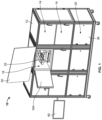
- FIG. 1 is a perspective view of a mobile device testing apparatus, in accordance with some embodiments of the present disclosure.
- FIG. 2 is a perspective view of a robot that is used to test of a mobile device in the testing apparatus, in accordance with some embodiments of the present disclosure.
- FIG. 3 is a side view of the robot in FIG. 2 , in accordance with some embodiments of the present disclosure.
- FIG. 4 is a front view of the robot in FIG. 2 , in accordance with some embodiments of the present disclosure.
- FIG. 5 is a top view of the robot in FIG. 2 , in accordance with some embodiments of the present disclosure.
- FIG. 6 is a flow chart showing an exemplary method for automatically testing a mobile device, in accordance with some embodiments of the present disclosure.
- a testing system for performing a completely automated functional testing of mobile devices, e.g. tablets, smartphones, smart watches.
- the disclosed system comprises a robot which can assist in the testing functionality through interaction and manipulation of the mobile device under test and work in collaboration with a testing app.
- the testing app may be customized during development.
- the disclosed system can support a complete functional testing of smartphones, tablets, and smart watch, across both iOS and Android operating systems. This may be achieved based on a software suite and a smartphone app that drives the test functionality.
- a disclosed testing system comprises: at least one test computer, a master computer, a robot, and a control system.
- the test computer drives all the test software and controls the app activity.
- the master computer communicates with each of the at least one test computer and provides graphic user interface (GUI) for interaction with users.
- GUI graphic user interface
- the robot may be a multi-axis robotic system that provides a motion controlled platform with toolbox and/or universal fixture to hold various sizes of mobile devices.
- the robot may also comprise a robot arm with object manipulation capabilities in addition to other features related to mobile device testing.
- the control system can comprise a control computer or programmable logic controller, and a compact and modular input/output (I/O) system to drive the robot and onboard I/O modules.
- FIG. 1 An illustrative embodiment of a mobile device testing apparatus 10 is shown in FIG. 1 .
- the methods in the present disclosure can be applied for not only testing mobile devices, but also other electronic devices.
- the mobile device testing apparatus 10 as shown in FIG. 1 , comprises a frame 12 , a plurality of device test chambers 16 , a plurality of test equipment cabinets 30 , a sanity monitor 50 , and a user monitor 60 connecting to the master computer.
- Each of the plurality of device test chambers 16 has a front door 16 A and a robot 22 inside the front door 16 A for receiving a mobile device for testing.
- the frame 12 is a structure forming a plurality of slots 14 .
- the plurality of device test chambers 16 are each positioned in one of the plurality of slots 14 of the frame 12 .
- the plurality of device test chambers 16 may be substantially square members, or any shape necessary to fit the slots 14 .
- the frame 12 has six slots in the exemplary embodiment shown in FIG. 1 . That is, there are six device test chambers 16 in the mobile device testing apparatus 10 in the exemplary embodiment shown in FIG. 1 .
- the number of slots 14 , the number of device test chambers 16 , and correspondingly the number of mobile devices that can be simultaneously tested, may vary based on the application.
- the frame 12 may be constructed out of any material that provides sufficient rigidity for the mobile device testing apparatus 10 , including metals, plastics, and other materials known to those with ordinary skill in the art.
- each of the plurality of slots 14 is a radio frequency (RF) shielded cabinet containing a respective device test chamber 16 .
- the front door 16 A of each of the plurality of device test chambers 16 is moveably or slidably mounted to the frame 12 . After the front door 16 A is opened, a mobile device to be tested may be placed into the corresponding device test chamber 16 and onto a robot 22 in the device test chambers 16 .
- RF radio frequency
- each RF shielded cabinet has at least one antenna mounted to and through a wall of the cabinet.
- each RF shielded cabinet 14 has four antennas coupled to and through a back wall of the RF shielded cabinet 14 .
- At least one antenna can receive wireless signals from the mobile device and forward the wireless signals to a wireless router, e.g. a Wi-Fi router.
- a wireless router e.g. a Wi-Fi router.
- each antenna can receive wireless signals from the wireless router and forward the wireless signals to the mobile device.
- each antenna is connected to the Wi-Fi router via a cable.
- the Wi-Fi router is electrically connected to test computers by wire. That is, each mobile device being tested can communicate with a corresponding test computer, via a Wi-Fi router, without being interfered by other wireless signals.
- the antenna coupled to and through a wall of each RF shielded cabinet 14 helps to connect the wireless router with the corresponding mobile device to be tested in the RF shielded cabinet 14 .
- the front door 16 A has a magnetic lock thereon for locking the front door 16 A magnetically.
- the magnetic lock on the front door 16 A is automatically released.
- the test computers are positioned in the test equipment cabinets 30 .
- Each RF shielded cabinet corresponds to a test computer positioned in a test equipment cabinet 30 below the RF shielded cabinet. That is, in the example shown in FIG. 1 , each test equipment cabinet 30 contains two test computers corresponding to the two RF shielded cabinets 14 stacked over the test equipment cabinet 30 , respectively.
- a test application is pre-installed on a mobile device to be tested. Before testing, the test application is loaded, once for the entire test, on the mobile device.
- the mobile device may be connected to a Wi-Fi network after being positioned in the RF shielded cabinet 14 , e.g. via antennas mounted on a wall of the RF shielded cabinet 14 .
- the robot 22 in the RF shielded cabinet 14 may also connect to the same Wi-Fi network when testing the mobile device.
- Each test computer is also connected to the same Wi-Fi network.
- each test computer has a processor and a non-transitory computer readable storage medium storing test software for testing a mobile device positioned in a RF shielded cabinet 14 corresponding to the test computer.
- the mobile device is wirelessly connected to the test computer, e.g. via the wireless router, and has a test application installed thereon corresponding to the test software.
- the robot 22 may be configured for performing interaction and manipulation of the mobile device in cooperation with the test application and the test software during the testing.
- the system includes a scanner (not shown in FIG. 1 ) electrically connected to the plurality of test computers and configured for scanning slot numbers corresponding to RF shielded cabinets 14 or device test chambers 16 , and scanning serial numbers of mobile devices.
- the scanner may first scan a slot number of the device test chamber or RF shielded cabinet in which the mobile device will be tested.
- the user monitor 60 may show an instruction or indication to scan a serial number, e.g. an international mobile equipment identity (IMEI), of the corresponding mobile device to be tested in the device test chamber, which has the scanned slot number.
- IMEI international mobile equipment identity
- the scanner may scan a serial number of the corresponding mobile device to be tested, before it is positioned in the device test chamber for testing. After the scanning of the slot number and the serial number, the scanned serial number is associated with the scanned slot number, such that the system knows that which mobile device is tested in which slot or cabinet. Then an operator can open the front door 16 A, and place the mobile device into the corresponding slot, e.g. slot N. In one embodiment, a selection, by the operator or by a signal from the test computer, is made on the test application of the mobile device to indicate that the testing of the mobile device is performed in the corresponding slot N, which automatically starts the test in slot N.
- the front door 16 A may be closed by the magnetic lock on the front door 16 A during the test.
- the same scanner may then be used to scan a slot number of another slot and a serial number of another mobile device to be tested in that slot, while the test is performed in slot N.
- the sanity monitor 50 may be a single monitor that can show internal views of all of the device test chambers 16 of the system, when the doors 16 A are closed and the tests are being performed. For example, in the example shown in FIG. 1 , where there are six device test chambers 16 , the sanity monitor 50 may show what is going on in each of the six chambers in six split screen views in the single monitor 50 . In one embodiment, the six split screen views have a same size. In another embodiment, after one chamber or cabinet is selected, the selected chamber is shown in a large screen view, and the other five chambers are shown in five small screen views respectively.
- a robot 22 includes a retention device 222 into which the mobile device 230 to be tested is positioned.
- the retention device 222 has two arms that can clasp the mobile device 230 therebetween.
- the retention device 222 holding the mobile device 230 can rotate the mobile device about the Y axis with any degree between 0-360 degrees; and can rotate the mobile device about the X axis with a degree between 0-50 degrees.
- the system associates the scanned serial number with the scanned slot number. Based on the serial number of the mobile device 230 , the system can automatically determine, e.g. from a database stored in the main computer or in a cloud server, testing-related information of the mobile device 230 .
- the testing-related information comprises information about at least one of: an operation system of the mobile device, number and locations of interfaces of the mobile device, dimensions and locations of the screen of the mobile device, number and locations of cameras of the mobile device on each side, number and locations of physical buttons of the mobile device, and/or hardware, firmware and software features of the mobile device.
- the robot 22 further includes a motional robot arm 26 .
- the robot arm 26 can move vertically along the Z direction, and horizontally along the X direction and the Y direction.
- the robot arm 26 can hold tools for testing the mobile device.
- the robot 22 automatically performs interaction and manipulation of the mobile device 230 , in cooperation with the test application running on the mobile device 230 and/or the test software running on the corresponding test computer, while at least one test process is performed to test internal components and/or feature performances of the mobile device 230 .
- the test application starts running, e.g. after a corresponding slot number is selected on the test application, the entire testing of the mobile device 230 on the robot 22 will be performed automatically.
- the robot 22 can use a capacitive touch tip tool coupled to the robot arm 26 to make touchpoints on a touchscreen of the mobile device 230 , based on the test application.
- the touchscreen of the mobile device 230 is automatically tested based on the test application, using a capacitive touch tip tool, e.g. a customized stylus pen.
- the robot 22 can use the capacitive touch tip tool coupled to the robot arm 26 to automatically test a proximity sensor of the mobile device 230 , based on the test application. For example, after the test application activates a proximity sensor of the mobile device 230 , the robot 22 can use a customized stylus pen to go over and touch the screen of the mobile device 230 . Then the test application may notify the test computer and the system, via the Wi-Fi network, about a detection of the proximity sensor triggered by the actions of the robot 22 , which means the proximity sensor works well.
- a back camera of the mobile device 230 is automatically tested based on the test application, using predetermined images, e.g. a colorful patterned image and a white blank image.
- predetermined images e.g. a colorful patterned image and a white blank image.
- the test software on the system or on the test computer may send a command to the test application to turn on the back camera to perform the back camera test.
- the back camera takes pictures of some predetermined images, based on the test application.
- the back camera may take a picture of the white board 240 , and take a picture of a plate 242 having a colorful predetermined image after the robot 22 moves the plate 242 along the Y direction to cover the white board 240 .
- the test application may then pass the taken pictures to the test computer and/or the main computer over Wi-Fi, so that the test computer and/or the main computer may use some algorithm to analyze the taken pictures.
- the performance of the back camera is tested.
- the white blank picture taken from the white board 240 under the mobile device 230 can be used to check whether there is a black spot or fingerprint on the back camera.
- a picture taken from a colorful image associated with codes and patterns may be used to test whether the back camera can focus correctly onto the image, e.g. based on brightness or sharpness of the picture.
- a front camera of the mobile device 230 is automatically tested based on the test application, using the predetermined images, in a similar manner to the testing of the back camera. For example, after the robot 22 turns over or flips over the mobile device 230 by rotating the retention device 222 by 180 degrees, the front camera of the mobile device 230 is facing the white board 240 under the mobile device 230 , if the back camera was facing the white board 240 before the flip. Then, the test software and the test application may control the front camera to take pictures and send the taken pictures of the predetermined images to the test computer and/or the main computer for image analysis. In one embodiment, the image analysis for the front and back cameras may be performed while other tests of the mobile device 230 are performed in the cabinet.
- the robot 22 grabs an audio connecter 250 electrically connected to the robot 22 and plugs it into an audio port of the mobile device 230 , to test the audio output of the mobile device 230 .
- a speaker of the mobile device 230 may be automatically tested via the audio connector.
- the system performs an IMEI match at the beginning of the testing to determine whether the correct IMEI is scanned. If not, the system may show an error to the user via the user monitor 60 . A correct IMEI match is helpful to determine a correct audio connector that matches the audio port of the mobile device 230 .
- a microphone coupled to the robot 22 e.g. coupled to the robot arm 26 , may be used to test the functionality of a speaker of the mobile device 230 , while a sound is generated by the test application on the mobile device 230 .
- a speaker coupled to the robot 22 may automatically generate a sound based on the test software and test application, to automatically test a microphone of the mobile device 230 using the sound.
- the test application can determine the functionality and performance of the microphone of the mobile device 230 .
- the robot 22 may use a mechanical finger coupled to the robot arm 26 to automatically push each physical button on the mobile device 230 for functionality test, based on the test application.
- the number and locations of the physical buttons on the mobile device 230 may be determined by the system based on the scanned serial number of the mobile device 230 .
- the robot 22 may use a camera 262 coupled to the robot arm 26 to automatically take pictures of a screen of the mobile device 230 when the screen is turned to different colors based on the test application, e.g. when the test application turns the screen to green, blue, red, respectively.
- the test software on the test computer may help to determine when the camera 262 should be moved to a correct position to take these pictures.
- the pictures are sent to the corresponding test computer for analysis.
- the test computer automatically analyzes the pictures in the background while other tests are being performed on the mobile device 230 .
- the robot 22 may use a magnetic tool coupled to the robot arm 26 to check a magnetic field sensor of the mobile device 230 , based on the test application.
- a magnetic field sensor measures the magnetic fields along the three axes of the mobile device 230 . It may be used to identify the direction.
- the magnetic tool may be moved around with the mobile device 230 to automatically test the magnetic field sensor.
- the system may automatically test a near field communication (NFC) functionality of the mobile device 230 , based on the test application.
- NFC near field communication
- the NFC functionality may be tested with other tests being performed in the background.
- the system includes another camera located in the device test chamber, e.g. coupled to a fixed part of the robot 22 , to automatically monitor a process of the automatically testing in the device test chamber.
- the camera may be connected to a sanity monitor 50 (as shown in FIG. 1 ) outside the device test chamber for awareness and sanity control.
- the system further includes a position calibration tool coupled to the robot 26 and configured for determining positions of interfaces and physical buttons of the mobile device 230 , e.g. by testing the positions of multiple points (e.g. three points) on the retention device that holds the mobile device 230 and a calibration software. After the automatic testing is completed, the system can automatically release a magnetic lock on a door of the device test chamber.
- a position calibration tool coupled to the robot 26 and configured for determining positions of interfaces and physical buttons of the mobile device 230 , e.g. by testing the positions of multiple points (e.g. three points) on the retention device that holds the mobile device 230 and a calibration software. After the automatic testing is completed, the system can automatically release a magnetic lock on a door of the device test chamber.
- the test application sends a pass signal to the test computer, which forwards the pass signal to the main computer, which may display a green check or another indication on the user monitor 60 .
- the user monitor 60 is electrically connected to the test computer and configured for providing and displaying one or more results of the testing of the mobile device 230 .
- the test computer may automatically send a result of the testing of the mobile device 230 to the user monitor 60 for display. Failure codes related to the automatic testing will be sent to a database to be stored thereon.
- the test result can be printed out with a serial number (e.g. IMEI), a bar code associated with the test, and/or a label corresponding to the failure codes.
- the robot 22 may contain a microphone, a speaker, one or more cameras, and/or LED.
- the robot 22 may also have a test image underneath with a light. The image can be moved front and back, e.g. along the Y axis.
- a mobile device to be tested may be placed and fixed onto the retention device 222 .
- the robot 22 has a robot arm that can move along various axes.
- the retention device 222 can be rotated 360 degrees around the Y axis, and about 50 degrees around the X axis. That is, the robot 22 has the ability to move the mobile device 360 degrees in rotational plane and about 50 degrees in vertical plane, to monitor multiple internal sensors of the mobile device in one process.
- the rotation of the mobile device allows both cameras of the mobile device to be tested with a same set of markers and backlight, and allows for testing sensors at the backside of the mobile device.
- a near field communication (NFC) may be tested along with other tests in the background.
- the robot 22 is a 7-axis robotic system that interacts with the mobile device throughout the test cycle.
- the robot arm of the robot 22 may have 4 degrees of freedom with object manipulation capabilities in the three-dimensional (3D) space.
- An end effector of the robot arm has precise position control to grab tools with desired grip strength.
- a gripper of the robot arm may comprise two capacitive mesh-tips.
- the robot 22 has the ability to pick and place different tools for testing functionality.
- a tool with capacitive stylus tip will enable the robot to interact (touch, swipe, multi-touch etc.) with a screen of the mobile device at locations that may be user defined, accurate and easy to calibrate.
- the robot 22 has a camera 262 mounted on its arm which moves to defined locations to capture images of the mobile device under test. This allows for enhancement and automation of tests like smartphone display test, flash test, where the robot takes pictures in each scenario for analysis by software based on user defined thresholds and/or parameters.
- the robot 22 allows all tests to be fully automated without operator intervention at any point. While tests like camera testing, audio testing, display testing were previously performed manually by operator interacting with the mobile device and were susceptible to subjectivity, these tests are performed through robot with parametric results according to various embodiments of the present disclosure.
- the robot 22 has a motion controlled platform, which is a test platform that holds the fixture, such that the mobile device is motion controlled in 2 degrees of freedom.
- the robot 22 can tilt the phone as well as rotate it 360° with precise position control in each direction.
- the platform of the robot 22 also includes a toolbox which has various tools with functionalities such as capacitive stylus head, magnet, near field communication (NFC) tag and lightening/type-c connector, 3.5 mm audio jack, etc.
- the retention device 222 can support different sizes and models of mobile devices without any tools required for adjustment.
- the robot 22 has a camera 262 mounted to the robot arm.
- the camera may be directly controlled through software application programming interface (API).
- API software application programming interface
- This camera 262 may be used to capture images of the mobile device for tests such as pixel testing.
- the robot base is fitted with a backlight that shines the light to illuminate the markers.
- the retention device 222 may be made of nylon, polyurethane, or other plastics. One with ordinary skill in the art would understand that other materials could be used that do not scratch or damage a mobile device when the mobile device contacts the elements during insertion and removal.
- FIG. 3 shows a side view of the robot in FIG. 2 ;
- FIG. 4 shows a front view of the robot in FIG. 2 ;
- FIG. 5 shows a top view of the robot in FIG. 2 .
- each test equipment cabinet 30 may have a door 36 , shown in FIG. 1 , and includes one or more test computers.
- each individual test equipment cabinet 30 houses the test computers that correspond to two device test chambers 16 .
- a test application is pre-installed on the mobile device before it is placed on the robot platform for testing.
- the test application can communicate device information such as model ID back to the test computer which determines the test suite to be executed for that particular make and model.
- the test application may have cross platform support for iOS and Android OS, or other operating systems.
- Each test computer comprises test software and drives the test functionality through the test application.
- the test software communicates with the test application and triggers various test activities and notifies the robot to perform specific tasks as required by each test.
- This also includes a library of test parameters that drive the testing for multitude of mobile device models. According to various embodiments, different test algorithms are used for testing different features of different mobile devices.
- the mobile device testing apparatus 10 comprises a master computer.
- the master computer is a central computer that controls and communicates to each test computer in the multi-unit system.
- the master computer has a GUI running thereon.
- the GUI may display list and status of tests being performed.
- the master computer will pull all the results and parametric test data from the test computers and display them for the user.
- the user monitor 60 may serve as a master computer.
- the robot is controlled through a compact and robust control system driven by programmable logic controller (PLC) and a fieldbus that includes drives and input-output modules mounted directly on the robot frame and communicates with PLC over a network.
- PLC programmable logic controller
- the PLC holds the robot configurations and motion program as well as a library that includes position mappings for variety of mobile device models and communicates with a test computer through a wireless connection, e.g. a local-area network (LAN) connection.
- a wireless connection e.g. a local-area network (LAN) connection.
- LAN local-area network
- a testing procedure includes the following operations. First, an operator places a mobile device in a universal fixture and connects the mobile device to a chamber specific Wi-Fi. Once connected, the operator opens the pre-installed test application and selects the chamber number or ID. Then, the system recognizes the mobile device and initiates the test cycle.
- the system first pulls all the information about the mobile device and selects appropriate test suite.
- the system indicates the PLC to load the corresponding library file for motion.
- the robot will then pick up a capacitive touch tip tool and make touchpoints on the screen of the mobile device. It will return the tool at the end of testing sequence or procedure and also simulate multi finger action using the capacitive mesh tips. Simultaneously, the test software can check for various sensors inside the mobile device in the background.
- the robot then moves the camera mounted on it to a location where it takes pictures of the mobile device in different test cases used for LCD screen tests such as detecting dead pixels.
- the platform then slightly tilts and eventually rotates 180°. Some markers are brought in workspace for the front camera picture of the mobile device. At the same time, the robot will bring the NFC tag near the mobile device to activate NFC sensor and verify it is working. The mobile device is rotated back to its original orientation and a picture is taken from the back camera of the mobile device and is tested for sensor focus and color fidelity.
- the robot then picks up the tool with audio connectors and plugs it in the audio port of the phone.
- this can be a 3.5 mm analog audio jack, a lighting connector for newer iPhones or a type C connection.
- the decision is made based on a mapping file in the library. Audio testing is performed to detect any crackling, harmonic distortions and other related parameters.
- all the signal generation and audio samples during the audio testing are being recorded through high precision modules for various time and frequency domain calculations (e.g. a fast Fourier transform analysis) to be performed.
- the robot is able to move the microphone to a desired location to collect audio samples from different speakers on the device.
- the sampling of data and analysis takes place in real time and results of the analysis are parametric.
- the robot then picks up a magnetic tool to check the Hall sensor. It will also push each of the physical buttons on the mobile device, e.g. volume, lock, mute switch etc. While the robot is interactive with various physical features of the mobile device, several test processes may happen in the background to test internals of the mobile device such as sensors, battery etc.
- FIG. 6 shows a flow chart of an exemplary method 600 for automatically testing a mobile device, in accordance with some embodiments of the present disclosure.
- a test application pre-installed on a mobile device is loaded.
- a slot number of a chamber is scanned into a test system.
- a serial number of the mobile device is scanned into the test system.
- the scanned serial number is automatically associated with the scanned slot number.
- the mobile device is placed into the chamber.
- the slot number is selected via the loaded test application on the mobile device to start testing.
- a touchscreen of the mobile device is tested using a robot with a touch tip.
- a proximity sensor of the mobile device is tested using the touch tip.
- a back camera of the mobile device is tested based on predetermined images.
- the mobile device is flipped to test a front camera of the mobile device.
- an audio connector is plugged into an audio port of the mobile device to test the speaker of the mobile device.
- a microphone of the mobile device is tested based on a speaker built in or coupled to the robot.
- each physical button on the mobile device is pushed by the robot for functionality test.
- pictures of the mobile device are taken during the tests for analysis.
- test results of the mobile device are generated and displayed, e.g. on a user monitor.
- operations 614 to 630 described above are performed automatically without any human intervention.
- the order of the operations shown in FIG. 6 may be changed according to different embodiments of the disclosure.
- Embodiments of the subject matter and the functional operations described in this specification can be implemented in digital electronic circuitry, or in computer software, firmware, or hardware, including the structures disclosed in this specification and their structural equivalents, or in combinations of one or more of them.
- Embodiments of the subject matter described in this specification can be implemented as one or more computer program products, i.e., one or more modules of computer program instructions encoded on a tangible program carrier for execution by, or to control the operation of, data processing apparatus.
- the tangible program carrier can be a computer readable medium.
- the computer readable medium can be a machine-readable storage device, a machine-readable storage substrate, a memory device, or a combination of one or more of them.
- processor encompasses all apparatus, devices, and machines for processing data, including by way of example a programmable processor, a computer, or multiple processors or computers.
- the processor can include, in addition to hardware, code that creates an execution environment for the computer program in question, e.g., code that constitutes processor firmware, a protocol stack, a database management system, an operating system, or a combination of one or more of them.
- a computer program (also known as a program, software, software application, app, script, or code) can be written in any form of programming language, including compiled or interpreted languages, or declarative or procedural languages, and it can be deployed in any form, including as a standalone program or as a module, component, subroutine, or other unit suitable for use in a computing environment.
- a computer program does not necessarily correspond to a file in a file system.
- a program can be stored in a portion of a file that holds other programs or data (e.g., one or more scripts stored in a markup language document), in a single file dedicated to the program in question, or in multiple coordinated files (e.g., files that store one or more modules, sub programs, or portions of code).
- a computer program can be deployed to be executed on one computer or on multiple computers that are located at one site or distributed across multiple sites and interconnected by a communication network or as an app on a mobile device such as a tablet, Phablet, PDA, smartphone, or wearable technology
- the processes and logic flows described in this specification can be performed by one or more programmable processors executing one or more computer programs to perform functions by operating on input data and generating output.
- the processes and logic flows can also be performed by, and apparatus can also be implemented as, special purpose logic circuitry, e.g., an FPGA (field programmable gate array) or an ASIC (application specific integrated circuit).
- processors suitable for the execution of a computer program include, by way of example, both general and special purpose microprocessors, and any one or more processors of any kind of digital computer or mobile device, smartphone or tablet.
- a processor will receive instructions and data from a read only memory or a random access memory or both.
- the essential elements of a computer are a processor for performing instructions and one or more data memory devices for storing instructions and data.
- a computer will also include, or be operatively coupled to receive data from or transfer data to, or both, one or more mass storage devices for storing data, e.g., magnetic, magneto optical disks, or optical disks.
- mass storage devices for storing data, e.g., magnetic, magneto optical disks, or optical disks.
- a computer need not have such devices.
- a computer can be embedded in another device, e.g., a mobile telephone, a mobile smartphone, a personal digital assistant (PDA), tablet, a mobile audio or video player, a game console, a Global Positioning System (GPS) receiver, to name just a few.
- a mobile telephone e.g., a mobile telephone, a mobile smartphone, a personal digital assistant (PDA), tablet, a mobile audio or video player, a game console, a Global Positioning System (GPS) receiver, to name just a few.
- PDA personal digital assistant
- GPS Global Positioning System
- Computer readable media suitable for storing computer program instructions and data include all forms data memory including non-volatile memory, media and memory devices, including by way of example semiconductor memory devices, e.g., EPROM, EEPROM, and flash memory devices; magnetic disks, e.g., internal hard disks or removable disks; magneto optical disks; and CD ROM and DVD-ROM disks.
- semiconductor memory devices e.g., EPROM, EEPROM, and flash memory devices
- magnetic disks e.g., internal hard disks or removable disks
- magneto optical disks e.g., CD ROM and DVD-ROM disks.
- the processor and the memory can be supplemented by, or incorporated in, special purpose logic circuitry.
- embodiments of the subject matter described in this specification can be implemented on a computer having a display device, e.g., a CRT (cathode ray tube), LCD (liquid crystal display) monitor or other monitor, for displaying information to the user and a keyboard and a pointing device, e.g., a mouse or a trackball, by which the user can provide input to the computer.
- a display device e.g., a CRT (cathode ray tube), LCD (liquid crystal display) monitor or other monitor
- a keyboard and a pointing device e.g., a mouse or a trackball
- Other kinds of devices can be used to provide for interaction with a user as well; for example, input from the user can be received in any form, including acoustic, speech, or tactile input.
Landscapes
- Engineering & Computer Science (AREA)
- Robotics (AREA)
- Theoretical Computer Science (AREA)
- General Physics & Mathematics (AREA)
- Physics & Mathematics (AREA)
- Mechanical Engineering (AREA)
- General Engineering & Computer Science (AREA)
- Quality & Reliability (AREA)
- Computer Networks & Wireless Communication (AREA)
- Signal Processing (AREA)
- Computer Hardware Design (AREA)
- Multimedia (AREA)
- Automation & Control Theory (AREA)
- Manipulator (AREA)
Abstract
Description
Claims (21)
Priority Applications (2)
| Application Number | Priority Date | Filing Date | Title |
|---|---|---|---|
| US16/923,465 US12124348B2 (en) | 2019-07-08 | 2020-07-08 | System, apparatus and methods for automatically testing mobile devices |
| US18/797,607 US20240394163A1 (en) | 2019-07-08 | 2024-08-08 | System, apparatus and methods for automatically testing mobile devices |
Applications Claiming Priority (2)
| Application Number | Priority Date | Filing Date | Title |
|---|---|---|---|
| US201962871455P | 2019-07-08 | 2019-07-08 | |
| US16/923,465 US12124348B2 (en) | 2019-07-08 | 2020-07-08 | System, apparatus and methods for automatically testing mobile devices |
Related Child Applications (1)
| Application Number | Title | Priority Date | Filing Date |
|---|---|---|---|
| US18/797,607 Continuation US20240394163A1 (en) | 2019-07-08 | 2024-08-08 | System, apparatus and methods for automatically testing mobile devices |
Publications (2)
| Publication Number | Publication Date |
|---|---|
| US20210011824A1 US20210011824A1 (en) | 2021-01-14 |
| US12124348B2 true US12124348B2 (en) | 2024-10-22 |
Family
ID=74101983
Family Applications (2)
| Application Number | Title | Priority Date | Filing Date |
|---|---|---|---|
| US16/923,465 Active 2043-03-15 US12124348B2 (en) | 2019-07-08 | 2020-07-08 | System, apparatus and methods for automatically testing mobile devices |
| US18/797,607 Pending US20240394163A1 (en) | 2019-07-08 | 2024-08-08 | System, apparatus and methods for automatically testing mobile devices |
Family Applications After (1)
| Application Number | Title | Priority Date | Filing Date |
|---|---|---|---|
| US18/797,607 Pending US20240394163A1 (en) | 2019-07-08 | 2024-08-08 | System, apparatus and methods for automatically testing mobile devices |
Country Status (1)
| Country | Link |
|---|---|
| US (2) | US12124348B2 (en) |
Cited By (1)
| Publication number | Priority date | Publication date | Assignee | Title |
|---|---|---|---|---|
| US20250061798A1 (en) * | 2022-01-25 | 2025-02-20 | Communications Test Design, Inc. | Systems, apparatus and methods for automatically testing security alarm devices |
Families Citing this family (14)
| Publication number | Priority date | Publication date | Assignee | Title |
|---|---|---|---|---|
| US12293181B2 (en) * | 2019-08-29 | 2025-05-06 | Communications Test Design, Inc. | Apparatus and methods for automatically removing data of mobile devices |
| US12099831B2 (en) * | 2019-08-29 | 2024-09-24 | Communications Test Design, Inc. | Apparatus and method for automatically removing data of mobile devices |
| CN113238905B (en) * | 2021-05-28 | 2023-04-07 | 广州绿怡信息科技有限公司 | Screen jumpiness detection method and device |
| US12003045B2 (en) | 2021-10-20 | 2024-06-04 | Samsung Electronics Co., Ltd. | Wireless interconnect for high rate data transfer |
| EP4469865A4 (en) * | 2022-01-25 | 2026-02-11 | Communications Test Design Inc | SYSTEMS, DEVICE AND METHOD FOR AUTOMATIC TESTING OF SAFETY DEVICES |
| US12162142B2 (en) | 2022-04-29 | 2024-12-10 | Rakuten Group, Inc. | Automatic end-to-end testing of mobile applications displaying optical barcodes |
| CN115464624B (en) * | 2022-09-21 | 2024-06-25 | 北京计算机技术及应用研究所 | A computer cold start hot plug test device |
| CN115683571B (en) * | 2022-10-31 | 2024-10-22 | 苏州工业园区精泰达自动化有限公司 | Intelligent watch bright screen factory detection tool |
| CN115672788B (en) * | 2022-11-28 | 2023-03-10 | 苏州方普智能装备有限公司 | Thin-wall product testing equipment |
| CN116187355A (en) * | 2023-02-15 | 2023-05-30 | 歌尔股份有限公司 | Card swiping area testing method, device and computer-readable storage medium |
| CN116399492A (en) * | 2023-04-03 | 2023-07-07 | 成都瑞勃电气实业有限公司 | A fully automatic grid spring clamping force measurement system |
| CN116990612B (en) * | 2023-08-02 | 2024-05-17 | 沈阳大学 | Environmental adaptability signal detection device suitable for electronic products |
| US20250190200A1 (en) * | 2023-12-08 | 2025-06-12 | Communications Test Design, Inc. | System and method for automated user mulitflash and boot check of streaming media devices |
| US20250190202A1 (en) * | 2023-12-08 | 2025-06-12 | Communications Test Design, Inc. | System and method for automated flashing and testing of smart speaker devices |
Citations (6)
| Publication number | Priority date | Publication date | Assignee | Title |
|---|---|---|---|---|
| US3552297A (en) * | 1967-08-15 | 1971-01-05 | Kathryn I Williams | Apparatus for aging and flavoring meat |
| US20080262759A1 (en) * | 2007-04-18 | 2008-10-23 | Bosl Dustin D | System and method for testing information handling system components |
| US20140187172A1 (en) * | 2010-11-05 | 2014-07-03 | Atc & Logistics & Electronics, Inc. | Test station for testing wireless electronic devices |
| US20160187876A1 (en) * | 2014-12-05 | 2016-06-30 | W2Bi, Inc. | Smart box for automatic feature testing of smart phones and other devices |
| US20170279945A1 (en) * | 2016-03-23 | 2017-09-28 | Communications Test Design, Inc. | Apparatus and Method for Simultaneously Testing a Plurality of Mobile Devices |
| US20180054265A1 (en) * | 2016-08-17 | 2018-02-22 | T-Mobile Usa, Inc. | Radio Frequency Shielded Robotic Telecommunication Device Testing Platform |
-
2020
- 2020-07-08 US US16/923,465 patent/US12124348B2/en active Active
-
2024
- 2024-08-08 US US18/797,607 patent/US20240394163A1/en active Pending
Patent Citations (6)
| Publication number | Priority date | Publication date | Assignee | Title |
|---|---|---|---|---|
| US3552297A (en) * | 1967-08-15 | 1971-01-05 | Kathryn I Williams | Apparatus for aging and flavoring meat |
| US20080262759A1 (en) * | 2007-04-18 | 2008-10-23 | Bosl Dustin D | System and method for testing information handling system components |
| US20140187172A1 (en) * | 2010-11-05 | 2014-07-03 | Atc & Logistics & Electronics, Inc. | Test station for testing wireless electronic devices |
| US20160187876A1 (en) * | 2014-12-05 | 2016-06-30 | W2Bi, Inc. | Smart box for automatic feature testing of smart phones and other devices |
| US20170279945A1 (en) * | 2016-03-23 | 2017-09-28 | Communications Test Design, Inc. | Apparatus and Method for Simultaneously Testing a Plurality of Mobile Devices |
| US20180054265A1 (en) * | 2016-08-17 | 2018-02-22 | T-Mobile Usa, Inc. | Radio Frequency Shielded Robotic Telecommunication Device Testing Platform |
Cited By (2)
| Publication number | Priority date | Publication date | Assignee | Title |
|---|---|---|---|---|
| US20250061798A1 (en) * | 2022-01-25 | 2025-02-20 | Communications Test Design, Inc. | Systems, apparatus and methods for automatically testing security alarm devices |
| US12567320B2 (en) * | 2022-01-25 | 2026-03-03 | Communications Test Design, Inc | Systems, apparatus and methods for automatically testing security alarm devices |
Also Published As
| Publication number | Publication date |
|---|---|
| US20240394163A1 (en) | 2024-11-28 |
| US20210011824A1 (en) | 2021-01-14 |
Similar Documents
| Publication | Publication Date | Title |
|---|---|---|
| US20240394163A1 (en) | System, apparatus and methods for automatically testing mobile devices | |
| US12332756B2 (en) | Method, an all-in-one tester and computer program product | |
| EP2269160B1 (en) | Robotic device tester | |
| US10656206B1 (en) | Multi-function electronic device testing | |
| US10530499B2 (en) | Methodology of using the various capabilities of the smart box to perform testing of other functionality of the smart device | |
| US8774793B2 (en) | Systems and methods of providing intelligent handset testing | |
| US20240385583A1 (en) | Parametric and Modal Work-holding Method for Automated Inspection | |
| JP2009290852A (en) | Function checking apparatus for equipment and device | |
| US11122445B2 (en) | System and method for mobile device functionality testing | |
| US20220032465A1 (en) | Non-intrusive automated test bench, intended to perform mechanical and/or software and/or visual and/or audio tests on the human-machine interface of an apparatus/device | |
| CN201449272U (en) | Full-automatic mobile phone vision tester | |
| US12600569B2 (en) | Recessed drawer opening apparatus | |
| US12617079B2 (en) | Robotics system for verification and validation of smart connected HMI devices and method thereof | |
| HK1192960A (en) | Robotic device tester |
Legal Events
| Date | Code | Title | Description |
|---|---|---|---|
| FEPP | Fee payment procedure |
Free format text: ENTITY STATUS SET TO UNDISCOUNTED (ORIGINAL EVENT CODE: BIG.); ENTITY STATUS OF PATENT OWNER: LARGE ENTITY |
|
| STPP | Information on status: patent application and granting procedure in general |
Free format text: DOCKETED NEW CASE - READY FOR EXAMINATION |
|
| AS | Assignment |
Owner name: COMMUNICATIONS TEST DESIGN, INC., PENNSYLVANIA Free format text: ASSIGNMENT OF ASSIGNORS INTEREST;ASSIGNORS:PARSONS, GERALD J.;PARSONS, BRIAN;PARSONS, SEAN;AND OTHERS;SIGNING DATES FROM 20221107 TO 20221116;REEL/FRAME:062101/0056 |
|
| STPP | Information on status: patent application and granting procedure in general |
Free format text: NON FINAL ACTION MAILED |
|
| STPP | Information on status: patent application and granting procedure in general |
Free format text: RESPONSE TO NON-FINAL OFFICE ACTION ENTERED AND FORWARDED TO EXAMINER |
|
| STPP | Information on status: patent application and granting procedure in general |
Free format text: FINAL REJECTION MAILED |
|
| STPP | Information on status: patent application and granting procedure in general |
Free format text: ADVISORY ACTION MAILED |
|
| STPP | Information on status: patent application and granting procedure in general |
Free format text: DOCKETED NEW CASE - READY FOR EXAMINATION |
|
| STPP | Information on status: patent application and granting procedure in general |
Free format text: NON FINAL ACTION MAILED |
|
| AS | Assignment |
Owner name: CITIZENS BANK, N.A., MASSACHUSETTS Free format text: SECURITY INTEREST;ASSIGNOR:COMMUNICATIONS TEST DESIGN, INC. (ALSO KNOWN AS COMMUNICATIONS TEST DESIGN, INC, AKA CTDI AND COMMUNICATIONS TEST DESIGN, INC. DBA NETWORK EXPANSION SOLUTIONS);REEL/FRAME:067565/0608 Effective date: 20240515 |
|
| STPP | Information on status: patent application and granting procedure in general |
Free format text: RESPONSE TO NON-FINAL OFFICE ACTION ENTERED AND FORWARDED TO EXAMINER |
|
| STPP | Information on status: patent application and granting procedure in general |
Free format text: NOTICE OF ALLOWANCE MAILED -- APPLICATION RECEIVED IN OFFICE OF PUBLICATIONS |
|
| ZAAB | Notice of allowance mailed |
Free format text: ORIGINAL CODE: MN/=. |
|
| STPP | Information on status: patent application and granting procedure in general |
Free format text: PUBLICATIONS -- ISSUE FEE PAYMENT VERIFIED |
|
| STCF | Information on status: patent grant |
Free format text: PATENTED CASE |