US12124207B2 - Image forming apparatus including button portion exposed to outside of casing - Google Patents

Image forming apparatus including button portion exposed to outside of casing Download PDF

Info

Publication number
US12124207B2
US12124207B2 US18/164,503 US202318164503A US12124207B2 US 12124207 B2 US12124207 B2 US 12124207B2 US 202318164503 A US202318164503 A US 202318164503A US 12124207 B2 US12124207 B2 US 12124207B2
Authority
US
United States
Prior art keywords
image forming
forming apparatus
pressed
button
contact
Prior art date
Legal status (The legal status is an assumption and is not a legal conclusion. Google has not performed a legal analysis and makes no representation as to the accuracy of the status listed.)
Active
Application number
US18/164,503
Other versions
US20230266697A1 (en
Inventor
Daisuke Yamamoto
Current Assignee (The listed assignees may be inaccurate. Google has not performed a legal analysis and makes no representation or warranty as to the accuracy of the list.)
Canon Inc
Original Assignee
Canon Inc
Priority date (The priority date is an assumption and is not a legal conclusion. Google has not performed a legal analysis and makes no representation as to the accuracy of the date listed.)
Filing date
Publication date
Application filed by Canon Inc filed Critical Canon Inc
Assigned to CANON KABUSHIKI KAISHA reassignment CANON KABUSHIKI KAISHA ASSIGNMENT OF ASSIGNORS INTEREST (SEE DOCUMENT FOR DETAILS). Assignors: YAMAMOTO, DAISUKE
Publication of US20230266697A1 publication Critical patent/US20230266697A1/en
Application granted granted Critical
Publication of US12124207B2 publication Critical patent/US12124207B2/en
Active legal-status Critical Current
Anticipated expiration legal-status Critical

Links

Images

Classifications

    • GPHYSICS
    • G03PHOTOGRAPHY; CINEMATOGRAPHY; ANALOGOUS TECHNIQUES USING WAVES OTHER THAN OPTICAL WAVES; ELECTROGRAPHY; HOLOGRAPHY
    • G03GELECTROGRAPHY; ELECTROPHOTOGRAPHY; MAGNETOGRAPHY
    • G03G15/00Apparatus for electrographic processes using a charge pattern
    • G03G15/50Machine control of apparatus for electrographic processes using a charge pattern, e.g. regulating differents parts of the machine, multimode copiers, microprocessor control
    • G03G15/5004Power supply control, e.g. power-saving mode, automatic power turn-off
    • GPHYSICS
    • G03PHOTOGRAPHY; CINEMATOGRAPHY; ANALOGOUS TECHNIQUES USING WAVES OTHER THAN OPTICAL WAVES; ELECTROGRAPHY; HOLOGRAPHY
    • G03GELECTROGRAPHY; ELECTROPHOTOGRAPHY; MAGNETOGRAPHY
    • G03G15/00Apparatus for electrographic processes using a charge pattern
    • G03G15/50Machine control of apparatus for electrographic processes using a charge pattern, e.g. regulating differents parts of the machine, multimode copiers, microprocessor control
    • G03G15/5016User-machine interface; Display panels; Control console
    • GPHYSICS
    • G03PHOTOGRAPHY; CINEMATOGRAPHY; ANALOGOUS TECHNIQUES USING WAVES OTHER THAN OPTICAL WAVES; ELECTROGRAPHY; HOLOGRAPHY
    • G03GELECTROGRAPHY; ELECTROPHOTOGRAPHY; MAGNETOGRAPHY
    • G03G21/00Arrangements not provided for by groups G03G13/00 - G03G19/00, e.g. cleaning, elimination of residual charge
    • G03G21/16Mechanical means for facilitating the maintenance of the apparatus, e.g. modular arrangements
    • G03G21/1604Arrangement or disposition of the entire apparatus
    • G03G21/1619Frame structures
    • GPHYSICS
    • G03PHOTOGRAPHY; CINEMATOGRAPHY; ANALOGOUS TECHNIQUES USING WAVES OTHER THAN OPTICAL WAVES; ELECTROGRAPHY; HOLOGRAPHY
    • G03GELECTROGRAPHY; ELECTROPHOTOGRAPHY; MAGNETOGRAPHY
    • G03G15/00Apparatus for electrographic processes using a charge pattern
    • G03G15/14Apparatus for electrographic processes using a charge pattern for transferring a pattern to a second base
    • G03G15/16Apparatus for electrographic processes using a charge pattern for transferring a pattern to a second base of a toner pattern, e.g. a powder pattern, e.g. magnetic transfer
    • G03G15/1605Apparatus for electrographic processes using a charge pattern for transferring a pattern to a second base of a toner pattern, e.g. a powder pattern, e.g. magnetic transfer using at least one intermediate support

Definitions

  • the present disclosure relates to an image forming apparatus.
  • an image forming apparatus such as an electrophotographic printer (e.g., electrophotographic copying machine, light-emitting diode (LED) printer, and laser beam printer), an electrophotographic facsimile machine, and an electrophotographic word processor have been often configured to include mechanical buttons because the configuration using mechanical buttons is inexpensive.
  • an electrophotographic printer e.g., electrophotographic copying machine, light-emitting diode (LED) printer, and laser beam printer
  • an electrophotographic facsimile machine e.g., electrophotographic facsimile machine, and an electrophotographic word processor have been often configured to include mechanical buttons because the configuration using mechanical buttons is inexpensive.
  • FIG. 1 is a cross-section diagram schematically illustrating an image forming apparatus according to a first embodiment.
  • FIG. 2 is a perspective view illustrating an external appearance of the image forming apparatus according to the first embodiment.
  • FIG. 3 is a cross-section diagram illustrating a power button viewed from a side, according to the first embodiment.
  • FIG. 4 is a perspective view illustrating a relationship between the power button and a frame, according to the first embodiment.
  • FIG. 5 is a cross-section diagram illustrating a state where the power button is pressed, according to the first embodiment.
  • FIG. 6 is a perspective view illustrating the power button according to the first embodiment.
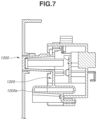
  • FIG. 7 is a cross-section diagram illustrating a vicinity of a power button according to a modification example 1 of the first embodiment.
  • FIG. 8 a cross-section diagram illustrating a vicinity of a power button according to a modification example 2 of the first embodiment.
  • FIGS. 1 to 6 An embodiment according to the present disclosure will be described with reference to FIGS. 1 to 6 .
  • FIG. 1 is a cross-section diagram schematically illustrating an image forming apparatus 100 according to a first embodiment.
  • a laser beam printer serving as an example of the present disclosure includes an image forming unit for forming an image, a sheet feeding device for separating sheets one by one and feeding the sheet to the image forming unit, a laser scanner unit, a fixing device, and a discharge tray.
  • the image forming unit includes a process cartridge attachable to and detachable from a main body of the laser beam printer, and a transfer roller. Further, the process cartridge includes a photosensitive drum, a charging roller, a developing unit, and a cleaning unit.
  • a sheet feeding roller 111 rotates to convey a sheet S stacked in a sheet feeding cassette 118 to a transfer roller 113 by a conveyance roller pair 112 .
  • an electrostatic latent image is formed on a photosensitive drum 114 by an exposure performed by a laser unit (not illustrated) based on the print instruction and the image information.
  • a toner image is formed on the photosensitive drum 114 by a developing unit (not illustrated).
  • the toner image is transferred onto the sheet S to form an image on the sheet S at a nip portion formed by the photosensitive drum 114 and the transfer roller 113 .
  • the sheet S is conveyed to a fixing device 115 and the image is fixed onto the sheet S.
  • the sheet S is discharged onto a discharge tray by a sheet discharge roller pair 116 .
  • the sheet S is conveyed to the fixing device 115 and then reversed by the sheet discharge roller pair 116 .
  • the sheet S passes through a both-surface path 117 , and is discharged after an image is formed on a side of the sheet S on which no image has been formed.
  • the sheet S is discharged by the sheet discharge roller pair 116 in a direction indicated by an arrow illustrated in FIG. 1 .
  • FIG. 2 is a perspective view illustrating an external appearance of the image forming apparatus 100 .
  • the power button 200 is provided at an upper right on the front side of the image forming apparatus 100 .
  • the rightward direction on the sheet surface in each of FIGS. 3 and 5 is defined as a first direction
  • the downward direction, which is orthogonal to the first direction, on the sheet surface in each of FIGS. 3 and 5 is defined as a second direction.
  • the X direction in FIG. 3 is the first direction
  • the Y direction in FIG. 3 is the second direction.
  • the discharge direction in which the sheet S with an image formed thereon is discharged intersects with the second direction.
  • FIG. 3 is a cross-section diagram illustrating an area in the vicinity of the power button 200 when viewed from a side
  • FIG. 4 is a perspective view illustrating a relationship between the power button 200 and a frame 130
  • An outer casing 120 of the image forming apparatus 100 includes a surface in which the power button 200 is arranged, the surface of the outer casing 120 extends in the second direction.
  • the power button 200 includes a pressed portion 201 (portion to be pressed), a side peripheral portion 202 , a light guide 203 , a contact portion 204 , and a support portion 205 .
  • One end of the support portion 205 is positioned by the frame 130 of an apparatus main body to support the power button 200 .
  • the frame 130 serves as a regulation member that supports the power button 200 and regulates the position of the power button 200 .
  • the support portion 205 includes curved portions 205 b and 205 c as deformable portions, and a regulated portion (portion to be regulated) 205 g.
  • the pressed portion 201 forms a part of an exterior of the image forming apparatus 100 , and the image forming apparatus 100 is powered ON/OFF by pressing the pressed portion 201 .
  • the light guide 203 has a role of transmitting light emitted from a light-emitting diode (LED) 152 to be described below to the pressed portion 201 .
  • the contact portion 204 extends from the support portion 205 in the first direction, and has a role of coming into contact with a contacted portion (portion to be contacted to) 151 to be described below when the pressed portion 201 is pressed. In other words, it can be said that the pressed portion 201 and the side peripheral portion 202 is supported by the support portion 205 .
  • the frame 130 includes an upper portion 130 a , a bottom portion 130 b , a rear end portion 130 c , and a holding portion 130 d as regulation portions.
  • the rear end portion 130 c is located on an extended line of the regulated portion 205 g , and the upper portion 130 a and the bottom portion 130 b face each other and are connected by the rear end portion 130 c .
  • a held portion (portion to be held) 205 a of the regulated portion 205 g comes into contact with the holding portion 130 d and then own weight of the power button 200 is received.
  • the side peripheral portion 202 includes a protruding portion 202 a .
  • a force for tilting the power button 200 in the left direction in FIG. 3 is applied to the power button 200 due to its own weight.
  • the force for tilting the power button 200 in the left direction due to its own weight is received by the protruding portion 202 a being in contact with the outer casing 120 of the apparatus main body.
  • the position of the power button 200 at this time is defined as a first position.
  • the contact portion 204 is not in contact with the contacted portion 151 . Further, the power button 200 is positioned at the first position by, the held portion 205 a being in contact with the holding portion 130 d , and the protruding portion 202 a being in contact with the outer casing 120 .
  • the substrate 150 includes the contacted portion 151 and the LED 152 serving as an emission unit.
  • the contacted portion 151 and the contact portion 204 come into contact with each other when the pressed portion 201 is pressed, and the contacted portion 151 has a role of receiving an instruction to turn ON/OFF the power of the image forming apparatus 100 .
  • the contacted portion 151 is a switch element.
  • the LED 152 is controlled to switch the light emission state based on the state of the image forming apparatus 100 , and has a role of displaying the state of the image forming apparatus 100 to users.
  • FIG. 5 is a cross-section diagram illustrating the state where the power button 200 is pressed.
  • FIG. 6 is a perspective view illustrating the power button 200 .
  • the regulated portion 205 g is regulated by the frame 130 of the apparatus main body so that the power button 200 is allowed to tilt in directions of clockwise rotation and counterclockwise rotation in FIG. 5 .
  • the regulated portion 205 g extends horizontally, and a gap is formed between the upper portion 130 a and the bottom portion 130 b of the frame 130 so that the regulated portion 205 g can tilt clockwise and counterclockwise.
  • the power button 200 rotates clockwise in FIG. 5 with the held portion 205 a as a center. Then, as illustrated in FIG. 5 , the movement of the power button 200 in the first direction is regulated by a part of the support portion 205 abutting on the upper portion 130 a . More specifically, an abutting portion 205 h of the support portion 205 is in contact with an abutted portion (portion to be abutted) 130 e of the frame 130 .
  • the movement of the power button 200 in the first direction may be regulated by a method of, for example, causing the regulated portion 205 g to come into contact with the rear end portion 130 c .
  • the position at which the movement of the power button 200 is regulated in the first direction by the upper portion 130 a being in contact with the support portion 205 is located at a position nearer to the pressed portion 201 than to the contacted portion 151 in the first direction.
  • a side sliding portion 202 b of the side peripheral portion 202 moves in an upper right direction in FIG. 5 and comes into contact with a casing sliding portion 120 a of the outer casing 120 .
  • a force in the second direction is applied to the support portion 205 when the side sliding portion 202 b and the casing sliding portion 120 a come into contact with each other and slide with each other.
  • the curved portions 205 b and 205 c deform to curve so that the pressed portion 201 moves in the second direction.
  • This deformation enables the frictional force between the side sliding portion 202 b and the casing sliding portion 120 a to be smaller, and the power button 200 to be pushed in.
  • the pressed portion 201 moves in the first direction.
  • the contact portion 204 and the contacted portion 151 are bought into contact with each other.
  • the power ON/OFF of the image forming apparatus 100 can be switched by the contact portion 204 coming into contact with the contacted portion 151 .
  • the position of the power button 200 in a state where the contact portion 204 is in contact with the contacted portion 151 is defined as a second position.
  • the power button 200 moves to the first position due to its own weight.
  • the held portion 205 a , the deformable portion, and the pressed portion 201 are arranged in this order when viewed from one end side of the support portion 205 along the portion forming the power button 200 .
  • the support portion 205 includes a straight portion 205 d extending in the second direction.
  • a thickness T1 of the deformable portion and the vicinity of the deformable portion is thinner than a thickness T2 of the straight portion 205 d (i.e., T1 ⁇ T2), and has an easily deformable shape. More specifically, since the deformable portion is lower in stiffness than the straight portion 205 d , the deformable portion can be deformed easier than the straight portion 205 d when the force is applied the support portion 205 in the second direction.
  • a width L1 in the deformable portion and the vicinity of the deformable portion is less than a width L2 of the straight portion 205 d (i.e., L1 ⁇ L2).
  • This configuration enables elastic deformation to easily occur in the portion so that the operability of the power button 200 is improved while keeping the durability of the support portion 205 .
  • the curved portions 205 b and 205 c form a portion between a portion of the support portion 205 extending in the first direction and a portion thereof extending in the direction opposite to the first direction.
  • the straight portion 205 d is provided on only one side of the pressed portion 201 in the second direction. More specifically, the held portion 205 a and the curved portions 205 b and 205 c are provided on only one side of the pressed portion 201 in the second direction. In this way, even in a case where there is little space in the vicinity the power button 200 , the support portion 205 can be provided in an empty space. Further, since the power button 200 is returned to the first position by the elastic force of the support portion 205 and no dedicated spring member is used, the number of components constituting the power button 200 can be reduced.
  • FIG. 7 is a cross-section diagram illustrating a vicinity of a power button 1200 according to the modification example 1 of the first embodiment.
  • a deformable portion 1205 e may have any shape.
  • a support portion 1205 is configured to form a hollow circular shape.
  • FIG. 8 is a cross-section diagram illustrating a vicinity of a power button 2200 according to the modification example 2 of the first embodiment.
  • the power button 2200 is rotatable with a rotational portion 2205 f of a support portion 2205 as a center.
  • the power button 2200 is urged due to its own weight in the direction opposite to the first direction, which is the left direction in FIG. 8 , (i.e., a force for tilting in the direction opposite to the first direction is applied to the power button 2200 ).

Landscapes

  • Physics & Mathematics (AREA)
  • General Physics & Mathematics (AREA)
  • Engineering & Computer Science (AREA)
  • Microelectronics & Electronic Packaging (AREA)
  • Electrophotography Configuration And Component (AREA)
  • Accessory Devices And Overall Control Thereof (AREA)
  • Push-Button Switches (AREA)

Abstract

An image forming apparatus incudes an outer casing, a button portion including a pressed portion, a support portion and a deformable portion, and a regulation portion configured to come into contact with the support portion to regulate a position of the button portion. The button portion is movable from a first positon to a second position when the pressed portion is pressed. When the button portion is moved from the first position to the second position, the outer casing of the image forming apparatus slides with the button portion and a force is applied in a second direction orthogonal to a first direction to cause the deformable portion of the support portion to deform and the button portion to move in the second direction.

Description

CROSS REFERENCE TO RELATED APPLICATIONS
This application claims the benefit of priority from Japanese Patent Application No. 2022-026376, filed Feb. 24, 2022, which is hereby incorporated by reference herein in its entirety.
BACKGROUND Field of the Disclosure
The present disclosure relates to an image forming apparatus.
Description of the Related Art
Conventionally, an image forming apparatus such as an electrophotographic printer (e.g., electrophotographic copying machine, light-emitting diode (LED) printer, and laser beam printer), an electrophotographic facsimile machine, and an electrophotographic word processor have been often configured to include mechanical buttons because the configuration using mechanical buttons is inexpensive.
For example, there is a configuration in which a dedicated spring is used to return a power button to its original position as discussed in Japanese Patent Application No. 10-14158.
If a dedicated spring is used for configuring a button, there may be an issue that the number of components constituting an image forming apparatus may increase.
SUMMARY
According to an aspect of the present disclosure, an image forming apparatus configured to form an image on a sheet includes an outer casing including a surface extending in a second direction that is orthogonal to a first direction, a substrate provided with a contacted portion, a button portion, including a pressed portion forming an exterior of the image forming apparatus together with the outer casing, a support portion configured to support the pressed portion and including a deformable portion configured to deform in the second direction, and a contact portion extending from the support portion in the first direction and configured to come into contact with the contacted portion, and the button portion configured to move from a first position at which the contact portion is not in contact with the contacted portion to a second position at which the contact portion is in contact with the contacted portion by the pressed portion being pressed in the first direction, and a regulation portion configured to come into contact with the support portion and regulate a position of the button portion, wherein when the pressed portion is pressed in the first direction and the button portion is caused to rotate, a part of the support portion is regulated by the regulation portion and the button portion and the outer casing slide with each other, and wherein when a force in the second direction is applied to the deformable portion due to sliding between the button portion and the outer casing and the deformable portion is caused to deform, the button portion is moved to the second position.
Further features of the present disclosure will become apparent from the following description of embodiments with reference to the attached drawings.
BRIEF DESCRIPTION OF THE DRAWINGS
FIG. 1 is a cross-section diagram schematically illustrating an image forming apparatus according to a first embodiment.
FIG. 2 is a perspective view illustrating an external appearance of the image forming apparatus according to the first embodiment.
FIG. 3 is a cross-section diagram illustrating a power button viewed from a side, according to the first embodiment.
FIG. 4 is a perspective view illustrating a relationship between the power button and a frame, according to the first embodiment.
FIG. 5 is a cross-section diagram illustrating a state where the power button is pressed, according to the first embodiment.
FIG. 6 is a perspective view illustrating the power button according to the first embodiment.
FIG. 7 is a cross-section diagram illustrating a vicinity of a power button according to a modification example 1 of the first embodiment.
FIG. 8 a cross-section diagram illustrating a vicinity of a power button according to a modification example 2 of the first embodiment.
DESCRIPTION OF THE EMBODIMENTS
An embodiment according to the present disclosure will be described with reference to FIGS. 1 to 6 .
FIG. 1 is a cross-section diagram schematically illustrating an image forming apparatus 100 according to a first embodiment. A laser beam printer serving as an example of the present disclosure includes an image forming unit for forming an image, a sheet feeding device for separating sheets one by one and feeding the sheet to the image forming unit, a laser scanner unit, a fixing device, and a discharge tray. The image forming unit includes a process cartridge attachable to and detachable from a main body of the laser beam printer, and a transfer roller. Further, the process cartridge includes a photosensitive drum, a charging roller, a developing unit, and a cleaning unit.
When image information is transmitted from a personal computer or the like, and a control unit that has performed image forming processing on the image information issues a print instruction, as illustrated in FIG. 1 , a sheet feeding roller 111 rotates to convey a sheet S stacked in a sheet feeding cassette 118 to a transfer roller 113 by a conveyance roller pair 112. On the other hand, an electrostatic latent image is formed on a photosensitive drum 114 by an exposure performed by a laser unit (not illustrated) based on the print instruction and the image information. Further, a toner image is formed on the photosensitive drum 114 by a developing unit (not illustrated).
Then, the toner image is transferred onto the sheet S to form an image on the sheet S at a nip portion formed by the photosensitive drum 114 and the transfer roller 113. Then, the sheet S is conveyed to a fixing device 115 and the image is fixed onto the sheet S. Then, the sheet S is discharged onto a discharge tray by a sheet discharge roller pair 116. Further, in a case of duplex printing, the sheet S is conveyed to the fixing device 115 and then reversed by the sheet discharge roller pair 116. The sheet S passes through a both-surface path 117, and is discharged after an image is formed on a side of the sheet S on which no image has been formed. In addition, in the configuration according to the present embodiment, the sheet S is discharged by the sheet discharge roller pair 116 in a direction indicated by an arrow illustrated in FIG. 1 .
Next, with reference to FIGS. 2 to 6 , a configuration of a button according to the present embodiment will be described using a power button (button portion) 200 as an example of the button of the image forming apparatus 100. FIG. 2 is a perspective view illustrating an external appearance of the image forming apparatus 100. As illustrated in FIG. 2 , the power button 200 is provided at an upper right on the front side of the image forming apparatus 100.
For the convenience of explanation, the rightward direction on the sheet surface in each of FIGS. 3 and 5 is defined as a first direction, and the downward direction, which is orthogonal to the first direction, on the sheet surface in each of FIGS. 3 and 5 is defined as a second direction. More specifically, the X direction in FIG. 3 is the first direction, and the Y direction in FIG. 3 is the second direction. The discharge direction in which the sheet S with an image formed thereon is discharged intersects with the second direction.
FIG. 3 is a cross-section diagram illustrating an area in the vicinity of the power button 200 when viewed from a side, and FIG. 4 is a perspective view illustrating a relationship between the power button 200 and a frame 130. An outer casing 120 of the image forming apparatus 100 includes a surface in which the power button 200 is arranged, the surface of the outer casing 120 extends in the second direction. The power button 200 includes a pressed portion 201 (portion to be pressed), a side peripheral portion 202, a light guide 203, a contact portion 204, and a support portion 205. One end of the support portion 205 is positioned by the frame 130 of an apparatus main body to support the power button 200. In other words, the frame 130 serves as a regulation member that supports the power button 200 and regulates the position of the power button 200. The support portion 205 includes curved portions 205 b and 205 c as deformable portions, and a regulated portion (portion to be regulated) 205 g.
The pressed portion 201 forms a part of an exterior of the image forming apparatus 100, and the image forming apparatus 100 is powered ON/OFF by pressing the pressed portion 201. The light guide 203 has a role of transmitting light emitted from a light-emitting diode (LED) 152 to be described below to the pressed portion 201. The contact portion 204 extends from the support portion 205 in the first direction, and has a role of coming into contact with a contacted portion (portion to be contacted to) 151 to be described below when the pressed portion 201 is pressed. In other words, it can be said that the pressed portion 201 and the side peripheral portion 202 is supported by the support portion 205.
The frame 130 and the regulated portion 205 g will be described in detail. As illustrated in FIG. 3 , the frame 130 includes an upper portion 130 a, a bottom portion 130 b, a rear end portion 130 c, and a holding portion 130 d as regulation portions. The rear end portion 130 c is located on an extended line of the regulated portion 205 g, and the upper portion 130 a and the bottom portion 130 b face each other and are connected by the rear end portion 130 c. A held portion (portion to be held) 205 a of the regulated portion 205 g comes into contact with the holding portion 130 d and then own weight of the power button 200 is received.
The side peripheral portion 202 includes a protruding portion 202 a. Normally, a force for tilting the power button 200 in the left direction in FIG. 3 is applied to the power button 200 due to its own weight. However, the force for tilting the power button 200 in the left direction due to its own weight is received by the protruding portion 202 a being in contact with the outer casing 120 of the apparatus main body. With this configuration, it is possible to increase the accuracy of the surface forming the exterior of the image forming apparatus 100 which is formed by the outer casing 120 and the pressed portion 201. In addition, the position of the power button 200 at this time is defined as a first position. When the power button 200 is at the first position, the contact portion 204 is not in contact with the contacted portion 151. Further, the power button 200 is positioned at the first position by, the held portion 205 a being in contact with the holding portion 130 d, and the protruding portion 202 a being in contact with the outer casing 120.
Next, a substrate 150 provided in the apparatus main body will be described. The substrate 150 includes the contacted portion 151 and the LED 152 serving as an emission unit. The contacted portion 151 and the contact portion 204 come into contact with each other when the pressed portion 201 is pressed, and the contacted portion 151 has a role of receiving an instruction to turn ON/OFF the power of the image forming apparatus 100. Specifically, the contacted portion 151 is a switch element. The LED 152 is controlled to switch the light emission state based on the state of the image forming apparatus 100, and has a role of displaying the state of the image forming apparatus 100 to users.
Next, with reference to FIGS. 5 and 6 , a state where the power button 200 is pressed will be described. FIG. 5 is a cross-section diagram illustrating the state where the power button 200 is pressed. FIG. 6 is a perspective view illustrating the power button 200. In FIG. 6 , the regulated portion 205 g is regulated by the frame 130 of the apparatus main body so that the power button 200 is allowed to tilt in directions of clockwise rotation and counterclockwise rotation in FIG. 5 . In other words, in FIG. 3 , the regulated portion 205 g extends horizontally, and a gap is formed between the upper portion 130 a and the bottom portion 130 b of the frame 130 so that the regulated portion 205 g can tilt clockwise and counterclockwise.
When the pressed portion 201 is pressed in the first direction, the power button 200 rotates clockwise in FIG. 5 with the held portion 205 a as a center. Then, as illustrated in FIG. 5 , the movement of the power button 200 in the first direction is regulated by a part of the support portion 205 abutting on the upper portion 130 a. More specifically, an abutting portion 205 h of the support portion 205 is in contact with an abutted portion (portion to be abutted) 130 e of the frame 130. However, the movement of the power button 200 in the first direction may be regulated by a method of, for example, causing the regulated portion 205 g to come into contact with the rear end portion 130 c. In the present embodiment, the position at which the movement of the power button 200 is regulated in the first direction by the upper portion 130 a being in contact with the support portion 205 is located at a position nearer to the pressed portion 201 than to the contacted portion 151 in the first direction.
Further, when the pressed portion 201 is pressed in the first direction, a side sliding portion 202 b of the side peripheral portion 202 moves in an upper right direction in FIG. 5 and comes into contact with a casing sliding portion 120 a of the outer casing 120. A force in the second direction is applied to the support portion 205 when the side sliding portion 202 b and the casing sliding portion 120 a come into contact with each other and slide with each other.
When the force is applied to the support portion 205 in the second direction, the curved portions 205 b and 205 c deform to curve so that the pressed portion 201 moves in the second direction. This deformation enables the frictional force between the side sliding portion 202 b and the casing sliding portion 120 a to be smaller, and the power button 200 to be pushed in. Thus, the pressed portion 201 moves in the first direction. When the power button 200 is pushed in, the contact portion 204 and the contacted portion 151 are bought into contact with each other. The power ON/OFF of the image forming apparatus 100 can be switched by the contact portion 204 coming into contact with the contacted portion 151. The position of the power button 200 in a state where the contact portion 204 is in contact with the contacted portion 151 is defined as a second position.
When the force applied to the pressed portion 201 in the first direction is released by, for example, releasing the user's finger from the power button 200, the power button 200 moves to the first position due to its own weight. Further, in the present embodiment, the held portion 205 a, the deformable portion, and the pressed portion 201 are arranged in this order when viewed from one end side of the support portion 205 along the portion forming the power button 200.
With reference to FIG. 6 , a configuration of the support portion 205 will be described. The support portion 205 includes a straight portion 205 d extending in the second direction. A thickness T1 of the deformable portion and the vicinity of the deformable portion is thinner than a thickness T2 of the straight portion 205 d (i.e., T1<T2), and has an easily deformable shape. More specifically, since the deformable portion is lower in stiffness than the straight portion 205 d, the deformable portion can be deformed easier than the straight portion 205 d when the force is applied the support portion 205 in the second direction.
Further, a width L1 in the deformable portion and the vicinity of the deformable portion is less than a width L2 of the straight portion 205 d (i.e., L1<L2). This configuration enables elastic deformation to easily occur in the portion so that the operability of the power button 200 is improved while keeping the durability of the support portion 205. In the present embodiment, the curved portions 205 b and 205 c form a portion between a portion of the support portion 205 extending in the first direction and a portion thereof extending in the direction opposite to the first direction.
Further, in the present embodiment, the straight portion 205 d is provided on only one side of the pressed portion 201 in the second direction. More specifically, the held portion 205 a and the curved portions 205 b and 205 c are provided on only one side of the pressed portion 201 in the second direction. In this way, even in a case where there is little space in the vicinity the power button 200, the support portion 205 can be provided in an empty space. Further, since the power button 200 is returned to the first position by the elastic force of the support portion 205 and no dedicated spring member is used, the number of components constituting the power button 200 can be reduced.
Next, with reference to FIG. 7 , a modification example 1 of the first embodiment will be described. FIG. 7 is a cross-section diagram illustrating a vicinity of a power button 1200 according to the modification example 1 of the first embodiment. As illustrated in FIG. 7 , a deformable portion 1205 e may have any shape. In the modification example 1, a support portion 1205 is configured to form a hollow circular shape.
Further, with reference to FIG. 8 , a modification example 2 of the first embodiment will be described. FIG. 8 is a cross-section diagram illustrating a vicinity of a power button 2200 according to the modification example 2 of the first embodiment. In the modification example 2, the power button 2200 is rotatable with a rotational portion 2205 f of a support portion 2205 as a center. At this time, the power button 2200 is urged due to its own weight in the direction opposite to the first direction, which is the left direction in FIG. 8 , (i.e., a force for tilting in the direction opposite to the first direction is applied to the power button 2200).
As described above, with the configurations described in the present embodiment, it is possible to reduce the number of components constituting the power button 2200.
According to the present disclosure, it is possible to provide an image forming apparatus in which a button can be moved without using a dedicated spring member.
While the present disclosure has been described with reference to embodiments, it is to be understood that the disclosure is not limited to the disclosed embodiments. The scope of the following claims is to be accorded the broadest interpretation so as to encompass all such modifications and equivalent structures and functions.

Claims (11)

What is claimed is:
1. An image forming apparatus configured to form an image on a sheet, the image forming apparatus comprising:
an outer casing including a surface extending in a second direction that is orthogonal to a first direction;
a substrate provided with a switch element;
a button portion, including (i) a pressed portion exposed to outside of the outer casing and forming an exterior of the image forming apparatus together with the outer casing, ii) a support portion connecting with the pressed portion and including a curved portion configured to deform in the second direction and a regulated portion, and (iii) a contact projection extending from the support portion in the first direction and configured to come into contact with the switch element, and the button portion configured to move from a first position at which the contact projection is not in contact with the switch element to a second position at which the contact projection is in contact with the switch element portion by the pressed portion being pressed in the first direction; and
a regulation portion configured to come into contact with the regulated portion such that the button portion is supported by the regulation portion and regulate a position of the button portion, the regulation portion including a first portion and a second portion, the first portion and the second portion face each other such that a gap is formed between the first portion and the second portion,
wherein the regulated portion is inserted to the gap such that the button portion is tiltable relative to the regulation portion, and when the pressed portion is pressed in the first direction, the button portion slidably contacts the outer casing, and
wherein when the button is moved to the second position, a force in the second direction is applied to the curved portion due to sliding between the button portion and the outer casing and the curved portion is caused to deform.
2. The image forming apparatus according to claim 1, wherein the substrate includes a light emitting unit, and the button portion includes a light guide that transmits the light emitted from the light emitting unit.
3. The image forming apparatus according to claim 1, wherein a direction in which the sheet with the image formed thereon is discharged intersects with the second direction.
4. The image forming apparatus according to claim 1, wherein the support portion includes a straight portion extending in the second direction, and the curved portion has a smaller thickness and a smaller width than those of the straight portion.
5. The image forming apparatus according to claim 1, wherein the curved portion forms a portion between a portion of the support portion extending in the first direction and a portion of the support portion extending in a direction opposite to the first direction.
6. The image forming apparatus according to claim 1, wherein the curved portion is disposed between the contact projection and the regulated portion.
7. The image forming apparatus according to claim 6, wherein the contact projection is disposed between the pressed portion and the curved portion.
8. The image forming apparatus according to claim 7, wherein the contact projection and the curved portion are disposed between the pressed portion and the regulated portion.
9. The image forming apparatus according to claim 8, wherein the contact projection is closer to the pressed portion than to the regulated portion, and the curved portion is closer to the regulated portion than to the pressed portion.
10. The image forming apparatus according to claim 1, further comprising a frame including the regulation portion.
11. The image forming apparatus according to claim 1, wherein the curved portion includes a first curved portion and a second curved portion.
US18/164,503 2022-02-24 2023-02-03 Image forming apparatus including button portion exposed to outside of casing Active US12124207B2 (en)

Applications Claiming Priority (2)

Application Number Priority Date Filing Date Title
JP2022-026376 2022-02-24
JP2022026376A JP7781669B2 (en) 2022-02-24 2022-02-24 Image forming device

Publications (2)

Publication Number Publication Date
US20230266697A1 US20230266697A1 (en) 2023-08-24
US12124207B2 true US12124207B2 (en) 2024-10-22

Family

ID=87574264

Family Applications (1)

Application Number Title Priority Date Filing Date
US18/164,503 Active US12124207B2 (en) 2022-02-24 2023-02-03 Image forming apparatus including button portion exposed to outside of casing

Country Status (2)

Country Link
US (1) US12124207B2 (en)
JP (1) JP7781669B2 (en)

Citations (3)

* Cited by examiner, † Cited by third party
Publication number Priority date Publication date Assignee Title
JPH1014158A (en) 1996-06-25 1998-01-16 Toshiba Corp Shaft sealing device for rotating electric machines
US20100116637A1 (en) * 2008-11-12 2010-05-13 Hiromi Kano Button-key structure and electric device having the same
US20200065038A1 (en) * 2018-08-24 2020-02-27 Kyocera Document Solutions Inc. Operation switch device, image forming apparatus

Family Cites Families (3)

* Cited by examiner, † Cited by third party
Publication number Priority date Publication date Assignee Title
JP3984694B2 (en) * 1998-01-27 2007-10-03 キヤノン株式会社 Image forming apparatus
JP4508734B2 (en) 2004-06-15 2010-07-21 株式会社オートネットワーク技術研究所 Operation button device
JP2006150871A (en) 2004-11-30 2006-06-15 Seiko Epson Corp Button switch member and button switch

Patent Citations (3)

* Cited by examiner, † Cited by third party
Publication number Priority date Publication date Assignee Title
JPH1014158A (en) 1996-06-25 1998-01-16 Toshiba Corp Shaft sealing device for rotating electric machines
US20100116637A1 (en) * 2008-11-12 2010-05-13 Hiromi Kano Button-key structure and electric device having the same
US20200065038A1 (en) * 2018-08-24 2020-02-27 Kyocera Document Solutions Inc. Operation switch device, image forming apparatus

Also Published As

Publication number Publication date
JP7781669B2 (en) 2025-12-08
US20230266697A1 (en) 2023-08-24
JP2023122719A (en) 2023-09-05

Similar Documents

Publication Publication Date Title
US8385800B2 (en) Fixing device for image forming device, capable of adjusting nip force between heating roller and pressure roller
EP2469349B1 (en) Process unit and image-forming device using process unit
US8403318B2 (en) Apparatus for detecting amount of remaining sheets and image forming apparatus including the same
JP6347181B2 (en) Sheet placing apparatus and image forming apparatus
US10315878B2 (en) Sheet conveying device, sheet discharging device incorporating the sheet conveying device and image forming apparatus incorporating the sheet conveying device and the sheet discharging device
JP4023468B2 (en) Image forming apparatus and cartridge
US12124207B2 (en) Image forming apparatus including button portion exposed to outside of casing
JP4850888B2 (en) Button key structure and electronic device
JP5240314B2 (en) Image forming apparatus
US12339485B2 (en) Display device, operating device and image forming apparatus
EP2372460B1 (en) Image-forming device
JP5381750B2 (en) Image forming apparatus
US8807560B2 (en) Recording sheet guide structure and cartridge
JP5277627B2 (en) Image forming apparatus
US7817926B2 (en) Image forming apparatus and optional sheet feeding device
JP5098900B2 (en) Image forming apparatus
JP2010250206A (en) Transfer device and image forming apparatus provided with the transfer device
JPH08157077A (en) Paper feed cassette and image forming apparatus
JP2006131348A (en) Sheet conveying apparatus and image forming apparatus
JP2022037755A (en) Input device and image forming device
JP2002154695A (en) Image forming device
JP5093002B2 (en) Image forming apparatus
JP2023152160A (en) Image forming device
CN120522989A (en) Sheet feeding device and image forming device
JP2014026095A (en) Recording sheet guide structure and cartridge

Legal Events

Date Code Title Description
FEPP Fee payment procedure

Free format text: ENTITY STATUS SET TO UNDISCOUNTED (ORIGINAL EVENT CODE: BIG.); ENTITY STATUS OF PATENT OWNER: LARGE ENTITY

AS Assignment

Owner name: CANON KABUSHIKI KAISHA, JAPAN

Free format text: ASSIGNMENT OF ASSIGNORS INTEREST;ASSIGNOR:YAMAMOTO, DAISUKE;REEL/FRAME:062896/0734

Effective date: 20230124

STPP Information on status: patent application and granting procedure in general

Free format text: DOCKETED NEW CASE - READY FOR EXAMINATION

STPP Information on status: patent application and granting procedure in general

Free format text: NON FINAL ACTION MAILED

STPP Information on status: patent application and granting procedure in general

Free format text: RESPONSE TO NON-FINAL OFFICE ACTION ENTERED AND FORWARDED TO EXAMINER

STPP Information on status: patent application and granting procedure in general

Free format text: NOTICE OF ALLOWANCE MAILED -- APPLICATION RECEIVED IN OFFICE OF PUBLICATIONS

STPP Information on status: patent application and granting procedure in general

Free format text: PUBLICATIONS -- ISSUE FEE PAYMENT VERIFIED

STCF Information on status: patent grant

Free format text: PATENTED CASE