US12120832B2 - Air-permeable member with removable protective film for covering ventilation hole - Google Patents
Air-permeable member with removable protective film for covering ventilation hole Download PDFInfo
- Publication number
- US12120832B2 US12120832B2 US17/442,242 US202017442242A US12120832B2 US 12120832 B2 US12120832 B2 US 12120832B2 US 202017442242 A US202017442242 A US 202017442242A US 12120832 B2 US12120832 B2 US 12120832B2
- Authority
- US
- United States
- Prior art keywords
- porous membrane
- protective film
- ventilation hole
- provisional protective
- tape
- Prior art date
- Legal status (The legal status is an assumption and is not a legal conclusion. Google has not performed a legal analysis and makes no representation as to the accuracy of the status listed.)
- Active, expires
Links
- 230000001681 protective effect Effects 0.000 title claims abstract description 160
- 238000009423 ventilation Methods 0.000 title claims abstract description 108
- 239000012528 membrane Substances 0.000 claims abstract description 206
- 230000035699 permeability Effects 0.000 claims abstract description 49
- 239000000428 dust Substances 0.000 claims abstract description 13
- 239000007788 liquid Substances 0.000 claims abstract description 12
- 239000000853 adhesive Substances 0.000 claims description 88
- 230000001070 adhesive effect Effects 0.000 claims description 88
- 239000000758 substrate Substances 0.000 claims description 57
- 239000012790 adhesive layer Substances 0.000 claims description 50
- 238000000034 method Methods 0.000 claims description 43
- 239000002390 adhesive tape Substances 0.000 claims description 26
- 239000004810 polytetrafluoroethylene Substances 0.000 claims description 22
- 229920001343 polytetrafluoroethylene Polymers 0.000 claims description 22
- 230000007423 decrease Effects 0.000 claims description 21
- 239000000463 material Substances 0.000 claims description 21
- 229920005989 resin Polymers 0.000 claims description 17
- 239000011347 resin Substances 0.000 claims description 17
- 238000004519 manufacturing process Methods 0.000 claims description 14
- -1 polytetrafluoroethylene Polymers 0.000 claims description 11
- 239000002904 solvent Substances 0.000 claims description 10
- 230000002093 peripheral effect Effects 0.000 claims description 8
- 229920000728 polyester Polymers 0.000 claims description 6
- YCKRFDGAMUMZLT-UHFFFAOYSA-N Fluorine atom Chemical compound [F] YCKRFDGAMUMZLT-UHFFFAOYSA-N 0.000 claims description 5
- 239000004696 Poly ether ether ketone Substances 0.000 claims description 5
- 239000004962 Polyamide-imide Substances 0.000 claims description 5
- 239000004642 Polyimide Substances 0.000 claims description 5
- 229910052731 fluorine Inorganic materials 0.000 claims description 5
- 239000011737 fluorine Substances 0.000 claims description 5
- 229920002312 polyamide-imide Polymers 0.000 claims description 5
- 229920002530 polyetherether ketone Polymers 0.000 claims description 5
- 229920001721 polyimide Polymers 0.000 claims description 5
- 229920006015 heat resistant resin Polymers 0.000 claims description 2
- XLYOFNOQVPJJNP-UHFFFAOYSA-N water Substances O XLYOFNOQVPJJNP-UHFFFAOYSA-N 0.000 description 36
- 238000005259 measurement Methods 0.000 description 25
- 238000012360 testing method Methods 0.000 description 17
- 238000011282 treatment Methods 0.000 description 14
- 230000002950 deficient Effects 0.000 description 11
- 238000000926 separation method Methods 0.000 description 11
- 229910052751 metal Inorganic materials 0.000 description 8
- 239000002184 metal Substances 0.000 description 8
- 239000005871 repellent Substances 0.000 description 8
- 238000005187 foaming Methods 0.000 description 7
- 229920000139 polyethylene terephthalate Polymers 0.000 description 7
- 239000005020 polyethylene terephthalate Substances 0.000 description 7
- 230000000052 comparative effect Effects 0.000 description 6
- 238000005304 joining Methods 0.000 description 6
- 239000000047 product Substances 0.000 description 6
- 238000003466 welding Methods 0.000 description 6
- 230000006866 deterioration Effects 0.000 description 5
- 238000011156 evaluation Methods 0.000 description 5
- 239000013067 intermediate product Substances 0.000 description 5
- 239000004698 Polyethylene Substances 0.000 description 4
- 239000004743 Polypropylene Substances 0.000 description 4
- 239000002131 composite material Substances 0.000 description 4
- 230000000694 effects Effects 0.000 description 4
- 229920000573 polyethylene Polymers 0.000 description 4
- 229920000098 polyolefin Polymers 0.000 description 4
- 229920001155 polypropylene Polymers 0.000 description 4
- 230000008569 process Effects 0.000 description 4
- 230000004044 response Effects 0.000 description 4
- 230000002269 spontaneous effect Effects 0.000 description 4
- 229910001220 stainless steel Inorganic materials 0.000 description 4
- 239000010935 stainless steel Substances 0.000 description 4
- 239000004952 Polyamide Substances 0.000 description 3
- 229910052782 aluminium Inorganic materials 0.000 description 3
- XAGFODPZIPBFFR-UHFFFAOYSA-N aluminium Chemical compound [Al] XAGFODPZIPBFFR-UHFFFAOYSA-N 0.000 description 3
- 238000000354 decomposition reaction Methods 0.000 description 3
- 230000003247 decreasing effect Effects 0.000 description 3
- 229920002647 polyamide Polymers 0.000 description 3
- 239000004417 polycarbonate Substances 0.000 description 3
- 229920000515 polycarbonate Polymers 0.000 description 3
- 239000011148 porous material Substances 0.000 description 3
- JOYRKODLDBILNP-UHFFFAOYSA-N Ethyl urethane Chemical compound CCOC(N)=O JOYRKODLDBILNP-UHFFFAOYSA-N 0.000 description 2
- 239000004793 Polystyrene Substances 0.000 description 2
- 230000008901 benefit Effects 0.000 description 2
- 230000008859 change Effects 0.000 description 2
- 238000004040 coloring Methods 0.000 description 2
- 238000010586 diagram Methods 0.000 description 2
- 239000000835 fiber Substances 0.000 description 2
- 239000012634 fragment Substances 0.000 description 2
- 238000010438 heat treatment Methods 0.000 description 2
- 238000000399 optical microscopy Methods 0.000 description 2
- 239000002245 particle Substances 0.000 description 2
- 229920002223 polystyrene Polymers 0.000 description 2
- 238000012545 processing Methods 0.000 description 2
- 230000000717 retained effect Effects 0.000 description 2
- 231100000241 scar Toxicity 0.000 description 2
- 239000013464 silicone adhesive Substances 0.000 description 2
- 238000012546 transfer Methods 0.000 description 2
- 238000004804 winding Methods 0.000 description 2
- 239000003522 acrylic cement Substances 0.000 description 1
- 230000015572 biosynthetic process Effects 0.000 description 1
- 238000003486 chemical etching Methods 0.000 description 1
- 238000006243 chemical reaction Methods 0.000 description 1
- 238000004891 communication Methods 0.000 description 1
- 238000011109 contamination Methods 0.000 description 1
- 238000004132 cross linking Methods 0.000 description 1
- 230000008034 disappearance Effects 0.000 description 1
- 238000004090 dissolution Methods 0.000 description 1
- 229920006332 epoxy adhesive Polymers 0.000 description 1
- 238000001125 extrusion Methods 0.000 description 1
- 239000004744 fabric Substances 0.000 description 1
- 239000006260 foam Substances 0.000 description 1
- 239000012943 hotmelt Substances 0.000 description 1
- 238000009434 installation Methods 0.000 description 1
- 238000010884 ion-beam technique Methods 0.000 description 1
- 239000010410 layer Substances 0.000 description 1
- 239000011159 matrix material Substances 0.000 description 1
- 239000000155 melt Substances 0.000 description 1
- 238000002844 melting Methods 0.000 description 1
- 230000008018 melting Effects 0.000 description 1
- 239000000203 mixture Substances 0.000 description 1
- 239000004745 nonwoven fabric Substances 0.000 description 1
- 230000003287 optical effect Effects 0.000 description 1
- 230000000149 penetrating effect Effects 0.000 description 1
- 238000002360 preparation method Methods 0.000 description 1
- 239000011241 protective layer Substances 0.000 description 1
- 238000005476 soldering Methods 0.000 description 1
- 238000000859 sublimation Methods 0.000 description 1
- 230000008022 sublimation Effects 0.000 description 1
- 230000008961 swelling Effects 0.000 description 1
- 239000002759 woven fabric Substances 0.000 description 1
Images




Classifications
-
- H—ELECTRICITY
- H05—ELECTRIC TECHNIQUES NOT OTHERWISE PROVIDED FOR
- H05K—PRINTED CIRCUITS; CASINGS OR CONSTRUCTIONAL DETAILS OF ELECTRIC APPARATUS; MANUFACTURE OF ASSEMBLAGES OF ELECTRICAL COMPONENTS
- H05K5/00—Casings, cabinets or drawers for electric apparatus
- H05K5/02—Details
- H05K5/0213—Venting apertures; Constructional details thereof
- H05K5/0214—Venting apertures; Constructional details thereof with means preventing penetration of rain water or dust
-
- B—PERFORMING OPERATIONS; TRANSPORTING
- B01—PHYSICAL OR CHEMICAL PROCESSES OR APPARATUS IN GENERAL
- B01D—SEPARATION
- B01D63/00—Apparatus in general for separation processes using semi-permeable membranes
- B01D63/08—Flat membrane modules
- B01D63/081—Manufacturing thereof
-
- B—PERFORMING OPERATIONS; TRANSPORTING
- B01—PHYSICAL OR CHEMICAL PROCESSES OR APPARATUS IN GENERAL
- B01D—SEPARATION
- B01D65/00—Accessories or auxiliary operations, in general, for separation processes or apparatus using semi-permeable membranes
- B01D65/003—Membrane bonding or sealing
-
- B—PERFORMING OPERATIONS; TRANSPORTING
- B01—PHYSICAL OR CHEMICAL PROCESSES OR APPARATUS IN GENERAL
- B01D—SEPARATION
- B01D69/00—Semi-permeable membranes for separation processes or apparatus characterised by their form, structure or properties; Manufacturing processes specially adapted therefor
- B01D69/10—Supported membranes; Membrane supports
- B01D69/107—Organic support material
- B01D69/1071—Woven, non-woven or net mesh
-
- B—PERFORMING OPERATIONS; TRANSPORTING
- B01—PHYSICAL OR CHEMICAL PROCESSES OR APPARATUS IN GENERAL
- B01D—SEPARATION
- B01D69/00—Semi-permeable membranes for separation processes or apparatus characterised by their form, structure or properties; Manufacturing processes specially adapted therefor
- B01D69/12—Composite membranes; Ultra-thin membranes
- B01D69/1213—Laminated layers
-
- B—PERFORMING OPERATIONS; TRANSPORTING
- B01—PHYSICAL OR CHEMICAL PROCESSES OR APPARATUS IN GENERAL
- B01D—SEPARATION
- B01D71/00—Semi-permeable membranes for separation processes or apparatus characterised by the material; Manufacturing processes specially adapted therefor
- B01D71/06—Organic material
- B01D71/30—Polyalkenyl halides
- B01D71/32—Polyalkenyl halides containing fluorine atoms
- B01D71/36—Polytetrafluoroethene
-
- B—PERFORMING OPERATIONS; TRANSPORTING
- B81—MICROSTRUCTURAL TECHNOLOGY
- B81C—PROCESSES OR APPARATUS SPECIALLY ADAPTED FOR THE MANUFACTURE OR TREATMENT OF MICROSTRUCTURAL DEVICES OR SYSTEMS
- B81C1/00—Manufacture or treatment of devices or systems in or on a substrate
- B81C1/00015—Manufacture or treatment of devices or systems in or on a substrate for manufacturing microsystems
- B81C1/00261—Processes for packaging MEMS devices
- B81C1/00309—Processes for packaging MEMS devices suitable for fluid transfer from the MEMS out of the package or vice versa, e.g. transfer of liquid, gas, sound
-
- H—ELECTRICITY
- H05—ELECTRIC TECHNIQUES NOT OTHERWISE PROVIDED FOR
- H05K—PRINTED CIRCUITS; CASINGS OR CONSTRUCTIONAL DETAILS OF ELECTRIC APPARATUS; MANUFACTURE OF ASSEMBLAGES OF ELECTRICAL COMPONENTS
- H05K5/00—Casings, cabinets or drawers for electric apparatus
- H05K5/02—Details
- H05K5/0213—Venting apertures; Constructional details thereof
-
- H—ELECTRICITY
- H05—ELECTRIC TECHNIQUES NOT OTHERWISE PROVIDED FOR
- H05K—PRINTED CIRCUITS; CASINGS OR CONSTRUCTIONAL DETAILS OF ELECTRIC APPARATUS; MANUFACTURE OF ASSEMBLAGES OF ELECTRICAL COMPONENTS
- H05K5/00—Casings, cabinets or drawers for electric apparatus
- H05K5/02—Details
- H05K5/0213—Venting apertures; Constructional details thereof
- H05K5/0215—Venting apertures; Constructional details thereof with semi-permeable membranes attached to casings
Definitions
- the present invention relates to a member for a ventilation hole, the member to be placed to cover a ventilation hole of a housing.
- the present invention also relates to a method for manufacturing an electronic device including a member for a ventilation hole and a tape including a member for a ventilation hole, the tape for feeding the member.
- a ventilation hole on a housing of, for example, an electronic device to ensure ventilation between the inside and the outside of the housing or to reduce a pressure change in the housing. It is also common to place a member on a housing provided with a ventilation hole to cover the ventilation hole, the member that allows passage of gas between the outside and the inside of the housing through the ventilation hole and that prevents dust or a liquid such as water from entering the inside of the housing from the outside thereof through the ventilation hole.
- the member for a ventilation hole typically includes a porous membrane having air permeability in its thickness direction.
- the member for a ventilation hole can be provided, for example, in the form of a tape for feeding a member, the tape including a substrate tape and pieces of the member placed on a surface of the substrate tape.
- Patent Literature 1 discloses a member for a ventilation hole, the member to be placed on a housing of a microelectromechanical systems (hereinafter referred to as “MEMS”) device to cover a ventilation hole provided on the housing.
- MEMS microelectromechanical systems
- Patent Literature 1 also discloses an assembly for feeding the member to a die ejector, the assembly including a liner tape on which pieces of the member are placed.
- Patent Literature 1 JP 2018-501972 A
- An efficient method for placing a member for a ventilation hole on a housing is that the member is fed using a tape for feeding a member, separated from a substrate tape, and suction-held by a suction-holding portion of a suction-holding device to transfer to a given position.
- This method can reduce damage to a porous membrane included in the member and is more reliably applicable to a downsized member, compared to a method in which a gripper head or the like is used to grasp and transfer a member.
- the present invention aims to provide a member for a ventilation hole, the member being unlikely to cause defective suction-holding during suction-holding by a suction-holding device even when the member is downsized, the member being capable of reducing damage to a porous membrane during suction-holding.
- the present invention provides a member for a ventilation hole, the member to be placed to cover a ventilation hole in order to allow passage of gas between an outside and an inside of a housing through the ventilation hole of the housing and prevent dust and/or a liquid from entering the inside from the outside through the ventilation hole, the member including:
- the present invention provides a method for manufacturing an electronic device, the electronic device including: a housing including a ventilation hole; and a member for the ventilation hole, the member being placed to cover the ventilation hole in order to allow passage of gas between an outside and an inside of the housing through the ventilation hole of the housing and prevent dust and/or a liquid from entering the inside from the outside through the ventilation hole, the member including a porous membrane having air permeability in a thickness direction and a provisional protective film joined to the porous membrane to cover the porous membrane, the provisional protective film being air impermeable in a thickness direction or having lower air permeability in the thickness direction than the air permeability of the porous membrane, the method including:
- the present invention provides a tape for feeding a member for a ventilation hole, the tape including:
- the member according to the present invention for a ventilation hole includes the provisional protective film joined to the porous membrane in a removable manner and can be suction-held and transferred with a suction-holding portion of a suction-holding device in contact with the provisional protective film.
- the provisional protective film is air-impermeable in the thickness direction or has lower air permeability in the thickness direction than the air permeability of the porous membrane in the thickness direction. Therefore, the member according to the present invention for a ventilation hole is unlikely to cause defective suction-holding during suction-holding by a suction-holding device even when downsized.
- the porous membrane can be a portion with which the suction-holding portion is in contact during suction-holding.
- FIG. 1 is a cross-sectional view schematically showing an example of a member according to the present invention for a ventilation hole.
- FIG. 2 A is a cross-sectional view schematically showing an example of a state where the member for a ventilation hole shown in FIG. 1 is placed on a housing.
- FIG. 2 B is a cross-sectional view schematically showing an example of a state where the member for a ventilation hole shown in FIG. 1 is placed on a housing and a provisional protective film has been removed (use state).
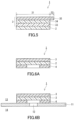
- FIG. 3 A is a cross-sectional view schematically showing an example of a state where the member for a ventilation hole shown in FIG. 1 is suction-held by a suction-holding device.
- FIG. 3 B is a cross-sectional view schematically showing a state where a conventional member for a ventilation hole is suction-held by a suction-holding device.
- FIG. 4 A is a plan view schematically showing another example of the member according to the present invention for a ventilation hole.
- FIG. 4 B is a cross-sectional view schematically showing a cross-section B-B of the member for a ventilation hole shown in FIG. 4 A .
- FIG. 5 is a cross-sectional view schematically showing yet another example of the member according to the present invention for a ventilation hole.
- FIG. 6 A is a cross-sectional view schematically showing yet another example of the member according to the present invention for a ventilation hole.
- FIG. 6 B is a cross-sectional view schematically showing an example of a state where the member for a ventilation hole shown in FIG. 6 A is placed on a housing.
- FIG. 6 C is a cross-sectional view schematically showing an example of a state where the member for a ventilation hole shown in FIG. 6 A is placed on a housing and a provisional protective film has been removed (use state).
- FIG. 7 is a perspective view schematically showing an example of a tape according to the present invention for feeding a member.
- FIG. 8 A is a process diagram showing an example of a method according to the present invention for manufacturing an electronic device.
- FIG. 8 B is a process diagram showing an example of the method according to the present invention for manufacturing an electronic device.
- FIG. 9 is an exploded perspective view schematically showing an example of an electronic device obtained by the method according to the present invention for manufacturing an electronic device.
- FIG. 1 shows an example of a member according to the present invention for a ventilation hole.
- FIG. 2 A shows an example of a state where the member 1 shown in FIG. 1 is placed in a housing.
- the member 1 includes a porous membrane 2 having air permeability in a thickness direction and a provisional protective film 3 joined to the porous membrane 2 .
- the provisional protective film 3 is joined to the porous membrane 2 to cover the porous membrane 2 from an outside 13 side of a housing 11 .
- the provisional protective film 3 is air-impermeable in a thickness direction or has lower air permeability in the thickness direction than the air permeability of the porous membrane 2 in the thickness direction.
- the provisional protective film 3 and the porous membrane 2 are joined to each other in such a manner that the provisional protective film 3 is removable from the porous membrane 2 .
- the member 1 is to be placed to cover a ventilation hole 12 of the housing 11 . More specifically, the member 1 is to be placed on a surface on the outside 13 side of the housing 11 to cover the ventilation hole 12 .
- the provisional protective film 3 is removed from the porous membrane 2 (refer to FIG. 2 B ).
- the member 1 allows passage of gas between the outside 13 and an inside 14 of the housing 11 through the ventilation hole 12 of the housing 11 and prevents dust and/or a liquid such as water from entering the inside 14 from the outside 13 through the ventilation hole 12 .
- the porous membrane 2 is placed to cover the ventilation hole 12 of the housing 11 . More specifically, the porous membrane 2 is placed on the surface on the outside 13 side of the housing 11 to cover the ventilation hole 12 .
- FIG. 3 A shows an example of a state where the member 1 is suction-held by a suction-holding device
- FIG. 3 B shows a state where a conventional member for a ventilation hole is suction-held by a suction-holding device.
- a conventional member 101 is suction-held by the suction-holding device such that a porous membrane 102 is in contact with a suction-holding portion 21 , such as a suction head, of the suction-holding device.
- a suction-holding portion 21 such as a suction head
- the member 1 can be suction-held by the suction-holding device such that the provisional protective film 3 is in contact with the suction-holding portion 21 , and this allows the suction force 22 of the suction-holding device to be more reliably retained during suction-holding. Moreover, since the suction force 22 is allowed to be more reliably retained, a benefit, for example, more reliable separation of the member 1 from a substrate tape by suction-holding, can be achieved when the member 1 is fed using a tape for feeding a member.
- the provisional protective film 3 is, for example, formed of a material that deforms or deteriorates by an external stimulus or by providing a solvent.
- the provisional protective film 3 of this type can be removed or be automatically detached (spontaneously separated) more reliably from the porous membrane 2 as a result of a decrease or loss of joining strength to the porous membrane 2 attributable to deformation or deterioration.
- the external stimulus is, for example, heat and/or light.
- the solvent is, for example, a solvent dissolving, swelling, or decomposing the material of the provisional protective film 3 .
- the light is, for example, an infrared ray or an ultraviolet ray. Depending on the wavelength of the light, irradiation of the light can also apply heat.
- deformation refers to, for example, shrinkage-induced deformation.
- deterioration refers to, for example, disappearance of at least a portion of the provisional protective film 3 by dissolution, melting, sublimation, decomposition, or the like.
- the types of the external stimulus, the solvent, and the light and the manners of the deformation and the deterioration are not limited to the above examples.
- the heat-shrinkable provisional protective film 3 is preferred because, in that case, contamination of the device by a fragment, a decomposition product, etc., resulting from the deformation or the deterioration, of the provisional protective film 3 can be prevented.
- the material that deforms or deteriorates include a metal, a resin, and a composite material thereof, and the material that deforms or deteriorates can be selected according to a specific manner of the deformation or the deterioration.
- the material is not limited to the above examples.
- the provisional protective film 3 of the above type is, for example, joined to the porous membrane 2 with an adhesive or by welding.
- the adhesive is not limited, and may be a later-described adhesive whose adhesive strength decreases by an external stimulus. Examples of the welding include heat welding and ultrasonic welding.
- the provisional protective film 3 may be joined to the porous membrane 2 with an adhesive whose adhesive strength decreases by an external stimulus.
- the provisional protective film 3 of this type can be removed or automatically detached (spontaneously separated) more reliably from the porous membrane 2 as a result of a decrease in the adhesive strength of the adhesive by an external stimulus and thereby causing a decrease or loss of joining strength to the porous membrane 2 .
- the provisional protective film 3 of this type can prevent the device from being contaminated by a fragment or a decomposition product of the provisional protective film 3 .
- the external stimulus is, for example, heat and/or light.
- the light is, for example, an infrared ray or an ultraviolet ray. Depending on the wavelength of the light, irradiation of the light can also apply heat.
- the types of the external stimulus and the light are not limited to the above examples.
- the adhesive whose adhesive strength decreases by the external stimulus is, for example, a heat foaming adhesive whose adhesive strength decreases by heat-induced foaming or a UV-responsive adhesive whose adhesive strength decreases by irradiation with an ultraviolet ray.
- the decrease of the adhesive strength of the UV-responsive adhesive proceeds, for example, by UV-induced crosslinking reaction of the adhesive composition.
- the adhesive is not limited to the above examples.
- the provisional protective film 3 of this type may be an adhesive tape (external stimulus-responsive adhesive tape) in which an adhesive layer formed of the above adhesive is provided on a surface of a substrate.
- examples of the material of a portion excluding the adhesive e.g. examples of the material of the substrate of the above adhesive tape, include a metal, a resin, and a composite material thereof.
- examples of the metal include aluminum and stainless steel.
- the resin examples include a polyolefin such as polyethylene or polypropylene, a polyester such as polyethylene terephthalate (PET), a fluorine resin such as polytetrafluoroethylene (PTFE), polystyrene, a polycarbonate, a polyamide, a polyimide, a polyamide-imide, and a polyetheretherketone.
- a polyolefin such as polyethylene or polypropylene
- PET polyethylene terephthalate
- PTFE polytetrafluoroethylene
- PTFE polytetrafluoroethylene
- polystyrene a polycarbonate
- a polyamide a polyimide
- polyamide-imide a polyamide-imide
- a polyetheretherketone examples include a polyetheretherketone.
- the adhesive whose adhesive strength decreases by heat is preferably an adhesive whose adhesive strength decreases by heating to, for example, 80 to 260° C. and preferably 120 to 200° C.
- This adhesive is suitable for placement of the member 1 on a precision device such as a MEMS device.
- the provisional protective film 3 is preferably air-impermeable in the thickness direction because, in that case, occurrence of defective suction-holding can be more reliably reduced during suction-holding.
- film being air-impermeable in the thickness direction refers to a film having an air permeance (Gurley air permeability) of more than 100,000 sec/100 mL in the thickness direction, the air permeance being measured according to Method B (Gurley method) for air permeability measurement as defined in Japanese Industrial Standards (hereinafter referred to as “JIS”) L 1096: 2010.
- JIS Japanese Industrial Standards
- the air permeability of the porous membrane 2 in the thickness direction and that of the provisional protective film 3 in the thickness direction are compared in terms of their Gurley air permeabilities.
- the permeability of the provisional protective film 3 having air permeability in the thickness direction is, for example, 100 to 100,000 sec/100 mL and may be 1,000 to 100,000 sec/100 mL, as expressed in terms of the Gurley air permeability.
- the Gurley air permeability can be evaluated using a measurement jig even when the size of the film to be evaluated does not satisfy the size (about 50 mm ⁇ 50 mm) of a specimen defined for the Gurley method.
- An example of the measurement jig is a polycarbonate disc having a thickness of 2 mm and a diameter of 47 mm and provided with a through hole (having a circular cross-section having a diameter of 1 mm or 2 mm) at the center thereof.
- the Gurley air permeability can be measured in the following manner using this measurement jig.
- a film to be evaluated is fixed to one surface of the measurement jig to cover an opening of the through hole of the measurement jig.
- the film to be evaluated is fixed so that during measurement of the Gurley air permeability, air passes only through the opening and an effective testing portion (a portion overlapping the opening when viewed in the direction perpendicular to a principal surface of the fixed film) of the film to be evaluated and a fixed portion will not hinder passage of the air through the effective testing portion of the film.
- a double-faced adhesive tape on which a vent having a shape corresponding to the shape of the opening is punched in a central part can be used.
- the double-faced adhesive tape is required to be placed between the measurement jig and the film such that the circumference of the vent and that of the opening are aligned.
- the measurement jig to which the film is fixed is set in a Gurley air permeability test apparatus such that the surface on which the film is fixed is on the downstream side of an air flow at the time of measurement. The time t 1 required for 100 mL of air to pass through the film is measured.
- the resulting value t can be employed as the Gurley air permeability of the film.
- the area of the effective testing portion of the film is the area of a cross-section of the through hole.
- the Gurley air permeability measured for a film satisfying the above specimen size without using the measurement jig and the Gurley air permeability measured for a small piece of the film using the measurement jig correspond well to each other, which means the use of the measurement jig substantially has no effect on a measured Gurley air permeability value.
- the provisional protective film 3 may have air permeability in the in-plane direction.
- the provisional protective film 3 is preferably air-impermeable in the in-plane direction because, in that case, cancellation of the suction force 22 generated by the suction-holding portion 21 of a suction-holding device by the air permeability of the provisional protective film 3 in the in-plane direction (occurrence of what is called “side leakage”) can be prevented.
- the provisional protective film 3 being air-impermeable in the thickness direction and/or the in-plane direction is, for example, a film with no communication hole, such as a through hole, connecting surfaces of the film 3 in the thickness direction and/or the in-plane direction, or may be a film with no pore.
- the thickness of the provisional protective film 3 (in the case where the provisional protective film 3 is an adhesive tape having an adhesive layer, the thickness of the adhesive layer is excluded) is, for example, 1 to 500 ⁇ m and may be 10 to 200 ⁇ m or even 25 to 100 ⁇ m. When the thickness of the provisional protective film 3 is in these ranges, occurrence of defective suction-holding and damage to the porous membrane 2 during suction-holding can be more reliably reduced.
- the adhesive strength of the provisional protective film 3 to the porous membrane 2 is required to be, for example, so strong that the provisional protective film 3 is not separated from the porous membrane 2 while the provisional protective film 3 suction-held by the suction-holding portion 21 is being transferred by a suction-holding device.
- the adhesive strength (initial adhesive strength) to the porous membrane 2 before application of an external stimulus is, for example, 0.1 N/25 mm or more and may be 0.13 N/25 mm or more, 0.2 N/25 mm or more, 0.3 N/25 mm or more, 0.4 N/25 mm or more, or even 0.45 N/25 mm or more, as expressed in terms of 180° peel adhesion strength measured according to Testing Method 1 for adhesive strength, as defined in JIS Z 0237: 2009.
- the upper limit of the initial adhesive strength is, for example, 5 N/25 mm or less as expressed in terms of the 180° peel adhesion strength.
- an adhesive strength (post-response adhesive strength) to the porous membrane 2 of the provisional protective film 3 whose adhesive strength has decreased by an external stimulus is, for example, 0.7 N/25 mm or less, and may be 0.5 N/25 mm or less, less than 0.45 N/25 mm, 0.4 N/25 mm or less, 0.3 N/25 mm or less, or even 0.2 N/25 mm or less.
- the post-response adhesive strength thereof may be 0 N/25 mm, and, in this case, the provisional protective film 3 can be automatically detached (spontaneously separated) from the porous membrane 2 .
- a specimen has a width of 25 mm, the separation speed is 300 mm/min, a testing plate is a SUS304 plate having a surface to which a porous PTFE membrane (TEMISH (registered trademark) NTF1131 manufactured by NITTO DENKO CORPORATION) is attached, and a press-bonding surface of the testing plate to which the specimen is press-bonded is an exposed surface of the porous PTFE membrane.
- TEMISH registered trademark
- NTF1131 manufactured by NITTO DENKO CORPORATION
- the provisional protective film 3 typically has the shape of a polygon, such as a square or a rectangle, a circle, or an oval when viewed in the direction perpendicular to its principal surface.
- the shape of the provisional protective film 3 may be the same as that of the porous membrane 2 .
- the provisional protective film 3 may include a joined portion 31 joined to the porous membrane 2 and a tab portion 32 protruding outward from a peripheral edge of the joined portion 31 .
- the members 1 shown in FIGS. 4 A and 4 B include the provisional protective film 3 including the tab portion 32 .
- FIG. 4 B shows a cross-section B-B of the member 1 shown in FIG. 4 A .
- the shape of the provisional protective film 3 is not limited to these examples.
- the provisional protective film 3 is not limited to the above examples as long as the provisional protective film 3 can be joined to the porous membrane 2 in such a manner that the provisional protective film 3 is removable from the porous membrane 2 .
- the manner in which the provisional protective film 3 is joined to the porous membrane 2 is not limited to the above examples as long as the provisional protective film 3 is joined in such a manner that the provisional protective film 3 is removable from the porous membrane 2 .
- FIG. 5 shows an example of the member 1 including the provisional protective film 3 of a type different from the above examples.
- the 5 has a multilayer structure including an external stimulus-responsive tape 33 , a tab sheet 35 including the tab portion 32 , and an adhesive layer 34 joining the external stimulus-responsive tape 33 and the tab sheet 35 .
- the surface of the provisional protective film 3 on the external stimulus-responsive tape 33 side is joined to the porous membrane 2 .
- the provisional protective film 3 can be more reliably removed by decreasing the adhesive strength of the external stimulus-responsive tape 33 to the porous membrane 2 by an external stimulus. However, as long as the provisional protective film 3 can be removed by pulling up the tab portion 32 , the external stimulus-responsive tape 33 may be omitted and the adhesive layer 34 and the provisional protective film 3 may be directly joined to the porous membrane 2 .
- the porous membrane 2 is commonly formed of a material that deforms or deteriorates less than the provisional protective film 3 by an external stimulus or by providing a solvent.
- the porous membrane 2 is preferably formed of a material that does not deform nor deteriorate by applying an external stimulus or providing a solvent for removal of the provisional protective film 3 from the porous membrane 2 .
- Examples of the material forming the porous membrane 2 include a metal, a resin, and a composite material thereof. Examples of the metal include aluminum and stainless steel.
- the resin examples include a polyolefin such as polyethylene or polypropylene, a polyester such as PET, a fluorine resin such as PTFE, polystyrene, a polycarbonate, a polyamide, a polyimide, a polyamide-imide and a polyetheretherketone.
- porous membrane 2 examples include a non-woven fabric, a woven fabric, a mesh, a net, or a porous membrane.
- the form of the porous membrane 2 is not limited to the above examples as long as the porous membrane 2 has air permeability in the thickness direction.
- the porous membrane 2 may include a porous membrane (porous PTFE membrane) formed by stretching a paste extrusion body containing PTFE particles or a cast film containing PTFE particles or may be a porous PTFE membrane.
- the porous PTFE membrane is formed of fine PTFE fibrils and can have a node in which PTFE is more highly aggregated than in the fibrils.
- the porous PTFE membrane has a good balance between mass and strength.
- the porous PTFE membrane can have a high water entry pressure depending on its configuration and can have a higher water entry pressure, for example, by liquid-repellent treatment.
- the average pore diameter of the porous membrane 2 that is the porous PTFE membrane is, for example, 0.01 to 10 ⁇ m.
- the porosity of the porous membrane 2 that is the porous PTFE membrane is, for example, 50 to 90%.
- the average pore diameter of the porous PTFE membrane can be measured according to American Society for Testing and Materials (ASTM) F316-86.
- the porosity of the porous PTFE membrane can be calculated by substituting the mass, thickness, area (area of a principal surface), and true density of the membrane in the following formula.
- the true density of PTFE is 2.18 g/cm 3 .
- Porosity (%) ⁇ 1 ⁇ (mass [g]/(thickness [cm] ⁇ area [cm 2 ] ⁇ true density [2.18 g/cm 3 ])) ⁇ 100
- the porous membrane 2 may be a through hole sheet.
- the through hole sheet is a sheet made by providing a raw sheet, such as an imperforate sheet, having a non-porous matrix structure with a plurality of through holes (penetrating holes) to penetrate the raw sheet in the thickness direction.
- the through hole sheet may be a sheet having no other ventilation paths in the thickness direction than the plurality of through holes.
- the through hole may be a straight hole linearly extending in the thickness direction of the sheet. Apertures of a net or a mesh are each commonly in the shape of a polygon such as a quadrangle. In contrast, the opening of the through hole is commonly in the shape of a circle or an oval when viewed in the direction perpendicular to a principal surface of the through hole sheet.
- the shape of a cross-section of the through hole may stay constant from one principal surface of the sheet to the other principal surface thereof, or may change between one principal surface of the sheet and the other principal surface thereof.
- the through holes When viewed in the direction perpendicular to the principal surface of the sheet, the through holes may be formed such that their openings are regularly arranged on the principal surface or may be formed such that their openings are randomly positioned on the principal surface.
- the through hole sheet may be a metal sheet or a resin sheet.
- the through holes can be formed, for example, by laser processing of the raw sheet or by ion beam irradiation of the raw sheet and subsequent perforation of the resulting sheet by chemical etching.
- Laser processing achieves more reliable formation of through holes whose openings are regularly arranged on a principal surface of the sheet when viewed in the direction perpendicular to the principal surface.
- the sheet disclosed in JP 2012-020279 A can be used as the through hole sheet.
- Liquid-repellent treatment of the sheet may or may not be performed.
- the porous membrane 2 may have an area of 100 mm 2 or less, 25 mm 2 or less, 9 mm 2 or less, or even 1 mm 2 or less.
- the member 1 further downsized for placement on a precision device such as a MEMS device can be created. Meanwhile, the member 1 can reduce occurrence of defective suction-holding and damage to the porous membrane 2 during suction-holding even when downsized. In other words, the effect of the present invention is more significant when the area of the porous membrane 2 is 9 mm 2 or less.
- the area of the porous membrane 2 is not limited to the above range, and may be, for example, in a greater range, specifically 400 mm 2 or less, depending on the type of the housing 11 on which the member 1 is placed and the area of the ventilation hole 12 .
- the lower limit of the area of the porous membrane 2 is, for example, 0.25 mm 2 or more.
- the housing 11 on which the member 1 is placed may be the housing 11 of an intermediate product to be made into a precision device such as a MEMS device by microfabrication such as dicing.
- the member 1 may be placed on the housing 11 of an intermediate product to be made into a precision device such as a MEMS device by microfabrication such as dicing.
- the member 1 is typically cut together with the housing 11 of the intermediate product by microfabrication and is then placed on the housing 11 of a precision device made by the microfabrication to cover the ventilation hole 12 .
- the provisional protective film 3 can reduce damage to the porous membrane 2 at the time of microfabrication such as dicing.
- the area of the porous membrane 2 of the member 1 to be placed on an intermediate product is, for example, 0.25 to 100 mm 2 and may be 1 to 25 mm 2 .
- the thickness of the porous membrane 2 is, for example, 1 to 500 ⁇ m and may be 5 to 200 ⁇ m or even 10 to 100 ⁇ m.
- the air permeability of the porous membrane 2 in the thickness direction is, for example, 0.05 sec/100 mL to 1,000 sec/100 mL and may be 0.1 sec/100 mL to 200 sec/100 mL or even 0.5 sec/100 mL to 100 sec/100 mL, as expressed in terms of the Gurley air permeability.
- the surface density of the porous membrane 2 is, for example, 1 to 50 g/m 2 .
- the surface density of the porous membrane 2 may be 1 to 30 g/m 2 or even 1 to 25 g/m 2 .
- the surface density thereof can be calculated by dividing the mass of the porous membrane 2 by the area (the area of a principal surface) thereof.
- the porous membrane 2 typically has the shape of a polygon, such as a square or a rectangle, a circle, or an oval when viewed in the direction perpendicular to its principal surface.
- the shape of the porous membrane 2 is not limited to these examples.
- the porous membrane 2 may be a waterproof membrane preventing water from entering the inside 14 of the housing 11 from the outside 13 thereof through the ventilation hole 12 thereof.
- the water proofness of the porous membrane 2 can be evaluated based on its water entry pressure.
- the water entry pressure of the porous membrane 2 is, for example, 1 kPa or more.
- the water entry pressure of the porous membrane 2 may be 10 kPa or more, 15 kPa or more, or even 20 kPa or more.
- the upper limit of the water entry pressure thereof is, for example, 2,000 kPa or less.
- the water entry pressure of the porous membrane 2 can be measured in the following manner according to Method A (low water pressure method) or Method B (high water pressure method) of the water resistance test in JIS L 1092: 2009 using a measurement jig.
- An example of the measurement jig is a stainless steel disc having a diameter of 47 mm and provided with a through hole (having a circular cross-section) having a diameter of 1 mm at the center thereof.
- This disc has such a thickness that the disc is not deformed by a water pressure applied to measure the water entry pressure.
- the water entry pressure can be measured in the following manner using this measurement jig.
- the porous membrane 2 to be evaluated is fixed to one surface of the measurement jig to cover an opening of the through hole of the measurement jig.
- the porous membrane 2 is fixed so that water will not leak from a fixed portion of the membrane during the measurement of the water entry pressure.
- a double-faced adhesive tape on which a water port having a shape corresponding to the shape of the opening is punched in a central part can be used.
- the double-faced adhesive tape is required to be placed between the measurement jig and the porous membrane 2 such that the circumference of the water port and that of the opening are aligned.
- the measurement jig to which the porous membrane 2 is fixed is set in a test apparatus such that the surface opposite to the surface on which the porous membrane 2 is fixed is a surface to which a water pressure is applied at the time of the measurement.
- the water entry pressure is measured according to Method A (low water pressure method) or Method B (high water pressure method) of water resistance test in JIS L 1092: 2009. It should be noted that the water entry pressure measured is a water pressure that causes water to come out from one region of the surface of the porous membrane 2 .
- the measured water entry pressure can be employed as the water entry pressure of the porous membrane 2 .
- the test apparatus can be used an apparatus having a specimen installation structure that allows the measurement jig to be set therein, the apparatus having the same configuration as the water resistance test apparatus exemplified in JIS L 1092: 2009.
- the porous membrane 2 may have been subjected to water-repellent treatment, oil-repellent treatment, or liquid-repellent treatment.
- the treatments can improve the water proofness of the porous membrane 2 .
- the porous membrane 2 may have been subjected to various treatments such as coloring treatment.
- Water-repellent treatment, oil-repellent treatment, liquid-repellent treatment, and coloring treatment of the porous membrane 2 can be performed by a known method.
- the member 1 for a ventilation hole can be fixed to the surface of the housing 11 , for example, by adhesion or welding. Therefore, the member 1 may further include an adhesive layer 4 joined to the porous membrane 2 from the inside 14 side (refer to FIG. 6 A ). The adhesive layer 4 is located on the opposite side of the porous membrane 2 from the provisional protective film 3 .
- the member 1 shown in FIG. 6 A can be fixed to the surface of the housing 11 with the adhesive layer 4 .
- FIG. 6 B shows an example of a state where the member 1 shown in FIG. 6 A is fixed to the surface of the housing 11 .
- the member 1 is to be placed on the surface on the outside 13 of the housing 11 to cover the ventilation hole 12 of the housing 11 as shown in FIG. 6 B .
- the provisional protective film 3 is removed from the porous membrane 2 (refer to FIG. 6 C ).
- the member 1 allows passage of gas between the outside 13 and the inside 14 of the housing 11 through the ventilation hole 12 of the housing 11 and prevents dust and/or a liquid such as water from entering the inside 14 from the outside 13 through the ventilation hole 12 .
- the adhesive layer 4 of the member 1 shown in FIGS. 6 A to 6 C has the same shape as that of a peripheral portion of the porous membrane 2 when viewed in the direction perpendicular to a principal surface of the porous membrane 2 . More specifically, the adhesive layer 4 has the shape of a ring, which is the shape of the peripheral portion of the porous membrane 2 that is circular, when viewed from the above direction.
- the member 1 is air-permeable in the thickness direction mainly through a non-placement region 41 where the adhesive layer 4 is not placed, the non-placement region 41 being surrounded by the peripheral portion of the porous membrane 2 in a state where the member 1 is placed on the housing 11 and the provisional protective film 3 has been removed (the state shown in FIG. 6 C ).
- the ratio of the area of a placement region 42 where the adhesive layer 4 is placed to the total area of the porous membrane 2 is, for example, 15 to 99%, and may be 20 to 99% or even 30 to 99%.
- the adhesive layer 4 can be formed, for example, by applying a known adhesive to the surface on the inside 14 side of the porous membrane 2 .
- the adhesive layer 4 may be a double-faced adhesive tape.
- the double-faced adhesive tape may be a tape including a substrate whose surfaces are each provided with an adhesive layer, or may be a substrate-less tape having no substrate sheet and composed only of an adhesive layer.
- a substrate-less double-faced adhesive tape can be adopted as the adhesive layer 4 because the provisional protective film 3 can improve the stiffness exhibited by the member 1 during suction-holding.
- the substrate of the double-faced adhesive tape is, for example, a resin film, a non-woven resin fabric, or a resin foam.
- the resin that can be used as the substrate is not limited, and is a polyester such as PET, a polyolefin such as polyethylene or polypropylene, a polyimide, a polyetheretherketone, a polyamide, a polyamide-imide, or a fluorine resin such as PTFE.
- the adhesive layer 4 may be a double-faced adhesive tape including a substrate formed of a heat-resistant resin including at least one selected from a polyimide, a polyester, a polyetheretherketone, a polyamide-imide, and a fluorine resin.
- the member 1 placed on a housing of a precision device such as a MEMS device can be subjected to a high-temperature process such as reflow soldering.
- the configuration of the adhesive layer 4 is not limited to the above examples as long as the member 1 in the state shown in FIG. 6 C has air permeability in the thickness direction and allows passage of gas between the outside 13 and the inside 14 of the housing 11 through the ventilation hole 12 and the member 1 can be stably kept placed on the housing 11 at the time of removal of the provisional protective film 3 from the porous membrane 2 .
- the housing 11 on which the member 1 for a ventilation hole is to be placed is, for example, a housing of a MEMS device.
- MEMS devices are so tiny that small ones have a size of 1 mm square, they are becoming more and more important these days as devices to be mounted in various products to sophisticate the products and offer high added value to the products.
- Some MEMS devices are non-encapsulated products having ventilation holes on surfaces of their packages, on which the member 1 can be placed to cover the ventilation holes. Examples of non-encapsulated MEMS devices include various sensors detecting the atmospheric pressure, humidity, gas, air flow, and the like and electroacoustic transducer elements such as speakers and microphones.
- the housing 11 on which the member 1 for a ventilation hole is to be placed is not limited to the above examples.
- the member 1 for a ventilation hole may be a member (sound-permeable member) allowing passage of sound between the outside and the inside of the housing 11 through the ventilation hole 12 of the housing 11 .
- the member 1 that is a sound-permeable member is to be placed, for example, on a housing of an electroacoustic transducer element, such as a speaker or a microphone, and/or a housing of an electronic device including such an element.
- the member 1 for a ventilation hole can be produced, for example, by joining the provisional protective film 3 to one surface of the porous membrane 2 .
- the member 1 further including the adhesive layer 4 can be produced, for example, by joining the provisional protective film 3 to one surface of the porous membrane 2 and forming the adhesive layer 4 on the other surface thereof.
- FIG. 7 shows an example of a tape according to the present invention for feeding a member.
- a tape 5 shown in FIG. 7 , for feeding a member includes a substrate tape 6 and a plurality of pieces of the member 1 for a ventilation hole, the pieces being placed on a surface of the substrate tape 6 .
- the tape 5 for feeding a member is a tape for feeding the member 1 .
- the member 1 is to be placed to cover the ventilation hole 12 in order to allow passage of gas between the outside 13 and the inside 14 of the housing 11 through the ventilation hole 12 of the housing 11 and prevent dust and/or a liquid such as water from entering the inside 14 from the outside 13 through the ventilation hole 12 .
- the member 1 includes the porous membrane 2 having air permeability in the thickness direction and the provisional protective film 3 joined to the porous membrane 2 to cover the porous membrane 2 on a side opposite to the substrate tape 6 .
- the provisional protective film 3 is air-impermeable in the thickness direction or has air permeability lower than the air permeability of the porous membrane 2 in the thickness direction.
- the provisional protective film 3 and the porous membrane 2 are joined to each other in such a manner that the provisional protective film 3 is removable from the porous membrane 2 .
- the member 1 fed to a suction-holding device using the tape 5 for feeding a member can be separated from the substrate tape 6 by suction-holding by the suction-holding device with the suction-holding portion 21 of the suction-holding device in contact with the provisional protective film 3 .
- the provisional protective film 3 damage to the porous membrane 2 can be reduced during suction-holding, defective suction-holding is unlikely to occur, and, accordingly, the member 1 can be more reliably separated from the substrate tape 6 .
- the configurations of the member 1 and the members included in the member 1 are the same as those mentioned above in the description of the member according to the present invention for a ventilation hole as long as the provisional protective film 3 is joined to the porous membrane 2 to cover the porous membrane 2 on a side opposite to the substrate tape 6 .
- the substrate tape 6 is, for example, formed of paper, a metal, a resin, and a composite material thereof.
- the metal includes aluminum and stainless steel.
- the resin include a polyester such as PET, and a polyolefin such as polyethylene and polypropylene.
- the material of the substrate tape 6 is not limited to these examples.
- the member 1 may be placed on the substrate tape 6 with an adhesive layer (for example, the adhesive layer 4 ) of the member 1 interposed therebetween.
- an adhesive layer for example, the adhesive layer 4
- a surface of the substrate tape 6 the surface where the member 1 is placed, may be subjected to release treatment for improving ease of release from the substrate tape 6 .
- the release treatment can be performed by a known method.
- the member 1 may be placed on the substrate tape 6 with an adhesive layer interposed therebetween, the adhesive layer being included in the substrate tape 6 and being located on the surface of the substrate tape 6 .
- the member 1 may or may not include the adhesive layer 4 .
- the adhesive layer included in the substrate tape 6 preferably has weak adhesiveness so that the member 1 can be more reliably separated.
- the adhesive layer included in the substrate tape 6 may be formed of an adhesive whose adhesive strength decreases by an external stimulus.
- the adhesive included in the substrate tape 6 preferably reacts to an external stimulus different from the external stimulus to which the adhesive joining the provisional protective film 3 and the porous membrane 2 reacts.
- the thickness of the substrate tape 6 is, for example, 1 to 200 ⁇ m.
- the tape 5 shown in FIG. 7 for feeding a member is strip-shaped, and the pieces of the member 1 are placed in one direction (the direction along which the substrate tape 6 extends) in series on the surface of the strip-shaped substrate tape 6 .
- the shape of the tape 5 for feeding a member, the shape of the substrate tape 6 , and the way of placing the pieces of the member 1 on the substrate tape 6 are not limited to this example.
- the tape 5 for feeding a member may be a sheet having any of various shapes such as a polygon, such as a rectangle or a square, a circle, or an oval, and the pieces of member 1 may be placed at intersections of a grid or in a staggered pattern on the surface of the substrate tape 6 being a sheet when viewed perpendicularly to the surface.
- the strip-shaped tape 5 for feeding a member may be a wound body (reel) wound around a winding core.
- the tape 5 for feeding a member can be produced by placing the pieces of member 1 on the surface of the substrate tape 6 .
- FIGS. 8 A and 8 B An example of a method according to the present invention for manufacturing an electronic device will be described with reference to FIGS. 8 A and 8 B .
- the example shown in FIGS. 8 A and 8 B includes:
- the member 1 is fed to the suction-holding device using the tape 5 for feeding a member. More specifically, the tape 5 drawn from a wound body (reel) 51 of the tape 5 is conveyed onto a separation stage 53 so as to be fed to the suction-holding device including the suction-holding portion 21 , and, just before turning at an edge of the separation stage 53 , the member 1 is suction-held by the suction-holding portion 21 to be separated from the substrate tape 6 . The member 1 suction-held by the suction-holding portion 21 and separated from the substrate tape 6 remains suction-held by the suction-holding portion 21 while being transferred to the position where the member 1 covers the ventilation hole 12 of the housing 11 .
- the member 1 is fixed to the surface of the housing 11 .
- a method such as adhesion using an adhesive layer (for example, the adhesive layer 4 included in the member 1 ) or welding can be adopted for the fixation of the member 1 to the surface of the housing 11 .
- the substrate tape 6 from which the member 1 is separated is collected by winding the substrate tape 6 around a take-up roll 52 .
- a method for transferring the member 1 to the above-described position is not limited to the above examples as long as the member 1 is transferred by the suction-holding device with the suction-holding portion 21 in contact with the provisional protective film 3 .
- the method for removing the provisional protective film 3 from the porous membrane 2 is not limited.
- the provisional protective film 3 formed of the material that deforms or deteriorates by the external stimulus or by providing the solvent the provisional protective film 3 may be removed from the porous membrane 2 by applying the external stimulus to the provisional protective film 3 or by providing the solvent.
- the provisional protective film 3 may be removed from the porous membrane 2 by applying the external stimulus to the adhesive to decrease the adhesive strength of the adhesive.
- FIG. 9 shows an example of an electronic device obtained by the method according to the present invention for manufacturing an electronic device.
- the electronic device 7 shown in FIG. 9 is a non-encapsulated MEMS device including the ventilation hole 12 in the housing 11 .
- the porous membrane 2 is placed on and fixed to the housing 11 of the electronic device 7 to cover the ventilation hole 12 with the adhesive layer 4 interposed therebetween.
- the adhesive layer 4 has the same shape as that of the peripheral portion of the porous membrane 2 when viewed in the direction perpendicular to the surface of the porous membrane 2 . In other words, the adhesive layer 4 has a through hole 43 being air-permeable in the thickness direction at the center.
- the member 1 including the porous membrane 2 can allow passage of gas between the outside 13 and the inside 14 of the housing 11 through the ventilation hole 12 and prevent dust and/or a liquid such as water from entering the inside 14 from the outside 13 through the ventilation hole 12 .
- electronic devices that can be obtained by the method according to the present invention for manufacturing an electronic device are not limited to the above example.
- the other electronic devices may be information devices such as smartphones or tablet PCs. Examples of the non-encapsulated MEMS devices are as described above.
- Adhesive strengths (initial adhesive strengths and, for Examples 1 to 6 in which an external stimulus-responsive tape was used as a provisional protective film, post-response adhesive strengths obtained after application of heat or an ultraviolet ray) of provisional protective films to porous membranes were evaluated by the above method. Preparation of specimens, attachment of the specimens to testing plates, and evaluation of the adhesive strengths were performed in an atmosphere at 23° C. ⁇ 5° C. For higher accuracy, the evaluation was performed when 30 minutes had passed since attachment of each specimen to a testing plate and the adhesive strength of the provisional protective film became stable.
- Suction-holding stabilities of members produced in Examples 1 to 8 and Comparative Example 1 suction-held by a suction-holding device were evaluated as follows.
- a feeding tape including a substrate tape and each member described above and placed on a surface of the substrate tape was produced.
- a release liner (RT-50Et manufactured by NITTO DENKO CORPORATION), on which 100 pieces of the member were aligned to give the feeding tape.
- a double-faced adhesive tape (a double-faced adhesive tape A) included in the member was used to place the member on the release liner.
- the thus-produced feeding tape was fed to a mounter (YSM10 manufactured by Hyundai Motor Co., Ltd.) in an attempt to have the mounter to pick up the member from the feeding tape.
- a nozzle having a tip with an outer diameter of 2 mm and an inner diameter of 1 mm was used as a nozzle of the mounter, and the suction-holding pressure was 80 kPa or less at the time of pickup. Then, the suction-holding stability of the member was rated as excellent (A) when 90 or more of the 100 pieces of the member were picked up by a suction-holding portion of the suction-holding device without problem, as good (B) when 50 or more and 89 or less were picked up without problem, or as poor (C) when 49 or less were picked up without problem.
- the provisional protective film was removed from the porous membrane and a surface (a surface that used to be joined with the porous membrane) of the removed provisional protective film was observed using an optical microscope at a 50-fold magnification.
- the condition of the above surface of the provisional protective film was rated as excellent (A) when adherence of a fiber of the porous membrane to the surface was not confirmed, and the condition of the above surface of the provisional protective film was rated as good (B) when adherence of a fiber of the porous membrane to the surface was confirmed.
- the provisional protective film 3 was spontaneously separated from the porous membrane 2 by heating each member at 120° C.
- the provisional protective film 3 was separated by hand from the porous membrane 2 after each member was irradiated with an ultraviolet ray with a wavelength of 365 nm at an irradiation intensity of 300 mW/cm 2 to decrease the adhesive strength of the adhesive.
- the provisional protective film 3 was able to be separated smoothly from the porous membrane 2 with a very week force.
- the provisional protective film 3 was able to be smoothly separated from the porous membrane 2 with a very week force without application of an external stimulus.
- the provisional protective film 3 was able to be separated from the porous membrane 2 without application of an external stimulus; however, a large force was needed for the separation, compared to the case of the members of Examples 5 to 7.
- a feeding tape similar to those produced for the evaluation of the suction-holding stabilities of the members suction-held by the suction-holding device was produced and fed to a mounter (YSM10 manufactured by Hyundai Motor Co., Ltd.) to have the mounter to pick up the member from the feeding tape and fix the picked up member to a dummy board.
- a nozzle having a tip with an outer diameter of 2 mm and an inner diameter of 1 mm was used as a nozzle of the mounter, and the suction-holding pressure was 80 kPa or less at the time of pickup.
- the double-faced adhesive tape (the double-faced adhesive tape A) of the member was used to fix the member to the dummy board, a force applied to the member for fixation was 1 N, and the time during which the force was being applied to the member was 0.1 seconds. Subsequently, a surface (a surface that used to be joined with the provisional protective film) of the porous membrane from which the provisional protective film was removed was observed by optical microscopy at a 50-fold magnification for the members of Examples 1 to 8, and a surface of the porous membrane, the surface with which the nozzle of the mounter was brought into contact at the time of pickup, was observed by optical microscopy at a 50-fold magnification for the member of Comparative Example 1.
- the protection performance was rated as excellent (A) when no dent or scar attributed to the nozzle of the mounter was confirmed on the above surface of the porous membrane, and the protection performance was rated as poor (C) when such a dent or scar was confirmed on the above surface of the porous membrane.
- the provisional protective films of the members of Examples 1 to 8 were removed by the method described in [Removal of provisional protective film and condition of surface of porous membrane after removal of provisional protective film].
- a porous PTFE membrane (TEMISH (registered trademark) NTF1131 manufactured by NITTO DENKO CORPORATION and having a circular shape with a thickness of 80 ⁇ m and a diameter of 2.0 mm) was prepared as the porous membrane 2 .
- TEMISH registered trademark
- NTF1131 manufactured by NITTO DENKO CORPORATION and having a circular shape with a thickness of 80 ⁇ m and a diameter of 2.0 mm
- TEMISH registered trademark
- a thermoresponsive tape No. 31935MS manufactured by NITTO DENKO CORPORATION and having a circular shape with a diameter of 2.0 mm
- an adhesive layer (thickness: 75 ⁇ m) formed of a heat foaming adhesive was arranged on one surface of a substrate (thickness: 100 ⁇ m) was prepared as the provisional protective film 3 .
- Example 1 (having a ring shape with a thickness of 50 ⁇ m, an outer diameter or 2.0 mm, and an inner diameter of 1.0 mm) manufactured by NITTO DENKO CORPORATION was prepared as the double-faced adhesive tape A.
- the provisional protective film 3 was joined to one surface of the porous membrane 2 with the above adhesive layer interposed therebetween, and the double-faced adhesive tape A was joined to the other surface.
- a member of Example 1 was thus obtained.
- the porous membrane 2 , the provisional protective film 3 , and the double-faced adhesive tape A were joined together such that their outer circumferences aligned with each other.
- Example 2 A member of Example 2 was obtained in the same manner as in Example 1, except that a thermoresponsive tape (No. 3193MS manufactured by NITTO DENKO CORPORATION and having a circular shape with a diameter of 2.0 mm) in which an adhesive layer (thickness: 75 ⁇ m) formed of a heat foaming adhesive was arranged on one surface of a substrate (thickness: 100 ⁇ m) was used as the provisional protective film 3 .
- a thermoresponsive tape No. 3193MS manufactured by NITTO DENKO CORPORATION and having a circular shape with a diameter of 2.0 mm
- Example 3 A member of Example 3 was obtained in the same manner as in Example 1, except that a thermoresponsive tape (No. 3195MS manufactured by NITTO DENKO CORPORATION and having a circular shape with a diameter of 2.0 mm) in which an adhesive layer (thickness: 48 ⁇ m) formed of a heat foaming adhesive was arranged on one surface of a substrate (thickness: 100 ⁇ m) was used as the provisional protective film 3 .
- a thermoresponsive tape No. 3195MS manufactured by NITTO DENKO CORPORATION and having a circular shape with a diameter of 2.0 mm
- Example 4 A member of Example 4 was obtained in the same manner as in Example 1, except that a thermoresponsive tape (No. 3198MS manufactured by NITTO DENKO CORPORATION and having a circular shape with a diameter of 2.0 mm) in which an adhesive layer (thickness: 48 ⁇ m) formed of a heat foaming adhesive was arranged on one surface of a substrate (thickness: 100 ⁇ m) was used as the provisional protective film 3 .
- a thermoresponsive tape No. 3198MS manufactured by NITTO DENKO CORPORATION and having a circular shape with a diameter of 2.0 mm
- Example 5 A member of Example 5 was obtained in the same manner as in Example 1, except that a UV-responsive tape (UB-3083D manufactured by NITTO DENKO CORPORATION and having a circular shape with a diameter of 2.0 mm) in which an adhesive layer (thickness: 30 ⁇ m) formed of a UV-responsive adhesive was arranged on one surface of a substrate (thickness: 50 ⁇ m) was used as the provisional protective film 3 .
- a UV-responsive tape U-3083D manufactured by NITTO DENKO CORPORATION and having a circular shape with a diameter of 2.0 mm
- Example 6 A member of Example 6 was obtained in the same manner as in Example 1, except that a UV-responsive tape (DU-300 manufactured by NITTO DENKO CORPORATION and having a circular shape with a diameter of 2.0 mm) in which an adhesive layer (thickness: 5 ⁇ m) formed of a UV-responsive adhesive was arranged on one surface of a substrate (thickness: 80 ⁇ m) was used as the provisional protective film 3 .
- a UV-responsive tape DU-300 manufactured by NITTO DENKO CORPORATION and having a circular shape with a diameter of 2.0 mm
- an adhesive layer thinness: 5 ⁇ m
- a UV-responsive adhesive was arranged on one surface of a substrate (thickness: 80 ⁇ m) was used as the provisional protective film 3 .
- Example 7 A member of Example 7 was obtained in the same manner as in Example 1, except that an easily releasable tape (AW303D manufactured by NITTO DENKO CORPORATION and having a circular shape with a diameter of 2.0 mm) in which an adhesive layer (thickness: 12 ⁇ m) formed of a urethane adhesive was arranged on one surface of a PET substrate (thickness: 38 ⁇ m) was used as the provisional protective film 3 .
- A303D easily releasable tape
- A3D manufactured by NITTO DENKO CORPORATION and having a circular shape with a diameter of 2.0 mm
- Example 8 A member of Example 8 was obtained in the same manner as in Example 1, except that an adhesive tape (No. 336 manufactured by NITTO DENKO CORPORATION and having a circular shape with a diameter of 2.0 mm) in which an adhesive layer (thickness: 30 ⁇ m) formed of a silicone adhesive was arranged on one surface of a PET substrate (thickness: 50 ⁇ m) was used as the provisional protective film 3 .
- an adhesive tape No. 336 manufactured by NITTO DENKO CORPORATION and having a circular shape with a diameter of 2.0 mm
- a member of Comparative Example 1 was obtained in the same manner as in Example 1, except that the provisional protective film 3 was not joined.
- Table 1 below shows the evaluation results for the members produced in Examples 1 to 8 and Comparative Example 1.
- the member according to the present invention for a ventilation hole is to be placed on a housing to cover a ventilation hole of the housing, passage of gas between the outside and the inside of the housing through the ventilation hole can be allowed and dust and/or a liquid can be prevented from entering the inside of the housing from the outside thereof through the ventilation hole.
Landscapes
- Engineering & Computer Science (AREA)
- Chemical & Material Sciences (AREA)
- Chemical Kinetics & Catalysis (AREA)
- Microelectronics & Electronic Packaging (AREA)
- Manufacturing & Machinery (AREA)
- Laminated Bodies (AREA)
- Separation Using Semi-Permeable Membranes (AREA)
- Casings For Electric Apparatus (AREA)
Abstract
Description
-
- a porous membrane having air permeability in a thickness direction; and
- a provisional protective film joined to the porous membrane to cover the porous membrane from the outside side, wherein
- the provisional protective film is air-impermeable in a thickness direction or has lower air permeability in the thickness direction than the air permeability of the porous membrane, and
- the provisional protective film and the porous membrane are joined to each other in such a manner that the provisional protective film is removable from the porous membrane.
-
- transferring the member by a suction-holding device with a suction-holding portion of the suction-holding device in contact with the provisional protective film to a position where the member covers the ventilation hole of the housing; and
- removing the provisional protective film from the porous membrane after the transferring.
-
- a substrate tape; and
- a plurality of pieces of a member for a ventilation hole, the pieces being placed on a surface of the substrate tape, wherein
- the member is to be placed to cover the ventilation hole in order to allow passage of gas between an outside and an inside of a housing through a ventilation hole of the housing and prevent dust and/or a liquid from entering the inside from the outside through the ventilation hole,
- the member includes a porous membrane having air permeability in a thickness direction and a provisional protective film joined to the porous membrane to cover the porous membrane on a side opposite to the substrate tape,
- the provisional protective film is air-impermeable in a thickness direction or has lower air permeability in the thickness direction than the air permeability of the porous membrane, and
- the provisional protective film and the porous membrane are joined to each other in such a manner that the provisional protective film is removable from the porous membrane.
Porosity (%)={1−(mass [g]/(thickness [cm]×area [cm2]×true density [2.18 g/cm3]))}×100
-
- transferring the
member 1 by a suction-holding device with the suction-holdingportion 21 of the suction-holding device in contact with the provisionalprotective film 3 to a position where themember 1 covers theventilation hole 12 of thehousing 11, themember 1 including theporous membrane 2 having air permeability in the thickness direction and the provisionalprotective film 3 joined to theporous membrane 2 to cover theporous membrane 2, the provisionalprotective film 3 being air-impermeable in the thickness direction or having lower air permeability in the thickness direction than the air permeability of the porous membrane 2 (FIG. 8A ); and - removing the provisional
protective film 3 from theporous membrane 2 at the position (FIG. 8B ). An electronic device 7 can be manufactured by this method, the electronic device 7 including: thehousing 11 including theventilation hole 12; and themember 1 for a ventilation hole, themember 1 being placed to cover theventilation hole 12 in order to allow passage of air between the outside 13 and the inside 14 of thehousing 11 through theventilation hole 12 of thehousing 11 and prevent dust and/or a liquid from entering the inside 14 from the outside 13 through theventilation hole 12. This manufacturing method is unlikely to cause defective suction-holding during suction-holding of themember 1 by the suction-holding device, and can reduce damage to theporous membrane 2 during suction-holding. In addition, this manufacturing method can offer, for example, the following benefits: (1) in a phase prior to the removal of the provisionalprotective film 3, thehousing 11 can be further transferred by the suction-holding device with themember 1 fixed to the surface of thehousing 11, and, at that time, transferring of thehousing 11 by suction-holding is more reliably achieved by suction-holding the provisionalprotective film 3; and (2) owing to the provisionalprotective film 3, the electronic device 7 including theporous membrane 2 not exposed to foreign matters, such as dust, that can be generated during manufacture of the electronic device 7 can be obtained. It should be noted that the provisionalprotective film 3 can be removed from theporous membrane 2 at any timing after transferring themember 1 to a position where themember 1 covers theventilation hole 12. For example, the provisionalprotective film 3 may be removed from theporous membrane 2 in a subsequent step that can follow the fixation of themember 1 to the surface of thehousing 11 or at any timing after the subsequent step.
- transferring the
| TABLE 1 | ||||||
| Initial adhesive | Post-response | |||||
| Provisional | strength | adhesive strength | Pick-up | Surface | Protection | |
| protective layer | (N/25 mm) | (N/25 mm) | property | condition | performance | |
| Example 1 | Thermoresponsive | 0.49 | 0 (spontaneous | A | A | A |
| tape | separation) | |||||
| Example 2 | Thermoresponsive | 0.56 | 0 (spontaneous | A | A | A |
| tape | separation) | |||||
| Example 3 | Thermoresponsive | 0.38 | 0 (spontaneous | A | A | A |
| tape | separation) | |||||
| Example 4 | Thermoresponsive | 0.14 | 0 (spontaneous | A | A | A |
| tape | separation) | |||||
| Example 5 | UV-responsive | 0.34 | 0.17 | A | A | A |
| tape | ||||||
| Example 6 | UV-responsive | 0.59 | 0.42 | A | A | A |
| tape | ||||||
| Example 7 | Easily releasable | 0.12 | — | B | A | A |
| tape | ||||||
| Example 8 | Adhesive tape | 1.40 | — | A | B | A |
| Comparative | N/A | — | — | B | — | C |
| Example 1 | ||||||
Claims (11)
Applications Claiming Priority (3)
| Application Number | Priority Date | Filing Date | Title |
|---|---|---|---|
| JP2019-059433 | 2019-03-26 | ||
| JP2019059433 | 2019-03-26 | ||
| PCT/JP2020/012161 WO2020196211A1 (en) | 2019-03-26 | 2020-03-18 | Vent member, method for manufacturing electronic device including vent member, and member supply tape |
Publications (2)
| Publication Number | Publication Date |
|---|---|
| US20220159852A1 US20220159852A1 (en) | 2022-05-19 |
| US12120832B2 true US12120832B2 (en) | 2024-10-15 |
Family
ID=72611945
Family Applications (1)
| Application Number | Title | Priority Date | Filing Date |
|---|---|---|---|
| US17/442,242 Active 2041-06-24 US12120832B2 (en) | 2019-03-26 | 2020-03-18 | Air-permeable member with removable protective film for covering ventilation hole |
Country Status (6)
| Country | Link |
|---|---|
| US (1) | US12120832B2 (en) |
| EP (1) | EP3950104A4 (en) |
| JP (1) | JP7514823B2 (en) |
| CN (1) | CN113631246A (en) |
| TW (1) | TW202100447A (en) |
| WO (1) | WO2020196211A1 (en) |
Families Citing this family (2)
| Publication number | Priority date | Publication date | Assignee | Title |
|---|---|---|---|---|
| US20230083359A1 (en) * | 2021-09-15 | 2023-03-16 | Ubicquia, Inc. | Electronic apparatus with airflow structure and moisture intrusion mitigation |
| WO2025072114A1 (en) * | 2023-09-25 | 2025-04-03 | W. L. Gore & Associates, Inc. | Improved sheet for the production of improved vent assemblies |
Citations (9)
| Publication number | Priority date | Publication date | Assignee | Title |
|---|---|---|---|---|
| JPH09330940A (en) | 1996-06-13 | 1997-12-22 | Sony Corp | Method for manufacturing semiconductor device |
| JP2002143624A (en) | 2000-11-14 | 2002-05-21 | Saint-Gobain Norton Kk | Air permeable filter and vessel provided with filter |
| WO2011068079A1 (en) | 2009-12-01 | 2011-06-09 | ジャパンゴアテックス株式会社 | Ventilation filter, method for affixing the ventilation filter, and method for manufacturing electrical device |
| JP2011161359A (en) | 2010-02-09 | 2011-08-25 | Nitto Denko Corp | Filter carrier and production system |
| US20110220268A1 (en) | 2008-11-25 | 2011-09-15 | Nitto Denko Corporation | Surface protection tape for dicing and method for peeling and removing surface protection tape for dicing |
| JP2012020279A (en) | 2010-06-16 | 2012-02-02 | Nitto Denko Corp | Waterproof breathable filter and use thereof |
| WO2016100265A1 (en) | 2014-12-15 | 2016-06-23 | W. L. Gore & Associates, Inc. | Vent attachment system for micro-electromechanical systems |
| JP2018176748A (en) | 2017-04-18 | 2018-11-15 | 日東電工株式会社 | Laminated body and wound body |
| JP2018184577A (en) * | 2017-04-27 | 2018-11-22 | 日本ゴア株式会社 | Film piece with protective film, removal method of protective film from film piece with protective film, and production method of electric device |
Family Cites Families (5)
| Publication number | Priority date | Publication date | Assignee | Title |
|---|---|---|---|---|
| US20030202671A1 (en) * | 2002-04-30 | 2003-10-30 | Koninklijke Philips Electronics N.V. | Product configuration with a double-side adhesive mounting disc |
| JP2009111993A (en) * | 2007-10-09 | 2009-05-21 | Nitto Denko Corp | Sound-permeable member using waterproof sound-permeable membrane and manufacturing method thereof |
| JP5947655B2 (en) * | 2012-08-02 | 2016-07-06 | 日東電工株式会社 | Polytetrafluoroethylene porous membrane, and ventilation membrane and ventilation member using the same |
| JP6472182B2 (en) * | 2014-07-15 | 2019-02-20 | 日東電工株式会社 | Waterproof member and electronic device provided with the waterproof member |
| CN207235291U (en) * | 2017-09-13 | 2018-04-13 | 北京经纬恒润科技有限公司 | A kind of electronic product and its waterproof and breathable structure |
-
2020
- 2020-03-18 EP EP20779839.8A patent/EP3950104A4/en active Pending
- 2020-03-18 US US17/442,242 patent/US12120832B2/en active Active
- 2020-03-18 WO PCT/JP2020/012161 patent/WO2020196211A1/en not_active Ceased
- 2020-03-18 JP JP2021509284A patent/JP7514823B2/en active Active
- 2020-03-18 CN CN202080024095.4A patent/CN113631246A/en active Pending
- 2020-03-25 TW TW109109992A patent/TW202100447A/en unknown
Patent Citations (13)
| Publication number | Priority date | Publication date | Assignee | Title |
|---|---|---|---|---|
| JPH09330940A (en) | 1996-06-13 | 1997-12-22 | Sony Corp | Method for manufacturing semiconductor device |
| JP2002143624A (en) | 2000-11-14 | 2002-05-21 | Saint-Gobain Norton Kk | Air permeable filter and vessel provided with filter |
| US20110220268A1 (en) | 2008-11-25 | 2011-09-15 | Nitto Denko Corporation | Surface protection tape for dicing and method for peeling and removing surface protection tape for dicing |
| CN102224575A (en) | 2008-11-25 | 2011-10-19 | 日本电工株式会社 | Surface protection tape for dicing and method for peeling and removing surface protection tape for dicing |
| WO2011068079A1 (en) | 2009-12-01 | 2011-06-09 | ジャパンゴアテックス株式会社 | Ventilation filter, method for affixing the ventilation filter, and method for manufacturing electrical device |
| JP2011161359A (en) | 2010-02-09 | 2011-08-25 | Nitto Denko Corp | Filter carrier and production system |
| JP2012020279A (en) | 2010-06-16 | 2012-02-02 | Nitto Denko Corp | Waterproof breathable filter and use thereof |
| US20130074691A1 (en) | 2010-06-16 | 2013-03-28 | Nitto Denko Corporation | Water-proof air-permeable filter and use of the same |
| WO2016100265A1 (en) | 2014-12-15 | 2016-06-23 | W. L. Gore & Associates, Inc. | Vent attachment system for micro-electromechanical systems |
| JP2018501972A (en) | 2014-12-15 | 2018-01-25 | ダブリュ.エル.ゴア アンド アソシエイツ,インコーポレイティドW.L. Gore & Associates, Incorporated | Vent mounting system for microelectromechanical systems |
| JP2018176748A (en) | 2017-04-18 | 2018-11-15 | 日東電工株式会社 | Laminated body and wound body |
| US20200148918A1 (en) | 2017-04-18 | 2020-05-14 | Nitto Denko Corporation | Laminate and roll |
| JP2018184577A (en) * | 2017-04-27 | 2018-11-22 | 日本ゴア株式会社 | Film piece with protective film, removal method of protective film from film piece with protective film, and production method of electric device |
Non-Patent Citations (6)
| Title |
|---|
| China Office Action received in CN Application No. 202080024095.4, dated Apr. 28, 2023. |
| China Office Action received in CN Application No. 202080024095.4, dated Oct. 12, 2023. |
| International Search Report issued in International Bureau of WIPO Patent Application No. PCT/JP2020/012161, dated Jun. 16, 2020, along with an English translation thereof. |
| Lidulard et al., "Engineering Innovation And Robot Technology", Beijing Polytechnic University Press, 7 pages (including translation), May 2013. |
| Phahd Red et al, "Industrial Robot Technology", West Amsan Electronic Technology University Press, 11 pages (including translation), Mar. 2012. |
| Written Opinion of the International Searching Authority issued in International Bureau of WIPO Patent Application No. PCT/JP2020/012161, dated Jun. 16, 2020, along with an English translation thereof. |
Also Published As
| Publication number | Publication date |
|---|---|
| JPWO2020196211A1 (en) | 2020-10-01 |
| JP7514823B2 (en) | 2024-07-11 |
| TW202100447A (en) | 2021-01-01 |
| US20220159852A1 (en) | 2022-05-19 |
| CN113631246A (en) | 2021-11-09 |
| EP3950104A1 (en) | 2022-02-09 |
| WO2020196211A1 (en) | 2020-10-01 |
| EP3950104A4 (en) | 2022-12-28 |
Similar Documents
| Publication | Publication Date | Title |
|---|---|---|
| US12200414B2 (en) | Waterproof member and electronic device | |
| US20240173947A1 (en) | Member supplying sheet | |
| US12120832B2 (en) | Air-permeable member with removable protective film for covering ventilation hole | |
| JP6488044B2 (en) | Laminated body and wound body | |
| US20220266575A1 (en) | Protective cover member and member supplying sheet including the same | |
| EP3904086A1 (en) | Breathable pressure-sensitive adhesive sheet and breathable product | |
| US12304716B2 (en) | Cover member and member supply assembly including same | |
| US12214575B2 (en) | Member supplying sheet | |
| CN109715388B (en) | Laminates and Wounds | |
| WO2021187328A1 (en) | Protective cover member and member-supplying sheet |
Legal Events
| Date | Code | Title | Description |
|---|---|---|---|
| AS | Assignment |
Owner name: NITTO DENKO CORPORATION, JAPAN Free format text: ASSIGNMENT OF ASSIGNORS INTEREST;ASSIGNOR:KIGAMI, HIROKI;REEL/FRAME:057575/0902 Effective date: 20210903 |
|
| FEPP | Fee payment procedure |
Free format text: ENTITY STATUS SET TO UNDISCOUNTED (ORIGINAL EVENT CODE: BIG.); ENTITY STATUS OF PATENT OWNER: LARGE ENTITY |
|
| STPP | Information on status: patent application and granting procedure in general |
Free format text: DOCKETED NEW CASE - READY FOR EXAMINATION |
|
| STPP | Information on status: patent application and granting procedure in general |
Free format text: NON FINAL ACTION MAILED |
|
| STPP | Information on status: patent application and granting procedure in general |
Free format text: RESPONSE TO NON-FINAL OFFICE ACTION ENTERED AND FORWARDED TO EXAMINER |
|
| STPP | Information on status: patent application and granting procedure in general |
Free format text: NON FINAL ACTION MAILED |
|
| STPP | Information on status: patent application and granting procedure in general |
Free format text: RESPONSE TO NON-FINAL OFFICE ACTION ENTERED AND FORWARDED TO EXAMINER |
|
| STPP | Information on status: patent application and granting procedure in general |
Free format text: NOTICE OF ALLOWANCE MAILED -- APPLICATION RECEIVED IN OFFICE OF PUBLICATIONS |
|
| ZAAB | Notice of allowance mailed |
Free format text: ORIGINAL CODE: MN/=. |
|
| STPP | Information on status: patent application and granting procedure in general |
Free format text: PUBLICATIONS -- ISSUE FEE PAYMENT VERIFIED |
|
| STCF | Information on status: patent grant |
Free format text: PATENTED CASE |