US12115530B2 - On-board reagent storage in a fluid processing device - Google Patents
On-board reagent storage in a fluid processing device Download PDFInfo
- Publication number
- US12115530B2 US12115530B2 US17/698,504 US202217698504A US12115530B2 US 12115530 B2 US12115530 B2 US 12115530B2 US 202217698504 A US202217698504 A US 202217698504A US 12115530 B2 US12115530 B2 US 12115530B2
- Authority
- US
- United States
- Prior art keywords
- reagent
- fluid
- barb
- rotor
- processing station
- Prior art date
- Legal status (The legal status is an assumption and is not a legal conclusion. Google has not performed a legal analysis and makes no representation as to the accuracy of the status listed.)
- Active, expires
Links
- 239000003153 chemical reaction reagent Substances 0.000 title claims abstract description 757
- 239000012530 fluid Substances 0.000 title claims abstract description 710
- 238000012545 processing Methods 0.000 title claims abstract description 503
- 238000003860 storage Methods 0.000 title description 2
- 238000000034 method Methods 0.000 claims abstract description 646
- 230000008569 process Effects 0.000 claims abstract description 602
- 230000000712 assembly Effects 0.000 claims description 94
- 238000000429 assembly Methods 0.000 claims description 94
- 230000006835 compression Effects 0.000 claims description 44
- 238000007906 compression Methods 0.000 claims description 44
- 230000000694 effects Effects 0.000 claims description 18
- 239000007788 liquid Substances 0.000 claims description 12
- 230000008878 coupling Effects 0.000 claims description 8
- 238000010168 coupling process Methods 0.000 claims description 8
- 238000005859 coupling reaction Methods 0.000 claims description 8
- 239000000523 sample Substances 0.000 description 81
- 238000006243 chemical reaction Methods 0.000 description 60
- 238000004891 communication Methods 0.000 description 55
- 230000005291 magnetic effect Effects 0.000 description 39
- 239000010408 film Substances 0.000 description 37
- 238000011144 upstream manufacturing Methods 0.000 description 24
- 239000000203 mixture Substances 0.000 description 19
- 239000002699 waste material Substances 0.000 description 19
- 230000000717 retained effect Effects 0.000 description 14
- 239000007787 solid Substances 0.000 description 12
- 239000011324 bead Substances 0.000 description 10
- 238000003752 polymerase chain reaction Methods 0.000 description 10
- 238000007481 next generation sequencing Methods 0.000 description 7
- 238000002360 preparation method Methods 0.000 description 7
- 238000012864 cross contamination Methods 0.000 description 6
- 238000007885 magnetic separation Methods 0.000 description 6
- 239000000463 material Substances 0.000 description 6
- 230000003321 amplification Effects 0.000 description 5
- 238000009396 hybridization Methods 0.000 description 5
- 238000003199 nucleic acid amplification method Methods 0.000 description 5
- 230000001737 promoting effect Effects 0.000 description 5
- 238000005382 thermal cycling Methods 0.000 description 5
- 229920000837 Heparan sulfate analogue Polymers 0.000 description 4
- 239000003570 air Substances 0.000 description 4
- 238000011109 contamination Methods 0.000 description 4
- 238000001816 cooling Methods 0.000 description 4
- 238000010586 diagram Methods 0.000 description 4
- 238000012986 modification Methods 0.000 description 4
- 230000004048 modification Effects 0.000 description 4
- 238000000746 purification Methods 0.000 description 4
- 230000002441 reversible effect Effects 0.000 description 4
- 239000000126 substance Substances 0.000 description 4
- 238000013519 translation Methods 0.000 description 4
- 238000003466 welding Methods 0.000 description 4
- 239000004743 Polypropylene Substances 0.000 description 3
- 230000009471 action Effects 0.000 description 3
- 238000004458 analytical method Methods 0.000 description 3
- 210000004027 cell Anatomy 0.000 description 3
- 230000007613 environmental effect Effects 0.000 description 3
- -1 polypropylene Polymers 0.000 description 3
- 229920001155 polypropylene Polymers 0.000 description 3
- 238000012546 transfer Methods 0.000 description 3
- 239000000853 adhesive Substances 0.000 description 2
- 230000001070 adhesive effect Effects 0.000 description 2
- 230000000903 blocking effect Effects 0.000 description 2
- 238000000151 deposition Methods 0.000 description 2
- 238000006073 displacement reaction Methods 0.000 description 2
- 239000003550 marker Substances 0.000 description 2
- 230000007246 mechanism Effects 0.000 description 2
- 230000037361 pathway Effects 0.000 description 2
- 239000000565 sealant Substances 0.000 description 2
- 238000007789 sealing Methods 0.000 description 2
- 239000004677 Nylon Substances 0.000 description 1
- 239000012080 ambient air Substances 0.000 description 1
- 238000003491 array Methods 0.000 description 1
- 230000008901 benefit Effects 0.000 description 1
- 239000000872 buffer Substances 0.000 description 1
- 230000009172 bursting Effects 0.000 description 1
- 238000004364 calculation method Methods 0.000 description 1
- 238000000748 compression moulding Methods 0.000 description 1
- 238000005520 cutting process Methods 0.000 description 1
- 210000002969 egg yolk Anatomy 0.000 description 1
- 230000005294 ferromagnetic effect Effects 0.000 description 1
- 238000010102 injection blow moulding Methods 0.000 description 1
- 238000001746 injection moulding Methods 0.000 description 1
- 238000003780 insertion Methods 0.000 description 1
- 230000037431 insertion Effects 0.000 description 1
- 238000009434 installation Methods 0.000 description 1
- 238000003698 laser cutting Methods 0.000 description 1
- 238000005461 lubrication Methods 0.000 description 1
- 238000004519 manufacturing process Methods 0.000 description 1
- 238000005259 measurement Methods 0.000 description 1
- 238000010137 moulding (plastic) Methods 0.000 description 1
- 229920001778 nylon Polymers 0.000 description 1
- 239000002245 particle Substances 0.000 description 1
- 239000004033 plastic Substances 0.000 description 1
- 229920003023 plastic Polymers 0.000 description 1
- 229920000515 polycarbonate Polymers 0.000 description 1
- 239000004417 polycarbonate Substances 0.000 description 1
- 229920001296 polysiloxane Polymers 0.000 description 1
- 239000012521 purified sample Substances 0.000 description 1
- 238000003908 quality control method Methods 0.000 description 1
- 239000011541 reaction mixture Substances 0.000 description 1
- 210000003296 saliva Anatomy 0.000 description 1
- 238000005464 sample preparation method Methods 0.000 description 1
- 238000012360 testing method Methods 0.000 description 1
- 229920002725 thermoplastic elastomer Polymers 0.000 description 1
- 229920002803 thermoplastic polyurethane Polymers 0.000 description 1
- 239000010409 thin film Substances 0.000 description 1
- 239000011534 wash buffer Substances 0.000 description 1
Images




Classifications
-
- B—PERFORMING OPERATIONS; TRANSPORTING
- B01—PHYSICAL OR CHEMICAL PROCESSES OR APPARATUS IN GENERAL
- B01L—CHEMICAL OR PHYSICAL LABORATORY APPARATUS FOR GENERAL USE
- B01L3/00—Containers or dishes for laboratory use, e.g. laboratory glassware; Droppers
- B01L3/50—Containers for the purpose of retaining a material to be analysed, e.g. test tubes
- B01L3/502—Containers for the purpose of retaining a material to be analysed, e.g. test tubes with fluid transport, e.g. in multi-compartment structures
- B01L3/5027—Containers for the purpose of retaining a material to be analysed, e.g. test tubes with fluid transport, e.g. in multi-compartment structures by integrated microfluidic structures, i.e. dimensions of channels and chambers are such that surface tension forces are important, e.g. lab-on-a-chip
- B01L3/502715—Containers for the purpose of retaining a material to be analysed, e.g. test tubes with fluid transport, e.g. in multi-compartment structures by integrated microfluidic structures, i.e. dimensions of channels and chambers are such that surface tension forces are important, e.g. lab-on-a-chip characterised by interfacing components, e.g. fluidic, electrical, optical or mechanical interfaces
-
- B—PERFORMING OPERATIONS; TRANSPORTING
- B01—PHYSICAL OR CHEMICAL PROCESSES OR APPARATUS IN GENERAL
- B01L—CHEMICAL OR PHYSICAL LABORATORY APPARATUS FOR GENERAL USE
- B01L3/00—Containers or dishes for laboratory use, e.g. laboratory glassware; Droppers
- B01L3/52—Containers specially adapted for storing or dispensing a reagent
- B01L3/523—Containers specially adapted for storing or dispensing a reagent with means for closing or opening
-
- B—PERFORMING OPERATIONS; TRANSPORTING
- B01—PHYSICAL OR CHEMICAL PROCESSES OR APPARATUS IN GENERAL
- B01L—CHEMICAL OR PHYSICAL LABORATORY APPARATUS FOR GENERAL USE
- B01L2200/00—Solutions for specific problems relating to chemical or physical laboratory apparatus
- B01L2200/02—Adapting objects or devices to another
- B01L2200/025—Align devices or objects to ensure defined positions relative to each other
-
- B—PERFORMING OPERATIONS; TRANSPORTING
- B01—PHYSICAL OR CHEMICAL PROCESSES OR APPARATUS IN GENERAL
- B01L—CHEMICAL OR PHYSICAL LABORATORY APPARATUS FOR GENERAL USE
- B01L2200/00—Solutions for specific problems relating to chemical or physical laboratory apparatus
- B01L2200/02—Adapting objects or devices to another
- B01L2200/026—Fluid interfacing between devices or objects, e.g. connectors, inlet details
- B01L2200/027—Fluid interfacing between devices or objects, e.g. connectors, inlet details for microfluidic devices
-
- B—PERFORMING OPERATIONS; TRANSPORTING
- B01—PHYSICAL OR CHEMICAL PROCESSES OR APPARATUS IN GENERAL
- B01L—CHEMICAL OR PHYSICAL LABORATORY APPARATUS FOR GENERAL USE
- B01L2200/00—Solutions for specific problems relating to chemical or physical laboratory apparatus
- B01L2200/04—Exchange or ejection of cartridges, containers or reservoirs
-
- B—PERFORMING OPERATIONS; TRANSPORTING
- B01—PHYSICAL OR CHEMICAL PROCESSES OR APPARATUS IN GENERAL
- B01L—CHEMICAL OR PHYSICAL LABORATORY APPARATUS FOR GENERAL USE
- B01L2200/00—Solutions for specific problems relating to chemical or physical laboratory apparatus
- B01L2200/06—Fluid handling related problems
- B01L2200/0631—Purification arrangements, e.g. solid phase extraction [SPE]
-
- B—PERFORMING OPERATIONS; TRANSPORTING
- B01—PHYSICAL OR CHEMICAL PROCESSES OR APPARATUS IN GENERAL
- B01L—CHEMICAL OR PHYSICAL LABORATORY APPARATUS FOR GENERAL USE
- B01L2200/00—Solutions for specific problems relating to chemical or physical laboratory apparatus
- B01L2200/06—Fluid handling related problems
- B01L2200/0647—Handling flowable solids, e.g. microscopic beads, cells, particles
- B01L2200/0668—Trapping microscopic beads
-
- B—PERFORMING OPERATIONS; TRANSPORTING
- B01—PHYSICAL OR CHEMICAL PROCESSES OR APPARATUS IN GENERAL
- B01L—CHEMICAL OR PHYSICAL LABORATORY APPARATUS FOR GENERAL USE
- B01L2200/00—Solutions for specific problems relating to chemical or physical laboratory apparatus
- B01L2200/14—Process control and prevention of errors
-
- B—PERFORMING OPERATIONS; TRANSPORTING
- B01—PHYSICAL OR CHEMICAL PROCESSES OR APPARATUS IN GENERAL
- B01L—CHEMICAL OR PHYSICAL LABORATORY APPARATUS FOR GENERAL USE
- B01L2200/00—Solutions for specific problems relating to chemical or physical laboratory apparatus
- B01L2200/16—Reagents, handling or storing thereof
-
- B—PERFORMING OPERATIONS; TRANSPORTING
- B01—PHYSICAL OR CHEMICAL PROCESSES OR APPARATUS IN GENERAL
- B01L—CHEMICAL OR PHYSICAL LABORATORY APPARATUS FOR GENERAL USE
- B01L2300/00—Additional constructional details
- B01L2300/04—Closures and closing means
- B01L2300/041—Connecting closures to device or container
- B01L2300/042—Caps; Plugs
-
- B—PERFORMING OPERATIONS; TRANSPORTING
- B01—PHYSICAL OR CHEMICAL PROCESSES OR APPARATUS IN GENERAL
- B01L—CHEMICAL OR PHYSICAL LABORATORY APPARATUS FOR GENERAL USE
- B01L2300/00—Additional constructional details
- B01L2300/06—Auxiliary integrated devices, integrated components
- B01L2300/0609—Holders integrated in container to position an object
-
- B—PERFORMING OPERATIONS; TRANSPORTING
- B01—PHYSICAL OR CHEMICAL PROCESSES OR APPARATUS IN GENERAL
- B01L—CHEMICAL OR PHYSICAL LABORATORY APPARATUS FOR GENERAL USE
- B01L2300/00—Additional constructional details
- B01L2300/06—Auxiliary integrated devices, integrated components
- B01L2300/0672—Integrated piercing tool
-
- B—PERFORMING OPERATIONS; TRANSPORTING
- B01—PHYSICAL OR CHEMICAL PROCESSES OR APPARATUS IN GENERAL
- B01L—CHEMICAL OR PHYSICAL LABORATORY APPARATUS FOR GENERAL USE
- B01L2300/00—Additional constructional details
- B01L2300/08—Geometry, shape and general structure
- B01L2300/0809—Geometry, shape and general structure rectangular shaped
- B01L2300/0829—Multi-well plates; Microtitration plates
-
- B—PERFORMING OPERATIONS; TRANSPORTING
- B01—PHYSICAL OR CHEMICAL PROCESSES OR APPARATUS IN GENERAL
- B01L—CHEMICAL OR PHYSICAL LABORATORY APPARATUS FOR GENERAL USE
- B01L2300/00—Additional constructional details
- B01L2300/14—Means for pressure control
-
- B—PERFORMING OPERATIONS; TRANSPORTING
- B01—PHYSICAL OR CHEMICAL PROCESSES OR APPARATUS IN GENERAL
- B01L—CHEMICAL OR PHYSICAL LABORATORY APPARATUS FOR GENERAL USE
- B01L2300/00—Additional constructional details
- B01L2300/18—Means for temperature control
- B01L2300/1805—Conductive heating, heat from thermostatted solids is conducted to receptacles, e.g. heating plates, blocks
-
- B—PERFORMING OPERATIONS; TRANSPORTING
- B01—PHYSICAL OR CHEMICAL PROCESSES OR APPARATUS IN GENERAL
- B01L—CHEMICAL OR PHYSICAL LABORATORY APPARATUS FOR GENERAL USE
- B01L2300/00—Additional constructional details
- B01L2300/18—Means for temperature control
- B01L2300/1805—Conductive heating, heat from thermostatted solids is conducted to receptacles, e.g. heating plates, blocks
- B01L2300/1827—Conductive heating, heat from thermostatted solids is conducted to receptacles, e.g. heating plates, blocks using resistive heater
-
- B—PERFORMING OPERATIONS; TRANSPORTING
- B01—PHYSICAL OR CHEMICAL PROCESSES OR APPARATUS IN GENERAL
- B01L—CHEMICAL OR PHYSICAL LABORATORY APPARATUS FOR GENERAL USE
- B01L2400/00—Moving or stopping fluids
- B01L2400/04—Moving fluids with specific forces or mechanical means
- B01L2400/0475—Moving fluids with specific forces or mechanical means specific mechanical means and fluid pressure
- B01L2400/0487—Moving fluids with specific forces or mechanical means specific mechanical means and fluid pressure fluid pressure, pneumatics
-
- B—PERFORMING OPERATIONS; TRANSPORTING
- B01—PHYSICAL OR CHEMICAL PROCESSES OR APPARATUS IN GENERAL
- B01L—CHEMICAL OR PHYSICAL LABORATORY APPARATUS FOR GENERAL USE
- B01L2400/00—Moving or stopping fluids
- B01L2400/06—Valves, specific forms thereof
- B01L2400/0633—Valves, specific forms thereof with moving parts
-
- B—PERFORMING OPERATIONS; TRANSPORTING
- B01—PHYSICAL OR CHEMICAL PROCESSES OR APPARATUS IN GENERAL
- B01L—CHEMICAL OR PHYSICAL LABORATORY APPARATUS FOR GENERAL USE
- B01L3/00—Containers or dishes for laboratory use, e.g. laboratory glassware; Droppers
- B01L3/50—Containers for the purpose of retaining a material to be analysed, e.g. test tubes
- B01L3/502—Containers for the purpose of retaining a material to be analysed, e.g. test tubes with fluid transport, e.g. in multi-compartment structures
- B01L3/5025—Containers for the purpose of retaining a material to be analysed, e.g. test tubes with fluid transport, e.g. in multi-compartment structures for parallel transport of multiple samples
-
- B—PERFORMING OPERATIONS; TRANSPORTING
- B01—PHYSICAL OR CHEMICAL PROCESSES OR APPARATUS IN GENERAL
- B01L—CHEMICAL OR PHYSICAL LABORATORY APPARATUS FOR GENERAL USE
- B01L3/00—Containers or dishes for laboratory use, e.g. laboratory glassware; Droppers
- B01L3/52—Containers specially adapted for storing or dispensing a reagent
- B01L3/527—Containers specially adapted for storing or dispensing a reagent for a plurality of reagents
Definitions
- Fluid processing such as multi-step fluid processing of multiple samples of a fluid
- issues including human error, equipment error (e.g., inconsistencies in processing volumes or timing), cross contamination, and environmental contamination.
- equipment error e.g., inconsistencies in processing volumes or timing
- cross contamination e.g., cross contamination
- environmental contamination e.g., inconsistencies in processing volumes or timing
- errors can lead to errors such as errors in calculation, measurement, identification, analysis, or actuation, which can produce, for example, imprecise or inaccurate results and inconsistent sample preparations.
- errors are amplified by the requirement for sophisticated fluid processing equipment in conventional fluid processing techniques and devices. Additionally, conventional fluid processing techniques and devices are time-consuming and expensive.
- NGS next generation sequencing
- aspects of the disclosure include a fluid processing device that includes two or more fluid channels and one or more processing stations, wherein the two or more fluid channels pass through each processing station.
- Each processing station comprises a process chamber associated with each of the two or more fluid channels, a reagent pump assembly associated with each of the two or more fluid channels, a reagent input well associated with each of the two or more fluid channels, and a reagent channel associated with each reagent input well connecting each reagent input well to the process chamber of the associated fluid channel.
- the reagent pump assemblies of each processing station are configured to be operable in unison to simultaneously move a reagent from each reagent input well of the associated fluid channel through the associated reagent channel and into each process chamber of the associated fluid channel.
- a reagent pack is associated with at least one of the one or more processing stations, and the reagent pack includes at least one reagent chamber associated with each reagent input well of the associated processing station.
- a barb actuator rod is associated with the at least one processing station and includes a barb associated with each reagent chamber. Each barb actuator rod is configured to be movable between a first position in which each barb of the barb actuator rod does not contact the associated reagent chamber and a second position in which each barb of the barb actuator rod punctures the at least one reagent chamber associated with the barb.
- the fluid processing device further includes a compression lid positioned over each reagent pack and including a compression spring associated with each reagent chamber of the reagent pack and configured to apply a compressive force to the reagent chamber to pressurize the reagent chamber.
- FIG. 1 is a top plan view of a fluid processing cassette embodying concepts disclosed herein, with a top plate of the fluid processing cassette removed.
- FIG. 2 is a top perspective view of the fluid processing cassette.
- FIG. 3 is a bottom perspective view of the fluid processing cassette.
- FIG. 4 is a bottom perspective view of a top plate of the fluid processing cassette.
- FIG. 5 is a top perspective view of a base plate of the fluid processing cassette.
- FIG. 6 is a perspective view of a gasket of the fluid processing cassette.
- FIG. 7 is a partial perspective, cross-sectional view of the fluid processing cassette along the line A-A in FIG. 2 .
- FIG. 8 is an exploded top perspective view of a stator assembly of the fluid processing cassette.
- FIG. 9 is an exploded bottom perspective view of the stator assembly.
- FIG. 10 is a top perspective view of a stator seal of the stator assembly.
- FIG. 11 is a top perspective view of pump assemblies, with rotor components removed, of the fluid processing cassette.
- FIG. 12 is a top perspective, cross-sectional view of the pump assemblies, with rotor components removed, along the line B-B in FIG. 11 .
- FIG. 13 is a top perspective view of an upper rotor of the fluid processing cassette.
- FIG. 14 is a bottom perspective view of the upper rotor.
- FIG. 15 is a top perspective view of the pump assemblies of the fluid processing cassette.
- FIG. 16 is a top perspective, cross-sectional view of the pump assemblies along the line C-C in FIG. 15 .
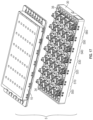
- FIG. 17 is an exploded top perspective view of the fluid processing cassette.
- FIG. 18 shows a partial bottom plan view of a base plate, including fluid channels and ports formed in the bottom of base plate.
- FIG. 19 shows a partial bottom plan view of a base plate with the base plate film removed and with the lower rotor in a first position.
- FIG. 20 shows a partial bottom plan view of a base plate with the base plate film removed and the lower rotor in the first position and showing fluid movement by solid fluid path arrows and dashed fluid path arrows.
- FIGS. 21 - 24 are exploded bottom perspective views of a bottom stator and rotor assembly of the fluid processing cassette showing different fluid movement paths through the bottom stator and the rotor assembly.
- FIG. 25 shows a partial bottom plan view of a base plate with the base plate film removed and with the lower rotor in a second position.
- FIG. 26 shows a partial bottom plan view of a base plate with the base plate film removed and the lower rotor in the second position and showing fluid movement by solid fluid path arrows and dashed fluid path arrows.
- FIG. 27 shows a partial top plan view of top plate, including fluid channels and ports formed on the top of top plate
- FIG. 28 shows a partial top plan view of top plate, including fluid channels and ports formed on the top of top plate with the top film removed and with the upper rotor in a first position.
- FIG. 29 shows a partial top plan view of top plate, including fluid channels and ports formed on the top of top plate with the top film removed and with the upper rotor in the first position and showing fluid movement by solid fluid path arrows, dashed fluid path arrows, and dotted fluid path arrows.
- FIGS. 30 - 33 are exploded top perspective views of a top stator and rotor assembly of the fluid processing cassette showing different fluid movement paths through the top stator and the rotor assembly.
- FIG. 34 shows a partial top plan view of top plate, including fluid channels and ports formed on the top of top plate with the top film removed and with the upper rotor in a second position.
- FIG. 35 shows a partial top plan view of top plate, including fluid channels and ports formed on the top of top plate with the top film removed and with the upper rotor in the second position and showing fluid movement by solid fluid path arrows and dashed fluid path arrows.
- FIG. 36 is a top perspective view of an actuator device for actuating the fluid processing cassette.
- FIG. 37 is a perspective view of rotor rod actuators of the actuator device.
- FIG. 38 is a perspective view of plunger rod actuators of the actuator device.
- FIG. 39 is a top perspective view of the rail and actuator components of the actuator device positioned relative to the fluid processing cassette to actuate the internal components of the fluid processing cassette.
- FIG. 40 is a bottom perspective view of two flex circuit heaters and two sets of magnets and magnet lifters of the actuator device positioned relative to the fluid processing cassette to perform temperature control and magnet control in two respective processing stations of the fluid processing cassette.
- FIG. 41 is a perspective view of rail and actuator components of the actuator device, including a magnet lift actuator.
- FIG. 42 is an exploded top perspective view of a flex circuit heater and set of magnets and magnet lifter of the actuator device positioned relative to a partial perspective, cross-sectional view of the fluid processing cassette along the line A-A in FIG. 2 , similar to FIG. 7 .
- FIG. 43 is a schematic diagram illustrating a general overview of operation of the fluid processing cassette.
- FIG. 44 is a schematic diagram illustrating operation of various processing stations within the fluid processing cassette.
- FIG. 45 is a top perspective view of a reagent cassette system with a blister compression lid in a closed position.
- FIG. 46 is a top perspective view of the reagent cassette system with the blister compression lid in an open position and reagent packs positioned above a top plate of the cassette.
- FIG. 47 is a top perspective view of the reagent cassette system with the reagent blister compression lid in an open position and the reagent packs placed on the top plate of the cassette and further showing an enlarged detail of a portion of the blister compression lid.
- FIG. 48 is a bottom perspective view of a single reagent pack.
- FIG. 49 is a bottom plan view of the single reagent pack.
- FIG. 50 is a top perspective view of the reagent cassette system with the blister compression lid in an open position and with two double reagent packs placed in the top plate of the cassette.
- FIG. 51 is a bottom perspective view of a double reagent pack.
- FIG. 52 is a the bottom plan view of the double reagent pack.
- FIG. 53 is a top perspective view of a barb actuator rod.
- FIG. 54 is a bottom plan in view of the barb actuator rod.
- FIG. 55 is an enlargement of detail “A” from FIG. 54 .
- FIG. 56 is a top perspective view of a reagent rotor rod.
- FIG. 57 is a partial perspective view of the top plate of the reagent cassette system.
- FIG. 58 is a partial plan view of the top plate of the reagent cassette system with the blister compression lid and a backing card of each reagent pack omitted.
- FIG. 59 is a partial plan view of the top plate of the reagent cassette system without reagent packs and with the barb actuator rod in a first, non-puncturing position.
- FIG. 60 is a partial plan view of the top plate of the reagent cassette system without reagent packs and with the barb actuator rod in a second, puncturing position.
- FIG. 61 is a partial cross-section of the reagent cassette system in the direction of arrow “A” in FIG. 46 , with the blister compression lid in an open position, and with the barb actuator rod in a first position, non-puncturing position.
- FIG. 62 is a partial cross-section of the reagent cassette system in the direction of arrow “A” in FIG. 46 , with the blister compression lid in an open position, and with the barb actuator rod in a second position, puncturing position.
- FIG. 63 is a top perspective view of a 16-channel reagent cassette system with a blister compression lid in a closed position.
- FIG. 64 a partial top perspective view of a 16-channel reagent cassette system with a blister compression lid and reagent pack omitted from the figure.
- references in the specification to “one embodiment,” “an embodiment,” a “further embodiment,” “an exemplary embodiment,” “some embodiments,” “various embodiments,” “some aspects,” “a further aspect,” “aspects,” etc., indicate that the embodiment(s) described may include a particular feature, structure, or characteristic, but every embodiment encompassed by this disclosure may not necessarily include the particular feature, structure, or characteristic. Moreover, such phrases are not necessarily referring to the same embodiment. Further, when a particular feature, structure, or characteristic is described in connection with an embodiment, such feature, structure, or characteristic is also a description in connection with other embodiments, whether or not explicitly described.
- This description may use various terms describing relative spatial arrangements and/or orientations or directions in describing the position and/or orientation of a component, apparatus, location, feature, or a portion thereof or direction of movement, force, or other dynamic action.
- such terms including, without limitation, top, bottom, above, below, under, on top of, upper, lower, left, right, in front of, behind, beneath, next to, adjacent, between, horizontal, vertical, diagonal, longitudinal, transverse, radial, axial, clockwise, counter-clockwise, etc., are used for convenience in referring to such component, apparatus, location, feature, or a portion thereof or movement, force, or other dynamic action in the drawings and are not intended to be limiting.
- terms used herein to describe a physical and/or spatial relationship between a first component, structure, or portion thereof and a second component, structure, or portion thereof such as, attached, connected, fixed, joined, linked, coupled, or similar terms or variations of such terms, shall encompass both a direct relationship in which the first component, structure, or portion thereof is in direct contact with the second component, structure, or portion thereof or there are one or more intervening components, structures, or portions thereof between the first component, structure, or portion thereof and the second component, structure, or portion thereof.
- any specific dimensions mentioned in this description are merely representative of an example implementation of a device embodying aspects of the disclosure and are not intended to be limiting.
- first and second preceding the name of an elopement (e.g., a component, apparatus, location, feature, or a portion thereof or a direction of movement, force, or other dynamic action) are used for identification purposes to distinguish between similar elements, and are not intended to necessarily imply order, nor are the terms “first” and “second” intended to preclude the inclusion of additional similar elements.
- adjacent refers to being near or adjoining. Adjacent objects can be spaced apart from one another or can be in actual or direct contact with one another. In some instances, adjacent objects can be coupled to one another or can be formed integrally with one another.
- proximate refers to being near, adjoining, or separated by a relatively or functionally small distance or space.
- a first object that is proximate to a second object can be in contact with the second object or can be within a distance of the second object such that the distance or space from the first object to the second object allows for the two objects to serve their respective functions or exhibit their respective characteristics in accordance with this disclosure.
- the terms “substantially” and “substantial” refer to a considerable degree or extent.
- the terms can refer to instances in which the event, circumstance, characteristic, or property occurs precisely as well as instances in which the event, circumstance, characteristic, or property occurs to a close approximation, such as accounting for typical tolerance levels or variability of the examples described herein.
- the terms “optional” and “optionally” mean that the subsequently described, component, structure, element, event, circumstance, characteristic, property, etc. may or may not be included or occur and that the description includes instances where the component, structure, element, event, circumstance, characteristic, property, etc. is included or occurs and instances in which it is not or does not.
- assemblies and devices as described herein may be used in combination with a fluid cartridge that may comprise one or more fluid processing passageways including one or more elements, for example, one or more of a channel, a branch channel, a valve, a flow splitter, a vent, a port, an access area, a via, a bead, a reagent containing bead, a cover layer, a reaction component, any combination thereof, and the like. Any element may be in fluid communication with another element.
- fluid communication means either direct fluid communication, for example, two regions can be in fluid communication with each other via an unobstructed fluid processing passageway connecting the two regions or can be capable of being in fluid communication, for example, two regions can be capable of fluid communication with each other when they are connected via a fluid processing passageway that can comprise a valve disposed therein, wherein fluid communication can be established between the two regions upon actuating the valve, for example, by dissolving a dissolvable valve, bursting a burstable valve, or otherwise opening a valve disposed in the fluid processing passageway.
- Fluid processing can include, for example, fluid analysis or fluid sample preparation, such as sample preparation for next generation sequencing (NGS).
- NGS sample preparation for example, is an expensive, time-consuming process (e.g., 1 to 3 days) and requires sophisticated lab facilities.
- NGS sample preparation and other conventional fluid processing techniques and devices are susceptible to human error, equipment error or failure, cross contamination, and environmental contamination.
- aspects of the disclosure encompass a novel fluid processing device capable of processing multiple fluid samples simultaneously in separate but similar fluid channels via identical processing steps, thereby increasing efficiency, avoiding inconsistencies, and lowering costs.
- the fluid processing device can be contained in a consumable, such as a single-use consumable, that replaces multiple separate pieces of expensive equipment associated with conventional fluid processing techniques.
- the fluid processing device can automate sample preparation for NGS.
- the fluid processing device is suitable for fluid processing or sample fluid preparation of a variety of fluids, including initial sample preps (ISPs) of DNA samples, saliva, and Formalin-fixed paraffin-embedded (FFPE) tissue.
- ISPs initial sample preps
- FFPE Formalin-fixed paraffin-embedded
- environmental contamination is avoided, for example, by sealing the fluid processing device and minimizing contact between the fluid channels of the fluid processing device and external processing equipment.
- Cross contamination is avoided, for example, by removing any fluid communication between the fluid channels of the fluid processing device.
- the fluid processing device can comprise two or more fluid channels, such as three, four, five, six, seven, eight, nine, ten, or more than ten fluid channels.
- a fluid channel can be separate from all other fluid channels such that there is no fluid communication between the fluid channel and all other fluid channels, which can avoid cross contamination and obviate the need for buffer wash or waste collection.
- Two or more fluid channels can be associated with or comprise identical or substantially similar components, such as components with identical or similar volumes, shapes, lengths, sizes, or relative positioning.
- Two or more fluid channels can be associated with an identical or similar number of components, and the associated components can be in an identical or similar order in the two or more fluid channels.
- all fluid channels of the fluid processing device are associated with corresponding components with identical volume fluid paths arranged in the same order in each fluid channel.
- the fluid processing device can comprise a sample input component associated with each fluid channel, such as a sample input well, channel, chamber, port, or other fluid input element.
- the fluid processing device can comprise a sample output component associated with each fluid channel, such as a sample output well, channel, chamber, port, or other fluid output element.
- a fluid channel in the fluid processing device can comprise or be associated with fluid components such as a pathway, channel, vessel, port, receptacle, chamber, well, valve, rotor, or other fluid component.
- the fluid processing device can comprise two or more processing stations.
- a processing station can be associated with two or more fluid channels of the fluid processing device, and each processing station can be configured to perform at least one processing step on a fluid in each of the associated fluid channels.
- the processing step(s) of a processing station can be performed identically and simultaneously on a fluid in each of the associated fluid channels.
- a processing step can comprise moving a fluid, retaining a fluid, adding one or more reagents to a fluid, removing one or more waste substances from a fluid, performing temperature control (e.g., heat) to the fluid, or performing a magnetic procedure, such as a magnetic separation procedure, to the fluid.
- temperature control e.g., heat
- Temperature control can be performed by air flow and/or a thin film heater, such that the temperature control can control an elevated reaction temperature or thermal cycling (e.g., for purposes of polymerase chain reaction (PCR)).
- Magnetic control can be performed using a permanent magnet, for example, by changing the distance between a permanent magnet and fluid in a fluid channel.
- a fluid processing device can comprise eight separate fluid channels and six processing stations each associated with all eight fluid channels.
- This fluid processing device can receive one of eight identical sample fluids into each of the eight fluid channels (e.g., via a sample input well associated with each fluid channel) and each of the six processing stations in turn can simultaneously perform processing steps identically to the sample fluid in each fluid channel, such that the sample fluids in the eight fluid channels are all subjected to the same processing steps at the same times.
- each processed sample fluid can be removed from the fluid processing device (e.g., via a sample output well associated with each fluid channel).
- the separate fluid channels avoid cross contamination, and the simultaneous, identical processing of each sample fluid avoids inconsistencies between the processed sample fluids.
- the fluid processing device can comprise at least a first processing station.
- the first processing station can be configured to process a fluid in each of two or more fluid channels.
- the first processing station can comprise a first process chamber or other similar component (e.g., cell, vessel, channel, compartment, or receptacle) associated with each of two or more fluid channels.
- the first processing station can further comprise a first process pump assembly associated with each of two or more fluid channels.
- the first process pump assemblies can be configured to perform one or more processing steps to a fluid in each associated fluid channel, such as move a fluid through a portion of each associated fluid channel or move a waste substance through a portion of each associated fluid channel.
- the first process pump assemblies can be configured to be operable in unison to simultaneously perform a processing step to a fluid in each associated fluid channel.
- the processing step can be, for example, moving a fluid downstream in each associated fluid channel into a first process chamber of the associated fluid channel from a portion of the associated fluid channel that is upstream from the first process chamber, such as a sample input well of the associated fluid channel.
- the processing step can be, for example, moving waste upstream into a sample input well, the first process chamber of the first processing station, or the first process pump assembly of the first processing station from a portion of the associated fluid channel that is downstream from the sample input well, the first process chamber of the first processing station, or the first process pump assembly of the first processing station.
- molecules of interest in sample fluid may be held stationary, such as by binding the molecules of interest (such as DNA) to ferromagnetic particles (e.g., magnetic beads) that are held stationary by magnets in proximity to the first process chamber of the first processing station, while the first process pump assembly of the first processing station moves waste from the first process chamber upstream into a sample input well or upstream into the first process pump assembly. This allows the fluid to be washed away thus leaving the molecules of interest (bead purification).
- the last step is to wash the molecules off the magnetic beads and send that fluid on to the next processing step.
- the magnetic beads are in a fluid that is added to the reagent input well
- the first processing station can further comprise a first reagent input component associated with each of two or more fluid channels, such as a reagent input well, channel, chamber, port, or other reagent input element.
- the first reagent input component can be a first reagent input well.
- the first processing station can comprise a first reagent channel associated with each first reagent input well.
- a first reagent channel can comprise one or more fluid passageway elements, such as fluid channels, ports, or valves.
- a first reagent input well associated with a fluid channel can be connected via an associated first reagent channel to a first process chamber of the associated fluid channel.
- the first processing station can further comprise a first reagent pump assembly associated with each of two or more fluid channels.
- the first reagent pump assemblies can be configured to perform a processing step of moving a reagent (e.g., a reagent including magnetic beads), such as from a reagent input well of an associated fluid channel to a first process chamber of the associated fluid channel, for example via a first reagent channel associated with the reagent input well.
- a reagent e.g., a reagent including magnetic beads
- the first reagent pump assemblies can be configured to be operable in unison to simultaneously move a reagent in each associated fluid channel.
- the fluid processing device can comprise one or more intermediate processing stations.
- An intermediate processing station can be disposed between a first processing station and an end processing station.
- An intermediate processing station can be configured to process a fluid in each of two or more fluid channels, such as a portion of each of the two or more fluid channels that is downstream from a first processing station but upstream from an end processing station.
- An intermediate processing station can comprise an intermediate process chamber or other similar component (e.g., cell, vessel, channel, compartment, or receptacle) associated with each of two or more fluid channels.
- An intermediate processing station can further comprise an intermediate process pump assembly associated with each of two or more fluid channels.
- the process step can be, for example, moving waste upstream into a preceding processing station (e.g., a process chamber or process pump assembly of the preceding processing station), the intermediate process chamber of the intermediate processing station, or the intermediate process pump assembly of the intermediate processing station from a portion of the associated fluid channel that is downstream from the preceding processing station, the intermediate process chamber of the intermediate processing station, or the intermediate process pump assembly of the intermediate processing station.
- a bead purification process can be performed in the intermediate process chamber of the intermediate processing station while the intermediate process pump assembly of the intermediate processing station moves waste from the intermediate process chamber upstream into a preceding processing station or upstream into the intermediate process pump assembly.
- Each intermediate processing station can further comprise an intermediate reagent input component associated with each of two or more fluid channels, such as an intermediate reagent input well, channel, chamber, port, or other reagent input element.
- the intermediate reagent input component can be an intermediate reagent input well.
- An intermediate processing station can comprise an intermediate reagent channel associated with each intermediate reagent input well.
- An intermediate reagent channel can comprise one or more fluid passageway elements, such as fluid channels, ports, or valves.
- An intermediate reagent input well associated with a fluid channel can be connected via an associated intermediate reagent channel to an intermediate process chamber of the associated fluid channel.
- An intermediate processing station can further comprise an intermediate reagent pump assembly associated with each of two or more fluid channels.
- the intermediate reagent pump assemblies can be configured to perform a processing step of moving a reagent (e.g., a reagent including magnetic beads or wash buffer), such as from an intermediate reagent input well of an associated fluid channel to an intermediate process chamber of the associated fluid channel, for example via an intermediate reagent channel associated with the intermediate reagent input well.
- a reagent e.g., a reagent including magnetic beads or wash buffer
- the intermediate reagent pump assemblies can be configured to be operable in unison to simultaneously move a reagent in each associated fluid channel.
- the fluid processing device can comprise an end processing station.
- the end processing station can be configured to process a fluid in each of two or more fluid channels.
- the end processing station can comprise an end process chamber or other similar component (e.g., cell, vessel, channel, compartment, or receptacle) associated with each of two or more fluid channels.
- the end processing station can comprise a sample output component (e.g., sample output well) associated with each of two or more fluid channels, such as a sample output well, channel, chamber, port, or other fluid output element.
- the end processing station can comprise an end process pump assembly associated with each of two or more fluid channels.
- the end process pump assemblies can be configured to perform one or more processing steps to a fluid in each associated fluid channel, such as move a fluid through a portion of each associated fluid channel or move a waste substance through a portion of each associated fluid channel.
- the end process pump assemblies can be configured to be operable in unison to simultaneously perform a processing step to a fluid in each associated fluid channel.
- the processing step can be, for example, moving a fluid downstream in each associated fluid channel into a sample output well of the associated fluid channel from a portion of the associated fluid channel that is upstream from the sample output well, such as a process chamber of a preceding processing station, for example a first process chamber of the first processing station or an intermediate process chamber of a preceding intermediate processing station.
- the process step can be, for example, moving waste upstream into a preceding processing station (e.g., a process chamber or process pump assembly of the preceding processing station), the end process chamber of the end processing station, or the end process pump assembly of the end processing station from a portion of the associated fluid channel that is downstream from the preceding processing station, the end process chamber of the end processing station, or the end process pump assembly of the end processing station.
- a bead purification process can be performed in the end process chamber of the end processing station while the end process pump assembly of the end processing station moves waste from the end process chamber upstream into a preceding processing station or upstream into the end process pump assembly.
- the end processing station does not does not comprise an end process chamber or similar component associated with each of two or more fluid channels. In some embodiments, the end processing station does not comprise an end reagent input component, end reagent channel, and/or end reagent pump assembly associated with each of two or more fluid channels. In some embodiments, the end processing station can comprise an end reagent input component, end reagent channel, and/or end reagent pump assembly associated with each of two or more fluid channels. In some embodiments, end reagent-related features perform no fluid function (e.g., the end reagent-related features are vented to atmosphere) and/or serve a structural or assembly purpose.
- the fluid processing device comprises multiple intermediate processing stations, such as a first intermediate processing station and a second intermediate processing station. In some examples, the fluid processing device comprises three, four, five, six, seven, eight, nine, ten, or more than ten intermediate processing stations. Multiple intermediate processing stations can perform one or more processing steps in turn.
- a first processing station can perform processing steps on a fluid sample in each of two or more associated fluid channels by moving the fluid samples from sample input wells to first process chambers of the first processing station via first process pump assemblies and moving reagents into the first process chambers via first reagent pump assemblies; then a first intermediate processing station can perform processing steps on the fluid samples in each of the two or more associated fluid channels by moving the fluid samples to first intermediate process chambers of the first intermediate processing station via first intermediate process pump assemblies and moving reagents into the first intermediate process chambers via first intermediate reagent pump assemblies; then a second intermediate processing station can perform processing steps on the fluid samples in each of the two or more associated fluid channels by moving the fluid samples to second intermediate process chambers of the second intermediate processing station via second intermediate process pump assemblies and moving reagents into the second intermediate process chambers via second intermediate reagent pump assemblies; and then an end processing station can perform a processing step on the fluid samples in each of the two or more associated fluid channels by moving the fluid samples to sample output wells.
- a first process pump assembly, an intermediate process pump assembly, and/or an end process pump assembly comprises at least one positive displacement pump, such as a reciprocating pump, for example a plunger pump.
- each of these process pump assemblies can comprise a process stator that defines at least one process pump chamber and defines at least one process chamber port in fluid communication with the at least one process pump chamber.
- a single stator can comprise components of two or more process pump assemblies.
- a single process stator can define two or more process pump chambers and two or more process chamber ports, such that each of the two or more process chamber ports is in fluid communication with one of the process pump chambers, and where each process pump chamber and associated process chamber port are components of one of the two or more process pump assemblies.
- One or more process plungers can be disposed within a process pump chamber and can be movable within the process pump chamber.
- a process plunger can be connected to a process plunger rod and can be movable (e.g., axially) via the process plunger rod. For example, movement of a process plunger within a process pump chamber in a first direction can draw fluid into the process pump chamber through a process chamber port in fluid connection with the process pump chamber, and movement of the process plunger within the process pump chamber in a second direction can expel fluid from the process pump chamber through the process chamber port.
- two or more process pump assemblies of a processing station comprise a single process plunger rod, and process plungers disposed within the process pump chambers of each of the two or more process pump assemblies are attached to the single process plunger rod such that axial movement of the single process plunger rod effects simultaneous movement of the process plungers within their respective process pump chambers in their respective first and second directions.
- Such an embodiment can perform the same processing step simultaneously to fluids in fluid channels associated with the two or more process pump assemblies, such as moving fluid into the process pump chambers or out of the process pump chambers.
- a first process pump assembly, an intermediate process pump assembly, and/or an end process pump assembly comprises at least one process valve.
- the process valve can be movable between a first position fluidly connecting a process pump assembly to an upstream portion of an associated fluid channel and a second position fluidly connecting the process pump assembly to a downstream portion of the associated fluid channel.
- a process valve can also be closed or moveable to a closed position such that fluid is retained in or blocked from entering or leaving components, such as an associated process chamber or a fluid component (e.g., chamber, channel, or port) of the process pump assembly.
- a process valve can be operatively coupled to a process valve rod and can be movable (e.g., rotatable) via the process valve rod between, for example, the first position and second position.
- the process valve is coupled to a process stator of the process pump assembly such that the first position and second position fluidly connect a process chamber port defined by the process stator to the upstream portion and downstream portion of the associated fluid channel, respectively.
- the process valve comprises a rotor, such as a rotor with multiple rotor ports and/or rotor fluid paths, which is rotatable between the first position and the second position.
- the process valve can comprise a rotor that is rotatably mounted with respect to a process stator for rotational movement between the first position and second position
- the process valve rod can be a process rotor rod.
- a single process valve is a component of two or more process pump assemblies and can be moved between two or more positions for fluidly connecting a first process pump of a first process pump assembly to an upstream portion of its associated fluid channel, the first process pump of the first process pump assembly to a downstream portion of its associated fluid channel, a second process pump of a second separate process pump assembly to an upstream portion of its associated fluid channel, and/or the second process pump of the second separate process pump assembly to a downstream portion of its associated fluid channel.
- two or more process pump assemblies of a processing station comprise a single process valve rod, and a process valve of each of the two or more process pump assemblies is coupled to the single process valve rod such that movement of the single process valve rod effects simultaneous movement of the process valves between their first positions and second positions.
- Such an embodiment can perform the same processing step simultaneously to fluids in fluid channels associated with the two or more process pump assemblies, such as directing fluid movement upstream or downstream from the process pump assemblies or blocking fluid from entering or leaving associated process chambers or fluid components of the process pump assemblies.
- a first reagent pump assembly and/or an intermediate reagent pump assembly comprises at least one positive displacement pump, such as a reciprocating pump, for example a plunger pump.
- each of these reagent pump assemblies can comprise a reagent stator that defines at least one reagent pump chamber and defines at least one reagent chamber port in fluid communication with the at least one reagent pump chamber.
- a single stator can comprise components of two or more reagent pump assemblies.
- a single reagent stator can define two or more reagent pump chambers and two or more reagent chamber ports, such that each of the two or more reagent chamber ports is in fluid communication with one of the reagent pump chambers, and where each reagent pump chamber and associated reagent chamber port are components of one of the two or more reagent pump assemblies.
- One or more reagent plungers can be disposed within a reagent pump chamber and can be movable within the reagent pump chamber.
- a reagent plunger can be connected to a reagent plunger rod and can be movable (e.g., axially) via the reagent plunger rod.
- movement of a reagent plunger within a reagent pump chamber in a first direction can draw fluid into the reagent pump chamber through a reagent chamber port in fluid connection with the reagent pump chamber, and movement of the reagent plunger within the reagent pump chamber in a second direction can expel fluid from the reagent pump chamber through the reagent chamber port.
- two or more reagent pump assemblies of a processing station comprise a single reagent plunger rod, and reagent plungers disposed within the reagent pump chambers of each of the two or more reagent pump assemblies are attached to the single reagent plunger rod such that axial movement of the single reagent plunger rod effects simultaneous movement of the reagent plungers within their respective reagent pump chambers in their respective first and second directions.
- Such an embodiment can perform the same processing step simultaneously to fluids in fluid channels associated with the two or more reagent pump assemblies, such as moving reagent from reagent input wells into the reagent pump chambers or moving reagent out of the reagent pump chambers into process chambers.
- a first reagent pump assembly and/or an intermediate reagent pump assembly comprises at least one reagent valve.
- the reagent valve can be movable between a first position fluidly connecting a reagent pump assembly to an associated reagent input well and a second position fluidly connecting the reagent pump assembly to an associated process chamber.
- a reagent valve can also be closed or moveable to a closed position such that reagent is retained in or blocked from entering or leaving components, such as an associated reagent input well, an associated process chamber, or a fluid component (e.g., chamber, channel, or port) of the reagent pump assembly.
- a reagent valve can be operatively coupled to a reagent valve rod and can be movable (e.g., rotatable) via the reagent valve rod between, for example, the first position and second position.
- the reagent valve is coupled to a reagent stator of the reagent pump assembly such that the first position fluidly connects a reagent chamber port defined by the reagent stator to the associated reagent input well and the second position fluidly connects the reagent chamber port to the associated process chamber.
- the reagent valve comprises a rotor, such as a rotor with multiple rotor ports and/or rotor fluid paths, which is rotatable between the first position and the second position.
- the reagent valve can comprise a rotor that is rotatably mounted with respect to a reagent stator for rotational movement between the first position and second position
- the reagent valve rod can be a reagent rotor rod.
- a single reagent valve is a component of two or more reagent pump assemblies and can be moved between two or more positions for fluidly connecting a first reagent pump of a first reagent pump assembly to a reagent input well of its associated fluid channel, the first reagent pump of the first reagent pump assembly to a process chamber of its associated fluid channel, a second reagent pump of a second separate reagent pump assembly to a reagent input well of its associated fluid channel, and/or the second reagent pump of the second separate reagent pump assembly to a process chamber of its associated fluid channel.
- two or more reagent pump assemblies of a processing station comprise a single reagent valve rod, and a reagent valve of each of the two or more reagent pump assemblies is coupled to the single reagent valve rod such that movement of the single reagent valve rod effects simultaneous movement of the reagent valves between their first positions and second positions.
- Such an embodiment can perform the same processing step simultaneously to fluids in fluid channels associated with the two or more reagent pump assemblies, such as directing or blocking reagent movement from reagent input wells or directing or to associated process chambers.
- one or more process pump chambers and/or reagent pump chambers can be sealed with a plunger rod seal.
- a plunger rod seal can operate in combination with one or more plunger rods and/or one or more plungers disposed in a pump chamber to form a seal in the pump chamber.
- a plunger rod seal can permit one or more plunger rods to extend through and move through the plunger rod seal without breaking or unsealing the seal in the pump chamber or without allowing fluid or air to escape the sealed pump.
- a stator such as a process stator or reagent stator can be coupled to one or more stator seals, such as by welding, adhesives, or elastomeric seal.
- a process stator and a reagent stator can be connected to a shared stator seal.
- a stator seal can comprise fluid paths, such as fluid paths formed into a surface of the stator seal, and such stator seal fluid paths can connect or form fluid communications with fluid ports or channels of a stator to which the stator seal is coupled.
- two or more process chambers of a processing station are in fluid communication with each other.
- two or more process chambers of a processing station can be combined to form a single pooled process chamber associated with two or more fluid channels such that process fluid from the two or more fluid channels can be received into the single pooled process chamber and process pump assemblies of the processing station associated with the two or more fluid channels can each move process fluid into the single pooled process chamber from portions of the associated fluid channels that are upstream from the single pooled process chamber.
- the end processing station comprises one or more pooled process chambers and each of the one or more pooled process chambers is associated with a pooled output well.
- a component such as a rotor valve, stator, or stator seal is a component of two or more pump assemblies of a processing station.
- two or more pump assemblies of a processing station can comprise a single rotor valve or a single stator.
- a single rotor valve can direct process fluids or reagents in two separate fluid channels
- a single stator can define a process pump chamber and/or reagent pump chamber for each of two separate fluid channels.
- a single component such as a rotor valve, stator, or stator seal is a component of two or more pump assemblies, one or more of the two or more pump assemblies can be actuated without actuating the remainder of the two or more pump assemblies.
- a single stator defines a process pump chamber and/or reagent pump chamber of a first pump assembly of a first fluid channel and defines a process pump chamber and/or reagent pump chamber of a second pump assembly of a second separate fluid channel
- the first pump assembly of the first fluid channel can be actuated without actuating the second pump assembly of the second separate fluid channel, and vice versa.
- one or more intermediate sample output wells can be associated with a fluid channel.
- An intermediate sample output well can be disposed, for example, between two processing stations of an associated a fluid channel or between a pump assembly and a process chamber of an associated fluid channel.
- Intermediate sample output wells can be configured to allow for a volume of sample process fluid to be retrieved from each of two or more fluid channels of the fluid processing device before or after addition of a reagent to the sample process fluids at a processing station of the fluid processing device.
- Sample fluids can be retrieved from intermediate sample output wells for purposes of quality control testing, archiving, or other fluid analysis performed outside of the fluid processing device.
- the fluid processing device comprises a consumable cassette.
- the cassette can comprise fluid components encapsulated or sealed within a top plate and a base plate.
- the cassette can contain the following components encapsulated or sealed inside the cassette: all fluid components, or all fluid components except for sample input components, reagent input components, and/or sample output components, or all processing stations, or all pump assemblies.
- the cassette width can be less than about 200 mm, 150 mm, 125 mm, 100 mm, 90 mm, 80 mm, 70 mm, or 60 mm.
- the cassette length can be less than about 400 mm, 350 mm, 325 mm, 300 mm, 275 mm, 250 mm, 225 mm, 210 mm, 200 mm, 190 mm, 180 mm, or 170 mm.
- the cassette contains eight fluid channels and seven processing stations and measures 90 mm wide and 210 mm in length.
- components of the cassette are stacked to decrease size and dead volumes.
- the fluid processing device can be designed or sized to fit inside a liquid handler.
- the liquid handler can transfer sample fluids to the fluid processing device, such as by depositing sample fluids into a sample input well of the device.
- the liquid handler can remove processed sample fluids from the fluid processing device, such as by retrieving a processed sample fluid from a sample output well of the device or an intermediate sample output well of the device.
- the liquid handler can transfer reagents to the fluid processing device, such as by depositing a reagent into a reagent input well of the fluid processing device.
- the fluid processing device can comprise sample input chambers or wells, reagent input chambers or wells, intermediate sample output chambers or wells, and sample output chambers or wells that are sized and spaced to receive fluids from or have fluids recovered by a liquid handler, such as chambers that are positioned at standard microtiter plate spacing (e.g., 9 mm).
- a liquid handler such as chambers that are positioned at standard microtiter plate spacing (e.g., 9 mm).
- components of the fluid processing device can be manufactured and/or assembled by simple processing (e.g., laser cutting, waterjet cutting, heat sealing, or lubrication), plastic molding (e.g., injection molding, blow molding, or compression molding), welding (e.g., ultrasonic welding), adhesives, or utilizing snap joints, or some combination of two or more of the forgoing.
- Components of the fluid processing device can comprise plastic, such as polycarbonate, polypropylene, OPP (polypropylene) film, thermoplastic urethane, thermoplastic elastomer, nylon, or polysiloxane.
- the fluid processing device comprises duplicates of some components, for example, stators, plungers, plunger rods, rotor valve rods, rotor valves, stator seals, plunger rod seals, and gaskets.
- the actuator device configured to activate and control pumps and/or valves of the fluid processing device.
- the actuator device comprises one or more valve actuators (e.g., rotor actuators) that actuate valves of the fluid processing device, such as by actuating one or more valve rods or rotor rods.
- the actuator device can comprise one or more process valve actuators to actuate one or more process valves or one or more process valve rods.
- the actuator device can comprise one or more reagent valve actuators to actuate one or more reagent valves or one or more reagent valve rods.
- the actuator device comprises a number of valve actuators to actuate the valves or valve rods of one processing station at a time, and the actuation device can comprise, for example, one or more valve linear actuators to move the valve actuators between processing stations of the fluid processing device.
- the actuator device comprises one or more pump actuators (e.g., plunger actuators) that actuate pumps of the fluid processing device, such as by actuating one or more plunger rods.
- the actuator device can comprise one or more process pump actuators to actuate one or more process pumps or one or more process plunger rods.
- the actuator device can comprise one or more reagent pump actuators to actuate one or more reagent pumps or one or more reagent plunger rods.
- the actuator device comprises a number of pump actuators to actuate the pumps or pump rods of one processing station at a time, and the actuation device can comprise, for example, one or more pump linear actuators to move the pump actuators between processing stations of the fluid processing device.
- the actuator device can control the temperature of the process chambers of the fluid processing device.
- the actuator device can comprise heaters or thermal elements configured to be positioned below each process chamber.
- the actuator device can comprise, for example, a thin flex circuit heater configured to heat process chambers individually, such that the actuator device can selectively control the temperature of all process chambers in a given processing station.
- the actuator device can further comprise one or more fans or blowers for cooling.
- Temperature control of a process chamber can comprise thermocycling (e.g., for PCR purposes).
- the actuator device can control the magnetic field in the process chambers of the fluid processing device.
- the actuator device can comprise one or more permanent magnets that may be moved to different distances from the process chambers, such as a first position proximate to the process chambers that applies a magnetic field to the contents of the process chambers and a second position not proximate or less proximate to the process chambers that does not apply a magnetic field to the contents of the process chambers.
- the actuator device comprises a magnet lifter configured to move one or more magnets to within close proximity of one or more process chambers, such as by lifting the one or more magnets to the bottom of the one or more process chambers.
- the actuator device can comprise a number of magnets equal to the number of process chambers in a processing station of the fluid processing device, and the actuator device can comprise a magnet linear actuator to move the magnets and magnet lifter between processing stations such that the actuator device can selectively control the magnetic field of all process chambers in a given processing station at a time.
- the actuator device can control both the temperature and the magnetic field in the process chambers of the fluid processing device, separately or at the same time.
- the actuator device can heat or cool one or more process chambers and apply a magnetic control to the one or more process chambers at different times or at the same time.
- the actuator device comprises (1) a thin flexible circuit heater configured to heat the process chambers of a processing station in the fluid processing device, where the thin flexible circuit heater is disposed proximate to the process chambers, and (2) one or more magnets coupled to a magnet lifter configured to move the one or more magnets between a first position proximate to the process chambers, in which the one or more magnetic fields of the one or more magnets are applied to the contents of the process chambers, and a second position not proximate to the process chambers, in which the one or more magnetic fields of the one or more magnets are not applied (or are applied less) to the contents of the process chambers.
- the thin flexible circuit heater is disposed between the process chambers and the one or more magnets when the one or more magnets are in the first position proximate to the process chambers, and the one or more magnets can press the thin flexible circuit heater against a surface or wall or the process chambers when the one or more magnets are in the first position.
- a temperature control can be performed in the process chambers via the thin flexible circuit heater when the one or more magnets are in the first position or second position
- a magnetic control can be performed in the process chambers via the one or more magnets when the one or more magnets are in the first position.
- the actuator device is configured to perform thermal and/or magnetic control in the process chambers according to DNA purification protocols.
- FIGS. 1 - 44 illustrate a fluid processing cassette and an actuator device for actuating the fluid processing cassette as described in International Publication No. WO 2020/242544, the disclosure of which is hereby incorporated by reference.
- FIG. 1 is a top view of a base plate 30 of a fluid processing cassette 5 (with top plate 10 (shown in FIG. 2 ) removed and not shown), which is an example fluid processing device according to an embodiment.
- cassette 5 comprises an input well 34 , which is exemplary of the eight total input wells of cassette 5 , and an output well 36 , which is exemplary of the eight total output wells of cassette 5 .
- Cassette 5 comprises eight separate fluid channels, and no fluid channel is in fluid communication with another fluid channel.
- Each of the eight input wells 34 is associated with a different fluid channel, and each of the eight output wells 36 is associated with a different fluid channel.
- Input well 34 and an associated output well 36 are associated with the same fluid channel, and the other input wells and output wells are likewise associated in pairs based on their positioning at proximal and distal ends of base plate 30 .
- cassette 5 comprises first processing station 500 , end processing station 560 , and first, second, third, fourth, and fifth intermediate processing stations 510 , 520 , 530 , 540 , and 550 , that are positioned between first processing station 500 and end processing station 560 .
- Cassette 5 encapsulates and seals the processing stations within base plate 30 and top plate 10 (see FIG. 2 ) to form a sealed consumable device.
- First processing station 500 comprises first pump assembly column 501 , second pump assembly column 502 , third pump assembly column 503 , and fourth pump assembly column 504 , and each of these pump assembly columns is configured to be operable in unison to simultaneously perform substantially similar processing steps on fluids in all eight fluid channels at first processing station 500 .
- First intermediate processing station 510 comprises first intermediate pump assembly column 511 , second intermediate pump assembly column 512 , third intermediate pump assembly column 513 , and fourth intermediate pump assembly column 514 , and each of these pump assembly columns is configured to be operable in unison to simultaneously perform substantially similar processing steps on fluids in all eight fluid channels at first intermediate processing station 510 .
- Each intermediate processing station 520 , 530 , 540 , and 550 similarly includes first, second, third, and fourth intermediate pump assembly columns.
- End processing station 560 comprises first end pump assembly column 561 , second end pump assembly column 562 , third end pump assembly column 563 , and fourth end pump assembly column 564 , and each of these pump assembly columns is configured to be operable in unison to simultaneously perform substantially similar processing steps on fluids in all eight fluid channels at end processing station 560 .
- Each pump assembly column of first processing station 500 and first intermediate processing station 510 comprises process pump assemblies and reagent pump assemblies associated with two separate fluid channels, such that the eight fluid channels of cassette 5 are processed separately at each of these processing stations.
- Each pump assembly column of end processing station 560 comprises process pump assemblies associated with two separate fluid channels, such that the eight fluid channels of cassette 5 are processed separately in this processing station.
- the pump assembly columns of end processing station 560 may not include functional reagent pump assemblies.
- FIG. 2 shows a top perspective view of cassette 5 .
- cassette 5 comprises a sealed device with input wells (e.g., input well 34 ) on one end and output wells (e.g., output well 36 ) on the opposite end, in which internal fluid processing components (not shown) are disposed between the input wells and output wells and are encapsulated within the base plate 30 and a top plate 10 .
- a top portion of top plate 10 is sealed by top film 12 .
- a plurality of reagent input wells 14 are formed in the top of top plate 10 and are configured to receive a volume of reagent, or other process fluid, at a particular processing station for a particular fluid channel.
- Reagent input well 14 is exemplary of forty-eight total reagent input wells formed in top plate 10 , of which eight are associated with the fluid channels (one reagent input well per fluid channel) at each of six processing stations—i.e., first processing station 500 and first, second, third, fourth, and fifth intermediate processing stations 510 , 520 , 530 , 540 , and 550 (see FIG. 1 ).
- Top-plate pump control port 212 formed in top plate 10 which is exemplary of other top-plate pump control ports also formed in top plate 10 , is configured to permit a reagent plunger rod actuator 220 (described below, see FIGS. 36 , 38 , 39 ) to actuate internal fluid components via first and second reagent plunger rods 200 , 202 (see FIG. 11 ).
- Base-plate pump control port 214 formed in base plate 30 which is exemplary of other base-plate pump control ports formed in base plate 30 , is configured to permit a process plunger rod actuator 222 (described below, see FIGS. 36 , 38 , 39 ) to actuate internal fluid components via first and second process plunger rods 204 , 206 (see FIG. 11 ).
- reagent plunger rod actuator 220 is coupled to first and second reagent plunger rods 200 , 202 , retraction of reagent plunger rod actuator 220 out of top-plate pump control ports 212 will cause reagent plunger rod actuator 220 to de-couple from first and second reagent plunger rods 200 , 202 due to interference between first and second reagent plunger rods 200 , 202 and top plate 10 , as first and second reagent plunger rod yokes 201 , 203 (see FIG. 11 ) each have a diameter that is larger than the diameter of top-plate pump control ports 212 .
- process plunger rod actuator 222 is coupled to first and second process plunger rods 204 , 206 , retraction of process plunger rod actuator 222 out of base-plate pump control ports 214 will cause process plunger rod actuator 222 to de-couple from first and second process plunger rods 204 , 206 due to interference between first and second process plunger rods 204 , 206 and base plate 30 , as first and second process plunger rod yokes 205 , 207 (see FIG. 11 ) each have a diameter that is larger than the diameter of base-plate pump control ports 214 .
- first and second reagent plunger rods 200 , 202 and first and second process plunger rods 204 , 206 are configured to be retained inside top plate 10 and base plate 30 upon retraction and release of reagent plunger rod actuator 220 and process plunger rod actuator 222 , respectively.
- FIG. 3 shows a bottom perspective view of cassette 5 .
- a bottom portion of base plate 30 is sealed by base film 32 .
- Base film 32 is shown as translucent in FIG. 3 so as to show features (e.g., process chamber 38 ) formed in the bottom of base plate 30 , where the bottom surface of such features are sealed by base film 32 .
- a plurality of process chambers 38 are formed in the bottom of base plate 30 and are configured to receive fluid at a particular processing station for a particular fluid channel.
- Process chamber 38 is exemplary of forty-eight total process chambers formed in base plate 30 , of which eight are associated with the eight fluid channels (one process chamber per fluid channel) at each of six processing stations—i.e., first processing station 500 and first, second, third, fourth, and fifth intermediate processing stations 510 , 520 , 530 , 540 , and 550 (see FIG. 1 ).
- Top-plate rotor control port 236 formed in top plate 10 which is exemplary of other top-plate rotor control ports also formed in top plate 10 , is configured to permit a reagent rotor rod actuator 240 (see FIGS. 36 , 37 , 39 ) to actuate internal fluid components via a reagent rotor rod 230 (see FIG. 15 ).
- Base-plate rotor control port 238 formed in base plate 30 which is exemplary of other base-plate rotor control ports formed in base plate 30 , is configured to permit a process rotor rod actuator 242 (see FIG. 36 , 37 , 39 ) to actuate fluid components via a process rotor rod 232 (see FIG. 15 ). If reagent rotor rod actuator 240 is coupled to reagent rotor rod 230 , retraction of reagent rotor rod actuator 240 out of and away from top-plate rotor control ports 236 a certain distance will cause reagent rotor rod actuator 240 to de-couple from reagent rotor rod 230 due to interference between reagent rotor rod 230 and top plate 10 .
- process rotor rod actuator 242 is coupled to process rotor rod 232 , retraction of process rotor rod actuator 242 out of and away from base-plate rotor control ports 238 a certain distance will cause process rotor rod actuator 242 to de-couple from process rotor rod 232 due to interference between process rotor rod 232 and base plate 30 .
- reagent rotor rod 230 and process rotor rod 232 are configured to be retained inside top plate 10 and base plate 30 upon retraction and release of reagent rotor rod actuator 240 and process rotor rod actuator 242 , respectively.
- An identification label 52 can comprise a machine-readable identification marker, such as a barcode or RFID tag, and/or a human-readable identification marker, such that sample fluids processed or sought to be processed in cassette 5 can be identified.
- a machine-readable identification marker such as a barcode or RFID tag
- a human-readable identification marker such that sample fluids processed or sought to be processed in cassette 5 can be identified.
- FIG. 4 is a bottom perspective view of top plate 10 .
- Reagent well ports 18 are ports located at the bottom of reagent input wells 14 (see FIGS. 2 , 7 ) formed in the top of top plate 10 and which permit reagents in the reagent input wells to move to the inside of cassette 5 to where the pump assembly columns, such as pump assembly columns 511 , 512 , 513 , and 514 (see FIGS. 1 , 17 ), are enclosed.
- Reagent-to-rotor ports 20 are connected to reagent well ports 18 via gasket slots 64 (see FIGS. 6 , 7 ) and permit reagents that enter reagent well ports 18 to move to upper rotors 150 of reagent pump assemblies (see FIG. 15 ).
- Reagent-to-process chamber top-plate ports 22 permit reagent to move from upper rotors 150 of reagent pump assemblies (see FIG. 15 ) to associated process chambers 38 (see FIG. 7 ) via reagent-to-process chamber gasket ports 66 (see FIGS. 6 , 7 ) and then via reagent-to-process chamber base-plate ports 42 (see FIGS. 5 , 7 ).
- the two reagent well ports 18 , the two reagent-to-rotor ports 20 , and the two reagent-to-process chamber top-plate ports 22 that are labelled in FIG.
- reagent well ports 18 see comparable elements 402 and 422 (first and second reagent well ports), 406 and 426 (first and second reagent-to-rotor port), and 410 and 430 (first and second reagent to process chamber top-plate ports) in FIGS. 28 and 34 .
- FIG. 5 is a top perspective view of base plate 30 .
- Reagent-to-process chamber base-plate ports 42 permit reagent from reagent-to-process chamber top-plate ports 22 (see FIG. 4 ) via reagent-to-process chamber gasket ports 66 (see FIG. 6 ) to move to process chambers 38 (see FIG. 3 ) formed in the bottom side of base plate 30 .
- the reagent-to-process chamber base-plate ports 42 that are labelled in FIG. 5 are repeating features of which one each is associated with each of the eight fluid channels at each of the six processing stations—i.e., first processing station 500 and first, second, third, fourth, and fifth intermediate processing stations 510 , 520 , 530 , 540 , and 550 (see FIG. 1 ).
- Gasket-positioning post 48 which is exemplary of other gasket-positioning posts formed in base plate 30 , is configured to fit into post hole 62 to secure and stabilize a gasket 60 (see FIG. 6 ).
- FIG. 6 is a perspective view of a gasket 60 , which comprises gasket slots 64 that form fluid passageways between reagent well ports 18 and reagent-to-rotor ports 20 (see FIG. 4 ).
- Gasket 60 further comprises reagent-to-process chamber gasket ports 66 , which permit reagents to move from reagent-to-process chamber top-plate ports 22 (see FIG. 4 ) to reagent-to-process chamber base-plate ports 42 (see FIG. 5 ).
- Gasket 60 further comprises post holes such as post hole 62 , which are configured to receive gasket-positioning posts such as gasket-positioning post 48 (see FIG. 5 ).
- FIG. 7 shows a partial perspective, cross-sectional view of fluid processing cassette 5 taken along line A-A in FIG. 2 .
- gasket 60 is positioned and secured between portions of top plate 10 and base plate 30 .
- FIG. 7 also shows that reagent in reagent input well 14 is fluidly connected through reagent well port 18 into gasket slot 64 .
- reagent is fluidly connected from a portion on top of top plate 10 down through reagent-to-process chamber top-plate port 22 , then through reagent-to-process chamber gasket port 66 , then through reagent-to-process chamber base-plate port 42 , and into process chamber 38 .
- Process chamber 38 is connected to the subsequent processing station via a process chamber outlet port 44 .
- a portion of base film 32 forms the bottom surface of process chamber 38 .
- FIG. 8 shows an exploded top perspective view of a stator assembly comprising top stator 80 of a reagent pump assembly, bottom stator 100 of a process pump assembly, and stator seal 120 disposed between top stator 80 and bottom stator 100 .
- Top stator 80 comprises a first reagent rotor port 84 that extends completely through top stator 80 and is in fluid communication with a first top stator fluid path 130 of stator seal 120 , which is in fluid communication with first reagent pump port 86 that extends from the bottom of top stator 80 to first reagent pump chamber 85 .
- Top stator 80 further comprises a second reagent rotor port 88 that extends completely through top stator 80 and is in fluid communication with a second top stator fluid path 132 of stator seal 120 , which is in fluid communication with second reagent pump port 90 that extends from the bottom of top stator 80 to second reagent pump chamber 89 .
- First and second reagent pump chambers 85 , 89 are associated with separate fluid channels via their respective reagent pump ports 86 , 90 , top stator fluid paths 130 , 132 , and reagent rotor ports 84 , 88 .
- Top stator 80 further comprises at least one snap tab 81 , which is a flexible tab with a detent configured to be snapped into a corresponding hole in top plate 10 , such as to form a snap joint to secure top stator 80 and top plate 10 to each other.
- snap tab 81 is a flexible tab with a detent configured to be snapped into a corresponding hole in top plate 10 , such as to form a snap joint to secure top stator 80 and top plate 10 to each other.
- Bottom stator 100 comprises first process rotor port 104 and second process rotor port 108 that extend completely through bottom stator 100 .
- Bottom stator 100 further comprises a first process pump chamber 105 , which is in fluid communication with a first process pump port 106 that extends from first process pump chamber 105 to the top of bottom stator 100 .
- Bottom stator 100 further comprises a second process pump chamber 109 , which is in fluid communication with a second process pump port 110 that extends from second process pump chamber 109 to the top of bottom stator 100 .
- Bottom stator 100 also comprises alignment holes 102 configured to receive alignment pins 123 (see FIG. 9 ) of stator seal 120 .
- Bottom stator 100 further comprises at least one snap tab 101 , which is a flexible tab with a detent configured to be snapped into a corresponding hole in base plate 30 , such as to form a snap joint to secure bottom stator 100 and base plate 10 to each other.
- snap tab 101 is a flexible tab with a detent configured to be snapped into a corresponding hole in base plate 30 , such as to form a snap joint to secure bottom stator 100 and base plate 10 to each other.
- FIG. 9 shows an exploded bottom perspective view of a stator assembly comprising top stator 80 of a reagent pump assembly, bottom stator 100 of a process pump assembly, and stator seal 120 disposed between top stator 80 and bottom stator 100 .
- Bottom stator 100 comprises first process rotor port 104 that extends completely through bottom stator 100 and is in fluid communication with a first bottom stator fluid path 136 of stator seal 120 , which is in fluid communication with first process pump port 106 that extends from the top of bottom stator 100 to first process pump chamber 105 .
- Bottom stator 100 further comprises a second process rotor port 108 that extends completely through bottom stator 100 and is in fluid communication with a second bottom stator fluid path 138 of stator seal 120 , which is in fluid communication with a second process pump port 110 that extends from the top of bottom stator 100 to second process pump chamber 109 .
- First and second process pump chambers 105 , 109 are associated with separate fluid channels via their respective process pump ports 106 , 110 , bottom stator fluid paths 136 , 138 , and process rotor ports 104 , 108 .
- Top stator 80 comprises a first reagent rotor port 84 and a second reagent rotor port 88 that extend completely through top stator 80 .
- Top stator 80 further comprises first reagent pump chamber 85 , which is in fluid communication with first reagent pump port 86 that extends from first reagent pump chamber 85 to the bottom of top stator 80 .
- Top stator 80 further comprises second reagent pump chamber 89 , which is in fluid communication with second reagent pump port 90 that extends from second reagent pump chamber 89 to the bottom of top stator 80 .
- Top stator 80 also comprises alignment holes 82 (see FIG. 9 ) configured to receive alignment pins 122 (see FIGS. 8 and 10 ) of stator seal 120 .
- FIG. 10 shows stator seal 120 .
- Stator seal 120 comprises top alignment pins 122 configured to fit into alignment holes 82 of top stator 80 and bottom alignment pins 123 (see FIG. 9 ) configured to fit into alignment holes 102 of bottom stator 100 to align the top stator 80 , bottom stator 100 , and stator seal 120 .
- Stator seal 120 further comprises a stator fluid path sealant 124 around each top stator fluid path 130 , 132 and bottom stator fluid path 136 , 138 .
- top stator 80 , bottom stator 100 , and stator seal 120 may be welded together (e.g., ultrasonically welded) during assembly of cassette 5 , and during the welding, the stator fluid path sealants 124 of stator seal 120 are melted into top stator 80 and bottom stator 100 to secure the three components together and prevent leaks or cross contamination from around the top or bottom stator fluid paths ( 130 , 132 , 136 , 138 ).
- stator seal 120 the top alignment pins 122 , first top stator fluid path 130 , and second top stator fluid path 132 on one surface of stator seal 120 and the bottom alignment pins 123 , second bottom stator fluid path 138 , and first bottom stator fluid path 136 on an opposite surface of stator seal 120 are mirrored features, respectively, on the opposite surfaces of stator seal 120 .
- components of stator seal 120 are labelled as “top” or “bottom” for description purposes and are not so limited.
- either opposite surface of stator seal 120 can be aligned with and secured to the bottom of top stator 80 or the top of bottom stator 100 .
- FIG. 11 shows a top perspective view of pump assemblies of a processing station of cassette 5 , with rotor components (described below) removed.
- the pump assemblies shown in FIG. 11 comprise four stator assemblies, each comprising a top stator, bottom stator, and stator seal, of which top stator 80 , bottom stator 100 , and stator seal 120 , respectively, are exemplary.
- the pump assemblies further comprise a first reagent plunger rod 200 that extends axially through the first reagent pump chambers of the four top stators, of which first reagent pump chamber 85 (see FIGS. 8 , 9 ) of top stator 80 is exemplary.
- the pump assemblies further comprise a second reagent plunger rod 202 that extends axially through the second reagent pump chambers of the four top stators, of which second reagent pump chamber 89 (see FIGS. 8 , 9 , 12 ) of top stator 80 is exemplary.
- the pump assemblies further comprise a first process plunger rod 204 that extends axially through the first process pump chambers of the four bottom stators, of which first process pump chamber 105 (see FIGS. 8 , 9 ) of bottom stator 100 is exemplary.
- the pump assemblies further comprise a second process plunger rod 206 that extends axially through the second process pump chambers of the four bottom stators, of which second process pump chamber 109 (see FIGS.
- First and second reagent plunger rods 200 , 202 comprise first and second reagent plunger rod yokes 201 , 203 , respectively.
- First and second reagent plunger rod yokes 201 , 203 are configured to operatively couple and de-couple first and second reagent plunger rods 200 , 202 to reagent plunger rod actuator 220 (described below, see FIGS. 36 , 38 , 39 ).
- First and second process plunger rods 204 , 206 comprise first and second plunger rod yokes 205 , 207 , respectively.
- First and second process plunger rod yokes 205 , 207 are configured to operatively couple and de-couple first and second process plunger rods 204 , 206 to process plunger rod actuator 222 (described below, see FIGS. 36 , 38 , 39 ).
- FIG. 12 shows a top perspective, cross-sectional view of the pump assemblies in FIG. 11 with rotor components removed, taken along line B-B in FIG. 11 .
- reagent plunger 208 is disposed in second reagent pump chamber 89 of top stator 80 , and similar reagent plungers are disposed in the second reagent pump chambers of each other top stator.
- process plunger 209 is disposed in second process pump chamber 109 of bottom stator 100 , and similar process plungers are disposed in the second process pump chambers of each other bottom stator.
- All of the reagent plungers in the second reagent pump chambers are attached to a single second reagent plunger rod 202 such that axial movement of second reagent plunger rod 202 effects simultaneous movement of the reagent plungers 208 within their respective second reagent pump chambers 89 .
- axial movement of second reagent plunger rod 202 in a first direction (to the right in FIG. 12 ) that moves reagent plungers 208 away from second reagent pump ports 90 will draw reagent into the second reagent pump chambers 89 via the second reagent pump ports 90
- axial movement of second reagent plunger rod 202 in a second direction to the left in FIG.
- the ends of the second reagent pump chambers (e.g., second reagent pump chamber 89 ) and second process pump chambers (e.g., second process pump chamber 109 ) that are not sealed via the reagent plungers (e.g., reagent plunger 208 ) or process plungers (e.g., process plunger 209 ), respectively, are sealed by a plunger rod seal (e.g., plunger rod seal 210 ).
- a plunger rod seal e.g., plunger rod seal 210
- plunger rod seal 210 seals second reagent pump chamber 89 and second process pump chamber 109 together with reagent plunger 208 and process plunger 209 , respectively, such that second reagent plunger rod 202 and second process plunger rod 206 are permitted to extend and move through plunger rod seal 210 without unsealing the pump chambers and without allowing fluid or air to escape the sealed pump chambers.
- FIG. 13 is a top perspective view of an upper rotor 150 , which is a component of the reagent pump assemblies of cassette 5 .
- Upper rotor 150 comprises first rotor port 156 and second rotor port 158 that are in fluid communication via first rotor path 154 .
- Upper rotor 150 further comprises third rotor port 164 and fourth rotor port 166 that are in fluid communication via second rotor path 162 .
- First, second, third, and fourth rotor ports 156 , 158 , 164 , and 166 each extends completely through upper rotor 150 .
- Upper rotor 150 also comprises rotor connector 152 configured to couple upper stator 150 to a reagent rotor rod 230 (see FIG. 15 ).
- Upper rotor 150 is substantially similar to lower rotor 170 (see FIG. 15 ), which is a component of the process pump assemblies of cassette 5 , except that the top-facing portion of upper rotor 150 shown in FIG. 13 is equivalent to the bottom-facing portion of lower rotor 170 .
- FIG. 14 is a bottom perspective view of upper rotor 150 and shows that first, second, third, and fourth rotor ports 156 , 158 , 164 , and 166 each extends completely through upper rotor 150 .
- the bottom-facing portion of upper rotor 150 shown in FIG. 14 is equivalent to the top-facing portion of lower rotor 170 (see FIG. 15 ).
- FIG. 15 is a top perspective view of pump assemblies of a processing station of cassette 5 .
- the pump assemblies shown in FIG. 15 are similar to the pump assemblies as shown in FIG. 11 , but the pump assemblies as shown in FIG. 15 include upper rotors (e.g., upper rotor 150 ), lower rotors (e.g., lower rotor 170 ), a reagent rotor rod 230 , and process rotor rod 232 .
- Upper rotors such as upper rotor 150 and lower rotors such as lower rotor 170 in the pump assemblies of cassette 5 are rotor valves that are coupled to top stators 80 and bottom stators 100 , respectively.
- Upper rotors such as upper rotor 150 are movable between a first position that fluidly connects reagent input wells, such as reagent input well 14 (see FIG. 2 ), to first and second reagent pump chambers 85 , 89 defined by the top stators 80 (see FIGS. 8 , 9 , 12 ) and a second position that fluidly connects the first and second reagent pump chambers 85 , 89 to associated process chambers, such as process chamber 38 (see FIG. 3 ).
- Lower rotors, such as lower rotor 170 are movable between a first position that fluidly connects first and second process pump chambers 105 , 109 defined by the bottom stators 100 (see FIGS.
- Lower rotors 170 in the second position allow the first and second process pump chambers 105 , 109 to expel sample fluid to downstream portions of the fluid channels or to receive waste fluid from downstream portions of the fluid channels, again depending on the direction of movement of the first and second process plunger rods 204 , 206 , respectively.
- the upper rotors such as upper rotor 150 are all coupled to a single reagent rotor rod 230 , via rotor connectors such as rotor connector 152 , such that movement of reagent rotor rod 230 effects simultaneous movement of the upper rotors 150 between their first positions and second positions.
- Reagent rotor rod 230 comprises reagent rotor rod yoke 231 , which is configured to operatively couple and de-couple reagent rotor rod 230 to reagent rotor rod actuator 240 (described below, see FIGS. 36 , 37 , 39 ).
- Process rotor rod 232 comprises process rotor rod yoke 233 , which is configured to operatively couple and de-couple process rotor rod 232 to process rotor rod actuator 242 (described below, see FIG. 36 , 37 , 39 ).
- FIG. 16 shows a top perspective, cross-sectional view of the pump assemblies in FIG. 15 taken along line C-C in FIG. 15 .
- a reagent pump assembly comprising an upper rotor coupled to a top stator provides fluid pathways through the combined upper rotor and top stator via the rotor ports of the upper rotor and the reagent rotor ports of the top stator.
- FIG. 16 shows a top perspective, cross-sectional view of the pump assemblies in FIG. 15 taken along line C-C in FIG. 15 .
- a reagent pump assembly comprising an upper rotor coupled to a top stator provides fluid pathways through the combined upper rotor and top stator via the rotor ports of the upper rotor and the reagent rotor ports of the top stator.
- first rotor port 156 of upper rotor 150 is in fluid communication with first reagent rotor port 84 of top stator 80 , which is in further fluid communication with first top stator fluid path 130 of stator seal 120 , which connects to first reagent pump chamber 85 via first reagent pump port 86 (see FIG. 8 ).
- FIG. 8 shows that with upper rotor 150 coupled to top stator 80 and positioned in its first position, first rotor port 156 of upper rotor 150 is in fluid communication with first reagent rotor port 84 of top stator 80 , which is in further fluid communication with first top stator fluid path 130 of stator seal 120 , which connects to first reagent pump chamber 85 via first reagent pump port 86 (see FIG. 8 ).
- FIG. 8 shows that with upper rotor 150 coupled to top stator 80 and positioned in its first position, first rotor port 156 of upper rotor 150 is in fluid communication with first reagent rotor port 84 of top stator 80
- FIG. 16 also shows that with upper rotor 150 coupled to top stator 80 and positioned in its first position, third rotor port 164 of upper rotor 150 is in fluid communication with second reagent rotor port 88 of stator 80 , which is in further fluid communication with second top stator fluid path 132 of stator seal 120 , which connects to second reagent pump chamber 89 via second reagent pump port 90 (see FIG. 8 ).
- FIG. 17 is an exploded top perspective view of the fluid processing cassette that shows the pump assemblies of each of first processing station 500 , end processing station 560 , and first, second, third, fourth, and fifth intermediate processing stations 510 , 520 , 530 , 540 , and 550 .
- each processing station comprises the pump assemblies shown in FIG. 15 .
- reagent pump assemblies may be non-functional.
- FIG. 18 shows a partial bottom plan view of base plate 30 , including fluid channels and ports formed in the bottom of base plate 30 .
- First rotor-input fluid channel 310 connects first port 312 and second port 314
- second rotor-input fluid channel 320 connects first port 322 to second port 324 .
- First rotor-output fluid channel 330 connects first port 332 to first process chamber 350 via first process chamber inlet 352
- second rotor-output fluid channel 340 connects first port 342 to second process chamber 360 via second process chamber inlet 362 .
- first and second rotor-input fluid channels 310 , 320 and first and second rotor-output fluid channels 330 , 340 are connected or in direct fluid communication with each other.
- First rotor-input fluid channel 310 , first rotor-output fluid channel 330 , and first process chamber 350 are all associated with the same fluid channel.
- Second rotor-input fluid channel 320 , second rotor-output fluid channel 340 , and second process chamber 360 are all associated with a different fluid channel.
- These channels, ports, inlets, and process chambers formed in the bottom of base plate 30 are sealed by base film 32 , which is disposed onto a portion of the bottom of base plate 30 .
- FIGS. 19 - 20 and 25 - 26 are similar to FIG. 18 and additionally show lower rotor 170 , specifically the bottom surface of lower rotor 170 that is disposed above the bottom surface of base plate 30 .
- lower rotor 170 is in its first position, which fluidly connects process pump chambers defined by the bottom stator 100 to which lower rotor 170 is coupled to upstream portions of the associated fluid channels. Since the processing station shown in FIGS. 19 and 20 is the first processing station 500 of cassette 5 , the upstream portions of the associated fluid channels comprise input wells, specifically first input well 307 and second input well 308 , rather than process chambers of a preceding processing station.
- first input well 307 is in fluid communication with first port 312 of first rotor-input fluid channel 310 , of which the second port 314 is in fluid communication with the second rotor port 178 of lower rotor 170 .
- a fluid can move from first input well 307 to second rotor port 178 of lower rotor 170 via first rotor-input fluid channel 310 , as shown by a solid fluid path arrow in FIG. 20 .
- the fluid can then move from second rotor port 178 to first rotor port 176 via first rotor path 174 of lower rotor 170 , as shown by a dashed fluid path arrow in FIG. 20 .
- Dashed fluid path arrows in FIG. 21 show that the fluid can then move up through first rotor port 176 , then through first process rotor port 104 of bottom stator 100 , then along first bottom stator fluid path 136 of stator seal 120 , and then through first process pump port 106 into first process pump chamber 105 of bottom stator 100 . Therefore, when lower rotor 170 is in its first position, fluid can be moved along a first fluid channel from first input well 307 to first process pump chamber 105 by the process pump assembly associated with the first fluid channel.
- fluid e.g., waste
- fluid can alternatively be moved via the same path but in a reverse direction along the first fluid channel from first process pump chamber 105 to first input well 307 by the process pump assembly associated with the first fluid channel.
- second input well 308 is in fluid communication with first port 322 of second rotor-input fluid channel 320 , of which the second port 324 is in fluid communication with a fourth rotor port 186 of lower rotor 170 .
- a fluid can move from second input well 308 to fourth rotor port 186 of lower rotor 170 via second rotor-input fluid channel 320 , as shown by a solid fluid path arrow in FIG. 20 .
- the fluid can then move from fourth rotor port 186 to third rotor port 184 via second rotor path 182 of lower rotor 170 , as shown by a dashed fluid path arrow in FIG. 20 .
- Dashed fluid path arrows in FIG. 22 show that the fluid can then move up through third rotor port 184 , then through second process rotor port 108 of bottom stator 100 , then along second bottom stator fluid path 138 of stator seal 120 , and then through second process pump port 110 into second process pump chamber 109 of bottom stator 100 . Therefore, when lower rotor 170 is in its first position, fluid can be moved along a second fluid channel from second input well 308 to second process pump chamber 109 by the process pump assembly associated with the second fluid channel.
- fluid e.g., waste
- fluid can alternatively be moved via the same path but in a reverse direction along the second fluid channel from second process pump chamber 109 to second input well 308 by the process pump assembly associated with the second fluid channel.
- lower rotor 170 is in its second position, which fluidly connects process pump chambers defined by the bottom stator 100 to which lower rotor 170 is coupled to downstream portions of the associated fluid channels, specifically first process chamber 350 and second process chamber 360 .
- Dashed fluid path arrows in FIG. 23 show that a fluid in first process pump chamber 105 of bottom stator 100 can move through first process pump port 106 , then along first bottom stator fluid path 136 of stator seal 120 , then through first process rotor port 104 of bottom stator 100 , and then through second rotor port 178 of lower rotor 170 .
- the fluid can then move from second rotor port 178 to first rotor port 176 via first rotor path 174 of lower rotor 170 , as shown by a dashed fluid path arrow in FIG. 26 .
- FIGS. 25 - 26 the fluid can then move from second rotor port 178 to first rotor port 176 via first rotor path 174 of lower rotor 170 , as shown by a dashed fluid path arrow in FIG. 26 .
- first rotor port 176 is in fluid communication with first port 332 of first rotor-output fluid channel 330 , of which the first process chamber inlet 352 is in fluid communication with the first process chamber 350 .
- the fluid can move from first rotor port 176 of lower rotor 170 to first process chamber 350 via first rotor-output fluid channel 330 , as shown by a solid fluid path arrow in FIG. 26 . Therefore, when lower rotor 170 is in its second position, fluid can be moved along the first fluid channel from first process pump chamber 105 to first process chamber 350 by the process pump assembly associated with the first fluid channel.
- fluid e.g., waste
- fluid can alternatively be moved via the same path but in a reverse direction along the first fluid channel from first process chamber 350 to first process pump chamber 105 by the process pump assembly associated with the first fluid channel.
- Dashed fluid path arrows in FIG. 24 show that a fluid in second process pump chamber 109 of bottom stator 100 can move through second process pump port 110 , then along second bottom stator fluid path 138 of stator seal 120 , then through second process rotor port 108 of bottom stator 100 , and then through fourth rotor port 186 of lower rotor 170 .
- the fluid can then move from fourth rotor port 186 to third rotor port 184 via second rotor path 182 of lower rotor 170 , as shown by a dashed fluid path arrow in FIG. 26 .
- FIGS. 25 - 26 the fluid can then move from fourth rotor port 186 to third rotor port 184 via second rotor path 182 of lower rotor 170 , as shown by a dashed fluid path arrow in FIG. 26 .
- third rotor port 184 is in fluid communication with first port 342 of second rotor-output fluid channel 340 , of which the second process chamber inlet 362 is in fluid communication with the second process chamber 360 .
- the fluid can move from third rotor port 184 of lower rotor 170 to second process chamber 360 via second rotor-output fluid channel 340 , as shown by a solid fluid path arrow in FIG. 26 . Therefore, when lower rotor 170 is in its second position, fluid can be moved along the second fluid channel from second process pump chamber 109 to second process chamber 360 by the process pump assembly associated with the second fluid channel.
- fluid e.g., waste
- fluid can alternatively be moved via the same path but in a reverse direction along the second fluid channel from second process chamber 360 to second process pump chamber 109 by the process pump assembly associated with the second fluid channel.
- FIG. 27 shows a partial top plan view of top plate 10 , including fluid channels and ports formed on the top of top plate 10 .
- First rotor-input fluid channel 440 connects first port 442 and second port 444
- second rotor-input fluid channel 450 connects first port 452 and second port 454 .
- First rotor-output fluid channel 460 connects first port 462 to second port 464
- second rotor-output fluid channel 470 connects first port 472 to second port 474 . None of the first and second rotor-input fluid channels 440 , 450 and first and second rotor-output fluid channels 460 , 470 are connected or in direct fluid communication with each other.
- First reagent input well 400 , first rotor-input fluid channel 440 , and first rotor-output fluid channel 460 are all associated with the same fluid channel.
- Second reagent input well 420 , second rotor-input fluid channel 450 , and second rotor-output fluid channel 470 are all associated with a different fluid channel.
- These channels and ports formed in the top of top plate 10 are sealed by top film 12 , which is disposed onto a portion of the top of top plate 10 .
- FIGS. 28 - 29 and 34 - 35 are similar to FIG. 27 and additionally show upper rotor 150 , specifically the top surface of upper rotor 150 that is disposed below the top surface of top plate 10 , and gasket 403 , which is disposed below a portion of the top plate 10 containing first and second reagent input wells 400 , 420 .
- upper rotor 150 is in its first position, which fluidly connects reagent pump chambers defined by the top stator 80 to which upper rotor 150 is coupled to reagent input wells of the associated fluid channels, specifically first reagent input well 400 and second reagent input well 420 .
- first reagent input well 400 is in fluid communication with first gasket slot 404 of gasket 403 via first reagent well port 402
- first gasket slot 404 is in fluid communication with first reagent-to-rotor port 406 .
- a fluid can move from first reagent input well 400 to first reagent-to-rotor port 406 via first gasket slot 404 , as shown by a dotted fluid path arrow in FIG. 29 .
- the fluid can then move up through first reagent-to-rotor port 406 to first port 442 of first rotor-input fluid channel 440 , of which the second port 444 is in fluid communication with the second rotor port 158 of upper rotor 150 .
- a fluid can move from first reagent-to-rotor port 406 to second rotor port 158 of upper rotor 150 via first rotor-input fluid channel 440 , as shown by a solid fluid path arrow in FIG. 29 .
- the fluid can then move from second rotor port 158 to first rotor port 156 via first rotor path 154 of upper rotor 150 , as shown by a dashed fluid path arrow in FIG. 29 .
- first rotor port 156 shows that the fluid can then move down through first rotor port 156 , then through first reagent rotor port 84 of top stator 80 , then along first top stator fluid path 130 of stator seal 120 , and then through first reagent pump port 86 into first reagent pump chamber 85 of top stator 80 . Therefore, when upper rotor 150 is in its first position, fluid can be moved along a first fluid channel from first reagent input well 400 to first reagent pump chamber 85 by the process pump assembly associated with the first fluid channel.
- second reagent input well 420 is in fluid communication with second gasket slot 424 of gasket 403 via second reagent well port 422
- second gasket slot 424 is in fluid communication with second reagent-to-rotor port 426 .
- a fluid can move from second reagent input well 420 to second reagent-to-rotor port 426 via second gasket slot 424 , as shown by a dotted fluid path arrow in FIG. 29 .
- the fluid can then move up through second reagent-to-rotor port 426 to first port 452 of second rotor-input fluid channel 450 , of which the second port 454 is in fluid communication with the fourth rotor port 166 of upper rotor 150 .
- a fluid can move from second reagent-to-rotor port 426 to fourth rotor port 166 of upper rotor 150 via second rotor-input fluid channel 450 , as shown by a solid fluid path arrow in FIG. 29 .
- the fluid can then move from fourth rotor port 166 to third rotor port 164 via second rotor path 162 of upper rotor 150 , as shown by a dashed fluid path arrow in FIG. 29 .
- Dashed fluid path arrows in FIG. 31 show that the fluid can then move down through third rotor port 164 , then through second reagent rotor port 88 of top stator 80 , then along second top stator fluid path 132 of stator seal 120 , and then through second reagent pump port 90 into second reagent pump chamber 89 of top stator 80 . Therefore, when upper rotor 150 is in its first position, fluid can be moved along a second fluid channel from second reagent input well 420 to second reagent pump chamber 89 by the process pump assembly associated with the second fluid channel.
- upper rotor 150 is in its second position, which fluidly connects reagent pump chambers defined by the top stator 80 to which upper rotor 150 is coupled to associated process chambers in the same processing station.
- Dashed fluid path arrows in FIG. 32 show that a fluid in first reagent pump chamber 85 of top stator 80 can move through first reagent pump port 86 , then along first top stator fluid path 130 of stator seal 120 , then through first reagent rotor port 84 of top stator 80 , and then through second rotor port 158 of upper rotor 150 .
- the fluid can then move from second rotor port 158 to first rotor port 156 via first rotor path 154 of upper rotor 150 , as shown by a dashed fluid path arrow in FIG. 35 .
- FIGS. 34 - 35 the fluid can then move from second rotor port 158 to first rotor port 156 via first rotor path 154 of upper rotor 150 , as shown by a dashed fluid path arrow in FIG. 35 .
- first rotor port 156 is in fluid communication with first port 462 of first rotor-output fluid channel 460 , of which the second port 464 is in fluid communication with first reagent-to-process chamber top-plate port 410 .
- the fluid can move from first rotor port 156 of upper rotor 150 to first reagent-to-process chamber top-plate port 410 , as shown by a solid fluid path arrow in FIG. 35 .
- first reagent-to-process chamber top-plate port 410 is connected to a process chamber 38 of the first fluid channel via a reagent-to-process chamber gasket port 66 and reagent-to-process chamber base-plate port 42 (see FIG. 7 ). Therefore, when upper rotor 150 is in its second position, fluid can be moved along the first fluid channel from first reagent pump chamber 85 to an associated process chamber by the process pump assembly associated with the first fluid channel.
- Dashed fluid path arrows in FIG. 33 show that a fluid in second reagent pump chamber 89 of top stator 80 can move through second reagent pump port 90 , then along second top stator fluid path 132 of stator seal 120 , then through second reagent rotor port 88 of top stator 80 , and then through fourth rotor port 166 of upper rotor 150 .
- the fluid can then move from fourth rotor port 166 to third rotor port 164 via second rotor path 162 of upper rotor 150 , as shown by a dashed fluid path arrow in FIG. 35 .
- FIGS. 34 - 35 the fluid can then move from fourth rotor port 166 to third rotor port 164 via second rotor path 162 of upper rotor 150 , as shown by a dashed fluid path arrow in FIG. 35 .
- third rotor port 164 is in fluid communication with first port 472 of second rotor-output fluid channel 470 , of which the second port 474 is in fluid communication with second reagent-to-process chamber top-plate port 430 .
- the fluid can move from third rotor port 164 of upper rotor 150 to second reagent-to-process chamber top-plate port 430 , as shown by a solid fluid path arrow in FIG. 35 .
- second reagent-to-process chamber top-plate port 430 is connected to a process chamber 38 of the second fluid channel via a reagent-to-process chamber gasket port 66 and reagent-to-process chamber base-plate port 42 (see FIG. 7 ). Therefore, when upper rotor 150 is in its second position, fluid can be moved along the second fluid channel from second reagent pump chamber 89 to an associated process chamber by the process pump assembly associated with the second fluid channel.
- FIG. 36 is a top perspective view of an actuator device 250 configured to actuate components of cassette 5 (discussed above).
- Cassette tray 264 is sized and configured to receive and retain base plate 30 of cassette 5 .
- Reagent rotor rod actuator 240 is coupled to first linear rail 252 and configured to actuate reagent rotor rod 230 (see FIG. 15 ).
- Reagent rotor rod actuator 240 is configured to actuate a single reagent rotor rod 230 at a time
- first linear rail actuator 254 is configured to move reagent rotor rod actuator 240 along first linear rail 252 such that reagent rotor rod actuator 240 can be re-positioned to actuate the reagent rotor rod 230 of different processing stations of cassette 5 (e.g., first processing station 500 , then each of first, second, third, fourth, and fifth intermediate processing stations 510 , 520 , 530 , 540 , 550 , and then end processing station 560 ; see FIG. 1 ).
- Process rotor rod actuator 242 is coupled to first linear rail 252 and is configured to actuate process rotor rod 232 (see FIG. 15 ).
- Process rotor rod actuator 242 is configured to actuate a single process rotor rod 232 at a time
- first linear rail actuator 254 is configured to move process rotor rod actuator 242 along first linear rail 252 such that process rotor rod actuator 242 can be re-positioned to actuate the process rotor rod 232 of different processing stations of cassette 5 (e.g., first processing station 500 , then each of first, second, third, fourth, and fifth intermediate processing stations 510 , 520 , 530 , 540 , 550 , and then end processing station 560 ; see FIG. 1 ).
- first linear rail actuator 254 may comprise a rotary motor attached to a first rail actuator carriage 253 that is slidably coupled to a first actuator track 255 mounted to a base of the actuator device 250 .
- First linear rail 252 may comprise a threaded rod (lead screw) operatively attached to the first linear rail actuator 254 and threadably coupled to the first rail actuator carriage 253 .
- the reagent rotor rod actuator 240 and the process rotor rod actuator 242 are attached to the first rail actuator carriage 253 .
- first linear rail actuator 254 causes the first linear rail 252 to rotate, and the threaded coupling between the first linear rail 252 and the rail actuator carriage 253 causes linear translation of the first rail actuator carriage 253 across the first actuator track 255 , thereby moving the reagent rotor rod actuator 240 and the process rotor rod actuator 242 .
- translation of the first rail actuator carriage 253 can be effected by rotating a threaded nut within the carriage while first linear rail 252 remains fixed.
- reagent plunger rod actuator 220 is coupled to second linear rail 256 and is configured to actuate first and second reagent plunger rods 200 , 202 (see FIG. 11 ).
- Reagent plunger rod actuator 220 is configured to actuate a single set of first and second reagent plunger rods 200 , 202 at a time
- second linear rail actuator 258 is configured to move reagent plunger rod actuator 220 along second linear rail 256 such that reagent plunger rod actuator 220 can be re-positioned to actuate the set of first and second reagent plunger rods 200 , 202 of different processing stations of cassette 5 (e.g., first processing station 500 , then each of first, second, third, fourth, and fifth intermediate processing stations 510 , 520 , 530 , 540 , 550 , and then end processing station 560 ; see FIG.
- Process plunger rod actuator 222 is coupled to second linear rail 256 and is configured to actuate first and second process plunger rods 204 , 206 (see FIG. 11 ).
- Process plunger rod actuator 222 is configured to actuate a single set of first and second process plunger rods 204 , 206 at a time
- second linear rail actuator 258 is configured to move process plunger rod actuator 222 along second linear rail 256 such that process plunger rod actuator 222 can be re-positioned to actuate the set of first and second process plunger rods 204 , 206 of different processing stations of cassette 5 (e.g., first processing station 500 , then each of first, second, third, fourth, and fifth intermediate processing stations 510 , 520 , 530 , 540 , 550 , and then end processing station 560 ; see FIG. 1 ).
- cassette 5 e.g., first processing station 500 , then each of first, second, third, fourth, and fifth intermediate processing stations 510 , 520 , 530
- second linear rail actuator 258 may comprise a rotary motor attached to a second rail actuator carriage 257 that is slidably coupled to a second actuator track 259 mounted to a base of the actuator device 250 .
- Second linear rail 256 may comprise a threaded rod (lead screw) operatively attached to the second linear rail actuator 258 and threadably coupled to the second rail actuator carriage 257 .
- the reagent plunger rod actuator 220 and the process plunger rod actuator 222 , as well as magnet lift actuator 260 (see FIG. 41 ), are attached to the second rail actuator carriage 257 .
- Operation of the second linear rail actuator 258 causes the second linear rail 256 to rotate, and the threaded coupling between the second linear rail 256 and the rail actuator carriage 257 causes linear translation of the first rail actuator carriage 257 across the second actuator track 259 , thereby moving the reagent plunger rod actuator 220 , the process plunger rod actuator 222 , and the magnet lift actuator 260 (see FIG. 41 ).
- translation of the second rail actuator carriage 257 can be effected by rotating a threaded nut within the carriage while second linear rail 256 remains fixed.
- actuator device 250 comprises a plurality of flex circuit heaters, such as first flex circuit heater 270 and second flex circuit heater 274 , which are substantially similar and are exemplary of all flex circuit heaters of actuator device 250 .
- Each processing station of cassette 5 that comprises process chambers 38 is associated with a separate flex circuit heater—for example, first processing station 500 and first intermediate processing station 510 (see FIG. 1 ) are associated with first and second flex circuit heaters 270 , 274 , respectively, when cassette 5 is installed in cassette tray 264 of actuator device 250 .
- First flex circuit heater 270 comprises eight resistance heaters 272
- each of the other flex circuit heaters of actuator device 250 likewise comprises eight resistance heaters 272 .
- the eight resistance heaters 272 of each flex circuit heater correspond to, and are associated with, the eight process chambers 38 of a processing station associated with the flex circuit heater.
- each of the eight resistance heaters 272 of first flex circuit heater 270 corresponds to one of the eight process chambers 38 of first processing station 500 , which is associated with first flex circuit heater 270 .
- the process chambers 38 of cassette 5 specifically the bottom surfaces of process chambers 38 formed by portions of base film 32 (see FIGS. 3 , 7 ), are in physical contact with resistance heaters 272 of the multiple flex circuit heaters (e.g., first and second flex circuit heaters 270 , 274 ) when cassette 5 is installed in cassette tray 264 of actuator device 250 .
- Each resistance heater 272 can be controlled independently such that actuator device 250 can maintain the same or different temperature independently in each process chamber 38 of each processing station of cassette 5 .
- Actuator device 250 may further comprise a cooling fan 266 configured to draw air (e.g., ambient air) through a conduit or plenum under cassette tray 264 across the bottom of the flex circuit heaters (e.g., first and second flex circuit heaters 270 , 274 ) to simultaneously lower the temperature in eight process chambers 38 of a given processing station.
- the temperature control components such as first and second flex circuit heaters 270 , 274 and cooling fan 266 , can achieve and maintain a fixed elevated temperature or perform thermal cycling (e.g., for PCR purposes) within the process chambers 38 of a given processing station.
- FIG. 37 is a perspective view of a reagent rotor rod actuator 240 and process rotor rod actuator 242 of actuator device 250 .
- Reagent rotor rod actuator 240 comprises a reagent rotor rod actuator finger 244 that is (i) received and retained or (ii) released by reagent rotor rod yoke 231 of reagent rotor rod 230 (see FIG. 15 ) when reagent rotor rod actuator 240 is (i) coupled or (ii) de-coupled, respectively, to reagent rotor rod 230 .
- Reagent rotor rod actuator finger 244 extends through top-plate rotor control port 236 (see FIGS.
- Process rotor rod actuator 242 comprises a process rotor rod actuator finger 246 that is (i) received and retained or (ii) released by process rotor rod yoke 233 of process rotor rod 232 (see FIG. 15 ) when process rotor rod actuator 242 is (i) coupled or (ii) de-coupled, respectively, to process rotor rod 232 .
- Process rotor rod actuator finger 246 extends through base-plate rotor control port 238 (see FIGS. 3 , 40 ) to access, couple to, and actuate process rotor rod 232 .
- process rotor rod actuator finger 246 of process rotor rod actuator 242 is linearly extended and reagent rotor rod actuator finger 244 of reagent rotor rod actuator 240 is not extended (i.e., comparatively retracted).
- Reagent rotor rod actuator 240 can actuate reagent rotor rod 230 (see FIG. 37 ).
- Process rotor rod actuator 240 can actuate process rotor rod 232 (see FIG.
- FIG. 38 is a perspective view of reagent plunger rod actuator 220 and process plunger rod actuator 222 of actuator device 250 .
- Reagent plunger rod actuator 220 comprises a first reagent plunger rod actuator finger 224 that is (i) received and retained or (ii) released by first reagent plunger rod yoke 201 of first reagent plunger rod 200 (see FIG. 11 ) when reagent plunger rod actuator 220 is (i) coupled or (ii) de-coupled, respectively, to first reagent plunger rod 200 .
- Reagent plunger rod actuator 220 comprises a second reagent plunger rod actuator finger 225 that is (i) received and retained or (ii) released by second reagent plunger rod yoke 203 of second reagent plunger rod 202 (see FIG. 11 ) when reagent plunger rod actuator 220 is (i) coupled or (ii) de-coupled, respectively, to second reagent plunger rod 202 .
- First and second reagent plunger rod actuator fingers 224 , 225 extend through top-plate pump control ports 212 (see FIGS. 2 , 39 ) to access, couple to, and actuate first and second reagent plunger rods 200 , 202 .
- Process plunger rod actuator 222 comprises a first process plunger rod actuator finger 226 that is (i) received and retained or (ii) released by first process plunger rod yoke 205 of first process plunger rod 204 (see FIG. 11 ) when process plunger rod actuator 222 is (i) coupled or (ii) de-coupled, respectively, to first process plunger rod 204 .
- Process plunger rod actuator 222 comprises a second process plunger rod actuator finger 227 that is (i) received and retained or (ii) released by second process plunger rod yoke 207 of second process plunger rod 206 (see FIG. 11 ) when process plunger rod actuator 222 is (i) coupled or (ii) de-coupled, respectively, to second process plunger rod 206 .
- First and second process plunger rod actuator fingers 226 , 227 extend through base-plate pump control ports 214 (see FIGS. 2 , 39 ) to access, couple to, and actuate first and second process plunger rods 204 , 206
- first and second reagent plunger rod actuator fingers 224 , 225 are linearly extended and first and second process plunger rod actuator fingers 226 , 227 are not extended (i.e., comparatively retracted).
- Reagent plunger rod actuator 220 can actuate first and second reagent plunger rods 200 , 202 (see FIG.
- first and second reagent plunger rod actuator fingers 224 , 225 to couple to first and second reagent plunger rods 200 , 202 and/or move first and second reagent plunger rods 200 , 202 to a first position
- first and second reagent plunger rod actuator fingers 224 , 225 to move first and second reagent plunger rods 200 , 202 to a second position
- Process plunger rod actuator 222 can actuate first and second process plunger rods 204 , 206 (see FIG. 11 ) by (1) fully extending first and second process plunger rod actuator fingers 226 , 227 to couple to first and second process plunger rods 204 , 206 and/or move first and second process plunger rods 204 , 206 to a first position, (2) partially extending/retracting first and second process plunger rod actuator fingers 226 , 227 to move first and second process plunger rods 204 , 206 to a second position, or (3) fully retracting first and second process plunger rod actuator fingers 226 , 227 to de-couple from first and second process plunger rods 204 , 206 , respectively, which are retained within cassette 5 .
- FIG. 39 is a top perspective view of cassette 5 positioned relative to reagent and process rotor rod actuators 240 , 242 , reagent and process plunger rod actuators 220 , 222 , and first and second linear rails 252 , 256 of actuator device 250 such that these components of actuator device 250 are positioned to actuate the internal components of cassette 5 .
- Cassette tray 264 of actuator device 250 is not shown in FIG. 39 (see FIG. 36 ).
- Reagent plunger rod actuator 220 actuates a set of first and second reagent plunger rods 200 , 202 (see FIG.
- second linear rail actuator 258 moves second rail actuator carriage 257 along with reagent plunger rod actuator 220 to different positions along second linear rail 256 such that reagent plunger rod actuator 220 can actuate different sets of first and second reagent plunger rods 200 , 202 via different pairs of top-plate pump control ports 212 .
- Process plunger rod actuator 222 actuates a set of first and second process plunger rods 204 , 206 (see FIG.
- second linear rail actuator 258 moves second rail actuator carriage 257 along with process plunger rod actuator 222 to different positions along second linear rail 256 such that process plunger rod actuator 222 can actuate different sets of first and second process plunger rods 204 , 206 via different pairs of base-plate pump control ports 214 .
- second linear rail actuator 258 moves second rail actuator carriage 257 along with process plunger rod actuator 222 to different positions along second linear rail 256 such that process plunger rod actuator 222 can actuate different sets of first and second process plunger rods 204 , 206 via different pairs of base-plate pump control ports 214 .
- reagent and process plunger rod actuators 220 , 222 are located in a position on second linear rail 256 relative to cassette 5 so as to allow reagent and process plunger rod actuators 220 , 222 to actuate first and second reagent plunger rods 200 , 202 and first and second process plunger rods 204 , 206 (see FIG. 11 ), respectively, of first processing station 500 (see FIG. 1 ) of cassette 5 .
- Reagent rotor rod actuator 240 actuates a reagent rotor rod 230 (see FIG. 15 ) of cassette 5 via a top-plate rotor control port 236 (see FIG. 40 ), and first linear rail actuator 254 moves first rail actuator carriage 253 along with reagent rotor rod actuator 240 to different positions along first linear rail 252 such that reagent rotor rod actuator 240 can actuate different reagent rotor rods 230 via different top-plate rotor control ports 236 .
- Process rotor rod actuator 242 actuates a process rotor rod 232 (see FIG. 15 ) of cassette 5 via a base-plate rotor control port 238 (see FIG.
- first linear rail actuator 254 moves first rail actuator carriage 253 along with process rotor rod actuator 242 to different positions along first linear rail 252 such that process rotor rod actuator 242 can actuate different process rotor rods 232 via different base-plate rotor control ports 238 .
- reagent and process rotor rod actuators 240 , 242 are located in a position on first linear rail 252 relative to cassette 5 so as to allow reagent and process rotor rod actuators 240 , 242 to actuate reagent rotor rod 230 and process rotor rod 232 (see FIG. 15 ), respectively, of first processing station 500 (see FIG. 1 ) of cassette 5 .
- FIG. 40 is a bottom perspective view of cassette 5 positioned relative to first and second flex circuit heaters 270 , 274 , first and second magnets (magnet arrays) 280 , 290 , and first and second magnet lifters 282 , 292 of actuator device 250 , such that these components of actuator device 250 are positioned to perform temperature control and/or magnet control in process chambers 38 of first processing station 500 and first intermediate processing station 510 (see FIG. 1 ) of cassette 5 .
- Cassette tray 264 of actuator device 250 is not shown in FIG. 40 (see FIG. 36 ).
- first processing station 500 and first intermediate processing station 510 are associated with first and second flex circuit heaters 270 , 274 , such that each of the eight process chambers 38 of first processing station 500 corresponds to and is proximate to one of the eight resistance heaters 272 (see FIG. 36 ) of first flex circuit heater 270 , and such that each of the eight process chambers 38 of first intermediate processing station 510 corresponds to and is proximate to one of the eight resistance heaters (see FIG. 36 ) of second flex circuit heater 274 .
- “proximate” means that the portion of base film 32 (shown as translucent in FIG.
- first and second flex circuit heaters 270 , 274 can perform temperature control of process chambers 38 in first processing station 500 and first intermediate processing station 510 , respectively.
- each of the eight process chambers 38 of first processing station 500 corresponds to one of the eight first magnets 280 of actuator device 250
- each of the eight process chambers 38 of first intermediate processing station 510 corresponds to one of the eight second magnets 290 of actuator device 250
- First magnets 280 are operatively associated with first magnet lifter 282 such that first magnet lifter 282 can be actuated to lift first magnets 280 into a first position or lower first magnets 280 into a second position. In the lifted first position (as shown in FIG.
- first magnets 280 press against first flex circuit heater 270 and are proximate to process chambers 38 of first processing station 500 such that first magnets 280 apply a magnetic field to those process chambers 38 through the first flex circuit heater 270 .
- first magnets 280 are relatively less proximate to those process chambers 38 such that first magnets 280 do not apply a magnetic field (or apply a weaker magnetic field) to those process chambers 38 .
- Second magnets 290 are operatively associated with second magnet lifter 292 such that second magnet lifter 292 can be actuated to lift second magnets 290 into a first position or lower second magnets 290 into a second position.
- second magnets 290 press against second flex circuit heater 274 and are proximate to process chambers 38 of first intermediate processing station 510 such that second magnets 290 apply a magnetic field to those process chambers 38 through the second flex circuit heater 274 .
- second magnets 290 are relatively less proximate to those process chambers 38 such that second magnets 290 do not apply a magnetic field (or apply a weaker magnetic field) to those process chambers 38 .
- first magnets 280 are shown in the first, or raised, position
- second magnets 290 are shown in the second, or lowered, position
- a first coil spring 281 may be associated with each individual first magnet 280
- a second coil spring 291 may be associated with each individual second magnet 290 for biasing the associated magnet in the lowered position whereby the magnet lifter 282 or 292 overcomes the biasing spring force to push the magnets into the first, or raised, position.
- first flex circuit heater 270 and first magnets 280 are stacked and second flex circuit heater 274 and second magnets 290 are stacked in actuator device 250 such that when cassette 5 is installed in actuator device 250 , process chambers 38 of first processing station 500 and process chambers 38 of first intermediate processing station 510 , respectively, can be subjected to temperature control, magnet control, or both temperature and magnet control.
- actuator device 250 comprises a flex circuit heater (such as first flex circuit heater 270 ) and a set of magnets and magnet lifter (such as first magnets 280 and first magnet lifter 282 ) associated with each processing station of cassette 5 that comprises process chambers 38 (e.g., first processing station 500 ).
- actuator device 250 comprises a flex circuit heater and a set of magnets and magnet lifter to separately perform temperature and/or magnet control in each of first processing station 500 and first, second, third, fourth, and fifth intermediate processing stations 510 , 520 , 530 , 540 , 550 (see FIG. 1 ).
- FIG. 41 is a perspective view of second linear rail 256 of actuator device 250 . Coupled to second linear rail 256 via the second rail actuator carriage 257 are reagent plunger rod actuator 220 , process plunger rod actuator 222 , and a magnet lift actuator 260 of actuator device 250 . Second linear rail actuator 258 is configured to move the second rail actuator carriage 257 along with the reagent plunger rod actuator 220 , process plunger rod actuator 222 , and magnet lift actuator 260 to different positions along second linear rail 256 .
- Magnet lift actuator 260 is configured to actuate a magnet lifter to thereby lift or lower a set of magnets associated with the magnet lifter—for example, configured to actuate magnet lifter 282 to lift or lower first magnets 280 (see FIGS.
- magnet lift actuator 260 extends magnet lift actuator arm 262 linearly downward to engage and downwardly rotate a first magnet lifter pedal 284 (see FIG. 42 ), which rotates first magnet lifter 282 and thereby lifts first magnets 280 .
- Magnet lift actuator 260 retracts magnet lift actuator arm 262 linearly upward to allow upward rotation of first magnet lifter pedal 284 , which rotates first magnet lifter 282 and thereby lowers first magnets 280 , e.g., under the biasing force of first coil springs 281 (see FIG. 40 ) associated with the first magnets 280 .
- Second linear rail actuator 258 is configured to move magnet lift actuator 260 along second linear rail 256 such that magnet lift actuator 260 can be re-positioned to actuate the magnet lifter (e.g., first magnet lifter 282 ) of different processing stations of cassette 5 (e.g., first processing station 500 , and then each of first, second, third, fourth, and fifth intermediate processing stations 510 , 520 , 530 , 540 , 550 ; see FIG. 1 )
- the magnet lifter e.g., first magnet lifter 282
- different processing stations of cassette 5 e.g., first processing station 500 , and then each of first, second, third, fourth, and fifth intermediate processing stations 510 , 520 , 530 , 540 , 550 ; see FIG. 1 .
- FIG. 42 shows an exploded top perspective view of first flex circuit heater 270 , first magnets 280 , and first magnet lifter 282 of actuator device 250 positioned relative to a partial perspective, cross-sectional view of cassette 5 taken along line A-A in FIG. 2 , which exposes process chambers 38 of first processing station 500 (see FIG. 1 ).
- each process chamber 38 of first processing station 500 corresponds to a separate resistance heater 272 of first flex circuit heater 270 , where each resistance heater 272 independently controls the temperature in a process chamber 38 and is in physical contact with the portion of base film 32 that forms the bottom surface of the process chamber 38 .
- cassette 5 specifically the process chambers 38 , which pushes the portions of base film 32 that form the bottom surfaces of process chambers 38 against the top surface of first flex circuit heater 270 and the resistance heaters 272 thereof.
- each process chamber 38 of first processing station 500 corresponds to a first magnet 280 , where rotating first magnet lifter pedal 284 downward or upward thereby rotates first magnet lifter 282 , which lifts or lowers, respectively, first magnets 280 to perform magnet control of the process chambers 38 .
- first magnets 280 When first magnets 280 are lifted to apply a magnetic field to process chambers 38 , first magnets 280 press against the bottom surface of first flex circuit heater 270 .
- first processing station 500 and the associated first flex circuit heater 270 , first magnets 280 , and first magnet lifter 282 also apply to each of the other processing stations of cassette 5 (e.g., first, second, third, fourth, and fifth intermediate processing stations 510 , 520 , 530 , 540 , 550 ; see FIG. 1 ).
- FIG. 43 is a schematic diagram illustrating a general overview of operation of a single fluid channel of the fluid processing cassette described above. As shown in FIG. 43 , sample provided at the input well 34 progresses through each of the processing stations 500 , 510 , 520 , 530 , 540 , 550 and then to the output well 36 .
- FIG. 43 is exemplary; the cassette may include more or less than six processing stations.
- FIG. 43 shows only a single fluid channel. Each processing station and each process illustrated in FIG. 43 can simultaneously occur within one or more additional fluid channels, as described above.
- a reagent is added to the sample, and a process, or reaction, involving the sample/reagent mix occurs within the process station.
- reagent “A” is added to the sample, and a process or reaction “A” occurs within the first processing station 500 .
- thermal control, magnetic control, or both is (are) applied to the sample/reagent mixture so as to effect one aspect of the process, such as promoting a reaction (e.g., an amplification or hybridization) or performing a magnetic separation procedure.
- Thermal, or temperature, control can be implemented to control an elevated reaction temperature or thermal cycling (e.g., for purposes of polymerase chain reaction (PCR)).
- Magnetic control can be performed using a permanent magnet, for example, by changing the distance between a permanent magnet and fluid in a fluid channel.
- first processing station 500 Following process or reaction “A”, the resulting mixture is moved from first processing station 500 to first intermediate processing station 510 .
- reagent “B” is added to the sample, and a process or reaction “B” occurs within the first intermediate processing station 510 .
- thermal control, magnetic control, or both is (are) applied to the sample/reagent mixture so as to effect one aspect of the process, such as promoting a reaction (e.g., an amplification or hybridization) or performing a magnetic separation procedure.
- the mixture is successively moved to intermediate processing stations 520 , 530 , 540 , 550 .
- intermediate processing station 520 , 530 , 540 , 550 reagent “C,” “D,” “E,” and “F,” respectively, is added to the sample, and a process or reaction “C,” “D,” “E,” and “F” occurs within the intermediate processing station 520 , 530 , 540 , 550 , respectively.
- thermal control, magnetic control, or both is (are) applied to the sample/reagent mixture so as to effect one aspect of the process, such as promoting a reaction (e.g., an amplification or hybridization) or performing a magnetic separation procedure.
- End processing station 560 shown in FIG. 1 is not represented in FIG. 43 .
- End processing station 560 does not involve the addition of reagent to the sample mixture or a process or reaction occurring at the end process station 560 or the associated thermal and/or magnetic control, but instead only involves the movement of mixture from the last intermediate processing station 550 to the output well 36 .
- FIG. 44 is a schematic diagram illustrating operation of various processing stations of a single fluid channel within the fluid processing cassette described above.
- the schematically-represented fluid processing cassette in FIG. 44 shows the first pump assembly column 501 (column A) of first processing station 500 and the first intermediate pump assembly column 511 (column B) of the first intermediate process station 510 .
- First pump assembly column 501 (column A) includes a first valve VA 1 (e.g., lower rotor valve 170 A exemplary of lower rotor valve 170 described above), a process pump chamber PA 1 (e.g., process pump chamber 105 A exemplary of first process pump chamber 105 described above), a reagent pump chamber PA 2 (e.g., reagent pump chamber 85 A exemplary of first reagent pump chamber 85 described above), a second valve VA 2 (e.g., upper rotor valve 150 A exemplary of upper rotor valve 150 described above), reagent input well RGTA (e.g., reagent input well 14 A exemplary of reagent well 14 described above), and reaction chamber RA (e.g., process chamber 38 A exemplary of process chamber 38 described above).
- a first valve VA 1 e.g., lower rotor valve 170 A exemplary of lower rotor valve 170 described above
- a process pump chamber PA 1 e.g., process pump chamber 105 A
- First intermediate pump assembly column 511 includes a first valve VB 1 (e.g., lower rotor valve 170 B exemplary of lower rotor valve 170 described above), a process pump chamber PB 1 (e.g., process pump chamber 105 B exemplary of first process pump chamber 105 described above), a reagent pump chamber PB 2 (e.g., reagent pump chamber 85 B exemplary of first reagent pump chamber 85 described above), a second valve VB 2 (e.g., upper rotor valve 150 B exemplary of upper rotor valve 150 described above), reagent input well RGTB (e.g., reagent input well 14 B exemplary of reagent well 14 described above), and reaction chamber RB (e.g., process chamber 38 B exemplary of process chamber 38 described above).
- a first valve VB 1 e.g., lower rotor valve 170 B exemplary of lower rotor valve 170 described above
- a process pump chamber PB 1 e.g., process pump chamber 105
- the remaining intermediate process processing stations 520 , 530 , 540 , 550 (columns C to F) would each be configured in substantially the same manner as first intermediate pump assembly column 511 of first intermediate processing station 510 and are not shown in detail in FIG. 44 .
- FIG. 44 shows processing stations and associated pump assembly columns for only a single fluid processing channel.
- Each of the processing stations and associated pump assembly columns illustrated in FIG. 44 can be provided, and the associated functions can be performed simultaneously, at one or more additional fluid channels as described above.
- First valve VA 1 of column A is configured to connect the input well 34 to the process pump chamber PA 1 of column A.
- a process pump operable within the process pump chamber PA 1 is activated to move an amount of sample material from the input well 34 to the process pump chamber PA 1 , as represented by arrow “S” between the input well 34 and the first valve VAL.
- First valve VA 1 is next configured to connect the process pump chamber PA 1 to the reaction chamber RA of first processing station 500 , and the process pump is activated to move sample material from the process pump chamber PA 1 to the reaction chamber RA, as represented by arrow “S” between the first valve VA 1 and the reaction chamber RA.
- a first reagent, reagent “A,” is placed, or contained, in the reagent input well RGTA of first processing station 500 .
- Second valve VA 2 of column A is configured to connect the reagent input well RGTA to the reagent pump chamber PA 2 of column A.
- a reagent pump operable within the reagent pump chamber PA 2 is activated to move an amount of reagent “A” from the reagent input well RGTA to the reagent pump chamber PA 2 .
- Second valve VA 2 is next configured to connect the reagent pump chamber PA 2 to the reaction chamber RA, and the reagent pump is activated to move reagent “A” from the reagent pump chamber PA 2 to the reaction chamber RA, thereby forming a mixture of sample and reagent “A” in reaction chamber RA.
- reaction chamber RA the order of adding sample and reagent to reaction chamber RA may be reversed.
- a process or reaction “A” occurs in reaction chamber RA in the first processing station 500 as thermal control, magnetic control, or both (as represented by arrow “T or M”), is (are) applied to the sample/reagent mixture within reaction mixture RA so as to effect one aspect of the process, such as promoting a reaction (e.g., an amplification or hybridization) or performing a magnetic separation procedure.
- Thermal, or temperature, control can be implemented, e.g., by resistance heater 272 of first flex circuit heater 270 and/or cooling fan 266 described above (see FIG. 36 ), to control an elevated reaction temperature or thermal cycling (e.g., for purposes of polymerase chain reaction (PCR)).
- Magnetic control can be performed using a permanent magnet, for example, by changing the distance between a permanent magnet and fluid in a fluid channel, e.g., by first magnet lifter 282 lifting a first magnet 280 as described above (see FIGS. 40 , 42 ).
- first valve VA 1 is configured to connect reaction chamber RA to process pump chamber PA 1 , and the process pump is activated while a magnetic field is applied to the contents of the reaction chamber RA (e.g., by first magnet lifter 282 lifting a first magnet 280 ) to move material that is not immobilized by the magnetic field from reaction chamber RA to the process pump chamber PA 1 , as represented by arrow “W” between reaction chamber RA and first valve VAL.
- First valve VA 1 can then be configured to connect process pump chamber PA 1 to input well 34 , and the process pump can be activated to move material from the process pump chamber PA 1 to the input well 34 , as represented by arrow “W” between first valve VA 1 and input well 34 , to thereby sequester waste material within the input well 34 .
- First valve VB 1 of column B is configured to connect the reaction chamber RA of first processing station 500 to the process pump chamber PB 1 of column B.
- a process pump operable within the process pump chamber PB 1 is activated to move an amount of sample mixture from the reaction chamber RA to the process pump chamber PB 1 , as represented by arrow “S” between the reaction chamber RA and the first valve VB 1 .
- First valve VB 1 is next configured to connect the process pump chamber PB 1 to the reaction chamber RB of first intermediate processing station 510 , and the process pump is activated to move material from the process pump chamber PB 1 to the reaction chamber RB, as represented by arrow “S” between the first valve VB 1 and the reaction chamber RB.
- a second reagent, reagent “B,” is placed, or contained, in the reagent input well RGTB of first intermediate processing station 510 .
- Second valve VB 2 of column B is configured to connect the reagent input well RGTB to the reagent pump chamber PB 2 of column B.
- a reagent pump operable within the reagent pump chamber PB 2 is activated to move an amount of reagent “B” from the reagent input well RGTB to the reagent pump chamber PB 2 .
- Second valve VB 2 is next configured to connect the reagent pump chamber PB 2 to the reaction chamber RB, and the reagent pump is activated to move reagent “B” from the reagent pump chamber PB 2 to the reaction chamber RB, thereby forming a mixture including sample and reagent “B” in reaction chamber RB.
- reaction chamber RB the order of adding sample mixture and reagent to reaction chamber RB may be reversed.
- a process or reaction “B” occurs in reaction chamber RB in the first intermediate processing station 510 as thermal control, magnetic control, or both (as represented by arrow “T or M”), is (are) applied to the sample/reagent mixture within reaction chamber RB so as to effect one aspect of the process, such as promoting a reaction (e.g., an amplification or hybridization) or performing a magnetic separation procedure.
- Thermal, or temperature, control can be implemented, e.g., by resistance heater 272 of second flex circuit heater 274 , described above (see FIG. 36 ), to control an elevated reaction temperature or thermal cycling (e.g., for purposes of polymerase chain reaction (PCR)).
- Magnetic control can be performed using a permanent magnet, for example, by changing the distance between a permanent magnet and fluid in a fluid channel, e.g., by second magnet lifter 292 lifting a second magnet 290 , as described above (see FIGS. 40 , 42 ).
- first valve VB 1 is configured to connect reaction chamber RB to process pump chamber PB 1 , and the process pump is activated while a magnetic field is applied to the contents of the reaction chamber RB (e.g., by second magnet lifter 292 lifting a second magnet 290 ) to move material that is not immobilized by the magnetic field from reaction chamber RB to the process pump chamber PB 1 , as represented by arrow “W” between reaction chamber RB and first valve VB 1 .
- First valve VB 1 can then be configured to connect process pump chamber PB 1 to reaction chamber RA of first processing station 500 , and the process pump can be activated to move material from the process pump chamber PB 1 to the reaction chamber RA, as represented by arrow “W” between first valve VB 1 and reaction chamber RA, to sequester waste material in the reaction chamber RA.
- One or more of the above-described processes can be performed at each of intermediate processing stations 520 , 530 , 540 , 550 (columns C to F).
- a first valve of end processing station 560 (see FIG. 1 ) is configured to connect the reaction chamber of the penultimate processing station to the process pump chamber of end processing station 560 .
- a process pump operable within the process pump chamber is activated to move an amount of sample mixture from the reaction chamber of the penultimate processing station to the process pump chamber of end processing station 560 .
- the first valve of end processing station 560 is next configured to connect the process pump chamber of end processing station 560 to the output well 36 , and the process pump is activated to move sample mixture from the process pump chamber to the output well 36 .
- FIG. 45 is a top perspective view of a reagent cassette system 600 .
- Reagent cassette system 600 is a fluid processing cassette (or fluid processing device), such as fluid processing cassette 5 described above, and includes on-board reagent storage and mechanisms for introducing the stored reagents into reagent input wells of the cassette, thereby avoiding the need for an external liquid handler for delivering reagents to the reagent input wells.
- Reagent cassette system 600 includes a baseplate 602 , a top plate 604 , and a reagent blister compression lid 620 .
- Base plate 602 may be structurally and functionally the same as base plate 30 of cassette 5 .
- top plate 604 may be structurally and functionally the same as top plate 10 of cassette 5 .
- System 600 may further include a handle 606 at one end thereof, which may comprise aligned extensions of the baseplate 602 and top plate 604 .
- Reagent cassette system 600 includes the functionality of fluid processing cassette 5 described above, and common reference numbers between cassette 5 and cassette system 600 represent identical features, components, or assemblies, as applicable.
- reagent cassette system 600 comprises a sample input well 34 , which is exemplary of the eight total input wells of cassette 600 , and a sample output well 36 , which is exemplary of the eight total output wells of cassette 600 .
- cassette 600 may comprise eight separate fluid channels, and no fluid channel is in fluid communication with another fluid channel.
- Each of the eight input wells 34 is associated with a different fluid channel
- each of the eight output wells 36 is associated with a different fluid channel.
- Input well 34 and an associated output well 36 are associated with the same fluid channel, and the other input wells and output wells are likewise associated in pairs based on their positioning at proximal and distal ends of base plate 602 .
- Cassette system 600 comprises a first processing station, such as first processing station 500 described above, an end processing station, such as end processing station 560 described above, and one or more intermediate processing stations, such as first, second, third, fourth, and fifth intermediate processing stations 510 , 520 , 530 , 540 , and 550 described above, that are positioned between first processing station 500 and end processing station 560 .
- Cassette system 600 encapsulates and seals the processing stations within base plate 602 and top plate 604 to form a sealed consumable device.
- first processing station 500 comprises a first pump assembly column (such as first pump assembly column 501 (see FIG. 1 )), a second pump assembly column (such as second pump assembly column 502 (see FIG.
- First intermediate processing station 510 comprises first intermediate pump assembly column (such as first intermediate pump assembly column 511 (see FIG. 1 )), second intermediate pump assembly column (such as second intermediate pump assembly column 512 (see FIG.
- End processing station 560 comprises first end pump assembly column (such as first end pump assembly column 561 (see FIG.
- Cassette system 600 comprises a sealed device with input wells (e.g., input well 34 ) on one end and output wells (e.g., output well 36 ) on the opposite end, in which internal fluid processing components (not shown in FIG. 45 ) are disposed between the input wells and output wells and are encapsulated within the base plate 602 and a top plate 604 .
- a top portion of top plate 604 is sealed by a top film, as will be described below.
- a plurality of reagent input wells, such as reagent input wells 400 , 420 see FIG.
- reagent input wells are formed in the top of top plate 604 and are configured to receive a volume of reagent, or other process fluid, at a particular processing station for a particular fluid channel.
- the blister compression lid 620 is removably attached to top of the top plate 604 and may be connected to the top plate 604 by a hinge 622 so as to be pivotable between the open position shown in FIG. 46 and the closed position shown in FIG. 45 .
- hinge 622 is a living hinge
- top plate 604 and compression lid 620 are two portions of a single, injection-molded component.
- top plate 604 of the reagent cassette system 600 may be covered and sealed by individual film panels.
- top plate 604 is covered by six individual film panels 612 a , 612 b , 612 c , 612 d , 612 e , and 612 f .
- Each individual film panel 612 a - 612 f covers a different processing station of the top plate 604 .
- Each of the individual film panels 612 a - 612 f is separated from an adjacent film panel so as to form a groove or a slot between adjacent film panels within which is guided a barb actuator rod 650 , which, in one embodiment, is exemplary of six identical barb actuator rods and which will be described below.
- Each of the film panels 612 a - 612 f includes reagent input well ports 614 , each being aligned with an associated reagent well formed in the top plate 604 , such as reagent wells 400 and 420 described above, for receiving a reagent into the associated reagent input well.
- Reagent input well port 614 is exemplary of forty-eight total reagent input wells formed in top film panels 612 a - 612 f , of which eight are associated with the fluid channels (one reagent input well per fluid channel) at each of six processing stations.
- top plate 604 Further details of the top plate 604 , base plate 602 , first processing station, end processing station, and intermediate processing stations that are described above will not be repeated in this description of cassette system 600 .
- FIG. 46 shows a reagent pack 630 that is placed on the top plate 604 over the reagent input well ports 614 and the barb actuator rod 650 .
- Reagent pack 630 is exemplary of six reagent packs shown in the illustrated embodiment, each reagent pack corresponding to a different processing station of the top plate 604 .
- the single reagent pack 630 includes a single row of reagent blister pairs disposed on a backing card 642 , each pair comprising a first blister 632 and a separate second blister 634 , which are exemplary of eight identical first blisters 632 and eight identical second blisters 634 , respectively, forming eight blister pairs.
- reagent pack 630 includes a first film, in which reagent blisters 632 and 634 are vacuum-formed, that is secured (e.g., heat-sealed) to a backing, and the portions of the first film surrounding the blisters 632 , 634 and the backing to which the first film is sealed form the backing card 642 .
- the backing to which the first film is sealed may be relatively rigid so that the backing card 642 is relatively rigid and so that the reagent pack 630 remains flat and retains its shape and position during installation of the reagent pack into the cartridge and during processing of the reagent pack within the cartridge (such as pressurizing and puncturing the blisters).
- Each reagent pack 630 includes a first side alignment notch 636 formed in backing card 642 and a second side alignment notch 638 formed in backing card 642 that register with an associated first side reagent pack registration feature 608 and a second side reagent pack registration feature 610 , respectively, formed in the top plate 604 .
- the alignment notches 636 , 638 and the corresponding reagent pack registration features 608 , 610 are asymmetrically positioned on opposed sides of the reagent pack 630 to allow the reagent pack to only be positioned in the top plate 604 in a single orientation and to prevent the reagent pack from being placed upside-down or backwards.
- the blister pack 630 is placed in the top plate 604 with the blisters 632 , 634 facing downwardly and with a portion of the first blister 632 and second blister 634 of each pair of blisters overlapping one associated reagent input well port 614 .
- the first blister 632 and second blister 634 of each blister pair may contain the same or different reagents. In an alternate embodiment, one or more blister pairs maybe replaced by a single contiguous blister containing the same reagent.
- FIGS. 50 - 51 illustrate an alternative embodiment of a reagent pack comprising a double reagent pack 640 comprising two rows of reagent blister pairs disposed on a backing card 644 , each pair comprising a first blister 632 and a second blister 634 .
- Each double reagent pack also includes first side alignment notches 636 and second side alignment notches 638 formed in backing card 644 configured to register with first side registration reagent pack registration features 608 and second side reagent pack registration feature 610 of the top plate 604 .
- Alternative reagent packs may include 3, 4, 5, or 6 or more rows of pairs of blisters (or rows of single blisters).
- the blister compression lid 620 is placed on top of the top plate 604 , as shown in FIG. 45 , and is secured in this closed position by, e.g., snaps, detents, a hinge, or some combination thereof.
- blister compression lid 620 includes a compression spring 624 that is exemplary of 96 identical compression springs in the illustrated embodiment for pressurizing 96 reagent blisters.
- each compression spring 624 is positioned above and presses against an associated one of the first blisters 632 or second blisters 634 of the blister packs 630 and/or 640 positioned in the top plate 604 .
- FIG. 45 In one embodiment, as shown in FIG.
- each compression spring 624 protrudes convexly in dimple-like fashion from the bottom side of the blister compression lid 620 and may include first and second relief cuts 626 a , 626 b , each extending partially across a corresponding compression spring 624 and defining a center compression portion 628 therebetween (see also FIGS. 61 , 62 ).
- Relief cuts 626 a , 626 b allow additional elastic flexure by the center compression portion 628 as it bears against a corresponding one of the blisters 632 or 634 so that each blister is independently and repeatably pressurized by the associated compression spring 624 for even fluid delivery from each blister.
- a blister compression lid may have fewer compression springs than the total number of blisters and compressions springs may be associated with and may pressurize groups of two or more blisters.
- each compression springs may be associated with each pair of blisters (i.e., blisters 632 , 634 of blister packs 630 or 640 ), each compression spring may be associated with two or more blisters comprising part of or an entire row of blisters or blister pairs, or a blister compression lid may have platform protruding from the bottom of the lid that pressures all reagent blisters positioned between the blister compression lid and the top plate.
- the individual reagent blisters 632 , 634 are punctured to release the liquid contents of each blister into the reagent input well ports 614 as the blisters 632 , 634 are compressed by associated compression springs 624 .
- all of the reagent blisters 632 , 634 in a row of blister pairs associated with a single processing station e.g. one of processing stations 500 , 510 , 520 , 530 , 540 , 550 , 560 , are simultaneously punctured to simultaneously release the liquid contents into the associated reagent input well ports 614 .
- each barb actuator rod 650 includes an actuator arm 652 that extends across the top plate 604 and is disposed in a groove or slot between adjacent film panels (and may be parallel to an associated row of blisters 632 , 634 ), such as film panels 612 a and 612 b (see also FIG. 57 showing actuator arms 652 of barb actuator rods 650 a , 650 b disposed in slots 616 formed in top plate 604 ).
- Barb actuator rod 650 further includes a plurality of barb arms 656 (or at least one barb arm) extending laterally from the actuator arm 652 .
- Each arm 656 is exemplary of eight identical barb arms 656 in the illustrated embodiment, as the number of arms typically corresponds to the number of channels of the cassette.
- a barb 658 is disposed at the end of each barb arm 656 .
- each barb 658 includes a first point 660 and a second point 662 . As shown in FIG.
- point 660 includes beveled edges 660 a , 660 b along converging sides of the point 660 , e.g., on the lower side of the barb 658
- point 662 includes beveled edges 662 a , 662 b along converging sides of the point 662 , e.g., on the lower side of the barb 658 .
- Each Barb arm 656 and associated barb 658 is associated with one reagent input well port 614 .
- the barb actuators 650 are positioned within the top plate 604 for movement between a first position, shown in FIG. 60 , in which each barb 658 is positioned over the associated reagent input well port 614 , and a second position, shown in FIG. 59 , in which each barb 658 is adjacent an associated reagent input well port 614 .
- FIGS. 57 and 58 This is also shown in FIGS. 57 and 58 .
- FIG. 57 is a partial perspective view of the top plate 604 with film panels 612 a , 612 b omitted.
- FIG. 57 further shows a first barb actuator rod 650 a in the second position with the associated barbs 658 a disposed adjacent the reagent wells 400 , 420 and a second barb actuator rod 650 b in the first position with the associated barbs 658 , disposed over the reagent wells 400 , 420 .
- the actuator arm 652 of each of the barb actuator rods 650 a , 650 b is disposed within a lateral slot 616 formed in the top plate 604 .
- FIG. 58 is a partial top view of the cassette 600 with the blister compression lid 620 and the card 640 of each reagent pack omitted.
- each barb actuator rod 650 a , 650 b extends longitudinally along each row of reagent blister pairs, and the barb arms 656 extend between adjacent pairs of reagent blisters 632 , 634 .
- the barbs 658 of the barb actuator rod 650 b in the first position puncture the reagent blisters 632 634 . More specifically, first point 660 of barb 658 punctures the first reagent blister 632 of the pair, and the second point 662 of the barb 658 punctures the second blister 634 of the pair.
- the points 660 , 662 puncture the respective blisters 632 , 634 at positions above the reagent well port 614 to direct the liquid expelled from the blisters 632 , 634 into the reagent input well port 614 .
- the shapes of the points 660 , 662 combined with the beveled surfaces 660 a , 660 b , 662 a , 662 b on the lower sides of the points, each defining a trocar, direct the fluid exiting the blisters 632 , 634 downwardly into the reagent input well port 614 .
- the shape of the points 660 , 662 allows the distance of insertion of the point into the blister to control the size of the opening formed in the blister, and thereby the flow rate.
- the presence of the barb within the punctured opening may at least partially block fluid flow through the opening. Accordingly, the flow rate through the opening can be further controlled by reversing the barb out of the opening and by controlling the amount by which the barb is reversed out of the opening.
- a barb for puncturing the blister may comprise a single puncturing point instead of two points for puncturing both blisters of a pair of blisters.
- each barb actuator rod 650 is coupled to a reagent rotor rod 664 for movement between the first position and the second position.
- Reagent rotor rod 664 is essentially identical to reagent rotor rod 230 coupled to the upper rotor 150 at the rotor connector 152 , as described above.
- reagent rotor rod 664 includes a reagent rotor rod yolk 666 configured to operatively couple and decouple the reagent rotor rod 664 to the reagent rotor rod actuator 240 , as described above (see FIGS. 36 , 37 , 39 ).
- Reagent rotor rod 664 further includes a longitudinal slot 668 that receives a coupling arm 654 extending laterally downwardly from the actuator arm 652 of the barb actuator rod 650 (see FIG. 53 ).
- the reagent rotor rod includes a lateral that is received within a slot formed in the actuator arm of the barb actuator.
- two lateral arms extending from one of the reagent rotor rod and the barb actuator are disposed on opposite sides of one lateral arm extending from the other to couple the reagent rotor rod to the barb actuator.
- a first end 668 a of slot 668 contacts the coupling arm 654 of the barb actuator rod 650 , and barb actuator rod 650 is in its second position, with the each barb 658 adjacent the reagent input well port 614 (i.e., not puncturing the blisters 632 , 634 (not shown in FIG. 61 )).
- a second end 668 b of slot 668 contacts the coupling arm 654 of the barb actuator rod 650 , and barb actuator rod 650 is in its first position, above the reagent input well port 614 (i.e., puncturing the blisters 632 , 634 (not shown in FIG. 62 )).
- the reagent rotor rod 664 and the barb actuator rod 650 be coupled to each other so that the rods move to their respective first and second positions together.
- the barb actuator rod 650 and reagent rotor rod 664 may be coupled to one another so that one rod is in its first position while the other rod is in its second position.
- cassette 600 or cassette 5 may be stored and shipped with the reagent rotor rod 664 / 230 —as well as process rotor rod 232 —in their retracted positions.
- the yoke 666 of each reagent rotor rod 664 or the yoke 231 of each reagent rotor rod 230 , is engaged by the reagent rotor rod actuator 240 to pull the rod 664 or 230 out of the cassette body.
- actuating the barb actuator 650 requires no special steps or mechanisms that are not already included in cassette 5 and actuator device 250 to operate reagent rotor rod 230 , so the barb actuator rod 650 is incorporated into the cassette 600 with minimal modification of the cassette 5 and with no modification to the actuator device 250 .
- the length of slot 668 between its first and second ends 668 a , 668 b is longer than the width of coupling arm 654 so the length of the stroke of barb actuator rod 650 between its first and second positions is shorter than the length of the stroke of the reagent rotor rod 664 .
- FIGS. 63 and 64 illustrate a reagent cassette system that includes sixteen channels, including sixteen input wells i 1 -i 16 and sixteen output wells (not visible in FIGS. 63 and 64 ), each being associated with one channel.
Landscapes
- Chemical & Material Sciences (AREA)
- Health & Medical Sciences (AREA)
- Clinical Laboratory Science (AREA)
- Chemical Kinetics & Catalysis (AREA)
- Dispersion Chemistry (AREA)
- Analytical Chemistry (AREA)
- General Health & Medical Sciences (AREA)
- Hematology (AREA)
- Medicinal Chemistry (AREA)
- Apparatus Associated With Microorganisms And Enzymes (AREA)
Abstract
Description
Claims (20)
Priority Applications (1)
| Application Number | Priority Date | Filing Date | Title |
|---|---|---|---|
| US17/698,504 US12115530B2 (en) | 2021-03-19 | 2022-03-18 | On-board reagent storage in a fluid processing device |
Applications Claiming Priority (2)
| Application Number | Priority Date | Filing Date | Title |
|---|---|---|---|
| US202163163535P | 2021-03-19 | 2021-03-19 | |
| US17/698,504 US12115530B2 (en) | 2021-03-19 | 2022-03-18 | On-board reagent storage in a fluid processing device |
Publications (2)
| Publication Number | Publication Date |
|---|---|
| US20220297123A1 US20220297123A1 (en) | 2022-09-22 |
| US12115530B2 true US12115530B2 (en) | 2024-10-15 |
Family
ID=83286033
Family Applications (1)
| Application Number | Title | Priority Date | Filing Date |
|---|---|---|---|
| US17/698,504 Active 2042-10-22 US12115530B2 (en) | 2021-03-19 | 2022-03-18 | On-board reagent storage in a fluid processing device |
Country Status (1)
| Country | Link |
|---|---|
| US (1) | US12115530B2 (en) |
Citations (5)
| Publication number | Priority date | Publication date | Assignee | Title |
|---|---|---|---|---|
| US3799742A (en) * | 1971-12-20 | 1974-03-26 | C Coleman | Miniaturized integrated analytical test container |
| US20060257941A1 (en) * | 2004-02-27 | 2006-11-16 | Mcdevitt John T | Integration of fluids and reagents into self-contained cartridges containing particle and membrane sensor elements |
| US20100165784A1 (en) * | 2008-12-31 | 2010-07-01 | Microchip Biotechnologies, Inc., A California Corporation | Instrument with microfluidic chip |
| US20130331298A1 (en) * | 2012-06-06 | 2013-12-12 | Great Basin Scientific | Analyzer and disposable cartridge for molecular in vitro diagnostics |
| US9040288B2 (en) * | 2006-03-24 | 2015-05-26 | Handylab, Inc. | Integrated system for processing microfluidic samples, and method of using the same |
-
2022
- 2022-03-18 US US17/698,504 patent/US12115530B2/en active Active
Patent Citations (5)
| Publication number | Priority date | Publication date | Assignee | Title |
|---|---|---|---|---|
| US3799742A (en) * | 1971-12-20 | 1974-03-26 | C Coleman | Miniaturized integrated analytical test container |
| US20060257941A1 (en) * | 2004-02-27 | 2006-11-16 | Mcdevitt John T | Integration of fluids and reagents into self-contained cartridges containing particle and membrane sensor elements |
| US9040288B2 (en) * | 2006-03-24 | 2015-05-26 | Handylab, Inc. | Integrated system for processing microfluidic samples, and method of using the same |
| US20100165784A1 (en) * | 2008-12-31 | 2010-07-01 | Microchip Biotechnologies, Inc., A California Corporation | Instrument with microfluidic chip |
| US20130331298A1 (en) * | 2012-06-06 | 2013-12-12 | Great Basin Scientific | Analyzer and disposable cartridge for molecular in vitro diagnostics |
Also Published As
| Publication number | Publication date |
|---|---|
| US20220297123A1 (en) | 2022-09-22 |
Similar Documents
| Publication | Publication Date | Title |
|---|---|---|
| US20220023862A1 (en) | Microfluidic cartridge for processing and detecting nucleic acids | |
| US8691592B2 (en) | Mechanically actuated diagnostic device | |
| US11485968B2 (en) | Microfluidic cartridge for processing and detecting nucleic acids | |
| CN107620804B (en) | Fluid control device | |
| CN115814864B (en) | In vitro diagnostic analysis devices and reagent cartridges | |
| WO2003060512A1 (en) | Slide cassette for fluidic injection | |
| US12115530B2 (en) | On-board reagent storage in a fluid processing device | |
| US12535497B2 (en) | Fluid processing device and method | |
| US20250073701A1 (en) | Integrated valve body and syringe tube component for assay cartridges | |
| GB2512141A (en) | Encapsulation System | |
| AU2023236548A1 (en) | Unitary cartridge body and associated components and methods of manufacture | |
| JP2014163773A (en) | Nucleic acid analysis cartridge, method for manufacturing the same, and nucleic acid analyzer | |
| WO2023220055A1 (en) | Systems and methods for handling and transferring fluids aseptically via microfluidic components | |
| CN120988830A (en) | A microfluidic chip integrating nucleic acid extraction and amplification detection | |
| CN119242431A (en) | A nucleic acid detection kit and a testing method |
Legal Events
| Date | Code | Title | Description |
|---|---|---|---|
| FEPP | Fee payment procedure |
Free format text: ENTITY STATUS SET TO UNDISCOUNTED (ORIGINAL EVENT CODE: BIG.); ENTITY STATUS OF PATENT OWNER: SMALL ENTITY |
|
| FEPP | Fee payment procedure |
Free format text: ENTITY STATUS SET TO SMALL (ORIGINAL EVENT CODE: SMAL); ENTITY STATUS OF PATENT OWNER: SMALL ENTITY |
|
| STPP | Information on status: patent application and granting procedure in general |
Free format text: DOCKETED NEW CASE - READY FOR EXAMINATION |
|
| AS | Assignment |
Owner name: LOST ARROW BIO, CALIFORNIA Free format text: ASSIGNMENT OF ASSIGNORS INTEREST;ASSIGNORS:KILCOIN, CHRISTOPHER;TU, EUGENE;SIGNING DATES FROM 20220922 TO 20220924;REEL/FRAME:061378/0449 |
|
| STPP | Information on status: patent application and granting procedure in general |
Free format text: NON FINAL ACTION MAILED |
|
| STPP | Information on status: patent application and granting procedure in general |
Free format text: RESPONSE TO NON-FINAL OFFICE ACTION ENTERED AND FORWARDED TO EXAMINER |
|
| STPP | Information on status: patent application and granting procedure in general |
Free format text: NOTICE OF ALLOWANCE MAILED -- APPLICATION RECEIVED IN OFFICE OF PUBLICATIONS |
|
| STPP | Information on status: patent application and granting procedure in general |
Free format text: PUBLICATIONS -- ISSUE FEE PAYMENT VERIFIED |
|
| STCF | Information on status: patent grant |
Free format text: PATENTED CASE |