US12114175B2 - Intelligent wireless network design system - Google Patents
Intelligent wireless network design system Download PDFInfo
- Publication number
- US12114175B2 US12114175B2 US17/566,612 US202117566612A US12114175B2 US 12114175 B2 US12114175 B2 US 12114175B2 US 202117566612 A US202117566612 A US 202117566612A US 12114175 B2 US12114175 B2 US 12114175B2
- Authority
- US
- United States
- Prior art keywords
- data
- target area
- processor
- module
- server node
- Prior art date
- Legal status (The legal status is an assumption and is not a legal conclusion. Google has not performed a legal analysis and makes no representation as to the accuracy of the status listed.)
- Active, expires
Links
Images


Classifications
-
- B—PERFORMING OPERATIONS; TRANSPORTING
- B64—AIRCRAFT; AVIATION; COSMONAUTICS
- B64C—AEROPLANES; HELICOPTERS
- B64C39/00—Aircraft not otherwise provided for
- B64C39/02—Aircraft not otherwise provided for characterised by special use
- B64C39/024—Aircraft not otherwise provided for characterised by special use of the remote controlled vehicle type, i.e. RPV
-
- B—PERFORMING OPERATIONS; TRANSPORTING
- B64—AIRCRAFT; AVIATION; COSMONAUTICS
- B64U—UNMANNED AERIAL VEHICLES [UAV]; EQUIPMENT THEREFOR
- B64U10/00—Type of UAV
- B64U10/10—Rotorcrafts
- B64U10/13—Flying platforms
-
- G—PHYSICS
- G06—COMPUTING OR CALCULATING; COUNTING
- G06N—COMPUTING ARRANGEMENTS BASED ON SPECIFIC COMPUTATIONAL MODELS
- G06N20/00—Machine learning
-
- G—PHYSICS
- G06—COMPUTING OR CALCULATING; COUNTING
- G06N—COMPUTING ARRANGEMENTS BASED ON SPECIFIC COMPUTATIONAL MODELS
- G06N20/00—Machine learning
- G06N20/10—Machine learning using kernel methods, e.g. support vector machines [SVM]
-
- G—PHYSICS
- G06—COMPUTING OR CALCULATING; COUNTING
- G06N—COMPUTING ARRANGEMENTS BASED ON SPECIFIC COMPUTATIONAL MODELS
- G06N20/00—Machine learning
- G06N20/20—Ensemble learning
-
- G—PHYSICS
- G06—COMPUTING OR CALCULATING; COUNTING
- G06N—COMPUTING ARRANGEMENTS BASED ON SPECIFIC COMPUTATIONAL MODELS
- G06N3/00—Computing arrangements based on biological models
- G06N3/02—Neural networks
- G06N3/04—Architecture, e.g. interconnection topology
- G06N3/045—Combinations of networks
-
- G—PHYSICS
- G06—COMPUTING OR CALCULATING; COUNTING
- G06N—COMPUTING ARRANGEMENTS BASED ON SPECIFIC COMPUTATIONAL MODELS
- G06N3/00—Computing arrangements based on biological models
- G06N3/02—Neural networks
- G06N3/08—Learning methods
-
- G—PHYSICS
- G06—COMPUTING OR CALCULATING; COUNTING
- G06N—COMPUTING ARRANGEMENTS BASED ON SPECIFIC COMPUTATIONAL MODELS
- G06N3/00—Computing arrangements based on biological models
- G06N3/12—Computing arrangements based on biological models using genetic models
- G06N3/126—Evolutionary algorithms, e.g. genetic algorithms or genetic programming
-
- G—PHYSICS
- G06—COMPUTING OR CALCULATING; COUNTING
- G06N—COMPUTING ARRANGEMENTS BASED ON SPECIFIC COMPUTATIONAL MODELS
- G06N5/00—Computing arrangements using knowledge-based models
- G06N5/01—Dynamic search techniques; Heuristics; Dynamic trees; Branch-and-bound
-
- G—PHYSICS
- G06—COMPUTING OR CALCULATING; COUNTING
- G06N—COMPUTING ARRANGEMENTS BASED ON SPECIFIC COMPUTATIONAL MODELS
- G06N7/00—Computing arrangements based on specific mathematical models
- G06N7/01—Probabilistic graphical models, e.g. probabilistic networks
-
- H—ELECTRICITY
- H04—ELECTRIC COMMUNICATION TECHNIQUE
- H04B—TRANSMISSION
- H04B17/00—Monitoring; Testing
- H04B17/30—Monitoring; Testing of propagation channels
- H04B17/391—Modelling the propagation channel
- H04B17/3913—Predictive models, e.g. based on neural network models
-
- H—ELECTRICITY
- H04—ELECTRIC COMMUNICATION TECHNIQUE
- H04L—TRANSMISSION OF DIGITAL INFORMATION, e.g. TELEGRAPHIC COMMUNICATION
- H04L41/00—Arrangements for maintenance, administration or management of data switching networks, e.g. of packet switching networks
- H04L41/12—Discovery or management of network topologies
-
- H—ELECTRICITY
- H04—ELECTRIC COMMUNICATION TECHNIQUE
- H04L—TRANSMISSION OF DIGITAL INFORMATION, e.g. TELEGRAPHIC COMMUNICATION
- H04L41/00—Arrangements for maintenance, administration or management of data switching networks, e.g. of packet switching networks
- H04L41/14—Network analysis or design
- H04L41/145—Network analysis or design involving simulating, designing, planning or modelling of a network
-
- H—ELECTRICITY
- H04—ELECTRIC COMMUNICATION TECHNIQUE
- H04L—TRANSMISSION OF DIGITAL INFORMATION, e.g. TELEGRAPHIC COMMUNICATION
- H04L41/00—Arrangements for maintenance, administration or management of data switching networks, e.g. of packet switching networks
- H04L41/16—Arrangements for maintenance, administration or management of data switching networks, e.g. of packet switching networks using machine learning or artificial intelligence
-
- H—ELECTRICITY
- H04—ELECTRIC COMMUNICATION TECHNIQUE
- H04W—WIRELESS COMMUNICATION NETWORKS
- H04W16/00—Network planning, e.g. coverage or traffic planning tools; Network deployment, e.g. resource partitioning or cells structures
- H04W16/18—Network planning tools
-
- H—ELECTRICITY
- H04—ELECTRIC COMMUNICATION TECHNIQUE
- H04W—WIRELESS COMMUNICATION NETWORKS
- H04W16/00—Network planning, e.g. coverage or traffic planning tools; Network deployment, e.g. resource partitioning or cells structures
- H04W16/22—Traffic simulation tools or models
-
- B—PERFORMING OPERATIONS; TRANSPORTING
- B64—AIRCRAFT; AVIATION; COSMONAUTICS
- B64U—UNMANNED AERIAL VEHICLES [UAV]; EQUIPMENT THEREFOR
- B64U2101/00—UAVs specially adapted for particular uses or applications
- B64U2101/30—UAVs specially adapted for particular uses or applications for imaging, photography or videography
Definitions
- the present disclosure generally relates to designing wireless networks, and more particularly, to an intelligent machine learning (ML)-based automated system for wireless network design and optimization.
- ML machine learning
- Wireless network systems are conventionally implemented based on design specification, area, equipment requirements, budgets, etc.
- the process of network implementation and tower site selection is of a concern of property owners worldwide. Securing tower locations is the result of a network designers working with their internal engineering staff to satisfy specific needs that company has in certain locations throughout the area.
- the engineering aspect is referred to as “Radio Frequency Engineering” or RF Engineering, for short.
- the RF engineers must act in concert with the site development and construction staff to optimize any cell tower site development and related construction projects that may have been scheduled.
- a goal of a conventional wireless network design is to provide:
- the network design must meet needs and restrictions as it relates to the ground space requirements for the selection, development and construction of new towers.
- the primary focus of companies is leasing ground space in both urban and rural areas for locations that have at least 1,500 square feet of ground space.
- One embodiment of the present disclosure provides a system for an automated ML-based design of a wireless network.
- the system includes a processor of a design server node run locally, on the edge, or connected to at least one cloud server node over a network and a memory on which are stored machine-readable instructions that when executed by the processor, cause the processor to: acquire aerial surveillance data of a target area from an unmanned aircraft system (UAS) flying over the target area; parse the aerial surveillance data to derive an at least one feature vector; provide the at least one feature vector to a machine learning (ML) module residing on the at least one cloud server node for generating a predictive model of a wireless network for the target area; receive outputs of the predictive model; and generate a wireless network design for the target area based on the predictive outputs.
- UAS unmanned aircraft system
- ML machine learning
- the system includes a processor of a design server node run locally, on the edge, or connected to at least one cloud server node over a network and a memory on which are stored machine-readable instructions that when executed by the processor, cause the processor to: acquire 3D mapping data of some or all of the target area from a sensor system mounted on an unmanned aircraft system (UAS) flying over and/or a robotic ground crawler moving on the surface of the target area; parse the 3-D mapping data to prepare it for being a direct or an indirect input into a signal quality ML model; run at least one or a plethora instances of a signal quality ML model or models running locally, on the edge, or residing on the at least one cloud server node, based on at least one combination of target area points and network configuration parameters; receive outputs of the predictive model; compare the outputs of the signal quality ML model(s) and select those that meet selection criteria; present the selected network designs to a user for a final decision.
- UAS unmanned aircraft system
- Another embodiment of the present disclosure provides a method that includes one or more of: acquiring aerial surveillance 3-D mapping data of a target area from an unmanned aircraft system (UAS) flying over some or all of the target area; acquiring 3-D mapping data from a ground robotic system crawling over some or all of the target area; parsing the aerial surveillance 3-D mapping data and the ground survey 3-D mapping data to derive an at least one feature vector; providing the at least one feature vector to a machine learning (ML) module residing on the at least one cloud server node for generating a predictive model of a wireless network for the target area; receiving a plurality of outputs of the predictive model; and generating a wireless network design for the target area based on the plurality of the predictive outputs.
- UAS unmanned aircraft system
- ML machine learning
- Another embodiment of the present disclosure provides a computer-readable medium including instructions for acquiring aerial surveillance 3-D mapping data of a target area from an unmanned aircraft system (UAS) flying over some or all of the target area or for acquiring 3-D mapping data from a ground robot crawling over some or all of the target area; parsing the 3-D mapping data to derive an at least one feature vector; providing the at least one feature vector to a machine learning (ML) module running locally, on the edge, or residing on the at least one cloud server node for generating a predictive model of a wireless network for the target area; receiving a plurality of outputs of the predictive model; and generating a wireless network design for the target area based on the plurality of the predictive outputs.
- UAS unmanned aircraft system
- ML machine learning
- drawings may contain text or captions that may explain certain embodiments of the present disclosure. This text is included for illustrative, non-limiting, explanatory purposes of certain embodiments detailed in the present disclosure.
- drawings may contain text or captions that may explain certain embodiments of the present disclosure. This text is included for illustrative, non-limiting, explanatory purposes of certain embodiments detailed in the present disclosure.
- FIG. 1 A illustrates a network diagram of a system for ML-based network design process employing 3-D mapping data consistent with the present disclosure
- FIG. 1 B illustrates a network diagram of a system for ML-based network design process employing signal strength data consistent with the present disclosure
- FIG. 1 C illustrates a network diagram of a system for ML-based network design process employing surveillance data and a blockchain network consistent with the present disclosure
- FIG. 2 illustrates a network diagram of a system including detailed features of a design server node consistent with the present disclosure
- FIG. 3 B illustrates a further flow chart of a method for ML-based network design and optimization of the design processing consistent with the present disclosure
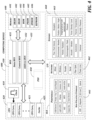
- FIG. 4 illustrates a block diagram of a system including a computing device for performing the method of FIGS. 3 A and 3 B .
- any sequence(s) and/or temporal order of steps of various processes or methods that are described herein are illustrative and not restrictive. Accordingly, it should be understood that, although steps of various processes or methods may be shown and described as being in a sequence or temporal order, the steps of any such processes or methods are not limited to being carried out in any particular sequence or order, absent an indication otherwise. Indeed, the steps in such processes or methods generally may be carried out in various different sequences and orders while still falling within the scope of the present invention. Accordingly, it is intended that the scope of patent protection is to be defined by the issued claim(s) rather than the description set forth herein.
- the system provides for AI/ML-generated RF design options based on 3-D signal quality pattern analysis and predictions for the 3-D area map including its surface and 3-D volume above it to a target height.
- An automated decision model may be configured to provide for identification of the most effective backhaul type, vendor in each type, and location of the gateway module in 3-D space (accounting for downstream area network signal strength and total area network cost of service optimization problem discussed below).
- a signal quality may be analyzed.
- the signal quality data may include signal strength, latency and packet loss measured in a specific unit of 3-D space overlaid with simultaneous measurements of the density of user devices in that unit of 3-D space.
- Network design automation in accordance to the embodiments of the present disclosure may include 3-D surveillance of a target coverage area and surfaces using surveillance data produced by the UAS flying over the target area.
- the 3-D surveillance data may include but is not limited to photogrammetry data, Light Detection and Ranging (LiDAR) data, thermal imagery data.
- the 3-D surveillance data may include overlaying of third-party satellite data (if available).
- Analysis of the 3-D surveillance data may include a derivation of the 3D point cloud with specificity about interference ground object types (e.g., vegetation, buildings, terrain, water volumes, surface objects types—i.e., brick buildings vs glass or steel, etc.).
- the network design server may use data related to potential network device profiles (e.g., tower, core, end user device, etc.) as inputs into the AI/ML module.
- the AI/ML module may generate backhaul capabilities/capacities models as well. These models along with the network design models may be used for network design optimizations. This approach may, advantageously, allow for evaluation of an infinite number of network designs.
- the network design server may be implemented as a blockchain peer and may record the network models (or predictive parameters) on a private blockchain discussed in more detail below.
- the AI/ML module may be configured to output a short list of network designs based on requirements or thresholds.
- the AI/ML module may be configured, with respect to the input 3-D mapping data, for pattern recognition of surface planes, corners, curvatures, angular and other characteristics as well as surface types.
- the AI/ML may be configured to output hybrid 3-D spatial surface outlines optimized for subsequent network design processing.
- the network design server may collect 3-D space map(s) data and 3-D signal map(s) data from the UAS or from ground robotic vehicles equipped with sensors.
- the 3-D maps may be represented by a plethora of vertical planes or by an optimized route dot cloud collected from sensors installed robotic vehicles.
- the AI/ML module may implement data smoothing and interpolation for generation of network models.
- the AI/ML module may further implement volumization with respect to creation of continuous 3-D spatial outlines of potential backhaul options. In this scenario, the AI/ML module may output 3-D dot clouds specifying spatial outlines of network backhaul options.
- the network design server may perform algorithmic modeling of objects by approximating more complex shapes with simpler/standard geometric shapes or, alternatively, irregular blobs (i.e., complex geometric shapes or dense clouds of points) for complex objects).
- the algorithmic modeling may employ methodology that relies on methods including but not limited to the following:
- Object interchange tables providing object replacements. For example, hills are iteratively replaced with prisms, spheres, half-spheres or spherical segments, and half-cylinders; cow barns are replaced with 3-D rectangles with 3-D prism on top; silos are replaced with vertical cylinders; irrigation tanks or water/liquid storage tanks are replaced with horizontal half cylinders or cylinders. Other variations of the shape interchanges may be applied.
- the design server may evaluate shape errors and my assign the best fitting simpler shapes as final approximations.
- the design server may use training of multiple ML models (e.g., neural network-based models, which include, but are not limited to Dense, Recurrent, and Convolution layers), which learn to predict signal strength as a function of input parameters or their learned combinations or transformations based on inputs included but not limited to in the following:
- ML models e.g., neural network-based models, which include, but are not limited to Dense, Recurrent, and Convolution layers
- the design server may generate a final design based on cost selection by customers.
- the example network 100 includes the design server node 102 connected to a cloud server node(s) 105 over a network.
- the cloud server node(s) 105 is configured to host an AI/ML module 107 .
- the design server node 102 may receive 3-D mapping data from an UAS device 104 that flies over a target area 106 and collects data using video and/or sensory equipment.
- the UAS device 104 may collect photogrammetry data, LiDAR data and thermal imagery data which is derived via methods including but not limited to Photogrammerty, Radiometry, Photometry, Laser Scanning, etc. and a combination thereof.
- the AI/ML module 107 may generate a predictive model(s) 108 based on historical network design-related data provided by the design server 102 from a local data storage 103 and based on the 3-D mapping data.
- the AI/ML module 107 may provide predictive outputs data that indicate locations and types of towers that are most optimal for the surveyed target area 106 .
- the AI/ML module 107 may be implemented on the design server node 102 .
- the design server node 102 may process the predictive outputs data received from the AI/ML module 107 to generate a final network design for the target area 106 .
- the AI/ML module 107 may use historical data that reflects previously studied and modeled dependencies. In one embodiment, the historical data may be recorded on a ledger of a private blockchain discussed in more detail below.
- FIG. 1 B illustrates a network diagram of a system for ML-based network design process employing signal strength data consistent with the present disclosure.
- the example network 111 includes the design server node 102 connected to a cloud server node(s) 105 over a network.
- the cloud server node(s) 105 is configured to host an AI/ML module 107 .
- the design server node 102 may receive signal strength data from the UAS device 104 that flies over a target area that has a signal source(s) 116 located within the target area and collects signal strength data using signal measurement equipment.
- the UAS device 104 may employ “slices” or “planes”—i.e., measured vertical flight planes (funnels) spaced away from each other at standard distances to be flown.
- the AI/ML module 107 may be configured to implement ML/regression modeling of a signal strength in each funnel within each plane.
- the design server node 102 may determine usable signal strength area definition within each plane as well as usable signal strength area definition in 3-D space using smart interpolation that may be implemented by the AI/ML module 107 .
- the AI/ML module 107 may generate a predictive model(s) 108 based on historical network design-related data provided by the design server 102 from a local data storage 103 and based on the signal strength.
- the AI/ML module 107 may provide predictive outputs data that indicate locations, orientations and types of towers that are most optimal for the surveyed target area 106 .
- the AI/ML module 107 may be implemented on the design server node 102 .
- the design server node 102 may process the predictive outputs data received from the AI/ML module 107 to generate a complete network design for the target area 106 .
- the AI/ML module 107 may be configured to implement ML/regression modeling of signal strength in each funnel within each flight plane.
- the design server node 102 may determine usable signal strength area definition within each plane as well as usable signal strength area definition in 3-D space using smart interpolation.
- the AI/ML module 107 may generate a predictive model(s) 108 based on historical network design-related data provided by the design server 102 from a local data storage 103 , based on the photogrammetry data and the signal strength acquired from a blockchain ledger 109 .
- the AI/ML module 107 may provide predictive outputs data that indicate locations, orientations and types of towers that are most optimal for the surveyed target area 106 .
- the AI/ML module 107 may be implemented on the design server node 102 .
- the design server node 102 may process the predictive outputs data received from the AI/ML module 107 to generate a final network design for the target area 106 .
- FIG. 2 illustrates a network diagram of a system including detailed features of a design server node consistent with the present disclosure.
- the example network 200 includes the design server node 102
- the design server node 102 may receive surveillance data including signal strength data and 3-D mapping data from the UAS device 104 that flies over a target area and collects data.
- the design server node 102 may be a computing device or a server computer, or the like, and may include a processor 204 , which may be a semiconductor-based microprocessor, a central processing unit (CPU), an application specific integrated circuit (ASIC), a field-programmable gate array (FPGA), and/or another hardware device. Although a single processor 204 is depicted, it should be understood that the design server node 102 may include multiple processors, multiple cores, or the like, without departing from the scope of the design server node 102 system.
- the design server node 102 may also include a non-transitory computer readable medium 212 that may have stored thereon machine-readable instructions executable by the processor 204 . Examples of the machine-readable instructions are shown as 214 - 220 and are further discussed below. Examples of the non-transitory computer readable medium 212 may include an electronic, magnetic, optical, or other physical storage device that contains or stores executable instructions. For example, the non-transitory computer readable medium 212 may be a Random-Access memory (RAM), an Electrically Erasable Programmable Read-Only Memory (EEPROM), a hard disk, an optical disc, or other type of storage device.
- RAM Random-Access memory
- EEPROM Electrically Erasable Programmable Read-Only Memory
- the processor 204 may fetch, decode, and execute the machine-readable instructions 214 to acquire aerial surveillance data of a target area from an unmanned aircraft system (UAS) flying over the target area.
- the processor 204 may fetch, decode, and execute the machine-readable instructions 216 to parse the aerial surveillance data to derive an at least one feature vector.
- the processor 204 may fetch, decode, and execute the machine-readable instructions 218 to provide the at least one feature vector to a machine learning (ML) module residing on the at least one cloud server node for generating a predictive model of a wireless network for the target area.
- ML machine learning
- FIG. 3 A illustrates a flowchart of a method for ML-based network design and optimization of the design processing consistent with the present disclosure.
- FIG. 3 A illustrates a flow chart of an example method executed by the design server 102 (see FIG. 2 ). It should be understood that method 300 depicted in FIG. 3 A may include additional operations and that some of the operations described therein may be removed and/or modified without departing from the scope of the method 300 . The description of the method 300 is also made with reference to the features depicted in FIG. 2 for purposes of illustration. Particularly, the processor 204 of the design server 102 may execute some or all of the operations included in the method 300 .
- the processor 204 may acquire aerial surveillance data of a target area from an unmanned aircraft system (UAS) flying over the target area.
- UAS unmanned aircraft system
- the processor 204 may parse the aerial surveillance data to derive an at least one feature vector.
- the processor 204 may provide the at least one feature vector to a machine learning (ML) module residing on the at least one cloud server node for generating a predictive model of a wireless network for the target area.
- the processor 204 may receive outputs of the predictive model and may generate a wireless network design for the target area based on the predictive outputs.
- ML machine learning
- the processor 204 may receive the aerial surveillance data further comprising 3-D sequential signal strength data collected by the UAS passing through a plurality of vertical flight planes located at a standard distance from each other and/or an algorithmically determined non-linear path specified as a set of waypoints over some or all of the target area.
- the processor 204 may configure the ML module to implement ML regression modeling of a signal strength within each plane of the plurality of the vertical flight planes.
- ML module may use an underlying neural network for modeling of signal quality indicators such as the signal strength.
- the ML module may use a combination of deterministic formulae as well as machine-learned independent-dependent variable relationships.
- the processor 204 may record the 3-D sequential signal strength data onto a blockchain, wherein the design server node is a blockchain peer node.
- the processor 204 may determine a usable signal strength area definition within each plane of the plurality of the vertical flight planes. The process may use each cubic unit of space within the planes depending on precision requirements.
- the processor 204 may determine a usable signal strength area definition in a 3-D space based on a custom-algorithm interpolation provided by the ML module.
- the ML module may provide direct predictive calculations for a plethora of cubic units of space, or any combination thereof. Selection of a method to be used and/or method weight may be based on context-driven criteria determined to lead to most accurate results and optimal network designs.
- overall signal quality data may be collected.
- the signal quality data may include signal strength, latency and packet loss measured in a specific unit of 3-D space overlaid with simultaneous measurements of the density of user devices in that unit of 3-D space.
- the above embodiments of the present disclosure may be implemented in hardware, in a computer-readable instructions executed by a processor, in firmware, or in a combination of the above.
- the computer computer-readable instructions may be embodied on a computer-readable medium, such as a storage medium.
- the computer computer-readable instructions may reside in random access memory (“RAM”), flash memory, read-only memory (“ROM”), erasable programmable read-only memory (“EPROM”), electrically erasable programmable read-only memory (“EEPROM”), registers, hard disk, a removable disk, a compact disk read-only memory (“CD-ROM”), or any other form of storage medium known in the art.
- An exemplary storage medium may be coupled to the processor such that the processor may read information from, and write information to, the storage medium.
- the storage medium may be integral to the processor.
- the processor and the storage medium may reside in an application specific integrated circuit (“ASIC”).
- ASIC application specific integrated circuit
- the processor and the storage medium may reside as discrete components.
- FIG. 4 illustrates an example computing device (e.g., a server node) 400 , which may represent or be integrated in any of the above-described components, etc.
- FIG. 4 illustrates a block diagram of a system including computing device 400 .
- the computing device 400 may comprise, but not be limited to the following:
- Mobile computing device such as, but is not limited to, a laptop, a tablet, a smartphone, a drone, a wearable, an embedded device, a handheld device, an hen, an industrial device, or a remotely operable recording device;
- a supercomputer an exa-scale supercomputer, a mainframe, or a quantum computer
- the design server node 102 may be hosted on a centralized server or on a cloud computing service. Although method 300 has been described to be performed by the design server node 102 implemented on a computing device 400 , it should be understood that, in some embodiments, different operations may be performed by a plurality of the computing devices 400 in operative communication at least one network.
- the computing device 400 may include the clock module 410 may be known to a person having ordinary skill in the art as a clock generator, which produces clock signals.
- Clock signal is a particular type of signal that oscillates between a high and a low state and is used like a metronome to coordinate actions of digital circuits.
- Most integrated circuits (ICs) of sufficient complexity use a clock signal in order to synchronize different parts of the circuit, cycling at a rate slower than the worst-case internal propagation delays.
- the preeminent example of the aforementioned integrated circuit is the CPU 420 , the central component of modern computers, which relies on a clock. The only exceptions are asynchronous circuits such as asynchronous CPUs.
- clock multiplier which multiplies a lower frequency external clock to the appropriate clock rate of the CPU 420 . This allows the CPU 420 to operate at a much higher frequency than the rest of the computer, which affords performance gains in situations where the CPU 420 does not need to wait on an external factor (like memory 440 or input/output 460 ).
- Some embodiments of the clock 410 may include dynamic frequency change, where, the time between clock edges can vary widely from one edge to the next and back again.
- the computing device 400 may include the CPU unit 420 comprising at least one CPU Core 421 .
- a plurality of CPU cores 421 may comprise identical CPU cores 421 , such as, but not limited to, homogeneous multi-core systems. It is also possible for the plurality of CPU cores 421 to comprise different CPU cores 421 , such as, but not limited to, heterogeneous multi-core systems, big.LITTLE systems and some AMD accelerated processing units (APU).
- the CPU unit 420 reads and executes program instructions which may be used across many application domains, for example, but not limited to, general purpose computing, embedded computing, network computing, digital signal processing (DSP), and graphics processing (GPU).
- DSP digital signal processing
- GPU graphics processing
- the CPU unit 420 may run multiple instructions on separate CPU cores 421 at the same time.
- the CPU unit 420 may be integrated into at least one of a single integrated circuit die and multiple dies in a single chip package.
- the single integrated circuit die and multiple dies in a single chip package may contain a plurality of other aspects of the computing device 400 , for example, but not limited to, the clock 410 , the CPU 420 , the bus 430 , the memory 440 , and I/O 460 .
- the CPU unit 420 may contain cache 422 such as, but not limited to, a level 1 cache, level 2 cache, level 3 cache or combination thereof.
- the aforementioned cache 422 may or may not be shared amongst a plurality of CPU cores 421 .
- the cache 422 sharing comprises at least one of message passing and inter-core communication methods may be used for the at least one CPU Core 421 to communicate with the cache 422 .
- the inter-core communication methods may comprise, but not limited to, bus, ring, two-dimensional mesh, and crossbar.
- the aforementioned CPU unit 420 may employ symmetric multiprocessing (SMP) design.
- SMP symmetric multiprocessing
- the aforementioned computing device 400 may employ a communication system that transfers data between components inside the aforementioned computing device 400 , and/or the plurality of computing devices 400 .
- the aforementioned communication system will be known to a person having ordinary skill in the art as a bus 430 .
- the bus 430 may embody internal and/or external plurality of hardware and software components, for example, but not limited to a wire, optical fiber, communication protocols, and any physical arrangement that provides the same logical function as a parallel electrical bus.
- the bus 430 may comprise at least one of, but not limited to a parallel bus, wherein the parallel bus carry data words in parallel on multiple wires, and a serial bus, wherein the serial bus carry data in bit-serial form.
- the aforementioned computing device 400 may employ hardware integrated circuits that store information for immediate use in the computing device 400 , know to the person having ordinary skill in the art as primary storage or memory 440 .
- the memory 440 operates at high speed, distinguishing it from the non-volatile storage sub-module 461 , which may be referred to as secondary or tertiary storage, which provides slow-to-access information but offers higher capacities at lower cost.
- the contents contained in memory 440 may be transferred to secondary storage via techniques such as, but not limited to, virtual memory and swap.
- the memory 440 may be associated with addressable semiconductor memory, such as integrated circuits consisting of silicon-based transistors, used for example as primary storage but also other purposes in the computing device 400 .
- the memory 440 may comprise a plurality of embodiments, such as, but not limited to volatile memory, non-volatile memory, and semi-volatile memory. It should be understood by a person having ordinary skill in the art that the ensuing are non-limiting examples of the aforementioned memory:
- the aforementioned computing device 400 may employ the communication sub-module 462 as a subset of the I/O 460 , which may be referred to by a person having ordinary skill in the art as at least one of, but not limited to, computer network, data network, and network.
- the network allows computing devices 400 to exchange data using connections, which may be known to a person having ordinary skill in the art as data links, between network nodes.
- the nodes comprise network computer devices 400 that originate, route, and terminate data.
- the nodes are identified by network addresses and can include a plurality of hosts consistent with the embodiments of a computing device 400 .
- the aforementioned embodiments include, but not limited to personal computers, phones, servers, drones, and networking devices such as, but not limited to, hubs, switches, routers, modems, and firewalls.
- the communication sub-module 462 supports a plurality of applications and services, such as, but not limited to World Wide Web (WWW), digital video and audio, shared use of application and storage computing devices 400 , printers/scanners/fax machines, email/online chat/instant messaging, remote control, distributed computing, etc.
- the network may comprise a plurality of transmission mediums, such as, but not limited to conductive wire, fiber optics, and wireless.
- the communication sub-module 462 may comprise a plurality of size, topology, traffic control mechanism and organizational intent.
- the communication sub-module 462 may comprise a plurality of embodiments, such as, but not limited to:
- the aforementioned network may comprise a plurality of layouts, such as, but not limited to, bus network such as ethernet, star network such as Wi-Fi, ring network, mesh network, fully connected network, and tree network.
- the network can be characterized by its physical capacity or its organizational purpose. Use of the network, including user authorization and access rights, differ accordingly.
- the characterization may include, but not limited to nanoscale network, Personal Area Network (PAN), Local Area Network (LAN), Home Area Network (HAN), Storage Area Network (SAN), Campus Area Network (CAN), backbone network, Metropolitan Area Network (MAN), Wide Area Network (WAN), enterprise private network, Virtual Private Network (VPN), and Global Area Network (GAN).
- PAN Personal Area Network
- LAN Local Area Network
- HAN Home Area Network
- SAN Storage Area Network
- CAN Campus Area Network
- backbone network Metropolitan Area Network
- MAN Metropolitan Area Network
- WAN Wide Area Network
- VPN Virtual Private Network
- GAN Global Area Network
- the aforementioned computing device 400 may employ the sensors sub-module 463 as a subset of the I/O 460 .
- the sensors sub-module 463 comprises at least one of the devices, modules, and subsystems whose purpose is to detect events or changes in its environment and send the information to the computing device 400 . Sensors are sensitive to the measured property, are not sensitive to any property not measured, but may be encountered in its application, and do not significantly influence the measured property.
- the sensors sub-module 463 may comprise a plurality of digital devices and analog devices, wherein if an analog device is used, an Analog to Digital (A-to-D) converter must be employed to interface the said device with the computing device 400 .
- A-to-D Analog to Digital
- Automotive sensors such as, but not limited to, air flow meter/mass airflow sensor, air-fuel ratio meter, AFR sensor, blind spot monitor, engine coolant/exhaust gas/cylinder head/transmission fluid temperature sensor, hall effect sensor, wheel/automatic transmission/turbine/vehicle speed sensor, airbag sensors, brake fluid/engine crankcase/fuel/oil/tire pressure sensor, camshaft/crankshaft/throttle position sensor, fuel/oil level sensor, knock sensor, light sensor, MAP sensor, oxygen sensor ( 02 ), parking sensor, radar sensor, torque sensor, variable reluctance sensor, and water-in-fuel sensor.
- air flow meter/mass airflow sensor such as, but not limited to, air flow meter/mass airflow sensor, air-fuel ratio meter, AFR sensor, blind spot monitor, engine coolant/exhaust gas/cylinder head/transmission fluid temperature sensor, hall effect sensor, wheel/automatic transmission/turbine/vehicle speed sensor, airbag sensors, brake fluid/engine crankcase/fuel/o
- Electric current, electric potential, magnetic, and radio sensors such as, but not limited to, current sensor, Daly detector, electroscope, electron multiplier, faraday cup, galvanometer, hall effect sensor, hall probe, magnetic anomaly detector, magnetometer, magnetoresistance, MEMS magnetic field sensor, metal detector, planar hall sensor, radio direction finder, and voltage detector.
- Environmental, weather, moisture, and humidity sensors such as, but not limited to, actinometer, air pollution sensor, bedwetting alarm, ceilometer, dew warning, electrochemical gas sensor, fish counter, frequency domain sensor, gas detector, hook gauge evaporimeter, humistor, hygrometer, leaf sensor, lysimeter, pyranometer, pyrgeometer, psychrometer, rain gauge, rain sensor, seismometers, SNOTEL, snow gauge, soil moisture sensor, stream gauge, and tide gauge.
- Flow and fluid velocity sensors such as, but not limited to, air flow meter, anemometer, flow sensor, gas meter, mass flow sensor, and water meter.
- Ionizing radiation and particle sensors such as, but not limited to, cloud chamber, Geiger counter, Geiger-Muller tube, ionization chamber, neutron detection, proportional counter, scintillation counter, semiconductor detector, and thermoluminescent dosimeter.
- Navigation sensors such as, but not limited to, air speed indicator, altimeter, attitude indicator, depth gauge, fluxgate compass, gyroscope, inertial navigation system, inertial reference unit, magnetic compass, MHD sensor, ring laser gyroscope, turn coordinator, variometer, vibrating structure gyroscope, and yaw rate sensor.
- Position, angle, displacement, distance, speed, and acceleration sensors such as, but not limited to, accelerometer, displacement sensor, flex sensor, free fall sensor, gravimeter, impact sensor, laser rangefinder, LIDAR, odometer, photoelectric sensor, position sensor such as, but not limited to, GPS or Glonass, angular rate sensor, shock detector, ultrasonic sensor, tilt sensor, tachometer, ultra-wideband radar, variable reluctance sensor, and velocity receiver.
- Imaging, optical and light sensors such as, but not limited to, CMOS sensor, LIDAR, multi-spectral light sensor, colorimeter, contact image sensor, electro-optical sensor, infra-red sensor, kinetic inductance detector, LED as light sensor, light-addressable potentiometric sensor, Nichols radiometer, fiber-optic sensors, optical position sensor, thermopile laser sensor, photodetector, photodiode, photomultiplier tubes, phototransistor, photoelectric sensor, photoionization detector, photomultiplier, photoresistor, photoswitch, phototube, scintillometer, Shack-Hartmann, single-photon avalanche diode, superconducting nanowire single-photon detector, transition edge sensor, visible light photon counter, and wavefront sensor.
- Pressure sensors such as, but not limited to, barograph, barometer, boost gauge, bourdon gauge, hot filament ionization gauge, ionization gauge, McLeod gauge, Oscillating U-tube, permanent downhole gauge, piezometer, Pirani gauge, pressure sensor, pressure gauge, tactile sensor, and time pressure gauge.
- Force, Density, and Level sensors such as, but not limited to, bhangmeter, hydrometer, force gauge or force sensor, level sensor, load cell, magnetic level or nuclear density sensor or strain gauge, piezocapacitive pressure sensor, piezoelectric sensor, torque sensor, and viscometer.
- Thermal and temperature sensors such as, but not limited to, bolometer, bimetallic strip, calorimeter, exhaust gas temperature gauge, flame detection/pyrometer, Gardon gauge, Golay cell, heat flux sensor, microbolometer, microwave radiometer, net radiometer, infrared/quartz/resistance thermometer, silicon bandgap temperature sensor, thermistor, and thermocouple.
- Proximity and presence sensors such as, but not limited to, alarm sensor, doppler radar, motion detector, occupancy sensor, proximity sensor, passive infrared sensor, reed switch, stud finder, triangulation sensor, touch switch, and wired glove.
- the aforementioned computing device 400 may employ the peripherals sub-module 462 as a subset of the I/O 460 .
- the peripheral sub-module 464 comprises ancillary devices uses to put information into and get information out of the computing device 400 .
- There are 3 categories of devices comprising the peripheral sub-module 464 which exist based on their relationship with the computing device 400 , input devices, output devices, and input/output devices.
- Input devices send at least one of data and instructions to the computing device 400 .
- Input devices can be categorized based on, but not limited to:
- Modality of input such as, but not limited to, mechanical motion, audio, visual, and tactile.
- the input is discrete, such as but not limited to, pressing a key, or continuous such as, but not limited to position of a mouse.
- the number of degrees of freedom involved such as, but not limited to, two-dimensional mice vs three-dimensional mice used for Computer-Aided Design (CAD) applications.
- CAD Computer-Aided Design
- Output devices provide output from the computing device 400 .
- Output devices convert electronically generated information into a form that can be presented to humans. Input/output devices perform that perform both input and output functions. It should be understood by a person having ordinary skill in the art that the ensuing are non-limiting embodiments of the aforementioned peripheral sub-module 464 :
- HID Human Interface Devices
- pointing device e.g., mouse, touchpad, joystick, touchscreen, game controller/gamepad, remote, light pen, light gun, Wii remote, jog dial, shuttle, and knob
- keyboard e.g., keyboard, graphics tablet, digital pen, gesture recognition devices, magnetic ink character recognition, Sip-and-Puff (SNP) device, and Language Acquisition Device (LAD).
- SNP Sip-and-Puff
- LAD Language Acquisition Device
- High degree of freedom devices that require up to six degrees of freedom such as, but not limited to, camera gimbals, Cave Automatic Virtual Environment (CAVE), and virtual reality systems.
- CAVE Cave Automatic Virtual Environment
- Video Input devices are used to digitize images or video from the outside world into the computing device 400 .
- the information can be stored in a multitude of formats depending on the user's requirement.
- Examples of types of video input devices include, but not limited to, digital camera, digital camcorder, portable media player, webcam, Microsoft Kinect, image scanner, fingerprint scanner, barcode reader, 3D scanner, laser rangefinder, eye gaze tracker, computed tomography, magnetic resonance imaging, positron emission tomography, medical ultrasonography, TV tuner, and iris scanner.
- Audio input devices are used to capture sound.
- an audio output device can be used as an input device, in order to capture produced sound.
- Audio input devices allow a user to send audio signals to the computing device 400 for at least one of processing, recording, and carrying out commands.
- Devices such as microphones allow users to speak to the computer in order to record a voice message or navigate software. Aside from recording, audio input devices are also used with speech recognition software. Examples of types of audio input devices include, but not limited to microphone, Musical Instrumental Digital Interface (MIDI) devices such as, but not limited to a keyboard, and headset.
- MIDI Musical Instrumental Digital Interface
- DAQ devices convert at least one of analog signals and physical parameters to digital values for processing by the computing device 400 .
- DAQ devices may include, but not limited to, Analog to Digital Converter (ADC), data logger, signal conditioning circuitry, multiplexer, and Time to Digital Converter (TDC).
- ADC Analog to Digital Converter
- TDC Time to Digital Converter
- Printers such as, but not limited to, inkjet printers, laser printers, 3D printers, solid ink printers and plotters.
- DAC Digital to Analog Converter
- Input/Output Devices may further comprise, but not be limited to, touchscreens, networking device (e.g., devices disclosed in network 462 sub-module), data storage device (non-volatile storage 461 ), facsimile (FAX), and graphics/sound cards.
- networking device e.g., devices disclosed in network 462 sub-module
- data storage device non-volatile storage 461
- facsimile (FAX) facsimile
- graphics/sound cards graphics/sound cards.
Landscapes
- Engineering & Computer Science (AREA)
- Physics & Mathematics (AREA)
- Theoretical Computer Science (AREA)
- Software Systems (AREA)
- Artificial Intelligence (AREA)
- Evolutionary Computation (AREA)
- Signal Processing (AREA)
- Computer Networks & Wireless Communication (AREA)
- General Physics & Mathematics (AREA)
- Data Mining & Analysis (AREA)
- General Engineering & Computer Science (AREA)
- Mathematical Physics (AREA)
- Computing Systems (AREA)
- Medical Informatics (AREA)
- Computer Vision & Pattern Recognition (AREA)
- Life Sciences & Earth Sciences (AREA)
- Biophysics (AREA)
- Health & Medical Sciences (AREA)
- Computational Linguistics (AREA)
- Biomedical Technology (AREA)
- General Health & Medical Sciences (AREA)
- Molecular Biology (AREA)
- Electromagnetism (AREA)
- Databases & Information Systems (AREA)
- Aviation & Aerospace Engineering (AREA)
- Bioinformatics & Computational Biology (AREA)
- Evolutionary Biology (AREA)
- Bioinformatics & Cheminformatics (AREA)
- Genetics & Genomics (AREA)
- Mathematical Optimization (AREA)
- Pure & Applied Mathematics (AREA)
- Mechanical Engineering (AREA)
- Remote Sensing (AREA)
- Mathematical Analysis (AREA)
- Computational Mathematics (AREA)
- Algebra (AREA)
- Probability & Statistics with Applications (AREA)
- Physiology (AREA)
- Mobile Radio Communication Systems (AREA)
- Management, Administration, Business Operations System, And Electronic Commerce (AREA)
Abstract
Description
-
- Signal Strength/Coverage: Cell towers are built to eliminate those locations where the services may be lacking, known as the “Dead Spot.” Typically, the RF Engineers determine where there are high rates of service interruption due to either interference or signal issues, then, a new cell tower site is selected and_developed to eliminate these dead areas.
- Data Usage Capacity: With the high demand for wireless connectivity to multiple devices and the data usage required for these devices, there must be an adequate amount of cell towers to facilitate such demand. The main reasons new tower locations are being selected and constructed are to meet these growing data usage needs and technological advancements.
- Call Clarity and Network Speed: The telecom industry is a complex industry but like most, it relies on increasing its customer base and satisfying the needs of its existing customers. Therefore, network must be designed and constructed to make sure customer needs are met.
-
- 1. Custom signal refraction tables previously produced by the ML module and calculations using surface characteristics defined above;
- 2. RF signal propagation and refraction formulae adjusted with ML-based correction terms previously determined for such surfaces.
-
- Object types, locations, surfaces, etc.;
- Signal diffraction angles;
- Radio characteristics such as antenna profiles (azimuth and elevation), radio power, radio types/models, switch types/models, amplifier types/models, user device types/models and characteristics, etc.
-
- Physical formulae of signal propagation around objects;
- Device characteristics into the RF physics formulae including:
-
- i. Finding a configuration of the best or near-best coverage, given a fixed budget and/or other optimization requirements;
- ii. Finding a configuration with the minimum or near-minimum cost, which provides minimum desired quality of coverage in a target area;
- iii. Given a relative cost-to-coverage-quality trade-off, finding a configuration which optimizes both objectives (cost and coverage) at once.
-
- Internal data bus (data bus) 431/Memory bus
-
Control bus 432 -
Address bus 433 - System Management Bus (SMBus)
- Front-Side-Bus (FSB)
- External Bus Interface (EBI)
- Local bus
- Expansion bus
- Lightning bus
- Controller Area Network (CAN bus)
- Camera Link
- ExpressCard
- Advanced Technology management Attachment (ATA), including embodiments and derivatives such as, but not limited to, Integrated Drive Electronics (IDE)/Enhanced IDE (EIDE), ATA Packet Interface (ATAPI), Ultra-Direct Memory Access (UDMA), Ultra ATA (UATA)/Parallel ATA (PATA)/Serial ATA (SATA), CompactFlash (CF) interface, Consumer Electronics ATA (CE-ATA)/Fiber Attached Technology Adapted (FATA), Advanced Host Controller Interface (AHCI), SATA Express (SATAe)/External SATA (eSATA), including the powered embodiment eSATAp/Mini-SATA (mSATA), and Next Generation Form Factor (NGFF)/M.2.
- Small Computer System Interface (SCSI)/Serial Attached SCSI (SAS)
- HyperTransport
- InfiniBand
- RapidIO
- Mobile Industry Processor Interface (MIPI)
- Coherent Processor Interface (CAPI)
- Plug-n-play
- 1-Wire
- Peripheral Component Interconnect (PCI), including embodiments such as, but not limited to, Accelerated Graphics Port (AGP), Peripheral Component Interconnect extended (PCI-X), Peripheral Component Interconnect Express (PCI-e) (e.g., PCI Express Mini Card, PCI Express M.2 [Mini PCIe v2], PCI Express External Cabling [ePCIe], and PCI Express OCuLink [Optical Copper{Cu} Link]), Express Card, AdvancedTCA, AMC, Universal 10, Thunderbolt/Mini DisplayPort, Mobile PCIe (M-PCIe), U.2, and Non-Volatile Memory Express (NVMe)/Non-Volatile Memory Host Controller Interface Specification (NVMHCIS).
- Industry Standard Architecture (ISA), including embodiments such as, but not limited to Extended ISA (EISA), PC/XT-bus/PC/AT-bus/PC/104 bus (e.g., PC/104-Plus, PCI/104-Express, PCI/104, and PCI-104), and Low Pin Count (LPC).
- Music Instrument Digital Interface (MIDI)
- Universal Serial Bus (USB), including embodiments such as, but not limited to, Media Transfer Protocol (MTP)/Mobile High-Definition Link (MHL), Device Firmware Upgrade (DFU), wireless USB, InterChip USB, IEEE 1394 Interface/Firewire, Thunderbolt, and extensible Host Controller Interface (xHCI).
-
- Volatile memory which requires power to maintain stored information, for example, but not limited to, Dynamic Random-Access Memory (DRAM) 441, Static Random-Access Memory (SRAM) 442,
CPU Cache memory 425, Advanced Random-Access Memory (A-RAM), and other types of primary storage such as Random-Access Memory (RAM). - Non-volatile memory which can retain stored information even after power is removed, for example, but not limited to, Read-Only Memory (ROM) 443, Programmable ROM (PROM) 444, Erasable PROM (EPROM) 445, Electrically Erasable PROM (EEPROM) 446 (e.g., flash memory and Electrically Alterable PROM [EAPROM]), Mask ROM (MROM), One Time Programable (OTP) ROM/Write Once Read Many (WORM), Ferroelectric RAM (FeRAM), Parallel Random-Access Machine (PRAM), Split-Transfer Torque RAM (STT-RAM), Silicon Oxime Nitride Oxide Silicon (SONOS), Resistive RAM (RRAM), Nano RAM (NRAM), 3D XPoint, Domain-Wall Memory (DWM), and millipede memory.
- Semi-volatile memory which may have some limited non-volatile duration after power is removed but loses data after said duration has passed. Semi-volatile memory provides high performance, durability, and other valuable characteristics typically associated with volatile memory, while providing some benefits of true non-volatile memory. The semi-volatile memory may comprise volatile and non-volatile memory and/or volatile memory with battery to provide power after power is removed. The semi-volatile memory may comprise, but not limited to spin-transfer torque RAM (STT-RAM).
- Consistent with the embodiments of the present disclosure, the
aforementioned computing device 400 may employ the communication system between an information processing system, such as thecomputing device 400, and the outside world, for example, but not limited to, human, environment, and anothercomputing device 400. The aforementioned communication system will be known to a person having ordinary skill in the art as I/O 460. The I/O module 460 regulates a plurality of inputs and outputs with regard to thecomputing device 400, wherein the inputs are a plurality of signals and data received by thecomputing device 400, and the outputs are the plurality of signals and data sent from thecomputing device 400. The I/O module 460 interfaces a plurality of hardware, such as, but not limited to,non-volatile storage 461,communication devices 462,sensors 463, andperipherals 464. The plurality of hardware is used by the at least one of, but not limited to, human, environment, and anothercomputing device 400 to communicate with thepresent computing device 400. The I/O module 460 may comprise a plurality of forms, for example, but not limited to channel I/O, port mapped I/O, asynchronous I/O, and Direct Memory Access (DMA). - Consistent with the embodiments of the present disclosure, the
aforementioned computing device 400 may employ thenon-volatile storage sub-module 461, which may be referred to by a person having ordinary skill in the art as one of secondary storage, external memory, tertiary storage, off-line storage, and auxiliary storage. Thenon-volatile storage sub-module 461 may not be accessed directly by theCPU 420 without using intermediate area in thememory 440. Thenon-volatile storage sub-module 461 does not lose data when power is removed and may be two orders of magnitude less costly than storage used in memory module, at the expense of speed and latency. Thenon-volatile storage sub-module 461 may comprise a plurality of forms, such as, but not limited to, Direct Attached Storage (DAS), Network Attached Storage (NAS), Storage Area Network (SAN), nearline storage, Massive Array of Idle Disks (MAID), Redundant Array of Independent Disks (RAID), device mirroring, off-line storage, and robotic storage. The non-volatile storage sub-module (461) may comprise a plurality of embodiments, such as, but not limited to: - Optical storage, for example, but not limited to, Compact Disk (CD) (CD-ROM/CD-R/CD-RW), Digital Versatile Disk (DVD) (DVD-ROM/DVD-R/DVD+R/DVD-RW/DVD+RW/DVD+RW/DVD+R DL/DVD-RAM/HD-DVD), Blu-ray Disk (BD) (BD-ROM/BD-R/BD-RE/BD-R DL/BD-RE DL), and Ultra-Density Optical (UDO).
- Semiconductor storage, for example, but not limited to, flash memory, such as, but not limited to, USB flash drive, Memory card, Subscriber Identity Module (SIM) card, Secure Digital (SD) card, Smart Card, CompactFlash (CF) card, Solid-State Drive (SSD) and memristor.
- Magnetic storage such as, but not limited to, Hard Disk Drive (HDD), tape drive, carousel memory, and Card Random-Access Memory (CRAM).
- Phase-change memory
- Holographic data storage such as Holographic Versatile Disk (HVD).
- Molecular Memory
- Deoxyribonucleic Acid (DNA) digital data storage
- Volatile memory which requires power to maintain stored information, for example, but not limited to, Dynamic Random-Access Memory (DRAM) 441, Static Random-Access Memory (SRAM) 442,
-
- Wired communications, such as, but not limited to, coaxial cable, phone lines, twisted pair cables (ethernet), and InfiniBand.
- Wireless communications, such as, but not limited to, communications satellites, cellular systems, radio frequency/spread spectrum technologies, IEEE 802.11 Wi-Fi,
- Bluetooth, NFC, free-space optical communications, terrestrial microwave, and Infrared (IR) communications. Wherein cellular systems embody technologies such as, but not limited to, 3G, 4G (such as WiMax and LTE), and 5G (short and long wavelength).
- Parallel communications, such as, but not limited to, LPT ports.
- Serial communications, such as, but not limited to, RS-232 and USB.
- Fiber Optic communications, such as, but not limited to, Single-mode optical fiber (SMF) and Multi-mode optical fiber (MMF).
- Power Line and wireless communications
Claims (18)
Priority Applications (8)
| Application Number | Priority Date | Filing Date | Title |
|---|---|---|---|
| US17/566,612 US12114175B2 (en) | 2021-12-30 | 2021-12-30 | Intelligent wireless network design system |
| EP22917445.3A EP4458042A4 (en) | 2021-12-30 | 2022-12-15 | Intelligent wireless network design system |
| PCT/US2022/081660 WO2023129817A1 (en) | 2021-12-30 | 2022-12-15 | Intelligent wireless network design system |
| AU2022426765A AU2022426765A1 (en) | 2021-12-30 | 2022-12-15 | Intelligent wireless network design system |
| CA3244967A CA3244967A1 (en) | 2021-12-30 | 2022-12-15 | Intelligent wireless network design system |
| MX2024008340A MX2024008340A (en) | 2021-12-30 | 2024-07-01 | Intelligent wireless network design system |
| US18/827,052 US20240430709A1 (en) | 2021-12-30 | 2024-09-06 | Intelligent wireless network design system |
| US18/827,018 US20240430696A1 (en) | 2021-12-30 | 2024-09-06 | Intelligent wireless network design system |
Applications Claiming Priority (1)
| Application Number | Priority Date | Filing Date | Title |
|---|---|---|---|
| US17/566,612 US12114175B2 (en) | 2021-12-30 | 2021-12-30 | Intelligent wireless network design system |
Related Child Applications (2)
| Application Number | Title | Priority Date | Filing Date |
|---|---|---|---|
| US18/827,052 Continuation-In-Part US20240430709A1 (en) | 2021-12-30 | 2024-09-06 | Intelligent wireless network design system |
| US18/827,018 Continuation-In-Part US20240430696A1 (en) | 2021-12-30 | 2024-09-06 | Intelligent wireless network design system |
Publications (2)
| Publication Number | Publication Date |
|---|---|
| US20230217260A1 US20230217260A1 (en) | 2023-07-06 |
| US12114175B2 true US12114175B2 (en) | 2024-10-08 |
Family
ID=86991310
Family Applications (1)
| Application Number | Title | Priority Date | Filing Date |
|---|---|---|---|
| US17/566,612 Active 2042-12-16 US12114175B2 (en) | 2021-12-30 | 2021-12-30 | Intelligent wireless network design system |
Country Status (6)
| Country | Link |
|---|---|
| US (1) | US12114175B2 (en) |
| EP (1) | EP4458042A4 (en) |
| AU (1) | AU2022426765A1 (en) |
| CA (1) | CA3244967A1 (en) |
| MX (1) | MX2024008340A (en) |
| WO (1) | WO2023129817A1 (en) |
Citations (18)
| Publication number | Priority date | Publication date | Assignee | Title |
|---|---|---|---|---|
| JP3280025B2 (en) | 1992-01-23 | 2002-04-30 | ノキア テレコミュニカシオンス オサケ ユキチュア | Method and system for planning a cellular wireless network |
| WO2004025978A1 (en) | 2002-09-13 | 2004-03-25 | Telefonaktiebolaget L M Ericsson (Publ) | Optimisation mechanism for frequency reuse |
| DE10251993A1 (en) | 2002-11-06 | 2004-05-19 | Vodafone Holding Gmbh | Optimizing cellular wireless message networks involves generating iteratively optimized network configuration in network model by accumulation of suitably weighted service-specific user traffic values |
| DE60318638T2 (en) | 2003-11-28 | 2008-12-24 | Telecom Italia S.P.A. | METHOD FOR EVALUATING THE PERFORMANCE OF A MOBILE RADIO NETWORK |
| US20100056163A1 (en) | 2008-09-04 | 2010-03-04 | Schmidt Jeffrey C | System and method for planning a wireless network |
| JP4719753B2 (en) | 2007-12-17 | 2011-07-06 | 韓國電子通信研究院 | Digital photogrammetry method and apparatus using heterogeneous sensor integrated modeling |
| CN102523590A (en) | 2012-01-05 | 2012-06-27 | 北京邮电大学 | Planning method of multi-system intelligent configurable wireless network |
| US8229416B2 (en) | 2008-09-23 | 2012-07-24 | Ixia | Methods, systems, and computer readable media for stress testing mobile network equipment using a common public radio interface (CPRI) |
| US8812273B2 (en) | 2003-11-21 | 2014-08-19 | Kenneth L. Trabona | Methods for generating design plans for physical spaces |
| US8953933B2 (en) | 2012-10-31 | 2015-02-10 | Kabushiki Kaisha Topcon | Aerial photogrammetry and aerial photogrammetric system |
| US20180310187A1 (en) | 2015-09-25 | 2018-10-25 | Vivint, Inc. | Uav network design |
| CN109688597A (en) | 2018-12-18 | 2019-04-26 | 北京邮电大学 | A kind of mist Radio Access Network network-building method and device based on artificial intelligence |
| US20190146477A1 (en) | 2016-05-09 | 2019-05-16 | Strong Force Iot Portfolio 2016, Llc | Method and system for adjusting an operating parameter in a marginal network |
| CN110636515A (en) | 2019-11-14 | 2019-12-31 | 国网湖南省电力有限公司 | Network planning evaluation method for electric power wireless private network |
| US20200136949A1 (en) | 2018-10-31 | 2020-04-30 | Citrix Systems, Inc. | Network Configuration System |
| WO2020123208A1 (en) | 2018-12-10 | 2020-06-18 | Sail Internet, Inc. | Method and apparatus for design of a wireless network |
| US20220375356A1 (en) * | 2021-05-11 | 2022-11-24 | Barron Associates, Inc. | System, device and method for measuring atmospheric conditions |
| US20220398806A1 (en) * | 2021-06-11 | 2022-12-15 | Netdrones, Inc. | Systems and methods for generating 3d models from drone imaging |
Family Cites Families (1)
| Publication number | Priority date | Publication date | Assignee | Title |
|---|---|---|---|---|
| US10939302B2 (en) * | 2018-10-31 | 2021-03-02 | Hewlett Packard Enterprise Development Lp | Computing system to create radio frequency plans for wireless network deployments |
-
2021
- 2021-12-30 US US17/566,612 patent/US12114175B2/en active Active
-
2022
- 2022-12-15 AU AU2022426765A patent/AU2022426765A1/en active Pending
- 2022-12-15 EP EP22917445.3A patent/EP4458042A4/en active Pending
- 2022-12-15 WO PCT/US2022/081660 patent/WO2023129817A1/en not_active Ceased
- 2022-12-15 CA CA3244967A patent/CA3244967A1/en active Pending
-
2024
- 2024-07-01 MX MX2024008340A patent/MX2024008340A/en unknown
Patent Citations (19)
| Publication number | Priority date | Publication date | Assignee | Title |
|---|---|---|---|---|
| JP3280025B2 (en) | 1992-01-23 | 2002-04-30 | ノキア テレコミュニカシオンス オサケ ユキチュア | Method and system for planning a cellular wireless network |
| WO2004025978A1 (en) | 2002-09-13 | 2004-03-25 | Telefonaktiebolaget L M Ericsson (Publ) | Optimisation mechanism for frequency reuse |
| DE10251993A1 (en) | 2002-11-06 | 2004-05-19 | Vodafone Holding Gmbh | Optimizing cellular wireless message networks involves generating iteratively optimized network configuration in network model by accumulation of suitably weighted service-specific user traffic values |
| US8812273B2 (en) | 2003-11-21 | 2014-08-19 | Kenneth L. Trabona | Methods for generating design plans for physical spaces |
| DE60318638T2 (en) | 2003-11-28 | 2008-12-24 | Telecom Italia S.P.A. | METHOD FOR EVALUATING THE PERFORMANCE OF A MOBILE RADIO NETWORK |
| JP4719753B2 (en) | 2007-12-17 | 2011-07-06 | 韓國電子通信研究院 | Digital photogrammetry method and apparatus using heterogeneous sensor integrated modeling |
| US20100056163A1 (en) | 2008-09-04 | 2010-03-04 | Schmidt Jeffrey C | System and method for planning a wireless network |
| US8229416B2 (en) | 2008-09-23 | 2012-07-24 | Ixia | Methods, systems, and computer readable media for stress testing mobile network equipment using a common public radio interface (CPRI) |
| CN102523590B (en) | 2012-01-05 | 2014-07-30 | 北京邮电大学 | Planning method of multi-system intelligent configurable wireless network |
| CN102523590A (en) | 2012-01-05 | 2012-06-27 | 北京邮电大学 | Planning method of multi-system intelligent configurable wireless network |
| US8953933B2 (en) | 2012-10-31 | 2015-02-10 | Kabushiki Kaisha Topcon | Aerial photogrammetry and aerial photogrammetric system |
| US20180310187A1 (en) | 2015-09-25 | 2018-10-25 | Vivint, Inc. | Uav network design |
| US20190146477A1 (en) | 2016-05-09 | 2019-05-16 | Strong Force Iot Portfolio 2016, Llc | Method and system for adjusting an operating parameter in a marginal network |
| US20200136949A1 (en) | 2018-10-31 | 2020-04-30 | Citrix Systems, Inc. | Network Configuration System |
| WO2020123208A1 (en) | 2018-12-10 | 2020-06-18 | Sail Internet, Inc. | Method and apparatus for design of a wireless network |
| CN109688597A (en) | 2018-12-18 | 2019-04-26 | 北京邮电大学 | A kind of mist Radio Access Network network-building method and device based on artificial intelligence |
| CN110636515A (en) | 2019-11-14 | 2019-12-31 | 国网湖南省电力有限公司 | Network planning evaluation method for electric power wireless private network |
| US20220375356A1 (en) * | 2021-05-11 | 2022-11-24 | Barron Associates, Inc. | System, device and method for measuring atmospheric conditions |
| US20220398806A1 (en) * | 2021-06-11 | 2022-12-15 | Netdrones, Inc. | Systems and methods for generating 3d models from drone imaging |
Non-Patent Citations (1)
| Title |
|---|
| International Search Report and Written Opinion mailed Mar. 31, 2023 cited in Application No. PCT/US22/81660, 22 pgs. |
Also Published As
| Publication number | Publication date |
|---|---|
| AU2022426765A1 (en) | 2024-07-18 |
| MX2024008340A (en) | 2025-02-10 |
| WO2023129817A1 (en) | 2023-07-06 |
| US20230217260A1 (en) | 2023-07-06 |
| CA3244967A1 (en) | 2023-07-06 |
| EP4458042A4 (en) | 2025-12-31 |
| EP4458042A1 (en) | 2024-11-06 |
Similar Documents
| Publication | Publication Date | Title |
|---|---|---|
| US11699078B2 (en) | Intelligent recognition and alert methods and systems | |
| EP3877325B1 (en) | Methods, systems, and devices for beverage consumption and inventory control and tracking | |
| US20230243690A1 (en) | Fluid tank remote monitoring network with predictive analysis | |
| US20230337606A1 (en) | Intelligent irrigation system | |
| US20250094468A1 (en) | Method and system for ai-based wedding planning platform | |
| US12149516B2 (en) | System and methods for tokenized hierarchical secured asset distribution | |
| US20240256870A1 (en) | Mobile content source for use with intelligent recognition and alert methods and systems | |
| US20210248695A1 (en) | Coordinated delivery of dining experiences | |
| US20240297522A1 (en) | System and method for ai-based programming of battery agnostic energy storage system | |
| US20220215492A1 (en) | Systems and methods for the coordination of value-optimizating actions in property management and valuation platforms | |
| US20250061493A1 (en) | Method and system for ai-based property evaluation | |
| US20250103853A1 (en) | System and method for ai-based object recognition | |
| US20230260275A1 (en) | System and method for identifying objects and/or owners | |
| US20250200026A1 (en) | System and method for ai-based graph management | |
| US12114175B2 (en) | Intelligent wireless network design system | |
| US12443952B2 (en) | Management platform for community association MGCOne online platform and marketplace | |
| US12170131B2 (en) | System for determining clinical trial participation | |
| US20240430696A1 (en) | Intelligent wireless network design system | |
| US20240430709A1 (en) | Intelligent wireless network design system | |
| WO2026055345A1 (en) | Intelligent wireless network design system | |
| WO2026055350A1 (en) | Intelligent wireless network design system | |
| US20250335957A1 (en) | Systems, methods, and media for generating business reviews | |
| US20260080779A1 (en) | Method and system for ai-based parking management | |
| US12535894B1 (en) | Autonomous book with non-digital screen and laser projectors | |
| US20250205581A1 (en) | Method and system for ai-based video recommendations based on golfer data |
Legal Events
| Date | Code | Title | Description |
|---|---|---|---|
| AS | Assignment |
Owner name: ITRA WIRELESS AI, LLC, NEW YORK Free format text: ASSIGNMENT OF ASSIGNORS INTEREST;ASSIGNORS:KHOMENKO, ANDRIY;KORMILITSIN, MAXIM;REEL/FRAME:058512/0227 Effective date: 20211228 |
|
| FEPP | Fee payment procedure |
Free format text: ENTITY STATUS SET TO UNDISCOUNTED (ORIGINAL EVENT CODE: BIG.); ENTITY STATUS OF PATENT OWNER: SMALL ENTITY |
|
| FEPP | Fee payment procedure |
Free format text: ENTITY STATUS SET TO SMALL (ORIGINAL EVENT CODE: SMAL); ENTITY STATUS OF PATENT OWNER: SMALL ENTITY |
|
| STPP | Information on status: patent application and granting procedure in general |
Free format text: DOCKETED NEW CASE - READY FOR EXAMINATION |
|
| STPP | Information on status: patent application and granting procedure in general |
Free format text: NON FINAL ACTION MAILED |
|
| STPP | Information on status: patent application and granting procedure in general |
Free format text: RESPONSE TO NON-FINAL OFFICE ACTION ENTERED AND FORWARDED TO EXAMINER |
|
| STPP | Information on status: patent application and granting procedure in general |
Free format text: NOTICE OF ALLOWANCE MAILED -- APPLICATION RECEIVED IN OFFICE OF PUBLICATIONS |
|
| ZAAA | Notice of allowance and fees due |
Free format text: ORIGINAL CODE: NOA |
|
| ZAAB | Notice of allowance mailed |
Free format text: ORIGINAL CODE: MN/=. |
|
| STPP | Information on status: patent application and granting procedure in general |
Free format text: PUBLICATIONS -- ISSUE FEE PAYMENT VERIFIED |
|
| STCF | Information on status: patent grant |
Free format text: PATENTED CASE |