US12111241B2 - Pulsed diffusion condensation particle counter - Google Patents
Pulsed diffusion condensation particle counter Download PDFInfo
- Publication number
- US12111241B2 US12111241B2 US17/568,940 US202217568940A US12111241B2 US 12111241 B2 US12111241 B2 US 12111241B2 US 202217568940 A US202217568940 A US 202217568940A US 12111241 B2 US12111241 B2 US 12111241B2
- Authority
- US
- United States
- Prior art keywords
- particle
- air
- chamber
- expansion
- particle chamber
- Prior art date
- Legal status (The legal status is an assumption and is not a legal conclusion. Google has not performed a legal analysis and makes no representation as to the accuracy of the status listed.)
- Active, expires
Links
Images



Classifications
-
- G—PHYSICS
- G01—MEASURING; TESTING
- G01N—INVESTIGATING OR ANALYSING MATERIALS BY DETERMINING THEIR CHEMICAL OR PHYSICAL PROPERTIES
- G01N15/00—Investigating characteristics of particles; Investigating permeability, pore-volume or surface-area of porous materials
- G01N15/06—Investigating concentration of particle suspensions
- G01N15/065—Investigating concentration of particle suspensions using condensation nuclei counters
-
- G—PHYSICS
- G01—MEASURING; TESTING
- G01N—INVESTIGATING OR ANALYSING MATERIALS BY DETERMINING THEIR CHEMICAL OR PHYSICAL PROPERTIES
- G01N15/00—Investigating characteristics of particles; Investigating permeability, pore-volume or surface-area of porous materials
- G01N15/06—Investigating concentration of particle suspensions
-
- G—PHYSICS
- G01—MEASURING; TESTING
- G01N—INVESTIGATING OR ANALYSING MATERIALS BY DETERMINING THEIR CHEMICAL OR PHYSICAL PROPERTIES
- G01N15/00—Investigating characteristics of particles; Investigating permeability, pore-volume or surface-area of porous materials
- G01N15/06—Investigating concentration of particle suspensions
- G01N15/075—Investigating concentration of particle suspensions by optical means
Definitions
- the technology pertains to the measurement of particles suspended in air or other gas.
- Airborne particles in the ultrafine size range are ubiquitous in urban air. Inhalation of these particles is considered a health risk and is implicated in shortening human lifetimes. Additionally, ultrafine particles are the dominant contributor to the total number of particles found in the atmosphere. Some ultrafine particles grow very rapidly, and can act as seeds for cloud formation, and thus play a role in global climate.
- the number concentration of airborne particle number concentration measurements that encompass the ultrafine size range are done by condensation particle counting, wherein individual particles are enlarged to optically detectable sizes through vapor condensation. This approach enables the detection of particles as small as a few nanometers in diameter, which otherwise are too small to be seen by optical scattering.
- condensation particle counters have been developed. Some detect particles as small 2 to 3 nm. Others are compact, but have a limited period of operation, 4-8 hours, as a result of the depletion of the condensing fluid.
- One general aspect includes a method for measuring a concentration of particles in air.
- the method includes introducing an air sample into a particle chamber through an inlet and closing the inlet to isolate the particle chamber.
- the method also includes exhausting the air sample in the isolated particle chamber through a nozzle connected to an optical detector, said exhausting of the flow performed at a flow rate chosen to cause an expansion of the air sample inside the particle chamber, said expansion causing a reduction in a temperature of the any of the air sample inside the particle chamber, an increase in a relative humidity of any of the air sample inside the particle chamber, and cause water vapor to condense on particles suspended in the any of the air sample inside the particle chamber, thereby forming droplets.
- the method also includes counting the individual droplets in the air sample as it is exhausted through an optical detector and measuring a pressure from which an amount of air exiting the chamber can be assessed.
- the method also includes determining a particle concentration as a ratio of a number of droplets detected to the amount of air that has exited the chamber based on the counting and the measuring.
- the method may include performing the counting and measuring steps simultaneously.
- the walls air within the particle chamber are at a uniform temperature, and the air within the particle chamber is humidified prior to expansion.
- the walls of the particle chamber are wetted with a fluid such as water, and one portion of the wall is warmer than the other portions such that there is some condensational growth prior to the expansion, and yet more condensational growth during the expansion.
- Other embodiments of this aspect include corresponding computer systems, apparatus, and computer programs recorded on one or more computer storage devices, each configured to perform the actions of the method.
- the method may further include performing the method where walls of the particle chamber are wet, or performing the method when the walls of the particle chamber are dry and the air sample is humid.
- the method may further include humidifying the air sample prior to introducing the air sample into the particle chamber.
- the method may further include a method in which walls of the particle chamber are formed from a membrane including sulfonated tetrafluoroethylene based fluoropolymer-copolymer on a first side, and having a second side in contact with water or high humidity air, and where the method further includes pausing between isolating of the particle chamber and the exhausting of the flow, such that the air within the particle chamber becomes humidified prior to expansion.
- the method may further include the counting, measuring, and determining performed during the exhausting.
- the method may further include continuously repeating the introducing and exhausting.
- Another general aspect includes a method to create water vapor supersaturation within a wet-walled chamber having an inlet and an outlet; including: introducing an air sample into the chamber by passing a flow into the wet walled chamber through the inlet by pumping at the outlet; and closing the inlet while continuing the pumping to exhaust the air sample from the chamber through the outlet, the pumping performed at a rate operable to reduce pressure inside the chamber such that the air sample in a central portion of the chamber cools, and water vapor from walls of the chamber has time to diffuse into the air sample in the chamber from the walls.
- Other embodiments of this aspect include corresponding computer systems, apparatus, and computer programs recorded on one or more computer storage devices, each configured to perform the actions of the methods.
- Implementations of this aspect may include one or more of: the method including continuously repeating the introducing and closing; and the method further including pausing between introducing and the closing, such that the air sample within the wet-walled chamber becomes humidified prior to expansion.
- the method may further include: counting droplets in the air sample as it is exhausted through an optical detector, measuring a pressure from which an amount of air exiting the chamber can be assessed, and determining a particle concentration as a ratio of a number of droplets detected to the amount of air that has exited the chamber based on the counting and the measuring.
- Another general aspect includes a particle counting apparatus, including: an inlet; a first valve coupled to the inlet; a particle chamber coupled to the first valve and having an output; an optical detector at the output of the particle chamber and having a detector outlet; a pump coupled the detector output and having a pump outlet; a second valve coupled between the detector output and the pump; and a controller executing code instructing the controller to: open the first and second valves, and cause the pump to introduce air into the particle chamber and pump a flow of air through the chamber from the inlet, through to the detector outlet; and close the first valve and cause the pump at the outlet to pull air out of the chamber thereby reducing pressure inside the chamber at a flow rate selected to cause the air in a central portion of the chamber to cool and allow water vapor from walls of the chamber to diffuses into the air in the chamber from wet walls.
- Implementations may include the apparatus where the controller executes code instructing the controller to close the second valve for less than two seconds while the first valve is closed and prior to causing the pump to reduce pressure inside the chamber.
- Implementations may include the apparatus where the pump is coupled to the detector output by two flow paths between the detector output, one flow path including the second valve and another flow path including a third valve, such that a flow rate at which air is introduced into the particle chamber, and a rate at which air is exhausted from the chamber once the first valve is closed, may be independently controlled.
- Implementations may include the apparatus where the optical detector is configured to count particles larger than about 400 nm when the first and second valves are open and the flow is drawn through the particle chamber.
- Implementations may include the apparatus where the controller executes code instructing the controller to count droplets in the air sample as it is exhausted through an optical detector, measure a pressure from which an amount of air exiting the chamber can be assessed, and determine a particle concentration as a ratio of a number of droplets detected to the amount of air that has exited the chamber based on the counting and the measuring. Implementations may include the apparatus where the controller executes code instructing the controller to repeatedly: open the first and second valves and cause the pump to introduce air into the particle chamber; and close the first valve and cause the pump at the outlet to pull air out of the chamber.
- Implementations may also include the apparatus where the controller executes code instructing the controller to repeatedly: open the first and second valves, and cause the pump to introduce air into the particle chamber; close the second valve and then close the first valve to cause the air in the particle chamber to humidify; to open the second valve while the first valve remains closed and cause the pump at the outlet to pull air out of the chamber.
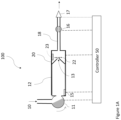
- FIG. 1 A is a first embodiment of a Pulsed Condensation Particle Counter (Pulsed CPC).
- FIG. 1 B shows a second embodiment of the Pulsed CPC with a second valve located on the flow path between the particle chamber and the pump.
- FIG. 1 C shows a third embodiment of the Pulsed CPC with separate expansion and purge flow transport paths.
- FIG. 2 illustrates the operational states of the Pulsed CPC.
- FIG. 3 is a display of the modeled saturation ratio within a Pulsed CPC particle chamber and its downstream focusing nozzle during the isolation and expansion steps, where the isolation is 0.5 s, and the expansion is from 1000 to 750 mbar over 0.5 s, and when the walls of the particle chamber are wet, and the initial relative humidity of the air is 50%
- FIG. 4 is a graph of pressure, temperature and saturation ratio, vs. time and shows results of model calculations of temperatures and saturation ratio at the centerline of a nozzle entrance for varying particle chamber diameters for a fixed expansion rate (mean of ⁇ 500 mbar/s) when the walls of the particle chamber are wet, and the relative humidity input into the chamber is 50%.
- FIG. 5 is a graph of pressure, temperature and saturation ratio, vs. time and shows results of model calculations of temperatures and saturation ratio at the centerline of a nozzle entrance at varying expansion rates for fixed particle chamber geometry of an 8.5 mm diameter cylinder with wet walls.
- FIG. 6 is a graph of pressure, temperature and saturation ratio, vs. time and shows results of model calculations of temperatures and saturation ratio at the centerline of the nozzle entrance for varying particle chamber geometries for a fixed expansion rate (mean of ⁇ 500 mbar/s) when the walls of the particle chamber are dry, and input air is at 90% RH before the expansion.
- FIG. 7 is a graph showing raw particle count and pressure data from a Pulsed CPC, where the overlay indicates the alternating purge and expansion steps.
- FIG. 8 A is a graph of the cumulative air volume passing exiting the particle chamber, vs. time, calculated from the pressure data from the first pulse of FIG. 7 .
- FIG. 8 B is the sum of detected particles exiting the particle chamber into the optical detector for the first pulse of FIG. 7 .
- FIG. 8 C is the indicated particle number concentration at each that point in the expansion state derived from the total number of droplets detected, divided by the volume sampled.
- FIG. 8 D is the particle number concentration calculated from the number of detected droplets and volume of air sampled after a delay time of 0 ms to 125 ms,
- FIG. 9 is a graph of the showing the pressure in the particle chamber and detected particle concentration versus time during a single expansion of a wet-walled, 6 mm diameter particle chamber.
- FIG. 10 is a graph of pressure, and particle concentration vs. time and shows the pressure in the particle chamber and detected particle concentration during a single expansion of a dry-walled, 9 mm diameter particle chamber.
- FIG. 11 is a graph of particle concentration vs. time and shows particle concentration as measured by the Pulsed CPC as compared to a benchtop, commercial condensation particle counter, for sampling ambient air.
- FIG. 12 is a graph showing measured detection efficiency of a Pulsed CPC as a function of particle size at two different expansion rates.
- FIG. 13 is a graph comparing the response of a Pulsed CPC to a benchtop condensation particle counter for 20 nm sulfate aerosols over a range of particle concentrations.
- FIG. 14 is a graph comparing the response of the Pulsed CPC during the purge state to a commercially available benchtop optical particle spectrometer, which has a threshold at particle diameters of 300 nm and 400 nm.
- FIG. 15 is a schematic of the Pulsed CPC configured with sulfonated tetrafluoroethylene based fluoropolymer-copolymer walls surrounded by a water jacket.
- FIG. 16 A is a side, cut-away view of a particle chamber and optical detector of a Pulsed CPC configured with sulfonated tetrafluoroethylene-based fluoropolymer-copolymer surrounded by a water jacket.
- FIG. 16 B is a perspective view of a rigid cage used to support a Nafion membrane in the embodiment of FIG. 16 A .
- FIG. 17 is a display of the modeled saturation ratio within a Pulsed CPC particle chamber and its downstream focusing nozzle during the expansion from 1000 to 750 mbar over when the walls of a 17-mm diameter particle chamber are dry, and the initial relative humidity of the air is 95%.
- FIG. 18 A shows the time dependence of the modeled number of particles of all sizes, and those that have grown to at least 1 ⁇ m, which exit particle chamber when the initial concentration of particles in the chamber is 450 particles/cm3.
- FIG. 18 B is the modeled detection efficiency, taken as the ratio between the number of particles and the air volume that have exited the particle chamber after a delay of 100-300 ms.
- FIG. 19 A is the measured detection efficiency of the embodiment of the Pulsed CPC of FIG. 16 vs particle diameter.
- FIG. 19 B is the measured detection efficiency of the embodiment of the Pulsed CPC of FIG. 16 vs particle concentration.
- FIG. 20 is a time series comparing ambient particle number concentrations measured with the Pulsed CPC to that measured by a commercial condensation particle counter.
- FIG. 21 is a scatterplot of ambient particle number concentrations measured with the Pulsed CPC to that measured by a commercial condensation particle counter.
- FIG. 22 illustrates another embodiment of a Pulsed CPC comprising a pulsed diffusion condensation particle counter (Pulsed diff-CPC) in a side, cut-away view of a particle chamber and optical detector of a Pulsed diff-CPC configured with radially opposing warm and cold wetted walls.
- Pulsed diff-CPC pulsed diffusion condensation particle counter
- FIG. 23 shows an embodiment of the Pulsed diff-CPC, configured with two separate expansion and purge flow transport paths.
- FIG. 24 illustrates the operational states of the Pulsed diff-CPC.
- FIG. 25 is a graph of the calculated saturation ratio along centerline trajectory for Pulsed diff-CPC during steady flow mode of operation wherein the walls are wet, and radially opposite sides of the tube are at temperatures of 10° C. and 30° C., and the axial dimension z is normalized with respect to the water vapor diffusion constant D and the volumetric flow rate q.
- FIG. 26 is a is a display of the modeled saturation ratio within a Pulsed diff-CPC particle chamber and its downstream focusing nozzle during expansion step, where the expansion is from 1000 to 762 mbar over 0.2 s, and when the walls of the particle chamber are wet, with opposite sides at 10° C. and 30° C.
- FIG. 27 is a graph of the droplet growth during the expansion step in the Pulsed diff-CPC for initial particle sizes of 2 nm 3 nm and 10 nm, and at inlet pressures of 460 mbar and 1000 mbar.
- FIG. 28 is a graph of the Pulsed diff-CPC particle counting efficiency in steady-flow and expansion modes as determined through experiments with mono-mobility aerosol.
- FIG. 29 is a time series graph of ambient measurements made with the Pulsed diff-CPC, showing data from steady flow and expansion modes.
- FIG. 30 is an example of count rate and chamber pressure data from two cycles of the Pulsed diff-CPC.
- the technology pertains to the measurement of particles suspended in air or other gas. More specifically, the technology pertains to devices and methods in which the size of particles is enlarged through condensation of water vapor onto the particle. These particle condensation techniques are most commonly applied to the detection, collection or inertial manipulation of airborne particles that are smaller than a few micrometers, or a few hundred nanometers in diameter.
- the Pulsed Condensation Particle Counter (Pulsed CPC) of this technology is a new approach for enlarging and detecting ultrafine particles through water vapor condensation.
- the Pulsed CPC utilizes the cooling created by adiabatic expansion, optionally in combination with the diffusive transport of water vapor from wet walls, to create the supersaturation for particle growth.
- the resulting condensationally enlarged particles are individually counted as the flow exits through an optical chamber.
- the single particle counting of this technology removes uncertainty associated with the ensemble scattering approach of prior adiabatic expansion instruments.
- condensation particle counters work by condensing a material, such as water or alcohol, onto particles that are suspended in the air, and subsequently detecting the droplets formed by optical means.
- This technology uses this same basic principle of condensational enlargement and optical detection.
- the underlying physics of condensational growth requires supersaturation, defined as a region in which the vapor pressure of the condensing vapor is higher than its saturation value. Simple saturation is not sufficient to initiate condensational growth because the equilibrium vapor pressure above the curved surface is higher than over a flat surface of the same chemical composition. This is due to the surface energy, a phenomenon described by the Kelvin relation. The level of required supersaturation increases as the inverse of the particle diameter, so that higher supersaturation values are required for smaller particles.
- the relative humidity needed to activate the condensational growth of a 6 nm particle is in the range of 140%, depending on particle chemical composition.
- Super-saturated conditions are inherently a non-equilibrium state.
- the flow at walls of the bounding container cannot be supersaturated as any excess water vapor will simply deposit.
- it is possible to create supersaturated conditions within the core of the flow, or in the core of a confined volume. Methods of achieving this include: (1) the rapid (generally turbulent) mixing of saturated flows of differing temperatures; (2) laminar-flow diffusion; and (3) adiabatic expansion of a nearly saturated flow.
- condensation particle counters in use today employ either of the first two of these methods, namely turbulent mixing or laminar flow diffusion.
- These are continuous flow devices and offer the advantage of ‘single particle counting’, wherein the droplets formed from condensational growth are passed through a light source and detected and counted individually.
- These approaches offer high sensitivity and precision.
- Some devices are capable of detection of particles as small as 2 nm to 3 nm. Yet they also require maintaining regions of the system at either high, or low temperatures, which consumes energy. Generally, they also require liquid reservoirs, which makes them intolerant to motion and tipping.
- Adiabatic expansion the third of these methods, is the oldest, dating from the nineteenth century. None of the previous or existing adiabatic expansion instruments are continuous flow devices, and none are capable of automated single particle counting; that is, none directly detect and enumerate the individual droplets formed. Indeed, they are inherently non-steady flow instruments, requiring introduction of a sample into a volume that is subsequently sealed and expanded. The measured quantity is the light scattered from the ensemble, or cloud, of droplets formed inside the expansion chamber, from which particle number concentration is inferred. Such devices do not count individual droplets passing through a light beam, as in the continuous flow instruments described above. As such, they are sensitive to the extent of droplet growth, as well as the particle number concentration and therefore lack the precision of the single particle counting instruments.
- the present technology comprises a pulsed condensation particle counter 100 (Pulsed CPC) which uses adiabatic expansion to create cooling, and yet is configured to individually count the condensationally enlarged particles. It can be operated either with dry walls, or with wet walls. The latter enhances the super-saturation through the combined effect of cooling from adiabatic expansion and diffusive transport of water vapor from wetted walls. In either configuration the Pulsed CPC approach provides the single-particle counting advantages of the continuous flow instruments, while maintaining the lower energy requirements of the adiabatic approach.
- Pulsed CPC Pulsed CPC
- FIG. 1 A A first embodiment of a Pulsed CPC 100 is illustrated in FIG. 1 A .
- Air to be sampled passes through an inlet 10 and valve 11 into the particle chamber 12 , and exits through an optical detector assembly 20 , exit tube 18 , a flow-limiting device 16 and pump 17 .
- Flow enters the optical detector 20 through a focusing nozzle 13 , wherein the flow is directed across a focused light beam 22 , configured such that much of the scattered light is directed onto a photodetector 23 .
- a pressure sensor 15 monitors the pressure upstream of a flow-limiting device 16 .
- a controller 50 may be coupled to the respective valve 11 , optical detector assembly 20 , flow limiting device 16 , pressure sensor 15 and pump 17 to enable the respective states of operation by operating these respective elements.
- the Pulsed CPC 100 has two states of operation—purge and expansion—and continuously cycles between these two states.
- the inlet valve 11 is open, and the sample (air) flows through the particle chamber 12 and optical detector 20 .
- the sample flow is exhausted through the pump 17 .
- Pump 17 operates to pull the sample from the inlet 10 through device 100 .
- the inlet valve 11 controls access to the particle chamber through the inlet pathway for the sample air flow.
- Valve 11 is shown as a rotating valve in FIGS. 1 A and 1 s shown open to allow passage of the sample through the device 100 . As the valve rotates, it closes to prevent sample flow from inlet 10 into chamber 12 .
- valve 11 may also be a simple on/off solenoid valve, or an automated ball valve, or any other type of valve allowing or inhibiting flow through device 100 .
- the flow-limiting device 16 controls the flow rate of the air sample in the device, and may be a simple orifice, or an orifice in combination with a vacuum regulator, or an active flow controller.
- ambient air flows through the particle chamber 12 .
- the device 100 measures direct light scattering from individual particles that have not been condensationally enlarged. Some will be sufficiently large to scatter a detectable amount of light and be counted. Depending on the optical configuration, the lower limit of detected particle size is around 0.3-0.5 ⁇ m.
- the expansion state immediately follows the purge state.
- the inlet valve 11 is closed and the particle chamber 12 is partially evacuated through the optical detector 20 and exit tube 18 by pump 17 .
- the pressure drops.
- the partial evacuation causes the air remaining within the chamber to expand. If the sampled air has been humidified, or if the walls of the particle chamber are wet, and if the expansion rate is appropriate, air within the particle chamber cools, initiating the formation of droplets around individual particles suspended in the air.
- the droplets that have formed are carried through the nozzle 13 , and through a focused light beam 22 , and the individual droplets are detected and counted by means of the scattered light captured by a photo sensor 23 .
- the pressure in chamber 12 is monitored by the pressure sensor 15 , which is may be placed in particle chamber, in the optics detector 20 , or in the exit tube 18 between the optical detector 20 and the flow-limiting device 16 .
- the volume of air passing through the optical detector 20 at any moment is calculated from the pressure reading and the volume of the particle chamber 12 .
- the expansion process occurs over a period of a few seconds, or less, and data are acquired at a rate of 16-64 Hz.
- the supersaturation achieved during the expansion process depends on the relative humidity of the sample at the onset of the expansion, as well as the expansion rate and the particle chamber geometry.
- the flow can be humidified prior to introduction into the particle chamber, such as can be achieved with a commercial humidifier.
- humidification can be done within the particle chamber. If a portion of the walls of the particle chamber are lined with a wetted material, or if they are formed from a membrane comprising sulfonated tetrafluoroethylene based fluoropolymer-copolymer (NafionTM) that is in contact with water or high humidity air, then water vapor transport from these walls can humidify the air.
- FIG. 1 B shows a second embodiment of the Pulsed CPC 101 with a valve 19 located on the exit flow path 18 . In this embodiment the flow through the particle chamber can be completely stopped between the steps of purging and expansion.
- FIG. 1 C shows a third embodiment which includes a separate expansion flow transport path 33 and purge flow pathway 34 .
- the expansion rate can be controlled independently of the flow during the purge state by means of a secondary expansion pathway 33 , which includes an expansion switching valve 31 and expansion flow limiting device 32 .
- the flow-limiting device 32 controls the evacuation rate. This may be a simple orifice, or an orifice in combination with a vacuum regulator, or an active flow controller. Alternatively, a vacuum regulator may be placed immediately upstream of the pump 17 , on exit tube 36 , with appropriately sized orifices serving as the flow-limiting devices 16 and 32 .
- the expansion pathway 33 may also include a ballast volume to aid in setting the desired evacuation rate.
- a controller 55 may be coupled to the respective valves 11 , 31 and 35 , optical detector 20 , flow limiting devices 16 and 32 , pressure sensor 15 and pump 17 to enable the respective states of operation by operating these respective elements.
- Each controller 50 / 55 may comprise a general purpose processor, special purpose processor or programmable circuit executing code adapted to cause the controller to perform the methods herein by controlling the various elements of each Pulsed CPC described herein.
- the controller is a microprocessor with a custom firmware program. Data output from the Pulsed CPC may, or may not, be stored internally by the controller. The controller may output a data output stream for transmitting data to external storage for later analysis.
- the controller may comprise an electrical circuit or circuitry coupled to the various elements of the Pulsed CPC which is configured to operate the Pulsed CPC to perform any of the methods described herein.
- elements of the Pulsed CPC may include additional circuitry such as circuitry to control a focused light beam 22 (which may comprise a laser or focused laser diode), circuitry to operate the photodetector 23 and process its output prior to input to the controller.
- a focused light beam 22 which may comprise a laser or focused laser diode
- circuitry to operate the photodetector 23 and process its output prior to input to the controller may include additional circuitry such as circuitry to control a focused light beam 22 (which may comprise a laser or focused laser diode), circuitry to operate the photodetector 23 and process its output prior to input to the controller.
- FIG. 2 illustrates the operational states of the Pulsed CPC.
- the Pulsed CPC is configured in the purge state, with the inlet valve 11 open, and the expansion valve 31 , if present, is closed. Air flows through the particle chamber and exits through the optical detector.
- the flow then exits through exit line 18 .
- the flow exits through purge pathway 34 and exit line 36 .
- the threshold for detection is larger than 300 nm, and can be as high as 2000 nm. Typically, most particles suspended in the ambient air are smaller than this threshold, and are too small to be detected. In normal operation the duration of the purge state is less than 60 seconds.
- the Pulsed CPC transitions to the expansion state.
- This transition may be direct or may include an isolation state for a time of a few seconds duration.
- the valves are closed to stop flow through the particle chamber.
- the valves are configured to close flow through the purge line 33 and flow through expansion line 34 , such as by closing valves 31 and 35 .
- the inlet valve 11 may be either open or closed. There is no flow through the particle chamber 12 , and there is no evacuation of the particle chamber 12 .
- this isolation state avows the air within the particle chamber to be humidified.
- the isolation state may be bypassed, and the Pulsed CPC transitions directly to the expansion state.
- inlet valve 11 In the expansion state the inlet valve 11 is closed, and flow through chamber 12 , detector 20 and other elements to the pump 17 is open such that the air within the chamber 12 is partially evacuated through the optical detector 20 .
- this is accomplished by closing the inlet valve 11 , such that the flow through exit port 18 becomes the expansion flow path.
- in configuration 101 this is accomplished by closing the inlet valve 11 and opening valve 19 .
- the inlet valve 11 In configuration 110 , the inlet valve 11 is closed and the expansion valve 31 is open; valve 35 may be either open or closed.
- air in the particle chamber is exhausted through the optical detector 20 , the pressure within the particle chamber 12 decreases, and correspondingly the remaining air in the chamber expands.
- this expansion approximates an adiabatic process, and the temperature of much of the air within the chamber decreases.
- the net effect of the expansion is to create super-saturated conditions within the particle chamber, such that particles present grow by water condensation, forming droplets. Typically, particles as small as 5-10 nm in diameter will be activated to grow, and the droplets formed are generally more than one micrometer in diameter.
- each droplet scatters light, producing a pulse of light that is detected and counted.
- the pressure inside the particle chamber 12 drops from an initial value close to the ambient air pressure, typically 1 atmosphere, to a final pressure in the range of 0.2 to 0.8 atmospheres.
- the expansion valve 35 if present, is closed, and the inlet valve 11 is opened, returning the instrument to the purge state.
- the adiabatic expansion of a volume of air that is nearly saturated (>90% RH) leads to super-saturated conditions. This is due to the decrease in temperature inside the volume as the flow expands, combined with the non-linear character of the saturation vapor pressure. During the adiabatic expansion both the temperature and the vapor pressure drop.
- the saturation vapor pressure which is only a function of the temperature, also drops, and because the saturation vapor curve is non-linear, the saturation vapor pressure drops more quickly than does the vapor pressure, resulting in supersaturated conditions.
- the Pulsed CPC of this technology can be operated with either dry, or wet walls.
- dry walls higher supersaturations are achieved when humidifying the air prior to expansion. This is achieved by humidifying the air stream as it is introduced.
- it is achieved by forming the walls of the particle chamber 12 with a sulfonated tetrafluoroethylene based fluoropolymer-copolymer membrane, the opposite side of which is in contact with water or high humidity air, and waiting a brief moment between closing the inlet valve and opening the expansion valve, such that the flow becomes humidified prior to expansion.
- wet walls as may be obtained by lining the walls with a wetted wick, the condensational growth is enhanced.
- FIG. 3 shows the results for a 12-mm diameter wet-walled particle chamber of FIG. 1 B .
- the sampled air is at 50% RH and 25° C., and the nozzle 13 has dry walls.
- the inlet valve is at the bottom (not shown), and during expansion the flow is upward.
- These 7 images show the calculated saturation ratio as it evolves during a 0.5 s purge followed by a 0.5 s expansion.
- Each image is a result for one-half of the tube, with the centerline on the left edge of the image (because the system is cylindrically symmetric, only one half is modeled).
- the inlet valve 11 and transport flow valve 19 are shut.
- the first image 302 shows starting conditions of 50% relative humidity throughout, while the second image 304 shows the increase to near 100% as water vapor diffuses into the chamber from the wet walls.
- the transport flow valve 19 is opened to evacuate the particle chamber.
- the pressure in the particle chamber decreases exponentially with time, as would happen for constant volumetric flow, with a pressure drop of 250 mbar within the chamber during the subsequent 0.5 s (0.5 s ⁇ t ⁇ 1 s).
- the temperature within the core of the chamber drops due to mechanical work, creating supersaturated conditions throughout the length of the tube.
- the increase in the saturation ratio throughout the expansion is due both to the drop in temperature and water vapor transport from the walls.
- the simultaneous heat and water vapor which are transported from the walls enhances the supersaturation because the mass diffusivity of water is higher than the thermal diffusivity of air.
- FIG. 4 shows this comparison for wet-walled particle chambers of varying geometric proportion, operated at equal expansion rates. Shown are results for cylindrically shaped particle chambers of diameters of 6.0 mm, 8.5 mm and 12 mm.
- the input air sample is initially at 50% RH.
- FIG. 5 examines the effect of the expansion rates for a wet-walled, 8.5 mm diameter particle chamber. In this embodiment, lower temperatures, and hence higher supersaturation are achieved at the higher expansion rates. The expansion rate is indicated by the initial rate of pressure decrease, in mbar/s.
- FIG. 6 shows the calculated super-saturation achieved through expansion when the particle chamber walls are dry.
- modeling is for a cylindrically-shaped particle chamber with diameters of 6.0 mm, 8.5 mm and 12 mm.
- the temperature profile is essentially the same as obtained at the same expansion rate (500 mbar/s), but the supersaturation achieved is lower. This indicates an enhancement in the saturation achieved by wetting the walls of the particle chamber.
- the enhancement over that achieved from expansion alone is due to the water transport from the walls.
- FIG. 7 shows raw data obtained with a cylindrically shaped, 6-mm diameter particle chamber with a volume of 3 cm 3 and wet walls. This figure illustrates the cycling between purge and expansion modes. Displayed are measurements of the particle chamber pressure and the number of droplets detected in each measurement interval. Data were recorded at 64 Hz, i.e. each measurement interval is 1/64 s. The sample was drawn from the ambient air in the room.
- the inlet valve 11 and the exit flow pathway valve 19 are open.
- the pressure in the particle chamber 12 is constant, and essentially no particles are detected. This is because there are too few particles of sufficient size to be seen by the optical system employed.
- the inlet valve 11 is closed, and the exit pathway valve 19 is opened, and the pressure in the particle chamber 12 drops. With each expansion state cycle, a burst of particles, or droplets, are seen by the optical detector. As the flow expands, and cools, the droplets passing through the nozzle 13 into the optical detector 20 are counted. To verify that this burst of particles was not generated from the closure of the inlet valve, the measurement was repeated with filtered air, and no particles are detected.
- FIGS. 8 A- 8 D illustrate how these data are processed to retrieve the ambient particle number concentration.
- Data are taken from the first expansion cycle of FIG. 7 .
- the sampled volume the volume of air that has passed through the focusing nozzle 13 into the optical detector 20 since the beginning of the expansion—is calculated from the pressure reading and the volume of the particle chamber 12 , as shown in FIG. 8 A .
- the sampled air volume is estimated as (1 ⁇ P/P o )*V o , where V o is the particle chamber volume, P is the pressure measured at the moment of the reading, P o the pressure before the expansion, and V o is calculated from the mechanical drawings of the system. This calculation ignores the temperature change (which is less than ⁇ 3% based on modeling).
- the total number of particles detected during each expansion state is summed, as shown in FIG. 8 B .
- the ratio of the number of detected particles to the sampled air volume is the indicated particle number concentration is shown in FIG. 8 C .
- the indicated particle concentration rises, and then plateaus. The plateau value indicates the measured particle concentration.
- FIGS. 8 A and 8 B Close inspection of the data in FIGS. 8 A and 8 B reveals a delay of about 46 ms between the moment the pressure in the particle chamber starts to decrease, and the first detection of particles. This is due to the time required for the saturation ratio within the particle chamber to rise, and for the droplets formed by the condensation of water onto the particles to grow to detectable size. For this reason, the particle number concentration is more accurately indicated by introducing a delay before summing the number of particles and calculating the sampled air volume.
- FIG. 8 D compares the particle number concentration derived from the data of FIGS. 8 A and 8 B obtained assuming no delay (as in FIG. 8 C ) to that obtained using delay times of 47 ms, 63 ms, 94 ms, and 125 ms.
- t time since the onset of the expansion
- t delay is the delay time (e.g.
- CumVol[t] is the cumulative amount of air that has exited the particle chamber from the onset of the expansion until time t, expressed as volume at the initial temperature and pressure
- CountSum[t] is the sum of detected particle counts from the beginning of the expansion until time t.
- CountSum[t delay ]) and CumVol[t delay ] are these two parameters evaluated at the delay time t delay , CumVol is shown in FIG. 8 A , and CountSum is shown in FIG. 8 B .
- FIG. 9 shows the indicated particle concentration from a single pulse obtained with a narrow, cylindrically shaped, wet-walled particle chamber with a diameter of 6-mm, and a volume of 3 cm 3 .
- FIG. 10 shows analogous data obtained with a dry-walled, 9-mm diameter particle chamber.
- FIG. 11 Comparisons to a benchtop condensation particle counter are shown in FIG. 11 for sampling ambient air. Data are from the 6-mm diameter, wet-walled system.
- the Pulsed CPC approach yields a particle number concentration within 10% of a benchtop condensation particle counter that has a nominal threshold of 5 nm.
- FIG. 12 presents calibration for a Pulsed CPC system showing particle-size dependent detection efficiency.
- Data were obtained using monodisperse ammonium sulfate aerosol generated by atomization, dried, charge equilibrated, and size classified using a differential mobility analyzer (TSI).
- TSI differential mobility analyzer
- the reference is a TSI Model 3789 versatile water condensation particle counter, configured for 2 nm particle detection.
- concentrations are calculated from the maximum reading from each pulse, as described above.
- Detection efficiency as a function of particle size are shown for two different expansion rates, with the higher evacuation rate exhibiting a 50% detection at 10 nm in particle size.
- FIG. 13 shows the response for varying concentrations of 20 nm test particles, showing agreement within 15% of the reference instrument over a wide range in particle concentrations.
- FIG. 14 shows data from the Pulsed CPC during the purge cycle, with comparison to a commercial optical particle spectrometer (such as one manufactured by Climet Instruments, Redlands CA).
- a commercial optical particle spectrometer such as one manufactured by Climet Instruments, Redlands CA.
- the Pulsed CPC acts simply as many optical particle spectrometers, counting and sizing particles based on the directly scattered light. Typically, these counters detect only those particles larger than 300-400 nm.
- the Pulsed CPC provides data similar to other commercial optical particle spectrometers.
- This added measurement enables a dual-use instrument which can act as both a condensation particle counter for total particle number, and an optical sensor for counting and sizing ambient particles above a 300-400 nm threshold. This latter measurement is what is used by current low-cost sensors to track PM 2.5 mass. This offers the advantage of two types of measurements in one instrument.
- FIG. 15 illustrates a Nafion-walled Pulsed CPC, 200 .
- This implementation has a particle chamber 212 including walls formed from sulfonated tetrafluoroethylene based fluoropolymer-copolymer (NafionTM) film 250 surrounded by a water jacket 251 .
- the particle chamber 212 is immediately joined to an optical detector 220 . Air enters the particle chamber through inlet valve 211 and exits through the optical detector 220 along exit path 218 to pump 217 .
- This implementation includes a port leading to a pressure sensor 215 , exit valve 219 , and restriction 216 .
- FIG. 16 A is a cut-away view of a Nafion-walled particle chamber 312 and optical detector 320 .
- the particle chamber is a 50-mm long cylinder with an internal diameter of 17 mm.
- the Nafion membrane 360 is formed from a nominal 0.7-inch diameter Nafion tube material from PermaPure (Toms River, NJ), and is supported by a rigid cage 361 ( FIG. 16 B ) to prevent collapse upon pressure changes.
- a water jacket 362 surrounds much of the Nafion.
- the o-ring 363 presses against the Nafion and the end cap to provide a seal.
- Port 371 connects to an inlet valve, and port 372 connects to a pressure sensor.
- the particle chamber is connected to the optical detector 320 through nozzle 313 .
- the Nafion-walled Pulsed CPC 200 was operated with a 4 s purge step, (valves 211 and 219 both open), a 4 s isolation step (valves 211 and 219 both closed) and a 2 s expansion step (valve 211 closed, valve 219 open).
- the internal volume of the particle chamber is about 12 cm 3 .
- the pump provided an absolute pressure in the range of 700-800 mbar, and the restriction 216 limited the maximum flow to about 0.8 L/min.
- FIG. 17 shows the time-dependent, spatial distribution of the saturation ratio under these operating conditions. This is presented as a sequence of images, in 100 ms steps from the onset of the expansion. The centerline is at the left-hand edge of each image.
- FIG. 18 A shows the rate at which particles enter the optical detector, as well as the rate for those larger than 1 ⁇ m. Initially, most particles are not activated, or not large enough to be detected. But after 200 ms, 90% of the exiting particles are large enough to be detected.
- 18 B shows the modeled counting efficiency derived from summing the counts after a delay of 100, 200, or 300 ms, with the result that 200 ms and 300 ms delays both yield efficiencies above 90%. Calculations (not shown) for delays of 400 ms and 600 ms also yielded this same high efficiency.
- FIG. 19 A Laboratory measurements of the size-dependent detection efficiency of the Nafion-Walled Pulsed CPC 200 , are shown in FIG. 19 A .
- the calibration aerosol is monodispersed ammonium sulfate obtained through atomization, charge conditioning and differential mobility selection. Data were obtained at two different operating conditions, the downstream vacuum setting of 800 mbar, and 720 mbar, and generated essentially the same cutoff curve. The dependence of counting efficiency on the concentration of particles is shown in FIG. 19 B .
- the monodispersed ammonium sulfate calibration aerosols at 30 nm and 50 nm we varied the concentrations from 10 cm ⁇ 3 to 60 ⁇ 10 3 cm ⁇ 3 , which is typical of the range of concentrations expected in urban settings, including near-freeway locations.
- Ambient data collected using the Pulsed CPC is shown in FIG. 20 . Comparison is made to a commercial condensation particle counter. For several sets of multi-day ambient air measurements, scatterplots of the one-minute averaged data yield regression slopes of above 0.9 and correlation coefficients R 2 >0.98. One such comparison is shown in FIG. 21 .
- Particle number concentrations are derived from the Pulsed CPC pressure and particle count data during the expansion step. In our experiments, each of these parameters is recorded at a rate of 64 Hz. Referring to t o as the time at the beginning of the expansion, t d as the time at which counting begins, and t s as the time at point s within the expansion that the counting stops, the number of moles ⁇ n s of air that has exited the particle chamber between time t o to time t s is given by the ideal gas law
- n o and n s are the number of moles of air in the particle chamber at time t o and t s , respectively, and V o is the volume of the particle chamber (between the inlet valve and the nozzle exit, and is derived from the mechanical drawings), P o and T o are the initial pressure and absolute temperature in the particle chamber at time t o , just before the beginning of the expansion, and P s and T s are the corresponding values at time t s .
- the needed parameter is the volume of air ⁇ V s that would be occupied by ⁇ n s moles of air if it were at the initial temperature and pressure in the particle chamber. This corrects the actual volume of air that flows out of the chamber to the volume of equal mass (or moles) at the initial temperature and pressure before expansion. This gives:
- V s V o ⁇ ( 1 - ( P s P o ) 1 k )
- the time t i t d +i ⁇ t.
- f i the effective dead time fraction. Most simply f i is the fraction of time during the time interval i that the light signal is above the threshold for particle counting. More sophisticated dead time corrections, such as those described in US Patent Publication No. 2020/0408931 may also be used.
- the Pulsed CPC particle number concentration is the ratio of particle number to expanded air volume, expressed at the initial temperature and pressure:
- N d , s ⁇ ⁇ C d , s ⁇ ⁇ V d , s .
- the subscripts d,s indicate that the counting and measuring was done between time t d and t s . Typically, these times are: 80 ms ⁇ t d ⁇ 150 ms, and t s >t d +300 ms. Within this range, the data give approximately the same value for N d,s .
- Pulsed CPC Pulsed CPC over existing methods are portability, low power requirement and inherently compact size.
- the extent of expansion required is low—an adiabatic expansion of 10% of saturated air will activate the condensational growth of particles as small as 6 nm.
- a range that is easily achievable with Nafion-based humidifiers a 15% expansion is sufficient for 6-nm particle activation.
- These values are readily obtained with a small diaphragm pump, such as a Sensidyne model 3A pump.
- the power requirement is small.
- the Sensidyne model 3A pump requires only 240 mW to pull 0.8 atm at a flow of 0.2 L/min.
- Pulsed CPC This is an order of magnitude reduction on the 2.2 W power required for an energy-optimized, miniature version of a laminar-flow water-based CPC, where three Peltier heat pumps were used to maintain the required temperature differences along the growth tube.
- the housing of the Pulsed CPC is isothermal, and all at ambient temperature, eliminating the need for heaters, coolers and fans.
- the upstream valve 11 need not be air-tight, but must block the flow sufficiently to allow the expansion, in other words the leak rate across the valve must be small compared to the evacuation rate.
- the Pulsed CPC is also insensitive to flow rate, as the measured air volume is derived from a pressure measurement and the particle chamber geometry.
- the Pulsed CPC approach is technically feasible because of the relatively fast rate of droplet growth and as compared to evaporation. Once initiated, particle condensational growth is rapid, but droplet evaporation relatively slow. Activation of condensational growth requires supersaturated conditions, yet once growth is initiated the driving force is large. Growth to a few micrometers occurs within 20-100 ms. Once the droplet reaches micrometer diameters, evaporation is relatively slow even as the saturation ratio drops. At 100% RH the lifetime of a 1 ⁇ m droplet is of the order of 1 second. This gives ample time to count the droplets once formed.
- a third feature is its dual capability to measure larger (>300 nm) airborne particles during the purge state, and then measure all particles, as small as 10 nm in the expansion state.
- This dual capability provides an optical estimate of the PM 2.5 parameter of interest due to government regulation, and in the same instrument, measure also the ultrafine particle concentration, of interest to public health.
- the instrument can be configured to give particle number concentrations in both steady-flow and expansion modes of operation.
- This embodiment is referred to as a pulsed diffusion condensation particle counter (Pulsed diff-CPC).
- Pulsed diff-CPC applies heat or cooling at different temperatures to different portions of the walls of the particle chamber. It integrates adiabatic expansion and laminar flow diffusion into a single condensation particle counter, with a single optical detector and a single chamber. Its operation may be configured to span two different particle size ranges. Each size range is characterized by the particle threshold diameter, defined as the smallest particle size that is detected with at least 50% efficiency.
- Pulsed diff-CPC has the different temperature regions within the particle chamber, supersaturated conditions are produced under steady flow conditions, as well as during the expansion.
- a steady-flow mode the flow is laminar, and supersaturation is produced due to diffusion of water vapor from the warm walls into colder regions of the flow.
- Particles above a first threshold size will grow through condensation, and are counted as they exit through the optical detector.
- an expansion mode the cooling associated with the expansion causes condensational growth particles above a second threshold, and these grown particles are then counted as described above for the Pulsed CPC.
- the threshold particle size depends on the level of supersaturation within the chamber. Simple saturation is not sufficient to initiate condensational growth because the equilibrium vapor pressure above the curved surface is higher than over a flat surface of the same chemical composition. This is due to the surface energy, a phenomenon described by the Kelvin relation. The level of required supersaturation increases as the inverse of the particle diameter, so that higher supersaturation values are required to initiate the condensational growth on yet smaller particles.
- the level of supersaturation achieved depends on a temperature difference between the sampled air and the walls, or on the difference in temperature between warmed and cooled portions of the walls.
- the threshold particle size in expansion mode depends on the expansion rate, and is minimally affected by the particle chamber wall temperatures.
- the wall temperature and the expansion rate are two independent parameters.
- the thresholds for the two modes are set independently. In this manner the Pulsed diff-CPC that gives particle number concentrations above two size thresholds, e.g. >2 nm and >15 nm.
- a Pulsed diff-CPC 400 is shown in FIG. 23 . It consists of a wet walled particle chamber 430 , in which one section 431 of the wall is warmer than another section 432 or is warmer than the temperature of the sampled air flow. This is followed by a nozzle 451 coupled to an optical detector 450 capable of detecting and counting droplets above a micrometer or so in diameter.
- the sample air stream enters the inlet 402 and exits at the air mover or pump, 460 .
- There is a valve 401 on the inlet 402 and one or more valves 418 and 419 on the outlet flow paths 416 and 422 .
- Orifices 417 in combination with air mover 460 control the air flow rate through flow path 416 when valve 418 is open.
- orifice 421 together with the pumping rate generated by air mover 460 controls the air flow rate through flow path 422 when valve 419 is open.
- Pressure sensor 440 measures pressure in the particle chamber 430 .
- Controller 500 controls the opens and closes the valves 401 , 418 and 419 , controls the air mover 460 , monitors the pressure sensor 440 , and reads the particle signal from the optical detector 450 .
- the controller may also monitor the flow rate by means of a flow meter 461 which may be placed on exit flow line 462 , or on one or both of the flow paths 422 or 416 . This flow monitoring may be done using a mass flow meter, or through measurement of a pressure drop across an orifice or capillary, as is common in the art.
- Controller 500 may take the form of any of the controllers previously described herein.
- Particle number concentrations above a first, generally larger threshold are obtained under steady flow, with the threshold set by the temperature difference between the warmer and cooler portions of the wet chamber walls or by the temperature difference between the walls and the sampled air flow.
- Particle concentration above a second, generally smaller particle size threshold diameter is determined from the expansion step. Additional particle size thresholds can be incorporated through multiple expansion paths. Because the Pulsed diff-CPC switches between thresholds without changing operating temperatures, cycle times are a few seconds.
- the modes of operation are outlined in FIG. 24 .
- the selection of the mode is determined by the configuration of the valves during operation.
- inlet valve 401 and one, or both, of the downstream valves 418 and 419 are open such that the sampled air passes through the chamber and optics at a constant flow rate.
- a region of water vapor supersaturation is created along the central region of the chamber due to the transport of water vapor from the warm, wet walls, which occurs more quickly than the transport of heat.
- the inlet valve 401 is closed, and an outlet valve 419 opens to a lower pressure chamber. With rapid expansion, the flow cools, creating supersaturation.
- droplets are formed within the region of supersaturation, and these exit through the optical detector and are counted.
- the steady-flow mode is the first counting mode, wherein particle larger than a first threshold diameter are detected and counted.
- the instrument operates much like other laminar flow condensation particle counters.
- Supersaturation is created in the central portion of the flow due to the convective diffusion of water vapor from the warm walls into the colder flow.
- the degree of supersaturation depends primarily on the operating temperatures.
- Particles above the first threshold diameter activate and grow to form droplets that are detected and counted optically.
- the particle concentration is calculated from the number of detected particles during a counting period divided by the volume of air that has passed through the optics during the counting period.
- the volume of air is calculated from the flow rate of air during the steady flow mode of operation multiplied by the counting period.
- This flow rate can be actively measured by a flow meter 461 .
- the flow rate can be set to a fixed value, such as by using a critical flow orifice or otherwise controlling the pumping rate. Occasionally, this flow rate can be audited using an external flow metering device.
- the expansion mode is the second counting mode, wherein particle larger than a second threshold diameter are detected and counted.
- the expansion rate is selected to be rapid as compared to heat transfer from the walls, such that the expansion is close to adiabatic.
- the core of the flow cools, lowering the saturation vapor pressure for the condensing vapor, and creating supersaturation. This supersaturation is further enhanced by water vapor transport from the walls.
- Particles larger than the second threshold diameter are activated and grow by vapor condensation to form droplets. These droplets are counted as they exit the chamber through the optical detector 450 .
- the Pulsed diff-CPC counts the individual droplets exiting the chamber.
- the particle number concentration is derived from the particle count rate and measured chamber pressure, as described above for the Pulsed CPC.
- the isolation mode is the transition step between the two counting modes. In the isolation mode there is no flow through the chamber, and the air sample contained within the chamber is humidified by water that evaporates from the wet walls of the chamber. This mode is optional and can be very brief.
- the calculation of particle number concentration can be corrected for coincidence, defined as the simultaneous presence of multiple particles within the light scattering region. This can be done through Poisson statistics, or by applying a dead time correction, as is common in the art.
- the dead time is the time interval during which a new particle entering the light scattering region is not detected due to the presence of another particle within the region.
- the dead time is subtracted from the measured counting duration. The dead time is dependent on the time the light scattering signal is above the level that triggers the counting of a pulse, and this can be measured directly.
- Pulsed diff-CPC quickly alternates between its two counting modes.
- the wall temperatures are selected to control the first, steady flow threshold.
- the expansion rate sets the second threshold diameter.
- the first, steady flow particle counting threshold can be configured for a threshold somewhere between 5 nm and 20 nm.
- the second, expansion particle threshold is dependent on the expansion rate, and can reach a few nanometers or less. These two parameters can be set independently.
- the Pulsed diff-CPC gives us two independently adjustable the particle size detection thresholds. Importantly, both modes are achieved without changing operating temperatures, and so switching between modes is fast. With multiple downstream valves and flow paths, the particle chamber can be flushed rapidly between modes. Cycle times are of the order of a few seconds.
- the modeled steady-flow mode saturation ratio along the centerline of the flow is shown in FIG. 25 for the configuration indicated in FIG. 23 , in which radially opposing walls are held at temperatures of 10° C. and 30° C.
- This configuration yields a steady supersaturation value of 1.12 over the length of the tube.
- the corresponding particle size that will be activated and grow by condensation is about 19 nm for a non-soluble, wettable material.
- the sustained supersaturation of the diff-CPC under steady flow enables the growth of particles that activate at low supersaturations to grow to detectable sizes.
- Modeled saturation profiles for the expansion mode are shown in FIG. 26 .
- FIG. 27 presents calculations that indicate this approach may work over a range of inlet pressures, as is needed for sampling the air at high altitudes, such as encountered on aircraft. Shown is the calculated exiting droplet size as a function of the initial particle size and the time during the expansion for an 18 mm-diameter chamber operated at two different initial pressures: 1000 mbar (sea level), and 460 mbar (equivalent to the FAA ceiling of 6000 m for most drone operations). The expansion rate at the lower operating pressure was adjusted to give similar saturation profiles during the first 200 ms of the expansion. Data are shown for the centerline. Note that the activation and droplet growth are similar in both cases.
- FIG. 22 is a mechanical model of one embodiment of a particle chamber 530 and optics 550 of the Pulsed diff-CPC.
- the valves and pump are not shown.
- the warmed wall 531 is heated resistively, its temperature is monitored and controlled through a microprocessor.
- the cold wall 532 is cooled by means of a Peltier cooler, coupled to a heat sink. Its temperature is monitored and controlled through the microprocessor.
- This configuration includes a downstream section 570 with cool walls.
- a common wick 536 lines the tube throughout.
- the cooled section 570 recovers water vapor from the air flow and returns to the warm section 531 via capillary action.
- FIG. 22 illustrates one embodiment of a Pulsed diff-CPC, other versions are possible within the scope of the claimed subject matter.
- Pulsed diff-CPC measurements were made using particle chamber 530 of FIG. 22 .
- the particle number concentration is calculated as the total number of detected particles, corrected for dead time, divided by the volume of air sampled.
- the counting is initiated 50 ms after the beginning of the expansion, and the sampled air volume is calculated from the measured pressure. This delay allows time for the supersaturation to develop and the particles to grow to detectable size.
- the particle concentration taken as the ratio of the cumulative counts to cumulative volume after this delay time reaches a plateau, and this plateau value is taken to be the indicated particle number concentrations.
- FIG. 28 shows calibration data obtained by measuring the response to mobility size-selected ammonium sulfate aerosol.
- the Pulsed diff-CPC was operated with temperatures of 10° C. and 25° C. for the opposing walls, a steady mode flow of 100 cm 3 /min and an expansion mode to 780 mbar within 1 s, with an initial evacuation rate of 820 mbar/s during the first 100 ms).
- the reference is a water condensation particle counter operated to give a 2 nm detection. Steady flow operation yields a threshold of 12 nm.
- the expansion mode has a threshold below 4 nm.
- FIG. 29 shows ambient sampling data.
- particle concentrations from the expansion mode are a bit more than twice that from the steady flow mode.
- the cycle time was 4 s, yielding a pair of values each cycle.
- the large difference between the data from the two modes of operation indicate that one should be able to readily distinguish the presence of a high concentration of particles in the smallest size range, such as may occur in the atmospheric during periods of rapid, new particle formation.
- FIG. 30 is an example the raw particle count rate and pressure data from two successive cycles of operation of the type from which the results of FIG. 29 were derived.
- Region 601 shows the chamber pressure and count rate during steady flow operation, while region 602 shows the chamber pressure and count rate during the expansion mode. These two modes are separated by a short isolation mode.
- steady mode 601 the chamber pressure is constant, the particle count rate reaches a steady value, from which the particle number concentration above the first particle threshold is calculated.
- expansion mode 602 the particle count rate increases rapidly while the pressure decreases, from which the particle number concentration above a second particle threshold is calculated, as described above.
- the system returns to steady mode of operation 603 , passes through a brief isolation mode, and then enters expansion mode 604 .
- the Pulsed diff-CPC has two independent modes of condensation particle counting. Each mode has a different means of enabling the growth through vapor condensation of particles in the nanometer and ultrafine particle size ranges. Each mode can be independently adjusted to give different threshold diameters.
- the Pulsed diff-CPC can be implemented with radially opposing sides of the particle chamber at different temperatures. In steady flow mode this produces a nearly constant value of the saturation ratio over much of the length of the chamber. This extended region of nearly constant supersaturation enables sufficient condensational growth at relatively low supersaturation values, to provide a particle size threshold in the 10-20 nm size range.
- the particle size threshold is determined by the expansion rate, and can be a small as 2 or 5 nm. The system quickly alternates between these two modes to provide particle number concentrations over two size ranges, each with distinct lower thresholds. It also possible to add multiple expansion rates to provide additional particle size thresholds.
Landscapes
- Chemical & Material Sciences (AREA)
- Dispersion Chemistry (AREA)
- Physics & Mathematics (AREA)
- Health & Medical Sciences (AREA)
- Life Sciences & Earth Sciences (AREA)
- Analytical Chemistry (AREA)
- Biochemistry (AREA)
- General Health & Medical Sciences (AREA)
- General Physics & Mathematics (AREA)
- Immunology (AREA)
- Pathology (AREA)
- Investigating Or Analysing Materials By Optical Means (AREA)
Abstract
Description
-
- where D the mass diffusivity of water vapor, u is the flow velocity obtained from solving the Navier Stokes equations. k, ρ, Cp and αp are the thermal conductivity, density, constant pressure heat capacity and compressibility of air.
N(t)=(CountSum[t]−CountSum[t delay])/(CumVol[t]−CumVol[t delay])
Where t is time since the onset of the expansion, tdelay is the delay time (e.g. 46 ms, 62 ms from the onset of the expansion, CumVol[t] is the cumulative amount of air that has exited the particle chamber from the onset of the expansion until time t, expressed as volume at the initial temperature and pressure, and CountSum[t] is the sum of detected particle counts from the beginning of the expansion until time t. CountSum[tdelay]) and CumVol[tdelay] are these two parameters evaluated at the delay time tdelay, CumVol is shown in
where no and ns are the number of moles of air in the particle chamber at time to and ts, respectively, and Vo is the volume of the particle chamber (between the inlet valve and the nozzle exit, and is derived from the mechanical drawings), Po and To are the initial pressure and absolute temperature in the particle chamber at time to, just before the beginning of the expansion, and Ps and Ts are the corresponding values at time ts. To calculate the particle number concentration, the needed parameter is the volume of air ΔVs that would be occupied by Δns moles of air if it were at the initial temperature and pressure in the particle chamber. This corrects the actual volume of air that flows out of the chamber to the volume of equal mass (or moles) at the initial temperature and pressure before expansion. This gives:
If the expansion is assumed to be approximately isothermal, that is the average temperature in the particle chamber is close to that at which is started (even though the exiting air may be colder) then (To/Ts)≈1. If the expansion were completely adiabatic, that is in the absence of all heat transfer from the walls, then (To/Ts)=(Po/Ps)(γ−1)/γ where γ is the ratio of specific heats for air (=1.4). More generally:
where fi is the effective dead time fraction. Most simply fi is the fraction of time during the time interval i that the light signal is above the threshold for particle counting. More sophisticated dead time corrections, such as those described in US Patent Publication No. 2020/0408931 may also be used.
where the subscripts d,s indicate that the counting and measuring was done between time td and ts. Typically, these times are: 80 ms<td<150 ms, and ts>td+300 ms. Within this range, the data give approximately the same value for Nd,s.
Claims (20)
Priority Applications (1)
| Application Number | Priority Date | Filing Date | Title |
|---|---|---|---|
| US17/568,940 US12111241B2 (en) | 2019-04-05 | 2022-01-05 | Pulsed diffusion condensation particle counter |
Applications Claiming Priority (4)
| Application Number | Priority Date | Filing Date | Title |
|---|---|---|---|
| US201962830346P | 2019-04-05 | 2019-04-05 | |
| PCT/US2020/026641 WO2021002908A2 (en) | 2019-04-05 | 2020-04-03 | Pulsed condensation particle counter |
| US17/492,955 US12105002B2 (en) | 2019-04-05 | 2021-10-04 | Pulsed condensation particle counter |
| US17/568,940 US12111241B2 (en) | 2019-04-05 | 2022-01-05 | Pulsed diffusion condensation particle counter |
Related Parent Applications (1)
| Application Number | Title | Priority Date | Filing Date |
|---|---|---|---|
| US17/492,955 Continuation-In-Part US12105002B2 (en) | 2019-04-05 | 2021-10-04 | Pulsed condensation particle counter |
Publications (2)
| Publication Number | Publication Date |
|---|---|
| US20220128445A1 US20220128445A1 (en) | 2022-04-28 |
| US12111241B2 true US12111241B2 (en) | 2024-10-08 |
Family
ID=81258601
Family Applications (1)
| Application Number | Title | Priority Date | Filing Date |
|---|---|---|---|
| US17/568,940 Active 2041-03-31 US12111241B2 (en) | 2019-04-05 | 2022-01-05 | Pulsed diffusion condensation particle counter |
Country Status (1)
| Country | Link |
|---|---|
| US (1) | US12111241B2 (en) |
Citations (6)
| Publication number | Priority date | Publication date | Assignee | Title |
|---|---|---|---|---|
| NL265069A (en) | 1961-05-24 | |||
| US2684008A (en) | 1949-11-23 | 1954-07-20 | Gen Electric | Method and apparatus for measuring the concentration of condensation nuclei |
| CA674040A (en) | 1963-11-12 | E. Bigelow John | Condensation nuclei detector | |
| US20060126056A1 (en) | 2002-09-18 | 2006-06-15 | Roberts Gregory C | Stream-wise thermal gradient cloud condensation nuclei chamber |
| EP2194370A1 (en) | 2008-12-03 | 2010-06-09 | GIP Messinstrumente GmbH | Condensation particle counter |
| US20110001963A1 (en) * | 2009-07-02 | 2011-01-06 | Durack Gary P | System and method for the measurement of multiple emissions from multiple parallel flow channels in a flow cytometry system |
-
2022
- 2022-01-05 US US17/568,940 patent/US12111241B2/en active Active
Patent Citations (7)
| Publication number | Priority date | Publication date | Assignee | Title |
|---|---|---|---|---|
| CA674040A (en) | 1963-11-12 | E. Bigelow John | Condensation nuclei detector | |
| US2684008A (en) | 1949-11-23 | 1954-07-20 | Gen Electric | Method and apparatus for measuring the concentration of condensation nuclei |
| NL265069A (en) | 1961-05-24 | |||
| DE1448148A1 (en) | 1961-05-24 | 1968-10-10 | Gen Electric | Device for measuring condensation nuclei |
| US20060126056A1 (en) | 2002-09-18 | 2006-06-15 | Roberts Gregory C | Stream-wise thermal gradient cloud condensation nuclei chamber |
| EP2194370A1 (en) | 2008-12-03 | 2010-06-09 | GIP Messinstrumente GmbH | Condensation particle counter |
| US20110001963A1 (en) * | 2009-07-02 | 2011-01-06 | Durack Gary P | System and method for the measurement of multiple emissions from multiple parallel flow channels in a flow cytometry system |
Non-Patent Citations (23)
| Title |
|---|
| Aitken, John "On the Number of Dust Particles in the Atmosphere", Transactions of the Royal Society of Edinburgh, vol. XXXV, (1888), pp. 1-20. |
| Final Office Action dated Apr. 3, 2024, U.S. Appl. No. 17/492,955, 25 pages. |
| First Office Action dated Dec. 28, 2023, Chinese Patent Application No. 202080027396.2, 21 pages. |
| Hering, Susanne V. et al., "A Laminar-Flow, Water-Based Condensation Particle Counter (WCPC)", Aerosol Science and Technology, vol. 39, No. 7, Jul. 1, 2005, pp. 659-672. |
| Hering, Susanne V., et al. "Detection Near 1-nm with a Laminar-Flow, Water-Based Condensation Particle Counter", Aerosol Science and Technology, vol. 51, No. 3 (2017), pp. 354-362. |
| Iida, Kenjiro et al. "Effect of Working Fluid on Sub-2 nm Particle Detection with a Laminar Flow Ultrafine Condensation Particle Counter", Aerosol Science and Technology, vol. 43, No. 1 (2009), pp. 81-96. |
| International Preliminary Report on Patentability dated Oct. 14, 2021, International Application No. PCT/US2020/026641. |
| International Search Report and Written Opinion dated Feb. 11, 2021, International Application No. PCT/US2020/026641. |
| Kenjiro, Iida et al., "An Ultrafine Water-Based Condensation Particle Counter and its Evaluation under Field Conditions", Aerosol Science and Technology, vol. 42, No. 10, Sep. 16, 2008, pp. 862-871. |
| McMurry, Peter H. "The History of Condensation Nucleus Counters", Aerosol Science & Technology, vol. 33, No. 4 (2000), pp. 297-322. |
| Non-Final Office Action dated Nov. 3, 2023, U.S. Appl. No. 17/492,955, 122 pages. |
| Non-Final Office Action dated Oct. 19, 2023, U.S. Appl. No. 17/494,449, 12 pages. |
| Notice of Allowance dated Aug. 26, 2024, U.S. Appl. No. 17/492,955, 27 pages. |
| Pinterich, T., et al. "The Versatile Size Analyzing Nuclei Counter (vSANC)", Aerosol Science and Technology, vol. 50, No. 9 (2016), pp. 947-958. |
| Response to Final Office Action dated Aug. 2, 2024, U.S. Appl. No. 17/492,955, 9 pages. |
| Response to Non-Final Office Action dated Feb. 5, 2024, U.S. Appl. No. 17/492,955, 15 pages. |
| Response to Office Action dated Jul. 4, 2024, Chinese Patent Application No. 202080027396.2, 19 pages. |
| Rich, T.A. "A Continuous Recorder for Condensation Nuclei", Geofisica pura e applicata, vol. 50, No. 1 (1961), pp. 46-52. |
| Saghafifar, Hossein et al. "Characterization of a Modified Expansion Condensation Particle Counter for Detection of Nanometer-Sized Particles", Aerosol Science and Technology, vol. 43, No. 8 (2009), pp. 767-780. |
| Saghafifar, Hossein et al., Characterization of a Modified Expansion Condensation Particle Counter for Detection of Nanometer-Sized Particles, May 2009, pp. 767-780. |
| Skala, G.F. "A New Instrument for the Continuous Measurement of Condensation Nuclei", Analytical Chemistry, vol. 35, No. 6 (1963), pp. 702-706. |
| Stolzenburg, Mark R., et al. "An Ultrafine Aerosol Condensation Nucleus Counter", Aerosol Science and Technology, vol. 14, No. 1 (1991), pp. 48-65. |
| Vanhanen, J., et al. "Particle Size Magnifier for Nano-CN Detection", Aerosol Science and Technology, vol. 45, No. 4 (2011), pp. 533-542. |
Also Published As
| Publication number | Publication date |
|---|---|
| US20220128445A1 (en) | 2022-04-28 |
Similar Documents
| Publication | Publication Date | Title |
|---|---|---|
| US8465791B2 (en) | Method for counting particles in a gas | |
| US9610531B2 (en) | Wick wetting for water condensation systems | |
| US7363828B2 (en) | Aerosol measurement by dilution and particle counting | |
| US7736421B2 (en) | High saturation ratio water condensation device and method | |
| Sem | Design and performance characteristics of three continuous-flow condensation particle counters: a summary | |
| US5903338A (en) | Condensation nucleus counter using mixing and cooling | |
| JP4369965B2 (en) | Aerosol measurement system and method | |
| US8943873B2 (en) | Method and device for detecting aerosol particles | |
| US4790650A (en) | Condensation nucleus counter | |
| US12105002B2 (en) | Pulsed condensation particle counter | |
| KR101976934B1 (en) | Exhaust Device of A Water Pretreatment Apparatus For Analysing Air Pollution Detection And Exhaust Method | |
| US20060126056A1 (en) | Stream-wise thermal gradient cloud condensation nuclei chamber | |
| Cheng | Condensation particle counters | |
| US20220128445A1 (en) | Pulsed diffusion condensation particle counter | |
| ten Brink et al. | A high-flow humidograph for testing the water uptake by ambient aerosol | |
| Zervaki et al. | A high-throughput, turbulent-mixing, condensation aerosol concentrator for direct aerosol collection as a liquid suspension | |
| WO2020092908A1 (en) | Humidity conditioning for water-based condensational growth of ultrafine particles | |
| CN109459337A (en) | VOCs ingredient on-line analysis and equipment in Atmospheric particulates | |
| EP0698778B1 (en) | A small gas component addition apparatus | |
| EP3695203B1 (en) | Particle condensation system | |
| RU2555353C1 (en) | Device to determine spectrum of size of suspended nanoparticles | |
| Parsons et al. | Design and characterization of a new, water-based, high sample-flow condensation nucleus counter | |
| US11029240B2 (en) | Wick moisture sensor for airborne particle condensational growth systems | |
| US20240426720A1 (en) | Vapor analyzers and vapor analysis systems and methods | |
| JP2001033377A (en) | Condensation nucleus counter device and method for specialty gases for the electronics industry |
Legal Events
| Date | Code | Title | Description |
|---|---|---|---|
| AS | Assignment |
Owner name: AEROSOL DYNAMICS INC., CALIFORNIA Free format text: ASSIGNMENT OF ASSIGNORS INTEREST;ASSIGNORS:HERING, SUSANNE VERA;LEWIS, GREGORY STEPHEN;SPIELMAN, STEVEN RUSSEL;REEL/FRAME:058556/0632 Effective date: 20220104 |
|
| FEPP | Fee payment procedure |
Free format text: ENTITY STATUS SET TO UNDISCOUNTED (ORIGINAL EVENT CODE: BIG.); ENTITY STATUS OF PATENT OWNER: SMALL ENTITY |
|
| FEPP | Fee payment procedure |
Free format text: ENTITY STATUS SET TO SMALL (ORIGINAL EVENT CODE: SMAL); ENTITY STATUS OF PATENT OWNER: SMALL ENTITY |
|
| STPP | Information on status: patent application and granting procedure in general |
Free format text: DOCKETED NEW CASE - READY FOR EXAMINATION |
|
| AS | Assignment |
Owner name: U.S. DEPARTMENT OF ENERGY, DISTRICT OF COLUMBIA Free format text: CONFIRMATORY LICENSE;ASSIGNOR:AEROSOL DYNAMICS INC;REEL/FRAME:066540/0942 Effective date: 20231130 |
|
| STPP | Information on status: patent application and granting procedure in general |
Free format text: NOTICE OF ALLOWANCE MAILED -- APPLICATION RECEIVED IN OFFICE OF PUBLICATIONS |
|
| STPP | Information on status: patent application and granting procedure in general |
Free format text: PUBLICATIONS -- ISSUE FEE PAYMENT VERIFIED |
|
| STCF | Information on status: patent grant |
Free format text: PATENTED CASE |