US12109502B2 - Cubical 3-D magnetic puzzle with movable sectors - Google Patents

Cubical 3-D magnetic puzzle with movable sectors Download PDF

Info

Publication number
US12109502B2
US12109502B2 US17/803,357 US202217803357A US12109502B2 US 12109502 B2 US12109502 B2 US 12109502B2 US 202217803357 A US202217803357 A US 202217803357A US 12109502 B2 US12109502 B2 US 12109502B2
Authority
US
United States
Prior art keywords
movable
sectors
puzzle
movable elements
elements
Prior art date
Legal status (The legal status is an assumption and is not a legal conclusion. Google has not performed a legal analysis and makes no representation as to the accuracy of the status listed.)
Active
Application number
US17/803,357
Other versions
US20220296993A1 (en
Inventor
Ilya V. Osipov
Current Assignee (The listed assignees may be inaccurate. Google has not performed a legal analysis and makes no representation or warranty as to the accuracy of the list.)
Individual
Original Assignee
Individual
Priority date (The priority date is an assumption and is not a legal conclusion. Google has not performed a legal analysis and makes no representation as to the accuracy of the date listed.)
Filing date
Publication date
Priority claimed from US16/974,148 external-priority patent/US20210106908A1/en
Application filed by Individual filed Critical Individual
Priority to US17/803,357 priority Critical patent/US12109502B2/en
Publication of US20220296993A1 publication Critical patent/US20220296993A1/en
Application granted granted Critical
Publication of US12109502B2 publication Critical patent/US12109502B2/en
Active legal-status Critical Current
Anticipated expiration legal-status Critical

Links

Images

Classifications

    • AHUMAN NECESSITIES
    • A63SPORTS; GAMES; AMUSEMENTS
    • A63FCARD, BOARD, OR ROULETTE GAMES; INDOOR GAMES USING SMALL MOVING PLAYING BODIES; VIDEO GAMES; GAMES NOT OTHERWISE PROVIDED FOR
    • A63F9/00Games not otherwise provided for
    • A63F9/06Patience; Other games for self-amusement
    • A63F9/08Puzzles provided with elements movable in relation, i.e. movably connected, to each other
    • A63F9/0826Three-dimensional puzzles with slidable or rotatable elements or groups of elements, the main configuration remaining unchanged, e.g. Rubik's cube
    • A63F9/0834Three-dimensional puzzles with slidable or rotatable elements or groups of elements, the main configuration remaining unchanged, e.g. Rubik's cube comprising only two layers, e.g. with eight elements
    • AHUMAN NECESSITIES
    • A63SPORTS; GAMES; AMUSEMENTS
    • A63FCARD, BOARD, OR ROULETTE GAMES; INDOOR GAMES USING SMALL MOVING PLAYING BODIES; VIDEO GAMES; GAMES NOT OTHERWISE PROVIDED FOR
    • A63F9/00Games not otherwise provided for
    • A63F9/06Patience; Other games for self-amusement
    • A63F9/08Puzzles provided with elements movable in relation, i.e. movably connected, to each other
    • A63F9/0826Three-dimensional puzzles with slidable or rotatable elements or groups of elements, the main configuration remaining unchanged, e.g. Rubik's cube
    • A63F9/0838Three-dimensional puzzles with slidable or rotatable elements or groups of elements, the main configuration remaining unchanged, e.g. Rubik's cube with an element, e.g. invisible core, staying permanently in a central position having the function of central retaining spider and with groups of elements rotatable about at least three axes intersecting in one point
    • AHUMAN NECESSITIES
    • A63SPORTS; GAMES; AMUSEMENTS
    • A63FCARD, BOARD, OR ROULETTE GAMES; INDOOR GAMES USING SMALL MOVING PLAYING BODIES; VIDEO GAMES; GAMES NOT OTHERWISE PROVIDED FOR
    • A63F9/00Games not otherwise provided for
    • A63F9/34Games using magnetically moved or magnetically held pieces, not provided for in other subgroups of group A63F9/00

Definitions

  • a magnetic puzzle with movable sectors is disclosed in RF Patent No. 2667861, published in 2018.
  • the disclosed puzzle uses magnetic fields to change the state of the puzzle.
  • the disclosed puzzle is rather simple and easy to solve.
  • the 3-D puzzle implemented as a cube consisting of eight movable sectors configured to move about a central cross-piece created by three axels that are perpendicular to each other.
  • Each movable sector includes three movable elements positioned orthogonally to each other.
  • Each movable element has an outer edge surface attached to a holder.
  • the holders of the three movable elements form a central cross inside the movable sector.
  • the central cross allows the three movable elements to assume positions where the movable element is extracted or retracted relative to the hosting movable sector.
  • Each holder of the movable element has a magnet positioned inside.
  • the central piece of the 3D cubical puzzle is formed by a central cross made of three orthogonal to each other axes with flat ends configured to fix the movable elements in a static position and to move them from one static position into another.
  • FIG. 1 illustrates a view of the 3-D cubic puzzle in an initial ordered state, according to the exemplary embodiment.
  • FIG. 2 illustrates a view of the 3-D cubic puzzle in a rotated state when movable sectors are twisted relative to each other, according to the exemplary embodiment.
  • FIG. 3 illustrates a view of the 3-D cubic puzzle with extracted and retracted movable elements, according to the exemplary embodiment.
  • FIG. 4 illustrates a top view of the puzzle depicted in FIG. 1 , according to the exemplary embodiment.
  • FIG. 5 illustrates a cross-section B-B view of the puzzle depicted in FIG. 4 , according to the exemplary embodiment.
  • FIG. 6 illustrates a disassembled 3-D cubic puzzle with a separate center piece, according to the exemplary embodiment.
  • FIG. 7 illustrates a movable sector of the 3-D puzzle, according to the exemplary embodiment.
  • FIG. 8 illustrates a movable element of the 3-D puzzle, according to the exemplary embodiment.
  • FIG. 9 illustrates a side view of the movable element depicted in FIG. 8 , according to the exemplary embodiment.
  • FIG. 10 illustrates a cross-section E-E of the movable element depicted in FIG. 8 , according to the exemplary embodiment.
  • FIG. 11 illustrates a holder of the movable element, according to the exemplary embodiment.
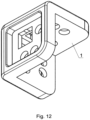
  • FIG. 12 illustrates another view of the movable sector of the 3-D puzzle depicted in FIG. 1 , according to the exemplary embodiment.
  • FIG. 13 illustrates a view of the movable sector of the 3-D puzzle depicted in FIG. 1 , according to the exemplary embodiment.
  • FIG. 14 illustrates a retractable part of the movable element of the 3-D puzzle depicted in FIG. 1 , according to the exemplary embodiment.
  • FIG. 15 illustrates an inner part of the retractable part of the movable element of the 3-D puzzle depicted in FIG. 1 , according to the exemplary embodiment.
  • FIG. 16 illustrates an additional view of the movable sector of the 3-D puzzle depicted in FIG. 1 , according to the exemplary embodiment.
  • FIG. 17 illustrates a central piece of the 3-D puzzle depicted in FIG. 1 , according to the exemplary embodiment.
  • FIG. 18 illustrates another view of the central piece of the 3-D puzzle depicted in FIG. 1 , according to the exemplary embodiment.
  • FIG. 19 illustrates a cross-section view G-G of the central piece depicted in FIG. 18 , according to the exemplary embodiment.
  • FIG. 20 illustrates an axel part of the central piece depicted in FIG. 18 , according to the exemplary embodiment.
  • FIG. 21 illustrates another part of the central piece depicted in FIG. 18 , according to the exemplary embodiment.
  • FIG. 22 illustrates a cross of the central piece depicted in FIG. 18 , according to the exemplary embodiment.
  • FIG. 23 illustrates an assembly of the movable sector including the movable elements, according to the exemplary embodiment.
  • distal refers to a direction relatively closer to a patient on which a medical device is to be used as described herein
  • proximal refers to a direction relatively further from the patient.
  • the words “including,” “has,” and “having,” as used herein, including the claims, shall have the same meaning as the word “comprising.”
  • Embodiments disclosed herein are directed to a 3-D cubical puzzle with movable sectors configured to be repositioned relative to each other.
  • the sectors may have movable elements providing for various states of the 3-D puzzle.
  • the 3-D puzzle is implemented as a cube consisting of multiple movable sectors configured to move about a central piece. All movable sectors have movable elements attached to holders configured to house magnets. The relative positioning of the movable elements can be changed by a user. According to the exemplary embodiment, the magnets interact with each other by pairs in any static position of the cubical 3-D puzzle. As a result, the movable elements are either being pulled to the center or being pushed away from the center.
  • the elements of the cubic 3-D puzzle may move by a principle similar to the one of the Rubik cube®.
  • the exemplary 3-D puzzle does not need to use colors for the movable sectors.
  • the movable sectors of the cube use square button-like elements positioned on every movable sector.
  • the button-like elements can be either in an extracted or pushed-in binary state.
  • the plates with static magnets may be shaped as disks.
  • the magnets regardless of a static position of the 3-D puzzle, the magnets always interact with each other by pairs causing the movable elements to be either pulled to the center or be pushed away from the center thereby creating different variations of the cubical 3-D puzzle.
  • the plates housing the static magnets include an even number of magnets each.
  • the magnets regardless of a static position of the cubical 3-D puzzle, the magnets always interact with each other by pairs.
  • the magnets and other movable elements made of a material with magnetic susceptibility as essential features of the puzzle structure itself in the absence of any guides.
  • the multivariance of their location in different stationary positions of the segments of the spherical puzzle is provided by rotation and magnetic interaction and is used to increase the number of different positions of the cubical puzzle, which ensures its complexity and variety of possible positions.
  • Rotations of magnets and elements made of a material with magnetic susceptibility is facilitated by attraction and repulsion of various magnets.
  • the proposed solution is simple and convenient to hold in user's hands, as well as to rotate and twist.
  • FIGS. 1 - 23 described below use the following numbering of the exemplary features and elements:
  • FIGS. 1 - 23 depict the 3-D cubical puzzle and its parts including movable sectors 1 configured to change the relative positions to each other.
  • the movable sectors 1 are configured to host the retractable movable elements 2 with magnets 3 that allow to assume various states of the 3-D cubical puzzle.
  • the movable sectors 1 may have cavities configured to accommodate the movable elements 2 .
  • Each movable element may move under influence of other movable elements as the movable sectors change their positions relative to each other.
  • Each movable sector 1 may include three movable elements 2 positioned orthogonally to each other.
  • Each movable element 2 has an outer surface 5 connected to a holder 6 .
  • the holders 6 of the three movable elements 2 form a holder cross inside the movable sector 1 .
  • the holder cross allows for movement of the three movable elements to cause the movable elements 2 assume either an extracted or pushed-in position relative to the hosting movable sector.
  • Each of the holder of the movable element has a magnet located inside.
  • a central piece 4 consists of a central cross 41 made of three orthogonal axes with flat ends configured to fix the movable elements 2 in a stationary position of the 3-D puzzle and to move to another stationary position of the 3-D puzzle by employing the part 42 of the central piece and an axel part 43 of the central piece 4 .
  • the cubical 3-D puzzle is configured in such manner that the movable elements have two distinct positions—extracted and retracted. As shown in FIG. 3 , some movable elements 2 are extracted and some are pushed-in. In the initial state, all movable elements 2 are in the pushed-in position. As shown in FIG. 2 , once the movable sectors 1 are displaced, the 3-D puzzle assumes an intermediary state shown in FIG. 3 .
  • Some magnets 3 located on the holders 6 interact with each other—i.e., push or pull.
  • the push or pull force makes the holders 6 to change the positions of the attached movable elements 2 from pushed-in to extracted and vice versa depending on pushing or pulling of the magnets 3 of the adjacent holders 6 .
  • the player's task is to first confuse the state of the puzzle, for example, so that the movable elements are in placed into a pushed-in or extracted position randomly. Then, the player has to collect from the out of order state all the sides of the cube puzzle so all movable elements are in the same state.
  • Practice shows that this is a tricky and non-trivial task that can take a lot of time.

Landscapes

  • Engineering & Computer Science (AREA)
  • Multimedia (AREA)
  • Toys (AREA)

Abstract

Disclosed herein is the 3-D puzzle implemented as a cube consisting of eight movable sectors configured to move about a central cross-piece created by three axels that are perpendicular to each other. Each movable sector includes three movable elements positioned orthogonally to each other. Each movable element has an outer edge surface attached to a holder. The holders of the three movable elements form a central cross inside the movable sector. The central cross allows the three movable elements to assume positions where the movable element is extracted or retracted relative to the hosting movable sector. Each holder of the movable element has a magnet positioned inside. The central piece of the 3-D cubical puzzle is formed by a central cross made of three orthogonal axes with flat ends configured to fix the movable elements in a static position and to move from one static position into another.

Description

CROSS-REFERENCE TO RELATED APPLICATION
This application is a CIP of the U.S. patent application Ser. No. 16/974,148 filed on 10.21.2020 and currently unintentionally abandoned.
BACKGROUND
There are currently several magnetic puzzles available. A magnetic puzzle with movable sectors is disclosed in RF Patent No. 2667861, published in 2018. The disclosed puzzle uses magnetic fields to change the state of the puzzle. However, the disclosed puzzle is rather simple and easy to solve.
Accordingly, a complex and hard to solve cubical 3-D puzzle with magnets and movable sectors is desired.
SUMMARY OF THE INVENTION
Disclosed herein is the 3-D puzzle implemented as a cube consisting of eight movable sectors configured to move about a central cross-piece created by three axels that are perpendicular to each other. Each movable sector includes three movable elements positioned orthogonally to each other. Each movable element has an outer edge surface attached to a holder. The holders of the three movable elements form a central cross inside the movable sector. The central cross allows the three movable elements to assume positions where the movable element is extracted or retracted relative to the hosting movable sector. Each holder of the movable element has a magnet positioned inside. The central piece of the 3D cubical puzzle is formed by a central cross made of three orthogonal to each other axes with flat ends configured to fix the movable elements in a static position and to move them from one static position into another.
These and other features of the concepts provided herein will become more apparent to those of skill in the art in view of the accompanying drawings and following description, which describe particular embodiments of such concepts in greater detail.
BRIEF DESCRIPTION OF DRAWINGS
A more particular description of the present disclosure will be rendered by reference to specific embodiments thereof that are illustrated in the appended drawings. It is appreciated that these drawings depict only typical embodiments of the invention and are therefore not to be considered limiting of its scope. Example embodiments of the invention will be described and explained with additional specificity and detail through the use of the accompanying drawings in which:
FIG. 1 illustrates a view of the 3-D cubic puzzle in an initial ordered state, according to the exemplary embodiment.
FIG. 2 illustrates a view of the 3-D cubic puzzle in a rotated state when movable sectors are twisted relative to each other, according to the exemplary embodiment.
FIG. 3 illustrates a view of the 3-D cubic puzzle with extracted and retracted movable elements, according to the exemplary embodiment.
FIG. 4 illustrates a top view of the puzzle depicted in FIG. 1 , according to the exemplary embodiment.
FIG. 5 illustrates a cross-section B-B view of the puzzle depicted in FIG. 4 , according to the exemplary embodiment.
FIG. 6 illustrates a disassembled 3-D cubic puzzle with a separate center piece, according to the exemplary embodiment.
FIG. 7 illustrates a movable sector of the 3-D puzzle, according to the exemplary embodiment.
FIG. 8 illustrates a movable element of the 3-D puzzle, according to the exemplary embodiment.
FIG. 9 illustrates a side view of the movable element depicted in FIG. 8 , according to the exemplary embodiment.
FIG. 10 illustrates a cross-section E-E of the movable element depicted in FIG. 8 , according to the exemplary embodiment.
FIG. 11 illustrates a holder of the movable element, according to the exemplary embodiment.
FIG. 12 illustrates another view of the movable sector of the 3-D puzzle depicted in FIG. 1 , according to the exemplary embodiment.
FIG. 13 illustrates a view of the movable sector of the 3-D puzzle depicted in FIG. 1 , according to the exemplary embodiment.
FIG. 14 illustrates a retractable part of the movable element of the 3-D puzzle depicted in FIG. 1 , according to the exemplary embodiment.
FIG. 15 illustrates an inner part of the retractable part of the movable element of the 3-D puzzle depicted in FIG. 1 , according to the exemplary embodiment.
FIG. 16 illustrates an additional view of the movable sector of the 3-D puzzle depicted in FIG. 1 , according to the exemplary embodiment.
FIG. 17 illustrates a central piece of the 3-D puzzle depicted in FIG. 1 , according to the exemplary embodiment.
FIG. 18 illustrates another view of the central piece of the 3-D puzzle depicted in FIG. 1 , according to the exemplary embodiment.
FIG. 19 illustrates a cross-section view G-G of the central piece depicted in FIG. 18 , according to the exemplary embodiment.
FIG. 20 illustrates an axel part of the central piece depicted in FIG. 18 , according to the exemplary embodiment.
FIG. 21 illustrates another part of the central piece depicted in FIG. 18 , according to the exemplary embodiment.
FIG. 22 illustrates a cross of the central piece depicted in FIG. 18 , according to the exemplary embodiment.
FIG. 23 illustrates an assembly of the movable sector including the movable elements, according to the exemplary embodiment.
DETAILED DESCRIPTION
Before some particular embodiments are disclosed in greater detail, it should be understood that the particular embodiments disclosed herein do not limit the scope of the concepts provided herein. It should also be understood that a particular embodiment disclosed herein can have features that can be readily separated from the particular embodiment and optionally combined with or substituted for features of any of a number of other embodiments disclosed herein.
Regarding terms used herein, it should also be understood the terms are for the purpose of describing some particular embodiments, and the terms do not limit the scope of the concepts provided herein. Ordinal numbers (e.g., first, second, third, etc.) are generally used to distinguish or identify different features or steps in a group of features or steps, and do not supply a serial or numerical limitation. For example, “first,” “second,” and “third” features or steps need not necessarily appear in that order, and the particular embodiments including such features or steps need not necessarily be limited to the three features or steps. Labels such as “left,” “right,” “top,” “bottom,” “front,” “back,” and the like are used for convenience and are not intended to imply, for example, any particular fixed location, orientation, or direction. Instead, such labels are used to reflect, for example, relative location, orientation, or directions. Singular forms of “a,” “an,” and “the” include plural references unless the context clearly dictates otherwise.
For clarity, it is to be understood that the word “distal” refers to a direction relatively closer to a patient on which a medical device is to be used as described herein, while the word “proximal” refers to a direction relatively further from the patient. Also, the words “including,” “has,” and “having,” as used herein, including the claims, shall have the same meaning as the word “comprising.”
Lastly, in the following description, the terms “or” and “and/or” as used herein are to be interpreted as inclusive or meaning any one or any combination. As an example, “A, B or C” or “A, B and/or C” mean “any of the following: A; B; C; A and B; A and C; B and C; A, B and C.” An exception to this definition will occur only when a combination of elements, components, functions, steps or acts are in some way inherently mutually exclusive.
Unless defined otherwise, all technical and scientific terms used herein have the same meaning as commonly understood by those of ordinary skill in the art.
Embodiments disclosed herein are directed to a 3-D cubical puzzle with movable sectors configured to be repositioned relative to each other. The sectors may have movable elements providing for various states of the 3-D puzzle.
According to the exemplary embodiments, the 3-D puzzle is implemented as a cube consisting of multiple movable sectors configured to move about a central piece. All movable sectors have movable elements attached to holders configured to house magnets. The relative positioning of the movable elements can be changed by a user. According to the exemplary embodiment, the magnets interact with each other by pairs in any static position of the cubical 3-D puzzle. As a result, the movable elements are either being pulled to the center or being pushed away from the center.
Accordingly, the elements of the cubic 3-D puzzle may move by a principle similar to the one of the Rubik cube®. However, the exemplary 3-D puzzle does not need to use colors for the movable sectors. Instead, the movable sectors of the cube use square button-like elements positioned on every movable sector. The button-like elements can be either in an extracted or pushed-in binary state.
Since the cubical 3-D puzzle has magnets positioned inside, at each turn of a segment of the puzzle, a new interaction of magnet pairs occurs. Magnetic pull/push causes repositioning of the movable sectors that change the appearance of the cubical 3-D puzzle.
In one embodiment, the plates with static magnets may be shaped as disks. Thus, regardless of a static position of the 3-D puzzle, the magnets always interact with each other by pairs causing the movable elements to be either pulled to the center or be pushed away from the center thereby creating different variations of the cubical 3-D puzzle.
In one embodiment, the plates housing the static magnets include an even number of magnets each. Thus, regardless of a static position of the cubical 3-D puzzle, the magnets always interact with each other by pairs.
Thanks to the above advantageous characteristics, it becomes possible to use the magnets and other movable elements made of a material with magnetic susceptibility as essential features of the puzzle structure itself in the absence of any guides. The multivariance of their location in different stationary positions of the segments of the spherical puzzle is provided by rotation and magnetic interaction and is used to increase the number of different positions of the cubical puzzle, which ensures its complexity and variety of possible positions.
Rotations of magnets and elements made of a material with magnetic susceptibility is facilitated by attraction and repulsion of various magnets. The proposed solution is simple and convenient to hold in user's hands, as well as to rotate and twist.
The FIGS. 1-23 described below use the following numbering of the exemplary features and elements:
    • 1—movable sectors;
    • 2—movable elements;
    • 3—magnets;
    • 4—central piece;
    • 41—cross of the central piece;
    • 42—part of the central piece;
    • 43—axel part of the central piece;
    • 5—outer surface of the movable element;
    • 6—holder of the movable element; and
    • 7—inner part of the movable element.
According to the exemplary embodiments, FIGS. 1-23 depict the 3-D cubical puzzle and its parts including movable sectors 1 configured to change the relative positions to each other. The movable sectors 1 are configured to host the retractable movable elements 2 with magnets 3 that allow to assume various states of the 3-D cubical puzzle. The movable sectors 1 may have cavities configured to accommodate the movable elements 2. Each movable element may move under influence of other movable elements as the movable sectors change their positions relative to each other.
As discussed above, the 3-D cubical puzzle is implemented with eight cubical movable sectors 1 attached to the central piece 4. Each movable sector 1 may include three movable elements 2 positioned orthogonally to each other. Each movable element 2 has an outer surface 5 connected to a holder 6. The holders 6 of the three movable elements 2 form a holder cross inside the movable sector 1. The holder cross allows for movement of the three movable elements to cause the movable elements 2 assume either an extracted or pushed-in position relative to the hosting movable sector. Each of the holder of the movable element has a magnet located inside.
A central piece 4 consists of a central cross 41 made of three orthogonal axes with flat ends configured to fix the movable elements 2 in a stationary position of the 3-D puzzle and to move to another stationary position of the 3-D puzzle by employing the part 42 of the central piece and an axel part 43 of the central piece 4.
According to the exemplary embodiment, the cubical 3-D puzzle is configured in such manner that the movable elements have two distinct positions—extracted and retracted. As shown in FIG. 3 , some movable elements 2 are extracted and some are pushed-in. In the initial state, all movable elements 2 are in the pushed-in position. As shown in FIG. 2 , once the movable sectors 1 are displaced, the 3-D puzzle assumes an intermediary state shown in FIG. 3 .
Some magnets 3 located on the holders 6 interact with each other—i.e., push or pull. The push or pull force makes the holders 6 to change the positions of the attached movable elements 2 from pushed-in to extracted and vice versa depending on pushing or pulling of the magnets 3 of the adjacent holders 6.
The player's task is to first confuse the state of the puzzle, for example, so that the movable elements are in placed into a pushed-in or extracted position randomly. Then, the player has to collect from the out of order state all the sides of the cube puzzle so all movable elements are in the same state. Practice shows that this is a tricky and non-trivial task that can take a lot of time. When the movable sectors 1 are moved, magnets 3 located in holders 6 interact with each other and change the positions of the movable elements 2 depending on the environment.
Embodiments of the invention may be embodied in other specific forms without departing from the spirit of the present disclosure. The described embodiments are to be considered in all respects only as illustrative yet not restrictive. The scope of the embodiments is, therefore, indicated by the appended claims rather than by the foregoing description. All changes that come within the meaning and range of equivalency of the claims are to be embraced within their scope.

Claims (5)

What is claimed is:
1. A 3-D cubical magnetic puzzle, comprising:
eight movable sectors configured to host movable elements configured to change a state of the 3-D magnetic puzzle, wherein:
the movable sectors are configured to change their positioning relative to each other; and
each of the movable sectors comprising three cavities configured to accommodate three movable elements attached to holders comprising magnets, wherein the movable elements are configured to move up and down inside the cavity responsive to a magnetic field provided by the magnets responsive to a change in positioning of the movable sectors relative to each other,
wherein the holders of the movable elements of each of the movable sectors form a holder cross inside each of the movable sectors configured to provide for movements of the movable elements in order to assume pushed-in or extracted positions relative to the movable sector, and
wherein the movable sectors are attached to a center piece comprising a central cross formed by three orthogonal axes with flat ends configured to fix the movable elements in a stationary position of the 3-D cubic magnetic puzzle and to facilitate movements of the movable elements into another stationary position of the 3-D cubical magnetic puzzle.
2. The 3-D cubical magnetic puzzle of claim 1, wherein each of the movable sectors comprises three movable elements orthogonally positioned to each other.
3. The 3-D cubical magnetic puzzle of claim 1, wherein each of the movable elements comprises an outer surface and one of the holders connected to the outer surface.
4. A method of a 3-D magnetic puzzle, comprising:
obtaining a cube-shaped 3-D magnetic puzzle comprising:
a plurality of movable sectors configured to host movable elements configured to change a state of the 3-D magnetic puzzle, wherein:
eight movable sectors configured to host movable elements configured to change a state of the 3-D magnetic puzzle, wherein:
the movable sectors are configured to change their positioning relative to each other; and
each of the movable sectors comprising three cavities configured to accommodate three movable elements attached to holders comprising magnets,
wherein the movable elements are configured to move up and down inside the cavity responsive to a magnetic field provided by the magnets responsive to a change in positioning of the movable sectors relative to each other,
wherein the holders of the movable elements of each of the movable sectors form a holder cross inside each of the movable sectors configured to provide for movements of the movable elements in order to assume pushed-in or extracted positions relative to the movable sector, and
wherein the movable sectors are attached to a center piece comprising a central cross formed by three orthogonal axes with flat ends configured to fix the movable elements in a stationary position of the 3-D cubic magnetic puzzle and to facilitate movements of the movable elements into another stationary position of the 3-D cubical magnetic puzzle.
5. The method of claim 4, further comprising rotating the movable sectors of the cube-shaped 3-D magnetic puzzle to bring the magnetic puzzle to an ordered state, wherein all of the movable elements are in a pushed-in position.
US17/803,357 2020-10-21 2022-05-31 Cubical 3-D magnetic puzzle with movable sectors Active US12109502B2 (en)

Priority Applications (1)

Application Number Priority Date Filing Date Title
US17/803,357 US12109502B2 (en) 2020-10-21 2022-05-31 Cubical 3-D magnetic puzzle with movable sectors

Applications Claiming Priority (2)

Application Number Priority Date Filing Date Title
US16/974,148 US20210106908A1 (en) 2018-05-09 2020-10-21 Three-dimensional puzzle with movable segments
US17/803,357 US12109502B2 (en) 2020-10-21 2022-05-31 Cubical 3-D magnetic puzzle with movable sectors

Related Parent Applications (1)

Application Number Title Priority Date Filing Date
US16/974,148 Continuation-In-Part US20210106908A1 (en) 2018-05-09 2020-10-21 Three-dimensional puzzle with movable segments

Publications (2)

Publication Number Publication Date
US20220296993A1 US20220296993A1 (en) 2022-09-22
US12109502B2 true US12109502B2 (en) 2024-10-08

Family

ID=83285580

Family Applications (1)

Application Number Title Priority Date Filing Date
US17/803,357 Active US12109502B2 (en) 2020-10-21 2022-05-31 Cubical 3-D magnetic puzzle with movable sectors

Country Status (1)

Country Link
US (1) US12109502B2 (en)

Families Citing this family (1)

* Cited by examiner, † Cited by third party
Publication number Priority date Publication date Assignee Title
ES2935559B2 (en) * 2022-10-10 2023-11-30 Univ Madrid Politecnica Mechanical three-dimensional puzzle

Citations (16)

* Cited by examiner, † Cited by third party
Publication number Priority date Publication date Assignee Title
US4462596A (en) * 1981-08-31 1984-07-31 Shuzo Yamamoto Piece-stacking game device utilizing magnetic forces
US7413493B2 (en) * 2004-01-27 2008-08-19 Rc2 Brands, Inc. Magnetic building block
WO2009118462A1 (en) * 2008-03-27 2009-10-01 Jean-Pierre Hardouin Game including small magnetically juxtaposable or stackable cubes
US7887056B2 (en) * 2007-02-02 2011-02-15 Educocio S.L. Puzzle formed by a plurality of cubes
US8850683B2 (en) * 2009-03-26 2014-10-07 Tegu Magnetic blocks and method of making magnetic blocks
US20150076766A1 (en) * 2013-09-16 2015-03-19 Cheng Wei Liu Magic cube structure
US9821244B1 (en) * 2016-11-09 2017-11-21 Click-Block Corporation Magnetic wooden block toy
CN108568089A (en) * 2018-06-27 2018-09-25 佛山市计客创新科技有限公司 Magnetic force positions magic square
CN112190916A (en) * 2020-09-27 2021-01-08 杨永顺 Shaftless three-order magnetic attraction magic cube
US20210153366A1 (en) * 2019-10-24 2021-05-20 Cubios, Inc Electronic device with a volumetric transformable display
CN113230645A (en) * 2021-03-09 2021-08-10 广州淦源智能科技有限公司 Magnetic suspension magic cube structure
KR20210127314A (en) * 2020-04-14 2021-10-22 공성순 Magic cube
US11224821B2 (en) * 2019-06-24 2022-01-18 LaRose Industries, LLC Shell-within-a-shell magnetic toy construction block
US20220118354A1 (en) * 2020-10-21 2022-04-21 IIya V. Osipov 3-D Puzzle with moving sectors
US20220296994A1 (en) * 2020-10-21 2022-09-22 Ilya V. Osipov Spherical 3-D puzzle with moving sectors
US11484780B1 (en) * 2021-05-26 2022-11-01 Guangzhou Ganyuan Inielligent Technology Co., Ltd. Magnetic levitation magic cube

Patent Citations (16)

* Cited by examiner, † Cited by third party
Publication number Priority date Publication date Assignee Title
US4462596A (en) * 1981-08-31 1984-07-31 Shuzo Yamamoto Piece-stacking game device utilizing magnetic forces
US7413493B2 (en) * 2004-01-27 2008-08-19 Rc2 Brands, Inc. Magnetic building block
US7887056B2 (en) * 2007-02-02 2011-02-15 Educocio S.L. Puzzle formed by a plurality of cubes
WO2009118462A1 (en) * 2008-03-27 2009-10-01 Jean-Pierre Hardouin Game including small magnetically juxtaposable or stackable cubes
US8850683B2 (en) * 2009-03-26 2014-10-07 Tegu Magnetic blocks and method of making magnetic blocks
US20150076766A1 (en) * 2013-09-16 2015-03-19 Cheng Wei Liu Magic cube structure
US9821244B1 (en) * 2016-11-09 2017-11-21 Click-Block Corporation Magnetic wooden block toy
CN108568089A (en) * 2018-06-27 2018-09-25 佛山市计客创新科技有限公司 Magnetic force positions magic square
US11224821B2 (en) * 2019-06-24 2022-01-18 LaRose Industries, LLC Shell-within-a-shell magnetic toy construction block
US20210153366A1 (en) * 2019-10-24 2021-05-20 Cubios, Inc Electronic device with a volumetric transformable display
KR20210127314A (en) * 2020-04-14 2021-10-22 공성순 Magic cube
CN112190916A (en) * 2020-09-27 2021-01-08 杨永顺 Shaftless three-order magnetic attraction magic cube
US20220118354A1 (en) * 2020-10-21 2022-04-21 IIya V. Osipov 3-D Puzzle with moving sectors
US20220296994A1 (en) * 2020-10-21 2022-09-22 Ilya V. Osipov Spherical 3-D puzzle with moving sectors
CN113230645A (en) * 2021-03-09 2021-08-10 广州淦源智能科技有限公司 Magnetic suspension magic cube structure
US11484780B1 (en) * 2021-05-26 2022-11-01 Guangzhou Ganyuan Inielligent Technology Co., Ltd. Magnetic levitation magic cube

Also Published As

Publication number Publication date
US20220296993A1 (en) 2022-09-22

Similar Documents

Publication Publication Date Title
US8490974B2 (en) Three-dimensional puzzle or puzzle or display platform
US12109502B2 (en) Cubical 3-D magnetic puzzle with movable sectors
US11484780B1 (en) Magnetic levitation magic cube
US20220118354A1 (en) 3-D Puzzle with moving sectors
US20190099688A1 (en) Finger Manipulated Device
US4357016A (en) Manipulation puzzle
US11007425B2 (en) Sliding intelligence toy
US2001067A (en) Puzzle
US11813541B2 (en) Spherical 3-D puzzle with moving sectors
US4483535A (en) Triangle combination game
US20140274492A1 (en) Magnetic juggling apparatus
RU2701264C1 (en) Three-dimensional puzzle with moving sectors
CN205995051U (en) Magnetic splicing building block
US2775458A (en) Magnetically indexed rotating chance device
CN111818977B (en) Three-dimensional puzzle with movable parts
US20120286472A1 (en) Pathway puzzle
US20150148155A1 (en) Disc-shaped toy
CN105043169B (en) Rolling type shooting target case
TWI606858B (en) Puzzle ball with multiple arrangement
US20250242231A1 (en) Puzzle with magnetic system
CN207237240U (en) A kind of new gyro magic square
KR0129092Y1 (en) Learning toys
CN223490394U (en) Magnetic second-order magic cube
US20250360430A1 (en) Block set
TWM507289U (en) Puzzle ball with a variety of arrangements

Legal Events

Date Code Title Description
FEPP Fee payment procedure

Free format text: ENTITY STATUS SET TO MICRO (ORIGINAL EVENT CODE: MICR); ENTITY STATUS OF PATENT OWNER: MICROENTITY

STPP Information on status: patent application and granting procedure in general

Free format text: DOCKETED NEW CASE - READY FOR EXAMINATION

STPP Information on status: patent application and granting procedure in general

Free format text: NON FINAL ACTION MAILED

STCB Information on status: application discontinuation

Free format text: ABANDONED -- FAILURE TO RESPOND TO AN OFFICE ACTION

STPP Information on status: patent application and granting procedure in general

Free format text: RESPONSE TO NON-FINAL OFFICE ACTION ENTERED AND FORWARDED TO EXAMINER

STPP Information on status: patent application and granting procedure in general

Free format text: NOTICE OF ALLOWANCE MAILED -- APPLICATION RECEIVED IN OFFICE OF PUBLICATIONS

STPP Information on status: patent application and granting procedure in general

Free format text: PUBLICATIONS -- ISSUE FEE PAYMENT RECEIVED

STPP Information on status: patent application and granting procedure in general

Free format text: PUBLICATIONS -- ISSUE FEE PAYMENT VERIFIED

STCF Information on status: patent grant

Free format text: PATENTED CASE