US12108936B2 - Anti-fogging endoscopic camera systems and methods - Google Patents
Anti-fogging endoscopic camera systems and methods Download PDFInfo
- Publication number
- US12108936B2 US12108936B2 US17/149,636 US202117149636A US12108936B2 US 12108936 B2 US12108936 B2 US 12108936B2 US 202117149636 A US202117149636 A US 202117149636A US 12108936 B2 US12108936 B2 US 12108936B2
- Authority
- US
- United States
- Prior art keywords
- desiccant
- coupler
- chamber
- component
- camera head
- Prior art date
- Legal status (The legal status is an assumption and is not a legal conclusion. Google has not performed a legal analysis and makes no representation as to the accuracy of the status listed.)
- Active, expires
Links
Images




Classifications
-
- A—HUMAN NECESSITIES
- A61—MEDICAL OR VETERINARY SCIENCE; HYGIENE
- A61B—DIAGNOSIS; SURGERY; IDENTIFICATION
- A61B1/00—Instruments for performing medical examinations of the interior of cavities or tubes of the body by visual or photographical inspection, e.g. endoscopes; Illuminating arrangements therefor
- A61B1/00112—Connection or coupling means
- A61B1/00121—Connectors, fasteners and adapters, e.g. on the endoscope handle
- A61B1/00126—Connectors, fasteners and adapters, e.g. on the endoscope handle optical, e.g. for light supply cables
-
- A—HUMAN NECESSITIES
- A61—MEDICAL OR VETERINARY SCIENCE; HYGIENE
- A61B—DIAGNOSIS; SURGERY; IDENTIFICATION
- A61B1/00—Instruments for performing medical examinations of the interior of cavities or tubes of the body by visual or photographical inspection, e.g. endoscopes; Illuminating arrangements therefor
- A61B1/00112—Connection or coupling means
- A61B1/00121—Connectors, fasteners and adapters, e.g. on the endoscope handle
- A61B1/00128—Connectors, fasteners and adapters, e.g. on the endoscope handle mechanical, e.g. for tubes or pipes
-
- A—HUMAN NECESSITIES
- A61—MEDICAL OR VETERINARY SCIENCE; HYGIENE
- A61B—DIAGNOSIS; SURGERY; IDENTIFICATION
- A61B1/00—Instruments for performing medical examinations of the interior of cavities or tubes of the body by visual or photographical inspection, e.g. endoscopes; Illuminating arrangements therefor
- A61B1/00131—Accessories for endoscopes
- A61B1/00137—End pieces at either end of the endoscope, e.g. caps, seals or forceps plugs
-
- A—HUMAN NECESSITIES
- A61—MEDICAL OR VETERINARY SCIENCE; HYGIENE
- A61B—DIAGNOSIS; SURGERY; IDENTIFICATION
- A61B1/00—Instruments for performing medical examinations of the interior of cavities or tubes of the body by visual or photographical inspection, e.g. endoscopes; Illuminating arrangements therefor
- A61B1/00163—Optical arrangements
- A61B1/00188—Optical arrangements with focusing or zooming features
-
- A—HUMAN NECESSITIES
- A61—MEDICAL OR VETERINARY SCIENCE; HYGIENE
- A61B—DIAGNOSIS; SURGERY; IDENTIFICATION
- A61B1/00—Instruments for performing medical examinations of the interior of cavities or tubes of the body by visual or photographical inspection, e.g. endoscopes; Illuminating arrangements therefor
- A61B1/04—Instruments for performing medical examinations of the interior of cavities or tubes of the body by visual or photographical inspection, e.g. endoscopes; Illuminating arrangements therefor combined with photographic or television appliances
- A61B1/042—Instruments for performing medical examinations of the interior of cavities or tubes of the body by visual or photographical inspection, e.g. endoscopes; Illuminating arrangements therefor combined with photographic or television appliances characterised by a proximal camera, e.g. a CCD camera
-
- A—HUMAN NECESSITIES
- A61—MEDICAL OR VETERINARY SCIENCE; HYGIENE
- A61B—DIAGNOSIS; SURGERY; IDENTIFICATION
- A61B1/00—Instruments for performing medical examinations of the interior of cavities or tubes of the body by visual or photographical inspection, e.g. endoscopes; Illuminating arrangements therefor
- A61B1/04—Instruments for performing medical examinations of the interior of cavities or tubes of the body by visual or photographical inspection, e.g. endoscopes; Illuminating arrangements therefor combined with photographic or television appliances
- A61B1/05—Instruments for performing medical examinations of the interior of cavities or tubes of the body by visual or photographical inspection, e.g. endoscopes; Illuminating arrangements therefor combined with photographic or television appliances characterised by the image sensor, e.g. camera, being in the distal end portion
Definitions
- the present invention pertains to the field of medical devices. More particularly, the present invention relates to endoscopic camera systems.
- An endoscopic camera system includes an endoscope that is inserted into the body of a subject for delivering light to and receiving light from a surgical cavity.
- the endoscope is mounted to a camera head that can capture video and images based on the light received from the endoscope.
- the camera head is communicatively coupled to a camera control unit that processes video and image data from the camera head for display or storage.
- An optical coupler is generally used to connect the endoscope to the camera head and can include optical components for focusing the light received from the endoscope onto the imaging sensor assembly in the camera head.
- a coupler may include one or more optical components, such as one or more lenses or prisms, that can be moved relative to the camera, the endoscope, or both, to alter the focal distance.
- Optical systems can be very sensitive to condensation caused by moisture, particularly the moisture of a sterilizing environment. Moisture from sterilization that penetrates into the interior of the optical chamber can cause fogging (condensation) on lenses and other optical components, which can reduce the quality of images generated by the camera head. Couplers can be configured with seals or water proof adhesives to prevent moisture accumulation in the coupler.
- a coupler for a camera head includes a sealed chamber housing one or more optical components and one or more desiccant components located in air communication with the sealed chamber to absorb moisture that may penetrate through the seals over time due to repeated sterilizations.
- the desiccant components are located near the optical components providing better humidity control and a more compact design.
- a breathable layer is provided over the desiccant material, which blocks particulates from migrating into the sealed chamber.
- the lifespan of the coupler can be increased without requiring costly and bulky seal configurations.
- a coupler for coupling an endoscope to an endoscopic camera head is configured for removably mounting to a portion of the camera head that houses at least one imaging sensor and a housing assembly forming a sealed chamber that houses at least one optical component for focusing light for the at least one imaging sensor, and at least one desiccant component that is in air communication with the sealed chamber for absorbing moisture from the sealed chamber, wherein the at least one desiccant component comprises a desiccant that is at least partially covered by at least one covering to prevent desiccant particulates from entering the sealed chamber.
- the coupler can be configured to be sterilized when dismounted from the portion of the camera head.
- the coupler can include a first light transmissive component sealing a first end of the sealed chamber and a second light transmissive component sealing a second end of the sealed chamber. In any of these embodiments, at least one of the first and second light transmissive components can be adhesively attached to the housing assembly.
- the at least one optical component can include an optical assembly that comprises an optical assembly housing that houses the at least one optical component.
- the optical assembly can include a plurality of optical components that are fixedly mounted to the optical assembly housing.
- the at least one optical component can be movable within the chamber for focus adjustment.
- the at least one desiccant component can be located in at least one pocket and at least one air pathway can lead from the at least one pocket to the sealed chamber.
- the at least one desiccant component can be located in the sealed chamber. In any of these embodiments, the at least one desiccant component can be shaped as a ring.
- the desiccant that is at least partially covered by the at least one covering can be formed as a single solid.
- the at least one desiccant component can include a plurality of spaced apart desiccant components.
- the at least one desiccant component can be shaped as a tablet.
- the at least one desiccant component can be shaped as a ring.
- the at least one desiccant component can include at least one of silica gel, activated charcoal, calcium chloride, charcoal sulfate, activated alumina, Montmorillonite clay, and molecular sieve.
- the sealed chamber can be at least partially sealed by at least one elastomeric seal.
- the coupler can include a focusing member for engagement by a user for adjusting a location of the at least one optical component within the sealed chamber and at least one elastomeric seal that seals between the focusing member and the housing assembly.
- the housing assembly can include a plurality of components that are assembled together and at least partially sealed by one or more elastomeric seals.
- an endoscopic camera head includes a main housing that houses at least one imaging sensor; and a coupler removably mounted to the main housing and configured for coupling an endoscope to the camera head, the coupler including a housing assembly forming a sealed chamber that houses at least one optical component for focusing light for the at least one imaging sensor, and at least one desiccant component that is in air communication with the sealed chamber for absorbing moisture from the sealed chamber, wherein the at least one desiccant component comprises a desiccant that is at least partially covered by at least one covering to prevent desiccant particulates from entering the sealed chamber.
- the coupler can be configured to be removed from the main housing and sterilized.
- the coupler can include a first light transmissive component sealing a first end of the sealed chamber and a second light transmissive component sealing a second end of the sealed chamber. In any of these embodiments, at least one of the first and second light transmissive components can be adhesively attached to the housing assembly.
- the at least one optical component can include an optical assembly that comprises an optical assembly housing that houses the at least one optical component.
- the optical assembly can include a plurality of optical components that are fixedly mounted to the optical assembly housing.
- the at least one optical component can be movable within the chamber for focus adjustment.
- the at least one desiccant component can be located in at least one pocket and at least one air pathway leads from the at least one pocket to the sealed chamber.
- the at least one desiccant component can be located in the sealed chamber. In any of these embodiments, the at least one desiccant component can be shaped as a ring.
- the desiccant that is at least partially covered by the at least one covering can be formed as a single solid.
- the at least one desiccant component can include a plurality of spaced apart desiccant components.
- the at least one desiccant component can be shaped as a tablet.
- the at least one desiccant component can be shaped as a ring.
- the at least one desiccant component can include at least one of silica gel, activated charcoal, calcium chloride, charcoal sulfate, activated alumina, Montmorillonite clay, and molecular sieve.
- the sealed chamber can be at least partially sealed by at least one elastomeric seal.
- the coupler can include a focusing member for engagement by a user for adjusting a location of the at least one optical component within the sealed chamber and at least one elastomeric seal that seals between the focusing member and the housing assembly.
- the housing assembly can include a plurality of components that are assembled together and at least partially sealed by one or more elastomeric seals.
- an endoscopic camera head includes a main housing that houses at least one imaging sensor and includes a sealed chamber that houses at least one optical component for focusing light for the at least one imaging sensor, and at least one desiccant component that is in air communication with the sealed chamber for absorbing moisture from the sealed chamber, wherein the at least one desiccant component comprises a desiccant that is at least partially covered by at least one covering to prevent desiccant particulates from entering the sealed chamber.
- an endoscope includes a main housing that houses at least one optical component for receiving endoscopic imaging light and includes a sealed chamber that houses the at least one optical component, and at least one desiccant component that is in air communication with the sealed chamber for absorbing moisture from the sealed chamber, wherein the at least one desiccant component comprises a desiccant that is at least partially covered by at least one covering to prevent desiccant particulates from entering the sealed chamber.
- a method includes sterilizing a coupler configured to couple an endoscope to an endoscopic camera head main body, the coupler comprising a housing assembly forming a sealed chamber that houses at least one optical component for focusing light for the at least one imaging sensor, and at least one desiccant component that is in air communication with the sealed chamber for absorbing moisture from the sealed chamber, wherein the at least one desiccant component comprises a desiccant that is at least partially covered by at least one covering to prevent desiccant particulates from entering the sealed chamber; and capturing one or more images via the endoscopic camera head with attached coupler.
- the coupler can be separated from the camera head main body for sterilization.
- the coupler can be attached to the camera head main body for sterilization.
- FIG. 1 illustrates an endoscopic imaging system, according to various embodiments
- FIG. 2 is a perspective view of a camera head of the endoscopic imaging system, according to various embodiments
- FIG. 3 is an exploded view of portions of a camera head that are housed within the main enclosure, according to some embodiments
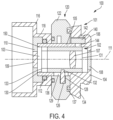
- FIG. 4 is a cross section of a coupler that can be incorporated into a camera head, according to some embodiments
- FIG. 5 is a perspective view of a rear adapter of a coupler, according to some embodiments.
- FIGS. 6 A and 6 B illustrate one manner of forming pockets and apertures in a coupler, according to some embodiments
- FIG. 7 is an exploded view of a desiccant component, according to some embodiments.
- FIG. 8 illustrates a section view of an alternative placement of a desiccant component within a coupler, according to some embodiments
- FIG. 9 is a section view of an endoscope incorporating desiccant, according to some embodiments.
- FIG. 10 is a block diagram of a method for using an endoscopic camera, according to some embodiments.
- an endoscopic camera head for use in endoscopic procedures includes a coupler that couples an endoscope to the camera head.
- the coupler is an opto-mechanical device that receives light from a scene via the attached endoscope and focuses the light onto an image sensor assembly within the camera head.
- the coupler is washed and sterilized to ensure that the coupler is clean and sterile before the next use.
- the coupler includes a plurality of sealing interfaces, such as o-ring seals and adhesively attached components.
- sealing interfaces such as o-ring seals and adhesively attached components.
- the inventors surprisingly discovered that moisture is able to migrate through the sealing interfaces over time due to repeated washing and sterilization procedures that occur over the lifespan of the coupler.
- elastomeric materials used in o-rings have a degree of moisture permeability that can allow moisture to migrate through the seals over time, and adhesives can break down over time due to exposure to moisture and heat during washing and sterilization.
- Moisture that migrates through seals and adhesive interfaces can accumulate to the degree that fogging of one or more optical components within the coupler occurs.
- the inventors also surprisingly discovered that the risk of fogging is exacerbated by the decreasing size of couplers designed to meet the requirements for smaller and lighter weight camera heads. Increased compactness leads to decreased air volume within the sealed portion of the coupler. This decreased air volume can reach a relative humidity that can lead to fogging sooner than a less compact design that has a greater air volume.
- embodiments described herein include desiccant located so as to be in air communication with the sealed optical chamber.
- desiccant located so as to be in air communication with the sealed optical chamber.
- the desiccant is located close to the optical components to ensure that the humidity in the optical chamber is well controlled and due to the compact design of the coupler, which can increase the risk that desiccant particulates fall onto one or more optical components.
- the desiccant is formed into a solid and at least partially covered by a breathable layer that allows moisture to pass into the desiccant while preventing desiccant particulates from breaking away and falling onto one or more optical components.
- couplers having desiccant according to the principles described herein can be sterilized using autoclaving. According to various embodiments, couplers having desiccant according to the principles described herein can be sterilized using low temperature sterilization.
- FIG. 1 illustrates an endoscopic imaging system 10 , according to various embodiments.
- Endoscopic imaging system 10 includes an endoscope assembly 11 that can be used for visualizing inside of a subject's body during an endoscopic procedure.
- the endoscope assembly 11 includes an endoscope 12 coupled to a camera head 13 by a coupler 14 that forms the distal portion of the camera head 13 .
- Light is provided to the endoscope 12 by a light source 16 via a light cable 15 , which can be, for example, a fiber optic cable.
- the endoscope 12 directs the light from the light cable 15 to the area of interest within the subject's body, receives light reflected from the area of interest, and conveys light to the imager within the camera head 13 .
- the imager is comprised of one or more image sensors which converts the optical image into electrical signals.
- the camera head 13 may be coupled to a camera control unit (CCU) 17 by a camera cable 18 .
- the camera cable 18 can convey imaging data from the camera head 13 to the CCU 17 for display on display 29 .
- various control signals are transmitted bi-directionally between the camera head 13 and the CCU 17 via the camera cable 18 .
- a user interface 20 can be provided on the camera head 13 for enabling a user to manually control various functions of the endoscopic imaging system 10 .
- various functions of the endoscopic imaging system 10 may be controlled by voice commands received by a microphone 24 mounted on a headset 25 worn by the surgeon and coupled to the voice-control unit 23 , which can be coupled to the CCU 17 .
- a hand-held control device 26 such as a tablet with a touch screen user interface, may be coupled to the voice-control unit 23 as a further control interface.
- an imaging system controller 27 can be included and connected to one or more system components, such as the CCU 17 and/or the light source 16 .
- the imaging system controller 27 provides further processing of image data from the CCU 17 , controls display and storage of image data and communication of imaging or other data to a hospital network, and/or communicates control commands to connected system components.
- a printer 28 may be included for printing hard copies of one or more images.
- FIG. 2 is a perspective view of camera head 13 of the endoscopic imaging system 10 , according to various embodiments.
- the camera head 13 includes a main enclosure 30 and a coupler 14 that extends forwardly from the main enclosure 30 .
- the main enclosure 30 can include two main enclosure parts-a front enclosure part 32 and a rear enclosure part 34 .
- the user interface 20 can be sealably attached to the rear enclosure part 34 , as described, for example, in commonly-owned U.S. Pat. No. 8,115,126, which is hereby incorporated by reference in its entirety.
- the coupler 14 extends forward of the front enclosure part 32 and can be removably mounted to the front enclosure part 32 , such as via a threaded engagement.
- the camera cable 18 may extend from the rear enclosure part 34 .
- FIG. 3 is an exploded view of portions of the camera head 13 that are housed within the main enclosure 30 , according to some embodiments.
- a window 40 can be sealably attached to the front enclosure part 32 , such as via an adhesive, to seal the main enclosure 30 .
- An O-ring 42 can be used to provide a seal between the front and rear enclosure parts 32 , 34 .
- An imaging sensor assembly 44 includes one or more imaging sensors for sensing light received from the scene via the endoscope 12 .
- the imaging sensor assembly 44 can be attached to brackets 46 and 50 , such as via fasteners 48 , that can mount the imaging sensor assembly 44 to the front enclosure part 32 via fasteners 54 .
- a connection spring 60 can be attached to the imaging sensor assembly 44 via the bracket 50 to allow engagement of the imaging sensor assembly 44 with the rear enclosure part 34 for further imaging sensor assembly support.
- the imaging sensor assembly 44 through the rear enclosure part 34 , is attached to the camera cable 18 for connection with the CCU 17 , as described above.
- One or more desiccant components 56 can be provided in the camera head 13 .
- the desiccant components can include a solid desiccant material, such as in a tablet shape, that are at least partially covered by a breathable layer that allows moisture in the air within the camera head to be absorbed by the desiccant, as discussed in more detail below.
- the one or more desiccant components 56 can be attached to the rear enclosure part 34 via any suitable attachment means, such as via an adhesive tape 58 .
- FIG. 4 is a cross section of a coupler 100 that can be incorporated into a camera head, such as camera head 13 , according to some embodiments.
- the coupler 100 can be removably attached to the main enclosure 30 , which can allow the coupler 100 to be swapped out and/or washed and sterilized separately from the rest of the camera head.
- Coupler 100 can be sterilized via any suitable sterilization method, including low-temperature sterilization.
- Coupler 100 includes a coupler housing assembly 101 that houses an optical assembly 102 for conveying light (e.g., focusing) received from an endoscope prior to the imaging sensor assembly 44 within the main enclosure 30 .
- the coupler housing assembly 101 includes a rear adapter 104 that includes a coupling portion 106 for coupling with the main enclosure 30 , such as via a threaded engagement with the front enclosure part 32 .
- the coupling portion 106 can be, for example, a C-mount thread.
- the optical assembly 102 is located within a chamber 103 formed by an inner wall 105 of the rear adapter 104 .
- the optical assembly 102 can include one or more optical components 107 , such as one or more lenses and/or prisms, for focusing light received from an endoscope onto the imaging sensor assembly housed in the main enclosure 30 .
- the optical components 107 may be mounted within an optical assembly housing 130 .
- the optical assembly housing 130 can have a rear opening 131 and may include a front piece 133 that fits to the optical assembly housing 130 for retaining the optical components 107 therein.
- the optical assembly 102 can be slidably received in the chamber 103 and its forward-rearward position can be adjusted for focusing.
- the inner surface 150 of the inner wall 105 of the rear adapter 104 can provide a bearing surface for the radially outer surface of the optical assembly housing 130 to enable the optical assembly 102 to slide within the chamber 103 .
- the chamber 103 is sealed by front and rear windows 108 and 109 .
- the rear window 108 can be affixed to the rear adapter 104 in such a way that a seal is formed between the rear adapter 104 and the rear window 108 , such as via an adhesive that forms an adequate seal.
- the front window 109 is affixed to a front retainer 110 that mounts to a front end of the rear adapter 104 .
- the front window 109 can be affixed to the front retainer 110 in similar fashion to the fixing of the rear window 108 to the rear adapter 104 .
- the front retainer 110 can mount to the front end of the rear adapter 104 via a threaded engagement or other suitable engagement.
- An endobody clamp 116 is provided at the front end of the coupler 100 for releasably clamping an endoscope to the front end of the coupler 100 .
- the endobody clamp 116 may be configured to repeatably position an endoscope relative to the coupler 100 such that the endoscope's optical axis (not shown) is aligned with the optical axis 111 of the optical assembly 102 .
- the endobody clamp 116 includes a mounting collar 118 that mounts to the rear adapter 104 behind the front retainer 110 such that the front retainer 110 retains the endobody clamp 116 on the rear adapter 104 .
- a focusing assembly 120 Mounted rearward of the mounting collar 118 of the endobody clamp 116 is a focusing assembly 120 that is translationally retained between the mounting collar 118 and a flange 134 of the rear adapter 104 .
- the focusing assembly 120 can be used to move the optical assembly 102 , or one or more lenses of an optical assembly, within the chamber 103 along the optical axis 111 for focusing.
- the focusing assembly 120 can include a focus ring 122 that a user may grasp and rotate relative to the rear adapter 104 .
- the focus ring or component interfaced with the focus ring may couple with a pin 128 that is mounted in a receiving bore 132 in the optical assembly housing 130 and extends through a longitudinally extending slot 129 in the inner wall 105 of the rear adapter 104 into the helical groove 126 of the focus ring 122 or component coupled to the focus ring 122 .
- the pin 128 slides within the helical groove 126 , which moves the pin 128 forward or backward within the slot 129 , depending on the direction of rotation. This movement of the pin 128 causes the optical assembly 102 to slide along the optical axis 111 within the chamber 103 , changing the focus provided by the coupler 100 .
- One or more seals can be used to ensure that the chamber 103 is sealed from ingress of moisture into the chamber 103 .
- a seal 112 e.g., an o-ring
- a second seal 136 can be provided on the front end of the focus ring 122 , between the focus ring 122 and the mounting collar 118
- a third seal 137 can be provided on the rear end of the focus ring 122 , between the focus ring 122 and the flange 134 of the rear adapter 104 .
- This arrangement of seals is merely exemplary. Any suitable number, configuration, and location of seals can be used to prevent or retard ingress of moisture into the chamber 103 .
- moisture can migrate through the seals and/or adhesives and humidify the chamber 103 .
- the relatively small volume of air within the sealed chamber 103 can exacerbate humidification since less moisture would need to migrate into the chamber 103 relative to a larger sealed chamber to reach the same relative humidity.
- humidification of the sealed chamber 103 can lead to fogging on one or more surfaces of the optical components 107 of the optical assembly 102 and/or onto the windows 108 , 109 , which could degrade image quality.
- the coupler 100 includes one or more desiccant components 140 for absorbing moisture that may be within the chamber 103 .
- FIG. 5 is a perspective view of the rear adapter 104 , according to some embodiments, which illustrates an exemplary configuration of pockets 142 for desiccant components 140 .
- four desiccant components 140 are provided in each of four separate pockets 142 in the flange 134 (the fourth is out of view) such that the desiccant components 140 are even spaced circumferentially around the chamber 103 .
- Any suitable number of desiccant components can be provided in any number of pockets, according to various embodiments.
- the size, number, and shape of desiccant components can be selected based on the space available for forming pockets 142 (or other desiccant component locations) in combination with the amount of desiccant required to maintain a sufficiently low level of humidity over the target lifespan of the coupler 100 , given the volume of the chamber, the rate of moisture migration through the various seals, as well as predictions for the rates of washings/sterilizations.
- FIGS. 6 A and 6 B illustrate one manner of forming the pockets 142 and openings 144 in a way that maximizes the available space for desiccant without sacrificing coupler compactness, according to some embodiments.
- the pockets 142 are machined or otherwise formed into the flange 134 of the rear adapter 104 .
- An annular groove 148 is machined or otherwise formed in the inner wall 105 of the rear adapter 104 , extending from the inner surface 150 radially outwardly to a diameter that is sufficient such that the groove 148 connects with the pockets 142 , thus forming the openings 144 that provide air communication between the pockets 142 and the chamber 103 .
- Positioning of the pockets 142 in the flange 134 allows for the positions of desiccant components 140 in air communication with the chamber while not requiring significant increases in size of the coupler 100 , which could otherwise be required if the desiccant were positioned, for example, directly in the chamber 103 .
- the one or more desiccant components 140 are located in close proximity to the chamber 103 housing optical components. Placement of the desiccant components 140 near the chamber 103 housing the optical components can ensure that humidity within the chamber 103 is well controlled. This advantage may not be achieved by placing the desiccant further from the optical components, such as, for example, placing the desiccant in a different part of a camera head assembly in embodiments in which the coupler and camera head main enclosure form a single sealed enclosure. However, this close proximity of the desiccant to the optical components increases the risk that desiccant particulates could migrate to the optical components or windows.
- desiccant material can be formed into solids
- desiccant is generally chalky and can relatively easily create particulates.
- the desiccant components 140 are formed of a solid desiccant material that is at least partially covered by a layer that prevents desiccant particulates from dislodging from the desiccant components 140 and falling into the chamber 103 , as mentioned above.
- FIG. 7 is an exploded view of desiccant component 140 illustrating the partial covering of a solid molded desiccant 145 by a breathable layer 146 , according to some embodiments.
- the breathable layer 146 serves to block desiccant particulates from entering the chamber 103 via the opening 144 while allowing humidity to pass to the desiccant 145 .
- the breathable layer 146 can be formed from a layer of breathable flexible material with an adhesive on one or both sides to keep the material in place on the desiccant and/or in the pocket.
- the material used for the breathable layer should be sufficiently porous to allow the desiccant to absorb moisture at a sufficiently high rate while not allowing desiccant particulates to migrate through.
- suitable breathable layer materials include medical grade materials, such as 3MTM MicroporeTM Surgical Tape, 3MTM Medical Release Liner 1361, and 3MTM Medical Tape 9834, which were, to varying degrees, unexpectedly found to have the ideal combination of desiccant particulate retention and breathability in various embodiments.
- the breathable layer 146 is made from a medical grade tape having an MVTR of at least 100 g/m 2 /24 hr, at least 400 g/m 2 /24 hr, at least 600 g/m 2 /24 hr, at least 800 g/m 2 /24 hr, at least 1000 g/m 2 /24 hr, at least 2000 g/m 2 /24 hr, or at least 400 g/m 2 /24 hr.
- the breathable layer is a cloth material having a thickness of about 0.1 mm and an MVTR of about 4200 g/m 2 /24 hr, which provides a very high MVTR while still providing the desiccant particulate blocking required to keep the chamber 103 free of desiccant particulate.
- the breathable layer is a paper material coated in polyurethane with acrylic adhesive having an MVTR in a range of 400-800 g/m 2 /24 hr.
- the desiccant material 145 can be any suitable desiccant or combination of desiccants that can be molded into the desired shape and provide the required moisture absorption.
- suitable desiccant materials include silica gel, activated charcoal, calcium chloride, charcoal sulfate, activated alumina, Montmorillonite clay, molecular sieve, and any combination of these materials.
- the desiccant material can be formed into any suitable shape, including, for example, various shapes of tablets (square, circular, rectangular, etc.), annular, semi-annular, etc.
- the desiccant material is an off-the-shelf component in a standard off-the-shelf shape, such as a tablet shape, which can be more cost effective than a custom molded component.
- FIG. 8 illustrates an alternative placement of a desiccant component 202 within a coupler 200 , according to some embodiments.
- Coupler 200 is similar to coupler 100 and, therefore, description of similar features is not repeated for conciseness.
- the desiccant component 202 in coupler 200 is formed as a ring and placed in a space between the front end of the rear adapter 204 and the front end cap 206 .
- the ring shape of the desiccant component 202 provides a greater amount of desiccant relative to the tablet shape of the desiccant components 140 , which can keep the chamber 103 dryer and/or increase the lifespan of the coupler 200 .
- the desiccant component 202 can be formed of a desiccant material molded into the ring shape and covered in a breathable material layer, as discussed above.
- Desiccant components can be placed in other locations of an endoscopic camera head assembly.
- one or more desiccant components having desiccant at least partially covered by a breathable layer, can be placed in an endoscope, such as in endoscope 12 of FIG. 1 , in air communication with one or more optical components of the endoscope.
- the desiccant component can be positioned directly in a chamber housing the optical components, similarly to the arrangement shown in FIG. 8 , or can be positioned in pockets machines in the housing of the endoscope, such as in the eyepiece portion of the endoscope, in similar fashion to the pockets of the embodiment illustrate din FIG. 4 .
- one or more desiccant components can be placed in the camera head main housing, as discussed above.
- desiccant can be positioned in a coupler of an endoscopic camera to keep the optical chamber free of moisture that may be introduced via sterilization or even during a manufacturing process.
- desiccant can additionally or alternatively be placed in one or more other components of an endoscopic camera head assembly, according to the principles described above.
- the camera head main enclosure may include desiccant, such as described above with respect to the desiccant components 56 optionally included in the rear enclosure part 34 of camera head 13 .
- desiccant can be provided in the endoscope, such as endoscope 12 of FIG. 1 .
- An example of an endoscope with desiccant is illustrated in FIG. 9 .
- Endoscope 300 is configured for coupling to an endoscopic camera head via a coupler, such as coupler 100 and endoscopic camera head 13 .
- Endoscope 300 can be sterilized prior to a surgical procedure and its distal end (not shown) can be inserted into a surgical cavity for imaging the surgical cavity.
- Endoscope 300 may be repeatedly sterilized between surgeries, and therefore, may include desiccant, according to the principles discussed above.
- Endoscope 300 includes a main body 301 that comprises an optical chamber 304 in which one or more light conveying components is positioned (such as one or more light pipes, prisms, lenses, etc.).
- a light transmissive component 306 such as a window or lens, may be attached to the proximal end 302 , such as adhesively, to substantially seal the optical chamber 304 .
- one or more desiccant components 308 which can be configured as described above, can be included in one or more pockets 310 formed in the main body 301 .
- the one or more pockets 310 are in air communication with the optical chamber 304 via one or more passages 312 .
- moisture present in the optical chamber 304 can pass via the one or more passages 312 into the one or more pockets 310 where it will be absorbed by the desiccant (e.g., by passing through the breathable cover on the desiccant).
- FIG. 10 is a block diagram of a method 400 for using an endoscopic camera head that includes a coupler according to the principles described herein.
- the endoscopic camera head can be, for example, camera head 13 of FIG. 1 - 3 with coupler 100 of FIG. 4 attachable thereon.
- the coupler can be used to couple an endoscope, such as endoscope 12 of FIG. 1 , to the camera head.
- the coupler is sterilized using any suitable sterilization method.
- the coupler is sterilized using a low temperature sterilization technique.
- the coupler may be autoclaved.
- the sterilization can be done with the coupler detached from the camera head main enclosure.
- the coupler is attached to the camera head main enclosure (e.g., coupler 100 attached to main enclosure 30 of camera head 13 ) so that the camera head with coupler assembly is sterilized as a unit.
- one or more additional components may be sterilized, such as one or more endoscopes for use during a surgery.
- an endoscope is coupled to the sterilized camera head via the sterilized coupler.
- this step is preceded by a coupler to main enclosure assembly step.
- one or more endoscopic images is captured using the camera head (such as via system 10 of FIG. 1 ).
- the images may be capture, for example, during an endoscopic surgery or other procedure on a subject.
Landscapes
- Health & Medical Sciences (AREA)
- Life Sciences & Earth Sciences (AREA)
- Surgery (AREA)
- Engineering & Computer Science (AREA)
- Biomedical Technology (AREA)
- Heart & Thoracic Surgery (AREA)
- Pathology (AREA)
- Radiology & Medical Imaging (AREA)
- Nuclear Medicine, Radiotherapy & Molecular Imaging (AREA)
- Biophysics (AREA)
- Physics & Mathematics (AREA)
- Optics & Photonics (AREA)
- Medical Informatics (AREA)
- Molecular Biology (AREA)
- Animal Behavior & Ethology (AREA)
- General Health & Medical Sciences (AREA)
- Public Health (AREA)
- Veterinary Medicine (AREA)
- Mechanical Engineering (AREA)
- Endoscopes (AREA)
Abstract
Description
-
- In the illustrated embodiment, a
desiccant component 140 is located in apocket 142 in theflange 134 of therear adapter 104. Anopening 144 is formed in theinner wall 105 of therear adapter 104 and provides an air communication path from thechamber 103 to thepocket 142 so that humidity in thechamber 103 can be drawn into thedesiccant component 140. Thedesiccant component 140 is located quite near thechamber 103 in the illustrated embodiments, separated only by the thickness of theinner wall 105 of therear adapter 104. As discussed further below, the desiccant component includes a layer of breathable material that is positioned so that it separates the desiccant material within the desiccant component from theopening 144 so that any desiccant particulates are prevented from passing through theopening 144 into thechamber 103.
- In the illustrated embodiment, a
Claims (18)
Priority Applications (2)
| Application Number | Priority Date | Filing Date | Title |
|---|---|---|---|
| US17/149,636 US12108936B2 (en) | 2020-01-15 | 2021-01-14 | Anti-fogging endoscopic camera systems and methods |
| US18/904,717 US20250160619A1 (en) | 2020-01-15 | 2024-10-02 | Anti-fogging endoscopic camera systems and methods |
Applications Claiming Priority (2)
| Application Number | Priority Date | Filing Date | Title |
|---|---|---|---|
| US202062961622P | 2020-01-15 | 2020-01-15 | |
| US17/149,636 US12108936B2 (en) | 2020-01-15 | 2021-01-14 | Anti-fogging endoscopic camera systems and methods |
Related Child Applications (1)
| Application Number | Title | Priority Date | Filing Date |
|---|---|---|---|
| US18/904,717 Continuation US20250160619A1 (en) | 2020-01-15 | 2024-10-02 | Anti-fogging endoscopic camera systems and methods |
Publications (2)
| Publication Number | Publication Date |
|---|---|
| US20210212555A1 US20210212555A1 (en) | 2021-07-15 |
| US12108936B2 true US12108936B2 (en) | 2024-10-08 |
Family
ID=76763919
Family Applications (2)
| Application Number | Title | Priority Date | Filing Date |
|---|---|---|---|
| US17/149,636 Active 2041-07-28 US12108936B2 (en) | 2020-01-15 | 2021-01-14 | Anti-fogging endoscopic camera systems and methods |
| US18/904,717 Pending US20250160619A1 (en) | 2020-01-15 | 2024-10-02 | Anti-fogging endoscopic camera systems and methods |
Family Applications After (1)
| Application Number | Title | Priority Date | Filing Date |
|---|---|---|---|
| US18/904,717 Pending US20250160619A1 (en) | 2020-01-15 | 2024-10-02 | Anti-fogging endoscopic camera systems and methods |
Country Status (1)
| Country | Link |
|---|---|
| US (2) | US12108936B2 (en) |
Families Citing this family (3)
| Publication number | Priority date | Publication date | Assignee | Title |
|---|---|---|---|---|
| HUP2000267A1 (en) * | 2020-08-11 | 2022-02-28 | Talas Laszlo Dr | Phototherapy device |
| DE102021005334B3 (en) * | 2021-10-26 | 2023-03-23 | Daimler Truck AG | Camera arrangement for a vehicle and vehicle |
| EP4618824A1 (en) * | 2022-11-18 | 2025-09-24 | Stryker Corporation | Endoscopic camera coupler |
Citations (15)
| Publication number | Priority date | Publication date | Assignee | Title |
|---|---|---|---|---|
| US5205280A (en) * | 1990-12-21 | 1993-04-27 | Mp Video, Inc. | Quick-release endoscopic coupling assembly |
| DE19647851A1 (en) | 1996-07-29 | 1998-02-05 | Storz Karl Gmbh & Co | Endoscope with desiccant |
| US5836867A (en) * | 1996-11-27 | 1998-11-17 | Linvatec Corporation | Magnetic coupling assembly for endoscope |
| US5868664A (en) * | 1996-02-23 | 1999-02-09 | Envision Medical Corporation | Electrically isolated sterilizable endoscopic video camera head |
| US6077220A (en) * | 1996-07-29 | 2000-06-20 | Karl Storz Gmbh & Co. Kg | Endoscope with drying agent |
| US6170167B1 (en) * | 1998-08-31 | 2001-01-09 | Fuji Photo Optical Co., Ltd. | Structure for attaching drying agent to lens barrel |
| US20040127768A1 (en) * | 2001-03-20 | 2004-07-01 | Matthias Huber | Optical instrument, in particular an endoscopic instrument |
| US20060069308A1 (en) * | 2003-09-24 | 2006-03-30 | Klaus Renner | Endoscope for medical and non-medical purposes |
| US20120283515A1 (en) * | 2011-05-02 | 2012-11-08 | Andre Buerk | Drying agent arrangement for optical instruments |
| US20130342906A1 (en) * | 2012-06-14 | 2013-12-26 | Jan Dahmen | Optical Instrument |
| US20140275781A1 (en) * | 2013-03-14 | 2014-09-18 | Wenjie Deng | Tamper-evident camera enclosure |
| US8840543B2 (en) * | 2011-12-07 | 2014-09-23 | Stryker Corporation | Parfocal coupler for endoscopic viewing system |
| US20170172701A1 (en) * | 2015-12-16 | 2017-06-22 | Karl Storz Gmbh & Co. Kg | RFID Transponder For A Medical Instrument And/Or For An Endoscope, Medical Instrument And/Or Endoscope, And Assembly Method |
| US20170347861A1 (en) * | 2016-06-01 | 2017-12-07 | Karl Storz Gmbh & Co. Kg | Endoscope and method for producing an endoscope, and latching element |
| US20200015661A1 (en) * | 2017-01-28 | 2020-01-16 | Olympus Winter & Ibe Gmbh | Observation instrument |
Family Cites Families (4)
| Publication number | Priority date | Publication date | Assignee | Title |
|---|---|---|---|---|
| US4779613A (en) * | 1986-03-13 | 1988-10-25 | Olympus Optical Co., Ltd. | Endoscope with means for preventing an observing optical system from being fogged |
| US4722000A (en) * | 1986-10-01 | 1988-01-26 | Medical Concepts Incorporated | Adapter for endoscopic camera |
| JP4668609B2 (en) * | 2004-12-28 | 2011-04-13 | オリンパス株式会社 | Culture observation equipment |
| US11497389B2 (en) * | 2018-10-03 | 2022-11-15 | Karl Storz Imaging, Inc. | Attachment system for conditioning light between endoscope and camera |
-
2021
- 2021-01-14 US US17/149,636 patent/US12108936B2/en active Active
-
2024
- 2024-10-02 US US18/904,717 patent/US20250160619A1/en active Pending
Patent Citations (17)
| Publication number | Priority date | Publication date | Assignee | Title |
|---|---|---|---|---|
| US5205280A (en) * | 1990-12-21 | 1993-04-27 | Mp Video, Inc. | Quick-release endoscopic coupling assembly |
| US5868664A (en) * | 1996-02-23 | 1999-02-09 | Envision Medical Corporation | Electrically isolated sterilizable endoscopic video camera head |
| DE19647851A1 (en) | 1996-07-29 | 1998-02-05 | Storz Karl Gmbh & Co | Endoscope with desiccant |
| US6077220A (en) * | 1996-07-29 | 2000-06-20 | Karl Storz Gmbh & Co. Kg | Endoscope with drying agent |
| US5836867A (en) * | 1996-11-27 | 1998-11-17 | Linvatec Corporation | Magnetic coupling assembly for endoscope |
| US6170167B1 (en) * | 1998-08-31 | 2001-01-09 | Fuji Photo Optical Co., Ltd. | Structure for attaching drying agent to lens barrel |
| US20040127768A1 (en) * | 2001-03-20 | 2004-07-01 | Matthias Huber | Optical instrument, in particular an endoscopic instrument |
| US7896800B2 (en) | 2003-09-24 | 2011-03-01 | Karl Storz Gmbh & Co. Kg | Endoscope for medical and non-medical purposes |
| US20060069308A1 (en) * | 2003-09-24 | 2006-03-30 | Klaus Renner | Endoscope for medical and non-medical purposes |
| US20120283515A1 (en) * | 2011-05-02 | 2012-11-08 | Andre Buerk | Drying agent arrangement for optical instruments |
| US8840543B2 (en) * | 2011-12-07 | 2014-09-23 | Stryker Corporation | Parfocal coupler for endoscopic viewing system |
| US20130342906A1 (en) * | 2012-06-14 | 2013-12-26 | Jan Dahmen | Optical Instrument |
| US20140275781A1 (en) * | 2013-03-14 | 2014-09-18 | Wenjie Deng | Tamper-evident camera enclosure |
| US9615725B2 (en) | 2013-03-14 | 2017-04-11 | Stryker Corporation | Tamper-evident camera enclosure |
| US20170172701A1 (en) * | 2015-12-16 | 2017-06-22 | Karl Storz Gmbh & Co. Kg | RFID Transponder For A Medical Instrument And/Or For An Endoscope, Medical Instrument And/Or Endoscope, And Assembly Method |
| US20170347861A1 (en) * | 2016-06-01 | 2017-12-07 | Karl Storz Gmbh & Co. Kg | Endoscope and method for producing an endoscope, and latching element |
| US20200015661A1 (en) * | 2017-01-28 | 2020-01-16 | Olympus Winter & Ibe Gmbh | Observation instrument |
Also Published As
| Publication number | Publication date |
|---|---|
| US20250160619A1 (en) | 2025-05-22 |
| US20210212555A1 (en) | 2021-07-15 |
Similar Documents
| Publication | Publication Date | Title |
|---|---|---|
| US20250160619A1 (en) | Anti-fogging endoscopic camera systems and methods | |
| US10499792B2 (en) | Phone adapter for flexible laryngoscope and rigid endoscopes | |
| CN111836571B (en) | Medical imaging apparatus and medical observation system | |
| US4756304A (en) | Arthroscopic video camera system | |
| CA2738044C (en) | Imaging device for dental instruments and methods for intra-oral viewing | |
| JPH0221041Y2 (en) | ||
| US7224472B2 (en) | Operation lamp with camera system for 3D referencing | |
| JP3085410B2 (en) | Magnetic coupling actuator | |
| CN101466297B (en) | Protection for endoscope, and corresponding endoscope | |
| US20090299137A1 (en) | Abdominal observation device | |
| CA2073890A1 (en) | Sterile video microscope holder for operating room | |
| EP4266966A1 (en) | Autoclavable endoscope for endoscopic imaging systems | |
| JP2019084334A (en) | Medical holding apparatus, medical arm system, and drape mounting mechanism | |
| US10383507B2 (en) | Sterile sleeve for a medical viewing instrument, and method for operating a medical viewing instrument | |
| JP7420137B2 (en) | Signal processing device, imaging device, signal processing method | |
| EP1038199A1 (en) | Universal endoscope video adaptor with zoom | |
| JP2000060791A (en) | Endoscope tray | |
| JP7264162B2 (en) | Interchangeable lens, imaging device and rotation detection device | |
| JP7264051B2 (en) | Image processing device and image processing method | |
| JP3560884B2 (en) | Endoscope imaging device | |
| JP4217357B2 (en) | Endoscopic imaging apparatus and endoscope system | |
| JP2006061376A (en) | System for medical apparatus | |
| JP4197809B2 (en) | Endoscope device | |
| US20240164621A1 (en) | Endoscopic camera coupler | |
| JP7228190B2 (en) | Imaging device for forehead band and image control method |
Legal Events
| Date | Code | Title | Description |
|---|---|---|---|
| FEPP | Fee payment procedure |
Free format text: ENTITY STATUS SET TO UNDISCOUNTED (ORIGINAL EVENT CODE: BIG.); ENTITY STATUS OF PATENT OWNER: LARGE ENTITY |
|
| STPP | Information on status: patent application and granting procedure in general |
Free format text: APPLICATION DISPATCHED FROM PREEXAM, NOT YET DOCKETED |
|
| STPP | Information on status: patent application and granting procedure in general |
Free format text: DOCKETED NEW CASE - READY FOR EXAMINATION |
|
| STPP | Information on status: patent application and granting procedure in general |
Free format text: NON FINAL ACTION MAILED |
|
| STPP | Information on status: patent application and granting procedure in general |
Free format text: RESPONSE TO NON-FINAL OFFICE ACTION ENTERED AND FORWARDED TO EXAMINER |
|
| STPP | Information on status: patent application and granting procedure in general |
Free format text: FINAL REJECTION MAILED |
|
| STPP | Information on status: patent application and granting procedure in general |
Free format text: RESPONSE AFTER FINAL ACTION FORWARDED TO EXAMINER |
|
| STPP | Information on status: patent application and granting procedure in general |
Free format text: ADVISORY ACTION MAILED |
|
| STPP | Information on status: patent application and granting procedure in general |
Free format text: DOCKETED NEW CASE - READY FOR EXAMINATION |
|
| STPP | Information on status: patent application and granting procedure in general |
Free format text: NON FINAL ACTION MAILED |
|
| STPP | Information on status: patent application and granting procedure in general |
Free format text: RESPONSE TO NON-FINAL OFFICE ACTION ENTERED AND FORWARDED TO EXAMINER |
|
| STPP | Information on status: patent application and granting procedure in general |
Free format text: NOTICE OF ALLOWANCE MAILED -- APPLICATION RECEIVED IN OFFICE OF PUBLICATIONS |
|
| ZAAA | Notice of allowance and fees due |
Free format text: ORIGINAL CODE: NOA |
|
| ZAAB | Notice of allowance mailed |
Free format text: ORIGINAL CODE: MN/=. |
|
| AS | Assignment |
Owner name: STRYKER CORPORATION, MICHIGAN Free format text: ASSIGNMENT OF ASSIGNORS INTEREST;ASSIGNORS:PANG, CHIEN MIEN;TRAN, LEVEY;SIGNING DATES FROM 20220322 TO 20220328;REEL/FRAME:068159/0176 |
|
| STPP | Information on status: patent application and granting procedure in general |
Free format text: PUBLICATIONS -- ISSUE FEE PAYMENT VERIFIED |
|
| STCF | Information on status: patent grant |
Free format text: PATENTED CASE |
|
| AS | Assignment |
Owner name: STRYKER CORPORATION, MICHIGAN Free format text: CHANGE OF ADDRESS;ASSIGNOR:STRYKER CORPORATION;REEL/FRAME:069737/0184 Effective date: 20241217 |