US12108666B2 - Compound and organic electroluminescence device - Google Patents
Compound and organic electroluminescence device Download PDFInfo
- Publication number
- US12108666B2 US12108666B2 US17/278,419 US201917278419A US12108666B2 US 12108666 B2 US12108666 B2 US 12108666B2 US 201917278419 A US201917278419 A US 201917278419A US 12108666 B2 US12108666 B2 US 12108666B2
- Authority
- US
- United States
- Prior art keywords
- ring
- group
- substituted
- unsubstituted
- formula
- Prior art date
- Legal status (The legal status is an assumption and is not a legal conclusion. Google has not performed a legal analysis and makes no representation as to the accuracy of the status listed.)
- Active, expires
Links
Images


Classifications
-
- C—CHEMISTRY; METALLURGY
- C07—ORGANIC CHEMISTRY
- C07D—HETEROCYCLIC COMPOUNDS
- C07D491/00—Heterocyclic compounds containing in the condensed ring system both one or more rings having oxygen atoms as the only ring hetero atoms and one or more rings having nitrogen atoms as the only ring hetero atoms, not provided for by groups C07D451/00 - C07D459/00, C07D463/00, C07D477/00 or C07D489/00
- C07D491/22—Heterocyclic compounds containing in the condensed ring system both one or more rings having oxygen atoms as the only ring hetero atoms and one or more rings having nitrogen atoms as the only ring hetero atoms, not provided for by groups C07D451/00 - C07D459/00, C07D463/00, C07D477/00 or C07D489/00 in which the condensed system contains four or more hetero rings
-
- C—CHEMISTRY; METALLURGY
- C07—ORGANIC CHEMISTRY
- C07D—HETEROCYCLIC COMPOUNDS
- C07D403/00—Heterocyclic compounds containing two or more hetero rings, having nitrogen atoms as the only ring hetero atoms, not provided for by group C07D401/00
- C07D403/14—Heterocyclic compounds containing two or more hetero rings, having nitrogen atoms as the only ring hetero atoms, not provided for by group C07D401/00 containing three or more hetero rings
-
- C—CHEMISTRY; METALLURGY
- C07—ORGANIC CHEMISTRY
- C07D—HETEROCYCLIC COMPOUNDS
- C07D487/00—Heterocyclic compounds containing nitrogen atoms as the only ring hetero atoms in the condensed system, not provided for by groups C07D451/00 - C07D477/00
- C07D487/22—Heterocyclic compounds containing nitrogen atoms as the only ring hetero atoms in the condensed system, not provided for by groups C07D451/00 - C07D477/00 in which the condensed system contains four or more hetero rings
-
- C—CHEMISTRY; METALLURGY
- C07—ORGANIC CHEMISTRY
- C07D—HETEROCYCLIC COMPOUNDS
- C07D519/00—Heterocyclic compounds containing more than one system of two or more relevant hetero rings condensed among themselves or condensed with a common carbocyclic ring system not provided for in groups C07D453/00 or C07D455/00
-
- C—CHEMISTRY; METALLURGY
- C09—DYES; PAINTS; POLISHES; NATURAL RESINS; ADHESIVES; COMPOSITIONS NOT OTHERWISE PROVIDED FOR; APPLICATIONS OF MATERIALS NOT OTHERWISE PROVIDED FOR
- C09K—MATERIALS FOR MISCELLANEOUS APPLICATIONS, NOT PROVIDED FOR ELSEWHERE
- C09K11/00—Luminescent materials, e.g. electroluminescent or chemiluminescent
- C09K11/06—Luminescent materials, e.g. electroluminescent or chemiluminescent containing organic luminescent materials
-
- H—ELECTRICITY
- H10—SEMICONDUCTOR DEVICES; ELECTRIC SOLID-STATE DEVICES NOT OTHERWISE PROVIDED FOR
- H10K—ORGANIC ELECTRIC SOLID-STATE DEVICES
- H10K50/00—Organic light-emitting devices
- H10K50/10—OLEDs or polymer light-emitting diodes [PLED]
- H10K50/11—OLEDs or polymer light-emitting diodes [PLED] characterised by the electroluminescent [EL] layers
- H10K50/12—OLEDs or polymer light-emitting diodes [PLED] characterised by the electroluminescent [EL] layers comprising dopants
-
- H—ELECTRICITY
- H10—SEMICONDUCTOR DEVICES; ELECTRIC SOLID-STATE DEVICES NOT OTHERWISE PROVIDED FOR
- H10K—ORGANIC ELECTRIC SOLID-STATE DEVICES
- H10K85/00—Organic materials used in the body or electrodes of devices covered by this subclass
- H10K85/60—Organic compounds having low molecular weight
- H10K85/615—Polycyclic condensed aromatic hydrocarbons, e.g. anthracene
- H10K85/626—Polycyclic condensed aromatic hydrocarbons, e.g. anthracene containing more than one polycyclic condensed aromatic rings, e.g. bis-anthracene
-
- H—ELECTRICITY
- H10—SEMICONDUCTOR DEVICES; ELECTRIC SOLID-STATE DEVICES NOT OTHERWISE PROVIDED FOR
- H10K—ORGANIC ELECTRIC SOLID-STATE DEVICES
- H10K85/00—Organic materials used in the body or electrodes of devices covered by this subclass
- H10K85/60—Organic compounds having low molecular weight
- H10K85/631—Amine compounds having at least two aryl rest on at least one amine-nitrogen atom, e.g. triphenylamine
-
- H—ELECTRICITY
- H10—SEMICONDUCTOR DEVICES; ELECTRIC SOLID-STATE DEVICES NOT OTHERWISE PROVIDED FOR
- H10K—ORGANIC ELECTRIC SOLID-STATE DEVICES
- H10K85/00—Organic materials used in the body or electrodes of devices covered by this subclass
- H10K85/60—Organic compounds having low molecular weight
- H10K85/649—Aromatic compounds comprising a hetero atom
- H10K85/654—Aromatic compounds comprising a hetero atom comprising only nitrogen as heteroatom
-
- H—ELECTRICITY
- H10—SEMICONDUCTOR DEVICES; ELECTRIC SOLID-STATE DEVICES NOT OTHERWISE PROVIDED FOR
- H10K—ORGANIC ELECTRIC SOLID-STATE DEVICES
- H10K85/00—Organic materials used in the body or electrodes of devices covered by this subclass
- H10K85/60—Organic compounds having low molecular weight
- H10K85/649—Aromatic compounds comprising a hetero atom
- H10K85/657—Polycyclic condensed heteroaromatic hydrocarbons
-
- H—ELECTRICITY
- H10—SEMICONDUCTOR DEVICES; ELECTRIC SOLID-STATE DEVICES NOT OTHERWISE PROVIDED FOR
- H10K—ORGANIC ELECTRIC SOLID-STATE DEVICES
- H10K85/00—Organic materials used in the body or electrodes of devices covered by this subclass
- H10K85/60—Organic compounds having low molecular weight
- H10K85/649—Aromatic compounds comprising a hetero atom
- H10K85/657—Polycyclic condensed heteroaromatic hydrocarbons
- H10K85/6572—Polycyclic condensed heteroaromatic hydrocarbons comprising only nitrogen in the heteroaromatic polycondensed ring system, e.g. phenanthroline or carbazole
-
- H—ELECTRICITY
- H10—SEMICONDUCTOR DEVICES; ELECTRIC SOLID-STATE DEVICES NOT OTHERWISE PROVIDED FOR
- H10K—ORGANIC ELECTRIC SOLID-STATE DEVICES
- H10K85/00—Organic materials used in the body or electrodes of devices covered by this subclass
- H10K85/60—Organic compounds having low molecular weight
- H10K85/649—Aromatic compounds comprising a hetero atom
- H10K85/657—Polycyclic condensed heteroaromatic hydrocarbons
- H10K85/6574—Polycyclic condensed heteroaromatic hydrocarbons comprising only oxygen in the heteroaromatic polycondensed ring system, e.g. cumarine dyes
-
- C—CHEMISTRY; METALLURGY
- C09—DYES; PAINTS; POLISHES; NATURAL RESINS; ADHESIVES; COMPOSITIONS NOT OTHERWISE PROVIDED FOR; APPLICATIONS OF MATERIALS NOT OTHERWISE PROVIDED FOR
- C09K—MATERIALS FOR MISCELLANEOUS APPLICATIONS, NOT PROVIDED FOR ELSEWHERE
- C09K2211/00—Chemical nature of organic luminescent or tenebrescent compounds
- C09K2211/10—Non-macromolecular compounds
- C09K2211/1018—Heterocyclic compounds
-
- H—ELECTRICITY
- H10—SEMICONDUCTOR DEVICES; ELECTRIC SOLID-STATE DEVICES NOT OTHERWISE PROVIDED FOR
- H10K—ORGANIC ELECTRIC SOLID-STATE DEVICES
- H10K50/00—Organic light-emitting devices
- H10K50/10—OLEDs or polymer light-emitting diodes [PLED]
- H10K50/11—OLEDs or polymer light-emitting diodes [PLED] characterised by the electroluminescent [EL] layers
-
- H—ELECTRICITY
- H10—SEMICONDUCTOR DEVICES; ELECTRIC SOLID-STATE DEVICES NOT OTHERWISE PROVIDED FOR
- H10K—ORGANIC ELECTRIC SOLID-STATE DEVICES
- H10K50/00—Organic light-emitting devices
- H10K50/10—OLEDs or polymer light-emitting diodes [PLED]
- H10K50/14—Carrier transporting layers
- H10K50/15—Hole transporting layers
-
- H—ELECTRICITY
- H10—SEMICONDUCTOR DEVICES; ELECTRIC SOLID-STATE DEVICES NOT OTHERWISE PROVIDED FOR
- H10K—ORGANIC ELECTRIC SOLID-STATE DEVICES
- H10K50/00—Organic light-emitting devices
- H10K50/10—OLEDs or polymer light-emitting diodes [PLED]
- H10K50/14—Carrier transporting layers
- H10K50/16—Electron transporting layers
-
- H—ELECTRICITY
- H10—SEMICONDUCTOR DEVICES; ELECTRIC SOLID-STATE DEVICES NOT OTHERWISE PROVIDED FOR
- H10K—ORGANIC ELECTRIC SOLID-STATE DEVICES
- H10K50/00—Organic light-emitting devices
- H10K50/10—OLEDs or polymer light-emitting diodes [PLED]
- H10K50/17—Carrier injection layers
-
- H—ELECTRICITY
- H10—SEMICONDUCTOR DEVICES; ELECTRIC SOLID-STATE DEVICES NOT OTHERWISE PROVIDED FOR
- H10K—ORGANIC ELECTRIC SOLID-STATE DEVICES
- H10K50/00—Organic light-emitting devices
- H10K50/10—OLEDs or polymer light-emitting diodes [PLED]
- H10K50/17—Carrier injection layers
- H10K50/171—Electron injection layers
Definitions
- the invention relates to a new compound and an organic electroluminescence device using the same.
- an organic electroluminescence device When voltage is applied to an organic electroluminescence device (hereinafter, referred to as an organic EL device in several cases), holes and electrons are injected into an emitting layer from an anode and a cathode, respectively. Then, thus injected holes and electrons are recombined in the emitting layer, and excitons are formed therein.
- an organic electroluminescence device hereinafter, referred to as an organic EL device in several cases
- the organic EL device includes the emitting layer between the anode and the cathode. Further, the organic EL device has a stacked structure including an organic layer such as a hole-injecting layer, a hole-transporting layer, an electron-injecting layer, and an electron-transporting layer in several cases.
- an organic layer such as a hole-injecting layer, a hole-transporting layer, an electron-injecting layer, and an electron-transporting layer in several cases.
- Patent Document 1 discloses a compound used as a material for an organic electroluminescence device.
- One of objects of the invention is to provide a compound which can be used as a material for an organic electroluminescence device. Further, another object of the invention is to provide an organic electroluminescence device having high luminous efficiency.
- One aspect of the invention provides a compound having structures represented by the following formulas (a) and (b).
- Another aspect of the invention provides an organic electroluminescence device having a cathode, an anode, and one or more organic layer arranged between the cathode and the anode, wherein at least one layer in the one or more organic layers contains the compound according to one aspect of the invention, and a compound represented by the following formula (10):
- Another aspect of the invention provides an electronic apparatus provided with the organic electroluminescence device.
- an organic electroluminescence device having high luminous efficiency can be provided.
- the FIGURE is a diagram showing a schematic configuration of one embodiment of an organic EL device of the invention.
- a hydrogen atom means an atom including isotopes different in the number of neutrons, namely, a protium, a deuterium and a tritium.
- a hydrogen atom that is, a light hydrogen atom, a deuterium atom, or a tritium atom is bonded thereto.
- ring carbon atoms represents the number of carbon atoms among atoms forming a subject ring itself of a compound having a structure in which atoms are bonded in a ring form (for example, a monocyclic compound, a fused ring compound, a cross-linked compound, a carbocyclic compound or a heterocyclic compound).
- a compound having a structure in which atoms are bonded in a ring form for example, a monocyclic compound, a fused ring compound, a cross-linked compound, a carbocyclic compound or a heterocyclic compound.
- a benzene ring has 6 ring carbon atoms
- a naphthalene ring has 10 ring carbon atoms
- a pyridine ring has 5 ring carbon atoms
- a furan ring has 4 ring carbon atoms.
- a 9,9-diphenylfluorenyl group has 13 ring carbon atoms
- a 9,9′-spirobifluorenyl group has 25 ring carbon atoms.
- the benzene ring or the naphthalene ring is substituted by an alkyl group as a substituent, for example, the number of carbon atoms of the alkyl group is not included in the ring carbon atoms.
- ring atoms represents the number of atoms forming a subject ring itself of a compound having a structure in which atoms are bonded in a ring form (for example, a monocycle, a fused ring and a ring assembly) (for example, a monocyclic compound, a fused ring compound, a cross-linked compound, a carbocyclic compound or a heterocyclic compound).
- ring atoms does not include atoms which do not form the ring (for example, a hydrogen atom which terminates a bond of the atoms forming the ring) or atoms contained in a substituent when the ring is substituted by the substituent.
- ring atoms described below, unless otherwise noted.
- a pyridine ring has 6 ring atoms
- a quinazoline ring has 10 ring atoms
- a furan ring has 5 ring atoms.
- a hydrogen atom bonded with a carbon atom of the pyridine ring or the quinazoline ring or an atom forming the substituent is not included in the number of the ring atoms.
- a term “XX to YY carbon atoms” in an expression of “substituted or unsubstituted ZZ group having XX to YY carbon atoms” represents the number of carbon atoms when the ZZ group is unsubstituted. The number of carbon atoms of a substituent when the ZZ group is substituted is not included.
- “YY” is larger than “XX”, and “XX” and “YY” each mean an integer of 1 or more.
- a term “XX to YY atoms” in an expression of “substituted or unsubstituted ZZ group having XX to YY atoms” represents the number of atoms when the ZZ group is unsubstituted. The number of atoms of a substituent when the group is substituted is not included.
- “YY” is larger than “XX”, and “XX” and “YY” each mean an integer of 1 or more.
- a term “unsubstituted” in the case of “substituted or unsubstituted ZZ group” means that the ZZ group is not substituted by a substituent, and a hydrogen atom is bonded therewith.
- a term “substituted” in the case of “substituted or unsubstituted ZZ group” means that one or more hydrogen atoms in the ZZ group are substituted by a substituent.
- a term “substituted” in the case of “BB group substituted by an AA group” means that one or more hydrogen atoms in the BB group are substituted by the AA group.
- the number of the ring carbon atoms of the “unsubstituted aryl group” described herein is 6 to 50, preferably 6 to 30, and more preferably 6 to 18, unless otherwise specified.
- the number of the ring carbon atoms of the “unsubstituted heterocyclic group” described herein is 5 to 50, preferably 5 to 30, and more preferably 5 to 18, unless otherwise specified.
- the number of the carbon atoms of the “unsubstituted alkyl group” described herein is 1 to 50, preferably 1 to 20, and more preferably 1 to 6, unless otherwise specified.
- the number of the carbon atoms of the “unsubstituted alkenyl group” described herein is 2 to 50, preferably 2 to 20, and more preferably 2 to 6, unless otherwise specified.
- the number of the carbon atoms of the “unsubstituted alkynyl group” described herein is 2 to 50, preferably 2 to 20, and more preferably 2 to 6, unless otherwise specified.
- the number of the ring carbon atoms of the “unsubstituted cycloalkyl group” described herein is 3 to 50, preferably 3 to 20, and more preferably 3 to 6, unless otherwise specified.
- the number of the ring carbon atoms of the “unsubstituted arylene group” described herein is 6 to 50, preferably 6 to 30, and more preferably 6 to 18, unless otherwise specified.
- the number of the ring atoms of the “unsubstituted divalent heterocyclic group” described herein is 5 to 50, preferably 5 to 30, and more preferably 5 to 18, unless otherwise specified.
- the number of the carbon atoms of the “unsubstituted alkylene group” described herein is 1 to 50, preferably 1 to 20, and more preferably 1 to 6, unless otherwise specified.
- Specific examples (specific example group G1) of the “substituted or unsubstituted aryl group” described herein include an unsubstituted aryl group and a substituted aryl group described below.
- a term “unsubstituted aryl group” refers to a case where the “substituted or unsubstituted aryl group” is the “unsubstituted aryl group”
- a term “substituted aryl group” refers to a case where the “substituted or unsubstituted aryl group” is the “substituted aryl group”.
- aryl group includes both the “unsubstituted aryl group” and the “substituted aryl group”.
- substituted aryl group refers to a case where the “unsubstituted aryl group” has a substituent, and specific examples thereof include a group in which the “unsubstituted aryl group” has the substituent, and a substituted aryl group described below.
- examples of the “unsubstituted aryl group” and examples of the “substituted aryl group” listed herein are only one example, and the “substituted aryl group” described herein also includes a group in which a group in which “unsubstituted aryl group” has a substituent further has a substituent, a group in which “substituted aryl group” further has a substituent, and the like.
- heterocyclic group is a ring group having at least one hetero atom in the ring atom.
- the hetero atom include a nitrogen atom, an oxygen atom, a sulfur atom, a silicon atom, a phosphorus atom and a boron atom.
- heterocyclic group described herein may be a monocyclic group, or a fused ring group.
- heterocyclic group may be an aromatic heterocyclic group, or an aliphatic heterocyclic group.
- Specific examples (specific example group G2) of the “substituted or unsubstituted heterocyclic group” include an unsubstituted heterocyclic group and a substituted heterocyclic group described below.
- the unsubstituted heterocyclic group refers to a case where the “substituted or unsubstituted heterocyclic group” is the “unsubstituted heterocyclic group”
- the substituted heterocyclic group refers to a case where the “substituted or unsubstituted heterocyclic group” is the “substituted heterocyclic group”.
- the case of merely “heterocyclic group” includes both the “unsubstituted heterocyclic group” and the “substituted heterocyclic group”.
- substituted heterocyclic group refers to a case where the “unsubstituted heterocyclic group” has a substituent, and specific examples thereof include a group in which the “unsubstituted heterocyclic group” has a substituent, and a substituted heterocyclic group described below.
- examples of the “unsubstituted heterocyclic group” and examples of the “substituted heterocyclic group” listed herein are merely one example, and the “substituted heterocyclic group” described herein also includes a group in which “unsubstituted heterocyclic group” which has a substituent further has a substituent, a group in which “substituted heterocyclic group” further has a substituent, and the like.
- a substituted heterocyclic group having a nitrogen atom having a nitrogen atom:
- a substituted heterocyclic group having an oxygen atom having an oxygen atom:
- a substituted heterocyclic group having a sulfur atom having a sulfur atom:
- X A and Y A are independently an oxygen atom, a sulfur atom, NH or CH 2 . However, at least one of X A and Y A is an oxygen atom, a sulfur atom or NH.
- the heterocyclic ring represented by the formulas (XY-1) to (XY-18) becomes a monovalent heterocyclic group having a bond at an arbitrary position.
- an expression “the monovalent group derived from the unsubstituted heterocyclic ring represented by the formulas (XY-1) to (XY-18) has a substituent” refers to a case where the hydrogen atom bonded with the carbon atom which constitutes a skeleton of the formulas is substituted by a substituent, or a state in which X A or Y A is NH or CH 2 , and the hydrogen atom in the NH or CH 2 is replaced with a substituent.
- Specific examples (specific example group G3) of the “substituted or unsubstituted alkyl group” include an unsubstituted alkyl group and a substituted alkyl group described below.
- the unsubstituted alkyl group refers to a case where the “substituted or unsubstituted alkyl group” is the “unsubstituted alkyl group”
- the substituted alkyl group refers to a case where the “substituted or unsubstituted alkyl group” is the “substituted alkyl group”.
- the case of merely “alkyl group” includes both the “unsubstituted alkyl group” and the “substituted alkyl group”.
- substituted alkyl group refers to a case where the “unsubstituted alkyl group” has a substituent, and specific examples thereof include a group in which the “unsubstituted alkyl group” has a substituent, and a substituted alkyl group described below.
- examples of the “unsubstituted alkyl group” and examples of the “substituted alkyl group” listed herein are merely one example, and the “substituted alkyl group” described herein also includes a group in which “unsubstituted alkyl group” has a substituent further has a substituent, a group in which “substituted alkyl group” further has a substituent, and the like.
- a substituted alkyl group :
- Specific examples (specific example group G4) of the “substituted or unsubstituted alkenyl group” include an unsubstituted alkenyl group and a substituted alkenyl group described below.
- the unsubstituted alkenyl group refers to a case where the “substituted or unsubstituted alkenyl group” is the “unsubstituted alkenyl group”
- the substituted alkenyl group refers to a case where the “substituted or unsubstituted alkenyl group” is the “substituted alkenyl group”).
- the case of merely “alkenyl group” includes both the “unsubstituted alkenyl group” and the “substituted alkenyl group”.
- substituted alkenyl group refers to a case where the “unsubstituted alkenyl group” has a substituent, and specific examples thereof include a group in which the “unsubstituted alkenyl group” has a substituent, and a substituted alkenyl group described below.
- examples of the “unsubstituted alkenyl group” and examples of the “substituted alkenyl group” listed herein are merely one example, and the “substituted alkenyl group” described herein also includes a group in which “unsubstituted alkenyl group” has a substituent further has a substituent, a group in which “substituted alkenyl group” further has a substituent, and the like.
- Specific examples (specific example group G5) of the “substituted or unsubstituted alkynyl group” include an unsubstituted alkynyl group described below.
- the unsubstituted alkynyl group refers to a case where the “substituted or unsubstituted alkynyl group” is the “unsubstituted alkynyl group”).
- a case of merely “alkynyl group” includes both the “unsubstituted alkynyl group” and the “substituted alkynyl group”.
- substituted alkynyl group refers to a case where the “unsubstituted alkynyl group” has a substituent, and specific examples thereof include a group in which the “unsubstituted alkynyl group” described below has a substituent.
- Specific examples (specific example group G6) of the “substituted or unsubstituted cycloalkyl group” described herein include an unsubstituted cycloalkyl group and a substituted cycloalkyl group described below.
- the unsubstituted cycloalkyl group refers to a case where the “substituted or unsubstituted cycloalkyl group” is the “unsubstituted cycloalkyl group”
- the substituted cycloalkyl group refers to a case where the “substituted or unsubstituted cycloalkyl group” is the “substituted cycloalkyl group”.
- a case of merely “cycloalkyl group” includes both the “unsubstituted cycloalkyl group” and the “substituted cycloalkyl group”.
- substituted cycloalkyl group refers to a case where the “unsubstituted cycloalkyl group” a the substituent, and specific examples thereof include a group in which the “unsubstituted cycloalkyl group” has a substituent, and a substituted cycloalkyl group described below.
- examples of the “unsubstituted cycloalkyl group” and examples of the “substituted cycloalkyl group” listed herein are merely one example, and the “substituted cycloalkyl group” described herein also includes a group in which “unsubstituted cycloalkyl group” has a substituent further has a substituent, a group in which “substituted cycloalkyl group” further has a substituent, and the like.
- Specific examples (specific example group G7) of the group represented by —Si(R 901 )(R 902 )(R 903 ) described herein include
- Specific examples (specific example group G11) of the “halogen atom” described herein include a fluorine atom, a chlorine atom, a bromine atom and an iodine atom.
- alkoxy group described herein include a group represented by —O(G3), where G3 is the “alkyl group” described in the specific example group G3.
- the number of carbon atoms of the “unsubstituted alkoxy group” are 1 to 50, preferably 1 to 30, and more preferably 1 to 18, unless otherwise specified.
- alkylthio group described herein include a group represented by —S(G3), where G3 is the “alkyl group” described in the specific example group G3.
- the number of carbon atoms of the “unsubstituted alkylthio group” are 1 to 50, preferably 1 to 30, and more preferably 1 to 18, unless otherwise specified.
- aryloxy group described herein include a group represented by —O(G1), where G1 is the “aryl group” described in the specific example group G1.
- the number of ring carbon atoms of the “unsubstituted aryloxy group” are 6 to 50, preferably 6 to 30, and more preferably 6 to 18, unless otherwise specified.
- arylthio group described herein include a group represented by —S(G1), where G1 is the “aryl group” described in the specific example group G1.
- the number of ring carbon atoms of the “unsubstituted arylthio group” are 6 to 50, preferably 6 to 30, and more preferably 6 to 18, unless otherwise specified.
- the “aralkyl group” described herein include a group represented by—(G3)-(G1), where G3 is the “alkyl group” described in the specific example group G3, and G1 is the “aryl group” described in the specific example group G1. Accordingly, the “aralkyl group” is one embodiment of the “substituted alkyl group” substituted by the “aryl group”.
- the number of carbon atoms of the “unsubstituted aralkyl group,” which is the “unsubstituted alkyl group” substituted by the “unsubstituted aryl group,” are 7 to 50, preferably 7 to 30, and more preferably 7 to 18, unless otherwise specified.
- aralkyl group examples include a benzyl group, a 1-phenylethyl group, a 2-phenylethyl group, a 1-phenylisopropyl group, a 2-phenylisopropyl group, a phenyl-t-butyl group, an ⁇ -naphthylmethyl group, a 1- ⁇ -naphthylethyl group, a 2- ⁇ -naphthylethyl group, a 1- ⁇ -naphthylisopropyl group, a 2- ⁇ -naphthylisopropyl group, a ⁇ -naphthylmethyl group, a 1- ⁇ -naphthylethyl group, a 2- ⁇ -naphthylethyl group, a 1- ⁇ -naphthylisopropyl group, and a 2- ⁇ -naphthylisopropyl group
- the substituted or unsubstituted aryl group described herein is, unless otherwise specified, preferably a phenyl group, a p-biphenyl group, a m-biphenyl group, an o-biphenyl group, a p-terphenyl-4-yl group, a p-terphenyl-3-yl group, a p-terphenyl-2-yl group, a m-terphenyl-4-yl group, a m-terphenyl-3-yl group, a m-terphenyl-2-yl group, an o-terphenyl-4-yl group, an o-terphenyl-3-yl group, an o-terphenyl-2-yl group, a 1-naphthyl group, a 2-naphthyl group, an anthryl group, a phenanthryl group, a pyrenyl group, a chry
- the substituted or unsubstituted heterocyclic group described herein is, unless otherwise specified, preferably a pyridyl group, a pyrimidinyl group, a triazinyl group, a quinolyl group, an isoquinolyl group, a quinazolinyl group, a benzimidazolyl group, a phenanthrolinyl group, a carbazolyl group (a 1-carbazolyl group, a 2-carbazolyl group, a 3-carbazolyl group, a 4-carbazolyl group, a 9-carbazolyl group), a benzocarbazolyl group, an azacarbazolyl group, a diazacarbazolyl group, a dibenzofuranyl group, a naphthobenzofuranyl group, an azadibenzofuranyl group, a diazadibenzofuranyl group, a dibenzothiophenyl group
- dibenzofuranyl group and the dibenzothiophenyl group as described above are specifically any group described below, unless otherwise specified.
- X B is an oxygen atom or a sulfur atom.
- the substituted or unsubstituted alkyl group described herein is, unless otherwise specified, preferably a methyl group, an ethyl group, a propyl group, an isopropyl group, a n-butyl group, an isobutyl group, a t-butyl group, or the like.
- the “substituted or unsubstituted arylene group” descried herein refers to a group in which the above-described “aryl group” is converted into divalence, unless otherwise specified.
- Specific examples (specific example group G12) of the “substituted or unsubstituted arylene group” include a group in which the “aryl group” described in the specific example group G1 is converted into divalence.
- specific examples (specific example group G12) of the “substituted or unsubstituted arylene group” refer to a group derived from the “aryl group” described in specific example group G1 by removal of one hydrogen atom bonded to the ring carbon atoms thereof.
- Specific examples (specific example group G13) of the “substituted or unsubstituted divalent heterocyclic group” include a group in which the “heterocyclic group” described in the specific example group G2 is converted into divalence. Namely, specific examples (specific example group G13) of the “substituted or unsubstituted divalent heterocyclic group” refer to a group derived from the “heterocyclic group” described in specific example group G2 by removal of one hydrogen atom bonded to the ring atoms thereof.
- Specific examples (specific example group G14) of the “substituted or unsubstituted alkylene group” include a group in which the “alkyl group” described in the specific example group G3 is converted into divalence. Namely, specific examples (specific example group G14) of the “substituted or unsubstituted alkylene group” refer to a group derived from the “alkyl group” described in specific example group G3 by removal of one hydrogen atom bonded to the carbon atoms constituting the alkane structure thereof.
- substituted or unsubstituted arylene group described herein is any group described below, unless otherwise specified.
- R 908 is a substituent.
- m901 is an integer of 0 to 4, and when m901 is 2 or more, a plurality of R 908 may be the same with or different from each other.
- R 909 is independently a hydrogen atom or a substituent. Two of R 909 may be bonded with each other through a single bond to form a ring.
- R 910 is a substituent.
- m902 is an integer of 0 to 6.
- a plurality of R 910 may be the same with or different from each other.
- the substituted or unsubstituted divalent heterocyclic group described herein is preferably any group described below, unless otherwise specified.
- R 911 is a hydrogen atom or a substituent.
- X B is an oxygen atom or a sulfur atom.
- R 921 to R 930 include R 921 and R 922 , R 922 and R 923 , R 923 and R 924 , R 924 and R 930 , R 930 and R 925 , R 925 and R 926 , R 926 and R 927 , R 927 and R 928 , R 928 and R 929 , and R 929 and R 921 .
- one or more sets means that two or more sets of two groups adjacent to each other may simultaneously form the ring.
- R 921 and R 922 are bonded with each other to form a ring A
- R 925 and R 926 are bonded with each other to form a ring B
- a case where “two or more groups adjacent to each other” form a ring means that, for example, R 921 and R 922 are bonded with each other to form a ring A, and R 922 and R 923 are bonded with each other to form a ring C.
- a case where the ring A and ring C sharing R 922 are formed, in which the ring A and the ring C are fused to the anthracene mother skeleton by three of R 921 to R 923 adjacent to each other, is represented by the following (XY-82).
- the rings A to C formed in the formulas (XY-81) and (XY-82) are a saturated or unsaturated ring.
- a term “unsaturated ring” means an aromatic hydrocarbon ring or an aromatic heterocyclic ring.
- saturated ring means an aliphatic hydrocarbon ring or an aliphatic heterocyclic ring.
- the ring A formed by R 921 and R 922 being bonded with each other represented by the formula (XY-81), means a ring formed by a carbon atom of the anthracene skeleton bonded with R 921 , a carbon atom of the anthracene skeleton bonded with R 922 , and one or more arbitrary elements.
- Specific examples include, when the ring A is formed by R 921 and R 922 , a case where an unsaturated ring is formed of a carbon atom of an anthracene skeleton bonded with R 921 , a carbon atom of the anthracene skeleton bonded with R 922 , and four carbon atoms, in which a ring formed by R 921 and R 922 is formed into a benzene ring. Further, when a saturated ring is formed, the ring is formed into a cyclohexane ring.
- arbitrary elements are preferably a C element, a N element, an O element and a S element.
- the bond that is not involved in ring formation may be terminated with the hydrogen atom or the like, or may be substituted by an arbitrary substituent.
- the ring to be formed is a heterocyclic ring.
- the number of “one or more arbitrary elements” forming the saturated or unsaturated ring is preferably 2 or more and 15 or less, more preferably 3 or more and 12 or less, and further preferably 3 or more and 5 or less.
- aromatic heterocyclic ring a structure in which the aromatic heterocyclic group described in specific example group G2 is terminated with a hydrogen atom may be mentioned.
- the substituent is an “arbitrary substituent” as described below, for example.
- specific examples of the substituent refer to the substituents described in above-mentioned “the substituent described in this specification”.
- the substituent in the case of the “substituted or unsubstituted” is a group selected from the group consisting of
- the substituent in the case of “substituted or unsubstituted” is a group selected from the group consisting of
- the substituent in the case of “substituted or unsubstituted” is a group selected from the group consisting of
- the saturated or unsaturated ring (preferably substituted or unsubstituted and saturated or unsaturated five-membered or six-membered ring, more preferably a benzene ring) may be formed by the arbitrary substituents adjacent to each other.
- the arbitrary substituent may further have the substituent.
- Specific examples of the substituent that the arbitrary substituent further has include to the ones same as the arbitrary substituent described above.
- the compound according to one aspect of the invention has a structure represented by the following formulas (a) and (b).
- Two or more of the ring A, the ring B, the ring C and the ring D are a heterocyclic ring.
- each of sites *a, *b, *c and *d in the formula (a) and the formula (b) represents a position of an atom, and the atoms located in the sites *a, *b, *c and *d form one substituted or unsubstituted and saturated or unsaturated six-membered ring including four atoms thereof.
- the “aromatic hydrocarbon ring” of the ring A, the ring B, the ring C and the ring D has the same structure as the ring in which the hydrogen atom is introduced into the “aryl group” described above.
- Specific examples of the “substituted or unsubstituted aromatic hydrocarbon ring having 6 to 50 ring carbon atoms” include the ring in which the hydrogen atom is introduced into the “aryl group” described in the specific example group G1.
- the “heterocyclic ring” of the ring A, the ring B, the ring C and the ring D has the same structure as the ring in which the hydrogen atom is introduced into the “heterocyclic group” described above.
- Specific examples of the “substituted or unsubstituted heterocyclic ring having 5 to 50 ring atoms” include the ring in which the hydrogen atom is introduced into the “heterocyclic group” described in the specific example group G2.
- one substituted or unsubstituted and saturated or unsaturated six-membered ring having the sites *a, *b, *c and *d include a six-membered carbon ring such as benzene, cyclohexane, cyclohexene and cyclohexadiene; and a six-membered heterocyclic ring such as pyridine, 1,4-dihydropyridine, piperidine, pyrazine, 1,4-dihydropyrazine, piperazine, diazine, 1,4-dioxane, dioxin, morpholine and oxazine.
- a six-membered carbon ring such as benzene, cyclohexane, cyclohexene and cyclohexadiene
- a six-membered heterocyclic ring such as pyridine, 1,4-dihydropyridine, piperidine, pyrazine, 1,4-di
- the compound according to the present aspect has a structure represented by the following formula (1a).
- a ring A, a ring B, a ring C and a ring D are as defined in the formulas (a) and (b).
- the present embodiment is the case wherein, in the formulas (a) and (b), the site *a shows a carbon atom of the ring B, the site *b shows a nitrogen atom of the formula (b), the site *c shows a nitrogen atom of the formula (a), and the site *d shows a carbon atom of the ring C.
- the compound according to the present aspect has a structure represented by the following formulas (a), (b) and (c).
- a ring A, a ring B, a ring C and a ring D are as defined in the formulas (a) and (b).
- R a , R b and R c When two of R a , R b and R c exist, respectively, two of R a , R b and R c may be the same with or different from each other.
- two or more substituents may be the same with or different from each other.
- R a , R b , R c and the substituent of the hetero atom are bonded with one or more of the ring A to the ring D to form a substituted or unsubstituted and saturated or unsaturated ring, or do not form the ring.
- R a , R b , and R c that do not form the ring are independently
- R 901 to R 907 are independently
- saturated or unsaturated six-membered ring represented by the formula (c) include a six-membered carbon ring such as benzene, cyclohexane, cyclohexene and cyclohexadiene; and a six-membered heterocyclic ring such as pyridine, 1,4-dihydropyridine, piperidine, pyrazine, 1,4-dihydropyrazine, piperazine, diazine, 1,4-dioxane, dioxin, morpholine and oxazine.
- a six-membered carbon ring such as benzene, cyclohexane, cyclohexene and cyclohexadiene
- a six-membered heterocyclic ring such as pyridine, 1,4-dihydropyridine, piperidine, pyrazine, 1,4-dihydropyrazine, piperazine, diazine, 1,4
- Z 1 to Z 6 in the formula (c) are a hetero atom bonded with a substituent
- specific examples of the substituent include to the ones same as the substituent in the case of “substituted or unsubstituted” in the section of [Definition] in the present specification.
- the formula (c) is a structure represented by the following formula (c1).
- R a C 1 to C 6 that are not bonded with the sites *a, *b, *c and *d are independently bonded with R a .
- Two of R a may be the same with or different from each other.
- R a is as defined in the formula (c).
- the structure represented by the formula (c1) is a structure in which two of R a are bonded with a benzene ring.
- the compound having a structure represented by the formulas (a), (b) and (c) is a compound represented by the following formulas (1-1A) to (1-1F).
- a ring A, a ring B, a ring C and a ring D are as defined in the formulas (a) and (b).
- R 1 is bonded with either or both of the ring A and the ring B to form a substituted or unsubstituted and saturated or unsaturated ring, or does not form the ring.
- R 2 is bonded with either or both of the ring C and the ring D to form a substituted or unsubstituted and saturated or unsaturated ring, or does not form the ring.
- R 1 and R 2 that do not form the ring are independently
- R 901 to R 907 are as defined in the formula (c).
- the ring A, the ring B, the ring C and the ring D are a ring fused with a fused bicyclic structure containing the nitrogen atoms on both sides of the benzene ring in a center of the formula (1-1A) (a substituted or unsubstituted aromatic hydrocarbon ring having 6 to 50 ring carbon atoms, or a substituted or unsubstituted heterocyclic ring having 5 to 50 ring atoms).
- (1-1A) a substituted or unsubstituted aromatic hydrocarbon ring having 6 to 50 ring carbon atoms, or a substituted or unsubstituted heterocyclic ring having 5 to 50 ring atoms.
- R 1 may be bonded with either or both of the ring A and the ring B to form a substituted or unsubstituted and saturated or unsaturated ring.
- R 2 may be bonded with either or both of the ring C and the ring D to form a substituted or unsubstituted and saturated or unsaturated ring.
- the heterocyclic ring in this case contains the nitrogen atom on the fused bicyclic structure in the formula (1-1A).
- the heterocyclic ring in this case may contain a hetero atom other than the nitrogen atom.
- An expression “R 1 and R 2 are bonded with the ring A, the ring B, the ring C and the ring D” specifically means that the atoms forming the ring A, the ring B, the ring C and the ring D are bonded with the atoms forming R 1 and R 2 .
- R 1 may be bonded with the ring A to form a nitrogen-containing heterocyclic ring in which the ring containing R 1 is fused with the ring A.
- Specific examples of the nitrogen-containing heterocyclic ring include a compound corresponding to two heterocyclic rings containing nitrogen in the specific example group G2.
- a ring A, a ring B, a ring C and a ring D are as defined in the formulas (a) and (b).
- R 1a is bonded with the ring C to form a substituted or unsubstituted and saturated or unsaturated ring, or does not form the ring.
- R 1b is bonded with the ring D to form a substituted or unsubstituted and saturated or unsaturated ring, or does not form the ring.
- R 1a and R 1b that do not form the ring are independently
- R 901 to R 907 are as defined in the formula (c).
- a ring A, a ring B, a ring C and a ring D are as defined in the formulas (a) and (b).
- R 1c is bonded with the ring A to form a substituted or unsubstituted and saturated or unsaturated ring, or does not form the ring.
- R 1d is bonded with the ring B to form a substituted or unsubstituted and saturated or unsaturated ring, or does not form the ring.
- R 1c and R 1d that do not form the ring are independently
- R 901 to R 907 are as defined in the formula (c).
- a ring A, a ring B, a ring C and a ring D are as defined in the formulas (a) and (b).
- R 1e is bonded with either or both of the ring A and the ring B to form a substituted or unsubstituted and saturated or unsaturated ring, or does not form the ring.
- R 1f is bonded with either or both of the ring C and the ring D to form a substituted or unsubstituted and saturated or unsaturated ring, or does not form the ring.
- R 1e and R 1f that do not form the ring are independently
- R 901 to R 907 are as defined in the formula (c).
- a ring A, a ring B, a ring C and a ring D are as defined in the formulas (a) and (b).
- R 1g is bonded with the ring A to form a substituted or unsubstituted and saturated or unsaturated ring, or does not form the ring.
- R 1h is bonded with the ring B to form a substituted or unsubstituted and saturated or unsaturated ring, or does not form the ring.
- R 1g and R 1h that do not form the ring are independently
- R 901 to R 907 are as defined in the formula (c).
- a ring A, a ring B, a ring C and a ring D are as defined in the formulas (a) and (b).
- R 1j is bonded with the ring A to form a substituted or unsubstituted and saturated or unsaturated ring, or does not form the ring.
- R 1k is bonded with the ring B to form a substituted or unsubstituted and saturated or unsaturated ring, or does not form the ring.
- R 1j and R 1k that do not form the ring are independently
- R 901 , to R 907 are as defined in the formula (c).
- the compound represented by the formula (1-1A) is a compound represented by the following formula (1-2).
- R 1 , R 2 , a ring A, a ring B, a ring C and a ring D are as defined in the formula (1-1A).
- the ring B and the ring C in the compound of the formula (1-2) contain, as the ring atoms, three carbon atoms on the fused bicyclic structure containing the nitrogen atom described above.
- the compound represented by the formula (1-1A) is a compound represented by the following formula (1-3).
- a ring A, and a ring D are a substituted or unsubstituted heterocyclic ring having 5 to 50 ring atoms.
- One or more sets of two or more adjacent to each other among R 1 , R 2 , R 3 to R 8 , the ring A 1 and the ring D 1 are bonded with each other to form a substituted or unsubstituted and saturated or unsaturated ring, or do not form the ring.
- R 1 , R 2 and R 3 to R 8 that do not form the ring are independently
- R 901 to R 907 are as defined in the formula (c).
- the ring B and the ring C in the formula (1-1A) are formed into a benzene ring structure.
- the ring A 1 and the ring D 1 in the formula (1-3) correspond to the ring A and the ring D in the formula (1-1A), respectively.
- One or more sets of two or more adjacent to each other among R 1 , R 2 , R 3 to R 8 , the ring A 1 and the ring D 1 may be bonded with each other to form a substituted or unsubstituted and saturated or unsaturated ring.
- R 3 and R 4 are bonded to form a structure in which a benzene ring, an indole ring, a pyrrole ring, a benzofuran ring, a benzothiophene ring, or the like is fused with the six-membered ring to which R 3 and R 4 are bonded.
- the compound represented by the formula (1-1A) is a compound represented by the following formula (1-4).
- a ring B 1 and a ring C 1 are a substituted or unsubstituted heterocyclic ring having 5 to 50 ring atoms.
- One or more sets of two or more adjacent to each other among R 1 , R 2 , R 11 to R 18 , the ring B, and the ring C 1 are bonded with each other to form a substituted or unsubstituted and saturated or unsaturated ring, or do not form the ring.
- R 1 , R 2 and R 11 to R 18 that do not form the ring are independently
- R 901 to R 907 are as defined in the formula (c).
- the ring A and the ring D in the formula (1-1A) are formed into a benzene ring structure.
- the ring B 1 and the ring C 1 in the formula (1-3) correspond to the ring B and the ring C in the formula (1-1A), respectively.
- One or more sets of two or more adjacent to each other among R 1 , R 2 , R 11 to R 18 , the ring B 1 and the ring C 1 may be bonded with each other to form a substituted or unsubstituted and saturated or unsaturated ring.
- R 11 and R 12 are bonded to form a structure in which a benzene ring, an indole ring, a pyrrole ring, a benzofuran ring, a benzothiophene ring or the like is fused with the six-membered ring to which R 11 and R 12 are bonded.
- the hetero atom contained in the substituted or unsubstituted heterocyclic ring having 5 to 50 ring atoms, represented by the ring A to the ring D and the ring A 1 to the ring D 1 is an atom selected from O, S and N.
- one or more sets of two or more adjacent to each other among R 1 , R 2 , R 3 to R 8 , the ring A 1 and the ring D 1 in the formula (1-3) do not form a substituted or unsubstituted and saturated or unsaturated ring.
- one or more sets of two or more adjacent to each other among R 1 , R 2 , R 11 to R 18 , the ring B 1 and the ring C 1 in the formula (1-4) do not form a substituted or unsubstituted and saturated or unsaturated ring.
- the substituted or unsubstituted heterocyclic ring having 5 to 50 ring atoms represented by the ring A to the ring D and the ring A 1 to the ring D 1 in the compounds represented by the formulas (1-1A) to (1-1F) and the formulas (1-2) to (1-4) independently has a structure selected from dibenzofuran, benzimidazole, indolocarbazole, pyridine, pyrazine, pyridazine, pyrimidine, triazine, quinoline, isoquinoline, quinazoline, cinnoline, phthalazine, quinoxaline, pyrrole, indole, pyrrolo[3,2,1-jk]carbazole, furan, benzofuran, thiophene, benzothiophene, pyrazole, imidazole, benzimidazole, triazole, oxazole, benzoxazole, thiazole, benzo
- the compound represented by the formula (1-3) is a compound represented by the following formula (1-5).
- R 1 , R 2 and R 3 to R 8 are as defined in the formula (1-3).
- Tow of *1 are fused with a group represented by the following formula (1A) to form a nitrogen atom-containing five-membered ring.
- Two of *2 are fused with a group represented by the following formula (1A), which is different from the group bonded with the two of *1, to form a nitrogen atom-containing five-membered ring.
- Two groups represented by the formula (1A) may be the same with or different from each other.
- one set selected from R 21 and R 22 , R 22 and R 23 , R 23 and R 24 , R 25 and R 26 , R 26 and R 27 , and R 27 and R 28 is bonded with the two of *1 or the two of *2 in the formula (1-5).
- One or more sets of two or more adjacent to each other among R 21 to R 28 that are not bonded with the two of *1 or the two of *2 in the formula (1-5) are bonded with each other to from a substituted or unsubstituted and saturated or unsaturated ring, or do not form the ring.
- R 21 to R 28 that are neither bonded with the two of *1 or the two of *2 in the formula (1-5), nor form the ring are independently
- R 901 to R 907 are as defined in the formula (c).
- X 1 is selected from O, S and N(R 35 ), and two of X 1 may be the same with or different from each other.
- R 35 is bonded with either or both of R 21 and R 28 to form a substituted or unsubstituted and saturated or unsaturated ring, or does not form the ring.
- R 35 that does not form the ring is a hydrogen atom
- R 21 and R 22 in one left group are bonded with the two of *1 in the formula (1-5), and R 21 and R 22 in the other (right) group are bonded with the two of *2 in the formula (1-5).
- R 22 and R 23 in one left group are bonded with the two of *1 in the formula (1-5), and R 22 and R 23 in the other group are bonded with the two of *2 in the formula (1-5).
- R 23 and R 24 in one left group are bonded with the two of *1 in the formula (1-5), and R 22 and R 23 in the other group are bonded with the two of *2 in the formula (1-5).
- R 25 and R 26 in one group on left side are bonded with the two of *1 in the formula (1-5), and R 25 and R 26 in the other group are bonded with the two of *2 in the formula (1-5).
- R 26 and R 27 in one left group are bonded with the two of *1 in the formula (1-5), and R 26 and R 27 in the other group are bonded with the two of *2 in the formula (1-5).
- R 27 and R 28 in one left group are bonded with the two of *1 in the formula (1-5), and R 27 and R 28 in the other group are bonded with the two of *2 in the formula (1-5).
- the compound represented by the formula (1-4) is a compound represented by the following formula (1-6).
- R 1 , R 2 and R 11 to R 18 are as defined in the formula (1-4).
- Two groups represented by the formula (1A) may be the same with or different from each other.
- one set selected from R 21 to R 23 , R 22 to R 24 , R 25 to R 27 and R 26 to R 28 is bonded with the three of *1 or the three of *2 in the formula (1-6).
- One or more sets of two or more adjacent to each other among R 21 to R 28 that are not bonded with the three of *1 and the three of *2 in the formula (1-6) are bonded with each other to form a substituted or unsubstituted and saturated or unsaturated ring, or do not form the ring.
- R 21 to R 28 that are neither bonded with the three of *1 and the three of *2 in the formula (1-6) nor form the ring are independently
- R 901 to R 907 are as defined in the formula (c).
- X 1 is selected from O, S and N(R 35 ), and two of X 1 may be the same with or different from each other.
- R 35 is bonded with either or both of R 21 and R 28 to form a substituted or unsubstituted and saturated or unsaturated ring, or does not form the ring.
- R 35 that does not form the ring is a hydrogen atom
- R 21 , R 22 and R 23 in one left group are bonded with the three of *1 in the formula (1-6), and R 21 , R 22 and R 23 in the other (right) group are bonded with the three of *2 in the formula (1-6).
- R 22 , R 23 and R 24 in one left group are bonded with the three of *1 in the formula (1-6), and R 22 , R 23 and R 24 in the other group are bonded with the three of *2 in the formula (1-6).
- R 25 , R 26 and R 27 in one left group are bonded with the three of *1 in the formula (1-6), and R 25 , R 26 and R 27 are bonded with the three of *2 in the formula (1-6) in the other group.
- R 26 , R 27 and R 28 in one left group are bonded with the three of *1 in the formula (1-6), and R 26 , R 27 and R 28 in the other group are bonded with the three of *2 in the formula (1-6).
- the compound according to the present aspect is useful as a material for an organic EL device.
- the compound according to the present aspect is useful as a material of an emitting layer of the organic EL device, and particularly useful as a fluorescent emitting material (also referred to as a fluorescent dopant) of the emitting layer.
- the compound according to the present aspect can cause improvement in luminous efficiency of the organic EL device.
- An organic electroluminescence device has a cathode, an anode and one or more organic layers arranged between the cathode and the anode. Then, at least one layer of the one or more organic layers includes the compound according to one aspect of the invention described above, and a compound represented by the following formula (10).
- R 101 to R 110 is a group represented by the following formula (31).
- the two or more groups represented by the following formula (31) may be the same with or different from each other.
- One or more sets of two or more adjacent to each other among R 101 to R 110 that are not the group represented by the formula (31) form a substituted or unsubstituted and saturated or unsaturated ring, or do not form the ring.
- R 101 to R 110 that are neither the group represented by the formula (31) nor form the ring are independently
- R 901 to R 907 are independently
- the compound (10) is a compound represented by the following formula (10-1).
- R 101 to R 108 , and L 101 and Ar 101 are as defined in the formula (10).
- the compound (10) is a compound represented by the following formula (10-2).
- R 101 , R 103 to R 108 , and L 101 and Ar 101 are as defined in the formula (10).
- the compound (10) is a compound represented by the following formula (10-3).
- R 101A to R 108A are independently a hydrogen atom, or a substituted or unsubstituted aryl group having 6 to 50 ring carbon atoms.
- L 101A is a single bond, or a substituted or unsubstituted arylene group having 6 to 30 ring carbon atoms. Two of L 101A may be the same with or different from each other.
- Ar 101A is a substituted or unsubstituted aryl group having 6 to 50 ring carbon atoms. Two of Ar 101A may be the same with or different from each other.
- the compound (10) is a compound represented by the following formula (10-4):
- R 101A to R 108A are independently a hydrogen atom, or a substituted or unsubstituted aryl group having 6 to 50 ring carbon atoms.
- X 11 is O, S or N(R 61 ).
- R 61 is a hydrogen atom, a substituted or unsubstituted alkyl group having 1 to 50 carbon atoms, or a substituted or unsubstituted aryl group having 6 to 50 ring carbon atoms.
- R 62 to R 69 is bonded with L 101 .
- One or more sets of two or more adjacent to each other among R 62 to R 69 that are not bonded with L 101 form a substituted or unsubstituted and saturated or unsaturated ring, or do not form the ring.
- R 62 to R 69 that are neither bonded with L 101 nor form the ring are independently a hydrogen atom, a substituted or unsubstituted alkyl group having 1 to 50 carbon atoms, or a substituted or unsubstituted aryl group having 6 to 50 ring carbon atoms.
- the compound (10) is a compound represented by the following formula (10-4A).
- R 101A to R 108A are independently a hydrogen atom, or a substituted or unsubstituted aryl group having 6 to 50 ring carbon atoms.
- X 11 is O, S or N(R 61 ).
- R 61 is a hydrogen atom, a substituted or unsubstituted alkyl group having 1 to 50 carbon atoms, or a substituted or unsubstituted aryl group having 6 to 50 ring carbon atoms.
- R 70 to R 73 is bonded with L 101 .
- R 70 to R 73 that are not bonded with L 101 are independently a hydrogen atom, a substituted or unsubstituted alkyl group having 1 to 50 carbon atoms, or a substituted or unsubstituted aryl group having 6 to 50 ring carbon atoms.
- One or more sets of two or more adjacent to each other among R 62A to R 69A that do not form the ring represented by the formula (10-4A-1) form a substituted or unsubstituted and saturated or unsaturated ring, or do not form the ring.
- R 62A to R 69A that do not form the ring represented by the formula (10-4A-1) and the substituted or unsubstituted and saturated or unsaturated ring are independently a hydrogen atom, a substituted or unsubstituted alkyl group having 1 to 50 carbon atoms, or a substituted or unsubstituted aryl group having 6 to 50 ring carbon atoms.
- the compound (10) is a compound represented by the following formula (10-6).
- R 101A to R 108A are as defined in the formula (10-4).
- R 66 to R 69 are as defined in the formula (10-4).
- X 12 is O or S.
- the compound represented by the formula (10-6) is a compound represented by the following formula (10-6H).
- R 66 to R 69 are as defined in the formula (10-4).
- X 12 is O or S.
- the compounds represented by the formulas (10-6) and (10-6H) each are a compound represented by the following formula (10-6Ha).
- X 12 is O or S.
- the compounds represented by the formulas (10-6), (10-6H) and (10-6Ha) each are a compound represented by the following formula (10-6Ha-1) or (10-6Ha-2).
- X 12 is O or S.
- the compound (10) is a compound represented by the following formula (10-7).
- R 101A to R 108A are as defined in the formula (10-4).
- X 11 is as defined in the formula (10-4).
- R 62 to R 69 are as defined in the formula (10-4). However, any of one set of R 66 and R 67 , R 67 and R 68 , and R 68 and R 69 is bonded with each other to form a substituted or unsubstituted and saturated or unsaturated ring.
- the compound (10) is a compound represented by the following formula (10-7H).
- X 11 is as defined in the formula (10-4).
- R 62 to R 69 are as defined in the formula (10-4). However, any of one set of R 66 and R 67 , R 67 and R 68 , and R 68 and R 69 is bonded with each other to form a substituted or unsubstituted and saturated or unsaturated ring.
- the compound (10) is a compound represented by the following formula (10-8).
- R 101A and R 108A are as defined in the formula (10-4).
- X 12 is O or S.
- R 66 to R 69 are as defined in the formula (10-4), in which any of one set of R 66 and R 67 , R 67 and R 68 , and R 68 and R 69 is bonded with each other to form a substituted or unsubstituted and saturated or unsaturated ring.
- the compound represented by the formula (10-8) is a compound represented by the following formula (10-8H).
- R 66 to R 69 are as defined in the formula (10-4), in which any of one set of R 66 and R 67 , R 67 and R 66 , and R 66 and R 69 is bonded with each other to form a substituted or unsubstituted and saturated or unsaturated ring.
- R 66 and R 67 , R 67 and R 68 , or R 68 and R 69 are preferably bonded with each other to form an unsubstituted benzene ring.
- X 12 is O or S.
- any of one set of R 66 and R 67 , R 67 and R 68 , and R 68 and R 69 is bonded with each other to form a ring represented by the following formula (10-8-1) or (10-8-2), and R 66 to R 69 that do not form the ring represented by the formula (10-8-1) or (10-8-2) do not form a substituted or unsubstituted and saturated or unsaturated ring.
- R 80 to R 83 are independently a hydrogen atom, a substituted or unsubstituted alkyl group having 1 to 50 carbon atoms, or a substituted or unsubstituted aryl group having 6 to 50 ring carbon atoms.
- X 13 is O or S.
- the compound (10) is a compound represented by the following formula (10-9).
- R 101A to R 108A are as defined in the formula (10-4).
- R 66 to R 69 are as defined in the formula (10-4), in which both of R 66 and R 67 , R 67 and R 68 , and R 68 and R 69 are neither bonded with each other nor form a substituted or unsubstituted and saturated or unsaturated ring.
- X 12 is O or S.
- the compound (10) is selected from the group consisting of compounds represented by the following formulas (10-10-1) to (10-10-4).
- L 101A , Ar 101A and R 101A to R 108A are as defined in the formula (10-3).
- the compounds represented by the formulas (10-10-1) to (10-10-4) are compounds represented by the following formulas (10-10-1H) to (10-10-4H).
- L 101A and Ar 101A are as defined in the formula (10-3).
- the organic EL device has an organic layer between a pair of electrodes formed of the cathode and the anode.
- the organic layer includes at least one layer composed of an organic compound.
- the organic layer is formed by stacking a plurality of layers composed of the organic compound.
- the organic layer may further contain an inorganic compound in addition to the organic compound.
- At least one layer of the organic layers is the emitting layer.
- a content of the compound represented by the formula (1-1A) is preferably 1 mass % or more and 20 mass % or less based on a total mass of the emitting layer.
- a content of the compound represented by the formula (10) is preferably 80 mass % or more and 99 mass % or less based on the total mass of the emitting layer.
- the organic layer may be formed, for example, as one layer of the emitting layer, or may include other layers which can be adopted in the layer configuration of the organic EL device.
- the layer that can be adopted in the layer configuration of the organic EL device is not particularly limited, but specific examples thereof include a hole-transporting zone (a hole-transporting layer, a hole-injecting layer, an electron-blocking layer, an exciton-blocking layer or the like) provided between the anode and the emitting layer, an emitting layer, a space layer, and an electron-transporting zone (an electron-transporting layer, an electron-injecting layer, a hole-blocking layer or the like) provided between the cathode and the emitting layer.
- a hole-transporting zone a hole-transporting layer, a hole-injecting layer, an electron-blocking layer, an exciton-blocking layer or the like
- an electron-transporting zone an electron-transporting layer, an electron-injecting layer, a hole-blocking layer or
- One embodiment of the organic EL device preferably has the hole-transporting layer between the anode and the emitting layer.
- One embodiment of the organic EL device preferably has the electron-transporting layer between the cathode and the emitting layer.
- a typified device configuration of the organic EL device of the invention include structures such as
- a configuration of (8) is preferably used, but the configuration is not limited thereto.
- the emitting layer may be a phosphorescent emitting layer or a fluorescent emitting layer, and may include a plurality of emitting layers.
- the organic EL device may have a space layer between the respective emitting layers for the purpose of preventing excitons generated in the phosphorescent emitting layer from diffusing into the fluorescent emitting layer.
- FIG. 1 shows a schematic configuration of one example of the organic EL device in an embodiment of the invention.
- An organic EL device 1 has a transparent substrate 2 , an anode 3 , a cathode 4 , and an organic layer 10 arranged between the anode 3 and the cathode 4 .
- the organic layer 10 has an emitting layer 5 described above, and may have a hole-injecting-transporting layer 6 or the like between the emitting layer 5 and the anode 3 , and an electron-injecting-transporting layer 7 or the like between the emitting layer 5 and the cathode 4 .
- the electron barrier layer may be provided on a side of the anode 3 of the emitting layer 5
- a hole barrier layer may be provided on a side of the cathode 4 of the emitting layer 5 , respectively.
- electrons or holes can be confined in the emitting layer 5 to enhance generation probability of the excitons in the emitting layer 5 .
- the “hole-injecting-transporting layer” herein means “at least one of the hole-injecting layer and the hole-transporting layer”
- the “electron-injecting-transporting layer” herein means “at least one of the electron-injecting layer and the electron-transporting layer”.
- the compound represented by the formula (1-1A) and the compound represented by the formula (10), to be contained in the above-described emitting layer 5 may have one kind alone, or two or more kinds thereof, respectively.
- a substrate is used as a support of an emitting device.
- glass, quartz, plastics or the like can be used, for example.
- a flexible substrate may be used.
- a term “flexible substrate” means a bendable (flexible) substrate, and specific examples thereof include a plastic substrate formed of polycarbonate or polyvinyl chloride.
- metal, alloy, an electrically conductive compound, a mixture thereof or the like, each having a large work function is preferably used.
- a large work function specifically 4.0 eV or more
- ITO Indium Tin Oxide
- silicon or silicon oxide-containing indium oxide-tin oxide silicon or silicon oxide-containing indium oxide-tin oxide, indium oxide-zinc oxide, tungsten oxide, zinc oxide-containing indium oxide, and graphene.
- specific examples thereof include gold (Au), platinum (Pt), or nitride of a metallic material (for example, titanium nitride).
- the hole-injecting layer is a layer containing a material having high hole-injection properties.
- a material having high hole-injection properties such a material can be used as molybdenum oxide, titanium oxide, vanadium oxide, rhenium oxide, ruthenium oxide, chromium oxide, zirconium oxide, hafnium oxide, tantalum oxide, silver oxide, tungsten oxide, manganese oxide, an aromatic amine compound, a ladder-type compound such as a fluorene derivative, or a polymer compound (an oligomer, a dendrimer, a polymer or the like).
- the hole-transporting layer is a layer containing a material having high hole-transporting properties.
- an aromatic amine compound such as poly(N-vinylcarbazole) (abbreviation: PVK) and poly(4-vinyltriphenylamine) (abbreviation: PVTPA) can also be used.
- PVK poly(N-vinylcarbazole)
- PVTPA poly(4-vinyltriphenylamine)
- a material other than the above-described materials may be used as long as the material has higher transporting properties of holes in comparison with electrons.
- the layer containing the material having high hole-transporting properties may be formed into not only a monolayer, but also a layer in which two or more layers formed of the above-described materials are stacked.
- the electron-transporting layer is a layer containing a substance having high electron-transporting properties.
- a material can be used as 1) a metal complex such as a lithium complex, an aluminum complex, a beryllium complex and a zinc complex; 2) a heteroaromatic compound such as an imidazole derivative, a benzimidazole derivative, an azine derivative, a carbazole derivative and a phenanthroline derivative; and 3) a polymer compound.
- the electron-injecting layer is a layer containing a material having high electron-injection properties.
- a material can be used as alkali metal, alkaline earth metal or a compound thereof, such as lithium (Li), a lithium complex, lithium fluoride (LiF), cesium fluoride (CsF), calcium fluoride (CaF 2 ) and lithium oxide (LiOx).
- cathode metal, alloy, an electrically conductive compound, a mixture thereof, or the like, each having a small work function (specifically, 3.8 eV or less) is preferably used.
- a cathode material include an element belonging to group 1 or group 2 of the periodic table of the elements, namely, alkali metal such as lithium (Li) and cesium (Cs), alkaline earth metal such as magnesium (Mg), and alloy containing the metal thereof (for example, MgAg and AlLi).
- a method for forming each layer is not limited.
- a conventionally-known method for forming each layer according to a vacuum deposition process, a spin coating process or the like can be used.
- Each layer such as the emitting layer can be formed by a known method such as a vacuum deposition process, a molecular beam deposition process (MBE process), or an application process such as a dipping process, a spin coating process, a casting process, a bar coating process and a roll coating process, using a solution prepared by dissolving the material in the solvent.
- MBE process molecular beam deposition process
- a film thickness of each layer is not particularly limited, but is ordinarily preferably in the range of several nm to 1 ⁇ m generally in order to suppress a defect such as a pinhole, keep low applied voltage, or improve the luminous efficiency.
- the organic EL device of the invention can be used for a displaying component such as an organic EL panel module; a display device of a television, a mobile phone, a personal computer or the like; and an electronic apparatus such as an emitting device for lighting, a lighting appliance for a vehicle, or the like.
- a displaying component such as an organic EL panel module
- an electronic apparatus such as an emitting device for lighting, a lighting appliance for a vehicle, or the like.
- Comparative compounds used in the fabrication of organic EL devices of Comparative Examples 1 and 2 are as follows:
- a 25 mm ⁇ 75 mm ⁇ 1.1 mm-thick glass substrate with an ITO transparent electrode (anode) (manufactured by GEOMATEC Co., Ltd.) was subjected to ultrasonic cleaning in isopropyl alcohol for 5 minutes, and then subjected to UV-ozone cleaning for 30 minutes.
- a thickness of ITO was adjusted to 130 nm.
- the glass substrate with the transparent electrode after being cleaned was mounted onto a substrate holder in a vacuum vapor deposition apparatus.
- a compound HI was deposited on a surface on the side on which the transparent electrode was formed so as to cover the transparent electrode to form a compound HI film having a thickness of 5 nm.
- the HI film functions as a hole-injecting layer.
- a compound HT1 was deposited thereon to form an HT1 film having a thickness of 80 nm on the HI film.
- the HT1 film functions as a first hole-transporting layer.
- a compound HT2 was deposited thereon to form an HT2 film having a thickness of 10 nm on the HT1 film.
- the HT2 film functions as a second hole-transporting layer.
- BH-1 host material
- BD-1 dopant material
- HBL was deposited on the emitting layer to form an electron-transporting layer having a thickness of 10 nm.
- ET as an electron-injecting material was deposited on the electron-transporting layer to form an electron-injecting layer having a thickness of 15 nm.
- LiF was deposited on the electron-injecting layer to form a LiF film having a thickness of 1 nm.
- Al metal was deposited on the LiF film to form a metal cathode having a thickness of 80 nm.
- the layer structure of the organic EL device of Example 1 is shown as follows.
- the numerical value in parentheses indicates the film thickness (unit: nm). Also, in parentheses, the numerical value displayed as a percentage indicates the ratio (mass %) of each compound in the light emitting layer.
- An initial driving voltage of the obtained organic EL device was measured by driving at a constant current of 10 mA/cm 2 of DC (direct current) at room temperature. The measurement results of the voltage are shown in Table 1.
- BD-4 was synthesized by reacting 2-iododibenzofuran with the intermediate 4 synthesized during the synthesis of BD-2.
- BD-5 was synthesized in accordance with Synthesis Example 2.
- BD-5 was synthesized in the same manner as in Synthesis Example 2 except that isobutyraldehyde was used instead of benzaldehyde, which is a raw material of BD-2, and changed as shown in the above reaction scheme.
- BD-6 was synthesized by reacting 3-iodobiphenyl with the intermediate 4 synthesized during the synthesis of BD-2.
- BD-7 was synthesized by reacting iodobenzene-D5 with the intermediate 4 synthesized during the synthesis of BD-2.
Landscapes
- Chemical & Material Sciences (AREA)
- Organic Chemistry (AREA)
- Engineering & Computer Science (AREA)
- Materials Engineering (AREA)
- Physics & Mathematics (AREA)
- Spectroscopy & Molecular Physics (AREA)
- Optics & Photonics (AREA)
- Electroluminescent Light Sources (AREA)
- Heterocyclic Carbon Compounds Containing A Hetero Ring Having Oxygen Or Sulfur (AREA)
Abstract
-
- wherein, in the formulas (a) and (b), a ring A, a ring B, a ring C and a ring D are independently a substituted or unsubstituted aromatic hydrocarbon ring having 6 to 50 ring carbon atoms, or a substituted or unsubstituted heterocyclic ring having 5 to 50 ring atoms; two or more of the ring A, the ring B, the ring C and the ring D are a heterocyclic ring; and each of sites *a, *b, *c and *d in the formula (a) and the formula (b) represents a position of an atom, and the atoms located in the sites *a, *b,*c and *d form one substituted or unsubstituted and saturated or unsaturated six-membered ring including four atoms thereof.

Description
-
- Patent Document 1: WO2013/077344

-
- wherein, in the structures represented by the formulas (a) and (b),
- a ring A, a ring B, a ring C and a ring D are independently
- a substituted or unsubstituted aromatic hydrocarbon ring having 6 to 50 carbon atoms that form a ring (hereinafter referred to as “ring carbon atoms”) or
- a substituted or unsubstituted heterocyclic ring having 5 to 50 atoms that form a ring (hereinafter referred to as “ring atoms”);
- two or more of the ring A, the ring B, the ring C and the ring D are the heterocyclic ring;
- each of sites *a, *b, *c and *d in the formula (a) and the formula (b) represents a position of an atom; and
- the atoms located in the sites *a, *b, *c and *d form a substituted or unsubstituted and saturated or unsaturated six-membered ring including the four atoms located in the sites.

-
- wherein, in the formulas (10), at least one of R101 to R110 is a group represented by the following formula (31); when two or more groups represented by the following formula (31) exist, two or more groups represented by the following formula (31) may be the same with or different from each other;
-L101-Ar101 (31) - wherein, in the formula (31),
- L101 is
- a single bond,
- a substituted or unsubstituted arylene group having 6 to 30 ring carbon atoms, or
- a substituted or unsubstituted divalent heterocyclic group having 5 to 30 ring atoms;
- Ar101 is
- a substituted or unsubstituted aryl group having 6 to 50 ring carbon atoms, or
- a substituted or unsubstituted monovalent heterocyclic group having 5 to 50 ring atoms;
- one or more sets of two or more adjacent to each other among R101 to R110 that are not the group represented by the formula (31) form a substituted or unsubstituted and saturated or unsaturated ring, or do not form the ring;
- R101 to R110 that are neither the group represented by the formula (31) nor form the ring are independently
- a hydrogen atom, a halogen atom, a cyano group, a nitro group,
- a substituted or unsubstituted alkyl group having 1 to 50 carbon atoms,
- a substituted or unsubstituted alkenyl group having 2 to 50 carbon atoms,
- a substituted or unsubstituted alkynyl group having 2 to 50 carbon atoms,
- a substituted or unsubstituted cycloalkyl group having 3 to 50 ring carbon atoms,
- —Si(R901)(R902)(R903),
- —O—(R904),
- —S—(R905)
- —N(R906)(R907)
- a substituted or unsubstituted aryl group having 6 to 50 ring carbon atoms, or
- a substituted or unsubstituted monovalent heterocyclic group having 5 to 50 ring atoms;
- R901 to R907 are independently
- a hydrogen atom,
- a substituted or unsubstituted alkyl group having 1 to 50 carbon atoms,
- a substituted or unsubstituted cycloalkyl group having 3 to 50 ring carbon atoms,
- a substituted or unsubstituted aryl group having 6 to 50 ring carbon atoms, or
- a substituted or unsubstituted monovalent heterocyclic group having 5 to 50 ring atoms; and when
- two or more of R901 to R907 exist, two or more of R901 to R907 may be the same with or different from each other.
- wherein, in the formulas (10), at least one of R101 to R110 is a group represented by the following formula (31); when two or more groups represented by the following formula (31) exist, two or more groups represented by the following formula (31) may be the same with or different from each other;
-
- a phenyl group,
- a p-biphenyl group,
- a m-biphenyl group,
- an o-biphenyl group,
- a p-terphenyl-4-yl group,
- a p-terphenyl-3-yl group,
- a p-terphenyl-2-yl group,
- a m-terphenyl-4-yl group,
- a m-terphenyl-3-yl group,
- a m-terphenyl-2-yl group,
- an o-terphenyl-4-yl group,
- an o-terphenyl-3-yl group,
- an o-terphenyl-2-yl group,
- a 1-naphthyl group,
- a 2-naphthyl group,
- an anthryl group,
- a benzanthryl group,
- a phenanthryl group,
- a benzophenanthryl group,
- a phenalenyl group,
- a pyrenyl group,
- a chrysenyl group,
- a benzochrysenyl group,
- a triphenylenyl group,
- a benzotriphenylenyl group,
- a tetracenyl group,
- a pentacenyl group,
- a fluorenyl group,
- a 9,9′-spirobifluorenyl group,
- a benzofluorenyl group,
- a dibenzofluorenyl group,
- a fluoranethenyl group,
- a benzofluoranethenyl group, and
- a perylenyl group.
-
- an o-tolyl group,
- a m-tolyl group,
- a p-tolyl group,
- a p-xylyl group,
- a m-xylyl group,
- an o-xylyl group,
- a p-isopropyl phenyl group,
- a m-isopropyl phenyl group,
- an o-isopropyl phenyl group,
- a p-t-butylphenyl group,
- a m-t-butylphenyl group,
- an o-t-butylphenyl group,
- a 3,4,5-trimethylphenyl group,
- a 9,9-dimethylfluorenyl group,
- a 9,9-diphenylfluorenyl group
- a 9,9-di(4-methylphenyl)fluorenyl group,
- a 9,9-di(4-isopropylphenyl)fluorenyl group,
- a 9,9-di(4-t-butylphenyl)fluorenyl group,
- a cyanophenyl group,
- a triphenylsilylphenyl group,
- a trimethylsilylphenyl group,
- a phenylnaphthyl group, and
- a naphthylphenyl group.
-
- a pyrrolyl group,
- an imidazolyl group,
- a pyrazolyl group,
- a triazolyl group,
- a tetrazolyl group,
- an oxazolyl group,
- an isoxazolyl group,
- an oxadiazolyl group,
- a thiazolyl group,
- an isothiazolyl group,
- a thiadiazolyl group,
- a pyridyl group,
- a pyridazinyl group,
- a pyrimidinyl group,
- a pyrazinyl group,
- a triazinyl group,
- an indolyl group,
- an isoindolyl group,
- an indolizinyl group,
- a quinolizinyl group,
- a quinolyl group,
- an isoquinolyl group,
- a cinnolyl group,
- a phthalazinyl group,
- a quinazolinyl group,
- a quinoxalinyl group,
- a benzimidazolyl group,
- an indazolyl group,
- a phenanthrolinyl group,
- a phenanthridinyl group
- an acridinyl group,
- a phenazinyl group,
- a carbazolyl group,
- a benzocarbazolyl group,
- a morpholino group,
- a phenoxazinyl group,
- a phenothiazinyl group,
- an azacarbazolyl group, and
- a diazacarbazolyl group.
-
- a furyl group,
- an oxazolyl group,
- an isoxazolyl group,
- an oxadiazolyl group,
- a xanthenyl group,
- a benzofuranyl group,
- an isobenzofuranyl group,
- a dibenzofuranyl group,
- a naphthobenzofuranyl group,
- a benzooxazolyl group,
- a benzisoxazolyl group,
- a phenoxazinyl group,
- a morpholino group,
- a dinaphthofuranyl group,
- an azadibenzofuranyl group,
- a diazadibenzofuranyl group,
- an azanaphthobenzofuranyl group, and
- a diazanaphthobenzofuranyl group.
-
- a thienyl group,
- a thiazolyl group,
- an isothiazolyl group,
- a thiadiazolyl group,
- a benzothiophenyl group,
- an isobenzothiophenyl group,
- a dibenzothiophenyl group,
- a naphthobenzothiophenyl group,
- a benzothiazolyl group,
- a benzisothiazolyl group,
- a phenothiazinyl group,
- a dinaphthothiophenyl group,
- an azadibenzothiophenyl group,
- a diazadibenzothiophenyl group,
- an azanaphthobenzothiophenyl group, and
- a diazanaphthobenzothiophenyl group.
-
- a (9-phenyl)carbazolyl group,
- a (9-biphenylyl)carbazolyl group,
- a (9-phenyl)phenylcarbazolyl group,
- a (9-naphthyl)carbazolyl group,
- a diphenylcarbazol-9-yl group,
- a phenylcarbazol-9-yl group,
- a methylbenzimidazolyl group,
- an ethylbenzimidazolyl group,
- a phenyltriazinyl group,
- a biphenylyltriazinyl group,
- a diphenyltriazinyl group,
- a phenylquinazolinyl group, and
- a biphenylylquinazolinyl group.
-
- a phenyldibenzofuranyl group,
- a methyldibenzofuranyl group,
- a t-butyldibenzofuranyl group, and
- a monovalent residue of spiro[9H-xanthene-9,9′-[9H]fluorene].
-
- a phenyldibenzothiophenyl group,
- a methyldibenzothiophenyl group,
- a t-butyldibenzothiophenyl group, and
- a monovalent residue of spiro[9H-thioxantene-9,9′-[9H]fluorene].


-
- a methyl group,
- an ethyl group,
- a n-propyl group,
- an isopropyl group,
- a n-butyl group,
- an isobutyl group,
- a s-butyl group, and
- a t-butyl group.
-
- a heptafluoropropyl group (including an isomer),
- a pentafluoroethyl group,
- a 2,2,2-trifluoroethyl group, and
- a trifluoromethyl group.
-
- a vinyl group,
- an allyl group,
- a 1-butenyl group,
- a 2-butenyl group,
- a 3-butenyl group,
- a 1,3-butanedienyl group,
- a 1-methylvinyl group,
- a 1-methylallyl group,
- a 1,1-dimethylallyl group,
- a 2-methylallyl group, and
- a 1,2-dimethylallyl group.
-
- an ethynyl group.
-
- a cyclopropyl group,
- a cyclobutyl group,
- a cyclopentyl group,
- a cyclohexyl group,
- a 1-adamantyl group,
- a 2-adamantyl group,
- a 1-norbornyl group, and
- a 2-norbornyl group.
-
- a 4-methylcyclohexyl group.
-
- —Si(G1)(G1)(G1),
- —Si(G1)(G2)(G2),
- —Si(G1)(G1)(G2),
- —Si(G2)(G2)(G2),
- —Si(G3)(G3)(G3),
- —Si(G5)(G5)(G5) and
- —Si(G6)(G6)(G6).
-
- G1 is the “aryl group” described in the specific example group G1.
- G2 is the “heterocyclic group” described in the specific example group G2.
- G3 is the “alkyl group” described in the specific example group G3.
- G5 is the “alkynyl group” described in the specific example group G5.
- G6 is the “cycloalkyl group” described in the specific example group G6.
-
- —O(G1),
- —O(G2),
- —O(G3) and
- —O(G6).
-
- G1 is the “aryl group” described in the specific example group G1.
- G2 is the “heterocyclic group” described in the specific example group G2.
- G3 is the “alkyl group” described in the specific example group G3.
- G6 is the “cycloalkyl group” described in the specific example group G6.
-
- —S(G1),
- —S(G2),
- —S(G3) and
- —S(G6).
-
- G1 is the “aryl group” described in the specific example group G1.
- G2 is the “heterocycle group” described in the specific example group G2.
- G3 is the “alkyl group” described in the specific example group G3.
- G6 is the “cycloalkyl group” described in the specific example group G6.
-
- —N(G1)(G1),
- —N(G2)(G2),
- —N(G1)(G2),
- —N(G3)(G3) and
- —N(G6) (G6).
-
- G1 is the “aryl group” described in the specific example group G1.
- G2 is the “heterocycle group” described in the specific example group G2.
- G3 is the “alkyl group” described in the specific example group G3.
- G6 is the “cycloalkyl group” described in the specific example group G6.


-
- an unsubstituted alkyl group having 1 to 50 carbon atoms,
- an unsubstituted alkenyl group having 2 to 50 carbon atoms,
- an unsubstituted alkynyl group having 2 to 50 carbon atoms,
- an unsubstituted cycloalkyl group having 3 to 50 ring carbon atoms,
- —Si(R901)(R902)(R903),
- —O—(R904),
- —S—(R905)
- —N(R906)(R907)
- wherein,
- R901 to R907 are independently
- a hydrogen atom,
- a substituted or unsubstituted alkyl group having 1 to 50 carbon atoms,
- a substituted or unsubstituted cycloalkyl group having 3 to 50 ring carbon atoms,
- a substituted or unsubstituted aryl group having 6 to 50 ring carbon atoms, or
- a substituted or unsubstituted monovalent heterocyclic group having 5 to 50 ring atoms; and when
- two or more of R901 to R907 exist, two or more of R901 to R907 may be the same with or different from each other,
- a halogen atom, a cyano group, a nitro group,
- an unsubstituted aryl group having 6 to 50 ring carbon atoms, and
- an unsubstituted monovalent heterocyclic group having 5 to 50 ring atoms.
-
- an alkyl group having 1 to 50 carbon atoms,
- an aryl group having 6 to 50 ring carbon atoms, and
- a monovalent heterocyclic group having 5 to 50 ring atoms.
-
- an alkyl group having 1 to 18 carbon atoms,
- an aryl group having 6 to 18 ring carbon atoms, and
- a monovalent heterocyclic group having 5 to 18 ring atoms.

-
- a ring A, a ring B, a ring C and a ring D are independently a substituted or unsubstituted aromatic hydrocarbon ring having 6 to 50 ring carbon atoms, or a substituted or unsubstituted heterocyclic ring having 5 to 50 ring atoms.


-
- Z1 to Z6 independently is a carbon atom or a hetero atom forming a saturated or unsaturated six-membered ring.
-
- Z1 to Z6 that are not bonded with the sites *a, *b, *c and *d are independently C (Ra), C (Rb)(Rc), a hetero atom or a hetero atom bonded with a hydrogen atom or a substituent.
-
- a hydrogen atom, a halogen atom, a cyano group, a nitro group,
- a substituted or unsubstituted alkyl group having 1 to 50 carbon atoms,
- a substituted or unsubstituted alkenyl group having 2 to 50 carbon atoms,
- a substituted or unsubstituted alkynyl group having 2 to 50 carbon atoms,
- a substituted or unsubstituted cycloalkyl group having 3 to 50 ring carbon atoms,
- —Si(R901)(R902)(R903),
- —O—(R904),
- —S—(R905),
- —N(R906)(R907),
- a substituted or unsubstituted aryl group having 6 to 50 ring carbon atoms, or
- a substituted or unsubstituted monovalent heterocyclic group having 5 to 50 ring atoms.
-
- a hydrogen atom,
- a substituted or unsubstituted alkyl group having 1 to 50 carbon atoms,
- a substituted or unsubstituted cycloalkyl group having 3 to 50 ring carbon atoms,
- a substituted or unsubstituted aryl group having 6 to 50 ring carbon atoms, or
- a substituted or unsubstituted monovalent heterocyclic group having 5 to 50 ring atoms. When two
- or more of R901 to R907 exist, two or more of R901 to R907 may be the same with or different from each other.

-
- C1 to C6 are a carbon atom, and two adjacent to each other among C1 to C6 are bonded with sites *a and *b in the formula (a) to form a fused ring.

-
- a hydrogen atom, a halogen atom, a cyano group, a nitro group,
- a substituted or unsubstituted alkyl group having 1 to 50 carbon atoms,
- a substituted or unsubstituted alkenyl group having 2 to 50 carbon atoms,
- a substituted or unsubstituted alkynyl group having 2 to 50 carbon atoms,
- a substituted or unsubstituted cycloalkyl group having 3 to 50 ring carbon atoms,
- —Si(R901)(R902)(R903),
- —O—(R904),
- —S—(R905),
- —N(R906)(R907),
- a substituted or unsubstituted aryl group having 6 to 50 ring carbon atoms, or
- a substituted or unsubstituted monovalent heterocyclic group having 5 to 50 ring atoms.

-
- a hydrogen atom, a halogen atom, a cyano group, a nitro group,
- a substituted or unsubstituted alkyl group having 1 to 50 carbon atoms,
- a substituted or unsubstituted alkenyl group having 2 to 50 carbon atoms,
- a substituted or unsubstituted alkynyl group having 2 to 50 carbon atoms,
- a substituted or unsubstituted cycloalkyl group having 3 to 50 ring carbon atoms,
- —Si(R901)(R902)(R903),
- —O—(R904),
- —S—(R905),
- —N(R906)(R907),
- a substituted or unsubstituted aryl group having 6 to 50 ring carbon atoms, or
- a substituted or unsubstituted monovalent heterocyclic group having 5 to 50 ring atoms.

-
- a hydrogen atom, a halogen atom, a cyano group, a nitro group,
- a substituted or unsubstituted alkyl group having 1 to 50 carbon atoms,
- a substituted or unsubstituted alkenyl group having 2 to 50 carbon atoms,
- a substituted or unsubstituted alkynyl group having 2 to 50 carbon atoms,
- a substituted or unsubstituted cycloalkyl group having 3 to 50 ring carbon atoms,
- —Si(R901)(R902)(R903),
- —O—(R904),
- —S—(R905),
- —N(R906)(R907),
- a substituted or unsubstituted aryl group having 6 to 50 ring carbon atoms, or
- a substituted or unsubstituted monovalent heterocyclic group having 5 to 50 ring atoms.

-
- a hydrogen atom, a halogen atom, a cyano group, a nitro group,
- a substituted or unsubstituted alkyl group having 1 to 50 carbon atoms,
- a substituted or unsubstituted alkenyl group having 2 to 50 carbon atoms,
- a substituted or unsubstituted alkynyl group having 2 to 50 carbon atoms,
- a substituted or unsubstituted cycloalkyl group having 3 to 50 ring carbon atoms,
- —Si(R901)(R902)(R903),
- —O—(R904),
- —S—(R905),
- —N(R906)(R907),
- a substituted or unsubstituted aryl group having 6 to 50 ring carbon atoms, or
- a substituted or unsubstituted monovalent heterocyclic group having 5 to 50 ring atoms.

-
- a hydrogen atom, a halogen atom, a cyano group, a nitro group,
- a substituted or unsubstituted alkyl group having 1 to 50 carbon atoms,
- a substituted or unsubstituted alkenyl group having 2 to 50 carbon atoms,
- a substituted or unsubstituted alkynyl group having 2 to 50 carbon atoms,
- a substituted or unsubstituted cycloalkyl group having 3 to 50 ring carbon atoms,
- —Si(R901)(R902)(R903),
- —O—(R904),
- —S—(R905),
- —N(R906)(R907),
- a substituted or unsubstituted aryl group having 6 to 50 ring carbon atoms, or
- a substituted or unsubstituted monovalent heterocyclic group having 5 to 50 ring atoms.

-
- a hydrogen atom, a halogen atom, a cyano group, a nitro group,
- a substituted or unsubstituted alkyl group having 1 to 50 carbon atoms,
- a substituted or unsubstituted alkenyl group having 2 to 50 carbon atoms,
- a substituted or unsubstituted alkynyl group having 2 to 50 carbon atoms,
- a substituted or unsubstituted cycloalkyl group having 3 to 50 ring carbon atoms,
- —Si(R901)(R902)(R903),
- —O—(R904),
- —S—(R905),
- —N(R906)(R907),
- a substituted or unsubstituted aryl group having 6 to 50 ring carbon atoms, or
- a substituted or unsubstituted monovalent heterocyclic group having 5 to 50 ring atoms.


-
- a hydrogen atom, a halogen atom, a cyano group, a nitro group,
- a substituted or unsubstituted alkyl group having 1 to 50 carbon atoms,
- a substituted or unsubstituted alkenyl group having 2 to 50 carbon atoms,
- a substituted or unsubstituted alkynyl group having 2 to 50 carbon atoms,
- a substituted or unsubstituted cycloalkyl group having 3 to 50 ring carbon atoms,
- —Si(R901)(R902)(R903),
- —O—(R904),
- —S—(R905),
- —N(R906)(R907),
- a substituted or unsubstituted aryl group having 6 to 50 ring carbon atoms, or
- a substituted or unsubstituted monovalent heterocyclic group having 5 to 50 ring atoms.

-
- a hydrogen atom, a halogen atom, a cyano group, a nitro group,
- a substituted or unsubstituted alkyl group having 1 to 50 carbon atoms,
- a substituted or unsubstituted alkenyl group having 2 to 50 carbon atoms,
- a substituted or unsubstituted alkynyl group having 2 to 50 carbon atoms,
- a substituted or unsubstituted cycloalkyl group having 3 to 50 ring carbon atoms,
- —Si(R901)(R902)(R903),
- —O—(R904),
- —S—(R905),
- —N(R906)(R907),
- a substituted or unsubstituted aryl group having 6 to 50 ring carbon atoms, or
- a substituted or unsubstituted monovalent heterocyclic group having 5 to 50 ring atoms.


-
- a hydrogen atom, a halogen atom, a cyano group, a nitro group,
- a substituted or unsubstituted alkyl group having 1 to 50 carbon atoms,
- a substituted or unsubstituted alkenyl group having 2 to 50 carbon atoms,
- a substituted or unsubstituted alkynyl group having 2 to 50 carbon atoms,
- a substituted or unsubstituted cycloalkyl group having 3 to 50 ring carbon atoms,
- —Si(R901)(R902)(R903),
- —O—(R904),
- —S—(R905),
- —N(R906)(R907),
- a substituted or unsubstituted aryl group having 6 to 50 ring carbon atoms, or
- a substituted or unsubstituted monovalent heterocyclic group having 5 to 50 ring atoms.
-
- a substituted or unsubstituted alkyl group having 1 to 50 carbon atoms,
- a substituted or unsubstituted cycloalkyl group having 3 to 50 ring carbon atoms,
- a substituted or unsubstituted aryl group having 6 to 50 ring carbon atoms,
- a substituted or unsubstituted monovalent heterocyclic group having 5 to 50 ring atoms, or
- —Si(R901)(R902)(R903). R901 to R903 are as defined in the formula (c).


-
- a hydrogen atom, a halogen atom, a cyano group, a nitro group,
- a substituted or unsubstituted alkyl group having 1 to 50 carbon atoms,
- a substituted or unsubstituted alkenyl group having 2 to 50 carbon atoms,
- a substituted or unsubstituted alkynyl group having 2 to 50 carbon atoms,
- a substituted or unsubstituted cycloalkyl group having 3 to 50 ring carbon atoms,
- —Si(R901)(R902)(R903),
- —O—(R904),
- —S—(R905),
- —N(R906)(R907),
- a substituted or unsubstituted aryl group having 6 to 50 ring carbon atoms, or
- a substituted or unsubstituted monovalent heterocyclic group having 5 to 50 ring atoms.
-
- a substituted or unsubstituted alkyl group having 1 to 50 carbon atoms,
- a substituted or unsubstituted cycloalkyl group having 3 to 50 ring carbon atoms,
- a substituted or unsubstituted aryl group having 6 to 50 ring carbon atoms,
- a substituted or unsubstituted monovalent heterocyclic group having 5 to 50 ring atoms, or
- —Si(R901)(R902)(R903). R901 to R903 are as defined in the formula (c).


(in the formulas, Ph represents a phenyl group.)


-L101-Ar101, (31)
-
- L101 is
- a single bond,
- a substituted or unsubstituted arylene group having 6 to 30 ring carbon atoms, or
- a substituted or unsubstituted divalent heterocyclic group having 5 to 30 ring atoms.
- Ar101 is
- a substituted or unsubstituted aryl group having 6 to 50 ring carbon atoms, or
- a substituted or unsubstituted monovalent heterocyclic group having 5 to 50 ring atoms.
-
- a hydrogen atom, a halogen atom, a cyano group, a nitro group,
- a substituted or unsubstituted alkyl group having 1 to 50 carbon atoms,
- a substituted or unsubstituted alkenyl group having 2 to 50 carbon atoms,
- a substituted or unsubstituted alkynyl group having 2 to 50 carbon atoms,
- a substituted or unsubstituted cycloalkyl group having 3 to 50 ring carbon atoms,
- —Si(R901)(R902)(R903),
- —O—(R904),
- —S—(R905),
- —N(R906)(R907),
- a substituted or unsubstituted aryl group having 6 to 50 ring carbon atoms, or
- a substituted or unsubstituted monovalent heterocyclic group having 5 to 50 ring atoms.
-
- a hydrogen atom,
- a substituted or unsubstituted alkyl group having 1 to 50 carbon atoms,
- a substituted or unsubstituted cycloalkyl group having 3 to 50 ring carbon atoms,
- a substituted or unsubstituted aryl group having 6 to 50 ring carbon atoms, or
- a substituted or unsubstituted monovalent heterocyclic group having 5 to 50 ring atoms. When two
- or more of R901 to R907 exist, two or more of R901 to R907 may be the same with or different from each other.


-
- L101 and Ar101 are as defined in the formula (10).

-
- L101 and Ar101 are as defined in the formula (10).

-
- two of * are bonded with two adjacent to each other among R62A to R69A, respectively.

-
- L101 and Ar101 are as defined in the formula (10).

-
- L101 and Ar101 are as defined in the formula (10).

-
- L101 and Ar101 are as defined in the formula (10).

-
- L101 and Ar101 are as defined in the formula (10).

-
- L101 and Ar101 are as defined in the formula (10).

-
- L101 and Ar101 are as defined in the formula (10).

-
- L101 and Ar101 are as defined in the formula (10).

-
- L101 and Ar101 are as defined in the formula (10).

-
- two of * are bonded with any of one set of R66 and R67, R67 and R68, and R68 and R69, respectively.

-
- L101 and Ar101 are as defined in the formula (10).


-
- (1) an anode/an emitting layer/a cathode,
- (2) an anode/a hole-injecting layer/an emitting layer/a cathode,
- (3) an anode/an emitting layer/an electron-injecting-transporting layer/a cathode,
- (4) an anode/a hole-injecting layer/an emitting layer/an electron-injecting-transporting layer/a cathode,
- (5) an anode/an organic semiconductor layer/an emitting layer/a cathode,
- (6) an anode/an organic semiconductor layer/an electron barrier layer/an emitting layer/a cathode,
- (7) an anode/an organic semiconductor layer/an emitting layer/an adhesion improving layer/a cathode,
- (8) an anode/a hole-injecting-transporting layer/an emitting layer/an electron-injecting-transporting layer/a cathode,
- (9) an anode/an insulating layer/an emitting layer/an insulating layer/a cathode,
- (10) an anode/an inorganic semiconductor layer/an insulating layer/an emitting layer/an insulating layer/a cathode,
- (11) an anode/an organic semiconductor layer/an insulating layer/an emitting layer/an insulating layer/a cathode,
- (12) an anode/an insulating layer/a hole-injecting-transporting layer/an emitting layer/an insulating layer/a cathode, and
- (13) an anode/an insulating layer/a hole-injecting-transporting layer/an emitting layer/an electron-injecting-transporting layer/a cathode.


<Fabrication of Organic EL Devices>
| TABLE 1 | |||||
| Driving voltage | EQE | ||||
| Host | Dopant | [V] | [%] | ||
| Example 1 | BH-1 | BD-1 | 3.6 | 7.1 | ||
| Example 2 | BH-1 | BD-2 | 3.7 | 7.5 | ||
| Example 3 | BH-1 | BD-3 | 3.7 | 7.2 | ||
| Example 4 | BH-1 | BD-4 | 3.7 | 7.5 | ||
| Example 5 | BH-1 | BD-5 | 3.7 | 7.1 | ||
| Example 6 | BH-1 | BD-6 | 3.7 | 7.6 | ||
| Example 7 | BH-1 | BD-7 | 3.7 | 7.4 | ||
| Example 8 | BH-1 | BD-8 | 3.7 | 7.3 | ||
| Example 9 | BH-2 | BD-2 | 3.9 | 7.0 | ||
| Example 10 | BH-3 | BD-2 | 3.4 | 7.0 | ||
| Comp. Ex. 1 | BH-1 | BD-C1 | 3.8 | 6.4 | ||
| Comp. Ex. 2 | BH-1 | BD-C2 | 3.8 | 6.0 | ||

(A) Synthesis of Intermediate A

(A) Synthesis of Intermediate 1

(A) Synthesis of Intermediate 5


Claims (23)
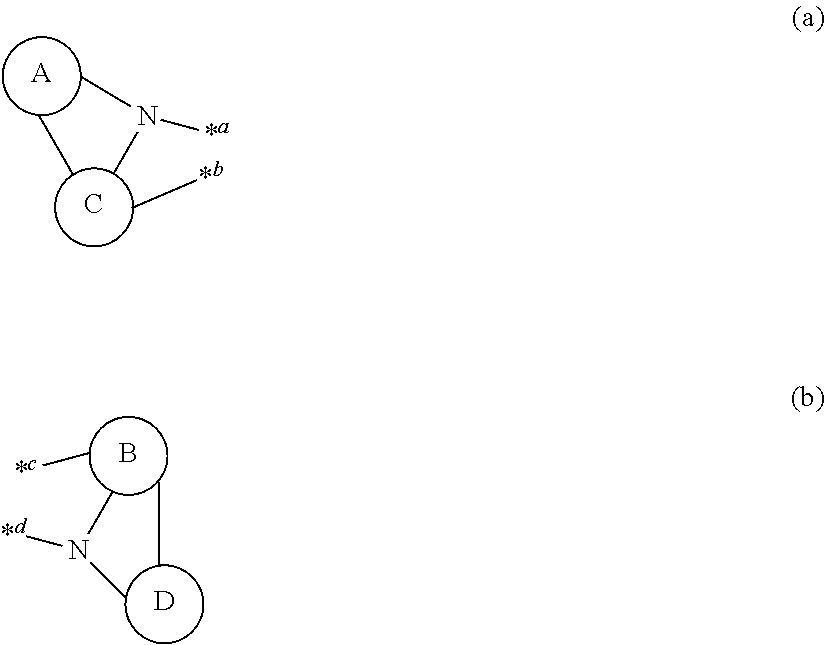


Priority Applications (1)
| Application Number | Priority Date | Filing Date | Title |
|---|---|---|---|
| US17/278,419 US12108666B2 (en) | 2018-09-26 | 2019-09-26 | Compound and organic electroluminescence device |
Applications Claiming Priority (6)
| Application Number | Priority Date | Filing Date | Title |
|---|---|---|---|
| JP2018-180465 | 2018-09-26 | ||
| JP2018180465 | 2018-09-26 | ||
| US16/355,222 US10593889B1 (en) | 2018-09-26 | 2019-03-15 | Compound and organic electroluminescence device |
| US16355222 | 2019-03-15 | ||
| US17/278,419 US12108666B2 (en) | 2018-09-26 | 2019-09-26 | Compound and organic electroluminescence device |
| PCT/JP2019/037865 WO2020067290A1 (en) | 2018-09-26 | 2019-09-26 | Novel compound and organic electroluminescence device |
Related Parent Applications (1)
| Application Number | Title | Priority Date | Filing Date |
|---|---|---|---|
| US16/355,222 Continuation-In-Part US10593889B1 (en) | 2018-09-26 | 2019-03-15 | Compound and organic electroluminescence device |
Publications (2)
| Publication Number | Publication Date |
|---|---|
| US20210395233A1 US20210395233A1 (en) | 2021-12-23 |
| US12108666B2 true US12108666B2 (en) | 2024-10-01 |
Family
ID=69778912
Family Applications (2)
| Application Number | Title | Priority Date | Filing Date |
|---|---|---|---|
| US16/355,222 Active US10593889B1 (en) | 2018-09-26 | 2019-03-15 | Compound and organic electroluminescence device |
| US17/278,419 Active 2040-12-27 US12108666B2 (en) | 2018-09-26 | 2019-09-26 | Compound and organic electroluminescence device |
Family Applications Before (1)
| Application Number | Title | Priority Date | Filing Date |
|---|---|---|---|
| US16/355,222 Active US10593889B1 (en) | 2018-09-26 | 2019-03-15 | Compound and organic electroluminescence device |
Country Status (4)
| Country | Link |
|---|---|
| US (2) | US10593889B1 (en) |
| KR (1) | KR102937539B1 (en) |
| CN (1) | CN112739702B (en) |
| WO (1) | WO2020067290A1 (en) |
Cited By (1)
| Publication number | Priority date | Publication date | Assignee | Title |
|---|---|---|---|---|
| US20220255018A1 (en) * | 2019-06-14 | 2022-08-11 | Idemitsu Kosan Co.,Ltd. | Organic electroluminescence device and electronic apparatus using the same |
Families Citing this family (19)
| Publication number | Priority date | Publication date | Assignee | Title |
|---|---|---|---|---|
| WO2019111971A1 (en) | 2017-12-06 | 2019-06-13 | 出光興産株式会社 | Organic electroluminescent element and novel compound |
| US10593889B1 (en) * | 2018-09-26 | 2020-03-17 | Idemitsu Kosan Co., Ltd. | Compound and organic electroluminescence device |
| CN113227083A (en) | 2018-11-30 | 2021-08-06 | 出光兴产株式会社 | Compound, material for organic electroluminescent element, and electronic device |
| US12048242B2 (en) | 2019-05-31 | 2024-07-23 | Idemitsu Kosan Co., Ltd. | Compound, material for organic electroluminescent elements, organic electroluminescent element, and electronic device |
| KR102564940B1 (en) * | 2019-11-21 | 2023-08-08 | 주식회사 엘지화학 | Heterocyclic compound and organic light emitting device comprising same |
| KR102698413B1 (en) | 2020-05-05 | 2024-08-26 | 뉴베일런트, 아이엔씨. | Heteroaromatic macrocyclic ether chemotherapeutic agent |
| KR20240132391A (en) | 2020-05-05 | 2024-09-03 | 뉴베일런트, 아이엔씨. | Heteroaromatic macrocyclic ether chemotherapeutic agents |
| CN115885599A (en) | 2020-07-22 | 2023-03-31 | 默克专利有限公司 | Materials for Organic Electroluminescent Devices |
| TW202237797A (en) | 2020-11-30 | 2022-10-01 | 德商麥克專利有限公司 | Materials for organic electroluminescent devices |
| KR20220119909A (en) | 2021-02-22 | 2022-08-30 | 삼성전자주식회사 | Heterocyclic compound, organic light emitting device including the same and electronic apparatus including the organic light emitting device |
| EP4068404A1 (en) | 2021-03-31 | 2022-10-05 | Idemitsu Kosan Co., Ltd. | An organic electroluminescence device comprising a light emitting layer comprising three different compounds and an electronic equipment comprising said organic electroluminescence device |
| TW202309243A (en) | 2021-04-09 | 2023-03-01 | 德商麥克專利有限公司 | Materials for organic electroluminescent devices |
| EP4320649A1 (en) | 2021-04-09 | 2024-02-14 | Merck Patent GmbH | Materials for organic electroluminescent devices |
| CN117084000A (en) | 2021-04-09 | 2023-11-17 | 默克专利有限公司 | Material for organic electroluminescent device |
| IL311444A (en) | 2021-10-01 | 2024-05-01 | Nuvalent Inc | Solid forms, pharmaceutical preparations and preparation of macrocyclic heteroaromatic ether compounds |
| EP4199130A1 (en) | 2021-12-15 | 2023-06-21 | Idemitsu Kosan Co.,Ltd. | An organic electroluminescence device comprising a light emitting layer comprising three different compounds and an electronic equipment comprising said organic electroluminescence device |
| KR20230145646A (en) * | 2022-04-08 | 2023-10-18 | 삼성디스플레이 주식회사 | Light emitting device and fused polycyclic compound for the light emitting device |
| WO2024050708A1 (en) * | 2022-09-07 | 2024-03-14 | 北京大学深圳研究生院 | Blue light emitting guest material and use |
| KR102821841B1 (en) | 2023-03-13 | 2025-06-16 | 조금복 | Label that is easy to separate from the container and its manufacturing method |
Citations (110)
| Publication number | Priority date | Publication date | Assignee | Title |
|---|---|---|---|---|
| US5843607A (en) | 1997-10-02 | 1998-12-01 | Xerox Corporation | Indolocarbazole photoconductors |
| US5942340A (en) | 1997-10-02 | 1999-08-24 | Xerox Corporation | Indolocarbazole electroluminescent devices |
| DE19831427A1 (en) | 1998-07-07 | 2000-01-13 | Syntec Ges Fuer Chemie Und Tec | New carbazole compounds useful for hole transport in organic electroluminescent device and electrophotography |
| US6337404B1 (en) | 1998-12-17 | 2002-01-08 | Nessdisplay Co., Ltd. | Diamine hole transport agent and organic electroluminescent device containing same |
| US6562982B1 (en) | 2002-07-25 | 2003-05-13 | Xerox Corporation | Carbazole compounds |
| US6649772B2 (en) | 2000-11-22 | 2003-11-18 | Academia Sinica | 3,6,9-Trisubstituted carbazoles for light emitting diodes |
| US6670054B1 (en) | 2002-07-25 | 2003-12-30 | Xerox Corporation | Electroluminescent devices |
| US7227027B2 (en) | 2003-09-05 | 2007-06-05 | Tsinghua University | Carbazole derivative and its use in electroluminescent devices |
| US20080220285A1 (en) | 2005-05-20 | 2008-09-11 | Merck Patent Gmbh | Novel Materials for Organic Electroluminescent Devices |
| JP2008227088A (en) | 2007-03-12 | 2008-09-25 | Mitsui Chemicals Inc | Organic transistor |
| US20090036689A1 (en) | 2004-12-14 | 2009-02-05 | Xerox Corporation | Substituted indolocarbazoles |
| US20090066235A1 (en) | 2007-08-06 | 2009-03-12 | Idemitsu Kosan Co., Ltd. | Aromatic amine derivative and organic electroluminescence device using the same |
| US20100051928A1 (en) | 2008-09-04 | 2010-03-04 | Fujifilm Corporation | Organic electroluminescence device |
| EP2182040A2 (en) | 2008-10-31 | 2010-05-05 | Gracel Display Inc. | Aromatic compounds and organic electronic device using the same |
| KR20100131745A (en) | 2009-06-08 | 2010-12-16 | 제일모직주식회사 | Composition for organic photoelectric device and organic photoelectric device using same |
| KR20110016044A (en) | 2009-08-10 | 2011-02-17 | 에스에프씨 주식회사 | Aromatic Compounds and Organic Electroluminescent Devices Using the Same |
| KR20110016047A (en) | 2009-08-10 | 2011-02-17 | 에스에프씨 주식회사 | Aromatic Compounds and Organic Electroluminescent Devices Using the Same |
| US20110062429A1 (en) | 2008-05-08 | 2011-03-17 | Takahiro Kai | Compound for organic electroluminescent device and organic electroluminescent device |
| KR20110079402A (en) | 2009-12-31 | 2011-07-07 | (주)씨에스엘쏠라 | Organic optical device and organic photosynthesis for same |
| KR20110111094A (en) | 2010-04-02 | 2011-10-10 | 에스에프씨 주식회사 | Condensed aromatic compound and organic light emitting device comprising the same |
| KR20120034140A (en) | 2010-07-30 | 2012-04-10 | 롬엔드하스전자재료코리아유한회사 | Novel organic electroluminescent compounds and organic electroluminescent device using the same |
| US20120157689A1 (en) | 2004-12-14 | 2012-06-21 | Xerox Corporation | Substituted indolocarbazoles |
| US8227801B2 (en) | 2010-04-26 | 2012-07-24 | Universal Display Corporation | Bicarbzole containing compounds for OLEDs |
| US20120202997A1 (en) | 2009-10-08 | 2012-08-09 | Merck Patent Gmbh | Materials for organic electroluminescent devices |
| US20120232241A1 (en) | 2009-11-18 | 2012-09-13 | Merck Patent Gmbh Patents & Scientific Information | Nitrogen-containing condensed heterocyclic compounds for oleds |
| US20120241732A1 (en) | 2009-12-07 | 2012-09-27 | Ayataka Endo | Organic light-emitting material and organic light-emitting element |
| JP2012191031A (en) | 2011-03-11 | 2012-10-04 | Konica Minolta Holdings Inc | Organic electroluminescent element, display device, and lighting device |
| US20120273764A1 (en) | 2009-11-03 | 2012-11-01 | Cheil Industries, Inc. | Composition for organic photoelectric device, organic photoelectric device using the same, and display device including the same |
| KR20120130074A (en) | 2012-10-15 | 2012-11-28 | 제일모직주식회사 | Composition for organic photoelectric device and organic photoelectric device using the same |
| US20120319052A1 (en) | 2010-03-02 | 2012-12-20 | Merck Patent Gmbh | Compounds for electronic devices |
| US20120326141A1 (en) | 2010-03-06 | 2012-12-27 | Merck Patent Gmbh | Organic electroluminescent device |
| US8343637B2 (en) | 2007-01-18 | 2013-01-01 | Merck Patent Gmbh | Carbazole derivatives for organic electroluminescent devices |
| US20130026422A1 (en) | 2010-04-14 | 2013-01-31 | Merck Patent Gmbh | Bridged triarylamines and -phosphines as materials for electronic devices |
| US8405070B2 (en) | 2005-03-23 | 2013-03-26 | Semiconductor Energy Laboratory Co., Ltd. | Composite material, and light emitting element and light emitting device using the composite material |
| US20130112952A1 (en) | 2010-04-28 | 2013-05-09 | Nippon Steel Chemical Co., Ltd. | Depositing premixed materials |
| WO2013077344A1 (en) | 2011-11-22 | 2013-05-30 | ユー・ディー・シー アイルランド リミテッド | Organic electroluminescent element, material for organic electroluminescent element, light emitting device, display device and lighting device each using said element, and compound used for said element |
| US20130168663A1 (en) | 2010-07-30 | 2013-07-04 | Merck Patent Gmbh | Organic electroluminescent device |
| JP2013147481A (en) | 2012-01-23 | 2013-08-01 | Udc Ireland Ltd | Synthesis method, compound synthesized using the same, and organic electroluminescent element |
| US20130248849A1 (en) | 2010-12-20 | 2013-09-26 | E I Dupont De Nemours And Company | Compositions for electronic applications |
| KR20130106255A (en) | 2012-03-19 | 2013-09-27 | 덕산하이메탈(주) | Compound for organic electronic element, organic electronic element using the same, and a electronic device thereof |
| US20130320839A1 (en) | 2012-05-22 | 2013-12-05 | Udc Ireland Limited | Charge Transporting Material, Organic Electroluminescent Element, Light Emitting Device, Display Device And Illumination Device |
| KR20140034710A (en) | 2012-09-12 | 2014-03-20 | 에스에프씨 주식회사 | Heterocyclic com pounds and organic light-emitting diode including the same |
| CN103664950A (en) | 2012-09-04 | 2014-03-26 | 北京师范大学 | Novel trimerization carbazole based narrow band gap conjugated micromolecule material and preparation method thereof |
| JP2014073965A (en) | 2012-10-02 | 2014-04-24 | Canon Inc | Novel benzoindolocarbazole compound, organic light-emitting element containing the same, display device, image information processor, lighting device, image forming device |
| WO2014081131A1 (en) | 2012-11-20 | 2014-05-30 | 주식회사 두산 | Organic compound, and organic electro-luminescence device comprising same |
| US20140299856A1 (en) | 2011-09-30 | 2014-10-09 | Udc Ireland Limited | Organic electroluminescence element |
| CN104119347A (en) | 2014-07-14 | 2014-10-29 | 烟台万润精细化工股份有限公司 | An organic electroluminescence diode material and applications thereof |
| US20140374711A1 (en) | 2013-06-14 | 2014-12-25 | Samsung Display Co., Ltd. | Organic light-emitting device |
| WO2015099507A1 (en) | 2013-12-27 | 2015-07-02 | Rohm And Haas Electronic Materials Korea Ltd. | Novel organic electroluminescent compound, and multi-component host material and organic electroluminescent device comprising the same |
| JP2015153911A (en) | 2014-02-14 | 2015-08-24 | 富士フイルム株式会社 | Photoelectric conversion element, photosensor and imaging element |
| KR20150111271A (en) | 2014-03-24 | 2015-10-05 | 주식회사 엠비케이 | New organic electroluminescent compounds and organic electroluminescent device comprising the same |
| EP2927234A1 (en) | 2014-04-02 | 2015-10-07 | Universal Display Corporation | Organic electroluminescent materials and devices |
| US20150295184A1 (en) | 2011-10-06 | 2015-10-15 | Merck Patent Gmbh | Organic electroluminescent device |
| JP2015530357A (en) | 2012-07-10 | 2015-10-15 | メルク パテント ゲーエムベーハー | Materials for organic electroluminescent devices |
| US20150325798A1 (en) | 2014-05-12 | 2015-11-12 | Samsung Display Co., Ltd. | Organic light-emitting devices |
| KR20150135125A (en) | 2014-05-23 | 2015-12-02 | 롬엔드하스전자재료코리아유한회사 | An Organic Electroluminescent Compound and an Organic Electroluminescent Device Comprising the Same |
| US20150357579A1 (en) | 2014-06-06 | 2015-12-10 | Samsung Display Co., Ltd. | Carbazole derivative and organic electroluminescent device |
| US9233922B2 (en) | 2011-09-02 | 2016-01-12 | Takasago International Corporation | Process for producing N-(hetero)arylazoles |
| WO2016006925A1 (en) | 2014-07-09 | 2016-01-14 | Rohm And Haas Electronic Materials Korea Ltd. | An organic electroluminescent compound and an organic electroluminescent device comprising the same |
| CN105492413A (en) | 2013-09-06 | 2016-04-13 | 出光兴产株式会社 | Anthracene derivative and organic electroluminescent device using the anthracene derivative |
| US20160126471A1 (en) | 2014-10-31 | 2016-05-05 | Samsung Sdi Co., Ltd. | Organic optoelectric device and display device |
| US20160233435A1 (en) | 2015-02-09 | 2016-08-11 | Universal Display Corporation | Organic electroluminescent materials and devices |
| US20160268516A1 (en) | 2013-08-16 | 2016-09-15 | Konica Minolta, Inc. | Organic electroluminescent element, electronic device, light emitting device, and light emitting material |
| US9530969B2 (en) | 2011-12-05 | 2016-12-27 | Idemitsu Kosan Co., Ltd. | Material for organic electroluminescence device and organic electroluminescence device |
| US20170117485A1 (en) | 2014-03-17 | 2017-04-27 | Rohm And Haas Electronic Materials Korea Ltd. | Electron buffering material and organic electroluminescent device comprising the same |
| US20170117486A1 (en) | 2015-10-27 | 2017-04-27 | Samsung Display Co., Ltd. | Organic light-emitting device |
| WO2017074052A1 (en) | 2015-10-27 | 2017-05-04 | 주식회사 엘지화학 | Organic light-emitting device |
| US20170125697A1 (en) | 2015-10-30 | 2017-05-04 | Samsung Display Co., Ltd. | Organic light-emitting device |
| DE102016122122A1 (en) | 2015-11-18 | 2017-05-18 | Cynora Gmbh | Organic molecules, in particular for use in organic optoelectronic devices |
| US20170179406A1 (en) | 2014-07-09 | 2017-06-22 | Rohm And Haas Electronic Materials Korea Ltd. | An organic electroluminescent compound and an organic electroluminescent device comprising the same |
| US20170186964A1 (en) | 2015-12-29 | 2017-06-29 | Samsung Display Co., Ltd. | Organic light-emitting device |
| US20170183360A1 (en) | 2015-12-28 | 2017-06-29 | Samsung Electronics Co., Ltd. | Bicarbazole compound, material for organic light-emitting device including bicarbazole compound, and organic light-emitting device including bicarbazole compound |
| US20170186978A1 (en) | 2015-12-23 | 2017-06-29 | Samsung Display Co., Ltd. | Organic light-emitting device |
| US20170194569A1 (en) | 2015-12-23 | 2017-07-06 | Samsung Display Co., Ltd | Organic light-emitting device |
| US20170213984A1 (en) | 2015-06-03 | 2017-07-27 | Lg Chem, Ltd. | Nitrogen-containing condensed cyclic compound and organic light emitting device using same |
| WO2017138755A1 (en) | 2016-02-11 | 2017-08-17 | 주식회사 엘지화학 | Heterocyclic compound and organic electroluminescent device containing same |
| JP2017141167A (en) | 2016-02-08 | 2017-08-17 | 出光興産株式会社 | Compound, material for organic electroluminescent element using the same, organic electroluminescent element using the same, luminaire and display device |
| WO2017142310A1 (en) | 2016-02-15 | 2017-08-24 | 주식회사 엘지화학 | Heterocyclic compound and organic electroluminescent device comprising same |
| KR20170103358A (en) | 2016-03-04 | 2017-09-13 | 성균관대학교산학협력단 | Delayed fluorescence material and organic light emitting device having the delayed fluorescence material |
| KR20170108895A (en) | 2016-03-18 | 2017-09-27 | 주식회사 엘지화학 | Heterocyclic compound and organic light emitting device comprising the same |
| US20170294613A1 (en) | 2016-04-07 | 2017-10-12 | Samsung Display Co., Ltd. | Organic light-emitting device |
| WO2017175690A1 (en) | 2016-04-08 | 2017-10-12 | 出光興産株式会社 | Novel compound, organic electroluminescent element, and electronic appliance |
| KR20170113398A (en) | 2016-03-30 | 2017-10-12 | 주식회사 엘지화학 | Compound and organic light emitting device using the same |
| KR20170116983A (en) | 2016-04-12 | 2017-10-20 | 주식회사 엘지화학 | Heterocyclic compound and organic light emitting device comprising the same |
| US20170324045A1 (en) | 2016-04-08 | 2017-11-09 | Idemitsu Kosan Co., Ltd. | Compound, organic electroluminescence device and electronic device |
| US9825239B2 (en) | 2012-10-18 | 2017-11-21 | Toray Industries, Inc. | Benzindolocarbazole derivative, light-emitting element material produced using same, and light-emitting element |
| CN107652295A (en) | 2016-07-26 | 2018-02-02 | 株式会社Lg化学 | Indolocarbazole-based compound and organic light-emitting device containing same |
| WO2018026197A1 (en) | 2016-08-03 | 2018-02-08 | 덕산네오룩스 주식회사 | Compound for organic electric element, organic electric element using same, and electronic apparatus comprising same |
| WO2018038544A1 (en) | 2016-08-24 | 2018-03-01 | 덕산네오룩스 주식회사 | Compound for organic electric device, organic electric device using same, and electronic apparatus thereof |
| US20180083201A1 (en) | 2015-03-30 | 2018-03-22 | Nippon Steel & Sumikin Chemical Co., Ltd. | Organic electroluminescent element |
| US20180114924A1 (en) | 2016-10-21 | 2018-04-26 | Research & Business Foundation Sungkyunkwan University | Delayed fluorescence material and organic light emitting device having the delayed fluorescence material |
| US20180182974A1 (en) | 2016-12-28 | 2018-06-28 | Idemitsu Kosan Co., Ltd. | Compound, material for organic electroluminescence devices, organic electroluminescence device, and electronic device |
| US20180179206A1 (en) | 2016-12-28 | 2018-06-28 | Idemitsu Kosan Co., Ltd., | Organic electroluminescence device and electronic device |
| KR20180078177A (en) | 2016-12-29 | 2018-07-09 | 머티어리얼사이언스 주식회사 | Organic compound and organic electroluminescent device comprising the same |
| JP2018108939A (en) | 2016-12-28 | 2018-07-12 | 出光興産株式会社 | Compound, material for organic electroluminescent element, organic electroluminescent element, and electronic apparatus |
| WO2018138306A1 (en) | 2017-01-30 | 2018-08-02 | Merck Patent Gmbh | Materials for organic electroluminescent devices |
| WO2018139662A1 (en) | 2017-01-30 | 2018-08-02 | 出光興産株式会社 | Organic electroluminescent element and electronic device |
| WO2018151065A1 (en) | 2017-02-14 | 2018-08-23 | 出光興産株式会社 | Organic electroluminescence element and electronic device |
| US20180240981A1 (en) | 2014-02-14 | 2018-08-23 | Samsung Display Co., Ltd. | Organic light-emitting devices |
| US20180269402A1 (en) | 2014-11-20 | 2018-09-20 | Lg Chem ,Ltd. | Organic light emitting diode |
| US20180287070A1 (en) | 2017-03-30 | 2018-10-04 | Universal Display Corporation | Organic electroluminescent materials and devices |
| US20180337345A1 (en) | 2017-05-19 | 2018-11-22 | Arizona Board Of Regents On Behalf Of Arizona State University | Donor-acceptor type thermally activated delayed fluorescent materials based on imidazo[1,2-f]phenanthridine and analogues |
| WO2018221930A1 (en) | 2017-05-29 | 2018-12-06 | 주식회사 엘지화학 | Organic light emitting element |
| WO2019022512A1 (en) | 2017-07-26 | 2019-01-31 | Rohm And Haas Electronic Materials Korea Ltd. | A plurality of host materials and organic electroluminescent device comprising the same |
| US20190074446A1 (en) | 2017-09-04 | 2019-03-07 | Chuanjun Xia | Hole injection layer and charge generation layer containing a truxene based compound |
| US10249832B1 (en) * | 2017-12-06 | 2019-04-02 | Idemitsu Kosan Co., Ltd. | Organic electroluminescence device and novel compound |
| US20190148650A1 (en) | 2016-05-27 | 2019-05-16 | Lg Chem, Ltd. | Organic Light Emitting Device |
| WO2019098766A1 (en) | 2017-11-16 | 2019-05-23 | 주식회사 엘지화학 | Organic light-emitting device |
| WO2019111971A1 (en) | 2017-12-06 | 2019-06-13 | 出光興産株式会社 | Organic electroluminescent element and novel compound |
| US10593889B1 (en) * | 2018-09-26 | 2020-03-17 | Idemitsu Kosan Co., Ltd. | Compound and organic electroluminescence device |
-
2019
- 2019-03-15 US US16/355,222 patent/US10593889B1/en active Active
- 2019-09-26 CN CN201980063600.3A patent/CN112739702B/en active Active
- 2019-09-26 WO PCT/JP2019/037865 patent/WO2020067290A1/en not_active Ceased
- 2019-09-26 US US17/278,419 patent/US12108666B2/en active Active
- 2019-09-26 KR KR1020217008303A patent/KR102937539B1/en active Active
Patent Citations (125)
| Publication number | Priority date | Publication date | Assignee | Title |
|---|---|---|---|---|
| US5942340A (en) | 1997-10-02 | 1999-08-24 | Xerox Corporation | Indolocarbazole electroluminescent devices |
| US5843607A (en) | 1997-10-02 | 1998-12-01 | Xerox Corporation | Indolocarbazole photoconductors |
| DE19831427A1 (en) | 1998-07-07 | 2000-01-13 | Syntec Ges Fuer Chemie Und Tec | New carbazole compounds useful for hole transport in organic electroluminescent device and electrophotography |
| US6337404B1 (en) | 1998-12-17 | 2002-01-08 | Nessdisplay Co., Ltd. | Diamine hole transport agent and organic electroluminescent device containing same |
| US6649772B2 (en) | 2000-11-22 | 2003-11-18 | Academia Sinica | 3,6,9-Trisubstituted carbazoles for light emitting diodes |
| US6670054B1 (en) | 2002-07-25 | 2003-12-30 | Xerox Corporation | Electroluminescent devices |
| US6562982B1 (en) | 2002-07-25 | 2003-05-13 | Xerox Corporation | Carbazole compounds |
| US7227027B2 (en) | 2003-09-05 | 2007-06-05 | Tsinghua University | Carbazole derivative and its use in electroluminescent devices |
| US20120157689A1 (en) | 2004-12-14 | 2012-06-21 | Xerox Corporation | Substituted indolocarbazoles |
| US20090036689A1 (en) | 2004-12-14 | 2009-02-05 | Xerox Corporation | Substituted indolocarbazoles |
| US8405070B2 (en) | 2005-03-23 | 2013-03-26 | Semiconductor Energy Laboratory Co., Ltd. | Composite material, and light emitting element and light emitting device using the composite material |
| US20080220285A1 (en) | 2005-05-20 | 2008-09-11 | Merck Patent Gmbh | Novel Materials for Organic Electroluminescent Devices |
| US8343637B2 (en) | 2007-01-18 | 2013-01-01 | Merck Patent Gmbh | Carbazole derivatives for organic electroluminescent devices |
| JP2008227088A (en) | 2007-03-12 | 2008-09-25 | Mitsui Chemicals Inc | Organic transistor |
| US20090066235A1 (en) | 2007-08-06 | 2009-03-12 | Idemitsu Kosan Co., Ltd. | Aromatic amine derivative and organic electroluminescence device using the same |
| US20110062429A1 (en) | 2008-05-08 | 2011-03-17 | Takahiro Kai | Compound for organic electroluminescent device and organic electroluminescent device |
| US20100051928A1 (en) | 2008-09-04 | 2010-03-04 | Fujifilm Corporation | Organic electroluminescence device |
| EP2182040A2 (en) | 2008-10-31 | 2010-05-05 | Gracel Display Inc. | Aromatic compounds and organic electronic device using the same |
| KR20100131745A (en) | 2009-06-08 | 2010-12-16 | 제일모직주식회사 | Composition for organic photoelectric device and organic photoelectric device using same |
| KR20110016044A (en) | 2009-08-10 | 2011-02-17 | 에스에프씨 주식회사 | Aromatic Compounds and Organic Electroluminescent Devices Using the Same |
| KR20110016047A (en) | 2009-08-10 | 2011-02-17 | 에스에프씨 주식회사 | Aromatic Compounds and Organic Electroluminescent Devices Using the Same |
| US20120202997A1 (en) | 2009-10-08 | 2012-08-09 | Merck Patent Gmbh | Materials for organic electroluminescent devices |
| US20120273764A1 (en) | 2009-11-03 | 2012-11-01 | Cheil Industries, Inc. | Composition for organic photoelectric device, organic photoelectric device using the same, and display device including the same |
| US20120232241A1 (en) | 2009-11-18 | 2012-09-13 | Merck Patent Gmbh Patents & Scientific Information | Nitrogen-containing condensed heterocyclic compounds for oleds |
| US20120241732A1 (en) | 2009-12-07 | 2012-09-27 | Ayataka Endo | Organic light-emitting material and organic light-emitting element |
| KR20120013278A (en) | 2009-12-31 | 2012-02-14 | (주)씨에스엘쏠라 | Organic optical device and organic photosynthesis for same |
| KR20110079402A (en) | 2009-12-31 | 2011-07-07 | (주)씨에스엘쏠라 | Organic optical device and organic photosynthesis for same |
| US20120319052A1 (en) | 2010-03-02 | 2012-12-20 | Merck Patent Gmbh | Compounds for electronic devices |
| US20120326141A1 (en) | 2010-03-06 | 2012-12-27 | Merck Patent Gmbh | Organic electroluminescent device |
| KR20110111094A (en) | 2010-04-02 | 2011-10-10 | 에스에프씨 주식회사 | Condensed aromatic compound and organic light emitting device comprising the same |
| US20130026422A1 (en) | 2010-04-14 | 2013-01-31 | Merck Patent Gmbh | Bridged triarylamines and -phosphines as materials for electronic devices |
| JP2013523847A (en) | 2010-04-14 | 2013-06-17 | メルク パテント ゲーエムベーハー | Bridged triarylamines and phosphines as materials for electronic devices |
| US8227801B2 (en) | 2010-04-26 | 2012-07-24 | Universal Display Corporation | Bicarbzole containing compounds for OLEDs |
| US20130112952A1 (en) | 2010-04-28 | 2013-05-09 | Nippon Steel Chemical Co., Ltd. | Depositing premixed materials |
| KR20120034140A (en) | 2010-07-30 | 2012-04-10 | 롬엔드하스전자재료코리아유한회사 | Novel organic electroluminescent compounds and organic electroluminescent device using the same |
| US20130168663A1 (en) | 2010-07-30 | 2013-07-04 | Merck Patent Gmbh | Organic electroluminescent device |
| US20130248849A1 (en) | 2010-12-20 | 2013-09-26 | E I Dupont De Nemours And Company | Compositions for electronic applications |
| JP2012191031A (en) | 2011-03-11 | 2012-10-04 | Konica Minolta Holdings Inc | Organic electroluminescent element, display device, and lighting device |
| US9233922B2 (en) | 2011-09-02 | 2016-01-12 | Takasago International Corporation | Process for producing N-(hetero)arylazoles |
| US20140299856A1 (en) | 2011-09-30 | 2014-10-09 | Udc Ireland Limited | Organic electroluminescence element |
| US20150295184A1 (en) | 2011-10-06 | 2015-10-15 | Merck Patent Gmbh | Organic electroluminescent device |
| US20140319507A1 (en) * | 2011-11-22 | 2014-10-30 | Udc Ireland Limited | Organic Electroluminescent Element, Material for Organic Electroluminescent Element, Light Emitting Device, Display Device and Lighting Device Each Using Said Element, and Compound Used for Said Element |
| WO2013077344A1 (en) | 2011-11-22 | 2013-05-30 | ユー・ディー・シー アイルランド リミテッド | Organic electroluminescent element, material for organic electroluminescent element, light emitting device, display device and lighting device each using said element, and compound used for said element |
| US9530969B2 (en) | 2011-12-05 | 2016-12-27 | Idemitsu Kosan Co., Ltd. | Material for organic electroluminescence device and organic electroluminescence device |
| JP2013147481A (en) | 2012-01-23 | 2013-08-01 | Udc Ireland Ltd | Synthesis method, compound synthesized using the same, and organic electroluminescent element |
| KR20130106255A (en) | 2012-03-19 | 2013-09-27 | 덕산하이메탈(주) | Compound for organic electronic element, organic electronic element using the same, and a electronic device thereof |
| US20190334098A1 (en) | 2012-05-22 | 2019-10-31 | Udc Ireland Limited | Charge Transporting Material, Organic Electroluminescent Element, Light Emitting Device, Display Device And Illumination Device |
| US20130320839A1 (en) | 2012-05-22 | 2013-12-05 | Udc Ireland Limited | Charge Transporting Material, Organic Electroluminescent Element, Light Emitting Device, Display Device And Illumination Device |
| JP2015530357A (en) | 2012-07-10 | 2015-10-15 | メルク パテント ゲーエムベーハー | Materials for organic electroluminescent devices |
| US20150295186A1 (en) | 2012-07-10 | 2015-10-15 | Merck Patent Gmbh | Materials for organic electroluminescent devices |
| CN103664950A (en) | 2012-09-04 | 2014-03-26 | 北京师范大学 | Novel trimerization carbazole based narrow band gap conjugated micromolecule material and preparation method thereof |
| KR20140034710A (en) | 2012-09-12 | 2014-03-20 | 에스에프씨 주식회사 | Heterocyclic com pounds and organic light-emitting diode including the same |
| JP2014073965A (en) | 2012-10-02 | 2014-04-24 | Canon Inc | Novel benzoindolocarbazole compound, organic light-emitting element containing the same, display device, image information processor, lighting device, image forming device |
| KR20120130074A (en) | 2012-10-15 | 2012-11-28 | 제일모직주식회사 | Composition for organic photoelectric device and organic photoelectric device using the same |
| US9825239B2 (en) | 2012-10-18 | 2017-11-21 | Toray Industries, Inc. | Benzindolocarbazole derivative, light-emitting element material produced using same, and light-emitting element |
| WO2014081131A1 (en) | 2012-11-20 | 2014-05-30 | 주식회사 두산 | Organic compound, and organic electro-luminescence device comprising same |
| US20140374711A1 (en) | 2013-06-14 | 2014-12-25 | Samsung Display Co., Ltd. | Organic light-emitting device |
| US20160268516A1 (en) | 2013-08-16 | 2016-09-15 | Konica Minolta, Inc. | Organic electroluminescent element, electronic device, light emitting device, and light emitting material |
| CN105492413A (en) | 2013-09-06 | 2016-04-13 | 出光兴产株式会社 | Anthracene derivative and organic electroluminescent device using the anthracene derivative |
| US20160181542A1 (en) | 2013-09-06 | 2016-06-23 | Idemitsu Kosan Co., Ltd. | Anthracene derivative and organic electroluminescent element using same |
| WO2015099507A1 (en) | 2013-12-27 | 2015-07-02 | Rohm And Haas Electronic Materials Korea Ltd. | Novel organic electroluminescent compound, and multi-component host material and organic electroluminescent device comprising the same |
| JP2015153911A (en) | 2014-02-14 | 2015-08-24 | 富士フイルム株式会社 | Photoelectric conversion element, photosensor and imaging element |
| US20180240981A1 (en) | 2014-02-14 | 2018-08-23 | Samsung Display Co., Ltd. | Organic light-emitting devices |
| US20170117485A1 (en) | 2014-03-17 | 2017-04-27 | Rohm And Haas Electronic Materials Korea Ltd. | Electron buffering material and organic electroluminescent device comprising the same |
| KR20150111271A (en) | 2014-03-24 | 2015-10-05 | 주식회사 엠비케이 | New organic electroluminescent compounds and organic electroluminescent device comprising the same |
| EP2927234A1 (en) | 2014-04-02 | 2015-10-07 | Universal Display Corporation | Organic electroluminescent materials and devices |
| US20150325798A1 (en) | 2014-05-12 | 2015-11-12 | Samsung Display Co., Ltd. | Organic light-emitting devices |
| KR20150135125A (en) | 2014-05-23 | 2015-12-02 | 롬엔드하스전자재료코리아유한회사 | An Organic Electroluminescent Compound and an Organic Electroluminescent Device Comprising the Same |
| US20150357579A1 (en) | 2014-06-06 | 2015-12-10 | Samsung Display Co., Ltd. | Carbazole derivative and organic electroluminescent device |
| JP2017521525A (en) | 2014-07-09 | 2017-08-03 | ローム・アンド・ハース・エレクトロニック・マテリアルズ・コリア・リミテッド | Organic electroluminescent compound and organic electroluminescent device comprising the same |
| US20170179406A1 (en) | 2014-07-09 | 2017-06-22 | Rohm And Haas Electronic Materials Korea Ltd. | An organic electroluminescent compound and an organic electroluminescent device comprising the same |
| WO2016006925A1 (en) | 2014-07-09 | 2016-01-14 | Rohm And Haas Electronic Materials Korea Ltd. | An organic electroluminescent compound and an organic electroluminescent device comprising the same |
| CN104119347A (en) | 2014-07-14 | 2014-10-29 | 烟台万润精细化工股份有限公司 | An organic electroluminescence diode material and applications thereof |
| US20160126471A1 (en) | 2014-10-31 | 2016-05-05 | Samsung Sdi Co., Ltd. | Organic optoelectric device and display device |
| US20180269402A1 (en) | 2014-11-20 | 2018-09-20 | Lg Chem ,Ltd. | Organic light emitting diode |
| US10177316B2 (en) | 2015-02-09 | 2019-01-08 | Universal Display Corporation | Organic electroluminescent materials and devices |
| KR20160098064A (en) | 2015-02-09 | 2016-08-18 | 유니버셜 디스플레이 코포레이션 | Organic electroluminescent materials and devices |
| US20160233435A1 (en) | 2015-02-09 | 2016-08-11 | Universal Display Corporation | Organic electroluminescent materials and devices |
| US20180083201A1 (en) | 2015-03-30 | 2018-03-22 | Nippon Steel & Sumikin Chemical Co., Ltd. | Organic electroluminescent element |
| US20170213984A1 (en) | 2015-06-03 | 2017-07-27 | Lg Chem, Ltd. | Nitrogen-containing condensed cyclic compound and organic light emitting device using same |
| US20180315930A1 (en) | 2015-10-27 | 2018-11-01 | Lg Chem, Ltd. | Organic light-emitting device |
| WO2017074052A1 (en) | 2015-10-27 | 2017-05-04 | 주식회사 엘지화학 | Organic light-emitting device |
| US20170117486A1 (en) | 2015-10-27 | 2017-04-27 | Samsung Display Co., Ltd. | Organic light-emitting device |
| US20190055222A1 (en) | 2015-10-27 | 2019-02-21 | Lg Chem, Ltd. | Compound and organic light-emitting device comprising same |
| US20170125697A1 (en) | 2015-10-30 | 2017-05-04 | Samsung Display Co., Ltd. | Organic light-emitting device |
| DE102016122122A1 (en) | 2015-11-18 | 2017-05-18 | Cynora Gmbh | Organic molecules, in particular for use in organic optoelectronic devices |
| US20170194569A1 (en) | 2015-12-23 | 2017-07-06 | Samsung Display Co., Ltd | Organic light-emitting device |
| US20170186978A1 (en) | 2015-12-23 | 2017-06-29 | Samsung Display Co., Ltd. | Organic light-emitting device |
| US20170183360A1 (en) | 2015-12-28 | 2017-06-29 | Samsung Electronics Co., Ltd. | Bicarbazole compound, material for organic light-emitting device including bicarbazole compound, and organic light-emitting device including bicarbazole compound |
| US20170186964A1 (en) | 2015-12-29 | 2017-06-29 | Samsung Display Co., Ltd. | Organic light-emitting device |
| JP2017141167A (en) | 2016-02-08 | 2017-08-17 | 出光興産株式会社 | Compound, material for organic electroluminescent element using the same, organic electroluminescent element using the same, luminaire and display device |
| WO2017138755A1 (en) | 2016-02-11 | 2017-08-17 | 주식회사 엘지화학 | Heterocyclic compound and organic electroluminescent device containing same |
| WO2017142310A1 (en) | 2016-02-15 | 2017-08-24 | 주식회사 엘지화학 | Heterocyclic compound and organic electroluminescent device comprising same |
| KR20170103358A (en) | 2016-03-04 | 2017-09-13 | 성균관대학교산학협력단 | Delayed fluorescence material and organic light emitting device having the delayed fluorescence material |
| KR20170108895A (en) | 2016-03-18 | 2017-09-27 | 주식회사 엘지화학 | Heterocyclic compound and organic light emitting device comprising the same |
| KR20170113398A (en) | 2016-03-30 | 2017-10-12 | 주식회사 엘지화학 | Compound and organic light emitting device using the same |
| US20170294613A1 (en) | 2016-04-07 | 2017-10-12 | Samsung Display Co., Ltd. | Organic light-emitting device |
| US20170324045A1 (en) | 2016-04-08 | 2017-11-09 | Idemitsu Kosan Co., Ltd. | Compound, organic electroluminescence device and electronic device |
| US20180198076A1 (en) | 2016-04-08 | 2018-07-12 | Idemitsu Kosan Co., Ltd. | Compound, organic electroluminescence device and electronic device |
| CN108026106A (en) | 2016-04-08 | 2018-05-11 | 出光兴产株式会社 | Novel compounds, organic electroluminescent elements and electronic devices |
| WO2017175690A1 (en) | 2016-04-08 | 2017-10-12 | 出光興産株式会社 | Novel compound, organic electroluminescent element, and electronic appliance |
| US20190097142A1 (en) | 2016-04-08 | 2019-03-28 | Idemitsu Kosan Co., Ltd. | Compound, organic electroluminescence device and electronic device |
| EP3269720A1 (en) | 2016-04-08 | 2018-01-17 | Idemitsu Kosan Co., Ltd | Novel compound, organic electroluminescent element, and electronic appliance |
| KR20170116983A (en) | 2016-04-12 | 2017-10-20 | 주식회사 엘지화학 | Heterocyclic compound and organic light emitting device comprising the same |
| US20190148650A1 (en) | 2016-05-27 | 2019-05-16 | Lg Chem, Ltd. | Organic Light Emitting Device |
| CN107652295A (en) | 2016-07-26 | 2018-02-02 | 株式会社Lg化学 | Indolocarbazole-based compound and organic light-emitting device containing same |
| WO2018026197A1 (en) | 2016-08-03 | 2018-02-08 | 덕산네오룩스 주식회사 | Compound for organic electric element, organic electric element using same, and electronic apparatus comprising same |
| WO2018038544A1 (en) | 2016-08-24 | 2018-03-01 | 덕산네오룩스 주식회사 | Compound for organic electric device, organic electric device using same, and electronic apparatus thereof |
| US20180114924A1 (en) | 2016-10-21 | 2018-04-26 | Research & Business Foundation Sungkyunkwan University | Delayed fluorescence material and organic light emitting device having the delayed fluorescence material |
| JP2018108939A (en) | 2016-12-28 | 2018-07-12 | 出光興産株式会社 | Compound, material for organic electroluminescent element, organic electroluminescent element, and electronic apparatus |
| US20180182974A1 (en) | 2016-12-28 | 2018-06-28 | Idemitsu Kosan Co., Ltd. | Compound, material for organic electroluminescence devices, organic electroluminescence device, and electronic device |
| US20180179206A1 (en) | 2016-12-28 | 2018-06-28 | Idemitsu Kosan Co., Ltd., | Organic electroluminescence device and electronic device |
| KR20180078177A (en) | 2016-12-29 | 2018-07-09 | 머티어리얼사이언스 주식회사 | Organic compound and organic electroluminescent device comprising the same |
| WO2018139662A1 (en) | 2017-01-30 | 2018-08-02 | 出光興産株式会社 | Organic electroluminescent element and electronic device |
| WO2018138306A1 (en) | 2017-01-30 | 2018-08-02 | Merck Patent Gmbh | Materials for organic electroluminescent devices |
| WO2018151065A1 (en) | 2017-02-14 | 2018-08-23 | 出光興産株式会社 | Organic electroluminescence element and electronic device |
| US20180287070A1 (en) | 2017-03-30 | 2018-10-04 | Universal Display Corporation | Organic electroluminescent materials and devices |
| US20180337345A1 (en) | 2017-05-19 | 2018-11-22 | Arizona Board Of Regents On Behalf Of Arizona State University | Donor-acceptor type thermally activated delayed fluorescent materials based on imidazo[1,2-f]phenanthridine and analogues |
| WO2018221930A1 (en) | 2017-05-29 | 2018-12-06 | 주식회사 엘지화학 | Organic light emitting element |
| WO2019022512A1 (en) | 2017-07-26 | 2019-01-31 | Rohm And Haas Electronic Materials Korea Ltd. | A plurality of host materials and organic electroluminescent device comprising the same |
| US20190074446A1 (en) | 2017-09-04 | 2019-03-07 | Chuanjun Xia | Hole injection layer and charge generation layer containing a truxene based compound |
| WO2019098766A1 (en) | 2017-11-16 | 2019-05-23 | 주식회사 엘지화학 | Organic light-emitting device |
| US10249832B1 (en) * | 2017-12-06 | 2019-04-02 | Idemitsu Kosan Co., Ltd. | Organic electroluminescence device and novel compound |
| WO2019111971A1 (en) | 2017-12-06 | 2019-06-13 | 出光興産株式会社 | Organic electroluminescent element and novel compound |
| US10593889B1 (en) * | 2018-09-26 | 2020-03-17 | Idemitsu Kosan Co., Ltd. | Compound and organic electroluminescence device |
Non-Patent Citations (17)
| Title |
|---|
| Brigitte Wex et al., "Perspective on carbazole-based organic compounds as emitters and hosts in TADF applications", J. Mater. Chem. C, 2017, 5, 8622-8653. |
| Database Registry [online] Chemical Abstract Service, US; Nov. 16, 1984 (Nov. 16, 1984), Retrieved from STN, Database accession No. RN: 14458-65-2, 1, 7b, 8, 14b- Tetraazabenz[a]indeno[1,2,4-hi] aceanthrylene [2019.11.21]. |
| European Extended Search Report, dated Jul. 29, 2021, issued in corresponding European Patent Application No. 18886934.1, (7 pages). |
| International Preliminary Report on Patentability and Written Opinion dated Mar. 23, 2021 for corresponding International Patent Application No. PCT/JP2019/037865. |
| International Search Report dated Aug. 6, 2019 for corresponding International Patent Application No. PCT/JP2019/023611. |
| International Search Report dated Dec. 10, 2019 for corresponding Application No. PCT/JP2019/037865. |
| International Search Report dated Dec. 10, 2019 for corresponding International Patent Application No. PCT/JP2019/037865. |
| International Search Report dated Feb. 19, 2019 in corresponding application No. PCT/JP2018/044792. |
| J.V. Grazulevicius et al. "Carbazole-containing polymers: synthesis, properties and applications", 2003, -Prog. Polym. Sci. 28 1297-1353. |
| Moehrle, H., et al., Ring opening reactions of carbinolamine equivalents of the tetrahydro-B-carboline series. I, Archivder Pharmazie (Weinheim, Germany), 1986, 319(11), 1043-9. |
| Niebel, Claude et al., "Dibenzo[2, 3:5, 6]pyrrolizino [1, 7-bc] indolo [1, 2, 3-1m] carbazole : a new electron donor", New Journal of Chemistry, 2010, vol. 34, pp. 1243-1246, compound 6. |
| Non-Final Office Action on U.S. Appl. No. 16/290,702 DTD May 8, 2019. |
| Notice of Allowance on U.S. Appl. No. 16/043,074 DTD Oct. 3, 2018. |
| Office Action issued in connection with Chinese Appl. No. 201980063600.3 dated Oct. 20, 2023. |
| Szantay, C. et al., Synthesis of substituted octahydroindolo [2, 3-a]-quinolizines. The formation of a new type of ring system, Journal of Organic Chemistry, 1967, 32(2), 423-7. |
| Tsuge, O., et al., Polyazapentalenes. I. Preparation of 6-dehydroindazolo[1,2-a]benzotriazole, Journal of Heterocyclic Chemistry, 1971, 8(5), 707-10. |
| Wang et al., Journal of the Chinese Chemical Society, 1993, 40, 497-502. * |
Cited By (2)
| Publication number | Priority date | Publication date | Assignee | Title |
|---|---|---|---|---|
| US20220255018A1 (en) * | 2019-06-14 | 2022-08-11 | Idemitsu Kosan Co.,Ltd. | Organic electroluminescence device and electronic apparatus using the same |
| US12550610B2 (en) * | 2019-06-14 | 2026-02-10 | Idemitsu Kosan Co., Ltd. | Organic electroluminescence device and electronic apparatus using the same |
Also Published As
| Publication number | Publication date |
|---|---|
| CN112739702A (en) | 2021-04-30 |
| CN112739702B (en) | 2024-12-06 |
| US20200098994A1 (en) | 2020-03-26 |
| US10593889B1 (en) | 2020-03-17 |
| KR20210065947A (en) | 2021-06-04 |
| WO2020067290A1 (en) | 2020-04-02 |
| KR102937539B1 (en) | 2026-03-10 |
| US20210395233A1 (en) | 2021-12-23 |
Similar Documents
| Publication | Publication Date | Title |
|---|---|---|
| US10593889B1 (en) | Compound and organic electroluminescence device | |
| US10777752B2 (en) | Organic electroluminescence device and electronic apparatus provided with the same | |
| US10804474B2 (en) | Organic electroluminescence device and electronic apparatus provided with the same | |
| US12410182B2 (en) | Compound, organic electroluminescence device and electronic apparatus | |
| US12516240B2 (en) | Compound, organic electroluminescence device using the same, and electronic apparatus | |
| US20210384430A1 (en) | Organic electroluminescence device and electronic apparatus provided with the same | |
| US12156467B2 (en) | Organic electroluminescence device and electronic appliance using the same | |
| US20210296591A1 (en) | Organic electroluminescence device and electronic appliance using the same | |
| US12063854B2 (en) | Organic electroluminescence device and electronic apparatus using the same | |
| US12550610B2 (en) | Organic electroluminescence device and electronic apparatus using the same | |
| US20140151647A1 (en) | Material for organic electroluminescence device and organic electroluminescence device | |
| US20210320251A1 (en) | Organic electroluminescence device and electronic appliance | |
| US20200365808A1 (en) | Organic electroluminescense device and electronic apparatus | |
| US20230039299A1 (en) | Compound and organic electroluminescence device | |
| US12171141B2 (en) | Organic electroluminescence device and electronic apparatus provided with the same | |
| US12284915B2 (en) | Organic electroluminescence device and electronic apparatus provided with the same | |
| US12516066B2 (en) | Compound, organic electroluminescence device and electronic apparatus | |
| US12433162B2 (en) | Compound, organic electroluminescence device, and electronic apparatus | |
| US20230042547A1 (en) | Compound, organic electroluminescence device, and electronic apparatus | |
| US20230309380A1 (en) | Compound, material for organic electroluminescence device, organic electroluminescence device, and electronic apparatus | |
| US20230045583A1 (en) | Organic electroluminescence device, electronic apparatus, and method for fabricating organic electroluminescence device | |
| US12552805B2 (en) | Compound and organic electroluminescent element | |
| US20250204242A1 (en) | Compound, material for organic electroluminescence device, organic electroluminescence device, and electronic apparatus |
Legal Events
| Date | Code | Title | Description |
|---|---|---|---|
| AS | Assignment |
Owner name: IDEMITSU KOSAN CO.,LTD., JAPAN Free format text: ASSIGNMENT OF ASSIGNORS INTEREST;ASSIGNORS:TAKAHASHI, RYOTA;IKEDA, HIDETSUGU;NAKANO, YUKI;AND OTHERS;SIGNING DATES FROM 20210122 TO 20210215;REEL/FRAME:055667/0182 |
|
| FEPP | Fee payment procedure |
Free format text: ENTITY STATUS SET TO UNDISCOUNTED (ORIGINAL EVENT CODE: BIG.); ENTITY STATUS OF PATENT OWNER: LARGE ENTITY |
|
| STPP | Information on status: patent application and granting procedure in general |
Free format text: DOCKETED NEW CASE - READY FOR EXAMINATION |
|
| STPP | Information on status: patent application and granting procedure in general |
Free format text: NON FINAL ACTION MAILED |
|
| STPP | Information on status: patent application and granting procedure in general |
Free format text: RESPONSE TO NON-FINAL OFFICE ACTION ENTERED AND FORWARDED TO EXAMINER |
|
| STPP | Information on status: patent application and granting procedure in general |
Free format text: NOTICE OF ALLOWANCE MAILED -- APPLICATION RECEIVED IN OFFICE OF PUBLICATIONS |
|
| ZAAA | Notice of allowance and fees due |
Free format text: ORIGINAL CODE: NOA |
|
| ZAAB | Notice of allowance mailed |
Free format text: ORIGINAL CODE: MN/=. |
|
| STPP | Information on status: patent application and granting procedure in general |
Free format text: AWAITING TC RESP., ISSUE FEE NOT PAID |
|
| STPP | Information on status: patent application and granting procedure in general |
Free format text: NOTICE OF ALLOWANCE MAILED -- APPLICATION RECEIVED IN OFFICE OF PUBLICATIONS |
|
| STPP | Information on status: patent application and granting procedure in general |
Free format text: PUBLICATIONS -- ISSUE FEE PAYMENT VERIFIED |
|
| FEPP | Fee payment procedure |
Free format text: PETITION RELATED TO MAINTENANCE FEES GRANTED (ORIGINAL EVENT CODE: PTGR); ENTITY STATUS OF PATENT OWNER: LARGE ENTITY |
|
| STCF | Information on status: patent grant |
Free format text: PATENTED CASE |
|
| CC | Certificate of correction |