US12107389B2 - High-power laser amplifier head - Google Patents
High-power laser amplifier head Download PDFInfo
- Publication number
- US12107389B2 US12107389B2 US17/291,826 US201917291826A US12107389B2 US 12107389 B2 US12107389 B2 US 12107389B2 US 201917291826 A US201917291826 A US 201917291826A US 12107389 B2 US12107389 B2 US 12107389B2
- Authority
- US
- United States
- Prior art keywords
- laser
- active medium
- plates
- cooling liquid
- amplifier head
- Prior art date
- Legal status (The legal status is an assumption and is not a legal conclusion. Google has not performed a legal analysis and makes no representation as to the accuracy of the status listed.)
- Active, expires
Links
Images



Classifications
-
- H—ELECTRICITY
- H01—ELECTRIC ELEMENTS
- H01S—DEVICES USING THE PROCESS OF LIGHT AMPLIFICATION BY STIMULATED EMISSION OF RADIATION [LASER] TO AMPLIFY OR GENERATE LIGHT; DEVICES USING STIMULATED EMISSION OF ELECTROMAGNETIC RADIATION IN WAVE RANGES OTHER THAN OPTICAL
- H01S3/00—Lasers, i.e. devices using stimulated emission of electromagnetic radiation in the infrared, visible or ultraviolet wave range
- H01S3/23—Arrangements of two or more lasers not provided for in groups H01S3/02 - H01S3/22, e.g. tandem arrangements of separate active media
- H01S3/2308—Amplifier arrangements, e.g. MOPA
- H01S3/2316—Cascaded amplifiers
-
- H—ELECTRICITY
- H01—ELECTRIC ELEMENTS
- H01S—DEVICES USING THE PROCESS OF LIGHT AMPLIFICATION BY STIMULATED EMISSION OF RADIATION [LASER] TO AMPLIFY OR GENERATE LIGHT; DEVICES USING STIMULATED EMISSION OF ELECTROMAGNETIC RADIATION IN WAVE RANGES OTHER THAN OPTICAL
- H01S5/00—Semiconductor lasers
- H01S5/04—Processes or apparatus for excitation, e.g. pumping, e.g. by electron beams
- H01S5/041—Optical pumping
-
- H—ELECTRICITY
- H01—ELECTRIC ELEMENTS
- H01S—DEVICES USING THE PROCESS OF LIGHT AMPLIFICATION BY STIMULATED EMISSION OF RADIATION [LASER] TO AMPLIFY OR GENERATE LIGHT; DEVICES USING STIMULATED EMISSION OF ELECTROMAGNETIC RADIATION IN WAVE RANGES OTHER THAN OPTICAL
- H01S3/00—Lasers, i.e. devices using stimulated emission of electromagnetic radiation in the infrared, visible or ultraviolet wave range
- H01S3/02—Constructional details
- H01S3/04—Arrangements for thermal management
- H01S3/0407—Liquid cooling, e.g. by water
-
- H—ELECTRICITY
- H01—ELECTRIC ELEMENTS
- H01S—DEVICES USING THE PROCESS OF LIGHT AMPLIFICATION BY STIMULATED EMISSION OF RADIATION [LASER] TO AMPLIFY OR GENERATE LIGHT; DEVICES USING STIMULATED EMISSION OF ELECTROMAGNETIC RADIATION IN WAVE RANGES OTHER THAN OPTICAL
- H01S3/00—Lasers, i.e. devices using stimulated emission of electromagnetic radiation in the infrared, visible or ultraviolet wave range
- H01S3/02—Constructional details
- H01S3/04—Arrangements for thermal management
- H01S3/042—Arrangements for thermal management for solid state lasers
-
- H—ELECTRICITY
- H01—ELECTRIC ELEMENTS
- H01S—DEVICES USING THE PROCESS OF LIGHT AMPLIFICATION BY STIMULATED EMISSION OF RADIATION [LASER] TO AMPLIFY OR GENERATE LIGHT; DEVICES USING STIMULATED EMISSION OF ELECTROMAGNETIC RADIATION IN WAVE RANGES OTHER THAN OPTICAL
- H01S3/00—Lasers, i.e. devices using stimulated emission of electromagnetic radiation in the infrared, visible or ultraviolet wave range
- H01S3/05—Construction or shape of optical resonators; Accommodation of active medium therein; Shape of active medium
- H01S3/06—Construction or shape of active medium
- H01S3/0602—Crystal lasers or glass lasers
- H01S3/0604—Crystal lasers or glass lasers in the form of a plate or disc
-
- H—ELECTRICITY
- H01—ELECTRIC ELEMENTS
- H01S—DEVICES USING THE PROCESS OF LIGHT AMPLIFICATION BY STIMULATED EMISSION OF RADIATION [LASER] TO AMPLIFY OR GENERATE LIGHT; DEVICES USING STIMULATED EMISSION OF ELECTROMAGNETIC RADIATION IN WAVE RANGES OTHER THAN OPTICAL
- H01S3/00—Lasers, i.e. devices using stimulated emission of electromagnetic radiation in the infrared, visible or ultraviolet wave range
- H01S3/05—Construction or shape of optical resonators; Accommodation of active medium therein; Shape of active medium
- H01S3/06—Construction or shape of active medium
- H01S3/07—Construction or shape of active medium consisting of a plurality of parts, e.g. segments
-
- H—ELECTRICITY
- H01—ELECTRIC ELEMENTS
- H01S—DEVICES USING THE PROCESS OF LIGHT AMPLIFICATION BY STIMULATED EMISSION OF RADIATION [LASER] TO AMPLIFY OR GENERATE LIGHT; DEVICES USING STIMULATED EMISSION OF ELECTROMAGNETIC RADIATION IN WAVE RANGES OTHER THAN OPTICAL
- H01S3/00—Lasers, i.e. devices using stimulated emission of electromagnetic radiation in the infrared, visible or ultraviolet wave range
- H01S3/10—Controlling the intensity, frequency, phase, polarisation or direction of the emitted radiation, e.g. switching, gating, modulating or demodulating
- H01S3/102—Controlling the intensity, frequency, phase, polarisation or direction of the emitted radiation, e.g. switching, gating, modulating or demodulating by controlling the active medium, e.g. by controlling the processes or apparatus for excitation
- H01S3/1026—Controlling the active medium by translation or rotation, e.g. to remove heat from that part of the active medium that is situated on the resonator axis
-
- H—ELECTRICITY
- H01—ELECTRIC ELEMENTS
- H01S—DEVICES USING THE PROCESS OF LIGHT AMPLIFICATION BY STIMULATED EMISSION OF RADIATION [LASER] TO AMPLIFY OR GENERATE LIGHT; DEVICES USING STIMULATED EMISSION OF ELECTROMAGNETIC RADIATION IN WAVE RANGES OTHER THAN OPTICAL
- H01S5/00—Semiconductor lasers
- H01S5/02—Structural details or components not essential to laser action
- H01S5/022—Mountings; Housings
- H01S5/02208—Mountings; Housings characterised by the shape of the housings
-
- H—ELECTRICITY
- H01—ELECTRIC ELEMENTS
- H01S—DEVICES USING THE PROCESS OF LIGHT AMPLIFICATION BY STIMULATED EMISSION OF RADIATION [LASER] TO AMPLIFY OR GENERATE LIGHT; DEVICES USING STIMULATED EMISSION OF ELECTROMAGNETIC RADIATION IN WAVE RANGES OTHER THAN OPTICAL
- H01S5/00—Semiconductor lasers
- H01S5/02—Structural details or components not essential to laser action
- H01S5/024—Arrangements for thermal management
- H01S5/02407—Active cooling, e.g. the laser temperature is controlled by a thermo-electric cooler or water cooling
- H01S5/02423—Liquid cooling, e.g. a liquid cools a mount of the laser
-
- H—ELECTRICITY
- H01—ELECTRIC ELEMENTS
- H01S—DEVICES USING THE PROCESS OF LIGHT AMPLIFICATION BY STIMULATED EMISSION OF RADIATION [LASER] TO AMPLIFY OR GENERATE LIGHT; DEVICES USING STIMULATED EMISSION OF ELECTROMAGNETIC RADIATION IN WAVE RANGES OTHER THAN OPTICAL
- H01S3/00—Lasers, i.e. devices using stimulated emission of electromagnetic radiation in the infrared, visible or ultraviolet wave range
- H01S3/02—Constructional details
- H01S3/04—Arrangements for thermal management
- H01S3/0401—Arrangements for thermal management of optical elements being part of laser resonator, e.g. windows, mirrors, lenses
Definitions
- the invention relates to a solid-state laser amplifier head which is intended to be used at high power (average power in the order of 1 kW or more, pulses in the order of 1 J or more).
- the laser head according to the invention is particularly suitable for the implementation of a laser amplifier, but can also be placed inside an optical cavity in order to implement an oscillator or a regenerative amplifier.
- the cooling of the active medium is particularly important.
- an excessive temperature adversely affects the amplification capacity and the optical quality of the laser beam (thermal lens effect, deformation of the active medium) and its polarization (stress-induced birefringence), and can even cause the degradation or fracture of the active medium.
- the active medium in the form of a plate or disk, typically having a thickness which is less—or even much less—than one tenth of its lateral dimensions.
- the cooling can then be carried out in a plurality of ways:
- the invention aims to provide a laser amplifier head offering more effective cooling than according to the prior art, thus allowing a higher power level to be achieved without degradation of (or even with an improvement in) the optical quality of the laser beam.
- this object is achieved by a laser head whose active medium is made up of a stack of thin plates rotating around a common axis (or, more generally, having a cyclic movement) and immersed in a liquid flow.
- Another aspect of the invention consists in an effective removal of the stimulated amplification radiation, made possible through the use of transparent cooling liquid guide plates, preferably associated with mirrors which deflect the radiation toward an absorbing and diffusing region.
- a laser amplifier head comprising a plurality of plates of a solid-state laser active medium disposed in a housing, arranged parallel to one another with their main surfaces facing one another, for example aligned according to a propagation direction of a laser beam, the housing being provided with an inlet port and an outlet port for a cooling liquid, and also at least one window allowing a laser beam to pass through the laser active medium plates, characterized in that it also comprises:
- FIG. 1 shows a cutaway view of a laser amplifier head according to a first embodiment of the invention
- FIGS. 2 A and 2 B respectively show a sectional view and a top view of a laser amplifier head according to a second embodiment of the invention
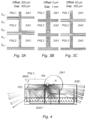
- FIGS. 3 A, 3 B, 3 C show the flows of the cooling liquid for different values of the spacing and offset between the cooling liquid guide plates and the laser active medium plates;
- FIG. 4 shows a diagram of the transport of amplified spontaneous emission radiation in the laser head shown in FIG. 1 ;
- FIG. 5 shows a diagram of a laser amplifier implementing an amplifier head according to the invention.
- the cutaway view shown in FIG. 1 provides an understanding of the structure of a laser amplifier head according to a first embodiment of the invention.
- the laser active medium is made up of three plates, more precisely disks, DA 1 , DA 2 , DA 3 consisting of yttrium-aluminum-garnet (YAG) doped with ytterbium (Yb:YAG), having a thickness of 3 mm and a diameter of 70 mm, mounted in series on a tree A passing through their center, with a spacing between two adjacent disks of 500 ⁇ m.
- the tree A allows the disks to be rotated, for example at a speed of between 1 and 10 revolutions per second.
- the assembly is placed inside a parallelepiped-shaped housing C.
- the reference z denotes the orientation direction of the tree A, and the references x, y denote axes perpendicular to one another and to the axis z defining a plane parallel to the main surfaces of the disks.
- the reference RA denotes the footprint of the laser beams on the disk DA 1 . Due to the rotation, the heat generated by the pumping is distributed in a crown (reference CO in FIG. 2 A ). Due to the thermal inertia of the disks, the local temperature increase when the beam passes remains limited to a few degrees. The heat is further distributed over a larger surface area than that of the laser beam, the surface area of heat exchange with the cooling liquid increases and the temperature of the disk is reduced thereby.
- the disks advantageously have different dopings, calculated in such a way that they are subjected to the same heat load.
- the cooling liquid for example heavy water, D 2 O, which is less absorbing than light water (H 2 O) at the emission wavelength of the Yb:YAG (1.030 nm)—re-enters the housing via an inlet port PEL, flows in the direction of the active material disks, guided laterally by two separating walls PSE 1 , PSE 2 defining a central channel.
- the channel initially has a width greater than the diameter of the disks DA 1 -DA 3 , then the walls PSE 1 , PSE 2 come closer together until they almost touch the disks, causing the flow to accelerate. After having passed through the region containing the disks, the liquid—which re-enters at 10° C.
- the lateral channels contain arrays of metal studs SAD 1 , SAD 2 , the function of which will be explained below, and open out into one or more liquid outlet ports PSL.
- Metal radiators RAD 1 , RAD 2 forming the lateral walls of the housing, allow the removal of a part of the heat transported by the liquid.
- Each liquid guide plate has the same thickness as a laser active material disk and is located in its extension.
- the gap between a liquid guide plate and the corresponding disk is preferably less than or equal to 500 ⁇ m and the offset in the direction of the thickness of the plates (z) is less than or equal to 50 ⁇ m (see FIGS. 3 A- 3 C and the corresponding discussion below).
- the function of the plates PGL 1 , PGL 2 , PGL 3 is to ensure that the flow of the cooling liquid is laminar in the region through which the laser beam passes.
- the flow is laminar (EL) between the plates PGL 1 , PGL 2 , PGL 3 , and turbulent (ETu) on the sides of the central channel.
- the flow remains laminar during the first centimeters that it travels between the active medium disks and, in particular, corresponding to the region RA, and then it makes a transition to a turbulent regime (the reference ETr denotes the flow at the laminar-to-turbulent transition), which offers the advantage of increasing the thermal exchange coefficient.
- the flow is turbulent downstream of the active medium disks and, in particular, in the lateral channels.
- FIGS. 2 A and 2 B illustrate a second embodiment in which the walls PSE 1 , PSE 2 are straight and parallel, such that the width of the central channel is throughout hardly greater than the diameter of the disks.
- a groove RF with rounded edges forming a hollow which creates a zone in which the flow can extend, and therefore slows down, can also be noted in the “low” part (opposite the liquid inlet and outlet ports), thus facilitating its ascent via the sides.
- FIG. 3 A gap of 500 ⁇ m and offset of 200 ⁇ m;
- FIG. 3 B gap of 1 mm and offset of zero;
- FIG. 3 C gap of 550 ⁇ m and offset of 50 ⁇ m.
- the flow is confined in the space between the upper main surface (not shown) of the first disk and the upper wall of the housing (not shown); between the lower main surface S 12 of the first disk and the upper main surface S 21 of the second disk; between the lower main surface S 22 of the second disk and the upper main surface S 31 of the third disk; and between the lower main surface S 32 of the third disk and the lower wall of the housing.
- a fluid recirculation is stationary or quasi-stationary; it can be laminar or turbulent.
- a turbulence varies rapidly with time, its size more often being much less than that of a recirculation. Rapid recirculation is most often accompanied by turbulence.
- ASE amplified spontaneous emission
- more than 75% of the incident energy provided by the pump beam which is almost entirely absorbed is emitted once more in the form of ASE radiation (compared with 15-20% of energy transferred to the laser beam to be amplified, the remaining part being absorbed by the active medium and converted directly into heat).
- This radiation is almost entirely emitted in the transverse direction (plane xy), since the gain is much greater there than in the direction of the thickness of the disks (z).
- FIG. 4 shows the propagation of the ASE radiation in the amplifier head shown in FIG. 2 , simulated by means of a ray-tracing algorithm.
- FIG. 5 shows an optical amplifier implementing an amplifier head of the type shown in FIG. 1 or in FIGS. 2 A /B.
- the tree A is rotated by the electric motor M.
- a fluid circuit containing cooling liquid is connected to the inlet port and to the outlet port of the housing, a pump PLR being provided close to the inlet port in order to cause a flow, at a desired rate, of said liquid.
- the housing has two windows FE 1 , FE 2 arranged facing one another on either side of the disks DA 1 -DA 3 .
- a pump laser beam FLP emitted by a pump laser source LAP, typically comprising diodes, passes through a dichroic mirror MD, then enters the housing via the window FE 2 ; it is almost entirely absorbed by the laser active medium disks.
- the laser beam to be amplified enters the housing via the window FE 1 , passes through the disks DA 1 -DA 3 which amplify it, exits via the window FE 2 , is reflected by the dichroic mirror MD, re-enters the housing via the window FE 2 , passes a second time through the laser active medium disks which amplify it even more, then exits via the window FE 1 and propagates in the opposite direction to that of its arrival.
- the amplified laser beam can be separated from the pump beam by means of a second dichroic mirror or a polarizer, or by utilizing a slight angular offset.
- the amplified laser beam can similarly be offset slightly at an angle from the incoming beam entering the laser head in such a way as to allow its removal; this also makes it possible to perform a plurality of passes through the amplifier medium.
- the amplified beam can be removed through polarization rotation by means of a quarter-wave plate and a Pockels cell associated with a polarizer.
- the laser head shown in FIG. 1 has been subject to thermal modelling. A simulation has been performed with the following parameters:
- an average doping at 2% and a total traversed thickness of 9 mm allows absorption of more than 95% of the pump.
- the simulation shows that the average central temperature of the disks, once the steady state is established, does not exceed 50° C.; the surface of the disks for its part remains at around 35° C.
- the heat is concentrated on a ring having a width equal to the diameter of the pump beam, thus indicating that the thermal conductivity is not sufficient to expect a removal of the heat by the sides and justifies the choice of separating the amplifier medium into three thinner disks in order to allow the removal of the heat from the center toward the surface with a reasonable temperature difference (around 10° C.).
- a temporal variation the maximum value of which is in the order of +/ ⁇ 7° C., is superimposed on this average temperature due to the successive heating and cooling phases caused by the rotation of the disks. The maximum instantaneous temperature of the disks does not therefore exceed 57° C.
- Thermal expansion deforms the disks, which assume the shape of a plate having a maximum deformation of 3.5 ⁇ m.
- the constraints are concentrated on the trace of the beam with a maximum of 6.22 ⁇ 10 7 Pa. This value remains lower by three orders of magnitude than the Young modulus, which indicates that this remains within the domain of the constraints and elastic deformations, far from the mechanical fracture thresholds of the component.
- the heating of the disks and the liquid waves which separate them cause optical disturbances which are due not only to the temperature dependence of the refractive indices (thermal lens effect), but also to the mechanical deformation of the disks.
- thermo-optical coefficients of YAG and water are opposite in sign, resulting in partial compensation of the deflection and thermal lens phenomena.
- the optical deflection calculations reveal that the laser beam is deflected by an angle of at most several tens of microradians (prad), which may be compensated by means of a cylindrical lens having a horizontal axis and a focal length equal to a few meters.
- the residual aberrations are estimated below the wavelength.
- the housing is mainly heated by the ASE radiation; thanks to the presence of the structures SAD 1 , SAD 2 and of the mirror MDA, the maximum temperature is in the order of 50° C., well below the boiling point of water at atmospheric pressure.
- the laser amplifier head structure according to the invention can be used for any solid-state active medium, whether it be monocrystalline, polycrystalline (ceramic) or amorphous (glass), regardless of its emission wavelength and its mode of operation (pulsed or continuous).
- dopant ions for the laser effect but also co-dopants allowing homogenization of the dopant ion concentration or modification of the spectral profile of the gain can be incorporated in the active medium.
- the different disks can have different characteristics: nature of the matrix, dopants and co-dopants, in terms of type and concentration.
- the described embodiments use a laser diode pumping, with a pump beam collinear with the beam to be amplified, but other optical pumping methods—for example lateral pumping.
- the laser beam to be amplified makes a round trip in the amplifier head.
- the amplifier head according to the invention can be used in a multipass or regenerative amplifier, or even in a laser oscillator.
- the housing It is not always necessary for the housing to have two optical windows, or porthole, facing one another; for example, a single window may suffice if the housing also contains a mirror reflecting the laser beam.
- the number of disks (and, consequently, the number of liquid guide plates), as well as their thickness, has been given purely by way of example and can vary.
- the laser active medium disks can be inclined in relation to the laser beam to be amplified, for example at Brewster's angle, as in references [ 3 ] and [ 4 ] (which nonetheless requires an adaptation of the intensity of the pump beam). It is not even essential for them to be strictly coaxial, provided that the laser beam to be amplified can pass through them at the same time.
- the disks can have a thickness of between 300 ⁇ m and 1 cm and a mutual spacing of between 200 ⁇ m and 4 mm, from the time when the Reynolds number remains below 2500.
- Other dimensioning is possible, provided that a laminar flow of the cooling liquid in the region through which the laser beam passes is ensured.
- the laser active medium plates which will then not necessarily be circular “disks”
- a different cyclic movement for example a linear oscillation.
- the term “cyclic” is understood to mean a periodic or, more generally, alternate movement which returns periodically to the same configuration; in this case, the tree A can be replaced with a different mechanical connection device, such as a sliding guide.
- the shape of the liquid guide plates must be adapted to the shape and movement of the active medium plates.
- the entire amplifier head will preferably move in relation to the laser beam to be amplified, and not only the laser active medium plates in relation to the housing as in the case of the rotating disks.
- the cooling liquid used will depend on the chemical nature of the active medium and its emission wavelength. Its mechanical properties (viscosity, density) and thermal properties (specific heat capacity, thermal conductivity, boiling point, etc.) will determine the dimensioning of the amplifier head.
- the cooling liquid “descends” from the inlet port toward the laser active medium disks, then “ascends” on the sides toward the outlet ports, passing through the absorbing and diffusing structures SAD 1 , SAD 2 .
- the flow can occur in a single direction, the outlet port being arranged opposite the inlet port.
- the absorbing and diffusing structures SAD 1 , SAD 2 can have a shape and nature which differ from those shown in the figures. They can surround the laser active medium disks on all sides (i.e. also in the “base” of the housing), or even on four sides, except when corresponding to the cooling liquid guide plates. Conversely, they can be absent, although this degrades the thermal performance of the invention; in this case, they can be replaced with absorbing crowns at the periphery of the laser active medium disks.
- the mirror MDA may be absent, or its shape may not be triangular (it may be a simple inclined mirror, or it may have a convex shape other than triangular).
- the laser active medium plates can be beveled and/or chamfered in order to limit the internal reflections of the ASE radiation.
- this is not essential: the coefficient of reflection at the active medium-cooling liquid interface is in fact only 2.2% and the transverse gain less than or equal to 8, giving a gain-loss product of less than 0.18—far from the value of 1 which would enable a laser oscillation in the transverse direction.
- the pump beam is eccentric in relation to the active medium disks, the reflections on the edges tend to distribute the ASE over parts of the disk where there is no pumping, and therefore no gain.
- the amplifier head can be used in a multipass, or even regenerative, configuration.
- the pump beam can be recycled.
Landscapes
- Physics & Mathematics (AREA)
- Electromagnetism (AREA)
- Optics & Photonics (AREA)
- Engineering & Computer Science (AREA)
- Plasma & Fusion (AREA)
- Condensed Matter Physics & Semiconductors (AREA)
- General Physics & Mathematics (AREA)
- Chemical & Material Sciences (AREA)
- Crystallography & Structural Chemistry (AREA)
- Lasers (AREA)
Abstract
-
- a mechanical connection device allowing a cyclic movement at least of the laser active medium plates in relation to the laser beam in a plane (xy) perpendicular to the direction (z) of their thickness; and
- cooling liquid guide plates arranged in the extension of the laser active medium plates, between the latter and the inlet port of said liquid.
Description
-
- Via the mounting, connected to an internal cooling circuit.
- Via the rear, reflective, surface, which requires very small thicknesses of the active medium (300 micrometers typically), and therefore a large number (typically 12 or more) of passageways. This is known as “thin disk” technology or “active mirror” technology for greater thicknesses. See, for example, [1a], [1b], [1c].
- By a fluid incident on the main surfaces of the disk; this fluid is most often a gas, but it can sometimes be a liquid. Document [2], for example, describes a laser oscillator whose active medium is formed from two thin plates of Nd:YAG inclined at Brewster's angle in relation to the optical path of the laser beam and forming an angle between them, immersed in a flow of cooling liquid. Documents [3] and [4] describe laser oscillators whose active medium is formed by a stack of disks having a thickness in the order of the millimeter, a cooling liquid (D2O) flowing in the spaces between the disks.
-
- a mechanical connection device allowing a cyclic movement at least of the laser active medium plates in relation to the laser beam in a plane perpendicular to the direction of their thickness; and
- cooling liquid guide plates arranged in the extension of the laser active medium plates, between the latter and the inlet port of said liquid.
-
- The mechanical connection device can be configured to cause the laser active medium plates to rotate around a common axis, perpendicular to the direction of their thickness, in relation to the housing. The common axis can, in particular, be parallel to the direction of propagation of the laser beam. The one or more windows can further be arranged in such a way that the laser beam passes through a region of said laser active medium plates between the inlet port of the cooling liquid and the common axis of rotation.
- The cooling liquid guide plates can be transparent in a spectral band of an amplified spontaneous emission radiation of the laser active medium plates, in such a way as to allow the removal of said radiation. In this case, the amplifier head can also comprise mirrors to deflect a portion of said amplified spontaneous emission radiation removed through the cooling liquid guide plates and initially directed toward the inlet port of the cooling liquid. The amplifier head can furthermore also comprise, inside said housing, at least one optically absorbing and diffusing structure in said spectral band of the amplified spontaneous emission radiation, said optically absorbing and diffusing structure at least partially surrounding the laser active medium plates in a plane perpendicular to the direction of their thickness and being arranged in such a way as to be in contact with said cooling liquid. Said optically absorbing and diffusing structure advantageously comprises an array of studs. The amplifier head can furthermore also comprise at least one transparent wall in said spectral band of the amplified spontaneous emission radiation and separating, on one hand, a region of the volume within the housing containing the laser active medium plates, the cooling liquid guide plates and the inlet port, and, on the other hand, said or each said optically absorbing and diffusing structure and the outlet port.
- The cooling liquid guide plates can have a width which is less than that of the laser active medium plates.
- The laser active medium plates can have a thickness of between 300 μm and 1 cm and a mutual spacing of between 200 μm and 4 mm.
- The laser active medium plates may be disk-shaped.
- The amplifier head can also comprise a pump which has a fluid connection to the inlet port and to the outlet port and which is suitable for causing a flow of the cooling liquid in the housing, the dimensioning and the arrangement of the pump, the housing, the laser active medium plates and the cooling liquid guide plates being such that the flow is laminar in a region through which the laser beam passes, then causes a transition to a turbulent regime.
- The amplifier head can also comprise an actuator interworking with the mechanical connection device to cause said cyclic movement of the active medium plates.
- The amplifier head can also comprise a longitudinal optical pumping system.
-
- First of all, not only the cooling liquid guide plates PGL1, PGL2, PGL3, but also the separating walls PSE1, PSE2 are transparent in the spectral band of this radiation, such that they do not absorb said radiation and heat up close to the laser active medium disks. The ASE radiation can thus propagate freely through these elements, at a distance from the active medium.
- A mirror MDA, for example triangular in shape, is arranged at the end of the cooling liquid guide plates PGL1, PGL2, PGL3 that is most distant from the laser active medium disks. The function of this mirror is to deflect the ASE radiation directed toward the cooling liquid inlet toward the sides of the housing. In the absence of the mirror MDA, the radiation would be absorbed by the region of the housing close to the inlet port of the cooling liquid, which would be heated before even reaching the disks.
- Diffusing and absorbing structures SAD1, SAD2 are arranged on the sides of the housing. These structures comprise, for example, arrays of metal (for example copper) studs having an absorbing surface (for example of black chrome). They diffuse and absorb the ASE radiation before it reaches the walls of the housing, and prevent any backscattering of this radiation toward the disk. The radiation reflected by the mirror MDA reaches the structures SAD1, SAD2 also. These structures are cooled by the (lukewarm) liquid which flows toward the outlet port. They further tend to make the flow of this liquid even more turbulent, thus increasing the thermal exchange coefficient. A diffusing and absorbing structure could also be provided in the “base” of the housing (after the groove RF in the case of
FIGS. 2A /2B), but this is less important since this region is more distant from the active zone of the disks, and the ASE radiation arrives there in attenuated form.
-
- Incident pump power: 16 kW/cm2, or 13 kW in total;
- Laser-heat energy conversion coefficient (quantum default): 0.1;
- Pump beam diameter: 10 mm;
- Diameter of the laser beam to be amplified: 8 mm;
- Thermal exchange coefficient in forced convection estimated at h=5000 Wm−2K−1;
- Temperature of the cooling fluid at the inlet: 10° C.;
- Radius of rotation: 25 mm;
- Rotation speed: 2 revolutions/second;
- Radius of the disks: 70 mm;
- Thickness of disk DA1=2.35 mm, doping 1.5%, absorption 160.5 m−1;
- Thickness of disk DA2=2.35 mm, doping 2.0%, absorption 214 m−1;
- Thickness of disk DA3=3.22 mm, doping 2.0%, absorption 214 m−1.
- [1a] BROWN, D. C., KELLY, J. H., ABATE, J. H. Active-Mirror Amplifiers: Progress and Prospects. IEEE Journal of Quantum Electronics, Vol. QE-17, No. 7, September 1981.
- [1b] GIESEN, A., HUGEL, H., VOSS, A., WITTIG, K., BRAUCH, U., OPOWER, H., Scalable Concept for Diode-Pumped High-Power Solid-State Lasers, Appl. Phys. B 58, 365-372 (1994).
- [1c] LUCIANETTI, A., ALBACH, D., CHANTELOUP, J.-C., Active-mirror-laser-amplifier thermal management with tunable helium pressure at cryogenic temperatures, Optics Express, Vol. 19, No. 13, 20 Jun. 2011.
- [2] NIE, R. Z., SHE, J. B., ZHAO, P. F., et al. Fully immersed liquid cooling thin-disk oscillator. Laser Physics Letters, 2014, vol. 11, no 11, p. 115808.
- [3] F U, Xing, L I, Peilin, L I U, Qiang, et al. 3 kW liquid-cooled elastically-supported Nd: YAG multi-slab CW laser resonator. Optics express, 2014, vol. 22, no 15, p. 18421-18432.
- [4] WANG, Ke, T U, Bo, J I A, Chunyan, et al. 7 kW direct-liquid-cooled side-pumped Nd: YAG multi-disk laser resonator. Optics Express, 2016, vol. 24, no 13, p. 15012-15020.
- [5] BASU, Santanu. Nd-YAG and Yb-YAG rotary disk lasers. IEEE Journal of selected topics in quantum electronics, 2005, vol. 11, no 3, p. 626-630.
- [6] US 2006/0007800
- [7] ONGSTAD, Andrew P., GUY, Matthew, and CHAVEZ, Joeseph R. High power Nd: YAG spinning disk laser. Optics Express, 2016, vol. 24, no 1, p. 108-113.
- [8] FU, Xing, L I U, Qiang, L I, Peilin, et al. Direct-liquid-cooled Nd: YAG thin disk laser oscillator. Applied Physics B, 2013, vol. 111, no 3, p. 517-521.
Claims (15)
Applications Claiming Priority (3)
| Application Number | Priority Date | Filing Date | Title |
|---|---|---|---|
| FR1860215 | 2018-11-06 | ||
| FR1860215A FR3088148B1 (en) | 2018-11-06 | 2018-11-06 | HIGH POWER LASER AMPLIFIER HEAD |
| PCT/EP2019/079111 WO2020094416A1 (en) | 2018-11-06 | 2019-10-24 | High-power laser amplifier head |
Publications (2)
| Publication Number | Publication Date |
|---|---|
| US20210391688A1 US20210391688A1 (en) | 2021-12-16 |
| US12107389B2 true US12107389B2 (en) | 2024-10-01 |
Family
ID=66166065
Family Applications (1)
| Application Number | Title | Priority Date | Filing Date |
|---|---|---|---|
| US17/291,826 Active 2041-11-13 US12107389B2 (en) | 2018-11-06 | 2019-10-24 | High-power laser amplifier head |
Country Status (5)
| Country | Link |
|---|---|
| US (1) | US12107389B2 (en) |
| EP (1) | EP3878062B1 (en) |
| CN (1) | CN113169506B (en) |
| FR (1) | FR3088148B1 (en) |
| WO (1) | WO2020094416A1 (en) |
Citations (9)
| Publication number | Priority date | Publication date | Assignee | Title |
|---|---|---|---|---|
| US5210768A (en) * | 1992-02-21 | 1993-05-11 | Seguin Herb J J | Multi-slab solid state laser system |
| US20060007800A1 (en) | 2004-07-12 | 2006-01-12 | Santanu Basu | Rotary disk laser module |
| US7280571B2 (en) * | 2004-11-23 | 2007-10-09 | Northrop Grumman Corporation | Scalable zig-zag laser amplifier |
| US7400812B2 (en) * | 2003-09-25 | 2008-07-15 | Nufern | Apparatus and methods for accommodating loops of optical fiber |
| EP2795745A2 (en) | 2011-12-22 | 2014-10-29 | The Science and Technology Facilities Council | Mounting vane for optical element of a laser |
| US9090315B1 (en) * | 2010-11-23 | 2015-07-28 | Piedra—Sombra Corporation, Inc. | Optical energy transfer and conversion system |
| US9209598B1 (en) * | 2011-12-14 | 2015-12-08 | Colorado State University Research Foundation | Cooling system for high average power laser |
| US9680279B2 (en) * | 2014-09-10 | 2017-06-13 | Bae Systems Information And Electronic Systems Integration Inc. | Ruggedized fiber optic laser for high stress environments |
| US11329448B2 (en) * | 2017-05-24 | 2022-05-10 | United Kingdom Research And Innovation | Laser amplifier module |
Family Cites Families (4)
| Publication number | Priority date | Publication date | Assignee | Title |
|---|---|---|---|---|
| US7535633B2 (en) * | 2005-01-10 | 2009-05-19 | Kresimir Franjic | Laser amplifiers with high gain and small thermal aberrations |
| CN102882109A (en) * | 2011-07-14 | 2013-01-16 | 中国科学院理化技术研究所 | Laser head device for solid laser |
| CN103779772B (en) * | 2014-01-23 | 2016-06-01 | 中国航空工业集团公司北京航空制造工程研究所 | Adopt laser module and the solid statelaser of recombination pump coupling |
| CN107437720B (en) * | 2017-08-23 | 2019-05-17 | 中国科学院上海光学精密机械研究所 | A kind of array rod-shaped laser amplifier |
-
2018
- 2018-11-06 FR FR1860215A patent/FR3088148B1/en not_active Expired - Fee Related
-
2019
- 2019-10-24 US US17/291,826 patent/US12107389B2/en active Active
- 2019-10-24 CN CN201980081026.4A patent/CN113169506B/en active Active
- 2019-10-24 WO PCT/EP2019/079111 patent/WO2020094416A1/en not_active Ceased
- 2019-10-24 EP EP19790017.8A patent/EP3878062B1/en active Active
Patent Citations (10)
| Publication number | Priority date | Publication date | Assignee | Title |
|---|---|---|---|---|
| US5210768A (en) * | 1992-02-21 | 1993-05-11 | Seguin Herb J J | Multi-slab solid state laser system |
| US7400812B2 (en) * | 2003-09-25 | 2008-07-15 | Nufern | Apparatus and methods for accommodating loops of optical fiber |
| US20060007800A1 (en) | 2004-07-12 | 2006-01-12 | Santanu Basu | Rotary disk laser module |
| US7593447B2 (en) * | 2004-07-12 | 2009-09-22 | Santanu Basu | Rotary disk laser module |
| US7280571B2 (en) * | 2004-11-23 | 2007-10-09 | Northrop Grumman Corporation | Scalable zig-zag laser amplifier |
| US9090315B1 (en) * | 2010-11-23 | 2015-07-28 | Piedra—Sombra Corporation, Inc. | Optical energy transfer and conversion system |
| US9209598B1 (en) * | 2011-12-14 | 2015-12-08 | Colorado State University Research Foundation | Cooling system for high average power laser |
| EP2795745A2 (en) | 2011-12-22 | 2014-10-29 | The Science and Technology Facilities Council | Mounting vane for optical element of a laser |
| US9680279B2 (en) * | 2014-09-10 | 2017-06-13 | Bae Systems Information And Electronic Systems Integration Inc. | Ruggedized fiber optic laser for high stress environments |
| US11329448B2 (en) * | 2017-05-24 | 2022-05-10 | United Kingdom Research And Innovation | Laser amplifier module |
Non-Patent Citations (12)
| Title |
|---|
| Basu, Santanu, "A Design for a 100-kW Rotary Disk Laser Oscillator with Good Beam Quality", Proceedings of SPIE 7513, 2009 International Conference on Optical Instruments and Technology, Jan. 23, 2010, pp. 75780D-1 to D11, vol. 7578, San Francisco, CA. |
| Basu, Santanu, "Nd-YAG and Yb-YAG rotary disk lasers", IEEE Journal of Selected Topics in Quantum Electronics, May/Jun. 2005, pp. 626-630, vol. 11, No. 3, IEEE, US. |
| Brown, D.C., et al., "Active-Mirror Amplifiers: Progress and Prospects", IEEE Journal of Quantum Electronics, Sep. 1981, pp. 1755-1765, vol. QE-17, No. 9, IEEE, US. |
| Fu, Xing, et al., "3kW liquid-cooled elastically-supported Nd: YAG multi-slab CW laser resonator", Optics Express, Jul. 2014, pp. 18421-18432, vol. 22, No. 15, Optical Society of America, US. |
| Fu, Xing, et al., "Direct-liquid-cooled Nd: YAG thin disk laser oscillator", Applied Physics B, May 2013, pp. 517-521, vol. 111, No. 3, Springer, Switzerland. |
| Giesen, A., et al., "Scalable Concept for Diode-Pumped High-Power Solid-State Lasers", Appl. Phys. B, May 1994, pp. 365-372, vol. 58, Springer-Verlag, Germany. |
| International Searching Authority, International Search Report and Written Opinion received for International Application No. PCT/EP2019/079111, dated Jan. 29, 2020, 21 pages, European Patent Office, Netherlands. |
| Lucianetti, A., et al., "Active-mirror-laser-amplifier thermal management with tunable helium pressure at cryogenic temperatures", Optics Express, Jun. 20, 2011, pp. 12766-12780, vol. 19, No. 13, Optical Society of America, US. |
| National Industrial Property Institute, Preliminary Search Report (PSR) and Written Opinion received for Application No. FR1860215, dated Aug. 5, 2019, 7 pages, Republic of France. |
| Nie, R. Z., et al., "Fully immersed liquid cooling thin-disk oscillator", Laser Physics Letters, Sep. 22, 2014, vol. 11, issue No. 11, article No. 115808, 6 pages, IOP Publishing, UK. |
| Ongstad, Andrew, et al., "High power Nd: YAG spinning disk laser", Optics Express, Jan. 2016, pp. 108-113, vol. 24, No. 1, Optical Society of America, US. |
| Wang, Ke, et al., "7KW direct-liquid-cooled side-pumped Nd: YAG multi-disk laser resonator", Optics Express, Jun. 2016, pp. 15012-15020, vol. 24, No. 13, Optical Society of America, US. |
Also Published As
| Publication number | Publication date |
|---|---|
| CN113169506A (en) | 2021-07-23 |
| CN113169506B (en) | 2024-02-09 |
| FR3088148A1 (en) | 2020-05-08 |
| FR3088148B1 (en) | 2020-11-13 |
| US20210391688A1 (en) | 2021-12-16 |
| WO2020094416A1 (en) | 2020-05-14 |
| EP3878062A1 (en) | 2021-09-15 |
| EP3878062B1 (en) | 2022-07-27 |
Similar Documents
| Publication | Publication Date | Title |
|---|---|---|
| US6894828B2 (en) | Power scalable waveguide amplifier and laser devices | |
| US7193771B1 (en) | Power scalable optical systems for generating, transporting, and delivering high power, high quality laser beams | |
| US20030063884A1 (en) | Power scalable optical systems for generating, transporting, and delivering high power, high quality, laser beams | |
| US6667999B2 (en) | Cooling of high power laser systems | |
| CN1319225C (en) | Encoding apparatus of audio signal, audio disc and disc reproducing apparatus | |
| US8406267B2 (en) | Grazing-incidence-disk laser element | |
| Siebold et al. | High-energy, ceramic-disk Yb: LuAG laser amplifier | |
| Shin et al. | Wavefront improvement in an end-pumped high-power Nd: YAG zigzag slab laser | |
| Chen et al. | Room temperature high-power TEM00 mode beam from bulk solid-state laser without water cooling | |
| EP3712664A1 (en) | Depolarization compensator | |
| US12107389B2 (en) | High-power laser amplifier head | |
| Goodno et al. | High average-power Yb: YAG end-pumped zig-zag slab laser | |
| Meng et al. | 6.2 kW quasi-continuous-wave diode-pumped Yb: YAG ceramic slab laser | |
| Wang et al. | RTP voltage-increased electro-optic Q-switched Ho: YAG laser with double anti-misalignment corner cubes | |
| Zhou et al. | Acousto-optic Q-switched operation Ho: YAP laser pumped by a Tm-doped fiber laser | |
| Ciofini et al. | Compact scalable diode-pumped Nd: YAG ceramic slab laser | |
| Bui et al. | Diode-pumped Nd: KGd (WO4) 2 laser: lasing at fundamental and second harmonic frequencies | |
| Wu et al. | A linearly polarized Ho: YAG Laser at 2.09 μm with corner cube cavity pumped by Tm: YLF laser | |
| Yang et al. | 160mJ and 9ns electro-optics Q-switched conductively cooled 1047nm Nd: YLF laser | |
| Song et al. | QCW surface-pumped cryogenically cooled single-slab laser with 1 kW level at 946 nm | |
| Ganija et al. | A cryogenic, end pumped, zigzag slab laser suitable for power scaling | |
| Fu et al. | End-pumped Nd: YAG zigzag slab laser with weak pump absorption | |
| Zhao et al. | A 15.1 W continuous wave TEM00 mode laser using a YVO4/Nd: YVO4 composite crystal | |
| Huang et al. | A compact high efficient diode-double-passing-pumped mid-IR Tm: YLF laser at room temperature | |
| Yang et al. | A narrow linewidth continuous wave Ho: SSO laser with Fabry–Perot etalons |
Legal Events
| Date | Code | Title | Description |
|---|---|---|---|
| FEPP | Fee payment procedure |
Free format text: ENTITY STATUS SET TO UNDISCOUNTED (ORIGINAL EVENT CODE: BIG.); ENTITY STATUS OF PATENT OWNER: LARGE ENTITY |
|
| STPP | Information on status: patent application and granting procedure in general |
Free format text: DOCKETED NEW CASE - READY FOR EXAMINATION |
|
| AS | Assignment |
Owner name: COMMISSARIAT A L'ENERGIE ATOMIQUE ET AUX ENERGIES ALTERNATIVES (34%), FRANCE Free format text: ASSIGNMENT OF ASSIGNORS INTEREST;ASSIGNOR:CENTRE NATIONAL DE LA RECHERCHE SCIENTIFIQUE;REEL/FRAME:063872/0207 Effective date: 20220303 Owner name: UNIVERSITE DE BORDEAUX (33%), FRANCE Free format text: ASSIGNMENT OF ASSIGNORS INTEREST;ASSIGNOR:CENTRE NATIONAL DE LA RECHERCHE SCIENTIFIQUE;REEL/FRAME:063872/0207 Effective date: 20220303 Owner name: CENTRE NATIONAL DE LA RECHERCHE SCIENTIFIQUE (33%), FRANCE Free format text: ASSIGNMENT OF ASSIGNORS INTEREST;ASSIGNOR:CENTRE NATIONAL DE LA RECHERCHE SCIENTIFIQUE;REEL/FRAME:063872/0207 Effective date: 20220303 |
|
| AS | Assignment |
Owner name: COMMISSARIAT A L'ENERGIE ATOMIQUE ET AUX ENERGIES ALTERNATIVES, FRANCE Free format text: ASSIGNMENT OF ASSIGNORS INTEREST;ASSIGNORS:FERAL, CHRISTOPHE;LHERMITE, JEROME;BRANDAM, JEREMY;AND OTHERS;SIGNING DATES FROM 20231209 TO 20231212;REEL/FRAME:065976/0285 Owner name: UNIVERSITE DE BORDEAUX, FRANCE Free format text: ASSIGNMENT OF ASSIGNORS INTEREST;ASSIGNORS:FERAL, CHRISTOPHE;LHERMITE, JEROME;BRANDAM, JEREMY;AND OTHERS;SIGNING DATES FROM 20231209 TO 20231212;REEL/FRAME:065976/0285 Owner name: CENTRE NATIONAL DE LA RECHERCHE SCIENTIFIQUE, FRANCE Free format text: ASSIGNMENT OF ASSIGNORS INTEREST;ASSIGNORS:FERAL, CHRISTOPHE;LHERMITE, JEROME;BRANDAM, JEREMY;AND OTHERS;SIGNING DATES FROM 20231209 TO 20231212;REEL/FRAME:065976/0285 |
|
| STPP | Information on status: patent application and granting procedure in general |
Free format text: NON FINAL ACTION MAILED |
|
| STPP | Information on status: patent application and granting procedure in general |
Free format text: RESPONSE TO NON-FINAL OFFICE ACTION ENTERED AND FORWARDED TO EXAMINER |
|
| STPP | Information on status: patent application and granting procedure in general |
Free format text: NOTICE OF ALLOWANCE MAILED -- APPLICATION RECEIVED IN OFFICE OF PUBLICATIONS |
|
| ZAAB | Notice of allowance mailed |
Free format text: ORIGINAL CODE: MN/=. |
|
| STPP | Information on status: patent application and granting procedure in general |
Free format text: PUBLICATIONS -- ISSUE FEE PAYMENT VERIFIED |
|
| STCF | Information on status: patent grant |
Free format text: PATENTED CASE |