US12098945B2 - Real-time vehicle overload detection method based on convolutional neural network - Google Patents
Real-time vehicle overload detection method based on convolutional neural network Download PDFInfo
- Publication number
- US12098945B2 US12098945B2 US17/491,216 US202117491216A US12098945B2 US 12098945 B2 US12098945 B2 US 12098945B2 US 202117491216 A US202117491216 A US 202117491216A US 12098945 B2 US12098945 B2 US 12098945B2
- Authority
- US
- United States
- Prior art keywords
- vehicle
- yolo
- real
- network model
- detection
- Prior art date
- Legal status (The legal status is an assumption and is not a legal conclusion. Google has not performed a legal analysis and makes no representation as to the accuracy of the status listed.)
- Active, expires
Links
Images




Classifications
-
- G—PHYSICS
- G01—MEASURING; TESTING
- G01G—WEIGHING
- G01G19/00—Weighing apparatus or methods adapted for special purposes not provided for in the preceding groups
- G01G19/02—Weighing apparatus or methods adapted for special purposes not provided for in the preceding groups for weighing wheeled or rolling bodies, e.g. vehicles
- G01G19/022—Weighing apparatus or methods adapted for special purposes not provided for in the preceding groups for weighing wheeled or rolling bodies, e.g. vehicles for weighing wheeled or rolling bodies in motion
- G01G19/024—Weighing apparatus or methods adapted for special purposes not provided for in the preceding groups for weighing wheeled or rolling bodies, e.g. vehicles for weighing wheeled or rolling bodies in motion using electrical weight-sensitive devices
-
- G—PHYSICS
- G06—COMPUTING OR CALCULATING; COUNTING
- G06V—IMAGE OR VIDEO RECOGNITION OR UNDERSTANDING
- G06V20/00—Scenes; Scene-specific elements
- G06V20/50—Context or environment of the image
- G06V20/52—Surveillance or monitoring of activities, e.g. for recognising suspicious objects
- G06V20/54—Surveillance or monitoring of activities, e.g. for recognising suspicious objects of traffic, e.g. cars on the road, trains or boats
-
- G—PHYSICS
- G06—COMPUTING OR CALCULATING; COUNTING
- G06F—ELECTRIC DIGITAL DATA PROCESSING
- G06F18/00—Pattern recognition
- G06F18/20—Analysing
- G06F18/23—Clustering techniques
- G06F18/232—Non-hierarchical techniques
- G06F18/2321—Non-hierarchical techniques using statistics or function optimisation, e.g. modelling of probability density functions
- G06F18/23213—Non-hierarchical techniques using statistics or function optimisation, e.g. modelling of probability density functions with fixed number of clusters, e.g. K-means clustering
-
- G—PHYSICS
- G06—COMPUTING OR CALCULATING; COUNTING
- G06F—ELECTRIC DIGITAL DATA PROCESSING
- G06F18/00—Pattern recognition
- G06F18/20—Analysing
- G06F18/24—Classification techniques
- G06F18/241—Classification techniques relating to the classification model, e.g. parametric or non-parametric approaches
-
- G—PHYSICS
- G06—COMPUTING OR CALCULATING; COUNTING
- G06N—COMPUTING ARRANGEMENTS BASED ON SPECIFIC COMPUTATIONAL MODELS
- G06N3/00—Computing arrangements based on biological models
- G06N3/02—Neural networks
- G06N3/04—Architecture, e.g. interconnection topology
-
- G—PHYSICS
- G06—COMPUTING OR CALCULATING; COUNTING
- G06N—COMPUTING ARRANGEMENTS BASED ON SPECIFIC COMPUTATIONAL MODELS
- G06N3/00—Computing arrangements based on biological models
- G06N3/02—Neural networks
- G06N3/04—Architecture, e.g. interconnection topology
- G06N3/045—Combinations of networks
-
- G—PHYSICS
- G06—COMPUTING OR CALCULATING; COUNTING
- G06N—COMPUTING ARRANGEMENTS BASED ON SPECIFIC COMPUTATIONAL MODELS
- G06N3/00—Computing arrangements based on biological models
- G06N3/02—Neural networks
- G06N3/04—Architecture, e.g. interconnection topology
- G06N3/0464—Convolutional networks [CNN, ConvNet]
-
- G—PHYSICS
- G06—COMPUTING OR CALCULATING; COUNTING
- G06N—COMPUTING ARRANGEMENTS BASED ON SPECIFIC COMPUTATIONAL MODELS
- G06N3/00—Computing arrangements based on biological models
- G06N3/02—Neural networks
- G06N3/04—Architecture, e.g. interconnection topology
- G06N3/0495—Quantised networks; Sparse networks; Compressed networks
-
- G—PHYSICS
- G06—COMPUTING OR CALCULATING; COUNTING
- G06N—COMPUTING ARRANGEMENTS BASED ON SPECIFIC COMPUTATIONAL MODELS
- G06N3/00—Computing arrangements based on biological models
- G06N3/02—Neural networks
- G06N3/08—Learning methods
-
- G—PHYSICS
- G06—COMPUTING OR CALCULATING; COUNTING
- G06N—COMPUTING ARRANGEMENTS BASED ON SPECIFIC COMPUTATIONAL MODELS
- G06N3/00—Computing arrangements based on biological models
- G06N3/02—Neural networks
- G06N3/08—Learning methods
- G06N3/082—Learning methods modifying the architecture, e.g. adding, deleting or silencing nodes or connections
-
- G—PHYSICS
- G06—COMPUTING OR CALCULATING; COUNTING
- G06N—COMPUTING ARRANGEMENTS BASED ON SPECIFIC COMPUTATIONAL MODELS
- G06N3/00—Computing arrangements based on biological models
- G06N3/02—Neural networks
- G06N3/08—Learning methods
- G06N3/09—Supervised learning
-
- G—PHYSICS
- G06—COMPUTING OR CALCULATING; COUNTING
- G06V—IMAGE OR VIDEO RECOGNITION OR UNDERSTANDING
- G06V10/00—Arrangements for image or video recognition or understanding
- G06V10/40—Extraction of image or video features
- G06V10/44—Local feature extraction by analysis of parts of the pattern, e.g. by detecting edges, contours, loops, corners, strokes or intersections; Connectivity analysis, e.g. of connected components
-
- G—PHYSICS
- G06—COMPUTING OR CALCULATING; COUNTING
- G06V—IMAGE OR VIDEO RECOGNITION OR UNDERSTANDING
- G06V2201/00—Indexing scheme relating to image or video recognition or understanding
- G06V2201/08—Detecting or categorising vehicles
Definitions
- the present disclosure relates to an object detection technology, and in particular, to a no-parking truck overload detection method based on a convolutional neural network (CNN).
- CNN convolutional neural network
- the overloading of vehicles is mainly avoided by pasting weight limit signs and arranging law enforcement officers for manual patrol and inspection.
- the law enforcement officers observe driving vehicles and guide trucks suspected to be overloaded to the check point for actual measurement.
- Such a manual detection method has the following defects: (1) The officers cannot work for 24 h; (2) on the basis of subjective judgments of the law enforcement officers, the precision cannot be ensured; and (3) the efficiency is low, and the vehicle-parking detection is time-consuming to cause traffic congestions easily.
- the present disclosure investigates a CNN-based object detection algorithm, and constructs a truck overload detection network with you only look once (YOLO)-V3, to implement automatic real-time vehicle overload detection without parking.
- the present disclosure detects a road driving vehicle in real time with a CNN method and a YOLO-V3 detection algorithm, detects the number of wheels to obtain the number of axles, detects a relative wheelbase, compares the number of axles and the relative wheelbase with a national vehicle load standard to obtain a maximum load of the vehicle, and compares the maximum load with an actual load measured by a piezoelectric sensor under the vehicle, thereby implementing real-time vehicle overload detection.
- the flow chart of the detection algorithm is as shown in FIG. 1 .
- the present disclosure uses the following technical solutions.
- a real-time vehicle overload detection method based on a CNN constructs, based on YOLO-V3, an object detection network for detecting a tire of a vehicle, performs sparsification on a YOLO network based on L1 regularization by using an artificial neural network pruning algorithm, and performs channel pruning on a CNN, thereby compressing the network greatly at a small precision loss;
- the present disclosure has the following advantages:
- the present disclosure has desirable real-time detection, can implement no-parking vehicle overload detection on the road, and avoids potential traffic congestions and road traffic accidents.
- the present disclosure simplifies the network structure without affecting the detection precision, and has a low hardware requirement, thereby reducing the device cost and being more suitable for application scenarios.
- FIG. 1 illustrates a flow chart of a detection algorithm.
- FIG. 3 illustrates a network structure of Darknet-53.
- FIG. 4 illustrates a schematic view and a flow chart of channel pruning, where a is the schematic view of the channel pruning, and b is the flowchart of the channel pruning.
- FIG. 5 illustrates a flow chart of a K-means clustering algorithm.
- the offline part includes two steps:
- Step 2 Construction of a YOLO-V3 Network Framework and Model Training
- the YOLO algorithm is to input an image to be detected into the convolutional network for direct classification and bounding box regression.
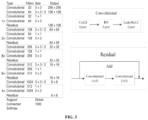
- the YOLO-V3 network structure (as shown in FIG. 2 ) includes two parts, one being a backbone network Darknet-53 for feature extraction and the other being a prediction network for classification and detection box regression.
- the computer has a memory of 8 G, and a graphics card of NvidiaGeforeGTX1060.
- the parallel computation framework and acceleration pool of Nvidia are employed and the version CUDA10+cudnn7.4 is installed.
- the Darknet-53 provides 53 convolutional layers. Because of the residual structure, it can perform deeper construction than the Darknet-19 network. To some extent, the deeper the network, the better the feature extraction capability. Hence, the Darknet-53 model has the higher classification precision than the Darknet-19.
- the YOLO-V3 abandons the last layer of the Darknet-53 and takes front 52 convolutional layers of the Darknet-53 as the backbone network for feature extraction (as shown in FIG. 3 ).
- channel pruning is performed on the YOLO-V3 to reduce convolutional channels of the YOLO globally.
- the feature extraction network of the YOLO is then adjusted to reduce a convolutional layer less contributed to the network, thereby obtaining a narrower object detection network.
- the convolution kernel can be deemed as a basic unit of the convolutional layer. After one convolution kernel is pruned, the corresponding output channel is also pruned.
- the artificial neural network researchers do not know how many channels are appropriate, and tend to design more channels for the fear of losing effective features of the network. As a result of the blindness, there are many redundant channels in the network.
- these convolution kernels are not subjected to any calculation during forward reasoning.
- Meantime input channels of next convolutional layers corresponding to output of the convolution kernels are also pruned, thereby compressing the network greatly. As the channel less contributed to the network is pruned, the pruning has a little impact on the whole network.
- FIG. 4 illustrates the schematic view and flow chart of the channel pruning.
- the YOLO algorithm provides an anchor box for the convolutional network to predict the object bounding box. It narrows the feature map by increasing the step size of the convolution kernel instead of the use of a pooling layer. In other object detection algorithms, the prior box is manually set based on experience and is not accurate.
- the YOLO algorithm performs clustering analysis on the manual labeling box of the training sample with a K-means clustering method, and initializes the anchor box with the width and height obtained from the clustering.
- FIG. 5 illustrates a flow chart of the K-means clustering algorithm.
- the K-means clustering algorithm mainly includes: Step 1: Randomly assign K points as initial centroids.
- Step 2 Classify each object to be classified to a cluster of the nearest centroid.
- Step 3 Calculate a centroid of each cluster after classification, update calculated centroids as new centroids of the clustering algorithm, and perform iterative calculation on Step 2 and Step 3 until the centroids no longer change or the number of iterations reaches.
- the YOLO-V3 provides three different scales for output and each scale requires three prior boxes. In this case, nine prior boxes of different sizes are clustered to detect objects of different sizes. The three times of detection correspond to different the receptive ranges.
- Table 1 illustrates the corresponding relationship between the size of the feature map and the receptive range, where the 32-fold down-sampling is suitable for large objects with the largest receptive range, the 16-fold for middle-sized objects, and the 8-fold for small objects with the smallest receptive range.
- the YOLO-V3 detects objects of different sizes with multi-scale prediction.
- feature information extracted by networks on different layers can be combined to improve the detection effect. Shallow neutral networks more focus on detail information of the images, while the high-level networks can extract more semantic feature information.
- the output from the deep network is fused with the output from the low-level network, such that the resolution of feature mapping can be increased and the network can make a prediction with more information. Therefore, the object detection effect is effectively improved, and particularly, the detection effect for small objects is obviously improved.
- the online part includes two steps:
- Step 1 Acquisition for the Number of Axles and a Relative Wheelbase of the Vehicle
- Step 2 Evaluation of a Detection Effect
- Object detection evaluation indexes include a precision and a recall, with a following Eq.:
- AP ⁇ 0 1 P ( r ) dr
Landscapes
- Engineering & Computer Science (AREA)
- Physics & Mathematics (AREA)
- Theoretical Computer Science (AREA)
- General Physics & Mathematics (AREA)
- Data Mining & Analysis (AREA)
- Evolutionary Computation (AREA)
- Life Sciences & Earth Sciences (AREA)
- Artificial Intelligence (AREA)
- General Engineering & Computer Science (AREA)
- Computing Systems (AREA)
- Molecular Biology (AREA)
- Computational Linguistics (AREA)
- Biophysics (AREA)
- Biomedical Technology (AREA)
- Mathematical Physics (AREA)
- Software Systems (AREA)
- Health & Medical Sciences (AREA)
- General Health & Medical Sciences (AREA)
- Computer Vision & Pattern Recognition (AREA)
- Evolutionary Biology (AREA)
- Bioinformatics & Computational Biology (AREA)
- Bioinformatics & Cheminformatics (AREA)
- Multimedia (AREA)
- Probability & Statistics with Applications (AREA)
- Image Analysis (AREA)
- Traffic Control Systems (AREA)
Abstract
Description
-
- the real-time vehicle overload detection method includes the following steps:
- step 1: preparing a visual object classes (VOC) dataset;
- acquiring an image of a multi-axle vehicle on site, labeling the acquired image (including the number of axles of the vehicle such as 6-axle and a wheel on a single side of the vehicle) of the multi-axle vehicle with a labeling tool, and preparing the VOC dataset, where
- the VOC dataset includes four parts, specifically, a folder Annotations stores a label file suffixed by an xml for all images, a folder JPEGImages stores all dataset images, a folder ImageSets stores a file suffixed by a txt and generated after the dataset is partitioned, and a folder labels stores a file converted from the label file and suffixed by the txt;
- step 2: configuring a training environment for a YOLO-V3 object detection network model;
- constructing the YOLO-V3 object detection network model with a darknet deep learning framework in a ubuntu system, and training the YOLO-V3 object detection network model on the darknet deep learning framework, where the YOLO-V3 object detection network model is trained and tested on a computer;
- step 3: training the YOLO-V3 object detection network model;
- training the model with a YOLO-V3 object detection algorithm, and simplifying the network model with a pruning algorithm, thereby reducing a performance requirement on the computer in an actual application scenario;
- step 3.1: pre-training the YOLO-V3 object detection network model with Darknet53, and training the model with the VOC-format dataset prepared in
step 1, where as shown inFIG. 3 , the Darknet53 is mainly composed of a series of 1×1 and 3×3 convolutional layers, with a total of 53 layers, and each convolutional layer is followed by a batch normalization (BN) layer and LeakyReLU layer; - step 3.2: sparsely training the network model, performing channel pruning on the network according to a proportion or a set threshold, and performing iterative pruning according to a precision of a pruned network until a detection precision meets a requirement; and
- step 3.3: selecting a pruning channel, where
- a key for selecting the pruning channel is to search a channel less contributed to an output; a convolutional channel is selected based on characteristics of intrinsic parameters of the convolutional channel, for example, all channels are sorted based on characteristics of numerical values such an average of parameters, an L1 norm and an L2 norm and pruned according to a sorted result and the proportion or the threshold, and a channel less affecting the number of axles of the vehicle and a detection precision of the wheel is removed, thereby simplifying a structure of the network model; and with γ parameters of the BN layers as sparse factors, L1 regularization is performed on the γ parameters, such that a part of γ parameters approach to 0, and a convolution kernel having a γ parameter less than the threshold is pruned, thereby completing the model training; and
- step 4: uploading a trained model to a server, where the acquired vehicle image is uploaded by a camera to the server for detection, and the number of axles and a relative wheelbase of the vehicle are detected and compared with a national vehicle load standard GB1589-2016 to obtain a theoretical maximum load of the vehicle; and obtaining a true load of the vehicle through a piezoelectric sensor under a road, and determining whether the vehicle is overloaded by comparing the theoretical maximum load and the true load.
-
- an automatic online real-time vehicle overload detection may be implemented as follows:
- step 1: acquiring the number of axles and the relative wheelbase of the vehicle
- photographing the vehicle with the camera, and uploading a photographed image to the server for real-time detection; and acquiring the number of tires on the single side of the vehicle to obtain the number of axles of the vehicle, calculating the relative wheelbase with a center coordinate of a bounding box, and comparing the number of axles and the relative wheelbase with the national vehicle load standard GB1589-2016 to obtain the theoretical maximum load of the vehicle; and
- step 2: evaluating a detection effect
- evaluating the detection effect to verify the effectiveness of a wheel detection model, where object detection evaluation indexes include a precision and a recall, with a following Eq.:
-
- where, TP represents a true positive, i.e., a detection result is the wheel that is also detected actually; FP represents a false positive, i.e., the detection result is the wheel that is not detected actually; and FN represents a false negative, i.e., the detection result is not the wheel that is detected actually;
- introducing an average precision (AP) to evaluate a network performance since individual use of the precision or the recall cannot reflect the network performance accurately, where the AP is calculated as follows:
AP=∫0 1 P(r)dr - where, P represents the precision, r represents the recall, and P is a function with the r as a parameter; a result obtained is an area enclosed by a Precision-Recall curve; and a higher AP value indicates a better performance of the trained model for detecting the number of axles and the wheel of the truck.
dis(X,C)=√{square root over (Σi=1 n(X i −C i)2)}
-
- where, X represents the object to be classified, C represents the centroid, Xi represents an ith property of the object to be classified, Ci represents an ith property of the clustering center, and n represents the number of properties. Distances from each object to be classified to each centroid are compared one by one to obtain m clusters, m being set manually as required. The evaluation index for the classification result of K-means is a sum of distances from all classified objects to centroids thereof. The smaller sum is an indication of a better classification effect.
| TABLE 1 |
| Corresponding relationship between the size |
| of the feature map and the receptive |
| Feature map |
| 13 × 13 | 26 × 26 | 52 × 52 | ||
| Receptive range | Large | middle | small | |
| Prior box | (116 × 90) | (30 × 61) | (10 × 13) | |
| VOC dataset | (156 × 198) | (62 × 45) | (16 × 30) | |
| (373 × 326) | (59 × 119) | (33 × 23) | ||
-
- where, TP represents a true positive, i.e., a detection result is the wheel that is also detected actually; FP represents a false positive, i.e., the detection result is the wheel that is not detected actually; and FN represents a false negative, i.e., the detection result is not the wheel that is detected actually; The recall and the precision are two paradoxical measures, and a higher recall may indicate a lower precision.
AP=∫0 1 P(r)dr
-
- where, P represents the precision, r represents the recall, and P is a function with the r as a parameter; a result obtained is an area enclosed by a Precision-Recall curve. A higher AP value indicates a better performance of the trained model for detecting the number of axles and the wheel of the truck.
Claims (6)
AP=∫0 1 P(r)dr
Applications Claiming Priority (2)
| Application Number | Priority Date | Filing Date | Title |
|---|---|---|---|
| CN202011526778.8A CN113033284B (en) | 2020-12-22 | 2020-12-22 | A real-time vehicle overload detection method based on convolutional neural network |
| CN202011526778.8 | 2020-12-22 |
Publications (2)
| Publication Number | Publication Date |
|---|---|
| US20220196459A1 US20220196459A1 (en) | 2022-06-23 |
| US12098945B2 true US12098945B2 (en) | 2024-09-24 |
Family
ID=76460459
Family Applications (1)
| Application Number | Title | Priority Date | Filing Date |
|---|---|---|---|
| US17/491,216 Active 2042-10-30 US12098945B2 (en) | 2020-12-22 | 2021-09-30 | Real-time vehicle overload detection method based on convolutional neural network |
Country Status (2)
| Country | Link |
|---|---|
| US (1) | US12098945B2 (en) |
| CN (1) | CN113033284B (en) |
Families Citing this family (29)
| Publication number | Priority date | Publication date | Assignee | Title |
|---|---|---|---|---|
| CN113554084B (en) * | 2021-07-16 | 2024-03-01 | 华侨大学 | Vehicle re-identification model compression method and system based on pruning and light convolution |
| CN113790718A (en) * | 2021-08-20 | 2021-12-14 | 武汉理工大学 | Unmanned ship-based information sharing system |
| CN113806603A (en) * | 2021-09-24 | 2021-12-17 | 小氢汽车(上海)有限公司 | Intelligent online weighing management method, system, equipment and medium for vehicle |
| CN113984175B (en) * | 2021-10-26 | 2024-11-15 | 东北大学秦皇岛分校 | Vehicle weight calibration method and cloud service system based on artificial neural network |
| CN115273010B (en) * | 2022-08-01 | 2025-09-12 | 安徽理工大学环境友好材料与职业健康研究院(芜湖) | A lane detection method to improve the detection accuracy of lightweight networks |
| CN115114966B (en) * | 2022-08-29 | 2023-04-07 | 苏州魔视智能科技有限公司 | Method, device and equipment for determining operation strategy of model and storage medium |
| CN115718303B (en) * | 2022-08-29 | 2026-03-13 | 浙江工业大学 | A camera-solid-state LiDAR fusion relocation method for dynamic environments |
| CN115222160B (en) * | 2022-09-16 | 2023-01-10 | 中铁电气化勘测设计研究院有限公司 | Rail transit traction load prediction method based on measured big data |
| CN115588169B (en) * | 2022-10-28 | 2026-04-28 | 深圳市富源信息技术有限公司 | A method and system for monitoring vehicle overload based on axle data |
| CN115938026B (en) * | 2023-03-13 | 2023-05-30 | 知鱼智联科技股份有限公司 | Park entrance guard management method, system and storage medium based on multidimensional features |
| CN116152757B (en) * | 2023-04-18 | 2023-07-07 | 深圳亿维锐创科技股份有限公司 | A multi-point weighing data analysis method and related device |
| CN116843895B (en) * | 2023-05-30 | 2024-06-07 | 湖南大学 | Image recognition-based vehicle tire pressure and weight combined prediction method and system |
| CN116503704B (en) * | 2023-06-27 | 2023-09-05 | 长春理工大学 | Target polarization detection system under strong background and detection method thereof |
| CN116503816B (en) * | 2023-06-28 | 2023-09-01 | 杭州久展电子有限公司 | Pin branching detection method for data cable |
| CN116863429B (en) * | 2023-07-26 | 2024-05-31 | 小米汽车科技有限公司 | Training method of detection model, method and device for determining executable area |
| CN116912747B (en) * | 2023-08-04 | 2024-04-05 | 北京中电汇智科技有限公司 | Data processing system based on video identification load foreign matter |
| CN116839783B (en) * | 2023-09-01 | 2023-12-08 | 华东交通大学 | Method for measuring stress value and deformation of automobile leaf spring based on machine learning |
| CN117197760B (en) * | 2023-09-06 | 2024-08-20 | 东南大学 | A long-term monitoring method for bridge vehicle load distribution based on video surveillance |
| CN117122288B (en) * | 2023-09-08 | 2024-10-18 | 太原理工大学 | Epilepsy EEG signal early warning method and device based on anchored convolutional network |
| CN117436331B (en) * | 2023-10-09 | 2026-07-24 | 中车青岛四方机车车辆股份有限公司 | Methods and related equipment for constructing a braking performance evaluation model for rail vehicles |
| CN117351367B (en) * | 2023-12-06 | 2024-02-09 | 鄄城县公路事业发展中心 | Highway maintenance inspection method, medium and equipment |
| CN117571107B (en) * | 2024-01-15 | 2024-03-15 | 山西富衡达自动化设备有限公司 | An intelligent unattended weighbridge abnormality monitoring system |
| US12704388B2 (en) | 2024-04-22 | 2026-08-11 | Torc Robotics, Inc. | Capacitive smart road for vehicle localization |
| CN118521651B (en) * | 2024-04-29 | 2026-07-31 | 中联重科股份有限公司 | Image processing method, device and system based on artificial intelligence and storage medium |
| CN118568596B (en) * | 2024-06-14 | 2024-11-29 | 电子科技大学 | A method for overload and eccentric load detection based on lightweight network |
| CN118865336B (en) * | 2024-07-05 | 2025-11-21 | 福州大学 | Fatigue driving detection method for lightweight YOLOv-pose |
| CN119445550B (en) * | 2024-11-08 | 2025-10-10 | 中国计量大学 | A method for detecting the lifting state of a truck suspension axle based on image processing technology |
| CN119691870B (en) * | 2024-12-12 | 2025-09-02 | 西南交通大学 | Digital twin method for real-time prediction of bearing performance of screw piles |
| CN119394415B (en) * | 2024-12-31 | 2025-04-18 | 武汉泰沃滋信息技术有限公司 | Multimodal vehicle weighing method and device based on vehicle-road cloud |
Citations (7)
| Publication number | Priority date | Publication date | Assignee | Title |
|---|---|---|---|---|
| US9760806B1 (en) * | 2016-05-11 | 2017-09-12 | TCL Research America Inc. | Method and system for vision-centric deep-learning-based road situation analysis |
| US10853671B2 (en) * | 2019-03-06 | 2020-12-01 | Dura Operating, Llc | Convolutional neural network system for object detection and lane detection in a motor vehicle |
| US11010641B2 (en) * | 2019-03-14 | 2021-05-18 | Mapbox, Inc. | Low power consumption deep neural network for simultaneous object detection and semantic segmentation in images on a mobile computing device |
| US11254331B2 (en) * | 2020-05-14 | 2022-02-22 | StradVision, Inc. | Learning method and learning device for updating object detector, based on deep learning, of autonomous vehicle to adapt the object detector to driving circumstance, and updating method and updating device using the same |
| US11495012B1 (en) * | 2021-11-19 | 2022-11-08 | Seoul National University R&Db Foundation | Semi-supervised learning method for object detection in autonomous vehicle and server for performing semi-supervised learning for object detection in autonomous vehicle |
| US11500063B2 (en) * | 2018-11-08 | 2022-11-15 | Motional Ad Llc | Deep learning for object detection using pillars |
| US11847834B2 (en) * | 2020-11-25 | 2023-12-19 | Hyundai Mobis Co., Ltd. | Device and method for recognizing obstacle of vehicle |
Family Cites Families (7)
| Publication number | Priority date | Publication date | Assignee | Title |
|---|---|---|---|---|
| WO2020215241A1 (en) * | 2019-04-24 | 2020-10-29 | 江南大学 | Real-time object detection method deployed in platform having limited computing resource |
| CN110633690B (en) * | 2019-09-24 | 2022-07-01 | 北京邮电大学 | Vehicle feature recognition method and system based on bridge monitoring |
| CN110796168B (en) * | 2019-09-26 | 2023-06-13 | 江苏大学 | Vehicle detection method based on improved YOLOv3 |
| CN111160270B (en) * | 2019-12-31 | 2023-09-01 | 中铁大桥科学研究院有限公司 | A Bridge Monitoring Method Based on Intelligent Video Recognition |
| CN111428558A (en) * | 2020-02-18 | 2020-07-17 | 东华大学 | A Vehicle Detection Method Based on Improved YOLOv3 Method |
| CN111414887B (en) * | 2020-03-30 | 2021-01-29 | 上海高重信息科技有限公司 | Secondary detection mask face recognition method based on YOLOV3 algorithm |
| CN111461083A (en) * | 2020-05-26 | 2020-07-28 | 青岛大学 | A fast vehicle detection method based on deep learning |
-
2020
- 2020-12-22 CN CN202011526778.8A patent/CN113033284B/en active Active
-
2021
- 2021-09-30 US US17/491,216 patent/US12098945B2/en active Active
Patent Citations (7)
| Publication number | Priority date | Publication date | Assignee | Title |
|---|---|---|---|---|
| US9760806B1 (en) * | 2016-05-11 | 2017-09-12 | TCL Research America Inc. | Method and system for vision-centric deep-learning-based road situation analysis |
| US11500063B2 (en) * | 2018-11-08 | 2022-11-15 | Motional Ad Llc | Deep learning for object detection using pillars |
| US10853671B2 (en) * | 2019-03-06 | 2020-12-01 | Dura Operating, Llc | Convolutional neural network system for object detection and lane detection in a motor vehicle |
| US11010641B2 (en) * | 2019-03-14 | 2021-05-18 | Mapbox, Inc. | Low power consumption deep neural network for simultaneous object detection and semantic segmentation in images on a mobile computing device |
| US11254331B2 (en) * | 2020-05-14 | 2022-02-22 | StradVision, Inc. | Learning method and learning device for updating object detector, based on deep learning, of autonomous vehicle to adapt the object detector to driving circumstance, and updating method and updating device using the same |
| US11847834B2 (en) * | 2020-11-25 | 2023-12-19 | Hyundai Mobis Co., Ltd. | Device and method for recognizing obstacle of vehicle |
| US11495012B1 (en) * | 2021-11-19 | 2022-11-08 | Seoul National University R&Db Foundation | Semi-supervised learning method for object detection in autonomous vehicle and server for performing semi-supervised learning for object detection in autonomous vehicle |
Also Published As
| Publication number | Publication date |
|---|---|
| CN113033284A (en) | 2021-06-25 |
| US20220196459A1 (en) | 2022-06-23 |
| CN113033284B (en) | 2022-10-25 |
Similar Documents
| Publication | Publication Date | Title |
|---|---|---|
| US20220196459A1 (en) | Real-time vehicle overload detection method based on convolutional neural network | |
| Ren et al. | YOLOv5s-M: A deep learning network model for road pavement damage detection from urban street-view imagery | |
| CN112508392B (en) | A dynamic assessment method for traffic conflict risk on hidden road sections of two-lane highways in mountainous areas | |
| CN110018524B (en) | A vision-attribute-based X-ray security inspection contraband identification method | |
| CN113989230A (en) | Improved YOLOv 4-based road pavement disease detection method | |
| CN114998852A (en) | Intelligent detection method for road pavement diseases based on deep learning | |
| CN113095387B (en) | Road risk identification method based on connected vehicle ADAS | |
| CN114202572A (en) | Vehicle load measuring and transportation route planning method and system based on machine vision | |
| CN108760740B (en) | A rapid detection method of pavement anti-skid performance based on machine vision | |
| CN112084890B (en) | Method for identifying traffic signal sign in multiple scales based on GMM and CQFL | |
| CN109214308A (en) | A kind of traffic abnormity image identification method based on focal loss function | |
| CN115993096A (en) | High-rise building deformation measuring method | |
| CN114694178A (en) | Method and system for monitoring safety helmet in power operation based on fast-RCNN algorithm | |
| CN117576073A (en) | A road defect detection method, device and medium based on the improved YOLOv8 model | |
| CN104933284B (en) | The random wagon flow analogy method of a kind of highway bridge based on measured data | |
| CN116543303A (en) | Bridge plate type rubber support disease identification and detection method based on deep learning | |
| CN110633690A (en) | Vehicle feature recognition method and system based on bridge monitoring | |
| CN115187953B (en) | A Road and Bridge Overload Early Warning System and Method Based on Computer Vision Technology | |
| CN117197085B (en) | A method for detecting pavement defects in highway rapid images based on an improved YOLOv8 network | |
| CN104850676A (en) | Highway bridge random traffic flow simulation method | |
| CN117437615A (en) | Foggy day traffic sign detection method and device, storage medium and electronic equipment | |
| Lee et al. | Pavement marking construction quality inspection and night visibility estimation using computer vision | |
| CN121505876A (en) | A method and system for identifying abnormal traffic events based on a large traffic model | |
| CN116798009A (en) | A truck overload identification method based on artificial intelligence technology | |
| CN117576919B (en) | Vehicle overload recognition system and method and electronic equipment |
Legal Events
| Date | Code | Title | Description |
|---|---|---|---|
| FEPP | Fee payment procedure |
Free format text: ENTITY STATUS SET TO UNDISCOUNTED (ORIGINAL EVENT CODE: BIG.); ENTITY STATUS OF PATENT OWNER: SMALL ENTITY |
|
| FEPP | Fee payment procedure |
Free format text: ENTITY STATUS SET TO SMALL (ORIGINAL EVENT CODE: SMAL); ENTITY STATUS OF PATENT OWNER: SMALL ENTITY |
|
| STPP | Information on status: patent application and granting procedure in general |
Free format text: DOCKETED NEW CASE - READY FOR EXAMINATION |
|
| AS | Assignment |
Owner name: DIBI (CHONGQING) INTELLIGENT TECHNOLOGY RESEARCH INSTITUTE CO., LTD., CHINA Free format text: ASSIGNMENT OF ASSIGNORS INTEREST;ASSIGNOR:SONG, YONGDUAN;REEL/FRAME:061375/0943 Effective date: 20210928 Owner name: STAR INSTITUTE OF INTELLIGENT SYSTEMS, CHINA Free format text: ASSIGNMENT OF ASSIGNORS INTEREST;ASSIGNORS:WANG, YUJUAN;LU, GONGLIN;TAN, SHILEI;AND OTHERS;REEL/FRAME:060983/0930 Effective date: 20210928 |
|
| STPP | Information on status: patent application and granting procedure in general |
Free format text: NON FINAL ACTION MAILED |
|
| STPP | Information on status: patent application and granting procedure in general |
Free format text: RESPONSE TO NON-FINAL OFFICE ACTION ENTERED AND FORWARDED TO EXAMINER |
|
| STPP | Information on status: patent application and granting procedure in general |
Free format text: NOTICE OF ALLOWANCE MAILED -- APPLICATION RECEIVED IN OFFICE OF PUBLICATIONS |
|
| STPP | Information on status: patent application and granting procedure in general |
Free format text: PUBLICATIONS -- ISSUE FEE PAYMENT VERIFIED |
|
| STCF | Information on status: patent grant |
Free format text: PATENTED CASE |