US12095653B2 - Router architecture for multi-dimensional topologies in on-chip and on-package networks - Google Patents
Router architecture for multi-dimensional topologies in on-chip and on-package networks Download PDFInfo
- Publication number
- US12095653B2 US12095653B2 US17/348,183 US202117348183A US12095653B2 US 12095653 B2 US12095653 B2 US 12095653B2 US 202117348183 A US202117348183 A US 202117348183A US 12095653 B2 US12095653 B2 US 12095653B2
- Authority
- US
- United States
- Prior art keywords
- router
- packet
- reward
- local
- destination
- Prior art date
- Legal status (The legal status is an assumption and is not a legal conclusion. Google has not performed a legal analysis and makes no representation as to the accuracy of the status listed.)
- Active, expires
Links
Images




Classifications
-
- G—PHYSICS
- G06—COMPUTING OR CALCULATING; COUNTING
- G06F—ELECTRIC DIGITAL DATA PROCESSING
- G06F18/00—Pattern recognition
- G06F18/20—Analysing
- G06F18/21—Design or setup of recognition systems or techniques; Extraction of features in feature space; Blind source separation
- G06F18/217—Validation; Performance evaluation; Active pattern learning techniques
-
- H—ELECTRICITY
- H04—ELECTRIC COMMUNICATION TECHNIQUE
- H04L—TRANSMISSION OF DIGITAL INFORMATION, e.g. TELEGRAPHIC COMMUNICATION
- H04L45/00—Routing or path finding of packets in data switching networks
- H04L45/02—Topology update or discovery
- H04L45/08—Learning-based routing, e.g. using neural networks or artificial intelligence
-
- H—ELECTRICITY
- H04—ELECTRIC COMMUNICATION TECHNIQUE
- H04L—TRANSMISSION OF DIGITAL INFORMATION, e.g. TELEGRAPHIC COMMUNICATION
- H04L45/00—Routing or path finding of packets in data switching networks
- H04L45/12—Shortest path evaluation
-
- H—ELECTRICITY
- H04—ELECTRIC COMMUNICATION TECHNIQUE
- H04L—TRANSMISSION OF DIGITAL INFORMATION, e.g. TELEGRAPHIC COMMUNICATION
- H04L45/00—Routing or path finding of packets in data switching networks
- H04L45/20—Hop count for routing purposes, e.g. TTL
-
- H—ELECTRICITY
- H04—ELECTRIC COMMUNICATION TECHNIQUE
- H04L—TRANSMISSION OF DIGITAL INFORMATION, e.g. TELEGRAPHIC COMMUNICATION
- H04L45/00—Routing or path finding of packets in data switching networks
- H04L45/74—Address processing for routing
-
- H—ELECTRICITY
- H04—ELECTRIC COMMUNICATION TECHNIQUE
- H04L—TRANSMISSION OF DIGITAL INFORMATION, e.g. TELEGRAPHIC COMMUNICATION
- H04L47/00—Traffic control in data switching networks
- H04L47/10—Flow control; Congestion control
- H04L47/12—Avoiding congestion; Recovering from congestion
- H04L47/122—Avoiding congestion; Recovering from congestion by diverting traffic away from congested entities
-
- H—ELECTRICITY
- H04—ELECTRIC COMMUNICATION TECHNIQUE
- H04L—TRANSMISSION OF DIGITAL INFORMATION, e.g. TELEGRAPHIC COMMUNICATION
- H04L47/00—Traffic control in data switching networks
- H04L47/10—Flow control; Congestion control
- H04L47/30—Flow control; Congestion control in combination with information about buffer occupancy at either end or at transit nodes
-
- H—ELECTRICITY
- H04—ELECTRIC COMMUNICATION TECHNIQUE
- H04L—TRANSMISSION OF DIGITAL INFORMATION, e.g. TELEGRAPHIC COMMUNICATION
- H04L49/00—Packet switching elements
- H04L49/10—Packet switching elements characterised by the switching fabric construction
- H04L49/102—Packet switching elements characterised by the switching fabric construction using shared medium, e.g. bus or ring
-
- H—ELECTRICITY
- H04—ELECTRIC COMMUNICATION TECHNIQUE
- H04L—TRANSMISSION OF DIGITAL INFORMATION, e.g. TELEGRAPHIC COMMUNICATION
- H04L49/00—Packet switching elements
- H04L49/10—Packet switching elements characterised by the switching fabric construction
- H04L49/109—Integrated on microchip, e.g. switch-on-chip
Definitions
- This disclosure generally relates to a routing network on a package for connecting chiplets from different ecosystems using different protocols. More specifically this disclosure describes a scalable network-on-package (NoPK) with programmable interconnect bridges and a routing network for routing traffic between chiplets in 2D, 2.5D, and 3D topologies.
- NoPK network-on-package
- a chiplet is a modular integrated circuit that is specifically designed to work with other similar modular chiplets to form a larger, more complex processing system. This allows functional blocks to be divided up into different chiplets in a design to provide greater flexibility and modularity during the design process.
- chiplet-based designs use smaller independent dyes that are connected together.
- Each chiplet may be specifically designed to perform individual functions, such as processing cores, graphic processing units, math coprocessors, hardware accelerators, and so forth. Chiplet-based designs also decrease the cost of manufacturing, as a larger die may be divided into smaller chiplets to improve yield and binning.
- a router may include a plurality of input buffers configured to receive a packet being transmitted from a source to a destination, a state generator configured to determine a state for the packet from a plurality of states, and a memory representing weights for a plurality of actions corresponding to the plurality of states.
- the memory may be configured to return an action corresponding to the state of the packet.
- the action may indicate a next hop in a route between the source and the destination.
- the router may also include reward logic configured to generate the weights for the plurality of actions in the memory.
- the reward logic may be configured to receive a global reward corresponding to the route between the source and the destination, calculate a local reward corresponding to next hops available to the router, and combine the global reward and the local reward to generate the weights for the plurality of actions in the memory.
- a method of determining next hops for packets received by routers may include receiving a packet being transmitted from a source to a destination at a router, determining a state for the packet from a plurality of states, receiving a global reward corresponding to the route between the source and the destination, calculating a local reward corresponding to next hops available to the router, combining the global reward and the local reward to generate weights for a plurality of actions corresponding to the plurality of states, determining an action corresponding to the state of the packet based on a weight for the state of the packet, wherein the action may indicate a next hop in a route between the source and the destination, and routing the packet to the next hop.
- a router may include a plurality of input buffers configured to receive a packet being transmitted from a source to a destination, and circuitry implementing a reinforcement learning algorithm that determines a state of the packet and selects a corresponding action indicating a next hop for the packet.
- the reinforcement learning algorithm may combine a global reward corresponding to the route between the source and the destination and a local reward corresponding to next hops available to the router.
- the router may also include a plurality of output buffers configured to receive the packet and route the packet to the next hop selected by the reinforcement learning algorithm based on the state of the packet.
- the router may also include an indirect bus connecting the plurality of input buffers to a plurality of output buffers.
- the indirect bus may not include a crossbar array.
- the router may be part of a Network on Package (NoPK), and the source and destination may include chiplets.
- the router may be part of a Network on Chip, and the source and destination comprise subsystems on a SoC.
- the memory may include a static random access memory (SRAM) storing Q-matrix for a Q-learning algorithm. Combining the global reward and the local reward to generate the weights for the plurality of actions my include using a weighted combination of the global reward and the local reward for each action.
- SRAM static random access memory
- the global reward may include values that punish or reward next hops for routers based on an optimal path between the source and the destination.
- the local reward may include values that are updated to reflect a local bottleneck observed by the router. Combining the global reward and the local reward may cause a next hop for the packet to change to avoid a local bottleneck.
- the reinforcement learning algorithm may include a Q-learning algorithm. The reinforcement learning algorithm may update a weight assigned to the action based on a discount factor that weights long-run rewards versus immediate rewards. The reinforcement learning algorithm may update a weight assigned to the action based on a learning rate factor that weights a new weight versus a previous weight.
- FIG. 1 illustrates a chiplet-based design, according to some embodiments.
- FIG. 2 illustrates a simplified block diagram of a network-on-package (NoPK), according to some embodiments.
- NoPK network-on-package
- FIG. 3 illustrates an embodiment of a router that may be used in the routing network, according to some embodiments.
- FIG. 4 illustrates an architecture for a router that uses a reinforcement learning algorithm, according to some embodiments.
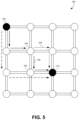
- FIG. 5 illustrates an example of how a global route can be modified using a local reward to avoid local bottlenecks from a particular router, according to some embodiments.
- FIG. 6 illustrates how a global reward can be communicated and interact with a local reward, according to some embodiments.
- FIG. 7 A illustrates an alternative to the crossbar array used in previous routers, according some embodiments.
- FIG. 7 B illustrates another indirect bus design having multiple buses that can be optimized, according to some embodiments.
- FIG. 8 illustrates a flowchart of a method of determining next hops for packets received by routers.
- chiplets have emerged as a successful alternative in system architectures to improve yields, reduce the cost of manufacture, and improve the modularity of designs.
- a chiplet is not a package type, but is rather part of a packaging architecture.
- Each chiplet may include a separate die manufactured from a silicon wafer.
- chiplet-based systems separate these functionalities out into separate dies that can then be packaged together to perform the same functionality. By making individual dies smaller, the yield and manufacturing costs are reduced for the overall system.
- FIG. 1 illustrates a chiplet-based system 100 , according to some embodiments.
- a plurality of chiplets 104 may be manufactured as separate dies from one or more silicon wafers.
- the chiplets 104 may include a plurality of different functions, such as application-specific systems-on-a-chip (SOCs), a GPU, a digital signal processor (DSP), an artificial intelligence (AI) accelerator, various codecs, Wi-Fi communication modules, memory controllers, caches, input/output (I/O) peripherals, and so forth.
- SOCs application-specific systems-on-a-chip
- DSP digital signal processor
- AI artificial intelligence
- each of these chiplets 104 may be connected together using various options to perform substantially the same functions as would be performed by a similar monolithic design, but in a distributed manner.
- chiplet-based system improves yield and manufacturing costs, such designs also greatly complicate the communication between different subsystems.
- these subsystems may communicate using a unified bus architecture, or a network-on-a-chip (NoC) fabric to pass information between the subsystems.
- NoC network-on-a-chip
- the routing between the chiplets 104 must be separately considered for each design and arrangement of chiplets.
- the chiplet-based system 100 typically must be co-designed and manufactured as a unified design. In other words, the type and physical arrangement of the chiplets 104 must first be established before the routing network can be designed and implemented. This greatly limits the scope of chiplet-based designs.
- chiplet-based designs are designed and manufactured by a single entity using architectures from a single chip ecosystem (e.g., ARM, ARC, x86), with unified communication protocols (e.g., PCIe, CCIX/CXL, AXI, AMBA, etc.).
- a single chip ecosystem e.g., ARM, ARC, x86
- unified communication protocols e.g., PCIe, CCIX/CXL, AXI, AMBA, etc.
- one chip manufacturer uses a proprietary system interconnect architecture that facilitates the data and control transmission across a chiplet-based architecture.
- this fabric supports up to eight CPU complexes and may be implemented in 2D packaging, it is not compatible with office-the-shelf chiplets.
- this fabric includes a single arbitration point, and is thus not able to scale with chiplet systems of various sizes.
- Another chip manufacturer has implemented a 3D-based chiplet architecture that uses Through-Silicon Vias (TSVs).
- TSVs Through-Silicon Vias
- the top-level die comprises a monolithic compute die with several functional blocks, including a CPU, GPU, memory controller, etc.
- a bottom die includes I/O blocks using PCIe. The top and bottom dies are connected using the TSVs.
- Some embodiments described herein may use a scalable interconnect that is manufactured independently on its own die.
- the solution is referred to herein as a “Network on Package” (NoPK), and may be designed as a dedicated die, package, or chiplet to be integrated with other chiplets in a scalable system.
- NoPK connects and facilitates communication across various off-the-shelf chiplets.
- the NoPK layer is a general-purpose scalable fabric that can work with off-the-shelf chiplets from various ecosystems.
- the NoPK can be implemented using TSVs, using a 2D approach, and using a 3D approach with vertical interconnects.
- the NoPK supports multiple protocols using interface bridges to facilitate communication between different chiplet types.
- FIG. 2 illustrates a simplified block diagram of a NoPK 200 , according to some embodiments.
- the NoPK 200 maybe a digital architecture that can be implemented to fit any combination of chiplets. This digital architecture may be implemented on a dedicated die and may be considered its own chiplet or package. Thus, the NoPK 200 may be physically separate from any of the surrounding chiplets that make up the chiplet-based system.
- the block diagram of the NoPK 200 illustrated in FIG. 2 A may be scaled as needed to meet the demands of chiplet-based systems of any size. For example, before the NoPK 200 is “taped out,” the design may add additional routing hops, interface bridges, microcontrollers, memory modules, memory controllers, and so forth, as may be required by the particular design. Therefore, the NoPK 200 illustrated in FIG.
- the NoPK 200 may include one or more interface bridges 204 .
- the interface bridges are provided in order to convert the various protocols that may be used by the surrounding chiplets into a common protocol such that chiplets from different manufacturers may communicate with each other.
- Each of the interface bridges 204 may be programmed to receive any of the available communication or bus protocols that may be available in the chiplet marketplace.
- the interface bridges 204 may support different protocols and enable dies or chiplets from different ecosystems and manufacturers to be used in a single unified design.
- these protocols may include PCIe, CCIX, CXL, AXI, AMBA, etc.
- the interface bridges 204 may be programmed to receive any of the available protocols and convert that protocol into a unified protocol that is used by the NoPK 200 .
- Traffic may include any signals, including power signals, communication signals, data signals, memory requests, and/or other electronic transmissions that may be received by the NoPK 200 .
- the interface bridges 204 may receive PCIe traffic from a microprocessor at interface bridge 204 - 1 .
- Interface bridge 204 - 1 may convert the PCIe traffic into a general packetized format and route the converted packets through the routing network of the NoPK 200 to interface bridge 204 - 3 . This may include a generic packet protocol that is not used by any of the other chiplets in the design.
- Interface bridge 204 - 3 may then convert the general packetized format into an AXI format to communicate with a Wi-Fi module of another chiplet.
- the interface bridges 204 may convert incoming traffic into one of the protocols used by the incoming traffic.
- interface bridge 204 - 1 may receive the PCIe traffic from the microprocessor and simply pass the PCIe traffic into the routing network.
- the routing network of the NoPK 200 may use PCIe as its internal communication protocol.
- the PCIe traffic When the PCIe traffic is received by interface bridge 204 - 3 , it may be converted into the AXI format to communicate with the Wi-Fi module of the other chiplet.
- the interface bridges 204 are arranged on three sides of the NoPK 200 .
- Other embodiments may further place interface bridges 204 along one, two, or four sides of the NoPK 200 , depending upon the connection requirements and orientation of the surrounding chiplets.
- orienting the interface bridges 204 along the periphery of the NoPK 200 allows vertical interconnects from layers above and/or below the NoPK layer.
- 2D implementations may also receive traces from neighboring chiplets at the periphery of the NoPK 200 through the interface bridges 204 .
- the NoPK 200 may include an internal routing network that includes a plurality of internal routers or hops that direct the traffic received from the interface bridges 204 .
- an internal routing network that includes a plurality of internal routers or hops that direct the traffic received from the interface bridges 204 .
- these packets may be passed through the internal routing network through the router hops 202 until the traffic reaches interface bridge 204 - 3 where it can be translated into AXI and passed to the Wi-Fi chip.
- the NoPK 200 may also include a controller 211 .
- the controller 211 may be implemented using a microcontroller, a microprocessor, an FPGA, and/or any programmable logic device or processor configured to execute instructions.
- the controller 211 may program the interface bridges 204 and/or the routing network according to the needs of the surrounding chiplets. This allows the NoPK architecture to be flexible enough to adapt to different chiplet ecosystems and communication protocols. It also allows the NoPK architecture to scale to meet the needs of any number of chiplets.
- the controller 211 may read/write configuration registers in the interface bridges 204 that control the protocol conversions.
- the controller 211 may also read/write configuration registers in the routing network that control connections between the interface bridges 204 .
- the controller 211 may write a configuration value to a configuration register in interface bridge 204 - 1 . This may cause interface bridge 204 - 1 to translate traffic received from the microprocessor from PCIe into a common protocol used in the routing network.
- the controller 211 may also write values to configuration registers that cause traffic received at interface bridge 204 - 1 from the microprocessor to be routed to interface bridge 204 - 3 . This may cause packets sent from interface bridge 204 - 1 to be addressed to a specific port or location on interface bridge 204 - 3 .
- the controller 204 may additionally write a configuration value to interface bridge 204 - 3 that causes traffic received internally from interface bridge 204 - 1 to be converted into AXI and sent to the Wi-Fi module of the external chiplet.
- the controller 211 may also read/write configuration registers at the router hops 202 to enforce a QoS policy on the traffic through the routing network. For example, the configurability provided by the controller 211 may allow the router hops 202 to prioritize traffic to/from specified external chiplets. Continuing with the example above, the traffic routed through the NoPK 200 from the microprocessor chiplet to the Wi-Fi module chiplet may be prioritized by the router hops 202 over communication between a chiplet implementing a GPU and a chiplet implementing a display driver. Thus, the controller 211 may program the routing network to prioritize traffic between a pair of chiplets in the design, traffic to/from a particular chiplet in the design, traffic of a particular type between any chiplets in the design, and so forth.
- the controller 211 may therefore program the configuration registers of the NoPK 200 based on the types of chiplets connected to the NoPK 200 .
- the types of chiplets may dictate the protocols that are used by the interface bridges and the corresponding configuration values that control how the interface bridges convert the various available protocols.
- the types of chiplets may also dictate the frequency/voltage used by the chiplets, and the configuration registers may be programmed such that the interface bridges properly interface with the chiplets. Additionally, the types of chiplets and their individual connections to the NoPK may be used to program the configuration registers for the routing network to route traffic between the different chiplets in the system.
- the controller 211 may also include a telemetry engine that monitors traffic and operations performed by the chiplets and reports back a unified view of data processed by the chiplet-based system.
- the controller 211 may sample and/or record any of the traffic that passes through the routing network.
- the controller 211 may also capture data from any of the chiplets in the platform package by, for example, reading performance registers associated with any of the chiplets.
- the controller 211 may then store the telemetry data in an on-board memory, in an off-board memory through the memory controller 213 , or transmit the telemetry data to an external device.
- the controller 211 may transmit the telemetry data through the interface bridges 204 through a bus connection to a monitoring computer system outside of the chiplet-based system.
- the controller 211 may transmit the telemetry data through the interface bridges 204 to a chiplet with a Wi-Fi module that transmits the telemetry data to a monitor system.
- Other embodiments may store the telemetry data in SRAM modules of the NoPK 200 such that the telemetry data may be downloaded and/or transmitted when needed. This allows end-users to obtain a unified view of data and understrand/address any bottlenecks that may occur in the traffic passing through the NoPK 200 and/or in the operations of the surrounding chiplets.
- the controller 211 may also program the interface bridges 204 and/or routing network to be compatible with different levels of dynamic voltage and frequency scaling (DVFS) used by different chiplets in the chiplet-based system. For example, various chiplets may use different voltage and/or frequency scaling to adjust the amount of power and the speed settings used by the individual chiplets.
- the controller 211 may program the interface bridges 204 to operate at different frequencies and/or at different voltages to correspond to the DVFS settings of the connected chiplet. Because the chiplets may adjust their DVFS settings during operation, it should be understood that the controller 211 can program the interface bridges 204 and/or routing network during operation.
- DVFS dynamic voltage and frequency scaling
- the controller 211 may initially program the interface bridges 204 and/or routing network after the NoPK 200 is physically connected to the plurality of chiplets during manufacturing.
- the controller 211 may also dynamically program the interface bridges 204 and/or routing network during operation as the NoPK 200 is receiving and routing traffic from the chiplets.
- Some embodiments may use a configurable memory hierarchy. These implementations may additionally include a memory controller 213 .
- the memory controller 213 may be accessible through the NoPK 200 and available for any of the connected chiplets.
- the memory controller 213 may be communicatively coupled to a memory device that is external to the NoPK 200 .
- one of the surrounding chiplets may include in SRAM that is accessible through the memory controller 213 .
- the NoPK 200 may include distributed SRAM modules 220 located in spaces between lanes of the routing network as depicted in FIG. 2 B . These SRAM modules 220 may be configured as caches or software-managed buffers.
- the SRAM modules 220 may be configurable by the controller 211 .
- the SRAM modules 220 may support the chiplet-based system as caches, which may be directly memory mapped.
- the controller 211 may configure the SRAM modules 220 to implement various eviction/replacement policies, such as Least Recently Used (LRE), First In First Out (FIFO), and/or any other cache policy. This allows the controller 211 to use the SRAM modules 200 as an adaptable memory hierarchy that can be configured during use for different use cases and workloads provided by the chiplets.
- LRE Least Recently Used
- FIFO First In First Out
- FIG. 3 illustrates an embodiment of a router 302 that may be used in the routing network, according to some embodiments.
- This router 302 may be used in the NoPK 200 described above in FIG. 2 .
- other embodiments may use this router 302 in Network-on-Chip (NoC) implementations as well.
- NoC may include a network-based communication subsystem on an integrated circuit that facilitates communications between modules in a system-on-a-chip (SoC).
- SoC system-on-a-chip
- Various topologies used in different NoC implementations may use routers to route communications through the different subsystems on the chip. More broadly, unless specified otherwise, the router 302 may be used in any communication system where routers are used to transmit packets between endpoints.
- the router 302 may include a plurality of inputs 314 . These inputs 314 may be associated with physical channels that link the router 302 to surrounding routers, chiplets, and/or SoC subsystems. Each physical channel may be linked to one or more virtual channels 304 .
- the virtual channels 304 may include multiple buffers that can share a physical channel.
- Each of the virtual channels 304 may include a credit tracker that monitors availability of the upstream and/or downstream routers connected to the corresponding physical channel.
- the packet header may be read by a next-hop table 306 to determine a next hop in the routing sequence.
- the header may include a destination address corresponding to a chiplet, etc., connected to the routing network.
- the next-hop table 306 may include a lookup table that has an entry for each possible destination. Each destination may be associated with an address referred to as a “next hop” that identifies one of the other routers connected to the router 302 to which the packet should be next sent.
- the next-hop table 306 may generate an address for a subsequent router in the routing sequence to the destination location.
- the selected next hop may result in a collision or contention over resources in the router 302 .
- two-dimensional (2D) routers may include inputs/outputs on the four cardinal directions of the router 302 , such as North, South, East, and West.
- arbitration logic 308 may handle arbitrating the conflicts between output locations. For example, the arbitration logic 308 may cause some packets to be delayed or may cause packets to be routed through different virtual channels where more bandwidth is available.
- the packet may be routed through an internal crossbar array 310 .
- This internal crossbar array 310 should be distinguished from the network array on the package or chip described above in FIG. 2 .
- This crossbar array 310 is internal to the router and serves to connect the inputs 314 to the various outputs 316 in each of the directions.
- the crossbar array may be a matrix of switches, and the dimension of the crossbar array 310 may be determined by the number of channels in each direction.
- the crossbar array 310 may include a 4 ⁇ 4 or 5 ⁇ 5 rectangular array corresponding to 4 or 5 channels in each direction.
- Each of the outputs 316 may be associated with corresponding virtual channels 312 that link multiple buffers to a single physical channel on the output 316 . Note that some embodiments may use bidirectional channels that can alternate between inputs and/or outputs.
- the embodiments described herein solve these technical problems by proposing a new router architecture that replaces the next-hop table 306 and the arbitration logic 308 with a reinforcement learning algorithm that dynamically determines a next hop in the router based on global and local considerations.
- the reinforcement learning matrix may be updated with each routing decision using a global “reward” that corresponds to the overall route between the source and the destination of the packet.
- the system may also consider a local “reward” that corresponds to the immediate delays or other effects observed in the router 302 itself.
- the reinforcement learning algorithm may make efficient routing decisions based on both local and global conditions.
- the learning matrix that stores actions for corresponding states may be statically sized such that it can scale very efficiently as the number of devices and/or ports on the router increase.
- Some embodiments may also replace the crossbar array 310 with a simple indirect connection topology, such as a bidirectional bus. Because the reinforcement learning algorithm can learn the availability of the indirect bus, it can be used more efficiently than the crossbar array 310 to achieve the same throughput
- FIG. 4 illustrates an architecture for a router 402 that uses a reinforcement learning algorithm, according to some embodiments.
- the router 402 may include a plurality of inputs 414 and a plurality of outputs 416 as described above in FIG. 3 .
- the inputs 414 and/or outputs 416 may have physical channels that are associated with one or more virtual channels 404 that include buffers for receiving packets through the inputs 414 and/or sending packets through the outputs 416 .
- the router 402 may include a plurality of hardware elements that implement a reinforcement learning algorithm in the router 402 .
- a particular type of reinforcement learning algorithm known as “Q-learning” is used by way of example. Therefore, some of the hardware elements and algorithms used herein may be referred to using terminology that is specific to Q-learning, such as a Q-matrix.
- Q-learning is used only by way of example and is not meant to be limiting. Any other reinforcement learning algorithm, particularly model-less algorithms that can be trained during use, may be used as a replacement for Q-learning without restriction. Therefore, substituting Q-learning with any known reinforcement learning algorithm or their equivalents is within the scope of this disclosure.
- a packet may be classified as having a certain state based on the packet's priority, the packet's QoS level, the datatype of the payload of the packet, a priority of the source and/or destination, and so forth.
- This type of state definition decouples the size of the decision space for the reinforcement learning algorithm from the size of the overall routing network. It also allows the router 402 to act independently without needing to define a state solely on its location relative to other devices in the routing network.
- the state generator 408 may be implemented by a lookup table that is indexed using the characteristics to define states to output a state identifier.
- the state generator may be used to index a learning matrix.
- a Q-matrix 406 may be implemented in SRAM.
- Each of the rows in the Q-matrix 406 may represent a state that may be generated by the state generator 408 .
- Each of the columns in the Q-matrix 406 may represent one of the available actions that may be taken in the various states.
- indexing a location in the Q-matrix 406 as Q[i, j] may represent a value or weight associated with taking action(j) while in state(i).
- Each of the locations in the Q-matrix 406 may represent a weight or a value associated with taking a the corresponding action when in the corresponding state.
- the state generator 408 may provide a state to the Q-matrix 406 in order to retrieve an action from the Q-matrix 406 .
- the Q-matrix 406 may retrieve the action having the highest corresponding weight or assigned value. This may correspond to taking the action from among the available actions that has the greatest likelihood of producing a maximum award over the course of the packet's journey through the routing network. In some embodiments, the Q-matrix 406 may forgo selecting the maximum value and may instead select a random value from amongst the available actions. This allows the router 402 to occasionally experiment with alternative routes to find undiscovered better routes through the routing network. Random values may be selected a predetermined percentage of the time (e.g., 10%), using, for example, an epsilon-greedy algorithm.
- the Q-matrix 406 may effectively replace the next-hop table and/or the arbitration logic.
- the actions associated with each column in the Q-matrix 406 may correspond to one of the cardinal directions out of the router 402 . For 3D packages, this may include North, South, East, West, Up, Down, etc.
- the Q-matrix 406 may stay a static size as the system grows because the number of states and actions may remain constant regardless of network size. This solves the technical problem of the size of the next-hop table and arbitration logic that grows with system size.
- Reward logic 404 may be used to drive the unsupervised learning of the reinforcement learning algorithm. Instead of using separate training and inference modes, the weights in the Q-matrix 406 can be set using rewards calculated by the reward logic 404 . As described in detail below, the reward logic 404 may receive a global reward that corresponds to the overall route between the source and the destination. The reward logic 404 may also calculate a local reward that corresponds to the immediate decision of which direction to send the packet from the router 402 . These two rewards can be combined into a reward value that is used to update the weights for each action in the Q-matrix 406 . As used herein, the term “reward” may refer to a numerical value that is used in an equation described below to update the weights in the Q-matrix 406 . The final calculated reward may be used in the reinforcement learning algorithm.
- a logic block 410 may include digital logic circuits or a microcontroller that performs mathematical operations using the output of the Q-matrix 406 .
- some embodiments may represent other actions in the Q-matrix 406 rather than the next direction for the packet to be routed. These other actions can be translated by the logic block 410 into a timing and direction for the corresponding input to be routed to the corresponding output.
- the logic block 410 may update the weight or value associated with the action based on the current reward. For example, equation (1) below illustrates one method of updating a Q value for an action.
- FIG. 5 illustrates an example of how a global route can be modified using a local reward to avoid local bottlenecks from a particular router, according to some embodiments.
- a global reward may be used to calculate a most efficient route from the perspective of the routing network as a whole.
- the global reward may generate numerical values that produce positive rewards when following path 506 between a source 502 and a destination 510 .
- This global reward may be broadcast out to each of the routers in the routing network.
- router 506 may include a global reward component that incentivizes (e.g., has a positive reward value) routing along path 506 , and that disincentives other paths.
- some embodiments may use a local reward that is maintained individually by each router that captures the action or direction of travel by the packet along with its score.
- This local reward value may be based on any metric that can be measured locally at the router. For example, some embodiments may measure a number of cycles during which a packet waits at the router 504 before being allowed to continue on path 506 .
- Other examples of local rewards may include measuring latency, throughput, the ability to prioritize packets and meet a QoS metric, and so forth. As the metric measured for the local reward changes, the local reward may be recalculated and updated. For example, the local reward may become more negative for actions that follow path 506 when the delay time waiting for an open channel on path 506 exceeds a threshold. The rewards may become less negative or more positive for actions that send the packet away from the local bottleneck on path 506 down another route.
- each router can take place during operation of the routing network. Instead of learning a single best route using a global reward that does not change after an initial optimization period is over, the system can continuously learn the most optimal route and overcome dynamic bottlenecks that rise and dissipate during operation.
- Each local router can combine the global reward that is broadcast for the route with the individual local reward calculated at the router. This combined reward may then be used to update the Q-matrix after each action is taken. Over time, each individual routing element “learns” a most optimal current route for each class of packet. As traffic patterns and workload behaviors change, the self-learning algorithm adapts the routing function based on both the global and local reward schemes. Combining these two rewards may include performing a weighted combination, an average, or other mathematical combination of these two rewards in various embodiments to form the final reward.
- FIG. 6 illustrates how a global reward can be communicated and interact with a local reward, according to some embodiments.
- some embodiments may use non-zero initial weights as a static routing policy. This ensures that initial packages through the routing network can be routed and are not dropped.
- the Q-matrix can begin with the initial weights and update these weights when a superior route is found at each router node. This ensures that initial packages are not dropped or lost in the network as the learning algorithm explores the routing network to find optimal routes. This also provides a static fallback or failsafe solution.
- These initial weights may be based on service level agreements to ensure that different packet types are transmitted in accordance with their required level of service. These initial weights may also define a optimal route that includes a fewest number of hops between the source and the destination.
- a global reward can be calculated based on the optimal path with the source and the destination.
- the router 604 can calculate the global reward for each router along the route and broadcast the global reward out to each router. In this example, this may include broadcasting the global reward to intermediate router 606 , and the router 606 can update its Q-matrix weights using the global reward.
- each router in the pathway between the source and the destination may update the Q-matrix with the global reward for that destination.
- the local rewards can be calculated at the router 606 for each action. This allows the reinforcement learning algorithm to adapt to local traffic for router 606 while still incorporating the global reward for the overall route.
- FIG. 7 A illustrates an alternative to the crossbar array used in previous routers, according some embodiments.
- the crossbar array grows exponentially with the number of ports on the router. While crossbar arrays offer a high level of interconnectivity between inputs and outputs on the router, they are not efficiently used. It can be shown that the different routes within a crossbar array have an average utilization of less than 30%. However, because of the inefficiency of using the next-hop table and arbitration logic described above, the crossbar array has been deemed necessary in order to provide an exhaustive level of connections between the inputs and outputs in different directions on the router.
- the crossbar array may be replaced with an indirect bus 412 .
- the term “direct” may be used to refer to a crossbar array or other topology that allows one-to-one connections between multiple inputs and outputs.
- the term “indirect” may be used to refer to buses that are shared between inputs and outputs that are used by one connection at a time per bus.
- the crossbar array was a necessary element to provide full connectivity. However, the reinforcement learning algorithm has been shown to be much more efficient in routing traffic internally within the router. Therefore, an indirect bus as illustrated in FIG. 7 A may be used instead of the crossbar array.
- the efficiency of the routing decisions made by the reinforcement learning algorithm can maximize the utilization of an indirect bus 710 to coordinate traffic between the inputs 702 and the outputs 704 .
- the reinforcement learning algorithm can adapt to the topology of the bus 710 to utilize it efficiently.
- FIG. 7 B illustrates another indirect bus design having multiple buses 706 , 708 that can be optimized under this same principle.
- Other examples of indirect buses or other replacements for the crossbar array may include time-series based networks (e.g., LSTM, Attention), which may be supported to predict a next packet in a sequence to significantly reduce arbitration complexities.
- Indirect networks can be configured based on the predicted next packet to reduce buffer requirements and path latency.
- FIG. 8 illustrates a flowchart of a method of determining next hops for packets received by routers. The method may be carried out by the router illustrated above in FIG. 4 . These operations may use a reinforcement learning algorithm implemented in hardware or software in the router. When implemented in software, some embodiments may cause these operations to be executed by one or more processors based on instructions stored on one or more memory devices or on a non-transitory computer-readable medium.
- the method may include receiving a packet being transmitted from a source to a destination ( 802 ).
- the packet may be transmitted from a source, such as a chiplet or subsystem in an SoC.
- the packet may include a header that stores the source/destination information.
- the packet may be received on a physical channel associated with one or more virtual channels.
- the packet may be transmitted through a NoPK or an NoC system.
- the method may also include determining a state for the packet from a plurality of states ( 804 ).
- the state determination need not use the location or sequence of the router as the state. Instead, some embodiments may use factors such as a priority level for the packet, a QoS level for the packet, a data type for the packet, a payload type for the packet, a payload value for the packet, a current latency of the packet as it is being transmitted from the source to the destination, a size of the packet, and/or other factors.
- the number of states may be decoupled from the number of chiplets or systems available as endpoints in the system.
- the number of states may also be decoupled from the number of ports on the router. In other words, some embodiments may determine a state independently from a number of endpoints or ports. Generally, the number of states does not change when the number of endpoints or ports increases or decreases.
- the method may additionally include receiving a global reward corresponding to the route between the source and the destination ( 806 ).
- the global reward may be calculated for the route between the source and the destination.
- the global reward may include rewards or punishments that produce an optimal path between the source and the destination assuming no temporary or local bottlenecks are encountered.
- the global reward may be broadcast to the router, and the global reward may be used to recalculate weights for a learning or reinforcement matrix, such as a Q-matrix.
- the method may further include calculating a local reward corresponding to next hops available to the router ( 808 ).
- the local reward may include a value that is calculated based on local metrics, such as a local number of cycles or delay associated with the packet or a destination.
- the local reward may be responsive to local bottlenecks, and the influence of the local reward may cause the original route between the source and destination to be rerouted to avoid a local bottleneck.
- the local reward may be recalculated after each action is performed, and the Q matrix may be updated accordingly. This allows the local reward to constantly learn and adjust to find a best route locally around bottlenecks.
- the method may also include combining the global reward and the local reward to generate weights for a plurality of actions corresponding to the plurality of states ( 810 ).
- Combining the two rewards may include creating a weighted combination, an average, or any other mathematical combination of the two values to generate an overall reward for an action.
- the method may additionally include determining an action corresponding to the state of the packet based on a weight for the state of the packet ( 812 ).
- the action may indicate a next hop in a route between the source and the destination, such as North, South, East, West, Up, Down, and so forth. Selecting the appropriate action may include selecting an action for a given state of the packet that has the highest weight. Other embodiments may randomly choose an action on occasion to explore other routes.
- the method may further include routing the packet to the next hop ( 814 ).
- FIG. 8 provides particular methods of determining next hops for packets received by routers according to various embodiments. Other sequences of steps may also be performed according to alternative embodiments. For example, alternative embodiments may perform the steps outlined above in a different order. Moreover, the individual steps illustrated in FIG. 8 may include multiple sub-steps that may be performed in various sequences as appropriate to the individual step. Furthermore, additional steps may be added or removed depending on the particular applications. Many variations, modifications, and alternatives also fall within the scope of this disclosure.
- circuits, systems, networks, processes, and other components may have been shown as components in block diagram form in order not to obscure the embodiments in unnecessary detail.
- well-known circuits, processes, algorithms, structures, and techniques may have been shown without unnecessary detail in order to avoid obscuring the embodiments.
- computer-readable medium includes, but is not limited to portable or fixed storage devices, optical storage devices, wireless channels and various other mediums capable of storing, containing, or carrying instruction(s) and/or data.
- a code segment or machine-executable instructions may represent a procedure, a function, a subprogram, a program, a routine, a subroutine, a module, a software package, a class, or any combination of instructions, data structures, or program statements.
- a code segment may be coupled to another code segment or a hardware circuit by passing and/or receiving information, data, arguments, parameters, or memory contents. Information, arguments, parameters, data, etc., may be passed, forwarded, or transmitted via any suitable means including memory sharing, message passing, token passing, network transmission, etc.
- embodiments may be implemented by hardware, software, firmware, middleware, microcode, hardware description languages, or any combination thereof.
- the program code or code segments to perform the necessary tasks may be stored in a machine readable medium.
- a processor(s) may perform the necessary tasks.
Landscapes
- Engineering & Computer Science (AREA)
- Signal Processing (AREA)
- Computer Networks & Wireless Communication (AREA)
- Evolutionary Computation (AREA)
- Artificial Intelligence (AREA)
- Theoretical Computer Science (AREA)
- Data Mining & Analysis (AREA)
- Medical Informatics (AREA)
- Computer Vision & Pattern Recognition (AREA)
- Evolutionary Biology (AREA)
- Bioinformatics & Computational Biology (AREA)
- Physics & Mathematics (AREA)
- General Engineering & Computer Science (AREA)
- General Physics & Mathematics (AREA)
- Bioinformatics & Cheminformatics (AREA)
- Life Sciences & Earth Sciences (AREA)
- Data Exchanges In Wide-Area Networks (AREA)
Abstract
Description
Where st and st+1 are the current and next state of the
Claims (20)
Priority Applications (6)
| Application Number | Priority Date | Filing Date | Title |
|---|---|---|---|
| US17/348,183 US12095653B2 (en) | 2021-06-15 | 2021-06-15 | Router architecture for multi-dimensional topologies in on-chip and on-package networks |
| KR1020247000857A KR20240018642A (en) | 2021-06-15 | 2022-05-26 | Router architecture for multidimensional topologies of on-chip and on-package networks |
| PCT/US2022/031139 WO2022265839A1 (en) | 2021-06-15 | 2022-05-26 | Router architecture for multi-dimensional topologies in on-chip and on-package networks |
| EP22825530.3A EP4356585A4 (en) | 2021-06-15 | 2022-05-26 | ROUTER ARCHITECTURE FOR MULTIDIMENSIONAL TOPOLOGIES IN NETWORKS ON A CHIP AND ON A HOUSING |
| CN202280051922.8A CN117716676A (en) | 2021-06-15 | 2022-05-26 | Router architecture for multi-dimensional topologies in on-chip and over-packet networks |
| TW111121616A TWI864401B (en) | 2021-06-15 | 2022-06-10 | Router and method for multi-dimensional topologies in on-chip and on-package networks |
Applications Claiming Priority (1)
| Application Number | Priority Date | Filing Date | Title |
|---|---|---|---|
| US17/348,183 US12095653B2 (en) | 2021-06-15 | 2021-06-15 | Router architecture for multi-dimensional topologies in on-chip and on-package networks |
Publications (2)
| Publication Number | Publication Date |
|---|---|
| US20220400073A1 US20220400073A1 (en) | 2022-12-15 |
| US12095653B2 true US12095653B2 (en) | 2024-09-17 |
Family
ID=84390680
Family Applications (1)
| Application Number | Title | Priority Date | Filing Date |
|---|---|---|---|
| US17/348,183 Active 2041-09-05 US12095653B2 (en) | 2021-06-15 | 2021-06-15 | Router architecture for multi-dimensional topologies in on-chip and on-package networks |
Country Status (6)
| Country | Link |
|---|---|
| US (1) | US12095653B2 (en) |
| EP (1) | EP4356585A4 (en) |
| KR (1) | KR20240018642A (en) |
| CN (1) | CN117716676A (en) |
| TW (1) | TWI864401B (en) |
| WO (1) | WO2022265839A1 (en) |
Families Citing this family (4)
| Publication number | Priority date | Publication date | Assignee | Title |
|---|---|---|---|---|
| CN116155801B (en) * | 2023-01-05 | 2024-09-17 | 华南理工大学 | Chip-to-chip network router supporting on-network computing and on-network data packet processing method |
| DE102024204919A1 (en) * | 2024-05-28 | 2025-12-04 | Robert Bosch Gesellschaft mit beschränkter Haftung | Interconnect device for a chiplet system and method for an interconnect device for a chiplet system |
| CN119537294B (en) * | 2025-01-22 | 2025-06-17 | 苏州元脑智能科技有限公司 | A controller for accelerated computing and an accelerated computing system |
| CN120975019B (en) * | 2025-03-04 | 2026-04-10 | 原粒(北京)半导体技术有限公司 | Topological structure for interconnection of core particles |
Citations (56)
| Publication number | Priority date | Publication date | Assignee | Title |
|---|---|---|---|---|
| US7120683B2 (en) * | 2000-04-03 | 2006-10-10 | Zarlink Semiconductor V.N. Inc. | Single switch image for a stack of switches |
| JP2006331067A (en) | 2005-05-26 | 2006-12-07 | Matsushita Electric Ind Co Ltd | Bus arbitration circuit control method |
| EP1775897A1 (en) * | 2005-10-17 | 2007-04-18 | Samsung Electronics Co., Ltd. | Interleaving in a NoC (Network on Chip) employing the AXI protocol |
| EP1560376B1 (en) * | 2004-01-28 | 2009-02-04 | Samsung Electronics Co., Ltd. | System-on-chip establishing paths between routers and method therefor |
| WO2010137572A1 (en) * | 2009-05-25 | 2010-12-02 | 日本電気株式会社 | Network-on-chip, network routing method, and system |
| US7903650B2 (en) * | 2003-03-05 | 2011-03-08 | Cisco Technology, Inc. | Method and apparatus for updating probabilistic network routing information |
| TW201211787A (en) | 2010-06-30 | 2012-03-16 | Intel Corp | Providing a bufferless transport method for multi-dimensional mesh topology |
| US20120144066A1 (en) * | 2010-12-01 | 2012-06-07 | Juniper Networks, Inc. | Dynamically generating application-layer traffic optimization protocol maps |
| GB2493710A (en) * | 2011-08-12 | 2013-02-20 | Uni Catholique De Louvain | A method for the sender of a packet to select the path the packet takes through a network. |
| US8699484B2 (en) * | 2010-05-24 | 2014-04-15 | At&T Intellectual Property I, L.P. | Methods and apparatus to route packets in a network |
| US20150052283A1 (en) * | 2013-02-19 | 2015-02-19 | Panasonic Intellectual Property Management Co., Ltd. | Interface apparatus and memory bus system |
| US20150124819A1 (en) * | 2012-05-16 | 2015-05-07 | Alcatel Lucent | Method and computer program products for routing a data unit |
| US9699079B2 (en) * | 2013-12-30 | 2017-07-04 | Netspeed Systems | Streaming bridge design with host interfaces and network on chip (NoC) layers |
| JP2017142774A (en) | 2015-10-26 | 2017-08-17 | エイチジーエスティーネザーランドビーブイ | Fabric interconnection for memory banks by network-on-chip method |
| US20180183728A1 (en) * | 2016-12-27 | 2018-06-28 | Netspeed Systems, Inc. | Traffic mapping of a network on chip through machine learning |
| US10205651B2 (en) * | 2016-05-13 | 2019-02-12 | 128 Technology, Inc. | Apparatus and method of selecting next hops for a session |
| US20190138948A1 (en) | 2017-11-09 | 2019-05-09 | Ciena Corporation | Reinforcement learning for autonomous telecommunications networks |
| US10355975B2 (en) | 2016-10-19 | 2019-07-16 | Rex Computing, Inc. | Latency guaranteed network on chip |
| US10397097B2 (en) * | 2017-01-18 | 2019-08-27 | Futurewei Technologies, Inc. | Weighted next hop selection at a router using an equal cost multipath process |
| US20190280963A1 (en) * | 2017-01-31 | 2019-09-12 | The Mode Group | High performance software-defined core network |
| KR102032362B1 (en) | 2018-05-15 | 2019-11-08 | 경기대학교 산학협력단 | Apparatus and method for multicast routing |
| US10552740B2 (en) * | 2014-11-10 | 2020-02-04 | International Business Machines Corporation | Fault-tolerant power-driven synthesis |
| US20200067637A1 (en) | 2018-08-21 | 2020-02-27 | The George Washington University | Learning-based high-performance, energy-efficient, fault-tolerant on-chip communication design framework |
| US10686729B2 (en) * | 2017-03-29 | 2020-06-16 | Fungible, Inc. | Non-blocking any-to-any data center network with packet spraying over multiple alternate data paths |
| US10791046B2 (en) * | 2016-11-17 | 2020-09-29 | Barefoot Networks, Inc. | Weighted-cost multi-pathing using range lookups |
| US10911261B2 (en) * | 2016-12-19 | 2021-02-02 | Intel Corporation | Method, apparatus and system for hierarchical network on chip routing |
| US10917328B2 (en) * | 2019-06-27 | 2021-02-09 | Intel Corporation | Routing updates in ICN based networks |
| US10924385B2 (en) * | 2017-11-07 | 2021-02-16 | Nicira, Inc. | Weighted multipath routing configuration in software-defined network (SDN) environments |
| US10931530B1 (en) * | 2017-06-26 | 2021-02-23 | Amazon Technologies, Inc. | Managing routing resources of a network |
| US10983910B2 (en) * | 2018-02-22 | 2021-04-20 | Netspeed Systems, Inc. | Bandwidth weighting mechanism based network-on-chip (NoC) configuration |
| US11121962B2 (en) * | 2017-01-31 | 2021-09-14 | Vmware, Inc. | High performance software-defined core network |
| US20210326275A1 (en) * | 2020-04-15 | 2021-10-21 | EMC IP Holding Company LLC | Dynamic bandwidth allocation of storage system ports |
| US20220067713A1 (en) * | 2020-08-26 | 2022-03-03 | Hewlett Packard Enterprise Development Lp | Automatically optimized credit pool mechanism based on number of virtual channels and round trip path delay |
| US11290395B1 (en) * | 2017-05-18 | 2022-03-29 | Juniper Networks, Inc. | Emulating output queued behavior in a virtual output queue switch |
| US20220129325A1 (en) * | 2020-10-28 | 2022-04-28 | Samsung Electronics Co., Ltd. | Parallelization method and apparatus with processing of neural network model for manycore system |
| US20220129769A1 (en) * | 2020-10-22 | 2022-04-28 | International Business Machines Corporation | Modular neural network computing apparatus with distributed neural network storage |
| US11329916B2 (en) * | 2020-09-03 | 2022-05-10 | 128 Technology, Inc. | Device information method and apparatus for directing link-layer communication |
| US20220182977A1 (en) * | 2019-05-28 | 2022-06-09 | Apple Inc. | Soft resource signaling in relay networks |
| US11362939B2 (en) * | 2020-08-31 | 2022-06-14 | Micron Technology, Inc. | Flow control for a multiple flow control unit interface |
| US20220222513A1 (en) * | 2019-09-03 | 2022-07-14 | Agency For Science, Technology And Research | Neural network processor system and methods of operating and forming thereof |
| US11398972B2 (en) * | 2020-03-31 | 2022-07-26 | Juniper Networks, Inc. | Transport endpoint segments for inter-domain segment routing |
| US11398980B2 (en) * | 2019-11-19 | 2022-07-26 | Advanced Micro Devices, Inc. | Packet router with virtual channel hop buffer control |
| US11438256B1 (en) * | 2020-02-27 | 2022-09-06 | Amazon Technologies, Inc. | Network routing tables generated based on pricing information |
| US11489788B2 (en) * | 2020-05-04 | 2022-11-01 | The George Washington University | Interconnection network with adaptable router lines for chiplet-based manycore architecture |
| CN115277551A (en) * | 2022-07-28 | 2022-11-01 | 上海交通大学 | Deadlock-free routing system and method for modular three-dimensional network-on-chip based on ring structure |
| US20220374288A1 (en) * | 2019-10-30 | 2022-11-24 | Cerebras Systems Inc. | Distributed placement of linear operators for accelerated deep learning |
| US11563687B2 (en) * | 2021-02-04 | 2023-01-24 | Ciena Corporation | Controlling distributed buffers in a network to manage data packets |
| US20230027585A1 (en) * | 2022-09-28 | 2023-01-26 | Intel Corporation | Inter-chiplet routing of transactions across multi-heterogeneous chiplets using hierarchical addressing |
| US11595302B2 (en) * | 2020-09-23 | 2023-02-28 | Ciena Corporation | Controlling routing behavior during router table-memory exhaustion events |
| US11658922B2 (en) * | 2020-08-31 | 2023-05-23 | Micron Technology, Inc. | Optional path ordering in packet-based network |
| CN116340248A (en) * | 2021-12-23 | 2023-06-27 | 英特尔公司 | Interconnection network for multi-chiplet systems on a chip |
| US11706127B2 (en) * | 2017-01-31 | 2023-07-18 | Vmware, Inc. | High performance software-defined core network |
| US11706146B1 (en) * | 2020-09-17 | 2023-07-18 | Amazon Technologies, Inc. | Directing network traffic using local routing decisions with a global overview |
| US20230244620A1 (en) * | 2020-06-22 | 2023-08-03 | FuriosaAl Co. | Neural network processor |
| US11757764B2 (en) * | 2019-05-23 | 2023-09-12 | Hewlett Packard Enterprise Development Lp | Optimized adaptive routing to reduce number of hops |
| US20230316057A1 (en) * | 2020-06-22 | 2023-10-05 | FuriosaAl Co. | Neural network processor |
-
2021
- 2021-06-15 US US17/348,183 patent/US12095653B2/en active Active
-
2022
- 2022-05-26 WO PCT/US2022/031139 patent/WO2022265839A1/en not_active Ceased
- 2022-05-26 EP EP22825530.3A patent/EP4356585A4/en active Pending
- 2022-05-26 KR KR1020247000857A patent/KR20240018642A/en active Pending
- 2022-05-26 CN CN202280051922.8A patent/CN117716676A/en active Pending
- 2022-06-10 TW TW111121616A patent/TWI864401B/en active
Patent Citations (58)
| Publication number | Priority date | Publication date | Assignee | Title |
|---|---|---|---|---|
| US7120683B2 (en) * | 2000-04-03 | 2006-10-10 | Zarlink Semiconductor V.N. Inc. | Single switch image for a stack of switches |
| US7903650B2 (en) * | 2003-03-05 | 2011-03-08 | Cisco Technology, Inc. | Method and apparatus for updating probabilistic network routing information |
| EP1560376B1 (en) * | 2004-01-28 | 2009-02-04 | Samsung Electronics Co., Ltd. | System-on-chip establishing paths between routers and method therefor |
| JP2006331067A (en) | 2005-05-26 | 2006-12-07 | Matsushita Electric Ind Co Ltd | Bus arbitration circuit control method |
| EP1775897A1 (en) * | 2005-10-17 | 2007-04-18 | Samsung Electronics Co., Ltd. | Interleaving in a NoC (Network on Chip) employing the AXI protocol |
| WO2010137572A1 (en) * | 2009-05-25 | 2010-12-02 | 日本電気株式会社 | Network-on-chip, network routing method, and system |
| US8699484B2 (en) * | 2010-05-24 | 2014-04-15 | At&T Intellectual Property I, L.P. | Methods and apparatus to route packets in a network |
| TW201211787A (en) | 2010-06-30 | 2012-03-16 | Intel Corp | Providing a bufferless transport method for multi-dimensional mesh topology |
| US20120144066A1 (en) * | 2010-12-01 | 2012-06-07 | Juniper Networks, Inc. | Dynamically generating application-layer traffic optimization protocol maps |
| GB2493710A (en) * | 2011-08-12 | 2013-02-20 | Uni Catholique De Louvain | A method for the sender of a packet to select the path the packet takes through a network. |
| US20150124819A1 (en) * | 2012-05-16 | 2015-05-07 | Alcatel Lucent | Method and computer program products for routing a data unit |
| US20150052283A1 (en) * | 2013-02-19 | 2015-02-19 | Panasonic Intellectual Property Management Co., Ltd. | Interface apparatus and memory bus system |
| US9699079B2 (en) * | 2013-12-30 | 2017-07-04 | Netspeed Systems | Streaming bridge design with host interfaces and network on chip (NoC) layers |
| US10552740B2 (en) * | 2014-11-10 | 2020-02-04 | International Business Machines Corporation | Fault-tolerant power-driven synthesis |
| JP2017142774A (en) | 2015-10-26 | 2017-08-17 | エイチジーエスティーネザーランドビーブイ | Fabric interconnection for memory banks by network-on-chip method |
| US10205651B2 (en) * | 2016-05-13 | 2019-02-12 | 128 Technology, Inc. | Apparatus and method of selecting next hops for a session |
| US10355975B2 (en) | 2016-10-19 | 2019-07-16 | Rex Computing, Inc. | Latency guaranteed network on chip |
| US10791046B2 (en) * | 2016-11-17 | 2020-09-29 | Barefoot Networks, Inc. | Weighted-cost multi-pathing using range lookups |
| US10911261B2 (en) * | 2016-12-19 | 2021-02-02 | Intel Corporation | Method, apparatus and system for hierarchical network on chip routing |
| US20180183728A1 (en) * | 2016-12-27 | 2018-06-28 | Netspeed Systems, Inc. | Traffic mapping of a network on chip through machine learning |
| US10397097B2 (en) * | 2017-01-18 | 2019-08-27 | Futurewei Technologies, Inc. | Weighted next hop selection at a router using an equal cost multipath process |
| US20190280963A1 (en) * | 2017-01-31 | 2019-09-12 | The Mode Group | High performance software-defined core network |
| US11121962B2 (en) * | 2017-01-31 | 2021-09-14 | Vmware, Inc. | High performance software-defined core network |
| US11706127B2 (en) * | 2017-01-31 | 2023-07-18 | Vmware, Inc. | High performance software-defined core network |
| US10686729B2 (en) * | 2017-03-29 | 2020-06-16 | Fungible, Inc. | Non-blocking any-to-any data center network with packet spraying over multiple alternate data paths |
| US11290395B1 (en) * | 2017-05-18 | 2022-03-29 | Juniper Networks, Inc. | Emulating output queued behavior in a virtual output queue switch |
| US10931530B1 (en) * | 2017-06-26 | 2021-02-23 | Amazon Technologies, Inc. | Managing routing resources of a network |
| US10924385B2 (en) * | 2017-11-07 | 2021-02-16 | Nicira, Inc. | Weighted multipath routing configuration in software-defined network (SDN) environments |
| US20190138948A1 (en) | 2017-11-09 | 2019-05-09 | Ciena Corporation | Reinforcement learning for autonomous telecommunications networks |
| US10983910B2 (en) * | 2018-02-22 | 2021-04-20 | Netspeed Systems, Inc. | Bandwidth weighting mechanism based network-on-chip (NoC) configuration |
| KR102032362B1 (en) | 2018-05-15 | 2019-11-08 | 경기대학교 산학협력단 | Apparatus and method for multicast routing |
| US20200067637A1 (en) | 2018-08-21 | 2020-02-27 | The George Washington University | Learning-based high-performance, energy-efficient, fault-tolerant on-chip communication design framework |
| US11973685B2 (en) * | 2019-05-23 | 2024-04-30 | Hewlett Packard Enterprise Development Lp | Fat tree adaptive routing |
| US11757764B2 (en) * | 2019-05-23 | 2023-09-12 | Hewlett Packard Enterprise Development Lp | Optimized adaptive routing to reduce number of hops |
| US20220182977A1 (en) * | 2019-05-28 | 2022-06-09 | Apple Inc. | Soft resource signaling in relay networks |
| US10917328B2 (en) * | 2019-06-27 | 2021-02-09 | Intel Corporation | Routing updates in ICN based networks |
| US20220222513A1 (en) * | 2019-09-03 | 2022-07-14 | Agency For Science, Technology And Research | Neural network processor system and methods of operating and forming thereof |
| US20220374288A1 (en) * | 2019-10-30 | 2022-11-24 | Cerebras Systems Inc. | Distributed placement of linear operators for accelerated deep learning |
| US11398980B2 (en) * | 2019-11-19 | 2022-07-26 | Advanced Micro Devices, Inc. | Packet router with virtual channel hop buffer control |
| US11438256B1 (en) * | 2020-02-27 | 2022-09-06 | Amazon Technologies, Inc. | Network routing tables generated based on pricing information |
| US11398972B2 (en) * | 2020-03-31 | 2022-07-26 | Juniper Networks, Inc. | Transport endpoint segments for inter-domain segment routing |
| US20210326275A1 (en) * | 2020-04-15 | 2021-10-21 | EMC IP Holding Company LLC | Dynamic bandwidth allocation of storage system ports |
| US11489788B2 (en) * | 2020-05-04 | 2022-11-01 | The George Washington University | Interconnection network with adaptable router lines for chiplet-based manycore architecture |
| US20230244620A1 (en) * | 2020-06-22 | 2023-08-03 | FuriosaAl Co. | Neural network processor |
| US20230316057A1 (en) * | 2020-06-22 | 2023-10-05 | FuriosaAl Co. | Neural network processor |
| US20220067713A1 (en) * | 2020-08-26 | 2022-03-03 | Hewlett Packard Enterprise Development Lp | Automatically optimized credit pool mechanism based on number of virtual channels and round trip path delay |
| US11658922B2 (en) * | 2020-08-31 | 2023-05-23 | Micron Technology, Inc. | Optional path ordering in packet-based network |
| US11362939B2 (en) * | 2020-08-31 | 2022-06-14 | Micron Technology, Inc. | Flow control for a multiple flow control unit interface |
| US11329916B2 (en) * | 2020-09-03 | 2022-05-10 | 128 Technology, Inc. | Device information method and apparatus for directing link-layer communication |
| US11706146B1 (en) * | 2020-09-17 | 2023-07-18 | Amazon Technologies, Inc. | Directing network traffic using local routing decisions with a global overview |
| US11595302B2 (en) * | 2020-09-23 | 2023-02-28 | Ciena Corporation | Controlling routing behavior during router table-memory exhaustion events |
| US20220129769A1 (en) * | 2020-10-22 | 2022-04-28 | International Business Machines Corporation | Modular neural network computing apparatus with distributed neural network storage |
| US20220129325A1 (en) * | 2020-10-28 | 2022-04-28 | Samsung Electronics Co., Ltd. | Parallelization method and apparatus with processing of neural network model for manycore system |
| US11563687B2 (en) * | 2021-02-04 | 2023-01-24 | Ciena Corporation | Controlling distributed buffers in a network to manage data packets |
| CN116340248A (en) * | 2021-12-23 | 2023-06-27 | 英特尔公司 | Interconnection network for multi-chiplet systems on a chip |
| CN115277551A (en) * | 2022-07-28 | 2022-11-01 | 上海交通大学 | Deadlock-free routing system and method for modular three-dimensional network-on-chip based on ring structure |
| CN115277551B (en) * | 2022-07-28 | 2024-01-12 | 上海交通大学 | Deadlock-free routing system and method for modular three-dimensional network-on-chip based on ring structure |
| US20230027585A1 (en) * | 2022-09-28 | 2023-01-26 | Intel Corporation | Inter-chiplet routing of transactions across multi-heterogeneous chiplets using hierarchical addressing |
Non-Patent Citations (2)
| Title |
|---|
| International Search Report and Written Opinion mailed on Aug. 31, 2022 in International Patent Application No. PCT/US2022/031139, 10 pages. |
| Photonic Networks-on-Chip for Future Generations of Chip Multiprocessors Assaf Shacham; Keren Bergman; Luca P. Carloni IEEE Transactions on Computers Year: 2008 | vol. 57, Issue: 9 | Journal Article | Publisher: IEEE (Year: 2008). * |
Also Published As
| Publication number | Publication date |
|---|---|
| US20220400073A1 (en) | 2022-12-15 |
| TW202318843A (en) | 2023-05-01 |
| CN117716676A (en) | 2024-03-15 |
| KR20240018642A (en) | 2024-02-13 |
| WO2022265839A1 (en) | 2022-12-22 |
| TWI864401B (en) | 2024-12-01 |
| EP4356585A1 (en) | 2024-04-24 |
| EP4356585A4 (en) | 2025-04-16 |
Similar Documents
| Publication | Publication Date | Title |
|---|---|---|
| US20220400073A1 (en) | Router architecture for multi-dimensional topologies in on-chip and on-package networks | |
| US12572500B2 (en) | Scalable network-on-chip for high-bandwidth memory | |
| US10367756B2 (en) | Programmable logic device with integrated network-on-chip | |
| US8819616B2 (en) | Asymmetric mesh NoC topologies | |
| Alimi et al. | Network-on-Chip Topologies: Potentials, Technical Challenges | |
| CN104780122B (en) | Control method based on the stratification network-on-chip router that caching is reallocated | |
| US20190266088A1 (en) | Backbone network-on-chip (noc) for field-programmable gate array (fpga) | |
| US20140092740A1 (en) | Adaptive packet deflection to achieve fair, low-cost, and/or energy-efficient quality of service in network on chip devices | |
| CN107454003B (en) | A network-on-chip router and method capable of dynamically switching working modes | |
| US10547514B2 (en) | Automatic crossbar generation and router connections for network-on-chip (NOC) topology generation | |
| WO2014209347A1 (en) | Mechanism to control resource utilization with adaptive routing | |
| CN103580890A (en) | Reconfigurable on-chip network structure and configuration method thereof | |
| US10206175B2 (en) | Communications fabric with split paths for control and data packets | |
| EP2782301A1 (en) | Relay device, method for controlling relay device, and computer program | |
| JP2012080379A (en) | Semiconductor data processing device and data processing system | |
| CN120416143B (en) | Routing method, routing node, electronic equipment and storage medium | |
| CN119537294B (en) | A controller for accelerated computing and an accelerated computing system | |
| CN107276920A (en) | A kind of distributed flow control system and mechanism applied to hybrid three-dimensional network-on-chip | |
| US20170060809A1 (en) | Automatic generation of physically aware aggregation/distribution networks | |
| US11144457B2 (en) | Enhanced page locality in network-on-chip (NoC) architectures | |
| Ying et al. | Dynamic quadrant partitioning adaptive routing algorithm for irregular reduced vertical link density topology 3-Dimensional Network-on-Chips | |
| US20180198682A1 (en) | Strategies for NoC Construction Using Machine Learning | |
| US20260050442A1 (en) | Automatic generation of control and status registers based on configuration of components in network-on-chip | |
| Matos et al. | Highly efficient reconfigurable routers in Networks-on-Chip | |
| CN108696441A (en) | A kind of adaptive routing monocycle network-on-chip router |
Legal Events
| Date | Code | Title | Description |
|---|---|---|---|
| AS | Assignment |
Owner name: APPLIED MATERIALS, INC., CALIFORNIA Free format text: ASSIGNMENT OF ASSIGNORS INTEREST;ASSIGNORS:SURI, TAMEESH;SHEIKH, BILAL SHAFI;SHAK, MYRON;AND OTHERS;REEL/FRAME:056550/0944 Effective date: 20210614 |
|
| FEPP | Fee payment procedure |
Free format text: ENTITY STATUS SET TO UNDISCOUNTED (ORIGINAL EVENT CODE: BIG.); ENTITY STATUS OF PATENT OWNER: LARGE ENTITY |
|
| STPP | Information on status: patent application and granting procedure in general |
Free format text: DOCKETED NEW CASE - READY FOR EXAMINATION |
|
| STPP | Information on status: patent application and granting procedure in general |
Free format text: RESPONSE TO NON-FINAL OFFICE ACTION ENTERED AND FORWARDED TO EXAMINER |
|
| STPP | Information on status: patent application and granting procedure in general |
Free format text: FINAL REJECTION MAILED |
|
| STPP | Information on status: patent application and granting procedure in general |
Free format text: DOCKETED NEW CASE - READY FOR EXAMINATION |
|
| STPP | Information on status: patent application and granting procedure in general |
Free format text: AWAITING TC RESP., ISSUE FEE NOT PAID |
|
| STPP | Information on status: patent application and granting procedure in general |
Free format text: NOTICE OF ALLOWANCE MAILED -- APPLICATION RECEIVED IN OFFICE OF PUBLICATIONS |
|
| STPP | Information on status: patent application and granting procedure in general |
Free format text: PUBLICATIONS -- ISSUE FEE PAYMENT VERIFIED |
|
| STCF | Information on status: patent grant |
Free format text: PATENTED CASE |