US12095224B2 - Light emitting element assembly, multi-beam laser chip assembly and stereolithographic apparatus, and member assembly and method for manufacturing the same - Google Patents
Light emitting element assembly, multi-beam laser chip assembly and stereolithographic apparatus, and member assembly and method for manufacturing the same Download PDFInfo
- Publication number
- US12095224B2 US12095224B2 US17/427,955 US202017427955A US12095224B2 US 12095224 B2 US12095224 B2 US 12095224B2 US 202017427955 A US202017427955 A US 202017427955A US 12095224 B2 US12095224 B2 US 12095224B2
- Authority
- US
- United States
- Prior art keywords
- light emitting
- emitting element
- joining member
- drive unit
- alloy material
- Prior art date
- Legal status (The legal status is an assumption and is not a legal conclusion. Google has not performed a legal analysis and makes no representation as to the accuracy of the status listed.)
- Active, expires
Links
Images




Classifications
-
- H—ELECTRICITY
- H10—SEMICONDUCTOR DEVICES; ELECTRIC SOLID-STATE DEVICES NOT OTHERWISE PROVIDED FOR
- H10W—GENERIC PACKAGES, INTERCONNECTIONS, CONNECTORS OR OTHER CONSTRUCTIONAL DETAILS OF DEVICES COVERED BY CLASS H10
- H10W90/00—Package configurations
-
- H—ELECTRICITY
- H01—ELECTRIC ELEMENTS
- H01S—DEVICES USING THE PROCESS OF LIGHT AMPLIFICATION BY STIMULATED EMISSION OF RADIATION [LASER] TO AMPLIFY OR GENERATE LIGHT; DEVICES USING STIMULATED EMISSION OF ELECTROMAGNETIC RADIATION IN WAVE RANGES OTHER THAN OPTICAL
- H01S5/00—Semiconductor lasers
- H01S5/02—Structural details or components not essential to laser action
- H01S5/022—Mountings; Housings
- H01S5/0235—Method for mounting laser chips
- H01S5/02355—Fixing laser chips on mounts
- H01S5/0237—Fixing laser chips on mounts by soldering
-
- B—PERFORMING OPERATIONS; TRANSPORTING
- B29—WORKING OF PLASTICS; WORKING OF SUBSTANCES IN A PLASTIC STATE IN GENERAL
- B29C—SHAPING OR JOINING OF PLASTICS; SHAPING OF MATERIAL IN A PLASTIC STATE, NOT OTHERWISE PROVIDED FOR; AFTER-TREATMENT OF THE SHAPED PRODUCTS, e.g. REPAIRING
- B29C64/00—Additive manufacturing, i.e. manufacturing of three-dimensional [3D] objects by additive deposition, additive agglomeration or additive layering, e.g. by 3D printing, stereolithography or selective laser sintering
- B29C64/10—Processes of additive manufacturing
- B29C64/106—Processes of additive manufacturing using only liquids or viscous materials, e.g. depositing a continuous bead of viscous material
- B29C64/124—Processes of additive manufacturing using only liquids or viscous materials, e.g. depositing a continuous bead of viscous material using layers of liquid which are selectively solidified
- B29C64/129—Processes of additive manufacturing using only liquids or viscous materials, e.g. depositing a continuous bead of viscous material using layers of liquid which are selectively solidified characterised by the energy source therefor, e.g. by global irradiation combined with a mask
- B29C64/135—Processes of additive manufacturing using only liquids or viscous materials, e.g. depositing a continuous bead of viscous material using layers of liquid which are selectively solidified characterised by the energy source therefor, e.g. by global irradiation combined with a mask the energy source being concentrated, e.g. scanning lasers or focused light sources
-
- B—PERFORMING OPERATIONS; TRANSPORTING
- B29—WORKING OF PLASTICS; WORKING OF SUBSTANCES IN A PLASTIC STATE IN GENERAL
- B29C—SHAPING OR JOINING OF PLASTICS; SHAPING OF MATERIAL IN A PLASTIC STATE, NOT OTHERWISE PROVIDED FOR; AFTER-TREATMENT OF THE SHAPED PRODUCTS, e.g. REPAIRING
- B29C64/00—Additive manufacturing, i.e. manufacturing of three-dimensional [3D] objects by additive deposition, additive agglomeration or additive layering, e.g. by 3D printing, stereolithography or selective laser sintering
- B29C64/20—Apparatus for additive manufacturing; Details thereof or accessories therefor
- B29C64/264—Arrangements for irradiation
- B29C64/268—Arrangements for irradiation using laser beams; using electron beams [EB]
-
- H01L33/486—
-
- H—ELECTRICITY
- H01—ELECTRIC ELEMENTS
- H01S—DEVICES USING THE PROCESS OF LIGHT AMPLIFICATION BY STIMULATED EMISSION OF RADIATION [LASER] TO AMPLIFY OR GENERATE LIGHT; DEVICES USING STIMULATED EMISSION OF ELECTROMAGNETIC RADIATION IN WAVE RANGES OTHER THAN OPTICAL
- H01S5/00—Semiconductor lasers
- H01S5/02—Structural details or components not essential to laser action
- H01S5/022—Mountings; Housings
- H01S5/0225—Out-coupling of light
- H01S5/02253—Out-coupling of light using lenses
-
- H—ELECTRICITY
- H01—ELECTRIC ELEMENTS
- H01S—DEVICES USING THE PROCESS OF LIGHT AMPLIFICATION BY STIMULATED EMISSION OF RADIATION [LASER] TO AMPLIFY OR GENERATE LIGHT; DEVICES USING STIMULATED EMISSION OF ELECTROMAGNETIC RADIATION IN WAVE RANGES OTHER THAN OPTICAL
- H01S5/00—Semiconductor lasers
- H01S5/02—Structural details or components not essential to laser action
- H01S5/022—Mountings; Housings
- H01S5/0233—Mounting configuration of laser chips
- H01S5/0234—Up-side down mountings, e.g. Flip-chip, epi-side down mountings or junction down mountings
-
- H—ELECTRICITY
- H01—ELECTRIC ELEMENTS
- H01S—DEVICES USING THE PROCESS OF LIGHT AMPLIFICATION BY STIMULATED EMISSION OF RADIATION [LASER] TO AMPLIFY OR GENERATE LIGHT; DEVICES USING STIMULATED EMISSION OF ELECTROMAGNETIC RADIATION IN WAVE RANGES OTHER THAN OPTICAL
- H01S5/00—Semiconductor lasers
- H01S5/02—Structural details or components not essential to laser action
- H01S5/022—Mountings; Housings
- H01S5/0239—Combinations of electrical or optical elements
-
- H—ELECTRICITY
- H01—ELECTRIC ELEMENTS
- H01S—DEVICES USING THE PROCESS OF LIGHT AMPLIFICATION BY STIMULATED EMISSION OF RADIATION [LASER] TO AMPLIFY OR GENERATE LIGHT; DEVICES USING STIMULATED EMISSION OF ELECTROMAGNETIC RADIATION IN WAVE RANGES OTHER THAN OPTICAL
- H01S5/00—Semiconductor lasers
- H01S5/40—Arrangement of two or more semiconductor lasers, not provided for in groups H01S5/02 - H01S5/30
- H01S5/4025—Array arrangements, e.g. constituted by discrete laser diodes or laser bar
- H01S5/4031—Edge-emitting structures
-
- H—ELECTRICITY
- H01—ELECTRIC ELEMENTS
- H01S—DEVICES USING THE PROCESS OF LIGHT AMPLIFICATION BY STIMULATED EMISSION OF RADIATION [LASER] TO AMPLIFY OR GENERATE LIGHT; DEVICES USING STIMULATED EMISSION OF ELECTROMAGNETIC RADIATION IN WAVE RANGES OTHER THAN OPTICAL
- H01S5/00—Semiconductor lasers
- H01S5/40—Arrangement of two or more semiconductor lasers, not provided for in groups H01S5/02 - H01S5/30
- H01S5/42—Arrays of surface emitting lasers
- H01S5/423—Arrays of surface emitting lasers having a vertical cavity
-
- H—ELECTRICITY
- H10—SEMICONDUCTOR DEVICES; ELECTRIC SOLID-STATE DEVICES NOT OTHERWISE PROVIDED FOR
- H10H—INORGANIC LIGHT-EMITTING SEMICONDUCTOR DEVICES HAVING POTENTIAL BARRIERS
- H10H20/00—Individual inorganic light-emitting semiconductor devices having potential barriers, e.g. light-emitting diodes [LED]
- H10H20/80—Constructional details
- H10H20/85—Packages
- H10H20/8506—Containers
-
- H—ELECTRICITY
- H01—ELECTRIC ELEMENTS
- H01S—DEVICES USING THE PROCESS OF LIGHT AMPLIFICATION BY STIMULATED EMISSION OF RADIATION [LASER] TO AMPLIFY OR GENERATE LIGHT; DEVICES USING STIMULATED EMISSION OF ELECTROMAGNETIC RADIATION IN WAVE RANGES OTHER THAN OPTICAL
- H01S5/00—Semiconductor lasers
- H01S5/02—Structural details or components not essential to laser action
- H01S5/024—Arrangements for thermal management
- H01S5/02407—Active cooling, e.g. the laser temperature is controlled by a thermo-electric cooler or water cooling
- H01S5/02423—Liquid cooling, e.g. a liquid cools a mount of the laser
-
- H—ELECTRICITY
- H01—ELECTRIC ELEMENTS
- H01S—DEVICES USING THE PROCESS OF LIGHT AMPLIFICATION BY STIMULATED EMISSION OF RADIATION [LASER] TO AMPLIFY OR GENERATE LIGHT; DEVICES USING STIMULATED EMISSION OF ELECTROMAGNETIC RADIATION IN WAVE RANGES OTHER THAN OPTICAL
- H01S5/00—Semiconductor lasers
- H01S5/10—Construction or shape of the optical resonator, e.g. extended or external cavity, coupled cavities, bent-guide, varying width, thickness or composition of the active region
- H01S5/16—Window-type lasers, i.e. with a region of non-absorbing material between the active region and the reflecting surface
-
- H—ELECTRICITY
- H01—ELECTRIC ELEMENTS
- H01S—DEVICES USING THE PROCESS OF LIGHT AMPLIFICATION BY STIMULATED EMISSION OF RADIATION [LASER] TO AMPLIFY OR GENERATE LIGHT; DEVICES USING STIMULATED EMISSION OF ELECTROMAGNETIC RADIATION IN WAVE RANGES OTHER THAN OPTICAL
- H01S5/00—Semiconductor lasers
- H01S5/20—Structure or shape of the semiconductor body to guide the optical wave ; Confining structures perpendicular to the optical axis, e.g. index or gain guiding, stripe geometry, broad area lasers, gain tailoring, transverse or lateral reflectors, special cladding structures, MQW barrier reflection layers
- H01S5/22—Structure or shape of the semiconductor body to guide the optical wave ; Confining structures perpendicular to the optical axis, e.g. index or gain guiding, stripe geometry, broad area lasers, gain tailoring, transverse or lateral reflectors, special cladding structures, MQW barrier reflection layers having a ridge or stripe structure
-
- H—ELECTRICITY
- H10—SEMICONDUCTOR DEVICES; ELECTRIC SOLID-STATE DEVICES NOT OTHERWISE PROVIDED FOR
- H10H—INORGANIC LIGHT-EMITTING SEMICONDUCTOR DEVICES HAVING POTENTIAL BARRIERS
- H10H20/00—Individual inorganic light-emitting semiconductor devices having potential barriers, e.g. light-emitting diodes [LED]
- H10H20/80—Constructional details
- H10H20/85—Packages
- H10H20/857—Interconnections, e.g. lead-frames, bond wires or solder balls
Definitions
- the present disclosure relates to a light emitting element assembly, a multi-beam laser chip assembly and a stereolithographic apparatus, and a member assembly and a method for manufacturing the member assembly.
- a multi-beam laser chip in which a plurality of laser elements is arranged adjacent to one another is widely used these days (see Japanese Patent Application Laid-Open No. 2003-158332, for example). Further, a plurality of laser elements is often joined to a submount (see Japanese Patent Application Laid-Open No. 2008-277471, for example).
- the present disclosure aims to provide a light emitting element assembly that can prevent warpage despite its simple configuration and structure, a multi-beam laser chip assembly and a stereolithographic apparatus, and a member assembly and a method for manufacturing the member assembly.
- a light emitting element assembly of the present disclosure for achieving the above objective includes:
- a multi-beam laser chip assembly of the present disclosure for achieving the above objective includes a plurality of light emitting element assemblies that are arranged adjacent to one another,
- a stereolithographic apparatus of the present disclosure for achieving the above objective includes:
- a member assembly of the present disclosure for achieving the above objective includes:
- a member assembly manufacturing method of the present disclosure for achieving the above objective includes:
- FIG. 1 A and FIG. 1 B are schematic partial cross-sectional views of a light emitting element assembly, a multi-beam laser chip assembly, and a member assembly of a first embodiment
- FIG. 1 A and FIG. 1 B are schematic partial cross-sectional views taken along arrows A-A and arrows B-B defined in FIG. 2 A and FIG. 2 B .
- FIG. 2 A and FIG. 2 B are partial layout diagrams schematically showing the layout of the components of the light emitting element assembly, the multi-beam laser chip assembly, and the member assembly of the first embodiment.
- FIG. 3 is a schematic partial cross-sectional view of a light emitting element assembly and the like for explaining a method for manufacturing the light emitting element assembly, the multi-beam laser chip assembly, and the member assembly of the first embodiment.
- FIG. 4 A and FIG. 4 B are schematic partial cross-sectional views of a light emitting element assembly and the like for explaining the method for manufacturing the light emitting element assembly, the multi-beam laser chip assembly, and the member assembly of the first embodiment, continuing from FIG. 3 .
- FIG. 5 A is a graph showing the results of analysis conducted on a first joining member and a second joining member that have been joined in one light emitting element of the first embodiment.
- FIG. 5 B is a graph showing the results of measurement of the heights H 1 of the first joint members of sixteen light emitting elements after the joining.
- FIG. 6 A and FIG. 6 B are partial layout diagrams schematically showing the layouts of the components of Modification-1 and Modification-2, respectively, of the light emitting element assembly, the multi-beam laser chip assembly, and the member assembly of the first embodiment.
- FIG. 7 A and FIG. 7 B are partial layout diagrams schematically showing the layouts of the components of Modification-3 and Modification-4, respectively, of the light emitting element assembly, the multi-beam laser chip assembly, and the member assembly of the first embodiment.
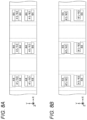
- FIG. 8 A and FIG. 8 B are partial layout diagrams schematically showing the layouts of the components of Modification-5 and Modification-6, respectively, of the light emitting element assembly, the multi-beam laser chip assembly, and the member assembly of the first embodiment.
- FIG. 9 is a partial layout diagram schematically showing the layout of the components of a light emitting element assembly, a multi-beam laser chip assembly, and a member assembly of a second embodiment.
- FIG. 10 A is a schematic partial cross-sectional view of Modification-1 of the light emitting element assembly, the multi-beam laser chip assembly, and the member assembly of the second embodiment.
- FIG. 10 B is a partial layout diagram schematically showing the layout of the components of Modification-1 of the second embodiment.
- FIG. 10 A is a schematic partial cross-sectional view taken along arrows A-A defined in FIG. 10 B .
- FIG. 11 is a partial layout diagram schematically showing the layout of the components of Modification-2 of the second embodiment.
- FIG. 12 is a schematic perspective view of a light emitting element (a laser element).
- FIG. 13 is a side view of a stereolithographic apparatus of a third embodiment.
- FIG. 14 is an electric block diagram of the stereolithographic apparatus of the third embodiment.
- FIG. 15 is a perspective view of a light detection unit that forms the stereolithographic apparatus of the third embodiment.
- FIG. 16 is an exploded perspective view of a light source unit that forms the stereolithographic apparatus of the third embodiment.
- FIG. 17 is a perspective view of a light emitting module in the light source unit that forms the stereolithographic apparatus of the third embodiment.
- FIG. 18 is an enlarged perspective view of part of the light emitting module in the light source unit that forms the stereolithographic apparatus of the third embodiment.
- a condensing member can be formed with a convergent rod lens. Further, in the stereolithographic apparatus of the present disclosure including such a preferred mode, light collected by the condensing member can be formed into an image on a photocurable resin, and the photocurable resin can be cured. Note that the respective lens portions constituting the convergent rod lens are disposed so as to face the light emitting portions of light emitting elements.
- multi-beam laser chip assembly of the present disclosure or in a stereolithographic apparatus of the present disclosure (hereinafter, these may be collectively referred to as a “multi-beam laser chip assembly and the like of the present disclosure” in some cases),
- the distance between the light emitting portions of light emitting elements is preferably 10 ⁇ m or longer and 100 ⁇ m or shorter, or preferably 50 ⁇ m or shorter in some mode, to achieve reliable junctions based on eutectic crystal and in view of resolution, as will be described later.
- the distances between the light emitting portions of the respective light emitting elements are preferably equal.
- N ⁇ 25 can be satisfied. That is, a multi-beam laser chip may include 50 or more light emitting elements in some mode.
- a light emitting element drive unit can be formed with a submount.
- the submounts can be arranged in the longitudinal direction of the multi-beam laser chip.
- external input electrode pads may be provided on the submounts, and the external input electrode pads can be disposed on the opposite side from the light emitting portions of the multi-beam laser chip, and in a region within the length of the multi-beam laser chip in the longitudinal direction.
- a light emitting element drive unit can be formed with a semiconductor substrate in which a light emitting element drive circuit is provided.
- the distances between the light emitting portions of the light emitting elements may be set so that the light density P A at an imaging center A and the light density P C at a position C satisfies the relationship P C ⁇ 0.5P A , where A represents the imaging center of light emitted from one light emitting element, B represents the imaging center of light emitted from a light emitting element adjacent to the one light emitting element, and C represents the position at the dichotomy point between the imaging center A and the imaging center B.
- the light emitting element drive units may be mounted on a heat transfer plate, or may be mounted on a cooling member.
- a plurality of light emitting element assemblies is accommodated in a housing, and a cooling mechanism that cools the heat generated by the plurality of light emitting element assemblies may be provided in the housing.
- a second portion and a first portion can be disposed adjacent to each other. That is, part of a side surface of the second portion can be in contact with part of a side surface of the first portion.
- the second portion may be disposed at a distance from the first portion. That is, any side surface of the second portion may not be in contact with any side surface of the first portion.
- the second portion is disposed on one of the light emitting element (or the light emitting element extension portion) and the light emitting element drive unit, and is in contact with the other one of the light emitting element (or the light emitting element extension portion) and the light emitting element drive unit.
- H 1 ⁇ H 2 can be satisfied, where H 1 represents the height of the first portion, and H 2 represents the height of the second portion.
- the alloy material may contain atoms forming the metallic material. Further, in this case, the first portion and the joining member including the metallic material are preferably joined to each other on the basis of eutectic crystal accompanied by diffusion of the atoms forming the metallic material. Further, in these cases, the alloy material can be formed with a gold-tin (Au—Sn) solder material, and the metallic material can be formed with gold (Au). In some cases, part of the first joining member including the surface (the opposing surface) of the first joining member facing the second joining member may be formed with gold (Au).
- the melting point of the alloy material forming the region of the first portion adjacent to the joining member including the metallic material may be lower than the melting point of the alloy material forming the second portion.
- the composition of the alloy material forming the region of the first portion adjacent to the joining member including the metallic material can be different from the composition of the alloy material forming the second portion.
- the tin content of the alloy material that is formed with a gold-tin (Au—Sn) solder material and forms the region of the first portion adjacent to the joining member including the metallic material is 18% by mass to 29 by mass %
- the tin content of the alloy material that is formed with a gold-tin (Au—Sn) solder material and forms the second portion is smaller than 18% by mass or greater than 29% by mass. That is, before the joining member including the metallic material and the first portion are joined to each other, the second portion and the first portion have the same composition.
- the region of the first portion adjacent to the joining member including the metallic material may have a different composition from that of the second portion.
- the second portion and the first portion may be formed with different materials or different compositions.
- a light emitting element may be formed with a laser element (an end-emitting semiconductor laser element) that emits light from an end face.
- a laser element an end-emitting semiconductor laser element
- light emitting elements are not limited to such a mode, and may be formed with end-emitting super luminescent diodes (SLDs), surface-emitting laser elements (also called vertical resonator lasers, or VCSELs), or light emitting diodes (LEDs).
- SLDs super luminescent diodes
- VCSELs surface-emitting laser elements
- LEDs light emitting diodes
- a light emitting element drive unit may be formed with a submount, or may be formed with a semiconductor substrate in which a light emitting element drive circuit is provided.
- S 1 represents the cross-sectional area of a first portion
- S 2 represents the cross-sectional area of a second portion, cut in a virtual plane orthogonal to the thickness direction
- S 3 represents the cross-sectional area of a joining member including the metallic material when cut in a virtual plane orthogonal to the thickness direction
- S 1 >S 3 is satisfied in some cases
- S 1 S 3 or S 1 ⁇ S 3 is satisfied in other cases.
- the light reflectance of the light emitting portion is preferably not lower than 5% and not higher than 90%
- the light reflectance of the surface (the back end face) facing the light emitting portion is preferably not lower than 60% but is lower than 100%.
- a first joining member and a second joining member can be formed on the basis of a combination of a patterning technique and a film forming method formed with a chemical vapor deposition method (CVD method) or a physical vapor deposition method (PVD method) such as a vacuum vapor deposition method or a sputtering method, for example, a plating technique, a printing technique, or the like.
- CVD method chemical vapor deposition method
- PVD method physical vapor deposition method
- a vacuum vapor deposition method or a sputtering method for example, a plating technique, a printing technique, or the like.
- a light emitting element has a stack structure in which a first compound semiconductor layer having a first conductivity type (n type, for example), a light emitting layer (an active layer), and a second compound semiconductor layer having a second conductivity type (p type, for example) different from the first conductivity type are stacked.
- a first electrode can be electrically connected to the first compound semiconductor layer, and a second electrode can be electrically connected to the second compound semiconductor layer in this structure.
- the light emitting layer (active layer) may be formed with a single compound semiconductor layer as an active layer, but preferably has a quantum well structure.
- the light emitting layer (active layer) may have a single quantum well structure (SQW structure), or may have a multiple quantum well structure (MQW structure).
- the first compound semiconductor layer and the second compound semiconductor layer are also called a first cladding layer and a second cladding layer.
- Each of the first compound semiconductor layer and the second compound semiconductor layer may be a layer having a single-layer structure, a layer having a multilayer structure, or a layer having a superlattice structure, or may even be a layer including a composition gradient layer and a concentration gradient layer.
- Examples of colors of light to be emitted by a light emitting element include any color such as red, green, blue, and purple.
- Examples of the material forming the light emitting layers of a red light emitting element that emits red light, a green light emitting element that emits green light, and a blue light emitting element that emits blue light include those using a group III-V compound semiconductor, and further, examples of the material forming the light emitting layer of a red light emitting element include those using an AlGaInP-based compound semiconductor.
- Examples of the group III-V compound semiconductor include GaN-based compound semiconductors (including AlGaN mixed crystal or AlInGaN mixed crystal, and InGaN mixed crystal), and further, these compound semiconductors may contain boron (B) atoms, thallium (Tl) atoms, arsenic (As) atoms, phosphorus (P) atoms, or antimony (Sb) atoms, as desired.
- GaN-based compound semiconductors including AlGaN mixed crystal or AlInGaN mixed crystal, and InGaN mixed crystal
- these compound semiconductors may contain boron (B) atoms, thallium (Tl) atoms, arsenic (As) atoms, phosphorus (P) atoms, or antimony (Sb) atoms, as desired.
- Examples of combinations of (the compound semiconductor forming the well layer and the compound semiconductor forming the barrier layer) in a light emitting layer having a quantum well structure may include (In y Ga (1-y) N, GaN), (In y Ga (1-y) N, In Z Ga (1-y) N) [where y>z], and (In y Ga (1-y) N, AlGaN).
- the group III-V compound semiconductor may be a GaInNAs-based compound semiconductor (including GaInAs mixed crystal or GaNAs mixed crystal), an AlGaInP-based compound semiconductor, an AlAs-based compound semiconductor, an AlGaInAs-based compound semiconductor, an AlGaAs-based compound semiconductor, a GaInAs-based compound semiconductor, a GaInAsP-based compound semiconductor, a GaInP-based compound semiconductor, a GaP-based compound semiconductor, an InP-based compound semiconductor, an InN-based compound semiconductor, or an AlN-based compound semiconductor, for example.
- GaInNAs-based compound semiconductor including GaInAs mixed crystal or GaNAs mixed crystal
- the second conductivity type is the p type.
- the second conductivity type is the n type.
- n-type impurities added to the compound semiconductor layers include silicon (Si), selenium (Se), germanium (Ge), tin (Sn), carbon (C), and titanium (Ti).
- p-type impurities include zinc (Zn), magnesium (Mg), beryllium (Be), cadmium (Cd), calcium (Ca), barium (Ba), and oxygen (O).
- Examples of methods (film forming methods) for forming the various compound semiconductor layers including the active layer include a metalorganic chemical vapor deposition method (MOCVD method), a metalorganic vapor phase epitaxy method (MOVPE method), a molecular beam epitaxy method (MBE method), a metalorganic molecular beam epitaxy method (MOMBE method), a hydride vapor phase epitaxy method (HVPE method) in which halogen contributes to transport or reaction, a plasma-assisted physical vapor phase deposition method (PPD method), an atomic layer deposition method (ALD Method), and a migration enhanced epitaxy method (MEE method).
- MOCVD method metalorganic chemical vapor deposition method
- MOVPE method metalorganic vapor phase epitaxy method
- MBE method molecular beam epitaxy method
- MOMBE method metalorganic molecular beam epitaxy method
- HVPE method hydride vapor phase epitaxy method in which halogen contributes to transport or reaction
- the organic gallium source gas in the MOCVD method may be a trimethylgallium (TMG) gas or a triethylgallium (TEG) gas, for example, and the nitrogen source gas may be an ammonia gas or a hydrazine gas, for example.
- TMG trimethylgallium
- TMG triethylgallium
- the nitrogen source gas may be an ammonia gas or a hydrazine gas, for example.
- Si silicon
- n-type dopant n-type dopant
- a GaN-based compound semiconductor layer having the p-type conductivity it is only required to add magnesium (Mg) as a p-type impurity (p-type dopant), for example.
- Mg magnesium
- Al aluminum
- In indium
- TMA trimethylaluminum
- TMI trimethylindium
- a monosilane gas SiH 4 gas
- a bis-cyclopentadienylmagnesium gas, methylcyclopentadienylmagnesium, or bis-cyclopentadienylmagnesium Cp 2 Mg
- examples of n-type impurities (n-type dopants) include Ge, Se, Sn, C, Te, S, O, Pd, and Po, as well as Si
- examples of p-type impurities (p-type dopants) include Zn, Cd, Be, Ca, Ba, C, Hg, and Sr, as well as Mg.
- the first electrode is an n-side electrode
- the second electrode is a p-side electrode
- the first electrode is a p-side electrode
- the second electrode is an n-side electrode.
- the first electrode and the second electrode can be formed by a PVD method such as a vacuum vapor deposition method or a sputtering method, for example.
- the first conductivity type is the n type
- the second conductivity type is the p type.
- the first electrode preferably has a single-layer configuration or a multilayer configuration including at least one metal (or alloy) selected from the group consisting of gold (Au), silver (Ag), palladium (Pd), platinum (Pt), nickel (Ni), titanium (Ti), vanadium (V), tungsten (W), chromium (Cr), aluminum (Al), copper (Cu), zinc (Zn), tin (Sn), and indium (In), for example.
- the single-layer configuration or the multilayer configuration include Ti/Au, Ti/Al, Ti/Al/Au, Ti/Pt/Au, Ni/Au, AuGe/Ni/Au, AuGe/Ni/(Au/)Ti/Pt/Au, AuGe/Ni/(Ti/)TiW/Pt/Au, Ni/Au/Pt, Ni/Pt, Pd/Pt, Pd/AuGe, Ag/Pd, and Ti. Note that a layer shown before “/” in a multilayer configuration is located closer to the active layer side.
- examples of the second electrode include Au/AuZn, Au/Pt/Ti(/Au)/AuZn, Au/Pt/TiW(/Ti) (/Au)/AuZn, Au/AuPd, Au/Pt/Ti (/Au)/AuPd, Au/Pt/TiW(/Ti) (/Au)/AuPd, Au/Pt/Ti, Au/Pt/Ti, Au/Pt/TiW(/Ti), Au/Pt/TiW/Pd/TiW(/Ti), Ti/Cu, Pt, Ni, Ag, and Ge. Note that a layer before “/” is located at a position electrically farther from the active layer.
- the second electrode may be formed with a transparent conductive material such as indium tin oxide (ITO, Sn-doped In 2 O 3 , crystalline ITO, or amorphous ITO), indium zinc oxide (IZO), indium gallium oxide (IGO), indium-doped gallium zinc oxide (IGZO, or In—GaZnO 4 ), IFO (F-doped In 2 O 3 ), ITiO (Ti-doped In 2 O 3 ), InSn, InSnZnO, a tin-based transparent conductive material [specifically, tin oxide (SnO 2 ), ATO (Sb-doped SnO 2 ), or FTO (F-doped SnO 2 ), for example], a zinc-based transparent conductive material [specifically, zinc oxide (ZnO, Al-doped ZnO (AZO), or B-doped ZnO), gallium-doped zinc oxide (GZO), or AlMg
- a first pad portion may be formed on (a surface of) the first electrode, and a second pad portion may be formed on (a surface of) the second electrode.
- a pad portion preferably has a single-layer configuration or a multilayer configuration containing at least one metal selected from the group consisting of titanium (Ti), aluminum (Al), platinum (Pt), gold (Au), nickel (Ni), and palladium (Pd).
- a pad portion may have a Ti/Pt/Au multilayer configuration, a Ti/Au multilayer configuration, a Ti/Pd/Au multilayer configuration, a Ti/Pd/Au multilayer configuration, a Ti/Ni/Au multilayer configuration, or a Ti/Ni/Au/Cr/Au multilayer configuration, for example.
- a cover metal layer formed with Ni/TiW/Pd/TiW/Ni is formed on a surface of the first electrode, for example, and a pad portion having a Ti/Ni/Au multilayer configuration or a Ti/Ni/Au/Cr/Au multilayer configuration can be formed on the cover metal layer, for example.
- the side surfaces or the exposed surface of the stack structure may be covered with a coating layer (an insulating film).
- the coating layer (insulating film) can be formed on the basis of a known method.
- the refractive index of the material forming the coating layer (insulating film) is preferably lower than the refractive index of the material forming the stack structure.
- Examples of the insulating material forming the coating layer (insulating film) include SiO X -based materials including SiO 2 , SiN X -based materials, SiO Y N Z -based materials, TaO X , ZrO X , AlN X , AlO X , and GaO X .
- such examples may include organic materials such as polyimide resins.
- the method for forming the coating layer (insulating film) may be a PVD method such as a vacuum vapor deposition method or a sputtering method, a CVD method, or a coating method, for example.
- Examples of light emitting element manufacturing substrates designed for manufacturing light emitting elements may include a GaAs substrate, a GaP substrate, an AlN substrate, an AlP substrate, an InN substrate, an InP substrate, an AlGaInN substrate, an AlGaN substrate, an AlInN substrate, a GaInN substrate, an AlGaInP substrate, an AlGaP substrate, an AlInP substrate, a GaInP substrate, a ZnS substrate, a sapphire substrate, a SiC substrate, an alumina substrate, a ZnO substrate, a LiMgO substrate, a LiGaO 2 substrate, a MgAl 2 O 4 substrate, a Si substrate, a Ge substrate, and those having an underlayer and a buffer layer formed on surfaces (principal surfaces) of these substrates.
- a red light emitting element a green light emitting element, and a blue light emitting element
- the characteristics of a GaN substrate change to polar, non-polar, or semi-polar characteristics, depending on the growth surface.
- any principal surface (a second surface) of a GaN substrate can be used for forming a compound semiconductor layer.
- crystal orientation planes called A-plane, B-plane, C-plane, R-plane, M-plane, N-plane, S-plane, and the like, or planes formed by tilting these planes in a specific direction, or the like can also be used, depending on the crystal structure (of a cubic type, a hexagonal type, or the like, for example).
- a substrate may be formed with a GaN substrate having a ⁇ 20-21 ⁇ plane that is a semi-polar surface as a principal surface (a GaN substrate whose principal surface is a surface having the c-plane tilted by about 75 degrees in an m-axis direction).
- a conductive light emitting element manufacturing substrate is left on, with the first compound semiconductor layer formed on one surface of the light emitting element manufacturing substrate in some cases. In other cases, the light emitting element manufacturing substrate is removed after a light emitting element is formed on the light emitting element manufacturing substrate. Further, in the former case, the first electrode is formed on the other surface of the conductive light emitting element manufacturing substrate. In the latter case, the first electrode is formed on the first compound semiconductor layer. In a multi-beam laser chip assembly and a stereolithographic apparatus of the present disclosure, a conductive light emitting element manufacturing substrate is left on, with the first compound semiconductor layer formed on one surface of the light emitting element manufacturing substrate.
- the first electrode is then formed on the other surface of the conductive light emitting element manufacturing substrate, and the first electrode is shared (common) by a plurality of light emitting element assemblies.
- the second compound semiconductor layer side preferably faces the light emitting element drive unit, from the viewpoint of heat dissipation and simplicity of the electrode configuration. Further, in this case, the electrode provided on a light emitting element to which a first joining member is connected is the second electrode.
- FIGS. 1 A and 1 B show schematic partial cross-sectional views of the light emitting element assembly, the multi-beam laser chip assembly, and the member assembly of the first embodiment.
- FIGS. 2 A and 2 B are partial layout diagrams schematically showing the layout of the components of the light emitting element assembly, the multi-beam laser chip assembly, and the member assembly of the first embodiment. Note that FIGS. 1 A and 1 B are schematic partial cross-sectional views taken along the arrows A-A and the arrows B-B defined in FIGS. 2 A and 2 B . Further, in a portion of FIG. 2 A , and in a portion of FIG. 9 , a portion of FIG. 10 B , and a portion of FIG. 11 described later, the regions of light emitting elements are surrounded by dot-and-dash lines.
- a light emitting element assembly 20 of the first embodiment includes:
- a multi-beam laser chip assembly 11 of the first embodiment is formed with a plurality of light emitting element assemblies that are arranged in parallel, and each light emitting element assembly is formed with a light emitting element assembly 20 of the first embodiment.
- a light emitting element 21 includes a laser element (an end-emitting semiconductor laser element) that emits light from its end face.
- the second portion 44 is disposed next to the first portion 43 . That is, a side surface of the second portion 44 is in contact with a side surface of the first portion 43 .
- H 1 the height of the first portion
- H 2 the height of the second portion
- the alloy material forming the second joining member 42 contains atoms forming the metallic material forming the first joining member 41 .
- the first portion 42 and the joining member including a metallic material (the first joining member 41 ) are joined to each other, on the basis of the eutectic crystal accompanied by diffusion of atoms forming the metallic material.
- the alloy material is formed with a gold-tin (Au—Sn) solder material, and the metallic material is formed with gold (Au).
- part of the first joining member 41 including the surface (the opposing surface) of the first joining member 41 facing the second joining member 42 includes gold (Au).
- the melting point MP 1 of the alloy material forming the region of the first portion 43 adjacent to the first joining member 41 is lower than the melting point MP 2 of the alloy material forming the second portion 44 .
- the composition of the alloy material forming the region of the first portion 43 adjacent to the first joining member 41 is different from the composition of the alloy material forming the second portion 44 .
- the tin content of the alloy material that is formed with a gold-tin (Au—Sn) solder material and forms the region of the first portion 43 adjacent to the first joining member 41 is 18% by mass to 29% by mass, or more specifically, is 20% by mass, for example.
- the tin content of the alloy material that is formed with a gold-tin (Au—Sn) solder material and forms the second portion 44 is smaller than 18% by mass or greater than 29% by mass, or specifically, is 30% by mass, for example.
- the melting point MP 1 of the alloy material forming the region of the first portion 43 adjacent to the first joining member 41 is 280° C.
- the melting point MP 2 of the alloy material forming the second portion 44 is 400° C.
- the melting point of the alloy material forming the second portion 44 and the first portion 43 is MP 2 .
- the region of the first portion 43 adjacent to the first joining member 41 and the second portion 44 have different compositions as described above.
- a light emitting element is formed with an end-emitting semiconductor laser element.
- the light reflectance of the light emitting portion is preferably not lower than 5% and not higher than 90%, and the light reflectance of the surface facing the light emitting portion (the back end face) is preferably not lower than 60% but lower than 100%.
- the distances between the light emitting portions of the light emitting elements 21 is not shorter than 10 ⁇ m and not longer than 100 ⁇ m, preferably is 50 ⁇ m or shorter, or specifically, is 20 ⁇ m, and the distances between the light emitting portions of the light emitting elements 21 are equal.
- the light emitting element drive unit 30 is formed with a submount, or is formed with a semiconductor substrate having a light emitting element drive circuit formed therein.
- the first member (specifically, the light emitting element) 21 having the first joining member 41 of a metallic material provided thereon, and the second member (specifically, the light emitting element drive unit) 30 that is formed with the first portion 43 and the second portion 44 and has a second joining member 42 ′ of an alloy material provided thereon are prepared (see a schematic partial cross-sectional view in FIG. 3 ).
- first portion 43 of the second joining member 42 and the first joining member 41 being in contact with each other, pressure is then applied between the first member 21 and the second member 30 with an appropriate means (a collet, for example) (see a schematic partial cross-sectional view in FIG. 4 A ).
- an appropriate means a collet, for example
- the first joining member 41 and the second joining member 42 are then heated, so that the first portion 43 is melted and is joined to the first joining member 41 , and the second portion 44 is brought into contact with the first member 21 .
- a collet is used to heat the first joining member 41 and the second joining member 42 to (MP 2 ⁇ T)° C.
- ⁇ T is preferably 10° C. to 100° C.
- the alloy material is formed with a gold-tin solder material, and the metallic material is formed with gold (in some cases, part of the first joining member 41 including the surface (the opposing surface) of the first joining member 41 facing the second joining member 42 is formed with gold (Au)), which means that the alloy material contains atoms forming the metallic material, the first portion 43 in contact with the first joining member 41 has diffusion of the atoms forming the metallic material from the first joining member 41 . As a result, the melting point of the first portion 43 becomes lower. In the end, the region of the first portion 43 adjacent to the first joining member 41 , and the first joining member 41 are joined to each other on the basis of eutectic crystal (see schematic partial cross-sectional views in FIG. 4 B , and FIGS.
- the eventual composition of the first portion 43 joined to the first joining member 41 on the basis of eutectic crystal is 80% by mass of gold and 20% by mass of tin.
- the composition of the second portion 44 remains 70% by mass of gold and 30% by mass of tin.
- FIG. 5 A shows the results of analysis conducted on a first joining member 41 and a second joining member 42 to which one light emitting element is joined. That is, FIG. 5 A shows the interface between the second portion 44 and the first member 21 , and the interface between the first portion 43 and the first joining member 41 .
- FIG. 5 A indicates the height (unit: ⁇ m) of these components, and the abscissa axis of FIG. 5 A indicates the position of the second joining member 42 in the X direction. Also, the results of measurement of the height H 1 of the first joining member 41 after joining of the sixteen light emitting elements 21 are shown in “A” of FIG. 5 B .
- “B” of FIG. 5 B shows the results of measurement of the height of a first joining member 41 in a light emitting element assembly obtained in a state in which no pressure is applied between the first member 21 and the second member 30 while the first portion 43 of the second joining member 42 is in contact with the first joining member 41 . Note that the abscissa axis of FIG.
- the ordinate axis of FIG. 5 B indicates the array of the sixteen light emitting elements, and the ordinate axis of FIG. 5 B indicates the height H 1 (unit: ⁇ m) of the first joining member 41 after the joining of the sixteen light emitting elements 21 . Also, regarding “B” of FIG. 5 B , the ordinate axis of FIG. 5 B indicates the penetration depth of the first joining member 41 into the second portion 44 . As can be seen from FIG. 5 B , the height H 1 of the first joining member 41 in the light emitting element assembly obtained by applying pressure between the first member 21 and the second member 30 is uniform, and furthermore, the height of the first joining member 41 hardly changes before and after the joining.
- FIGS. 6 A, 6 B, 7 A, 7 B, 8 A, and 8 B show partial layout diagrams schematically showing the layouts of the components of Modification-1, Modification-2, Modification-3, Modification-4, Modification-5, and Modification-6 of the light emitting element assembly, the multi-beam laser chip assembly, and the member assembly of the first embodiment.
- the first portion 43 and the second portion 44 are arrayed in the X direction.
- the first portion 43 and the second portion 44 are arrayed in the Y direction.
- the second portion 44 is in contact with two side surfaces of the first portion 43 and the first joining member 41 .
- the second portion 44 is in contact with three side surfaces of the first portion 43 and the first joining member 41 .
- the height of the second portion remains H 2 . Accordingly, in the multi-beam laser chip assembly obtained by such a method for manufacturing a light emitting element assembly of the first embodiment and by such a method for manufacturing a member assembly of the first embodiment, the distance between the light emitting elements and the light emitting element drive unit in the light emitting element assembly can be defined by the height H 2 of the second portion.
- the distance between the light emitting elements and the light emitting element drive unit in the light emitting element assembly can be defined by the height H 2 of the second portion.
- first joining member and the second joining member are formed with materials having high thermal conductivity and electric conductivity, such as gold and a gold-tin solder material.
- FIG. 12 shows a schematic perspective view of a light emitting element (a laser element) in a multi-beam laser chip. Note that, between FIGS. 1 A and 1 B and FIG. 12 , the positional relationship in the vertical direction in a light emitting element is reversed.
- a light emitting element 21 includes a substrate 22 formed with a GaN substrate, a stack structure 23 formed on one surface of the substrate 22 , and a contact layer 23 D including GaN, for example.
- the stack structure 23 includes, from the substrate side, a first compound semiconductor layer 23 A formed with AlGaN, for example, a light emitting layer (an active layer) 23 C having a multiple quantum well structure (MQW structure) formed with GaInN having different composition ratios in the well layer and the barrier layer, and a second compound semiconductor layer 23 B formed with AlGaN, for example.
- a ridge portion (an optical waveguide) 24 is formed so as to protrude from the second compound semiconductor layer 23 B.
- the ridge portion 24 is part of the stack structure 23 (specifically, part of the second compound semiconductor layer 23 B). At the ridge portion, light confinement in the X direction is performed by taking advantage of the difference in refractive index in the X direction, and the current to be injected into the stack structure 23 is narrowed.
- the light emitting layer 23 C one end face of the ridge portion 24 is a light emitting region 24 A.
- the light emitting element (laser element) 21 has a structure in which the strip-shaped ridge portion 24 long in the Z direction is sandwiched between the front end face and the back end face in the resonator direction (Z direction). That is, as described above, the light emitting element (laser element) 21 is an end-emitting semiconductor laser.
- the light emitting portion (the front end face 24 A) of the light emitting element 21 is the face from which light is emitted, and a multilayer reflective film (not shown) is formed on the light emitting portion.
- the surface (the back end face) facing the light emitting portion is the surface by which light is reflected, and a multilayer reflective film (not shown) is also formed on this surface.
- the light reflectance of the multilayer reflective film on the light emitting portion (the front end face) is about 10%, for example.
- the reflectance of the multilayer reflective film on the surface (the back end face) facing the light emitting portion is about 95%, for example.
- a first electrode 26 is formed on the other surface of the substrate 22 .
- the first electrode 26 is shared (common) by a plurality of light emitting elements 21 .
- a second electrode 27 is formed on the surface of the ridge portion 24 (the surface of the contact layer 23 D) so as to cover the entire ridge portion 24 , and the second electrode 27 is in contact with the contact layer 23 D.
- an insulating layer 25 is formed on the stack structure 23 excluding the contact layer 23 D.
- the insulating layer 25 includes SiO 2 , SiN, ZrO 2 , or the like, for example.
- FIG. 9 is a partial layout diagram schematically showing the layout of the components of a light emitting element assembly, a multi-beam laser chip assembly, and a member assembly of the second embodiment.
- FIG. 10 A shows a schematic partial cross-sectional view of Modification-1 of the light emitting element assembly, the multi-beam laser chip assembly, and the member assembly of the second embodiment.
- FIG. 10 B is a partial layout diagram schematically showing the layout of the components of Modification-1 of the second embodiment.
- FIG. 11 is a partial layout diagram schematically showing the layout of the component of Modification-2 of the second embodiment.
- FIG. 10 A is a schematic partial cross-sectional view taken along the arrows A-A defined in FIG. 10 B .
- a second portion 46 is disposed at a distance from a first portion 45 . That is, any side surface of a second portion 46 is not in contact with any side surface of any first portion 45 .
- the first portions 45 are separated from the second portions 46 in the Y direction.
- the first portions 45 are separated from the second portions 46 in the X direction.
- the first portions 45 are separated from second portions 47 in the Y direction.
- the material forming the second portion 46 and the first portion 45 before the joining is an Au—Sn solder material containing 70% by mass of gold and 30% by mass of tin, as in the first embodiment.
- the material is not limited to this, and the first portion 45 and the second portion 46 before the joining may include different materials or be formed with different compositions.
- the light emitting element assembly, the multi-beam laser chip assembly, and the member assembly of the second embodiment can have configurations and structures similar to those of the light emitting element assembly, the multi-beam laser chip assembly, and the member assembly of the first embodiment, and therefore, detailed explanation of them is not made herein.
- a third embodiment relates to a stereolithographic apparatus of the present disclosure.
- FIG. 13 shows a conceptual side view of a stereolithographic apparatus 100 of the third embodiment.
- FIG. 14 is an electric block diagram showing the stereolithographic apparatus 100 .
- the stereolithographic apparatus 100 of the third embodiment includes:
- the stereolithographic apparatus 100 of the third embodiment includes:
- the resin tank 103 is a container whose upper surface is open, and can store the liquid photocurable resin 101 therein.
- the photocurable resin 101 an epoxy-based or urethane-based ultraviolet curable resin or the like is used, for example.
- the stage 104 is a flat plate-like member, and supports the modeled object 102 formed by being cured by light emitted from the light source unit 120 from below.
- the stage elevating mechanism 112 can move the stage 104 in the vertical direction (Z direction).
- the stage elevating mechanism 112 moves the stage 104 downward by a predetermined distance each time one layer of the modeled object 102 is formed.
- the distance to move the stage 104 downward is equal to the thickness T 0 of one layer of the modeled object 102 , and is also equal to the exposure depth D 0 of the light source unit 120 with respect to the photocurable resin 101 .
- the thickness T 0 of one layer and the exposure depth D 0 are 20 ⁇ m, but are not limited to this.
- the thickness T 0 of one layer and the exposure depth D 0 can be selected between several tens of ⁇ m and several hundreds of ⁇ m, as appropriate.
- the light source unit 120 irradiates the surface of the photocurable resin 101 (the surface planarized by the blade 105 ) with light while being moved in the scanning direction (Y direction) by the light source moving mechanism 113 .
- the photocurable resin 101 is exposed (cured) layer by layer.
- the light source unit 120 includes a plurality of light emitting elements (laser elements) 21 (see FIG. 12 ) arrayed in the X direction, and the photocurable resin 101 is exposed in dots and is cured by light emitted from these light emitting elements 21 .
- the distance L 0 between the lower end face of the light source unit 120 (the lower end face of a convergent rod lens 122 ) and the (planarized) surface of the photocurable resin 101 is set at 2 mm, for example. However, the distance L 0 can be changed as appropriate.
- the height of the light source unit 120 is adjusted so that the focal position of light to be emitted from the light source unit 120 is a position at a distance of several ⁇ m to several tens of ⁇ m from the (planarized) surface of the photocurable resin 101 .
- the configuration of the light source unit 120 will be described later in detail.
- the blade 105 is disposed on the front side (the left side in FIG. 13 ) of the light source unit 120 in the traveling direction, and can be moved together with the light source unit 120 by the light source moving mechanism 113 .
- the distance between the blade 105 and the light source unit 120 is 30 mm, for example, but this distance can be changed as appropriate.
- the blade 105 is a flat plate-like member, and is moved by the light source moving mechanism 113 while being in contact with the surface of the photocurable resin 101 on its lower surface. In this manner, the blade 105 planarizes the surface of the photocurable resin 101 .
- the light source moving mechanism 113 can move the light source unit 120 and the blade 105 in three axial directions of the X direction, the Y direction, and the Z direction.
- the light source moving mechanism 113 moves the light source unit 120 and the blade 105 in the scanning direction (Y direction), after positioning the light source unit 120 and the blade 105 on one end side (the exposure start position: the right side in FIG. 13 ) of the resin tank 103 in the Y direction.
- the light source moving mechanism 113 also moves, in the Z direction (upward), the light source unit 120 and the blade 105 that have moved to the other end side (the left side) of the resin tank 103 in the scanning direction (Y direction), so that the light source unit 120 and the blade 105 do not come into contact with the surface of the photocurable resin 101 . After that, the light source moving mechanism 113 again moves the light source unit 120 and the blade 105 to the one end side (the right side) of the resin tank 103 , to return them to the original positions.
- the light source moving mechanism 113 moves the light source unit 120 and the blade 105 in the X direction.
- the light source moving mechanism 113 may be designed to be capable of moving the light source unit 120 and the blade 105 in the two axial directions of the X direction and the Y direction in the horizontal direction, or may be designed to be capable of moving the light source unit 120 and the blade 105 only in the one axial direction of the Y direction in the horizontal.
- the cooling mechanism 130 is attached to a side surface of the light source unit 120 , and cools the light source unit 120 by receiving heat generated in the light source unit 120 .
- the cooling mechanism 130 includes a housing 131 capable of containing water inside, and two tubes 132 connected to the housing 131 . Of the two tubes 132 , one tube 132 is a water supply tube, and the other tube 132 is a drainage tube.
- the circulation pump 134 is disposed in the water circulation path in the cooling mechanism 130 , and water is circulated by the cooling mechanism 130 .
- FIG. 15 is a perspective view of the light detection unit 140 .
- the light detection unit 140 is disposed on the front side (the lower side in FIG. 13 ) of the light source unit 120 in the light emission direction, and detects light emitted from the light source unit 120 .
- the light detection unit 140 is disposed on a support 144 attached to an outer surface of the resin tank 103 .
- the position at which the light detection unit 140 is disposed may be any position within the moving range (X-Y direction) of the light source unit 120 .
- the light detection unit 140 is designed to be capable of detecting light, while the distance L between the light source unit 120 and the light detection unit 140 varies.
- the light detection unit 140 includes a first light detection unit 141 , and a second light detection unit 142 disposed so that the distance from the light source unit 120 differs from that of the first light detection unit 141 . That is, the distance between the light source unit 120 and the first light detection unit 141 is L 1 , and the distance between the light source unit 120 and the second light detection unit 142 is L 2 (>L 1 ).
- the number of the light detection units 140 may be one, or may be three or larger.
- the first light detection unit 141 and the second light detection unit 142 each include a plurality of line sensors 143 that are long in the X direction (the array direction of the light emitting elements 21 ).
- the line sensors 143 include a plurality of light receiving elements arrayed in the X direction.
- the number of the light receiving elements included in one line sensor 143 is set at 5,400.
- the distance between each two light receiving elements adjacent to each other is 4 ⁇ m, and the resolution is 4 ⁇ m.
- the reason why the resolution of the line sensors 143 is set at a high value of 4 ⁇ m is that the light detection unit 140 accurately detects the distribution of the amount of light from the light emitting elements 21 at a narrow pitch.
- the number of the light receiving elements and the distance between the light receiving elements are not limited to these values, and can be changed as appropriate.
- the plurality of line sensors 143 is arrayed in a staggered pattern, and is arrayed in a straight line.
- the reason why the plurality of line sensors 143 is arranged in a staggered pattern is now described. That is, in a case where the length of the line sensors 143 that can be taken out from one wafer is not as long as the target length, it is necessary to array a plurality of line sensors 143 in a straight line. On the other hand, as described above, the distance between adjacent light receiving elements is set at a small value of 4 ⁇ m.
- the distance between the light receiving element disposed at the end of one line sensor 143 and the light receiving element disposed at the end of the other line sensor 143 also needs to be 4 ⁇ m.
- the distance between the light receiving element disposed at the end of one line sensor 143 and the light receiving element disposed at the end of the other line sensor 143 cannot be 4 ⁇ m. Therefore, the plurality of line sensors 143 is arrayed in a staggered pattern, so that the distance between the light receiving element disposed at the end of one line sensor 143 and the light receiving element disposed at the end of the other line sensor 143 can be 4 ⁇ m.
- the positions of the imaging planes of the first light detection unit 141 and the second light detection unit 142 can be changed, as appropriate, within the range between the (planarized) surface of the photocurable resin 101 and the position that is lower than the (planarized) surface by the length equivalent to the exposure depth D 0 . That is, the positions of the imaging planes of the first light detection unit 141 and the second light detection unit 142 are set so that the conditions shown below are satisfied with the distance L 0 , the distances (L 1 , L 2 ), and the exposure depth D 0 : L 0 ⁇ L 1 ⁇ L 2 ⁇ L 0 +D 0
- the control unit 111 includes a central processing unit (CPU), for example, and comprehensively controls the respective components of the stereolithographic apparatus 100 .
- the control unit 111 performs a process of forming the modeled object 102 , on the basis of modeling data (three-dimensional computer aided design (CAD) data).
- CAD computer aided design
- the storage unit 114 includes a nonvolatile memory in which various kinds of programs and data required for the processing to be performed by the control unit 111 are stored, and a volatile memory to be used as a work area of the control unit 111 .
- the programs may be read from a portable memory such as an optical disk or a semiconductor memory, or may be downloaded from a server device in a network.
- FIG. 16 is an exploded perspective view of the light source unit 120 .
- the size of the entire light source unit 120 is 420 mm in width (X direction), 30 mm in depth (Y direction), and 50 mm in height (Z direction), but is not limited to these values.
- the light source unit 120 includes a housing 121 that accommodates various components of the light source unit 120 therein, a light emitting module 150 , and a condensing member (convergent rod lens) 122 disposed on the light emission side of the light emitting module 150 , a connector 123 , a glass epoxy substrate 124 to which the connector 123 is attached, and a heat transfer plate 125 on which the light emitting module 150 and the glass epoxy substrate 124 are mounted.
- a condensing member convergent rod lens
- the housing 121 has a rectangular parallelepiped shape that is long in the X direction (the array direction of the light emitting elements 21 ), and includes a first base 126 and a second base 127 .
- the housing 121 is formed with various metallic materials (stainless steel, for example). However, the material used for the housing 121 may be any material that has a strength and a thermal conductivity at a certain level or higher.
- the first base 126 and the second base 127 are secured with screws or the like, and are integrated to form the housing 121 .
- the first base 126 has a groove portion 126 a in which the convergent rod lens 122 is to be fitted, a groove portion (not shown) in which the connector 123 is to be fitted, and the like.
- the second base 127 has a groove portion 127 a in which the convergent rod lens 122 is to be fitted, a groove portion 127 b formed between the light emitting module 150 and the convergent rod lens 122 , and the like.
- the cooling mechanism 130 is secured to a position on an outer surface with screws or the like via an O-ring 133 , the position corresponding to the position at which the heat transfer plate 125 is disposed.
- the condensing member (convergent rod lens) 122 condenses light emitted from the respective light emitting elements 21 of the light emitting module 150 , and forms an image on the (planarized) surface of the photocurable resin 101 .
- the convergent rod lens 122 is secured, being fitted into an opening of the housing 121 .
- the opening is formed with the groove portion 126 a of the first base 126 and the groove portion 127 a of the second base 127 .
- the convergent rod lens 122 is formed with a plurality of columnar lens portions (rod lens portions) 122 a that are long in the Z direction and are arrayed in the X direction and the Y direction.
- convergent rod lens 122 As the convergent rod lens 122 , a Selfoc lens array (Selfoc: registered trademark) manufactured by Nippon Sheet Glass Company, Limited is used. The focal length of the convergent rod lens 122 from the lower end face is about 2 mm.
- the heat transfer plate 125 is formed with various kinds of metallic materials (copper, for example). Note that the material used for the heat transfer plate 125 may be any material that has a strength and a thermal conductivity at a certain level or higher.
- the light emitting module 150 and the glass epoxy substrate 124 are mounted on the heat transfer plate 125 , and the heat transfer plate 125 on which these components are mounted is temporarily secured onto the second base 127 via an adhesive having a high thermal conductivity (an ultraviolet curable silver paste, for example). Further, the heat transfer plate 125 and the second base 127 are secured with screws from the side of the second base 127 .
- the heat transfer plate 125 and the second base 127 are secured with screws not in the region of the light emitting module 150 but in the region of the glass epoxy substrate 124 .
- the heat transfer plate 125 and the second base 127 are secured with screws not in the region of the light emitting module 150 but in the region of the glass epoxy substrate 124 as described above, so as not to affect the accuracy of the distances between the light emitting elements 21 in the light emitting module 150 .
- the connector 123 is electrically connected to the glass epoxy substrate 124 , and the electric power and various kinds of signals for driving the light source unit 120 are input to the connector 123 .
- the glass epoxy substrate 124 and the light emitting module 150 (specifically, a driver IC 151 ) are connected by wire bonding.
- the gap between the first base 126 and the second base 127 , the gap between the housing 121 and the convergent rod lens 122 , and the gap between the housing 121 and the connector 123 are filled and sealed with an adhesive, to prevent ingress of volatile substances of the photocurable resin 101 .
- the light emitting module 150 and the glass epoxy substrate 124 to which the connector 123 is attached are mounted on the heat transfer plate 125 .
- the light emitting module 150 (a driver IC 151 ) and the glass epoxy substrate 124 are connected by wire bonding.
- the heat transfer plate 125 on which the light emitting module 150 and the glass epoxy substrate 124 are mounted is temporarily secured onto the second base 127 via an adhesive (not shown) having a high thermal conductivity, and further, is secured with screws.
- the heat transfer plate 125 is secured with screws not in the region of the glass epoxy substrate 124 but in the region of the light emitting module 150 .
- the first base 126 and the second base 127 are secured with screws.
- the convergent rod lens 122 is then secured to the opening of the housing 121 , the opening being formed with the groove portion 126 a of the first base 126 and the groove portion 127 a of the second base 127 .
- the position of the convergent rod lens 122 with respect to the light emitting module 150 is adjusted, and the convergent rod lens 122 is then temporarily secured to the housing 121 with an ultraviolet curable adhesive.
- the gap between the first base 126 and the second base 127 , the gap between the housing 121 and the convergent rod lens 122 , and the gap between the housing 121 and the connector 123 are filled and sealed with an adhesive.
- the cooling mechanism 130 is screwed to the housing 121 (the second base 127 ).
- FIG. 17 is a perspective view of the light emitting module 150 in the light source unit 120 .
- FIG. 18 is an enlarged perspective view of part of the light emitting module 150 .
- the light emitting module 150 includes a plurality of driver ICs 151 (mount members), a plurality of light emitting element drive units 30 (submounts (submount members) 160 ) mounted on the driver ICs 151 , and multi-beam laser chips 12 (multi-illuminators) mounted on the submounts 160 .
- driver IC 151 mount members
- light emitting element drive units 30 submounts (submount members) 160
- multi-beam laser chips 12 multi-illuminators mounted on the submounts 160 .
- the number of the driver ICs 151 is 16, but the number of the driver ICs 151 included in the light emitting module 150 is not limited to any particular number and can be changed as appropriate.
- the size of a driver IC 151 is 20.47 mm in width (X direction), 5 mm in depth (Z direction), and 0.09 mm in height (Y direction), for example.
- the overall width (X direction) of the light emitting module 150 is about 330 mm, for example, and the size of the heat transfer plate 125 on which the light emitting module 150 is mounted is 350 mm in width (X direction), 30 mm in depth (Z direction), and 3 mm in height (Y direction), for example.
- the first joining member 41 and the second joining member 42 are not disposed in the region on the outer side of the light emitting portion of the first light emitting element 21 and in the region on the outer side of the 2Nth light emitting element 21 , the first joining member 41 and the second joining member 42 are disposed between the light emitting portion of the first light emitting element 21 and the light emitting portion of the second light emitting element 21 , and the first joining member 41 and the second joining member 42 are disposed between the light emitting portion of the (2N ⁇ 1)th light emitting element 21 and the light emitting portion of the 2Nth light emitting element 21 .
- the distance between the light emitting element 21 located at the end of one of two multi-beam laser chips 12 adjacent to each other and the light emitting element 21 located at the end of the other one of the two multi-beam laser chips 12 can be made equal to the distance between the light emitting elements 21 in the same multi-beam laser chip 12 . Accordingly, a modeled object can be formed more accurately than in a case where the distance between light emitting elements of two multi-beam laser chips adjacent to each other is different from the distance between the light emitting elements in a multi-beam laser chip.
- the distance between the light emitting elements 21 of two multi-beam laser chips adjacent to each other can be made equal to the distance (20 ⁇ m) between the light emitting elements in a multi-beam laser chip.
- the driver ICs 151 are formed with silicon substrates, for example. Further, a driver IC 151 has a plurality of input electrode pads 152 and a plurality of output electrode pads 153 on its top surface. The input electrode pads 152 are connected to the glass epoxy substrate 124 by wire bonding. Meanwhile, the output electrode pads 153 are connected to input electrode pads 162 on the submounts 160 by wire bonding.
- a driver IC 151 includes a drive circuit for driving each light emitting element (laser element) 21 included in the multi-beam laser chips 12 on the plurality of submounts 160 mounted on the driver IC 151 .
- a signal for controlling the light emission timing and the light emitting time for driving each light emitting element 21 is input from the control unit 111 to the drive circuit.
- the drive circuit causes each light emitting element 21 to emit light, via switching circuits in the submounts 160 .
- One light emitting time at a light emitting element 21 is 1 ⁇ sec, and the number of times light emission is performed per unit time is controlled to adjust the integrated light amount.
- sixteen driver ICs 151 control light emission of different light emitting elements 21 from one another, and therefore, different signals from one another are input from the control unit 111 to the sixteen driver ICs 151 .
- the submounts 160 are mounted on one driver IC 151 in the X direction (the array direction of the light emitting elements 21 ).
- the submounts 160 are secured onto the driver ICs 151 via an adhesive (not shown) having a high thermal conductivity (an ultraviolet curable silver paste, for example).
- the size of a submount 160 is 630 ⁇ m in width (X direction), 1000 ⁇ m in depth (Z direction), and 90 ⁇ m in height (Y direction), for example.
- the submounts 160 are formed with silicon substrates, for example.
- a submount 160 has a plurality of joining pads (not shown), a plurality of input electrode pads 162 , and one common electrode pad 163 on its top surface.
- a submount 160 also has a plurality of alignment marks 164 on its top surface.
- the joining pads are formed with Au plating layers of 10 ⁇ m in thickness. These joining pads are electrically connected to the second electrodes 27 of the multi-beam laser chip 12 .
- the positions and the shape of the joining pads are the same as the positions and the shape of the second electrodes 27 in the multi-beam laser chip 12 .
- the plurality of input electrode pads 162 is connected to the output electrode pads 153 of the driver IC 151 by wire bonding.
- the number of the input electrode pads 162 is four, and the size of each input electrode pad is 90 ⁇ m ⁇ 90 ⁇ m.
- the four input electrode pads 162 are used for power supply, GND, first switching pulse input, and second switching pulse input, for example.
- the common electrode pad 163 is connected to the first electrode 26 shared (common) in the multi-beam laser chip 12 , by wire bonding.
- the size of the common electrode pad 163 is 90 ⁇ m ⁇ 90 ⁇ m.
- a submount 160 includes a switching circuit for individually switching each light emitting element 21 of the multi-beam laser chip 12 mounted on the submount 160 , to cause each light emitting element 21 to emit light. Specifically, the switching circuit switches the plurality of light emitting elements 21 in the multi-beam laser chip 12 to emit light in response to a switching pulse input from the driver IC 151 (the drive circuit) via the input electrode pads 162 .
- the alignment marks 164 are used when the multi-beam laser chips 12 are mounted on the submounts 160 , and are also used when the submounts 160 on which the multi-beam laser chips 12 are mounted are mounted on the driver ICs 151 .
- One multi-beam laser chip 12 is mounted on one submount 160 .
- a plurality of multi-beam laser chips 12 may be mounted on one submount 160 .
- the size of a multi-beam laser chip 12 is 630 ⁇ m (same as the width of a submount 160 ) in width (X direction), 280 ⁇ m in depth (Z direction), and 90 ⁇ m in height (Y direction), for example.
- a multi-beam laser chip 12 includes a plurality of light emitting elements (laser elements) 21 that are long in the Z direction.
- the plurality of light emitting elements 21 is arranged at predetermined interval in the X direction, and emit light in the Z direction.
- the oscillation wavelength of the light emitting elements (laser elements) 21 is 405 nm.
- a multi-beam laser chip 12 has a first electrode 26 shared (common) among the plurality of light emitting elements 21 and alignment marks 13 on its top surface, and has a plurality of second electrodes 27 for supplying electric power to each of the plurality of light emitting elements 21 .
- the number of the light emitting elements 21 included in one multi-beam laser chip 12 is 32, but this number can be changed as appropriate. Further, the distance between two light emitting elements 21 adjacent to each other (the distance between the ridge portions 24 ) is 20 ⁇ m, and the distance between the light emitting elements 21 can also be changed as appropriate. However, the distance between the light emitting elements 21 is typically 100 ⁇ m or shorter.
- a first electrode 26 is formed on the entire top surface of a multi-beam laser chip 12 , and is connected to the common electrode pad 163 on the submount 160 by wire bonding.
- the first electrode 26 is formed with a stack of an alloy of Au and Ge, Ni, Au, and the like, for example.
- the alignment marks 13 are used when the multi-beam laser chips 12 are mounted on the submounts 160 , and are also used when the submounts 160 on which the multi-beam laser chips 12 are mounted are mounted on the driver ICs 151 .
- the two second electrodes 27 that supply electric power to two light emitting elements 21 adjacent to each other are disposed in the region between the two light emitting elements 21 adjacent to each other (a region on the lower surface of the multi-beam laser chip 12 ).
- the region between the two light emitting elements 21 adjacent to each other is used as the one region in which the two second electrodes 27 that supply electric power to the two respective light emitting elements 21 adjacent to each other are disposed.
- a second electrode 27 includes an electrode main body and a plating portion formed on the electrode main body.
- the electrode main body is formed with a stack of Ti, Pt, Au, and the like, for example.
- the electrode main body includes a coating portion formed so as to cover a light emitting element 21 , and a base portion extending from the coating portion.
- the size of the base portion is about half the size of the region between two light emitting elements 21 adjacent to each other. Further, one of the two base portions disposed in this region is located on the front side (Z direction), and the other one is located on the back side (Z direction). Note that, in practice, the shape of the second electrodes 27 is longer in the Z direction than that shown in FIG. 12 .
- the plating portion is formed with an Au plating of 2 ⁇ m in thickness.
- Au—Au ultrasonic joining of this plating portion formed with Au to the joining pads (including Au) on the submount 160 is performed, so that the multi-beam laser chip 12 is flip-chip mounted on the submount 160 .
- the joining method is not limited to this, and may be Au—Sn joining, Cu—Cu joining, or the like.
- the respective light emitting elements (laser elements) 21 is converged by the condensing member (the convergent rod lens) 122 , and forms images at different imaging positions in the X direction.
- one light emitting element 21 exposes a region of one dot. In this region of one dot, light is strongest at the center of imaging, and light becomes weaker at a position farther away from the center of imaging.
- the two dots cured by two light emitting elements 21 adjacent to each other need to be appropriately connected. That is, if the distance between two light emitting elements 21 adjacent to each other is too long, the imaging centers of the respective light emitting elements 21 are separated, and the two dots cannot be appropriately connected.
- Light emitting element assemblies, multi-beam laser chip assemblies, a stereolithographic apparatus, and a member assembly and a method for manufacturing the member assembly of the present disclosure have been described above on the basis of embodiments, but these are not limited to the embodiments.
- a first joining member 41 on a light emitting element 21 and providing a second joining member 42 on a light emitting element drive unit 30
- the light emitting elements may be some other light emitting elements, such as light emitting diodes (LEDs).
- the multi-beam laser chips 12 may be disposed on the lower side of the submounts 160 , not on the upper side of the submounts 160 , and the submounts 160 may be mounted on the driver ICs 151 by flip-chip mounting, not by wire bonding.
- the light emitting module 150 can be applied to various kinds of apparatuses such as a laser printer, a laser display apparatus, and a measuring apparatus.
- a light emitting element assembly including:
- a multi-beam laser chip assembly including
- a stereolithographic apparatus including:
- a member assembly including:
- a method for manufacturing a member assembly including:
Landscapes
- Physics & Mathematics (AREA)
- Optics & Photonics (AREA)
- Condensed Matter Physics & Semiconductors (AREA)
- General Physics & Mathematics (AREA)
- Electromagnetism (AREA)
- Engineering & Computer Science (AREA)
- Chemical & Material Sciences (AREA)
- Materials Engineering (AREA)
- Manufacturing & Machinery (AREA)
- Mechanical Engineering (AREA)
- Health & Medical Sciences (AREA)
- Toxicology (AREA)
- Plasma & Fusion (AREA)
- Semiconductor Lasers (AREA)
Abstract
Description
-
- Patent Document 1: Japanese Patent Application Laid-Open No. 2003-158332
- Patent Document 2: Japanese Patent Application Laid-Open No. 2008-277471
-
- a light emitting element;
- a light emitting element drive unit;
- a first joining member connected to an electrode provided in the light emitting element; and
- a second joining member provided on the light emitting element drive unit,
- in which
- one of the first joining member and the second joining member includes an alloy material,
- the other one of the first joining member and the second joining member includes a metallic material,
- the joining member including the alloy material includes a first portion and a second portion,
- the joining member including the metallic material and the first portion are joined to each other, and,
- between the light emitting element and the light emitting element drive unit, the second portion is provided on one of the light emitting element and the light emitting element drive unit, and is in contact with the other one of the light emitting element and the light emitting element drive unit.
-
- in which
- each light emitting element assembly includes:
- a light emitting element including a laser element;
- a light emitting element drive unit;
- a first joining member connected to an electrode provided in the light emitting element; and
- a second joining member provided on the light emitting element drive unit,
- one of the first joining member and the second joining member includes an alloy material,
- the other one of the first joining member and the second joining member includes a metallic material,
- the joining member including the alloy material includes a first portion and a second portion,
- the joining member including the metallic material and the first portion are joined to each other, and,
- between the light emitting element and the light emitting element drive unit, the second portion is provided on one of the light emitting element and the light emitting element drive unit, and is in contact with the other one of the light emitting element and the light emitting element drive unit.
-
- a multi-beam laser chip assembly; and
- a condensing member that condenses light emitted from the multi-beam laser chip assembly,
- in which
- the multi-beam laser chip assembly includes a plurality of light emitting element assemblies that are arranged adjacent to one another,
- each light emitting element assembly includes:
- a light emitting element including a laser element;
- a light emitting element drive unit;
- a first joining member connected to an electrode provided in the light emitting element; and
- a second joining member provided on the light emitting element drive unit,
- one of the first joining member and the second joining member includes an alloy material,
- the other one of the first joining member and the second joining member includes a metallic material,
- the joining member including the alloy material includes a first portion and a second portion,
- the joining member including the metallic material and the first portion are joined to each other, and,
- between the light emitting element and the light emitting element drive unit, the second portion is provided on one of the light emitting element and the light emitting element drive unit, and is in contact with the other one of the light emitting element and the light emitting element drive unit.
-
- a first member;
- a second member;
- a first joining member provided on the first member; and
- a second joining member provided on the second member,
- in which
- the first joining member includes a metallic material,
- the second joining member includes an alloy material,
- the second joining member includes a first portion and a second portion,
- the first joining member and the first portion are joined to each other, and
- the second portion is disposed between the first member and the second member, and is in contact with the first member.
-
- preparing a first member on which a first joining member including a metallic material is provided, and a second member that includes a first portion and a second portion, a second joining member including an alloy material being provided on the second member; and,
- with the first portion of the second joining member being in contact with the first joining member, melting and joining the first portion to the first joining member, and bringing the second portion into contact with the first member, by heating the first joining member and the second joining member while applying pressure between the first member and the second member.
-
- 1. General description of a light emitting element assembly, a multi-beam laser chip assembly and a stereolithographic apparatus, a member assembly and a method for manufacturing the member assembly according to the present disclosure
- 2. First embodiment (a light emitting element assembly and a multi-beam laser chip assembly, and a member assembly and a method for manufacturing the member assembly according to the present disclosure).
- 3. Second embodiment (a modification of the first embodiment)
- 4. Third embodiment (a stereolithographic apparatus)
- 5. Other aspects
<General Description of a Light Emitting Element Assembly, a Multi-Beam Laser Chip Assembly and a Stereolithographic Apparatus, a Member Assembly and a Method for Manufacturing the Member Assembly According to the Present Disclosure>
-
- the number of the light emitting element assemblies constituting the multi-beam laser chip assembly is 2N (N is an integer of 2 or greater), and,
- where n is an integer that is not smaller than 1 and not greater than N, a first joining member and a second joining member are disposed between the light emitting portion of the (2n−1)th light emitting element and the light emitting portion of the 2nth light emitting element, but are not disposed between the light emitting portion of the 2nth light emitting element and the light emitting portion of the (2n+1)th light emitting element, so that the pitch of the layout of the light emitting elements can be narrowed. However, embodiments are not limited to such a mode, and a first joining member and a second joining member may be disposed between the light emitting portion of the mth light emitting element and the light emitting portion of the (m+1)th light emitting element [here, m=1, 2, 3, . . . , (2N−1)] in some mode. Alternatively, a first joining member and a second joining member may be disposed between the light emitting portion of the mth light emitting element and the light emitting portion of the (m+1)th light emitting element [here, m=1, 2, 3, . . . , (2N−1)], while a first joining member and a second joining member are not disposed between the light emitting portion of a desired m′th light emitting element and the light emitting portion of the (m′+1) the light emitting element [here, m′ is an integer of 2 to (2N−1)]. Alternatively, a first joining member and the second joining member may not be disposed in the region on the outer side of the light emitting portion of the first light emitting element and in the region on the outer side of the 2Nth light emitting element, a first joining member and a second joining member may be disposed between the light emitting portion of the first light emitting element and the light emitting portion of the second light emitting element, and a first joining member and a second joining member may be disposed between the light emitting portion of the (2N−1)th light emitting element and the light emitting portion of the 2Nth light emitting element. Further, in these modes, the distances between the light emitting elements can be easily made shorter, while the distances between the light emitting elements in the entire multi-beam laser chip assembly are made equal. In some cases, an aggregate of the 2N light emitting elements is referred to as a “multi-beam laser chip”, for convenience sake.
S 1/(S 1 +S 2)<1, and
0.5≤S 1/(S 1 +S 2)≤0.9,
-
- a
light emitting element 21; - a light emitting element drive unit 30 (specifically, a
submount 160 described later); - a first joining
member 41 connected to an electrode provided on the light emitting element 21 (specifically, asecond electrode 27 described later); and - a second joining
member 42 provided on the light emittingelement drive unit 30. Further, - one of the first joining
member 41 and the second joining member 42 (specifically, the second joiningmember 42 in the first embodiment) includes an alloy material, - the other one of the first joining member and the second joining member (specifically, the first joining
member 41 in the first embodiment) includes a metallic material, - the joining member including an alloy material (the second joining member 42) is formed with a
first portion 43 and asecond portion 44, - the joining member including a metallic material (the first joining member 41) and the
first portion 43 are joined to each other, and, - between the light emitting
element 21 and the light emittingelement drive unit 30, thesecond portion 44 is disposed on one of thelight emitting element 21 and the light emitting element drive unit 30 (specifically, the light emittingelement drive unit 30 in the first embodiment), and is in contact with the other one of the light emitting element and the light emitting element drive unit (specifically, thelight emitting element 21 in the first embodiment).
- a
-
- a
first member 21; - a
second member 30; - a first joining
member 41 provided on thefirst member 21; and - a second joining
member 42 provided on thesecond member 30, - in which
- the first joining
member 41 includes a metallic material, - the second joining
member 42 includes an alloy material, - the second joining
member 42 is formed with afirst portion 43 and asecond portion 44, - the first joining
member 41 and thefirst portion 43 are joined to each other, and - the
second portion 44 is disposed between thefirst member 21 and thesecond member 30, and is in contact with thefirst member 21.
- a
S 1/(S 1 +S 2)<1
0.5≤S 1/(S 1 +S 2)≤0.9
Specifically, the relationship is
S 1/(S 1 +S 2)=0.8
Where the cross-sectional area of the joining member including a metallic material (the first joining member 41) when cut in a virtual plane orthogonal to the thickness direction is represented by S3, S1>S3 is satisfied in some cases, and S1=S3 or S1<S3 is satisfied in other cases, as shown in
-
- the number of light emitting element assemblies constituting the multi-beam
laser chip assembly 11 is 2N (N is an integer of 2 or greater), and N≥25, for example, and, - where n is an integer that is not smaller than 1 and not greater than N, the first joining
member 41 and the second joiningmember 42 are disposed between the light emitting portion of the (2n−1)th light emitting element and the light emitting portion of the 2nth light emitting element, but are not disposed between the light emitting portion of the 2nth light emitting element and the light emitting portion of the (2n+1)th light emitting element, so that the pitch of the light emitting elements can be narrowed. Note that an aggregate of the 2N light emitting elements is sometimes referred to as amulti-beam laser chip 12.
- the number of light emitting element assemblies constituting the multi-beam
-
- the multi-beam
laser chip assembly 11 described in the first and second embodiments; and - a condensing
member 122 that condenses light emitted from the multi-beamlaser chip assembly 11, - in which
- the multi-beam
laser chip assembly 11 is formed with a plurality of light emitting element assemblies that are aligned, and - each light emitting element assembly is formed with the light emitting
element assembly 20 described in the first and second embodiments.
- the multi-beam
-
- a
resin tank 103 that stores a liquidphotocurable resin 101; - a
stage 104 that is immersed in thephotocurable resin 101 and supports a modeledobject 102; - a stage elevating mechanism 112 (see
FIG. 14 ) that moves up and down thestage 104; - a
light source unit 120 that irradiates thephotocurable resin 101 with light; - a
blade 105 that planarizes the surface of thephotocurable resin 101; - a light source moving mechanism 113 (see
FIG. 14 ) that moves thelight source unit 120 and theblade 105 in a horizontal direction (X-Y direction); - a
cooling mechanism 130 attached to thelight source unit 120; - a circulation pump 134 (see
FIG. 14 ) that circulates water in thecooling mechanism 130; - a
light detection unit 140 that detects light emitted from thelight source unit 120; - a control unit 111 (see
FIG. 14 ) that comprehensively controls the respective components of thestereolithographic apparatus 100; and - a storage unit 114 (see
FIG. 14 ) that stores various kinds of programs and data required for the processing to be performed bycontrol unit 111.
- a
L 0 ≤L 1 <L 2 ≤L 0 +D 0
-
- a light emitting element;
- a light emitting element drive unit;
- a first joining member connected to an electrode provided in the light emitting element; and
- a second joining member provided on the light emitting element drive unit,
- in which
- one of the first joining member and the second joining member includes an alloy material,
- the other one of the first joining member and the second joining member includes a metallic material,
- the joining member including the alloy material includes a first portion and a second portion,
- the joining member including the metallic material and the first portion are joined to each other, and,
- between the light emitting element and the light emitting element drive unit, the second portion is provided on one of the light emitting element and the light emitting element drive unit, and is in contact with the other one of the light emitting element and the light emitting element drive unit.
-
- the tin content of the alloy material that includes a gold-tin solder material, and forms the region of the first portion adjacent to the joining member including the metallic material is 18% by mass to 29% by mass, and
- the tin content of the alloy material that includes a gold-tin solder material and forms the second portion is smaller than 18% by mass or is greater than 29% by mass.
-
- a plurality of light emitting element assemblies that are arranged adjacent to one another,
- in which
- each light emitting element assembly includes:
- a light emitting element including a laser element;
- a light emitting element drive unit;
- a first joining member connected to an electrode provided in the light emitting element; and
- a second joining member provided on the light emitting element drive unit,
- one of the first joining member and the second joining member includes an alloy material,
- the other one of the first joining member and the second joining member includes a metallic material,
- the joining member including the alloy material includes a first portion and a second portion,
- the joining member including the metallic material and the first portion are joined to each other, and,
- between the light emitting element and the light emitting element drive unit, the second portion is provided on one of the light emitting element and the light emitting element drive unit, and is in contact with the other one of the light emitting element and the light emitting element drive unit.
-
- a multi-beam laser chip assembly; and
- a condensing member that condenses light emitted from the multi-beam laser chip assembly,
- in which
- the multi-beam laser chip assembly includes a plurality of light emitting element assemblies that are arranged adjacent to one another,
- each light emitting element assembly includes:
- a light emitting element including a laser element;
- a light emitting element drive unit;
- a first joining member connected to an electrode provided in the light emitting element; and
- a second joining member provided on the light emitting element drive unit,
- one of the first joining member and the second joining member includes an alloy material,
- the other one of the first joining member and the second joining member includes a metallic material,
- the joining member including the alloy material includes a first portion and a second portion,
- the joining member including the metallic material and the first portion are joined to each other, and,
- between the light emitting element and the light emitting element drive unit, the second portion is provided on one of the light emitting element and the light emitting element drive unit, and is in contact with the other one of the light emitting element and the light emitting element drive unit.
-
- a first member;
- a second member;
- a first joining member provided on the first member; and
- a second joining member provided on the second member,
- in which
- the first joining member includes a metallic material,
- the second joining member includes an alloy material,
- the second joining member includes a first portion and a second portion,
- the first joining member and the first portion are joined to each other, and
- the second portion is disposed between the first member and the second member, and is in contact with the first member.
-
- preparing a first member on which a first joining member including a metallic material is provided, and a second member that includes a first portion and a second portion, a second joining member including an alloy material being provided on the second member; and,
- with the first portion of the second joining member being in contact with the first joining member, melting and joining the first portion to the first joining member, and bringing the second portion into contact with the first member, by heating the first joining member and the second joining member while applying pressure between the first member and the second member.
- 11 Multi-beam laser chip assembly
- 12 Multi-beam laser chip
- 13 Alignment mark
- 20 Light emitting element assembly
- 21 Light emitting element (first member)
- 21′ Light emitting element extension portion
- 22 Substrate
- 23 Stack structure
- 23A First compound semiconductor layer
- 23B Second compound semiconductor layer
- 23C Light emitting layer (active layer)
- 23D Contact layer
- 24 Ridge portion (optical waveguide)
- 24A Light emitting region
- 25 Insulating layer
- 26 First electrode
- 27 Second electrode
- 30 Light emitting element drive unit (second member)
- 41 First joining member
- 42 Second joining member
- 42′ Second joining member before joining
- 43, 45 First portion
- 44, 46, 47 Second portion
- 100 Stereolithographic apparatus
- 101 Photocurable resin
- 102 Modeled object
- 103 Resin tank
- 104 Stage
- 105 Blade
- 111 Control unit
- 112 Stage elevating mechanism
- 113 Light source moving mechanism
- 114 Storage unit
- 120 Light source unit
- 121 Housing
- 122 Condensing member (rod lens)
- 122 a Lens portion (rod lens portion)
- 123 Connector
- 124 Glass epoxy substrate
- 125 Heat transfer plate
- 126 First base
- 127 Second base
- 126 a, 127 a, 127 b Groove portion
- 130 Cooling mechanism
- 131 Housing
- 132 Tube
- 133 O-ring
- 134 Circulation pump
- 140 Light detection unit
- 141 First light detection unit
- 142 Second light detection unit
- 143 Line sensor
- 144 Support
- 150 Light emitting module
- 151 Driver IC
- 152 Input electrode pad
- 153 Output electrode pad
- 160 Submount (submount member)
- 162 Input electrode pad
- 163 Common electrode pad
- 164 Alignment mark
Claims (17)
Applications Claiming Priority (3)
| Application Number | Priority Date | Filing Date | Title |
|---|---|---|---|
| JP2019018808 | 2019-02-05 | ||
| JP2019-018808 | 2019-08-26 | ||
| PCT/JP2020/001493 WO2020162142A1 (en) | 2019-02-05 | 2020-01-17 | Light emitting element assembly, multi-beam laser chip assembly, optical shaping apparatus, member assembly, and method of manufacturing same |
Publications (2)
| Publication Number | Publication Date |
|---|---|
| US20220131338A1 US20220131338A1 (en) | 2022-04-28 |
| US12095224B2 true US12095224B2 (en) | 2024-09-17 |
Family
ID=71947027
Family Applications (1)
| Application Number | Title | Priority Date | Filing Date |
|---|---|---|---|
| US17/427,955 Active 2041-10-18 US12095224B2 (en) | 2019-02-05 | 2020-01-17 | Light emitting element assembly, multi-beam laser chip assembly and stereolithographic apparatus, and member assembly and method for manufacturing the same |
Country Status (3)
| Country | Link |
|---|---|
| US (1) | US12095224B2 (en) |
| JP (1) | JP7480711B2 (en) |
| WO (1) | WO2020162142A1 (en) |
Cited By (1)
| Publication number | Priority date | Publication date | Assignee | Title |
|---|---|---|---|---|
| US20230067340A1 (en) * | 2020-02-19 | 2023-03-02 | Sony Semiconductor Solutions Corporation | Light emitting device and method of manufacturing the same |
Families Citing this family (5)
| Publication number | Priority date | Publication date | Assignee | Title |
|---|---|---|---|---|
| TWI781193B (en) * | 2017-08-24 | 2022-10-21 | 日商索尼股份有限公司 | Light emitting module, light source unit, light shaping device |
| TWI731329B (en) * | 2019-04-30 | 2021-06-21 | 晶智達光電股份有限公司 | Laser device and semiconductor device having the same |
| KR102916276B1 (en) * | 2020-09-02 | 2026-01-22 | 에스케이하이닉스 주식회사 | Three dimensional semiconductor device |
| US20240113066A1 (en) * | 2021-02-19 | 2024-04-04 | Sony Semiconductor Solutions Corporation | Electronic device |
| JP7800187B2 (en) * | 2022-02-16 | 2026-01-16 | ウシオ電機株式会社 | laser device |
Citations (10)
| Publication number | Priority date | Publication date | Assignee | Title |
|---|---|---|---|---|
| JPH0964479A (en) | 1995-08-28 | 1997-03-07 | Mitsubishi Electric Corp | Semiconductor laser device and method of manufacturing the same |
| JP2003158332A (en) | 2001-09-10 | 2003-05-30 | Fuji Photo Film Co Ltd | Laser diode array, laser apparatus, synthesized wave laser light source, and light exposure apparatus |
| US20040092055A1 (en) * | 2002-11-11 | 2004-05-13 | Honeywell International Inc., | High speed otpical transceiver package using heterogeneous integration |
| JP2006351589A (en) | 2005-06-13 | 2006-12-28 | Sony Corp | Semiconductor chip, electronic device and manufacturing method thereof |
| US20080279246A1 (en) * | 2007-04-27 | 2008-11-13 | Ricoh Printing Systems, Ltd. | Semiconductor laser apparatus and method for mounting semiconductor laser apparatus |
| US7606275B2 (en) * | 2006-10-04 | 2009-10-20 | Sharp Kabushiki Kaisha | Semiconductor laser device having incomplete bonding region and electronic equipment |
| JP2014022481A (en) | 2012-07-17 | 2014-02-03 | Japan Oclaro Inc | Multi-beam semiconductor laser device |
| US20200006271A1 (en) * | 2018-07-02 | 2020-01-02 | Taiwan Semiconductor Manufacturing Co., Ltd. | Structures for bonding a group iii-v device to a substrate |
| US20200014169A1 (en) * | 2018-07-06 | 2020-01-09 | Taiwan Semiconductor Manufacturing Company, Ltd. | Semiconductor Device and Method |
| US20200105961A1 (en) * | 2018-10-01 | 2020-04-02 | Medtronic, Inc. | Integrated circuit package and system using same |
-
2020
- 2020-01-17 US US17/427,955 patent/US12095224B2/en active Active
- 2020-01-17 WO PCT/JP2020/001493 patent/WO2020162142A1/en not_active Ceased
- 2020-01-17 JP JP2020571068A patent/JP7480711B2/en active Active
Patent Citations (12)
| Publication number | Priority date | Publication date | Assignee | Title |
|---|---|---|---|---|
| JPH0964479A (en) | 1995-08-28 | 1997-03-07 | Mitsubishi Electric Corp | Semiconductor laser device and method of manufacturing the same |
| US5729561A (en) * | 1995-08-28 | 1998-03-17 | Mitsubishi Denki Kabushiki Kaisha | Semiconductor laser device |
| JP2003158332A (en) | 2001-09-10 | 2003-05-30 | Fuji Photo Film Co Ltd | Laser diode array, laser apparatus, synthesized wave laser light source, and light exposure apparatus |
| US20040092055A1 (en) * | 2002-11-11 | 2004-05-13 | Honeywell International Inc., | High speed otpical transceiver package using heterogeneous integration |
| JP2006351589A (en) | 2005-06-13 | 2006-12-28 | Sony Corp | Semiconductor chip, electronic device and manufacturing method thereof |
| US7606275B2 (en) * | 2006-10-04 | 2009-10-20 | Sharp Kabushiki Kaisha | Semiconductor laser device having incomplete bonding region and electronic equipment |
| US20080279246A1 (en) * | 2007-04-27 | 2008-11-13 | Ricoh Printing Systems, Ltd. | Semiconductor laser apparatus and method for mounting semiconductor laser apparatus |
| JP2008277471A (en) | 2007-04-27 | 2008-11-13 | Ricoh Printing Systems Ltd | Semiconductor laser device and mounting method of semiconductor laser device |
| JP2014022481A (en) | 2012-07-17 | 2014-02-03 | Japan Oclaro Inc | Multi-beam semiconductor laser device |
| US20200006271A1 (en) * | 2018-07-02 | 2020-01-02 | Taiwan Semiconductor Manufacturing Co., Ltd. | Structures for bonding a group iii-v device to a substrate |
| US20200014169A1 (en) * | 2018-07-06 | 2020-01-09 | Taiwan Semiconductor Manufacturing Company, Ltd. | Semiconductor Device and Method |
| US20200105961A1 (en) * | 2018-10-01 | 2020-04-02 | Medtronic, Inc. | Integrated circuit package and system using same |
Non-Patent Citations (2)
| Title |
|---|
| International Search Report issued in International Patent Application No. PCT/JP2020/001493 on Mar. 24, 2020 and English translation of same. 5 pages. |
| Written Opinion issued in International Patent Application No. PCT/JP2020/001493 on Mar. 24, 2020. 4 pages. |
Cited By (1)
| Publication number | Priority date | Publication date | Assignee | Title |
|---|---|---|---|---|
| US20230067340A1 (en) * | 2020-02-19 | 2023-03-02 | Sony Semiconductor Solutions Corporation | Light emitting device and method of manufacturing the same |
Also Published As
| Publication number | Publication date |
|---|---|
| JP7480711B2 (en) | 2024-05-10 |
| US20220131338A1 (en) | 2022-04-28 |
| WO2020162142A1 (en) | 2020-08-13 |
| JPWO2020162142A1 (en) | 2021-12-09 |
Similar Documents
| Publication | Publication Date | Title |
|---|---|---|
| US12095224B2 (en) | Light emitting element assembly, multi-beam laser chip assembly and stereolithographic apparatus, and member assembly and method for manufacturing the same | |
| US11602889B2 (en) | Stereolithography apparatus and light emission control method | |
| KR102552466B1 (en) | Surface-emitting laser module, optical device, and surface-emitting laser substrate | |
| CN106233473B (en) | Semiconductor optical devices and display devices | |
| CN108701744A (en) | Glass wires substrate and its production method, the glass wires substrate for being equipped with component and its production method and display set standby baseboard | |
| US11329196B2 (en) | Optoelectronic device mounting structure with embedded heatsink element | |
| US10546975B2 (en) | Semiconductor optical device | |
| US6925100B2 (en) | Communication device | |
| US7653110B2 (en) | Semiconductor laser apparatus and method for mounting semiconductor laser apparatus | |
| JP2024516090A (en) | Optoelectronics Semiconductor Components | |
| EP1496582A1 (en) | Surface light emitting element, optical module, light transmission device | |
| TWI781193B (en) | Light emitting module, light source unit, light shaping device | |
| JP2009283735A (en) | Semiconductor laser assembly | |
| US20210068266A1 (en) | Glass wiring substrate and component-mounted glass wiring substrate | |
| US20240429674A1 (en) | Optoelectronic converter element, optoelectronic semiconductor device and method for producing an optoelectronic component | |
| TWI880369B (en) | Testing system and method of testing light-emitting elemet | |
| US8435880B2 (en) | Method for manufacturing semiconductor device and semiconductor device | |
| WO2024184004A1 (en) | Laser device and method for manufacturing a laser device |
Legal Events
| Date | Code | Title | Description |
|---|---|---|---|
| AS | Assignment |
Owner name: SONY GROUP CORPORATION, JAPAN Free format text: ASSIGNMENT OF ASSIGNORS INTEREST;ASSIGNORS:SATOU, KEI;MITOMO, JUGO;REEL/FRAME:057066/0679 Effective date: 20210615 |
|
| FEPP | Fee payment procedure |
Free format text: ENTITY STATUS SET TO UNDISCOUNTED (ORIGINAL EVENT CODE: BIG.); ENTITY STATUS OF PATENT OWNER: LARGE ENTITY |
|
| STPP | Information on status: patent application and granting procedure in general |
Free format text: DOCKETED NEW CASE - READY FOR EXAMINATION |
|
| STPP | Information on status: patent application and granting procedure in general |
Free format text: NOTICE OF ALLOWANCE MAILED -- APPLICATION RECEIVED IN OFFICE OF PUBLICATIONS |
|
| STCF | Information on status: patent grant |
Free format text: PATENTED CASE |