US12094493B2 - Automated classification and indexing of events using machine learning - Google Patents
Automated classification and indexing of events using machine learning Download PDFInfo
- Publication number
- US12094493B2 US12094493B2 US17/328,960 US202117328960A US12094493B2 US 12094493 B2 US12094493 B2 US 12094493B2 US 202117328960 A US202117328960 A US 202117328960A US 12094493 B2 US12094493 B2 US 12094493B2
- Authority
- US
- United States
- Prior art keywords
- data
- media content
- event
- recording device
- index
- Prior art date
- Legal status (The legal status is an assumption and is not a legal conclusion. Google has not performed a legal analysis and makes no representation as to the accuracy of the status listed.)
- Active
Links
Images




Classifications
-
- G—PHYSICS
- G11—INFORMATION STORAGE
- G11B—INFORMATION STORAGE BASED ON RELATIVE MOVEMENT BETWEEN RECORD CARRIER AND TRANSDUCER
- G11B27/00—Editing; Indexing; Addressing; Timing or synchronising; Monitoring; Measuring tape travel
- G11B27/10—Indexing; Addressing; Timing or synchronising; Measuring tape travel
- G11B27/102—Programmed access in sequence to addressed parts of tracks of operating record carriers
-
- G—PHYSICS
- G06—COMPUTING OR CALCULATING; COUNTING
- G06F—ELECTRIC DIGITAL DATA PROCESSING
- G06F16/00—Information retrieval; Database structures therefor; File system structures therefor
- G06F16/40—Information retrieval; Database structures therefor; File system structures therefor of multimedia data, e.g. slideshows comprising image and additional audio data
- G06F16/41—Indexing; Data structures therefor; Storage structures
-
- G—PHYSICS
- G06—COMPUTING OR CALCULATING; COUNTING
- G06N—COMPUTING ARRANGEMENTS BASED ON SPECIFIC COMPUTATIONAL MODELS
- G06N20/00—Machine learning
- G06N20/20—Ensemble learning
-
- G—PHYSICS
- G06—COMPUTING OR CALCULATING; COUNTING
- G06V—IMAGE OR VIDEO RECOGNITION OR UNDERSTANDING
- G06V10/00—Arrangements for image or video recognition or understanding
- G06V10/70—Arrangements for image or video recognition or understanding using pattern recognition or machine learning
- G06V10/82—Arrangements for image or video recognition or understanding using pattern recognition or machine learning using neural networks
-
- G—PHYSICS
- G06—COMPUTING OR CALCULATING; COUNTING
- G06V—IMAGE OR VIDEO RECOGNITION OR UNDERSTANDING
- G06V20/00—Scenes; Scene-specific elements
- G06V20/50—Context or environment of the image
- G06V20/59—Context or environment of the image inside of a vehicle, e.g. relating to seat occupancy, driver state or inner lighting conditions
-
- G—PHYSICS
- G11—INFORMATION STORAGE
- G11B—INFORMATION STORAGE BASED ON RELATIVE MOVEMENT BETWEEN RECORD CARRIER AND TRANSDUCER
- G11B27/00—Editing; Indexing; Addressing; Timing or synchronising; Monitoring; Measuring tape travel
- G11B27/10—Indexing; Addressing; Timing or synchronising; Measuring tape travel
-
- G—PHYSICS
- G11—INFORMATION STORAGE
- G11B—INFORMATION STORAGE BASED ON RELATIVE MOVEMENT BETWEEN RECORD CARRIER AND TRANSDUCER
- G11B27/00—Editing; Indexing; Addressing; Timing or synchronising; Monitoring; Measuring tape travel
- G11B27/10—Indexing; Addressing; Timing or synchronising; Measuring tape travel
- G11B27/11—Indexing; Addressing; Timing or synchronising; Measuring tape travel by using information not detectable on the record carrier
-
- G—PHYSICS
- G11—INFORMATION STORAGE
- G11B—INFORMATION STORAGE BASED ON RELATIVE MOVEMENT BETWEEN RECORD CARRIER AND TRANSDUCER
- G11B27/00—Editing; Indexing; Addressing; Timing or synchronising; Monitoring; Measuring tape travel
- G11B27/10—Indexing; Addressing; Timing or synchronising; Measuring tape travel
- G11B27/19—Indexing; Addressing; Timing or synchronising; Measuring tape travel by using information detectable on the record carrier
- G11B27/28—Indexing; Addressing; Timing or synchronising; Measuring tape travel by using information detectable on the record carrier by using information signals recorded by the same method as the main recording
- G11B27/32—Indexing; Addressing; Timing or synchronising; Measuring tape travel by using information detectable on the record carrier by using information signals recorded by the same method as the main recording on separate auxiliary tracks of the same or an auxiliary record carrier
- G11B27/327—Table of contents
-
- G—PHYSICS
- G11—INFORMATION STORAGE
- G11B—INFORMATION STORAGE BASED ON RELATIVE MOVEMENT BETWEEN RECORD CARRIER AND TRANSDUCER
- G11B27/00—Editing; Indexing; Addressing; Timing or synchronising; Monitoring; Measuring tape travel
- G11B27/10—Indexing; Addressing; Timing or synchronising; Measuring tape travel
- G11B27/34—Indicating arrangements
-
- G—PHYSICS
- G06—COMPUTING OR CALCULATING; COUNTING
- G06N—COMPUTING ARRANGEMENTS BASED ON SPECIFIC COMPUTATIONAL MODELS
- G06N3/00—Computing arrangements based on biological models
- G06N3/02—Neural networks
- G06N3/08—Learning methods
- G06N3/09—Supervised learning
-
- G—PHYSICS
- G06—COMPUTING OR CALCULATING; COUNTING
- G06V—IMAGE OR VIDEO RECOGNITION OR UNDERSTANDING
- G06V20/00—Scenes; Scene-specific elements
- G06V20/40—Scenes; Scene-specific elements in video content
- G06V20/41—Higher-level, semantic clustering, classification or understanding of video scenes, e.g. detection, labelling or Markovian modelling of sport events or news items
-
- G—PHYSICS
- G06—COMPUTING OR CALCULATING; COUNTING
- G06V—IMAGE OR VIDEO RECOGNITION OR UNDERSTANDING
- G06V20/00—Scenes; Scene-specific elements
- G06V20/40—Scenes; Scene-specific elements in video content
- G06V20/44—Event detection
Definitions
- Media content files may be received at a media processing platform from one or more remote recording devices.
- remote recording devices may include a wearable device (such as a body-mounted camera) or a vehicle-mounted camera.
- the media processing platform may receive sensor and/or contextual data that corresponds to the received media content file.
- the media processing platform may receive information obtained from an accelerometer, gyroscope, compass, or other sensor device.
- the sensor data may be used to identify a context associated with the recording device. Based on one or more patterns determined within the sensor data, and based on the identified context, determining one or more events occurring at a particular time. Once one or more events have been identified, an index may be generated for each of the identified events. Indices may then be appended to (or otherwise associated with) the media content file, such that a viewer can easily locate the associated events within the media content file.
- a method is disclosed as being performed by a media processing platform, the method comprising receiving, from at least one recording device, a media content, receiving sensor data determined to correspond to the media content, determining a context associated with the at least one recording device based on the sensor data, identifying, based on one or more data patterns detected within the sensor data and based on the contextual data, at least one event, generating an index corresponding to the identified event, and storing an indication of the generated index in association with the media content.
- An embodiment is directed to a computing device comprising: a processor; and a memory including instructions that, when executed with the processor, cause the computing device to receive, from at least one recording device, a media content, receive sensor data determined to correspond to the media content, determine a context associated with the at least one recording device based on the sensor data, identify, based on one or more data patterns detected within the sensor data and based on the contextual data, at least one event, generate an index corresponding to the identified event, and store an indication of the generated index in association with the media content.
- An embodiment is directed to a non-transitory computer-readable media collectively storing computer-executable instructions that upon execution cause one or more computing devices to perform acts comprising receiving, from at least one recording device, a media content, receiving sensor data determined to correspond to the media content, determining a context associated with the at least one recording device based on the sensor data, identifying, based on one or more data patterns detected within the sensor data and based on the contextual data, at least one event, generating an index corresponding to the identified event, and storing an indication of the generated index in association with the media content.
- Embodiments of the disclosure provide several advantages over conventional techniques. For example, embodiments of the proposed system provide for automatic identification and indexing of events within media content. This allows an interested party to skip to relevant portions of a video or other media file without having to review the media file in its entirety. Additionally, because events are identified from sensor data that accompanies the media file, the media file can be enhanced to include information/context that would otherwise not be available from simple review of the media file. Furthermore, the system enables portions of a media file to be flagged for review based on a detected event type, eliminating the necessity to review an entire media file, which can be invasive in the case that the media file is generated via a body camera.
- FIG. 1 illustrates an example computing environment configured to receive media content from one or more recording devices and to automatically classify and index events detected within the media content, in accordance with some embodiments;
- FIG. 2 is a block diagram showing various components of an example computing system architecture that supports a classification and indexing of events within media content in accordance with some embodiments;
- FIG. 3 depicts a block diagram showing an example process flow for identifying and indexing events within media content in accordance with some embodiments
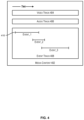
- FIG. 4 depicts an example structure diagram for a media content file that may be generated to include indexed events in accordance with some embodiments
- FIG. 5 depicts an example of a graphical representation of one or more interactions that may be undertaken with a media content file that has been indexed with one or more events in accordance with some embodiments.
- FIG. 6 depicts a block diagram showing an example process flow for automatically identifying and indexing events in a media content in accordance with some embodiments.
- sensor and/or contextual data is received in association with the media content file.
- the sensor data may be received from the same recording device that the media content file is received from.
- contextual data may be received from a third-party entity and/or external device and associated with the media content file.
- the sensor and/or contextual data may be provided to a trained machine learning model in order to identify one or more data patterns that correspond to an event.
- an index may be generated that corresponds to the event.
- the generated index may then be associated with the media content file (e.g., within an event track).
- An index may be any suitable sign, token, or indication of an event related to a point in time and a media data file.
- FIG. 1 illustrates a computing environment configured to receive media content from one or more recording devices and to automatically classify and index events detected within the media content.
- a recording device 102 is configured to communicate with a number of other electronic devices, such as an event classification engine 104 and/or one or more external devices 106 .
- a recording device 102 may comprise any suitable electronic device capable of being used to record information about a person and/or vehicle's surroundings.
- the recording device may be a camera mounted within a vehicle.
- the recording device may be a device that is capable of being worn or otherwise mounted or fastened to a person.
- the recording device 102 may include at least one input device 108 , such as a microphone or camera, and a number of sensors 110 capable of obtaining data about an environment in which the recording device is located.
- the number of sensors 110 may include a temperature sensor, a real-time clock (RTC), an inertial measurement unit (IMU), or any other suitable sensor.
- An IMU may be any electronic device that measures and reports a body's specific force, angular rate, and sometimes the orientation of the body, using a combination of accelerometers, gyroscopes, and magnetometers.
- the recording device may be configured to transmit data to the media processing platform 104 . More particularly, the recording device may be configured to transmit media data 112 captured by the input device to the media processing platform. Media data 112 may comprise any suitable time series of data samples collected via any suitable sensor. For example, the recording device may be configured to transmit streaming video and/or audio data to the event classification engine. In another example, the recording device may be configured to send still images captured at periodic intervals. In some embodiments, the recording device may be further configured to transmit sensor data 114 captured by the one or more sensors 110 to the event classification engine. Sensor data 114 may include any suitable data collected in relation to environmental factors affecting the recording device. For example, the recording device may transmit information about movements and/or orientations of the recording device to the event classification engine. The sensor data may be transmitted to the event classification engine 112 separately or associated with the media data (e.g., as metadata). Each of the media data and sensor data may include timestamp information that may be used to correlate the two types of data.
- Media data 112 may comprise any suitable time series of
- the media processing platform 104 can include any computing device configured to perform at least a portion of the operations described herein.
- Media processing platform 104 may be composed of one or more general purpose computers, specialized server computers (including, by way of example, PC (personal computer) servers, UNIXTM servers, mid-range servers, mainframe computers, rack-mounted servers, etc.), server farms, server clusters, or any other appropriate arrangement and/or combination.
- Service provider computer 108 can include one or more virtual machines running virtual operating systems, or other computing architectures involving virtualization such as one or more flexible pools of logical storage devices that can be virtualized to maintain virtual storage devices for the computer.
- the media processing platform 104 may maintain a number of components, including an event classification engine 116 capable of categorizing and indexing events and associating an index with a media file in association with the categorized event.
- the event classification engine 116 may use one or more trained machine learning models 118 to perform such categorization and indexing.
- the media processing platform 104 may maintain access to a data store of contextual data 120 that includes information that may be relevant to one or more events identified from a stream of media data.
- Such contextual data may be received from one or more third-party computing devices 122 .
- the contextual data 120 may include weather information that pertains to various regions.
- such weather information may be provided to the media processing platform 104 by a third-party provider of weather information.
- the contextual data 120 may be input to a machine learning model 118 during training and/or during classification of events within media data.
- at least a portion of the third-party devices 122 may receive external data 124 from one or more external devices 106 .
- the third-party device may process the received external data to generate contextual data that is provided to the media processing platform.
- the one or more external devices 106 may be in communication with a recording device (e.g., via a short-range communication channel).
- the recording device is situated within a vehicle (e.g., mounted on a person sitting within the vehicle) that includes an onboard computer.
- the onboard computer of that vehicle may be in communication with a vehicle onboard computing service provider (i.e., a third-party device).
- the vehicle onboard computing service provider may receive information on how fast the vehicle is traveling and in what direction (i.e., a velocity of the vehicle) as well as other information about an environment in which the vehicle is located (e.g., a temperature of the air surrounding the vehicle, a level of precipitation, a grade or degree of incline of a road on which the vehicle is traveling/parked, etc.).
- This information is then processed by the vehicle onboard computing service provider to generate contextual data for the vehicle that is then provided to the media processing platform.
- Such contextual data may then be associated with media data received from the recording device situated within that vehicle.
- the event classification engine 116 may be configured to identify, based on contextual data and/or sensor data associated with received media data, one or more events within that media data. To do this, the machine learning model 118 may be trained to first determine a context associated with the recording device. Such a context may relate to a situation that currently pertains to the recording device and/or a person operating the recording device. For example, such a context may comprise a determination as to whether the recording device is traveling or stationary, in a particular location or type of location, in a particular state, etc.
- the event classification engine may be configured to correlate patterns of data to particular events. For example, this may comprise identifying particular patterns of movements attributed to the recording device. In another example, this may comprise identifying particular objects or types of objects that are depicted within the received media data 112 (e.g., using one or more object recognition techniques). In another example, this may comprise identifying particular audio cues (e.g., spoken words or phrases) within the media data. Each event may be classified based on a type or category associated with that event. In some embodiments, each event may be assigned a priority level based on its classification. The event classification engine may then generate, for each identified event, an index that corresponds to that event.
- This may comprise identifying particular patterns of movements attributed to the recording device. In another example, this may comprise identifying particular objects or types of objects that are depicted within the received media data 112 (e.g., using one or more object recognition techniques). In another example, this may comprise identifying particular audio cues (e.g., spoken words or phrases) within the media data
- the index is appended to the media data itself (e.g., as metadata). In some embodiments, the index is appended to a reference database table or other suitable mapping between the media data and the corresponding identified events. In these embodiments, each event may be mapped to a timestamp within the media data or a range of times during which the event is determined to have occurred.
- the media processing platform may store indexed media data within a datastore of indexed media data 126 .
- indexed media data 126 When such indexed media data 126 is presented to a user, that user may also be presented with an indication of the events identified in relation to the indexed media data 126 as well as a time corresponding to each of those events. For example, upon selecting a video to view, a user may be provided with a list of each of the events determined to be depicted within that video as well as times within the video at which those events occur. In some embodiments, the user may be provided the ability to click on (or otherwise select) a particular event and have the video being playing from a time corresponding to that event.
- communication between one or more components as described with respect to the computing environment 100 can be facilitated via a network.
- a network can include any appropriate network, including an intranet, the Internet, a cellular network, a local area network or any other such network or combination thereof.
- Components used for such a system can depend at least in part upon the type of network and/or environment selected. Protocols and components for communicating via such a network may be known to one skilled in the art and will not be discussed herein in detail. Communication over the network can be enabled by wired or wireless connections and combinations thereof.
- FIG. 1 For clarity, a certain number of components are shown in FIG. 1 . It is understood, however, that embodiments of the disclosure may include more than one of each component. In addition, some embodiments of the disclosure may include fewer than or greater than all of the components shown in FIG. 1 . In addition, the components in FIG. 1 may communicate via any suitable communication medium (including the Internet), using any suitable communication protocol.
- any suitable communication medium including the Internet
- FIG. 2 is a block diagram showing various components of a computing system architecture that supports a classification and indexing of events within media content in accordance with some embodiments.
- the system architecture 200 may include a media processing platform 104 that comprises one or more computing devices.
- the media processing platform 104 may include a communication interface 202 , one or more processors 204 , memory 206 , and hardware 208 .
- the communication interface 202 may include wireless and/or wired communication components that enable the media processing platform 104 to transmit data to, and receive data from, other networked devices.
- the hardware 208 may include additional user interface, data communication, or data storage hardware.
- the user interfaces may include a data output device (e.g., visual display, audio speakers), and one or more data input devices.
- the data input devices may include, but are not limited to, combinations of one or more of keypads, keyboards, mouse devices, touch screens that accept gestures, microphones, voice or speech recognition devices, and any other suitable devices.
- the media processing platform 104 can include any computing device or combination of computing devices configured to perform at least a portion of the operations described herein.
- the media processing platform 104 may be composed of one or more general purpose computers, specialized server computers (including, by way of example, PC (personal computer) servers, UNIX® servers, mid-range servers, mainframe computers, rack-mounted servers, etc.), server farms, server clusters, or any other appropriate arrangement and/or combination.
- the media processing platform 104 can include one or more virtual machines running virtual operating systems, or other computing architectures involving virtualization such as one or more flexible pools of logical storage devices that can be virtualized to maintain virtual storage devices for the computer.
- the media processing platform 104 may include virtual computing devices in the form of virtual machines or software containers that are hosted in a cloud.
- the memory 206 may be implemented using computer-readable media, such as computer storage media.
- Computer-readable media includes, at least, two types of computer-readable media, namely computer storage media and communications media.
- Computer storage media includes volatile and non-volatile, removable and non-removable media implemented in any method or technology for storage of information such as computer-readable instructions, data structures, program modules, or other data.
- Computer storage media includes, but is not limited to, RAM, DRAM, ROM, EEPROM, flash memory or other memory technology, CD-ROM, digital versatile disks (DVD) or other optical storage, magnetic cassettes, magnetic tape, magnetic disk storage or other magnetic storage devices, or any other non-transmission medium that can be used to store information for access by a computing device.
- communication media may embody computer-readable instructions, data structures, program modules, or other data in a modulated data signal, such as a carrier wave, or other transmission mechanisms.
- the one or more processors 204 and the memory 206 of the media processing platform 104 may implement functionality from one or more software modules and data stores. Such software modules may include routines, program instructions, objects, and/or data structures that are executed by the processors 204 to perform particular tasks or implement particular data types.
- the memory 206 may include at least a module for detecting and classifying events detected within a media content (e.g., event classification engine 116 ) as well as a module for training and/or generating a machine learning (ML) model capable of being used to detect such events (ML module 210 ). Additionally, the memory 206 may further include a data store 212 that contains a number of database tables or other data storage schemas.
- the data store 212 may include at least a database of media data for which events have been identified and classified (indexed media data 126 ). In some cases, the data store 212 may further include a database of contextual data 120 received from one or more third-party devices.
- the event classification engine 116 may be configured to, in conjunction with the processor 204 , identify particular events that occur within a media content and to categorize and index those events. In some embodiments, this comprises receiving media content from a recording device as well as sensor data corresponding to that media content. In some cases, the sensor data may be received from the same recording device and may be correlated to the media content based on that relationship. In some cases, contextual data received from one or more third-party and/or external devices may be correlated to the media content. This correlation may be created based on a date/time for the received contextual data as well as some relationship between the external device and the recording device (e.g., assigned to the same user, located in the same location, in direct short-range wireless communication, etc.). The sensor data and/or contextual data correlated to a particular piece of media content may then be used to identify a context associated with the recording device and/or operator of the recording device.
- a context for a recording device may be identified based on a location, velocity, state, or other suitable attribute of the recording device.
- One or more events may then be identified within that media content in light of the identified context.
- events may be detected within a media content upon providing at least a portion of sensor data and/or contextual data correlated with the media content to a trained machine learning model.
- an event may be detected upon determining that values for certain sensor data and/or contextual data have exceeded or fallen below predetermined threshold values.
- a type or category of the event may also be determined.
- an event may be identified based on data patterns detected within the sensor data as well as when a particular context has been determined to be associated with the recording device and/or operator of the recoding device. For example, given a scenario in which the recording device is being operated by a law enforcement officer, the event classification engine may determine a context for the recording device in which the recording device and its operator are currently located within a police station or authorized firing range. In this example, contextual data may be received from a firearm associated with the recording device indicating that the firearm has been discharged. In this example, the discharge of the firearm is determined to be an authorized firearm discharge event based on its occurrence as well as the determined context. If, however, the context is determined to be that the recording device is not located within a police station or authorized firing range, then the discharge of the firearm is determined to be an unauthorized firearm discharge event based on its occurrence as well as the determined context.
- the event classification engine may generate an index for that event.
- the index may be stored separate from the media content in a database of index mappings.
- the index may be associated with the media content (e.g., as metadata or as a separate track) in a manner that indicates the beginning and/or end of the event within the media content.
- the media content is stored by the event classification engine within a database of indexed media data.
- an index associated with an event may be updated or otherwise adjusted by a user (e.g., an administrator). For example, the user may adjust a begin or end time for the event.
- certain generated indices within a media content may be flagged for user review based on a type of event associated with those indices.
- the machine learning (ML) module 210 may be configured to, in conjunction with the processor 204 , train a machine learning model to be used to identify and categorize events. In some embodiments, this may comprise generating training data in which a user simulates particular events while wearing a recording device. When the training data is provided to the ML module 210 , the event may be identified manually in order to facilitate the ML module in correlating one or more patterns detected in the provided data with the event.
- the ML module may utilize any suitable algorithm for generating an appropriate trained machine learning model. For example, the ML module may use a deep learning algorithm that operates based on artificial neural networks with representation learning.
- a trained machine learning model may consist of a number of layers of which each layer includes mathematical relationships between various inputs and outputs for the model.
- feedback received in relation to an accuracy of the trained machine learning model is used to adjust that model (e.g., by adjusting variables included within one or more layers of the trained machine learning model).
- the event classification engine 116 is depicted as being included upon a computing device of the media processing platform, this is exemplary only. One skilled in the art would recognize that such a module may be implemented elsewhere to server an equivalent function.
- the event classification engine may be implemented on a computing device outside of the media processing platform.
- the event classification engine may be implemented upon an edge computing device that acts as a gateway to a local network.
- the event classification engine may be implemented upon a recording device to detect and classify events as media content is obtained.
- a trained machine learning model may be implemented within the recording device to facilitate event classification.
- the communication interface 202 may include wireless and/or wired communication components that enable the media processing platform to transmit or receive data via a network, such as the Internet, to a number of other electronic devices (e.g., recording device 102 ). Such a communication interface 202 may include access to both wired and wireless communication mechanisms. In some cases, the media processing platform transmits data to other electronic devices over a long-range communication channel, such as a data communication channel that uses a mobile communications standard (e.g., long-term evolution (LTE)).
- LTE long-term evolution
- the media processing platform 104 may be in communication with a number of recording devices 102 .
- a recording device 102 may be any suitable electronic device capable of obtaining and recording situational data and that has communication capabilities. The types and/or models of recording device may vary.
- a recording device may include one or more input device 108 as well as a number of sensors 110 .
- a input device 108 may include any device capable of obtaining imagery and/or audio.
- the input device may include a camera device capable of capturing image data and/or a microphone device capable of capturing audio data.
- the input device may be configured to capture streaming media (audio and/or video) data to be provided to the media processing platform.
- the input device may be configured to capture media, such as still images, at periodic intervals.
- the captured media data may be stored locally on the recording device and uploaded to the media processing platform when a communication channel is established between the two.
- the captured media data may be transmitted to the media processing platform in real-time (e.g., as the media content is captured).
- Each recording device may include an input/output (I/O) interface 214 that enables interaction between the recording device and a user (e.g., its wearer). Additionally, the recording device may include a communication interface 216 that enables communication between the recording device and at least one other electronic device (e.g., media processing platform 104 and/or one or more external devices 106 ). Such a communication interface may include some combination of short-range communication mechanisms and long-range communication mechanisms. For example, the recording device may connect to one or more external devices in its proximity via a short-range communication channel (e.g., Bluetooth®, Bluetooth Low Energy (BLE), WiFi, etc.) and may connect to the media processing platform via a long-range communication channel (e.g., cellular network).
- a short-range communication channel e.g., Bluetooth®, Bluetooth Low Energy (BLE), WiFi, etc.
- FIG. 3 depicts a block diagram showing an example process flow for identifying and indexing events within media content in accordance with embodiments.
- the process 300 involves interactions between various components of the architecture 100 described with respect to FIG. 1 . More particularly, the process 300 involves interactions between at least a media processing platform 104 and a recording device 102 .
- media content is obtained from a recording device.
- the media content is received from a wearable device capable of being mounted on a person.
- the media content is received from a camera device mounted within a vehicle.
- the media content may be received as a stream of content in real-time (substantially as the media content is obtained) via a communication channel maintained between the media processing platform and the recording device.
- the media content may be uploaded all at once at a time subsequent to the collection of the media. For example, at the end of shift, a worker (e.g., a law enforcement officer) may upload a video captured over the course of the shift by his or her wearable recording device to the media processing platform.
- sensor data is obtained by the media processing platform.
- such sensor data is obtained from the same recording device from which the media content is received at 302 .
- the sensor data may include information obtained from a gyroscope, accelerometer, compass or other suitable sensor device installed within the recording device with respect to time.
- such sensor data is received from an external device (e.g., external device 106 ).
- the media processing platform may receive an indication from a vehicle that a car door was opened and a time at which the car door was opened.
- information received from an external device may be received via the recording device.
- the vehicle may relay the indication that the car door was opened to the recording device, which may then forward that indication to the media processing platform.
- contextual data may be received at 304 of the process 300 .
- Contextual data may include any additional information that can be associated with the obtained media content.
- such contextual data may be obtained from a third-party entity (e.g., third-party device 122 ) and/or external device (e.g., external device 106 ).
- temperature, wind velocity and precipitation information for a particular location may be received from a weather service provider.
- video footage may be received from a network of cameras (e.g., traffic cameras or private security cameras).
- contextual data may be associated with a piece of media content.
- contextual data may be associated with media content based on proximity.
- the media processing platform may receive an indication of a location at which the media content was captured (e.g., via a global positioning system (GPS) device installed within the recording device.
- GPS global positioning system
- contextual data may be associated with the media content if the indicated location is within some threshold distance of a location associated with the contextual data.
- contextual data may be associated with the media content by virtue of being associated with a common user. For example, media content obtained from a recording device that is assigned to Officer A may be automatically associated with contextual data received from a vehicle that is also assigned to Officer A.
- contextual data may be assigned to media content upon identifying some relationship between the media content and the context.
- contextual data may include security camera footage obtained from an external camera network.
- one or more pattern recognition techniques may be performed to identify a particular person within the received footage. The security footage may then be associated with the media content obtained from a recording device worn by that particular person.
- the process 300 may comprise performing one or more object recognition techniques at 308 .
- a basic object recognition technique may be employed to identify categories of objects that appear within a video file and at what times those respective objects appear within the video.
- an identification of the owner of that face may be provided.
- the process 300 may comprise synchronizing the received data at 310 .
- the data may be received from a number of different sources and at different times. Accordingly, the data may be received out of sync. For example, some data may be received in real time whereas some data may be provided after its occurrence. The received data may be synchronized based on a timestamp associated with that data.
- the process 300 comprises providing the received data to a trained machine learning model.
- a determination may be made as to whether one or more patterns of data that correspond to an event can be identified.
- a machine learning model may have been trained to draw correlations between patterns in sensor and/or contextual data and one or more contexts and events.
- multiple machine learning models may be utilized. For example, a first machine learning model may be used to identify a context to be associated with a media data file and a second machine learning model may be used to identify events.
- an administrator or other user may define events that are to be identified during a training process.
- the trained machine learning model may determine, based on the provided sensor/contextual data, a likelihood that a particular event has occurred.
- the event may be detected (i.e., determined to have occurred) if the corresponding likelihood value is greater than a predetermined threshold.
- the process 300 may involve identifying a context associated with the media content.
- a context associated with the media content may be determined based on one or more factors associated with the media content. For example, a context may be identified based on a location, speed, direction of travel, state, or other factor associated with the media content. Data patterns correlated to events may then be assessed in light of the determined context. In some embodiments, an event may be identified based on data patterns only if a particular context or type of context is determined to be associated with the recording device.
- the process 300 comprises generating an index at 316 .
- an index may be generated for an event upon determining that the likelihood of that event having occurred is greater than a predetermined threshold.
- a generated index may include any combination of an event identifier that uniquely identifies the event, an event categorization and/or text, or a timestamp/timestamp range.
- an indication of the event may additionally be stored in a separate database (e.g., an event database) along with an indication of the media content to which the index relates.
- one or more generated indices is associated with the media content.
- the generated indices are appended to the media content as metadata or within a separate data track.
- the generated indices are stored in a database table or other storage medium that is correlated to the media content.
- the indexed media content is stored.
- the indexed media is stored in a manner that it is accessible to one or more users that wish to play the media content.
- the media processing platform may also store an unindexed version of the media content (e.g., for evidentiary purposes).
- one or more users may be notified of the indexed media content. For example, certain events or event categories may be flagged for independent review by a user. In this example, each time that an index is generated that corresponds to one of the events or event categories, a notification may be generated and provided to the user. The user may then be provided the ability to load the indexed portion of the media content that corresponds to the flagged event.
- FIG. 4 depicts an example structure diagram for a media content file that may be generated to include indexed events in accordance with at least some embodiments.
- a media content file 402 may include a number of tracks, each of which may include different types of data.
- the media content file is a video file
- that media content file may include at least a video track 404 and an audio track 406 .
- a video track may include image data with respect to time
- an audio track may include audio data with respect to time.
- Each of the tracks within the media content file may be correlated based on timestamps in each of the respective tracks.
- a number of indices 410 may be associated with the media content file 402 .
- such indices for events e.g., Event_ 1 , Event_ 2 , and Event_ 3
- index data i.e., indices
- the indices included within an event track may include at least text data and timestamp data.
- each of the indices in the index data may include an indication of an event identifier that can be used to identify an event within a database table or other data storage means.
- timestamp data stored in event data may include a single timestamp associated with the event.
- timestamp data stored in event data may include a range of timestamp data.
- the indices may include at least a beginning timestamp and an ending timestamp for the event. It should be noted that ranges of timestamp data for the indices in the event track can overlap in that the beginning timestamp for a second event can occur after the beginning timestamp of a first event but before the ending timestamp of the first event.
- the event data may be presented to the consumer of the media content along with the data in the other tracks.
- text associated with the indices may be overlayed onto a video of a video track on a graphical user interface presented via the media player.
- a list of indices identified within the event track may be presented to the consumer of the media such that the consumer is able to select one of the indices.
- the media player may move to a position within the media content that corresponds to the selected index.
- FIG. 5 depicts an example of a graphical representation of one or more interactions that may be undertaken with a media content file that has been indexed with one or more events in accordance with embodiments.
- a graphical user interface (GUI) 502 is depicted as being presented in association with a media player application.
- the media player application is one configured to present video media content.
- Each media content file may contain an associated timeline (e.g., a series of timestamps) that is used to synchronize various data tracks included within the media content file.
- the timeline may be presented via the GUI as a timeline bar 504 .
- a timeline bar may include a position marker 506 that indicates a respective position of the current content within the timeline of the media content file.
- a timeline bar may further include a number of time markers 508 that indicate relative positions within the timeline that are associated with indices for different events.
- a media content file may include an event track having indices 512 for a number of events associated with that media content file. As described elsewhere, such indices may be included within a data track of the media content file.
- each of the indices may include an event identifier 514 that identifies a particular event, a categorization 516 or description, and a time 518 .
- a categorization for an event may be determined using a trained machine learning model as described elsewhere.
- the time 518 associated with an index may be represented as a single point in time within a timeline included in a media content file.
- the time 518 associated with an index may be represented as a range of times within a timeline included in a media content file.
- At least a portion of the information associated with an index may be presented within a GUI when the media content is played.
- a video i.e., an example media content
- the GUI may cause a list of indices associated with the media content to be presented to the user and enable the user to select (e.g., by clicking on) one of the presented indices.
- selection of a particular index within the presented list of indices may cause the media player to play a portion of the video associated with that index by skipping to a position within the video timeline that is associated with the index.
- Such embodiments enable a user to quickly skip to portions of a video that might be relevant to the user's viewing interests without requiring the video to be viewed in its entirety.
- FIG. 6 depicts a block diagram showing an example process flow for automatically identifying and indexing events in a media content in accordance with embodiments.
- the process 600 may be performed by components within a system 100 as discussed with respect to FIG. 1 above.
- the process 600 may be performed by a media processing platform 104 in communication with a number of recording devices 102 .
- the process 600 comprises receiving media content from a recording device.
- Such media content may comprise at least one of video data or audio data.
- the media content is received from the at least one recording device in substantial real-time as streaming data.
- the media content is received from the at least one recording device as an upload after the recording device has finished recording.
- the process 600 comprises receiving sensor data corresponding to the media content.
- the sensor data is also received from the at least one recording device from which the media content was received.
- Such sensor data may comprise data obtained from at least one of a gyroscope, accelerometer, compass or any other suitable sensor type.
- the process 600 further comprises receiving contextual data from one or more third-party devices.
- at least a portion of the contextual data is obtained by an external device in proximity of the recording device.
- contextual data may be received from a vehicle in proximity to the recording device or a private security camera network.
- the process 600 comprises determining a context to be associated with the media content.
- a context is determined based on the sensor and/or contextual data received in relation to the media content.
- the determined context may relate to a state or condition of the recording device and/or its operator. For example, a context may pertain to whether the recording device and/or its operator is located within a location or type of location. In another example, a context may pertain to whether the recording device is in transit or stationary. In yet another example, a context may pertain to whether or not an operator of the recording device has activated that recording device (e.g., started recording).
- the process 600 comprises identifying one or more events based on detected data patterns within the sensor data.
- the one or more data patterns are detected using a trained machine learning model.
- one or more machine learning algorithms may be used to generate a trained machine learning model by providing an example training set of sensor data that corresponds to known events an input data.
- an administrator or other user may manually mark events in a manner that is proved to the machine learning algorithm.
- the machine learning algorithm then builds correlations between the input data and the output data.
- the machine learning algorithm is a deep neural network, then values stored in various layers of the neural network may be adjusted based on the provided inputs and outputs.
- the trained machine learning model may be provided new sensor data as inputs and will identify an event.
- the trained machine learning model will output a likelihood that patterns exhibited by the input data correspond to an event. This likelihood may be represented by a percentage.
- an event may be determined only when a particular context is determined for the recording device.
- the process 600 comprises generating an index associated with the identified one or more events.
- the generated index comprises at least one of an event identifier and a timestamp.
- the timestamp represents a single point in time. In some embodiments, the timestamp represents a range of times.
- the process 600 comprises storing the generated index in association with the media content.
- the indication of the generated index is stored within an event data track of the media content.
- selection of the generated index using a media player causes the media player to play the media content from a particular point on a timeline associated with the media content, the particular point in time corresponding to an occurrence of the event.
- the indication of the generated index is stored in a database table being mapped to the media content.
Landscapes
- Engineering & Computer Science (AREA)
- Theoretical Computer Science (AREA)
- Software Systems (AREA)
- Physics & Mathematics (AREA)
- General Physics & Mathematics (AREA)
- Multimedia (AREA)
- Data Mining & Analysis (AREA)
- General Engineering & Computer Science (AREA)
- Databases & Information Systems (AREA)
- Evolutionary Computation (AREA)
- Artificial Intelligence (AREA)
- Computer Vision & Pattern Recognition (AREA)
- Medical Informatics (AREA)
- Computing Systems (AREA)
- Mathematical Physics (AREA)
- Health & Medical Sciences (AREA)
- General Health & Medical Sciences (AREA)
- Management, Administration, Business Operations System, And Electronic Commerce (AREA)
- Information Retrieval, Db Structures And Fs Structures Therefor (AREA)
Abstract
Description
Claims (20)
Priority Applications (3)
| Application Number | Priority Date | Filing Date | Title |
|---|---|---|---|
| US17/328,960 US12094493B2 (en) | 2021-05-24 | 2021-05-24 | Automated classification and indexing of events using machine learning |
| PCT/US2022/029291 WO2022250987A1 (en) | 2021-05-24 | 2022-05-13 | Automated classification and indexing of events using machine learning |
| US18/807,085 US20240404562A1 (en) | 2021-05-24 | 2024-08-16 | Automated classification and indexing of events using machine learning |
Applications Claiming Priority (1)
| Application Number | Priority Date | Filing Date | Title |
|---|---|---|---|
| US17/328,960 US12094493B2 (en) | 2021-05-24 | 2021-05-24 | Automated classification and indexing of events using machine learning |
Related Child Applications (1)
| Application Number | Title | Priority Date | Filing Date |
|---|---|---|---|
| US18/807,085 Continuation US20240404562A1 (en) | 2021-05-24 | 2024-08-16 | Automated classification and indexing of events using machine learning |
Publications (2)
| Publication Number | Publication Date |
|---|---|
| US20220375501A1 US20220375501A1 (en) | 2022-11-24 |
| US12094493B2 true US12094493B2 (en) | 2024-09-17 |
Family
ID=84103084
Family Applications (2)
| Application Number | Title | Priority Date | Filing Date |
|---|---|---|---|
| US17/328,960 Active US12094493B2 (en) | 2021-05-24 | 2021-05-24 | Automated classification and indexing of events using machine learning |
| US18/807,085 Pending US20240404562A1 (en) | 2021-05-24 | 2024-08-16 | Automated classification and indexing of events using machine learning |
Family Applications After (1)
| Application Number | Title | Priority Date | Filing Date |
|---|---|---|---|
| US18/807,085 Pending US20240404562A1 (en) | 2021-05-24 | 2024-08-16 | Automated classification and indexing of events using machine learning |
Country Status (2)
| Country | Link |
|---|---|
| US (2) | US12094493B2 (en) |
| WO (1) | WO2022250987A1 (en) |
Families Citing this family (2)
| Publication number | Priority date | Publication date | Assignee | Title |
|---|---|---|---|---|
| US12094493B2 (en) * | 2021-05-24 | 2024-09-17 | Getac Technology Corporation | Automated classification and indexing of events using machine learning |
| AU2024309291A1 (en) * | 2023-06-30 | 2026-02-12 | Axon Enterprise, Inc. | Method for management of device update transmission |
Citations (18)
| Publication number | Priority date | Publication date | Assignee | Title |
|---|---|---|---|---|
| US20040268224A1 (en) * | 2000-03-31 | 2004-12-30 | Balkus Peter A. | Authoring system for combining temporal and nontemporal digital media |
| JP2009070026A (en) | 2007-09-12 | 2009-04-02 | Mitsubishi Electric Corp | Recording apparatus, verification apparatus, playback apparatus, recording method, verification method, and program |
| US20140072284A1 (en) * | 2012-09-12 | 2014-03-13 | Intel Corporation | Techniques for indexing video files |
| US20140198216A1 (en) | 2011-09-22 | 2014-07-17 | Koninklijke Philips N.V. | Imaging service using outdoor lighting networks |
| US20150078727A1 (en) | 2013-08-14 | 2015-03-19 | Digital Ally, Inc. | Forensic video recording with presence detection |
| US20160314818A1 (en) | 2015-04-23 | 2016-10-27 | Adidas Ag | Method and device for associating frames in a video of an activity of a person with an event |
| US20160349019A1 (en) | 2015-05-26 | 2016-12-01 | Digital Ally, Inc. | Wirelessly conducted electronic weapon |
| US20170142214A1 (en) * | 2015-11-17 | 2017-05-18 | Google Inc. | Enhanced push messaging |
| KR20170141049A (en) | 2016-06-14 | 2017-12-22 | 주식회사 케이티 | System and method for event alarm based on metadata and application therefor |
| US20180063421A1 (en) | 2016-09-01 | 2018-03-01 | Panasonic Intellectual Property Management Co., Ltd. | Wearable camera, wearable camera system, and recording control method |
| US20180158265A1 (en) | 2014-04-29 | 2018-06-07 | Vivint, Inc. | Techniques for securing a dropspot |
| US20190356885A1 (en) | 2018-05-16 | 2019-11-21 | 360Ai Solutions Llc | Camera System Securable Within a Motor Vehicle |
| US20190392215A1 (en) | 2018-06-25 | 2019-12-26 | Panasonic Intellectual Property Management Co., Ltd. | Information processing apparatus and method for conversion of video picture into text |
| WO2020172414A1 (en) | 2019-02-21 | 2020-08-27 | Theator inc. | Systems and methods for analysis of surgical videos |
| US20200344301A1 (en) | 2019-04-26 | 2020-10-29 | Samsara Networks Inc. | Event detection system |
| US20210026881A1 (en) * | 2019-07-23 | 2021-01-28 | Obayashi Corporation | System, method, and computer-readable medium for managing image |
| US20210124741A1 (en) * | 2019-10-23 | 2021-04-29 | Honeywell International Inc. | Predicting potential incident event data structures based on multi-modal analysis |
| US20220303455A1 (en) | 2021-03-17 | 2022-09-22 | Samsung Electronics Co., Ltd | Image sensor and operating method of the image sensor |
Family Cites Families (15)
| Publication number | Priority date | Publication date | Assignee | Title |
|---|---|---|---|---|
| US5969755A (en) * | 1996-02-05 | 1999-10-19 | Texas Instruments Incorporated | Motion based event detection system and method |
| US20070043608A1 (en) * | 2005-08-22 | 2007-02-22 | Recordant, Inc. | Recorded customer interactions and training system, method and computer program product |
| US20080155422A1 (en) * | 2006-12-20 | 2008-06-26 | Joseph Anthony Manico | Automated production of multiple output products |
| US20080219641A1 (en) * | 2007-03-09 | 2008-09-11 | Barry Sandrew | Apparatus and method for synchronizing a secondary audio track to the audio track of a video source |
| EP2224357A1 (en) * | 2009-02-27 | 2010-09-01 | BRITISH TELECOMMUNICATIONS public limited company | Video segmentation |
| US20130282446A1 (en) * | 2010-04-15 | 2013-10-24 | Colin Dobell | Methods and systems for capturing, measuring, sharing and influencing the behavioural qualities of a service performance |
| US9578377B1 (en) * | 2013-12-03 | 2017-02-21 | Venuenext, Inc. | Displaying a graphical game play feed based on automatically detecting bounds of plays or drives using game related data sources |
| WO2016123495A1 (en) * | 2015-01-30 | 2016-08-04 | Vizio Inscape Technologies, Llc | Methods for identifying video segments and displaying option to view from an alternative source and/or on an alternative device |
| US10402697B2 (en) * | 2016-08-01 | 2019-09-03 | Nvidia Corporation | Fusing multilayer and multimodal deep neural networks for video classification |
| US11397558B2 (en) * | 2017-05-18 | 2022-07-26 | Peloton Interactive, Inc. | Optimizing display engagement in action automation |
| WO2019236953A1 (en) * | 2018-06-08 | 2019-12-12 | Storevision North America Inc. | A panoptes device or image acquisition system having multiple independent sensors |
| US11429301B2 (en) * | 2020-04-22 | 2022-08-30 | Dell Products L.P. | Data contextual migration in an information handling system |
| US11461428B2 (en) * | 2020-06-08 | 2022-10-04 | Dropbox, Inc. | Intelligently generating and managing third-party sources within a contextual hub |
| EP3958580A4 (en) * | 2020-06-24 | 2022-11-09 | Baidu Online Network Technology (Beijing) Co., Ltd. | Video data production method and apparatus, electronic device, and computer readable medium |
| US12094493B2 (en) * | 2021-05-24 | 2024-09-17 | Getac Technology Corporation | Automated classification and indexing of events using machine learning |
-
2021
- 2021-05-24 US US17/328,960 patent/US12094493B2/en active Active
-
2022
- 2022-05-13 WO PCT/US2022/029291 patent/WO2022250987A1/en not_active Ceased
-
2024
- 2024-08-16 US US18/807,085 patent/US20240404562A1/en active Pending
Patent Citations (19)
| Publication number | Priority date | Publication date | Assignee | Title |
|---|---|---|---|---|
| US20040268224A1 (en) * | 2000-03-31 | 2004-12-30 | Balkus Peter A. | Authoring system for combining temporal and nontemporal digital media |
| JP2009070026A (en) | 2007-09-12 | 2009-04-02 | Mitsubishi Electric Corp | Recording apparatus, verification apparatus, playback apparatus, recording method, verification method, and program |
| US20140198216A1 (en) | 2011-09-22 | 2014-07-17 | Koninklijke Philips N.V. | Imaging service using outdoor lighting networks |
| US20140072284A1 (en) * | 2012-09-12 | 2014-03-13 | Intel Corporation | Techniques for indexing video files |
| US20150078727A1 (en) | 2013-08-14 | 2015-03-19 | Digital Ally, Inc. | Forensic video recording with presence detection |
| US20160035391A1 (en) | 2013-08-14 | 2016-02-04 | Digital Ally, Inc. | Forensic video recording with presence detection |
| US20180158265A1 (en) | 2014-04-29 | 2018-06-07 | Vivint, Inc. | Techniques for securing a dropspot |
| US20160314818A1 (en) | 2015-04-23 | 2016-10-27 | Adidas Ag | Method and device for associating frames in a video of an activity of a person with an event |
| US20160349019A1 (en) | 2015-05-26 | 2016-12-01 | Digital Ally, Inc. | Wirelessly conducted electronic weapon |
| US20170142214A1 (en) * | 2015-11-17 | 2017-05-18 | Google Inc. | Enhanced push messaging |
| KR20170141049A (en) | 2016-06-14 | 2017-12-22 | 주식회사 케이티 | System and method for event alarm based on metadata and application therefor |
| US20180063421A1 (en) | 2016-09-01 | 2018-03-01 | Panasonic Intellectual Property Management Co., Ltd. | Wearable camera, wearable camera system, and recording control method |
| US20190356885A1 (en) | 2018-05-16 | 2019-11-21 | 360Ai Solutions Llc | Camera System Securable Within a Motor Vehicle |
| US20190392215A1 (en) | 2018-06-25 | 2019-12-26 | Panasonic Intellectual Property Management Co., Ltd. | Information processing apparatus and method for conversion of video picture into text |
| WO2020172414A1 (en) | 2019-02-21 | 2020-08-27 | Theator inc. | Systems and methods for analysis of surgical videos |
| US20200344301A1 (en) | 2019-04-26 | 2020-10-29 | Samsara Networks Inc. | Event detection system |
| US20210026881A1 (en) * | 2019-07-23 | 2021-01-28 | Obayashi Corporation | System, method, and computer-readable medium for managing image |
| US20210124741A1 (en) * | 2019-10-23 | 2021-04-29 | Honeywell International Inc. | Predicting potential incident event data structures based on multi-modal analysis |
| US20220303455A1 (en) | 2021-03-17 | 2022-09-22 | Samsung Electronics Co., Ltd | Image sensor and operating method of the image sensor |
Non-Patent Citations (6)
| Title |
|---|
| Canadian Patent Application No. 3,164,841, Office Action mailed Jul. 31, 2023, 5 pages. |
| International Patent Application No. PCT/US2022/029291, Search Report and Written Opinion mailed Sep. 7, 2022, 10 pages. |
| U.S. Appl. No. 17/373,091, Final Office Action mailed Aug. 7, 2023, 68 pages. |
| U.S. Appl. No. 17/373,091, Final Office Action mailed Oct. 6, 2022, 37 pages. |
| U.S. Appl. No. 17/373,091, Office Action mailed Apr. 27, 2022, 30 pages. |
| U.S. Appl. No. 17/373,091, Office Action mailed Mar. 3, 2023, 44 pages. |
Also Published As
| Publication number | Publication date |
|---|---|
| US20220375501A1 (en) | 2022-11-24 |
| WO2022250987A1 (en) | 2022-12-01 |
| US20240404562A1 (en) | 2024-12-05 |
Similar Documents
| Publication | Publication Date | Title |
|---|---|---|
| US20240404562A1 (en) | Automated classification and indexing of events using machine learning | |
| US7447331B2 (en) | System and method for generating a viewable video index for low bandwidth applications | |
| CN118312922A (en) | Multi-mode network content security intelligent auditing system and method thereof | |
| US20180069937A1 (en) | Event correlation and association using a graph database | |
| US20150264296A1 (en) | System and method for selection and viewing of processed video | |
| KR102028930B1 (en) | method of providing categorized video processing for moving objects based on AI learning using moving information of objects | |
| US12394202B2 (en) | AI-based transformation of audio/video content | |
| CN106529401A (en) | Vehicle anti-tracking method, vehicle anti-tracking device and vehicle anti-tracking system | |
| US12469287B2 (en) | Computer-implemented method and non- transitory computer-readable medium for generating a thumbnail from a video stream or file, and video surveillance system | |
| US20220377277A1 (en) | Selective obfuscation of objects in media content | |
| CA3164841C (en) | Classification and indicating of events on an edge device | |
| US20250308236A1 (en) | Artificial intelligence (ai) trained data model selection | |
| US20180249218A1 (en) | Camera with reaction integration | |
| US11468671B2 (en) | Sentiment analysis for situational awareness | |
| US11887386B1 (en) | Utilizing an intelligent in-cabin media capture device in conjunction with a transportation matching system | |
| US20250316087A1 (en) | Methods and systems for detecting bullying in real time using artificial intelligence | |
| Yawovi et al. | Responsibility evaluation in vehicle collisions from driving recorder videos using open data | |
| WO2024096999A1 (en) | Item analysis and linking across multiple multimedia files | |
| WO2023144780A1 (en) | Crowdsourcing techniques to deploy artificial intelligence systems | |
| US20230011547A1 (en) | Optimizing continuous media collection | |
| US11818507B2 (en) | Automated correlation of media data to events | |
| CN116469254B (en) | Information processing method and device | |
| US10726270B2 (en) | Selecting media from mass social monitoring devices | |
| US11818215B1 (en) | External device management | |
| KR102911586B1 (en) | Video-Based Vehicle Speed Violation Detection and Comparative Visualization System and Method |
Legal Events
| Date | Code | Title | Description |
|---|---|---|---|
| AS | Assignment |
Owner name: WHP WORKFLOW SOLUTIONS, INC., SOUTH CAROLINA Free format text: ASSIGNMENT OF ASSIGNORS INTEREST;ASSIGNORS:GUZIK, THOMAS;ADEEL, MUHAMMAD;SIGNING DATES FROM 20210521 TO 20210522;REEL/FRAME:056334/0462 Owner name: GETAC TECHNOLOGY CORPORATION, TAIWAN Free format text: ASSIGNMENT OF ASSIGNORS INTEREST;ASSIGNORS:GUZIK, THOMAS;ADEEL, MUHAMMAD;SIGNING DATES FROM 20210521 TO 20210522;REEL/FRAME:056334/0462 |
|
| FEPP | Fee payment procedure |
Free format text: ENTITY STATUS SET TO UNDISCOUNTED (ORIGINAL EVENT CODE: BIG.); ENTITY STATUS OF PATENT OWNER: LARGE ENTITY |
|
| STPP | Information on status: patent application and granting procedure in general |
Free format text: RESPONSE TO NON-FINAL OFFICE ACTION ENTERED AND FORWARDED TO EXAMINER |
|
| STPP | Information on status: patent application and granting procedure in general |
Free format text: NON FINAL ACTION MAILED |
|
| STPP | Information on status: patent application and granting procedure in general |
Free format text: RESPONSE TO NON-FINAL OFFICE ACTION ENTERED AND FORWARDED TO EXAMINER |
|
| STPP | Information on status: patent application and granting procedure in general |
Free format text: FINAL REJECTION MAILED |
|
| STPP | Information on status: patent application and granting procedure in general |
Free format text: RESPONSE AFTER FINAL ACTION FORWARDED TO EXAMINER |
|
| STPP | Information on status: patent application and granting procedure in general |
Free format text: ADVISORY ACTION MAILED |
|
| STPP | Information on status: patent application and granting procedure in general |
Free format text: DOCKETED NEW CASE - READY FOR EXAMINATION |
|
| STPP | Information on status: patent application and granting procedure in general |
Free format text: NOTICE OF ALLOWANCE MAILED -- APPLICATION RECEIVED IN OFFICE OF PUBLICATIONS |
|
| STPP | Information on status: patent application and granting procedure in general |
Free format text: PUBLICATIONS -- ISSUE FEE PAYMENT RECEIVED |
|
| STCF | Information on status: patent grant |
Free format text: PATENTED CASE |