US12093848B2 - Learning parameters of Bayesian network using uncertain evidence - Google Patents
Learning parameters of Bayesian network using uncertain evidence Download PDFInfo
- Publication number
- US12093848B2 US12093848B2 US17/107,984 US202017107984A US12093848B2 US 12093848 B2 US12093848 B2 US 12093848B2 US 202017107984 A US202017107984 A US 202017107984A US 12093848 B2 US12093848 B2 US 12093848B2
- Authority
- US
- United States
- Prior art keywords
- bayesian network
- sample
- node
- value
- uncertain
- Prior art date
- Legal status (The legal status is an assumption and is not a legal conclusion. Google has not performed a legal analysis and makes no representation as to the accuracy of the status listed.)
- Active, expires
Links
Images




Classifications
-
- G—PHYSICS
- G06—COMPUTING OR CALCULATING; COUNTING
- G06N—COMPUTING ARRANGEMENTS BASED ON SPECIFIC COMPUTATIONAL MODELS
- G06N7/00—Computing arrangements based on specific mathematical models
- G06N7/02—Computing arrangements based on specific mathematical models using fuzzy logic
-
- G—PHYSICS
- G06—COMPUTING OR CALCULATING; COUNTING
- G06N—COMPUTING ARRANGEMENTS BASED ON SPECIFIC COMPUTATIONAL MODELS
- G06N20/00—Machine learning
-
- G—PHYSICS
- G06—COMPUTING OR CALCULATING; COUNTING
- G06N—COMPUTING ARRANGEMENTS BASED ON SPECIFIC COMPUTATIONAL MODELS
- G06N7/00—Computing arrangements based on specific mathematical models
- G06N7/01—Probabilistic graphical models, e.g. probabilistic networks
-
- G—PHYSICS
- G16—INFORMATION AND COMMUNICATION TECHNOLOGY [ICT] SPECIALLY ADAPTED FOR SPECIFIC APPLICATION FIELDS
- G16H—HEALTHCARE INFORMATICS, i.e. INFORMATION AND COMMUNICATION TECHNOLOGY [ICT] SPECIALLY ADAPTED FOR THE HANDLING OR PROCESSING OF MEDICAL OR HEALTHCARE DATA
- G16H50/00—ICT specially adapted for medical diagnosis, medical simulation or medical data mining; ICT specially adapted for detecting, monitoring or modelling epidemics or pandemics
- G16H50/20—ICT specially adapted for medical diagnosis, medical simulation or medical data mining; ICT specially adapted for detecting, monitoring or modelling epidemics or pandemics for computer-aided diagnosis, e.g. based on medical expert systems
Definitions
- Some embodiments described in the present disclosure relate to data analysis and, more specifically, but not exclusively, to learning parameters of Bayesian network using uncertain evidence.
- Bayesian networks are a type of probabilistic graphical model used for representing probabilistic relationships among a large number of variables. Bayesian networks aim to model conditional dependence, and sometimes causation, by representing conditional dependence through the structure of a directed graph. Through these relationships, one can conduct inference on the random variables represented by nodes in the graph, using factorized form representation of their joint probability distribution. Bayesian networks provide a powerful way to embed knowledge and to update one's beliefs about target variables given new information about other variables. They are widely used for an ample range of tasks including prediction, classification, anomaly detection, diagnostics, automated insight, reasoning, time series prediction and decision making under uncertainty.
- Bayesian network In a Bayesian network, prior knowledge is represented by a probability distribution P on the set of variables which define the problem, whereas updated beliefs are represented by the posterior probability distribution P( ⁇
- Inference in Bayesian networks provides a means to update the probability space over the variables given the observations. Examples of inference include Maximum A Posteriori Assignment (MAP), Most Probable Explanation (MPE), and Most Relevant Explanation (MRE).
- MAP Maximum A Posteriori Assignment
- MPE Most Probable Explanation
- MRE Most Relevant Explanation
- Evidence is the starting point of such methods and refers to new information in a Bayesian network.
- a piece of evidence is also called a finding or an observation, and evidence refers to a set of findings.
- a finding on a variable commonly refers to an instantiation of the variable. This can be represented by a vector with one element equal to 1, corresponding to the state the variable is in, and all other elements equal to zero. This type of evidence is usually referred to as hard evidence. Another type of evidence, that cannot be represented by such vectors, is uncertain evidence.
- Another type of evidence, that cannot be represented by such vectors is uncertain evidence.
- a method for learning parameters of Bayesian network from uncertain evidence comprising: receiving an input comprising graph representation and at least one sample of a Bayesian network, wherein the graph comprising a plurality of nodes representing random variables and a plurality of directed edges between pairs of nodes from the plurality of nodes representing conditional dependencies, wherein each of the at least one sample comprising for each node of the plurality of nodes a value selected from the group consisting of: a known value; an unknown value; and an uncertain value; and applying on the input a Bayesian network learning process configured for calculating estimates of conditional probability tables of the Bayesian network using probabilities of random variables represented by the plurality of nodes, which probabilities being inferred by applying on the input a Bayesian network uncertain inference process configured for performing inference in a Bayesian network from uncertain evidence comprising one or more uncertain values in one or more samples.
- each of the at least one node being associated with at least one of: a probability distribution over a domain of possible values of at least a subset of the at least one node comprising one or more nodes, wherein the probability distribution being either affectable or not affectable by additional information on the Bayesian network; and a likelihood ratio comprising quantitative representation of a conditional probability of an observed value of the node in the sample for each value in a domain of possible values of the node.
- the Bayesian network uncertain inference process being further configured for obtaining an augmented Bayesian network by adding a child node and corresponding conditional probability table for each node of the at least one node being associated with a likelihood ratio, the child node representing a binary random variable of whether for the node the uncertain value being observed in the sample, the corresponding conditional probability table comprising probabilities obtained from the likelihood ratio, and wherein the uncertain Bayesian network inference process being further configured for performing inference using the augmented Bayesian network and known values of the sample.
- the Bayesian network uncertain inference process being further configured for completing a sample comprising at least one unknown value by calculating a statistic for each node for which the value thereof in the sample being unknown.
- the Bayesian network learning process being further configured for iteratively calculating for each sample of the at least one sample an expected value for each node which value thereof in the sample being unknown using estimates of conditional probability tables of the Bayesian network, and updating estimates of conditional probability tables of the Bayesian network by calculating a maximum likelihood estimator using the at least one sample and expected values calculated therefor.
- the Bayesian network learning process being further configured for performing continuous learning by calculating and saving a number of samples used for calculating each of at least one probability distribution entry in a conditional probability table of the Bayesian network, and updating each of the at least one probability distribution entry using the number of samples saved.
- the Bayesian network learning process being further configured for incorporating expert estimates.
- a computer program product comprising: a non-transitory computer readable storage medium; program instructions for executing, by a processor, a method for learning parameters of Bayesian network from uncertain evidence, the method comprising: receiving an input comprising graph representation and at least one sample of a Bayesian network, wherein the graph comprising a plurality of nodes representing random variables and a plurality of directed edges between pairs of nodes from the plurality of nodes representing conditional dependencies, wherein each of the at least one sample comprising for each node of the plurality of nodes a value selected from the group consisting of: a known value; an unknown value; and an uncertain value; and applying on the input a Bayesian network learning process configured for calculating estimates of conditional probability tables of the Bayesian network using probabilities of random variables represented by the plurality of nodes, which probabilities being inferred by applying on the input a Bayesian network uncertain inference process configured for performing inference in a Bayesian
- each of the at least one node being associated with at least one of: a probability distribution over a domain of possible values of at least a subset of the at least one node comprising one or more nodes, wherein the probability distribution being either affectable or not affectable by additional information on the Bayesian network; and a likelihood ratio comprising quantitative representation of a conditional probability of an observed value of the node in the sample for each value in a domain of possible values of the node.
- the Bayesian network uncertain inference process being further configured for obtaining an augmented Bayesian network by adding a child node and corresponding conditional probability table for each node of the at least one node being associated with a likelihood ratio, the child node representing a binary random variable of whether for the node the uncertain value being observed in the sample, the corresponding conditional probability table comprising probabilities obtained from the likelihood ratio, and wherein the uncertain Bayesian network inference process being further configured for performing inference using the augmented Bayesian network and known values of the sample.
- the Bayesian network uncertain inference process being further configured for completing a sample comprising at least one unknown value by calculating a statistic for each node for which the value thereof in the sample being unknown.
- the Bayesian network learning process being further configured for iteratively calculating for each sample of the at least one sample an expected value for each node which value thereof in the sample being unknown using estimates of conditional probability tables of the Bayesian network, and updating estimates of conditional probability tables of the Bayesian network by calculating a maximum likelihood estimator using the at least one sample and expected values calculated therefor.
- the Bayesian network learning process being further configured for performing continuous learning by calculating and saving a number of samples used for calculating each of at least one probability distribution entry in a conditional probability table of the Bayesian network, and updating each of the at least one probability distribution entry using the number of samples saved.
- the Bayesian network learning process being further configured for incorporating expert estimates.
- a system for learning parameters of Bayesian network from uncertain evidence comprising: a processing circuitry adapted to execute a code for: receiving an input comprising graph representation and at least one sample of a Bayesian network, wherein the graph comprising a plurality of nodes representing random variables and a plurality of directed edges between pairs of nodes from the plurality of nodes representing conditional dependencies, wherein each of the at least one sample comprising for each node of the plurality of nodes a value selected from the group consisting of: a known value; an unknown value; and an uncertain value; and applying on the input a Bayesian network learning process configured for calculating estimates of conditional probability tables of the Bayesian network using probabilities of random variables represented by the plurality of nodes, which probabilities being inferred by applying on the input a Bayesian network uncertain inference process configured for performing inference in a Bayesian network from uncertain evidence comprising one or more uncertain values in one or more samples.
- each of the at least one node being associated with at least one of: a probability distribution over a domain of possible values of at least a subset of the at least one node comprising one or more nodes, wherein the probability distribution being either affectable or not affectable by additional information on the Bayesian network; and a likelihood ratio comprising quantitative representation of a conditional probability of an observed value of the node in the sample for each value in a domain of possible values of the node.
- the Bayesian network uncertain inference process being further configured for obtaining an augmented Bayesian network by adding a child node and corresponding conditional probability table for each node of the at least one node being associated with a likelihood ratio, the child node representing a binary random variable of whether for the node the uncertain value being observed in the sample, the corresponding conditional probability table comprising probabilities obtained from the likelihood ratio, and wherein the uncertain Bayesian network inference process being further configured for performing inference using the augmented Bayesian network and known values of the sample.
- the Bayesian network uncertain inference process being further configured for completing a sample comprising at least one unknown value by calculating a statistic for each node for which the value thereof in the sample being unknown.
- the Bayesian network learning process being further configured for iteratively calculating for each sample of the at least one sample an expected value for each node which value thereof in the sample being unknown using estimates of conditional probability tables of the Bayesian network, and updating estimates of conditional probability tables of the Bayesian network by calculating a maximum likelihood estimator using the at least one sample and expected values calculated therefor.
- the Bayesian network learning process being further configured for performing continuous learning by calculating and saving a number of samples used for calculating each of at least one probability distribution entry in a conditional probability table of the Bayesian network, and updating each of the at least one probability distribution entry using the number of samples saved.
- the Bayesian network learning process being further configured for incorporating expert estimates.
- FIG. 1 A is a schematic illustration of an exemplary Bayesian network, according to some embodiments.
- FIG. 1 B is a diagram of an exemplary conditional probability table of a node in a Bayesian network, according to some embodiments
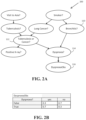
- FIG. 2 A is a schematic illustration of an exemplary Bayesian network augmented with a virtual node representing uncertain evidence, according to some embodiments;
- FIG. 2 B is a diagram of an exemplary conditional probability table of a virtual node in an augmented Bayesian network, according to some embodiments
- FIG. 3 is a flowchart of a method for learning parameters of Bayesian network given uncertain evidence, according to some embodiments.
- FIG. 4 is a pseudo-code of an exemplary Expectation-Maximization algorithm for learning parameters of a Bayesian network using likelihood evidence.
- Some embodiments described in the present disclosure relate to data analysis and, more specifically, but not exclusively, to learning parameters of Bayesian network given uncertain evidence.
- Bayesian Networks provide a powerful framework for reasoning about conditional dependency structures over many variables.
- the creation of BNs often requires the specification of a large number of parameters, making it highly desirable to be able to learn these parameters from historical data.
- such data has uncertainty associated with it, including cases in which this data comes from unstructured analysis or from sensors.
- unstructured analysis algorithms can be run on the historical text descriptions or images of previous cases so as to extract data that can be used for Bayesian Network parameter learning, but such derived data has inherent uncertainty associated with it due to the nature of such algorithms Because of the inability of current Bayesian Network parameter learning algorithms to incorporate such uncertainty, common approaches either ignore this uncertainty, thus reducing the resulting accuracy, or completely disregard such data.
- an illustrative exemplary real-world application may entail creating a model for electrical equipment diagnosis, in which much of the data available to train the BN was in textual descriptions written by technicians.
- natural language processing (NLP) tools can be used to transform the unstructured data into a structured format more suitable for BN parameter learning.
- NLP natural language processing
- such natural-language processing models are not completely accurate, and have both false positives and false negatives.
- most such tools provide confidence measures indicating their level of certainty about the outcome. It is of course desirable to use such confidence levels when learning the probabilities of the BN.
- One technical problem dealt with by the disclosed subject matter is to learn parameters of a Bayesian network from data containing uncertain evidence.
- Another technical problem dealt with by the disclosed subject matter is to harness and employ capabilities of Bayesian network inference from uncertain evidence in service of parameter learning, thus allowing incorporating knowledge gained by uncertainty inference into the learning process.
- an input comprising graph representation and at least one sample of a Bayesian network (BN) may be received, wherein random variables and conditional dependencies there-among are represented by nodes and directed edges of the graph respectively, and wherein each sample comprising either a known, unknown, or uncertain value for each random variable represented by the BN nodes.
- a learning process for estimating conditional probability tables (CPTs) of Bayesian network, using Bayesian network inference and resulting probabilities of random variables represented by the BN for calculating estimates of the CPTs may be employed on the input, wherein in case where uncertain evidence being encountered, the learning process may employ a BN inference process configured for performing inference with uncertain evidence of such sort.
- CPTs conditional probability tables
- X x 1 ) of the observation of value o occurring when the value or state of X is x i .
- X x 1 ) of the observation of value o occurring when the value or state of X is x i .
- This may be referred to as a likelihood finding on the variable X
- a set of likelihood findings on variables of the BN may be referred to as likelihood evidence.
- a likelihood finding on a variable in general may be an observation with uncertainty of the variable.
- Likelihood evidence for the node may be (0.3,0.7) indicating that the confidence associated with the value being true is 0.7 and that it is false is 0.3.
- this type of uncertainty may be suitable for handling the confidence output by unstructured analysis algorithms, sensors, and/or any likewise data source which uncertainty of the observation may originate or result therefrom, for example, due to the unreliability or imprecision of the data source. This is so because likelihood evidence is assumed not to incorporate any prior knowledge beyond what appears directly in the information source (the sensor, text or picture).
- an augmented BN may be generated from the graph input by adding an auxiliary binary child node for each of which nodes, and corresponding conditional probability tables may be populated for each respective edge connecting such child node with its parent node.
- the child node may represent a binary random variable of the uncertain value being observed in a sample of the BN.
- the augmented BN may then be used for inference from the uncertain evidence, wherein known values in the sample and observations of uncertain values may be treated as certain evidence in the augmented BN, whereas unknown values in the sample and values of nodes for which likelihood ratios being specified may be treated as being unknown, i.e. variables for which no evidence being available.
- Entries of conditional probability tables of the auxiliary child nodes may comprise respective probabilities of the observed uncertain values occurring conditioned on which value or state, out of all possibilities, the parent nodes being in.
- the learning process may be based on or extend an Expectation-Maximization (EM) algorithm, to enable learning BN parameters that have uncertain evidence associated with them.
- EM Expectation-Maximization
- the EM algorithm in its standard basic form is intended to enable learning of a BN's parameters with missing data, i.e., on examples for which some of the values of the variables in the network are missing or unknown. To do this, it repeats two steps: an expectation step, in which, for each example, the missing data values are replaced with the expected values given the current BN parameters using BN inference; and a maximization step, in which the maximum likelihood values of the BN's parameters are calculated given the (now complete) data.
- this algorithm can be described as follows:
- uncertain evidence may usually be introduced whenever there is knowledge about the value of the random variable, but the observational process is unable to clearly report a single state for the observed variable.
- the learning process may be an EM-based learning process in which the standard expectation step being replaced by one that incorporates uncertain evidence propagation into the BN inference.
- the uncertain evidence may be likelihood evidence and step 1 may be replaced by the following:
- the BN inference employed by the learning process may be adapted for performing inference using uncertain evidence of one or more types, including likelihood evidence, probabilistic evidence, and/or any other type of uncertain evidence, and the learning process may invoke the BN inference for handling uncertainty of the corresponding type whenever it being encountered in the input data.
- any suitable learning algorithm which uses BN inference for calculating probabilities of random variables represented by the BN and then uses the resulting probabilities from the inference in updating of the estimate of the parameters of the BN may be employed in accordance with the disclosed subject matter to yield a learning process capable of incorporating uncertain data into the parameters' estimation.
- the learning process may also support integrating expert knowledge together with historical data, by incorporation thereof into the BN inference process being used thereby. Additionally or alternatively, continuous learning, i.e. continued updating of the parameters estimations or post-training of the model may be supported, for example, by calculating and saving the number of examples used to calculate each conditional probability distribution (CPD) entry, and using these values when updating the CPDs. Other enhancements that can be updated incrementally may similarly be incorporated during BN inference and by result in the learning process in whole, as can readily be appreciated by a person skilled in the art.
- CPD conditional probability distribution
- One technical effect of utilizing the disclosed subject matter is that parameter learning of a Bayesian network can be achieved also when the data provided or part of it being uncertain.
- Another technical effect of utilizing the disclosed subject matter is incorporation of uncertain evidence in parameter learning of a Bayesian network at no additional significant cost.
- Embodiments may be a system, a method, and/or a computer program product.
- the computer program product may include a computer readable storage medium (or media) having computer readable program instructions thereon for causing a processor to carry out aspects of the embodiments.
- the computer readable storage medium can be a tangible device that can retain and store instructions for use by an instruction execution device.
- the computer readable storage medium may be, for example, but is not limited to, an electronic storage device, a magnetic storage device, an optical storage device, an electromagnetic storage device, a semiconductor storage device, or any suitable combination of the foregoing.
- a non-exhaustive list of more specific examples of the computer readable storage medium includes the following: a portable computer diskette, a hard disk, a random access memory (RAM), a read-only memory (ROM), an erasable programmable read-only memory (EPROM or Flash memory), a static random access memory (SRAM), a portable compact disc read-only memory (CD-ROM), a digital versatile disk (DVD), a memory stick, a floppy disk, and any suitable combination of the foregoing.
- RAM random access memory
- ROM read-only memory
- EPROM or Flash memory erasable programmable read-only memory
- SRAM static random access memory
- CD-ROM compact disc read-only memory
- DVD digital versatile disk
- memory stick a floppy disk, and any suitable combination of the foregoing.
- a computer readable storage medium is not to be construed as being transitory signals per se, such as radio waves or other freely propagating electromagnetic waves, electromagnetic waves propagating through a waveguide or other transmission media (e.g., light pulses passing through a fiber-optic cable), or electrical signals transmitted through a wire.
- Computer readable program instructions described herein can be downloaded to respective computing/processing devices from a computer readable storage medium or to an external computer or external storage device via a network, for example, the Internet, a local area network, a wide area network and/or a wireless network.
- the network may comprise copper transmission cables, optical transmission fibers, wireless transmission, routers, firewalls, switches, gateway computers and/or edge servers.
- a network adapter card or network interface in each computing/processing device receives computer readable program instructions from the network and forwards the computer readable program instructions for storage in a computer readable storage medium within the respective computing/processing device.
- Computer readable program instructions for carrying out operations of embodiments may be assembler instructions, instruction-set-architecture (ISA) instructions, machine instructions, machine dependent instructions, microcode, firmware instructions, state-setting data, or either source code or object code written in any combination of one or more programming languages, including an object oriented programming language such as Smalltalk, C++ or the like, and conventional procedural programming languages, such as the “C” programming language or similar programming languages.
- the computer readable program instructions may execute entirely on the user's computer, partly on the user's computer, as a stand-alone software package, partly on the user's computer and partly on a remote computer or entirely on the remote computer or server.
- the remote computer may be connected to the user's computer through any type of network, including a local area network (LAN) or a wide area network (WAN), or the connection may be made to an external computer (for example, through the Internet using an Internet Service Provider).
- electronic circuitry including, for example, programmable logic circuitry, field-programmable gate arrays (FPGA), or programmable logic arrays (PLA) may execute the computer readable program instructions by utilizing state information of the computer readable program instructions to personalize the electronic circuitry, in order to perform aspects of embodiments.
- These computer readable program instructions may be provided to a processor of a general purpose computer, special purpose computer, or other programmable data processing apparatus to produce a machine, such that the instructions, which execute via the processor of the computer or other programmable data processing apparatus, create means for implementing the functions/acts specified in the flowchart and/or block diagram block or blocks.
- These computer readable program instructions may also be stored in a computer readable storage medium that can direct a computer, a programmable data processing apparatus, and/or other devices to function in a particular manner, such that the computer readable storage medium having instructions stored therein comprises an article of manufacture including instructions which implement aspects of the function/act specified in the flowchart and/or block diagram block or blocks.
- the computer readable program instructions may also be loaded onto a computer, other programmable data processing apparatus, or other device to cause a series of operational steps to be performed on the computer, other programmable apparatus or other device to produce a computer implemented process, such that the instructions which execute on the computer, other programmable apparatus, or other device implement the functions/acts specified in the flowchart and/or block diagram block or blocks.
- each block in the flowchart or block diagrams may represent a module, segment, or portion of instructions, which comprises one or more executable instructions for implementing the specified logical function(s).
- the functions noted in the block may occur out of the order noted in the figures.
- two blocks shown in succession may, in fact, be executed substantially concurrently, or the blocks may sometimes be executed in the reverse order, depending upon the functionality involved.
- FIG. 1 A is a schematic illustration of an exemplary Bayesian network, according to some embodiments.
- FIG. 1 B is a diagram of an exemplary conditional probability table of a node in a Bayesian network, according to some embodiments.
- a Bayesian network such as BN 100 illustrated in FIG. 1 A
- the BN 100 may depict a diagnosis network in the medical domain.
- the BN of FIG. 1 A may also be known as the “Asia” network or “Lung cancer” network.
- BN 100 may enable the use of evidence regarding “Visit to Asia?” together with “Smoker?”, “Positive X-ray?”, and “Dyspnoea?” to compute the probability of the “Lung cancer?”, “Tuberculosis?” and “Bronchitis?” nodes.
- CPT conditional probability table
- the left-most column in the CPT of FIG. 1 B specifies the probability distribution or likelihood of Dyspnoea occurring or not given observations of both the nodes “Bronchitis?” and “Tuberculosis or Lung cancer?” (nodes 110 and 112 of FIG. 1 A ) being positive, where the top row corresponds to the node “Dyspnoea?” being positive and the bottom row to it being negative.
- FIG. 1 B corresponds to probabilities of Dyspnoea occurring given that Bronchitis occurred and Tuberculosis or Lung cancer did not.
- the two right columns in the CPT of FIG. 1 B similarly correspond to probabilities of Dyspnoea occurring given that Bronchitis did not occur and that Tuberculosis or Lung cancer occurred or not respectively.
- NLP tools can be used to transform such unstructured data into a structured format with associated uncertainty. For example, an NLP tool run on such a historical report may be able to indicate with a 0.7 confidence level that a specific patient indeed had the “Dyspnoea?” symptom.
- the information with uncertainty may be represented by assigning the node “Dyspnoea?” in the network the likelihood evidence (0.7; 0.3).
- inference in a BN given likelihood evidence can be carried out as follows: a virtual node for the observation may be added to the network with the appropriate CPT; the virtual evidence may be set as a hard finding on this node; and the evidence on all the nodes in the BN may then be propagated using standard BN propagation algorithms.
- FIG. 2 A is a schematic illustration of an exemplary Bayesian network augmented with a virtual node representing uncertain evidence, according to some embodiments.
- FIG. 2 B is a diagram of an exemplary conditional probability table of a virtual node in an augmented Bayesian network, according to some embodiments.
- augmented BN 200 may consist of nodes and edges of BN 100 of FIG. 1 A , such as nodes 110 , 112 and 114 and edges 120 and 122 .
- augmented BN 200 may comprise for each node with likelihood evidence a child node representing the observed value with uncertainty of the node, along with corresponding CPT for the child node with probabilities matching the likelihoods of each of the possible values of its parent node.
- the original “Asia” BN 100 of FIG. 1 A may be extended with a boolean (true/false) node “DyspnoeaObs”, such as node 116 , added to BN 100 as a child of “Dyspnoea?” (node 114 ), thus yielding augmented BN 200 .
- the node 116 may then have the CPT given in FIG. 2 B associated with it.
- the value of “DyspnoeaObs” may be set to “true” accordingly, and inference may be carried out on the augmented BN 200 using any standard BN inference algorithm.
- FIG. 3 is a flowchart of a method for learning parameters of Bayesian network given uncertain evidence, according to some embodiments.
- an input comprising a graph representation and one or more data samples of a Bayesian network may be received.
- the graph of the Bayesian network may comprise a plurality of nodes representing random variables and a plurality of directed edges between pairs of nodes representing conditional dependencies among respective variables represented thereby.
- the received data samples may comprise known, missing, and/or uncertain values for each of the plurality of random variables nodes.
- the uncertain values may be associated with a likelihood ratio and/or a probability distribution over a domain of possible values of the respective nodes for which the uncertain values being observed in a corresponding sample.
- probabilities of the plurality of random variables represented by the nodes of the Bayesian network graph received at 302 may be calculated using a Bayesian network inference process and the data samples received at 302 .
- a determination may be made as to whether a received data sample comprises uncertain evidence, for example, an uncertain value for a node with associated probability distribution and/or likelihood ratio.
- the uncertain evidence may be accordingly incorporated in the calculation of probabilities through use of an uncertainty Bayesian network inference process adapted for this task.
- the received Bayesian network may be augmented with a virtual node and corresponding conditional probability table (CPT) for each node with an observed uncertain value, and inference may be performed on the augmented network using standard propagation methods.
- CPT conditional probability table
- probabilistic evidence for which there may be at hand an appropriate inference method of incorporating the uncertain information in the propagation throughout the Bayesian network, such uncertainty inference process may be used with the uncertain data.
- probabilistic evidence may comprise a probability distribution over values of a single node or a set of nodes (i.e. a joint distribution), and may be affectable by additional information on the network (i.e. not-fixed) or not affectable thereby (i.e. fixed probabilistic evidence).
- CPT estimations for the Bayesian network received at 302 may be calculated using the probabilities resulting from the inference performed at 304 through 306 and 308 .
- the learning process from 304 to 310 may be iterated for a number of times until convergence.
- the parameters of the Bayesian network resulting from the learning process of 304 to 310 i.e. the CPTs calculated for the plurality of graph nodes, may be outputted.
- a number of the data samples used in calculation of the CPTs e.g. the number of data samples received at 302 , may be recorded and stored, to enable implementation of continuous learning scheme, wherein probability distribution entry may be updated using the number of data samples as stored.
- FIG. 4 is a pseudo-code of an exemplary Expectation-Maximization algorithm for learning parameters of a Bayesian network using likelihood evidence.
- Each data example S j ⁇ S may contain one element d V ⁇ domain(V) ⁇ ? ⁇ l V ⁇ for each V ⁇ , where “?” denotes an unknown value and ⁇ l V ⁇ is likelihood evidence for node V.
- l V For each node V with k possible values for which likelihood evidence l V is provided, l V consists of numbers ⁇ Pr(obs
- V v 1 ), . . . , Pr(obs
- V v k ) ⁇ . That is, for each data item S j , the value for variable V can be any of its discrete values, unknown, or a new type of value, indicating likelihood evidence.
- o V denotes the node for which d V is an observation in S j
- O j denotes the set of variables in S j for which there is likelihood evidence.
- Conf in the algorithm are the actual likelihood values provided for a node.
- ⁇ is used to denote the network's parameters, i.e., the set of all entries of the CPTs in P.
- ⁇ t represents the parameters of the network in iteration t of the algorithm (the initial values for ⁇ may be uniformly sampled or otherwise determined as an educated guess).
- the EM-Likelihood algorithm may extend the original Bayesian network (BN) with nodes specific to each example that contains likelihood evidence, in order to enable inference with likelihood evidence during the expectation step. This step is carried out in the function A UGMENT -BN.
- Val(X i ,P ) is used to denote the joint set of possible values of a node X i and its parents P , in .
- the term d j is used to denote the union of known values in example S j and the evidence obtained by setting to “true” the auxiliary nodes, performed after the function AUGMENT-BN returns the augmented network G′.
- d j ) are obtained via inference in the augmented network G′.
- M ⁇ t [u] denotes the sum ⁇ x i M ⁇ t [x i , u i ].
- composition or method may include additional ingredients and/or steps, but only if the additional ingredients and/or steps do not materially alter the basic and novel characteristics of the claimed composition or method.
- a compound or “at least one compound” may include a plurality of compounds, including mixtures thereof.
- range format is merely for convenience and brevity and should not be construed as an inflexible limitation on the scope of embodiments. Accordingly, the description of a range should be considered to have specifically disclosed all the possible subranges as well as individual numerical values within that range. For example, description of a range such as from 1 to 6 should be considered to have specifically disclosed subranges such as from 1 to 3, from 1 to 4, from 1 to 5, from 2 to 4, from 2 to 6, from 3 to 6 etc., as well as individual numbers within that range, for example, 1, 2, 3, 4, 5, and 6. This applies regardless of the breadth of the range.
- a numerical range is indicated herein, it is meant to include any cited numeral (fractional or integral) within the indicated range.
- the phrases “ranging/ranges between” a first indicate number and a second indicate number and “ranging/ranges from” a first indicate number “to” a second indicate number are used herein interchangeably and are meant to include the first and second indicated numbers and all the fractional and integral numerals therebetween.
Landscapes
- Engineering & Computer Science (AREA)
- Theoretical Computer Science (AREA)
- Physics & Mathematics (AREA)
- Software Systems (AREA)
- General Physics & Mathematics (AREA)
- Data Mining & Analysis (AREA)
- Computing Systems (AREA)
- Evolutionary Computation (AREA)
- Artificial Intelligence (AREA)
- Mathematical Physics (AREA)
- General Engineering & Computer Science (AREA)
- Health & Medical Sciences (AREA)
- Medical Informatics (AREA)
- Mathematical Optimization (AREA)
- Mathematical Analysis (AREA)
- Algebra (AREA)
- Computational Mathematics (AREA)
- Pure & Applied Mathematics (AREA)
- Biomedical Technology (AREA)
- General Health & Medical Sciences (AREA)
- Computer Vision & Pattern Recognition (AREA)
- Probability & Statistics with Applications (AREA)
- Life Sciences & Earth Sciences (AREA)
- Public Health (AREA)
- Automation & Control Theory (AREA)
- Fuzzy Systems (AREA)
- Molecular Biology (AREA)
- Epidemiology (AREA)
- Pathology (AREA)
- Primary Health Care (AREA)
- Databases & Information Systems (AREA)
- Complex Calculations (AREA)
- Error Detection And Correction (AREA)
Abstract
Description
-
- 1. Complete the data for each example by calculating the expected value for each variable with missing values given the current parameters of the BN.
- 2. Update the parameters of the BN to the Maximum Likelihood Estimate (MLE) given the set of full data provided by the expectation step.
-
- 1. Complete the data for each example:
- (a) Extend the original network by adding nodes and edges to each node for which there is likelihood evidence, as well as the appropriate conditional probability tables (CPTs). (In this way, the example with likelihood evidence can be replaced with a new example with only missing data. For example, if an observation child has been added to node V, the node V now has an unknown value in this new augmented data point.)
- (b) Calculate the expected value for the nodes with the missing data.
- 1. Complete the data for each example:


Claims (21)
Priority Applications (1)
| Application Number | Priority Date | Filing Date | Title |
|---|---|---|---|
| US17/107,984 US12093848B2 (en) | 2020-12-01 | 2020-12-01 | Learning parameters of Bayesian network using uncertain evidence |
Applications Claiming Priority (1)
| Application Number | Priority Date | Filing Date | Title |
|---|---|---|---|
| US17/107,984 US12093848B2 (en) | 2020-12-01 | 2020-12-01 | Learning parameters of Bayesian network using uncertain evidence |
Publications (2)
| Publication Number | Publication Date |
|---|---|
| US20220172091A1 US20220172091A1 (en) | 2022-06-02 |
| US12093848B2 true US12093848B2 (en) | 2024-09-17 |
Family
ID=81752713
Family Applications (1)
| Application Number | Title | Priority Date | Filing Date |
|---|---|---|---|
| US17/107,984 Active 2043-07-19 US12093848B2 (en) | 2020-12-01 | 2020-12-01 | Learning parameters of Bayesian network using uncertain evidence |
Country Status (1)
| Country | Link |
|---|---|
| US (1) | US12093848B2 (en) |
Families Citing this family (7)
| Publication number | Priority date | Publication date | Assignee | Title |
|---|---|---|---|---|
| CN115357564B (en) * | 2022-07-05 | 2026-01-09 | 深圳大学 | A data cleaning method, terminal, and storage medium based on Bayes' theorem |
| US11734594B1 (en) * | 2022-09-12 | 2023-08-22 | Sas Institute Inc. | State monitoring system |
| CN115730265A (en) * | 2022-11-30 | 2023-03-03 | 中国农业银行股份有限公司 | Abnormal identification method and equipment |
| CN116306264A (en) * | 2023-02-24 | 2023-06-23 | 北京百度网讯科技有限公司 | Self-driving vehicle behavior decision-making and model building method, device and vehicle |
| CN116227604A (en) * | 2023-02-28 | 2023-06-06 | 支付宝(杭州)信息技术有限公司 | Distributed Bayesian network training method and device |
| CN116796150B (en) * | 2023-06-15 | 2025-12-05 | 中南大学 | A method for determining the correlation of ore-controlling factors in three-dimensional mineralization prediction |
| US20250149128A1 (en) * | 2023-11-02 | 2025-05-08 | Microsoft Technology Licensing, Llc | Querying and analysis of clinical trials using probabilistic graphical models |
Citations (4)
| Publication number | Priority date | Publication date | Assignee | Title |
|---|---|---|---|---|
| US6415276B1 (en) * | 1998-08-14 | 2002-07-02 | University Of New Mexico | Bayesian belief networks for industrial processes |
| US20040220892A1 (en) | 2003-04-29 | 2004-11-04 | Ira Cohen | Learning bayesian network classifiers using labeled and unlabeled data |
| US20090313204A1 (en) * | 2006-07-31 | 2009-12-17 | Koninklijke Philips Electronics N.V. | Sample-based robust inference for decision support system |
| US20120078678A1 (en) * | 2010-09-23 | 2012-03-29 | Infosys Technologies Limited | Method and system for estimation and analysis of operational parameters in workflow processes |
-
2020
- 2020-12-01 US US17/107,984 patent/US12093848B2/en active Active
Patent Citations (4)
| Publication number | Priority date | Publication date | Assignee | Title |
|---|---|---|---|---|
| US6415276B1 (en) * | 1998-08-14 | 2002-07-02 | University Of New Mexico | Bayesian belief networks for industrial processes |
| US20040220892A1 (en) | 2003-04-29 | 2004-11-04 | Ira Cohen | Learning bayesian network classifiers using labeled and unlabeled data |
| US20090313204A1 (en) * | 2006-07-31 | 2009-12-17 | Koninklijke Philips Electronics N.V. | Sample-based robust inference for decision support system |
| US20120078678A1 (en) * | 2010-09-23 | 2012-03-29 | Infosys Technologies Limited | Method and system for estimation and analysis of operational parameters in workflow processes |
Non-Patent Citations (6)
| Title |
|---|
| Ben Mrad et al. "An Explication of Uncertain Evidence in Bayesian Networks: Likelihood Evidence and Probabilistic Evidence," Applied Intelligence 1-23, 2015. |
| Ben Mrad et al. "Uncertain Evidence in Bayesian Networks : Presentation and Comparison on a Simple Example," IPMU 2012, Part III, CCIS 299, pp. 39-48, 2012. |
| Bornhold et al., Uncertain<T>: A First-Order Type for Uncertain Data, ASPLOS '14, Mar. 1-5, 2014, Total pp. 15 (Year: 2014). * |
| Choi et al. "EDML: A Method for Learning Parameters in Bayesian Networks," Conference: UAI 2011, Proceedings of the Twenty-Seventh Conference on Uncertainty in Artificial Intelligence, Barcelona, Spain, Jul. 14-17, 2011: 115-124. |
| Masegosa et al. "Learning from Incomplete Data in Bayesian Networks with Qualitative Influences," International Journal of Approximate Reasoning 69: 18-34, 2016. |
| Wistuba et al. "Scalable Multi-Class Bayesian Support Vector Machines for Structured and Unstructured Data," arXiv:1806.02659v1 [cs.LG] Jun. 7, 2018, 14 pages. |
Also Published As
| Publication number | Publication date |
|---|---|
| US20220172091A1 (en) | 2022-06-02 |
Similar Documents
| Publication | Publication Date | Title |
|---|---|---|
| US20220172091A1 (en) | Learning parameters of bayesian network using uncertain evidence | |
| US11610097B2 (en) | Apparatus and method for generating sampling model for uncertainty prediction, and apparatus for predicting uncertainty | |
| CN109034219B (en) | Image multi-label category prediction method and device, electronic device and storage medium | |
| US12469268B2 (en) | Method, device and computer storage medium for data analysis | |
| Bonald et al. | A minimax optimal algorithm for crowdsourcing | |
| US11880432B2 (en) | Confidence measure for a deployed machine learning model | |
| US20190332933A1 (en) | Optimization of model generation in deep learning neural networks using smarter gradient descent calibration | |
| US11449731B2 (en) | Update of attenuation coefficient for a model corresponding to time-series input data | |
| US11100388B2 (en) | Learning apparatus and method for learning a model corresponding to real number time-series input data | |
| CN114064928A (en) | Knowledge inference method, knowledge inference device, knowledge inference equipment and storage medium | |
| JP7573548B2 (en) | Feature Vector Feasibility Estimation | |
| US20140317034A1 (en) | Data classification | |
| US20200050971A1 (en) | Minibatch Parallel Machine Learning System Design | |
| US20210056675A1 (en) | Image generation device, image generation method, and image generation program | |
| CN112686317B (en) | Neural network training method, device, electronic device and storage medium | |
| US10733537B2 (en) | Ensemble based labeling | |
| CN116401372A (en) | Knowledge map representation learning method, device, electronic device and readable storage medium | |
| US20210046953A1 (en) | Efficient inference update using belief space planning | |
| CN114594963A (en) | Model deployment method, device, electronic device and storage medium | |
| US20220076058A1 (en) | Estimation device, estimation method, and computer program product | |
| CN112486784A (en) | Method, apparatus and medium for diagnosing and optimizing data analysis system | |
| Conde et al. | Adaptive-TTA: accuracy-consistent weighted test time augmentation method for the uncertainty calibration of deep learning classifiers. | |
| US20210241148A1 (en) | Abduction apparatus, abduction method, and computer-readable recording medium | |
| CN116360387A (en) | A Fault Localization Method Fused with Bayesian Network and Performance-Fault Relationship Graph | |
| Lefringhausen et al. | Barrier certificates for unknown systems with latent states and polynomial dynamics using bayesian inference |
Legal Events
| Date | Code | Title | Description |
|---|---|---|---|
| AS | Assignment |
Owner name: INTERNATIONAL BUSINESS MACHINES CORPORATION, NEW YORK Free format text: ASSIGNMENT OF ASSIGNORS INTEREST;ASSIGNORS:WASSERKRUG, ELIEZER SEGEV;MARINESCU, RADU;SIGNING DATES FROM 20201130 TO 20201201;REEL/FRAME:054497/0445 |
|
| FEPP | Fee payment procedure |
Free format text: ENTITY STATUS SET TO UNDISCOUNTED (ORIGINAL EVENT CODE: BIG.); ENTITY STATUS OF PATENT OWNER: LARGE ENTITY |
|
| STPP | Information on status: patent application and granting procedure in general |
Free format text: DOCKETED NEW CASE - READY FOR EXAMINATION |
|
| STPP | Information on status: patent application and granting procedure in general |
Free format text: NON FINAL ACTION COUNTED, NOT YET MAILED |
|
| STPP | Information on status: patent application and granting procedure in general |
Free format text: NON FINAL ACTION MAILED |
|
| STPP | Information on status: patent application and granting procedure in general |
Free format text: RESPONSE TO NON-FINAL OFFICE ACTION ENTERED AND FORWARDED TO EXAMINER |
|
| STPP | Information on status: patent application and granting procedure in general |
Free format text: NOTICE OF ALLOWANCE MAILED -- APPLICATION RECEIVED IN OFFICE OF PUBLICATIONS |
|
| ZAAB | Notice of allowance mailed |
Free format text: ORIGINAL CODE: MN/=. |
|
| STPP | Information on status: patent application and granting procedure in general |
Free format text: PUBLICATIONS -- ISSUE FEE PAYMENT RECEIVED |
|
| STPP | Information on status: patent application and granting procedure in general |
Free format text: PUBLICATIONS -- ISSUE FEE PAYMENT VERIFIED |
|
| STCF | Information on status: patent grant |
Free format text: PATENTED CASE |