US12087008B2 - User analytics using a camera device and associated systems and methods - Google Patents
User analytics using a camera device and associated systems and methods Download PDFInfo
- Publication number
- US12087008B2 US12087008B2 US17/326,341 US202117326341A US12087008B2 US 12087008 B2 US12087008 B2 US 12087008B2 US 202117326341 A US202117326341 A US 202117326341A US 12087008 B2 US12087008 B2 US 12087008B2
- Authority
- US
- United States
- Prior art keywords
- user
- physical information
- pose
- camera
- location
- Prior art date
- Legal status (The legal status is an assumption and is not a legal conclusion. Google has not performed a legal analysis and makes no representation as to the accuracy of the status listed.)
- Active, expires
Links
Images




Classifications
-
- G—PHYSICS
- G06—COMPUTING OR CALCULATING; COUNTING
- G06T—IMAGE DATA PROCESSING OR GENERATION, IN GENERAL
- G06T7/00—Image analysis
- G06T7/70—Determining position or orientation of objects or cameras
-
- G—PHYSICS
- G06—COMPUTING OR CALCULATING; COUNTING
- G06T—IMAGE DATA PROCESSING OR GENERATION, IN GENERAL
- G06T7/00—Image analysis
- G06T7/70—Determining position or orientation of objects or cameras
- G06T7/73—Determining position or orientation of objects or cameras using feature-based methods
-
- G—PHYSICS
- G06—COMPUTING OR CALCULATING; COUNTING
- G06N—COMPUTING ARRANGEMENTS BASED ON SPECIFIC COMPUTATIONAL MODELS
- G06N3/00—Computing arrangements based on biological models
- G06N3/02—Neural networks
- G06N3/04—Architecture, e.g. interconnection topology
- G06N3/0464—Convolutional networks [CNN, ConvNet]
-
- G—PHYSICS
- G06—COMPUTING OR CALCULATING; COUNTING
- G06T—IMAGE DATA PROCESSING OR GENERATION, IN GENERAL
- G06T5/00—Image enhancement or restoration
- G06T5/20—Image enhancement or restoration using local operators
-
- G—PHYSICS
- G06—COMPUTING OR CALCULATING; COUNTING
- G06T—IMAGE DATA PROCESSING OR GENERATION, IN GENERAL
- G06T5/00—Image enhancement or restoration
- G06T5/70—Denoising; Smoothing
-
- G—PHYSICS
- G06—COMPUTING OR CALCULATING; COUNTING
- G06T—IMAGE DATA PROCESSING OR GENERATION, IN GENERAL
- G06T7/00—Image analysis
- G06T7/20—Analysis of motion
-
- G—PHYSICS
- G06—COMPUTING OR CALCULATING; COUNTING
- G06T—IMAGE DATA PROCESSING OR GENERATION, IN GENERAL
- G06T7/00—Image analysis
- G06T7/50—Depth or shape recovery
-
- G—PHYSICS
- G06—COMPUTING OR CALCULATING; COUNTING
- G06T—IMAGE DATA PROCESSING OR GENERATION, IN GENERAL
- G06T7/00—Image analysis
- G06T7/50—Depth or shape recovery
- G06T7/536—Depth or shape recovery from perspective effects, e.g. by using vanishing points
-
- G—PHYSICS
- G06—COMPUTING OR CALCULATING; COUNTING
- G06T—IMAGE DATA PROCESSING OR GENERATION, IN GENERAL
- G06T7/00—Image analysis
- G06T7/60—Analysis of geometric attributes
-
- G—PHYSICS
- G09—EDUCATION; CRYPTOGRAPHY; DISPLAY; ADVERTISING; SEALS
- G09B—EDUCATIONAL OR DEMONSTRATION APPLIANCES; APPLIANCES FOR TEACHING, OR COMMUNICATING WITH, THE BLIND, DEAF OR MUTE; MODELS; PLANETARIA; GLOBES; MAPS; DIAGRAMS
- G09B19/00—Teaching not covered by other main groups of this subclass
- G09B19/003—Repetitive work cycles; Sequence of movements
- G09B19/0038—Sports
-
- G—PHYSICS
- G06—COMPUTING OR CALCULATING; COUNTING
- G06N—COMPUTING ARRANGEMENTS BASED ON SPECIFIC COMPUTATIONAL MODELS
- G06N20/00—Machine learning
- G06N20/10—Machine learning using kernel methods, e.g. support vector machines [SVM]
-
- G—PHYSICS
- G06—COMPUTING OR CALCULATING; COUNTING
- G06N—COMPUTING ARRANGEMENTS BASED ON SPECIFIC COMPUTATIONAL MODELS
- G06N3/00—Computing arrangements based on biological models
- G06N3/02—Neural networks
- G06N3/04—Architecture, e.g. interconnection topology
- G06N3/045—Combinations of networks
-
- G—PHYSICS
- G06—COMPUTING OR CALCULATING; COUNTING
- G06N—COMPUTING ARRANGEMENTS BASED ON SPECIFIC COMPUTATIONAL MODELS
- G06N3/00—Computing arrangements based on biological models
- G06N3/02—Neural networks
- G06N3/08—Learning methods
-
- G—PHYSICS
- G06—COMPUTING OR CALCULATING; COUNTING
- G06N—COMPUTING ARRANGEMENTS BASED ON SPECIFIC COMPUTATIONAL MODELS
- G06N7/00—Computing arrangements based on specific mathematical models
- G06N7/01—Probabilistic graphical models, e.g. probabilistic networks
-
- G—PHYSICS
- G06—COMPUTING OR CALCULATING; COUNTING
- G06N—COMPUTING ARRANGEMENTS BASED ON SPECIFIC COMPUTATIONAL MODELS
- G06N7/00—Computing arrangements based on specific mathematical models
- G06N7/02—Computing arrangements based on specific mathematical models using fuzzy logic
-
- G—PHYSICS
- G06—COMPUTING OR CALCULATING; COUNTING
- G06T—IMAGE DATA PROCESSING OR GENERATION, IN GENERAL
- G06T2207/00—Indexing scheme for image analysis or image enhancement
- G06T2207/20—Special algorithmic details
- G06T2207/20081—Training; Learning
-
- G—PHYSICS
- G06—COMPUTING OR CALCULATING; COUNTING
- G06T—IMAGE DATA PROCESSING OR GENERATION, IN GENERAL
- G06T2207/00—Indexing scheme for image analysis or image enhancement
- G06T2207/20—Special algorithmic details
- G06T2207/20084—Artificial neural networks [ANN]
-
- G—PHYSICS
- G06—COMPUTING OR CALCULATING; COUNTING
- G06T—IMAGE DATA PROCESSING OR GENERATION, IN GENERAL
- G06T2207/00—Indexing scheme for image analysis or image enhancement
- G06T2207/30—Subject of image; Context of image processing
- G06T2207/30196—Human being; Person
Definitions
- Embodiments of the present invention are in the field of image processing and pertain particularly to methods and systems for determining user analytics such as user location and movement information by imaging users in a three-dimensional environment with a computing device, the computing device having one or more cameras for video capture.
- Some embodiments of the present invention include methods, systems, and apparatuses for determining user location and movement information using a computing device.
- a computer-implemented method for performing location and movement determination in a three-dimensional environment using a computing device having a camera.
- the method can include the steps of capturing an image of a user using the camera of the computing device, identifying the user from the image using a first algorithm, determining a first physical information associated with the user using a second algorithm, determining a second physical information associated with the user based on the first physical information and an input parameter of the user using a search process, and determining the location of the user in the environment based on the first physical information and the second physical information.
- the first physical information includes a pose of the user
- the second physical information includes a depth of the user with respect to the camera
- the method further includes determining a movement associated with the user based on the first physical information.
- the method further includes determining a direction of gravity using the computing device, determining a second location of a portion of the user's body in the three-dimensional environment, and determining, based on the second location, a distance between the camera and the second location.
- the method further includes determining, based on the second physical information, a reference plane in the camera's coordinate system.
- the method further includes determining a first pose size of the user from a first user pose and determining a second pose size of the user from a second user pose, and determining a depth based on one or more of the camera's center, a distance to an imaging plane, an input height, the first pose size, and the second pose size.
- the method can further include determining the first pose size based on a length of pose limbs associated with the first user pose.
- the first physical information includes noisy pose data
- the method further includes applying a filter to the noisy pose data, and determining a second location of the user based on the filtered noisy pose data, where the second location has a greater accuracy than the location.
- a non-transitory storage medium for performing location and movement determination in a three-dimensional environment using a computing device having a camera.
- the storage medium includes machine-readable program code that cause a processor to capture an image of a user using the camera of the computing device, identify the user from the image using a first algorithm, determine a first physical information associated with the user using a second algorithm, determine a second physical information associated with the user based on the first physical information and an input parameter of the user using a search process, and determine the location of the user in the environment based on the first physical information and the second physical information.
- the first physical information includes a pose of the user
- the second physical information includes a depth of the user with respect to the camera
- the program code can cause the processor to determine a movement associated with the user based on the first physical information. In some embodiments, the program code can cause the processor to determine a direction of gravity using the computing device, determine a second location of a portion of the user's body in the three-dimensional environment, and determine, based on the second location, a distance between the camera and the second location. In an embodiment, the program code can cause the processor to determine, based on the second physical information, a reference plane in the camera's coordinate system.
- the program code can cause the processor to determine a first pose size of the user from a first user pose and determine a second pose size of the user from a second user pose, and determine a depth based on one or more of the camera's center, a distance to an imaging plane, an input height, the first pose size, and the second pose size.
- the first physical information includes noisy pose data
- the program code can cause the processor to apply a filter to the noisy pose data and determine a second location of the user based on the filtered noisy pose data, where the second location has a greater accuracy than the location.
- the computing device can include a camera device, a processor, and a non-transitory memory storing program code thereon.
- the program code can be executable by the processor to capture an image of a user using the camera device of the computing device, identify the user from the image using a first algorithm, determine a first physical information associated with the user using a second algorithm, determine a second physical information associated with of the user based on the first physical information and an input parameter of the user using a search process, and determine the location of the user in the environment based on the first physical information and the second physical information.
- the first physical information includes a pose of the user
- the second physical information includes a depth of the user with respect to the camera
- the program code can be executable by the processor to determine a direction of gravity using the computing device, determine a location of a portion of the user's body in the three-dimensional environment, and determine, based on the location, a distance between the camera and the location.
- the program code can be executable by the processor to determine, based on the second physical information, a reference plane in the camera's coordinate system.
- the program code can be executable by the processor to determine a first pose size of the user from a first user pose and determining a second pose size of the user from a second user pose, and determine a depth based on one or more of the camera's center, a distance to an imaging plane, an input height, the first pose size, and the second pose size.
- a computer program product is disclosed.
- the computer program may be used for facilitating location and movement determination in a three-dimensional environment using a camera of a computing device and may include a computer-readable storage medium having program instructions, or program code, embodied therewith, the program instructions executable by a processor to cause the processor to perform the steps described herein.
- a system including a memory that stores computer-executable components; a hardware processor, operably coupled to the memory, and that executes the computer-executable components stored in the memory, wherein the computer-executable components may include components communicatively coupled with the processor that execute the steps described herein.
- the present invention includes a non-transitory, computer-readable storage medium storing executable instructions or program code, which when executed by a processor, causes the processor to perform a process for facilitating location and movement determination in a three-dimensional environment using a camera of a computing device, the instructions causing the processor to perform the steps described herein.
- the present invention includes a system for facilitating location and movement determination in a three-dimensional environment using a camera of a computing device, the system comprising a user device or a computing device having a two-dimensional camera, a processor, a display, a first memory; a server comprising a second memory and a data repository; a telecommunications-link between said user device and said server; and a plurality of computer codes embodied on said first and second memory of said user-device and said server, said plurality of computer codes when executed causes said server and said user-device to execute a process comprising the steps described herein.
- the present invention includes a computerized server comprising at least one processor, memory, and a plurality of computer codes embodied on said memory, said plurality of computer codes when executed causes said processor to execute a process comprising the steps described herein.
- FIG. 1 is an exemplary schematic diagram of an overview of information generated by the device for determining a user's location and movements in an environment, in accordance with example embodiments of the present invention.
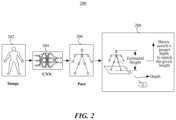
- FIG. 2 is an exemplary schematic diagram illustrating the use of machine learning algorithms and machine vision algorithms for determining a user's height and depth with respect to a camera in an environment, in accordance with example embodiments of the present invention.
- FIG. 3 is an exemplary flow chart illustrating example operations for determining a ground plane in a camera coordinate system with respect to a given user in an environment, in accordance with example embodiments of the present invention.
- FIG. 4 is an exemplary schematic illustrating one approach of determining a given user's location in a three-dimensional representation of an environment from the perspective of a camera of a device, in accordance with example embodiments of the present invention.
- FIG. 5 A is an exemplary schematic illustrating a technique of determining a given user's depth with respect to the camera of the device during a setup and activity phase, in accordance with example embodiments of the present invention.
- FIG. 5 B is an illustration of an exemplary flow chart illustrating example operations for performing location determination, in accordance with example embodiments of the present invention.
- FIG. 6 is an exemplary schematic diagram of a user computing entity for implementing a user location and movement determination system, according to exemplary embodiments of the present invention.
- FIG. 7 is an exemplary schematic diagram of a management computing entity for implementing a user location and movement determination system, according to exemplary embodiments of the present invention.
- FIG. 8 is a schematic diagram illustrating an exemplary NEX platform, according to exemplary embodiments of the present invention.
- NEX, NEX TEAM, and HOMECOURT are trademark names carrying embodiments of the present invention, and hence, the aforementioned trademark names may be interchangeably used in the specification and drawings to refer to the products/services offered by embodiments of the present invention.
- the term NEX, NEX TEAM, or HOMECOURT may be used in this specification to describe the overall user location and movement determination system, as well as the company providing said system.
- embodiments of the present invention relate to image processing and pertain particularly to methods and systems for user location and movement determination for use, for example, in connection with physical activities, training, and sport games of users, using a mobile computing device having one or more on-device cameras, by deploying artificial intelligence (AI)-based processes such as computer vision techniques.
- AI artificial intelligence
- training, or performance training activities discussed in this disclosure broadly refer to any physical exercise, workout, drill, or practice that improve a user's fitness and skill levels to better his or her ability to perform a given physical activity or sport.
- Training activities thus disclosed can maintain, condition, correct, restore, strengthen, or improve the physical ability, power, agility, flexibility, speed, quickness, reaction, endurance, and other physical and technical skills necessary for a physical activity or sport.
- Such a physical activity or sport may be competitive or non-competitive in nature, with or without specific goals or challenges, and may or may not be scored according to specific rules.
- a user of the system as disclosed herein may also be referred to as a player, including in non-competitive activities such as rehabilitative physical therapies and occupational therapies.
- a training session may involve one or more individual players.
- individual skills such as power, speed, agility, flexibility, posture, balance, core strength, upper and lower-body strength, rhythm, swing, stroke, flick, running, stopping, dribbling, juggling, passing, catching, throwing, smashing, tackling, shooting, jumping, sprinting, serving, and goalkeeping may be isolated, broken down into specific movements, and worked upon. Such skills may be inter-dependent.
- Embodiments of the present invention may be used for interactive virtual coaching in ball sports as well as other types of sports or physical activities, including but not limited to, basketball, soccer, baseball, football, hockey, tennis, badminton, juggling, archery, softball, volleyball, boxing, canoeing, kayaking, climbing, cycling, diving, equestrian, fencing, golf, gymnastics, handball, judo, karate, modern pentathlon, roller sport, rowing, rugby, sailing, shooting, swimming, surfing, table tennis, taekwondo, track and field, triathlon, water polo, weightlifting, wrestling, squash, wakeboard, wushu, dancing, bowling, netball, cricket, lacrosse, running, jogging, yo-yo, foot bagging, hand
- Real-time analytics systems have been developed to provide quantitative and qualitative game and player analytics, with uses in broadcasting, game strategizing, and team management, yet mass mainstream usage of such systems by individual players for customized performance training may be, in many situations, complex and expensive.
- Real-time tracking technology based on image recognition may often require use of multiple high-definition cameras mounted on top of a game area or playfield for capturing visual data from multiple camera arrays positioned at multiple perspectives, calibration for different environments, and massive processing power in high-end desktop and/or server-grade hardware to analyze data from the camera arrays.
- Accurate tracking of player motion and forms, and real-time automated analysis require vast computational resources that hinder implementations with low-cost, general-purpose hardware with small form factors.
- Such real-time analytics systems may need to determine various location and movement information associated with users (e.g., players of a game). Therefore, the disclosed systems advance the state of the art at least with respect to determining user location and movement information by imaging users in a three-dimensional environment using just a mobile device by utilizing video data captured from a camera on the mobile device.
- embodiments of the virtual coaching system disclosed herein relate to providing user location and movement determination, tracking and analysis of player movements using one or more computer vision algorithms running on a mobile computing device such as a smartphone, tablet, or laptop, and optionally providing audio or visual feedback based on the movement analysis, in real-time or near real-time.
- computer vision techniques such as image registration, motion detection, background subtraction, objection tracking, three-dimensional reconstruction techniques, cluster analysis techniques, camera calibration techniques such as camera pose estimation and sensor fusion, and modern machine learning techniques such as convolutional neural network (CNN)
- CNN convolutional neural network
- the limited computational resources in a mobile device present a unique challenge. For instance, a smartphone's limited CPU processing power can be heat-sensitive. A CPU clock rate may be reduced by the operating system (OS) whenever the phone heats up. Also, when a system consumes too much memory, the system or application running on the system may be terminated by the OS. In some embodiments, the amount of battery that the user location and movement determination system consume is controlled, otherwise the limited battery on a smartphone may not last a given duration (e.g., duration of a whole training session).
- OS operating system
- the amount of battery that the user location and movement determination system consume is controlled, otherwise the limited battery on a smartphone may not last a given duration (e.g., duration of a whole training session).
- analytics can refer to meaningful patterns (e.g., from a human perspective or from the perspective of a computer algorithm or machine learning module), knowledge, and information from data or statistics.
- user or player analytics can refer to quantitative and qualitative characterizations of player actions during one or more training sessions. Further, the terms player and user may be used interchangeably in many of the various embodiments described herein.
- the user location and movement determinations and information derived therefrom can be used downstream to perform analytics and provide feedback to users.
- player analytics include but are not limited to, shot types, shot make/miss determinations, shot score, player movement patterns, player moving speed, moving direction, reaction time, jump height and type, jump foot, landing foot, shot release time and angle, and posture statistics such as body bend angle, body rotation, leg bend ratio, leg power, combinations thereof, and/or the like.
- analytic may refer to both a shot analytic specific to a given shot attempt, and a player analytic specific to an identified player.
- game analytics can generally refer to statistical analytics generated from player analytics and optionally, can refer to shot analytics over the duration of a game.
- team analytics can refer to analytics aggregated across players of a team.
- player analytics and/or metrics can be specific to different types of sports.
- one or more users may be able to perform a dribbling workout, and an application on a mobile computing device implementing an embodiment of the present disclosure may be configured to monitor the dribbling workout to determine dribble speed, dribble accuracy, ability of the user to make specific movements during dribbling, combinations thereof, and/or the like.
- the physical activities and/or sports being trained for can include, but not be limited to, any suitable type of physical games played in the real world, such as on a court, field, trail, and/or the like.
- interactivity with a virtual and/or augmented world provides training opportunities for specific skills and techniques and physical activities and/or sports that at least partially interface with such domains and accordingly, the disclosed systems can be configured to operate within such domains.
- another level of interactivity may exist among one or more users linked through a network, where multiple users or players may train together at the same time, and training results may be compared across time.
- the disclosed systems can be configured to operate with group activities with multiple users, which may not necessarily have to be collocated or performing one or more activities (e.g., training sessions, games, drills, etc.) at substantially the same time.
- embodiments of the disclosure are directed to using a device (e.g., mobile device, tablet, laptop, wearable device, and/or the like) to determine the location of one or more users and associated movements and/or movement patterns (e.g., jumps, squats, stretches, weightlifting movements, combinations thereof, and/or the like). Further, the disclosed systems can determine the location of user(s) and associated movements over a predetermined time interval in a three-dimensional environment.
- a device e.g., mobile device, tablet, laptop, wearable device, and/or the like
- FIG. 1 shows an exemplary schematic diagram 100 that illustrates an overview of at least some information generated by the device for determining a user's location and movements in an environment, in accordance with example embodiments of the present invention.
- the device can include a camera.
- the camera can be an RGB-based camera, that is, a camera equipped with a standard complementary metal-oxide semiconductor (CMOS) based sensor device through which the colored images of persons and objects can be acquired via color-sensitive (e.g., red, green, and blue sensitive) sensor arrays.
- CMOS complementary metal-oxide semiconductor
- the camera can include various intrinsic parameters (e.g., focal length, image sensor format, principal point, lens distortions, and/or the like associated with the camera), and the disclosed systems can be configured to modify one or more of such parameters to obtain images and videos of the users and/or objects for analysis.
- the device can include various sensors, such as an accelerometer, a location-determination unit (e.g., including, but not limited to, a lidar-based sensor, a Global positioning system (GPS) based sensor, etc.), and/or the like.
- GPS Global positioning system
- the device can obtain data generated by the camera and/or one or more sensors (e.g., an accelerometer) of the device, and combined with information about the user (e.g., the height of the user, a weight of a user, a color of a user's clothing or skin, or any other physically relevant information associated with the user) and can determine, based at least in part on the obtained data, additional information related to an environment of the user and/or objects of interest in the environment, the user and/or objects themselves, and/or movements of the user and/or objects.
- sensors e.g., an accelerometer
- the disclosed systems can be configured to determine the additional information that can include, but not be limited to: (i) information about the ground of the environment including the three-dimensional location of various points on the ground of a certain environment, (ii) the three-dimensional location of the user and/or objects, (iii) the speed associated with and/or distance traveled by the user and/or objects, and/or (iv) event information which can represent user's movement events (e.g., jumping, squatting, shooting, dancing, weight lifting, running, and/or the like) and information associated with the user's movement events (e.g., height of jump, degree of squats, acceleration and/or speed of sprint, accuracy of shooting, combinations thereof and/or the like).
- event information can represent user's movement events (e.g., jumping, squatting, shooting, dancing, weight lifting, running, and/or the like) and information associated with the user's movement events (e.g., height of jump, degree of squats, acceleration and/or speed of
- the device can be initialized and configured (e.g., calibrated) as follows to make the determinations described above.
- the device may be positioned in a predetermined manner (e.g., affixed to a tripod, and/or positioned to be lying at an angle on a surface such as a table). In such a position and configuration, the device may be maintained in a stationary position for at least a predetermined period of time during the measurement process.
- a camera associated with the device may be maintained in a position such that the camera points in a forward direction (e.g., as opposed to a downwards or upwards direction) with respect to the user (e.g., the normal vector can be defined with respect to the surface of the camera that can point substantially in the direction of the user).
- the camera may be positioned such that a predetermined portion of the ground of the environment is visible by the camera of the device.
- the device may be maintained in the position for a predetermined duration (e.g., several seconds, minutes, etc.) such that a user can be positioned (e.g., stand or assume any suitable position such as a position associated with a training session) in front of the camera associated with the device, for example, to perform an initial setup and calibration of the device and camera.
- a predetermined duration e.g., several seconds, minutes, etc.
- the user may need to be in a predetermined position in order to perform a calibration of the disclosed systems beyond a predetermined threshold of accuracy.
- the disclosed systems can request that the user stands straight such as the user's head and/or feet are visible and imaged by the camera.
- the device can track the location and movements of the user, and the user can perform various activities (e.g., play a game or sport, train, etc.).
- some example activities performed by the user can include, but not be limited to, the user standing, walking, running, squatting, jumping, and/or the like in an area (e.g., game area, field, or court) which is visible and actively being imaged by the camera of the device.
- the disclosed systems can thereby detect the user's location, moving speed and/or velocity, acceleration, and total travel distance. Further, the disclosed systems can, in addition, determine various user initiated or associated events such as a user performing a squatting motion, a jump motion, a given pose, a shot attempt, etc. and can determine information associated with said user events, such as a height of jump, a degree of a squat, and/or the like.
- the disclosed systems can use the determination of various events and/or information associated with the events to further determine a parameter that represents a score characterizing a user's performance of a given activity (e.g., for training and/or coaching purposes). For example, the disclosed systems can determine a speed score, an agility score, and/or explosiveness score associated with the user's performance of a motion associated with the event. In some non-limiting examples, the disclosed systems described herein can be used to determine user performance metrics (e.g., speed, agility, power, acceleration, accuracy, explosiveness, combinations thereof, and/or the like) while performing an activity such as a shuttle run activity associated with a sport such as basketball and/or a lane agility drill associated with basketball training.
- user performance metrics e.g., speed, agility, power, acceleration, accuracy, explosiveness, combinations thereof, and/or the like
- the disclosed systems can be used to track, monitor, and/or record the fitness activity of a user or a group of users. For example, the disclosed systems can determine and/or record the user's fitness effort over a predetermined interval of time (e.g., days, weeks, months, or the like). In particular, the system can determine the user's fitness effort by tracking the user's locations and movement and calculating the fitness effort based on at least these parameters. For example, the disclosed systems can record the moving distance and speed of the user and can use this information to estimate the calories used by the user. Accordingly, effort can refer to the user's total moving distance, the total burned calories by the user, or the like.
- a predetermined interval of time e.g., days, weeks, months, or the like.
- the disclosed systems can record the moving distance and speed of the user and can use this information to estimate the calories used by the user. Accordingly, effort can refer to the user's total moving distance, the total burned calories by the user, or the like.
- the disclosed systems can determine the user's effort by determining a step count or a count of a certain movement pattern performed by the user which can be tracked based on a user's pose or movement. Further, such data determined by the disclosed systems can be used to further guide users to perform a given fitness activity in a more accurate and/or improved manner, for example, under the supervision of a coach or other regulating entity.
- the disclosed systems can allow the coach (or regulating entity) to view the user's performance of the activities over time to determine changes needed to improve the user's performance of said activities, and the disclosed systems can further be used as a means to communicate such information from the coach (e.g., via messages, audio, and/or video instructions conveyed to the user via an application associated with the disclosed systems).
- the disclosed systems can be used in connection with an activity that involves the detection and/or determination of a user's motion (e.g., a motion sensing game).
- the disclosed systems can use a user's physical position and/or movements in order to provide input to a video game to control the video game.
- the above examples are merely illustrative and should not be considered to limit the applications of the disclosed systems as understood by one of ordinary skill in the art.
- FIG. 2 is an exemplary schematic diagram 200 illustrating the use of machine learning algorithms and machine vision algorithms for determining a user's height and depth with respect to the camera in an environment, in accordance with example embodiments of the present invention.
- the disclosed systems can capture images 202 using the camera of the device (e.g., mobile phone), input at least a portion of the images to a machine-learning algorithm 204 (e.g., which can implement any suitable algorithm including, but not limited to, a convolutional neural network, CNN or the like), and extract a user's pose 206 using, for example, an algorithm such as a predetermined machine-vision algorithm (e.g., a pose estimation algorithm).
- a machine-learning algorithm 204 e.g., which can implement any suitable algorithm including, but not limited to, a convolutional neural network, CNN or the like
- extract a user's pose 206 using, for example, an algorithm such as a predetermined machine-vision algorithm (e.g., a pose estimation algorithm).
- the disclosed systems can use two or more of the camera's intrinsic parameters (which can be known based on the specifications of the camera), the direction of gravity using the accelerometer of the device, two-dimensional (2D) pose data representing one or more key points of the image(s), and the depth of the user (e.g., the distance from the camera's center to the user's plane, assuming the user is on a plane in the three-dimensional world), to determine the real-world height of a given user as will be further described herein.
- the disclosed systems can determine the depth data by any suitable technique, such as binary searching the depth of the user's position to match the given real-world height of the user, as described further below.
- the disclosed systems can determine the depth of the user, which can represent the real-world distance from the camera to the user.
- the disclosed systems can perform a binary search process to determine a depth of the user from the mobile computing device.
- the disclosed systems can first estimate the depth of the user (e.g., the disclosed system can estimate a depth having a value of D).
- the disclosed systems may not initially know the user's depth but may compute the user's depth as an output based on an input of the user's height.
- the disclosed systems can perform the determination of the user's depth by first randomly predicting a depth, then using the predicted depth to compute a corresponding height of the user, and then compare the computed height with user's actual height.
- the disclosed systems can be configured to interpret the predicted user's depth as being too large, and accordingly, the disclosed systems can reduce the predicted user's depth and predicting and checking against the user's height. This process can be referred to as a binary search process, which can lead the disclosed systems to a more and more accurate guessed depth with increasing the prediction/checking iterations.
- the disclosed systems can determine whether the estimated depth D is larger or smaller than the user's actual depth based on the following procedure. If the disclosed systems determine that the estimated depth is too large compared to the actual depth, the disclosed systems can decrease the estimated depth accordingly by a predetermined incremental value, which can be dynamically modified based on user settings or algorithmic configuration. If, on the other hand, the disclosed systems determine that the estimated depth is too small compared to the actual depth, the disclosed systems can increase the estimated depth value by a predetermined incremental value. Moreover, the disclosed systems can continuously (and/or periodically) adjust the estimated depth until an optimal value of the depth is determined.
- the disclosed systems can verify whether the value of the estimated depth is too large or too small. If the disclosed systems perform an algorithm (described below) to compute the height H′ of the user given the depth D, and the algorithm can ensure that the computed height H′ of the user is monotonically increasing for increases in the value of the depth D. Thereafter, the disclosed systems can compare the computed height H′ with the user's actual height H (which can represent a ground truth, provided, for example, by user input). Accordingly, if the value of H′ is larger than H, the disclosed systems can determine that the estimated value of the depth D is too large. On the other hand, if the value of H′ is less than H, the disclosed systems can determine that the estimated value of the depth D is too small.
- an algorithm described below
- the algorithm the disclosed systems can use to compute the user's height H′ based on an estimated depth D can include one or more of the following operations.
- the disclosed systems may not necessarily simply use the estimated depth value D to compute the user's height. Rather, the disclosed systems may use at least some of the inputs described below to obtain the user's height H′.
- the disclosed systems may use a 2D human pose estimation result of at least one image of the user. Specifically, the disclosed systems can use the midpoint of two ears and the midpoint of two ankles of the user's pose estimation result to determine a first parameter associated with the user.
- the disclosed systems may determine and use a second parameter associated with a user, namely the user's estimated chest point in addition to the midpoints of the user's ears and ankles. Accordingly, the disclosed systems can use at least the following parameters to determine the user's height: Pc—the chest point, Pe—the midpoint of two ears, and Pa—the midpoint of two ankles.
- the disclosed systems can use camera intrinsic variable(s) (e.g., a focal length and/or a principal point of the camera) to determine the user's height.
- the disclosed systems can use one or more of the intrinsic variables (e.g., the principal point) to determine how various three-dimensional points in the user's environment are projected to a 2D image of the user and the user's environment. Accordingly, the disclosed systems can use the following variables: f—focal length and (cx, cy)—principal point in order to determine the user's height.
- the intrinsic variables e.g., the principal point
- the disclosed systems can use the depth of the user while the disclosed systems continue estimating the depth of the user during the binary search process described above. In this manner, the disclosed systems can continue to update the value of the user's depth (e.g., as the user moves, or as the user stands still so as to improve the accuracy of the depth determination). Further, in some examples, the disclosed systems may determine the depth as estimated from a first portion of the user's body (e.g., the user's chest) as opposed to a second portion of the user's body. In some examples, the disclosed systems can use a gravity direction associated with the camera coordinate system (e.g., gravity direction as obtained from the user's mobile device's accelerator readings).
- a gravity direction associated with the camera coordinate system e.g., gravity direction as obtained from the user's mobile device's accelerator readings.
- the disclosed systems can determine and use a variable g that can represent the three-dimensional vector of the gravity in the camera coordinate system, and the variable may be determined with respect to the position of the mobile device (e.g., updated as the mobile device moves and/or changes orientation).
- the disclosed systems aspects of the technique described above to determine the user's height based on one or more of the following operations.
- the algorithm can compute the three-dimensional location of the user's chest as follows.
- the disclosed system can use background knowledge (e.g., any 2D point on the image represents a ray in the three-dimensional space, the camera coordinate system).
- the disclosed systems can locate the three-dimensional chest point as ((Pc.x ⁇ cx)*D/f, (Pc.y ⁇ cy)*D/f, D), where f is the focal length.
- the chest key point can refer to the midpoint of the user's left and right shoulder key points. Further, the left and right shoulders' key points can respectively be defined as the rotational centers of the left and right shoulder joints.
- the disclosed systems can determine a user's plane that can represent an imaginary plane that can pass through the three-dimensional chest point associated with the user when the user is in a predetermined position with respect to the camera (e.g., the user is standing straight and facing the camera).
- the disclosed systems can determine a normal vector associated with the user's plane which can be used to represent the user's plane mathematically.
- the disclosed systems can determine the gravity vector g, and can determine that the gravity vector is parallel with the user's plane (e.g., because the user can be assumed to be standing straight).
- the disclosed systems can further determine that an x direction represented by a vector (1, 0, 0) in the camera coordinate system is parallel with the user's plane because the user can be in a predetermined orientation such as facing the camera. Accordingly, the disclosed systems can obtain the normal vector associated with user's plane by performing a cross product of vectors g and the vector (1, 0, 0) to obtain the normal vector.
- the disclosed systems can compute the three-dimensional location of the user's ankle midpoint and ear midpoint.
- the disclosed systems can identify the user's plane via the normal vector which is determined from the chest three-dimensional point and the gravity vector described above.
- a 2D point on an image of the user can be represented by a ray in a three-dimensional space representing the user's environment.
- the disclosed systems can perform a ray-plane intersection to obtain the three-dimensional point location of a corresponding 2D image point, if the image point is the projection of a point on that three-dimensional plane.
- the disclosed systems can use the ray-plane intersection to determine the three-dimensional location of the ankle midpoint and ear midpoint because these points are approximately on the user's plane.
- a 2D point on an image can be represented by a ray in a three-dimensional space.
- the ray can be determined from a point (e.g., a point representing a camera center) and a direction (e.g., a ray's direction computed from a 2D point).
- the disclosed systems can compute an estimate of the user's height. From the operations described above, the disclosed systems can determine the three-dimensional location of user's ankle midpoint and ear midpoint. Accordingly, the three-dimensional distance between these two points can be multiplied with a constant (e.g., 1.16) to approximate the height of the user. Such an approximation may introduce a relatively small error (e.g., about a 0 ⁇ 2% error) on the user's depth that the disclosed systems estimate from the user's height estimate.
- a constant e.g., 1.16
- the disclosed systems can determine an estimated depth from a height of the user. Further, given a ground truth height of the user, for example provided by user input, the disclosed systems can perform a binary search of the depth as described above to obtain a more accurate estimate of the user's real-world depth. As noted above, the disclosed systems can randomly predict a user's depth, use the predicted depth to compute a predicted height of the person, compare the predicted height with user's real height. If the predicted height is too large, the disclosed systems can determine that the predicted depth is too large, and can reduce the predicted depth and continue predicting and checking the depth using the binary search process, which can lead to a more and more accurate guessed depth
- FIG. 3 is an exemplary flow chart 300 illustrating some example operations for determining a ground plane in a camera coordinate system with respect to a given user in an environment (shown schematically at 312 ), in accordance with example embodiments of the present invention.
- the disclosed systems can estimate the ground plane based on the determined depth of user. Again, the disclosed systems may not need to compute the user's height because the user's height has already been obtained (e.g., from user input). In some examples, the computation of the predicted user height from a predicted depth can merely be performed as a step of the binary search for computing an accurate estimated user depth. Further, the disclosed systems can compute the ground plane for certain applications that require the determination of the ground plane.
- the disclosed systems can be configured to determine a three-dimensional ray from the user's 2D feet location and intersect the three-dimensional ray with a ground plane to determine the user's bird-eye view location. Further, the disclosed systems can also render some AR objects on the ground based on the determination of the ground plane. It will be appreciated by one of ordinary skill in the art that the above-mentioned applications are non-limiting and are merely provided as examples.
- the disclosed systems can determine the user's depth 301 as described in connection with FIG. 2 , above. Further, the disclosed systems can determine the 2D pose 302 of the user by the machine learning algorithm and machine vision algorithm from one or more images captured by the camera of the device. As further noted, the disclosed systems can determine the direction of gravity 304 (e.g., the gravity vector) from the accelerometer of the user's device (e.g., mobile phone). In some examples, the direction of gravity, the 2D pose of the user, and the user depth can be used by the disclosed systems to estimate the bottom of the user's feet 306 in the location of the user in the user's three-dimensional environment.
- the direction of gravity 304 e.g., the gravity vector
- the direction of gravity, the 2D pose of the user, and the user depth can be used by the disclosed systems to estimate the bottom of the user's feet 306 in the location of the user in the user's three-dimensional environment.
- the estimated bottom of the user's feet 306 can be used in combination with the determined direction of gravity to determine the distance between the camera of the user's device and the ground 308 . From the distance between the camera and the ground 308 , the disclosed systems can determine a ground plane in the camera's coordinate system 310 .
- FIG. 4 is an exemplary schematic illustrating one approach of determining a given user's location in a three-dimensional representation of an environment from the perspective of the camera of a device, in accordance with example embodiments of the present invention.
- the disclosed systems can determine the user's location using a first approach in which the disclosed systems determine and/or check the ground location(s) corresponding to the user's location. This approach may also be suitable for determining the locations of multiple users.
- a user can be represented via a pose in the image at one or more locations (e.g., poses 402 and 404 ). As shown in FIG.
- the disclosed systems can determine corresponding ground locations 406 and 408 associated with user's poses by determining a ray-plane intersection (e.g., determining the intersection of a ray representing the user and a plane representing the ground in the three-dimensional space) in the camera's coordinate system. More precisely, the disclosed systems can compute the three-dimensional ray from the user's feet location in 2D, similar to how systems can project three-dimensional scene to images through a camera.
- a ray-plane intersection e.g., determining the intersection of a ray representing the user and a plane representing the ground in the three-dimensional space
- FIG. 5 A is an exemplary schematic illustrating a technique of determining a given user's depth with respect to the camera of the device during a setup (e.g., calibration) and activity phase, in accordance with example embodiments of the present invention.
- the disclosed systems can determine the user's location using an approach in which the disclosed systems determine the user's depth from the camera using the user's pose size in image(s) of the user taken by the camera.
- Such an approach may be more suitable in situations in which the users are not standing on the ground (e.g., jumping) and/or the ground is not visible to the camera (e.g., the device is positioned on ground itself). As shown in FIG.
- the disclosed systems can determine a first pose size during a setup (e.g., S 1 ) 500 operation and a second pose size during a user's activity (e.g., S 2 ) 501 stage. Then, as shown in diagrams 502 , using information such as a camera's center, the distance to the imaging plane (F), and the depths of the user during setup (D 1 ) along with the user's height (H) and the first and second pose sizes (S 1 and S 2 ), the user's depth during a given activity (D 2 ) can be determined as shown and described in connection with diagram 504 , described below.
- the disclosed systems can determine the pose size as a number based on the image pixel length of the pose limbs associated with pose model of the user. More specifically, the limb can represent a segment between two joints in the image, and the segment can have a length which can be represented by a number of pixels for the unit system (e.g., since the length is based on an image and not actual real-life measurement).
- the disclosed systems can determine a more robust location of a given user from noisy input (e.g., noisy pose detection data), by applying any suitable filter technique such as a temporal smoothing technique on the user's locations.
- the disclosed systems can perform, for multi-user use cases, a calibration and/or setup step for each user. Additionally, some visual features (e.g., clothing and/or skin colors and/or jersey, face, or other body part identifying information) associated with the users can be saved during the setup step and used to distinguish different users during subsequent activities.
- S 1 can refer to the height of the person on the image during setup (with units of pixels) during setup
- S 2 can refer to the height of the person on the image during the activity (with units of pixels).
- D 1 can refer to the distance between the camera center and the user during setup
- D 2 can refer to the distance between the camera center and the user the activity.
- S 1 and S 2 can be determined from the image detection during the setup stage and can also be determined during the user's activity.
- the disclosed systems can compute the three-dimensional location of all the key points associated with the pose of the user (assuming the user's key points are on the same plane, which is normally the case). Accordingly, with the three-dimensional locations of pose key points, the disclosed systems can determine the real-world height of the user's body including the height of certain portions of the user's body such as the user's hip, chest, and/or shoulders. Therefore, the disclosed systems can this information to further determine whether the user is in a given position (e.g., a jumping and/or squatting position), for example, by noting particular arrangements or patterns of the key points of the representation of the user's body.
- a given position e.g., a jumping and/
- FIG. 5 B is an illustration of an exemplary flow chart 520 illustrating example operations for performing location determination, in accordance with example embodiments of the present invention.
- the disclosed systems can be configured to capture one or more images of a user using the camera on the mobile computing device.
- the disclosed systems can be configured to determine the user from the images using a machine learning algorithm.
- the disclosed systems can be configured to determine a pose associated with the user using a machine vision algorithm.
- the disclosed systems can be configured to determine a depth of the user with respect to the camera based on the pose and an input height of the user using a binary search process.
- the disclosed systems can be configured to determine the location of the user in the environment based on the pose and the depth.
- the disclosed systems can be configured to determine a movement associated with the user based on the pose.
- the disclosed systems can be configured to determine a score based on at least one of the location and the movement, the score associated with at least one user activity.
- An exemplary embodiment of the present disclosure may include one or more user computing entities 600 , one or more networks, and one or more server or management computing entities 700 , as shown in FIGS. 6 and 7 .
- Each of these components, entities, devices, systems, and similar words used herein interchangeably may be in direct or indirect communication with, for example, one another over the same or different wired or wireless networks.
- FIGS. 6 and 7 illustrate the various system entities as separate, standalone entities, the various embodiments are not limited to this particular architecture.
- FIG. 6 is an exemplary schematic diagram of a user computing device for implementing a user location and movement determination system, according to exemplary embodiments of the present invention.
- a user operates a user computing device 600 that includes one or more components as shown.
- these architectures and descriptions are provided for exemplary purposes only and are not limiting to the various embodiments.
- the terms device, system, computing entity, entity, and/or similar words used herein interchangeably may refer to, for example, one or more computers, computing entities, desktops, mobile phones, tablets, phablets, notebooks, laptops, distributed systems, gaming consoles (e.g., Xbox, Play Station, Wii), watches, glasses, key fobs, radio frequency identification (RFID) tags, earpieces, scanners, cameras, wristbands, kiosks, input terminals, servers or server networks, blades, gateways, switches, processing devices, processing entities, set-top boxes, relays, routers, network access points, base stations, the like, and/or any combination of devices or entities adapted to perform the functions, operations, and/or processes described herein.
- gaming consoles e.g., Xbox, Play Station, Wii
- RFID radio frequency identification
- Such functions, operations, and/or processes may include, for example, transmitting, receiving, retrieving, operating on, processing, displaying, storing, determining, creating, generating, generating for display, monitoring, evaluating, comparing, and/or similar terms used herein interchangeably.
- these functions, operations, and/or processes can be performed on data, content, information, and/or similar terms used herein interchangeably.
- user computing device 600 may be a mobile device, and may be operated by a user participating in an interactive physical training activity.
- a server may be implemented according to the exemplary schematic diagram shown in FIG. 7 , possibly in the cloud, and possibly with logically or physically distributed architectures.
- the user computing entity 600 may include an antenna 670 , a radio transceiver 620 , and a processing unit 610 that provides signals to and receives signals from the transceiver.
- the signals provided to and received from the transceiver may include signaling information in accordance with air interface standards of applicable wireless systems.
- the user computing entity 600 may be capable of operating with one or more air interface standards, communication protocols, modulation types, and access types. More particularly, the user computing entity 600 may operate in accordance with any of a number of wireless communication standards and protocols.
- user computing entity 600 may operate in accordance with multiple wireless communication standards and protocols, such as 5G, UMTS, FDM, OFDM, TDM, TDMA, E-TDMA, GPRS, extended GPRS, CDMA, CDMA2000, 1 ⁇ RTT, WCDMA, TD-SCDMA, GSM, LTE, LTE advanced, EDGE, E-UTRAN, EVDO, HSPA, HSDPA, MDM, DMT, Wi-Fi, Wi-Fi Direct, WiMAX, UWB, IR, NFC, ZigBee, Wibree, Bluetooth, and/or the like.
- the user computing entity 600 may operate in accordance with multiple wired communication standards and protocols, via a network and communication interface 622 .
- the user computing entity 600 can communicate with various other computing entities using concepts such as Unstructured Supplementary Service Data (USSD), Short Message Service (SMS), Multimedia Messaging Service (MMS), Dual-Tone Multi-Frequency Signaling (DTMF), and/or Subscriber Identity Module Dialer (SIM dialer).
- USSD Unstructured Supplementary Service Data
- SMS Short Message Service
- MMS Multimedia Messaging Service
- DTMF Dual-Tone Multi-Frequency Signaling
- SIM dialer Subscriber Identity Module Dialer
- User computing entity 600 can also download changes, add-ons, and updates, for instance, to its firmware, software (e.g., including executable instructions, applications, program modules), and operating system.
- processing unit 610 may be embodied in several different ways.
- processing unit 610 may be embodied as one or more complex programmable logic devices (CPLDs), microprocessors, multi-core processors, coprocessing entities, application-specific instruction-set processors (ASIPs), microcontrollers, and/or controllers.
- CPLDs complex programmable logic devices
- ASIPs application-specific instruction-set processors
- the processing unit may be embodied as one or more other processing devices or circuitry.
- the term circuitry may refer to an entirely hardware embodiment or a combination of hardware and computer program products.
- processing unit 610 may be embodied as integrated circuits, application specific integrated circuits (ASICs), field programmable gate arrays (FPGAs), programmable logic arrays (PLAs), hardware accelerators, other circuitry, and/or the like.
- ASICs application specific integrated circuits
- FPGAs field programmable gate arrays
- PLAs programmable logic arrays
- processing unit 610 may be configured for a particular use or configured to execute instructions stored in volatile or non-volatile media or otherwise accessible to the processing unit. As such, whether configured by hardware or computer program products, or by a combination thereof, processing unit 610 may be capable of performing steps or operations according to embodiments of the present invention when configured accordingly.
- processing unit 610 may comprise a control unit 612 and a dedicated arithmetic logic unit 614 (ALU) to perform arithmetic and logic operations.
- user computing entity 600 may optionally comprise a graphics processing unit 640 (GPU) for specialized image and video rendering tasks, and/or an artificial intelligence (AI) accelerator 642 , specialized for applications including artificial neural networks, machine vision, and machine learning.
- processing unit 610 may be coupled with GPU 640 and/or AI accelerator 642 to distribute and coordinate processing tasks.
- user computing entity 600 may include a user interface, comprising an input interface 650 and an output interface 652 , each coupled to processing unit 610 .
- User input interface 650 may comprise any of a number of devices or interfaces allowing the user computing entity 600 to receive data, such as a keypad (hard or soft), a touch display, a mic for voice/speech, and a camera for motion or posture interfaces.
- User output interface 652 may comprise any of a number of devices or interfaces allowing user computing entity 600 to provide information to a user, such as through the touch display, or a speaker for audio outputs.
- output interface 652 may connect user computing entity 600 to an external loudspeaker or projector, for audio or visual output.
- User computing entity 600 may also include volatile and/or non-volatile storage or memory 630 , which can be embedded and/or may be removable.
- a non-volatile memory may be ROM, PROM, EPROM, EEPROM, flash memory, MMCs, SD memory cards, Memory Sticks, CBRAM, PRAM, FeRAM, NVRAM, MRAM, RRAM, SONOS, FJG RAM, Millipede memory, racetrack memory, and/or the like.
- the volatile memory may be RAM, DRAM, SRAM, FPM DRAM, EDO DRAM, SDRAM, DDR SDRAM, DDR2 SDRAM, DDR3 SDRAM, RDRAM, TTRAM, T-RAM, Z-RAM, RIMM, DIMM, SIMM, VRAM, cache memory, register memory, and/or the like.
- the volatile and non-volatile storage or memory may store an operating system 615 , application software 616 , data 618 , databases, database instances, database management systems, programs, program modules, scripts, source code, object code, byte code, compiled code, interpreted code, machine code, executable instructions, and/or the like to implement the functions of user computing entity 600 . As indicated, this may include a user application that is resident on the entity or accessible through a browser or other user interface for communicating with a management computing entity and/or various other computing entities.
- user computing entity 600 may include location determining aspects, devices, modules, functionalities, and/or similar words used herein interchangeably.
- user computing entity 600 may include outdoor positioning aspects, such as a location module adapted to acquire, for example, latitude, longitude, altitude, geocode, course, direction, heading, speed, universal time (UTC), date, and/or various other information/data.
- the location module may acquire data, sometimes known as ephemeris data, by identifying the number of satellites in view and the relative positions of those satellites.
- the location information may be determined by triangulating the user computing entity's position in connection with a variety of other systems, including cellular towers, Wi-Fi access points, and/or the like.
- user computing entity 600 may include indoor positioning aspects, such as a location module adapted to acquire, for example, latitude, longitude, altitude, geocode, course, direction, heading, speed, time, date, and/or various other information/data.
- indoor positioning aspects such as a location module adapted to acquire, for example, latitude, longitude, altitude, geocode, course, direction, heading, speed, time, date, and/or various other information/data.
- Some of the indoor systems may use various position or location technologies including RFID tags, indoor beacons or transmitters, Wi-Fi access points, cellular towers, nearby computing devices (e.g., smartphones, laptops) and/or the like.
- such technologies may include the iBeacons, Gimbal proximity beacons, Bluetooth Low Energy (BLE) transmitters, NFC transmitters, and/or the like.
- BLE Bluetooth Low Energy
- a user computing entity 600 may be deployed (e.g., installed; configured; accepted; installed and accepted; configured and accepted; installed, configured, and accepted; or the like) in a training area that includes players and/or game equipment.
- at least one input device on user computing entity 600 may collect or may be configured to collect information (e.g., data, metadata, and/or signaling) indicative of operational features of the training area and/or equipment for analysis by processing unit 610 .
- computer vision algorithms as implemented on user computer entity 600 may be configured to detect the location of users in addition to various aspects of the environment and/or objects in the environment including, but not limited to, court lines, field boundaries, one or more balls, or goal posts in an input video as captured by an input camera device.
- a system for user location and movement determination may include at least one user computing device such as a mobile computing device and optionally a mounting apparatus for at least one mobile computing device.
- the mounting apparatus may be a tripod or a kickstand, and may mount the electronic device with a camera of the user computing device positioned to monitor a training area.
- the user computing device may be hand-held or put on the ground leaning against certain articles such as a water bottle.
- the system for user location and movement determination further comprises a sound device, for example, earbuds (e.g., wireless earbuds) or a speaker system (e.g., a public address (PA) system) coupled to the at least one user computing device.
- earbuds e.g., wireless earbuds
- PA public address
- the sound device may serve to provide instruction and feedback regarding the certain aspects such as calibration of the user location and movement determination system and/or a training session to the user.
- the system optionally comprises an optical device such as a projector, a projection lamp, a laser pointing system, a jumbotron, a television screen, or the like, that can facilitate an interactive training session.
- a laser pointing system may point to a location in the training area to direct the user to position himself or herself, or it may point to a location in a display of the training video as the visual cue, to direct the user to perform a desired set of physical movements.
- user computing entity 600 may communicate to external devices like other smartphones and/or access points to receive information such as software or firmware, or to send information (e.g., location data, movement data, event data, training data such as analytics, statistics, scores, recorded video, etc.) from the memory of the user computing device to external systems or devices such as servers, computers, smartphones, and the like.
- information e.g., location data, movement data, event data, training data such as analytics, statistics, scores, recorded video, etc.
- two or more users may establish a connection between their computing devices using a network utilizing any of the networking protocols listed previously. At least two of the users may be in geographically different training areas.
- the user computing devices may use a network interface such as 622 to communicate with various other computing entities, such as by communicating data, content, information, and/or similar terms used herein interchangeably that can be transmitted, received, operated on, processed, displayed, stored, and/or the like.
- data such as location, movement, and event data, and training statistics, scores, and videos may be uploaded by one or more user computing devices to a server such as shown in FIG. 7 when the device accesses a network connection, such as a wireless access point or hotspot.
- the data transfer may be performed using protocols like file transfer protocol (FTP), MQ telemetry transport (MQTT), advanced message queuing protocol (AMQP), hypertext transfer protocol (HTTP), and HTTP secure (HTTPS).
- FTP file transfer protocol
- MQTT MQ telemetry transport
- AMQP advanced message queuing protocol
- HTTP hypertext transfer protocol
- HTTPS HTTP secure
- TLS transport layer security
- SSL secure sockets layer
- artificial intelligence-based computer vision algorithms may be used to perform at least one of the following: (i) ensure that users are located where they should be, (ii) determine the users' motion/action, and (iii) determine when/if users successfully complete a task (e.g., a calibration task).
- the mobile computing device may not be on the user's person, and instructions may be given via a speaker or other remote devices connected to the mobile device.
- computer vision algorithms may be used on the mobile device to guide and monitor motion, movements, and/or training being conducted within the mobile device camera's field of view.
- embodiments of devices described herein can employ artificial intelligence (AI) to facilitate automating one or more training features of functionalities as described herein.
- AI artificial intelligence
- components described herein may examine the entirety or a subset of data to which it is granted access and can provide for reasoning about or determine states of the system or environment from a set of observations as captured via events and/or data. Determinations may be employed to identify a specific context or action, or may generate a probability distribution over states, for example. The determinations may be probabilistic. That is, the computation of a probability distribution over states of interest based on a consideration of data and events. Determinations may also refer to techniques employed for composing higher-level events from a set of events and/or data.
- Such determinations may result in the construction of new events or actions from a set of observed events and/or stored event data, whether the events are correlated in close temporal proximity, and whether the events and data come from one or several event and data sources.
- calibration instructions and feedbacks to users may be generated from data derived from user previous movements and/or camera positioning.
- components disclosed herein may employ various classification schemes (e.g., explicitly trained via training data or implicitly trained via observing behavior, preferences, historical information, receiving extrinsic information, etc.) and/or systems (e.g., support vector machines, neural networks, expert systems, Bayesian belief networks, fuzzy logic, data fusion engines, etc.) in connection with performing automatic and/or determined action in connection with the claimed subject matter.
- classification schemes and/or systems may be used to automatically learn and perform a number of functions, actions, and/or determinations.
- FIG. 7 is an exemplary schematic diagram of a management computing entity 700 , such as NEX server, for implementing a virtual coaching and performance training system, according to exemplary embodiments of the present invention.
- a management computing entity 700 such as NEX server
- the terms computing entity, computer, entity, device, system, and/or similar words used herein interchangeably are explained in detail with reference to user computing entity 600 .
- management computing entity 700 may include one or more network or communications interface 720 for communicating with various computing entities, such as by communicating data, content, information, and/or similar terms used herein interchangeably that can be transmitted, received, operated on, processed, displayed, stored, and/or the like.
- management computing entity 700 may communicate with user computing device 600 and/or a variety of other computing entities.
- Network or communications interface 720 may utilize a wired data transmission protocol, such as fiber distributed data interface (FDDI), digital subscriber line (DSL), Ethernet, asynchronous transfer mode (ATM), frame relay, data over cable service interface specification (DOCSIS), or any other wired transmission protocol.
- management computing entity 700 may be configured to communicate via wireless external communication networks using any of a variety of standards and protocols as discussed with reference to user computing device 600 .
- management computing entity 700 may include or be in communication with one or more processing unit 710 (also referred to as processors, processing circuitry, processing element, and/or similar terms used herein interchangeably) that communicate with other elements within the management computing entity 700 .
- processing unit 710 may be embodied in a number of different ways. For example, as one or more CPLDs, microprocessors, multi-core processors, coprocessing entities, ASIPs, microcontrollers, and/or controllers, in the form of integrated circuits, application specific integrated circuits (ASICs), field programmable gate arrays (FPGAs), programmable logic arrays (PLAs), hardware accelerators, other circuitry, and/or the like.
- ASICs application specific integrated circuits
- FPGAs field programmable gate arrays
- PDAs programmable logic arrays
- processing unit 710 may be configured for a particular use or configured to execute instructions stored in volatile or non-volatile media 730 and 740 . As such, whether configured by hardware or computer program products, or by a combination thereof, processing unit 710 may be capable of performing steps or operations according to embodiments of the present disclosure when configured accordingly.
- management computing entity 700 may include or be in communication with one or more input elements, such as a keyboard, a mouse, a touch screen/display, a camera for motion and movement input, a mic for audio input, a joystick, and/or the like.
- input elements such as a keyboard, a mouse, a touch screen/display, a camera for motion and movement input, a mic for audio input, a joystick, and/or the like.
- Management computing entity 700 may also include or be in communication with one or more output elements such as speaker, screen/display, and/or the like.
- one or more of the components of management computing entity 700 may be located remotely from other management computing entity components, such as in a distributed system or in the cloud. Furthermore, one or more of the components may be combined and additional components performing functions described herein may be included in the management computing entity 700 .
- embodiments of the present invention use one or more artificial intelligence, machine vision, and machine learning algorithms or modules for determining the location of the user, determining the pose of the user in an environment, and determining movement patterns associated with the user in the environment.
- Various exemplary machine vision algorithms are within the scope of the present invention used for performing object recognition, gesture recognition, pose estimation, and so forth. The following description describes in detail some illustrative machine vision and machine learning algorithms for implementing some embodiments of the present invention.
- DNN deep learning network
- CNN convolutional neural network
- DNN convolutional neural network
- neural networks are computer systems inspired by the biology of the human brain. They can be viewed as parallel, densely interconnected computational models that adaptively learn through automatic adjustment of system parameters based on training data. Input information is modified based on system parameters when traversing through layers of interconnected neurons or nodes, to activate or trigger particular outputs.
- the design of a neural network refers to the configuration of its architecture or topology, or the specific arrangements of layers and nodes in the network. The applicability, utility, and optimality of a neural network, and the framework in which the neural network is deployed are often mutually interdependent.
- Convolutional Neural Networks utilize the process of convolution to reduce the number of model parameters involved, while successfully capturing the spatial and temporal dependencies in an image.
- FIG. 8 is a schematic diagram illustrating and summarizing some functionalities provided by an extended NEX platform 800 , according to one embodiment of the present invention.
- a NEX device 850 may take in training goals 820 , and facilitate different types of training activities, optionally generating player analytics 830 , providing live streaming 870 of training sessions, and enable the replay and share 860 of training video and analytics.
- NEX platform 800 may also receive training session recordings 810 , for local analysis to generate training analytics or statistics.
- NEX platform 800 also enables multi-player training processes 880 , where multiple users located at the same or geographically different training areas may train at the same time or asynchronously, using a single mobile computing device or multiple mobile computing devices.
- NEX device 850 as shown in FIG. 8 serves as the core for a NEX platform 800
- NEX platform 800 may be networked among multiple user devices, where a NEX server implemented according to the embodiment shown in FIG. 7 may be connected to multiple camera-enabled user computing devices implemented according to the embodiment shown in FIG. 6 , and each used to capture user locations and movements over time, physical training data, and for providing player analytics. Such data may be uploaded to the NEX server, which in term may store and facilitate sharing of such data among individual players/users and teams.
- Every embodiment may be unique, and methods/steps may be either shortened or lengthened, overlapped with the other activities, postponed, delayed, and continued after a time gap, such that every end-user device is accommodated by the server to practice the methods of the present invention.
- a computing device is a hardware that includes at least one processor coupled to a memory.
- the processor may represent one or more processors (e.g., microprocessors), and the memory may represent random access memory (RAM) devices comprising a main storage of the hardware, as well as any supplemental levels of memory, e.g., cache memories, non-volatile or back-up memories (e.g., programmable or flash memories), read-only memories, etc.
- the memory may be considered to include memory storage physically located elsewhere in the hardware, e.g., any cache memory in the processor, as well as any storage capacity used as a virtual memory, e.g., as stored on a mass storage device.
- the hardware of a computing device also typically receives a number of inputs and outputs for communicating information externally.
- the hardware may include one or more user input devices (e.g., a keyboard, a mouse, a scanner, a microphone, a camera, etc.) and a display (e.g., a Liquid Crystal Display (LCD) panel).
- the hardware may also include one or more mass storage devices, e.g., a floppy or other removable disk drive, a hard disk drive, a Direct Access Storage Device (DASD), an optical drive (e.g., a Compact Disk (CD) drive, a Digital Versatile Disk (DVD) drive, etc.) and/or a tape drive, among others.
- DASD Direct Access Storage Device
- CD Compact Disk
- DVD Digital Versatile Disk
- the hardware may include an interface to one or more networks (e.g., a local area network (LAN), a wide area network (WAN), a wireless network, and/or the Internet among others) to permit the communication of information with other computers coupled to the networks.
- networks e.g., a local area network (LAN), a wide area network (WAN), a wireless network, and/or the Internet among others.
- LAN local area network
- WAN wide area network
- wireless network e.g., a wireless network
- the hardware typically includes suitable analog and/or digital interfaces to communicate with each other.
- the entire system can be implemented and offered to the end-users and operators over the Internet, in a so-called cloud implementation.
- No local installation of software or hardware would be needed, and the end-users and operators would be allowed access to the systems of the present invention directly over the Internet, using either a web browser or similar software on a client, which client could be a desktop, laptop, mobile device, and so on.
- Various business models, revenue models, and delivery mechanisms for the present invention are envisioned, and are all to be considered within the scope of the present invention.
- the hardware operates under the control of an operating system, and executes various computer software applications, components, program code, libraries, objects, modules, etc. to perform the methods, processes, and techniques described above.
- the method executed to implement the embodiments of the invention may be implemented as part of an operating system or a specific application, component, program, object, module or sequence of instructions referred to as “computer program(s)” or “program code(s).”
- the computer programs typically comprise one or more instructions set at various times in various memory and storage devices in a computing device or computer, and that, when read and executed by one or more processors in the computer, cause the computer to perform operations necessary to execute elements involving the various aspects of the invention.
- Blocks of the block diagrams and flow diagrams support combinations of means for performing the specified functions, combinations of elements or steps for performing the specified functions, and program instruction means for performing the specified functions. It will also be understood that each block of the block diagrams and flow diagrams, and combinations of blocks in the block diagrams and flow diagrams, may be implemented by special-purpose, hardware-based computer systems that perform the specified functions, elements or steps, or combinations of special-purpose hardware and computer instructions.
- a software component may be coded in any of a variety of programming languages.
- An illustrative programming language may be a lower-level programming language such as an assembly language associated with a particular hardware architecture and/or operating system platform.
- a software component comprising assembly language instructions may require conversion into executable machine code by an assembler prior to execution by the hardware architecture and/or platform.
- a software component may be stored as a file or other data storage construct.
- Software components of a similar type or functionally related may be stored together such as, for example, in a particular directory, folder, or library.
- Software components may be static (for example, pre-established or fixed) or dynamic (for example, created or modified at the time of execution).
- Software components may invoke or be invoked by other software components through any of a wide variety of mechanisms.
- Invoked or invoking software components may comprise other custom-developed application software, operating system functionality (for example, device drivers, data storage (for example, file management) routines, other common routines and services, etc.), or third-party software components (for example, middleware, encryption, or other security software, database management software, file transfer or other network communication software, mathematical or statistical software, image processing software, and format translation software).
- operating system functionality for example, device drivers, data storage (for example, file management) routines, other common routines and services, etc.
- third-party software components for example, middleware, encryption, or other security software, database management software, file transfer or other network communication software, mathematical or statistical software, image processing software, and format translation software.
- Software components associated with a particular solution or system may reside and be executed on a single platform or may be distributed across multiple platforms.
- the multiple platforms may be associated with more than one hardware vendor, underlying chip technology, or operating system.
- software components associated with a particular solution or system may be initially written in one or more programming languages but may invoke software components written in another programming language.
- Computer-executable program instructions may be loaded onto a special-purpose computer or other particular machine, a processor, or other programmable data processing apparatus to produce a particular machine, such that execution of the instructions on the computer, processor, or other programmable data processing apparatus causes one or more functions or operations specified in the flow diagrams to be performed.
- These computer program instructions may also be stored in a computer-readable storage medium (CRSM) that upon execution may direct a computer or other programmable data processing apparatus to function in a particular manner, such that the instructions stored in the computer-readable storage medium produce an article of manufacture including instruction means that implement one or more functions or operations specified in the flow diagrams.
- the computer program instructions may also be loaded onto a computer or other programmable data processing apparatus to cause a series of operational elements or steps to be performed on the computer or other programmable apparatus to produce a computer-implemented process.
Landscapes
- Engineering & Computer Science (AREA)
- Physics & Mathematics (AREA)
- Theoretical Computer Science (AREA)
- General Physics & Mathematics (AREA)
- Computer Vision & Pattern Recognition (AREA)
- Business, Economics & Management (AREA)
- Educational Technology (AREA)
- Educational Administration (AREA)
- Entrepreneurship & Innovation (AREA)
- Multimedia (AREA)
- Geometry (AREA)
- Biophysics (AREA)
- Evolutionary Computation (AREA)
- General Engineering & Computer Science (AREA)
- Molecular Biology (AREA)
- Mathematical Physics (AREA)
- Software Systems (AREA)
- General Health & Medical Sciences (AREA)
- Computing Systems (AREA)
- Data Mining & Analysis (AREA)
- Computational Linguistics (AREA)
- Biomedical Technology (AREA)
- Artificial Intelligence (AREA)
- Life Sciences & Earth Sciences (AREA)
- Health & Medical Sciences (AREA)
- Image Analysis (AREA)
Abstract
Description
Claims (15)
Priority Applications (2)
| Application Number | Priority Date | Filing Date | Title |
|---|---|---|---|
| US17/326,341 US12087008B2 (en) | 2019-12-20 | 2021-05-21 | User analytics using a camera device and associated systems and methods |
| US18/827,794 US20240428439A1 (en) | 2019-12-20 | 2024-09-08 | User analytics using a camera device and associated systems and methods |
Applications Claiming Priority (4)
| Application Number | Priority Date | Filing Date | Title |
|---|---|---|---|
| US201962950949P | 2019-12-20 | 2019-12-20 | |
| US202062975710P | 2020-02-12 | 2020-02-12 | |
| US17/124,520 US11024053B1 (en) | 2019-12-20 | 2020-12-17 | User analytics using a mobile device camera and associated systems and methods |
| US17/326,341 US12087008B2 (en) | 2019-12-20 | 2021-05-21 | User analytics using a camera device and associated systems and methods |
Related Parent Applications (1)
| Application Number | Title | Priority Date | Filing Date |
|---|---|---|---|
| US17/124,520 Continuation US11024053B1 (en) | 2019-12-20 | 2020-12-17 | User analytics using a mobile device camera and associated systems and methods |
Related Child Applications (1)
| Application Number | Title | Priority Date | Filing Date |
|---|---|---|---|
| US18/827,794 Continuation US20240428439A1 (en) | 2019-12-20 | 2024-09-08 | User analytics using a camera device and associated systems and methods |
Publications (2)
| Publication Number | Publication Date |
|---|---|
| US20210272312A1 US20210272312A1 (en) | 2021-09-02 |
| US12087008B2 true US12087008B2 (en) | 2024-09-10 |
Family
ID=76094415
Family Applications (3)
| Application Number | Title | Priority Date | Filing Date |
|---|---|---|---|
| US17/124,520 Active US11024053B1 (en) | 2019-12-20 | 2020-12-17 | User analytics using a mobile device camera and associated systems and methods |
| US17/326,341 Active 2041-02-18 US12087008B2 (en) | 2019-12-20 | 2021-05-21 | User analytics using a camera device and associated systems and methods |
| US18/827,794 Pending US20240428439A1 (en) | 2019-12-20 | 2024-09-08 | User analytics using a camera device and associated systems and methods |
Family Applications Before (1)
| Application Number | Title | Priority Date | Filing Date |
|---|---|---|---|
| US17/124,520 Active US11024053B1 (en) | 2019-12-20 | 2020-12-17 | User analytics using a mobile device camera and associated systems and methods |
Family Applications After (1)
| Application Number | Title | Priority Date | Filing Date |
|---|---|---|---|
| US18/827,794 Pending US20240428439A1 (en) | 2019-12-20 | 2024-09-08 | User analytics using a camera device and associated systems and methods |
Country Status (1)
| Country | Link |
|---|---|
| US (3) | US11024053B1 (en) |
Families Citing this family (5)
| Publication number | Priority date | Publication date | Assignee | Title |
|---|---|---|---|---|
| CN112535475B (en) * | 2020-11-24 | 2021-11-19 | 中国标准化研究院 | Functional shoulder joint rotation center positioning method based on rigid upper arm model |
| US11819734B2 (en) * | 2020-12-29 | 2023-11-21 | NEX Team Inc. | Video-based motion counting and analysis systems and methods for virtual fitness application |
| FR3128806B1 (en) * | 2021-11-04 | 2024-04-12 | Idemia Identity & Security France | Method for determining calibration parameters of a shooting device and associated computer program product |
| US20240115919A1 (en) * | 2022-10-07 | 2024-04-11 | William Martino | Systems and methods for football training |
| WO2025037303A1 (en) * | 2023-08-14 | 2025-02-20 | Amit Fisher | Safety system for swimmers including visually impaired and elderly swimmers |
Citations (22)
| Publication number | Priority date | Publication date | Assignee | Title |
|---|---|---|---|---|
| US5563988A (en) | 1994-08-01 | 1996-10-08 | Massachusetts Institute Of Technology | Method and system for facilitating wireless, full-body, real-time user interaction with a digitally represented visual environment |
| US20120070070A1 (en) | 2010-09-16 | 2012-03-22 | Primesense Ltd. | Learning-based pose estimation from depth maps |
| US20130328762A1 (en) * | 2012-06-12 | 2013-12-12 | Daniel J. McCulloch | Controlling a virtual object with a real controller device |
| US20140002444A1 (en) * | 2012-06-29 | 2014-01-02 | Darren Bennett | Configuring an interaction zone within an augmented reality environment |
| US20180075593A1 (en) * | 2016-09-15 | 2018-03-15 | Qualcomm Incorporated | Automatic scene calibration method for video analytics |
| US20190371028A1 (en) * | 2016-01-19 | 2019-12-05 | Magic Leap, Inc. | Augmented reality systems and methods utilizing reflections |
| US20200304375A1 (en) * | 2019-03-19 | 2020-09-24 | Microsoft Technology Licensing, Llc | Generation of digital twins of physical environments |
| US20200364937A1 (en) * | 2019-05-16 | 2020-11-19 | Subvrsive, Inc. | System-adaptive augmented reality |
| US11003918B1 (en) * | 2019-10-25 | 2021-05-11 | 7-Eleven, Inc. | Event trigger based on region-of-interest near hand-shelf interaction |
| US11023740B2 (en) * | 2019-10-25 | 2021-06-01 | 7-Eleven, Inc. | System and method for providing machine-generated tickets to facilitate tracking |
| US11023741B1 (en) * | 2019-10-25 | 2021-06-01 | 7-Eleven, Inc. | Draw wire encoder based homography |
| US11030756B2 (en) * | 2018-10-26 | 2021-06-08 | 7-Eleven, Inc. | System and method for position tracking using edge computing |
| US11113541B2 (en) * | 2019-10-25 | 2021-09-07 | 7-Eleven, Inc. | Detection of object removal and replacement from a shelf |
| US11113837B2 (en) * | 2019-10-25 | 2021-09-07 | 7-Eleven, Inc. | Sensor mapping to a global coordinate system |
| US11301691B2 (en) * | 2019-10-25 | 2022-04-12 | 7-Eleven, Inc. | Homography error correction using sensor locations |
| US11403852B2 (en) * | 2019-10-25 | 2022-08-02 | 7-Eleven, Inc. | Object detection based on wrist-area region-of-interest |
| US11450011B2 (en) * | 2019-10-25 | 2022-09-20 | 7-Eleven, Inc. | Adaptive item counting algorithm for weight sensor using sensitivity analysis of the weight sensor |
| US11501454B2 (en) * | 2019-10-25 | 2022-11-15 | 7-Eleven, Inc. | Mapping wireless weight sensor array for item detection and identification |
| US11551454B2 (en) * | 2019-10-25 | 2023-01-10 | 7-Eleven, Inc. | Homography error correction using marker locations |
| US11557124B2 (en) * | 2019-10-25 | 2023-01-17 | 7-Eleven, Inc. | Homography error correction |
| US11587243B2 (en) * | 2019-10-25 | 2023-02-21 | 7-Eleven, Inc. | System and method for position tracking using edge computing |
| US11674792B2 (en) * | 2019-10-25 | 2023-06-13 | 7-Eleven, Inc. | Sensor array with adjustable camera positions |
Family Cites Families (18)
| Publication number | Priority date | Publication date | Assignee | Title |
|---|---|---|---|---|
| EP2050067A1 (en) * | 2006-08-03 | 2009-04-22 | Alterface S.A. | Method and device for identifying and extracting images of multiple users, and for recognizing user gestures |
| US8267781B2 (en) * | 2009-01-30 | 2012-09-18 | Microsoft Corporation | Visual target tracking |
| US9626554B2 (en) * | 2010-08-26 | 2017-04-18 | Blast Motion Inc. | Motion capture system that combines sensors with different measurement ranges |
| GB201501510D0 (en) * | 2015-01-29 | 2015-03-18 | Apical Ltd | System |
| US10839203B1 (en) * | 2016-12-27 | 2020-11-17 | Amazon Technologies, Inc. | Recognizing and tracking poses using digital imagery captured from multiple fields of view |
| US10217195B1 (en) * | 2017-04-17 | 2019-02-26 | Amazon Technologies, Inc. | Generation of semantic depth of field effect |
| US10977818B2 (en) * | 2017-05-19 | 2021-04-13 | Manor Financial, Inc. | Machine learning based model localization system |
| WO2019082376A1 (en) * | 2017-10-27 | 2019-05-02 | 株式会社アシックス | Motion state evaluation system, motion state evaluation device, motion state evaluation server, motion state evaluation method, and motion state evaluation program |
| US11562243B2 (en) * | 2017-11-17 | 2023-01-24 | Meta Platforms, Inc. | Machine-learning models based on non-local neural networks |
| US10733431B2 (en) * | 2017-12-03 | 2020-08-04 | Facebook, Inc. | Systems and methods for optimizing pose estimation |
| WO2019136400A2 (en) * | 2018-01-08 | 2019-07-11 | Fitscript Llc | Systems and methods for interactive exercise therapy |
| US20210001172A1 (en) * | 2018-08-05 | 2021-01-07 | Manu Pallatheri Namboodiri | Exercise Counting and Form Guidance System |
| US11532094B2 (en) * | 2018-12-05 | 2022-12-20 | Qualcomm Technologies, Inc. | Systems and methods for three-dimensional pose determination |
| CN110097639B (en) * | 2019-03-18 | 2023-04-18 | 北京工业大学 | Three-dimensional human body posture estimation method |
| US11159717B2 (en) * | 2019-04-18 | 2021-10-26 | eyecandylab Corporation | Systems and methods for real time screen display coordinate and shape detection |
| US11010921B2 (en) * | 2019-05-16 | 2021-05-18 | Qualcomm Incorporated | Distributed pose estimation |
| US20200398110A1 (en) * | 2019-06-20 | 2020-12-24 | Perfectmotion, Llc | Motion Detection Method and System for Training a User in the Performance of a Motion in an Activity |
| US11263443B2 (en) * | 2019-07-19 | 2022-03-01 | Sri International | Centimeter human skeleton pose estimation |
-
2020
- 2020-12-17 US US17/124,520 patent/US11024053B1/en active Active
-
2021
- 2021-05-21 US US17/326,341 patent/US12087008B2/en active Active
-
2024
- 2024-09-08 US US18/827,794 patent/US20240428439A1/en active Pending
Patent Citations (27)
| Publication number | Priority date | Publication date | Assignee | Title |
|---|---|---|---|---|
| US5563988A (en) | 1994-08-01 | 1996-10-08 | Massachusetts Institute Of Technology | Method and system for facilitating wireless, full-body, real-time user interaction with a digitally represented visual environment |
| US20120070070A1 (en) | 2010-09-16 | 2012-03-22 | Primesense Ltd. | Learning-based pose estimation from depth maps |
| US20130328762A1 (en) * | 2012-06-12 | 2013-12-12 | Daniel J. McCulloch | Controlling a virtual object with a real controller device |
| US20140002444A1 (en) * | 2012-06-29 | 2014-01-02 | Darren Bennett | Configuring an interaction zone within an augmented reality environment |
| US20190371028A1 (en) * | 2016-01-19 | 2019-12-05 | Magic Leap, Inc. | Augmented reality systems and methods utilizing reflections |
| US20180075593A1 (en) * | 2016-09-15 | 2018-03-15 | Qualcomm Incorporated | Automatic scene calibration method for video analytics |
| US11030756B2 (en) * | 2018-10-26 | 2021-06-08 | 7-Eleven, Inc. | System and method for position tracking using edge computing |
| US11501455B2 (en) * | 2018-10-26 | 2022-11-15 | 7-Eleven, Inc. | System and method for position tracking using edge computing |
| US20200304375A1 (en) * | 2019-03-19 | 2020-09-24 | Microsoft Technology Licensing, Llc | Generation of digital twins of physical environments |
| US20200364937A1 (en) * | 2019-05-16 | 2020-11-19 | Subvrsive, Inc. | System-adaptive augmented reality |
| US11450011B2 (en) * | 2019-10-25 | 2022-09-20 | 7-Eleven, Inc. | Adaptive item counting algorithm for weight sensor using sensitivity analysis of the weight sensor |
| US11501454B2 (en) * | 2019-10-25 | 2022-11-15 | 7-Eleven, Inc. | Mapping wireless weight sensor array for item detection and identification |
| US11113541B2 (en) * | 2019-10-25 | 2021-09-07 | 7-Eleven, Inc. | Detection of object removal and replacement from a shelf |
| US11113837B2 (en) * | 2019-10-25 | 2021-09-07 | 7-Eleven, Inc. | Sensor mapping to a global coordinate system |
| US11301691B2 (en) * | 2019-10-25 | 2022-04-12 | 7-Eleven, Inc. | Homography error correction using sensor locations |
| US11403852B2 (en) * | 2019-10-25 | 2022-08-02 | 7-Eleven, Inc. | Object detection based on wrist-area region-of-interest |
| US11423657B2 (en) * | 2019-10-25 | 2022-08-23 | 7-Eleven, Inc. | Event trigger based on region-of-interest near hand-shelf interaction |
| US11023740B2 (en) * | 2019-10-25 | 2021-06-01 | 7-Eleven, Inc. | System and method for providing machine-generated tickets to facilitate tracking |
| US11003918B1 (en) * | 2019-10-25 | 2021-05-11 | 7-Eleven, Inc. | Event trigger based on region-of-interest near hand-shelf interaction |
| US11551454B2 (en) * | 2019-10-25 | 2023-01-10 | 7-Eleven, Inc. | Homography error correction using marker locations |
| US11023741B1 (en) * | 2019-10-25 | 2021-06-01 | 7-Eleven, Inc. | Draw wire encoder based homography |
| US11557124B2 (en) * | 2019-10-25 | 2023-01-17 | 7-Eleven, Inc. | Homography error correction |
| US11587243B2 (en) * | 2019-10-25 | 2023-02-21 | 7-Eleven, Inc. | System and method for position tracking using edge computing |
| US11674792B2 (en) * | 2019-10-25 | 2023-06-13 | 7-Eleven, Inc. | Sensor array with adjustable camera positions |
| US11721041B2 (en) * | 2019-10-25 | 2023-08-08 | 7-Eleven, Inc. | Sensor mapping to a global coordinate system |
| US11721029B2 (en) * | 2019-10-25 | 2023-08-08 | 7-Eleven, Inc. | Draw wire encoder based homography |
| US11756213B2 (en) * | 2019-10-25 | 2023-09-12 | 7-Eleven, Inc. | Object detection based on wrist-area region-of-interest |
Non-Patent Citations (1)
| Title |
|---|
| Osama Mazhar, "Vision-based Human Gestures Recognition for Human-Robot Interaction", Available at: https://tel.archives-ouvertes.fr/tel-02310606v3, Feb. 12, 2020, pp. 1-123. |
Also Published As
| Publication number | Publication date |
|---|---|
| US20210272312A1 (en) | 2021-09-02 |
| US11024053B1 (en) | 2021-06-01 |
| US20210192773A1 (en) | 2021-06-24 |
| US20240428439A1 (en) | 2024-12-26 |
Similar Documents
| Publication | Publication Date | Title |
|---|---|---|
| US12138042B2 (en) | Methods and systems for facilitating interactive training of body-eye coordination and reaction time | |
| US12233332B2 (en) | Remote multiplayer interactive physical gaming with mobile computing devices | |
| US12280297B2 (en) | Pose comparison systems and methods using mobile computing devices | |
| US10748376B2 (en) | Real-time game tracking with a mobile device using artificial intelligence | |
| US20240428439A1 (en) | User analytics using a camera device and associated systems and methods | |
| US11568617B2 (en) | Full body virtual reality utilizing computer vision from a single camera and associated systems and methods | |
| US11941916B2 (en) | Practice drill-related features using quantitative, biomechanical-based analysis | |
| US12383789B2 (en) | Video-based motion counting and analysis systems and methods for virtual fitness application | |
| US20260069951A1 (en) | Methods and systems for object trajectory reconstruction | |
| US10796448B2 (en) | Methods and systems for player location determination in gameplay with a mobile device | |
| US20220138966A1 (en) | Repetition counting and classification of movements systems and methods | |
| US12586417B1 (en) | AI-powered sports training system with enhanced motion synchronization and comparative analysis capabilities | |
| US20250312680A1 (en) | Methods, systems, and devices for capturing video content associated with performing an athletic skill and determining biomechanic adjustments for performing the athletic skill | |
| US20220296983A1 (en) | Systems, methods, and devices for providing an interactive intelligent sports system | |
| KR102957335B1 (en) | Method for providing feedback information based on user training data by analyzing user’s psychological state and abandonment timing and providing feedback at a determined timing upon request for real-time training guide | |
| KR102957338B1 (en) | User training data-based method for analyzing user skill and level for specific motion type, automatically classifying user level based on analysis result, and providing training information according to analysis result when user requests real-time training guide for specific motion type | |
| US20260102673A1 (en) | Badminton intelligent training evalution system, method and non-transitory computer readable storage medium | |
| KR102957341B1 (en) | Method for providing training information in which, when user training video is acquired, comparison training videos of other users and target training video of target athlete for specific motion type are identified, and ranking information of the user and the other users is determined based on the target training video and provided to user terminal |
Legal Events
| Date | Code | Title | Description |
|---|---|---|---|
| AS | Assignment |
Owner name: NEX TEAM INC., CALIFORNIA Free format text: ASSIGNMENT OF ASSIGNORS INTEREST;ASSIGNORS:ZHANG, QI;CHAN, WING HUNG;LEE, KENG FAI;AND OTHERS;SIGNING DATES FROM 20201111 TO 20201201;REEL/FRAME:056308/0794 |
|
| FEPP | Fee payment procedure |
Free format text: ENTITY STATUS SET TO UNDISCOUNTED (ORIGINAL EVENT CODE: BIG.); ENTITY STATUS OF PATENT OWNER: SMALL ENTITY |
|
| FEPP | Fee payment procedure |
Free format text: ENTITY STATUS SET TO SMALL (ORIGINAL EVENT CODE: SMAL); ENTITY STATUS OF PATENT OWNER: SMALL ENTITY |
|
| STPP | Information on status: patent application and granting procedure in general |
Free format text: DOCKETED NEW CASE - READY FOR EXAMINATION |
|
| STPP | Information on status: patent application and granting procedure in general |
Free format text: NON FINAL ACTION MAILED |
|
| STPP | Information on status: patent application and granting procedure in general |
Free format text: NON FINAL ACTION MAILED |
|
| STPP | Information on status: patent application and granting procedure in general |
Free format text: RESPONSE TO NON-FINAL OFFICE ACTION ENTERED AND FORWARDED TO EXAMINER |
|
| STPP | Information on status: patent application and granting procedure in general |
Free format text: NON FINAL ACTION MAILED |
|
| STPP | Information on status: patent application and granting procedure in general |
Free format text: RESPONSE TO NON-FINAL OFFICE ACTION ENTERED AND FORWARDED TO EXAMINER |
|
| STPP | Information on status: patent application and granting procedure in general |
Free format text: NOTICE OF ALLOWANCE MAILED -- APPLICATION RECEIVED IN OFFICE OF PUBLICATIONS |
|
| STPP | Information on status: patent application and granting procedure in general |
Free format text: PUBLICATIONS -- ISSUE FEE PAYMENT RECEIVED |
|
| STPP | Information on status: patent application and granting procedure in general |
Free format text: PUBLICATIONS -- ISSUE FEE PAYMENT VERIFIED |
|
| STCF | Information on status: patent grant |
Free format text: PATENTED CASE |
|
| AS | Assignment |
Owner name: SILVER LAKE WATERMAN FUND III, L.P., AS AGENT, CALIFORNIA Free format text: SECURITY INTEREST;ASSIGNOR:NEX TEAM INC.;REEL/FRAME:072524/0882 Effective date: 20250627 |