US12084432B2 - Nitrogen-containing compound, and organic electroluminescent device and electronic apparatus thereof - Google Patents

Nitrogen-containing compound, and organic electroluminescent device and electronic apparatus thereof Download PDF

Info

Publication number
US12084432B2
US12084432B2 US18/288,600 US202218288600A US12084432B2 US 12084432 B2 US12084432 B2 US 12084432B2 US 202218288600 A US202218288600 A US 202218288600A US 12084432 B2 US12084432 B2 US 12084432B2
Authority
US
United States
Prior art keywords
sub
substituted
unsubstituted
nitrogen
group
Prior art date
Legal status (The legal status is an assumption and is not a legal conclusion. Google has not performed a legal analysis and makes no representation as to the accuracy of the status listed.)
Active
Application number
US18/288,600
Other versions
US20240246938A1 (en
Inventor
Xianbin Xu
Lei Yang
Current Assignee (The listed assignees may be inaccurate. Google has not performed a legal analysis and makes no representation or warranty as to the accuracy of the list.)
Shaanxi Lighte Optoelectronics Material Co Ltd
Original Assignee
Shaanxi Lighte Optoelectronics Material Co Ltd
Priority date (The priority date is an assumption and is not a legal conclusion. Google has not performed a legal analysis and makes no representation as to the accuracy of the date listed.)
Filing date
Publication date
Application filed by Shaanxi Lighte Optoelectronics Material Co Ltd filed Critical Shaanxi Lighte Optoelectronics Material Co Ltd
Assigned to SHAANXI LIGHTE OPTOELECTRONICS MATERIAL CO., LTD. reassignment SHAANXI LIGHTE OPTOELECTRONICS MATERIAL CO., LTD. ASSIGNMENT OF ASSIGNORS INTEREST (SEE DOCUMENT FOR DETAILS). Assignors: XU, XIANBIN, YANG, LEI
Publication of US20240246938A1 publication Critical patent/US20240246938A1/en
Application granted granted Critical
Publication of US12084432B2 publication Critical patent/US12084432B2/en
Active legal-status Critical Current
Anticipated expiration legal-status Critical

Links

Images

Classifications

    • CCHEMISTRY; METALLURGY
    • C07ORGANIC CHEMISTRY
    • C07DHETEROCYCLIC COMPOUNDS
    • C07D401/00Heterocyclic compounds containing two or more hetero rings, having nitrogen atoms as the only ring hetero atoms, at least one ring being a six-membered ring with only one nitrogen atom
    • C07D401/14Heterocyclic compounds containing two or more hetero rings, having nitrogen atoms as the only ring hetero atoms, at least one ring being a six-membered ring with only one nitrogen atom containing three or more hetero rings
    • CCHEMISTRY; METALLURGY
    • C07ORGANIC CHEMISTRY
    • C07DHETEROCYCLIC COMPOUNDS
    • C07D403/00Heterocyclic compounds containing two or more hetero rings, having nitrogen atoms as the only ring hetero atoms, not provided for by group C07D401/00
    • C07D403/02Heterocyclic compounds containing two or more hetero rings, having nitrogen atoms as the only ring hetero atoms, not provided for by group C07D401/00 containing two hetero rings
    • C07D403/10Heterocyclic compounds containing two or more hetero rings, having nitrogen atoms as the only ring hetero atoms, not provided for by group C07D401/00 containing two hetero rings linked by a carbon chain containing aromatic rings
    • CCHEMISTRY; METALLURGY
    • C07ORGANIC CHEMISTRY
    • C07DHETEROCYCLIC COMPOUNDS
    • C07D403/00Heterocyclic compounds containing two or more hetero rings, having nitrogen atoms as the only ring hetero atoms, not provided for by group C07D401/00
    • C07D403/14Heterocyclic compounds containing two or more hetero rings, having nitrogen atoms as the only ring hetero atoms, not provided for by group C07D401/00 containing three or more hetero rings
    • CCHEMISTRY; METALLURGY
    • C07ORGANIC CHEMISTRY
    • C07DHETEROCYCLIC COMPOUNDS
    • C07D405/00Heterocyclic compounds containing both one or more hetero rings having oxygen atoms as the only ring hetero atoms, and one or more rings having nitrogen as the only ring hetero atom
    • C07D405/14Heterocyclic compounds containing both one or more hetero rings having oxygen atoms as the only ring hetero atoms, and one or more rings having nitrogen as the only ring hetero atom containing three or more hetero rings
    • CCHEMISTRY; METALLURGY
    • C07ORGANIC CHEMISTRY
    • C07DHETEROCYCLIC COMPOUNDS
    • C07D409/00Heterocyclic compounds containing two or more hetero rings, at least one ring having sulfur atoms as the only ring hetero atoms
    • C07D409/14Heterocyclic compounds containing two or more hetero rings, at least one ring having sulfur atoms as the only ring hetero atoms containing three or more hetero rings
    • CCHEMISTRY; METALLURGY
    • C07ORGANIC CHEMISTRY
    • C07DHETEROCYCLIC COMPOUNDS
    • C07D495/00Heterocyclic compounds containing in the condensed system at least one hetero ring having sulfur atoms as the only ring hetero atoms
    • C07D495/02Heterocyclic compounds containing in the condensed system at least one hetero ring having sulfur atoms as the only ring hetero atoms in which the condensed system contains two hetero rings
    • C07D495/04Ortho-condensed systems
    • HELECTRICITY
    • H10SEMICONDUCTOR DEVICES; ELECTRIC SOLID-STATE DEVICES NOT OTHERWISE PROVIDED FOR
    • H10KORGANIC ELECTRIC SOLID-STATE DEVICES
    • H10K50/00Organic light-emitting devices
    • HELECTRICITY
    • H10SEMICONDUCTOR DEVICES; ELECTRIC SOLID-STATE DEVICES NOT OTHERWISE PROVIDED FOR
    • H10KORGANIC ELECTRIC SOLID-STATE DEVICES
    • H10K50/00Organic light-emitting devices
    • H10K50/10OLEDs or polymer light-emitting diodes [PLED]
    • H10K50/11OLEDs or polymer light-emitting diodes [PLED] characterised by the electroluminescent [EL] layers
    • HELECTRICITY
    • H10SEMICONDUCTOR DEVICES; ELECTRIC SOLID-STATE DEVICES NOT OTHERWISE PROVIDED FOR
    • H10KORGANIC ELECTRIC SOLID-STATE DEVICES
    • H10K85/00Organic materials used in the body or electrodes of devices covered by this subclass
    • H10K85/60Organic compounds having low molecular weight
    • H10K85/649Aromatic compounds comprising a hetero atom
    • H10K85/654Aromatic compounds comprising a hetero atom comprising only nitrogen as heteroatom
    • HELECTRICITY
    • H10SEMICONDUCTOR DEVICES; ELECTRIC SOLID-STATE DEVICES NOT OTHERWISE PROVIDED FOR
    • H10KORGANIC ELECTRIC SOLID-STATE DEVICES
    • H10K85/00Organic materials used in the body or electrodes of devices covered by this subclass
    • H10K85/60Organic compounds having low molecular weight
    • H10K85/649Aromatic compounds comprising a hetero atom
    • H10K85/657Polycyclic condensed heteroaromatic hydrocarbons
    • H10K85/6572Polycyclic condensed heteroaromatic hydrocarbons comprising only nitrogen in the heteroaromatic polycondensed ring system, e.g. phenanthroline or carbazole
    • HELECTRICITY
    • H10SEMICONDUCTOR DEVICES; ELECTRIC SOLID-STATE DEVICES NOT OTHERWISE PROVIDED FOR
    • H10KORGANIC ELECTRIC SOLID-STATE DEVICES
    • H10K99/00Subject matter not provided for in other groups of this subclass
    • YGENERAL TAGGING OF NEW TECHNOLOGICAL DEVELOPMENTS; GENERAL TAGGING OF CROSS-SECTIONAL TECHNOLOGIES SPANNING OVER SEVERAL SECTIONS OF THE IPC; TECHNICAL SUBJECTS COVERED BY FORMER USPC CROSS-REFERENCE ART COLLECTIONS [XRACs] AND DIGESTS
    • Y02TECHNOLOGIES OR APPLICATIONS FOR MITIGATION OR ADAPTATION AGAINST CLIMATE CHANGE
    • Y02EREDUCTION OF GREENHOUSE GAS [GHG] EMISSIONS, RELATED TO ENERGY GENERATION, TRANSMISSION OR DISTRIBUTION
    • Y02E10/00Energy generation through renewable energy sources
    • Y02E10/50Photovoltaic [PV] energy
    • Y02E10/549Organic PV cells

Definitions

  • the present disclosure relates to the technical field of organic electroluminescent materials, in particular to a nitrogen-containing compound, and an organic electroluminescent device and an electronic apparatus thereof.
  • An organic electroluminescent device typically includes a cathode and an anode which are disposed oppositely, and a functional layer disposed between the cathode and the anode.
  • the functional layer is composed of a plurality of organic or inorganic film layers, and generally includes an organic electroluminescent layer, a hole transport layer, an electron transport layer, and the like.
  • the most major problems are service life and efficiency, as an area of a display becomes larger, the driving voltage also increases, and the luminous efficiency and the current efficiency also need to be improved, and thus, it is necessary to continue to develop new materials to further improve the performance of the organic electroluminescent device.
  • an object of the present disclosure is to provide a nitrogen-containing compound, and an organic electroluminescent device and an electronic apparatus thereof.
  • the nitrogen-containing compound is used in an organic electroluminescent device, the performance of the device can be improved.
  • a nitrogen-containing compound having a structure represented by a formula 1:
  • a # position represents a site that is fused with a # position of
  • an organic electroluminescent device including an anode and a cathode which are oppositely disposed, and a functional layer disposed between the anode and the cathode; where the functional layer includes the nitrogen-containing compound described above.
  • an electronic apparatus including the organic electroluminescent device in the second aspect.
  • a structure of the nitrogen-containing compound of the present disclosure includes tetramethylcyclohexanocarbazole and nitrogen-containing heteroarylene, where the nitrogen-containing heteroarylene is connected to a nitrogen atom of a carbazole group through an aromatic group, and this special connection mode enables a target molecule to make full use of a larger conjugation plane of a carbazole molecule, improving the charge mobility of the target molecule.
  • the structure of tetramethylcyclohexane can further enhance the charge transport ability of the carbazole group through a hyperconjugation effect.
  • the nitrogen-containing compound of the present disclosure when used as a host material, the carrier balance in a electroluminescent layer can be improved, a carrier recombination region can be broadened, the exciton generation and utilization efficiency can be increased, and the luminous efficiency of the device can be improved; and at the same time, the compound of the present disclosure can form a better amorphous film when used as the host material, improving the service life of the device.
  • FIG. 1 is a structural schematic diagram of an organic electroluminescent device according to an embodiment of the present disclosure.
  • FIG. 2 is a structural schematic diagram of an electronic device according to an embodiment of the present disclosure.
  • the present disclosure provides a nitrogen-containing compound, having a structure represented by a formula 1:
  • a # position represents a site that is fused with a # position of
  • any two adjacent substituents form a ring
  • the two substituents may or may not form a ring
  • any two adjacent substituents in Ar 1 form a ring
  • any two adjacent substituents in Ar 1 may be connected to each other to form a ring, or any two adjacent substituents in Ar 1 may also be present independently of each other.
  • Any two adjacent may include the condition that a same atom has two substituents, and may also include the condition that two adjacent atoms each have one substituent; when the same atom has two substituents, the two substituents may form a saturated or unsaturated spiro ring with the atom to which they are connected; and when two adjacent atoms each have one substituent, the two substituents may be fused to form a ring.
  • each . . . is (are) independently
  • “ . . . is(are) respectively and independently” and “ . . . is each independently” can be interchanged, and should be understood in a broad sense, which means that in different groups, specific options expressed between the same symbols do not influence each other, or in a same group, specific options expressed between the same symbols do not influence each other.
  • each q is independently 0, 1, 2 or 3
  • each R“is independently selected from hydrogen, deuterium, fluorine and chlorine” is as follows: a formula Q-1 represents that q substituents R′′ exist on a benzene ring, each R′′ can be the same or different, and options of each R′′ do not influence each other; and a formula Q-2 represents that each benzene ring of biphenyl has q substituents R′′, the number q of the substituents R′′ on the two benzene rings can be the same or different, each R′′ can be the same or different, and options of each R′′ do not influence each other.
  • the term such as “substituted or unsubstituted” means that a functional group described behind the term may have or do not have a substituent (in the following, the substituent is collectively referred to as Rc in order to facilitate description).
  • the “substituted or unsubstituted aryl” refers to aryl having the substituent Rc or unsubstituted aryl.
  • the above substituent, i.e., Rc may be, for example, deuterium, a halogen group, cyano, heteroaryl, aryl, trialkylsilyl, alkyl, haloalkyl, cycloalkyl, and the like.
  • the number of the substituents may be one or more.
  • a plurality of refers to two or more, e.g., two, three, four, five, six, etc.
  • the number of carbon atoms in a substituted or unsubstituted functional group refers to the number of all carbon atoms. For example, if L 1 is substituted arylene with 12 carbon atoms, the number of all carbon atoms of the arylene and substituents on the arylene is 12.
  • aryl refers to an optional functional group or substituent derived from an aromatic carbocyclic ring.
  • the aryl may be monocyclic aryl (e.g., phenyl) or polycyclic aryl, in other words, the aryl can be monocyclic aryl, fused aryl, two or more monocyclic aryl conjugatedly connected through carbon-carbon bonds, monocyclic aryl and fused aryl which are conjugatedly connected through a carbon-carbon bond, or two or more fused aryl conjugatedly connected through carbon-carbon bonds. That is, unless otherwise noted, two or more aromatic groups conjugatedly connected through carbon-carbon bonds can also be regarded as the aryl of the present disclosure.
  • the fused aryl may include, for example, bicyclic fused aryl (e.g., naphthyl), tricyclic fused aryl (e.g., phenanthryl, fluorenyl, and anthryl), and the like.
  • the aryl does not contain heteroatoms such as B, N, O, S, P, Se and Si.
  • aryl may include, but are not limited to, phenyl, naphthyl, fluorenyl, anthryl, phenanthryl, biphenyl, terphenyl, triphenylene, perylenyl, benzo[9,10]phenanthryl, pyrenyl, benzofluoranthenyl, chrysenyl, and the like.
  • the arylene involved refers to a divalent group formed by further loss of one hydrogen atom from aryl.
  • terphenyl includes
  • the number of carbon atoms of the substituted aryl refers to the total number of carbon atoms of the aryl and substituents on the aryl, for example, substituted aryl with 18 carbon atoms means that the total number of carbon atoms of the aryl and substituents is 18.
  • the number of carbon atoms of the substituted or unsubstituted aryl may be 6, 10, 12, 13, 14, 15, 16, 17, 18, 20, 25 or 30.
  • the substituted or unsubstituted aryl is substituted or unsubstituted aryl with 6 to 30 carbon atoms; in other embodiments, the substituted or unsubstituted aryl is substituted or unsubstituted aryl with 6 to 25 carbon atoms; in other embodiments, the substituted or unsubstituted aryl is substituted or unsubstituted aryl with 6 to 18 carbon atoms; and in other embodiments, the substituted or unsubstituted aryl is substituted or unsubstituted aryl with 6 to 15 carbon atoms.
  • fluorenyl may be substituted by one or more substituents, where any two adjacent substituents may be bonded to each other to form a substituted or unsubstituted spirocyclic structure.
  • the substituted fluorenyl may be
  • aryl as a substituent of L 1 , L 2 , L, Ar 1 and Ar 2 is, for example, but is not limited to, phenyl, naphthyl, phenanthryl, biphenyl, fluorenyl, dimethylfluorenyl and the like.
  • heteroaryl refers to a monovalent aromatic ring containing 1, 2, 3, 4, 5 or 6 heteroatoms in the ring or its derivative, and the heteroatom may be one or more of B, O, N, P, Si, Se and S.
  • the heteroaryl may be monocyclic heteroaryl or polycyclic heteroaryl, in other words, the heteroaryl may be a single aromatic ring system or a plurality of aromatic ring systems conjugatedly connected through carbon-carbon bonds, and any aromatic ring system is one aromatic monocyclic ring or one aromatic fused ring.
  • the heteroaryl may include thienyl, furyl, pyrrolyl, imidazolyl, thiazolyl, oxazolyl, oxadiazolyl, triazolyl, pyridyl, bipyridyl, pyrimidinyl, triazinyl, acridinyl, pyridazinyl, pyrazinyl, quinolyl, quinazolinyl, quinoxalinyl, phenoxazinyl, phthalazinyl, pyridopyrimidinyl, pyridopyrazinyl, pyrazinopyrazinyl, isoquinolyl, indolyl, carbazolyl, benzoxazolyl, benzimidazolyl, benzothiazolyl, benzocarbazolyl, benzothienyl, dibenzothienyl, thienothienyl, benzofuranyl, phenan
  • the number of carbon atoms of the substituted or unsubstituted heteroaryl may be selected from 3, 4, 5, 6, 7, 8, 9, 10, 11, 12, 13, 14, 15, 16, 17, 18, 20, 21, 22, 23, 24, 25, 26, 27, 28, 29 or 30.
  • the substituted or unsubstituted heteroaryl is substituted or unsubstituted heteroaryl having a total of 3 to 30 carbon atoms; in other embodiments, the substituted or unsubstituted heteroaryl is substituted or unsubstituted heteroaryl having a total of 12 to 18 carbon atoms; and in other embodiments, the substituted or unsubstituted heteroaryl is substituted or unsubstituted heteroaryl having a total of 5 to 12 carbon atoms.
  • heteroaryl as a substituent of L 1 , L 2 , L, Ar 1 and Ar 2 is, for example, but is not limited to, pyridyl, carbazolyl, dibenzothienyl or dibenzofuranyl.
  • the substituted heteroaryl may be that one or two or more hydrogen atoms in the heteroaryl are substituted by groups such as a deuterium atom, a halogen group, cyano, aryl, heteroaryl, trialkylsilyl, alkyl, cycloalkyl, haloalkyl, and the like. It should be understood that the number of carbon atoms of the substituted heteroaryl refers to the total number of carbon atoms of heteroaryl and substituents on the heteroaryl.
  • the alkyl with 1 to 10 carbon atoms may include linear alkyl with 1 to 10 carbon atoms and branched alkyl with 3 to 10 carbon atoms.
  • the number of carbon atoms of the alkyl may be, for example, 1, 2, 3, 4, 5, 6, 7, 8, 9, or 10, and specific examples of the alkyl include, but are not limited to, methyl, ethyl, n-propyl, isopropyl, n-butyl, isobutyl, tert-butyl, n-pentyl, isopentyl, neopentyl, n-hexyl, and the like.
  • the halogen group may be, for example, fluorine, chlorine, bromine or iodine.
  • trialkylsilyl include, but are not limited to, trimethylsilyl, triethylsilyl, and the like.
  • haloalkyl examples include, but are not limited to, trifluoromethyl.
  • the number of carbon atoms of cycloalkyl with 3 to 10 carbon atoms may be, for example, 3, 4, 5, 6, 7, 8, or 10.
  • Specific examples of cycloalkyl include, but are not limited to, cyclopentyl, cyclohexyl, and adamantyl.
  • a ring system formed by n atoms is an n-membered ring.
  • phenyl is 6-membered aryl.
  • 6- to 18-membered nitrogen-containing heteroarylene refers to heteroarylene with 6 to 18 ring atoms including nitrogen atoms.
  • an unpositioned connecting bond refers to a single bond “ ” extending from a ring system, which means that one end of the connecting bond can be connected with any position in the ring system through which the bond penetrates, and the other end of the connecting bond is connected with the remaining part of a compound molecule.
  • naphthyl represented by the formula (f) is connected to other positions of a molecule through two unpositioned connecting bonds penetrating a dicyclic ring, and its meaning includes any one possible connecting mode represented by formulae (f-1) to (f-10):
  • dibenzofuranyl represented by the formula (X′) is connected with other positions of a molecule through one unpositioned connecting bond extending from the middle of a benzene ring on one side, and its meaning includes any one possible connecting mode represented by formulae (X′-1) to (X′-4):
  • the ring B in the formula 1 is a naphthalene ring or a phenanthrene ring.
  • the stability of the core structure is further improved, and the molecular thermal stability is improved, and when applied in a luminescent layer of a device, the service life of the device can be improved.
  • the ring B is selected from the following structures:
  • a position represents a site that is fused with a * position of
  • Het is 6- to 16-membered nitrogen-containing heteroarylene, and at least two nitrogen atoms are included in the Het group, for example, 2, 3 or 4 nitrogen atoms are included in the Het group.
  • Het is 6-membered nitrogen-containing heteroarylene, 10-membered nitrogen-containing heteroarylene, or 13-membered nitrogen-containing heteroarylene, and at least two nitrogen atoms are included in the Het group.
  • Het is 6- to 18-membered electron-deficient nitrogen-containing heteroaryl (also referred to as electron-deficient heteroaryl), and at least two nitrogen atoms are included in the Het group.
  • An sp 2 hybridized nitrogen atom on the Het can reduce the electron cloud density of a conjugated system of the heteroaryl as a whole, instead of increasing the electron cloud density of the conjugated system of the heteroaryl, lone pair electrons on a heteroatom does not participate in the conjugated system, and the heteroatom decreases the electron cloud density of the conjugated system due to the stronger electronegativity.
  • electron-deficient nitrogen-containing heteroaryl may include, but is not limited to, triazinyl, pyrimidinyl, quinolyl, quinoxalinyl, quinazolinyl, isoquinolyl, benzimidazolyl, benzothiazolyl, benzoxazolyl, phenanthrolinyl, benzoquinazolinyl, phenanthroimidazolyl, benzofuropyrimidinyl, benzothienopyrimidinyl, and the like.
  • the Het group may form an electron transport core group of the compound, so that the compound can effectively achieve electron transport and then can effectively balance the mobility of electrons and holes in an organic luminescent layer.
  • the compound can not only be used as a bipolar host material for the organic luminescent layer to simultaneously transport electrons and holes, and can also be used as an electron-type host material for the organic luminescent layer to cooperate with a hole-type host material for the organic luminescent layer.
  • Het is selected from the group consisting of:
  • Het is selected from the group consisting of the following nitrogen-containing heteroarylene:
  • each R 1 is the same or different from each other, and is independently selected from deuterium, fluorine, cyano, trimethylsilyl, trideuteromethyl, trifluoromethyl, cyclopentyl, cyclohexyl, methyl, ethyl, isopropyl, tert-butyl, or phenyl; and n 1 represents the number of R 1 , and n 1 is selected from 0, 1, 2, 3 or 4.
  • Ar 1 is selected from substituted or unsubstituted aryl with 6 to 25 carbon atoms, and substituted or unsubstituted heteroaryl with 12 to 18 carbon atoms;
  • Ar 2 is selected from hydrogen, substituted or unsubstituted aryl with 6 to 25 carbon atoms, and substituted or unsubstituted heteroaryl with 12 to 18 carbon atoms.
  • substituents in Ar 1 and Ar 2 are the same or different, and are each independently selected from deuterium, halogen, cyano, haloalkyl with 1 to 4 carbon atoms, deuteroalkyl with 1 to 4 carbon atoms, alkyl with 1 to 4 carbon atoms, cycloalkyl with 5 to 10 carbon atoms, aryl with 6 to 12 carbon atoms, heteroaryl with 5 to 12 carbon atoms, and trialkylsilyl with 3 to 8 carbon atoms, and optionally, any two adjacent substituents form a fluorene ring.
  • Ar 1 is selected from substituted or unsubstituted aryl with 6, 7, 8, 9, 10, 11, 12, 13, 14, 15, 16, 17, 18, 19, 20, 21, 22, 23, 24 or 25 carbon atoms, and substituted or unsubstituted heteroaryl with 12, 13, 14, 15, 16, 17, or 18 carbon atoms.
  • Ar 2 is selected from hydrogen, substituted or unsubstituted aryl with 6, 7, 8, 9, 10, 11, 12, 13, 14, 15, 16, 17, 18, 19, 20, 21, 22, 23, 24 or 25 carbon atoms, and substituted or unsubstituted heteroaryl with 12, 13, 14, 15, 16, 17, or 18 carbon atoms.
  • Ar 1 is selected from a substituted or unsubstituted group W
  • Ar 2 is selected from hydrogen
  • a substituted or unsubstituted group W where the unsubstituted group W is selected from the group consisting of:
  • the substituted group W has one or two or more substituents
  • the substituents in the substituted group W are each independently selected from deuterium, fluorine, cyano, trideuteromethyl, trimethylsilyl, trifluoromethyl, cyclopentyl, cyclohexyl, adamantyl, methyl, ethyl, isopropyl, tert-butyl, phenyl, naphthyl, pyridyl, dibenzofuranyl, dibenzothienyl or carbazolyl, and when the number of the substituents on the group W is greater than 1, the substituents are the same or different.
  • Ar 1 and Ar 2 are both selected from the substituted or unsubstituted group W
  • Ar 1 and Ar 2 may be the same or different, i.e., Ar 1 and Ar 2 are each independently selected from the substituted or unsubstituted group W without affecting each other.
  • Ar 1 is selected from substituted or unsubstituted phenyl, substituted or unsubstituted naphthyl, substituted or unsubstituted biphenyl, substituted or unsubstituted terphenyl, substituted or unsubstituted fluorenyl, substituted or unsubstituted phenanthryl, substituted or unsubstituted dibenzofuranyl, substituted or unsubstituted dibenzothienyl, substituted or unsubstituted carbazolyl, substituted or unsubstituted spirobifluorenyl, substituted or unsubstituted triphenylene, and substituted or unsubstituted phenanthrolinyl.
  • Ar 2 is selected from hydrogen, substituted or unsubstituted phenyl, substituted or unsubstituted naphthyl, substituted or unsubstituted biphenyl, substituted or unsubstituted terphenyl, substituted or unsubstituted fluorenyl, substituted or unsubstituted phenanthryl, substituted or unsubstituted dibenzofuranyl, substituted or unsubstituted dibenzothienyl, substituted or unsubstituted carbazolyl, substituted or unsubstituted spirobifluorenyl, substituted or unsubstituted triphenylene, and substituted or unsubstituted phenanthrolinyl.
  • substituents in Ar 1 and Ar 2 are the same or different, and are each independently selected from deuterium, fluorine, cyano, trimethylsilyl, triphenylsilyl, trideuteromethyl, trifluoromethyl, cyclopentyl, cyclohexyl, methyl, ethyl, isopropyl, tert-butyl, phenyl, naphthyl, biphenyl, pyridyl, dibenzofuranyl, dibenzothienyl or carbazolyl.
  • Ar 1 is selected from the group consisting of the following groups, and Ara is selected from hydrogen or the group consisting of the following groups:
  • Ani is selected from the group consisting of,
  • Ara is selected from hydrogen or the group consisting of:
  • L is selected from substituted or unsubstituted arylene with 6 to 15 carbon atoms, and substituted or unsubstituted heteroarylene with 5 to 12 carbon atoms; and L 1 and L 2 are each independently selected from a single bond, substituted or unsubstituted arylene with 6 to 15 carbon atoms, and substituted or unsubstituted heteroarylene with 12 to 18 carbon atoms.
  • L is selected from substituted or unsubstituted arylene with 6, 10, or 12 carbon atoms, and substituted or unsubstituted heteroarylene with 12 carbon atoms.
  • L 1 and L 2 are each independently selected from a single bond, substituted or unsubstituted arylene with 6, 10, 12, 14, 15, or 18 carbon atoms, and substituted or unsubstituted heteroarylene with 12 or 18 carbon atoms.
  • substituents in L 1 , L 2 and L are each independently selected from deuterium, fluorine, cyano, alkyl with 1 to 5 carbon atoms, trialkylsilyl with 3 to 8 carbon atoms, fluoroalkyl with 1 to 4 carbon atoms, deuteroalkyl with 1 to 4 carbon atoms, phenyl or naphthyl.
  • L is selected from substituted or unsubstituted phenylene, substituted or unsubstituted naphthylene, substituted or unsubstituted biphenylene, substituted or unsubstituted dibenzothienylene, substituted or unsubstituted dibenzofurylene, and substituted or unsubstituted fluorenylene; and L 1 and L 2 are each independently selected from a single bond, substituted or unsubstituted phenylene, substituted or unsubstituted naphthylene, substituted or unsubstituted biphenylene, substituted or unsubstituted dibenzothienylene, substituted or unsubstituted dibenzofurylene, substituted or unsubstituted carbazolylene, and substituted or unsubstituted fluorenylene.
  • substituents in L 1 , L 2 and L are the same or different, and are each independently selected from deuterium, fluorine, cyano, methyl, ethyl, isopropyl, tert-butyl, trifluoromethyl, trideuteromethyl, trimethylsilyl or phenyl.
  • L is selected from the following groups:
  • L 1 and L 2 are each independently selected from a single bond or the group consisting of:
  • nitrogen-containing compound is selected from the group consisting of:
  • the nitrogen-containing compound is selected from the group consisting of the following compounds:
  • the present disclosure provides an organic electroluminescent device, including an anode, a cathode, and a functional layer disposed between the anode and the cathode; where the functional layer includes the nitrogen-containing compound according to the first aspect of the present disclosure.
  • the nitrogen-containing compound provided in the present disclosure can be used for forming at least one organic film layer in the functional layer so as to improve the characteristics such as the luminous efficiency and service life of the organic electroluminescent device.
  • the functional layer includes an organic luminescent layer including the nitrogen-containing compound.
  • the organic luminescent layer may be composed of the nitrogen-containing compound provided by the present disclosure, and may also be composed of the nitrogen-containing compound provided by the present disclosure and other materials together.
  • the functional layer further includes a hole transport layer, and the hole transport layer is located between the anode and the organic luminescent layer.
  • the hole transport layer includes a first hole transport layer and a second hole transport layer, the first hole transport layer being closer to the anode relative to the second hole transport layer.
  • the organic electroluminescent device is shown in FIG. 1 , and the organic electroluminescent device may include an anode 100 , a hole injection layer 310 , a first hole transport layer 321 , a second hole transport layer (a hole auxiliary layer) 322 , an organic luminescent layer 330 , an electron transport layer 340 , an electron injection layer 350 , and a cathode 200 which are sequentially stacked.
  • the anode 100 includes the following anode materials which are preferably materials having a large work function that facilitate hole injection into the functional layer.
  • the anode materials include metals such as nickel, platinum, vanadium, chromium, copper, zinc, and gold, or their alloy; metal oxides such as zinc oxide, indium oxide, indium tin oxide (ITO) and indium zinc oxide (IZO); combined metals and oxides, such as ZnO:Al or SnO 2 :Sb; or a conductive polymer such as poly(3-methylthiophene), poly[3,4-(ethylene-1,2-dioxy)thiophene] (PEDT), polypyrrole, and polyaniline, but are not limited to this.
  • a transparent electrode containing indium tin oxide (ITO) as the anode is preferably included.
  • the hole transport layer may include one or more hole transport materials, and the hole transport layer materials may be selected from a carbazole polymer, carbazole connected triarylamine compounds or other types of compounds, and in particular may be selected from compounds shown below or any combination of them:
  • the first hole transport layer 321 may consist of ⁇ -NPD.
  • the second hole transport layer 322 consists of HT-1.
  • the hole injection layer 310 may be further disposed between the anode 100 and the first hole transport layer 321 to enhance the ability to inject holes to the first hole transport layer 321 .
  • the hole injection layer 310 can be made of a benzidine derivative, a starburst arylamine compound, a phthalocyanine derivative or other materials, which is not specially limited in the present disclosure.
  • a material of the hole injection layer 310 may be selected from, for example, the following compounds or any combination of them;
  • the hole injection layer 310 is composed of HAT-CN.
  • the organic luminescent layer 330 may be composed of a single luminescent material, and may also include a host material and a dopant material.
  • the organic luminescent layer 330 is composed of the host material and the dopant material, holes injected into the organic luminescent layer 330 and electrons injected into the organic luminescent layer 330 can be recombined in the organic luminescent layer 330 to form excitons, the excitons transfer energy to the host material, the host material transfers energy to the dopant material, and then the dopant material can emit light.
  • the host material of the organic luminescent layer 330 may include a metal chelated compound, a distyryl derivative, an aromatic amine derivative, a dibenzofuran derivative, or other types of materials.
  • the host material includes the nitrogen-containing compound of the present disclosure.
  • the dopant material of the organic luminescent layer 330 may be a compound having a condensed aryl ring or its derivative, a compound having a heteroaryl ring or its derivative, an aromatic amine derivative, or other materials, which is not specially limited in the present disclosure.
  • the dopant material is also referred to as a doping material or a dopant.
  • the dopant material can be divided into fluorescent dopants and phosphorescent dopants according to luminescence types. For example, specific examples of the phosphorescent dopants include, but are not limited to,
  • the organic electroluminescent device is a red organic electroluminescent device.
  • the host material of the organic luminescent layer 330 includes the nitrogen-containing compound as provided in the first aspect of the present disclosure.
  • the dopant material may be, for example, Ir(MDQ) 2 (acac).
  • the organic electroluminescent device is a green organic electroluminescent device.
  • the host material of the organic luminescent layer 330 includes the nitrogen-containing compound as provided in the first aspect of the present disclosure.
  • the dopant material may be, for example, fac-Ir(ppy) 3 .
  • the electron transport layer 340 may be of a single-layer structure or a multi-layer structure, and may include one or more electron transport materials, and the electron transport materials may be selected from, but are not limited to, ET-1, LiQ, a benzimidazole derivative, an oxadiazole derivative, a quinoxaline derivative, or other electron transport materials, which are not particularly limited in the present disclosure.
  • a material of the electron transport layer 340 includes, but is not limited to, the following compounds:
  • the electron transport layer 340 may consist of ET-1 and LiQ, or ET-2 and LiQ.
  • the cathode 200 may include a cathode material, which is a material with a small work function that facilitates electron injection into the functional layer.
  • a cathode material include, but are not limited to, metals such as magnesium, calcium, sodium, potassium, titanium, indium, yttrium, lithium, gadolinium, aluminum, silver, tin, and lead, or their alloy; or a multilayer material such as LiF/Al, Liq/Al, LiO 2 /Al, LiF/Ca, LiF/Al, and BaF 2 /Ca.
  • a metal electrode including magnesium and silver as the cathode is included.
  • the electron injection layer 350 may be further disposed between the cathode 200 and the electron transport layer 340 to enhance the ability to inject electrons into the electron transport layer 340 .
  • the electron injection layer 350 may include an inorganic material such as an alkali metal sulfide, and an alkali metal halide, or may include a complex of an alkali metal and an organic substance.
  • the electron injection layer 350 may include ytterbium (Yb).
  • an electronic apparatus including the organic electroluminescent device according to the second aspect of the present disclosure.
  • the electronic apparatus is an electronic device 400 including the organic electroluminescent device described above.
  • the electronic apparatus 400 may be, for example, a display device, a lighting device, an optical communication device, or other type of electronic devices, and may include, for example, but is not limited to, a computer screen, a mobile phone screen, a television, electronic paper, an emergency lighting lamp, an optical module, and the like.
  • a synthesis method of the nitrogen-containing compound of the present disclosure is specifically illustrated below with reference to synthesis examples, but the present disclosure is not limited in any way accordingly.
  • 6-Bromo-1,1,4,4-tetramethyl-1,2,3,4-tetrahydronaphthalene 13.36 g, 50 mmol
  • bis(pinacolato)diboron 15.24 g, 60 mmol
  • potassium acetate 10.8 g, 110 mmol
  • 1,4-dioxane 160 mL
  • tris(dibenzylideneacetone)dipalladium Pd 2 (dba) 3 , 0.46 g, 0.5 mmol)
  • 2-dicyclohexylphosphino-2′,4′,6′-triisopropylbiphenyl Xphos, 0.48 g, 1 mmol
  • Sub-a2 was synthesized by using a reactant A shown in Table 1 instead of 6-bromo-1,1,4,4-tetramethyl-1,2,3,4-tetrahydronaphthalene.
  • Sub-b2 to Sub-b7 were synthesized by using a reactant B shown in Table 2 instead of Sub-a1 and a reactant C shown in Table 2 instead of o-bromonitrobenzene.
  • Sub-c1 and Sub-c6 were synthesized by using a reactant Z shown in Table 3 instead of Sub-b1.
  • Sub-d1 Sub-d2 to Sub-d22 were synthesized by using a reactant D shown in Table 4 instead of Sub-c1 and a reactant E shown in Table 4 instead of p-bromoiodobenzene.
  • Sub-d2 Sub-d2 85 Sub-d3 Sub-d3 67 Sub-d4 Sub-d4 75 Sub-d5 Sub-d5 83 Sub-d6 Sub-d6 70 Sub-d7 Sub-d7 66 Sub-d8 Sub-d8 74 Sub-d9 Sub-d9 76 Sub-d10 Sub-d10 82 Sub-d11 Sub-d11 69 Sub-d12 Sub-d12 68 Sub-d13 Sub-d13 66 Sub-d14 Sub-d14 72 Sub-d15 Sub-d15 72 Sub-d16 Sub-d16 77 Sub-d17 Sub-d17 82 Sub-d18 Sub-d18 79 Sub-d19 Sub-d19 68 Sub-d20 62 Sub-d21 57 Sub-d22 63
  • Sub-e2 to Sub-e22 were synthesized by using a reactant F shown in Table 5 instead of Sub-d1.
  • Sub-f1 Sub-f2 to Sub-f35 were synthesized by using a reactant G shown in Table 6 instead of 2-(4-biphenyl)-4,6-dichloro-1,3,5-triazine and a reactant H shown in Table 6 instead of 4-fluorobenzeneboronic acid.
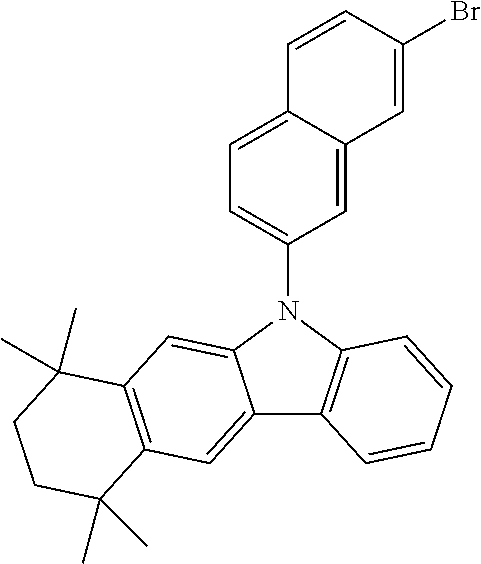
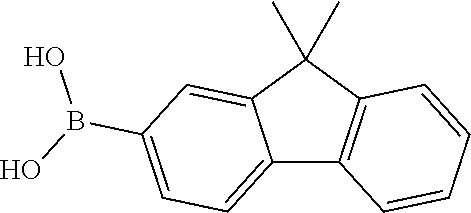
  • Sub-d1 (10.54 g, 22 mmol), Sub-f1 (7.24 g, 20 mmol), tetrakis(triphenylphosphine)palladium (0.23 g, 0.2 mmol), tetrabutyl ammonium bromide (0.64 g, 5 mmol), anhydrous potassium carbonate (5.53 g, 40 mmol), toluene (100 mL), tetrahydrofuran (25 mL), and deionized water (25 mL) were added sequentially to a 250 mL three-necked flask under a nitrogen atmosphere. The reaction mixture was heated to reflux and stirred for 16 h.
  • An anode was pretreated by the following process: surface treatment was performed with UV ozone and O 2 :N 2 plasma on an ITO/Ag/ITO substrate with a thicknesses of 100 ⁇ , 1000 ⁇ , and 100 ⁇ in sequence to increase the work function of the anode, and the surface of the ITO/Ag/ITO substrate was cleaned with an organic solvent to remove impurities and oil on the surface of the substrate.
  • HAT-CN was evaporated on the experimental substrate (the anode) in vacuum to form a hole injection layer (HIL) having a thickness of 100 ⁇ , and then ⁇ -NPD was vacuum evaporated on the hole injection layer to form a first hole transport layer having a thickness of 1080 ⁇ .
  • HIL hole injection layer
  • a compound HT-1 was vacuum evaporated on the first hole transport layer to form a second hole transport layer having a thickness of 890 ⁇ .
  • RH-P, a compound 8 and Ir(MDQ) 2 (acac) were co-evaporated on the second hole transport layer at an evaporation rate ratio of 49%:49%:2% to form a red electroluminescent layer (EML) having a thickness of 400 ⁇ .
  • EML red electroluminescent layer
  • CP-1 was evaporated on the above cathode in vacuum to form an organic capping layer having a thickness of 800 ⁇ , thus completing the manufacture of a red organic electroluminescent device.
  • An organic electroluminescent device was manufactured by the same method as that in Example 1 except that a compound A, a compound B, and a compound C were respectively used instead of the compound 8 in Example 1 when the electroluminescent layer was manufactured.
  • the red organic electroluminescent devices manufactured in Examples 1 to 38 and Comparative examples 1 to 3 were subjected to performance tests, and specifically, the current-voltage-brightness (IVL) performance of the devices was tested under the condition of 10 mA/cm 2 , and the T95 device service life was tested under the condition of 20 mA/cm 2 , and the test results are shown in Table 8.
  • IVL current-voltage-brightness
  • An anode was pretreated by the following process: surface treatment was performed with UV ozone and O 2 :N 2 plasma on an ITO/Ag/ITO substrate with thicknesses of 100 ⁇ , 1000 ⁇ , and 100 ⁇ in sequence to increase the work function of the anode, and the surface of the ITO substrate was cleaned with an organic solvent to remove impurities and oil on the surface of the ITO substrate.
  • HAT-CN was evaporated on the experimental substrate (the anode) in vacuum to form a hole injection layer (TIL) having a thickness of 100 ⁇ , and then ⁇ -NPD was evaporated on the hole injection layer in vacuum to form a first hole transport layer having a thickness of 1080 ⁇ .
  • TIL hole injection layer
  • ⁇ -NPD was evaporated on the hole injection layer in vacuum to form a first hole transport layer having a thickness of 1080 ⁇ .
  • a compound HT-1 was evaporated on the first hole transport layer in vacuum to form a second hole transport layer having a thickness of 350 ⁇ .
  • a compound 3, GH-P and fac-Ir(ppy) 3 were co-evaporated on the second hole transport layer at an evaporation rate ratio of 45%:45%:10% to form an organic electroluminescent layer (a green luminescent layer) having a thickness of 350 ⁇ .
  • a compound ET-2 and LiQ were mixed in a weight ratio of 1:1 and evaporated on the electroluminescent layer to form an electron transport layer (ETL) having a thickness of 350 ⁇ , Yb was evaporated on the electron transport layer to form an electron injection layer (EIL) having a thickness of 10 ⁇ , and then magnesium (Mg) and silver (Ag) were mixed at an evaporation rate of 1:9 and evaporated on the electron injection layer in vacuum to form a cathode having a thickness of 130 ⁇ .
  • ETL electron transport layer
  • EIL electron injection layer
  • Mg magnesium
  • Ag silver
  • CP-1 was evaporated on the above cathode in vacuum to form an organic capping layer having a thickness of 800 ⁇ , thus completing the manufacture of the green organic electroluminescent device.
  • An organic electroluminescent device was manufactured by the same method as that in Example 39 except that compounds in Table 9 below (collectively referred to as “compounds Y”) were used instead of the compound 3 in Example 39 when the electroluminescent layer was manufactured.
  • An organic electroluminescent device was manufactured by the same method as that in Example 39 except that a compound D and a compound E were respectively used instead of the compound 3 in Example 39 when the electroluminescent layer was manufactured.
  • the green organic electroluminescent devices manufactured in Examples 39 to 47 and Comparative examples 4 to 5 were subjected to performance tests, and specifically, the current-voltage-brightness (IVL) performance of the devices was tested under the condition of 10 mA/cm 2 , and the T95 device service life was tested under the condition of 20 mA/cm 2 , and the test results are shown in Table 9.
  • IVL current-voltage-brightness
  • the compound of the present disclosure can significantly improve the luminous efficiency and service life of the device.
  • a structure of the compound of the present disclosure includes tetramethylcyclohexanocarbazole and nitrogen-containing heteroarylene, where the nitrogen-containing heteroarylene is connected to a nitrogen atom of a carbazolyl through an aromatic group, and this special connection mode enables a target molecule to make full use of a larger conjugation plane of a carbazolyl molecule, improving the charge mobility of the target molecule.
  • the structure of the tetramethylcyclohexane group may further enhance the charge transport ability of the carbazolyl through a hyperconjugation effect.
  • four methyl on cyclohexane are located outside the conjugation plane of the carbazolyl in steric configuration, forming a certain steric hindrance, and intermolecular stacking of the target molecule is finely regulated, so that the target molecule may form a better amorphous thin film.
  • the carrier balance in a luminescent layer can be improved, a carrier recombination region can be broadened, the exciton generation and utilization efficiency can be increased, and the luminous efficiency of the device can be improved; and at the same time, the compound of the present disclosure can form a better amorphous film when used as the host material, improving the service life of the device.

Landscapes

  • Chemical & Material Sciences (AREA)
  • Organic Chemistry (AREA)
  • Physics & Mathematics (AREA)
  • Spectroscopy & Molecular Physics (AREA)
  • Engineering & Computer Science (AREA)
  • Materials Engineering (AREA)
  • Optics & Photonics (AREA)
  • Electroluminescent Light Sources (AREA)

Abstract

The present disclosure relates to a nitrogen-containing compound, and an organic electroluminescent device and an electronic apparatus including the same. The nitrogen-containing compound of the present disclosure includes a tetramethylcyclohexanocarbazole group and a nitrogen-containing heteroaryl group, and when the nitrogen-containing compound is used as a host material of an organic electroluminescent device, the luminous efficiency of the device can be significantly improved.

Description

CROSS REFERENCE TO RELATED APPLICATIONS
The present application claims the priority of Chinese patent application No. CN202210032719.8, filed on Jan. 12, 2022, and Chinese patent application No. CN202211051681.5, filed on Aug. 30, 2022, the contents of which are incorporated herein by reference in their entirety as part of the present application.
FIELD
The present disclosure relates to the technical field of organic electroluminescent materials, in particular to a nitrogen-containing compound, and an organic electroluminescent device and an electronic apparatus thereof.
BACKGROUND
With the development of electronic technology and the progress of material science, the application range of electronic components for realizing electroluminescence or photoelectric conversion is wider and wider. An organic electroluminescent device (OLED) typically includes a cathode and an anode which are disposed oppositely, and a functional layer disposed between the cathode and the anode. The functional layer is composed of a plurality of organic or inorganic film layers, and generally includes an organic electroluminescent layer, a hole transport layer, an electron transport layer, and the like. When voltage is applied to the cathode and the anode, an electric field is generated between the cathode and the anode, electrons on a cathode side move towards an electroluminescent layer and holes on an anode side also move towards the electroluminescent layer under the action of the electric field, the electrons and the holes are combined in the electroluminescent layer to form excitons, the excitons are in an excited state and release energy outwards, and then the electroluminescent layer emits light outwards.
In the existing organic electroluminescent device, the most major problems are service life and efficiency, as an area of a display becomes larger, the driving voltage also increases, and the luminous efficiency and the current efficiency also need to be improved, and thus, it is necessary to continue to develop new materials to further improve the performance of the organic electroluminescent device.
SUMMARY
In view of the above problems existing in the prior art, an object of the present disclosure is to provide a nitrogen-containing compound, and an organic electroluminescent device and an electronic apparatus thereof. When the nitrogen-containing compound is used in an organic electroluminescent device, the performance of the device can be improved.
According to a first aspect of the present disclosure, provided is a nitrogen-containing compound, having a structure represented by a formula 1:
Figure US12084432-20240910-C00001
    • where a ring A has a structure shown in a formula A-1 or a structure shown in a formula A-2
Figure US12084432-20240910-C00002

and a # position represents a site that is fused with a # position of
Figure US12084432-20240910-C00003

in the formula 1;
    • a ring B is an aromatic ring with 6 to 14 carbon atoms;
    • Het is 6- to 18-membered nitrogen-containing heteroarylene, and the Het includes at least 2 nitrogen atoms;
    • each R1 is independently selected from deuterium, a halogen group, cyano, alkyl with 1 to 10 carbon atoms, cycloalkyl with 1 to 10 carbon atoms, haloalkyl with 1 to 10 carbon atoms, deuteroalkyl with 1 to 10 carbon atoms, aryl with 6 to 20 carbon atoms, and heteroaryl with 3 to 20 carbon atoms;
    • n1 is selected from 0, 1, 2, 3, 4, 5 or 6;
    • L is selected from substituted or unsubstituted arylene with 6 to 30 carbon atoms, and substituted or unsubstituted heteroarylene with 3 to 30 carbon atoms;
    • L1 and L2 are the same or different, and are each independently selected from a single bond, substituted or unsubstituted arylene with 6 to 30 carbon atoms, and substituted or unsubstituted heteroarylene with 3 to 30 carbon atoms;
    • Ar1 is selected from substituted or unsubstituted aryl with 6 to 30 carbon atoms, and substituted or unsubstituted heteroaryl with 3 to 30 carbon atoms;
    • Ar2 is selected from hydrogen, substituted or unsubstituted aryl with 6 to 30 carbon atoms, and substituted or unsubstituted heteroaryl with 3 to 30 carbon atoms; and
    • substituents in L1, L2, L, Ar1 and Ar2 are the same or different, and are each independently selected from deuterium, cyano, a halogen group, alkyl with 1 to 10 carbon atoms, haloalkyl with 1 to 10 carbon atoms, deuteroalkyl with 1 to 10 carbon atoms, trialkylsilyl with 3 to 12 carbon atoms, triphenylsilyl, aryl with 6 to 20 carbon atoms, heteroaryl with 3 to 20 carbon atoms, and cycloalkyl with 3 to 10 carbon atoms; and optionally, any two adjacent substituents form a saturated or unsaturated 3- to 15-membered ring.
According to a second aspect of the present disclosure, provided is an organic electroluminescent device, including an anode and a cathode which are oppositely disposed, and a functional layer disposed between the anode and the cathode; where the functional layer includes the nitrogen-containing compound described above.
According to a third aspect of the present disclosure, provided is an electronic apparatus, including the organic electroluminescent device in the second aspect.
A structure of the nitrogen-containing compound of the present disclosure includes tetramethylcyclohexanocarbazole and nitrogen-containing heteroarylene, where the nitrogen-containing heteroarylene is connected to a nitrogen atom of a carbazole group through an aromatic group, and this special connection mode enables a target molecule to make full use of a larger conjugation plane of a carbazole molecule, improving the charge mobility of the target molecule. At the same time, the structure of tetramethylcyclohexane can further enhance the charge transport ability of the carbazole group through a hyperconjugation effect. In addition, four methyl are located outside the conjugation plane of the carbazole group in steric configuration, forming a certain steric hindrance, and intermolecular stacking of the compound is finely regulated, so that the compound may form an amorphous thin film with better stability in a functional layer of a device. Thus, when the nitrogen-containing compound of the present disclosure is used as a host material, the carrier balance in a electroluminescent layer can be improved, a carrier recombination region can be broadened, the exciton generation and utilization efficiency can be increased, and the luminous efficiency of the device can be improved; and at the same time, the compound of the present disclosure can form a better amorphous film when used as the host material, improving the service life of the device.
BRIEF DESCRIPTION OF THE DRAWINGS
FIG. 1 is a structural schematic diagram of an organic electroluminescent device according to an embodiment of the present disclosure.
FIG. 2 is a structural schematic diagram of an electronic device according to an embodiment of the present disclosure.
DESCRIPTION OF REFERENCE SIGNS
    • 100, anode; 200, cathode; 300, functional layer; 310, hole injection layer; 320, hole transport layer; 321, first hole transport layer; 322, second hole transport layer; 330, organic luminescent layer; 340, electron transport layer; 350, electron injection layer; and 400, electronic apparatus.
DETAILED DESCRIPTION
Embodiments will now be described more fully with reference to the accompanying drawings. However, the embodiments can be implemented in a variety of forms, and should not be understood as a limitation to the instances set forth here; and on the contrary, these embodiments are provided such that the present disclosure will be more comprehensive and complete, and the concepts of the examples are comprehensively conveyed to those skilled in the art. The described features, structures, or characteristics may be incorporated in one or more embodiments in any suitable manner. In the following description, many specific details are provided to give a sufficient understanding of the examples of the present disclosure.
In a first aspect, the present disclosure provides a nitrogen-containing compound, having a structure represented by a formula 1:
Figure US12084432-20240910-C00004
    • where a ring A has a structure shown in a formula A-1 or a structure shown in a formula A-2:
Figure US12084432-20240910-C00005

and a # position represents a site that is fused with a # position of
Figure US12084432-20240910-C00006

in the formula 1;
    • a ring B is an aromatic ring with 6 to 14 carbon atoms;
    • Het is 6- to 18-membered nitrogen-containing heteroarylene, and includes at least 2 nitrogen atoms;
    • each R1 is independently selected from deuterium, a halogen group, cyano, alkyl with 1 to 10 carbon atoms, cycloalkyl with 1 to 10 carbon atoms, haloalkyl with 1 to 10 carbon atoms, deuteroalkyl with 1 to 10 carbon atoms, aryl with 6 to 20 carbon atoms, and heteroaryl with 3 to 20 carbon atoms;
    • n1 is selected from 0, 1, 2, 3, 4, 5 or 6;
    • L is selected from substituted or unsubstituted arylene with 6 to 30 carbon atoms, and substituted or unsubstituted heteroarylene with 3 to 30 carbon atoms;
    • L1 and L2 are the same or different, and are each independently selected from a single bond, substituted or unsubstituted arylene with 6 to 30 carbon atoms, and substituted or unsubstituted heteroarylene with 3 to 30 carbon atoms;
    • Ar1 is selected from substituted or unsubstituted aryl with 6 to 30 carbon atoms, and substituted or unsubstituted heteroaryl with 3 to 30 carbon atoms;
    • Ar2 is selected from hydrogen, substituted or unsubstituted aryl with 6 to 30 carbon atoms, and substituted or unsubstituted heteroaryl with 3 to 30 carbon atoms; and
    • substituents in L1, L2, L, Ar1 and Ar2 are the same or different, and are each independently selected from deuterium, cyano, a halogen group, alkyl with 1 to 10 carbon atoms, haloalkyl with 1 to 10 carbon atoms, deuteroalkyl with 1 to 10 carbon atoms, trialkylsilyl with 3 to 12 carbon atoms, triphenylsilyl, aryl with 6 to 20 carbon atoms, heteroaryl with 3 to 20 carbon atoms, and cycloalkyl with 3 to 10 carbon atoms; and optionally, any two adjacent substituents form a saturated or unsaturated 3- to 15-membered ring.
In the present disclosure, the terms “optional” and “optionally” mean that the subsequently described event or circumstance may or may not occur. For example, “optionally, any two adjacent substituents form a ring”, which means that the two substituents may or may not form a ring, i.e., includes a scenario where two adjacent substituents form a ring and a scenario where two adjacent substituents do not form a ring. For another example, “optionally, any two adjacent substituents in Ar1 form a ring”, which means that any two adjacent substituents in Ar1 may be connected to each other to form a ring, or any two adjacent substituents in Ar1 may also be present independently of each other. “Any two adjacent” may include the condition that a same atom has two substituents, and may also include the condition that two adjacent atoms each have one substituent; when the same atom has two substituents, the two substituents may form a saturated or unsaturated spiro ring with the atom to which they are connected; and when two adjacent atoms each have one substituent, the two substituents may be fused to form a ring.
In the present disclosure, the adopted description modes “each . . . is (are) independently”, “ . . . is(are) respectively and independently” and “ . . . is each independently” can be interchanged, and should be understood in a broad sense, which means that in different groups, specific options expressed between the same symbols do not influence each other, or in a same group, specific options expressed between the same symbols do not influence each other. For example, the meaning of
Figure US12084432-20240910-C00007

where each q is independently 0, 1, 2 or 3, and each R“is independently selected from hydrogen, deuterium, fluorine and chlorine” is as follows: a formula Q-1 represents that q substituents R″ exist on a benzene ring, each R″ can be the same or different, and options of each R″ do not influence each other; and a formula Q-2 represents that each benzene ring of biphenyl has q substituents R″, the number q of the substituents R″ on the two benzene rings can be the same or different, each R″ can be the same or different, and options of each R″ do not influence each other.
In the present disclosure, the term such as “substituted or unsubstituted” means that a functional group described behind the term may have or do not have a substituent (in the following, the substituent is collectively referred to as Rc in order to facilitate description). For example, the “substituted or unsubstituted aryl” refers to aryl having the substituent Rc or unsubstituted aryl. The above substituent, i.e., Rc, may be, for example, deuterium, a halogen group, cyano, heteroaryl, aryl, trialkylsilyl, alkyl, haloalkyl, cycloalkyl, and the like. The number of the substituents may be one or more.
In the present disclosure, “a plurality of” refers to two or more, e.g., two, three, four, five, six, etc.
In the present disclosure, the number of carbon atoms in a substituted or unsubstituted functional group refers to the number of all carbon atoms. For example, if L1 is substituted arylene with 12 carbon atoms, the number of all carbon atoms of the arylene and substituents on the arylene is 12.
In the present disclosure, aryl refers to an optional functional group or substituent derived from an aromatic carbocyclic ring. The aryl may be monocyclic aryl (e.g., phenyl) or polycyclic aryl, in other words, the aryl can be monocyclic aryl, fused aryl, two or more monocyclic aryl conjugatedly connected through carbon-carbon bonds, monocyclic aryl and fused aryl which are conjugatedly connected through a carbon-carbon bond, or two or more fused aryl conjugatedly connected through carbon-carbon bonds. That is, unless otherwise noted, two or more aromatic groups conjugatedly connected through carbon-carbon bonds can also be regarded as the aryl of the present disclosure. The fused aryl may include, for example, bicyclic fused aryl (e.g., naphthyl), tricyclic fused aryl (e.g., phenanthryl, fluorenyl, and anthryl), and the like. The aryl does not contain heteroatoms such as B, N, O, S, P, Se and Si. Examples of the aryl may include, but are not limited to, phenyl, naphthyl, fluorenyl, anthryl, phenanthryl, biphenyl, terphenyl, triphenylene, perylenyl, benzo[9,10]phenanthryl, pyrenyl, benzofluoranthenyl, chrysenyl, and the like. In the present disclosure, the arylene involved refers to a divalent group formed by further loss of one hydrogen atom from aryl.
In the present disclosure, terphenyl includes
Figure US12084432-20240910-C00008
In the present disclosure, the number of carbon atoms of the substituted aryl refers to the total number of carbon atoms of the aryl and substituents on the aryl, for example, substituted aryl with 18 carbon atoms means that the total number of carbon atoms of the aryl and substituents is 18.
In the present disclosure, the number of carbon atoms of the substituted or unsubstituted aryl may be 6, 10, 12, 13, 14, 15, 16, 17, 18, 20, 25 or 30. In some embodiments, the substituted or unsubstituted aryl is substituted or unsubstituted aryl with 6 to 30 carbon atoms; in other embodiments, the substituted or unsubstituted aryl is substituted or unsubstituted aryl with 6 to 25 carbon atoms; in other embodiments, the substituted or unsubstituted aryl is substituted or unsubstituted aryl with 6 to 18 carbon atoms; and in other embodiments, the substituted or unsubstituted aryl is substituted or unsubstituted aryl with 6 to 15 carbon atoms.
In the present disclosure, fluorenyl may be substituted by one or more substituents, where any two adjacent substituents may be bonded to each other to form a substituted or unsubstituted spirocyclic structure. In the case where the above fluorenyl is substituted, the substituted fluorenyl may be
Figure US12084432-20240910-C00009

and the like, but is not limited to this.
In the present disclosure, aryl as a substituent of L1, L2, L, Ar1 and Ar2 is, for example, but is not limited to, phenyl, naphthyl, phenanthryl, biphenyl, fluorenyl, dimethylfluorenyl and the like.
In the present disclosure, heteroaryl refers to a monovalent aromatic ring containing 1, 2, 3, 4, 5 or 6 heteroatoms in the ring or its derivative, and the heteroatom may be one or more of B, O, N, P, Si, Se and S. The heteroaryl may be monocyclic heteroaryl or polycyclic heteroaryl, in other words, the heteroaryl may be a single aromatic ring system or a plurality of aromatic ring systems conjugatedly connected through carbon-carbon bonds, and any aromatic ring system is one aromatic monocyclic ring or one aromatic fused ring. For example, the heteroaryl may include thienyl, furyl, pyrrolyl, imidazolyl, thiazolyl, oxazolyl, oxadiazolyl, triazolyl, pyridyl, bipyridyl, pyrimidinyl, triazinyl, acridinyl, pyridazinyl, pyrazinyl, quinolyl, quinazolinyl, quinoxalinyl, phenoxazinyl, phthalazinyl, pyridopyrimidinyl, pyridopyrazinyl, pyrazinopyrazinyl, isoquinolyl, indolyl, carbazolyl, benzoxazolyl, benzimidazolyl, benzothiazolyl, benzocarbazolyl, benzothienyl, dibenzothienyl, thienothienyl, benzofuranyl, phenanthrolinyl, isoxazolyl, thiadiazolyl, phenothiazinyl, silafluorenyl, dibenzofuranyl, as well as N-phenylcarbazolyl, N-pyridylcarbazolyl, N-methylcarbazolyl and the like, but is not limited to this.
In the present disclosure, the number of carbon atoms of the substituted or unsubstituted heteroaryl may be selected from 3, 4, 5, 6, 7, 8, 9, 10, 11, 12, 13, 14, 15, 16, 17, 18, 20, 21, 22, 23, 24, 25, 26, 27, 28, 29 or 30. In some embodiments, the substituted or unsubstituted heteroaryl is substituted or unsubstituted heteroaryl having a total of 3 to 30 carbon atoms; in other embodiments, the substituted or unsubstituted heteroaryl is substituted or unsubstituted heteroaryl having a total of 12 to 18 carbon atoms; and in other embodiments, the substituted or unsubstituted heteroaryl is substituted or unsubstituted heteroaryl having a total of 5 to 12 carbon atoms.
In the present disclosure, heteroaryl as a substituent of L1, L2, L, Ar1 and Ar2 is, for example, but is not limited to, pyridyl, carbazolyl, dibenzothienyl or dibenzofuranyl.
In the present disclosure, the substituted heteroaryl may be that one or two or more hydrogen atoms in the heteroaryl are substituted by groups such as a deuterium atom, a halogen group, cyano, aryl, heteroaryl, trialkylsilyl, alkyl, cycloalkyl, haloalkyl, and the like. It should be understood that the number of carbon atoms of the substituted heteroaryl refers to the total number of carbon atoms of heteroaryl and substituents on the heteroaryl.
In the present disclosure, the alkyl with 1 to 10 carbon atoms may include linear alkyl with 1 to 10 carbon atoms and branched alkyl with 3 to 10 carbon atoms. The number of carbon atoms of the alkyl may be, for example, 1, 2, 3, 4, 5, 6, 7, 8, 9, or 10, and specific examples of the alkyl include, but are not limited to, methyl, ethyl, n-propyl, isopropyl, n-butyl, isobutyl, tert-butyl, n-pentyl, isopentyl, neopentyl, n-hexyl, and the like.
In the present disclosure, the halogen group may be, for example, fluorine, chlorine, bromine or iodine.
In the present disclosure, specific examples of trialkylsilyl include, but are not limited to, trimethylsilyl, triethylsilyl, and the like.
In the present disclosure, specific examples of haloalkyl include, but are not limited to, trifluoromethyl.
In the present disclosure, the number of carbon atoms of cycloalkyl with 3 to 10 carbon atoms may be, for example, 3, 4, 5, 6, 7, 8, or 10. Specific examples of cycloalkyl include, but are not limited to, cyclopentyl, cyclohexyl, and adamantyl.
In the present disclosure, a ring system formed by n atoms is an n-membered ring. For example, phenyl is 6-membered aryl. 6- to 18-membered nitrogen-containing heteroarylene refers to heteroarylene with 6 to 18 ring atoms including nitrogen atoms.
In the disclosure, “
Figure US12084432-20240910-P00001
”, “
Figure US12084432-20240910-P00002
”, “
Figure US12084432-20240910-P00003
*”, “
Figure US12084432-20240910-P00004
” and “
Figure US12084432-20240910-P00005
” all refer to chemical bonds connected to other groups.
In the present disclosure, an unpositioned connecting bond refers to a single bond “
Figure US12084432-20240910-P00006
” extending from a ring system, which means that one end of the connecting bond can be connected with any position in the ring system through which the bond penetrates, and the other end of the connecting bond is connected with the remaining part of a compound molecule. For example, as shown in the following formula (f), naphthyl represented by the formula (f) is connected to other positions of a molecule through two unpositioned connecting bonds penetrating a dicyclic ring, and its meaning includes any one possible connecting mode represented by formulae (f-1) to (f-10):
Figure US12084432-20240910-C00010
Figure US12084432-20240910-C00011
For another example, as shown in the following formula (X′), dibenzofuranyl represented by the formula (X′) is connected with other positions of a molecule through one unpositioned connecting bond extending from the middle of a benzene ring on one side, and its meaning includes any one possible connecting mode represented by formulae (X′-1) to (X′-4):
Figure US12084432-20240910-C00012
In some embodiments, the ring B in the formula 1 is a naphthalene ring or a phenanthrene ring. When an aromatic ring continues to be fused to a carbazolotetramethylcyclohexane core structure, the stability of the core structure is further improved, and the molecular thermal stability is improved, and when applied in a luminescent layer of a device, the service life of the device can be improved.
In some embodiments, in the formula 1, the ring B is selected from the following structures:
Figure US12084432-20240910-C00013

and a position represents a site that is fused with a * position of
Figure US12084432-20240910-C00014

in the formula 1.
In some embodiments,
Figure US12084432-20240910-C00015

in the formula 1 is selected from the following structures:
Figure US12084432-20240910-C00016
Figure US12084432-20240910-C00017
Figure US12084432-20240910-C00018
In some embodiments, Het is 6- to 16-membered nitrogen-containing heteroarylene, and at least two nitrogen atoms are included in the Het group, for example, 2, 3 or 4 nitrogen atoms are included in the Het group. In other embodiments of the present disclosure, Het is 6-membered nitrogen-containing heteroarylene, 10-membered nitrogen-containing heteroarylene, or 13-membered nitrogen-containing heteroarylene, and at least two nitrogen atoms are included in the Het group.
In some embodiments, Het is 6- to 18-membered electron-deficient nitrogen-containing heteroaryl (also referred to as electron-deficient heteroaryl), and at least two nitrogen atoms are included in the Het group. An sp2 hybridized nitrogen atom on the Het can reduce the electron cloud density of a conjugated system of the heteroaryl as a whole, instead of increasing the electron cloud density of the conjugated system of the heteroaryl, lone pair electrons on a heteroatom does not participate in the conjugated system, and the heteroatom decreases the electron cloud density of the conjugated system due to the stronger electronegativity. For example, electron-deficient nitrogen-containing heteroaryl may include, but is not limited to, triazinyl, pyrimidinyl, quinolyl, quinoxalinyl, quinazolinyl, isoquinolyl, benzimidazolyl, benzothiazolyl, benzoxazolyl, phenanthrolinyl, benzoquinazolinyl, phenanthroimidazolyl, benzofuropyrimidinyl, benzothienopyrimidinyl, and the like. The Het group may form an electron transport core group of the compound, so that the compound can effectively achieve electron transport and then can effectively balance the mobility of electrons and holes in an organic luminescent layer. Thus, the compound can not only be used as a bipolar host material for the organic luminescent layer to simultaneously transport electrons and holes, and can also be used as an electron-type host material for the organic luminescent layer to cooperate with a hole-type host material for the organic luminescent layer.
In some embodiments, Het is selected from the group consisting of:
Figure US12084432-20240910-C00019
Figure US12084432-20240910-C00020

where ———* denotes a bond connected to L, and the remaining two connecting bonds
Figure US12084432-20240910-P00001
are respectively connected to L1 and L2.
In some more specific embodiments, Het is selected from the group consisting of the following nitrogen-containing heteroarylene:
Figure US12084432-20240910-C00021
Figure US12084432-20240910-C00022
Figure US12084432-20240910-C00023
    • where *
      Figure US12084432-20240910-P00002
      denotes a position where Het is connected to L,
      Figure US12084432-20240910-P00001
      denotes a position where Het is connected to L1,
      Figure US12084432-20240910-P00007
      denotes a position that is connected to L2, and where
      Figure US12084432-20240910-P00007
      is absent in the formula means that L2 is a single bond and Ar2 is hydrogen in
Figure US12084432-20240910-C00024

connected at this position.
In some embodiments, each R1 is the same or different from each other, and is independently selected from deuterium, fluorine, cyano, trimethylsilyl, trideuteromethyl, trifluoromethyl, cyclopentyl, cyclohexyl, methyl, ethyl, isopropyl, tert-butyl, or phenyl; and n1 represents the number of R1, and n1 is selected from 0, 1, 2, 3 or 4.
In some embodiments, Ar1 is selected from substituted or unsubstituted aryl with 6 to 25 carbon atoms, and substituted or unsubstituted heteroaryl with 12 to 18 carbon atoms; and
Ar2 is selected from hydrogen, substituted or unsubstituted aryl with 6 to 25 carbon atoms, and substituted or unsubstituted heteroaryl with 12 to 18 carbon atoms.
In some embodiments, substituents in Ar1 and Ar2 are the same or different, and are each independently selected from deuterium, halogen, cyano, haloalkyl with 1 to 4 carbon atoms, deuteroalkyl with 1 to 4 carbon atoms, alkyl with 1 to 4 carbon atoms, cycloalkyl with 5 to 10 carbon atoms, aryl with 6 to 12 carbon atoms, heteroaryl with 5 to 12 carbon atoms, and trialkylsilyl with 3 to 8 carbon atoms, and optionally, any two adjacent substituents form a fluorene ring.
In some embodiments, Ar1 is selected from substituted or unsubstituted aryl with 6, 7, 8, 9, 10, 11, 12, 13, 14, 15, 16, 17, 18, 19, 20, 21, 22, 23, 24 or 25 carbon atoms, and substituted or unsubstituted heteroaryl with 12, 13, 14, 15, 16, 17, or 18 carbon atoms.
In some embodiments, Ar2 is selected from hydrogen, substituted or unsubstituted aryl with 6, 7, 8, 9, 10, 11, 12, 13, 14, 15, 16, 17, 18, 19, 20, 21, 22, 23, 24 or 25 carbon atoms, and substituted or unsubstituted heteroaryl with 12, 13, 14, 15, 16, 17, or 18 carbon atoms.
In some embodiments, Ar1 is selected from a substituted or unsubstituted group W, and Ar2 is selected from hydrogen, and a substituted or unsubstituted group W, where the unsubstituted group W is selected from the group consisting of:
Figure US12084432-20240910-C00025
the substituted group W has one or two or more substituents, the substituents in the substituted group W are each independently selected from deuterium, fluorine, cyano, trideuteromethyl, trimethylsilyl, trifluoromethyl, cyclopentyl, cyclohexyl, adamantyl, methyl, ethyl, isopropyl, tert-butyl, phenyl, naphthyl, pyridyl, dibenzofuranyl, dibenzothienyl or carbazolyl, and when the number of the substituents on the group W is greater than 1, the substituents are the same or different. It should be noted that when Ar1 and Ar2 are both selected from the substituted or unsubstituted group W, Ar1 and Ar2 may be the same or different, i.e., Ar1 and Ar2 are each independently selected from the substituted or unsubstituted group W without affecting each other.
In some embodiments, Ar1 is selected from substituted or unsubstituted phenyl, substituted or unsubstituted naphthyl, substituted or unsubstituted biphenyl, substituted or unsubstituted terphenyl, substituted or unsubstituted fluorenyl, substituted or unsubstituted phenanthryl, substituted or unsubstituted dibenzofuranyl, substituted or unsubstituted dibenzothienyl, substituted or unsubstituted carbazolyl, substituted or unsubstituted spirobifluorenyl, substituted or unsubstituted triphenylene, and substituted or unsubstituted phenanthrolinyl.
In some embodiments, Ar2 is selected from hydrogen, substituted or unsubstituted phenyl, substituted or unsubstituted naphthyl, substituted or unsubstituted biphenyl, substituted or unsubstituted terphenyl, substituted or unsubstituted fluorenyl, substituted or unsubstituted phenanthryl, substituted or unsubstituted dibenzofuranyl, substituted or unsubstituted dibenzothienyl, substituted or unsubstituted carbazolyl, substituted or unsubstituted spirobifluorenyl, substituted or unsubstituted triphenylene, and substituted or unsubstituted phenanthrolinyl.
Optionally, substituents in Ar1 and Ar2 are the same or different, and are each independently selected from deuterium, fluorine, cyano, trimethylsilyl, triphenylsilyl, trideuteromethyl, trifluoromethyl, cyclopentyl, cyclohexyl, methyl, ethyl, isopropyl, tert-butyl, phenyl, naphthyl, biphenyl, pyridyl, dibenzofuranyl, dibenzothienyl or carbazolyl.
In some embodiments, Ar1 is selected from the group consisting of the following groups, and Ara is selected from hydrogen or the group consisting of the following groups:
Figure US12084432-20240910-C00026
Figure US12084432-20240910-C00027
Figure US12084432-20240910-C00028
In some more specific embodiments, Ani is selected from the group consisting of,
Figure US12084432-20240910-C00029
Figure US12084432-20240910-C00030
Figure US12084432-20240910-C00031
Figure US12084432-20240910-C00032
Figure US12084432-20240910-C00033
Figure US12084432-20240910-C00034
In some more specific embodiments, Ara is selected from hydrogen or the group consisting of:
Figure US12084432-20240910-C00035
Figure US12084432-20240910-C00036
Figure US12084432-20240910-C00037
Figure US12084432-20240910-C00038
Figure US12084432-20240910-C00039
Figure US12084432-20240910-C00040
In some embodiments, L is selected from substituted or unsubstituted arylene with 6 to 15 carbon atoms, and substituted or unsubstituted heteroarylene with 5 to 12 carbon atoms; and L1 and L2 are each independently selected from a single bond, substituted or unsubstituted arylene with 6 to 15 carbon atoms, and substituted or unsubstituted heteroarylene with 12 to 18 carbon atoms.
In some embodiments, L is selected from substituted or unsubstituted arylene with 6, 10, or 12 carbon atoms, and substituted or unsubstituted heteroarylene with 12 carbon atoms.
In some embodiments, L1 and L2 are each independently selected from a single bond, substituted or unsubstituted arylene with 6, 10, 12, 14, 15, or 18 carbon atoms, and substituted or unsubstituted heteroarylene with 12 or 18 carbon atoms.
Optionally, substituents in L1, L2 and L are each independently selected from deuterium, fluorine, cyano, alkyl with 1 to 5 carbon atoms, trialkylsilyl with 3 to 8 carbon atoms, fluoroalkyl with 1 to 4 carbon atoms, deuteroalkyl with 1 to 4 carbon atoms, phenyl or naphthyl.
In some specific embodiments, L is selected from substituted or unsubstituted phenylene, substituted or unsubstituted naphthylene, substituted or unsubstituted biphenylene, substituted or unsubstituted dibenzothienylene, substituted or unsubstituted dibenzofurylene, and substituted or unsubstituted fluorenylene; and L1 and L2 are each independently selected from a single bond, substituted or unsubstituted phenylene, substituted or unsubstituted naphthylene, substituted or unsubstituted biphenylene, substituted or unsubstituted dibenzothienylene, substituted or unsubstituted dibenzofurylene, substituted or unsubstituted carbazolylene, and substituted or unsubstituted fluorenylene.
Optionally, substituents in L1, L2 and L are the same or different, and are each independently selected from deuterium, fluorine, cyano, methyl, ethyl, isopropyl, tert-butyl, trifluoromethyl, trideuteromethyl, trimethylsilyl or phenyl.
In some embodiments, L is selected from the following groups:
Figure US12084432-20240910-C00041
Figure US12084432-20240910-C00042
Figure US12084432-20240910-C00043
Figure US12084432-20240910-C00044
In some embodiments, L1 and L2 are each independently selected from a single bond or the group consisting of:
Figure US12084432-20240910-C00045
Figure US12084432-20240910-C00046
Figure US12084432-20240910-C00047
In some embodiments,
Figure US12084432-20240910-C00048

is selected from the group consisting of the following groups, and
Figure US12084432-20240910-C00049

is selected from hydrogen or the group consisting of the following groups:
Figure US12084432-20240910-C00050
Figure US12084432-20240910-C00051
Figure US12084432-20240910-C00052
Figure US12084432-20240910-C00053
Figure US12084432-20240910-C00054
Figure US12084432-20240910-C00055
Figure US12084432-20240910-C00056
Figure US12084432-20240910-C00057
Figure US12084432-20240910-C00058
Figure US12084432-20240910-C00059
In some embodiments,
Figure US12084432-20240910-C00060

in the nitrogen-containing compound is selected from the group consisting of:
Figure US12084432-20240910-C00061
Figure US12084432-20240910-C00062
Figure US12084432-20240910-C00063
Figure US12084432-20240910-C00064
Figure US12084432-20240910-C00065
Figure US12084432-20240910-C00066
Figure US12084432-20240910-C00067
Figure US12084432-20240910-C00068
Figure US12084432-20240910-C00069
Optionally, the nitrogen-containing compound is selected from the group consisting of the following compounds:
Figure US12084432-20240910-C00070
Figure US12084432-20240910-C00071
Figure US12084432-20240910-C00072
Figure US12084432-20240910-C00073
Figure US12084432-20240910-C00074
Figure US12084432-20240910-C00075
Figure US12084432-20240910-C00076
Figure US12084432-20240910-C00077
Figure US12084432-20240910-C00078
Figure US12084432-20240910-C00079
Figure US12084432-20240910-C00080
Figure US12084432-20240910-C00081
Figure US12084432-20240910-C00082
Figure US12084432-20240910-C00083
Figure US12084432-20240910-C00084
Figure US12084432-20240910-C00085
Figure US12084432-20240910-C00086
Figure US12084432-20240910-C00087
Figure US12084432-20240910-C00088
Figure US12084432-20240910-C00089
Figure US12084432-20240910-C00090
Figure US12084432-20240910-C00091
Figure US12084432-20240910-C00092
Figure US12084432-20240910-C00093
Figure US12084432-20240910-C00094
Figure US12084432-20240910-C00095
Figure US12084432-20240910-C00096
Figure US12084432-20240910-C00097
Figure US12084432-20240910-C00098
Figure US12084432-20240910-C00099
Figure US12084432-20240910-C00100
Figure US12084432-20240910-C00101
Figure US12084432-20240910-C00102
Figure US12084432-20240910-C00103
Figure US12084432-20240910-C00104
Figure US12084432-20240910-C00105
Figure US12084432-20240910-C00106
Figure US12084432-20240910-C00107
Figure US12084432-20240910-C00108
Figure US12084432-20240910-C00109
Figure US12084432-20240910-C00110
Figure US12084432-20240910-C00111
Figure US12084432-20240910-C00112
Figure US12084432-20240910-C00113
Figure US12084432-20240910-C00114
Figure US12084432-20240910-C00115
Figure US12084432-20240910-C00116
Figure US12084432-20240910-C00117
Figure US12084432-20240910-C00118
Figure US12084432-20240910-C00119
Figure US12084432-20240910-C00120
Figure US12084432-20240910-C00121
Figure US12084432-20240910-C00122
Figure US12084432-20240910-C00123
Figure US12084432-20240910-C00124
Figure US12084432-20240910-C00125
Figure US12084432-20240910-C00126
Figure US12084432-20240910-C00127
Figure US12084432-20240910-C00128
Figure US12084432-20240910-C00129
Figure US12084432-20240910-C00130
Figure US12084432-20240910-C00131
Figure US12084432-20240910-C00132
Figure US12084432-20240910-C00133
Figure US12084432-20240910-C00134
Figure US12084432-20240910-C00135
Figure US12084432-20240910-C00136
Figure US12084432-20240910-C00137
Figure US12084432-20240910-C00138
Figure US12084432-20240910-C00139
Figure US12084432-20240910-C00140
Figure US12084432-20240910-C00141
Figure US12084432-20240910-C00142
Figure US12084432-20240910-C00143
Figure US12084432-20240910-C00144
Figure US12084432-20240910-C00145
Figure US12084432-20240910-C00146
Figure US12084432-20240910-C00147
Figure US12084432-20240910-C00148
Figure US12084432-20240910-C00149
Figure US12084432-20240910-C00150
Figure US12084432-20240910-C00151
Figure US12084432-20240910-C00152
Figure US12084432-20240910-C00153
Figure US12084432-20240910-C00154
Figure US12084432-20240910-C00155
Figure US12084432-20240910-C00156
Figure US12084432-20240910-C00157
Figure US12084432-20240910-C00158
Figure US12084432-20240910-C00159
Figure US12084432-20240910-C00160
Figure US12084432-20240910-C00161
Figure US12084432-20240910-C00162
Figure US12084432-20240910-C00163
Figure US12084432-20240910-C00164
Figure US12084432-20240910-C00165
Figure US12084432-20240910-C00166
Figure US12084432-20240910-C00167
Figure US12084432-20240910-C00168
Figure US12084432-20240910-C00169
Figure US12084432-20240910-C00170
Figure US12084432-20240910-C00171
Figure US12084432-20240910-C00172
Figure US12084432-20240910-C00173
Figure US12084432-20240910-C00174
Figure US12084432-20240910-C00175
Figure US12084432-20240910-C00176
Figure US12084432-20240910-C00177
Figure US12084432-20240910-C00178
Figure US12084432-20240910-C00179
Figure US12084432-20240910-C00180
Figure US12084432-20240910-C00181
Figure US12084432-20240910-C00182
Figure US12084432-20240910-C00183
Figure US12084432-20240910-C00184
Figure US12084432-20240910-C00185
Figure US12084432-20240910-C00186
Figure US12084432-20240910-C00187
Figure US12084432-20240910-C00188
Figure US12084432-20240910-C00189
Figure US12084432-20240910-C00190
Figure US12084432-20240910-C00191
Figure US12084432-20240910-C00192
Figure US12084432-20240910-C00193
Figure US12084432-20240910-C00194
Figure US12084432-20240910-C00195
Figure US12084432-20240910-C00196
Figure US12084432-20240910-C00197
Figure US12084432-20240910-C00198
Figure US12084432-20240910-C00199
Figure US12084432-20240910-C00200
Figure US12084432-20240910-C00201
Figure US12084432-20240910-C00202
Figure US12084432-20240910-C00203
Figure US12084432-20240910-C00204
Figure US12084432-20240910-C00205
Figure US12084432-20240910-C00206
Figure US12084432-20240910-C00207
Figure US12084432-20240910-C00208
Figure US12084432-20240910-C00209
Figure US12084432-20240910-C00210
Figure US12084432-20240910-C00211
Figure US12084432-20240910-C00212
Figure US12084432-20240910-C00213
Figure US12084432-20240910-C00214
Figure US12084432-20240910-C00215
Figure US12084432-20240910-C00216
Figure US12084432-20240910-C00217
Figure US12084432-20240910-C00218
Figure US12084432-20240910-C00219
Figure US12084432-20240910-C00220
Figure US12084432-20240910-C00221
Figure US12084432-20240910-C00222
Figure US12084432-20240910-C00223
Figure US12084432-20240910-C00224
Figure US12084432-20240910-C00225
Figure US12084432-20240910-C00226
Figure US12084432-20240910-C00227
Figure US12084432-20240910-C00228
Figure US12084432-20240910-C00229
Figure US12084432-20240910-C00230
Figure US12084432-20240910-C00231
Figure US12084432-20240910-C00232
Figure US12084432-20240910-C00233
Figure US12084432-20240910-C00234
Figure US12084432-20240910-C00235
Figure US12084432-20240910-C00236
Figure US12084432-20240910-C00237
Figure US12084432-20240910-C00238
Figure US12084432-20240910-C00239
Figure US12084432-20240910-C00240
Figure US12084432-20240910-C00241
Figure US12084432-20240910-C00242
Figure US12084432-20240910-C00243
Figure US12084432-20240910-C00244
Figure US12084432-20240910-C00245
Figure US12084432-20240910-C00246
Figure US12084432-20240910-C00247
Figure US12084432-20240910-C00248
Figure US12084432-20240910-C00249
Figure US12084432-20240910-C00250
Figure US12084432-20240910-C00251
Figure US12084432-20240910-C00252
Figure US12084432-20240910-C00253
Figure US12084432-20240910-C00254
Figure US12084432-20240910-C00255
Figure US12084432-20240910-C00256
In a second aspect, the present disclosure provides an organic electroluminescent device, including an anode, a cathode, and a functional layer disposed between the anode and the cathode; where the functional layer includes the nitrogen-containing compound according to the first aspect of the present disclosure.
The nitrogen-containing compound provided in the present disclosure can be used for forming at least one organic film layer in the functional layer so as to improve the characteristics such as the luminous efficiency and service life of the organic electroluminescent device.
Optionally, the functional layer includes an organic luminescent layer including the nitrogen-containing compound. The organic luminescent layer may be composed of the nitrogen-containing compound provided by the present disclosure, and may also be composed of the nitrogen-containing compound provided by the present disclosure and other materials together.
Optionally, the functional layer further includes a hole transport layer, and the hole transport layer is located between the anode and the organic luminescent layer.
In one embodiment, the hole transport layer includes a first hole transport layer and a second hole transport layer, the first hole transport layer being closer to the anode relative to the second hole transport layer.
According to one specific embodiment, the organic electroluminescent device is shown in FIG. 1 , and the organic electroluminescent device may include an anode 100, a hole injection layer 310, a first hole transport layer 321, a second hole transport layer (a hole auxiliary layer) 322, an organic luminescent layer 330, an electron transport layer 340, an electron injection layer 350, and a cathode 200 which are sequentially stacked.
Optionally, the anode 100 includes the following anode materials which are preferably materials having a large work function that facilitate hole injection into the functional layer. Specific examples of the anode materials include metals such as nickel, platinum, vanadium, chromium, copper, zinc, and gold, or their alloy; metal oxides such as zinc oxide, indium oxide, indium tin oxide (ITO) and indium zinc oxide (IZO); combined metals and oxides, such as ZnO:Al or SnO2:Sb; or a conductive polymer such as poly(3-methylthiophene), poly[3,4-(ethylene-1,2-dioxy)thiophene] (PEDT), polypyrrole, and polyaniline, but are not limited to this. A transparent electrode containing indium tin oxide (ITO) as the anode is preferably included.
In the present disclosure, the hole transport layer may include one or more hole transport materials, and the hole transport layer materials may be selected from a carbazole polymer, carbazole connected triarylamine compounds or other types of compounds, and in particular may be selected from compounds shown below or any combination of them:
Figure US12084432-20240910-C00257
Figure US12084432-20240910-C00258
Figure US12084432-20240910-C00259
In one embodiment, the first hole transport layer 321 may consist of α-NPD.
In one embodiment of the present disclosure, the second hole transport layer 322 consists of HT-1.
Optionally, the hole injection layer 310 may be further disposed between the anode 100 and the first hole transport layer 321 to enhance the ability to inject holes to the first hole transport layer 321. The hole injection layer 310 can be made of a benzidine derivative, a starburst arylamine compound, a phthalocyanine derivative or other materials, which is not specially limited in the present disclosure. A material of the hole injection layer 310 may be selected from, for example, the following compounds or any combination of them;
Figure US12084432-20240910-C00260
Figure US12084432-20240910-C00261
In one embodiment of the present disclosure, the hole injection layer 310 is composed of HAT-CN.
Optionally, the organic luminescent layer 330 may be composed of a single luminescent material, and may also include a host material and a dopant material. Optionally, the organic luminescent layer 330 is composed of the host material and the dopant material, holes injected into the organic luminescent layer 330 and electrons injected into the organic luminescent layer 330 can be recombined in the organic luminescent layer 330 to form excitons, the excitons transfer energy to the host material, the host material transfers energy to the dopant material, and then the dopant material can emit light.
The host material of the organic luminescent layer 330 may include a metal chelated compound, a distyryl derivative, an aromatic amine derivative, a dibenzofuran derivative, or other types of materials. Optionally, the host material includes the nitrogen-containing compound of the present disclosure.
The dopant material of the organic luminescent layer 330 may be a compound having a condensed aryl ring or its derivative, a compound having a heteroaryl ring or its derivative, an aromatic amine derivative, or other materials, which is not specially limited in the present disclosure. The dopant material is also referred to as a doping material or a dopant. The dopant material can be divided into fluorescent dopants and phosphorescent dopants according to luminescence types. For example, specific examples of the phosphorescent dopants include, but are not limited to,
Figure US12084432-20240910-C00262
Figure US12084432-20240910-C00263
Figure US12084432-20240910-C00264
Figure US12084432-20240910-C00265
In one embodiment of the present disclosure, the organic electroluminescent device is a red organic electroluminescent device. In one more particular embodiment, the host material of the organic luminescent layer 330 includes the nitrogen-containing compound as provided in the first aspect of the present disclosure. The dopant material may be, for example, Ir(MDQ)2(acac).
In one embodiment of the present disclosure, the organic electroluminescent device is a green organic electroluminescent device. In one more particular embodiment, the host material of the organic luminescent layer 330 includes the nitrogen-containing compound as provided in the first aspect of the present disclosure. The dopant material may be, for example, fac-Ir(ppy)3.
The electron transport layer 340 may be of a single-layer structure or a multi-layer structure, and may include one or more electron transport materials, and the electron transport materials may be selected from, but are not limited to, ET-1, LiQ, a benzimidazole derivative, an oxadiazole derivative, a quinoxaline derivative, or other electron transport materials, which are not particularly limited in the present disclosure. A material of the electron transport layer 340 includes, but is not limited to, the following compounds:
Figure US12084432-20240910-C00266
Figure US12084432-20240910-C00267
In one embodiment of the present disclosure, the electron transport layer 340 may consist of ET-1 and LiQ, or ET-2 and LiQ.
In the present disclosure, the cathode 200 may include a cathode material, which is a material with a small work function that facilitates electron injection into the functional layer. Specific examples of the cathode material include, but are not limited to, metals such as magnesium, calcium, sodium, potassium, titanium, indium, yttrium, lithium, gadolinium, aluminum, silver, tin, and lead, or their alloy; or a multilayer material such as LiF/Al, Liq/Al, LiO2/Al, LiF/Ca, LiF/Al, and BaF2/Ca. Optionally, a metal electrode including magnesium and silver as the cathode is included.
Optionally, the electron injection layer 350 may be further disposed between the cathode 200 and the electron transport layer 340 to enhance the ability to inject electrons into the electron transport layer 340. The electron injection layer 350 may include an inorganic material such as an alkali metal sulfide, and an alkali metal halide, or may include a complex of an alkali metal and an organic substance. In one embodiment of the present disclosure, the electron injection layer 350 may include ytterbium (Yb).
According to a third aspect of the present disclosure, provided is an electronic apparatus, including the organic electroluminescent device according to the second aspect of the present disclosure.
According to one embodiment, as shown in FIG. 2 , the electronic apparatus provided is an electronic device 400 including the organic electroluminescent device described above. The electronic apparatus 400 may be, for example, a display device, a lighting device, an optical communication device, or other type of electronic devices, and may include, for example, but is not limited to, a computer screen, a mobile phone screen, a television, electronic paper, an emergency lighting lamp, an optical module, and the like.
A synthesis method of the nitrogen-containing compound of the present disclosure is specifically illustrated below with reference to synthesis examples, but the present disclosure is not limited in any way accordingly.
SYNTHESIS EXAMPLES
Those skilled in the art will recognize that chemical reactions described in the present disclosure may be used to suitably prepare a number of organic compounds of the present disclosure, and that other methods for preparing the compounds of the present disclosure are deemed to be within the scope of the present disclosure. For example, the synthesis of those non-exemplified compounds according to the present disclosure can be successfully accomplished by those skilled in the art by modification methods such as appropriately protecting interfering groups, by utilizing other known reagents other than those described in the present disclosure, or by making some conventional modification of reaction conditions. Compounds of which synthesis methods were not mentioned in the present disclosure were all commercially available raw material products.
Figure US12084432-20240910-C00268
6-Bromo-1,1,4,4-tetramethyl-1,2,3,4-tetrahydronaphthalene (13.36 g, 50 mmol), bis(pinacolato)diboron (15.24 g, 60 mmol), potassium acetate (10.8 g, 110 mmol) and 1,4-dioxane (160 mL) were sequentially added to a 500 mL three-necked flask under a nitrogen atmosphere, and the mixture was stirred and heated, after the mixture was heated to 40° C., tris(dibenzylideneacetone)dipalladium (Pd2(dba)3, 0.46 g, 0.5 mmol) and 2-dicyclohexylphosphino-2′,4′,6′-triisopropylbiphenyl (Xphos, 0.48 g, 1 mmol) were added rapidly, heating was continued to be performed to reflux, and stirring was performed overnight. After the mixture was cooled to room temperature, 200 mL of water was added to the mixture, well stirring was performed for 30 min to precipitate a solid, suction filtration was performed in vacuum, and the obtained filter cake was washed with deionized water to be neutral, and was subjected to drip washing with 100 mL of absolute ethanol to obtain a gray solid; and a crude product was slurried once with n-heptane, dissolved with 200 mL of toluene and allowed to pass through a silica gel column to remove a catalyst, and an eluate was concentrated to obtain a white solid Sub-a1 (12.73 g, yield: 81%).
Referring to the synthesis of Sub-a1, Sub-a2 was synthesized by using a reactant A shown in Table 1 instead of 6-bromo-1,1,4,4-tetramethyl-1,2,3,4-tetrahydronaphthalene.
TABLE 1
Synthesis of Sub-a2
Reactant A Sub-a2 Yield (%)
Figure US12084432-20240910-C00269
  CAS: 2595048-93-2
Figure US12084432-20240910-C00270
  Sub-a2
74
Figure US12084432-20240910-C00271
Raw materials Sub-a1 (17.28 g, 55 mmol), o-bromonitrobenzene (10.10 g, 50 mmol), tetrakis(triphenylphosphine)palladium (Pd(PPh3)4, 0.58 g, 0.5 mmol), anhydrous potassium carbonate (13.82 g, 100 mmol), toluene (180 mL), anhydrous ethanol (45 mL) and deionized water (45 mL) were added sequentially to a 500 mL three-necked flask under a nitrogen atmosphere, the mixture was stirred and heated to reflux, and a reaction was carried out for 16 h. After the reaction mixture was cooled to room temperature, the reaction solution was extracted with dichloromethane (100 mL×3), organic phases were mixed, dried over anhydrous magnesium sulfate, and filtered, and the obtained filtrate was concentrated in vacuum to remove a solvent to obtain a crude product. The crude product was purified by silica gel column chromatography with n-heptane as a mobile phase to obtain Sub-b1 (12.06 g, yield: 78%) as a white solid.
Referring to the synthesis of Sub-b1, Sub-b2 to Sub-b7 were synthesized by using a reactant B shown in Table 2 instead of Sub-a1 and a reactant C shown in Table 2 instead of o-bromonitrobenzene.
TABLE 2
Synthesis of Sub-b2 to Sub-b7
Intermediate Sub structure Yield
No. Reactant B Reactant C and No. (%)
Sub-b2
Figure US12084432-20240910-C00272
  Sub-a1
Figure US12084432-20240910-C00273
  CAS: 4185-55-1
Figure US12084432-20240910-C00274
  Sub-b2
76
Sub-b3
Figure US12084432-20240910-C00275
  Sub-a1
Figure US12084432-20240910-C00276
  CAS: 67116-33-0
Figure US12084432-20240910-C00277
  Sub-b3
81
Sub-b4
Figure US12084432-20240910-C00278
  Sub-a1
Figure US12084432-20240910-C00279
  CAS: 4185-62-0
Figure US12084432-20240910-C00280
  Sub-b4
74
Sub-b5
Figure US12084432-20240910-C00281
  Sub-a1
Figure US12084432-20240910-C00282
  CAS: 17024-21-4
Figure US12084432-20240910-C00283
  Sub-b5
72
Sub-b6
Figure US12084432-20240910-C00284
  Sub-a2
Figure US12084432-20240910-C00285
  CAS: 577-19-5
Figure US12084432-20240910-C00286
  Sub-b6
62
Sub-b7
Figure US12084432-20240910-C00287
  Sub-a2
Figure US12084432-20240910-C00288
  CAS: 4185-62-0
Figure US12084432-20240910-C00289
  Sub-b7
58
Figure US12084432-20240910-C00290
The Sub-b1 (15.47 g, 50 mmol), triphenylphosphine (32.78 g, 125 mmol) and o-dichlorobenzene (160 mL) were added to a 250 mL three-necked flask under a nitrogen atmosphere, the mixture was stirred and heated to reflux, and a reaction was carried out for 16 h. After the system was cooled to room temperature, the reaction solution was concentrated in vacuum to remove a solvent to obtain a crude product. The crude product was purified by silica gel column chromatography with n-heptane as a mobile phase to give Sub-c1 (4.44 g, yield: 32%) and Sub-c6 (6.24 g, yield: 45%) as white solids.
Referring to the synthesis of Sub-c1 and Sub-c6, Sub-c2 to Sub-c8 were synthesized by using a reactant Z shown in Table 3 instead of Sub-b1.
TABLE 3
Synthesis of Sub-c2 to Sub-c8
Sub structure
Intermediate No. Reactant Z and No. Yield (%)
Sub-c2
Figure US12084432-20240910-C00291
  Sub-b2
Figure US12084432-20240910-C00292
  Sub-c2
63
Sub-c3
Figure US12084432-20240910-C00293
  Sub-b3
Figure US12084432-20240910-C00294
  Sub-c3
66
Sub-c4
Figure US12084432-20240910-C00295
  Sub-b4
Figure US12084432-20240910-C00296
  Sub-c4
59
Sub-c5
Figure US12084432-20240910-C00297
  Sub-b5
Figure US12084432-20240910-C00298
  Sub-c5
64
Sub-c7
Figure US12084432-20240910-C00299
  Sub-b6
Figure US12084432-20240910-C00300
  Sub-c7
67
Sub-c8
Figure US12084432-20240910-C00301
  Sub-b7
Figure US12084432-20240910-C00302
  Sub-c8
58
Figure US12084432-20240910-C00303
The Sub-c1 (13.87 g, 50 mmol), p-bromoiodobenzene (15.56 g, 55 mmol), cuprous iodide (1.90 g, 10 mmol), 1,10-phenanthroline (3.60, 20 mmol), 18-crown-6 ether (1.32 g, 5 mmol), anhydrous potassium carbonate (15.2 g, 110 mmol) and DMF (160 mL) were added to a 500 mL three-necked flask under a nitrogen atmosphere, the mixture was heated to reflux and stirred for 16 h. After the mixture was cooled to room temperature, the reaction mixture was extracted with dichloromethane (150 mL×3), and organic phases were mixed, dried over anhydrous magnesium sulfate, filtered, and concentrated in vacuum to remove a solvent to obtain a crude product. The crude product was purified by silica gel column chromatography using n-heptane as a mobile phase to obtain Sub-d1 (18.81 g, yield: 87%) as a white solid.
Referring to the synthesis of Sub-d1, Sub-d2 to Sub-d22 were synthesized by using a reactant D shown in Table 4 instead of Sub-c1 and a reactant E shown in Table 4 instead of p-bromoiodobenzene.
TABLE 4
Synthesis of Sub-d2 to Sub-d22
Intermediate
No. Reactant D Reactant E
Sub-d2
Figure US12084432-20240910-C00304
  Sub-c1
Figure US12084432-20240910-C00305
  CAS: 591-18-4
Sub-d3
Figure US12084432-20240910-C00306
  Sub-c1
Figure US12084432-20240910-C00307
  CAS: 63279-58-3
Sub-d4
Figure US12084432-20240910-C00308
  Sub-c1
Figure US12084432-20240910-C00309
  CAS: 389806-32-0
Sub-d5
Figure US12084432-20240910-C00310
  Sub-c1
Figure US12084432-20240910-C00311
  CAS: 1261807-30-0
Sub-d6
Figure US12084432-20240910-C00312
  Sub-c2
Figure US12084432-20240910-C00313
  CAS: 591-18-4
Sub-d7
Figure US12084432-20240910-C00314
  Sub-c2
Figure US12084432-20240910-C00315
  CAS: 589-87-7
Sub-d8
Figure US12084432-20240910-C00316
  Sub-c3
Figure US12084432-20240910-C00317
  CAS: 591-18-4
Sub-d9
Figure US12084432-20240910-C00318
  Sub-c4
Figure US12084432-20240910-C00319
  CAS: 589-87-7
Sub-d10
Figure US12084432-20240910-C00320
  Sub-c4
Figure US12084432-20240910-C00321
  CAS: 591-18-4
Sub-d11
Figure US12084432-20240910-C00322
  Sub-c5
Figure US12084432-20240910-C00323
  CAS: 591-18-4
Sub-d12
Figure US12084432-20240910-C00324
  Sub-c3
Figure US12084432-20240910-C00325
  CAS: 77332-64-0
Sub-d13
Figure US12084432-20240910-C00326
  Sub-c1
Figure US12084432-20240910-C00327
  CAS: 1261843-11-1
Sub-d14
Figure US12084432-20240910-C00328
  Sub-c3
Figure US12084432-20240910-C00329
  CAS: 1261752-97-9
Sub-d15
Figure US12084432-20240910-C00330
  Sub-c1
Figure US12084432-20240910-C00331
  CAS: 1261510-93-3
Sub-d16
Figure US12084432-20240910-C00332
  Sub-c2
Figure US12084432-20240910-C00333
  CAS: 676267-02-0
Sub-d17
Figure US12084432-20240910-C00334
  Sub-c6
Figure US12084432-20240910-C00335
  CAS: 589-87-7
Sub-d18
Figure US12084432-20240910-C00336
  Sub-c7
Figure US12084432-20240910-C00337
  CAS: 63279-58-3
Sub-d19
Figure US12084432-20240910-C00338
  Sub-c8
Figure US12084432-20240910-C00339
  CAS: 1261510-93-3
Sub-d20
Figure US12084432-20240910-C00340
  Sub-c1
Figure US12084432-20240910-C00341
  CAS: 105946-82-5
Sub-d21
Figure US12084432-20240910-C00342
  Sub-c1
Figure US12084432-20240910-C00343
  CAS: 105946-82-5
Sub-d22
Figure US12084432-20240910-C00344
  Sub-c1
Figure US12084432-20240910-C00345
  CAS: 105946-82-5
Intermediate Sub and Yield
No. structure No. (%)
Sub-d2
Figure US12084432-20240910-C00346
  Sub-d2
85
Sub-d3
Figure US12084432-20240910-C00347
  Sub-d3
67
Sub-d4
Figure US12084432-20240910-C00348
  Sub-d4
75
Sub-d5
Figure US12084432-20240910-C00349
  Sub-d5
83
Sub-d6
Figure US12084432-20240910-C00350
  Sub-d6
70
Sub-d7
Figure US12084432-20240910-C00351
  Sub-d7
66
Sub-d8
Figure US12084432-20240910-C00352
  Sub-d8
74
Sub-d9
Figure US12084432-20240910-C00353
  Sub-d9
76
Sub-d10
Figure US12084432-20240910-C00354
  Sub-d10
82
Sub-d11
Figure US12084432-20240910-C00355
  Sub-d11
69
Sub-d12
Figure US12084432-20240910-C00356
  Sub-d12
68
Sub-d13
Figure US12084432-20240910-C00357
  Sub-d13
66
Sub-d14
Figure US12084432-20240910-C00358
  Sub-d14
72
Sub-d15
Figure US12084432-20240910-C00359
  Sub-d15
72
Sub-d16
Figure US12084432-20240910-C00360
  Sub-d16
77
Sub-d17
Figure US12084432-20240910-C00361
  Sub-d17
82
Sub-d18
Figure US12084432-20240910-C00362
  Sub-d18
79
Sub-d19
Figure US12084432-20240910-C00363
  Sub-d19
68
Sub-d20
Figure US12084432-20240910-C00364
62
Sub-d21
Figure US12084432-20240910-C00365
57
Sub-d22
Figure US12084432-20240910-C00366
63
Figure US12084432-20240910-C00367
Sub-d1 (21.62 g, 50 mmol), bis(pinacolato)diboron (15.24 g, 60 mmol), potassium acetate (10.8 g, 110 mmol) and 1,4-dioxane (160 mL) were sequentially added to a 500 mL three-necked flask under a nitrogen atmosphere, stirring and heating were started, after the mixture was heated to 40° C., tris(dibenzylideneacetone)dipalladium (Pd2(dba)3, 0.46 g, 0.5 mmol) and 2-dicyclohexylphosphino-2′,4′,6′-triisopropylbiphenyl (Xphos, 0.48 g, 1 mmol) were added rapidly, heating was continued to be performed to reflux, and a reaction was carried out overnight under stirring. After the reaction solution was cooled to room temperature, 200 mL of water was added to the solution, well stirring was performed for 30 min, suction filtration was performed in vacuum, and the obtained filter cake was washed with deionized water to be neutral, and was subjected to drip washing with 100 mL of absolute ethanol to obtain a gray solid; and a crude product was slurried once with n-heptane, dissolved in 200 mL of toluene and purified by a flash silica gel column to remove a catalyst, and an eluate was concentrated to obtain a white solid Sub-e1 (17.26 g, yield: 72N).
Referring to the synthesis of Sub-e1, Sub-e2 to Sub-e22 were synthesized by using a reactant F shown in Table 5 instead of Sub-d1.
TABLE 5
Synthesis of Sub-e2 to Sub-e22
Intermediate Reactant Sub structure Yield
No. F and No. (%)
Sub-e2
Figure US12084432-20240910-C00368
  Sub-d2
Figure US12084432-20240910-C00369
  Sub-e2
68
Sub-e3
Figure US12084432-20240910-C00370
  Sub-d3
Figure US12084432-20240910-C00371
  Sub-e3
68
Sub-e4
Figure US12084432-20240910-C00372
  Sub-d4
Figure US12084432-20240910-C00373
  Sub-e4
73
Sub-e5
Figure US12084432-20240910-C00374
  Sub-d5
Figure US12084432-20240910-C00375
  Sub-e5
66
Sub-e6
Figure US12084432-20240910-C00376
  Sub-d6
Figure US12084432-20240910-C00377
  Sub-e6
74
Sub-e7
Figure US12084432-20240910-C00378
  Sub-d7
Figure US12084432-20240910-C00379
  Sub-e7
67
Sub-e8
Figure US12084432-20240910-C00380
  Sub-d8
Figure US12084432-20240910-C00381
  Sub-e8
75
Sub-e9
Figure US12084432-20240910-C00382
  Sub-d9
Figure US12084432-20240910-C00383
  Sub-e9
72
Sub-e10
Figure US12084432-20240910-C00384
  Sub-d10
Figure US12084432-20240910-C00385
  Sub-e10
74
Sub-e11
Figure US12084432-20240910-C00386
  Sub-d11
Figure US12084432-20240910-C00387
  Sub-e11
72
Sub-e12
Figure US12084432-20240910-C00388
  Sub-d12
Figure US12084432-20240910-C00389
  Sub-e12
70
Sub-e13
Figure US12084432-20240910-C00390
  Sub-d13
Figure US12084432-20240910-C00391
  Sub-e13
65
Sub-e14
Figure US12084432-20240910-C00392
  Sub-d14
Figure US12084432-20240910-C00393
  Sub-e14
74
Sub-e15
Figure US12084432-20240910-C00394
  Sub-d15
Figure US12084432-20240910-C00395
  Sub-e15
69
Sub-e16
Figure US12084432-20240910-C00396
  Sub-d16
Figure US12084432-20240910-C00397
  Sub-e16
69
Sub-e17
Figure US12084432-20240910-C00398
  Sub-d17
Figure US12084432-20240910-C00399
  Sub-e17
76
Sub-e18
Figure US12084432-20240910-C00400
  Sub-d18
Figure US12084432-20240910-C00401
  Sub-e18
74
Sub-e19
Figure US12084432-20240910-C00402
  Sub-d19
Figure US12084432-20240910-C00403
  Sub-e19
71
Sub-e20
Figure US12084432-20240910-C00404
  Sub-d20
Figure US12084432-20240910-C00405
70
Sub-e21
Figure US12084432-20240910-C00406
  Sub-d21
Figure US12084432-20240910-C00407
72
Sub-e22
Figure US12084432-20240910-C00408
  Sub-d22
Figure US12084432-20240910-C00409
76
Figure US12084432-20240910-C00410
2-(4-Biphenyl)-4,6-dichloro-1,3,5-triazine (22.66 g, 75 mmol), 4-fluorobenzeneboronic acid (6.99 g, 50 mmol), tetrakis(triphenylphosphine)palladium (0.58 g, 0.5 mmol), tetrabutyl ammonium bromide (TBAB, 1.61 g, 5 mmol), anhydrous potassium carbonate (13.82 g, 100 mmol), toluene (220 mL), and deionized water (55 mL) were sequentially added to a 500 mL three-necked flask under a nitrogen atmosphere, the mixture was stirred and heated to 65° C. to 70° C. and stirred for 16 h. After the reaction solution was cooled to room temperature, the reaction solution was extracted with dichloromethane (100 mL×3), an organic phase was dried over anhydrous magnesium sulfate, filtered, and concentrated in vacuum to remove a solvent to obtain a crude product. The crude product was recrystallized with toluene to obtain a white solid Sub-f1 (11.03 g, yield: 61%).
Referring to the synthesis of Sub-f1, Sub-f2 to Sub-f35 were synthesized by using a reactant G shown in Table 6 instead of 2-(4-biphenyl)-4,6-dichloro-1,3,5-triazine and a reactant H shown in Table 6 instead of 4-fluorobenzeneboronic acid.
TABLE 6
Synthesis of Sub-f2 to Sub-f35
Intermediate
No. Reactant G Reactant H
Sub-f2
Figure US12084432-20240910-C00411
  CAS: 1700-02-3
Figure US12084432-20240910-C00412
  CAS: 68572-87-2
Sub-f3
Figure US12084432-20240910-C00413
  CAS: 1700-02-3
Figure US12084432-20240910-C00414
  CAS: 162607-19-4
Sub-f4
Figure US12084432-20240910-C00415
  CAS: 1700-02-3
Figure US12084432-20240910-C00416
  CAS: 864377-33-3
Sub-f5
Figure US12084432-20240910-C00417
  CAS: 1700-02-3
Figure US12084432-20240910-C00418
  CAS: 1292285-28-9
Sub-f6
Figure US12084432-20240910-C00419
  CAS: 1700-02-3
Figure US12084432-20240910-C00420
  CAS: 918655-03-5
Sub-f7
Figure US12084432-20240910-C00421
  CAS: 1700-02-3
Figure US12084432-20240910-C00422
  CAS: 1009112-34-8
Sub-f8
Figure US12084432-20240910-C00423
  CAS: 1700-02-3
Figure US12084432-20240910-C00424
  CAS: 128388-54-5
Sub-f9
Figure US12084432-20240910-C00425
  CAS: 112719-97-8
Figure US12084432-20240910-C00426
  CAS: 162607-19-4
Sub-f10
Figure US12084432-20240910-C00427
  CAS: 59336-36-6
Figure US12084432-20240910-C00428
  CAS: 333432-28-3
Sub-f11
Figure US12084432-20240910-C00429
  CAS: 112719-97-8
Figure US12084432-20240910-C00430
  CAS: 5122-94-1
Sub-f12
Figure US12084432-20240910-C00431
  CAS: 112719-97-8
Figure US12084432-20240910-C00432
  CAS: 876442-90-9
Sub-f13
Figure US12084432-20240910-C00433
  CAS: 112719-97-8
Figure US12084432-20240910-C00434
  CAS: 864377-33-3
Sub-f14
Figure US12084432-20240910-C00435
  CAS: 1700-02-3
Figure US12084432-20240910-C00436
  CAS: 1245943-60-5
Sub-f15
Figure US12084432-20240910-C00437
  CAS: 1700-02-3
Figure US12084432-20240910-C00438
  CAS: 5122-95-2
Sub-f16
Figure US12084432-20240910-C00439
  CAS: 59336-36-6
Figure US12084432-20240910-C00440
  CAS: 870774-25-7
Sub-f17
Figure US12084432-20240910-C00441
  CAS: 59336-36-6
Figure US12084432-20240910-C00442
  CAS: 1245943-60-5
Sub-f18
Figure US12084432-20240910-C00443
  CAS: 1700-02-3
Figure US12084432-20240910-C00444
  CAS: 123324-71-0
Sub-f19
Figure US12084432-20240910-C00445
  CAS: 10202-45-6
Figure US12084432-20240910-C00446
  CAS: 150255-96-2
Sub-f20
Figure US12084432-20240910-C00447
  CAS: 112719-97-8
Figure US12084432-20240910-C00448
  CAS: 215527-70-1
Sub-f21
Figure US12084432-20240910-C00449
  CAS: 1700-02-3
Figure US12084432-20240910-C00450
  CAS: 372521-91-0
Sub-f22
Figure US12084432-20240910-C00451
  CAS: 102528-19-8
Figure US12084432-20240910-C00452
  CAS: 162607-19-4
Sub-f23
Figure US12084432-20240910-C00453
  CAS: 1700-02-3
Figure US12084432-20240910-C00454
  CAS: 854952-58-2
Sub-f24
Figure US12084432-20240910-C00455
  CAS: 2134165-04-9
Figure US12084432-20240910-C00456
  CAS: 1251773-34-8
Sub-f25
Figure US12084432-20240910-C00457
  CAS: 1700-02-3
Figure US12084432-20240910-C00458
  CAS: 1582-24-7
Sub-f26
Figure US12084432-20240910-C00459
  CAS: 10202-45-6
Figure US12084432-20240910-C00460
  CAS: 1245943-60-5
Sub-f27
Figure US12084432-20240910-C00461
  CAS: 333432-28-3
Sub-f28
Figure US12084432-20240910-C00462
  CAS: 2213-63-0
Figure US12084432-20240910-C00463
  CAS: 32316-92-0
Sub-f29
Figure US12084432-20240910-C00464
  CAS: 76872-40-7
Figure US12084432-20240910-C00465
  CAS: 13922-41-3
Sub-f30
Figure US12084432-20240910-C00466
  CAS: 160199-05-3
Figure US12084432-20240910-C00467
  CAS: 5122-95-2
Sub-f31
Figure US12084432-20240910-C00468
  CAS: 1598130-46-1
Figure US12084432-20240910-C00469
  CAS: 98-80-6
Sub-f32
Figure US12084432-20240910-C00470
  CAS: 2213-63-0
Figure US12084432-20240910-C00471
  CAS: 1251825-71-4
Sub-f33
Figure US12084432-20240910-C00472
  CAS: 160199-95-1
Figure US12084432-20240910-C00473
  CAS: 5122-95-2
Sub-f34
Figure US12084432-20240910-C00474
  CAS: 26032-72-4
Figure US12084432-20240910-C00475
  CAS: 918655-03-5
Sub-f35
Figure US12084432-20240910-C00476
  CAS: 1700-02-3
Figure US12084432-20240910-C00477
  CAS: 395087-89-5
Sub
structure Yield
and No. (%)
Sub-f2
Figure US12084432-20240910-C00478
  Sub-f2
63
Sub-f3
Figure US12084432-20240910-C00479
  Sub-f3
55
Sub-f4
Figure US12084432-20240910-C00480
  Sub-f4
61
Sub-f5
Figure US12084432-20240910-C00481
  Sub-f5
65
Sub-f6
Figure US12084432-20240910-C00482
  Sub-f6
60
Sub-f7
Figure US12084432-20240910-C00483
  Sub-f7
61
Sub-f8
Figure US12084432-20240910-C00484
  Sub-f8
55
Sub-f9
Figure US12084432-20240910-C00485
  Sub-f9
57
Sub-f10
Figure US12084432-20240910-C00486
  Sub-f10
55
Sub-f11
Figure US12084432-20240910-C00487
  Sub-f11
61
Sub-f12
Figure US12084432-20240910-C00488
  Sub-f12
56
Sub-f13
Figure US12084432-20240910-C00489
  Sub-f13
61
Sub-f14
Figure US12084432-20240910-C00490
  Sub-f14
57
Sub-f15
Figure US12084432-20240910-C00491
  Sub-f15
63
Sub-f16
Figure US12084432-20240910-C00492
  Sub-f16
58
Sub-f17
Figure US12084432-20240910-C00493
  Sub-f17
64
Sub-f18
Figure US12084432-20240910-C00494
  Sub-f18
64
Sub-f19
Figure US12084432-20240910-C00495
  Sub-f19
61
Sub-f20
Figure US12084432-20240910-C00496
  Sub-f20
58
Sub-f21
Figure US12084432-20240910-C00497
  Sub-f21
56
Sub-f22
Figure US12084432-20240910-C00498
  Sub-f22
57
Sub-f23
Figure US12084432-20240910-C00499
  Sub-f23
64
Sub-f24
Figure US12084432-20240910-C00500
  Sub-f24
60
Sub-f25
Figure US12084432-20240910-C00501
  Sub-f25
63
Sub-f26
Figure US12084432-20240910-C00502
  Sub-f26
64
Sub-f27
Figure US12084432-20240910-C00503
  Sub-f27
62
Sub-f28
Figure US12084432-20240910-C00504
  Sub-f28
61
Sub-f29
Figure US12084432-20240910-C00505
  Sub-f29
55
Sub-f30
Figure US12084432-20240910-C00506
  Sub-f30
65
Sub-f31
Figure US12084432-20240910-C00507
  Sub-f31
65
Sub-f32
Figure US12084432-20240910-C00508
  Sub-f32
60
Sub-f33
Figure US12084432-20240910-C00509
  Sub-f33
58
Sub-f34
Figure US12084432-20240910-C00510
  Sub-f34
64
Sub-f35
Figure US12084432-20240910-C00511
  Sub-f35
59
Figure US12084432-20240910-C00512
Sub-d1 (10.54 g, 22 mmol), Sub-f1 (7.24 g, 20 mmol), tetrakis(triphenylphosphine)palladium (0.23 g, 0.2 mmol), tetrabutyl ammonium bromide (0.64 g, 5 mmol), anhydrous potassium carbonate (5.53 g, 40 mmol), toluene (100 mL), tetrahydrofuran (25 mL), and deionized water (25 mL) were added sequentially to a 250 mL three-necked flask under a nitrogen atmosphere. The reaction mixture was heated to reflux and stirred for 16 h. After the mixture was cooled to room temperature, the reaction solution was extracted with dichloromethane (100 mL×3), an organic phase was dried over anhydrous magnesium sulfate, filtered and distilled in vacuum to remove a solvent to obtain a crude product. The crude product was recrystallized with toluene to obtain the compound 3 (11.81 g, yield: 87%) as a white solid. Mass spectrum: m/z=679.3 [M+H]+
Referring to the synthesis of the compound 3, the following compounds of the present disclosure were synthesized by using a reactant J shown in Table 7 instead of Sub-d1 and a reactant K shown in Table 7 instead of Sub-f1:
TABLE 7
Synthesis of compounds
Compound Reactant J Reactant K
8
Figure US12084432-20240910-C00513
  Sub-e1
Figure US12084432-20240910-C00514
  Sub-f2
21
Figure US12084432-20240910-C00515
  Sub-e1
Figure US12084432-20240910-C00516
  Sub-f3
28
Figure US12084432-20240910-C00517
  Sub-e1
Figure US12084432-20240910-C00518
  Sub-f4
35
Figure US12084432-20240910-C00519
  Sub-e1
Figure US12084432-20240910-C00520
  Sub-f5
55
Figure US12084432-20240910-C00521
  Sub-e2
Figure US12084432-20240910-C00522
  Sub-f6
60
Figure US12084432-20240910-C00523
  Sub-e2
Figure US12084432-20240910-C00524
  Sub-f7
67
Figure US12084432-20240910-C00525
  Sub-e2
Figure US12084432-20240910-C00526
  Sub-f8
85
Figure US12084432-20240910-C00527
  Sub-e1
Figure US12084432-20240910-C00528
  Sub-f9
88
Figure US12084432-20240910-C00529
  Sub-e1
Figure US12084432-20240910-C00530
  Sub-f10
107
Figure US12084432-20240910-C00531
  Sub-e2
Figure US12084432-20240910-C00532
  Sub-f11
119
Figure US12084432-20240910-C00533
  Sub-e2
Figure US12084432-20240910-C00534
  Sub-f12
125
Figure US12084432-20240910-C00535
  Sub-e2
Figure US12084432-20240910-C00536
  Sub-f13
143
Figure US12084432-20240910-C00537
  Sub-e3
Figure US12084432-20240910-C00538
  Sub-f14
192
Figure US12084432-20240910-C00539
  Sub-e4
Figure US12084432-20240910-C00540
  Sub-f15
224
Figure US12084432-20240910-C00541
  Sub-e4
Figure US12084432-20240910-C00542
  Sub-f16
241
Figure US12084432-20240910-C00543
  Sub-e5
Figure US12084432-20240910-C00544
  Sub-f3
266
Figure US12084432-20240910-C00545
  Sub-e5
Figure US12084432-20240910-C00546
  Sub-f17
282
Figure US12084432-20240910-C00547
  Sub-e6
Figure US12084432-20240910-C00548
  Sub-f18
285
Figure US12084432-20240910-C00549
  Sub-e7
Figure US12084432-20240910-C00550
  Sub-f19
319
Figure US12084432-20240910-C00551
  Sub-e8
Figure US12084432-20240910-C00552
  Sub-f20
331
Figure US12084432-20240910-C00553
  Sub-e8
Figure US12084432-20240910-C00554
  Sub-f21
359
Figure US12084432-20240910-C00555
  Sub-e9
Figure US12084432-20240910-C00556
  Sub-f22
372
Figure US12084432-20240910-C00557
  Sub-e10
Figure US12084432-20240910-C00558
  Sub-f22
386
Figure US12084432-20240910-C00559
  Sub-e11
Figure US12084432-20240910-C00560
  CAS: 3842-55-5
408
Figure US12084432-20240910-C00561
  Sub-e6
Figure US12084432-20240910-C00562
  Sub-f11
413
Figure US12084432-20240910-C00563
  Sub-e9
Figure US12084432-20240910-C00564
  Sub-f9
442
Figure US12084432-20240910-C00565
  Sub-e8
Figure US12084432-20240910-C00566
  CAS: 1205748-61-3
452
Figure US12084432-20240910-C00567
  Sub-e8
Figure US12084432-20240910-C00568
  Sub-f24
487
Figure US12084432-20240910-C00569
  Sub-e12
Figure US12084432-20240910-C00570
  Sub-f25
496
Figure US12084432-20240910-C00571
  Sub-e13
Figure US12084432-20240910-C00572
  Sub-f26
512
Figure US12084432-20240910-C00573
  Sub-e14
Figure US12084432-20240910-C00574
  Sub-f27
517
Figure US12084432-20240910-C00575
  Sub-e2
Figure US12084432-20240910-C00576
  CAS: 29874-83-7
518
Figure US12084432-20240910-C00577
  Sub-e1
Figure US12084432-20240910-C00578
  Sub-f28
529
Figure US12084432-20240910-C00579
  Sub-e2
Figure US12084432-20240910-C00580
  Sub-f29
530
Figure US12084432-20240910-C00581
  Sub-e1
Figure US12084432-20240910-C00582
  Sub-f30
539
Figure US12084432-20240910-C00583
  Sub-e1
Figure US12084432-20240910-C00584
  Sub-f31
555
Figure US12084432-20240910-C00585
  Sub-e15
Figure US12084432-20240910-C00586
  Sub-f32
567
Figure US12084432-20240910-C00587
  Sub-e9
Figure US12084432-20240910-C00588
  Sub-f33
571
Figure US12084432-20240910-C00589
  Sub-e9
Figure US12084432-20240910-C00590
  Sub-f34
588
Figure US12084432-20240910-C00591
  Sub-e16
Figure US12084432-20240910-C00592
  CAS: 7065-92-1
589
Figure US12084432-20240910-C00593
  Sub-e17
Figure US12084432-20240910-C00594
  CAS: 3842-55-5
602
Figure US12084432-20240910-C00595
  Sub-e18
Figure US12084432-20240910-C00596
  CAS: 3842-55-5
620
Figure US12084432-20240910-C00597
  Sub-e19
Figure US12084432-20240910-C00598
  Sub-f35
637
Figure US12084432-20240910-C00599
  Sub-e20
Figure US12084432-20240910-C00600
  CAS: 3842-55-5
645
Figure US12084432-20240910-C00601
  Sub-e21
Figure US12084432-20240910-C00602
  CAS: 3842-55-5
651
Figure US12084432-20240910-C00603
  Sub-e22
Figure US12084432-20240910-C00604
  CAS: 3842-55-5
Compound
structure m/z Yield
Compound and No. [M + H]+ (%)
8
Figure US12084432-20240910-C00605
  8
685.3 79
21
Figure US12084432-20240910-C00606
  21
675.3 75
28
Figure US12084432-20240910-C00607
  28
750.4 80
35
Figure US12084432-20240910-C00608
  35
825.4 81
55
Figure US12084432-20240910-C00609
  55
711.3 85
60
Figure US12084432-20240910-C00610
  60
687.3 79
67
Figure US12084432-20240910-C00611
  67
737.4 83
85
Figure US12084432-20240910-C00612
  85
725.3 78
88
Figure US12084432-20240910-C00613
  88
751.4 70
107
Figure US12084432-20240910-C00614
  107
711.3 75
119
Figure US12084432-20240910-C00615
  119
761.4 83
125
Figure US12084432-20240910-C00616
  125
800.4 85
143
Figure US12084432-20240910-C00617
  143
741.3 78
192
Figure US12084432-20240910-C00618
  192
711.3 83
224
Figure US12084432-20240910-C00619
  224
811.4 70
241
Figure US12084432-20240910-C00620
  24
725.3 84
266
Figure US12084432-20240910-C00621
  266
791.3 87
282
Figure US12084432-20240910-C00622
  282
691.4 72
285
Figure US12084432-20240910-C00623
  285
736.4 73
319
Figure US12084432-20240910-C00624
  319
690.4 79
331
Figure US12084432-20240910-C00625
  331
761.4 76
359
Figure US12084432-20240910-C00626
  359
743.3 76
372
Figure US12084432-20240910-C00627
  372
800.4 78
386
Figure US12084432-20240910-C00628
  386
685.3 74
408
Figure US12084432-20240910-C00629
  408
761.4 76
413
Figure US12084432-20240910-C00630
  413
775.4 74
442
Figure US12084432-20240910-C00631
  442
787.4 82
452
Figure US12084432-20240910-C00632
  452
827.4 87
487
Figure US12084432-20240910-C00633
  487
775.3 84
496
Figure US12084432-20240910-C00634
  496
817.3 71
512
Figure US12084432-20240910-C00635
  512
877.4 74
517
Figure US12084432-20240910-C00636
  517
558.3 82
518
Figure US12084432-20240910-C00637
  518
608.3 86
529
Figure US12084432-20240910-C00638
  529
664.3 83
530
Figure US12084432-20240910-C00639
  530
690.3 83
539
Figure US12084432-20240910-C00640
  539
608.3 76
555
Figure US12084432-20240910-C00641
  555
724.4 73
567
Figure US12084432-20240910-C00642
  567
724.3 71
571
Figure US12084432-20240910-C00643
  571
760.4 78
588
Figure US12084432-20240910-C00644
  588
658.3 68
589
Figure US12084432-20240910-C00645
  589
585.3 79
602
Figure US12084432-20240910-C00646
  602
635.3 75
620
Figure US12084432-20240910-C00647
  620
775.4 72
637
Figure US12084432-20240910-C00648
  637
661.3 68
645
Figure US12084432-20240910-C00649
  645
675.3 65
651
Figure US12084432-20240910-C00650
  651
691.3 63
NMR for a compound 85: 1H-NMR (400 MHz, CD2Cl2) δ ppm: 8.84 (s, 1H), 8.56-8.46 (m, 3H), 8.35 (d, 1H), 8.26 (d, 1H), 8.16-8.06 (m, 2H), 8.03-7.96 (m, 2H), 7.83-7.76 (m, 3H), 7.74-7.59 (m, 5H), 7.56-7.45 (m, 3H), 7.38-7.32 (m, 2H), 7.26 (t, 1H), 1.74 (s, 4H), 1.34 (d, 12H).
NMR for a compound 408: 1H-NMR (400 MHz, CD2Cl2) δ ppm: 8.81 (s, 1H), 8.56-8.49 (m, 2H), 8.42 (d, 1H), 8.27 (d, 1H), 8.19 (d, 2H), 8.13 (d, 1H), 8.01, (d, 1H), 8.03-7.93 (m, 3H), 7.89-7.72 (m, 6H), 7.67-7.59 (m, 2H), 7.55-7.45 (m, 5H), 7.44-7.36 (m, 3H), 1.77 (s, 4H), 1.39 (d, 12H).
Organic Electroluminescent Device Manufacture and Evaluation:
Example 1: Manufacture of Red Organic Electroluminescent Device
An anode was pretreated by the following process: surface treatment was performed with UV ozone and O2:N2 plasma on an ITO/Ag/ITO substrate with a thicknesses of 100 Å, 1000 Å, and 100 Å in sequence to increase the work function of the anode, and the surface of the ITO/Ag/ITO substrate was cleaned with an organic solvent to remove impurities and oil on the surface of the substrate.
HAT-CN was evaporated on the experimental substrate (the anode) in vacuum to form a hole injection layer (HIL) having a thickness of 100 Å, and then α-NPD was vacuum evaporated on the hole injection layer to form a first hole transport layer having a thickness of 1080 Å.
A compound HT-1 was vacuum evaporated on the first hole transport layer to form a second hole transport layer having a thickness of 890 Å.
Next, RH-P, a compound 8 and Ir(MDQ)2(acac) were co-evaporated on the second hole transport layer at an evaporation rate ratio of 49%:49%:2% to form a red electroluminescent layer (EML) having a thickness of 400 Å.
A compound ET-1 and LiQ were mixed in a weight ratio of 1:1 and evaporated on the electroluminescent layer to form an electron transport layer (ETL) having a thickness of 350 Å, Yb was evaporated on the electron transport layer to form an electron injection layer (EIL) having a thickness of 10 Å, and then magnesium (Mg) and silver (Ag) were mixed in an evaporation rate of 1:9 and vacuum evaporated on the electron injection layer to form a cathode having a thickness of 130 Å.
In addition, CP-1 was evaporated on the above cathode in vacuum to form an organic capping layer having a thickness of 800 Å, thus completing the manufacture of a red organic electroluminescent device.
Examples 2 to 38
An organic electroluminescent device was manufactured by the same method as that in Example 1 except that compounds in Table 8 below (collectively referred to as “compounds X”) were used instead of the compound 8 in Example 1 when the electroluminescent layer was manufactured.
Comparative Examples 1 to 3
An organic electroluminescent device was manufactured by the same method as that in Example 1 except that a compound A, a compound B, and a compound C were respectively used instead of the compound 8 in Example 1 when the electroluminescent layer was manufactured.
In the examples and Comparative examples, the structures of main compounds employed are as follows:
Figure US12084432-20240910-C00651
Figure US12084432-20240910-C00652
Figure US12084432-20240910-C00653
The red organic electroluminescent devices manufactured in Examples 1 to 38 and Comparative examples 1 to 3 were subjected to performance tests, and specifically, the current-voltage-brightness (IVL) performance of the devices was tested under the condition of 10 mA/cm2, and the T95 device service life was tested under the condition of 20 mA/cm2, and the test results are shown in Table 8.
TABLE 8
Electroluminescent Operating
layer voltage Current T95 (h)
RH-P:compound Volt efficiency @ 20
Example No. X:Ir(MDQ)2(acac) (V) Cd/A CIEx CIEy mA/cm2
Example 1 Compound 8 3.61 63.1 0.680 0.320 505
Example 2 Compound 55 3.51 64.8 0.680 0.320 520
Example 3 Compound 60 3.60 64.1 0.680 0.320 506
Example 4 Compound 85 3.61 62.1 0.680 0.320 503
Example 5 Compound 88 3.64 62.9 0.680 0.320 508
Example 6 Compound 107 3.60 64.0 0.680 0.320 512
Example 7 Compound 119 3.62 62.9 0.680 0.320 498
Example 8 Compound 125 3.64 63.7 0.680 0.320 494
Example 9 Compound 143 3.59 63.1 0.680 0.320 515
Example 10 Compound 192 3.59 64.4 0.680 0.320 502
Example 11 Compound 224 3.59 63.8 0.680 0.320 499
Example 12 Compound 241 3.62 63.0 0.680 0.320 516
Example 13 Compound 266 3.60 63.7 0.680 0.320 496
Example 14 Compound 282 3.60 62.8 0.680 0.320 564
Example 15 Compound 285 3.61 62.5 0.680 0.320 572
Example 16 Compound 319 3.58 62.7 0.680 0.320 576
Example 17 Compound 331 3.63 64.8 0.680 0.320 574
Example 18 Compound 359 3.58 65.0 0.680 0.320 573
Example 19 Compound 372 3.60 63.2 0.680 0.320 562
Example 20 Compound 386 3.60 64.2 0.680 0.320 573
Example 21 Compound 408 3.64 63.4 0.680 0.320 560
Example 22 Compound 413 3.62 62.9 0.680 0.320 566
Example 23 Compound 442 3.64 63.5 0.680 0.320 565
Example 24 Compound 452 3.60 63.7 0.680 0.320 567
Example 25 Compound 487 3.64 63.4 0.680 0.320 569
Example 26 Compound 496 3.59 63.5 0.680 0.320 570
Example 27 Compound 512 3.63 63.8 0.680 0.320 561
Example 28 Compound 517 3.64 56.0 0.680 0.320 513
Example 29 Compound 518 3.62 56.3 0.680 0.320 512
Example 30 Compound 529 3.64 56.3 0.680 0.320 519
Example 31 Compound 530 3.64 56.2 0.680 0.320 517
Example 32 Compound 539 3.59 55.7 0.680 0.320 521
Example 33 Compound 555 3.64 55.8 0.680 0.320 522
Example 34 Compound 567 3.59 55.7 0.680 0.320 572
Example 35 Compound 571 3.64 56.7 0.680 0.320 562
Example 36 Compound 588 3.62 56.4 0.680 0.320 571
Example 37 Compound 602 3.57 56.4 0.680 0.320 514
Example 38 Compound 620 3.54 55.9 0.680 0.320 570
Comparative Compound A 3.68 46.6 0.680 0.320 344
example 1
Comparative Compound B 3.67 45.1 0.680 0.320 425
example 2
Comparative Compound C 3.65 47.3 0.680 0.320 336
example 3
It can be seen from Table 8 that the compound of the present disclosure is used as a red host material of an organic electroluminescent device, and the luminous efficiency of the device is improved by at least 17.7% and the T95 service life is improved by at least 16.2% when the compound of the present disclosure is used as the red host material compared with Comparative examples 1 to 3.
Example 39: Green Organic Electroluminescent Device
An anode was pretreated by the following process: surface treatment was performed with UV ozone and O2:N2 plasma on an ITO/Ag/ITO substrate with thicknesses of 100 Å, 1000 Å, and 100 Å in sequence to increase the work function of the anode, and the surface of the ITO substrate was cleaned with an organic solvent to remove impurities and oil on the surface of the ITO substrate.
HAT-CN was evaporated on the experimental substrate (the anode) in vacuum to form a hole injection layer (TIL) having a thickness of 100 Å, and then α-NPD was evaporated on the hole injection layer in vacuum to form a first hole transport layer having a thickness of 1080 Å.
A compound HT-1 was evaporated on the first hole transport layer in vacuum to form a second hole transport layer having a thickness of 350 Å.
A compound 3, GH-P and fac-Ir(ppy)3 were co-evaporated on the second hole transport layer at an evaporation rate ratio of 45%:45%:10% to form an organic electroluminescent layer (a green luminescent layer) having a thickness of 350 Å.
A compound ET-2 and LiQ were mixed in a weight ratio of 1:1 and evaporated on the electroluminescent layer to form an electron transport layer (ETL) having a thickness of 350 Å, Yb was evaporated on the electron transport layer to form an electron injection layer (EIL) having a thickness of 10 Å, and then magnesium (Mg) and silver (Ag) were mixed at an evaporation rate of 1:9 and evaporated on the electron injection layer in vacuum to form a cathode having a thickness of 130 Å.
In addition, CP-1 was evaporated on the above cathode in vacuum to form an organic capping layer having a thickness of 800 Å, thus completing the manufacture of the green organic electroluminescent device.
Examples 40 to 47
An organic electroluminescent device was manufactured by the same method as that in Example 39 except that compounds in Table 9 below (collectively referred to as “compounds Y”) were used instead of the compound 3 in Example 39 when the electroluminescent layer was manufactured.
Comparative Examples 4 to 5
An organic electroluminescent device was manufactured by the same method as that in Example 39 except that a compound D and a compound E were respectively used instead of the compound 3 in Example 39 when the electroluminescent layer was manufactured.
In Examples 40 to 47 and Comparative examples 4 to 5, the structures of main compounds employed are as follows:
Figure US12084432-20240910-C00654
Figure US12084432-20240910-C00655
The green organic electroluminescent devices manufactured in Examples 39 to 47 and Comparative examples 4 to 5 were subjected to performance tests, and specifically, the current-voltage-brightness (IVL) performance of the devices was tested under the condition of 10 mA/cm2, and the T95 device service life was tested under the condition of 20 mA/cm2, and the test results are shown in Table 9.
Table 9
Electroluminescent Operating
layer voltage Current T95 (h)
GH-P:compound Volt efficiency @ 20
Example No. Y:fac-Ir(ppy)3 (V) Cd/A CIEx CIEy mA/cm2
Example 39 Compound 3 4.22 102.2 0.220 0.730 390
Example 40 Compound 21 4.28 106.9 0.220 0.730 375
Example 41 Compound 28 4.23 106.9 0.220 0.730 377
Example 42 Compound 35 4.23 104.6 0.220 0.730 391
Example 43 Compound 67 4.30 105.7 0.220 0.730 389
Example 44 Compound 589 4.27 103.6 0.220 0.730 385
Example 45 Compound 637 4.26 104.2 0.680 0.320 379
Example 46 Compound 645 4.28 106.4 0.680 0.320 382
Example 47 Compound 651 4.30 105.8 0.680 0.320 386
Comparative Compound D 4.28 88.0 0.220 0.730 270
example 4
Comparative Compound E 4.26 76.8 0.220 0.730 327
example 5
Referring to Table 9 above, it can be seen that when the compound of the present disclosure is used as a green host material in an organic electroluminescent device, the luminous efficiency of the device is improved by at least 15.9% and the T95 service life is improved by at least 14.7%.
According to the test results of the above device examples, as a host material of a electroluminescent layer of an OLED device, the compound of the present disclosure can significantly improve the luminous efficiency and service life of the device. The reason is that a structure of the compound of the present disclosure includes tetramethylcyclohexanocarbazole and nitrogen-containing heteroarylene, where the nitrogen-containing heteroarylene is connected to a nitrogen atom of a carbazolyl through an aromatic group, and this special connection mode enables a target molecule to make full use of a larger conjugation plane of a carbazolyl molecule, improving the charge mobility of the target molecule. At the same time, the structure of the tetramethylcyclohexane group may further enhance the charge transport ability of the carbazolyl through a hyperconjugation effect. In addition, four methyl on cyclohexane are located outside the conjugation plane of the carbazolyl in steric configuration, forming a certain steric hindrance, and intermolecular stacking of the target molecule is finely regulated, so that the target molecule may form a better amorphous thin film. Thus, when the compound of the present disclosure is used as a host material, the carrier balance in a luminescent layer can be improved, a carrier recombination region can be broadened, the exciton generation and utilization efficiency can be increased, and the luminous efficiency of the device can be improved; and at the same time, the compound of the present disclosure can form a better amorphous film when used as the host material, improving the service life of the device.
It will be understood by those of ordinary skill in the art that the above embodiments are specific examples for implementing the present disclosure, and that various changes may be made in form and detail in actual application without departing from the scope of the present disclosure.

Claims (9)

The invention claimed is:
1. A nitrogen-containing compound, having a structure represented by formula 1:
Figure US12084432-20240910-C00656
wherein ring A has a structure shown in formula A-1 or a structure shown in formula A-2:
Figure US12084432-20240910-C00657
and a # position represents a site that is fused with a # position of
Figure US12084432-20240910-C00658
in the formula 1;
ring B is selected from the following structures:
Figure US12084432-20240910-C00659
a * position represents a site that is fused with a * position of
Figure US12084432-20240910-C00660
in the formula 1;
Het is selected from the following groups:
Figure US12084432-20240910-C00661
Figure US12084432-20240910-C00662
wherein
Figure US12084432-20240910-P00003
denotes a bond connected to L, and the remaining two connecting bonds
Figure US12084432-20240910-P00001
are respectively connected to L1 and L2;
each R1 is independently selected from deuterium, fluorine, cyano, methyl, ethyl, isopropyl, tert-butyl or phenyl;
n1 is selected from 0, 1, 2, 3, 4, 5 or 6;
L is selected from substituted or unsubstituted phenylene, substituted or unsubstituted naphthylene, substituted or unsubstituted biphenylene, substituted or unsubstituted dibenzothienylene, substituted or unsubstituted dibenzofurylene, or substituted or unsubstituted fluorenylene;
L1 and L2 are each independently selected from a single bond, substituted or unsubstituted phenylene, substituted or unsubstituted naphthylene, substituted or unsubstituted biphenylene, substituted or unsubstituted dibenzothienylene, substituted or unsubstituted dibenzofurylene, substituted or unsubstituted carbazolylene, or substituted or unsubstituted fluorenylene;
substituents in L1, L2 and L are the same or different, and are each independently selected from deuterium, fluorine, cyano, methyl, ethyl, isopropyl, tert-butyl, trifluoromethyl, trideuteromethyl, trimethylsilyl or phenyl;
Ar1 is selected from a substituted or unsubstituted group W, and Ar2 is selected from hydrogen, or a substituted or unsubstituted group W; wherein the unsubstituted group W is selected from the group consisting of:
Figure US12084432-20240910-C00663
the substituted group W has one or two or more substituents each independently selected from deuterium, fluorine, cyano, trideuteromethyl, trimethylsilyl, methyl, ethyl, isopropyl, tert-butyl, phenyl, naphthyl, dibenzofuranyl, dibenzothienyl or carbazolyl, and when the number of the substituents on the group W is greater than 1, the substituents are the same or different.
2. The nitrogen-containing compound according to claim 1, wherein
Figure US12084432-20240910-C00664
in the formula 1 is selected from the following structures:
Figure US12084432-20240910-C00665
Figure US12084432-20240910-C00666
3. The nitrogen-containing compound according to claim 1, wherein Ar1 is selected from the group consisting of the following groups, and Ar2 is selected from hydrogen or the group consisting of the following groups:
Figure US12084432-20240910-C00667
Figure US12084432-20240910-C00668
Figure US12084432-20240910-C00669
4. The nitrogen-containing compound according to claim 1, wherein Het is selected from the group consisting of the following nitrogen-containing heteroarylene:
Figure US12084432-20240910-C00670
Figure US12084432-20240910-C00671
wherein
Figure US12084432-20240910-P00002
denotes a position where Het is connected to L,
Figure US12084432-20240910-P00001
denotes a position where Het is connected to L1,
Figure US12084432-20240910-P00007
denotes a position that is connected to L2, and where
Figure US12084432-20240910-P00007
is absent in the formula means that L2 is a single bond and Ar2 is hydrogen in
Figure US12084432-20240910-C00672
connected at this position.
5. The nitrogen-containing compound according to claim 1, wherein
Figure US12084432-20240910-C00673
is selected from the group consisting of the following groups, and
Figure US12084432-20240910-C00674
is selected from hydrogen or the group consisting of the following groups:
Figure US12084432-20240910-C00675
Figure US12084432-20240910-C00676
Figure US12084432-20240910-C00677
Figure US12084432-20240910-C00678
Figure US12084432-20240910-C00679
Figure US12084432-20240910-C00680
Figure US12084432-20240910-C00681
Figure US12084432-20240910-C00682
Figure US12084432-20240910-C00683
Figure US12084432-20240910-C00684
Figure US12084432-20240910-C00685
Figure US12084432-20240910-C00686
Figure US12084432-20240910-C00687
6. The nitrogen-containing compound according to claim 1, wherein the nitrogen-containing compound is selected from the group consisting of the following compounds:
Figure US12084432-20240910-C00688
Figure US12084432-20240910-C00689
Figure US12084432-20240910-C00690
Figure US12084432-20240910-C00691
Figure US12084432-20240910-C00692
Figure US12084432-20240910-C00693
Figure US12084432-20240910-C00694
Figure US12084432-20240910-C00695
Figure US12084432-20240910-C00696
Figure US12084432-20240910-C00697
Figure US12084432-20240910-C00698
Figure US12084432-20240910-C00699
Figure US12084432-20240910-C00700
Figure US12084432-20240910-C00701
Figure US12084432-20240910-C00702
Figure US12084432-20240910-C00703
Figure US12084432-20240910-C00704
Figure US12084432-20240910-C00705
Figure US12084432-20240910-C00706
Figure US12084432-20240910-C00707
Figure US12084432-20240910-C00708
Figure US12084432-20240910-C00709
Figure US12084432-20240910-C00710
Figure US12084432-20240910-C00711
Figure US12084432-20240910-C00712
Figure US12084432-20240910-C00713
Figure US12084432-20240910-C00714
Figure US12084432-20240910-C00715
Figure US12084432-20240910-C00716
Figure US12084432-20240910-C00717
Figure US12084432-20240910-C00718
Figure US12084432-20240910-C00719
Figure US12084432-20240910-C00720
Figure US12084432-20240910-C00721
Figure US12084432-20240910-C00722
Figure US12084432-20240910-C00723
Figure US12084432-20240910-C00724
Figure US12084432-20240910-C00725
Figure US12084432-20240910-C00726
Figure US12084432-20240910-C00727
Figure US12084432-20240910-C00728
Figure US12084432-20240910-C00729
Figure US12084432-20240910-C00730
Figure US12084432-20240910-C00731
Figure US12084432-20240910-C00732
Figure US12084432-20240910-C00733
Figure US12084432-20240910-C00734
Figure US12084432-20240910-C00735
Figure US12084432-20240910-C00736
Figure US12084432-20240910-C00737
Figure US12084432-20240910-C00738
Figure US12084432-20240910-C00739
Figure US12084432-20240910-C00740
Figure US12084432-20240910-C00741
Figure US12084432-20240910-C00742
Figure US12084432-20240910-C00743
Figure US12084432-20240910-C00744
Figure US12084432-20240910-C00745
Figure US12084432-20240910-C00746
Figure US12084432-20240910-C00747
Figure US12084432-20240910-C00748
Figure US12084432-20240910-C00749
Figure US12084432-20240910-C00750
Figure US12084432-20240910-C00751
Figure US12084432-20240910-C00752
Figure US12084432-20240910-C00753
Figure US12084432-20240910-C00754
Figure US12084432-20240910-C00755
Figure US12084432-20240910-C00756
Figure US12084432-20240910-C00757
Figure US12084432-20240910-C00758
Figure US12084432-20240910-C00759
Figure US12084432-20240910-C00760
Figure US12084432-20240910-C00761
Figure US12084432-20240910-C00762
Figure US12084432-20240910-C00763
Figure US12084432-20240910-C00764
Figure US12084432-20240910-C00765
Figure US12084432-20240910-C00766
Figure US12084432-20240910-C00767
Figure US12084432-20240910-C00768
Figure US12084432-20240910-C00769
Figure US12084432-20240910-C00770
Figure US12084432-20240910-C00771
Figure US12084432-20240910-C00772
Figure US12084432-20240910-C00773
Figure US12084432-20240910-C00774
Figure US12084432-20240910-C00775
Figure US12084432-20240910-C00776
Figure US12084432-20240910-C00777
Figure US12084432-20240910-C00778
Figure US12084432-20240910-C00779
Figure US12084432-20240910-C00780
Figure US12084432-20240910-C00781
Figure US12084432-20240910-C00782
Figure US12084432-20240910-C00783
Figure US12084432-20240910-C00784
Figure US12084432-20240910-C00785
Figure US12084432-20240910-C00786
Figure US12084432-20240910-C00787
Figure US12084432-20240910-C00788
Figure US12084432-20240910-C00789
Figure US12084432-20240910-C00790
Figure US12084432-20240910-C00791
Figure US12084432-20240910-C00792
Figure US12084432-20240910-C00793
Figure US12084432-20240910-C00794
Figure US12084432-20240910-C00795
Figure US12084432-20240910-C00796
Figure US12084432-20240910-C00797
Figure US12084432-20240910-C00798
Figure US12084432-20240910-C00799
Figure US12084432-20240910-C00800
Figure US12084432-20240910-C00801
Figure US12084432-20240910-C00802
Figure US12084432-20240910-C00803
Figure US12084432-20240910-C00804
Figure US12084432-20240910-C00805
Figure US12084432-20240910-C00806
Figure US12084432-20240910-C00807
Figure US12084432-20240910-C00808
Figure US12084432-20240910-C00809
Figure US12084432-20240910-C00810
Figure US12084432-20240910-C00811
Figure US12084432-20240910-C00812
Figure US12084432-20240910-C00813
Figure US12084432-20240910-C00814
Figure US12084432-20240910-C00815
Figure US12084432-20240910-C00816
Figure US12084432-20240910-C00817
Figure US12084432-20240910-C00818
Figure US12084432-20240910-C00819
Figure US12084432-20240910-C00820
Figure US12084432-20240910-C00821
Figure US12084432-20240910-C00822
Figure US12084432-20240910-C00823
Figure US12084432-20240910-C00824
Figure US12084432-20240910-C00825
Figure US12084432-20240910-C00826
Figure US12084432-20240910-C00827
Figure US12084432-20240910-C00828
Figure US12084432-20240910-C00829
Figure US12084432-20240910-C00830
Figure US12084432-20240910-C00831
Figure US12084432-20240910-C00832
Figure US12084432-20240910-C00833
Figure US12084432-20240910-C00834
Figure US12084432-20240910-C00835
Figure US12084432-20240910-C00836
Figure US12084432-20240910-C00837
Figure US12084432-20240910-C00838
Figure US12084432-20240910-C00839
Figure US12084432-20240910-C00840
Figure US12084432-20240910-C00841
Figure US12084432-20240910-C00842
Figure US12084432-20240910-C00843
Figure US12084432-20240910-C00844
Figure US12084432-20240910-C00845
Figure US12084432-20240910-C00846
Figure US12084432-20240910-C00847
Figure US12084432-20240910-C00848
Figure US12084432-20240910-C00849
Figure US12084432-20240910-C00850
Figure US12084432-20240910-C00851
Figure US12084432-20240910-C00852
Figure US12084432-20240910-C00853
Figure US12084432-20240910-C00854
Figure US12084432-20240910-C00855
Figure US12084432-20240910-C00856
Figure US12084432-20240910-C00857
Figure US12084432-20240910-C00858
Figure US12084432-20240910-C00859
Figure US12084432-20240910-C00860
Figure US12084432-20240910-C00861
Figure US12084432-20240910-C00862
Figure US12084432-20240910-C00863
Figure US12084432-20240910-C00864
Figure US12084432-20240910-C00865
Figure US12084432-20240910-C00866
Figure US12084432-20240910-C00867
Figure US12084432-20240910-C00868
Figure US12084432-20240910-C00869
Figure US12084432-20240910-C00870
Figure US12084432-20240910-C00871
Figure US12084432-20240910-C00872
Figure US12084432-20240910-C00873
Figure US12084432-20240910-C00874
Figure US12084432-20240910-C00875
Figure US12084432-20240910-C00876
Figure US12084432-20240910-C00877
Figure US12084432-20240910-C00878
Figure US12084432-20240910-C00879
Figure US12084432-20240910-C00880
Figure US12084432-20240910-C00881
7. An organic electroluminescent device, comprising an anode and a cathode which are oppositely arranged, and a functional layer disposed between the anode and the cathode; wherein the functional layer comprises the nitrogen-containing compound according to claim 1.
8. An electronic apparatus, comprising the organic electroluminescent device according to claim 7.
9. The organic electroluminescent device according to claim 7, wherein the functional layer comprises an organic luminescent layer comprising the nitrogen-containing compound.
US18/288,600 2022-01-12 2022-09-28 Nitrogen-containing compound, and organic electroluminescent device and electronic apparatus thereof Active US12084432B2 (en)

Applications Claiming Priority (5)

Application Number Priority Date Filing Date Title
CN202210032719 2022-01-12
CN202210032719.8 2022-01-12
CN202211051681.5A CN115557937B (en) 2022-01-12 2022-08-30 Nitrogen-containing compound, organic electroluminescent device and electronic device comprising same
CN202211051681.5 2022-08-30
PCT/CN2022/122326 WO2023134228A1 (en) 2022-01-12 2022-09-28 Nitrogen-containing compound and organic electroluminescent device comprising same, and electronic apparatus

Publications (2)

Publication Number Publication Date
US20240246938A1 US20240246938A1 (en) 2024-07-25
US12084432B2 true US12084432B2 (en) 2024-09-10

Family

ID=84739145

Family Applications (1)

Application Number Title Priority Date Filing Date
US18/288,600 Active US12084432B2 (en) 2022-01-12 2022-09-28 Nitrogen-containing compound, and organic electroluminescent device and electronic apparatus thereof

Country Status (3)

Country Link
US (1) US12084432B2 (en)
CN (1) CN115557937B (en)
WO (1) WO2023134228A1 (en)

Families Citing this family (2)

* Cited by examiner, † Cited by third party
Publication number Priority date Publication date Assignee Title
CN115385898B (en) * 2022-05-30 2023-09-12 陕西莱特光电材料股份有限公司 Nitrogen-containing compound, organic electroluminescent device and electronic device
CN119930637A (en) * 2023-11-02 2025-05-06 陕西莱特光电材料股份有限公司 Organic compound, organic electroluminescent device and electronic device

Citations (7)

* Cited by examiner, † Cited by third party
Publication number Priority date Publication date Assignee Title
CN102186819A (en) 2008-10-17 2011-09-14 三井化学株式会社 Aromatic amine derivative and organic electroluminescent device using the same
KR20140004005A (en) * 2012-06-22 2014-01-10 에스에프씨 주식회사 Aromatic compound and organoelectro luminescent device comprising the compound
KR20140105634A (en) 2013-02-22 2014-09-02 에스에프씨 주식회사 Novel organic compounds for organic light-emitting diode and organic light-emitting diode including the same
KR20160060572A (en) 2014-11-19 2016-05-30 주식회사 엠비케이 Organic electroluminescent compound, ink composition, organic electroluminescent device and electric apparatus
US20200140440A1 (en) 2015-08-13 2020-05-07 Merck Patent Gmbh Hexamethylindanes
CN113773290A (en) 2021-06-25 2021-12-10 陕西莱特光电材料股份有限公司 Organic compound, and electronic element and electronic device using same
CN114805179A (en) * 2022-04-15 2022-07-29 陕西莱特光电材料股份有限公司 Nitrogen-containing compound, organic electroluminescent device, and electronic device

Patent Citations (7)

* Cited by examiner, † Cited by third party
Publication number Priority date Publication date Assignee Title
CN102186819A (en) 2008-10-17 2011-09-14 三井化学株式会社 Aromatic amine derivative and organic electroluminescent device using the same
KR20140004005A (en) * 2012-06-22 2014-01-10 에스에프씨 주식회사 Aromatic compound and organoelectro luminescent device comprising the compound
KR20140105634A (en) 2013-02-22 2014-09-02 에스에프씨 주식회사 Novel organic compounds for organic light-emitting diode and organic light-emitting diode including the same
KR20160060572A (en) 2014-11-19 2016-05-30 주식회사 엠비케이 Organic electroluminescent compound, ink composition, organic electroluminescent device and electric apparatus
US20200140440A1 (en) 2015-08-13 2020-05-07 Merck Patent Gmbh Hexamethylindanes
CN113773290A (en) 2021-06-25 2021-12-10 陕西莱特光电材料股份有限公司 Organic compound, and electronic element and electronic device using same
CN114805179A (en) * 2022-04-15 2022-07-29 陕西莱特光电材料股份有限公司 Nitrogen-containing compound, organic electroluminescent device, and electronic device

Non-Patent Citations (1)

* Cited by examiner, † Cited by third party
Title
International Search Report from corresponding International Application No. PCT/CN2022/122326, mailed on Dec. 12, 2022, 4 pages with translation.

Also Published As

Publication number Publication date
US20240246938A1 (en) 2024-07-25
WO2023134228A1 (en) 2023-07-20
CN115557937B (en) 2023-05-12
CN115557937A (en) 2023-01-03

Similar Documents

Publication Publication Date Title
US11718583B2 (en) Nitrogen-containing compound, electronic component using same and electronic device
US20230269958A1 (en) Organic compound, and electronic component and electronic device having same
US20230322656A1 (en) Organic compound, and electronic component and electronic device having same
US12120950B2 (en) Organic compound, electronic element and electronic apparatus
US20230200224A1 (en) Nitrogen-containing compound, and electronic element and electronic device having same
US12457900B2 (en) Organic compound, and electronic element and electronic device using same
US20230146030A1 (en) Arylamine compound, electronic component using same and electronic device
US20160163995A1 (en) Organic optoelectric device and display device
US20210217963A1 (en) Organic light-emitting device
US20230242484A1 (en) Nitrogen-containing compound, and electronic element and electronic apparatus using same
US11588115B2 (en) Nitrogen-containing compound, organic electroluminescent device and electronic apparatus
US11370782B2 (en) Compound and organic light emitting device comprising the same
US12144247B2 (en) Organic compound and electronic device and electronic apparatus thereof
US11723271B2 (en) Organic compound, and electronic component and electronic device therefor
US12108660B2 (en) Organic compound, electronic component, and electronic apparatus
US11991922B2 (en) Organic light-emitting device
US20230320205A1 (en) Nitrogen-containing compound, organic electroluminescent device, and electronic apparatus
US20250109091A1 (en) Nitrogen-containing compound, electronic element, and electronic device
US20250115807A1 (en) Arylamine compound, organic electroluminescent device, and electronic apparatus
US12433158B2 (en) Nitrogen-containing compound, organic electroluminescent device, and electronic apparatus
US12048240B2 (en) Organic compound, electronic component and electronic apparatus comprising the same
CN110800122A (en) Organic electroluminescent device
US12084432B2 (en) Nitrogen-containing compound, and organic electroluminescent device and electronic apparatus thereof
US11800792B2 (en) Organic compound with spirocyclic adamantane, and electronic element and electronic device using same
US12338217B2 (en) Nitrogen-containing compound, electronic element and electronic device

Legal Events

Date Code Title Description
AS Assignment

Owner name: SHAANXI LIGHTE OPTOELECTRONICS MATERIAL CO., LTD., CHINA

Free format text: ASSIGNMENT OF ASSIGNORS INTEREST;ASSIGNORS:XU, XIANBIN;YANG, LEI;REEL/FRAME:065385/0407

Effective date: 20230911

FEPP Fee payment procedure

Free format text: ENTITY STATUS SET TO UNDISCOUNTED (ORIGINAL EVENT CODE: BIG.); ENTITY STATUS OF PATENT OWNER: SMALL ENTITY

FEPP Fee payment procedure

Free format text: ENTITY STATUS SET TO SMALL (ORIGINAL EVENT CODE: SMAL); ENTITY STATUS OF PATENT OWNER: SMALL ENTITY

STPP Information on status: patent application and granting procedure in general

Free format text: PUBLICATIONS -- ISSUE FEE PAYMENT VERIFIED

STCF Information on status: patent grant

Free format text: PATENTED CASE

CC Certificate of correction