US12083108B2 - Compounds for targeting mutant huntingtin protein and uses thereof - Google Patents
Compounds for targeting mutant huntingtin protein and uses thereof Download PDFInfo
- Publication number
- US12083108B2 US12083108B2 US17/752,683 US202217752683A US12083108B2 US 12083108 B2 US12083108 B2 US 12083108B2 US 202217752683 A US202217752683 A US 202217752683A US 12083108 B2 US12083108 B2 US 12083108B2
- Authority
- US
- United States
- Prior art keywords
- alkyl
- optionally substituted
- amino
- compound
- heteroaryl
- Prior art date
- Legal status (The legal status is an assumption and is not a legal conclusion. Google has not performed a legal analysis and makes no representation as to the accuracy of the status listed.)
- Active
Links
Images


Classifications
-
- C—CHEMISTRY; METALLURGY
- C07—ORGANIC CHEMISTRY
- C07D—HETEROCYCLIC COMPOUNDS
- C07D519/00—Heterocyclic compounds containing more than one system of two or more relevant hetero rings condensed among themselves or condensed with a common carbocyclic ring system not provided for in groups C07D453/00 or C07D455/00
-
- A—HUMAN NECESSITIES
- A61—MEDICAL OR VETERINARY SCIENCE; HYGIENE
- A61K—PREPARATIONS FOR MEDICAL, DENTAL OR TOILETRY PURPOSES
- A61K31/00—Medicinal preparations containing organic active ingredients
- A61K31/33—Heterocyclic compounds
- A61K31/395—Heterocyclic compounds having nitrogen as a ring hetero atom, e.g. guanethidine or rifamycins
- A61K31/435—Heterocyclic compounds having nitrogen as a ring hetero atom, e.g. guanethidine or rifamycins having six-membered rings with one nitrogen as the only ring hetero atom
- A61K31/44—Non condensed pyridines; Hydrogenated derivatives thereof
- A61K31/445—Non condensed piperidines, e.g. piperocaine
- A61K31/4523—Non condensed piperidines, e.g. piperocaine containing further heterocyclic ring systems
- A61K31/454—Non condensed piperidines, e.g. piperocaine containing further heterocyclic ring systems containing a five-membered ring with nitrogen as a ring hetero atom, e.g. pimozide, domperidone
-
- A—HUMAN NECESSITIES
- A61—MEDICAL OR VETERINARY SCIENCE; HYGIENE
- A61K—PREPARATIONS FOR MEDICAL, DENTAL OR TOILETRY PURPOSES
- A61K31/00—Medicinal preparations containing organic active ingredients
- A61K31/16—Amides, e.g. hydroxamic acids
- A61K31/165—Amides, e.g. hydroxamic acids having aromatic rings, e.g. colchicine, atenolol, progabide
-
- A—HUMAN NECESSITIES
- A61—MEDICAL OR VETERINARY SCIENCE; HYGIENE
- A61K—PREPARATIONS FOR MEDICAL, DENTAL OR TOILETRY PURPOSES
- A61K31/00—Medicinal preparations containing organic active ingredients
- A61K31/33—Heterocyclic compounds
- A61K31/395—Heterocyclic compounds having nitrogen as a ring hetero atom, e.g. guanethidine or rifamycins
- A61K31/41—Heterocyclic compounds having nitrogen as a ring hetero atom, e.g. guanethidine or rifamycins having five-membered rings with two or more ring hetero atoms, at least one of which being nitrogen, e.g. tetrazole
- A61K31/425—Thiazoles
- A61K31/427—Thiazoles not condensed and containing further heterocyclic rings
-
- A—HUMAN NECESSITIES
- A61—MEDICAL OR VETERINARY SCIENCE; HYGIENE
- A61K—PREPARATIONS FOR MEDICAL, DENTAL OR TOILETRY PURPOSES
- A61K47/00—Medicinal preparations characterised by the non-active ingredients used, e.g. carriers or inert additives; Targeting or modifying agents chemically bound to the active ingredient
- A61K47/50—Medicinal preparations characterised by the non-active ingredients used, e.g. carriers or inert additives; Targeting or modifying agents chemically bound to the active ingredient the non-active ingredient being chemically bound to the active ingredient, e.g. polymer-drug conjugates
- A61K47/51—Medicinal preparations characterised by the non-active ingredients used, e.g. carriers or inert additives; Targeting or modifying agents chemically bound to the active ingredient the non-active ingredient being chemically bound to the active ingredient, e.g. polymer-drug conjugates the non-active ingredient being a modifying agent
- A61K47/54—Medicinal preparations characterised by the non-active ingredients used, e.g. carriers or inert additives; Targeting or modifying agents chemically bound to the active ingredient the non-active ingredient being chemically bound to the active ingredient, e.g. polymer-drug conjugates the non-active ingredient being a modifying agent the modifying agent being an organic compound
- A61K47/555—Medicinal preparations characterised by the non-active ingredients used, e.g. carriers or inert additives; Targeting or modifying agents chemically bound to the active ingredient the non-active ingredient being chemically bound to the active ingredient, e.g. polymer-drug conjugates the non-active ingredient being a modifying agent the modifying agent being an organic compound pre-targeting systems involving an organic compound, other than a peptide, protein or antibody, for targeting specific cells
-
- A—HUMAN NECESSITIES
- A61—MEDICAL OR VETERINARY SCIENCE; HYGIENE
- A61P—SPECIFIC THERAPEUTIC ACTIVITY OF CHEMICAL COMPOUNDS OR MEDICINAL PREPARATIONS
- A61P25/00—Drugs for disorders of the nervous system
-
- C—CHEMISTRY; METALLURGY
- C07—ORGANIC CHEMISTRY
- C07D—HETEROCYCLIC COMPOUNDS
- C07D277/00—Heterocyclic compounds containing 1,3-thiazole or hydrogenated 1,3-thiazole rings
- C07D277/60—Heterocyclic compounds containing 1,3-thiazole or hydrogenated 1,3-thiazole rings condensed with carbocyclic rings or ring systems
- C07D277/62—Benzothiazoles
- C07D277/64—Benzothiazoles with only hydrocarbon or substituted hydrocarbon radicals attached in position 2
- C07D277/66—Benzothiazoles with only hydrocarbon or substituted hydrocarbon radicals attached in position 2 with aromatic rings or ring systems directly attached in position 2
-
- C—CHEMISTRY; METALLURGY
- C07—ORGANIC CHEMISTRY
- C07D—HETEROCYCLIC COMPOUNDS
- C07D401/00—Heterocyclic compounds containing two or more hetero rings, having nitrogen atoms as the only ring hetero atoms, at least one ring being a six-membered ring with only one nitrogen atom
- C07D401/02—Heterocyclic compounds containing two or more hetero rings, having nitrogen atoms as the only ring hetero atoms, at least one ring being a six-membered ring with only one nitrogen atom containing two hetero rings
- C07D401/12—Heterocyclic compounds containing two or more hetero rings, having nitrogen atoms as the only ring hetero atoms, at least one ring being a six-membered ring with only one nitrogen atom containing two hetero rings linked by a chain containing hetero atoms as chain links
-
- C—CHEMISTRY; METALLURGY
- C07—ORGANIC CHEMISTRY
- C07D—HETEROCYCLIC COMPOUNDS
- C07D413/00—Heterocyclic compounds containing two or more hetero rings, at least one ring having nitrogen and oxygen atoms as the only ring hetero atoms
- C07D413/14—Heterocyclic compounds containing two or more hetero rings, at least one ring having nitrogen and oxygen atoms as the only ring hetero atoms containing three or more hetero rings
-
- C—CHEMISTRY; METALLURGY
- C07—ORGANIC CHEMISTRY
- C07D—HETEROCYCLIC COMPOUNDS
- C07D417/00—Heterocyclic compounds containing two or more hetero rings, at least one ring having nitrogen and sulfur atoms as the only ring hetero atoms, not provided for by group C07D415/00
- C07D417/14—Heterocyclic compounds containing two or more hetero rings, at least one ring having nitrogen and sulfur atoms as the only ring hetero atoms, not provided for by group C07D415/00 containing three or more hetero rings
-
- C—CHEMISTRY; METALLURGY
- C07—ORGANIC CHEMISTRY
- C07D—HETEROCYCLIC COMPOUNDS
- C07D487/00—Heterocyclic compounds containing nitrogen atoms as the only ring hetero atoms in the condensed system, not provided for by groups C07D451/00 - C07D477/00
- C07D487/02—Heterocyclic compounds containing nitrogen atoms as the only ring hetero atoms in the condensed system, not provided for by groups C07D451/00 - C07D477/00 in which the condensed system contains two hetero rings
- C07D487/04—Ortho-condensed systems
Definitions
- the present disclosure relates generally to compounds that simultaneously bind both mutant huntingtin protein (mHTT) and an ubiquitin E3 ligase and their use as therapeutic agents, for example, in treating diseases, such as neurodegenerative disorders caused by aggregation of mHTT.
- mHTT mutant huntingtin protein
- ubiquitin E3 ligase ubiquitin E3 ligase
- Huntington's disease is an inherited progressive neurodegenerative disorder, characterized by motor, cognitive, and psychiatric deficits as well as neurodegeneration and brain atrophy beginning in the striatum and the cortex and extending to other subcortical brain regions. It belongs to a family of neurodegenerative diseases caused by mutations in which an expanded CAG repeat tract results in long stretches of polyglutamine (polyQ) in the encoded mutant protein. This family also includes dentatorubral-pallidoluysian atrophy (DRPLA), spinal and bulbar muscular atrophy (SBMA) and the spinocerebellar ataxias (SCAs). Apart from their polyQ repeats, the proteins involved are unrelated, and although they are all widely expressed in the central nervous system and peripheral tissues, they lead to characteristic patterns of neurodegeneration.
- DRPLA dentatorubral-pallidoluysian atrophy
- SBMA spinal and bulbar muscular atrophy
- SCAs spinocerebellar ataxias
- HD the selective neurodegeneration of the ⁇ -aminobutyric acid-releasing spiny-projection neurons of the striatum is predominant, although loss of neurons in many other brain regions has also been reported.
- the number of CAG repeats in the IT 15 gene that encodes the HD protein huntingtin (HTT protein) varies from 6 to 35.
- CAG repeats of 36 or more define an HD allele, thereby resulting in translation of a mutant huntingtin protein (mHTT) containing a longer polyQ stretch. This mHTT protein is prone to misfolding and aggregate formation.
- the length of the CAG expansion is inversely correlated with age of disease onset, with cases of juvenile onset characterized by expansions of more than 60 repeats.
- HD has a prevalence of 5-10 cases per 100,000 worldwide, which makes it the most common inherited neurodegenerative disorder.
- the HTT protein is a 348-kDa multidomain protein that contains a polymorphic glutamine/proline-rich domain at its amino-terminus.
- the longer polyQ domain of mHTT seems to induce conformational changes in the protein, which causes it to form intracellular aggregates that, in most cases, manifest as nuclear inclusions. However, aggregates can also form outside of the nucleus.
- mHTT protein is present in the nucleus, cell body, dendrites and nerve terminals of neurons, and is also associated with a number of organelles including the Golgi apparatus, endoplasmic reticulum and mitochondria.
- HD is caused by expression of mHTT protein
- lowering expression of mHTT is a key therapeutic strategy. Reducing the amount of mHTT protein in HD-affected brains is predicted to prevent cellular dysfunction, neurodegeneration, and alleviate symptoms of the disease. There remains a need for compounds that can effectively treat HD.
- heterobifunctional molecules that simultaneously bind both mHTT and an ubiquitin E3 ligase.
- W-L-ULM W-L-ULM (I) or a pharmaceutically acceptable salt, a stereoisomer, a mixture of stereoisomers, or isotopically enriched analog thereof, wherein:
- compositions comprising a compound as described herein, or a pharmaceutically acceptable salt, a stereoisomer, a mixture of stereoisomers, or isotopically enriched analog thereof, and a pharmaceutically acceptable excipient or carrier.
- Also provided herein are methods for inducing degradation of mHTT comprising administering a therapeutically effective amount of a compound as described herein, or a pharmaceutically acceptable salt, a stereoisomer, a mixture of stereoisomers, or isotopically enriched analog thereof, or a pharmaceutical composition as described herein.
- Also provided herein are methods for treating Huntington's disease comprising administering a therapeutically effective amount of a compound as described herein, or a pharmaceutically acceptable salt, a stereoisomer, a mixture of stereoisomers, or isotopically enriched analog thereof, or a pharmaceutical composition as described herein.
- FIG. 1 A and FIG. 1 B depict HTT degradation of mHTT with compound 1 in HeLa cells transfected with various Exon1-Qn-EGFP constructs. Analysis by MSD assays for soluble mHTT ( FIG. 1 A ) and aggregated HTT ( FIG. 1 B ).
- a dash (“-”) that is not between two letters or symbols is used to indicate a point of attachment for a substituent. For example, —CONH 2 is attached through the carbon atom.
- group refers to a functional group or fragment of a molecule attachable to a bond or other fragments of molecules.
- C 1-6 alkyl includes C 1 , C 2 , C 3 , C 4 , C 5 , C 6 , C 1-6 , C 2-6 , C 3-6 , C 4-6 , C 5-6 , C 1-5 , C 2-5 , C 3-5 , C 4-5 , C 1-4 , C 2-4 , C 3-4 , C 1-3 , C 2-3 , and C 1-2 alkyl.
- a moiety When a moiety is defined as being optionally substituted, it may be substituted as itself or as part of another moiety.
- R x is defined as “C 1-6 alkyl or OC 1-6 alkyl, wherein C 1-6 alkyl is optionally substituted with halogen”, then both the C 1-6 alkyl group alone and the C 1-6 alkyl that makes up part of the OC 1-6 alkyl group may be substituted with halogen.
- alkyl encompasses straight chain and branched chain moieties having the indicated number of carbon atoms, usually from 1 to 20 carbon atoms, for example 1 to 8 carbon atoms, such as 1 to 6 carbon atoms.
- C 1 -C 6 alkyl encompasses both straight and branched chain alkyl of from 1 to 6 carbon atoms.
- C 1 -C 6 alkyl groups include methyl, ethyl, propyl, isopropyl, n-butyl, sec-butyl, tert-butyl, pentyl, 2-pentyl, isopentyl, neopentyl, hexyl, 2-hexyl, 3-hexyl, 3-methylpentyl, and the like.
- alkyl residue having a specific number of carbons When an alkyl residue having a specific number of carbons is named, all geometric isomers having that number of carbons are intended to be encompassed; thus, for example, “butyl” is meant to include n-butyl, sec-butyl, isobutyl and tert-butyl; “propyl” includes n-propyl and isopropyl. “Lower alkyl” refers to alkyl groups having 1 to 6 carbons.
- Alkylene refers to a divalent alkyl group as defined above. As used herein, alkylene has 1 to 10 carbon atoms (i.e., C 1-10 alkylene), 1 to 8 carbon atoms (i.e., C 1-8 alkylene), 1 to 6 carbon atoms (i.e., (C 1-6 alkylene), or 1 to 4 carbon atoms (i.e., (C 1-4 alkylene).
- Heteroalkylene refers to an alkylene group in which one or more of the carbon atoms (and any associated hydrogen atoms) are each independently replaced with the same or different heteroatomic group.
- the term “heteroalkylene” includes unbranched or branched saturated chain having carbon and heteroatoms. By way of example, 1, 2 or 3 carbon atoms may be independently replaced with the same or different heteroatomic group.
- Heteroatomic groups include, but are not limited to, —NH—, —O—, —S—, —S(O)—, —S(O) 2 —, and the like.
- heteroalkylene includes 1 to 8 carbon atoms, or 1 to 4 carbon atoms; and 1 to 3 heteroatoms, 1 to 2 heteroatoms, or 1 heteroatom.
- alkoxy is meant an alkyl group of the indicated number of carbon atoms attached through an oxygen bridge such as, for example, methoxy, ethoxy, propoxy, isopropoxy, n-butoxy, sec-butoxy, tert-butoxy, pentoxy, 2-pentyloxy, isopentoxy, neopentoxy, hexoxy, 2-hexoxy, 3-hexoxy, 3-methylpentoxy, and the like.
- Alkoxy groups will usually have from 1 to 6 carbon atoms attached through the oxygen bridge.
- “Lower alkoxy” refers to alkoxy groups having 1 to 6 carbons.
- cycloalkoxy is meant a cycloalkyl group that is likewise attached through an oxygen bridge.
- Alkenyl refers to an unsaturated branched or straight-chain alkyl group having the indicated number of carbon atoms (e.g., 2 to 8 or 2 to 6 carbon atoms) and at least one carbon-carbon double bond derived by the removal of one molecule of hydrogen from adjacent carbon atoms of the corresponding alkyl.
- Alkenyl groups include, but are not limited to, ethenyl, propenyl (e.g., prop-1-en-1-yl, prop-2-en-1-yl) and butenyl (e.g., but-1-en-1-yl, but-1-en-3-yl, but-3-en-1-yl).
- “Lower alkenyl” refers to alkenyl groups having 2 to 6 carbons.
- Alkenylene refers to an alkylene group containing at least one carbon-carbon double bond and having from 2 to 8 carbon atoms (i.e., C 2-8 alkenylene), 2 to 6 carbon atoms (i.e., C 2-6 alkenylene), or 2 to 4 carbon atoms (i.e., C 2-4 alkenylene).
- Heteroalkenylene refers to a heteroalkylene group containing at least one carbon-carbon double bond and having from 2 to 8 carbon atoms, 2 to 6 carbon atoms, or 2 to 4 carbon atoms; and 1 to 3 heteroatoms, 1 to 2 heteroatoms, or 1 heteroatom.
- alkenyloxy refers to the group —O-alkenyl, wherein the alkenyl is as described herein.
- Alkynyl refers to an unsaturated branched or straight-chain alkyl group having the indicated number of carbon atoms (e.g., 2 to 8 or 2 to 6 carbon atoms) and at least one carbon-carbon triple bond derived by the removal of two molecules of hydrogen from adjacent carbon atoms of the corresponding alkyl.
- Alkynyl groups include, but are not limited to, ethynyl, propynyl (e.g., prop-1-yn-1-yl, prop-2-yn-1-yl) and butynyl (e.g., but-1-yn-1-yl, but-1-yn-3-yl, but-3-yn-1-yl).
- “Lower alkynyl” refers to alkynyl groups having 2 to 6 carbons.
- Alkynylene refers to an alkylene group containing at least one carbon-carbon triple bond and having from 2 to 8 carbon atoms (i.e., C 2-8 alkynylene), 2 to 6 carbon atoms (i.e., C 2-6 alkynylene), or 2 to 4 carbon atoms (i.e., C 2-4 alkynylene).
- alkynyl also includes those groups having one triple bond and one double bond.
- Heteroalkynylene refers to a heteroalkylene group containing at least one carbon-carbon triple bond and having from 2 to 8 carbon atoms, 2 to 6 carbon atoms, or 2 to 4 carbon atoms; and 1 to 3 heteroatoms, 1 to 2 heteroatoms, or 1 heteroatom.
- alkynyl also includes those groups having one triple bond and one double bond.
- alkynyloxy refers to the group —O-alkynyl, wherein the alkynyl is as described herein.
- Aryl indicates an aromatic carbon ring having the indicated number of carbon atoms, for example, 6 to 12 or 6 to 10 carbon atoms.
- Aryl groups may be monocyclic or polycyclic (e.g., bicyclic, tricyclic). In some instances, both rings of a polycyclic aryl group are aromatic (e.g., naphthyl). In other instances, polycyclic aryl groups may include a non-aromatic ring (e.g., cycloalkyl, cycloalkenyl, heterocycloalkyl, heterocycloalkenyl) fused to an aromatic ring, provided the polycyclic aryl group is bound to the parent structure via an atom in the aromatic ring.
- a 1,2,3,4-tetrahydronaphthalen-5-yl group (wherein the moiety is bound to the parent structure via an aromatic carbon atom) is considered an aryl group
- 1,2,3,4-tetrahydronaphthalen-1-yl (wherein the moiety is bound to the parent structure via a non-aromatic carbon atom) is not considered an aryl group.
- aryl does not encompass or overlap with “heteroaryl” regardless of the point of attachment (e.g., both quinolin-5-yl and quinolin-2-yl are heteroaryl groups).
- aryl is phenyl or naphthyl. In certain instances, aryl is phenyl.
- Alkyl refers to “-alkylene-aryl.”
- Allene refers to a divalent aryl group as defined above.
- Bivalent radicals formed from substituted benzene derivatives and having the free valences at ring atoms are named as substituted phenylene radicals.
- Bivalent radicals derived from univalent polycyclic hydrocarbon radicals whose names end in “-yl” by removal of one hydrogen atom from the carbon atom with the free valence are named by adding “-idene” to the name of the corresponding univalent radical, e.g., a naphthyl group with two points of attachment is termed naphthylidene.
- one ring of a polycyclic cycloalkyl group may be aromatic, provided the polycyclic cycloalkyl group is bound to the parent structure via a non-aromatic carbon.
- a 1,2,3,4-tetrahydronaphthalen-1-yl group (wherein the moiety is bound to the parent structure via a non-aromatic carbon atom) is a cycloalkyl group
- 1,2,3,4-tetrahydronaphthalen-5-yl is not considered a cycloalkyl group.
- Examples of polycyclic cycloalkyl groups consisting of a cycloalkyl group fused to an aromatic ring are described below.
- Cycloalkylene refers to a divalent cycloalkyl group as defined above.
- Cycloalkenyl indicates a non-aromatic carbocyclic ring, containing the indicated number of carbon atoms (e.g., 3 to 10, or 3 to 8, or 3 to 6 ring carbon atoms) and at least one carbon-carbon double bond derived by the removal of one molecule of hydrogen from adjacent carbon atoms of the corresponding cycloalkyl. Cycloalkenyl groups may be monocyclic or polycyclic (e.g., bicyclic, tricyclic).
- cycloalkenyl groups include cyclopropenyl, cyclobutenyl, cyclopentenyl, cyclopentadienyl, and cyclohexenyl, as well as bridged and caged ring groups (e.g., bicyclo[2.2.2]octene).
- one ring of a polycyclic cycloalkenyl group may be aromatic, provided the polycyclic alkenyl group is bound to the parent structure via a non-aromatic carbon atom.
- inden-1-yl (wherein the moiety is bound to the parent structure via a non-aromatic carbon atom) is considered a cycloalkenyl group
- inden-4-yl (wherein the moiety is bound to the parent structure via an aromatic carbon atom) is not considered a cycloalkenyl group
- polycyclic cycloalkenyl groups consisting of a cycloalkenyl group fused to an aromatic ring are described below.
- cycloalkoxy refers to —O-cycloalkyl, wherein cycloalkyl is as described herein.
- cyano refers to —CN.
- halo includes fluoro, chloro, bromo, and iodo
- halogen includes fluorine, chlorine, bromine, and iodine
- Haloalkyl includes straight and branched carbon chains having the indicated number of carbon atoms (e.g., 1 to 6 carbon atoms) substituted with at least one halogen atom. In instances wherein the haloalkyl group contains more than one halogen atom, the halogens may be the same (e.g., dichloromethyl) or different (e.g., chlorofluoromethyl).
- haloalkyl groups include, but are not limited to, chloromethyl, dichloromethyl, trichloromethyl, fluoromethyl, difluoromethyl, trifluoromethyl, chlorofluoromethyl, 2-fluoroethyl, 2,2-difluoroethyl, 2,2,2-trifluoroethyl, 1,2-difluoroethyl, 2-chloroethyl, 2,2-dichloroethyl, 2,2,2-trichloroethyl, 1,2-dichloroethyl, pentachloroethyl, and pentafluoroethyl.
- Heteroaryl indicates an aromatic ring containing the indicated number of atoms (e.g., 5 to 12, or 5 to 10 membered heteroaryl) made up of one or more heteroatoms (e.g., 1, 2, 3 or 4 heteroatoms) selected from N, O and S and with the remaining ring atoms being carbon. Heteroaryl groups do not contain adjacent S and O atoms. In some embodiments, the total number of S and O atoms in the heteroaryl group is not more than 2. In some embodiments, the total number of S and O atoms in the heteroaryl group is not more than 1. Unless otherwise indicated, heteroaryl groups may be bound to the parent structure by a carbon or nitrogen atom, as valency permits.
- pyridyl includes 2-pyridyl, 3-pyridyl and 4-pyridyl groups
- pyrrolyl includes 1-pyrrolyl, 2-pyrrolyl and 3-pyrrolyl groups.
- nitrogen is present in a heteroaryl ring, it may, where the nature of the adjacent atoms and groups permits, exist in an oxidized state (i.e., N + —O ⁇ ).
- sulfur when sulfur is present in a heteroaryl ring, it may, where the nature of the adjacent atoms and groups permits, exist in an oxidized state (i.e., S + —O ⁇ or SO 2 ).
- Heteroaryl groups may be monocyclic or polycyclic (e.g., bicyclic, tricyclic).
- a heteroaryl group is monocyclic.
- examples include pyrrole, pyrazole, imidazole, triazole (e.g., 1,2,3-triazole, 1,2,4-triazole, 1,2,4-triazole), tetrazole, furan, isoxazole, oxazole, oxadiazole (e.g., 1,2,3-oxadiazole, 1,2,4-oxadiazole, 1,3,4-oxadiazole), thiophene, isothiazole, thiazole, thiadiazole (e.g., 1,2,3-thiadiazole, 1,2,4-thiadiazole, 1,3,4-thiadiazole), pyridine, pyridazine, pyrimidine, pyrazine, triazine (e.g., 1,2,4-triazine, 1,3,5-triazine) and tetrazine.
- pyrrole pyrazole
- both rings of a polycyclic heteroaryl group are aromatic.
- examples include indole, isoindole, indazole, benzoimidazole, benzotriazole, benzofuran, benzoxazole, benzoisoxazole, benzoxadiazole, benzothiophene, benzothiazole, benzoisothiazole, benzothiadiazole, 1H-pyrrolo[2,3-b]pyridine, 1H-pyrazolo[3,4-b]pyridine, 3H-imidazo[4,5-b]pyridine, 3H-[1,2,3]triazolo[4,5-b]pyridine, 1H-pyrrolo[3,2-b]pyridine, 1H-pyrazolo[4,3-b]pyridine, 1H-imidazo[4,5-b]pyridine, 1H-[1,2,3]triazolo[4,5-b]pyridine, 1H-pyrrolo[2,3-c]pyridine, 1H-pyrazol
- polycyclic heteroaryl groups may include a non-aromatic ring (e.g., cycloalkyl, cycloalkenyl, heterocycloalkyl, heterocycloalkenyl) fused to a heteroaryl ring, provided the polycyclic heteroaryl group is bound to the parent structure via an atom in the aromatic ring.
- a non-aromatic ring e.g., cycloalkyl, cycloalkenyl, heterocycloalkyl, heterocycloalkenyl
- Heteroaralkyl refers to the group “-alkylene-heteroaryl.”
- Heteroarylene refers to a divalent heteroaryl group as defined above.
- Heteroaryloxy refers to “—O-heteroaryl.”
- Heterocycloalkyl indicates a non-aromatic, fully saturated ring having the indicated number of atoms (e.g., 3 to 10, or 3 to 7, membered heterocycloalkyl) made up of one or more heteroatoms (e.g., 1, 2, 3 or 4 heteroatoms) selected from N, O and S and with the remaining ring atoms being carbon. Heterocycloalkyl groups may be monocyclic or polycyclic (e.g., bicyclic, tricyclic).
- Examples of monocyclic heterocycloalkyl groups include oxiranyl, aziridinyl, azetidinyl, pyrrolidinyl, imidazolidinyl, pyrazolidinyl, piperidinyl, piperazinyl, morpholinyl and thiomorpholinyl.
- heterocycloalkyl ring When nitrogen is present in a heterocycloalkyl ring, it may, where the nature of the adjacent atoms and groups permits, exist in an oxidized state (i.e., N + —O ⁇ ). Examples include piperidinyl N-oxide and morpholinyl-N-oxide. Additionally, when sulfur is present in a heterocycloalkyl ring, it may, where the nature of the adjacent atoms and groups permits, exist in an oxidized state (i.e., S + —O ⁇ or —SO 2 —). Examples include thiomorpholine S-oxide and thiomorpholine S,S-dioxide.
- one ring of a polycyclic heterocycloalkyl group may be aromatic (e.g., aryl or heteroaryl), provided the polycyclic heterocycloalkyl group is bound to the parent structure via a non-aromatic carbon or nitrogen atom.
- a 1,2,3,4-tetrahydroquinolin-1-yl group (wherein the moiety is bound to the parent structure via a non-aromatic nitrogen atom) is considered a heterocycloalkyl group
- 1,2,3,4-tetrahydroquinolin-8-yl group is not considered a heterocycloalkyl group.
- Heterocycloalkylene refers to a divalent heterocycloalkyl group as defined above.
- Heterocycloalkenyl indicates a non-aromatic ring having the indicated number of atoms (e.g., 3 to 10, or 3 to 7, membered heterocycloalkyl) made up of one or more heteroatoms (e.g., 1, 2, 3 or 4 heteroatoms) selected from N, O and S and with the remaining ring atoms being carbon, and at least one double bond derived by the removal of one molecule of hydrogen from adjacent carbon atoms, adjacent nitrogen atoms, or adjacent carbon and nitrogen atoms of the corresponding heterocycloalkyl.
- Heterocycloalkenyl groups may be monocyclic or polycyclic (e.g., bicyclic, tricyclic). When nitrogen is present in a heterocycloalkenyl ring, it may, where the nature of the adjacent atoms and groups permits, exist in an oxidized state (i.e., N + —O ⁇ ).
- heterocycloalkenyl groups include dihydrofuranyl (e.g., 2,3-dihydrofuranyl, 2,5-dihydrofuranyl), dihydrothiophenyl (e.g., 2,3-dihydrothiophenyl, 2,5-dihydrothiophenyl), dihydropyrrolyl (e.g., 2,3-dihydro-1H-pyrrolyl, 2,5-dihydro-1H-pyrrolyl), dihydroimidazolyl (e.g., 2,3-dihydro-1H-imidazolyl, 4,5-dihydro-1H-imidazolyl), pyranyl, dihydropyranyl (e.g., 3,
- one ring of a polycyclic heterocycloalkenyl group may be aromatic (e.g., aryl or heteroaryl), provided the polycyclic heterocycloalkenyl group is bound to the parent structure via a non-aromatic carbon or nitrogen atom.
- a 1,2-dihydroquinolin-1-yl group (wherein the moiety is bound to the parent structure via a non-aromatic nitrogen atom) is considered a heterocycloalkenyl group
- 1,2-dihydroquinolin-8-yl group is not considered a heterocycloalkenyl group.
- hydroxy or “hydroxyl” refers to —OH.
- (Lower alkyl)thio refers to the group “lower alkyl-S—”.
- Oxo refers to the group ( ⁇ O) or (O).
- optionally substituted alkyl encompasses both “alkyl” and “substituted alkyl” as defined herein. It will be understood by those skilled in the art, with respect to any group containing one or more substituents, that such groups are not intended to introduce any substitution or substitution patterns that are sterically impractical, synthetically non-feasible, and/or inherently unstable.
- substituted means that any one or more hydrogens on the designated atom or group is replaced with a selection from the indicated group, provided that the designated atom's normal valence is not exceeded.
- a substituent is oxo (i.e., ⁇ O) then 2 hydrogens on the atom are replaced.
- Combinations of substituents and/or variables are permissible only if such combinations result in stable compounds or useful synthetic intermediates.
- a stable compound or stable structure is meant to imply a compound that is sufficiently robust to survive isolation from a reaction mixture, and subsequent formulation as an agent having at least practical utility.
- substituents are named into the core structure. For example, it is to be understood that when (cycloalkyl)alkyl is listed as a possible substituent, the point of attachment of this substituent to the core structure is in the alkyl portion.
- substituted alkyl including without limitation C 1 -C 4 alkyl
- cycloalkyl including without limitation C 1 -C 4 alkyl
- cycloalkenyl aryl, heterocycloalkyl, heterocycloalkenyl, and heteroaryl
- alkyl cycloalkyl
- cycloalkenyl aryl, heterocycloalkyl
- heterocycloalkenyl and heteroaryl
- one or more such as up to 5, for example, up to 3 hydrogen atoms are replaced by a substituent independently chosen from:
- amino refers to the group —NH 2 .
- (alkyl)amino refers to the group —NH(alkyl), wherein alkyl is as described herein.
- di(alkyl)amino refers to the group —N(alkyl)(alkyl), wherein alkyl is as described herein.
- substituted amino refers to the group —NHR d or —NR d R d where each R d is independently chosen from: optionally substituted alkyl, optionally substituted cycloalkyl, optionally substituted acyl, optionally substituted aryl, optionally substituted heteroaryl, optionally substituted heterocycloalkyl, alkoxycarbonyl, sulfinyl and sulfonyl, wherein substituted alkyl, cycloalkyl, aryl, heterocycloalkyl, and heteroaryl refer respectively to alkyl, cycloalkyl, aryl, heterocycloalkyl, and heteroaryl wherein one or more (such as up to 5, for example, up to 3) hydrogen atoms are replaced by a substituent independently chosen from:
- substituted amino also refers to the group —NR e R f wherein R e and R f , together with the nitrogen to which they are bound, form an optionally substituted 5- to 7-membered nitrogen-containing, non-aromatic, heterocycle which optionally contains 1 or 2 additional heteroatoms chosen from nitrogen, oxygen, and sulfur.
- Aminocarbonyl encompasses a group of the formula —(C ⁇ O)(optionally substituted amino) wherein substituted amino is as described herein.
- Alkylaminocarbonyl refers to —C( ⁇ O)((alkyl)amino), wherein (alkyl)amino is as described herein.
- Di(alkyl)aminocarbonyl refers to —C( ⁇ O)(di(alkyl)amino), wherein di(alkyl)amino is as described herein.
- Compounds described herein include, but are not limited to, their optical isomers, racemates, and other mixtures thereof.
- the single enantiomers or diastereomers i.e., optically active forms
- Resolution of the racemates can be accomplished, for example, by conventional methods such as crystallization in the presence of a resolving agent, or chromatography, using, for example a chiral high-pressure liquid chromatography (HPLC) column.
- isomers refers to different compounds that have the same molecular formula.
- stereoisomers refers to isomers that differ only in the way the atoms are arranged in space.
- enantiomers refers to stereoisomers that are non-superimposable mirror images of each other.
- a 1:1 mixture of a pair of enantiomers is a “racemic” mixture.
- the symbol “( ⁇ )” may be used to designate a racemic mixture where appropriate.
- diastereoisomers refers to stereoisomers that have at least two asymmetric atoms, but which are not mirror-images of each other.
- the absolute stereochemistry is specified according to the Cahn-Ingold-Prelog R—S system. When a compound is a pure enantiomer the stereochemistry at each chiral carbon can be specified by either R or S. Resolved compounds whose absolute configuration is unknown can be designated (+) or ( ⁇ ) depending on the direction (dextro- or levorotatory) which they rotate plane polarized light at the wavelength of the sodium D line.
- the term “compound” includes all tautomeric forms of the compound. Such compounds also include crystal forms including polymorphs and clathrates. Similarly, the term “salt” includes all tautomeric forms and crystal forms of the compound.
- the term “tautomers” refers to structurally distinct isomers that interconvert by tautomerization. Tautomerization is a form of isomerization and includes prototropic or proton-shift tautomerization, which is considered a subset of acid-base chemistry. Prototropic tautomerization or proton-shift tautomerization involves the migration of a proton accompanied by changes in bond order, often the interchange of a single bond with an adjacent double bond.
- tautomerization is possible (e.g. in solution), a chemical equilibrium of tautomers can be reached.
- An example of tautomerization is keto-enol tautomerization.
- keto-enol tautomerization is the interconversion of pentane-2,4-dione and 4-hydroxypent-3-en-2-one tautomers.
- Another example of tautomerization is phenol-keto tautomerization.
- phenol-keto tautomerization is the interconversion of pyridin-4-ol and pyridin-4(1H)-one tautomers.
- compositions recited herein include pharmaceutically acceptable salts, and mixtures thereof.
- the compounds described herein are in the form of pharmaceutically acceptable salts.
- “Pharmaceutically acceptable salts” include, but are not limited to salts with inorganic acids, such as hydrochlorate, phosphate, diphosphate, hydrobromate, sulfate, sulfinate, nitrate, and like salts; as well as salts with an organic acid, such as malate, maleate, fumarate, tartrate, succinate, citrate, acetate, lactate, methanesulfonate, p-toluenesulfonate, 2-hydroxyethylsulfonate, benzoate, salicylate, stearate, haloalkanoate such as trifluoroacetate, and alkanoate such as acetate, HOOC—(CH 2 ) n —COOH where n is 0-4, and like salts.
- inorganic acids such as hydrochlorate, phosphate, diphosphate, hydrobromate, sulfate, sulfinate, nitrate, and like salts
- pharmaceutically acceptable cations include, but are not limited to sodium, potassium, calcium, aluminum, lithium, and ammonium.
- the free base can be obtained by basifying a solution of the acid salt.
- an addition salt, particularly a pharmaceutically acceptable addition salt may be produced by dissolving the free base in a suitable organic solvent and treating the solution with an acid, in accordance with conventional procedures for preparing acid addition salts from base compounds.
- Those skilled in the art will recognize various synthetic methodologies that may be used to prepare non-toxic pharmaceutically acceptable addition salts.
- any compound or structure given herein is intended to represent unlabeled forms as well as “isotopically enriched analogs” of the compounds.
- Isotopically enriched forms of compounds may also be referred to as “labeled.”
- Isotopically enriched analogs have structures depicted herein, except that one or more atoms are enriched in an isotope having a selected atomic mass or mass number.
- isotopes examples include isotopes of hydrogen, carbon, nitrogen, oxygen, phosphorous, fluorine, chlorine and iodine, such as 2 H, 3 H, 11 C, 13 C, 14 C, 13 N, 15 N, 15 O, 17 O, 18 O, 31 P, 32 P, 35 S, 18 F, 36 Cl, 123 and 125 I, respectively.
- an isotopically enriched analog includes compounds having any isotopic enrichment above the natural abundance of the isotope (e.g., at Earth's surface).
- Various isotopically labeled compounds are included in the present disclosure, for example, those into which radioactive isotopes such as 3 H, 18 F, 11 C, 13 C and 14 C are incorporated.
- Compounds labeled with 18 F, 3 H, or 11 C may be useful in metabolic studies, reaction kinetic studies, detection or imaging techniques, such as positron emission tomography (PET) or single-photon emission computed tomography (SPECT) including drug or substrate tissue distribution assays or in radioactive treatment of patients.
- PET positron emission tomography
- SPECT single-photon emission computed tomography
- isotopically enriched analogs includes “deuterated analogs” of compounds described herein in which one or more hydrogens is/are replaced by deuterium, such as a hydrogen on a carbon atom. Such compounds may exhibit increased resistance to metabolism and are thus may be useful for increasing the half-life of any compound when administered to a mammal, particularly a human. See, for example, Foster, “Deuterium Isotope Effects in Studies of Drug Metabolism,” Trends Pharmacol. Sci. 5(12):524-527 (1984). Such compounds are synthesized by means well known in the art, for example by employing starting materials in which one or more hydrogens have been replaced by deuterium.
- Deuterium labelled or substituted compounds of the disclosure may have improved DMPK (drug metabolism and pharmacokinetics) properties, relating to distribution, metabolism and excretion (ADME). Substitution with heavier isotopes such as deuterium may afford certain therapeutic advantages resulting from greater metabolic stability, for example increased in vivo half-life, reduced dosage requirements and/or an improvement in therapeutic index.
- Isotopically labeled compounds of this disclosure can generally be prepared by carrying out the procedures disclosed in the schemes or in the examples and preparations described below by substituting a readily available isotopically labeled reagent for a non-isotopically labeled reagent. Where a compound is described as a deuterated analog, the compound may be drawn with deuterium as a substituent.
- the concentration of such a heavier isotope, specifically deuterium, may be defined by an isotopic enrichment factor.
- any atom not specifically designated as a particular isotope is meant to represent any stable isotope of that atom.
- a position is designated specifically as “H” or “hydrogen”, the position is understood to have hydrogen and its isotopes at their natural abundances.
- huntingtin protein or “HTT protein,” as “ ⁇ -amyloid aggregate used herein, refers to the protein encoded by the human huntingtin gene (HTT gene) located on the short (p) arm of chromosome 4 at position 16.3. More precisely, the IT 15 gene coding for the HTT protein is located from base pair 3,076,407 to base pair 3,245,686 on chromosome 4.
- ⁇ -amyloid aggregate refers to an insoluble fibrous amyloid comprising mis-folded ⁇ -amyloid protein molecules.
- HTT protein aggregate refers to an insoluble fibrous amyloid comprising mis-folded HTT protein molecules.
- mutant huntingtin protein or “mHTT protein” refers to polyglutamine-expanded versions of HTT protein produced due to an expansion of CAG repeats in the hutingtin gene. This mutant form of HTT protein is prone to misfolding and aggregate formation.
- compound targeting mutant huntintin protein refers to a compound that can bind to mHTT.
- ubiquitin ligase refers to a family of proteins that facilitate the transfer of ubiquitin to a specific substrate protein and thereby targeting the substrate protein for degradation.
- E3 ubiquitin ligase alone or in complex with an E2 ubiquitin conjugating enzyme, is responsible for the transfer of ubiquitin to targeted proteins.
- the ubiquitin ligase is involved in polyubiquitination (which marks proteins for degradation by the proteasome) such that a second ubiquitin is attached to the first; a third is attached to the second, and so forth.
- E3 ubiquitin ligase targeting moiety refers to a molecule that can bind and/or recruit an E3 ubiquitin ligase.
- VHL ligase targeting moiety refers to a molecule that can bind and/or recruit von Hippel-Lindau (VHL).
- Cereblon ligase targeting moiety refers to a molecule that can bind and/or recruit cereblon (CRBN).
- cellular inhibitor of apoptosis protein 1 targeting moiety refers to a molecule that can bind and/or recruit cellular inhibitor of apoptosis protein 1 (cIAP1).
- blood brain barrier refers to the physiological barrier between the peripheral circulation and the brain and spinal cord that restricts the transport of molecules into the brain.
- the blood brain barrier within the brain, the blood spinal cord barrier within the spinal cord, and the blood retinal barrier within the retina are contiguous capillary barriers within the central nervous system, and are herein collectively referred to as the blood brain barrier or BBB.
- the BBB also encompasses the blood-CSF barrier (choroid plexus) where the barrier is comprised of ependymal cells rather than capillary endothelial cells.
- the term “moiety that crosses the blood brain barrier and/or enhances cell permeability” refers to a molecule or macromolecule that is capable of being transported across the BBB and/or exhibits an increased ability to cross a cell membrane. Transport across the BBB may be accomplished via a variety of mechanisms known in the art (such as transmembrane diffusion, saturable transporters, adsorptive endocytosis, and extracellular pathways). Transport across cell membranes are also known in the art (such as active or passive transport mechanisms). In some embodiments, the molecule or macromolecule can assist in the delivery of an active agent across the BBB and/or cell membrane.
- Non-limiting examples of a moiety that crosses the blood brain barrier and/or enhances cell permeability are as described herein.
- substituted atom refers to an atom that may be further substituted with a group or moiety as described herein, and in some embodiments, such substitution allows a compound described herein to retain activity. It will be understood by those skilled in the art that such groups or moieties are not intended to introduce any substitution or substitution patterns that are sterically impractical, synthetically non-feasible, and/or inherently unstable.
- the simultaneous binding of compounds described herein to both mHTT and an ubiquitin E3 ligase produces a ternary complex formation, which then leads to the transfer of multiple ubiquitin molecules to mHTT; after dissociation or degradation of the complex, the polyubiquitinated mHTT is recognized by the proteasome and degraded.
- Some embodiments provide for a compound of formula (I): W-L-ULM (I) or a pharmaceutically acceptable salt, a stereoisomer, or a mixture of stereoisomers thereof, wherein:
- Some embodiments provide for a compound of formula (I): W-L-ULM (I) or a pharmaceutically acceptable salt, a stereoisomer, a mixture of stereoisomers, or isotopically enriched analog thereof, wherein:
- a compound of formula (I) is not:
- a compound of formula (I) comprises 1 linking moiety optionally substituted with B.
- Some embodiments provide for a deuterated analog of a compound of formula (I).
- each of W, L, and ULM of compounds of formula (I) may be attached at any possible substituent to form a compound of formula (I).
- a substitutable atom of W is attached (e.g. covalently bonded) to substitutable atom of L.
- a substitutable atom of L is attached (e.g. covalently bonded) to substitutable atom of ULM.
- W-L-ULM W-L-ULM (I) or a pharmaceutically acceptable salt, a stereoisomer, a mixture of stereoisomers, or isotopically enriched analog thereof, wherein:
- W is a compound that binds to mutant huntingtin protein (mHTT).
- the compound of formula (I) retains activity and is able to bind to mHTT. In some embodiments, even after W is conjugated to L-ULM, the compound of formula (I) retains at least 50% activity, at least 60% activity, at least 70% activity, at least 80% activity, at least 90% activity, or at least 95% activity as compared to W before its conjugation to L-ULM.
- W is a compound of formula (A):
- W is a compound of formula (B)(i):
- W is a compound of formula (B)(i)(a):
- W is a compound of formula (B)(ii):
- W is a compound of formula (B)(ii)(a):
- R 5 is heteroaryl optionally substituted with one or two groups independently selected from cyano, halo, lower alkyl optionally substituted with amino, alkylamino, or di(alkyl)amino, lower alkoxy optionally substituted with lower alkoxy, optionally substituted amino, haloalkyl, di(alkyl)aminocarbonyl, alkylaminocarbonyl, and aminocarbonyl.
- R 5 is heterocycloalkenyl optionally substituted with one or two groups independently selected from cyano, halo, lower alkyl optionally substituted with amino, alkylamino, or di(alkyl)amino, lower alkoxy optionally substituted with lower alkoxy, optionally substituted amino, haloalkyl, di(alkyl)aminocarbonyl, alkylaminocarbonyl, and aminocarbonyl.
- R 5 is heterocycloalkyl optionally substituted with one or two groups independently selected from cyano, halo, lower alkyl optionally substituted with amino, alkylamino, or di(alkyl)amino, lower alkoxy optionally substituted with lower alkoxy, optionally substituted amino, haloalkyl, di(alkyl)aminocarbonyl, alkylaminocarbonyl, and aminocarbonyl.
- R 6 is 5-6 membered heteroaryl, each of which is optionally substituted with one or two groups selected from: halo; lower alkoxy; lower alkoxy substituted with lower alkoxy, amino, (alkyl)amino, (dialkyl)amino, heterocycloalkyl, heteroaryl, or halo; lower alkyl, and lower alkyl substituted with amino, (alkyl)amino, (dialkyl)amino, hydroxyl or lower alkoxy.
- W is a compound of formula (C):
- W is a compound of formula (D):
- W is a compound of formula (E):
- W is a compound of formula (E)(i):
- R 21 is hydrogen and R 22 is aryl, aralkyl, heterocycloalkyl, heterocycloalkenyl, heteroaryl, or heteroaralkyl, each of which is optionally substituted with one, two, or three groups independently selected from hydroxy, lower alkoxy optionally substituted with lower alkoxy or halo, lower alkyl optionally substituted with halo, halo, heteroaryl, —(CH 2 ) t NR 24 R 25 , oxo, cyano, and —C(O)—NR 24 R 25 .
- W is a compound of formula (F):
- R 28 is bicyclic heteroaryl optionally substituted with one, two, or three groups independently selected from cyano, lower alkoxy, lower alkenyl, —NR 24 R 25 , halo, and heteroaryl optionally substituted with one to three lower alkoxy.
- R 28 is bicyclic heteroaryl optionally substituted with one or two groups independently selected from cyano and —NR 24 R 25 .
- W is attached to L of L-ULM via any substitutable atom and is a compound selected from:
- W is attached to L of L-ULM via any substitutable atom and is a compound selected from:
- W is attached to L of L-ULM via any substitutable atom and is a compound selected from:
- W is attached to L of L-ULM via any substitutable atom and is a compound selected from:
- W is selected from:
- ULM is a moiety that recognizes an ubiquitin pathway protein.
- the ubiquitin pathway protein is an E3 ubiquitin ligase.
- ULM is a moiety that binds to an E3 ubiquitin ligase.
- ULM is a E3 ligase ubiquitin recruiter that targets a E3 ubiquitin ligase.
- Exemplary ULM are known in the art (such as, for example, WO 2018/102067, which is hereby incorporated by reference in its entirety).
- ULM is a molecule that binds to mouse double minute two homolog (MDM2), cellular inhibitor of apoptosis protein 1 (cIAP1), cerebrlon (CRBN), or von Hippel-Lindau (VHL).
- MDM2 mouse double minute two homolog
- cIAP1 cellular inhibitor of apoptosis protein 1
- CRBN cerebrlon
- VHL von Hippel-Lindau
- ULM is a compound of formula (VIII):
- ULM is a compound of formula:
- Z B is a bond connecting ULM to W-L of formula (I).
- ULM is a moiety that targets mouse double minute two homolog (MDM2), cellular inhibitor of apoptosis protein 1 (cIAP1), cerebrlon (CRBN), or von Hippel-Lindau (VHL).
- MDM2 mouse double minute two homolog
- cIAP1 cellular inhibitor of apoptosis protein 1
- CRBN cerebrlon
- VHL von Hippel-Lindau
- ULM is a VHL ligase targeting moiety.
- ULM is a cereblon ligase targeting moiety.
- ULM is a cellular inhibitor of apoptosis protein 1 (cIAP1) targeting moiety.
- cIAP1 apoptosis protein 1
- ULM is selected from:
- R 40 is hydrogen or C 1-6 alkyl.
- R 40 is hydrogen
- ULM is:
- L is a bond
- L is a linking moiety optionally substituted with B.
- linking moiety is alkylene, heteroalkylene, alkenylene, heteroalkenylene, alkynylene, heteroalkynylene, arylene, heteroarylene, cycloalkylene or heterocycloalkylene;
- the linking moiety is of the formula: -G 1 -((CH 2 ) a -G 2 ) c -(CH 2 ) b -G 3 - wherein:
- the linking moiety is of the formula: -G 1 -((CH 2 ) a -G 2 ) c -(CH 2 ) b -G 3 - wherein:
- the linking moiety is of the formula: (-G 1 -(CH 2 ) a -G 2 -(CH 2 ) b -G 3 -) c wherein:
- the linking moiety is of the formula: (-G 1 -(CH 2 ) a -G 2 -(CH 2 ) b -G 3 -) c wherein:
- the linking moiety is of the formula:
- the linking moiety is of the formula:
- L is a linking moiety optionally substituted with B, and B is a moiety that crosses the blood brain barrier.
- a moiety that crosses the blood brain barrier is a molecule or macromolecule that may pass through the blood brain barrier via targeting a receptor for transport through the blood brain barrier.
- Such moieties include those known in the art.
- B is a carrier peptide, cholesterol, or a carrier peptide conjugated (e.g. via a linking moiety as described herein or covalently bonded) to cholesterol.
- a carrier peptide is a peptide having about 5-35 resides and is capable of crossing cell membranes.
- Exemplary carrier peptides are known in the art.
- B is Angiopep2, ApoE-I, ApoE-II, ApoB, THR, Peptide-22, L57, TGN, leptin30, RVG29, nipah virus envelope (env.) HR region conjugated to cholesterol, newcastle disease virus conjugated to cholesterol, or measles virus peptide conjugated to cholesterol.
- provided is a compound, or a pharmaceutically acceptable salt, stereoisomer, or mixture of stereoisomers thereof, selected from Table 2. In some embodiments, provided is a compound, or a pharmaceutically acceptable salt, stereoisomer, mixture of stereoisomers, or isotopically enriched analog thereof, selected from Table 2.
- Treatment is an approach for obtaining beneficial or desired results including clinical results.
- beneficial or desired clinical results may include one or more of the following: a) inhibiting the disease or condition (e.g., decreasing one or more symptoms resulting from the disease or condition, and/or diminishing the extent of the disease or condition); b) slowing or arresting the development of one or more clinical symptoms associated with the disease or condition (e.g., stabilizing the disease or condition, preventing or delaying the worsening or progression of the disease or condition, and/or preventing or delaying the spread (e.g., metastasis) of the disease or condition); and/or c) relieving the disease, that is, causing the regression of clinical symptoms (e.g., ameliorating the disease state, providing partial or total remission of the disease or condition, enhancing effect of another medication, delaying the progression of the disease, increasing the quality of life, and/or prolonging survival.
- a) inhibiting the disease or condition e.g., decreasing one or more symptoms resulting from the disease or condition
- Prevention means any treatment of a disease or condition that causes the clinical symptoms of the disease or condition not to develop.
- Compounds may, in some embodiments, be administered to a subject (including a human) who is at risk or has a family history of the disease or condition.
- Subject refers to an animal, such as a mammal (including a human), that has been or will be the object of treatment, observation or experiment. The methods described herein may be useful in human therapy and/or veterinary applications.
- the subject is a mammal. In one embodiment, the subject is a human.
- terapéuticaally effective amount or “effective amount” of a compound described herein or a pharmaceutically acceptable salt, stereoisomer, or mixture of stereoisomers, thereof means an amount sufficient to effect treatment when administered to a subject, to provide a therapeutic benefit such as amelioration of symptoms or slowing of disease progression.
- a therapeutically effective amount may be an amount sufficient to decrease a symptom of a disease or condition of HD.
- the therapeutically effective amount may vary depending on the subject, and disease or condition being treated, the weight and age of the subject, the severity of the disease or condition, and the manner of administering, which can readily be determined by one or ordinary skill in the art.
- ex vivo means within a living individual, as within an animal or human. In this context, the methods described herein may be used therapeutically in an individual.
- Ex vivo means outside of a living individual. Examples of ex vivo cell populations include in vitro cell cultures and biological samples including fluid or tissue samples obtained from individuals. Such samples may be obtained by methods well known in the art. Exemplary biological fluid samples include blood, cerebrospinal fluid, urine, and saliva. In this context, the compounds and compositions described herein may be used for a variety of purposes, including therapeutic and experimental purposes.
- the compounds and compositions described herein may be used ex vivo to determine the optimal schedule and/or dosing of administration of a compound of the present disclosure for a given indication, cell type, individual, and other parameters. Information gleaned from such use may be used for experimental purposes or in the clinic to set protocols for in vivo treatment. Other ex vivo uses for which the compounds and compositions described herein may be suited are described below or will become apparent to those skilled in the art.
- the selected compounds may be further characterized to examine the safety or tolerance dosage in human or non-human subjects. Such properties may be examined using commonly known methods to those skilled in the art.
- the compounds provided herein bind the target protein, mHTT, and an E3-ubiquitin ligase complex. It is contemplated that this ternary complex formation leads to the transfer of multiple ubiquitin molecules to mHTT. Upon dissociation of the complex, the polyubiquitinated mHTT is recognized by the proteasome and degraded.
- Some embodiments provide for a method for inducing degradation of mHTT comprising administering a therapeutically effective amount of a compound described herein or a pharmaceutical composition described herein.
- the degradation of mHTT provides treatment of a disease caused by the aggregation of mHTT.
- the compounds disclosed herein are useful for the treatment of neurodegenerative diseases.
- the neurodegenerative disease is caused by aggregates of mHTT.
- the neurodegenerative disease is Huntington's Disease (HD), Alzheimer's disease (AD), Parkinson's disease (PD), or a polyglutamine (polyQ) disease.
- HD Huntington's Disease
- AD Alzheimer's disease
- PD Parkinson's disease
- polyQ polyglutamine
- the polyglutamine (polyQ) disease is dentatorubropallidoluysian atrophy (DRPLA), HD, spinal and bulbar muscular atrophy (ABMA), spinocerebellar ataxia Type 1, spinocerebellar ataxia Type 2, spinocerebellar ataxia Type 3, spinocerebellar ataxia Type 6, spinocerebellar ataxia Type 7, or spinocerebellar ataxia Type 17.
- DPLA dentatorubropallidoluysian atrophy
- ABMA spinal and bulbar muscular atrophy
- spinocerebellar ataxia Type 1 spinocerebellar ataxia Type 2
- spinocerebellar ataxia Type 3 spinocerebellar ataxia Type 6
- spinocerebellar ataxia Type 7 spinocerebellar ataxia Type 17.
- Some embodiments provide for a method for treating Huntington's disease comprising administering a therapeutically effective amount of a compound described herein or a pharmaceutical composition described herein.
- the compounds disclosed herein may be used in combination with one or more additional therapeutic agent that are being used and/or developed to treat a neurodegenerative disease.
- the compounds disclosed herein may be used in combination with one or more additional therapeutic agent that are being used and/or developed to treat HD.
- the one or more additional therapeutic agent may be a compound that activates an E3 enzymes that otherwise may be down regulated by mHTT.
- the one or more additional therapeutic agent may be an inhibitor, such as P-glycoprotein 1 (pgp) or Breast Cancer Resistance Protein (BCRP) efflux inhibitors, such as Elacridar, to enhance cellular uptake.
- an inhibitor such as P-glycoprotein 1 (pgp) or Breast Cancer Resistance Protein (BCRP) efflux inhibitors, such as Elacridar, to enhance cellular uptake.
- pgp P-glycoprotein 1
- BCRP Breast Cancer Resistance Protein
- kits that include a compound of the disclosure, or a pharmaceutically acceptable salt, stereoisomer, or mixture of stereoisomers thereof, and suitable packaging.
- a kit further includes instructions for use.
- a kit includes a compound of the disclosure, or a pharmaceutically acceptable salt, stereoisomer, or mixture of stereoisomers thereof, and a label and/or instructions for use of the compounds in the treatment of the indications, including the diseases or conditions, described herein.
- articles of manufacture that include a compound described herein or a pharmaceutically acceptable salt, stereoisomer, or mixture of stereoisomers thereof in a suitable container.
- the container may be a vial, jar, ampoule, preloaded syringe, and intravenous bag.
- compositions that contain one or more of the compounds described herein or a pharmaceutically acceptable salt, stereoisomer, or mixture of stereoisomers thereof and one or more pharmaceutically acceptable vehicles selected from carriers, adjuvants and excipients.
- suitable pharmaceutically acceptable vehicles may include, for example, inert solid diluents and fillers, diluents, including sterile aqueous solution and various organic solvents, permeation enhancers, solubilizers and adjuvants.
- Such compositions are prepared in a manner well known in the pharmaceutical art. See, e.g., Remington's Pharmaceutical Sciences, Mace Publishing Co., Philadelphia, Pa. 17th Ed. (1985); and Modern Pharmaceutics, Marcel Dekker, Inc. 3rd Ed. (G. S. Banker & C. T. Rhodes, Eds.).
- the pharmaceutical compositions may be administered in either single or multiple doses.
- the pharmaceutical composition may be administered by various methods including, for example, rectal, buccal, intranasal and transdermal routes.
- the pharmaceutical composition may be administered by intra-arterial injection, intravenously, intraperitoneally, parenterally, intramuscularly, subcutaneously, orally, topically, or as an inhalant.
- Oral administration may be another route for administration of the compounds described herein. Administration may be via, for example, capsule or enteric coated tablets.
- the active ingredient is usually diluted by an excipient and/or enclosed within such a carrier that can be in the form of a capsule, sachet, paper or other container.
- the excipient serves as a diluent, it can be in the form of a solid, semi-solid, or liquid material, which acts as a vehicle, carrier or medium for the active ingredient.
- compositions can be in the form of tablets, pills, powders, lozenges, sachets, cachets, elixirs, suspensions, emulsions, solutions, syrups, aerosols (as a solid or in a liquid medium), ointments containing, for example, up to 10% by weight of the active compound, soft and hard gelatin capsules, sterile injectable solutions, and sterile packaged powders.
- compositions that include at least one compound described herein or a pharmaceutically acceptable salt, stereoisomer, or mixture of stereoisomers thereof can be formulated so as to provide quick, sustained or delayed release of the active ingredient after administration to the subject by employing procedures known in the art.
- Controlled release drug delivery systems for oral administration include osmotic pump systems and dissolutional systems containing polymer-coated reservoirs or drug-polymer matrix formulations. Examples of controlled release systems are given in U.S. Pat. Nos. 3,845,770; 4,326,525; 4,902,514; and 5,616,345.
- Another formulation for use in the methods disclosed herein employ transdermal delivery devices (“patches”). Such transdermal patches may be used to provide continuous or discontinuous infusion of the compounds described herein in controlled amounts.
- a dosage may be expressed as a number of milligrams of a compound described herein per kilogram of the subject's body weight (mg/kg). Dosages of between about 0.1 and 150 mg/kg may be appropriate. In some embodiments, about 0.1 and 100 mg/kg may be appropriate. In other embodiments a dosage of between 0.5 and 60 mg/kg may be appropriate.
- Normalizing according to the subject's body weight is particularly useful when adjusting dosages between subjects of widely disparate size, such as occurs when using the drug in both children and adult humans or when converting an effective dosage in a non-human subject such as dog to a dosage suitable for a human subject.
- the daily dosage may also be described as a total amount of a compound described herein administered per dose or per day.
- Daily dosage of a compound described herein may be between about 1 mg and 4,000 mg, between about 2,000 to 4,000 mg/day, between about 1 to 2,000 mg/day, between about 1 to 1,000 mg/day, between about 10 to 500 mg/day, between about 20 to 500 mg/day, between about 50 to 300 mg/day, between about 75 to 200 mg/day, or between about 15 to 150 mg/day.
- the total daily dosage for a human subject may be between 1 mg and 1,000 mg, between about 1,000-2,000 mg/day, between about 10-500 mg/day, between about 50-300 mg/day, between about 75-200 mg/day, or between about 100-150 mg/day.
- Treatment cycles may be used, and are frequently alternated with resting periods of about 1 to 28 days, commonly about 7 days or about 14 days, between cycles.
- the treatment cycles in other embodiments, may also be continuous.
- the compounds may be prepared using the methods disclosed herein and routine modifications thereof, which will be apparent given the disclosure herein and methods well known in the art. Conventional and well-known synthetic methods may be used in addition to the teachings herein. The synthesis of typical compounds described herein may be accomplished as described in the following examples. If available, reagents may be purchased commercially, e.g., from Sigma Aldrich or other chemical suppliers.
- Typical embodiments of compounds described herein may be synthesized using the general reaction schemes described below. It will be apparent given the description herein that the general schemes may be altered by substitution of the starting materials with other materials having similar structures to result in products that are correspondingly different. Descriptions of syntheses follow to provide numerous examples of how the starting materials may vary to provide corresponding products. Given a desired product for which the substituent groups are defined, the necessary starting materials generally may be determined by inspection. Starting materials are typically obtained from commercial sources or synthesized using published methods. For synthesizing compounds which are embodiments described in the present disclosure, inspection of the structure of the compound to be synthesized will provide the identity of each substituent group. The identity of the final product will generally render apparent the identity of the necessary starting materials by a simple process of inspection, given the examples herein. In general, compounds described herein are typically stable and isolatable at room temperature and pressure.
- PG refers to a protecting group
- W, L, and ULM are as defined herein.
- a compound 1-1 and compound 1-2 are coupled under appropriate conditions (for example, via a Mitsunobu reaction) to form a compound 1-3. Suitable deprotection of compound 1-3 provides compound 1-4.
- a compound of formula (I) is produced from coupling compound 1-4 and ULM (for example, in the presence of HATU and a base).
- LG refers to a leaving group
- W, L, and ULM are as defined herein.
- a compound 2-1 and compound 2-2 are coupled under appropriate conditions (for example, in the presence of a base) to form a compound 2-3.
- a compound of formula (I) is produced from coupling compound 2-3 and W (for example, in the presence of a base).
- a compound of formula (I)(i) can be achieved by coupling compound 3-1 and compound 3-2 via standard coupling conditions (for example, via click chemistry between an azido-substituted-L A of compound 3-1 and alkynyl-substituted-L B of 3-2).
- UV spectra were recorded at 215 nm using a Waters 2788 dual wavelength UV detector.
- UV spectra were recorded at 215 nm using a Waters 2996 photo diode array. Data were integrated and reported using Shimadzu Psiport software.
- Proton nuclear magnetic resonance spectra were obtained on a Bruker ASCEND 500 spectrometer at 500 MHz. Spectra are given in ppm ( ⁇ ) and coupling constants, J values, are reported in hertz (Hz). Tetramethylsilane was used as an internal standard for proton nuclear magnetic resonance.
- Mass spectra and LCMS analyses were obtained using a Varian 1200L single quadrupole mass spectrometer (ESI, HP-LCMS), a Waters Acquity SQD (ESI, UP-LCMS) or a Shimadzu 2020 single quadrupole mass spectrometer (DUIS, UP-LCMS).
- HPLC analyses were obtained using either a Phenomenex Luna C18(2) column, 5 ⁇ m, (4.6 ⁇ 150 mm) with elution as per solvent gradient Method 1 or using a Phenomenex C18 Kinetex column, 5 ⁇ m (4.6 ⁇ 150 mm) with elution as per solvent gradient Method 2. Detection was by UV absorbance at 254 nm.
- Step 1 Methyl 5-(2- ⁇ 2-[2-(2- ⁇ [(tert-butoxy)carbonyl]amino ⁇ ethoxy)ethoxy]ethoxy ⁇ ethoxy)pyridine-2-carboxylate
- the reaction mixture was concentrated to a reduced volume then diluted with water (20 mL) and extracted with DCM (4 ⁇ 20 mL). The combined organic extracts were washed with brine (20 mL), dried over MgSO 4 , filtered and concentrated in vacuo. The crude material was purified by acidic reverse phase chromatography (C-18, 0-100% MeCN/Water+0.100 formic acid) to give the title compound.
- Step 2 Methyl 5-(2- ⁇ 2-[2-(2-azaniumylethoxy)ethoxy]ethoxy ⁇ ethoxy)pyridine-2-carboxylate chloride
- Step 3 Methyl 5- ⁇ 2-[2-(2- ⁇ 2-[(2S)-2-[(2S,3R)-3- ⁇ [(tert-butoxy)carbonyl]amino ⁇ -2-hydroxy-4-phenylbutanamido]-4-methylpentanamido]ethoxy ⁇ ethoxy)ethoxy]ethoxy ⁇ pyridine-2-carboxylate
- DIPEA (07 ⁇ L, 2.34 mmol) was added dropwise to a suspension of methyl 5-(2- ⁇ 2-[2-(2-azaniumylethoxy)ethoxy]ethoxy ⁇ ethoxy)pyridine-2-carboxylate chloride (138 mg, 0.36 mmol), (2S)-2-[[(2S,3R)-3-(tert-butoxycarbonylamino)-2-hydroxy-4-phenyl-butanoyl]amino]-4-methyl-pentanoic acid (160 mg, 0.36 mmol), HOBT (124 mg, 0.81 mmol) and EDC.HCl (276 mg, 1.44 mmol) cooled to 0° C. The mixture was stirred at 0° C.
- Step 4 5- ⁇ 2-[2-(2- ⁇ 2-[(2S)-2-[(2S,3R)-3- ⁇ [(tert-Butoxy)carbonyl]amino ⁇ -2-hydroxy-4-phenylbutanamido]-4-methylpentanamido]ethoxy ⁇ ethoxy)ethoxy]ethoxy ⁇ pyridine-2-carboxylic acid
- Step 5 tert-Butyl N-[(1S,2R)-1-hydroxy-1- ⁇ [(1S)-3-methyl-1-( ⁇ 2-[2-(2- ⁇ 2-[(6- ⁇ [2-(pyridin-3-yl)-1,3-benzoxazol-5-yl]carbamoyl ⁇ pyridin-3-yl)oxy]ethoxy ⁇ ethoxy)ethoxy]ethyl ⁇ carbamoyl)butyl]carbamoyl ⁇ -3-phenylpropan-2-yl]carbamate
- HATU 71 mg, 0.19 mmol was added to a solution of DIPEA (82 ⁇ L, 0.47 mmol), 5- ⁇ 2-[2-(2- ⁇ 2-[(2S)-2-[(2S,3R)-3- ⁇ [(tert-butoxy)carbonyl]amino ⁇ -2-hydroxy-4-phenylbutanamido]-4-methylpentanamido]ethoxy ⁇ ethoxy)ethoxy]ethoxy ⁇ pyridine-2-carboxylic acid (110 mg, 0.16 mmol) and 2-(pyridin-3-yl)-1,3-benzoxazol-5-amine (33 mg, 0.16 mmol) in THE (2 mL) cooled to 0° C.
- Step 6 5- ⁇ 2-[2-(2- ⁇ 2-[(2S)-2-[(2S,3R)-3-Azaniumyl-2-hydroxy-4-phenylbutanamido]-4-methylpentanamido]ethoxy ⁇ ethoxy)ethoxy]ethoxy ⁇ -N-[2-(pyridin-3-yl)-1,3-benzoxazol-5-yl]pyridine-2-carboxamide diformate
- Step 1 5-Hydroxy-N-[2-(1-methyl-6-oxo-1,6-dihydropyridazin-3-yl)-1,3-benzoxazol-5-yl]pyridine-2-carboxamide
- 6-(5-Amino-1,3-benzoxazol-2-yl)-2-methyl-pyridazin-3-one 200 mg, 0.83 mmol
- 5-hydroxypyridine-2-carboxylic acid 115 mg, 0.83 mmol
- DMF 5 mL
- N-Ethyl-N-(propan-2-yl)propan-2-amine 160 ⁇ L, 0.91 mmol
- HATU 380 mg, 0.99 mmol
- Step 2 tert-Butyl 2- ⁇ 2-[(6- ⁇ [2-(1-methyl-6-oxo-1,6-dihydropyridazin-3-yl)-1,3-benzoxazol-5-yl]carbamoyl ⁇ pyridin-3-yl)oxy]ethoxy ⁇ acetate
- Step 3 2- ⁇ 2-[(6- ⁇ [2-(1-Methyl-6-oxo-1,6-dihydropyridazin-3-yl)-1,3-benzoxazol-5-yl]carbamoyl ⁇ pyridin-3-yl)oxy]ethoxy ⁇ acetic acid
- Step 4 5-[2-( ⁇ [(2R)-1-[(2R,4S)-4-Hydroxy-2-( ⁇ [4-(4-methyl-1,3-thiazol-5-yl)phenyl]methyl ⁇ carbamoyl)pyrrolidin-1-yl]-3,3-dimethyl-1-oxobutan-2-yl]carbamoyl ⁇ methoxy)ethoxy]-N-[2-(1-methyl-6-oxo-1,6-dihydropyridazin-3-yl)-1,3-benzoxazol-5-yl]pyridine-2-carboxamide (Compound 51)
- Step 1 tert-Butyl N- ⁇ 2-[2-(2- ⁇ [6-( ⁇ [2-(1-methyl-6-oxo-1,6-dihydropyridazin-3-yl)-1,3-benzoxazol-5-yl]oxy ⁇ methyl)pyridin-3-yl]oxy ⁇ ethoxy)ethoxy]ethyl ⁇ carbamate
- DIAD (68 ⁇ L, 0.344 mmol) was added to a solution of tert-butyl N- ⁇ 2-[2-(2-hydroxyethoxy)ethoxy]ethyl ⁇ carbamate (57 mg, 0.229 mmol), 6- ⁇ 5-[(5-hydroxypyridin-2-yl)methoxy]-1,3-benzoxazol-2-yl ⁇ -2-methyl-2,3-dihydropyridazin-3-one (110 mg, 0.229 mmol) and Ph 3 P (90 mg, 0.344 mmol) in DMF (0.8 mL).
- Step 2 6- ⁇ 5-[(5- ⁇ 2-[2-(2-Aminoethoxy)ethoxy]ethoxy ⁇ pyridin-2-yl)methoxy]-1,3-benzoxazol-2-yl ⁇ -2-methyl-2,3-dihydropyridazin-3-one
- Step 3 (2S)-4-Methyl-N- ⁇ 2-[2-(2- ⁇ [6-( ⁇ [2-(1-methyl-6-oxo-1,6-dihydropyridazin-3-yl)-1,3-benzoxazol-5-yl]oxy ⁇ methyl)pyridin-3-yl]oxy ⁇ ethoxy)ethoxy]ethyl ⁇ -2-(4-phenylbutanamido)pentanamide (Compound 52)
- DIPEA (61 ⁇ L, 0.351 mmol) was added to a solution of 6- ⁇ 5-[(5- ⁇ 2-[2-(2-aminoethoxy)ethoxy]ethoxy ⁇ pyridin-2-yl)methoxy]-1,3-benzoxazol-2-yl ⁇ -2-methyl-2,3-dihydropyridazin-3-one (65%, 40 mg, 0.054 mmol), N-(4-phenylbutanoyl)-L-leucine (15 mg, 0.054 mmol), EDC.HCl (41 mg, 0.216 mmol) and HOBT (19 mg, 0.121 mmol) cooled to 0° C. The reaction was stirred at rt monitoring by LCMS.
- Step 1 (2S)-4-Methyl-N- ⁇ 2-[2-(2- ⁇ [6-( ⁇ [2-(1-methyl-6-oxo-1,6-dihydropyridazin-3-yl)-1,3-benzoxazol-5-yl]oxy ⁇ methyl)pyridin-3-yl]oxy ⁇ ethoxy)ethoxy]ethyl ⁇ -2-(4-phenylbutanamido)pentanamide
- Step 2 (2S)-2-[(2S,3R)-3-Azaniumyl-2-hydroxy-4-phenylbutanamido]-4-methyl-N- ⁇ 2-[2-(2- ⁇ [6-( ⁇ [2-(1-methyl-6-oxo-1,6-dihydropyridazin-3-yl)-1,3-benzoxazol-5-yl]oxy ⁇ methyl)pyridin-3-yl]oxy ⁇ ethoxy)ethoxy]ethyl ⁇ pentanamide formate (Compound 49)
- Step 1 6-Oxo-1- ⁇ [2-(trimethylsilyl)ethoxy]methyl ⁇ -1,6-dihydropyridazine-3-carboxylic acid
- Methyl 6-oxo-1,6-dihydropyridazine-3-carboxylate (2.00 g, 12.98 mmol) was dissolved in dry DMF (17.5 mL), cooled to 0° C. and sodium hydride (60% dispersion in mineral oil, 779 mg, 19.46 mmol) was added portion wise. The reaction was stirred at 0° C. for 5 min then [2-(chloromethoxy)ethyl]trimethylsilane (2.76 mL, 15.57 mmol) was added over 5 min and the resulting mixture was stirred at 0° C. for 1 h. The reaction mixture was then poured onto ice cold water and extracted with DCM.
- the aqueous layer was acidified to ⁇ pH 4 and extracted with DCM (3 ⁇ ).
- the organic layers from both extractions were combined and evaporated to dryness to give a dark red crude oil, which was dissolved in water:MeOH mixture (1:1, 30 mL) and treated with LiOH.H 2 O (653 mg, 15.57 mmol).
- the reaction was stirred at rt for 1 h, then concentrated to a reduced volume and acidified with a 10% solution of citric acid (aq) to pH ⁇ 4.
- the aqueous phase was extracted with DCM and the combined extracts were washed with brine, dried over Na 2 SO 4 , filtered and evaporated to dryness to give the title compound.
- Step 3 6-(5-Nitro-1,3-benzoxazol-2-yl)-2- ⁇ [2-(trimethylsilyl)ethoxy]methyl ⁇ -2,3-dihydropyridazin-3-one
- N-(2-Hydroxy-5-nitrophenyl)-6-oxo-1- ⁇ [2-(trimethylsilyl)ethoxy]methyl ⁇ -1,6-dihydropyridazine-3-carboxamide 600 mg, 1.476 mmol
- triphenylphosphine 774 mg, 2.952 mmol
- hexachloroethane 874 mg, 3.690 mmol
- Step 4 6-(5-Nitro-1,3-benzoxazol-2-yl)-2,3-dihydropyridazin-3-one
- Step 5 tert-Butyl N-[2-(2- ⁇ 2-[3-(5-nitro-1,3-benzoxazol-2-yl)-6-oxo-1,6-dihydropyridazin-1-yl]ethoxy ⁇ ethoxy)ethyl]carbamate
- Step 6 tert-Butyl N-[2-(2- ⁇ 2-[3-(5-amino-1,3-benzoxazol-2-yl)-6-oxo-1,6-dihydropyridazin-1-yl]ethoxy ⁇ ethoxy)ethyl]carbamate
- Iron powder (96 mg, 1.716 mmol) was added to a solution of NH 4 C 1 (115 mg, 2.145 mmol) and tert-butyl N-[2-(2- ⁇ 2-[3-(5-nitro-1,3-benzoxazol-2-yl)-6-oxo-1,6-dihydropyridazin-1-yl]ethoxy ⁇ ethoxy)ethyl]carbamate (210 mg, 0.429 mmol) in EtOH (10 mL) and water (1 mL). The mixture was heated to reflux for 3 h, then cooled to rt and filtered through celite.
- Step 7 tert-Butyl N- ⁇ 2-[2-(2- ⁇ 3-[5-(5-methoxypyridine-2-amido)-1,3-benzoxazol-2-yl]-6-oxo-1,6-dihydropyridazin-1-yl ⁇ ethoxy)ethoxy]ethyl ⁇ carbamate
- Step 8 N-[2-(1- ⁇ 2-[2-(2-Azaniumylethoxy)ethoxy]ethyl ⁇ -6-oxo-1,6-dihydropyridazin-3-yl)-1,3-benzoxazol-5-yl]-5-methoxypyridine-2-carboxamide chloride
- Step 9 tert-Butyl N-[(1S,2R)-1-hydroxy-1- ⁇ [(1S)-1-( ⁇ 2-[2-(2- ⁇ 3-[5-(5-methoxypyridine-2-amido)-1,3-benzoxazol-2-yl]-6-oxo-1,6-dihydropyridazin-1-yl ⁇ ethoxy)ethoxy]ethyl ⁇ carbamoyl)-3-methylbutyl]carbamoyl ⁇ -3-phenylpropan-2-yl]carbamate
- the resulting mixture was stirred at 0° C. then allowed to warm to rt over 2 h.
- the reaction was partitioned between water and EtOAc.
- the organic layer was washed successively with a 10% citric acid solution (aq), a saturated solution of NaHCO 3 (aq) and brine.
- the organic phase was dried over MgSO 4 , filtered and evaporated to dryness to afford the title compound.
- Step 10 N-(2- ⁇ 1-[2-(2- ⁇ 2-[(2S)-2-[(2S,3R)-3-Amino-2-hydroxy-4-phenylbutanamido]-4-methylpentanamido]ethoxy ⁇ ethoxy)ethyl]-6-oxo-1,6-dihydropyridazin-3-yl ⁇ -1,3-benzoxazol-5-yl)-5-methoxypyridine-2-carboxamide (Compound 50)
- Step 1 Methyl 5-(2- ⁇ 2-[3-(tert-butoxy)-3-oxopropoxy]ethoxy ⁇ ethoxy)pyridine-2-carboxylate
- Step 3 tert-Butyl 3-(2- ⁇ 2-[(6- ⁇ [2-(1-methyl-6-oxo-1,6-dihydropyridazin-3-yl)-1,3-benzoxazol-5-yl]carbamoyl ⁇ pyridin-3-yl)oxy]ethoxy ⁇ ethoxy)propanoate
- Step 4 3-(2- ⁇ 2-[(6- ⁇ [2-(1-Methyl-6-oxo-1,6-dihydropyridazin-3-yl)-1,3-benzoxazol-5-yl]carbamoyl ⁇ pyridin-3-yl)oxy]ethoxy ⁇ ethoxy)propanoic acid
- reaction mixture was concentrated in vacuo and the residue was diluted with water (10 mL), and neutralized with a saturated solution of NaHCO 3 (aq) at 0° C.
- the precipitated solid was collected by filtration, washed with water and then dried in a high vacuum oven at 40° C. for 4 h to give the title compound.
- Step 5 5- ⁇ 2-[2-(2- ⁇ [(2S)-1-[(2S,4R)-4-Hydroxy-2-( ⁇ [4-(4-methyl-1,3-thiazol-5-yl)phenyl]methyl ⁇ carbamoyl)pyrrolidin-1-yl]-3,3-dimethyl-1-oxobutan-2-yl]carbamoyl ⁇ ethoxy)ethoxy]ethoxy ⁇ -N-[2-(1-methyl-6-oxo-1,6-dihydropyridazin-3-yl)-1,3-benzoxazol-5-yl]pyridine-2-carboxamide
- Step 4 5-[2-[2-[2-(2-Iodoethoxy)ethoxy]ethoxy]ethoxy]pyridine-2-carboxylic acid
- Step 5 5-[2-[2-[2-(2-Iodoethoxy)ethoxy]ethoxy]ethoxy]-N-[2-(1-methyl-6-oxo-pyridazin-3-yl)-1,3-benzoxazol-5-yl]pyridine-2-carboxamide
- the combined organic phases were washed with brine (10 mL). The layers were separated and the aqueous phase was extracted with DCM (10 mL). The combined organic phases were dried over MgSO 4 , filtered and concentrated in vacuo.
- the crude material was purified by FCC (silica, 0-100% EtOAc in Heptanes, followed by a 10% MeOH in DCM flush) followed by acidic reverse phase chromatography (C-18, 10-100% MeCN/Water+0.1% formic acid). The clean fractions were combined, concentrated in vacuo and further dried in a vacuum oven at 50° C. overnight to give the title compound.
- Step 6 5- ⁇ 2-[2-(2- ⁇ 2-[2-( ⁇ [(2S,4R)-4-Hydroxy-1-[(2S)-3-methyl-2-(1-oxo-2,3-dihydro-1H-isoindol-2-yl)butanoyl]pyrrolidin-2-yl]formamido ⁇ methyl)-5-(4-methyl-1,3-thiazol-5-yl)phenoxy]ethoxy ⁇ ethoxy)ethoxy]ethoxy ⁇ -N-[2-(1-methyl-6-oxo-1,6-dihydropyridazin-3-yl)-1,3-benzoxazol-5-yl]pyridine-2-carboxamide
- the layers were separated and the aqueous phase was extracted with DCM (3 ⁇ 10 mL). The combined organics were washed with brine (10 mL). The layers were separated and the aqueous was extracted with DCM (10 mL). The combined organic phases were dried over MgSO 4 , filtered and concentrated in vacuo.
- the crude material was purified by acidic reverse phase chromatography (C-18, 10-100% MeCN/Water+0.1% formic acid) and the clean fractions were triturated with ether and then re-purified by acidic reverse phase chromatography (C-18, 10-100% MeCN/Water+0.1% formic acid). The clean fractions were lyophilized overnight to give the title compound.
- Step 1 tert-Butyl 2-[2-[2-[[6-[[2-(1-methyl-6-oxo-pyridazin-3-yl)-1,3-benzoxazol-5-yl]oxymethyl]-3-pyridyl]oxy]ethoxy]ethoxy]acetate
- reaction mixture was treated with a solution of tert-butyl 2-[2-(2-hydroxyethoxy)ethoxy]acetate (50 mg, 0.23 mmol) in DMF (1 mL), cooled to 0° C. and treated with triphenylphosphine (90 mg, 0.34 mmol).
- the reaction mixture was stirred for 10 min and then treated with a solution of DIAD (67 ⁇ L, 0.34 mmol) in DMF (1 mL) dropwise over 3 min. The mixture was stirred at 0° C. for a further 15 min and then at rt overnight.
- Step 2 2-[2-[[6-[[2-(1-Methyl-6-oxo-pyridazin-3-yl)-1,3-benzoxazol-5-yl]oxymethyl]-3-pyridyl]oxy]ethoxy]ethoxy]acetic acid
- reaction mixture was then re-treated with TFA (0.15 mL, 1.96 mmol) and stirred at rt for a further 6 h, After which time, the reaction mixture was concentrated in vacuo, azeotroped with DCM (2 ⁇ 10 mL) and further dried in a vacuum oven at 50° C. for several hours to give the title compound.
- Step 3 (2S,4R)-1-[(2S)-3,3-Dimethyl-2- ⁇ 2-[2-(2- ⁇ [6-( ⁇ [2-(1-methyl-6-oxo-1,6-dihydropyridazin-3-yl)-1,3-benzoxazol-5-yl]oxy ⁇ methyl)pyridin-3-yl]oxy ⁇ ethoxy)ethoxy]acetamido ⁇ butanoyl]-4-hydroxy-N- ⁇ [4-(4-methyl-1,3-thiazol-5-yl)phenyl]methyl ⁇ pyrrolidine-2-carboxamide
- Tr(MET-uHPLC-AB-101) 2.85 min, (ES + ) (M) + 909.3; (M + 2H)/2 + 455.
- Step 1 Methyl 5- ⁇ 2-[2-(2- ⁇ [(tert-butoxy)carbonyl]amino ⁇ ethoxy)ethoxy]ethoxy ⁇ pyridine-2-carboxylate
- reaction mixture was re-treated with tert-butyl N- ⁇ 2-[2-(2-hydroxyethoxy)ethoxy]ethyl ⁇ carbamate (407 mg, 1.63 mmol) and cooled to 0° C.
- PPh 3 (0.64 g, 2.45 mmol) was added and the reaction mixture was stirred for 20 mins and then treated with DIAD (0.48 mL, 2.45 mmol). The mixture was stirred at 0° C. for a further 30 min and then at rt for a further 24 h. After which time, the reaction mixture was concentrated to dryness and the crude was dissolved in EtOAc (50 mL). The organic layer was extracted with EtOAc (2 ⁇ 50 mL).
- Step 2 tert-Butyl N- ⁇ 2-[2-(2- ⁇ [6-(hydroxymethyl)pyridin-3-yl]oxy ⁇ ethoxy)ethoxy]ethyl ⁇ carbamate
- Step 3 tert-Butyl N-(2- ⁇ 2-[2-( ⁇ 6-[(methanesulfonyloxy)methyl]pyridin-3-yl ⁇ oxy)ethoxy]ethoxy ⁇ ethyl)carbamate
- Step 4 tert-Butyl N- ⁇ 2-[2-(2- ⁇ [6-( ⁇ [2-(1-methyl-6-oxo-1,6-dihydropyridazin-3-yl)-1,3-benzoxazol-5-yl]oxy ⁇ methyl)pyridin-3-yl]oxy ⁇ ethoxy)ethoxy]ethyl ⁇ carbamate
- Step 5 6- ⁇ 5-[(5- ⁇ 2-[2-(2-Aminoethoxy)ethoxy]ethoxy ⁇ pyridin-2-yl)methoxy]-1,3-benzoxazol-2-yl ⁇ -2-methyl-2,3-dihydropyridazin-3-one
- Step 6 2-(2,6-Dioxopiperidin-3-yl)-4-( ⁇ 2-[2-(2- ⁇ [6-( ⁇ [2-(1-methyl-6-oxo-1,6-dihydropyridazin-3-yl)-1,3-benzoxazol-5-yl]oxy ⁇ methyl)pyridin-3-yl]oxy ⁇ ethoxy)ethoxy]ethyl ⁇ amino)-2,3-dihydro-1H-isoindole-1,3-dione
- a sealed tube was charged with 6- ⁇ 5-[(5- ⁇ 2-[2-(2-aminoethoxy)ethoxy]ethoxy ⁇ pyridin-2-yl)methoxy]-1,3-benzoxazol-2-yl ⁇ -2-methyl-2,3-dihydropyridazin-3-one (50 mg, 0.104 mmol), 2-(2,6-dioxopiperidin-3-yl)-4-fluoro-2,3-dihydro-1H-isoindole-1,3-dione (29 mg, 0.104 mmol) in DMF (2 mL) and DIPEA (36 ⁇ L, 0.208 mmol).
- the tube was flushed with nitrogen and placed on a pre-heated heating block at 90° C. for 4 h.
- the reaction mixture was re-treated with 2-(2,6-dioxopiperidin-3-yl)-4-fluoro-2,3-dihydro-1H-isoindole-1,3-dione (29 mg, 0.104 mmol) and DIPEA (36 ⁇ L, 0.208 mmol) and stirred at 90° C. for a further 4 h.
- the reaction was cooled to rt and the product was purified by low pH-prep. The pure fractions were combined and lyophilised overnight to give the title compound.
- Step 1 Methyl 5- ⁇ 2-[2-(2- ⁇ [tert-butoxy)carbonyl]amino ⁇ ethoxy)ethoxy]ethoxy ⁇ pyridine-2-carboxylate
- Triphenylphosphine (428 mg, 1.63 mmol) was added and the reaction mixture was stirred for 20 min and then treated with DIAD (0.32 mL, 1.63 mmol) dropwise over 10 min. The mixture was stirred at 0° C. for a further 30 min and then at rt for another 6 h. The reaction mixture was concentrated to dryness and the crude was suspended in water (50 mL). The aqueous was extracted with EtOAc (2 ⁇ 50 mL).
- Step 2 5- ⁇ 2-[2-(2- ⁇ [(tert-Butoxy)carbonyl]amino ⁇ ethoxy)ethoxy]ethoxy ⁇ pyridine-2-carboxylic acid
- Step 3 tert-Butyl N-[2-(2- ⁇ 2-[(6- ⁇ [2-(1-methyl-6-oxo-1,6-dihydropyridazin-3-yl)-1,3-benzoxazol-5-yl]carbamoyl ⁇ pyridin-3-yl)oxy]ethoxy ⁇ ethoxy)ethyl]carbamate
- Step 4 5- ⁇ 2-[2-(2-Aminoethoxy)ethoxy]ethoxy ⁇ -N-[2-(1-methyl-6-oxo-1,6-dihydropyridazin-3-yl)-1,3-benzoxazol-5-yl]pyridine-2-carboxamide
- Step 5 (5- ⁇ 2-[2-(2- ⁇ [2-(2,6-Dioxopiperidin-3-yl)-1,3-dioxo-2,3-dihydro-1H-isoindol-4-yl]amino ⁇ ethoxy)ethoxy]ethoxy ⁇ -N-[2-(1-methyl-6-oxo-1,6-dihydropyridazin-3-yl)-1,3-benzoxazol-5-yl]pyridine-2-carboxamide
- the tube was flushed with nitrogen and placed on a pre-heated heating block at 90° C. for 8 h.
- the reaction was cooled to rt and the mixture was submitted directly to low pH prep HPLC in two batches. The pure fractions were combined and the solvent was removed by freeze-drying to give the title compound.
- Tr(METCR1603 High pH 7 min) 3.9 min, (ES+) (M + H)+ 751.
- Tr(MET-uHPLC-AB-101) 3.07 min, (ES+) (M + H)+ 707.4.
- Tr(METCR1603 High pH 7 min) 3.84 min, (ES+) (M + H)+ 795.4.
- 32 Tr(METCR1603 High pH 7 min) 3.86 min, (ES+) (M + H)+ 883.4.
- Tr(MET-uHPLC-AB-101) 3.05 min, (ES+) (M + H)+ 1015.5.
- Tr(MET-uHPLC-AB-101) 3.07 min, (ES+) (M + H)+ 1147.3.
- the filter cake was rinsed with ethyl acetate (3 ⁇ 75 mL), and the filtrate layers were separated.
- the aqueous layer was extracted with ethyl acetate (3 ⁇ 35 mL), and the organic layers were combined, dried over sodium sulfate, filtered and concentrated at reduced pressure.
- the residue obtained was chromatographed (silica gel; ethyl acetate to 95:5 ethyl acetate/methanol; gradient elution) to afford (7-methoxybenzo[d]imidazo[2,1-b]thiazol-2-yl)methanol.
- Step 4 2-(7-Methoxybenzo[d]imidazo[2,1-b]thiazol-2-yl)-3-(methyl-amino)imidazo-[1,2-a]pyridine-7-carbonitrile
- Step 5 2-(7-hydroxybenzo[d]imidazo[2,1-b]thiazol-2-yl)-3-(methylamino)-imidazo-[1,2-a]pyridine-7-carbonitrile
- Step 6 tert-butyl 14-((2-(7-cyano-3-(methylamino)imidazo[1,2-a]pyridin-2-yl)benzo[d]imidazo[2,1-b]thiazol-7-yl)oxy)-3,6,9,12-tetraoxatetradecan-1-oate
- Step 7 (2S,4R)-1-((S)-2-(tert-butyl)-17-((2-(7-cyano-3-(methylamino)-imidazo[1,2-a]pyridin-2-yl)benzo[d]imidazo[2,1-b]thiazol-7-yl)oxy)-4-oxo-6,9,12,15-tetraoxa-3-azaheptadecan-1-oyl)-4-hydroxy-N-(4-(4-methylthiazol-5-yl)benzyl)-pyrrolidine-2-carboxamide
- Trifluoroacetic acid (0.50 mL, 0.75 g, 35 mmol) was added dropwise to a solution of tert-butyl 14-((2-(7-cyano-3-(methylamino)imidazo[1,2-a]pyridin-2-yl)benzo[d]imidazo[2,1-b]thiazol-7-yl)oxy)-3,6,9,12-tetraoxatetradecan-1-oate (0.120 g, 0.184 mmol) in dichloromethane (8 mL), and the mixture was stirred at room temperature.
- N,N-dimethylformamide 8 mL was added N,N-diisopropyl-ethylamine (0.128 mL, 0.0950 g, 0.733 mmol), and the mixture was stirred at room temperature for 5 min.
- HATU 0.084 g, 0.23 mmol was then added, and the mixture was stirred at room temperature for 30 min.
- water 15 mL was added, and the aqueous layer was saturated with sodium chloride and extracted with ethyl acetate (6 ⁇ 50 mL). The organic layers were combined, washed with brine (4 ⁇ 30 mL), dried over sodium sulfate, filtered and concentrated at reduced pressure.
- Step 1 2-(2-(((2S,4R)-4-hydroxy-1-((S)-3-methyl-2-(1-oxoisoindolin-2-yl)butanoyl)pyrrolidine-2-carboxamido)methyl)-5-(4-methylthiazol-5-yl)phenoxy)-ethyl 4-methyl-benzenesulfonate
- Step 2 (2S,4R)—N-(2-(2-((2-(7-cyano-3-(methylamino)imidazo[1,2-a]pyridin-2-yl)benzo[d]imidazo[2,1-b]thiazol-7-yl)oxy)ethoxy)-4-(4-methylthiazol-5-yl)benzyl)-4-hydroxy-1-((S)-3-methyl-2-(1-oxoisoindolin-2-yl)butanoyl)pyrrolidine-2-carboxamide
- the residue obtained was adsorbed onto silica gel and chromatographed (silica gel; dichloromethane to 93:7 dichloromethane/methanol; gradient elution) to afford the title compound.
- the product obtained was dissolved in a mixture of methylene chloride and methanol (92:8, 4.0 mL), and the solution was added dropwise to a stirring mixture of heptane and ethyl acetate (95:5, 20 mL). The suspension was stirred at room temperature for approximately 30 min and filtered.
- the filter cake was washed with a mixture of heptane and ethyl acetate (95:5, 2 ⁇ 3 mL), dried under reduced pressure, lyophilized from 2:1 acetonitrile/water (10 mL), and dried in vacuo at 55° C. for 2 h to afford the title compound.
- Step 1 N-(2,5-dihydroxyphenyl)-1-methyl-6-oxo-1,6-dihydropyridazine-3-carboxamide
- Step 3 6-(5-((5-(allyloxy)pyridin-2-yl)methoxy)benzo[d]oxazol-2-yl)-2-methyl-pyridazin-3(2H)-one
- reaction mixture was cooled to room temperature and quenched with water (100 mL).
- the product was extracted with methylene chloride (2 ⁇ 100 mL), and the combined organic layers were dried over sodium sulfate, filtered, and the filtrate concentrated under reduced pressure.
- the residue obtained was purified by chromatography (silica gel; methylene chloride to 95:5 methylene chloride/methanol; gradient elution).
- the product obtained was again purified by chromatography (silica gel; methylene chloride to ethyl acetate; gradient elution) to afford the title compound.
- Step 4 6-(5-((5-hydroxypyridin-2-yl)methoxy)benzo[d]oxazol-2-yl)-2-methylpyridazin-3(2H)-one
- Step 5 (2S,4R)-4-hydroxy-1-((S)-3-methyl-2-(1-oxoisoindolin-2-yl)butan-oyl)-N-(2-(2-((6-(((2-(1-methyl-6-oxo-1,6-dihydropyridazin-3-yl)benzo[d]oxazol-5-yl)oxy)methyl)pyridin-3-yl)oxy)ethoxy)-4-(4-methylthiazol-5-yl)benzyl)pyrrolidine-2-carboxamide
- the resulting mixture was poured into stirring water (500 mL), diluted to a total volume of 1 L with water and stirred for 5 min.
- the resulting suspension was placed in an ice/water bath, let stand 30 min and filtered.
- the filter cake was washed with water (2 ⁇ 20 mL) and dried under vacuum to afford the title compound.
- the filtrate from above was extracted with ethyl acetate (4 ⁇ 100 mL), and the combined organic layers were washed with water (2 ⁇ 100 mL) and brine (50 mL), dried over sodium sulfate, filtered and the filtrate concentrated under reduced pressure.
- Step 5 5-((5-(allyloxy)pyridin-2-yl)methoxy)-2-(5,6-dihydroimidazo[1,2-a]pyrazin-7(8H)-yl)benzo[d]oxazole
- Dichlorodiphenoxymethane (0.3 g, 1.0 mmol) was added to a solution of 4-((5-(allyloxy)-pyridin-2-yl)methoxy)-2-aminophenol (0.27 g, 0.98 mmol), 5,6,7,8-tetrahydroimidazo-[1,2-a]pyrazine (0.1 g, 1.0 mmol) and triethylamine (0.1 mL, 1.0 mmol) in toluene (7.0 mL) and 1,2-dichloroethane (1.0 mL), and the resulting reaction mixture was heated at 80° C. for 24 h.
- Step 6 5-((5-(allyloxy)pyridin-2-yl)methoxy)-2-(5,6-dihydroimidazo[1,2-a]pyrazin-7(8H)-yl)benzo[d]oxazole
- Step 7 6-(((2-(5,6-dihydroimidazo[1,2-a]pyrazin-7(8H)-yl)benzo[d]oxazol-5-yl)oxy)methyl)pyridin-3-ol
- Step 8 2-(2-(2-((6-(((2-(5,6-dihydroimidazo[1,2-a]pyrazin-7(8H)-yl)benzo-[d]oxazol-5-yl)oxy)methyl)pyridin-3-yl)oxy)ethoxy)ethoxy)ethoxy)acetic acid
- Step 9 (2S,4R)-1-((S)-2-(tert-butyl)-14-((6-(((2-(5,6-dihydroimidazo[1,2-a]pyrazin-7(8H)-yl)benzo[d]oxazol-5-yl)oxy)methyl)pyridin-3-yl)oxy)-4-oxo-6,9,12-trioxa-3-azatetra-decan-1-oyl)-4-hydroxy-N-(4-(4-methylthiazol-5-yl)benzyl)-pyrrolidine-2-carboxamide
- HATU 0.058 g, 0.15 mmol
- Step 1 tert-butyl 4-(5-((5-(allyloxy)pyridin-2-yl)methoxy)benzo[d]oxazol-2-yl)piperazine-1-carboxylate
- Tetramethoxymethane (0.42 mL, 3.2 mmol) was added to a solution of 4-((5-(allyloxy)-pyridin-2-yl)methoxy)-2-aminophenol (0.426 g, 1.56 mmol), tert-butyl piperazine-1-carboxylate (0.584 g, 3.14 mmol) and acetic acid (0.36 mL, 6.3 mmol) in chloroform (9 mL), and the mixture was stirred at 60° C. for 20 h. After this time, the reaction mixture was cooled to room temperature and diluted with chloroform (100 mL).
- Step 2 tert-butyl 4-(5-((5-hydroxypyridin-2-yl)methoxy)benzo[d]oxazol-2-yl)piperazine-1-carboxylate
- reaction mixture was diluted with water (150 mL) and extracted with ethyl acetate (3 ⁇ 60 mL). The combined organic layers were washed with brine (40 mL), dried over sodium sulfate, and filtered, and the filtrate concentrated under reduced pressure. The residue obtained was purified by column chromatography (silica gel; dichloromethane to 95:5 dichloromethane/methanol; gradient elution) to afford the title compound.
- Step 3 tert-butyl 4-(5-((5-((3-oxo-2,5,8,11-tetraoxatridecan-13-yl)oxy)-pyridin-2-yl)methoxy)benzo[d]oxazol-2-yl)piperazine-1-carboxylate
- Step 4 2-(2-(2-((6-(((2-(4-(tert-butoxycarbonyl)piperazin-1-yl)benzo[d]-oxazol-5-yl)oxy)methyl)pyridin-3yl)oxy)ethoxy)ethoxy)ethoxy)acetic acid
- Step 5 tert-butyl 4-(5-((5-(((S)-13-((2S,4R)-4-hydroxy-2-((4-(4-methylthiazol-5-yl)benzyl)carbamoyl)pyrrolidine-1-carbonyl)-14,14-dimethyl-11-oxo-3,6,9-trioxa-12-azapentadecyl)oxy)pyridin-2-yl)methoxy)benzo[d]oxazol-2-yl)piperazine-1-carboxylate
- HATU (0.090 g, 0.24 mmol) was added to a suspension of 2-(2-(2-(2-((6-(((2-(4-(tert-butoxycarbonyl)piperazin-1-yl)benzo[d]oxazol-5-yl)oxy)methyl)pyridin-3-yl)oxy)ethoxy)-ethoxy)ethoxy)acetic acid (0.145 g, 0.235 mmol), (2S,4R)-1-((S)-2-amino-3,3-dimethyl-butanoyl)-4-hydroxy-N-(4-(4-methylthiazol-5-yl)benzyl)pyrrolidine-2-carboxamide (0.101 g, 0.235 mmol) and N,N-diisopropylethylamine (0.15 mL, 0.86 mmol) in N,N-dimethylformamide (6.5 mL), and the mixture was stirred at room temperature for 30 min.
- reaction mixture was diluted with saturated aqueous sodium bicarbonate (60 mL) and brine (20 mL), and extracted with ethyl acetate (3 ⁇ 50 mL). The combined organic layers were washed with brine (20 mL), dried over sodium sulfate, and filtered, and the filtrate concentrated under reduced pressure. The residue obtained was purified by column chromatography (silica gel; dichloromethane to 90:10 dichloromethane/methanol; gradient elution) to afford the title compound.
- Step 6 (2S,4R)-1-((S)-2-(tert-butyl)-4-oxo-14-((6-(((2-(piperazin-1-yl)benzo-[d]oxazol-5-yl)oxy)methyl)pyridin-3-yl)oxy)-6,9,12-trioxa-3-azatetradecanoyl)-4-hydroxy-N-(4-(4-methylthiazol-5-yl)benzyl)pyrrolidine-2-carboxamide
- Trifluoroacetic acid (4.0 mL, 52 mmol) was added to a solution of tert-butyl 4-(5-((5-(((S)-13-((2S,4R)-4-hydroxy-2-((4-(4-methylthiazol-5-yl)benzyl)carbamoyl)pyrrolidine-1-carbonyl)-14,14-dimethyl-11-oxo-3,6,9-trioxa-12-azapentadecyl)oxy)pyridin-2-yl)methoxy)benzo[d]oxazol-2-yl)piperazine-1-carboxylate (0.113 g, 0.110 mmol) in dichloromethane (4.0 mL) at 0° C., and the mixture was stirred at 0° C.
- the residue obtained was further purified by reverse phase chromatography (C18; 95:5 water/acetonitrile to acetonitrile; no additive; loaded in 1:1 tetrahydrofuran/water; gradient elution).
- the product fractions were lyophilized to afford the title compound.
- Step 1 tert-butyl 4-(5-((5-methoxypyridin-2-yl)methoxy)benzo[d]oxazol-2-yl)piperazine-1-carboxylate
- reaction mixture was cooled to room temperature, diluted with dichloromethane (30 mL) and washed with water (30 mL), 1 M aqueous sodium hydroxide (20 mL) and brine (30 mL). The organic phase was dried over sodium sulfate, filtered and the filtrate concentrated under reduced pressure. The residue obtained was purified by column chromatography (silica gel; dichloromethane to ethyl acetate; gradient elution) to afford the title compound.
- Step 2 5-((5-methoxypyridin-2-yl)methoxy)-2-(piperazin-1-yl)benzo[d]-oxazole
- Step 3 tert-butyl 2-(2-(2-(2-(4-(5-((5-methoxypyridin-2-yl)methoxy)benzo-[d]oxazol-2-yl)piperazin-1-yl)ethoxy)ethoxy)acetate
- N,N-Diisopropylethylamiine (0.21 mL, 1.2 mmol) was added to a solution of 5-((5-methoxypyridin-2-yl)methoxy)-2-(piperazin-1-yl)benzo[d]oxazole (0.150 g, 0.410 mmol) and tert-butyl 2-(2-(2-(2-((methylsulfonyl)oxy)ethoxy)ethoxy)ethoxy)acetate (0.178 g, 0.520 mmol) in acetonitrile (3.5 mL), and the mixture was stirred at reflux for 18 h. After this time, the reaction mixture was cooled to room temperature and concentrated under reduced pressure.
- Step 4 (2S,4R)-1-((S)-2-(tert-butyl)-14-(4-(5-((5-methoxypyridin-2-yl)meth-oxy)benzo[d]oxazol-2-yl)piperazin-1-yl)-4-oxo-6,9,12-trioxa-3-azatetradecanoyl)-4-hydroxy-N-(4-(4-methylthiazol-5-yl)benzyl)pyrrolidine-2-carboxamide
- Trifluoroacetic acid (1.0 mL, 13 mmol) was added to a solution of tert-butyl 2-(2-(2-(2-(4-(5-((5-methoxypyridin-2-yl)methoxy)benzo[d]oxazol-2-yl)piperazin-1-yl)ethoxy)ethoxy)-ethoxy)acetate (0.156 g, 0.266 mmol) in dichloromethane (1.5 mL), and the mixture was stirred at room temperature for 80 min.
- reaction mixture was diluted with 1:1 water/saturated aqueous sodium bicarbonate (80 mL), and extracted with ethyl acetate (3 ⁇ 50 mL). The combined organic layers were washed with brine (2 ⁇ 30 mL), dried over sodium sulfate, filtered and the filtrate concentrated under reduced pressure. The residue obtained was purified by column chromatography (silica gel; dichloromethane to 80:20 dichloromethane/methanol; gradient elution). The product fractions were concentrated under reduced pressure and lyophilized from 2:1 acetonitrile/water (7 mL) to afford the title compound.
- Step 1 tert-Butyl N-[2-(2- ⁇ 2-[(5-nitropyridin-2-yl)oxy]ethoxy ⁇ ethoxy)ethyl]carbamate
- Step 2 tert-Butyl N-[2-(2- ⁇ 2-[(5-aminopyridin-2-yl)oxy]ethoxy ⁇ ethoxy)ethyl]carbamate
- Iron powder 120 mg, 2.15 mmol was added to a solution of NH 4 C 1 (144 mg, 2.69 mmol) and tert-butyl N-[2-(2- ⁇ 2-[(5-nitropyridin-2-yl)oxy]ethoxy ⁇ ethoxy)ethyl]carbamate (200 mg, 0.54 mmol) in EtOH (10 mL) and water (1 mL). The mixture was heated to reflux for 90 min then cooled to rt and filtered through Celite. The filtrate was evaporated to dryness and partitioned between water and EtOAc. The aqueous layer was extracted once more with EtOAc.
- Step 3 tert-Butyl N-[2-(2- ⁇ 2-[(5- ⁇ 1,8,10-triazatricyclo[7.4.0.0 2 ,7]trideca-2,4,6,8,10,12-hexaene-11-amido ⁇ pyridin-2-yl)oxy]ethoxy ⁇ ethoxy)ethyl]carbamate
- 1,8,10-Triazatricyclo[7.4.0.0 2 ,7]trideca-2(7),3,5,8,10,12-hexaene-11-carboxylic acid 108 mg, 0.51 mmol
- HATU 212 mg, 0.56 mmol
- DIPEA 206 ⁇ L, 1.18 mmol
- Step 4 N-(6- ⁇ 2-[2-(2-Aminoethoxy)ethoxy]ethoxy ⁇ pyridin-3-yl)-1,8,10-triazatricyclo[7.4.0.0 2,7 ]trideca-2,4,6,8,10,12-hexaene-11-carboxamide
- Step 5 tert-Butyl N-[(1S,2R)-1-hydroxy-1- ⁇ [(1S)-3-methyl-1- ⁇ [2-(2- ⁇ 2-[(5- ⁇ 1,8,10-triazatricyclo[7.4.0.0 2 ,7]trideca-2,4,6,8,10,12-hexaene-11-amido ⁇ pyridin-2-yl)oxy]ethoxy ⁇ ethoxy)ethyl]carbamoyl ⁇ butyl]carbamoyl ⁇ -3-phenylpropan-2-yl]carbamate
- the reaction mixture was stirred at rt for 16 h.
- the mixture was partitioned between water (10 mL) and EtOAc (10 mL). The phases were separated and the aqueous layer was extracted with more EtOAc (3 ⁇ 10 mL). Combined organic layers were washed with 10% citric acid (aq) (10 mL), sat NaHCO 3 (aq) (2 ⁇ 10 mL), brine (1 ⁇ 10 mL), dried over MgSO 4 , filtered and evaporated to dryness.
- the crude was purified by FCC (silica, 0-6% MeOH in DCM) to afford the title compound.
- Step 6 N- ⁇ 6-[2-(2- ⁇ 2-[(2S)-2-[(2S,3R)-3-amino-2-hydroxy-4-phenylbutanamido]-4-methylpentanamido]ethoxy ⁇ ethoxy)ethoxy]pyridin-3-yl ⁇ -1,8,10-triazatricyclo[7.4.0.0 2 ,7]trideca-2,4,6,8,10,12-hexaene-11-carboxamide
- the mixture was sonicated at rt for 10 min then stirred at rt for 4 h.
- the reaction was diluted with MeOH and then evaporated to dryness.
- the crude was partitioned between sat NaHCO 3 (25 mL and DCM (25 mL). The phases were separated and the aqueous layer was extracted with more DCM (4 ⁇ 15 mL). Combined organic layers were washed with brine, dried over MgSO 4 , filtered and evaporated to dryness.
- the crude was adsorbed on silica and purified by FCC (silica, 0-20% MeOH in DCM). Combined fractions were evaporated to dryness to afford the title compound.
- Step 1 tert-Butyl N-[2-(2- ⁇ 2-[(5-nitropyridin-2-yl)amino]ethoxy ⁇ ethoxy)ethyl]carbamate
- Triethylamine (198 ⁇ l, 1.42 mmol) was added dropwise to a solution of 2-chloro-5-nitropyridine (150 mg, 0.95 mmol) and tert-butyl N- ⁇ 2-[2-(2-aminoethoxy)ethoxy]ethyl ⁇ carbamate (282 mg, 1.14 mmol) in MeCN (1.5 mL). The mixture was stirred in a sealed tube at reflux for 4 h then cooled to rt and partitioned between EtOAc and water. The aq layer was extracted twice. Combined organic layers were washed with brine, dried over MgSO 4 , filtered and evaporated to dryness.
- Step 2 tert-Butyl N-[2-(2- ⁇ 2-[(5-aminopyridin-2-yl)amino]ethoxy ⁇ ethoxy)ethyl]carbamate
- Iron powder (175 mg, 0.79 mmol) was added to a solution of NH 4 C 1 (210 mg, 3.93 mmol) and tert-butyl N-[2-(2- ⁇ 2-[(5-nitropyridin-2-yl)amino]ethoxy ⁇ ethoxy)ethyl]carbamate (291 mg, 0.54 mmol) in EtOH (10 mL) and water (1 mL). The mixture was heated to reflux for 2 h. More NH 4 C 1 (100 mg) and iron powder (50 mg) were added and the reaction was stirred at reflux for 1 h. The reaction was cooled to rt and filtered through Celite, washing with EtOH.
- Step 3 tert-Butyl N-[2-(2- ⁇ 2-[(5- ⁇ 1,8,10-triazatricyclo[7.4.0.0 2 ,7]trideca-2,4,6,8,10,12-hexaene-11-amido ⁇ pyridin-2-yl)amino]ethoxy ⁇ ethoxy)ethyl]carbamate
- Step 4 2-(2- ⁇ 2-[(5- ⁇ 1,8,10-Triazatricyclo[7.4.0.0 2 ,7]trideca-2,4,6,8,10,12-hexaene-11-amido ⁇ pyridin-2-yl)amino]ethoxy ⁇ ethoxy)ethan-1-aminium chloride
- Step 5 tert-Butyl N-[(1S,2R)-1-hydroxy-1- ⁇ [(1S)-3-methyl-1- ⁇ [2-(2- ⁇ 2-[(5- ⁇ 1,8,10-triazatricyclo[7.4.0.0 2 ,7]trideca-2,4,6,8,10,12-hexaene-11-amido ⁇ pyridin-2-yl)amino]ethoxy ⁇ ethoxy)ethyl]carbamoyl ⁇ butyl]carbamoyl ⁇ -3-phenylpropan-2-yl]carbamate
- the reaction mixture was stirred at rt for 7 h.
- the reaction was partitioned between water (50 mL) and EtOAc (50 mL). The phases were separated and the aq layer was extracted with more EtOAc (2 ⁇ 15 mL). Combined org layers were washed with 10% citric acid (1 ⁇ 30 mL), sat. NaHCO 3 (2 ⁇ 30 mL) and brine (30 mL). The organic layer was dried over Na 2 SO 4 , filtered and evaporated to dryness.
- the crude was purified by FCC (silica, 0-10% MeOH in DCM) to give the title compound.
- Step 6 N-(6- ⁇ [2-(2- ⁇ 2-[(2S)-2-[(2S,3R)-3-azaniumyl-2-hydroxy-4-phenylbutanamido]-4-methylpentanamido]ethoxy ⁇ ethoxy)ethyl]amino ⁇ pyridin-3-yl)-1,8,10-triazatricyclo[7.4.0.0 2,7 ]trideca-2,4,6,8,10,12-hexaene-11-carboxamide formate
- Step 1 tert-Butyl N-[2-[2-[7-cyano-3-(methylamino)imidazo[1,2-a]pyridin-2-yl]imidazo[2,1-b][1,3]benzothiazol-6-yl]oxyethoxy]ethyl]carbamate
- CMBP 2-(6-hydroxyimidazo[2,1-b][1,3]benzothiazol-2-yl)-3-(methylamino)imidazo[1,2-a]pyridine-7-carbonitrile (192 mg, 0.533 mmol) and tert-butyl N-[2-(2-hydroxyethoxy)ethyl]carbamate (219 mg, 1.07 mmol) in toluene (5 mL).
- the reaction was stirred at 100° C. for 2 hr.
- the reaction was then cooled to rt and the precipitate formed was filtered and washed with toluene to give the title compound.
- Step 2 2-[6-[2-(2-aminoethoxy)ethoxy]imidazo[2,1-b][1,3]benzothiazol-2-yl]-3-(methylamino)imidazo[1,2-a]pyridine-7-carbonitrile hydrochloride
- Step 3 2-[6-[2-[2-[[2-(2,6-dioxo-3-piperidyl)-1,3-dioxo-isoindolin-4-yl]amino]ethoxy]ethoxy]imidazo[2,1-b][1,3]benzothiazol-2-yl]-3-(methylamino)imidazo[1,2-a]pyridine-7-carbonitrile (Compound 9)
- DIPEA 0.072 mL, 0.413 mmol
- 2-(2,6-dioxo-3-piperidyl)-4-fluoro-isoindoline-1,3-dione 57 mg, 0.207 mmol
- 2-[6-[2-(2-aminoethoxy)ethoxy]imidazo[2,1-b][1,3]benzothiazol-2-yl]-3-(methylamino)imidazo[1,2-a]pyridine-7-carbonitrile;hydrochloride 100 mg, 0.207 mmol) in DMF (2.5 mL). The solution was heated at 90° C. for 48 hr.
- methyl 2-chloropyrimidine-4-carboxylate 250 mg, 1.45 mmol
- dioxane 2 mL
- aniline 135 ⁇ L, 1.45 mmol
- acetic acid 158 ⁇ L, 2.9 mmol
- the tube was flushed with nitrogen, placed on a pre-heated heating block set at 100° C. and stirred for 1 h and then at rt overnight.
- the reaction mixture was heated at 100° C. for a further 5 h and then left to stand at rt over the weekend.
- the reaction mixture was heated for a further 6 h and then left to reach room temperature.
- Step 4 2-[N-[2-[2-(tert-Butoxycarbonylamino)ethoxy]ethoxy]ethyl]anilino]pyrimidine-4-carboxylic acid
- Step 5 tert-Butyl N-[2-[2-[2-(N-[4-[(6-methoxy-3-pyridyl)carbamoyl]pyrimidin-2-yl]anilino)ethoxy]ethoxy]ethyl]carbamate
- Step 6 2-[N-[2-[2-(2-Aminoethoxy)ethoxy]ethyl]anilino]-N-(6-methoxy-3-pyridyl)pyrimidine-4-carboxamide hydrochloride
- Step 7 2-[N-[2-[2-[[(2S)-2-[[(2S,3R)-3-Amino-2-hydroxy-4-phenyl-butanoyl]amino]-4-methyl-pentanoyl]amino]ethoxy]ethoxy]ethyl]anilino]-N-(6-methoxy-3-pyridyl)pyrimidine-4-carboxamide
- a radioligand binding assay was developed to screen for compounds which can efficiently displace a radioligand detailed elsewhere (see, e.g., U.S. Patent Publication No. from US 2017/0292150) pre-formed polyQ46 or Exon1-polyQ46 aggregates (Q46_RBA).
- Aggregation of polyQ peptides is initiated by cleavage of the tag from a GST-polyQ46 or from a MBP-Exon1-polyQ46 fusion protein.
- the pre-formed aggregates are then incubated with compounds which compete with the [ 3 H]-radiolabelled ligand for binding to the aggregates.
- the readout is a scintillation based MicroBeta measurement of radioligand bound to aggregates. The activity was indicated as: +++, ⁇ 100 nM; ++, 100-500 nM, +, >500 nM.
- SPR Surface Plasmon Resonance
- the assays are based on surface plasmon resonance (SPR), which enables to measure the changes of the local refractive index due to changes of molecular mass on a gold chip surface in the case of a binding event and in a flowing system.
- SPR surface plasmon resonance
- the respective E3 ligase is immobilized to the chip surface, while the test compounds are flown over the chip surface at a steady velocity.
- the detected changes in the RU response are indicative of the binding event and are concentration dependent.
- VHL complex (Merck, 23-044; composed of 5 units: VHL, Elongin B, Elongin C, Cul2, and Rbx1) exhibiting a his-tag at the Cul2 subunit or an internally produced biotin-tagged mouse CRBN thalidomide binding domain (mCRBN-TBD) was used.
- VHL Merck, 23-044; composed of 5 units: VHL, Elongin B, Elongin C, Cul2, and Rbx1
- mCRBN-TBD biotin-tagged mouse CRBN thalidomide binding domain
- concentration response curves of the compounds were recorded.
- Compounds were usually tested in 10-pt dilutions up to 20 ⁇ M final concentration in assay buffer and were flown over the chip at 30 ⁇ L/min.
- the contact time for each cycle includes 90 s for association and 200 s for dissociation of compounds. Every test cycle was read out as a sensorgram that was referenced to the sensor surface that does not present the target protein.
- K d values are indicated as: +++, ⁇ 100 nM; ++, 100-500 nM, +, >500 nM.
- HTT-lowering in human HeLa cells transiently overexpressing HTT-Exon1-polyQ n proteins.
- HeLa cells were transiently transfected with pcDNA3.1(+)-hHTT-E1mixQn-EGFP plasmids for transient expression of HTT-Exon1 proteins of different polyQ length (HTT-exon1-Q23/73/145-EGFP). Two hours after transfection the cells were treated with test compounds at 7 concentrations from 0.01 ⁇ M to 10 ⁇ M (final assay concentration)+DMSO control.
- MSD lysis buffer 150 mM NaCl; 20 mM Tris ph 7.5; 1 mM EDTA, 1 mM EGTA; 1% Triton X-100, 1 ⁇ Phosphatase Inh. Cocktail 2, 1 ⁇ Phosphatase Inh. Cocktail 3, 1 ⁇ Protease Inh. Cocktail, 10 mM NaF, 1 mM PMSF) for 30 min on ice.
- MSD 384-well plates were coated overnight at 4° C. with 10 ⁇ L of the respective coating antibody (soluble mHTT-assay 6: 2B7 (5 ⁇ g/mL); aggregated HTT-assay-45: MW8; 4 ⁇ g/mL)) in carbonate-bicarbonate coating buffer (15 mM Na 2 CO 3 , 35 mM NaHCO 3 , pH 9.6) per well.
- soluble mHTT-assay 6 2B7 (5 ⁇ g/mL); aggregated HTT-assay-45: MW8; 4 ⁇ g/mL)
- carbonate-bicarbonate coating buffer 15 mM Na 2 CO 3 , 35 mM NaHCO 3 , pH 9.6
- mHTT aggregate-specific MSD assay cell lysates were diluted to a final concentration of 1 mg/ml total protein in blocking buffer.
- soluble mHTT MSD assay cell lysates were first diluted in lysis buffer to a concentration of 0.2 mg/ml total protein and then further diluted to 0.1 mg/ml total protein in blocking buffer.
Landscapes
- Chemical & Material Sciences (AREA)
- Health & Medical Sciences (AREA)
- Organic Chemistry (AREA)
- Life Sciences & Earth Sciences (AREA)
- Pharmacology & Pharmacy (AREA)
- Animal Behavior & Ethology (AREA)
- Veterinary Medicine (AREA)
- Public Health (AREA)
- General Health & Medical Sciences (AREA)
- Medicinal Chemistry (AREA)
- Epidemiology (AREA)
- Bioinformatics & Cheminformatics (AREA)
- Engineering & Computer Science (AREA)
- Immunology (AREA)
- Molecular Biology (AREA)
- Neurology (AREA)
- Chemical Kinetics & Catalysis (AREA)
- Biomedical Technology (AREA)
- General Chemical & Material Sciences (AREA)
- Nuclear Medicine, Radiotherapy & Molecular Imaging (AREA)
- Neurosurgery (AREA)
- Pharmaceuticals Containing Other Organic And Inorganic Compounds (AREA)
- Medicinal Preparation (AREA)
- Medicines That Contain Protein Lipid Enzymes And Other Medicines (AREA)
- Peptides Or Proteins (AREA)
Abstract
Description
W-L-ULM (I)
or a pharmaceutically acceptable salt, a stereoisomer, a mixture of stereoisomers, or isotopically enriched analog thereof, wherein:
-
- W is a compound targeting mutant huntingtin protein (mHTT);
- L is a bond or linking moiety optionally substituted with B;
- ULM is a E3 ubiquitin ligase targeting moiety; and
- B is a moiety that crosses the blood brain barrier and/or enhances cell permeability.
-
- —Ra, —ORb, —O(C1-C2 alkyl)O— (e.g., methylenedioxy-), —SRb, guanidine (—NHC(═NH)NH2), guanidine wherein one or more of the guanidine hydrogens are replaced with a C1-C4alkyl group, —NRbRc, halo, cyano, oxo (as a substituent for heterocycloalkyl), nitro, —CORb, —CO2Rb, —CONRbRc, —OCORb, —OCO2Ra, —OCONRbRc, —NRcCORb, —NRcCO2Ra, —NRcCONRbRc, —SORa, —SO2Ra, —SO2NRbRc, and —NRcSO2Ra,
- where Ra is chosen from C1-C6 alkyl, cycloalkyl, aryl, heterocycloalkyl, and heteroaryl;
- Rb is chosen from H, C1-C6 alkyl, aryl, and heteroaryl; and
- Rc is chosen from hydrogen and C1-C4 alkyl; or
- Rb and Rc, and the nitrogen to which they are attached, form a heterocycloalkyl group; and
- where each C1-C6 alkyl, cycloalkyl, aryl, heterocycloalkyl, and heteroaryl is optionally substituted with one or more, such as one, two, or three, substituents independently selected from C1-C4 alkyl, C3-C6 cycloalkyl, aryl, heteroaryl, aryl-C1-C4 alkyl-, heteroaryl-C1-C4 alkyl-, C1-C4 haloalkyl-, —OC1-C4 alkyl, —OC1-C4 alkylphenyl, —C1-C4 alkyl-OH, —C1-C4 alkyl-O—C1-C4 alkyl, —OC1-C4 haloalkyl, halo, —OH, —NH2, —C1-C4 alkyl-NH2, —N(C1-C4 alkyl)(C1-C4 alkyl), —NH(C1-C4 alkyl), —N(C1-C4 alkyl)(C1-C4 alkylphenyl), —N(C1-C4 alkyl)(C1-C4 alkylheteroaryl), —NH(C1-C4 alkylphenyl), cyano, nitro, oxo (as a substitutent for heteroaryl), —CO2H, —C(O)OC1-C4 alkyl, —CON(C1-C4 alkyl)(C1-C4 alkyl), —CONH(C1-C4 alkyl), —CONH2, —NHC(O)(C1-C4 alkyl), —NHC(O)(phenyl), —N(C1-C4 alkyl)C(O)(C1-C4 alkyl), —N(C1-C4 alkyl)C(O)(phenyl), —C(O)C1-C4 alkyl, —C(O)C1-C4 phenyl, —C(O)C1-C4 haloalkyl, —OC(O)C1-C4 alkyl, —SO2(C1-C4 alkyl), —SO2(aryl), —SO2(heteroaryl), —SO2(C1-C4 haloalkyl), —SO2NH2, —SO2NH(C1-C4 alkyl), —SO2NH(aryl), —SO2NH(heteroaryl), —SO2(aryl), —NHSO2(C1-C4 alkyl), —NHSO2(phenyl), —NHSO2(aryl), —NHSO2(heteroaryl), and —NHSO2(C1-C4 haloalkyl).
-
- —Ra, —ORb, —O(C1-C2 alkyl)O— (e.g., methylenedioxy-), —SRb, guanidine, guanidine wherein one or more of the guanidine hydrogens are replaced with a lower-alkyl group, —NRbRc, halo, cyano, nitro, —CORb, —CO2Rb, —CONRbRc, —OCORb, —OCO2Ra, —OCONRbRc, —NRcCORb, —NRcCO2Ra, —NRCONRbRc, —CO2Rb, —CONRbRc, —NRcCORb, —SORa, —SO2Ra, —SO2NRbRc, and —NRcSO2Ra,
- where Ra is chosen from optionally substituted C1-C6 alkyl, optionally substituted aryl, and optionally substituted heteroaryl;
- Rb is chosen from H, optionally substituted C1-C6 alkyl, optionally substituted aryl, and optionally substituted heteroaryl; and
- Rc is chosen from hydrogen and optionally substituted C1-C4 alkyl;
- where each optionally substituted group is unsubstituted or independently substituted with one or more, such as one, two, or three, substituents independently selected from C1-C4 alkyl, aryl, heteroaryl, aryl-C1-C4 alkyl-, heteroaryl-C1-C4 alkyl-, C1-C4 haloalkyl-, —OC1-C4 alkyl, —OC1-C4 alkylene-aryl, —OC1-C4 alkylene-heteroaryl, —C1-C4 alkyl-OH, —OC1-C4 haloalkyl, halo, —OH, —NH2, —C1-C4 alkyl-NH2, —N(C1-C4 alkyl)(C1-C4 alkyl), —NH(C1-C4 alkyl), —N(C1-C4 alkyl)(C1-C4 alkylenearyl), —N(C1-C4 alkyl)(C1-C4 alkyleneheteroaryl), —N(C1-C4 alkyl)(C1-C4 alkylheteroaryl), —NH(C1-C4 alkylphenyl), cyano, nitro, oxo (as a substitutent for heteroaryl), —CO2H, —C(O)OC1-C4 alkyl, —CON(C1-C4 alkyl)(C1-C4 alkyl), —CONH(C1-C4 alkyl), —CONH2, —NHC(O)(C1-C4 alkyl), —NHC(O)(aryl), —NHC(O)(heteroaryl), —N(C1-C4 alkyl)C(O)(C1-C4 alkyl), —N(C1-C4 alkyl)C(O)(aryl), —N(C1-C4 alkyl)C(O)(heteroaryl), —C(O)C1-C4 alkyl, —C(O)C1-C6 aryl, —C(O)heteroaryl, —C(O)C1-C4 haloalkyl, —OC(O)C1-C4 alkyl, —SO2(C1-C4 alkyl), —SO2(aryl), —SO2(heteroaryl), —SO2(C1-C4 haloalkyl), —SO2NH2, —SO2NH(C1-C4 alkyl), —SO2NH(aryl), —SO2NH(heteroaryl), —NHSO2(C1-C4 alkyl), —NHSO2(aryl), —NHSO2(heteroaryl), and —NHSO2(C1-C4 haloalkyl).
W-L-ULM (I)
or a pharmaceutically acceptable salt, a stereoisomer, or a mixture of stereoisomers thereof, wherein:
-
- W is a compound targeting mutant huntingtin protein (mHTT);
- L is a bond or linking moiety optionally substituted with B;
- ULM is a E3 ubiquitin ligase targeting moiety; and
- B is a moiety that crosses the blood brain barrier and/or enhances cell permeability.
W-L-ULM (I)
or a pharmaceutically acceptable salt, a stereoisomer, a mixture of stereoisomers, or isotopically enriched analog thereof, wherein:
-
- W is a compound targeting mutant huntingtin protein (mHTT);
- L is a bond or linking moiety optionally substituted with B;
- ULM is a E3 ubiquitin ligase targeting moiety; and
- B is a moiety that crosses the blood brain barrier and/or enhances cell permeability.

W-L-ULM (I)
or a pharmaceutically acceptable salt, a stereoisomer, a mixture of stereoisomers, or isotopically enriched analog thereof, wherein:
-
- L is a linking moiety optionally substituted with B;
- ULM is:

-
- W is:
- (i) a compound of formula (A):
- W is:

-
- wherein the point of attachment of W to L-ULM is at any substitutable atom of formula (A);
- (ii) a compound of formula (B):
- wherein the point of attachment of W to L-ULM is at any substitutable atom of formula (A);

-
- wherein the point of attachment of W to L-ULM is at any substitutable atom of formula (B);
- or (iii) a compound of formula (E):
- wherein the point of attachment of W to L-ULM is at any substitutable atom of formula (B);

-
- wherein the point of attachment of W to L-ULM is at any substitutable atom of formula (E);
and the variables of formula (A), (B), and (E) are as described herein.
Exemplary W Moieties
- wherein the point of attachment of W to L-ULM is at any substitutable atom of formula (E);

-
- wherein:
- the point of attachment of W to L-ULM is at any substitutable atom of formula (A);
- L1 is —CH═CH— or L1 is absent;
- R1 is chosen from phenyl or heteroaryl, each of which is optionally substituted with one, two, or three groups independently selected from:
- cyano,
- halo,
- heteroaryl,
- lower alkyl,
- lower alkyl substituted with one or two substituents independently selected from: lower alkoxy substituted with heteroaryl,
- —C(O)O-lower alkyl,
- hydroxyl,
- lower alkynyloxy,
- lower alkoxy, and
- lower alkoxy substituted with one or two substituents independently selected from:
- halo,
- heterocycloalkyl,
- heteroaryl,
- heteroaryl substituted with lower alkoxy,
- optionally substituted amino,
- alkyl substituted with heteroaryl, and
- alkyl substituted with heteroaryl substituted with lower alkoxy;
- or
- R1 is phenyl substituted with two groups, which taken together with the carbon atoms to which they are bonded form a heterocycloalkenyl ring wherein said phenyl is further optionally substituted with a substituent selected from:
- halo,
- heteroaryl, and
- optionally substituted amino;
- L2 is —N(R4)— or L2 is absent;
- R2 is selected from:
- hydrogen,
- lower alkyl, and
- lower alkyl substituted with lower alkoxy, amino, (alkyl)amino, (dialkyl)amino, or hydroxy;
- for each occurrence, R3 is independently selected from:
- halo,
- cyano,
- lower alkoxy,
- lower alkyl optionally substituted with amino, (alkyl)amino, or di(alkyl)amino, and
- ethynyl optionally substituted with tri(alkyl)silyl;
- R4 is hydrogen or lower alkyl; and
- m is 0, 1, or 2.

wherein:
-
- the point of attachment of W to L-ULM is at any substitutable atom of formula (B);
- Z1, Z2, Z3, and Z4 are independently selected from CH and N, provided that at least two of Z1, Z2, Z3, and Z4 are CH;
- R5 is heteroaryl, heterocycloalkenyl, or heterocycloalkyl, each of which is optionally substituted with one or two groups independently selected from cyano, halo, lower alkyl optionally substituted with amino, alkylamino, or di(alkyl)amino, lower alkoxy optionally substituted with lower alkoxy, optionally substituted amino, haloalkyl, di(alkyl)aminocarbonyl, alkylaminocarbonyl, and aminocarbonyl, or
- R5 is phenyl optionally substituted with one or two groups independently selected from cyano, heteroaryl, halo, phenoxy, benzyloxy, heteroaryl, lower alkyl optionally substituted with amino, (alkyl)amino, or di(alkyl)amino, lower alkoxy, optionally substituted amino, di(alkyl)aminocarbonyl, alkylaminocarbonyl, and aminocarbonyl;
- L3 is —O— and L4 is —(CR8R9)p— or —(CR8R9)p—O—; or
- L3 is —NR10— and L4 is —C(O)— or —(R8R9)p—; or
- L3 is —NR10— and L4 is —C(O)(O)(R8R9)p—; or
- L3 is —NR10— and L4 is —C(O)(R8R9)p(O)—; or
- L3 is —NR10— and L4 is —C(O)(R8R9)p—; or
- L3 is —NR10— and L4 is —C(O)CR8═CR9—; or
- L3 is —C(O)— and L4 is NR10—; or
- L3 is —(R8R9)p— and L4 is —NR10—, —C(O)— or —O—; or
- L3 is absent and L4 is absent; or
- L3 taken together with L4 is —CH═CH—, —C≡C—, or heterocyclylene;
- L5 is —CH═CH—, or L5 is absent;
- R6 is selected from heterocycloalkyl, aryl and heteroaryl, each of which is optionally substituted with one or two groups selected from
- —OC(O)—R11,
- —C(O)O—R11,
- amino,
- halo,
- haloalkyl,
- phenyl,
- heteroaryl,
- cyano,
- (lower alkyl)thio,
- phenoxy,
- phenoxymethyl,
- heteroaryloxy,
- heteroaryloxy substituted with lower alkyl,
- hydroxyl,
- lower alkenyloxy,
- lower alkoxy,
- lower alkoxy substituted with lower alkoxy, amino, (alkyl)amino, (dialkyl)amino, heterocycloalkyl, heteroaryl, or halo,
- lower alkyl, and
- lower alkyl substituted with amino, (alkyl)amino, (dialkyl)amino, hydroxyl or lower alkoxy;
- X1 is NR12, O, or S;
- Y1 is CR12 or N;
- R10 is hydrogen or lower alkyl;
- R12 is hydrogen, halo, cyano, or lower alkyl;
- each R7 is independently selected from lower alkyl, lower alkoxy, and halo;
- R11 is lower alkyl;
- each R8 is independently selected from hydrogen, hydroxyl, trifluoromethyl, and lower alkyl;
- each R9 is independently selected from hydrogen and lower alkyl;
- n is 0 or 1; and
- p is 0, 1, or 2.

wherein the wavy line indicates the point of attachment to L of L-ULM.

wherein the wavy line indicates the point of attachment to L of L-ULM.

wherein the wavy line indicates the point of attachment to L of L-ULM.

wherein the wavy line indicates the point of attachment to L of L-ULM.

-
- wherein:
- wherein the point of attachment of W to L-ULM is at any substitutable atom of formula (C);
- X2 is (CR16═CR16), O, NH, or S;
- Y2 is CR16 or N;
- each R16 is independently selected from hydrogen, halo, cyano, and lower alkyl;
- Z1, Z2, Z3, and Z4 are independently selected from CH and N, provided that at least two of Z1, Z2, Z3, and Z4 are CH;
- R13 is aryl, heteroaryl, or heterocycloalkyl, each of which is optionally substituted with one or two groups independently selected from alkynyl, heteroaryl, cyano, optionally substituted amino, halo, and lower alkyl optionally substituted with optionally substituted amino;
- L6 is absent, C(O)O, O, or NR17;
- R17 is hydrogen or lower alkyl;
- L7 is (CH2)q;
- R14 is hydrogen, hydroxyl, lower alkyl, lower haloalkyl, halo, or lower alkoxy,
- each R15 is selected from lower alkyl, lower alkoxy, and halo; or
- R14 and R15, taken together with any intervening atoms forms a 5- to 7-membered heterocycloalkyl ring;
- z is 0 or 1; and
- q is 0, 1, or 2.

wherein:
-
- the point of attachment of W to L-ULM is at any substitutable atom of formula (D);
- Z1, Z2, Z3, and Z4 are independently selected from CH and N, provided that at least two of Z1, Z2, Z3, and Z4 are CH;
- R18 is aryl, heteroaryl, or heterocycloalkenyl, each of which is optionally substituted with one or two groups independently selected from alkynyl, heteroaryl, cyano, optionally substituted amino, halo, lower alkyl, and lower alkyl substituted with optionally substituted amino;
- L8 is O or NR21;
- R21 is hydrogen or lower alkyl;
- L9 is (CH2)x;
- R19 is hydrogen, aryl, aryl substituted with hydroxyl or lower alkoxy, heteroaryl, and heteroaryl substituted with hydroxyl or lower alkoxy;
- each R20 is independently selected from lower alkyl, lower alkoxy, halo, and oxo (as a substituent on the heterocycloalkyl ring);
- x is 0, 1, or 2; and
- y is 0 or 1.

wherein:
-
- the point of attachment of W to L-ULM is at any substitutable atom of formula (E);
- J is C(═O) or —CH2—;
- X3 is S or N;
- Y3 is CH or N;
- Z5 is CH or N;
- Q is N or S;
- for each occurrence, R23 is independently selected from halo, lower alkoxy, hydroxy, aryl, heteroaryl, cycloalkoxy, and lower alkyl, wherein the lower alkoxy, cycloalkoxy, lower alkyl, aryl, or heteroaryl are each optionally substituted with one, two, or three groups independently selected from lower alkoxy, alkenyl, —NR24R25, halo, and heteroaryl optionally substituted with one to three lower alkoxy;
- R21 is hydrogen or lower alkyl; and
- R22 is alkyl, aryl, aralkyl, heterocycloalkyl, heterocycloalkenyl, heteroaryl, or heteroaralkyl, each of which is optionally substituted with one, two, or three groups independently selected from hydroxy, lower alkoxy optionally substituted with lower alkoxy or halo, lower alkyl optionally substituted with halo, halo, heteroaryl, —(CH2)tNR24R25, oxo, cyano, and —C(O)—NR24R25, or
- R21 and R22 taken together with the nitrogen to which they are bound form a heterocycloalkyl ring, optionally substituted with one, two, or three groups independently selected from hydroxy, lower alkoxy, lower alkyl, halo, and —C(O)—NR24R25;
- t is 0, 1, or 2;
- each R24 is independently selected from hydrogen or lower alkyl;
- each R25 is independently selected from hydrogen or lower alkyl; or
- R24 and R25 taken together with the nitrogen to which they are bound form a heterocycloalkyl ring, optionally substituted with one, two, or three groups independently selected from hydroxy, lower alkoxy, lower alkyl, halo, or —C(O)—NR26R27;
- each R26 is independently hydrogen or lower alkyl;
- each R27 is independently hydrogen or lower alkyl;
- s is 0, 1, or 2; and
- r is 1 or 2.

wherein the wavy line indicates the point of attachment to L of L-ULM.

wherein:
-
- X3 is S or N;
- Y3 is CH or N;
- Z5 is CH or N;
- Q is N or S;
- R28 is heteroaryl optionally substituted with one, two, or three groups independently selected from cyano, lower alkoxy, lower alkenyl, —NR24R25, halo, and heteroaryl optionally substituted with one to three lower alkoxy;
- each R24 is independently selected from hydrogen or lower alkyl;
- each R25 is independently selected from hydrogen or lower alkyl; or
- R24 and R25 taken together with the nitrogen to which they are bound form a heterocycloalkyl ring, optionally substituted with one, two, or three groups independently selected from hydroxy, lower alkoxy, lower alkyl, halo, or —C(O)—NR26R27;
- each R26 is independently hydrogen or lower alkyl;
- each R27 is independently hydrogen or lower alkyl; and
wherein the wavy line indicates the point of attachment of W to L of L-ULM.
- 2-(5-fluoro-1-benzofuran-2-yl)-N-methylimidazo[1,2-a]pyridin-3-amine;
- 2-(5-methoxy-1-benzofuran-2-yl)-N-methylimidazo[1,2-a]pyridin-3-amine;
- 6-fluoro-2-(5-methoxy-1-benzofuran-2-yl)-N-methylimidazo[1,2-a]pyridin-3-amine;
- 7-fluoro-2-(5-methoxy-1-benzofuran-2-yl)-N-methylimidazo[1,2-a]pyridin-3-amine;
- 2-(5-methoxy-1-benzofuran-2-yl)-3-(methylamino)imidazo[1,2-a]pyridine-7-carbonitrile;
- 2-[6-fluoro-3-(methylamino)imidazo[1,2-a]pyridin-2-yl]-1-benzofuran-5-ol;
- 2-(5-methoxy-1-benzofuran-2-yl)-N-(2-methoxyethyl)imidazo[1,2-a]pyridin-3-amine;
- 2-[7-fluoro-3-(methylamino)imidazo[1,2-a]pyridin-2-yl]-1-benzofuran-5-ol;
- 2-{3-[(2-hydroxyethyl)amino]imidazo[1,2-a]pyridin-2-yl}-1-benzofuran-5-ol;
- 2-(5-hydroxy-1-benzofuran-2-yl)-3-(methylamino)imidazo[1,2-a]pyridine-7-carbonitrile;
- 2-[5-(2-fluoroethoxy)-1-benzofuran-2-yl]-3-(methylamino)imidazo[1,2-a]pyridine-7-carbonitrile;
- 2-(4-methoxyphenyl)-3-(methylamino)imidazo[1,2-a]pyridine-7-carbonitrile;
- 2-(6-methoxy-1-benzofuran-2-yl)-3-(methylamino)imidazo[1,2-a]pyridine-7-carbonitrile;
- 7-methoxy-2-(5-methoxy-1-benzofuran-2-yl)-N-methylimidazo[1,2-a]pyridin-3-amine;
- 3-(methylamino)-2-[3-(pyridin-3-ylmethoxy)phenyl]imidazo[1,2-a]pyridine-7-carbonitrile;
- 3-(methylamino)-2-[4-(pyridin-3-ylmethoxy)phenyl]imidazo[1,2-a]pyridine-7-carbonitrile;
- 7-chloro-2-(5-methoxy-1-benzofuran-2-yl)-N-methylimidazo[1,2-a]pyridin-3-amine;
- 7-bromo-2-(5-methoxy-1-benzofuran-2-yl)-N-methylimidazo[1,2-a]pyridin-3-amine;
- 2-(5-methoxy-1-benzofuran-2-yl)-3-(methylamino)imidazo[1,2-a]pyridine-6-carbonitrile;
- 2-(5-bromo-1-benzofuran-2-yl)-3-(methylamino)imidazo[1,2-a]pyridine-7-carbonitrile;
- 3-(methylamino)-2-[3-(pyrazin-2-yl)phenyl]imidazo[1,2-a]pyridine-7-carbonitrile;
- 3-(methylamino)-2-[4-(pyrazin-2-yl)phenyl]imidazo[1,2-a]pyridine-7-carbonitrile;
- 2-[(E)-2-(4-methoxyphenyl)ethenyl]-3-(methylamino)imidazo[1,2-a]pyridine-7-carbonitrile;
- 2-(5-methoxy-1-benzofuran-2-yl)-3-[(2-methoxyethyl)amino]imidazo[1,2-a]pyridine-7-carbonitrile;
- 2-(2,3-dihydro-1,4-benzodioxin-6-yl)-3-(methylamino)imidazo[1,2-a]pyridine-7-carbonitrile;
- 2-(5-bromofuran-2-yl)-3-(methylamino)imidazo[1,2-a]pyridine-7-carbonitrile;
- 2-(4-cyanophenyl)-3-(methylamino)imidazo[1,2-a]pyridine-7-carbonitrile;
- 2-(1-benzofuran-5-yl)-3-(methylamino)imidazo[1,2-a]pyridine-7-carbonitrile;
- 3-(methylamino)-2-[4-(prop-2-yn-1-yloxy)phenyl]imidazo[1,2-a]pyridine-7-carbonitrile;
- 2-(5-fluoro-1-benzofuran-2-yl)-3-(methylamino)imidazo[1,2-a]pyridine-7-carbonitrile;
- 2-{3-[(5-methoxypyrazin-2-yl)methoxy]phenyl}-3-(methylamino)imidazo[1,2-a]pyridine-7-carbonitrile;
- 2-{5-[(5-methoxypyrazin-2-yl)methoxy]pyridin-2-yl}-3-(methylamino)imidazo[1,2-a]pyridine-7-carbonitrile;
- 3-(dimethylamino)-2-(5-methoxy-1-benzofuran-2-yl)imidazo[1,2-a]pyridine-7-carbonitrile;
- 2-(5-methoxy-1-methyl-1H-1,3-benzodiazol-2-yl)-3-(methylamino)imidazo[1,2-a]pyridine-7-carbonitrile;
- 2-(6-methoxy-1,3-benzothiazol-2-yl)-3-(methylamino)imidazo[1,2-a]pyridine-7-carbonitrile;
- 2-(5-methoxy-1,3-benzoxazol-2-yl)-3-(methylamino)imidazo[1,2-a]pyridine-7-carbonitrile;
- 2-(5-methoxy-1H-1,3-benzodiazol-2-yl)-3-(methylamino)imidazo[1,2-a]pyridine-7-carbonitrile;
- 2-(5-methoxy-1-benzofuran-2-yl)imidazo[1,2-a]pyridine-7-carbonitrile;
- 2-(6-methoxy-1-methyl-1H-1,3-benzodiazol-2-yl)-3-(methylamino)imidazo[1,2-a]pyridine-7-carbonitrile;
- 3-(methylamino)-2-[5-(pyridin-3-ylmethoxy)-1-benzofuran-2-yl]imidazo[1,2-a]pyridine-7-carbonitrile;
- 3-amino-2-[5-(2-fluoroethoxy)-1-benzofuran-2-yl]imidazo[1,2-a]pyridine-7-carbonitrile;
- 3-amino-2-(5-methoxy-1-benzofuran-2-yl)imidazo[1,2-a]pyridine-7-carbonitrile;
- 2-(5-methoxy-1-benzofuran-2-yl)-3-(methoxymethyl)imidazo[1,2-a]pyridine-7-carbonitrile;
- 3-[(dimethylamino)methyl]-2-(5-methoxy-1-benzofuran-2-yl)imidazo[1,2-a]pyridine-7-carbonitrile;
- 2-{5-[2-(dimethylamino)ethoxy]-1-benzofuran-2-yl}-3-(methylamino)imidazo[1,2-a]pyridine-7-carbonitrile;
- 3-(methylamino)-2-{4-[(pyridin-3-ylmethoxy)methyl]phenyl}imidazo[1,2-a]pyridine-7-carbonitrile;
- 3-{[2-(dimethylamino)ethyl]amino}-2-(5-methoxy-1-benzofuran-2-yl)imidazo[1,2-a]pyridine-7-carbonitrile
- tert-butyl 2-[7-cyano-3-(methylamino)imidazo[1,2-a]pyridin-2-yl]-4H,5H,6H,7H-furo[3,2-c]pyridine-5-carboxylate;
- 7-(aminomethyl)-2-(5-methoxy-1-benzofuran-2-yl)-N-methylimidazo[1,2-a]pyridin-3-amine;
- 3-(methylamino)-2-{3-[(pyridin-3-ylmethoxy)methyl]phenyl}imidazo[1,2-a]pyridine-7-carbonitrile;
- 2-{4-[(5-methoxypyrazin-2-yl)methoxy]phenyl}-3-(methylamino)imidazo[1,2-a]pyridine-7-carbonitrile;
- 2-{6-[(5-methoxypyrazin-2-yl)methoxy]pyridin-3-yl}-3-(methylamino)imidazo[1,2-a]pyridine-7-carbonitrile;
- 2-(5-methoxy-1-benzofuran-2-yl)-N-methyl-7-[2-(trimethylsilyl)ethynyl]imidazo[1,2-a]pyridin-3-amine;
- 7-ethynyl-2-(5-methoxy-1-benzofuran-2-yl)-N-methylimidazo[1,2-a]pyridin-3-amine;
- 2-(4-{[(5-methoxypyridin-2-yl)methyl]amino}phenyl)-3-(methylamino)imidazo[1,2-a]pyridine-7-carbonitrile;
- 2-(4-{5H,6H-imidazo[2,1-b][1,3]thiazol-3-ylmethoxy}phenyl)-3-(methylamino)imidazo[1,2-a]pyridine-7-carbonitrile;
- 2-{10-methoxy-7-thia-2,5-diazatricyclo[6.4.0.02,6]dodeca-1(12),3,5,8,10-pentaen-4-yl}-3-(methylamino)imidazo[1,2-a]pyridine-7-carbonitrile;
- 2-{11-methoxy-7-thia-2,5-diazatricyclo[6.4.0.02,6]dodeca-1(12),3,5,8,10-pentaen-4-yl}-3-(methylamino)imidazo[1,2-a]pyridine-7-carbonitrile; and
- 2-{5-[(5-methoxypyridin-2-yl)methoxy]pyrazin-2-yl}-3-(methylamino)imidazo[1,2-a]pyridine-7-carbonitrile.
- In some embodiments, W is attached to L of L-ULM via any substitutable atom and is a compound selected from:
- tert-butyl 4-[2-(pyridin-3-yl)-1,3-benzoxazol-5-yl]piperazine-1-carboxylate;
- 4-methoxy-N-[2-(pyridin-3-yl)-1,3-benzoxazol-5-yl]benzamide;
- 4-methoxy-N-[2-(pyridin-4-yl)-1,3-benzoxazol-5-yl]benzamide;
- N-[(4-methoxyphenyl)methyl]-2-(pyridin-3-yl)-1,3-benzoxazol-5-amine;
- 2-(3-bromopyridin-4-yl)-6-[2-(morpholin-4-yl)ethoxy]-1,3-benzothiazole;
- 5-methoxy-N-[2-(3-methylphenyl)-1,3-benzoxazol-5-yl]pyridine-2-carboxamide;
- 6-methoxy-N-[2-(3-methylphenyl)-1,3-benzoxazol-5-yl]pyridine-3-carboxamide;
- 2-methoxy-N-[2-(3-methylphenyl)-1,3-benzoxazol-5-yl]pyrimidine-5-carboxamide;
- 5-methoxy-N-[2-(3-methylphenyl)-1,3-benzoxazol-5-yl]pyrazine-2-carboxamide;
- 4-methoxy-N-[2-(3-methylphenyl)-[1,3]oxazolo[5,4-b]pyridin-6-yl]benzamide;
- 5-(4-methoxyphenyl)-2-(pyridin-3-yl)-1,3-benzoxazole;
- N-(4-methoxyphenyl)-2-(pyridin-3-yl)-1,3-benzoxazol-5-amine;
- 2-(pyridin-3-yl)-N-{[1,2,4]triazolo[4,3-a]pyridin-3-yl}-1,3-benzoxazol-5-amine;
- 2-(pyridin-3-yl)-N-(pyrimidin-4-yl)-1,3-benzoxazol-5-amine;
- 2-(pyridin-3-yl)-N-(pyrimidin-2-yl)-1,3-benzoxazol-5-amine;
- 5-(5-methoxypyridin-2-yl)-2-(pyridin-3-yl)-1,3-benzoxazole;
- 5-(2-methoxypyrimidin-5-yl)-2-(pyridin-3-yl)-1,3-benzoxazole;
- 5-(5-methoxypyrimidin-2-yl)-2-(pyridin-3-yl)-1,3-benzoxazole;
- 5-(6-methoxypyridazin-3-yl)-2-(pyridin-3-yl)-1,3-benzoxazole;
- 5-(5-methoxypyrazin-2-yl)-2-(pyridin-3-yl)-1,3-benzoxazole;
- 1-methyl-4-[5-(pyrimidin-5-ylmethoxy)-1-benzofuran-2-yl]-1H-pyrazole-3-carbonitrile;
- 4-[5-(pyrimidin-5-ylmethoxy)-1-benzofuran-2-yl]pyridine-3-carbonitrile;
- 4-{5-[(5-methoxypyridin-2-yl)methoxy]-1-benzofuran-2-yl}pyridine-3-carbonitrile;
- 4-{5-[(5-methoxypyridin-2-yl)methoxy]-1-benzofuran-2-yl}pyridine;
- 4-{5-[(1-methyl-1H-imidazol-4-yl)methoxy]-1-benzofuran-2-yl}pyridine-3-carbonitrile;
- 4-{5-[(1-methyl-1H-imidazol-2-yl)methoxy]-1-benzofuran-2-yl}pyridine-3-carbonitrile;
- 5-methoxy-2-[2-(pyridin-3-yl)-1,3-benzoxazol-5-yl]-2,3-dihydro-1H-isoindol-1-one;
- 3-{6-[(E)-2-(4-methoxyphenyl)ethenyl]-[1,3]oxazolo[5,4-b]pyridin-2-yl}pyridine;
- 4-[5-(pyridin-3-yloxy)-1-benzofuran-2-yl]pyridine-3-carbonitrile;
- 6-methoxy-2-[2-(pyridin-3-yl)-1,3-benzoxazol-5-yl]-1,2,3,4-tetrahydroisoquinolin-1-one;
- dimethyl({3-[4-({[2-(pyridin-3-yl)-1,3-benzoxazol-5-yl]oxy}methyl)phenoxy]propyl})amine;
- 5-[(1-methyl-1H-pyrazol-4-yl)methoxy]-2-(pyridin-3-yl)-1,3-benzoxazole;
- 5-[(4-methoxyphenyl)methoxy]-2-(pyridin-3-yl)-1,3-benzoxazole;
- 5-[(3-methoxyphenyl)methoxy]-2-(pyridin-3-yl)-1,3-benzoxazole;
- 5-[(5-methoxypyridin-2-yl)methoxy]-2-(pyridin-3-yl)-1,3-benzoxazole;
- 2-(pyridin-3-yl)-5-(pyridin-3-ylmethoxy)-1,3-benzoxazole;
- 5-{5H,6H-imidazo[2,1-b][1,3]thiazol-3-ylmethoxy}-2-(pyridin-3-yl)-1,3-benzoxazole;
- 1-(pyridin-2-yl)-2-[2-(pyridin-3-yl)-1,3-benzoxazol-5-yl]ethan-1-ol;
- 1-(pyridin-2-yl)-2-[2-(pyridin-3-yl)-1,3-benzoxazol-5-yl]ethan-1-one;
- 6-methoxy-2-[2-(pyridin-3-yl)-1,3-benzoxazol-5-yl]-1,2-dihydroisoquinolin-1-one;
- 2-(pyridin-3-yl)-N-[2,2,2-trifluoro-1-(4-methoxyphenyl)ethyl]-[1,3]oxazolo[5,4-b]pyridin-6-amine;
- 3-{6-[2-(4-methoxyphenyl)ethynyl]-[1,3]oxazolo[5,4-b]pyridin-2-yl}pyridine;
- 3-{6-[(Z)-2-(4-methoxyphenyl)ethenyl]-[1,3]oxazolo[5,4-b]pyridin-2-yl}pyridine;
- 5-methoxy-2-[2-(pyridin-3-yl)-[1,3]oxazolo[5,4-b]pyridin-6-yl]-2,3-dihydro-1H-isoindol-1-one;
- 5-[(5-methoxypyrazin-2-yl)methoxy]-2-(pyridin-3-yl)-1,3-benzoxazole;
- 3-methoxy-6-[2-(pyridin-3-yl)-1,3-benzoxazol-5-yl]-5H,6H,7H-pyrrolo[3,4-b]pyridin-7-one;
- 2-(pyridin-3-yl)-6-(pyridin-3-ylmethoxy)-1,3-benzoxazole;
- 3-{6-[2-(pyridin-3-yl)ethynyl]-[1,3]oxazolo[5,4-b]pyridin-2-yl}pyridine;
- 5-{[(5-methoxypyridin-2-yl)oxy]methyl}-2-(pyridin-3-yl)-1,3-benzoxazole;
- 4-[5-(pyridin-3-ylmethoxy)-1-benzofuran-2-yl]pyridine-3-carbonitrile;
- 4-{5-[(1-methyl-1H-pyrazol-4-yl)methoxy]-1-benzofuran-2-yl}pyridine-3-carbonitrile;
- 3-[5-(pyridin-3-ylmethoxy)-1-benzofuran-2-yl]pyridine-4-carbonitrile;
- 3-{5-[(1-methyl-1H-pyrazol-4-yl)methoxy]-1-benzofuran-2-yl}pyridine-4-carbonitrile;
- 3-{6-[1-(5-methoxypyridin-2-yl)ethoxy]-[1,3]oxazolo[5,4-b]pyridin-2-yl}pyridine;
- 4-{5-[(5-methoxypyrazin-2-yl)methoxy]-1-benzofuran-2-yl}pyridine-3-carbonitrile;
- 6-({[2-(pyridin-3-yl)-1,3-benzoxazol-5-yl]oxy}methyl)pyridin-3-ol;
- 5-{[5-(prop-2-en-1-yloxy)pyrazin-2-yl]methoxy}-2-(pyridin-3-yl)-1,3-benzoxazole;
- 5-({[2-(pyridin-3-yl)-1,3-benzoxazol-5-yl]oxy}methyl)-1,2-dihydropyrazin-2-one;
- 1-methyl-5-({[2-(pyridin-3-yl)-1,3-benzoxazol-5-yl]oxy}methyl)-1,2-dihydropyrazin-2-one;
- 5-[4-(5-methoxypyrimidin-2-yl)piperazin-1-yl]-2-(pyridin-3-yl)-1,3-benzoxazole;
- 3-{6-[(5-methoxypyridin-2-yl)methoxy]-[1,3]oxazolo[5,4-b]pyridin-2-yl}pyridine;
- 5-(1-methyl-1H-pyrazol-4-yl)-2-(pyridin-3-yl)-1,3-benzoxazole;
- 3-{6-[(6-methoxypyridin-3-yl)methoxy]-[1,3]oxazolo[5,4-b]pyridin-2-yl}pyridine;
- 5-[(5-methoxypyridin-2-yl)methoxy]-2-(pyridin-4-yl)-1,3-benzoxazole;
- [(3-{5-[(5-methoxypyridin-2-yl)methoxy]-1,3-benzoxazol-2-yl}phenyl)methyl]dimethylamine;
- 5-[(5-methoxypyridin-2-yl)methoxy]-2-(1-methyl-1H-pyrazol-4-yl)-1,3-benzoxazole;
- 5-[(5-methoxypyridin-2-yl)methoxy]-2-(pyrazin-2-yl)-1,3-benzoxazole;
- 5-[(5-methoxypyridin-2-yl)methoxy]-2-(1-methylpiperidin-4-yl)-1,3-benzoxazole;
- 5-[(5-methoxypyridin-2-yl)methoxy]-2-(1,3-thiazol-5-yl)-1,3-benzoxazole;
- 5-[2-(pyridin-2-yloxy)ethoxy]-2-(pyridin-3-yl)-1,3-benzoxazole;
- 4-[5-(1H-pyrazol-4-ylmethoxy)-1-benzofuran-2-yl]pyridine-3-carbonitrile;
- 3-{[(2-{5H,6H-imidazo[2,1-b][1,3]thiazol-3-yl}-1-benzofuran-5-yl)oxy]methyl}pyridine;
- 2-(3-fluoroazetidin-1-yl)-5-[(5-methoxypyridin-2-yl)methoxy]-1,3-benzoxazole;
- 2-{3H,4H,5H,6H,7H-imidazo[4,5-c]pyridin-5-yl}-5-[(5-methoxypyridin-2-yl)methoxy]-1,3-benzoxazole;
- 5-[(5-methoxypyridin-2-yl)methoxy]-2-{2H,4H,5H,6H,7H-pyrazolo[4,3-c]pyridin-5-yl}-1,3-benzoxazole;
- 2-{5H,6H,7H,8H-imidazo[1,5-a]pyrazin-7-yl}-5-[(5-methoxypyridin-2-yl)methoxy]-1,3-benzoxazole;
- 5-[(5-methoxypyridin-2-yl)methoxy]-2-{5H,6H,7H-pyrrolo[3,4-b]pyridin-6-yl}-1,3-benzoxazole;
- 7-{5-[(5-methoxypyridin-2-yl)methoxy]-1,3-benzoxazol-2-yl}-5,6,7,8-tetrahydro-1,7-naphthyridine;
- 2-(1H-imidazol-1-yl)-5-[(5-methoxypyridin-2-yl)methoxy]-1,3-benzoxazole;
- 2-{5H,6H,7H,8H-imidazo[1,2-a]pyrazin-7-yl}-5-[(5-methoxypyridin-2-yl)methoxy]-1,3-benzoxazole;
- 4-(5-{[1-(2-methoxyethyl)-1H-pyrazol-4-yl]methoxy}-1-benzofuran-2-yl)pyridine-3-carbonitrile;
- 2-[5-(2-methoxyethoxy)pyridin-3-yl]-5-[(5-methoxypyridin-2-yl)methoxy]-1,3-benzoxazole;
- N-(5-{5-[(5-methoxypyridin-2-yl)methoxy]-1,3-benzoxazol-2-yl}pyridin-2-yl)acetamide;
- 5-{5-[(5-methoxypyridin-2-yl)methoxy]-1,3-benzoxazol-2-yl}pyridin-2-amine;
- methyl({[4-({[2-(pyridin-3-yl)-1,3-benzoxazol-5-yl]oxy}methyl)phenyl]methyl})amine;
- 4-(5-{[1-(2-hydroxyethyl)-1H-pyrazol-4-yl]methoxy}-1-benzofuran-2-yl)pyridine-3-carbonitrile;
- dimethyl({2-[4-({[2-(pyridin-3-yl)-1,3-benzoxazol-5-yl]oxy}methyl)phenoxy]ethyl})amine;
- 5-{[5-(2-methoxyethoxy)pyridin-2-yl]methoxy}-2-(pyridin-3-yl)-1,3-benzoxazole;
- 4-[5-({1-[2-(dimethylamino)ethyl]-1H-pyrazol-4-yl}methoxy)-1-benzofuran-2-yl]pyridine-3-carbonitrile;
- 5-{5-[(5-methoxypyridin-2-yl)methoxy]-1,3-benzoxazol-2-yl}-N-methylpyridin-2-amine;
- 3-{[(2-{2-bromo-5H,6H-imidazo[2,1-b][1,3]thiazol-3-yl}-1-benzofuran-5-yl)oxy]methyl}pyridine;
- 5-[(5-methoxypyrazin-2-yl)methoxy]-1-methyl-2-(pyridin-3-yl)-1H-1,3-benzodiazole;
- 6-[(5-methoxypyrazin-2-yl)methoxy]-1-methyl-2-(pyridin-3-yl)-1H-1,3-benzodiazole;
- 5-[(5-methoxypyrazin-2-yl)methoxy]-2-(pyridin-3-yl)-1H-1,3-benzodiazole;
- 5-[(5-methoxypyridin-2-yl)methoxy]-2-(piperazin-1-yl)-1,3-benzoxazole;
- N-methyl-6-({[2-(pyridin-3-yl)-1,3-benzoxazol-5-yl]oxy}methyl)pyridin-3-amine;
- 3-[5-(pyridin-3-ylmethoxy)-1-benzofuran-2-yl]-5H,6H-imidazo[2,1-b][1,3]thiazole-2-carbonitrile;
- 5-{5-[(5-methoxypyridin-2-yl)methoxy]-1,3-benzoxazol-2-yl}-N-methylpyridine-2-carboxamide;
- 5-[(5-methoxypyridin-2-yl)methoxy]-2-(1-methyl-1H-imidazol-4-yl)-1,3-benzoxazole;
- 5-methoxy-N-{[2-(pyridin-3-yl)-1,3-benzoxazol-5-yl]methyl}pyridin-2-amine;
- 4-(5-{5H,6H-imidazo[2,1-b][1,3]thiazol-3-ylmethoxy}-1-benzofuran-2-yl)pyridine-3-carbonitrile;
- 5-({5-[2-(morpholin-4-yl)ethoxy]pyridin-2-yl}methoxy)-2-(pyridin-3-yl)-1,3-benzoxazole;
- 2-bromo-6-{5-[(5-methoxypyridin-2-yl)methoxy]-1-benzofuran-2-yl}benzonitrile;
- 4-{[2-(4-chlorophenyl)-1,3-benzoxazol-5-yl]carbamoyl}phenyl acetate;
- N-(2-phenyl-1,3-benzoxazol-5-yl)benzamide;
- 4-methoxy-N-[2-(3-methylphenyl)-1,3-benzoxazol-5-yl]benzamide;
- 2-methoxy-N-[2-(4-methoxyphenyl)-1,3-benzoxazol-5-yl]benzamide;
- 4-methoxy-N-[2-(4-methoxyphenyl)-1,3-benzoxazol-5-yl]benzamide;
- 3-methoxy-N-[2-(4-methoxyphenyl)-1,3-benzoxazol-5-yl]benzamide;
- 3-{5-[(5-methoxypyridin-2-yl)methoxy]-1,3-benzoxazol-2-yl}pyridin-1-ium-1-olate;
- 2-phenoxy-N-[2-(pyridin-3-yl)-1,3-benzoxazol-5-yl]acetamide;
- N-[2-(pyridin-3-yl)-1,3-benzoxazol-5-yl]-1-benzofuran-2-carboxamide;
- N-[2-(pyridin-3-yl)-1,3-benzoxazol-5-yl]-6-(trifluoromethyl)pyridine-3-carboxamide;
- N-[2-(pyridin-3-yl)-1,3-benzoxazol-5-yl]quinoxaline-2-carboxamide;
- 6-phenoxy-N-[2-(pyridin-3-yl)-1,3-benzoxazol-5-yl]pyridine-3-carboxamide;
- N-[2-(pyridin-3-yl)-1,3-benzoxazol-5-yl]-2H-1,3-benzodioxole-5-carboxamide;
- 3-(benzyloxy)-N-[2-(pyridin-3-yl)-1,3-benzoxazol-5-yl]benzamide;
- 3-phenoxy-N-[2-(pyridin-3-yl)-1,3-benzoxazol-5-yl]benzamide;
- N-[2-(pyridin-3-yl)-1,3-benzoxazol-5-yl]quinoline-2-carboxamide;
- N-[2-(pyridin-3-yl)-1,3-benzoxazol-5-yl]-2,3-dihydro-1-benzofuran-2-carboxamide;
- 5-methyl-N-[2-(pyridin-3-yl)-1,3-benzoxazol-5-yl]pyridine-3-carboxamide;
- N-[2-(pyridin-3-yl)-1,3-benzoxazol-5-yl]quinoxaline-6-carboxamide;
- (2E)-3-(4-methoxyphenyl)-N-[2-(pyridin-3-yl)-1,3-benzoxazol-5-yl]prop-2-enamide;
- 5-methoxy-N-[2-(pyridin-3-yl)-1,3-benzoxazol-5-yl]pyridine-2-carboxamide;
- 3-cyano-N-[2-(pyridin-3-yl)-1,3-benzoxazol-5-yl]benzamide;
- 4-(methylsulfanyl)-N-[2-(pyridin-3-yl)-1,3-benzoxazol-5-yl]benzamide;
- benzyl N-[2-(pyridin-3-yl)-1,3-benzoxazol-5-yl]carbamate;
- 5-[2-(pyridin-3-yl)-1,3-benzoxazol-5-yl]pyrazin-2-ol;
- 5-[(5-methoxypyridin-2-yl)methoxy]-2-(pyrimidin-5-yl)-1,3-benzoxazole;
- 2-(2,3-dihydro-1-benzofuran-2-yl)-5-[(5-methoxypyridin-2-yl)methoxy]-1,3-benzoxazole;
- 2-[(2R)-2,3-dihydro-1-benzofuran-2-yl]-5-[(5-methoxypyridin-2-yl)methoxy]-1,3-benzoxazole;
- 2-[(2S)-2,3-dihydro-1-benzofuran-2-yl]-5-[(5-methoxypyridin-2-yl)methoxy]-1,3-benzoxazole;
- 5-[5-(2-methoxyethoxy)pyrimidin-2-yl]-2-(pyridin-3-yl)-1,3-benzoxazole;
- 5-[(5-methoxypyridin-2-yl)methoxy]-2-(5-methylpyridin-3-yl)-1,3-benzoxazole;
- 5-[(5-methoxypyridin-2-yl)methoxy]-2-(2-methylpyridin-4-yl)-1,3-benzoxazole;
- 5-[(5-methoxypyridin-2-yl)methoxy]-2-(3-phenoxyphenyl)-1,3-benzoxazole;
- 6-{5-[(5-methoxypyridin-2-yl)methoxy]-1,3-benzoxazol-2-yl}-2-methyl-2,3-dihydropyridazin-3-one;
- 5-[(5-methoxypyridin-2-yl)methoxy]-2-(pyridazin-3-yl)-1,3-benzoxazole;
- 5-[(5-methoxypyridin-2-yl)methoxy]-2-(pyridazin-4-yl)-1,3-benzoxazole;
- 5-{5-[(5-methoxypyridin-2-yl)methoxy]-1,3-benzoxazol-2-yl}-1,2-dihydropyridin-2-one;
- 5-{5-[(5-methoxypyridin-2-yl)methoxy]-1,3-benzoxazol-2-yl}-1-methyl-1,2-dihydropyridin-2-one;
- 5-phenyl-N-[2-(pyridin-3-yl)-1,3-benzoxazol-5-yl]-1,3,4-oxadiazole-2-carboxamide;
- 5-[(5-methoxypyridin-2-yl)methoxy]-2-(pyrimidin-4-yl)-1,3-benzoxazole;
- 5-[(5-bromopyridin-2-yl)methoxy]-2-(pyridin-3-yl)-1,3-benzoxazole;
- 5-(pyridin-2-ylmethoxy)-2-(pyridin-3-yl)-1,3-benzoxazole;
- N-[2-(pyridin-3-yl)-1,3-benzoxazol-5-yl]-1-benzofuran-5-carboxamide;
- 2-phenyl-N-[2-(pyridin-3-yl)-1,3-benzoxazol-5-yl]pyrimidine-5-carboxamide;
- N-[2-(pyridin-3-yl)-1,3-benzoxazol-5-yl]-4-(pyrimidin-2-yl)benzamide;
- 1-methyl-N-[2-(pyridin-3-yl)-1,3-benzoxazol-5-yl]-1H-pyrazole-4-carboxamide;
- 4-[(6-methylpyrazin-2-yl)oxy]-N-[2-(pyridin-3-yl)-1,3-benzoxazol-5-yl]benzamide;
- 4-(phenoxymethyl)-N-[2-(pyridin-3-yl)-1,3-benzoxazol-5-yl]benzamide;
- 2-phenoxy-N-[2-(pyridin-3-yl)-1,3-benzoxazol-5-yl]pyridine-3-carboxamide;
- 4-cyano-N-[2-(pyridin-3-yl)-1,3-benzoxazol-5-yl]benzamide;
- 6-methoxy-N-[2-(pyridin-3-yl)-1,3-benzoxazol-5-yl]pyridine-2-carboxamide;
- 2-methyl-N-[2-(pyridin-3-yl)-1,3-benzoxazol-5-yl]pyridine-4-carboxamide;
- 3-methoxy-N-[2-(pyridin-3-yl)-1,3-benzoxazol-5-yl]pyridine-2-carboxamide;
- 4-methoxy-N-[2-(pyridin-3-yl)-1,3-benzoxazol-5-yl]pyridine-2-carboxamide;
- 4-hydroxy-N-[2-(pyridin-3-yl)-1,3-benzoxazol-5-yl]pyridine-2-carboxamide;
- 3-methoxy-N-[2-(pyridin-3-yl)-1,3-benzoxazol-5-yl]-1,2-oxazole-5-carboxamide;
- 5-methoxy-N-[2-(pyridin-3-yl)-1,3-benzoxazol-5-yl]pyridine-3-carboxamide;
- 6-({[2-(1-methyl-1H-pyrazol-4-yl)-1,3-benzoxazol-5-yl]oxy}methyl)pyridin-3-ol;
- 5-[(5-methoxypyrazin-2-yl)methoxy]-2-(1-methyl-1H-pyrazol-4-yl)-1,3-benzoxazole;
- 2-methoxy-5-({[2-(1-methyl-1H-pyrazol-4-yl)-[1,3]oxazolo[5,4-b]pyridin-6-yl]oxy}methyl)pyrazine;
- 3-{6-[(5-bromopyridin-2-yl)methoxy]-[1,3]oxazolo[5,4-b]pyridin-2-yl}pyridine;
- 3-methoxy-6-({[2-(pyridin-3-yl)-[1,3]oxazolo[5,4-b]pyridin-6-yl]oxy}methyl)pyridazine;
- 3-{5-[(5-methoxypyridin-2-yl)methoxy]-1,3-benzoxazol-2-yl}benzonitrile;
- 4-{5-[(5-methoxypyridin-2-yl)methoxy]-1,3-benzoxazol-2-yl}benzonitrile;
- 5-(1-methyl-1H-pyrazol-4-yl)-2-({[2-(pyridin-3-yl)-[1,3]oxazolo[5,4-b]pyridin-6-yl]oxy}methyl)pyridine;
- 3-methoxy-5-({[2-(pyridin-3-yl)-[1,3]oxazolo[5,4-b]pyridin-6-yl]oxy}methyl)pyridine;
- 4-methoxy-2-({[2-(pyridin-3-yl)-[1,3]oxazolo[5,4-b]pyridin-6-yl]oxy}methyl)pyridine;
- 2-({[2-(1-methyl-1H-pyrazol-4-yl)-[1,3]oxazolo[5,4-b]pyridin-6-yl]oxy}methyl)pyrazine;
- [(3-{5-[(5-methoxypyridin-2-yl)methoxy]-1,3-benzoxazol-2-yl}phenyl)methyl](methyl)amine;
- (5-methoxypyridin-2-yl)methyl N-[2-(pyridin-3-yl)-1,3-benzoxazol-5-yl]carbamate;
- 2-(5-methoxypyridin-2-yl)-5-[(5-methoxypyridin-2-yl)methoxy]-1,3-benzoxazole;
- 2-(1-benzofuran-2-yl)-5-[(5-methoxypyridin-2-yl)methoxy]-1,3-benzoxazole;
- 5-[(5-methoxypyridin-2-yl)methoxy]-2-[6-(trifluoromethyl)pyridin-3-yl]-1,3-benzoxazole;
- 2-(1-benzofuran-5-yl)-5-[(5-methoxypyridin-2-yl)methoxy]-1,3-benzoxazole;
- 2-{5-[(5-methoxypyridin-2-yl)methoxy]-1,3-benzoxazol-2-yl}quinoline;
- 2-[3-(benzyloxy)phenyl]-5-[(5-methoxypyridin-2-yl)methoxy]-1,3-benzoxazole;
- 5-[(5-methoxypyridin-2-yl)methoxy]-2-[4-(pyrimidin-2-yl)phenyl]-1,3-benzoxazole;
- 2-[(E)-2-(4-Methoxyphenyl)ethenyl]-5-[(5-methoxypyridin-2-yl)methoxy]-1,3-benzoxazole;
- 5-methoxy-2-({[2-(pyridin-3-yl)-[1,3]oxazolo[5,4-b]pyridin-6-yl]oxy}methyl)pyrimidine;
- 6-({[2-(1-methyl-1H-pyrazol-4-yl)-[1,3]oxazolo[5,4-b]pyridin-6-yl]oxy}methyl)pyridin-3-amine;
- 5-{5-[(5-hydroxypyridin-2-yl)methoxy]-1,3-benzoxazol-2-yl}-N-methylpyridine-2-carboxamide;
- 6-{6-[(5-methoxypyridin-2-yl)methoxy]-[1,3]oxazolo[5,4-b]pyridin-2-yl}-2-methyl-2,3-dihydropyridazin-3-one;
- 2-methyl-6-({[2-(pyridin-3-yl)-[1,3]oxazolo[5,4-b]pyridin-6-yl]oxy}methyl)-2,3-dihydropyridazin-3-one;
- 2-{6-[(5-methoxypyridin-2-yl)methoxy]-[1,3]oxazolo[5,4-b]pyridin-2-yl}pyrazine;
- 5-{6-[(5-methoxypyridin-2-yl)methoxy]-[1,3]oxazolo[5,4-b]pyridin-2-yl}-N-methylpyridine-2-carboxamide;
- 5-{5-[(5-methoxypyridin-2-yl)methoxy]-1,3-benzoxazol-2-yl}-1-methyl-1,2-dihydropyrazin-2-one;
- 6-(6-{[5-(2-fluoroethoxy)pyridin-2-yl]methoxy}-[1,3]oxazolo[5,4-b]pyridin-2-yl)-2-methyl-2,3-dihydropyridazin-3-one;
- 5-methoxy-2-({[2-(pyridin-3-yl)-[1,3]oxazolo[5,4-b]pyridin-6-yl]oxy}methyl)pyridin-1-ium-1-olate;
- 3-{6-[(5-methoxy-1-oxidopyridin-1-ium-2-yl)methoxy]-[1,3]oxazolo[5,4-b]pyridin-2-yl}pyridin-1-ium-1-olate;
- 5-{5-[(5-methoxypyridin-2-yl)methoxy]-1,3-benzoxazol-2-yl}-2-(methylcarbamoyl)pyridin-1-ium-1-olate;
- (5-hydroxypyridin-2-yl)methyl N-[2-(pyridin-3-yl)-1,3-benzoxazol-5-yl]carbamate;
- 5-methoxy-N-[2-(1-methyl-6-oxo-1,6-dihydropyridazin-3-yl)-1,3-benzoxazol-5-yl]pyridine-2-carboxamide;
- 5-methoxy-N-[2-(1-methyl-6-oxo-1,6-dihydropyridazin-3-yl)-1,3-benzoxazol-5-yl]pyridine-3-carboxamide;
- 4-methoxy-N-[2-(1-methyl-6-oxo-1,6-dihydropyridazin-3-yl)-1,3-benzoxazol-5-yl]pyridine-2-carboxamide;
- 1-methyl-N-[2-(1-methyl-6-oxo-1,6-dihydropyridazin-3-yl)-1,3-benzoxazol-5-yl]-6-oxo-1,6-dihydropyridazine-3-carboxamide;
- [(5-{5-[(5-methoxypyridin-2-yl)methoxy]-1,3-benzoxazol-2-yl}pyridin-3-yl)methyl](methyl)amine;
- 6-{5-[(5-hydroxypyridin-2-yl)methoxy]-1,3-benzoxazol-2-yl}-2-methyl-2,3-dihydropyridazin-3-one; and
- N-(5-Methoxypyridin-3-yl)-2-(pyridin-3-yl)-1,3-benzoxazole-5-carboxamide.
- 6-methoxy-2-(pyridin-3-yl)-1,3-benzoxazole;
- [2-(pyridin-3-yl)-1,3-benzoxazol-5-yl]methanol;
- 4-[5-(methoxymethoxy)-1-benzofuran-2-yl]-1-methyl-1H-pyrazole-3-carbonitrile;
- 4-(5-methoxy-1-benzofuran-2-yl)-3-methylpyridine;
- 3-iodo-4-(5-methoxy-1-benzofuran-2-yl)pyridine;
- 2-[(dimethylamino)methyl]-6-(5-methoxy-1-benzofuran-2-yl)benzonitrile;
- 2-bromo-6-(5-methoxy-1-benzofuran-2-yl)benzonitrile;
- 5-bromo-2-(5-methoxy-1-benzofuran-2-yl)benzonitrile;
- 4-iodo-6-(5-methoxy-1-benzofuran-2-yl)pyrimidine-5-carbonitrile;
- 3-(5-hydroxy-1-benzofuran-2-yl)-5H,6H-imidazo[2,1-b][1,3]thiazole-2-carbonitrile;
- 4-(6-methoxynaphthalen-2-yl)pyridine-3-carbonitrile;
- 6-methoxy-2-(2-methoxyphenyl)-1,3-benzothiazole;
- 4-(6-methoxy-1,3-benzothiazol-2-yl)benzonitrile;
- 4-(6-methoxy-1H-1,3-benzodiazol-2-yl)pyridine-3-carbonitrile;
- 6-methoxy-2-[3-(1H-pyrazol-5-yl)pyridin-4-yl]-1,3-benzothiazole;
- 4-(6-methoxy-1,3-benzothiazol-2-yl)-N-methylpyridin-3-amine;
- 4-(6-methoxyquinolin-2-yl)pyridine-3-carbonitrile;
- 4-(6-methoxy-1,3-benzothiazol-2-yl)pyridine-3-carbonitrile;
- 4-(5-methoxy-1-benzofuran-2-yl)pyridine-3-carbonitrile;
- N-[6-(5-methoxy-1-benzofuran-2-yl)pyridin-2-yl]acetamide;
- 6-(5-methoxy-1-benzofuran-2-yl)pyridine-3-carbonitrile;
- 4-(1,3-benzothiazol-2-yl)pyridine-3-carbonitrile;
- 2-(6-methoxy-1,3-benzothiazol-2-yl)benzonitrile;
- 2-(3-bromopyridin-4-yl)-6-methoxy-1,3-benzothiazole;
- 2-(3-bromopyridin-4-yl)-1,3-benzothiazol-6-ol;
- 2-(3-bromopyridin-2-yl)-6-methoxy-1,3-benzothiazole;
- 2-(6-methoxy-1,3-benzothiazol-2-yl)pyridine-3-carbonitrile;
- 2-(3-fluoropyridin-4-yl)-6-methoxy-1,3-benzothiazole;
- 4-[6-(dimethylamino)-1,3-benzothiazol-2-yl]pyridine-3-carbonitrile;
- 4-(6-methoxy-1,3-benzothiazol-2-yl)pyridine-2-carbonitrile;
- 2-(6-methoxy-1,3-benzoxazol-2-yl)benzonitrile;
- N-[4-(6-methoxy-1,3-benzothiazol-2-yl)pyridin-3-yl]acetamide;
- 2-(3-bromopyridin-4-yl)-6-(2-fluoroethoxy)-1,3-benzothiazole;
- 4-[6-(2-fluoroethoxy)-1,3-benzothiazol-2-yl]pyridine-3-carbonitrile;
- 4-(5-methoxy-1,3-benzothiazol-2-yl)pyridine-3-carbonitrile;
- 4-[6-(trifluoromethyl)-1,3-benzothiazol-2-yl]pyridine-3-carbonitrile;
- 4-[5-(2-fluoroethoxy)-1-benzofuran-2-yl]pyridine-3-carbonitrile;
- 3-(6-methoxy-1,3-benzothiazol-2-yl)pyridine-4-carbonitrile;
- 5-bromo-3-{5-bromofuro[2,3-b]pyridin-2-yl}-1,2-dihydropyridin-2-one;
- 2-{5-methoxyfuro[2,3-c]pyridin-2-yl}benzonitrile;
- 2-{5-bromofuro[2,3-b]pyridin-2-yl}benzonitrile;
- 2-{5-methoxyfuro[2,3-b]pyridin-2-yl}benzonitrile;
- 4-(5-methoxy-1-benzofuran-2-yl)-1H-indazole;
- 7-(5-methoxy-1-benzofuran-2-yl)-1H-indazole;
- 4-[5-(methoxymethoxy)-1-benzofuran-2-yl]pyridine-3-carbonitrile;
- 4-(5-hydroxy-1-benzofuran-2-yl)pyridine-3-carbonitrile;
- 4-[5-(2-methoxyethoxy)-1-benzofuran-2-yl]pyridine-3-carbonitrile;
- 2-(5-methoxy-1-benzofuran-2-yl)pyridine-3-carbonitrile;
- 4-{5-methoxyfuro[2,3-c]pyridin-2-yl}pyridine-3-carbonitrile;
- 4-{6-methoxyfuro[3,2-b]pyridin-2-yl}pyridine-3-carbonitrile;
- 4-(3-bromo-5-methoxy-1-benzofuran-2-yl)pyridine;
- 5-methoxy-2-(pyridin-4-yl)-1-benzofuran-3-carbonitrile;
- 4-[5-(2-hydroxyethoxy)-1-benzofuran-2-yl]pyridine-3-carbonitrile;
- 2-{4,6,10-trioxa-12-azatricyclo[7.3.0.03,7]dodeca-1(9),2,7,11-tetraen-11-yl}benzonitrile;
- 4-{5-[(2-hydroxyethyl)(methyl)amino]-1-benzofuran-2-yl}pyridine-3-carbonitrile;
- 2-{2-methoxyfuro[2,3-d]pyrimidin-6-yl}benzonitrile;
- 4-(6-methoxy-1,3-benzoxazol-2-yl)pyridine-3-carbonitrile;
- 3-(5-methoxy-1-benzofuran-2-yl)-5H,6H-imidazo[2,1-b][1,3]thiazole-2-carbonitrile;
- 3-ethynyl-4-(5-methoxy-1-benzofuran-2-yl)pyridine;
- 4-(5-methoxy-3-methyl-1-benzofuran-2-yl)pyridine-3-carbonitrile;
- 4-[(dimethylamino)methyl]-2-(5-methoxy-1-benzofuran-2-yl)benzonitrile;
- 2-(3-Methylphenyl)-1,3-benzoxazol-5-amine;
- 2-(Pyridin-3-yl)-1,3-benzoxazol-5-amine;
- 2-(Pyridin-4-yl)-1,3-benzoxazol-5-amine; and
- 2-(3-Methylphenyl)-[1,3]oxazolo[5,4-b]pyridin-6-amine.
- 2-(5-methoxy-2,3-dihydro-1H-isoindol-2-yl)pyridine-3-carbonitrile;
- 2-{5-[(5-methoxypyridin-2-yl)methoxy]-2,3-dihydro-1H-isoindol-2-yl}pyridine-3-carbonitrile;
- 2-[5-(pyrimidin-5-ylmethoxy)-2,3-dihydro-1H-isoindol-2-yl]pyridine-3-carbonitrile;
- 4-{5-[(5-methoxypyridin-2-yl)methoxy]-2,3-dihydro-1H-isoindol-2-yl}pyridine-3-carbonitrile;
- 4-(5-methoxy-2,3-dihydro-1H-isoindol-2-yl)pyrimidine-5-carbonitrile;
- 4-{5-[(5-methoxypyridin-2-yl)methoxy]-2,3-dihydro-1H-isoindol-2-yl}pyrimidine-5-carbonitrile;
- 4-{5-[(5-hydroxypyridin-2-yl)methoxy]-2,3-dihydro-1H-isoindol-2-yl}pyridine-3-carbonitrile;
- 4-(5-methoxy-2,3-dihydro-1H-isoindol-2-yl)pyridine-3-carbonitrile;
- 4-[5-(pyrimidin-5-ylmethoxy)-2,3-dihydro-1H-isoindol-2-yl]pyridine-3-carbonitrile;
- 5-[(5-methoxypyrazin-2-yl)methoxy]-2-(pyridin-4-yl)-2,3-dihydro-1H-isoindole;
- 4-[5-(benzyloxy)-2,3-dihydro-1H-isoindol-2-yl]pyrimidine-5-carbonitrile;
- 4-{5-[(5-hydroxypyridin-2-yl)methoxy]-2,3-dihydro-1H-isoindol-2-yl}pyrimidine-5-carbonitrile;
- 6-{5-[(5-methoxypyridin-2-yl)methoxy]-2,3-dihydro-1H-isoindol-2-yl}-2-methyl-2,3-dihydropyridazin-3-one; and
- 5-[(5-methoxypyridin-2-yl)methoxy]-2-(pyridin-4-yl)-2,3-dihydro-1H-isoindol-1-one.
- 10-methoxy-N-(pyridin-3-yl)-7-thia-2,5-diazatricyclo[6.4.0.02,6]dodeca-1(12),3,5,8,10-pentaene-4-carboxamide;
- 10-methoxy-N-(6-methoxypyridin-3-yl)-7-thia-2,5-diazatricyclo[6.4.0.02,6]dodeca-1(12),3,5,8,10-pentaene-4-carboxamide;
- 10-methoxy-N-(pyridin-3-ylmethyl)-7-thia-2,5-diazatricyclo[6.4.0.02,6]dodeca-1(12),3,5,8,10-pentaene-4-carboxamide;
- 10-methoxy-N-methyl-N-(pyridin-3-yl)-7-thia-2,5-diazatricyclo[6.4.0.02,6]dodeca-1(12),3,5,8,10-pentaene-4-carboxamide;
- N-(1-benzofuran-5-yl)-10-methoxy-7-thia-2,5-diazatricyclo[6.4.0.02,6]dodeca-1(12),3,5,8,10-pentaene-4-carboxamide;
- 10-hydroxy-N-(6-methoxypyridin-3-yl)-7-thia-2,5-diazatricyclo[6.4.0.02,6]dodeca-1(12),3,5,8,10-pentaene-4-carboxamide;
- N-(6-methoxypyridin-3-yl)-1,8,10-triazatricyclo[7.4.0.02,7]trideca-2(7),3,5,8,10,12-hexaene-11-carboxamide;
- N-(6-fluoropyridin-3-yl)-1,8,10-triazatricyclo[7.4.0.02,7]trideca-2(7),3,5,8,10,12-hexaene-11-carboxamide;
- 10-hydroxy-N-(pyridin-3-yl)-7-thia-2,5-diazatricyclo[6.4.0.02,6]dodeca-1(12),3,5,8,10-pentaene-4-carboxamide;
- 10-methoxy-N-(5-methoxypyridin-3-yl)-7-thia-2,5-diazatricyclo[6.4.0.02,6]dodeca-1(12),3,5,8,10-pentaene-4-carboxamide;
- 10-methoxy-N-(1-methyl-1H-pyrazol-4-yl)-7-thia-2,5-diazatricyclo[6.4.0.02,6]dodeca-1(12),3,5,8,10-pentaene-4-carboxamide;
- N-(6-fluoropyridin-3-yl)-10-methoxy-7-thia-2,5-diazatricyclo[6.4.0.02,6]dodeca-1(12),3,5,8,10-pentaene-4-carboxamide;
- 10-methoxy-N-(pyridin-3-yl)-7-thia-2,5,9-triazatricyclo[6.4.0.02,6]dodeca-1(12),3,5,8,10-pentaene-4-carboxamide;
- 10-methoxy-N-(5-methoxypyridin-3-yl)-7-thia-2,5,9-triazatricyclo[6.4.0.02,6]dodeca-1(12),3,5,8,10-pentaene-4-carboxamide;
- 10-methoxy-N-[6-(methylcarbamoyl)pyridin-3-yl]-7-thia-2,5-diazatricyclo[6.4.0.02,6]dodeca-1(12),3,5,8,10-pentaene-4-carboxamide;
- 10-methoxy-4-{1H,2H,3H-pyrrolo[2,3-c]pyridine-1-carbonyl}-7-thia-2,5-diazatricyclo[6.4.0.02,6]dodeca-1(12),3,5,8,10-pentaene;
- 10-methoxy-N-(6-methylpyridin-3-yl)-7-thia-2,5-diazatricyclo[6.4.0.02,6]dodeca-1(12),3,5,8,10-pentaene-4-carboxamide;
- 10-methoxy-4-{1-methyl-1H,4H,5H,6H-pyrrolo[3,4-c]pyrazole-5-carbonyl}-7-thia-2,5-diazatricyclo[6.4.0.02,6]dodeca-1(12),3,5,8,10-pentaene;
- 10-methoxy-N-(1-methyl-6-oxo-1,6-dihydropyridazin-3-yl)-7-thia-2,5-diazatricyclo[6.4.0.02,6]dodeca-1(12),3,5,8,10-pentaene-4-carboxamide;
- 10-methoxy-N-(2-methylpyrimidin-5-yl)-7-thia-2,5-diazatricyclo[6.4.0.02,6]dodeca-1(12),3,5,8,10-pentaene-4-carboxamide;
- N-[6-(1H-imidazol-1-yl)pyridin-3-yl]-10-methoxy-7-thia-2,5-diazatricyclo[6.4.0.02,6]dodeca-1(12),3,5,8,10-pentaene-4-carboxamide;
- 10-methoxy-N-(pyrimidin-5-yl)-7-thia-2,5-diazatricyclo[6.4.0.02,6]dodeca-1(12),3,5,8,10-pentaene-4-carboxamide;
- N-[2-(dimethylamino)ethyl]-10-methoxy-7-thia-2,5-diazatricyclo[6.4.0.02,6]dodeca-1(12),3,5,8,10-pentaene-4-carboxamide;
- 10-methoxy-N-(2-methoxyethyl)-7-thia-2,5-diazatricyclo[6.4.0.02,6]dodeca-1(12),3,5,8,10-pentaene-4-carboxamide;
- 10-methoxy-N-(6-oxo-1,6-dihydropyridin-3-yl)-7-thia-2,5-diazatricyclo[6.4.0.02,6]dodeca-1(12),3,5,8,10-pentaene-4-carboxamide;
- 10-methoxy-N-[5-(pyridin-3-yl)pyridin-2-yl]-7-thia-2,5-diazatricyclo[6.4.0.02,6]dodeca-1(12),3,5,8,10-pentaene-4-carboxamide;
- 10-methoxy-N-(6-oxo-1,6-dihydropyridazin-3-yl)-7-thia-2,5-diazatricyclo[6.4.0.02,6]dodeca-1(12),3,5,8,10-pentaene-4-carboxamide;
- 5-methoxy-N-(pyridin-3-yl)-1,8,10-triazatricyclo[7.4.0.02,7]trideca-2(7),3,5,8,10,12-hexaene-11-carboxamide;
- N-[6-(methylcarbamoyl)pyridin-3-yl]-1,8,10-triazatricyclo[7.4.0.02,7]trideca-2(7),3,5,8,10,12-hexaene-11-carboxamide;
- N-(5-methoxypyridin-3-yl)-1,8,10-triazatricyclo[7.4.0.02,7]trideca-2(7),3,5,8,10,12-hexaene-11-carboxamide;
- N-(1-methyl-6-oxo-1,6-dihydropyridazin-3-yl)-1,8,10-triazatricyclo[7.4.0.02,7]trideca-2(7),3,5,8,10,12-hexaene-11-carboxamide;
- N-(6-oxo-1,6-dihydropyridin-3-yl)-1,8,10-triazatricyclo[7.4.0.02,7]trideca-2(7),3,5,8,10,12-hexaene-11-carboxamide;
- N-(pyridin-3-yl)-1,8,10-triazatricyclo[7.4.0.02,7]trideca-2(7),3,5,8,10,12-hexaene-11-carboxamide;
- N-(3-cyanopyridin-4-yl)-1,8,10-triazatricyclo[7.4.0.02,7]trideca-2(7),3,5,8,10,12-hexaene-11-carboxamide;
- N-(2-methoxypyridin-4-yl)-1,8,10-triazatricyclo[7.4.0.02,7]trideca-2(7),3,5,8,10,12-hexaene-11-carboxamide;
- N-(5,6-dimethoxypyridin-3-yl)-1,8,10-triazatricyclo[7.4.0.02,7]trideca-2(7),3,5,8,10,12-hexaene-11-carboxamide;
- 5-methoxy-N-(1-methyl-6-oxo-1,6-dihydropyridazin-3-yl)-1,8,10-triazatricyclo[7.4.0.02,7]trideca-2(7),3,5,8,10,12-hexaene-11-carboxamide;
- 5-methoxy-11-{1-methyl-1H,4H,5H,6H-pyrrolo[3,4-c]pyrazole-5-carbonyl}-1,8,10-triazatricyclo[7.4.0.02,7]trideca-2(7),3,5,8,10,12-hexaene;
- 4-methoxy-N-(5-methoxypyridin-3-yl)-1,8,10-triazatricyclo[7.4.0.02,7]trideca-2(7),3,5,8,10,12-hexaene-11-carboxamide;
- 5-methoxy-N-(5-methoxypyridin-3-yl)-1,8,10-triazatricyclo[7.4.0.02,7]trideca-2(7),3,5,8,10,12-hexaene-11-carboxamide;
- N-[6-(1H-imidazol-1-yl)pyridin-3-yl]-5-methoxy-1,8,10-triazatricyclo[7.4.0.02,7]trideca-2(7),3,5,8,10,12-hexaene-11-carboxamide;
- N-(3-cyanopyridin-4-yl)-5-methoxy-1,8,10-triazatricyclo[7.4.0.02,7]trideca-2(7),3,5,8,10,12-hexaene-11-carboxamide;
- N-(6-oxo-1,6-dihydropyridazin-3-yl)-1,8,10-triazatricyclo[7.4.0.02,7]trideca-2(7),3,5,8,10,12-hexaene-11-carboxamide;
- N-(3-cyano-2-methoxypyridin-4-yl)-1,8,10-triazatricyclo[7.4.0.02,7]trideca-2(7),3,5,8,10,12-hexaene-11-carboxamide;
- 5-methoxy-N-(6-methoxypyridin-3-yl)-1,8,10-triazatricyclo[7.4.0.02,7]trideca-2(7),3,5,8,10,12-hexaene-11-carboxamide;
- 10-methoxy-N-(5-methoxypyridin-2-yl)-7-thia-2,5-diazatricyclo[6.4.0.02,6]dodeca-1(12),3,5,8,10-pentaene-4-carboxamide;
- N-(5-methoxypyridin-3-yl)-7-thia-2,5-diazatricyclo[6.4.0.02,6]dodeca-1(12),3,5,8,10-pentaene-4-carboxamide;
- 10-methoxy-N-(pyridin-4-yl)-7-thia-2,5-diazatricyclo[6.4.0.02,6]dodeca-1(12),3,5,8,10-pentaene-4-carboxamide;
- 10-methoxy-N-(pyrazin-2-yl)-7-thia-2,5-diazatricyclo[6.4.0.02,6]dodeca-1(12),3,5,8,10-pentaene-4-carboxamide;
- 3-{10-methoxy-7-thia-2,5-diazatricyclo[6.4.0.02,6]dodeca-1(12),3,5,8,10-pentaene-4-amido}pyridin-1-ium-1-olate;
- 10-(2-fluoroethoxy)-N-(pyridin-3-yl)-7-thia-2,5-diazatricyclo[6.4.0.02,6]dodeca-1(8),3,5,9,11-pentaene-4-carboxamide;
- N-({10-methoxy-7-thia-2,5-diazatricyclo[6.4.0.02,6]dodeca-1(12),3,5,8,10-pentaen-4-yl}methyl)pyridin-3-amine;
- 10-[(5-methoxypyridin-2-yl)methoxy]-N-(5-methoxypyridin-3-yl)-7-thia-2,5-diazatricyclo[6.4.0.02,6]dodeca-1(12),3,5,8,10-pentaene-4-carboxamide;
- N-(1-methyl-6-oxo-1,6-dihydropyridin-3-yl)-1,8,10-triazatricyclo[7.4.0.02′7]trideca-2(7),3,5,8,10,12-hexaene-11-carboxamide;
- 11-bromo-N-(5-methoxypyridin-3-yl)-7-thia-2,5,9-triazatricyclo[6.4.0.02,6]dodeca-1(12),3,5,8,10-pentaene-4-carboxamide;
- N-(1-methyl-6-oxo-1,6-dihydropyridazin-3-yl)-10-(prop-2-en-1-yloxy)-7-thia-2,5-diazatricyclo[6.4.0.02,6]dodeca-1(12),3,5,8,10-pentaene-4-carboxamide;
- 10-methoxy-N-(5-methoxypyridin-3-yl)-5-thia-2,7-diazatricyclo[6.4.0.02,6]dodeca-1(12),3,6,8,10-pentaene-4-carboxamide;
- 10-methoxy-N-(1-methyl-6-oxo-1,6-dihydropyridazin-3-yl)-5-thia-2,7-diazatricyclo[6.4.0.02,6]dodeca-1(12),3,6,8,10-pentaene-4-carboxamide;
- 10-methoxy-N-(2-methylpyrimidin-5-yl)-5-thia-2,7-diazatricyclo[6.4.0.02,6]dodeca-1(8),3,6,9,11-pentaene-4-carboxamide;
- N-(1-methyl-2-oxo-1,2-dihydropyrimidin-5-yl)-1,8,10-triazatricyclo[7.4.0.02,7]trideca-2(7),3,5,8,10,12-hexaene-11-carboxamide;
- 11-methoxy-N-(5-methoxypyridin-3-yl)-7-thia-2,5,9-triazatricyclo[6.4.0.02,6]dodeca-1(12),3,5,8,10-pentaene-4-carboxamide;
- 11-methoxy-N-(1-methyl-6-oxo-1,6-dihydropyridazin-3-yl)-7-thia-2,5,9-triazatricyclo[6.4.0.02,6]dodeca-1(12),3,5,8,10-pentaene-4-carboxamide;
- 10-methoxy-N-{3-[(methylamino)methyl]phenyl}-7-thia-2,5-diazatricyclo[6.4.0.02,6]dodeca-1(8),3,5,9,11-pentaene-4-carboxamide;
- 10-[(dimethylamino)methyl]-N-(5-methoxypyridin-3-yl)-7-thia-2,5-diazatricyclo[6.4.0.02,6]dodeca-1(12),3,5,8,10-pentaene-4-carboxamide;
- N-(5-methoxypyridin-3-yl)-10-phenyl-7-thia-2,5-diazatricyclo[6.4.0.02,6]dodeca-1(12),3,5,8,10-pentaene-4-carboxamide;
- N,5-bis(5-methoxypyridin-3-yl)-1,8,10-triazatricyclo[7.4.0.02,7]trideca-2(7),3,5,8,10,12-hexaene-11-carboxamide;
- N,4-bis(5-methoxypyridin-3-yl)-1,8,10-triazatricyclo[7.4.0.02,7]trideca-2(7),3,5,8,10,12-hexaene-11-carboxamide;
- N-[5-(2-methoxyethoxy)pyridin-3-yl]-1,8,10-triazatricyclo[7.4.0.02,7]trideca-2(7),3,5,8,10,12-hexaene-11-carboxamide; and
- N-[6-(2-methoxyethoxy)pyridin-3-yl]-1,8,10-triazatricyclo[7.4.0.02,7]trideca-2(7),3,5,8,10,12-hexaene-11-carboxamide.


wherein the wavy line indicates the point of attachment to L of L-ULM.
Exemplary ULM Moieties

-
- a is 1, 2, or 3;
- XA and XB are each independently selected from a bond, O, NRB, CRBRC, C═O, C═S, SO, and SO2;
- RB and RC and each independently selected from hydrogen, C1-6alkyl, C1-6haloalkyl, and C1-6alkoxy;
- each RA is independently selected from H, halo, OH, and C1-3alkyl;
- WA is -T(NRD1RD2), an optionally substituted -T(NRD1RD2)XC, -T-aryl, an optionally substituted T-heteroaryl, an optionally substituted -T-heterocycle, an optionally substituted —NRD-T-aryl, an optionally substituted —NRD-T-heteroaryl, or an —NRD-T-heterocycle, wherein T is covalently bonded to XA;
- XC is C═O, RD, RD1, or RD2;
- RD, RD1, and RD2 are each independently selected from hydrogen, C1-6alkyl optionally substituted with 1-3 halo or OH, RBC═O, RBC═S, RBSO, RBSO2, N(RBRC)C═O, N(RBRC)C═S, N(RBRC)SO, and N(RBRC)SO2;
- T is a bond or C1-12alkyl optionally substituted with 1-5 halo or OH groups or an optionally substituted amino acid side chain;
- WB is optionally substituted —NRD4-T-aryl, optionally substituted —NRD4-T-heteroaryl, or —NRD4-T-heterocycle, wherein —NRD4 is covalently bonded to XB; and
- RD4 is hydrogen or C1-3alkyl.
wherein ULM is attached to W-L at any substitutable atom of ULM and L.

-
- WC is CH2, CHRE, C═O, SO2, NH, or N-alkyl;
- each XD is independently selected from O, S, and H2;
- YA is CH2, —C═CRF, NH, N-alkyl, N-aryl, N-heteroaryl, N-cycloalkyl, N-heterocyclyl, O, or S;
- ZA is O, S, or H2, provided that both XD and ZA cannot be H2;
- GA and GB are each independently selected from H, alkyl optionally substituted with RF, OH, RFOCOORE, RFOCONRERG, —CH2-heterocyclyl optionally substituted with RF, and benzyl optionally substituted with RF;
- QA, QB, QC and QD are each independently CRF, N, or N-oxide;
- A is H, alkyl, cycloalkyl, Cl, or F;
- RE is —CONRFRG, —ORF, —NRFRG, —SRF, —SO2RF, —SO2NRFRG, —CRFRG, —CRFNRFRG, aryl, heteroaryl, optionally substituted alkyl, cycloalkyl, heterocycloalkyl, —P(O)(ORF)(RG), —P(O)RFRG, —OP(O)(ORF)(RG), —OP(O)RFRG, halo, —CF3, —CN, —NRFSO2NRFRG, —NRFCONRFRG, —CONRFCORG, —NRFC(═N—CN)NRFRG, —C(═N—CN)NRFRG, —NRFC(═N—CN)RG, —NRFC(═C—NO2)NRFRG, —SO2NRFCORG, —NO2, —CO2RF, —C(C═N—ORF)RG, —CRF═CRFRG, —CCRF, —S(C═O)(C═N—RF)RG, —SF5, or —OCF3;
- RF and RG are each independently selected from a bond, H, N, N-oxide, alkyl, cycloalkyl, aryl, heteroaryl, heterocyclyl, or —C(O)RH, wherein the alkyl, cycloalkyl, aryl, heteroaryl, or heterocyclyl are optionally substituted;
- RH is hydrogen, alkyl, aryl, heteroaryl, cycloalkyl, or heterocycloalkyl; and
- ZB is a functional group or atom, and optionally one of which is modified to be covalently joined to the remainder of a compound of formula (I).

wherein R40 is hydrogen or C1-6 alkyl.

Exemplary L Moieties
-
- wherein each alkylene, heteroalkylene, alkenylene, heteroalkenylene, alkynylene, heteroalkynylene, may optionally comprise an arylene, heteroarylene, cycloalkylene or heterocycloalkylene; and
- further wherein each alkylene, heteroalkylene, alkenylene, heteroalkenylene, alkynylene, heteroalkynylene, arylene, heteroarylene, cycloalkylene or heterocycloalkylene is independently optionally substituted with one to five substituents independently selected from oxo, halo, C1-4 alkyl, C1-4 alkoxy, and C1-4 haloalkyl.
-G1-((CH2)a-G2)c-(CH2)b-G3-
wherein:
-
- each of G1, G2, and G3 are independently a bond, —NR28—, —O—, —S(O)0-2—, —NR28C(O)—, —C(O)NR28—, —NR28S(O)2—, —S(O)2NR28—, —CR29═N—NR28—, —NR28—N═CR29—, or —C(O)—, alkylene, heteroalkylene, alkenylene, heteroalkenylene, alkynylene, heteroalkynylene, arylene, heteroarylene, cycloalkylene or heterocycloalkylene; wherein each alkylene, heteroalkylene, alkenylene, heteroalkenylene, alkynylene, heteroalkynylene, arylene, heteroarylene, cycloalkylene or heterocycloalkylene is independently optionally substituted with one to five substituents independently selected from oxo, halo, C1-4 alkyl, C1-4 alkoxy, and C1-4 haloalkyl;
- each R28 is independently hydrogen, C1-4 alkyl, C1-4 haloalkyl, aryl, heteroaryl, cycloalkyl or heterocyclyl;
- R29 is C1-4 alkyl, C1-4 haloalkyl, aryl, heteroaryl, cycloalkyl or heterocyclyl; and a and b are each independently 0, 1, 2, 3, 4, 5, 6, 7, or 8;
- c is an integer between 0-20;
and wherein the linking moiety is optionally substituted, on a substitutable atom, with:
(-G4-(CH2)d-G5-)e-B - each of G4 and G5 are independently a bond, —NR28—, —O—, —S(O)0-2—, —NR28C(O)—, —C(O)NR28—, —NR28S(O)2—, —S(O)2NR28—, —CR29═N—NR28—, —NR28—N═CR29—, or —C(O)—, alkylene, heteroalkylene, alkenylene, heteroalkenylene, alkynylene, heteroalkynylene, arylene, heteroarylene, cycloalkylene or heterocycloalkylene; wherein each alkylene, heteroalkylene, alkenylene, heteroalkenylene, alkynylene, heteroalkynylene, arylene, heteroarylene, cycloalkylene or heterocycloalkylene is independently optionally substituted with one to five substituents independently selected from oxo, halo, C1-4 alkyl, C1-4 alkoxy, and C1-4 haloalkyl; and d and e are each independently 0, 1, 2, 3, 4, 5, 6, 7, or 8.
-G1-((CH2)a-G2)c-(CH2)b-G3-
wherein:
-
- each of G1, G2, and G3 are independently a bond, —NR28—, —O—, —S(O)0-2—, —NR28C(O)—, —C(O)NR28—, —NR28S(O)2—, —S(O)2NR28—, —CR29═N—NR28—, —NR28—N═CR29—, or —C(O)—, alkylene, heteroalkylene, alkenylene, heteroalkenylene, alkynylene, heteroalkynylene, arylene, heteroarylene, cycloalkylene or heterocycloalkylene; wherein each alkylene, heteroalkylene, alkenylene, heteroalkenylene, alkynylene, heteroalkynylene, arylene, heteroarylene, cycloalkylene or heterocycloalkylene is independently optionally substituted with one to five substituents independently selected from oxo, halo, C1-4 alkyl, C1-4 alkoxy, and C1-4 haloalkyl;
- each R28 is independently hydrogen, C1-4 alkyl, C1-4 haloalkyl, aryl, heteroaryl, cycloalkyl or heterocyclyl;
- R29 is C1-4 alkyl, C1-4 haloalkyl, aryl, heteroaryl, cycloalkyl or heterocyclyl; and
- a and b are each independently 0, 1, 2, 3, 4, 5, 6, 7, or 8; and
- c is an integer between 0-20.
(-G1-(CH2)a-G2-(CH2)b-G3-)c
wherein:
-
- each of G1, G2, and G3 are independently a bond, —NR28—, —O—, —S(O)0-2—, —NR28C(O)—, —C(O)NR28—, —NR28S(O)2—, —S(O)2NR28—, —CR29═N—NR28—, —NR28—N═CR29—, or —C(O)—, alkylene, heteroalkylene, alkenylene, heteroalkenylene, alkynylene, heteroalkynylene, arylene, heteroarylene, cycloalkylene or heterocycloalkylene; wherein each alkylene, heteroalkylene, alkenylene, heteroalkenylene, alkynylene, heteroalkynylene, arylene, heteroarylene, cycloalkylene or heterocycloalkylene is independently optionally substituted with one to five substituents independently selected from oxo, halo, C1-4 alkyl, C1-4 alkoxy, and C1-4 haloalkyl;
- each R28 is independently C1-4 alkyl, C1-4 haloalkyl, aryl, heteroaryl, cycloalkyl or heterocyclyl;
- R29 is C1-4 alkyl, C1-4 haloalkyl, aryl, heteroaryl, cycloalkyl or heterocyclyl; and
- a, b, and c are each independently 0, 1, 2, 3, 4, 5, 6, 7, or 8;
and wherein the linking moiety is optionally substituted, on a substitutable atom, with:
(-G4-(CH2)d-G5-)e-B - each of G4 and G5 are independently a bond, —NR28—, —O—, —S(O)0-2—, —NR28C(O)—, —C(O)NR28—, —NR28S(O)2—, —S(O)2NR28—, —CR29═N—NR28—, —NR28—N═CR29—, or —C(O)—, alkylene, heteroalkylene, alkenylene, heteroalkenylene, alkynylene, heteroalkynylene, arylene, heteroarylene, cycloalkylene or heterocycloalkylene; wherein each alkylene, heteroalkylene, alkenylene, heteroalkenylene, alkynylene, heteroalkynylene, arylene, heteroarylene, cycloalkylene or heterocycloalkylene is independently optionally substituted with one to five substituents independently selected from oxo, halo, C1-4 alkyl, C1-4 alkoxy, and C1-4 haloalkyl; and
- d and e are each independently 0, 1, 2, 3, 4, 5, 6, 7, or 8.
(-G1-(CH2)a-G2-(CH2)b-G3-)c
wherein:
-
- each of G1, G2, and G3 are independently a bond, —NR28—, —O—, —S(O)0-2—, —NR28C(O)—, —C(O)NR28—, —NR28S(O)2—, —S(O)2NR28—, —CR29═N—NR28—, —NR28—N═CR29—, or —C(O)—, alkylene, heteroalkylene, alkenylene, heteroalkenylene, alkynylene, heteroalkynylene, arylene, heteroarylene, cycloalkylene or heterocycloalkylene; wherein each alkylene, heteroalkylene, alkenylene, heteroalkenylene, alkynylene, heteroalkynylene, arylene, heteroarylene, cycloalkylene or heterocycloalkylene is independently optionally substituted with one to five substituents independently selected from oxo, halo, C1-4 alkyl, C1-4 alkoxy, and C1-4 haloalkyl;
- each R28 is independently C1-4 alkyl, C1-4 haloalkyl, aryl, heteroaryl, cycloalkyl or heterocyclyl;
- R29 is C1-4 alkyl, C1-4 haloalkyl, aryl, heteroaryl, cycloalkyl or heterocyclyl; and
- a, b, and c are each independently 0, 1, 2, 3, 4, 5, 6, 7, or 8.

-
- wherein the wavy lines indicate the point of attachment to W and ULM;
- f is an integer between 1-20; and
- wherein any substitutable atom may be further optionally substituted with L-B, wherein L is any linking moiety as described herein.

-
- wherein the wavy lines indicate the point of attachment to W and ULM; and
- f is an integer between 1-20.
Exemplary B Moieties
| TABLE 1 | |||
| SEQ ID | |||
| Peptide | Peptide sequence | NO. | |
| Angiopep2 | TFFYGGSRGKRNNFKTEEY | 1 | |
| ApoE-I | TEELRVRLASHLRKLRKRLLRDA | 2 | |
| ApoE-II | Ac-(LRKLRKRLL)2-CONH2 | | |
| ApoB | SVIDALQYKLEGTTRLTRKRGLKLATALSLSNKFVEGS | ||
| 4 | |||
| THR | THRPPMWSPVWP-NH2 and retro- |
5 | |
| Peptide-22 | Ac-CMPRLRGC (cycle) | 6 | |
| | TWPKHFDKHTFYSILKLGKH | 7 | |
| | TGNYKALHPHNG | 8 | |
| Leptin30 | YQQILTSMPSRNVIQISNDLENLRDLLHVL | 9 | |
| RVG29 | YTIWMPENPRPGTPCDIFTNSRGKRASNG-COOH | 10 | |
| Nipah Virus | Ac-VALDPIDISIVLNKIKSDLEESKEWIRRSNKILDSI- | 11 | |
| Env. HR | PEG4-Cholesterol | ||
| region | |||
| +Chol | |||
| Newcastle | Ac-VNKKIEEIDKKIEELNKKLEELEKKLEEVNKK- | 12 | |
| disease virus | Peg4-Cholesterol | ||
| peptide | |||
| conjugated to | |||
| cholesterol | |||
| Measles virus | Ac-PPISLERLDVGTNLGNAIAKLEDAKELLESSDQILR- | 13 | |
| peptide and | PEG4-Cholesterol | ||
| cholesterol | |||
| TABLE 2 | |
| # | Structure |
| 1 |
 |
| 2 |
 |
| 3 |
 |
| 4 |
 |
| 5 |
 |
| 6 |
 |
| 7 |
 |
| 8 |
 |
| 9 |
 |
| 10 |
 |
| 11 |
 |
| 12 |
 |
| 13 |
 |
| 14 |
 |
| 15 |
 |
| 16 |
 |
| 17 |
 |
| 18 |
 |
| 19 |
 |
| 20 |
 |
| 21 |
 |
| 22 |
 |
| 23 |
 |
| 24 |
 |
| 25 |
 |
| 26 |
 |
| 27 |
 |
| 28 |
 |
| 29 |
 |
| 30 |
 |
| 31 |
 |
| 32 |
 |
| 33 |
 |
| 34 |
 |
| 35 |
 |
| 36 |
 |
| 37 |
 |
| 38 |
 |
| 39 |
 |
| 40 |
 |
| 41 |
 |
| 42 |
 |
| 43 |
 |
| 44 |
 |
| 45 |
 |
| 46 |
 |
| 47 |
 |
| 48 |
 |
| 49 |
 |
| 50 |
 |
| 51 |
 |
| 52 |
 |
| 53 |
 |
| 54 |
 |
| 55 |
 |
| 56 |
 |
| 57 |
 |
| 58 |
 |
| 59 |
 |
| 60 |
 |
| 61 |
 |
| 62 |
 |
| 63 |
 |
| 64 |
 |
| 65 |
 |
| 66 |
 |
| 67 |
 |
| 68 |
 |
| 69 |
 |
| 70 |
 |


| Time | Flow | ||||
| (min) | (mL/min) | % A | % B | ||
| 0.0 | 2.0 | 95.0 | 5.0 | ||
| 10.0 | 2.0 | 0.0 | 100.0 | ||
| 13.0 | 2.0 | 0.0 | 100.0 | ||
| A = Water with 0.1% v/v Trifluoroacetic Acid | |||||
| B = Acetonitrile with 0.1% v/v Trifluoroacetic Acid | |||||
| Time | Flow | ||||
| (min) | (mL/min) | % A | % B | ||
| 0.01 | 2.0 | 95.0 | 5.0 | ||
| 10.0 | 2.0 | 0.0 | 100.0 | ||
| 13.0 | 2.0 | 0.0 | 100.0 | ||
| 14.0 | 2.0 | 95.0 | 5.0 | ||
| A = Water with 0.1% v/v Trifluoroacetic Acid | |||||
| B = Acetonitrile with 0.1% v/v Trifluoroacetic Acid | |||||
-
- AcOH—Acetic acid
- aq—aqueous
- Boc—tert-butyloxycarbonyl
- CMBP—Cyanomethyltributylphosphorane
- DCM—Dichloromethane
- DIAD—diisopropyl azodicarboxylate
- DIPEA—diisopropylethylamine
- DMF—N,N-dimethylformamide
- DMSO—dimethyl sulfoxide
- EDC—N-Ethyl-N′-(3-dimethylaminopropyl)carbodiimide
- ESI—electrospray ionisation
- Et—Ethyl
- EtOAc—Ethyl acetate
- EtOH—Ethanol
- FCC—flash column chromatography
- h—hour(s)
- HATU—1-[Bis(dimethylamino)methylene]-1H-1,2,3-triazolo[4,5-b]pyridinium 3-oxid hexafluorophosphate
- HOBT—Hydroxybenzotriazole
- HPLC—High performance liquid chromatography
- IPA—isopropanol
- LCMS—liquid chromatography mass spectrometry
- Me—Methyl
- MeCN—acetonitrile
- MeOH—methanol
- min—minute(s)
- Ms—methylsulfonyl
- m/z—mass to charge ratio
- NMR—nuclear magnetic resonance
- O/N—over-night
- Ph—Phenyl
- ppm—part(s) per million
- rt—room temperature
- sat.—saturated
- TBME—tert-Butyl methyl ether
- tBu—tert-Butyl
- TFA—trifluoroacetic acid
- THE—tetrahydrofuran
- TLC—thin layer chromatography
- Ts—p-toluenesulfonyl
- UV—ultraviolet

| # | Structure | Data |
| 62 |
 |
Tr(MET-uHPLC-AB-101) = 2.31 min, (ES+) (M+H)+ 795 |
| 61 |
 |
Tr(MET-uHPLC-AB-101) = 2.24 min, (ES+) (M + H)+ 754 |
| 12 |
 |
Tr(MET-uHPLC-AB-101) = 2.16 min, (ES+) (M + H)+ 741 |
| 13 |
 |
Tr(MET-uHPLC-AB-101) = 2.2 min, (ES+) (M + H)+ 785 |
| 14 |
 |
Tr(MET-uHPLC-AB-101) = 2.23 min, (ES+) (M + H)+ 829 |
| 15 |
 |
Tr(MET-uHPLC-AB-101) = 2.25 min, (ES+) (M + H)+ 873 |
| 16 |
 |
Tr( |
| 17 |
 |
Tr(MET-uHPLC-AB-101) = 2.34 min, (ES+) (M + H)+ 1049 |
| 18 |
 |
Tr(MET-uHPLC-AB-101) = 2.37 min, (ES+) (M)+ 1181 |
| 19 |
 |
Tr(MET-uHPLC-AB-101) = 2.43 min, (ES+) (M)+ 1357 |


| # | Structure | Data |
| 22 |
 |
Tr( |
| 25 |
 |
Tr(MET-uHPLC-AB-101) = 2.95 min, (ES+) (M + 2H)/2+ 601.0 |
| 26 |
 |
Tr(MET-uHPLC-AB-101) = 3.0 min, (ES+) (M + H)+ 1377.0 |
| 21 |
 |
Tr(MET-uHPLC-AB-101) = 2.84 min, (ES+) (M + H)+ 892.3 |
| 29 |
 |
Tr(MET-uHPLC-AB-101) = 2.87 min, (ES+) (M + H)+ 878.3 |
| 23 |
 |
Tr( |
| 24 |
 |
Tr(MET-uHPLC-AB-101) = 2.93 min, (ES+) (M + H)+ 535 |
| 27 |
 |
Tr(MET-uHPLC-AB-101) = 3.03 min, (ES+) (M + H)+ 1553.8 |
| 28 |
 |
Tr(MET-uHPLC-AB-101) = 3.0 min, (ES+) (M + H)+ 1376.7 |
| 41 |
 |
Tr(MET-uHPLC-AB-101) = 2.95 min, (ES+) (M + H)+ 1069.3 |

| # | Structure | Data |
| 20 |
 |
Tr(MET-uHPLC- AB-101) = 3.2 min, (ES+) (M + H)+ 1070. |
| 11 |
 |
Tr(METCR1603) = 4.14 min, (ES+) (M + H)+ 1070.6. |

| # | Data | |
| 47 |
 |
Tr(MET-uHPLC-AB-101) = 2.85 min, (ES+) (M)+ 909.3; (M + 2H)/2+ 455. |
| 48 |
 |
Tr(MET-uHPLC-AB-101) = 2.85 min, (ES+) (M)+ 909.3; (M + 2H)/2+ = 455. |

| # | Structure | Data |
| 31 |
 |
Tr(METCR1603) = 4.21 min, (ES+) (M + H)+ 738.4. |
| 30 |
 |
Tr(METCR1603) = 4.29 min, (ES+) (M + H)+ 752.5. |

| # | Structure | Data |
| 33 |
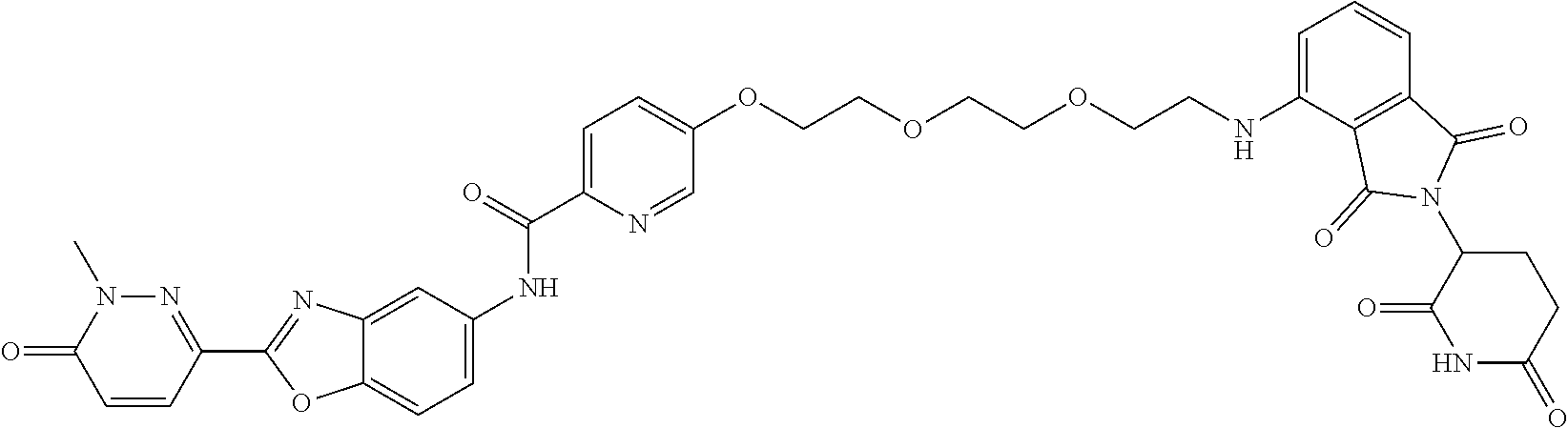 |
Tr( |
| 35 |
 |
Tr(MET-uHPLC-AB-101) = 3.07 min, (ES+) (M + H)+ 707.4. |
| 36 |
 |
Tr( |
| 32 |
 |
Tr( |
| 38 |
 |
Tr(MET-uHPLC-AB-101) = 3.05 min, (ES+) (M + H)+ 1015.5. |
| 34 |
 |
Tr(MET-uHPLC-AB-101) = 3.07 min, (ES+) (M + H)+ 1147.3. |
| 37 |
 |
Tr(MET-uHPLC-AB-101)= 3.1 min, (ES+) (M + H)+ 1323.4. |
| 39 |
 |
Tr( |
| 40 |
 |
Tr(MET-uHPLC-AB-101)= 3.28 min, (ES+) (M + H)+ 1161.4 |
| 42 |
 |
|
| 70 |
 |
Tr(MET-uHPLC-AB-101) = 3.41 min m/z (ES+) (M + H)+ 765.3 |

| | Structure | Data | |
| 4 |
 |
MS (ESI) m/z 1007 [M + H]+; HPLC: tR = 6.01 min | |
| 3 |
 |
MS (ESI) m/z 963 [M + H]+; HPLC: tR = 6.03 min | |
| 2 |
 |
MS (ESI) m/z 919 [M + H]+; HPLC: tR = 5.94 min | |
| 1 |
 |
MS (ESI) m/z 875 [M + H]+; HPLC: tR = 5.94 min | |
| 10 |
 |
Tr( |
|

| | Structure | Data | |
| 5 |
 |
MS (ESI) m/z 957 [M + Na]+; HPLC tR = 6.41 |
|
| 6 |
 |
MS (ESI) m/z 1001 [M + Na]+; HPLC: tR = 6.30 |
|
| 7 |
 |
MS (ESI) m/z 1023 [M + H]+; HPLC: tR = 6.35 |
|
| 8 |
 |
MS (ESI) m/z 1089 [M+Na]+; HPLC: tR = 6.28 min | |


| # | Structure | Data |
| 43 |
 |
MS (ESI) m/z 947 [M + Na]+; HPLC: tR = 5.71 min |
| 44 |
 |
MS (ESI) m/z 991 [M + Na]+; HPLC: tR = 5.74 |
| 45 |
 |
MS (ESI) m/z 1035 [M + Na]+; HPLC: tR = 5.75 min |
| 46 |
 |
MS (ESI) m/z 1079 [M + Na]+; HPLC: Method 1, tR = 5.72 min |


| # | Structure | Data |
| 58 |
 |
MS (ESI) m/z 966 [M + H]+; HPLC: Method 2, tR = 4.80 min |
| 57 |
 |
MS (ESI) m/z 1010 [M + H]+, tR = 4.83 min |


| # | Structure | Data |
| 53 |
 |
MS (ESI) m/z 929 [M + H]+; HPLC: Method 1, tR = 4.66 min |
| 54 |
 |
MS (ESI) m/z 995 [M + Na]+; HPLC: Method 1, tR = 6.16 min |


| # | Structure | Data |
| 55 |
 |
MS (ESI) m/z 943 [M + H]+; HPLC: Method 1, tR = 5.17 min |
| 56 |
 |
MS (ESI) m/z 987 [M + H]+; HPLC: Method 1, tR = 4.77 min |

| # | Structure | Data |
| 59 |
 |
Tr(METCR1603) = 4.00 min, (ES)+ [M + H]+ 727 |

| # | Structure | Data |
| 60 |
 |
Tr(MET-uHPLC-AB-101) = 1.53 min, (ES+) (M + H)+ 726 |
| 9 |
 |
Tr(MET-uHPLC-AB-101) = 3.36 min m/z (ES+) (M + H)+ 704.3. |


| TABLE 3 | |||
| Q46_RBA | |||
| # | IC50 (nM) | ||
| 1 | +++ | ||
| 2 | +++ | ||
| 3 | +++ | ||
| 4 | ++ | ||
| 5 | ++ | ||
| 6 | ++ | ||
| 7 | ++ | ||
| 8 | ++ | ||
| 9 | +++ | ||
| 10 | +++ | ||
| 11 | +++ | ||
| 12 | +++ | ||
| 13 | +++ | ||
| 14 | +++ | ||
| 15 | +++ | ||
| 16 | +++ | ||
| 17 | +++ | ||
| 18 | +++ | ||
| 19 | ++ | ||
| 20 | +++ | ||
| 21 | +++ | ||
| 22 | +++ | ||
| 23 | +++ | ||
| 24 | +++ | ||
| 25 | ++ | ||
| 26 | ++ | ||
| 27 | ++ | ||
| 28 | +++ | ||
| 29 | +++ | ||
| 30 | +++ | ||
| 31 | +++ | ||
| 32 | +++ | ||
| 33 | +++ | ||
| 34 | +++ | ||
| 35 | +++ | ||
| 36 | +++ | ||
| 37 | +++ | ||
| 38 | +++ | ||
| 39 | +++ | ||
| 40 | +++ | ||
| 41 | +++ | ||
| 43 | +++ | ||
| 44 | ++ | ||
| 45 | ++ | ||
| 46 | 101 | ||
| 47 | +++ | ||
| 48 | +++ | ||
| 49 | +++ | ||
| 50 | +++ | ||
| 51 | +++ | ||
| 52 | +++ | ||
| 53 | + | ||
| 54 | + | ||
| 55 | ++ | ||
| 56 | + | ||
| 57 | +++ | ||
| 58 | ++ | ||
| 59 | +++ | ||
| 60 | +++ | ||
| 61 | +++ | ||
| 62 | +++ | ||
| 63 | +++ | ||
| 64 | + | ||
| 65 | ++ | ||
| 66 | ++ | ||
| 67 | ++ | ||
| 68 | ++ | ||
| 69 | + | ||
| 70 | +++ | ||
| TABLE 4 | |||
| VHL | |||
| SPR Kd | |||
| # | (nM) | ||
| 1 | ++ | ||
| 2 | ++ | ||
| 3 | ++ | ||
| 11 | + | ||
| 20 | ++ | ||
| 21 | ++ | ||
| 22 | +++ | ||
| 23 | +++ | ||
| 24 | +++ | ||
| 25 | ++ | ||
| 26 | +++ | ||
| 43 | + | ||
| 44 | + | ||
| 45 | + | ||
| 46 | + | ||
| 47 | ++ | ||
| 48 | + | ||
| 53 | ++ | ||
| 54 | + | ||
| 55 | ++ | ||
| 56 | ++ | ||
| 57 | ++ | ||
| 58 | + | ||
| TABLE 5 | |||
| CRBN | |||
| SPR Kd | |||
| # | (nM) | ||
| 30 | + | ||
| 31 | ++ | ||
| 32 | ++ | ||
| 33 | ++ | ||
| 34 | + | ||
| 36 | ++ | ||
| 37 | ++ | ||
| 38 | ++ | ||
| 39 | + | ||
| 40 | + | ||
| 70 | + | ||
Claims (17)
W-L-ULM (I)


-G1-((CH2)a-G2)c-(CH2)b-G3-


Priority Applications (1)
| Application Number | Priority Date | Filing Date | Title |
|---|---|---|---|
| US17/752,683 US12083108B2 (en) | 2019-02-25 | 2022-05-24 | Compounds for targeting mutant huntingtin protein and uses thereof |
Applications Claiming Priority (3)
| Application Number | Priority Date | Filing Date | Title |
|---|---|---|---|
| US201962810213P | 2019-02-25 | 2019-02-25 | |
| US16/799,651 US11389438B2 (en) | 2019-02-25 | 2020-02-24 | Compounds for targeting mutant huntingtin protein and uses thereof |
| US17/752,683 US12083108B2 (en) | 2019-02-25 | 2022-05-24 | Compounds for targeting mutant huntingtin protein and uses thereof |
Related Parent Applications (1)
| Application Number | Title | Priority Date | Filing Date |
|---|---|---|---|
| US16/799,651 Continuation US11389438B2 (en) | 2019-02-25 | 2020-02-24 | Compounds for targeting mutant huntingtin protein and uses thereof |
Publications (2)
| Publication Number | Publication Date |
|---|---|
| US20220409600A1 US20220409600A1 (en) | 2022-12-29 |
| US12083108B2 true US12083108B2 (en) | 2024-09-10 |
Family
ID=70009388
Family Applications (2)
| Application Number | Title | Priority Date | Filing Date |
|---|---|---|---|
| US16/799,651 Active 2040-02-26 US11389438B2 (en) | 2019-02-25 | 2020-02-24 | Compounds for targeting mutant huntingtin protein and uses thereof |
| US17/752,683 Active US12083108B2 (en) | 2019-02-25 | 2022-05-24 | Compounds for targeting mutant huntingtin protein and uses thereof |
Family Applications Before (1)
| Application Number | Title | Priority Date | Filing Date |
|---|---|---|---|
| US16/799,651 Active 2040-02-26 US11389438B2 (en) | 2019-02-25 | 2020-02-24 | Compounds for targeting mutant huntingtin protein and uses thereof |
Country Status (4)
| Country | Link |
|---|---|
| US (2) | US11389438B2 (en) |
| EP (1) | EP3931186A1 (en) |
| JP (2) | JP7619952B2 (en) |
| WO (1) | WO2020176424A1 (en) |
Families Citing this family (8)
| Publication number | Priority date | Publication date | Assignee | Title |
|---|---|---|---|---|
| MX2019005007A (en) | 2016-11-01 | 2019-07-18 | Arvinas Inc | PROTAC TARGETED AT TAU PROTEIN AND ASSOCIATED METHODS OF USE. |
| WO2020176424A1 (en) | 2019-02-25 | 2020-09-03 | Chdi Foundation, Inc. | Compounds for targeting mutant huntingtin protein and uses thereof |
| EP3999182A1 (en) | 2019-07-17 | 2022-05-25 | Arvinas Operations, Inc. | Tau-protein targeting compounds and associated methods of use |
| BR112023016690A2 (en) * | 2021-02-22 | 2023-11-14 | Univ Yale | TARGETED BIFUNCTIONAL DEGRADERS AND METHODS USING THE SAME |
| US12606570B2 (en) | 2021-04-27 | 2026-04-21 | Chdi Foundation, Inc. | Deuterated compounds and imaging agents for imaging huntingtin protein |
| TW202317546A (en) | 2021-07-09 | 2023-05-01 | 美商普萊克斯姆公司 | Aryl compounds and pharmaceutical compositions that modulate ikzf2 |
| EP4516787A4 (en) * | 2022-06-15 | 2025-12-24 | Hangzhou Polymed Biopharmaceuticals Inc | Five-membered ring-condensed six-membered compound, manufacturing process therefor, as well as pharmaceutical composition and use thereof |
| US12180199B1 (en) | 2023-10-23 | 2024-12-31 | King Faisal University | 2-(benzo[d]oxazol-2-yl)-n′-(isonicotinoyloxy)acetimidamide as an antimicrobial compound |
Citations (11)
| Publication number | Priority date | Publication date | Assignee | Title |
|---|---|---|---|---|
| WO2015000867A1 (en) | 2013-07-03 | 2015-01-08 | Glaxosmithkline Intellectual Property Development Limited | Benzothiophene derivatives as estrogen receptor inhibitors |
| WO2016197078A1 (en) | 2015-06-05 | 2016-12-08 | Syros Pharmaceuticals, Inc. | Compounds for the modulation of myc activity |
| US20170281804A1 (en) | 2014-08-29 | 2017-10-05 | Chdi Foundation, Inc. | Probes for imaging huntingtin protein |
| US20170283439A1 (en) | 2014-08-29 | 2017-10-05 | CCHDI Foundation Inc. | Probes for imaging huntingtin protein |
| US20180125821A1 (en) | 2016-11-01 | 2018-05-10 | Arvinas, Inc. | Tau-protein targeting protacs and associated methods of use |
| WO2018118598A1 (en) | 2016-12-23 | 2018-06-28 | Arvinas, Inc. | Compounds and methods for the targeted degradation of fetal liver kinase polypeptides |
| WO2018140809A1 (en) | 2017-01-26 | 2018-08-02 | Arvinas, Inc. | Modulators of estrogen receptor proteolysis and associated methods of use |
| US10137211B2 (en) | 2015-08-28 | 2018-11-27 | Chdi Foundation, Inc. | Probes for imaging Huntingtin protein |
| US10479802B2 (en) | 2014-08-29 | 2019-11-19 | Chdi Foundation, Inc. | Probes for imaging huntingtin protein |
| WO2020176424A1 (en) | 2019-02-25 | 2020-09-03 | Chdi Foundation, Inc. | Compounds for targeting mutant huntingtin protein and uses thereof |
| US10907197B2 (en) | 2014-08-29 | 2021-02-02 | Chdi Foundation, Inc. | Probes for imaging huntingtin protein |
Family Cites Families (12)
| Publication number | Priority date | Publication date | Assignee | Title |
|---|---|---|---|---|
| US3845770A (en) | 1972-06-05 | 1974-11-05 | Alza Corp | Osmatic dispensing device for releasing beneficial agent |
| US4326525A (en) | 1980-10-14 | 1982-04-27 | Alza Corporation | Osmotic device that improves delivery properties of agent in situ |
| US5364620A (en) | 1983-12-22 | 1994-11-15 | Elan Corporation, Plc | Controlled absorption diltiazem formulation for once daily administration |
| US5023252A (en) | 1985-12-04 | 1991-06-11 | Conrex Pharmaceutical Corporation | Transdermal and trans-membrane delivery of drugs |
| US4992445A (en) | 1987-06-12 | 1991-02-12 | American Cyanamid Co. | Transdermal delivery of pharmaceuticals |
| US5001139A (en) | 1987-06-12 | 1991-03-19 | American Cyanamid Company | Enchancers for the transdermal flux of nivadipine |
| US4902514A (en) | 1988-07-21 | 1990-02-20 | Alza Corporation | Dosage form for administering nilvadipine for treating cardiovascular symptoms |
| EP4649963A3 (en) | 2014-04-14 | 2026-05-13 | Arvinas Operations, Inc. | Imide-based modulators of proteolysis and associated methods of use |
| CA2988414C (en) | 2015-06-04 | 2023-09-26 | Arvinas, Inc. | Imide-based modulators of proteolysis and associated methods of use |
| CA2994969A1 (en) | 2015-08-06 | 2017-02-09 | Dana-Farber Cancer Institute, Inc. | Targeted protein degradation to attenuate adoptive t-cell therapy associated adverse inflammatory responses |
| IL325835A (en) | 2016-12-23 | 2026-03-01 | Univ Yale | Compounds and methods for the targeted reduction of rapidly accelerating polypeptide fibrosarcoma |
| US20210154184A1 (en) | 2017-07-12 | 2021-05-27 | Dana-Farber Cancer Institute, Inc. | Compounds for tau protein degradation |
-
2020
- 2020-02-24 WO PCT/US2020/019537 patent/WO2020176424A1/en not_active Ceased
- 2020-02-24 US US16/799,651 patent/US11389438B2/en active Active
- 2020-02-24 EP EP20714754.7A patent/EP3931186A1/en active Pending
- 2020-02-24 JP JP2021549614A patent/JP7619952B2/en active Active
-
2022
- 2022-05-24 US US17/752,683 patent/US12083108B2/en active Active
-
2024
- 2024-11-05 JP JP2024193512A patent/JP7872824B2/en active Active
Patent Citations (14)
| Publication number | Priority date | Publication date | Assignee | Title |
|---|---|---|---|---|
| WO2015000867A1 (en) | 2013-07-03 | 2015-01-08 | Glaxosmithkline Intellectual Property Development Limited | Benzothiophene derivatives as estrogen receptor inhibitors |
| US20200102328A1 (en) | 2014-08-29 | 2020-04-02 | Chdi Foundation, Inc. | Probes for imaging huntingtin protein |
| US20170281804A1 (en) | 2014-08-29 | 2017-10-05 | Chdi Foundation, Inc. | Probes for imaging huntingtin protein |
| US20170283439A1 (en) | 2014-08-29 | 2017-10-05 | CCHDI Foundation Inc. | Probes for imaging huntingtin protein |
| US10479802B2 (en) | 2014-08-29 | 2019-11-19 | Chdi Foundation, Inc. | Probes for imaging huntingtin protein |
| US10907197B2 (en) | 2014-08-29 | 2021-02-02 | Chdi Foundation, Inc. | Probes for imaging huntingtin protein |
| WO2016197078A1 (en) | 2015-06-05 | 2016-12-08 | Syros Pharmaceuticals, Inc. | Compounds for the modulation of myc activity |
| US10137211B2 (en) | 2015-08-28 | 2018-11-27 | Chdi Foundation, Inc. | Probes for imaging Huntingtin protein |
| US10765764B2 (en) | 2015-08-28 | 2020-09-08 | Chdi Foundation, Inc. | Probes for imaging huntingtin protein |
| US20210060187A1 (en) | 2015-08-28 | 2021-03-04 | Chdi Foundation, Inc. | Probes for imaging huntingtin protein |
| US20180125821A1 (en) | 2016-11-01 | 2018-05-10 | Arvinas, Inc. | Tau-protein targeting protacs and associated methods of use |
| WO2018118598A1 (en) | 2016-12-23 | 2018-06-28 | Arvinas, Inc. | Compounds and methods for the targeted degradation of fetal liver kinase polypeptides |
| WO2018140809A1 (en) | 2017-01-26 | 2018-08-02 | Arvinas, Inc. | Modulators of estrogen receptor proteolysis and associated methods of use |
| WO2020176424A1 (en) | 2019-02-25 | 2020-09-03 | Chdi Foundation, Inc. | Compounds for targeting mutant huntingtin protein and uses thereof |
Non-Patent Citations (13)
| Title |
|---|
| Cyrus, Kedra et al., "Impact of linker length on the activity of PROTACs", Molecular BioSystems, vol. 7, No. 2, pp. 359-364 (2011). |
| Dominguez, U.S. Appl. No. 16/799,651, filed Feb. 24, 2020. |
| International Search Report and Written Opinion for PCT/US2020/019537, Jun. 15, 2020, 21 pages. |
| Tomoshige, et al., "Degradation of huntingtin mediated by a hybrid molecule composed of IAP antagonist linked to phenyldiazenyl benzothiazole derivative", Bioorganic & Medicinal Chemistry Letters, vol. 28, No. 4, Feb. 1, 2018, pp. 707-710, XP055699376. |
| Tomoshige, et al., "Discovery of Small Molecules that Induce the Degradation of Huntingtin", Angewandte Chemie, International Edition, vol. 56, No. 38, Sep. 11, 2017, pp. 11530-11533, XP055694994. |
| Tomoshige, et al., "Supporting Information, Discovery of Small Molecules that Induce the Degradation of Huntingtin", Jan. 1, 2017, Retrieved from the Internet: URL:https://onlinelibrary.wiley.com/action/downloadSupplement?doi=10.1002/anie.201706529&file=anie201706529-sup-0001-misc_information.pdf, retrieved on May 29, 2020. |
| U.S. Appl. No. 17/125,905, filed Dec. 17, 2020, Liu et al. |
| U.S. Appl. No. 17/325,038, filed May 19, 2021, Dominguez et al. |
| U.S. Appl. No. 17/344,582, filed Jun. 10, 2021, Liu et al. |
| U.S. Appl. No. 17/353,611, filed Jun. 21, 2021, Dominguez et al. |
| U.S. Appl. No. 17/353,627, filed Jun. 21, 2021, Dominguez et al. |
| U.S. Appl. No. 17/558,397, filed Dec. 21, 2021, Dominguez et al. |
| U.S. Appl. No. 17/881,895, filed Aug. 5, 2022, Dominguez et al. |
Also Published As
| Publication number | Publication date |
|---|---|
| US11389438B2 (en) | 2022-07-19 |
| US20220409600A1 (en) | 2022-12-29 |
| JP2025032084A (en) | 2025-03-11 |
| EP3931186A1 (en) | 2022-01-05 |
| JP7872824B2 (en) | 2026-06-10 |
| US20200276176A1 (en) | 2020-09-03 |
| WO2020176424A1 (en) | 2020-09-03 |
| JP7619952B2 (en) | 2025-01-22 |
| JP2022521431A (en) | 2022-04-07 |
Similar Documents
| Publication | Publication Date | Title |
|---|---|---|
| US20220409600A1 (en) | Compounds for targeting mutant huntingtin protein and uses thereof | |
| US12258355B2 (en) | Probes for imaging huntingtin protein | |
| US12281122B1 (en) | PI3K inhibitors | |
| US12577226B2 (en) | Compounds for treating Huntington's disease | |
| US9926307B2 (en) | Compounds | |
| US9079914B2 (en) | Fused aminodihydro-oxazine derivatives | |
| US11851446B2 (en) | Probes for imaging Huntingtin protein | |
| US11344637B2 (en) | Probes for imaging huntingtin protein | |
| US12109198B2 (en) | Macrocyclic azolopyridine derivatives as EED and PRC2 modulators | |
| TW201609726A (en) | Imidazopyridine and imidazopyrazine as LSD1 inhibitors | |
| US20120165331A1 (en) | Di/tri-aza-spiro-C9-C11alkanes | |
| US20230295159A1 (en) | Atx inhibitor, and preparation method therefor and use thereof | |
| US20260137706A1 (en) | Methods of treating inflammatory diseases |
Legal Events
| Date | Code | Title | Description |
|---|---|---|---|
| FEPP | Fee payment procedure |
Free format text: ENTITY STATUS SET TO UNDISCOUNTED (ORIGINAL EVENT CODE: BIG.); ENTITY STATUS OF PATENT OWNER: LARGE ENTITY |
|
| STPP | Information on status: patent application and granting procedure in general |
Free format text: DOCKETED NEW CASE - READY FOR EXAMINATION |
|
| STPP | Information on status: patent application and granting procedure in general |
Free format text: RESPONSE TO NON-FINAL OFFICE ACTION ENTERED AND FORWARDED TO EXAMINER |
|
| STPP | Information on status: patent application and granting procedure in general |
Free format text: NON FINAL ACTION MAILED |
|
| STPP | Information on status: patent application and granting procedure in general |
Free format text: RESPONSE TO NON-FINAL OFFICE ACTION ENTERED AND FORWARDED TO EXAMINER |
|
| STPP | Information on status: patent application and granting procedure in general |
Free format text: FINAL REJECTION MAILED |
|
| AS | Assignment |
Owner name: CHDI FOUNDATION, INC., NEW YORK Free format text: ASSIGNMENT OF ASSIGNORS INTEREST;ASSIGNOR:EVOTEC (UK) LTD.;REEL/FRAME:066571/0042 Effective date: 20220511 Owner name: EVOTEC (UK) LTD., UNITED KINGDOM Free format text: ASSIGNMENT OF ASSIGNORS INTEREST;ASSIGNORS:PRIME, MICHAEL EDWARD;COE, SAMUEL;SIGNING DATES FROM 20210706 TO 20220505;REEL/FRAME:066571/0036 Owner name: CHDI FOUNDATION, INC., NEW YORK Free format text: ASSIGNMENT OF ASSIGNORS INTEREST;ASSIGNORS:DOMINGUEZ, CELIA;BARD, JONATHAN;LEE, MATTHEW R.;AND OTHERS;SIGNING DATES FROM 20210701 TO 20220428;REEL/FRAME:066570/0931 |
|
| STPP | Information on status: patent application and granting procedure in general |
Free format text: RESPONSE AFTER FINAL ACTION FORWARDED TO EXAMINER |
|
| ZAAA | Notice of allowance and fees due |
Free format text: ORIGINAL CODE: NOA |
|
| ZAAB | Notice of allowance mailed |
Free format text: ORIGINAL CODE: MN/=. |
|
| STPP | Information on status: patent application and granting procedure in general |
Free format text: AWAITING TC RESP., ISSUE FEE NOT PAID |
|
| STPP | Information on status: patent application and granting procedure in general |
Free format text: NOTICE OF ALLOWANCE MAILED -- APPLICATION RECEIVED IN OFFICE OF PUBLICATIONS |
|
| STPP | Information on status: patent application and granting procedure in general |
Free format text: PUBLICATIONS -- ISSUE FEE PAYMENT VERIFIED |
|
| STPP | Information on status: patent application and granting procedure in general |
Free format text: AWAITING TC RESP, ISSUE FEE PAYMENT VERIFIED |
|
| STPP | Information on status: patent application and granting procedure in general |
Free format text: AWAITING TC RESP, ISSUE FEE PAYMENT VERIFIED |
|
| STPP | Information on status: patent application and granting procedure in general |
Free format text: PUBLICATIONS -- ISSUE FEE PAYMENT VERIFIED |
|
| STCF | Information on status: patent grant |
Free format text: PATENTED CASE |
|
| CC | Certificate of correction |