US12083099B2 - Methods of treating symptoms of coronavirus infection with viral protease inhibitors - Google Patents

Methods of treating symptoms of coronavirus infection with viral protease inhibitors Download PDF

Info

Publication number
US12083099B2
US12083099B2 US17/513,284 US202117513284A US12083099B2 US 12083099 B2 US12083099 B2 US 12083099B2 US 202117513284 A US202117513284 A US 202117513284A US 12083099 B2 US12083099 B2 US 12083099B2
Authority
US
United States
Prior art keywords
compound
implementation
compounds
present disclosure
purposes
Prior art date
Legal status (The legal status is an assumption and is not a legal conclusion. Google has not performed a legal analysis and makes no representation as to the accuracy of the status listed.)
Active
Application number
US17/513,284
Other versions
US20230113114A1 (en
Inventor
Kevin Brown
Kevin Brogle
Current Assignee (The listed assignees may be inaccurate. Google has not performed a legal analysis and makes no representation or warranty as to the accuracy of the list.)
Accencio LLC
Original Assignee
Accencio LLC
Priority date (The priority date is an assumption and is not a legal conclusion. Google has not performed a legal analysis and makes no representation as to the accuracy of the date listed.)
Filing date
Publication date
Application filed by Accencio LLC filed Critical Accencio LLC
Priority to US17/513,284 priority Critical patent/US12083099B2/en
Assigned to Accencio LLC reassignment Accencio LLC ASSIGNMENT OF ASSIGNORS INTEREST (SEE DOCUMENT FOR DETAILS). Assignors: BROGLE, KEVIN, BROWN, KEVIN
Publication of US20230113114A1 publication Critical patent/US20230113114A1/en
Priority to US18/469,995 priority patent/US12453717B1/en
Application granted granted Critical
Publication of US12083099B2 publication Critical patent/US12083099B2/en
Active legal-status Critical Current
Anticipated expiration legal-status Critical

Links

Classifications

    • AHUMAN NECESSITIES
    • A61MEDICAL OR VETERINARY SCIENCE; HYGIENE
    • A61KPREPARATIONS FOR MEDICAL, DENTAL OR TOILETRY PURPOSES
    • A61K31/00Medicinal preparations containing organic active ingredients
    • A61K31/33Heterocyclic compounds
    • A61K31/395Heterocyclic compounds having nitrogen as a ring hetero atom, e.g. guanethidine or rifamycins
    • A61K31/40Heterocyclic compounds having nitrogen as a ring hetero atom, e.g. guanethidine or rifamycins having five-membered rings with one nitrogen as the only ring hetero atom, e.g. sulpiride, succinimide, tolmetin, buflomedil
    • A61K31/407Heterocyclic compounds having nitrogen as a ring hetero atom, e.g. guanethidine or rifamycins having five-membered rings with one nitrogen as the only ring hetero atom, e.g. sulpiride, succinimide, tolmetin, buflomedil condensed with other heterocyclic ring systems, e.g. ketorolac, physostigmine
    • AHUMAN NECESSITIES
    • A61MEDICAL OR VETERINARY SCIENCE; HYGIENE
    • A61KPREPARATIONS FOR MEDICAL, DENTAL OR TOILETRY PURPOSES
    • A61K31/00Medicinal preparations containing organic active ingredients
    • A61K31/33Heterocyclic compounds
    • A61K31/395Heterocyclic compounds having nitrogen as a ring hetero atom, e.g. guanethidine or rifamycins
    • A61K31/435Heterocyclic compounds having nitrogen as a ring hetero atom, e.g. guanethidine or rifamycins having six-membered rings with one nitrogen as the only ring hetero atom
    • A61K31/47Quinolines; Isoquinolines
    • A61K31/4709Non-condensed quinolines and containing further heterocyclic rings
    • AHUMAN NECESSITIES
    • A61MEDICAL OR VETERINARY SCIENCE; HYGIENE
    • A61KPREPARATIONS FOR MEDICAL, DENTAL OR TOILETRY PURPOSES
    • A61K9/00Medicinal preparations characterised by special physical form
    • A61K9/0012Galenical forms characterised by the site of application
    • A61K9/0014Skin, i.e. galenical aspects of topical compositions
    • AHUMAN NECESSITIES
    • A61MEDICAL OR VETERINARY SCIENCE; HYGIENE
    • A61KPREPARATIONS FOR MEDICAL, DENTAL OR TOILETRY PURPOSES
    • A61K9/00Medicinal preparations characterised by special physical form
    • A61K9/0012Galenical forms characterised by the site of application
    • A61K9/0019Injectable compositions; Intramuscular, intravenous, arterial, subcutaneous administration; Compositions to be administered through the skin in an invasive manner
    • AHUMAN NECESSITIES
    • A61MEDICAL OR VETERINARY SCIENCE; HYGIENE
    • A61KPREPARATIONS FOR MEDICAL, DENTAL OR TOILETRY PURPOSES
    • A61K9/00Medicinal preparations characterised by special physical form
    • A61K9/0012Galenical forms characterised by the site of application
    • A61K9/007Pulmonary tract; Aromatherapy
    • A61K9/0073Sprays or powders for inhalation; Aerolised or nebulised preparations generated by other means than thermal energy
    • A61K9/0078Sprays or powders for inhalation; Aerolised or nebulised preparations generated by other means than thermal energy for inhalation via a nebulizer such as a jet nebulizer, ultrasonic nebulizer, e.g. in the form of aqueous drug solutions or dispersions
    • AHUMAN NECESSITIES
    • A61MEDICAL OR VETERINARY SCIENCE; HYGIENE
    • A61KPREPARATIONS FOR MEDICAL, DENTAL OR TOILETRY PURPOSES
    • A61K9/00Medicinal preparations characterised by special physical form
    • A61K9/14Particulate form, e.g. powders, Processes for size reducing of pure drugs or the resulting products, Pure drug nanoparticles
    • A61K9/19Particulate form, e.g. powders, Processes for size reducing of pure drugs or the resulting products, Pure drug nanoparticles lyophilised, i.e. freeze-dried, solutions or dispersions

Definitions

  • the present disclosure relates to methods of treating symptoms of a coronavirus infection, e.g., SARS-COV-19, by administering a viral protease inhibitor.
  • SARS-COV-19 The novel virus 2019-nCOV (SARS-COV-19, COVID-19), is the third well-known coronavirus to cross species to infect human populations in the past two decades. The previous two are the severe acute respiratory syndrome coronavirus (SARS-COV) outbreak in 2002 and the Middle East respiratory syndrome coronavirus (MERS-COV) outbreak in 2012. Like SARS-COV and MERs-COV, SARS-COV-19 causes severe respiratory illness, and is highly transmissible from human-to-human. On Mar. 11, 2020, the World Health Organization (WHO) declared SARS-CoV-19 a global pandemic. Since then, over 20 million people have been infected, and over 750,000 people have died worldwide from the virus. In the United States alone there have been over 5 million infections to date, with over 160,000 deaths.
  • WHO World Health Organization
  • ARDS Acute Respiratory Distress Syndrome
  • cytokine-chemokine responses cause the immune system to become hyperactive and induce a condition called a cytokine storm, which is considered to be one of the major causes of ARDS and multiple-organ failure in these patients.
  • Targeting cytokines during the management of SARS-COV-19 patients could improve survival rates and reduce mortality.
  • the present disclosure relates to methods of treating one or more symptoms of a coronavirus infection, particularly SARS-COV-19.
  • the present disclosure further relates to methods of treating or preventing an acute inflammatory response, e.g., a cytokine storm in a coronavirus patient, by administering a viral protease inhibitor, in particular a viral polymerase inhibitor.
  • protease inhibitors prevent viral replication by selectively binding to viral proteases (e.g. HIV-1 protease) and blocking proteolytic cleavage of protein precursors that are necessary for the production of infectious viral particles.
  • viral proteases e.g. HIV-1 protease
  • the present disclosure is based on the discovery that viral protease inhibitors may have therapeutic utility in the treatment of coronavirus symptoms, in particular in reducing inflammation and preventing cytokine storms in patients with coronavirus infections, in particular SARS-COV-19.
  • the present disclosure relates to a method of treating or alleviating at least one symptom of a coronavirus infection in a subject, by administering to the subject a therapeutically effective amount of a viral protease inhibitor.
  • the symptom is selected from the group consisting of fever, cough, tiredness, sore throat, diarrhea, conjunctivitis, headache, loss of taste, loss of smell, rash, difficulty breathing, shortness of breath, chest pain, chest pressure, Acute Respiratory Distress Syndrome (ARDS) and organ failure.
  • the subject is a human.
  • the present disclosure relates to a method of treating an acute inflammatory condition in a subject infected with a coronavirus, the method comprising the step of administering to the subject a therapeutically effective amount of a viral protease inhibitor.
  • the inflammatory condition comprises a cytokine storm.
  • the subject is a human.
  • the present disclosure relates to a method of preventing a cytokine storm in a subject infected with a coronavirus, the method comprising the step of administering to the subject a therapeutically effective amount of a viral protease inhibitor.
  • the subject is a human.
  • the present disclosure relates to a method of reducing or arresting viral load in a subject infected with a coronavirus, the method comprising the step of administering to the subject a therapeutically effective amount of a viral protease inhibitor.
  • the subject is a human.
  • the coronavirus is a severe acute respiratory syndrome coronavirus (SARS-COV). In some embodiments, the coronavirus is a novel virus 2019-nCOV (SARS-COV-19). In some embodiments, the coronavirus is a Middle East respiratory syndrome coronavirus (MERS-COV). In one preferred embodiment, the coronavirus is SARS-COV-19.
  • SARS-COV severe acute respiratory syndrome coronavirus
  • MERS-COV Middle East respiratory syndrome coronavirus
  • the viral protease inhibitor is E)-N-(4-(3-(tert-butyl)-5-(2,4-dioxo-3,4-dihydropyrimidin-1(2H)-yl)-2-methoxystyryl)phenyl)methanesulfonamide; (R)-3-((2S,3S)-2-hydroxy-3-(3-hydroxy-2-methylbenzamido)-4-phenylbutanoyl)-5,5-dimethyl-N-(2-methylbenzyl)thiazolidine-4-carboxamide; R)—N-allyl-3-((2S,3S)-2-hydroxy-3-(3-hydroxy-2-methylbenzamido)-4-phenylbutanoyl)-5,5-dimethylthiazolidine-4-carboxamide; (4-((N-(5-cyclopropyl-2-(4-fluorophenyl)-3-(methylcarbamoyl)benzo
  • the viral protease inhibitors are selected from the group consisting of a compound of any one of Table 1.
  • viral protease inhibitor is administered according to a dose regimen selected from the group consisting of once daily (q.d.), twice daily (b.i.d.) thrice daily (t.i.d.), once a week, twice a week, three times a week, once every 2 weeks, once every three weeks, or once a month.
  • the viral protease inhibitor is administered in a pharmaceutical composition, wherein the composition further comprises at least one pharmaceutically acceptable excipient.
  • the viral protease inhibitor is administered in a form selected from the group consisting of a solution, a suspension, a syrup, an emulsion, a dispersion, a tablet, a pill, a capsule, a pellet, granules, a powder, an ointment, an elixir, a wafer, coated or uncoated beads, a lozenge, a sachet, a cachet, a depot system, a patch, an aerosol, an oil, an ointment, a suppository, a gel, and a cream.
  • the pharmaceutical composition is formulated for oral, topical, mucosal, intranasal, parenteral, gastrointestinal, intraspinal, intraperitoneal, intramuscular, intravenous, intrauterine, intraocular, intradermal, intracranial, intratracheal, intravaginal, intracerebroventricular, intracerebral, subcutaneous, ophthalmic, transdermal, rectal, buccal, epidural, sublingual oral, intranasal, intravenous, intraarterial, intrathecal, vaginal, rectal or subcutaneous administration.
  • the present disclosure relates to a topical pharmaceutical composition in a form selected from the group consisting of ointment, a gel, a drop, a patch and a cream, the composition comprising a viral protease inhibitor and at least one topically acceptable excipient, wherein the viral protease inhibitor is selected from the group consisting of the compounds provided in Table 1.
  • treatment is an approach for obtaining beneficial or desired results, including clinical results.
  • beneficial or desired clinical results can include, but are not limited to, alleviation or amelioration of one or more symptoms or conditions, diminishment of extent of disease, stabilized (i.e., not worsening) state of disease, preventing spread of disease, delay or slowing of disease progression, amelioration or palliation of the disease state and remission (whether partial or total), whether detectable or undetectable.
  • Treatment can also mean prolonging survival as compared to expected survival if not receiving treatment.
  • an “effective amount,” “sufficient amount” or “therapeutically effective amount” of an agent as used herein interchangeably is that amount sufficient to effectuate beneficial or desired results, including preclinical and/or clinical results and, as such, an “effective amount” or its variants depends upon the context in which it is being applied. The response is in some embodiments preventative, in others therapeutic, and in others a combination thereof.
  • the term “effective amount” also includes the amount of a compound of the disclosure, which is “therapeutically effective” and which avoids or substantially attenuates undesirable side effects.
  • the term “subject” means an animal, including but not limited a human, monkey, cow, horse, sheep, pig, chicken, turkey, quail, cat, dog, mouse, rat, rabbit, or guinea pig.
  • the subject is a mammal and in another embodiment the subject is a human coronavirus patient.
  • proteases play a critical role in the life cycle of many viruses.
  • protease inhibitors prevent viral replication by selectively binding to viral proteases (e.g. HIV-1 protease) and blocking proteolytic cleavage of protein precursors that are necessary for the production of infectious viral particles.
  • viral proteases e.g. HIV-1 protease
  • proteases provide utility by effecting the cleavage of high-molecular-weight viral polyprotein precursors to yield functional products.
  • proteases have utility in catalyzing the processing of the structural proteins necessary for assembly and morphogenesis of virus particles.
  • Viral protease inhibitors targets these functions from being carried out and preset mechanisms for treating an acute viral infection.
  • Viral proteases have been developed to treat Human Immunodeficiency Virus (HIV) and hepatitis C. deficiency. Because other viruses also encode for the same proteases that are essential to viral replication, the present disclosure extends the utility of protease inhibitors for other viruses, such as SARS-COV-19, where the processing site sequence and the catalytic mechanism are known and understood.
  • a compound for use in the method of the present disclosure is a viral protease inhibitor.
  • the compound is 4-PBA, or sodium 4-phenylbutanoate.
  • the compound is described in WO2000015634 the contents of which are hereby incorporated by reference for all purposes and the specific purposes identified herein.
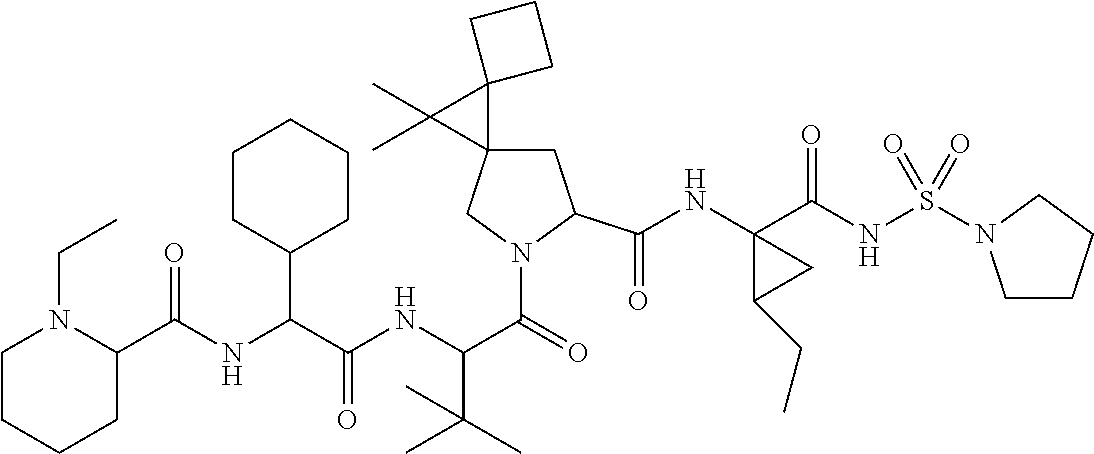
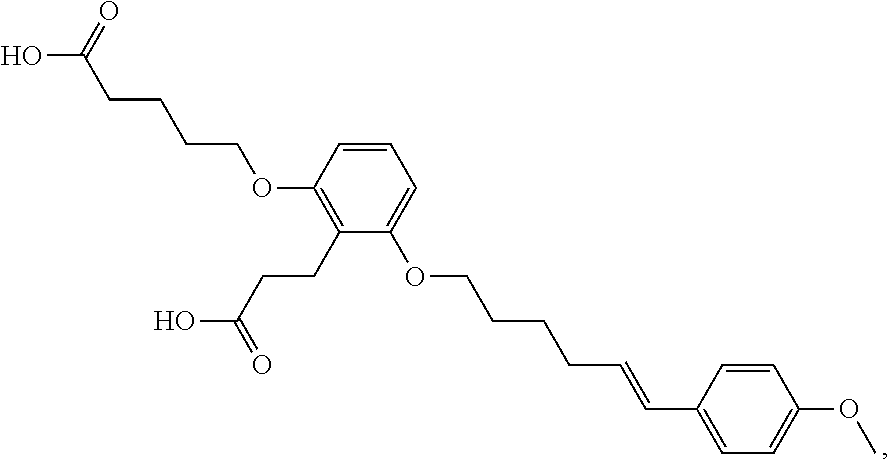
  • such compounds are represented by any one or more of the structures shown in Table 1. Any one of the compounds depicted in Table 1 is suitable for use in the methods of the present disclosure.
  • the compound is A-837093, a drug investigated in Phase 1 clinical trials as a NS5A Protein Inhibitor and having the formula:
  • the compound, or variations and permutations thereof is described in WO2015197028 the contents of which are hereby incorporated by reference for all purposes and the specific purposes identified herein.
  • such compounds are represented by any one or more of the structures shown in Table 2. Any one of the compounds depicted in Table 2 is suitable for use in the methods of the present disclosure.
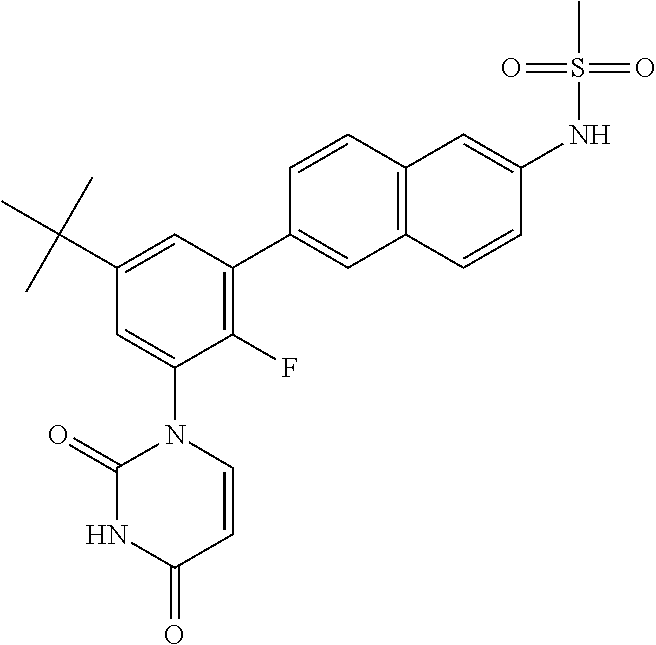
  • the compound is ABT-072, E)-N-(4-(3-(tert-butyl)-5-(2,4-dioxo-3,4-dihydropyrimidin-1(2H)-yl)-2-methoxystyryl)phenyl)methanesulfonamide.
  • the compound, or variations and permutations thereof is described in WO2015197028 the contents of which are hereby incorporated by reference for all purposes and the specific purposes identified herein.
  • the compound is, ACT-519276, a glucosylceramide synthase inhibitor or Non lysosomal glucosylceramidase inhibitor, that has been clinically evaluated.
  • the compound is represented by the following:
  • the compound is AG-1776, a HIV protease inhibitor under clinical investigation and having the formula (R)-3-((2S,3S)-2-hydroxy-3-(3-hydroxy-2-methylbenzamido)-4-phenylbutanoyl)-5,5-dimethyl-N-(2-methylbenzyl)thiazolidine-4-carboxamide.
  • the compound, or variations and permutations thereof is described in WO02100844; and WO2001047948 the contents of which are hereby incorporated by reference for all purposes and the specific purposes identified herein
  • the compound, or variations and permutations thereof is described in WO2002008256 the contents of which are hereby incorporated by reference for all purposes and the specific purposes identified herein.
  • the compound is BMS-605339, a clinically investigated NS3 protease inhibitor.
  • the compound, or variations and permutations thereof is described in WO2003099274; WO2005051410; WO2006007708; WO2009082697; WO2011002807; WO2012040242; and WO2012151195 the contents of which are hereby incorporated by reference for all purposes and the specific purposes identified herein.
  • such compounds are represented by any one or more of the structures shown in Table 6. Any one of the compounds depicted in Table 6 is suitable for use in the methods of the present disclosure.
  • the compound is BZF (1-benzofuran)-961 having the formula:
  • the compound is a CCR1 antagonists or chemokine having the formula:
  • the compound is the drug Almirall, a cyclooxygenase 2 inhibitor having the formula:
  • the compound is N-(2-aminoethyl)-2-aminoethyl-N-(2-aminoethyl)-2-aminoethyl-N-(2-aminoethyl)-2-aminoethyl-N-(2-aminoethyl)-2-aminoethyl-N-(2-aminoethyl)-2-aminoethyl
  • the compound is DPC-684 (N-[4-[(4-aminophenyl)sulfonyl-(2-methylpropyl)amino]-3-hydroxy-1-phenylbutan-2-yl]-2-[[2-[(3-fluorophenyl)methylamino]acetyl]amino]-3,3-dimethylbutanamide), a clinically investigated HIV-1 protease inhibitor.
  • the compound, or variations and permutations thereof is further described in U.S. Pat. No. 6,391,919; WO2004043355; WO2002006292; WO2004043355; WO2005061450; WO2004043911 the contents of which are hereby incorporated by reference for all purposes and the specific purposes identified herein.
  • the compound is E-5050 (3-[4-(2,6-dimethylheptyl)phenyl]-N-(2-hydroxyethyl)butanamide), a clinically investigated protease inhibitor compound.
  • the compound, or variations and permutations thereof is described in WO1999050229 the contents of which are hereby incorporated by reference for all purposes and the specific purposes identified herein.
  • such compounds are represented by any one or more of the structures shown in Table 9. Any one of the compounds depicted in Table 9 is suitable for use in the methods of the present disclosure.
  • the compound is GPI-1485, (2S)-1-(3,3-Dimethyl-2-oxopentanoyl)pyrrolidine-2-carboxylic acid), a clinically investigated compound operating as a FK506 binding protein modulator.
  • the compound, or variations and permutations thereof is described in WO02100844 the contents of which are hereby incorporated by reference for all purposes and the specific purposes identified herein.
  • such compounds are represented by any one or more of the structures shown in Table 10. Any one of the compounds depicted in Table 10 is suitable for use in the methods of the present disclosure.
  • the compound is GSK-2485852, (4-((N-(5-cyclopropyl-2-(4-fluorophenyl)-3-(methylcarbamoyl)benzofuran-6-yl)methylsulfonamido)methyl)-2-fluorophenyl)boronic acid, a clinically investigated compound functioning as a Hepatitis C virus NS5B polymerase inhibitor or RNA polymerase inhibitor.
  • the compound, or variations and permutations thereof is described in WO2011103063 the contents of which are hereby incorporated by reference for all purposes and the specific purposes identified herein.
  • such compounds are represented by any one or more of the structures shown in Table 11. Any one of the compounds depicted in Table 11 is suitable for use in the methods of the present disclosure.
  • the compound is Hoe-065((E)-but-2-enedioic acid;octyl (2S,3aS,6aS)-1[(2S)-2-[[(2S)-1-ethoxy-1-oxo-4-phenylbutan-2-yl]amino]propanoyl]-3,3a,4,5,6,6a-hexahydro-2H-cyclopenta[b]pyrrole-2-carboxylate), a clinically investigated acetylcholine receptor agonist or acetylcholinesterase inhibitor.
  • the compound, or variations and permutations thereof is described in WO2007117560 the contents of which are hereby incorporated by reference for all purposes and the specific purposes identified herein.
  • such compounds are represented by any one or more of the structures shown in Table 12. Any one of the compounds depicted in Table 12 is suitable for use in the methods of the present disclosure.
  • the compound is IDX-320 ((1S,4R,6S,7Z,18S)-18-[7-methoxy-8-methyl-2-[4-(trifluoromethyl)-1,3-thiazol-2-yl]quinolin-4-yl]oxy-13-methyl-N-(1-methylcyclopropyl)sulfonyl-2,14-dioxo-3,13,15-triazatricyclo[13.4.0.04,6]nonadec-7-ene-4-carboxamide) a clinically investigated NS3 protease inhibitor.
  • the compound, or variations and permutations thereof is described in WO2009014730 the contents of which are hereby incorporated by reference for all purposes and the specific purposes identified herein.
  • such compounds are represented by any one or more of the structures shown in Table 13. Any one of the compounds depicted in Table 13 is suitable for use in the methods of the present disclosure.
  • the compound is L-653328 ((S)-4-(3-(tert-butylamino)-2-hydroxypropoxy)phenethyl acetate).
  • the compound, or variations and permutations thereof is described in WO2007117560 the contents of which are hereby incorporated by reference for all purposes and the specific purposes identified herein.
  • such compounds are represented by any one or more of the structures shown in Table 14. Any one of the compounds depicted in Table 14 is suitable for use in the methods of the present disclosure.
  • the compound is MK-1220 ((3R,5S,8S)-8-cyclohexyl-N-[(1R,2S)-1-(cyclopropylsulfonylcarbamoyl)-2-ethenylcyclopropyl]-18-methoxy-13,13-dimethyl-7,10-dioxo-2,11-dioxa-6,9,23-triazatetracyclo[15.6.2.13,6.020,24]hexacosa-1(23), 17,19,21,24-pentaene-5-carboxamide), a clinically investigated NS5B polymerase inhibitor.
  • the compound, or variations and permutations thereof is further described in WO2007016441; WO2008057208 the contents of which are hereby incorporated by reference for all purposes and the specific purposes identified herein.
  • such compounds are represented by any one or more of the structures shown in Table 15. Any one of the compounds depicted in Table 15 is suitable for use in the methods of the present disclosure.
  • the compound is MR-708 (2-acetamido-3-phenylpropanoic acid;adamantan-1-amine) a clinically investigated protease Inhibitor.
  • the compound, or variations and permutations thereof is further described in JP2000159746 and WO2007002172 the contents of which are hereby incorporated by reference for all purposes and the specific purposes identified herein.
  • such compounds are represented by any one or more of the structures shown in Table 16. Any one of the compounds depicted in Table 16 is suitable for use in the methods of the present disclosure.
  • the compound is MSI-469, having the formula
  • the compound is a NO-antihypertensives, for example having the formula
  • the compound is ONO-405, having the formula
  • the compound is PBI-4050 (2-(3-pentylphenyl)acetic acid), a clinically investigated connective tissue growth factor ligand inhibitor; free fatty acid receptor 1 agonist; and G-protein coupled receptor 84 antagonist.
  • PBI-4050 (2-(3-pentylphenyl)acetic acid)
  • free fatty acid receptor 1 agonist free fatty acid receptor 1 agonist
  • G-protein coupled receptor 84 antagonist G-protein coupled receptor 84 antagonist.
  • the compound, or variations and permutations thereof is further described in WO2000015634 the contents of which are hereby incorporated by reference for all purposes and the specific purposes identified herein.
  • such compounds are represented by any one or more of the structures shown in Table 21. Any one of the compounds depicted in Table 21 is suitable for use in the methods of the present disclosure.
  • the compound is PL-37 (1-ethoxycarbonyloxyethyl 2-[[(2S)-2-[[[(2S)-2-amino-4-methylsulfanylbutyl]disulfanyl]methyl]-3-phenylpropanoyl]amino]acetate), a clinically investigated aminopeptidase N inhibitor; Neutral endopeptidase inhibitor.
  • the compound, or variations and permutations thereof is further described in WO1999050229 the contents of which are hereby incorporated by reference for all purposes and the specific purposes identified herein.
  • such compounds are represented by any one or more of the structures shown in Table 22. Any one of the compounds depicted in Table 22 is suitable for use in the methods of the present disclosure.
  • the compound is PZ-128 (N-[(2S)-6-amino-1-[[(2S)-6-amino-1-[[(2S)-1-[(2S)-1-[[(2S)-1-[[(2S)-1-amino-1-oxo-3-phenylpropan-2-yl]amino]-4-methyl-1-oxopentan-2-yl]amino]-1-oxopropan-2-yl]amino]-5-(diaminomethylideneamino)-1-oxopentan-2-yl]amino]-3-hydroxy-1-oxopropan-2-yl]amino]-1-oxohexan-2-yl]amino]-1-oxohexan-2-yl]hexadecanamide), a clinically investigated protease-activated receptor-1 antagonist.
  • the compound, or variations and permutations thereof is further described in WO2007002172 the contents of which are hereby incorporated by reference for all purposes and the specific purposes identified herein.
  • such compounds are represented by any one or more of the structures shown in Table 23. Any one of the compounds depicted in Table 23 is suitable for use in the methods of the present disclosure.
  • the compound is R-944 having a formula
  • the compound, or variations and permutations thereof, is further described in WO1993023379 and WO2002042277 the contents of which are hereby incorporated by reference for all purposes and the specific purposes identified herein.
  • such compounds are represented by any one or more of the structures shown in Table 24. Any one of the compounds depicted in Table 24 is suitable for use in the methods of the present disclosure.
  • the compound is SC-49483([(2R,3R,4R,5S)-3,4,5-tri(butanoyloxy)-1-butylpiperidin-2-yl]methyl butanoate), a clinically investigated alpha-glucosidase inhibitor.
  • the compound, or variations and permutations thereof is further described in WO2006073456 the contents of which are hereby incorporated by reference for all purposes and the specific purposes identified herein.
  • such compounds are represented by any one or more of the structures shown in Table 25. Any one of the compounds depicted in Table 25 is suitable for use in the methods of the present disclosure.
  • the compound is SC-49992 ((3S)-4-[(1S)-1-carboxy-2-phenylethyl]amino]-3-[8-(diaminomethylideneamino)octanoylamino]-4-oxobutanoic acid), a clinically investigated GP IIb IIIa antagonist and described according to:
  • the compound is SM-8849 (4-[1-(3-fluoro-4-phenylphenyl)ethyl]-N-methyl-1,3-thiazol-2-amine), a clinically investigated 2-Aminothiazole compounds useful as aspartyl protease inhibitors.
  • the compound, or variations and permutations thereof is further described in WO2005097767 the contents of which are hereby incorporated by reference for all purposes and the specific purposes identified herein.
  • such compounds are represented by any one or more of the structures shown in Table 26. Any one of the compounds depicted in Table 26 is suitable for use in the methods of the present disclosure.
  • the compound is Sch-42495 (ethyl (2S)-2-[[(2S)-2-(acetylsulfanylmethyl)-3-(2-methylphenyl)propanoyl]amino]-4-methylsulfanylbutanoate) a clinically investigated endopeptidase inhibitor,
  • the compound, or variations and permutations thereof is further described in WO1999050229 the contents of which are hereby incorporated by reference for all purposes and the specific purposes identified herein
  • the compound has the formula:
  • the compound is TMB-607 (methyl N-[(2S)-1-[[(5S)-5-[(4-aminophenyl) sulfonyl-(2-methylpropyl)amino]-6-hydroxyhexyl]amino]-1-oxo-3,3-diphenylpropan-2-yl]carbamate), a clinically investigated HIV protease inhibitor.
  • the compound, or variations and permutations thereof is further described in PE20091208; SG00129185; WO2004056764; WO2008078200; WO2009042093; WO2012055031 the contents of which are hereby incorporated by reference for all purposes and the specific purposes identified herein.
  • such compounds are represented by any one or more of the structures shown in Table 27. Any one of the compounds depicted in Table 27 is suitable for use in the methods of the present disclosure.
  • the compound is TMC-310911 ([(3aS,4R,6aR)-2,3,3a,4,5,6a-hexahydrofuro[2,3-b]furan-4-yl] N-[(2S,3R)-4-[2-[(1-cyclopentylpiperidin-4-yl)amino]-1,3-benzothiazol-6-yl]sulfonyl-(2-methylpropyl)amino]-3-hydroxy-1-phenylbutan-2-yl]carbamate), a clinically investigated HIV-1 protease inhibitor.
  • the compound, or variations and permutations thereof is further described in WO2007147884; U.S. Pat. No. 9,346,820; WO2017031220 the contents of which are hereby incorporated by reference for all purposes and the specific purposes identified herein.
  • the compound is Thymotrinan, (2S)-2-[[(2S)-6-amino-2-[[(2S)-2-amino-5-(diaminomethylideneamino)pentanoyl]amino]hexanoyl]amino]butanedioic acid.
  • the compound, or variations and permutations thereof is further described in WO2003051910 the contents of which are hereby incorporated by reference for all purposes and the specific purposes identified herein.
  • such compounds are represented by any one or more of the structures shown in Table 29. Any one of the compounds depicted in Table 29 is suitable for use in the methods of the present disclosure.
  • the compound is U-96988 (4-hydroxy-6-(1-phenylbutan-2-yl)-3-(1-phenylpropyl)pyran-2-one), a clinically investigated HIV protease inhibitor.
  • the compound, or variations and permutations thereof is further described in WO1994011361 the contents of which are hereby incorporated by reference for all purposes and the specific purposes identified herein.
  • such compounds are represented by any one or more of the structures shown in Table 30. Any one of the compounds depicted in Table 30 is suitable for use in the methods of the present disclosure.
  • the compound is VTP-27999 (Methyl N-[2-[(R)-(3-Chlorophenyl)[(3R)-1-[[[(2S)-2-(methylamino)-3-[(3R)-tetrahydro-2H-pyran-3-yl]propyl]amino]carbonyl]-3-piperidinyl]methoxy]ethyl]carbamate trifluoroacetate) a clinically investigated selective renin inhibitor.
  • the compound, or variations and permutations thereof is further described in WO2007070201 the contents of which are hereby incorporated by reference for all purposes and the specific purposes identified herein.
  • such compounds are represented by any one or more of the structures shown in Table 31. Any one of the compounds depicted in Table 31 is suitable for use in the methods of the present disclosure.
  • the compound is Anipamil (2-(3-((m-Methoxyphenethyl)methylamino)propyl)-2-(m-methoxyphenyl)tetradecanenitrile), a clinically investigated calcium channel inhibitor.
  • the compound, or variations and permutations thereof is further described in WO2007117560 the contents of which are hereby incorporated by reference for all purposes and the specific purposes identified herein.
  • such compounds are represented by any one or more of the structures shown in Table 32. Any one of the compounds depicted in Table 32 is suitable for use in the methods of the present disclosure.
  • the compound is antineoplaston AS2-1 (sodium (2-phenylacetyl)-L-glutaminate 2-phenylacetate) or antineoplaston AS2-5, a clinically investigated Glutamate receptor modulator.
  • AS2-1 sodium (2-phenylacetyl)-L-glutaminate 2-phenylacetate
  • AS2-5 a clinically investigated Glutamate receptor modulator.
  • the compound, or variations and permutations thereof, is further described in JP2000159746 the contents of which are hereby incorporated by reference for all purposes and the specific purposes identified herein.
  • such compounds are represented by any one or more of the structures shown in Table 33. Any one of the compounds depicted in Table 33 is suitable for use in the methods of the present disclosure.
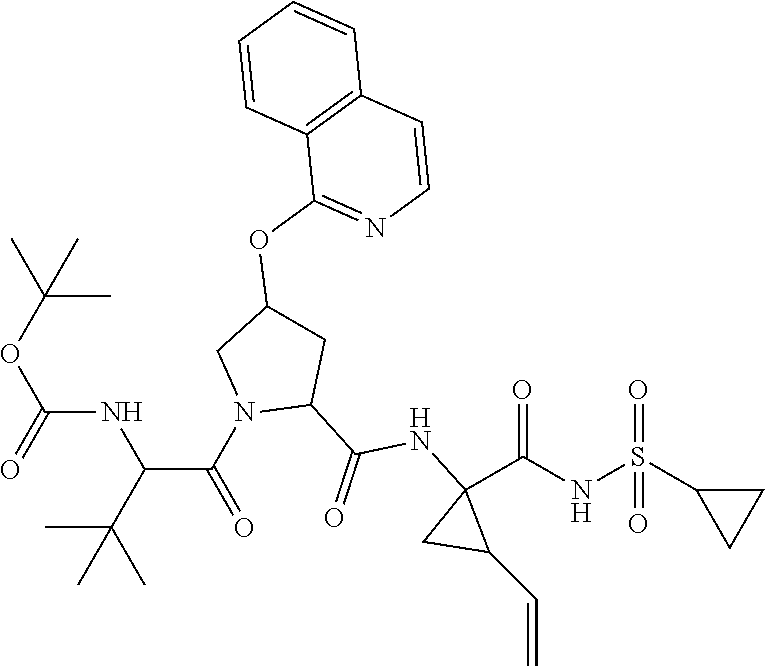
  • the compound is asunaprevir (1,1-dimethylethyl ((1S)-1- ⁇ ((2S,4R)-4-(7-chloro-4-methoxyisoquinolin-1-yloxy)-2-( ⁇ (1R,2S)-1-((cyclopropylsulfonyl)carbamoyl)-2-ethenylcyclopropyl ⁇ carbamoyl) pyrrolidin-1-yl)carbonyl ⁇ -2,2-dimethylpropyl)carbamate), a clinically investigated NS3 protease inhibitor.
  • the compound, or variations and permutations thereof is further described in WO2012040242 the contents of which are hereby incorporated by reference for all purposes and the specific purposes identified herein.
  • such compounds are represented by any one or more of the structures shown in Table 34. Any one of the compounds depicted in Table 34 is suitable for use in the methods of the present disclosure.
  • the compound is Atazanavir (methyl N-[(2S)-1-[2-[(2S,3S)-2-hydroxy-3-[[(2S)-2-(methoxycarbonylamino)-3,3-dimethylbutanoyl]amino]-4-phenylbutyl]-2-[(4-pyridin-2-ylphenyl)methyl]hydrazinyl]-3,3-dimethyl-1-oxobutan-2-yl]carbamate) a clinically investigated HIV GAG POL polyprotein inhibitor; HIV GAG protein inhibitor; and HIV-1 protease inhibitor.
  • the compound, or variations and permutations thereof is further described in WO1999036404; WO2008011117; and WO2005058841 the contents of which are hereby incorporated by reference for all purposes and the specific purposes identified herein.
  • such compounds are represented by any one or more of the structures shown in Table 35. Any one of the compounds depicted in Table 35 is suitable for use in the methods of the present disclosure.
  • the compound is atenolol, (2-[4-[2-hydroxy-3-(propan-2-ylamino)propoxy]phenyl]acetamide or (s)-atenolol, a clinically investigated Beta 1 adrenoceptor antagonist.
  • the compound, or variations and permutations thereof is further described in WO2007117560 the contents of which are hereby incorporated by reference for all purposes and the specific purposes identified herein.
  • such compounds are represented by any one or more of the structures shown in Table 36. Any one of the compounds depicted in Table 36 is suitable for use in the methods of the present disclosure.
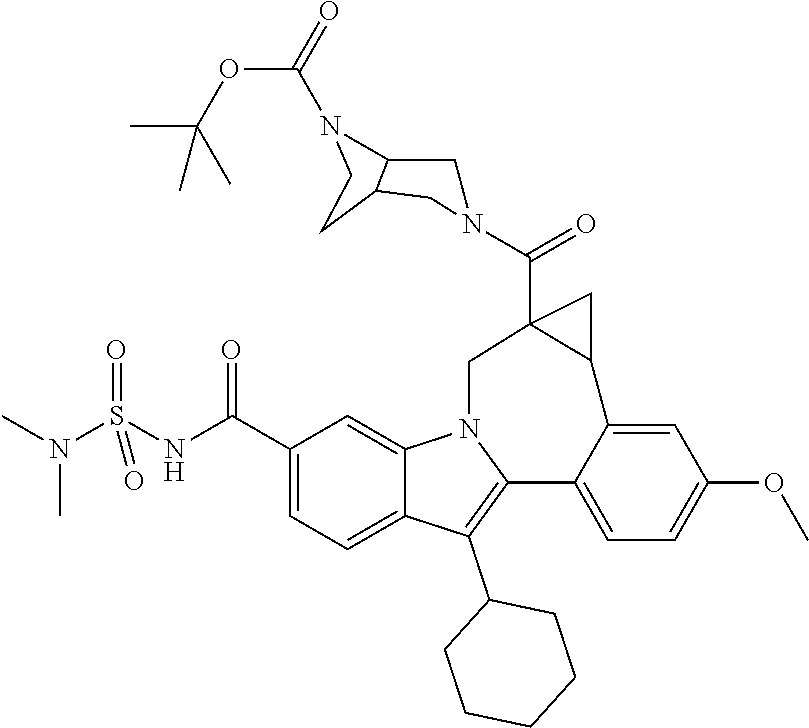
  • the compound is beclabuvir (8S,10R)-19-cyclohexyl-N-(dimethylsulfamoyl)-5-methoxy-10-(3-methyl-3,8-diazabicyclo[3.2.1]octane-8-carbonyl)-12-azapentacyclo[10.7.0.02,7.08,10.013,18]nonadeca-1(19), 2(7),3,5,13(18), 14,16-heptaene-15-carboxamide), a clinically investigated hepatitis C virus NS5B polymerase inhibitor.
  • the compound, or variations and permutations thereof is further described in WO2007033175; WO2007136982; and WO2007140109 the contents of which are hereby incorporated by reference for all purposes and the specific purposes identified herein.
  • such compounds are represented by any one or more of the structures shown in Table 37. Any one of the compounds depicted in Table 37 is suitable for use in the methods of the present disclosure.
  • the compound is bisoprolol ((E)-but-2-enedioic acid; 1-(propan-2-ylamino)-3-[4-(2-propan-2-yloxyethoxymethyl)phenoxy]propan-2-ol), bisoprolol fumarate, or bisoprolol, a clinically investigated beta adrenoceptor antagonist or beta 1 adrenoceptor antagonist.
  • the compound, or variations and permutations thereof is further described in WO2007117560 the contents of which are hereby incorporated by reference for all purposes and the specific purposes identified herein.
  • such compounds are represented by any one or more of the structures shown in Table 39. Any one of the compounds depicted in Table 39 is suitable for use in the methods of the present disclosure.
  • the compound is boceprevir ((1R,2S,5S)—N-(4-amino-1-cyclobutyl-3,4-dioxobutan-2-yl)-3-((S)-2-(3-(tert-butyl)ureido)-3,3-dimethylbutanoyl)-6,6-dimethyl-3-azabicyclo[3.1.0]hexane-2-carboxamide), a clinically investigated hepatitis C virus NS3 protease inhibitor and hepatitis C virus protein NS4B inhibitor.
  • the compound, or variations and permutations thereof is further described in CN101448781; U.S. Pat. No.
  • such compounds are represented by any one or more of the structures shown in Table 40. Any one of the compounds depicted in Table 40 is suitable for use in the methods of the present disclosure.
  • the compound is Brecanavir ([(3aS,4R,6aR)-2,3,3a,4,5,6a-hexahydrofuro[2,3-b]furan-4-yl] N-[(2S,3R)-4-[1,3-benzodioxol-5-ylsulfonyl(2-methylpropyl)amino]-3-hydroxy-1-[4-[(2-methyl-1,3-thiazol-4-yl)methoxy]phenyl]butan-2-yl]carbamate), a clinically investigated aspartic protease inhibitor and HIV protease inhibitor.
  • the compound, or variations and permutations thereof is further described in WO2010135424; WO2008115894; WO2006104646; and WO2000076961 the contents of which are hereby incorporated by reference for all purposes and the specific purposes identified herein.
  • the compound is celiprolol (3-(3-acetyl-4-(3-(tert-butylamino)-2-hydroxypropoxy)phenyl)-1,1-diethylurea) a clinically investigated beta adrenoceptor antagonist.
  • the compound, or variations and permutations thereof is further described in WO2007117560 the contents of which are hereby incorporated by reference for all purposes and the specific purposes identified herein.
  • such compounds are represented by any one or more of the structures shown in Table 42. Any one of the compounds depicted in Table 42 is suitable for use in the methods of the present disclosure.
  • the compound is ciluprevir ((2R,6S,13aS,14aR, 16aS,Z)-6-(((cyclopentyloxy)carbonyl)amino)-2-((2-(2-(isopropylamino)thiazol-4-yl)-7-methoxyquinolin-4-yl)oxy)-5,16-dioxo-1,2,3,6,7,8,9,10,11,13a,14,15,16,16a-tetradecahydrocyclopropa[e]pyrrolo[1,2-a]), a clinically investigated Hepatitis C virus NS3 protease inhibitor.
  • the compound, or variations and permutations thereof is further described in US20080267917; WO2003064416; WO2003064455; WO2003064456; WO2004037855; WO2004101605; WO2004103996; WO2005028501; WO2007001406; WO2009005676; WO2009053828; WO2009076173; and WO2012040242 the contents of which are hereby incorporated by reference for all purposes and the specific purposes identified herein.
  • such compounds are represented by any one or more of the structures shown in Table 43. Any one of the compounds depicted in Table 43 is suitable for use in the methods of the present disclosure.
  • the compound is cyclizine (1-benzhydryl-4-methylpiperazine) lactate, a clinically investigated histimine H1 antagonist.
  • the compound, or variations and permutations thereof, is further described in WO2007117560 the contents of which are hereby incorporated by reference for all purposes and the specific purposes identified herein.
  • such compounds are represented by any one or more of the structures shown in Table 44. Any one of the compounds depicted in Table 44 is suitable for use in the methods of the present disclosure.
  • the compound is danoprevir, 2R,13aS,14aR,16aS,Z)-6-((tert-butoxycarbonyl)amino)-14a-((cyclopropylsulfonyl)carbamoyl)-5,16-dioxo-1,2,3,5,6,7,8,9,10,11,13a, 14,14a,15,16,16a-hexadecahydrocyclopropa[e]pyrrolo[1,2-a][1,4]diazacyclopentadecin-2-yl 4-fluoroisoindoline-2-carboxylate, a clinically investigated NS3/4A protease inhibitor.
  • the compound, or variations and permutations thereof is further described in WO2005037214; WO2007015824; WO2007044893; WO2008134395; WO2008137779; WO2009053828; WO2009070689; WO2009070692; WO2009082697; WO2011038283; WO2011091757; WO2011150190; WO2012040242; and WO2014070974 the contents of which are hereby incorporated by reference for all purposes and the specific purposes identified herein.
  • the compound is diaparsin ((S)-2-amino-5-(((R)-1-((carboxymethyl)amino)-3-((dimethylarsino)thio)-1-oxopropan-2-yl)amino)-5-oxopentanoic acid), a clinically investigated viral protease inhibitor.
  • the compound, or variations and permutations thereof is further described in WO2003051910 the contents of which are hereby incorporated by reference for all purposes and the specific purposes identified herein.
  • the compound is darunavir ((3R,3aS,6aR)-hexahydrofuro[2,3-b]furan-3-yl ((2S,3R)-4-(4-amino-N-isobutylphenylsulfonamido)-3-hydroxy-1-phenylbutan-2-yl)carbamate), a clinically investigated HIV-1 protease inhibitor.
  • the compound, or variations and permutations thereof is further described in U.S. Pat. No.
  • the compound is dasabuvir (N-(6-(3-(tert-butyl)-5-(2,4-dioxo-3,4-dihydropyrimidin-1(2H)-yl)-2-methoxyphenyl)naphthalen-2-yl)methanesulfonamide), a clinically investigated hepatitis C virus NS5B polymerase inhibitor.
  • the compound, or variations and permutations thereof is further described in WO2015197028 the contents of which are hereby incorporated by reference for all purposes and the specific purposes identified herein.
  • such compounds are represented by any one or more of the structures shown in Table 48. Any one of the compounds depicted in Table 48 is suitable for use in the methods of the present disclosure.
  • the compound is a dexamfetamine prodrug, or Lisdexamphetamine ((S)-6-amino-2-(((S)-1-phenylpropan-2-yl)amino)hexanamide, dimesylate), clinically investigated as an adrenergic receptor agonist.
  • the compound, or variations and permutations thereof is further described in WO1998029435 the contents of which are hereby incorporated by reference for all purposes and the specific purposes identified herein.
  • such compounds are represented by any one or more of the structures shown in Table 49. Any one of the compounds depicted in Table 49 is suitable for use in the methods of the present disclosure.
  • the compound is di-PHPB (potassium 2-(1-hydroxypentyl)benzoate) a clinically investigated HIV protease inhibitor.
  • the compound, or variations and permutations thereof, is further described in WO2000015634 the contents of which are hereby incorporated by reference for all purposes and the specific purposes identified herein.
  • such compounds are represented by any one or more of the structures shown in Table 50. Any one of the compounds depicted in Table 50 is suitable for use in the methods of the present disclosure.
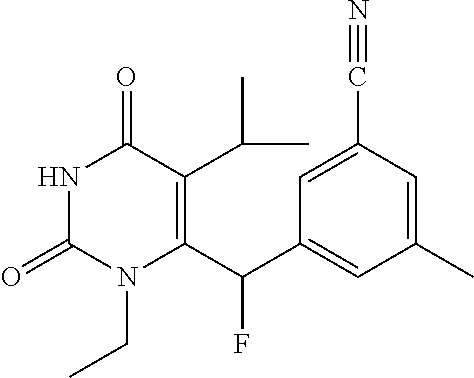
  • the compound is emivirine (1-(Ethoxymethyl)-5-(1-methylethyl)-6-(phenylmethyl)-2,4(1H,3H)-pyrimidinedione) a clinically investigated HIV-1 reverse transcriptase inhibitor and non-nucleoside reverse transcriptase inhibitor.
  • the compound, or variations and permutations thereof is further described in WO2009005674 the contents of which are hereby incorporated by reference for all purposes and the specific purposes identified herein.
  • such compounds are represented by any one or more of the structures shown in Table 51. Any one of the compounds depicted in Table 51 is suitable for use in the methods of the present disclosure.
  • the compound is esprolol (ethyl (S)-3-(2-(2-hydroxy-3-(isopropylamino)propoxy)phenyl)propanoate hydrochloride), a clinically investigated beta adrenoceptor antagonist.
  • esprolol ethyl (S)-3-(2-(2-hydroxy-3-(isopropylamino)propoxy)phenyl)propanoate hydrochloride
  • WO2007117560 the contents of which are hereby incorporated by reference for all purposes and the specific purposes identified herein.
  • such compounds are represented by any one or more of the structures shown in Table 54. Any one of the compounds depicted in Table 54 is suitable for use in the methods of the present disclosure.
  • the compound is faldaprevir (1R,2S)-1-((2S,4R)-4-((8-bromo-2-(2-isobutyramidothiazol-4-yl)-7-methoxyquinolin-4-yl)oxy)-1-((S)-2-(((cyclopentyloxy)carbonyl)amino)-3,3-dimethylbutanoyl)pyrrolidine-2-carboxamido)-2-vinylcyclopropane-1-carboxylic acid), a clinically investigated hepatitis C virus NS3 protease inhibitor.
  • the compound, or variations and permutations thereof is further described in US20080267917; WO2003064416; WO2003064456; WO2004037855; WO2004101605; WO2004103996; WO2005028501; WO2009005676; WO2009053828; WO2009076173; WO2012040242; and WO2012040242 the contents of which are hereby incorporated by reference for all purposes and the specific purposes identified herein
  • the compound is felbinac (2-([1,1′-biphenyl]-4-yl)acetic acid) or felbinac trometamol, a clinically investigated cyclooxygenase inhibitor.
  • felbinac (2-([1,1′-biphenyl]-4-yl)acetic acid) or felbinac trometamol, a clinically investigated cyclooxygenase inhibitor.
  • the compound, or variations and permutations thereof is further described in WO1998019997 the contents of which are hereby incorporated by reference for all purposes and the specific purposes identified herein.
  • such compounds are represented by any one or more of the structures shown in Table 56. Any one of the compounds depicted in Table 56 is suitable for use in the methods of the present disclosure.
  • the compound is fosamprenavir or calcium; [(2R,3S)-1-[(4-aminophenyl)sulfonyl-(2-methylpropyl)amino]-3-[(3S)-oxolan-3-yl]oxycarbonylamino]-4-phenylbutan-2-yl] phosphate, a clinically investigated HIV protease inhibitor.
  • the compound, or variations and permutations thereof is further described in WO1994005639; WO1999033815; WO2000047551; WO2001000635; WO2008013834; WO2008118849; and WO2016069955 the contents of which are hereby incorporated by reference for all purposes and the specific purposes identified herein.
  • such compounds are represented by any one or more of the structures shown in Table 57. Any one of the compounds depicted in Table 57 is suitable for use in the methods of the present disclosure.
  • the compound is frovatriptan (1H-Carbazole-6-carboxamide, 2,3,4,9-tetrahydro-3-(methylamino)-, (3R)-), a clinically investigated 5-HT 1b receptor agonist and 5-HT 1d receptor agonist.
  • the compound, or variations and permutations thereof is further described in WO2005037791 the contents of which are hereby incorporated by reference for all purposes and the specific purposes identified herein.
  • such compounds are represented by any one or more of the structures shown in Table 58. Any one of the compounds depicted in Table 58 is suitable for use in the methods of the present disclosure.
  • the compound is furaprevir (cyclopentyl N-[(1S,4R,6S,7Z,14S,18R)-4-[(1-methylcyclopropyl)sulfonylcarbamoyl]-2,15-dioxo-18-[2-(4-propan-2-yloxyphenyl)-[1]benzofuro[3,2-d]pyrimidin-4-yl]oxy]-3,16-diazatricyclo[14.3.0.04,6]nonadec-7-en-14-yl]carbamate), a clinically investigated hepatitis C virus NS3 protease inhibitor.
  • the compound, or variations and permutations thereof is further described in WO2009139792; WO2011034518; and WO2016127859 the contents of which are hereby incorporated by reference for all purposes and the specific purposes identified herein.
  • such compounds are represented by any one or more of the structures shown in Table 59. Any one of the compounds depicted in Table 59 is suitable for use in the methods of the present disclosure.
  • the compound is glecaprevir ((1R,14E,18R,22R,26S,29S)-26-tert-butyl-N-[(1R,2R)-2-(difluoromethyl)-1-[(1-methylcyclopropyl)sulfonylcarbamoyl]cyclopropyl]-13,13-difluoro-24,27-dioxo-2,17,23-trioxa-4,11,25,28-tetrazapentacyclo[26.2.1.03.12.05,10.018,22]hentriaconta-3,5,7,9,11,14-hexaene-29-carboxamide) a clinically investigated hepatitis C virus NS3 protease inhibitor.
  • the compound, or variations and permutations thereof is further described in WO2012040167 and WO2016141890 the contents of which are hereby incorporated by reference for all purposes and the specific purposes identified
  • the compound is glutathione ((2S)-2-amino-5-[(2R)-1-(carboxymethylamino)-1-oxo-3-sulfanylpropan-2-yl]amino]-5-oxopentanoic acid) a clinically investigated nuclear factor kappa B inhibitor.
  • glutathione ((2S)-2-amino-5-[(2R)-1-(carboxymethylamino)-1-oxo-3-sulfanylpropan-2-yl]amino]-5-oxopentanoic acid) a clinically investigated nuclear factor kappa B inhibitor.
  • the compound, or variations and permutations thereof is further described in WO2003051910 the contents of which are hereby incorporated by reference for all purposes and the specific purposes identified herein.
  • the compound is grazoprevir ((1R,18R,20R,24S,27S)-24-tert-butyl-N-[(1R,2S)-1-(cyclopropylsulfonyicarbamoyl)-2-ethenylcyclopropyl]-7-methoxy-22,25-dioxo-2,21-dioxa-4,11,23,26-tetrazapentacyclo[24.2.1.03.12.05.10.018,20]nonacosa-3,5(10),6,8,11-pentaene-27-carboxamide), a clinically investigated hepatitis C virus NS3 protease inhibitor.
  • the compound, or variations and permutations thereof is further described in WO2010011566; WO2011014487; WO2014008285; WO2012040040 and WO2011014487 the contents of which are hereby incorporated by reference for all purposes and the specific purposes identified herein.
  • such compounds are represented by any one or more of the structures shown in Table 62. Any one of the compounds depicted in Table 62 is suitable for use in the methods of the present disclosure.
  • the compound is ibuprofen lysine or ibuprofen, a clinically investigated cyclooxygenase inhibitor.
  • the compound, or variations and permutations thereof is further described in WO2000015634 the contents of which are hereby incorporated by reference for all purposes and the specific purposes identified herein.
  • such compounds are represented by any one or more of the structures shown in Table 1. Any one of the compounds depicted in Table 1 is suitable for use in the methods of the present disclosure.
  • the compound is imidazole salicylate or salicylic acid, a clinically investigated cyclooxygenase inhibitor and Oxidoreductase inhibitor.
  • the compound, or variations and permutations thereof is further described in WO1998019997 the contents of which are hereby incorporated by reference for all purposes and the specific purposes identified herein.
  • such compounds are represented by any one or more of the structures shown in Table 64. Any one of the compounds depicted in Table 64 is suitable for use in the methods of the present disclosure.
  • the compound is indinavir ((2S)-1-[(2S,4R)-4-benzyl-2-hydroxy-5-[[(1S,2R)-2-hydroxy-2,3-dihydro-1H-inden-1-yl]amino]-5-oxopentyl]-N-tert-butyl-4-(pyridin-3-ylmethyl)piperazine-2-carboxamide), a clinically investigated HIV protease inhibitor.
  • the compound, or variations and permutations thereof is further described in WO2001038332 the contents of which are hereby incorporated by reference for all purposes and the specific purposes identified herein.
  • such compounds are represented by any one or more of the structures shown in Table 65. Any one of the compounds depicted in Table 1 is suitable for use in the methods of the present disclosure.
  • the compound is iofolastat I 123 ((2S)-2-[[(1S)-1-carboxy-5-[(4-( 123 I)iodanylphenyl)methylamino]pentyl]carbamoylamino]pentanedioic acid), a clinically investigated glutamate carboxypeptidase Il inhibitor.
  • the compound, or variations and permutations thereof is further described in JP2000159746 the contents of which are hereby incorporated by reference for all purposes and the specific purposes identified herein.
  • such compounds are represented by any one or more of the structures shown in Table 66. Any one of the compounds depicted in Table 66 is suitable for use in the methods of the present disclosure.
  • the compound is lacosamide ((2R)-2-acetamido-N-benzyl-3-methoxypropanamide), a dihydropyrimidinase related protein 2 modulator and Sodium channel modulator.
  • the compound, or variations and permutations thereof, is further described in WO2006084688, the contents of which are hereby incorporated by reference for all purposes and the specific purposes identified herein.
  • such compounds are represented by any one or more of the structures shown in Table 67. Any one of the compounds depicted in Table 67 is suitable for use in the methods of the present disclosure.
  • the compound is lisdexamfetamine ((2S)-2,6-diamino-N-[(2S)-1-phenylpropan-2-yl]hexanamide), a clinically investigated Cytomegalovirus protease inhibitor.
  • the compound, or variations and permutations thereof is further described in WO1998029435 and JP2000159746, the contents of which are hereby incorporated by reference for all purposes and the specific purposes identified herein.
  • such compounds are represented by any one or more of the structures shown in Table 1. Any one of the compounds depicted in Table 1 is suitable for use in the methods of the present disclosure.
  • the compound is lisinopril ((2S)-1-[(2S)-6-amino-2-[[(1S)-1-carboxy-3-phenylpropyl]amino]hexanoyl]pyrrolidine-2-carboxylic acid), a clinically investigated ACE inhibitor.
  • the compound, or variations and permutations thereof is further described in WO2007117560 the contents of which are hereby incorporated by reference for all purposes and the specific purposes identified herein.
  • such compounds are represented by any one or more of the structures shown in Table 69. Any one of the compounds depicted in Table 69 is suitable for use in the methods of the present disclosure.
  • the compound is lucerastat ((2R,3S,4R,5S)-1-butyl-2-(hydroxymethyl)piperidine-3,4,5-triol) or miglustat, a clinically investigated glucosylceramide synthase inhibitor.
  • the compound, or variations and permutations thereof is further described in the contents of WO2006073456 which are hereby incorporated by reference for all purposes and the specific purposes identified herein.
  • such compounds are represented by any one or more of the structures shown in Table 70. Any one of the compounds depicted in Table 70 is suitable for use in the methods of the present disclosure.
  • the compound is masoprocol (4-[(2S,3R)-4-(3,4-dihydroxyphenyl)-2,3-dimethylbutyl]benzene-1,2-diol), a clinically investigated erbb2 tyrosine kinase receptor inhibitor; Insulin-like growth factor 1 receptor antagonist; and Lipase inhibitor.
  • the compound, or variations and permutations thereof is further described in the contents of WO2005073195 which are hereby incorporated by reference for all purposes and the specific purposes identified herein.
  • such compounds are represented by any one or more of the structures shown in Table 71. Any one of the compounds depicted in Table 71 is suitable for use in the methods of the present disclosure.
  • the compound is metoprolol succinate (butanedioic acid; 1-[4-(2-methoxyethyl)phenoxy]-3-(propan-2-ylamino)propan-2-ol), a clinically investigated adrenergic receptor antagonist and Beta 1 adrenoceptor antagonist.
  • metoprolol succinate butanedioic acid; 1-[4-(2-methoxyethyl)phenoxy]-3-(propan-2-ylamino)propan-2-ol
  • Beta 1 adrenoceptor antagonist a clinically investigated adrenergic receptor antagonist
  • the compound, or variations and permutations thereof is further described in WO2007117560 the contents of which are hereby incorporated by reference for all purposes and the specific purposes identified herein.
  • such compounds are represented by any one or more of the structures shown in Table 72. Any one of the compounds depicted in Table 72 is suitable for use in the methods of the present disclosure.
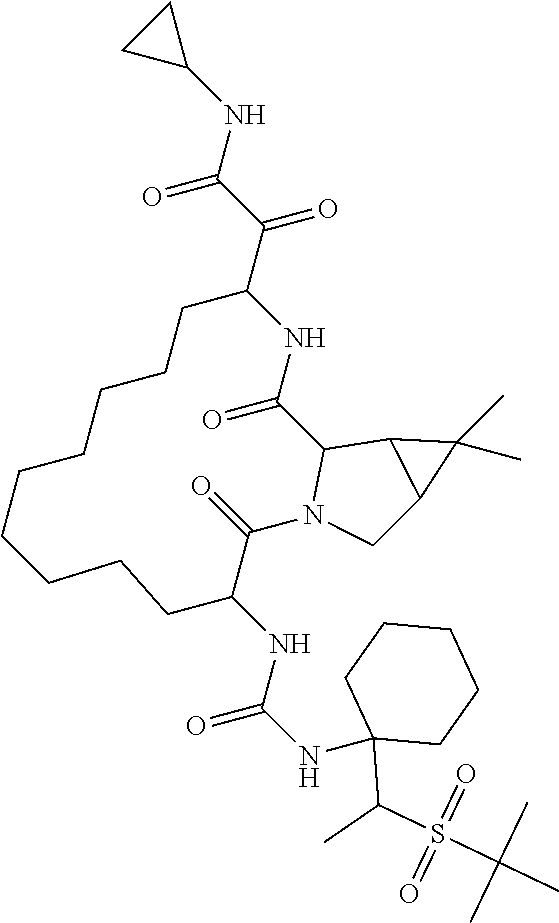
  • the compound is narlaprevir ((1R,2S,5S)-3-[(2S)-2-[[1-(tert-butylsulfonylmethyl)cyclohexyl]carbamoylamino]-3,3-dimethylbutanoyl]-N-[(3S)-1-(cyclopropylamino)-1,2-dioxoheptan-3-yl]-6,6-dimethyl-3-azabicyclo[3.1.0]hexane-2-carboxamide), a clinically investigated hepatitis C virus NS3 protease inhibitor.
  • the compound, or variations and permutations thereof is further described in WO2005030796; WO2005087731; WO2008124148 and WO2009008913 the contents of which are hereby incorporated by reference for all purposes and the specific purposes identified herein.
  • such compounds are represented by any one or more of the structures shown in Table 73. Any one of the compounds depicted in Table 73 is suitable for use in the methods of the present disclosure.
  • Nitecapone (3-(3,4-dihydroxy-5-nitrobenzylidene)pentane-2,4-dione), a clinically investigated catechol O-methyltransferase inhibitor.
  • the compound, or variations and permutations thereof is further described in WO2014164667 the contents of which are hereby incorporated by reference for all purposes and the specific purposes identified herein.
  • such compounds are represented by any one or more of the structures shown in Table 74. Any one of the compounds depicted in Table 74 is suitable for use in the methods of the present disclosure.
  • the compound is ornithine phenylacetate ((2S)-2,5-diaminopentanoic acid; 2-phenylacetic acid) or MNK-6105, a clinically investigated nuclear factor kappa B modulator or Glutamine synthetase stimulator.
  • the compound, or variations and permutations thereof is further described in WO2000015634 the contents of which are hereby incorporated by reference for all purposes and the specific purposes identified herein.
  • such compounds are represented by any one or more of the structures shown in Table 1. Any one of the compounds depicted in Table 1 is suitable for use in the methods of the present disclosure.
  • the compound is paritaprevir ((1S,4R,6S,7Z,14S,18R)—N-cyclopropylsulfonyl-14-[(5-methylpyrazine-2-carbonyl)amino]-2,15-dioxo-18-phenanthridin-6-yloxy-3,16-diazatricyclo[14.3.0.04,6]nonadec-7-ene-4-carboxamide), is a clinically investigated hepatitis C virus NS3 protease inhibitor.
  • the compound, or variations and permutations thereof is further described in WO2010030359; WO2016127859; and
  • WO2012092409 the contents of which are hereby incorporated by reference for all purposes and the specific purposes identified herein.
  • such compounds are represented by any one or more of the structures shown in Table 76. Any one of the compounds depicted in Table 76 is suitable for use in the methods of the present disclosure.
  • the compound is perindopril ((2S,3aS,7aS)-1-[(2S)-2-[[(2S)-1-ethoxy-1-oxopentan-2-yl]amino]propanoyl]-2,3,3a,4,5,6,7,7a-octahydroindole-2-carboxylic acid), a clinically investigated ACE inhibitor.
  • the compound, or variations and permutations thereof is further described in WO2007117560 the contents of which are hereby incorporated by reference for all purposes and the specific purposes identified herein.
  • such compounds are represented by any one or more of the structures shown in Table 77. Any one of the compounds depicted in Table 77 is suitable for use in the methods of the present disclosure.
  • the compound is quinapril hydrochloride ((3S)-2-[(2S)-2-[[(2S)-1-ethoxy-1-oxo-4-phenylbutan-2-yl]amino]propanoyl]-3,4-dihydro-1H-isoquinoline-3-carboxylic acid;hydrochloride), a clinically investigated ACE inhibitor.
  • the compound, or variations and permutations thereof is further described in WO2007117560 the contents of which are hereby incorporated by reference for all purposes and the specific purposes identified herein.
  • such compounds are represented by any one or more of the structures shown in Table 78. Any one of the compounds depicted in Table 78 is suitable for use in the methods of the present disclosure.
  • the compound is ramipril ((2S,3aS,6aS)-1-[(2S)-2-[[(2S)-1-ethoxy-1-oxo-4-phenylbutan-2-yl]amino]propanoyl]-3,3a,4,5,6,6a-hexahydro-2H-cyclopenta[b]pyrrole-2-carboxylic acid), a clinically investigated ACE inhibitor.
  • the compound, or variations and permutations thereof is further described in WO2007117560 the contents of which are hereby incorporated by reference for all purposes and the specific purposes identified herein.
  • such compounds are represented by any one or more of the structures shown in Table 79. Any one of the compounds depicted in Table 79 is suitable for use in the methods of the present disclosure.
  • the compound is chlorcyclizine hydrochloride (1-[(4-chlorophenyl)-phenylmethyl]-4-methylpiperazine;hydrochloride), a clinically investigated plasmepsin inhibitor; renin inhibitor; beta secretase inhibitor; aspartic protease inhibitor; HIV protease inhibitor.
  • the compound, or variations and permutations thereof is further described in WO2007117560 the contents of which are hereby incorporated by reference for all purposes and the specific purposes identified herein.
  • such compounds are represented by any one or more of the structures shown in Table 80. Any one of the compounds depicted in Table 80 is suitable for use in the methods of the present disclosure.
  • esmolol hydrochloride methyl 3-[4-[2-hydroxy-3-(propan-2-ylamino)propoxy]phenyl]propanoate;hydrochloride
  • beta adrenoceptor antagonist a clinically investigated beta adrenoceptor antagonist.
  • the compound, or variations and permutations thereof is further described in WO2007117560 the contents of which are hereby incorporated by reference for all purposes and the specific purposes identified herein.
  • such compounds are represented by any one or more of the structures shown in Table 81. Any one of the compounds depicted in Table 81 is suitable for use in the methods of the present disclosure.
  • the compound is seraprevir potassium, having the formula:
  • hepatitis C virus NS3 protease inhibitor a hepatitis C virus NS3 protease inhibitor.
  • the compound, or variations and permutations thereof is further described in WO2007016441 and WO2008057208 the contents of which are hereby incorporated by reference for all purposes and the specific purposes identified herein.
  • such compounds are represented by any one or more of the structures shown in Table 82. Any one of the compounds depicted in Table 82 is suitable for use in the methods of the present disclosure.
  • the compound is sobetirome (2-(4-(4-hydroxy-3-isopropylbenzyl)-3,5-dimethylphenoxy)acetic acid), a clinically investigated thyroid hormone receptor beta agonist.
  • the compound, or variations and permutations thereof is further described in WO2005073195 the contents of which are hereby incorporated by reference for all purposes and the specific purposes identified herein.
  • such compounds are represented by any one or more of the structures shown in Table 83. Any one of the compounds depicted in Table 83 is suitable for use in the methods of the present disclosure.
  • the compound is sodium phenylbutyrate (sodium;4-phenylbutanoate), a clinically investigated histone deacetylase inhibitor and BC ketoacid dehydrogenase kinase inhibitor.
  • the compound, or variations and permutations thereof is further described in WO2000015634 the contents of which are hereby incorporated by reference for all purposes and the specific purposes identified herein.
  • such compounds are represented by any one or more of the structures shown in Table 84. Any one of the compounds depicted in Table 84 is suitable for use in the methods of the present disclosure.
  • the compound is sovaprevir ((2S,4R)—N-[(1R,2S)-1-(cyclopropylsulfonylcarbamoyl)-2-ethenylcyclopropyl]-1-[(2S)-3,3-dimethyl-2-(2-oxo-2-piperidin-1-ylethyl)butanoyl]-4-(7-methoxy-2-phenylquinolin-4-yl)oxypyrrolidine-2-carboxamide), a clinically investigated hepatitis C virus NS3 protease inhibitor.
  • the compound, or variations and permutations thereof is further described in WO2008008502 the contents of which are hereby incorporated by reference for all purposes and the specific purposes identified herein.
  • such compounds are represented by any one or more of the structures shown in Table 85. Any one of the compounds depicted in Table 85 is suitable for use in the methods of the present disclosure.
  • the compound is verapamil hydrochloride (2-(3,4-dimethoxyphenyl)-5-[2-(3,4-dimethoxyphenyl)ethyl-methylamino]-2-propan-2-ylpentanenitrile;hydrochloride), verapamil, and verapamil R/S isomers, and dexverapamil, a clinically investigated calcium channel inhibitor, 5-HT 2b receptor modulator; and Melatonin MT1 receptor modulator.
  • the compound, or variations and permutations thereof is further described in WO2007117560 the contents of which are hereby incorporated by reference for all purposes and the specific purposes identified herein.
  • such compounds are represented by any one or more of the structures shown in Table 86. Any one of the compounds depicted in Table 86 is suitable for use in the methods of the present disclosure.
  • the compound is telaprevir ((3S,3aS,6aR)-2-[(2S)-2-[[(2S)-2-cyclohexyl-2-(pyrazine-2-carbonylamino)acetyl]amino]-3,3-dimethylbutanoyl]-N-[(3S)-1-(cyclopropylamino)-1,2-dioxohexan-3-yl]-3,3a,4,5,6,6a-hexahydro-1H-cyclopenta[c]pyrrole-3-carboxamide), a clinically investigated hepatitis C virus NS3 protease inhibitor and P-Glycoprotein inhibitor.
  • the compound, or variations and permutations thereof is further described in CN101448781; U.S. Pat. Nos. 8,188,137; 8,618,152; WO2002018369; WO2004092161; WO2005030796; WO2007121124; WO2007133865 and WO2014187271, the contents of which are hereby incorporated by reference for all purposes and the specific purposes identified herein.
  • the compound is telinavir ((2S)—N—[(2S,3R)-4-[tert-butylcarbamoyl(2-methylpropyl)amino]-3-hydroxy-1-phenylbutan-2-yl]-2-(quinoline-2-carbonylamino)butanediamide), a clinically investigated HIV protease inhibitor.
  • the compound, or variations and permutations thereof is further described in WO1994004492 the contents of which are hereby incorporated by reference for all purposes and the specific purposes identified herein.
  • such compounds are represented by any one or more of the structures shown in Table 88. Any one of the compounds depicted in Table 88 is suitable for use in the methods of the present disclosure.
  • the compound is terameprocol (4-[(2S,3R)-4-(3,4-dimethoxyphenyl)-2,3-dimethylbutyl]-1,2-dimethoxybenzene), a clinically investigated survivin protein inhibitor; transcription factor inhibitor.
  • terameprocol (4-[(2S,3R)-4-(3,4-dimethoxyphenyl)-2,3-dimethylbutyl]-1,2-dimethoxybenzene)
  • transcription factor inhibitor transcription factor inhibitor
  • such compounds are represented by any one or more of the structures shown in Table 89. Any one of the compounds depicted in Table 89 is suitable for use in the methods of the present disclosure.
  • the compound is thymocartin (2S)-2-[[(2S)-2-[[(2S)-6-amino-2-[(2S)-2-amino-5-(diaminomethylideneamino)pentanoyl]amino]hexanoyl]amino]-3-carboxypropanoyl]amino]-3-methylbutanoic acid), a clinically investigated IL2 gene stimulator.
  • the compound, or variations and permutations thereof is further described in WO2003051910 the contents of which are hereby incorporated by reference for all purposes and the specific purposes identified herein.
  • the compound is thymoctonan ((2S)-2-[[(2S)-2-[[(2S)-6-amino-2-[(2S)-1-[2-[[(2S)-2-[[(2S)-2-[[(2S)-2-amino-4-methylpentanoyl]amino]-4-carboxybutanoyl]amino]-3-carboxypropanoyl]amino]acetyl]pyrrolidine-2-carbonyl]amino]hexanoyl]amino]-3-phenylpropanoyl]amino]-4-methylpentanoic acid),
  • IL2 gene stimulator a clinically investigated IL2 gene stimulator.
  • the compound, or variations and permutations thereof is further described in WO2002008256 the contents of which are hereby incorporated by reference for all purposes and the specific purposes identified herein.
  • such compounds are represented by any one or more of the structures shown in Table 91. Any one of the compounds depicted in Table 91 is suitable for use in the methods of the present disclosure.
  • the compound is trandolapril ((2S,3aR,7aS)-1-[(2S)-2-[[(2S)-1-ethoxy-1-oxo-4-phenylbutan-2-yl]amino]propanoyl]-2,3,3a,4,5,6,7,7a-octahydroindole-2-carboxylic acid), a clinically investigated ACE inhibitor.
  • the compound, or variations and permutations thereof is further described in WO2007117560 the contents of which are hereby incorporated by reference for all purposes and the specific purposes identified herein.
  • such compounds are represented by any one or more of the structures shown in Table 92. Any one of the compounds depicted in Table 92 is suitable for use in the methods of the present disclosure.
  • the compound is trofinetide ((2S)-2-[[(2S)-1-(2-aminoacetyl)-2-methylpyrrolidine-2-carbonyl]amino]pentanedioic acid), a clinically investigated cytokine receptor antagonist.
  • trofinetide ((2S)-2-[[(2S)-1-(2-aminoacetyl)-2-methylpyrrolidine-2-carbonyl]amino]pentanedioic acid)
  • WO2002008256 the contents of which are hereby incorporated by reference for all purposes and the specific purposes identified herein.
  • the compound is ubenimex ((2S)-2-[[(2S,3R)-3-amino-2-hydroxy-4-phenylbutanoyl]amino]-4-methylpentanoic acid), a clinically evaluated aminopeptidase inhibitor, leukotriene A4 hydrolase inhibitor, and leukotriene BLT receptor antagonist.
  • the compound, or variations and permutations thereof is further described in WO2007002172; WO1999064442; JP2000159746; and WO2002008256 the contents of which are hereby incorporated by reference for all purposes and the specific purposes identified herein.
  • such compounds are represented by any one or more of the structures shown in Table 94. Any one of the compounds depicted in Table 94 is suitable for use in the methods of the present disclosure.
  • the compound is vaniprevir ((1R,21S,24S)-21-tert-butyl-N-[(1R,2R)-1-(cyclopropylsulfonylcarbamoyl)-2-ethylcyclopropyl]-16,16-dimethyl-3,19,22-trioxo-2,18-dioxa-4,20,23-triazatetracyclo[21.2.1.1 4,7 .0 6,11 ]heptacosa-6(11),7,9-triene-24-carboxamide), a clinically investigated hepatitis C virus NS3 protease inhibitor.
  • the compound is vedroprevir ((1R,2R)-1-[[(2S,4R)-1-[(2S)-2-[[(1R,5S)-3-bicyclo[3.1.0]hexanyl]oxycarbonylamino]-3,3-dimethylbutanoyl]-4-[8-chloro-7-(2-morpholin-4-ylethoxy)-2-[2-(propan-2-ylamino)-1,3-thiazol-4-yl]quinolin-4-yl]oxypyrrolidine-2-carbonyl]amino]-2-ethylcyclopropane-1-carboxylic acid), a clinically investigated hepatitis C virus NS3 protease inhibitor.
  • the compound, or variations and permutations thereof is further described in WO2009005676 the contents of which are hereby incorporated by reference for all purposes and the specific purposes identified herein.
  • the compound is voxilaprevir ((1R,18R,20R,24S,27S,28S)-24-tert-butyl-N-[(1R,2R)-2-(difluoromethyl)-1-[(1-methylcyclopropyl)sulfonylcarbamoyl]cyclopropyl]-28-ethyl-13,13-difluoro-7-methoxy-22,25-dioxo-2,21-dioxa-4,11,23,26-tetrazapentacyclo[24.2.1.0 3.12 .0 5.10 .0 18,20 ]nonacosa-3,5(10),6,8,11-pentaene-27-carboxamide), a clinically investigated hepatitis C virus NS3 protease inhibitor.
  • compositions and methods of the present disclosure are useful for the prevention and/or treatment of symptoms of SARS-COV-19 infections. In certain embodiments, the compositions and methods of the present disclosure are useful for the prevention and/or treatment of acute inflammatory responses. In certain embodiments, the compositions and methods of the present disclosure are useful for the prevention and/or treatment of acute inflammatory responses, e.g., cytokine storms that are associates with a coronavirus infection.
  • viral protease inhibitors may have therapeutic utility in the treatment of coronavirus symptoms, in particular in preventing viral replication in critical patients with coronavirus infections, in particular SARS-COV-19. Viral protease inhibitors or reduce viral replication if viruses, thereby decreasing the viral load suffered by an infected patient.
  • viral protease inhibitors may prevent onset of severe SARS-CoV-19 symptoms.
  • viral protease inhibitors may reduce or eliminate the viral load in patients with SARS-COV-19 pneumonia and prevent or ameliorate progress thereof.
  • Successful intervention with viral protease inhibitors may reduce life-threatening complications of SARS-COV-19, including severe respiratory symptoms that often necessitate further medical intervention such as mechanical intervention.
  • the present disclosure relates to a method of treating or alleviating at least one symptom of a coronavirus infection in a subject, by administering to the subject a therapeutically effective amount of viral protease inhibitors.
  • the subject is a human.
  • the symptom is fever. In other embodiments, the symptom is cough. In other embodiments, the symptom is dry cough. In other embodiments, the symptom is tiredness. In other embodiments, the symptom is sore throat. In other embodiments, the symptom is diarrhea. In other embodiments, the symptom is conjunctivitis. In other embodiments, the symptom is headache. In other embodiments, the symptom is loss of taste. In other embodiments, the symptom is loss of smell. In other embodiments, the symptom is a rash. In other embodiments, the symptom is difficulty breathing. In other embodiments, the symptom is shortness of breath. In other embodiments, the symptom is chest pain. In other embodiments, the symptom is chest pressure. In other embodiments, the symptom is Acute Respiratory Distress Syndrome (ARDS). In other embodiments, the symptom is organ failure. In other embodiments, the symptom is multiple organ failure. In other embodiments, the symptom is any combination of the foregoing.
  • ARDS Acute Respir
  • the present disclosure relates to a method of treating an acute condition in a subject infected with a coronavirus, the method comprising the step of administering to the subject a therapeutically effective amount of viral protease inhibitors.
  • the condition comprises a high viral load.
  • the subject is a human.
  • the present disclosure relates to a method of reducing or arresting viral load in a subject infected with a coronavirus, the method comprising the step of administering to the subject a therapeutically effective amount of a viral protease inhibitors.
  • the subject is a human.
  • Viral load can be measured by any viral diagnostic equipment or technique known in the art.
  • samples can be used for virological testing.
  • Such samples include, but are not limited to, upper respiratory swabs (nasopharyngeal swabs, nasopharyngeal wash/aspirate, oropharyngeal swabs, saliva) and lower respiratory specimens (sputum, bronchoalveolar lavage, lung tissue), as well as stool, rectal swabs, blood, skin, urine, semen, faeces, cerebrospinal fluid, tissue (e.g., biopsies), and the like.
  • upper respiratory swabs nasopharyngeal swabs, nasopharyngeal wash/aspirate, oropharyngeal swabs, saliva
  • lower respiratory specimens sputum, bronchoalveolar lavage, lung tissue
  • rectal swabs blood, skin, urine, semen, fae
  • NATs nucleic acid amplification-based tests
  • RT-PCR reverse transcription polymerase chain reaction
  • NASBA nucleic acid sequence-based amplification
  • Viral load is typically reported as copies the virus in a milliliter (mL) of blood. Changes in viral load are usually reported as a log change (in powers of 10). For example, a three-log increase in viral load (3 log 10) is an increase of 103 or 1,000 times the previously reported level, while a drop from 500,000 to 500 copies would be a three-log-drop.
  • the subject is infected with a coronavirus.
  • the coronavirus is selected from the group consisting of 229E (alpha coronavirus), NL63 (alpha coronavirus), OC43 (beta coronavirus), HKU1 (beta coronavirus), MERS-COV (beta coronavirus that causes Middle East Respiratory Syndrome, or MERS), SARS-COV (the beta coronavirus that causes severe acute respiratory syndrome, or SARS) SARS-COV-2 (the novel coronavirus that causes coronavirus disease 2019, or COVID-19, also referred to herein as SARS-Covid-19).
  • the coronavirus is a severe acute respiratory syndrome coronavirus (SARS-CoV). In some embodiments, the coronavirus is a novel virus 2019-nCOV (SARS-COV-19). In some embodiments, the coronavirus is a Middle East respiratory syndrome coronavirus (MERS-CoV). In one preferred embodiment, the coronavirus is SARS-COV-19.
  • SARS-CoV severe acute respiratory syndrome coronavirus
  • MERS-CoV Middle East respiratory syndrome coronavirus
  • the present disclosure thus provides pharmaceutical compositions comprising viral protease inhibitors and a pharmaceutically acceptable carrier.
  • the compounds of the present disclosure can be formulated as pharmaceutical compositions and administered to a mammalian host, such as a human patient, in a variety of forms adapted to the chosen route of administration.
  • Routes of administration include, but are not limited to oral, topical, mucosal, nasal, parenteral, gastrointestinal, intraspinal, intraperitoneal, intramuscular, intravenous, intrauterine, intraocular, intradermal, intracranial, intratracheal, intravaginal, intracerebroventricular, intracerebral, subcutaneous, ophthalmic, transdermal, rectal, buccal, epidural and sublingual administration.
  • administering generally refers to any and all means of introducing compounds described herein to the host subject.
  • Compounds described herein may be administered in unit dosage forms and/or compositions containing one or more pharmaceutically-acceptable carriers, adjuvants, diluents, excipients, and/or vehicles, and combinations thereof.
  • composition generally refers to any product comprising more than one ingredient, including the compounds described herein. It is to be understood that the compositions described herein may be prepared from compounds described herein or from salts, solutions, hydrates, solvates, and other forms of the compounds described herein. It is appreciated that the compositions may be prepared from various amorphous, non-amorphous, partially crystalline, crystalline, and/or other morphological forms of the compounds described herein, and the compositions may be prepared from various hydrates and/or solvates of the compounds described herein. Accordingly, such pharmaceutical compositions that recite compounds described herein include each of, or any combination of, or individual forms of, the various morphological forms and/or solvate or hydrate forms of the compounds described herein.
  • the viral protease inhibitors may be systemically (e.g., orally) administered in combination with a pharmaceutically acceptable vehicle such as an inert diluent or an assimilable edible carrier.
  • a pharmaceutically acceptable vehicle such as an inert diluent or an assimilable edible carrier.
  • the active compound may be combined with one or more excipients and used in the form of ingestible tablets, buccal tablets, sublingual tablets, troches, capsules, elixirs, suspensions, syrups, wafers, and the like.
  • compositions and preparations may vary and may be between about 1 to about 99% weight of the active ingredient(s) and excipients such as, but not limited to a binder, a filler, a diluent, a disintegrating agent, a lubricant, a surfactant, a sweetening agent; a flavoring agent, a colorant, a buffering agent, anti-oxidants, a preservative, chelating agents (e.g., ethylenediaminetetraacetic acid), and agents for the adjustment of tonicity such as sodium chloride.
  • excipients such as, but not limited to a binder, a filler, a diluent, a disintegrating agent, a lubricant, a surfactant, a sweetening agent; a flavoring agent, a colorant, a buffering agent, anti-oxidants, a preservative, chelating agents (e.g., ethylenediaminetetraacetic acid), and
  • Suitable binders include, but are not limited to, polyvinylpyrrolidone, copovidone, hydroxypropyl methylcellulose, starch, and gelatin.
  • Suitable fillers include, but are not limited to, sugars such as lactose, sucrose, mannitol or sorbitol and derivatives therefore (e.g. amino sugars), ethylcellulose, microcrystalline cellulose, and silicified microcrystalline cellulose.
  • Suitable diluents include, but are not limited to, dicalcium phosphate dihydrate, sugars, lactose, calcium phosphate, cellulose, kaolin, mannitol, sodium chloride, and dry starch.
  • Suitable disintegrants include, but are not limited to, pregelatinized starch, crospovidone, crosslinked sodium carboxymethyl cellulose and combinations thereof.
  • Suitable lubricants include, but are not limited to, sodium stearyl fumarate, stearic acid, polyethylene glycol or stearates, such as magnesium stearate.
  • Suitable surfactants or emulsifiers include, but are not limited to, polyvinyl alcohol (PVA), polysorbate, polyethylene glycols, polyoxyethylene-polyoxypropylene block copolymers known as “poloxamer”, polyglycerin fatty acid esters such as decaglyceryl monolaurate and decaglyceryl monomyristate, sorbitan fatty acid ester such as sorbitan monostearate, polyoxyethylene sorbitan fatty acid ester such as polyoxyethylene sorbitan monooleate (Tween), polyethylene glycol fatty acid ester such as polyoxyethylene monostearate, polyoxyethylene alkyl ether such as polyoxyethylene lauryl ether, polyoxyethylene castor oil and hardened castor oil such as polyoxyethylene hardened castor oil.
  • PVA polyvinyl alcohol
  • polysorbate polyethylene glycols
  • Suitable flavoring agents and sweeteners include, but are not limited to, sweeteners such as sucralose and synthetic flavor oils and flavoring aromatics, natural oils, extracts from plants, leaves, flowers, and fruits, and combinations thereof.
  • sweeteners such as sucralose and synthetic flavor oils and flavoring aromatics, natural oils, extracts from plants, leaves, flowers, and fruits, and combinations thereof.
  • Exemplary flavoring agents include cinnamon oils, oil of wintergreen, peppermint oils, clover oil, hay oil, anise oil, eucalyptus , vanilla, citrus oil such as lemon oil, orange oil, grape and grapefruit oil, and fruit essences including apple, peach, pear, strawberry, raspberry, cherry, plum, pineapple, and apricot.
  • Suitable colorants include, but are not limited to, alumina (dried aluminum hydroxide), annatto extract, calcium carbonate, canthaxanthin, caramel, ß-carotene, cochineal extract, carmine, potassium sodium copper chlorophyllin (chlorophyllin-copper complex), dihydroxyacetone, bismuth oxychloride, synthetic iron oxide, ferric ammonium ferrocyanide, ferric ferrocyanide, chromium hydroxide green, chromium oxide greens, guanine, mica-based pearlescent pigments, pyrophyllite, mica, dentifrices, talc, titanium dioxide, aluminum powder, bronze powder, copper powder, and zinc oxide.
  • alumina dried aluminum hydroxide
  • annatto extract calcium carbonate
  • canthaxanthin caramel
  • ß-carotene cochineal extract
  • carmine potassium sodium copper chlorophyllin (chlorophyllin-copper complex)
  • dihydroxyacetone bismut
  • Suitable buffering or pH adjusting agent include, but are not limited to, acidic buffering agents such as short chain fatty acids, citric acid, acetic acid, hydrochloric acid, sulfuric acid and fumaric acid; and basic buffering agents such as tris, sodium carbonate, sodium bicarbonate, sodium hydroxide, potassium hydroxide and magnesium hydroxide.
  • acidic buffering agents such as short chain fatty acids, citric acid, acetic acid, hydrochloric acid, sulfuric acid and fumaric acid
  • basic buffering agents such as tris, sodium carbonate, sodium bicarbonate, sodium hydroxide, potassium hydroxide and magnesium hydroxide.
  • Suitable tonicity enhancing agents include, but are not limited to, ionic and non-ionic agents such as, alkali metal or alkaline earth metal halides, urea, glycerol, sorbitol, mannitol, propylene glycol, and dextrose.
  • Suitable wetting agents include, but are not limited to, glycerin, cetyl alcohol, and glycerol monostearate.
  • Suitable preservatives include, but are not limited to, benzalkonium chloride, benzoxonium chloride, thiomersal, phenylmercuric nitrate, phenylmercuric acetate, phenylmercuric borate, methylparaben, propylparaben, chlorobutanol, benzyl alcohol, phenyl alcohol, chlorohexidine, and polyhexamethylene biguanide.
  • Suitable antioxidants include, but are not limited to, sorbic acid, ascorbic acid, ascorbate, glycine, a-tocopherol, butylated hydroxyanisole (BHA), and butylated hydroxytoluene (BHT).
  • the viral protease inhibitors of the present disclosure may also be administered via infusion or injection (e.g., using needle (including microneedle) injectors and/or needle-free injectors).
  • Solutions of the active composition can be aqueous, optionally mixed with a nontoxic surfactant and/or may contain carriers or excipients such as salts, carbohydrates and buffering agents (preferably at a pH of from 3 to 9), and, for some applications, they may be more suitably formulated as a sterile non-aqueous solution or as a dried form to be used in conjunction with a suitable vehicle such as sterile, pyrogen-free water or phosphate-buffered saline.
  • dispersions can be prepared in glycerol, liquid polyethylene glycols, triacetin, and mixtures thereof and in oils. The preparations may further contain a preservative to prevent the growth of microorganisms.
  • the pharmaceutical compositions may be formulated for parenteral administration (e.g., subcutaneous, intravenous, intra-arterial, transdermal, intraperitoneal or intramuscular injection) and may include aqueous and non-aqueous, isotonic sterile injection solutions, which can contain anti-oxidants, buffers, bacteriostats, and solutes that render the formulation isotonic with the blood of the intended recipient, and aqueous and non-aqueous sterile suspensions that include suspending agents, solubilizers, thickening agents, stabilizers, and preservatives. Water is a preferred carrier when the pharmaceutical composition is administered intravenously.
  • parenteral administration e.g., subcutaneous, intravenous, intra-arterial, transdermal, intraperitoneal or intramuscular injection
  • parenteral administration e.g., subcutaneous, intravenous, intra-arterial, transdermal, intraperitoneal or intramuscular injection
  • parenteral administration e.g.,
  • compositions may contain one or more nonionic surfactants.
  • Suitable surfactants include polyethylene sorbitan fatty acid esters, such as sorbitan monooleate and the high molecular weight adducts of ethylene oxide with a hydrophobic base, formed by the condensation of propylene oxide with propylene glycol.
  • Suitable preservatives include e.g. sodium benzoate, benzoic acid, and sorbic acid.
  • Suitable antioxidants include e.g. sulfites, ascorbic acid and ⁇ -tocopherol.
  • parenteral compounds/compositions under sterile conditions may readily be accomplished using standard pharmaceutical techniques well known to those skilled in the art.
  • compositions for inhalation or insulation include solutions and suspensions in pharmaceutically acceptable aqueous or organic solvents, or mixtures thereof, and powders.
  • the liquid or solid compositions may contain suitable pharmaceutically acceptable excipients as described above.
  • the compositions are administered by the oral or nasal respiratory route for local or systemic effect.
  • Compositions in pharmaceutically acceptable solvents may be nebulized by use of inert gases. Nebulized solutions may be breathed directly from the nebulizing device or the nebulizing device may be attached to a face masks tent, or intermittent positive pressure breathing machine. Solution, suspension, or powder compositions may be administered, orally or nasally, from devices that deliver the formulation in an appropriate manner.
  • the composition is prepared for topical administration, e.g. as an ointment, a gel, a drop, a patch or a cream.
  • topical administration e.g. as an ointment, a gel, a drop, a patch or a cream.
  • the compounds of the present disclosure can be prepared and applied in a physiologically acceptable diluent with or without a pharmaceutical carrier.
  • Adjuvants for topical or gel base forms may include, for example, sodium carboxymethylcellulose, polyacrylates, polyoxyethylene-polyoxypropylene-block polymers, polyethylene glycol, wood wax alcohols, isostearic acid, cetyl alcohol, stearyl alcohol, white petrolatum, polysorbate 60, sorbitan monostearate, glycerin, xanthan gum, water, benzyl alcohol, methylparaben, and propylparaben.
  • Additional additives may be selected from the group consisting of waxes, soaps, sorbitan esters, fatty acids, fatty acid esters, fatty acid oils, borates, cresol, chlorocresol, cellulose, methylcellulose, hydroxypropylcellulose, acacia, and the like.
  • suitable topical dosage forms may be found in e.g., Tarun Garg, Goutam Rath & Amit K. Goyal (2015) Comprehensive review on additives of topical dosage forms for drug delivery, Drug Delivery, 22:8, 969-987, the contents of which are hereby incorporated by reference in their entirety.
  • Alternative formulations include nasal sprays, liposomal formulations, slow-release formulations, pumps delivering the drugs into the body (including mechanical or osmotic pumps) controlled-release formulations and the like, as are known in the art.
  • the term “therapeutically effective dose” means (unless specifically stated otherwise) a quantity of a compound which, when administered either one time or over the course of a treatment cycle affects the health, wellbeing or mortality of a subject (e.g., delays the onset of and/or reduces the severity of one or more of the symptoms associated with a coronavirus, e.g., SARS-Covid-19.
  • a viral protease inhibitors described herein can be present in a composition in an amount of about 0.001 mg, about 0.005 mg, about 0.01 mg, about 0.02 mg, about 0.03 mg, about 0.04 mg, about 0.05 mg, about 0.06 mg, about 0.07 mg, about 0.08 mg, about 0.09 mg about 0.1 mg, about 0.2 mg, about 0.3 mg, about 0.4 mg, about 0.5 mg, about 0.6 mg, about 0.7 mg, about 0.8 mg, about 0.9 mg, about 1 mg, about 1.5 mg, about 2 mg, about 2.5 mg, about 3 mg, about 3.5 mg, about 4 mg, about 4.5 mg, about 5 mg, about 5.5 mg, about 6 mg, about 6.5 mg, about 7 mg, about 7.5 mg, about 8 mg, about 8.5 mg, about 9 mg, about 0.5 mg, about 10 mg, about 10.5 mg, about 11 mg, about 12 mg, about 12.5 mg, about 13 mg, about 13.5 mg, about 14 mg, about 14.5 g, about 15 mg, about 15.5 mg, about 16
  • Viral protease inhibitors described herein described herein can be present in a composition in a range of from about 0.1 mg to about 100 mg; 0.1 mg to about 75 mg; from about 0.1 mg to about 50 mg; from about 0.1 mg to about 25 mg; from about 0.1 mg to about 10 mg; 0.1 mg to about 7.5 mg, 0.1 mg to about 5 mg; 0.1 mg to about 2.5 mg; from about 0.1 mg to about 1 mg; from about 0.5 mg to about 100 mg; from about 0.5 mg to about 75 mg; from about 0.5 mg to about 50 mg; from about 0.5 mg to about 25 mg; from about 0.5 mg to about 10 mg; from about 0.5 mg to about 5 mg, from about 0.5 mg to about 2.5 mg; from about 0.5 mg to about 1 mg; from about 1 mg to about 100 mg; from about 1 mg to about 75 mg; from about 0.1 mg to about 50 mg; from about 0.1 mg to about 25 mg; from about 0.1 mg to about 10 mg; from about 0.1 mg to about 5 mg; from about 0.5 mg to about
  • the viral protease inhibitor is administered for a period of at least one day. In other embodiments, the viral protease inhibitor is administered for a period of at least 2 days. In other embodiments, the viral protease inhibitor antagonist is administered for a period of at least 3 days. In other embodiments, the viral protease inhibitor antagonist is administered for a period of at least 4 days. In other embodiments, the viral protease inhibitor antagonist is administered for a period of at least 5 days. In other embodiments, the viral protease inhibitor is administered for a period of at least 6 days. In other embodiments, the viral protease inhibitor is administered for a period of at least 7 days.
  • the viral protease inhibitor is administered for a period of at least 10 days. In other embodiments, the viral protease inhibitor is administered for a period of at least 14 days. In other embodiments, the viral protease inhibitor is administered for a period of at least one month. In some embodiments, the viral protease inhibitor is administered chronically for as long as the treatment is needed.

Landscapes

  • Health & Medical Sciences (AREA)
  • Chemical & Material Sciences (AREA)
  • General Health & Medical Sciences (AREA)
  • Public Health (AREA)
  • Pharmacology & Pharmacy (AREA)
  • Epidemiology (AREA)
  • Life Sciences & Earth Sciences (AREA)
  • Animal Behavior & Ethology (AREA)
  • Veterinary Medicine (AREA)
  • Medicinal Chemistry (AREA)
  • Dermatology (AREA)
  • Engineering & Computer Science (AREA)
  • Bioinformatics & Cheminformatics (AREA)
  • Dispersion Chemistry (AREA)
  • Otolaryngology (AREA)
  • Pulmonology (AREA)
  • Pharmaceuticals Containing Other Organic And Inorganic Compounds (AREA)
  • Medicines That Contain Protein Lipid Enzymes And Other Medicines (AREA)

Abstract

The present disclosure relates to a method of reducing or arresting viral load in a subject infected with a coronavirus, the method comprising the step of administering to the subject a therapeutically effective amount of a viral protease inhibitor. In some embodiments, the subject is a human. In one embodiment, the coronavirus is SARS-COV-19 and the viral protease inhibitor is E)-N-(4-(3-(tert-butyl)-5-(2,4-dioxo-3,4-dihydropyrimidin-1(2H)-yl)-2-methoxystyryl)phenyl)methanesulfonamide; (R)-3-((2S,3S)-2-hydroxy-3-(3-hydroxy-2-methylbenzamido)-4-phenylbutanoyl)-5,5-dimethyl-N-(2-methylbenzyl)thiazolidine-4-carboxamide; R)—N-allyl-3-((2S,3S)-2-hydroxy-3-(3-hydroxy-2-methylbenzamido)-4-phenylbutanoyl)-5,5-dimethylthiazolidine-4-carboxamide; (4-((N-(5-cyclopropyl-2-(4-fluorophenyl)-3-(methylcarbamoyl)benzofuran-6-yl)methylsulfonamido)methyl)-2-fluorophenyl)boronic acid or salts thereof.

Description

CROSS REFERENCE TO RELATED APPLICATION
The present application claims the benefit of U.S. patent application Ser. No. 63/106,529, filed Oct. 28, 2020, which is hereby incorporated by reference in its entirety.
FIELD
The present disclosure relates to methods of treating symptoms of a coronavirus infection, e.g., SARS-COV-19, by administering a viral protease inhibitor.
BACKGROUND
The novel virus 2019-nCOV (SARS-COV-19, COVID-19), is the third well-known coronavirus to cross species to infect human populations in the past two decades. The previous two are the severe acute respiratory syndrome coronavirus (SARS-COV) outbreak in 2002 and the Middle East respiratory syndrome coronavirus (MERS-COV) outbreak in 2012. Like SARS-COV and MERs-COV, SARS-COV-19 causes severe respiratory illness, and is highly transmissible from human-to-human. On Mar. 11, 2020, the World Health Organization (WHO) declared SARS-CoV-19 a global pandemic. Since then, over 20 million people have been infected, and over 750,000 people have died worldwide from the virus. In the United States alone there have been over 5 million infections to date, with over 160,000 deaths.
Most of the critically ill patients do not develop severe clinical manifestations in early stages of the diseases; however, these patients rapidly deteriorate in the later stages of the disease, presenting with Acute Respiratory Distress Syndrome (ARDS) and multiple-organ failure, resulting in death within a short time. Evidence suggests that proinflammatory responses play a role in the pathogenesis of SARS-COV-19 and other coronaviruses. Dysregulations of cytokine-chemokine responses cause the immune system to become hyperactive and induce a condition called a cytokine storm, which is considered to be one of the major causes of ARDS and multiple-organ failure in these patients. Targeting cytokines during the management of SARS-COV-19 patients could improve survival rates and reduce mortality.
To date, no treatment or vaccine has been approved to combat SARS-COV-19. There is therefore an urgent and unmet need for effective means to combat the symptoms of SARS-COV-19 and other coronaviruses such as SARS-COV and MERS-COV.
SUMMARY
The present disclosure relates to methods of treating one or more symptoms of a coronavirus infection, particularly SARS-COV-19. The present disclosure further relates to methods of treating or preventing an acute inflammatory response, e.g., a cytokine storm in a coronavirus patient, by administering a viral protease inhibitor, in particular a viral polymerase inhibitor.
Broadly, protease inhibitors prevent viral replication by selectively binding to viral proteases (e.g. HIV-1 protease) and blocking proteolytic cleavage of protein precursors that are necessary for the production of infectious viral particles. The present disclosure is based on the discovery that viral protease inhibitors may have therapeutic utility in the treatment of coronavirus symptoms, in particular in reducing inflammation and preventing cytokine storms in patients with coronavirus infections, in particular SARS-COV-19.
Thus, in some embodiments, the present disclosure relates to a method of treating or alleviating at least one symptom of a coronavirus infection in a subject, by administering to the subject a therapeutically effective amount of a viral protease inhibitor. In some embodiments, the symptom is selected from the group consisting of fever, cough, tiredness, sore throat, diarrhea, conjunctivitis, headache, loss of taste, loss of smell, rash, difficulty breathing, shortness of breath, chest pain, chest pressure, Acute Respiratory Distress Syndrome (ARDS) and organ failure. In some embodiments, the subject is a human.
In some embodiments, the present disclosure relates to a method of treating an acute inflammatory condition in a subject infected with a coronavirus, the method comprising the step of administering to the subject a therapeutically effective amount of a viral protease inhibitor. In some embodiments, the inflammatory condition comprises a cytokine storm. In some embodiments, the subject is a human.
In some embodiments, the present disclosure relates to a method of preventing a cytokine storm in a subject infected with a coronavirus, the method comprising the step of administering to the subject a therapeutically effective amount of a viral protease inhibitor. In some embodiments, the subject is a human.
In some embodiments, the present disclosure relates to a method of reducing or arresting viral load in a subject infected with a coronavirus, the method comprising the step of administering to the subject a therapeutically effective amount of a viral protease inhibitor. In some embodiments, the subject is a human.
In some embodiments, the coronavirus is a severe acute respiratory syndrome coronavirus (SARS-COV). In some embodiments, the coronavirus is a novel virus 2019-nCOV (SARS-COV-19). In some embodiments, the coronavirus is a Middle East respiratory syndrome coronavirus (MERS-COV). In one preferred embodiment, the coronavirus is SARS-COV-19.
In some embodiments, the viral protease inhibitor is E)-N-(4-(3-(tert-butyl)-5-(2,4-dioxo-3,4-dihydropyrimidin-1(2H)-yl)-2-methoxystyryl)phenyl)methanesulfonamide; (R)-3-((2S,3S)-2-hydroxy-3-(3-hydroxy-2-methylbenzamido)-4-phenylbutanoyl)-5,5-dimethyl-N-(2-methylbenzyl)thiazolidine-4-carboxamide; R)—N-allyl-3-((2S,3S)-2-hydroxy-3-(3-hydroxy-2-methylbenzamido)-4-phenylbutanoyl)-5,5-dimethylthiazolidine-4-carboxamide; (4-((N-(5-cyclopropyl-2-(4-fluorophenyl)-3-(methylcarbamoyl)benzofuran-6-yl)methylsulfonamido)methyl)-2-fluorophenyl)boronic acid or salts thereof. Combinations of viral protease inhibitors may also be used in the methods of the present disclosure.
In some embodiments, the viral protease inhibitors are selected from the group consisting of a compound of any one of Table 1.
In some embodiments, viral protease inhibitor is administered according to a dose regimen selected from the group consisting of once daily (q.d.), twice daily (b.i.d.) thrice daily (t.i.d.), once a week, twice a week, three times a week, once every 2 weeks, once every three weeks, or once a month.
In some embodiments, the viral protease inhibitor is administered in a pharmaceutical composition, wherein the composition further comprises at least one pharmaceutically acceptable excipient.
In some embodiments, the viral protease inhibitor is administered in a form selected from the group consisting of a solution, a suspension, a syrup, an emulsion, a dispersion, a tablet, a pill, a capsule, a pellet, granules, a powder, an ointment, an elixir, a wafer, coated or uncoated beads, a lozenge, a sachet, a cachet, a depot system, a patch, an aerosol, an oil, an ointment, a suppository, a gel, and a cream.
In some embodiments, the pharmaceutical composition is formulated for oral, topical, mucosal, intranasal, parenteral, gastrointestinal, intraspinal, intraperitoneal, intramuscular, intravenous, intrauterine, intraocular, intradermal, intracranial, intratracheal, intravaginal, intracerebroventricular, intracerebral, subcutaneous, ophthalmic, transdermal, rectal, buccal, epidural, sublingual oral, intranasal, intravenous, intraarterial, intrathecal, vaginal, rectal or subcutaneous administration.
In some embodiments, the present disclosure relates to a topical pharmaceutical composition in a form selected from the group consisting of ointment, a gel, a drop, a patch and a cream, the composition comprising a viral protease inhibitor and at least one topically acceptable excipient, wherein the viral protease inhibitor is selected from the group consisting of the compounds provided in Table 1.
Further embodiments and the full scope of applicability of the present disclosure will become apparent from the detailed description given hereinafter. However, it should be understood that the detailed description and specific examples, while indicating preferred embodiments of the disclosure, are given by way of illustration only, since various changes and modifications within the spirit and scope of the present disclosure will become apparent to those skilled in the art from this detailed description
DETAILED DESCRIPTION
As used herein and as well understood in the art, “treatment” is an approach for obtaining beneficial or desired results, including clinical results. Beneficial or desired clinical results can include, but are not limited to, alleviation or amelioration of one or more symptoms or conditions, diminishment of extent of disease, stabilized (i.e., not worsening) state of disease, preventing spread of disease, delay or slowing of disease progression, amelioration or palliation of the disease state and remission (whether partial or total), whether detectable or undetectable. “Treatment” can also mean prolonging survival as compared to expected survival if not receiving treatment.
As used herein and as well understood in the art, the term an “effective amount,” “sufficient amount” or “therapeutically effective amount” of an agent as used herein interchangeably, is that amount sufficient to effectuate beneficial or desired results, including preclinical and/or clinical results and, as such, an “effective amount” or its variants depends upon the context in which it is being applied. The response is in some embodiments preventative, in others therapeutic, and in others a combination thereof. The term “effective amount” also includes the amount of a compound of the disclosure, which is “therapeutically effective” and which avoids or substantially attenuates undesirable side effects.
As used herein and as well known in the art, and unless otherwise defined, the term “subject” means an animal, including but not limited a human, monkey, cow, horse, sheep, pig, chicken, turkey, quail, cat, dog, mouse, rat, rabbit, or guinea pig. In one embodiment, the subject is a mammal and in another embodiment the subject is a human coronavirus patient.
Molecular studies have indicated that viral proteases play a critical role in the life cycle of many viruses. Broadly, protease inhibitors prevent viral replication by selectively binding to viral proteases (e.g. HIV-1 protease) and blocking proteolytic cleavage of protein precursors that are necessary for the production of infectious viral particles. According to current research, proteases provide utility by effecting the cleavage of high-molecular-weight viral polyprotein precursors to yield functional products. Likewise, proteases have utility in catalyzing the processing of the structural proteins necessary for assembly and morphogenesis of virus particles. Viral protease inhibitors targets these functions from being carried out and preset mechanisms for treating an acute viral infection.
Viral proteases have been developed to treat Human Immunodeficiency Virus (HIV) and hepatitis C. deficiency. Because other viruses also encode for the same proteases that are essential to viral replication, the present disclosure extends the utility of protease inhibitors for other viruses, such as SARS-COV-19, where the processing site sequence and the catalytic mechanism are known and understood.
For example, a compound for use in the method of the present disclosure is a viral protease inhibitor.
In one implementation, the compound is 4-PBA, or sodium 4-phenylbutanoate. In one particular implementation, the compound is described in WO2000015634 the contents of which are hereby incorporated by reference for all purposes and the specific purposes identified herein. In some embodiments, such compounds are represented by any one or more of the structures shown in Table 1. Any one of the compounds depicted in Table 1 is suitable for use in the methods of the present disclosure.
TABLE 1
Compound
Figure US12083099-20240910-C00001
Figure US12083099-20240910-C00002
Figure US12083099-20240910-C00003
Figure US12083099-20240910-C00004
Figure US12083099-20240910-C00005
Figure US12083099-20240910-C00006
Figure US12083099-20240910-C00007
Figure US12083099-20240910-C00008
In one implementation, the compound is A-837093, a drug investigated in Phase 1 clinical trials as a NS5A Protein Inhibitor and having the formula:
Figure US12083099-20240910-C00009
In one particular implementation, the compound, or variations and permutations thereof, is described in WO2015197028 the contents of which are hereby incorporated by reference for all purposes and the specific purposes identified herein. In some embodiments, such compounds are represented by any one or more of the structures shown in Table 2. Any one of the compounds depicted in Table 2 is suitable for use in the methods of the present disclosure.
TABLE 2
Compound
Figure US12083099-20240910-C00010
Figure US12083099-20240910-C00011
Figure US12083099-20240910-C00012
Figure US12083099-20240910-C00013
In one implementation, the compound is ABT-072, E)-N-(4-(3-(tert-butyl)-5-(2,4-dioxo-3,4-dihydropyrimidin-1(2H)-yl)-2-methoxystyryl)phenyl)methanesulfonamide. In one particular implementation, the compound, or variations and permutations thereof, is described in WO2015197028 the contents of which are hereby incorporated by reference for all purposes and the specific purposes identified herein.
In one implementation, the compound is, ACT-519276, a glucosylceramide synthase inhibitor or Non lysosomal glucosylceramidase inhibitor, that has been clinically evaluated. In one implementation, the compound is represented by the following:
Figure US12083099-20240910-C00014
In one particular implementation, the compound, or variations and permutations thereof, is described in WO2006073456 the contents of which are hereby incorporated by reference for all purposes and the specific purposes identified herein.
In one implementation, the compound is AG-1776, a HIV protease inhibitor under clinical investigation and having the formula (R)-3-((2S,3S)-2-hydroxy-3-(3-hydroxy-2-methylbenzamido)-4-phenylbutanoyl)-5,5-dimethyl-N-(2-methylbenzyl)thiazolidine-4-carboxamide. In one particular implementation, the compound, or variations and permutations thereof, is described in WO02100844; and WO2001047948 the contents of which are hereby incorporated by reference for all purposes and the specific purposes identified herein
In one implementation, the compound is AG-1859, R)—N-allyl-3-((2S,3S)-2-hydroxy-3-(3-hydroxy-2-methylbenzamido)-4-phenylbutanoyl)-5,5-dimethylthiazolidine-4-carboxamide, acting as a HIV protease inhibitor. In one particular implementation, the compound, or variations and permutations thereof, is described in WO02100844 the contents of which are hereby incorporated by reference for all purposes and the specific purposes identified herein. In some embodiments, such compounds are represented by any one or more of the structures shown in Table 5. Any one of the compounds depicted in Table 1 is suitable for use in the methods of the present disclosure.
TABLE 3
Figure US12083099-20240910-C00015
Figure US12083099-20240910-C00016
Figure US12083099-20240910-C00017
Figure US12083099-20240910-C00018
Figure US12083099-20240910-C00019
Figure US12083099-20240910-C00020
Figure US12083099-20240910-C00021
Figure US12083099-20240910-C00022
Figure US12083099-20240910-C00023
In one implementation, the compound is Allotrap((4S)-5-[[(2S)-1-[[(2S)-1-[[(2S)-1-[[(2S)-4-amino-1-[[(2S)-1[-[[(2S)-1-[[2-[[(1S)-1-carboxy-2-(4-hydroxyphenyl)ethyl]amino]-2-oxoethyl]amino]-5-(diaminomethylideneamino)-1-oxopentan-2-yl]amino]-4-methyl-1-oxopentan-2-yl]amino]-1,4-dioxobutan-2-yl]amino]-5-(diaminomethylideneamino)-1-oxopentan-2-yl]amino]-4-methyl-1-oxopentan-2-yl]amino]-3-hydroxy-1-oxopropan-2-yl]amino]-4-[[(2S)-2-amino-5-(diaminomethylideneamino)pentanoyl]amino]-5-oxopentanoic acid)-2702, a clinically investigated compound for NS3-serine protease inhibitors and having the formula:
Figure US12083099-20240910-C00024
In one particular implementation, the compound, or variations and permutations thereof, is described in WO2002008256 the contents of which are hereby incorporated by reference for all purposes and the specific purposes identified herein. In one implementation, the compound is BMS-605339, a clinically investigated NS3 protease inhibitor. In one particular implementation, the compound, or variations and permutations thereof, is described in WO2003099274; WO2005051410; WO2006007708; WO2009082697; WO2011002807; WO2012040242; and WO2012151195 the contents of which are hereby incorporated by reference for all purposes and the specific purposes identified herein. In some embodiments, such compounds are represented by any one or more of the structures shown in Table 6. Any one of the compounds depicted in Table 6 is suitable for use in the methods of the present disclosure.
TABLE 4
Figure US12083099-20240910-C00025
Figure US12083099-20240910-C00026
Figure US12083099-20240910-C00027
Figure US12083099-20240910-C00028
Figure US12083099-20240910-C00029
Figure US12083099-20240910-C00030
Figure US12083099-20240910-C00031
Figure US12083099-20240910-C00032
Figure US12083099-20240910-C00033
Figure US12083099-20240910-C00034
Figure US12083099-20240910-C00035
Figure US12083099-20240910-C00036
Figure US12083099-20240910-C00037
Figure US12083099-20240910-C00038
Figure US12083099-20240910-C00039
Figure US12083099-20240910-C00040
Figure US12083099-20240910-C00041
Figure US12083099-20240910-C00042
Figure US12083099-20240910-C00043
Figure US12083099-20240910-C00044
Figure US12083099-20240910-C00045
Figure US12083099-20240910-C00046
Figure US12083099-20240910-C00047
Figure US12083099-20240910-C00048
Figure US12083099-20240910-C00049
Figure US12083099-20240910-C00050
Figure US12083099-20240910-C00051
Figure US12083099-20240910-C00052
Figure US12083099-20240910-C00053
Figure US12083099-20240910-C00054
Figure US12083099-20240910-C00055
Figure US12083099-20240910-C00056
Figure US12083099-20240910-C00057
Figure US12083099-20240910-C00058
Figure US12083099-20240910-C00059
Figure US12083099-20240910-C00060
Figure US12083099-20240910-C00061
Figure US12083099-20240910-C00062
Figure US12083099-20240910-C00063
Figure US12083099-20240910-C00064
Figure US12083099-20240910-C00065
Figure US12083099-20240910-C00066
Figure US12083099-20240910-C00067
Figure US12083099-20240910-C00068
Figure US12083099-20240910-C00069
Figure US12083099-20240910-C00070
Figure US12083099-20240910-C00071
Figure US12083099-20240910-C00072
Figure US12083099-20240910-C00073
Figure US12083099-20240910-C00074
Figure US12083099-20240910-C00075
Figure US12083099-20240910-C00076
Figure US12083099-20240910-C00077
Figure US12083099-20240910-C00078
Figure US12083099-20240910-C00079
Figure US12083099-20240910-C00080
Figure US12083099-20240910-C00081
Figure US12083099-20240910-C00082
Figure US12083099-20240910-C00083
Figure US12083099-20240910-C00084
Figure US12083099-20240910-C00085
Figure US12083099-20240910-C00086
Figure US12083099-20240910-C00087
Figure US12083099-20240910-C00088
Figure US12083099-20240910-C00089
Figure US12083099-20240910-C00090
Figure US12083099-20240910-C00091
Figure US12083099-20240910-C00092
Figure US12083099-20240910-C00093
Figure US12083099-20240910-C00094
Figure US12083099-20240910-C00095
Figure US12083099-20240910-C00096
Figure US12083099-20240910-C00097
Figure US12083099-20240910-C00098
Figure US12083099-20240910-C00099
Figure US12083099-20240910-C00100
Figure US12083099-20240910-C00101
Figure US12083099-20240910-C00102
Figure US12083099-20240910-C00103
Figure US12083099-20240910-C00104
In one implementation, the compound is BZF (1-benzofuran)-961 having the formula:
Figure US12083099-20240910-C00105

and understood as a compound clinically investigated as a NS3 protease inhibitor. In one particular implementation, the compound, or variations and permutations thereof, is described in WO2010116248 the contents of which are hereby incorporated by reference for all purposes and the specific purposes identified herein. In some embodiments, such compounds are represented by any one or more of the structures shown in Table 7. Any one of the compounds depicted in Table 7 is suitable for use in the methods of the present disclosure.
TABLE 5
Figure US12083099-20240910-C00106
Figure US12083099-20240910-C00107
Figure US12083099-20240910-C00108
Figure US12083099-20240910-C00109
Figure US12083099-20240910-C00110
Figure US12083099-20240910-C00111
Figure US12083099-20240910-C00112
Figure US12083099-20240910-C00113
Figure US12083099-20240910-C00114
Figure US12083099-20240910-C00115
In one implementation, the compound is a CCR1 antagonists or chemokine having the formula:
Figure US12083099-20240910-C00116
In a particular arrangement the compound is
Figure US12083099-20240910-C00117

as further described in WO2007070201 the contents of which are hereby incorporated by reference for all purposes and the specific purposes identified herein.
In one arrangement, the compound is the drug Almirall, a cyclooxygenase 2 inhibitor having the formula:
Figure US12083099-20240910-C00118
In one or more implementations the compound is
Figure US12083099-20240910-C00119

or a variation thereof as described in U.S. Pat. No. 8,440,649, herein incorporated by reference in its entirety. In one implementation, the compound is DPC-684 (N-[4-[(4-aminophenyl)sulfonyl-(2-methylpropyl)amino]-3-hydroxy-1-phenylbutan-2-yl]-2-[[2-[(3-fluorophenyl)methylamino]acetyl]amino]-3,3-dimethylbutanamide), a clinically investigated HIV-1 protease inhibitor. In one particular implementation, the compound, or variations and permutations thereof, is further described in U.S. Pat. No. 6,391,919; WO2004043355; WO2002006292; WO2004043355; WO2005061450; WO2004043911 the contents of which are hereby incorporated by reference for all purposes and the specific purposes identified herein.
In one implementation, the compound is E-5050 (3-[4-(2,6-dimethylheptyl)phenyl]-N-(2-hydroxyethyl)butanamide), a clinically investigated protease inhibitor compound. In one particular implementation, the compound, or variations and permutations thereof, is described in WO1999050229 the contents of which are hereby incorporated by reference for all purposes and the specific purposes identified herein. In some embodiments, such compounds are represented by any one or more of the structures shown in Table 9. Any one of the compounds depicted in Table 9 is suitable for use in the methods of the present disclosure.
TABLE 6
Figure US12083099-20240910-C00120
Figure US12083099-20240910-C00121
In one implementation, the compound is GPI-1485, (2S)-1-(3,3-Dimethyl-2-oxopentanoyl)pyrrolidine-2-carboxylic acid), a clinically investigated compound operating as a FK506 binding protein modulator. In one particular implementation, the compound, or variations and permutations thereof, is described in WO02100844 the contents of which are hereby incorporated by reference for all purposes and the specific purposes identified herein. In some embodiments, such compounds are represented by any one or more of the structures shown in Table 10. Any one of the compounds depicted in Table 10 is suitable for use in the methods of the present disclosure.
TABLE 7
Figure US12083099-20240910-C00122
Figure US12083099-20240910-C00123
In one implementation, the compound is GSK-2485852, (4-((N-(5-cyclopropyl-2-(4-fluorophenyl)-3-(methylcarbamoyl)benzofuran-6-yl)methylsulfonamido)methyl)-2-fluorophenyl)boronic acid, a clinically investigated compound functioning as a Hepatitis C virus NS5B polymerase inhibitor or RNA polymerase inhibitor. In one particular implementation, the compound, or variations and permutations thereof, is described in WO2011103063 the contents of which are hereby incorporated by reference for all purposes and the specific purposes identified herein. In some embodiments, such compounds are represented by any one or more of the structures shown in Table 11. Any one of the compounds depicted in Table 11 is suitable for use in the methods of the present disclosure.
TABLE 8
Figure US12083099-20240910-C00124
Figure US12083099-20240910-C00125
Figure US12083099-20240910-C00126
Figure US12083099-20240910-C00127
Figure US12083099-20240910-C00128
Figure US12083099-20240910-C00129
Figure US12083099-20240910-C00130
Figure US12083099-20240910-C00131
Figure US12083099-20240910-C00132
Figure US12083099-20240910-C00133
Figure US12083099-20240910-C00134
Figure US12083099-20240910-C00135
Figure US12083099-20240910-C00136
Figure US12083099-20240910-C00137
Figure US12083099-20240910-C00138
Figure US12083099-20240910-C00139
Figure US12083099-20240910-C00140
Figure US12083099-20240910-C00141
Figure US12083099-20240910-C00142
Figure US12083099-20240910-C00143
Figure US12083099-20240910-C00144
Figure US12083099-20240910-C00145
Figure US12083099-20240910-C00146
Figure US12083099-20240910-C00147
Figure US12083099-20240910-C00148
Figure US12083099-20240910-C00149
Figure US12083099-20240910-C00150
Figure US12083099-20240910-C00151
Figure US12083099-20240910-C00152
Figure US12083099-20240910-C00153
Figure US12083099-20240910-C00154
Figure US12083099-20240910-C00155
Figure US12083099-20240910-C00156
Figure US12083099-20240910-C00157
Figure US12083099-20240910-C00158
Figure US12083099-20240910-C00159
In one implementation, the compound is Hoe-065((E)-but-2-enedioic acid;octyl (2S,3aS,6aS)-1[(2S)-2-[[(2S)-1-ethoxy-1-oxo-4-phenylbutan-2-yl]amino]propanoyl]-3,3a,4,5,6,6a-hexahydro-2H-cyclopenta[b]pyrrole-2-carboxylate), a clinically investigated acetylcholine receptor agonist or acetylcholinesterase inhibitor. In one particular implementation, the compound, or variations and permutations thereof, is described in WO2007117560 the contents of which are hereby incorporated by reference for all purposes and the specific purposes identified herein. In some embodiments, such compounds are represented by any one or more of the structures shown in Table 12. Any one of the compounds depicted in Table 12 is suitable for use in the methods of the present disclosure.
TABLE 9
Figure US12083099-20240910-C00160
Figure US12083099-20240910-C00161
Figure US12083099-20240910-C00162
In one implementation, the compound is IDX-320 ((1S,4R,6S,7Z,18S)-18-[7-methoxy-8-methyl-2-[4-(trifluoromethyl)-1,3-thiazol-2-yl]quinolin-4-yl]oxy-13-methyl-N-(1-methylcyclopropyl)sulfonyl-2,14-dioxo-3,13,15-triazatricyclo[13.4.0.04,6]nonadec-7-ene-4-carboxamide) a clinically investigated NS3 protease inhibitor. In one particular implementation, the compound, or variations and permutations thereof, is described in WO2009014730 the contents of which are hereby incorporated by reference for all purposes and the specific purposes identified herein. In some embodiments, such compounds are represented by any one or more of the structures shown in Table 13. Any one of the compounds depicted in Table 13 is suitable for use in the methods of the present disclosure.
TABLE 10
Figure US12083099-20240910-C00163
Figure US12083099-20240910-C00164
Figure US12083099-20240910-C00165
In one implementation, the compound is L-653328 ((S)-4-(3-(tert-butylamino)-2-hydroxypropoxy)phenethyl acetate). In one particular implementation, the compound, or variations and permutations thereof, is described in WO2007117560 the contents of which are hereby incorporated by reference for all purposes and the specific purposes identified herein. In some embodiments, such compounds are represented by any one or more of the structures shown in Table 14. Any one of the compounds depicted in Table 14 is suitable for use in the methods of the present disclosure.
TABLE 11
Figure US12083099-20240910-C00166
Figure US12083099-20240910-C00167
In one implementation, the compound is MK-1220 ((3R,5S,8S)-8-cyclohexyl-N-[(1R,2S)-1-(cyclopropylsulfonylcarbamoyl)-2-ethenylcyclopropyl]-18-methoxy-13,13-dimethyl-7,10-dioxo-2,11-dioxa-6,9,23-triazatetracyclo[15.6.2.13,6.020,24]hexacosa-1(23), 17,19,21,24-pentaene-5-carboxamide), a clinically investigated NS5B polymerase inhibitor. In one particular implementation, the compound, or variations and permutations thereof, is further described in WO2007016441; WO2008057208 the contents of which are hereby incorporated by reference for all purposes and the specific purposes identified herein. In some embodiments, such compounds are represented by any one or more of the structures shown in Table 15. Any one of the compounds depicted in Table 15 is suitable for use in the methods of the present disclosure.
TABLE 12
Figure US12083099-20240910-C00168
Figure US12083099-20240910-C00169
Figure US12083099-20240910-C00170
Figure US12083099-20240910-C00171
Figure US12083099-20240910-C00172
Figure US12083099-20240910-C00173
Figure US12083099-20240910-C00174
Figure US12083099-20240910-C00175
Figure US12083099-20240910-C00176
Figure US12083099-20240910-C00177
Figure US12083099-20240910-C00178
Figure US12083099-20240910-C00179
Figure US12083099-20240910-C00180
Figure US12083099-20240910-C00181
Figure US12083099-20240910-C00182
Figure US12083099-20240910-C00183
Figure US12083099-20240910-C00184
Figure US12083099-20240910-C00185
Figure US12083099-20240910-C00186
Figure US12083099-20240910-C00187
In one implementation, the compound is MR-708 (2-acetamido-3-phenylpropanoic acid;adamantan-1-amine) a clinically investigated protease Inhibitor. In one particular implementation, the compound, or variations and permutations thereof, is further described in JP2000159746 and WO2007002172 the contents of which are hereby incorporated by reference for all purposes and the specific purposes identified herein. In some embodiments, such compounds are represented by any one or more of the structures shown in Table 16. Any one of the compounds depicted in Table 16 is suitable for use in the methods of the present disclosure.
TABLE 13
Figure US12083099-20240910-C00188
Figure US12083099-20240910-C00189
Figure US12083099-20240910-C00190
Figure US12083099-20240910-C00191
In one implementation, the compound is MSI-469, having the formula
Figure US12083099-20240910-C00192

a clinically investigated Peptidomimetic inhibitor of the human cytomegalovirus protease. In a particular arrangement the compound is further described in WO1998029435 the contents of which are hereby incorporated by reference for all purposes and the specific purposes identified herein. In some embodiments, such compounds are represented by any one or more of the structures shown in Table 17. Any one of the compounds depicted in Table 17 is suitable for use in the methods of the present disclosure.
TABLE 14
Figure US12083099-20240910-C00193
In one implementation, the compound is N30-201, having the formula
Figure US12083099-20240910-C00194
a clinically investigated alcohol dehydrogenase 5 modulator. In one particular implementation, the compound, or variations and permutations thereof, is further described in WO2003051910 the contents of which are hereby incorporated by reference for all purposes and the specific purposes identified herein. In some embodiments, such compounds are represented by any one or more of the structures shown in Table 18. Any one of the compounds depicted in Table 18 is suitable for use in the methods of the present disclosure.
TABLE 15
Figure US12083099-20240910-C00195
Figure US12083099-20240910-C00196
Figure US12083099-20240910-C00197
In one implementation, the compound is a NO-antihypertensives, for example having the formula
Figure US12083099-20240910-C00198

and being clinically investigated ACE inhibitor. In one particular implementation, the compound, or variations and permutations thereof, is further described in WO2007117560 the contents of which are hereby incorporated by reference for all purposes and the specific purposes identified herein. In some embodiments, such compounds are represented by any one or more of the structures shown in Table 19. Any one of the compounds depicted in Table 19 is suitable for use in the methods of the present disclosure.
TABLE 16
Figure US12083099-20240910-C00199
Figure US12083099-20240910-C00200
Figure US12083099-20240910-C00201
In one implementation, the compound is NPC-15199 ((2S)-2-(9H-fluoren-9-ylmethoxycarbonylamino)-4-methylpentanoic acid), a clinically investigated NS3 protease inhibitor. In one particular implementation, the compound, or variations and permutations thereof, is further described in WO1999064442 the contents of which are hereby incorporated by reference for all purposes and the specific purposes identified herein.
In one implementation, the compound is ONO-405, having the formula
Figure US12083099-20240910-C00202

and clinically investigated as a leukotriene BLT receptor antagonist. In one particular implementation, the compound, or variations and permutations thereof, is further described in WO1998019997 the contents of which are hereby incorporated by reference for all purposes and the specific purposes identified herein. In some embodiments, such compounds are represented by any one or more of the structures shown in Table 20. Any one of the compounds depicted in Table 20 is suitable for use in the methods of the present disclosure.
TABLE 17
Figure US12083099-20240910-C00203
Figure US12083099-20240910-C00204
Figure US12083099-20240910-C00205
In one implementation, the compound is PBI-4050 (2-(3-pentylphenyl)acetic acid), a clinically investigated connective tissue growth factor ligand inhibitor; free fatty acid receptor 1 agonist; and G-protein coupled receptor 84 antagonist. In one particular implementation, the compound, or variations and permutations thereof, is further described in WO2000015634 the contents of which are hereby incorporated by reference for all purposes and the specific purposes identified herein. In some embodiments, such compounds are represented by any one or more of the structures shown in Table 21. Any one of the compounds depicted in Table 21 is suitable for use in the methods of the present disclosure.
TABLE 18
Figure US12083099-20240910-C00206
In one implementation, the compound is PL-37 (1-ethoxycarbonyloxyethyl 2-[[(2S)-2-[[[(2S)-2-amino-4-methylsulfanylbutyl]disulfanyl]methyl]-3-phenylpropanoyl]amino]acetate), a clinically investigated aminopeptidase N inhibitor; Neutral endopeptidase inhibitor. In one particular implementation, the compound, or variations and permutations thereof, is further described in WO1999050229 the contents of which are hereby incorporated by reference for all purposes and the specific purposes identified herein. In some embodiments, such compounds are represented by any one or more of the structures shown in Table 22. Any one of the compounds depicted in Table 22 is suitable for use in the methods of the present disclosure.
TABLE 19
Figure US12083099-20240910-C00207
In one implementation, the compound is PZ-128 (N-[(2S)-6-amino-1-[[(2S)-6-amino-1-[[(2S)-1-[(2S)-1-[[(2S)-1-[[(2S)-1-[[(2S)-1-amino-1-oxo-3-phenylpropan-2-yl]amino]-4-methyl-1-oxopentan-2-yl]amino]-1-oxopropan-2-yl]amino]-5-(diaminomethylideneamino)-1-oxopentan-2-yl]amino]-3-hydroxy-1-oxopropan-2-yl]amino]-1-oxohexan-2-yl]amino]-1-oxohexan-2-yl]hexadecanamide), a clinically investigated protease-activated receptor-1 antagonist. In one particular implementation, the compound, or variations and permutations thereof, is further described in WO2007002172 the contents of which are hereby incorporated by reference for all purposes and the specific purposes identified herein. In some embodiments, such compounds are represented by any one or more of the structures shown in Table 23. Any one of the compounds depicted in Table 23 is suitable for use in the methods of the present disclosure.
TABLE 20
Figure US12083099-20240910-C00208
In one implementation, the compound is R-944 having a formula
Figure US12083099-20240910-C00209

and used as a clinically investigated HIV protease inhibitor. In one particular implementation, the compound, or variations and permutations thereof, is further described in WO1993023379 and WO2002042277 the contents of which are hereby incorporated by reference for all purposes and the specific purposes identified herein. In some embodiments, such compounds are represented by any one or more of the structures shown in Table 24. Any one of the compounds depicted in Table 24 is suitable for use in the methods of the present disclosure.
TABLE 21
Figure US12083099-20240910-C00210
Figure US12083099-20240910-C00211
Figure US12083099-20240910-C00212
Figure US12083099-20240910-C00213
Figure US12083099-20240910-C00214
Figure US12083099-20240910-C00215
Figure US12083099-20240910-C00216
Figure US12083099-20240910-C00217
Figure US12083099-20240910-C00218
Figure US12083099-20240910-C00219
Figure US12083099-20240910-C00220
Figure US12083099-20240910-C00221
Figure US12083099-20240910-C00222
Figure US12083099-20240910-C00223
Figure US12083099-20240910-C00224
Figure US12083099-20240910-C00225
Figure US12083099-20240910-C00226
Figure US12083099-20240910-C00227
Figure US12083099-20240910-C00228
Figure US12083099-20240910-C00229
Figure US12083099-20240910-C00230
Figure US12083099-20240910-C00231
Figure US12083099-20240910-C00232
Figure US12083099-20240910-C00233
Figure US12083099-20240910-C00234
Figure US12083099-20240910-C00235
Figure US12083099-20240910-C00236
Figure US12083099-20240910-C00237
Figure US12083099-20240910-C00238
Figure US12083099-20240910-C00239
Figure US12083099-20240910-C00240
Figure US12083099-20240910-C00241
In one implementation, the compound is SC-49483([(2R,3R,4R,5S)-3,4,5-tri(butanoyloxy)-1-butylpiperidin-2-yl]methyl butanoate), a clinically investigated alpha-glucosidase inhibitor. In one particular implementation, the compound, or variations and permutations thereof, is further described in WO2006073456 the contents of which are hereby incorporated by reference for all purposes and the specific purposes identified herein. In some embodiments, such compounds are represented by any one or more of the structures shown in Table 25. Any one of the compounds depicted in Table 25 is suitable for use in the methods of the present disclosure.
TABLE 22
Figure US12083099-20240910-C00242
Figure US12083099-20240910-C00243
In one implementation, the compound is SC-49992 ((3S)-4-[(1S)-1-carboxy-2-phenylethyl]amino]-3-[8-(diaminomethylideneamino)octanoylamino]-4-oxobutanoic acid), a clinically investigated GP IIb IIIa antagonist and described according to:
Figure US12083099-20240910-C00244
In one particular implementation, the compound, or variations and permutations thereof, is further described in JP2000159746 the contents of which are hereby incorporated by reference for all purposes and the specific purposes identified herein.
In one implementation, the compound is SM-8849 (4-[1-(3-fluoro-4-phenylphenyl)ethyl]-N-methyl-1,3-thiazol-2-amine), a clinically investigated 2-Aminothiazole compounds useful as aspartyl protease inhibitors. In one particular implementation, the compound, or variations and permutations thereof, is further described in WO2005097767 the contents of which are hereby incorporated by reference for all purposes and the specific purposes identified herein. In some embodiments, such compounds are represented by any one or more of the structures shown in Table 26. Any one of the compounds depicted in Table 26 is suitable for use in the methods of the present disclosure.
TABLE 23
Figure US12083099-20240910-C00245
Figure US12083099-20240910-C00246
Figure US12083099-20240910-C00247
Figure US12083099-20240910-C00248
Figure US12083099-20240910-C00249
In one implementation, the compound is Sch-42495 (ethyl (2S)-2-[[(2S)-2-(acetylsulfanylmethyl)-3-(2-methylphenyl)propanoyl]amino]-4-methylsulfanylbutanoate) a clinically investigated endopeptidase inhibitor, In one particular implementation, the compound, or variations and permutations thereof, is further described in WO1999050229 the contents of which are hereby incorporated by reference for all purposes and the specific purposes identified herein In one further implementation, the compound has the formula:
Figure US12083099-20240910-C00250
In one implementation, the compound is TMB-607 (methyl N-[(2S)-1-[[(5S)-5-[(4-aminophenyl) sulfonyl-(2-methylpropyl)amino]-6-hydroxyhexyl]amino]-1-oxo-3,3-diphenylpropan-2-yl]carbamate), a clinically investigated HIV protease inhibitor. In one particular implementation, the compound, or variations and permutations thereof, is further described in PE20091208; SG00129185; WO2004056764; WO2008078200; WO2009042093; WO2012055031 the contents of which are hereby incorporated by reference for all purposes and the specific purposes identified herein. In some embodiments, such compounds are represented by any one or more of the structures shown in Table 27. Any one of the compounds depicted in Table 27 is suitable for use in the methods of the present disclosure.
TABLE 24
Figure US12083099-20240910-C00251
Figure US12083099-20240910-C00252
Figure US12083099-20240910-C00253
Figure US12083099-20240910-C00254
Figure US12083099-20240910-C00255
Figure US12083099-20240910-C00256
Figure US12083099-20240910-C00257
Figure US12083099-20240910-C00258
Figure US12083099-20240910-C00259
Figure US12083099-20240910-C00260
Figure US12083099-20240910-C00261
Figure US12083099-20240910-C00262
Figure US12083099-20240910-C00263
Figure US12083099-20240910-C00264
Figure US12083099-20240910-C00265
Figure US12083099-20240910-C00266
Figure US12083099-20240910-C00267
Figure US12083099-20240910-C00268
Figure US12083099-20240910-C00269
Figure US12083099-20240910-C00270
Figure US12083099-20240910-C00271
Figure US12083099-20240910-C00272
Figure US12083099-20240910-C00273
Figure US12083099-20240910-C00274
Figure US12083099-20240910-C00275
Figure US12083099-20240910-C00276
Figure US12083099-20240910-C00277
Figure US12083099-20240910-C00278
Figure US12083099-20240910-C00279
Figure US12083099-20240910-C00280
Figure US12083099-20240910-C00281
Figure US12083099-20240910-C00282
Figure US12083099-20240910-C00283
Figure US12083099-20240910-C00284
Figure US12083099-20240910-C00285
Figure US12083099-20240910-C00286
Figure US12083099-20240910-C00287
Figure US12083099-20240910-C00288
Figure US12083099-20240910-C00289
Figure US12083099-20240910-C00290
Figure US12083099-20240910-C00291
Figure US12083099-20240910-C00292
Figure US12083099-20240910-C00293
Figure US12083099-20240910-C00294
Figure US12083099-20240910-C00295
Figure US12083099-20240910-C00296
Figure US12083099-20240910-C00297
Figure US12083099-20240910-C00298
Figure US12083099-20240910-C00299
Figure US12083099-20240910-C00300
Figure US12083099-20240910-C00301
Figure US12083099-20240910-C00302
Figure US12083099-20240910-C00303
Figure US12083099-20240910-C00304
Figure US12083099-20240910-C00305
Figure US12083099-20240910-C00306
Figure US12083099-20240910-C00307
Figure US12083099-20240910-C00308
Figure US12083099-20240910-C00309
Figure US12083099-20240910-C00310
Figure US12083099-20240910-C00311
Figure US12083099-20240910-C00312
Figure US12083099-20240910-C00313
Figure US12083099-20240910-C00314
Figure US12083099-20240910-C00315
Figure US12083099-20240910-C00316
Figure US12083099-20240910-C00317
Figure US12083099-20240910-C00318
Figure US12083099-20240910-C00319
Figure US12083099-20240910-C00320
Figure US12083099-20240910-C00321
In one implementation, the compound is TMC-310911 ([(3aS,4R,6aR)-2,3,3a,4,5,6a-hexahydrofuro[2,3-b]furan-4-yl] N-[(2S,3R)-4-[2-[(1-cyclopentylpiperidin-4-yl)amino]-1,3-benzothiazol-6-yl]sulfonyl-(2-methylpropyl)amino]-3-hydroxy-1-phenylbutan-2-yl]carbamate), a clinically investigated HIV-1 protease inhibitor. In one particular implementation, the compound, or variations and permutations thereof, is further described in WO2007147884; U.S. Pat. No. 9,346,820; WO2017031220 the contents of which are hereby incorporated by reference for all purposes and the specific purposes identified herein.
In one implementation, the compound is Thymotrinan, (2S)-2-[[(2S)-6-amino-2-[[(2S)-2-amino-5-(diaminomethylideneamino)pentanoyl]amino]hexanoyl]amino]butanedioic acid. In one particular implementation, the compound, or variations and permutations thereof, is further described in WO2003051910 the contents of which are hereby incorporated by reference for all purposes and the specific purposes identified herein. In some embodiments, such compounds are represented by any one or more of the structures shown in Table 29. Any one of the compounds depicted in Table 29 is suitable for use in the methods of the present disclosure.
TABLE 25
Figure US12083099-20240910-C00322
In one implementation, the compound is U-96988 (4-hydroxy-6-(1-phenylbutan-2-yl)-3-(1-phenylpropyl)pyran-2-one), a clinically investigated HIV protease inhibitor. In one particular implementation, the compound, or variations and permutations thereof, is further described in WO1994011361 the contents of which are hereby incorporated by reference for all purposes and the specific purposes identified herein. In some embodiments, such compounds are represented by any one or more of the structures shown in Table 30. Any one of the compounds depicted in Table 30 is suitable for use in the methods of the present disclosure.
TABLE 26
Figure US12083099-20240910-C00323
Figure US12083099-20240910-C00324
Figure US12083099-20240910-C00325
Figure US12083099-20240910-C00326
Figure US12083099-20240910-C00327
Figure US12083099-20240910-C00328
Figure US12083099-20240910-C00329
Figure US12083099-20240910-C00330
Figure US12083099-20240910-C00331
Figure US12083099-20240910-C00332
Figure US12083099-20240910-C00333
Figure US12083099-20240910-C00334
Figure US12083099-20240910-C00335
Figure US12083099-20240910-C00336
Figure US12083099-20240910-C00337
In one implementation, the compound is VTP-27999 (Methyl N-[2-[(R)-(3-Chlorophenyl)[(3R)-1-[[[(2S)-2-(methylamino)-3-[(3R)-tetrahydro-2H-pyran-3-yl]propyl]amino]carbonyl]-3-piperidinyl]methoxy]ethyl]carbamate trifluoroacetate) a clinically investigated selective renin inhibitor. In one particular implementation, the compound, or variations and permutations thereof, is further described in WO2007070201 the contents of which are hereby incorporated by reference for all purposes and the specific purposes identified herein. In some embodiments, such compounds are represented by any one or more of the structures shown in Table 31. Any one of the compounds depicted in Table 31 is suitable for use in the methods of the present disclosure.
TABLE 27
Figure US12083099-20240910-C00338
Figure US12083099-20240910-C00339
Figure US12083099-20240910-C00340
Figure US12083099-20240910-C00341
Figure US12083099-20240910-C00342
Figure US12083099-20240910-C00343
Figure US12083099-20240910-C00344
Figure US12083099-20240910-C00345
Figure US12083099-20240910-C00346
Figure US12083099-20240910-C00347
Figure US12083099-20240910-C00348
Figure US12083099-20240910-C00349
Figure US12083099-20240910-C00350
Figure US12083099-20240910-C00351
Figure US12083099-20240910-C00352
Figure US12083099-20240910-C00353
Figure US12083099-20240910-C00354
Figure US12083099-20240910-C00355
Figure US12083099-20240910-C00356
Figure US12083099-20240910-C00357
Figure US12083099-20240910-C00358
Figure US12083099-20240910-C00359
Figure US12083099-20240910-C00360
Figure US12083099-20240910-C00361
Figure US12083099-20240910-C00362
Figure US12083099-20240910-C00363
Figure US12083099-20240910-C00364
Figure US12083099-20240910-C00365
Figure US12083099-20240910-C00366
Figure US12083099-20240910-C00367
Figure US12083099-20240910-C00368
Figure US12083099-20240910-C00369
Figure US12083099-20240910-C00370
Figure US12083099-20240910-C00371
Figure US12083099-20240910-C00372
Figure US12083099-20240910-C00373
Figure US12083099-20240910-C00374
Figure US12083099-20240910-C00375
Figure US12083099-20240910-C00376
Figure US12083099-20240910-C00377
Figure US12083099-20240910-C00378
Figure US12083099-20240910-C00379
Figure US12083099-20240910-C00380
Figure US12083099-20240910-C00381
Figure US12083099-20240910-C00382
Figure US12083099-20240910-C00383
Figure US12083099-20240910-C00384
Figure US12083099-20240910-C00385
Figure US12083099-20240910-C00386
Figure US12083099-20240910-C00387
Figure US12083099-20240910-C00388
Figure US12083099-20240910-C00389
Figure US12083099-20240910-C00390
Figure US12083099-20240910-C00391
Figure US12083099-20240910-C00392
Figure US12083099-20240910-C00393
Figure US12083099-20240910-C00394
Figure US12083099-20240910-C00395
Figure US12083099-20240910-C00396
Figure US12083099-20240910-C00397
Figure US12083099-20240910-C00398
Figure US12083099-20240910-C00399
In one implementation, the compound is Anipamil (2-(3-((m-Methoxyphenethyl)methylamino)propyl)-2-(m-methoxyphenyl)tetradecanenitrile), a clinically investigated calcium channel inhibitor. In one particular implementation, the compound, or variations and permutations thereof, is further described in WO2007117560 the contents of which are hereby incorporated by reference for all purposes and the specific purposes identified herein. In some embodiments, such compounds are represented by any one or more of the structures shown in Table 32. Any one of the compounds depicted in Table 32 is suitable for use in the methods of the present disclosure.
TABLE 28
Figure US12083099-20240910-C00400
Figure US12083099-20240910-C00401
In one implementation, the compound is antineoplaston AS2-1 (sodium (2-phenylacetyl)-L-glutaminate 2-phenylacetate) or antineoplaston AS2-5, a clinically investigated Glutamate receptor modulator. In one particular implementation, the compound, or variations and permutations thereof, is further described in JP2000159746 the contents of which are hereby incorporated by reference for all purposes and the specific purposes identified herein. In some embodiments, such compounds are represented by any one or more of the structures shown in Table 33. Any one of the compounds depicted in Table 33 is suitable for use in the methods of the present disclosure.
TABLE 29
Figure US12083099-20240910-C00402
In one implementation, the compound is asunaprevir (1,1-dimethylethyl ((1S)-1-{((2S,4R)-4-(7-chloro-4-methoxyisoquinolin-1-yloxy)-2-({(1R,2S)-1-((cyclopropylsulfonyl)carbamoyl)-2-ethenylcyclopropyl}carbamoyl) pyrrolidin-1-yl)carbonyl}-2,2-dimethylpropyl)carbamate), a clinically investigated NS3 protease inhibitor. In one particular implementation, the compound, or variations and permutations thereof, is further described in WO2012040242 the contents of which are hereby incorporated by reference for all purposes and the specific purposes identified herein. In some embodiments, such compounds are represented by any one or more of the structures shown in Table 34. Any one of the compounds depicted in Table 34 is suitable for use in the methods of the present disclosure.
TABLE 30
Figure US12083099-20240910-C00403
Figure US12083099-20240910-C00404
Figure US12083099-20240910-C00405
Figure US12083099-20240910-C00406
Figure US12083099-20240910-C00407
Figure US12083099-20240910-C00408
Figure US12083099-20240910-C00409
Figure US12083099-20240910-C00410
Figure US12083099-20240910-C00411
Figure US12083099-20240910-C00412
Figure US12083099-20240910-C00413
Figure US12083099-20240910-C00414
Figure US12083099-20240910-C00415
Figure US12083099-20240910-C00416
Figure US12083099-20240910-C00417
Figure US12083099-20240910-C00418
Figure US12083099-20240910-C00419
Figure US12083099-20240910-C00420
Figure US12083099-20240910-C00421
Figure US12083099-20240910-C00422
Figure US12083099-20240910-C00423
Figure US12083099-20240910-C00424
Figure US12083099-20240910-C00425
Figure US12083099-20240910-C00426
Figure US12083099-20240910-C00427
Figure US12083099-20240910-C00428
Figure US12083099-20240910-C00429
Figure US12083099-20240910-C00430
Figure US12083099-20240910-C00431
Figure US12083099-20240910-C00432
Figure US12083099-20240910-C00433
Figure US12083099-20240910-C00434
Figure US12083099-20240910-C00435
Figure US12083099-20240910-C00436
Figure US12083099-20240910-C00437
Figure US12083099-20240910-C00438
Figure US12083099-20240910-C00439
Figure US12083099-20240910-C00440
Figure US12083099-20240910-C00441
Figure US12083099-20240910-C00442
Figure US12083099-20240910-C00443
Figure US12083099-20240910-C00444
Figure US12083099-20240910-C00445
Figure US12083099-20240910-C00446
Figure US12083099-20240910-C00447
Figure US12083099-20240910-C00448
Figure US12083099-20240910-C00449
Figure US12083099-20240910-C00450
Figure US12083099-20240910-C00451
Figure US12083099-20240910-C00452
Figure US12083099-20240910-C00453
Figure US12083099-20240910-C00454
Figure US12083099-20240910-C00455
Figure US12083099-20240910-C00456
Figure US12083099-20240910-C00457
Figure US12083099-20240910-C00458
Figure US12083099-20240910-C00459
Figure US12083099-20240910-C00460
Figure US12083099-20240910-C00461
Figure US12083099-20240910-C00462
Figure US12083099-20240910-C00463
Figure US12083099-20240910-C00464
Figure US12083099-20240910-C00465
Figure US12083099-20240910-C00466
Figure US12083099-20240910-C00467
Figure US12083099-20240910-C00468
Figure US12083099-20240910-C00469
Figure US12083099-20240910-C00470
Figure US12083099-20240910-C00471
Figure US12083099-20240910-C00472
Figure US12083099-20240910-C00473
Figure US12083099-20240910-C00474
Figure US12083099-20240910-C00475
Figure US12083099-20240910-C00476
Figure US12083099-20240910-C00477
Figure US12083099-20240910-C00478
Figure US12083099-20240910-C00479
Figure US12083099-20240910-C00480
Figure US12083099-20240910-C00481
Figure US12083099-20240910-C00482
Figure US12083099-20240910-C00483
Figure US12083099-20240910-C00484
In one implementation, the compound is Atazanavir (methyl N-[(2S)-1-[2-[(2S,3S)-2-hydroxy-3-[[(2S)-2-(methoxycarbonylamino)-3,3-dimethylbutanoyl]amino]-4-phenylbutyl]-2-[(4-pyridin-2-ylphenyl)methyl]hydrazinyl]-3,3-dimethyl-1-oxobutan-2-yl]carbamate) a clinically investigated HIV GAG POL polyprotein inhibitor; HIV GAG protein inhibitor; and HIV-1 protease inhibitor. In one particular implementation, the compound, or variations and permutations thereof, is further described in WO1999036404; WO2008011117; and WO2005058841 the contents of which are hereby incorporated by reference for all purposes and the specific purposes identified herein. In some embodiments, such compounds are represented by any one or more of the structures shown in Table 35. Any one of the compounds depicted in Table 35 is suitable for use in the methods of the present disclosure.
TABLE 31
Figure US12083099-20240910-C00485
Figure US12083099-20240910-C00486
Figure US12083099-20240910-C00487
Figure US12083099-20240910-C00488
Figure US12083099-20240910-C00489
Figure US12083099-20240910-C00490
Figure US12083099-20240910-C00491
In one implementation, the compound is atenolol, (2-[4-[2-hydroxy-3-(propan-2-ylamino)propoxy]phenyl]acetamide or (s)-atenolol, a clinically investigated Beta 1 adrenoceptor antagonist.
In one particular implementation, the compound, or variations and permutations thereof, is further described in WO2007117560 the contents of which are hereby incorporated by reference for all purposes and the specific purposes identified herein. In some embodiments, such compounds are represented by any one or more of the structures shown in Table 36. Any one of the compounds depicted in Table 36 is suitable for use in the methods of the present disclosure.
TABLE 32
Figure US12083099-20240910-C00492
Figure US12083099-20240910-C00493
In one implementation, the compound is beclabuvir (8S,10R)-19-cyclohexyl-N-(dimethylsulfamoyl)-5-methoxy-10-(3-methyl-3,8-diazabicyclo[3.2.1]octane-8-carbonyl)-12-azapentacyclo[10.7.0.02,7.08,10.013,18]nonadeca-1(19), 2(7),3,5,13(18), 14,16-heptaene-15-carboxamide), a clinically investigated hepatitis C virus NS5B polymerase inhibitor. In one particular implementation, the compound, or variations and permutations thereof, is further described in WO2007033175; WO2007136982; and WO2007140109 the contents of which are hereby incorporated by reference for all purposes and the specific purposes identified herein. In some embodiments, such compounds are represented by any one or more of the structures shown in Table 37. Any one of the compounds depicted in Table 37 is suitable for use in the methods of the present disclosure.
TABLE 33
Figure US12083099-20240910-C00494
Figure US12083099-20240910-C00495
Figure US12083099-20240910-C00496
Figure US12083099-20240910-C00497
Figure US12083099-20240910-C00498
Figure US12083099-20240910-C00499
Figure US12083099-20240910-C00500
Figure US12083099-20240910-C00501
Figure US12083099-20240910-C00502
Figure US12083099-20240910-C00503
Figure US12083099-20240910-C00504
Figure US12083099-20240910-C00505
Figure US12083099-20240910-C00506
Figure US12083099-20240910-C00507
Figure US12083099-20240910-C00508
Figure US12083099-20240910-C00509
Figure US12083099-20240910-C00510
Figure US12083099-20240910-C00511
Figure US12083099-20240910-C00512
Figure US12083099-20240910-C00513
Figure US12083099-20240910-C00514
Figure US12083099-20240910-C00515
Figure US12083099-20240910-C00516
Figure US12083099-20240910-C00517
Figure US12083099-20240910-C00518
Figure US12083099-20240910-C00519
Figure US12083099-20240910-C00520
Figure US12083099-20240910-C00521
Figure US12083099-20240910-C00522
Figure US12083099-20240910-C00523
Figure US12083099-20240910-C00524
Figure US12083099-20240910-C00525
Figure US12083099-20240910-C00526
Figure US12083099-20240910-C00527
Figure US12083099-20240910-C00528
Figure US12083099-20240910-C00529
Figure US12083099-20240910-C00530
Figure US12083099-20240910-C00531
Figure US12083099-20240910-C00532
Figure US12083099-20240910-C00533
Figure US12083099-20240910-C00534
Figure US12083099-20240910-C00535
In one implementation, the compound is bisoprolol ((E)-but-2-enedioic acid; 1-(propan-2-ylamino)-3-[4-(2-propan-2-yloxyethoxymethyl)phenoxy]propan-2-ol), bisoprolol fumarate, or bisoprolol, a clinically investigated beta adrenoceptor antagonist or beta 1 adrenoceptor antagonist.
In one particular implementation, the compound, or variations and permutations thereof, is further described in WO2007117560 the contents of which are hereby incorporated by reference for all purposes and the specific purposes identified herein. In some embodiments, such compounds are represented by any one or more of the structures shown in Table 39. Any one of the compounds depicted in Table 39 is suitable for use in the methods of the present disclosure.
TABLE 34
Figure US12083099-20240910-C00536
Figure US12083099-20240910-C00537
In one implementation, the compound is boceprevir ((1R,2S,5S)—N-(4-amino-1-cyclobutyl-3,4-dioxobutan-2-yl)-3-((S)-2-(3-(tert-butyl)ureido)-3,3-dimethylbutanoyl)-6,6-dimethyl-3-azabicyclo[3.1.0]hexane-2-carboxamide), a clinically investigated hepatitis C virus NS3 protease inhibitor and hepatitis C virus protein NS4B inhibitor. In one particular implementation, the compound, or variations and permutations thereof, is further described in CN101448781; U.S. Pat. No. 8,188,137; WO2002008244; WO2005085275; WO2005087731; WO2005107745; WO2007133865; WO2008124148; and WO201418727 the contents of which are hereby incorporated by reference for all purposes and the specific purposes identified herein. In some embodiments, such compounds are represented by any one or more of the structures shown in Table 40. Any one of the compounds depicted in Table 40 is suitable for use in the methods of the present disclosure.
TABLE 35
Figure US12083099-20240910-C00538
Figure US12083099-20240910-C00539
Figure US12083099-20240910-C00540
Figure US12083099-20240910-C00541
Figure US12083099-20240910-C00542
Figure US12083099-20240910-C00543
Figure US12083099-20240910-C00544
Figure US12083099-20240910-C00545
Figure US12083099-20240910-C00546
Figure US12083099-20240910-C00547
Figure US12083099-20240910-C00548
Figure US12083099-20240910-C00549
Figure US12083099-20240910-C00550
Figure US12083099-20240910-C00551
Figure US12083099-20240910-C00552
Figure US12083099-20240910-C00553
Figure US12083099-20240910-C00554
Figure US12083099-20240910-C00555
Figure US12083099-20240910-C00556
Figure US12083099-20240910-C00557
Figure US12083099-20240910-C00558
Figure US12083099-20240910-C00559
Figure US12083099-20240910-C00560
Figure US12083099-20240910-C00561
Figure US12083099-20240910-C00562
Figure US12083099-20240910-C00563
Figure US12083099-20240910-C00564
Figure US12083099-20240910-C00565
Figure US12083099-20240910-C00566
Figure US12083099-20240910-C00567
Figure US12083099-20240910-C00568
Figure US12083099-20240910-C00569
Figure US12083099-20240910-C00570
Figure US12083099-20240910-C00571
Figure US12083099-20240910-C00572
Figure US12083099-20240910-C00573
Figure US12083099-20240910-C00574
Figure US12083099-20240910-C00575
Figure US12083099-20240910-C00576
Figure US12083099-20240910-C00577
Figure US12083099-20240910-C00578
Figure US12083099-20240910-C00579
In one implementation, the compound is Brecanavir ([(3aS,4R,6aR)-2,3,3a,4,5,6a-hexahydrofuro[2,3-b]furan-4-yl] N-[(2S,3R)-4-[1,3-benzodioxol-5-ylsulfonyl(2-methylpropyl)amino]-3-hydroxy-1-[4-[(2-methyl-1,3-thiazol-4-yl)methoxy]phenyl]butan-2-yl]carbamate), a clinically investigated aspartic protease inhibitor and HIV protease inhibitor. In one particular implementation, the compound, or variations and permutations thereof, is further described in WO2010135424; WO2008115894; WO2006104646; and WO2000076961 the contents of which are hereby incorporated by reference for all purposes and the specific purposes identified herein.
In one implementation, the compound is celiprolol (3-(3-acetyl-4-(3-(tert-butylamino)-2-hydroxypropoxy)phenyl)-1,1-diethylurea) a clinically investigated beta adrenoceptor antagonist. In one particular implementation, the compound, or variations and permutations thereof, is further described in WO2007117560 the contents of which are hereby incorporated by reference for all purposes and the specific purposes identified herein. In some embodiments, such compounds are represented by any one or more of the structures shown in Table 42. Any one of the compounds depicted in Table 42 is suitable for use in the methods of the present disclosure.
TABLE 36
Figure US12083099-20240910-C00580
In one implementation, the compound is ciluprevir ((2R,6S,13aS,14aR, 16aS,Z)-6-(((cyclopentyloxy)carbonyl)amino)-2-((2-(2-(isopropylamino)thiazol-4-yl)-7-methoxyquinolin-4-yl)oxy)-5,16-dioxo-1,2,3,6,7,8,9,10,11,13a,14,15,16,16a-tetradecahydrocyclopropa[e]pyrrolo[1,2-a]), a clinically investigated Hepatitis C virus NS3 protease inhibitor. In one particular implementation, the compound, or variations and permutations thereof, is further described in US20080267917; WO2003064416; WO2003064455; WO2003064456; WO2004037855; WO2004101605; WO2004103996; WO2005028501; WO2007001406; WO2009005676; WO2009053828; WO2009076173; and WO2012040242 the contents of which are hereby incorporated by reference for all purposes and the specific purposes identified herein. In some embodiments, such compounds are represented by any one or more of the structures shown in Table 43. Any one of the compounds depicted in Table 43 is suitable for use in the methods of the present disclosure.
TABLE 37
Figure US12083099-20240910-C00581
Figure US12083099-20240910-C00582
Figure US12083099-20240910-C00583
Figure US12083099-20240910-C00584
Figure US12083099-20240910-C00585
Figure US12083099-20240910-C00586
Figure US12083099-20240910-C00587
Figure US12083099-20240910-C00588
Figure US12083099-20240910-C00589
Figure US12083099-20240910-C00590
Figure US12083099-20240910-C00591
Figure US12083099-20240910-C00592
Figure US12083099-20240910-C00593
Figure US12083099-20240910-C00594
Figure US12083099-20240910-C00595
Figure US12083099-20240910-C00596
Figure US12083099-20240910-C00597
Figure US12083099-20240910-C00598
Figure US12083099-20240910-C00599
Figure US12083099-20240910-C00600
Figure US12083099-20240910-C00601
Figure US12083099-20240910-C00602
Figure US12083099-20240910-C00603
Figure US12083099-20240910-C00604
Figure US12083099-20240910-C00605
Figure US12083099-20240910-C00606
Figure US12083099-20240910-C00607
Figure US12083099-20240910-C00608
Figure US12083099-20240910-C00609
Figure US12083099-20240910-C00610
Figure US12083099-20240910-C00611
Figure US12083099-20240910-C00612
Figure US12083099-20240910-C00613
Figure US12083099-20240910-C00614
Figure US12083099-20240910-C00615
Figure US12083099-20240910-C00616
Figure US12083099-20240910-C00617
Figure US12083099-20240910-C00618
Figure US12083099-20240910-C00619
Figure US12083099-20240910-C00620
Figure US12083099-20240910-C00621
Figure US12083099-20240910-C00622
Figure US12083099-20240910-C00623
Figure US12083099-20240910-C00624
Figure US12083099-20240910-C00625
Figure US12083099-20240910-C00626
Figure US12083099-20240910-C00627
Figure US12083099-20240910-C00628
Figure US12083099-20240910-C00629
Figure US12083099-20240910-C00630
Figure US12083099-20240910-C00631
Figure US12083099-20240910-C00632
Figure US12083099-20240910-C00633
Figure US12083099-20240910-C00634
Figure US12083099-20240910-C00635
Figure US12083099-20240910-C00636
Figure US12083099-20240910-C00637
Figure US12083099-20240910-C00638
Figure US12083099-20240910-C00639
Figure US12083099-20240910-C00640
Figure US12083099-20240910-C00641
Figure US12083099-20240910-C00642
Figure US12083099-20240910-C00643
Figure US12083099-20240910-C00644
Figure US12083099-20240910-C00645
Figure US12083099-20240910-C00646
Figure US12083099-20240910-C00647
Figure US12083099-20240910-C00648
Figure US12083099-20240910-C00649
Figure US12083099-20240910-C00650
Figure US12083099-20240910-C00651
Figure US12083099-20240910-C00652
Figure US12083099-20240910-C00653
Figure US12083099-20240910-C00654
Figure US12083099-20240910-C00655
Figure US12083099-20240910-C00656
Figure US12083099-20240910-C00657
Figure US12083099-20240910-C00658
Figure US12083099-20240910-C00659
Figure US12083099-20240910-C00660
Figure US12083099-20240910-C00661
In one implementation, the compound is cyclizine (1-benzhydryl-4-methylpiperazine) lactate, a clinically investigated histimine H1 antagonist. In one particular implementation, the compound, or variations and permutations thereof, is further described in WO2007117560 the contents of which are hereby incorporated by reference for all purposes and the specific purposes identified herein.
In some embodiments, such compounds are represented by any one or more of the structures shown in Table 44. Any one of the compounds depicted in Table 44 is suitable for use in the methods of the present disclosure.
TABLE 38
Figure US12083099-20240910-C00662
In one implementation, the compound is danoprevir, 2R,13aS,14aR,16aS,Z)-6-((tert-butoxycarbonyl)amino)-14a-((cyclopropylsulfonyl)carbamoyl)-5,16-dioxo-1,2,3,5,6,7,8,9,10,11,13a, 14,14a,15,16,16a-hexadecahydrocyclopropa[e]pyrrolo[1,2-a][1,4]diazacyclopentadecin-2-yl 4-fluoroisoindoline-2-carboxylate, a clinically investigated NS3/4A protease inhibitor. In one particular implementation, the compound, or variations and permutations thereof, is further described in WO2005037214; WO2007015824; WO2007044893; WO2008134395; WO2008137779; WO2009053828; WO2009070689; WO2009070692; WO2009082697; WO2011038283; WO2011091757; WO2011150190; WO2012040242; and WO2014070974 the contents of which are hereby incorporated by reference for all purposes and the specific purposes identified herein.
In one implementation, the compound is darinaparsin ((S)-2-amino-5-(((R)-1-((carboxymethyl)amino)-3-((dimethylarsino)thio)-1-oxopropan-2-yl)amino)-5-oxopentanoic acid), a clinically investigated viral protease inhibitor. In one particular implementation, the compound, or variations and permutations thereof, is further described in WO2003051910 the contents of which are hereby incorporated by reference for all purposes and the specific purposes identified herein.
In one implementation, the compound is darunavir ((3R,3aS,6aR)-hexahydrofuro[2,3-b]furan-3-yl ((2S,3R)-4-(4-amino-N-isobutylphenylsulfonamido)-3-hydroxy-1-phenylbutan-2-yl)carbamate), a clinically investigated HIV-1 protease inhibitor. In one particular implementation, the compound, or variations and permutations thereof, is further described in U.S. Pat. No. 9,346,820; WO1999067254; WO2000047551; WO2000076961; WO2003078438; WO2008013834; WO2012031237; WO2012092168; WO2016069955; and WO2017031220 the contents of which are hereby incorporated by reference for all purposes and the specific purposes identified herein. In some embodiments, such compounds are represented by any one or more of the structures shown in Table 47. Any one of the compounds depicted in Table 47 is suitable for use in the methods of the present disclosure.
TABLE 39
Figure US12083099-20240910-C00663
Figure US12083099-20240910-C00664
Figure US12083099-20240910-C00665
Figure US12083099-20240910-C00666
Figure US12083099-20240910-C00667
Figure US12083099-20240910-C00668
Figure US12083099-20240910-C00669
Figure US12083099-20240910-C00670
Figure US12083099-20240910-C00671
Figure US12083099-20240910-C00672
Figure US12083099-20240910-C00673
Figure US12083099-20240910-C00674
Figure US12083099-20240910-C00675
Figure US12083099-20240910-C00676
Figure US12083099-20240910-C00677
Figure US12083099-20240910-C00678
Figure US12083099-20240910-C00679
Figure US12083099-20240910-C00680
Figure US12083099-20240910-C00681
Figure US12083099-20240910-C00682
Figure US12083099-20240910-C00683
Figure US12083099-20240910-C00684
Figure US12083099-20240910-C00685
Figure US12083099-20240910-C00686
Figure US12083099-20240910-C00687
Figure US12083099-20240910-C00688
In one implementation, the compound is dasabuvir (N-(6-(3-(tert-butyl)-5-(2,4-dioxo-3,4-dihydropyrimidin-1(2H)-yl)-2-methoxyphenyl)naphthalen-2-yl)methanesulfonamide), a clinically investigated hepatitis C virus NS5B polymerase inhibitor. In one particular implementation, the compound, or variations and permutations thereof, is further described in WO2015197028 the contents of which are hereby incorporated by reference for all purposes and the specific purposes identified herein. In some embodiments, such compounds are represented by any one or more of the structures shown in Table 48. Any one of the compounds depicted in Table 48 is suitable for use in the methods of the present disclosure.
TABLE 40
Figure US12083099-20240910-C00689
Figure US12083099-20240910-C00690
Figure US12083099-20240910-C00691
Figure US12083099-20240910-C00692
Figure US12083099-20240910-C00693
Figure US12083099-20240910-C00694
Figure US12083099-20240910-C00695
Figure US12083099-20240910-C00696
Figure US12083099-20240910-C00697
Figure US12083099-20240910-C00698
Figure US12083099-20240910-C00699
Figure US12083099-20240910-C00700
Figure US12083099-20240910-C00701
Figure US12083099-20240910-C00702
Figure US12083099-20240910-C00703
Figure US12083099-20240910-C00704
In one implementation, the compound is a dexamfetamine prodrug, or Lisdexamphetamine ((S)-6-amino-2-(((S)-1-phenylpropan-2-yl)amino)hexanamide, dimesylate), clinically investigated as an adrenergic receptor agonist. In one particular implementation, the compound, or variations and permutations thereof, is further described in WO1998029435 the contents of which are hereby incorporated by reference for all purposes and the specific purposes identified herein. In some embodiments, such compounds are represented by any one or more of the structures shown in Table 49. Any one of the compounds depicted in Table 49 is suitable for use in the methods of the present disclosure.
TABLE 41
Figure US12083099-20240910-C00705
In one implementation, the compound is di-PHPB (potassium 2-(1-hydroxypentyl)benzoate) a clinically investigated HIV protease inhibitor. In one particular implementation, the compound, or variations and permutations thereof, is further described in WO2000015634 the contents of which are hereby incorporated by reference for all purposes and the specific purposes identified herein.
In some embodiments, such compounds are represented by any one or more of the structures shown in Table 50. Any one of the compounds depicted in Table 50 is suitable for use in the methods of the present disclosure.
TABLE 42
Figure US12083099-20240910-C00706
Figure US12083099-20240910-C00707
In one implementation, the compound is emivirine (1-(Ethoxymethyl)-5-(1-methylethyl)-6-(phenylmethyl)-2,4(1H,3H)-pyrimidinedione) a clinically investigated HIV-1 reverse transcriptase inhibitor and non-nucleoside reverse transcriptase inhibitor. In one particular implementation, the compound, or variations and permutations thereof, is further described in WO2009005674 the contents of which are hereby incorporated by reference for all purposes and the specific purposes identified herein. In some embodiments, such compounds are represented by any one or more of the structures shown in Table 51. Any one of the compounds depicted in Table 51 is suitable for use in the methods of the present disclosure.
TABLE 43
Figure US12083099-20240910-C00708
Figure US12083099-20240910-C00709
Figure US12083099-20240910-C00710
Figure US12083099-20240910-C00711
Figure US12083099-20240910-C00712
Figure US12083099-20240910-C00713
In one implementation, the compound is enalapril maleate (Z)-but-2-enedioic acid; (2S)-1-[(2S)-2-[(2S)-1-ethoxy-1-oxo-4-phenylbutan-2-yl]amino]propanoyl]pyrrolidine-2-carboxylic acid), a clinically investigated ACE inhibitor. In one particular implementation, the compound, or variations and permutations thereof, is further described in WO2007117560 the contents of which are hereby incorporated by reference for all purposes and the specific purposes identified herein. In some embodiments, such compounds are represented by any one or more of the structures shown in Table 52. Any one of the compounds depicted in Table 52 is suitable for use in the methods of the present disclosure.
TABLE 44
Figure US12083099-20240910-C00714
Figure US12083099-20240910-C00715
Figure US12083099-20240910-C00716
Figure US12083099-20240910-C00717
Figure US12083099-20240910-C00718
In one implementation, the compound is entacapone ((E)-2-cyano-3-(3,4-dihydroxy-5-nitrophenyl)-N,N-diethylacrylamide), a clinically investigated catechol O-methyltransferase inhibitor. In one particular implementation, the compound, or variations and permutations thereof, is further described in WO2014164667 the contents of which are hereby incorporated by reference for all purposes and the specific purposes identified herein. In some embodiments, such compounds are represented by any one or more of the structures shown in Table 53. Any one of the compounds depicted in Table 53 is suitable for use in the methods of the present disclosure.
TABLE 45
Figure US12083099-20240910-C00719
Figure US12083099-20240910-C00720
Figure US12083099-20240910-C00721
Figure US12083099-20240910-C00722
Figure US12083099-20240910-C00723
In one implementation, the compound is esprolol (ethyl (S)-3-(2-(2-hydroxy-3-(isopropylamino)propoxy)phenyl)propanoate hydrochloride), a clinically investigated beta adrenoceptor antagonist. In one particular implementation, the compound, or variations and permutations thereof, is further described in WO2007117560 the contents of which are hereby incorporated by reference for all purposes and the specific purposes identified herein. In some embodiments, such compounds are represented by any one or more of the structures shown in Table 54. Any one of the compounds depicted in Table 54 is suitable for use in the methods of the present disclosure.
TABLE 46
Figure US12083099-20240910-C00724
Figure US12083099-20240910-C00725
In one implementation, the compound is faldaprevir (1R,2S)-1-((2S,4R)-4-((8-bromo-2-(2-isobutyramidothiazol-4-yl)-7-methoxyquinolin-4-yl)oxy)-1-((S)-2-(((cyclopentyloxy)carbonyl)amino)-3,3-dimethylbutanoyl)pyrrolidine-2-carboxamido)-2-vinylcyclopropane-1-carboxylic acid), a clinically investigated hepatitis C virus NS3 protease inhibitor. In one particular implementation, the compound, or variations and permutations thereof, is further described in US20080267917; WO2003064416; WO2003064456; WO2004037855; WO2004101605; WO2004103996; WO2005028501; WO2009005676; WO2009053828; WO2009076173; WO2012040242; and WO2012040242 the contents of which are hereby incorporated by reference for all purposes and the specific purposes identified herein
In one implementation, the compound is felbinac (2-([1,1′-biphenyl]-4-yl)acetic acid) or felbinac trometamol, a clinically investigated cyclooxygenase inhibitor. In one particular implementation, the compound, or variations and permutations thereof, is further described in WO1998019997 the contents of which are hereby incorporated by reference for all purposes and the specific purposes identified herein. In some embodiments, such compounds are represented by any one or more of the structures shown in Table 56. Any one of the compounds depicted in Table 56 is suitable for use in the methods of the present disclosure.
TABLE 47
Figure US12083099-20240910-C00726
In one implementation, the compound is fosamprenavir or calcium; [(2R,3S)-1-[(4-aminophenyl)sulfonyl-(2-methylpropyl)amino]-3-[(3S)-oxolan-3-yl]oxycarbonylamino]-4-phenylbutan-2-yl] phosphate, a clinically investigated HIV protease inhibitor. In one particular implementation, the compound, or variations and permutations thereof, is further described in WO1994005639; WO1999033815; WO2000047551; WO2001000635; WO2008013834; WO2008118849; and WO2016069955 the contents of which are hereby incorporated by reference for all purposes and the specific purposes identified herein. In some embodiments, such compounds are represented by any one or more of the structures shown in Table 57. Any one of the compounds depicted in Table 57 is suitable for use in the methods of the present disclosure.
TABLE 48
Figure US12083099-20240910-C00727
Figure US12083099-20240910-C00728
Figure US12083099-20240910-C00729
Figure US12083099-20240910-C00730
Figure US12083099-20240910-C00731
Figure US12083099-20240910-C00732
Figure US12083099-20240910-C00733
Figure US12083099-20240910-C00734
Figure US12083099-20240910-C00735
Figure US12083099-20240910-C00736
Figure US12083099-20240910-C00737
Figure US12083099-20240910-C00738
Figure US12083099-20240910-C00739
Figure US12083099-20240910-C00740
Figure US12083099-20240910-C00741
Figure US12083099-20240910-C00742
Figure US12083099-20240910-C00743
Figure US12083099-20240910-C00744
Figure US12083099-20240910-C00745
Figure US12083099-20240910-C00746
Figure US12083099-20240910-C00747
Figure US12083099-20240910-C00748
Figure US12083099-20240910-C00749
Figure US12083099-20240910-C00750
Figure US12083099-20240910-C00751
Figure US12083099-20240910-C00752
Figure US12083099-20240910-C00753
Figure US12083099-20240910-C00754
Figure US12083099-20240910-C00755
Figure US12083099-20240910-C00756
Figure US12083099-20240910-C00757
Figure US12083099-20240910-C00758
Figure US12083099-20240910-C00759
Figure US12083099-20240910-C00760
In one implementation, the compound is frovatriptan (1H-Carbazole-6-carboxamide, 2,3,4,9-tetrahydro-3-(methylamino)-, (3R)-), a clinically investigated 5-HT 1b receptor agonist and 5-HT 1d receptor agonist. In one particular implementation, the compound, or variations and permutations thereof, is further described in WO2005037791 the contents of which are hereby incorporated by reference for all purposes and the specific purposes identified herein. In some embodiments, such compounds are represented by any one or more of the structures shown in Table 58. Any one of the compounds depicted in Table 58 is suitable for use in the methods of the present disclosure.
TABLE 49
Figure US12083099-20240910-C00761
Figure US12083099-20240910-C00762
In one implementation, the compound is furaprevir (cyclopentyl N-[(1S,4R,6S,7Z,14S,18R)-4-[(1-methylcyclopropyl)sulfonylcarbamoyl]-2,15-dioxo-18-[2-(4-propan-2-yloxyphenyl)-[1]benzofuro[3,2-d]pyrimidin-4-yl]oxy]-3,16-diazatricyclo[14.3.0.04,6]nonadec-7-en-14-yl]carbamate), a clinically investigated hepatitis C virus NS3 protease inhibitor. In one particular implementation, the compound, or variations and permutations thereof, is further described in WO2009139792; WO2011034518; and WO2016127859 the contents of which are hereby incorporated by reference for all purposes and the specific purposes identified herein. In some embodiments, such compounds are represented by any one or more of the structures shown in Table 59. Any one of the compounds depicted in Table 59 is suitable for use in the methods of the present disclosure.
TABLE 50
Figure US12083099-20240910-C00763
Figure US12083099-20240910-C00764
Figure US12083099-20240910-C00765
Figure US12083099-20240910-C00766
Figure US12083099-20240910-C00767
Figure US12083099-20240910-C00768
Figure US12083099-20240910-C00769
Figure US12083099-20240910-C00770
Figure US12083099-20240910-C00771
Figure US12083099-20240910-C00772
Figure US12083099-20240910-C00773
Figure US12083099-20240910-C00774
Figure US12083099-20240910-C00775
Figure US12083099-20240910-C00776
Figure US12083099-20240910-C00777
Figure US12083099-20240910-C00778
Figure US12083099-20240910-C00779
Figure US12083099-20240910-C00780
Figure US12083099-20240910-C00781
Figure US12083099-20240910-C00782
Figure US12083099-20240910-C00783
Figure US12083099-20240910-C00784
Figure US12083099-20240910-C00785
Figure US12083099-20240910-C00786
Figure US12083099-20240910-C00787
Figure US12083099-20240910-C00788
Figure US12083099-20240910-C00789
Figure US12083099-20240910-C00790
Figure US12083099-20240910-C00791
Figure US12083099-20240910-C00792
Figure US12083099-20240910-C00793
Figure US12083099-20240910-C00794
Figure US12083099-20240910-C00795
Figure US12083099-20240910-C00796
Figure US12083099-20240910-C00797
Figure US12083099-20240910-C00798
Figure US12083099-20240910-C00799
Figure US12083099-20240910-C00800
Figure US12083099-20240910-C00801
Figure US12083099-20240910-C00802
Figure US12083099-20240910-C00803
Figure US12083099-20240910-C00804
Figure US12083099-20240910-C00805
Figure US12083099-20240910-C00806
Figure US12083099-20240910-C00807
Figure US12083099-20240910-C00808
Figure US12083099-20240910-C00809
Figure US12083099-20240910-C00810
Figure US12083099-20240910-C00811
Figure US12083099-20240910-C00812
Figure US12083099-20240910-C00813
Figure US12083099-20240910-C00814
Figure US12083099-20240910-C00815
Figure US12083099-20240910-C00816
Figure US12083099-20240910-C00817
Figure US12083099-20240910-C00818
Figure US12083099-20240910-C00819
Figure US12083099-20240910-C00820
Figure US12083099-20240910-C00821
Figure US12083099-20240910-C00822
Figure US12083099-20240910-C00823
Figure US12083099-20240910-C00824
Figure US12083099-20240910-C00825
Figure US12083099-20240910-C00826
Figure US12083099-20240910-C00827
Figure US12083099-20240910-C00828
Figure US12083099-20240910-C00829
Figure US12083099-20240910-C00830
Figure US12083099-20240910-C00831
Figure US12083099-20240910-C00832
Figure US12083099-20240910-C00833
In one implementation, the compound is glecaprevir ((1R,14E,18R,22R,26S,29S)-26-tert-butyl-N-[(1R,2R)-2-(difluoromethyl)-1-[(1-methylcyclopropyl)sulfonylcarbamoyl]cyclopropyl]-13,13-difluoro-24,27-dioxo-2,17,23-trioxa-4,11,25,28-tetrazapentacyclo[26.2.1.03.12.05,10.018,22]hentriaconta-3,5,7,9,11,14-hexaene-29-carboxamide) a clinically investigated hepatitis C virus NS3 protease inhibitor. In one particular implementation, the compound, or variations and permutations thereof, is further described in WO2012040167 and WO2016141890 the contents of which are hereby incorporated by reference for all purposes and the specific purposes identified herein.
In one particular implementation, the compound is glutathione ((2S)-2-amino-5-[(2R)-1-(carboxymethylamino)-1-oxo-3-sulfanylpropan-2-yl]amino]-5-oxopentanoic acid) a clinically investigated nuclear factor kappa B inhibitor. In one particular implementation, the compound, or variations and permutations thereof, is further described in WO2003051910 the contents of which are hereby incorporated by reference for all purposes and the specific purposes identified herein.
In one implementation, the compound is grazoprevir ((1R,18R,20R,24S,27S)-24-tert-butyl-N-[(1R,2S)-1-(cyclopropylsulfonyicarbamoyl)-2-ethenylcyclopropyl]-7-methoxy-22,25-dioxo-2,21-dioxa-4,11,23,26-tetrazapentacyclo[24.2.1.03.12.05.10.018,20]nonacosa-3,5(10),6,8,11-pentaene-27-carboxamide), a clinically investigated hepatitis C virus NS3 protease inhibitor. In one particular implementation, the compound, or variations and permutations thereof, is further described in WO2010011566; WO2011014487; WO2014008285; WO2012040040 and WO2011014487 the contents of which are hereby incorporated by reference for all purposes and the specific purposes identified herein. In some embodiments, such compounds are represented by any one or more of the structures shown in Table 62. Any one of the compounds depicted in Table 62 is suitable for use in the methods of the present disclosure.
TABLE 51
Figure US12083099-20240910-C00834
Figure US12083099-20240910-C00835
Figure US12083099-20240910-C00836
Figure US12083099-20240910-C00837
Figure US12083099-20240910-C00838
Figure US12083099-20240910-C00839
Figure US12083099-20240910-C00840
Figure US12083099-20240910-C00841
Figure US12083099-20240910-C00842
Figure US12083099-20240910-C00843
In one implementation, the compound is ibuprofen lysine or ibuprofen, a clinically investigated cyclooxygenase inhibitor. In one particular implementation, the compound, or variations and permutations thereof, is further described in WO2000015634 the contents of which are hereby incorporated by reference for all purposes and the specific purposes identified herein. In some embodiments, such compounds are represented by any one or more of the structures shown in Table 1. Any one of the compounds depicted in Table 1 is suitable for use in the methods of the present disclosure.
TABLE 52
Figure US12083099-20240910-C00844
Figure US12083099-20240910-C00845
Figure US12083099-20240910-C00846
Figure US12083099-20240910-C00847
Figure US12083099-20240910-C00848
Figure US12083099-20240910-C00849
Figure US12083099-20240910-C00850
Figure US12083099-20240910-C00851
Figure US12083099-20240910-C00852
Figure US12083099-20240910-C00853
Figure US12083099-20240910-C00854
Figure US12083099-20240910-C00855
Figure US12083099-20240910-C00856
In one implementation, the compound is imidazole salicylate or salicylic acid, a clinically investigated cyclooxygenase inhibitor and Oxidoreductase inhibitor. In one particular implementation, the compound, or variations and permutations thereof, is further described in WO1998019997 the contents of which are hereby incorporated by reference for all purposes and the specific purposes identified herein. In some embodiments, such compounds are represented by any one or more of the structures shown in Table 64. Any one of the compounds depicted in Table 64 is suitable for use in the methods of the present disclosure.
TABLE 53
Figure US12083099-20240910-C00857
In one implementation, the compound is indinavir ((2S)-1-[(2S,4R)-4-benzyl-2-hydroxy-5-[[(1S,2R)-2-hydroxy-2,3-dihydro-1H-inden-1-yl]amino]-5-oxopentyl]-N-tert-butyl-4-(pyridin-3-ylmethyl)piperazine-2-carboxamide), a clinically investigated HIV protease inhibitor. In one particular implementation, the compound, or variations and permutations thereof, is further described in WO2001038332 the contents of which are hereby incorporated by reference for all purposes and the specific purposes identified herein. In some embodiments, such compounds are represented by any one or more of the structures shown in Table 65. Any one of the compounds depicted in Table 1 is suitable for use in the methods of the present disclosure.
TABLE 54
Figure US12083099-20240910-C00858
In one implementation, the compound is iofolastat I 123 ((2S)-2-[[(1S)-1-carboxy-5-[(4-(123I)iodanylphenyl)methylamino]pentyl]carbamoylamino]pentanedioic acid), a clinically investigated glutamate carboxypeptidase Il inhibitor. In one particular implementation, the compound, or variations and permutations thereof, is further described in JP2000159746 the contents of which are hereby incorporated by reference for all purposes and the specific purposes identified herein. In some embodiments, such compounds are represented by any one or more of the structures shown in Table 66. Any one of the compounds depicted in Table 66 is suitable for use in the methods of the present disclosure.
TABLE 55
Figure US12083099-20240910-C00859
In one implementation, the compound is lacosamide ((2R)-2-acetamido-N-benzyl-3-methoxypropanamide), a dihydropyrimidinase related protein 2 modulator and Sodium channel modulator. In one particular implementation, the compound, or variations and permutations thereof, is further described in WO2006084688, the contents of which are hereby incorporated by reference for all purposes and the specific purposes identified herein. In some embodiments, such compounds are represented by any one or more of the structures shown in Table 67. Any one of the compounds depicted in Table 67 is suitable for use in the methods of the present disclosure.
TABLE 56
Figure US12083099-20240910-C00860
Figure US12083099-20240910-C00861
In one implementation, the compound is lisdexamfetamine ((2S)-2,6-diamino-N-[(2S)-1-phenylpropan-2-yl]hexanamide), a clinically investigated Cytomegalovirus protease inhibitor. In one particular implementation, the compound, or variations and permutations thereof, is further described in WO1998029435 and JP2000159746, the contents of which are hereby incorporated by reference for all purposes and the specific purposes identified herein. In some embodiments, such compounds are represented by any one or more of the structures shown in Table 1. Any one of the compounds depicted in Table 1 is suitable for use in the methods of the present disclosure.
TABLE 57
Figure US12083099-20240910-C00862
Figure US12083099-20240910-C00863
In one implementation, the compound is lisinopril ((2S)-1-[(2S)-6-amino-2-[[(1S)-1-carboxy-3-phenylpropyl]amino]hexanoyl]pyrrolidine-2-carboxylic acid), a clinically investigated ACE inhibitor. In one particular implementation, the compound, or variations and permutations thereof, is further described in WO2007117560 the contents of which are hereby incorporated by reference for all purposes and the specific purposes identified herein. In some embodiments, such compounds are represented by any one or more of the structures shown in Table 69. Any one of the compounds depicted in Table 69 is suitable for use in the methods of the present disclosure.
TABLE 58
Figure US12083099-20240910-C00864
Figure US12083099-20240910-C00865
Figure US12083099-20240910-C00866
Figure US12083099-20240910-C00867
In one implementation, the compound is lucerastat ((2R,3S,4R,5S)-1-butyl-2-(hydroxymethyl)piperidine-3,4,5-triol) or miglustat, a clinically investigated glucosylceramide synthase inhibitor. In one particular implementation, the compound, or variations and permutations thereof, is further described in the contents of WO2006073456 which are hereby incorporated by reference for all purposes and the specific purposes identified herein. In some embodiments, such compounds are represented by any one or more of the structures shown in Table 70. Any one of the compounds depicted in Table 70 is suitable for use in the methods of the present disclosure.
TABLE 59
Figure US12083099-20240910-C00868
In one implementation, the compound is masoprocol (4-[(2S,3R)-4-(3,4-dihydroxyphenyl)-2,3-dimethylbutyl]benzene-1,2-diol), a clinically investigated erbb2 tyrosine kinase receptor inhibitor; Insulin-like growth factor 1 receptor antagonist; and Lipase inhibitor. In one particular implementation, the compound, or variations and permutations thereof, is further described in the contents of WO2005073195 which are hereby incorporated by reference for all purposes and the specific purposes identified herein. In some embodiments, such compounds are represented by any one or more of the structures shown in Table 71. Any one of the compounds depicted in Table 71 is suitable for use in the methods of the present disclosure.
TABLE 60
Figure US12083099-20240910-C00869
Figure US12083099-20240910-C00870
In one implementation, the compound is metoprolol succinate (butanedioic acid; 1-[4-(2-methoxyethyl)phenoxy]-3-(propan-2-ylamino)propan-2-ol), a clinically investigated adrenergic receptor antagonist and Beta 1 adrenoceptor antagonist. In one particular implementation, the compound, or variations and permutations thereof, is further described in WO2007117560 the contents of which are hereby incorporated by reference for all purposes and the specific purposes identified herein. In some embodiments, such compounds are represented by any one or more of the structures shown in Table 72. Any one of the compounds depicted in Table 72 is suitable for use in the methods of the present disclosure.
TABLE 61
Figure US12083099-20240910-C00871
Figure US12083099-20240910-C00872
Figure US12083099-20240910-C00873
In one implementation, the compound is narlaprevir ((1R,2S,5S)-3-[(2S)-2-[[1-(tert-butylsulfonylmethyl)cyclohexyl]carbamoylamino]-3,3-dimethylbutanoyl]-N-[(3S)-1-(cyclopropylamino)-1,2-dioxoheptan-3-yl]-6,6-dimethyl-3-azabicyclo[3.1.0]hexane-2-carboxamide), a clinically investigated hepatitis C virus NS3 protease inhibitor. In one particular implementation, the compound, or variations and permutations thereof, is further described in WO2005030796; WO2005087731; WO2008124148 and WO2009008913 the contents of which are hereby incorporated by reference for all purposes and the specific purposes identified herein. In some embodiments, such compounds are represented by any one or more of the structures shown in Table 73. Any one of the compounds depicted in Table 73 is suitable for use in the methods of the present disclosure.
TABLE 62
Figure US12083099-20240910-C00874
Figure US12083099-20240910-C00875
Figure US12083099-20240910-C00876
Figure US12083099-20240910-C00877
Figure US12083099-20240910-C00878
Figure US12083099-20240910-C00879
Figure US12083099-20240910-C00880
Figure US12083099-20240910-C00881
Figure US12083099-20240910-C00882
Figure US12083099-20240910-C00883
Figure US12083099-20240910-C00884
Figure US12083099-20240910-C00885
Figure US12083099-20240910-C00886
Figure US12083099-20240910-C00887
Figure US12083099-20240910-C00888
Figure US12083099-20240910-C00889
Figure US12083099-20240910-C00890
Figure US12083099-20240910-C00891
Figure US12083099-20240910-C00892
Figure US12083099-20240910-C00893
Figure US12083099-20240910-C00894
Figure US12083099-20240910-C00895
Figure US12083099-20240910-C00896
Figure US12083099-20240910-C00897
Figure US12083099-20240910-C00898
Figure US12083099-20240910-C00899
Figure US12083099-20240910-C00900
Figure US12083099-20240910-C00901
Figure US12083099-20240910-C00902
Figure US12083099-20240910-C00903
Figure US12083099-20240910-C00904
Figure US12083099-20240910-C00905
Figure US12083099-20240910-C00906
Figure US12083099-20240910-C00907
Figure US12083099-20240910-C00908
Figure US12083099-20240910-C00909
Figure US12083099-20240910-C00910
Figure US12083099-20240910-C00911
Figure US12083099-20240910-C00912
Figure US12083099-20240910-C00913
Figure US12083099-20240910-C00914
Figure US12083099-20240910-C00915
Figure US12083099-20240910-C00916
Figure US12083099-20240910-C00917
Figure US12083099-20240910-C00918
Figure US12083099-20240910-C00919
Figure US12083099-20240910-C00920
Figure US12083099-20240910-C00921
Figure US12083099-20240910-C00922
Figure US12083099-20240910-C00923
Figure US12083099-20240910-C00924
Figure US12083099-20240910-C00925
Figure US12083099-20240910-C00926
Figure US12083099-20240910-C00927
Figure US12083099-20240910-C00928
Figure US12083099-20240910-C00929
Figure US12083099-20240910-C00930
Figure US12083099-20240910-C00931
Figure US12083099-20240910-C00932
Figure US12083099-20240910-C00933
Figure US12083099-20240910-C00934
Figure US12083099-20240910-C00935
Figure US12083099-20240910-C00936
Figure US12083099-20240910-C00937
Figure US12083099-20240910-C00938
Figure US12083099-20240910-C00939
Figure US12083099-20240910-C00940
Figure US12083099-20240910-C00941
Figure US12083099-20240910-C00942
Figure US12083099-20240910-C00943
Figure US12083099-20240910-C00944
Figure US12083099-20240910-C00945
Figure US12083099-20240910-C00946
Figure US12083099-20240910-C00947
Figure US12083099-20240910-C00948
Figure US12083099-20240910-C00949
Figure US12083099-20240910-C00950
Figure US12083099-20240910-C00951
Figure US12083099-20240910-C00952
Figure US12083099-20240910-C00953
Figure US12083099-20240910-C00954
Figure US12083099-20240910-C00955
Figure US12083099-20240910-C00956
Figure US12083099-20240910-C00957
Figure US12083099-20240910-C00958
Figure US12083099-20240910-C00959
Figure US12083099-20240910-C00960
Figure US12083099-20240910-C00961
Figure US12083099-20240910-C00962
Figure US12083099-20240910-C00963
Figure US12083099-20240910-C00964
Figure US12083099-20240910-C00965
Figure US12083099-20240910-C00966
Figure US12083099-20240910-C00967
Figure US12083099-20240910-C00968
In one or more implementations, Nitecapone (3-(3,4-dihydroxy-5-nitrobenzylidene)pentane-2,4-dione), a clinically investigated catechol O-methyltransferase inhibitor. In one particular implementation, the compound, or variations and permutations thereof, is further described in WO2014164667 the contents of which are hereby incorporated by reference for all purposes and the specific purposes identified herein. In some embodiments, such compounds are represented by any one or more of the structures shown in Table 74. Any one of the compounds depicted in Table 74 is suitable for use in the methods of the present disclosure.
TABLE 63
Figure US12083099-20240910-C00969
Figure US12083099-20240910-C00970
In one or more implementations, the compound is ornithine phenylacetate ((2S)-2,5-diaminopentanoic acid; 2-phenylacetic acid) or MNK-6105, a clinically investigated nuclear factor kappa B modulator or Glutamine synthetase stimulator. In one particular implementation, the compound, or variations and permutations thereof, is further described in WO2000015634 the contents of which are hereby incorporated by reference for all purposes and the specific purposes identified herein. In some embodiments, such compounds are represented by any one or more of the structures shown in Table 1. Any one of the compounds depicted in Table 1 is suitable for use in the methods of the present disclosure.
TABLE 64
Figure US12083099-20240910-C00971
Figure US12083099-20240910-C00972
Figure US12083099-20240910-C00973
Figure US12083099-20240910-C00974
Figure US12083099-20240910-C00975
In one or more implementations, the compound is paritaprevir ((1S,4R,6S,7Z,14S,18R)—N-cyclopropylsulfonyl-14-[(5-methylpyrazine-2-carbonyl)amino]-2,15-dioxo-18-phenanthridin-6-yloxy-3,16-diazatricyclo[14.3.0.04,6]nonadec-7-ene-4-carboxamide), is a clinically investigated hepatitis C virus NS3 protease inhibitor. In one particular implementation, the compound, or variations and permutations thereof, is further described in WO2010030359; WO2016127859; and
WO2012092409 the contents of which are hereby incorporated by reference for all purposes and the specific purposes identified herein. In some embodiments, such compounds are represented by any one or more of the structures shown in Table 76. Any one of the compounds depicted in Table 76 is suitable for use in the methods of the present disclosure.
TABLE 65
Figure US12083099-20240910-C00976
Figure US12083099-20240910-C00977
Figure US12083099-20240910-C00978
Figure US12083099-20240910-C00979
Figure US12083099-20240910-C00980
In one or more implementations, the compound is perindopril ((2S,3aS,7aS)-1-[(2S)-2-[[(2S)-1-ethoxy-1-oxopentan-2-yl]amino]propanoyl]-2,3,3a,4,5,6,7,7a-octahydroindole-2-carboxylic acid), a clinically investigated ACE inhibitor. In one particular implementation, the compound, or variations and permutations thereof, is further described in WO2007117560 the contents of which are hereby incorporated by reference for all purposes and the specific purposes identified herein. In some embodiments, such compounds are represented by any one or more of the structures shown in Table 77. Any one of the compounds depicted in Table 77 is suitable for use in the methods of the present disclosure.
TABLE 66
Figure US12083099-20240910-C00981
In one or more implementations, the compound is quinapril hydrochloride ((3S)-2-[(2S)-2-[[(2S)-1-ethoxy-1-oxo-4-phenylbutan-2-yl]amino]propanoyl]-3,4-dihydro-1H-isoquinoline-3-carboxylic acid;hydrochloride), a clinically investigated ACE inhibitor. In one particular implementation, the compound, or variations and permutations thereof, is further described in WO2007117560 the contents of which are hereby incorporated by reference for all purposes and the specific purposes identified herein. In some embodiments, such compounds are represented by any one or more of the structures shown in Table 78. Any one of the compounds depicted in Table 78 is suitable for use in the methods of the present disclosure.
TABLE 67
Figure US12083099-20240910-C00982
Figure US12083099-20240910-C00983
In one or more implementations, the compound is ramipril ((2S,3aS,6aS)-1-[(2S)-2-[[(2S)-1-ethoxy-1-oxo-4-phenylbutan-2-yl]amino]propanoyl]-3,3a,4,5,6,6a-hexahydro-2H-cyclopenta[b]pyrrole-2-carboxylic acid), a clinically investigated ACE inhibitor. In one particular implementation, the compound, or variations and permutations thereof, is further described in WO2007117560 the contents of which are hereby incorporated by reference for all purposes and the specific purposes identified herein. In some embodiments, such compounds are represented by any one or more of the structures shown in Table 79. Any one of the compounds depicted in Table 79 is suitable for use in the methods of the present disclosure.
TABLE 68
Figure US12083099-20240910-C00984
Figure US12083099-20240910-C00985
Figure US12083099-20240910-C00986
Figure US12083099-20240910-C00987
In one implementation, the compound is chlorcyclizine hydrochloride (1-[(4-chlorophenyl)-phenylmethyl]-4-methylpiperazine;hydrochloride), a clinically investigated plasmepsin inhibitor; renin inhibitor; beta secretase inhibitor; aspartic protease inhibitor; HIV protease inhibitor. In one particular implementation, the compound, or variations and permutations thereof, is further described in WO2007117560 the contents of which are hereby incorporated by reference for all purposes and the specific purposes identified herein. In some embodiments, such compounds are represented by any one or more of the structures shown in Table 80. Any one of the compounds depicted in Table 80 is suitable for use in the methods of the present disclosure.
TABLE 69
Figure US12083099-20240910-C00988
In one implementation, esmolol hydrochloride (methyl 3-[4-[2-hydroxy-3-(propan-2-ylamino)propoxy]phenyl]propanoate;hydrochloride), a clinically investigated beta adrenoceptor antagonist. In one particular implementation, the compound, or variations and permutations thereof, is further described in WO2007117560 the contents of which are hereby incorporated by reference for all purposes and the specific purposes identified herein. In some embodiments, such compounds are represented by any one or more of the structures shown in Table 81. Any one of the compounds depicted in Table 81 is suitable for use in the methods of the present disclosure.
TABLE 70
Figure US12083099-20240910-C00989
Figure US12083099-20240910-C00990
In one or more implementations, the compound is seraprevir potassium, having the formula:
Figure US12083099-20240910-C00991

and clinically investigated as a hepatitis C virus NS3 protease inhibitor. In one particular implementation, the compound, or variations and permutations thereof, is further described in WO2007016441 and WO2008057208 the contents of which are hereby incorporated by reference for all purposes and the specific purposes identified herein. In some embodiments, such compounds are represented by any one or more of the structures shown in Table 82. Any one of the compounds depicted in Table 82 is suitable for use in the methods of the present disclosure.
TABLE 71
Figure US12083099-20240910-C00992
Figure US12083099-20240910-C00993
Figure US12083099-20240910-C00994
Figure US12083099-20240910-C00995
Figure US12083099-20240910-C00996
Figure US12083099-20240910-C00997
Figure US12083099-20240910-C00998
Figure US12083099-20240910-C00999
Figure US12083099-20240910-C01000
Figure US12083099-20240910-C01001
Figure US12083099-20240910-C01002
Figure US12083099-20240910-C01003
Figure US12083099-20240910-C01004
Figure US12083099-20240910-C01005
Figure US12083099-20240910-C01006
Figure US12083099-20240910-C01007
Figure US12083099-20240910-C01008
Figure US12083099-20240910-C01009
Figure US12083099-20240910-C01010
Figure US12083099-20240910-C01011
Figure US12083099-20240910-C01012
In one implementation, the compound is sobetirome (2-(4-(4-hydroxy-3-isopropylbenzyl)-3,5-dimethylphenoxy)acetic acid), a clinically investigated thyroid hormone receptor beta agonist. In one particular implementation, the compound, or variations and permutations thereof, is further described in WO2005073195 the contents of which are hereby incorporated by reference for all purposes and the specific purposes identified herein. In some embodiments, such compounds are represented by any one or more of the structures shown in Table 83. Any one of the compounds depicted in Table 83 is suitable for use in the methods of the present disclosure.
TABLE 72
Figure US12083099-20240910-C01013
Figure US12083099-20240910-C01014
In one implementation, the compound is sodium phenylbutyrate (sodium;4-phenylbutanoate), a clinically investigated histone deacetylase inhibitor and BC ketoacid dehydrogenase kinase inhibitor. In one particular implementation, the compound, or variations and permutations thereof, is further described in WO2000015634 the contents of which are hereby incorporated by reference for all purposes and the specific purposes identified herein. In some embodiments, such compounds are represented by any one or more of the structures shown in Table 84. Any one of the compounds depicted in Table 84 is suitable for use in the methods of the present disclosure.
TABLE 73
Figure US12083099-20240910-C01015
Figure US12083099-20240910-C01016
Figure US12083099-20240910-C01017
Figure US12083099-20240910-C01018
Figure US12083099-20240910-C01019
In one or more implementations, the compound is sovaprevir ((2S,4R)—N-[(1R,2S)-1-(cyclopropylsulfonylcarbamoyl)-2-ethenylcyclopropyl]-1-[(2S)-3,3-dimethyl-2-(2-oxo-2-piperidin-1-ylethyl)butanoyl]-4-(7-methoxy-2-phenylquinolin-4-yl)oxypyrrolidine-2-carboxamide), a clinically investigated hepatitis C virus NS3 protease inhibitor. In one particular implementation, the compound, or variations and permutations thereof, is further described in WO2008008502 the contents of which are hereby incorporated by reference for all purposes and the specific purposes identified herein. In some embodiments, such compounds are represented by any one or more of the structures shown in Table 85. Any one of the compounds depicted in Table 85 is suitable for use in the methods of the present disclosure.
TABLE 74
Figure US12083099-20240910-C01020
Figure US12083099-20240910-C01021
In one or more implementations, the compound is verapamil hydrochloride (2-(3,4-dimethoxyphenyl)-5-[2-(3,4-dimethoxyphenyl)ethyl-methylamino]-2-propan-2-ylpentanenitrile;hydrochloride), verapamil, and verapamil R/S isomers, and dexverapamil, a clinically investigated calcium channel inhibitor, 5-HT 2b receptor modulator; and Melatonin MT1 receptor modulator. In one particular implementation, the compound, or variations and permutations thereof, is further described in WO2007117560 the contents of which are hereby incorporated by reference for all purposes and the specific purposes identified herein. In some embodiments, such compounds are represented by any one or more of the structures shown in Table 86. Any one of the compounds depicted in Table 86 is suitable for use in the methods of the present disclosure.
TABLE 75
Figure US12083099-20240910-C01022
Figure US12083099-20240910-C01023
In one or more implementations, the compound is telaprevir ((3S,3aS,6aR)-2-[(2S)-2-[[(2S)-2-cyclohexyl-2-(pyrazine-2-carbonylamino)acetyl]amino]-3,3-dimethylbutanoyl]-N-[(3S)-1-(cyclopropylamino)-1,2-dioxohexan-3-yl]-3,3a,4,5,6,6a-hexahydro-1H-cyclopenta[c]pyrrole-3-carboxamide), a clinically investigated hepatitis C virus NS3 protease inhibitor and P-Glycoprotein inhibitor. In one particular implementation, the compound, or variations and permutations thereof, is further described in CN101448781; U.S. Pat. Nos. 8,188,137; 8,618,152; WO2002018369; WO2004092161; WO2005030796; WO2007121124; WO2007133865 and WO2014187271, the contents of which are hereby incorporated by reference for all purposes and the specific purposes identified herein.
In one or more implementations, the compound is telinavir ((2S)—N—[(2S,3R)-4-[tert-butylcarbamoyl(2-methylpropyl)amino]-3-hydroxy-1-phenylbutan-2-yl]-2-(quinoline-2-carbonylamino)butanediamide), a clinically investigated HIV protease inhibitor.
In one particular implementation, the compound, or variations and permutations thereof, is further described in WO1994004492 the contents of which are hereby incorporated by reference for all purposes and the specific purposes identified herein. In some embodiments, such compounds are represented by any one or more of the structures shown in Table 88. Any one of the compounds depicted in Table 88 is suitable for use in the methods of the present disclosure.
TABLE 76
Figure US12083099-20240910-C01024
In one or more implementations, the compound is terameprocol (4-[(2S,3R)-4-(3,4-dimethoxyphenyl)-2,3-dimethylbutyl]-1,2-dimethoxybenzene), a clinically investigated survivin protein inhibitor; transcription factor inhibitor. In one particular implementation, the compound, or variations and permutations thereof, is further described in WO2005073195 the contents of which are hereby incorporated by reference for all purposes and the specific purposes identified herein.
In some embodiments, such compounds are represented by any one or more of the structures shown in Table 89. Any one of the compounds depicted in Table 89 is suitable for use in the methods of the present disclosure.
TABLE 77
Figure US12083099-20240910-C01025
Figure US12083099-20240910-C01026
In one or more implementations, the compound is thymocartin (2S)-2-[[(2S)-2-[[(2S)-6-amino-2-[(2S)-2-amino-5-(diaminomethylideneamino)pentanoyl]amino]hexanoyl]amino]-3-carboxypropanoyl]amino]-3-methylbutanoic acid), a clinically investigated IL2 gene stimulator. In one particular implementation, the compound, or variations and permutations thereof, is further described in WO2003051910 the contents of which are hereby incorporated by reference for all purposes and the specific purposes identified herein.
In one or more implementations, the compound is thymoctonan ((2S)-2-[[(2S)-2-[[(2S)-6-amino-2-[(2S)-1-[2-[[(2S)-2-[[(2S)-2-[[(2S)-2-amino-4-methylpentanoyl]amino]-4-carboxybutanoyl]amino]-3-carboxypropanoyl]amino]acetyl]pyrrolidine-2-carbonyl]amino]hexanoyl]amino]-3-phenylpropanoyl]amino]-4-methylpentanoic acid),
a clinically investigated IL2 gene stimulator. In one particular implementation, the compound, or variations and permutations thereof, is further described in WO2002008256 the contents of which are hereby incorporated by reference for all purposes and the specific purposes identified herein.
In some embodiments, such compounds are represented by any one or more of the structures shown in Table 91. Any one of the compounds depicted in Table 91 is suitable for use in the methods of the present disclosure.
TABLE 78
Figure US12083099-20240910-C01027
Figure US12083099-20240910-C01028
Figure US12083099-20240910-C01029
In one or more implementations, the compound is trandolapril ((2S,3aR,7aS)-1-[(2S)-2-[[(2S)-1-ethoxy-1-oxo-4-phenylbutan-2-yl]amino]propanoyl]-2,3,3a,4,5,6,7,7a-octahydroindole-2-carboxylic acid), a clinically investigated ACE inhibitor. In one particular implementation, the compound, or variations and permutations thereof, is further described in WO2007117560 the contents of which are hereby incorporated by reference for all purposes and the specific purposes identified herein.
In some embodiments, such compounds are represented by any one or more of the structures shown in Table 92. Any one of the compounds depicted in Table 92 is suitable for use in the methods of the present disclosure.
TABLE 79
Figure US12083099-20240910-C01030
Figure US12083099-20240910-C01031
Figure US12083099-20240910-C01032
Figure US12083099-20240910-C01033
In one or more implementations, the compound is trofinetide ((2S)-2-[[(2S)-1-(2-aminoacetyl)-2-methylpyrrolidine-2-carbonyl]amino]pentanedioic acid), a clinically investigated cytokine receptor antagonist. In one particular implementation, the compound, or variations and permutations thereof, is further described in WO2002008256 the contents of which are hereby incorporated by reference for all purposes and the specific purposes identified herein.
In one or more implementations, the compound is ubenimex ((2S)-2-[[(2S,3R)-3-amino-2-hydroxy-4-phenylbutanoyl]amino]-4-methylpentanoic acid), a clinically evaluated aminopeptidase inhibitor, leukotriene A4 hydrolase inhibitor, and leukotriene BLT receptor antagonist. In one particular implementation, the compound, or variations and permutations thereof, is further described in WO2007002172; WO1999064442; JP2000159746; and WO2002008256 the contents of which are hereby incorporated by reference for all purposes and the specific purposes identified herein. In some embodiments, such compounds are represented by any one or more of the structures shown in Table 94. Any one of the compounds depicted in Table 94 is suitable for use in the methods of the present disclosure.
TABLE 80
Figure US12083099-20240910-C01034
Figure US12083099-20240910-C01035
Figure US12083099-20240910-C01036
Figure US12083099-20240910-C01037
Figure US12083099-20240910-C01038
Figure US12083099-20240910-C01039
Figure US12083099-20240910-C01040
In one or more implementations, the compound is vaniprevir ((1R,21S,24S)-21-tert-butyl-N-[(1R,2R)-1-(cyclopropylsulfonylcarbamoyl)-2-ethylcyclopropyl]-16,16-dimethyl-3,19,22-trioxo-2,18-dioxa-4,20,23-triazatetracyclo[21.2.1.14,7.06,11]heptacosa-6(11),7,9-triene-24-carboxamide), a clinically investigated hepatitis C virus NS3 protease inhibitor.
In one particular implementation, the compound, or variations and permutations thereof, is further described in WO2007015787; WO2008057208; WO2009082697; WO2011002808; WO2012040040 and WO2012040242 the contents of which are hereby incorporated by reference for all purposes and the specific purposes identified herein. In some embodiments, such compounds are represented by any one or more of the structures shown in Table 95. Any one of the compounds depicted in Table 95 is suitable for use in the methods of the present disclosure.
TABLE 81
Figure US12083099-20240910-C01041
Figure US12083099-20240910-C01042
Figure US12083099-20240910-C01043
Figure US12083099-20240910-C01044
Figure US12083099-20240910-C01045
Figure US12083099-20240910-C01046
Figure US12083099-20240910-C01047
Figure US12083099-20240910-C01048
Figure US12083099-20240910-C01049
Figure US12083099-20240910-C01050
Figure US12083099-20240910-C01051
Figure US12083099-20240910-C01052
Figure US12083099-20240910-C01053
Figure US12083099-20240910-C01054
Figure US12083099-20240910-C01055
Figure US12083099-20240910-C01056
Figure US12083099-20240910-C01057
Figure US12083099-20240910-C01058
Figure US12083099-20240910-C01059
Figure US12083099-20240910-C01060
Figure US12083099-20240910-C01061
Figure US12083099-20240910-C01062
Figure US12083099-20240910-C01063
Figure US12083099-20240910-C01064
Figure US12083099-20240910-C01065
Figure US12083099-20240910-C01066
Figure US12083099-20240910-C01067
Figure US12083099-20240910-C01068
Figure US12083099-20240910-C01069
Figure US12083099-20240910-C01070
Figure US12083099-20240910-C01071
Figure US12083099-20240910-C01072
Figure US12083099-20240910-C01073
Figure US12083099-20240910-C01074
Figure US12083099-20240910-C01075
Figure US12083099-20240910-C01076
Figure US12083099-20240910-C01077
Figure US12083099-20240910-C01078
Figure US12083099-20240910-C01079
Figure US12083099-20240910-C01080
Figure US12083099-20240910-C01081
Figure US12083099-20240910-C01082
Figure US12083099-20240910-C01083
Figure US12083099-20240910-C01084
Figure US12083099-20240910-C01085
Figure US12083099-20240910-C01086
Figure US12083099-20240910-C01087
Figure US12083099-20240910-C01088
Figure US12083099-20240910-C01089
Figure US12083099-20240910-C01090
Figure US12083099-20240910-C01091
Figure US12083099-20240910-C01092
Figure US12083099-20240910-C01093
Figure US12083099-20240910-C01094
Figure US12083099-20240910-C01095
Figure US12083099-20240910-C01096
Figure US12083099-20240910-C01097
Figure US12083099-20240910-C01098
Figure US12083099-20240910-C01099
Figure US12083099-20240910-C01100
Figure US12083099-20240910-C01101
Figure US12083099-20240910-C01102
Figure US12083099-20240910-C01103
Figure US12083099-20240910-C01104
In one or more implementations, the compound is vedroprevir ((1R,2R)-1-[[(2S,4R)-1-[(2S)-2-[[(1R,5S)-3-bicyclo[3.1.0]hexanyl]oxycarbonylamino]-3,3-dimethylbutanoyl]-4-[8-chloro-7-(2-morpholin-4-ylethoxy)-2-[2-(propan-2-ylamino)-1,3-thiazol-4-yl]quinolin-4-yl]oxypyrrolidine-2-carbonyl]amino]-2-ethylcyclopropane-1-carboxylic acid), a clinically investigated hepatitis C virus NS3 protease inhibitor. In one particular implementation, the compound, or variations and permutations thereof, is further described in WO2009005676 the contents of which are hereby incorporated by reference for all purposes and the specific purposes identified herein.
In one or more implementations, the compound is voxilaprevir ((1R,18R,20R,24S,27S,28S)-24-tert-butyl-N-[(1R,2R)-2-(difluoromethyl)-1-[(1-methylcyclopropyl)sulfonylcarbamoyl]cyclopropyl]-28-ethyl-13,13-difluoro-7-methoxy-22,25-dioxo-2,21-dioxa-4,11,23,26-tetrazapentacyclo[24.2.1.03.12.05.10.018,20]nonacosa-3,5(10),6,8,11-pentaene-27-carboxamide), a clinically investigated hepatitis C virus NS3 protease inhibitor. In one particular implementation, the compound, or variations and permutations thereof, is further described in WO2008057209; WO2014145095; WO2014008285; and WO2014145095 the contents of which are hereby incorporated by reference for all purposes and the specific purposes identified herein.
In one or more implementations, the compound is warfarin (4-hydroxy-3-(3-oxo-1-phenylbutyl)chromen-2-one), a clinically investigated Factor IIa antagonist; Factor IX antagonist; Factor VII antagonist; Factor X antagonist; Vitamin K epoxide reductase inhibitor. In one particular implementation, the compound, or variations and permutations thereof, is further described in WO1994011361 the contents of which are hereby incorporated by reference for all purposes and the specific purposes identified herein. In some embodiments, such compounds are represented by any one or more of the structures shown in Table 98. Any one of the compounds depicted in Table 98 is suitable for use in the methods of the present disclosure.
TABLE 82
Figure US12083099-20240910-C01105
Figure US12083099-20240910-C01106
Figure US12083099-20240910-C01107
Figure US12083099-20240910-C01108
Figure US12083099-20240910-C01109
Figure US12083099-20240910-C01110
Figure US12083099-20240910-C01111
Figure US12083099-20240910-C01112

Methods of Treatment
In certain embodiments, the compositions and methods of the present disclosure are useful for the prevention and/or treatment of symptoms of SARS-COV-19 infections. In certain embodiments, the compositions and methods of the present disclosure are useful for the prevention and/or treatment of acute inflammatory responses. In certain embodiments, the compositions and methods of the present disclosure are useful for the prevention and/or treatment of acute inflammatory responses, e.g., cytokine storms that are associates with a coronavirus infection.
The present disclosure is based on the discovery that viral protease inhibitors may have therapeutic utility in the treatment of coronavirus symptoms, in particular in preventing viral replication in critical patients with coronavirus infections, in particular SARS-COV-19. Viral protease inhibitors or reduce viral replication if viruses, thereby decreasing the viral load suffered by an infected patient.
Thus, in some embodiments, viral protease inhibitors may prevent onset of severe SARS-CoV-19 symptoms. For example, viral protease inhibitors may reduce or eliminate the viral load in patients with SARS-COV-19 pneumonia and prevent or ameliorate progress thereof. Successful intervention with viral protease inhibitors may reduce life-threatening complications of SARS-COV-19, including severe respiratory symptoms that often necessitate further medical intervention such as mechanical intervention.
Thus, in some embodiments, the present disclosure relates to a method of treating or alleviating at least one symptom of a coronavirus infection in a subject, by administering to the subject a therapeutically effective amount of viral protease inhibitors. In some embodiments, the subject is a human.
In some embodiments, the symptom is fever. In other embodiments, the symptom is cough. In other embodiments, the symptom is dry cough. In other embodiments, the symptom is tiredness. In other embodiments, the symptom is sore throat. In other embodiments, the symptom is diarrhea. In other embodiments, the symptom is conjunctivitis. In other embodiments, the symptom is headache. In other embodiments, the symptom is loss of taste. In other embodiments, the symptom is loss of smell. In other embodiments, the symptom is a rash. In other embodiments, the symptom is difficulty breathing. In other embodiments, the symptom is shortness of breath. In other embodiments, the symptom is chest pain. In other embodiments, the symptom is chest pressure. In other embodiments, the symptom is Acute Respiratory Distress Syndrome (ARDS). In other embodiments, the symptom is organ failure. In other embodiments, the symptom is multiple organ failure. In other embodiments, the symptom is any combination of the foregoing.
In some embodiments, the present disclosure relates to a method of treating an acute condition in a subject infected with a coronavirus, the method comprising the step of administering to the subject a therapeutically effective amount of viral protease inhibitors. In some embodiments, the condition comprises a high viral load. In some embodiments, the subject is a human.
In some embodiments, the present disclosure relates to a method of reducing or arresting viral load in a subject infected with a coronavirus, the method comprising the step of administering to the subject a therapeutically effective amount of a viral protease inhibitors. In some embodiments, the subject is a human.
Viral load can be measured by any viral diagnostic equipment or technique known in the art. A wide variety of samples can be used for virological testing. Such samples include, but are not limited to, upper respiratory swabs (nasopharyngeal swabs, nasopharyngeal wash/aspirate, oropharyngeal swabs, saliva) and lower respiratory specimens (sputum, bronchoalveolar lavage, lung tissue), as well as stool, rectal swabs, blood, skin, urine, semen, faeces, cerebrospinal fluid, tissue (e.g., biopsies), and the like. Techniques for measuring viral load include, but are not limited to, nucleic acid amplification-based tests (NATs) or non-nucleic acid-based tests. Examples of NATs include, but are not limited to, PCR (polymerase chain reaction), reverse transcription polymerase chain reaction (RT-PCR), and nucleic acid sequence-based amplification (NASBA). Viral load is typically reported as copies the virus in a milliliter (mL) of blood. Changes in viral load are usually reported as a log change (in powers of 10). For example, a three-log increase in viral load (3 log 10) is an increase of 103 or 1,000 times the previously reported level, while a drop from 500,000 to 500 copies would be a three-log-drop.
In one embodiment, the subject is infected with a coronavirus. In some embodiments, the coronavirus is selected from the group consisting of 229E (alpha coronavirus), NL63 (alpha coronavirus), OC43 (beta coronavirus), HKU1 (beta coronavirus), MERS-COV (beta coronavirus that causes Middle East Respiratory Syndrome, or MERS), SARS-COV (the beta coronavirus that causes severe acute respiratory syndrome, or SARS) SARS-COV-2 (the novel coronavirus that causes coronavirus disease 2019, or COVID-19, also referred to herein as SARS-Covid-19). In some embodiments, the coronavirus is a severe acute respiratory syndrome coronavirus (SARS-CoV). In some embodiments, the coronavirus is a novel virus 2019-nCOV (SARS-COV-19). In some embodiments, the coronavirus is a Middle East respiratory syndrome coronavirus (MERS-CoV). In one preferred embodiment, the coronavirus is SARS-COV-19.
Pharmaceutical Compositions
The present disclosure thus provides pharmaceutical compositions comprising viral protease inhibitors and a pharmaceutically acceptable carrier. The compounds of the present disclosure can be formulated as pharmaceutical compositions and administered to a mammalian host, such as a human patient, in a variety of forms adapted to the chosen route of administration.
Routes of administration include, but are not limited to oral, topical, mucosal, nasal, parenteral, gastrointestinal, intraspinal, intraperitoneal, intramuscular, intravenous, intrauterine, intraocular, intradermal, intracranial, intratracheal, intravaginal, intracerebroventricular, intracerebral, subcutaneous, ophthalmic, transdermal, rectal, buccal, epidural and sublingual administration.
As used herein, the term “administering” generally refers to any and all means of introducing compounds described herein to the host subject. Compounds described herein may be administered in unit dosage forms and/or compositions containing one or more pharmaceutically-acceptable carriers, adjuvants, diluents, excipients, and/or vehicles, and combinations thereof.
As used herein, the terms “composition” generally refers to any product comprising more than one ingredient, including the compounds described herein. It is to be understood that the compositions described herein may be prepared from compounds described herein or from salts, solutions, hydrates, solvates, and other forms of the compounds described herein. It is appreciated that the compositions may be prepared from various amorphous, non-amorphous, partially crystalline, crystalline, and/or other morphological forms of the compounds described herein, and the compositions may be prepared from various hydrates and/or solvates of the compounds described herein. Accordingly, such pharmaceutical compositions that recite compounds described herein include each of, or any combination of, or individual forms of, the various morphological forms and/or solvate or hydrate forms of the compounds described herein.
In some embodiments, the viral protease inhibitors may be systemically (e.g., orally) administered in combination with a pharmaceutically acceptable vehicle such as an inert diluent or an assimilable edible carrier. For oral therapeutic administration, the active compound may be combined with one or more excipients and used in the form of ingestible tablets, buccal tablets, sublingual tablets, troches, capsules, elixirs, suspensions, syrups, wafers, and the like. The percentage of the compositions and preparations may vary and may be between about 1 to about 99% weight of the active ingredient(s) and excipients such as, but not limited to a binder, a filler, a diluent, a disintegrating agent, a lubricant, a surfactant, a sweetening agent; a flavoring agent, a colorant, a buffering agent, anti-oxidants, a preservative, chelating agents (e.g., ethylenediaminetetraacetic acid), and agents for the adjustment of tonicity such as sodium chloride.
Suitable binders include, but are not limited to, polyvinylpyrrolidone, copovidone, hydroxypropyl methylcellulose, starch, and gelatin.
Suitable fillers include, but are not limited to, sugars such as lactose, sucrose, mannitol or sorbitol and derivatives therefore (e.g. amino sugars), ethylcellulose, microcrystalline cellulose, and silicified microcrystalline cellulose.
Suitable diluents include, but are not limited to, dicalcium phosphate dihydrate, sugars, lactose, calcium phosphate, cellulose, kaolin, mannitol, sodium chloride, and dry starch.
Suitable disintegrants include, but are not limited to, pregelatinized starch, crospovidone, crosslinked sodium carboxymethyl cellulose and combinations thereof.
Suitable lubricants include, but are not limited to, sodium stearyl fumarate, stearic acid, polyethylene glycol or stearates, such as magnesium stearate.
Suitable surfactants or emulsifiers include, but are not limited to, polyvinyl alcohol (PVA), polysorbate, polyethylene glycols, polyoxyethylene-polyoxypropylene block copolymers known as “poloxamer”, polyglycerin fatty acid esters such as decaglyceryl monolaurate and decaglyceryl monomyristate, sorbitan fatty acid ester such as sorbitan monostearate, polyoxyethylene sorbitan fatty acid ester such as polyoxyethylene sorbitan monooleate (Tween), polyethylene glycol fatty acid ester such as polyoxyethylene monostearate, polyoxyethylene alkyl ether such as polyoxyethylene lauryl ether, polyoxyethylene castor oil and hardened castor oil such as polyoxyethylene hardened castor oil.
Suitable flavoring agents and sweeteners include, but are not limited to, sweeteners such as sucralose and synthetic flavor oils and flavoring aromatics, natural oils, extracts from plants, leaves, flowers, and fruits, and combinations thereof. Exemplary flavoring agents include cinnamon oils, oil of wintergreen, peppermint oils, clover oil, hay oil, anise oil, eucalyptus, vanilla, citrus oil such as lemon oil, orange oil, grape and grapefruit oil, and fruit essences including apple, peach, pear, strawberry, raspberry, cherry, plum, pineapple, and apricot.
Suitable colorants include, but are not limited to, alumina (dried aluminum hydroxide), annatto extract, calcium carbonate, canthaxanthin, caramel, ß-carotene, cochineal extract, carmine, potassium sodium copper chlorophyllin (chlorophyllin-copper complex), dihydroxyacetone, bismuth oxychloride, synthetic iron oxide, ferric ammonium ferrocyanide, ferric ferrocyanide, chromium hydroxide green, chromium oxide greens, guanine, mica-based pearlescent pigments, pyrophyllite, mica, dentifrices, talc, titanium dioxide, aluminum powder, bronze powder, copper powder, and zinc oxide.
Suitable buffering or pH adjusting agent include, but are not limited to, acidic buffering agents such as short chain fatty acids, citric acid, acetic acid, hydrochloric acid, sulfuric acid and fumaric acid; and basic buffering agents such as tris, sodium carbonate, sodium bicarbonate, sodium hydroxide, potassium hydroxide and magnesium hydroxide.
Suitable tonicity enhancing agents include, but are not limited to, ionic and non-ionic agents such as, alkali metal or alkaline earth metal halides, urea, glycerol, sorbitol, mannitol, propylene glycol, and dextrose.
Suitable wetting agents include, but are not limited to, glycerin, cetyl alcohol, and glycerol monostearate.
Suitable preservatives include, but are not limited to, benzalkonium chloride, benzoxonium chloride, thiomersal, phenylmercuric nitrate, phenylmercuric acetate, phenylmercuric borate, methylparaben, propylparaben, chlorobutanol, benzyl alcohol, phenyl alcohol, chlorohexidine, and polyhexamethylene biguanide.
Suitable antioxidants include, but are not limited to, sorbic acid, ascorbic acid, ascorbate, glycine, a-tocopherol, butylated hydroxyanisole (BHA), and butylated hydroxytoluene (BHT).
The viral protease inhibitors of the present disclosure may also be administered via infusion or injection (e.g., using needle (including microneedle) injectors and/or needle-free injectors). Solutions of the active composition can be aqueous, optionally mixed with a nontoxic surfactant and/or may contain carriers or excipients such as salts, carbohydrates and buffering agents (preferably at a pH of from 3 to 9), and, for some applications, they may be more suitably formulated as a sterile non-aqueous solution or as a dried form to be used in conjunction with a suitable vehicle such as sterile, pyrogen-free water or phosphate-buffered saline. For example, dispersions can be prepared in glycerol, liquid polyethylene glycols, triacetin, and mixtures thereof and in oils. The preparations may further contain a preservative to prevent the growth of microorganisms.
The pharmaceutical compositions may be formulated for parenteral administration (e.g., subcutaneous, intravenous, intra-arterial, transdermal, intraperitoneal or intramuscular injection) and may include aqueous and non-aqueous, isotonic sterile injection solutions, which can contain anti-oxidants, buffers, bacteriostats, and solutes that render the formulation isotonic with the blood of the intended recipient, and aqueous and non-aqueous sterile suspensions that include suspending agents, solubilizers, thickening agents, stabilizers, and preservatives. Water is a preferred carrier when the pharmaceutical composition is administered intravenously. Saline solutions and aqueous dextrose and glycerol solutions can also be employed as liquid carriers, particularly for injectable solutions. Oils such as petroleum, animal, vegetable, or synthetic oils and soaps such as fatty alkali metal, ammonium, and triethanolamine salts, and suitable detergents may also be used for parenteral administration. Further, the compositions may contain one or more nonionic surfactants. Suitable surfactants include polyethylene sorbitan fatty acid esters, such as sorbitan monooleate and the high molecular weight adducts of ethylene oxide with a hydrophobic base, formed by the condensation of propylene oxide with propylene glycol. Suitable preservatives include e.g. sodium benzoate, benzoic acid, and sorbic acid. Suitable antioxidants include e.g. sulfites, ascorbic acid and □-tocopherol.
The preparation of parenteral compounds/compositions under sterile conditions, for example, by lyophilization, may readily be accomplished using standard pharmaceutical techniques well known to those skilled in the art.
Compositions for inhalation or insulation include solutions and suspensions in pharmaceutically acceptable aqueous or organic solvents, or mixtures thereof, and powders. The liquid or solid compositions may contain suitable pharmaceutically acceptable excipients as described above. In one embodiment, the compositions are administered by the oral or nasal respiratory route for local or systemic effect. Compositions in pharmaceutically acceptable solvents may be nebulized by use of inert gases. Nebulized solutions may be breathed directly from the nebulizing device or the nebulizing device may be attached to a face masks tent, or intermittent positive pressure breathing machine. Solution, suspension, or powder compositions may be administered, orally or nasally, from devices that deliver the formulation in an appropriate manner.
In yet another embodiment, the composition is prepared for topical administration, e.g. as an ointment, a gel, a drop, a patch or a cream. For topical administration to body surfaces using, for example, creams, gels, drops, ointments and the like, the compounds of the present disclosure can be prepared and applied in a physiologically acceptable diluent with or without a pharmaceutical carrier. Adjuvants for topical or gel base forms may include, for example, sodium carboxymethylcellulose, polyacrylates, polyoxyethylene-polyoxypropylene-block polymers, polyethylene glycol, wood wax alcohols, isostearic acid, cetyl alcohol, stearyl alcohol, white petrolatum, polysorbate 60, sorbitan monostearate, glycerin, xanthan gum, water, benzyl alcohol, methylparaben, and propylparaben. Additional additives may be selected from the group consisting of waxes, soaps, sorbitan esters, fatty acids, fatty acid esters, fatty acid oils, borates, cresol, chlorocresol, cellulose, methylcellulose, hydroxypropylcellulose, acacia, and the like. Examples of suitable topical dosage forms may be found in e.g., Tarun Garg, Goutam Rath & Amit K. Goyal (2015) Comprehensive review on additives of topical dosage forms for drug delivery, Drug Delivery, 22:8, 969-987, the contents of which are hereby incorporated by reference in their entirety.
Alternative formulations include nasal sprays, liposomal formulations, slow-release formulations, pumps delivering the drugs into the body (including mechanical or osmotic pumps) controlled-release formulations and the like, as are known in the art.
Doses
As used herein, the term “therapeutically effective dose” means (unless specifically stated otherwise) a quantity of a compound which, when administered either one time or over the course of a treatment cycle affects the health, wellbeing or mortality of a subject (e.g., delays the onset of and/or reduces the severity of one or more of the symptoms associated with a coronavirus, e.g., SARS-Covid-19.
A viral protease inhibitors described herein can be present in a composition in an amount of about 0.001 mg, about 0.005 mg, about 0.01 mg, about 0.02 mg, about 0.03 mg, about 0.04 mg, about 0.05 mg, about 0.06 mg, about 0.07 mg, about 0.08 mg, about 0.09 mg about 0.1 mg, about 0.2 mg, about 0.3 mg, about 0.4 mg, about 0.5 mg, about 0.6 mg, about 0.7 mg, about 0.8 mg, about 0.9 mg, about 1 mg, about 1.5 mg, about 2 mg, about 2.5 mg, about 3 mg, about 3.5 mg, about 4 mg, about 4.5 mg, about 5 mg, about 5.5 mg, about 6 mg, about 6.5 mg, about 7 mg, about 7.5 mg, about 8 mg, about 8.5 mg, about 9 mg, about 0.5 mg, about 10 mg, about 10.5 mg, about 11 mg, about 12 mg, about 12.5 mg, about 13 mg, about 13.5 mg, about 14 mg, about 14.5 g, about 15 mg, about 15.5 mg, about 16 mg, about 16.5 mg, about 17 mg, about 17.5 mg, about 18 mg, about 18.5 mg, about 19 mg, about 19.5 mg, about 20 mg, about 25 mg, about 30 mg, about 35 mg, about 40 mg, about 45 mg, about 50 mg, about 55 mg, about 60 mg, about 65 mg, about 70 mg, about 75 mg, about 80 mg, about 85 mg, about 90 mg, about 95 mg, about 100 mg.
Viral protease inhibitors described herein described herein can be present in a composition in a range of from about 0.1 mg to about 100 mg; 0.1 mg to about 75 mg; from about 0.1 mg to about 50 mg; from about 0.1 mg to about 25 mg; from about 0.1 mg to about 10 mg; 0.1 mg to about 7.5 mg, 0.1 mg to about 5 mg; 0.1 mg to about 2.5 mg; from about 0.1 mg to about 1 mg; from about 0.5 mg to about 100 mg; from about 0.5 mg to about 75 mg; from about 0.5 mg to about 50 mg; from about 0.5 mg to about 25 mg; from about 0.5 mg to about 10 mg; from about 0.5 mg to about 5 mg, from about 0.5 mg to about 2.5 mg; from about 0.5 mg to about 1 mg; from about 1 mg to about 100 mg; from about 1 mg to about 75 mg; from about 0.1 mg to about 50 mg; from about 0.1 mg to about 25 mg; from about 0.1 mg to about 10 mg; from about 0.1 mg to about 5 mg; from about 0.1 mg to about 2.5 mg; from about 0.1 mg to about 1 mg.
Dosing Regimens
The compounds described herein can be administered by any dosing schedule or dosing regimen as applicable to the patient and/or the condition being treated. Administration can be once a day (q.d.), twice a day (b.i.d.), thrice a day (t.i.d.), once a week, twice a week, three times a week, once every 2 weeks, once every three weeks, or once a month twice, and the like.
In some embodiments, the viral protease inhibitor is administered for a period of at least one day. In other embodiments, the viral protease inhibitor is administered for a period of at least 2 days. In other embodiments, the viral protease inhibitor antagonist is administered for a period of at least 3 days. In other embodiments, the viral protease inhibitor antagonist is administered for a period of at least 4 days. In other embodiments, the viral protease inhibitor antagonist is administered for a period of at least 5 days. In other embodiments, the viral protease inhibitor is administered for a period of at least 6 days. In other embodiments, the viral protease inhibitor is administered for a period of at least 7 days. In other embodiments, the viral protease inhibitor is administered for a period of at least 10 days. In other embodiments, the viral protease inhibitor is administered for a period of at least 14 days. In other embodiments, the viral protease inhibitor is administered for a period of at least one month. In some embodiments, the viral protease inhibitor is administered chronically for as long as the treatment is needed.
The present subject matter described herein will be illustrated more specifically by the following non-limiting examples, it being understood that changes and variations can be made therein without deviating from the scope and the spirit of the disclosure as hereinafter claimed. It is also understood that various theories as to why the disclosure works are not intended to be limiting.
The foregoing description of the specific embodiments will so fully reveal the general nature of the disclosure that others can, by applying knowledge within the skill of the relevant art(s) (including the contents of the documents cited and incorporated by reference herein for all purposes), readily modify and/or adapt for various applications such specific embodiments, without undue experimentation, without departing from the general concept of the present disclosure. Such adaptations and modifications are therefore intended to be within the meaning and range of equivalents of the disclosed embodiments, based on the teaching and guidance presented herein. It is to be understood that the phraseology or terminology herein is for the purpose of description and not of limitation, such that the terminology or phraseology of the present specification is to be interpreted by the skilled artisan in light of the teachings and guidance presented herein, in combination with the knowledge of one skilled in the relevant art(s).
The terminology used herein is for the purpose of describing particular embodiments only and is not intended to be limiting of the invention. As used herein, the singular forms “a”, “an” and “the” are intended to include the plural forms as well, unless the context clearly indicates otherwise. It will be further understood that the terms “comprises” and/or “comprising”, when used in this specification, specify the presence of stated features, integers, steps, operations, elements, and/or components, but do not preclude the presence or addition of one or more other features, integers, steps, operations, elements, components, and/or groups thereof.
While various embodiments of the present disclosure have been described above, it should be understood that they have been presented by way of examples, and not limitation. It would be apparent to one skilled in the relevant art(s) that various changes in form and detail could be made therein without departing from the spirit and scope of the disclosure. Thus, the present disclosure should not be limited by any of the above-described exemplary embodiments but should be defined only in accordance with the following claims and their equivalents.

Claims (3)

What is claimed:
1. A method of treating or alleviating at least one symptom of a coronavirus infection in a subject infected with coronavirus, the method comprising the step of administering to the subject a therapeutically effective amount of the viral protease inhibitor.
2. The method according to claim 1, wherein the symptom is selected from the group consisting of fever, cough, tiredness, sore throat, diarrhea, conjunctivitis, headache, loss of taste, loss of smell, rash, difficulty breathing, shortness of breath, chest pain, chest pressure, Acute Respiratory Distress Syndrome (ARDS) and organ failure.
3. The method according to claim 1, wherein the coronavirus is SARS-COV-19.
US17/513,284 2020-10-28 2021-10-28 Methods of treating symptoms of coronavirus infection with viral protease inhibitors Active US12083099B2 (en)

Priority Applications (2)

Application Number Priority Date Filing Date Title
US17/513,284 US12083099B2 (en) 2020-10-28 2021-10-28 Methods of treating symptoms of coronavirus infection with viral protease inhibitors
US18/469,995 US12453717B1 (en) 2020-10-28 2023-09-19 Methods of treating symptoms of coronavirus infection with viral protease inhibitors

Applications Claiming Priority (2)

Application Number Priority Date Filing Date Title
US202063106529P 2020-10-28 2020-10-28
US17/513,284 US12083099B2 (en) 2020-10-28 2021-10-28 Methods of treating symptoms of coronavirus infection with viral protease inhibitors

Related Child Applications (1)

Application Number Title Priority Date Filing Date
US18/469,995 Continuation US12453717B1 (en) 2020-10-28 2023-09-19 Methods of treating symptoms of coronavirus infection with viral protease inhibitors

Publications (2)

Publication Number Publication Date
US20230113114A1 US20230113114A1 (en) 2023-04-13
US12083099B2 true US12083099B2 (en) 2024-09-10

Family

ID=85797873

Family Applications (2)

Application Number Title Priority Date Filing Date
US17/513,284 Active US12083099B2 (en) 2020-10-28 2021-10-28 Methods of treating symptoms of coronavirus infection with viral protease inhibitors
US18/469,995 Active US12453717B1 (en) 2020-10-28 2023-09-19 Methods of treating symptoms of coronavirus infection with viral protease inhibitors

Family Applications After (1)

Application Number Title Priority Date Filing Date
US18/469,995 Active US12453717B1 (en) 2020-10-28 2023-09-19 Methods of treating symptoms of coronavirus infection with viral protease inhibitors

Country Status (1)

Country Link
US (2) US12083099B2 (en)

Families Citing this family (2)

* Cited by examiner, † Cited by third party
Publication number Priority date Publication date Assignee Title
ES3015457T3 (en) 2020-08-24 2025-05-05 Gilead Sciences Inc Phospholipid compounds and uses thereof
TW202344257A (en) 2020-10-16 2023-11-16 美商基利科學股份有限公司 Phospholipid compounds and uses thereof

Citations (126)

* Cited by examiner, † Cited by third party
Publication number Priority date Publication date Assignee Title
WO1993023379A1 (en) 1992-05-21 1993-11-25 Monsanto Company Retroviral protease inhibitors
WO1994004492A1 (en) 1992-08-25 1994-03-03 G.D. Searle & Co. Hydroxyethylamino sulfonamides useful as retroviral protease inhibitors
WO1994005639A1 (en) 1992-09-08 1994-03-17 Vertex Pharmaceuticals Incorporated Sulfonamide inhibitors of hiv-aspartyl protease
WO1994011361A1 (en) 1992-11-13 1994-05-26 The Upjohn Company Pyran-2-ones and 5,6-dihydropyran-2-ones useful for treating hiv and other retroviruses
WO1998019997A2 (en) 1996-11-01 1998-05-14 Warner-Lambert Company Dihydropyrones with improved antiviral activity
WO1998029435A1 (en) 1996-12-27 1998-07-09 Boehringer Ingelheim (Canada) Ltd. Peptidomimetic inhibitors of the human cytomegalovirus protease
WO1999033815A1 (en) 1997-12-24 1999-07-08 Vertex Pharmaceuticals Incorporated Sulphonamide derivatives as prodrugs of aspartyl protease inhibitors
WO1999036404A1 (en) 1998-01-20 1999-07-22 Bristol-Myers Squibb Company Bisulfate salt of hiv protease inhibitor
WO1999050229A1 (en) 1998-03-27 1999-10-07 G.D. Searle & Co. Fatty acid analogs and prodrugs
WO1999064442A1 (en) 1998-06-10 1999-12-16 Istituto Di Ricerche Di Biologia Molecolare P Angeletti S.P.A. Peptide inhibitors of hepatitis c virus ns3 protease
WO1999067254A2 (en) 1998-06-23 1999-12-29 The United States Of America Represented By The Secretary, Department Of Health And Human Services Multi-drug resistant retroviral protease inhibitors and use thereof
WO2000015634A2 (en) 1998-09-11 2000-03-23 Warner-Lambert Company Hiv protease inhibitors
JP2000159746A (en) 1998-11-27 2000-06-13 Nissui Pharm Co Ltd Hiv-1 protease inhibitor, pharmaceutical composition and new compound
WO2000047551A2 (en) 1999-02-12 2000-08-17 Vertex Pharmaceuticals Incorporated Inhibitors of aspartyl protease
WO2000076961A1 (en) 1999-06-11 2000-12-21 Vertex Pharmaceuticals Incorporated Inhibitors of aspartyl protease
WO2001000635A2 (en) 1999-06-24 2001-01-04 Glaxo Group Limited Derivatives of (3s) tetrahydro-3-furanyl (1s,2r)-3-[[(4-aminophenyl)sulfonyl](isobutyl)amino]-1-benzyl-2-(phosphonooxy)propylcarbamate
WO2001038332A1 (en) 1999-11-24 2001-05-31 Merck & Co., Inc. Gamma-hydroxy-2-(fluoroalkylaminocarbonyl)-1-piperazinepentanamides as hiv protease inhibitors
WO2001047948A1 (en) 1999-12-28 2001-07-05 Japan Energy Corporation Novel dipeptide compound and medicinal use thereof
WO2002006292A1 (en) 2000-07-19 2002-01-24 Bristol-Myers Sqibb Company Phosphate esters of bis-amino acid sulfonamides containing substituted benzyl amines
WO2002008256A2 (en) 2000-07-21 2002-01-31 Schering Corporation Peptides as ns3-serine protease inhibitors of hepatitis c virus
WO2002008244A2 (en) 2000-07-21 2002-01-31 Schering Corporation Peptides as ns3-serine protease inhibitors of hepatitis c virus
WO2002018369A2 (en) 2000-08-31 2002-03-07 Eli Lilly And Company Peptidomimetic protease inhibitors
US6391919B1 (en) 2000-01-12 2002-05-21 Bristol-Myers Squibb Pharma Company Bis-amino acid sulfonamides containing substituted benzyl amines HIV protease inhibitors
WO2002042277A1 (en) 2000-11-22 2002-05-30 F. Hoffmann-La Roche Ag Novel compounds for use as hiv protease inhibitors
WO2002100844A2 (en) 2001-06-11 2002-12-19 Agouron Pharmaceuticals, Inc. Hiv protease inhibitors, compositions containing the same, their pharmaceutical uses and materials for their synthesis
WO2003051910A2 (en) 2001-12-14 2003-06-26 Michael Joyce Inhibitors of hepatitis c virus protease
WO2003064455A2 (en) 2002-01-30 2003-08-07 Boehringer Ingelheim (Canada) Ltd. Macrocyclic peptides active against the hepatitis c virus
WO2003064416A1 (en) 2002-02-01 2003-08-07 Boehringer Ingelheim International Gmbh Heterocyclic tripeptides as hepatitis c inhibitors
WO2003064456A1 (en) 2002-02-01 2003-08-07 Boehringer Ingelheim International Gmbh Tripeptides having a hydroxyproline ether of a substituted quinoline for the inhibition of ns3 (hepatitis c)
WO2003078438A1 (en) 2002-03-12 2003-09-25 The Board Of Trustees Of The University Of Illinois Carbamates as hiv protease inhibitors
WO2003099274A1 (en) 2002-05-20 2003-12-04 Bristol-Myers Squibb Company Hepatitis c virus inhibitors
WO2004037855A1 (en) 2002-10-25 2004-05-06 Boehringer Ingelheim International Gmbh Macrocyclic peptides active against the hepatitis c virus
WO2004043355A2 (en) 2002-11-14 2004-05-27 Bristol-Myers Squibb Company Alpha, alpha-disubstituted benzylglycine derivatives as hiv protease inhibitors
WO2004043911A2 (en) 2002-11-14 2004-05-27 Bristol-Myers Squibb Company N-cycloalkylglycines as hiv protease inhibitors
WO2004056764A1 (en) 2002-12-23 2004-07-08 Procyon Biopharma Inc. Aromatic derivatives as hiv aspartyl protease inhibitors
WO2004092161A1 (en) 2003-04-11 2004-10-28 Vertex Pharmaceuticals Incorporated Inhibitors of serine proteases, particularly hcv ns3-ns4a protease
WO2004101605A1 (en) 2003-03-05 2004-11-25 Boehringer Ingelheim International Gmbh Hepatitis c inhibiting compounds
WO2004103996A1 (en) 2003-05-21 2004-12-02 Boehringer Ingelheim International Gmbh Hepatitis c inhibitor compounds
WO2005028501A1 (en) 2003-09-22 2005-03-31 Boehringer Ingelheim International Gmbh Macrocyclic peptides active against the hepatitis c virus
WO2005030796A1 (en) 2003-09-26 2005-04-07 Schering Corporation Macrocyclic inhibitors of hepatitis c virus ns3 serine protease
WO2005037791A1 (en) 2003-10-15 2005-04-28 Chiron Corporation Compositions and methods for viral inhibition
WO2005037214A2 (en) 2003-10-14 2005-04-28 Intermune, Inc. Macrocyclic carboxylic acids and acylsulfonamides as inhibitors of hcv replication
WO2005051410A1 (en) 2003-11-20 2005-06-09 Bristol-Myers Squibb Company Hepatitis c virus inhibitors
WO2005058841A2 (en) 2003-12-11 2005-06-30 Abbott Laboratories Hiv protease inhibiting compounds
WO2005061450A2 (en) 2003-12-11 2005-07-07 Abbott Laboratories Hiv protease inhibiting sulfonamides
WO2005073195A2 (en) 2004-01-30 2005-08-11 Medivir Ab Hcv ns-3 serine protease inhibitors
WO2005085275A1 (en) 2004-02-27 2005-09-15 Schering Corporation Inhibitors of hepatitis c virus ns3 protease
WO2005087731A1 (en) 2004-02-27 2005-09-22 Schering Corporation Sulfur compounds as inhibitors of hepatitis c virus ns3 serine protease
WO2005097767A1 (en) 2004-03-30 2005-10-20 Merck & Co., Inc. 2-aminothiazole compounds useful as aspartyl protease inhibitors
WO2005107745A1 (en) 2004-05-06 2005-11-17 Schering Corporation An inhibitor of hepatitis c
WO2006007708A1 (en) 2004-07-20 2006-01-26 Boehringer Engelheim International Gmbh Hepatitis c inhibitor peptide analogs
WO2006073456A2 (en) 2004-05-04 2006-07-13 Academia Sinica Anti-coronavirus compounds
WO2006084688A1 (en) 2005-02-10 2006-08-17 Medivir Ab HIV protease inhibitors
WO2006104646A1 (en) 2005-03-11 2006-10-05 Smithkline Beecham Corporation Hiv protease inhibitors
WO2007001406A2 (en) 2004-10-05 2007-01-04 Chiron Corporation Aryl-containing macrocyclic compounds
WO2007002172A2 (en) 2005-06-22 2007-01-04 University Of Massachusetts Hiv-1 protease inhibitors
WO2007016441A1 (en) 2005-08-01 2007-02-08 Merck & Co., Inc. Macrocyclic peptides as hcv ns3 protease inhibitors
WO2007015787A1 (en) 2005-07-20 2007-02-08 Merck & Co., Inc. Hcv ns3 protease inhibitors
WO2007015824A2 (en) 2005-07-25 2007-02-08 Intermune, Inc. Novel macrocyclic inhibitors of hepatitis c virus replication
WO2007033175A1 (en) 2005-09-13 2007-03-22 Bristol-Myers Squibb Company Indolobenzazepine hcv ns5b inhibitors
WO2007044893A2 (en) 2005-10-11 2007-04-19 Intermune, Inc. Compounds and methods for inhibiting hepatitis c viral replication
WO2007070201A1 (en) 2005-11-14 2007-06-21 Vitae Pharmaceuticals, Inc. Aspartic protease inhibitors
WO2007117560A2 (en) 2006-04-05 2007-10-18 Vitae Pharmaceuticals, Inc. Piperidine and morpholine renin inhibitors
WO2007121124A2 (en) 2006-04-11 2007-10-25 Novartis Ag Hcv inhibitors comprising beta amino acids and their uses
WO2007133865A2 (en) 2006-04-11 2007-11-22 Novartis Ag Hcv/hiv inhibitors an their uses
WO2007136982A1 (en) 2006-05-17 2007-11-29 Bristol-Myers Squibb Company Cyclopropyl fused indolobenzazepine hcv ns5b inhibitors
WO2007140109A1 (en) 2006-05-22 2007-12-06 Bristol-Myers Squibb Company Cyclopropyl fused indolobenzazepine hcv ns5b inhibitors
WO2007147884A1 (en) 2006-06-23 2007-12-27 Tibotec Pharmaceuticals Ltd. 2-(substituted-amino)-benzothiazole sulfonamide hiv protease inhibitors
WO2008008502A1 (en) 2006-07-13 2008-01-17 Achillion Pharmaceuticals, Inc. 4-amino-4-oxobutanoyl peptides as inhibitors of viral replication
WO2008011117A2 (en) 2006-07-21 2008-01-24 Gilead Sciences, Inc. Antiviral protease inhibitors
WO2008013834A1 (en) 2006-07-24 2008-01-31 Gilead Sciences, Inc., Bisfuranyl protease inhibitors
WO2008057208A2 (en) 2006-10-27 2008-05-15 Merck & Co., Inc. Hcv ns3 protease inhibitors
WO2008057209A1 (en) 2006-10-27 2008-05-15 Merck & Co., Inc. Hcv ns3 protease inhibitors
WO2008078200A2 (en) 2006-09-21 2008-07-03 Ambrilia Biopharma Inc. Protease inhibitors
WO2008115894A1 (en) 2007-03-16 2008-09-25 Sequoia Pharmaceuticals Benzofuran-derived hiv protease inhibitors
WO2008118849A2 (en) 2007-03-23 2008-10-02 University Of Massachusetts Hiv-1 protease inhibitors
WO2008124148A2 (en) 2007-04-10 2008-10-16 Schering Corporation Sulfur compounds as inhiibitors of hepatitis c virus ns3 serine protease
US20080267917A1 (en) 2007-04-26 2008-10-30 Deqiang Niu N-functionalized amides as hepatitis c serine protease inhibitors
WO2008134395A1 (en) 2007-04-26 2008-11-06 Enanta Pharmaceuticals, Inc. Aza-peptide macrocyclic hepatitis c serine protease inhibitors
WO2008137779A2 (en) 2007-05-03 2008-11-13 Intermune, Inc. Novel macrocyclic inhibitors of hepatitis c virus replication
WO2009005676A2 (en) 2007-06-29 2009-01-08 Gilead Sciences, Inc. Antiviral compounds
WO2009005674A2 (en) 2007-06-29 2009-01-08 Gilead Sciences, Inc. Novel hiv reverse transcriptase inhibitors
WO2009008913A2 (en) 2007-03-23 2009-01-15 Schering Corporation P1-nonepimerizable ketoamide inhibitors of hcv ns3 protease
WO2009014730A1 (en) 2007-07-26 2009-01-29 Idenix Pharmaceuticals, Inc. Macrocyclic serine protease inhibitors
WO2009042093A1 (en) 2007-09-25 2009-04-02 Merck & Co., Inc. Hiv protease inhibitors
WO2009053828A2 (en) 2007-10-22 2009-04-30 Enanta Pharmaceuticals, Inc. P3 hydroxyamino macrocyclic hepatitis c serine protease inhibitors
CN101448781A (en) 2006-03-16 2009-06-03 弗特克斯药品有限公司 Deuterated hepatitis C protease inhibitors
WO2009070689A1 (en) 2007-11-29 2009-06-04 Enanta Pharmaceuticals, Inc. Bicyclic, c5-substituted proline derivatives as inhibitors of the hepatitis c virus ns3 protease
WO2009070692A1 (en) 2007-11-29 2009-06-04 Enanta Pharmaceuticals, Inc. C5-substituted, proline-derived, macrocyclic hepatitis c serine protease inhibitors
WO2009076173A2 (en) 2007-12-05 2009-06-18 Enanta Pharmaceuticals, Inc. Fluorinated tripeptide hcv serine protease inhibitors
WO2009082697A1 (en) 2007-12-21 2009-07-02 Avila Therapeutics, Inc. Hcv protease inhibitors and uses thereof
PE20091208A1 (en) 2008-08-12 2009-08-28 Merck & Co Inc DERIVATIVES OF LYSINE SULFONAMIDE AS INHIBITORS OF HIV PROTEASE
WO2009139792A1 (en) 2008-05-16 2009-11-19 Taigen Biotechnology Co., Ltd. Hcv protease inhibitors
WO2010011566A1 (en) 2008-07-22 2010-01-28 Merck & Co., Inc. Macrocyclic quinoxaline compounds as hcv ns3 protease inhibitors
WO2010030359A2 (en) 2008-09-11 2010-03-18 Enanta Pharjmaceuticals, Inc. Macrocyclic hepatitis c serine protease inhibitors
WO2010135424A1 (en) 2009-05-19 2010-11-25 Glaxosmithkline Llc Chemical compounds
WO2011002808A1 (en) 2009-07-02 2011-01-06 Avila Therapeutics, Inc. Hcv protease inhibitors and uses thereof
WO2011002807A1 (en) 2009-07-02 2011-01-06 Avila Therapeutics, Inc. Hcv protease inhibitors and uses thereof
WO2011014487A1 (en) 2009-07-30 2011-02-03 Merck Sharp & Dohme Corp. Hepatitis c virus ns3 protease inhibitors
WO2011034518A1 (en) 2009-09-15 2011-03-24 Taigen Biotechnology Co., Ltd. Hcv protease inhibitors
WO2011038283A1 (en) 2009-09-28 2011-03-31 Hoffmann-La Roche Inc. Novel macrocyclic inhibitors of hepatitis c virus replication
WO2011091757A1 (en) 2010-01-27 2011-08-04 AB Pharma Ltd. Polyheterocyclic compounds highly potent as hcv inhibitors
WO2011103063A1 (en) 2010-02-19 2011-08-25 Glaxo Group Limited Therapeutic compounds
WO2011150190A2 (en) 2010-05-26 2011-12-01 Anacor Pharmaceuticals, Inc. Hcv inhibitor compounds and methods of use thereof
WO2012031237A1 (en) 2010-09-02 2012-03-08 Purdue Research Foundation Fused tricyclic ether carbamates and their use
WO2012040167A1 (en) 2010-09-21 2012-03-29 Enanta Pharmaceuticals, Inc. Macrocyclic proline derived hcv serine protease inhibitors
WO2012040242A1 (en) 2010-09-22 2012-03-29 Intermune, Inc. Substituted proline inhibitors of hepatitis c virus replication
WO2012040040A1 (en) 2010-09-21 2012-03-29 Merck Sharp & Dohme Corp. Hcv ns3 protease inhibitors
WO2012055031A1 (en) 2010-10-28 2012-05-03 Merck Canada Inc. Hiv protease inhibitors
US8188137B2 (en) 2008-08-15 2012-05-29 Avila Therapeutics, Inc. HCV protease inhibitors and uses thereof
WO2012092409A2 (en) 2010-12-30 2012-07-05 Enanta Phararmaceuticals, Inc Macrocyclic hepatitis c serine protease inhibitors
WO2012092168A1 (en) 2010-12-27 2012-07-05 Purdue Research Foundation Fused 6,5 bicyclic ring system p2 ligands, and methods for treating hiv
WO2012151195A1 (en) 2011-05-05 2012-11-08 Bristol-Myers Squibb Company Hepatitis c virus inhibitors
US8618152B2 (en) 2003-04-11 2013-12-31 Vertex Pharmaceuticals Incorporated Inhibitors of serine proteases, particularly HCV NS3-NS4A proteases
WO2014008285A1 (en) 2012-07-03 2014-01-09 Gilead Sciences, Inc. Inhibitors of hepatitis c virus
WO2014018727A1 (en) 2012-07-25 2014-01-30 Siemens Energy, Inc. Method and system for monitoring rotating blade health
WO2014070974A1 (en) 2012-11-05 2014-05-08 Bristol-Myers Squibb Company Hepatitis c virus inhibitors
WO2014145095A1 (en) 2013-03-15 2014-09-18 Gilead Sciences, Inc. Macrocyclic and bicyclic inhibitors of hepatitis c virus
WO2014164667A1 (en) 2013-03-11 2014-10-09 Georgetown University Dengue and west nile virus protease inhibitors
WO2014187271A1 (en) 2013-05-20 2014-11-27 北京新天宇科技开发有限公司 Fluorinated alpha-keto amide and hcv ns3/4a serine protease inhibitor containing said component
WO2015197028A1 (en) 2014-06-28 2015-12-30 Sunshine Lake Pharma Co., Ltd. Compounds as hepatitis c virus (hcv) inhibitors and uses thereof in medicine
WO2016069955A1 (en) 2014-10-29 2016-05-06 Wisconsin Alumni Research Foundation Boronic acid inhibitors of hiv protease
US9346820B2 (en) 2013-09-11 2016-05-24 Purdue Research Foundation HIV-1 protease inhibitors having gem-di-fluoro bicyclic P2-ligands
WO2016127859A1 (en) 2015-02-13 2016-08-18 Sunshine Lake Pharma Co., Ltd. Compounds as hepatitis c inhibitors and uses thereof in medicine
WO2016141890A1 (en) 2015-03-12 2016-09-15 Sunshine Lake Pharma Co., Ltd. Compounds as hepatitis c virus inhibitors and pharmaceutical uses thereof
WO2017031220A1 (en) 2015-08-17 2017-02-23 Ghosh Arun K Hiv-1 protease inhibitors and uses thereof

Family Cites Families (1)

* Cited by examiner, † Cited by third party
Publication number Priority date Publication date Assignee Title
GB201309967D0 (en) * 2013-06-04 2013-07-17 Cambridge Entpr Ltd Therapeutic combinations

Patent Citations (127)

* Cited by examiner, † Cited by third party
Publication number Priority date Publication date Assignee Title
WO1993023379A1 (en) 1992-05-21 1993-11-25 Monsanto Company Retroviral protease inhibitors
WO1994004492A1 (en) 1992-08-25 1994-03-03 G.D. Searle & Co. Hydroxyethylamino sulfonamides useful as retroviral protease inhibitors
WO1994005639A1 (en) 1992-09-08 1994-03-17 Vertex Pharmaceuticals Incorporated Sulfonamide inhibitors of hiv-aspartyl protease
WO1994011361A1 (en) 1992-11-13 1994-05-26 The Upjohn Company Pyran-2-ones and 5,6-dihydropyran-2-ones useful for treating hiv and other retroviruses
WO1998019997A2 (en) 1996-11-01 1998-05-14 Warner-Lambert Company Dihydropyrones with improved antiviral activity
WO1998029435A1 (en) 1996-12-27 1998-07-09 Boehringer Ingelheim (Canada) Ltd. Peptidomimetic inhibitors of the human cytomegalovirus protease
WO1999033815A1 (en) 1997-12-24 1999-07-08 Vertex Pharmaceuticals Incorporated Sulphonamide derivatives as prodrugs of aspartyl protease inhibitors
WO1999036404A1 (en) 1998-01-20 1999-07-22 Bristol-Myers Squibb Company Bisulfate salt of hiv protease inhibitor
WO1999050229A1 (en) 1998-03-27 1999-10-07 G.D. Searle & Co. Fatty acid analogs and prodrugs
WO1999064442A1 (en) 1998-06-10 1999-12-16 Istituto Di Ricerche Di Biologia Molecolare P Angeletti S.P.A. Peptide inhibitors of hepatitis c virus ns3 protease
WO1999067254A2 (en) 1998-06-23 1999-12-29 The United States Of America Represented By The Secretary, Department Of Health And Human Services Multi-drug resistant retroviral protease inhibitors and use thereof
WO2000015634A2 (en) 1998-09-11 2000-03-23 Warner-Lambert Company Hiv protease inhibitors
JP2000159746A (en) 1998-11-27 2000-06-13 Nissui Pharm Co Ltd Hiv-1 protease inhibitor, pharmaceutical composition and new compound
WO2000047551A2 (en) 1999-02-12 2000-08-17 Vertex Pharmaceuticals Incorporated Inhibitors of aspartyl protease
WO2000076961A1 (en) 1999-06-11 2000-12-21 Vertex Pharmaceuticals Incorporated Inhibitors of aspartyl protease
WO2001000635A2 (en) 1999-06-24 2001-01-04 Glaxo Group Limited Derivatives of (3s) tetrahydro-3-furanyl (1s,2r)-3-[[(4-aminophenyl)sulfonyl](isobutyl)amino]-1-benzyl-2-(phosphonooxy)propylcarbamate
WO2001038332A1 (en) 1999-11-24 2001-05-31 Merck & Co., Inc. Gamma-hydroxy-2-(fluoroalkylaminocarbonyl)-1-piperazinepentanamides as hiv protease inhibitors
WO2001047948A1 (en) 1999-12-28 2001-07-05 Japan Energy Corporation Novel dipeptide compound and medicinal use thereof
US6391919B1 (en) 2000-01-12 2002-05-21 Bristol-Myers Squibb Pharma Company Bis-amino acid sulfonamides containing substituted benzyl amines HIV protease inhibitors
WO2002006292A1 (en) 2000-07-19 2002-01-24 Bristol-Myers Sqibb Company Phosphate esters of bis-amino acid sulfonamides containing substituted benzyl amines
WO2002008256A2 (en) 2000-07-21 2002-01-31 Schering Corporation Peptides as ns3-serine protease inhibitors of hepatitis c virus
WO2002008244A2 (en) 2000-07-21 2002-01-31 Schering Corporation Peptides as ns3-serine protease inhibitors of hepatitis c virus
WO2002018369A2 (en) 2000-08-31 2002-03-07 Eli Lilly And Company Peptidomimetic protease inhibitors
WO2002042277A1 (en) 2000-11-22 2002-05-30 F. Hoffmann-La Roche Ag Novel compounds for use as hiv protease inhibitors
WO2002100844A2 (en) 2001-06-11 2002-12-19 Agouron Pharmaceuticals, Inc. Hiv protease inhibitors, compositions containing the same, their pharmaceutical uses and materials for their synthesis
WO2003051910A2 (en) 2001-12-14 2003-06-26 Michael Joyce Inhibitors of hepatitis c virus protease
WO2003064455A2 (en) 2002-01-30 2003-08-07 Boehringer Ingelheim (Canada) Ltd. Macrocyclic peptides active against the hepatitis c virus
WO2003064416A1 (en) 2002-02-01 2003-08-07 Boehringer Ingelheim International Gmbh Heterocyclic tripeptides as hepatitis c inhibitors
WO2003064456A1 (en) 2002-02-01 2003-08-07 Boehringer Ingelheim International Gmbh Tripeptides having a hydroxyproline ether of a substituted quinoline for the inhibition of ns3 (hepatitis c)
WO2003078438A1 (en) 2002-03-12 2003-09-25 The Board Of Trustees Of The University Of Illinois Carbamates as hiv protease inhibitors
WO2003099274A1 (en) 2002-05-20 2003-12-04 Bristol-Myers Squibb Company Hepatitis c virus inhibitors
WO2004037855A1 (en) 2002-10-25 2004-05-06 Boehringer Ingelheim International Gmbh Macrocyclic peptides active against the hepatitis c virus
WO2004043355A2 (en) 2002-11-14 2004-05-27 Bristol-Myers Squibb Company Alpha, alpha-disubstituted benzylglycine derivatives as hiv protease inhibitors
WO2004043911A2 (en) 2002-11-14 2004-05-27 Bristol-Myers Squibb Company N-cycloalkylglycines as hiv protease inhibitors
WO2004056764A1 (en) 2002-12-23 2004-07-08 Procyon Biopharma Inc. Aromatic derivatives as hiv aspartyl protease inhibitors
WO2004101605A1 (en) 2003-03-05 2004-11-25 Boehringer Ingelheim International Gmbh Hepatitis c inhibiting compounds
US8618152B2 (en) 2003-04-11 2013-12-31 Vertex Pharmaceuticals Incorporated Inhibitors of serine proteases, particularly HCV NS3-NS4A proteases
WO2004092161A1 (en) 2003-04-11 2004-10-28 Vertex Pharmaceuticals Incorporated Inhibitors of serine proteases, particularly hcv ns3-ns4a protease
WO2004103996A1 (en) 2003-05-21 2004-12-02 Boehringer Ingelheim International Gmbh Hepatitis c inhibitor compounds
WO2005028501A1 (en) 2003-09-22 2005-03-31 Boehringer Ingelheim International Gmbh Macrocyclic peptides active against the hepatitis c virus
WO2005030796A1 (en) 2003-09-26 2005-04-07 Schering Corporation Macrocyclic inhibitors of hepatitis c virus ns3 serine protease
WO2005037214A2 (en) 2003-10-14 2005-04-28 Intermune, Inc. Macrocyclic carboxylic acids and acylsulfonamides as inhibitors of hcv replication
WO2005037791A1 (en) 2003-10-15 2005-04-28 Chiron Corporation Compositions and methods for viral inhibition
WO2005051410A1 (en) 2003-11-20 2005-06-09 Bristol-Myers Squibb Company Hepatitis c virus inhibitors
WO2005058841A2 (en) 2003-12-11 2005-06-30 Abbott Laboratories Hiv protease inhibiting compounds
WO2005061450A2 (en) 2003-12-11 2005-07-07 Abbott Laboratories Hiv protease inhibiting sulfonamides
WO2005073195A2 (en) 2004-01-30 2005-08-11 Medivir Ab Hcv ns-3 serine protease inhibitors
WO2005087731A1 (en) 2004-02-27 2005-09-22 Schering Corporation Sulfur compounds as inhibitors of hepatitis c virus ns3 serine protease
WO2005085275A1 (en) 2004-02-27 2005-09-15 Schering Corporation Inhibitors of hepatitis c virus ns3 protease
WO2005097767A1 (en) 2004-03-30 2005-10-20 Merck & Co., Inc. 2-aminothiazole compounds useful as aspartyl protease inhibitors
WO2006073456A2 (en) 2004-05-04 2006-07-13 Academia Sinica Anti-coronavirus compounds
WO2005107745A1 (en) 2004-05-06 2005-11-17 Schering Corporation An inhibitor of hepatitis c
WO2006007708A1 (en) 2004-07-20 2006-01-26 Boehringer Engelheim International Gmbh Hepatitis c inhibitor peptide analogs
WO2007001406A2 (en) 2004-10-05 2007-01-04 Chiron Corporation Aryl-containing macrocyclic compounds
WO2006084688A1 (en) 2005-02-10 2006-08-17 Medivir Ab HIV protease inhibitors
WO2006104646A1 (en) 2005-03-11 2006-10-05 Smithkline Beecham Corporation Hiv protease inhibitors
WO2007002172A2 (en) 2005-06-22 2007-01-04 University Of Massachusetts Hiv-1 protease inhibitors
WO2007015787A1 (en) 2005-07-20 2007-02-08 Merck & Co., Inc. Hcv ns3 protease inhibitors
WO2007015824A2 (en) 2005-07-25 2007-02-08 Intermune, Inc. Novel macrocyclic inhibitors of hepatitis c virus replication
WO2007016441A1 (en) 2005-08-01 2007-02-08 Merck & Co., Inc. Macrocyclic peptides as hcv ns3 protease inhibitors
WO2007033175A1 (en) 2005-09-13 2007-03-22 Bristol-Myers Squibb Company Indolobenzazepine hcv ns5b inhibitors
WO2007044893A2 (en) 2005-10-11 2007-04-19 Intermune, Inc. Compounds and methods for inhibiting hepatitis c viral replication
WO2007070201A1 (en) 2005-11-14 2007-06-21 Vitae Pharmaceuticals, Inc. Aspartic protease inhibitors
CN101448781A (en) 2006-03-16 2009-06-03 弗特克斯药品有限公司 Deuterated hepatitis C protease inhibitors
WO2007117560A2 (en) 2006-04-05 2007-10-18 Vitae Pharmaceuticals, Inc. Piperidine and morpholine renin inhibitors
WO2007133865A2 (en) 2006-04-11 2007-11-22 Novartis Ag Hcv/hiv inhibitors an their uses
WO2007121124A2 (en) 2006-04-11 2007-10-25 Novartis Ag Hcv inhibitors comprising beta amino acids and their uses
WO2007136982A1 (en) 2006-05-17 2007-11-29 Bristol-Myers Squibb Company Cyclopropyl fused indolobenzazepine hcv ns5b inhibitors
WO2007140109A1 (en) 2006-05-22 2007-12-06 Bristol-Myers Squibb Company Cyclopropyl fused indolobenzazepine hcv ns5b inhibitors
WO2007147884A1 (en) 2006-06-23 2007-12-27 Tibotec Pharmaceuticals Ltd. 2-(substituted-amino)-benzothiazole sulfonamide hiv protease inhibitors
WO2008008502A1 (en) 2006-07-13 2008-01-17 Achillion Pharmaceuticals, Inc. 4-amino-4-oxobutanoyl peptides as inhibitors of viral replication
WO2008011117A2 (en) 2006-07-21 2008-01-24 Gilead Sciences, Inc. Antiviral protease inhibitors
WO2008013834A1 (en) 2006-07-24 2008-01-31 Gilead Sciences, Inc., Bisfuranyl protease inhibitors
WO2008078200A2 (en) 2006-09-21 2008-07-03 Ambrilia Biopharma Inc. Protease inhibitors
WO2008057209A1 (en) 2006-10-27 2008-05-15 Merck & Co., Inc. Hcv ns3 protease inhibitors
WO2008057208A2 (en) 2006-10-27 2008-05-15 Merck & Co., Inc. Hcv ns3 protease inhibitors
WO2008115894A1 (en) 2007-03-16 2008-09-25 Sequoia Pharmaceuticals Benzofuran-derived hiv protease inhibitors
WO2008118849A2 (en) 2007-03-23 2008-10-02 University Of Massachusetts Hiv-1 protease inhibitors
WO2009008913A2 (en) 2007-03-23 2009-01-15 Schering Corporation P1-nonepimerizable ketoamide inhibitors of hcv ns3 protease
WO2008124148A2 (en) 2007-04-10 2008-10-16 Schering Corporation Sulfur compounds as inhiibitors of hepatitis c virus ns3 serine protease
US20080267917A1 (en) 2007-04-26 2008-10-30 Deqiang Niu N-functionalized amides as hepatitis c serine protease inhibitors
WO2008134395A1 (en) 2007-04-26 2008-11-06 Enanta Pharmaceuticals, Inc. Aza-peptide macrocyclic hepatitis c serine protease inhibitors
WO2008137779A2 (en) 2007-05-03 2008-11-13 Intermune, Inc. Novel macrocyclic inhibitors of hepatitis c virus replication
WO2009005674A2 (en) 2007-06-29 2009-01-08 Gilead Sciences, Inc. Novel hiv reverse transcriptase inhibitors
WO2009005676A2 (en) 2007-06-29 2009-01-08 Gilead Sciences, Inc. Antiviral compounds
WO2009014730A1 (en) 2007-07-26 2009-01-29 Idenix Pharmaceuticals, Inc. Macrocyclic serine protease inhibitors
WO2009042093A1 (en) 2007-09-25 2009-04-02 Merck & Co., Inc. Hiv protease inhibitors
WO2009053828A2 (en) 2007-10-22 2009-04-30 Enanta Pharmaceuticals, Inc. P3 hydroxyamino macrocyclic hepatitis c serine protease inhibitors
WO2009070689A1 (en) 2007-11-29 2009-06-04 Enanta Pharmaceuticals, Inc. Bicyclic, c5-substituted proline derivatives as inhibitors of the hepatitis c virus ns3 protease
WO2009070692A1 (en) 2007-11-29 2009-06-04 Enanta Pharmaceuticals, Inc. C5-substituted, proline-derived, macrocyclic hepatitis c serine protease inhibitors
WO2009076173A2 (en) 2007-12-05 2009-06-18 Enanta Pharmaceuticals, Inc. Fluorinated tripeptide hcv serine protease inhibitors
WO2009082697A1 (en) 2007-12-21 2009-07-02 Avila Therapeutics, Inc. Hcv protease inhibitors and uses thereof
WO2009139792A1 (en) 2008-05-16 2009-11-19 Taigen Biotechnology Co., Ltd. Hcv protease inhibitors
WO2010011566A1 (en) 2008-07-22 2010-01-28 Merck & Co., Inc. Macrocyclic quinoxaline compounds as hcv ns3 protease inhibitors
AR071258A1 (en) 2008-08-12 2010-06-09 Merck & Co Inc INHIBITING COMPOUNDS OF HIV PROTEASE, PHARMACEUTICAL COMPOSITIONS AND USE TO PREPARE MEDICINES
PE20091208A1 (en) 2008-08-12 2009-08-28 Merck & Co Inc DERIVATIVES OF LYSINE SULFONAMIDE AS INHIBITORS OF HIV PROTEASE
US8188137B2 (en) 2008-08-15 2012-05-29 Avila Therapeutics, Inc. HCV protease inhibitors and uses thereof
WO2010030359A2 (en) 2008-09-11 2010-03-18 Enanta Pharjmaceuticals, Inc. Macrocyclic hepatitis c serine protease inhibitors
WO2010135424A1 (en) 2009-05-19 2010-11-25 Glaxosmithkline Llc Chemical compounds
WO2011002808A1 (en) 2009-07-02 2011-01-06 Avila Therapeutics, Inc. Hcv protease inhibitors and uses thereof
WO2011002807A1 (en) 2009-07-02 2011-01-06 Avila Therapeutics, Inc. Hcv protease inhibitors and uses thereof
WO2011014487A1 (en) 2009-07-30 2011-02-03 Merck Sharp & Dohme Corp. Hepatitis c virus ns3 protease inhibitors
WO2011034518A1 (en) 2009-09-15 2011-03-24 Taigen Biotechnology Co., Ltd. Hcv protease inhibitors
WO2011038283A1 (en) 2009-09-28 2011-03-31 Hoffmann-La Roche Inc. Novel macrocyclic inhibitors of hepatitis c virus replication
WO2011091757A1 (en) 2010-01-27 2011-08-04 AB Pharma Ltd. Polyheterocyclic compounds highly potent as hcv inhibitors
WO2011103063A1 (en) 2010-02-19 2011-08-25 Glaxo Group Limited Therapeutic compounds
WO2011150190A2 (en) 2010-05-26 2011-12-01 Anacor Pharmaceuticals, Inc. Hcv inhibitor compounds and methods of use thereof
WO2012031237A1 (en) 2010-09-02 2012-03-08 Purdue Research Foundation Fused tricyclic ether carbamates and their use
WO2012040040A1 (en) 2010-09-21 2012-03-29 Merck Sharp & Dohme Corp. Hcv ns3 protease inhibitors
WO2012040167A1 (en) 2010-09-21 2012-03-29 Enanta Pharmaceuticals, Inc. Macrocyclic proline derived hcv serine protease inhibitors
WO2012040242A1 (en) 2010-09-22 2012-03-29 Intermune, Inc. Substituted proline inhibitors of hepatitis c virus replication
WO2012055031A1 (en) 2010-10-28 2012-05-03 Merck Canada Inc. Hiv protease inhibitors
WO2012092168A1 (en) 2010-12-27 2012-07-05 Purdue Research Foundation Fused 6,5 bicyclic ring system p2 ligands, and methods for treating hiv
WO2012092409A2 (en) 2010-12-30 2012-07-05 Enanta Phararmaceuticals, Inc Macrocyclic hepatitis c serine protease inhibitors
WO2012151195A1 (en) 2011-05-05 2012-11-08 Bristol-Myers Squibb Company Hepatitis c virus inhibitors
WO2014008285A1 (en) 2012-07-03 2014-01-09 Gilead Sciences, Inc. Inhibitors of hepatitis c virus
WO2014018727A1 (en) 2012-07-25 2014-01-30 Siemens Energy, Inc. Method and system for monitoring rotating blade health
WO2014070974A1 (en) 2012-11-05 2014-05-08 Bristol-Myers Squibb Company Hepatitis c virus inhibitors
WO2014164667A1 (en) 2013-03-11 2014-10-09 Georgetown University Dengue and west nile virus protease inhibitors
WO2014145095A1 (en) 2013-03-15 2014-09-18 Gilead Sciences, Inc. Macrocyclic and bicyclic inhibitors of hepatitis c virus
WO2014187271A1 (en) 2013-05-20 2014-11-27 北京新天宇科技开发有限公司 Fluorinated alpha-keto amide and hcv ns3/4a serine protease inhibitor containing said component
US9346820B2 (en) 2013-09-11 2016-05-24 Purdue Research Foundation HIV-1 protease inhibitors having gem-di-fluoro bicyclic P2-ligands
WO2015197028A1 (en) 2014-06-28 2015-12-30 Sunshine Lake Pharma Co., Ltd. Compounds as hepatitis c virus (hcv) inhibitors and uses thereof in medicine
WO2016069955A1 (en) 2014-10-29 2016-05-06 Wisconsin Alumni Research Foundation Boronic acid inhibitors of hiv protease
WO2016127859A1 (en) 2015-02-13 2016-08-18 Sunshine Lake Pharma Co., Ltd. Compounds as hepatitis c inhibitors and uses thereof in medicine
WO2016141890A1 (en) 2015-03-12 2016-09-15 Sunshine Lake Pharma Co., Ltd. Compounds as hepatitis c virus inhibitors and pharmaceutical uses thereof
WO2017031220A1 (en) 2015-08-17 2017-02-23 Ghosh Arun K Hiv-1 protease inhibitors and uses thereof

Also Published As

Publication number Publication date
US12453717B1 (en) 2025-10-28
US20230113114A1 (en) 2023-04-13

Similar Documents

Publication Publication Date Title
US12453717B1 (en) Methods of treating symptoms of coronavirus infection with viral protease inhibitors
US11382924B2 (en) Compounds and pharmaceutical uses thereof
CN115427076B (en) Human deubiquitinase inhibitors for the treatment of coronavirus infection
JP2023510719A (en) How to treat coronavirus infection
US20230058134A1 (en) Aldose reductase inhibitors for the treatment of acute respiratory distress syndrome, acute lung inflammation/injury, cardiac injury and anti-viral therapy
US20240016813A1 (en) Methods of treating symptoms of coronavirus infection
US20230310469A1 (en) Methods of treating symptoms of coronavirus infection with toll-like-receptor agonists
US20230158103A1 (en) Pld for use in combination in the treatment of coronavirus
US7560482B2 (en) Inhibitors of plasmepsins
US20230201151A1 (en) Formulations and methods for treating acute respiratory distress syndrome, asthma, or allergic rhinitis
US20240398749A1 (en) Inhalable protease inhibitors for use in the prevention and/or treatment of fibrotic autoimmune or inflammatory lung diseases
US20230233510A1 (en) Cysteine protease inhibitors for use in the prevention and/or treatment of coronavirus
EP4134078A1 (en) Injectable melatonin composition for the treatment of viral diseases
US20230149521A1 (en) Methods of treating viral infections using arginase
US20230265081A1 (en) Methods of treating coronavirus
US20240382510A1 (en) New combination drug for treating coronavirus infections, pharmaceutical composition and use thereof
ES3002532T3 (en) Application of dalargin for the prevention of viral respiratory infections and prevention of the development of complications during viral respiratory infections
CN118984703A (en) Methods of treating influenza and poxvirus infections
EA048350B1 (en) USE OF DALARGIN FOR PREVENTION OF ARI AND PREVENTION OF DEVELOPMENT OF COMPLICATIONS IN ARI DISEASES
EA048266B1 (en) METHODS OF TREATMENT OF CORONAVIRUS DISEASE
JP2003155230A (en) Anti-influenza drug
CN113893347A (en) Application of 1869 compounds and their compositions in the fight against novel coronavirus infection

Legal Events

Date Code Title Description
FEPP Fee payment procedure

Free format text: ENTITY STATUS SET TO UNDISCOUNTED (ORIGINAL EVENT CODE: BIG.); ENTITY STATUS OF PATENT OWNER: SMALL ENTITY

FEPP Fee payment procedure

Free format text: ENTITY STATUS SET TO SMALL (ORIGINAL EVENT CODE: SMAL); ENTITY STATUS OF PATENT OWNER: SMALL ENTITY

AS Assignment

Owner name: ACCENCIO LLC, PENNSYLVANIA

Free format text: ASSIGNMENT OF ASSIGNORS INTEREST;ASSIGNORS:BROWN, KEVIN;BROGLE, KEVIN;REEL/FRAME:060281/0223

Effective date: 20201103

STPP Information on status: patent application and granting procedure in general

Free format text: NOTICE OF ALLOWANCE MAILED -- APPLICATION RECEIVED IN OFFICE OF PUBLICATIONS

STPP Information on status: patent application and granting procedure in general

Free format text: NOTICE OF ALLOWANCE MAILED -- APPLICATION RECEIVED IN OFFICE OF PUBLICATIONS

STPP Information on status: patent application and granting procedure in general

Free format text: AWAITING TC RESP, ISSUE FEE PAYMENT RECEIVED

STPP Information on status: patent application and granting procedure in general

Free format text: PUBLICATIONS -- ISSUE FEE PAYMENT RECEIVED

STPP Information on status: patent application and granting procedure in general

Free format text: PUBLICATIONS -- ISSUE FEE PAYMENT VERIFIED

STPP Information on status: patent application and granting procedure in general

Free format text: AWAITING TC RESP, ISSUE FEE PAYMENT VERIFIED

STPP Information on status: patent application and granting procedure in general

Free format text: PUBLICATIONS -- ISSUE FEE PAYMENT VERIFIED

STPP Information on status: patent application and granting procedure in general

Free format text: PUBLICATIONS -- ISSUE FEE PAYMENT VERIFIED

STPP Information on status: patent application and granting procedure in general

Free format text: PUBLICATIONS -- ISSUE FEE PAYMENT VERIFIED

STPP Information on status: patent application and granting procedure in general

Free format text: AWAITING TC RESP, ISSUE FEE PAYMENT VERIFIED

STPP Information on status: patent application and granting procedure in general

Free format text: PUBLICATIONS -- ISSUE FEE PAYMENT VERIFIED

STPP Information on status: patent application and granting procedure in general

Free format text: AWAITING TC RESP, ISSUE FEE PAYMENT VERIFIED

STPP Information on status: patent application and granting procedure in general

Free format text: PUBLICATIONS -- ISSUE FEE PAYMENT VERIFIED

STPP Information on status: patent application and granting procedure in general

Free format text: AWAITING TC RESP, ISSUE FEE PAYMENT VERIFIED

STPP Information on status: patent application and granting procedure in general

Free format text: AWAITING TC RESP, ISSUE FEE PAYMENT VERIFIED

STPP Information on status: patent application and granting procedure in general

Free format text: PUBLICATIONS -- ISSUE FEE PAYMENT VERIFIED

STPP Information on status: patent application and granting procedure in general

Free format text: AWAITING TC RESP, ISSUE FEE PAYMENT VERIFIED

STPP Information on status: patent application and granting procedure in general

Free format text: PUBLICATIONS -- ISSUE FEE PAYMENT VERIFIED

STCF Information on status: patent grant

Free format text: PATENTED CASE