US12082484B2 - Fluorine-substituted Pi-bridge (Pi-bridge) selenide polymer acceptor and preparation and application thereof - Google Patents

Fluorine-substituted Pi-bridge (Pi-bridge) selenide polymer acceptor and preparation and application thereof Download PDF

Info

Publication number
US12082484B2
US12082484B2 US18/073,140 US202218073140A US12082484B2 US 12082484 B2 US12082484 B2 US 12082484B2 US 202218073140 A US202218073140 A US 202218073140A US 12082484 B2 US12082484 B2 US 12082484B2
Authority
US
United States
Prior art keywords
reaction
pyse
substituted
selenide
catalyst
Prior art date
Legal status (The legal status is an assumption and is not a legal conclusion. Google has not performed a legal analysis and makes no representation as to the accuracy of the status listed.)
Active, expires
Application number
US18/073,140
Other versions
US20230180593A1 (en
Inventor
Shirong LU
Liu ZHU
Current Assignee (The listed assignees may be inaccurate. Google has not performed a legal analysis and makes no representation or warranty as to the accuracy of the list.)
Taizhou Huimo Technology Co Ltd
Taizhou University
Original Assignee
Taizhou Huimo Technology Co Ltd
Taizhou University
Priority date (The priority date is an assumption and is not a legal conclusion. Google has not performed a legal analysis and makes no representation as to the accuracy of the date listed.)
Filing date
Publication date
Application filed by Taizhou Huimo Technology Co Ltd, Taizhou University filed Critical Taizhou Huimo Technology Co Ltd
Assigned to Taizhou huimo technology co., ltd, TAIZHOU UNIVERSITY reassignment Taizhou huimo technology co., ltd ASSIGNMENT OF ASSIGNORS INTEREST (SEE DOCUMENT FOR DETAILS). Assignors: LU, SHIRONG, ZHU, Liu
Publication of US20230180593A1 publication Critical patent/US20230180593A1/en
Application granted granted Critical
Publication of US12082484B2 publication Critical patent/US12082484B2/en
Active legal-status Critical Current
Adjusted expiration legal-status Critical

Links

Images

Classifications

    • CCHEMISTRY; METALLURGY
    • C08ORGANIC MACROMOLECULAR COMPOUNDS; THEIR PREPARATION OR CHEMICAL WORKING-UP; COMPOSITIONS BASED THEREON
    • C08GMACROMOLECULAR COMPOUNDS OBTAINED OTHERWISE THAN BY REACTIONS ONLY INVOLVING UNSATURATED CARBON-TO-CARBON BONDS
    • C08G61/00Macromolecular compounds obtained by reactions forming a carbon-to-carbon link in the main chain of the macromolecule
    • C08G61/12Macromolecular compounds containing atoms other than carbon in the main chain of the macromolecule
    • CCHEMISTRY; METALLURGY
    • C08ORGANIC MACROMOLECULAR COMPOUNDS; THEIR PREPARATION OR CHEMICAL WORKING-UP; COMPOSITIONS BASED THEREON
    • C08GMACROMOLECULAR COMPOUNDS OBTAINED OTHERWISE THAN BY REACTIONS ONLY INVOLVING UNSATURATED CARBON-TO-CARBON BONDS
    • C08G61/00Macromolecular compounds obtained by reactions forming a carbon-to-carbon link in the main chain of the macromolecule
    • C08G61/12Macromolecular compounds containing atoms other than carbon in the main chain of the macromolecule
    • C08G61/122Macromolecular compounds containing atoms other than carbon in the main chain of the macromolecule derived from five- or six-membered heterocyclic compounds, other than imides
    • C08G61/123Macromolecular compounds containing atoms other than carbon in the main chain of the macromolecule derived from five- or six-membered heterocyclic compounds, other than imides derived from five-membered heterocyclic compounds
    • C08G61/124Macromolecular compounds containing atoms other than carbon in the main chain of the macromolecule derived from five- or six-membered heterocyclic compounds, other than imides derived from five-membered heterocyclic compounds with a five-membered ring containing one nitrogen atom in the ring
    • CCHEMISTRY; METALLURGY
    • C08ORGANIC MACROMOLECULAR COMPOUNDS; THEIR PREPARATION OR CHEMICAL WORKING-UP; COMPOSITIONS BASED THEREON
    • C08GMACROMOLECULAR COMPOUNDS OBTAINED OTHERWISE THAN BY REACTIONS ONLY INVOLVING UNSATURATED CARBON-TO-CARBON BONDS
    • C08G61/00Macromolecular compounds obtained by reactions forming a carbon-to-carbon link in the main chain of the macromolecule
    • C08G61/12Macromolecular compounds containing atoms other than carbon in the main chain of the macromolecule
    • C08G61/122Macromolecular compounds containing atoms other than carbon in the main chain of the macromolecule derived from five- or six-membered heterocyclic compounds, other than imides
    • C08G61/123Macromolecular compounds containing atoms other than carbon in the main chain of the macromolecule derived from five- or six-membered heterocyclic compounds, other than imides derived from five-membered heterocyclic compounds
    • C08G61/126Macromolecular compounds containing atoms other than carbon in the main chain of the macromolecule derived from five- or six-membered heterocyclic compounds, other than imides derived from five-membered heterocyclic compounds with a five-membered ring containing one sulfur atom in the ring
    • CCHEMISTRY; METALLURGY
    • C08ORGANIC MACROMOLECULAR COMPOUNDS; THEIR PREPARATION OR CHEMICAL WORKING-UP; COMPOSITIONS BASED THEREON
    • C08LCOMPOSITIONS OF MACROMOLECULAR COMPOUNDS
    • C08L65/00Compositions of macromolecular compounds obtained by reactions forming a carbon-to-carbon link in the main chain; Compositions of derivatives of such polymers
    • CCHEMISTRY; METALLURGY
    • C09DYES; PAINTS; POLISHES; NATURAL RESINS; ADHESIVES; COMPOSITIONS NOT OTHERWISE PROVIDED FOR; APPLICATIONS OF MATERIALS NOT OTHERWISE PROVIDED FOR
    • C09DCOATING COMPOSITIONS, e.g. PAINTS, VARNISHES OR LACQUERS; FILLING PASTES; CHEMICAL PAINT OR INK REMOVERS; INKS; CORRECTING FLUIDS; WOODSTAINS; PASTES OR SOLIDS FOR COLOURING OR PRINTING; USE OF MATERIALS THEREFOR
    • C09D165/00Coating compositions based on macromolecular compounds obtained by reactions forming a carbon-to-carbon link in the main chain; Coating compositions based on derivatives of such polymers
    • CCHEMISTRY; METALLURGY
    • C09DYES; PAINTS; POLISHES; NATURAL RESINS; ADHESIVES; COMPOSITIONS NOT OTHERWISE PROVIDED FOR; APPLICATIONS OF MATERIALS NOT OTHERWISE PROVIDED FOR
    • C09KMATERIALS FOR MISCELLANEOUS APPLICATIONS, NOT PROVIDED FOR ELSEWHERE
    • C09K11/00Luminescent, e.g. electroluminescent, chemiluminescent materials
    • C09K11/06Luminescent, e.g. electroluminescent, chemiluminescent materials containing organic luminescent materials
    • HELECTRICITY
    • H10SEMICONDUCTOR DEVICES; ELECTRIC SOLID-STATE DEVICES NOT OTHERWISE PROVIDED FOR
    • H10KORGANIC ELECTRIC SOLID-STATE DEVICES
    • H10K85/00Organic materials used in the body or electrodes of devices covered by this subclass
    • H10K85/10Organic polymers or oligomers
    • H10K85/111Organic polymers or oligomers comprising aromatic, heteroaromatic, or aryl chains, e.g. polyaniline, polyphenylene or polyphenylene vinylene
    • H10K85/113Heteroaromatic compounds comprising sulfur or selene, e.g. polythiophene
    • HELECTRICITY
    • H10SEMICONDUCTOR DEVICES; ELECTRIC SOLID-STATE DEVICES NOT OTHERWISE PROVIDED FOR
    • H10KORGANIC ELECTRIC SOLID-STATE DEVICES
    • H10K85/00Organic materials used in the body or electrodes of devices covered by this subclass
    • H10K85/10Organic polymers or oligomers
    • H10K85/151Copolymers
    • CCHEMISTRY; METALLURGY
    • C08ORGANIC MACROMOLECULAR COMPOUNDS; THEIR PREPARATION OR CHEMICAL WORKING-UP; COMPOSITIONS BASED THEREON
    • C08GMACROMOLECULAR COMPOUNDS OBTAINED OTHERWISE THAN BY REACTIONS ONLY INVOLVING UNSATURATED CARBON-TO-CARBON BONDS
    • C08G2261/00Macromolecular compounds obtained by reactions forming a carbon-to-carbon link in the main chain of the macromolecule
    • C08G2261/10Definition of the polymer structure
    • C08G2261/12Copolymers
    • CCHEMISTRY; METALLURGY
    • C08ORGANIC MACROMOLECULAR COMPOUNDS; THEIR PREPARATION OR CHEMICAL WORKING-UP; COMPOSITIONS BASED THEREON
    • C08GMACROMOLECULAR COMPOUNDS OBTAINED OTHERWISE THAN BY REACTIONS ONLY INVOLVING UNSATURATED CARBON-TO-CARBON BONDS
    • C08G2261/00Macromolecular compounds obtained by reactions forming a carbon-to-carbon link in the main chain of the macromolecule
    • C08G2261/10Definition of the polymer structure
    • C08G2261/12Copolymers
    • C08G2261/124Copolymers alternating
    • CCHEMISTRY; METALLURGY
    • C08ORGANIC MACROMOLECULAR COMPOUNDS; THEIR PREPARATION OR CHEMICAL WORKING-UP; COMPOSITIONS BASED THEREON
    • C08GMACROMOLECULAR COMPOUNDS OBTAINED OTHERWISE THAN BY REACTIONS ONLY INVOLVING UNSATURATED CARBON-TO-CARBON BONDS
    • C08G2261/00Macromolecular compounds obtained by reactions forming a carbon-to-carbon link in the main chain of the macromolecule
    • C08G2261/10Definition of the polymer structure
    • C08G2261/14Side-groups
    • C08G2261/141Side-chains having aliphatic units
    • C08G2261/1412Saturated aliphatic units
    • CCHEMISTRY; METALLURGY
    • C08ORGANIC MACROMOLECULAR COMPOUNDS; THEIR PREPARATION OR CHEMICAL WORKING-UP; COMPOSITIONS BASED THEREON
    • C08GMACROMOLECULAR COMPOUNDS OBTAINED OTHERWISE THAN BY REACTIONS ONLY INVOLVING UNSATURATED CARBON-TO-CARBON BONDS
    • C08G2261/00Macromolecular compounds obtained by reactions forming a carbon-to-carbon link in the main chain of the macromolecule
    • C08G2261/10Definition of the polymer structure
    • C08G2261/14Side-groups
    • C08G2261/143Side-chains containing nitrogen
    • CCHEMISTRY; METALLURGY
    • C08ORGANIC MACROMOLECULAR COMPOUNDS; THEIR PREPARATION OR CHEMICAL WORKING-UP; COMPOSITIONS BASED THEREON
    • C08GMACROMOLECULAR COMPOUNDS OBTAINED OTHERWISE THAN BY REACTIONS ONLY INVOLVING UNSATURATED CARBON-TO-CARBON BONDS
    • C08G2261/00Macromolecular compounds obtained by reactions forming a carbon-to-carbon link in the main chain of the macromolecule
    • C08G2261/10Definition of the polymer structure
    • C08G2261/14Side-groups
    • C08G2261/146Side-chains containing halogens
    • CCHEMISTRY; METALLURGY
    • C08ORGANIC MACROMOLECULAR COMPOUNDS; THEIR PREPARATION OR CHEMICAL WORKING-UP; COMPOSITIONS BASED THEREON
    • C08GMACROMOLECULAR COMPOUNDS OBTAINED OTHERWISE THAN BY REACTIONS ONLY INVOLVING UNSATURATED CARBON-TO-CARBON BONDS
    • C08G2261/00Macromolecular compounds obtained by reactions forming a carbon-to-carbon link in the main chain of the macromolecule
    • C08G2261/30Monomer units or repeat units incorporating structural elements in the main chain
    • C08G2261/31Monomer units or repeat units incorporating structural elements in the main chain incorporating aromatic structural elements in the main chain
    • C08G2261/316Monomer units or repeat units incorporating structural elements in the main chain incorporating aromatic structural elements in the main chain bridged by heteroatoms, e.g. N, P, Si or B
    • CCHEMISTRY; METALLURGY
    • C08ORGANIC MACROMOLECULAR COMPOUNDS; THEIR PREPARATION OR CHEMICAL WORKING-UP; COMPOSITIONS BASED THEREON
    • C08GMACROMOLECULAR COMPOUNDS OBTAINED OTHERWISE THAN BY REACTIONS ONLY INVOLVING UNSATURATED CARBON-TO-CARBON BONDS
    • C08G2261/00Macromolecular compounds obtained by reactions forming a carbon-to-carbon link in the main chain of the macromolecule
    • C08G2261/30Monomer units or repeat units incorporating structural elements in the main chain
    • C08G2261/32Monomer units or repeat units incorporating structural elements in the main chain incorporating heteroaromatic structural elements in the main chain
    • C08G2261/322Monomer units or repeat units incorporating structural elements in the main chain incorporating heteroaromatic structural elements in the main chain non-condensed
    • C08G2261/3223Monomer units or repeat units incorporating structural elements in the main chain incorporating heteroaromatic structural elements in the main chain non-condensed containing one or more sulfur atoms as the only heteroatom, e.g. thiophene
    • CCHEMISTRY; METALLURGY
    • C08ORGANIC MACROMOLECULAR COMPOUNDS; THEIR PREPARATION OR CHEMICAL WORKING-UP; COMPOSITIONS BASED THEREON
    • C08GMACROMOLECULAR COMPOUNDS OBTAINED OTHERWISE THAN BY REACTIONS ONLY INVOLVING UNSATURATED CARBON-TO-CARBON BONDS
    • C08G2261/00Macromolecular compounds obtained by reactions forming a carbon-to-carbon link in the main chain of the macromolecule
    • C08G2261/30Monomer units or repeat units incorporating structural elements in the main chain
    • C08G2261/32Monomer units or repeat units incorporating structural elements in the main chain incorporating heteroaromatic structural elements in the main chain
    • C08G2261/324Monomer units or repeat units incorporating structural elements in the main chain incorporating heteroaromatic structural elements in the main chain condensed
    • C08G2261/3241Monomer units or repeat units incorporating structural elements in the main chain incorporating heteroaromatic structural elements in the main chain condensed containing one or more nitrogen atoms as the only heteroatom, e.g. carbazole
    • CCHEMISTRY; METALLURGY
    • C08ORGANIC MACROMOLECULAR COMPOUNDS; THEIR PREPARATION OR CHEMICAL WORKING-UP; COMPOSITIONS BASED THEREON
    • C08GMACROMOLECULAR COMPOUNDS OBTAINED OTHERWISE THAN BY REACTIONS ONLY INVOLVING UNSATURATED CARBON-TO-CARBON BONDS
    • C08G2261/00Macromolecular compounds obtained by reactions forming a carbon-to-carbon link in the main chain of the macromolecule
    • C08G2261/30Monomer units or repeat units incorporating structural elements in the main chain
    • C08G2261/32Monomer units or repeat units incorporating structural elements in the main chain incorporating heteroaromatic structural elements in the main chain
    • C08G2261/324Monomer units or repeat units incorporating structural elements in the main chain incorporating heteroaromatic structural elements in the main chain condensed
    • C08G2261/3246Monomer units or repeat units incorporating structural elements in the main chain incorporating heteroaromatic structural elements in the main chain condensed containing nitrogen and sulfur as heteroatoms
    • CCHEMISTRY; METALLURGY
    • C08ORGANIC MACROMOLECULAR COMPOUNDS; THEIR PREPARATION OR CHEMICAL WORKING-UP; COMPOSITIONS BASED THEREON
    • C08GMACROMOLECULAR COMPOUNDS OBTAINED OTHERWISE THAN BY REACTIONS ONLY INVOLVING UNSATURATED CARBON-TO-CARBON BONDS
    • C08G2261/00Macromolecular compounds obtained by reactions forming a carbon-to-carbon link in the main chain of the macromolecule
    • C08G2261/30Monomer units or repeat units incorporating structural elements in the main chain
    • C08G2261/32Monomer units or repeat units incorporating structural elements in the main chain incorporating heteroaromatic structural elements in the main chain
    • C08G2261/324Monomer units or repeat units incorporating structural elements in the main chain incorporating heteroaromatic structural elements in the main chain condensed
    • C08G2261/3247Monomer units or repeat units incorporating structural elements in the main chain incorporating heteroaromatic structural elements in the main chain condensed containing combinations of different heteroatoms other than nitrogen and oxygen or nitrogen and sulfur
    • CCHEMISTRY; METALLURGY
    • C08ORGANIC MACROMOLECULAR COMPOUNDS; THEIR PREPARATION OR CHEMICAL WORKING-UP; COMPOSITIONS BASED THEREON
    • C08GMACROMOLECULAR COMPOUNDS OBTAINED OTHERWISE THAN BY REACTIONS ONLY INVOLVING UNSATURATED CARBON-TO-CARBON BONDS
    • C08G2261/00Macromolecular compounds obtained by reactions forming a carbon-to-carbon link in the main chain of the macromolecule
    • C08G2261/30Monomer units or repeat units incorporating structural elements in the main chain
    • C08G2261/34Monomer units or repeat units incorporating structural elements in the main chain incorporating partially-aromatic structural elements in the main chain
    • C08G2261/344Monomer units or repeat units incorporating structural elements in the main chain incorporating partially-aromatic structural elements in the main chain containing heteroatoms
    • CCHEMISTRY; METALLURGY
    • C08ORGANIC MACROMOLECULAR COMPOUNDS; THEIR PREPARATION OR CHEMICAL WORKING-UP; COMPOSITIONS BASED THEREON
    • C08GMACROMOLECULAR COMPOUNDS OBTAINED OTHERWISE THAN BY REACTIONS ONLY INVOLVING UNSATURATED CARBON-TO-CARBON BONDS
    • C08G2261/00Macromolecular compounds obtained by reactions forming a carbon-to-carbon link in the main chain of the macromolecule
    • C08G2261/40Polymerisation processes
    • C08G2261/42Non-organometallic coupling reactions, e.g. Gilch-type or Wessling-Zimmermann type
    • CCHEMISTRY; METALLURGY
    • C08ORGANIC MACROMOLECULAR COMPOUNDS; THEIR PREPARATION OR CHEMICAL WORKING-UP; COMPOSITIONS BASED THEREON
    • C08GMACROMOLECULAR COMPOUNDS OBTAINED OTHERWISE THAN BY REACTIONS ONLY INVOLVING UNSATURATED CARBON-TO-CARBON BONDS
    • C08G2261/00Macromolecular compounds obtained by reactions forming a carbon-to-carbon link in the main chain of the macromolecule
    • C08G2261/90Applications
    • C08G2261/91Photovoltaic applications
    • HELECTRICITY
    • H10SEMICONDUCTOR DEVICES; ELECTRIC SOLID-STATE DEVICES NOT OTHERWISE PROVIDED FOR
    • H10KORGANIC ELECTRIC SOLID-STATE DEVICES
    • H10K30/00Organic devices sensitive to infrared radiation, light, electromagnetic radiation of shorter wavelength or corpuscular radiation
    • H10K30/30Organic devices sensitive to infrared radiation, light, electromagnetic radiation of shorter wavelength or corpuscular radiation comprising bulk heterojunctions, e.g. interpenetrating networks of donor and acceptor material domains
    • YGENERAL TAGGING OF NEW TECHNOLOGICAL DEVELOPMENTS; GENERAL TAGGING OF CROSS-SECTIONAL TECHNOLOGIES SPANNING OVER SEVERAL SECTIONS OF THE IPC; TECHNICAL SUBJECTS COVERED BY FORMER USPC CROSS-REFERENCE ART COLLECTIONS [XRACs] AND DIGESTS
    • Y02TECHNOLOGIES OR APPLICATIONS FOR MITIGATION OR ADAPTATION AGAINST CLIMATE CHANGE
    • Y02EREDUCTION OF GREENHOUSE GAS [GHG] EMISSIONS, RELATED TO ENERGY GENERATION, TRANSMISSION OR DISTRIBUTION
    • Y02E10/00Energy generation through renewable energy sources
    • Y02E10/50Photovoltaic [PV] energy
    • Y02E10/549Organic PV cells

Definitions

  • the present application relates to the field of polymer acceptors, specifically to the technical field of organic polymer photovoltaic devices or organic semiconductor thin film solar cells, and in particular to a fluorine-substituted Pi ( ⁇ )-bridge) selenide polymer acceptor and its preparation and application.
  • Organic solar cell embraces a promising application prospect in the market as one of the most competitive systems among the third-generation solar cells, owing to its properties such as diverse and controllable material structure, good device processing performance, light weight, flexibility, solution-processable, and ability to prepare large area printing at low cost.
  • Recent years saw a rapid development of the entire organic solar cell field along with the continuous advance in the organic semiconductor materials and the continuous improvement in device structure and process, with cell efficiency breaking through to new heights.
  • the efficiency of stacked organic solar cells exceeded 15 percent (%), and 17% in succession, and the new dense ring electron acceptor Y6 emerged in 2019 has brought the photoelectric conversion efficiency of organic solar cells to a new level. So far, the photoelectric conversion efficiency of single-layer organic solar cells has reached 19%, which has attracted extensive attention from academia and industry, and also accelerated the commercialization and industrialization of organic solar cells.
  • All-polymer organic solar cells have aroused great research interest in recent years on account of their excellent stability, light weight, flexibility, and potential for low-cost large-area manufacturing.
  • all-PSCs based on polymer donors and polymeric small molecule acceptors have achieved power conversion efficiencies (PCEs) of more than 17%.
  • the present application provides a fluorine-substituted Pi ( ⁇ )-bridge) selenide polymer acceptor and its preparation and application to address the problems of complex preparation process of all-polymer organic solar cells (all-PSCs) in the prior art and the uneven performance of the products due to the existence of a certain difference in molecular weight of polymer materials in different batches.
  • one of the aspects of the present application provides a fluorine-substituted ⁇ -bridge selenide polymer acceptor material, with a name of PYSe-2FT and a chemical structural formula illustrated as follows:
  • R 1 and R 2 are a substituted side chain at position 2 of selenophene and an alkyl chain substituted by pyrrole ring N, respectively, and * indicates a connecting position.
  • the fluorine-substituted ⁇ -bridge selenide polymer acceptor material PYSe-2FT takes a selenium-substituted core donor unit as a main structure, and combines a difluoro-substituted thiophene ⁇ -electronic connection unit, where the selenium-substituted core donor unit and the difluoro-substituted thiophene ⁇ -electronic connection unit can effectively regulate and control the molecular energy level, so that molecules generate good accumulation, thus making PYSe-2FT an excellent polymer acceptor material.
  • step 1 Knoevenagel condensation reaction, including dissolving a compound as shown in formula (I) and a compound as shown in formula (II) in an organic solvent A, adding a weak base catalyst B, followed by heating and stirring for reaction, and separating and purifying a reaction solution after the reaction to obtain a compound shown in formula (IV); and step 2: Still cross-coupling reaction, including dissolving a compound as shown in formula (III) and the compound shown in formula (IV) in an organic solvent C, adding a catalyst D and a catalyst E, heating and stirring for reaction under protection of inert gas, and after the reaction, separating and purifying a reaction solution to obtain the fluorine-substituted ⁇ -bridge selenide polymer acceptor PYSe-2FT;
  • the heating and stirring for reaction in step 1 are carried out under temperature of 45-60 degree Celsius (CC) for a duration of 5-48 hours (h), and preferably at 50° C. for 12 h.
  • CC 45-60 degree Celsius
  • the organic solvent A in step 1 includes at least one selected from a group of chloroform, dichloromethane, anhydrous oxygen-free toluene, preferably pure chloroform.
  • the weak base catalyst B in step 1 includes at least one selected from a group of pyridine and piperidine, preferably pyridine.
  • the compounds (I) and (II) used in step 1 are in a mole ratio of 1:(3-5), preferably 1:5.
  • the weak base catalyst B and the compound (I) used in step 1 are in a mole ratio of 1:(5-20), preferably 1:3.
  • the organic solvent A and the weak base catalyst B in step 1 are in a volume ratio of (3-8):1, preferably 5:1.
  • a method for separating and purifying the reaction solution in step 1 includes: stopping heating after reaction, adding water after a reaction system is cooled to room temperature, then extracting with an organic solvent to obtain a lower organic phase and an upper aqueous phase, washing the organic phase, followed by drying, filtering, rotary steaming to obtain a crude product, washing the crude product with a solvent, filtering, and separating by silica gel column chromatography to obtain the compound shown in formula (IV).
  • the organic solvent used for extracting in the method for separating and purifying the reaction in step 1 is any one of dichloromethane and chloroform.
  • the organic phase in the method for separating and purifying the reaction in step 1 is washed with saturated NaCl aqueous solution and water in turn, and then dried.
  • the method for separating and purifying the reaction in step 1 adopts a desiccant selected from a group of anhydrous magnesium sulfate and sodium sulfate.
  • the solvent used for washing the crude product is any one of methanol, n-hexane, acetone and isopropanol.
  • the crude product is subject to silica gel column chromatography of 200-300 meshes with a mixture of chloroform/petroleum ether as eluent, where the chloroform is in a volume ratio of (2-4):1 to the petroleum ether in the mixture of chloroform/petroleum ether, preferably 3:1.
  • the inert gas in the step 2 includes any one of nitrogen and argon.
  • the compounds (IV) and (III) used in the step 2 are in a mole ratio of 1:1 to 1:2, preferably 1:1.1.
  • the catalyst D is in a mole ratio of 1:(6 percent (%)-8%) to the compound (III) in the step 2, preferably 1:8%.
  • the organic solvent C, the catalyst D and the catalyst E used in step 2 are in a volume ratio of (10-20):(1-2):(4-8), preferably 20:1:4.
  • the heating and stirring for reaction of step 2 are carried out under temperature of 100-120° C., preferably 110° C.
  • the heating and stirring for reaction of step 2 are carried out for a duration of >2 h, preferably 2-48 h, more preferably 2-12 h.
  • the products with different molecular weights can be obtained after reaction of different duration; the selenide polymer acceptor material PYSe-2FT shows a number average molecular weight (M n ) of 5.6 kilodaltons (kDa) after 2 h of reaction; whereas after 4 h of reaction, the number average molecular weight (Me) of the selenide polymer acceptor material PYSe-2FT is 13.3 kDa, and that of the selenide polymer acceptor material PYSe-2FT after reaction of 8 h is 17.5 kDa, and 23.3 kDa after 24 h.
  • the organic solvent C in the step 2 is at least one selected form a group of anhydrous oxygen-free toluene, N,N-dimethylformamide, tetrahydrofuran and anhydrous oxygen-free chlorobenzene, preferably anhydrous oxygen-free toluene.
  • the catalyst D in the step 2 is a phosphorus catalyst of tris(o-methylphenyl)phosphorus.
  • the catalyst E in the step 2 is a palladium catalyst, including at least one selected from a group of tris(dibenzylideneacetone)palladium, tetratriphenylphosphine palladium, bis(dibenzylideneacetone)palladium and bis(triphenylphosphine)palladium dichloride, preferably tris(dibenzylideneacetone)palladium.
  • a method for separating and purifying the reaction solution in step 2 includes: stop heating after the reaction is finished, pouring a reaction system into methanol after the reaction system is cooled to room temperature so as to separate out solid precipitates, filtering and collecting the solid precipitates, purifying the solid precipitates with a Soxhlet extractor using methanol, acetone and hexane in sequence to remove products of small molecular weight; extracting a solution in the Soxhlet extractor with trichloromethane until the solution is colorless, removing the trichloromethane remained after extracting by rotary evaporation to obtain a crude product, separating the crude product by silica gel column chromatography to obtain the selenide polymer acceptor material PYSe-2FT with uniform molecular weight distribution.
  • the methanol used in the method for separating and purifying the reaction solution in step 2 is used in an amount of more than 20 times of a volume of the reaction solution.
  • the solid precipitates in the method for separating and purifying the reaction solution in step 2 are extracted with a Soxhlet extractor using methanol, acetone, and hexane in turn and for 10 to 15 h each, preferably 12 h.
  • the crude product in the method for separating and purifying the reaction solution in step 2 is chromatographed on a 100-200 meshes silica gel column with pure trichloromethane as an eluent.
  • Another aspect of the present application provides an application of the selenide polymer acceptor PYSe-2FT as described in an aspect of the present application in preparing solar photovoltaic devices.
  • Another aspect of the present application provides an organic solar cell device, where the organic solar cell device includes the selenide polymer acceptor PYSe-2FT as described in an aspect of the present application.
  • the organic solar cell device includes an active layer with donor material being any one of D18, D18-Si and OPz11.
  • the organic solar cell device includes a cathode transparent conductive glass, where the cathode transparent conductive glass is made of indium tin oxide (ITO).
  • ITO indium tin oxide
  • the organic solar cell device includes a cathode modification layer (i.e., a hole transport layer), where the cathode modification layer is made of PEDOT:PSS, where the PEDOT is poly(3,4-ethylenedioxythiophene), a polymer of 3,4-ethylenedioxythiophene monomer (EDOT), and PSS is polystyrene sulfonate.
  • a cathode modification layer i.e., a hole transport layer
  • the cathode modification layer is made of PEDOT:PSS, where the PEDOT is poly(3,4-ethylenedioxythiophene), a polymer of 3,4-ethylenedioxythiophene monomer (EDOT), and PSS is polystyrene sulfonate.
  • the organic solar cell device includes an anode modification layer (i.e., an electron transport layer), and the anode modification layer is made of Phen-NaDPO (phenyl(2-naphthyl)diphenylphosphineoxide).
  • anode modification layer i.e., an electron transport layer
  • Phen-NaDPO phenyl(2-naphthyl)diphenylphosphineoxide
  • the organic solar cell device also includes an anode with material of silver (Ag).
  • the organic solar cell device adopts a forward cell structure.
  • the selenide polymer acceptor PYSe-2FT has excellent semiconductor properties, good self-assembly and stability as well as solution processability, and the synthesis process is simple, easy to prepare and insensitive to molecular weight; PYSe-2FT has great potential and application value in the field of organic solar cells and other photovoltaic devices; it can be used as an electron acceptor material for all-PSCs with simple processing and no requirement for any post-treatment (free-treatment), significantly improving the photoelectric conversion efficiency of all-PSCs and providing all-PSCs with excellent photoelectric performance.
  • FIG. 1 shows a schematic synthetic route of polymer acceptor PYSe-2FT provided by the present application.
  • FIG. 2 illustrates chemical structural formulas of polymer donor materials D18, D18-Si, OPz11, poly(3,4-ethylenedioxythiophene) (PEDOT), polystyrene sulfonate (PSS) and phenyl(2-naphthyl)diphenylphosphineoxide (Phen-NADPO) used in this application.
  • PEDOT poly(3,4-ethylenedioxythiophene)
  • PSS polystyrene sulfonate
  • Phen-NADPO phenyl(2-naphthyl)diphenylphosphineoxide
  • FIG. 3 shows a schematic structural diagram of an all-polymer organic solar cell (all-PSC) device according to the present application.
  • FIG. 4 is a graph illustrating current density-voltage characteristics (J-V) of an all-PSC device based on D18:PYSe-2FT, D18-Si:PYSe-2FT and OPz11:PYSe-2FT in Embodiment 2 of the present application.
  • FIG. 5 shows external quantum efficiency (EQE) curves of the all-PSC devices based on D18:PYSe-2FT, D18-Si:PYSe-2FT and OPz11:PYSe-2FT in Embodiment 2 of the present application.
  • EQE external quantum efficiency
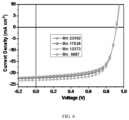
  • FIG. 6 is a graph showing the current density-voltage characteristics (J-V) of all-PSC devices prepared by matching D18 with PYSe-2FT of different molecular weights in Embodiments 3-6 of the present application.
  • PYSe-2FT fluorine-substituted Pi(it)-bridge selenide polymer acceptor
  • R 1 and R 2 are a substituted side chain at position 2 of selenophene and an alkyl chain substituted by pyrrole ring N, respectively, and * indicates a connecting position.
  • FIG. 1 shows a synthetic route of the fluorine-substituted ⁇ -bridge selenide polymer acceptor provided by the present application, including: step 1: Knoevenagel condensation reaction, including dissolving a compound as shown in formula (I) and a compound as shown in formula (II) in an organic solvent A, adding a weak base catalyst B, followed by heating and stirring for reaction, and separating and purifying a reaction solution after the reaction to obtain a compound shown in formula (IV); and step 2: Still cross-coupling reaction, including dissolving a compound as shown in formula (III) and the compound shown in formula (IV) in an organic solvent C, adding a catalyst D and a catalyst E, heating and stirring for reaction under protection of inert gas, and after the reaction, separating and purifying a reaction solution to obtain the fluorine-substituted ⁇ -bridge selenide polymer acceptor PYSe-2FT
  • the heating and stirring for reaction in step 1 are carried out under temperature of 45-60 degree Celsius (CC) for a duration of 5-48 hours (h), and preferably at 50° C. for 12 h.
  • CC 45-60 degree Celsius
  • the organic solvent A in step 1 includes at least one selected from a group of chloroform, dichloromethane, anhydrous oxygen-free toluene, preferably pure chloroform; and the weak base catalyst B includes at least one selected from a group of pyridine and piperidine, preferably pyridine.
  • step 1 the compounds (I) and (II) are in a mole ratio of 1:(3-5), preferably 1:5; the weak base catalyst B and the compound (I) are in a mole ratio of 1:(5-20), preferably 1:3; and the organic solvent A and the weak base catalyst B are in a volume ratio of (3-8):1, preferably 5:1.
  • the inert gas in the step 2 includes any one of nitrogen and argon.
  • the compounds (IV) and (III) used are in a mole ratio of 1:1 to 1:2, preferably 1:1.1; the catalyst D is in a mole ratio of 1:(6 percent (%)-8%) to the compound (III), preferably 1:8%; and the organic solvent C, the catalyst D and the catalyst E are in a volume ratio of (10-20):(1-2):(4-8), preferably 20:1:4.
  • the heating and stirring for reaction of step 2 are carried out under temperature of 100-120° C., preferably 110° C.; the heating and stirring for reaction of step 2 are carried out for a duration of >2 h, preferably 2-48 h, more preferably 2-12 h.
  • the products with different molecular weights can be obtained after reaction of different duration; the selenide polymer acceptor material PYSe-2FT shows a number average molecular weight (M n ) of 5.6 kilodaltons (kDa) after 2 h of reaction; whereas after 4 h of reaction, the number average molecular weight (M n ) of the selenide polymer acceptor material PYSe-2FT is 13.3 kDa, and that of the selenide polymer acceptor material PYSe-2FT after reaction of 8 h is 17.5 kDa, and 23.3 kDa after 24 h.
  • the organic solvent C is at least one selected form a group of anhydrous oxygen-free toluene, and N,N-dimethylformamide, preferably anhydrous oxygen-free toluene;
  • the catalyst D is tris(o-methylphenyl)phosphorus;
  • the catalyst E is a palladium catalyst, including at least one selected from a group of tris(dibenzylideneacetone)palladium, tetratriphenylphosphine palladium, bis(dibenzylideneacetone)palladium and bis(triphenylphosphine)palladium dichloride, preferably tris(dibenzylideneacetone)palladium.
  • a method for separating and purifying the reaction solution in step 2 includes: stop heating after the reaction is finished, pouring a reaction system into methanol (with a volume of more than 20 times a volume of the reaction solution) after the reaction system is cooled to room temperature so as to separate out solid precipitates, filtering and collecting the solid precipitates, purifying the solid precipitates with a Soxhlet extractor using methanol, acetone and hexane in sequence and each for 10-15 h to remove products of small molecular weight; extracting a solution in the Soxhlet extractor with trichloromethane until the solution is colorless, removing the trichloromethane remained after extracting by rotary evaporation to obtain a crude product, separating the crude product by a small amount of silica gel column chromatography with pure chloroform as eluent, collecting effluent components and obtaining the polymer acceptor PYSe-2FT with uniform molecular weight distribution.
  • the fluorine-substituted ⁇ -bridge selenide polymer acceptor material PYSe-2FT takes a selenium-substituted core donor unit as a main structure, and combines a difluoro-substituted thiophene ⁇ -electronic connection unit, with excellent semiconductor properties, good self-assembly and stability as well as solution processability; and it is simple to synthesize, easy to prepare, and insensitive to molecular weight.
  • the selenide polymer acceptor PYSe-2FT provided by the present application can be used as an electron acceptor material for all-polymer organic solar cells (all-PSCs) with simple processing and no requirement for any post-treatment (free-treatment), significantly improving the photoelectric conversion efficiency of all-PSCs and providing all-PSCs with excellent photoelectric performance.
  • the all-PSCs device of the present application adopts the forward cell structure of ITO/PEDOT:PSS/donor: PYSe-2FT/phenyl(2-naphthyl)diphenylphosphineoxide (Phen-NaDPO)/silver (Ag), with a cathode modification layer ((i.e., cathode transparent conductive glass) made of indiumtinoxide (ITO), a cathode modification layer (i.e., hole transport layer) of poly(3,4-ethenyldioxythiophene) (PEDOT):poly(styrene sulfonate) (PSS), donor material of active layer being any one of D18, D18-Si and OPz11, acceptor material of active layer of PYSe-2FT, an anode modification layer (i.e. electron transport layer) of (Phen-NADPO, DPO), and anode material of Ag.
  • the forward all-PSCs device is prepared by a method as follows:
  • the raw material compounds, organic solvents, catalysts, electrode materials and modification layer materials used in the present application can be directly purchased from the market.
  • a fluorine-substituted ⁇ -bridge selenide polymer acceptor PYSe-2FT is prepared with a synthetic route as shown in FIG. 1 , including: step 1: Knoevenagel condensation reaction, including dissolving a compound as shown in formula (I) and a compound as shown in formula (II) in an organic solvent A, adding a weak base catalyst B, followed by heating at 50° C., stirring and refluxing for 24 h, and separating and purifying a reaction solution to obtain the compounds shown in formula (IV), where the compounds (I), (II) and weak base catalyst B are in a molar ratio of 1:2.2:0.1, the organic solvent A is pure chloroform, the weak base catalyst B is pyridine, and the organic solvent A is in a volume ratio of 5:1 to the weak base catalyst B.
  • step 2 Still cross-coupling reaction, including dissolving a compound as shown in formula (III) and the compound shown in formula (IV) in an organic solvent C, adding a catalyst D and a catalyst E, heating at 100° C., stirring and refluxing, where the compounds (IV), (III) and the catalyst E are in a mole ratio of 1:1.1:8%, the organic solvent C is anhydrous oxygen-free toluene, the catalysts D and E are tri(o-methylphenyl)phosphorus and tri(dibenzylideneacetone) dipalladium respectively, with a volume ratio of organic solvent C, catalyst D and catalyst E of 20:1:4.
  • the reaction solution in step 2 is separated and purified by a method as follows: stop heating after the reaction is finished, pouring a reaction system into methanol (with a volume of more than 20 times a volume of the reaction solution) after the reaction system is cooled to room temperature so as to separate out solid precipitates, filtering and collecting the solid precipitates, purifying the solid precipitates with a Soxhlet extractor using methanol, acetone and hexane in sequence and each for 12 h to remove products of small molecular weight; extracting a solution in the Soxhlet extractor with trichloromethane until the solution is colorless, removing the trichloromethane remained after extracting by rotary evaporation to obtain a crude product, separating the crude product by a small amount of silica gel column chromatography of 100-200 meshes with pure chloroform as eluent, separating by passing through column and collecting effluent components to obtain the polymer acceptor PYSe-2FT with uniform mole
  • the products with different molecular weights can be obtained after reaction of different duration; the selenide polymer acceptor material PYSe-2FT has a number average molecular weight (M n ) of 5.6 kDa after 2 h of reaction; whereas after 4 h of reaction, the number average molecular weight (M n ) of the selenide polymer acceptor material PYSe-2FT is about 13.3 kDa, and that of the selenide polymer acceptor material PYSe-2FT after reaction of 8 h is about 17.5 kDa, and 23.3 kDa after reaction over 24 h.
  • the compound PYSe-2FT has characterization data illustrated as follows:
  • Embodiments 2-6 Under the irradiation condition of global spectrum (AM1.5G, light intensity 100 milliwatt per square centimeter (mW ⁇ cm ⁇ 2 ), the all-PSC devices prepared in Embodiments 2-6 are tested in terms of performance, with Tables 1 and 2 illustrating photovoltaic performance parameters of the devices in Embodiments 2-6 respectively, FIG. 4 showing the current density-voltage (J-V) curves of the devices in Embodiment 2, FIG. 5 showing external quantum efficiency (EQE), and FIG. 6 showing the J-V curves of all-PSC devices prepared by matching D18 with PYSe-2FT of different molecular weights in Embodiments 3-6 of the present application.
  • J-V current density-voltage
  • EQE external quantum efficiency
  • the highest efficiency of the device based on D18:PYSe-2FT is 14.54%, the open-circuit voltage (Voc) is 0.915 Volts (V), the current density (J SC ) is 21.11 milliamperes per square centimeter (mA ⁇ cm ⁇ 2 ), and the filling factor (FF) is 68.87% without any post-treatment of the active layer; the device based on D18-Si:PYSe-2FT has the highest efficiency of 13.21%, Voc of 0.897 V, J SC of 22.51 mA ⁇ cm 2 and FF of 65.38%; and the device based on OPz11:PYSe-2FT has the highest efficiency of 12.70%, Voc of 0.930 V, J SC of 22.10 mA ⁇ cm ⁇ 2 and FF of 61.74%.
  • the EQE curves of the device based on D18:PYSe-2FT is slightly higher than that of devices based on D18-Si:PYSe-2FT and OPz11:PYSe-2FT, indicating that the ratio of electrons collected by the device based on D18:PYSe-2FT to incident photons is higher than that based on D18-Si:PYSe-2FT and OPz11: PYSe-2FT.
  • the EQE curves suggest that the all-PSC devices based on D18:PYSe-2FT, D18-Si:PYSe-2FT and OPz11:PYSe-2FT have wide photocurrent response from 300 nm to 1,000 nm; by integrating EQE curves, the J SC values of devices based on D18:PYSe-2FT, D18-Si:PYSe-2FT and OPz11:PYSe-2FT are 22.90 mA ⁇ cm 2 , 22.09 mA ⁇ cm 2 and 21.92 mA ⁇ cm ⁇ 2 respectively, with errors within 3% compared to the values obtained from the J-V curve.

Landscapes

  • Chemical & Material Sciences (AREA)
  • Organic Chemistry (AREA)
  • Chemical Kinetics & Catalysis (AREA)
  • Engineering & Computer Science (AREA)
  • Materials Engineering (AREA)
  • Health & Medical Sciences (AREA)
  • Medicinal Chemistry (AREA)
  • Polymers & Plastics (AREA)
  • Life Sciences & Earth Sciences (AREA)
  • Wood Science & Technology (AREA)
  • Photovoltaic Devices (AREA)
  • Polyoxymethylene Polymers And Polymers With Carbon-To-Carbon Bonds (AREA)

Abstract

Disclosed is a fluorine-substituted Pi(π)-bridge selenide polymer acceptor material, its preparation and application. The selenide polymer acceptor material is named PYSe2FT and is synthesized by Knoevenagel condensation reaction and Still cross-coupling reaction; the material PYSe2FT takes a selenium-substituted core donor unit as a main structure, and combines a difluoro-substituted thiophene π-electronic connection unit, where the selenium-substituted core donor unit and the difluoro-substituted thiophene π-electronic connection unit can effectively regulate and control the molecular energy level, so that molecules generate good accumulation, thus making PYSe-2FT an excellent polymer acceptor material.

Description

CROSS-REFERENCE TO RELATED APPLICATIONS
This application claims priority to Chinese Patent Application No. 202111476980.9, filed on Dec. 2, 2022, the contents of which are hereby incorporated by reference.
TECHNICAL FIELD
The present application relates to the field of polymer acceptors, specifically to the technical field of organic polymer photovoltaic devices or organic semiconductor thin film solar cells, and in particular to a fluorine-substituted Pi (π)-bridge) selenide polymer acceptor and its preparation and application.
BACKGROUND
Organic solar cell embraces a promising application prospect in the market as one of the most competitive systems among the third-generation solar cells, owing to its properties such as diverse and controllable material structure, good device processing performance, light weight, flexibility, solution-processable, and ability to prepare large area printing at low cost. Recent years saw a rapid development of the entire organic solar cell field along with the continuous advance in the organic semiconductor materials and the continuous improvement in device structure and process, with cell efficiency breaking through to new heights. In 2018, the efficiency of stacked organic solar cells exceeded 15 percent (%), and 17% in succession, and the new dense ring electron acceptor Y6 emerged in 2019 has brought the photoelectric conversion efficiency of organic solar cells to a new level. So far, the photoelectric conversion efficiency of single-layer organic solar cells has reached 19%, which has attracted extensive attention from academia and industry, and also accelerated the commercialization and industrialization of organic solar cells.
All-polymer organic solar cells (all-PSCs) have aroused great research interest in recent years on account of their excellent stability, light weight, flexibility, and potential for low-cost large-area manufacturing. At present, all-PSCs based on polymer donors and polymeric small molecule acceptors have achieved power conversion efficiencies (PCEs) of more than 17%. However, all-PSCs require complex post-treatment processes to optimize the morphology during production, as preaggregation of the polymer in the precursor solution and difficulty in forming an optimal active layer after preparation of the film are caused by the relatively strong intermolecular interactions and long molecular backbones of both the polymer donor and polymer acceptor; moreover, the molecular weights of different batches of polymer materials may vary, causing uneven performance of products between different batches. Therefore, an organic solar cell device that can be prepared by a simple process with molecular weight-insensitive polymer acceptor materials is of great interest.
SUMMARY
In view of the above-mentioned shortcomings of the prior art, the present application provides a fluorine-substituted Pi (π)-bridge) selenide polymer acceptor and its preparation and application to address the problems of complex preparation process of all-polymer organic solar cells (all-PSCs) in the prior art and the uneven performance of the products due to the existence of a certain difference in molecular weight of polymer materials in different batches.
In order to achieve the above objectives and other related objectives, one of the aspects of the present application provides a fluorine-substituted π-bridge selenide polymer acceptor material, with a name of PYSe-2FT and a chemical structural formula illustrated as follows:
Figure US12082484-20240903-C00001
where R1 and R2 are a substituted side chain at position 2 of selenophene and an alkyl chain substituted by pyrrole ring N, respectively, and * indicates a connecting position.
The fluorine-substituted π-bridge selenide polymer acceptor material PYSe-2FT provided by the present application takes a selenium-substituted core donor unit as a main structure, and combines a difluoro-substituted thiophene π-electronic connection unit, where the selenium-substituted core donor unit and the difluoro-substituted thiophene π-electronic connection unit can effectively regulate and control the molecular energy level, so that molecules generate good accumulation, thus making PYSe-2FT an excellent polymer acceptor material.
Another aspect of the present application provides a method for preparing the fluorine-substituted π-bridge selenide polymer acceptor, including: step 1: Knoevenagel condensation reaction, including dissolving a compound as shown in formula (I) and a compound as shown in formula (II) in an organic solvent A, adding a weak base catalyst B, followed by heating and stirring for reaction, and separating and purifying a reaction solution after the reaction to obtain a compound shown in formula (IV); and step 2: Still cross-coupling reaction, including dissolving a compound as shown in formula (III) and the compound shown in formula (IV) in an organic solvent C, adding a catalyst D and a catalyst E, heating and stirring for reaction under protection of inert gas, and after the reaction, separating and purifying a reaction solution to obtain the fluorine-substituted π-bridge selenide polymer acceptor PYSe-2FT;
Figure US12082484-20240903-C00002
Figure US12082484-20240903-C00003
Optionally, the heating and stirring for reaction in step 1 are carried out under temperature of 45-60 degree Celsius (CC) for a duration of 5-48 hours (h), and preferably at 50° C. for 12 h.
Optionally, the organic solvent A in step 1 includes at least one selected from a group of chloroform, dichloromethane, anhydrous oxygen-free toluene, preferably pure chloroform.
Optionally, the weak base catalyst B in step 1 includes at least one selected from a group of pyridine and piperidine, preferably pyridine.
Optionally, the compounds (I) and (II) used in step 1 are in a mole ratio of 1:(3-5), preferably 1:5.
Optionally, the weak base catalyst B and the compound (I) used in step 1 are in a mole ratio of 1:(5-20), preferably 1:3.
Optionally, the organic solvent A and the weak base catalyst B in step 1 are in a volume ratio of (3-8):1, preferably 5:1.
Optionally, a method for separating and purifying the reaction solution in step 1 includes: stopping heating after reaction, adding water after a reaction system is cooled to room temperature, then extracting with an organic solvent to obtain a lower organic phase and an upper aqueous phase, washing the organic phase, followed by drying, filtering, rotary steaming to obtain a crude product, washing the crude product with a solvent, filtering, and separating by silica gel column chromatography to obtain the compound shown in formula (IV).
Optionally, the organic solvent used for extracting in the method for separating and purifying the reaction in step 1 is any one of dichloromethane and chloroform.
Optionally, the organic phase in the method for separating and purifying the reaction in step 1 is washed with saturated NaCl aqueous solution and water in turn, and then dried.
Optionally, the method for separating and purifying the reaction in step 1 adopts a desiccant selected from a group of anhydrous magnesium sulfate and sodium sulfate.
Optionally, in the method for separating and purifying the reaction in step 1, the solvent used for washing the crude product is any one of methanol, n-hexane, acetone and isopropanol.
Optionally, in the method for separating and purifying the reaction in step 1, the crude product is subject to silica gel column chromatography of 200-300 meshes with a mixture of chloroform/petroleum ether as eluent, where the chloroform is in a volume ratio of (2-4):1 to the petroleum ether in the mixture of chloroform/petroleum ether, preferably 3:1.
Optionally, the inert gas in the step 2 includes any one of nitrogen and argon.
Optionally, the compounds (IV) and (III) used in the step 2 are in a mole ratio of 1:1 to 1:2, preferably 1:1.1.
Optionally, the catalyst D is in a mole ratio of 1:(6 percent (%)-8%) to the compound (III) in the step 2, preferably 1:8%.
Optionally, the organic solvent C, the catalyst D and the catalyst E used in step 2 are in a volume ratio of (10-20):(1-2):(4-8), preferably 20:1:4.
Optionally, the heating and stirring for reaction of step 2 are carried out under temperature of 100-120° C., preferably 110° C. Optionally, the heating and stirring for reaction of step 2 are carried out for a duration of >2 h, preferably 2-48 h, more preferably 2-12 h. The products with different molecular weights can be obtained after reaction of different duration; the selenide polymer acceptor material PYSe-2FT shows a number average molecular weight (Mn) of 5.6 kilodaltons (kDa) after 2 h of reaction; whereas after 4 h of reaction, the number average molecular weight (Me) of the selenide polymer acceptor material PYSe-2FT is 13.3 kDa, and that of the selenide polymer acceptor material PYSe-2FT after reaction of 8 h is 17.5 kDa, and 23.3 kDa after 24 h.
Optionally, the organic solvent C in the step 2 is at least one selected form a group of anhydrous oxygen-free toluene, N,N-dimethylformamide, tetrahydrofuran and anhydrous oxygen-free chlorobenzene, preferably anhydrous oxygen-free toluene.
Optionally, the catalyst D in the step 2 is a phosphorus catalyst of tris(o-methylphenyl)phosphorus.
Optionally, the catalyst E in the step 2 is a palladium catalyst, including at least one selected from a group of tris(dibenzylideneacetone)palladium, tetratriphenylphosphine palladium, bis(dibenzylideneacetone)palladium and bis(triphenylphosphine)palladium dichloride, preferably tris(dibenzylideneacetone)palladium.
Optionally, a method for separating and purifying the reaction solution in step 2 includes: stop heating after the reaction is finished, pouring a reaction system into methanol after the reaction system is cooled to room temperature so as to separate out solid precipitates, filtering and collecting the solid precipitates, purifying the solid precipitates with a Soxhlet extractor using methanol, acetone and hexane in sequence to remove products of small molecular weight; extracting a solution in the Soxhlet extractor with trichloromethane until the solution is colorless, removing the trichloromethane remained after extracting by rotary evaporation to obtain a crude product, separating the crude product by silica gel column chromatography to obtain the selenide polymer acceptor material PYSe-2FT with uniform molecular weight distribution.
Optionally, the methanol used in the method for separating and purifying the reaction solution in step 2 is used in an amount of more than 20 times of a volume of the reaction solution.
Optionally, the solid precipitates in the method for separating and purifying the reaction solution in step 2 are extracted with a Soxhlet extractor using methanol, acetone, and hexane in turn and for 10 to 15 h each, preferably 12 h.
Optionally, the crude product in the method for separating and purifying the reaction solution in step 2 is chromatographed on a 100-200 meshes silica gel column with pure trichloromethane as an eluent.
Another aspect of the present application provides an application of the selenide polymer acceptor PYSe-2FT as described in an aspect of the present application in preparing solar photovoltaic devices.
Another aspect of the present application provides an organic solar cell device, where the organic solar cell device includes the selenide polymer acceptor PYSe-2FT as described in an aspect of the present application.
Optionally, the organic solar cell device includes an active layer with donor material being any one of D18, D18-Si and OPz11.
Optionally, the organic solar cell device includes a cathode transparent conductive glass, where the cathode transparent conductive glass is made of indium tin oxide (ITO).
Optionally, the organic solar cell device includes a cathode modification layer (i.e., a hole transport layer), where the cathode modification layer is made of PEDOT:PSS, where the PEDOT is poly(3,4-ethylenedioxythiophene), a polymer of 3,4-ethylenedioxythiophene monomer (EDOT), and PSS is polystyrene sulfonate.
Optionally, the organic solar cell device includes an anode modification layer (i.e., an electron transport layer), and the anode modification layer is made of Phen-NaDPO (phenyl(2-naphthyl)diphenylphosphineoxide).
Optionally, the organic solar cell device also includes an anode with material of silver (Ag).
Optionally, the organic solar cell device adopts a forward cell structure.
As described above, the fluorine-substituted π-bridge selenide polymer acceptor PYSe-2FT and its preparation as well as application provided by the present application achieve the following beneficial effects:
the selenide polymer acceptor PYSe-2FT has excellent semiconductor properties, good self-assembly and stability as well as solution processability, and the synthesis process is simple, easy to prepare and insensitive to molecular weight; PYSe-2FT has great potential and application value in the field of organic solar cells and other photovoltaic devices; it can be used as an electron acceptor material for all-PSCs with simple processing and no requirement for any post-treatment (free-treatment), significantly improving the photoelectric conversion efficiency of all-PSCs and providing all-PSCs with excellent photoelectric performance.
BRIEF DESCRIPTION OF THE DRAWINGS
FIG. 1 shows a schematic synthetic route of polymer acceptor PYSe-2FT provided by the present application.
FIG. 2 illustrates chemical structural formulas of polymer donor materials D18, D18-Si, OPz11, poly(3,4-ethylenedioxythiophene) (PEDOT), polystyrene sulfonate (PSS) and phenyl(2-naphthyl)diphenylphosphineoxide (Phen-NADPO) used in this application.
FIG. 3 shows a schematic structural diagram of an all-polymer organic solar cell (all-PSC) device according to the present application.
FIG. 4 is a graph illustrating current density-voltage characteristics (J-V) of an all-PSC device based on D18:PYSe-2FT, D18-Si:PYSe-2FT and OPz11:PYSe-2FT in Embodiment 2 of the present application.
FIG. 5 shows external quantum efficiency (EQE) curves of the all-PSC devices based on D18:PYSe-2FT, D18-Si:PYSe-2FT and OPz11:PYSe-2FT in Embodiment 2 of the present application.
FIG. 6 is a graph showing the current density-voltage characteristics (J-V) of all-PSC devices prepared by matching D18 with PYSe-2FT of different molecular weights in Embodiments 3-6 of the present application.
DETAILED DESCRIPTION OF THE EMBODIMENTS
The following specific embodiments illustrate the embodiments of the present invention, and those skilled in the art can easily understand other advantages and efficacy of the present application from the disclosure of this specification. The application can also be implemented or applied by other different specific embodiments, and the details in this specification can be modified or changed based on different viewpoints and applications without departing from the spirit of the application.
The present application provides a fluorine-substituted Pi(it)-bridge selenide polymer acceptor named PYSe-2FT, with chemical structural formula illustrated as follows:
Figure US12082484-20240903-C00004
where R1 and R2 are a substituted side chain at position 2 of selenophene and an alkyl chain substituted by pyrrole ring N, respectively, and * indicates a connecting position.
FIG. 1 shows a synthetic route of the fluorine-substituted π-bridge selenide polymer acceptor provided by the present application, including: step 1: Knoevenagel condensation reaction, including dissolving a compound as shown in formula (I) and a compound as shown in formula (II) in an organic solvent A, adding a weak base catalyst B, followed by heating and stirring for reaction, and separating and purifying a reaction solution after the reaction to obtain a compound shown in formula (IV); and step 2: Still cross-coupling reaction, including dissolving a compound as shown in formula (III) and the compound shown in formula (IV) in an organic solvent C, adding a catalyst D and a catalyst E, heating and stirring for reaction under protection of inert gas, and after the reaction, separating and purifying a reaction solution to obtain the fluorine-substituted π-bridge selenide polymer acceptor PYSe-2FT
Specifically, the heating and stirring for reaction in step 1 are carried out under temperature of 45-60 degree Celsius (CC) for a duration of 5-48 hours (h), and preferably at 50° C. for 12 h.
Specifically, the organic solvent A in step 1 includes at least one selected from a group of chloroform, dichloromethane, anhydrous oxygen-free toluene, preferably pure chloroform; and the weak base catalyst B includes at least one selected from a group of pyridine and piperidine, preferably pyridine.
Specifically, in step 1, the compounds (I) and (II) are in a mole ratio of 1:(3-5), preferably 1:5; the weak base catalyst B and the compound (I) are in a mole ratio of 1:(5-20), preferably 1:3; and the organic solvent A and the weak base catalyst B are in a volume ratio of (3-8):1, preferably 5:1.
Specifically, a method for separating and purifying the reaction solution in step 1 includes: stopping heating after reaction, adding water after a reaction system is cooled to room temperature, then extracting with an organic solvent to obtain a lower organic phase and an upper aqueous phase, extracting the aqueous phase for several times, combining the organic phase and washing with saturated NaCl aqueous solution and water in turn, followed by drying with anhydrous MgSO4 or sodium sulfate, then filtering and subjecting to rotatory evaporation to remove the solvent from a filtrate, obtaining a crude product, washing the organic phase, followed by drying, filtering, rotary steaming to obtain a crude product, washing the crude product with a solvent for 3 times, filtering, and separating by silica gel column chromatography of 200-300 meshes with a mixture of chloroform/petroleum ether (volume/volume (V/V)=3:1) as eluent, followed by separating by passing column, collecting effluent components and obtaining the compound shown in formula (IV); among them, the organic solvent used for extracting is any one of dichloromethane and chloroform; the solvent used for washing the crude product is any one of methanol, n-hexane, acetone and isopropanol; the mixture of chloroform/petroleum ether is used as the eluent for silica gel column chromatography, where the chloroform is in a volume ratio of (2-4):1 to the petroleum ether in the mixture of chloroform/petroleum ether, preferably 3:1.
Specifically, the inert gas in the step 2 includes any one of nitrogen and argon.
Specifically, in the step 2, the compounds (IV) and (III) used are in a mole ratio of 1:1 to 1:2, preferably 1:1.1; the catalyst D is in a mole ratio of 1:(6 percent (%)-8%) to the compound (III), preferably 1:8%; and the organic solvent C, the catalyst D and the catalyst E are in a volume ratio of (10-20):(1-2):(4-8), preferably 20:1:4.
Specifically, in the step 2, the heating and stirring for reaction of step 2 are carried out under temperature of 100-120° C., preferably 110° C.; the heating and stirring for reaction of step 2 are carried out for a duration of >2 h, preferably 2-48 h, more preferably 2-12 h. The products with different molecular weights can be obtained after reaction of different duration; the selenide polymer acceptor material PYSe-2FT shows a number average molecular weight (Mn) of 5.6 kilodaltons (kDa) after 2 h of reaction; whereas after 4 h of reaction, the number average molecular weight (Mn) of the selenide polymer acceptor material PYSe-2FT is 13.3 kDa, and that of the selenide polymer acceptor material PYSe-2FT after reaction of 8 h is 17.5 kDa, and 23.3 kDa after 24 h.
Specifically, in the step 2, the organic solvent C is at least one selected form a group of anhydrous oxygen-free toluene, and N,N-dimethylformamide, preferably anhydrous oxygen-free toluene; the catalyst D is tris(o-methylphenyl)phosphorus; and the catalyst E is a palladium catalyst, including at least one selected from a group of tris(dibenzylideneacetone)palladium, tetratriphenylphosphine palladium, bis(dibenzylideneacetone)palladium and bis(triphenylphosphine)palladium dichloride, preferably tris(dibenzylideneacetone)palladium.
Specifically, a method for separating and purifying the reaction solution in step 2 includes: stop heating after the reaction is finished, pouring a reaction system into methanol (with a volume of more than 20 times a volume of the reaction solution) after the reaction system is cooled to room temperature so as to separate out solid precipitates, filtering and collecting the solid precipitates, purifying the solid precipitates with a Soxhlet extractor using methanol, acetone and hexane in sequence and each for 10-15 h to remove products of small molecular weight; extracting a solution in the Soxhlet extractor with trichloromethane until the solution is colorless, removing the trichloromethane remained after extracting by rotary evaporation to obtain a crude product, separating the crude product by a small amount of silica gel column chromatography with pure chloroform as eluent, collecting effluent components and obtaining the polymer acceptor PYSe-2FT with uniform molecular weight distribution.
The fluorine-substituted π-bridge selenide polymer acceptor material PYSe-2FT provided by the present application takes a selenium-substituted core donor unit as a main structure, and combines a difluoro-substituted thiophene π-electronic connection unit, with excellent semiconductor properties, good self-assembly and stability as well as solution processability; and it is simple to synthesize, easy to prepare, and insensitive to molecular weight.
The selenide polymer acceptor PYSe-2FT provided by the present application can be used as an electron acceptor material for all-polymer organic solar cells (all-PSCs) with simple processing and no requirement for any post-treatment (free-treatment), significantly improving the photoelectric conversion efficiency of all-PSCs and providing all-PSCs with excellent photoelectric performance.
As shown in FIG. 3 , the all-PSCs device of the present application adopts the forward cell structure of ITO/PEDOT:PSS/donor: PYSe-2FT/phenyl(2-naphthyl)diphenylphosphineoxide (Phen-NaDPO)/silver (Ag), with a cathode modification layer ((i.e., cathode transparent conductive glass) made of indiumtinoxide (ITO), a cathode modification layer (i.e., hole transport layer) of poly(3,4-ethenyldioxythiophene) (PEDOT):poly(styrene sulfonate) (PSS), donor material of active layer being any one of D18, D18-Si and OPz11, acceptor material of active layer of PYSe-2FT, an anode modification layer (i.e. electron transport layer) of (Phen-NADPO, DPO), and anode material of Ag.
See FIG. 2 for the chemical structural formulas of D18, D18-Si, OPz11, PEDOT, PSS and Phen-NaDPO. The forward all-PSCs device provided by the present application is prepared by a method as follows:
    • a) cleaning ITO glass, including cleaning a substrate composed of transparent substrate layer and transparent conductive electrode ITO with deionized water, acetone and isopropyl alcohol, each for 30 minutes (min) respectively, and blow-drying with nitrogen after cleaning; then placing the substrate in an ozone cleaner for 30 min;
    • b) spin-coating the hole transport layer PEDOT:PSS on ITO glass with a thickness of 10-30 nanometers (nm), where the thickness of the hole transport layer in the following embodiments is 30 nm, and subjecting to thermal annealing treatment in air;
    • c) in a glove box filled with nitrogen, spin-coating the active layer mixture donor:PYSe-2FT on the hole transport layer PEDOT:PSS by solution method, with donor to the PYSe-2FT in a mass ratio of 1:1.1; specifically, the donor:PYSe-2FT is dissolved in chlorobenzene or chloroform with a concentration of 12 milligrams per milliliter (mg/mL), and a spin-coating thickness of that active layer of 80-300 nm, while that in the following embodiments is 120 nm;
    • d) spin-coating Phen-NaDPO isopropanol solution on the active layer to prepare an electron transport layer with a thickness of 10-50 nm, and the thickness of the electron transport layer in the following embodiments is 30 nm; and
    • e) vapor-depositing a metal silver electrode on the Phen-NaDPO electron transport layer with a thickness of 90-100 nm, and the anode thickness in the following embodiments is 100 nm.
The raw material compounds, organic solvents, catalysts, electrode materials and modification layer materials used in the present application can be directly purchased from the market.
The methods not detailed in the present application are conventional methods in the field.
The following specific embodiments are given to illustrate the present application in detail. It should also be understood that the following embodiments are only used to specifically illustrate the present application, and should not be construed as limiting the scope of protection of the present application. Some non-essential improvements and adjustments made by those skilled in the art according to the above contents of the present application all belong to the scope of protection of the present application. The specific process parameters of the following embodiments are only one embodiment of the appropriate range, that is, those skilled in the art can make choices within the appropriate range through the description herein, and are not limited to the specific values of the following embodiments.
Embodiment 1
A fluorine-substituted π-bridge selenide polymer acceptor PYSe-2FT is prepared with a synthetic route as shown in FIG. 1 , including: step 1: Knoevenagel condensation reaction, including dissolving a compound as shown in formula (I) and a compound as shown in formula (II) in an organic solvent A, adding a weak base catalyst B, followed by heating at 50° C., stirring and refluxing for 24 h, and separating and purifying a reaction solution to obtain the compounds shown in formula (IV), where the compounds (I), (II) and weak base catalyst B are in a molar ratio of 1:2.2:0.1, the organic solvent A is pure chloroform, the weak base catalyst B is pyridine, and the organic solvent A is in a volume ratio of 5:1 to the weak base catalyst B.
The reaction solution is separated and purified by a method as follows: after the reaction is finished, stopping heating, adding water after a reaction system is cooled to room temperature, extracting with chloroform to obtain a lower organic phase and an upper aqueous phase, extracting the aqueous phase for many times, combining the organic phase and washing with saturated NaCl aqueous solution and water in turn, drying with anhydrous MgSO4, filtering, and removing solvent in a filtrate by rotary evaporation to obtain a crude product, washing the crude product with methanol solvent for three times, followed by filtering and subjecting to 200-300 meshes silica gel column chromatography with a chloroform/petroleum ether mixture (V/V=3:1) as eluent, and separating by passing through column to collect effluent components, thus obtaining the compound shown in formula (IV); and
step 2: Still cross-coupling reaction, including dissolving a compound as shown in formula (III) and the compound shown in formula (IV) in an organic solvent C, adding a catalyst D and a catalyst E, heating at 100° C., stirring and refluxing, where the compounds (IV), (III) and the catalyst E are in a mole ratio of 1:1.1:8%, the organic solvent C is anhydrous oxygen-free toluene, the catalysts D and E are tri(o-methylphenyl)phosphorus and tri(dibenzylideneacetone) dipalladium respectively, with a volume ratio of organic solvent C, catalyst D and catalyst E of 20:1:4.
The reaction solution in step 2 is separated and purified by a method as follows: stop heating after the reaction is finished, pouring a reaction system into methanol (with a volume of more than 20 times a volume of the reaction solution) after the reaction system is cooled to room temperature so as to separate out solid precipitates, filtering and collecting the solid precipitates, purifying the solid precipitates with a Soxhlet extractor using methanol, acetone and hexane in sequence and each for 12 h to remove products of small molecular weight; extracting a solution in the Soxhlet extractor with trichloromethane until the solution is colorless, removing the trichloromethane remained after extracting by rotary evaporation to obtain a crude product, separating the crude product by a small amount of silica gel column chromatography of 100-200 meshes with pure chloroform as eluent, separating by passing through column and collecting effluent components to obtain the polymer acceptor PYSe-2FT with uniform molecular weight distribution.
The products with different molecular weights can be obtained after reaction of different duration; the selenide polymer acceptor material PYSe-2FT has a number average molecular weight (Mn) of 5.6 kDa after 2 h of reaction; whereas after 4 h of reaction, the number average molecular weight (Mn) of the selenide polymer acceptor material PYSe-2FT is about 13.3 kDa, and that of the selenide polymer acceptor material PYSe-2FT after reaction of 8 h is about 17.5 kDa, and 23.3 kDa after reaction over 24 h.
The compound PYSe-2FT has characterization data illustrated as follows:
1HNMR (400 MHz, CDCl3)δ 9.24-9.27 (d, 2H, ═CH), 8.8 (s, 1H, ArH), 8.55 (m, 2H, ArH), 8.03 (s, 1H, ArH), 7.73-7.88 (m, 3H, ArH), 7.52 (m, 1H, ArH), 4.79 (m, 6H, CH), 3.22-3.24 (m, 2.5H, CH2), 2.04-2.19 (m, 2H, CH2), 1.85-1.1.87 (m, 6H, CH3), 0.66-1.54 (m, 94H, CH2 and CH3).
Theoretical values of elements (%): C=68.48%, H=6.89%, S=7.07%, N %=5.14%; test values: C=68.16%, H=6.86%, S=7.28%, N %=4.77%.
Embodiment 2
A substrate composed of transparent substrate layer and transparent conductive electrode ITO is ultrasonically cleaned with cleaning solution, deionized water, acetone and isopropanol respectively, and then blow-dried with nitrogen, then the substrate is treated in an ozone cleaner for 30 min, followed by spin-coating with hole transport layer material PEDOT:PSS (4,000 revolutions per minute (rpm) for 20 seconds (s)) in air, followed by thermal annealing (130° C., 15 min) in the air and introducing into a glove box filled with nitrogen, and the active layer (D18: PYSe-2FT (Mn=17.5 kDa)=1:1.1, 12 mg/mL; D18-Si:PYSe-2FT (Mn=17.5 kDa)=1:1.1, 12 mg/mL; OPz11:PYSe-2FT (Mn=17.5 kDa)=1:1.1, 12 mg/mL) is prepared by spin-coating on the hole transport layer PEDOT:PSS; an electron transport layer DPO is then spin-coated (2,000 rpm, 20 s) on the active layer, followed by vapor-depositing Ag electrode (100 nm) on the electron transport layer to prepare an all-PSC device.
Embodiment 3
A substrate composed of transparent substrate layer and transparent conductive electrode ITO is ultrasonically cleaned with cleaning solution, deionized water, acetone and isopropanol respectively, and then blow-dried with nitrogen; the substrate is treated in an ozone cleaner for 30 min, and spin-coated (4,000 rpm, 20 s) with hole transport layer material PEDOT:PSS in the air, followed by thermal annealing (130° C., 15 min) in the air; then the substrate sample is introduced into a glove box filled with nitrogen, and the active layer is prepared on the hole transport layer PEDOT:PSS by spin-coating (D18:PY6-Se-1=1:1.1, 12 mg/mL, PYSe-2FT (Mn=5687), 3.000 rpm, 30 s); the electron transport layer DPO is then spin-coated (2,000 rpm, 20 s) on the active layer, and then the Ag electrode (100 nm) is vapor-deposited on the electron transport layer, and an all-PSC device is prepared.
Embodiment 4
A substrate composed of transparent substrate layer and transparent conductive electrode ITO is ultrasonically cleaned with cleaning solution, deionized water, acetone and isopropanol respectively, and then blow-dried with nitrogen; then the substrate is treated in an ozone cleaner for 20 min then spin-coated (4,000 rpm, 20 s) with hole transport layer material PEDOT:PSS, followed by thermal annealing (130° C., 15 min) in the air; then the substrate sample is introduced into a glove box filled with nitrogen, and the active layer is prepared on the PEDOT:PSS hole transport layer (D18:PYSe-2FT=1:1.1, 12 mg/mL, PYSe-2FT with Mn, =13373, 3,000 rpm, 30 s) by spin-coating method; then, the electron transport layer DPO is spin-coated (2,000 rpm, 20 s) on the active layer, and then the Ag electrode (100 nm) is vapor-deposited on the electron transport layer, and an all-PSC device is prepared.
Embodiment 5
A substrate composed of transparent substrate layer and transparent conductive electrode ITO is ultrasonically cleaned with cleaning solution, deionized water, acetone and isopropanol respectively, and then blow-dried with nitrogen; after treatment in an ozone cleaner for 20 min, the substrate is spin-coated (4,000 rpm, 20 s) with hole transport layer material PEDOT:PSS in the air, followed by thermal annealing (130° C., 15 min) in the air; then the substrate sample is introduced into a glove box filled with nitrogen, and the active layer is prepared on the PEDOT:PSS hole transport layer (D18:PYSe-2FT=1:1.1, 12 mg/mL, PYSe-2FT with Mn, =17536, 3,000 rpm, 30 s) by spin-coating method; then, the electron transport layer DPO is spin-coated (2,000 rpm, 20 s) on the active layer, and then the Ag electrode (100 nm) is vapor-deposited on the electron transport layer, and an all-PSC device is prepared.
Embodiment 6
A substrate composed of transparent substrate layer and transparent conductive electrode ITO is ultrasonically cleaned with cleaning solution, deionized water, acetone and isopropanol respectively, and then blow-dried with nitrogen; then the substrate is treated in an ozone cleaner for 20 min, and spin-coated (4,000 rpm, 20, s) with hole transport layer material PEDOT:PSS, followed by thermal annealing (130° C., 15 min) in the air; then the substrate sample is introduced into a glove box filled with nitrogen, and the active layer is prepared on the PEDOT:PSS hole transport layer (D18:PYSe-2FT=1:1.1, 12 mg/mL, PYSe-2FT with Mn=23302, 3,000 rpm, 30 s) by spin-coating method; then the electron transport layer DPO (2,000 rpm, 20 s) is spin-coated on the active layer, and the Ag electrode (100 nm) is vapor-deposited on the electron transport layer to obtain an all-PSC device.
Under the irradiation condition of global spectrum (AM1.5G, light intensity 100 milliwatt per square centimeter (mW·cm−2), the all-PSC devices prepared in Embodiments 2-6 are tested in terms of performance, with Tables 1 and 2 illustrating photovoltaic performance parameters of the devices in Embodiments 2-6 respectively, FIG. 4 showing the current density-voltage (J-V) curves of the devices in Embodiment 2, FIG. 5 showing external quantum efficiency (EQE), and FIG. 6 showing the J-V curves of all-PSC devices prepared by matching D18 with PYSe-2FT of different molecular weights in Embodiments 3-6 of the present application.
TABLE 1
Photovoltaic Performance Parameters of all-PSC devices based
on D18:PYSe-2FT, D18-Si:PYSe-2FT and OPz11:PYSe-2FT
post-
treat- VOC JSC FF PCEMax EQE
Active layer ment [mV] [mA · cm−2] [%] [%] [mA · cm−2
D18:PYSe-2FT no 0.915 23.11 68.78 14.54 22.90
D18-Si:PYSe-2FT no 0.897 22.51 65.38 13.21 22.09
OPz11:PYSe-2FT no 0.930 22.10 61.74 12.70 21.92
TABLE 2
Photovoltaic performance parameters of all-PSC devices with different
PYSe-2FT molecular weights based on D18:PYSe-2FT devices
PYSe-FT post-
molecular treat- VOC JSC FF PCEMax
Active layer weight Mn ment [mV] [mA · cm−2] [%] [%]
D18:PYSe-FT 22302 no 0.913 21.66 66.00 13.17
17536 no 0.915 22.12 68.20 13.81
13373 no 0.915 23.11 68.78 14.54
5687 no 0.920 21.84 65.85 13.24
It can be seen from Table 1 that the highest efficiency of the device based on D18:PYSe-2FT is 14.54%, the open-circuit voltage (Voc) is 0.915 Volts (V), the current density (JSC) is 21.11 milliamperes per square centimeter (mA·cm−2), and the filling factor (FF) is 68.87% without any post-treatment of the active layer; the device based on D18-Si:PYSe-2FT has the highest efficiency of 13.21%, Voc of 0.897 V, JSC of 22.51 mA·cm2 and FF of 65.38%; and the device based on OPz11:PYSe-2FT has the highest efficiency of 12.70%, Voc of 0.930 V, JSC of 22.10 mA·cm−2 and FF of 61.74%.
It can be seen from FIG. 4 that the EQE curves of the device based on D18:PYSe-2FT is slightly higher than that of devices based on D18-Si:PYSe-2FT and OPz11:PYSe-2FT, indicating that the ratio of electrons collected by the device based on D18:PYSe-2FT to incident photons is higher than that based on D18-Si:PYSe-2FT and OPz11: PYSe-2FT. The EQE curves suggest that the all-PSC devices based on D18:PYSe-2FT, D18-Si:PYSe-2FT and OPz11:PYSe-2FT have wide photocurrent response from 300 nm to 1,000 nm; by integrating EQE curves, the JSC values of devices based on D18:PYSe-2FT, D18-Si:PYSe-2FT and OPz11:PYSe-2FT are 22.90 mA·cm2, 22.09 mA·cm2 and 21.92 mA·cm−2 respectively, with errors within 3% compared to the values obtained from the J-V curve.
As can be seen from Table 2 and FIG. 6 , with the increase of molecular weight of PYSe-2FT from 5.6 kDa to 23.3 kDa, the performance of photovoltaic devices based on D18:PYSe-2FT is less affected by the molecular weight of PYSe-2FT (the energy conversion efficiency is all kept above 13%), suggesting that the performance of photovoltaic devices is not affected by the batches of PYSe-2FT polymers, and the product is insensitive to the molecular weight of polymers, making it favorable for industrial production of PYSe-2FT polymer receptor materials.
The above embodiments only illustrate the principle and efficacy of the present application, and are not intended to limit the present application. Anyone skilled in the art can modify or change the above embodiments without departing from the spirit and scope of the present application. Therefore, all equivalent modifications or changes made by those with ordinary knowledge in the technical field without departing from the spirit and technical idea disclosed by the present application should still be covered by the claims of the present application.

Claims (9)

What is claimed is:
1. A fluorine-substituted Pi (π)-bridge) selenide polymer acceptor material, named PYSe-2FT, comprising a chemical structural formula illustrated as follows:
Figure US12082484-20240903-C00005
wherein R1 and R2 are a substituted side chain at position 2 of selenophene and an alkyl chain substituted by pyrrole ring N, respectively, and * indicates a connecting position.
2. A method for preparing the fluorine-substituted π-bridge selenide polymer acceptor material PYSe-2FT, comprising step 1: Knoevenagel condensation reaction, comprising dissolving a compound as shown in formula (I) and a compound as shown in formula (II) in an organic solvent A, adding a weak base catalyst B, followed by heating and stirring for reaction, and separating and purifying a reaction solution after the reaction to obtain a compound shown in formula (IV); and
step 2: Still cross-coupling reaction, comprising dissolving a compound as shown in formula (III) and the compound shown in formula (IV) in an organic solvent C, adding a catalyst D and a catalyst E, heating and stirring for reaction under protection of inert gas, and after the reaction, separating and purifying a reaction solution to obtain the fluorine-substituted π-bridge selenide polymer acceptor PYSe-2FT;
Figure US12082484-20240903-C00006
Figure US12082484-20240903-C00007
3. The method for preparing the fluorine-substituted π-bridge selenide polymer acceptor material PYSe-2FT according to claim 2, wherein the heating and stirring for reaction in step 1 are carried out under temperature of 45-60 degree Celsius (CC) for a duration of 12-48 hours (h);
and, the heating and stirring for reaction of step 2 are carried out under temperature of 100-120° C. for a duration of
Figure US12082484-20240903-P00001
2 h.
4. The method for preparing the fluorine-substituted π-bridge selenide polymer acceptor material PYSe-2FT according to claim 2, wherein the organic solvent A in step 1 comprises at least one selected from a group of chloroform, anhydrous oxygen-free toluene, and N,N-dimethylformamide;
and, the organic solvent A in step 1 comprises at least one selected from a group of chloroform, dichloromethane, anhydrous oxygen-free toluene;
and, the organic solvent C in the step 2 comprises at least one selected form a group of anhydrous oxygen-free toluene and N,N-dimethylformamide;
and, the catalyst D in the step 2 is a phosphorus catalyst of tris(o-methylphenyl)phosphorus;
and, the catalyst E in the step 2 is a palladium catalyst, comprising at least one selected from a group of tris(dibenzylideneacetone)palladium, tetratriphenylphosphine palladium, bis(dibenzylideneacetone)palladium and bis(triphenylphosphine)palladium dichloride, preferably tris(dibenzylideneacetone)palladium.
5. The method for preparing the fluorine-substituted π-bridge selenide polymer acceptor material PYSe-2FT according to claim 2, wherein the compounds (I) and (II) used in step 1 are in a mole ratio of 1:(3-5), the weak base catalyst B and the compound (I) are in a mole ratio of 1:(5-20), and the organic solvent A and the weak base catalyst B are in a volume ratio of (3-8):1;
wherein in the step 2, the compounds (IV) and (III) used are in a mole ratio of 1:1 to 1:2, the catalyst D is in a mole ratio of 1:(6 percent (%)-8%) to the compound (III), and the organic solvent C, the catalyst D and the catalyst E are in a volume ratio of (10-20):(1-2):(4-8).
6. The method for preparing the fluorine-substituted π-bridge selenide polymer acceptor material PYSe-2FT according to claim 2, wherein a method for separating and purifying the reaction solution in step 1 comprises: stopping heating after reaction, adding water after a reaction system is cooled to room temperature, then extracting with an organic solvent to obtain a lower organic phase and an upper aqueous phase, washing the organic phase, followed by drying, filtering, rotary steaming to obtain a crude product, washing the crude product with a solvent, filtering, and separating by silica gel column chromatography to obtain the compound shown in formula (IV);
and, a method for separating and purifying the reaction solution in step 2 comprises: stop heating after the reaction is finished, pouring a reaction system into methanol after the reaction system is cooled to room temperature so as to separate out solid precipitates, filtering and collecting the solid precipitates, purifying the solid precipitates with a Soxhlet extractor using methanol, acetone and hexane in sequence to remove products of small molecular weight; extracting a solution in the Soxhlet extractor with trichloromethane until the solution is colorless, removing the trichloromethane remained after extracting by rotary evaporation to obtain a crude product, separating the crude product by silica gel column chromatography to obtain the selenide polymer acceptor material PYSe-2FT with uniform molecular weight distribution.
7. An organic solar cell device, comprising the selenide polymer acceptor PYSe-2FT according to claim 1.
8. The organic solar cell device according to claim 7, wherein the organic solar cell device comprises an active layer, a cathode transparent conductive glass, a cathode modification layer, an anode modification layer and an anode.
9. The organic solar cell device according to claim 7, wherein the organic solar cell device adopts a forward cell structure.
US18/073,140 2021-12-02 2022-12-01 Fluorine-substituted Pi-bridge (Pi-bridge) selenide polymer acceptor and preparation and application thereof Active 2043-03-02 US12082484B2 (en)

Applications Claiming Priority (2)

Application Number Priority Date Filing Date Title
CN202111476980.9 2021-12-02
CN202111476980.9A CN114262426A (en) 2021-12-02 2021-12-02 Pi-bridge fluorine substituted selenizing polymer receptor material and preparation and application thereof

Publications (2)

Publication Number Publication Date
US20230180593A1 US20230180593A1 (en) 2023-06-08
US12082484B2 true US12082484B2 (en) 2024-09-03

Family

ID=80826564

Family Applications (1)

Application Number Title Priority Date Filing Date
US18/073,140 Active 2043-03-02 US12082484B2 (en) 2021-12-02 2022-12-01 Fluorine-substituted Pi-bridge (Pi-bridge) selenide polymer acceptor and preparation and application thereof

Country Status (2)

Country Link
US (1) US12082484B2 (en)
CN (1) CN114262426A (en)

Families Citing this family (2)

* Cited by examiner, † Cited by third party
Publication number Priority date Publication date Assignee Title
CN114891020B (en) * 2022-04-22 2024-10-18 国家纳米科学中心 Oligomer receptor material, preparation method thereof and solar cell
CN116444543B (en) * 2023-03-14 2024-07-16 南方科技大学 Organic photovoltaic cell receptor material and preparation method and application thereof

Citations (1)

* Cited by examiner, † Cited by third party
Publication number Priority date Publication date Assignee Title
WO2021107674A1 (en) * 2019-11-29 2021-06-03 경상국립대학교산학협력단 Novel compound and organic electronic device using same

Family Cites Families (1)

* Cited by examiner, † Cited by third party
Publication number Priority date Publication date Assignee Title
CN105542131B (en) * 2016-01-29 2018-06-19 中国科学院长春应用化学研究所 Boracic conjugated polymer and preparation method and application

Patent Citations (1)

* Cited by examiner, † Cited by third party
Publication number Priority date Publication date Assignee Title
WO2021107674A1 (en) * 2019-11-29 2021-06-03 경상국립대학교산학협력단 Novel compound and organic electronic device using same

Non-Patent Citations (2)

* Cited by examiner, † Cited by third party
Title
English machine translation of WO-2021107674-A1 (Year: 2024). *
Wolf, "Wide Band-Gap 3,4-Difluorothiophene-Based Polymer with 7% Solar Cell Efficiency: an Alternative to P3HT", Chem. Mater.2015, 27, 4184-4187 (Year: 2015). *

Also Published As

Publication number Publication date
US20230180593A1 (en) 2023-06-08
CN114262426A (en) 2022-04-01

Similar Documents

Publication Publication Date Title
Fu et al. Multifunctional two-dimensional conjugated materials for dopant-free perovskite solar cells with efficiency exceeding 22%
Xu et al. 15.8% efficiency binary all-small-molecule organic solar cells enabled by a selenophene substituted sematic liquid crystalline donor
Wang et al. Series of multifluorine substituted oligomers for organic solar cells with efficiency over 9% and fill factor of 0.77 by combination thermal and solvent vapor annealing
Zhang et al. Porous organic polymers in solar cells
Duan et al. Solution processed thick film organic solar cells
US12082484B2 (en) Fluorine-substituted Pi-bridge (Pi-bridge) selenide polymer acceptor and preparation and application thereof
US9153785B2 (en) Semiconducting polymers
CN112646130B (en) N-type water/alcohol-soluble conjugated polyelectrolyte based on double free radical benzobisthiadiazole, and preparation and application thereof
CN105140399B (en) A kind of organic photovoltaic cell based on non-fullerene acceptor
CN113072533B (en) A non-fused electron acceptor material and an organic solar cell constructed therefrom
US11713371B2 (en) Polar functional group-partially introduced polymer, preparation method therefor, and organic electronic element containing same
JP5546070B2 (en) Copolymer containing fluorenylporphyrin-anthracene, process for producing the same and application thereof
Liu et al. A rational design and synthesis of cross-conjugated small molecule acceptors approaching high-performance fullerene-free polymer solar cells
Liu et al. Low-bandgap small-molecule donor material containing thieno [3, 4-b] thiophene moiety for high-performance solar cells
Guo et al. An alkylthieno-2-yl flanked dithieno [2, 3-d: 2′, 3′-d′] benzo [1, 2-b: 4, 5-b′] dithiophene-based low band gap conjugated polymer for high performance photovoltaic solar cells
JP5688420B2 (en) Fluorenyl-containing porphyrin-benzene copolymer and method for producing the same
KR101828012B1 (en) Conjugated polymer for organic solar cell and manufacturing method thereof
TW201437249A (en) P-type semiconductor polymer and related methods
US9735365B2 (en) Low band gap polymer compound, synthesis of thereof, and organic photovoltaic cell containing the same
CN102822181B (en) A quinone-type silfluorene-based organic semiconductor material and its preparation method and application
KR101666353B1 (en) Mid Band-gap conjugated polymers and method for manufacturing thereof and organo-electronic devices using the same
KR102310582B1 (en) Organic semiconducting compounds, and organic electronic device ing the same
KR102389528B1 (en) Organic semiconducting compounds, and organic electronic device ing the same
KR20130036983A (en) Electron donating polymer and organic solar cell including the same
KR102082222B1 (en) polymer with partially polar functional group, method for producing the same and organic electronic device using the same

Legal Events

Date Code Title Description
AS Assignment

Owner name: TAIZHOU HUIMO TECHNOLOGY CO., LTD, CHINA

Free format text: ASSIGNMENT OF ASSIGNORS INTEREST;ASSIGNORS:LU, SHIRONG;ZHU, LIU;REEL/FRAME:062038/0514

Effective date: 20221130

Owner name: TAIZHOU UNIVERSITY, CHINA

Free format text: ASSIGNMENT OF ASSIGNORS INTEREST;ASSIGNORS:LU, SHIRONG;ZHU, LIU;REEL/FRAME:062038/0514

Effective date: 20221130

FEPP Fee payment procedure

Free format text: ENTITY STATUS SET TO UNDISCOUNTED (ORIGINAL EVENT CODE: BIG.); ENTITY STATUS OF PATENT OWNER: SMALL ENTITY

FEPP Fee payment procedure

Free format text: ENTITY STATUS SET TO SMALL (ORIGINAL EVENT CODE: SMAL); ENTITY STATUS OF PATENT OWNER: SMALL ENTITY

STPP Information on status: patent application and granting procedure in general

Free format text: DOCKETED NEW CASE - READY FOR EXAMINATION

STPP Information on status: patent application and granting procedure in general

Free format text: NOTICE OF ALLOWANCE MAILED -- APPLICATION RECEIVED IN OFFICE OF PUBLICATIONS

STPP Information on status: patent application and granting procedure in general

Free format text: NOTICE OF ALLOWANCE MAILED -- APPLICATION RECEIVED IN OFFICE OF PUBLICATIONS

STPP Information on status: patent application and granting procedure in general

Free format text: PUBLICATIONS -- ISSUE FEE PAYMENT VERIFIED

STCF Information on status: patent grant

Free format text: PATENTED CASE