US12082159B2 - Extended bandwidth allocation - Google Patents
Extended bandwidth allocation Download PDFInfo
- Publication number
- US12082159B2 US12082159B2 US17/764,249 US201917764249A US12082159B2 US 12082159 B2 US12082159 B2 US 12082159B2 US 201917764249 A US201917764249 A US 201917764249A US 12082159 B2 US12082159 B2 US 12082159B2
- Authority
- US
- United States
- Prior art keywords
- bandwidth
- narrowbands
- indication
- frequency offset
- extended
- Prior art date
- Legal status (The legal status is an assumption and is not a legal conclusion. Google has not performed a legal analysis and makes no representation as to the accuracy of the status listed.)
- Active, expires
Links
Images




Classifications
-
- H—ELECTRICITY
- H04—ELECTRIC COMMUNICATION TECHNIQUE
- H04L—TRANSMISSION OF DIGITAL INFORMATION, e.g. TELEGRAPHIC COMMUNICATION
- H04L5/00—Arrangements affording multiple use of the transmission path
- H04L5/0001—Arrangements for dividing the transmission path
- H04L5/0003—Two-dimensional division
- H04L5/0005—Time-frequency
- H04L5/0007—Time-frequency the frequencies being orthogonal, e.g. OFDM(A) or DMT
- H04L5/0012—Hopping in multicarrier systems
-
- H—ELECTRICITY
- H04—ELECTRIC COMMUNICATION TECHNIQUE
- H04W—WIRELESS COMMUNICATION NETWORKS
- H04W72/00—Local resource management
- H04W72/04—Wireless resource allocation
- H04W72/044—Wireless resource allocation based on the type of the allocated resource
- H04W72/0453—Resources in frequency domain, e.g. a carrier in FDMA
-
- H—ELECTRICITY
- H04—ELECTRIC COMMUNICATION TECHNIQUE
- H04W—WIRELESS COMMUNICATION NETWORKS
- H04W72/00—Local resource management
- H04W72/02—Selection of wireless resources by user or terminal
Definitions
- Example embodiments of the present disclosure generally relate to the field of communications, and in particular, to devices, methods, apparatuses and computer readable storage media of extended bandwidth allocation.
- an eMTC device can operate in different LTE system bandwidths.
- eMTC Machine Type Communication
- LTE Long Term Evolution
- NR New Radio
- the minimum system bandwidth for eMTC would be 1.4 MHz for backward compatibility with a legacy eMTC device.
- the system bandwidth could be also 3 MHz or 5 MHz. If the system bandwidth is larger, such as 20 MHz, more physical resources can be used for eMTC, and more eMTC devices can be supported with a larger channel capacity.
- example embodiments of the present disclosure provide devices, methods, apparatuses and computer readable storage media of extended bandwidth allocation.
- a first device which comprises at least one processor and at least one memory including computer program code.
- the at least one memory and the computer program code are configured to, with the at least one processor, cause the first device to receive, from a second device, an indication of a reference bandwidth.
- the first device is further caused to receive, from the second device, an indication of a bandwidth extended from the reference bandwidth and receive, from the second device, an indication of at least one frequency offset of a first set of narrowbands with respect to a second set of narrowbands associated with the reference bandwidth.
- the first device is caused to determine, based on the reference bandwidth, the extended bandwidth and the at least one frequency offset, the first set of narrowbands for communication with the second device.
- a second device which comprises at least one processor and at least one memory including computer program code.
- the at least one memory and the computer program code are configured to, with the at least one processor, cause the second device to send, to a first device, an indication of a reference bandwidth.
- the second device is caused to determine a bandwidth extended from the reference bandwidth and at least one frequency offset of a first set of narrowbands with respect to a second set of narrowbands associated with the reference bandwidth.
- the second device is further caused to send, to the first device, an indication of the extended bandwidth and an indication of the at least one frequency offset to allow communication with the first device in the first set of narrowbands.
- a method in the method, a first device receives, from a second device, an indication of a reference bandwidth.
- the first device receives, from the second device, an indication of a bandwidth extended from the reference bandwidth and receives an indication of at least one frequency offset of a first set of narrowbands with respect to a second set of narrowbands associated with the reference bandwidth.
- the first device determines, based on the reference bandwidth, the extended bandwidth and the at least one frequency offset, the first set of narrowbands for communication with the second device.
- a method in the method, a second device sends, to a first device, an indication of a reference bandwidth. Further, the second device determines a bandwidth extended from the reference bandwidth and at least one frequency offset of a first set of narrowbands with respect to a second set of narrowbands associated with the reference bandwidth. Then, the second device sends, to the first device, an indication of the extended bandwidth and an indication of the at least one frequency offset to allow communication with the first device in the first set of narrowbands.
- an apparatus comprising means for performing the method according to the third or fourth aspect.
- a computer readable storage medium comprising program instructions stored thereon. The instructions, when executed by a processor of a device, cause the device to perform the method according to the third or fourth aspect.
- FIGS. 1 ( a ) and 1 ( b ) illustrate example resource allocation for the co-existence of LTE eMTC with NR;
- FIG. 2 illustrates an example environment in which example embodiments of the present disclosure can be implemented
- FIGS. 3 ( a ), 3 ( b ) and 3 ( c ) illustrate example NB deployment in different bandwidths
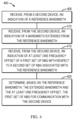
- FIG. 4 illustrates a flowchart of an example method according to some example embodiments of the present disclosure
- FIG. 5 illustrates example bandwidth extending according to some example embodiments of the present disclosure
- FIG. 6 illustrates example bandwidth extending according to some other example embodiments of the present disclosure
- FIG. 7 illustrates a flowchart of an example method according to some other example embodiments of the present disclosure.
- FIG. 8 illustrates a simplified block diagram of a device that is suitable for implementing example embodiments of the present disclosure.
- terminal device or “user equipment” (UE) refers to any terminal device capable of wireless communications with each other or with the base station.
- the communications may involve transmitting and/or receiving wireless signals using electromagnetic signals, radio waves, infrared signals, and/or other types of signals suitable for conveying information over air.
- the UE may be configured to transmit and/or receive information without direct human interaction. For example, the UE may transmit information to the base station on predetermined schedules, when triggered by an internal or external event, or in response to requests from the network side.
- Examples of the UE include, but are not limited to, smart phones, wireless-enabled tablet computers, laptop-embedded equipment (LEE), laptop-mounted equipment (LME), wireless customer-premises equipment (CPE), sensors, metering devices, personal wearables such as watches, and/or vehicles that are capable of communication.
- LEE laptop-embedded equipment
- LME laptop-mounted equipment
- CPE wireless customer-premises equipment
- sensors metering devices
- personal wearables personal wearables such as watches, and/or vehicles that are capable of communication.
- UE may also correspond to Mobile Termination (MT) part of the integrated access and backhaul (IAB) node (a.k.a. a relay node).
- MT Mobile Termination
- IAB integrated access and backhaul
- the term “network device” refers to a device via which services can be provided to a terminal device in a communication network.
- the network device may comprise a base station.
- the term “base station” refers to a network device via which services can be provided to a terminal device in a communication network.
- the base station may comprise any suitable device via which a terminal device or UE can access the communication network.
- Examples of the base stations include a relay, an access point (AP), a transmission point (TRP), a node B (NodeB or NB), an evolved NodeB (eNodeB or eNB), a New Radio (NR) NodeB (gNB), a Remote Radio Module (RRU), a radio header (RH), a remote radio head (RRH), a low power node such as a femto, a pico, and the like.
- a relay node may correspond to Distributed Unit (DU) part of the IAB node.
- circuitry may refer to one or more or all of the following:
- combinations of hardware circuits and software such as (as applicable): (i) a combination of analog and/or digital hardware circuit(s) with software/firmware and (ii) any portions of hardware processor(s) with software (including digital signal processor(s)), software, and memory(ies) that work together to cause an apparatus, such as a mobile phone or server, to perform various functions) and (c) hardware circuit(s) and or processor(s), such as a microprocessor(s) or a portion of a microprocessor(s), that requires software (e.g., firmware) for operation, but the software may not be present when it is not needed for operation.
- software e.g., firmware
- circuitry also covers an implementation of merely a hardware circuit or processor (or multiple processors) or portion of a hardware circuit or processor and its (or their) accompanying software and/or firmware.
- circuitry also covers, for example and if applicable to the particular claim element, a baseband integrated circuit or processor integrated circuit for a mobile device or a similar integrated circuit in a server, a cellular base station, or other computing or base station.
- first As used herein, the terms “first”, “second” and the like may be used herein to describe various elements, these elements should not be limited by these terms. These terms are only used to distinguish one element from another. For example, a first element could be referred to as a second element, and similarly, a second element could be termed a first element, without departing from the scope of example embodiments. As used herein, the term “and/or” includes any and all combinations of one or more of the listed terms.
- FIGS. 1 ( a ) and 1 ( b ) show example resource allocation for the co-existence of LTE eMTC with NR.
- FIG. 1 ( a ) in a NR carrier 105 , outside an eMTC carrier 110 of 1.4 MHZ, for example, two sets 115 and 120 of additional eMTC PRBs are allocated to eMTC.
- FIG. 1 ( b ) in the NR carrier 105 , the set 120 of additional eMTC PRBs is allocated outside the eMTC carrier 110 .
- the additional PRBs may be allocated on either side or both sides of the eMTC carrier 110 .
- the number of PRBs allocated may be indicated to a UE.
- the additional PRBs can be a part of a newly defined narrowband (NB) or may be seen as a part of a virtual carrier (for example, a virtual 3 MHz eMTC carrier), which can be dynamically assigned.
- NB narrowband
- a virtual carrier for example, a virtual 3 MHz eMTC carrier
- These PRBs may not carry a CRS.
- the CRS can be transmitted on demand, or DMRS-based transmission mode can be used.
- Example embodiments of the present disclosure provide a resource allocation scheme where an extended frequency band (for example, including PRBs) is allocated to a device for communication.
- an extended frequency band for example, including PRBs
- the device in addition to a reference bandwidth with a set of narrowbands (for example, legacy NBs), the device is indicated with a bandwidth extended from the reference bandwidth and a frequency offset of a further set of NB s (for example, extended NBs or E-NBs) with respect to the set of NBs associated with the reference bandwidth.
- the device determines the set of extended bandwidth for communication.
- the communication comprises an eMTC carrier deployed within a NR carrier.
- a legacy LTE system bandwidth (for example, 1.4 MHz) may be broadcasted by a network device such as an eNB, to provide the basic NBs for eMTC usage.
- a frequency offset may be indicated to a terminal device such as UE in a master information block (MIB), system information block (SIB) or Radio Resource Control (RRC) signaling.
- the frequency offset may represent an offset of the lowest E-NB to the lowest basic NB in a frequency domain, where the lowest basic NB is the lowest narrowband in the frequency domain in the legacy LTE system bandwidth.
- the value of the frequency offset may be negative or positive, which depends on the specific E-NB allocation in the frequency domain relative to the lowest basic NB.
- An extended bandwidth for the E-NBs is also indicated to the terminal device, for example, in the SIB or RRC signaling.
- the terminal device uses three parameters, including the frequency offset, the broadcast legacy LTE bandwidth, the extended bandwidth, to determine a frequency-domain location (for example, the exact PRB locations) where the E-NBs are placed.
- the terminal device may report the capability of supporting the additional PRBs usage. Moreover, RRC or other higher-layer signaling informs the terminal device whether the feature of the additional PRBs usage is enabled or disabled.
- the E-NB may be adjacent to the legacy or basic NB and comprise the same number of PRBs (for example, 6 PRBs) as the basic NB. Accordingly, the new additional PRB resource with the unit of 6 PRBs could be freely allocated to be adjacent to the eMTC narrow band.
- the E-NBs and the basic NBs may be re-indexed within the extended bandwidth. With the proposed scheme, the frequency-domain resources may be used more effectively and efficiently, while legacy UE behavior will not be impacted.
- FIG. 2 shows an example environment 200 in which example embodiments of the present disclosure can be implemented.
- the environment 200 which may be a part of a communication network, comprises devices 210 and 220 communicating with each other, which are referred to as a first device 210 and a second device 220 , respectively.
- the first and second devices 210 and 220 may be implemented by any suitable devices in the communication network.
- the first device 210 may be implemented by a terminal device such as a UE
- the second device 220 may be implemented by a network device such as a base station.
- the first and second devices 210 and 220 may be both implemented by terminal devices. Only for the purpose of discussion, in some example embodiments, the terminal device will be taken as an example of the first device 210 , and the network device will be taken as an example of the second device 220 .
- the environment 200 may comprise any suitable number of devices.
- the first device 210 is implemented by a terminal device and the second device 220 is implemented by a network device, the environment 200 may comprise another terminal device to communicate with the second device 220 .
- the communication in the environment 200 may follow any suitable communication standards or protocols, which are already in existence or to be developed in the future, such as Universal Mobile Telecommunications System (UMTS), Long Term Evolution (LTE), LTE-Advanced (LTE-A), the fifth generation (5G) New Radio (NR), Wireless Fidelity (Wi-Fi) and Worldwide Interoperability for Microwave Access (WiMAX) standards, and employs any suitable communication technologies, including, for example, Multiple-Input Multiple-Output (MIMO), Orthogonal Frequency Division Multiplexing (OFDM), time division multiplexing (TDM), frequency division multiplexing (FDM), code division multiplexing (CDM), Bluetooth, ZigBee, machine type communication (MTC), enhanced Machine Type Communication (eMTC), enhanced mobile broadband (eMBB), massive machine type communication (mMTC), ultra-reliable low latency communication (URLLC), Carrier Aggregation (CA), Dual Connection (DC), and New Radio Unlicensed (NR-U) technologies.
- UMTS Universal Mobile Telecommunication
- the first device 210 can use one or more NBs for communication such as eMTC with the second device 220 .
- FIGS. 3 ( a ), 3 ( b ) and 3 ( c ) show NB definitions in different example bandwidths 305 , 310 and 315 for legacy deployments.
- the 1.4 MHz bandwidth 305 as shown in FIG. 3 ( a ) is provided with a NB 320 , labeled as NB 0 .
- the 3 MHz bandwidth 310 as shown in FIG. 3 ( b ) is provided with two NBs 325 and 330 , labeled as NB 0 and NB 1 .
- a narrowband may comprise 6 PRBs. If the number of PRBs in the bandwidth is not equal to an integer multiple of 6 (the number of PRBs in a narrowband), the leftover PRBs outside of the narrowband(s) in the bandwidth are unallocated for eMTC.
- the locations of all the NBs and hence the locations of the unallocated PRBs may be defined in the eMTC specification for all supported LTE system bandwidths. If the system bandwidth comprises an odd number of PRBs, there may be always one unallocated PRB in the middle of the bandwidth, which appears as a frequency gap between contiguous narrowbands. For all system bandwidths larger than 1.4 MHz, there may be an allocated band at either edge of the bandwidth comprising at least one PRB.
- the 3 MHz bandwidth 310 there are three unallocated bands 335 , 340 and 345 which are unused for the communication.
- Each of the unallocated bands 335 , 340 and 345 may comprise one PRB.
- the unallocated band may also comprise any other integral number of PRBs.
- the 5 MHz bandwidth 345 is provided with four NBs 350 , 355 , 360 and 365 (labeled as NB 0 , NB 1 , NB 2 and NB 3 ) and one unallocated band 370 (for example, one PRB).
- Table 1 shows the numbers of NBs in six bandwidths for use in eMTC in LTE, for example.
- one or more extended NBs are allocated to the first device 210 .
- the first device 210 receives three parameters from the second device 220 , including a reference bandwidth, an extended bandwidth and a frequency offset of a set of E-NBs with respect to a set of basic NBs associated with the reference bandwidth. Accordingly, the first device 210 determines determine a frequency-domain location of the E-NBs, for example, the exact PRB locations.
- FIG. 4 shows a flowchart of an example method 400 of bandwidth extending according to some example embodiments of the present disclosure.
- the method 400 can be implemented by the first device 210 as shown in FIG. 2 .
- the method 400 will be described with reference to FIG. 2 .
- the first device 210 receives an indication of a reference bandwidth from the second device 220 .
- the reference bandwidth may be a legacy LTE system bandwidth such as 1.4 MHz, 3 MHz, 5 MHz, 10 MHz, 15 MHz and 20 MHz as shown in Table 1.
- the indication may be broadcast by the second device 220 for example in a physical Broadcast Channel (PBCH).
- PBCH physical Broadcast Channel
- the indication may also be sent by UE specific signaling.
- the first device 210 receives an indication of a bandwidth extended from the reference bandwidth from the second device 220 .
- the indication may be carried in SIB or RRC signaling. Other broadcast or dedicated signaling or messages may be used for transmitting the indication.
- the extended bandwidth may be any suitable bandwidth extended from the reference bandwidth, such as 3 MHz, 5 MHz, 10 MHz, 15 MHz and 20 MHz.
- the second device 220 may broadcast another bandwidth parameter, which could be a cell bandwidth of NR (for example, 100 MHz).
- the first device 210 may indicate its capability of using a larger system bandwidth to the second device 220 .
- the extended bandwidth allocated by the second device 220 may be a cell bandwidth of NR such as 100 MHz.
- the first device 210 receives an indication of at least one frequency offset of a set (referred to as a first set) of NBs (for example, E-NBs) with respect to a further set (referred to as a second set) of NBs (for example, legacy NBs) associated with the reference bandwidth.
- the indication may also be sent using SIB or RRC signaling or any other suitable signaling or messages.
- the second set of NBs may comprise the NBs within any one of different reference bandwidths as shown in FIG. 2 .
- the number of NBs in the second set may be the same as the number for the corresponding bandwidth as shown in Table 1.
- the first set of NBs may comprise any suitable number of NBs depending on the network implementations.
- the number of NBs in the first set may be different for DL and UL communication.
- the at least one frequency offset may comprise a frequency offset of a reference NB (referred to as a first reference NB) in the first set of NBs to a reference NB (referred to as a second reference NB) in the second set of NBs.
- the frequency offset may be indicated by the number of PRBs. Accordingly, the indication of the frequency offset may be implemented by the number of PRBs.
- the first reference NB may be the lowest NB in the first set of NBs in the frequency domain.
- the second reference NB may be the lowest NB in the second set of NBs in the frequency domain.
- the value of the frequency offset can be negative or positive, which may depend on the allocation of the first reference NB relative to the second reference NB in the frequency domain.
- the first set of NBs may comprise contiguous NBs. Accordingly, only one frequency offset may be sufficient to indicate a location of the first set of NBs relative to the second set of NBs.
- the first set of NBs may comprise contiguous NBs. In this case, more than one frequency offsets may be indicated to the first device 210 to specify the locations of the contiguous NBs relative to the second set of NBs.
- the NB in the first set may occupy any suitable size of resources.
- the NB in the first set may occupy a predefined or dynamically configured number of PRBs.
- the number of PRBs may be the same as that in a legacy NB in LTE, such as 6 PRBs.
- the additional PRBs of the first set of NBs are outside of the reference bandwidth.
- the unit of additional PRBs is a single PRB.
- the first set of NBs may be adjacent to the legacy NBs. That is, no unallocated band (or PRB) is inserted between the second set of NBs and the first set of NBs. As such, there is no need to indicate the unallocated band, and therefore the system overhead may be further reduced.
- the first set of NBs may be on either side or both sides of the second NBs. No matter which side the first set of NBs is, there may be no unallocated band or PRB between the first and second sets of NBs.
- only a part of time duration (for example, some subframes) for a NB in the first set carries a cell-specific reference signal (CRS).
- Other subframes may contain a CRS only when there is transmission in a Physical Downlink Shared Channel (PDSCH)/MTC Physical Downlink Control Channel (MPDCCH) to further reduce the reserved resources to improve the resource efficiency.
- PDSCH Physical Downlink Shared Channel
- MPDCCH Physical Downlink Control Channel
- the reference bandwidth may be extended in the case that the first device 210 supports the extending.
- the first device 210 may send an indication of a capability of using the extended bandwidth to the second device 220 .
- the second device 220 will know that the first device 210 supports the bandwidth extending and will allocate the extended bandwidth to the first device 210 .
- the second device 220 may send an indication of enabling the extended bandwidth. In response to this indication, the first device 210 will know that the extended bandwidth is available.
- the second device 220 may also send an indication of disabling the extended bandwidth to the first device 210 when no extended bandwidth is allocated to the first device 210 .
- the first device 210 determines the first set of NBs for communication with the second device 220 . Further, the first device 210 may receive from the second device 220 an indication of a frequency resource allocated from the first set of NBs. The frequency resource may be allocated by the second device 220 or other suitable devices or entities. The first device 210 may use the allocated frequency resource to communicate with the second device 220 .
- the second set of NBs may be used for communication.
- the legacy UEs is not required to know the extended narrowbands and can operate normally, thereby achieving backward compatibility.
- the first device 210 may re-index the first set of NBs and the second set of NBs within the extended bandwidth.
- the re-indexing may be in an order of increasing PRB number.
- FIG. 5 shows example bandwidth extending according to some example embodiments of the present disclosure.
- a 1.4 MHz reference bandwidth 505 is extended to a 3 MHz extended bandwidth 510 and a 5 MHz extended bandwidth 515 .
- the PBCH may be used by the second device 220 to indicate to the first device 210 that an original system bandwidth is 1.4 MHz.
- the first device 210 may be indicated by SIB or RRC signaling that the bandwidth is to be extended to a 3 or 5 MHz channel bandwidth.
- the first set of NBs comprises E-NBs
- the second set of NBs comprises legacy NBs.
- 1.4 MHz system bandwidth including 6 PRBs
- 1.08 MHz can be used for data transmission, other frequency resources are unallocated.
- the unallocated band is not needed for resource extension.
- the indicated frequency offset is ⁇ 1.
- the lowest E-NB 520 is lower than the lowest legacy NB 525 (labeled as NB 0 in the reference bandwidth 505 ) by one NB.
- the two NBs 520 and 525 are re-indexed.
- the E-NB 520 is the starting NB, labeled as NB 0
- the legacy NB 525 is labeled as NB 1 .
- the first device 210 can determine that there are two NBs, including NB 0 and NB 1 , for resource allocation.
- the indicated frequency offset is ⁇ 2.
- the lowest E-NB 530 is lower than the lowest NB 525 (original NB 0 in the reference bandwidth 505 ) by two NBs.
- the first device 210 knows that there are three E-NBs 530 , 535 and 540 for resource allocation.
- the NBs within the 5 MHz extended bandwidth 515 are re-indexed where the lowest E-NB 530 is labeled as NB 0 , other two E-NBs 535 and 540 are labeled as NB 1 and NB 3 , and the legacy NB 525 is labeled as NB 2 .
- the index NB 0 in the 1.4 MHz bandwidth 505 is re-indexed as NB 1 and NB 2 , respectively.
- the re-indexing is based on frequency-domain locations of the E-NBs (for example, the additional PRBs) relative to the legacy NBs of the 1.4 MHz bandwidth 505 .
- the re-indexing is needed if a new NB (or an E-NB) is “below” the original NB 0 (that is, a negative offset to legacy NB 0 ) in the frequency domain. If a new NB is “above”, no re-indexing is needed.
- the “below”/“above” location corresponds to a negative/positive offset.
- FIG. 6 shows example bandwidth extending according to some other example embodiments of the present disclosure.
- the first set of NBs comprises E-NBs
- the second set of NBs comprises legacy NBs.
- a 3 MHz reference bandwidth 605 is extended to a 5 MHz extended bandwidth 610 .
- the 3 MHz reference bandwidth 605 may comprise 15 PRBs
- the 5 MHz extended bandwidth 610 may comprise 25 PRBs.
- the reference bandwidth 605 comprises two NBs 615 and 620 (labeled as NB 0 and NB 1 ) and three unused bands 625 , 630 and 635 .
- the offset is “+2”, and therefore two upper E-NBs 640 and 645 are added, labeled as NB 2 and NB 3 . Since the offset is positive, no re-indexing is needed.
- the E-NBs 640 and 645 are adjacent to the legacy NBs 615 and 620 . Accordingly, the upper edge unallocated band 635 (for example, a PRB) is used by the new NB 640 and is not reserved any more. The unallocated bands 625 and 630 are remaining as shown, which are still not used but counted in the new bandwidth 610 .
- the upper edge unallocated band 635 for example, a PRB
- the first device 210 may first identify the allocated narrowband, which may be the legacy NB or the E-NB. Then, the first device 210 may identify the PRB(s) in the NB or E-NB. The guard PRB (not belonging to a NB) in the reference bandwidth may be kept, if no E-NB is adjacent to that PRB. The unallocated PRB (not belonging to a NB) in the reference bandwidth is removed, if the E-NB is adjacent to that PRB. That is, this PRB is mapping to the E-NB.
- the guard PRB (not belonging to a NB) in the reference bandwidth may be kept, if no E-NB is adjacent to that PRB.
- the unallocated PRB (not belonging to a NB) in the reference bandwidth is removed, if the E-NB is adjacent to that PRB. That is, this PRB is mapping to the E-NB.
- the specific E-NB to be used by the first device 210 depends on network scheduling.
- the total number of available E-NBs is equal to or smaller than the total number of NBs in the extended bandwidth minus the number of legacy NBs in the reference bandwidth.
- the number of bits for the resource block assignment field is ceil(log 2 (floor(N RB UL /6)))+5 for Physical Uplink Shared Channel (PUSCH) scheduling in Control Element (CE) Mode A where the parameter N RB UL represents a LTE system bandwidth in terms of a number of uplink PRBs.
- the parameter N RB UL may represent the extended bandwidth instead.
- the first device 210 may only use the E-NBs for communication.
- the legacy NBs are used by a legacy terminal device to keep the backward compatibility for legacy devices.
- the legacy NBs 615 and 620 (labeled as NB 0 and NB 1 ) can be used by a legacy UE which do not know the E-NBs 640 and 645 (labeled as NB 2 and NB 3 ).
- a legacy UE transmits on PRBs in NB 0 and then in NB 1 .
- the first device 210 may use the E-NBs 640 and 645 for communication.
- the first device 210 may use all the four NBs 615 , 620 , 640 and 645 for communication.
- the first device 210 may use frequency hopping in the communication.
- the hopping pattern may be predefined or configured dynamically. For example, in the example embodiments where only the first set of NB s are allocated, the first device 210 may use only the first set of NBs to hop for UE specific MPDCCH search space and PDSCH/Physical Uplink Shared Channel (PUSCH). In the example embodiments where all the NBs (including the first and second set of NBs) within the extended bandwidth are available, the first device 210 can hop in all the NBs. The first device 210 may also hop only in the second set of NBs. For a certain terminal device (for example, a legacy UE), the frequency hopping may be occur in the second set of NBs (for example, the legacy NBs).
- a part of time duration for a NB in the first set may be used by a legacy device.
- some symbols in an E-NB may be used by a legacy UE.
- the E-NB may comprise PRBs of higher subcarrier spacing (SCS). Accordingly, only a portion of a subframe may be used by NR scheduling, and the remaining portion can be used for LTE-M.
- a few additional bits in DCI may indicate the OFDM symbols applicable for the first device 210 within the E-NB. Other implementations for indicating the available symbols are possible.
- FIG. 7 shows a flowchart of an example method 700 of bandwidth extending according to some other example embodiments of the present disclosure.
- the method 700 can be implemented by the second device 220 as shown in FIG. 2 .
- the method 700 will be described with reference to FIG. 2 .
- the second device 220 sends an indication of a reference bandwidth, to the first device 210 .
- the indication of the reference bandwidth may be broadcast by the second device 220 .
- the second device 220 determines a bandwidth extended from the reference bandwidth and at least one frequency offset of the first set of NBs with respect to the second set of NBs associated with the reference bandwidth.
- the extended bandwidth may comprise a cell bandwidth.
- the first set of NBs may be adjacent to the second set of NBs.
- the first set of NBs may be on either side or both sides of the second set of NBs.
- the at least one frequency offset may comprise a frequency offset of the first reference NB in the first set of NBs with respect to the second reference NB in the second set of NBs.
- the indication of the frequency offset of the first reference narrowband with respect to the second reference narrowband may comprise the number of PRBs.
- the second device 220 sends, to the first device 210 , an indication of the extended bandwidth and an indication of the at least one frequency offset to allow communication with the first device 210 in the first set of narrowbands.
- the indication of the extended bandwidth and/or the frequency offset may be sent by the second device 220 in SIB and/or RRC signaling.
- the second device 220 may allocate a frequency resource from the first set of NBs for the communication with the first device 210 . Then, the second device 220 may send an indication of the allocated frequency resource to the first device 210 . Accordingly, the second device 220 can communicate with the first device 210 in the allocated frequency resource. In some example embodiments, the second device 220 may use the second set of NBs to communicate with other devices such as a legacy device.
- the second device 220 may receive, from the first device 210 , an indication of a capability of using the extended bandwidth.
- the second device 220 may send an indication of enabling the extended bandwidth to the first device 210 .
- the communication is performed using frequency hopping in at least one of the first set of NBs and the second set of NBs.
- FIG. 8 is a simplified block diagram of a device 800 that is suitable for implementing example embodiments of the present disclosure.
- the device 800 can be implemented at or as a part of the first device 210 or the second device 220 as shown in FIG. 2 .
- the device 800 includes a processor 810 , a memory 820 coupled to the processor 810 , a communication module 830 coupled to the processor 810 , and a communication interface (not shown) coupled to the communication module 830 .
- the memory 820 stores at least a program 840 .
- the communication module 830 is for bidirectional communications, for example, via multiple antennas.
- the communication interface may represent any interface that is necessary for communication.
- the program 840 is assumed to include program instructions that, when executed by the associated processor 810 , enable the device 800 to operate in accordance with the example embodiments of the present disclosure, as discussed herein with reference to FIGS. 2 - 7 .
- the example embodiments herein may be implemented by computer software executable by the processor 810 of the device 800 , or by hardware, or by a combination of software and hardware.
- the processor 810 may be configured to implement various example embodiments of the present disclosure.
- the memory 820 may be of any type suitable to the local technical network and may be implemented using any suitable data storage technology, such as a non-transitory computer readable storage medium, semiconductor based memory devices, magnetic memory devices and systems, optical memory devices and systems, fixed memory and removable memory, as non-limiting examples. While only one memory 820 is shown in the device 800 , there may be several physically distinct memory modules in the device 800 .
- the processor 810 may be of any type suitable to the local technical network, and may include one or more of general purpose computers, special purpose computers, microprocessors, digital signal processors (DSPs) and processors based on multicore processor architecture, as non-limiting examples.
- the device 800 may have multiple processors, such as an application specific integrated circuit chip that is slaved in time to a clock which synchronizes the main processor.
- the processor 810 and the communication module 830 may cooperate to implement the method 400 as described above with reference to FIGS. 2 - 6 .
- the processor 810 and the communication module 830 may cooperate to implement the method 700 as described above with reference to FIGS. 2 and 7 . All operations and features as described above with reference to FIGS. 2 - 7 are likewise applicable to the device 800 and have similar effects. For the purpose of simplification, the details will be omitted.
- various example embodiments of the present disclosure may be implemented in hardware or special purpose circuits, software, logic or any combination thereof. Some aspects may be implemented in hardware, while other aspects may be implemented in firmware or software which may be executed by a controller, microprocessor or other computing device. While various aspects of example embodiments of the present disclosure are illustrated and described as block diagrams, flowcharts, or using some other pictorial representations, it is to be understood that the block, apparatus, system, technique or method described herein may be implemented in, as non-limiting examples, hardware, software, firmware, special purpose circuits or logic, general purpose hardware or controller or other computing devices, or some combination thereof.
- the present disclosure also provides at least one computer program product tangibly stored on a non-transitory computer readable storage medium.
- the computer program product includes computer-executable instructions, such as those included in program modules, being executed in a device on a target real or virtual processor, to carry out the methods 400 and 700 as described above with reference to FIGS. 2 - 7 .
- program modules include routines, programs, libraries, objects, classes, components, data structures, or the like that perform particular tasks or implement particular abstract data types.
- the functionality of the program modules may be combined or split between program modules as desired in various example embodiments.
- Machine-executable instructions for program modules may be executed within a local or distributed device. In a distributed device, program modules may be located in both local and remote storage media.
- Program code for carrying out methods of the present disclosure may be written in any combination of one or more programming languages. These program codes may be provided to a processor or controller of a general purpose computer, special purpose computer, or other programmable data processing apparatus, such that the program codes, when executed by the processor or controller, cause the functions/operations specified in the flowcharts and/or block diagrams to be implemented.
- the program code may execute entirely on a machine, partly on the machine, as a stand-alone software package, partly on the machine and partly on a remote machine or entirely on the remote machine or server.
- the computer program codes or related data may be carried by any suitable carrier to enable the device, apparatus or processor to perform various processes and operations as described above.
- Examples of the carrier include a signal, computer readable media.
- the computer readable medium may be a computer readable signal medium or a computer readable storage medium.
- a computer readable medium may include but not limited to an electronic, magnetic, optical, electromagnetic, infrared, or semiconductor system, apparatus, or device, or any suitable combination of the foregoing. More specific examples of the computer readable storage medium would include an electrical connection having one or more wires, a portable computer diskette, a hard disk, a random access memory (RAM), a read-only memory (ROM), an erasable programmable read-only memory (EPROM or Flash memory), an optical fiber, a portable compact disc read-only memory (CD-ROM), Digital Versatile Disc (DVD), an optical storage device, a magnetic storage device, or any suitable combination of the foregoing.
- a first device comprises: at least one processor; and at least one memory including computer program code; the at least one memory and the computer program code configured to, with the at least one processor, cause the first device to: receive, from a second device, an indication of a reference bandwidth; receive, from the second device, an indication of a bandwidth extended from the reference bandwidth; receive, from the second device, an indication of at least one frequency offset of a first set of narrowbands with respect to a second set of narrowbands associated with the reference bandwidth; and determine, based on the reference bandwidth, the extended bandwidth and the at least one frequency offset, the first set of narrowbands for communication with the second device.
- the first device is further caused to: receive, from the second device, an indication of a frequency resource allocated from the first set of narrowbands; and perform the communication with the second device in the allocated frequency resource.
- the first device is further caused to: send, to the second device, an indication of a capability of using the extended bandwidth.
- the first device is further caused to: receive, from the second device, an indication of enabling the extended bandwidth.
- the indication of the reference bandwidth is broadcast by the second device.
- the indication of the extended bandwidth is received from the second device in at least one of a system information block or radio resource control signaling.
- the indication of the at least one frequency offset is received from the second device in at least one of a system information block or radio resource control signaling.
- the first set of narrowbands is adjacent to and on one side or both sides of the second set of narrowbands.
- the at least one frequency offset comprises a frequency offset of a first reference narrowband in the first set of narrowbands with respect to a second reference narrowband in the second set of narrowbands.
- the indication of the frequency offset of the first reference narrowband with respect to the second reference narrowband comprises the number of physical resource blocks.
- the extended bandwidth comprises a cell bandwidth.
- the first device is further caused to: re-index the first set of narrowbands and the second set of narrowbands.
- the first device is further caused to: perform the communication with the second device using frequency hopping in at least one se to the first set of narrowbands and the second set of narrowbands.
- the first device comprises a terminal device
- the second device comprises a network device
- a second device comprises: at least one processor; and at least one memory including computer program code; the at least one memory and the computer program code configured to, with the at least one processor, cause the second device to: send, to a first device, an indication of a reference bandwidth; determine a bandwidth extended from the reference bandwidth and at least one frequency offset of a first set of narrowbands with respect to a second set of narrowbands associated with the reference bandwidth; and send, to the first device, an indication of the extended bandwidth and an indication of the at least one frequency offset to allow communication with the first device in the first set of narrowbands.
- the second device is further caused to: allocate a frequency resource from the first set of narrowbands for the communication; and send, to the first device, an indication of the allocated frequency resource.
- the second device is further caused to: communicate with a further device in the second set of narrowbands.
- the second device is further caused to: receive, from the first device, an indication of a capability of using the extended bandwidth.
- the second device is further caused to: send, to the first device, an indication of enabling the extended bandwidth.
- the indication of the reference bandwidth is broadcast by the second device.
- the indication of the extended bandwidth is sent by the second device in at least one of a system information block or radio resource control signaling.
- the indication of the at least one frequency offset is sent by the second device in at least one of a system information block or radio resource control signaling.
- the first set of narrowbands is adjacent to and on one side or both sides of the second set of narrowbands.
- the at least one frequency offset comprises a frequency offset of a first reference narrowband in the first set of narrowbands with respect to a second reference narrowband in the second set of narrowbands.
- the indication of the frequency offset of the first reference narrowband with respect to the second reference narrowband comprises the number of physical resource blocks.
- the extended bandwidth comprises a cell bandwidth.
- the communication is performed using frequency hopping in at least one set of the first set of narrowbands and the second set of narrowbands.
- the first device comprises a terminal device
- the second device comprises a network device
- a method implemented at a first device comprises: receiving, from a second device, an indication of a reference bandwidth; receiving, from the second device, an indication of a bandwidth extended from the reference bandwidth; receiving, from the second device, an indication of at least one frequency offset of a first set of narrowbands with respect to a second set of narrowbands associated with the reference bandwidth; and determining, based on the reference bandwidth, the extended bandwidth and the at least one frequency offset, the first set of narrowbands for communication with the first device.
- the method further comprises: receiving an indication of a frequency resource allocated from the first set of narrowbands; and performing the communication with the second device in the allocated frequency resource.
- the method further comprises: sending, to the second device, an indication of a capability of using the extended bandwidth.
- the method further comprises: receiving, from the second device, an indication of enabling the extended bandwidth.
- the indication of the reference bandwidth is broadcast by the second device.
- the indication of the extended bandwidth is received from the second device in at least one of a system information block or radio resource control signaling.
- the indication of the at least one frequency offset is received from the second device in at least one of a system information block or radio resource control signaling.
- the first set of narrowbands is adjacent to and on one side or both sides of the second set of narrowbands.
- the at least one frequency offset comprises a frequency offset of a first reference narrowband in the first set of narrowbands with respect to a second reference narrowband in the second set of narrowbands.
- the indication of the frequency offset of the first reference narrowband with respect to the second reference narrowband comprises the number of physical resource blocks.
- the extended bandwidth comprises a cell bandwidth.
- the method further comprises: re-indexing the first set of narrowbands and the second set of narrowbands.
- the method further comprises: performing the communication with the second device using frequency hopping in at least one set of the first set of narrowbands and the second set of narrowbands.
- the first device comprises a terminal device
- the second device comprises a network device
- a method implemented at a second device comprises: sending, to a first device, an indication of a reference bandwidth; determining a bandwidth extended from the reference bandwidth and at least one frequency offset of a first set of narrowbands with respect to a second set of narrowbands associated with the reference bandwidth; and sending, to the first device, an indication of the extended bandwidth and an indication of the at least one frequency offset to allow communication with the first device in the first set of narrowbands.
- the method further comprises: allocating a frequency resource from the first set of narrowbands for the communication; and sending, to the first device, an indication of the allocated frequency resource.
- the method further comprises: communicating with a further device in the second set of narrowbands.
- the method further comprises: receiving, from the first device, an indication of a capability of using the extended bandwidth.
- the method further comprises: sending, to the first device, an indication of enabling the extended bandwidth.
- the indication of the reference bandwidth is broadcast by the second device.
- the indication of the extended bandwidth is sent by the second device in at least one of a system information block or radio resource control signaling.
- the indication of the frequency offset is sent by the second device in at least one of a system information block or radio resource control signaling.
- the first set of narrowbands is adjacent to and on one side or both sides of the second set of narrowbands.
- the at least one frequency offset comprises a frequency offset of a first reference narrowband in the first set of narrowbands with respect to a second reference narrowband in the second set of narrowbands.
- the indication of the frequency offset of the first reference narrowband with respect to the second reference narrowband comprises the number of physical resource blocks.
- the extended bandwidth comprises a cell bandwidth.
- the communication is performed using frequency hopping in at least one set of the first set of narrowbands and the second set of narrowbands.
- the first device comprises a terminal device
- the second device comprises a network device
- an apparatus comprises: means for receiving, from a second device, an indication of a reference bandwidth; means for receiving, from the second device, an indication of a bandwidth extended from the reference bandwidth; means for receiving, from the second device, an indication of at least one frequency offset of a first set of narrowbands with respect to a second set of narrowbands associated with the reference bandwidth; and means for determining, based on the reference bandwidth, the extended bandwidth and the at least one frequency offset, the first set of narrowbands for communication between the second device.
- the apparatus further comprises: means for receiving, from the second device, an indication of a frequency resource allocated from the first set of narrowbands; and performing the communication with the second device in the allocated frequency resource.
- the apparatus further comprises: means for sending, to the second device, an indication of a capability of using the extended bandwidth.
- the apparatus further comprises: means for receiving, from the second device, an indication of enabling the extended bandwidth.
- the indication of the reference bandwidth is broadcast by the second device.
- the indication of the extended bandwidth is received from the second device in at least one of a system information block or radio resource control signaling.
- the indication of the at least one frequency offset is received from the second device in at least one of a system information block or radio resource control signaling.
- the first set of narrowbands is adjacent to and on one side or both sides of the second set of narrowbands.
- the at least one frequency offset comprises a frequency offset of a first reference narrowband in the first set of narrowbands with respect to a second reference narrowband in the second set of narrowbands.
- the indication of the frequency offset of the first reference narrowband with respect to the second reference narrowband comprises the number of physical resource blocks.
- the extended bandwidth comprises a cell bandwidth.
- the apparatus further comprises: means for re-indexing the first set of narrowbands and the second set of narrowbands.
- the apparatus further comprises: means for performing the communication with the second device using frequency hopping in at least one set of the first set of narrowbands and the second set of narrowbands.
- the first device comprises a terminal device
- the second device comprises a network device
- an apparatus comprises: means for sending, to a first device, an indication of a reference bandwidth; means for determining a bandwidth extended from the reference bandwidth and at least one frequency offset of a first set of narrowbands with respect to a second set of narrowbands associated with the reference bandwidth; and means for sending, to the first device, an indication of the extended bandwidth and an indication of the at least one frequency offset to allow communication with the first device in the first set of narrowbands.
- the apparatus further comprises: means for receiving, from the first device, an indication of a capability of using the extended bandwidth.
- the apparatus further comprises: means for sending, to the first device, an indication of enabling the extended bandwidth.
- the indication of the reference bandwidth is broadcast by the second device.
- the indication of the extended bandwidth is sent by the second device in at least one of a system information block or radio resource control signaling.
- the indication of the at least one frequency offset is sent by the second device in at least one of a system information block or radio resource control signaling.
- the first set of narrowbands is adjacent to and on one side or both sides of the second set of narrowbands.
- the at least one frequency offset comprises a frequency offset of a first reference narrowband in the first set of narrowbands with respect to a second reference narrowband in the second set of basic narrowbands.
- the indication of the frequency offset of the first reference narrowband with respect to the second reference narrowband comprises the number of physical resource blocks.
- the extended bandwidth comprises a cell bandwidth.
- the communication is performed using frequency hopping in at least one set of the first set of narrowbands and the second set of narrowbands.
- the first device comprises a terminal device
- the second device comprises a network device
- a computer readable storage medium comprises program instructions stored thereon, the instructions, when executed by a processor of a device, causing the device to perform the method according to some example embodiments of the present disclosure.
Landscapes
- Engineering & Computer Science (AREA)
- Signal Processing (AREA)
- Computer Networks & Wireless Communication (AREA)
- Mobile Radio Communication Systems (AREA)
Abstract
Description
(c) hardware circuit(s) and or processor(s), such as a microprocessor(s) or a portion of a microprocessor(s), that requires software (e.g., firmware) for operation, but the software may not be present when it is not needed for operation.
| Channel Bandwidth (MHz) | |||
| 1.4 | 3 | 5 | 10 | 15 | 20 | |||
| Number of PRBs | 6 | 15 | 25 | 50 | 75 | 100 | ||
| Number of NBs | 1 | 2 | 4 | 8 | 12 | 16 | ||
Claims (54)
Applications Claiming Priority (1)
| Application Number | Priority Date | Filing Date | Title |
|---|---|---|---|
| PCT/CN2019/108988 WO2021056525A1 (en) | 2019-09-29 | 2019-09-29 | Extended bandwidth allocation |
Publications (2)
| Publication Number | Publication Date |
|---|---|
| US20230025011A1 US20230025011A1 (en) | 2023-01-26 |
| US12082159B2 true US12082159B2 (en) | 2024-09-03 |
Family
ID=75164995
Family Applications (1)
| Application Number | Title | Priority Date | Filing Date |
|---|---|---|---|
| US17/764,249 Active 2040-07-31 US12082159B2 (en) | 2019-09-29 | 2019-09-29 | Extended bandwidth allocation |
Country Status (4)
| Country | Link |
|---|---|
| US (1) | US12082159B2 (en) |
| EP (1) | EP4035479B1 (en) |
| CN (1) | CN114503757B (en) |
| WO (1) | WO2021056525A1 (en) |
Families Citing this family (2)
| Publication number | Priority date | Publication date | Assignee | Title |
|---|---|---|---|---|
| CN110831198B (en) * | 2018-08-10 | 2024-02-02 | 华为技术有限公司 | Bandwidth resource switching method, instruction bandwidth resource switching method, terminal and network equipment |
| CN119621644B (en) * | 2025-02-11 | 2025-05-30 | 北京亿安天下科技股份有限公司 | A modular computing and storage integrated server |
Citations (11)
| Publication number | Priority date | Publication date | Assignee | Title |
|---|---|---|---|---|
| US20110125492A1 (en) * | 2009-11-23 | 2011-05-26 | Cambridge Silicon Radio Limited | Speech Intelligibility |
| US20110125491A1 (en) * | 2009-11-23 | 2011-05-26 | Cambridge Silicon Radio Limited | Speech Intelligibility |
| WO2017139540A1 (en) | 2016-02-11 | 2017-08-17 | Qualcomm Incorporated | Multi-prb operation for narrowband systems |
| WO2018031927A1 (en) | 2016-08-12 | 2018-02-15 | Intel IP Corporation | Narrowband definitions, resource allocation, and frequency hopping for user equipment |
| CN107733622A (en) | 2016-08-12 | 2018-02-23 | 中兴通讯股份有限公司 | Resource allocation and the method and device determined |
| US20180077689A1 (en) | 2016-09-15 | 2018-03-15 | Qualcomm Incorporated | Multiple bandwidth operation |
| WO2018085145A1 (en) | 2016-11-02 | 2018-05-11 | Idac Holding, Inc. | Receiver bandwidth adaptation |
| WO2018190620A1 (en) | 2017-04-10 | 2018-10-18 | Samsung Electronics Co., Ltd. | Method and user equipment for access to narrowband internet of things (nb iot) |
| US20180332505A1 (en) | 2017-05-15 | 2018-11-15 | Samsung Electronics Co., Ltd. | Method and apparatus for control resource set configuration and monitoring of downlink control channel in wireless communication system |
| CN109155719A (en) | 2016-03-16 | 2019-01-04 | 瑞典爱立信有限公司 | Method in wireless device, network node and wireless communication system |
| US20200075038A1 (en) * | 2017-03-10 | 2020-03-05 | Samsung Electronics Co., Ltd. | Method and apparatus for improving call quality in noise environment |
Family Cites Families (4)
| Publication number | Priority date | Publication date | Assignee | Title |
|---|---|---|---|---|
| US8542605B2 (en) * | 2009-10-15 | 2013-09-24 | Qualcomm Incorporated | System and method for allocating resources in an extended bandwidth wireless network |
| WO2017108111A1 (en) * | 2015-12-22 | 2017-06-29 | Sony Mobile Communications Inc. | Co-deployment of narrowband and wideband carriers |
| CN109803391A (en) * | 2017-11-17 | 2019-05-24 | 华为技术有限公司 | Communication means and communication device |
| US10880950B2 (en) * | 2018-02-16 | 2020-12-29 | Intel Corporation | Flexible resource allocation for even further enhanced machine type communication (EFEMTC) |
-
2019
- 2019-09-29 EP EP19947254.9A patent/EP4035479B1/en active Active
- 2019-09-29 WO PCT/CN2019/108988 patent/WO2021056525A1/en not_active Ceased
- 2019-09-29 US US17/764,249 patent/US12082159B2/en active Active
- 2019-09-29 CN CN201980100855.2A patent/CN114503757B/en active Active
Patent Citations (14)
| Publication number | Priority date | Publication date | Assignee | Title |
|---|---|---|---|---|
| US20110125491A1 (en) * | 2009-11-23 | 2011-05-26 | Cambridge Silicon Radio Limited | Speech Intelligibility |
| US20110125492A1 (en) * | 2009-11-23 | 2011-05-26 | Cambridge Silicon Radio Limited | Speech Intelligibility |
| WO2017139540A1 (en) | 2016-02-11 | 2017-08-17 | Qualcomm Incorporated | Multi-prb operation for narrowband systems |
| US20170238292A1 (en) | 2016-02-11 | 2017-08-17 | Qualcomm Incorporated | Multi-prb operation for narrowband systems |
| CN109155719A (en) | 2016-03-16 | 2019-01-04 | 瑞典爱立信有限公司 | Method in wireless device, network node and wireless communication system |
| WO2018031927A1 (en) | 2016-08-12 | 2018-02-15 | Intel IP Corporation | Narrowband definitions, resource allocation, and frequency hopping for user equipment |
| CN107733622A (en) | 2016-08-12 | 2018-02-23 | 中兴通讯股份有限公司 | Resource allocation and the method and device determined |
| CN109479280A (en) | 2016-08-12 | 2019-03-15 | 英特尔Ip公司 | Narrowband definition, resource allocation and frequency hopping for user equipment |
| US20180077689A1 (en) | 2016-09-15 | 2018-03-15 | Qualcomm Incorporated | Multiple bandwidth operation |
| WO2018085145A1 (en) | 2016-11-02 | 2018-05-11 | Idac Holding, Inc. | Receiver bandwidth adaptation |
| EP3535917A1 (en) | 2016-11-02 | 2019-09-11 | IDAC Holdings, Inc. | Receiver bandwidth adaptation |
| US20200075038A1 (en) * | 2017-03-10 | 2020-03-05 | Samsung Electronics Co., Ltd. | Method and apparatus for improving call quality in noise environment |
| WO2018190620A1 (en) | 2017-04-10 | 2018-10-18 | Samsung Electronics Co., Ltd. | Method and user equipment for access to narrowband internet of things (nb iot) |
| US20180332505A1 (en) | 2017-05-15 | 2018-11-15 | Samsung Electronics Co., Ltd. | Method and apparatus for control resource set configuration and monitoring of downlink control channel in wireless communication system |
Non-Patent Citations (19)
| Title |
|---|
| "3rd Generation Partnership Project; Technical Specification Group Radio Access Network; Evolved Universal Terrestrial Radio Access (E-UTRA); Multiplexing and channel coding (Release 15)", 3GPP TS 36.212, V15.5.0, Mar. 2019, pp. 1-246. |
| "3rd Generation Partnership Project; Technical Specification Group Radio Access Network; Evolved Universal Terrestrial Radio Access (E-UTRA); User Equipment (UE) radio transmission and reception (Release 16)", 3GPP TS 36.101, V16.0.0, Dec. 2018, 1820 pages. |
| "3rd Generation Partnership Project; Technical Specification Group Radio Access Network; NR; Base Station (BS) radio transmission and reception (Release 15)", 3GPP TS 38.104, V15.4.0, Dec. 2018, pp. 1-208. |
| "3rd Generation Partnership Project; Technical Specification Group Radio Access Network; NR; Physical layer procedures for data (Release 15)", 3GPP TS 38.214, V15.5.0, Mar. 2019, pp. 1-103. |
| "3rd Generation Partnership Project; Technical Specification Group Radio Access Network; NR; User Equipment (UE) radio transmission and reception; Part 1: Range 1 Standalone (Release 15)", 3GPP TS 38.101-1, V15.4.0, Dec. 2018, pp. 1-230. |
| "Coexistence of eMTC with NR", 3GPP TSG RAN WG1 Meeting #95, R1-1812906, Agenda item : 6.2.1.4, Nokia, Nov. 12-16, 2018, 4 pages. |
| "Coexistence of eMTC with NR", 3GPP TSG RAN WG1 Meeting #96, R1-1901956, Agenda item: 6.2.1.4, Nokia, Feb. 25-Mar. 1, 2019, 5 pages. |
| "Coexistence of LTE-MTC with NR", 3GPP TSG RAN WG1 Meeting #95, R1-1812122, Agenda Item: 6.2.1.4, Ericsson, Nov. 12-17, 2018, pp. 1-16. |
| "Coexistence of LTE-MTC with NR", 3GPP TSG RAN WG1 Meeting #95, R1-1812767, Agenda item: 6.2.1.4, ZTE, Nov. 12-16, 2018, 4 pages. |
| "Coexistence of LTE-MTC with NR", 3GPP TSG-RAN WG1 #95, R1-1813041, Agenda Item: 6.2.1.4, Qualcomm Incorporated, Nov. 12-16, 2018, pp. 1-6. |
| "Coexistence of LTE-MTC with NR", 3GPP TSG-RAN WG1 Meeting #96, R1-1901740, Agenda Item: 6.2.1.4, Ericsson, Feb. 25-Mar. 1, 2019, pp. 1-12. |
| "New WID on Rel-16 MTC enhancements for LTE", 3GPP TSG RAN Meeting #80, RP-181450, Agenda Item: 10.1.3, Ericsson, Jun. 11-14, 2018, 4 pages. |
| "Revised WID: Additional MTC enhancements for LTE", 3GPP TSG RAN meeting #82, RP-182891, Agenda Item: 10.4.1, Qualcomm Incorporated, Dec. 10-13, 2018, 4 pages. |
| "Use of LTE control channel region for DL transmission in LTE-MTC", 3GPP TSG-RAN WG1 Meeting #96, R1-1901744, Agenda Item: 6.2.1.8, Ericsson, Feb. 25-Mar. 1, 2019, pp. 1-6. |
| 3GPP TSG RAN WG1 Meeting #88, Athens, Greece Feb. 13-18, 2017, R1-1702660, "Resource Allocation and DCI design for FeMTC", Lenovo, Motorola Mobility, 5 pgs. |
| 3GPP TSG RAN WG1 Meeting #96bis, Xi'an, China, Apr. 8-12, 2019, R1-1904170, "Coexistence of eMTC with NR", Nokia, Nokia Shanghai Bell, 6 pgs. |
| 3GPP TSG RAN WG1 Meeting #96bis, Xi'an, China, Apr. 8-12, 2019, R1-1905535, "Feature lead summary for Coexistence of LTE-MTC with NR", Ericsson, 11 pgs. |
| 3GPP TSG RAN WG1 Meeting #97, Reno, USA, May 13-17, 2019, R1-196508, "Coexistence of NB-IoT with NR", ZTE, 4 pgs. |
| 3GPP TSG-RAN WG1 #96bis, Apr. 8-12, 2019, Xi'an, China, R1-1904520, "Coexistence of LTE-MTC with NR", Qualcomm Incorporated, 7 pgs. |
Also Published As
| Publication number | Publication date |
|---|---|
| EP4035479A1 (en) | 2022-08-03 |
| WO2021056525A1 (en) | 2021-04-01 |
| CN114503757A (en) | 2022-05-13 |
| EP4035479B1 (en) | 2025-09-17 |
| EP4035479A4 (en) | 2023-05-31 |
| CN114503757B (en) | 2025-08-12 |
| US20230025011A1 (en) | 2023-01-26 |
Similar Documents
| Publication | Publication Date | Title |
|---|---|---|
| JP7627673B2 (en) | Method, device, apparatus, and storage medium for indicating and receiving resource location - Patents.com | |
| US20220312356A1 (en) | Small Cell Demodulation Reference Signal and Initial Synchronization | |
| US20220231813A1 (en) | Methods and apparatuses for phase tracking reference signal configuration | |
| US11595175B2 (en) | Methods and apparatuses for transmitting control information | |
| AU2012319821B2 (en) | Wireless communication apparatus, wireless communication method, and wireless communication system | |
| US8824404B2 (en) | Reuse of legacy radio access technology | |
| EP3328110B1 (en) | Method of using spectrum resource of orthogonal frequency division multiplexing system, and corresponding base station | |
| EP3662584A1 (en) | Method and apparatus for reference signal configuration | |
| CN108023666A (en) | The method and apparatus of wireless communication | |
| US20210044402A1 (en) | Methods and apparatuses for phase tracking reference signal configuration | |
| CN107926035B (en) | A first communication device and method thereof for sending one or more control signals to a second communication device | |
| WO2019105255A1 (en) | Method, device and computer readable storage medium for resource allocation on unlicensed spectrum | |
| EP3912384A1 (en) | Scheduling serving cells with signaling message | |
| US12082159B2 (en) | Extended bandwidth allocation | |
| US20200366438A1 (en) | Adaptation Of On/Off Mask For NR With Different Numerologies | |
| KR102736006B1 (en) | Applicability of LTE-M subcarrier puncturing coexisting with NR | |
| WO2014126572A1 (en) | Design for small cell demodulation reference signal and initial synchronization | |
| US12015568B2 (en) | Base station, method, program, and recording medium | |
| WO2024168787A1 (en) | Cross-link interference reference signal generation in a wireless communication system | |
| US20250105980A1 (en) | Method and apparatus for configuring resources for sbfd operation | |
| WO2022151631A1 (en) | Resource allocation for transport block transmission over multiple slots |
Legal Events
| Date | Code | Title | Description |
|---|---|---|---|
| FEPP | Fee payment procedure |
Free format text: ENTITY STATUS SET TO UNDISCOUNTED (ORIGINAL EVENT CODE: BIG.); ENTITY STATUS OF PATENT OWNER: LARGE ENTITY |
|
| STPP | Information on status: patent application and granting procedure in general |
Free format text: DOCKETED NEW CASE - READY FOR EXAMINATION |
|
| STPP | Information on status: patent application and granting procedure in general |
Free format text: NOTICE OF ALLOWANCE MAILED -- APPLICATION RECEIVED IN OFFICE OF PUBLICATIONS |
|
| ZAAA | Notice of allowance and fees due |
Free format text: ORIGINAL CODE: NOA |
|
| ZAAB | Notice of allowance mailed |
Free format text: ORIGINAL CODE: MN/=. |
|
| STPP | Information on status: patent application and granting procedure in general |
Free format text: NOTICE OF ALLOWANCE MAILED -- APPLICATION RECEIVED IN OFFICE OF PUBLICATIONS |
|
| STPP | Information on status: patent application and granting procedure in general |
Free format text: AWAITING TC RESP., ISSUE FEE NOT PAID |
|
| STPP | Information on status: patent application and granting procedure in general |
Free format text: NOTICE OF ALLOWANCE MAILED -- APPLICATION RECEIVED IN OFFICE OF PUBLICATIONS |
|
| STPP | Information on status: patent application and granting procedure in general |
Free format text: DOCKETED NEW CASE - READY FOR EXAMINATION |
|
| AS | Assignment |
Owner name: NOKIA TECHNOLOGIES OY, FINLAND Free format text: ASSIGNMENT OF ASSIGNORS INTEREST;ASSIGNORS:YAO, CHUNHAI;RATASUK, RAPEEPAT;MANGALVEDHE, NITIN;SIGNING DATES FROM 20220331 TO 20220401;REEL/FRAME:067750/0830 Owner name: NOKIA TECHNOLOGIES OY, FINLAND Free format text: ASSIGNMENT OF ASSIGNORS INTEREST;ASSIGNORS:CHIRANJI, MUNEENDER;SELVAGANAPATHY, SRINIVASAN;SIGNING DATES FROM 20220401 TO 20220524;REEL/FRAME:067750/0823 |
|
| ZAAB | Notice of allowance mailed |
Free format text: ORIGINAL CODE: MN/=. |
|
| STPP | Information on status: patent application and granting procedure in general |
Free format text: PUBLICATIONS -- ISSUE FEE PAYMENT RECEIVED |
|
| STPP | Information on status: patent application and granting procedure in general |
Free format text: PUBLICATIONS -- ISSUE FEE PAYMENT VERIFIED |
|
| STCF | Information on status: patent grant |
Free format text: PATENTED CASE |