US12080932B2 - In-vehicle fuel cell system - Google Patents
In-vehicle fuel cell system Download PDFInfo
- Publication number
- US12080932B2 US12080932B2 US18/266,461 US202018266461A US12080932B2 US 12080932 B2 US12080932 B2 US 12080932B2 US 202018266461 A US202018266461 A US 202018266461A US 12080932 B2 US12080932 B2 US 12080932B2
- Authority
- US
- United States
- Prior art keywords
- fuel cell
- auxiliary machine
- vehicle
- cell stack
- fuel
- Prior art date
- Legal status (The legal status is an assumption and is not a legal conclusion. Google has not performed a legal analysis and makes no representation as to the accuracy of the status listed.)
- Active
Links
Images




Classifications
-
- H—ELECTRICITY
- H01—ELECTRIC ELEMENTS
- H01M—PROCESSES OR MEANS, e.g. BATTERIES, FOR THE DIRECT CONVERSION OF CHEMICAL ENERGY INTO ELECTRICAL ENERGY
- H01M8/00—Fuel cells; Manufacture thereof
- H01M8/24—Grouping of fuel cells, e.g. stacking of fuel cells
- H01M8/2404—Processes or apparatus for grouping fuel cells
-
- B—PERFORMING OPERATIONS; TRANSPORTING
- B60—VEHICLES IN GENERAL
- B60K—ARRANGEMENT OR MOUNTING OF PROPULSION UNITS OR OF TRANSMISSIONS IN VEHICLES; ARRANGEMENT OR MOUNTING OF PLURAL DIVERSE PRIME-MOVERS IN VEHICLES; AUXILIARY DRIVES FOR VEHICLES; INSTRUMENTATION OR DASHBOARDS FOR VEHICLES; ARRANGEMENTS IN CONNECTION WITH COOLING, AIR INTAKE, GAS EXHAUST OR FUEL SUPPLY OF PROPULSION UNITS IN VEHICLES
- B60K1/00—Arrangement or mounting of electrical propulsion units
-
- H—ELECTRICITY
- H01—ELECTRIC ELEMENTS
- H01M—PROCESSES OR MEANS, e.g. BATTERIES, FOR THE DIRECT CONVERSION OF CHEMICAL ENERGY INTO ELECTRICAL ENERGY
- H01M8/00—Fuel cells; Manufacture thereof
- H01M8/04—Auxiliary arrangements, e.g. for control of pressure or for circulation of fluids
- H01M8/04007—Auxiliary arrangements, e.g. for control of pressure or for circulation of fluids related to heat exchange
- H01M8/04014—Heat exchange using gaseous fluids; Heat exchange by combustion of reactants
-
- H—ELECTRICITY
- H01—ELECTRIC ELEMENTS
- H01M—PROCESSES OR MEANS, e.g. BATTERIES, FOR THE DIRECT CONVERSION OF CHEMICAL ENERGY INTO ELECTRICAL ENERGY
- H01M8/00—Fuel cells; Manufacture thereof
- H01M8/04—Auxiliary arrangements, e.g. for control of pressure or for circulation of fluids
- H01M8/04007—Auxiliary arrangements, e.g. for control of pressure or for circulation of fluids related to heat exchange
- H01M8/04014—Heat exchange using gaseous fluids; Heat exchange by combustion of reactants
- H01M8/04022—Heating by combustion
-
- H—ELECTRICITY
- H01—ELECTRIC ELEMENTS
- H01M—PROCESSES OR MEANS, e.g. BATTERIES, FOR THE DIRECT CONVERSION OF CHEMICAL ENERGY INTO ELECTRICAL ENERGY
- H01M8/00—Fuel cells; Manufacture thereof
- H01M8/04—Auxiliary arrangements, e.g. for control of pressure or for circulation of fluids
- H01M8/04082—Arrangements for control of reactant parameters, e.g. pressure or concentration
- H01M8/04201—Reactant storage and supply, e.g. means for feeding, pipes
-
- H—ELECTRICITY
- H01—ELECTRIC ELEMENTS
- H01M—PROCESSES OR MEANS, e.g. BATTERIES, FOR THE DIRECT CONVERSION OF CHEMICAL ENERGY INTO ELECTRICAL ENERGY
- H01M8/00—Fuel cells; Manufacture thereof
- H01M8/24—Grouping of fuel cells, e.g. stacking of fuel cells
- H01M8/249—Grouping of fuel cells, e.g. stacking of fuel cells comprising two or more groupings of fuel cells, e.g. modular assemblies
-
- B—PERFORMING OPERATIONS; TRANSPORTING
- B60—VEHICLES IN GENERAL
- B60K—ARRANGEMENT OR MOUNTING OF PROPULSION UNITS OR OF TRANSMISSIONS IN VEHICLES; ARRANGEMENT OR MOUNTING OF PLURAL DIVERSE PRIME-MOVERS IN VEHICLES; AUXILIARY DRIVES FOR VEHICLES; INSTRUMENTATION OR DASHBOARDS FOR VEHICLES; ARRANGEMENTS IN CONNECTION WITH COOLING, AIR INTAKE, GAS EXHAUST OR FUEL SUPPLY OF PROPULSION UNITS IN VEHICLES
- B60K1/00—Arrangement or mounting of electrical propulsion units
- B60K1/04—Arrangement or mounting of electrical propulsion units of the electric storage means for propulsion
-
- B—PERFORMING OPERATIONS; TRANSPORTING
- B60—VEHICLES IN GENERAL
- B60K—ARRANGEMENT OR MOUNTING OF PROPULSION UNITS OR OF TRANSMISSIONS IN VEHICLES; ARRANGEMENT OR MOUNTING OF PLURAL DIVERSE PRIME-MOVERS IN VEHICLES; AUXILIARY DRIVES FOR VEHICLES; INSTRUMENTATION OR DASHBOARDS FOR VEHICLES; ARRANGEMENTS IN CONNECTION WITH COOLING, AIR INTAKE, GAS EXHAUST OR FUEL SUPPLY OF PROPULSION UNITS IN VEHICLES
- B60K1/00—Arrangement or mounting of electrical propulsion units
- B60K1/04—Arrangement or mounting of electrical propulsion units of the electric storage means for propulsion
- B60K2001/0405—Arrangement or mounting of electrical propulsion units of the electric storage means for propulsion characterised by their position
- B60K2001/0438—Arrangement under the floor
-
- B—PERFORMING OPERATIONS; TRANSPORTING
- B60—VEHICLES IN GENERAL
- B60Y—INDEXING SCHEME RELATING TO ASPECTS CROSS-CUTTING VEHICLE TECHNOLOGY
- B60Y2200/00—Type of vehicle
- B60Y2200/90—Vehicles comprising electric prime movers
- B60Y2200/91—Electric vehicles
-
- B—PERFORMING OPERATIONS; TRANSPORTING
- B60—VEHICLES IN GENERAL
- B60Y—INDEXING SCHEME RELATING TO ASPECTS CROSS-CUTTING VEHICLE TECHNOLOGY
- B60Y2400/00—Special features of vehicle units
- B60Y2400/11—Electric energy storages
- B60Y2400/112—Batteries
-
- B—PERFORMING OPERATIONS; TRANSPORTING
- B60—VEHICLES IN GENERAL
- B60Y—INDEXING SCHEME RELATING TO ASPECTS CROSS-CUTTING VEHICLE TECHNOLOGY
- B60Y2400/00—Special features of vehicle units
- B60Y2400/20—Energy converters
- B60Y2400/202—Fuel cells
-
- B—PERFORMING OPERATIONS; TRANSPORTING
- B62—LAND VEHICLES FOR TRAVELLING OTHERWISE THAN ON RAILS
- B62D—MOTOR VEHICLES; TRAILERS
- B62D25/00—Superstructure or monocoque structure sub-units; Parts or details thereof not otherwise provided for
- B62D25/08—Front or rear portions
- B62D25/082—Engine compartments
-
- H—ELECTRICITY
- H01—ELECTRIC ELEMENTS
- H01M—PROCESSES OR MEANS, e.g. BATTERIES, FOR THE DIRECT CONVERSION OF CHEMICAL ENERGY INTO ELECTRICAL ENERGY
- H01M2250/00—Fuel cells for particular applications; Specific features of fuel cell system
- H01M2250/20—Fuel cells in motive systems, e.g. vehicle, ship, plane
-
- Y—GENERAL TAGGING OF NEW TECHNOLOGICAL DEVELOPMENTS; GENERAL TAGGING OF CROSS-SECTIONAL TECHNOLOGIES SPANNING OVER SEVERAL SECTIONS OF THE IPC; TECHNICAL SUBJECTS COVERED BY FORMER USPC CROSS-REFERENCE ART COLLECTIONS [XRACs] AND DIGESTS
- Y02—TECHNOLOGIES OR APPLICATIONS FOR MITIGATION OR ADAPTATION AGAINST CLIMATE CHANGE
- Y02E—REDUCTION OF GREENHOUSE GAS [GHG] EMISSIONS, RELATED TO ENERGY GENERATION, TRANSMISSION OR DISTRIBUTION
- Y02E60/00—Enabling technologies; Technologies with a potential or indirect contribution to GHG emissions mitigation
- Y02E60/30—Hydrogen technology
- Y02E60/50—Fuel cells
-
- Y—GENERAL TAGGING OF NEW TECHNOLOGICAL DEVELOPMENTS; GENERAL TAGGING OF CROSS-SECTIONAL TECHNOLOGIES SPANNING OVER SEVERAL SECTIONS OF THE IPC; TECHNICAL SUBJECTS COVERED BY FORMER USPC CROSS-REFERENCE ART COLLECTIONS [XRACs] AND DIGESTS
- Y02—TECHNOLOGIES OR APPLICATIONS FOR MITIGATION OR ADAPTATION AGAINST CLIMATE CHANGE
- Y02T—CLIMATE CHANGE MITIGATION TECHNOLOGIES RELATED TO TRANSPORTATION
- Y02T90/00—Enabling technologies or technologies with a potential or indirect contribution to GHG emissions mitigation
- Y02T90/40—Application of hydrogen technology to transportation, e.g. using fuel cells
Definitions
- the present invention relates to an in-vehicle fuel cell system.
- JP 2012-221630 A discloses a fuel cell system in which a plurality of fuel cell stacks are stacked on a structure including a heat exchanger, a reformer, a combustor, and the like.
- JP 2012-221630 A when the fuel cell system disclosed in JP 2012-221630 A is mounted on a vehicle, the structure is fixed to the vehicle, but a height of the structure in a lowermost portion of the fuel cell system is different from that of a vehicle skeleton, and thus it is necessary to increase a size of a bracket for attaching the structure to the vehicle skeleton, and a weight increases accordingly. Since the lowermost portion of the fuel cell system is fixed by the large bracket, an amplitude of swing of the fuel cell system and the bracket increases during operation, and there is a concern that vibration damping performance and steering stability of the vehicle may be impaired.
- an object of the invention is to provide an in-vehicle fuel cell system that suppresses an increase in weight of a vehicle and suppresses a decrease in vibration damping performance and steering stability of the vehicle.
- An in-vehicle fuel cell system is an in-vehicle fuel cell system including a fuel cell, and an auxiliary machine configured to exchange a gas with the fuel cell, the in-vehicle fuel system including an auxiliary machine structure configured to accommodate the auxiliary machine, wherein the fuel cell includes a first fuel cell fixed to an upper surface of the auxiliary machine structure and a second fuel cell fixed to a lower surface of the auxiliary machine structure, the auxiliary machine structure is disposed at substantially the same position in a height direction as a skeleton member of a vehicle body, and the first fuel cell and the second fuel cell are fixed to the skeleton member via the auxiliary machine structure.
- FIG. 1 is a perspective view illustrating an example in which an in-vehicle fuel cell system according to the present embodiment is mounted on a vehicle front side.
- FIG. 2 is a side view illustrating the example in which the in-vehicle fuel cell system according to the present embodiment is mounted on the vehicle front side.
- FIG. 3 is a side view illustrating pipes attached to the in-vehicle fuel cell system according to the present embodiment.
- FIG. 4 is a partially enlarged view of FIG. 3 .
- FIG. 5 is a view from the vehicle front side in a case where an in-vehicle fuel cell system according to a comparative example is mounted on the vehicle front side.
- FIG. 6 is a view from the vehicle front side of the example in which the in-vehicle fuel cell system according to the present embodiment is mounted on the vehicle front side.
- FIG. 7 is a diagram illustrating a basic configuration of the in-vehicle fuel cell system according to the present embodiment.
- FIG. 8 is a perspective view illustrating fuel cell stacks and an auxiliary machine structure, which are components of the in-vehicle fuel cell system according to the present embodiment.
- FIG. 9 is an exploded perspective view illustrating the fuel cell stacks and the auxiliary machine structure, which are components of the in-vehicle fuel cell system according to the present embodiment.
- FIG. 10 is a plan view illustrating the auxiliary machine structure constituting the in-vehicle fuel cell system according to the present embodiment.
- FIG. 11 is a front view illustrating the in-vehicle fuel cell system according to the present embodiment.
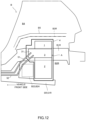
- FIG. 12 is a diagram illustrating a first modification in which the in-vehicle fuel cell system according to the present embodiment is mounted on a vehicle rear side.
- FIG. 13 is a view from the vehicle rear side in a case where the in-vehicle fuel cell system according to the comparative example is mounted on the vehicle rear side.
- FIG. 14 is a view from the vehicle rear side of the first modification in which the in-vehicle fuel cell system according to the present embodiment is mounted on the vehicle rear side.
- FIG. 15 is a diagram illustrating a second modification in which the in-vehicle fuel cell system according to the present embodiment is mounted on the vehicle rear side.
- FIG. 1 is a perspective view illustrating an example in which an in-vehicle fuel cell system according to the present embodiment is mounted on a vehicle front side.
- FIG. 2 is a side view illustrating the example in which the in-vehicle fuel cell system according to the present embodiment is mounted on the vehicle front side.
- a first fuel cell stack 1 and a second fuel cell stack 2 which will be described later, are not illustrated.
- the in-vehicle fuel cell system (hereinafter, referred to as a “fuel cell system”) according to the present embodiment is mounted on an electric vehicle that travels by a drive motor 73 (see FIG. 7 ).
- the electric vehicle includes a vehicle body B that is formed with a prime mover chamber (a front prime mover chamber B 2 F (see FIG. 3 ) or a rear prime mover chamber B 2 R (see FIG. 12 )), a cabin B 4 (see FIG. 12 ), and the like, and a front suspension device SF (see FIG. 3 ) and a rear suspension device SR (see FIG. 12 ) that support the vehicle body B using a restoring force.
- a prime mover chamber a front prime mover chamber B 2 F (see FIG. 3 ) or a rear prime mover chamber B 2 R (see FIG. 12 )
- a cabin B 4 see FIG. 12
- a front suspension device SF see FIG. 3
- a rear suspension device SR see FIG. 12
- an FF vehicle an FR vehicle
- an RR vehicle an RR vehicle to be described later is applied.
- the front prime mover chamber B 2 F is disposed on a front side of the vehicle body B.
- Side members B 1 F skeleton members
- a space occupying a position higher than the side member B 1 F is defined as a first internal space
- a space occupying a position lower than the side member B 1 F is defined as a second internal space.
- the front suspension device SF has a structure in which a wheel (not illustrated), a spring (not illustrated) that supports the vehicle body B via an arm (not illustrated) (or a link (not illustrated)) to which a knuckle (not illustrated) that holds the wheel and enables steering is attached, and a shock absorber (not illustrated) that absorbs vibration from a road surface are attached to a sub-frame 51 F (a structural skeleton) on which a drive device B 23 (the drive motor 73 (see FIG. 7 ), and a transaxle device (not illustrated)), and a steering device B 24 are mounted.
- the rear suspension device SR see FIG.
- a wheel (not illustrated), a spring (not illustrated) that supports the vehicle body B via an arm (not illustrated) (or a link (not illustrated)) to which a hub (not illustrated) that holds the wheel is attached, and a shock absorber (not illustrated) that absorbs vibration from a road surface are attached to a sub-frame S 1 R (see FIG. 12 ).
- the front suspension device SF has a structure in which a wheel (not illustrated), a spring (not illustrated) that supports the vehicle body B via an arm (not illustrated) (or a link (not illustrated)) to which a knuckle (not illustrated) that holds the wheel and enables steering is attached, and a shock absorber (not illustrated) that absorbs vibration from a road surface are attached to the sub-frame 51 F on which the drive device B 23 (the drive motor 73 (see FIG. 7 )) and the steering device B 24 (not illustrated) are mounted.
- the rear suspension device SR (see FIG.
- a wheel (not illustrated), a spring (not illustrated) that supports the vehicle body B via an arm (not illustrated) (or a link (not illustrated)) to which a hub (not illustrated) that holds the wheel is attached, and a shock absorber (not illustrated) that absorbs vibration from a road surface are attached to the sub-frame S 1 R on which a transaxle device (not illustrated) is mounted, and a driving force from the drive motor 73 (see FIG. 7 ) is transmitted to the transaxle device (not illustrated) via a propeller shaft (not illustrated).
- a configuration in which the drive motor 73 and the transaxle device (not illustrated) are integrated and attached to the rear suspension device SR, and thus the propeller shaft (not illustrated) is omitted can also be applied.
- a cooling device B 21 such as a radiator is disposed on the vehicle front side of the front prime mover chamber B 2 F.
- An outfitting component B 22 is disposed on a vehicle rear side in the first internal space of the front prime mover chamber B 2 F.
- an air box a built-in wiper system
- braking system components a master cylinder, a booster, a hydraulic pump, an ABS/VDC ACTR, and the like
- air conditioning system components a heater hose, and an A/C TUBE
- the drive device B 23 the drive motor 73 (see FIG. 7 ), and the transaxle device), and the steering device B 24 are disposed on the vehicle rear side in the second internal space of the front prime mover chamber B 2 F.
- An in-vehicle battery 72 (see FIG. 7 ) is disposed at a lower central portion of the vehicle.
- the drive motor 73 In the electric vehicle, during traveling, the drive motor 73 (see FIG. 7 ) is driven by supplying electric power from the in-vehicle battery 72 (see FIG. 7 ) to the drive motor 73 via an inverter (not illustrated), and during decelerating, regenerative electric power generated by the drive motor 73 is supplied to the in-vehicle battery 72 via the inverter (not illustrated) to charge the in-vehicle battery 72 .
- the fuel cell system When an SOC (a charge amount) of the in-vehicle battery 72 reaches a predetermined lower limit value, the fuel cell system is started, and fuel cell stacks (the first fuel cell stack 1 , and the second fuel cell stack 2 ) are caused to generate electric power to charge the in-vehicle battery 72 .
- Electric power of auxiliary machines (a compressor 64 (see FIG. 7 ) and the like) constituting the fuel cell system is supplied from the in-vehicle battery 72 or an auxiliary machine battery (not illustrated).
- the auxiliary machine battery (not illustrated) is supplied with electric power from the fuel cell stacks.
- the fuel cell system according to the present embodiment is disposed at a position between the cooling device B 21 and the outfitting component B 22 (and the drive device B 23 , and the steering device B 24 ) in the front prime mover chamber B 2 F.
- the fuel cell system includes a stacked structure A in which the first fuel cell stack 1 (a first fuel cell) and the second fuel cell stack 2 (a second fuel cell) are attached to an auxiliary machine structure 3 (a manifold) which is a housing including auxiliary machines (a heat exchanger 65 , a combustor 67 , and the like) of the fuel cell stack, and the second fuel cell stack 2 , the auxiliary machine structure 3 , and the first fuel cell stack 1 are stacked in order from the bottom.
- the stacked structure A is accommodated in a case 4 , and the case 4 is attached to the side member B 1 F via brackets (a case-side bracket 41 , and a vehicle-side bracket B 6 ) ( FIG. 1 ). Details of the stacked structure A will be described later.
- the case 4 includes a tray-shaped front case 4 F that accommodates the stacked structure A in the vehicle front side and to which the auxiliary machine structure 3 is attached, and a rear case 4 R that accommodates the stacked structure A in the vehicle rear side and is connected to the front case 4 F.
- the front case 4 F and the rear case 4 R are connected to each other with their opening portions aligned with each other, but a part of the opening portion of the rear case 4 R remains open, and pipes connected to the auxiliary machine structure 3 extend from the open portion.
- the case-side bracket 41 extends from a position of the case 4 at substantially the same height as the auxiliary machine structure 3 (the side member B 1 F).
- the vehicle-side bracket B 6 is attached to the side member B 1 F at a position facing the case-side bracket 41 .
- the case-side bracket 41 is screwed to the vehicle-side bracket B 6 , the case 4 including the stacked structure A is fixed to the side member B 1 F.
- the case 4 suppresses a decrease in a temperature of the fuel cell stack by avoiding a traveling wind blowing to the stacked structure A, but may be omitted when an influence of the traveling wind is small.
- the auxiliary machine structure 3 is attached to the side member B 1 F via the vehicle-side bracket B 6 , or the auxiliary machine structure 3 is directly attached to the side member B 1 F. Since the case 4 also has a function of protecting the stacked structure A from curbstones or the like that enter the front prime mover chamber B 2 F (and the rear prime mover chamber B 2 R) from the road surface, it is also preferable to dispose the case 4 in a manner of covering at least a lower portion of the stacked structure A.
- the auxiliary machine structure 3 is disposed at substantially the same height as the side member B 1 F.
- the first fuel cell stack 1 is disposed in the first internal space
- the second fuel cell stack 2 is disposed in the second internal space.
- a distance in a height direction between the side member B 1 F and a hood B 25 (a bonnet) that covers the front prime mover chamber B 2 F from above is longer than a distance in the height direction between the side member B 1 F and the sub-frame 51 F (a height of the second internal space).
- a dimension of the first fuel cell stack 1 in the height direction is set to be larger than a dimension of the second fuel cell stack 2 in the height direction.
- An upper end of the first fuel cell stack 1 (including an upper end of the case 4 ) is disposed lower than a virtual plane B 3 F which is set lower than the hood B 25 (the bonnet) by a predetermined distance. Accordingly, a gap for impact reduction can be secured between the hood B 25 and the stacked structure A (including the case 4 ), and thus for example, an impact on human at the time of occurrence of a traffic accident can be reduced, and particularly, a head of a pedestrian can be protected.
- a lower end of the second fuel cell stack 2 (including the case 4 ) is set higher than a lower end of the sub-frame 51 F constituting the front suspension device SF. Accordingly, a direct hit caused by an on-road obstacle such as a curbstone or a rut can be avoided.
- the sub-frame 51 F is one of strongest components among vehicle body system components. Therefore, when the sub-frame 51 F is damaged, the traveling is influenced, and thus an abnormality of the front suspension device SF (or the rear suspension device SR) can be easily detected, and the damage of the case 4 can be easily estimated at that time.
- an end portion (a side surface) of the stacked structure A (the first fuel cell stack 1 , the auxiliary machine structure 3 , and the second fuel cell stack 2 ) on the front side of the electric vehicle is formed at substantially the same plane. Accordingly, the stacked structure A (including the case 4 ) can be disposed close to the cooling device B 21 , and a space behind the stacked structure A (including the case 4 ) can be expanded accordingly.
- FIG. 3 is a side view illustrating pipes attached to the in-vehicle fuel cell system according to the present embodiment.
- FIG. 4 is a partially enlarged view of FIG. 3 .
- a part of the auxiliary machine structure 3 is formed as a protruding portion 31 that protrudes rearward relative to the first fuel cell stack 1 and the second fuel cell stack 2 .
- At least one of pipes (a fuel supply pipe 51 , an air supply pipe 52 , and an off-gas exhaust pipe 53 ) for supplying fuel (an anode gas) and air (a cathode gas) to the first fuel cell stack 1 and the second fuel cell stack 2 is attached to the protruding portion 31 of the auxiliary machine structure 3 .
- the fuel supply pipe 51 supplies fuel supplied from a fuel tank 61 (see FIG. 7 ) to the auxiliary machine structure 3 .
- the air supply pipe 52 supplies air supplied from the compressor 64 (see FIG. 7 ) to the auxiliary machine structure 3 .
- the off-gas exhaust pipe 53 discharges an off-gas (a combustion gas) discharged from the auxiliary machine structure 3 to the outside.
- the combustor 67 and the heat exchanger 65 can be disposed directly below the first fuel cell stack 1 and directly above the second fuel cell stack 2 . Therefore, the off-gas (a fuel off-gas, and an air off-gas) discharged from the fuel cell stack can be supplied to the combustor 67 in a shortest distance, and air heated by the heat exchanger 65 can be supplied to the fuel cell stack in a shortest distance. Heat generated by the combustor 67 (the heat exchanger 65 ) is easily transferred to the fuel cell stack, and a thermal efficiency is improved.
- the heat exchanger 65 may be disposed adjacent to the combustor 67 as illustrated in FIGS. 3 and 4 , or may be disposed inside the combustor 67 as illustrated in FIG. 7 and the like.
- the fuel tank 61 , the compressor 64 , the auxiliary machine battery, and the like constituting the fuel cell system can be disposed at positions adjacent to the case 4 in the width direction of the electric vehicle (positions on a right side relative to the case 4 in FIG. 6 ) in the front prime mover chamber B 2 F.
- FIG. 5 is a view from the vehicle front side in a case where an in-vehicle fuel cell system according to a comparative example is mounted on the vehicle front side.
- FIG. 6 is a view from the vehicle front side in the example in which the in-vehicle fuel cell system according to the present embodiment is mounted on the vehicle front side.
- the fuel cell system according to the comparative example illustrated in FIG. 5 has the same configuration as that according to JP 2012-221630 A described above, and includes a stacked structure AA in which a second fuel cell stack 2 A and a first fuel cell stack 1 A are disposed in order on an auxiliary machine structure 3 A including a combustor, a heat exchanger, a reformer, and the like.
- the stacked structure AA is fixed to the side member B 1 F by using, for example, a bracket B 6 A as in the invention.
- the auxiliary machine structure 3 A that can be connected to the bracket B 6 A is a lowermost portion of the stacked structure AA, and thus the auxiliary machine structure 3 A is disposed at a position lower than the side member B 1 F. Therefore, a size of the bracket B 6 A for attaching the auxiliary machine structure 3 A to the side member B 1 F increases, and a weight increases accordingly.
- a length of a component extending in a vertical direction of the bracket B 6 A and a distance between the first fuel cell stack 1 A and a portion fixed by the bracket B 6 A (the auxiliary machine structure 3 A) in the stacked structure AA increase. Therefore, an amplitude of swing of the stacked structure AA and the bracket B 6 A increases during operation, and there is a concern that vibration damping performance and steering stability of the vehicle may be impaired.
- the auxiliary machine structure 3 constituting the stacked structure A according to the present embodiment illustrated in FIG. 6 is disposed at substantially the same height as the side member B 1 F. Therefore, a center of gravity of the stacked structure A is at substantially the same height as the side member B 1 F, and the brackets (the case-side bracket 41 , and the vehicle-side bracket B 6 ) can be connected to the stacked structure A at a position at a height position of the center of gravity of the stacked structure A (including the case 4 ).
- brackets (the case-side bracket 41 , and the vehicle-side bracket B 6 ) can be reduced, and the center of gravity of the stacked structure A is close to the brackets (the case-side bracket 41 , and the vehicle-side bracket B 6 ), and thus it is possible to suppress an amplitude of swing of the stacked structure A and the brackets (the case-side bracket 41 , and the vehicle-side bracket B 6 ) during operation, and to improve vibration damping performance and steering stability of the vehicle.
- the stacked structure AA according to the comparative example height dimensions (the number of stacked fuel cells) of the first fuel cell stack 1 A and the second fuel cell stack 2 A are the same. Therefore, in the stacked structure AA according to the comparative example, if a configuration in which the auxiliary machine structure 3 A is sandwiched between the first fuel cell stack 1 A and the second fuel cell stack 2 A is constructed, and the stacked structure AA is mounted on the front prime mover chamber B 2 F in a manner that the auxiliary machine structure 3 A is fixed to the side member B 1 F via the bracket, a problem in arrangement such as the second fuel cell stack 2 A being lower than a lower end of the sub-frame S 1 F or the first fuel cell stack 1 A coming into contact with the hood B 25 occurs.
- the number of stacks in the first fuel cell stack 1 can be set according to an interval between the side member B 1 F and the virtual plane B 3 F
- the number of stacks in the second fuel cell stack 2 can be set according to an interval between the side member B 1 F and the lower end of the sub-frame S 1 F. Therefore, the stacked structure A (including the case 4 ) can be mounted on the front prime mover chamber B 2 F without exceeding the virtual plane B 3 F and without protruding from the lower end of the sub-frame S 1 F. Therefore, the stacked structure A (including the case 4 ) can be mounted on the front prime mover chamber B 2 F in an optimal state without changing a design of the electric vehicle, and an output of the fuel cell stack can be optimized.
- FIG. 7 is a diagram illustrating a basic configuration of the in-vehicle fuel cell system according to the present embodiment.
- the fuel cell system according to the present embodiment has a configuration in which the auxiliary machine structure 3 is disposed between the first fuel cell stack 1 and the second fuel cell stack 2 .
- the combustor 67 , the heat exchanger 65 disposed inside the combustor 67 , and a valve 66 are accommodated in the auxiliary machine structure 3 .
- the auxiliary machine structure 3 includes fuel flow paths 32 A each connected to the fuel supply pipe 51 and connecting the fuel supply pipe 51 and an anode inlet of the first fuel cell stack 1 , fuel flow paths 32 B each connecting an anode outlet of the first fuel cell stack 1 and an anode inlet of the second fuel cell stack 2 , a fuel flow path 32 C connecting an anode outlet of the second fuel cell stack 2 and a fuel inlet of the combustor 67 , and a fuel flow path 32 D communicating with a second injector 63 B and connected to the fuel inlet of the combustor 67 .
- the auxiliary machine structure 3 includes an air flow path 33 A connected to the air supply pipe 52 and connecting the air supply pipe 52 and an inlet of the heat exchanger 65 , an air flow path 33 B connecting an outlet of the heat exchanger 65 and a cathode inlet of the second fuel cell stack 2 , an air flow path 33 C connecting a cathode outlet of the second fuel cell stack 2 and a cathode inlet of the first fuel cell stack 1 , an air flow path 33 D connecting a cathode outlet of the first fuel cell stack 1 and an air inlet of the combustor 67 , an air flow path 33 E branching from a middle of the air flow path 33 B and connected to an inlet of the valve 66 , and an air flow path 33 F connecting an outlet of the valve 66 and the fuel flow path 32 A.
- the auxiliary machine structure 3 includes an off-gas flow path 34 connected to the off-gas exhaust pipe 53 and connecting an outlet of the combustor 67 and the off-gas exhaust pipe 53 .
- the fuel cell system includes a fuel supply system that supplies fuel (the anode gas) to anodes of the first fuel cell stack 1 and the second fuel cell stack 2 , respectively, an air supply system that supplies air (the cathode gas) to cathodes of the first fuel cell stack 1 and the second fuel cell stack 2 , a gas combustion system that mixes and combusts the fuel off-gas discharged from the first fuel cell stack 1 and the air off-gas discharged from the second fuel cell stack 2 , and an electric power supply system that causes the first fuel cell stack 1 and the second fuel cell stack 2 to generate electric power and supplies an extraction current to the in-vehicle battery 72 .
- the fuel cell system includes a controller 8 that integrally controls the fuel supply system, the air supply system, the gas combustion system, and the electric power supply system.
- the auxiliary machine structure 3 is disposed between the first fuel cell stack 1 and the second fuel cell stack 2 , and accommodates a part of the fuel supply system, the air supply system, and the gas combustion system.
- the fuel supply system includes the fuel tank 61 (TANK), a pump 62 (PUMP), and a first injector 63 A (INJ 1 ).
- the pump 62 pressurizes fuel stored in the fuel tank 61 and supplies the pressurized fuel to the first injector 63 A, and the first injector 63 A supplies the fuel pressurized by the pump 62 to the anode of the first fuel cell stack 1 .
- the anode of the first fuel cell stack 1 and the anode of the second fuel cell stack 2 are connected in series by the fuel flow path 32 B, and are connected in a manner that the anode of the first fuel cell stack 1 is on an upstream side.
- the air supply system includes the compressor 64 (COMP), the heat exchanger 65 (HEX), and the valve 66 .
- the compressor 64 introduces outside air and supplies the outside air to the heat exchanger 65 , and the air heated by the heat exchanger 65 is supplied to the cathode of the second fuel cell stack 2 .
- the cathode of the first fuel cell stack 1 and the cathode of the second fuel cell stack 2 are connected in series by the air flow path 33 C, and are connected in a manner that the cathode of the second fuel cell stack 2 is on an upstream side.
- the valve 66 branches from the air flow path 33 B and supplies air (oxygen) heated by the heat exchanger 65 to the anode of the first fuel cell stack 1 through the fuel flow path 32 A at a predetermined flow rate.
- the gas combustion system includes the combustor 67 (CMB) and the second injector 63 B (INJ 2 ).
- the second injector 63 B (INJ 2 ) is connected in parallel with the first injector 63 A (INJ 1 ) with respect to the pump 62 , and supplies fuel to the combustor 67 .
- the combustor 67 mixes fuel supplied from the second injector 63 B (INJ 2 ) and air (oxygen) supplied from the cathode of the second fuel cell stack 2 during the starting of the fuel cell system to generate a combustion gas, and heats the heat exchanger 65 (and the first fuel cell stack 1 and the second fuel cell stack 2 ) by the combustion gas.
- the combustor 67 mixes the fuel off-gas discharged from the anode of the second fuel cell stack 2 and the air off-gas discharged from the cathode of the first fuel cell stack 1 during generation of electric power by the first fuel cell stack 1 and the second fuel cell stack 2 to generate a combustion gas, and heats the heat exchanger 65 and the like.
- the combustion gas is finally discharged to the outside through the off-gas exhaust pipe 53 .
- the electric power supply system includes a DC/DC converter 71 (CONV) that electrically connects the fuel cell stack to the in-vehicle battery 72 (BATT) (or the auxiliary machine battery) and the drive motor 73 (M).
- CONV DC/DC converter 71
- the fuel cell stack (the first fuel cell stack 1 , and the second fuel cell stack 2 ) is a solid oxide fuel cell (SOFC).
- SOFC solid oxide fuel cell
- a catalyst for steam reforming (and partial oxidation reforming) the fuel is disposed in the first fuel cell stack 1 . Further, air (oxygen) is supplied to the anode of the first fuel cell stack 1 via the valve 66 at a predetermined flow rate, and partial oxidation reforming can be performed on the fuel.
- the controller 8 starts the pump 62 and the second injector 63 B to supply fuel to the combustor 67 , and starts the compressor 64 to supply air (oxygen) to the combustor 67 . Accordingly, the fuel and air (oxygen) are combusted in a mixed state in the combustor 67 to generate a combustion gas, thereby warming up the combustor 67 (the heat exchanger 65 ), the first fuel cell stack 1 , and the second fuel cell stack 2 .
- the controller 8 stops the second injector 63 B, starts the first injector 63 A, and starts the DC/DC converter 71 . Accordingly, the first fuel cell stack 1 and the second fuel cell stack 2 start generating electric power.
- the fuel is subjected to steam reforming (an endothermic reaction) via the catalyst to be reformed into fuel containing hydrogen, and this fuel is used for electric power generation in the first fuel cell stack 1 and the second fuel cell stack 2 .
- the controller 8 controls the valve 66 to supply air (oxygen) to the first fuel cell stack 1 , and causes partial oxidation reforming (an exothermic reaction) of the fuel via the catalyst to suppress a decrease in the temperature of the first fuel cell stack 1 .
- the controller 8 stops generation of electric power by the first fuel cell stack 1 and the second fuel cell stack 2 by stopping the DC/DC converter 71 . Further, driving of the compressor 64 is continued to decrease the temperature of the fuel cell stack while the pump 62 and the first injector 63 A are stopped. When the temperature of the fuel cell stack is decreased to a predetermined temperature, the controller 8 stops the compressor 64 .
- FIG. 8 is a perspective view illustrating the fuel cell stack 2 and the auxiliary machine structure 3 , which are components of the in-vehicle fuel cell system according to the present embodiment.
- FIG. 9 is an exploded perspective view illustrating the fuel cell stack 2 and the auxiliary machine structure 3 , which are components of the in-vehicle fuel cell system according to the present embodiment.
- FIG. 10 is a plan view illustrating the auxiliary machine structure 3 constituting the in-vehicle fuel cell system according to the present embodiment.
- FIG. 11 is a front view illustrating the in-vehicle fuel cell system according to the present embodiment.
- the fuel cell system according to the present embodiment is the stacked structure A in which the auxiliary machine structure 3 is disposed between the first fuel cell stack 1 and the second fuel cell stack 2 , and the second fuel cell stack 2 , the auxiliary machine structure 3 , and the first fuel cell stack 1 are stacked in this order from the bottom.
- the first fuel cell stack 1 is formed by sandwiching the fuel cells stacked in multiple stages with an end plate 11 as the upper end and an upper surface of the auxiliary machine structure 3 as a lower end, and pressing the fuel cells from a stacking direction with fastening bolts 12 .
- the second fuel cell stack 2 is formed by sandwiching the fuel cells stacked in multiple stages with an end plate 21 as the lower end and a lower surface of the auxiliary machine structure 3 as an upper end, and pressing the fuel cells from the stacking direction with fastening bolts 22 .
- a current collector plate (not illustrated) is disposed on each of a lower surface of the end plate 11 and the upper surface of the auxiliary machine structure 3 .
- the current collector plate (not illustrated) is electrically connected to the fuel cells constituting the first fuel cell stack 1 , but is electrically insulated from the end plate 11 and the auxiliary machine structure 3 . Therefore, an extraction current of the first fuel cell stack 1 can be extracted from the pair of current collector plates (not illustrated).
- a current collector plate (not illustrated) is disposed on each of an upper surface of the end plate 21 and the lower surface of the auxiliary machine structure 3 , and an extraction current of the second fuel cell stack 2 can be extracted from the pair of current collector plates (not illustrated).
- FIGS. 9 , 10 , and the like illustrate the combustor 67 disposed in a central portion of the auxiliary machine structure 3 and the heat exchanger 65 disposed inside the combustor 67 .
- FIGS. 9 , 10 , and the like illustrate the fuel flow paths 32 A each introducing fuel from the outside and supplying the fuel to the anode of the first fuel cell stack 1 , the fuel flow paths 32 B each connecting the anode outlet of the first fuel cell stack 1 and the anode inlet of the second fuel cell stack 2 , the air flow path 33 A that supplies air to the heat exchanger 65 , the air flow path 33 C connecting the cathode outlet of the second fuel cell stack 2 and the cathode inlet of the first fuel cell stack 1 , the air flow path 33 D that supplies air (oxygen) exhausted from the cathode of the first fuel cell stack 1 to the combustor 67 , and the off-gas flow path 34 for discharging the combustion gas discharged from the combustor 67 to the outside
- the fuel flow paths 32 B and the air flow path 33 C are disposed at positions close to the front side of the vehicle relative to the combustor 67 (the heat exchanger 65 ) in the auxiliary machine structure 3 .
- the fuel flow paths 32 B connect the anode outlet of the first fuel cell stack 1 and the anode inlet of the second fuel cell stack 2 , and are disposed in a pair, in which one fuel flow path 32 B is disposed on one end side of the auxiliary machine structure 3 in the width direction of the electric vehicle, and the other fuel flow path 32 B is disposed on the other end side of the auxiliary machine structure 3 in the width direction of the vehicle.
- the air flow path 33 C connects the cathode outlet of the second fuel cell stack 2 and the cathode inlet of the first fuel cell stack 1 .
- the air flow path 33 C is disposed between the pair of fuel flow paths 32 B, and is widely formed in the width direction of the electric vehicle. As illustrated in FIG. 10 , the air flow path 33 C has substantially the same length as the heat exchanger 65 in the width direction of the electric vehicle, and is disposed in a manner of covering the heat exchanger 65 when viewed from the vehicle front side as illustrated in FIG. 11 .
- a side surface of the auxiliary machine structure 3 on the vehicle front side is a portion where a heat dissipation amount is largest due to the influence of the traveling wind.
- the air flow path 33 C allows the cathode outlet of the second fuel cell stack 2 and the cathode inlet of the first fuel cell stack 1 to communicate with each other at a short distance, the heat dissipation amount therebetween can be suppressed.
- FIG. 12 is a diagram illustrating a first modification in which the in-vehicle fuel cell system according to the present embodiment is mounted on a vehicle rear side.
- An electric vehicle to which the fuel cell system according to the first modification is applied is an RR vehicle, and the fuel cell system according to the first modification is attached to the rear prime mover chamber B 2 R of the electric vehicle.
- Side members B 1 R are disposed on the rear side of a vehicle body in a manner of extending in a front-rear direction of the vehicle and sandwiching the rear prime mover chamber B 2 R in a vehicle width direction.
- the rear prime mover chamber B 2 R and the cabin B 4 are partitioned by a floor plate B 5 .
- a front suspension device (not illustrated) has a structure in which a spring that supports the vehicle body B and a shock absorber that absorbs vibration from a road surface are attached to a sub-frame on which a steering device is mounted.
- the rear suspension device SR has a structure in which a spring (not illustrated) that supports the vehicle body B and a shock absorber (not illustrated) that absorbs vibration from the road surface are attached to the sub-frame S 1 R on which the drive device B 23 (the drive motor 73 , and a transaxle device) is mounted.
- the stacked structure A in which the second fuel cell stack 2 , the auxiliary machine structure 3 , and the first fuel cell stack 1 are stacked in this order is accommodated in the case 4 .
- the auxiliary machine structure 3 is disposed at substantially the same height position as the side member B 1 R, and the case 4 and the side member B 1 R are connected by brackets (the case-side bracket 41 , the vehicle-side bracket B 6 ) at substantially the same height position as the auxiliary machine structure 3 in the case 4 , whereby the case 4 including the stacked structure A is fixed to the side member B 1 R.
- a distance in a height direction between the side member B 1 R and the floor plate B 5 (a dimension of a first internal space in the height direction) is shorter than a distance in the height direction between the side member B 1 R and the sub-frame S 1 R (a dimension of a second internal space in the height direction). Therefore, by making the number of stacked fuel cells in the first fuel cell stack 1 smaller than the number of stacked fuel cells in the second fuel cell stack 2 , the dimension of the first fuel cell stack 1 in the height direction is set smaller than the dimension of the second fuel cell stack 2 in the height direction.
- an upper end of the first fuel cell stack 1 (including an upper end of the case 4 ) is set lower than a virtual plane B 3 R positioned lower by a predetermined distance than the floor plate B 5 positioned above the upper end. Accordingly, the fuel cell system can be mounted without changing a design of the cabin B 4 . Even if the floor plate B 5 receives an impact from the cabin B 4 , damage to the fuel cell system can be avoided because the fuel cell system is separated from the floor plate B 5 by a predetermined distance or more.
- a lower end of the second fuel cell stack 2 (including a lower end of the case 4 ) is set higher than a lower end of the sub-frame S 1 R constituting the rear suspension device SR. Accordingly, a direct hit caused by an on-road obstacle such as a curbstone or a rut can be avoided.
- An end portion (a side surface) of the stacked structure A (the first fuel cell stack 1 , the auxiliary machine structure 3 , and the second fuel cell stack 2 ) on the rear side of the electric vehicle is formed on substantially the same plane, and a part of the auxiliary machine structure 3 is formed as the protruding portion 31 that protrudes forward relative to the first fuel cell stack 1 and the second fuel cell stack 2 in an end portion of the stacked structure A on a vehicle front side.
- the case 4 including the stacked structure A illustrated in FIG. 2 and the like may be mounted on the rear prime mover chamber B 2 R while being reversed in the front-rear direction of the electric vehicle.
- the drive device B 23 (the drive motor 73 (see FIG. 7 ), and the transaxle device) can be disposed in a region surrounded by the protruding portion 31 , the second fuel cell stack 2 (including the case 4 ), and the sub-frame S 1 R, and the inside of the rear prime mover chamber B 2 R can be effectively used.
- At least one of pipes (the fuel supply pipe 51 , and the air supply pipe 52 ) is connected to the protruding portion 31 . Accordingly, in the first modification, the combustor 67 and the heat exchanger 65 can also be disposed directly below the first fuel cell stack 1 and directly above the second fuel cell stack 2 .
- the fuel tank 61 (not illustrated) and the compressor 64 (not illustrated) are disposed in a front prime mover chamber (not illustrated), the fuel tank 61 communicates with the protruding portion 31 (the auxiliary machine structure 3 ) via the fuel supply pipe 51 , and the compressor 64 communicates with the protruding portion 31 (the auxiliary machine structure 3 ) via the air supply pipe 52 .
- the fuel tank 61 and the compressor 64 may be disposed in the rear prime mover chamber B 2 R.
- FIG. 13 is a view of the vehicle rear side in a case where the in-vehicle fuel cell system according to the comparative example is mounted on the vehicle rear side.
- FIG. 14 is a view from the vehicle rear side of the first modification in which the in-vehicle fuel cell system according to the present embodiment is mounted on the vehicle rear side.
- the fuel cell system according to the comparative example illustrated in FIG. 13 includes the stacked structure AA in which the second fuel cell stack 2 A and the first fuel cell stack 1 A are disposed in order on the auxiliary machine structure 3 A including the combustor, the heat exchanger, the reformer, and the like.
- the stacked structure AA is fixed to the side member B 1 R by using, for example, the bracket B 6 A.
- the size of the bracket B 6 A for attaching the stacked structure AA to the side member B 1 R increases, and the weight increases accordingly. Accordingly, there is a concern that vibration damping performance and steering stability of the vehicle may be impaired.
- the auxiliary machine structure 3 constituting the stacked structure A in the first modification of the present embodiment illustrated in FIG. 14 is disposed at substantially the same height as the side member B 1 R. Therefore, for the same reason as described above, the sizes of the brackets (the case-side bracket 41 , and the vehicle-side bracket B 6 ) can be reduced, and since the center of gravity of the stacked structure A is close to the brackets, it is possible to suppress the amplitude of swing of the fuel cell system and the brackets during operation, and to improve vibration damping performance and steering stability of the vehicle.
- FIG. 15 is a diagram illustrating a second modification in which the in-vehicle fuel cell system according to the present embodiment is mounted on the vehicle rear side.
- the floor plate B 5 behind the cabin B 4 of the electric vehicle is set at, for example, substantially the same height as (or lower than) a lower end of a rear window B 7 .
- a distance in a height direction between the side member B 1 R and the floor plate B 5 (a height of a first internal space) is larger than a distance in the height direction between the side member B 1 R and the sub-frame S 1 R (a height of a second internal space). Therefore, by making the number of stacked fuel cells in the first fuel cell stack 1 larger than the number of stacked fuel cells in the second fuel cell stack 2 , a dimension of the first fuel cell stack 1 in the height direction is set larger than a dimension of the second fuel cell stack 2 in the height direction. In this way, the number of stacked fuel cells can be appropriately set according to the dimensions of the first internal space and the second internal space in the height direction. Therefore, the stacked structure A (including the case 4 ) can be mounted on the rear prime mover chamber B 2 R in an optimal state without changing a design of the electric vehicle, and an output of the fuel cell stack can be optimized.
- the in-vehicle fuel cell system includes: a fuel cell (the first fuel cell stack 1 , the second fuel cell stack 2 ); an auxiliary machine (the combustor 67 , the heat exchanger 65 ) configured to exchange a gas with the fuel cell (the first fuel cell stack 1 , the second fuel cell stack 2 ); the in-vehicle fuel cell system includes: the auxiliary machine structure 3 configured to accommodate the auxiliary machine (the combustor 67 , the heat exchanger 65 ), wherein the fuel cell (the first fuel cell stack 1 , the second fuel cell stack 2 ) includes a first fuel cell (the first fuel cell stack 1 ) fixed to an upper surface of the auxiliary machine structure 3 and a second fuel cell (the second fuel cell stack 2 ) fixed to a lower surface of the auxiliary machine structure 3 , the auxiliary machine structure 3 is disposed at substantially the same position in a height direction as a skeleton member (the side member B 1 F, the side member B 1 R) of the vehicle body B, and
- the auxiliary machine structure 3 is disposed at substantially the same height as the skeleton member (the side member B 1 F, the side member B 1 R). Therefore, the center of gravity of the stacked structure A is at substantially the same height as the skeleton member (the side member B 1 F, the side member B 1 R), and the stacked structure A can be attached to the skeleton member (the side member B 1 F, the side member B 1 R) via the brackets (the case-side bracket 41 , the vehicle-side bracket B 6 ) at the height position of the center of gravity of the stacked structure A (including the case 4 ), or the stacked structure A can be directly attached to the skeleton member (the side member B 1 F, the side member B 1 R).
- the sizes of the brackets (the case-side bracket 41 , the vehicle-side bracket B 6 ) can be reduced, and the center of gravity of the stacked structure A is close to the brackets (the case-side bracket 41 , the vehicle-side bracket B 6 ), and thus it is possible to suppress an amplitude of swing of the stacked structure A and the brackets (the case-side bracket 41 , the vehicle-side bracket B 6 ) during operation, and to improve vibration damping performance and steering stability of the vehicle.
- the first fuel cell (the first fuel cell stack 1 ) is disposed in a first internal space occupying a position higher than the skeleton member (the side member B 1 F, the side member B 1 R) in the vehicle body B
- the second fuel cell (the second fuel cell stack 2 ) is disposed in a second internal space occupying a position lower than the skeleton member (the side member B 1 F, the side member B 1 R) in the vehicle body B.
- a height dimension of the first fuel cell is set to be larger than a height dimension of the second fuel cell
- the height dimension of the second fuel cell is set to be larger than the height of the first fuel cell
- the stacked structure A including the case 4 ) including the first fuel cell (the first fuel cell stack 1 ), the auxiliary machine structure 3 , and the second fuel cell (the second fuel cell stack 2 ) can be mounted on the first internal space and the second internal space (the front prime mover chamber B 2 F or the rear prime mover chamber B 2 R) in an optimum state without changing a design of the electric vehicle, and the output of the fuel cell stack (the first fuel cell stack 1 , the second fuel cell stack 2 ) can be optimized.
- a lower surface of the second fuel cell (the second fuel cell stack 2 ) is disposed above a lower surface of a structural skeleton (the sub-frame S 1 F) constituting the front suspension device SF.
- the fuel cell stack (in particular, the second fuel cell stack 2 ) can avoid a direct hit caused by an on-road obstacle such as a curbstone or a rut.
- an upper surface of the first fuel cell (the first fuel cell stack 1 ) is disposed at a position lower than the virtual plane B 3 F set at a position lower than the hood B 25 by a predetermined distance, the hood B 25 covering the front prime mover chamber B 2 F.
- a gap for impact reduction can be secured between the hood B 25 and the stacked structure A (including the case 4 ), and thus for example, an impact on human at the time of occurrence of a traffic accident can be reduced, and particularly, a head of a pedestrian can be protected.
- an end portion of the stacked structure A on the vehicle front side is formed on substantially the same plane, and the protruding portion 31 , which is a part of the auxiliary machine structure 3 and protrudes rearward relative to the first fuel cell (the first fuel cell stack 1 ) and the second fuel cell (the second fuel cell stack 2 ), is formed at an end portion of the stacked structure A on the vehicle rear side.
- the stacked structure A (including the case 4 ) can be disposed close to the cooling device B 21 , and a space behind the stacked structure A (including the case 4 ) can be expanded accordingly.
- the combustor 67 and the heat exchanger 65 can be disposed directly below the first fuel cell stack 1 and directly above the second fuel cell stack 2 . Therefore, the off-gas (the fuel off-gas, the air off-gas) discharged from the fuel cell stack can be supplied to the combustor 67 in a shortest distance, and air heated by the heat exchanger 65 can be supplied to the fuel cell stack in a shortest distance. Heat generated by the combustor 67 (the heat exchanger 65 ) is easily transferred to the fuel cell stack, and a thermal efficiency is improved.
- the pipes (the fuel supply pipe 51 , the air supply pipe 52 , and the off-gas exhaust pipe 53 ) are disposed behind the stacked structure A, and thus a risk of damage to the pipes can be avoided when a frontal collision of the electric vehicle occurs.
- a lower surface of the second fuel cell (the second fuel cell stack 2 ) is disposed above a lower surface of a structural skeleton (the sub-frame S 1 R) constituting the rear suspension device SR.
- the fuel cell stack (in particular, the second fuel cell stack 2 ) can avoid a direct hit caused by an on-road obstacle such as a curbstone or a rut.
- an upper surface of the first fuel cell (the first fuel cell stack 1 ) is disposed at a position lower than the virtual plane B 3 R set at a position lower than the floor plate B 5 at a rear portion of the cabin B 4 by a predetermined distance.
- the in-vehicle fuel cell system can be mounted without or with a minimized change in the design of the cabin B 4 . Even if the floor plate B 5 receives an impact from the cabin B 4 , damage to the in-vehicle fuel cell system can be avoided because the fuel cell system is separated from the floor plate B 5 by a predetermined distance or more.
- an upper surface of the first fuel cell (the first fuel cell stack 1 ) is disposed at a position lower than the virtual plane B 3 R set at a position lower than the floor plate B 5 of the cabin B 4 by a predetermined distance.
- the in-vehicle fuel cell system can be mounted without or with a minimized change in the design of the cabin B 4 .
- the stacked structure A (including the case 4 ) can be mounted on the first internal space and the second internal space (the rear prime mover chamber B 2 R) in an optimum state, and the output of the fuel cell stack (the first fuel cell stack 1 , the second fuel cell stack 2 ) can be optimized.
- an end portion of the stacked structure A on the vehicle rear side is formed on substantially the same plane, and the protruding portion 31 , which is a part of the auxiliary machine structure 3 and protrudes forward relative to the first fuel cell (the first fuel cell stack 1 ) and the second fuel cell (the second fuel cell stack 2 ), is formed at an end portion of the stacked structure A on the vehicle front side.
- the drive device B 23 (the drive motor 73 (see FIG. 7 ), and the transaxle device) can be disposed in a region surrounded by the protruding portion 31 , the second fuel cell (the second fuel cell stack 2 ) (including the case 4 ), and the sub-frame S 1 R, and the inside of the rear prime mover chamber B 2 R can be effectively used.
- the end portion of the auxiliary machine structure 3 on the vehicle rear side on substantially the same plane, it is possible to avoid interference between the end portion of the auxiliary machine structure 3 on the vehicle rear side and a rearmost portion of the rear prime mover chamber B 2 R.
- At least one of the fuel supply pipe 51 configured to supply fuel to the first fuel cell (the first fuel cell stack 1 ) and the second fuel cell (the second fuel cell stack 2 ), and the air supply pipe 52 configured to supply air to the first fuel cell (the first fuel cell stack 1 ) and the second fuel cell (the second fuel cell stack 2 ) is connected to the protruding portion 31 .
- auxiliary machines (the combustor 67 and the heat exchanger 65 ) can be disposed directly below the first fuel cell stack 1 and directly above the second fuel cell stack 2 . Therefore, air heated by the heat exchanger 65 can be supplied to the fuel cell stack in a shortest distance. Heat generated by the combustor 67 (the heat exchanger 65 ) is easily transferred to the fuel cell stack, and a thermal efficiency is improved.
- the auxiliary machine structure 3 includes the air flow path 33 C connecting a cathode of the first fuel cell (the first fuel cell stack 1 ) and a cathode of the second fuel cell (the second fuel cell stack 2 ).
- the auxiliary machine includes the combustor 67 configured to mix and combust a fuel off-gas discharged from the first fuel cell (the first fuel cell stack 1 ) and the second fuel cell (the second fuel cell stack 2 ) and an air off-gas discharged from the first fuel cell (the first fuel cell stack 1 ) and the second fuel cell (the second fuel cell stack 2 ), and the heat exchanger 65 configured to heat, by heat of the combustor 67 , air to be supplied to the first fuel cell (the first fuel cell stack 1 ) and the second fuel cell (the second fuel cell stack 2 ).
- the air flow path 33 C is disposed on the vehicle front side relative to the combustor 67 and the heat exchanger 65 in the auxiliary machine structure 3 .
- the side surface of the auxiliary machine structure 3 on the vehicle front side is a portion where the heat dissipation amount is the largest due to the influence of the traveling wind. Accordingly, by disposing the air flow path 33 C on the side surface of the auxiliary machine structure 3 , which is on the vehicle front side, it is possible to suppress the decrease in the temperature of the heat exchanger 65 (and the combustor 67 ) due to the traveling wind. Since the air flow path 33 C allows the cathode outlet of the second fuel cell stack 2 and the cathode inlet of the first fuel cell stack 1 to communicate with each other at a short distance, the heat dissipation amount therebetween can be suppressed.
- the auxiliary machine structure 3 includes a pair of fuel flow paths 32 B connecting an anode of the first fuel cell (the first fuel cell stack 1 ) and an anode of the second fuel cell (the second fuel cell stack 2 ).
- the pair of fuel flow paths 32 B are disposed on both end sides of the vehicle in a width direction in the auxiliary machine structure 3 .
- the air flow path 33 C is disposed between the pair of fuel flow paths 32 B in the auxiliary machine structure 3 , and is widely disposed in a manner that both ends of the air flow path 33 C in the width direction are adjacent to the fuel flow paths 32 B.
- the air flow path 33 C is formed to be flat as a whole by reducing a dimension in the front-rear direction of the vehicle while maintaining a cross-sectional area (a pressure loss), and a space of the auxiliary machine structure 3 in the front-rear direction of the vehicle can be secured.
- the air flow path 33 C is disposed in a manner of covering the heat exchanger 65 when viewed from the vehicle front side of the auxiliary machine structure 3 .
- the decrease in the temperature of the heat exchanger 65 (and the combustor 67 ) due to the traveling wind can be efficiently suppressed.
Landscapes
- Engineering & Computer Science (AREA)
- Chemical & Material Sciences (AREA)
- Chemical Kinetics & Catalysis (AREA)
- Sustainable Development (AREA)
- Sustainable Energy (AREA)
- Manufacturing & Machinery (AREA)
- Life Sciences & Earth Sciences (AREA)
- Electrochemistry (AREA)
- General Chemical & Material Sciences (AREA)
- Combustion & Propulsion (AREA)
- Fuel Cell (AREA)
- Transportation (AREA)
- Mechanical Engineering (AREA)
- Electric Propulsion And Braking For Vehicles (AREA)
Abstract
Description
Claims (15)
Applications Claiming Priority (1)
| Application Number | Priority Date | Filing Date | Title |
|---|---|---|---|
| PCT/IB2020/001064 WO2022123280A1 (en) | 2020-12-10 | 2020-12-10 | Onboard fuel cell system |
Publications (2)
| Publication Number | Publication Date |
|---|---|
| US20230395838A1 US20230395838A1 (en) | 2023-12-07 |
| US12080932B2 true US12080932B2 (en) | 2024-09-03 |
Family
ID=81973132
Family Applications (1)
| Application Number | Title | Priority Date | Filing Date |
|---|---|---|---|
| US18/266,461 Active US12080932B2 (en) | 2020-12-10 | 2020-12-10 | In-vehicle fuel cell system |
Country Status (5)
| Country | Link |
|---|---|
| US (1) | US12080932B2 (en) |
| EP (1) | EP4261960B1 (en) |
| JP (1) | JP7514954B2 (en) |
| CN (1) | CN116601807A (en) |
| WO (1) | WO2022123280A1 (en) |
Families Citing this family (2)
| Publication number | Priority date | Publication date | Assignee | Title |
|---|---|---|---|---|
| KR20230111933A (en) * | 2022-01-19 | 2023-07-26 | 현대자동차주식회사 | Fuel cell vehicle |
| JP7544087B2 (en) * | 2022-03-02 | 2024-09-03 | トヨタ自動車株式会社 | Support structure for in-vehicle electronic device unit |
Citations (10)
| Publication number | Priority date | Publication date | Assignee | Title |
|---|---|---|---|---|
| JP2002050391A (en) | 2000-08-02 | 2002-02-15 | Honda Motor Co Ltd | Fuel cell system |
| JP2010238567A (en) | 2009-03-31 | 2010-10-21 | Toyota Motor Corp | Fuel cell system |
| JP2010287394A (en) | 2009-06-10 | 2010-12-24 | Honda Motor Co Ltd | Fuel cell system |
| JP2012158312A (en) | 2011-02-03 | 2012-08-23 | Toyota Motor Corp | Vehicle equipment mounting structure |
| JP2012221630A (en) | 2011-04-05 | 2012-11-12 | Honda Motor Co Ltd | Fuel cell system |
| CN106042878A (en) | 2015-04-09 | 2016-10-26 | 丰田自动车株式会社 | Holding mechanism, electric vehicle, front-drive electric vehicle, and rear-drive electric vehicle |
| US20170066479A1 (en) * | 2015-09-04 | 2017-03-09 | Toyota Jidosha Kabushiki Kaisha | Fuel cell vehicle |
| US20170092964A1 (en) * | 2015-09-28 | 2017-03-30 | General Electric Company | Fuel cell module including heat exchanger and method of operating such module |
| US20180048002A1 (en) | 2016-08-11 | 2018-02-15 | General Electric Company | Multi-stack fuel cell systems and heat exchanger assemblies |
| CN110495031A (en) | 2017-04-13 | 2019-11-22 | Avl李斯特有限公司 | Fuel Cell Unit with Stacked Auxiliaries |
Family Cites Families (6)
| Publication number | Priority date | Publication date | Assignee | Title |
|---|---|---|---|---|
| JP2006100076A (en) * | 2004-09-29 | 2006-04-13 | Honda Motor Co Ltd | Fuel cell system |
| CN101297426B (en) * | 2005-10-25 | 2010-08-11 | 日产自动车株式会社 | fuel cell electric vehicle |
| JP5012282B2 (en) * | 2007-07-24 | 2012-08-29 | マツダ株式会社 | Vehicle powertrain arrangement structure |
| WO2013118602A1 (en) * | 2012-02-07 | 2013-08-15 | 本田技研工業株式会社 | Fuel cell vehicle |
| JP6939040B2 (en) * | 2017-04-18 | 2021-09-22 | トヨタ自動車株式会社 | vehicle |
| JP6907913B2 (en) * | 2017-12-08 | 2021-07-21 | トヨタ自動車株式会社 | Fuel cell vehicle |
-
2020
- 2020-12-10 EP EP20964992.0A patent/EP4261960B1/en active Active
- 2020-12-10 JP JP2022567704A patent/JP7514954B2/en active Active
- 2020-12-10 WO PCT/IB2020/001064 patent/WO2022123280A1/en not_active Ceased
- 2020-12-10 CN CN202080107772.9A patent/CN116601807A/en active Pending
- 2020-12-10 US US18/266,461 patent/US12080932B2/en active Active
Patent Citations (15)
| Publication number | Priority date | Publication date | Assignee | Title |
|---|---|---|---|---|
| JP2002050391A (en) | 2000-08-02 | 2002-02-15 | Honda Motor Co Ltd | Fuel cell system |
| JP2010238567A (en) | 2009-03-31 | 2010-10-21 | Toyota Motor Corp | Fuel cell system |
| JP2010287394A (en) | 2009-06-10 | 2010-12-24 | Honda Motor Co Ltd | Fuel cell system |
| JP2012158312A (en) | 2011-02-03 | 2012-08-23 | Toyota Motor Corp | Vehicle equipment mounting structure |
| US20130307330A1 (en) | 2011-02-03 | 2013-11-21 | Aisin Aw Co., Ltd. | Vehicle equipment mounting structure |
| JP2012221630A (en) | 2011-04-05 | 2012-11-12 | Honda Motor Co Ltd | Fuel cell system |
| CN106042878A (en) | 2015-04-09 | 2016-10-26 | 丰田自动车株式会社 | Holding mechanism, electric vehicle, front-drive electric vehicle, and rear-drive electric vehicle |
| US20180099552A1 (en) * | 2015-04-09 | 2018-04-12 | Toyota Jidosha Kabushiki Kaisha | Rear-drive electric vehicle |
| US20170066479A1 (en) * | 2015-09-04 | 2017-03-09 | Toyota Jidosha Kabushiki Kaisha | Fuel cell vehicle |
| JP2017047842A (en) | 2015-09-04 | 2017-03-09 | トヨタ自動車株式会社 | Fuel cell vehicle |
| US20170092964A1 (en) * | 2015-09-28 | 2017-03-30 | General Electric Company | Fuel cell module including heat exchanger and method of operating such module |
| US20180048002A1 (en) | 2016-08-11 | 2018-02-15 | General Electric Company | Multi-stack fuel cell systems and heat exchanger assemblies |
| JP2018041720A (en) | 2016-08-11 | 2018-03-15 | ゼネラル・エレクトリック・カンパニイ | Multi-stack fuel cell systems and heat exchanger assemblies |
| CN110495031A (en) | 2017-04-13 | 2019-11-22 | Avl李斯特有限公司 | Fuel Cell Unit with Stacked Auxiliaries |
| US20200161681A1 (en) | 2017-04-13 | 2020-05-21 | Avl List Gmbh | Fuel cell unit having stacked auxiliary devices |
Also Published As
| Publication number | Publication date |
|---|---|
| WO2022123280A1 (en) | 2022-06-16 |
| EP4261960A4 (en) | 2024-03-06 |
| EP4261960B1 (en) | 2025-01-22 |
| JP7514954B2 (en) | 2024-07-11 |
| JPWO2022123280A1 (en) | 2022-06-16 |
| US20230395838A1 (en) | 2023-12-07 |
| CN116601807A (en) | 2023-08-15 |
| EP4261960A1 (en) | 2023-10-18 |
Similar Documents
| Publication | Publication Date | Title |
|---|---|---|
| JP3932185B2 (en) | Fuel cell mounted electric vehicle and fuel cell system box | |
| US6378637B1 (en) | Fuel-cell-powered electric automobile | |
| JP5093404B2 (en) | Fuel cell vehicle | |
| US11548553B2 (en) | Vehicle underbody structure | |
| KR100597023B1 (en) | Car | |
| EP1932707B1 (en) | Cooling device for on-vehicle machinery | |
| US6223843B1 (en) | Electrochemical propulsion system | |
| US20010049040A1 (en) | Fuel cell system for an electric vehicle | |
| JP2013023206A (en) | Battery mounting structure of electric vehicle | |
| CN102239060A (en) | Power supply device mounting structure | |
| JP2004168101A (en) | Electric vehicle with fuel cell | |
| EP4261960B1 (en) | In-vehicle fuel cell system for mountain in a vehicle | |
| JP2008234870A (en) | Battery mounting structure for vehicle | |
| JP2015157608A (en) | Electric vehicle | |
| CN118618480A (en) | Lower body structure | |
| JP2013220782A (en) | Mounting structure of external power supply inverter of vehicle mounted with power unit | |
| JP2020023301A (en) | Vehicle power unit | |
| CN111332114A (en) | Chassis support for protecting traction battery | |
| JP6690588B2 (en) | Fuel cell vehicle | |
| JP4706250B2 (en) | Vehicle fuel cell system | |
| JP2000149974A (en) | Electric car | |
| JP4192535B2 (en) | Fuel cell vehicle | |
| JP7714917B2 (en) | Automotive fuel cell system | |
| CN112776618B (en) | Power battery components for electric vehicles and electric vehicles | |
| JP6569724B2 (en) | Generator-equipped vehicle |
Legal Events
| Date | Code | Title | Description |
|---|---|---|---|
| AS | Assignment |
Owner name: RENAULT S.A.S., FRANCE Free format text: ASSIGNMENT OF ASSIGNORS INTEREST;ASSIGNORS:ISODA, HIROYUKI;CHIKUGO, HAYATO;USUDA, MASAHIRO;SIGNING DATES FROM 20230509 TO 20230518;REEL/FRAME:063910/0763 Owner name: NISSAN MOTOR CO., LTD., JAPAN Free format text: ASSIGNMENT OF ASSIGNORS INTEREST;ASSIGNORS:ISODA, HIROYUKI;CHIKUGO, HAYATO;USUDA, MASAHIRO;SIGNING DATES FROM 20230509 TO 20230518;REEL/FRAME:063910/0763 |
|
| FEPP | Fee payment procedure |
Free format text: ENTITY STATUS SET TO UNDISCOUNTED (ORIGINAL EVENT CODE: BIG.); ENTITY STATUS OF PATENT OWNER: LARGE ENTITY |
|
| STPP | Information on status: patent application and granting procedure in general |
Free format text: NON FINAL ACTION MAILED |
|
| STPP | Information on status: patent application and granting procedure in general |
Free format text: RESPONSE TO NON-FINAL OFFICE ACTION ENTERED AND FORWARDED TO EXAMINER |
|
| STPP | Information on status: patent application and granting procedure in general |
Free format text: NOTICE OF ALLOWANCE MAILED -- APPLICATION RECEIVED IN OFFICE OF PUBLICATIONS |
|
| AS | Assignment |
Owner name: AMPERE S.A.S., FRANCE Free format text: ASSIGNMENT OF ASSIGNORS INTEREST;ASSIGNOR:RENAULT S.A.S.;REEL/FRAME:067526/0311 Effective date: 20240426 |
|
| STPP | Information on status: patent application and granting procedure in general |
Free format text: WITHDRAW FROM ISSUE AWAITING ACTION |
|
| STPP | Information on status: patent application and granting procedure in general |
Free format text: PUBLICATIONS -- ISSUE FEE PAYMENT VERIFIED |
|
| STCF | Information on status: patent grant |
Free format text: PATENTED CASE |