US12079641B2 - Machine learning based power and performance optimization system and method for graphics processing units - Google Patents
Machine learning based power and performance optimization system and method for graphics processing units Download PDFInfo
- Publication number
- US12079641B2 US12079641B2 US17/879,986 US202217879986A US12079641B2 US 12079641 B2 US12079641 B2 US 12079641B2 US 202217879986 A US202217879986 A US 202217879986A US 12079641 B2 US12079641 B2 US 12079641B2
- Authority
- US
- United States
- Prior art keywords
- gpu
- command
- gpu core
- machine learning
- commands
- Prior art date
- Legal status (The legal status is an assumption and is not a legal conclusion. Google has not performed a legal analysis and makes no representation as to the accuracy of the status listed.)
- Active
Links
Images




Classifications
-
- G—PHYSICS
- G06—COMPUTING OR CALCULATING; COUNTING
- G06F—ELECTRIC DIGITAL DATA PROCESSING
- G06F9/00—Arrangements for program control, e.g. control units
- G06F9/06—Arrangements for program control, e.g. control units using stored programs, i.e. using an internal store of processing equipment to receive or retain programs
- G06F9/44—Arrangements for executing specific programs
- G06F9/448—Execution paradigms, e.g. implementations of programming paradigms
- G06F9/4482—Procedural
-
- G—PHYSICS
- G06—COMPUTING OR CALCULATING; COUNTING
- G06F—ELECTRIC DIGITAL DATA PROCESSING
- G06F1/00—Details not covered by groups G06F3/00 - G06F13/00 and G06F21/00
- G06F1/26—Power supply means, e.g. regulation thereof
- G06F1/32—Means for saving power
- G06F1/3203—Power management, i.e. event-based initiation of a power-saving mode
- G06F1/3234—Power saving characterised by the action undertaken
- G06F1/324—Power saving characterised by the action undertaken by lowering clock frequency
-
- G—PHYSICS
- G06—COMPUTING OR CALCULATING; COUNTING
- G06F—ELECTRIC DIGITAL DATA PROCESSING
- G06F1/00—Details not covered by groups G06F3/00 - G06F13/00 and G06F21/00
- G06F1/26—Power supply means, e.g. regulation thereof
- G06F1/32—Means for saving power
- G06F1/3203—Power management, i.e. event-based initiation of a power-saving mode
- G06F1/3234—Power saving characterised by the action undertaken
- G06F1/3243—Power saving in microcontroller unit
-
- G—PHYSICS
- G06—COMPUTING OR CALCULATING; COUNTING
- G06F—ELECTRIC DIGITAL DATA PROCESSING
- G06F1/00—Details not covered by groups G06F3/00 - G06F13/00 and G06F21/00
- G06F1/26—Power supply means, e.g. regulation thereof
- G06F1/32—Means for saving power
- G06F1/3203—Power management, i.e. event-based initiation of a power-saving mode
- G06F1/3234—Power saving characterised by the action undertaken
- G06F1/3296—Power saving characterised by the action undertaken by lowering the supply or operating voltage
-
- G—PHYSICS
- G06—COMPUTING OR CALCULATING; COUNTING
- G06N—COMPUTING ARRANGEMENTS BASED ON SPECIFIC COMPUTATIONAL MODELS
- G06N20/00—Machine learning
-
- G—PHYSICS
- G06—COMPUTING OR CALCULATING; COUNTING
- G06N—COMPUTING ARRANGEMENTS BASED ON SPECIFIC COMPUTATIONAL MODELS
- G06N3/00—Computing arrangements based on biological models
- G06N3/02—Neural networks
- G06N3/08—Learning methods
-
- G—PHYSICS
- G06—COMPUTING OR CALCULATING; COUNTING
- G06T—IMAGE DATA PROCESSING OR GENERATION, IN GENERAL
- G06T1/00—General purpose image data processing
- G06T1/20—Processor architectures; Processor configuration, e.g. pipelining
-
- G—PHYSICS
- G06—COMPUTING OR CALCULATING; COUNTING
- G06T—IMAGE DATA PROCESSING OR GENERATION, IN GENERAL
- G06T15/00—Three-dimensional [3D] image rendering
- G06T15/005—General purpose rendering architectures
-
- Y—GENERAL TAGGING OF NEW TECHNOLOGICAL DEVELOPMENTS; GENERAL TAGGING OF CROSS-SECTIONAL TECHNOLOGIES SPANNING OVER SEVERAL SECTIONS OF THE IPC; TECHNICAL SUBJECTS COVERED BY FORMER USPC CROSS-REFERENCE ART COLLECTIONS [XRACs] AND DIGESTS
- Y02—TECHNOLOGIES OR APPLICATIONS FOR MITIGATION OR ADAPTATION AGAINST CLIMATE CHANGE
- Y02D—CLIMATE CHANGE MITIGATION TECHNOLOGIES IN INFORMATION AND COMMUNICATION TECHNOLOGIES [ICT], I.E. INFORMATION AND COMMUNICATION TECHNOLOGIES AIMING AT THE REDUCTION OF THEIR OWN ENERGY USE
- Y02D10/00—Energy efficient computing, e.g. low power processors, power management or thermal management
Definitions
- the present inventions relate to processor power management. Particularly, the present inventions relate to optimizing power delivered to graphics processing units (GPUs).
- GPUs graphics processing units
- DVFS dynamic voltage frequency scaling
- a processor such as a central processing unit (CPU) or a graphics processing unit (GPU) adjusts its operating voltages and frequencies according to past workloads to meet the needs of a current or subsequent workload.
- CPU central processing unit
- GPU graphics processing unit
- This type of DVFS scheme is generally not suited for GPU workloads that vary instantaneously, as so-adjusted voltages and frequencies would not match requirements of every workload and can result in energy and performance losses.
- a machine learning model can be trained to determine operating voltages and frequencies to be provided to a GPU core of the GPU to execute a workload comprising a plurality of commands.
- the trained machine learning model can be deployed to firmware of the GPU.
- a command in the workload to be executed by the GPU core can be received.
- the trained machine learning model can determine operating voltage and frequency for the GPU core to execute the command.
- the determined operating voltage and frequency to the GPU core can be provided before the GPU core executes the command.
- the machine learning model can comprise a voltage-frequency inference model trained to determine operating voltages and frequencies of the GPU core in executing commands.
- the machine learning model can further comprise a draw performance inference model trained to determine performance data of the GPU core in executing the commands.
- the machine learning model further comprises a power inference model trained to determine power consumptions of the GPU core in executing the commands.
- the operating voltage and frequency for the GPU core can be adjusted if a determined power consumption exceeds a threshold.
- performance data of the GPU core in executing the command can be determined based on the command.
- a power consumption of the GPU core in executing the command can be determined based on the command.
- the optimal operating voltage and frequency for the GPU core to execute the command can be determined based on the command, the determined performance data, and the determined power consumption.
- the machine learning model can be trained with a first dataset generated from a GPU simulation model.
- the first dataset can comprise data associated with simulated commands for a workload, simulated operating voltages, simulated operating frequencies, simulated power consumption and simulated performance data of the GPU core in executing the simulated commands.
- the machine learning model can be trained with a second dataset generated from a GPU simulation model.
- the second dataset can comprise data associated with simulated commands for a workload, simulated operating voltages, simulated operating frequencies, simulated power consumption and simulated performance data of the GPU core in executing the simulated commands.
- a second command to be executed by the GPU core can be received.
- the trained machine learning model can determine, based on the second command, second operating voltage and frequency for the GPU core to execute the second command.
- the commands of the workload can include at least a draw command for rendering three-dimensional graphics.
- the trained machine learning model is not based on a feedback mechanism in which the trained machine learning model provides operating frequency and voltage to the GPU core to execute a current workload based on operating frequency and voltage of the GPU core in executing a previous workload.
- FIG. 1 illustrates a conventional dynamic voltage frequency scaling scheme.
- FIG. 2 illustrates an improved dynamic voltage frequency scaling scheme, according to various embodiments of the present disclosure.
- FIG. 3 A illustrates a computing environment in which the machine learning model of the GPU firmware under the improved dynamic voltage frequency scaling scheme can be trained, according to various embodiments of the current disclosure.
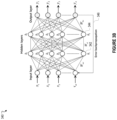
- FIG. 3 B illustrates an example neural network from which the draw performance inference model, the power inference model, and the voltage-frequency inference model can be implemented, according to various embodiments of the current disclosure.
- FIG. 3 C illustrates an example draw command used in rendering image frames, according to various embodiments of the present disclosure.
- FIG. 4 illustrates a computing component that includes one or more hardware processors and a machine-readable storage media storing a set of machine-readable/machine-executable instructions that, when executed, cause the hardware processor(s) to perform a method to dynamically adjust operating conditions of a graphics processing unit (GPU), according to various embodiments of the present disclosure.
- GPU graphics processing unit
- a GPU machine learning-based power performance optimization system can be implemented to optimize GPU performance while conserving power.
- a machine learning model associated with the GPU machine learning-based power performance optimization system can be trained to develop various inference models to determine optimal voltages and frequencies of a GPU to execute commands of a workload.
- a workload can be defined as one or more commands instructed to a GPU to render an image frame.
- the inference models can determine the optimal voltages and frequencies based on commands in workloads to be executed by the GPU on a per-command basis.
- the inference models can be deployed (i.e., loaded) to power management firmware of the GPU to intervene commands. Based on each upcoming command to be executed by the GPU, the inference models in the firmware can determine and provide optimal voltage and frequency to the GPU to execute each upcoming command of a workload on a per-command basis.
- optimal voltage and frequency refer to those capable of achieving peak performance under a given power consumption, achieving given performance under a minimum power consumption, or achieving optimal power efficiency overall.
- FIG. 1 illustrates a conventional dynamic voltage frequency scaling (DVFS) scheme 100 .
- the conventional DVFS scheme 100 can include a computing system 102 configured to render graphics for two-dimensional (2D) or three-dimensional (3D) images or videos.
- the computing system 102 can include a central processing unit (CPU) 110 coupled to a graphics processing unit (GPU) 120 over a data bus, such as a peripheral component interconnect express (PCIe) bus, for example.
- the CPU 110 in conjunction with the GPU 120 can be instructed to render graphics on a display associated with the computing system.
- a computer application or program e.g., a virtual reality application, an augmented reality application, etc.
- the computing system 102 can provide instructions to the CPU 110 and/or the GPU 120 to render graphics associated with the computer program through the display.
- the CPU 110 and the GPU 120 can have access to a system memory 112 .
- the system memory 112 can store data relating to index buffer, shader programs, GPU frontend command processor (FCP) command buffer, and parameter buffers that are needed in rendering graphics.
- the CPU 110 and the GPU 120 can write and/or read various data to and from the system memory 112 . For example, once the GPU 120 performs a graphics rendering function or executes a graphics rendering command, such as executing a draw function, the GPU 120 can write resulting data to a memory location, such as the shader programs, on the system memory 112 . The CPU 110 can then subsequently access this data from the system memory 112 and display this data to a display.
- the CPU 110 can have access to an operating system (OS) driver stack 114 .
- the OS driver stack 114 can include various application programming interfaces, graphics drivers, user-mode graphics drivers (UMDs), and kernel-mode drivers (KMDs).
- UMDs user-mode graphics drivers
- KMDs kernel-mode drivers
- the GPU 120 can include at least one non-volatile memory 122 storing GPU firmware, one power management integrated circuit (PMIC) 124 , one phase lock loop (PLL) 126 , and a plurality of GPU cores 128 .
- the non-volatile memory 122 can be any suitable memory type.
- the non-volatile memory 122 can be a programmable read-only memory (PROM) or an electrically erasable programmable read-only memory (EEPROM).
- the GPU firmware can be configured to provide instructions to the PMIC 124 , PLL 126 , and the plurality of GPU cores 128 based on commands of a workload (e.g., “Ts-Kick” of FIG. 1 ) to be executed by the GPU 120 .
- a workload e.g., “Ts-Kick” of FIG. 1
- the GPU firmware can receive commands to render graphics.
- the GPU firmware can schedule or allocate the commands to one or more GPU cores of the plurality of GPU cores 128 (e.g., “schedule WL” of FIG. 1 ), and estimate, based on previous workloads (e.g., “executed WL estimation” of FIG. 1 ), operating voltages and frequencies for the one or more GPU cores to execute the scheduled one or more commands (e.g., “estimated voltage” and “estimated frequency” of FIG. 1 ).
- the plurality of GPU cores 128 can include power and performance counters.
- the power and performance counters can be configured to count events such as a number of instructions or commands a GPU core has executed, a number of pixels/vertexes/primitives a GPU core has processed, a number of memory reads/writes a GPU core has performed, etc.
- the power and performance counters can be implemented as registers in hardware, and major hardware function blocks of a GPU core can have multiple counters counting the various events mentioned above.
- Values stored in the power and performance counts can represent workloads to be processed by a GPU core and are a direct reflection of GPU power/performance. For example, values corresponding to GPU power stored in the power counter can be used to check whether power to the GPU exceeds a threshold, such as a maximum power allowed for the GPU core.
- the GPU firmware can include a particular set of instructions to estimate operating voltages and frequencies for the plurality of GPU cores 128 (e.g., “VF Estimation” of FIG. 1 ). This particular set of instructions is responsible for estimating the operating voltages and frequencies. For example, machine-compatible codes responsible for estimating operating voltages and frequencies for the plurality of GPU cores 128 can be stored in the GPU firmware for execution.
- the PMIC 124 can be a logic configured to provide operating voltages to the plurality of GPU cores 128 of the GPU 120 . In some examples, the PMIC 124 can be a separate chip external to the GPU 120 . In other embodiments, the PMIC 124 can be integrated as part of the GPU 120 .
- the PLL 126 can be a logic configured to provide operating frequencies to the plurality of GPU cores 128 of the GPU 120 . Similar to the PMIC 124 , in some examples, the PLL 126 can be a separate chip external to the GPU 120 . In other examples, the PLL 126 can be integrated as part of the GPU 120 .
- the conventional DVFS scheme 100 of FIG. 1 has its disadvantages. For example, it lacks instantaneous effectiveness. Under conventional methods, operating voltages and frequencies provided to a GPU for executing commands of a current workload are determined based on the previous workloads executed by the GPU and power consumed by the GPU during execution of the previous workloads. As such, the conventional DVFS scheme 100 is reactive in nature. Referring back to FIG. 1 , steps 1 to 4 show a process of how the GPU firmware determines operating voltage and frequency for the GPU 120 for a upcoming workload according to a previous executed workload. Step 1 : The GPU firmware of the GPU 120 receives an instruction (“1 Ts-Kick”) from the CPU 110 to execute a workload (i.e., render an image frame).
- an instruction (“1 Ts-Kick”) from the CPU 110 to execute a workload (i.e., render an image frame).
- Step 2 The GPU firmware schedules the upcoming workload to one or more GPU cores of the plurality of GPU cores 128 .
- Step 3 Based on the one or more GPU cores selected to perform the upcoming workload, the GPU firmware estimates, based on previous workloads executed by the one or more selected GPU cores, operating voltages and frequencies to be provided to the one or more selected GPU cores.
- Step 4 The GPU firmware provides the estimated operating voltages and frequencies to the one or more selected GPU cores to execute the upcoming workload. As such, the operating voltages and frequencies provided to the one or more selected GPU cores are reactive to execution of the upcoming workload.
- a workload of a GPU is generally calculated on a per-frame basis, and adjustments to operating voltages and frequencies of the GPU are generally done at a per-frame or multiple-frames basis, which is not fully optimized for GPU performance or power.
- a draw command is one of the more important commands to be executed by the GPU, particularly for three-dimension graphics rendering.
- Draw command related data can include, for example, argument counts, constant data sizes, index count per instance, instance count, vertex buffer size, vertex buffer stride, etc.
- the draw command can also have various attributes, such as command deadlines, command workload cycles, command power, command frequency/voltage operation, etc.
- the draw command will be discussed in further detail with reference to FIG. 3 C herein. Since each draw command process different amount of data, the power requirement for different draw commands could be very different.
- Another important command to be executed by the GPU in three-dimensional graphics renderings is a shader command. Shader command related data can include, for example, vertex shaders, tessellation control and evaluation shaders, geometry shaders, fragment shaders, and compute shaders. The power requirement for the shader command could be very different from that of the draw command.
- the conventional DVFS scheme 100 is not an optimal solution because the conventional DVFS scheme 100 is based on past workloads, derived operating voltages and frequencies do not represent characteristics of current workloads, so the conventional DVFS scheme 100 does not provide an optimal power saving solution.
- FIG. 2 illustrates an improved dynamic voltage frequency scaling (DVFS) scheme 200 , according to various embodiments of the present disclosure.
- the improved DVFS scheme 200 can include a computing system 202 configured to render graphics for two-dimensional or three-dimensional images or videos.
- This computing system 202 includes same components as in the computing system 102 of FIG. 1 , therefore, discussions of these components will not be repeated here.
- DVFS scheme 100 of FIG. 1 Similar to the conventional DVFS scheme 100 of FIG. 1 , the improved DVFS scheme 200 can include a computing system 202 configured to render graphics for two-dimensional or three-dimensional images or videos.
- This computing system 202 includes same components as in the computing system 102 of FIG. 1 , therefore, discussions of these components will not be repeated here.
- the improved DVFS 200 can improve instantaneous responsiveness or effectiveness of the conventional DVFS scheme 100 , can provide fine-tune adjustment granularity DVFS so that optimal operating voltages and frequencies can be provided to GPU cores on a per-command basis, as opposed to, on a per-frame basis, and can provide a machine learning-based optimal solution for GPU power management.
- the GPU firmware stored in the non-volatile memory 122 of the computing system can include a particular set of instructions (e.g., “ML Interference”) that is dedicated for estimating operating voltages and frequencies for the plurality of GPU cores 128 .
- This particular set of instructions in some embodiments, can be associated with instructions (e.g., codes) to execute a machine learning model to “proactively” estimate the operating voltages and frequencies for the plurality of GPU cores 128 on a per-command basis.
- the machine learning model can estimate operating voltage and frequency for each of the plurality of GPU cores 128 based on respective commands to be executed by each of the plurality of GPU cores 128 .
- the machine learning model For each command to the executed by a GPU core, the machine learning model can estimate operating voltage and frequency for the GPU core. In this way, the improved DVFS scheme 200 can provide fine adjustments to power optimizations of the plurality of GPU cores 128 .
- the machine learning model can comprise a plurality of inference models. Once the plurality of inference models are trained, these models can determine optimal voltages and frequencies to provide to GPU cores based on commands to be executed by the GPU cores. The machine learning model and the plurality of inference models will be discussed in further detail in reference to FIG. 3 herein.
- the improved DVFS scheme 200 eliminates a step being performed by the GPU firmware under the conventional DVFS scheme 100 .
- the GPU firmware can estimate operating voltages and frequencies for a current workload based on operating voltages and frequencies of previous workloads.
- the GPU firmware can directly estimate operating voltages and frequencies of the current workload by evaluating commands of the current workload without having to evaluate operating voltages and frequencies of previous workloads. As such, the improved DVFS scheme 200 is quicker to respond to fluctuations in workloads than the conventional DVFS scheme 100 .
- the improved DVFS scheme 200 can adjust operating voltages and frequencies of a GPU in fine granularity, which significantly improves its performance as some commands in processing a frame may require a higher frequency and some commands in processing the same frame may require a lower frequency.
- the improved DVFS scheme 200 can adjust operating voltage and frequency provided to a GPU core if a determined power consumption exceeds a threshold (i.e., power limit, thermal limit, etc.) of the CPU core. For example, the improved DVFS scheme 200 determines, based on a command to be executed by a GPU core, optimal operating voltage and frequency for the GPU core to execute the command. In this example, optimal operating voltage and frequency for the GPU core would exceed thermal limit of the GPU core, which causes the GPU core to thermal throttle. In this example, the improved DVFS scheme 200 can adjust the optimal operating voltage and frequency lower so not the exceed the thermal limit.
- a threshold i.e., power limit, thermal limit, etc.
- FIG. 3 A illustrates a computing environment 300 in which the machine learning model of the GPU firmware under the improved DVFS scheme 200 can be trained, according to various embodiments of the current disclosure.
- the computing environment 300 can include a use-case simulation database 302 , a machine learning training platform 304 , and a trained inference model library 306 .
- the use-case simulation database 302 can store various simulated data from a GPU simulation model. These various simulated data can include, for example, simulated commands for a workload, simulated operating voltages, simulated operating frequencies, simulated power consumption and simulated performance data of GPU cores in executing the simulated commands.
- the use-case simulation database 302 can store power consumption data of GPU cores and its components from real-world use-cases. Leveraging the above data and adopting proper algorithms, predictive and adaptive GPU DVFS inference models can be trained under various use-case workloads.
- the machine learning training platform 304 can be a software development environment that can be used to train the inference models of the machine learning model.
- the machine learning training platform 304 can be an integrated development environment (IDE).
- IDE integrated development environment
- the trained inference model library 306 can be a database in which the trained inference models of the machine learning model are stored to later access.
- data obtained from 3D graphics rendering under various use cases including commands, command execution times, performance, and power records, etc. can be obtained.
- Power consumption data for the 3D graphics rendering workloads can also be obtained.
- These data can then be used as a training dataset to train the inference models.
- actual usage data from simulations of the GPU simulation model can be stored in the use-case simulation database 302 , and used to train the inference models.
- Data stored in the use-case simulation database 302 can be generated by running game applications on C-language GPU model, and usage data including commands and events under various operating voltages/frequencies, which all can be fed into the algorithm to train the interference models.
- the machine learning model can be associated with at least three inference models: a draw performance inference model, a power inference model, and a voltage-frequency inference model.
- the draw performance inference model can be trained according to simulated or real-world commands of a workload, and corresponding voltages/frequencies provided to GPU cores and execution times of the GPU cores in executing the simulated or real-world commands of the workload.
- the power inference model can be trained according to simulated or real-world commands of a workload, and corresponding voltages/frequencies to the GPU cores and power/performance data of the GPU cores in executing the simulated or real-world commands of the workload.
- the power inference model can be used to determine power requirements of various graphics commands including a draw command, and ensures whether power provided to the GPU cores exceed the maximum power allowed in a computing system. If so, operating voltages and frequencies need to be quickly adjust before thermal issue occurs.
- the voltage-frequency inference model can be trained according to simulated or real-world commands of a workload and performance of GPU cores in executing the simulated or real-world commands of the workload. The draw performance inference model, the power inference model, and the voltage-frequency inference model will be discussed in further detail with reference to FIG. 3 B herein.
- FIG. 3 B illustrates an example neural network 340 from which the draw performance inference model, the power inference model, and the voltage-frequency inference model can be implemented, according to various embodiments of the current disclosure.
- each of the draw performance inference model, the power inference model, and the voltage-frequency inference model can be implemented as the neural network 340 .
- the neural network 340 can be implemented using any suitable neural network.
- the neural network 340 can be a regression artificial neural network or a convolutional neural network. In the regression artificial neural network, a number of hidden layers and activation functions of the hidden layers can be adjusted during training to optimize performance of the inference models.
- the neural network 340 is shown to include two hidden layers 342 , 344 .
- the two hidden layers 342 , 344 may not be sufficient to accurately determine optimal operating voltages and frequencies for GPU cores.
- additional hidden layers may be added to the neural network 340 to improve performance.
- the neural network 340 can include an error backpropagation 346 .
- the error backpropagation 346 can help to optimize the example neural network 340 during training.
- the voltage-frequency inference model based on the example neural network 340 can be trained using draw command data, command deadline, and command workload cycles as inputs (e.g., x 1 , x 2 , . . . x m , of FIG. 3 B ).
- the power inference based on the example neural network 340 can be trained using draw command data and operating voltages and frequencies associated with commands as inputs.
- a predictive DVFS scheme to adjust GPU core voltage and frequency can be implemented.
- the predictive DVFS scheme has already been discussed with reference to FIG. 2 above.
- GPU incorporating the inference models can determine and make operating voltage and frequency adjustment requests according to a current workload before the current workload is scheduled to execute in advance.
- the predictive DVFS ensures that the current workload can be executed under optimal operating condition, thereby enhancing performance/watt metrics.
- the inference models are trained to determine optimal voltages and frequencies to provide to GPU cores based on commands to be executed during the current workload and before these commands are executed.
- the invention is “predictive” in nature.
- FIG. 3 C illustrates an example draw command 360 used in rendering image frames, according to various embodiments of the present disclosure.
- the draw command 360 is one of the more important commands to be executed by a GPU, particularly for three-dimension graphics rendering.
- the draw command 360 can be associated with various arguments in executing the draw command 360 . These arguments can include, for example, argument counts, argument constant data size, argument index count per instance, argument instance count, argument vertex buffer size, argument vertex buffer stride, etc.
- the draw command 360 can be associated with various command attributes. These command attributes can include, for example, command deadline, command workload cycles, command power, and command frequency and voltage.
- arguments and command attributes of various graphics rendering commands, including the draw command 360 can stored in counters of GPU cores.
- FIG. 4 illustrates a computing component 400 that includes one or more hardware processors 402 and a machine-readable storage media 404 storing a set of machine-readable/machine-executable instructions that, when executed, cause the hardware processor(s) 402 to perform a method to dynamically adjust operating conditions of a graphics processing unit (GPU), according to various embodiments of the present disclosure.
- a graphics processing unit GPU
- a machine learning model can be trained to determine operating voltages and frequencies to be provided to a GPU core of the GPU to execute a workload comprising a plurality of commands.
- the machine learning model can comprise a voltage-frequency inference model trained to determine operating voltages and frequencies of the GPU core in executing commands.
- the machine learning model can further comprise a draw performance inference model trained to determine performance data of the GPU core in executing the commands.
- the machine learning model can further comprise a power inference model trained to determine power consumptions of the GPU core in executing the commands.
- the machine learning model can be trained with a first dataset generated from a GPU simulation model.
- the first dataset can comprise data associated with simulated commands for a workload, simulated operating voltages, simulated operating frequencies, simulated power consumption and simulated performance data of the GPU core in executing the simulated commands.
- the machine learning model can be trained with a second dataset generated from a GPU simulation model.
- the second dataset can comprise data associated with simulated commands for a workload, simulated operating voltages, simulated operating frequencies, simulated power consumption and simulated performance data of the GPU core in executing the simulated commands.
- the commands of the workload can include at least a draw command for rendering three-dimensional graphics.
- the trained machine learning model can be deployed to firmware of the GPU.
- a command in the workload to be executed by the GPU core can be received.
- the trained machine learning model can determine operating voltage and frequency for the GPU core to execute the command.
- performance data of the GPU core in executing the command can be determined based on the command.
- a power consumption of the GPU core in executing the command can be determined based on the command.
- the optimal operating voltage and frequency for the GPU core to execute the command can be determined based on the command, the determined performance data, and the determined power consumption. In some embodiments, the optimal operating voltage and frequency for the GPU core to execute the command can be determined directly based on the command.
- the inventions disclosed herein can be implemented using any suitable computing systems.
- various inference models disclosed herein can be loaded onto a non-volatile memory, such as a PROM or an EEPROM, associated with or accessible by a GPU on a graphics card.
- the inference models disclosed herein can implemented on a separate a computing system or computing device controlling a GPU.
- eGPU external GPU device
- the inference models can be stored in the computing sytem.
- the computer system can include a main memory, such as a random access memory (RAM), cache and/or other dynamic storage devices, coupled to a bus for storing information and instructions to be executed by a processor. For example, instructions associated with the inference models.
- the main memory also may be used for storing temporary variables or other intermediate information during execution of instructions by the processor.
- Such instructions when stored in a storage media accessible to the processor, render the computer system into a special-purpose machine that is customized to perform the operations specified in the instructions. For example, a computer program or application running on the computer system may control operating voltages and frequencies for an eGPU when rendering graphics.
- the computer system can further include a read only memory (ROM) or other static storage device coupled to the bus for storing static information and instructions for the processor.
- ROM read only memory
- a storage device such as a magnetic disk, optical disk, or USB thumb drive (Flash drive), etc., can be provided and coupled to the bus for storing information and instructions.
- the computer system may be coupled via the bus to output device(s), such as a cathode ray tube (CRT) or LCD display (or touch screen), for displaying information to a user.
- output device(s) such as a cathode ray tube (CRT) or LCD display (or touch screen)
- Input device(s) can be coupled to the bus for communicating information and command selections to the processor.
- Another type of user input device can be a cursor control device, such as a computer mouse or other equivalent input devices.
- the computer system can also include a communication interface, such as a network interface card, coupled to the bus.
- a component being implemented as another component may be construed as the component being operated in a same or similar manner as another component, and/or comprising same or similar features, characteristics, and parameters as another component.
Landscapes
- Engineering & Computer Science (AREA)
- Theoretical Computer Science (AREA)
- Physics & Mathematics (AREA)
- General Physics & Mathematics (AREA)
- Software Systems (AREA)
- General Engineering & Computer Science (AREA)
- Computing Systems (AREA)
- Artificial Intelligence (AREA)
- Mathematical Physics (AREA)
- Data Mining & Analysis (AREA)
- Evolutionary Computation (AREA)
- Biomedical Technology (AREA)
- Molecular Biology (AREA)
- General Health & Medical Sciences (AREA)
- Computational Linguistics (AREA)
- Biophysics (AREA)
- Life Sciences & Earth Sciences (AREA)
- Health & Medical Sciences (AREA)
- Computer Graphics (AREA)
- Computer Vision & Pattern Recognition (AREA)
- Medical Informatics (AREA)
- Power Sources (AREA)
Abstract
Description
Claims (20)
Priority Applications (3)
| Application Number | Priority Date | Filing Date | Title |
|---|---|---|---|
| US17/879,986 US12079641B2 (en) | 2022-08-03 | 2022-08-03 | Machine learning based power and performance optimization system and method for graphics processing units |
| PCT/CN2023/110957 WO2024027791A1 (en) | 2022-08-03 | 2023-08-03 | Machine learning based power and performance optimization system and method for graphics processing units |
| CN202380057821.6A CN119654623A (en) | 2022-08-03 | 2023-08-03 | Machine learning based power consumption and performance optimization system and method for graphics processing unit |
Applications Claiming Priority (1)
| Application Number | Priority Date | Filing Date | Title |
|---|---|---|---|
| US17/879,986 US12079641B2 (en) | 2022-08-03 | 2022-08-03 | Machine learning based power and performance optimization system and method for graphics processing units |
Publications (2)
| Publication Number | Publication Date |
|---|---|
| US20240045699A1 US20240045699A1 (en) | 2024-02-08 |
| US12079641B2 true US12079641B2 (en) | 2024-09-03 |
Family
ID=89769077
Family Applications (1)
| Application Number | Title | Priority Date | Filing Date |
|---|---|---|---|
| US17/879,986 Active US12079641B2 (en) | 2022-08-03 | 2022-08-03 | Machine learning based power and performance optimization system and method for graphics processing units |
Country Status (3)
| Country | Link |
|---|---|
| US (1) | US12079641B2 (en) |
| CN (1) | CN119654623A (en) |
| WO (1) | WO2024027791A1 (en) |
Families Citing this family (6)
| Publication number | Priority date | Publication date | Assignee | Title |
|---|---|---|---|---|
| US12547236B2 (en) * | 2022-10-06 | 2026-02-10 | Google Llc | Workload-aware voltage regulator tuning |
| US12579046B2 (en) * | 2022-11-17 | 2026-03-17 | Dell Products, L.P. | Firmware-based orchestration of artificial intelligence (AI) performance profiles in heterogeneous computing platforms |
| US12355882B2 (en) | 2023-06-13 | 2025-07-08 | Bank Of America Corporation | Machine learning based system for optimized central processing unit (CPU) utilization in data transformation |
| US12481542B2 (en) * | 2023-06-29 | 2025-11-25 | Nvidia Corporation | Optimizing runtime configuration of processing units using machine learning |
| US12445114B1 (en) * | 2023-09-06 | 2025-10-14 | Amazon Technologies, Inc. | Intelligent power noise reduction |
| CN118113561B (en) * | 2024-04-30 | 2024-08-02 | 哈尔滨工业大学(深圳)(哈尔滨工业大学深圳科技创新研究院) | GPU energy efficiency optimization method through dynamic and static information fusion |
Citations (14)
| Publication number | Priority date | Publication date | Assignee | Title |
|---|---|---|---|---|
| US20080201591A1 (en) * | 2007-02-16 | 2008-08-21 | Chunling Hu | Method and apparatus for dynamic voltage and frequency scaling |
| US20110134111A1 (en) * | 2009-09-11 | 2011-06-09 | David Stone | Remote rendering of three-dimensional images using virtual machines |
| US20120110099A1 (en) * | 2009-03-23 | 2012-05-03 | Sony Computer Entertainment Inc. | Chat System, Server Device, Chat Method, Chat Execution Program, Storage Medium Stored with Chat Execution Program, Information Processing Unit, Image Display Method, Image Processing Program, Storage Medium Stored with Image Processing Program |
| US8689220B2 (en) * | 2011-11-30 | 2014-04-01 | International Business Machines Corporation | Job scheduling to balance energy consumption and schedule performance |
| US20180293776A1 (en) * | 2017-04-07 | 2018-10-11 | Intel Corporation | Apparatus and method for efficient graphics virtualization |
| US20190250691A1 (en) * | 2018-02-09 | 2019-08-15 | Samsung Electronics Co., Ltd. | Mobile device including context hub and operation method thereof |
| CN110209501A (en) | 2019-06-03 | 2019-09-06 | Oppo广东移动通信有限公司 | Frequency adjusting method and device of graphic processor, terminal and storage medium |
| CN111427750A (en) | 2020-04-09 | 2020-07-17 | 中国人民解放军国防科技大学 | A GPU power consumption estimation method, system and medium of a computer platform |
| CN112363842A (en) | 2020-11-27 | 2021-02-12 | Oppo(重庆)智能科技有限公司 | Frequency adjusting method and device for graphic processor, electronic equipment and storage medium |
| KR20210078260A (en) | 2019-12-18 | 2021-06-28 | 고려대학교 산학협력단 | Apparatus for Predicting Optimal CPU Frequency Based on Machine learning |
| US20220164423A1 (en) * | 2020-11-20 | 2022-05-26 | Wallife s.r.l. | Method and apparatus for user recognition |
| US20230079229A1 (en) * | 2021-09-10 | 2023-03-16 | Maxim Integrated Products, Inc. | Power modulation using dynamic voltage and frequency scaling |
| US11640194B2 (en) * | 2021-06-29 | 2023-05-02 | Red Hat, Inc. | Coordinating dynamic power scaling of agents based on power correlations of agent instructions |
| US20230205293A1 (en) * | 2021-12-29 | 2023-06-29 | SambaNova Systems, Inc. | High-bandwidth power estimator for ai accelerator |
-
2022
- 2022-08-03 US US17/879,986 patent/US12079641B2/en active Active
-
2023
- 2023-08-03 WO PCT/CN2023/110957 patent/WO2024027791A1/en not_active Ceased
- 2023-08-03 CN CN202380057821.6A patent/CN119654623A/en active Pending
Patent Citations (14)
| Publication number | Priority date | Publication date | Assignee | Title |
|---|---|---|---|---|
| US20080201591A1 (en) * | 2007-02-16 | 2008-08-21 | Chunling Hu | Method and apparatus for dynamic voltage and frequency scaling |
| US20120110099A1 (en) * | 2009-03-23 | 2012-05-03 | Sony Computer Entertainment Inc. | Chat System, Server Device, Chat Method, Chat Execution Program, Storage Medium Stored with Chat Execution Program, Information Processing Unit, Image Display Method, Image Processing Program, Storage Medium Stored with Image Processing Program |
| US20110134111A1 (en) * | 2009-09-11 | 2011-06-09 | David Stone | Remote rendering of three-dimensional images using virtual machines |
| US8689220B2 (en) * | 2011-11-30 | 2014-04-01 | International Business Machines Corporation | Job scheduling to balance energy consumption and schedule performance |
| US20180293776A1 (en) * | 2017-04-07 | 2018-10-11 | Intel Corporation | Apparatus and method for efficient graphics virtualization |
| US20190250691A1 (en) * | 2018-02-09 | 2019-08-15 | Samsung Electronics Co., Ltd. | Mobile device including context hub and operation method thereof |
| CN110209501A (en) | 2019-06-03 | 2019-09-06 | Oppo广东移动通信有限公司 | Frequency adjusting method and device of graphic processor, terminal and storage medium |
| KR20210078260A (en) | 2019-12-18 | 2021-06-28 | 고려대학교 산학협력단 | Apparatus for Predicting Optimal CPU Frequency Based on Machine learning |
| CN111427750A (en) | 2020-04-09 | 2020-07-17 | 中国人民解放军国防科技大学 | A GPU power consumption estimation method, system and medium of a computer platform |
| US20220164423A1 (en) * | 2020-11-20 | 2022-05-26 | Wallife s.r.l. | Method and apparatus for user recognition |
| CN112363842A (en) | 2020-11-27 | 2021-02-12 | Oppo(重庆)智能科技有限公司 | Frequency adjusting method and device for graphic processor, electronic equipment and storage medium |
| US11640194B2 (en) * | 2021-06-29 | 2023-05-02 | Red Hat, Inc. | Coordinating dynamic power scaling of agents based on power correlations of agent instructions |
| US20230079229A1 (en) * | 2021-09-10 | 2023-03-16 | Maxim Integrated Products, Inc. | Power modulation using dynamic voltage and frequency scaling |
| US20230205293A1 (en) * | 2021-12-29 | 2023-06-29 | SambaNova Systems, Inc. | High-bandwidth power estimator for ai accelerator |
Non-Patent Citations (2)
| Title |
|---|
| GPU Power Prediction via Ensemble Machine Learning for DVFS Space Exploration (Year: 2018). * |
| PCT International Search Report and the Written Opinion mailed Nov. 3, 2023, issued in related International Application No. PCT/CN2023/110957 (6 pages). |
Also Published As
| Publication number | Publication date |
|---|---|
| US20240045699A1 (en) | 2024-02-08 |
| WO2024027791A1 (en) | 2024-02-08 |
| CN119654623A (en) | 2025-03-18 |
Similar Documents
| Publication | Publication Date | Title |
|---|---|---|
| US20240045699A1 (en) | Machine learning based power and performance optimization system and method for graphics processing units | |
| US12045924B2 (en) | Real-time hardware-assisted GPU tuning using machine learning | |
| US20230169717A1 (en) | Unified rasterization and ray tracing rendering environments | |
| US10007292B2 (en) | Energy aware dynamic adjustment algorithm | |
| US9940687B2 (en) | Dynamic graphics rendering scheduling | |
| US8542221B1 (en) | Method and system for optimizing display power reduction through a continuously variable refresh rate adjustment | |
| CN106663331B (en) | Technology is performed for the coloration program in graphics process | |
| US11533683B2 (en) | Advanced graphics power state management | |
| US20170199558A1 (en) | Flexible and scalable energy model for estimating energy consumption | |
| JP6130296B2 (en) | Dynamic enabling and disabling of SIMD units in graphics processors | |
| US11481256B2 (en) | Task graph scheduling for workload processing | |
| US9558573B2 (en) | Optimizing triangle topology for path rendering | |
| US11275586B2 (en) | Task graph generation for workload processing | |
| US12436767B2 (en) | System and method for scheduling operations in a graphics pipeline | |
| CN113467959A (en) | Method, device and medium for determining task complexity applied to GPU | |
| US20210065441A1 (en) | Machine learning-based technique for execution mode selection | |
| CN110192225B (en) | Out-of-order pixel shader derivation | |
| CN114119337A (en) | Method of processing workload in graphics processor and graphics processing apparatus | |
| US20230401070A1 (en) | Performance benchmarking-based selection of processor for generating graphic primitives | |
| US12277001B2 (en) | Automated data-driven system to optimize overclocking | |
| CN112988364B (en) | Dynamic task scheduling method, device and storage medium | |
| US11900123B2 (en) | Marker-based processor instruction grouping | |
| Farazmand et al. | Quality of service-aware dynamic voltage and frequency scaling for mobile 3D graphics applications | |
| US20250208922A1 (en) | Dynamic precision management in graphics processing | |
| US12333626B2 (en) | Processor, method and non-transitory computer-readable storage media for handling data |
Legal Events
| Date | Code | Title | Description |
|---|---|---|---|
| AS | Assignment |
Owner name: MOORE THREADS TECHNOLOGY CO., LTD., CHINA Free format text: ASSIGNMENT OF ASSIGNORS INTEREST;ASSIGNORS:TANG, ZHIWEI;WU, JING;DONG, SUOLONG;SIGNING DATES FROM 20220726 TO 20220727;REEL/FRAME:060706/0574 |
|
| FEPP | Fee payment procedure |
Free format text: ENTITY STATUS SET TO UNDISCOUNTED (ORIGINAL EVENT CODE: BIG.); ENTITY STATUS OF PATENT OWNER: LARGE ENTITY |
|
| STPP | Information on status: patent application and granting procedure in general |
Free format text: RESPONSE TO NON-FINAL OFFICE ACTION ENTERED AND FORWARDED TO EXAMINER |
|
| STPP | Information on status: patent application and granting procedure in general |
Free format text: NOTICE OF ALLOWANCE MAILED -- APPLICATION RECEIVED IN OFFICE OF PUBLICATIONS |
|
| ZAAA | Notice of allowance and fees due |
Free format text: ORIGINAL CODE: NOA |
|
| ZAAB | Notice of allowance mailed |
Free format text: ORIGINAL CODE: MN/=. |
|
| STPP | Information on status: patent application and granting procedure in general |
Free format text: DOCKETED NEW CASE - READY FOR EXAMINATION |
|
| STPP | Information on status: patent application and granting procedure in general |
Free format text: NOTICE OF ALLOWANCE MAILED -- APPLICATION RECEIVED IN OFFICE OF PUBLICATIONS |
|
| ZAAB | Notice of allowance mailed |
Free format text: ORIGINAL CODE: MN/=. |
|
| STPP | Information on status: patent application and granting procedure in general |
Free format text: PUBLICATIONS -- ISSUE FEE PAYMENT RECEIVED |
|
| STPP | Information on status: patent application and granting procedure in general |
Free format text: PUBLICATIONS -- ISSUE FEE PAYMENT VERIFIED |
|
| STCF | Information on status: patent grant |
Free format text: PATENTED CASE |