US12079178B2 - Snapshot volume proxy for object storage interfaces - Google Patents
Snapshot volume proxy for object storage interfaces Download PDFInfo
- Publication number
- US12079178B2 US12079178B2 US17/511,481 US202117511481A US12079178B2 US 12079178 B2 US12079178 B2 US 12079178B2 US 202117511481 A US202117511481 A US 202117511481A US 12079178 B2 US12079178 B2 US 12079178B2
- Authority
- US
- United States
- Prior art keywords
- object storage
- snapshot
- request
- snapshot volume
- response
- Prior art date
- Legal status (The legal status is an assumption and is not a legal conclusion. Google has not performed a legal analysis and makes no representation as to the accuracy of the status listed.)
- Active, expires
Links
Images


Classifications
-
- G—PHYSICS
- G06—COMPUTING OR CALCULATING; COUNTING
- G06F—ELECTRIC DIGITAL DATA PROCESSING
- G06F16/00—Information retrieval; Database structures therefor; File system structures therefor
- G06F16/10—File systems; File servers
- G06F16/18—File system types
- G06F16/188—Virtual file systems
- G06F16/196—Specific adaptations of the file system to access devices and non-file objects via standard file system access operations, e.g. pseudo file systems
-
- G—PHYSICS
- G06—COMPUTING OR CALCULATING; COUNTING
- G06F—ELECTRIC DIGITAL DATA PROCESSING
- G06F16/00—Information retrieval; Database structures therefor; File system structures therefor
- G06F16/10—File systems; File servers
- G06F16/11—File system administration, e.g. details of archiving or snapshots
- G06F16/128—Details of file system snapshots on the file-level, e.g. snapshot creation, administration, deletion
-
- G—PHYSICS
- G06—COMPUTING OR CALCULATING; COUNTING
- G06F—ELECTRIC DIGITAL DATA PROCESSING
- G06F16/00—Information retrieval; Database structures therefor; File system structures therefor
- G06F16/10—File systems; File servers
- G06F16/18—File system types
- G06F16/182—Distributed file systems
- G06F16/184—Distributed file systems implemented as replicated file system
- G06F16/1844—Management specifically adapted to replicated file systems
Definitions
- the present disclosure is generally related to computer systems, and more particularly, to enabling a snapshot volume proxy for object storage interfaces in cloud computing systems.
- PaaS Platform-as-a-Service
- Cloud computing is a computing paradigm in which a user engages a “cloud provider” to execute a program on computer hardware owned and/or controlled by the cloud provider.
- a cloud provider can make virtual machines (VMs) hosted on its computer hardware available to customers for this purpose.
- the cloud provider can provide an interface that a user can use to requisition virtual machines and associated resources such as security policies, processors, storage, and network services, etc., as well as an interface to install and execute the user's applications and files on the virtual machines.
- PaaS offerings can facilitate deployment of application workloads without the cost and complexity of buying and managing the underlying hardware and software and provisioning hosting capabilities, providing the facilities to support the complete life cycle of building and delivering application workloads and services entirely available from the Internet.
- FIG. 1 depicts a high-level component diagram of an example computer system architecture, in accordance with one or more aspects of the present disclosure.
- FIG. 2 depicts a block diagram illustrating an example of a snapshot storage proxy for facilitating communication translation with object storage interfaces in a cloud computing environment, in accordance with one or more aspects of the present disclosure.
- FIG. 3 A illustrates an example of translating a request from an object storage interface into a snapshot data volume request in a cloud computing environment, in accordance with one or more aspects of the present disclosure.
- FIG. 3 B illustrates an example of translating a response from a snapshot data volume to response for an object storage interface in a cloud computing environment, in accordance with one or more aspects of the present disclosure.
- FIG. 4 A depicts a flow diagram of a method for translating a request from an object storage interface into a snapshot data volume request in a cloud computing environment, in accordance with one or more aspects of the present disclosure.
- FIG. 4 B depicts a flow diagram of a method for translating a response from a snapshot data volume to response for an object storage interface in a cloud computing environment, in accordance with one or more aspects of the present disclosure
- FIG. 5 depicts a block diagram of an illustrative computer system operating in accordance with one or more aspects of the present disclosure.
- Cloud computing environments provide many advantages over locally owned computing systems. For example, cloud computing environments can optimize resources by sharing them across multiple users and multiple clients, thereby reducing costs otherwise dedicated to procuring and maintaining local hardware. Additionally, cloud computing environments provide improved scalability for clients. Instead of purchasing additional local computing resources, supporting more data storage and buying more software licenses to support growth in the business, users can rent more storage space, acquire more bandwidth and increase access to software programs which are controlled by a cloud computing provider.
- Cloud computing environments can present challenges with the management of data storage.
- cloud computing environments can implement data protection capabilities that include storage snapshots and backups that provide point in time data copies that can be restored in the event of data corruption, data loss, or ransomware incursion.
- a storage snapshot is an image or reference point created at a particular point in time which preserves the state of a system, server, storage volume, etc., so that recovery can be performed to return the system to the preserved state.
- the snapshot data is typically stored as an immutable volume (e.g., cannot be overwritten, deleted, or edited) to preserve the validity of the captured state information.
- snapshots can provide significant flexibility for data recovery
- various conventional cloud providers can provide storage solutions that vary from one another, which can increase complexity in the management of those snapshots.
- file storage is network attached storage where the data is typically stored in a folder type structure. When a file needs to be accessed, the full path of file location should be known.
- Block storage can save data in blocks and should be accessed through a particular network structure (e.g., a storage area network (SAN)).
- SAN storage area network
- Object storage is a type of architecture where each file is saved as an object that can be accessed using a hypertext transfer protocol (HTTP) request.
- HTTP hypertext transfer protocol
- Each type of storage solution involves different network configurations and storage protocols. Thus, an interface developed for one type of storage does not readily interact with data of other types.
- cloud providers attempt to mitigate these issues by restricting the storage architectures implemented to those with robust toolsets. This, however, can often result in a more narrowly limited storage architecture platform, which can significantly decrease the flexibility and efficiency of the cloud environment.
- cloud providers can implement solutions where snapshot data that is stored as non-object data (e.g., block data, file data, etc.) is copied to object data. While this can offer more advanced and readily available toolsets to manage the data, it can significantly increase the storage requirements as well as processing resources involved in conducting the copy operations.
- the snapshot storage proxy can expose non-object persistent snapshot image volume data as an object storage endpoint to enable an object storage interface to access the non-object data as if it were an object.
- the snapshot storage proxy can receive a request from an object storage interface (e.g., a toolset configured to access object data) to access a snapshot volume where the request formatted to interact with object storage data, and where the target data is stored as non-object storage data.
- the snapshot storage proxy can translate the request into a snapshot volume request that is formatted to interact with the non-object storage data, and subsequently, can access the snapshot using the translated request.
- the snapshot storage proxy of the present disclosure can provide the ability to access non-object data storage solutions using the tools developed to interact with object-based storage solutions.
- This can significantly streamline cloud environments by providing the ability to utilize the conventionally implemented and accepted object storage tools across an environment with hybrid storage architecture without the need to replicate those tools for each storage solution. This, in turn, can significantly reduce development costs as well as processing costs associated with maintaining hybrid storage infrastructure access tools.
- the non-object data can remain in place without being copied into objects. This can significantly reduce overall storage costs since data need not be copied in order to access with more robust toolsets.
- the snapshot storage proxy can improve the performance of snapshot data management within the cloud environment, providing increased efficiency in management of cloud computing resources overall.
- FIG. 1 is a block diagram of a network architecture 100 in which implementations of the disclosure may operate.
- the network architecture 100 may be used in a containerized computing services platform.
- a containerized computing services platform may include a Platform-as-a-Service (PaaS) system, such as OpenShift® or Kubernetes®.
- PaaS Platform-as-a-Service
- the PaaS system provides resources and services (e.g., micro-services) for the development and execution of applications owned or managed by multiple users.
- a PaaS system provides a platform and environment that allow users to build applications and services in a clustered compute environment (the “cloud”)
- the cloud clustered compute environment
- the network architecture 100 includes a cloud-computing environment 130 (also referred to herein as a cloud) that includes nodes 111 , 112 , 121 to execute applications and/or processes associated with the applications.
- a “node” providing computing functionality may provide the execution environment for an application of the PaaS system.
- the “node” may refer to a virtual machine (VM) that is hosted on a physical machine, such as host 1 110 through host N 120 , implemented as part of the cloud 130 .
- VM virtual machine
- nodes 111 and 112 are hosted on physical machine of host 1 110 in cloud 130 provided by cloud provider 104 .
- an environment other than a VM may be used to execute functionality of the PaaS applications.
- OSs operating systems
- the host machines 110 , 120 are often located in a data center. Users can interact with applications executing on the cloud-based nodes 111 , 112 , 121 using client computer systems, such as clients 160 , 170 and 180 , via corresponding client software 161 , 171 and 181 .
- Client software 161 , 171 , 181 may include an application such as a web browser.
- the applications may be hosted directly on hosts 1 through N 110 , 120 without the use of VMs (e.g., a “bare metal” implementation), and in such an implementation, the hosts themselves are referred to as “nodes”.
- Clients 160 , 170 , and 180 are connected to hosts 110 , 120 in cloud 130 and the cloud provider system 104 via a network 102 , which may be a private network (e.g., a local area network (LAN), a wide area network (WAN), intranet, or other similar private networks) or a public network (e.g., the Internet).
- a network 102 may be a private network (e.g., a local area network (LAN), a wide area network (WAN), intranet, or other similar private networks) or a public network (e.g., the Internet).
- Each client 160 , 170 , 180 may be a mobile device, a PDA, a laptop, a desktop computer, a tablet computing device, a server device, or any other computing device.
- Each host 110 , 120 may be a server computer system, a desktop computer or any other computing device.
- the cloud provider system 104 may include one or more machines such as server computers, desktop computers, etc.
- developers, owners, and/or system administrators of the applications may maintain applications executing in cloud 130 by providing software development services, system administration services, or other related types of configuration services for associated nodes in cloud 130 . This can be accomplished by accessing cloud 130 using an application programmer interface (API) within the applicable cloud service provider system 104 .
- API application programmer interface
- a developer, owner, or system administrator may access the cloud service provider system 104 from a client device (e.g., clients 160 , 170 , and 180 ) that includes dedicated software to interact with various cloud components.
- the cloud service provider system 104 may be accessed using a web-based or cloud-based application that executes on a separate computing device that communicates with a client device via network 102 .
- the cloud provider system 104 is coupled to a cloud controller 108 via the network 102 .
- the cloud controller 108 may reside on one or more machines (e.g., server computers, desktop computers, etc.) and may manage the execution of applications in the cloud 130 .
- cloud controller 108 receives commands from containerized system controller 140 . In view of these commands, the cloud controller 108 provides data (e.g., such as pre-generated images) associated with different applications to the cloud provider system 104 .
- the data may be provided to the cloud provider 104 and stored in a snapshot image repository 106 , in an image repository (not shown) located on each host 110 , 120 , or in an image repository (not shown) located on each node 111 , 112 , 121 .
- This data may be used for the execution of applications for a containerized computing services platform managed by the containerized system controller 140 .
- snapshot image repository 106 can store snapshot images of application data as well as delta images (e.g., information describing incremental changes made to the data stored in the most recent snapshot image).
- the snapshot image repository 106 can be stored as non-object data (e.g., block storage, file storage, etc.).
- data from snapshot image repository 106 can be copied to object storage.
- the data from the snapshot image repository can be exposed to tools available via an object storage interface application (e.g., object storage interface 162 ) such that the data in snapshot image repository 106 can remain in place without being copied to object storage.
- Object storage interface 162 can be a component of client software 161 , or a different component executed by client 160 .
- the data is used for execution of containers 191 , 192 , 193 , 194 in one or more pods 151 , 152 , 153 .
- the pods 151 , 152 , 153 are a group of one or more containers that are deployed together on the same node 111 , 112 , 121 , and are the smallest compute unit that can be defined, deployed, and managed in the containerized computing service environment.
- Each pod 151 , 152 , 153 is allocated its own internal IP address, with containers 191 , 192 , 193 , 194 within pods 151 , 152 , 153 being able to share local storage and networking.
- Pods 151 , 152 , 153 have a lifecycle that is defined and can run on a node 111 , 112 , 121 until the pod's containers exit or they are removed for some other reason.
- the containers 191 , 192 , 193 , 194 can include application images built from pre-existing application components and source code of users managing the application.
- An image may refer to data representing executables and files of the application used to deploy functionality for a runtime instance of the application.
- the application images can be built using various types of containerization technologies (e.g., DockerTM).
- An image build system (not pictured) can generate an application image for an application by combining a preexisting ready-to-run application image corresponding to core functional components of the application (e.g., a web framework, database, etc.) with source code specific to the application provided by the user.
- the resulting application image may be pushed to image repository 106 for subsequent use in launching instances of the application images for execution in the PaaS system.
- a container 191 , 192 , 193 , 194 can be a secure process space on the nodes 111 , 112 , 121 to execute functionality of an application.
- a container 191 , 192 , 193 , 194 is established at the nodes 111 , 112 , 121 and 122 with access to certain resources of the underlying node, including memory and storage.
- the containers 191 , 192 , 193 , 194 may be established using the Linux Containers (LXC) method.
- containers 191 , 192 , 193 , 194 may also be established using cgroups, SELinuxTM, and kernel namespaces, to name a few examples.
- containers 191 , 192 , 193 , 194 can include one or more executable workloads 195 , 196 , 197 , 198 .
- Workloads 195 , 196 , 197 , 198 can be standalone applications to be executed in containers 191 , 192 , 193 , 194 or virtual machine (VM), a virtual machine that itself hosts one or more applications, or the like.
- the executable workloads can be the containers 191 , 192 , 193 , 194 themselves that host one or more applications or VMs, or the like.
- cloud controller 108 may include a snapshot storage proxy 142 that facilitates communication translation with object storage interfaces for the cloud-based PaaS system described above.
- the snapshot image repository 106 can store persistent snapshot volumes as non-object based data (e.g., block storage, file storage, etc.). Snapshot storage proxy 142 can expose the persistent snapshot volumes to the object storage interface 162 as if it actually were composed of object-based data. Thus, the snapshot storage proxy 142 can provide the ability to use the data access tools available via object storage interface 162 to access the non-object data in snapshot image repository 106 without copying that data to object data before doing so.
- snapshot storage proxy 142 can expose configuration information from the snapshot image repository 106 to object storage interface 162 as an object storage endpoint to enable object storage interface 162 to access the non-object data. Subsequently, snapshot storage proxy 142 can receive a request from object storage interface 162 to access a snapshot volume in snapshot image repository 106 . As noted above, since this request is received from the object storage interface 162 , it can be formatted to interact with object storage data whereas the target data is stored as non-object storage data. Snapshot storage proxy 142 can translate the request from object storage interface 162 into a snapshot volume request, where that translated request is formatted to interact with the non-object storage data stored in snapshot image repository 106 . Subsequently, snapshot storage proxy 142 can access snapshot image repository 106 using the translated request.
- snapshot storage proxy 142 can translate any response data received from the snapshot image repository 106 into a format that can be received by the object storage interface 162 .
- snapshot storage proxy 142 can receive a notification from snapshot image repository 106 that indicates that a request to access the applicable snapshot volume has been performed.
- the notification can include response data to be provided to the requesting client.
- Snapshot storage proxy 142 can translate the response received from the snapshot image repository 106 into a format that can be received by object storage interface 162 , and subsequently provide the translated response to the object storage interface.
- snapshot storage proxy 142 can also be implemented in an Infrastructure-as-a-Service (Iaas) environment, such as such as Red Hat OpenStack®.
- Iaas Infrastructure-as-a-Service
- FIG. 1 depicts a single cloud 130
- aspects of the present disclosure can be implemented to manage workloads across multiple clouds 130 .
- the snapshot storage proxy 142 can manage storage interface translation for hybrid cloud environments, multi-cluster cloud environments, or the like. Snapshot storage proxy 142 is described in further detail below with respect to FIGS. 2 - 3 .
- FIG. 2 depicts a block diagram illustrating an example of a snapshot storage proxy 210 for facilitating communication translation with an object storage interface in a cloud computing environment.
- snapshot storage proxy 210 may correspond to snapshot storage proxy 142 of FIG. 1 .
- snapshot storage proxy 210 may be a component of a computing apparatus 200 that includes a processing device 205 , operatively coupled to a memory 201 , to execute snapshot storage proxy 210 .
- processing device 205 and memory 201 may correspond to processing device 502 and main memory 504 respectively as described below with respect to FIG. 5 .
- Snapshot storage proxy 210 may include request receiver 211 , protocol translator 212 , snapshot volume access module 213 , response receiver 214 , and object storage interface notification module 215 .
- the functionality of one or more of request receiver 211 , protocol translator 212 , snapshot volume access module 213 , response receiver 214 , and object storage interface notification module 215 may be combined into a single module or divided into multiple sub-modules.
- Request receiver 211 is responsible for receiving a request from an object storage interface component to access a snapshot volume in a cloud computing environment.
- the request can be received from a user interface (or other interface component) executing on a client device (e.g., object storage interface 161 of client 160 in FIG. 1 ), where that interface component includes tools/functionality that is configured to interact with object storage data.
- the received request can be formatted to interact with object storage data (e.g., Amazon S3® object data).
- object storage data e.g., Amazon S3® object data
- the snapshot volume to which access is being requested e.g., snapshot image repository 106 in FIG. 1
- the request can be directed to performing various operations on the snapshot volumes using the tools that are configured for accessing object storage data.
- the request can be a request to wherein the request comprises a request to perform a replication operation (e.g., where the target snapshot is to be replicated, etc.), a compression operation (e.g., where the target snapshot is to be compressed, etc.), an encryption operation (e.g., where the target snapshot is to be encrypted, etc.), an upload operation (e.g., where data is to be uploaded to the snapshot data store, etc.), a download operation (e.g., where the target snapshot is to be downloaded from the snapshot data store, etc.), a tiering operation (e.g., where the target snapshot is to be tiered, etc.), a versioning operation (e.g., interacting with a particular snapshot version, creating a new snapshot version, etc.), a listing operation (e.g., listing the snapshots in a volume, etc.), a creation operation (e.g.
- the requested operations can be configured by the object storage interface to interact with data configured as object data, rather than non-object data.
- the request received by request receiver 211 can be formatted using a particular application programming interface (API) protocol (or a particular communication protocol) associated with interacting with object data.
- API application programming interface
- the protocol associated with interacting with the object data can include multiple communication elements, attributes, or features that define how the object storage interface interacts with object data as well as any applicable elements, attributes, features, or content of the data stored in object data.
- the snapshot storage proxy 210 can facilitate receipt of the request by initially exposing configuration information associated with the snapshot volume data as if it were object storage by exposing an “endpoint” for the snapshot volume data to the object storage interface.
- a storage endpoint can represent settings and access credentials needed to connect to the object storage API.
- the snapshot storage proxy 210 can expose the endpoint to the snapshot data such that it is in the format expected by the object storage interface, but representing the settings and access credentials needed to access the snapshot volume data that is stored as non-object data.
- Protocol translator 212 is responsible for translating the request from the object storage interface into a snapshot volume request, where the snapshot volume request is formatted to interact with non-object storage data. Protocol translator 212 can perform the translation operation by examining the object-based request and determining non-object storage data operations that can be performed on the snapshot data to satisfy the request. In some implementations, protocol translator 212 can analyze the request from the object storage interface in view of an object storage interface protocol used by the interface. As noted above, the object storage interface protocol can include the elements, attributes, features, or data that define how the object storage interface interacts with object data. In some implementations, the snapshot storage proxy 210 can be specifically configured to receive requests for a specific protocol. Alternatively, the snapshot storage proxy 210 can be configured to receive requests for multiple protocols, and the request can specify the protocol used.
- protocol translator 212 can identify the applicable protocol features associated with the request from the object storage interface.
- protocol translator 212 can retrieve protocol information from a data store (e.g., object interface protocol information 202 ) that includes the layout, format, content, etc. of the applicable object interface protocol.
- protocol translator 212 can identify this information in view of the format of the request itself. For example, in instances where the protocol being used is defined with key/value pairs, protocol translator 212 can identify the protocol features of the request by parsing the key value pairs.
- protocol features associated with the request can specify the particular operation to be performed on the target snapshot data, the data to be retrieved and/or modified, the location of the snapshot data, or the like.
- protocol translator 212 can identify object data instructions and/or operations using the information included in the request.
- protocol translator 212 can use information from the request and access information that maps object interface protocol information to applicable object data access instructions (e.g., instruction mapping information 204 ).
- protocol translator 212 can determine one or more snapshot volume instructions to perform operations on the snapshot data that are associated with the identified object storage protocol features. In other words, once protocol translator 212 identifies the object-based operations to be performed, it can then identify one or more analogous instructions that can be performed on the snapshot data to satisfy the request. In some implementations, protocol translator 212 can identify the snapshot instructions to be performed by accessing mapping information that maps an object-based instruction (or instructions) to a snapshot-based instruction (or instructions). For example, this instruction mapping can be stored in instruction mapping information 204 .
- Snapshot volume access module 213 is responsible for accessing the snapshot volume in view of the translated snapshot volume request.
- snapshot volume access module 213 can access the snapshot volume using the applicable instruction (or instructions) identified by protocol translator 212 .
- snapshot volume access module 213 can execute the one or more snapshot volume instructions to perform the snapshot operations on the snapshot volume that satisfy the received request.
- Response receiver 214 is responsible for receiving a notification from the snapshot volume that the request to access the snapshot volume has been performed.
- the notification can include response information associated with the snapshot volume request that is formatted for a non-object storage interface.
- the response information may be in a format that is not readily accepted by the object storage interface component that provided the original request to request receiver 211 .
- the notification can be received as a return code, a response message, an API response from the snapshot data volume, or the like.
- response receiver 214 can invoke protocol translator 212 to translate the response received from the snapshot data volume into a format understood and/or accepted by the object storage interface component.
- protocol translator 212 can translate the response information from the received notification into an object storage response, where the object storage response is formatted for the object storage interface component.
- protocol translator 212 can follow the reverse of the process mentioned above for translating the request.
- protocol translator 212 can analyze the response information in view of the snapshot volume interface protocol (e.g., snapshot volume interface protocol 203 ), where the snapshot volume interface protocol includes protocol features associated with accessing the snapshot data volume. Protocol translator 212 can then identify one or more snapshot volume features of the first set of protocol features associated with the response information from the first notification. As noted above, protocol translator 212 can identify these features by accessing the stored snapshot volume interface protocol 203 , or in the alternative, identify these features using the context of the response (e.g., the key/value pair notations included in the response). Once the applicable features have been identified, protocol translator 212 can map the identified snapshot volume features to corresponding object storage interface protocol features for the object storage interface protocol associated with the original request. As noted above, protocol translator 212 can perform this mapping by accessing information stored in instruction mapping information 204 . Subsequently, protocol translator 212 can generate the object storage response using this mapping.
- the snapshot volume interface protocol e.g., snapshot volume interface protocol 203
- Object storage interface notification module 215 is responsible for providing a notification to the object storage interface using the object storage response generated by response receiver 214 and protocol translator 212 .
- FIGS. 3 A- 3 B illustrate examples of a snapshot storage proxy for facilitating communication translation with object storage interfaces in a cloud computing environment.
- FIG. 3 A illustrates an example of translating a request from an object storage interface into a snapshot data volume request.
- snapshot storage proxy 142 receives a request (e.g., access request 350 ) from object storage interface 162 to access a persistent snapshot volume in snapshot image repository 106 .
- the request can be received from a component of a client device that provides storage management interface functionality to object storage data, and the access request 350 can be formatted to interact with object storage data.
- access request 350 can be formatted to interact with object storage data, while the target snapshot data stored in snapshot image repository 106 is stored as non-object storage data.
- snapshot storage proxy 142 can receive access request 350 using a communication protocol or API that specifies particular communication and/or data features associated with interacting with object storage (communication 361 ). Snapshot storage proxy 142 can then translate access request 350 into a format that can be processed by the snapshot image repository 106 (operation(s) 362 ). As described above with respect to FIG. 2 , snapshot storage proxy 142 can analyze the information included the request, and identify the applicable features associated with that request. In various implementations, snapshot storage proxy 142 can conduct the analysis using stored information that describes the protocol rules associated with the object storage interface 162 (e.g., object interface protocol information 302 ).
- snapshot storage proxy 142 can translate the received access request 350 by determining one or more instructions to perform operations 362 on the snapshot volume in snapshot image repository 106 .
- snapshot storage proxy 142 can use the communication protocol rules associated with communication with the snapshot image repository 106 (e.g., snapshot volume interface protocol 303 ) as well as mapping rules that map object storage instructions to their associated snapshot volume instructions (e.g., instruction mapping information 304 ). Once the request has been translated to an analogous request or set of instructions that can be performed on the snapshot volume, snapshot storage proxy 142 can perform the access operation on snapshot image repository 106 to satisfy access request 350 .
- FIG. 3 B illustrates an example of translating a response from a snapshot data volume to response for an object storage interface in a cloud computing environment
- snapshot storage proxy 142 receives a notification (e.g., notification 363 ) from snapshot image repository 106 that indicates that an access request (e.g., access request 350 of FIG. 3 A ) has been performed.
- the notification can include response information associated with the processed access request, where the response data is formatted for a snapshot data that is stored as persistent volumes in a non-object format (e.g., file data, block data, etc.).
- snapshot storage proxy 142 can receive notification 363 using a communication protocol or API that specifies particular communication and/or data features associated with interacting with non-object data. Snapshot storage proxy 142 can then translate the notification into a format that can be processed by the object storage interface 162 (access response 351 ). As described above with respect to FIG. 2 , snapshot storage proxy 142 can analyze the information included the response notification, and identify the applicable features associated with that response. In various implementations, snapshot storage proxy 142 can conduct the analysis using stored information that describes the protocol rules associated with the snapshot image repository 106 (e.g., snapshot volume interface protocol 303 ).
- snapshot storage proxy 142 can translate the received notification by converting the features of response 363 into a response that can be received understood by the object storage interface 162 .
- snapshot storage proxy 142 can use the communication protocol rules associated with communication with the object storage interface 162 (e.g., object interface protocol information 302 ) as well as mapping rules that map snapshot volume protocol features to corresponding object interface protocol features (e.g., instruction mapping information 304 ).
- object interface protocol information 302 e.g., object interface protocol information 302
- mapping rules that map snapshot volume protocol features to corresponding object interface protocol features
- FIG. 4 A depicts a flow diagram of an example method 400 for translating a request from an object storage interface into a snapshot data volume request in a cloud computing environment.
- the method may be performed by processing logic that may comprise hardware (circuitry, dedicated logic, etc.), computer readable instructions (run on a general purpose computer system or a dedicated machine), or a combination of both.
- method 400 may be performed by snapshot storage proxy 142 in FIG. 1 and/or snapshot storage proxy 210 in FIG. 2 .
- some or all of method 400 might be performed by another module or machine. It should be noted that blocks depicted in FIG. 4 A could be performed simultaneously or in a different order than that depicted.
- processing logic receives a request from an object storage interface component to access a snapshot volume, where the request is formatted to interact with object storage data, and where the snapshot volume is stored as non-object storage data.
- processing logic translates the request from the object storage interface into a snapshot volume request, where the snapshot volume request is formatted to interact with non-object storage data.
- processing logic accesses the snapshot volume in view of the translated snapshot volume request.
- FIG. 4 B depicts a flow diagram of an example method 450 for translating a response from a snapshot data volume to response for an object storage interface in a cloud computing environment.
- the method may be performed by processing logic that may comprise hardware (circuitry, dedicated logic, etc.), computer readable instructions (run on a general purpose computer system or a dedicated machine), or a combination of both.
- method 450 may be performed by snapshot storage proxy 142 in FIG. 1 and/or snapshot storage proxy 210 in FIG. 2 .
- some or all of method 450 might be performed by another module or machine. It should be noted that blocks depicted in FIG. 4 B could be performed simultaneously or in a different order than that depicted.
- processing logic receives a first notification from the snapshot volume that the request to access the snapshot volume has been performed, where the first notification comprises response information associated with the snapshot volume request that is formatted for a non-object storage interface.
- processing logic translates the response information from the received first notification into an object storage response, where the object storage response is formatted for the object storage interface component.
- processing logic provides a second notification to the object storage interface in view of the translated object storage response.
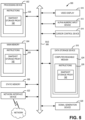
- FIG. 5 depicts an example computer system 500 which can perform any one or more of the methods described herein.
- computer system 500 may correspond to computer system 100 of FIG. 1 .
- the computer system may be connected (e.g., networked) to other computer systems in a LAN, an intranet, an extranet, or the Internet.
- the computer system may operate in the capacity of a server in a client-server network environment.
- the computer system may be a personal computer (PC), a set-top box (STB), a server, a network router, switch or bridge, or any device capable of executing a set of instructions (sequential or otherwise) that specify actions to be taken by that device.
- PC personal computer
- STB set-top box
- server a server
- network router switch or bridge
- the exemplary computer system 500 includes a processing device 502 , a main memory 504 (e.g., read-only memory (ROM), flash memory, dynamic random access memory (DRAM) such as synchronous DRAM (SDRAM)), a static memory 506 (e.g., flash memory, static random access memory (SRAM)), and a data storage device 516 , which communicate with each other via a bus 508 .
- main memory 504 e.g., read-only memory (ROM), flash memory, dynamic random access memory (DRAM) such as synchronous DRAM (SDRAM)
- DRAM dynamic random access memory
- SDRAM synchronous DRAM
- static memory 506 e.g., flash memory, static random access memory (SRAM)
- SRAM static random access memory
- Processing device 502 represents one or more general-purpose processing devices such as a microprocessor, central processing unit, or the like. More particularly, the processing device 502 may be a complex instruction set computing (CISC) microprocessor, reduced instruction set computing (RISC) microprocessor, very long instruction word (VLIW) microprocessor, or a processor implementing other instruction sets or processors implementing a combination of instruction sets.
- the processing device 502 may also be one or more special-purpose processing devices such as an application specific integrated circuit (ASIC), a field programmable gate array (FPGA), a digital signal processor (DSP), network processor, or the like.
- the processing device 502 is configured to execute processing logic (e.g., instructions 526 ) that includes snapshot storage proxy 142 for performing the operations and steps discussed herein (e.g., corresponding to the method of FIGS. 4 A- 4 B , etc.).
- the computer system 500 may further include a network interface device 522 .
- the computer system 500 also may include a video display unit 510 (e.g., a liquid crystal display (LCD) or a cathode ray tube (CRT)), an alphanumeric input device 512 (e.g., a keyboard), a cursor control device 514 (e.g., a mouse), and a signal generation device 520 (e.g., a speaker).
- a video display unit 510 e.g., a liquid crystal display (LCD) or a cathode ray tube (CRT)
- an alphanumeric input device 512 e.g., a keyboard
- a cursor control device 514 e.g., a mouse
- a signal generation device 520 e.g., a speaker
- the video display unit 510 , the alphanumeric input device 512 , and the cursor control device 514 may be combined into a single component or device (e.
- the data storage device 516 may include a non-transitory computer-readable medium 524 on which may store instructions 526 that include snapshot storage proxy 142 (e.g., corresponding to the method of FIGS. 4 A- 4 B , etc.) embodying any one or more of the methodologies or functions described herein. Snapshot storage proxy 142 may also reside, completely or at least partially, within the main memory 504 and/or within the processing device 502 during execution thereof by the computer system 500 , the main memory 504 and the processing device 502 also constituting computer-readable media. Snapshot storage proxy 142 may further be transmitted or received over a network via the network interface device 522 .
- snapshot storage proxy 142 e.g., corresponding to the method of FIGS. 4 A- 4 B , etc.
- While the computer-readable storage medium 524 is shown in the illustrative examples to be a single medium, the term “computer-readable storage medium” should be taken to include a single medium or multiple media (e.g., a centralized or distributed database, and/or associated caches and servers) that store the one or more sets of instructions.
- the term “computer-readable storage medium” shall also be taken to include any medium that is capable of storing, encoding or carrying a set of instructions for execution by the machine and that cause the machine to perform any one or more of the methodologies of the present disclosure.
- the term “computer-readable storage medium” shall accordingly be taken to include, but not be limited to, solid-state memories, optical media, and magnetic media.
- the present disclosure also relates to an apparatus for performing the operations herein.
- This apparatus may be specially constructed for the specific purposes, or it may comprise a general purpose computer selectively activated or reconfigured by a computer program stored in the computer.
- a computer program may be stored in a computer readable storage medium, such as, but not limited to, any type of disk including floppy disks, optical disks, CD-ROMs, and magnetic-optical disks, read-only memories (ROMs), random access memories (RAMs), EPROMs, EEPROMs, magnetic or optical cards, or any type of media suitable for storing electronic instructions, each coupled to a computer system bus.
- a machine-readable medium includes any mechanism for storing or transmitting information in a form readable by a machine (e.g., a computer).
- a machine-readable (e.g., computer-readable) medium includes a machine (e.g., a computer) readable storage medium (e.g., read only memory (“ROM”), random access memory (“RAM”), magnetic disk storage media, optical storage media, flash memory devices, etc.).
- example or “exemplary” are used herein to mean serving as an example, instance, or illustration. Any aspect or design described herein as “example” or “exemplary” is not to be construed as preferred or advantageous over other aspects or designs. Rather, use of the words “example” or “exemplary” is intended to present concepts in a concrete fashion.
- the term “or” is intended to mean an inclusive “or” rather than an exclusive “or”. That is, unless specified otherwise, or clear from context, “X includes A or B” is intended to mean any of the natural inclusive permutations. That is, if X includes A; X includes B; or X includes both A and B, then “X includes A or B” is satisfied under any of the foregoing instances.
Landscapes
- Engineering & Computer Science (AREA)
- Theoretical Computer Science (AREA)
- Data Mining & Analysis (AREA)
- Databases & Information Systems (AREA)
- Physics & Mathematics (AREA)
- General Engineering & Computer Science (AREA)
- General Physics & Mathematics (AREA)
- Information Retrieval, Db Structures And Fs Structures Therefor (AREA)
Abstract
Description
Claims (17)
Priority Applications (1)
| Application Number | Priority Date | Filing Date | Title |
|---|---|---|---|
| US17/511,481 US12079178B2 (en) | 2021-10-26 | 2021-10-26 | Snapshot volume proxy for object storage interfaces |
Applications Claiming Priority (1)
| Application Number | Priority Date | Filing Date | Title |
|---|---|---|---|
| US17/511,481 US12079178B2 (en) | 2021-10-26 | 2021-10-26 | Snapshot volume proxy for object storage interfaces |
Publications (2)
| Publication Number | Publication Date |
|---|---|
| US20230127847A1 US20230127847A1 (en) | 2023-04-27 |
| US12079178B2 true US12079178B2 (en) | 2024-09-03 |
Family
ID=86056609
Family Applications (1)
| Application Number | Title | Priority Date | Filing Date |
|---|---|---|---|
| US17/511,481 Active 2042-10-07 US12079178B2 (en) | 2021-10-26 | 2021-10-26 | Snapshot volume proxy for object storage interfaces |
Country Status (1)
| Country | Link |
|---|---|
| US (1) | US12079178B2 (en) |
Families Citing this family (7)
| Publication number | Priority date | Publication date | Assignee | Title |
|---|---|---|---|---|
| US12174789B2 (en) | 2020-11-04 | 2024-12-24 | Netapp, Inc. | Sibling object generation for storing results of operations performed upon base objects |
| US12169483B2 (en) | 2020-11-04 | 2024-12-17 | Netapp, Inc. | On-demand parallel processing of objects using data connector components |
| US11625306B2 (en) | 2020-11-04 | 2023-04-11 | Netapp, Inc. | Data connector component for implementing data requests |
| US12164381B2 (en) | 2020-11-04 | 2024-12-10 | Netapp, Inc. | Data connector component for implementing management requests |
| US11755590B2 (en) | 2020-11-04 | 2023-09-12 | Netapp, Inc. | Data connector component for implementing integrity checking, anomaly detection, and file system metadata analysis |
| US12182067B2 (en) | 2020-11-04 | 2024-12-31 | Netapp, Inc. | Containerization and serverless thread implementation for processing objects |
| CN118606130A (en) * | 2023-03-06 | 2024-09-06 | 戴尔产品有限公司 | Method, electronic device and computer program product for monitoring storage resource objects |
Citations (7)
| Publication number | Priority date | Publication date | Assignee | Title |
|---|---|---|---|---|
| US20050066037A1 (en) * | 2002-04-10 | 2005-03-24 | Yu Song | Browser session mobility system for multi-platform applications |
| US8006054B2 (en) | 2008-01-29 | 2011-08-23 | Hitachi, Ltd. | Storage system and snapshot configuration migration method |
| US9235356B2 (en) | 2010-08-31 | 2016-01-12 | Bruce R. Backa | System and method for in-place data migration |
| CN106027620A (en) | 2016-05-11 | 2016-10-12 | 国网江苏省电力公司 | Data migration system based on cloud computing |
| CN111459415A (en) | 2020-04-15 | 2020-07-28 | 腾讯科技(深圳)有限公司 | Cross-cloud data migration method, device, equipment and storage medium |
| CN111611048A (en) | 2020-04-08 | 2020-09-01 | 曙光信息产业(北京)有限公司 | Migration method, device and computer equipment for virtual machine in cloud computing environment |
| US10802862B2 (en) | 2018-05-01 | 2020-10-13 | Vmware, Inc. | Live migration of virtual machines across heterogeneous virtual machine management domains |
-
2021
- 2021-10-26 US US17/511,481 patent/US12079178B2/en active Active
Patent Citations (7)
| Publication number | Priority date | Publication date | Assignee | Title |
|---|---|---|---|---|
| US20050066037A1 (en) * | 2002-04-10 | 2005-03-24 | Yu Song | Browser session mobility system for multi-platform applications |
| US8006054B2 (en) | 2008-01-29 | 2011-08-23 | Hitachi, Ltd. | Storage system and snapshot configuration migration method |
| US9235356B2 (en) | 2010-08-31 | 2016-01-12 | Bruce R. Backa | System and method for in-place data migration |
| CN106027620A (en) | 2016-05-11 | 2016-10-12 | 国网江苏省电力公司 | Data migration system based on cloud computing |
| US10802862B2 (en) | 2018-05-01 | 2020-10-13 | Vmware, Inc. | Live migration of virtual machines across heterogeneous virtual machine management domains |
| CN111611048A (en) | 2020-04-08 | 2020-09-01 | 曙光信息产业(北京)有限公司 | Migration method, device and computer equipment for virtual machine in cloud computing environment |
| CN111459415A (en) | 2020-04-15 | 2020-07-28 | 腾讯科技(深圳)有限公司 | Cross-cloud data migration method, device, equipment and storage medium |
Non-Patent Citations (2)
| Title |
|---|
| Svard et al., "Evaluation of Delta Compression Techniques for Efficient Live Migration of Large Virtual Machines," Mar. 9-11, 2011, 10 pgs. |
| Zhang et al., "LayerMover: Storage Migration of Virtual Machine across Data Centers Based on Three-layer Image Structure," 2016, 6 pgs. |
Also Published As
| Publication number | Publication date |
|---|---|
| US20230127847A1 (en) | 2023-04-27 |
Similar Documents
| Publication | Publication Date | Title |
|---|---|---|
| US12079178B2 (en) | Snapshot volume proxy for object storage interfaces | |
| US20250055905A1 (en) | Architecture for managing i/o and storage for a virtualization environment using executable containers and virtual machines | |
| US20230244516A1 (en) | Dynamic image composition for container deployment | |
| US8627310B2 (en) | Capturing multi-disk virtual machine images automatically | |
| US9582319B2 (en) | Migrating virtual machines across network separated data centers | |
| US10379845B2 (en) | Source to image transformation pipeline for a platform-as-a-service system | |
| US10990369B2 (en) | Repurposing serverless application copies | |
| US10013491B2 (en) | Methods and systems of workload mobility across divergent platforms | |
| US10521447B2 (en) | Container application execution using image metadata | |
| US10445121B2 (en) | Building virtual machine disk images for different cloud configurations from a single generic virtual machine disk image | |
| US9229759B2 (en) | Virtual machine provisioning using replicated containers | |
| US8769531B2 (en) | Optimizing the configuration of virtual machine instances in a networked computing environment | |
| US9134962B1 (en) | Interactive content development | |
| US20130227563A1 (en) | Mechanism for Creating and Maintaining Multi-Tenant Applications in a Platform-as-a-Service (PaaS) Environment of a Cloud Computing System | |
| US10891569B1 (en) | Dynamic task discovery for workflow tasks | |
| US20130262923A1 (en) | Efficient application management in a cloud with failures | |
| US20150058461A1 (en) | Image management in cloud environments | |
| US9094473B2 (en) | Installation of an asset from a cloud marketplace to a cloud server in a private network | |
| CN114443215A (en) | Business application deployment method, apparatus, computer equipment and storage medium | |
| CN112199567A (en) | Distributed data acquisition method, system, server and storage medium | |
| US11537523B2 (en) | Command result caching for building application container images | |
| US20240112062A1 (en) | Quantum circuit service | |
| CN115525396A (en) | Application management method and device based on cloud protogenesis | |
| US9934019B1 (en) | Application function conversion to a service | |
| US11494184B1 (en) | Creation of transportability container files for serverless applications |
Legal Events
| Date | Code | Title | Description |
|---|---|---|---|
| AS | Assignment |
Owner name: RED HAT, INC., NORTH CAROLINA Free format text: ASSIGNMENT OF ASSIGNORS INTEREST;ASSIGNOR:KAUL, YANIV;REEL/FRAME:057921/0622 Effective date: 20211026 |
|
| FEPP | Fee payment procedure |
Free format text: ENTITY STATUS SET TO UNDISCOUNTED (ORIGINAL EVENT CODE: BIG.); ENTITY STATUS OF PATENT OWNER: LARGE ENTITY |
|
| STPP | Information on status: patent application and granting procedure in general |
Free format text: DOCKETED NEW CASE - READY FOR EXAMINATION |
|
| STPP | Information on status: patent application and granting procedure in general |
Free format text: NON FINAL ACTION MAILED |
|
| STPP | Information on status: patent application and granting procedure in general |
Free format text: RESPONSE TO NON-FINAL OFFICE ACTION ENTERED AND FORWARDED TO EXAMINER |
|
| STPP | Information on status: patent application and granting procedure in general |
Free format text: NOTICE OF ALLOWANCE MAILED -- APPLICATION RECEIVED IN OFFICE OF PUBLICATIONS |
|
| STPP | Information on status: patent application and granting procedure in general |
Free format text: NOTICE OF ALLOWANCE MAILED -- APPLICATION RECEIVED IN OFFICE OF PUBLICATIONS |
|
| STPP | Information on status: patent application and granting procedure in general |
Free format text: PUBLICATIONS -- ISSUE FEE PAYMENT RECEIVED |
|
| STPP | Information on status: patent application and granting procedure in general |
Free format text: PUBLICATIONS -- ISSUE FEE PAYMENT VERIFIED |
|
| STCF | Information on status: patent grant |
Free format text: PATENTED CASE |