US12078583B2 - Methods for classifying petroleum coke - Google Patents
Methods for classifying petroleum coke Download PDFInfo
- Publication number
- US12078583B2 US12078583B2 US17/055,072 US201917055072A US12078583B2 US 12078583 B2 US12078583 B2 US 12078583B2 US 201917055072 A US201917055072 A US 201917055072A US 12078583 B2 US12078583 B2 US 12078583B2
- Authority
- US
- United States
- Prior art keywords
- coke
- sample
- relaxation
- nmr
- materials
- Prior art date
- Legal status (The legal status is an assumption and is not a legal conclusion. Google has not performed a legal analysis and makes no representation as to the accuracy of the status listed.)
- Active
Links
Images




Classifications
-
- G—PHYSICS
- G01—MEASURING; TESTING
- G01N—INVESTIGATING OR ANALYSING MATERIALS BY DETERMINING THEIR CHEMICAL OR PHYSICAL PROPERTIES
- G01N1/00—Sampling; Preparing specimens for investigation
- G01N1/28—Preparing specimens for investigation including physical details of (bio-)chemical methods covered elsewhere, e.g. G01N33/50, C12Q
-
- G—PHYSICS
- G01—MEASURING; TESTING
- G01N—INVESTIGATING OR ANALYSING MATERIALS BY DETERMINING THEIR CHEMICAL OR PHYSICAL PROPERTIES
- G01N15/00—Investigating characteristics of particles; Investigating permeability, pore-volume or surface-area of porous materials
- G01N15/08—Investigating permeability, pore-volume, or surface area of porous materials
- G01N15/088—Investigating volume, surface area, size or distribution of pores; Porosimetry
-
- G—PHYSICS
- G01—MEASURING; TESTING
- G01N—INVESTIGATING OR ANALYSING MATERIALS BY DETERMINING THEIR CHEMICAL OR PHYSICAL PROPERTIES
- G01N24/00—Investigating or analyzing materials by the use of nuclear magnetic resonance, electron paramagnetic resonance or other spin effects
- G01N24/08—Investigating or analyzing materials by the use of nuclear magnetic resonance, electron paramagnetic resonance or other spin effects by using nuclear magnetic resonance
-
- G—PHYSICS
- G01—MEASURING; TESTING
- G01R—MEASURING ELECTRIC VARIABLES; MEASURING MAGNETIC VARIABLES
- G01R33/00—Arrangements or instruments for measuring magnetic variables
- G01R33/20—Arrangements or instruments for measuring magnetic variables involving magnetic resonance
- G01R33/44—Arrangements or instruments for measuring magnetic variables involving magnetic resonance using nuclear magnetic resonance [NMR]
- G01R33/448—Relaxometry, i.e. quantification of relaxation times or spin density
-
- C—CHEMISTRY; METALLURGY
- C10—PETROLEUM, GAS OR COKE INDUSTRIES; TECHNICAL GASES CONTAINING CARBON MONOXIDE; FUELS; LUBRICANTS; PEAT
- C10B—DESTRUCTIVE DISTILLATION OF CARBONACEOUS MATERIALS FOR PRODUCTION OF GAS, COKE, TAR, OR SIMILAR MATERIALS
- C10B55/00—Coking mineral oils, bitumen, tar, and the like or mixtures thereof with solid carbonaceous material
Definitions
- This disclosure relates to the general subject of classification of petroleum coke.
- Delayed coking is a thermal cracking process used in petroleum refineries to upgrade and convert high-boiling-range hydrocarbon residues into liquid and gas product streams, leaving behind solid carbonaceous material in the process' coke drums.
- the solid coke material may have several different types of morphologies, depending upon the specific feedstock and coking conditions.
- Virgin petroleum residues bottoms from atmospheric and vacuum distillation of crude oil
- can produce cokes which can be classified as “sponge coke” see for example P. Ellis, C. Paul, “Tutorial: Delayed Coking Fundamentals,” AlChE 1998 Spring Meeting, New La, La., Mar. 8-12, 1998, Paper 29a
- shot coke see for example H. Marsh, C. Calvert, J. Bacha, “Structure and Formation of Shot Coke-a Microscopic Study,” J. of Materials Science 20 (1985) 289-302
- transition coke see for example M. Siskin, S. Kelemen, C.
- the physical structures and chemical properties of the petroleum coke determine the end use of the coke which can be burned as fuel, calcined for use in the aluminum, chemical, or steel industries, or gasified to produce steam, electricity, or gas feedstocks for the petrochemicals industry.
- test methods for determining identity of petroleum coke that are both accurate and do not involve long testing durations.
- One aspect of the instant disclosure relates to a method of using hydrogen NMR measurements of a coke sample to measure the amount of hydrogen present in the sample.
- This measurement is a measurement of moisture content in the sample.
- the moisture is usually in the form of water but can be another NMR active fluid present in the pores and/or interstitial regions of the coke sample. Measurements of the moisture content are used to identify the coke sample for classification purposes.
- Another aspect of the instant disclosure relates to a method of saturating a coke sample with a NMR active fluid (such as water) and examining the sample using NMR.
- a NMR active fluid such as water
- the internal microstructures of different types of coke show different NMR measurement results.
- the coke sample is classified based on the NMR results.
- Another aspect of the instant disclosure relates to a method wherein a coke sample is saturated with a NMR active fluid and then scanned in a NMR apparatus. The results of the scan are then used to determine the amount of various types of coke present in the sample as a percentage of the total amount of coke in the sample.
- Another aspect of the instant disclosure relates to a method for quantitatively and rapidly determining physical morphologies of petroleum coke, including sponge, shot and dense-cokes, by infusing and saturating a representative coke sample with a NMR active fluid such as water, measuring the log mean T 2 log with a low field NMR instrument, and assigning the coke sample a morphology based on the measured log mean T 2 .
- the sample may include more than one type of petroleum coke.
- Another aspect of the instant disclosure relates to a method of determining the identity of a petroleum coke sample including obtaining a nuclear magnetic resonance (NMR) measurement of the sample, determining a relaxation decay value of a fluid in the sample from the NMR measurement, comparing the relaxation decay value to relaxation decay values of known petroleum coke materials in a reference group to determine whether the petroleum coke is one of the known materials.
- NMR nuclear magnetic resonance
- FIG. 1 illustrates a conventional NMR pulse diagram of a Carr-Purcell-Meilboom-Gill (CPMG) sequence usable in methods of the present disclosure, where RF represents radio frequency for a pulse, ACQ represents acquired in an acquired signal, 180 represents a 180° pulse and 90 represents a 90° pulse;
- CPMG Carr-Purcell-Meilboom-Gill
- FIG. 2 illustrates a conventional NMR pulse diagram of an Inversion Recovery (IR) sequence usable in methods of the present disclosure, where TE represents echo time, RF represents radio frequency in a radio frequency pulse, ACQ represents acquired in an acquired signal, 180 represents a 180° pulse and 90 represents a 90° pulse;
- IR Inversion Recovery
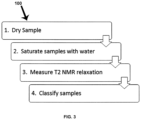
- FIG. 3 is a flowchart depicting an example method for classifying coke
- FIG. 4 a is a graph illustrating the T 2 relaxation distribution for a first Type A coke sample
- FIG. 4 b is a graph illustrating the T 2 relaxation distribution for a second Type A coke sample
- FIG. 4 c is a graph illustrating the T 2 relaxation distribution for a first Type C coke sample
- FIG. 4 d is a graph illustrating the T 2 relaxation distribution for a second Type C coke sample
- FIG. 4 e is a graph illustrating the T 2 relaxation distribution for a first Type D coke sample
- FIG. 4 f is a graph illustrating the T 2 relaxation distribution for a second Type D coke sample.
- FIG. 5 is a plot of porosity versus the T 2 log mean of coke samples.
- the present invention in one embodiment relates to a method of using NMR to investigate different internal structures (pore and interstitial regions) of different types of coke.
- the internal structures of a coke sample are filled with water (or other NMR active fluid) and the relaxation decay of the fluid is measured using NMR.
- the relaxation decay is directly affected by the internal structure of the coke sample.
- the relaxation parameter used can be a T 1 or T 2 relaxation decay.
- the relaxation parameters T 1 and T 2 can be measured using a conventional NMR measurement pulse sequence. In certain embodiments, parameters of the sequence are selected to measure the range of T 1 or T 2 expected.
- the raw data is analyzed by fitting a sum of exponential as described by equation (1):
- T 2 (i) is the list of T 2 values that are chosen to be fitted to; t is the time (for example, increments of 2*TAU can be used); A(i) is the amplitude or amount of signal at the T 2 (i) value; i is the current T 2 value to fit to (for example, ⁇ 100 T 2 values log spaced between 0.01 ms and 10 sec can be used); and S(t) is the signal as a function of time.
- the alpha or smoothing factor, ⁇ can be determine by a variety of methods (Butler 1981).
- a conventional inversion recovery sequence such as depicted in FIG. 1 , is used to measure the T 1 relaxation decay.
- the inversion recovery sequence is repeated at different recovery times (TI) and the detected signal recovers with the relaxation constant of T 1 .
- a conventional Carr-Purcell-Meilboom-Gill (CPMG) NMR pulse sequence such as depicted in FIG. 2 , can be used to measure T 2 .
- the T 2 relaxation decay parameter is the decay of the acquired echoes (marked with x's) over time.
- step 1 a coke sample is dried to remove fluid present in the sample.
- step 2 the coke sample is saturated with water by placing the sample under vacuum, introducing water to wet pores and interstitial regions of the sample and then releasing the vacuum. The vacuum created inside the sample facilitates the water to enter the pores and interstitial regions of the sample. It will be understood by those skilled in the art that other suitable sample wetting techniques can be used.
- step 3 the T 2 relaxation decay of the sample is measured using a conventional NMR apparatus (not shown) programmed to apply a CPMG pulse sequence to samples.
- step 4 the T 2 relaxation decay measurement is analyzed to obtain a T 2 relaxation decay parameter value.
- the T 2 relaxation decay parameter value is compared to known classification parameter values for coke types in a reference group of coke types to determine whether a known coke type is present in the sample tested.
- results of the identification can be outputted.
- the “ . . . ” in the above equation is included to indicate that this type*weighting can be extended to the various types of coke which are to be classified.
- the computing environment can be integrated with the NMR apparatus of step 3 or can be separate.
- FIG. 4 are graphs illustrating T 2 relaxation distributions for two samples of three different types of coke tested in this example. Differences in the porosity and the average T 2 value were observed for the different types of Coke samples. Table 1 lists the peak T 2 relaxation time, the average T 2 relaxation time (log mean), the maximum T 2 value, the NMR porosity, and the NMR porosity of the dry samples. The peak time is the T 2 time with the maximum intensity. The log mean is the T 2 time that divides the distribution into two equal areas (like an average). The NMR porosity is the total area under the distribution which is the total porosity of the water occupied pores (which at 100% saturation is all of them).
- FIG. 5 is a plot comparison and differentiation of petroleum coke samples based on porosity versus T 2 log mean. Groupings for each coke type identified are shown.
- Type A which was primarily sponge Coke
- Type C which was primarily shot Coke
- Type D which was primarily a denser Coke that is not that common.
- coke samples are classified by using a “cut-off” method which uses the T 2 log mean value.
- a sample is classified based on the range of T 2 log mean values that are measured.
- the T 2 log mean value range for each type of coke can be predetermined. For example, if the measured T 2 log mean is between 800 ms and 1500 ms, it is indicative of Type D coke.
- the above described “cut-off” method could use a T 1 log mean value instead of the T 2 log mean value.
- a second NMR parameter may be used in addition to a relaxation decay parameter.
- the second NMR parameter may be porosity.
- the T 2 response of known classifications is measured and the sum each T 2 distribution with weightings is used to obtain the measured result on the unknown coke samples. This allows for a percentage of each classification (i.e. 50% Type A, 20% Type C and 30% type D).
- a series petroleum coke samples with masses ranging from approximately 15 to 25 grams were vacuum saturated with 2% w/w KCl in water solution for a minimum of about 2 hours at ambient temperature. The samples were drained of free water and blotted with a paper towel to remove excess moisture. A given sample was loaded into a 40 mm diameter NMR tube and NMR measurements were performed at ambient temperature using an Oxford Instruments Geo Spec 2 NMR spectrometer operating at 2.36 MHz. The NMR measurements consisting of T 2 and T 1 -T 2 spectra (bulk measurement) were performed with scan times ranging from 5 minutes to 5 hours depending upon the sample coke morphology and type of NMR measurement.
Landscapes
- Physics & Mathematics (AREA)
- General Physics & Mathematics (AREA)
- Chemical & Material Sciences (AREA)
- High Energy & Nuclear Physics (AREA)
- Pathology (AREA)
- Analytical Chemistry (AREA)
- Biochemistry (AREA)
- Health & Medical Sciences (AREA)
- General Health & Medical Sciences (AREA)
- Immunology (AREA)
- Life Sciences & Earth Sciences (AREA)
- Dispersion Chemistry (AREA)
- Condensed Matter Physics & Semiconductors (AREA)
- Other Investigation Or Analysis Of Materials By Electrical Means (AREA)
- Coke Industry (AREA)
- Investigating Or Analyzing Materials By The Use Of Magnetic Means (AREA)
- Investigating Or Analyzing Materials By The Use Of Electric Means (AREA)
Abstract
Description
where T2 (i) is the list of T2 values that are chosen to be fitted to; t is the time (for example, increments of 2*TAU can be used); A(i) is the amplitude or amount of signal at the T2 (i) value; i is the current T2 value to fit to (for example, ˜100 T2 values log spaced between 0.01 ms and 10 sec can be used); and S(t) is the signal as a function of time.
where m(t) is the measured signal as a function of time; J is the echo number and the balance of the variables are as per equation (1).
ERROR=measured T 2−(Type A T 2*weight A+Type B T 2*weight B+ . . . )
| TABLE 1 | |||||
| Dry NMR | |||||
| T2 | T2 Log | T2 @ | NMR | Porosity | |
| Sample | Peak | Mean | 99% | Porosity | Contribution |
| Number | (ms) | (ms) | (ms) | (p.u.) | (p.u) |
| Type A I | 2818 | 2424 | 5623 | 15.7 | 0.062 |
| Type A II | 2818 | 2551 | 5623 | 14.9 | 0.077 |
| |
1000 | 279 | 2512 | 8.3 | 0.48 |
| Type C II | 1258 | 362 | 3162 | 9.6 | 0.51 |
| Type D I | 1995 | 1184 | 5012 | 8.0 | 0.095 |
| Type D II | 1995 | 1149 | 5012 | 6.0 | 0.14 |
Claims (15)
ERROR=measured T2−(Type A T2*weight A+Type B T2*weight B+ . . . ).
Priority Applications (1)
| Application Number | Priority Date | Filing Date | Title |
|---|---|---|---|
| US17/055,072 US12078583B2 (en) | 2018-01-19 | 2019-01-17 | Methods for classifying petroleum coke |
Applications Claiming Priority (3)
| Application Number | Priority Date | Filing Date | Title |
|---|---|---|---|
| US201862619412P | 2018-01-19 | 2018-01-19 | |
| US17/055,072 US12078583B2 (en) | 2018-01-19 | 2019-01-17 | Methods for classifying petroleum coke |
| PCT/CA2019/050062 WO2019140525A1 (en) | 2018-01-19 | 2019-01-17 | Methods for classifying petroleum coke |
Publications (2)
| Publication Number | Publication Date |
|---|---|
| US20210223157A1 US20210223157A1 (en) | 2021-07-22 |
| US12078583B2 true US12078583B2 (en) | 2024-09-03 |
Family
ID=67301667
Family Applications (1)
| Application Number | Title | Priority Date | Filing Date |
|---|---|---|---|
| US17/055,072 Active US12078583B2 (en) | 2018-01-19 | 2019-01-17 | Methods for classifying petroleum coke |
Country Status (6)
| Country | Link |
|---|---|
| US (1) | US12078583B2 (en) |
| EP (1) | EP3740750B1 (en) |
| AR (1) | AR114211A1 (en) |
| AU (1) | AU2019210174A1 (en) |
| ES (1) | ES2980190T3 (en) |
| WO (1) | WO2019140525A1 (en) |
Citations (10)
| Publication number | Priority date | Publication date | Assignee | Title |
|---|---|---|---|---|
| US5023551A (en) | 1986-08-27 | 1991-06-11 | Schlumberger-Doll Research | Nuclear magnetic resonance pulse sequences for use with borehole logging tools |
| US6462542B1 (en) | 2000-07-21 | 2002-10-08 | Schlumberger Technology Corporation | Nuclear magnetic resonance measurements and methods of analyzing nuclear magnetic resonance data |
| JP2002294250A (en) * | 2001-03-30 | 2002-10-09 | Nippon Steel Corp | Method for estimating strength of blast furnace coke |
| US20020179493A1 (en) | 1999-08-20 | 2002-12-05 | Environmental & Energy Enterprises, Llc | Production and use of a premium fuel grade petroleum coke |
| US6883702B2 (en) | 2002-03-21 | 2005-04-26 | Schlumberger Technology Corporation | Method and apparatus for NMR measurement of wettability |
| US7034528B2 (en) | 2003-02-27 | 2006-04-25 | Schlumberger Technology Corporation | Methods for formation evaluation based on multi-dimensional representation of nuclear magnetic resonance data |
| US20070068800A1 (en) | 2004-06-22 | 2007-03-29 | Edwards Leslie C | Electrodes useful for molten salt electrolysis of aluminum oxide to aluminum |
| US20140361774A1 (en) * | 2011-12-12 | 2014-12-11 | Nanonord A/S | Method for quantitative determination of sodium in petroleum fuel |
| US9139781B2 (en) * | 2009-07-10 | 2015-09-22 | Exxonmobil Research And Engineering Company | Delayed coking process |
| US20150268323A1 (en) | 2014-03-24 | 2015-09-24 | Schlumberger Technology Corporation | Multi-dimensional nuclear magnetic resonance methods for characterizing fluids |
-
2019
- 2019-01-16 AR ARP190100083A patent/AR114211A1/en active IP Right Grant
- 2019-01-17 US US17/055,072 patent/US12078583B2/en active Active
- 2019-01-17 EP EP19741253.9A patent/EP3740750B1/en active Active
- 2019-01-17 WO PCT/CA2019/050062 patent/WO2019140525A1/en not_active Ceased
- 2019-01-17 AU AU2019210174A patent/AU2019210174A1/en not_active Abandoned
- 2019-01-17 ES ES19741253T patent/ES2980190T3/en active Active
Patent Citations (11)
| Publication number | Priority date | Publication date | Assignee | Title |
|---|---|---|---|---|
| US5023551A (en) | 1986-08-27 | 1991-06-11 | Schlumberger-Doll Research | Nuclear magnetic resonance pulse sequences for use with borehole logging tools |
| US20020179493A1 (en) | 1999-08-20 | 2002-12-05 | Environmental & Energy Enterprises, Llc | Production and use of a premium fuel grade petroleum coke |
| US6462542B1 (en) | 2000-07-21 | 2002-10-08 | Schlumberger Technology Corporation | Nuclear magnetic resonance measurements and methods of analyzing nuclear magnetic resonance data |
| JP2002294250A (en) * | 2001-03-30 | 2002-10-09 | Nippon Steel Corp | Method for estimating strength of blast furnace coke |
| US6883702B2 (en) | 2002-03-21 | 2005-04-26 | Schlumberger Technology Corporation | Method and apparatus for NMR measurement of wettability |
| US7034528B2 (en) | 2003-02-27 | 2006-04-25 | Schlumberger Technology Corporation | Methods for formation evaluation based on multi-dimensional representation of nuclear magnetic resonance data |
| US7388374B2 (en) | 2003-02-27 | 2008-06-17 | Schlumberger Technology Corporation | Interpretation methods for NMR diffusion-T2 maps |
| US20070068800A1 (en) | 2004-06-22 | 2007-03-29 | Edwards Leslie C | Electrodes useful for molten salt electrolysis of aluminum oxide to aluminum |
| US9139781B2 (en) * | 2009-07-10 | 2015-09-22 | Exxonmobil Research And Engineering Company | Delayed coking process |
| US20140361774A1 (en) * | 2011-12-12 | 2014-12-11 | Nanonord A/S | Method for quantitative determination of sodium in petroleum fuel |
| US20150268323A1 (en) | 2014-03-24 | 2015-09-24 | Schlumberger Technology Corporation | Multi-dimensional nuclear magnetic resonance methods for characterizing fluids |
Non-Patent Citations (16)
| Title |
|---|
| Brouwer, Eric et al., Magnetic Resonance Microimaging Studies of Porous Petroleum Coke, Studies in Surface Science and Catalysis 129 2000 Elsevier Science B.V., pp. 509-516. |
| Butler, J.P., Estimating Solutions of First Kind Integral Equations With Nonnegative Constraints and Optimal Smoothing, Siam J. Numer. Anal. vol. 18, No. 3, Jun. 1981. |
| Cheng, H.N., Solid-state NMR and ESR studies of activated carbons produced from pecan shells, Carbon 48 (2010) 2455-2469. |
| Edwards, John: A Review of Applications of NMR Spectroscopy in the Petroleum Industry, Chapter 16 in "Spectroscopic Analysis of Petroleum Products and Lubricants", ASTM International, 2011. |
| Ellis, Paul et al., Tutorial: Delayed Coking Fundamentals, Mar. 9, 1998 Great Lakes Carbon Corporation. |
| International Preliminary Report on Patentability for PCT/CA2019/050062 dated Jul. 21, 2020. |
| John C. Edwards; A Review of Applications of NMR Spectroscopy in the Petroleum Industry; Chapter 16 in "Spectroscopic Analysis of Petroleum Products and Lubricants" © ASTM International; 2011. * |
| Marsh, H. et al., Structure and formation of shot coke—a microscopy study., Journal of Materials Science 20 (1985) 289-302. |
| Michel, D. et al., NMR of Petroleum Cokes I: Relaxation Studies and Quantitative Analysis of Hydrogen by Magnetic Resonance, Carbon, vol. 32, No. 1, pp. 31-40, 1994. |
| Morriss, Chris et al., Core Analysis by Low Field NMR, SCA-9404, Mar. 1, 1997, pp. 43-56. |
| Rodriguez, Joaquin et al., Evaluation of a delayed coking process by 'H and 13C n.m.r. spectroscopy: 1. Material balances, Fuel 1994 vol. 73 No. 12 pp. 1863-1869. |
| Siskin, M., Asphaltene Molecular Structure and Chemical Influences on the Morphology of Coke Produced in Delayed Coking, Energy and Fuels 2006, 20, 1227-1234. |
| Supplementary European Search Report for EP19741253 dated Sep. 22, 2021. |
| Wang, Zongxian et al., Correlation of Temperature-Programmed Oxidation with Microscopy for Quantitative Morphological Characterization of Thermal Cokes Produced from Pilot and Commercial Delayed Cokers, Energy Fuels 2015, 29, 659-665. |
| Yao, Yanbin et al., Petrophysical characterization of coals by low-field nuclear magnetic resonance (NMR), Fuel 89 (2010) 1371-1380. |
| Zhou, Sandong et al., Fractal characterization of pore-fracture in low-rank coals using a low-field NMR relaxation method, Fuel 181 (2016) 218-226. |
Also Published As
| Publication number | Publication date |
|---|---|
| EP3740750A4 (en) | 2021-10-20 |
| ES2980190T3 (en) | 2024-09-30 |
| EP3740750A1 (en) | 2020-11-25 |
| US20210223157A1 (en) | 2021-07-22 |
| AR114211A1 (en) | 2020-08-05 |
| AU2019210174A1 (en) | 2020-09-03 |
| WO2019140525A1 (en) | 2019-07-25 |
| EP3740750B1 (en) | 2024-03-20 |
Similar Documents
| Publication | Publication Date | Title |
|---|---|---|
| Morga et al. | Relationship between coking coal quality and its micro-Raman spectral characteristics | |
| Pejcic et al. | Analysis of carbonaceous materials in shales using mid-infrared spectroscopy | |
| RS58558B1 (en) | Method for predicting the properties of crude oils by the application of neural networks | |
| AU2016298137A1 (en) | NMR in kinetics of hydrocarbon generation | |
| CN105004745B (en) | A method of viscosity of crude is predicted by nuclear magnetic resoance spectrum | |
| Xie et al. | Investigation of physical properties of hydrocarbons in unconventional mudstones using two-dimensional NMR relaxometry | |
| US6477516B1 (en) | System and method for predicting parameter of hydrocarbon with spectroscopy and neural networks | |
| CN115144361A (en) | A method for identifying terahertz characteristic peaks of matter based on the second derivative spectrum | |
| CN113945536A (en) | Method for detecting biomolecules based on terahertz-like frequency comb | |
| Canan et al. | Rapid characterization of crude oil by NMR relaxation using new user-friendly software | |
| Winschel et al. | Correlation of microautoclave and 1H nmr measurements of coal liquefaction solvent quality | |
| CA1142228A (en) | Identification of materials using their complex dielectric response | |
| Barbosa et al. | Relative hydrogen index as a fast method for the simultaneous determination of physicochemical properties of petroleum fractions | |
| US20210223157A1 (en) | Methods for classifying petroleum coke | |
| CN109668856B (en) | Method and apparatus for predicting hydrocarbon group composition of LCO hydrogenation feedstock and product | |
| Garro Linck et al. | Total organic carbon determination by 13C CP/MAS solid-state NMR in unconventional oil/gas source rocks: a case study from the Neuquén and cuyo basins in Argentina | |
| Smirnov et al. | Distribution and interrelation of the main structural-group composition parameters of Western Siberia crude oils according to NMR data | |
| US20190101609A1 (en) | Predicting solids content, boiling point information, and micro carbon residue content of extra heavy oil samples using low-field time-domain nmr | |
| Khasanova et al. | Low-field NMR method for analysis of heavy oils without extraction of asphaltenes | |
| Smirnov et al. | Distribution Patterns of Main Structural-Group Parameters of Crude Oils from Lena–Tunguska Oil-and-Gas Basin According to 13C NMR Data | |
| RU2813455C1 (en) | Method for determining group composition of oil products using nmr relaxometry | |
| CN105738312A (en) | A Method of Using Infrared Spectroscopy to Detect the Coking Tendency of Inferior Heavy Oil Heating | |
| RU2838173C1 (en) | Method of determining quality of coal | |
| RU2796819C1 (en) | Method for determining the group composition of bitumen in rock using low-frequency nmr relaxometry | |
| KR20040046413A (en) | Method with means for analyzing coke property of coal with non-carbonization |
Legal Events
| Date | Code | Title | Description |
|---|---|---|---|
| FEPP | Fee payment procedure |
Free format text: ENTITY STATUS SET TO UNDISCOUNTED (ORIGINAL EVENT CODE: BIG.); ENTITY STATUS OF PATENT OWNER: LARGE ENTITY |
|
| STPP | Information on status: patent application and granting procedure in general |
Free format text: APPLICATION DISPATCHED FROM PREEXAM, NOT YET DOCKETED |
|
| AS | Assignment |
Owner name: GREEN IMAGING TECHNOLOGIES, INC., CANADA Free format text: ASSIGNMENT OF ASSIGNORS INTEREST;ASSIGNORS:GREEN, DERRICK;LI, QIANGYI;EPPIG, CHRISTOPHER P.;SIGNING DATES FROM 20190116 TO 20190225;REEL/FRAME:057034/0352 Owner name: BP CORPORATION NORTH AMERICA INC., TEXAS Free format text: ASSIGNMENT OF ASSIGNORS INTEREST;ASSIGNORS:GREEN, DERRICK;LI, QIANGYI;EPPIG, CHRISTOPHER P.;SIGNING DATES FROM 20190116 TO 20190225;REEL/FRAME:057034/0352 |
|
| STPP | Information on status: patent application and granting procedure in general |
Free format text: DOCKETED NEW CASE - READY FOR EXAMINATION |
|
| STPP | Information on status: patent application and granting procedure in general |
Free format text: NON FINAL ACTION MAILED |
|
| STPP | Information on status: patent application and granting procedure in general |
Free format text: RESPONSE TO NON-FINAL OFFICE ACTION ENTERED AND FORWARDED TO EXAMINER |
|
| STPP | Information on status: patent application and granting procedure in general |
Free format text: NOTICE OF ALLOWANCE MAILED -- APPLICATION RECEIVED IN OFFICE OF PUBLICATIONS |
|
| STCB | Information on status: application discontinuation |
Free format text: ABANDONED -- FAILURE TO PAY ISSUE FEE |
|
| STCB | Information on status: application discontinuation |
Free format text: ABANDONED -- FAILURE TO PAY ISSUE FEE |
|
| STPP | Information on status: patent application and granting procedure in general |
Free format text: DOCKETED NEW CASE - READY FOR EXAMINATION |
|
| STPP | Information on status: patent application and granting procedure in general |
Free format text: NOTICE OF ALLOWANCE MAILED -- APPLICATION RECEIVED IN OFFICE OF PUBLICATIONS |
|
| STPP | Information on status: patent application and granting procedure in general |
Free format text: PUBLICATIONS -- ISSUE FEE PAYMENT VERIFIED |
|
| STCF | Information on status: patent grant |
Free format text: PATENTED CASE |